Physicists think they’ve solved the muon mystery

A new approach

artistic illustration of Supercomputer simulations reveal the effect of the strong nuclear force on the muon's magnetism.

Supercomputer simulations reveal the effect of the strong nuclear force on the muon’s magnetism.

Credit: University of Wuppertal

Supercomputer simulations reveal the effect of the strong nuclear force on the muon’s magnetism. Credit: University of Wuppertal

This latest measurement focuses on strong force effects, specifically the “hadronic vacuum polarization,” which arises as quarks and gluons interact within the framework of quantum chromodynamics (QCD) theory. The authors adopted a hybrid approach, combining powerful large-scale computer simulations with experimental data.

“The old methodology involved collecting thousands of experimental results and reinterpreting them to get the single number, the magnetic moment of the muon,” Fodor said. “Our approach was completely different. We divided space-time into very small cells, a lattice, then we solved the equations of the Standard Model on that. There was an awful lot of theory, mathematics, programming, computational knowledge and computer architecture behind this calculation.”

It took 10 years to make those complicated calculations, but when they were done. Fodor et al. found their results agreed with the Standard Model to within half a standard deviation and down to 11 decimal places. It’s the most precise calculation yet achieved, accurate to parts per billion. While the results do not completely rule out possible new physics like a fifth force, they do further constrain the areas where new physics might be lurking.

“People ask me how it feels to make this discovery and, to be honest, I feel somewhat sad,” said Fodor. “When we started to calculate this quantity, we thought we were going to have a good and trustworthy calculation for a new fifth force. Instead, we found there is no fifth force. We did find a very precise proof of not just the Standard Model but also of quantum field theory, which is the foundation on which the Standard Model was built.”

Nature, 2026. DOI: 10.1038/s41586-026-10449-z (About DOIs).

https://arstechnica.com/science/2026/04/physicists-think-theyve-solved-the-muon-mystery/



Physicists think they’ve solved the muon mystery

A new approach

artistic illustration of Supercomputer simulations reveal the effect of the strong nuclear force on the muon's magnetism.

Supercomputer simulations reveal the effect of the strong nuclear force on the muon’s magnetism.

Credit: University of Wuppertal

Supercomputer simulations reveal the effect of the strong nuclear force on the muon’s magnetism. Credit: University of Wuppertal

This latest measurement focuses on strong force effects, specifically the “hadronic vacuum polarization,” which arises as quarks and gluons interact within the framework of quantum chromodynamics (QCD) theory. The authors adopted a hybrid approach, combining powerful large-scale computer simulations with experimental data.

“The old methodology involved collecting thousands of experimental results and reinterpreting them to get the single number, the magnetic moment of the muon,” Fodor said. “Our approach was completely different. We divided space-time into very small cells, a lattice, then we solved the equations of the Standard Model on that. There was an awful lot of theory, mathematics, programming, computational knowledge and computer architecture behind this calculation.”

It took 10 years to make those complicated calculations, but when they were done. Fodor et al. found their results agreed with the Standard Model to within half a standard deviation and down to 11 decimal places. It’s the most precise calculation yet achieved, accurate to parts per billion. While the results do not completely rule out possible new physics like a fifth force, they do further constrain the areas where new physics might be lurking.

“People ask me how it feels to make this discovery and, to be honest, I feel somewhat sad,” said Fodor. “When we started to calculate this quantity, we thought we were going to have a good and trustworthy calculation for a new fifth force. Instead, we found there is no fifth force. We did find a very precise proof of not just the Standard Model but also of quantum field theory, which is the foundation on which the Standard Model was built.”

Nature, 2026. DOI: 10.1038/s41586-026-10449-z (About DOIs).

https://arstechnica.com/science/2026/04/physicists-think-theyve-solved-the-muon-mystery/


New court ruling blocks many of the government’s anti-renewable policies

Under the newly adopted policies, the Corps of Engineers must weigh the energy produced per acre for any projects under its oversight against the potential impact of alternative uses of the land. The Department of the Interior was ordered to make a similar consideration.

For the purposes of a temporary injunction, that turned out to be enough. Given this justification, Casper said she could not conclude that the suing organizations were likely to win on their claims that the policy was arbitrary and capricious. That determination would have to await a full trial.

But it won’t, because those rules turned out to be illegal for other reasons.

Casper’s ruling notes that the laws governing the use of public lands require agencies to weigh multiple factors, balancing the benefits of different uses versus preservation. The rules instituted at Interior and the Corps of Engineers made a simple energy-density calculation the sole determinant of whether a project could proceed, sidestepping the process set forth in the relevant laws. As such, those policies also merit an injunction.

At least for the parties involved in the suit, none of the hurdles the Trump administration placed on renewable energy will apply. And the groups involved in the suit included many renewable energy developers*. That said, involved agencies could still create informal obstacles without violating the injunction, such as quietly slowing the pace of project approvals. The government can also potentially appeal this injunction.

So while the ruling is good news, it’s not a guarantee that the growth of renewables will continue unhindered over the next several years.

* The full list of plaintiffs: Clean Grid Alliance, Alliance For Clean Energy New York, Renew Northeast, Mid-Atlantic Renewable Energy Coalition Action, Renewable Northwest, Carolinas Clean Energy Business Association, Southern Renewable Energy Association, Interwest Energy Alliance.

https://arstechnica.com/tech-policy/2026/04/new-court-ruling-blocks-many-of-the-governments-anti-renewable-policies/


Pentagon pulls the plug on one of the military’s most troubled space programs

The Pentagon has canceled a ground control system for the US military’s GPS satellite navigation network after the program’s enduring problems “proved insurmountable,” the US Space Force announced in a press release Monday.

The Global Positioning System Next-Generation Operational Control System, known by the acronym OCX, was officially canceled by Michael Duffey, the Pentagon’s defense acquisition executive, on Friday, April 17, the Space Force said.

The decision to terminate the OCX program ends a 16-year, multibillion-dollar effort to design, test, and deliver a command and control system for the military’s constellation of GPS navigation satellites. The program consisted of software to handle new signals from the latest generation of GPS satellites, GPS III, which started launching in 2018, along with two master control stations and modifications to ground monitoring stations around the world.

The Pentagon awarded the OCX contract to Raytheon, now known as RTX Corporation, in 2010, with a timetable for completion in 2016 at a cost of $3.7 billion. Budget projections to finish the program grew to nearly $8 billion, nearly as much as the cost of an entire fleet of some 30 new GPS satellites.

The schedule for OCX extended out a decade longer than anticipated. RTX finally delivered the control system to the Space Force last year, but further tests revealed it was still not ready for GPS operations. Ars reported on the long-running issues with OCX last month.

“We discovered problems”

“Regrettably, extensive system issues arose during the integrated testing of OCX with the broader GPS enterprise,” said Col. Stephen Hobbs, commander of the Space Force’s Mission Delta 31, which operates the GPS constellation. “Despite repeated collaborative approaches by the entire government and contractor team, the challenges of onboarding the system in an operationally relevant timeline proved insurmountable.

“We discovered problems across a broad range of capability areas that would put current GPS military and civilian capabilities at risk,” Hobbs said in a statement.

“RTX is aware of the US Government decision regarding the GPS OCX program,” an RTX spokesperson said in a statement. “Raytheon delivered the system in 2025 and has continued to support the US Space Force in post-delivery activities. We remain committed to supporting our customers and will work closely with the government on the next steps.”

https://arstechnica.com/space/2026/04/pentagon-pulls-the-plug-on-one-of-the-militarys-most-troubled-space-programs/


Meet Bruce, the “beak-jousting” parrot

one bird with half missing beak using it to thrust at another male bird

Bruce “jousting” with another male.

Alex Grabham

bird with half a missing beak running at an opponent bird

Bruce runs and jumps to “joust” with opponents from a distance.

Ximena Nelson

The key to Bruce’s success and overall chill mood? His unique beak-jousting technique, which enabled him to quickly displace his rivals. At close range, Bruce would extend his neck to thrust at opponents, adding a run or jump to the motion when attacking from farther away. Other non-disabled males mostly bit downward onto an opponent’s neck, while Bruce mostly engaged in forward thrusts and targeted the back, head, wings, and legs of his opponents. He kicked at the same rate as other kea but used his half-beak much more frequently.

According to the authors, there are only two other cases in the scientific literature that are comparable to Bruce’s ingenious adaptation. In one case, the late Jane Goodall observed an alpha male chimpanzee named Fabian who lost the use of his arm due to polio; his brother became the new alpha male. Fabian managed to achieve “beta” status via association, and also by developing unusual charging displays. The other case concerned an old Japanese macaque whose ability to walk gradually deteriorated; the macaque maintained his alpha status by allying with the alpha female. But Bruce achieved his alpha status on his own through dominance, not via a useful alliance.

“Bruce shows us that behavioral innovation can help bypass physical disability, at least in species with the cognitive flexibility to develop new solutions,” said co-author Alexander Grabham of Te Whare Wānanga o Waitaha/University of Canterbury in New Zealand. “Previous research has shown links between large brains, behavioral flexibility, and survival at the species level. Bruce demonstrates how those links play out in a single individual across traits that matter day-to-day, such as social dominance. Our findings also raise an important welfare question: if a disabled animal can innovate its way to success, well-intentioned interventions like prosthetics might not always improve their quality of life. Sometimes the animal can do better without help.”

Current Biology, 2026. DOI: 10.1016/j.cub.2026.03.004 (About DOIs).

https://arstechnica.com/science/2026/04/meet-bruce-the-beak-jousting-parrot/


Blue Origin’s rocket reuse achievement marred by upper stage failure

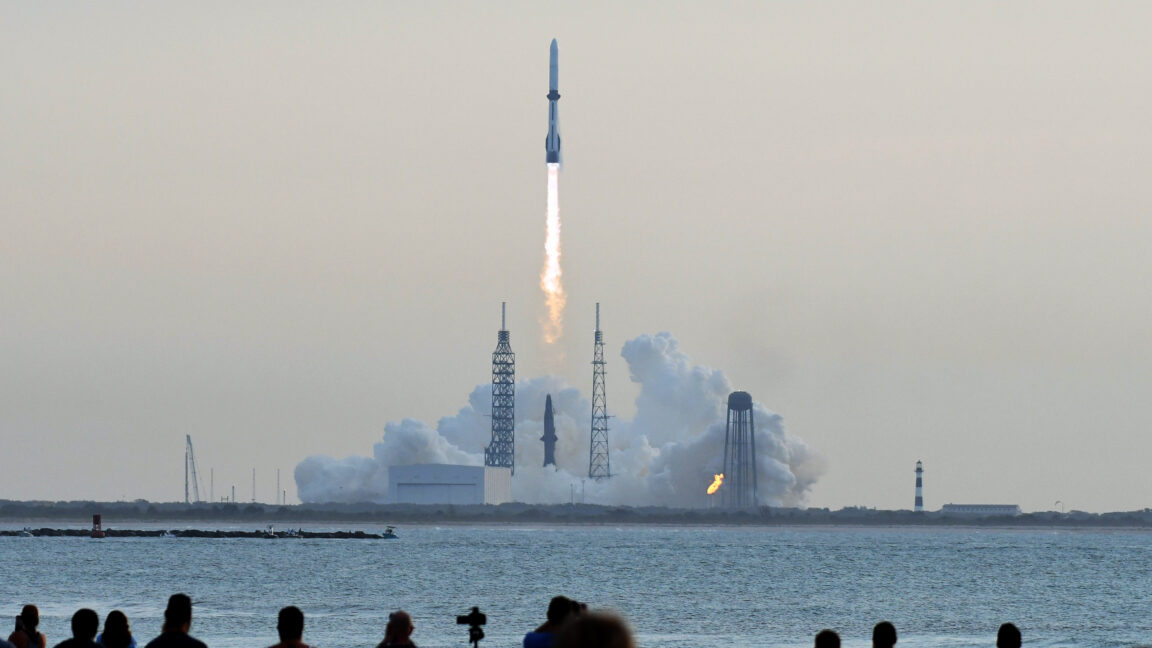
The third flight of Blue Origin’s heavy-lift New Glenn launcher began Sunday with the company’s first successful reflight of an orbital-class booster, but ended with a setback for Jeff Bezos’ flagship rocket, a key element in NASA’s Artemis lunar program.

The 321-foot-tall (98-meter) New Glenn launch vehicle ignited its seven methane-fueled BE-4 engines at 7:25 am EDT (11:25 UTC) Sunday, beginning a slow climb from its launch pad at Cape Canaveral Space Force Station, Florida.

The main engines, each producing more than a half-million pounds of thrust, accelerated the rocket past the speed of sound in about a minute-and-a-half. Three minutes into the flight, the booster switched off its engines and fell away from New Glenn’s upper stage, powered by two BE-3U engines burning liquid hydrogen and liquid oxygen.

New Glenn’s first stage continued a downrange parabolic arc, briefly soaring into space before guiding itself toward Blue Origin’s landing platform in the Atlantic Ocean nearly 400 miles southeast of Cape Canaveral. Reigniting its engines for two braking burns, the booster settled onto the ship for a smoky but on-target touchdown less than 10 minutes after liftoff.

The landing marked the end of the second flight for this booster, named Never Tell Me The Odds, after debuting with a good launch and recovery on Blue Origin’s previous New Glenn mission in November. Blue Origin, founded and owned by Amazon’s Jeff Bezos, has landed and reused its smaller New Shepard suborbital booster numerous times, but New Glenn surpasses New Shepard in difficulty and scale. It flies higher, travels faster, and is three times the height of the New Shepard.

Technicians installed new engines on the booster for Sunday’s flight, but the Blue Origin intends to reuse the engines from the November launch on future New Glenn missions, according to Dave Limp, the company’s CEO.

New Glenn allows Blue Origin to reach into a broader market for launches to low-Earth orbit and beyond. SpaceX has shown it can recycle a Falcon 9 booster for reflight in just nine days, and launch Falcon 9s five or more times in one week using a fleet of reusable boosters and three active launch pads. Blue Origin officials expect reusing New Glenn boosters will unlock a vastly faster launch rate for themselves.

https://arstechnica.com/space/2026/04/errant-upper-stage-spoils-blue-origins-success-in-reusing-new-glenn-booster/


I’ve fired one of America’s most powerful lasers—here’s what a shot day looks like

Back in the control room, I sit down and start charging the capacitor banks. At this point, there’s no going back except for an emergency shutdown, and that means losing the shot and waiting for everything to cool down.

“Charging.”

The room goes silent. Everyone’s eyes are on the monitors. Nobody talks.

I typically will share a glance with the researcher whose project the shot is for – today it’s Joe, a visiting scientist from Los Alamos National Lab, who designed the target we’re about to vaporize. He’s gripping his coffee cup like it owes him money. I turn back to the console.

“Charge complete. Firing system shot in three, two, one. Fire.”

I press the button. A loud thud rolls through the building as all that stored energy dumps into the beam. The monitors freeze, capturing everything at the moment of the shot: beam profiles, spectra, diagnostics—these metrics provide a full picture of exactly how the laser performed and whether the shot was clean. Downstairs, in the vacuum chamber, a spot smaller than a human hair just reached temperatures measured in millions of degrees.

I lean back in my chair and start recording laser parameters as everyone exhales. A radiation safety officer heads down first to check readings around the target chamber before anyone else can enter. The experimental team follows to collect data.

Sometimes it all works perfectly. Sometimes a shutter fails to open and you lose the shot.

For example, one afternoon in 2023, we’d spent three hours preparing for a high-priority shot. Target aligned. Capacitors charged. I pressed the button and heard nothing. A shutter had failed somewhere in the chain. The monitors stayed frozen, showing black. Nobody said anything. I wrote SHOT FAILED in the logbook and started the hourlong cooldown sequence. That’s the part they don’t show in movies: sitting in silence, waiting to try again. We got the shot four hours later.

This anticipation is all part of the job: hours of patience for 10 seconds you never quite get used to. Everything happens underneath a campus where thousands of people walk above, unaware that for a fraction of a second, a tiny point of matter hotter than the surface of the Sun just existed below their feet.

Ahmed Helal, research scientist, The University of Texas at Austin. This article is republished from The Conversation under a Creative Commons license. Read the original article.

https://arstechnica.com/science/2026/04/ive-fired-one-of-americas-most-powerful-lasers-heres-what-a-shot-day-looks-like/


Great white sharks are overheating

This will disrupt ecosystems as mesotherms are typically apex predators that exert disproportionate control on species below them in the food chain, said Edward Snelling, co-author and physiologist at the University of Pretoria.

“These species are being pushed closer to their physiological limits, which could have consequences for where they can live and how they survive,” said Snelling in a press release. “These animals are already operating on a tight energy budget, and climate change is narrowing their options even further.”

Using tiny sensors on a range of fish, including basking sharks weighing over three tons, researchers calculated how much heat fish produce and lose in real time. From this, they calculated that a one-ton warm-bodied shark may struggle to remain in waters above 62.6° Fahrenheit  (17° Celsius) without taking countermeasures. Discovering these “hidden heat budgets” could prove critical to any hope of conserving them or mapping protection areas, researchers said.

In South Africa, the stakes are both ecological and cultural. Here, great whites have emerged as a “sentinel species”: When their patterns change, it signals a deeper shift in the marine ecosystem.

While long sensationalized as feared predators, they’ve increasingly become icons of marine conservation and eco-tourism, said Stephanie Nicolaides, a marine conservation researcher at the University of the Western Cape. “Many local and international conservation narratives now position the great white not as a villain, but as a keystone species essential to maintaining ocean health,” Nicolaides said.

Declines of great white sightings in False Bay, Mossel Bay, and Gansbaai, however, are multifaceted. Though thermal relocation may be a contributor, their population decline is also linked to a history of overfishing, shark netting, and habitat destruction.

Indeed, though warming waters heighten mesotherms’ vulnerability worldwide, other manmade harms exert the most danger. “If we had to say what is the one thing that we need to urgently address for these animals, it’s the fishing problem,” said Payne. “The most acute, urgent crisis these animals face is from overfishing, and particularly now from bycatch.”

Bycatch refers to fish and other marine animals caught unintentionally by fishermen using huge nets or long lines baited with thousands of hooks.

History, however, offers a grim precedent for physiological vulnerability itself. Fossils of extinct warm-bodied species—like the infamous Megalodon shark, which reached almost 60 feet long—suggest they suffered disproportionately during past ocean temperature increases as they likely struggled to secure food to fuel their large, warm bodies.

“Today’s oceans are changing at unprecedented speeds,” Payne said. “The alarm bells are ringing loudly at this point.”

This article originally appeared on Inside Climate News, a nonprofit, non-partisan news organization that covers climate, energy, and the environment. Sign up for their newsletter here.

https://arstechnica.com/science/2026/04/great-white-sharks-are-overheating/


Rocket Report: Starship V3 test-fired; ESA’s tentative step toward crew launch

More swaps coming?… The Vulcan rocket is many months from returning to flight for the US military. One industry source told Ars that the Space Force may not fly another mission on Vulcan before the end of the year. Space Systems Command has moved four launches of new GPS navigation satellites from ULA to SpaceX in the past two years as Vulcan encountered delays. Col. Eric Zarybnisky, head of Space Systems Command’s Space Access office, said the military is “working through a significant number” of potential additional rocket swaps from Vulcan to another launch vehicle, likely SpaceX’s Falcon 9 or Falcon Heavy.

ESA’s first Mars rover finally has a ride. NASA confirmed Thursday that SpaceX will launch the European Space Agency’s Rosalind Franklin Mars rover, perhaps as soon as late 2028, on a Falcon Heavy rocket from Kennedy Space Center, Florida, Ars reports. So why is NASA deciding which rocket will launch a flagship European Mars mission? It’s a long story involving the search for extraterrestrial life, crippling political hatchets, and, of all things, Russia’s invasion of Ukraine. Ars explores the mission’s tortured history, a nearly quarter-century of broken promises, technical setbacks, and geopolitical drama.

Taking aim on Mars… The announcement is also notable because it is the first time SpaceX has won a launch contract for a mission to Mars. The red planet is the apple of Elon Musk’s eye, with utopian concepts for a Mars settlement to go along with SpaceX’s more tangible work on a massive rocket to actually fly there. This new rocket, named Starship, is still a ways away from reaching Mars. Therefore, it’s likely SpaceX’s Falcon Heavy, no slouch itself, will make the company’s first Mars run on behalf of NASA and the European Space Agency.

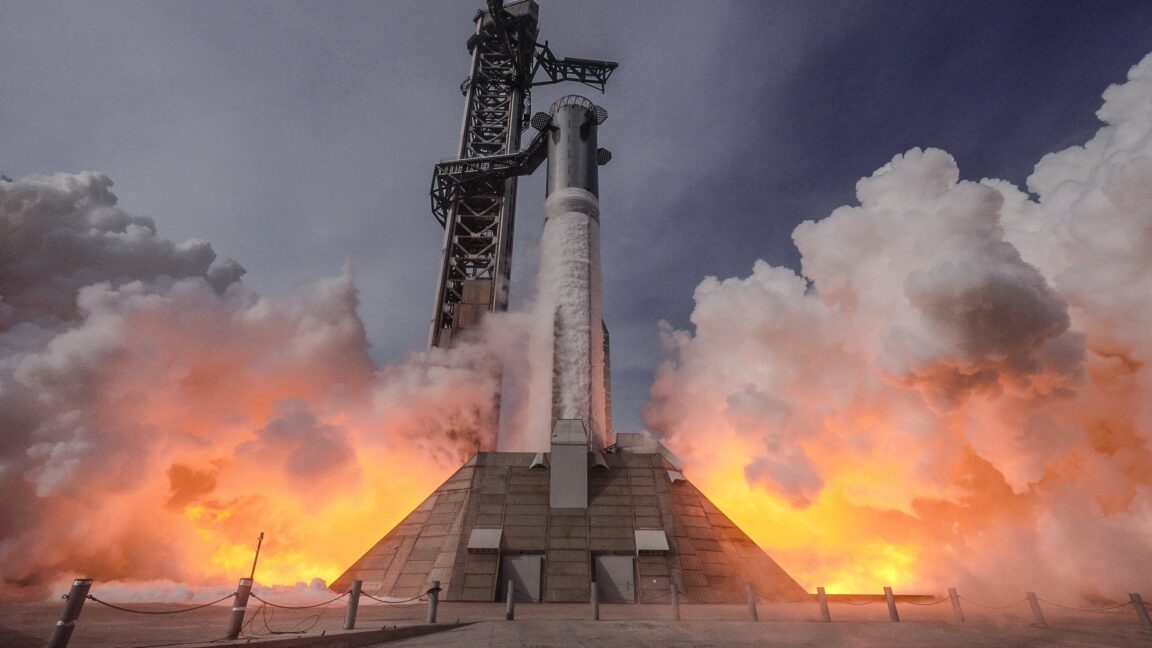
Next-gen Starship tested at Starbase. The new, juiced-up version of SpaceX’s Starship mega-rocket cleared a big hurdle this week on the path to its first launch, Space.com reports. That liftoff, targeted for early or mid-May, will be the 12th overall for Starship but the first for the vehicle’s “Version 3,” which is bigger and more powerful than its predecessors. The first Starship V3 vehicle fired its six Raptor engines on Tuesday while anchored on a test stand in South Texas. The static fire test follows a series of cryogenic proof tests earlier this year.

https://arstechnica.com/space/2026/04/rocket-report-starship-v3-test-fired-esas-tentative-step-toward-crew-launch/


After a saga of broken promises, a European rover finally has a ride to Mars

Instead, the agency turned to Russia to launch the orbiter and rover on two Proton rockets and provide the descent system to deliver the rover to Mars. In exchange, ESA agreed to add Russian science instruments to the orbiter and rover missions. This was a boon for Russian scientific institutions. Without an international partnership like ExoMars, they lacked any realistic prospect of ever sending their own research payloads to the red planet.

Russia successfully launched the European-built ExoMars Trace Gas Orbiter spacecraft on a Proton rocket in 2016. The orbiter is still operating around Mars today, returning scientific data and serving as a communications relay for NASA’s Curiosity and Perseverance rovers. A small European tech demo probe riding piggyback on the orbiter crash landed upon reaching the red planet.

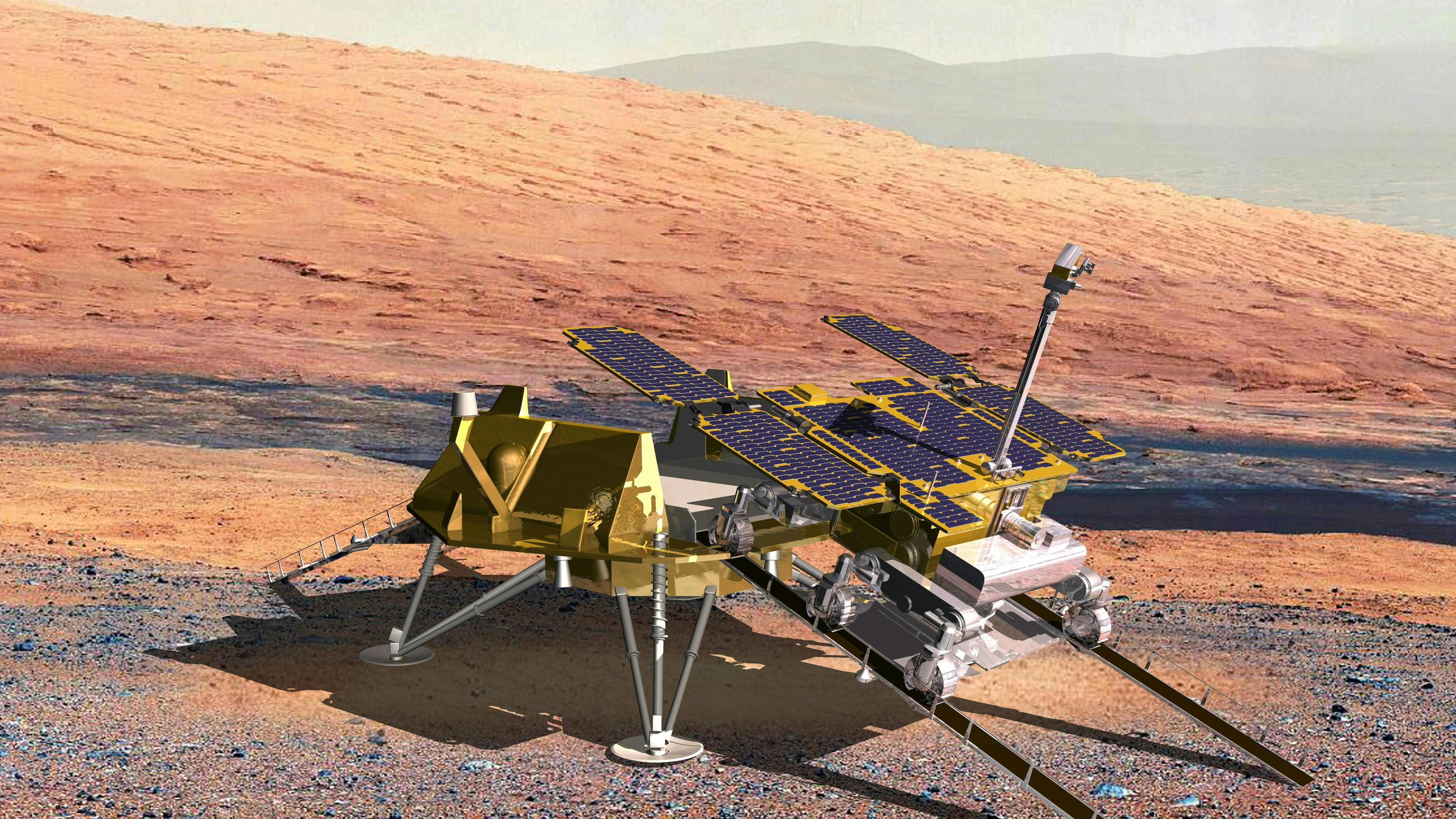
Artist’s illustration of the Rosalind Franklin rover departing its landing platform on Mars.

Credit: Airbus

Artist’s illustration of the Rosalind Franklin rover departing its landing platform on Mars. Credit: Airbus

Additional delays pushed the launch of the ExoMars rover from 2018 until 2020. The rover, by then named for the late British chemist and DNA research pioneer Rosalind Franklin, was nearly ready for launch in 2020 when a series of parachute test failures and the COVID-19 pandemic prompted another delay until late 2022.

Everything changed again when Russian forces invaded Ukraine in February 2022. ESA severed most ties with Russia’s space agency, ending the partnership on ExoMars after all of the mission’s elements, including the Russian rocket and Mars descent stage, were already built and ready for final assembly. ESA also removed two Russian science instruments from the mission.

Once again, the US government stepped in to give the Rosalind Franklin rover a ride to Mars. NASA and ESA formalized the new agreement in 2024, with the US side committing to provide a launch vehicle, the braking engines needed to land, and small nuclear-powered heaters to keep the rover’s sensitive electronics warm during Martian nights. NASA long ago delivered a mass spectrometer for the European rover that will analyze Martian soil to look for markers of organic molecules.

ESA is providing the rover and the carrier spacecraft to ferry it to Mars. Europe is also responsible for the overall assembly of the landing platform and operating the rover on the Martian surface. Airbus built the rover in the United Kingdom and is supplying the main structure for the lander, which will settle onto Mars and deploy ramps for the rover to disembark and begin its mission. German company OHB manufactured the carrier spacecraft, or cruise stage, to shepherd the rover from Earth to Mars. Thales Alenia Space of Italy is in charge of putting all the pieces together and readying the mission for launch.

https://arstechnica.com/space/2026/04/after-a-saga-of-broken-promises-a-european-rover-finally-has-a-ride-to-mars/