Astronomers are filling in the blanks of the Kuiper Belt
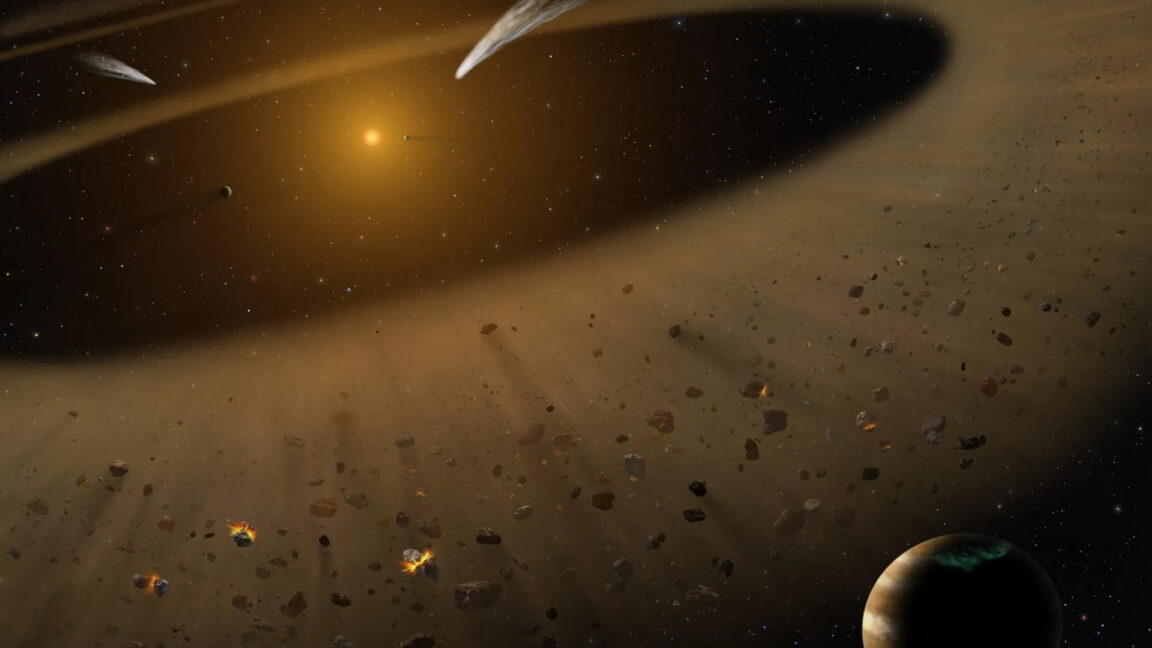
“Imagine a snowplow driving along a highway, and lifting up the plow. It leaves a clump of snow behind,” he adds. “That same sort of idea is what left the clump of cold classicals behind. That is the kernel.”

In other words, Neptune tugged these objects along with it as it migrated outward, but then broke its gravitational hold over them when it “jumped,” leaving them to settle into the Kuiper Belt in the distinctive Neptune-sculpted kernel pattern that remains intact to this day.

Last year, Siraj and his advisers at Princeton set out to look for other hidden structures in the Kuiper Belt with a new algorithm that analyzed 1,650 KBOs—about 10 times as many objects as the 2011 study, led by Jean-Robert Petit, that first identified the kernel.

The results consistently confirmed the presence of the original kernel, while also revealing a possibly new “inner kernel” located at about 43 AU, though more research is needed to confirm this finding, according to the team’s 2025 study.

“You have these two clumps, basically, at 43 and 44 AU,” Siraj explains. “It’s unclear whether they’re part of the same structure,” but “either way, it’s another clue about, perhaps, Neptune’s migration, or some other process that formed these clumps.”

As Rubin and other telescopes discover thousands more KBOs in the coming years, the nature and possible origin of these mysterious structures in the belt may become clearer, potentially opening new windows into the tumultuous origins of our solar system.

In addition to reconstructing the early lives of the known planets, astronomers who study the Kuiper Belt are racing to spot unknown planets. The most famous example is the hypothetical giant world known as Planet Nine or Planet X, first proposed in 2016. Some scientists have suggested that the gravitational influence of this planet, if it exists, might explain strangely clustered orbits within the Kuiper Belt, though this speculative world would be located well beyond the belt, at several hundred AU.

https://arstechnica.com/science/2026/02/astronomers-are-filling-in-the-blanks-of-the-kuiper-belt/
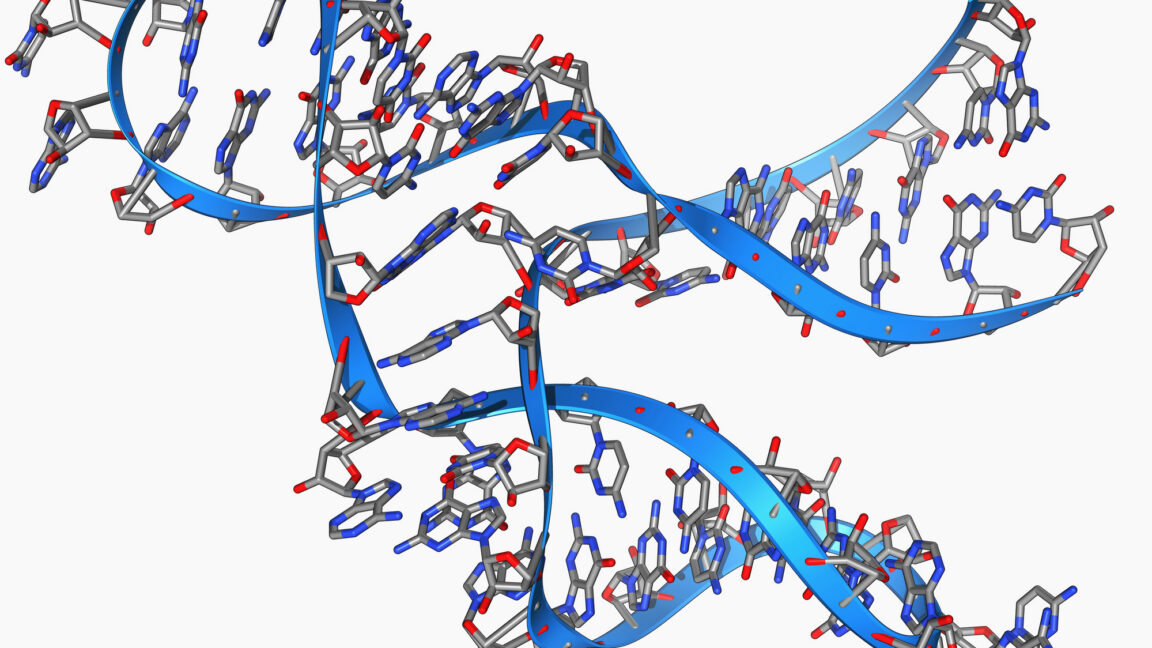


Tiny, 45 base long RNA can make copies of itself

But the key finding was that it could synthesize a sequence that base-pairs with itself, and then synthesize itself by copying that sequence. This was horribly inefficient and took months, but it happened.

Throughout these experiments, the fidelity averaged about 95 percent, meaning that, in copying itself, it would make an average of two to three errors. While this means a fair number of its copies wouldn’t be functional, it also means the raw materials for an evolutionary selection for improved function—random mutations—would be present.

What this means

It’s worth taking a moment to consider the use of three-base RNA fragments by this enzyme. On the surface, this may seem a bit like cheating, since current RNA polymerases add sequence one base at a time. But in reality, any chemical environment that could spontaneously assemble an RNA molecule 45 bases long will produce many fragments shorter than that. So in many ways, this might be a more realistic model of the conditions in which life emerged.

The authors note that these shorter fragments may be essential for QT-45’s activity. The short ribozyme probably doesn’t have the ability to enzymatically pry base-paired strands of RNA apart to copy them. But in a mixture of lots of small fragments, there’s likely to be an equilibrium, with some base-paired sequences spontaneously popping open and temporarily base pairing with a shorter fragment. Working with these base-paired fragments is probably essential to the ribozyme’s overall activity.

Right now, QT-45 isn’t an impressive enzyme. But the researchers point out that it has only been through 18 rounds of selection, which isn’t much. The most efficient ribozyme polymerases we have at present have been worked on by multiple labs for years. I expect QT-45 to receive similar attention and improve significantly over time.

Also notable is that the team came up with three different ligases in a test of just a small subset of the possible total RNA population of this size. If that frequency holds, there are on the order of 1011 ligating ribozymes among the sequences of this size. Which raises the possibility that we could find far more if we do an exhaustive search. That suggests the first self-copying RNA might not be as improbable as it seems at first.

Science, 2026. DOI: 10.1126/science.adt2760  (About DOIs).

https://arstechnica.com/science/2026/02/researchers-find-small-rnas-that-can-make-copies-of-themselves/


When Amazon badly needed a ride, Europe’s Ariane 6 rocket delivered

The Ariane 64 flew with an extended payload shroud to fit all 32 Amazon Leo satellites. Combined, the payload totaled around 20 metric tons, or about 44,000 pounds, according to Arianespace. This is close to maxing out the Ariane 64’s lift capability.

Amazon has booked more than 100 missions across four launch providers to populate the company’s planned fleet of more than 3,200 satellites. With Thursday’s launch, Amazon has launched 214 production satellites on eight missions with United Launch Alliance, SpaceX, and now Arianespace.

The Amazon Leo constellation is a competitor with SpaceX’s Starlink Internet network. SpaceX now has more than 9,000 satellites in orbit beaming broadband to more than 9 million subscribers, and all have launched on the company’s own Falcon 9 rockets. Amazon, meanwhile, initially bypassed SpaceX when selecting which companies would launch satellites for the Amazon Leo program, formerly known as Project Kuiper.

Amazon booked the last nine launches on ULA’s soon-to-retire Atlas V, five of which have now flown, and reserved the rest of its launches in 2022 on rockets that had never launched before: 38 flights on ULA’s new Vulcan rocket, 24 launches on Blue Origin’s New Glenn, and 18 on Europe’s Ariane 6.

An artist’s illustration of the Ariane 6’s upper stage in orbit with a stack of Amazon Leo satellites awaiting deployment.

Credit: Arianespace

An artist’s illustration of the Ariane 6’s upper stage in orbit with a stack of Amazon Leo satellites awaiting deployment. Credit: Arianespace

Meanwhile, in Florida

All three new rockets suffered delays but are now in service. The Ariane 6 has enjoyed the fastest ramp-up in launch cadence, with six flights under its belt after Thursday’s mission from French Guiana. ULA’s Vulcan rocket has flown four times, and Amazon says its first batch of satellites to fly on Vulcan is now complete. But a malfunction with one of the Vulcan launcher’s solid rocket boosters on a military launch from Florida early Thursday—the second such anomaly in three flights—raises questions about when Amazon will get its first ride on Vulcan.

Blue Origin, owned by Amazon founder Jeff Bezos, is gearing up for the third flight of its heavy-lift New Glenn rocket from Florida as soon as next month. Amazon and Blue Origin have not announced when the first group of Amazon Leo satellites will launch on New Glenn.

https://arstechnica.com/space/2026/02/when-amazon-badly-needed-a-ride-europes-ariane-6-rocket-delivered/


SpaceX takes down Dragon crew arm, giving Starship a leg up in Florida

Pad 40 has been the primary Falcon 9 launch site for most of the rocket’s history, while Pad 39A provided a location for crew launches and an augmentation to support SpaceX’s growing launch cadence. But there are signs the Falcon 9 launch cadence, which reached 165 missions last year, may be peaking as the company turns its attention to Starship. And SpaceX has steadily reduced the time it takes to reconfigure Pad 40 between launches, cutting the turnaround time to less than 48 hours.

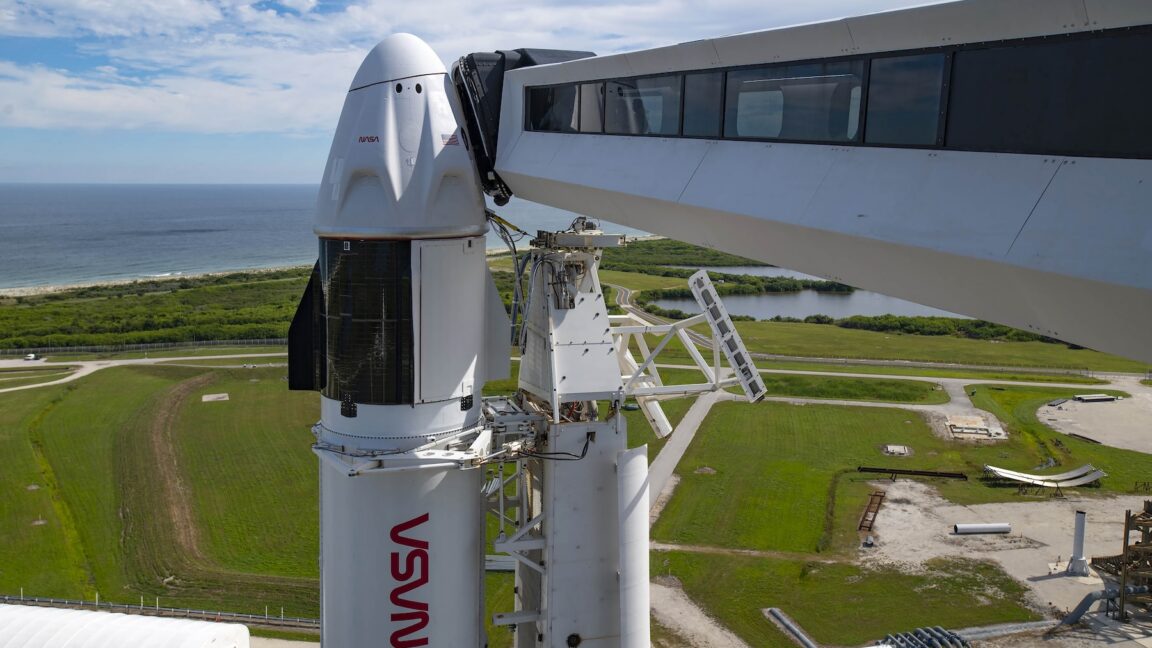
If needed, SpaceX officials said they could reinstall the crew arm for Dragon missions launching from Pad 39A.

Repairs required

Bill Gerstenmaier, SpaceX’s vice president of build and flight reliability, said there’s another pressing reason for removing the crew arm at Pad 39A. The bearings that connect the arm to the launch pad’s tower need repairs.

“To physically get access to those, the arm needs to be removed,” Gerstenmaier said. “Those bearings have to come out and they have to be reinstalled. We’ll do that work at the Kennedy Space Center. And the intent there is, we don’t need to put the arm back up … When we get a call-up for a mission and we have to go fly a mission, if it requires that, we have plenty of time to get the arm back up.”

SpaceX has continued launching Falcon 9 and Falcon Heavy rockets from Pad 39A amid the nearby construction work to prepare for Starship flights. “That doesn’t impact our ability to launch from the pad,” Gerstenmaier said.

That could change as SpaceX begins testing and launching Starships from Kennedy Space Center. Starship launch operations may routinely force the closure of Pad 39A to personnel.

“The right thing to do is get those bearings replaced in the environment on the ground, make some upgrades to them, and then we’ll be ready to go and put the arm back up when it’s time to go fly, if we need to go fly,” Gerstenmaier said.

https://arstechnica.com/space/2026/02/heres-why-americas-most-historic-launch-pad-is-getting-yet-another-facelift/


Trump orders the military to make agreements with coal power plants

Today’s executive order takes a different route to propping up coal: artificially inflating demand. “The Secretary of War, in coordination with the Secretary of Energy,” the order reads, “shall seek to procure power from the United States coal generation fleet by approving long-term Power Purchase Agreements, or entering into any similar contractual agreements, with coal-fired energy production facilities to serve Department of War installations or other mission-critical facilities.”

The justification for this seems to come from an alternate reality with little relationship to the US grid. “It’s going to be less expensive and actually much more effective than what we have been using for many, many years,” Trump said at the event. “And again, with the environmental progress that’s been made on coal, it’s going to be just as clean.” None of that is true.

The executive order instead seeks to highlight coal’s supposed ability to produce a constant power output, touting the “proven reliability of our coal-fired generation fleet in providing continuous, on-demand baseload power.” This seemingly ignores Texas’ recent experience, in which coal plants contributed significantly to the collapse of the state grid, having gone offline for a wide range of reasons.

The Trump administration, however, has rarely let spurious justifications stand in the way of its preferred policy actions. The key action here is likely to be locking the military into long-term contracts that would persist beyond the end of Trump’s term in 2029.

https://arstechnica.com/science/2026/02/trumps-latest-plan-to-revive-coal-power-make-the-military-buy-it/


Did seabird poop fuel rise of Chincha in Peru?

A nutrient-rich natural fertilizer

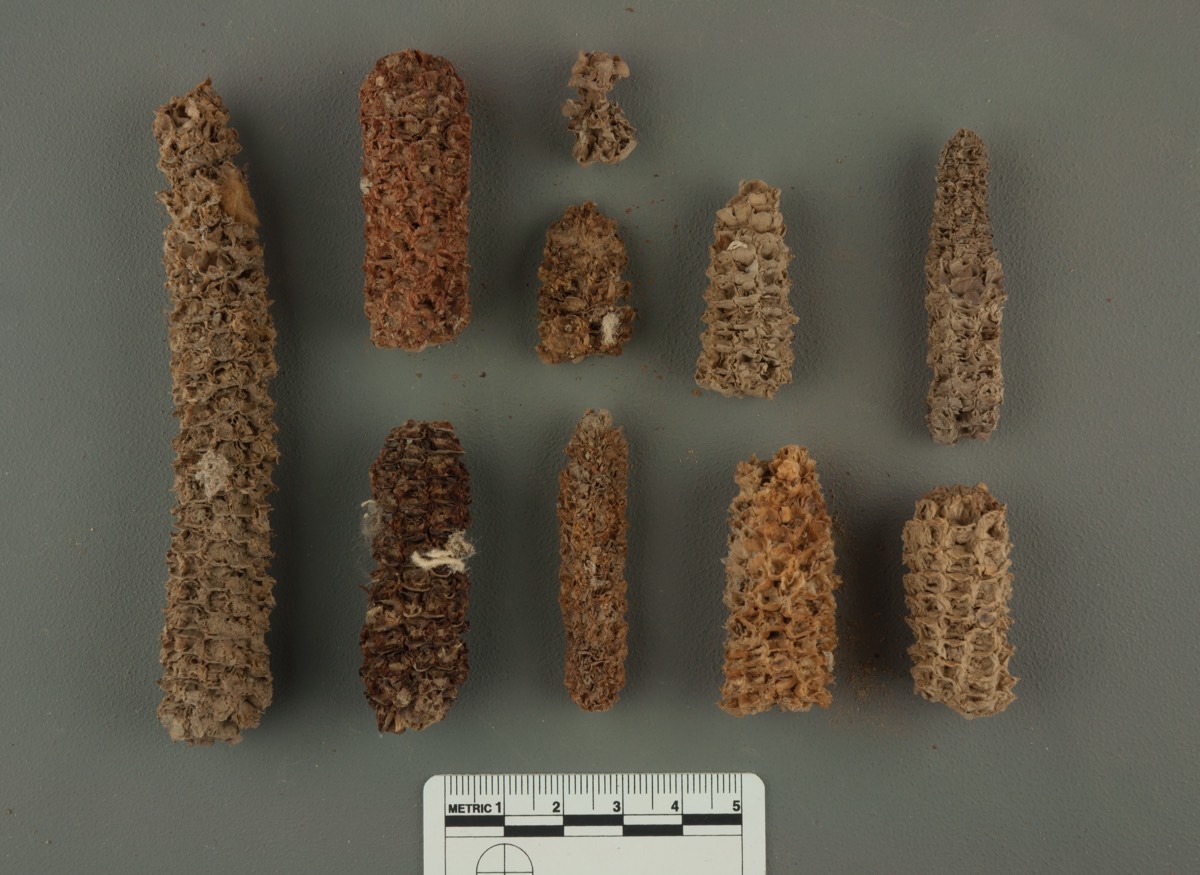
Now Bongers has turned his attention to analyzing the biochemical signatures of 35 maize samples excavated from buried tombs in the region. He and his co-authors found significantly higher levels of nitrogen in the maize than in the natural soil conditions, suggesting the Chincha used guano as a natural fertilizer. The guano from such birds as the guanay cormorant, the Peruvian pelican, and the Peruvian booby contains all the essential growing nutrients: nitrogen, phosphorus, and potassium. All three species are abundant on the Chincha Islands, all within 25 kilometers of the kingdom.

The primary guano-producing bird species. (A) Sula variegata (Peruvian booby). (B) Pelecanus thagus (Peruvian pelican). (C) Leucocarbo bougainvilliorum (Guanay cormorant).

“We’re all looking for the birds who did this.”

Diego H. and Claude Kolwelter, iNaturalist.org

Maize cobs from a tomb in the middle Chincha Valley in Peru.

Maize cobs from a tomb in the middle Chincha Valley in Peru.

C. O’Shea

Seabird imagery on various artifacts from the Peruvian southern coast.

Seabird imagery on various artifacts from the Peruvian southern coast.

19th century poster advertising the sale of Pacific seabird guano in the US.

19th century poster advertising the sale of Pacific seabird guano in the US.

Public domain

Those results were further bolstered by historical written sources describing how seabird guano was collected and its importance for trade and production of food. For instance, during colonial eras, groups would sail to nearby islands on rafts to collect bird droppings to use as crop fertilizer. The Lunahuana people in the Canete Valley just outside of Chincha were known to use bird guano in their fields, and the Inca valued the stuff so highly that it restricted access to the islands during breeding season and forbade the killing of the guano-producing birds on penalty of death.

The 19th-century Swiss naturalist Johann Jakob von Tschudi also reported observing the guano being used as fertilizer, with a fist-sized amount added to each plant before submerging entire fields in water. It was even imported to the US. The authors also pointed out that much of the iconography from Chincha and nearby valleys featured seabirds: textiles, ceramics, balance-beam scales, spindles, decorated gourds, adobe friezes and wall paintings, ceremonial wooden paddles, and gold and silver metalworks.

“The true power of the Chincha wasn’t just access to a resource; it was their mastery of a complex ecological system,” said co-author Jo Osborn of Texas A&M University. “They possessed the traditional knowledge to see the connection between marine and terrestrial life, and they turned that knowledge into the agricultural surplus that built their kingdom. Their art celebrates this connection, showing us that their power was rooted in ecological wisdom, not just gold or silver.”

PLoS ONE, 2026. DOI: 10.1371/journal.pone.0341263 (About DOIs).

https://arstechnica.com/science/2026/02/did-seabird-poop-fuel-rise-of-chincha-in-peru/


SpaceX’s next-gen Super Heavy booster aces four days of “cryoproof” testing

The upgraded Super Heavy booster slated to launch SpaceX’s next Starship flight has completed cryogenic proof testing, clearing a hurdle that resulted in the destruction of the company’s previous booster.

SpaceX announced the milestone in a social media post Tuesday: “Cryoproof operations complete for the first time with a Super Heavy V3 booster. This multi-day campaign tested the booster’s redesigned propellant systems and its structural strength.”

Ground teams at Starbase, Texas, rolled the 237-foot-tall (72.3-meter) stainless-steel booster out of its factory and transported it a few miles away to Massey’s Test Site last week. The test crew first performed a pressure test on the rocket at ambient temperatures, then loaded super-cold liquid nitrogen into the rocket four times over six days, putting the booster through repeated thermal and pressurization cycles. The nitrogen is a stand-in for the cryogenic methane and liquid oxygen that will fill the booster’s propellant tanks on launch day.

The proof test is notable because it moves engineers closer to launching the first test flight of an upgraded version of SpaceX’s mega-rocket named Starship V3 or Block 3. SpaceX launched the previous version, Starship V2, five times last year, but the first three test flights failed. The last two flights achieved SpaceX’s goals, and the company moved on to V3.

Better results this time

The Super Heavy booster originally assigned to the first Starship V3 test flight failed during a pressure test in November. The rocket’s liquid oxygen tank ruptured under pressure, and SpaceX scrapped the booster and moved on to the next in line—Booster 19. This Super Heavy vehicle appears have sailed through stress testing, and SpaceX returned the booster to the factory early Monday. There, technicians will mount 33 Raptor engines to the bottom of the rocket and install the booster’s grid fins.

These components are changed from Starship V2. The Raptor engines set to debut on Starship V3 produce more thrust and include changes to improve reliability, according to SpaceX. The Raptor 3s are lighter with plumbing and sensors integrated into the engine’s main structure, eliminating the requirement for self-contained heat shields between the engines at the base of the rocket.

https://arstechnica.com/space/2026/02/spacexs-starbase-is-coming-alive-again-after-a-lull-in-starship-testing/


After Republican complaints, judicial body pulls climate advice

In short, the state attorneys general object to the document treating facts as facts, as there have been lawsuits that contested them. “Among other things, the Manual states that human activities have ‘unequivocally warmed the climate,’ that it is ‘extremely likely’ human influence drives ocean warming, and that researchers are ‘virtually certain’ about ocean acidification,” their letter states, “treating contested litigation positions as settled fact.” In other words, they’re arguing that, if someone is ignorant enough to start a suit based on ignorance of well-established science, then the Federal Judicial Center should join them in their ignorance.

The attorneys general also complain that the report calls the Intergovernmental Panel on Climate Change an “authoritative science body,” citing a conservative Canadian public policy think tank that disagreed with that assessment.

These complaints were mixed in with some more potentially reasonable complaints about how the climate chapter gave specific suggestions on how to legally approach some issues and assigned significance to one or two recent studies that haven’t yet been validated by follow-on work. But the letter’s authors would not settle for revisions based on a few reasonable complaints; instead, they demand the entire chapter be removed because it accurately reflects the status of climate science.

Naturally, the Federal Judicial Center has agreed. We have confirmed that the current version of the document no longer includes a chapter on climate science, even though the foreword by Supreme Court Justice Elana Kagan still mentions it. The full text of the now-deleted chapter has been posted by the RealClimate blog, though.

https://arstechnica.com/science/2026/02/us-court-agency-pulls-climate-change-from-science-advisory-document/


NIH head, still angry about COVID, wants a second scientific revolution

“This was not a reclamation that involved people like Anthony Fauci,” she went on to say. “It was a reclamation of ordinary Americans, men and women who wanted our nation to excel in science rather than weaponize it.”

Things got a bit strange. Moderators from the MAHA Institute asked questions about whether COVID vaccines could cause cancer and raised the possibility of a lab leak favorably. An audience member asked why alternative treatments aren’t being researched. A speaker who proudly announced that he and his family had never received a COVID vaccine was roundly applauded. Fifteen minutes of the afternoon were devoted to a novelist seeking funding for a satirical film about the pandemic that portrayed Anthony Fauci as an egomaniacal lightweight, vaccines as a sort of placebo, and Bhattacharya as the hero of the story.

The organizers also had some idea of who might give all of this a hostile review, as reporters from Nature and Science said they were denied entry.

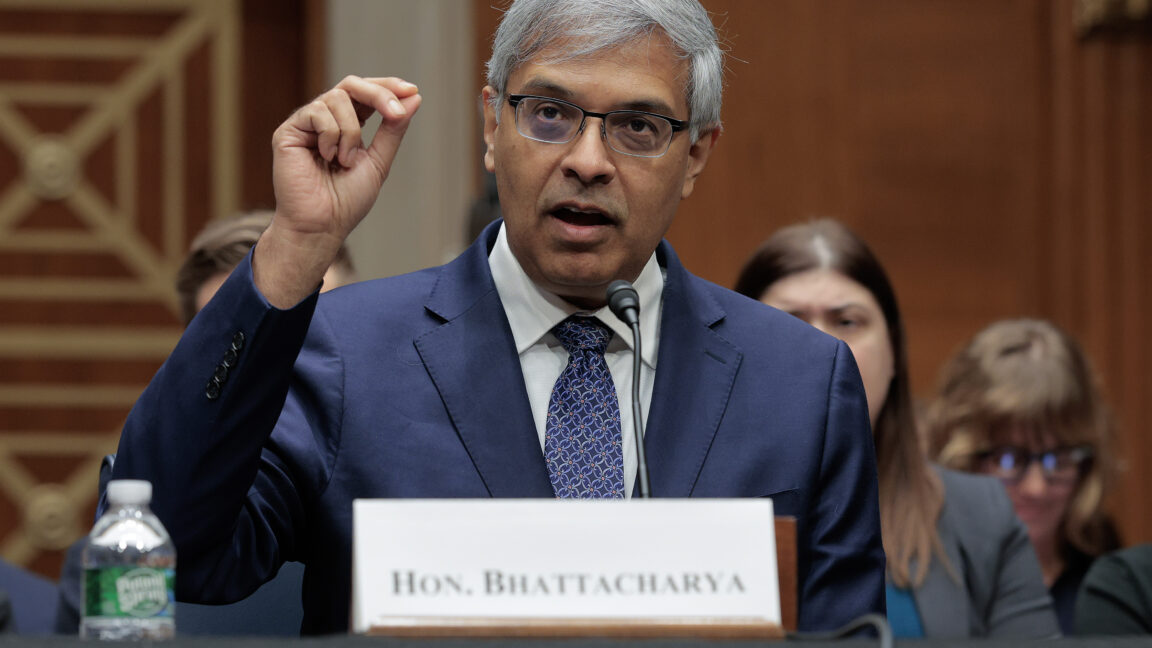
In short, this was not an event you’d go to if you were interested in making serious improvements to the scientific method. But that’s exactly how Bhattacharya treated it, spending the afternoon not only justifying the changes he’s made within the NIH but also arguing that we’re in need of a second scientific revolution—and he’s just the guy to bring it about.

Here’s an extensive section of his introduction to the idea:

I want to launch the second scientific revolution.

Why this grandiose vision? The first scientific revolution you have… very broadly speaking, you had high ecclesiastical authority deciding what was true or false on physical, scientific reality. And the first scientific revolution basically took… the truth-making power out of the hands of high ecclesiastical authority for deciding physical truth. We can leave aside spiritual—that is a different thing—physical truth and put it in the hands of people with telescopes. It democratized science fundamentally, it took the hands of power to decide what’s true out of the hands of authority and put it in the hands of ridiculous geniuses and regular people.

The second scientific revolution, then, is very similar. The COVID crisis, if it was anything, was the crisis of high scientific authority geting to decide not just a scientific truth like “plexiglass is going to protect us from COVID” or something, but also essentially spiritual truth. How should we treat our neighbor? Well, we treat our neighbor as a mere biohazzard.

The second scientific revolution, then, is the replication revolution. Rather than using the metrics of how many papers are we publishing as a metric for success, instead, what we’ll look at as a metric for successful scientific idea is ‘do you have an idea where other people [who are] looking at the same idea tend to find the same thing as you?’ It is not just narrow replication of one paper or one idea. It’s a really broad science. It includes, for instance, reproduction. So if two scientists disagree, that often leads to constructive ways forward in science—deciding, well there some new ideas that may come out of that disagreement

That section, which came early in his first talk of the day, hit on themes that would resurface throughout the afternoon: These people are angry about how the pandemic was handled, they’re trying to use that anger to fuel fundamental change in how science is done in the US, and their plan for change has nearly nothing to do with the issues that made them angry in the first place. In view of this, laying everything out for the MAHA crowd actually does make sense. They’re a suddenly powerful political constituency that also wants to see fundamental change in the scientific establishment, and they are completely unbothered by any lack of intellectual coherence.

https://arstechnica.com/science/2026/02/nih-head-still-angry-about-covid-wants-a-second-scientific-revolution/


Under Trump, EPA’s enforcement of environmental laws collapses, report finds

Another signal of declining enforcement: Through September of last year, the EPA issued $41 million in penalties—$8 million less than the same period in the first year of the Biden administration, after adjusting for inflation. This suggests “the Trump Administration may be letting more polluters get by with a slap on the wrist when the Administration does take enforcement action,” the report reads.

Combined, the lack of lawsuits, penalties, and other enforcement actions for environmental violations could impact communities across the country, said Erika Kranz, a senior staff attorney in the Environmental and Energy Law Program at Harvard Law School, who was not involved in the report.

“We’ve been seeing the administration deregulate by repealing rules and extending compliance deadlines, and this decline in enforcement action seems like yet another mechanism that the administration is using to de-emphasize environmental and public health protections,” Kranz said. “It all appears to be connected, and if you’re a person in the US who is worried about your health and the health of your neighbors generally, this certainly could have effects.”

The report notes that many court cases last longer than a year, so it will take time to get a clearer sense of how environmental enforcement is changing under the Trump administration. However, the early data compiled by the Environmental Integrity Project and other nonprofits shows a clear and steep shift away from legal actions against polluters.

Historically, administrations have a “lot of leeway on making enforcement decisions,” Kranz said. But this stark of a drop could prompt lawsuits against the Trump administration, she added.

“Given these big changes and trends, you might see groups arguing that this is more than just an exercise of discretion or choosing priorities [and] this is more of an abdication of an agency’s core mission and its statutory duties,” Kranz said. “I think it’s going to be interesting to see if groups make those arguments, and if they do, how courts look at them.”

This article originally appeared on Inside Climate News, a nonprofit, non-partisan news organization that covers climate, energy, and the environment. Sign up for their newsletter here.

https://arstechnica.com/science/2026/02/under-trump-epas-enforcement-of-environmental-laws-collapses-report-finds/