China just carried out its second reusable launch attempt in three weeks
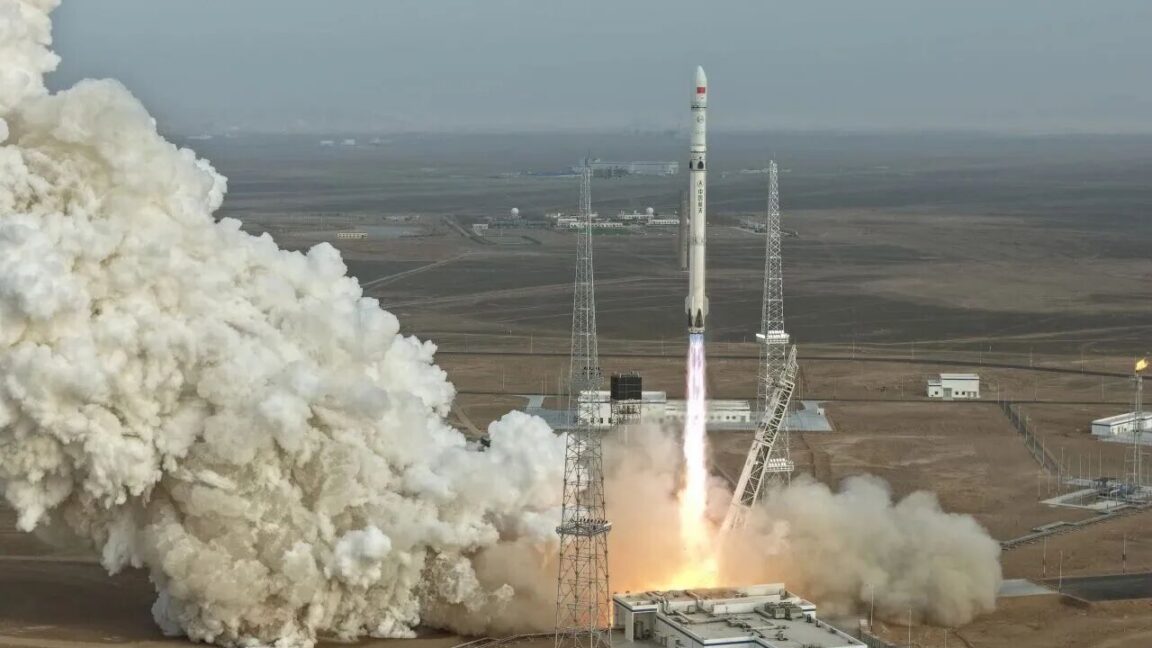
For the second time this month, a Chinese rocket designed for reuse successfully soared into low-Earth orbit on its first flight Monday, defying the questionable odds that burden the debuts of new launch vehicles.

The first Long March 12A rocket, roughly the same height and diameter of SpaceX’s workhorse Falcon 9, lifted off from the Jiuquan Satellite Launch Center at 9:00 pm EST Monday (02:00 UTC Tuesday).

Less than 10 minutes later, rocket’s methane-fueled first stage booster hurtled through the atmosphere at supersonic speed, impacting in a remote region about 200 miles downrange from the Jiuquan spaceport in northwestern China. The booster failed to complete a braking burn to slow down for landing at a prepared location near the edge of the Gobi Desert.

The Long March 12A’s upper stage performed as intended, successfully reaching the mission’s “predetermined orbit,” said the China Aerospace Science and Technology Corporation (CASC), the state-owned enterprise that leads the country’s space industry.

“The first stage failed to be successfully recovered,” the corporation said in a statement. “The specific reasons are currently under further analysis and investigation.”

A stable of reusable rockets

This outcome resembles the results from the first flight of another medium-class Chinese rocket, the Zhuque-3, on December 2. The Zhuque-3 rocket was developed by a privately-funded startup named LandSpace. Similar in size and performance to the Long March 12A, the Zhuque-3 also reached orbit on its first launch, and its recoverable booster stage crashed during a downrange landing attempt. The Zhuque-3’s first stage came down next to its landing zone, while the Long March 12A appears to have missed by at least a couple of miles.

“Although this mission did not achieve the planned recovery of the rocket’s first stage, it obtained critical engineering data under the rocket’s actual flight conditions, laying an important foundation for subsequent launches and reliable recovery of the stages,” CASC said. “The research and development team will promptly conduct a comprehensive review and technical analysis of this test process, fully investigate the cause of the failure, continuously optimize the recovery plan, and continue to advance reusable technology verification.”

https://arstechnica.com/space/2025/12/china-just-carried-out-its-second-reusable-launch-attempt-in-three-weeks/




In a surprise announcement, Tory Bruno is out as CEO of United Launch Alliance

The retirement of the Atlas V and Delta IV led to a period of downsizing for United Launch Alliance, with layoffs and facility closures in Florida, California, Alabama, Colorado, and Texas. In a further sign of ULA’s troubles, SpaceX won a majority of US military launch contracts for the first time last year.

Bruno, 64, served as a genial public face for ULA amid the company’s difficult times. He routinely engaged with space enthusiasts on social media, fielded questions from reporters, and even started a podcast. Bruno’s friendly and accessible demeanor was unusual among industry leaders, especially those with ties to large legacy defense contractors.

ULA is a 50-50 joint venture between Boeing and Lockheed Martin, which merged their rocket divisions in 2006. Bruno’s plans did not always enjoy full support from ULA’s corporate owners. For example, Boeing and Lockheed initially only approved tranches of funding for developing the new Vulcan rocket on a quarterly basis. Beginning before Bruno’s arrival and extending into his tenure as CEO, ULA’s owners slow-walked development of an advanced upper stage that might have become a useful centerpiece for an innovative in-space transport and refueling infrastructure.

There were also rumors in recent years of an impending sale of ULA by Boeing and Lockheed Martin, but nothing has materialized so far.

The third flight of the Vulcan rocket lifted off from Cape Canaveral Space Force Station, Florida, on August 12, 2025. Credit: United Launch Alliance

A statement from the co-chairs of ULA’s board, Robert Lightfoot of Lockheed Martin and Kay Sears of Boeing, did not identify a reason for Bruno’s resignation, other than saying he is stepping down “to pursue another opportunity.”

“We are grateful for Tory’s service to ULA and the country, and we thank him for his leadership,” the board chairs said in a statement.

John Elbon, ULA’s chief operating officer, will take over as interim CEO effective immediately, the company said.

“We have the greatest confidence in John to continue strengthening ULA’s momentum while the board proceeds with finding the next leader of ULA,” the company said. “Together with Mark Peller, the new COO, John’s career in aerospace and his launch expertise is an asset for ULA and its customers, especially for achieving key upcoming Vulcan milestones.”

In a post on X, Bruno thanked ULA’s owners for the opportunity to lead the company. “It has been a great privilege to lead ULA through its transformation and to bring Vulcan into service,” he wrote. “My work here is now complete and I will be cheering ULA on.”

https://arstechnica.com/space/2025/12/in-a-surprise-announcement-tory-bruno-is-out-as-ceo-of-united-launch-alliance/


US blocks all offshore wind construction, says reason is classified

On Monday, the US Department of the Interior announced that it was pausing the leases on all five offshore wind sites currently under construction in the US. The move comes despite the fact that these projects already have installed significant hardware in the water and on land; one of them is nearly complete. In what appears to be an attempt to avoid legal scrutiny, the Interior is blaming the decisions on a classified report from the Department of Defense.

The second Trump administration announced its animosity toward offshore wind power literally on day one, issuing an executive order on inauguration day that called for a temporary halt to issuing permits for new projects pending a re-evaluation. Earlier this month, however, a judge vacated that executive order, noting that the government has shown no indication that it was even attempting to start the re-evaluation it said was needed.

But a number of projects have gone through the entire permitting process, and construction has started. Before today, the administration had attempted to stop these in an erratic, halting manner. Empire Wind, an 800 MW farm being built off New York, was stopped by the Department of the Interior, which alleged that it had been rushed through permitting. That hold was lifted following lobbying and negotiations by New York and the project developer Orsted, and the Department of the Interior never revealed why it changed its mind. When the Interior Department blocked a second Orsted project, Revolution Wind offshore of southern New England, the company took the government to court and won a ruling that let it continue construction.

https://arstechnica.com/science/2025/12/us-government-finds-new-excuse-to-stop-construction-of-offshore-wind/


When clouds flock together

Some models suggest that clouds (and the convection that gives rise to them) will clump together more with global warming — and produce more rainfall extremes that often far exceed what theory predicts. But other simulations suggest that clouds will congregate less. “There seems to be still possibly a range of answers,” says Allison Wing, a climate scientist at Florida State University in Tallahassee who has compared various models.

Scientists are beginning to try to reconcile some of these inconsistencies using powerful types of computer simulations called global storm-resolving models. These can capture the fine structures of clouds, thunderstorms, and cyclones while also simulating the global climate. They bring a 50-fold leap in realism beyond the global climate models scientists generally use—but demand 30,000 times more computational power.

Using one such model in a paper published in 2024, Bao, Muller, and their collaborators found that clouds in the tropics congregated more as temperatures increased—leading to less frequent storms but ones that were larger, lasted longer, and, over the course of a day, dumped more rain than expected from theory.

But that work relied on just one model and simulated conditions from around one future time point—the year 2070. Scientists need to run longer simulations using more storm-resolving models, Bao says, but very few research teams can afford to run them. They are so computationally intensive that they are typically run at large centralized hubs, and scientists occasionally host “hackathons” to crunch through and share data.

Researchers also need more real-world observations to get at some of the biggest unknowns about clouds. Although a flurry of recent studies using satellite data linked the clustering of clouds to heavier rainfall in the tropics, there are large data gaps in many tropical regions. This weakens climate projections and leaves many countries ill-prepared. In June of 2025, floods and landslides in Venezuela and Colombia swept away buildings and killed at least a dozen people, but scientists don’t know what factors worsened these storms because the data are so paltry. “Nobody really knows, still, what triggered this,” Hernández Deckers says.

New, granular data are on their way. Wing is analyzing rainfall measurements from a German research vessel that traversed the tropical Atlantic Ocean for six weeks in 2024. The ship’s radar mapped clusters of convection associated with the storms it passed through, so the work should help researchers see how clouds organize over vast tracts of the ocean.

And an even more global view is on the horizon. The European Space Agency plans to launch two satellites in 2029 that will measure, among other things, near-surface winds that ruffle Earth’s oceans and skim mountaintops. Perhaps, scientists hope, the data these satellites beam back will finally provide a better grasp of clumping clouds and the heaviest rains that fall from them.

Research and interviews for this article were partly supported through a journalism residency funded by the Institute of Science & Technology Austria (ISTA). ISTA had no input into the story. This story originally appeared on Knowable Magazine

https://arstechnica.com/science/2025/12/when-clouds-flock-together/


The evolution of expendability: Why some ants traded armor for numbers

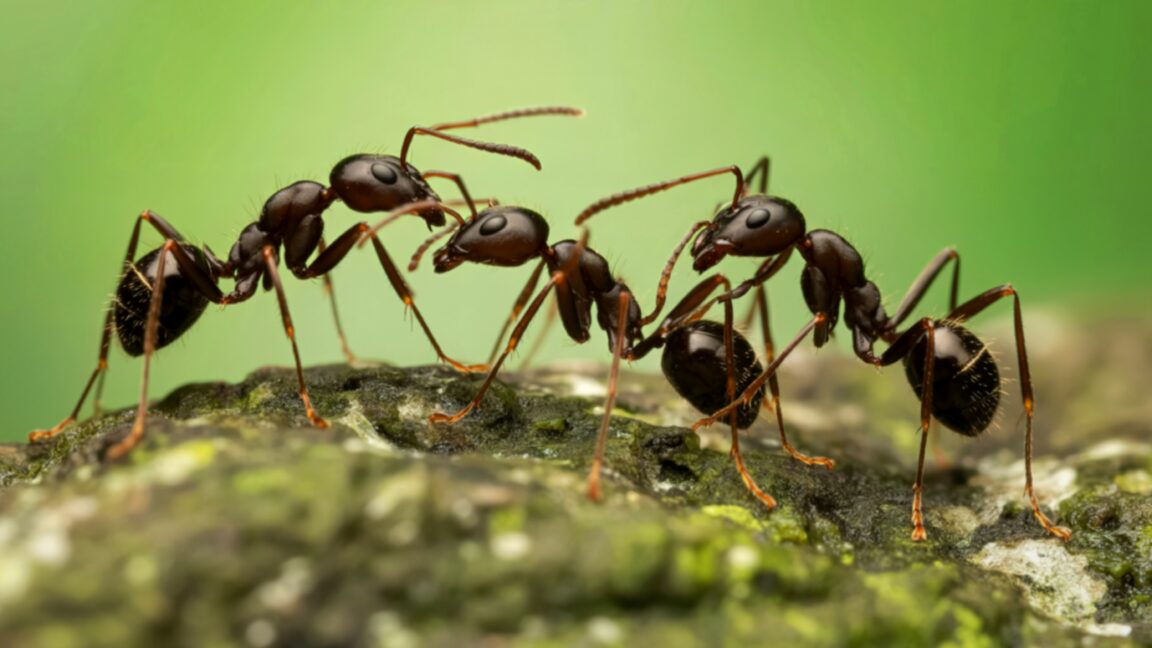
“Ants reduce per-worker investment in one of the most nutritionally expensive tissues for the good of the collective,” Matte explains. “They’re shifting from self-investment toward a distributed workforce.”

Power of the collective

The researchers think the pattern they observed in ants reflects a more universal trend in the evolution of societal complexity. The transition from solitary life to complex societies echoes the transition from single-celled organisms to multicellular ones.

In a single-celled organism, a cell must be a “jack-of-all-trades,” performing every function necessary for survival. In a multicellular animal, however, individual cells often become simpler and more specialized, relying on the collective for protection and resources.

“It’s a pattern that echoes the evolution of multicellularity, where cooperative units can be individually simpler than a solitary cell, yet collectively capable of far greater complexity,” says Matte. Still, the question of whether underinvesting in individuals to boost the collective makes sense for creatures other than ants remains open, and it most likely isn’t as much about nutritional economics as it is about sex.

Expendable servants

The study focused on ants that already have a reproductive division of labor, one where workers do not reproduce. This social structure is likely the key prerequisite for the cheap worker strategy. For the team, this is the reason we haven’t, at least so far, found similar evolutionary patterns in more complex social organisms like wolves, which live in packs—or humans with their amazingly complex societies. Wolves and people are both social, but maintain a high degree of individual self-interest regarding reproduction. Ant workers could be made expendable because they don’t pass their own genes—they are essentially extensions of the queen’s reproductive strategy.

Before looking for signs of ant-like approaches to quality versus quantity dilemmas in other species, the team wants to take an even closer look at ants. Economo, Matte, and their colleagues seek to expand their analysis to other ant tissues, such as the nervous system and muscles, to see if the cheapening of individuals extends beyond the exoskeleton. They are also looking at ant genomes to see what genetic innovations allowed for the shift from quality to quantity.  “We still need a lot of work to understand ants’ evolution,” Matte says.

Science Advances. 2025. DOI: 10.1126/sciadv.adx8068

https://arstechnica.com/science/2025/12/the-evolution-of-expendability-why-some-ants-traded-armor-for-numbers/


Trump’s energy secretary orders a Washington state coal plant to remain open

The year-end emergency that does exist in Washington state has been caused by record-setting rainfall and widespread flooding. (President Donald Trump has declared a federal emergency and authorized disaster assistance.) Thousands of people have been displaced and damage to major highways will take months to repair.

“It is so ironic, when we have a real emergency, that they picked this time to fabricate an energy emergency,” said KC Golden, a member of the Northwest Power and Conservation Council, an interstate agency created by Congress to ensure reliable power while protecting the environment.

While there is no emergency electricity shortfall in the Pacific Northwest, the region, like much of the United States, does have a serious and worsening long-term electricity supply problem.

Washington and Oregon are home to about 100 data centers. Oregon is second only to Virginia in data center capacity, and the centers consume 11 percent of Oregon’s power supply, nearly three times the national average, according to the Sightline Institute, a Seattle think tank.

Energy use is rising along with the region’s booming high-tech economy, its outsized appetite for electric cars (The Seattle Times reported that 26 percent of new cars registered in Washington in October were EVs) and the climate-change-driven growth of home air-conditioning. The Northwest could face a 9-gigawatt shortfall of power by 2030, according to a recent utility-funded report by the energy consulting group E3. Nine gigawatts is roughly the electricity load of Oregon.

“We are facing a real energy supply challenge and we have been slow to take up that challenge,” said Golden, who represents Washington state on the Northwest power council.

The Pacific Northwest gets more of its power from hydroelectric dams than any other part of the country (60 percent in Washington), and the region has long been blessed with cheap electricity rates. But drought and changing weather patterns (less snow, more rain) have hammered the reliability of the system, which draws most of its power from big federal dams on the Columbia River, North America’s largest hydroelectric resource.

https://arstechnica.com/science/2025/12/trumps-energy-secretary-orders-a-washington-state-coal-plant-to-remain-open/


Rocket Report: Russia pledges quick fix for Soyuz launch pad; Ariane 6 aims high

The easiest way to keep up with Eric Berger’s and Stephen Clark’s reporting on all things space is to sign up for our newsletter. We’ll collect their stories and deliver them straight to your inbox.

Sign Me Up!

SpaceX warns of dangerous Chinese launch. China’s recent deployment of nine satellites occurred dangerously close to a Starlink satellite, SpaceX’s vice president of Starlink engineering said. Michael Nicolls wrote in a December 12 social media post that there was a 200-meter close approach between a satellite launched December 10 on a Chinese Kinetica-1 rocket and SpaceX’s Starlink-6079 spacecraft at 560 kilometers (348 miles) altitude, Aviation Week and Space Technology reports. “Most of the risk of operating in space comes from the lack of coordination between satellite operators—this needs to change,” Nicolls wrote.

Blaming the customer... The company in charge of the Kinetica-1 rocket, CAS Space, responded to Nicolls’ post on X saying it would “work on identifying the exact details and provide assistance.” In a follow-up post on December 13, CAS Space said the close call, if confirmed, occurred nearly 48 hours after the satellite separated from the Kinetica-1 rocket, by which time the launch mission had long concluded. “CAS Space will coordinate with satellite operators to proceed.”

A South Korean startup is ready to fly. Innospace, a South Korean space startup, will launch its independently developed commercial rocket, Hanbit-Nano, as soon as Friday, the Maeil Business Newspaper reports. The rocket will lift off from the Alcântara Space Center in Brazil. The small launcher will attempt to deliver eight small payloads, including five deployable satellites, into low-Earth orbit. The launch was delayed two days to allow time for technicians to replace components of the first stage oxidizer supply cooling system.

Hybrid propulsion… This will be the first launch of Innospace’s Hanbit-Nano rocket. The launcher has two stages and stands 71 feet (21.7 meters) tall with a diameter of 4.6 feet (1.4 meters). Hanbit-Nano is a true micro-launcher, capable of placing up to 200 pounds (90 kilograms) of payload mass into Sun-synchronous orbit. It has a unique design, with hybrid engines consuming a mix of paraffin as the fuel and liquid oxygen as the oxidizer.

Ten years since a milestone in rocketry. On December 21, 2015, SpaceX launched the Orbcomm-2 mission on an upgraded version of its Falcon 9 rocket. That night, just days before Christmas, the company successfully landed the first stage for the first time. Ars has reprinted a slightly condensed chapter from the book Reentry, authored by Senior Space Editor Eric Berger and published in 2024. The chapter begins in June 2015 with the failure of a Falcon 9 rocket during launch of a resupply mission to the International Space Station and ends with a vivid behind-the-scenes recounting of the historic first landing of a Falcon 9 booster to close out the year.

https://arstechnica.com/space/2025/12/rocket-report-russia-pledges-quick-fix-for-soyuz-launch-pad-ariane-6-aims-high/


These are the flying discs the government wants you to know about

CubeSats have been a ubiquitous part of the satellite industry for nearly a quarter-century. They are based on a cube-shaped design, measuring about 10 centimeters per side, but can be scaled from a single cube “unit” to three, six, 12, or more, depending on mission requirements. The CubeSat standard has become a popular choice for commercial companies, the military, NASA, and universities looking to build small satellites on a tight budget.

By one measure, nearly 3,000 CubeSats have launched since the first one soared into orbit in 2003. After originally being confined to low-Earth orbit, they have now flown to high-altitude orbits, to the Moon, and to Mars.

While CubeSats are now prolific, engineers at the Aerospace Corporation saw an opportunity to improve on the concept. Debra Emmons, Aerospace’s chief technology officer, said the idea originated from Rich Welle, a scientist recently retired from the center’s Experiments Lab, or xLab, division.

“They were asking questions,” Emmons recounted in an interview with Ars. “They were looking at CubeSat studies and looking at some alternatives. The typical CubeSat is, in fact, a cube. So, the idea was could you look at some different types of form factors that might be able to generate more power … and offer up benefit for certain mission applications?”

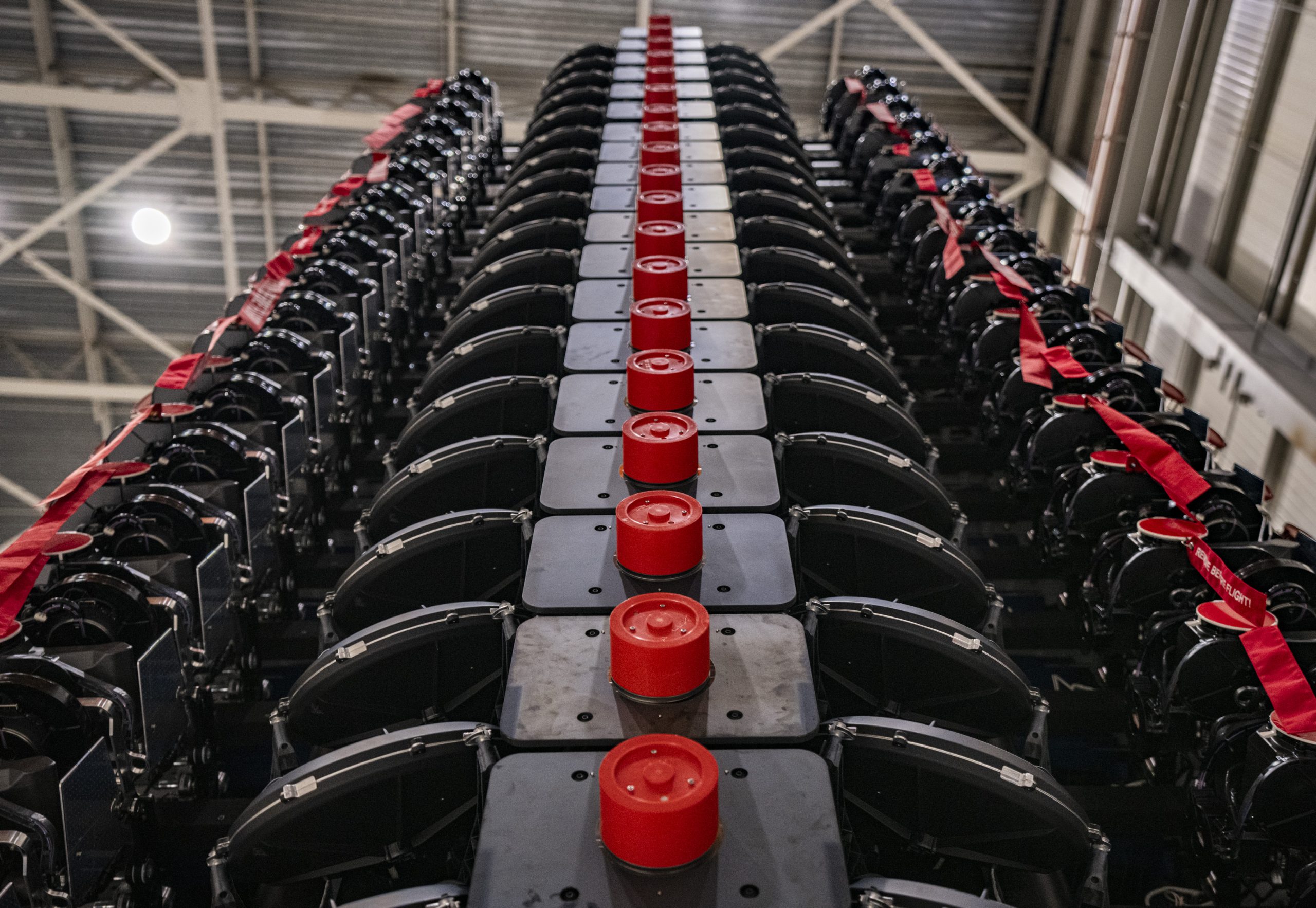
Aerospace’s research team arrived at the DiskSat design. Emmons said the stackable flat-panel format is easier to pack for launch than a CubeSat. The concept is similar to SpaceX’s pioneering approach to launching stackable Starlink Internet satellites, but DiskSats are significantly smaller, lighter, and adaptable to different kinds of missions.

A batch of Starlink satellites prior to launch

A stack of Starlink satellites prior to launch. Credit: SpaceX

DiskSats have several advantages over CubeSats, according to the Aerospace Corporation. Each of the four DiskSats launched Thursday has a mass of about 35 pounds (16 kilograms), less than that of a typical 12U CubeSat. But a DiskSat has more than 13 times the surface area on a single side, providing valuable real estate for developers to load up the satellite with power-generating solar arrays, sensors, antennas, or other payloads that simply won’t fit on a CubeSat.

https://arstechnica.com/science/2025/12/heres-why-nasa-and-the-space-force-are-interested-in-pizza-shaped-satellites/


Parasites plagued Roman soldiers at Hadrian’s Wall

It probably sucked to be a Roman soldier guarding Hadrian’s Wall circa the third century CE. W.H. Auden imagined the likely harsh conditions in his poem “Roman Wall Blues,” in which a soldier laments enduring wet wind and rain with “lice in my tunic and a cold in my nose.” We can now add chronic nausea and bouts of diarrhea to his list of likely woes, thanks to parasitic infections, according to a new paper published in the journal Parasitology.

As previously reported, archaeologists can learn a great deal by studying the remains of intestinal parasites in ancient feces. For instance, in 2022, we reported on an analysis of soil samples collected from a stone toilet found within the ruins of a swanky 7th-century BCE villa just outside Jerusalem. That analysis revealed the presence of parasitic eggs from four different species: whipworm, beef/pork tapeworm, roundworm, and pinworm. (It’s the earliest record of roundworm and pinworm in ancient Israel.)

Later that same year, researchers from the University of Cambridge and the University of British Columbia analyzed the residue on an ancient Roman ceramic pot excavated at the site of a 5th-century CE Roman villa at Gerace, a rural district in Sicily. They identified the eggs of intestinal parasitic worms commonly found in feces—strong evidence that the 1,500-year-old pot in question was most likely used as a chamber pot.

Other prior studies have compared fecal parasites found in hunter-gatherer and farming communities, revealing dramatic dietary changes, as well as shifts in settlement patterns and social organization coinciding with the rise of agriculture. This latest paper analyzes sediment collected from sewer drains at the Roman fort at Vindolanda, located just south of the defense fortification known as Hadrian’s Wall.

An antiquarian named William Camden recorded the existence of the ruins in a 1586 treatise. Over the next 200 years, many people visited the site, discovering a military bathhouse in 1702 and an altar in 1715.  Another altar found in 1914 confirmed that the fort had been called Vindolanda. Serious archaeological excavation at the site began in the 1930s. The site is most famous for the so-called Vindolanda tablets, among the oldest surviving handwritten documents in the UK—and for the 2023 discovery of what appeared to be an ancient Roman dildo, although others argued the phallus-shaped artifact was more likely to be a drop spindle used for spinning yarn.

https://arstechnica.com/science/2025/12/study-roman-soldiers-battled-parasites-at-hadrians-wall/


LLMs’ impact on science: Booming publications, stagnating quality

This effect was likely to be most pronounced in people that weren’t native speakers of English. If the researchers limited the analysis to people with Asian names working at institutions in Asia, their rate of submissions to bioRxiv and SSRN nearly doubled once they started using AI and rose by over 40 percent at the arXiv. This suggests that people who may not have the strongest English skills are using LLMs to overcome a major bottleneck: producing compelling text.

Quantity vs. quality

The value of producing compelling text should not be underestimated. “Papers with clear but complex language are perceived to be stronger and are cited more frequently,” the researchers note, suggesting that we may use the quality of writing as a proxy for the quality of the research it’s describing. And they found some indication of that here, as non-LLM-assisted papers were more likely to be published in the peer reviewed literature if they used complex language (the abstracts were scored for language complexity using a couple of standard measures).

But the dynamic was completely different for LLM-produced papers. The complexity of language in papers written with an LLM was generally higher than for those using natural language. But they were less likely to end up being published. “For LLM-assisted manuscripts,” the researchers write, “the positive correlation between linguistic complexity and scientific merit not only disappears, it inverts.”

But not all of the differences were bleak. When the researchers checked the references being used in AI-assisted papers, they found that the LLMs weren’t just citing the same papers that everyone else did. They instead cited a broader range of sources, and were more likely to cite books and recent papers. So, there’s a chance that AI use could ultimately diversify the published research that other researchers consider (assuming they check their own references, which they clearly should).

What does this tell us?

There are a couple of cautions for interpreting these results. One, acknowledged by the researchers, is that people may be using AI to produce initial text that’s then heavily edited, and that may be mislabeled as human-produced text here. So, the overall prevalence of AI use is likely to be higher. The other is that some manuscripts may take a while to get published, so their use of that as a standard for scientific quality may penalize more recent drafts—which are more likely to involve AI use. These may ultimately bias some of the results, but the effects the authors saw were so large that they’re unlikely to go away entirely.

https://arstechnica.com/science/2025/12/llms-impact-on-science-booming-publications-stagnating-quality/