Scientists found the key to accurate Maya eclipse tables

The Mayan calendars were maintained by specialists known as “daykeepers,” a cultural tradition that continues today. There is general consensus that eclipses were important to the Maya. “They were tracking them, they had rituals around [eclipses], and it was built into their system of belief, ” Lowry told Ars. “So we know the eclipse table is part of the cultural knowledge of the time. We were just trying to figure out how the table came to be in its current state.”

A predictive mechanism

Lowry and Justeson’s analysis involved mathematically modeling the eclipse predictions in the Dresden Codex table and comparing the results to a historical NASA database. They focused on 145 solar eclipses that would have been visible in the Maya geographical region between 350 and 1150 CE.

First publication in 1810 by Humboldt, who repainted five pages for his atlas

First publication in 1810 by Alexander von Humboldt, who repainted five pages for his atlas. Credit: Public domain

They concluded that the codex’s eclipse tables evolved from a more general table of successive lunar months. The length of a 405-month lunar cycle (11,960 days) aligned much better with a 260-day calendar (46 x 260 =11,960) than with solar or lunar eclipse cycles. This suggests that the Maya daykeepers figured out that 405 new moons almost always came out equivalent to 46 260-day periods, knowledge the Maya used to accurately predict the dates of full and new moons over 405 successive lunar dates.

The daykeepers also realized that solar eclipses seemed to recur on or near the same day in their 260-day calendar and, over time, figured out how to predict days on which a solar eclipse might occur locally. “An eclipse happens only on a new moon,” said Lowry. “The fact that it has to be a new moon means that if you can accurately predict a new moon, you can accurately predict a one-in-seven chance of an eclipse. That’s why it makes sense that the Maya are revising lunar predicting models to have an accurate eclipse, because they don’t have to predict where the moon is relative to the ecliptic.”

The Maya also understood that they had to adjust their tables occasionally to account for slippage over time. “When we talk about accuracy, sometimes we think about being able to predict something down to the microsecond,” said Lowry, pointing to NASA records. “The Maya have a very accurate calendar, but they’re predicting to the day, not down to the second.”

https://arstechnica.com/science/2025/11/study-how-the-maya-created-such-accurate-eclipse-tables/


Flying with whales: Drones are remaking marine mammal research

In 2010, the Deepwater Horizon oil rig exploded in the Gulf of Mexico, causing one of the largest marine oil spills ever. In the aftermath of the disaster, whale scientist Iain Kerr traveled to the area to study how the spill had affected sperm whales, aiming specialized darts at the animals to collect pencil eraser-sized tissue samples.

It wasn’t going well. Each time his boat approached a whale surfacing for air, the animal vanished beneath the waves before he could reach it. “I felt like I was playing Whac-A-Mole,” he says.

As darkness fell, a whale dove in front of Kerr and covered him in whale snot. That unpleasant experience gave Kerr, who works at the conservation group Ocean Alliance, an idea: What if he could collect that same snot by somehow flying over the whale? Researchers can glean much information from whale snot, including the animal’s DNA sequence, its sex, whether it is pregnant, and the makeup of its microbiome.

After many experiments, Kerr’s idea turned into what is today known as the SnotBot: a drone fitted with six petri dishes that collect a whale’s snot by flying over the animal as it surfaces and exhales through its blowhole. Today, drones like this are deployed to gather snot all over the world, and not just from sperm whales: They’re also collecting this scientifically valuable mucus from other species, such as blue whales and dolphins. “I would say drones have changed my life,” says Kerr.

[embedded content]

S’not just mucus

Gathering snot is one of many ways that drones are being used to study whales. In the past 10 to 15 years, drone technology has made great strides, becoming affordable and easy to use. This has been a boon for researchers. Scientists “are finding applications for drones in virtually every aspect of marine mammal research,” says Joshua Stewart, an ecologist at the Marine Mammal Institute at Oregon State University.

https://arstechnica.com/science/2025/11/flying-with-whales-drones-are-remaking-marine-mammal-research/


UCLA faculty gets big win in suit against Trump’s university attacks

The final step is a proposed settlement that would include large payments (over $1.2 billion in UCLA’s case) and a set of conditions that alter university governance and instruction. These conditions often have little to no connection with antisemitism.

While all of this was ostensibly meant to combat antisemitism, the plaintiffs in this case presented a huge range of quotes from administration officials, including the head of the Task Force to Combat Anti-Semitism, saying the goal was to suppress certain ideas on campus. “The unrebutted record in this case shows that Defendants have used the threat of investigations and economic sanctions to… coerce the UC to stamp out faculty, staff, and student ‘woke,’ ‘left,’ ‘anti-American,’ ‘anti-Western,’ and ‘Marxist’ speech,” Lin said.

And even before any sort of agreement was reached, there was extensive testimony that people on campus changed their teaching and research to avoid further attention from the administration. “Plaintiffs’ members express fear that researching, teaching, and speaking on disfavored topics will trigger further retaliatory funding cancellations against the UC,” Lin wrote, “and that they will be blamed for the retaliation. They also describe fears that the UC will retaliate against them to avoid further funding cuts or in order to comply with the proposed settlement agreement.”

That’s a problem, given that teaching and research topics are forms of speech, and therefore protected by the First Amendment. “These are classic, predictable First Amendment harms, and exactly what Defendants publicly said that they intended,” Lin concluded.

Beyond speech

But the First Amendment isn’t the only issue here. The Civil Rights Act, most notably Title VI, lays out a procedure for cutting federal funding, including warnings and hearings before any funds are shut off. That level of coercion is also limited to cases where there’s an indication that voluntary compliance won’t work. Any funding cut would need to target the specific programs involved and the money allocated to them. There is nothing in Title VI that enables the sort of financial payments that the government has been demanding (and, in some cases, receiving) from schools.

https://arstechnica.com/science/2025/11/ucla-faculty-gets-big-win-in-suit-against-trumps-university-attacks/


The evolution of rationality: How chimps process conflicting evidence

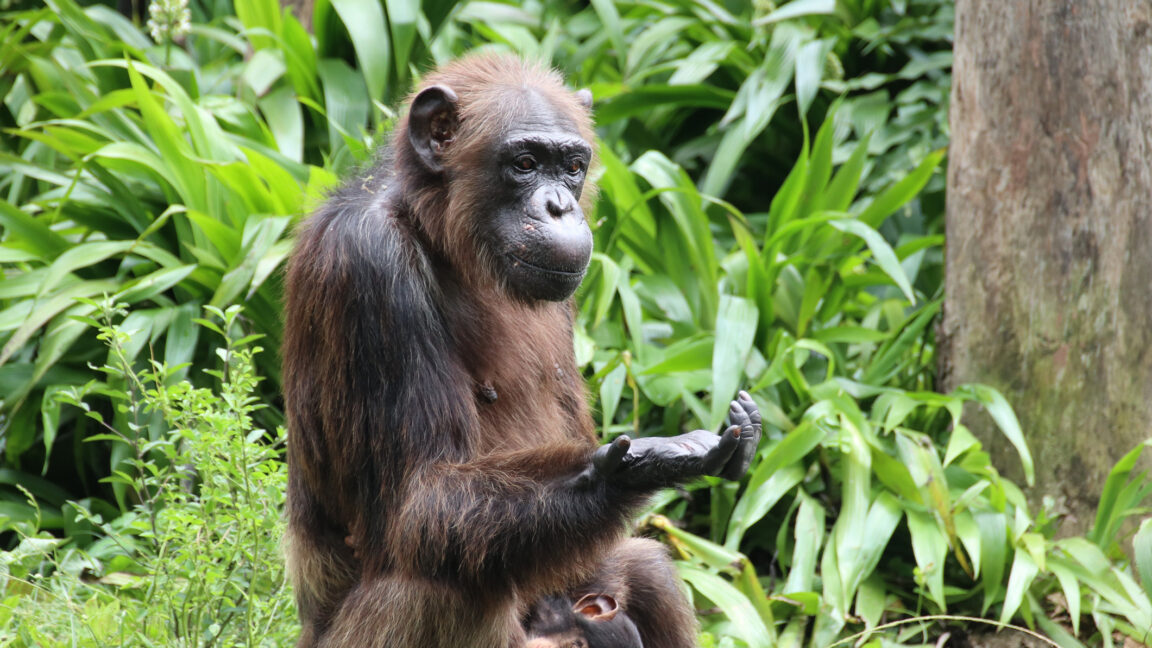
In the first step, the chimps got the auditory evidence, the same rattling sound coming from the first container. Then, they received indirect visual evidence: a trail of peanuts leading to the second container. At this point, the chimpanzees picked the first container, presumably because they viewed the auditory evidence as stronger. But then the team would remove a rock from the first container. The piece of rock suggested that it was not food that was making the rattling sound. “At this point, a rational agent should conclude, ‘The evidence I followed is now defeated and I should go for the other option,’” Engelmann told Ars. “And that’s exactly what the chimpanzees did.”

The team had 20 chimpanzees participating in all five experiments, and they followed the evidence significantly above chance level—in about 80 percent of the cases. “At the individual level, about 18 out of 20 chimpanzees followed this expected pattern,” Engelmann claims.

He views this study as one of the first steps to learn how rationality evolved and when the first sparks of rational thought appeared in nature. “We’re doing a lot of research to answer exactly this question,” Engelmann says.

The team thinks rationality is not an on/off switch; instead, different animals have different levels of rationality. “The first two experiments demonstrate a rudimentary form of rationality,” Engelmann says. “But experiments four and five are quite difficult and show a more advanced form of reflective rationality I expect only chimps and maybe bonobos to have.”

In his view, though, humans are still at least one level above the chimps. “Many people say reflective rationality is the final stage, but I think you can go even further. What humans have is something I would call social rationality,” Engelmann claims. “We can discuss and comment on each other’s thinking and in that process make each other even more rational.”

Sometimes, at least in humans, social interactions can also increase our irrationality instead. But chimps don’t seem to have this problem. Engelmann’s team is currently running a study focused on whether the choices chimps make are influenced by the choices of their fellow chimps. “The chimps only followed the other chimp’s decision when the other chimp had better evidence,” Engelmann says. “In this sense, chimps seem to be more rational than humans.”

Science, 2025. DOI: 10.1126/science.aeb7565

https://arstechnica.com/science/2025/11/the-evolution-of-rationality-how-chimps-process-conflicting-evidence/


Wyoming dinosaur mummies give us a new view of duck-billed species

As a result, the Edmontosaurus image got updated one more time. And some of the updates were rather striking.

Delicate elephants

Sereno’s team analyzed the newly discovered Edmontosaurus mummies with a barrage of modern imaging techniques like CT scans, X-rays, photogrammetry, and more. “We created a detailed model of the skin and wrapped it around the skeleton—some of these technologies were not even available 10 years ago,” Sereno says. The result was an updated Edmontosaurus image that includes changes to the crest, the spikes, and the appearance of its skin. Perhaps most surprisingly, it adds hooves to its legs.

It turned out both Knight and Horner were partially right about the look of Edmontosaurus’ back. The fleshy crest, as depicted by Knight, indeed started at the top of the head and extended rearward along the spine. The difference was that there was a point where this crest changed into a row of spikes, as depicted in the Horner version. The spikes were similar to the ones found on modern chameleons, where each spike corresponds one-to-one with the vertebrae underneath it.

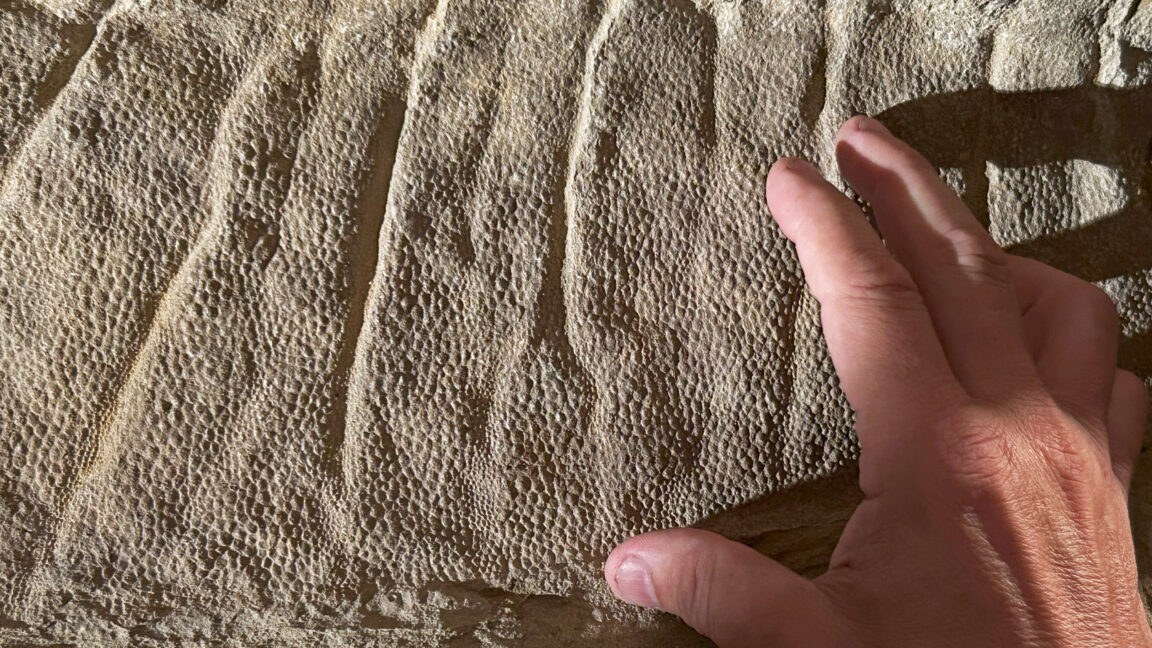
“Another thing that was stunning in Edmontosaurus was the small size of its scales,” Sereno says. Most of the scales were just 1 to 4 millimeters across. They grew slightly larger toward the bottom of the tail, but even there they did not exceed 1 centimeter. “You can find such scales on a lizard, and we’re talking about an animal the size of an elephant,” Sereno adds. The skin covered with these super-tiny scales was also incredibly thin, which the team deduced from the wrinkles they found in their imagery.

And then came the hooves. “In a hoof, the nail goes around the toe and wraps, wedge-shaped, around its bottom,” Sereno explains. The Edmontosaurus had singular, central hooves on its fore legs with a “frog,” a triangular, rubbery structure at the underside. “They looked very much like equine hooves, so apparently these were not invented by mammals,” Sereno says. “Dinosaurs had them.” The hind legs that supported most of the animal’s weight, on the other hand, had three wedge-shaped hooves wrapped around three digits and a fleshy heel toward the back—a structure found in modern-day rhinos.

https://arstechnica.com/science/2025/11/wyoming-dinosaur-mummies-give-us-a-new-view-of-duck-billed-species/


Three astronauts are stuck on China’s space station without a safe ride home

This view shows a Shenzhou spacecraft departing the Tiangong space station in 2023. Credit: China Manned Space Agency

Swapping spacecraft in low-Earth orbit

With their original spacecraft deemed unsafe, Chen and his crewmates instead rode back to Earth on the newer Shenzhou 21 craft that launched and arrived at the Tiangong station October 31. The three astronauts who launched on Shenzhou 21—Zhang Lu, Wu Fei, and Zhang Hongzhang—remain aboard the nearly 100-metric ton space station with only the damaged Shenzhou 20 craft available to bring them home.

China’s line of Shenzhou spaceships not only provide transportation to and from low-Earth orbit, they also serve as lifeboats to evacuate astronauts from the Chinese space station in the event of an in-flight emergency, such as major failures or a medical crisis. They serve the same role as Russian Soyuz and SpaceX Crew Dragon vehicles flying to and from the International Space Station.

Another Shenzhou spacecraft, Shenzhou 22, “will be launched at a later date,” the China Manned Space Agency said in a statement. Shenzhou 20 will remain in orbit to “continue relevant experiments.” The Tiangong lab is designed to support crews of six for only short periods, with longer stays of three astronauts.

Officials have not disclosed when Shenzhou 22 might launch, but Chinese officials typically have a Long March rocket and Shenzhou spacecraft on standby for rapid launch if required. Instead of astronauts, Shenzhou 22 will ferry fresh food and equipment to sustain the three-man crew on the Tiangong station.

China’s state-run Xinhua news agency called Friday’s homecoming “the first successful implementation of an alternative return procedure in the country’s space station program history.”

The shuffling return schedules and damaged spacecraft at the Tiangong station offer a reminder of the risks of space junk, especially tiny debris fragments that evade detection by tracking telescopes and radars. A minuscule piece of space debris traveling at several miles per second can pack a punch. Crews at the Tiangong outpost ventured outside the station multiple times in the last few years to install space debris shielding to protect the outpost.

Astronaut Tim Peake took this photo of a cracked window on the International Space Station in 2016. The 7-millimeter (quarter-inch) divot on the quadruple-pane window was gouged out by an impact of space debris no larger than a few thousandths of a millimeter across. The damage did not pose a risk to the station. Credit: ESA/NASA

Shortly after landing on Friday, ground teams assisted the Shenzhou astronauts out of their landing module. All three appeared to be in good health and buoyant spirits after completing the longest-duration crew mission for China’s space program.

“Space exploration has never been easy for humankind,” said Chen Dong, the mission commander, according to Chinese state media.

“This mission was a true test, and we are proud to have completed it successfully,” Chen said shortly after landing. “China’s space program has withstood the test, with all teams delivering outstanding performances … This experience has left us a profound impression that astronauts’ safety is really prioritized.”

https://arstechnica.com/science/2025/11/three-astronauts-are-stuck-on-chinas-space-station-without-a-safe-ride-home/


World’s oldest RNA extracted from Ice Age woolly mammoth

A young woolly mammoth now known as Yuka was frozen in the Siberian permafrost for about 40,000 years before it was discovered by local tusk hunters in 2010. The hunters soon handed it over to scientists, who were excited to see its exquisite level of preservation, with skin, muscle tissue, and even reddish hair intact. Later research showed that, while full cloning was impossible, Yuka’s DNA was in such good condition that some cell nuclei could even begin limited activity when placed inside mouse eggs.

Now, a team has successfully sequenced Yuka’s RNA—a feat many researchers once thought impossible. Researchers at Stockholm University carefully ground up bits of muscle and other tissue from Yuka and nine other woolly mammoths, then used special chemical treatments to pull out any remaining RNA fragments, which are normally thought to be much too fragile to survive even a few hours after an organism has died. Scientists go to great lengths to extract RNA even from fresh samples, and most previous attempts with very old specimens have either failed or been contaminated.

A different view

The team used RNA-handling methods adapted for ancient, fragmented molecules. Their scientific séance allowed them to explore information that had never been accessible before, including which genes were active when Yuka died. In the creature’s final panicked moments, its muscles were tensing and its cells were signaling distress—perhaps unsurprising since Yuka is thought to have died as a result of a cave lion attack.

It’s an exquisite level of detail, and one that scientists can’t get from just analyzing DNA. “With RNA, you can access the actual biology of the cell or tissue happening in real time within the last moments of life of the organism,” said Emilio Mármol, a researcher who led the study. “In simple terms, studying DNA alone can give you lots of information about the whole evolutionary history and ancestry of the organism under study. “Obtaining this fragile and mostly forgotten layer of the cell biology in old tissues/specimens, you can get for the first time a full picture of the whole pipeline of life (from DNA to proteins, with RNA as an intermediate messenger).”

https://arstechnica.com/science/2025/11/worlds-oldest-rna-extracted-from-ice-age-woolly-mammoth/


Dogs came in a wide range of sizes and shapes long before modern breeds

“The concept of ‘breed’ is very recent and does not apply to the archaeological record,” Evin said. People have, of course, been breeding dogs for particular traits for as long as we’ve had dogs, and tiny lap dogs existed even in ancient Rome. However, it’s unlikely that a Neolithic herder would have described his dog as being a distinct “breed” from his neighbor’s hunting partner, even if they looked quite different. Which, apparently, they did.

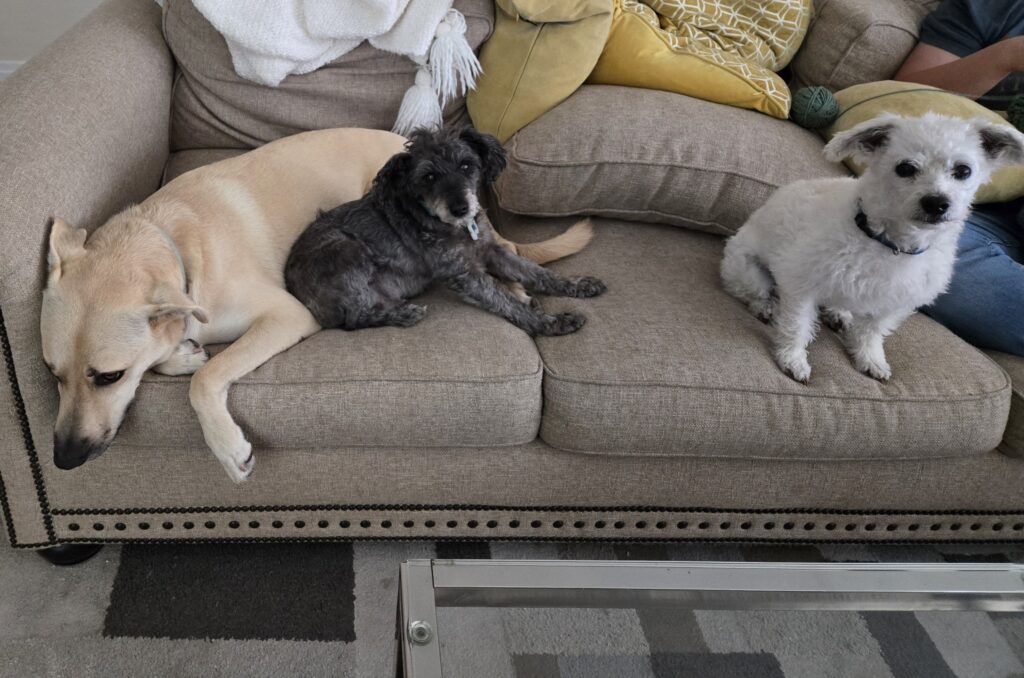
A big yellow dog, a little gray dog, and a little white dog

Dogs had about half of their modern diversity (at least in skull shapes and sizes) by the Neolithic. Credit: Kiona Smith

Bones only tell part of the story

“We know from genetic models that domestication should have started during the late Pleistocene,” Evin told Ars. A 2021 study suggested that domestic dogs have been a separate species from wolves for more than 23,000 years. But it took a while for differences to build up.

Evin and her colleagues had access to 17 canine skulls that ranged from 12,700 to 50,000 years old—prior to the end of the ice age—and they all looked enough like modern wolves that, as Evin put it, “for now, we have no evidence to suggest that any of the wolf-like skulls did not belong to wolves or looked different from them.” In other words, if you’re just looking at the skull, it’s hard to tell the earliest dogs from wild wolves.

We have no way to know, of course, what the living dog might have looked like. It’s worth mentioning that Evin and her colleagues found a modern Saint Bernard’s skull that, according to their statistical analysis, looked more wolf-like than dog-like. But even if it’s not offering you a brandy keg, there’s no mistaking a live Saint Bernard, with its droopy jowls and floppy ears, for a wolf.

“Skull shape tells us a lot about function and evolutionary history, but it represents only one aspect of the animal’s appearance. This means that two dogs with very similar skulls could have looked quite different in life,” Evin told Ars. “It’s an important reminder that the archaeological record captures just part of the biological and cultural story.”

And with only bones—and sparse ones, at that—to go on, we may be missing some of the early chapters of dogs’ biological and cultural story. Domestication tends to select the friendliest animals to produce the next generation, and apparently that comes with a particular set of evolutionary side effects, whether you’re studying wolves, foxes, cattle, or pigs. Spots, floppy ears, and curved tails all seem to be part of the genetic package that comes with inter-species friendliness. But none of those traits is visible in the skull.

https://arstechnica.com/science/2025/11/dogs-came-in-a-wide-range-of-sizes-and-shapes-long-before-modern-breeds/


Scientist pleaded guilty to smuggling Fusarium graminearum into US. But what is it?

Even with Fusarium graminearum, which has appeared on every continent but Antarctica, there is potential for introducing new genetic material into the environment that may exist in other countries but not the US and could have harmful consequences for crops.

How do you manage Fusarium graminearum infections?

Fusarium graminearum infections generally occur during the plant’s flowering stage or when there is more frequent rainfall and periods of high humidity during early stages of grain production.

How Fusarium graminearum risk progressed in 2025. Yellow is low risk, orange is medium risk, and red is high risk. Fusarium Risk Tool/Penn State

Wheat in the southern US is vulnerable to infection during the spring. As the season advances, the risk from scab progresses north through the US and into Canada as the grain crops mature across the region, with continued periods of conducive weather throughout the summer.

Between seasons, Fusarium graminearum survives on barley, wheat, and corn plant residues that remain in the field after harvest. It reproduces by producing microscopic spores that can then travel long distances on wind currents, spreading the fungus across large geographic areas each season.

In wheat and barley, farmers can suppress the damage by spraying a fungicide onto developing wheat heads when they’re most susceptible to infection. Applying fungicide can reduce scab and its severity, improve grain weight, and reduce mycotoxin contamination.

However, integrated approaches to manage plant diseases are generally ideal, including planting barley or wheat varieties that are resistant to scab and also using a carefully timed fungicide application, rotating crops, and tilling the soil after harvest to reduce residue where Fusarium graminearum can survive the winter.

Even though fungicide applications may be beneficial, fungicides offer only some protection and can’t cure scab. If the environmental conditions are extremely conducive for scab, with ample moisture and humidity during flowering, the disease will still occur, albeit at reduced levels.

[embedded content]

Fusarium Head Blight with NDSU’s Andrew Friskop.

Plant pathologists are making progress on early warning systems for farmers. A team from Kansas State University, Ohio State University, and Pennsylvania State University has been developing a computer model to predict the risk of scab. Their wheat disease predictive model uses historic and current environmental data from weather stations throughout the US, along with current conditions, to develop a forecast.

In areas that are most at risk, plant pathologists and commodity specialists encourage wheat growers to apply a fungicide during periods when the fungus is likely to grow to reduce the chances of damage to crops and the spread of mycotoxin.

Tom W. Allen, associate research professor of Plant Pathology, Mississippi State University. This article is republished from The Conversation under a Creative Commons license. Read the original article.

https://arstechnica.com/science/2025/11/scientist-pleaded-guilty-to-smuggling-fusarium-graminearum-into-us-but-what-is-it/


Blue Origin’s New Glenn rocket came back home after taking aim at Mars

ESCAPADE, short for Escape and Plasma Acceleration and Dynamics Explorers, was developed and launched on a budget of about $80 million, a bargain compared to all of NASA’s recent Mars missions. The spacecraft were built by Rocket Lab, and the project is managed on behalf of NASA by the University of California, Berkeley.

The two spacecraft for NASA’s ESCAPADE mission at Rocket Lab’s factory in Long Beach, California. Credit: Rocket Lab

NASA paid Blue Origin about $20 million for the launch of ESCAPADE, significantly less than it would have cost to launch it on any other dedicated rocket. The space agency accepted the risk of launching on the relatively unproven New Glenn rocket, which hasn’t yet been certified by NASA or the Space Force for the government’s marquee space missions.

The mission was supposed to launch last year, when Earth and Mars were in the right positions to enable a direct trip between the planets. But Blue Origin delayed the launch, forcing a yearlong wait until the company’s second New Glenn was ready to fly. Now, the ESCAPADE satellites, each about a half-ton in mass fully fueled, will loiter in a unique orbit more than a million miles from Earth until next November, when they will set off for the red planet. ESCAPADE will arrive at Mars in September 2027 and begin its science mission in 2028.

Rocket Lab ground controllers established communication with the ESCAPADE satellites late Thursday night.

“The ESCAPADE mission is part of our strategy to understand Mars’ past and present so we can send the first astronauts there safely,” said Nicky Fox, associate administrator of NASA’s Science Mission Directorate. “Understanding Martian space weather is a top priority for future missions because it helps us protect systems, robots, and most importantly, humans, in extreme environments.”

https://arstechnica.com/science/2025/11/blue-origin-caps-second-heavy-lift-launch-with-first-offshore-landing/