For giant carnivorous dinosaurs, big size didn’t mean a big bite
“And then you have the Spinosaurus which was kind of weird in general,” Rowe says. “There was a study by Dave Hone and Tom Holtz about how it was waiting on the shorelines, waiting for food to go by that it could fish out.” But Spinosaurus’ foraging wasn’t limited to fishing. There was a pterosaur found preserved in its stomach and there were iguanodon remains found in the maw of a Baryonyx, another large carnivore belonging to the same lineage as the Spinosaurus. “They had great diversity in their diet. They were generalists, but our results show they weren’t these massive bone-crunching predators like the T. rex,” Rowe says. Because the T. rex was just built different.
King of the Cretaceous jungle
The Tyranosauroidea lineage had stiff, akinetic skulls, meaning they had very little mobility in the joints. The T. rex skull could and most likely did withstand very high stress as the animal pursued a “high stress, high power” strategy, entirely different from other large carnivores. “They were very much like big crocodiles with extremely strong, reinforced jaws and powerful muscles that could pulverize bones,” Rowe claims.
The T. rex, he argued, was a specialist—an ambush predator that attacked large, highly mobile prey, aiming to subdue it with a single bite. “And we have fossil evidence of that,” Rowe says. “In the Museum of Natural History in New York, there is a Hadrosaur, a large herbivorous dinosaur with a duck-like beak, and there’s a T. rex tooth embedded in its back.” This, he thinks, means the T. rex was actively preying on this animal, especially since there are healing marks around the stuck tooth. “Even with this super strong bite, the T. rex wasn’t always successful,” Rowe adds.
Still, the fight with the Spinosaurus most likely wouldn’t go the way it did in Jurassic Park III. “The T. rex was built to fight like that; the Spinosaurus really wasn’t”, Rowe says.
Texas prepares for war as invasion of flesh-eating flies appears imminent
Past success
As the flies’ host and geographic range expand, pressure is intensifying to control the flies—something many countries have managed to do in the past.
Decades ago, screwworms were endemic throughout Central America and the southern US. However, governments across the regions used intensive, coordinated control efforts to push the flies southward. Screwworms were eliminated from the US around 1966, and were pushed downward through Mexico in the 1970s and 1980s. They were eventually declared eliminated from Panama in 2006, with the population held at bay by a biological barrier at the Darién Gap, at the border of Panama and Colombia. However, in 2022, the barrier was breached, and the flies began advancing northward, primarily through unmonitored livestock movements. The latest surveillance suggests the flies are now about 370 miles south of Texas.
The main method to wipe out screwworms is the sterile insect technique (SIT), which exploits a weakness in the fly’s life cycle since they tend to only mate once. In the 1950s, researchers at the US Department of Agriculture figured out they could use gamma radiation to sterilize male flies without affecting their ability to find mates. They then bred massive amounts of male flies, sterilized them, and carpet-bombed infested areas with aerial releases, which tanked the population.
Panama, in partnership with the US, maintained the biological barrier at the Colombian border with continual sterile-fly bombings for years. But as the flies approached this year, the USDA shifted its aerial deliveries to Mexico. In June, the USDA announced plans to set up a new sterile fly facility in Texas for aerial deliveries to northern Mexico. And last month, the USDA halted livestock trade from southern entry points.
Miller said in the announcement today that SIT is no longer enough, and Texas is taking its own steps. Those include the new bait, insecticides, and new feed for livestock and deer laced with the anti-parasitic drug ivermectin. Miller also said that the state aims to develop a vaccine for cattle that could kill larvae, but such a shot is still in development.
New executive order puts all grants under political control
On Thursday, the Trump administration issued an executive order asserting political control over grant funding, including all federally supported research. The order requires that any announcement of funding opportunities be reviewed by the head of the agency or someone they designate, which means a political appointee will have the ultimate say over what areas of science the US funds. Individual grants will also require clearance from a political appointee and “must, where applicable, demonstrably advance the President’s policy priorities.”
The order also instructs agencies to formalize the ability to cancel previously awarded grants at any time if they’re considered to “no longer advance agency priorities.” Until a system is in place to enforce the new rules, agencies are forbidden from starting new funding programs.
In short, the new rules would mean that all federal science research would need to be approved by a political appointee who may have no expertise in the relevant areas, and the research can be canceled at any time if the political winds change. It would mark the end of a system that has enabled US scientific leadership for roughly 70 years.
We’re in control
The text of the executive order recycles prior accusations the administration has used to justify attacks on the US scientific endeavor: Too much money goes to pay for the facilities and administrative staff that universities provide researchers; grants have gone to efforts to diversify the scientific community; some studies can’t be replicated; and there have been instances of scientific fraud. Its “solution” to these problems (some of which are real), however, is greater control of the grant-making process by non-expert staff appointed by the president.
In general, the executive order inserts a layer of political control over both the announcement of new funding opportunities and the approval of individual grants. It orders the head of every agency that issues grants—meaning someone appointed by the president—to either make funding decisions themselves, or to designate another senior appointee to do it on their behalf. That individual will then exert control over whether any funding announcements or grants can move forward. Decisions will also require “continuation of existing coordination with OMB [Office of Management and Budget].” The head of OMB, Russell Vought, has been heavily involved in trying to cut science funding, including a recent attempt to block all grants made by the National Institutes of Health.
Stone tools may hint at ancestors of Homo floresiensis
Some stone tools found near a river on the Indonesian island of Sulawesi suggest that the first hominins had reached the islands by at least 1.04 million years ago. That’s around the same time that the ancestors of the infamously diminutive “Hobbits” may have reached the island of Flores.
Archaeologist Budianto Hakim of Indonesia’s National Research and Innovation Agency and his colleagues were the ones who recently unearthed the tools from a site on Sulawesi. Although a handful of stone flakes from that island don’t tell us who the ancestors of the small species were or how they reached remote islands like Flores and Luzon, the tools are one more piece in the puzzle. And this handful of stone flakes may eventually play a role in helping us understand how other hominin species conquered most of the world long before we came along.
Crossing the ocean a million years ago
Sometimes the deep past leaves the smallest traces. At the Calio site, a sandstone outcrop in what’s now a cornfield outside the village of Ujung in southern Sulawesi, people left behind just a handful of sharp stone flakes roughly a million years ago. There are seven of them, ranging from 22 to 60 millimeters long, and they’re scratched, worn, and chipped from tumbling around at the bottom of a river. But it’s still clear that they were once shaped by skilled human—or at least human-like—hands that used hard stones as hammers to make sharp-edged chert flakes for cutting and scraping.
The oldest of these tools is likely to be between 1.04 and 1.48 million years old. Hakim and his colleagues dated teeth from a wild pig to around 1.26 million years ago. They were part of a jawbone archaeologists unearthed from a layer just above the oldest flake. Throw in some statistical modeling, and you get the range of likely dates for the stone flake buried in the deepest layer of soil.
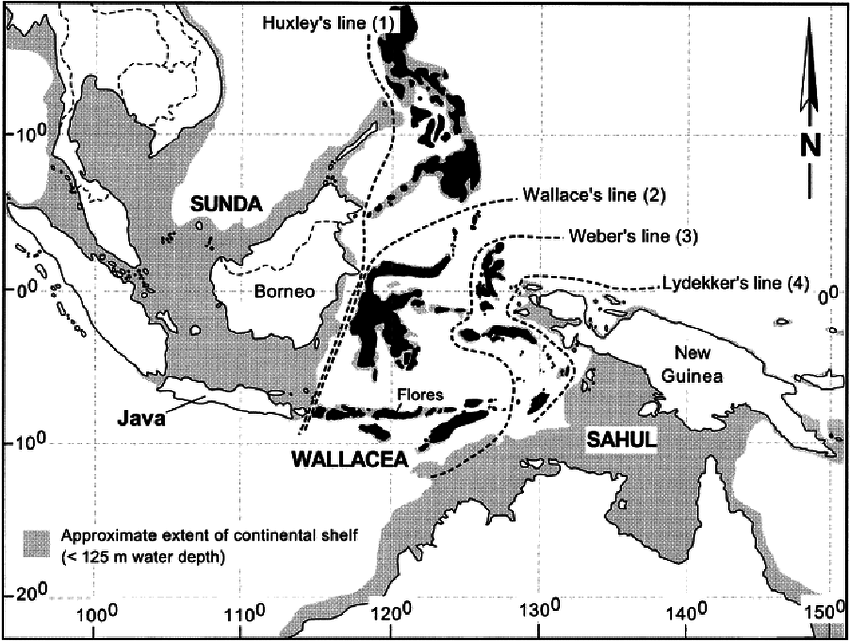
Even the younger end of that estimate would make these tools the oldest evidence yet of hominins (of any species) in the islands of Indonesia and the Philippines. This area, sometimes called Wallacea, lies between the continents of Asia and Australia, separated from both by wide channels of deep ocean.
“But the Calio site has yet to yield any hominin fossils,” said Brumm, “so while we now know there were tool-makers on Sulawesi a million years ago, their identity remains a mystery.” But they may be related to the Hobbits, a short-statured group of hominins who lived hundreds of kilometers away on the island of Flores until around 50,000 years ago.
“The discovery of Early Pleistocene artifacts at Calio suggests that Sulawesi was populated by hominins at around the same time as Flores, if not earlier,” wrote Hakim and his colleagues in their recent paper.
The Flores connection
The islands that now make up Indonesia and the Philippines have been a hominin hotspot for at least a million years. Our species wandered onto the scene sometime between 63,000 and 73,000 years ago, but at least one other hominin species had already been there for at least a million years. We’re just not sure exactly who they were, when they arrived, or how.
“Precisely when hominins first crossed to Sulawesi remains an open question, as does the taxonomic affinity of the colonizing population,” the authors note.
This map shows the islands of Wallacea. The large one just east of Java is Sulawesi. Credit: Darren O’Connell
That’s why the handful of stone tools the team recently unearthed at Calio matter: They’re another piece of that puzzle, albeit a small one. Every slightly older date is one step closer to the first hominin tools, bones, or footprints in these islands, and another pin on the map of who was where and when.
And that map is accumulating quite a lot of pins, representing an ever-increasing number of species. Once the first hominins made it across the Makassar Strait, they found themselves in isolated groups on islands cut off from the mainland—and each other—so the hominin family tree started branching very quickly. On at least two islands, Flores and Luzon, those original hominin settlers eventually gave rise to local species, Homo floresiensis and Homo luzonensis. And University of Wollongong paleoanthropologist Richard Roberts, a co-discoverer of Homo floresiensis, thinks there are probably more isolated island hominin species.
In 2019, when Homoluzonensis was first described, Roberts told Ars, “These new fossils, and the assignation of them to a new species (Homo luzonensis), fulfills one of the predictions Mike Morwood and others (myself included) made when we first reported (15 years ago!) the discovery of Homo floresiensis: that other unknown species of hominins would be found in the islands of Southeast Asia.”
Both Homo floresiensis (the original “Hobbits”) and Homo luzonensis were short, clocking in at just over a meter tall. Their bones and teeth are different enough from each other to set them apart as a unique species, but they have enough in common that they probably share a common ancestor—one they don’t share with us. They’re more like our distant cousins, and the islands of Wallacea may have been home to many other such cousins, if Roberts and his colleagues are correct.
Complicated family history
But who was the common ancestor of all these hominin cousins? That’s where things get complicated (as if they weren’t already). Most paleoanthropologists lean toward Homo erectus, but there’s a chance—along with some tantalizing hints, and no direct evidence—that much more ancient human relatives called Australopithecines may have made the journey a million (or two) years before Homo erectus.
Finger and toe bones from Homo luzonensis are curved, as if they spent as much of their lives climbing trees as walking. That’s more like Australopithecines than any member of our genus Homo. But their teeth are smaller and shaped more like ours. Anthropologists call this mix of features a mosaic, and it can make it tough to figure out how hominin species are related. That’s part of why the question of when the ancestors of the Hobbits arrived on their respective islands is so important.
Compare the teeth and phalanx of Homo luzonensis to those of Homo sapiens (right) and Australopithecus afarensis (left). Credit: Tocheri 2019
We don’t know the answer yet, but we do know that someone was making stone tools on Flores by 1.02 million years ago. Those toolmakers may have been Homo erectus, Australopithecines, or something already recognizable as tiny Homo floresiensis. The Hobbits (or their ancestors) were distinctly “Hobbity” by around 700,000 years ago; fossil teeth and bones from a handful of hominins at a site called Mata Menge make that clear. The Hobbits discovered at Liang Bua Cave on Flores date to somewhere between 50,000 and 100,000 years ago.
Meanwhile, 2,800 kilometers away on the island of Luzon, the oldest stone tools, along with their obvious cut marks left behind on animal bones, date back to 700,000 years ago. That’s as old as the Mata Menge Hobbits on Flores. The oldest Homo luzonensis fossils are between 50,000 and 67,000 years old. It’s entirely possible that older evidence, of the island’s original settlers and of Homo luzonensis, may eventually be found, but until then, we’re left with a lot of blank space and a lot of questions.
And now we know that the oldest traces of hominin presence on Sulawesi is at least 1.04 million years old. But might Sulawesi have its own diminutive hominins?
So are there more Hobbits out there?
“Sulawesi is a wild card—it’s like a mini-continent in itself,” said Brumm. “If hominins were cut off on this huge and ecologically rich island for a million years, would they have undergone the same evolutionary changes as the Flores hobbits? Or would something totally different have happened?”
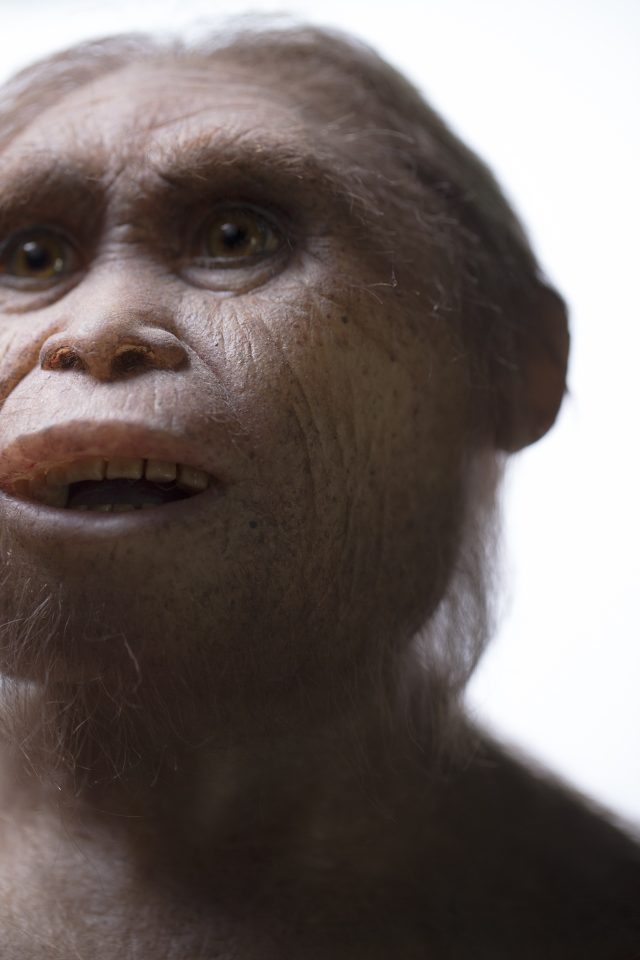
Reconstruction of Homo floresiensis by Atelier Elisabeth Daynes. Credit: Kinez Riza
A phenomenon called island dwarfism played a role in Homo floresiensis‘ evolution; species that live in relative isolation on small islands tend to evolve into either much larger or much smaller versions of their ancestors (which is why the Hobbits shared their island home with pygmy elephants and giant moas). But how small does an island need to be before island dwarfism kicks in? Sulawesi is about 12 times as large as Flores, for example. So what might the descendants of the Calio toolmakers have looked like by 100,000 years ago?
That’s something that we’ll only know if archaeologists on Sulawesi, like Hakim and his team, find fossil remains of those hominins.
Seafarers or tsunami survivors?
Understanding exactly when hominins first set foot on the island of Sulawesi might eventually help us figure out how they got there. These islands are thousands of kilometers from the Southeast Asian mainland and from each other, so getting there would have meant crossing vast stretches of deep, open ocean.
Archaeologists haven’t found any evidence that anyone who came before our species built boats or rafts, although those watercraft would have been made of materials that tend to decay pretty quickly, so even scraps of ancient wood and rope are extremely rare and lucky finds. But some ancient hominins did have a decent grasp of all the basic skills they’d need for at least a simple raft: woodworking and rope-making.
Another possibility is that hominins living on the coast of mainland Southeast Asia could have been swept out to sea by a tsunami, and some of them could have been lucky enough to survive the misadventure and wash ashore someplace like Sulawesi, Flores, or Luzon (RIP to any others). But for that scenario to work, enough hominins would have had to reach each island to create a lasting population, and it probably had to happen more than once to end up with hominin groups on at least three distant islands.
Either way, it’s no small feat, even for a Hobbit with small feet.
Human remains from 11 individuals recovered from El Mirador Cave in Spain showed evidence of cannibalism, archaeologists have concluded. According to a new paper published in the journal Scientific Reports, the cannibalism was likely the result of a violent episode between competing Late Neolithic herding communities about 5,700 years ago.
“Cannibalism is one of the most complex behaviors to interpret, due to the inherent difficulty of understanding the act of humans consuming other humans,” said co-author Palmira Saladié, a researcher at IPHES-CERCA and the Universitat Rovira i Virgili (URV). “Moreover, in many cases we lack all the necessary evidence to associate it with a specific behavioral context. Finally, societal biases tend to interpret it invariably as an act of barbarism.”
The El Mirador Cave is located at Sierra de Atapuerca, an archaeological site in the Burgos province of northern Spain. There is prior evidence of cannibalism at the Atapuerca site, including the remains of six Early Bronze Age humans, which included skull caps possibly used as containers during ceremonial consumption. In addition, since 1994, more than 160 bone fragments have been recovered from the Aurora Stratum (TD-6) in the Gran Dolina cavern at Sierra de Atapuerca. Over 30 percent of those fragments showed signs of butchering and consumption, such as slice marks, scrape marks, and chop marks.
This latest paper analyzed 5,056 human remains recovered from two sectors of El Mirador Cave using microscopy. Eight samples were selected for additional radiocarbon dating, with at least one bone taken from each stratigraphic level, and another five bones underwent strontium isotope testing.
The microscopy analysis revealed telltale slice marks, scrape marks, and chop marks, as well as evidence of cremation, peeling, fractures, and human tooth marks. This indicates the victims were skinned, the flesh removed, the bodies disarticulated, and then cooked and eaten. Radiocarbon dating placed the time between 5,700 and 5,570 years ago, while isotope analysis indicated the individuals were local and were probably eaten over the course of just a few days.
Infant human femur found at El Mirador, with percussion marks for marrow extraction.
IPHES-CERCA
Infant human femur found at El Mirador, with percussion marks for marrow extraction. IPHES-CERCA
Fragmented and cannibalized limb bones.
IPHES-CERCA
Fragmented and cannibalized limb bones. IPHES-CERCA
Infant human femur found at El Mirador, with percussion marks for marrow extraction. IPHES-CERCA
Fragmented and cannibalized limb bones. IPHES-CERCA
Cannibalized human maxilla.
IPHES-CERCA
Cannibalized human maxilla. IPHES-CERCA
Cut marks on a foot bone.
IPHES-CERCA
Cut marks on a foot bone. IPHES-CERCA
Cannibalized human maxilla. IPHES-CERCA
Cut marks on a foot bone. IPHES-CERCA
Granted, it can be challenging to determine whether such marks are due to cannibalistic behavior, and the authors considered several alternative hypotheses. For example, there are funerary rituals that involve removing skulls or disarticulating the bodies, which would leave marks on the bones, but the authors note this would typically only affect between 1 to 5 percent of the remains. Injuries from weapons made of stone, metal, or bone can produce similar slice and chop marks, but these are usually found mainly on the ribs and vertebrae.
Titan sub implosion caused by absolutely bonkers “toxic workplace environment”
In a 300-plus page final report released today, the US Coast Guard analyzed the 2023 Titan sub implosion from every conceivable angle and came to a clear conclusion: OceanGate CEO Stockton Rush was a dangerous and deeply unpleasant boss.
His company used “intimidation tactics” to sidestep regulatory scrutiny, it was a “toxic” workplace, and its safety culture was “critically flawed.” The Titan itself was “undocumented, unregistered, non-certificated, [and] unclassed.” As for Rush, he managed to “completely ignore vital inspections, data analyses, and preventative maintenance procedures.” The result was a “catastrophic event” that occurred when 4,930 pounds per square inch of water pressure cracked the sub open and crushed its five occupants during a dive to the Titanic wreckage site.
Had Rush somehow survived, the report says, he would have been referred for prosecution.
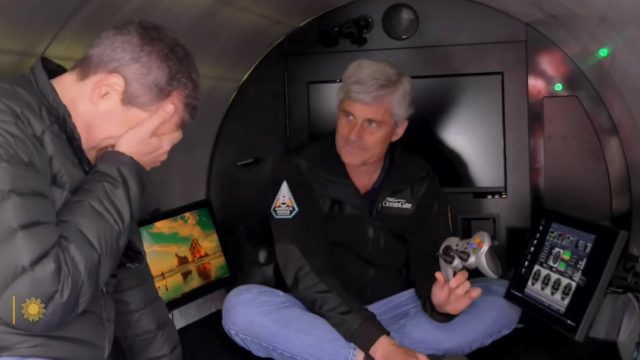
OceanGate CEO Stockton Rush shows David Pogue the 2010-era game controller used to pilot the Titan sub during a CBS Sunday Morning segment broadcast in November 2022. Credit: CBS Sunday Morning
Throwing the controller
One small story about a video game controller shows what Rush was like to work for. You may remember Rush from an infamous 2022 CBS Sunday Morning segment, where Rush showed journalist David Pogue around the Titan sub. “We run the whole thing with this game controller,” Rush said, holding up a Logitech F710 controller with 3D-printed thumbstick extensions. Pogue chuckled, saying, “Come on!” as he covered his face with his hand.
The game controller had been used in OceanGate subs for years by that point; a 2014 video showed one being used to control the company’s earlier Cyclops I submersible. In 2016, OceanGate took the Cyclops I to dive the wreck of the Andrea Doria outside of Nantucket, Massachusetts. (Seinfeld fans will remember that an entire episode is taken up with George’s quest to get an apartment that was about to go to an Andrea Doria survivor.)
The OceanGate team spent two days at the site, running 2D and 3D scans of the sunken ship, until Rush got the Cyclops I “stuck under the bow of the Andrea Doria wreckage”—and he couldn’t get the sub free. According to the report, Rush then “experienced a ‘meltdown’ and refused to let [the assistant pilot] assist in resolving the situation. When a mission specialist suggested that Mr. Rush hand over the controller to the assistant pilot, the assistant pilot reported that the controller was thrown at him. Upon obtaining the controller, the assistant pilot was able to free the Cyclops I from the wreckage.”
Analysis: The Trump administration’s assault on climate action
The report is a master class in arbitrary and capricious decision-making applied to science. Sometimes the authors rely on the peer-reviewed literature. Other times they perform their own analysis for this document, in some cases coming up with almost comically random metrics for data. (Example: “We examine occurrences of 5-day deluges as follows. Taking the Pacific coast as an example, a 130-year span contains 26 5-year intervals. At each location we computed the 5-day precipitation totals throughout the year and selected the 26 highest values across the sample.” Why five days? Five-year intervals? Who knows.)
This is especially striking in a few cases where the authors choose references that were published a few years ago, and thus neatly avoid the dramatic temperature records that have been set over the past couple of years. Similarly, they sometimes use regional measures and sometimes use global ones. They demand long-term data in some contexts, while getting excited about two years of coral growth in the Great Barrier Reef. The authors highlight the fact that US tide gauges don’t show any indication of an acceleration in the rate of sea level rise while ignoring the fact that global satellite measures clearly do.
That’s not to say that there aren’t other problems. There’s some blatant misinformation, like claims that urbanization could be distorting the warming, which has already been tested extensively. (Notably, warming is most intense in the sparsely populated Arctic.) There’s also some creative use of language, like referring to the ocean acidification caused by CO2 as “neutralizing ocean alkalinity.”
But the biggest bit of misinformation comes in the introduction, where the secretary of energy, Chris Wright, said of the authors, “I chose them for their rigor, honesty, and willingness to elevate the debate.” There is no reason to choose this group of marginal contrarians except the knowledge that they’d produce a report like this, thus providing a justification for those in the administration who want to believe it’s all a scam.
With Trump’s cutbacks, crew heads for ISS unsure of when they’ll come back
The next four-person team to live and work aboard the International Space Station departed from NASA’s Kennedy Space Center in Florida on Friday, taking aim at the massive orbiting research complex for a planned stay of six to eight months.
Spacecraft commander Zena Cardman leads the mission, designated Crew-11, that lifted off from Florida’s Space Coast at 11:43 am EDT (15:43 UTC) on Friday. Sitting to her right inside SpaceX’s Crew Dragon Endeavour capsule was veteran NASA astronaut Mike Fincke, serving as the vehicle pilot. Flanking the commander and pilot were two mission specialists: Kimiya Yui of Japan and Oleg Platonov of Russia.
Cardman and her crewmates rode a Falcon 9 rocket off the launch pad and headed northeast over the Atlantic Ocean, lining up with the space station’s orbit to set the stage for an automated docking at the complex early Saturday.
Goodbye LZ-1
The Falcon 9’s reusable first stage booster detached and returned to a propulsive touchdown at Landing Zone 1 (LZ-1) at Cape Canaveral Space Force Station, a few miles south of the launch site. This was the 53rd and final rocket landing at LZ-1 since SpaceX aced the first intact recovery of a Falcon 9 booster there on December 21, 2015.
On most of SpaceX’s missions, Falcon 9 boosters land on the company’s offshore drone ships hundreds of miles downrange from the launch site. For launches with enough fuel margin, the first stage can return to an onshore landing. But the Space Force, which leases out the landing zones to SpaceX, wants to convert the site of LZ-1 into a launch site for another rocket company.
SpaceX will move onshore rocket landings to new landing zones to be constructed next to the two Falcon 9 launch pads at the Florida spaceport. Landing Zone 2, located adjacent to Landing Zone 1, will also be decommissioned and handed back over to the Space Force once SpaceX activates the new landing sites.
“We’re working with the Cape and with the Kennedy Space Center folks to figure out the right time to make that transition from Landing Zone 2 in the future,” said Bill Gerstenmaier, SpaceX’s vice president of build and flight reliability. “But I think we’ll stay with Landing Zone 2 at least near-term, for a little while, and then look at the right time to move to the other areas.”
EPA plans to ignore science, stop regulating greenhouse gases
It derives from a 2007 Supreme Court ruling that named greenhouse gases as “air pollutants,” giving the EPA the mandate to regulate them under the Clean Air Act.
Critics of the rule say that the Clean Air Act was fashioned to manage localized emissions, not those responsible for global climate change.
A rollback would automatically weaken the greenhouse gas emissions standards for cars and heavy-duty vehicles. Manufacturers such as Daimler and Volvo Cars have previously opposed the EPA’s efforts to tighten emission standards, while organized labour groups such as the American Trucking Association said they “put the trucking industry on a path to economic ruin.”
However, Katherine García, director of Sierra Club’s Clean Transportation for All Campaign, said that the ruling would be “disastrous for curbing toxic truck pollution, especially in frontline communities disproportionately burdened by diesel exhaust.”
Energy experts said the move could also stall progress on developing clean energy sources such as nuclear power.
“Bipartisan support for nuclear largely rests on the fact that it doesn’t have carbon emissions,” said Ken Irvin, a partner in Sidley Austin’s global energy and infrastructure practice. “If carbon stops being considered to endanger human welfare, that might take away momentum from nuclear.”
The proposed rule from the EPA will go through a public comment period and inter-agency review. It is likely to face legal challenges from environmental activists.
“Obviously with a meme, they’re not the size of a city block,” she continued. “So it occurred to me that they are infinite, but almost like you’re peeling sheets off a pad and the pad just has an endless number of sheets. You can just keep redoing it, redo, redo, redo. That’s memes. They get revised and repurposed and re-imagined and redone and recirculated over and over and over again. The template gets used inexhaustibly, which is what makes them fun, what makes them go viral.”
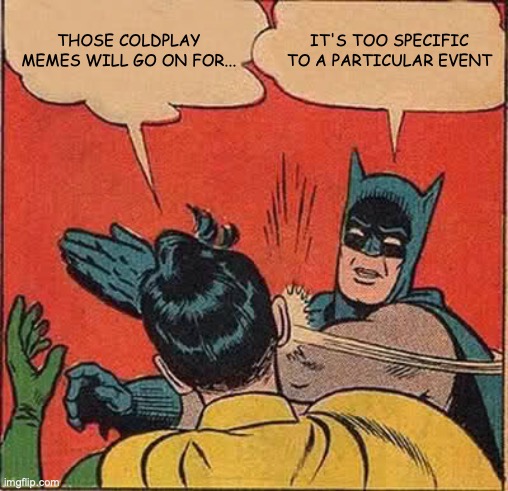
Credit: Jennifer Ouellette via imgflp
Just what makes a good meme image? Abate has some thoughts about that, too. “It has to be not just the image, but the ability for the image to be paired with a caption, a text,” she said. “It has to lend itself to some kind of verbal element as well. And it also has to have some elasticity of being specific enough that it’s recognizable, but also being malleable enough that it can be adapted to different forms.”
In other words, a really good meme must be generalizable if it is to last longer than a few weeks. The recent kiss-cam incident at a Coldplay concert is a case in point. When a married tech CEO was caught embracing his company’s “chief people officer,” they quickly realized they were on the Jumbotron, panicked, and hid their faces—which only made it worse. The moment went viral and spawned myriad memes. Even the Phillies mascots got into the spirit, re-enacting the moment at a recent baseball game. But that particular meme might not have long-term staying power.
“It became a meme very quickly and went viral very fast,” said Abate. “I may be proved wrong, but I don’t think the Coldplay moment will be a meme that will be around a year from now. It’s commenting on a particular incident in the culture, and then the clock will tick, and folks will move on. Whereas something like ‘Distracted Boyfriend’ or ‘This is Fine’ has more staying power because it’s not tied to a particular incident or a particular scandal but can be applied to all kinds of political topics, pop culture events, and cultural experiences.”