Causality optional? Testing the “indefinite causal order” superposition
The results were 18 standard deviations away from what you’d expect based on Bell’s theorem, which is a strong indication that superposition of temporal order is a fundamental feature of quantum mechanics.

But the experiment remains where entanglement was a few decades ago: There are plenty of loopholes. For example, many photons are lost during the experiment (about 1 percent of those sent into it come out the other side to be measured). It remains technically possible that the losses were preferentially occurring among a subset of photons that would otherwise restore correlations that are compatible with hidden variables.

The team also hasn’t separated the hardware by far enough distances to rule out sub-light-speed influences, and there are a few potential oddities specific to indefinite causal-order experiments as well. But the work points the way toward experiments that could close these loopholes, and we already have a history of slamming the door shut on them.

Normally, when covering something weird like this, all we’re left with is the ability to gape at just how weird our world actually is compared to our expectations. But this is one of those cases where understanding the physics is already known to have many practical applications.

“The [device used in this work] may also be interesting for applications as it has been shown that it can outperform causally ordered processes at a wide variety of tasks such as channel discrimination, promise problems, communication complexity, noise mitigation, various thermodynamic applications, quantum metrology, quantum key distribution, entanglement generation, and distillation, among others,” the authors write.

In other words, getting confused about the time might actually be useful.

* I wouldn’t even be aware that this work was done if I hadn’t seen an excellent summary of it on the American Physical Society news site.

PRX Quantum, 2026. DOI: 10.1103/5t2y-ddmt  (About DOIs).

https://arstechnica.com/science/2026/03/getting-formal-about-quantum-mechanics-lack-of-causality/


How new fishing tech can reduce bycatch of turtles and other creatures

Our oceans are full of sophisticated, perfect traps: Nets, hooks, fishing lines. Designed to capture animals destined for our dinner tables, they often catch other wildlife too.

This accidental harvest is known as bycatch, and every year it causes the death of millions of marine animals, including whales, dolphins, sharks, turtles, and seabirds. Nets and gear can asphyxiate animals or cause fatal injuries; even when the animals are tossed back to sea, they frequently die. Bycatch is also a dilemma for fishermen—entangled creatures can destroy equipment, costing time, money, and fisheries’ reputations.

Over the decades, conservationists, researchers, and fishermen have developed ways to minimize various kinds of bycatch in different fishing stocks around the world. But putting these solutions to work is often a challenge, and many mitigation strategies are never widely implemented.

overhead photo of dolphin entangled in fishing gear

Fishing gear that entangles dolphins, porpoises, and whales is a major threat to the animals. Here, gear trails from the North Atlantic right whale called Snowcone (known individual #3560) who swims with her calf in waters off Georgia.

Credit: Georgia Dept. of Natural Resources NOAA permit #20556

Fishing gear that entangles dolphins, porpoises, and whales is a major threat to the animals. Here, gear trails from the North Atlantic right whale called Snowcone (known individual #3560) who swims with her calf in waters off Georgia. Credit: Georgia Dept. of Natural Resources NOAA permit #20556

Some approaches, however, now have a proven success rate—and more may be on the horizon. Recent research has explored nets equipped with lights; even low-tech tricks like kitting out gear with plastic water bottles show promise of reducing some kinds of bycatch while also being practical for fishermen to use.

Despite the challenges, researchers are hopeful. “There are not very many conservation issues that I’m aware of where industry and conservationists and consumers and the fishermen and the resource users all want the same thing,” says marine biologist Matthew Savoca, a research scientist at Stanford University’s Hopkins Marine Station. “Every stakeholder wants less bycatch.”

Keeping turtles out

The bycatch problem has always existed. “It’s a conflict that’s intrinsic to the whole idea of fishing,” says marine scientist Nancy Knowlton, marine biologist emerita at the Smithsonian’s National Museum of Natural History. “If you have something that’s designed to catch animals, you’re going to wind up, almost always, catching some things that you didn’t mean to catch.”

https://arstechnica.com/science/2026/03/how-new-fishing-tech-can-reduce-bycatch-of-turtles-and-other-creatures/


Rocket Report: Russia reopens gateway to ISS; Cape Canaveral hosts missile test

More to come?… Lt. Gen. Doug Schiess, the Space Force’s deputy chief of operations, told a House subcommittee Wednesday that the military was looking at moving more missions off of ULA’s Vulcan rocket to other providers. Currently, only ULA’s Vulcan and SpaceX’s Falcon 9 and Falcon Heavy rockets are certified for national security launches. The Vulcan rocket is expected to be grounded until at least this summer as engineers investigate a recurring problem with the vehicle’s solid rocket boosters.

NASA is blowing things up. A team of NASA engineers is intentionally blowing up models of methane-fueled rockets in Florida to see just how big of a bang they make when they explode, Ars reports. Methane is the launch industry’s chic new rocket fuel because it is better suited for reusable engines. Heavy- and super-heavy-lift rockets like Blue Origin’s New Glenn, ULA’s Vulcan, and SpaceX’s Starship now use it. But rockets sometimes blow up. The US Space Force and NASA, the agencies responsible for range safety at America’s federally owned spaceports, want to better understand how the hazards from an exploding methane-fueled rocket might differ from those of other launchers. This is important as launches become more routine, with companies foreseeing multiple flights per day from launch pads that are, in some cases, just 1 or 2 miles apart.

For good reason… Federal safety officials require the evacuation of blast danger areas around each launch pad as rockets are fueled for flight, and some companies have raised concerns that SpaceX, which has the largest of the methane-burning rockets, could disrupt their operations on neighboring launch pads. The ongoing explosive yield tests at Eglin Air Force Base, Florida, are meant to help officials fine-tune their hazard analyses to determine the proper size of the danger areas for methane-fueled rockets. Hopefully, the data will show the danger areas are too conservative, and the keep-out zones will shrink. The concept is simple. “We put fuel in a rocket, blow it up in a remote location, and measure how big the boom is,” said Jason Hopper, deputy manager for the methalox assessment project at NASA’s Stennis Space Center.

Next three launches

March 28: Electron | Daughter of the Stars | Māhia Peninsula, New Zealand | 09:14 UTC

March 28: Spectrum | Onward and Upward | Andøya Rocket Range, Norway | 20:00 UTC

March 29: Atlas V | Amazon Leo LA-05 | Cape Canaveral Space Force Station, Florida | 07:53 UTC

https://arstechnica.com/space/2026/03/rocket-report-russian-megaconstellation-takes-off-isar-preps-for-second-launch/


Damaged church floor may have revealed the grave of the fourth musketeer

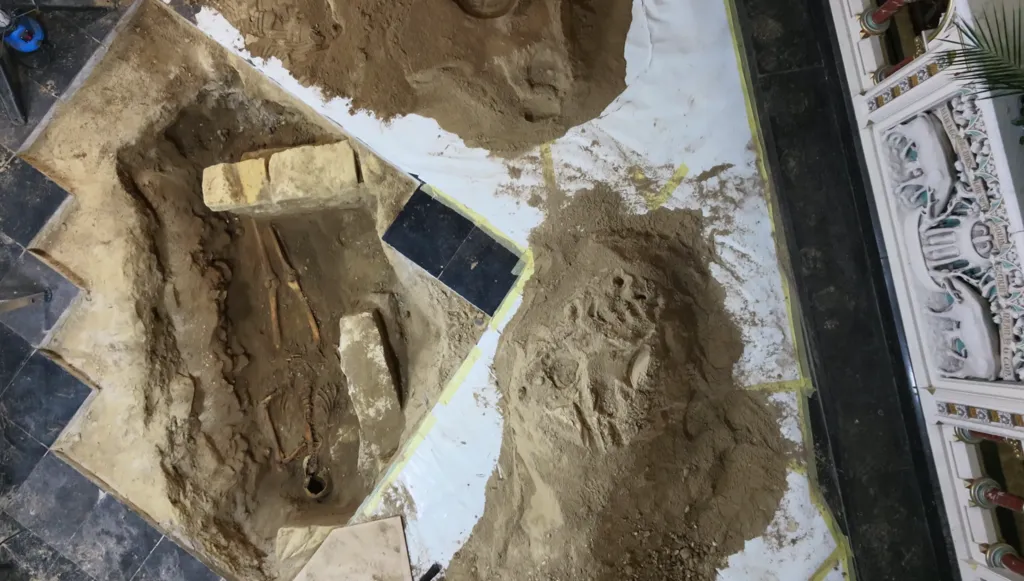
“I’m a scientist, but my expectations are high,” Wim Dijkman, archaeologist and curator for the city of Maastricht, who excavated the skeleton, told the BBC. “I’ve already been researching d’Artagnan’s grave for 28 years. This could be the highlight of my career.”

After all, it is our business to risk our lives”

The King’s Musketeers are best known to most of us today from Alexandre Dumas’ novel The Three Musketeers. They were the top-tier unit of the 17th-century French military, two companies of light cavalry under the king’s personal command, made up entirely of noblemen with muskets and fast horses. They served as the king’s personal guard whenever he left the palace (he had a whole other guard unit at home, where they presumably didn’t need the fast horses). D’Artagnan became their captain-lieutenant in 1667, and his command would very briefly include a young Marquis de Lafayette, who later went on to do some other stuff.

And in 1673, the Musketeers were part of the French forces besieging the Dutch city of Maastricht because Louis XIV had decided to invade what was then called the Dutch Republic. It ended rather poorly for d’Artagnan, among numerous others, as battles tend to do.

D’Artagnan probably attended Mass at Saints Peter and Paul on the morning of June 25, 1673, as he did most days during the siege. The French army had set up its headquarters nearby, in what was then the village of Wolder, just outside Maastrich’s city walls (today, Wolder is a district of the city). And by nightfall, as French historian Odile Bordaz suggested in 2008, d’Artagnan’s body was entombed beneath the altar where he had taken Communion that morning.

Based on parish registers from other churches in the area, high-ranking officers who died during the siege would have been buried at the nearest church. And based on maps of the area around Maastricht from the time of the siege, which Bordaz and her colleagues pored over, the closest church to the Musketeers’ camp would have been Saint Peter and Paul in Wolder.

https://arstechnica.com/science/2026/03/archaeologists-may-have-found-the-grave-of-the-legendary-fourth-musketeer/


2026’s historic snow drought is bad news for the West

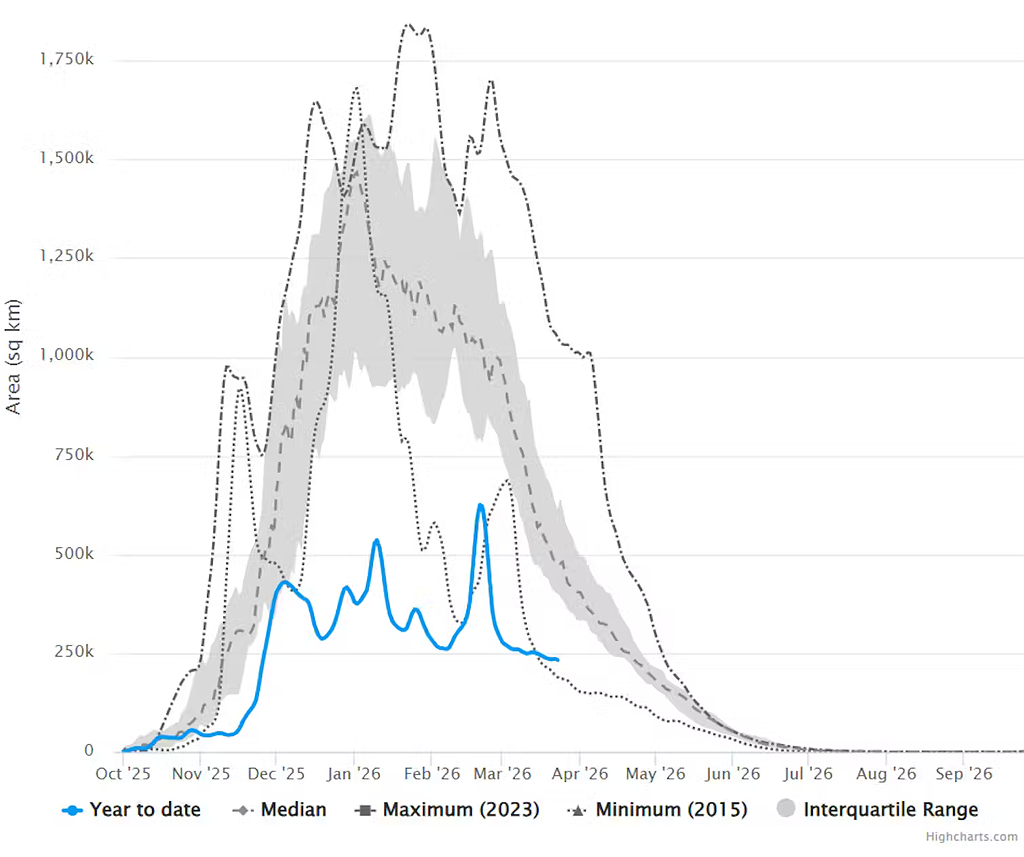
The West experienced a very warm December at all but the highest elevations, but strong storms also drenched large parts of the region. Washington state was swamped with rain that triggered flooding and melted the existing snowpack.

The total area of the Western US with snow cover has been exceptionally low compared to the years 2001 to 2025.

The total area of the Western US with snow cover has been exceptionally low compared to the years 2001 to 2025. Credit: National Snow and Ice Data Center

Temperatures in January were less extreme but still warmer than historical averages. However, precipitation in January was far below the 1991–2020 average throughout much of the region. February brought precipitation conditions closer to historical averages, but temperatures were much warmer than normal.

The Western US, therefore, got a triple whammy: Two of the three critical snow-accumulation months were too warm, and the third was too dry.

Water worries ahead

So what does this mean for water supplies and river flows?

A recent assessment of drought conditions from NOAA’s National Integrated Drought Information System suggests 2026 will be a tight year for water supplies.

Water managers in Wyoming and Washington are already signaling that some water rights holders—cities, irrigation districts, individual farms, and industries can take limited amounts of water from rivers, canals, and aquifers—can expect to receive less than their full allotment of water in 2026. It’s not unreasonable to expect other states to soon follow suit.

Throughout the Western US, water rights are administered according to the Doctrine of Prior Appropriation—those who hold the oldest legitimate claims to water from a river, reservoir, or aquifer are entitled to receive their allotments first.

Junior water rights holders who may be at risk of receiving less than their full allotment of water likely have difficult decisions ahead related to the planting and management of their crops. The challenges are compounded by the likelihood of increases in fertilizer and transportation costs associated with the ongoing war in Iran.

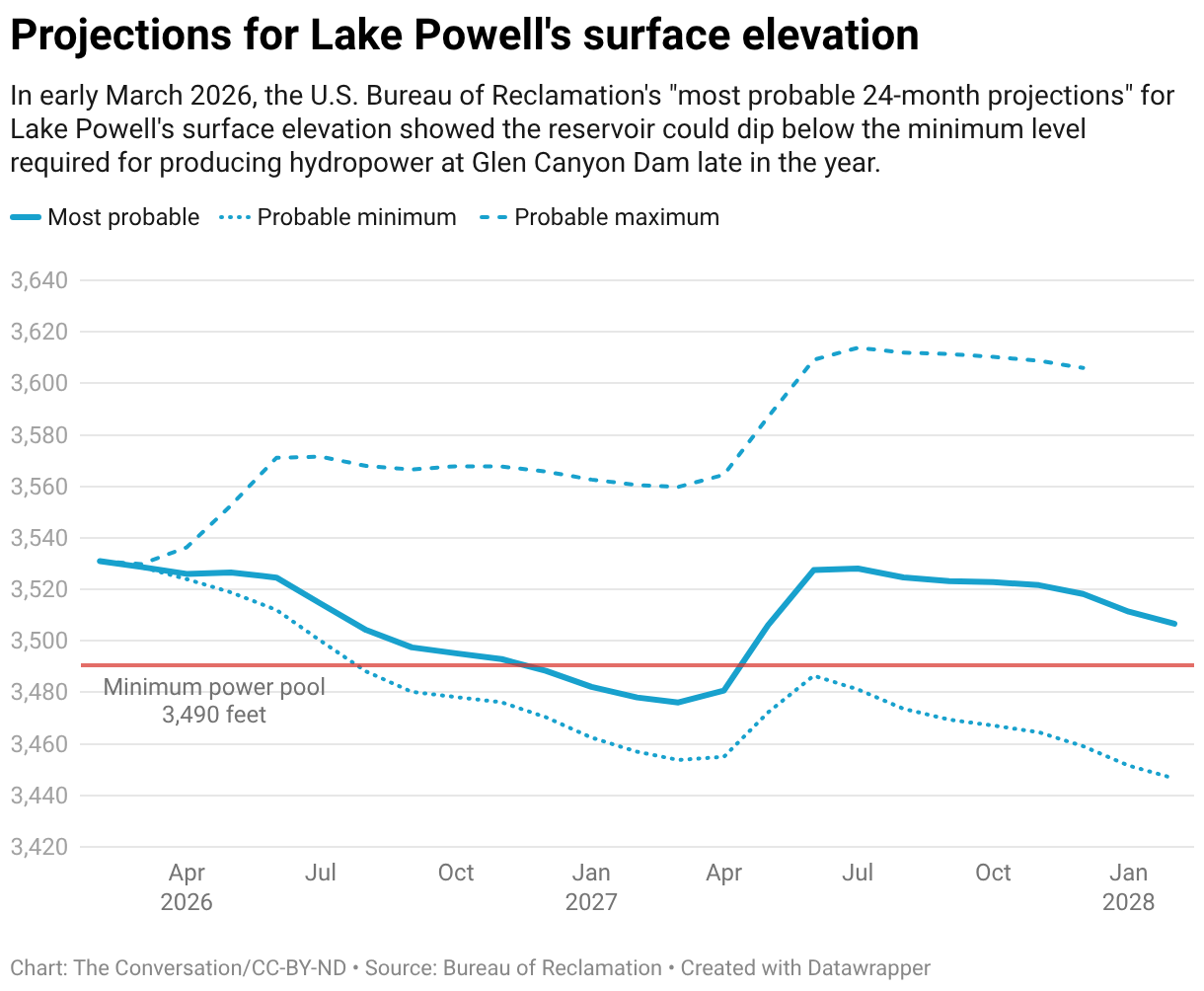
In the Colorado River Basin, the US Bureau of Reclamation’s most probable forecast indicates water levels in Lake Powell falling below the minimum power pool elevation in December 2026. That’s bad news for power supplies, because below that level, the Glen Canyon Dam can’t produce hydroelectric power. The dam contributes power for millions of customers across seven states.

https://arstechnica.com/science/2026/03/2026s-historic-snow-drought-is-bad-news-for-the-west/


Here is NASA’s plan for nuking Gateway and sending it to Mars

In addition to efficiency, a nuclear-electric propulsion system has the benefit of using conventional plasma thrusters. But instead of using solar power to energize the thrusters’ xenon fuel, SR-1 will use electricity generated from a nuclear reactor.

“Our nuclear program, SR-1, is not about going and lobbying for billions of dollars to undertake a brand-new mission,” Isaacman said. “Honestly, we haven’t won the right to be able to do that after $20 billion worth of failed programs over time. This is why we’re taking hardware that we already have, a reactor that’s mostly built, fuel that’s mostly paid for over time.”

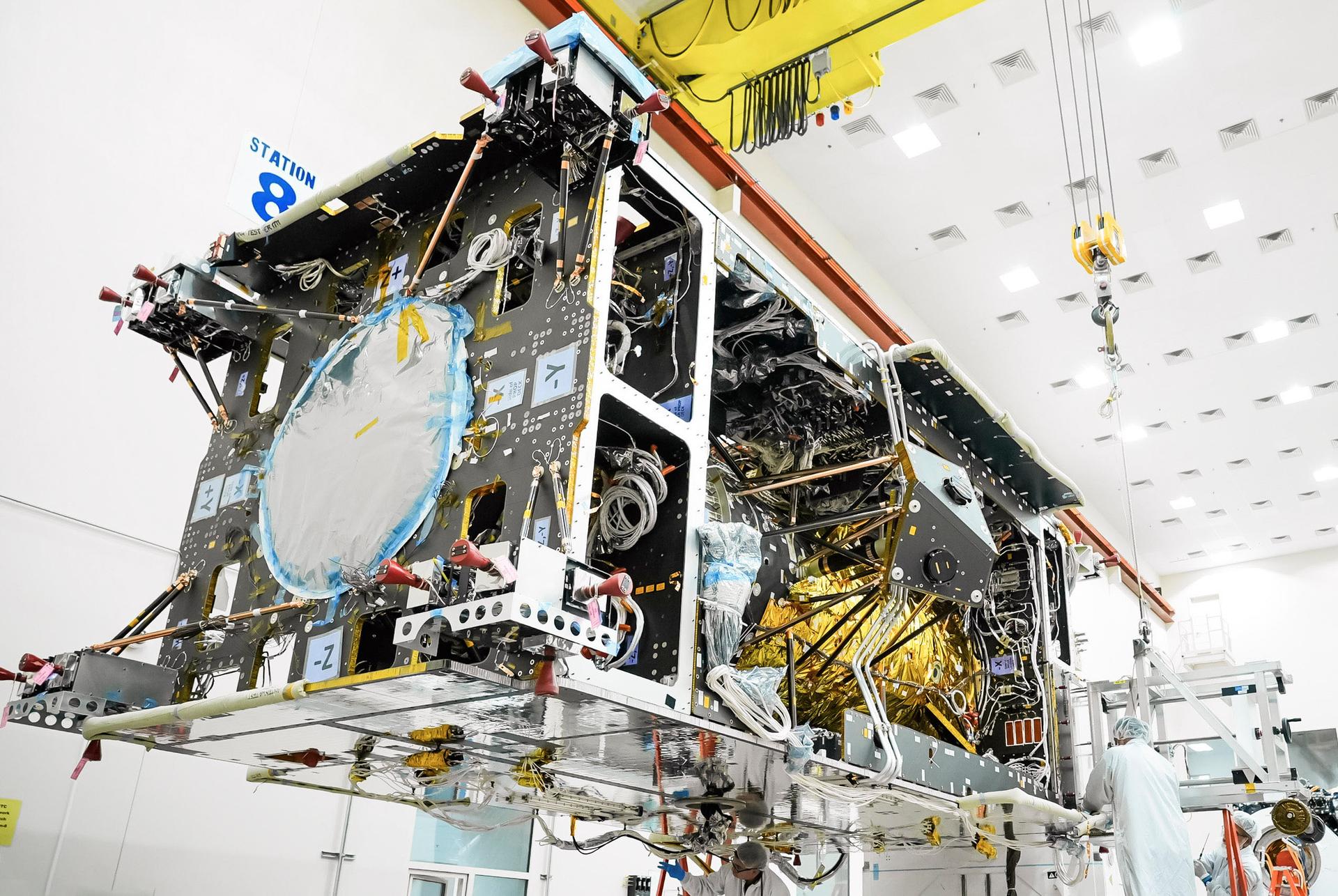
Gateway’s Power and Propulsion Element, seen here under construction last year, will form the centerpiece of the SR-1 Freedom mission.

Credit: Lanteris Space Systems

Gateway’s Power and Propulsion Element, seen here under construction last year, will form the centerpiece of the SR-1 Freedom mission. Credit: Lanteris Space Systems

NASA officials did not disclose an estimated cost for the SR-1 mission.

After proving nuclear propulsion works, “then you can come back and maybe ask for more [funding] in the future when you show that it can be done,” Isaacman said.

“SR-1 Freedom primarily has that one new system, the reactor, on a spacecraft bus that already exists,” Sinacore said. “The timeline will match the need with the next Mars launch window in December 2028. Orbital mechanics does not negotiate, and the scope must bend around this deadline.”

There are still some hurdles that won’t be easy to jump. Readying any large space mission, especially one as novel as a nuclear propulsion demo, for launch in less than three years will require sharp focus, resistance to mission creep, and near-perfect execution. Sinacore laid out an ambitious timeline for SR-1, with mission design complete by June and large-scale assembly beginning at the start of 2028. If the mission misses a launch opportunity in late 2028, the next Earth-Mars alignment won’t happen until early 2031.

“We are not trying to do everything,” Sinacore said. “We are trying to do the hard thing, which is operate a coupled nuclear reactor, power conversion, and electric propulsion thruster system beyond Earth orbit for the first time ever.”

Although NASA will be the “prime integrator” for SR-1, actually launching radioactive fuel into space requires input from multiple federal agencies, including the Department of Energy. Any rocket selected to launch a nuclear-powered mission must undergo a special certification. SpaceX’s Falcon Heavy, which NASA originally booked to launch the Gateway core module, is undergoing a nuclear certification to launch NASA’s Dragonfly mission to Saturn’s moon Titan.

https://arstechnica.com/space/2026/03/here-is-nasas-plan-for-nuking-gateway-and-sending-it-to-mars/


A unique NASA satellite is falling out of orbit—this team is trying to rescue it

But the Swift spacecraft will surely crash back to Earth, likely before the end of this year, without a reboost. That’s where Katalyst comes in. The company’s robotic servicing spacecraft, named Link, will attempt to rendezvous and dock with the Swift satellite, then raise its altitude to give the observatory a new lease on life.

That is, if everything goes according to plan.

Artist’s illustration of Katalyst’s Link spacecraft (top) approaching NASA’s Swift observatory (bottom).

Credit: Katalyst Space Technologies

Artist’s illustration of Katalyst’s Link spacecraft (top) approaching NASA’s Swift observatory (bottom). Credit: Katalyst Space Technologies

Deadline looming

There are a few things you should know about this venture. First, Swift was never designed to be captured or reboosted in orbit. Second, this mission is the first time Katalyst will attempt to dock with another satellite in space. And third, NASA gave Katalyst a daunting timetable of just nine months to build, test, and launch the rescue mission before Swift’s altitude falls too low for a safe rendezvous.

“This is really technically ambitious,” said Ghonhee Lee, founder and CEO of Katalyst.

Launch is scheduled for June 1, and there’s little margin for error. By late summer or early fall, Swift will slip below 200 miles (320 kilometers), too low for Katalyst to have confidence in controlling its spacecraft. “It’s a lot of drag with two big spacecraft docking together, ” Lee said. “Originally, we thought we had more time.”

NASA’s goals are twofold: first, demonstrate an important capability for the future of space exploration, and second, save Swift from a fiery demise and continue its scientific observations.

“We realized that you can’t get 100 percent guaranteed success on this,” Lee said.

When Ars visited Katalyst in late February, technicians were heads-down at work stations, soldering parts, assembling solar panels, and preparing components for environmental testing. For a traditional government space mission, a project might be at this stage of manufacturing years before reaching the launch pad.

“This is not quite as mature as you would expect,” one company official said. “Keep in mind that we started this whole thing about five months ago, so we are making great progress by those standards.”

https://arstechnica.com/space/2026/03/a-unique-nasa-satellite-is-falling-out-of-orbit-this-team-is-trying-to-rescue-it/


Mining the deep ocean

Saleem Ali, an environmental systems scientist at the University of Delaware who also provides research and advice on critical metals to the United Nations, says that deep-sea mining should be part of discussions on the green transition. He coauthored a 2022 analysis, funded by The Metals Company, that compared mining waste from terrestrial deposits to that of seabed resources. (Ali says he has never received direct funding from The Metals Company.) For example, the analysis looked at the impact of terrestrial mine tailings on water pollution and local biodiversity, and at the anticipated pollution from nodule mining, such as seabed sediment kicked into the water column by harvesting machines. It suggests that both types of mining will have effects on biodiversity, but deep-sea mining could result in less waste and fewer risks for communities than terrestrial mining. The study cautions, however, that its conclusions are limited by “substantial uncertainty” regarding impacts of sediment plumes.

Ali adds that the International Seabed Authority has been collecting data for at least 30 years, which should be sufficient to develop rules and regulations to govern seabed mining even if it’s unclear what the long-term impacts are, and whether the environmental impacts are likely to be better or worse than mining on land.

“I’m not saying that we should go ahead with it. I’m saying that it deserves to be considered in this broad context of very difficult choices we have to make,” he says.

But opponents calling for moratoriums or bans note that the same study that The Metals Company refers to as evidence of quick recovery eventually reached more pessimistic conclusions from its data as a whole. “The effects of polymetallic nodule mining are likely to be long term,” the authors wrote, and the analyses “show considerable negative biological effects of seafloor nodule mining, even at the small scale of test mining experiments.” Scientists are concerned that deep-sea organisms, which are adapted to living in a dark, quiet, and sparsely populated environment, will not cope well with the noise and light disturbances from mining. The organisms will also be exposed to toxic metals and plumes of sediment that can interfere with feeding and breathing. The Metals Company did not respond to several requests for comment.

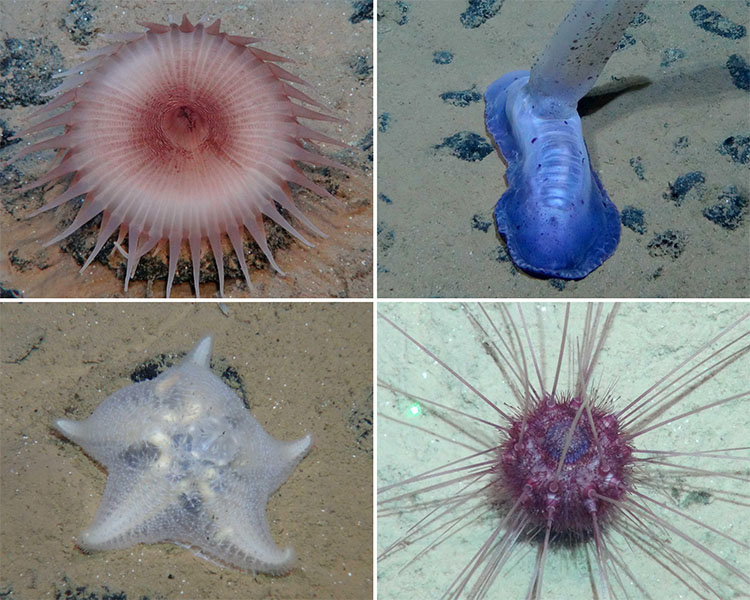
The seafloor of Clarion-Clipperton Zone is home to many creatures, some of which are shown here: anemone (top left), sea cucumber, Psychropotes longicauda (top right), sea urchin Plesiodiadema sp. (bottom right), and starfish (bottom left). The biology and ecology of these depths remain poorly understood, making it hard to know what the ecological impacts of deep-sea mining would be.

Credit: ROV TEAM / GEOMAR (CC-BY 4.0)

The seafloor of Clarion-Clipperton Zone is home to many creatures, some of which are shown here: anemone (top left), sea cucumber, Psychropotes longicauda (top right), sea urchin Plesiodiadema sp. (bottom right), and starfish (bottom left). The biology and ecology of these depths remain poorly understood, making it hard to know what the ecological impacts of deep-sea mining would be. Credit: ROV TEAM / GEOMAR (CC-BY 4.0)

Because of these unknowns, the mining rules shouldn’t be rushed, says Anna Metaxas, a deep-sea ecologist at Dalhousie University in Canada who coauthored a 2025 overview of the potential impacts of mining on the deep-ocean ecosystem in the Annual Review of Environment and Resources. Metaxas participates in the Deep-Ocean Stewardship Initiative, a nonprofit international network of experts to inform deep-sea policy and governance. She says that she earlier led a project with experts in land and deep-sea mining to develop a framework for environmental comparisons of mining on land and the seabed. But in 2024, she and her coauthors concluded that data are at present too scarce to do so.

“Our knowledge gaps are really large,” agrees Matthias Haeckel, a marine biogeochemist at the GEOMAR Helmholtz Centre for Ocean Research in Kiel, Germany. He is part of a group of 30 researchers and technical experts tasked by the International Seabed Authority in 2024 to develop values needed for monitoring and assessing mining impacts. The group looked at toxicity, such as that from heavy metals, turbidity from sediment kicked up by harvesting machines, and underwater noise and light pollution. They are expected to submit a first draft of standards and guidelines at some point later this year.

Seeking answers—and soon

The International Seabed Authority Council—its executive body—convened in Jamaica in early March and will do so again in July to debate, and perhaps adopt, mining regulations. The Metals Company is still waiting for a nod from the United States to start commercial mining in the Clarion-Clipperton Zone. But it says it expects to have a permit by the end of this year and to start mining shortly after.

Meanwhile, scientists like Haeckel are scrambling to launch additional research cruises to provide critical data that will inform decisions about the future of seabed mining and the mining code. Haeckel is leading a European project called MiningImpact that will return later this year to research sites where, in 2021, it monitored part of the mining tests by Global Sea Mineral Resources, a subsidiary of the Belgian company DEME. The third phase of MiningImpact aims to see how the ecosystem has fared five years on, and to promote further understanding of the ecology of life in the abyssal depths.

“The Clarion-Clipperton Zone is a large area, and there are still many, many open questions,” Haeckel says. He wonders how mining in the area could be properly regulated when scientists hardly know yet what creatures live down there, or how they interact.

https://arstechnica.com/science/2026/03/mining-the-deep-ocean/


We keep finding the raw material of DNA in asteroids—what’s it telling us?

On Monday, a paper announcing that all four DNA bases had been found on an asteroid sparked a lot of headlines. But many of the headlines omitted a key word needed to put the discovery in context: “again.” The paper itself cited similar results dating back to 2011, and the ensuing years have seen various confirmations and more rigorous studies. The new work was less notable for showing that we had found these bases in Ryugu than for solving a previous mystery: earlier studies had failed to detect them there, despite their presence in many other asteroid samples.

Outside the headlines, though, the new work provides some interesting details, as it may answer an important question: how these bases got there in the first place. Understanding that better may be critical for getting a better picture of how the raw materials for life ended up on Earth in the first place.

Searching for bases

Let’s start with a description of what the researchers found. Both DNA and RNA, the two nucleic acids used by life, share a similar structure. That includes the backbone, a chain that alternates between sugars and phosphates that are all chemically linked together. While the specific sugar differs between DNA and RNA, the chain itself varies only in length; otherwise, the backbone of every DNA or RNA molecule is identical.

What gives nucleic acids the identity needed to carry genetic information are the bases. There are four (A, T, C, and G in DNA; A, U, C, and G in RNA), and one is always attached to each of the sugars in the backbone. The order of the bases along the backbone is what carries genetic information, enabling life as we know it. It’s been hypothesized that, before life evolved, the order of bases along RNA molecules determined the sorts of chemical reactions they could catalyze.

https://arstechnica.com/science/2026/03/we-keep-finding-the-raw-material-of-dna-in-asteroids-whats-it-telling-us/


DOGE goes nuclear: How Trump invited Silicon Valley into America’s nuclear power regulator

The DOE spokesperson said its radiation standards “are aligned with Gold Standard Science… with a focus on protecting people and the environment while avoiding unnecessary bureaucracy.”

The department has already decided to abandon the long-standing radiation protection principle known as “ALARA”—the “As Low As Reasonably Achievable” standard—which directs anyone dealing with radioactive materials to minimize exposure.

It often pushes exposure well below legal thresholds. Many experts agreed that the ALARA principle was sometimes applied too strictly, but the move to entirely throw it out was opposed by many prominent radiation health experts.

Whether the agencies will actually change the legal thresholds for radiation exposure is an open question, said sources familiar with the deliberations.

Internal DOE documents arguing for changing dose rules cite a report produced at the Idaho National Laboratory, which was compiled with the help of the AI assistant Claude. “It’s really strange,” said Kathryn Higley, president of the National Council on Radiation Protection and Measurements, a congressionally chartered group studying radiation safety. “They fundamentally mistake the science.”

John Wagner, the head of the Idaho National Laboratory and the report’s lead author, acknowledged to ProPublica that the science over changing radiation exposure rules is hotly contested. “We recognize that respected experts interpret aspects of this literature differently,” he wrote. His analysis was not meant to be the final word, he said, but was “intended to inform debate.”

The impact of radiation levels at very low doses is hard to measure, so the US has historically struck a cautious note. Raising dose limits could put the US out of step with international standards.

For his part, Cohen has told the nuclear industry that he sees his job as making sure the government “is no longer a barrier” to them.

In June, he shot down the notion of companies putting money into a fund for workplace accidents. “Put yourself in the shoes of one of these startups,” he said. “They’re raising hundreds of millions of dollars to do this. And then they would have to go to their VCs and their board and say, listen, guys, we actually need a few hundred million dollars more to put into a trust fund?”

He also suggested that regulators should not fret about preparing for so-called 100-year events—disasters that have roughly a 1 percent chance of taking place but can be catastrophic for nuclear facilities.

“When SpaceX started building rockets, they sort of expected the first ones to blow up,” he said.

This story originally appeared on ProPublica.

ProPublica is a Pulitzer Prize-winning investigative newsroom. Read the original story here. Sign up for The Big Story newsletter to receive stories like this one in your inbox.

Pratheek Rebala and Kirsten Berg contributed research.

https://arstechnica.com/science/2026/03/doge-goes-nuclear-how-trump-invited-silicon-valley-into-americas-nuclear-power-regulator/