Artemis II broke Fred Haise’s distance record, but he is happy to pass it on
The bottom line: Astronauts likely won’t exceed Artemis II’s distance from Earth on most lunar landing missions, but it’s conceivable that on some occasions, circumstances will align to propel a crew a little beyond the 252,756-mile mark. The sure bet will come when someone finally takes aim at Mars.

“Big disappointment”

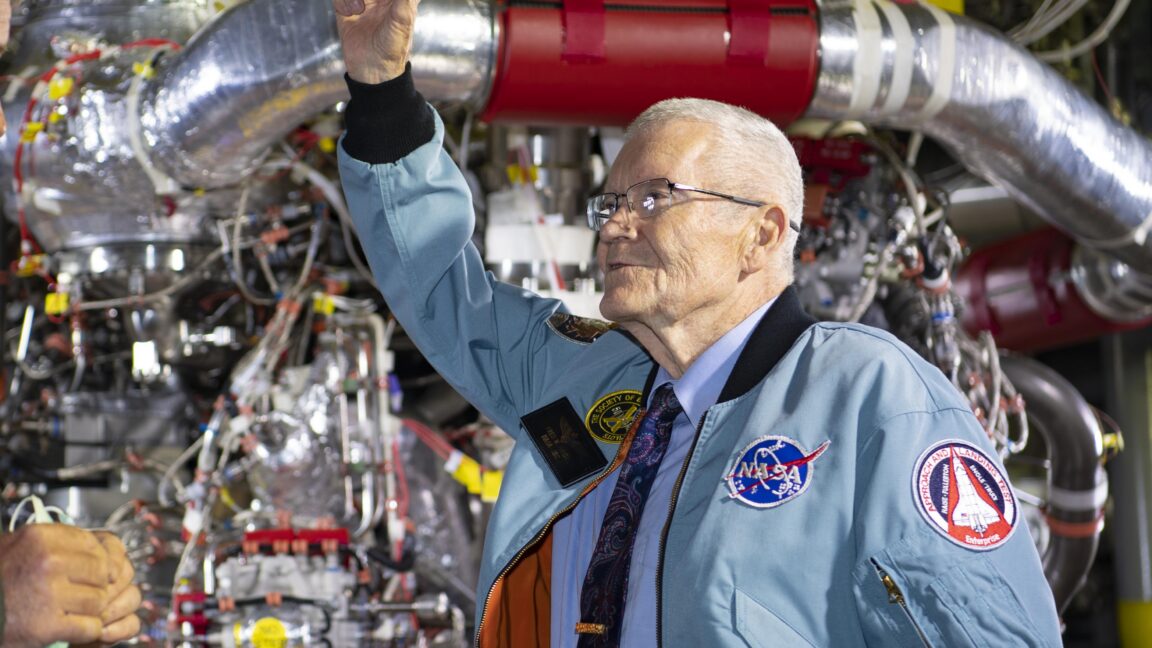
Haise, the only Apollo 13 astronaut still living, didn’t care much for the record he and his crewmates set in 1970. It was a consolation prize, of sorts, for Haise. You probably know the story of Apollo 13’s aborted lunar landing and the around-the-clock, high-stakes effort to bring the crew home.

Still, among the more than 100 billion people who have walked the Earth in human history, the Artemis II astronauts have ventured farther from the cradle than anyone else. Sure, it’s not walking on the Moon, but it’s something more than a piece of trivia.

Haise, 92, spoke with Ars as Artemis II made its way back to Earth earlier this month. We present our conversation below, lightly edited for clarity.

Ars: How closely have you followed the Artemis II mission?

Fred Haise: Not real close. Today, I have not seen anything. I just got home from my great-grandson’s baseball game. I noticed, from their projected flight plan, they’re past the Moon, sort of on their cruise back toward Earth for the reentry. I’ve seen the pictures they’ve shot, which are excellent. They have better cameras and better equipment than we had on Apollo, because it really looks like they got much higher-resolution pictures than we were able to from that altitude.

Ars: I presume this all brings back some memories for you.

Haise: Vaguely. When they splash down Friday, if you go to the next day, Saturday, the 11th, that’s when I launched, 56 years ago. So, yes, I’ve lived several lifetimes, the Shuttle program, then in the business world. It was a long time ago.

https://arstechnica.com/science/2026/04/artemis-ii-broke-fred-haises-distance-record-but-he-is-happy-to-pass-it-on/

This is who’s developing Golden Dome’s orbital interceptors—if they’re ever built

The US Space Force released a list Friday of a dozen companies working on Space-Based Interceptors for the Pentagon’s Golden Dome initiative, a multilayer defense system to shield US territory from drones and ballistic, hypersonic, and cruise missile attacks.

The roster of Golden Dome Space-Based Interceptor (SBI) contractors, some of which were previously reported, includes Anduril Industries, Booz Allen Hamilton, General Dynamics Mission Systems, GITAI USA, Lockheed Martin, Northrop Grumman, Quindar, Raytheon, Sci-Tec, SpaceX, True Anomaly, and Turion Space.

The Space Force made 20 individual awards the 12 companies in late 2025 and early 2026 using an acquisition mechanism known as Other Transaction Authority, or OTA, agreements. OTAs allow the Pentagon to bypass federal acquisition regulations and cast a wide net to attract a larger number of potential contractors, and are especially useful for rapid prototyping. That is exactly what the Space Force wants to see with the first phase of the SBI program.

The agreements have a combined value of up to $3.2 billion, and will capitalize on a mix of public and private investment to move SBIs closer to testing in low-Earth orbit.

Officials have not released details of each company’s contribution, but the contractors come to the SBI program with different skill sets. The agreements are for early stage development and tech demos, not for full-scale production, which will come with a significantly higher price tag.

“No additional information will be available at this time due to operational security requirements regarding the SBI program,” the Space Force said in a statement.

The usual players

Some of the companies on the list, such as SpaceX, Lockheed Martin, and Northrop Grumman, are well known in the space industry. They seem positioned to become lead or prime contractors. Others, such as Anduril and True Anomaly, are full-stack developers that are newer to the space industry but have lofty ambitions in the national security market. Sci-Tec and Quindar have expertise in software. Turion develops space sensing technology, and GITAI USA had its start as an in-space robotics company.

https://arstechnica.com/space/2026/04/this-is-whos-developing-golden-domes-orbital-interceptors-if-theyre-ever-built/


Meet the 19-meter Cretaceous kraken that swam with mosasaurs

On top of that, when analyzing the beaks, the team noticed a distinct pattern. The wear wasn’t uniform. The right edge of the jaw was consistently more worn down, chipped, and scratched than the left. The team concluded this asymmetry wasn’t an accident but a proof of lateralized behavior. It’s a tendency we observe in modern octopuses, which often favor a specific side of their body or a particular eye when performing complex tasks.

In biology, lateralized behavior is usually linked to a highly sophisticated, specialized nervous system. “Of course, we cannot directly measure intelligence from a fossil,” Iba said. “But the asymmetric wear suggests that these animals may also have had advanced and individualized hunting behavior, similar in some ways to modern octopuses.”

They were not just huge and powerful. They were probably smart.

The evolutionary arms race

A highly intelligent, 19-meter-long cephalopod actively hunting and crushing prey suggests that the Cretaceous evolutionary arms race wasn’t entirely dominated by vertebrates. By shedding heavy shells like those seen in early nautiloids and ammonites, the ancestors of modern octopuses traded passive defense for active offense. They gained explosive swimming speed, vast improvements in eyesight, and the neurological capacity required for advanced cognition.

“Our study highlights convergent evolution. Vertebrates and cephalopods have very different evolutionary origins, but both evolved toward becoming large, intelligent marine predators with powerful jaws, flexible bodies, high mobility, and advanced behavior,” Iba said. He notes that Cretaceous marine ecosystems were most likely way more complex than we thought.

Iba also hopes the Digital Fossil Mining technique can be used to learn more about this complexity. “One major direction is to apply Digital Fossil Mining to many more fossil-bearing rocks,” he told Ars. “This approach allows us to uncover organisms and structures that were previously almost invisible in the fossil record.” The technique, he thinks, is especially important for animals like octopuses and squids, which rarely fossilize.

The team ultimately wants to reconstruct a more complete history of cephalopods. “More broadly, our goal is to reveal the hidden components of ancient ecosystems and build a much more complete picture of how past ecosystems really worked,” Iba said.

Science, 2026. DOI: 10.1126/science.aea6285

https://arstechnica.com/science/2026/04/meet-the-19-meter-cretaceous-kraken-that-swam-with-mosasaurs/


Carbon nanotube wiring gets closer to competing with copper

Shortly after their discovery, carbon nanotubes seemed to be a material wonder. There were metallic and semiconducting forms; they were tiny and incredibly light; and they could only be broken by tearing apart chemical bonds. The ideas for using them seemed endless.

But then the reality of working with them set in. It was hard to get a pure population of metallic or semiconducting forms. Synthesis techniques tended to produce a tangle of mostly short nanotubes; those that extended for more than a couple of centimeters remain rare. And while the metallic version offered little resistance to carrying electric current, it was hard to send many electrons down the nanotube.

Materials scientists, however, are a stubborn bunch, and they’re still trying to get them to work. Today’s issue of Science includes a paper describing the addition of a chemical to carbon nanotube bundles to boost their ability to carry current to levels closer to those of copper. While the more conductive nanotubes weren’t stable, the discovery may point the way toward something with a longer shelf life.

Doped nanotubes

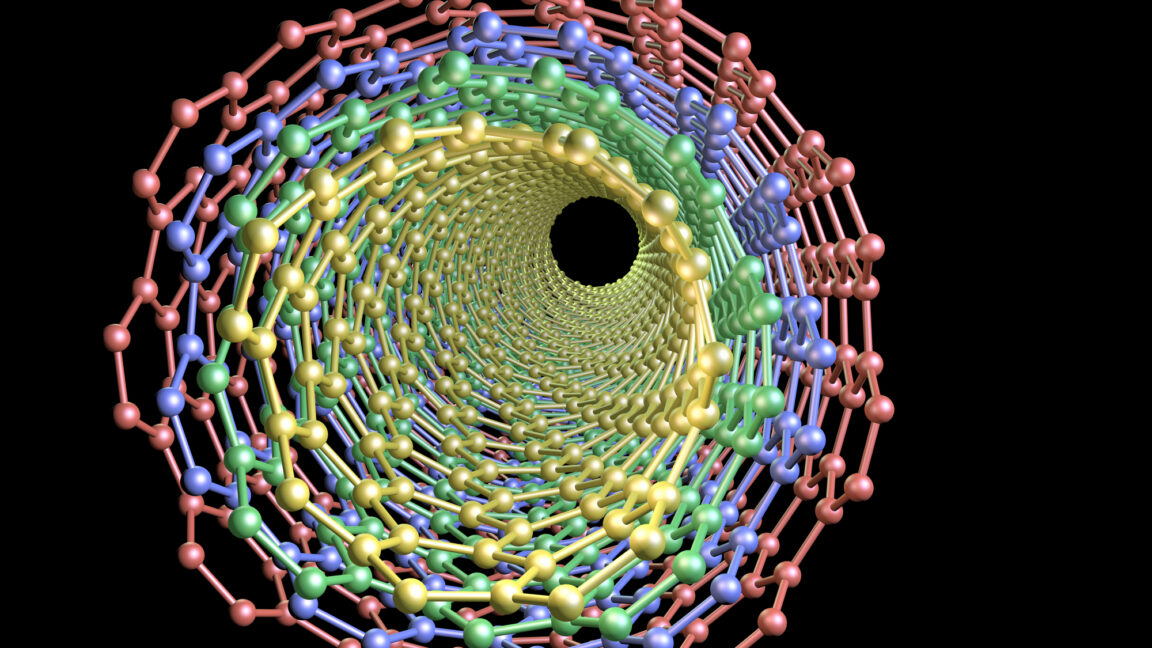
Carbon nanotubes come in various forms. In the case of single-walled nanotubes, you can think of them as taking a sheet of graphene, rolling it up into a circle, and linking together the two opposite ends you just brought together. These can also be different diameters. There are also multi-walled carbon nanotubes, where a second nanotube (and maybe third, and maybe more beyond that) is wrapped around the first.

When metallic, these offer little resistance to electron flow along the nanotube. But, because most of their electrons are tied up in the chemical bonding needed to form the nanotube, there’s not a lot of them available to carry current. So, a lot of people have tried developing dopants—chemicals that can be mixed in small quantities that change the behavior of the bulk material. In this case, the goal was to find chemicals that would act as electron donors, adding to the amount of current that could potentially be sent down the nanotube.

https://arstechnica.com/science/2026/04/researchers-get-carbon-nanotube-wiring-to-conduct-more-like-copper/


We still don’t have a more precise value for “Big G”

[embedded content]

The gravitational constant, affectionally known as “Big G,” is one of the most fundamental constants of our universe. Its value describes the strength of the gravitational force acting on two masses separated by a given distance—or if you want to be relativistic about it, the amount a given mass curves space-time. Physicists have a solid ballpark figure for the value of Big G, but they’ve been trying to measure it ever more precisely for more than two centuries, each effort yielding slightly different values. And we do mean slight: The values vary by roughly one part in 10,000.

Still, other fundamental constants are known much more precisely. So Big G is the black sheep of the family and a point of frustration for physicists keen on precision metrology. The problem is that gravity is so weak, by far the weakest of the four fundamental forces, so there is significant background noise from the gravitational field of the Earth (aka “little g”). That weakness is even more pronounced in a laboratory.

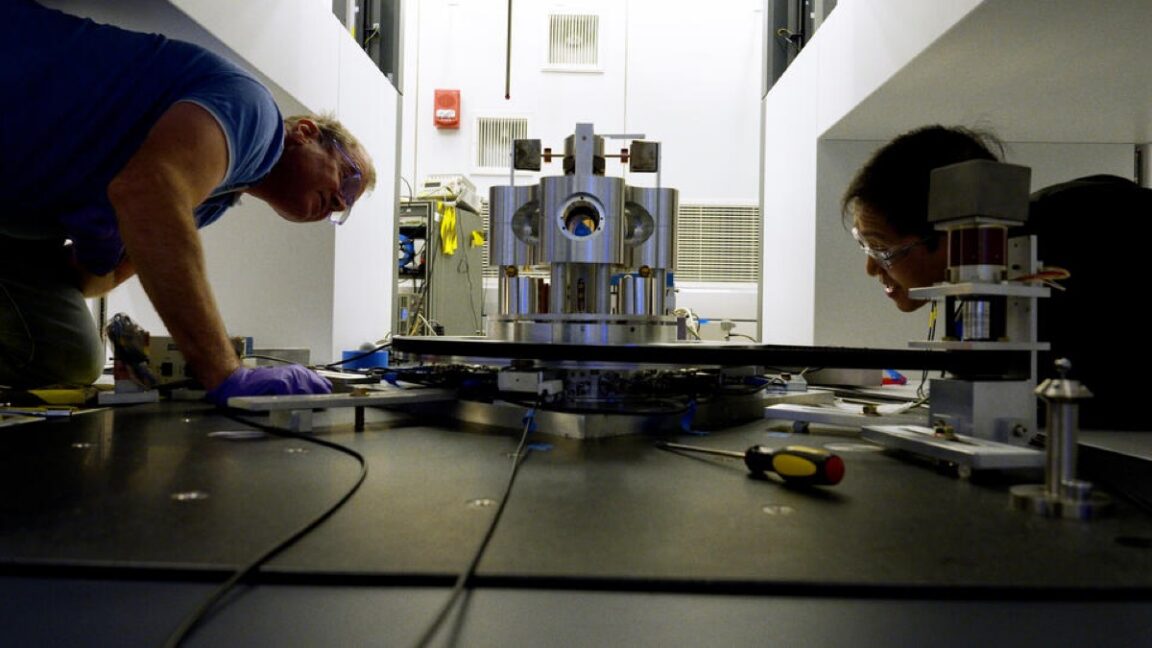
In the latest effort to resolve the issue, scientists at the National Institute of Standards and Technology (NIST) spent the last decade replicating one of the most divergent recent experimental results. The group just announced their results in a paper published in the journal Metrologia. It does not resolve the discrepancy, but it gives physicists one more data point in their ongoing quest to nail down a more precise value for Big G.

Isaac Newton introduced the concept of a gravitational constant when he published his law of universal gravitation in the late 17th century, although it didn’t get its Big G notation until the 1890s. Newton thought it might be possible to measure the strength of gravity by swinging a pendulum near a large hill and measuring the deflection, but he never attempted the experiment, reasoning that the effect would be too small to measure. By 1774, the Royal Society had established a committee to determine the density of the Earth as an indirect measurement of Big G, using a variation of Newton’s pendulum concept.

https://arstechnica.com/science/2026/04/we-still-dont-have-a-more-precise-value-for-big-g/


US Space Command: Russia is now operationalizing co-orbital ASAT weapons

“Russia remains a capable space power, even while its space industry suffers from systemic underfunding, quality control issues, international sanctions, and export controls,” US intelligence agencies wrote in their annual unclassified threat assessment released earlier this year.

Russia’s space industry has far less money than the US and Chinese space programs. Russian factories produce fewer satellites, and Russian rockets launch less often than the world’s other two leading space powers. But Russia seems to have a unique theory for the use of anti-satellite, or ASAT, weapons.

Whiting said Russia “has come to the conclusion that they’re a conventional arms deficit” compared to the United States and its NATO allies. Russian forces are seeking to get an asymmetric advantage anywhere they can.

“They’re looking for novel ways to try to balance that correlation of forces, to use a Soviet term,” Whiting said. “So they’re looking at nuclear, cyber, and space, and that’s why, when we read the reports over the last two years that Russia may be considering placing a nuclear ASAT on orbit, we find those just incredibly troubling.”

US forces rely on space-based assets for all major military operations. Satellite capabilities, such as overhead surveillance, navigation, missile warning, and electronic warfare, are now “fully nested in” all military planning. If you take away any of these capabilities, US forces “cannot fight the way they are designed or sized,” Whiting said.

“We’ve noted that the Chinese and the Russians have studied us since Desert Storm (in 1991),” Whiting said. “They deeply have tried to understand how is it that the United States is able to create such global effects with what appears to be such small number of forces, and they’ve assessed that space is one of those foundational issues. So now they have developed a suite of counter-space weapons.”

The United States, China, Russia, and India have each demonstrated the ability to destroy a low-Earth orbit (LEO) satellite using a ground-launched missile. Russia’s development of co-orbital ASAT, or counter-space, weapons has long focused on LEO. That may be changing with the launch of a suspected Nivelir or similar mission last year toward geosynchronous orbit more than 20,000 miles above Earth.

https://arstechnica.com/space/2026/04/us-space-command-russia-is-now-operationalizing-co-orbital-asat-weapons/


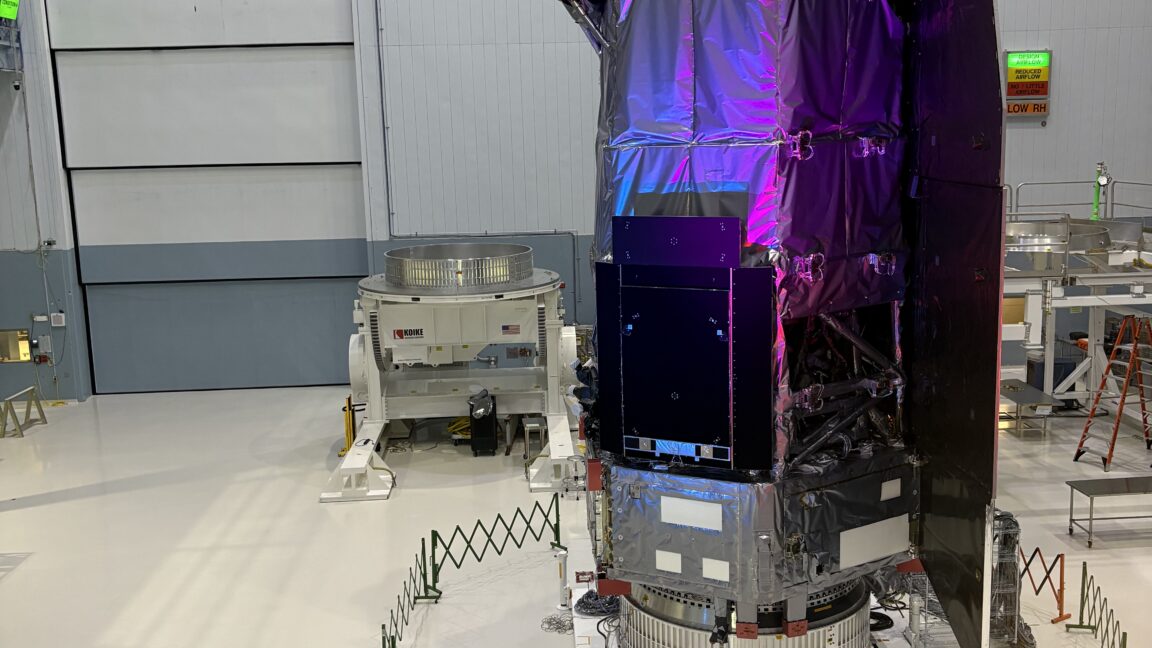
Eight months early and under budget, the Roman Telescope is ready to launch

Scientifically, it will be used to image exoplanets in distant orbits from their stars. But it also serves an engineering purpose: starting the development of a coronagraph for the planned Habitable Worlds Observatory that will need to be 100 times more effective at blocking out stars.

Compared to something like the Webb Telescope, Roman is also delightfully simple. It has relatively few moving parts that need to be deployed once in space, and those that exist, like the solar arrays and high-gain antenna, are simple spring-loaded devices. Once latches are released, they’ll simply open into place, a process that NASA’s Melton said will start as soon as 20 minutes after the NGRST separates from the launch vehicle. Commissioning is planned to take only 90 days, and Melton told Ars that it could be doing science before it completes the final burn to put it into orbit around the L2 Lagrange point.

He said the fuel needed to keep it in orbit will be the primary factor limiting the observatory’s life. Using very conservative estimates of its rate of use, NGRST will be sent to space with 10 years of fuel, so barring a major hardware failure, it’s likely to be operational for quite a bit longer.

What will we be looking for?

One of the key targets of the NGRST surveys is what are called baryon acoustic oscillations. In the extremely early Universe, matter was dense enough that sound waves could create interference patterns in the material, with areas forming that had higher or lower densities than average. As the Universe expanded, these patterns were frozen into place and ultimately formed regions with a higher or lower density of galaxies.

Identifying these patterns at large scales can tell us about the composition of the Universe, including the factors that shape most of its structure: dark matter and dark energy. Tracking how they evolve over time could also help us determine whether dark energy is changing with time rather than being in constant acceleration. There have been hints that some details of our understanding of these factors are wrong, and the NGRST will provide an independent measure of them.

https://arstechnica.com/science/2026/04/eight-months-early-and-under-budget-the-roman-telescope-is-ready-to-launch/


Physicists think they’ve solved the muon mystery

A new approach

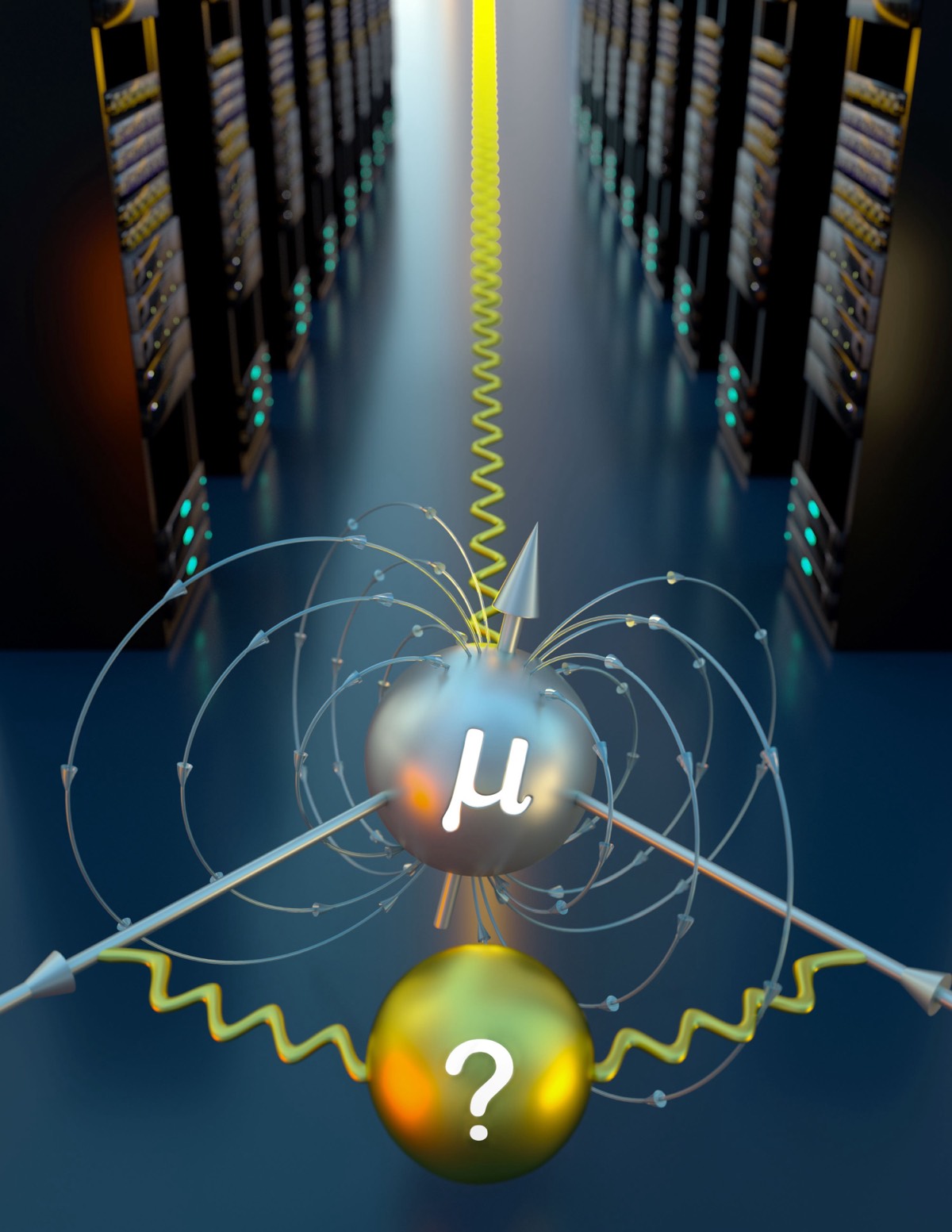
artistic illustration of Supercomputer simulations reveal the effect of the strong nuclear force on the muon's magnetism.

Supercomputer simulations reveal the effect of the strong nuclear force on the muon’s magnetism.

Credit: University of Wuppertal

Supercomputer simulations reveal the effect of the strong nuclear force on the muon’s magnetism. Credit: University of Wuppertal

This latest measurement focuses on strong force effects, specifically the “hadronic vacuum polarization,” which arises as quarks and gluons interact within the framework of quantum chromodynamics (QCD) theory. The authors adopted a hybrid approach, combining powerful large-scale computer simulations with experimental data.

“The old methodology involved collecting thousands of experimental results and reinterpreting them to get the single number, the magnetic moment of the muon,” Fodor said. “Our approach was completely different. We divided space-time into very small cells, a lattice, then we solved the equations of the Standard Model on that. There was an awful lot of theory, mathematics, programming, computational knowledge and computer architecture behind this calculation.”

It took 10 years to make those complicated calculations, but when they were done. Fodor et al. found their results agreed with the Standard Model to within half a standard deviation and down to 11 decimal places. It’s the most precise calculation yet achieved, accurate to parts per billion. While the results do not completely rule out possible new physics like a fifth force, they do further constrain the areas where new physics might be lurking.

“People ask me how it feels to make this discovery and, to be honest, I feel somewhat sad,” said Fodor. “When we started to calculate this quantity, we thought we were going to have a good and trustworthy calculation for a new fifth force. Instead, we found there is no fifth force. We did find a very precise proof of not just the Standard Model but also of quantum field theory, which is the foundation on which the Standard Model was built.”

Nature, 2026. DOI: 10.1038/s41586-026-10449-z (About DOIs).

https://arstechnica.com/science/2026/04/physicists-think-theyve-solved-the-muon-mystery/


Physicists think they’ve solved the muon mystery

A new approach

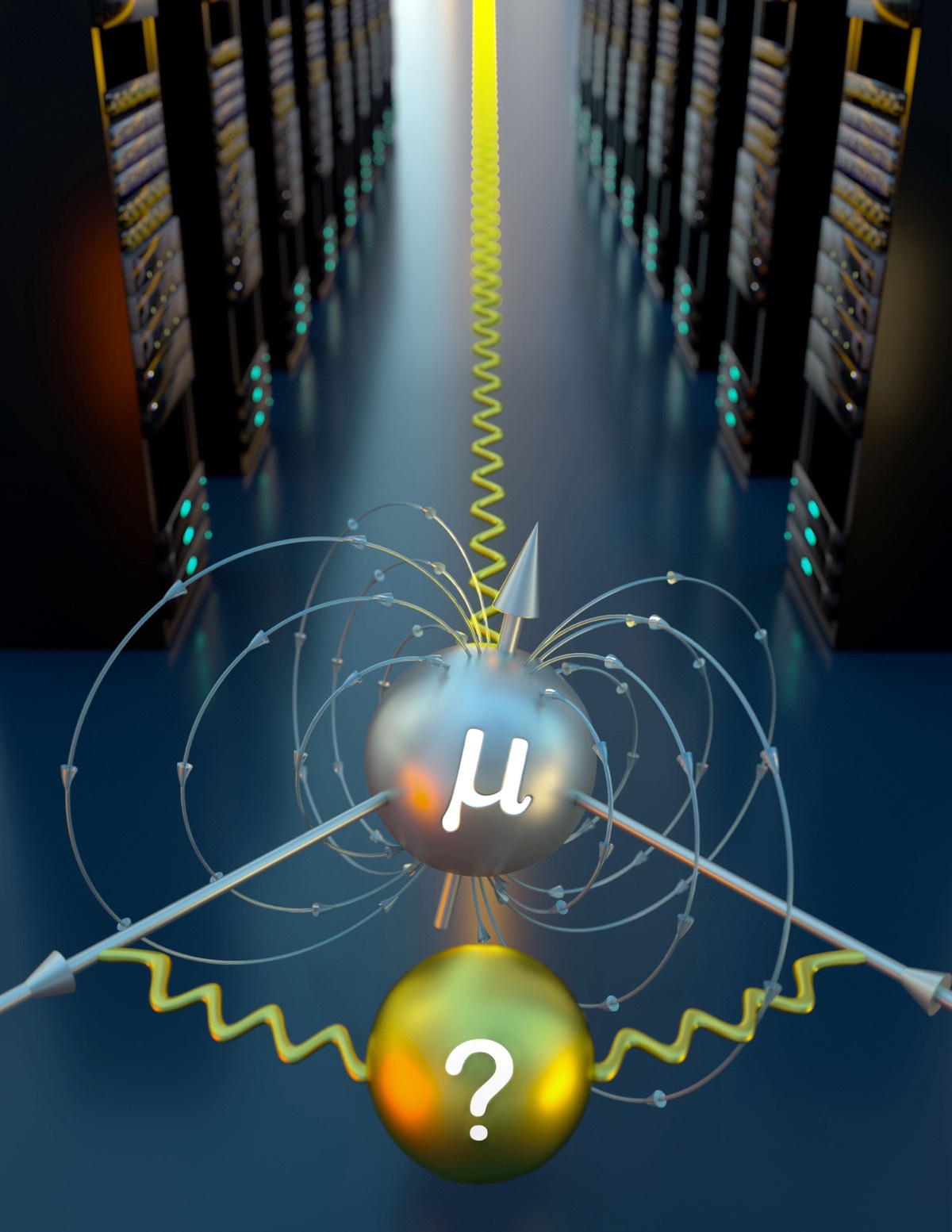
artistic illustration of Supercomputer simulations reveal the effect of the strong nuclear force on the muon's magnetism.

Supercomputer simulations reveal the effect of the strong nuclear force on the muon’s magnetism.

Credit: University of Wuppertal

Supercomputer simulations reveal the effect of the strong nuclear force on the muon’s magnetism. Credit: University of Wuppertal

This latest measurement focuses on strong force effects, specifically the “hadronic vacuum polarization,” which arises as quarks and gluons interact within the framework of quantum chromodynamics (QCD) theory. The authors adopted a hybrid approach, combining powerful large-scale computer simulations with experimental data.

“The old methodology involved collecting thousands of experimental results and reinterpreting them to get the single number, the magnetic moment of the muon,” Fodor said. “Our approach was completely different. We divided space-time into very small cells, a lattice, then we solved the equations of the Standard Model on that. There was an awful lot of theory, mathematics, programming, computational knowledge and computer architecture behind this calculation.”

It took 10 years to make those complicated calculations, but when they were done. Fodor et al. found their results agreed with the Standard Model to within half a standard deviation and down to 11 decimal places. It’s the most precise calculation yet achieved, accurate to parts per billion. While the results do not completely rule out possible new physics like a fifth force, they do further constrain the areas where new physics might be lurking.

“People ask me how it feels to make this discovery and, to be honest, I feel somewhat sad,” said Fodor. “When we started to calculate this quantity, we thought we were going to have a good and trustworthy calculation for a new fifth force. Instead, we found there is no fifth force. We did find a very precise proof of not just the Standard Model but also of quantum field theory, which is the foundation on which the Standard Model was built.”

Nature, 2026. DOI: 10.1038/s41586-026-10449-z (About DOIs).

https://arstechnica.com/science/2026/04/physicists-think-theyve-solved-the-muon-mystery/


New court ruling blocks many of the government’s anti-renewable policies

Under the newly adopted policies, the Corps of Engineers must weigh the energy produced per acre for any projects under its oversight against the potential impact of alternative uses of the land. The Department of the Interior was ordered to make a similar consideration.

For the purposes of a temporary injunction, that turned out to be enough. Given this justification, Casper said she could not conclude that the suing organizations were likely to win on their claims that the policy was arbitrary and capricious. That determination would have to await a full trial.

But it won’t, because those rules turned out to be illegal for other reasons.

Casper’s ruling notes that the laws governing the use of public lands require agencies to weigh multiple factors, balancing the benefits of different uses versus preservation. The rules instituted at Interior and the Corps of Engineers made a simple energy-density calculation the sole determinant of whether a project could proceed, sidestepping the process set forth in the relevant laws. As such, those policies also merit an injunction.

At least for the parties involved in the suit, none of the hurdles the Trump administration placed on renewable energy will apply. And the groups involved in the suit included many renewable energy developers*. That said, involved agencies could still create informal obstacles without violating the injunction, such as quietly slowing the pace of project approvals. The government can also potentially appeal this injunction.

So while the ruling is good news, it’s not a guarantee that the growth of renewables will continue unhindered over the next several years.

* The full list of plaintiffs: Clean Grid Alliance, Alliance For Clean Energy New York, Renew Northeast, Mid-Atlantic Renewable Energy Coalition Action, Renewable Northwest, Carolinas Clean Energy Business Association, Southern Renewable Energy Association, Interwest Energy Alliance.

https://arstechnica.com/tech-policy/2026/04/new-court-ruling-blocks-many-of-the-governments-anti-renewable-policies/