For CMOs and marketing leaders, this is no longer just an SEO discussion. It is a platform-level question.
Or is your current website stack quietly limiting performance across discovery and conversion?
In this marketing leader webinar, we walk through a practical CMS audit framework designed to help marketing leaders evaluate whether their enterprise and large-scale website implementation is built for AI-driven search.
You will gain a clear understanding of what AI readiness means at the system level and how to identify structural gaps before they impact growth.
What You’ll Learn
Where enterprise implementations most often fall short in AI driven discovery
How AI search is reshaping SEO strategy, content modeling, and conversion performance
What defines an AI ready CMS stack, including structured content and flexible architecture
Why Attend?
This webinar offers a strategic lens on whether your CMS is enabling visibility or restricting it. You will leave with a clear framework to assess risk, strengthen your digital foundation, and ensure your platform supports how discovery works today.
Register now to evaluate whether your CMS is prepared for AI-driven search.
🛑 Can’t attend live? Register anyway, and we’ll send the on-demand recording.
Google Updates AI Mode Recipe Sites Results In Response To Backlash via @sejournal, @martinibuster
Robby Stein, VP of Product Google Search, posted that Google is updating AI Mode so that it surfaces more links to creators when users search for recipes. Google’s AI Mode has generated controversy by synthesizing multiple recipes into what many have taken to calling Frankenstein recipes. This new update aims to fix that by making it easier to tap and see a link to the recipe sites.
Change To How AI Mode Displays Recipes
What Google did was to create an attractive display of recipes that when clicked opens a side panel that displays recipe images and a summary of the recipe. The user can click from there to visit the recipe site and explore the dish in more depth.
Robby Stein said that this change is already rolled out. I tried variations of Stein’s example keyword phrase (easy recipes for two) and was able to spawn a recipe panel, what I think he’s referring to. On the left is a summary and in this specific AI Mode results, I had to scroll down to get to the images that can be clicked.
Screenshot Of AI Mode Without Images To Click
Scrolling down the page reveals a new topic with images that can be clicked.
Screenshot Of AI Mode Images That Can Be Clicked
The problem with this AI Mode result is that it’s not clear that those images can be clicked. They look like decorative images. It may be that a user will not going to intuitively understand that clicking those images will generate a side panel to the right with more information on that particular dish.
Screenshot Of AI Mode Panel With Recipe
Announcement By Robby Stein Of Google
Google’s Robby Stein made a direct mention of the “feedback” they had received about how AI Mode was handling meal ideas.
According to Robby Stein:
“We’ve heard feedback on recipe results in AI Mode, and we’re making updates to better connect people with recipe creators on the web. Starting today, when you search for meal ideas like “easy dinners for two,” you can tap on the dish to see links to relevant recipe sites, plus a short overview of the dish to help with inspiration.
We’re also planning to bring helpful information like cook time to more recipe results, which testers have found useful for deciding on a recipe. We know there’s more work to be done on this, so stay tuned for future updates.”
He also posted a video of the feature in action:
We’ve heard feedback on recipe results in AI Mode, and we’re making updates to better connect people with recipe creators on the web. Starting today, when you search for meal ideas like “easy dinners for two,” you can tap on the dish to see links to relevant recipe sites, plus a… pic.twitter.com/kNKTAEC0Q7
There is a pervasive narrative doing the rounds in the publishing industry called “Google Zero.” This narrative, embraced by many industry leaders, poses that traffic from Google – Search and Discover – will decline and eventually become negligible.
This Google Zero narrative is entirely false, and extremely dangerous. And I’m going to explain why.
When the concept of “Google Zero” first began to emerge, I thought it could be a useful way to frame the strategic approaches publishers should consider when optimizing for Google. But it’s taken on an entirely different meaning, one that is actively dangerous and downright false.
It’s true, gaining traffic from Google hasn’t gotten easier. Websites need to work harder to grow their share of Google visits, both in Search and Discover. This is not a new development – the writing has been on the wall for nearly two decades.
Google started enriching its search results with all kinds of different elements in 2007, intended to provide exactly the kind of information Google’s users are looking for. The clean list of 10 blue links has long been forgotten.
Since Google began introducing new elements into its search results, every new feature has diverted clicks away from websites. Often, these clicks were channeled toward Google’s own properties like YouTube, Google Maps, or the image search vertical. And increasingly, searches didn’t result in any clicks at all when the right information was shown to the user directly on the results page.
This trend continued with every new feature Google introduced into its results. Many websites were affected. Lawsuits were launched – some of which are still ongoing.
News publishers didn’t really feel the pain, however. On the contrary, the introduction of news carousels on Google’s results increased the traffic Google sent to publishers.
Apparently, The Verge’s Nilay Patel was the first to coin “Google Zero” as a phrase, though I suspect he was more than a little inspired by Sparktoro’s Amanda Natividad and Rand Fishkin, who have been talking about “Zero-Click Marketing” for years.
I understand why Nilay is worried about Google. According to Similarweb, Google traffic to The Verge has been steadily declining since late 2023, predating the launch of AI Overviews.
Image Credit: Barry Adams
Interestingly, this graph shows that Google is still the largest organic channel for The Verge, surpassed only by direct visits (which, by the way, are also declining). And you’ll also be interested to know that the periods of strongest Google traffic decreases on The Verge correlate with Google core algorithm updates and Site Reputation Abuse penalties.
I find it funny that The Verge seems to have an existential issue with the SEO industry as a whole. That, too, might contribute to their less-than-stellar performance in Search in recent years. Not to mention the fact that every channel is sending less traffic to The Verge in recent years.
Perhaps it’s not entirely Google’s fault that The Verge is experiencing a decline.
One website’s editor complaining about Google traffic doesn’t make for a narrative. Yet somehow, the Google Zero story has become embedded in the publishing industry, with very little critical analysis.
A few weeks ago, I was at a news-focused conference where one of the speakers presented a slide showing data from Chartbeat. This data indicated a huge decline in Google traffic to many of Chartbeat’s customers.
Image Credit: Barry Adams
The data was published on the Reuters Institute’s website as part of their 2026 predictions, and seems to have been accepted as gospel by many in the industry.
The speaker who presented this slide works for one of my clients. I have access to this client’s Google Search Console data for dozens of their websites across Europe. I know exactly how much Google traffic they’ve lost in the last few years.
They haven’t lost any.
In fact, the speaker’s employer is showing growth in Google traffic across many of their websites. Yet the speaker presented the Chartbeat graph as fact, without any caveat, despite having access to a wealth of data that contradicts it.
It’s not just my clients – Press Gazette recently did a deeper dive into the Google Zero panic, speaking with many UK publishers. A clear consensus emerged: Google traffic isn’t actually declining all that much.
This is supported by data from Similarweb, published by Graphite, showing the actual decline of Google traffic to the top websites on the global web is … drumroll … 2.5%.
Image Credit: Barry AdamsSo, why does the Chartbeat data show such a strong decline, and other sources do not? I have theories. One is that Chartbeat’s data is skewed by several of their largest clients, who may have suffered from Google’s core algorithm updates and Site Reputation Abuse penalties.
The Chartbeat data appears to be a simple aggregate, not taking individual sites’ comparative sizes into account. So when a few big sites experienced strong losses, it would skew the data heavily towards a decline, even when dozens of smaller sites don’t see any meaningful decreases.
When we look at Similarweb’s data on global web traffic, Google is still by far the most-visited website in the world, accounting for nearly 20% of all web visits. This hasn’t changed in any meaningful way in the last few years.
Image Credit: Barry Adams
Despite an abundance of contradicting data, the Google Zero panic has permeated the publishing industry. Not a week goes by without some C-level leader at a publisher declaring a shift away from Google towards other channels for audience growth.
I’m all for diversifying traffic sources. Publishers need to be less reliant on Google for their traffic, and have alternative sources of visitors that can sustain their business model. I’ve been on record saying exactly that for years.
But traffic diversification should not come at the expense of SEO. When you take your eye off the Google ball, you’re making a colossal mistake.
No matter how you interpret the data, Google is still by far the single largest source of visitors for websites. There is literally no other channel that comes close (keeping in mind that direct traffic isn’t a channel – it’s all traffic where there is no referral string associated with the visit).
Yes, it’s gotten harder to win in Google. I’ve outlined some of the underlying reasons in my AI Survival Strategies article.
But when things get harder, the dumbest course of action is to give up.
If you lower your investment in SEO, guess what happens? You lose more Google traffic. This will then reinforce your preconceived notion of Google Zero, so you invest even less in SEO, and down the spiral goes until you’re dead in the water.
Your Google Zero prophecy has come true because you’ve made it come true.
In the meantime, competing websites that continued to invest in SEO will happily scoop up the clicks you’ve abandoned.
There is literally no sign that Google is in danger of losing its position as the largest source of traffic to the web. There is no other channel rising to take Google’s place. Choosing to abandon Google is a potentially catastrophic strategic error.
Why Most Enterprise SEO Operating Models Are Structurally Broken via @sejournal, @billhunt
Enterprise SEO doesn’t usually fail because of bad tactics. It fails because the operating model itself makes success nearly impossible.
For years, organizations have treated SEO like a downstream marketing function, one that audits what others build, files tickets, and hopes development or content teams eventually implement recommendations. That model worked (barely) when search engines simply ranked pages. But in today’s environment, where visibility depends on structure, eligibility, entity clarity, and machine comprehension, SEO can no longer survive as a reactive service desk.
And yet, that’s exactly where most enterprises still put it. The uncomfortable truth is this: Many enterprise SEO teams are structurally set up to lose before they even start.
The Core Problem: SEO Lives Too Far Downstream
In most large organizations, SEO sits inside marketing and is treated like quality assurance. Product or brand teams define initiatives, content teams create assets, and development builds templates and pages. SEO is then asked to review everything after launch, when the most important decisions have already been made.
By that point, issues are easy to identify but hard to change. Tickets get filed, fixes compete for priority, and implementation happens late, if it happens at all. SEO becomes a cleanup crew for choices made elsewhere.
The problem is that “quality assurance” is a misnomer. True quality assurance exists upstream, shaping plans before they harden into execution. What SEO usually does is inspection after the fact, when the opportunity to influence structure has already passed.
A recent call illustrated this perfectly. The SEO team presented a report showing hundreds of the same issues repeated across four areas of the site. The action item was familiar: Each team was asked to “fix them,” much like the report that had been circulated the month before. What no one asked was the more important question: Why are the same issues appearing everywhere, and what in the workflow is creating them in the first place?
Instead of treating the situation as a systems failure, the conversation framed it as a volume problem. More fixes. More tickets. More effort.
This is where the upstream versus downstream framing becomes tangible. The real issue isn’t that teams aren’t fixing problems fast enough; it’s that something upstream is poisoning the water. As long as the source of contamination remains untouched, the same issues will continue to surface no matter how many times they’re cleaned up downstream.
The dynamic mirrors how prevention teams are often treated more broadly. Early warnings are raised and overridden as too cautious or slowing progress. Yet when visibility drops, traffic declines, or revenue is impacted, the same team is expected to reverse outcomes created by decisions they never influenced.
Modern search does not reward post-hoc inspection or emergency response. It rewards architecture that is built correctly from the start. Search performance today is shaped upstream by decisions around information structure, entity modeling, taxonomy, internal linking frameworks, data models, and how content depth aligns to intent decisions made long before traditional SEO teams are invited into the process.
As a result, SEO teams spend most of their time fighting symptoms instead of influencing causes.
The Illusion Of “SEO Integration”
Many enterprises believe they take SEO seriously because they have the trappings of an SEO program. There is a budget allocation, an SEO team, expensive auditing tools, and dashboards. There may even be multiple agencies involved, along with a significant backlog of tickets labeled “SEO.”
But resources are not the same thing as an integrated operating model. The issue isn’t effort; it’s how those resources are deployed.
What follows isn’t a single point of failure, but a set of recurring operating patterns. Each one reflects a different way organizations claim to integrate SEO while never giving it structural leverage. The outcome is chronic underperformance that looks like a tactical problem, but is actually a structural one.
The Four Broken Enterprise SEO Models
After working with hundreds of global organizations, a consistent pattern emerges. Most enterprise SEO teams operate within one of four flawed structures. They look different on the surface, but they all produce the same outcome: reactive SEO with limited impact.
1. The Audit Factory
This is the most common model and fails at the point of prevention.
SEO runs crawls, identifies issues, produces reports, and prioritizes fixes. The team becomes exceptionally good at finding problems. What it never gets to do is prevent them. Because SEO has visibility but not authority, every finding depends on another team to act. Issues recur because root causes are never addressed. Development teams begin to view SEO as a backlog generator rather than a partner. SEO is rewarded for identifying issues, not for eliminating them.
The organization mistakes activity for impact.
2. The Ticket Desk
In this model, SEO functions like an internal help desk and fails at the point of delivery.
SEO has no built-in priority and no integration into release cycles. Influence depends on persuasion and clever project integration rather than a mandate. Over time, SEO becomes a beggar in the backlog. Tickets are filed in Jira. They enter queues already crowded with revenue-driving projects or executive pet initiatives. SEO work becomes one request among hundreds.
Implementation takes months. By the time fixes are deployed, the site has changed again.
3. The Local Islands
This is where I have the most experience in trying to change multinational organizations, where markets are like distant islands disconnected from the heart of the organization.
Central teams define organization-wide SEO standards, but local markets control content and execution. Local priorities override global requirements. The need to “deliver for their market means templates are resisted, shared infrastructure is avoided, with every region doing its own thing.
Implementation fragments due to varied infrastructure, lack of resources, and fundamental disagreements. Effort is duplicated across markets or conflicting based on the SEO knowledge of the agency or local team. All results in conflicting signals being sent to search engines, which will only be exponentially worse of a problem in the new AI environment.
A typical SEO Center of Excellence is created to define standards, train teams, and share best practices. But the CoE often has no enforcement power. It doesn’t control templates, development standards, structured data policy, or workflows. Guidelines are published and quietly ignored. Speed and convenience win. SEO becomes “recommended,” not required.
The CoE becomes a library of forgotten best practices, and not the highly functional collaborative governing body it should be.
What All Broken Models Have In Common
Despite their differences, these operating models fail for the same structural reasons. SEO is reactive rather than embedded into the workflow and consciousness of the organization, brought in after decisions are made instead of participating in them. Execution depends on other teams with different priorities, while SEO is still measured on outcomes it doesn’t control. Authority is missing from the workflows that actually shape search performance, leaving SEO to advise on decisions that have already hardened.
As a result, SEO is treated less like infrastructure and more like compliance. This is why enterprise SEO so often feels frustratingly ineffective, not because the teams are weak, but because the organization handicaps them by design.
One consequence is rarely discussed. Experienced SEOs learn to recognize these patterns quickly, and many actively avoid enterprise roles altogether. Not because the work lacks importance, but because bureaucracy replaces progress and motion substitutes for action.
Why This Is Getting Worse In The AI Era
AI-driven search doesn’t introduce new problems so much as it magnifies existing structural weaknesses. In traditional search, damage could often be undone. Rankings recovered, pages were reindexed, and signals eventually recalibrated.
AI systems behave differently. They reward clean structure, clear entity definitions, consistent signals, deep topical coverage, and machine-readable relationships. Those qualities aren’t additive features that can be patched in later; they are properties of how a site and its underlying systems are built.
These weaknesses are not new, but they have been amplified by how search itself has evolved. As I explored in my previous Search Engine Journal article, “AI Search Changes Everything – Is Your Organization Built to Compete?”, AI-first search no longer surfaces brands based on rankings alone. It relies on structured understanding, entity representation, and organizational alignment. That shift makes structural integration critical because visibility in AI-driven ecosystems depends on how well internal systems and teams align with the way machines interpret and present information.
When an operating model prevents SEO from influencing those foundational elements, the impact extends beyond traditional SERPs. Visibility erodes across AI-generated answers, recommendations, and synthesized results, often without a clear recovery path.
Structure can’t be retrofitted into a system that was never designed to let SEO shape it.
The Real Takeaway
Enterprise SEO struggles are rarely tactical failures. They are organizational design failures disguised as execution problems. Most companies never built SEO into product workflows, development requirements, content planning, market rollouts, or governance structures. Instead, SEO was positioned as a review layer, brought in after decisions were already made.
Modern search punishes this model not through penalties, but through exclusion. Eligibility is determined upstream by structure, consistency, and machine-readable clarity, long before traditional SEO reviews take place. AI-driven systems don’t correct ambiguity after the fact; they synthesize only what they can confidently understand. When SEO is positioned as a downstream review layer, it loses the ability to influence those decisions, and visibility erodes quietly across answers, recommendations, and synthesized results with few clear recovery paths.
Coming Next In The Series
In the next article, I’ll outline what high-performing organizations do differently and introduce the embedded SEO operating model that shifts search from an audit function to a built-in enterprise capability.
Because SEO doesn’t fail from lack of effort. It fails due to a lack of structural integration.
And structure is something organizations can fix, if they’re willing to rethink where SEO actually belongs.
We’re Bringing The SEJ Newsroom To You, Live [Free Event] via @sejournal, @hethr_campbell
We’re bringing the SEJ newsroom to a screen near you.
On March 11 from 12–3pm ET, we’ve gathered our own search experts, alongside some very special guests, to help you master AI search visibility this year. This is SEJ Live, a new series we’ve been building behind the scenes, and I couldn’t be more excited to see it come to life.
Here’s why this matters right now: I’m seeing a huge disconnect between leadership and the marketing teams doing the work. Leadership wants performance yesterday, but those with their feet on the ground know that customer behaviors have changed. The metrics we used to rely on, the strategies our plans were built on, no longer tell the actual story. And strategies need to change.
SEJ Live is designed to help you bridge that gap.
Come, chat with others deep in these shifts, ask the questions your team is wrestling with, and see how these experts are making sense of AI-influenced search.
We’re all in the same boat, so let’s commiserate together…. And share our learnings like the search community is so well known for!
What We’re Covering
Session 1: Newsroom: 1 New AI Search Reality. 3 SEJ Leader Perspectives Three SEJ leaders break down 2025’s AI search shifts from three angles. Loren Baker covers the business side, Matt Southern breaks down the news, and Shelley Walsh translates the impact on your content. The question for all three: what should experienced marketers do about it heading into Q2 26?
Session 2: Traffic Changes Or Measurement Gaps? Expand Your SEO KPIs For AI Search AI search requires a new set of KPIs tailored to how discovery and conversion occur today. Learn which metrics accurately reflect AI-driven visibility and performance. Emily Popson, VP of Marketing at CallRail, shows you how to replace outdated metrics with KPIs aligned to modern search behavior.
Session 3: Why Answer Engines Should Be on Every CMO’s Strategic Agenda And, I’m very excited to have our guest speaker Nikhil Lai, Principal Analyst at Forrester, join us. Nikhil is going to share identified shifts in search behavior, how different teams should align around these changes, and what’s next for answer engines and you.
Who Should Be There
We’re speaking to the CMOs, marketing directors, and search leaders who are past the “AI is coming” conversation and need the “here’s what to do right now” conversation.
Each session builds on the one before it, intended to spark changes you need to make in your own strategy.
This first SEJ Live is being thoughtfully planned to bring this community and conversation to the forefront. All three sessions are live with full Q&A at the end, so bring your hardest questions. The presentations are going to be insightful, and I expect the chat is going to be lit.
Tell your peers and your team. If you’re responsible for marketing performance, reporting to leadership, or building your 2026 growth plan, these will be three hours well spent.
P.S. The team is talking about doing a special AMA for any questions we can’t answer during the event. Another benefit of joining us live … it’s the only way you can submit your question.
When Google Is No Longer A Verb: Search Becoming Infrastructure via @sejournal, @DuaneForrester
Most people do not wake up one day and decide they are done with a product category. They leave when the workflow starts to feel like work.
Think about something mundane. Planning a trip, picking a new doctor, comparing two insurance options, deciding which grill to buy, figuring out what to do in a new city for one afternoon. You used to “search.” That meant typing, scanning, opening tabs, cross-checking, coming back, refining the query, repeating the loop until you felt confident enough to decide. That loop is not a preference; it is labor.
Search worked because it was the best tool available for that kind of labor, not because people love result pages. The web was large, messy, and constantly changing. Search engines built an interface that made that mess navigable. For a long time, that was enough.
Now, the alternative is getting good enough to change the habit.
This is not a “Google is doomed” argument. Search is not disappearing, but the action of search is being absorbed. The shift is behavioral, and it is about people paying to outsource the annoying middle steps that search has always required.
Image Credit: Duane Forrester
To understand why that matters, you need to anchor this in two familiar patterns, the kind that show up outside tech, then inside tech, then inside search.
First, the physical-world version. Cadillac has spent years carrying an “older buyer” perception, and it has been explicit about pushing into new products and new positioning to change who the brand is for. The easy takeaway is “EVs are modern,” but the useful takeaway is that when a buyer base drifts older, the brand either adapts, or it becomes a heritage label that slowly loses cultural relevance. Coverage of Cadillac’s EV push has included specific references to customer age trends and how new products are being used to reset perception.
Second, the software version. Facebook buying Instagram is the classic case of an incumbent realizing the next behavior loop is not going to be won by incremental tweaks to the existing front door. Instagram was not a feature added. It was a different consumption pattern, mobile-first, camera-first, feed-native, and designed for how the next cohort shared and discovered content. Meta’s 2012 10-K describes Instagram as a mobile photo-sharing service expected to enhance photos and increase mobile engagement. That phrasing is corporate restraint over a simpler truth; they were buying a shift in behavior.
Those two examples matter because they normalize the core concept. Consumer habits change over time. When the habit changes, brands and systems have to adapt, or they lose relevance and eventually revenue.
Search is facing the same pressure, with a twist. The replacement is not another search engine. It is a personal agent that sits in front of search, uses search when needed, and returns decisions instead of links.
When an agent becomes the interface, the workflow changes in a way that is easy to miss if you only look at features.
At first, the query becomes a conversation. People stop writing keyword strings and start describing outcomes, constraints, preferences, and context. That alone softens the edges of the search behavior, because it shifts the user from “find pages” to “help me decide.”
Then the conversation becomes delegation. This is the break point. Once you can say, “find me the best option and show me the tradeoffs,” you stop browsing the way you used to. You assign work. It becomes less about retrieving information and more about having the system do the comparison and synthesis that used to happen in your head, across a dozen tabs.
Finally, delegation becomes subscription. Once an agent reliably saves time and reduces decision fatigue, paying for it feels normal. People already pay to remove friction in other parts of life, from shipping to storage to media. The pricing ladder is not theoretical anymore. OpenAI’s ChatGPT Pro offering is positioned as scaled access to its best models and tools, plus a compute-heavier mode for harder problems. And OpenAI’s own support documentation describes Pro as including access to advanced features, with higher limits and priority access.
The point is not the specific price tag or which tier wins. The point is that “pay for more intelligence” is already a product category.
So, why is this happening now, instead of remaining a niche behavior for power users?
Three forces are converging, and they reinforce each other.
The first is scale. Behavior change accelerates when usage gets big enough that it becomes socially ordinary. Reuters reported that OpenAI CEO Sam Altman told employees ChatGPT was back to exceeding 10% monthly growth, and that it had more than 800 million weekly active users, based on a CNBC report of an internal message.
You do not need to fixate on a single “daily active” number to see what matters. Hundreds of millions of people using a conversational interface to get answers is enough to normalize the habit. Once it is normal, it spreads into more life moments, and more categories of decisions.
The second is memory. Search is personalized, but usually contextually forgetful. An agent can be personalized and remember, within the bounds you allow. That difference matters because it reduces repeated friction. If the system can carry preferences and context across time, it can stop asking you to restate the same things, stop making the same mistakes, and stop treating every decision as a one-off. OpenAI has published updates describing memory and user controls, which signals persistent context is now a core product feature rather than a novelty.
Memory also creates a switching cost. People will tolerate plenty of imperfections if the tool keeps their context straight. That is how habits form. The product stops being something you use occasionally and becomes something you lean on.
The third is that “agents” are moving from concept to product direction. One clean proof point is OpenAI’s hiring of Peter Steinberger, creator of OpenClaw. Reuters reported that Steinberger was joining OpenAI to lead development on next-generation personal agents, with OpenClaw transitioning into a foundation with OpenAI support.
This isn’t some subplot either. Strategic hires are one of the clearest, least-hyped signals of roadmap priorities. People do not hire for a future they are not actively building.
Surfaces: The Expanding Engagement Point
There is one more accelerant that deserves mention, and it is not a specific device; it is surfaces.
A surface is any place where asking becomes easy enough that you do it more often. The lower the interaction cost, the more people delegate. The more they delegate, the less they “search” in the traditional sense.
Wearables and ambient interfaces matter because they reduce the friction to near zero. Meta’s Ray-Ban smart glasses are a clear example of AI moving closer to the moment of intent, with assistant interaction built into the product experience. Meta’s and Ray-Ban’s own product pages describe voice-driven actions like calling, texting, controlling features, and finding answers.
The surface expansion is not limited to glasses. Reuters reported Meta reviving a smartwatch plan with health tracking features and a built-in Meta AI assistant, targeting a 2026 launch.
You do not have to predict which company ships which device next, however. The broader point is that assistants are spreading across more touchpoints. As surfaces multiply, the habit deepens, because people stop saving questions for later. They ask in the moment. That changes the discovery pattern, and it changes who gets exposure along the way.
This is where the “search becomes infrastructure” idea becomes tangible.
Even when agents sit between people and the web, search engines still do an enormous amount of work. Crawling, indexing, ranking, freshness, spam defense, retrieval. All of that remains critical. What changes is where the journey happens.
The old discovery loop required repeated user effort. You asked, searched, scanned, clicked, skimmed, compared, then repeated until the fog cleared enough for you to decide.
The agent loop compresses the journey into delegation and review. You ask, delegate, review, decide. That compression reduces exposure to brand touch-points, reduces the number of times a consumer shops around for competing perspectives, and shifts persuasion from a sequence of pages into a single output that feels complete.
This is why the shift is not “SEO is dead.” SEO is not dead. But the destination is changing.
If an agent is doing the discovery work, your job is no longer only about earning a click. It becomes about being selected as input, and that is a different competitive game.
In practice, that means you will spend more time making your content easier to retrieve, easier to reuse, and easier to trust. It means publishing in structures that allow clean extraction, and backing claims with sources that a system can weigh. It means reducing ambiguity around entities and facts, and being explicit about constraints and tradeoffs. It also means caring more about distribution defaults, because if an agent becomes the first layer on the devices your customers use, the agent’s retrieval behavior and preferences shape who gets surfaced.
The Loop Is Changing; We’ve Been Here Before
None of that requires a doom narrative. It is simply the next layer of optimization in a world where discovery becomes delegated.
And this does not flip everywhere at the same speed. Agents will win earliest in categories where the work is repetitive, and the decision can be framed as tradeoffs: shopping comparisons, travel planning, local services selection, career moves, and early-stage health navigation, where the goal is understanding options rather than making a final medical decision.
The counterpoints are real, and they help define the timeline. Agents still make mistakes. Hallucinations still exist. Quality varies. Some categories demand high trust and accountability. Cost and latency shape how often people delegate. These are not thesis killers. They are rollout shapers. People adopt new workflows first where the downside is small, then expand usage as reliability improves.
So yes, this convergence is real, and it is not one trend. It is a stack of trends influencing, and being influenced, in a common direction.
Scale is normalizing conversational discovery. Subscription tiers are turning “more intelligence” into a paid product. Memory is creating stickiness and reducing repeated friction. Agent capability is becoming an explicit roadmap priority. Surfaces are multiplying, which reduces interaction cost and turns delegation into habit.
Consumers will not replace search with a new search engine. They will replace the search workflow with delegated utility. Search will still exist. It just stops being where the journey happens.
How Researchers Reverse-Engineered LLMs For A Ranking Experiment via @sejournal, @martinibuster
Researchers published the results of a study showing how AI search rankings can be systematically influenced, with a high success rate for product search tests that also generalizes to other categories like travel.
The name of the research paper is Controlling Output Rankings in Generative Engines for LLM-based Search and the approach to optimization is called CORE, a way to influence output rankings in LLMs.
Caveat About The CORE Research
The testing and the reported results were done with actual LLMs queried via an API.
They tested:
Claude 4
Gemini 2.5
GPT-4o
Grok-3
They did not test AI Overviews, ChatGPT or Claude through their consumer interfaces. The importance of this distinction is that the normal kinds of personalization will not play a role. Also, the testing was limited to just the candidate search results.
Also, when the researchers queried the target LLMs (Claude-4, Gemini-2.5, GPT-4o, and Grok-3) via an API, the models did not rely on RAG or their own external search tools. Instead, the researchers manually supplied the “retrieved” data as part of the input prompt.
Why The Research Matters
CORE is a proof-of-concept for strategically optimizing text with reasoning and reviews. It also shows that LLMs respond differently to reviews and reasoning-based changes to text.
Reverse Engineering A Black Box
Understanding exactly what to do to improve AI search engine rankings is a classic black box problem. A black box problem is where you can see what goes into a box (the input) and what comes out (the output), but what happens inside the box is unknown.
The researchers in this study employed two strategies for reverse engineering generative AI to identify what optimizations were best for influencing rankings.
They used two reverse-engineering approaches:
Query-Based Solution
Shadow Model Solution
Of the two approaches, the Query-Based Solution performed better than the Shadow Model approach.
The percentages of top ranked optimizations of bottom ranked pages:
Query-based Top-1 ≈ 77–82%
Shadow model Top-1 ≈ 30–34%
Query-Based Solution
The query-based solution operates under the constraint that the researchers cannot access model internals, so they treat the LLM as a black box.
They repeatedly modify the document text. After each modification, they resubmit the candidate list to the LLM and observe the new ranking. The modify and test loop continues until a target ranking criterion or iteration limit is reached.
The query-based solution uses an LLM to add text to the target document. This is content expansion, not content editing.
They used two kinds of content expansion:
Reasoning-Based Generation Adds explanatory language describing why the item satisfies the query.
Review-Based Generation. Adds evaluative content, review-like language about the item.
These are not random edits. They are changes tested as separate strategies, which the researchers then evaluate the rankings to determine whether or not the change had a positive ranking effect.
Interestingly, neither approach (reasoning versus review based) was better than the other. Which one was better depended on the LLM they were testing against.
Here is how reasoning and review based performed:
GPT-4o and Claude-4 responded more strongly to reasoning-style augmentation,
Gemini-2.5 and Grok-3 responded more strongly to review-style augmentation.
Shadow Model Solution
In the context of reverse engineering a black box, a shadow model, also called a surrogate model, is a local model that mimics the target model (black box). The goal of the shadow model is to mathematically approximate the outputs of the black box so that the inputs to the shadow model eventually produce similar outputs to the black box. The input-output pairs of the black box are used as a training data set to train the shadow model.
Llama-3.1-8B Shadow Model
Interestingly, Llama-3.1-8B was a reliable proxy for calculating and predicting how target models like GPT-4o would rank products.
The researchers found that the recommendations produced by the Llama-3.1-8B shadow model and the target LLMs were generally consistent.
On a scale of 1 – 5, with 1 equal to divergence and 5 indicating similarity, Llama-3.1-8B scored a similarity rating of 4.5 when compared to GPT-4o outputs.
Success Rate With Different Shadow Models
The results of the research for the shadow model approach reach the following two conclusions:
1. The researchers show that by iteratively adjusting the target item using a shadow model, they were able to push it to the top of the rankings in their experiments.
2. They also prove that when the surrogate model only approximately matches the real model, the optimization still transfers, but the achievable promotion success decreases smoothly rather than failing abruptly.
Once the shadow model was trained they then began testing with three optimization strategies:
String-Based
Reasoning-Based
Review-Based Optimization
String-Based Optimization
The researchers used a string of 20 characters that were all exclamation points (!) and then iteratively changed the string, tracking how the changes influenced the rankings. They performed 2,000 iterations of these mathematical updates to the string, refining it into the best string of characters that resulted in higher rankings. The resulting string looked like nonsense to humans but still increased the item’s ranking in the experiment.
This approach didn’t work as well as the other two approaches but it did work at a rate of 33% for boosting a last ranked page to the first position. Testing with human annotators showed that it was detected 98.5% of the time. So, not a stealth optimization.
Reasoning-Based Optimization
The researchers optimized the text to mirror a user’s reasoning over the retrieved results, as well as aligning with the LLM’s reasoning structure. In their tests, the reasoning-based approach achieved the highest success rate among the three strategies. But it was detected by human raters 62.1%, a relatively high rate likely because of the unnatural highly structured phrasing.
This is an example of the prompt they used to generate the reasoning-based content:
“You are a helpful assistant. The user query is: *user query* The candidate products are: *product list in JSON format* The target product is: *target item information* Generate an initial draft that highlights why the target product should be ranked highly for the given query. Use step-by-step logical reasoning, comparing the target product with alternatives and explaining why it is the best match.”
And this is an example of reasoning content:
“Understanding Air Fryer Types I’m exploring the different air fryer designs to help you find your perfect match. Basket-style models offer compact convenience, while oven-style units provide spacious versatility. Your choice depends on kitchen space and cooking habits—whether you need quick snacks or full meals.
Explaining Key Features I’m breaking down the must-have features of premium air fryers. Precise temperature controls and auto-shutoff timers ensure perfect results, while dishwasher-safe baskets simplify cleanup. For families, I emphasize capacity (4+ quarts) and multi-functionality—think roasting, baking, and even dehydrating for maximum utility.”
Review-Based Optimization
The review content is written in the past tense in order to resemble an actual purchase. Like a lot of the optimizations described in this research paper, this one is quite likely the most deceitful because they were writing the reviews without having reviewed an actual product, then iterating the optimization until the content ranked as high as it could go, scoring betwen 79% to 83.5% in pushing a last place ranking to first place.
For GPT-4o: Reasoning-based reached 81.0%, while Review-based reached 79.0% and scoring as high as 91% for pushing a last ranked listing to the top 5.
This is an example of a prompt used to generate the review content:
“You are a helpful assistant. The user query is: *user query* The candidate products are: *product list in JSON format* The target product is: *target item information*
Generate an initial draft in the style of a short customer review. Write in past tense and natural language, as if you had purchased and compared the product with alternatives. Highlight the advantages of the target product in a realistic review-like way.”
The headings used in one of the reviews shows a pattern of information aligned to the following intents:
Presenting an overview of the product type
Narrowing the focus to explain features
Provide information of different models
Purchasing strategies (how to buy at the best price)
Summary of key takeaways
That pattern partially follows Google’s recommendation for review content, but it lacks a clear comparison with alternatives, discussion of improvements from previous product models, and of course links to multiple stores to purchase from.
The review content had the following headings in it:
Understanding Air Fryer Types
Explaining Key Features
Detailing Top Models
Providing Smart Purchase Strategies
Final Verdict
An example of the review content published in the research paper indicates that it leads the LLM into believing that actual product testing occurred, even though that was not the case.
Example of the “Final Verdict” content:
“After 6 months of testing, the Gourmia Air Fryer Oven (GAF486) is my #1 recommendation. It’s the only model that replaced my oven and toaster, with none of the smoke alarms or soggy fries. If you buy one air fryer, make it this one—your taste buds (and wallet) will thank you.”
Takeaways
The experiments were conducted in a controlled setting where the researchers supplied the candidate results directly to the models rather than influencing live search or real-world retrieval systems. Yet there are some takeaways that may be useful.
LLMs Have Content Preferences The research confirms that different models (like GPT-4o vs. Gemini-2.5) have measurable preferences toward specific content types, such as logical reasoning versus hands-on reviews.
Suggests That Expanding Content Is Useful Adding specific types of explanatory or evaluative content may be helpful to increasing rankings in an LLM.
Shadow Model The research showed that even if the shadow model only approximately matches a real model, the optimization still works under a controlled experimental environment. Whether it works in a live environment is an open question but I personally wonder if some of the spam that ranks in AI-assisted search is due to this kind of optimization.
From Visibility Engineering To Preference Engineering: The Rise Of The Infinite Tail via @sejournal, @TaylorDanRW
For the past couple of decades, SEO has been about linear visibility. Your website ranks for more keywords in higher positions, which, in turn, drives more clicks, and has been benchmarked by total opportunities in search (MSV) and ranking comparisons against your competitors.
This model worked well because search operated within a shared reality, and even with the “light touch” personalization Google was making, there was a recognizable, mostly replicable search results page. These benchmarks for success were universally known, repeatable, scalable, and understandable when SEO services were being purchased.
Google’s latest shift toward personal intelligence is further progressing a change we’ve been seeing over the past couple of years with the increasing accessibility and adoption of AI. Even prior to personal intelligence, we’ve seen the results produced by all LLMs vary greatly across users and are rarely repeatable. This is more than just having an AI interface layered on top of search, but is a shift away from shared search results within a shared reality to personal search being the default.
This takes search as we know it away from being “personalized search” to being user-habit based, memory-aware, and shaped by the users’ overall digital footprint, preferences, and experiences.
For users, this is shaping how people are searching and moving away from the notion of “find me information” to “find me a solution.” As search/AI search is becoming more conversational, and journeys are becoming more multimodal, less linear, and users have access to more information than ever before, we’re evolving from the long tail to the infinite tail.
From Long Tail To Infinite Tail
Over the past couple of decades, the way we talk about search has centered on keywords, typically dividing them into short-tail and long-tail queries, where a short-tail search might be something like “cheap holidays” and a long-tail query would be more specific, such as “cheap holidays for families in Europe.” When voice search started gaining traction, we saw a shift toward question-based searches that led to an entire SEO economy built around question-focused content and top-of-funnel, information-led discovery.
Short Tail > Long Tail > Infinite Tail
That model made sense when most searches happened in a single place (the search bar), but today, that is no longer the case because people now search through Google, TikTok, Instagram, social platforms, and LLMs. This means search has become multimodal and multiplatform, extending beyond typed queries into voice, images, video, and conversational prompts, creating user journeys that are fragmented, unpredictable, and far from the clean, linear paths we once mapped out, and what we are entering now is what I call the infinite tail.
In the keyword-only era, users operated within clear boundaries and tried to choose the right words because they understood the system depended on those words. Meanwhile, keyword research tools reflected a finite, measurable set of phrases, making the universe of search terms feel vast yet ultimately countable, something we could quantify and model. This is precisely the foundation the SEO industry was built on.
AI search changes this dynamic by removing many of those constraints and shifting us into natural language interactions, mixed media outputs, and conversational refinement. People no longer feel pressure to compress their intent into carefully engineered phrases and can instead express what they want in whatever way feels natural. This aligns with the principles of information foraging theory that describe users as hunters moving between patches while constantly weighing effort versus reward. When friction drops, exploration increases, and AI lowers that friction dramatically, allowing users to pursue nuance without the same cognitive cost.
As the cost of refinement/additional user effort approaches zero, users assume the model will interpret them correctly and therefore experiment more freely. As personalization deepens, friction reduces even further. AI simultaneously offloads a user’s cognitive effort by framing responses, structuring comparisons, and pulling together information from multiple sources so that users no longer need to open multiple tabs, read several articles, and manually compare options since the system can synthesize and summarize on their behalf.
Keyword Research For The Infinite Tail
If the query space is effectively infinite, keyword research cannot remain a process of building a fixed list and attempting to rank for each term individually.
Traditional keyword research assumed a relatively stable demand set. You identified head terms, expanded into the long-tail, catered to FAQs, grouped them into clusters, and mapped content accordingly. Success meant increasing coverage across that measurable universe.
With the infinite tail, instead of optimizing for a predefined set of keywords, we optimize for intent expansion and intent satisfaction.
Fan-out queries are the expansions an AI system generates as it explores adjacent variations, comparison angles, constraints, and decision factors around a task. A simple question about “quiet beaches in November” can quickly branch into topics such as crowd levels, flight routes, food options, safety, walkability, and budget limits. Your content does not need to rank for every individual phrasing, but it does need to fully support the broader decision space surrounding the task.
Grounding queries serve as the system’s validation layer. These checks pull from trusted sources, structured data, reviews, and corroborating signals to reduce hallucination and risk. If your brand is not firmly grounded through clear entity signals, deep topical coverage, structured information, and credible external validation, it becomes less likely to be chosen when the system needs to justify its answer.
Keyword research now expands in two distinct directions.
Firstly, it shifts from extractive to exploratory, and instead of just collecting phrases, we examine how tasks break down, how user journeys unfold step by step, and where intent naturally branches. We map problems and real use cases, the problems users are trying to solve, not just search terms they’re using as vehicles to get from A (the problem) to B (the solution).
It also becomes much more constrained at the brand level. In a probabilistic ranking model, authority tends to cluster around clearly defined categories. A probabilistic ranking model is one that estimates how likely a piece of content is to satisfy a specific inferred intent, rather than assigning it a fixed position for a single keyword.
Trying to rank for everything, even loosely related, in the pursuit of traffic, weakens your signals. Broad, unfocused coverage erodes your position within any single intent cluster. The strategic move then is to go narrower, not wider.
You then need to define the category where you want to be the default choice, then build dense, interconnected coverage around real-world use cases within that space. Strengthen entity clarity, trust signals, and behavioral reinforcement so that grounding mechanisms consistently recognize you as a reliable authority – and this is where building your brand starts to compound in AI search.
In practical terms, this means moving away from asking how many keywords you can rank for, and instead, focusing on how completely you solve a defined class of problems, and how consistently the system associates your brand with that solution space. You then market like hell to your audience and gain leverage in the next wave of personalized search.
In the infinite tail, traffic growth no longer comes from capturing small keyword variations. It comes from increasing the likelihood that your brand is selected across countless fan-out paths within a clearly defined domain of expertise.
AI-SEO Is A Change Management Problem via @sejournal, @Kevin_Indig
Boost your skills with Growth Memo’s weekly expert insights. Subscribe for free!
AI-SEO transformation will fail at the alignment layer, not the tactics layer. 25 years of transformation research, spanning 10,800+ participants across industries, reveals that the gap between successful and failed initiatives isn’t technical skill. It’s organizational readiness.
What you’ll get:
Why AI SEO implementation challenges are people and process problems, not technical ones.
The specific alignment failures that kill AI-SEO initiatives before tactics ever get tested.
A sequenced approach that transforms you from channel executor to organizational translator.
The underlying infrastructure of AI SEO – retrieval-augmented generation, citation selection, answer synthesis – operates on different principles than the crawl-index-rank paradigm SEO teams previously mastered. And unlike past shifts, the old playbook doesn’t bend to fit the new reality.
AI SEO is different. It’s not just an algorithm update: This is a search product change and a user behavior movement.
Our classic instinct is to respond with tactics: prompt optimization, entity markup increase, LLM-specific structured data, citation acquisition strategies.
These aren’t wrong. But long-term, it’s likely AI SEO strategies will fail, and the reason isn’t tactical incompetence or lack of staying up-to-date and flexible. It’s internal organizational misalignment.
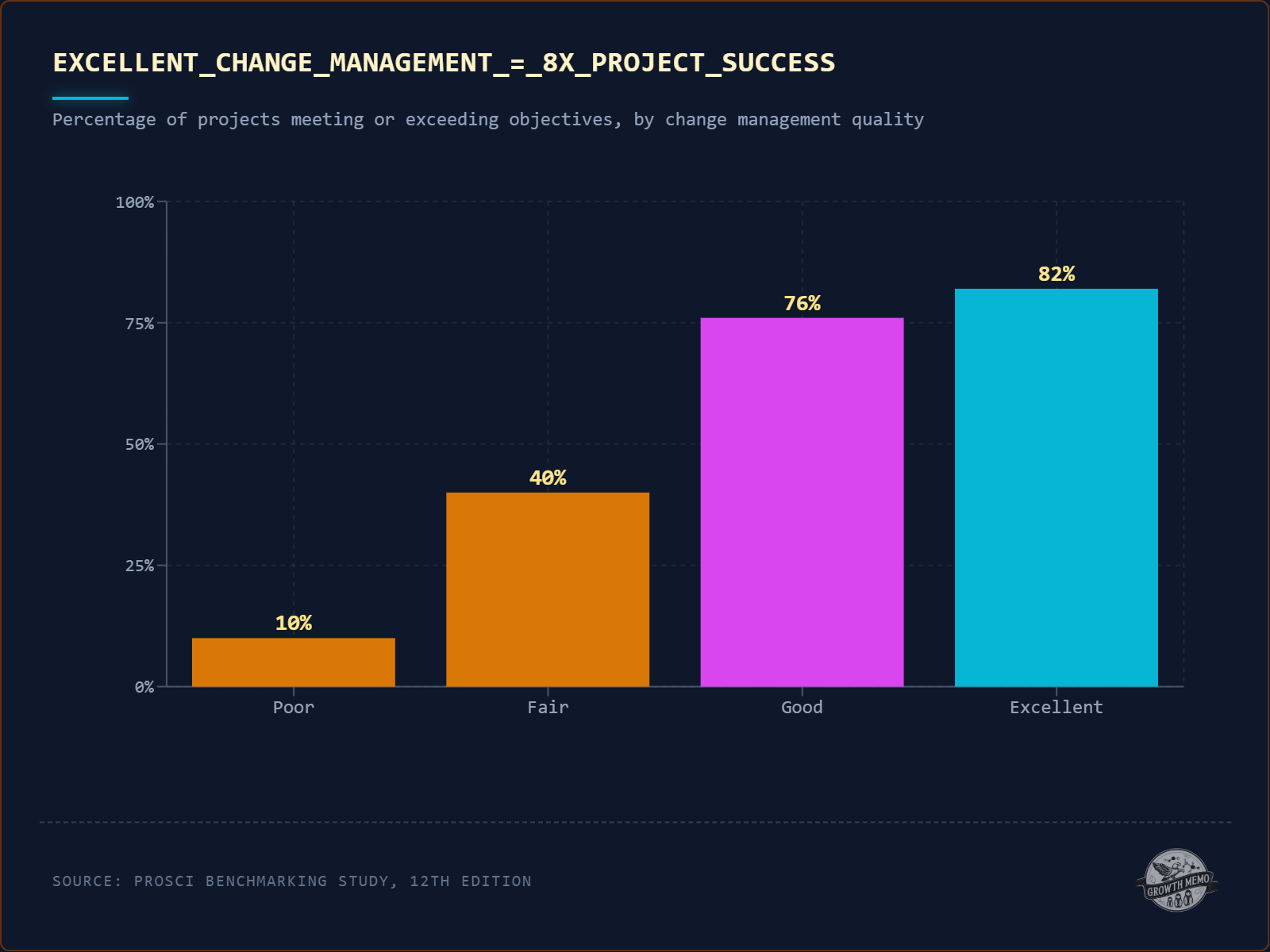
Organizations with structured change management are 8× more likely to meet transformation objectives. The same principle applies to AI-SEO. (Image Credit: Kevin Indig)
Your marketing team – and your executive team – is being asked to transform their understanding of SEO during a period of unprecedented change fatigue. Those who have survived two decades of algorithm updates are expertly adaptable, but reeducation is required because LLMs are a new product, not just another layer of search.
And this, of course, is the alignment layer fail.
Image Credit: Kevin Indig
In AI SEO, misalignment has specific symptoms:
Conflicting definitions of success: One stakeholder wants “rankings in ChatGPT.” Another wants brand mentions. A third wants citation links. A fourth wants traffic recovery. Every experiment gets judged against a different standard, and no one has agreed which matters most or how they’ll be measured. (Although our AI Overview and AI Mode studies confirm brand mentions are more valuable than citations.)
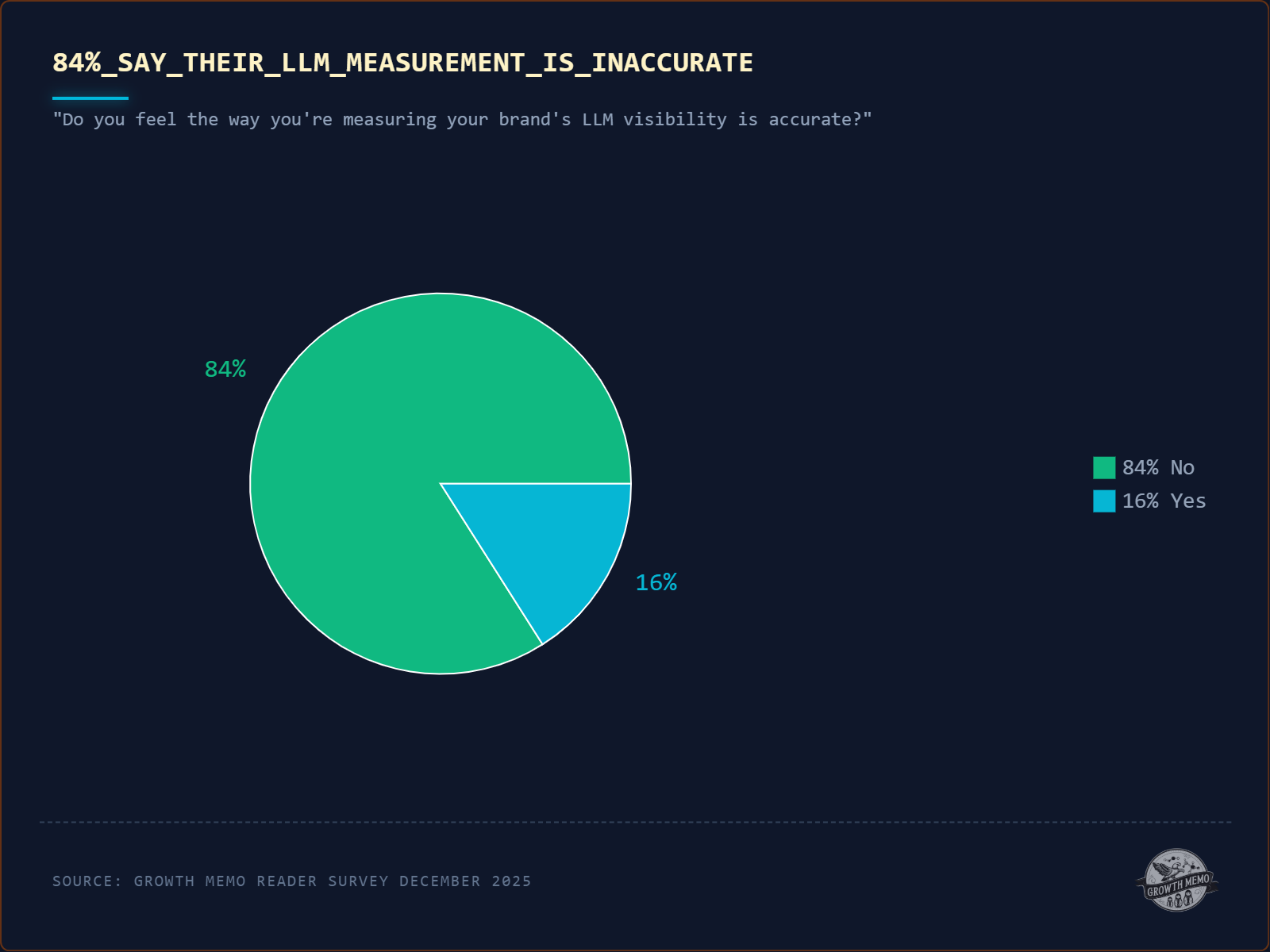
Metrics mismatch with leadership expectations: Executives ask for increased traffic in a growing zero-click environment. Classic SEO reports on influence metrics; leadership sees declining sessions and questions the investment. In our December 2025 Growth Memo reader survey, 84% of respondents said they feel their current LLM visibility measurement approach is inaccurate. Teams can’t prove value because no one has agreed on how value would be proven.
Turf fragmentation: AI SEO touches SEO, content, brand, product, PR, and (at times) legal. Without explicit ownership and a baseline, agreed-upon understanding of your brand’s AI SEO approach, each team runs experiments in its silo. No one synthesizes learning. Conflicting tactics cancel each other out.
Premature tactics without a shared foundation: This looks like “Let’s test prompts” without agreeing on what success means; “Let’s scale AI content to mitigate click loss” without understanding AI-assisted versus AI-generated content limits; “Let SEO handle AI” while product, PR, and legal stay uninvolved.
Panic-testing instead of strategic reorientation: Teams deploy short-term tactics reactively rather than reorienting the whole ship for better long-term outcomes.
This is classic change management failure: unclear mandate, fragmented ownership, mismatched incentives. No amount of tactical excellence or smart strategy pivots can fix it.
Layering AI SEO tactics + tools on top without structured change management compounds fatigue and accelerates burnout. The “scrappy resilience” that has carried the industry in the past can’t be assumed to instantly apply to this new channel without a strategic transition.
A baseline understanding of organizational change management matters in the AI SEO era … because most organizational transformations fail or underperform.
Your AI-SEO initiative is no different, even if changes in SEO seem contained to your marketing and product teams and stakeholders, rather than the larger organization or brand as a whole.
I’d argue that AI SEO falls into the category of industry transformation that affects your brand and org. And from decades of research, failure and underperformance are the statistical norm for these big transitions – seasoned leaders know this already. No wonder they’re skeptical of your AI SEO plans.
One McKinsey survey found fewer than one-third of teams succeed at both improving performance and sustaining improvements during significant shifts. BCG’s forensic analysis of 825 executives across 70 companies found transformation success at 30%.
Multiple major consulting firms’ independent research shows that most change transformations underperform.
Assuming that tactical excellence alone will carry you – without strategic reeducation and thoughtful change management as our industry shifts – is assuming you’re the exception to the rule.
The correlation between the quality of managing a big shift and your project’s success is dramatic:
Image Credit: Kevin Indig
The gap between excellent and poor represents a nearly 8x improvement. Even the jump from poor to fair quadruples success rates.
BCG’s 2020 analysis reinforces this from a different angle, noting six critical factors that increase successful transformation odds from 30% to 80%:
Integrated strategy with clear goals: This is where a carefully crafted AI SEO strategy comes in, one that not only outlines growth goals, but also clear testing and what successful outcomes look like.
Leadership commitment from the CEO through middle management: If you’re a consultant or agency, this step can’t be skipped, especially if they have an in-house team assisting in executing the strategy.
High-caliber talent deployment: Or I would argue, high-quality reeducation of existing talent – make sure all operators have a baseline shared understanding of what has changed about SEO, how LLM outputs work, what the brand’s goals are, and how it will be executed.
Flexible, agile governance: Teams should have the ability to deal with individual challenges without losing sight of the broader goals, including removing barriers quickly.
Effective monitoring: Establish core, agreed-upon KPIs to measure what winning would look like, and note what actions were taken when.
Modern/updated technology: Your SEO team needs the right tools to succeed, but they also need to know how to use them effectively. Don’t skip allotting time for integration of new workflows and AI monitoring systems.
Marketing teams that treat AI-SEO simply as a technical project to execute or tactics to update are leaving an 8× multiplier on the table.
BCG’s 2024 AI implementation study found that roughly 70% of change implementation hurdles relate to people and processes. Only about 10% of challenges were purely technical.
A 2024 Kyndryl survey found that while 95% of senior executives reported investing in AI, only 14% felt they had successfully aligned workforce strategies.
Your brand’s ability to test, update tactics, learn AI workflows, implement structured data, and optimize for LLM retrieval is not the bottleneck you need to be concerned about.
The real concern is whether your team – leadership, cross-functional team partners, and frontline executors/operators – is aligned on what AI SEO means, why and how you’re making changes from your classic SEO approach, what success looks like, and who owns outcomes.
Active and visible executive sponsorship is the No. 1 contributor to change success, cited 3-to-1 more frequently than any other factor, according to 25 years of benchmarking research by Prosci. Your first step as the person leading the AI SEO charge for your brand (or across your clients) is to earn executive buy-in.
But the head of SEO cannot transform a brand’s understanding and approach to AI SEO alone. Bain’s 2024 research emphasized that successful transformations “drive change from the middle of the organization out.”
Keep in mind, financial benefits can compound quickly: One research analysis of 600 organizations found “change accelerators” experience greater revenue growth than companies with below-average change effectiveness.
Image Credit: Kevin Indig
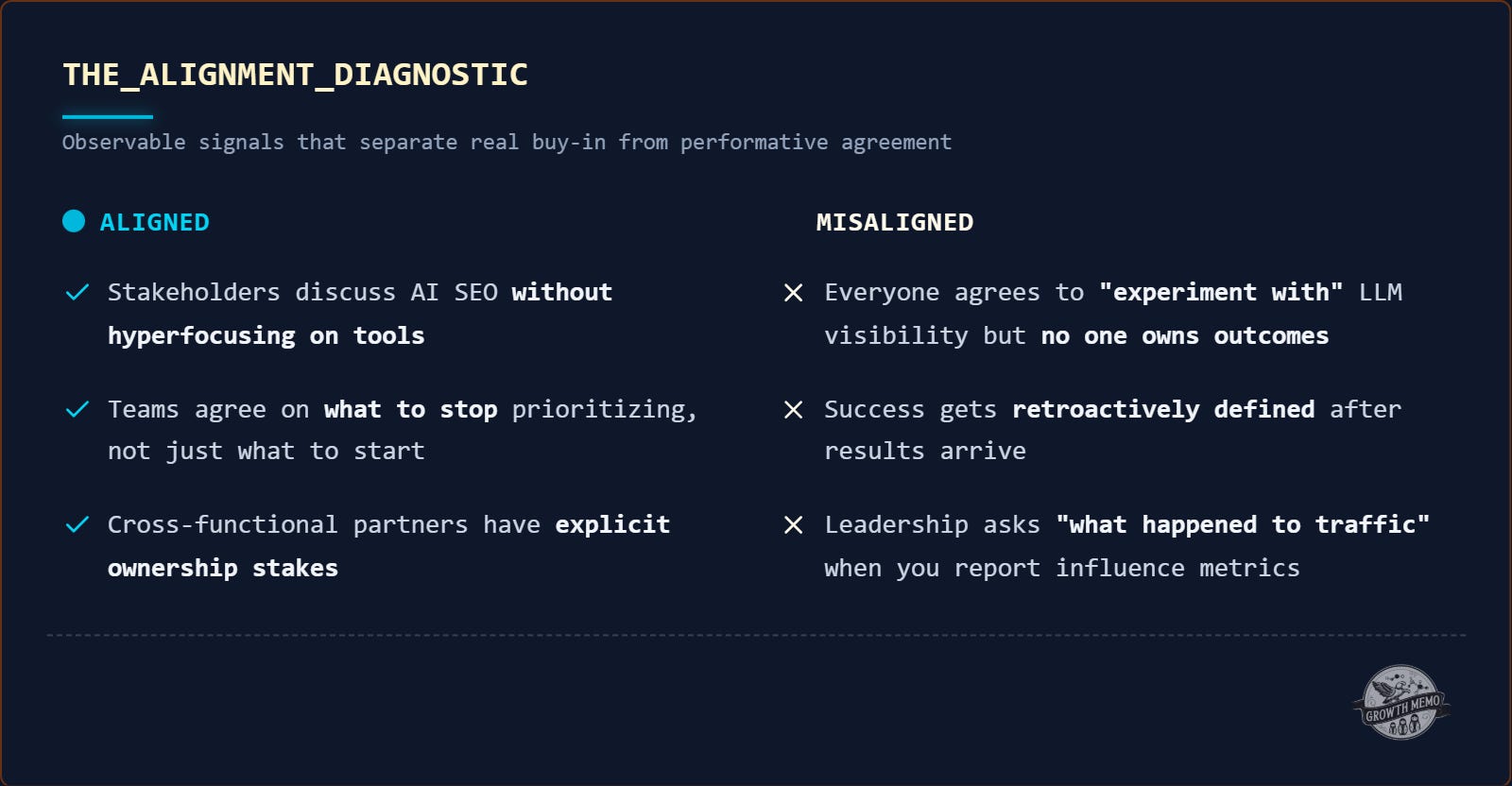
Alignment isn’t just a feeling; it’s observable. You’ll know when you get there:
Stakeholders can talk through AI SEO without hyperfocusing on tools.
Teams agree on what to stop prioritizing (not just what to start).
Cross-functional partners have explicit ownership stakes.
Alignment isn’t happening when:
Everyone is good with “experimenting with” or “investing in” LLM visibility, but no one owns outcomes.
Success gets retroactively defined, or
Leadership asks, “What happened to traffic?” when you report influence metrics.
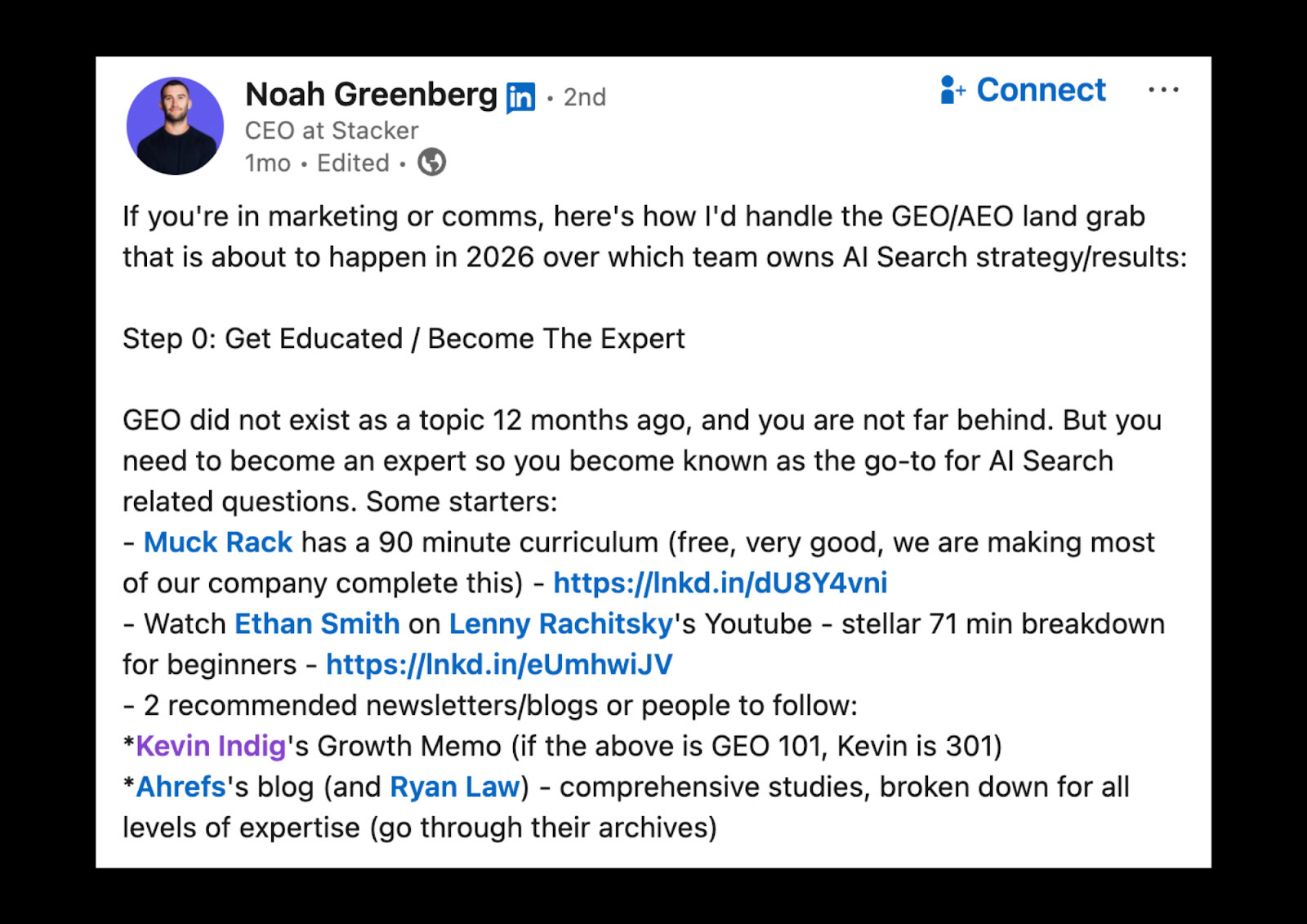
Noah Greenberg, CEO at Stacker, outlined this pretty clearly in a recent LinkedIn post: Step 0 in your AI SEO transformation is to become the expert.
Screenshot from LinkedIn by Kevin Indig, February 2026
Educating stakeholders on the structural differences between classic search engines and LLM retrieval – guiding teams to explain why your CEO doesn’t see the same LLM output when they look up the brand vs. what you’re reporting.
Explaining the tradeoffs, not just opportunities.
Setting expectations executives won’t like at first, but need to hear (traffic loss or slower growth than in years prior).
This is uncomfortable. Less direct control. More indirect influence. Higher stakes.
Your mindset – as the change agent for your clients or organization – centers on three principles:
Honesty over confidence. What we don’t know: the precise value of an AI mention. What we do know: your brand not appearing for related topics is a measurable miss.
Progress over perfection. Alignment doesn’t require certainty. It requires shared uncertainty, agreeing on what you’re testing and how you’ll learn.
Translation over broadcasting. The same strategic message needs adaptation for ICs (how their work changes), managers (how they report success), and executives (how budgets should shift). Uniform communication fails; translated communication scales.
Do this in order:
Write the one-sentence AI SEO mandate for your organization. If you can’t explain AI SEO in one sentence to leadership, you’re not ready to execute.
Complete a high-level SWOT. Identify where your organization has existing strengths and gaps. The Brand SEO scorecard from The Great Decoupling will walk you through.
Replace or supplement legacy KPIs. Add LLM visibility estimates alongside classic KPIs (rankings, sessions) to start the transition. Reporting both builds the case for the shift without abandoning the old model cold.
Name cross-functional owners explicitly. Who owns brand mentions in LLM outputs: SEO, PR, or brand? Who owns citation link acquisition: SEO or content? Ambiguity is the enemy.
Provide baseline education at every level. ICs need to understand how LLM retrieval differs from crawl-index-rank. Executives need to understand why slowed organic traffic or zero-click growth doesn’t mean zero impact.
Kill one SEO practice without a fight. Success means everyone understands why, and you don’t receive pushback. If you can’t retire one outdated tactic without internal conflict, you haven’t achieved alignment.
Only then change workflows and tactics. Tactics deployed on an unaligned organization waste resources and burn credibility. Tactics deployed on an aligned organization compound advantage.
Featured Image: Summit Art Creations/Search Engine Journal
Web Almanac Data Reveals CMS Plugins Are Setting Technical SEO Standards (Not SEOs) via @sejournal, @chrisgreenseo
If more than half the web runs on a content management system, then the majority of technical SEO standards are being positively shaped before an SEO even starts work on it. That’s the lens I took into the 2025 Web Almanac SEO chapter (for clarity, I co-authored the 2025 Web Almanac SEO chapter referenced in this article).
Rather than asking how individual optimization decisions influence performance, I wanted to understand something more fundamental: How much of the web’s technical SEO baseline is determined by CMS defaults and the ecosystems around them.
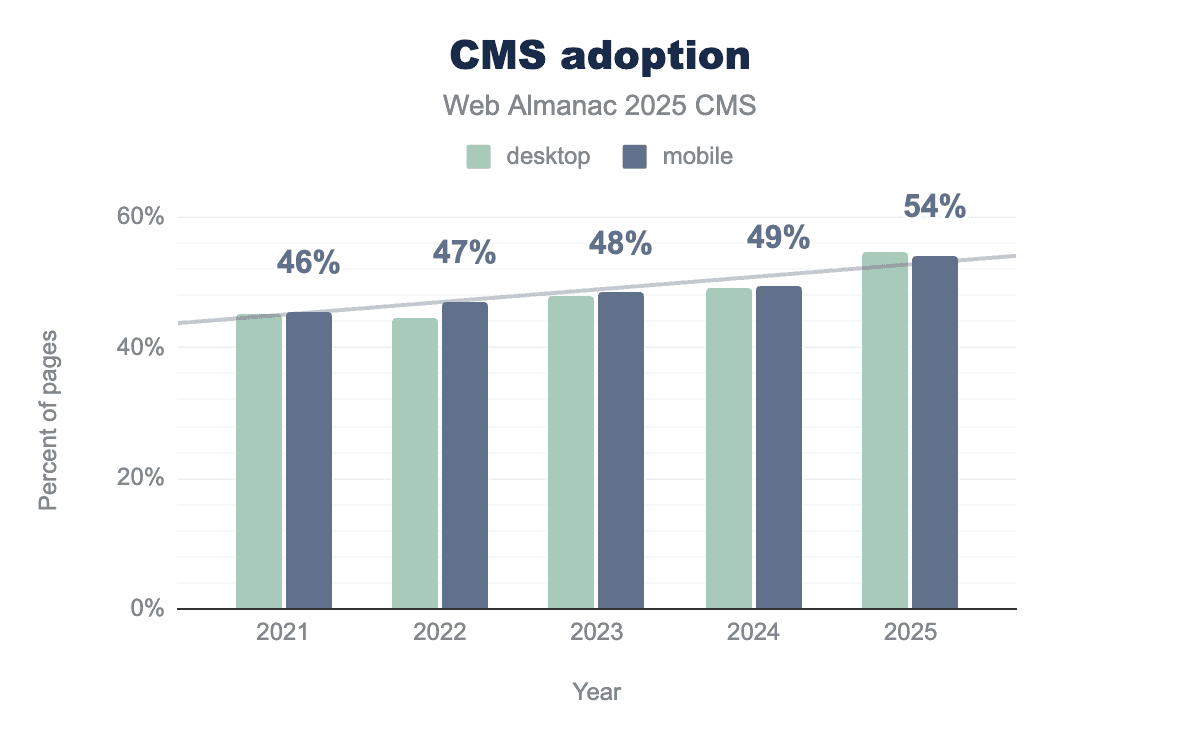
SEO often feels intensely hands-on – perhaps too much so. We debate canonical logic, structured data implementation, crawl control, and metadata configuration as if each site were a bespoke engineering project. But when 50%+ of pages in the HTTP Archive dataset sit on CMS platforms, those platforms become the invisible standard-setters. Their defaults, constraints, and feature rollouts quietly define what “normal” looks like at scale.
How CMS adoption trends track with core technical SEO signals.
Where plugin ecosystems appear to shape implementation patterns.
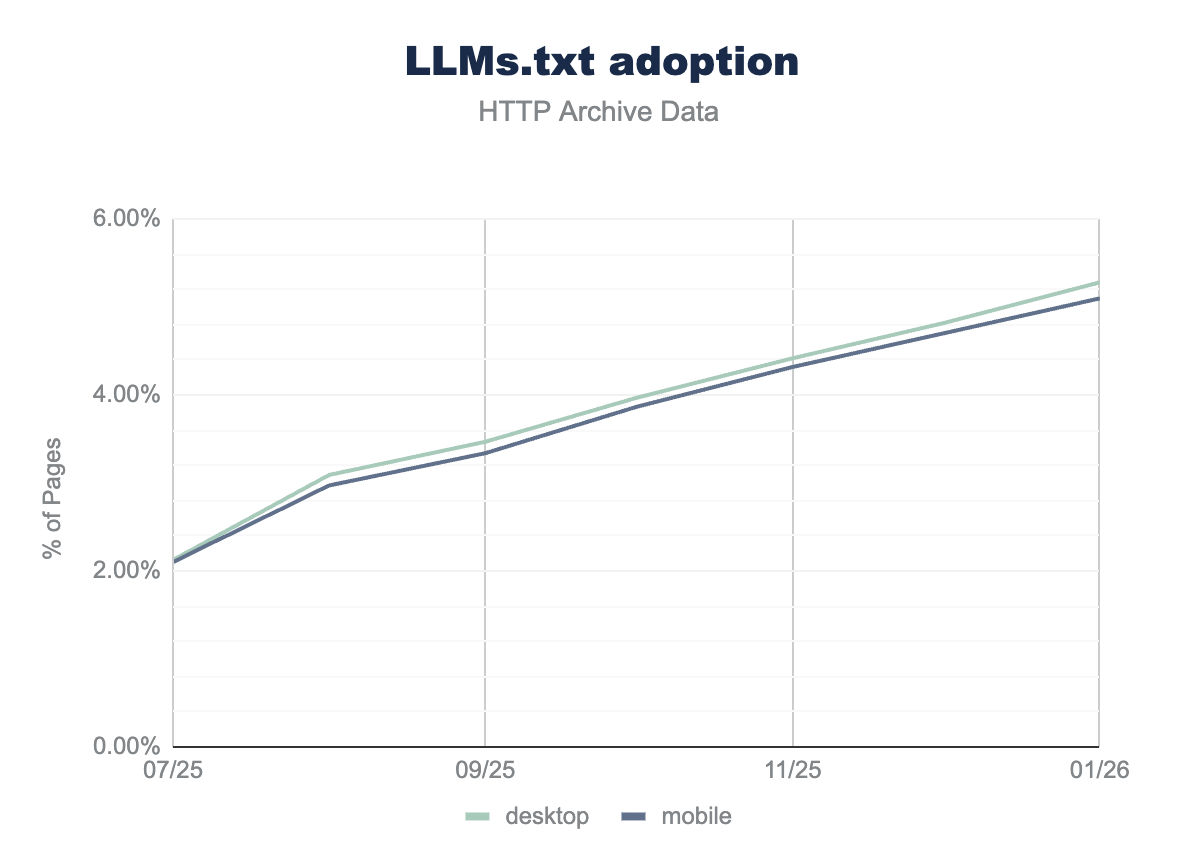
And how emerging standards like llms.txt are spreading as a result.
The question is not whether SEOs matter. It’s whether we’ve been underestimating who sets the baseline for the modern web.
The Backbone Of Web Design
The 2025 CMS chapter of the Web Almanac saw a milestone hit with CMS adoption; over 50% of pages are on CMSs. In case you were unsold on how much of the web is carried by CMSs, over 50% of 16 million websites is a significant amount.
WordPress is still the most used CMS, by a long way, even if it has dropped marginally in the 2024 data. Shopify, Wix, Squarespace, and Joomla trail a long way behind, but they still have a significant impact, especially Shopify, on ecommerce specifically.
SEO Functions That Ship As Defaults In CMS Platforms
CMS platform defaults are important, this – I believe – is that a lot of basic technical SEO standards are either default setups or for the relatively small number of websites that have dedicated SEOs or people who at least build to/work with SEO best practice.
When we talk about “best practice,” we’re on slightly shaky ground for some, as there isn’t a universal, prescriptive view on this one, but I would consider:
Descriptive “SEO-friendly” URLs.
Editable title and meta description.
XML sitemaps.
Canonical tags.
Meta robots directive changing.
Structured data – at least a basic level.
Robots.txt editing.
Of the main CMS platforms, here is what they – self-reportedly – have as “default.” Note: For some platforms – like Shopify – they would say they’re SEO-friendly (and to be honest, it’s “good enough”), but many SEOs would argue that they’re not friendly enough to pass this test. I’m not weighing into those nuances, but I’d say both Shopify and those SEOs make some good points.
CMS
SEO-friendly URLs
Title & meta description UI
XML sitemap
Canonical tags
Robots meta support
Basic structured data
Robots.txt
WordPress
Yes
Partial (theme-dependent)
Yes
Yes
Yes
Limited (Article, BlogPosting)
No (plugin or server access required)
Shopify
Yes
Yes
Yes
Yes
Limited
Product-focused
Limited (editable via robots.txt.liquid, constrained)
Wix
Yes
Guided
Yes
Yes
Limited
Basic
Yes (editable in UI)
Squarespace
Yes
Yes
Yes
Yes
Limited
Basic
No (platform-managed, no direct file control)
Webflow
Yes
Yes
Yes
Yes
Yes
Manual JSON-LD
Yes (editable in settings)
Drupal
Yes
Partial (core)
Yes
Yes
Yes
Minimal (extensible)
Partial (module or server access)
Joomla
Yes
Partial
Yes
Yes
Yes
Minimal
Partial (server-level file edit)
Ghost
Yes
Yes
Yes
Yes
Yes
Article
No (server/config level only)
TYPO3
Yes
Partial
Yes
Yes
Yes
Minimal
Partial (config or extension-based)
Based on the above, I would say that most SEO basics can be covered by most CMSs “out of the box.” Whether they work well for you, or you cannot achieve the exact configuration that your specific circumstances require, are two other important questions – ones which I am not taking on. However, it often comes down to these points:
It is possible for these platforms to be used badly.
It is possible that the business logic you need will break/not work with the above.
There are many more advanced SEO features that aren’t out of the box, that are just as important.
We are talking about foundations here, but when I reflect on what shipped as “default” 15+ years ago, progress has been made.
Fingerprints Of Defaults In The HTTP Archive Data
Given that a lot of CMSs ship with these standards, do these SEO defaults correlate with CMS adoption? In many ways, yes. Let’s explore this in the HTTP Archive data.
Canonical Tag Adoption Correlates With CMS
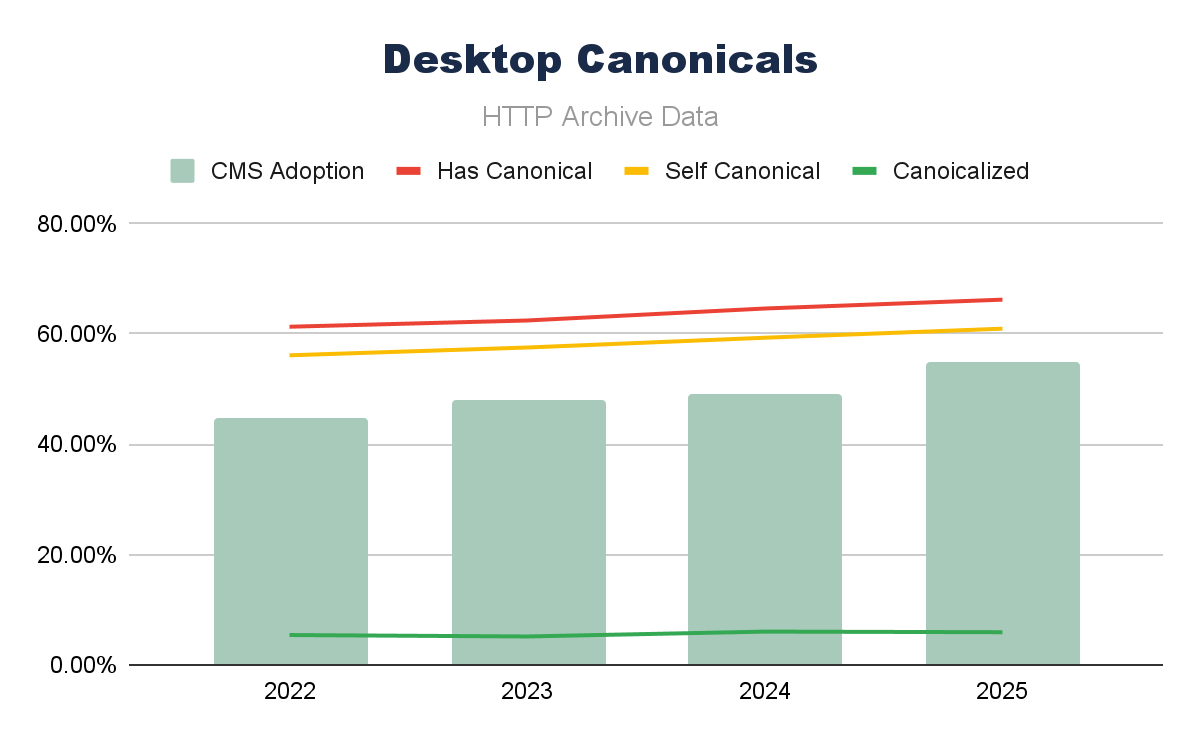
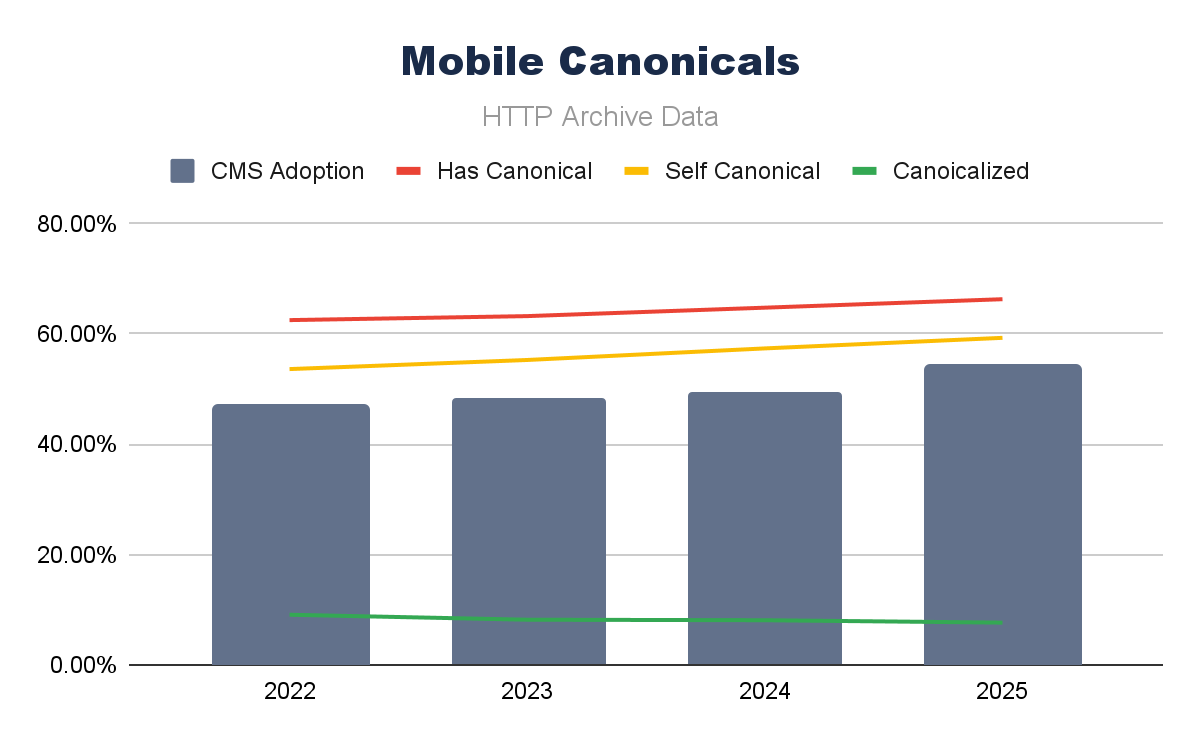
Combining canonical tag adoption data with (all) CMS adoption over the last four years, we can see that for both mobile and desktop, the trends seem to follow each other pretty closely.
Image by author, February 2026Image by author, February 2026
Running a simple Pearson correlation over these elements, we can see this strong correlation even clearer, with canonical tag implementation and the presence of self-canonical URLs.
Image by author, February 2026
What differs is the mobile correlation of canonicalized URLs; that seems to be a negative correlation on mobile and a lower (but still positive) correlation on desktop. A drop in canonicalized pages is largely causing this negative correlation, and the reasons behind this could be many (and harder to be sure of).
Canonical tags are a crucial element for technical SEO; their continued adoption does certainly seem to track the growth in CMS use, too.
Schema.org Data Types Correlate With CMS
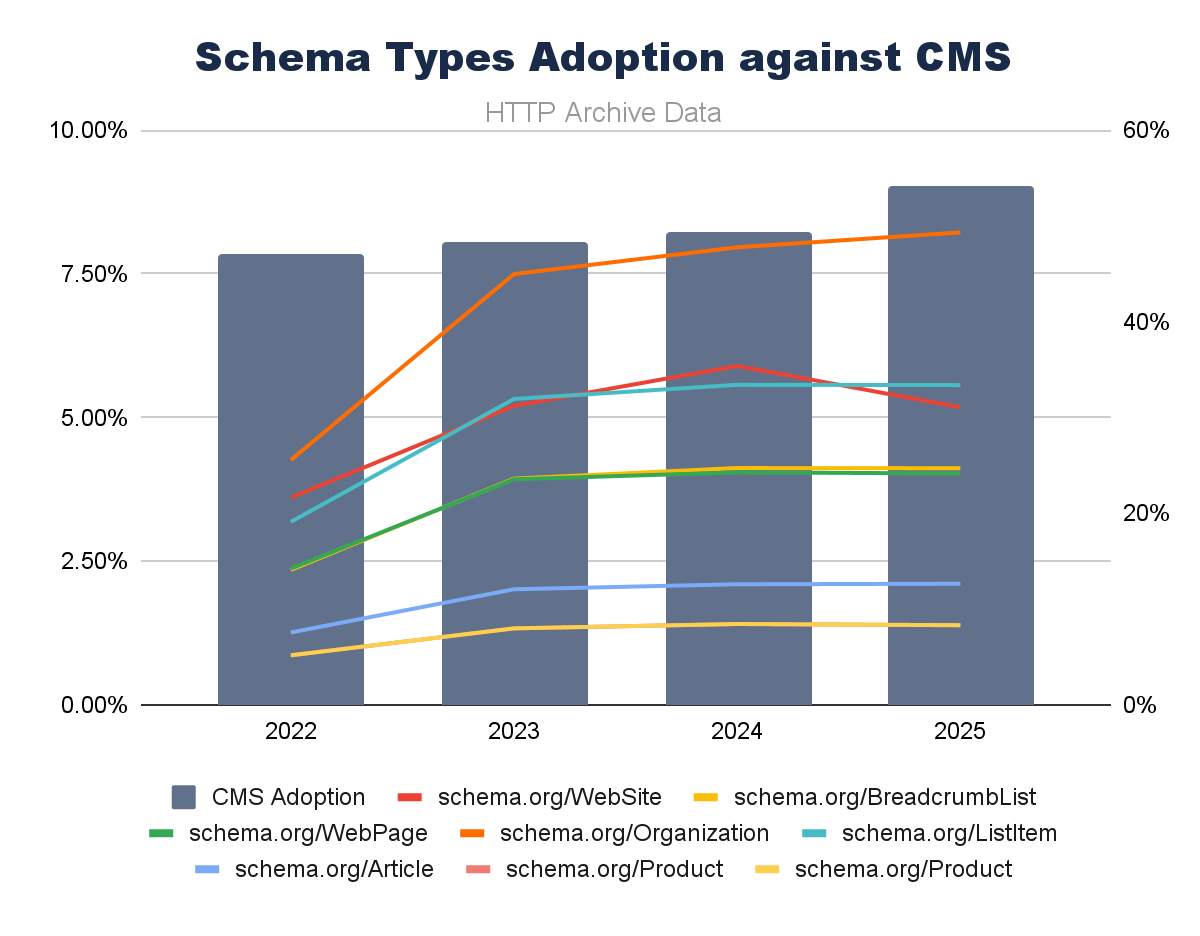
Schema.org types against CMS adoption show similar trends, but are less definitive overall. There are many different types of Schema.org, but if we plot CMS adoption against the ones most common to SEO concerns, we can observe a broadly rising picture.
Image by author, February 2026
With the exception of Schema.org WebSite, we can see CMS growth and structured data following similar trends.
But we must note that Schema.org adoption is quite considerably lower than CMSs overall. This could be due to most CMS defaults being far less comprehensive with Schema.org. When we look at specific CMS examples (shortly), we’ll see far-stronger links.
Schema.org implementation is still mostly intentional, specialist, and not as widespread as it could be. If I were a search engine or creating an AI Search tool, would I rely on universal adoption of these, seeing the data like this? Possibly not.
Robots.txt
Given that robots.txt is a single file that has some agreed standards behind it, its implementation is far simpler, so we could anticipate higher levels of adoption than Schema.org.
The presence of a robots.txt is pretty important, mostly to limit crawl of search engines to specific areas of the site. We are starting to see an evolution – we noted in the 2025 Web Almanac SEO chapter – that the robots.txt is used even more as a governance piece, rather than just housekeeping. A key sign that we’re using our key tools differently in the AI search world.
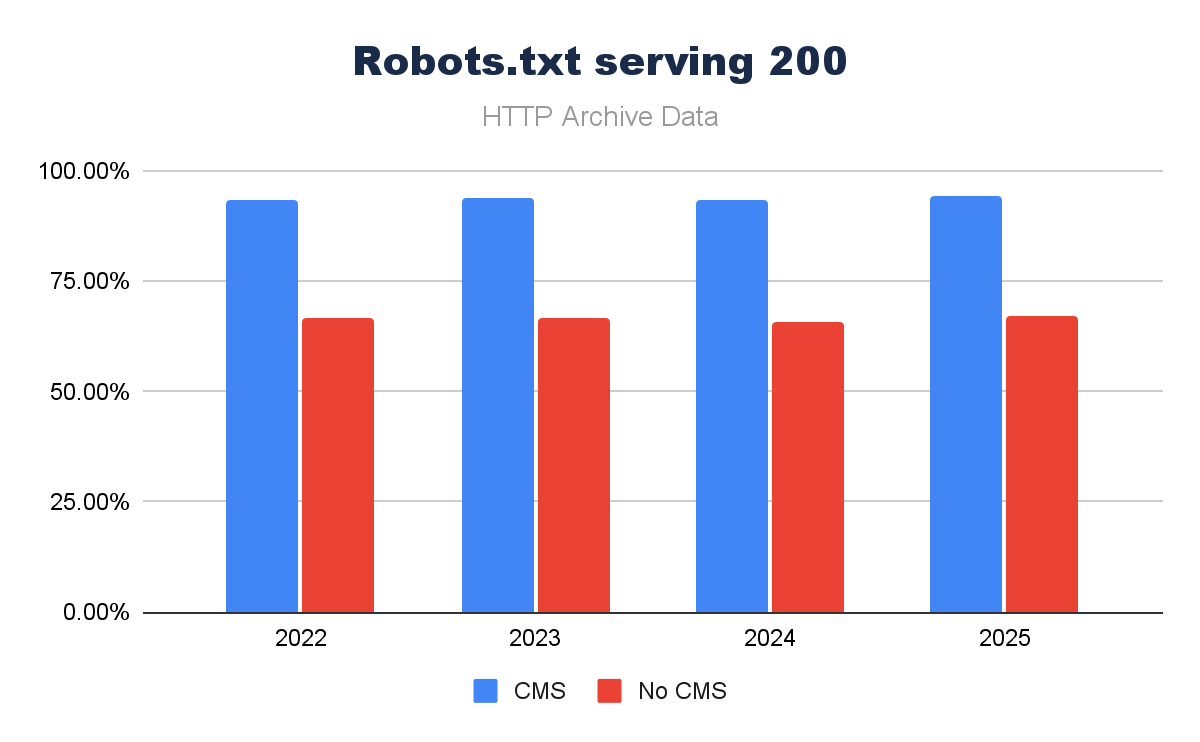
But before we consider the more advanced implementations, how much of a part does a CMS have in ensuring a robots.txt is present? Looks like over the last four years, CMS platforms are driving a significant amount more of robots.txt files serving a 200 response:
Image by author, February 2026
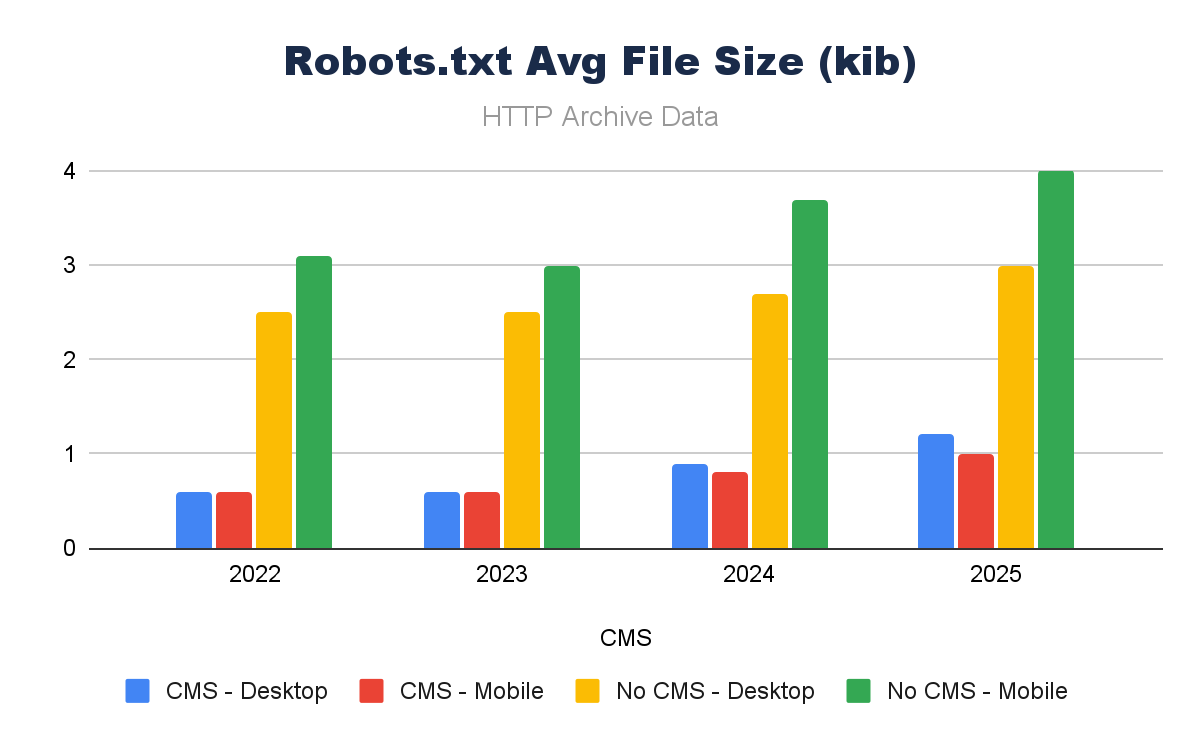
What is more curious, however, is when you consider the file of the robots.txt files. Non-CMS platforms have robots.txt files that are significantly larger.
Image by author, February 2026
Why could this be? Are they more advanced in non-CMS platforms, longer files, more bespoke rules? Most probably in some cases, but we’re missing another impact of a CMSs standards – compliant (valid) robots.txt files.
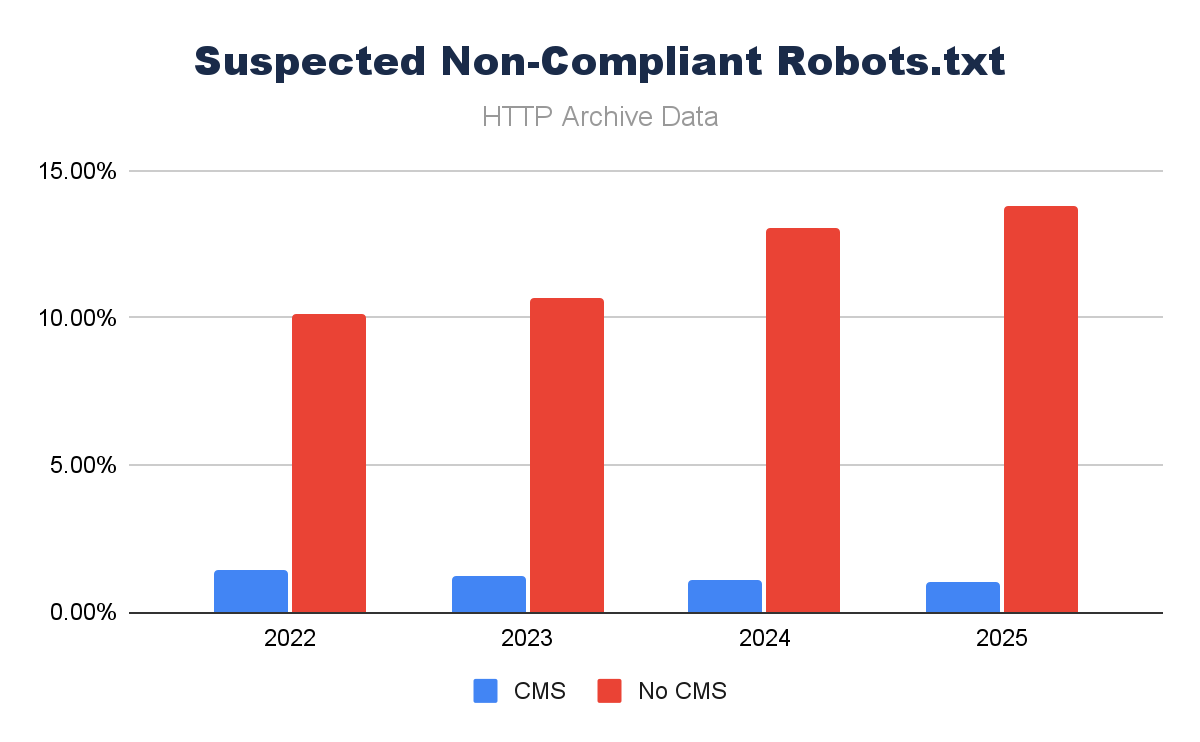
A lot of robots.txt files serve a valid 200 response, but often they’re not txt files, or they’re redirecting to 404 pages or similar. When we limit this list to only files that contain user-agent declarations (as a proxy), we see a different story.
Image by author, February 2026
Approaching 14% of robots.txt files served on non-CMS platforms are likely not even robots.txt files.
A robots.txt is easy to set up, but it is a conscious decision. If it’s forgotten/overlooked, it simply won’t exist. A CMS makes it more likely to have a robots.txt, and what’s more, when it is in place, it makes it easier to manage/maintain – which IS key.
WordPress Specific Defaults
CMS platforms, it seems, cover the basics, but more advanced options – which still need to be defaults – often need additional SEO tools to enable.
Interrogating WordPress-specific sites with the HTTP Archive data will be easiest as we get the largest sample, and the Wapalizer data gives a reliable way to judge the impact of WordPress-specific SEO tools.
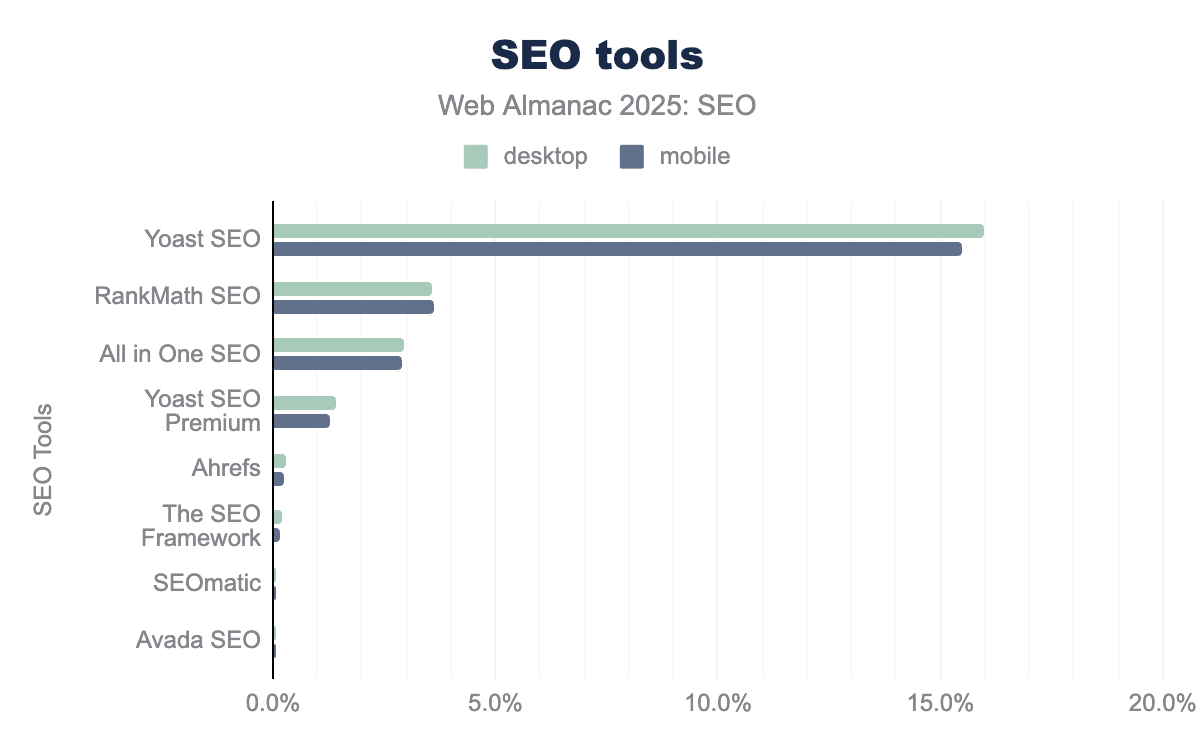
From the Web Almanac, we can see which SEO tools are the most installed on WordPress sites.
Screenshot from Web Almanac, February 2026
For anyone working within SEO, this is unlikely to be surprising. If you are an SEO and worked on WordPress, there is a high chance you have used either of the top three. What IS worth considering right now is that while Yoast SEO is by far the most prevalent within the data, it is seen on barely over 15% of sites. Even the most popular SEO plugin on the most popular CMS is still a relatively small share.
Of these top three plugins, let’s first consider what the differences of their “defaults” are. These are similar to some of WordPress’s, but we can see many more advanced features that come as standard.
Editable metadata, structured data, robots.txt, sitemaps, and, more recently, llms.txt are the most notable. It is worth noting that a lot of the functionality is more “back-end,” so not something we’d be as easily able to see in the HTTP Archive data.
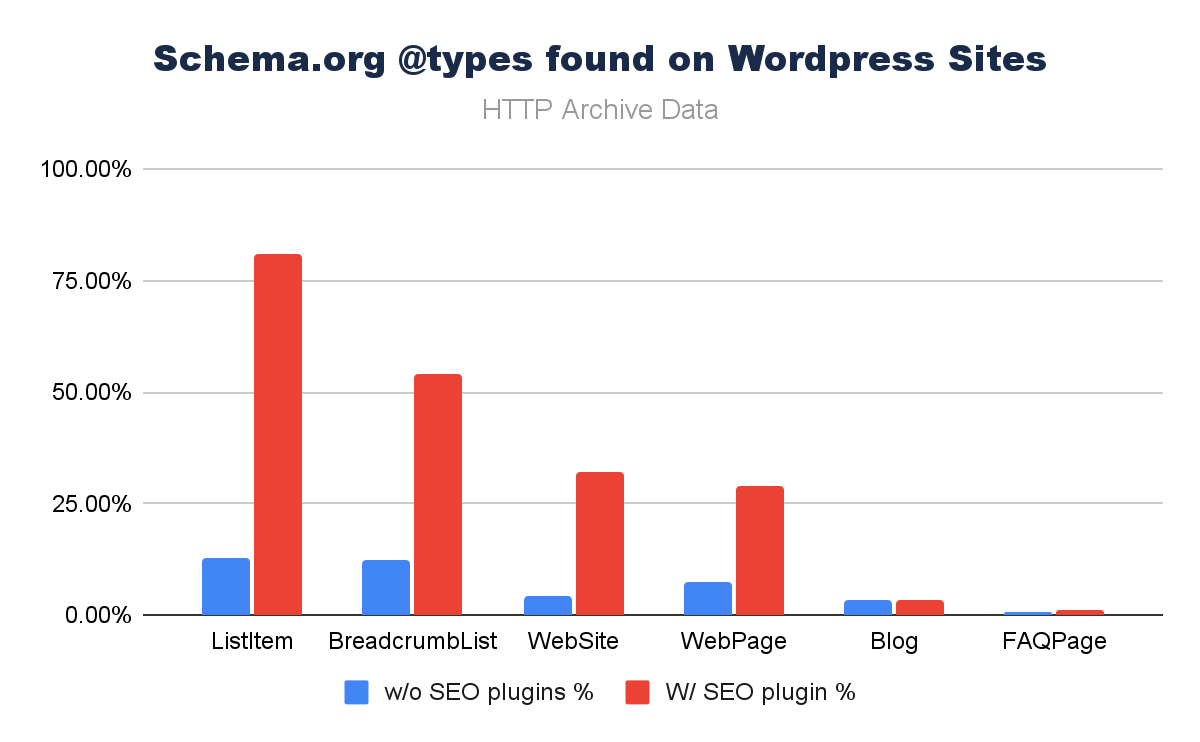
Structured Data Impact From SEO Plugins
We can see (above) that structured data implementation and CMS adoption do correlate; what is more interesting here is to understand where the key drivers themselves are.
Viewing the HTTP Archive data with a simple segment (SEO plugins vs. no SEO plugins), from the most recent scoring paints a stark picture.
Image by author, February 2026
When we limit the Schema.org @types to the most associated with SEO, it is really clear that some structured data types are pushed really hard using SEO plugins. They are not completely absent. People may be using lesser-known plugins or coding their own solutions, but ease of implementation is implicit in the data.
Robots Meta Support
Another finding from the SEO Web Almanac 2025 chapter was that “follow” and “index” directives were the most prevalent, even though they’re technically redundant, as having no meta robots directives is implicitly the same thing.
Screenshot from Web Almanac 2025, February 2026
Within the chapter number crunching itself, I didn’t dig in much deeper, but knowing that all major SEO WordPress plugins have “index,follow” as default, I was eager to see if I could make a stronger connection in the data.
Where SEO plugins were present on WordPress, “index, follow” was set on over 75% of root pages vs. <5% of WordPress sites without SEO plugins.
Image by author, February 2026
Given the ubiquity of WordPress and SEO plugins, this is likely a huge contributor to this particular configuration. While this is redundant, it isn’t wrong, but it is – again – a key example of whether one or more of the main plugins establish a de facto standard like this, it really shapes a significant portion of the web.
Diving Into LLMs.txt
Another key area of change from the 2025 Web Almanac was the introduction of the llms.txt file. Not an explicit endorsement of the file, but rather a tacit acknowledgment that this is an important data point in the AI Search age.
From the 2025 data, just over 2% of sites had a valid llms.txt file and:
39.6% of llms.txt files are related to All-in-One SEO.
3.6% of llms.txt files are related to Yoast SEO.
This is not necessarily an intentional act by all those involved, especially as Rank Math enables this by default (not an opt-in like Yoast and All-in-One SEO).
Image by author, February 2026
Since the first data was gathered on July 25, 2025 if we take a month-by-month view of the data, we can see further growth since. It is hard not to see this as growing confidence in this markup OR at least, that it’s so easy to enable, more people are likely hedging their bets.
Conclusion
The Web Almanac data suggests that SEO, at a macro level, moves less because of individual SEOs and more because WordPress, Shopify, Wix, or a major plugin ships a default.
Canonical tags correlate with CMS growth.
Robots.txt validity improves with CMS governance.
Redundant “index,follow” directives proliferate because plugins make them explicit.
Even llms.txt is already spreading through plugin toggles before it even gets full consensus.
This doesn’t diminish the impact of SEO; it reframes it. Individual practitioners still create competitive advantage, especially in advanced configuration, architecture, content quality, and business logic. But the baseline state of the web, the technical floor on which everything else is built, is increasingly set by product teams shipping defaults to millions of sites.
Perhaps we should consider that if CMSs are the infrastructure layer of modern SEO, then plugin creators are de facto standards setters. They deploy “best practice” before it becomes doctrine
This is how it should work, but I am also not entirely comfortable with this. They normalize implementation and even create new conventions simply by making them zero-cost. Standards that are redundant have the ability to endure because they can.
So the question is less about whether CMS platforms impact SEO. They clearly do. The more interesting question is whether we, as SEOs, are paying enough attention to where those defaults originate, how they evolve, and how much of the web’s “best practice” is really just the path of least resistance shipped at scale.
An SEO’s value should not be interpreted through the amount of hours they spend discussing canonical tags, meta robots, and rules of sitemap inclusion. This should be standard and default. If you want to have an out-sized impact on SEO, lobby an existing tool, create your own plugin, or drive interest to influence change in one.