SEO product manager vs. SEO manager: What’s the difference?

SEO product managers and SEO managers may sound similar, but they entail distinct responsibilities. So, what sets these roles apart?

This article covers the different expectations between an SEO product manager and an SEO manager and how each role is designed to operate inside a large organization. 

Going fast vs. going far

When you’re an SEO product manager, you have a team that you collaborate with to get things done. 

When you’re in an SEO manager role, you operate differently and may not be connected to the same types of resources as those in product. 

While no role is better than the other, in my experience, the SEO product manager may have more access to internal engineering resources. 

The dynamics of each role remind me of an African proverb, “If you want to go fast, go alone. If you want to go far, go together.”

Comparing job descriptions

Let’s look at these two roles side by side for comparison.

I found two examples of SEO job descriptions on LinkedIn: 

  • A technical SEO senior product manager at Target.
  • An SEO manager at Vimeo. 

Both companies are large, customer-facing brands. 

The About section
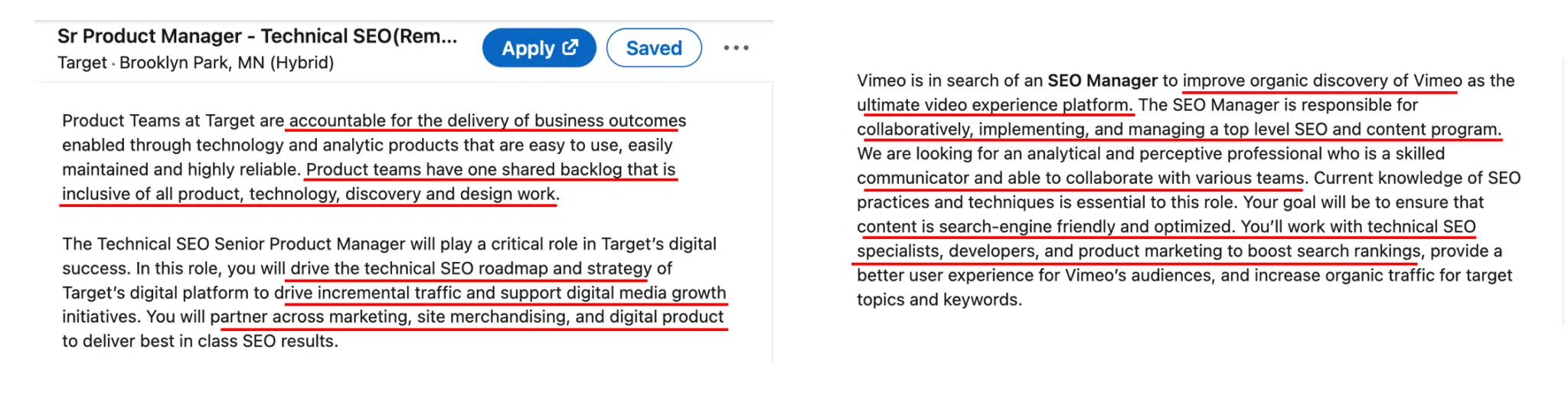
About section - JDs

I’ve highlighted the differences. But immediately, notice how each role is accountable for very different things. 

On the left, you’ll see the product role is responsible for business outcomes. 

On the right, the SEO manager is in charge of a specific SEO aspect: improving the brand’s organic visibility. 

Both job descriptions show that the person needs to be a good communicator and open to collaborating with cross-functional teams. 

The primary difference is operational: 

  • Product managers are responsible for roadmaps and backlogs that deliver business impact.
  • SEO managers are often responsible for developing and guiding the SEO program. In this case, “collaborating, implementing and managing a top-level SEO program.”

In a way, both roles actually do work off of a roadmap. (What SEO professional does not have a prioritized list of technical fixes they would love to implement?)

The distinction is in the discipline of product management. SEO product managers (PMs) develop, maintain and share their roadmap with the broader organization in a more product-focused way. 

This differs from how an SEO manager oversees a list of technical and content fixes and improvements. 

In many ways, the SEO PM is intricately involved in quarterbacking each roadmap initiative along the way, whereas an SEO manager is largely putting SEO recommendations in motion with other teams. 

Skills and knowledge the candidate should possess
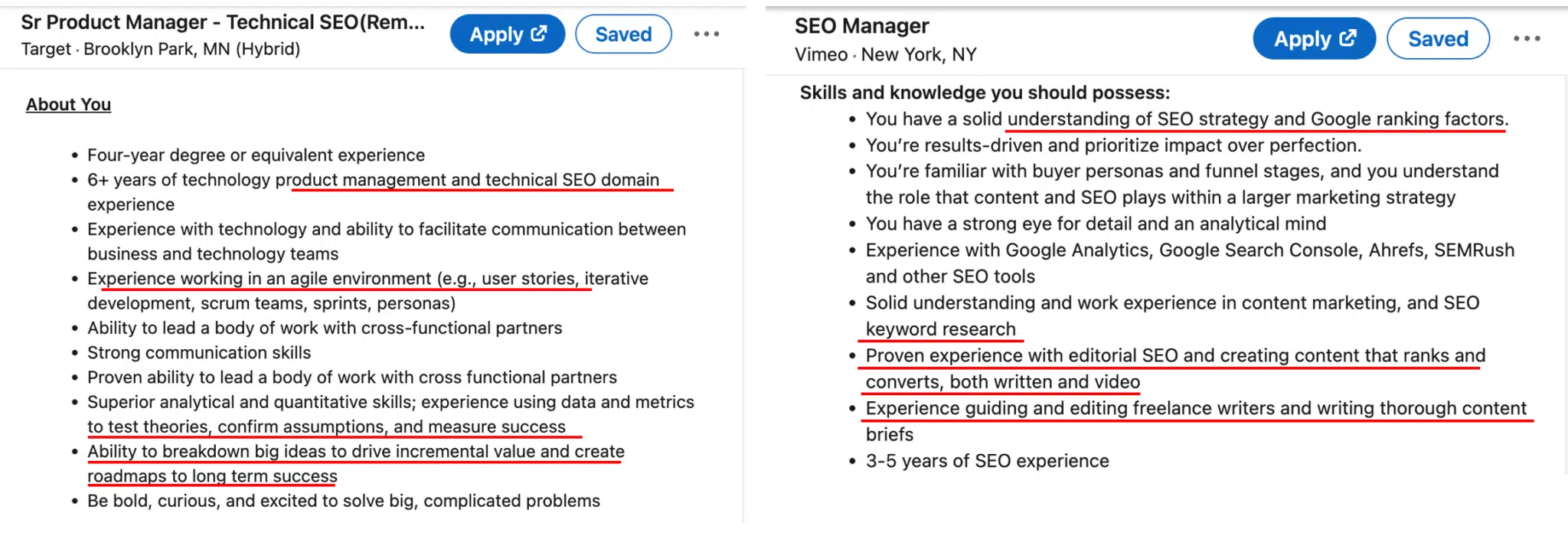
Skills side by side JD

This is really where we see the roles differentiate. The PM should have the expertise of a product manager and, in this case, technical SEO. 

The SEO manager should demonstrate solid experience in SEO strategy, in this case, content SEO and editorial duties. 

What’s interesting to me is that the product role explicitly lists the candidate should have “experience using data and metrics to test theories, confirm assumptions, and measure success.” 

In practice, SEO managers do this, too, especially when we need to bring a business case to the table to prove the SEO hypothesis is worth the investment and what the incremental lift in KPIs would be. 

I’m surprised a similar requirement isn’t reflected in the job description for the SEO manager. 


Get the daily newsletter search marketers rely on.


The day-to-day: Where the magic happens
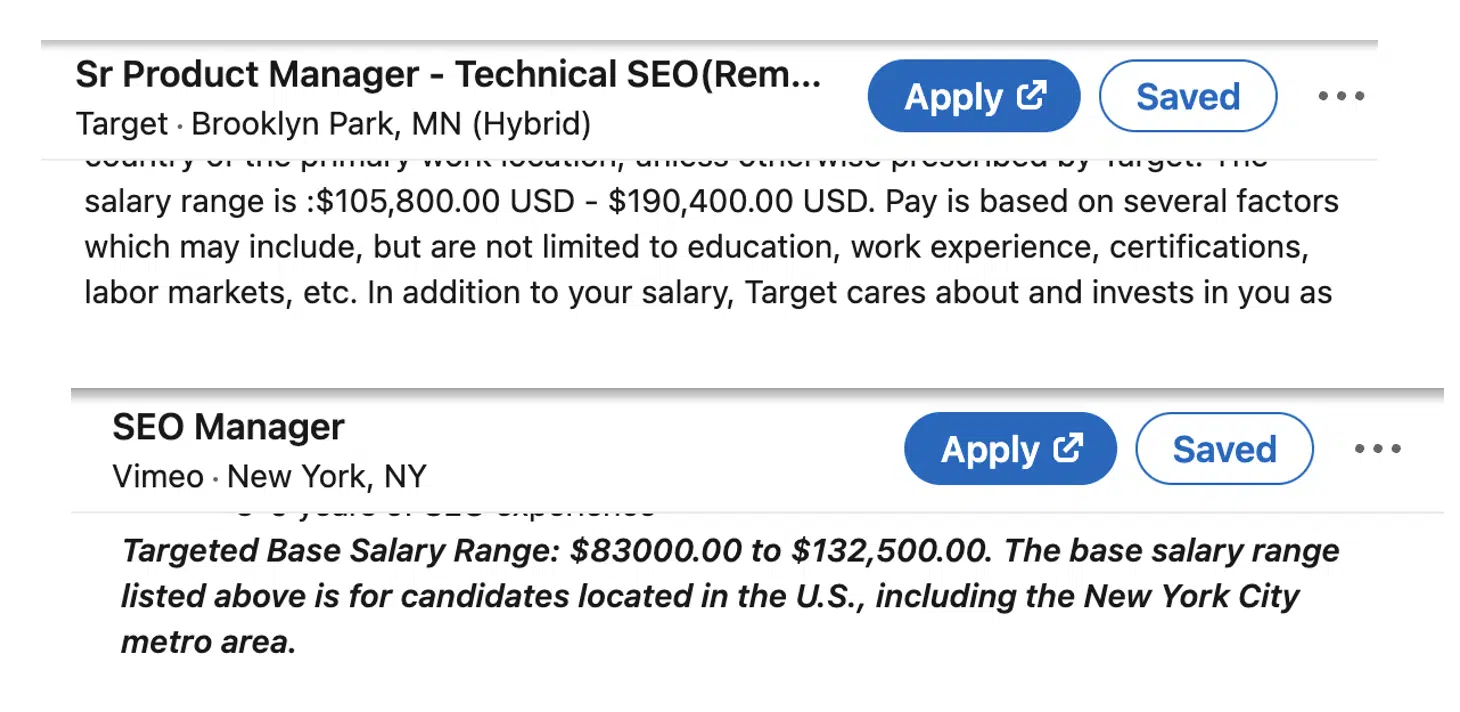
Skills side by side JD

Here’s where things diverge. The big differences between an SEO PM and an SEO manager are product roadmap ownership and operational function ownership.

SEO product managers own a roadmap of features and fixes where the initiatives range from ad hoc technical fixes (bugs) to building features that improve the foundational aspects of SEO, such as: 

  • Internal linking.
  • The amount of content on the site.
  • Googlebot’s ability to crawl and index the site.
  • User experience. 
  • Speed and core web vitals. 

The primary aspects of an SEO product manager role are:

  • Areas of responsibilities.
  • Operational function (a functional member of an agile team).
  • Ability to write technical requirements as SEO requirements.
  • Documentation.

Let’s look at these a bit more closely. 

Areas of responsibilities

Product managers often own an aspect of the website or customer experience (what’s referred to in the job description as “leading a product”). 

On large ecommerce sites, this covers areas like on-site search, cart and checkout, user-generated content (UGC), personalization/loyalty, the brand’s app, and SEO.  

Another differentiator for product managers is being the “voice of the product.” This means having a point of view on why one feature should be prioritized over another (and knowing the data that backs it up). 

What’s not said enough is that SEOs, especially those in product management positions, fundamentally understand their two primary customers are search engines and humans visiting the website. 

Their SEO knowledge and expertise (translated into requirements) help make a website with products or visual content discoverable to both audiences. 

Search engines are like a small child; they must be told everything. 

Operational function as a functional member of an agile team

For context, project management methodologies such as Agile, Lean and Scrum are ways of operating and collaborating across multiple teams. 

While an SEO manager is not an integral part of the agile process by design, an SEO product manager is. 

The challenge SEO managers often face is actually getting SEO priorities onto a roadmap as they’re essentially on the outside of this process looking in.  

In this case, the SEO manager role is expected to operate in such a way that they  develop and oversee a content SEO strategy using keywords and optimization plans in addition to supporting “product releases… as needed.” 

There’s exposure to the product leads, but overall, the role seems to be one of an individual contributor.  

Pro tip: If you ever interview for this type of role, ask questions to understand if it has resources like direct reports or if it functions more independently.

This can help you determine what type of team dynamic you’re coming into or if the expectation is for you to build one out over time. 

Ability to write technical requirements as SEO requirements 

This is where fixes and updates are released to the production site.

All product managers, regardless of whether or not they are an SEO, are in a position to write technical requirements for engineering teams regarding how features get coded on the site. Therefore, they can directly impact SEO. 

This is why we say the SEO team does not solely do SEO. Any team member touching the website contributes to SEO.  

Furthermore, what’s not obvious is where the execution takes place. 

Product managers – through the rituals of agile product management – are inherently closer to the process of:

  • Writing technical requirements.
  • Prioritizing upcoming work in the sprints.
  • Collaborating with other product and delivery teams to launch features and implement improvements.  

SEO managers do not operate this way, and I think that level of detail and involvement in the process is missing in the equation of prioritizing SEO work. 

Create and maintain documentation (features, processes, etc.) 

Since product managers build things in collaboration with other teams, they’re the owners of creating the “user manuals” for the features and functionality that get developed. 

A few types of documents are specific to what a PM would be responsible for creating and maintaining. 

In most cases, SEO managers create documentation reporting on KPIs and/or outlining SEO recommendations such as:

  • Writing QA test scripts.
  • Providing specific technical Google Developer Guidelines and best practices or a quick reference sheet with high-level search data for teams leveraging keyword trends and topics. 

Product documentation is more comprehensive for a few reasons. 

Since the audience of such documents is much broader than just outlining technical SEO recommendations for engineers, it contains sections detailing what’s called “Business As Usual” (BAU) – referring to which business operations teams or automated jobs support the feature functionality.  

This type of holistic business documentation is championed by product managers and intended to be a resource for transferring institutional knowledge and work.   

Salary
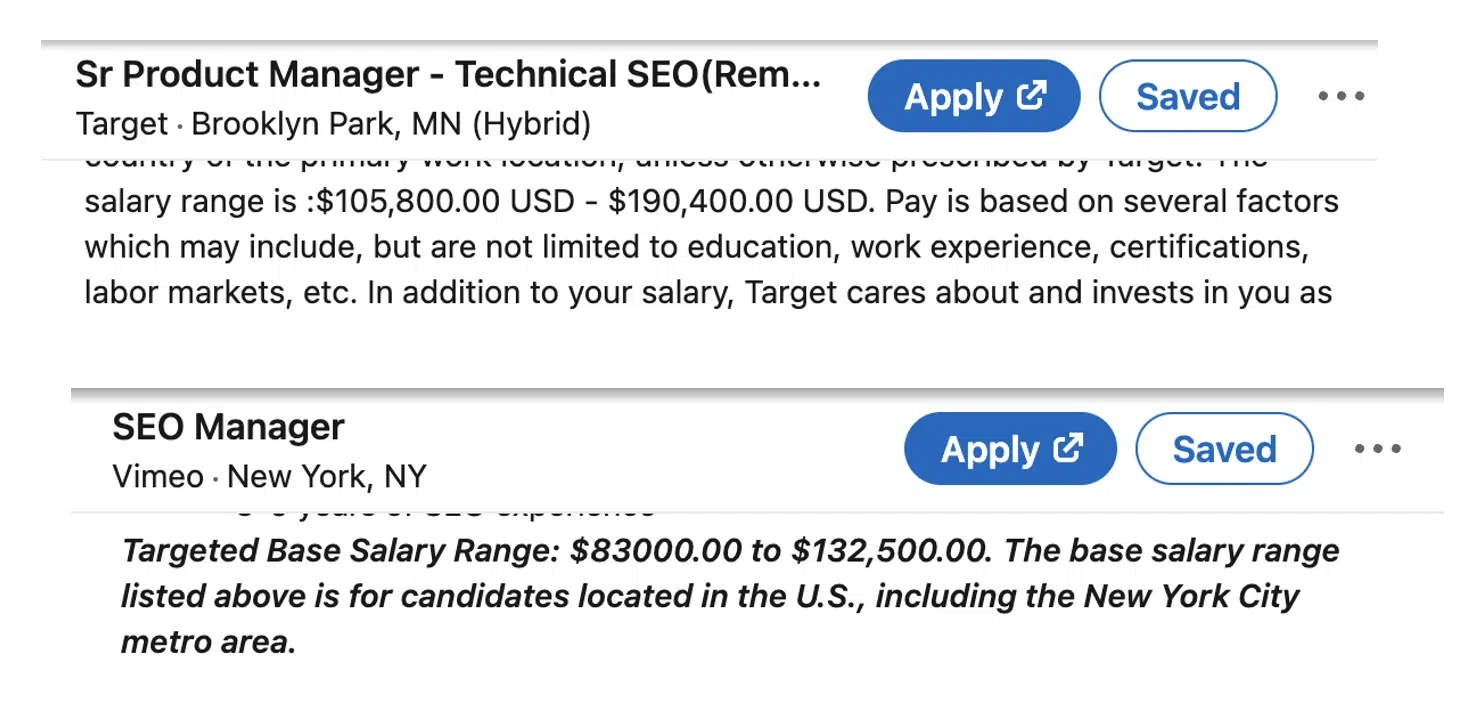
Salary

This is pretty straightforward because these roles provide at least the target salary range. Admittedly, these ranges are very broad. 

It’s nice that a range is listed, but it’s still challenging for the candidate to know where they realistically fall on that pay scale. 

Everyone wants to be at the highest end of offered compensation, right?

A word on career trajectory for SEO PMs

SEO skills matrix resource

Here’s the thing: career success is how you define it. It’s never a straight line.

As Tom Critchlow put it, they often only make sense in hindsight. 

The SEO Skills Maturity Matrix is a fantastic complementary resource to help any SEO navigate and, at least, attempt to plan on how they want to invest in their career development, whether agency or in-house. 

Ultimately, exposure to both makes you a more well-rounded candidate and better able to self abscess which environment you liked best and therefore want to pursue. 

SEO product management is an evolving role and career. Keep an ear to the ground for online courses related to this topic. I suspect more practicing professionals will share their knowledge digitally through learning platforms. 

Here are some resources related to SEO product management: 

The linchpin to growing your organic search efforts

Before SEO managers and SEO product managers existed, it’s anyone’s guess whether anyone was watching over a company’s organic traffic and revenue growth. 

Yet today and beyond, these roles are poised to become the strategic linchpin to nurturing and growing organic traffic and revenue for any business. 

If you are an SEO manager or director, and in a position to build out your team and you don’t have an SEO PM on your team, treat yourself and get one. 

If you’re an SEO PM inside your organization, make friends with other PMs, learn more about what makes a great product manager, and share your SEO wisdom. 

SEO is a skill learned through experience, experimentation and shared knowledge. 

It’s your job to educate and elevate those around you with your unique skill set to delight search engines and humans alike. 


Opinions expressed in this article are those of the guest author and not necessarily Search Engine Land. Staff authors are listed here.


Related stories

New on Search Engine Land

@media screen and (min-width: 800px) { #div-gpt-ad-3191538-7 { display: flex !important; justify-content: center !important; align-items: center !important; min-width:770px; min-height:260px; } } @media screen and (min-width: 1279px) { #div-gpt-ad-3191538-7 { display: flex !important; justify-content: center !important; align-items: center !important; min-width:800px!important; min-height:440px!important; } }

About the author

Holly Miller Anderson

Holly Miller Anderson is an experienced SEO and marketing strategist. She has more than a decade of broad, digital marketing experience that includes marketing films, managing events, as well as experience growing SEO as an acquisition channel in various roles from consultant to agency and in-house Product Manager at enterprise-level brands. She has made a career advising marketers on their holistic SEO strategy by developing a strategic plan and tactical roadmap that delivers sustainable growth. Holly is currently a Lead SEO Product Manager at Under Armour.

https://searchengineland.com/seo-product-manager-vs-seo-manager-difference-400338


How to prioritize SEO keywords for content creation

When it comes to SEO, there is always something to do. It’s easy to get sidetracked by the next shiny thing instead of focusing on the tasks that will move the needle for the business.

Having hundreds, thousands, or even millions of potential keywords worth targeting is overwhelming. You need to prioritize SEO keywords and create a measurable plan.

How do you get started? Read on to find top tips on prioritizing SEO keywords for content creation.

Think about business and marketing goals

If you’re creating SEO content, you must have a goal in mind.

You should be working toward ranking a particular set of keywords, usually based on a specific topic. An end goal is essential for measuring SEO success.

A complete optimization might be doable if your site is less than 20 pages. More than that, you need to hone in on a topic cluster.

Your topic cluster will be a section of your website. For example, if you sell housewares, you might prioritize one particular room and related items. 

You can prioritize your essential clusters by considering the following:

  • Management’s desires and business goals: Marketing should support management to drive the business forward.
  • What’s working well already: You might find some easy wins if a site already has some authority in a particular topic or product.
  • Well-converting pages: If a page converts well, increase organic traffic to drive more conversions.

Finding keywords for prioritization 

Before you start prioritizing keywords, you’ll need to research keywords for SEO. You can do this in many ways, but here are three ways to get started.

Google Search Console

If you’ve got a site with organic visitors, then Google Seach Console (GSC) can be a great place to start. GSC tells you every keyword your site ranks for.

Go to Search results in the left-hand menu and click Average position so it turns orange. I recommend filtering by country but clicking the plus above the graph and choosing Country. Now you can see the average position of all ranking keywords in the country you’re most interested in ranking in.

Look through the keywords and pay attention to those in positions six to 20. 

These keywords are your bottom of page one, page two, or top of page three keywords, also known as your low-hanging fruits. 

In theory, moving these keywords up the ranks will be easier. 

Screenshot of Google Search Console showing search results and average position.

Competitor analysis

As part of a competitor analysis, you can find keywords that competitors are ranking for. SEO tools like Ahrefs or Semrush will give you insights into potential search volume, traffic and search intent. 

There are two major benefits to researching competitor keywords:

  • You will eventually show up in the SERPs where they are so that you can receive some of that traffic.
  • You can demonstrate E-E-A-T to Google. If you cover the same keywords (and, more specifically, content) that your competitors are, you’re proving to Google that your site is at least as valuable as theirs.

Just because your competitor is ranking doesn’t necessarily mean that you should. Use the prioritization tips below to help determine what to use on your site.

Customer research

Nothing beats finding keywords than talking to the people you most want on your site. 

Talk to your customers and prospective buyers. Alternatively, talk to sales and customer support or customer success managers. 

If you can understand customer pain points and the words or phrases buyers use to find you, you can be sure they’re also putting these words into Google.


Get the daily newsletter search marketers rely on.


Tips for prioritizing SEO keywords 

Paid ads

Ads data is a trove of information for SEO. If a website runs ads, getting a list of converting keywords is necessary. If a keyword is converting for ads, it will likely convert with SEO, too. 

Not every keyword that ads are bidding on can rank organically, but where it can, you should go for it providing it fits into those business and marketing goals. 

You can also trial keywords with ads by bidding on them to test their conversion rate. 

Google Keyword Planner

If you’re not already running ads, Google Keyword Planner – an advertising tool – can still support you (and it’s free). 

Google Keyword Planner

Screenshot of Google Keyword Planner to illustrate how competition and cost per click can help influence keyword prioritization.

Google Keyword Planner provides some interesting data: 

  • The keyword with its average monthly searches (exact searches if you’re running ads).
  • Competition means how difficult it is to get visibility with ads for this keyword.
  • Bid range means how much people are paying for the keyword.

So, what does this mean for SEO? 

If a keyword has high competition, many people are bidding on it, and businesses tend not to bid on keywords that aren’t making them money. 

A high competitor is an indicator that a keyword is making an ROI. 

If you can earn a rank organically for the same keyword, then there’s a chance it’ll make money for your site.

Prioritize conversion keywords and money pages

SEO’s primary goal is building a qualified audience. You want people on your site who will likely be interested in your product or service.

You want visibility for the pages that lead to conversion, be it a sale or an email sign-up, a download, or something that brings web traffic into your marketing funnel.

Your SEO efforts should be in pursuit of bolstering these highly important pages so that you can accelerate the marketing funnel.

SEO can bring users to the site who are in the awareness stage of the marketing funnel. 

This stage is also known as the top-funnel (ToFu). ToFu users are unlikely to convert. But, good to have if marketing can nurture them through other means – by email if users sign up, for example.

SEO can also bring bottom-funnel (BoFu) traffic – a.k.a. conversion traffic – if those money pages rank high enough on page one. 

BoFu users are ready to buy. If you know which pages are converting, you can work to develop an SEO content strategy that helps these pages rank. 

Search volume

Generally, your keywords with high search volumes will be your ToFu/awareness keywords, and your BoFu keywords will have lower search volumes. 

Since the BoFu keywords convert, you’ll likely find them in your ads accounts. 

Getting sidetracked by high-search keywords is easy, but you must remember that your goal is to get conversions and revenue, not just traffic. 

The keywords you choose should be less volume-focused and more conversion-focused.

Ask yourself how your SEO content is helping those BoFu ranks.

Keyword difficulty

It is worth considering keyword difficulty. Like the competition metric on Google Keyword Planner, keyword difficulty indicates how easy or difficult it might be to rank for a particular keyword.

New sites might have a long road ahead to rank for seed keywords. In this instance, prioritize longer-tail keywords. 

That said, topical authority is more important than keywords and difficulty. Although some of your keywords may not hit the top pages of Google sometime soon, you should consider adding pages with the keywords to the site anyway.

Topic coverage helps build E-E-A-T, and only some pieces of content have to rank immediately. In the interim, you can share the content through other marketing channels.

Do it well, or don’t do it at all

You can’t cut corners when creating content that ranks in SERPs. 

Google wants to provide its users with the best possible experience and it’s not enough to just use keywords. 

You need to be creating content that is highly valuable and genuinely useful.

If you’re looking at the competitor pages and seeing 3,000-word articles with video embeds and images, you should make your play for the keyword only when you can create something as good as those pages ranking.

Measure and improve for SEO success

As you build your SEO and content strategy, you’ll find that new opportunities will surface and take priority. 

After a few months, you can refer back to that Google Search Console tip at the beginning of this article. Likely, new keywords will be ranking on the bottom of page one and onwards. 

You’ll repeat the optimization process continually, building your content architecture and discovering new opportunities.

Once you’ve got your chosen cluster ranking and bringing in revenue, you can move on and repeat the process for a second cluster.  


Opinions expressed in this article are those of the guest author and not necessarily Search Engine Land. Staff authors are listed here.


Related stories

New on Search Engine Land

@media screen and (min-width: 800px) { #div-gpt-ad-3191538-7 { display: flex !important; justify-content: center !important; align-items: center !important; min-width:770px; min-height:260px; } } @media screen and (min-width: 1279px) { #div-gpt-ad-3191538-7 { display: flex !important; justify-content: center !important; align-items: center !important; min-width:800px!important; min-height:440px!important; } }

About the author

Zoe Ashbridge

Zoe Ashbridge is a Senior SEO Strategist and Co-Founder at forank. Zoe has a background in digital marketing and digital project management. Zoe supports businesses worldwide with actionable SEO strategy for internal teams, consultancy and search engine marketing implementation. Zoe writes about SEO, Digital Marketing and Entrepreneurship.

https://searchengineland.com/prioritize-seo-keywords-content-creation-398904


Google: Page experience is not a ranking system, but it is a ranking signal

Google page experience was never a ranking “system” but is still considered a ranking “signal,” Danny Sullivan, Google’s Search Liaison, said this morning. Google emphasized that just because page experience was removed as a ranking system, it does not mean it does not reward pages that have a good page experience.

What changed. A week ago, Google removed page experience system, the mobile-friendly system, page speed system and the secure site system from its ranking systems page. Google also wrote, “The page experience update was a concept to describe a set of key page experience aspects for site owners to focus on.”

So Google seemed to have downplayed page experience signals as an overall ranking system.

We did email Google for a statement about this a week ago, and Google only referenced the line about page experience update being a concept but would not tell us anything more on the record.

Clarification. This morning, Sullivan wrote a long post on Twitter, saying, “This just meant these weren’t ranking *systems* but instead signals used by other systems.” Why did Google make this change? “We dropped the systems that were actually signals so that if people did go to that page in the future, they wouldn’t (hopefully) get confused,” he added.

“As our guidance on page experience says in the first sentence: Google’s core ranking systems look to reward content that provides a good page experience,” Sullivan said.

Signal not system. So Google said the page experience update/system was never a “system” but is still considered a ranking signal. “Taking them off didn’t mean we no longer consider aspects of page experience,” Sullivan said.

Why we care. Continue to provide a good page experience. Google said it is still a ranking signal, while not being a ranking system. Of course, you should have always provided a good page experience, even if it is not a Google ranking system. Heck, even if it is not a ranking signal, which Google says it is, but even if it was not, you should still provide a good page experience to your users.

That being said, this may clarify some confusion on this topic, or this may create even more confusion.

My advice? For SEO, focus on providing outstanding content that helps your users. Build content and a website that go above and beyond your competitors. Make sure that users can access that content, and that they have a good experience while consuming that content on desktop and mobile.

Do not obsess about making sure you score 100s across all Core Web Vital metrics. Core Web Vitals is not that big of a ranking signal. You know better if your site is providing a good page experience than a third-party tool from Google.


Related stories

New on Search Engine Land

@media screen and (min-width: 800px) { #div-gpt-ad-3191538-7 { display: flex !important; justify-content: center !important; align-items: center !important; min-width:770px; min-height:260px; } } @media screen and (min-width: 1279px) { #div-gpt-ad-3191538-7 { display: flex !important; justify-content: center !important; align-items: center !important; min-width:800px!important; min-height:440px!important; } }

About the author

Barry Schwartz

Barry Schwartz a Contributing Editor to Search Engine Land and a member of the programming team for SMX events. He owns RustyBrick, a NY based web consulting firm. He also runs Search Engine Roundtable, a popular search blog on very advanced SEM topics. Barry can be followed on Twitter here.

https://searchengineland.com/google-page-experience-is-not-a-ranking-system-but-it-is-a-ranking-signal-399940


How to create a resource page

If you’re interested in creating helpful content for your audience (and you should be), you should consider making a resource page.

It’s the best way to collect your top recommendations for products or services and promote the tools and resources you love and use in your business.

And as part of your content strategy, a resource page can add depth and value to your website.

Let’s go deeper into what a resource page is, why you should create one, and how to do it, plus resource page examples.

What is a resource page?

A resource page is a curated page that links to helpful resources, tools, apps, products, services, media, or websites that your audience may find useful.

(You may also know this page as a “recommended tools” page, an affiliate links page, or even a brand “toolbox.”)

A resource page is a one-stop shop for finding a brand’s recommended resources, including the tools or products its staff uses and loves in the company’s day-to-day business.

If you’re a solopreneur or freelancer, your resource page can be very personal and reflect your expertise. And, if you’ve built a following and an engaged audience, your resource page will be valuable for the people who trust your guidance.

There are three ways to approach a resource page:

  • Use affiliate links. (This means you and the company of the product you recommend have an agreement – you earn a small commission from people who click your affiliate link and engage with that company.)
  • Link to resources organically (because you love them and for no other reason).
  • Include a mixture of affiliate and organic links.

Why you should create a resource page

The first and most important reason to create a resource page is the helpfulness factor.

  • A resource page curated by you can help your audience discover tools, websites, and resources to help them solve problems they face. 
  • The resource page you create can be personalized with hand-picked links that you actually use, enjoy, or get value from – and since your expert opinion matters to your audience, they’ll care about the resources you recommend.

The second reason to create a resource page is if you’re involved with affiliate programs and want to maximize your income.

Including your links on a dedicated resource page in your top navigation gives your readers an easy way to find and engage with them.

But, remember – never create a resource page just to get people to click your affiliate links.

Instead, create this type of content to help your audience connect with great resources that have aided you during your own journey in your niche.

How to create a resource page with value

Anyone can throw together a list of links. To avoid the plague of thin, useless content, follow these steps to create a resource page with real value for your readers.

This initial step in creating a resource page should be the easiest.

You simply need to gather a list of links to your favorite, most trusted tools, websites, products, services, etc. that relate to what you do in your niche.

For example, if you’re an expert baker who posts recipes, your resource page might be full of the baking tools you trust and use daily, like on this baking website:

Sally's baking recipes

Similarly, if you sell content marketing courses, your resource page would likely include a list of tools you use to make content marketing easier.

(Think SEO tools, content creation tools, your favorite website host, and the content calendar tool you depend on.)

Don’t include just any resources. Think about what would be most beneficial for your audience.

Finally, never recommend anything you haven’t actually used or liked. Honesty and transparency are essential for maintaining the trust between you and your audience.

If you plan to include affiliate links on your resource page, add a clear disclosure that you may earn a commission when your visitors click those links.

This isn’t just good practice for ethics and transparency – it’s also a requirement of the U.S. Federal Trade Commission (FTC).

The FTC considers linking to affiliate sites without disclosure to be deceptive advertising.

Luckily, the disclosure itself doesn’t have to be a big deal. A simple, clear statement at the top of your page will suffice. Here’s a great example from a photography website:

Disclosure example

Get the daily newsletter search marketers rely on.


3. Describe each resource and why you included it

Now we can start beefing up your resource page with useful content.

What will make your page useful beyond the links themselves?

Helpful descriptions that explain why you’re recommending each product, service, tool, etc., and why they’re valuable.

Here’s a good formula for describing the resources on your page:

  • Introduce the product/service/tool/resource and explain what it does.
  • Explain why you use it and trust it.
  • List at least one way it could improve your reader’s life.

Your descriptions don’t have to be long, either. You can summarize each of the above points in one or two sentences. Here’s an example from Smart Passive Income:

Smart Passive Income - Most recommended tools

Ultimately, this list of recommended tools is much more valuable because SPI describes how and why each tool is trustworthy and effective.

If, on the other hand, they just provided a list of links, you wouldn’t understand the value of any of them.

4. Organize and optimize your resource page

Again, don’t just throw a list of links on a page. Put some effort into organizing and optimizing your resource page so the most visitors will get the most use out of it.

Particularly, organize your resources into categories and add a heading (an H2 or an H3) to each one.

For example, if you have a list of media to consume to learn more about a topic, you could categorize the links by type of media, e.g., books, podcasts, videos, blog posts, courses, etc.

This wellness center, for instance, has a resource page for employees and their families that includes online fitness resources categorized by workout type:

Wellness center resource pages

Another option: If you regularly blog about great industry resources, collect them on one resource page, like Learn to Code With Me did:

Learn to Code With Me - Resources

Yes, you can include your own content on your resource page, but take care – adding too much of your content can look a bit too self-promotional.

Instead, look for ways to mention or link to your content organically.

For instance, this travel blog includes their in-house tour company as one of the resources under their “tour companies” category.

However, the mention isn’t overtly salesy and looks even less so next to their other recommendations.

Travel resources

Another way to include your content on your resource page is to link to related blog posts.

Add these links in the descriptions for each category, such as, “Want to learn more about choosing a travel company? Check out our guide.”

6. Update your resource page regularly

Next, since your resource page is essentially a page full of links, you’ll want to make sure the links are working and accurate regularly.

For example, this can be a task you set as part of your regular website or content audit.

A quick way to check all the URLs on the page for dead links is to use a broken link checker.

Lastly, ensure your affiliate links are all accurate and working so it’s tracked each time someone is referred through your page to a product.

Once your resource page is created, link to it in your other content, including blogs and core site pages like your About Us page.

For example, a baking blog could link to its resources page whenever they talk about baking equipment. E.g., “The right size mixing bowl is essential to creating this recipe. Check out my resource page to see the large mixing bowls I use and love.”

Essentially, any “learn more” opportunity or mention in a blog could connect back to your resource page.

Of course, another great place to include a link to this content is right in your main menu. Learn to Code With Me does this well – its resource hub is located in the top menu under the heading “Where to learn.”

Resource page in top nav

Those aren’t the only possibilities. Here are some other suggestions for linking to your resource page in your other content:

  • Include a link in your site’s footer menu.
  • Create a call-to-action banner or graphic to place strategically inside blogs.
  • Add a link to your lead magnets, ebooks, or freebies.
  • Create a perpetual link for your blog sidebar.
  • Link to and promote your resource page in social media posts.

A resource page is helpful content

Correction: A resource page can be helpful content if you create it with the above steps in mind.

And that’s important because helpful content matters to your audience as part of their overarching experience of your brand. It also matters to Google, because the search engine wants to serve searchers content that helps them.

As you’ll remember, helpful content is:

  • Created with a specific audience in mind.
  • Has trust and credibility markers.
  • Includes expertise from the creator(s).
  • Meets the needs of the audience.

Created with care, your resource page can add value to your content strategy by educating your audience and strengthening your website. And those are worthy goals.


Opinions expressed in this article are those of the guest author and not necessarily Search Engine Land. Staff authors are listed here.


Related stories

New on Search Engine Land

@media screen and (min-width: 800px) { #div-gpt-ad-3191538-7 { display: flex !important; justify-content: center !important; align-items: center !important; min-width:770px; min-height:260px; } } @media screen and (min-width: 1279px) { #div-gpt-ad-3191538-7 { display: flex !important; justify-content: center !important; align-items: center !important; min-width:800px!important; min-height:440px!important; } }

About the author

Julia McCoy

Julia McCoy is the founder of Content Hacker, 7x author, and a leading strategist around creating exceptional content and brand presence that lasts online. At 19 years old, she used her last $75 to build a 7-figure writing agency which she sold ten years later. In the 2020s, she’s devoted to teaching founders and marketers the strategy, skills, and systems they need to build a business through inbound content, so they can create more lasting impact in the world.

https://searchengineland.com/create-resource-page-398815


Google’s April 2023 reviews update was more volatile than the previous product reviews update, data providers say

The April 2023 reviews update created more volatility in Google’s search results than past versions of the update, including the February 2023 product reviews update, according to Semrush and Rank Ranger data.

About the Google April 2023 reviews update. The update started to roll out at about 12 p.m. ET on April 12. This update took 13 days and completed on April 25, 2023.

This was the seventh reviews update and the first Google update that targeted more than just product reviews. Yes, this version went beyond Google’s prior product reviews updates to evaluate reviews of any topic that is reviewable, including:

  • Services and businesses.
  • Destinations.
  • Media (e.g., games, movies).

Google changed the name of its “product reviews system” to “reviews system” and has altered the language in multiple parts of its guidance documentation around product reviews to now apply to all types of reviews.

Data shows the April 2023 update was more significant

Semrush. Semrush data showed that the April 2023 reviews update was more volatile than the previous reviews update, the February 2023 product reviews update.

“Overall, comparing the baseline to the update periods the April 2023 reviews update was slightly more volatile than the February 2023 product reviews update,” Mordy Obersterin, from Semrush told us.

Here is a look at thre Semrush sensor, showing the volatility it tracked over the past few weeks. You can see most of that volatility was during the last week of the update.

Semrush Sensor 800x305

This chart shows the break down by vertical, comparing April 2023 to February 2023:

Semrush Compare By Niche

If you look at the peak of the volatility, you will notice that the February spiked higher than the highest peak we saw in the April 2023 update:

Semrush Peak

Semrush also showed how there were more URLs newly ranking among the top ten results that prior to the update ranked 20+ back in February:

Semrush Top 10 800x560

Rank Ranger. Rank Ranger data told a similar story. The April 2023 reviews update was more volatile than the previous reviews update, the February 2023 product reviews update.

“Although the update rolled out on April 12th, the Rank Risk Index reported high levels of fluctuations on April 20th, peaking on April 25th. This analysis is based on the fluctuations on April 25,” Darrell Mordecai from Rank Ranger told us.

Here is what the Rank Ranger Rank Risk Index showed over the past few weeks. Again, you can see most of that volatility was during the last week of the update. Rank Ranger is reporting that volatility is continuing, two-days after the update was completed.

Rankranger 800x269

Here is a chart comparing the two past updates, showing the April 2023 update to be more volatile than the February 2023 update. “April update made significantly more impact than the February update. This could possibly be explained by the fact that the April update has been extended to include all reviews and not just product reviews,” Mordecai added.

Rankranger Compare 800x538

There was substantial volatility in the top 5 results comparing April to February. In April, 72% of rankings were affected compared to 49% in February. There was slightly more volatility among the top 3 results in April than February, and slightly less volatility in the top 10 results in April than February.

Rankranger Top X 749x600

And looking at it by industry, you see which verticals were more volatile as you break it down by top 3, top 5 and top 10 results.

Rankranger Niches 720x600

Community. The SEO community chatter was pretty limited relative to other updates during the first week of the update. It heated up in the second week of the update, until Google announced the update was complete.

In short, the spikes in volatility in the Semrush and RankRanger data were in lockstep with level and timing of chatter in the SEO community.

More on the April 2023 reviews update

Previous product review updates. This is the seventh release of the formerly known as product reviews update, now the reviews update. It began April 12 at about 12 pm ET.

The first product reviews update was launched on April 8, 2021, the second was launched on December 1, 2021, the third has been released on March 23, 2022, and the fourth was released on July 27, 0222, and the fifth was released on September 20, 2022 and the sixth was released on February 21, 2023.

Google’s updated advice. Here is the updated advice Google published related to this update:

  • Evaluate from a user’s perspective.
  • Demonstrate that you are knowledgeable about what you are reviewing—show you are an expert.
  • Provide evidence such as visuals, audio, or other links of your own experience with what you are reviewing, to support your expertise and reinforce the authenticity of your review.
  • Share quantitative measurements about how something measures up in various categories of performance.
  • Explain what sets something apart from its competitors.
  • Cover comparable things to consider, or explain which might be best for certain uses or circumstances.
  • Discuss the benefits and drawbacks of something, based on your own original research.
  • Describe how a product has evolved from previous models or releases to provide improvements, address issues, or otherwise help users in making a purchase decision.
  • Focus on the most important decision-making factors, based on your experience or expertise (for example, a car review might determine that fuel economy and safety are key decision-making factors and rate performance in those areas).
  • Describe key choices in how a product has been designed and their effect on the users beyond what the manufacturer says.
  • Include links to other useful resources (your own or from other sites) to help a reader make a decision.
  • Consider including links to multiple sellers to give the reader the option to purchase from their merchant of choice.
  • When recommending something as the best overall or the best for a certain purpose, include why you consider it the best, with first-hand supporting evidence.
  • Ensure there is enough useful content in your ranked lists for them to stand on their own, even if you choose to write separate in-depth single reviews.

Why we care. If your website offers general review content, you will want to check your rankings to see if you were impacted. Did your Google organic traffic improve, decline or stay the same?

Long term, you are going to want to ensure that you put a lot more detail and effort into your review content. Make it unique so it stands out from the competition on the web.

This data shows that many sites experienced some big changes to rankings. If you did tool, you are not alone.


Related stories

New on Search Engine Land

@media screen and (min-width: 800px) { #div-gpt-ad-3191538-7 { display: flex !important; justify-content: center !important; align-items: center !important; min-width:770px; min-height:260px; } } @media screen and (min-width: 1279px) { #div-gpt-ad-3191538-7 { display: flex !important; justify-content: center !important; align-items: center !important; min-width:800px!important; min-height:440px!important; } }

About the author

Barry Schwartz

Barry Schwartz a Contributing Editor to Search Engine Land and a member of the programming team for SMX events. He owns RustyBrick, a NY based web consulting firm. He also runs Search Engine Roundtable, a popular search blog on very advanced SEM topics. Barry can be followed on Twitter here.

https://searchengineland.com/googles-april-2023-reviews-update-was-more-volatile-than-the-previous-product-reviews-update-data-providers-say-398825


Where traditional search and AI chatbots excel: A closer look

Marketing conversations nowadays almost always involve artificial intelligence, particularly when it comes to the future of search. 

Will AI chatbots powered by large language models (LLMs) such as ChatGPT and Bard ultimately replace “traditional” search as we know it? 

Generative AI brings a meaningful shift with vast possibilities for the future of search. The potential for disruption makes it an exciting time for the industry. 

Curious about the strengths and weaknesses of traditional search engines versus AI chatbots, I ran 100 identical queries in both Google search and ChatGPT. The results revealed that each approach has its own advantages in certain situations.

This article covers key areas where traditional search engines and AI chatbots like ChatGPT have the upper hand.

Where do search engines have the edge? Four areas will be hard to shake from consumers’ minds.

Facts and figures (birthdays, ages and math problems)

When you search on Google, it does not only suggest and anticipate the full query. 

In most cases, it also provides the answer without hitting enter. 

This applies to queries where the answer is specifically a number result.

Number SERP result

Integrations

If you want anything visual, traditional search is the way to go. 

While ChatGPT may eventually catch up in this area, Google’s vast ecosystem is currently a major advantage. 

With access to Maps, YouTube, and Gmail, Google has a wealth of knowledge about its users. 

For example, you can simply tell Maps to navigate from “home” to a specific location like Progressive Field.

Google Maps

YouTube is another powerful tool, particularly for “how to” searches. Google can quickly pull up relevant YouTube videos and take users directly to the section of the video that answers their query. 

Images

Similar to the integrations point above, Google’s ability to identify the contents of an image and provide users with relevant results is a valuable use case for search. 

As AI chatbots evolve, they will have the ability to integrate with multiple components and absorb even more images to understand them. 

Google Lens is already using AI to decode images, and the next step is to apply this to AI chatbots.

But for now, image searches for products, plants, animals and more remain a key differentiator, adding value to users.

Google Lens

Opinion and nuance

Having the ability to choose the source to get your answer or opinion is important. 

For example, you might be seeking a restaurant recommendation and want to see if multiple sources agree on the same spot. Or perhaps you want to compare Fox News and CNN’s takes on a particular story. 

With an AI chatbot, you’ll only receive one viewpoint without the ability to access a range of opinions.

Whether it’s a debate about the best Wu-Tang Clan rapper or a contentious political issue, gathering information from various sources can help you develop a well-rounded opinion. 

Best place for brunch in chicago

Get the daily newsletter search marketers rely on.


Advantages of ChatGPT

Here are four areas where AI chatbots like ChatGPT shine.

Content creation

ChatGPT has the ability to generate copy at lightning speed, whether it’s a poem, blog post, email, or even a script. 

This has significantly reduced content creation time, putting pressure on marketers to evolve their writing and creativity. 

Imagine the possibilities for your brand. You could quickly generate engaging blog posts or craft personalized emails for your customers.

ChatGPT poem
While this is a nice poem, I did not use it for my anniversary. My wife still appreciated the personal poem I wrote (at least, that’s what she told me).

Creativity

Similar to content creation, AI is transforming the creative process. You can now easily create everything from images and jokes to screenplays and songs. 

While this technology is still being refined, it is set to change how we approach creativity – from ideation to execution. 

Jim Gaffigan roast

‘How to’ tasks and recipes

Have you ever found yourself wading through endless ads and scrolling through cluttered websites when you only need a simple answer?

This may be more of a problem for the ad ecosystem overall, but AI chatbots do better when you just need straightforward answers to your queries. 

Case in point: recipe websites.

They often provide a poor user experience, with too much fluff, numerous ads and the need for endless scrolling – even if you only really wanted a simple recipe for chocolate chip cookies.  

On the other hand, ChatGPT simply gives you an answer. It takes you step by step and keeps the answer straightforward in a bulleted list.

ChatGPT instructions

Support (coding and problem-solving)

“Everyone can be a 10x engineer.” 

I’ve heard this statement many times since ChatGPT rolled out. 

AI chatbots help support various tasks, such as summarizing meeting minutes, finding errors in code or helping solve math problems. 

These tools enable users to expedite tasks that were previously tedious or time-consuming. 

Search helped us find answers, but AI chatbots can become personal support agents.

They go beyond seeking answers and surface the answer with the solution already completed for us.

ChatGPT code

We are witnessing the early days of a significant change in the industry. It’s a thrilling time for digital marketers since the rise of social media during the Web 2.0 era. 

However, this change is much more consequential because AI has quickly disrupted the way we work. This will put pressure on existing business models, ultimately benefiting consumers. 

Despite this, some critical use cases are still not yet accessible in AI chatbots. Thus, we’ll still need to rely on traditional search engines for now. 

Strap in, keep testing and enjoy the ride.


Opinions expressed in this article are those of the guest author and not necessarily Search Engine Land. Staff authors are listed here.


Related stories

New on Search Engine Land

@media screen and (min-width: 800px) { #div-gpt-ad-3191538-7 { display: flex !important; justify-content: center !important; align-items: center !important; min-width:770px; min-height:260px; } } @media screen and (min-width: 1279px) { #div-gpt-ad-3191538-7 { display: flex !important; justify-content: center !important; align-items: center !important; min-width:800px!important; min-height:440px!important; } }

About the author

Jason Tabeling

Jason Tabeling is the CEO of Airtank and is an accomplished marketing executive and proven leader with over 20 years of experience growing strong and profitable teams, working for and with Fortune 500 companies in a variety of industries.
Prior to AirTank, Jason served as Executive Vice President of Product for BrandMuscle, an enterprise software and services company focused on Fortune 1,000 brands, where he led product innovation and strategy. He earned the company a Leadership Ranking in the Forrester 2020 Through-Channel Marketing Automation Wave. He also spent 16 years working with Rosetta, Razorfish and Progressive Insurance, leading Paid, Earned and Owned media teams across health care, financial services and retail verticals. He was named a “40 under 40” by Direct Marketing News, has been a judge for the AMA Reggie Awards, and has been published in Forbes and many other publications as a subject matter expert.

https://searchengineland.com/traditional-search-ai-chatbots-397671


TikTok Shop launches in Beta

TikTok sellers are being invited to be the first to sign up and try out TikTok Shop before its public release.

Now open in Beta. I received the email below this afternoon. Though I’m not a seller, nor do I manage any TikTok ecommerce accounts.

Screenshot 2023 04 26 At 12.35.37 PM 512x600

What is TikTok Shop. TikTok Shop is an ecommerce solution designed to boost sales and brand growth on TikTok. It allows users to discover and purchase products from their favorite creators and brands in a single, smooth experience.

Those who join as beta sellers will gain exclusive access to TikTok Shop and have the opportunity to provide valuable feedback for product improvement. Moreover, for a limited time, they will be able to take advantage of an exclusive promo offering 0% Referral Fees for the next 90 days.

Sign up. To participate in TikTok Shop, sellers need only click the link in your email invitation. But if you didn’t receive an invitation, then you can access the Beta signup here.

Screenshot 2023 04 26 At 12.42.23 PM
Why we care. TikTok Shop presents a unique opportunity to tap into the rapidly growing TikTok community, where 83% of users say the platform influences their purchasing decisions. TikTok Shop allows users to discover and purchase products from their favorite creators and brands. Additionally, advertisers and brands can make their products and services easily discoverable to a highly engaged audience, ultimately maximizing their ROI.

Related stories

New on Search Engine Land

@media screen and (min-width: 800px) { #div-gpt-ad-3191538-7 { display: flex !important; justify-content: center !important; align-items: center !important; min-width:770px; min-height:260px; } } @media screen and (min-width: 1279px) { #div-gpt-ad-3191538-7 { display: flex !important; justify-content: center !important; align-items: center !important; min-width:800px!important; min-height:440px!important; } }

About the author

Nicole Farley

Nicole Farley is an editor for Search Engine Land covering all things PPC. In addition to being a Marine Corps veteran, she has an extensive background in digital marketing, an MBA and a penchant for true crime, podcasts, travel, and snacks.

https://searchengineland.com/tiktok-shop-launches-in-beta-397551


The SEO hierarchy of needs for local businesses on a budget

Up to 98% of people used the internet to find information about a local business in 2022, according to BrightLocal research. And 87% of consumers used Google to evaluate a local business. 

For local businesses with limited time, money and resources, it can be hard to know where to focus marketing efforts. 

One thing is for sure: The ability for people to find local businesses online is critical. 

And SEO is one of the most effective marketing activities for a local business to show up online, as it offers some of the best returns on investment in the long term. 

Given that local businesses may have a limited budget, which SEO factors should they focus on?

Here, I’ll outline six areas that small businesses can reasonably do on their own (or spend a little money on outside help for the techie stuff) and, at the very least, get the SEO foundations in place. 

What are those foundations? 

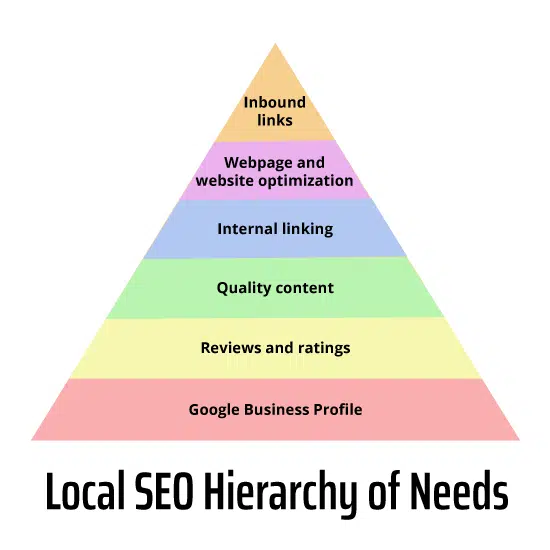
For local businesses to rank in the search results, they need to consider the following areas:

  • Google Business Profile
  • Reviews and ratings
  • Quality content
  • Internal linking 
  • Webpage and website optimization
  • Inbound links
Local SEO hierarchy of needs

6 SEO tactics that every local business should do at minimum

Local businesses need to focus on optimizing two areas of the search results: 

  • The Google local pack / local finder or Maps.
  • Google organic listings.

When ranking local businesses in the local pack, Google takes into account relevance, distance and prominence. 

And there is another set of countless signals it uses for the organic listings, including the “blue links.” 

Local pack vs organic listings
Search engine results for “pet shop near thousand oaks, ca”

While the following is not an exhaustive list, it has some essential SEO tactics to do at a bare minimum for helping local business rank. 

For local pack rankings

1. Google Business Profile

Creating, verifying and optimizing a Google Business Profile is one of the most critical tactics for ranking local businesses in the Local Pack.

Here are three of the most impactful optimization techniques for a Business Profile:

  • Choose the most relevant primary category for the business, then add two to three categories (or only those that are most relevant). The primary category is the most important factor in helping to rank in the local pack. You may not always get it right the first time, so don’t be afraid to experiment with different categories and test the results. PlePler is a handy tool that can help in this area by providing useful data.
  • Fill in the Google Business Profile as completely as possible. Take the time to fill in all the information available in a profile. Create a compelling description of the business and its offerings, using rich keywords as often as possible in a natural way. 
  • Ensure the business name, address, phone and website (NAP+W) are accurate. A physical address will be a key signal to Google for ranking, as it looks at businesses closest to the point of search (where the searcher is). The NAP+W data must be consistent across all sources online – not just a Google Business Profile – because it improves the search engine’s confidence in a business listing’s accuracy. Remember to use a local phone number (not a toll-free one).

2. Ratings and reviews

A local business’s ratings and reviews can impact how well it ranks, including how many reviews (text-based and numerical star ratings) and the actual scores. This is straight from Google’s mouth. So take reviews and ratings seriously. 

Here are some tips:

  • Encourage customers to leave reviews. Google explains how to share a link with customers to leave reviews. Doing this on an ongoing basis helps ensure the recency of reviews, which can be a positive signal to Google.
  • Remember: Google doesn’t want businesses to offer incentives for leaving reviews. Many local businesses do, though. It’s a matter of ensuring that a business’s review profile represents an honest picture of the business. If all the reviews are positive with no negative reviews, then a user may not trust the business as much. 
  • Consider displaying third-party reviews to add value to the listing. This can further help users decide on a business. 

Get the daily newsletter search marketers rely on.


For organic rankings

3. Quality content

Quality content is probably one of – if not the most important – on-page ranking factor in most cases. 

There are a lot of ways to define quality, but here are some ways to ensure it on a site: 

  • Make sure key pages throughout the site, like service pages, have enough content on them to be helpful and useful to website visitors. Spy on the top-ranked competitors for that service page’s keyword to see how much content to create. 
  • Outside of service pages or location pages, consider how the business will contribute to the community with content. You can establish the business as a local authority by talking about the topics the business is an expert on, telling local stories or acting as a guide. Also: Good, local content can attract good, local links. 
  • Have a variety of content for more opportunities to rank and be found – for example, YouTube videos, images or something else. 

And remember, if you are using AI content for a website, you must have a system in place to have it reviewed and edited by a human to ensure quality. 

For more, see my article on Search Engine Land: ChatGPT and SEO content: Where do we go from here?

4. Internal linking

Having a good volume of helpful content throughout the site that is organized well helps make a website more relevant for a search.  

SEO siloing is a technique I invented more than 20 years ago. It structures a website’s content by grouping related webpages in hierarchical categories through its directory and links. 

In other words, how you set up directories and navigation on a website matters. 

Siloing streamlines the internal linking system to connect like-pages and helps the search engines discover more related content to better understand what the site is about. 

It also helps users navigate with ease to find the information they need.

Remember that sometimes Google takes into account the whole website and not just a single webpage when determining which sites to rank:

“The navigation of a website is important in helping visitors quickly find the content they want. It can also help search engines understand what content the website owner thinks is important. Although Google’s search results are provided at a page level, Google also likes to have a sense of what role a page plays in the bigger picture of the site.”

– Google, Search Engine Optimization (SEO) Starter Guide

Practically, for a local business’s website, the site would most likely be organized by things like:

  • A section with individual service pages.
  • A section with location pages, as applicable.

For example: When a business has more than one location, create one or more pages dedicated to each location the business is in. 

An example would be the siloing strategy for a keyword like “engineering firm.” 

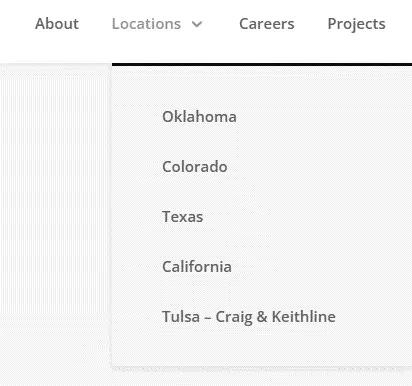
You’d create a section for locations by having a landing page for that term linked to from the top navigation. Then you’d add subpages underneath it that detail each location and the services it provides. 

Location sections on a website
Location sections on a local business’s website navigation

This would apply to every location of a business. Avoid duplicate content issues by making each location section unique. 

5. Webpage and website optimization

There are countless ways to optimize a site, but for local businesses that are just getting started, here are a handful of things they can and should do to boost SEO:

  • Optimize local webpages by including the city, neighborhood, relevant geographic terms and other key terms in places like the meta tags and on the webpage content, including the heading tags and anchor text.
  • Implement local business-type schema on the webpages to further clarify to the search engines what the business is about and to present that information to searchers. Name, address, phone, number and website would be the minimum goal. This is a little more technical, and local businesses may want to use things like the Structured Data Markup Helper to get this going. Google also has a help file on that here.
  • Optimize the performance of the website. Since most local searches are on a mobile device, local businesses must have a mobile-friendly website. This is another techie venture, but Google has tools and help files to get people started. In addition, making sure the site is secure by enabling HTTPS is key. 

The last two bullets may be areas where a local business spends a little money for expert help.

Local businesses must have quality, local links to show they are a trusted local business. Here are some ideas for earning links:

  • As mentioned earlier, quality, useful content targeted to a community can earn links naturally.
  • Only links coming from unique IP addresses, domains and WHOIS for a geographic area will help. 
  • Some more ideas to help get local links include: Joining a local organization, being listed in a local directory, hosting a local event and driving the audience to the site, sponsoring a local event, starting a blog or being interviewed by local press.

Focus on what matters

Countless SEO tactics can help local websites rank in the search results. However, there are a handful of methods where local businesses can get the most bang for their buck, whether implementing them on their own or spending some marketing budget to hire outside expertise. 

Focus on the local SEO hierarchy of needs, and get the right SEO foundations in place for a chance to compete.


Opinions expressed in this article are those of the guest author and not necessarily Search Engine Land. Staff authors are listed here.


Related stories

New on Search Engine Land

@media screen and (min-width: 800px) { #div-gpt-ad-3191538-7 { display: flex !important; justify-content: center !important; align-items: center !important; min-width:770px; min-height:260px; } } @media screen and (min-width: 1279px) { #div-gpt-ad-3191538-7 { display: flex !important; justify-content: center !important; align-items: center !important; min-width:800px!important; min-height:440px!important; } }

About the author

Bruce Clay

Bruce Clay is the founder and president of Bruce Clay Inc., a global digital marketing optimization firm providing search engine optimization, PPC management, paid social media marketing, SEO-friendly site architecture, content development, and SEO tools and education.
Clay authored the book “Search Engine Optimization All-In-One For Dummies,” now in its fourth edition, and “Content Marketing Strategies for Professionals.” He wrote the first webpage-analysis tool, created the Search Engine Relationship Chart® and is credited with being the first to use the term search engine optimization. Bruce Clay’s renowned SEO training course is available online at SEOtraining.com.

https://searchengineland.com/local-seo-hierarchy-needs-396019


Google April 2023 reviews update is finished rolling out

Google has confirmed that the April 2023 reviews update is now finished rolling out. This update announced on April 12, 2023, has officially completed rolling out over a 13-day period.

February 2023 reviews update. As a reminder, the April 2023 reviews update started to roll out at about 12 p.m. ET on April 12. This update took 13 days to roll out after it was announced. So this update started on April 12 and lasted through April 25, 2023, Google posted.

This update goes beyond Google’s prior product reviews updates to evaluate reviews of any topic that is reviewable, including:

  • Services and businesses.
  • Destinations.
  • Media (e.g., games, movies).

Google has changed the name of its “product reviews system” to “reviews system” and has altered the language in multiple parts of its guidance documentation around product reviews to now apply to all types of reviews.

Why we care. If your website offers general review content, you will want to check your rankings to see if you were impacted. Did your Google organic traffic improve, decline or stay the same?

Long term, you are going to want to ensure that you put a lot more detail and effort into your review content. Make it unique so it stands out from the competition on the web.

If you need more advice on this update, see our previous story over here.

Previous product review updates. This is the seventh release of the formerly known as product reviews update, now the reviews update and was released on April 12 at about 12 pm ET. The first product reviews update was launched on April 8, 2021, the second was launched on December 1, 2021, the third has been released on March 23, 2022, and the fourth was released on July 27, 0222, and the fifth was released on September 20, 2022 and the sixth was released on February 21, 2023.


Related stories

New on Search Engine Land

@media screen and (min-width: 800px) { #div-gpt-ad-3191538-7 { display: flex !important; justify-content: center !important; align-items: center !important; min-width:770px; min-height:260px; } } @media screen and (min-width: 1279px) { #div-gpt-ad-3191538-7 { display: flex !important; justify-content: center !important; align-items: center !important; min-width:800px!important; min-height:440px!important; } }

About the author

Barry Schwartz

Barry Schwartz a Contributing Editor to Search Engine Land and a member of the programming team for SMX events. He owns RustyBrick, a NY based web consulting firm. He also runs Search Engine Roundtable, a popular search blog on very advanced SEM topics. Barry can be followed on Twitter here.

https://searchengineland.com/google-april-2023-reviews-update-is-finished-rolling-out-395916


Create high-quality content that meets Google E-E-A-T standards by Digital Marketing Depot

People In Office Collaborating 800x450

Are you struggling with your content marketing strategy? Do you lack time, resources, and a clear purpose? The Content Marketing Quick Start Guide from MoreVisibility is here to help! This guide provides tips and guidance to jumpstart your content planning and creation, helping you overcome common challenges such as lack of time, strategy, or production resources.

One of the most critical aspects of content marketing is Google E-E-A-T, which stands for experience, expertise, authoritativeness, and trustworthiness. In this guide, you’ll learn how to create content that meets these guidelines, ensuring that your website ranks higher in search engine results and drives more traffic to your site.

The guide will walk you through the different types of content you’ll need to plan, create, and optimize. Visit Digital Marketing Depot to download the Content Marketing Quick Start Guide.


Related stories

New on Search Engine Land

@media screen and (min-width: 800px) { #div-gpt-ad-3191538-7 { display: flex !important; justify-content: center !important; align-items: center !important; min-width:770px; min-height:260px; } } @media screen and (min-width: 1279px) { #div-gpt-ad-3191538-7 { display: flex !important; justify-content: center !important; align-items: center !important; min-width:800px!important; min-height:440px!important; } }

About the author

Digital Marketing Depot

Digital Marketing Depot is the resource center for digital marketing strategies and tactics. Created by Third Door Media, Digital Marketing Depot features a robust library of hosted white papers, eBooks, original research, and webinars on a wide range of digital marketing topics- from advertising, analytics, data and content management, to email marketing, SEO and PPC campaign management, and much more. Visit us at http://digitalmarketingdepot.com.

https://searchengineland.com/create-high-quality-content-that-meets-google-e-e-a-t-standards-396004