Entity SEO: The definitive guide

This article was co-authored by Andrew Ansley.

Things, not strings. If you haven’t heard this before, it comes from a famous Google blog post that announced the Knowledge Graph. 

The announcement’s 11th anniversary is only a month away, yet many still struggle to understand what “things, not strings” really means for SEO.

The quote is an attempt to convey that Google understands things and is no longer a simple keyword detection algorithm.

In May 2012, one could argue that entity SEO was born. Google’s machine learning, aided by semi-structured and structured knowledge bases, could understand the meaning behind a keyword.

The ambiguous nature of language finally had a long-term solution.

So if entities have been important for Google for over a decade, why are SEOs still confused about entities?

Good question. I see four reasons:

  • Entity SEO as a term has not been used widely enough for SEOs to become comfortable with its definition and therefore incorporate it into their vocabulary.
  • Optimizing for entities greatly overlaps with the old keyword-focused optimization methods. As a result, entities get conflated with keywords. On top of this, it was not clear how entities played a role in SEO, and the word “entities” is sometimes interchangeable with “topics” when Google speaks on the subject.
  • Understanding entities is a boring task. If you want deep knowledge of entities, you’ll need to read some Google patents and know the basics of machine learning. Entity SEO is a far more scientific approach to SEO – and science just isn’t for everyone.
  • While YouTube has massively impacted knowledge distribution, it has flattened the learning experience for many subjects. The creators with the most success on the platform have historically taken the easy route when educating their audience. As a result, content creators haven’t spent much time on entities until recently. Because of this, you need to learn about entities from NLP researchers, and then you need to apply the knowledge to SEO. Patents and research papers are key. Once again, this reinforces the first point above.

This article is a solution to all four problems that have prevented SEOs from fully mastering an entity-based approach to SEO. 

By reading this, you’ll learn: 

  • What an entity is and why it’s important.
  • The history of semantic search.
  • How to identify and use entities in the SERP.
  • How to use entities to rank web content.

Why are entities important?

Entity SEO is the future of where search engines are headed with regard to choosing what content to rank and determining its meaning. 

Combine this with knowledge-based trust, and I believe that entity SEO will be the future of how SEO is done in the next two years.  

Examples of entities

So how do you recognize an entity?

The SERP has several examples of entities that you’ve likely seen.

The most common types of entities are related to locations, people, or businesses.

Google Profile Page
Google Business Profile
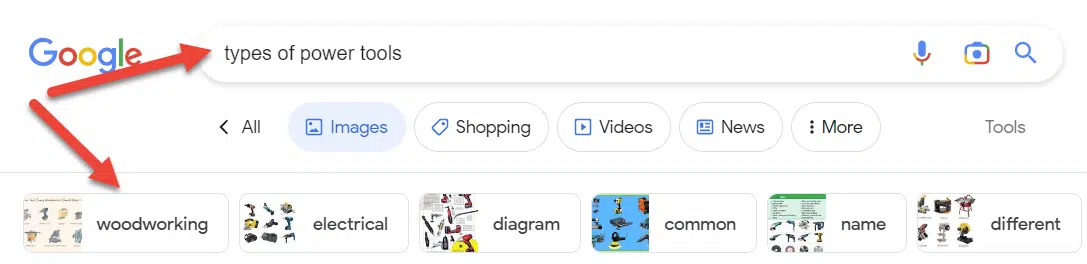
Google image search
Google image search
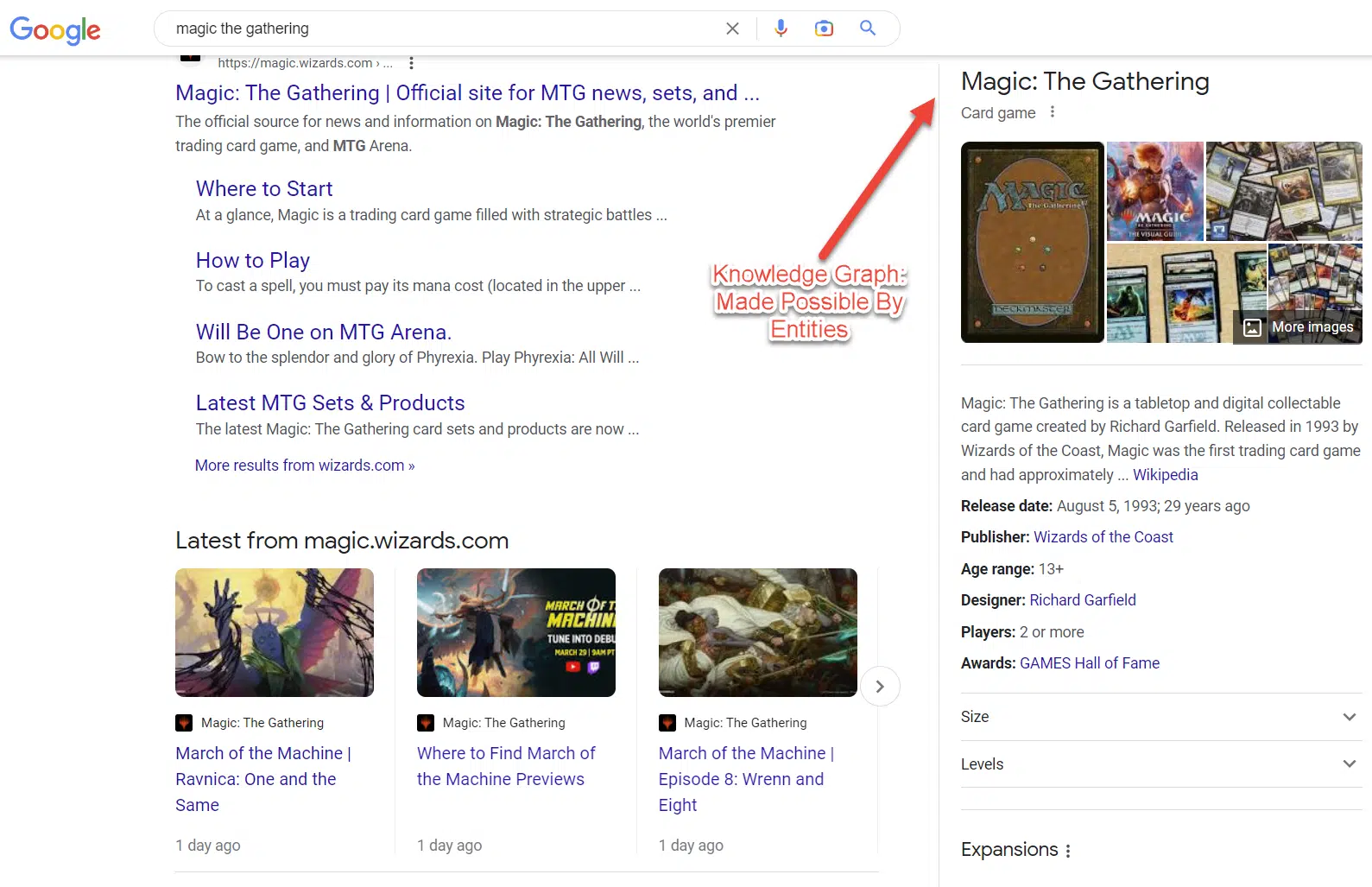
Knowledge Panel
Knowledge Panel
Intent clusters
Intent clusters

Perhaps the best example of entities in the SERP is intent clusters. The more a topic is understood, the more these search features emerge.

Interestingly enough, a single SEO campaign can alter the face of the SERP when you know how to execute entity-focused SEO campaigns.

Wikipedia entries are another example of entities. Wikipedia provides a great example of information associated with entities. 

As you can see from the top left, the entity has all sorts of attributes associated with “fish,” ranging from its anatomy to its importance to humans. 
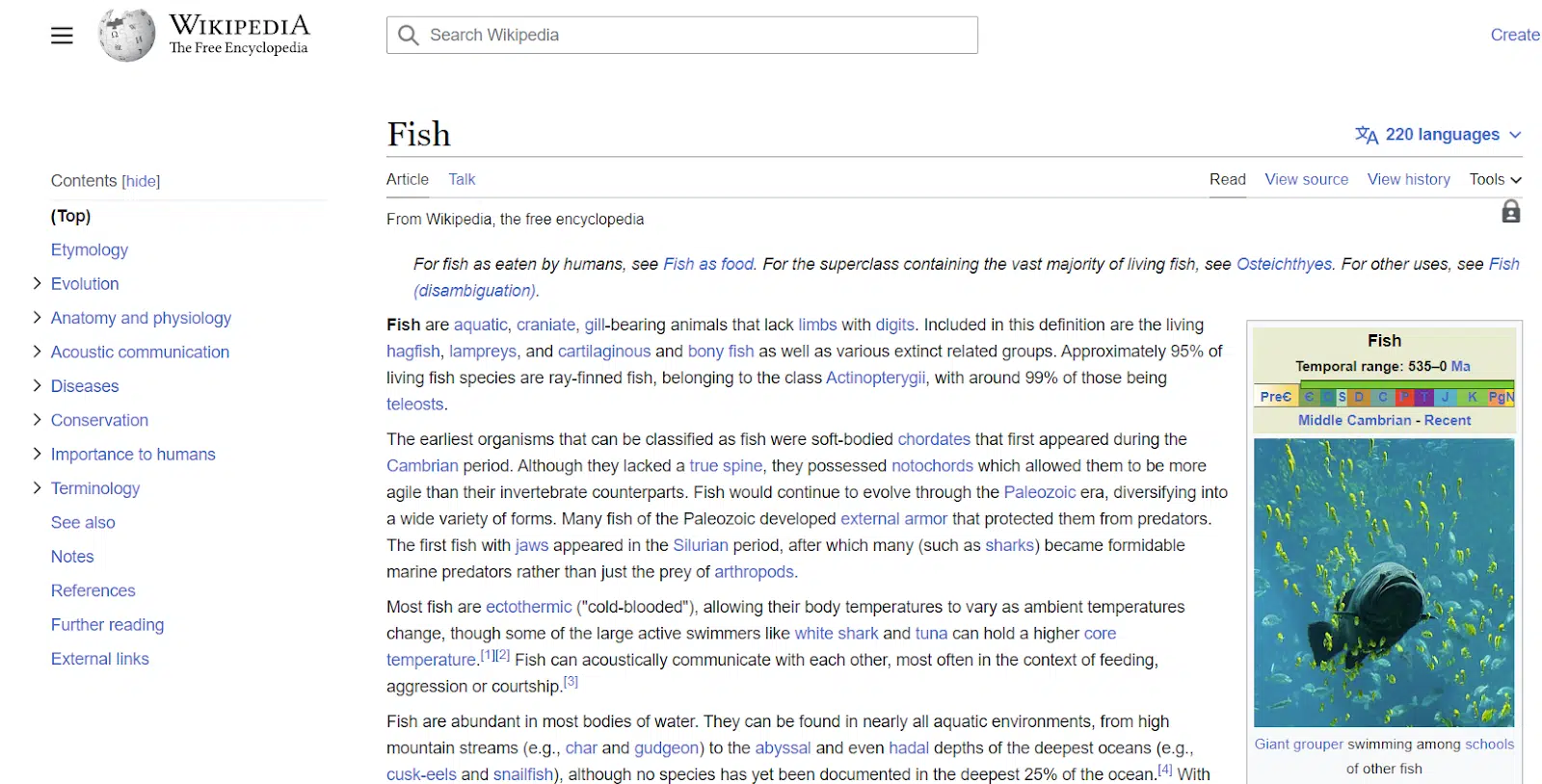
Fish - Wikipedia entity

While Wikipedia contains many data points on a topic, it is by no means exhaustive.

What is an entity?

An entity is a uniquely identifiable object or thing characterized by its name(s), type(s), attributes, and relationships to other entities. An entity is only considered to exist when it exists in an entity catalog. 

Entity catalogs assign a unique ID to each entity. My agency has programmatic solutions that use the unique ID associated with each entity (services, products, and brands are all included).

If a word or phrase is not inside an existing catalog, it does not mean that the word or phrase is not an entity, but you can typically know whether something is an entity by its existence in the catalog. 

It is important to note that Wikipedia is not the deciding factor on whether something is an entity, but the company is most well-known for its database of entities.

Any catalog can be used when talking about entities. Typically, an entity is a person, place, or thing, but ideas and concepts can also be included. 

Some examples of entity catalogs include:

  • Wikipedia
  • Wikidata
  • DBpedia
  • Freebase
  • Yago
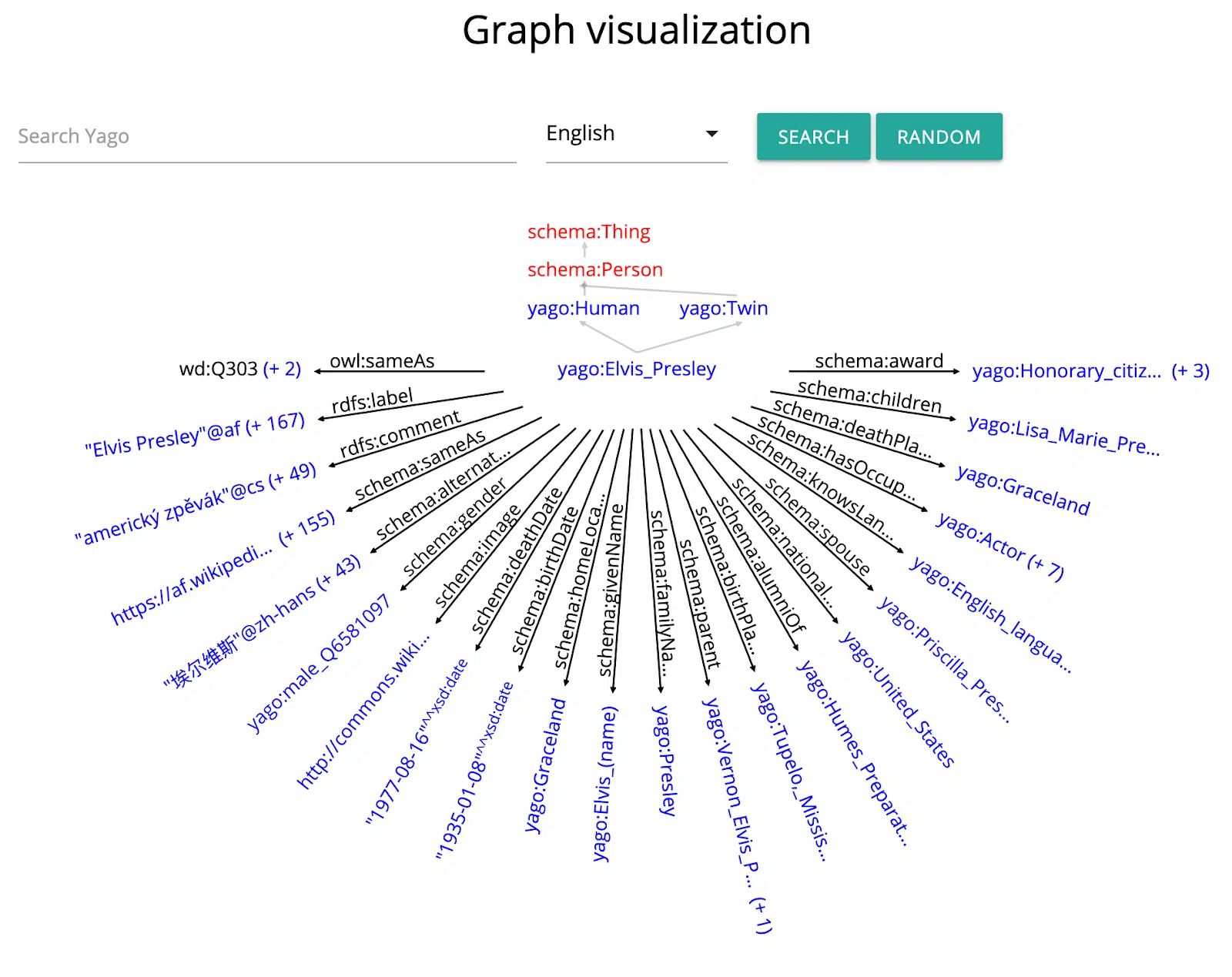
Yago knowledge graph

Entities help to bridge the gap between the worlds of unstructured and structured data.

They can be used to semantically enrich unstructured text, while textual sources may be utilized to populate structured knowledge bases. 

Recognizing mentions of entities in text and associating these mentions with the corresponding entries in a knowledge base is known as the task of entity linking.

Entities allow for a better understanding of the meaning of text, both for humans and for machines. 

While humans can relatively easily resolve the ambiguity of entities based on the context in which they are mentioned, this presents many difficulties and challenges for machines. 

The knowledge base entry of an entity summarizes what we know about that entity. 

As the world is constantly changing, so are new facts surfacing. Keeping up with these changes requires a continuous effort from editors and content managers. This is a demanding task at scale. 

By analyzing the contents of documents in which entities are mentioned, the process of finding new facts or facts that need updating may be supported or even fully automated. 

Scientists refer to this as the problem of knowledge base population, which is why entity linking is important.

Entities facilitate a semantic understanding of the user’s information need, as expressed by the keyword query, and the document’s content. Entities thus may be used to improve query and/or document representations.

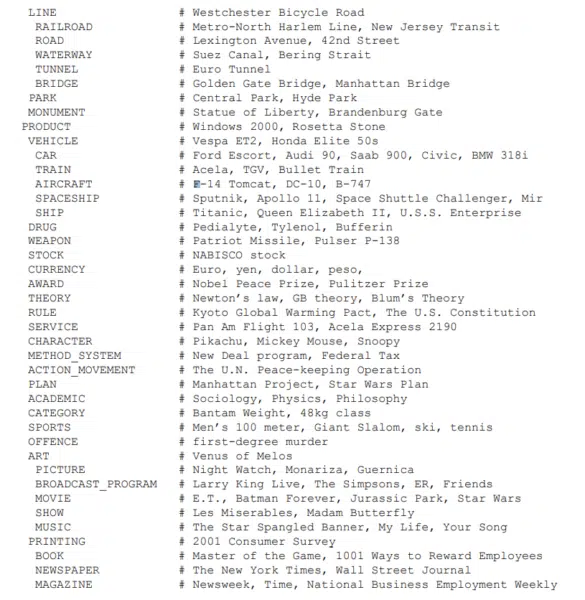
In the Extended Named Entity research paper, the author identifies around 160 entity types. Here are two of seven screenshots from the list.
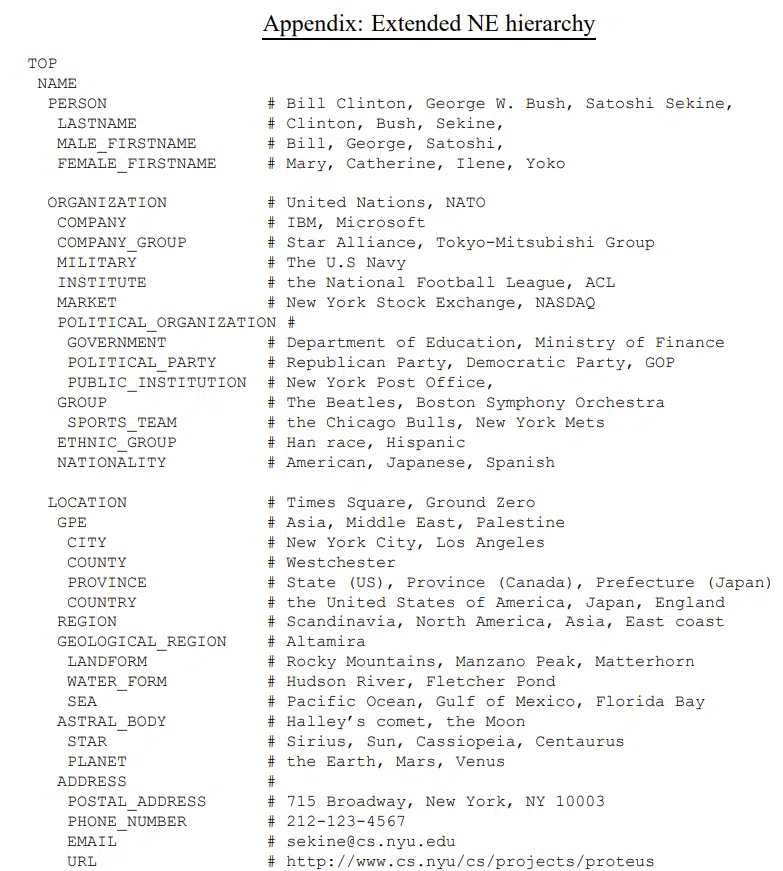
extended named entity - 1
1/7 entity types
extended named entity - 2
3/7 entity types

Certain categories of entities are more easily defined, but it’s important to remember that concepts and ideas are entities. Those two categories are very difficult for Google to scale on its own. 

You can’t teach Google with just a single page when working with vague concepts. Entity understanding requires many articles and many references sustained over time.

Google’s history with entities

On July 16, 2010, Google purchased Freebase. This purchase was the first major step that led to the current entity search system. 
Google and Freebase

After investing in Freebase, Google realized that Wikidata had a better solution. Google then worked to merge Freebase into Wikidata, a task that was far more difficult than expected. 

Five Google scientists wrote a paper titled “From Freebase to Wikidata: The Great Migration.” Key takeaways include.

“Freebase is built on the notions of objects, facts, types, and properties. Each Freebase object has a stable identifier called a “mid” (for Machine ID).”

“Wikidata’s data model relies on the notions of item and statement. An item represents an entity, has a stable identifier called “qid”, and may have labels, descriptions, and aliases in multiple languages; further statements and links to pages about the entity in other Wikimedia projects –  most prominently Wikipedia. Contrary to Freebase, Wikidata statements do not aim to encode true facts, but claims from different sources, which can also contradict each other…”

Entities are defined in these knowledge bases, but Google still had to build its entity knowledge for unstructured data (i.e., blogs).

Google partnered with Bing and Yahoo and created Schema.org to accomplish this task.

Google provides schema directions so website managers can have tools that help Google understand the content. Remember, Google wants to focus on things, not strings.

In Google’s words:

“You can help us by providing explicit clues about the meaning of a page to Google by including structured data on the page. Structured data is a standardized format for providing information about a page and classifying the page content; for example, on a recipe page, what are the ingredients, the cooking time and temperature, the calories, and so on.”

Google continues by saying:

“You must include all the required properties for an object to be eligible for appearance in Google Search with enhanced display. In general, defining more recommended features can make it more likely that your information can appear in Search results with enhanced display. However, it is more important to supply fewer but complete and accurate recommended properties rather than trying to provide every possible recommended property with less complete, badly-formed, or inaccurate data.”

More could be said about schema, but suffice it to say schema is an incredible tool for SEOs looking to make page content clear to search engines.

The last piece of the puzzle comes from Google’s blog announcement titled “Improving Search for The Next 20 Years.” 

Document relevance and quality are the main ideas behind this announcement. The first method Google used for determining the content of a page was entirely focused on keywords. 

Google then added topic layers to search. This layer was made possible by knowledge graphs and by systematically scraping and structuring data across the web.

That brings us to the current search system. Google went from 570 million entities and 18 billion facts to 800 billion facts and 8 billion entities in less than 10 years. As this number grows, entity search improves.

How is the entity model an improvement from previous search models?

Traditional keyword-based information retrieval (IR) models have an inherent limitation of not being able to retrieve (relevant) documents that have no explicit term matches with the query. 

If you use ctrl + f to find text on a page, you use something similar to the traditional keyword-based information retrieval model. 

An insane amount of data is published on the web every day. 

It simply isn’t feasible for Google to understand the meaning of every word, every paragraph, every article, and every website. 

Instead, entities provide a structure from which Google can minimize the computational load while improving understanding. 

“Concept-based retrieval methods attempt to tackle this challenge by relying on auxiliary structures to obtain semantic representations of queries and documents in a higher-level concept space. Such structures include controlled vocabularies (dictionaries and thesauri), ontologies, and entities from a knowledge repository.”

– Entity-Oriented Search, Chapter 8.3

Krisztian Balog, who wrote the definitive book on entities, identifies three possible solutions to the traditional information retrieval model.

  • Expansion-based: Uses entities as a source for expanding the query with different terms.
  • Projection-based: The relevance between a query and a document is understood by projecting them onto a latent space of entities
  • Entity-based: Explicit semantic representations of queries and documents are obtained in the entity space to augment the term-based representations.

The goal of these three approaches is to gain a richer representation of the user’s information needed by identifying entities strongly related to the query.

Balog then identifies six algorithms associated with projection-based methods of entity mapping (projection methods relate to converting entities into three-dimensional space and measuring vectors using geometry).

  • Explicit semantic analysis (ESA): The semantics of a given word are described by a vector storing the word’s association strengths to Wikipedia-derived concepts.
  • Latent entity space model (LES): Based on a generative probabilistic framework. The document’s retrieval score is taken to be a linear combination of the latent entity space score and the original query likelihood score.
  • EsdRank: EsdRank is for ranking documents, using a combination of query-entity and entity-document features. These correspond to the notions of query projection and document projection components of LES, respectively, from before. Using a discriminative learning framework, additional signals can also be incorporated easily, such as entity popularity or document quality
  • Explicit semantic ranking (ESR): The explicit semantic ranking model incorporates relationship information from a knowledge graph to enable “soft matching” in the entity space.
  • Word-entity duet framework: This incorporates cross-space interactions between term-based and entity-based representations, leading to four types of matches: query terms to document terms, query entities to document terms, query terms to document entities, and query entities to document entities.
  • Attention-based ranking model: This is by far the most complicated one to describe. 

Here is what Balog writes:

“A total of four attention features are designed, which are extracted for each query entity. Entity ambiguity features are meant to characterize the risk associated with an entity annotation. These are: (1) the entropy of the probability of the surface form being linked to different entities (e.g., in Wikipedia), (2) whether the annotated entity is the most popular sense of the surface form (i.e., has the highest commonness score, and (3) the difference in commonness scores between the most likely and second most likely candidates for the given surface form. The fourth feature is closeness, which is defined as the cosine similarity between the query entity and the query in an embedding space. Specifically, a joint entity-term embedding is trained using the skip-gram model on a corpus, where entity mentions are replaced with the corresponding entity identifiers. The query’s embedding is taken to be the centroid of the query terms’ embeddings.”

For now, it is important to have surface-level familiarity with these six entity-centric algorithms.

The main takeaway is that two approaches exist: projecting documents to a latent entity layer and explicit entity annotations of documents.

Three types of data structures
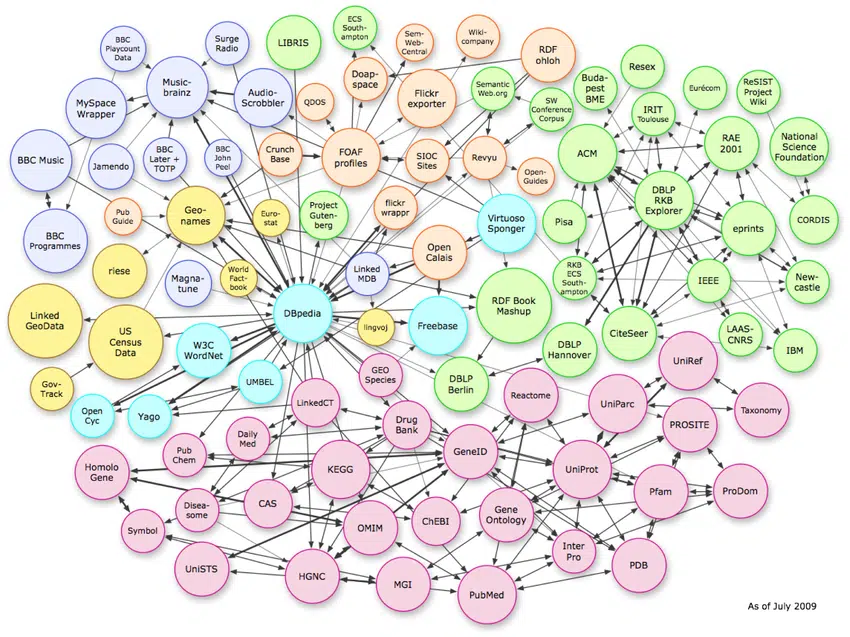
Three types of data structures

The image above shows the complex relationships that exist in vector space. While the example shows knowledge graph connections, this same pattern can be replicated on a page-by-page schema level.

To understand entities, it is important to know the three types of data structures that algorithms use.

  • Using unstructured entity descriptions, references to other entities must be recognized and disambiguated. Directed edges (hyperlinks) are added from each entity to all the other entities mentioned in its description.
  • In a semi-structured setting (i.e., Wikipedia), links to other entities might be explicitly provided.
  • When working with structured data, RDF triples define a graph (i.e., the knowledge graph). Specifically, subject and object resources (URIs) are nodes, and predicates are edges.

The problem with a semi-structured and distracting context for IR score is that if a document is not configured for a single topic, the IR score can be diluted by the two different contexts resulting in a relative rank lost to another textual document. 

IR score dilution involves poorly structured lexical relations and bad word proximity. 

The relevant words that complete each other should be used closely within a paragraph or section of the document to signal the context more clearly to increase the IR Score. 

Utilizing entity attributes and relationships yields relative improvements in the 5–20% range. Exploiting entity-type information is even more rewarding, with relative improvements ranging from 25% to over 100%.

Annotating documents with entities can bring structure to unstructured documents, which can help populate knowledge bases with new information about entities. 
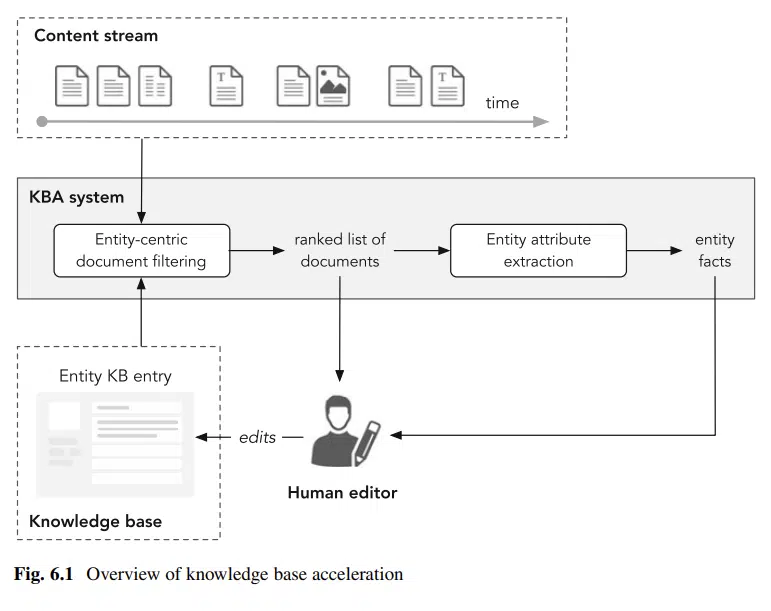
Content stream

Using Wikipedia as your entity SEO framework

Structure of Wikipedia pages

  • Title (I.)
  • Lead section (II.)
    • Disambiguation links (II.a)
    • Infobox (II.b)
    • Introductory text (II.c)
  • Table of contents (III.)
  • Body content (IV.)
  • Appendices and bottom matter (V.)
    • References and notes (V.a)
    • External links (V.b)
    • Categories (V.c)

Most Wikipedia articles include an introductory text, the “lead,” a brief summary of the article – typically, no more than four paragraphs long. This should be written in a way that creates interest in the article. 

The first sentence and the opening paragraph bear special importance. The first sentence “can be thought of as the definition of the entity described in the article.” The first paragraph offers a more elaborate definition without too much detail.

The value of links extends beyond navigational purposes; they capture semantic relationships between articles. In addition, anchor texts are a rich source of entity name variants. Wikipedia links may be used, among others, to help identify and disambiguate entity mentions in text.

  • Summarize key facts about the entity (infobox).
  • Brief introduction.
  • Internal Links. A key rule given to editors is to link only to the first occurrence of an entity or concept.
  • Include all popular synonyms for an entity.
  • Category page designation.
  • Navigation Template.
  • References.
  • Special Parsing tools for understanding Wiki Pages.
  • Multiple Media Types.

How to optimize for entities

What follows are key considerations when optimizing entities for search:

  • The inclusion of semantically related words on a page.
  • Word and phrase frequency on a page.
  • The organization of concepts on a page.
  • Including unstructured data, semi-structured data, and structured data on a page.
  • Subject-Predicate-Object Pairs (SPO).
  • Web documents on a site that function as pages of a book.
  • Organization of web documents on a website.
  • Include concepts on a web document that are known features of entities.

Important note: When the emphasis is on the relationships between entities, a knowledge base is often referred to as a knowledge graph.

Since intent is being analyzed in conjunction with user search logs and other bits of context, the same search phrase from person 1 could generate a different result from person 2. The person could have a different intent with the exact same query. 

If your page covers both types of intent, then your page is a better candidate for web ranking. You can use the structure of knowledge bases to guide your query-intent templates (as mentioned in a previous section).

People Also Ask, People Search For, and Autocomplete are semantically related to the submitted query and either dive deeper into the current search direction or move to a different aspect of the search task. 

We know this, so how can we optimize for it? 

Your documents should contain as many search intent variations as possible. Your website should contain every search intent variation for your cluster. Clustering relies on three types of similarity: 

  • Lexical similarity. 
  • Semantic similarity.
  • Click similarity.

Topic coverage

What is it –> Attribute list –> Section dedicated to each attribute –> Each section links to an article fully dedicated to that topic –> The audience should be specified and definitions for the sub-section should be specified –> What should be considered? –> What are the benefits? –> Modifier benefits –> What is ___ –> What does it do? –> How to get it –> How to do it –> Who can do it –> Link back to all categories
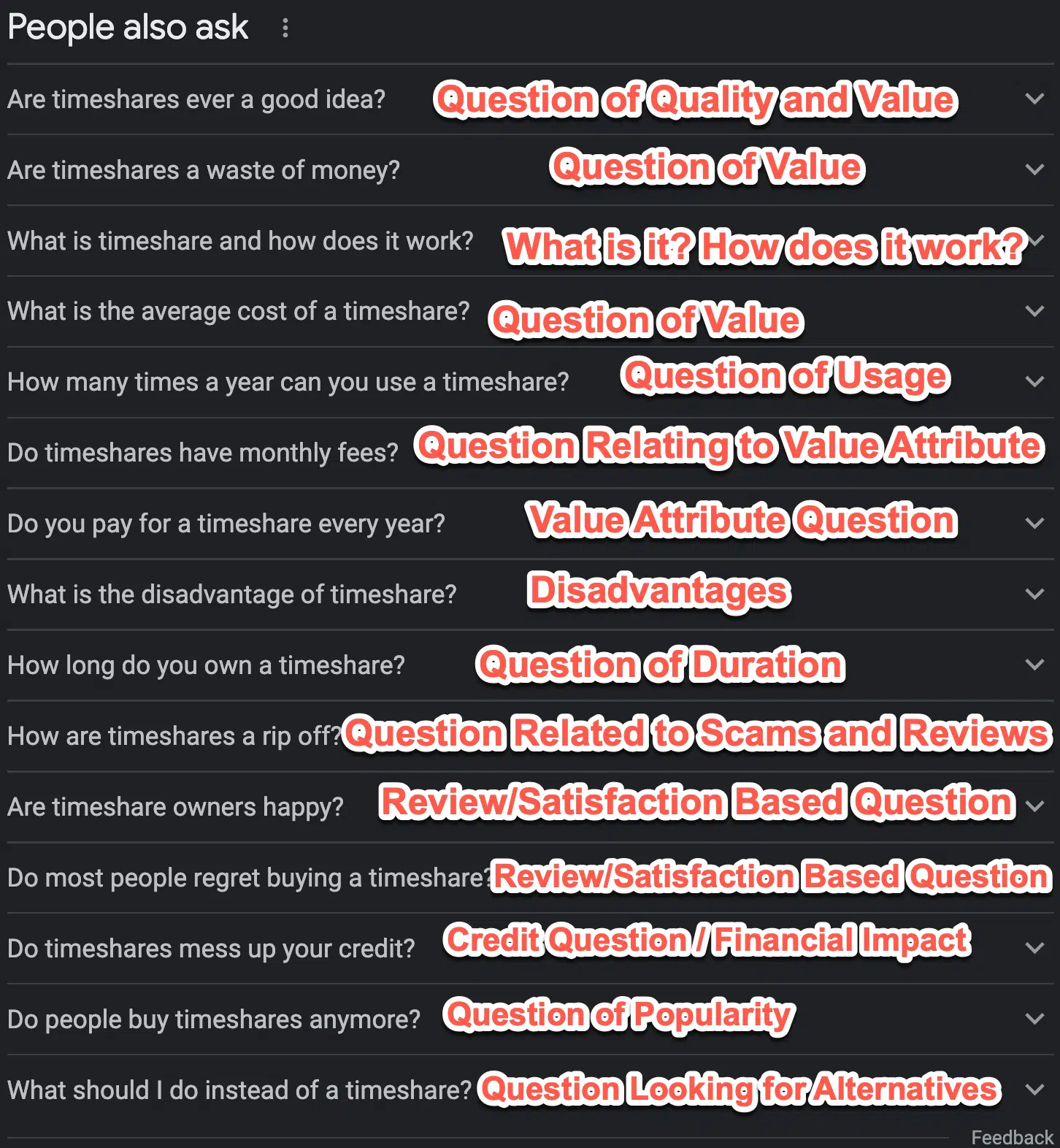
People also ask

Google offers a tool that provides a salience score (similar to how we use the word “strength” or “confidence”) that tells you how Google sees the content.
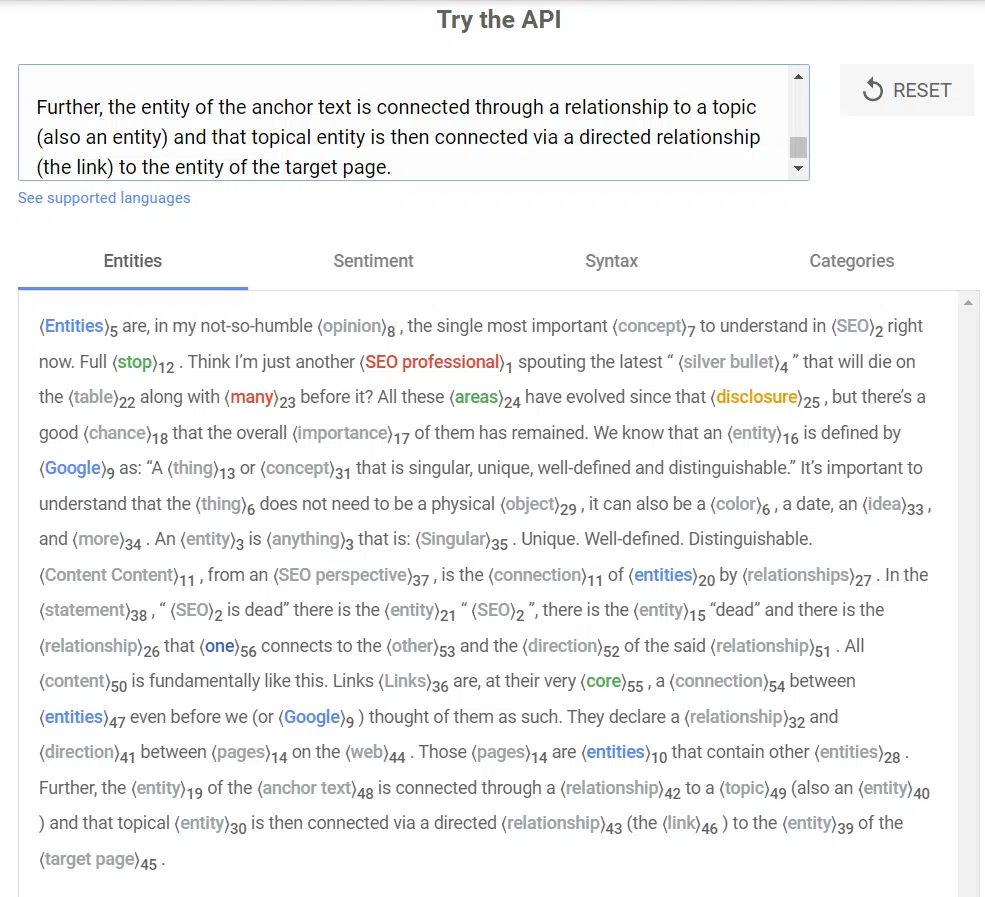
Google API tool

The example above comes from a Search Engine Land article on entities from 2018.
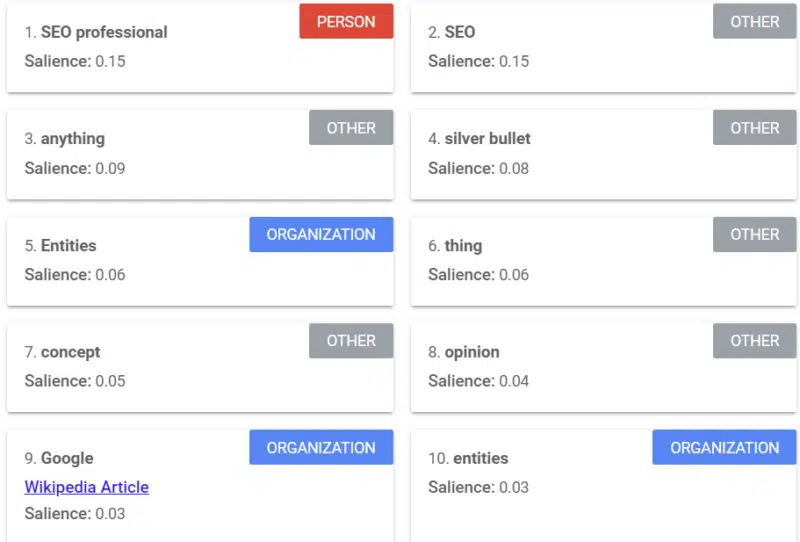
Entities in an SEL article

You can see person, other, and organizations from the example. The tool is Google Cloud’s Natural Language API.

Every word, sentence, and paragraph matter when talking about an entity. How you organize your thoughts can change Google’s understanding of your content. 

You may include a keyword about SEO, but does Google understand that keyword the way you want it to be understood? 

Try placing a paragraph or two into the tool and reorganizing and modifying the example to see how it increases or decreases salience.

This exercise, called “disambiguation,” is incredibly important for entities. Language is ambiguous, so we must make our words less ambiguous to Google.

Modern disambiguation approaches consider three types of evidence:

Prior importance of entities and mentions.

Contextual similarity between the text surrounding the mention and the candidate entity and coherence among all entity-linking decisions in the document. 
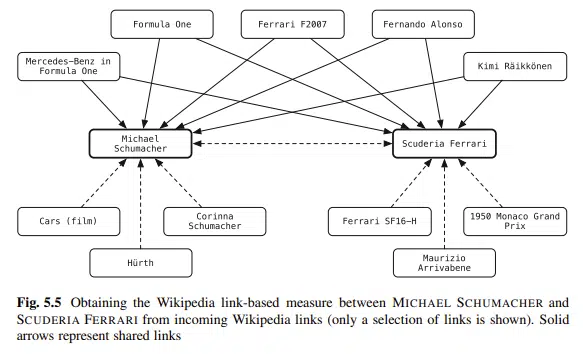
Entity linking decisions

Schema is one of my favorite ways of disambiguating content. You are linking entities in your blog to knowledge repositories. Balog says: 

“[L]inking entities in unstructured text to a structured knowledge repository can greatly empower users in their information consumption activities.” 

For instance, readers of a document can acquire contextual or background information with a single click, and they can gain easy access to related entities.

Entity annotations can also be used in downstream processing to improve retrieval performance or to facilitate better user interaction with search results.
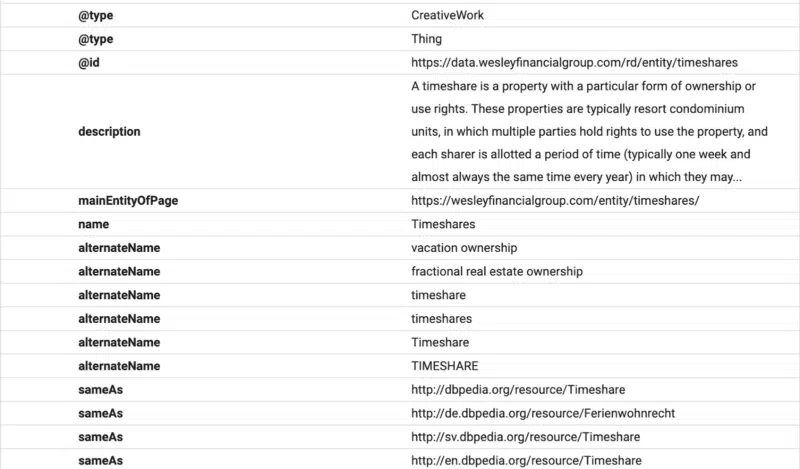
Entity annotations

Here you can see that the FAQ content is structured for Google using FAQ schema.
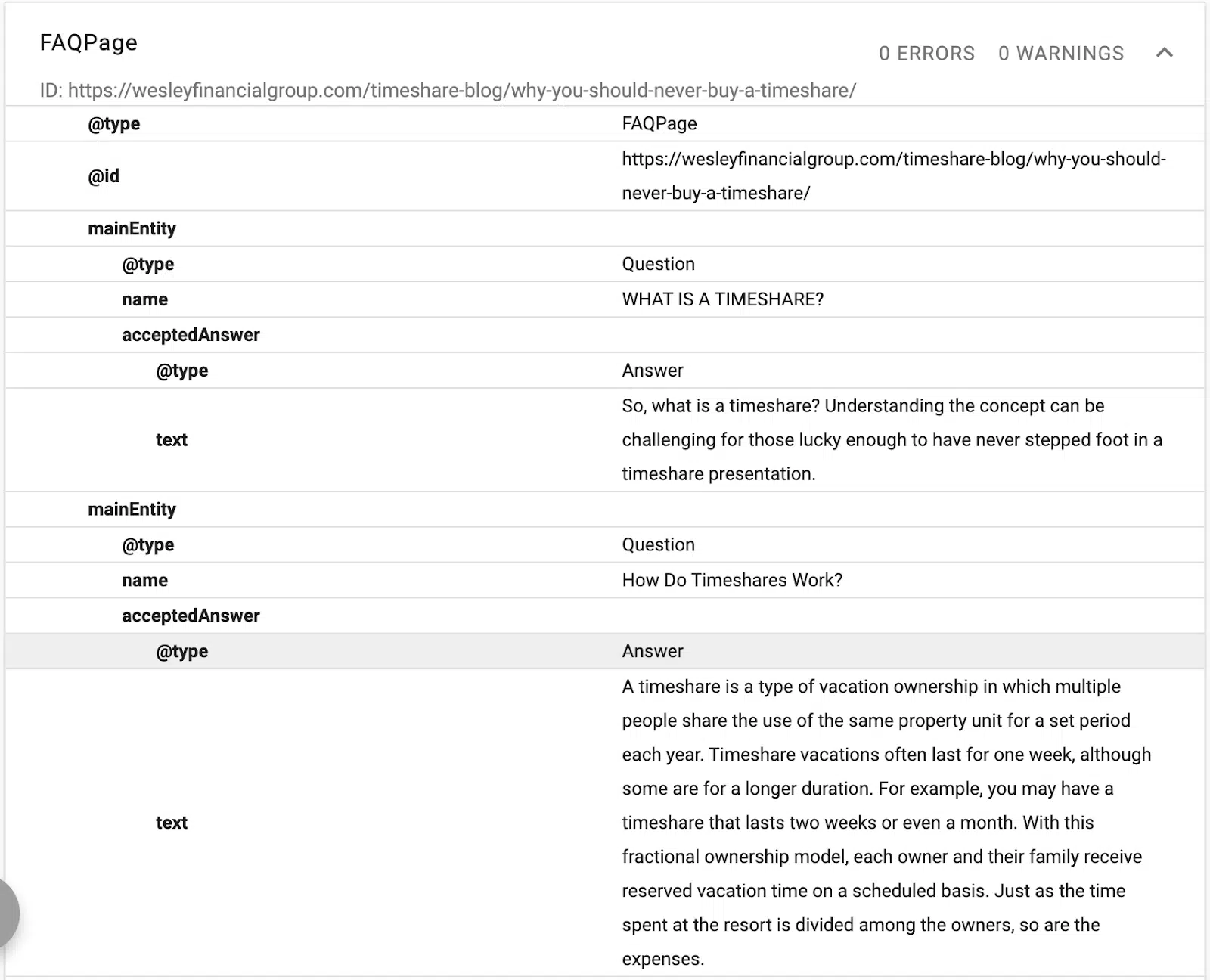
Entity annotations - 2

In this example, you can see schema providing a description of the text, an ID, and a declaration of the main entity of the page.

(Remember, Google wants to understand the hierarchy of the content, which is why H1–H6 is important.)

You’ll see alternative names and the same as declarations. Now, when Google reads the content, it will know which structured database to associate with the text, and it will have synonyms and alternative versions of a word linked to the entity.

When you optimize with schema, you optimize for NER (named entity recognition), also known as entity identification, entity extraction, and entity chunking.

The idea is to engage in Named Entity Disambiguation > Wikification > Entity Linking.
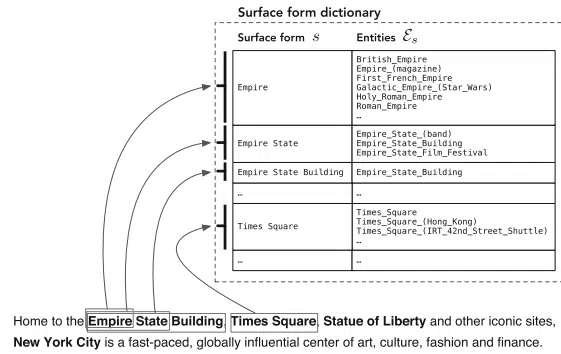
Entities

“The advent of Wikipedia has facilitated large-scale entity recognition and disambiguation by providing a comprehensive catalog of entities along with other invaluable resources (specifically, hyperlinks, categories, and redirection and disambiguation pages.”

– Entity-Oriented Search

Most SEOs use some on-page tool for optimizing their content. Every tool is limited in its ability to identify unique content opportunities and content depth suggestions.

For the most part, on-page tools are just aggregating the top SERP results and creating an average for you to emulate. 

SEOs must remember that Google is not looking for the same rehashed information. You can copy what others are doing, but unique information is the key to becoming a seed site/authority site.

Here is a simplified description of how Google handles new content:

Once a document has been found to mention a given entity, that document may be checked to possibly discover new facts with which the knowledge base entry of that entity may be updated.

Balog writes: 

“We wish to help editors stay on top of changes by automatically identifying content (news articles, blog posts, etc.) that may imply modifications to the KB entries of a certain set of entities of interest (i.e., entities that a given editor is responsible for).”

Anyone that improves knowledge bases, entity recognition, and crawlability of information will get Google’s love. 

Changes made in the knowledge repository can be traced back to the document as the original source. 

If you provide content that covers the topic and you add a level of depth that is rare or new, Google can identify if your document added that unique information.

Eventually, this new information sustained over a period of time could lead to your website becoming an authority.

This isn’t an authoritativeness based on domain rating but topical coverage, which I believe is far more valuable.

With the entity approach to SEO, you aren’t limited to targeting keywords with search volume.

All you need to do is to validate the head term (“fly fishing rods,” for example), and then you can focus on targeting search intent variations based on good ole fashion human thinking.

We begin with Wikipedia. For the example of fly fishing, we can see that, at a minimum, the following concepts should be covered on a fishing website:

  • Fish species, history, origins, development, technological improvements, expansion, methods of fly fishing, casting, spey casting, fly fishing for trout, techniques for fly fishing, fishing in cold water, dry fly trout fishing, nymphing for trout, still water trout fishing, playing trout, releasing trout, saltwater fly fishing, tackle, artificial flies, and knots.

The topics above came from the fly fishing Wikipedia page. While this page provides a great overview of topics, I like to add additional topic ideas that come from semantically related topics. 

For the topic “fish,” we can add several additional topics, including etymology, evolution, anatomy and physiology, fish communication, fish diseases, conservation, and importance to humans. 

Has anyone linked the anatomy of trout to the effectiveness of certain fishing techniques?

Has a single fishing website covered all fish varieties while linking the types of fishing techniques, rods, and bait to each fish? 

By now, you should be able to see how the topic expansion can grow. Keep this in mind when planning a content campaign.

Don’t just rehash. Add value. Be unique. Use the algorithms mentioned in this article as your guide.

Conclusion

This article is part of a series of articles focused on entities. In the next article, I’ll dive deeper into the optimization efforts around entities and some entity-focused tools on the market.

I want to end this article by giving a shout-out to two people that explained many of these concepts to me. 

Bill Slawski of SEO by the Sea and Koray Tugbert of Holistic SEO. While Slawski is no longer with us, his contributions continue to have a ripple effect in the SEO industry.

I heavily rely on the following sources for the article content, as these sources are the best resources that exist on the topic:


Opinions expressed in this article are those of the guest author and not necessarily Search Engine Land. Staff authors are listed here.


Related stories

New on Search Engine Land

@media screen and (min-width: 800px) { #div-gpt-ad-3191538-7 { display: flex !important; justify-content: center !important; align-items: center !important; min-width:770px; min-height:260px; } } @media screen and (min-width: 1279px) { #div-gpt-ad-3191538-7 { display: flex !important; justify-content: center !important; align-items: center !important; min-width:800px!important; min-height:440px!important; } }

About the author

Timothy Warren

Timothy Warren is a serial entrepreneur and the founder of the Helium family of brands, including Helium SEO, Helium Interactive and Venture Automotive. He serves as the President and CEO of Helium SEO, which is a technology driven digital marketing agency that provides data driven digital marketing and leverages AI and Machine Learning to provide superior SEO results for mid-sized and enterprise businesses. Helium SEO has 50+ employees throughout 15 states and is headquartered in Cincinnati, OH. Helium SEO was recently named the 5thfastest growing company in Cincinnati, the 10thlargest Marketing and Advertising Agency in Cincinnati, and ranks #679 on the Inc 5000 list of fastest growing companies. Timothy travels often to speaking events and loves speaking & training audiences on SEO and digital marketing methods that are new and driving results.

https://searchengineland.com/entity-seo-guide-395264


New Bing attracts new Edge users – who then use Google Search

People who rushed to download the Microsoft Edge browser to try out the New Bing Chat experience – ironically – ended up using Google Search on Edge, according to new data from enterprise SEO platform BrightEdge.

Why we care. We’re watching closely for any data indicating whether the New Bing is starting to chip away at Google’s massive lead in search. What we see here is more evidence that Microsoft is driving more traffic to sites – in a twist, they’re doing it via Edge instead of Bing.

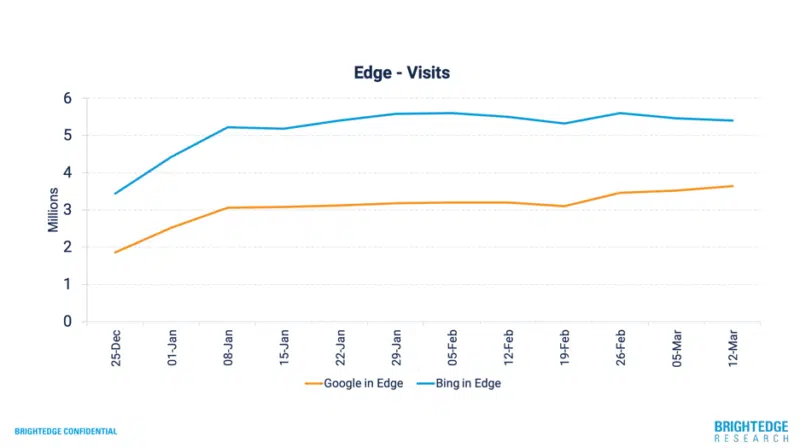
What the data shows. Google fairly consistently sent more than 3 million visits to websites since the start of 2023. Starting around Feb. 19, however, there is a noticeable uptick in Google traffic coming from the Edge browser. That number grew to roughly 3.7 million visits by the week of March 12.

Data comparison of website visits from Google in Edge vs. Bing in Edge.

Meanwhile, traffic from Bing in Edge also showed some growth since the start of the year (from just over 5 million to about 5.5 million as of the week of March 12), but the data seems to show that as more traffic started coming from Google in Edge, less came from Bing in Edge.

For its analysis, BrightEdge examined more than 600,000 million visits to websites across all major industries, comparing U.S. traffic from Google and Bing, by browser (Chrome vs. Edge).

Google gains an Edge. More than 1 million people signed up within the first 48 hours to try out the new Bing in February, but ended up stuck on a waitlist, in some cases for weeks.

So all those people who downloaded Edge stuck with it. But when it came to searching, rather than using Bing, many started using Google Search on Edge.

One big question we will be better able to answer months from now is whether limiting the integration of GPT-4 into Bing Chat solely on the Edge browser was a missed opportunity. We just don’t have that data yet.

“It is still early to predict how Google and Bing will evolve and if there is a significant market dominance shift,” said Lemuel Park, BrightEdge co-founder and CTO. “However, Bing will undoubtedly increase in popularity as more and more people experiment with its new capabilities.”

More data. The new Bing making (small) gains on Google Search has some additional data, including page visits on Bing rising 15.8% and Bing becoming a more significant referral source for some publishers.


Related stories

New on Search Engine Land

@media screen and (min-width: 800px) { #div-gpt-ad-3191538-7 { display: flex !important; justify-content: center !important; align-items: center !important; min-width:770px; min-height:260px; } } @media screen and (min-width: 1279px) { #div-gpt-ad-3191538-7 { display: flex !important; justify-content: center !important; align-items: center !important; min-width:800px!important; min-height:440px!important; } }

About the author

Danny Goodwin

Danny Goodwin has been Managing Editor of Search Engine Land & Search Marketing Expo – SMX since 2022. He joined Search Engine Land in 2022 as Senior Editor. In addition to reporting on the latest search marketing news, he manages Search Engine Land’s SME (Subject Matter Expert) program. He also helps program U.S. SMX events. Goodwin has been editing and writing about the latest developments and trends in search and digital marketing since 2007. He previously was Executive Editor of Search Engine Journal (2017 to 2022), managing editor of Momentology (from 2014-2016) and editor of Search Engine Watch (from 2007 to 2014). He has spoken at many major search conferences and virtual events, and has been sourced for his expertise by a wide range of publications and podcasts.

https://searchengineland.com/bing-vs-google-microsoft-edge-traffic-395223


Study: 31% of international websites contain hreflang errors

Implementing hreflang can be a challenging task for many SEOs. The countless syntax variations across several languages can be difficult for those with little understanding of more than one language.

There’s also the added complexity of understanding specific language nuances and regional targeting which would only typically be understood by a native speaker or someone who had thoroughly studied the language.

Incorrect hreflang implementation can cause many complications (i.e., duplicate content, erroneous indexing and poor SERP visibility) detrimental to SEO performance.

It’s imperative to implement hreflang with care. Thankfully, hreflang is well-documented and related issues can be identified through various SEO tools.

Hreflang errors study

To determine how widespread hreflang issues are and which ones are more common, I partnered with NerdyData, which gave me access to their database of websites that contain hreflang code. 

NerdyData provided a list of 18,786 websites that contain at least one instance of hreflang declaring an alternate within the source code. Thus, this study only accounts for hreflang implemented in the <head>, not through XML sitemaps or the HTTP header.

I carried out the study by:

  • Running crawls in Screaming Frog to validate the presence of hreflang on the homepages.
  • Removing GEO-IP redirects so the complete list of URLs resolves in 200s.
  • Utilizing HreflangChecker.com and Visual SEO Studio to process the URLs in batches to identify common issues identified by the tools.

31.02% of websites contain conflicting hreflang directives

My findings show 31.02% of websites serving multiple languages have conflicting hreflang directives. Conflicting hreflang can happen when a webpage has various hreflang tags for different languages and geographical targeting. 

Put simply, more than one URL has been assigned to an individual language or region, sending confusing signals to search engines. For example:

  • <link rel=”alternate” href=”https://example.com/” hreflang=”en” />
  • <link rel=”alternate” href=”https://example.com/en-uk/” hreflang=”en-gb” />
  • <link rel=”alternate” href=”https://example.com/en-us/” hreflang=”en-gb” />
  • <link rel=”alternate” href=”https://example.com/en-au/” hreflang=”en-au” />

Such confusion potentially leads to complications around duplicate content and incorrect ranking and indexing, making it difficult to place well in the SERP.

Even if users find your webpage among those performing well, they will suffer poor user experience if they are served the incorrect version of the page.

Self-referencing hreflang happens when a page includes a hreflang tag pointing to its URL.

In essence, the page indicates it is available in various languages, including the original language of the page. 

Despite initially appearing as a redundant tactic, it’s good practice for international SEO. Unfortunately, 16.04% of sites with multiple languages have no self-referencing hreflang tags.

Search engines can better understand the relationship between different versions of the same page when self-referencing hreflang tags are used, including pages available in different languages.

Given that hreflang contributes as one of approximately 20 canonicalization signals, it’s an important signal to include.

47.95% of websites don’t utilize x-default

The x-default attribute signals to search engines that a page doesn’t target a specific language or location, defining it as a default language version of the page.

It’s especially useful when a page is available in multiple languages but doesn’t deliver content in the user’s preferred language. 

The x-default attribute isn’t necessarily needed in hreflang. Up to 47.95% of multilanguage sites are currently not using it. 

However, it can be beneficial to use in cases where a user searches for a page in a specific language that isn’t available, as it helps search engines find the most appropriate version of the page to display.

It’s important to note that the x-default attribute should only be used if another language isn’t available. Where other available languages exist, each should be specified with a hreflang tag.

Additionally, x-default should not be used on pages specific to a particular language or location.

8.91% of hreflang clusters contain at least one instance of invalid language codes

It is essential to use the two-letter ISO-639-1 format within hreflang attributes.

Unfortunately, it’s common for language codes to go wrong, causing multiple issues that can affect the international targeting of a website. 

My research found that 8.91% of sites targeting more than one language currently contain unknown language codes. 

It could simply be a confused approach to combining language and location codes, but many common issues might be the cause.

Some language codes don’t quite match the spelling of a country. 

For example, you might expect the language code for Croatian to be “cr,” but it’s actually “hr.” Because the code isn’t obvious, it’s easy to make mistakes when implementing language codes.

1.6% of hreflang clusters contain at least one instance of invalid region codes

Contrary to the previous statistic, relatively few hreflang clusters contain invalid region codes.

While using the two-letter ISO-3166-1 region codes isn’t required, it does help when targeting the same language between two or more countries with different spelling rules. Doing so provides more context to search engines, looking into user location and language.

To return to my previous example, you must use the code “en-US” to target users in the United States. If it is set to “en-GB,” you will only target British-based users, missing your intended audience entirely.

Common errors here include:

  • <link rel=”alternate” href=”https://example.com/en-gb/” hreflang=”en-uk” />
  • <link rel=”alternate” href=”https://example.com/en-eu/” hreflang=”en-eu” />

Here, the entries all target English but also intend to target the UK and Europe. Both UK and EU are invalid codes as it’s GB (Great Britain), and you can’t target Europe as a continent.

Spanish targeting can also be problematic in Latin America, with cluster trying to target es-la, es-lx and es-419 in an attempt to target the region as a whole when you should be targeting individual countries – or leaving Spanish as a general language.

22.46% of hreflang clusters contain irregular/unusual language-region combinations

There is a range of benefits to targeting countries without native languages with hreflang, with a major one being to improve the user experience for non-native speakers. 

For example, Dutch is the native language of the Netherlands, but an estimated 95% of the population also speaks English. There are also around 97,8000 British nationals who live in the Netherlands. 

With such high numbers of English speakers, targeting users in the Netherlands with your English website pages makes sense.

However, not all combinations make sense. For example:

  • <link rel=”alternate” href=”https://example.com/en-vn/” hreflang=”en-vn” />
  • <link rel=”alternate” href=”https://example.com/es-ie/” hreflang=”es-ie” />
  • <link rel=”alternate” href=”https://example.com/zh-zm/” hreflang=”zh-zm” />

While the three examples above will pass a hreflang test and are technically accurate, Zambia’s number of Chinese speakers will likely yield little to no results in having this alternate version.

Creating alternate versions that make little sense creates additional and unnecessary crawl demand and versions that Google may likely deem to be duplicated, overriding the canonicals.


Opinions expressed in this article are those of the guest author and not necessarily Search Engine Land. Staff authors are listed here.


Related stories

New on Search Engine Land

@media screen and (min-width: 800px) { #div-gpt-ad-3191538-7 { display: flex !important; justify-content: center !important; align-items: center !important; min-width:770px; min-height:260px; } } @media screen and (min-width: 1279px) { #div-gpt-ad-3191538-7 { display: flex !important; justify-content: center !important; align-items: center !important; min-width:800px!important; min-height:440px!important; } }

About the author

Dan Taylor

Dan Taylor is head of technical SEO at SALT.agency, a UK-based technical SEO specialist and winner of the 2022 Queens Award. Dan works with and oversees a team working with companies ranging from technology and SaaS companies to enterprise e-commerce.

https://searchengineland.com/study-31-of-international-websites-contain-hreflang-errors-395161


What ChatGPT means for your search campaigns by Adthena

Adthena ChatGPT 800x450

Love it or fear it, ChatGPT has put generative artificial intelligence (AI) squarely at the center of the current technological discourse. In case you need an introduction, ChatGPT is an advanced AI chatbot launched in late 2022 by OpenAI that can converse on virtually any topic in a natural and sophisticated way. It learns from text and images across the web (and human trainers at OpenAI) how to understand and respond to human queries. The potential implications for industry and society are controversial and complex. But for search marketing, the impact of this new era in AI is more immediate. Marketers want to know how it will influence paid search results and how to leverage it. So, we’ve gathered some answers. Fittingly, we got some help from ChatGPT. 

If you were asked to guess the price of eggs in New York City this week, you would probably be able to get close (at least relative to your local shop) even if you had never been to NYC. That’s because you’ve learned many things about the price of eggs in the current economy and how the cost of goods varies in different cities around the world.

In the context of PPC, machine learning works much the same way. It has been trained to analyze what factors influence costs and clicks, identify the relationships between search terms and brands, and make correlations and predictions based on vast amounts of pre-existing data.

That’s essentially what we do at Adthena. We’ve been using our own algorithms and machine learning technology since our inception to uncover strategic insights for brands, marketers, and agencies about their search strategies, the strategies of their competitors, and their competitive landscape. Using an extensive in-house data set and natural language processing techniques, we’ve also constructed a machine-learning model to accurately categorize search terms. For example, we seek out millions of search terms each day, analyze the Google Ads auction landscape to which they belong and estimate click-through rate (CTR) and cost per click (CPC) for each competitor bidding on each term.

To deliver this information, our AI models use observations from the search engine results page (SERP), such as the number of ads competing for a term, the position of each ad and elements on competing pages, and characteristics derived through natural language processing.

Adthena uses our AI to generate our signature Whole Market View for each enterprise customer, provide recommendations for ad creative and assess the probability of a click. AI drives our most potent platform capabilities, including our proprietary categorization model. Because we have significant pools of data on thousands of brands collected over many years, we have a robust baseline for using machine learning to estimate the CTR and CPC for any given search term, advertiser and rank. 

From Adthena’s vantage point, ChatGPT provides another powerful tool for us to help our clients better understand customer preferences, provide even more relevant results in their ads and identify ways to improve ad campaigns and performance. But what does the bot have to say about the topic?

We asked the bot: “How will ChatGPT impact search?”

To understand the big picture of how ChatGPT will affect the search landscape, we went to the source. Here’s verbatim what ChatGPT generated in response to our query.

“As a language model, ChatGPT can have a significant impact on search in a few ways:

  1. Natural language processing: ChatGPT’s ability to process and understand natural language can help improve search queries and results. By understanding the context and intent behind a search query, ChatGPT can provide more relevant and accurate search results.
  1. Answer generation: ChatGPT can generate answers to questions that users may have when performing a search. This can provide more direct and helpful information to users, leading to a better search experience.
  1. Personalization: ChatGPT can learn from user behavior and preferences, which can help personalize search results. By tailoring search results to individual users, ChatGPT can provide more relevant and useful results.

Overall, ChatGPT has the potential to improve the search experience by providing more relevant and personalized results, as well as generating answers to questions that users may have. However, its impact on search will depend on how it is implemented and integrated into search engines and other search tools.”

The ChatGPT bot also told us about how Google uses a variant of the generative pre-trained transformer (GPT) architecture in its search engine to answer questions and summarize (e.g., to create good snippets) and translate content. 

Bing, too, uses GPT-based models to improve its natural language understanding capabilities, making it easier for users to search using natural language queries. Bing uses ChatGPT and other GPT-based models to improve the accuracy and relevance of its search results and provide personalized recommendations and suggestions.

3 ways ChatGPT could empower search marketers

  1. Keyword research. It can be used alongside free tools like Google keyword planner or auction insights and with enterprise-level tools like Adthena.
  2. Ad copy research and optimization. ChatGPT could be used for testing new headlines, product descriptions, and ad copy.
  3. Improve your understanding of search intent. Use ChatGPT to gain insight into consumer behavior.

How does Adthena use ChatGPT?

This new generation of natural language processing technology enhances our ability to analyze large amounts of text data and extract insights that can be used to further improve our clients’ campaigns. For example, we’ll have even more power to analyze customer reviews, social media comments and other types of user-generated content to identify key themes and trends. 

ChatGPT can identify common issues or complaints that customers have with a product or service, which can inform advertising messaging and help businesses address specific concerns. ChatGPT can also identify emerging trends or topics of interest in customer feedback, which can be used to tailor content and ad creative. 

As you can see from the above, we’re also experimenting with using ChatGPT for automated content creation. This will help our clients generate ad copy and other types of content more efficiently.

Yes, this sophisticated technology has limits, and it has the potential for misuse and for creating misinformation. But in our corner of the web universe, ChatGPT enhances our ability to understand what consumers are looking for when they search and what message we can deliver to best engage and convert. That neatly aligns with the goals of search marketing and will help advertisers compete and provide a better experience for shoppers all around.

For a closer look at how Adthena uses AI to deliver unique competitive search intelligence to advertisers, check out this 60-second video explainer, and request a demo to see the platform in action.


Related stories

New on Search Engine Land

About the author

Adthena

Founded in 2012, Adthena is an award-winning search intelligence platform. Our unique combination of patented, AI-driven technology and a world-class team of experts helps brands, marketers, and agencies across the globe dominate their competitive landscapes. We provide our customers with a clear view of the paid search landscape, helping them optimize their spend to increase ROI, all while saving them time and better informing their cross-channel strategies. Adthena’s solutions are powered by our market-leading technology: Whole Market View creates a unique market map of a client’s entire search landscape and Smart Monitor automatically detects threats and opportunities every day. Our award-winning Local View product provides the location-based strategic insights that marketers need to dominate at a local level. For more information, visit: www.adthena.com

https://searchengineland.com/what-chatgpt-means-for-your-search-campaigns-395082


Who’s verified? Who’s not? Who knows, it’s Twitter

Did a Twitter account get a blue checkmark by paying for Twitter Blue or is it a legacy verified account? Right now it’s nearly impossible to tell.

Why we care. Twitter’s designation for “notable” accounts was supposed to disappear April 1. Some have (e.g., The New York Times lost it) but many others have not yet lost the designation. And with April 15 approaching, Twitter CEO Elon Musk has said that “only verified accounts will be eligible to be in For You recommendations” starting April 15.

What it looks like. On all blue checkmarks, Twitter now says: “This account is verified because it’s subscribed to Twitter Blue or is a legacy verified account.”

Before April 2, Twitter showed a different message: “This account is verified because it’s subscribed to Twitter Blue.”

The addition of “or is a legacy verified account” has made it impossible to tell who paid for their checkmark and who didn’t. Probably the hope is Twitter will drive more sign-ups for Twitter Blue.

And before April 1, on legacy verified accounts you would see the message “This is a legacy verified account. It may or may not be notable. Learn more“:

Many search marketers have said they won’t pay for Twitter Blue, so they are voluntarily giving up the blue checkmark. Such as Google’s Ads Liaison, Ginny Marvin.

“Twitter has been an integral aspect of my professional life for more than a decade,” Marvin tweeted. “I don’t need a blue check mark for that to continue.”

Twitter Blue. About 180,000 U.S. accounts (approximately 290,000 worldwide) had signed up for the $8 per month (or $11 on mobile) service, as of mid-January, according to documents obtained by the Information (warning: paywalled).

Furthering the confusion. Twitter’s top 500 advertisers, as well as the 10,000 most-followed organizations with prior verification, reportedly will continue to have verified accounts – without paying – under the new Verified Organizations program.


Related stories

New on Search Engine Land

@media screen and (min-width: 800px) { #div-gpt-ad-3191538-7 { display: flex !important; justify-content: center !important; align-items: center !important; min-width:770px; min-height:260px; } } @media screen and (min-width: 1279px) { #div-gpt-ad-3191538-7 { display: flex !important; justify-content: center !important; align-items: center !important; min-width:800px!important; min-height:440px!important; } }

About the author

Danny Goodwin

Danny Goodwin has been Managing Editor of Search Engine Land & Search Marketing Expo – SMX since 2022. He joined Search Engine Land in 2022 as Senior Editor. In addition to reporting on the latest search marketing news, he manages Search Engine Land’s SME (Subject Matter Expert) program. He also helps program U.S. SMX events. Goodwin has been editing and writing about the latest developments and trends in search and digital marketing since 2007. He previously was Executive Editor of Search Engine Journal (2017 to 2022), managing editor of Momentology (from 2014-2016) and editor of Search Engine Watch (from 2007 to 2014). He has spoken at many major search conferences and virtual events, and has been sourced for his expertise by a wide range of publications and podcasts.

https://searchengineland.com/twitter-verified-account-confusion-395168


Decoding the SEO success of LinkedIn collaborative articles

On March 3, LinkedIn introduced collaborative articles, a new type of content that LinkedIn publishes with the help of AI and LinkedIn users. 

While it was marketed as an initiative to surface the expertise of LinkedIn users (i.e., “Unlocking nearly 10 billion years worth of knowledge to help you tackle everyday work problems”), it is also a brilliant AI-driven SEO play.

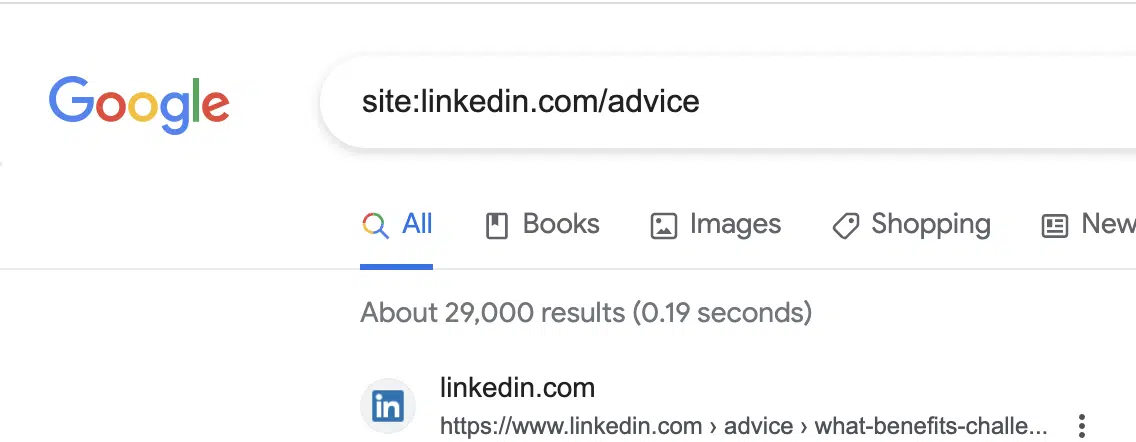
In less than three weeks, the content hub /advice/ launched almost 30,000 articles (9,000 in the last week).

LinkedIn advice - search results

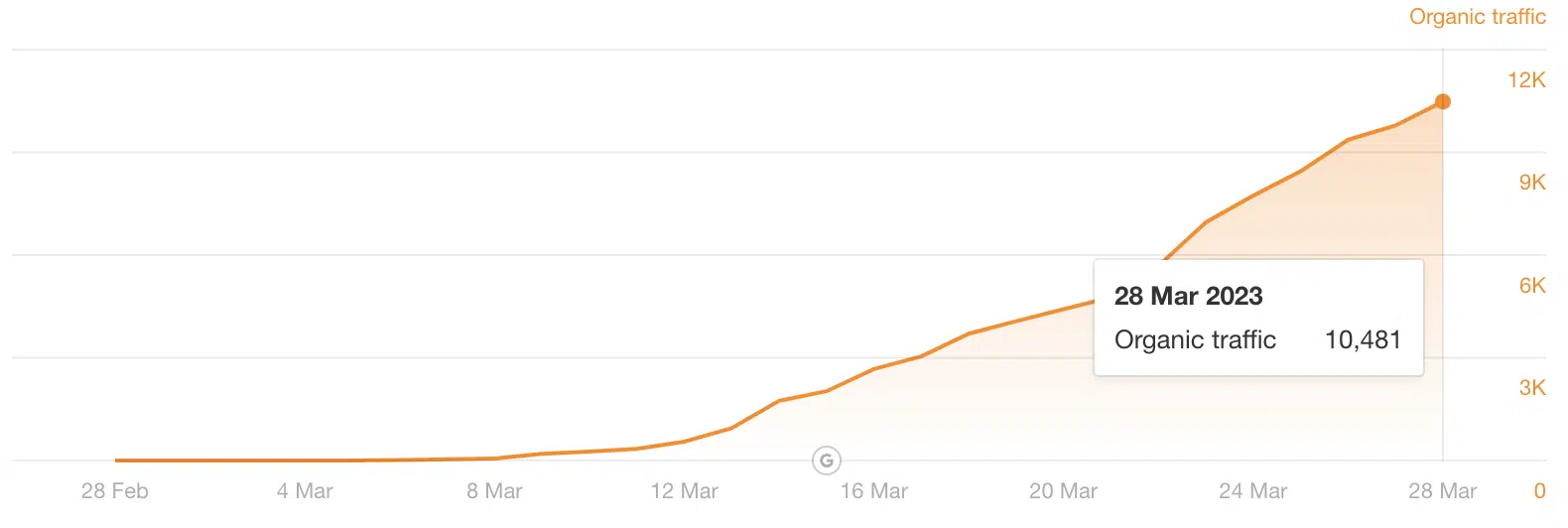
LinkedIn also gained 17,658 keywords and is estimated to gather thousands of organic sessions per Ahrefs data. 

LinkedIn advice - Ahrefs data

This article explores how LinkedIn’s latest AI- and member-assisted content initiative works and its impressive performance in Google search.

What is a LinkedIn collaborative article?

Collaborative articles on LinkedIn are created with AI and edited by human experts.

It allows LinkedIn to scale its content efforts with AI while maintaining quality through community insights. (Similar to how Wikipedia allows users to create and edit content.)

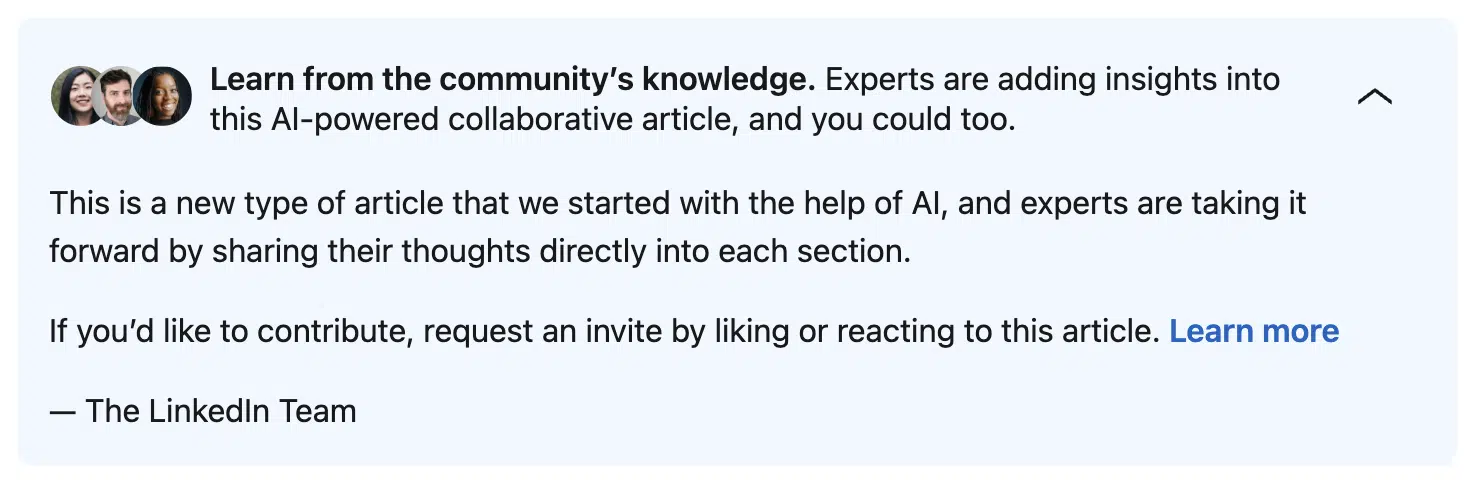
Collaborative articles are clearly labeled as such:

LinkedIn collaborative article label

LinkedIn collaborative articles and SEO

“How do you showcase your teamwork skills on your resume?” is an example of the SEO success of collaborative articles. 

It is already on Page 2 for the keyword cluster “teamwork on resume,” with 2,290 monthly searches in the U.S.

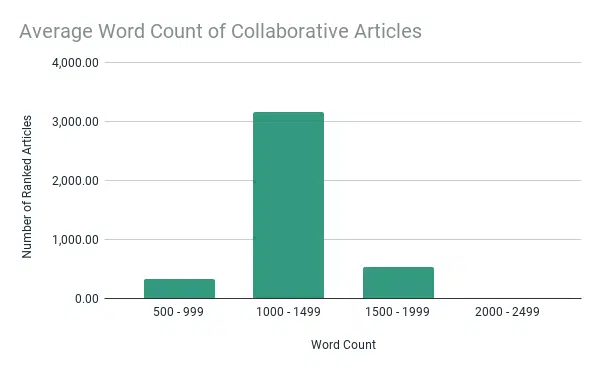
While this piece has 920 words, the average collaborative article is even longer – between 1,000 and 1,500 words. And they get longer with every quote and user insight added.

LinkedIn collaborative articles - average word count

The content is clearly structured with one H1, several H2s and a unique page title and meta description – all optimized for the keyword cluster.

URL https://www.linkedin.com/advice/0/how-do-you-showcase-your-teamwork-skills-resume-skills-teamwork
Word Count 920
Inlinks 4
Readability Fairly Easy
Indexability Indexable
Title 1 Teamwork Skills Resume Examples: How to Stand Out
Title 1 Length 49
Meta Description 1 Learn how to use teamwork skills resume examples to impress hiring managers. Choose relevant skills, use action verbs and results, and provide examples.
Meta Description 1 Length 152
H1 How do you showcase your teamwork skills on your resume?
H2 Choose relevant teamwork skills
Use action verbs and quantifiable results
Provide examples from different contexts

The hub has already collected 343 referring domains., and its popularity is only growing.

Imagine creating 30,000 articles of 1,200 words each and the cost and time associated with it. 

AI allowed LinkedIn to scale massively – the community component guarantees pageviews, social shares and backlinks, two perfect loops for growth and engagement. 

Why would you want to contribute to a collaborative article?

You will receive exposure through the quote box where your contribution will appear:

Contributing to LinkedIn collaborative articles

The whole advice hub is currently gaining massive momentum in Google Search.

LinkedIn is one of the strongest domains on the web, with a domain rating of 98 (Ahrefs). If your website can not rank for a keyword or topic, LinkedIn probably can.

By contributing to collaborative articles, you have a chance to:

  • Gain exposure on search queries you otherwise have no chance to rank for.
  • Gather credibility as an industry expert and thought leader.
  • Build your professional expertise on LinkedIn.
    • As LinkedIn puts it, “…to make sure that contributors are rewarded for giving their time and experience, they can earn a new Community Top Voice badge in their skill areas (e.g., “Top Sales Voice”) for adding their insights. You’ll be able to see the badge on profiles and next to contributions on the articles.”

As for selecting who can contribute, Linked states that they:  

“[Identify] members who are likely to be experts in a certain topic based on their work experience, skills proficiency, and prior engagement on the platform. They must also meet high trust standards by adhering to LinkedIn’s User Agreement and Professional Community Policies.”


Get the daily newsletter search marketers rely on.


Understanding user-generated content on LinkedIn

There are two more article types to understand and distinguish from the collaborative articles:

  • Users were already able to publish their own articles on LinkedIn and rank.
  • LinkedIn already scaled up its content production massively through “LinkedIn News.” 

User-generated content: Publishing your own articles

Your own LinkedIn articles already get indexed on the search results. They live on the slug /pulse/. Everyone with a LinkedIn account can create these articles – similar to Medium.

User-generated content: Publishing your own articles

The /pulse/ slug ranks for more than 7 million keywords. The good thing is you do not need to share space with the AI. 

So, if you are looking to rank for a competitive term, and you do not see a LinkedIn article ranking on Page 1 yet, write your own unique and keyword-optimized articles, and with a bit of luck (and backlinks), you can secure a top position.

LinkedIn article ideas

Some people call this on-SERP SEO because it allows you to own real estate on Page 1 even if your own website is not there.

Partner-generated content: LinkedIn News content

You will notice that the /advice/ slug redirects to the /pulse/ hub of the website, with the title: 

  • “Explore LinkedIn: Dig into what’s trending on LinkedIn. Learn something new, follow a topic of interest, find inspiration and join the conversation.”

Here, you will find LinkedIn News stories produced by the platform’s content creators and collaborators.

Because LinkedIn’s editorial team develops the content hub, it is very focused and structured, strategically speaking to the core areas of LinkedIn’s professional offerings. (Not so much Linkedin, the social media platform.)

You can learn about the following:

  • Career.
  • Job search.
  • Workplace.
  • Technology.
  • Job skills.
  • Human resources.
  • And more.

Each core pillar is broken down into subcategories. For example, “Job search” is broken into:

  • Resumes and cover letters
  • Interviewing

Every SEO loves this clean site structure. And /pulse/ has surely been an SEO play for LinkedIn.

Clean siite structure

Collaborative articles and skills pages

The new collaborative articles are published by skills pages, which look similar to company pages. 

Skills page - collaborative articles

Some skills pages already have hundreds of thousands of followers. LinkedIn automatically adds you to relevant pages based on your profile.

Following them is a good way to get notified about new articles going live.

SEO learnings from LinkedIn’s collaborative articles

These AI articles are LinkedIn’s big SEO bet

The collaborative articles are a creative example of AI content at scale. The contributions by LinkedIn users add human editing, stories and examples without making the LinkedIn content team a bottleneck during growth.

Since the LinkedIn editorial team originally briefs these pages, they have a structured approach to scaling content across new areas, e.g., business planning, customer experience, employee training or event management. 

The search volume for the main keywords of the first 4,069 pages ranked in the U.S. is already 710,080 per month – and more pages are getting ranked daily.

My hypothesis: Collaborative articles are LinkedIn’s big SEO bet this year. 

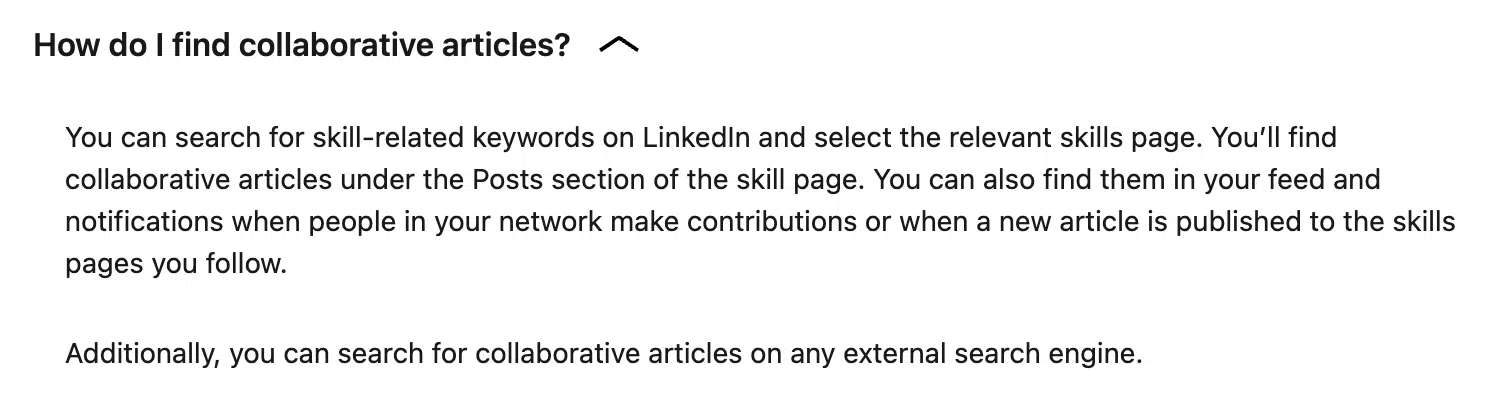
LinkedIn hints at that in its own FAQs, where they note search engines as one of the best ways to find these new articles.

LinkedIn collaborative article FAQ

Growth loop

The /advice/ hub works because it is a clever growth loop for Linkedin, as Juliana Mendez, fractional VP Growth and advisor for B2B SaaS, explains:

  • “Acquisition loop: AI and user-generated content brings in new users via SEO impact. These potentially contribute to these articles and share them – which again increases SEO impact (content and referrals) and again wins more new users or engages existing ones.
  • Engagement loop: Updates and new contributions trigger notifications and hence create higher engagement and likelihood of returning to the platform.”

LinkedIn’s brilliant SEO play

Collaborative articles align with LinkedIn’s general push of becoming a place where professionals come to learn.

With their unique combination of AI and user-generated content, they just put their content marketing and SEO on steroids. 


Opinions expressed in this article are those of the guest author and not necessarily Search Engine Land. Staff authors are listed here.


Related stories

New on Search Engine Land

@media screen and (min-width: 800px) { #div-gpt-ad-3191538-7 { display: flex !important; justify-content: center !important; align-items: center !important; min-width:770px; min-height:260px; } } @media screen and (min-width: 1279px) { #div-gpt-ad-3191538-7 { display: flex !important; justify-content: center !important; align-items: center !important; min-width:800px!important; min-height:440px!important; } }

About the author

Viola Eva

Viola Eva is passionate about digital entrepreneurship, flow, and mindful marketing. As founder and SEO of Flow SEO, she helps SaaS startups to scale their organic traffic. She is a speaker, educator, and specialist on all things SEO, known from UnGagged, Pubcon, Wordcamp Europe, Ahrefs, and many other events and publications.

https://searchengineland.com/decoding-seo-success-linkedin-collaborative-articles-395128


How to create, optimize and promote an ebook

As far as lead magnets go, an ebook is a great one.

A well-written, well-designed, optimized ebook can be an enticing appetizer for your audience. It’s a complete example of your brand voice, expertise, and knowledge in a portable, endlessly sharable format.

And if your appetizer (your ebook) impresses, your audience is likelier to partake in your main course (your products/services). 

About 43% of marketers say ebooks are the content assets that produce the best results for them.

In other words, an ebook is an indispensable part of a brand content marketing strategy. For that reason, let’s learn how to create, optimize and promote your ebook.

What is an ebook?

In marketing, an ebook is a digital book designed to teach your audience about a topic relevant to their problems and interests.

Brands make their ebooks available via downloadable files (in formats like PDF or EPUB)  that readers can view on their smartphones, tablets, and other devices. Some readers may even choose to print them out.

A typical ebook has a few important elements:

  • Written content in book format with a table of contents, chapters, and page numbers.
  • Graphic design elements include a designed ebook cover, pages, charts or graphics, and images. (The main draw should be your written ebook content.)
  • An author page with a bio or an “About us” if the author is a brand.
  • CTAs (calls to action) encourage readers to check out your products, services, or related content.

For example, this ebook called The Freelancer’s Bible has all the above elements to create a very effective package.

The Freelancer's Bible - Cover

Why create an ebook?

An ebook is a trust-building, credibility-creating, illustrated digital book that should nurture your audience and pull them further into your marketing cycle.

There are tons of benefits to creating an ebook. Needless to say:

  • It’s portable: Download it to read on your phone or tablet, or print it out.
  • It’s relatively low-cost to produce: You’ll either have to spend the time and effort to DIY your ebook or pay for a writer and a designer to create it. But ultimately, if you produce an evergreen ebook, it pays for itself over time.
    • You can distribute it infinitely without having to pay printing or shipping costs.
    • If your ebook has a lot of high-value content, you can charge a flat fee for readers to download it, which will cover your production costs.
  • An ebook can be interactive: You can embed links in the text and add CTAs readers can tap or click to further engage with your brand.
  • It can be accessible: If you make your ebook available to download in different formats, like EPUB, readers can adjust the text size and other screen options.
  • Ebooks aren’t intimidating: Usually, ebooks created for marketing run the gamut from five to 50 pages in length. This means your audience won’t be scared away from downloading it but rather encouraged because ebooks are quick and easy to read.

Ebook creation: How to write content and design your ebook

So it’s time to create your ebook. Before you write a single word of content, you must first have an ebook topic in hand that you know your target audience will love.

After that, you can move on to content creation and design.

1. Choose your ebook topic

Vet your ebook topic carefully. If you choose any random topic out of a hat, you can’t be sure your audience will be interested enough to download your ebook – that’s the entire goal!

Here are some tips to find the right topic:

Follow your content strategy

Your strategy should include guidance on content creation topics your brand focuses on. Refer to these areas to find a topic relevant to both what your audience wants and what you sell.

Look at your blog content for inspiration

Is there a topic you wrote about where you only scratched the surface? Expand on it in an ebook. Did one blog get a lot of engagement? Consider repurposing and expanding your best-performing blog into a high-value ebook format.

Mine your customer questions and feedback for ideas

What’s the number one question your customers ask? What do they wish they knew more about? Could you turn that topic into an ebook?

Research your topic to make sure it’s the right depth

Some topics don’t require an entire ebook to explain them. Others might be too in-depth and can’t be covered in less than 50 pages. For these reasons, look at how other people have approached your chosen topic to see whether what you want to discuss will fit in an ebook.

Research your topic on Google to see what types of content already exist online about it. If you find many books, check out their length and number of chapters.

If you find many articles, check what topic facets they include and what they might be missing that you could cover.

Do keyword research on your topic

Particularly, look at how competitive your topic is in search rankings. You’ll also see how many monthly searches it gets, which can help you understand the topic’s popularity. 

2. Create a table of contents

Next, once you’ve chosen a good topic, you can outline what you’ll include in the entire ebook by creating a table of contents.

This doesn’t have to be fancy right now (for example, you don’t have any content written yet, so don’t worry about page numbers). Just list the chapters you plan to include, and brainstorm your titles.

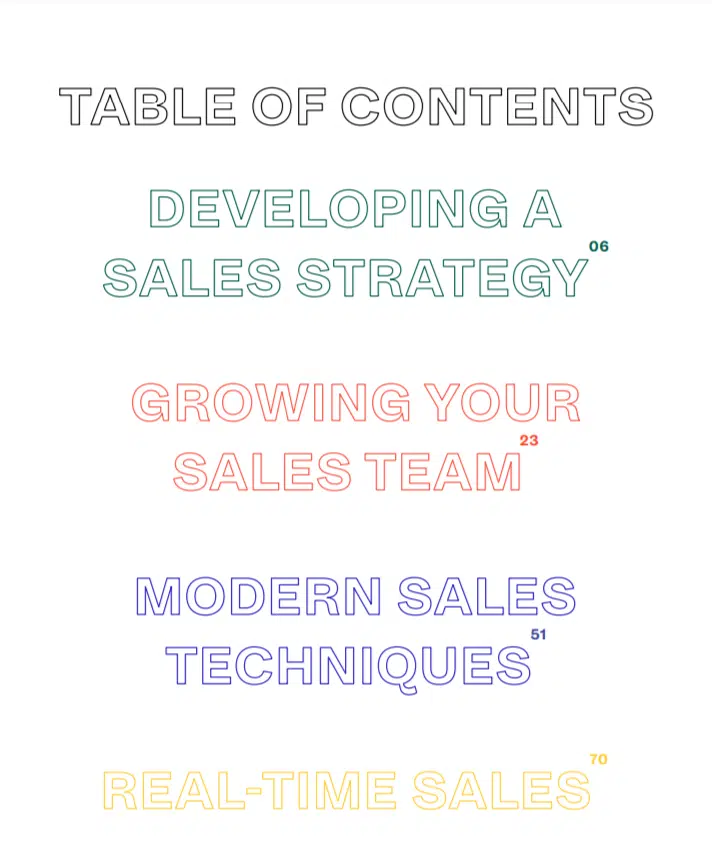
For example, in this ebook by Intercom (called “The Sales Handbook”), the table of contents is very simply laid out, but it tells you what piece of the topic each chapter covers.

(The topic, by the way, is sales strategy and techniques to achieve growth.)

Intercom ebook

3. Outline what you’ll talk about in each chapter

Once your chapters are laid out, you can outline what you’ll discuss in each.

Don’t skip outlining, by the way. It gives you a roadmap to follow as you write, which is super helpful for creating ultra-long-form content like ebooks. Content this long can quickly become unwieldy if you’re not organized.

Go as deep with your outline as you want. Maybe you’d prefer to keep it super simple and loose, so you just jot down a few key points for each chapter. Or, perhaps, you want to create a point-by-point outline that maps out every paragraph. Or maybe you float somewhere between these two extremes.

However you do it, just create a helpful guideline to follow later when you write the brunt of the content and fill in the blanks.

Remember: Your outline can include more than just text. 

For example, you could add placeholders and ideas for visual elements for your ebook, such as charts or graphs, photos you still need to source, or graphics you’d like custom-created. You can also add lists of resources you’d like to reference or content you want to use as inspiration.

This is your outline, so make it work for you.

4. Create a compelling ebook title

If you haven’t come up with a compelling, descriptive title yet for your ebook, now is the time.

Don’t be tempted to phone this part in – it matters because the title is the first thing people will see. They may not be motivated enough to learn more if it doesn’t immediately speak to them.

Consider these three rules when crafting your ebook title:

Keep it simple

A simple title beats a long, convoluted title any day. Especially for an ebook. You want your audience to understand exactly what your ebook is about without any confusion.  Let’s reference the ebook examples from earlier to show you what I mean. They’re short, sweet, but effective:

  • The Sales Handbook.
  • The Freelancer’s Bible.

Keep it clear

What if, instead of “The Sales Handbook,” the title was “The Handbook of Sales Strategy for Faster Business Revenue”? It doesn’t quite have the same ring, does it? 

Be descriptive

This doesn’t mean your title has to include a lot of adjectives. Instead, consider one strong word that conveys the purpose of your ebook.

In the above title examples, those words were “handbook” and “bible.” Both tell you that these ebooks are either exhaustive or contain step-by-step practical guidance. That’s the power of one strong word.


Get the daily newsletter search marketers rely on.


5. Brainstorm visual elements to complement the text

At this point, start thinking more deeply about the visual aspects of your ebook. 

And, yes, you do need visuals. They’re standard in a marketing ebook, not to mention they make your content much more engaging.

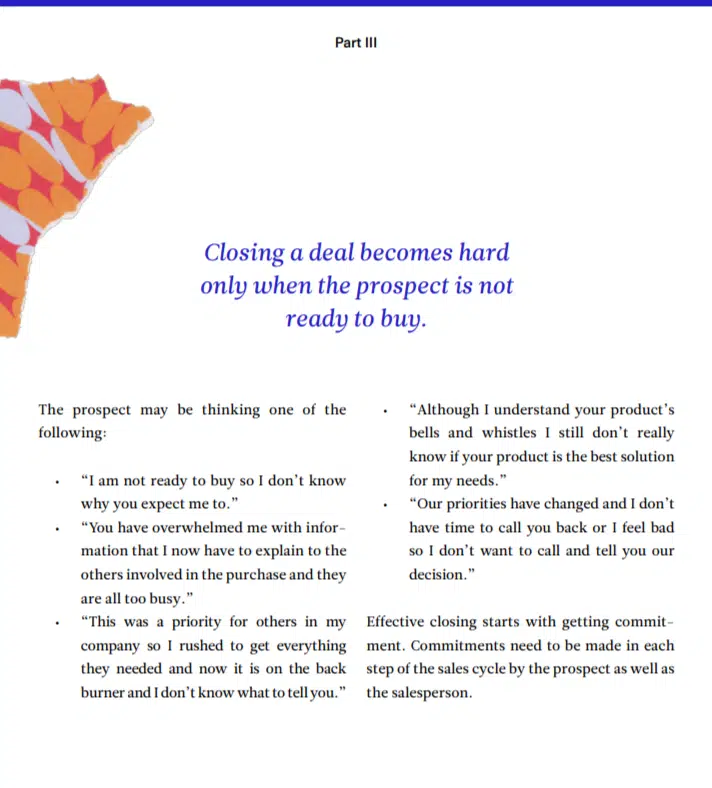
Pull quotes: Highlight important quotes from the content. Here’s an example from The Sales Handbook:

Sales Handbook pull quote

Stats: Similar to pull quotes, use graphical elements to make interesting or valuable stats stand out.

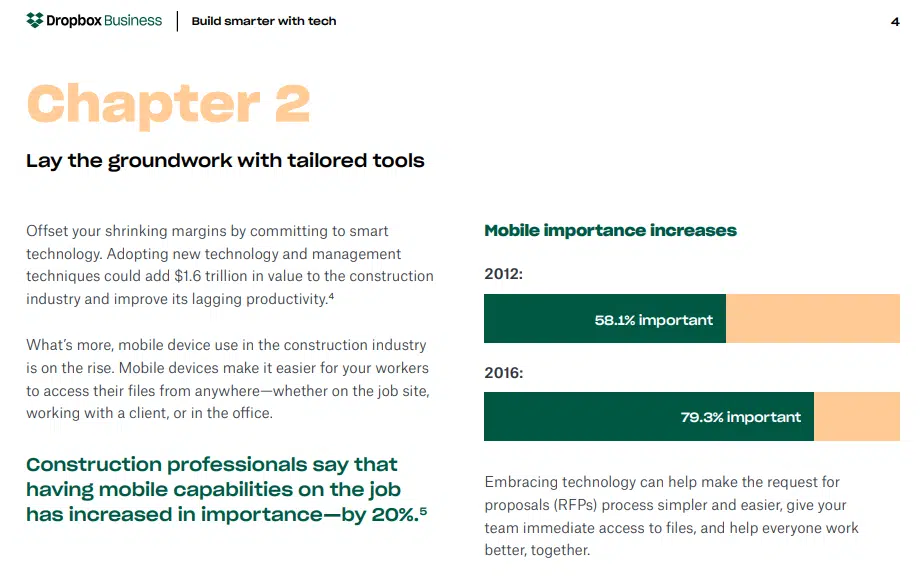
Charts or graphs: If you’re including research in your ebook, help readers visualize the data with a chart or graph. For example, this Dropbox ebook features simple bar graphs:

Dropbox ebook with charts and graphs

Infographic-style images: Again, help readers visualize what you’re talking about. Infographics are great for highlighting your most important points, too.

Photography: Photos are engaging and even better when they’re unique to your brand.

Design elements: Consider adding design elements to the text, like call-out boxes, typography, borders, accent colors, or custom illustrations.

For example, this ebook by Talking Shrimp is simple but features tiny illustrated shrimp around page headers. Note that it also includes blank space for readers to reflect on concepts taught in the content:

Talking Shrimp ebook with design elements

6. Strategize CTA placements

Don’t forget to add CTAs to your ebook in strategic spots. For example, you could add a CTA at the end of each chapter that encourages readers to check out related content. 

At the end of your ebook, add a CTA pointing to your best landing page selling your best, most relevant product or service.

Most ebook formats allow embedded links in your document, so don’t forget to add links to your website, your social accounts, and a link to sign up for your email list.

7. Enlist editing and graphic design help

You can DIY your ebook design using templates in tools like Canva, Issu, or Adobe InDesign. But, if you have the resources, consider hiring help from a graphic designer who can customize your ebook and align it with your branding.

In addition to design help, consider enlisting an editor who can comb through your ebook and catch any grammar slip-ups or mistakes you might have missed. The more eyes you get on your content, the more likely you will end up with a flawless final product.

A good editor can also help you nail the structure of your ebook and help you come up with engaging titles. If you need help finessing your copy/content, this person on your side will be indispensable.

Ebook optimization

Optimizing your ebook will make it more readable and likelier to rank in Google. Optimize with a few simple tasks:

8. Include relevant keywords

Yes, you can optimize your ebook with keywords. Here are some crucial places where you can add them:

  • The ebook file name.
  • The ebook title and chapter headings.
  • Inside the anchor text for any embedded links.
  • If applicable, in image captions or image alt text.

9. Make it easy to read

You should also optimize your ebook for ease of reading. If your audience has to zoom in by 200% just to squint at your tiny text, that’s a barrier to enjoying or learning from your content. And, without those value factors, they may not see any further value in engaging with your other content.

So, make sure your ebook is formatted for readability. Choose a clear, clean font for the majority of the text. Make sure it’s a comfortable size for reading on most devices. Ensure graphical elements don’t disrupt the reading experience or hinder it.

If you enlist a graphic designer, they can take the reins here to ensure your ebook is easy to read – not just pretty to look at.

10. Offer it in multiple formats

Not every reader has access to the same technology. If you offer your ebook in multiple formats (PDF and EPUB are great options), you’ll broaden the number of people who can access and read it.

When your ebook is written, designed, formatted, and ready to go, you can start promoting it.

11. Create an ebook landing page

Number one on your list for promoting your ebook should be to create a landing page.

A landing page is a dedicated page on your website that promotes and describes your ebook so people will want to read it. 

This page is the main spot where people can download your ebook. When you link to it on social media, in emails, or blogs, you’ll point people to this specific page.

What should you include on your landing page? 

  • Descriptive/promotional copy: Include your ebook title, a summary of what it’s about, and the benefits of reading your ebook (what will your readers walk away with in terms of education, information, entertainment, growth, or value?). 
  • A picture of the cover: Display a photo of your ebook cover to entice potential readers.
  • A preview of what’s inside: Your preview could include the table of contents or a full-page spread to give your audience a taste of what’s in store. If your ebook is on the longer side, this is especially worthwhile to include.
  • A form: Your ebook is meant to convert your audience from casual followers of your content to engaged subscribers. Hook up a form to your landing page that allows the reader to download your ebook only after filling out their contact information.
  • SEO: Don’t forget to optimize your landing page for search. Include the keywords you researched earlier in the page title, the meta title/description, the summary, and other bits of copy on the page.

Here’s an example from Crowdstacker:

Crowdstacker ebook landing page

12. Add CTAs to your ebook in relevant blog and website content

Once your landing page is ready, you can add CTAs that point to it in your blog and website content. Good rules of thumb to follow include:

  • Only add a CTA to your ebook when it’s relevant to the topic. For instance, point readers to your ebook when a “learn more about this topic” opportunity presents itself in related blogs.  
  • Don’t spam your audience with CTAs. Include them at key moments on a page or blog – no more, no less.

13. Promote your ebook on social media and in emails

Share your ebook with a wider audience to get more downloads. Go beyond your website to:

  • Post on social media with a link to your ebook. Include an image of the cover or a preview of the contents.
  • Send an email to your subscribers alerting them that you just published a new ebook. Include the link to the landing page and photos of the cover and contents.

Ebooks are a top content type for a reason. 

A good ebook converts well because it’s packed with value. Much thought and care should go into creating your ebook, from the presentation to the design and content.

When executed well, it should look like a printed publication in a handy digital package.

All that effort is worth it when considering the infinite ways an ebook can be distributed. As long as you choose an evergreen topic, you’ll have a conversion vehicle in your arsenal for years to come.


Opinions expressed in this article are those of the guest author and not necessarily Search Engine Land. Staff authors are listed here.


Related stories

New on Search Engine Land

@media screen and (min-width: 800px) { #div-gpt-ad-3191538-7 { display: flex !important; justify-content: center !important; align-items: center !important; min-width:770px; min-height:260px; } } @media screen and (min-width: 1279px) { #div-gpt-ad-3191538-7 { display: flex !important; justify-content: center !important; align-items: center !important; min-width:800px!important; min-height:440px!important; } }

About the author

Julia McCoy

Julia McCoy is the founder of Content Hacker, 7x author, and a leading strategist around creating exceptional content and brand presence that lasts online. At 19 years old, she used her last $75 to build a 7-figure writing agency which she sold ten years later. In the 2020s, she’s devoted to teaching founders and marketers the strategy, skills, and systems they need to build a business through inbound content, so they can create more lasting impact in the world.

https://searchengineland.com/ebook-create-optimize-promote-395116


Google updates Bard to improve math, logic responses

Google Bard just got an upgrade. By incorporating Google’s PaLM language models, Bard is now better at math and logic responses.

“Today I wanted to share that we’ve improved Bard’s capabilities in math and logic by incorporating some of the advances we’ve developed in PaLM,” Jack Krawczyk, the Google executive leading up Bard and Google’s AI efforts, said on Twitter.

What improved. Bard can now better understand and respond to your prompts and questions when they are in a multi-step word and multi-step math problems format, Krawczyk said.

Math improvements coming. Coding is coming soon to Bard, Krawczyk added.

The tweets. Here are his tweets with this announcement:

Google PaLM. PaLM stands for Pathways Language Model. It is a large language model developed by Google with 540 billion parameters. Researchers also trained smaller versions of PaLM (8 billion and 62 billion parameter models) to test the effects of model scale.

More on Bard. As a reminder, Google announced Bard was coming the day before Bing Chat launched but Bard did not open to general users until 10 days ago. The response Google received from Bard has been somewhat disappointing and underwhelming compared to that of Bing Chat and ChatGPT’s efforts. Even inside Google, employees urged the company to improve Bard.

But Google promises more is to come and Bard will get better.

Google intentionally launched a lightweight version of Bard and it will continue to get better over time, Google CEO Sundar Pichai said in a New York Times interview published today.

Why we care. Mostly, it is fun and exciting to see how these AI assistants and tools improve and are improving rapidly in such a short period of time. Be it ChatGPT, Bing Chat, Google Bard or others, following this space is a lot of fun.

So give Bard another try and see if you find it to be any better today than it was yesterday.


Related stories

New on Search Engine Land

@media screen and (min-width: 800px) { #div-gpt-ad-3191538-7 { display: flex !important; justify-content: center !important; align-items: center !important; min-width:770px; min-height:260px; } } @media screen and (min-width: 1279px) { #div-gpt-ad-3191538-7 { display: flex !important; justify-content: center !important; align-items: center !important; min-width:800px!important; min-height:440px!important; } }

About the author

Barry Schwartz

Barry Schwartz a Contributing Editor to Search Engine Land and a member of the programming team for SMX events. He owns RustyBrick, a NY based web consulting firm. He also runs Search Engine Roundtable, a popular search blog on very advanced SEM topics. Barry can be followed on Twitter here.

https://searchengineland.com/google-says-bard-was-updated-to-improve-math-and-logic-responses-395127


Google Maps can detect fake phone numbers in photos and remove them

Did you know Google can now detect if scammers are overlaying fake phone numbers in user-contributed photos within Google Maps and automatically detect and block those photos from displaying on business listings within the local search results?

Google has released some information on its efforts to combat fake content and reviews in Google Maps and local search. Here is some of the figures Google shared of those efforts, but was it enough?

Google Maps spam fighting. Here are some of the statistics Google shared on how it fought Google Maps spam in 2022:

  • Blocked or removed over 115 million policy-violating reviews (20% more than last year)
  • Blocked or removed over 200 million photos
  • Blocked or removed over 7 million videos
  • Prevented 20 million attempts at creating fake Google Business Profiles

Machine learning. Google also added two new machine learning-based techniques to help detect and prevent spam in Google Maps.

(1) Google said they released a new “machine learning model” that helped them “identify novel abuse trends many times faster than previous years.” This helped them find a sudden uptick in Business Profiles with websites that have .design or .top TLDs and quickly acted on those.

(2) Google also added a new machine learning model to detect scammers who overlayed inaccurate phone numbers on top of user-contributed photos to scam searchers to call the numbers in the phone number and not the official business phone number.

Is it enough. Just the other day, Jason Brown how hotels are being spammed with fake positive reviews and the hotel managers are nervous what this might result in. He also recently reported how review spammers are using ChatGPT to generate fake reviews for Google Maps.

Google did say, “While we’ve made a lot of progress in this area, we know that scammers continue to evolve — and we will too.”

Why we care. Spam and fake information in search is a hassle we all see and have to deal with as marketers. None of us like to be hit with spam, and none of us like to have fake reviews left on our businesses or clients’ business listings. Google is trying to reduce spam efforts but as you can imagine, it is a cat-and-mouse game.

As Google comes up with more ways and techniques to prevent and/or reduce spam, spammers find other ways around those efforts. You can see Google’s efforts last year, over here.


Related stories

New on Search Engine Land

@media screen and (min-width: 800px) { #div-gpt-ad-3191538-7 { display: flex !important; justify-content: center !important; align-items: center !important; min-width:770px; min-height:260px; } } @media screen and (min-width: 1279px) { #div-gpt-ad-3191538-7 { display: flex !important; justify-content: center !important; align-items: center !important; min-width:800px!important; min-height:440px!important; } }

About the author

Barry Schwartz

Barry Schwartz a Contributing Editor to Search Engine Land and a member of the programming team for SMX events. He owns RustyBrick, a NY based web consulting firm. He also runs Search Engine Roundtable, a popular search blog on very advanced SEM topics. Barry can be followed on Twitter here.

https://searchengineland.com/google-maps-can-detect-fake-phone-numbers-in-photos-and-remove-them-395098


These 44 hilariously terrible BuzzFeed travel articles were AI-assisted

I know what you’re thinking. “I’m going on a trip to Cape May, NJ and need a true ‘hidden gem’ of a travel guide.” Well, if by some extreme fluke, you see one of BuzzFeed’s AI-assisted content in your search results, here’s my recommendation: avoid it.

That’s because BuzzFeed has published 20 low-quality travel articles under the byline “As Told to Buzzy.” They’re all super formulaic and written in the first-person point of view. Or, do we now have to call it the “first-AI point of view”? (Does AI even have a view?)

Why we care. Multiple articles are calling these “SEO-driven” travel guides. Let’s stop that now. If these pages rank for any competitive terms, Google has failed as a search engine.

No, what BuzzFeed has done here is not “SEO”. BuzzFeed has simply published super low-quality, shallow, AI-generated articles written as a first-person narrative by the AI, about locations that exist in the world. Nothing more, nothing less. If these pages rank, it will be because it lives on an authoritative site, not because it’s any good.

As Told to Buzzy. That is the profile name under which the 44 articles live. The biography of this AI writer: “Articles written with the help of Buzzy the Robot (aka our Creative AI Assistant) but powered by human ideas.” But this is BuzzFeed, so E-E-A-T doesn’t matter, right?

All of Buzzy’s articles I looked at had a note at the top saying a version of “This article was collaboratively written by [insert name here] + Buzzy, our creative AI assistant.” Those collaborators seemed to all be non-editorial staff (from the business and sales side of the company), the Verge reported.

  • Fun fact: BuzzFeed has a separate AI quiz writer byline for Buzzy the Robot, author of 26 quizzes.

Hilariously terrible. Some of the lowlights, via Futurism:

  • “Now I know what you’re thinking…”
Buzzy I Know What Youre Thinking 800x442
  • “A hidden gem”
Buzzy Hidden Gems 800x475
  • And beyond.

Part of BuzzFeed’s core business. BuzzFeed CEO Jonah Peretti announced its big ambition in January: to “lead the future of AI-powered content.” If the future is now, I’m not impressed.

AI can make many parts of the content creation process easier (e.g., brainstorming topics, structuring the article). The one thing AI clearly can’t do yet is improve the final product for the unfortunate humans who try to read it.

Yes, you can easily create tons of AI-assisted or AI-generated content about whatever topic you want now. But the question is: should you?

And the bigger question is – how will Google respond? Will the helpful content system catch low-quality, AI-assisted content and prevent it from ranking? Or will Google need to take new action as it did with content farms a decade ago with Panda?

Dig deeper. More coverage on Techmeme.


Related stories

New on Search Engine Land

@media screen and (min-width: 800px) { #div-gpt-ad-3191538-7 { display: flex !important; justify-content: center !important; align-items: center !important; min-width:770px; min-height:260px; } } @media screen and (min-width: 1279px) { #div-gpt-ad-3191538-7 { display: flex !important; justify-content: center !important; align-items: center !important; min-width:800px!important; min-height:440px!important; } }

About the author

Danny Goodwin

Danny Goodwin has been Managing Editor of Search Engine Land & Search Marketing Expo – SMX since 2022. He joined Search Engine Land in 2022 as Senior Editor. In addition to reporting on the latest search marketing news, he manages Search Engine Land’s SME (Subject Matter Expert) program. He also helps program U.S. SMX events. Goodwin has been editing and writing about the latest developments and trends in search and digital marketing since 2007. He previously was Executive Editor of Search Engine Journal (2017 to 2022), managing editor of Momentology (from 2014-2016) and editor of Search Engine Watch (from 2007 to 2014). He has spoken at many major search conferences and virtual events, and has been sourced for his expertise by a wide range of publications and podcasts.

https://searchengineland.com/buzzfeed-ai-assisted-travel-articles-395112