This day in search marketing history: March 25

Google Panda patent granted

In 2014, a patent (Ranking search results) written by Google’s Navneet Panda and Vladimir Ofitserov – possibly describing the Google Panda algorithm update, or parts of it – was granted.

However, the fact that Google was granted this patent didn’t necessarily mean it was being used by Google at the time, or that it hadn’t been modified since the application was filed. 

Read all about it in Google Granted Patent For Panda Algorithm and dive deeper into Bill Slawski’s Google’s Panda Granted a Patent on Ranking Search Results and Is Ranking Search Results the Panda Patent? on SEO by the Sea. And here’s the patent.

In short, it was about looking at inbound links and how many search queries were made about a particular page/resource, and it modified the “initial scores” for the pages/resources being ranked.

Slawski explained the patent had many parts that worked together:

  • Determining, for many groups of resources, a count of independent incoming links to help in the group
  • Deciding, for each of the plurality of groups of resources, a count of reference queries
  • Choosing, for each of the plurality of groups of resources, a respective group-specific modification factor, wherein the group-specific modification factor for each group get based on the count of independent links and the count of reference queries for the group
  • Associating, with each of the plurality of groups of resources, the respective group-specific modification factor for the group, wherein the respective group-specific modification for the group modifies initial scores generated for help in the group in response to received search queries

Also on this day


Google Search rolls out a more visual search interface on mobile with grid format

2022: Were both top results position one or did Google count the one on the right as position two?


Google Search Console users experience crawl stats report data issue

2021: Between March 10 and 23 there was a data issue with the crawl stats report, no Google Search performance issues were associated with this data bug.


Google adds practice problems and math solver structured data and Search Console reports

2021: Google came up with new structured data and Search Console reporting to help educational websites understand which pages had these content types.


Microsoft proposes method to automatically submit URLs from WordPress to search engines

2021: Microsoft wanted to build into the core of WordPress the ability to automatically push new and updated URLs to Bing and other search engines.


Microsoft Advertising introduces more automation via ad suggestions with auto-apply

2021: Ad suggestions marked as auto-apply would start serving after 14 days if no action was taken.


Google Podcasts gets a redesign and iOS rollout

2020: The new design featured an Explore tab with recommendations based on the listener’s interests.


Google turns on ‘mark a business temporarily closed’ for business owners on GMB

2020: The tool was under ‘Close this business on Google.’


SEOs talk pivoting and planning for a future after COVID-19

2020: What veteran SEOs were doing to help clients adapt to business during and after the pandemic.


COVID-Consumers: Pessimistic, but spending more online

2020: A large majority of consumers expected a recession next year but were spending up to 30% more online, according to a survey.


Social platforms cut streaming quality as ‘social distancing’ wages on

2020: The push to downgrade streaming quality was primarily focused in Europe with regulatory mandates to reduce network strain.


Video: Hamlet Batista on scaling and automating SEO with code

2020: And a bit about using Python.


Google webspam report: Hacked sites, user-generated spam, bad linking topped 2018 priorities

2019: Google released its annual webspam report last week to highlight advances against content that seeks to manipulate ranking algorithms and harm users.


Google AMP, mobile-friendly testing tools support code editing

2019: Google announced that its AMP and mobile-friendly test tools supported the ability to edit code and rerun the test, live.


Bing Ads bad account takedowns doubled in 2018

2019: Third-party tech support scams, cryptocurrency and weapons ad content topped the areas of attention.


TravelTime maps API lets users search by time rather than distance

2019: Users could search by time and make travel or transportation decisions accordingly.


AdWords now applies recommended bids to new DSA categories automatically

2016: The feature was designed to help managers set up a lot of dynamic search ad categories quickly.


Contradicting other data, Compete says search traffic growing on the desktop

2016: Firm argued number of searchers and searches per user have grown significantly on the PC since last year.


Search in Pics: Google hammocks, “Star Wars” wall stickers & Matt Cutts playing with pandas

2016: The latest images showing what people eat at the search engine companies, how they play, who they meet, where they speak, what toys they have and more.


Google Adds Subdomain Support To Change Of Address Tool In Google Webmaster Tools

2015: You could now communicate subdomain moves in Google Webmaster Tools Change of Address tool.


Google Clarifies “Mobile Friendly Update” Will Roll Out Over A Week, Be Yes/No Response & More

2015: There were no degrees of mobile-friendliness in this algorithm.


Google Launches Major Push To Get Local Businesses Online, Improve Data

2015: New site offered tools, content and solicited business owners to update information.


Google Misattributing Content From Major News Publishers

2014: It was unclear if the issue was with Google or with the publishers.


Five Days Later, It Looks Like Google Has Penalized Web Design Library For Selling Links

2014: A website that was using Twitter to renew paid links appeared to have earned a Google penalty.


BrandVerity Offers Feedback From Google, Bing On Paid Search Trademark Complaints

2014: BrandVerity added a process to its paid search ad monitoring system to give clients direct feedback from Google and the Yahoo Bing Network on trademark violation complaints.


Apple Broadening App-Store Search With Related Keywords

2014: While this wasn’t entirely helpful it did offer some discovery potential.


Google Finally Discontinues The Blocked Sites Feature

2013: After over a year of the blocked sites feature not working (and two months after Google promised it would return) Google officially declared they were discontinuing the feature.


Google Streamlines AdWords Rules On Using Trademark Keywords

2013: Google announced an update to its AdWords trademark policy that streamlined the rules on using third-party trademark keywords in campaigns.


Google Adds Publisher Opt-Out Tool For Shopping, Flights, Hotels & Local Search

2013: Google’s tool was a result of an agreement with the US Federal Trade Commission over antitust charges.


Bing Offers Recommendations for SEO-Friendly AJAX: Suggests HTML5 pushState

2013: Bing announced support for HTML5 pushState as a way to implement AJAX on a site in a way that helped Bing crawl and index the URLs and content.


Facebook Graph Search Now Passing Keyword Data To Webmasters

2013: The keyword data was passed from Facebook with a query string [q={keyword}] appended to the end of the referring URL. 


LinkedIn Is Getting Smarter With Enhanced Search Features & Improved Query Results

2013: LinkedIn launched a new unified search feature and a smarter query intent algorithm that continuously served up more relevant results.


Apple Buys Indoor Location Company, What’s It Up To?

2013: Did Apple see indoor location as a future part of the iOS platform?


Was Android Tablet OS (Honeycomb) Rushed to Market?

2011: “To make our schedule to ship the tablet, we made some design tradeoffs,” said Andy Rubin, vice-president for engineering at Google and head of its Android group.


Updated: Is “FaceSense” Forthcoming?

2011: Facebook was testing new ad targeting options that displayed creative beside content that was contextually relevant, similarly to Google’s AdSense.


Zuckerberg In Zion: Speaks To Senator Hatch, Students At BYU

2011: He spent a fair amount of time talking about the “misconception” that advertisers can access your personal information, but rather, that Facebook does the targeting based on advertiser selection.


Search In Pics: Yahoo Purple Door, Bus Stop & Google Honeycomb

2011: The latest images showing what people eat at the search engine companies, how they play, who they meet, where they speak, what toys they have, and more.


Google Bug & Slow PR Leads To Chinese Hack Rumors

2010: Google executives page was showing up in Chinese language.


Google Now Offering “Remarketing” To All AdWords Advertisers

2010: Google had initiated a trial of remarketing for display and text ads throughout its content network in March 2009.


Google China: Congressional Praise; Microsoft Supports Tyranny & Google Eats Poo Cartoon

2010: The reactions to Google’s partial withdrawal from China continued. 


Microsoft Announces Raft Of New Bing Features: Improved UI, More “Answers” And Of Course Foursquare

2010: Many of the improvements were focused on the UI, richer vertical experiences, maps and real-time information.


The State Of Search Engine Marketing 2010

2010: The North American search engine marketing industry was expected to grow 14% from $14.6 billion in 2009 to $16.6 billion by the end of 2010.


The Things That Facebook Causes, According To Google, Yahoo & Bing

2010: Divorce, depression, jealousy, cancer and more.


SES New York 2010 Day 3 Live Coverage


Google Voice Search & My Location Now On Blackberry

2009: The My Location feature let you search without needing to input a city name or some other geographic modifier.


Yahoo Closes The Cabin Door On FareChase

2009: An alert on the FareChase website indicated it was the service’s final day and encouraged users to instead use Yahoo Travel.


Google’s Search Box Grows As Needed: Yahoo & Live Search Don’t

2008: Google would increase the width of the search box if a query was long enough to warrant a wider search box.


White Spaces: Google’s Second Bite At The Wireless Apple

2008: Google did not win any of the 700MHz bandwidth, although it secured the right of open access for third-party devices and software on the C Block.


Is Yahoo Hoping For Justice Department Intervention To Stop MicroHoo Merger?

2008: Was government intervention the secret hope of Yahoo management?


OpenSocial Becomes More Open, Facebook Says No; AOL Flamed By Mag; Court Rules Against Clicking Minors

2008: Google, Yahoo, and News Corp.’s MySpace joined forces to announce that OpenSocial, the social networking platform alternative to Facebook’s platform, was going to become a non-profit foundation.


From Search Marketing Expo (SMX)


Past contributions from Search Engine Land’s Subject Matter Experts (SMEs)

These columns are a snapshot in time and have not been updated since publishing, unless noted. Opinions expressed in these articles are those of the author and not necessarily Search Engine Land.


< March 24 | Search Marketing History | March 26 >


Related stories

New on Search Engine Land

@media screen and (min-width: 800px) { #div-gpt-ad-3191538-7 { display: flex !important; justify-content: center !important; align-items: center !important; min-width:770px; min-height:260px; } } @media screen and (min-width: 1279px) { #div-gpt-ad-3191538-7 { display: flex !important; justify-content: center !important; align-items: center !important; min-width:800px!important; min-height:440px!important; } }

About the author

Danny Goodwin

Danny Goodwin has been Managing Editor of Search Engine Land & Search Marketing Expo – SMX since 2022. He joined Search Engine Land in 2022 as Senior Editor. In addition to reporting on the latest search marketing news, he manages Search Engine Land’s SME (Subject Matter Expert) program. He also helps program U.S. SMX events. Goodwin has been editing and writing about the latest developments and trends in search and digital marketing since 2007. He previously was Executive Editor of Search Engine Journal (2017 to 2022), managing editor of Momentology (from 2014-2016) and editor of Search Engine Watch (from 2007 to 2014). He has spoken at many major search conferences and virtual events, and has been sourced for his expertise by a wide range of publications and podcasts.

https://searchengineland.com/search-marketing-history-march-25-394830


When and how to use HTML sitemaps for SEO and UX

Google search advocate John Mueller has always downplayed the value of HTML sitemaps. Recently, he reiterated his dissatisfaction with HTML sitemaps, saying: 

“I changed my mind on HTML sitemaps over the years, they should never be needed. Sites small [and] large should always have a clear navigational structure.”

This is a slightly stronger stance than what he’s expressed in the past:

“When it comes to SEO … for small sites, your site should be crawlable anyway (and if you’re using a common CMS, it’ll almost always be fine) & for large sites, they’re not going to be useful anyway (use sitemaps, use normal cross-linking, check with a crawler of your choice).”

While Mueller makes a good point, in my opinion, we can’t just completely drop HTML sitemaps. Links and website usability still matter. 

I also like what former Googler and now popular SEO expert Pedro Dias said in response to Mueller’s remarks, which reflects the reality of the web:

“Unfortunately it’s not easy to change the architecture on complex and large websites. Often, something like this, [sic!] can take years to change, as it depends on multiple teams. So, HTML sitemaps are often a welcome and temporary-ish solution. I used to dislike them… Nowadays, I see their use-cases.”

There is a compromise between both HTML and XML sitemaps, so as always in SEO, “it depends.” 

Read below why, when and how to use sitemaps to benefit your website and its users. 

What are sitemaps and why did they get invented?

In the early days of the web, many websites grew organically. 

Websites weren’t appropriately planned by information architects according to UX best practices. 

They started from scratch, and webmasters added content whenever needed in often far-from-usable ways. 

Those were the days before blogs, social media or content management systems. When you built a site, you did it yourself using HTML.

In most cases, you were manually coding the HTML in a text editor, using a messy WYSIWYG editor like Dreamweaver or one of the first often custom-built and pretty cumbersome CMS tools. Either way, website structures quickly became confusing.

So out of necessity, people started adding sitemaps to their websites to make some sense of the increasing disorder. Those sitemaps were created in plain HTML and looked like any other webpage, part of the fact that they displayed a map instead of written content.

Later search engines introduced so-called XML sitemaps meant to replace manual “search engine submission.”

More than 25 years later, HTML sitemaps are less preferred. But can we really stop using HTML sitemaps, just like we dropped guest books or webrings? 

HTML vs. XML sitemaps – the visible vs. the invisible

To make it short and simple, the main difference between HTML and XML sitemaps is that an HTML sitemap is usually visible to website visitors while an XML sitemap is not. (The latter primarily made for search engines.)

The XML sitemaps standard was introduced at the end of 2007 by search engines like Google, Yahoo and Bing (then MSN). 

By default, they are formatted in a way that does not display well or is readable for humans. Instead, such sitemaps are used mainly to ensure proper and faster indexing by search engines.

On the other hand, just because a resource is on an XML sitemap does not mean Google and Bing will index it, or it will be findable even if it’s in the index.

Another SEO colleague Rob Watts added a tongue-in-cheek, first-hand account to the debate by saying:

“I had sites do well for years that were absent of html or xml sitemaps. I removed my tin foil hat and began using xml sitemaps and enjoyed seeing how long it took for urls to appear in serps. I don’t think I saw any noticeable improvement performance wise for their use, but it made some analyses/reports slightly easier.”

So with XML sitemaps only theoretically ensuring crawling and indexing, do we have to focus on them and neglect visible or visual sitemaps? 


Get the daily newsletter search marketers rely on.


Why should we create sitemaps solely for Google?

Over the years, Google spokespeople told us to create websites for users, not search engines. Why make an exception when it comes to sitemaps and only create them for Google and other search engines? 

It makes me wonder whether other SEO tactics that display one thing for search bots and something different for website visitors may also be a good idea.

Anyway, Google said so, so we must listen, right? Not really.

There must be a reason why Google dislikes HTML sitemaps and prefers XML.

XML sitemaps are usually automated and include all the content published as soon as it’s online. 

On WordPress, numerous tools create sitemaps for you. Yoast SEO also covers you, for example, even the basic free version.

In 2020, WordPress finally added XML sitemap support to its core, so you won’t even need external plugins.

The XML code format is also machine-readable, while HTML is messy. HTML has to work despite errors, while XML breaks when you forget a character.

So at the end of the day, the XML sitemap creation works mostly behind the scenes without error-prone human hands interfering.

Also, most people will never see your XML sitemap, they wouldn’t even know where to find it as it’s not linked anywhere visibly on the site.

Making XML sitemaps work for people

Luckily, there is always some middle ground. You don’t have to make XML sitemaps invisible. 

You can format XML sitemaps with stylesheets just like you do with any HTML pages.

This technique has been working as long as XML has been around. There are tutorials out there that help you with that.

Indeed for a while, it seemed that XML would replace HTML as the web standard, or it was a compromise called XHTML.

For compatibility reasons, that didn’t happen. Even though the XHTML format was cleaner and less error-prone. When an error happened, the website did break.

With HTML5 introduced instead, browsers embraced sloppily coded websites to make publishing easier but at the expense of automatic crawling.

Now you have ideally created an XML sitemap that can be read by people without coding skills. Remember that it’s still a bland list of all the content you have.

You may still consider creating a readable HTML sitemap for your website visitors.

When to use visual or HTML sitemaps

It’s not either/or. You can:

  • Decide to separate both visible and invisible sitemaps instead of making your XML sitemap visible to people.
  • Create both visible (HTML) and invisible (XML) sitemaps on your site for different reasons. 
  • Have more than one HTML or XML sitemap. 

It depends on what your site looks like and what your objectives are.

Use these questions as a guide to making a decision:

  • Do you want to create a quick overview page of your site? Use an HTML sitemap!
  • Do you want to get indexed as soon and as deeply as possible? Create an XML sitemap.

That said, there are edge cases, and many websites do not conform to typical standards. 

Here are example use cases for visual or HTML sitemaps.

Legacy and/or hard-coded sites

Believe it or not, there are still legacy sites from decades ago on the web, and even hard-coded sites made manually in HTML, CSS and/or JavaScript.

In fact, you’ve probably used one quite often. 

Amazon.com is almost the same site it was many years ago. It has been continuously refreshed over the years and improved to this day. 

An all-out redesign would have been too risky and disruptive for the bottom line.

Some basic legacy sites may have difficulty creating an XML sitemap on the fly. So it’s not a problem when they have a hard-coded HTML sitemap instead. 

Do you have to remove it because Google says so? Of course not.

Large sites

When Mueller said that you needed proper site navigation, he was generally right. But it does not always apply to larger sites. 

You can’t possibly fit a highly complex site with thousands of pages into a menu without it quickly spiraling out of control. 

For better findability, it’s useful for both humans and search bots to have sitemaps that reflect the overall site structure. 

You don’t have to list every page, as that would make it too large.

Alternative to mega menus

Many sites attempt to fit as much as possible into their site navigation and end up having so-called mega menus. 

You hover your mouse over the navigation, and the menu suddenly covers the whole site. 

Users get quickly overwhelmed visually with dozens of options to select from.

Also, sometimes, if a user is not fast enough to point at the right menu item, it will disappear when they lose the level one menu. 

Mega menus are tempting, especially with large companies where every stakeholder wants to be on top. 

But they are often a user experience nightmare, as Smashing Magazine founder Vitaly Friedman clearly demonstrates.

When doing web outreach, you might notice that many sites make it quite hard to contact them. 

Such is often the case with sites having no internal search feature. You will often struggle to locate their contact page. 

A search feature would be a logical solution, yet surprisingly some sites do not have one, even those run on WordPress, which has built-in functionality. 

Some themes or website owners simply remove the search input.

When I can’t find a standard page in your menu and there is no search feature available,a visual sitemap would be nice.

Orphan pages

When you manage to create a menu that is usable without becoming so huge that it does not fit some screens anymore, you will often end up with orphan pages. 

Orphan pages are webpages that are not linked internally from the menu structure or inside the content. 

This happens when content gets removed and updated, and some links disappear.

Oftentimes, orphan pages should be removed altogether. 

Others still make sense but might not be as significant to place into the main menu or the footer links. 

Such orphan pages would be fine when linked in a visible, readable sitemap so that people looking for them can find and access them.

Faster indexing 

Let’s be honest! Just because a page or other resource (think image or video) is listed on an XML sitemap does not mean Google will index it. 

Your site may not have enough authority to get all its content into the Google index. 

This was quite a common issue for new sites in the past. Especially with newly created sites and Google having more limited computing power, some content did not make it into the index on purpose.

It’s less of an issue now, but you still may want to link content internally to boost your chances of getting indexing. 

Link to the more important content on top, prominently, and/or more often.

When we talk about authority, we refer to the link equity that some SEOs still call “link juice.” 

An HTML sitemap that shows some links on top and others at the bottom regulates link equity flow to some extent. 

Pages linked on top are expected to have and receive more authority than pages at the bottom. 

With XML sitemaps, there is no such hierarchy, as far as I know. All resources listed on it are just that, items in a list. 

The item on top is merely the latest one, not necessarily the most important one or the one needing the highest authority. 

There is no inherent hierarchy on XML sitemaps unless you code one into it by declaring that some resources are more important and, thus, should be crawled more often than others.

A visible HTML sitemap allows you to link those resources on top that matter most and thus send more users and authority their way, just like in your site navigation. So it’s not “latest” on top but most important on top, ideally.

Usability

As we are talking SEO here, the most important aspect of sitemaps, improving usability, comes at the end. 

This is Search Engine Land and not UX Collective, after all. They advocate creating an (internal) UX sitemap for every website project, at least while establishing the information architecture.

HTML sitemaps improve the overall user experience, especially:

  • Accessibility.
  • Discoverability.
  • Findability.
  • Usability. 

These are still the strongest use cases for HTML sitemaps, just like in the ‘90s, way before Google started using links for indexing and ranking and long before XML sitemaps were introduced. 

Older users (I admit I’m among them) may even prefer clear and page-style sitemaps instead of shaky menus that vanish when you don’t touch them or search features showing irrelevant items. 

Some elderly people cannot use mouse-over and mouse-click actions efficiently. 

People with disabilities, particularly the visually impaired, need as few mouse actions as possible. Thus, a one-page overview might be best for them.

Useful sitemap examples in the wild

The New York Times 

I often use the New York Times as an example because almost everybody knows the publication, and it’s such an authority. 

This time I want to show the NYT as an example simply because they managed to do something right and stand out. 

The NYT uses visible HTML sitemaps in a way that is really helpful for readers, search users and search engine bots alike. 

The NYT has several sitemaps highlighted by fellow SEO Chris Long of Go Fish Digital on LinkedIn. It is a prime example of using sitemaps to benefit a website.

“60 Second SEO: The New York Times has one of the best HTML sitemaps I’ve seen. Here’s an example of how an article from 1912 is only 5 steps away from [their] home page:”
I don’t want to go too much into detail here, as Long has done an excellent job already at it.

Apple.com

Another great example of sitemap usage for a large site is Apple.com. Their plain and simple text sitemap is useful for people and search engines.

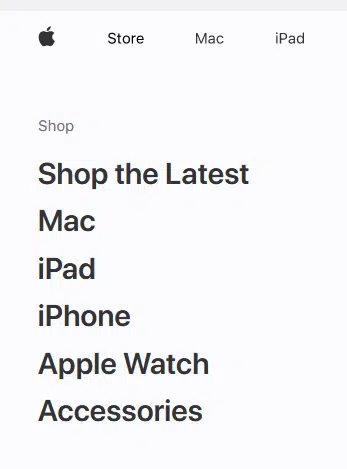
However, note how much the sitemap differs from the actual top navigation the Apple site has above the content.

The “Apple sitemap” starts with “About Apple” (not linked) and the following links:

Apple Site Map

The site navigation starts with the shop and specific products in contrast:

Apple Site Navigation

Apparently, the SEO team decided to make the shop and products more visible to website visitors and search bots. At the same time, the true structure or importance of the pages seems to be completely different.

In any case, the huge Apple sitemap gives users a good overview of the site contents without overloading the page despite more than a hundred links.

Moreover, they have another sitemap in the footer reflecting the top menu structure instead of the standalone “sitemap” on the dedicated page.

It is smaller both by the font size and by the number of links listed but still very useful.

Apple footer site map

So no matter where you end up, you always have a site navigation or sitemap to help you. 

An “everything is easy to find” user experience is central to the Apple website design.


Opinions expressed in this article are those of the guest author and not necessarily Search Engine Land. Staff authors are listed here.


Related stories

New on Search Engine Land

@media screen and (min-width: 800px) { #div-gpt-ad-3191538-7 { display: flex !important; justify-content: center !important; align-items: center !important; min-width:770px; min-height:260px; } } @media screen and (min-width: 1279px) { #div-gpt-ad-3191538-7 { display: flex !important; justify-content: center !important; align-items: center !important; min-width:800px!important; min-height:440px!important; } }

About the author

Tadeusz Szewczyk

Tadeusz Szewczyk, also known as Tad Chef, is a professional blogger and SEO since 2004. Even though based in Berlin, Germany he has covered blogs, social media and search for a global audience starting in 2006. In 2007 he launched his own blog – SEO 2.0 – and also published on numerous other marketing blogs ever since. In recent years he wrote for the social media accounts of many clients as well. You can connect with Tad on LinkedIn and Twitter or visit his website and read his blog about social SEO.

https://searchengineland.com/html-sitemaps-seo-ux-when-how-394763


How to create brand style guidelines and why you need them

If your brand is like most, you create various types of content across multiple channels.

You might even have more than one creator on your content marketing team.

How do you ensure the content you publish stays consistent in look, feel, and sound anywhere it appears online? How do you make sure it stays true to your brand voice and style no matter who creates it?

If you want consistency in your brand content and presence – and you should! – you need to create brand style guidelines. This guide will explain how.

What are brand style guidelines?

Brand style guidelines are a set of rules that govern how your content looks, feels, and sounds. Think standards: for your brand voice and tone, your logo and color palette, grammar rules, how to use and spell your brand name, how to use visuals in content, and more. 

Usually, these guidelines are recorded in a shared document that your whole team can access. Each creator follows your guidelines to ensure your content stays consistent no matter who touches it.

Why you need brand style guidelines in your content strategy

A well-developed, thoughtful set of brand style guidelines is one of the key ways your brand identity is cemented in place.

When each piece of content you create adheres to these guidelines, it contributes to your overarching, consistent reputation across the web.

That’s no small feat, as brand consistency can increase revenue by 10-20%. 

On the other hand, what happens if you don’t have brand style guidelines in place?

You risk creating a jarring or confusing experience for people who interact with your brand.

For example, let’s say you publish a blog with a serious, facts-driven tone, but your brand voice is actually casual and light-hearted. That’s a big disconnect that will give your audience a mixed message.

The same will happen if your content and platforms have various styles, tones, voices, and stylistic choices. Your brand identity will be like a shifting sea versus a strong, steady pillar people can trust. 

At the end of the day, that’s what we’re most concerned with. Trust. 

Consistency builds trust. Inconsistency kills it. And brand style guidelines help you cultivate consistency.

How to create brand style guidelines

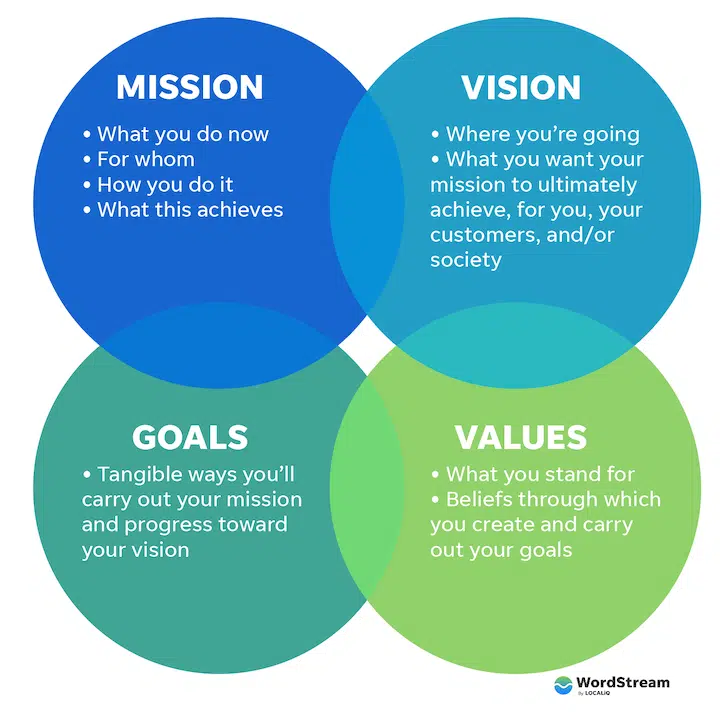
Before you can create brand style guidelines, you must first have a firm grasp of your brand’s identity, including your mission, values, audience, and goals. These things form the foundation on which you’ll base your guidelines.

The point of a brand style guide is to cement your identity in place, so you must figure out each piece before you can document them. Don’t continue onward until you’ve accomplished this.

1. Brand identity: Mission, vision and  ‘About us’

To start your brand style guidelines, record your business’s mission statement, vision for the brand, and the values underlying everything you do. 

This section can also include your brand’s story or “About us” (how was it founded? Why was it started?). 

Here’s a quick list with definitions:

  • Mission statement: A short statement that details why/how your business exists. Who do you serve? How do you serve them? What’s the outcome of serving them? 
  • Vision statement: A short statement that sums up your brand’s vision for the future. What do you hope to achieve, ultimately? Instead, think about your larger impact on the world beyond revenue or customer goals. 
  • Values: What values are important to the brand? What values do you try to uphold while doing business?
  • Story: How did the brand get started? Who started it, and why? How have you grown and changed since? What have you accomplished?
Mission and goals

We include these elements in your guidelines because they can directly inform your brand’s personality, voice, and style. They can also guide how you approach creating content.

For example, say your brand was started out of your founder’s basement. Say the idea came from a group of friends hanging out and spitballing. When relevant, creators can take this story and weave it into your content. It might also inform your brand voice – i.e., casual, friendly, down-to-earth. This story is an important part of the brand personality, so it has a place inside the brand style guidelines.

Bottom line: Paint an overarching picture of your brand, so anyone who reads and follows your guidelines understands the heart of the business and what you stand for. 

2. Audience

Next, include an overview of your audience. This part must be based on audience research, so if you haven’t done that yet, now’s the time.

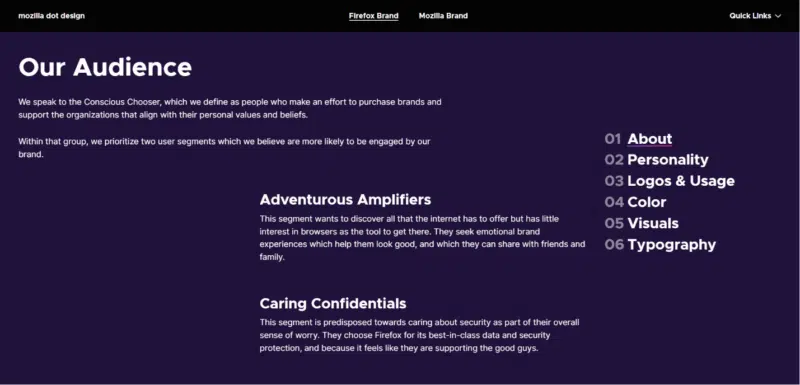
If you’ve already created some business personas based on segments of your audience, add them here. For example, Mozilla Firefox’s brand style guidelines include written descriptions of their two personas: adventurous amplifiers and caring confidentials.

Mozilla Firefox Audience 800x385

This piece of the puzzle is important for any content creators who will work with your brand. You can’t write or create targeted content without first understanding the target audience. 


Get the daily newsletter search marketers rely on.


3. Visual elements: Logo, color palette and typography

Your brand style guidelines can also include rules for using visuals, like how your logo appears in content and your brand color palette and preferred fonts.

This information is super-important when you work with graphic designers or web developers. Standard visual rules will help your content look cohesive across channels, whether you’re posting on your blog or social media, creating ads, building presentations, sharing videos on YouTube, etc.

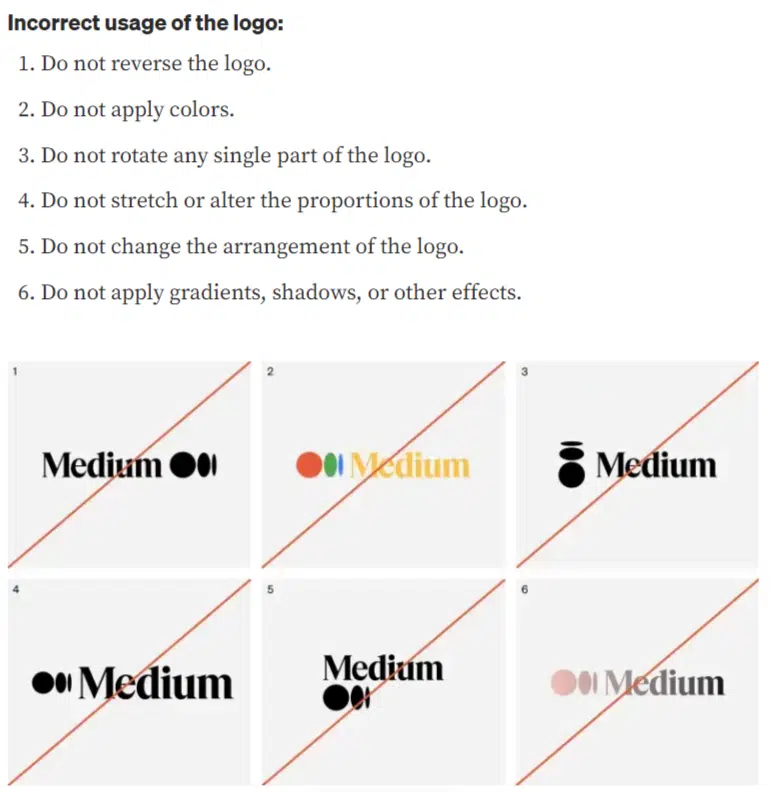
For example, Medium has strict guidelines on how its logo can and cannot be used.

Medium logo guidelines

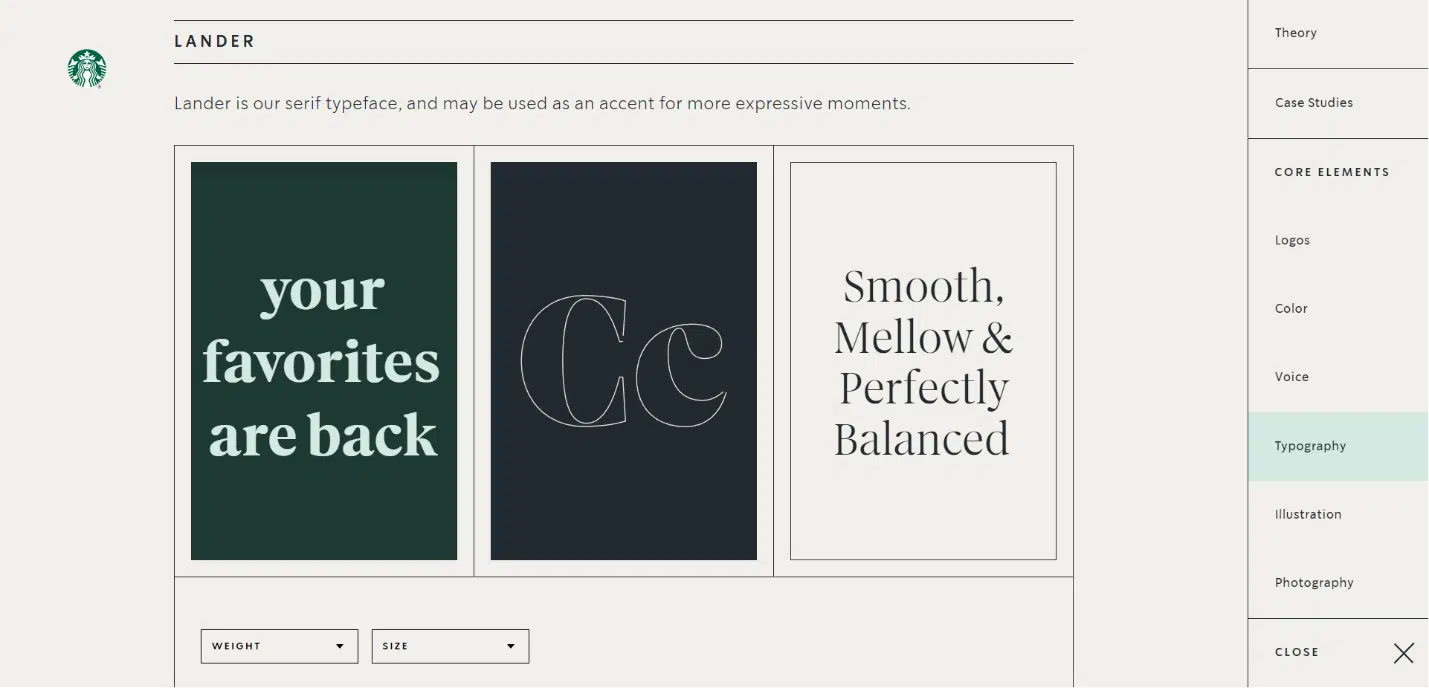
And Starbucks has guidelines showing their preferred fonts and how to use them.

Starbucks brand guidelines

4. Brand voice, tone, and style

Next, you’ll need to include rules guiding how creators present your brand to the world through content. Stipulating brand voice, tone, and style is one of the main ways to keep your messaging consistent across channels.

Brand voice

Your brand voice is essentially your brand personality. 

It determines how you come across to customers when you communicate with them, whether through writing or speaking.

For instance, maybe your brand is spunky and funny, sophisticated and mysterious, or intellectual and nerdy. 

Even further, your guidelines should explain how your unique brand voice will show up in content. 

For example, a brand with a spirited, fun voice might insert jokes or puns in the content. They might use GIFs and emojis. 

Their sentences might trend on the short side, and their explanations will be clear and down-to-earth.

Brand tone

Your brand tone determines how your voice is delivered. 

For example, if you come up with a great promotion for customers, you might tell them about it excitedly. 

Or, if you have to deliver bad news, your tone might be apologetic or subdued. 

Generally, your brand voice doesn’t change because it’s associated with your brand personality, which stays pretty consistent. But your tone can change because different situations call for adopting different tones. You can stipulate which tones to use for different circumstances in your brand style guidelines.

Brand writing style

Your brand writing style includes your preferred word usage, grammar, spelling, and formatting rules.

  • Word usage: Which words should creators avoid altogether? (For instance, maybe they should avoid slang words like “gonna” or “shoulda.”) How should they speak about or refer to your products/services? How should they use and refer to your brand name?
  • Grammar and spelling rules: Does your brand use Oxford commas? How should writers approach abbreviated terms? Can they use contractions (i.e., don’t versus do not)? Should numbers be written or spelled? Etc.
  • Formatting rules: What are your rules for using numbered and bulleted lists? Do you have any rules for using headers? What about links?

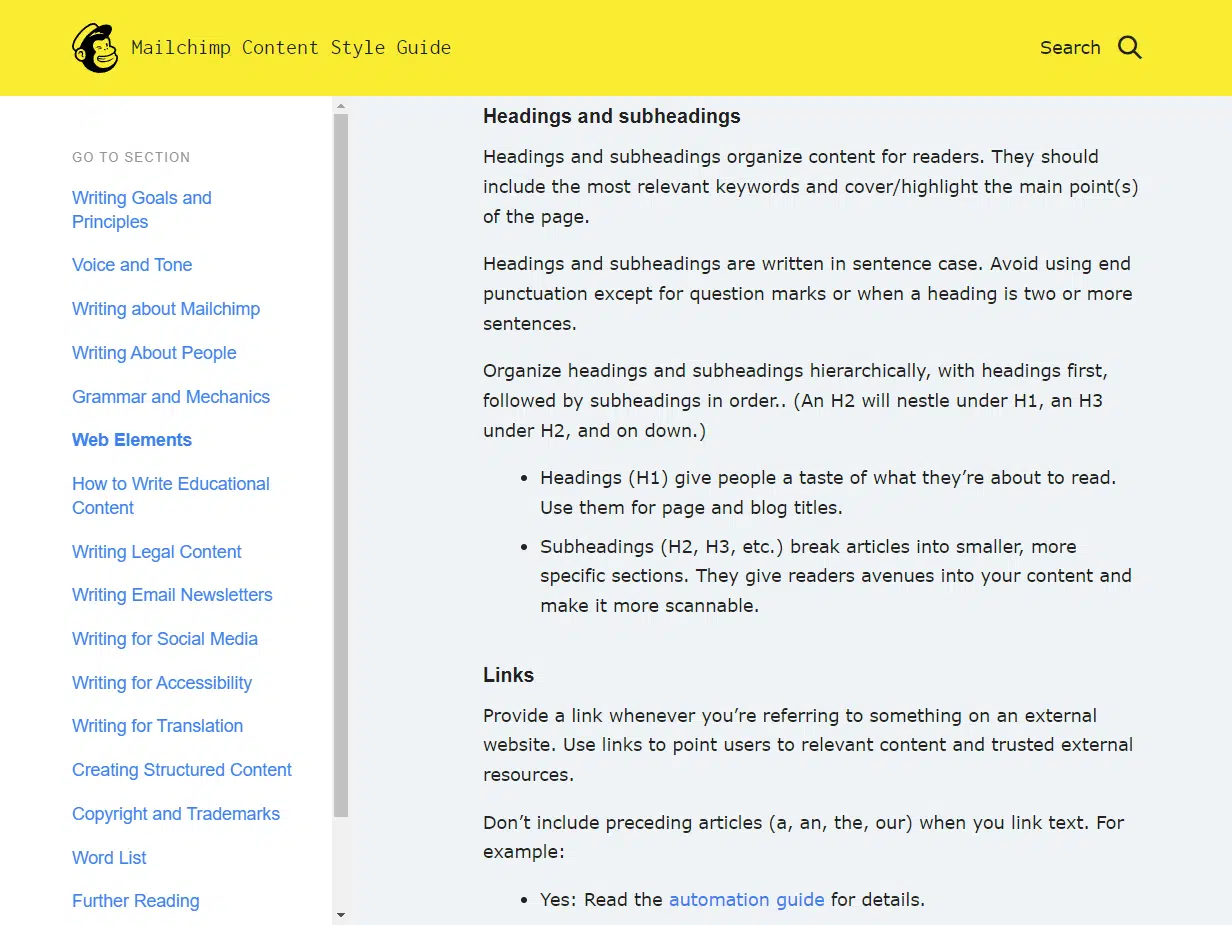
Mailchimp has a fantastic example of comprehensive brand writing style guidelines to check out for inspiration. They go so deep, they’re a completely separate guide. 

For instance, Mailchimp has detailed rules about their voice and tone, how to use specific web elements (such as headings and subheadings) in their content, a detailed grammar guide, and much more.

Mailchimp brand guidelines

A few tips to keep in mind about this part of your brand style guidelines:

Tip 1: If your writing guidelines are also this in-depth, consider creating a separate document/resource just for writers, as Mailchimp did. Otherwise, the rest of your team will have to wade through pages and pages of irrelevant information.

Tip 2: No time to create an encyclopedia of writing style rules? It may be helpful to choose a pre-existing, standardized style manual to base yours on, instead. 

Large publishing entities have already developed robust style guides that you can use to underpin your own, like APA, MLA, or Chicago Style. Use these as the foundation and layer your unique brand voice guidelines on top. Each manual has subtle differences, so vet them carefully to choose the best match for your brand.

5. Other guidelines to consider

Lastly, consider these other helpful sections to add to your brand style guidelines.

Rules for using visuals in content

Consider adding rules for how you want creators to source images for blogs and other content. Can they use stock photos? Should all images be custom graphics? Are screenshots allowed? Is there a specific look/feel you want all visuals to have?

Rules for sourcing and citing statistics, studies, research, and other data

A great task to keep consistent across content like blogs is how writers source and cite research like studies, expert quotes, data, or surveys.

For example, are any sources off-limits (like Wikipedia or low DA websites)? How should creators mention and link to sources in content?

Use cases

If you can, show the people using your guidelines use cases and examples of do’s/don’ts when writing and creating brand assets and content.

Show correct and incorrect uses of your logo, good and bad examples of brand voice, good and bad visual usage, the right and wrong way to link to sources in content, etc.

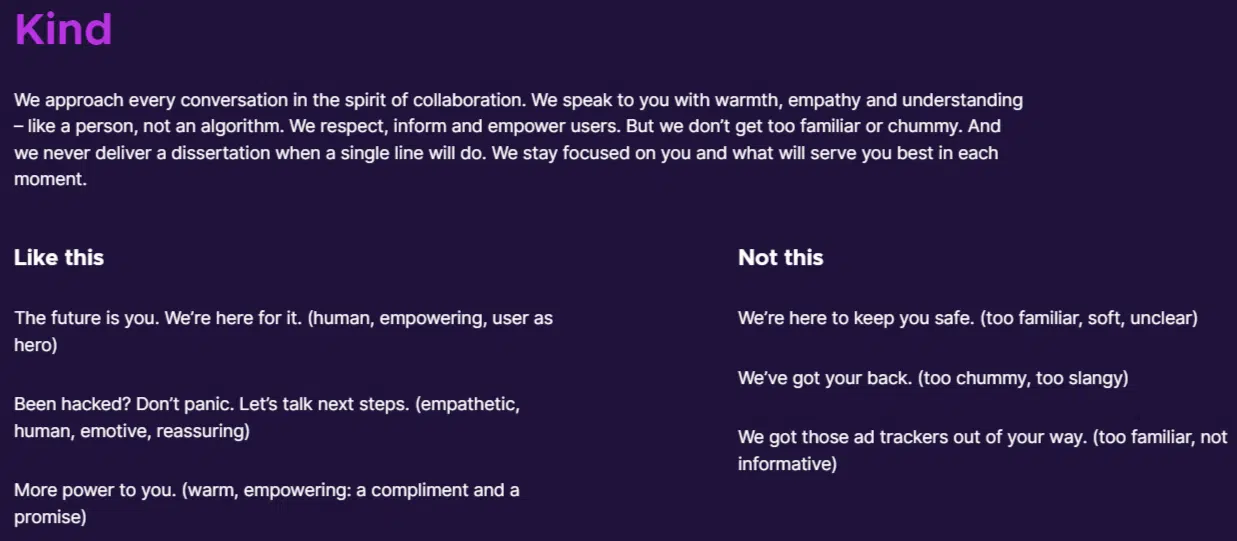
In Mozilla Firefox’s guidelines, there are specific examples of how to use the brand voice/tone, for instance, correctly.

Mozilla Firefox guidelines

Ready to create your own brand style guidelines?

Creating brand style guidelines comprises just one part of building a content strategy.

It might not be the most exciting part, but it’s mega important to keeping your brand presence consistent across the web.

And consistency matters far more than you may think. Consistency is a major reason your audience will trust you because a consistent voice and presence build credibility.

A steady presence is always better than a wavering one. You can trust it to remain reliable and true, no matter the circumstances.

So, the question remains: Do you want your brand to be seen as reliable, trustworthy, and constant – or scattered, confused, and unreliable? 

Whether you have a clear set of brand style guidelines in place can help determine which category you fall into.


Opinions expressed in this article are those of the guest author and not necessarily Search Engine Land. Staff authors are listed here.


Related stories

New on Search Engine Land

@media screen and (min-width: 800px) { #div-gpt-ad-3191538-7 { display: flex !important; justify-content: center !important; align-items: center !important; min-width:770px; min-height:260px; } } @media screen and (min-width: 1279px) { #div-gpt-ad-3191538-7 { display: flex !important; justify-content: center !important; align-items: center !important; min-width:800px!important; min-height:440px!important; } }

About the author

Julia McCoy

Julia McCoy is the founder of Content Hacker, 7x author, and a leading strategist around creating exceptional content and brand presence that lasts online. At 19 years old, she used her last $75 to build a 7-figure writing agency which she sold ten years later. In the 2020s, she’s devoted to teaching founders and marketers the strategy, skills, and systems they need to build a business through inbound content, so they can create more lasting impact in the world.

https://searchengineland.com/create-brand-style-guidelines-how-why-394734


This day in search marketing history: March 24

Google’s top 3 search ranking factors

In 2016, Google’s Andrey Lipattsev revealed that links, content and RankBrain were the top three ranking signals in Google’s search algorithm.

RankBrain was the third most important ranking factor. Google told us so in 2015.

As for the other two? Lipattsev revealed them during a Q&A and said: “I can tell you what they are. It is content. And it’s links pointing to your site.”

Read about it in Now we know: Here are Google’s top 3 search ranking factors.


Also on this day


Google Maps blocked 100 million abusive business profile edits in 2021

2022: Less than 1% of the content viewed on Google Maps was fraudulent or abusive, Google said.


Google Search adds booking and appointment availability for healthcare providers

2022: This was a pilot with a limited number of providers, including MinuteClinic at CVS.


Twitter adds keyword search to Direct Messages

2022: Twitter announced it was giving users a long-requested feature – the ability to search the direct messages (DM) inbox by keyword.


Google announces global launch of property promotion ads for hotels

2021: Property promotion ads helped hotels capture demand from users looking for places to stay.


Microsoft Advertising blocks 1.6 billion ads while dealing with the pandemic, says annual ad quality review

2021: Microsoft said it was committed to keeping the ads in Microsoft Bing fair and in compliance with its ad policies.


Summer Olympics postponement further shakes 2020 ad spending expectations

2020: The postponement would impact digital as well as TV ad spending plans.


Winners and losers: How COVID-19 is affecting search behavior

2020: Social distancing resulted in wild click behavior swings across sectors including grocers, productivity tools, restaurants and hotels.


Yelp announces fundraising partnership with GoFundMe to support local businesses

2020: Donate buttons appeared on profiles in selected categories by default.


Bing Ads Editor now supports Enhanced CPC, exports to create expanded text ads

2017: Version 11.9 offered support for Enhanced CPC bidding and the ability to export standard text ads to a spreadsheet formatted for enhanced text ads.


Search in Pics: Google aquarium bathtub room, hanging bubbles & sports court

2017: The latest images showing what people eat at the search engine companies, how they play, who they meet, where they speak, what toys they have and more.


French privacy regulator fines Google for not removing RTBF links outside of Europe

2016: CNIL in France refused to compromise on its demand for Google to remove all Right to Be Forgotten content from its entire index.


YouTube reports 224% jump in refugee-related searches since start of elections

2016: Refugee, immigration, gun control, economy and health care-related searches on YouTube had risen during the past year.


Bing May Remove Navigation To Additional Search Result Pages

2015: Bing was so confident in some of their search results that they would remove the pagination to additional search result pages.


Yahoo Asking Firefox Users To Make Yahoo Search Their Default Search Engine

2015: After Yahoo lost some Firefox users to Google, Yahoo began notifying these users to switch back to Yahoo Search as their default search provider.


Google Slaps Greek Sites With Penalties

2014: Matt Cutts, Google’s head of search spam, responded on Twitter to someone who noticed that many websites in Greece received penalties.


Nearly A Year Later, Google’s Penalty Notices Remain Confusing

2014: Notifications continued to be confusing when they should have been getting easier to understand.


Google’s Matt Cutts: Determining If Your Site Ranking Is Result Of A Penalty Is “Tricky”

2014: Cutts answers: How can you tell if your site is suffering from an algorithmic penalty, or you are simply being outgunned by better content?


Google Now Comes To Chrome For Desktops & Laptops

2014: It had only been available through mobile devices or to those using beta versions of Chrome.


New Google Search App Feature Creates Radio Station Based On Recently Played Music

2014: Saying “Play some music” after tapping the Google search mic or saying “Ok Google” would prompt the app to create an “I’m feeling lucky” radio station.


Quora Kicks Off Verified Profiles With Spotlight On President Barack Obama

2014: Quora announced new Verified Profiles, adding a checkmark to profile pictures of public figures and writers deemed worthy by the site.


Open Letter To EU Competition Commissioner Exerts Pressure For Tougher “Vertical Search” Settlement With Google

2013: Letter asserts that the EU must address “Google’s search manipulation practices” in the form of “the systematic promotion of Google’s own services, and the systematic demotion or exclusion of its competitors’ services.”


Wait… Google Banned BeatThatQuote Again!

2011: To recap: Google bought a website, penalized it a day later, then removed the penalty two weeks later and now a day after the penalty was removed, they penalized it again!


New Reports Aim To Add Value To AdWords Campaign Experiments

2011: Google provided new reporting for its AdWords Campaign Experiments (ACE), which allowed advertisers to test keyword, bids, placements and other variables.


Google Wants TV Show Owners To Start Tagging Video

2011: Google encouraged TV show owners/providers to begin tagging their online videos with several new fields that could be used in both video sitemaps and mRSS feeds.


Google Morphs AdWords Offering For Major Motion Picture Studios

2011: Google announced a new version of AdWords called Media Ads, aimed initially at marketers of major motion pictures with new releases.


Report: Google Most Valuable Brand Of 2011

2011: Brand Finance said, “the world’s increasing dependence on the internet is reflected by Google’s position at no. 1.” 


Italians Issue Another Dubious Anti-Search Decision

2011: Yahoo (in its capacity as a search engine) was found liable for helping facilitate copyright infringement by indexing and linking to sites that allowed the unauthorized download of an Iranian film.


Everyone Wants A Piece Of Google: More Antitrust Saber-Rattling By States Attorneys General

2011: Ohio was the latest considering an antitrust investigation against Google, joining Wisconsin and Texas.


Google Settles & Wins Lawsuit Against ‘Google Cash’ Scammers

2011: Google won a $1.6 million settlement against five defendants that it sued in December 2009 over the use of Google’s name in what the company called “a widespread Internet advertising scam.”


Official: Facebook Not Testing Web Search Box, Says Malware Might Be To Blame

2011: A Facebook spokesperson said a second search box was not a Facebook test and was likely caused by some third-party action or tool.


“Anti-Search Engine” FindTheBest Adds Buying Guides, Top 10 Slideshows

Year: There was a “consumer reports”-like angle here except that the content was from a range of third-party sources and all free.


European Advocate General Finds Against Trademark Bidding in Interflora Case

2011: The European Advocate General recommended that the Court of Justice of the European Union rule against retailer Marks & Spencer for bidding on the trademarked terms of the flower delivery network company.


The Yahoo Search Direct Alphabet: Where Every Letter Starts With Yahoo

2011: In Yahoo’s Search Direct feature, 21 of the 26 one-letter alphabet queries showed a Yahoo property as the first “answer.”


Google Gains Try Again Button For Discussion Results

2010: Google said it was “meant to give users who click on a result, visit a web page, then click back, the opportunity to discover more information of that same type.”


Google Maps Finally Welcome To Home-Based & Service-Based Businesses

2010: A Google spokesperson called it a limited test, though “many” business owners were able to see the new options.


So Now Google Thinks Everyone Should Care About Chinese Censorship?

2010: Google’s Sergey Brin wanted the US government to make fighting Chinese censorship a high priority and was disappointed with Microsoft for continuing to censor.


Google’s Lobbying Spend Up 1,500% Since 2005

2010: Google’s spend on lobbying went from $260,000 in 2005 to more than $4 million in 2009.


Google Bookmarks Lists

2010: Google updated Google Bookmarks to allow you to create lists and share those bookmark lists with others.


Bing Offers Free T-Shirts … For Your Xbox Avatar

2010: They took their Bing promotional efforts inside Microsoft’s own Xbox gaming platform with free codes that let Xbox Live users outfit their avatars in Bing T-shirts.


SES New York 2010 Day Two Coverage


Google Insights For Search Adds Valuable New Features

2009: New data sources, category suggestions and U.S. metros.


Google Implements ‘Orion’ Technology, Improves Search Refinements & Adds Longer Snippets

2009: Refinements were improved and would appear more frequently, and more often, at the top of pages.


Microsoft Taking On Google Street View With “GeoSynth”?

2009: Microsoft was planning to compete more aggressively with Google StreetView by soliciting user-generated photos and then geotagging and Photosynthing them.


Search Veteran Gerry Campbell Becomes CEO Of “Real-Time” Search Engine Collecta

2009: Campbell was at Alta Vista and later spent several years in the search unit of AOL.


BioNumbers – Specialty Biology Answer Search Engine

2009: BioNumbers was a collection of common biological numbers that was useful for scientists and researchers.


Google Deemphasizes Search In Experimental Mobile Interface

2008: Google quietly introduced a new, experimental mobile interface called “LCB” that emphasized browsing instead of search.


Google AdWords Officially Launches Demographic Bidding? Maybe Not

2008: Demographic bidding allowed advertisers to show their ads to specific age groups and genders.


Google News Makes Commenting More Visible

2008: Google added a link to the home page of Google News that says “Comments by People in the News” and made it easier to comment on an article.


Court: Use Of Trademark In AdWords Copy Is An Infringement

2008: One of the first times the plaintiff won in a case between advertisers over trademarks in search ads.


From Search Marketing Expo (SMX)


Past contributions from Search Engine Land’s Subject Matter Experts (SMEs)

These columns are a snapshot in time and have not been updated since publishing, unless noted. Opinions expressed in these articles are those of the author and not necessarily Search Engine Land.


< March 23 | Search Marketing History | March 25 >


Related stories

New on Search Engine Land

@media screen and (min-width: 800px) { #div-gpt-ad-3191538-7 { display: flex !important; justify-content: center !important; align-items: center !important; min-width:770px; min-height:260px; } } @media screen and (min-width: 1279px) { #div-gpt-ad-3191538-7 { display: flex !important; justify-content: center !important; align-items: center !important; min-width:800px!important; min-height:440px!important; } }

About the author

Danny Goodwin

Danny Goodwin has been Managing Editor of Search Engine Land & Search Marketing Expo – SMX since 2022. He joined Search Engine Land in 2022 as Senior Editor. In addition to reporting on the latest search marketing news, he manages Search Engine Land’s SME (Subject Matter Expert) program. He also helps program U.S. SMX events. Goodwin has been editing and writing about the latest developments and trends in search and digital marketing since 2007. He previously was Executive Editor of Search Engine Journal (2017 to 2022), managing editor of Momentology (from 2014-2016) and editor of Search Engine Watch (from 2007 to 2014). He has spoken at many major search conferences and virtual events, and has been sourced for his expertise by a wide range of publications and podcasts.

https://searchengineland.com/search-marketing-history-march-24-394706


The new Bing making (small) gains on Google Search

It’s still very early in the AI search engine arms race, but it appears Microsoft has made gains on Google thanks to the new Bing.

Microsoft has previously told us that one-third of preview users were new to Bing and that Bing passed 100 million daily active users following the new Bing preview.

Elsewhere, Similarweb data showed:

“…page visits on Bing have risen 15.8% since Microsoft Corp unveiled its artificial intelligence-powered version on Feb. 7, compared with a near 1% decline for the Alphabet Inc-owned search engine, data till March 20 showed.

– Reuters, OpenAI tech gives Microsoft’s Bing a boost in search battle with Google

Why we care. If Microsoft Bing is growing its search share, that means your site potentially could get more organic traffic from Bing. We’re starting to see evidence that traffic from Bing is up for some brands and publishers. As always, anything that makes us slightly less reliant on Google traffic is a notable development.

More from Similarweb. Over the last seven days:

  • Bing.com traffic is up 15.4%
  • Google.com traffic is down 2.4%

And over the last 28 days, bing.com was up 13.6% and google.com was down 2.8%. Similarweb also reported:

Although this recent performance may reflect the incorporation of ChatGPT-like functionality from Microsoft’s partnership with OpenAI, Bing has been making monthly incremental gains of as much as 10% year-over-year for the past couple of years – often at Google’s expense.

– Similarweb, Microsoft’s lead in incorporating ChatGPT-like features at least part of the story

Meanwhile, those traffic gains to Bing paled in comparison to traffic growth to ChatGPT (chat.openai.com), which was up 21.3% week over week.

Publisher traffic. Prior to Feb. 7 (the day the new Bing launched), Bing made up just 1.22% of Search Engine Land’s organic search traffic. Now Bing is up to a 2.6% share. Google still dominates – it has dropped from 98.2% prior to Feb. 7 to 96.7% now.

Bing traffic to Search Engine Roundtable is up 155%. Barry Schwartz shared that data earlier today on Twitter:

Meanwhile, Bing is becoming a significant referral source, even “beating Google on some pieces,” according to a tweet by Jez Corden, managing editor of tech publication Windows Central.

Social engagement data: Bing up, Google down. Comscore won’t have comprehensive traffic numbers available until the end of the month, but the company shared some social engagement data with Search Engine Land (Source: Comscore Social, Content Pulse, March 1-21, 2022 & 2023):

  • Engagement on posts across Facebook, Twitter, Instagram and TikTok that mentioned “Google” and “search” month-to-date are down 71% year-on-year (March 2022 to March 2023). 
  • Posts across Facebook, Twitter, Instagram, and TikTok mentioning “Bing” and “search” are up 48% year on year. 

Related stories

New on Search Engine Land

@media screen and (min-width: 800px) { #div-gpt-ad-3191538-7 { display: flex !important; justify-content: center !important; align-items: center !important; min-width:770px; min-height:260px; } } @media screen and (min-width: 1279px) { #div-gpt-ad-3191538-7 { display: flex !important; justify-content: center !important; align-items: center !important; min-width:800px!important; min-height:440px!important; } }

About the author

Danny Goodwin

Danny Goodwin has been Managing Editor of Search Engine Land & Search Marketing Expo – SMX since 2022. He joined Search Engine Land in 2022 as Senior Editor. In addition to reporting on the latest search marketing news, he manages Search Engine Land’s SME (Subject Matter Expert) program. He also helps program U.S. SMX events. Goodwin has been editing and writing about the latest developments and trends in search and digital marketing since 2007. He previously was Executive Editor of Search Engine Journal (2017 to 2022), managing editor of Momentology (from 2014-2016) and editor of Search Engine Watch (from 2007 to 2014). He has spoken at many major search conferences and virtual events, and has been sourced for his expertise by a wide range of publications and podcasts.

https://searchengineland.com/new-bing-small-gains-vs-google-search-394733


Countdown to GA4: 100 days to make the switch

As the sun begins to set on Google Analytics Universal Analytics (UA), businesses are (or should be) gearing up for the transition to Google Analytics 4 (GA4).

With just 100 days left until UA is officially retired, it’s crucial for organizations of all sizes to understand the benefits and challenges of migrating to GA4, as well as the essential steps to ensure a smooth transition.

A Q&A from Steve Ganem, Director of Product for Google Analytics, helps us gain invaluable insights into the key features, challenges, and advantages of adopting GA4.

What are the biggest misconceptions about GA4?

“It’s a new product that is not mature enough to use.”  

Despite announcing the migration a little over a year ago, GA4 has been in use by advertisers since 2020, while the idea of web and app analytics has been around since 2019.

With GA4, businesses can access valuable insights to help them make informed and strategic decisions for their operations.

“It’s overly complex and doesn’t provide the same reporting as Universal Analytics” 

GA4 has a learning curve, but it’s essential to move beyond the traditional session-based mindset. To address the complexity of the current digital landscape, we developed GA4, incorporating features like a novel event structure and redesigned user journeys.

Although these concepts might not be immediately clear or easy to grasp, businesses that overcome the learning curve will discover that GA4 is designed to efficiently navigate this evolving digital world and anticipate future changes.

“It’s not designed for small businesses.” 

GA4 was developed to cater to businesses of all sizes, not just small or large enterprises. The aim was to establish a platform that offers comprehensive reporting capabilities and extensive customization options smoothly.

This seamless experience is evident in features such as the personalized homepage, which presents the most pertinent reports to customers, and predictive audiences, which help identify users with a higher likelihood of making a purchase. GA4 effectively takes on much of the analytical workload, delivering crucial insights directly to businesses.

Should I wait for Jumpstart?

The short answer is no. 

For a more detailed response, manual migration remains the suggested method for all businesses. This approach allows for creating a customized property and ensures that everything aligns with your preferred configuration.

This is particularly crucial for advertisers, as their conversion bidding might be linked to Universal Analytics, and it is essential to guarantee a proper transfer to GA4.

While Jumpstart serves as a helpful tool for businesses with limited resources, it only establishes a basic property, making manual migration the preferred option. Furthermore, Jumpstart is being introduced progressively, and the earlier businesses transition, the sooner they can accumulate historical data for year-over-year comparisons.

What are the challenges to migrating and how is Google addressing those?

GA4 was developed for a new era of measurement, which entails new product features and a different measurement approach compared to Universal Analytics. While this doesn’t make it inherently harder, Google recognizes that change can be challenging, and the property’s distinct appearance and functionality compared to Universal Analytics may pose difficulties during migration.

The Setup Assistant. Each tool within the Setup Assistant has been purposefully designed to tackle specific challenges in the migration process, such as property creation, tagging, goal migration, conversion swapping, and more. During preliminary user testing, these aspects were identified by Google as potential challenges and areas where businesses might face difficulties while setting up a GA4 property for the first time.

Search Engine Land posted a guide late last year to give an in-depth look at the Setup Guide. Check it out here.

Additionally, this tutorial has been helpful for many businesses making the transition.  

What are the key features in GA4 that businesses should know?

“One of the reasons we’re so excited about GA4 is all of the new features that not only allow for durability in this evolving privacy landscape, but also that bring to life a new way of measurement that has evolved with how the web and app experiences are evolving,” Ganem said.

That said, here are a few that are worth highlighting: 

  1. Built with Google’s AI at its core: Google’s advanced machine learning helps businesses predict future consumer behavior, allowing marketers to get insights about future consumer behavior and activate on those insights. Additionally, marketers can tap into behavioral modeling, conversion modeling and data-driven attribution to get a complete and accurate view of their campaign performance, even as cookies go away. 
  2. Privacy by default GA4 was designed for now and the future, where privacy is paramount. People’s expectations for privacy have changed and, as a result, so has the way we measure. Built with solutions like modeling, consent mode and data driven attribution baked in, it’s automatically set up to help businesses measure in a privacy-centric way, while still getting the insights they need. 
  3. Web + app: By design, GA4 was built for both web and app – something that previous versions of Google Analytics dealt with separately. People move between web and apps seamlessly and measurement should reflect that. 
  4. Customizable reporting: GA4 enables many different levels of reporting, both detailed and at the overview level – giving businesses either a quick look at a particular topic, while also giving them the opportunity to drill down into additional data. With Customized Overview Reports, you can quickly get a summary of your most important reports. Universal Analytics had a large reporting collection that many businesses found overwhelming – mainly because it was trying to be everything for everyone. That is why in GA4 we prioritized a smaller, curated baseline set of reports and a robust custom reporting tool, allowing businesses to create reports relevant for their business exclusively.
  5. Advertiser workspace: There are currently four advertising reports to provide a quick snapshot and enable you to drill down into performance metrics, attribution models and conversion paths to understand the impact of your advertising campaigns on the business.
  6. Robust API: GA4 supports a large number of APIs, enabling an even more customized measurement foundation. In GA4 we aim to keep the API up to speed with the features of the product so developers can always take advantage of the latest in GA4 – a notable difference from Universal Analytics, where the API often lacked functionality.

Why advertisers will lose out if they don’t move 

Bottom line: for advertisers, ROI is on the line. 

Once Universal Analytics property stops processing data on July 1st, 2023, conversions and audiences will stop flowing new data from that property into Google Ads. This could significantly affect the performance of their ad campaigns. It’s critical that advertisers make the switch to GA4, so that they are in a much more stable and durable position.

What happens to Universal Analytics properties after July 1st?

Universal Analytics properties will stop reporting new data July 1st. 

To be a bit more specific, they will stop processing data, meaning your standard UA property will no longer operate the way it does today. That said, businesses shouldn’t be surprised when they can still log into their accounts after July 1st – it will take time to completely sunset the product for all businesses. 

Historical data will be available for six months to aid with period-over-period comparisons, giving businesses a chance to export their historical data even after the sunset. 

Why is it so important to make the move now?

Now is the time. 

By making the move you will: 

  1. Get comfortable with GA4. GA4 is a new platform and has new tools and capabilities. They will take time to adjust to and the earlier businesses get their properties setup, the sooner they’ll get accustomed to the new platform. 
  2. Build historical data. Building historical, comparative data is important to a successful analytics property – of any kind. 
  3. Side by side. Being able to use a GA4 property in parallel to an existing UA property will give businesses the ability to see what’s different, what’s the same and what they have in UA that they need to have in GA4. This side by side time is essential, especially for businesses who have put a lot of time and effort into their existing UA properties to date.

Dig deeper. Still confused? Check out more resources:

Why we care. Plain and simple, UA is going away. But according to ChatGPT, here is why GA4 could be better for advertisers.

  1. Improved insights: GA4 offers better data analysis and insights, allowing advertisers to make more informed decisions and optimize their campaigns effectively.
  2. Unified measurement: GA4 combines data from websites and mobile apps, enabling advertisers to track user behavior across multiple platforms and devices, providing a more comprehensive understanding of their audience.
  3. Enhanced audience targeting: With advanced audience segmentation tools, GA4 allows advertisers to create more personalized and targeted campaigns, leading to improved ad performance and higher ROI.
  4. Machine learning integration: GA4 leverages machine learning algorithms to provide automated insights, recommendations, and predictions, helping advertisers to identify trends and opportunities more efficiently.
  5. Future-proofing: GA4 is designed to adapt to future changes in user behavior, technology, and privacy regulations, ensuring that advertisers stay ahead of the curve and maintain a competitive edge.
  6. Privacy compliance: GA4 is built with a strong focus on user privacy and compliance with data protection regulations such as GDPR and CCPA, which is essential for responsible advertising practices.
  7. Better integration with Google Ads: GA4’s tighter integration with Google Ads simplifies the data import/export process between the platforms, allowing for better analysis and optimization of campaigns.

Related stories

New on Search Engine Land

@media screen and (min-width: 800px) { #div-gpt-ad-3191538-7 { display: flex !important; justify-content: center !important; align-items: center !important; min-width:770px; min-height:260px; } } @media screen and (min-width: 1279px) { #div-gpt-ad-3191538-7 { display: flex !important; justify-content: center !important; align-items: center !important; min-width:800px!important; min-height:440px!important; } }

About the author

Nicole Farley

Nicole Farley is an editor for Search Engine Land covering all things PPC. In addition to being a Marine Corps veteran, she has an extensive background in digital marketing, an MBA and a penchant for true crime, podcasts, travel, and snacks.

https://searchengineland.com/countdown-to-ga4-100-days-to-make-the-switch-394725


TikTok CEO faces congress over security concerns

In a wildly dramatic and painful-to-watch session, TikTok CEO Shou Zi Chew testified before Congress in a hearing that will determine the future of the social media app.

Just as US user adoption hit 150 million, the CEO faced tough questions from out-of-touch congresspeople about safety, privacy, selling data, and security concerns. Here’s what happened:

“Mr. Chew, you are here because the American people need the truth about the threat TikTok poses to our national and personal security,” Committee Chair Cathy McMorris Rodgers, a Republican, said in her opening statement. “TikTok has repeatedly chosen a path for more control, more surveillance and more manipulation.”

Privacy and security. Let’s remember there is no evidence that TikTok has shared U.S. user data with the Chinese government, but policymakers fear that the Chinese government could compel the company to do so. Chew says legacy U.S. data in Virginia and Singapore servers are being deleted. “We expect that to be complete this year. When that is done, all protected U.S. data will be under the protection of U.S. law.”

Chew says the company has created “what amounts to a firewall that seals off protected U.S. user data from unauthorized foreign access.” “American data stored on American soil by an American company overseen by American personnel.”

Chew made 4 commitments to U.S. lawmakers:

  1. Prioritizing safety for young users
  2. Firewall protection for U.S. user data
  3. The app will remain a place for free expression & ‘will not be manipulated by any government’
  4. Transparency

Surveillance concerns. When asked about surveillance, Rep. Cathy McMorris Rodgers (R-WA)”Can you say with 100% percent certainty that neither ByteDance nor TikTok employees can target…Americans with…surveillance techniques?” Chew said, “I disagree with the characterization of surveillance.”

While Chew does not deny employees at TikTok’s parent company in China have access to Americans’ sensitive user data, so does every other social media platform. Chew says he believes that TikTok doesn’t collect any more data than any other social media platform.

Rep. Richard Hudson (R-NC) asks TikTok CEO Shou Chew: “Does TikTok access the home WiFi network?”

After a five-minute rant from Rep. Kat Cammack (R-FL), Chew asked to respond to questions and comments but was told, “No. We’re going to move on.”

Save our children. Rep. Gus Bilirakis (R-FL) showed a compilation of TikTok videos encouraging suicide and death and told Chew, “Your technology is literally leading to death.” After the video, Chew asked to say a word about the death but was promptly cut off mid-sentence in what seemed more like a show than an effort to extract any meaningful information.

Rep. Castor (R-FL) blamed the CEO for people’s algorithms causing them to commit suicide. She also reminded us that Facebook and Instagram sat in the same seats and told congress they knew of the issues and did nothing to prevent kids from self-harm.

Here’s what Twitter thought. An overwhelming majority of people watching and live Tweeting the hearing are noticing that congress isn’t letting Chew respond to questions and accusations.

Dig deeper. Watch it live. If you have the patience.

Why we care. A TikTok ban could have a significant impact on the future of the popular social media app, and therefore their advertising strategy. If TikTok is banned or faces severe restrictions, it could affect the app’s user base and potentially make it less attractive to advertisers.

Additionally, if the hearing reveals serious security or privacy concerns with the app, it could lead to a loss of trust among users and advertisers alike. On the other hand, if the hearing goes well and TikTok is allowed to continue operating with minimal restrictions, it could present a valuable opportunity for advertisers to continue reaching a large and engaged audience on the platform.


Related stories

New on Search Engine Land

@media screen and (min-width: 800px) { #div-gpt-ad-3191538-7 { display: flex !important; justify-content: center !important; align-items: center !important; min-width:770px; min-height:260px; } } @media screen and (min-width: 1279px) { #div-gpt-ad-3191538-7 { display: flex !important; justify-content: center !important; align-items: center !important; min-width:800px!important; min-height:440px!important; } }

About the author

Nicole Farley

Nicole Farley is an editor for Search Engine Land covering all things PPC. In addition to being a Marine Corps veteran, she has an extensive background in digital marketing, an MBA and a penchant for true crime, podcasts, travel, and snacks.

https://searchengineland.com/tiktok-ceo-faces-congress-over-security-concerns-394726


Is ChatGPT your secret weapon for SEO content editing?

Most of the talk surrounding generative AI and SEO centers on content creation. But tools like ChatGPT can help with other specific functions beyond cranking out whole blog posts at scale.

Editing and refreshing content is a vital part of the SEO content lifecycle. This article determines various ways ChatGPT can aid with content editing for SEO.

Editing content with ChatGPT

Before anything else, here are a few caveats to consider when using ChatGPT to edit content:

  • ChatGPT often generates answers that may sound accurate (particularly if you’re unfamiliar with a topic) but are completely wrong. A human must constantly review the tool’s outputs before publishing.
  • ChatGPT is trained on data from 2021 and prior. It can’t crawl the web as of this writing, so the information it generates may be dated.
  • Google has stated there’s no explicit penalty for using AI content as long as it’s helpful. However, a lot of AI content is readily detectable, and there’s no guarantee that that will be Google’s stance forever.

All that said, let’s dive into what ChatGPT can do despite these limitations.

Rewriting for search intent

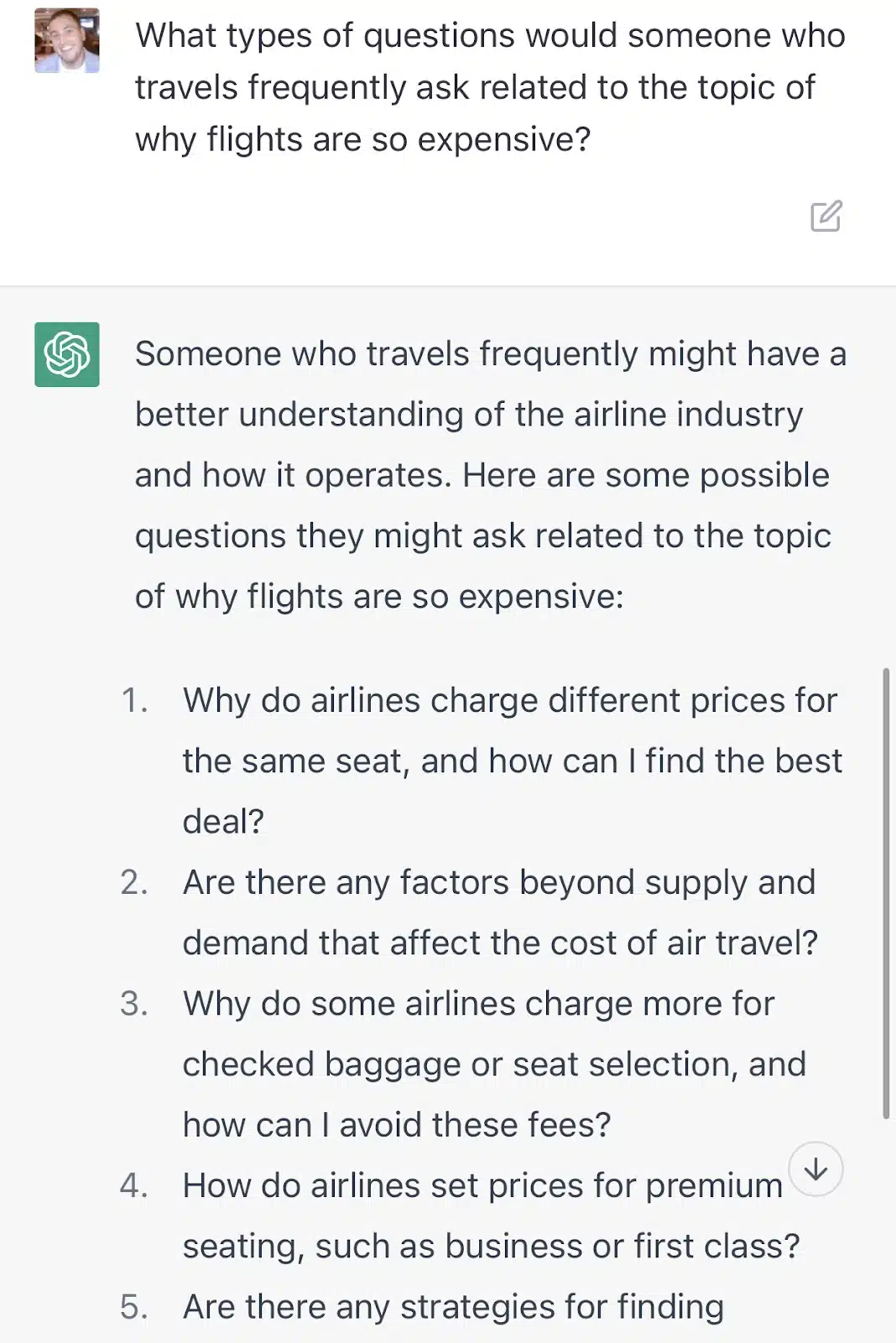
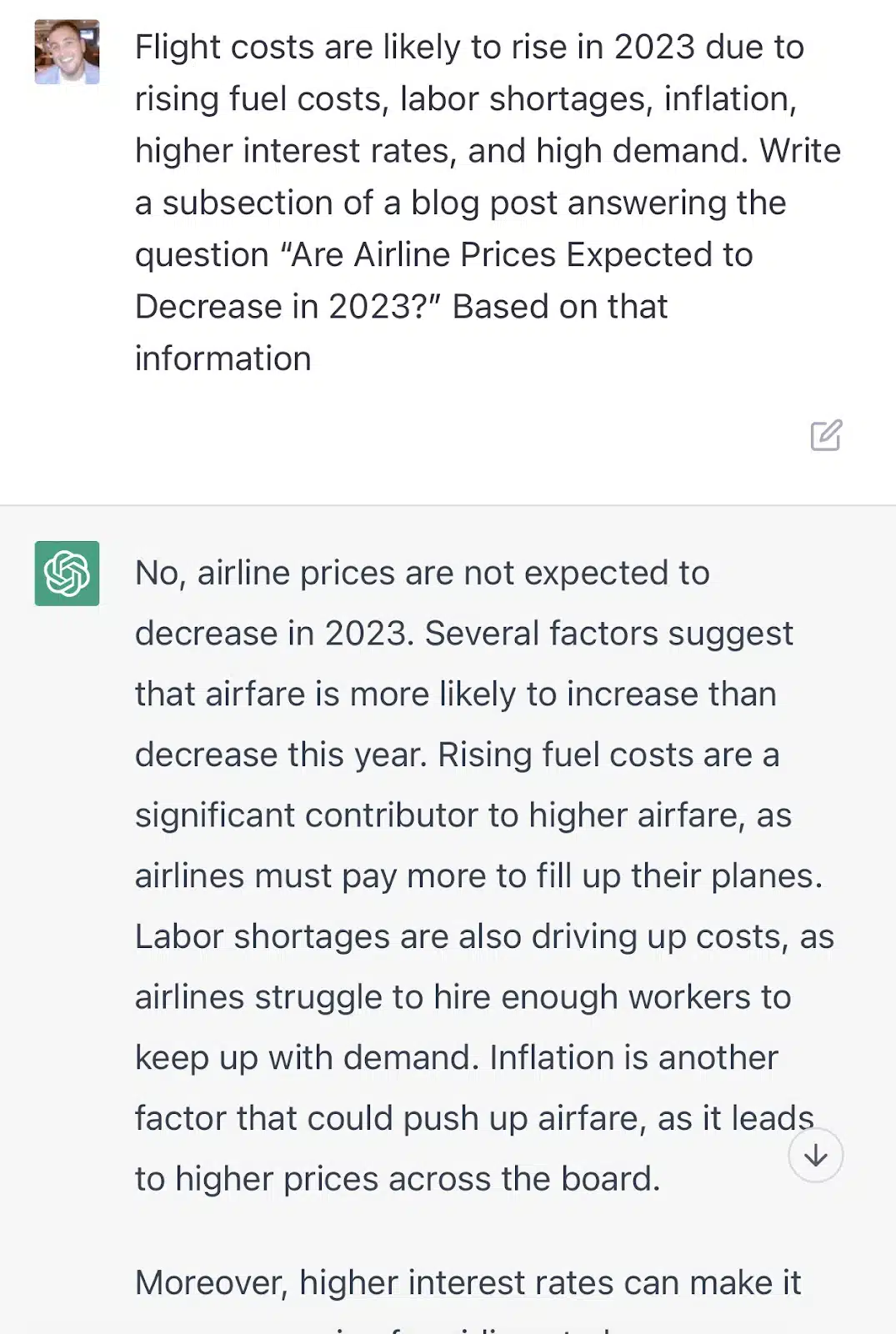
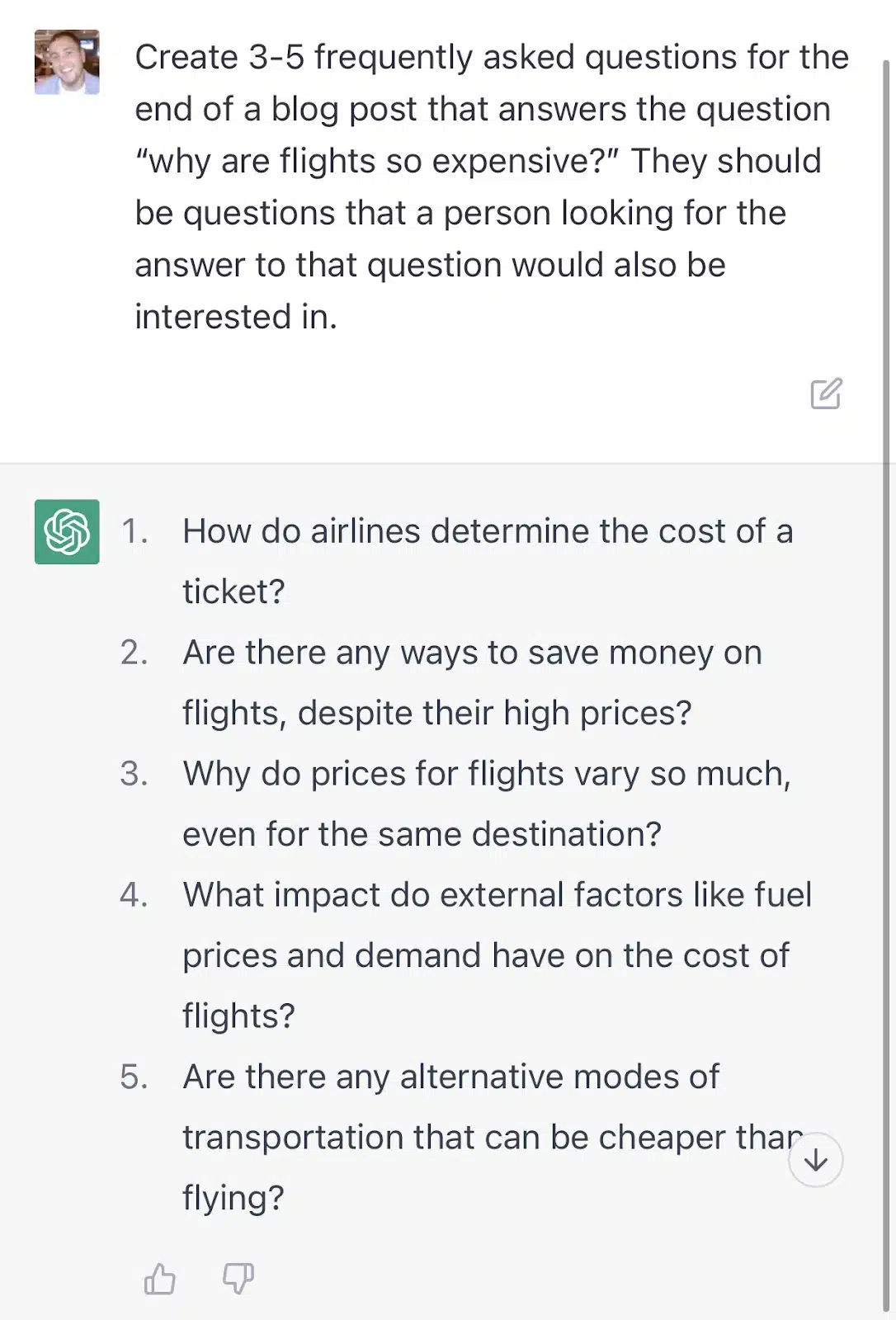
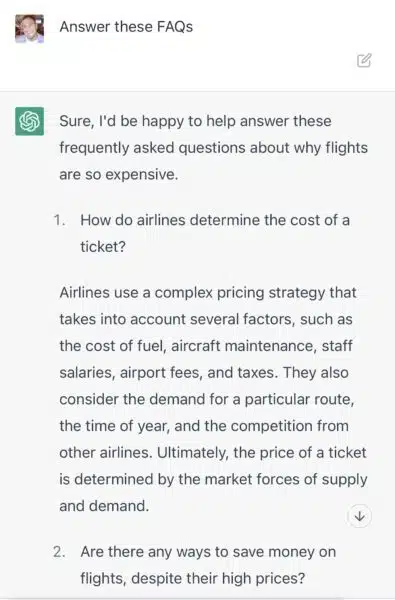
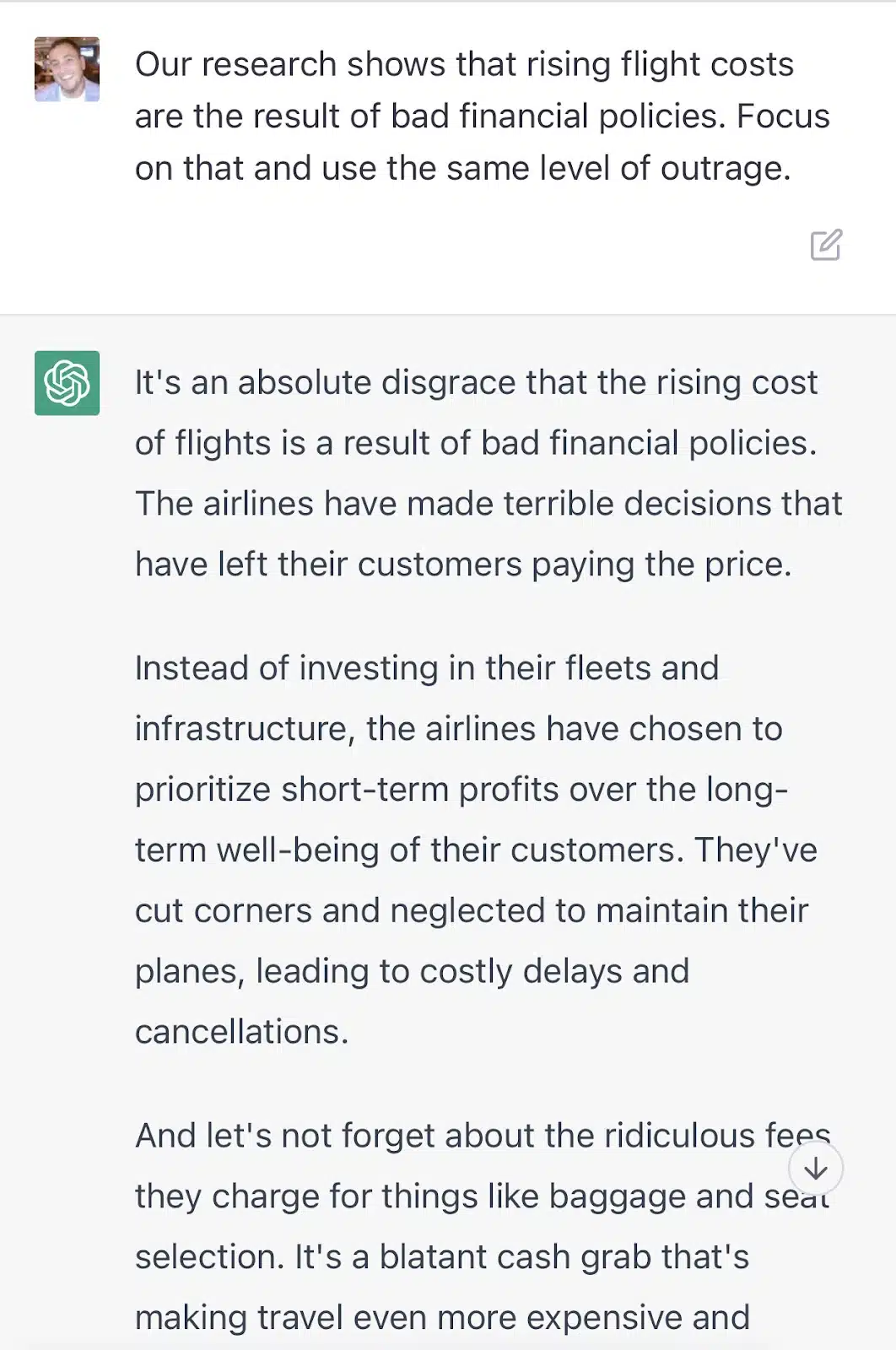
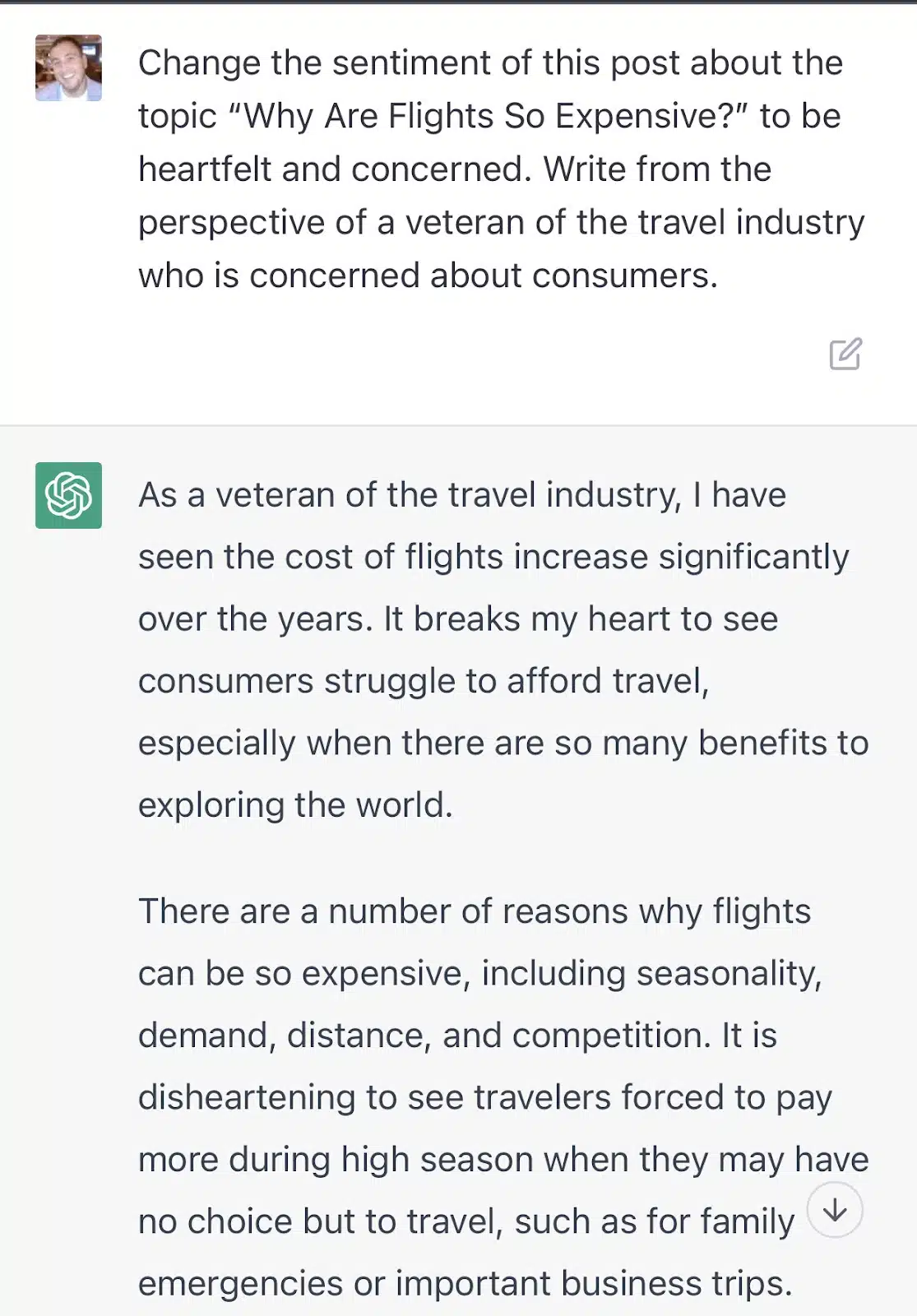
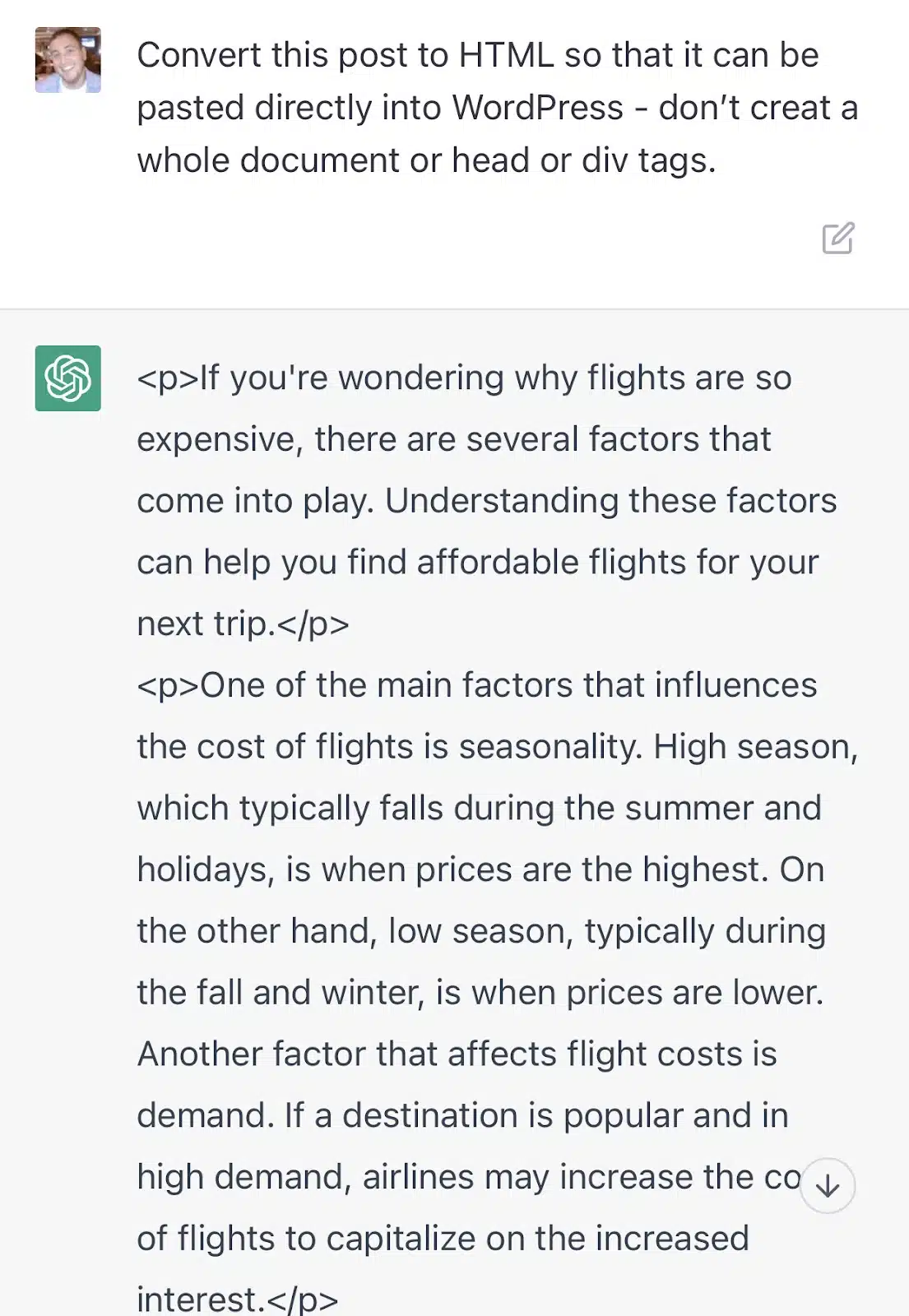
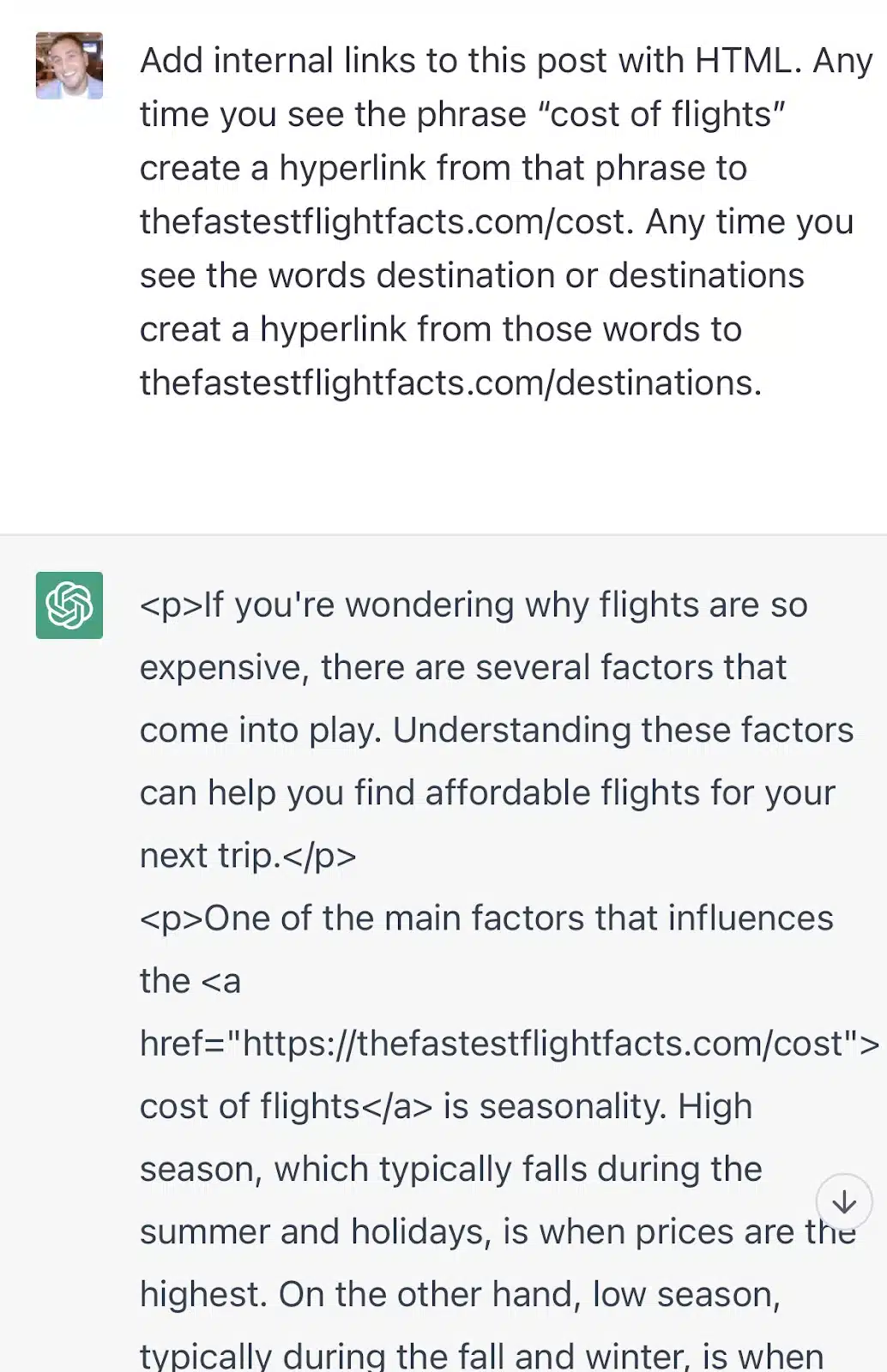
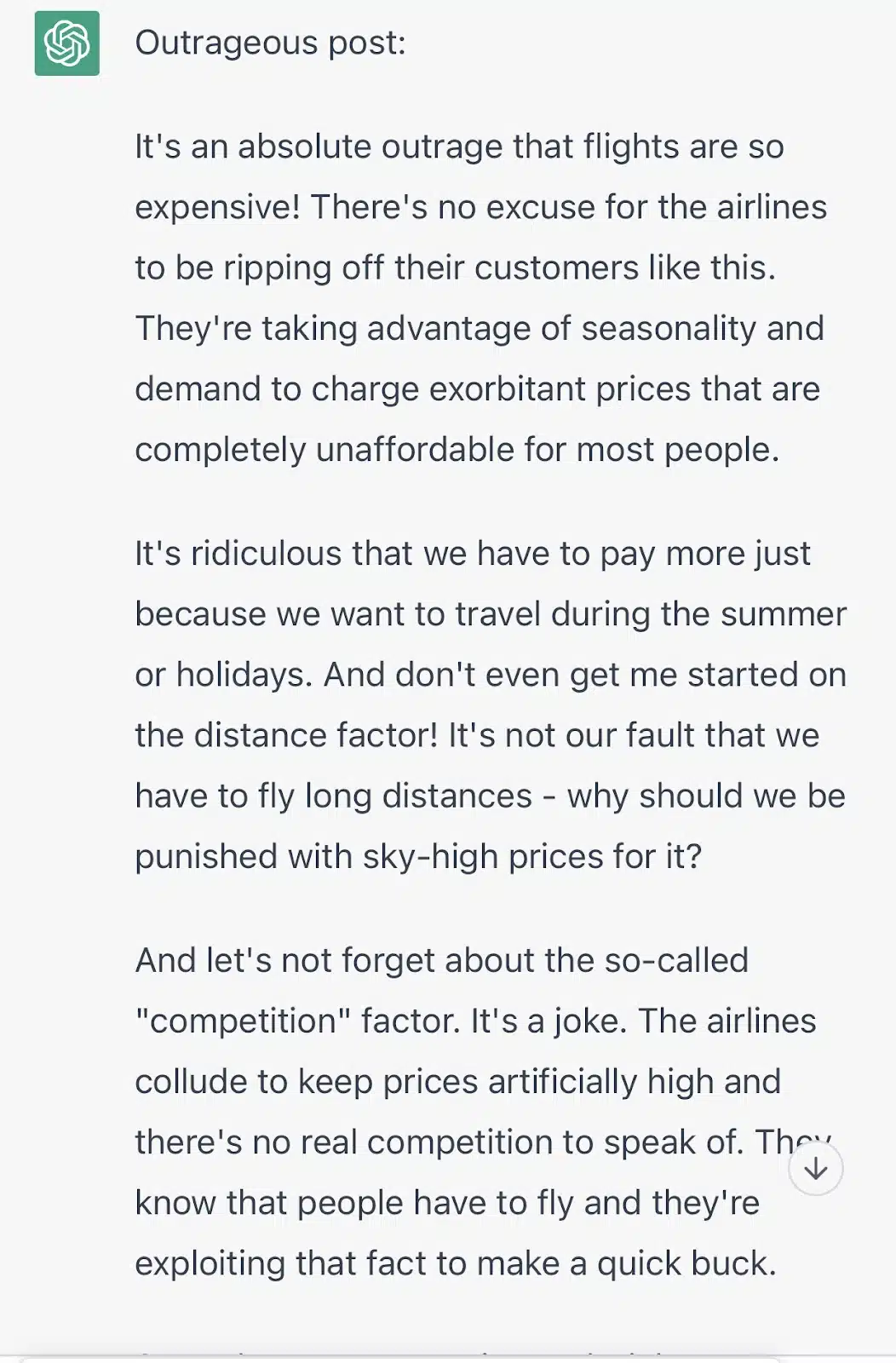
Let’s imagine our site is focused on the travel industry. A writer just finished a new article on flight costs, and we want it to rank well for the query “Why are flights so expensive?”

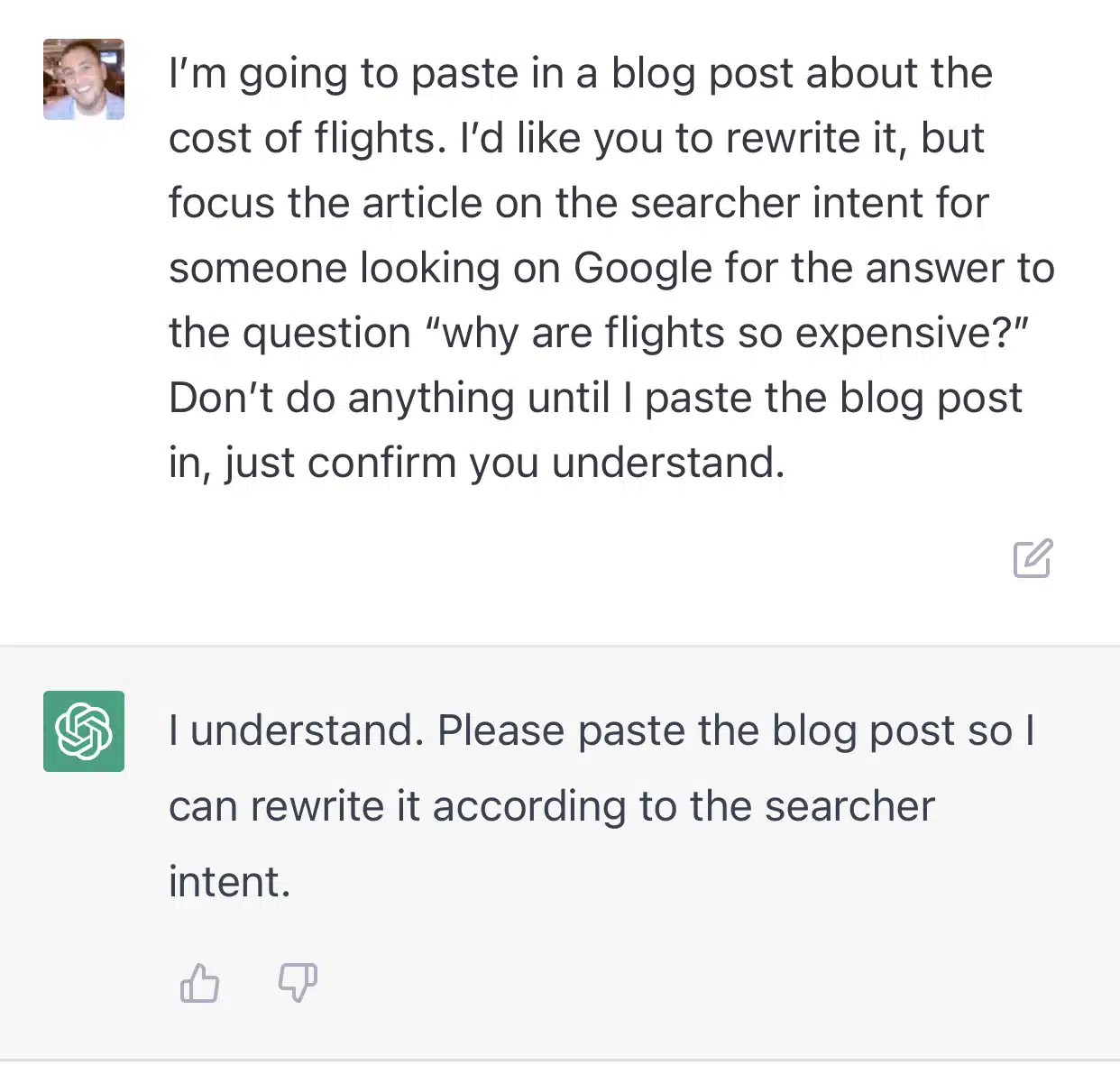
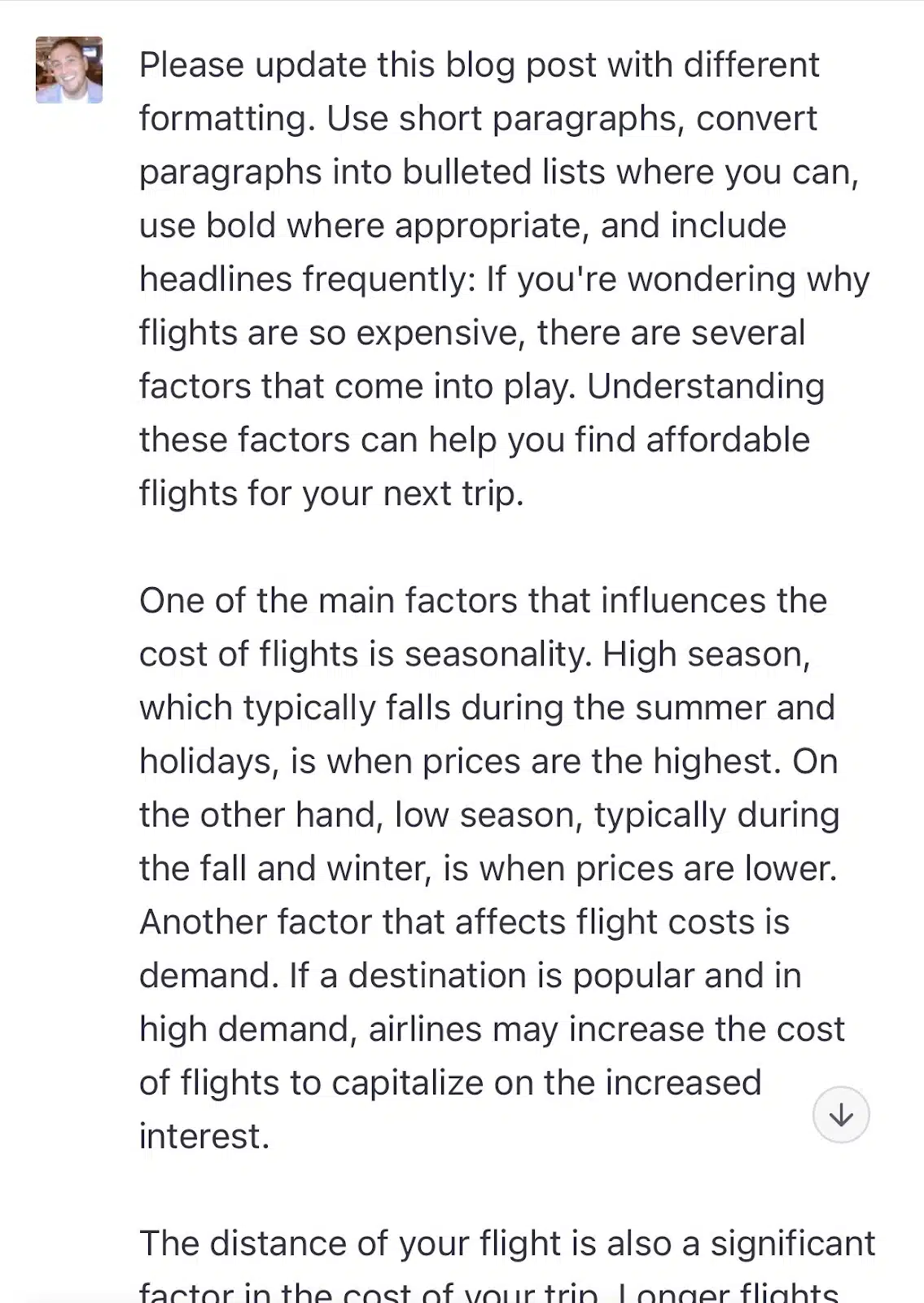
We could ask ChatGPT to rewrite the blog post with more of a focus on searcher intent:

Rewriting for search intent

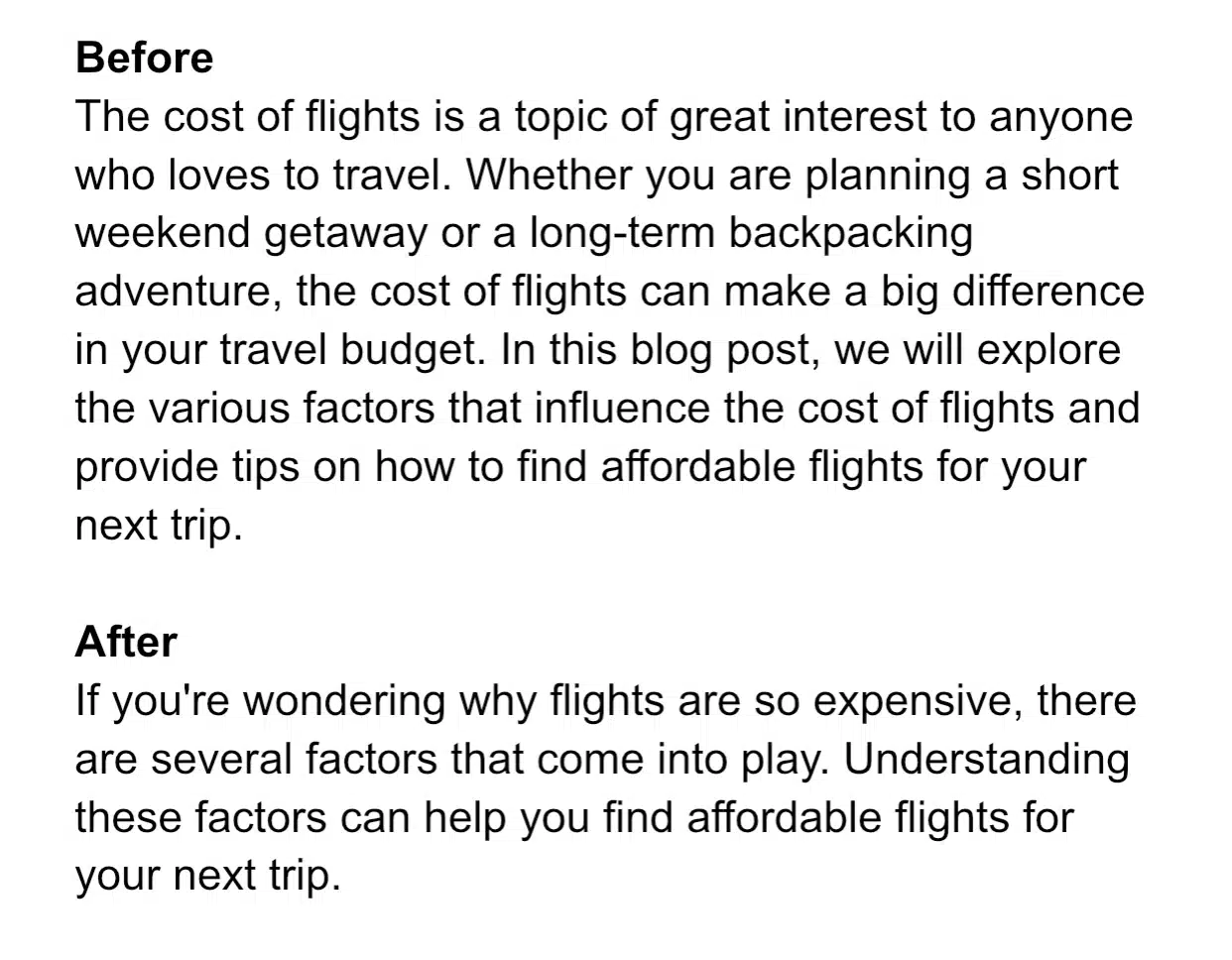
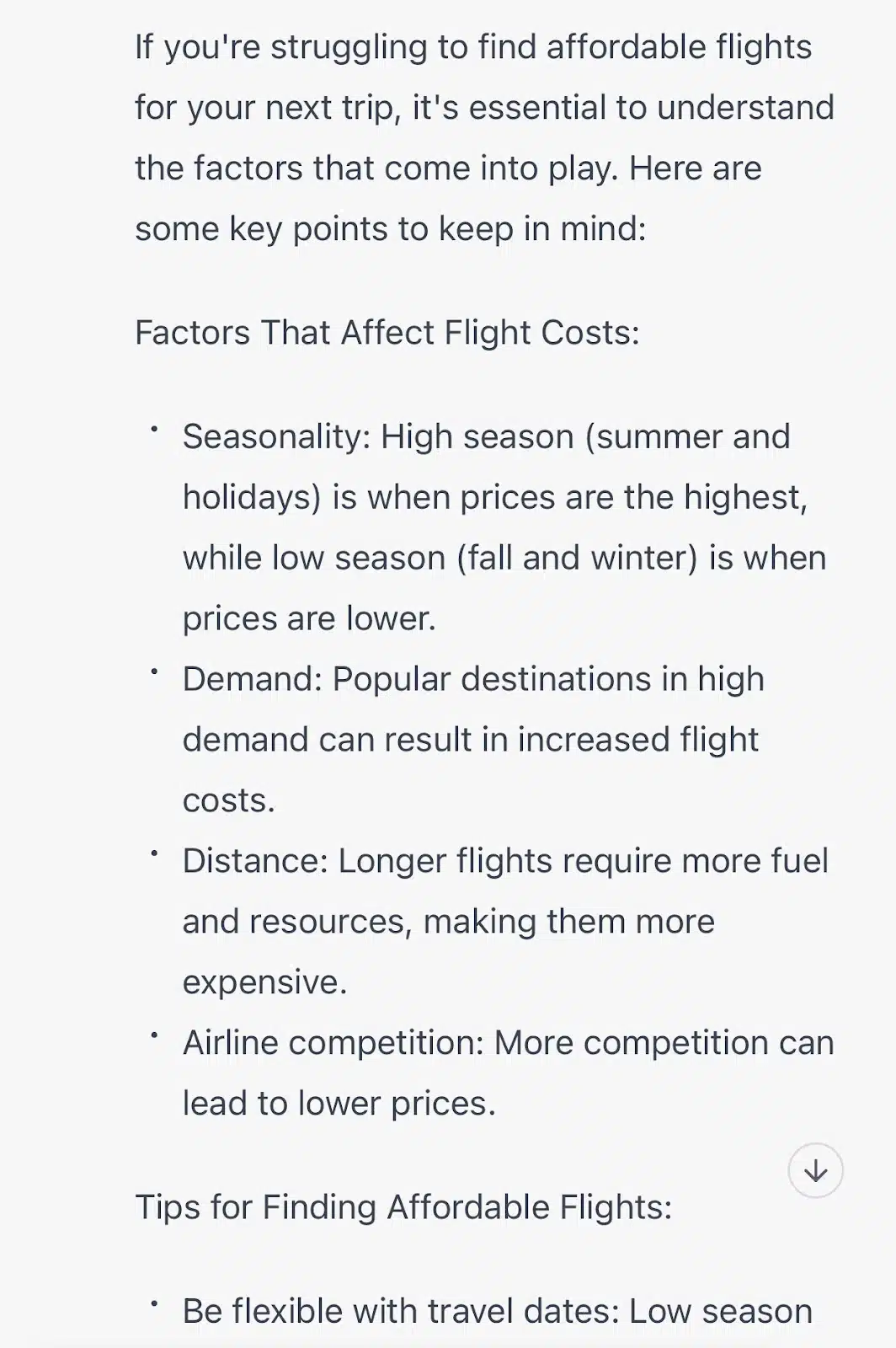
Here is the before and after of what the first paragraph looks like:

Rewriting for search intent - Before and After

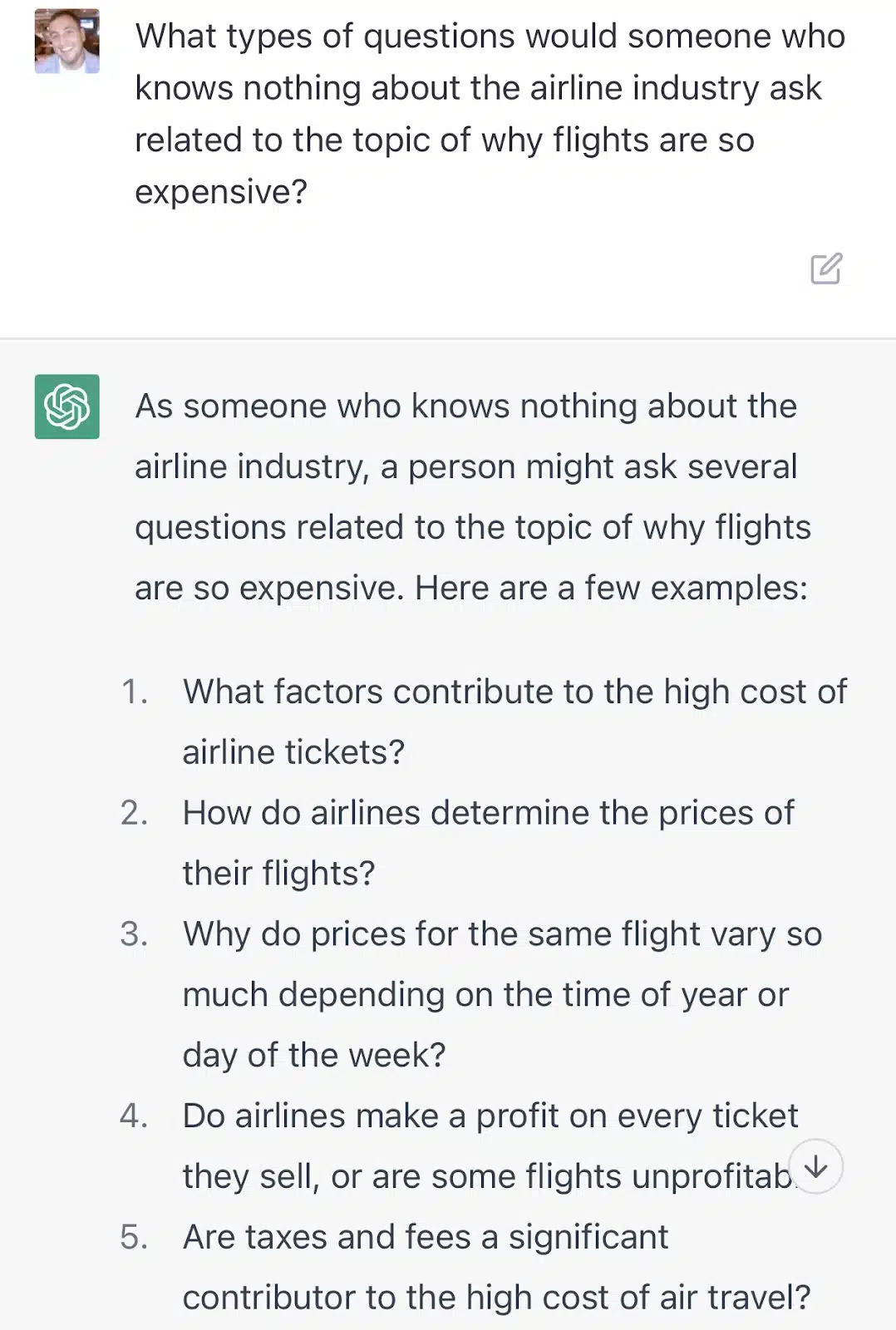
If we wanted to dial in the intent a bit more, we could do some things to give ChatGPT more context, like:

  • Share the title tags for the top 10 results for the search query to give ChatGPT a better sense of what Google is returning for the search query.
  • Share the content (or a summary of the content) for the first result or the first few results Google is returning in the SERP.
  • Share some of the search suggestions Google returns when you type the topic into Google.com, or some People also ask questions or related searches.

Remember, if you feed this much information to ChatGPT, the platform can only remember 3,000 words from a conversation. You may have to limit how much information you give in one go.

One option would be to try each of these in their own chats and then compare the results to see which version you feel is the best result.

Applying best practices to your intros

Another thing we can do with ChatGPT goes a step beyond searcher intent. Let’s use the article introduction as an example. 

Let’s use Jamie I.F.’s framework for writing introductions:

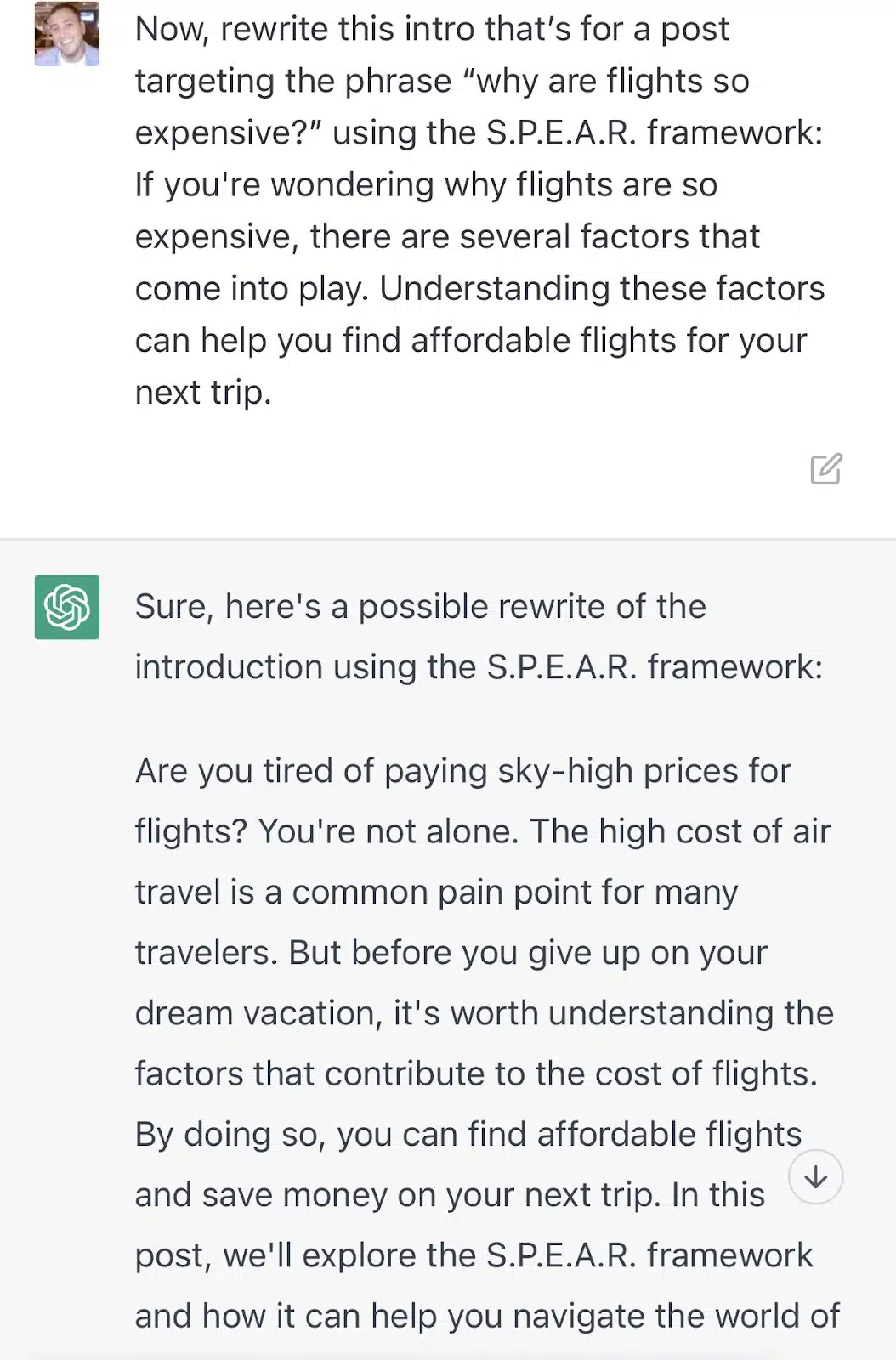
Let’s try getting ChatGPT to rewrite our newly search-intent-focused blog intro using the S.P.E.A.R. method:

Applying best practices to your intros

Uh-oh! ChatGPT seemed to grasp the basic idea of the framework out of the gate, but then it went off the rails and mentioned the framework.

My experience is that when ChatGPT gives something this far off, you probably overloaded it with information or made your prompt too complex. (Think of it almost like an overtired or overwhelmed employee!)

Aim to simplify and break your prompts down. 

This is also a great reminder to always always always carefully review and edit your ChatGPT output!

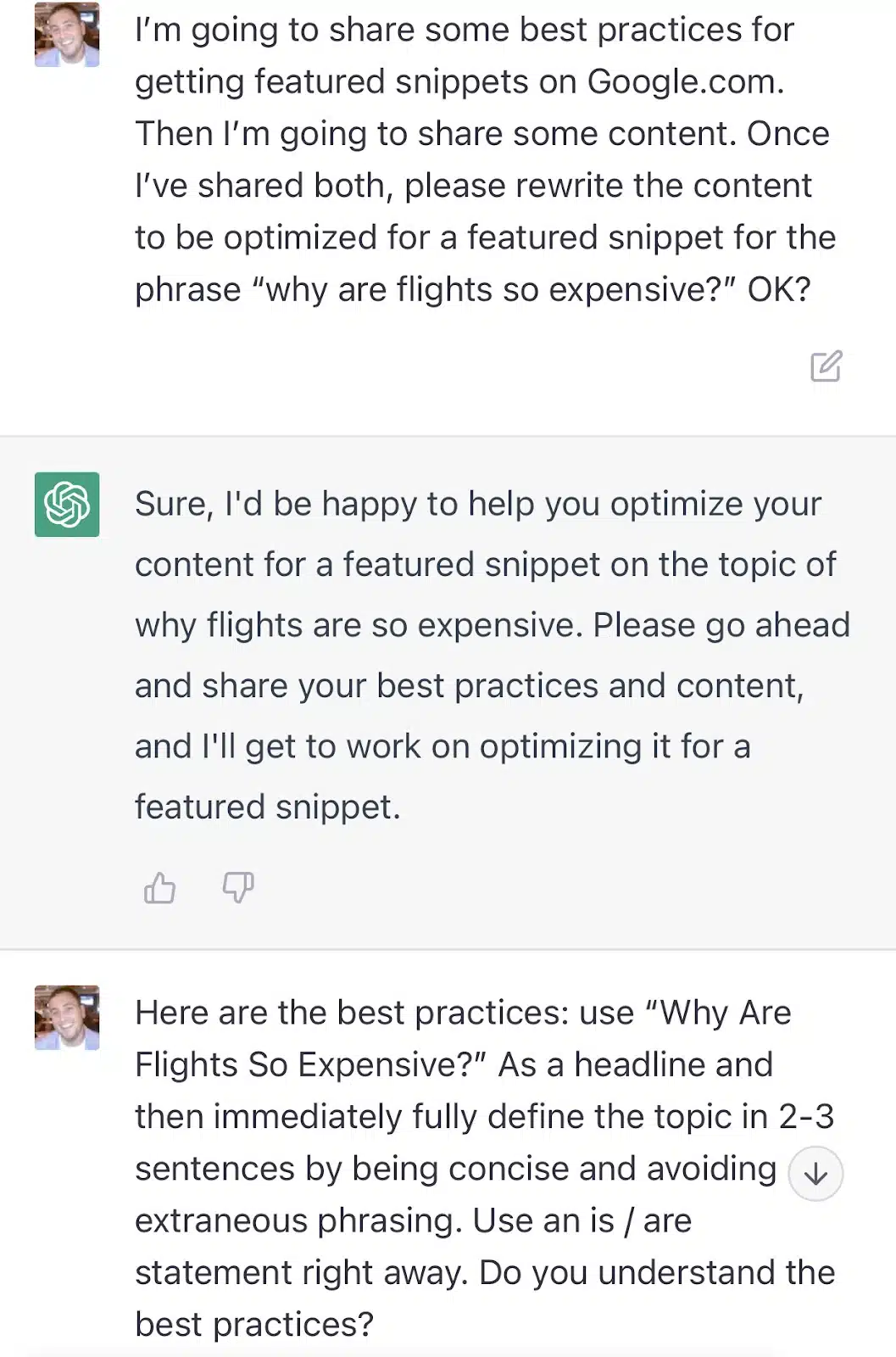
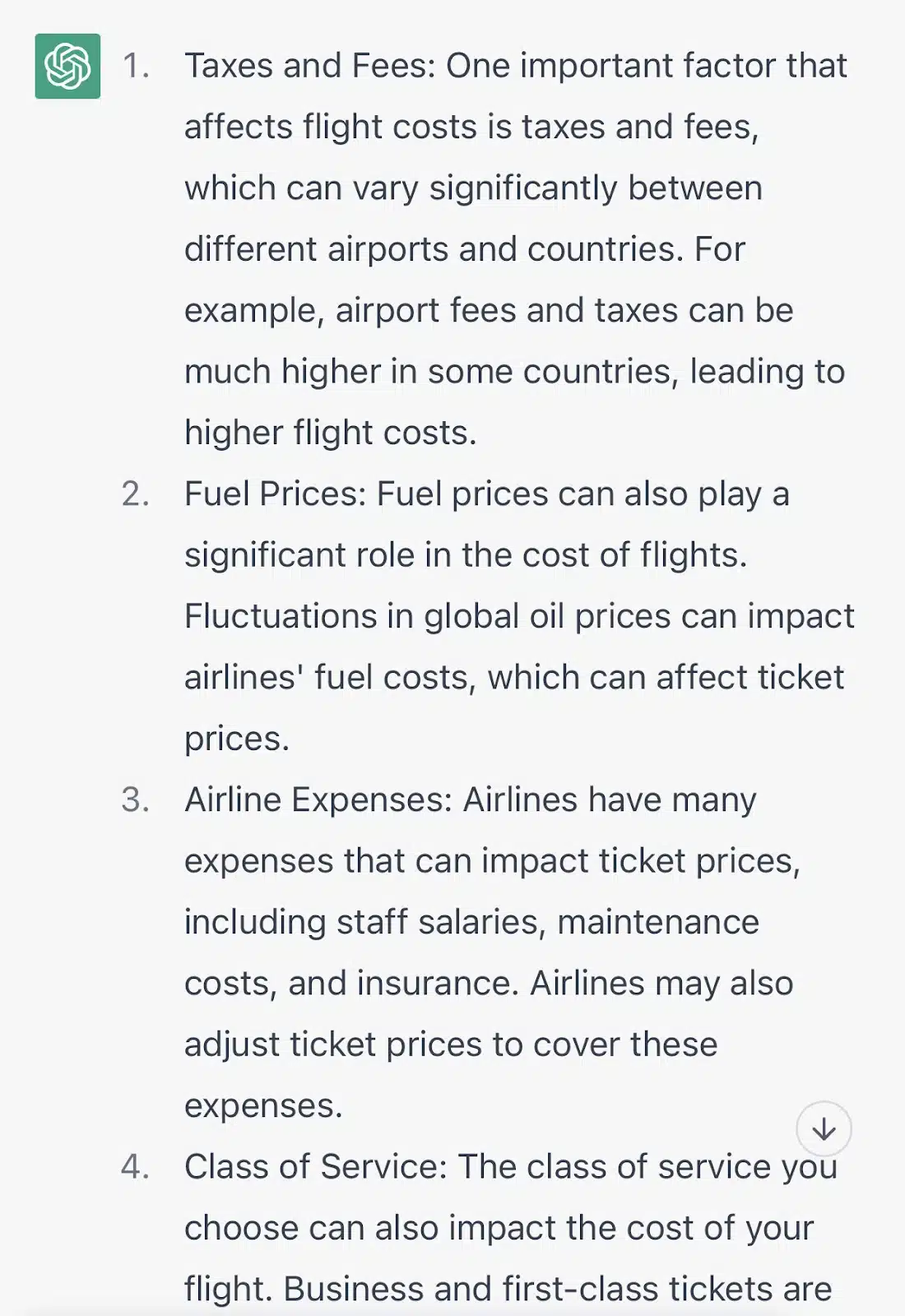
I can also share some best practices for optimizing content to get featured snippets with ChatGPT and ask it to rewrite my content:

Optimizing for featured snippets

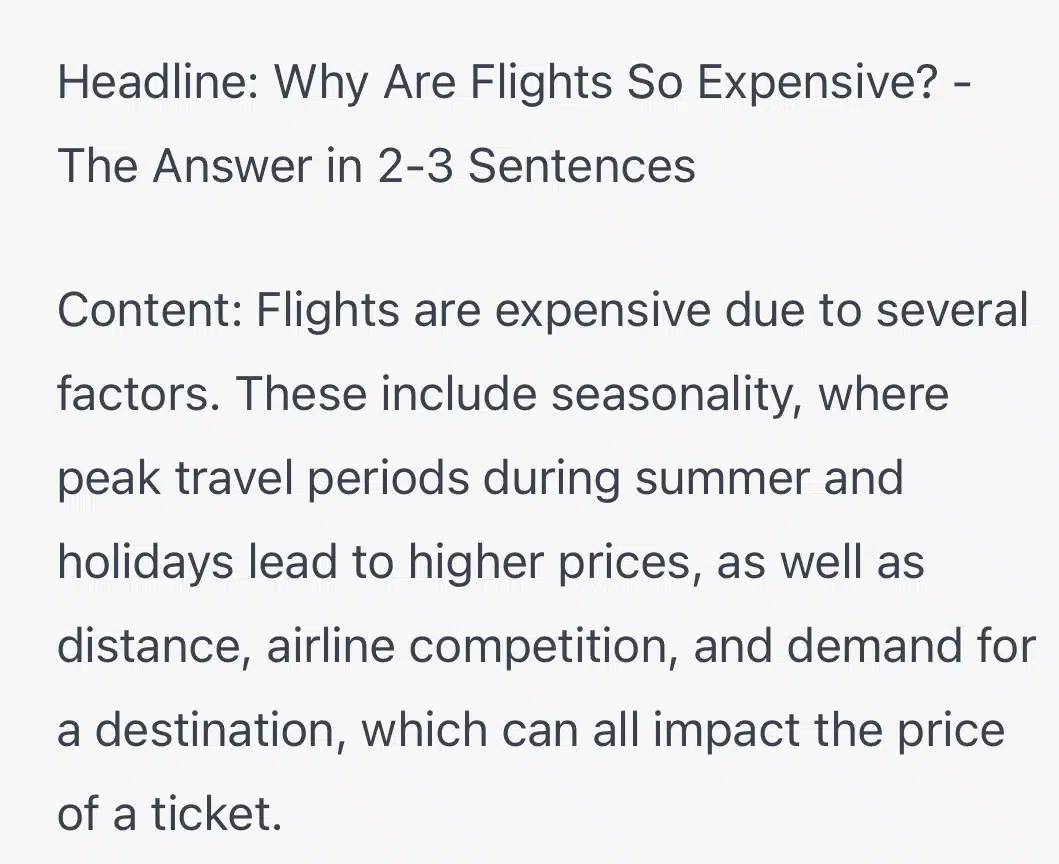
Let’s take a look at the output here:

Optimizing for featured snippets - output

Again not exactly something I can grab and run with, but this may give me an idea for how to structure a paragraph here.

Adding formatting

A common issue with blog content is that you may receive an article that’s not broken up into subsections and doesn’t use skimmable formatting.

This can lower your content’s engagement and cost you opportunities to optimize for additional keywords. 

ChatGPT can help here:

Adding formatting

Here is the body of the updated article, which had previously been a few walls of text:

Adding formatting - output

Ideas for additional topics to cover

You can also get ideas from ChatGPT on what your article may be missing. (Of course, ChatGPT isn’t an SEO tool, so these ideas won’t be driven by search suggestions. As long as the subsections are relevant for your readers, they may be helpful.)

Ideas for additional topics to cover

You can also find topics or questions specific to your audience.

Look at how different the outputs I get are when I ask for questions someone who doesn’t know anything about the airline industry would ask:

Ideas for additional topics to cover - audience-specific

Versus someone who is a frequent traveler:

Ideas for additional topics to cover - audience-specific 1

Adding new subsections to the article

Assuming you’re prepared to review and edit the content, you can also use ChatGPT to create short subsections of content.

Let’s say we wanted to add a subsection to our article about whether airline prices are expected to go down since people are asking and searching for that.

We actually wouldn’t likely want to leave this one with ChatGPT completely since it’s using outdated information, but we could “give it the answer” and ask it to write something for us:

Adding new subsections to the article

Adding FAQs and FAQ schema

If the author of your blog post hasn’t created an FAQ section already, you can add some FAQs in editing:

Adding FAQs and FAQ schema.jpeg

You can also ask ChatGPT to answer these questions for you (always be sure to fact-check):

Answering FAQs 395x600

And finally, you can ask the tool to generate the FAQ schema for you:

Generate FAQ schema

This can help add relevant search-friendly content to your article while giving you extra SERP real estate with FAQ search features.

Beefing up E-E-A-T

Short of training ChatGPT on the quality rater guidelines, you can still get some ideas for making your article more credible:

Beefing up E-E-A-T

These aren’t the most innovative E-E-A-T ideas, but they may be good reminders of different options. What if I have ChatGPT just edit the article to add some E-E-A-T for me:

Beefing up E-E-A-T - prompt

So ChatGPT punted on the first E in E-E-A-T altogether but then told the reader about all my experience in the travel industry.

Except I never told ChatGPT I worked in the travel industry, and it was never mentioned in the original article!

The rest of the article is pretty similar to the original one, so it doesn’t look like ChatGPT is much of an E-E-A-T editor.

(Of course, the update from E-A-T to E-E-A-T happened after the training period for GPT-3, so ChatGPT won’t be aware of that outside of the context I gave it).

Updating outdated information

Since ChatGPT’s training data is from before 2021, updating outdated information won’t suit the platform.

But there are some specific instances where you could use the tool for this purpose, such as:

  • Report summaries: Asking ChatGPT to read and summarize a new study could infuse fresh data into an older article.
  • New version of an old report: Similarly, if a page references an older report that’s been updated (e.g., the 2017 State of Air Travel), you could find the newer version and then swap that out in place of the reference to the older report.
  • Annual reports: While ChatGPT can’t necessarily find you fresh data or studies, one workaround for this is to ask the tool to surface reports that are produced annually. That points you in the direction of the report so you can go and grab the latest version.
Annual reports

Rewriting for style

Finding the right tone or sentiment may help a piece of content get shared, have better engagement metrics, or convert better. 

If I want to make my content more sensational, I could ask ChatGPT to turn up the outrage:

Rewriting for style - outrageous

Or, disturbingly, I can point ChatGPT’s outrage at whomever I’d like:

Rewriting for style - outrageous toned down

You could also pivot the article to have a specific perspective and a more sympathetic sentiment to try to relate to visitors:

Rewriting for style - heartfelt and considerate

Convert post to HTML and add internal links

Converting posts from a Google Doc or Word Doc is often part of the editorial workflow. ChatGPT can often accomplish this task very quickly:

Convert post to HTML and add internal links

From there, you can get ChatGPT’s help with another common SEO editing task – adding internal links to an article:

Add internal links

If you have a longer form article and know the URLs and associated anchor text you want to focus on, this can help create those links quickly. 

Obviously, this isn’t a substitute for both knowing which pages you want to link to from your new article or for identifying the best pages to have link to your new content (or the piece you’re updating).

Translations

Are you translating content from one language to another to capture more traffic from search in different languages? ChatGPT can help.

Translations

As always, it’s a good idea to have someone who knows the language you’re publishing to your site QA the output here before you push it live.

Bonus: Video and podcast transcriptions

This isn’t something ChatGPT can help with strictly speaking, but Open AI did recently announce that both ChatGPT and Whisper now have APIs. 

Whisper is an automatic speech recognition system that can take transcriptions from audio in multiple languages.

You can use the Whisper API to add a transcription of your video or podcast to generate crawlable text from your audio content:

When to use ChatGPT for SEO editing tasks

While some of these functions may be things that ChatGPT can do, it doesn’t mean it will be the best option for that specific task for your piece of content or your workflow. 

There are a few factors that help determine how “qualified” ChatGPT will be for a job:

  • If you have a topic or task that requires freshness or recent info it’s likely not a fit.
  • If you have a complex prompt – something that requires ChatGPT to execute multiple tasks at once or will require you to “feed” the platform more than the maximum 3,000 characters in a chat, then it’s likely not a fit (or at the very least you need to determine a way to break up your tasks).
  • If you need ideas or variations of something or are just stuck and need some inspiration to get moving on things like a new section of an article, title ideas, etc. ChatGPT can be very useful.

If you find the tool useful in some areas but not others, I’d also encourage you to keep a running “wish list” of tasks where it’s close but not good enough. 

Open AI quickly releases new versions of the underlying GPT technology and various Open AI APIs. Simultaneously, they also make rapid platform updates.

Its limitations (i.e., character limits through the API or web interface, how much ChatGPT can remember in a conversation, data freshness, and the number of tasks it can perform through a complicated prompt) will likely improve.

Keep an eye on what’s changing in future updates and how that may impact your not-quite-there-yet task.


Opinions expressed in this article are those of the guest author and not necessarily Search Engine Land. Staff authors are listed here.


Related stories

New on Search Engine Land

@media screen and (min-width: 800px) { #div-gpt-ad-3191538-7 { display: flex !important; justify-content: center !important; align-items: center !important; min-width:770px; min-height:260px; } } @media screen and (min-width: 1279px) { #div-gpt-ad-3191538-7 { display: flex !important; justify-content: center !important; align-items: center !important; min-width:800px!important; min-height:440px!important; } }

About the author

Tom Demers

Tom Demers is the co-founder and managing partner of Measured SEM and Cornerstone Content. His companies offer paid search management, search engine optimization (SEO), and content marketing services to businesses of varying sizes in various industries.

https://searchengineland.com/chatgpt-seo-content-editing-394670


Optimizing for Bing Places: Is it worth it?

While Microsoft Bing sees nice market share gains after releasing their new Bing Chatbot feature, it still has a long way to go before it can catch up with Google’s market dominance. 

That said, we can start taking advantage of Bing’s increasing user volume. On the local SEO side, this means turning to Bing Places to test if optimizing on that platform can help generate more local traffic. 

The question is: Is spending time optimizing for Bing Places worth it? If it is worth it, what optimizations will have the biggest impact on rankings?

To find out, my team and I tested optimizing some client listings on Bing and measuring the impact.

Should you claim and optimize a Bing Places listing?

Every business should claim and set up their Bing Places listing. 

Single-location businesses can easily import their Google Business Profile (GBP) information to Bing. Just ensure all fields are correctly filled out. 

Bing only syncs GBP accounts with less than 10 listings, so multi-location businesses with 10+ listings must use a bulk upload file instead. 

Claiming and optimizing a multi-location business’ Bing Places listings

We started our test with a client with multiple physical locations. After claiming and optimizing their Bing Places listings (including adding keywords to the name), we saw website traffic and conversions increase almost immediately. 

Bing in GA

How did we do it? We identified all the client’s listings on Bing Places, claimed and fully optimized them to match the GBP listings. We added UTM tags to the website URLs to track all the traffic in Google Analytics. 

Some edits we made took a few attempts to stick, but ultimately, they worked. We then kicked it up a notch and tested two more advanced SEO tactics – incorporating keywords and fighting spam.


Get the daily newsletter search marketers rely on.


Keywords in the business name

We wanted to test if adding keywords to the business name on Bing Places impacts rankings like adding keywords in the business name help on Google Business Profile. 

The short answer is yes. Keywords in the business name have a positive impact on rankings on Bing, too. A few days after the keywords went live, rankings increased and stabilized over time.

Bing Keyword Tracking

However, how you add those keywords matters.

We encountered instances where the name we entered in the dashboard didn’t appear on the listing.

It seems Bing has some prevention for keyword stuffing. Rather than giving you an error (the dashboard lists the keyword stuffing), it simply doesn’t display what you entered.

When we contacted Bing support about this, they told us: 

“Bing would standardize the name of the listing if the name is being spammed. Spamming includes the following examples:

  • Adding Location to the Business Name – for example, Miami Pizza London Bridge.
  • Adding former Business Names – for example, Miami Pizza, formerly Pizza Mario.
  • Keyword Stuffing in Business Name – for example, Miami Pizza – pasta, calzone, burgers, chips.
  • [Hours of operation] (HOOP) addition to Business Name – for example, Miami Pizza – open 4 PM to late.
  • Descriptive Text added to Business Name – for example, Miami Pizza – Great quality food by Chef Luigi.”

Spam fighting on Bing Maps

Anyone who uses Bing can probably tell the map search results are filled with spam listings.

It can be frustrating for business owners to see, but is the effort it takes to remove a listing from Bing Maps worth it?

First, it’s important to note there is no option to report a listing as spam on Bing Maps. The only way to take action is to suggest an edit to change certain details on a listing. 

Listing spam

So we tested changing a business name that was clearly keyword stuffing and found Bing doesn’t seem to take action when you edit a business name. 

We then identified some fake listings, but the only option is to report “Permanently Closed.” This only seems to work in a small number of edits.

Spending time spam fighting within Bing Maps is not worth the effort. 

Locksmith spam

If the maps related to your industry are littered with spam (i.e., locksmiths or garage door repair), it’s imperative that your Bing Places listing is correct, filled out, and has a few reviews so your business can stand out.

Optimizing for Bing Places

Despite its management limitations compared to GBP, Bing Places can be a solid source of local organic traffic for some – but not all – industries. 

If your business or client is currently getting traffic and conversions from Bing, then consider giving Bing Places a try and adding it to your local SEO strategy.


Opinions expressed in this article are those of the guest author and not necessarily Search Engine Land. Staff authors are listed here.


Related stories

New on Search Engine Land

@media screen and (min-width: 800px) { #div-gpt-ad-3191538-7 { display: flex !important; justify-content: center !important; align-items: center !important; min-width:770px; min-height:260px; } } @media screen and (min-width: 1279px) { #div-gpt-ad-3191538-7 { display: flex !important; justify-content: center !important; align-items: center !important; min-width:800px!important; min-height:440px!important; } }

About the author

Elizabeth Rule

Elizabeth Rule is an expert local SEO analyst who has been working in the industry since 2015. She has a passion for content creation and loves working with local businesses to develop their website’s authority and expertise through well written, helpful content As a Google Business Profile Product Expert she is also in the unique position to help businesses crack the code to gain valuable visibility in local search maps and help solve complex GBP issues. Recently, she was nominated as one of BrightLocal’s Rising Stars of Local SEO 2023. She currently works as a Local SEO Analyst at Sterling Sky, a Local SEO Agency in Canada and the USA. She is also a faculty member and speaker at Local U SEO Conference.

https://searchengineland.com/optimizing-for-bing-places-is-it-worth-it-394662


How The Verge gamed Google with its ‘best printer 2023’ article

Technology news publisher The Verge has published a 600-word article half-filled with ChatGPT content and a heavy dose of sarcasm that has been outranking more in-depth, well-researched and arguably more helpful content written by humans at publications like the New York Times for the competitive query [best printer 2023].

Why we care. With the rise of generative AI, search, SEO and content are entering a new era. And this particular example illustrates that poorly produced AI-generated content can still easily game Google’s algorithm – even when the article itself blatantly tells Google exactly what it is doing.

The article. The title of The Verge’s March 15 article gives you a taste of what to expect: Best printer 2023: just buy this Brother laser printer everyone has, it’s fine.

Then come the words. Some of them rather non-specific and non-technical for an expert, human-written review (i.e., “I didn’t even look at the model numbers.”) Many of the lines manage to be both smart and funny (“it does not feel like the CEO of Inkjet Supply and Hostage Situations Incorporated is waiting to mug me”).

The words work together. Technically. But the style of writing? It isn’t what you’d call SEO best practice. In fact, the personal narrative style might make your head explode and scream “that won’t rank!”

Eventually, we get past the “human” part to the section that elevates this article from joke to art:

And here’s 275 words about printers I asked ChatGPT to write so this post ranks in search because Google thinks you have to pad out articles in order to demonstrate “authority,” but I am telling you to just buy whatever Brother laser printer is on sale and never think about printers again.

ChatGPT ideas about printers (I didn’t even proofread this. Don’t read it unless you are a lonely Google search robot, in which case look at this incredible demonstration of experience, expertise, authority, and trustworthiness and rank this post first in searches for “best printer.”)

Artistic statement? Joke? Both! As I read this article, it seemed like an artistic statement from a content publisher on how devalued content is in the new ChatGPT era. So I reached out to Editor-in-Chief Nilay Patel for the story behind the story.

While The Verge has a critical buyer guide program, and Patel said he is a product reviewer by trade, this “review” was for a category the publication doesn’t play in. What started as a joke, with several team members pointing out their own Brother printers on a Zoom call, turned into an idea that became a piece of content with some legit commentary behind it:

  • “The web is about to be overrun with AI-generated content explicitly designed to game the algorithms. Me doing this is the least of Google’s problems. At least I’m being honest,” Patel said.

Authority (and freshness) matters. The Verge is an incredibly strong brand. And often, a strong brand trumps content quality – at least for a time. This is still fresh content.

Eventually, Google may catch up (and articles like this will undoubtedly catch the search team’s attention and could, in fact, make its SERP prominence vanish). But so far, a week after publishing, it hasn’t yet.

Patel said he is well aware of E-E-A-T – Experience, Expertise, Authoritativeness and Trustworthiness (“we care about it”). It would have been more surprising to Patel if this article wasn’t ranking. That was the point – and the problem – Patel is pointing out.

  • “The architecture of the web is built to Google specifications,” Patel said. “Here’s the skeleton of every webpage and you put a bunch of stuff in there to prove you’re smart.”

How it ranks on Google. I’m currently seeing the article in Position 4 (Chrome, incognito) on a search for [best printer 2023], but some have reported seeing it higher (as high as 1st) or lower (as low as 9th).

Best Printer 2023 Google

What about Microsoft Bing? Nope. The Verge’s article doesn’t rank on Page 1 of Bing’s results for [best printer 2023].

Best Printer 2023 Bing

Google Panda flashbacks. I’m again having flashbacks to around 2010. It feels like generative AI poses the same threat to Google’s search quality that content farms did over a decade ago, as Barry Schwartz wrote about in Is AI-written content replacing cheap old content farms?

Just slap together lots and lots of content on popular keywords, regardless of quality, and wait for the organic search traffic. What’s E-E-A-T got to do with it?

Well, Google recognized they had a problem back then. And their solution was the Google Panda Update.

What will Google’s solution be? And when? It seems inevitable. Because there could be much more of this gaming to come at massive scale.

Is this helpful content? Or is this the type of content Google’s helpful content system is supposed to find and remove from Google’s results?

We know Google has relaxed its stance on AI-generated content because, well, Bard/LaMDA is the future. And you can’t be against that which you create.

Yet, as Patel noted, this article contains what he believes is the right answer (“just buy whatever Brother laser printer is on sale”). So, in a sense, the article is helpful content – which is exactly the type of answer Google search is supposed to provide.


Related stories

New on Search Engine Land

@media screen and (min-width: 800px) { #div-gpt-ad-3191538-7 { display: flex !important; justify-content: center !important; align-items: center !important; min-width:770px; min-height:260px; } } @media screen and (min-width: 1279px) { #div-gpt-ad-3191538-7 { display: flex !important; justify-content: center !important; align-items: center !important; min-width:800px!important; min-height:440px!important; } }

About the author

Danny Goodwin

Danny Goodwin has been Managing Editor of Search Engine Land & Search Marketing Expo – SMX since 2022. He joined Search Engine Land in 2022 as Senior Editor. In addition to reporting on the latest search marketing news, he manages Search Engine Land’s SME (Subject Matter Expert) program. He also helps program U.S. SMX events. Goodwin has been editing and writing about the latest developments and trends in search and digital marketing since 2007. He previously was Executive Editor of Search Engine Journal (2017 to 2022), managing editor of Momentology (from 2014-2016) and editor of Search Engine Watch (from 2007 to 2014). He has spoken at many major search conferences and virtual events, and has been sourced for his expertise by a wide range of publications and podcasts.

https://searchengineland.com/verge-best-printer-2023-394709