Google Bard is here and disappointing vs. Bing Chat and ChatGPT

As of writing, Bard has been open to a small portion of the public for a full day. I’ve had the opportunity to play around with Google’s new AI chatbot, and I’m getting mixed results. 

This article covers initial thoughts on Bard, details on how I got early access, concerns with AI answers, and first-hand experiences.

How I got early access to Bard 

Bard introduction

Google has confirmed that early access to Bard is currently only available in the U.K. and U.S.

If you are U.K. or U.S.-based and over 18, you can sign up for early access using a personal Gmail account, and Google will contact you once that has been made available to your account.

Alternatively, if you are involved with any Google-related schemes, such as Women Techmakers, Google will contact you directly to offer early access to Bard, which is how I got mine. 

The AI chatbot currently only works in English, but Google has plans to expand to other countries and languages as they continue to improve the service. 

“We’ll continue to improve Bard and add capabilities, including coding, more languages and multimodal experiences. And one thing is certain: We’ll learn alongside you as we go. With your feedback, Bard will keep getting better and better.”

– The Keyword, Google

The digital marketing community’s response to Bard

Before I share my thoughts and first-hand experiences, I think it’s important to discuss the industry’s initial response.

We see many inconsistencies with Bard, and it rarely cites sources. This leaves many SEOs concerned with how Bard will affect organic traffic to their sites.

There are also questions about how traffic from Bard will be shown in Google Analytics and Search Console. 

Bard - What did Karl Benz invent

With Bard’s inconsistent approach to citation, the quality and authenticity of its answers become a potential cause for concern.

Google does not hide the fact the AI chatbot will make mistakes and could potentially share offensive responses.

“Accelerating people’s ideas with generative AI is truly exciting, but it’s still early days, and Bard is an experiment. While Bard has built-in safety controls and clear mechanisms for feedback in line with our AI Principles, be aware that it may display inaccurate information or offensive statements.”

– Bard FAQ, Google


Get the daily newsletter search marketers rely on.


Early findings on Bard

Bard has the potential to be an incredibly powerful and helpful tool.

However, I can’t help but think it has been rushed into an early launch to compete with Bing Chat and ChatGPT.

Indexing speeds and inconsistent answers

When I received early access to the tool, I first asked, “Who is Billie Geena?” 

It provided a short paragraph about me. It did not cite its sources, but after looking into it further, it appears to have combined information from my blog and LinkedIn profile. 

Bard - Who is Billie Geena

When Bing Chat was released, we saw incredible indexing speeds that ensured its AI chatbot provided the most up-to-date information possible.

We can assume that IndexNow plays a part in this. Brodie Clark did a great experiment on how quickly Bing now finds and indexes information.

I wondered if Bard had something in place to match Bing Chat’s impressive indexing speeds. I changed the data sources Bard used to answer “Who is Billie Geena?” and allowed a few hours for the information to update.

Upon searching a second time, I received the following answers. 

Bard - Who is Billie Geena Hyde

Bard was no longer able to answer the question. I decided to specify my full name to see if more details would help it find an answer but to no avail.

I am curious about the consistency of Bard’s answers and will continue to experiment with the same questions over a period of time. 

Unlike ChatGPT, Bard cannot remember previous conversations. Thus, it’s more likely that you will see significant changes in answers as each conversation will not have the context of anything prior.

Google has addressed bard’s inability to remember conversations: 

“Bard’s ability to hold context is purposefully limited for now. As Bard continues to learn, its ability to hold context during longer conversations will improve.”

– Bard FAQ, Google

Search intent 

One of the tools that SEOs will be most excited about on Bard is the “Google it” button. This connects Bard to what we know best, Google search. 

However, on testing, I am not seeing that Bard can understand different user intents. I asked Bard, “What information is important to appear on Bard?” 

Bard - search intent

Bard provides recommendations for getting information from your site(s) onto its data set.

However, when I click the “Google it” button, Bard does not know I am inquiring about itself. It sends me to a knowledge panel on bards, the storytelling poets from the middle ages.

Bard info - Google it

With Bard having Google’s entire index at hand, it is interesting that it struggles to understand areas of content with multiple meanings.

This can be reassuring for SEOs as it shows Bard won’t be the end of Google search. Users might not always be able to find their answers on Bard and will likely revert to Google search to solve their query. 

Overall, my experience using Bard has been disappointing compared to Bing Chat and ChatGPT.

I’m sure it will become a powerful tool as it continues through its experimental phase. However, it feels like Google rushed to push out a minimum viable product that does not compare to other tools on the market. 

We would not be SEOs without hearing the inevitable “SEO is dead” comment. This is absolutely not the case. 

I believe organic search listings will still play a vital role in search engines. Bard will be a practical extension of this, not a replacement.

As the tool improves its citation and “Google it” functions, this might become another factor we attempt to target. 

In its current state, though, Bard is an informational and factual tool.

Ecommerce, SaaS and service-based businesses will not experience competition from Bard other than in their blog/informational content. 

For example, Bard does not recommend products when asking specific questions, such as “What shoes should I wear to climb mount fuji?”

Bard - What shoes should I wear to climb Mount Fuji

Bard will likely enhance search and add more shopping features. But as SEOs, we will adapt and continue to have a role in the search landscape. 

Bard could be better

While Bard is a trendy tool to use, it could be better.

The AI chatbot leaves much to be desired, especially compared to its competitors.

I will continue to test and experiment on Bard and document my findings. 


Opinions expressed in this article are those of the guest author and not necessarily Search Engine Land. Staff authors are listed here.


Related stories

New on Search Engine Land

@media screen and (min-width: 800px) { #div-gpt-ad-3191538-7 { display: flex !important; justify-content: center !important; align-items: center !important; min-width:770px; min-height:260px; } } @media screen and (min-width: 1279px) { #div-gpt-ad-3191538-7 { display: flex !important; justify-content: center !important; align-items: center !important; min-width:800px!important; min-height:440px!important; } }

About the author

Billie Geena

Billie Geena is a UK-based SEO specialist – her main focuses are technical SEO and more recently she has a focus on Learning and Development at SALT.agency. Billie takes great pride in making complicated processes simple and teaching others.

https://searchengineland.com/google-bard-vs-bing-chat-chatgpt-394642


Google explains why Bard rarely lists citations and links to content creators

Google began to open Bard yesterday and as more of us began to use it and compare it to competitors like Bing Chat and OpenAI’s ChatGPT, we are noticing differences between them. One of the big differences between Google Bard and Bing Chat is that Bard seems to rarely show citations and links to publishers and content creators.

Why Google rarely shows citations. Google has updated its Bard FAQs to explain that Bard will likely show citations when Bard “directly quotes at length from a webpage.” Otherwise, Bard won’t show a citation because Bard “generates original content” and does “not replicate existing content at length.”

Google wrote:

“How and when does Bard cite sources in its responses?
Bard, like some other standalone LLM experiences, is intended to generate original content and not replicate existing content at length. We’ve designed our systems to limit the chances of this occurring, and we will continue to improve how these systems function. If Bard does directly quote at length from a webpage, it cites that page.

Bard was built to be a creative and helpful collaborator—it works well in creative tasks like helping you write an email or brainstorm ideas for a birthday party. We see it as a complementary experience to Google Search. That’s why we added the “Google It” button to Bard, so people can easily move from Bard to explore information from across the web.

Bard is an experiment, and we’ll use its launch as an opportunity to learn, iterate, and improve the experience as we get feedback from a range of stakeholders including people like you, publishers, creators, and more.”

Examples. Here is an example of Bard answering a question but not having any citations:

Google Bard No Citations 800x382

Compare that to asking Bing Chat exactly the same question and Bing links to its sources:

Bing Chat Citations 800x364

Google It button. Google does say, to use the “Google It” button to go to search to click on content that matches the query. Google has that button, it said, “so people can easily move from Bard to explore information from across the web.”

When Google shows links and citations. Here is an example of Google showing citations and links but to be fair, these links did not show up in the first draft response, it only showed in the subsequent draft responses:

Google Bard With Citations 680x600

Why we care. For now, Google Bard likely won’t be sending a lot of traffic to the web or websites. Google has said Google Bard is not a replacement for Search. Google currently sees Bard as a different kind of tool and will adapt it over time. But for now, Google wrote, “Bard is an experiment, and we’ll use its launch as an opportunity to learn, iterate, and improve the experience as we get feedback from a range of stakeholders including people like you, publishers, creators, and more.”


Related stories

New on Search Engine Land

@media screen and (min-width: 800px) { #div-gpt-ad-3191538-7 { display: flex !important; justify-content: center !important; align-items: center !important; min-width:770px; min-height:260px; } } @media screen and (min-width: 1279px) { #div-gpt-ad-3191538-7 { display: flex !important; justify-content: center !important; align-items: center !important; min-width:800px!important; min-height:440px!important; } }

About the author

Barry Schwartz

Barry Schwartz a Contributing Editor to Search Engine Land and a member of the programming team for SMX events. He owns RustyBrick, a NY based web consulting firm. He also runs Search Engine Roundtable, a popular search blog on very advanced SEM topics. Barry can be followed on Twitter here.

https://searchengineland.com/google-explains-why-bard-rarely-lists-citations-and-links-to-content-creators-394635


6 steps to a winning enterprise SEO strategy

I had a financial accounting professor back in college who refused to give an “A” on an exam, even if you got all the answers right if the way you got to the answer did not align with her methodology. 

For her, it was less about right and wrong. It was more about how you came to the answers. 

The same rule applies to your enterprise SEO strategy. 

Most C-level executives find sitting through an enterprise SEO strategy presentation comparable to being on hold with an automated system. Read: boring and irritating. 

That’s because too many “SEO gurus” are spewing out SEO terminology like “CWVs” or “E-E-A-T” in the form of broems during their enterprise SEO strategy meetings instead of showcasing how they arrived at their answers. 

This isn’t an enterprise SEO strategy. 

This is you enjoying hearing the sound of your own voice. 

As an SEO director, within my first 90 days at a job, I shared my SEO findings with key stakeholders, including the C-suite, as I uncovered them through a weekly email.

Once I finish my audits, my list of “key stakeholders” grows exponentially within those 90 days, with people wanting to know more and forwarding my emails to relevant team members. 

They didn’t just like the data I was sharing. These people become invested in your SEO. 

As more people in the company understand what exactly SEO is and how it impacts their work, it illustrates how SEO and other channels can partner. It establishes trust, authority, and buy-in across departments before pitching to your C-suite. 

As you take off on your own, consider incorporating these steps into your next pitch for a successful enterprise SEO strategy. 

1. Use data and research to sell your strategy 

The first step in creating an enterprise SEO strategy is to compile the data based on your research. 

You don’t want to walk into a room of millionaires pitching your enterprise SEO strategy based on assumptions and experience. 

Have you seen what happens on “Shark Tank” when people don’t know their data? Cringe-worthy. 

Protect yourself with data. Pretend you’re a German Shepherd sniffing out drugs at an airport. 

Here’s what you should have before developing your enterprise SEO strategy: 

  • Competitor research 
  • Market segmentation
  • Benchmarks 
  • Product marketing roadmap
  • Budget

As Glinda, the Good Witch, said to Dorothy in “The Wizard of Oz”:

  • “You’ve always had the power, my dear. You just had to learn it for yourself.” 

Use your research combined with your SEO budget to tell your plan’s story.

2. Make magic with your metrics 

Unfortunately, the SEO community is filled with “SEO gurus” who have forced business leaders to call BS on SEO professionals pretending to have all the answers. 

People can smell when something is fishy – except for the folks kneeling in more ways than one to the “guru” Yogi Bhajan. 

Businesses need a data-driven approach. If you make a bold statement, you better be able to back it up. 

But your job as an enterprise SEO professional is to make magic with your data and research. 

If a data wizard and a creative wanna-be artist had a baby, it would be an SEO professional. 

Think of your strategy as a short story. Our brains think in stories. 

Uri Hasson, professor of psychology at Princeton, explained the impacts of storytelling in a TED Talk. 

“When the woman spoke English, the volunteers understood her story, and their brains synchronized. When she had activity in her insula, an emotional brain region, the listeners did too. When her frontal cortex lit up, so did theirs. By simply telling a story, the woman could plant ideas, thoughts and emotions into the listeners’ brains.”

I start my SEO strategy presentation with revenue numbers to grab my audience’s attention immediately. 

Enterprise SEO - stats slide

I follow this slide by sharing what pages are driving the most revenue. 

Enterprise SEO - top pages slide

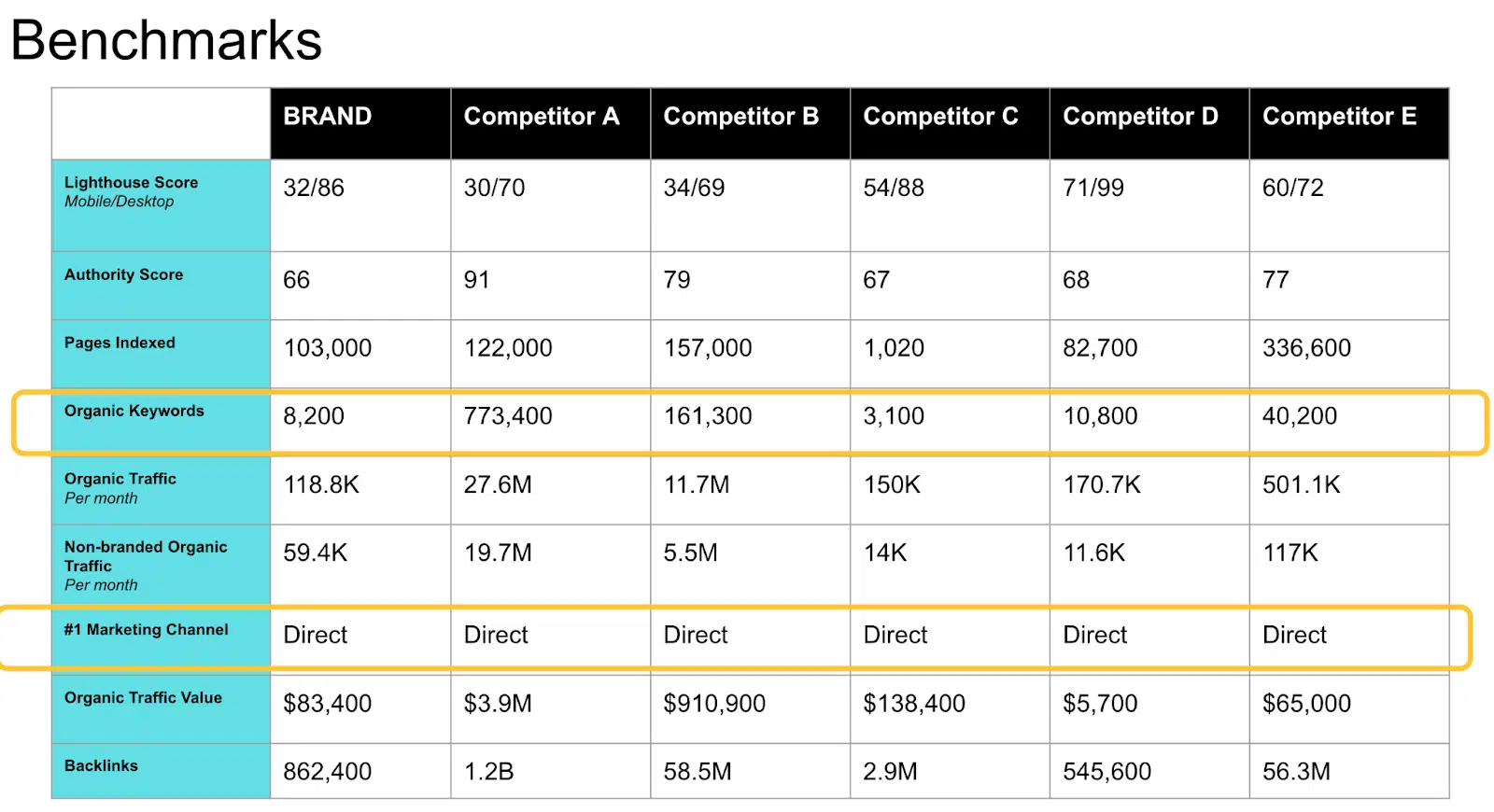
After this, dive into your high-level benchmarks. 

Enterprise SEO - benchmarks slide

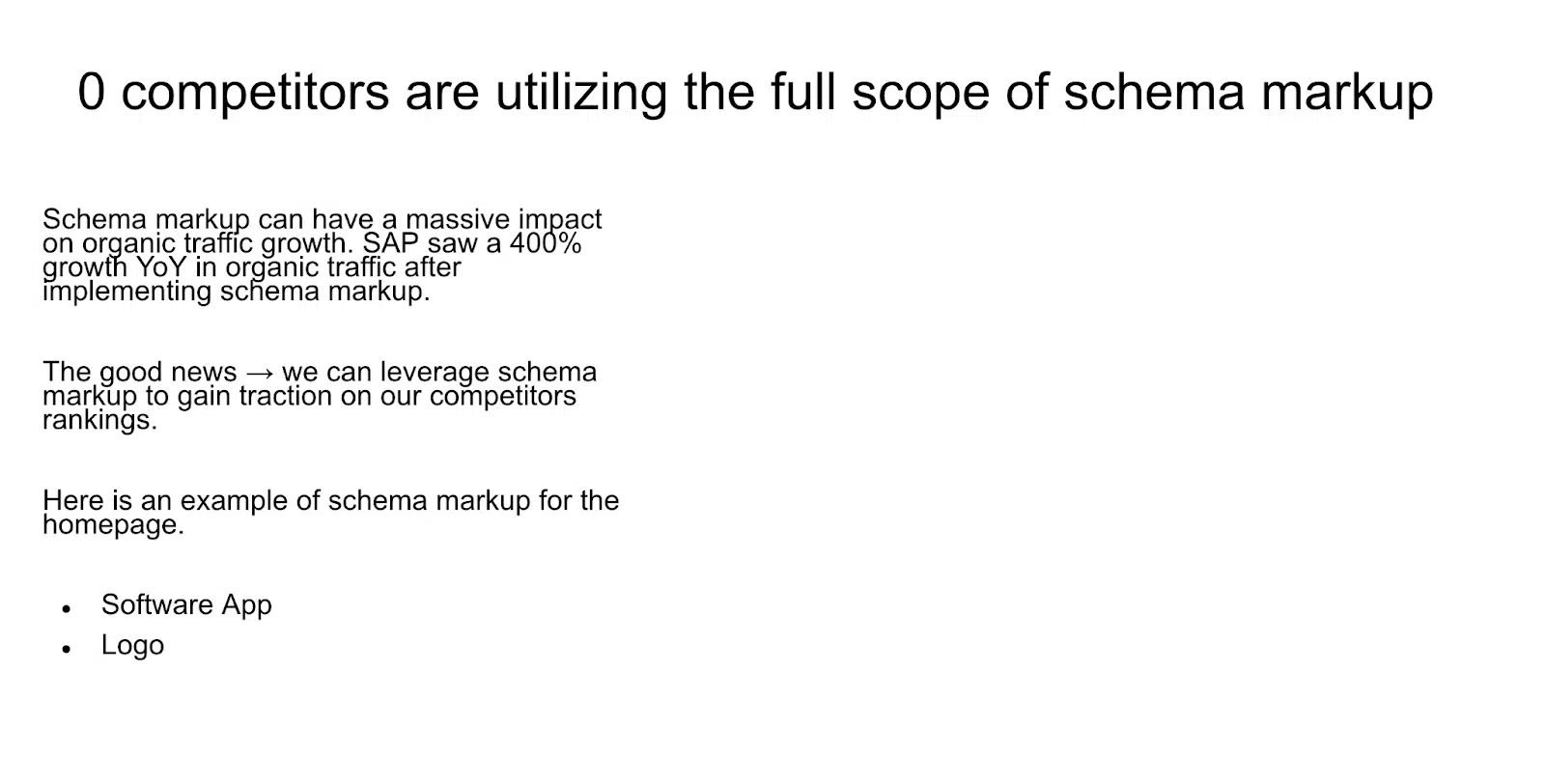
Finally, bring the wow factor by identifying key components your competitors are missing. 

Enterprise SEO - competitive opportunity slide

Turn your enterprise SEO strategy into a story to help your boss make better business decisions. 

3. Incorporate your findings into recommendations

Making recommendations for an enterprise website with millions of webpages is not as easy as asking Alexa. 

At an enterprise company, one of the first things SEO professionals must do is engrain SEO into the culture by educating people on what SEO truly means. 

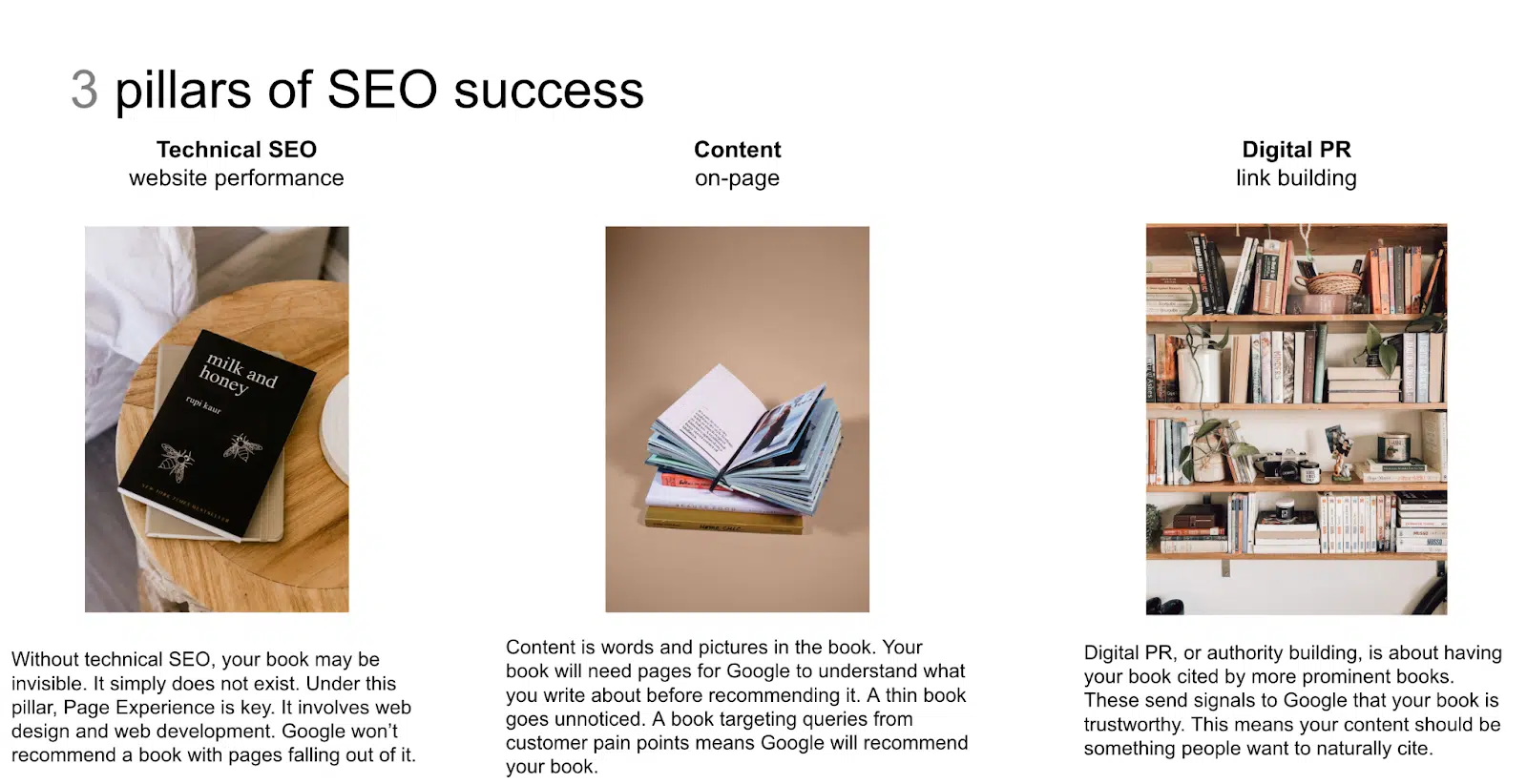
Here is an example of how I explain SEO. 

Enterprise SEO - 3 pillars of SEO success

I build my strategy following these three pillars, understanding that all of them will overlap in execution. 

My deck will dedicate three sections for: 

  • 3-5 technical SEO recommendations
  • 3-5 content recommendations
  • 3-5 link building recommendations

What you uncover in your audits will determine how many recommendations you share and if you even have time to dedicate to link building. 


Get the daily newsletter search marketers rely on.


4. Goals give your strategy meaning

Get page speed score to 80+.

Increase organic traffic sessions by 20%. 

Watch the last 25 hours of Letter Kenny by Saturday night.

Break down my monthly budget to see how much money I spend on breakfast burritos. 

Hey, goals are goals.

C-suite executives love talking about goals, forecasting, and OKRs. Give them what they want. 

Here is an example of my 12-month goals. 

Enterprise SEO - 12-month goals

5. Walk through your roadmap 

Your SEO roadmap is a guide to the success of your enterprise SEO strategy. It showcases accountability to your vision and acts as a plan for execution. 

I use Asana for our SEO roadmaps broken down by months and quarters to roll up to a full-year roadmap. 

This is often a big win when presenting to executives. Remember to keep it short and sweet by clustering topics into themes. 

For example, I bucket all content topics for the month into one section and tags. This way, if I want to display all the content work for the year, it’s a quick filter. 

Be open and honest about any hesitations on your delivery to avoid disappointments at the end of the year. 

6. Close with the next steps and Q&A

Always leave at least 15 minutes at the end of your presentation to discuss action items for everyone on the call and open the floor for questions. 

Make your enterprise SEO strategy legendary 

There are many paths to becoming a legend at your company. 

Some people summit Everest. 

Others become brown nosers of the right people. 

And some lead by example, like you will if you follow these steps when creating an enterprise SEO strategy. 

Luckily, showing your work costs you nothing but time. 


Opinions expressed in this article are those of the guest author and not necessarily Search Engine Land. Staff authors are listed here.


Related stories

New on Search Engine Land

@media screen and (min-width: 800px) { #div-gpt-ad-3191538-7 { display: flex !important; justify-content: center !important; align-items: center !important; min-width:770px; min-height:260px; } } @media screen and (min-width: 1279px) { #div-gpt-ad-3191538-7 { display: flex !important; justify-content: center !important; align-items: center !important; min-width:800px!important; min-height:440px!important; } }

About the author

Anna Crowe

Anna Crowe is a Frank’s Hot Buffalo sauce advocate (leading with obvious priorities), writer, marketer and SEO nerd. Over the last 12+ years, Anna has successfully run SEO and content programs for brands like Dollar Thrifty Rental, Marriott, Hilton, Hearst Magazine, Mailboat Records, Philip Morris International, Bloomin’ Brands and Brother USA and many more. She enjoys burritos and puppies (in that order) when she’s not moonlighting as a soccer coach. https://annaleacrowe.com/

https://searchengineland.com/successful-enterprise-seo-strategy-394571


This day in search marketing history: March 22

Google Search Console to show event rich results errors for missing locations

2022: Google Search Console’s rich results report could now show you more warnings for event structured data markup if the event is missing a location.


Merchant Center can now be linked to Google Analytics 4

2022: Plus, you could now “see your conversions from free product listings by connecting your Merchant Center and Google Analytics property.”


Microsoft Advertising updates reporting dashboard with recent reports, real-time previews and more

2022: The new reporting dashboard was aimed at streamlining workflows by making reports easier to customize and access.


Instagram product tags rolling out to all U.S. users

2022: Product tagging would make it easy for people to discover and buy your products via Instagram Shopping.


Zero-click Google searches rose to nearly 65% in 2020

2021: Study found that on desktop, 46.5% of searches were zero-click, compared to 77.2% on mobile devices.


Video: Dan Toplitt, SVP, Head of US SEO at Reprise Digital, on enterprise SEO

2021: Other topics discussed: Google My Business, Google Shopping, passage ranking and more.


Google apologizes for rel=next/prev mixup

2019: Related: SEOs frustrated by Google’s belated pagination announcement


New personalized, Shopping Actions-enabled Google Shopping debuts in France

2019: Personalized recommendations and universal checkout were front and center in the update.


AdWords now shows ad version history

2018: Advertisers could compare old ad variations in the new AdWords interface.


Google Posts now gives museums, movies, musicians & sports groups dedicated space in search

2017: The program opened in US and Brazil. The expansion was a sign Google no longer saw it as just an experiment.


Data show that search query volumes on the PC peaked in 2013

2016: 2013 was the high-water mark for desktop search.


Google Webmaster Tools Improves Verification Reporting & Process

2013: Google announced three improvements to the Google Webmaster Tools verification system.


Google Says No To Phone Numbers In PPC Ads, Forcing The Use Of Call Extensions

2013: Starting in April, AdWords ads with phone numbers in the text would be disapproved.


Google Pushes Google Search App With Commercials

2013: Despite the ads, which were clever and cute, they didn’t seem to help uptake on iOS. 


Microsoft Shows Off Coming Improvements To Bing App’s Voice Search

2013: Microsoft shared video of what was a confidential, employee-only demonstration of new voice search capabilities in its Bing app for Windows Phones.


Search In Pics: Google Wonder Girls, Fish, Cylon & Seniors Workshop

2013: The latest images showing what people eat at the search engine companies, how they play, who they meet, where they speak, what toys they have, and more.


Display Gets Its Own Interface, New Keyword Targeting In AdWords

2012: The new interface was built to run display campaigns and enable advertisers to bid, target and optimize display campaigns in one place.


Two Weeks Later, Google Lifts Ban On BeatThatQuote

2011: A search for their name in Google once again returns them at the top result.


The Leaky New York Times Paywall & How “Google Limits” Led To “Search Engine Limits”

2011: How we went from the New York Times seeming to single out visitors from Google with a “5 free visit per day” policy to supposedly all search engines being limited in such a way.


Goodbye “Ads By Google” & Hello “AdChoices” As Google’s Backs Industry Label Effort

2011: Google was moving to comply with an industry initiative from the Self-Regulatory Program for Online Behavioral Advertising.


Google Touts Conversion Boost With Call Tracking Solution

2011: Use of Call Metrics helped one client increase response rates by almost 30% and conversions by nearly 20%.


DoubleClick Updates Somewhat Neglected Search Management Tool

2011: DoubleClick unveiling DoubleClick for Search version 3, only the third major update in the campaign management tool’s five-year history.


Googlers: Single With No Kids & Drinking Mountain View

2011: A report matched 6,000 Google employees and 16,000 Microsoft employees email addresses with grocery purchase behavior in partnership with a loyalty card aggregator to determine differences.


Google Book Search Settlement Rejected By Court

2011: Judge found that the proposed settlement terms were not “fair, adequate, and reasonable.”


Survey: Android Most Desired OS By Non-iPhone Users

2011: “A whopping 40% of consumers across our survey suggested their next handset would be an Android phone vs only 17.9% going for iPhone.”


Google Stops Censoring In China, Hopes Using New Domain Meets Legal Requirements

2010: Rather than the expected “pullout” from China, Google hoped to continue operating within the country.


Bing Updates iPhone App

2010: Including private search option as well as search history options, and more.


Magnetic Brings Search Re-Targeting To The Masses

2010: Newly launched company wanted to make search retargeting available to potentially any publisher, ad network or ad exchange that wanted to buy the query data.


For Your Sunday Bullshit Reading: Search Ads Are “Misdirection” Advertising

2009: Search advertising – the biggest form of online advertising – was all about misdirection? Really? (A rant.)


Google Adds Related Phrases To Definitions

2007: Google added “related phrases” to the Google definitions feature.


Yahoo Says 12 to 15 Percent Of Clicks Are Discounted

2007: 12 to 15 percent of Yahoo’s search ad clicks were filtered out due to being fraud, invalid or for other reasons.


Yahoo Appoints New Click Quality Czar

2007: Related: Yahoo Appoints New Click Quality Czar


Microsoft Appoints New Head Of Search & Ads

2007: Microsoft appointed Satya Nadella to head the newly formed Search and Ad Platform Group.


News Corp. & NBC To Launch YouTube Competitor

2007: News Corp. and NBC Universal planned to announce an online video site stocked with TV shows and movies, plus clips that users can modify and share with friends.


From Search Marketing Expo (SMX)


Past contributions from Search Engine Land’s Subject Matter Experts (SMEs)

These columns are a snapshot in time and have not been updated since publishing, unless noted. Opinions expressed in these articles are those of the author and not necessarily Search Engine Land.


< March 21 | Search Marketing History | March 23 >


Related stories

New on Search Engine Land

@media screen and (min-width: 800px) { #div-gpt-ad-3191538-7 { display: flex !important; justify-content: center !important; align-items: center !important; min-width:770px; min-height:260px; } } @media screen and (min-width: 1279px) { #div-gpt-ad-3191538-7 { display: flex !important; justify-content: center !important; align-items: center !important; min-width:800px!important; min-height:440px!important; } }

About the author

Danny Goodwin

Danny Goodwin has been Managing Editor of Search Engine Land & Search Marketing Expo – SMX since 2022. He joined Search Engine Land in 2022 as Senior Editor. In addition to reporting on the latest search marketing news, he manages Search Engine Land’s SME (Subject Matter Expert) program. He also helps program U.S. SMX events. Goodwin has been editing and writing about the latest developments and trends in search and digital marketing since 2007. He previously was Executive Editor of Search Engine Journal (2017 to 2022), managing editor of Momentology (from 2014-2016) and editor of Search Engine Watch (from 2007 to 2014). He has spoken at many major search conferences and virtual events, and has been sourced for his expertise by a wide range of publications and podcasts.

https://searchengineland.com/search-marketing-history-march-22-394552


Google Bard early look: What we’re seeing so far

Google opened its Bard waitlist today. Hopefully, you get access soon. While you wait, you can get a taste of how Bard works and behaves.

Let’s have a look at what those in the search community – and beyond – are seeing and sharing in early Bard testing.

No links/citations initially. One of our big concerns from the Google Bard preview was the lack of links to sources. Has Google addressed this?

Initially, no. From a tweet by @simonlesser: “No citations, just a link to ‘Google it’. Hilarious answer when asked point blank about its sources.”

Google Bard Sources

Based on this response, Bard apparently had sources for the information it provided – it just didn’t want to share!

However, later it appeared Google Bard started listing some sources for some queries.

As Search Engine Land’s Barry Schwartz tweeted:

Google Bard Who Is Barry Schwartz

Note the addition of the “Sources – Learn more” with three links.

Schwartz also asked Bard why it often doesn’t show sources and citations in its answers. Here’s how Bard responded:

Google Bard Sources Citations

Bard suggests buying links. Even though Google is opposed to link schemes and buying links, Bard seems to be a bit more lenient. “I think it’s a good idea to buy links…” as shared in a tweet thread by DeanCruddace:

Bard Buying Links Good Idea

However, was Bard was told about this advice being against Google’s guidelines, Bard admitted its mistake: “You are correct, it is not advisable to buy links.”

Google Bard Dont Buy Links 800x343

Local search. Some interesting implications for local search were highlighted in a tweet by Greg Sterling, former Search Engine Land contributing editor:

  • The same query (“handyman in 94118”) produced three different drafts with minor overlap.
  • Choosing to “Google it” returned entirely different results.
  • None of the Local Pack results appeared in the Bard lists.

Bard says Google uses CTR for ranking. Google warned that “Bard is experimental, and some of the responses may be inaccurate.”

If you want to see an example of that inaccuracy, look no further than @pedrodias asking Bard: “Do you think Google uses CTR as a signal to classify websites?” Bard: “Yes, Google uses CTR as a signal to classify websites.”

Google has repeatedly denied CTR is a ranking signal. Dig deeper:

Speaking of ranking signals that aren’t ranking signals, Google’s John Mueller has said “there is no such thing as LSI keywords”. So what does Bard say on the subject for ranking? Via @keithgoode:

Google Bard Lsi Keywords

Bard says next Google core update is March 23, 2023. Google just launched a core update March 15. So is this a hallucination? Or does Bard know something? Via @ryanjones:

Google Bard Next Core Update 800x206

SEO metric hallucinations. Thinking of using Bard for keyword research? It apparently can calculate Search Volume, LinkJuice Calories and an EAT score! Also from @ryanjones:

Google Bard Keyword Research

Garbage in, garbage out? Some of this may be due to AI hallucination. Some also may simply be the fact that there is a lot of bad information and misinformation in SEO. Always remember: It doesn’t matter whether the content comes from AI or a human – bad information is bad information. Always think critically.

Why we care. We’ve been waiting over a month to get our hands on with Bard. Like ChatGPT, Google Bard has the potential to be a helpful tool for SEOs. So it’s important to understand the strengths and weaknesses of this generative AI tool.


Related stories

New on Search Engine Land

@media screen and (min-width: 800px) { #div-gpt-ad-3191538-7 { display: flex !important; justify-content: center !important; align-items: center !important; min-width:770px; min-height:260px; } } @media screen and (min-width: 1279px) { #div-gpt-ad-3191538-7 { display: flex !important; justify-content: center !important; align-items: center !important; min-width:800px!important; min-height:440px!important; } }

About the author

Danny Goodwin

Danny Goodwin has been Managing Editor of Search Engine Land & Search Marketing Expo – SMX since 2022. He joined Search Engine Land in 2022 as Senior Editor. In addition to reporting on the latest search marketing news, he manages Search Engine Land’s SME (Subject Matter Expert) program. He also helps program U.S. SMX events. Goodwin has been editing and writing about the latest developments and trends in search and digital marketing since 2007. He previously was Executive Editor of Search Engine Journal (2017 to 2022), managing editor of Momentology (from 2014-2016) and editor of Search Engine Watch (from 2007 to 2014). He has spoken at many major search conferences and virtual events, and has been sourced for his expertise by a wide range of publications and podcasts.

https://searchengineland.com/google-bard-first-looks-394583


Google begins to open Bard to a limited number of users

Google has begun opening up Google Bard, its answer to ChatGPT and other AI chat solutions, to the public. There is now a way to sign up for a waitlist at bard.google.com if you are based in the US or UK.

I signed up, but note, that you cannot use your Google Workspace account to sign up; you need to use a personal Google account to sign up.

Bard not Search. As a reminder, Google Bard is not a replacement for Search. “Bard is separate from Search, so talking about the Search screenshots in the context of Bard isn’t accurate. Bard is one thing, and then generative AI features in Search are separate. Bard is a standalone experience, not in Search,” Jack Krawczyk, the product lead for Bard, said some time ago.

What it looks like. Here is a video Google shared of Bard in action:

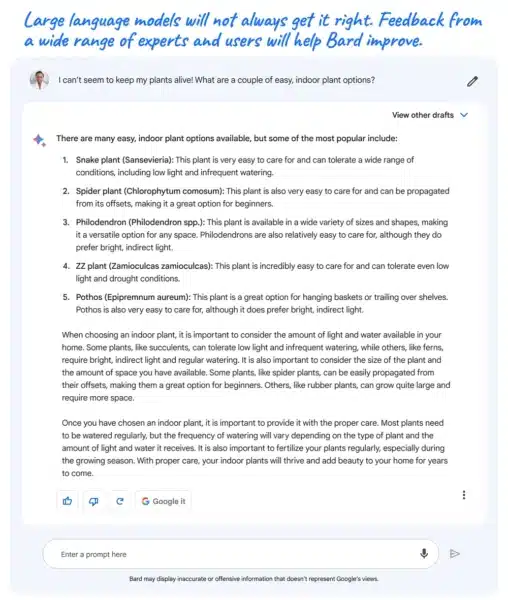
Here is a screenshot of Bard from Google:

Press Copy For Social Blog As.width 1000.format Webp 508x600

Impressions. I do not yet have access to Bard, although I am told I should have access soon. Until then, The Verge reviewed Bard and said, Bard is “certainly faster than either (though this may be simply because it currently has fewer users) and seems to have as potentially broad capabilities as these other systems. (In our brief tests, it was also able to generate lines of code, for example.) But it also lacks Bing’s clearly labeled footnotes, which Google says only appear when it directly quotes a source like a news article and seemed generally more constrained in its answers.”

Why we care. We are now closer to seeing Google Bard out in the wild. How users will use Bard, where Bard might stumble and shine, how Bard will be integrated into Search will be fun to watch over the coming weeks and months. For now, go sign up for the waitlist and I hope you gain access soon.


Related stories

New on Search Engine Land

@media screen and (min-width: 800px) { #div-gpt-ad-3191538-7 { display: flex !important; justify-content: center !important; align-items: center !important; min-width:770px; min-height:260px; } } @media screen and (min-width: 1279px) { #div-gpt-ad-3191538-7 { display: flex !important; justify-content: center !important; align-items: center !important; min-width:800px!important; min-height:440px!important; } }

About the author

Barry Schwartz

Barry Schwartz a Contributing Editor to Search Engine Land and a member of the programming team for SMX events. He owns RustyBrick, a NY based web consulting firm. He also runs Search Engine Roundtable, a popular search blog on very advanced SEM topics. Barry can be followed on Twitter here.

https://searchengineland.com/google-begins-to-open-bard-to-a-limited-number-of-users-394565


Bing Image Creator added to Bing Chat

Bing Chat has added integration with its Image Creator tool where you can ask Bing Chat to create images for you and it will. “Bing Image Creator, new AI-powered visual Stories and updated Knowledge Cards” is rolling out to new Bing and Edge preview, Yusuf Mehdi, Corporate Vice President & Consumer Chief Marketing Officer at Microsoft, said.

What it looks like. Here is a screenshot of how this works:

Bing Ai Chat Image Creator 800x450

How it works. You can simply enter in words into Bing Chat describing the image you want Bing Image Creator to create or you can ask Bing Chat to create images based on other visual content. Microsoft said this is powered by an advanced version of the DALL∙E model from OpenAI.

“Bing Image Creator preview will also be available in Microsoft Edge, making it the first and only browser with an integrated AI-powered image generator. To use Bing Image Creator in Edge, simply click the Bing Image Creator icon in the sidebar to create your image or invoke from Bing chat in Edge,” Microsoft added

You need to be in “creative” mode within Bing Chat for this to work, but when I tried it, Bing told me, “I’m sorry but I cannot create an image of 3 robots sitting by desktop computers. The chatbox doesn’t support images.”

Bing Chat Images Not Working 800x374

This may be still rolling out, so I will give it more time and keep trying. Bing wrote, “Bing Image Creator integrated into Bing chat will begin to roll out to Bing preview users on both desktop and mobile starting today. For those not in the new Bing preview, the preview experience of Image Creator is now available at bing.com/create for Bing users around the world in English. We will add more language support over time.”

Available in Edge. This is also available in the Edge Sidebar, by clicking the Bing Image Creator icon in the sidebar to create your image or invoke from Bing chat in Edge.

BingImageCreator Edge 16x9 EN US 2048x1186 1 800x463

Stories and knowledge cards. Also with this news Microsoft Bing announced changes to visual stories and knowledge cards:

  • Stories is an AI-powered visual summary that you can click through to learn more about the topic you’re searching. Stories provide a more engaging way to search and interact with content, offering images and short videos for easy consumption.  
  • Knowledge Cards 2.0 is an AI-powered infographic-inspired experience that provides fun facts and key information at a glance. It’s been updated to include interactive, dynamic content like charts, graphs, timelines, visual stories and more. 

Why we care. MidJourney and other AI tools, like the DALL∙E model from OpenAI, are excellent and amazing tools to creating images. Now that it is integrated into Bing Chat, it makes it a bit easier to utilize these image-creation AI models.

These advancements are super fun and exciting to watch and play with.


Related stories

New on Search Engine Land

@media screen and (min-width: 800px) { #div-gpt-ad-3191538-7 { display: flex !important; justify-content: center !important; align-items: center !important; min-width:770px; min-height:260px; } } @media screen and (min-width: 1279px) { #div-gpt-ad-3191538-7 { display: flex !important; justify-content: center !important; align-items: center !important; min-width:800px!important; min-height:440px!important; } }

About the author

Barry Schwartz

Barry Schwartz a Contributing Editor to Search Engine Land and a member of the programming team for SMX events. He owns RustyBrick, a NY based web consulting firm. He also runs Search Engine Roundtable, a popular search blog on very advanced SEM topics. Barry can be followed on Twitter here.

https://searchengineland.com/bing-image-creator-added-to-bing-chat-394559


What Google’s new guidelines for AI-produced content mean for SEO

Google might have stumbled in its Bard announcement, but it made up some goodwill (for me, at least) with another early-February release – its new search guidelines on AI-generated content. 

Google seems to support what many good SEOs have argued for some time:

It doesn’t matter what you use to create content as long as you’re producing something valuable for people – and not gaming the search engine.

With Google’s perspective out there for all to see, where do SEOs go from here? I’ll examine the topic from a few angles:

  • The marriage of Google and AI.
  • The caveats to consider when using AI for content.
  • Skills SEOs need to develop right now.

The marriage of Google and AI

Google and Microsoft Bing are using AI-powered content to deliver search results, and that shouldn’t come as a surprise to anyone.

Even Google’s guidelines say they’ve been using AI in some form for a long time. (And paid search marketers know how much AI and machine learning have changed the PPC game.)

I’m guessing these companies knew that people would use AI for content production when it became widely available – a watershed moment marked by ChatGPT‘s release.

It’s not feasible to tell people not to use it. Instead, both search engines are racing to establish themselves as responsible curators of AI content.

Staying focused on creating value with content has always been important for me. Now it’s clear: Google has the same standard.

After all, humans can write spammy content just as readily as AI. It’s like saying a calculator is bad for math results because you didn’t figure out the answer yourself.

And we’ve been through the “spam vs. quality” argument before, notably with links. 

As it stands, Google is still focused on helpful content, regardless of the technology used to produce it.


Get the daily newsletter search marketers rely on.


Google and AI content: The caveats

If you use AI as part of your toolset to provide valuable content, Google won’t ding you.

The problem is that it’s enticing to use these tools the wrong way. Google is not giving you the green light to have ChatGPT write for you and call it a day. 

Like any tool, ChatGPT and its competitors are just that – tools that require humans to leverage them.

Otherwise, it will take and regurgitate what you feed it, delivering no value beyond aggregation. You’re giving users nothing new.

I can see, for instance, shoddy use cases where marketers use ChatGPT to fill in the location for thousands of otherwise-identical franchise doorway pages and call it a day.

I can confidently say that won’t fly – but what I don’t know, and what Google hasn’t yet articulated, is what a penalty would look like.

  • Will there be a manual hit if Google thinks you’re using AI for straight-up ranking purposes?
  • Will it tweak some of its algorithms to catch instances of AI being manipulated? 
  • Could anyone legitimately trying to do something right get caught up in a manual penalty? 

As most SEOs know, Google’s algorithms have occasionally dinged white-hat companies in the past. Any significant change to the algorithm raises fears that it could happen at scale.

As for the guidelines, the section that seemed most ambiguous (and ominous) to me is the part about AI disclosures.

Google said you could “consider” adding it, which is a strange gray area that doesn’t give marketers confidence either way:

AI-generated content disclosure

Skills in focus for SEOs

Any way you look, AI is positioned to be a powerful tool for content production. SEOs who don’t yet know its ins and outs should get serious about learning.

AI-produced content will create a massive opportunity for skilled writers and marketers to rise above what might well be an impending onslaught of lazy, mediocre copy.

The more craft good writers can add, the easier for Google to distinguish actual value. AI-produced content is a faster way to establish a baseline – but it’s still just a baseline.

Good SEOs should learn how to:

  • Develop valuable inputs.
  • Provide good source information (think initial sets of keywords or smart ideas for content briefs).
  • Add their unique skills and research to the refinement stage to make the content truly unique and valuable. 

SEOs should already know the concepts of user psychology and needs and use those concepts to add nuance and legitimate value.

Ultimately, the more SEOs can practice using AI – even to speed up block-and-tackle tasks – the better they’ll be at it. 

They’ll be more familiar with the publishing environment, AI’s capabilities, and, perhaps most importantly, its limitations. 

Writing helpful content for users is the North Star

AI-generated content is, at its essence, a contemporary update to a classic philosophical tug-of-war in SEO…

You can try to game the algo and take shortcuts to get ahead, or you can create world-class websites and content with great UX across platforms. 

Google has made its stance clear. Marketers who remain faithful to a North Star of using customer understanding to create value will stand out.

The applications may evolve, but the goal remains the same.


Opinions expressed in this article are those of the guest author and not necessarily Search Engine Land. Staff authors are listed here.


Related stories

New on Search Engine Land

@media screen and (min-width: 800px) { #div-gpt-ad-3191538-7 { display: flex !important; justify-content: center !important; align-items: center !important; min-width:770px; min-height:260px; } } @media screen and (min-width: 1279px) { #div-gpt-ad-3191538-7 { display: flex !important; justify-content: center !important; align-items: center !important; min-width:800px!important; min-height:440px!important; } }

About the author

Adam Tanguay

Adam Tanguay is Head of SEO and Content at Jordan Digital Marketing, which he joined in Feb. 2019. Formerly Head of Marketing at Webflow and Head of Organic Growth at Weebly, Adam has developed successful growth programs with a mix of content strategy, copywriting, technical know-how, and analytics acumen across a range of organic channels.

https://searchengineland.com/what-googles-new-guidelines-for-ai-produced-content-mean-for-seo-394534


Discover cutting-edge martech solutions for free – online next week!

MTCS2023 OG Main 1

MTCS2023 OG Main 1

Driving sales, improving lead quality, and boosting conversions have never been more critical – especially in an age of increased privacy concerns. The right marketing technology is your key to getting it done.

Discover dozens of marketing technologies, tools, and solutions – all for FREE and all without leaving your desk: Grab your free MarTech pass now and join us online, next Tuesday and Wednesday (March 28-29)!

At MarTech, you’ll unlock nearly 50 data-rich sessions from world-class brands including Forrester, Sysco, Electrolux, Salesforce, and more:

Logo GardenKick-off each day with eye-opening keynotes…

… and get your questions answered in real-time during live Q&A (Overtime!) with select speakers, including the godfather of martech, Scott Brinker, Mission MarTech’s Milton Hwang, and more!

You’ll also explore the critical rise of AI and what it means for marketers during exclusive programming and networking opportunities, including…

Hungry for more? Discuss ChatGPT, GA4, and MOPs challenges with like-minded attendees and industry experts during Coffee Talk meetups – only available live!

And don’t miss these recent additions to the MarTech agenda!

After just a few hours, you’ll be ready to… 

  • Leverage automation and real-time insights to optimize KPIs
  • Reduce marketing spend with a first-party data strategy
  • Apply personalization strategies that accelerate customer loyalty
  • Support additional revenue streams through audience monetization 
  • Execute campaigns to help fill your marketing funnel with new consumers
  • Reach, engage, and convert more email marketing prospects  
  • Execute more effective targeting, increase personalization, and improve ROI 

…and so much more. Can’t attend live? Explore at your own pace with instant on-demand access, included for free. 

Don’t wait… grab your free MarTech pass now and join us online, next Tuesday and Wednesday, March 28-29!


Related stories

New on Search Engine Land

@media screen and (min-width: 800px) { #div-gpt-ad-3191538-7 { display: flex !important; justify-content: center !important; align-items: center !important; min-width:770px; min-height:260px; } } @media screen and (min-width: 1279px) { #div-gpt-ad-3191538-7 { display: flex !important; justify-content: center !important; align-items: center !important; min-width:800px!important; min-height:440px!important; } }

About the author

Lauren Donovan

Lauren Donovan has worked in online marketing since 2006, specializing in event marketing, content management, organic and paid social media, community and reputation management, and real-time journalism. She currently serves as Director of Marketing at Third Door Media — producer of the Search Marketing Expo and MarTech conference series and publishers of Search Engine Land and MarTech.

https://searchengineland.com/the-martech-conference-news-394240


News SEO and generative AI: Inside a ‘parasitical relationship’

As reports circulate that AI research lab OpenAI uses news stories from media outlets like the Wall Street Journal and CNN to train its ChatGPT chatbot, an even greater challenge emerges: How do media outlets retain traffic, revenue and relevancy in the generative AI era?

AI-generated news has long inspired fear among journalists. In 2016, for example, the U.K.’s Press Association signaled its intent to use AI for some sports and election stories.

We’ve seen more recent examples in the U.S., like this NHL roundup from the Associated Press compiled with technology from sports content automation firm Data Skrive.

The CEO of media company Axel Springer, which owns titles like Business Insider and Politico, recently said AI has the potential to replace journalists altogether. “Only those who create the best original content will survive,” Springer reportedly wrote in a letter to employees.

The issue of copyrights – and potential legal trouble, has already surfaced in France and Spain.

“If OpenAI is going to enhance its model with up-to-date content without sending any traffic [to the original source, it will] spark a debate [over] who owns the rights for the content,” said Marcus Tober, senior vice president of enterprise solutions at marketing platform Semrush.

OpenAI has already seen some copyright lawsuits, and Dan Smullen, head of SEO at sports gambling platform Betsperts Media and Technology Group, said we could expect more shortly.

“In fact, despite hearing that some publishers have begun to adopt AI-assisted content in the newsroom, the editorial teams I have spoken to are uncomfortable using the outputs from OpenAI due to the unknown copyright issues,” Smullen added.

OpenAI has taken steps to address these concerns, such as allowing publishers to opt out of having their content used, he noted. The AI research lab has also agreed to provide attribution when its algorithms scrape information from news sites.

“Still, SEOs in the media industry worry this system may not adequately protect against copyright and intellectual property issues,” Smullen added. “As such, news organizations should continue to monitor OpenAI’s use of news data and ensure that their content is being used responsibly.”

One easy solution would be to add footnotes linking to sources, similar to what ChatGPT does in Bing.

“We expect something similar with [Google’s conversational AI service] Bard,” Smullen added.


Get the daily newsletter search marketers rely on.


‘Truth decay’

Ultimately, AI’s push into news threatens to upend media consumption all over again.

According to Ben Poulton, SEO consultant and founder of the SEO agency Intellar, AI companies using scraped data “threatens the curated control that news organizations have had for decades.”

The result could be further degradation of journalistic integrity.

Smullen noted lack of publisher compensation for training data could lead to a future in which publishers block OpenAI and its counterparts, so high-authority news sites are not crawled. That, in turn, could yield an even bigger challenge with fake news, including wider circulation of inaccurate and/or biased information masquerading as fact.

As such, Smullen called for publishers to be compensated for the critical role they play – and Cameron Conaway, a former investigative journalist who leads a growth marketing team at tech giant Cisco and teaches digital marketing at the University of San Francisco, agreed.

“Could this deepen truth decay and society’s distrust of legitimate new sources?” he asked. “What impact might it have on democracy if most information is source-less, and who (or what) will then hold the power?”

‘Disastrous implications’

There’s even concern about OpenAI eventually automating news production altogether. Still, Barry Adams, a specialized SEO consultant at SEO firm Polemic Digital, noted generative AI systems can’t predict the news, so he doesn’t foresee any immediate issues.

“AI will not replace journalism when it comes to reporting the news, investigating stories and holding power to account,” he added.

Then again, AI could reword local news stories without citation as it spits out its own versions. This, in turn, would siphon traffic and related revenue from news sites, which is particularly harmful to local news sites that are especially reliant on display ad traffic, Conaway said.

And rewording has the potential to change the original meaning of the reporting.

“The combination of scrappy and financially vulnerable local newsrooms, general media avoidance and distrust and the rise of AI as a primary source could have disastrous implications,” he added.

But it’s not all – wait for it – bad news.

“On the plus side for news organizations, people will always consume news. It’s just the medium which changes,” Poulton said. “If ChatGPT can summarize five stories on the same topic from five different outlets in five seconds, is that not a good product? Maybe the likes of ChatGPT could be used on news sites to help users break down and find information they want quickly.”

‘A parasitical relationship’

First, however, the parties must address the issue of traffic and revenue.

Adams said the lack of attribution with early iterations of Bing ChatGPT and Google’s Language Model for Dialogue Applications, or LaMDA, concerns him most here.

“This undermines a fundamental contract of the web, where search engines and content websites exist in a symbiotic state,” he said. “Generative AI turns this symbiosis into a parasitical relationship, where the search engines take everything from the content creators (i.e., the content needed to train [large language models (LLMs)] on) and give nothing back in return.”

Google-owned YouTube, however, already uses a more symbiotic model in which content creators share in the revenue generated by the platform.

“There is no reason why a similar model couldn’t be adopted for search engines and the web, except that it would make Google less of a money-printing machine and lose some shareholder value,” Adams added.

Smullen agreed the solution is to pay publishers for training data. 

“Similar to Google, it will abuse its dominance until governments step up and question the legality of its business model from a copyright standpoint,” Smullen said. “It’s only fair that publishers be compensated for their role in making the next generation of AI possible.”

Adams agreed it’s unlikely Google will voluntarily reduce its own profits.

“They won’t care that they used the combined knowledge of humanity shared on the web to build these generative AI systems and are now discarding these creators without attribution,” he added. “If they can get away with it, they will.”

‘Remain vigilant’

Some news organizations have already responded with stricter licensing agreements, strengthened data collection and usage rules, and use of copyright protection software, according to Julian Scott, content strategist at social media management and automation tool Socialbu.

“However, these measures may not be enough to fully protect their content from being used without attribution,” he added.

Media industry SEOs are calling for better tools within OpenAI’s model, which would ensure proper credit, noted Daniel Chabert, CEO and founder of web and software development agency PurpleFire.

“They hope OpenAI will increase its transparency regarding the use of news data and be more proactive in alerting authors and publishers when their content is being used,” he added. 

Meanwhile, news organizations would be wise to invest in better monitoring systems to detect errors or biases in the data generated by OpenAI’s models. 

“News organizations must remain vigilant about OpenAI’s use of news data and take the necessary steps to protect their content and ensure accuracy and quality,” Chabert added.

‘A first-stop destination’

There’s also one tried-and-true online marketing tactic, which is particularly relevant here.

Adams noted websites need to start thinking about a “post-Google future” and build strong brands that tie their audiences directly to them.

“Some publishers are quite successful at this and have built brands that are almost immune to the whims of search engines,” he added. “The goal is to become a first-stop destination for your audience, with readers directly visiting your website without the intermediary of a Google or Facebook.”

As the impetus to click through to original sources lessens, Matt Greenwood, SEO manager at search agency Reflect Digital, agreed websites should be “looking to provide information and experiences that are more valuable than can be condensed into a few lines of auto-generated text, to give consumers a reason to still visit our sites and read our original content.”


Opinions expressed in this article are those of the guest author and not necessarily Search Engine Land. Staff authors are listed here.


Related stories

New on Search Engine Land

@media screen and (min-width: 800px) { #div-gpt-ad-3191538-7 { display: flex !important; justify-content: center !important; align-items: center !important; min-width:770px; min-height:260px; } } @media screen and (min-width: 1279px) { #div-gpt-ad-3191538-7 { display: flex !important; justify-content: center !important; align-items: center !important; min-width:800px!important; min-height:440px!important; } }

About the author

Lisa Lacy

Lisa Lacy is a reporter who has covered advertising, technology and retail for publications like Adweek, TechCrunch, Digiday, CMO.com and VentureBeat.

https://searchengineland.com/news-seo-and-generative-ai-inside-a-parasitical-relationship-394520