The biggest obstacle is working for global clients with a “decentralized” approach to marketing.
Often, they have siloed organizational structures, making them unable to appropriately communicate SEO and paid media initiatives across global markets.
This article breaks down the problem international search marketers face when working with such clients and what we can do about it.
The problem with decentralized marketing
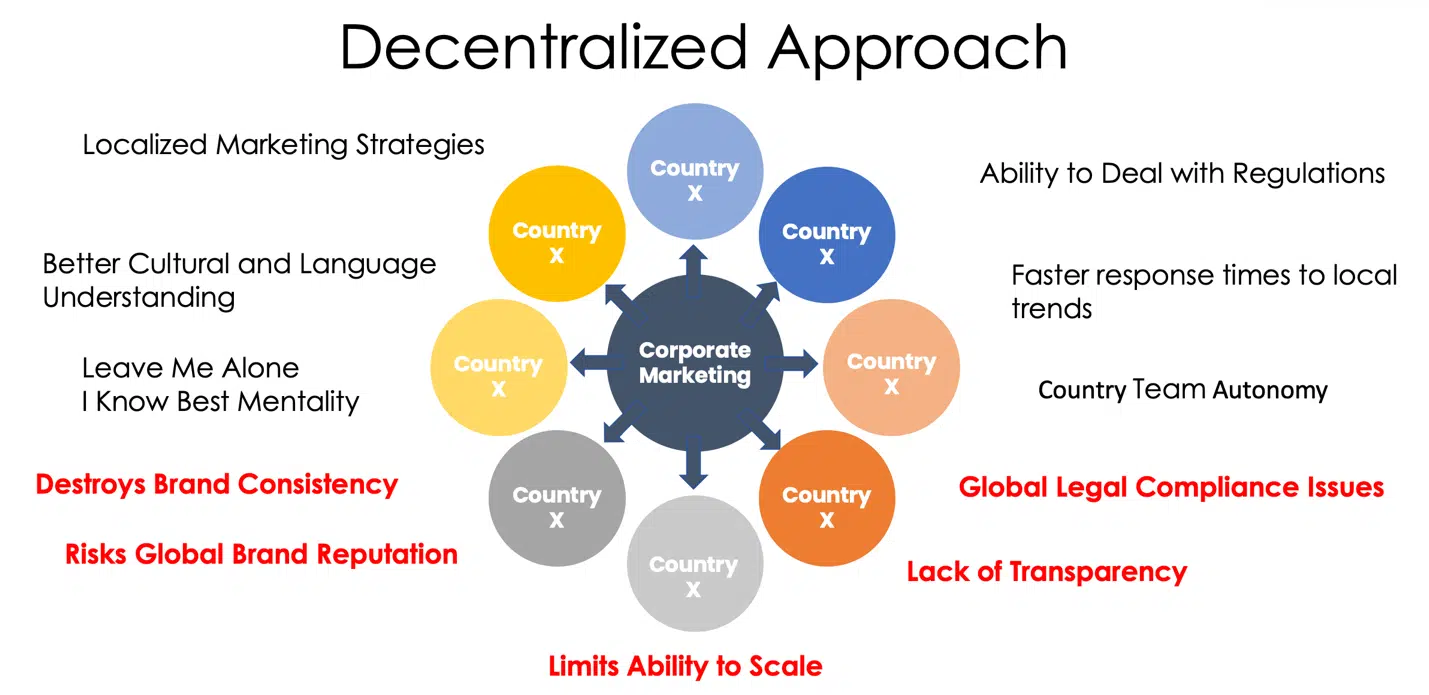
Decentralized marketing occurs when different departments or business units (or “silos”) in the organization have autonomy over marketing activities.
Each business unit and locality is responsible for developing its marketing strategy and executing marketing campaigns in this approach.
While it allows for greater flexibility in adapting to local market conditions, it can also result in:
“Using a decentralized approach for global SEO strategy and implementation makes coordination and prioritization a reactive firefighting process. The argument is often made by marketing leaders that regions / business units know better what they need.
While this may be the case with merchandising and integrated campaigns, if you have a single website with multiple regions sitting on subfolders then you need a unified approach to SEO or, at the very least, someone coordinating and overseeing all activities around major launches.”
She also shares the pitfalls of such an approach:
“[T]here’s often a breakdown in shared learnings and innovation and worse financial risks when one unit operates in a way that could negatively impact another.
We recently experienced this with one of our global clients… In our particular case, our point of contact at one unit said, ‘the right hand didn’t know what the left hand was doing’ with regard to another English-speaking region displacing their content in SERPs during a global campaign launch.
The root of this is really how Google handles international SEO and structural issues there around signaling, which is a massive work in progress with this organization.
But, there are major contributing factors that stem from the organization’s region-led approach to SEO requests rather than [a] top-down SEO strategy.”
She makes a great point. So what’s the alternative?
Get the daily newsletter search marketers rely on.
Is a centralized approach better for search marketing?
Centralized marketing refers to an approach where all the marketing decisions and activities are controlled and managed by a central team or department within an organization or as part of an agency.
Here, the central team determines the marketing strategy, creates the marketing campaigns, and manages the implementation of those campaigns across all channels, platforms and locations, local or global.
It allows for greater brand consistency, content alignment and control over marketing activities.
Still, this system causes a lag in adapting to local and global market conditions.
Restructuring global search marketing
If your international SEO client deals with similar issues, it may be time to talk to leadership. Inform them about the benefits of rethinking their global marketing structure.
I have seen such organizational changes happen to firms over the last few decades. Common reasons include:
CEO change
Usually, CEOs are under pressure from their boards to have their companies perform.
These same boards may also bring in or suggest someone they know at an X public agency to reposition their agenda and build their stake within the boardroom.
CMO change
CMOs are one of the leading causes for re-organizations in marketing.
Whether centralized or decentralized, new CMOs usually want to come in and make massive changes to make marketing more effective and less costly.
Fortunately, out of all the CxOs, these CMOs know our marketing world and often, listen to the benefits and challenges of making changes that help define their strategies.
CFO
The CFO’s job is to cut budgets down and, at the same time, increase revenue as much as possible. Marketing is the most immediate target on the CFO’s arsenal of cuts.
The only way to win the love of a CFO is to prove to these number crunchers with quantitative data the value your digital marketing programs bring to the company.
Also, keep in mind the task of “decentralizing marketing” may also be interpreted as, “I want to throw global marketing budgets off my P&L, so they may advocate for wreaking havoc on your search agenda when they send their sledgehammer crashing down onto your plans as well as your global colleagues.”
Global leadership
Global leadership, especially those in sales roles or who have to do all the marketing with few resources in their respective countries, also have a hand in restructuring.
The last thing they want is to be told how and what to do by someone in another country who has no idea of their culture or language, let alone their competition. Often they’ll advocate for decentralization.
What can search marketers do? Pushing for a hybrid model
As a marketer, you may be unable to push a centralized marketing system to leadership, which is okay.
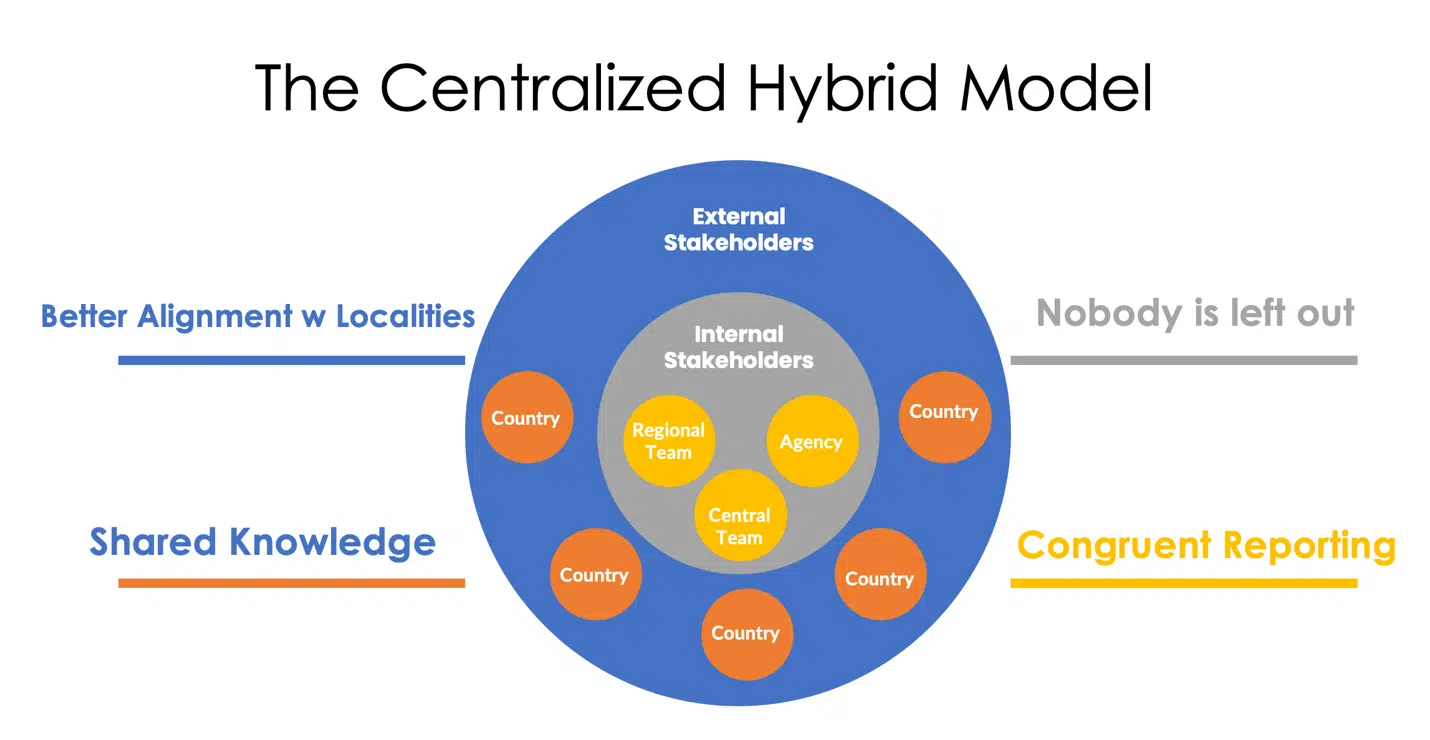
You have another option, what I like to call the “centralized hybrid model.”
I can attest that implementing this is easier said than done. However, it provides all the benefits of centralization and decentralization combined.
The central, regional and local stakeholders have equal say and participation in the global marketing strategy. Each regional stakeholder also has complete alignment with each country manager.
Having a system where knowledge is shared and considerations are made from those on the ground up to the central team equally disrupts the silos formed in other models and benefits the group as a whole.
An example of this would be Switzerland, considered one of the world’s most stable and competitive countries despite its size, according to the World Economic Forum.
The 26 Swiss cantons are similar to the external marketing stakeholders, who work closely together with the central internal stakeholders to help guide strategy and provide local feedback, reporting and knowledge.
At the same time, the internal stakeholders utilize the control of the budget, declaring as a team what’s working, what’s not working and areas to explore.
Breaking down silos in marketing
A global SEO must work technically. Execute content appropriately to align the brand and its company goals.
A proper system for paid media will ensure branding and messaging reach their potential and budgets are fairly distributed.
Regardless of your system, the best practice is to keep everyone together. Removing silos, sharing ideas and having joint objectives will help you win with a multinational marketing group.
Opinions expressed in this article are those of the guest author and not necessarily Search Engine Land. Staff authors are listed here.
@media screen and (min-width: 800px) { #div-gpt-ad-3191538-7 { display: flex !important; justify-content: center !important; align-items: center !important; min-width:770px; min-height:260px; }
}
@media screen and (min-width: 1279px) { #div-gpt-ad-3191538-7 { display: flex !important; justify-content: center !important; align-items: center !important; min-width:800px!important; min-height:440px!important; }
}
About the author
Michael Bonfils specializes in providing multinational search marketing services for agencies and in-house search marketing professionals. Since 1996, Michael has helped pioneer best practices in global search engine marketing and innovations in technology advertising.
T-minus 2 weeks until MarTech: Grab your free pass now to discover cutting-edge solutions and strategies
Delivering personalized customer journeys while respecting privacy.
Effectively and responsibly leveraging generative AI.
Supercharging your funnels with qualified leads.
These are table stakes for modern marketers like you. And marketing technology is your key to making it all happen.
Attend MarTech, online March 28-29 for FREE, to unlock…
Nearly 50 tactic-rich sessions on how to leverage marketing technology for ongoing organizational success
50 tactic-rich sessions from Sysco, Forrester, Electrolux, and more – ready to share reliable solutions, strategies, and insights to mine valuable first-party data, streamline marketing operations, and drive more ROI
An exclusive AI panel featuring Anita Brearton, CEO at CabinetM, Ricky Ray Butler, CEO at BENlabs, Pam Didner, VP of Marketing at Relentless Pursuit, and Paul Roetzer, CEO at Marketing AI Institute (plus live Q&A!)
Additional live Q&A with select speakers (including the godfather of martech, Scott Brinker!) – so you can get specific answers to your questions in real-time
Invigorating Coffee Talk meetups, where you can discuss ChatGPT, GA4, and MOPs challenges with like-minded attendees and industry experts (only available live!)
Instant on-demand access to all sessions and keynotes – participate when it fits your schedule
Your very own Certificate of Attendance and digital badge – perfect for sharing on social and showcasing your commitment to the latest in marketing
… all for free – and all without leaving your desk. What are you waiting for? MarTech kicks off in TWO weeks… secure your pass now!
@media screen and (min-width: 800px) { #div-gpt-ad-3191538-7 { display: flex !important; justify-content: center !important; align-items: center !important; min-width:770px; min-height:260px; }
}
@media screen and (min-width: 1279px) { #div-gpt-ad-3191538-7 { display: flex !important; justify-content: center !important; align-items: center !important; min-width:800px!important; min-height:440px!important; }
}
About the author
Lauren Donovan has worked in online marketing since 2006, specializing in event marketing, content management, organic and paid social media, community and reputation management, and real-time journalism. She currently serves as Director of Marketing at Third Door Media — producer of the Search Marketing Expo and MarTech conference series and publishers of Search Engine Land and MarTech.
Microsoft may replace Bing Search answers with Bing Chat responses
Bing may replace the standard answers you get at the top of the Bing Search results with Bing Chat answers.
The current answers on Bing Search “use old technology and crowdsourcing” and that Bing “will replace them ASAP” with Bing Chat responses, Mikhail Parakhin, who leads up Bing Search and Bing Chat, said on Twitter over the weekend.
This may result in a new user interface for the answers Bing Search provides to user queries directly in the Bing search results, Parakhin added.
What it might look like. It is hard to say for certain how these Bing Chat-based answers may look, but we did spot a new feature that summarizes answers from multiple sources across the web, which looks a lot like Bing Chat responses.
Here is a screenshot of that from Brodie Clark on Twitter:
Context. Here are those tweets where Parakhin said this, so you can see the full context:
Testando com Curitiba, Bing informou dois resultados. O card em cima tá com informação de sites de 3 anos atrás. Google informou 0 card.
IMO precisam atualizar o card em cima pelo Chat ou algo do tipo, é muito mais preciso. pic.twitter.com/6erGVgSAhN
Improved Bing Search and Bing Chat integration. Improved Bing Search with Bing Chat integration is coming, Parakhin said:
“It’s a tricky interaction, so the bugs keep creeping in.”
Bing Chat growing. This news follows Microsoft’s recent announcement of some metrics showing the growth of Bing chat:
Over 100 million daily active users.
45 million total chats.
One-third of daily preview users use Bing Chat daily.
One-third of preview users are brand new to Bing.
Why we care. Watching how search may adapt over time with the rollout of AI chat features is interesting and also important for publishers, content creators, marketers and SEOs. If Bing will replace featured snippet-like responses with Bing Chat responses, that might impact click-through rates and traffic to your websites.
@media screen and (min-width: 800px) { #div-gpt-ad-3191538-7 { display: flex !important; justify-content: center !important; align-items: center !important; min-width:770px; min-height:260px; }
}
@media screen and (min-width: 1279px) { #div-gpt-ad-3191538-7 { display: flex !important; justify-content: center !important; align-items: center !important; min-width:800px!important; min-height:440px!important; }
}
About the author
Barry Schwartz a Contributing Editor to Search Engine Land and a member of the programming team for SMX events. He owns RustyBrick, a NY based web consulting firm. He also runs Search Engine Roundtable, a popular search blog on very advanced SEM topics. Barry can be followed on Twitter here.
How to successfully scale your content marketing and grow traffic
You’ve probably heard how successful content marketing can be when you do it consistently.
Consistent content earns 55% more visitors coming to your site and 67% more leads. (Overall, creating content is your best bet for increasing traffic – ranking in organic search brings in 1,000% more traffic than organic social media.)
But you can’t produce one blog post per month or blog randomly at a whim and expect to move that needle.
Achieving consistency – producing great content on a regular schedule – is hard to do unless you scale your content marketing operation.
Scaling means ramping up production while growing your resources and increasing your efforts to get it done.
Scaling the right way means you’ll have the ability to amp up your content output without sacrificing any part of what makes your content unique, engaging, and valuable.
So, what do you need to scale?
You need a strategy, systems, workflows, and a team in place if you expect to scale your content marketing successfully and earn more traffic.
How to scale your content marketing in 3 steps
Step 1: Build a content strategy
No, the first step on this list isn’t to hire more people for your content team.
Why?
Because if you hire more people, that’s all you’ll have – more people.
You won’t have a strategic way to guide those people to produce great content at scale.
It’s that simple: You can’t scale without a strategy in place. That’s because, at its most basic level, a content strategy is a plan of action that maps out how you’ll execute content marketing.
Without this action plan, you’ll be missing key building blocks that make scaling possible in the first place.
Who are we creating content for?
Why are we creating content for them?
What do we hope to get out of content marketing?
Who is in charge of our content? Who plans, who writes, who publishes, etc.?
What tools do we invest in to make our jobs easier? What resources?
What broad topic area is our focus? What content topics will we cover under that umbrella?
How often will we post?
What will we post about next week? In 2 weeks? Next month?
How will we measure and track our progress?
Attempt to scale without setting a foundation, and you’ll risk breaking your content marketing entirely. That’s because increased output adds pressure to every piece of your operation – especially your team members and processes.
For instance, if you decide to double the number of blogs you publish each week but don’t plan how to do that beforehand, your production will become rushed and messy. Your content creators will burn out quickly. Little things will start falling through the cracks. Here are a few examples:
You’re rushing to publish blogs each week, so you skip the final editing pass that would have caught small but detrimental mistakes like a missing link, a broken image, or misspelled words.
Burned-out writers who feel trapped by impossible deadlines and a lack of guidance are more likely to copy and spin content – a huge issue that could destroy your reputation.
Or, they might skip researching thoroughly and citing sources, so your content loses credibility.
Since your standards slip, your brand voice falters and sounds off-key – a trust-breaker.
Your team is too busy and rushed for much creativity (which needs time and space to simmer), so your content starts to sound samey and repetitive.
Blindly adding more team members won’t solve the root issue – a lack of strategy that directs and guides your content marketing, processes, team, and roles.
TL;DR: Your content will suffer if you scale without preparation and strategy. And sub-par content does not bring results.
Get the daily newsletter search marketers rely on.
Step 2: Put a content marketing team in place
Once the strategy is set, you can move on to solidifying your team or putting one together.
A strong team is essential to scaling content marketing because, without an effective team, the effort will inevitably fall apart. An effective team:
Works toward a larger goal than just completing their individual tasks.
Knows their roles, what success looks like within them, and how every other team role contributes to the whole.
Can create content at scale without sacrificing quality.
A good, effective team is not just made up of talented individuals. Instead of plain talent, look for people with potential + the right mindset. This means:
They have some skills, but more than that, they have the potential to build those skills to leverage them toward your business specifically.
They’re willing to learn and happy to grow with the brand/business.
If you already have people like this on your side, make sure their roles are clearly defined within your team. And keep in mind one person may wear multiple hats.
This is true in smaller teams more often than in large ones. Additionally, small teams without the budget to hire for specific roles may need freelancers to fill in gaps until they have the funds to grow their team permanently.
Here are the essential roles:
Content manager: Every content team needs a leader who guides the ship’s direction. This person oversees writers/creators, the content calendar, the brand voice and style guidelines, and ensures all content aligns with the brand’s goals and carries out the strategy.
SEO specialist/strategist: This person ensures the website and blog are SEO-ready. They strategize to ensure SEO goals are met on- and off-page with keyword research and proper optimization.
Content writer/creator: This role can be multi-faceted (or involve multiple people) if the brand creates more than written content. Writers write, designers create visual content and infographics, videographers create videos, etc.
Social media/promotions manager: Who distributes content on various promotional channels after publication? Who’s in charge of social posts, emails, or even ads? This person.
Step 3: Set up content marketing workflows
Scaling is a lot easier when you have documented processes for each piece of the content marketing picture. For instance:
Your main content writer leaves the team. Your content manager must moonlight as a writer until you can find a replacement. They follow the content writer’s workflow to produce consistent content without missing a beat.
You hire a new writer to help scale your content marketing. You give them the workflows and SOPs (standard operating procedures) your established writer uses to create content, streamlining the onboarding process.
What do workflows look like?
To create a writer workflow, you might ask these questions:
How should your writer(s) go about writing content?
What are the standard procedures they should follow as they research and write?
What style should they use?
What grammar rules?
What resources?
What tools?
Should they follow a general outline for each post?
In short, a workflow is a series of smaller tasks and guidelines anyone can follow to carry out a larger task, like writing a blog post, promoting blog content, or researching keywords and content topics.
Workflows are helpful because they help your team members’ output stay consistent across tasks. For example, with one workflow that all your writers use, your blog posts will look, feel, and sound more consistent – like one person wrote them in the brand’s voice versus two or three different people.
Workflows are meant to be repeated and reused no matter who fills a specific role. That means, even if your team makeup changes, it will still run like clockwork because you put SOPs in place.
Best of all, you can get creative with workflows. You can create one for each content marketing task, like ideating content, researching keywords, or writing blogs, or you can create a large, overarching workflow for each role on your team.
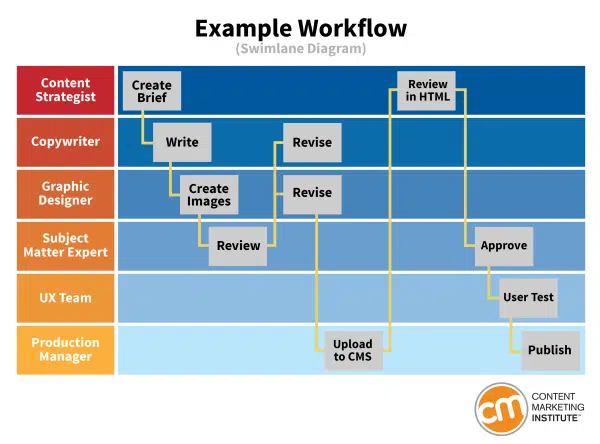
Workflows can also apply to much broader tasks – like your content marketing as a whole. For instance, an overarching team workflow can help your team members understand exactly how they fit into the large process of producing and publishing content consistently.
Source: Content Marketing Institute
Here are some examples of workflows attached to content marketing processes.
Ideating
Document how someone ideating content topics should go about the process.
What tools should they rely on?
What research should they carry out? (Social listening? Keyword research? A mixture of qualitative and quantitative methods?)
How should they record the topics they find and share them with the team?
Writing/researching
Create a detailed writer workflow showing them exactly how they should write your brand’s blogs.
Give them a general skeleton outline to follow with rules for formatting that can be reused for every blog.
Provide overarching grammar and style guidelines.
Stipulate which resources are good to cite and which are off-limits.
Detail where/how they’ll receive assignments, who they report to, and who they submit completed assignments to (or where they should be uploaded).
Editing
Guide your content editor, so they know exactly how to effectively do their job.
What should the content editor look for while editing? Just spelling/grammar/punctuation, or should they review links, check sources, and edit for flow and style?
Should they rewrite when they find large issues or send it back to the writer?
What style guides should they follow?
Should they use Word’s “track changes” feature or edit without marking up the doc?
Scheduling/Publishing
Decide which tool you’ll use for content planning (like a content calendar), and document how often content should get published, the best times for publishing, and the strategy for published blogs that coincide with events, holidays, sales, or seasons.
Scale smartly to grow your content marketing without breaking
To scale your content marketing successfully, you must scale smartly.
Think of strategy as the foundation of your content marketing. The strategy provides support and structure to effectively add to it and scale content as the brand grows.
An effective team with defined roles and workflows adds another layer of support and stability to your scaling efforts. It’s much easier to hire more people when they can slot into the roles you’ve established versus hiring and figuring it out as you go.
Plus, when your team understands their place within the business and knows exactly what’s expected of them, how to execute, and what success looks like, they’re better able to follow through, stay productive, and work together.
Bottom line: Don’t attempt to scale without first reinforcing your content marketing efforts. Without that support, your operations will be unstable – they’ll fail and crumble.
Opinions expressed in this article are those of the guest author and not necessarily Search Engine Land. Staff authors are listed here.
@media screen and (min-width: 800px) { #div-gpt-ad-3191538-7 { display: flex !important; justify-content: center !important; align-items: center !important; min-width:770px; min-height:260px; }
}
@media screen and (min-width: 1279px) { #div-gpt-ad-3191538-7 { display: flex !important; justify-content: center !important; align-items: center !important; min-width:800px!important; min-height:440px!important; }
}
About the author
Julia McCoy is the founder of Content Hacker, 7x author, and a leading strategist around creating exceptional content and brand presence that lasts online. At 19 years old, she used her last $75 to build a 7-figure writing agency which she sold ten years later. In the 2020s, she’s devoted to teaching founders and marketers the strategy, skills, and systems they need to build a business through inbound content, so they can create more lasting impact in the world.
The extra “E” stands for “experience” and precedes the original E-A-T concept – expertise, authoritativeness and trustworthiness.
We know that E-A-T was already of high importance. Hyung-Jin Kim, VP of Search at Google, confirmed this at SMX Next:
“E-A-T is a template for how we rate an individual site. We do it to every single query and every single result. It’s pervasive throughout every single thing we do.”
To rank at Google’s SERPs, you must demonstrate E-E-A-T in your content strategy.
This comprehensive overview will dig deeper into E-E-A-T – specifically what it means, why it matters to SEO, and how to use it to your advantage.
In this article:
E-E-A-T: What does it mean for SEO and why is it important?
As a quality signal, E-E-A-T feels more than reasonable. After all, in the real world, we trust sources who are qualified and would prefer to get information or advice from authoritative people.
Google provides a perfect example of this in the Google Search Central Blog, pointing out that if you want to find tax information, you’ll want to see content produced by an accounting expert.
A tax advisor or accountant would be a highly desirable source since they have experience, expertise and authority on the subject, so we trust what they have to say. We can be sure we’re getting accurate and sound information.
Google wants to provide accurate information to its users, so to gain traction in SERPs and get your site to the top spots, you need to demonstrate E-E-A-T.
Demonstrating E-E-A-T to Google
SEO is highly accountable for delivering what’s needed to meet E-E-A-T standards, but what does it mean exactly and how do you prove experience, expertise, authoritativeness and trustworthiness?
The good news is most conscientious website administrators, SEOs, and marketing teams are already doing what they need to and developing E-E-A-T right now.
The Stanford Persuasive Technology Lab compiled 10 guidelines for building web credibility based on three-year research with over 4,500 participants.
Make it easy to verify the accuracy of the information on your site.
Show that there’s a real organization behind your site.
Highlight the expertise in your organization and in the content and services you provide.
Show that honest and trustworthy people stand behind your site.
Make it easy to contact you.
Design your site so it looks professional (or is appropriate for your purpose).
Make your site easy to use – and useful.
Update your site’s content often (at least show it’s been reviewed recently).
Use restraint with any promotional content (e.g., ads, offers).
Avoid errors of all types, no matter how small they seem.
– Stanford Web Credibility Research
If the above doesn’t scream, “Be a human, care about your users and your website experience,” I don’t know what does.
Let’s break down E-E-A-T and see how SEO can influence it with the above guidelines in mind.
Experience
Think of lived experience – specifically, first-hand experiences on the topic you’re writing about.
Experience is especially important in a digital world moving toward generative AI content.
AI can never demonstrate true experiences of anything. At best, it can make assumptions about the human experience, but the content it generates won’t be unique.
It’s probably no coincidence that Google announced the addition of “experience” in its search quality raters guidelines shortly after ChatGPT’s launch.
Experience is a core differentiator between human- and AI-written content.
You can showcase your experience by sharing the faces behind your website. This statement lines up with Stanford’s web credibility guidelines to:
Show that there’s a real organization behind your site.
Highlight the expertise in your organization and in the content and services you provide.
Show that honest and trustworthy people stand behind your site.
Achieving this doesn’t have to be complicated. Consider a well-thought-out About us page to share your team’s credentials and qualifications.
Think of what makes you feel safer before you spend your money on a product or service and transfer that to the digital world.
Expertise
Expertise relates to the extent of knowledge demonstrated within your article or by the writer.
The rater guidelines suggest that an author’s expertise or authoritativeness on a subject would count considerably toward demonstrating expertise.
But there’s some evidence suggesting that an author’s authority as an individual doesn’t matter to E-A-T (dare I say, yet).
Take a look at this WordStream article. The author is unknown, yet a search for “Google E-A-T” brings “unknown’s” article to the prime position at the top of Google with a sought-after featured snippet.
You can bet that Google values this article as the best one to rank, and it’s probably received more than its fair share of clicks.
Although author authority doesn’t seem to influence Google’s E-E-A-T guidelines in this example, I wouldn’t be too quick to dismiss it.
WordStream is likely perceived as a highly authoritative website on this matter. Plus, author expertise is detailed in the quality rater guidelines (more on this in the Tips section).
As AI content rises further and Google’s algorithm gets more sophisticated, it can’t hurt to demonstrate an author’s expertise on a subject.
Besides, expertise will build confidence with the human reading your content, so I would still consider adding:
The author’s name.
A descriptive bio containing:
Their relevant qualifications.
Links to their social media profiles.
A Person schema with relevant properties for certifications or professions.
Building trust with your audience will result in other positive engagements that indicate to the algorithm that your site is one to trust and rank.
Moreover, Google’s search quality raters guidelines are clear on what experience entails:
“…which would you rather trust: home electrical rewiring advice from a skilled electrician or from an antique home enthusiast who has no knowledge of electrical wiring.”
In the case of the WordStream article, it may be that the site itself had enough authority on the subject of Google E-A-T that it could rank with an unknown writer.
Authoritativeness
Authoritativeness considers the extent to which a content creator is known as a go-to source on the topic.
Authority can be demonstrated in three core ways:
Establishing a strong content architecture covering all aspects of a particular topic.
Earning backlinks from other authoritative sites.
Building a digital profile or personal brand as an expert in a particular topic.
Authority, expertise and experience go hand in hand. You can’t be an authority on a topic without experience and expertise, and vice versa.
Let’s dig further into the ways you can build authority using SEO.
Content architecture and topical authority
Building topical authority makes sense to appease Google E-E-A-T and applies in the real world.
Think about it this way…
If you were hiring an SEO consultant who could tell you about keywords, you might consider them fairly authoritative.
If the same SEO could tell you about keywords, backlinks and technical SEO with confidence, they’re going to seem even more authoritative.
If the SEO could do all of the above and prove their expertise through case studies (experience) and relate SEO to other forms of marketing, they’re going to seem highly authoritative.
You’re more likely to trust and hire the person with the most amount of authority.
Regarding E-E-A-T, you can demonstrate authoritativeness with a solid content strategy.
Your content strategy should consider everything your potential buyer/site visitor will want to know. Develop and document a strategy to deliver answers in a way that exhibits E-E-A-T in every article.
The more high-quality content successfully indexed by Google, the more authoritative your site becomes on a particular subject.
Once again, the idea of publishing content that is truly helpful supports Standford’s web credibility guidelines:
Make it easy to contact you.
Make it easy to verify the accuracy of the information on your site.
Design your site so it looks professional (or is appropriate for your purpose).
Make your site easy to use – and useful.
Update your site’s content often (at least show it’s been reviewed recently).
Use restraint with any promotional content (e.g., ads, offers).
Avoid errors of all types, no matter how small they seem.
Helpful content that supports buyers through their journey will naturally achieve all of these items.
Backlinks from authoritative sites
Although they carry less weight than they used to, backlinks are still an indicator of an authoritative site. If someone links to your site referencing information you published, this is a sign that you can be trusted.
Earning backlinks from other authoritative sites will also indicate that your site is trustworthy. The critical thing to note is that authority refers more to topical authority relating to expertise and experience and not domain authority.
For example, Google recognizes Search Engine Land as an authority in SEO. A search for “SEO publications” ranks Search Engine Land on Page 1. At the bottom of SERPs, Google associates Search Engine Land as an SEO source.
As a trusted website, a link from Search Engine Land to an article carries some weight.
Google knows it can trust Search Engine Land when it comes to SEO, so if there’s an external link to a topically relevant website (say an SEO study or research), it will add some indication that the linked site can also be trusted.
Building a digital profile or personal brand
If you can show Google who you are and what you do, you can establish authority and expertise on a particular subject.
Sara Taher, an SEO consultant and speaker, achieves this with great success. Taher’s knowledge panel clearly says she is a “Canadian-based SEO consultant.”
The panel has her social links and shares details of her authored pieces.
We can see that Google knows Taher is an authority on SEO. With this in mind, it’s unsurprising that Taher has articles ranking number 1 in Google for SEO-related topics.
Trustworthiness
When we break it down, we’ll see that trust is developed by showcasing experience, expertise and authority in aggregate.
Building E-E-A-T is a long-term process. Be mindful of these core pillars when creating a content strategy so SEO can work properly.
Get the daily newsletter search marketers rely on.
Levels of E-E-A-T
E-E-A-T is a wide spectrum, and some sites have higher levels of E-E-A-T than others.
The aim is to build E-E-A-T to the highest possible level, but every website will need to move through the levels over time – likely years.
It’s worth noting that most websites won’t have low E-E-A-T, provided the content they’re putting out there is genuinely helpful.
The lowest E-E-A-T websites will look and read spammy. Equally, high levels of E-E-A-T will be challenging to achieve.
Website owners must aim to share good knowledge and build topical clusters that serve buyers at every step of their journey.
All that said, it’s good to know what the different levels of E-E-A-T look like according to the guidelines.
Lowest E-E-A-T
Pages with the lowest E-E-A-T will probably look and feel spammy to the human eye. Interestingly, the lowest E-E-A-T pages fail to meet an optimal page experience.
“Obstructed or obscured MC [main content]” relates more to page experience than anything else.
Pages with the following characteristics should be considered untrustworthy:
Inadequate information about the website or content creator for its purpose.
Lowest E-E-A-T or Lowest reputation.
Deceptive purpose, deceptive page design, or deceptive intent.
Deliberately obstructed or obscured MC.
Characteristics of scams, malicious downloads, or other harmful behavior.
Any webpage or website designed to manipulate people into actions that benefit the website or other organization while causing harm to self, others, or Specified Groups.
Lacking E-E-A-T
The rater guidelines suggest that a website can lack E-E-A-T on a subject despite having a positive reputation elsewhere. This suggested that page and topical relevancy is of high importance.
As detailed below, it wouldn’t make sense for a cooking website to share a tax form download. It no longer matters that the cooking might be otherwise trustworthy if the topical relevance is low.
Low-quality pages often lack an appropriate level of E-E-A-T for the topic or purpose of the page. Here are some examples:
The content creator lacks adequate experience (e.g., a restaurant review written by someone who has never eaten at the restaurant).
The content creator lacks adequate expertise (e.g., an article about how to skydive written by someone with no expertise in the subject).
The website or content creator is not an authoritative or trustworthy source for the page’s topic (e.g., tax form downloads provided on a cooking website).
The page or website is not trustworthy for its purpose (e.g., a shopping page with minimal customer service information).
Important: The Low rating should be used if the page lacks appropriate E-E-A-T. No other considerations, such as a positive reputation or the type of website, can overcome a lack of E-E-A-T for the topic or purpose of the page.
High level of E-E-A-T
Websites with high levels of E-E-A-T will achieve and demonstrate experience, expertise, authority and trust.
Google describes high E-E-A-T websites as news or government sites but also highly relevant videos, small business websites and blog posts.
Don’t be dismayed about achieving high levels of E-E-A-T. Every website has a chance!
Very high level of E-E-A-T
Websites that showcase the highest levels of E-E-A-T will look good to the user.
High E-E-A-T pages will satisfy search intent and will be home to high-quality, well-written articles with evidence of knowledge and expertise.
In the documentation, Google says:
“The standards for Highest quality MC may be very different depending on the purpose, topic, and type of website. Here are some examples of Highest quality original content:
For news : Original reporting that provides information that would not otherwise have been known had the article not revealed it. Accurate, original, in-depth, and investigative reporting requires a high level of skill/talent and effort. Very high quality news content will include a description of primary sources and other original reporting referenced during the content creation process. Very high quality news content must be accurate and should meet professional journalistic standards.
For artistic content (videos, images, photography, writing, etc.): Unique and original content created by highly skilled and talented artists or content creators. Such artistic content requires a high level of skill/talent and effort. If the artistic content is related to a YMYL topic (e.g., artistic content with the purpose of informing or swaying opinion about YMYL topics), YMYL standards should apply.
For informational content: Original, accurate, comprehensive, clearly communicated, and should reflect expert consensus as appropriate. Expectations for different types of information may vary. For example, scientific papers have a different set of expectations than a social media post sharing information about a hobby such as stamp collecting. However, all types of very high quality informational content share common characteristics of accuracy and clarity of communication, in addition to meeting standards appropriate to the topic or field. The Highest rating may be justified for pages with very satisfying MC created with a very high level of effort, originality, talent, or skill.”
When building a level of E-E-A-T, asking if something feels right on your website is essential.
Aim to be consistently useful across the site, showcasing genuine knowledge and expertise, and you should meet E-E-A-T.
SEO tips for achieving E-E-A-T
The most conscientious of us are already on the trajectory of achieving high levels of E-E-A-T, but if you’re still unconvinced or’d like a steer, here are some tips.
Consider page experience
Google algorithms tend to build on and evolve rather than supersede each other. Although we heard about page experience a while back, it is still imperative.
Look at the National Heart, Lung and Blood Institute’s BMI calculator page. In the rater guidelines, Google classifies it as having the highest E-E-A-T.
As seen from the screenshot, the page quality rating and explanation consider plenty of factors, including the reputation and expertise on medical topics and the general functionality of the page.
The page’s functionality and the BMI calculator’s usability feed into its E-E-A-T.
Get technical
It’s not much of a leap to assume that if functioning page experiences matter, then so does the website’s functionality.
Reducing 404s which result in a poor user experience.
Reducing crawl rate so Googlebot can find all the good information on your site and not duplicate or missing pages and daisy-chained redirects.
Adding alt text to your images, so all users have a positive experience.
Show your humans with an About us or Team page
The new “E” is here for a good reason, so showcase your experience.
As mentioned, consider all the points and frictions in the real world. What do your customers need to see to feel they can trust you?
If I were hiring a lawyer, for example, I’d want to know who they are, what their expertise is and what their credentials are. Put this information on your website
Lawyers and service-based businesses can showcase their experience online in a way that is easy to understand.
On their team page, BD&P Law showcases experience, education, professional involvement and awards. This helps Google build a picture of who each team member is.
All this information is helpful to Google and useful for a person needing a lawyer.
You wouldn’t have known everything you know now without researching and learning from other credible sources, right?
Don’t be afraid to link to the sites that helped you develop your content, particularly in article/blog writing.
Linking to credible resources shows you’ve done your research, allowing your user to read related content (don’t worry, they’ll come back!). Google can also verify the information you’re sharing.
Add or update content regularly
Add new content as regularly as you can to keep your site competitive. This give you something to share with your target audience and shows Google you’re active and in business.
Don’t forget to update existing content. Some queries demand updates such as breaking news, product releases or reoccurring events (TV shows, the Olympics, sporting events and more).
Naturally, Google will prioritize updated pieces of content in these instances. But I wouldn’t sleep regularly for a site outside the above categories.
At the turn of the New Year, a joke circulates in the SEO community that we need to update our blogs from “Best Dancing Shoes to Buy in 2022” to “Best Dancing Shoes to Buy in 2023.”
I don’t think this update will pass the E-E-A-T checks as Google inevitably gets smarter. Take your time to update content properly. What’s changed? What else do people need to know?
Perhaps there’s an argument to say that no content is truly evergreen. At some point, it’ll need a little tweak to hold the most recent and trustworthy information.
Build topical clusters
The importance of topical clusters has been mentioned already, but it is crucial to showcase expertise.
You can’t prove subject matter expertise with a single webpage. (Well, maybe you can if it’s book-length content. But I’m not convinced your users want 60,000 words on one webpage.)
Use internal links
If you’ve got articles around a subject, then link them together.
You don’t need to do anything exceptionally clever to build authority through internal links.
Simply link relevant pieces of content together, so it is useful for your audience. Think of a related webpage the user might want to see next.
Include different content types
Content is more than just words on a page. On top of the typical blog post, consider creating:
If a video is the best way to satisfy user intent, use it to your advantage.
Try for a Wikipedia page
Wikipedia is known for having a robust process. It’s not easy to get a Wikipedia page so having one can help you appear more authoritative.
It’ll also help sites earn knowledge graphs in the SERPs – a clear indicator that Google pays attention to Wikipedia.
Engage experts
If you’re adding content to your site, include quotes from experts or have experts write the article.
An article written by someone in-the-know is going to be far more compelling than one that’s not.
A high E-E-A-T blog post on parenting is highlighted in the rater guidelines. It’s written by an author who’s known as an expert on the subject of parenting issues.
You can develop expertise on a subject by building your brand and showcasing your content on other sites through guest posting.
Encourage reviews
Reviews provide proof of expertise. If your customers are happy and Google can see this in the data or entities related to your website (like Google Business Profile), this can only go in your site’s favor.
Final thoughts on E-E-A-T
We know there’s no way to identify a high E-E-A-T website. Instead, Google looks at a multitude of factors.
While it can be an overwhelming concept, it is a straightforward and effective way to gauge content quality.
Treat your web users like your offline customers, know their needs and serve them.
Treat your website like your home or brick-and-mortar store. Keep it tidy and updated, and you should have no problem achieving some decent levels of E-E-A-T.
All this ensures you’re providing value and building trust at every step.
Opinions expressed in this article are those of the guest author and not necessarily Search Engine Land. Staff authors are listed here.
@media screen and (min-width: 800px) { #div-gpt-ad-3191538-7 { display: flex !important; justify-content: center !important; align-items: center !important; min-width:770px; min-height:260px; }
}
@media screen and (min-width: 1279px) { #div-gpt-ad-3191538-7 { display: flex !important; justify-content: center !important; align-items: center !important; min-width:800px!important; min-height:440px!important; }
}
About the author
Zoe Ashbridge is a Senior SEO Strategist and Co-Founder at forank. Zoe has a background in digital marketing and digital project management. Zoe supports businesses worldwide with actionable SEO strategy for internal teams, consultancy and search engine marketing implementation. Zoe writes about SEO, Digital Marketing and Entrepreneurship.
In 2012, Google shared a video from one of its search quality meetings – something that few outsiders had ever seen.
Google annotated the video to make the conversation more understandable to the general public, as well as explain more about the particular feature that was being discussed, a change to how it handles spelling corrections.
“I got to attend one last October, and it was one of the most fascinating, interesting things I’ve witnessed in my nearly 16 years of covering search,” wrote Search Engine Land’s Editor-in-Chief Danny Sullivan. “I watched many different features get evaluated, with discussion and debate flying back-and-forth among those gathered in the crowded room as well as those interacting through video conference…”
2015: Wal-Mart reportedly had plans to offer inventory data directly to its shoppers through Wal-Mart.com and its mobile app, rather than through an intermediary.
2014: While Google’s goal is to give searchers a quick answer, there is no substitute for the searcher to do deeper research by clicking into the sources provided in the Google search results.
2012: Survey respondents had a very positive view of search and the quality of search results. Yet the majority gave an unequivocal thumbs down to search personalization (and behavioral targeting).
2012: Reactions from local community directory AmericanTowns.com; product reviews site Buzzillions; small business networking site MerchantCircle; and product search engine TheFind.
2010: The TV shortcut showed the title and a short synopsis of the next episode, along with video clips and links to see photos, the show’s schedule and an episodes list.
2009: You could see up to 20 images on a single page. When you clicked on the details of that image you could view a larger thumbnail, visit the web page, or view it in full size.
2009: There were a lot of stats and analyses about Twitter’s traffic, how it compared to other social search sites, and who benefited from all the traffic Twitter can send.
2009: One of Google’s longest serving executives, Tim Armstrong, was departing the company to become AOL’s new chairman and CEO, replacing existing chair and CEO Randy Falco.
2008: Google announced it would have webmaster communication messages waiting for webmasters even if they have not yet verified their site in Google Webmaster Tools.
2008: Vertical health destination and search engine Healthline teamed up with US health insurance carrier Aetna to offer what the company called Aetna SmartSource – customized health search.
Past contributions from Search Engine Land’s Subject Matter Experts (SMEs)
These columns are a snapshot in time and have not been updated since publishing, unless noted. Opinions expressed in these articles are those of the author and not necessarily Search Engine Land.
@media screen and (min-width: 800px) { #div-gpt-ad-3191538-7 { display: flex !important; justify-content: center !important; align-items: center !important; min-width:770px; min-height:260px; }
}
@media screen and (min-width: 1279px) { #div-gpt-ad-3191538-7 { display: flex !important; justify-content: center !important; align-items: center !important; min-width:800px!important; min-height:440px!important; }
}
About the author
Danny Goodwin is Managing Editor of Search Engine Land & SMX. In addition to writing daily about SEO, PPC, and more for Search Engine Land, Goodwin also manages Search Engine Land’s roster of subject-matter experts. He also helps program our conference series, SMX – Search Marketing Expo. Prior to joining Search Engine Land, Goodwin was Executive Editor at Search Engine Journal, where he led editorial initiatives for the brand. He also was an editor at Search Engine Watch. He has spoken at many major search conferences and virtual events, and has been sourced for his expertise by a wide range of publications and podcasts.
In 2008, the European Commission approved Google’s acquisition of DoubleClick, valued at $3.1 billion.
The commission found that the “transaction would be unlikely to have harmful effects on consumers, either in ad serving or in intermediation in online advertising markets.”
2016: The latest images showing what people eat at the search engine companies, how they play, who they meet, where they speak, what toys they have and more.
2015: Just over 40% of the U.S. smartphone population, these mobile users searched more and relied more on their mobile devices than conventional smartphone users.
2013: Despite the commercials and despite Microsoft reporting that after extensive testing users preferred Bing 2:1, people generally expressed skepticism.
2009: Interest-Based Advertising allowed advertisers to deliver ads based on hundreds of interest categories and previous interactions with those users.
2009: The companies were spending $51 million per day on PPC for primary keywords, but they only ranked in the Top 100 natural search ranking for 21% of the keywords.
Past contributions from Search Engine Land’s Subject Matter Experts (SMEs)
These columns are a snapshot in time and have not been updated since publishing, unless noted. Opinions expressed in these articles are those of the author and not necessarily Search Engine Land.
@media screen and (min-width: 800px) { #div-gpt-ad-3191538-7 { display: flex !important; justify-content: center !important; align-items: center !important; min-width:770px; min-height:260px; }
}
@media screen and (min-width: 1279px) { #div-gpt-ad-3191538-7 { display: flex !important; justify-content: center !important; align-items: center !important; min-width:800px!important; min-height:440px!important; }
}
About the author
Danny Goodwin is Managing Editor of Search Engine Land & SMX. In addition to writing daily about SEO, PPC, and more for Search Engine Land, Goodwin also manages Search Engine Land’s roster of subject-matter experts. He also helps program our conference series, SMX – Search Marketing Expo. Prior to joining Search Engine Land, Goodwin was Executive Editor at Search Engine Journal, where he led editorial initiatives for the brand. He also was an editor at Search Engine Watch. He has spoken at many major search conferences and virtual events, and has been sourced for his expertise by a wide range of publications and podcasts.
Demand for SEO has been growing yearly based on Google Trends and Exploding Topics data. For many businesses, organic search reach is still a significant source of traffic, leads and sales.
Despite this, there’s no visible optimism within the industry. Some say the brewing economic crisis will hit the SEO industry first and hardest, with a few high-level firings of top SEO executives and industry leaders having fueled such fears.
This reminds me of a famous quotation on optimism vs. pessimism attributed to Henry Ford:
“Whether you think you can, or you think you can’t – you’re right.”
A self-fulfilling prophecy works that way. When you don’t think you can make it you won’t even try or sabotage yourself while at it. When you believe it can be done on the other hand you will excel and make it happen despite some roadblocks.
That’s why it’s important to view the situation optimistically or at least realistically. At the moment, we’re still seeing an increasing demand for SEO services and corresponding employment opportunities. Yes, SEO is alive and well.
SEO is no longer just technical
Over the years, SEO has been increasingly labeled as technical to distinguish itself from other disciplines and to justify the investment. Yet, in reality, SEO is much more than ensuring crawling, indexing and rendering or taking care of canonical tags and rich results.
Often 80% of the actual SEO work is about content and social tasks. Content SEO usually gets labeled as content marketing or simply publishing and assigned (wrongly) to other teams completely while social SEO is not (just) about social media really but rather about social relations with people who will likely link to you:
Website owners.
Bloggers.
Journalists.
Editors.
Publishers.
You have to build relationships with actual influencers before asking for favors, especially big ones like a link. In a way, actual outreach is only the last step of proper social SEO.
Get the daily newsletter search marketers rely on.
One reason SEO was said to be dead is social media traffic. During its heyday, Facebook drew more visitors to publishers than Google did – a trend that has been reversed since 2017. Fast forward to 2023, organic search traffic dominates while social media traffic continues to dwindle.
It’s not an either-or anyway.
Nowadays, SEO and social media go hand in hand – although much less obvious than a few years back when Google+ and authorship markup were clear indicators of social search. Despite Google giving up those two and other social tools and features search is inherently social in nature.
Facebook updates are more public than they used to be.
Popular content on social media is much more likely to attract links naturally.
Otherwise, you have to invest a lot in outreach and other PR efforts.
While I was a big proponent of social media as early as 2007, I eventually realized that it doesn’t work by itself without search engines. They have different yet complementary roles.
Social media is needed to discover new things while search is used in the final steps of the customer journey. Searching for something is impossible if you don’t even know it exists. You have to discover something new outside of search first to take an interest in it and finally search for it.
Once people buy, the conversion or sale often gets attributed to search. We know this is just a small part of the truth as this form of attribution overvalues the last click.
That said, shoppers rarely buy on or through social media directly. The customer journey often starts on social media or elsewhere:
Real life (word of mouth, billboards).
TV and radio (including streaming).
Print (magazines, newspapers).
We know there are at least a few “touchpoints” until a person decides to search for something and even then the search query will most likely be informational at first, then navigational and transactional only toward the end.
Social SEO also works in real life when family, friends and colleagues recommend you and your products or services to someone else. They won’t buy your product from these people though, neither offline nor online. They still have to search for it.
The demand for SEO: What data tells us
Among the many changes the COVID-19 pandemic brought about is the rise of all things digital, reshaping how people live and work. Remote work and online shopping are the new norms now and in the foreseeable future.
As such, marketers who can support businesses in navigating the digital landscape are sought after. SEO is no exception.
The growing demand for SEO services and expertise persists in 2023. Let’s look at the data.
Google Trends
Demand for SEO has been growing for a few years, according to Google Trends data. In the U.S., it peaked in December 2022. (I used the “Internet & Telecom” filter to rule out some false positives from Korean pop stars.)
Search query data can be biased as it shows just generic searches. Despite that, generic SEO demand has been growing.
The following keyphrases are on top of the “related queries” list with a “breakout” instead of actual numbers (which usually signifies a growth of more than 100%):
seo local
seo agency
seo content
seo consultant
seo analytics
Exploding Topics
Exploding Topics is great for discovering trends with skyrocketing demand.
I was surprised to find SEO among them, including:
LinkedIn is a good indicator of actual demand based on the number of positions for a given expertise. SEO has been in growing demand for years, especially in the wake of the pandemic.
Whatever sources you prefer, the numbers seem to prove that SEO is alive and kicking in 2023.
Even if it doesn’t say SEO it might be SEO
You still don’t believe that SEO is alive and well?
When your boss wants to invest in content, marketing and PR they may often mean actual SEO-related tasks, e.g.:
Creating link magnets.
User experience design.
Blogger outreach.
SEO is still such a technocratic term and most people prefer proper words or less negatively connotated ones. Thus, SEO tasks are often mislabeled.
Over the years there have been many attempts to use simple language in place of SEO. Some common synonyms for SEO are:
Findability.
(Online) visibility.
Website optimization.
Educational and government spokespeople often say findability as it implies a more holistic and even scientific approach.
Advocating SEO
So you want to convince your boss, a potential client or even your partner to invest time, effort and money into SEO and beyond technical best practices?
Here are some ideas on how to speak out on behalf of the still often underestimated art of search engine optimization in its full scope:
Technical SEO
Content SEO
Social SEO
Google SERP real estate
There is less space on Google search result pages due to the growing number of other Google search features. Thus, competition for the remaining space for organic results also grows. You need SEO to differentiate yourself.
People Also Ask
With the plethora of search features also comes People Also Ask, an ever-growing number of real and potential (probably AI-generated) questions people might ask. Your SEO can help tap into those and divert traffic from major one-word keywords.
Empty sites don’t rank
Neither empty sites nor random content will be able to help you rank on Google anymore. “The good old days” of mere link building and ignoring site quality and content are luckily over.
Your SEO can still help you find those opportunities you can create content for through keyword research. They can also create or at least optimize that content (content SEO) and tell people about it (social SEO).
With AI all over the place, will SEO still matter?
When I first drafted this article, the ChatGPT hype just started. Then, Google and Bing introduced their respective AI enhancements and tools for search.
How will AI-powered search affect SEO as a discipline? Will it still matter?
I think, with these rapid developments, businesses will need SEO advice all the more.
Ask yourself or your boss: Do you want to be among the first movers or wait until the dust settles and the competition has already optimized for AI-enhanced results?
Opinions expressed in this article are those of the guest author and not necessarily Search Engine Land. Staff authors are listed here.
@media screen and (min-width: 800px) { #div-gpt-ad-3191538-7 { display: flex !important; justify-content: center !important; align-items: center !important; min-width:770px; min-height:260px; }
}
@media screen and (min-width: 1279px) { #div-gpt-ad-3191538-7 { display: flex !important; justify-content: center !important; align-items: center !important; min-width:800px!important; min-height:440px!important; }
}
About the author
Tadeusz Szewczyk, also known as Tad Chef, is a professional blogger and SEO since 2004. Even though based in Berlin, Germany he has covered blogs, social media and search for a global audience starting in 2006. In 2007 he launched his own blog – SEO 2.0 – and also published on numerous other marketing blogs ever since. In recent years he wrote for the social media accounts of many clients as well. You can connect with Tad on LinkedIn and Twitter or visit his website and read his blog about social SEO.
https://searchengineland.com/seo-is-alive-392901
Do personas REALLY matter in content marketing?
Do you know who you’re selling to – and, by extension, who you’re targeting in your content marketing?
And, if you’ve done audience research, you’ve probably heard of personas, too.
A persona is a content strategy tool used to understand your audience on a deeper level and position all of your content so it speaks to them effectively.
A persona is incredibly useful because it represents the conglomeration of a lot of thought, research, conversations, data, and insights on the most important consideration in content marketing – your brand’s specific audience.
That means, yes – personas really do matter in content marketing. Let’s explore deeper.
A persona is a representation of your target audience. Their main commonalities, including defining traits, preferences, habits, demographics, goals, challenges, and more, are combined and distilled to create a fictional character or avatar representing your ideal customer.
This puts a face and a personality to your audience, who can easily become a faceless mass to people on your team who work disconnected from the customer experience (like content creators, who ironically have little direct interaction with your audience but are in charge of the bulk of communications).
And, if you have multiple target audience segments, you can create multiple personas to represent them and refer to as you create, publish, and distribute content.
Here’s an example of a B2C persona for a coffee shop:
As you can see, a persona can get extremely detailed. When you create one, it’s almost like reading a dating profile that makes you go, “Whoa, TMI.”
The thing is, all of these details must be backed by research and actual data. These aren’t made-up attributes. Instead, they come from studying members of your target audience, interacting with them, surveying them, and looking at data. None of it should come from assumptions or guesses.
The more you know about your ideal customer and persona, the better you can speak to them in your content, target their exact needs and concerns, empathize with them, and solve their problems. And that’s powerful.
Why do personas matter in content marketing? Key reasons to use them
A content marketing strategy that includes targeted personas can improve your results drastically. One case study found with this strategy, website traffic grew by 210% and leads increased by 97%.
Using personas can make your website 2-5x more effective and lift email click-through rates by 14%.
Why do personas work? Here are three reasons.
Personas are the manifestation of real data
If you’re creating personas the right way, they should be based entirely on data, insights, research, and real customer interactions – not assumptions.
That means a persona represents real data you’ve learned about your customers. A good persona can represent hours and hours of research, months of social listening, and countless interactions with your customers.
This is the only way a persona is valuable. But that value is undeniable to your content marketing.
Personas capture the true spirit of your customers (when done right)
Since personas are the distillation of mountains of customer research, they have the unique ability to capture the true essence of your audience.
This is invaluable when trying to target your messaging and customize your content.
How? When you use and refer to personas to create content, you’re far more likely to hit your audience in the heart or punch them in the gut with impactful content.
It can also guide the topics you write about or the angle you approach certain topics. For instance, if I was using the coffee shop persona above to lead me while writing a blog about gifts to give coffee lovers, I would lean toward affordable gifts vs. luxury gifts because I know my persona is budget-conscious.
Personas are an ultra-useful marketing tool
Personas are a useful tool for marketing and your entire business. They can align how you approach your customer and talk to them throughout your brand.
Sharing personas with different teams (such as sales and customer service) can inspire a better understanding of your customers and, thus, better interactions with them. And better interactions can lead to higher customer satisfaction, more sales, and more repeat customers.
You can also share personas across your marketing team to align different creators in their approach. Personas are helpful for content writers, graphic designers, video editors, and social media managers.
Lastly, personas are a valuable tool to employ as you craft your brand voice/tone and style guidelines. Your persona(s) will help inform the voice you use in content, the tone you adopt for specific circumstances, and the style and personality you craft for your brand identity.
Get the daily newsletter search marketers rely on.
How to create accurate personas
The accuracy of your personas will directly affect how valuable they are to your content marketing. Here’s how to ensure they’re useful and precise.
Gather customer data from the right sources
There are many places to gather the data that will inform how you create your persona. These are some of the best sources.
Remember, if your assumptions aren’t reflected in the data, you must toss them out the window.
Sales team: Gather insights about your customers from your sales team – they’re on the front lines of your business.
Customer service team: Your customer service team should have tons of insights from directly helping your customers, especially about the questions your audience asks repeatedly and their challenges.
1:1 interviews: I always recommend talking to ideal clients 1:1 to get deep, personal data.
Social listening: Watch and observe your ideal clients on social media to gather data.
Customer surveys: Surveys can help you find specific information from a swathe of your targets.
Analytics: Don’t forget to check your analytics software for real data about your website visitors.
Social media insights: If you have an audience on social media platforms like Facebook or LinkedIn, you can get live insights on them with the platform’s specific tools.
Analyze and synthesize the data
Once you’ve spent some time gathering audience data from various sources, you can start to analyze and make sense of it.
Look for commonalities, recurring themes, and patterns as you sift through it all. What details pop up over and over? What words do customers repeatedly use to discuss themselves and their goals/challenges?
During this process, you might find multiple categories of people or different ways to segment your audience. You can use each of these categories to craft a connected persona.
Fill in persona categories
Your completed persona will look a lot like a character fact sheet. Here are some categories you should fill in based on your research findings.
Name: Name each persona uniquely to refer to and differentiate them easily. Some brands name their personas based on their role in a company (especially for B2Bs) or their biggest defining quality (e.g., “Marketer Molly” or “Sarah Student”).
Background/demographics: What’s the age bracket of your persona? What’s their gender? Where do they live? What’s their income, and what do they do for a living?
Goals: What are their goals (for B2B personas, think of goals in terms of their job; for B2C customers, consider their life goals as they relate to your industry, i.e., health and fitness goals, lifestyle goals, skills goals, etc.)
Challenges: What challenges are they most frustrated by in their work/life?
Content preferences and consumption habits:It’s a great idea to include what types of content they prefer to read when they read and what platforms they use to get it.
Blogs they read/social profiles they follow: What related brands/influencers/bloggers do they follow and like?
Quotes: Include quotes from real customer conversations that help define your persona. (Your customer service, sales and social media teams can watch for and collect these.)
Photo: A photo helps personalize your persona even further. Find a stock photo of a human who encompasses their gender, age, and lifestyle and add it to your persona.
Bonus: Take your persona to the next level
Your persona(s) can be used in your content marketing and whole business as a useful tool for understanding your prospects.
For that reason, consider turning your persona into an asset. Here are a few examples:
Ask a graphic designer to illustrate your persona with a character and turn your document into a pleasing infographic.
Format your persona for easy reading and upload it to a shared location, like an online workspace, a file-sharing service, or a shared Google Drive.
Link to the persona inside your content strategy.
Create a presentation that shows your disparate teams how they can use the persona in various ways to help them do their jobs better.
Personas matter in content marketing – now go out and create yours
Personas matter in content marketing. They’re a vital instrument every brand should have in its content strategy toolkit.
When done right, personas result from weeks or months of research and data synthesis. They give teams across your business a deep understanding of your ideal customer at a glance. Personas are also a boon to sales, customer service, and social media teams.
A detailed persona can help you craft the right messages and content to resonate with your audience. Your content will be more relevant, empathetic, targeted, useful, and engaging.
There are no downsides to using personas for any brand. That means it’s high time you got down to business and incorporated persona-building into your strategy.
Opinions expressed in this article are those of the guest author and not necessarily Search Engine Land. Staff authors are listed here.
@media screen and (min-width: 800px) { #div-gpt-ad-3191538-7 { display: flex !important; justify-content: center !important; align-items: center !important; min-width:770px; min-height:260px; }
}
@media screen and (min-width: 1279px) { #div-gpt-ad-3191538-7 { display: flex !important; justify-content: center !important; align-items: center !important; min-width:800px!important; min-height:440px!important; }
}
About the author
Julia McCoy is the founder of Content Hacker, 7x author, and a leading strategist around creating exceptional content and brand presence that lasts online. At 19 years old, she used her last $75 to build a 7-figure writing agency which she sold ten years later. In the 2020s, she’s devoted to teaching founders and marketers the strategy, skills, and systems they need to build a business through inbound content, so they can create more lasting impact in the world.
In 2011, Google and Bing revealed at SMX West that they have “exception lists” for websites that might get hit by some algorithm signals.
Neither search engine suggested that these lists were used to boost sites in their search results or exempt them from any overall algorithm changes.
However, some sites might be excluded from the impact of particular ranking signals on Google, according to its spam chief, Matt Cutts.
Google followed up with a longer statement that read, in part:
“Like other search engines (including Microsoft’s Bing), we also use exception lists when specific algorithms inadvertently impact websites, and when we believe an exception list will significantly improve search quality. We don’t keep a master list protecting certain sites from all changes to our algorithms.”
2022: Billed as a “personal shopping concierge, powered by a taste-driven algorithm,” the “Your Shop” feature was a recommendations engine designed to suggest products, brands and creators to users based on their activities and preferences.
2017: The latest images showing what people eat at the search engine companies, how they play, who they meet, where they speak, what toys they have and more.
2015: Despite many sites already supporting HTTPS, 80% of those URLs did not show in the Google search results because the webmaster was communicating to Google to display the HTTP version.
2014: The annotations spotlighted strongly rated aspects of an advertiser’s business such as customer service, a rewards program or shipping practices in search ads.
2011: Whether using Google or Bing, all 24 participants looked at the organic search results for their queries, but between 70% and 80% ignored the paid ads on the right side of the page.
2011: Through a system of rewards and by encouraging social behavior, Whrrl enabled people to check-in, make a list of things they wanted to do locally and join affinity groups of people with similar interests.
2010: Collecta mobile included real-time news, photos, and status updates from more than 10 million content sources – from Twitter to Flickr and CNN and blogs.
2008: Google’s Tim Armstrong outlined a provocative and much larger vision for the company that would incorporate it more centrally into major ad agencies’ media buying and planning processes.
2008: Sergey Brin ranked at number 32 with $18.7 billion, Larry Page at number 33 with $18.6 billion, and CEO Eric Schmidt was ranked 142 with $6.6 billion.
2008: News Corp wasn’t throwing Yahoo a life preserver to fend off Microsoft; Mark Zuckerberg said maybe Facebook was “ahead of itself” in calling its ads so revolutionary; and more.
2007: The effort, conducted with a small group of advertisers, was aimed at testing the computer and network infrastructure needed for Google to broker and deliver commercials to cable systems more widely.
Past contributions from Search Engine Land’s Subject Matter Experts (SMEs)
These columns are a snapshot in time and have not been updated since publishing, unless noted. Opinions expressed in these articles are those of the author and not necessarily Search Engine Land.
@media screen and (min-width: 800px) { #div-gpt-ad-3191538-7 { display: flex !important; justify-content: center !important; align-items: center !important; min-width:770px; min-height:260px; }
}
@media screen and (min-width: 1279px) { #div-gpt-ad-3191538-7 { display: flex !important; justify-content: center !important; align-items: center !important; min-width:800px!important; min-height:440px!important; }
}
About the author
Danny Goodwin is Managing Editor of Search Engine Land & SMX. In addition to writing daily about SEO, PPC, and more for Search Engine Land, Goodwin also manages Search Engine Land’s roster of subject-matter experts. He also helps program our conference series, SMX – Search Marketing Expo. Prior to joining Search Engine Land, Goodwin was Executive Editor at Search Engine Journal, where he led editorial initiatives for the brand. He also was an editor at Search Engine Watch. He has spoken at many major search conferences and virtual events, and has been sourced for his expertise by a wide range of publications and podcasts.