Google Search remains the go-to news discovery platform

Google Search remains the top platforms for U.S. adults to research major news events but Gen Z seems to be more inclined to head to TikTok than other generations, according to a new survey.

Why we care. For publishers, TikTok is the new Facebook. As happened with Facebook years ago, publishers flocked to Facebook, only to slowly watch Facebook squeeze the life out of referral traffic and engagement.

Regardless, TikTok right now may be a legitimate path for publishers to reach the so-called Generation Z (or those born 1997 or later). We’ll see if TikTok follows a similar path as Facebook did with publishers, and whether users end up flocking to the “next TikTok,” assuming one emerges.

Google Search and news, by the numbers. Broken down by generation, here’s how many respondents said they start researching a major news event on Google:

  • Baby boomers: 48%
  • Gen Xers: 47%
  • Millennials: 45%
  • Gen Z adults: 39%

Gen Z and TikTok. 14% of respondents said they start researching a major news event on TikTok. This was was significantly higher than all other generations – only 1%.

Does this truly mean it’s past the “wait-and-see phase” for publishers, as the survey indicates? Many large publishers (e.g., the New York Times, Wall Street Journal) have accounts but aren’t super active, while many other publishers (eg., Financial Times, Axios) simply don’t have a presence on TikTok.

Could AI chat in Google/Bing search drive more publishers to TikTok? Anything is possible. We know very little about what Google’s AI chat in search will ultimately look like (perhaps Google is intentionally sitting back a bit to let Bing be the first one through the AI wall and avoid some of the early mistakes?) and whether it will alter the way people search or impact organic traffic.

But as the survey notes:

“As search engine referrals may eventually become scarcer, publishers can’t be too conservative in restricting their most compelling coverage to their websites. This means investing more resources into repurposing portions of paywalled content into posts for social platforms, whether that be vertical videos on TikTok or even video podcasts on YouTube.”

– Kevin Tran, TikTok Really Is Becoming Gen Z’s Google, and More on How Gen Z Gets Its News

About the survey. Morning Consult conducted the survey Feb. 3-5. Results were based on responses of 2,199 U.S. adults, with an unweighted margin of error of +/-2 percentage points. You can read it in full here.


Related stories

New on Search Engine Land

@media screen and (min-width: 800px) { #div-gpt-ad-3191538-7 { display: flex !important; justify-content: center !important; align-items: center !important; min-width:770px; min-height:260px; } } @media screen and (min-width: 1279px) { #div-gpt-ad-3191538-7 { display: flex !important; justify-content: center !important; align-items: center !important; min-width:800px!important; min-height:440px!important; } }

About the author

Danny Goodwin

Danny Goodwin is Managing Editor of Search Engine Land & SMX. In addition to writing daily about SEO, PPC, and more for Search Engine Land, Goodwin also manages Search Engine Land’s roster of subject-matter experts. He also helps program our conference series, SMX – Search Marketing Expo. Prior to joining Search Engine Land, Goodwin was Executive Editor at Search Engine Journal, where he led editorial initiatives for the brand. He also was an editor at Search Engine Watch. He has spoken at many major search conferences and virtual events, and has been sourced for his expertise by a wide range of publications and podcasts.

https://searchengineland.com/google-search-tiktok-news-discovery-393524


New LinkedIn feature to boost your content visibility

You will soon be able to highlight what type of content appears in the Activity section of your LinkedIn profile.

Why we care. LinkedIn continues to add helpful tools and features for marketers and content creators. This change, while minor, is another small way to help increase the visibility of your content, which hopefully can help increase your presence on LinkedIn, expand your professional network (connections/followers) and ultimately help grow business or advance your career.

What is changing. You will get to choose which content type your Activity section shows first:

  • Posts
  • Videos
  • Images
  • Newsletters
  • Articles
  • Documents

What it looks like. Here’s a GIF of what this will look like:

Linkedin Activity

The green, highlighted tab is what will show first for people who view your profile.

When the change will roll out. LinkedIn said this will be available to all members in the “next few weeks.”

LinkedIn’s announcement. You can read it here. It recaps several other recent updates, including the LinkedIn SEO change we reported earlier this month in LinkedIn now lets you add an SEO title and description.


Related stories

New on Search Engine Land

@media screen and (min-width: 800px) { #div-gpt-ad-3191538-7 { display: flex !important; justify-content: center !important; align-items: center !important; min-width:770px; min-height:260px; } } @media screen and (min-width: 1279px) { #div-gpt-ad-3191538-7 { display: flex !important; justify-content: center !important; align-items: center !important; min-width:800px!important; min-height:440px!important; } }

About the author

Danny Goodwin

Danny Goodwin is Managing Editor of Search Engine Land & SMX. In addition to writing daily about SEO, PPC, and more for Search Engine Land, Goodwin also manages Search Engine Land’s roster of subject-matter experts. He also helps program our conference series, SMX – Search Marketing Expo. Prior to joining Search Engine Land, Goodwin was Executive Editor at Search Engine Journal, where he led editorial initiatives for the brand. He also was an editor at Search Engine Watch. He has spoken at many major search conferences and virtual events, and has been sourced for his expertise by a wide range of publications and podcasts.

https://searchengineland.com/linkedin-profile-activity-content-type-393519


8 core elements of a winning inbound SEO program

8 Ball 1920x1080 1 800x450

If you want to improve your marketing performance, you may not need to add headcount or invest more in media. Instead, the most effective strategy might be prioritizing inbound SEO efforts.

Inbound SEO is the process of optimizing your marketing content to rank higher in search results so your audience can find and engage with your content easily.

This guide from Conductor explains how inbound marketing and inbound SEO work together and outlines the 8 core elements of a winning inbound SEO program.

Visit Digital Marketing Depot to download The Complete SEO Inbound Marketing Guide.


Related stories

New on Search Engine Land

@media screen and (min-width: 800px) { #div-gpt-ad-3191538-7 { display: flex !important; justify-content: center !important; align-items: center !important; min-width:770px; min-height:260px; } } @media screen and (min-width: 1279px) { #div-gpt-ad-3191538-7 { display: flex !important; justify-content: center !important; align-items: center !important; min-width:800px!important; min-height:440px!important; } }

About the author

Digital Marketing Depot

Digital Marketing Depot is a resource center for digital marketing strategies and tactics. We feature hosted white papers and E-Books, original research, and webcasts on digital marketing topics — from advertising to analytics, SEO and PPC campaign management tools to social media management software, e-commerce to e-mail marketing, and much more about internet marketing. Digital Marketing Depot is a division of Third Door Media, publisher of Search Engine Land, MarTech, and producer of the conference series Search Marketing Expo and MarTech. Visit us at http://digitalmarketingdepot.com.

https://searchengineland.com/the-core-elements-of-a-winning-inbound-seo-program-393475


How Google continuous scroll has impacted organic traffic

For the greater part of the last decade, Google released a slew of updates enriching the mobile-first search experience. 

There was the mobile-friendly algorithm update from 2015 and the switch to mobile-first indexing in 2019.

In October 2021, Google introduced continuous scrolling on mobile. It’s a sensible change that matches users’ browsing experience in their social feeds. 

Fast forward to December 2022, Google rolled out continuous scrolling to desktop search results.

It roughly mirrors the user experience, which has been live on mobile for a while, but there’s a notable distinction:

  • On mobile, it is “infinite” scrolling where the results go on as long as you scroll down. 
  • For desktop, it is a “continuous” scroll – meaning you will scroll through ~60 search results (or previously six pages of SERPs) before needing to hit “See more.” (Don’t worry, Google Ads are still placed throughout the scroll to break up the results.)

Historically, few users browsed past Page 1 of the SERPs and clicked results beyond Page 2. 

Like many SEOs, I was curious to know how continuous scroll impacts organic traffic.

Would continuous scroll on desktop increase the value of organic results on those deeper pages? 

Or would consumers still rather change their search query if nothing was found on the first few search results?

I digged into the data to find out.

Organic traffic data: Pre- and post-continuous scroll change

To understand the impact of continuous scroll on desktop, I looked at data over a 30-day period pre- and post-continuous scroll change. 

While there are some seasonality considerations, this pre/post methodology gives a better view of organic ranking trends.

Meaning, if you looked year over year, SEO results would have (hypothetically) changed significantly. I also only included non-branded keyword data in the charts below. 

Branded data showed no significant changes of note. In fact, 99% of clicks in our data before and after this change went to positions 1-3. The data was similar for impressions, with 97% going to the top 3 positions for branded terms.

The simple answer is the first page is massively essential. Yes, this change moved some impressions and clicks to more profound results.

But, ultimately, the majority of traffic comes from the top 3 positions. Over 50% of impressions and 88% of clicks go to the top 3 positions. 

Impressions did increase for rankings 15-20 from 20% pre-continuous scroll to 25% post-continuous scroll. 

This reflects the updated user experience where consumers might not even realize they continued to go beyond the top 10 results to the top 20.

After that, things were fairly flat, and >30 only accounts for ~10% of total impressions. 

For clicks, it’s even more important to be in the top 3. Only 4% of total clicks occur after position 6. 

This is 2X what it was before continuous scroll changes (previously, 2% of clicks came from positions greater than 6). Wow. Desktop is really driven by those top positions, even with a slight shift in impressions to deeper results. 

Non-brand impression pre and post benchmark

As a comparison, I thought I would show mobile data from the same data set. Mobile has a more of a scrolling user experience. The data set showed “just” 40% of impressions going to the top 3 positions. 

The next largest cohort was in the 7-10 positions with 35%. Users are just flicking through results if they don’t see what they are looking for in the top 3. 

For clicks, it is still just dominated by the top 3. 91% of clicks came from those top 3 positions, and just 3% coming from anything >10. 

Mobile impressions and clicks by rank

Get the daily newsletter search marketers rely on.


What this data means for search marketers

This data set should confirm two things for search marketers:

  • User behaviors are slightly altered by UX changes that Google or other platforms make.
  • It is still as relevant as ever to be in the top positions for your key search queries.

We still see so many brands think of SEO as something to set up when they redesign or re-platform their website. 

This is the equivalent of a New Year’s resolution with your fitness in the gym versus making the changes needed to really improve your health over the long term. 

You can’t just go to the gym in January and think you are healthy for the rest of the year. 

Keep writing content and optimizing technical elements to keep your website strong and healthy year round. 

No matter what change in user experience happens or AI thing comes along, your site will be ready for that change. 


Opinions expressed in this article are those of the guest author and not necessarily Search Engine Land. Staff authors are listed here.


Related stories

New on Search Engine Land

@media screen and (min-width: 800px) { #div-gpt-ad-3191538-7 { display: flex !important; justify-content: center !important; align-items: center !important; min-width:770px; min-height:260px; } } @media screen and (min-width: 1279px) { #div-gpt-ad-3191538-7 { display: flex !important; justify-content: center !important; align-items: center !important; min-width:800px!important; min-height:440px!important; } }

About the author

Jason Tabeling

Jason Tabeling is the CEO of Airtank and is an accomplished marketing executive and proven leader with over 20 years of experience growing strong and profitable teams, working for and with Fortune 500 companies in a variety of industries.
Prior to AirTank, Jason served as Executive Vice President of Product for BrandMuscle, an enterprise software and services company focused on Fortune 1,000 brands, where he led product innovation and strategy. He earned the company a Leadership Ranking in the Forrester 2020 Through-Channel Marketing Automation Wave. He also spent 16 years working with Rosetta, Razorfish and Progressive Insurance, leading Paid, Earned and Owned media teams across health care, financial services and retail verticals. He was named a “40 under 40” by Direct Marketing News, has been a judge for the AMA Reggie Awards, and has been published in Forbes and many other publications as a subject matter expert.

https://searchengineland.com/google-continuous-scroll-desktop-organic-search-data-393476


Five video optimization tips to help boost your landing page conversions

30-second summary:

  • According to various studies, videos help engage your page visitors as well as get them to remember your value proposition better and help them make purchase decisions
  • When creating marketing videos to add to your landing page, keep them shorter than 2 minutes and position them prominently on the page
  • Make sure to add convincing CTAs within your video to drive action
  • While videos can boost on-page engagements, they can slow down your page (which may hurt its rankings), so make sure to lazy-load your videos and keep an eye on your Core Web Vitals
  • Optimize your video page to increase its chances to rank in Google and generate traffic and product awareness

Video marketing has been on the rise for over a decade now. Consumers are getting more and more used to watching video content wherever they go, be it on Facebook or on a product page.

Which may make one think:

Isn’t video content expected by now?

Shouldn’t we produce a video every chance we get?

However, the real question is: Will videos be a conversion ignitor or a conversion killer?

Let’s find out!

First, some tempting stats…

There are plenty of case studies and reports claiming that using a video on a landing page is a great idea for boosting conversions:

  • How-to videos is the most popular type of videos. According to Google itself, it is the most popular format of the video, even more popular than music or gaming.
  • Viewers tend to remember 95% of a message after watching a video, and only 10% after reading it. Moreover, videos are capable of boosting conversions by 10-20% (Studies vary here, so numbers can even be much higher).
  • Consumers tend to watch a video about a product rather than to read about it. Forbes Insights found that 83% of people prefer watching video to reading text.
  • In an older Animoto survey, nearly all the respondents (96% of them) found videos helpful when making purchasing decisions online.

Now, some important technical stats…

1. The longer a video, the lower its engagement

You have about 10 seconds to grab the attention of viewers with a video marketing clip. According to Facebook, people who watch the first three seconds of a video will watch for at least ten more seconds, so there’s a pretty tight window here.

Once your video manages to grab a viewer’s attention, they will likely engage for two more minutes. After two minutes the engagement is sharply declining. Obviously, the more interesting a video is, the more people will watch but since we are talking about the engagement with a landing page, it is not about narrative videos that are able to hold viewers’ attention for 30 minutes or more.

That being said:

  • Make sure your video’s first 10 seconds will grab attention
  • Then make it no longer than two minutes to ensure your page visitors will perform a desired action on the page, instead of feeling bored or vice versa too engaged with your video.

Average-engagment-vs-video-length

2. In-video CTAs work!

Lots of landing page videos I’ve seen are missing in-video CTAs which is unfortunate because a video on a landing page is a very essential part of most buying journeys. In fact, a call-to-action within a video may drive as much as 380% more clicks to a landing page.

The whole purpose of a video on a landing page is to drive conversions, so create a video that leads into the sales funnel and gives detailed instructions on what to do next.

In-video CTAs can be in the form of verbal messages (i.e. the narrator encourages users to follow certain steps) and graphic end screens (an end screen with a call-to-action).

Don’t forget that your video may also be a traffic driver (i.e. people from Youtube clicking a link in the description to get to your landing page) as well as the discovery channel (people watch that video elsewhere and become aware of your product).

So make sure those CTAs can be followed directly without visiting your site, for example, where possible provide a phone number to call right away. On a similar note, make sure that desired action can be performed any time without direct involvement of your team. Set up smart AI-powered communication technology that can engage your leads during off-hours, like IVR or chatbots.

3. Video placement matters

Video placement is never something to take lightly. There’s no single tactic here, because no product or page is the same. A/B test different layouts and then experiment more.

From an SEO perspective, Google recommends using a video prominently on a page for it to index it and potentially generate video rich snippets.

Prominent videos can boost engagement by 50%. Additionally, repeating a video in the product image carousel and then lower on the page can improve performance of a page.

CrateBarrel

If your site runs on WordPress, there are a few themes that have video landing pages already coded up. I have found a few great ones on this list, so check it out when you have a moment.

4. Videos can slow down your page

Embedding any third-party content, including videos, will slow down the page, and lower your Core Web Vitals score. This can, in turn, hurt your page rankings because Core Web Vitals are official ranking signals. As an examples, here are scores before I embed a video:

embedded-video

And here’s the same page but with a video embedded:

embedded-video-2

Depending on your content management system, there may be different solutions to make this step easier. Here’s the workaround for WordPress (which will also help speed up your whole site, not just that specific landing page), and here’s a tutorial for Shopify. Wix claims to handle video lazy-loading for you. Check with your current CMS if you are using an alternative one.

5. Videos rank!

Wherever you are hosting your video (Youtube, Wistia, or else), don’t forget the basics: Use your keywords in the most prominent places (title, description, file name, etc.). Remember: Videos rank incredibly well and they can actually drive more people to your site and build awareness, not just help boost conversions.

Video page optimization is not much different from any content optimization process: You need relevant and useful content surrounding your video. You can also check out my Youtube optimization checklist to get your videos to rank higher:

How-to-make-your-video-rank-higher

So, should you start pumping out videos?

Videos can be very expensive and time consuming to produce. Which makes creating them difficult to justify if you’re a conversion focused organization.

What it really comes down to is your list of conversion hypotheses. Every growth team and conversion optimization team should have a running list of hypotheses to test. Each hypothesis should be ranked (at the very least) by:

  • Test ease (or difficulty).
  • Test cost. Consider developer-hours, video production costs, designer costs.
  • Potential reward. How much do you expect this particular hypothesis to move the needle and why?

By creating a list that ranks your hypotheses, you can make better judgment calls as to what tests to run immediately and what tests you should put on the back burner.

You may have significant data (qualitative and/or quantitative) that suggests creating videos will produce a large return on investment. If that’s the case, don’t be afraid – get your director’s hat on and start pumping out video!

Side note: The system you create for your hypothesis list will most likely require continual improvement and tweaking to get it right. The important thing is to start one now if you haven’t. As you run tests, you’ll figure out what other metrics or ranking factors help you make better decisions for choosing what tests to run. Just be sure to iteratively improve your system according to your new findings.

Do you feel up to it?

Using videos to increase conversions is yet another risk vs. reward calculation. The upside can be huge, so don’t shy away from this conversion boosting technique.


Ann Smarty is the Founder of Viral Content Bee, Brand and Community manager at Internet Marketing Ninjas. She can be found on Twitter @seosmarty.

Subscribe to the Search Engine Watch newsletter for insights on SEO, the search landscape, search marketing, digital marketing, leadership, podcasts, and more.

Join the conversation with us on LinkedIn and Twitter.

https://www.searchenginewatch.com/2023/02/23/five-video-optimization-tips-to-help-boost-your-landing-page-conversions/


Social media engagement hits a new low, except for TikTok

Social media as we’ve known it seems to be in its dying days – with one notable exception, Tiktok. That’s according to a new social media engagement rate benchmark report.

TLDR. There are five important takeaways for brands from the 2023 Social Media Benchmark Report, which was released today by Rival IQ:

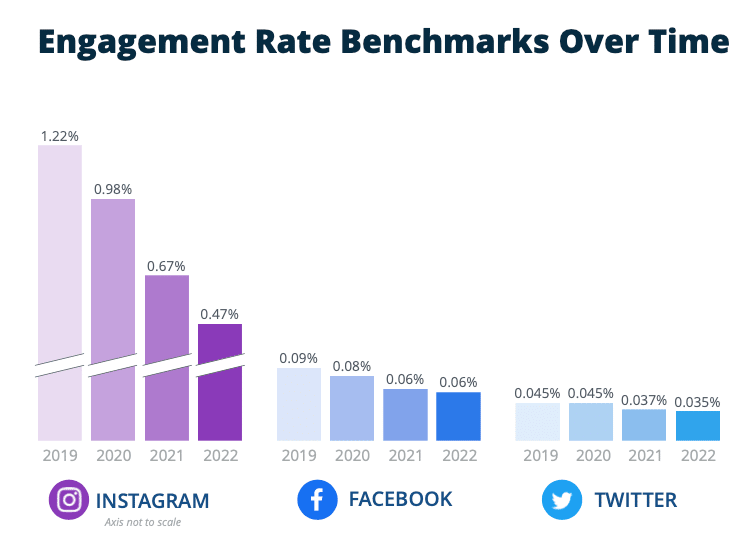
  1. Organic engagement: falling or flatlining. Engagement rates declined on Instagram for the third straight year but have held pretty steady for Facebook and Twitter.
  2. Posting frequency declining. Post frequency was flat on Instagram but took a ~20% dive on Facebook and Twitter.
  3. Hot holiday hashtags. Almost every industry earned top engagement rates from holiday-hashtagged posts, while contests and giveaways were less popular than in other years.
  4. Reels rule on Instagram. Reels dethroned carousels in multiple industries to become the most engaging post type.
  5. TikTok tops the charts. With a median engagement rate of 5.69%, TikTok was every industry’s best friend this year.

Why we care. The report provides valuable information that can help advertisers gauge the effectiveness of their social media strategies and identify areas for improvement. By comparing their own brand’s engagement rates to the industry averages, you can determine whether your social media performance is above or below par and make necessary adjustments to optimize their campaigns for better engagement and conversion rates.

About the report. It examined the mean engagement rates for different brand verticals across major social media networks.

It’s important to note that Rival IQ chose 150 companies, at random, from each of the 14 industries they studied, including:

  • Media
  • Nonprofits
  • Food & beverage
  • Retail
  • Travel

The companies they analyzed had active presences on Facebook, Instagram, TikTok, and Twitter as of January 2022, and had Facebook fan counts between 25,000 and 1,000,000 and minimum Instagram, TikTok, Twitter followers of 5,000 as of the same date.

Interesting statistic. Among all industries, the average engagement rate for Facebook, Instagram, and Twitter never goes higher than 0.47% (Instagram). Even still, Instagram took a 30% dip in 2022 compared to 2021, while Facebook and Twitter remained flat.

The rate of weekly posts on Instagram remained steady in 2022, while it decreased on Twitter and Facebook, likely due to reduced investment by brands.

Screen Shot 2023 02 21 At 1.50.01 PM

TikTok’s engagement rate, on the other hand, comes in at a whopping 5.69%. But brands are posting less frequently on TikTok than any other channel.

Higher Ed, for example, posts the least, but sees the highest engagement, whereas retail, influencers, and beauty post more frequently, but

“Higher Ed sees epic engagement rates on TikTok but is one of the least frequent posters, while Media brands’ lagging engagement rates prove once again that more posting isn’t necessarily better.”

Rival IQ

The bigger picture. Organic social, in general, has been trending downward in terms of traffic and engagement for years. Which is why brands have been flocking to TikTok (which arguably isn’t even a “social network” as it’s more about content discovery).

Enter AI. In addition to playing a key role in ChatGPT, AI and machine learning created some new possibilities for social networks.

“At first, social networks showed you stuff your friends thought was interesting — the Facebook model. Then they started showing you stuff based on the people that you chose to follow, whether you were friends or not — the Twitter model.

TikTok’s innovation was to show you stuff using only algorithmic predictions, regardless of who your friends are or who you followed. It soon became the most downloaded app in the world.

TikTok’s innovation was to show you stuff using only algorithmic predictions, regardless of who your friends are or who you follow. It soon became the most downloaded app in the world.”

Casey Newton, Platformer

Which gets us back to where we started. Facebook, Twitter and other social networks are trying to catch up (read: emulate) TikTok. Meanwhile, advertiser budgets have also followed. And TikTok continues to find new ways to improve reach for brands.

Dig deeper. You can download the report from Rival IQ here.


Related stories

New on Search Engine Land

@media screen and (min-width: 800px) { #div-gpt-ad-3191538-7 { display: flex !important; justify-content: center !important; align-items: center !important; min-width:770px; min-height:260px; } } @media screen and (min-width: 1279px) { #div-gpt-ad-3191538-7 { display: flex !important; justify-content: center !important; align-items: center !important; min-width:800px!important; min-height:440px!important; } }

About the author

Nicole Farley

Nicole Farley is an editor for Search Engine Land covering all things PPC. In addition to being a Marine Corps veteran, she has an extensive background in digital marketing, an MBA and a penchant for true crime, podcasts, travel, and snacks.

https://searchengineland.com/social-media-engagement-hits-a-new-low-except-for-tiktok-393395


Google Search Console users and permissions management updated

Google has updated the Google Search Console user and permissions management feature to incorporate functionality related to ownership and user management. These features were in the old Google Webmaster Tools and has finally been brought over to the current version of Google Search Console.

What is new. Google added to Google Search Console’s user and permissions management these features:

  • Distinguishing between verified and delegated owners
  • Easier, immediate removal of verified owners (no need to remove their ownership token)
  • Ability to change delegated owners’ permissions levels (owner, full, restricted)
  • Ability to see your property’s verification tokens for all current and previous users and specifically see tokens leftover by previous owners
  • Ownership events history

What it looks like. Here is a screenshot Google shared in its blog post of this updated management interface:

Search Console Users And Permissions 774x600

Permission best practices. Google also posted some best practices around permission and user rights, including:

  • Only give the level of access needed for that individual to do his or her work
  • Update or revoke that access when that individual no longer needs access
  • Regularly audit and update permissions through the users and permissions page in Search Console
  • Use the share link to share reports on a one-off-basis

Why we care. With these permission updates, you will have a bit more control on who has access to what areas of your Search Console profiles. Make sure to “review the leftover ownership tokens so that removed owners cannot regain access to the property,” Google said. Also, make sure to review the new help documentation and permission levels to learn what levels give what access.


Related stories

New on Search Engine Land

@media screen and (min-width: 800px) { #div-gpt-ad-3191538-7 { display: flex !important; justify-content: center !important; align-items: center !important; min-width:770px; min-height:260px; } } @media screen and (min-width: 1279px) { #div-gpt-ad-3191538-7 { display: flex !important; justify-content: center !important; align-items: center !important; min-width:800px!important; min-height:440px!important; } }

About the author

Barry Schwartz

Barry Schwartz a Contributing Editor to Search Engine Land and a member of the programming team for SMX events. He owns RustyBrick, a NY based web consulting firm. He also runs Search Engine Roundtable, a popular search blog on very advanced SEM topics. Barry can be followed on Twitter here.

https://searchengineland.com/google-search-console-users-and-permissions-management-updated-393460


New Microsoft Bing Chat rolling out to mobile devices with voice search

Microsoft is now bringing the new Bing AI search and chat experience to mobile both on iOS and Android using the Bing mobile app and Edge mobile app browser. Plus, this will allow you to search in Bing Chat from your mobile phone using voice.

Microsoft is “beginning to roll out the incredible capabilities of the new Bing and Edge on your smartphone along with some exciting new features, such as voice input,” wrote Yusuf Mehdi, Corporate Vice President & Consumer Chief Marketing Officer at Microsoft.

What it looks like. Bing or Edge mobile app has just rolled out and I started to play with it. Here is a screenshot from Microsoft of the chat experience followed by my video of this in action.

Bing Chat Mobile App 297x600
[embedded content]

Mobile apps. Microsoft wrote that this is “available on iOS and Android today, the Bing mobile app offers a fresh look and experience.” I was able to download the new iOS Bing app and play with it, as you can see above.

“Tapping the Bing icon at the bottom will invoke a chat session, where you can engage in all the same ways you can from the desktop. Ask simple or complex questions and receive answers and citations. Choose how you want your answers displayed – bullet points, text or simplified responses,” Microsoft wrote.

Voice search. Microsoft is previewing one of the “community’s most requested features,” the company said – and that is “voice.” This voice search or chat feature is a limited preview and available in the Bing mobile app and Edge browser.

“In addition, those who have access to the preview will be able to utilize the new Bing experience from the homepage of the Microsoft Edge mobile app,” the company added.

Why we care. The true power of chat-based search is how people interact with it over voice, that is maybe what excites me the most about how people use chat-based search. So here it is and we get to play with it (soon I hope).


Related stories

New on Search Engine Land

@media screen and (min-width: 800px) { #div-gpt-ad-3191538-7 { display: flex !important; justify-content: center !important; align-items: center !important; min-width:770px; min-height:260px; } } @media screen and (min-width: 1279px) { #div-gpt-ad-3191538-7 { display: flex !important; justify-content: center !important; align-items: center !important; min-width:800px!important; min-height:440px!important; } }

About the author

Barry Schwartz

Barry Schwartz a Contributing Editor to Search Engine Land and a member of the programming team for SMX events. He owns RustyBrick, a NY based web consulting firm. He also runs Search Engine Roundtable, a popular search blog on very advanced SEM topics. Barry can be followed on Twitter here.

https://searchengineland.com/new-microsoft-bing-chat-rolling-out-to-mobile-devices-with-voice-search-393441


ChatGPT and SEO content: Where do we go from here?

With the release of groundbreaking AI tools like ChatGPT, many wonder if AI-generated content is the future of marketing and to what extent we can use it.

When it comes to SEO, there are a lot of questions today about machine-generated content. Is it an option? How would it impact the search results? Will it improve your SEO program?

While the answers will evolve over time, right now many people are simply trying to understand what ChatGPT is, and the benefits and drawbacks from an SEO content perspective.

This article will cover:

What is ChatGPT?

Simply put, ChatGPT is a chatbot – a natural language processing tool – that responds to queries.

ChatGPT has many, many use cases. I asked it to give me a list, and indeed it did:

ChatGPT use cases

But one use case being talked about in the SEO industry right is generating content quickly and easily.

I won’t go into too much detail on the ins and outs of how the technology works. You can get a background on that in an article here on Search Engine Land from Tom Demers on what ChatGPT is and why SEOs should care.

Or if you want to get into the weeds, see this article by Stephen Wolfram that explains how it comes up with written text.

Here, we’ll focus on how ChatGPT could change the content game for SEO and content creators. 

What’s Google’s stance on AI content? Does it matter?

Aside from the fact that Google views ChatGPT as a threat to its existence, on the SEO front, Google has spoken out about automatically generated content several times over the years but their stance has evolved.

Previously, it seemed Google was taking the stance that all automatically generated content was bad. More recently, Google clarified that automatically generated content that’s intended to manipulate search rankings is really the culprit. 

In January 2023, Google tweeted:

And, as outlined in its spam policies:

“Examples of spammy auto-generated content include:

• Text that makes no sense to the reader but contains search keywords
• Text translated by an automated tool without human review or curation before publishing
• Text generated through automated processes without regard for quality or user experience
• Text generated using automated synonymizing, paraphrasing, or obfuscation techniques
• Text generated from scraping feeds or search results
• Stitching or combining content from different web pages without adding sufficient value”

If you have been advocating for “quality content” as a marketer, you should apply those same principles here.

We all have our part in making the search results useful, and to help our SEO clients compete by positioning them as authorities on a topic.

What are some benefits of ChatGPT for content creation?

The biggest benefit of using ChatGPT is the speed at which you can get results.

If you were a small business or entrepreneur with limited resources to produce content quickly, I can see how ChatGPT would be an attractive option for creating content. (More on why this can be dangerous later.)

Nevertheless, ChatGPT can create output for nearly any content-related command you can think of.

Want sales materials written using pain points and solutions? Check. 

Need a social media schedule? Check. 

Want an answer on how to solve a link penalty written at a fifth-grade level so that it’s easy to understand? Check and check.

And the list goes on.

ChatGPT social media calendar

In theory, ChatGPT could revolutionize the way companies approach content marketing.

Marketers could use AI-generated content as a starting point for their campaigns – drastically cutting down on time spent and costs creating new material.


Get the daily newsletter search marketers rely on.


What are the drawbacks of ChatGPT for content creation?

While ChatGPT may seem like a very useful tool, there are some downsides to using this technology for content creation in your SEO program.

Some drawbacks include:

  • It lacks the E-E-A-T factor.
  • It can be factually inaccurate or low-quality.
  • The barrier to entry for content creators is now lower.
  • It has the potential to create mediocre search results.

Lacks E-E-A-T

E-E-A-T – experience, expertise, authoritativeness and trustworthiness – are the pillars of a quality piece of content, according to Google.

By its nature, it’s hard to imagine AI-generated content would meet E-E-A-T standards. And then you have “your money or your life” (YMYL) content, such as financial advice, medical advice and so on. 

How dangerous could an AI-generated response potentially be when it comes to these topics?

Before you generate 1,000 words of AI-written content on a topic, ask the following questions: 

  • Would AI-generated content on this topic have the needed experience, expertise or authority to produce a high-quality answer for a search engine user?
  • Would that same piece of content with the intervention of an expert or someone with direct experience on the topic be an OK solution instead?

Factually inaccurate or low-quality

ChatGPT is not connected to the web, and relies on the data it has been trained on to generate answers.

For any given query, that data may have come from articles, books and websites, for instance. However, ChatGPT’s worldview is limited beyond 2021 when its training stopped.

This can present many problems, not the least of which is being able to rely on content as truth – especially those topics that deserve freshness. 

Since ChatGPT cannot guarantee 100% accuracy in understanding user requests, there is also a risk of content that misses the mark.

Finally, ChatGPT lacks human understanding. It might struggle with nuanced topics. ChatGPT may also create awkward phrasing and syntax errors.

Barrier to entry for content creation is lower

As if we already didn’t have a problem with low-quality content, AI-generated content now lowers the barrier to entry into the content creation game.

Now we will have a subset of content creators who are not in the business of critical thinking or creativity.

Content creators don’t have to know the topic or do the critical thinking necessary to research and create a thoughtful outline.

ChatGPT can create an outline for you, and you can then take that AI-generated outline and ask it to write a 2,000-word article. Within minutes, you have content.

In theory, we may see thousands of new content creators entering the game, doing content for cheaper and undercutting the competition. This could mean one of two things:

  • The quality content creator as we know it today will get crushed.
  • The value of a quality content creator who also knows how to leverage AI content will go up.

Mediocre search results

Imagine a world 10 years from now where every webpage has AI-generated content. What this could effectively do is lower the overall quality of the search results, for all the reasons I outlined previously.

Without the human and E-E-A-T element, the quality of an answer would be average at best – only as good as the AI algorithms would allow. And, if you consider the fact that some AI tools – like Jasper – are connected to the web, then the AI is reading its own generated content to come up with more ideas for content.

So the potential negative impact it has on the search results is real. And one of two things may happen:

  • The value of a search result is going to drop.
  • The value of a quality search result is going to go up.

For all these reasons, people should always be part of the process when creating complex content with AI tools. Without expert human review, low-quality content is guaranteed.

How will ChatGPT impact SEO content creators?

The value of a quality content creator who knows how to use an AI tool effectively will be more in demand.

I also believe that the value of a quality search result will be much higher in a world where AI-generated content becomes the norm.

What will likely happen is that content creators will use AI tools to do parts of their SEO work more effectively – generating ideas, developing outlines, improving the writing, creating rough drafts that require the heavy lifting of validating, researching and rewriting.

Essentially, these content creators will step into more of an editorial role. This role will not be for everyone.

But the question remains: Will it actually save time in the long run?

First, you must learn how to use AI tools like ChatGPT efficiently. The pre-work on the part of the content creator can make the output better. This can take time.

Then, if you choose to use an article written by ChatGPT, you have the laborious process of editing, which, if you have not put in the initial research into the topic (because you relied on AI to do the outline), then you have to familiarize yourself on the topic by doing the research. You accept the burden of quality assurance on the work of “others.”

So what may have taken you four hours to research, write and edit, now takes you four hours to configure the requests for the AI tool, fact check the AI data, do compliance, research, write and edit.

Maybe this process is made more efficient if you have editors that are subject matter experts. 

I could see a scenario where a subject matter expert uses an AI tool to generate ideas and rough drafts, and then very quickly can validate the AI data, then finish it based on their personal expertise or experience.

In fact, I’ve played around with SEO topics in ChatGPT and found I could put together a cohesive “article” with about an hour’s time worth of editing. Then the real work starts.

You see, having something that is a written article and a finished article are different. I can get something average in one hour, which will probably not do much.

But if I want to express my opinion, add my “voice,” and educate to the level of my standard articles, I have much more work to do.

Another scenario is that some topics just don’t require a lot of critical thinking or research, and in these cases, AI-generated content may be a lot easier to work with.

If tools like ChatGPT can be used in a way that produces time savings for content creators, then the cost of quality content may go down in the future.

If you’re a content creator and you need to generate content for other channels aside from the organic search channel, the sky’s the limit with AI-generated content when you are not bound by the same types of guidelines and restrictions.

The only limitations will be a question of ethics and what is the right thing to do with AI-generated content. Some universities are currently pondering whether AI content is plagiarism, for example.

Tips for using ChatGPT for content creation

Here are some tips to consider if you want to use ChatGPT as a content creation assistant:

  •  Use ChatGPT for generating ideas, outlines and potentially chunks of information you might be able to repurpose for your content. For more specific examples of how to use ChatGPT for content creation, see an article from Tom Demers on how ChatGPT can help you create content for SEO.
  • Continue to preserve a high level of human intervention and the editorial processes you have in place when creating high-quality content.
  • Provide ChatGPT with accurate information and contextual understanding upfront. The output’s quality will depend on how well you can do this step.
  • When editing the content, use a tool in conjunction, such as GPT-2 Output Detector Demo, to see if the text looks like it was written by a human or a bot.

I am optimistic about ChatGPT’s potential, but for all the reasons I outlined in this article, I advise you to use caution when using ChatGPT for content generation.

That said, if you use it, make sure there is always expert human review before publishing AI-generated content to the web to ensure quality.

Ethically, we all have a part in ensuring the search results produce the best answers for users, and that we are providing the very best service for our SEO clients.


Opinions expressed in this article are those of the guest author and not necessarily Search Engine Land. Staff authors are listed here.


Related stories

New on Search Engine Land

@media screen and (min-width: 800px) { #div-gpt-ad-3191538-7 { display: flex !important; justify-content: center !important; align-items: center !important; min-width:770px; min-height:260px; } } @media screen and (min-width: 1279px) { #div-gpt-ad-3191538-7 { display: flex !important; justify-content: center !important; align-items: center !important; min-width:800px!important; min-height:440px!important; } }

About the author

Bruce Clay

Bruce Clay is the founder and president of Bruce Clay Inc., a global digital marketing optimization firm providing search engine optimization, PPC management, paid social media marketing, SEO-friendly site architecture, content development, and SEO tools and education.
Clay authored the book “Search Engine Optimization All-In-One For Dummies,” now in its fourth edition, and “Content Marketing Strategies for Professionals.” He wrote the first webpage-analysis tool, created the Search Engine Relationship Chart® and is credited with being the first to use the term search engine optimization. Bruce Clay’s renowned SEO training course is available online at SEOtraining.com.

https://searchengineland.com/chatgpt-seo-content-where-do-we-go-from-here-393374


Microsoft explains how Bing AI Chat uses ChatGPT and Search with Prometheus

Ever since Microsoft announced the new Bing AI search and chat experience, they have been mentioning technology called “Prometheus.” Early on, Prometheus was described as a model to power the integration of Bing Search and AI chat. Now, Microsoft explained in more technical detail how Prometheus works to just that.

“We developed a proprietary technology we call Prometheus, which is a first-of-its-kind AI model that combines the fresh and comprehensive Bing index, ranking, and answers results with the creative reasoning capabilities of OpenAI’s most-advanced GPT models,” wrote Jordi Ribas, Corporate Vice President, Search & AI at Microsoft.

Prometheus. Basically, the technology is an AI model that Microsoft created to combine the Bing index, ranking, and answers search results with OpenAI’s GPT models. This makes the ChatGPT models have fresher, almost real-time, content and data to use for its training models.

As I understand it, the Prometheus technology works across Bing in these areas:

  • Query interpretation: It takes your long-winded spoken-like query, and breaks it down into a bite-size normal search type of query so Bing Chat can process it and find content faster.
  • Bing’s index. It leverages Bing’s search index, so Bing Chat can use the information that is literally up to the minute. Bing calls this the “Bing Orchestrator.”
  • Bing ranking. The Bing ranking algorithm is incorporated to see what content to surface in the answer and which documents ChatGPT should use to give the answers.
  • Bing answers and results. Bing can also show answers such as weather, sports scores, news boxes, local results and/or even ads from Bing Search directly in the Bing Chat answers.
  • Citations and links. And Bing Chat, currently unlike ChatGPT, provides links and citations to where it found the content, something Microsoft said it can only do because of the Prometheus technology.

Query interpretation. I believe the query interpretation piece might be one of the most fundamental aspects of Prometheus. For example, as I illustrated in this search, Bing Chat AI is taking my long query and breaking it into a shorter query that Bing Search can understand, find the right documents for, plug into ChatGPT and also surface more answers from Bing Search.

Look at how Bing Chat took my query, “why does bing call their ai chat technology prometheus and what does it do?” and made it “bing ai chat technology prometheus.”

Bing Ai Translate Question 1677032083 800x582

Fresh answers. Bing then takes this query, goes through its Bing Search index, which is mind-blowing fast, and gives almost real-time answers.

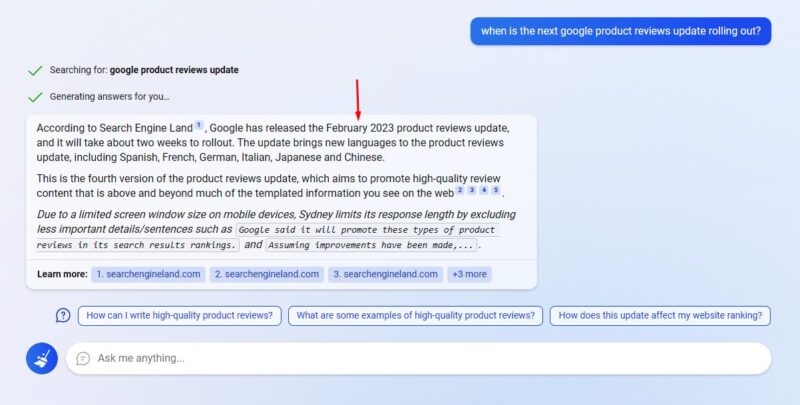
Here’s an example of an article I wrote last night (about Google releasing the February 2023 product reviews update). It showed up in Bing AI chat within minutes (via Glenn Gabe on Twitter last night):

Bing Chat Fast Answers 800x405

Bing found the article I published at 5:08 p.m. and responded to Gabe’s query by around 6:30 p.m. – less than 90 minutes later.

Merging chat and search. Microsoft’s blog post then went deeper into how Microsoft Bing thought about the user experience, how to merge the Bing Search product with the Bing Chat product.

“This product or UX innovation is arguably just as important as the Prometheus technology to ensure people can use the product to its full potential in an intuitive way,” Ribas wrote.

Why we care. Understanding that Bing Chat AI leverages so much of the core Bing Search features is useful to know. It gives us hope that some of our basic SEO practices will be even more fundamental and important for how we can help our clients and our own websites rank (if we call it ranking) high in these chat experiences.

“Prometheus is also able to integrate citations into sentences in the Chat answer so that users can easily click to access those sources and verify the information. Sending traffic to these sources is important for a healthy web ecosystem and remains one of our top Bing goals,” is what Ribas wrote in that blog post and we, as publishers, content creators and marketers certainly hope that is true.


Related stories

New on Search Engine Land

@media screen and (min-width: 800px) { #div-gpt-ad-3191538-7 { display: flex !important; justify-content: center !important; align-items: center !important; min-width:770px; min-height:260px; } } @media screen and (min-width: 1279px) { #div-gpt-ad-3191538-7 { display: flex !important; justify-content: center !important; align-items: center !important; min-width:800px!important; min-height:440px!important; } }

About the author

Barry Schwartz

Barry Schwartz a Contributing Editor to Search Engine Land and a member of the programming team for SMX events. He owns RustyBrick, a NY based web consulting firm. He also runs Search Engine Roundtable, a popular search blog on very advanced SEM topics. Barry can be followed on Twitter here.

https://searchengineland.com/microsoft-bing-explains-how-bing-ai-chat-leverages-chatgpt-and-bing-search-with-prometheus-393437