Google warns against using 403 or 404 status codes for Googlebot crawl rate limiting
Google is warning against using 404 and other 4xx client server status errors, such as 403s, for the purpose of trying to set a crawl rate limit for Googlebot. “Please don’t do that,” Gary Illyes from the Google Search Relations team wrote.
Why the notice. There has been a recent increase in the number of sites and CDNs using these techniques to try to limit Googlebot crawling. “Over the last few months we noticed an uptick in website owners and some content delivery networks (CDNs) attempting to use 404 and other 4xx client errors (but not 429) to attempt to reduce Googlebot’s crawl rate,” Gary Illyes wrote.
What to do instead. Google has a detailed help document just on the topic of reducing Googlebot crawling on your site. The recommended approach is to use the Google Search Console crawl rate settings to adjust your crawl rate.
If you can’t do that, Google then says “reduce the crawl rate for short period of time (for example, a couple of hours, or 1-2 days), then return an informational error page with a 500, 503, or 429 HTTP response status code.”
Why we care. If you noticed crawling issues, maybe your hosting provider or CDN recently deployed these techniques. You may want to submit a support request with them to show them Google’s blog post on this topic to ensure they are not using 404s or 403s to reduce crawl rates.
@media screen and (min-width: 800px) { #div-gpt-ad-3191538-7 { display: flex !important; justify-content: center !important; align-items: center !important; min-width:770px; min-height:260px; }
}
@media screen and (min-width: 1279px) { #div-gpt-ad-3191538-7 { display: flex !important; justify-content: center !important; align-items: center !important; min-width:800px!important; min-height:440px!important; }
}
About the author
Barry Schwartz a Contributing Editor to Search Engine Land and a member of the programming team for SMX events. He owns RustyBrick, a NY based web consulting firm. He also runs Search Engine Roundtable, a popular search blog on very advanced SEM topics. Barry can be followed on Twitter here.
Report: Google sharing Chrome iOS search revenue with Apple
Google pays Apple a share of revenue generated from Chrome search traffic, according to a new report from The Register.
Revenue share reveal. In a 356-page report, published June 10, 2022, there was a key redaction:
Google pays Apple a share of the search revenue it earns from browser traffic on iOS in the following contexts: in return for being the default search provider on Safari, Google pays Apple a share of revenue derived from Safari search traffic; and pursuant to various commercial arrangements, Google pays Apple a share of revenue derived from [redacted] search traffic.
According to The Register, that redacted word is “Chrome.” And it was redacted from another section of the CMA’s report:
Under these agreements, Apple receives a significant share of revenue from Google Search traffic on Safari and [redacted] on iOS devices. Google’s estimated payments to Apple for search default status on Safari (£[1-1.5] billion total in 2021 for the UK) were substantially more than those made to its next largest partner, Samsung. This high level of payment is likely to reflect Apple’s strong positions in browsers (and other search access points) and browser engines (through the WebKit restriction).
Why we care. Almost every year, we’ve heard rumors about Apple finally unveiling its own search engine to compete with Google. Yet it has never happened. Could this be a – or the – reason why? Is Google essentially paying Apple not to become a search competitor and thus, both are maintaining their status quo?
Maintaining dominance? It’s impossible to deny Google and Apple have a mutually beneficial relationship. And there’s further theory to be found about how important that relationship is within this antitrust lawsuit, which alleges:
More than half (50%) of Google’s search business was conducted through use of Apple devices.
Because more than half of Google’s search business was conducted through Apple devices, Apple was a major potential threat to Google, and that threat was designated by Google as “Code Red.”
Google paid billions of dollars to Apple and agreed to share its profits with Apple to eliminate the threat and fear of Apple as a competitor.
Google viewed the aspect of Apple as a potential competitor to be “Code Red.”
If Apple became a competitor in the search business, Google would have lost half of its business.
What isn’t new. Google has paid Apple billions of dollars over the years to remain the default search option on Apple devices. What started as a $1 billion dollar deal has grown to be worth an estimated $15 billion annually (in 2021) to Apple.
We’ve covered the evolution of the Google-Apple search deal in prior years:
@media screen and (min-width: 800px) { #div-gpt-ad-3191538-7 { display: flex !important; justify-content: center !important; align-items: center !important; min-width:770px; min-height:260px; }
}
@media screen and (min-width: 1279px) { #div-gpt-ad-3191538-7 { display: flex !important; justify-content: center !important; align-items: center !important; min-width:800px!important; min-height:440px!important; }
}
About the author
Danny Goodwin is Managing Editor of Search Engine Land & SMX. In addition to writing daily about SEO, PPC, and more for Search Engine Land, Goodwin also manages Search Engine Land’s roster of subject-matter experts. He also helps program our conference series, SMX – Search Marketing Expo. Prior to joining Search Engine Land, Goodwin was Executive Editor at Search Engine Journal, where he led editorial initiatives for the brand. He also was an editor at Search Engine Watch. He has spoken at many major search conferences and virtual events, and has been sourced for his expertise by a wide range of publications and podcasts.
Bing AI chat needs to stop sourcing the Bing search results
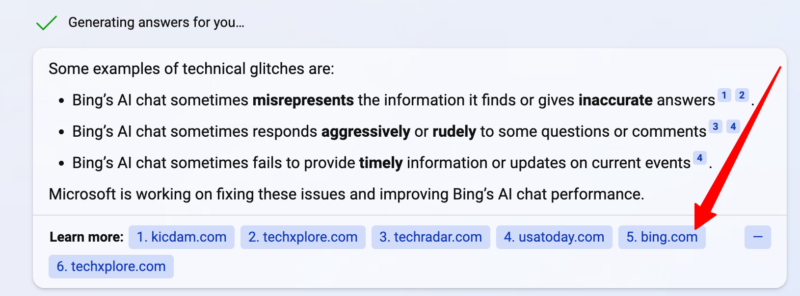
As I go down the rabbit hole of exploring the new Microsoft Bing AI with ChatGPT, I keep finding more and more interesting answers. One such example is when I ask Bing Chat a question and it sources itself as one of the answers. Yes, Bing Chat can list bing.com as a citation for an answer in its search results.
Examples. I posted an example on Twitter showing how I asked a question and then one of the citations were bing.com, so I clicked it and it took me to Bing search that referenced articles it mentioned already in the other citations. This search experience is circular and sends searchers back to the search results in a way that might confuse the searcher.
Here is a screencast I made of this in action:
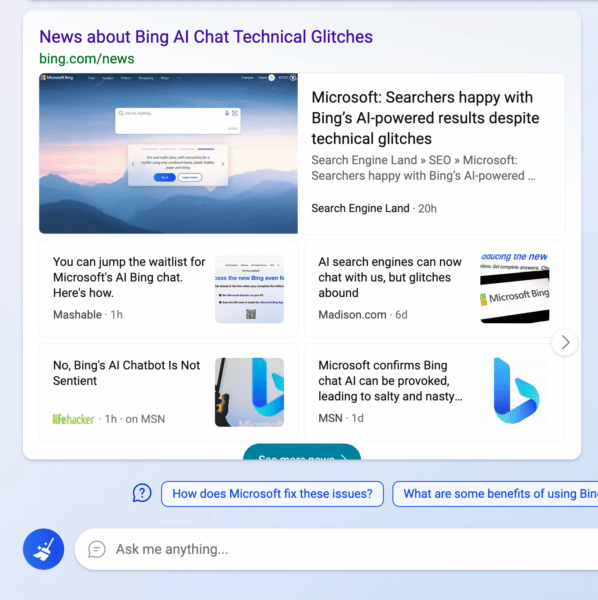
Now, I repeated it for a different query, where bing.com was also listed as a citation:
But here, Bing also included in the answer box the Bing search news box, which is helpful but why link someone to more search results Bing?
Glenn Gabe also spotted examples of this yesterday, he said, “Bing leading to more Bing search results when it could be leading to authoritative health/medical sites is not great.”
Ask Bing Chat about a health issue, & one of those citations is NOT like the others… :) Bing leading to more Bing search results when it could be leading to authoritative health/medical sites is not great. Also, eat anti-inflammatory foods for an Achilles injury?? Uh, right… pic.twitter.com/ZSo9y68Twz
Against Google’s guidelines. Google has always said that you should not have search engines index and ultimately rank your internal search results pages. There was a line in the Google webmaster guidelines (recently revamped to search essentials) that read, “Use the robots.txt file on your web server to manage your crawling budget by preventing crawling of infinite spaces such as search result pages.”
I do not know if Bing’s webmaster guidelines also recommend you do not let Bing index your internal search result pages; I couldn’t find that mentioned yet. But in any case, it seems like Bing Chat should not source Bing search for its answers, especially when those Bing search results just link to other publishers that it can list in the situations within the Bing Chat answers.
Why we care. Yes, Bing AI Chat is in its infancy, and I know it will change over time. It is important for Bing to hear our feedback and adapt Bing Chat for the better; not just for the betterment of the searcher (which is rightfully their number one concern), but also for the whole ecosystem.
@media screen and (min-width: 800px) { #div-gpt-ad-3191538-7 { display: flex !important; justify-content: center !important; align-items: center !important; min-width:770px; min-height:260px; }
}
@media screen and (min-width: 1279px) { #div-gpt-ad-3191538-7 { display: flex !important; justify-content: center !important; align-items: center !important; min-width:800px!important; min-height:440px!important; }
}
About the author
Barry Schwartz a Contributing Editor to Search Engine Land and a member of the programming team for SMX events. He owns RustyBrick, a NY based web consulting firm. He also runs Search Engine Roundtable, a popular search blog on very advanced SEM topics. Barry can be followed on Twitter here.
The big concern for publishers is when AI becomes the journalist
With all the talk of Google Bard and Microsoft’s Bing AI with ChatGPT over the past several days, we all keep thinking more about how search and publishing will change in the future.
As we covered before, content creators are concerned about if there will be ROI in creating content that might not get clicks.
[embedded content]
When AI becomes the journalist. While that is a concern, I think the bigger concern is when AI becomes the journalist. When AI can find the sources, track the necessary data, and follow the right people to produce unique, helpful and breaking news stories.
Right now, we see Bing’s interface consume and output amazing and timely answers in its chat interface based on not just what publishers are posting on their own sites but also referencing posts on Twitter from experts in the field. And Microsoft Bing said it is not fast enough at this and it will get faster – faster than it is even now!
AI can do the research. So what if AI can collect expert opinions on a breaking topic from social media? What if AI can make phone calls using technology like Duplex (which closed down)? What if AI can track the data sources that journalists often track to come up with a story faster, better, and more detailed than a human journalist?
The is the concern. I believe that is the true concern with AI. Not that journalists and publications won’t get traffic from search because the links are not just worth clicking on (and yes that is a valid concern). But more so, the AI can write the article on the fly without needing to find what other human journalists have written.
Entertainment matters. So what do we, as publishers, do to make our content something that you, the readers, want to consume and continue to subscribe to? Maybe we need to add an entertainment factor. Maybe we need to add personality and humor, and entertainment into our content, above and beyond what a machine can do at this point in time.
E-E-E-A-T. This gets me thinking, should Google add to their quality raters guidelines a third “E”, not just E-E-A-T but E-E-E-A-T. Should Google add “entertainment” to the list?
Entertainment?
Experience.
Expertise.
Authoritativeness.
Trustworthiness.
Don’t we have enough Es by now? Maybe.
But maybe we need to think one step beyond Google. Think about how you can add more value to your content so that readers won’t just find us on search but they will want to become loyal fans – subscribing and continuing to read your content in the future.
Why we care. We need to continue to think about how we, as marketers, continue to innovate and improve our offerings so that both our readers and the searchers want to continue to read, consume and share your content.
This is why I added a video to the top of this page, which is a 90-second clip from my weekly SEO video recap that I publish on YouTube, iTunes, Apple Podcasts, Spotify, Google Podcasts or your favorite podcast player.
@media screen and (min-width: 800px) { #div-gpt-ad-3191538-7 { display: flex !important; justify-content: center !important; align-items: center !important; min-width:770px; min-height:260px; }
}
@media screen and (min-width: 1279px) { #div-gpt-ad-3191538-7 { display: flex !important; justify-content: center !important; align-items: center !important; min-width:800px!important; min-height:440px!important; }
}
About the author
Barry Schwartz a Contributing Editor to Search Engine Land and a member of the programming team for SMX events. He owns RustyBrick, a NY based web consulting firm. He also runs Search Engine Roundtable, a popular search blog on very advanced SEM topics. Barry can be followed on Twitter here.
Clearly, YouTube is doing something right with its algorithm, but what is it doing that’s so effective?
We wanted to find out, so we read YouTube’s creator documentation and watched a lot of content to discover how YouTube works. We also asked active creators to share how they find the YouTube algorithm in the real world.
Read on to discover how the algorithm works and what you can do to get the most out of YouTube and gain visibility on your best pieces of content.
What is the YouTube algorithm?
The YouTube algorithm is an AI-powered recommendation system designed to put the best and most engaging content in front of YouTube’s users.
The algorithm is constantly changing to understand the preferences of each and every user. Preferences and engagements inform the algorithm what a user wants to see more or less of.
Understanding YouTube’s algorithm
Naturally, a social media algorithm is designed to provide the most relevant and engaging content to its users. However, an algorithm will always work in favor of a company’s policies, values and mission statements.
Raise up authoritative sources for news and information.
Reward trusted creators.
This tells us that the YouTube algorithm is looking to prioritize content that follows guidelines, is factually correct and comes from authoritative channels and trusted creators.
How does the YouTube algorithm work in 2023?
Like many algorithms, YouTube is using machine learning to understand user behavior. The algo is evolving to prioritize videos users are most likely to watch and interact with.
In their creator videos, YouTube says:
“YouTube’s recommendation system actually finds videos for viewers, rather than viewers for videos. Videos are pulled for each user when they visit Youtube. The goal of the search and discovery system is to watch each viewer with a video they’re most likely to watch and enjoy. Every viewer’s recommendations will look different.”
[embedded content]
This algorithm takes into account several factors when recommending content. The factors can be split into two categories:
Viewer personalization.
Video performance.
Viewer personalization includes signals like what videos users watch, which ones they ignore and more.
Video performance is based on viewer satisfaction.
How YouTube measures viewer satisfaction
Viewer satisfaction is determined by factors impacted by users. These factors might include metrics like:
All of the above are indicators of positive action on a video, which results in video quality increasing.
Let’s break down each part of YouTube and discover how it works.
YouTube search
It’s no secret that people use YouTube as a search engine.
Not only do people use the search bar on YouTube itself, but as a Google-owned channel, YouTube videos can be found on Google search engine results pages (SERPs) and a video tab for video search on Google.
Getting your video featured on a search can earn views from an audience who may not already know you.
Relevance is provided through video title tags, descriptions, and search queries – think keywords.
Engagement signals such as video watch time help YouTube determine whether or not a video is useful to address specific search intent.
Quality is the most ominous element with the guidelines stating that YouTube has signals to gauge channel expertise, authority, and trustworthiness.
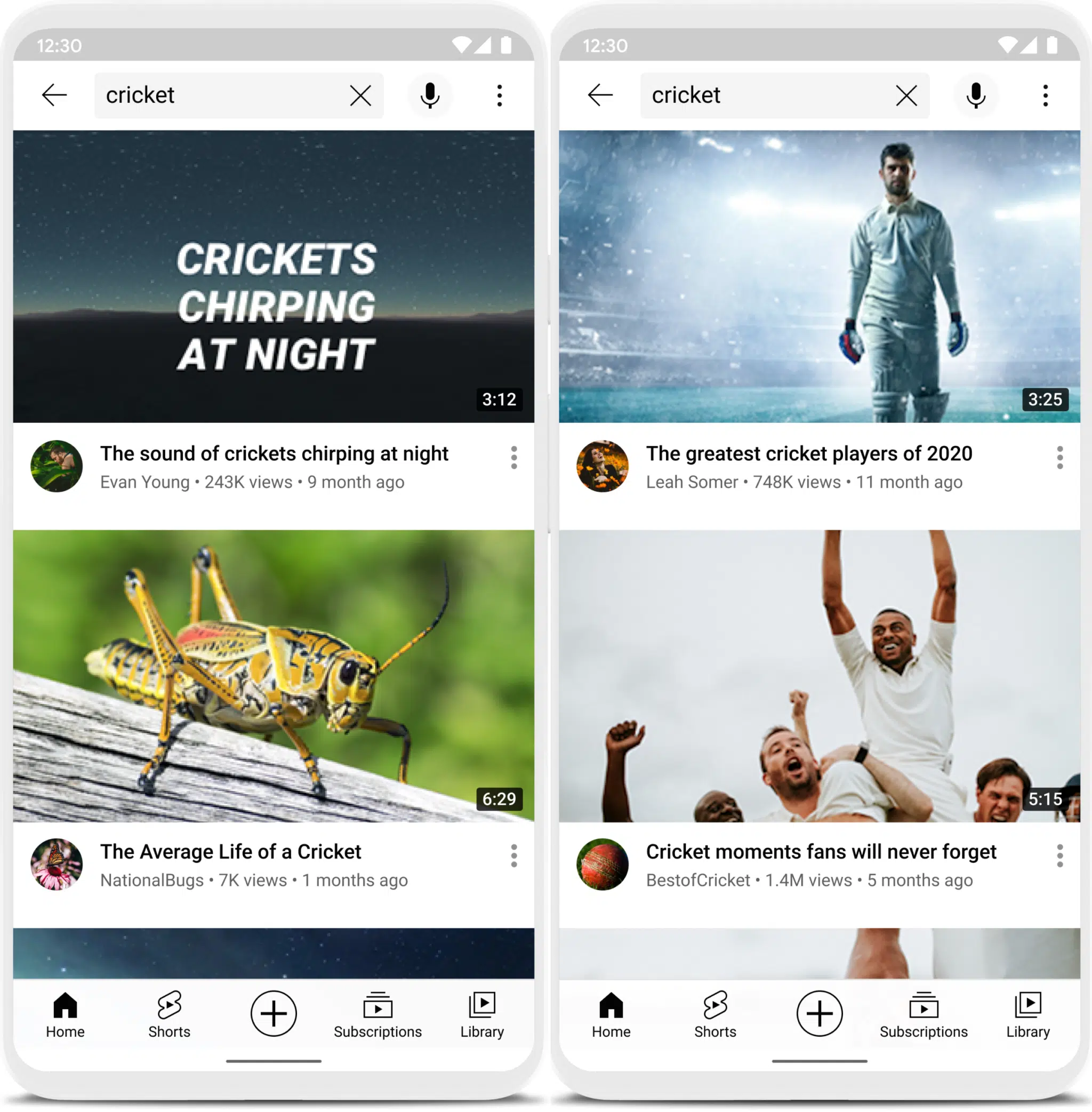
Impressively, and like any good algorithm, aside from the three elements above, YouTube does consider individual preferences when sharing videos in relation to a search query.
The image below, taken from YouTube, shows this consideration in action.
YouTube creators say:
Dough Dibert from Magnfi shows creators how they can rank a video on Google, in minutes, using keywords.
In the video below Dibert explains that there are five principles to listing a video in Google SERPs and one of those principles is keywords. He explains:
“You want to have long-tail keywords, the more specific the better…. In the title, in the first sentence of the description…in your tags… You want to name the video file itself the keyword. The next thing… saying the words in the video.”
[embedded content]
YouTube homepage
YouTube’s homepage is the place where most users start their YouTube session. It’s the first page users see when they visit the website or open the app.
For users logged in, the YouTube homepage provides video ads, relevant videos, and Shorts that a user might be interested in.
For users who are not logged in, YouTube shares popular videos that one might be interested in. Where YouTube has data on a user (gender, age etc) recommendations will likely be based on this.
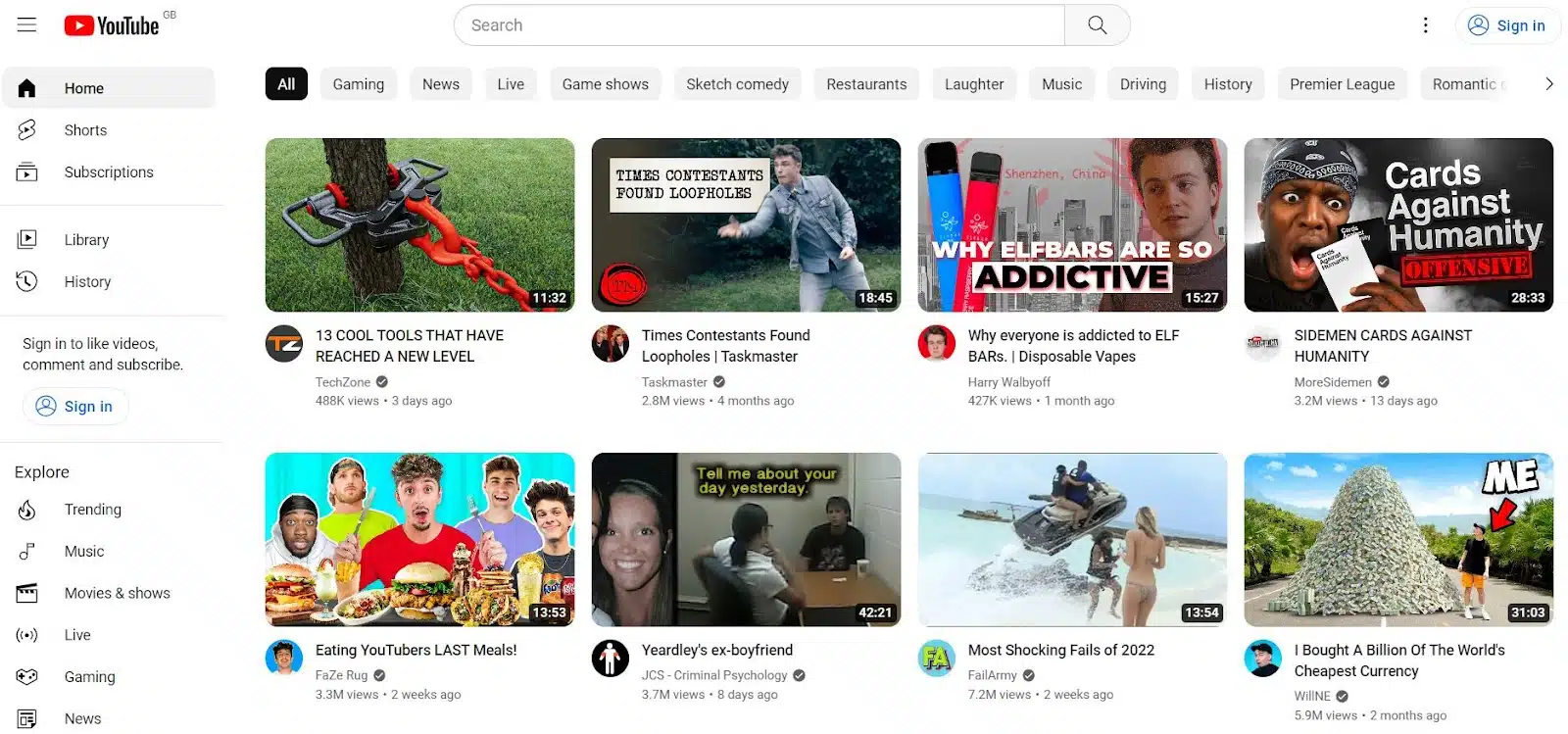
The screenshot below shows a YouTube homepage with a user signed out. The videos prioritized on the homepage are newly uploaded.
Clearly, these videos are incredibly popular amongst viewers. In two weeks, one of the videos surpassed 7.2 million views.
It’s clear to see that without viewer personalization YouTube doesn’t really know what type of content to deliver to the viewer, so starts with a range.
Recommended videos
YouTube shares recommended videos on the YouTube homepage and on the “Up next” section.
YouTube is clear that their recommended video algorithm is always changing. To ensure utmost relevancy, YouTube constantly tests and adjusts the recommended videos to individual users.
Where it can, the algorithm takes into account, user:
Watch history.
Search history.
Channel subscriptions.
Country and time of day for news or trending content.
Another factor in the recommended video algorithm is video quality. YouTube considers whether others clicked the same video or watched it to completion. These signs are important quality indicators for the algorithm.
Finally, YouTube is gathering its own data about how useful a video is through the use of surveys that appear on the homepage and app. This direct feedback is used to refine the algorithm and recommendation system for all users and not just the individual responding.
YouTube creators say:
Zach Mitchem, YouTube Strategist says:
“Suggested video is the number one thing to focus on and understand. 70% of views on YouTube come from suggested. If you get a video that YouTube likes it will push the video for you.”
Mitchem shares the importance of users watching multiple videos from one channel. If YouTube can see users watching multiple videos from a channel, YouTube will recommend other videos from the channel.
A tactic to help users stay engaged with content is to use a thumbnail template. Mitchem adds:
“If users like the video, see the thumbnail again later, and click it, YouTube learns users are watching multiple videos. We want to teach YouTube that users don’t watch one video from a channel, they watch ten. When YouTube notices users are watching multiple videos it will see users are staying on the platform, staying more, and watching more ads. YouTube will want to show them more.”
The key here is to use thumbnails to continually engage users and encourage them to watch your other videos.
Trending
Trending is a unique part of the YouTube algorithm because it is not personalized. Trending aims to share videos likely to appeal to a large audience.
Featuring in the trending spot on YouTube will require fast video churn in relation to trending pieces. For the average creator, this might be a viral video capturing viewers’ attention.
YouTube Creators say:
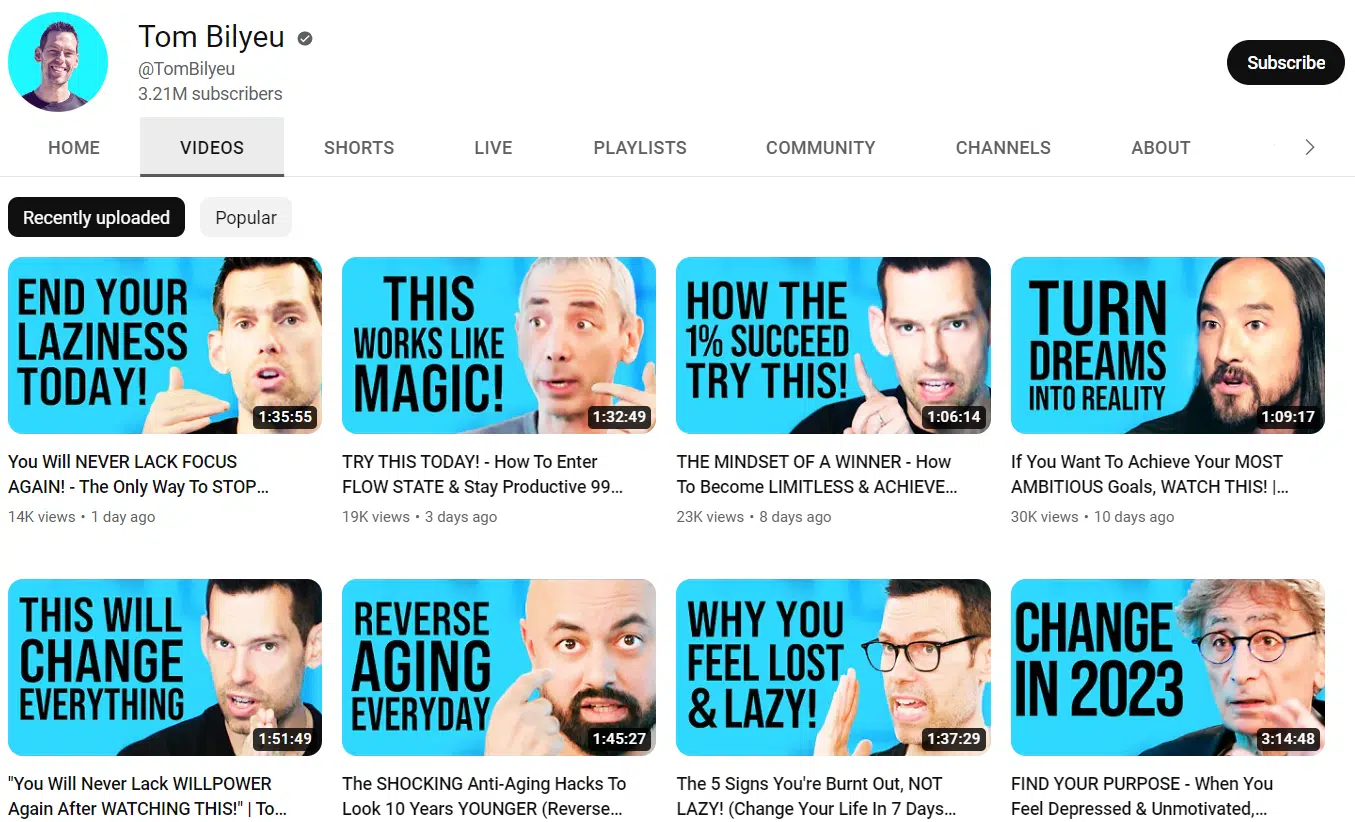
In the video below, Mitchem analyzes the power of trending videos in a commentary on Tom Bilyeu’s channel. He shows how “trend jacking” and thumbnail templates can bolster a channel’s success.
[embedded content]
Mitchem points out:
“Find something in your industry, in your niche that gets a lot of attention. Whether that’s a person, concept or current event… find something with energy and attention on it now. This will help your channel to grow and get more views on your other videos.”
Once you’ve got your video, Mitchem suggests thumbnail templates will improve click-through rate.
YouTube Shorts
With the rise of short-form video, TikToks and Instagram reels you won’t be surprised to hear that YouTube is encouraging creators to use Shorts.
YouTube-backed hashtags like #shorts30 encourage creators to upload one video daily for a month.
Shorts are given pretty high priority on the mobile version of the homepage, featuring after one ad and one long-form video.
YouTube creators say:
Malvika Sheth is an Indian-American digital luxury fashion and beauty creator. Sheth has a following of 120k+ on platforms and is an active YouTube creator.
On Shorts, Sheth says:
“I’ve been invited to major events on behalf of the YouTube Shorts team, like red carpets for Babylon, Vengeance, and more. Also, looking at my analytics it feels like my new subscribers are coming, and are consuming shorts. It’s hard to say which shorts viewers are crossing to long form, but I feel I’m struggling to convert shorts viewers to long form content.”
It seems that there are two types of users:
Those who want to watch short-form videos.
Those who prefer long-form.
Sheth’s experience suggests that creators should be including both long and short-form videos on their channels to give them the best chance of reaching a wider audience.
Sheth also shares that her most engaged Shorts included a viral fashion trend.
[embedded content]
Subscribers, subscriptions and notifications
As a creator increasing your subscriber count with an engaged following is highly desirable since subscribers will receive notifications about the channel. Notifications will bring users back to your channel and encourage your most invested viewers to watch another video.
Creators can use subscription data to better understand what their audience likes. Through YouTube analytics, you can see where users subscribed to your channel.
It’s worth remembering here that the YouTube algorithm finds videos for viewers and not viewers for videos. Therefore, if you know a video or short resulted in more subscribers, it might be worth replicating it.
Get the daily newsletter search marketers rely on.
YouTube’s algorithm news, authority and trust
YouTube guidelines make it clear that expertise, experience, authoritativeness and trustworthiness (E-E-A-T) are important factors when it comes to earning favor in the algorithm.
To understand how E-E-A-T works in relation to the YouTube algorithm we read up on how YouTube handles news.
After all, the news is the most important industry when it comes to weeding out false news and providing a space for the most trustworthy content only.
While the news may have slightly stricter guidelines, in all likelihood, the factors can be rolled out to other niches, too.
YouTube establishes E-E-A-T using machine learning. Elements that feed into the algorithm include:
Authoritativeness:YouTube states that top news stories will be filled with authoritative news sources. YouTube lists CNN and Fox News as two examples. Perhaps the algorithm refers to national publications to determine an authoritative source.
Expertise:Perceived experts gain exposure in the recommendation system. YouTube uses the example of vaccines where misinformation can spread. For content such as this, YouTube elevates the channels from public health experts.
Tips for working with the YouTube algorithm for more reach
To get the most out of YouTube, you’ll want to create engaging videos for users that its algorithm will view favorably.
This way, YouTube will prioritize your videos on the homepage or in the recommended video sections.
Here are some tactics to get more visibility for your videos.
Use keywords strategically (and naturally) in video titles and descriptions to increase your chances of appearing for relevant searches. Remember, keyword research will help you on YouTube and in Google SERPs.
Use YouTube Shorts
Experiment with long-form and short-form videos. There’s no doubt that short-form video is on the rise and doesn’t seem to be going anywhere.
YouTube has the functionality to help creators cut long-form content pieces into more digestible Shorts.
YouTube creator, Vanessa Lau, has over 600,000 subscribers on YouTube and claims that 2023 is the year for building an audience.
In her video, Lau shares how YouTube content, particularly Shorts, can be reused on other marketing channels.
[embedded content]
Engaging thumbnail
In a world of infinite scrolling and on visual platforms like YouTube (or Instagram) engaging thumbnails are an absolute must.
Instead of using a generated thumbnail for your video, design something that stands out.
YouTube thumbnails that follow a template can help increase engagement on your channel. Help loyal viewers spot your video in a busy space and improve your click-through rate.
Engage with comments
Comments are engagement metrics. Comments on your video increase the chances of YouTube viewing your video as useful and authoritative. Be sure to reply to your comments where you can.
Engaging with comments doubles the comment count and inspires your audience to leave more. If people know they’re likely to get a response, they’re more likely to comment.
Plus, your response could open an engaging dialogue in the comment section. Social media is, after all, here to be social.
Caroline Birks, YouTube Creator at Like Maria, says:
“Engaging with comments creates a community of learners. In our case, the videos we make are about films or literature and can sometimes generate a lot of debate. The comments allow us to discuss and respond and offer alternative ideas. Engaging with comments helps you get to know your audience better and then tailor your content to them. With poetry, we get a lot of requests from students studying all over the world, to cover poems they’ve been set in class.”
In the video below, you can see the engaged audience at Like Maria sharing differing opinions about the poetry.
The comment section presents an opportunity for Like Maria to engage with audiences and generate more video ideas they know their viewers are interested in.
[embedded content]
Market your videos
Videos created on YouTube should serve other marketing channels such as TikTok and Instagram.
Plus, with YouTube’s embed feature adding a video to your site’s blog could not be easier. Embedding a video within your website helps build topical relevancy as the content contextualizes what the video is about.
Videos embedded in blogs are more likely to appear in SERPs and the video search tab.
On marketing videos, Markus Stitz says:
“A lot of my films on my YouTube channel are part of a bigger PR campaign. Getting videos embedded on external websites works well for driving more external traffic to the video, and in return also boosts views from YouTube browse features and YouTube search. It’s crucial that the media coverage goes live in the first 24 – 48h after the film is published, otherwise, the positive effect on views and likes will be less.”
Stitz’s video, commissioned by Wild About Argyll, earned more than 12,000 views despite the channel having just over 5,000 followers. Marketing your videos can be a powerful way to increase viewership.
[embedded content]
Watch time
Your video watch time is a huge indicator that a video is of high quality. If someone stays until the end of the video, they’ve been highly engaged.
This type of engagement will play a bigger role in the YouTube algorithm, so create content that people wantto stick around for.
A common tactic can be leaving the best tips until last.
Experiment and have fun
As tempting as it can be to simply please the algorithm and tick a bunch of boxes, don’t.
It’s more important to ensure that your video is exciting for your viewers. An engaged viewer is a sign of a good video so experiment and have fun. If you’re enjoying the video creation process your videos will be better.
Experimentation allows you to understand your audience better so that you can create video after video that they will love and engage with.
If YouTube is finding videos for viewers, create videos your viewers will love.
Opinions expressed in this article are those of the guest author and not necessarily Search Engine Land. Staff authors are listed here.
@media screen and (min-width: 800px) { #div-gpt-ad-3191538-7 { display: flex !important; justify-content: center !important; align-items: center !important; min-width:770px; min-height:260px; }
}
@media screen and (min-width: 1279px) { #div-gpt-ad-3191538-7 { display: flex !important; justify-content: center !important; align-items: center !important; min-width:800px!important; min-height:440px!important; }
}
About the author
Zoe Ashbridge is a Senior SEO Strategist and Co-Founder at forank. Zoe has a background in digital marketing and digital project management. Zoe supports businesses worldwide with actionable SEO strategy for internal teams, consultancy and search engine marketing implementation. Zoe writes about SEO, Digital Marketing and Entrepreneurship.
What is short-form content? Your guide to when and how to use it
While long-form content is the gold standard in content marketing, that doesn’t mean you should ignore or overlook short-form content.
There’s a time and a place for both types.
In general, short-form content is best for when you want to share an opinion, pass along important news or updates, or provide a bite-sized nugget of value.
However, there’s a right way and a wrong way to create short-form content – and a right time and a wrong time to publish it.
Created and published right, it can help supplement your longer content pieces by drawing a wider audience and building brand awareness.
Particularly, platforms like Instagram and Facebook are focused on serving short-form videos to users, so these types of posts get more views and shares.
That means short-form content is a great way to get new audience members and leads introduced to your brand. After that, your long-form content pulls double-duty to nurture and convert them.
So, what are all the possibilities for short-form content? What should you focus on when creating it?
Let’s discuss all the details in this guide to short-form content.
What is short-form content?
Short-form content is any type of content your audience can easily and quickly consume, whether they’re reading, watching, or listening.
When it’s written, generally, short-form content is under 1,000 words in length.
Examples: Short blog posts, social media posts, and short emails.
When it’s visual, as in short videos, this type of content is usually under three minutes long.
Examples: TikToks, YouTube Shorts, Instagram and Facebook Reels.
Why create short-form content?
Short-form content may serve any of the following purposes in a brand’s content marketing strategy.
Nail search intent and SEO with written short-form content
In certain situations, written SEO short-form content suits the needs of your readers better than long-form content.
For example, not all blog topics require 2,000 words to provide satisfactory information. In many cases, a short post of 1,000 words or less will provide the exact answer your audience is looking for.
And, as you know, giving your audience the exact information they need is a trust-builder.
So, whether or not you create SEO short-form content depends on the context of the topic and the intent of your reader.
If short-form suits the intent of the searcher looking for your topic in Google, that’s exactly what you should create to rank well and draw in traffic and leads.
Build brand awareness with short-form video
When we talk about short-form content like videos, you should create it because it’s a great format to engage your audience and build awareness of your brand through visual storytelling.
People are 2x as likely to share video content than any other content type.
Marketers also report that, compared to other video formats, short videos have the highest ROI in terms of engagement and lead generation.
In conjunction with other content formats, including long-form videos and blogs, short-form content is a worthy addition to any content strategy and sales cycle.
Get the daily newsletter search marketers rely on.
The 3 top types of short-form content and examples
What are the top types of short-form content? Look to short blogs, videos, and social posts.
Short-form blog posts
As you’ll recall, a short-form blog post is under 1,000 words.
Short-form blogs are quick reads, but that doesn’t mean they should skimp on value. In fact, one of the keys to effective short-form blogs is to pack in useful information while staying concise and clear.
You need to get to the point quickly, and then dish out the value in just the right proportion.
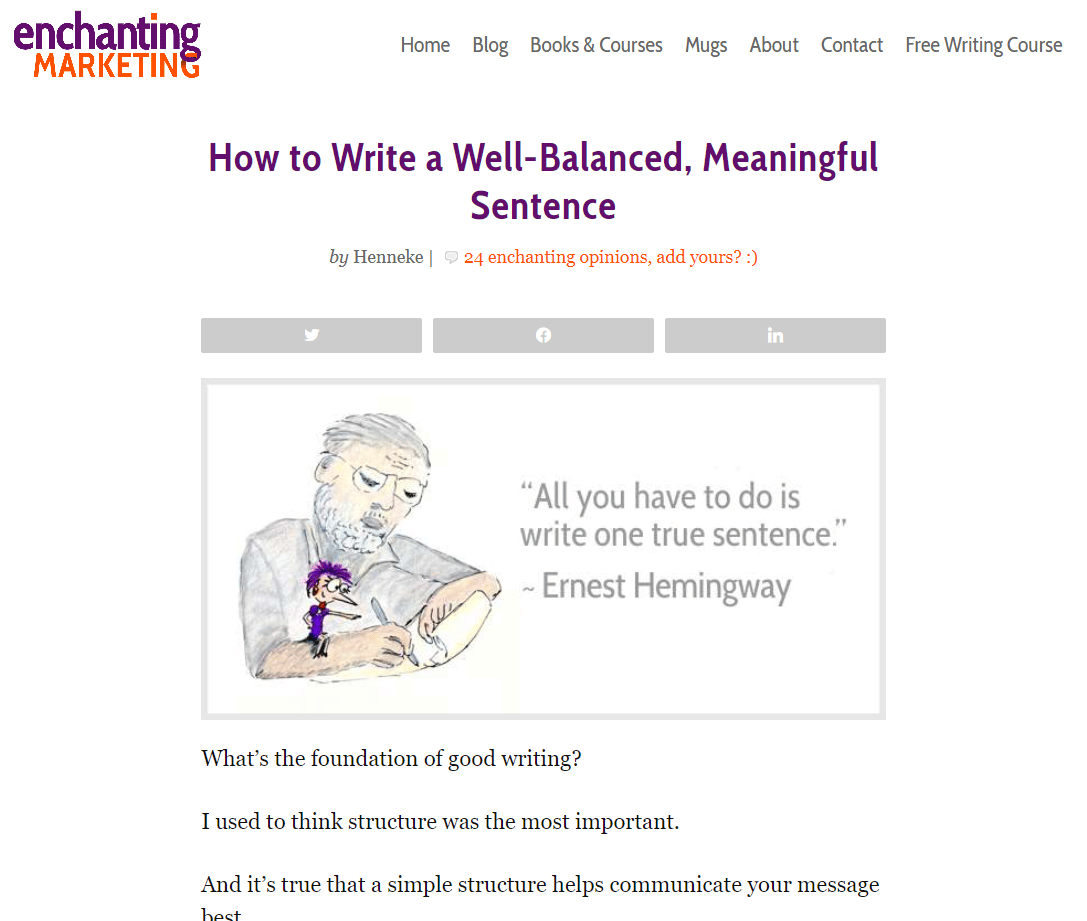
This post from Enchanting Marketing does a great job of all of that, using almost exactly 1,000 words to do it.
It doesn’t feel brief or rushed, however. It’s a quick read, but it doesn’t lack substance. Instead, it’s packed with great examples and writing advice.
Social media posts
Social media posts are short because of constraints the platforms set, but that doesn’t mean your posts have to be bland.
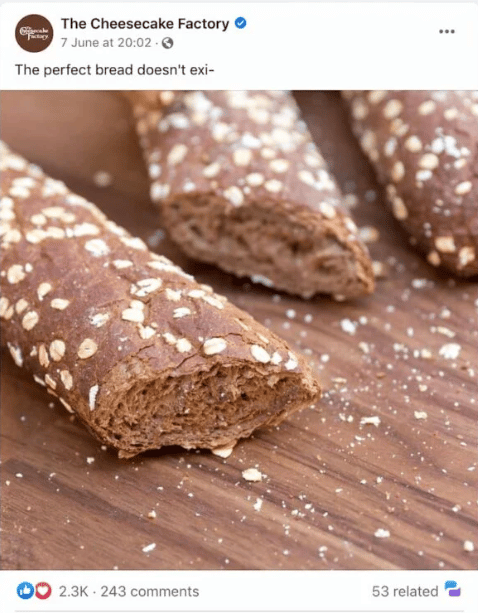
Instead, a truly engaging social post tends to include a trifecta of great copy, a striking image, and a relevant link.
Sometimes, all you need to engage people is just a snippet of text and a great photo.
Short videos (TikToks, Reels, YouTube Shorts)
Do short videos spring to mind immediately when you think of short-form content? You’re not alone.
The rise of short-form video has coincided with the rise of TikTok, the short video platform that has gained nearly one billion active users in just six years.
TikTok’s growth caused other platforms to jump on the video bandwagon, including Reels from Meta, the parent company of Facebook and Instagram, and Shorts from YouTube (which is owned by Google).
Short-form videos can be as brief as a few seconds long, and if they’re any longer, they usually stay under the three-minute mark.
Here are some examples from each platform.
TikTok
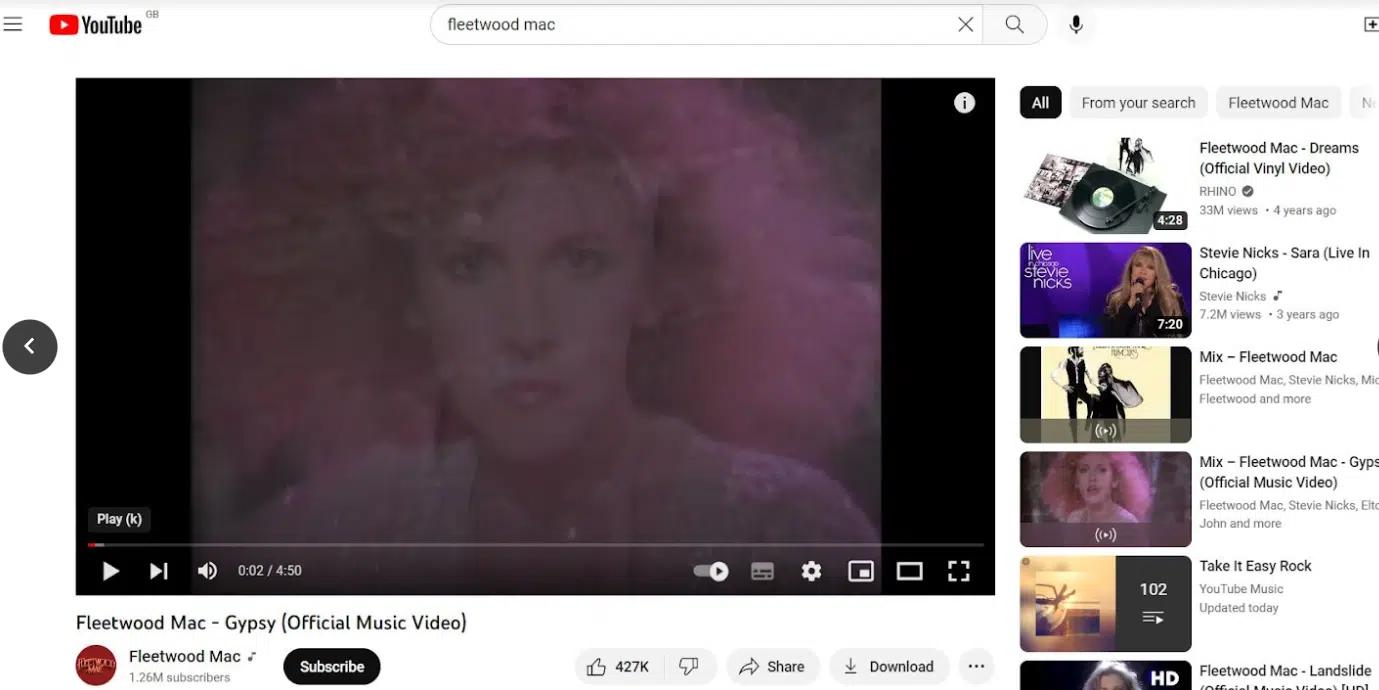
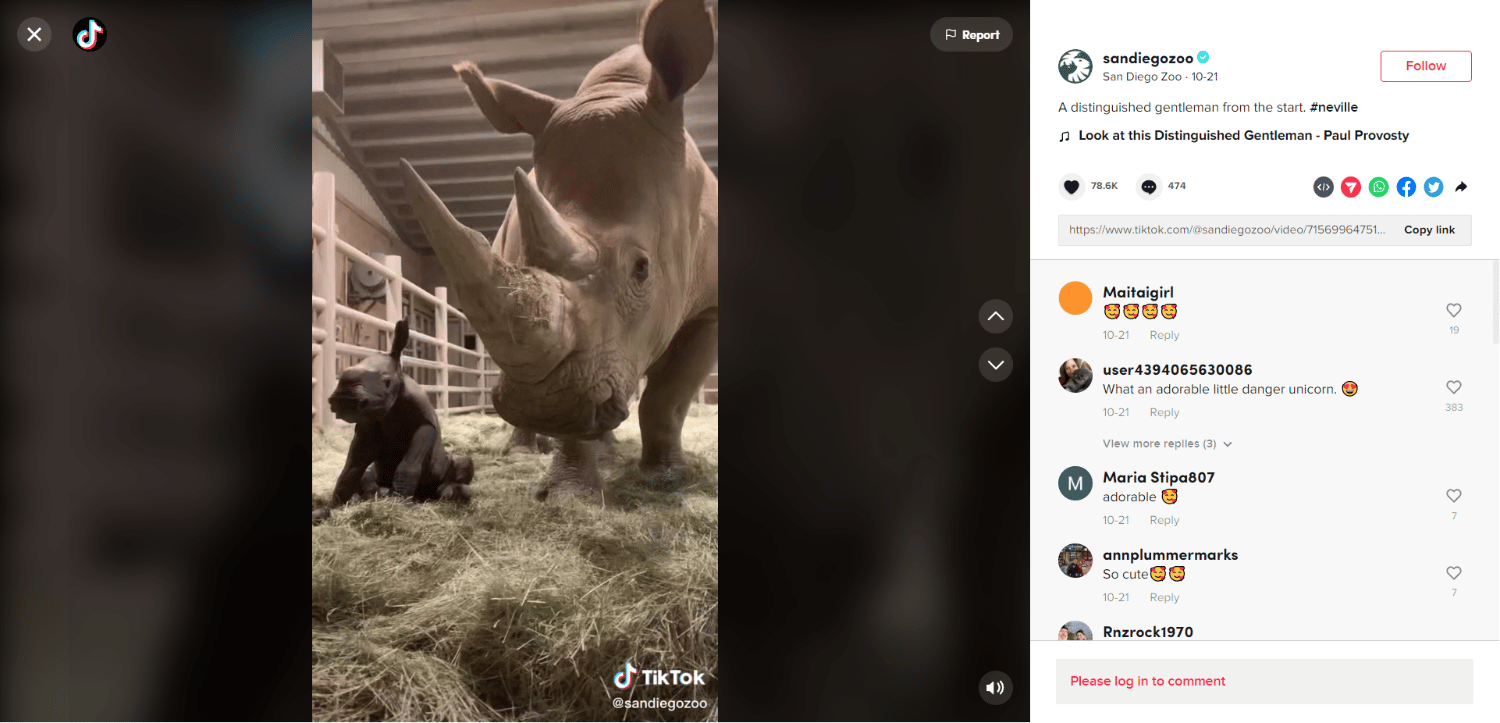
The San Diego Zoo uses its TikTok account to show off the amazing denizens in its care. One cute and funny video of a new baby rhino clocked in at a mere eight seconds but got 78.6K likes and 474 comments.
Instagram & Facebook Reels
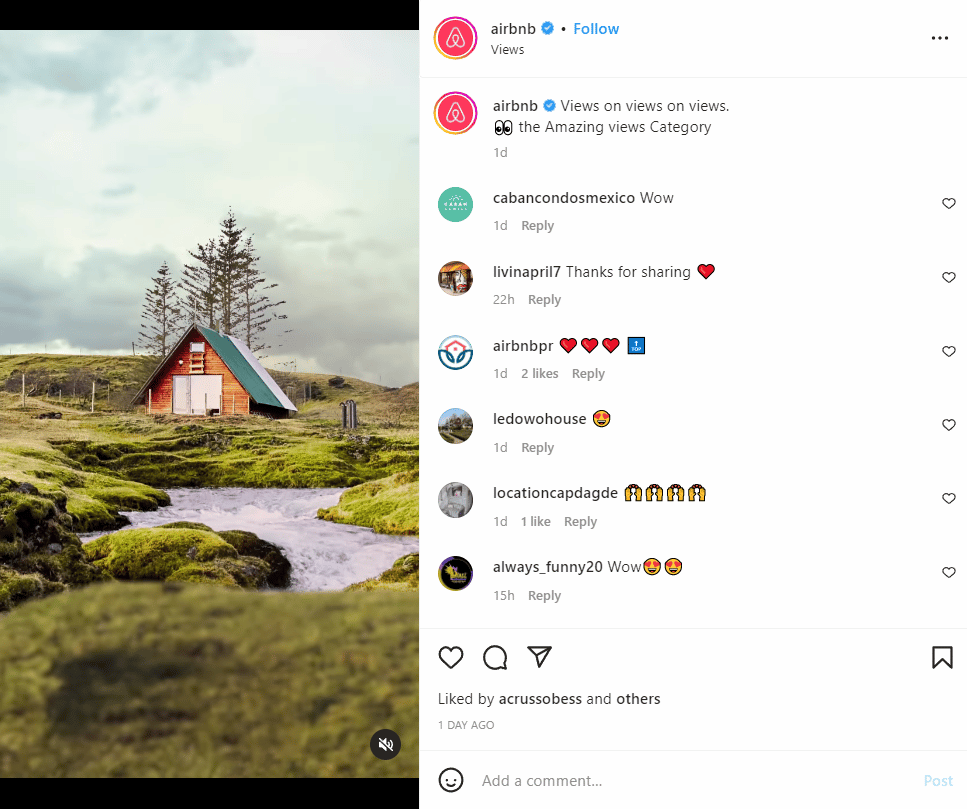
In its Instagram reels, Airbnb shows off the stunning views from its vast array of rentals to great effect. One of the benefits of short videos is how impactful they can be with just a few seconds of footage.
YouTube Shorts
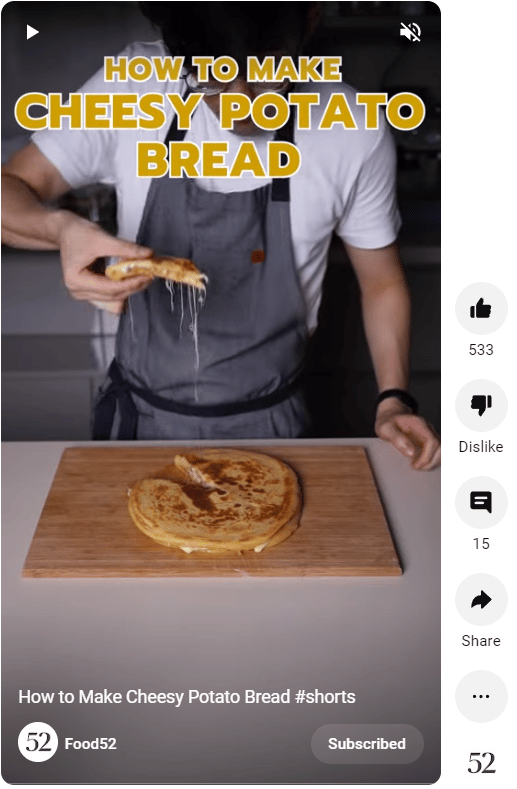
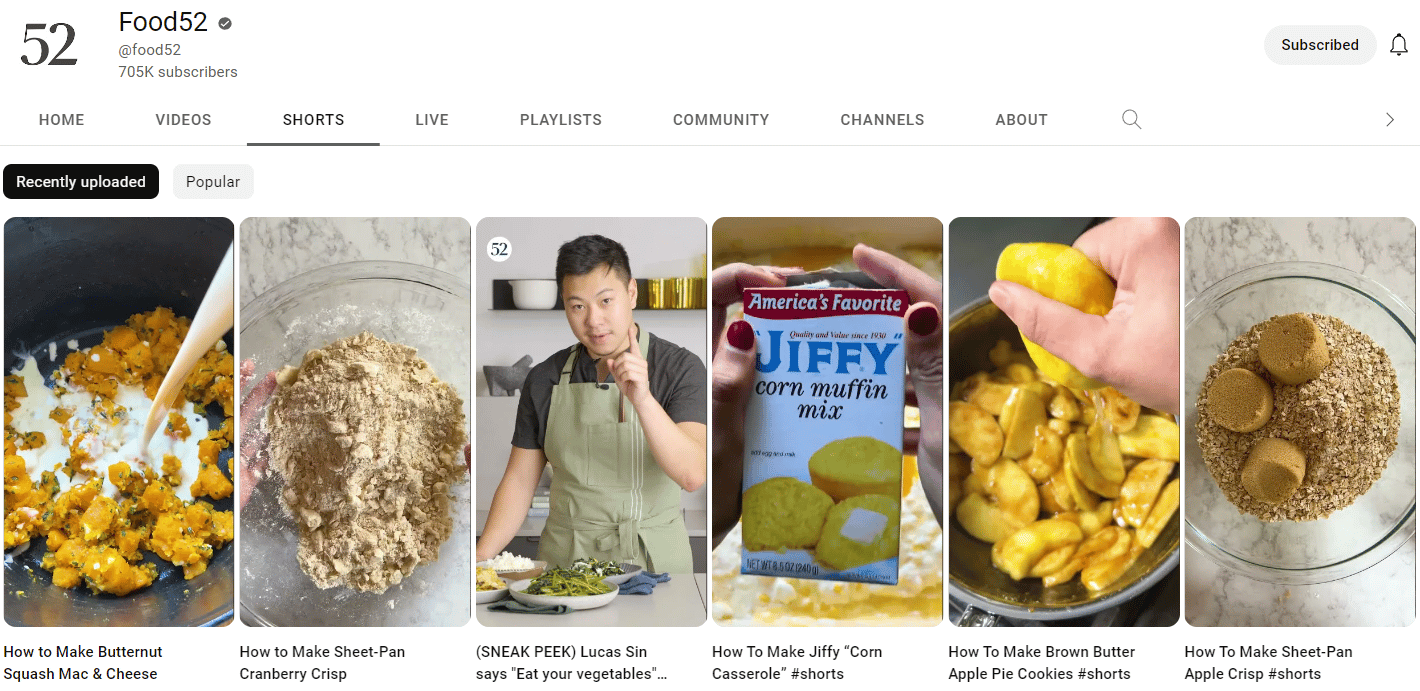
Food52 uses YouTube Shorts to show off quick recipes and cooking tips. They also post Shorts that feature previews of their longer video content.
Overall, short videos are an amazing format for brands focused on how-to content.
Best practices for creating short-form content
Short-form content like an Instagram Reel or a short blog post could be a customer’s first introduction to your brand. How do you ensure you engage them?
Here are some best practices to follow, including specific tips for short videos.
1. Get to the point and hook them
No matter what kind of short-form content you’re creating, you need to get to the point of your post quickly.
Why should your audience care – why should they give you their attention? Tell them immediately, either in your written introduction in a blog post; or with a text overlay, a quick explanation, or a strategic shot in your video.
Getting to the point of your content is essential because the point is also your hook – the element in your content that grabs your audience and doesn’t let go.
For example, in the YouTube Short above, “How to Make Cheesy Potato Bread,” you’ll notice the first few seconds feature the finished product in motion. You see the host slicing the bread and the cheese oozing out.
That’s the reason to watch it! Viewers immediately think, “Yum! How do I make it?” – and stick around to find out.
So, give viewers/readers your “why” right away, so they know exactly what the value of the content is upfront.
2. Videos: Pay attention to trends
On short video platforms, hopping on trends is a way to reach more people.
For example, specific songs or sound bytes often become popular and people enjoy putting their own creative twist on them.
In the TikTok of the baby rhino from San Diego Zoo that we mentioned, the clip is set to a sound byte that made the rounds on the platform in various iterations from different users.
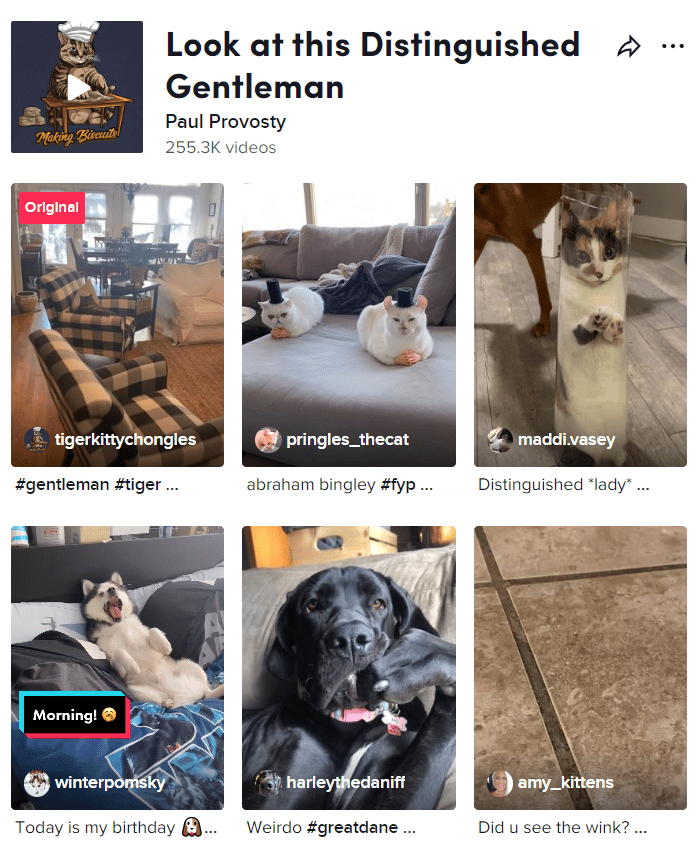
One user overlaid the sound byte with footage of his cat, and other users followed suit with their own pets.
San Diego Zoo hopped on the trend with a totally unique yet relevant entry, which earned them a lot of engagement.
Similarly, pay attention to trends and look for creative ways to use them in your content.
3. Stay relevant to your brand/audience
Whether you’re writing a short blog post or creating a short video, whether you’re capitalizing on trends or not, always make sure to stay brand- and audience-relevant in the process.
For example, some short video trends will fit seamlessly with your identity, and others will be way off the mark. Don’t buy into trends just because they’re trendy, but rather determine whether they fit in with your brand identity and audience preferences before you jump on a bandwagon.
For short blogs, keyword and audience research will help you learn whether a topic is relevant and whether addressing it with a short post is the right move.
4. Videos: Worry less about quality
In short-form videos, quality matters less than authenticity, relevance, and value.
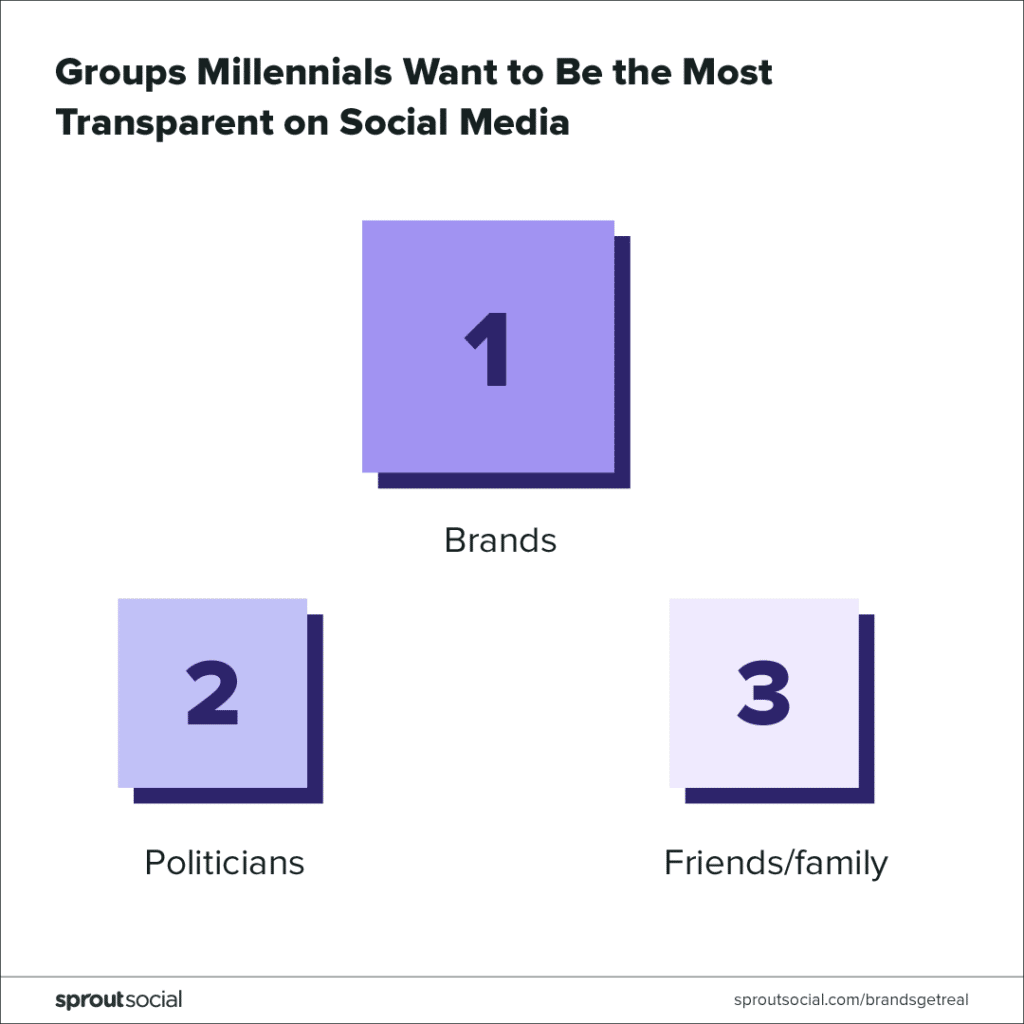
Don’t worry about producing crisp videos with immaculate shots. Most users want transparency from the brands they like and expect it on social media.
In many cases, greater transparency means showing less gloss and more imperfections.
It means shooting with a shaky smartphone and featuring real people who aren’t made up perfectly or going behind the scenes to see the guts of a business, especially if it’s messy or imperfect.
5. Focus on value: Entertain, educate, or inform
Above all, no matter the type of short-form content you create, focus on providing value to your audience.
And, by the way, “value” has a lot of meanings. If your content is funny or thought-provoking, it has entertainment value. If it teaches people a relevant concept or skill they’re missing, it has educational value. And, if you’re sharing important news or information, that content has informational value.
Never publish a short-form piece just to get it out there. Evaluate carefully whether you’re sharing something of worth – or whether it will just add to the noise.
Short-form content: A worthy addition to your content strategy
While long-form content holds the top prize for nurturing and converting leads, short-form content has its uses, too.
High-quality short-form content can reach more people, introduce them to your brand, and compel them to engage with you further. Short-form video is especially worthwhile to build brand awareness on social media.
However, the key lies in the mix. You need both short-form and long-form leveraged in different places to get the best results, as each type has a different role to play in your marketing strategy and sales cycle.
Don’t overfocus on one at the expense of the other. Rather, use each type strategically for the best results.
Opinions expressed in this article are those of the guest author and not necessarily Search Engine Land. Staff authors are listed here.
@media screen and (min-width: 800px) { #div-gpt-ad-3191538-7 { display: flex !important; justify-content: center !important; align-items: center !important; min-width:770px; min-height:260px; }
}
@media screen and (min-width: 1279px) { #div-gpt-ad-3191538-7 { display: flex !important; justify-content: center !important; align-items: center !important; min-width:800px!important; min-height:440px!important; }
}
About the author
Julia McCoy is the founder of Content Hacker, 7x author, and a leading strategist around creating exceptional content and brand presence that lasts online. At 19 years old, she used her last $75 to build a 7-figure writing agency which she sold ten years later. In the 2020s, she’s devoted to teaching founders and marketers the strategy, skills, and systems they need to build a business through inbound content, so they can create more lasting impact in the world.
In 2016, Microsoft announced the launch of the Bing Network, marking the end of the Yahoo Bing Network.
Bing Ads continued to serve ads on a sizable percentage of Yahoo’s search results.
The Bing Network was the result of a renegotiated search deal between Microsoft and Yahoo, which was originally a 10-year deal. The revised Yahoo-Bing search deal returned ad sales and account management back to each company: Bing handled Bing customers, Yahoo handled Yahoo customers.
2021: As an antitrust remedy, the choice screen had not only failed to make the search market a more competitive space, it may have even reinforced Google’s dominant position.
2017: The latest images showing what people eat at the search engine companies, how they play, who they meet, where they speak, what toys they have and more.
2012: The cartoon tied people who do SEO as weasels and those who hire SEOs as an accomplice, someone who actively participates in the commission of a crime.
2012: The latest images showing what people eat at the search engine companies, how they play, who they meet, where they speak, what toys they have, and more.
2011: Google expanded Social Search results. Friends’ activity on Twitter, Flickr and elsewhere would soon be more visible in Google’s search results and have an impact on how pages ranked.
2011: Google was being embraced and celebrated for its new publisher-friendly platform after it had been derided and bashed by content publishers and newspapers.
2011: When you searched for [Santorum], the first result was a blog created as part of a successful campaign to associate the senator’s name with anal sex.
2011: The toolbar, which was graphically more pleasing to look at than a conventional toolbar, let users get lots of different types of information via drop-down windows.
Past contributions from Search Engine Land’s Subject Matter Experts (SMEs)
These columns are a snapshot in time and have not been updated since publishing, unless noted. Opinions expressed in these articles are those of the author and not necessarily Search Engine Land.
@media screen and (min-width: 800px) { #div-gpt-ad-3191538-7 { display: flex !important; justify-content: center !important; align-items: center !important; min-width:770px; min-height:260px; }
}
@media screen and (min-width: 1279px) { #div-gpt-ad-3191538-7 { display: flex !important; justify-content: center !important; align-items: center !important; min-width:800px!important; min-height:440px!important; }
}
About the author
Danny Goodwin is Managing Editor of Search Engine Land & SMX. In addition to writing daily about SEO, PPC, and more for Search Engine Land, Goodwin also manages Search Engine Land’s roster of subject-matter experts. He also helps program our conference series, SMX – Search Marketing Expo. Prior to joining Search Engine Land, Goodwin was Executive Editor at Search Engine Journal, where he led editorial initiatives for the brand. He also was an editor at Search Engine Watch. He has spoken at many major search conferences and virtual events, and has been sourced for his expertise by a wide range of publications and podcasts.
Susan Wojcicki, the CEO of YouTube, is stepping down
Susan Wojcicki, one of the longest-serving Googlers is stepping down as the CEO of YouTube after nine years in that role and 25 years at Google. In her personal update blog post she said, “after nearly 25 years here, I’ve decided to step back from my role as the head of YouTube and start a new chapter focused on my family, health, and personal projects I’m passionate about.”
Over her 25-year career at Google, she “managed marketing, co-created Google Image Search, led Google’s first Video and Book search, as well as early parts of AdSense’s creation, worked on the YouTube and DoubleClick acquisitions, served as SVP of Ads, and for the last nine years, the CEO of YouTube,” Susan Wojcicki wrote.
Susan took the CEO of YouTube role in 2014 when Google did a large executive restructuring. Four years prior to that, Susan was promoted as Senior Vice President at Google, one of eight Googlers at that time with that title.
Neal Mohan. Neal Mohan will be taking over as the Senior Vice President and new head of YouTube. Neal came to Google in 2007 when Google acquired DoubleClick for $3.1 billion. Neal became the SVP of Display and Video and later became YouTube’s Chief Product Officer in 2015.
YouTuber’s thoughts. Here are some thoughts from well-known YouTubers on this change:
The ez take on Susan leaving is “Yay the source of all our problems is gone” but if we’re honest the CEO of YouTube (often unfairly) becomes the scapegoat for literally everything that goes wrong at the company, no matter what actually happens
Thank you for your leadership over so many years, @SusanWojcicki. CEO of such a massive, influential platform is an insanely hard job (I saw it close-up), and to do it for so long – with 5 kids at home – is remarkable. Congrats and enjoy the time away! https://t.co/517JM2CqRp
Why we care. YouTube is an important platform, not just for consumers and not just for creators but also for advertisers. It will be interesting to see if anything significant changes across the Google Ads platform with this leadership change.
Susan Wojcicki has been one of the constants at Google and now that is coming to and end.
@media screen and (min-width: 800px) { #div-gpt-ad-3191538-7 { display: flex !important; justify-content: center !important; align-items: center !important; min-width:770px; min-height:260px; }
}
@media screen and (min-width: 1279px) { #div-gpt-ad-3191538-7 { display: flex !important; justify-content: center !important; align-items: center !important; min-width:800px!important; min-height:440px!important; }
}
About the author
Barry Schwartz a Contributing Editor to Search Engine Land and a member of the programming team for SMX events. He owns RustyBrick, a NY based web consulting firm. He also runs Search Engine Roundtable, a popular search blog on very advanced SEM topics. Barry can be followed on Twitter here.
Googlers urged to help improve Bard, its AI chatbot
Google has asked its employees to test Bard – Google’s answer to ChatGPT – by rewriting answers or providing other forms of feedback.
Googlers have received an email with a list of dos and dont’s for fixing Bard’s responses in an email from Prabhakar Raghavana, the senior vice president at Google who oversees Search.
This followed a companywide email from CEO Sundar Pichai, who asked employees to spend two to four hours of their time helping improve Bard.
Teaching Bard. Among the dos, Google employees were told to:
Keep responses “polite, casual and approachable.”
Respond “in first person.”
Maintain an “unopinionated, neutral tone.”
As for don’ts:
“Avoid making presumptions based on race, nationality, gender, age, religion, sexual orientation, political ideology, location, or similar categories.”
“Don’t describe Bard as a person, imply emotion, or claim to have human-like experiences.”
Don’t try to re-write answers that offer “legal, medical, financial advice” or are hateful and abusive. (Googlers are instead told to give a “thumbs down”).
Why we care. As we’ve seen in the early days “BingGPT,” there have been many positives and negatives. Google is trying to recover from its introduction of Bard, which has been generally perceived as botched. The generative AI aspects of search continue to be a huge area of interest for search marketers as we wait to learn the impact on websites, how it changes search results, and whether this will alter user behavior.
@media screen and (min-width: 800px) { #div-gpt-ad-3191538-7 { display: flex !important; justify-content: center !important; align-items: center !important; min-width:770px; min-height:260px; }
}
@media screen and (min-width: 1279px) { #div-gpt-ad-3191538-7 { display: flex !important; justify-content: center !important; align-items: center !important; min-width:800px!important; min-height:440px!important; }
}
About the author
Danny Goodwin is Managing Editor of Search Engine Land & SMX. In addition to writing daily about SEO, PPC, and more for Search Engine Land, Goodwin also manages Search Engine Land’s roster of subject-matter experts. He also helps program our conference series, SMX – Search Marketing Expo. Prior to joining Search Engine Land, Goodwin was Executive Editor at Search Engine Journal, where he led editorial initiatives for the brand. He also was an editor at Search Engine Watch. He has spoken at many major search conferences and virtual events, and has been sourced for his expertise by a wide range of publications and podcasts.
In 2004, SEO as a discipline was perceived as some kind of dark art performed behind the scenes. This “SEO voodoo” had minimal effect on a website and nothing to do with the actual business. Some people bought some links on more or less shady corners of the web and miraculously the Google rankings shot up.
Fast forward to 2023, we still don’t have proper jetpacks, flying cars or hoverboards, but modern SEO is a far cry from 20 years ago. Today, SEO is about:
Content
UX
Trust
And other “new” elements.
Yet we’re not yet fully there. We haven’t yet arrived at a place where SEO clearly informs every part of the business like:
PR.
Marketing
Sales.
If you’re lucky, you have an SEO team within your company. This already puts you ahead of the competition in many cases.
Most organizations have marketing and sales teams – even small businesses with limited resources, but SEO is not as mainstream.
So where do we place SEO responsibilities within an organization to ensure the best results?
Why do businesses still struggle to add SEO to their hierarchy?
Some startups and local businesses may even need external input when it comes to organic search opportunities. But oftentimes, the marketing, tech or PR team (or person) has to implement the SEO advice.
Other departments often encroach on or thwart SEO efforts – at times by accident or, in some cases, due to assumed superiority.
So where do we insert SEO expertise to achieve the best results?
You need to establish a holistic and multidisciplinary approach to SEO that does not treat the still relatively new discipline as separate and place it at the far end of business concerns.
The earlier you take SEO into account the better for the whole business.
Just don’t overdo it. Don’t make your business a “one-trick pony” dependent on often volatile Google traffic.
Given the current realities, companies often “forget” SEO until it’s too late.
Having an external SEO consultant, agency or some foster child type of in-house SEO who can’t introduce sweeping changes across a larger organization is futile.
We may end up with an outcast type of situation where SEO is a mere afterthought that often forces the SEO expert to bend the rules to get any results.
When to start SEO? At the start!
Over the years I have seen many futile attempts to sprinkle a little SEO after everything else was done. Plenty of #SEOhorrorstories, such as:
A relaunch of the website that completely ignores SEO? Still happens.
“Forgetting” to add redirects to new URLs while the old ones just result in 404 errors? Check!
Shiny website designs that made designers happy but did not even have enough space for content, let alone content optimization? Been there.
I’ve seen these and more follies – you name it! Unfortunately, some organizations fail to realize that you can’t wait until everything else is done and perform SEO like some cosmetic surgery.
The earlier you add SEO considerations to business planning the better:
Is there a lot of competition for that type of offer in your area?
Is it better to create a new name you can then promote to generate demand?
Do you have educational content about your industry?
Get the daily newsletter search marketers rely on.
Is SEO at the lowest level of the hierarchy?
SEO often gets treated as being at the lowest level of the business hierarchy. It happens especially with an independent consultant or freelance SEO.
The SEO may be perceived as a stranger trying to meddle with senior team members who have spent years climbing the career ladders within a company.
In the worst case, SEO is on the bottom rung.
Of course, a structure like this is doomed to fail. The business eventually suffers.
Without organic traffic, a growing dependence on paid search efforts will significantly impact marketing budgets. (And don’t get me started on click fraud!)
Putting SEO ‘everywhere’
Modern SEO is a multidisciplinary approach that requires input throughout the whole business structure.
We can’t just put SEO on the outskirts of a project or inside a silo to limit its scope. Ideally, SEO insights should inform most other teams. Data from other business areas could improve your SEO approach.
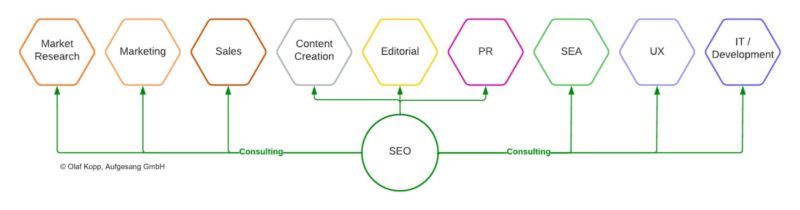
This type of multidisciplinary SEO approach has been highlighted by seasoned SEO agency founder Olaf Kopp who published a straightforward albeit intriguing view of the SEO impact on other teams.
He inspired me to write this article by what he said in a LinkedIn post:
“SEOs should act more and more as an interface to all departments responsible for communication.”
He added a well-structured visualization of how SEO can relate to other teams. Let’s look at it before we dive into each team’s responsibilities:
Market research is at the start and also a wonderful example. Ideally, you perform surveys, ask people about their needs and go out in the wild to find out what’s happening.
How do people use your product? If you don’t have one yet, what pain points do they have with existing ones?
These insights are invaluable also for SEO. They can get translated into keywords or the questions can be used directly for content by providing answers.
Likewise, keyword research performed by SEO experts can inform and inspire market research as a whole.
As an SEO, I typically offer both market and keyword research, but I am aware that my skills and capabilities are fairly limited.
I can’t go out and meet potential customers to see how they use a vacuum cleaner. I only look at searches people perform, existing websites, and products already on the market.
Thus, personally, I’d add an arrow showing in both directions here.
Marketing in general is a huge discipline by itself. Depending on the company and its size it may be a plethora of things, including:
Trade fairs.
CRM.
Email newsletters.
Social media ads.
Customer (service) feedback.
Many companies are tempted to add SEO as just another part of the marketing mix, which reinforces the silo approach I mentioned earlier and leads to missed opportunities.
I often encounter this issue when working with large companies.
First, seemingly everybody could interfere with my work while my feedback remain unheard. I might never get any feedback unless it was a negative one indicating “we can’t do that.”
I once asked the newsletter team to add links to content I created only to hear them say, “No, we have enough links already. You have to ask for them several weeks in advance.” When I did ask months in advance, I still did not get the links.
I could add more examples, but you get the point. Being the SEO outsider wasn’t a position that allowed me to align the SEO efforts with larger business objectives.
Again, the SEO person shouldn’t be the only one to inform and inspire the whole marketing team, it’s also vice versa.
The “real” marketers can help make SEO succeed when they don’t perceive it as a nuisance, threat or afterthought. Again, I’d rather add an arrow showing in both directions.
Salesshould be obvious. How is it connected to SEO? Ideally, a key performance indicator of SEO success is sales or at least conversion metrics.
The customer journey is too long and complicated? You don’t want to rely on last-click attribution? You haven’t figured out more accurate metrics?
Then, at least give the SEO access to the raw data. They may be able to find some correlations:
Did sales drop when traffic tanked?
Did sales increase when the SEO campaign was launched?
What drives sales outside of SEO?
Anything can be useful as feedback to the SEO specialist trying to go blindly in the right direction.
Also, listen to the SEO who will tell you that branded traffic may not increase sales or that very broad general audience keywords have merely informational intent and thus do not lead to sales either.
So again here we have an arrow pointing both ways.
The other teams are more self-explanatory so I will keep it short.
Content creation requires SEO input at least.
What topics to cover?
Which keywords to use in the headline or title?
Which question “people also ask” to answer?
The content team – be it writers, photographers or illustrators – should speak with the SEO about what they are doing.
Newsletter covering a specific product? Please add these keywords and links!
Photos from the trade fair? Excellent! Please take photos of some influencers we can mention!
Using graphic novel-inspired artwork? Wonderful! Let us reach out to the geeks!
Guess which way the arrow points then!
I’m not sure what Kopp means by editorial so I’d rather refer to it as publishing. There is a lot of content published on a website that is often considered not to be SEO-relevant. It’s not just the privacy policy.
All kinds of announcements, campaigns, press releases and videos could benefit from SEO insights. SEO is not just about “SEO content” or simply text. Even the privacy policy or the guest blogging guidelines can be optimized.
Likewise, editors or publishers may be surprised at the input they get from SEO experts. They may find out that they are writing content for the wrong audience or just ignoring some parts of the sales funnel completely.
Usually, we tend to publish top-of-the-funnel content unless we take a closer look at content strategy.
PR is such a treasure trove to SEO practitioners. Often, we see PR and SEO teams working side by side with no significant cooperation between them. But there is a way to combine both efforts.
Search (and social media) ads can provide a wealth of information on demand, keywords and trends. Please share them with the SEO.
The SEO person can also give you many ideas on what to advertise based on organic demand.
UX has indeed been part of SEO for many years. It goes so far that some SEOs call themselves search experience optimizers.
Make sure that the SEO and UX people work closely together or end up with conflicting priorities and penalties at worst.
A redesign solely based on UX considerations may destroy your Google rankings. The information flow has to go both ways.
IT/dev teams have the highest risk of destroying years of SEO work. Ask an SEO before major changes to any “running system” you have established.
Also, be willing to improve existing systems based on SEO feedback. Pay attention to server speed, URL structure and third-party code libraries which can cause issues.
SEO isn’t limited to communications-related tasks
Kopp stresses the communications teams as the most relevant for SEO.
But the SEO expert should be able to consult throughout the whole business process but stay outside the rigid hierarchy.
This enables other teams and experts to have as much positive impact on organic reach as possible.
Do you play chess? The SEO person is ideally the knight. Jumping in from outside in to help when needed and to receive feedback on where to go next.
Ideally, SEO starts at the product level. Product names are already keywords.
Marketing and sales are directly dependent on organic search traffic so neither department should ignore or overrule SEO decisions without taking the SEO expert’s advice into account.
SEO also affects content publishing and PR efforts in manifold ways. The technology behind the website is clearly subject to “technical SEO” considerations.
On the other hand design (hence UX) and technology teams also benefit from SEO input voiced as early as possible (before a redesign or technical changes).
How to integrate SEO throughout the business process without losing sight of the bigger picture
Make the SEO specialist or content marketer (whatever you prefer the person to be called) as independent as needed. The person or team should be able to inform and consult the other teams throughout the company – not just the marketing department.
Don’t limit access to decision-making processes by establishing rigid hierarchies that depend on personal relations or top-down structures.
The SEO should be ideally able to report to the CEO or CTO directly not through a game of telephone or by talking to numerous superiors.
For larger companies, a project manager should be able to help. That person needs the necessary clout inside the business to assign tasks and priorities. Ideally, the SEO specialist should not be responsible for project management.
Believe it or not, the alternative is a potential deadlock. Once I had to ask permission from up to nine different “superiors” before being able to make a change or publish something within a larger international company. The actual work was done but different opinions and numerous change requests based on the perceived importance of each stakeholder in the hierarchy literally blocked progress.
So no, you can’t just push SEO into the geeky corner of technical changes. SEO has to inform the whole business process – the more input gets included the better the results. Kopp concludes:
“The former nerd child SEO, who conjures up rankings with some SEO magic, has to grow up and work as an internal consultant and salesperson.”
So it’s not just the business hierarchy that adapts and integrates the SEO practitioner. The SEO expert has to embrace all other teams and give up the limited technical perspective to succeed in the long run.
Opinions expressed in this article are those of the guest author and not necessarily Search Engine Land. Staff authors are listed here.
@media screen and (min-width: 800px) { #div-gpt-ad-3191538-7 { display: flex !important; justify-content: center !important; align-items: center !important; min-width:770px; min-height:260px; }
}
@media screen and (min-width: 1279px) { #div-gpt-ad-3191538-7 { display: flex !important; justify-content: center !important; align-items: center !important; min-width:800px!important; min-height:440px!important; }
}
About the author
Tadeusz Szewczyk, also known as Tad Chef, is a professional blogger and SEO since 2004. Even though based in Berlin, Germany he has covered blogs, social media and search for a global audience starting in 2006. In 2007 he launched his own blog – SEO 2.0 – and also published on numerous other marketing blogs ever since. In recent years he wrote for the social media accounts of many clients as well. You can connect with Tad on LinkedIn and Twitter or visit his website and read his blog about social SEO.