How to analyze Google’s SERPs

SEO has a lot of moving parts.

You have to worry about your content strategy, keyword selection, Google ranking signals, backlinks, and competition.

When clients ask me if they can rank their site for a particular keyword, I conduct a SERP analysis immediately.

I wouldn’t know how difficult it is to rank for a specific keyword without analyzing Google’s SERPs first.

If you’re not conducting base analysis, you might set your site up for failure by funneling all of your resources to a main keyword that is too far out of reach.

Defining SERP analysis

So, what is SERP analysis?

Search engine results page (SERP) analysis is the practice of analyzing the top-ranking pages for your desired keyword, spotting opportunities to rank for this keyword and trying to pinpoint difficulties in reaching the top of the search results.

A SERP analysis demands that you:

  • Search for the desired keyword.
  • Evaluate the top sites.
  • Determine if the keyword is relevant to your site.
  • Determine how you “could” rank for this keyword.

However, the final item on this list has a big question mark next to it.

You need to go beyond what you would need to do to rank today because your competitors are working diligently to maintain these rankings in most cases.

How to analyze a Google SERP

Learning how to analyze Google SERPs provides insights into a keyword and your ability to rank for the term. However, you’ll also uncover:

  • Additional keywords that you may try to rank for on search engines.
  • Opportunities that your competitors are missing.
  • Content ideas.
  • And more.

You can look through the SERPs manually, but when it comes to competitive keywords, you’ll want a tool to help you with looking at a page’s link profile, number of external backlinks and other factors.

A few tools work very well for this purpose, such as:

  • Semrush
  • Ahrefs
  • Moz

Plug in your keyword to these tools, and you’ll find a wealth of information on the top-ranking pages. For example, on Ahrefs, I just conducted a search for “SEO” and came out with the following:
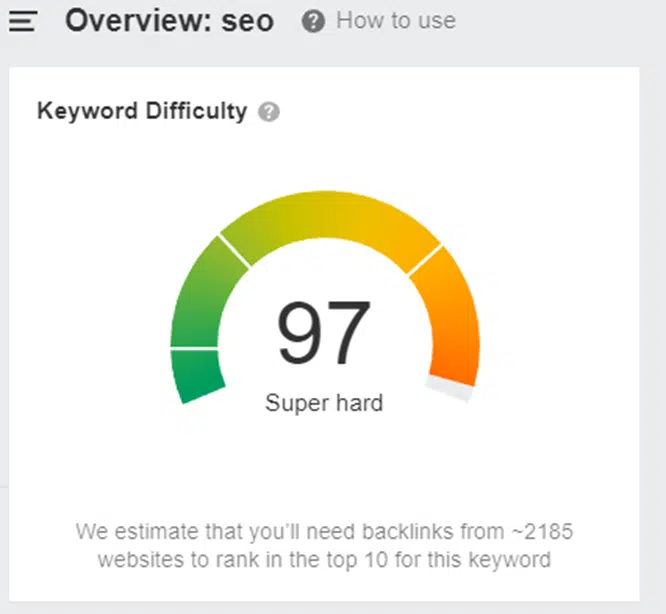
Ahrefs - SEO overview

Search Engine Land’s What is SEO is ranked #2 and shows the following statistics:
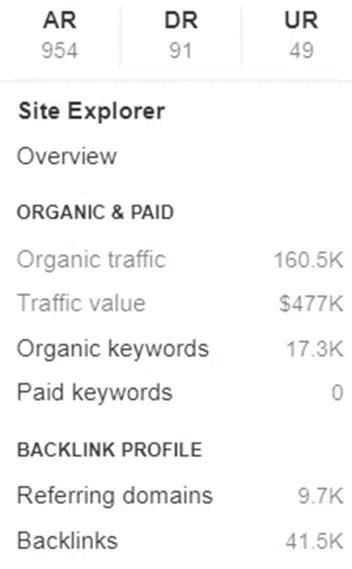
Search Engine Land's What is SEO - stats

Ranking for this keyword will be extremely difficult without a massive budget, a highly reputable website and a backlink campaign.

However, it’s important to look at other factors in a SERP analysis, such as:

  • Search intent.
  • Type of content ranking.
  • The competition.

Search intent

When searching for your query, search intent can be determined by the different layouts and types of pages that you land on. You can tell the intent because it will be one of the following:

  • Commercial: Users who are researching before making a purchasing decision.
  • Informational: Users who are trying to find a solution to their problem and are educating themselves.
  • Navigational: Users who are looking for a brand or website that they already know about.
  • Transactional: Users who want to buy a product or service.

Considering these four categories of intent, you’ll find that the keyword “SEO” has informational intent, as all the top results aim to educate their readers. Your goal to outrank these competitors would be to educate the user.

Sites may look something like this:
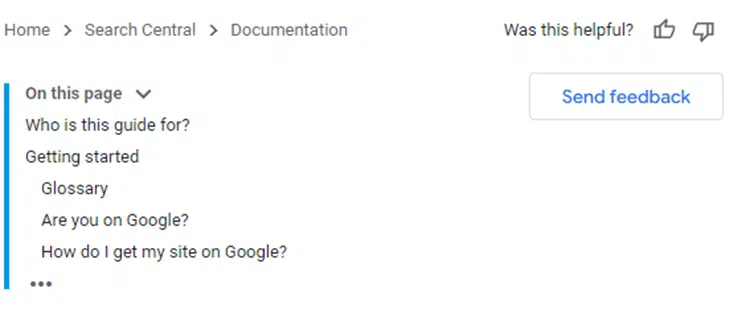
Google's SEO Starter Guide - Informational
Google’s SEO starter guide
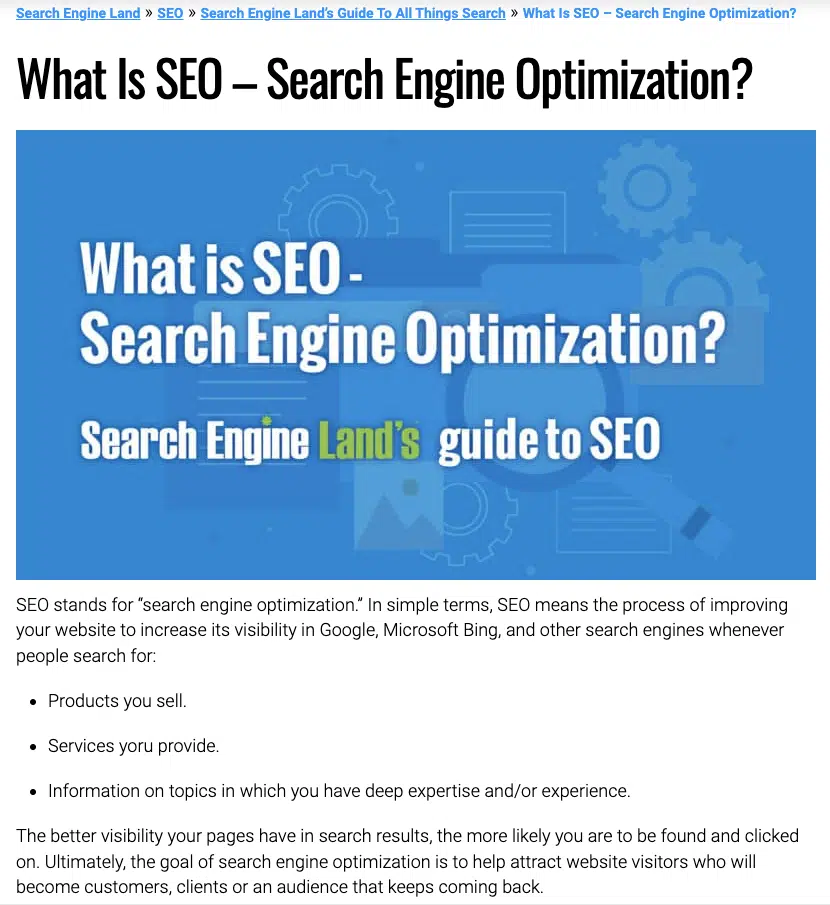
Search Engine Land's What is SEO guide
Search Engine Land’s What is SEO guide

If you changed the keyword to “books on SEO,” you would find Amazon as a transactional intent keyword because the site is laid out for products. 

However, if you changed the keyword to “SEO books on Amazon,” this would be seen as a navigational keyword because the user is looking for these books specifically on Amazon.

Search intent is important because it will dictate your site’s:

  • Layout.
  • Navigation.
  • Personalization.
  • Common devices used to access the site.

Once you go through search intent, you can focus on the technical aspects of the site, UI/UX design and content.

Type of content ranking

Often, you’ll find an array of content ranking for a certain keyword. Going back to the “books on SEO” keyword, there are a lot of content types that are ranking:

  • Ecommerce stores.
  • Listicles.
  • Guides.
  • Book reviews.

This keyword is far easier to rank for than just “SEO” and you can create the above types of content to meet the needs of people querying this keyword.

When you perform SERP analysis, you have the opportunity to learn what content currently works for your competitors and don’t need to reinvent the wheel. Perhaps you can create a video guide on the top books to go along with your listicle or review article.

Now, you can learn a lot of information from just a few minutes of SERP analysis:

  • Keyword difficulty.
  • Backlink profile.
  • Search intent.
  • Content ideas or types to use.

You might even find videos ranking for a certain keyword, allowing you to target traffic via YouTube. It may be easier to show up at the top of the results in a snippet or video than with informational content.

Make a note of SERP features on the page that you may be able to leverage in your content creation, such as:

  • Ratings.
  • Shopping results.
  • People also ask.
  • Featured snippet.
  • Images.

You can target the keyword from all angles to try and generate traffic from all sources.

The competition

You’ve already done a basic analysis of the top-ranking sites, but now it’s time to look into these sites further. You can look at things such as:

  • Keyword difficulty.
  • External backlinks to the entire domain.
  • External backlinks to the page.
  • Domain authority/page authority (or similar).
  • Top domain presence.
  • Social signals.

It is worth taking the time to look through the competing page and learn about the type of content created, length, proper on-page optimization, formatting, images and video use.

When you analyze competing sites, you can get an idea of what works and how well the site has targeted the keyword.

You may find opportunities to create better content or use on-page and technical SEO to improve your odds of ranking for the keyword.

Additionally, you can identify content gaps in the competitor’s content strategy that may improve your odds of ranking for the keyword.

However, if the entire top page is filled with truly tough competitors, it may be worth finding a new keyword to target.

For example, if the top results include Google’s own sites, Microsoft, Apple and Wikipedia, it will be very difficult to overcome them.


Get the daily newsletter search marketers rely on.


Use your SERP analysis in your SEO and content strategy

Can you rank for the specific keyword within budget and in a relatively timely manner? If so, you can begin to dig deeper by:

  • Creating content that is more in-depth and better than your competitors.
  • Focusing heavily on the content gaps that the competition is overlooking.
  • Improving your on-page and technical SEO.
  • Looking through the backlink profile of the top-ranked sites and seeing if there is any opportunity to replicate the backlinks.

If the search results include rich snippets for the query, you absolutely should incorporate structured data into your site, too.

Something as simple as a picture of one of the top-ranking books in SEO can bump up your click-through rate dramatically, even if you’re not ranked as high as some of your competitors.

When older pages or sites are ranking in the top 10 results, they often haven’t implemented structured data, opening up a golden opportunity for you to use it on your page.

You can now begin drafting your content ideas and looking for faults in the competition:

  • Perhaps all of the books listed on the competitor’s site are 5+ years old. You can create a new list of books that are relevant to the best practices of today.
  • You can create multiple forms of content, such as blog posts, videos and images to improve your chances of ranking higher in the results.

Your content must have its own unique selling proposition. When you create content, it’s important to take a step back and ask:

  • Why would people like my content better than what already exists?
  • Do I provide any unique insights or data?
  • Can I improve readability or add custom images?

If you’re focused on creating generic content without original data or insights, you may not achieve the results that you had hoped for. You’ll find that adding something “special” is a selling point for readers and search engines.

You should spend time making your content or pages the “best.”

However, when the search intent is transactional or navigational, it may be hard to make the content the best. In other cases, you can certainly use a strong content strategy to rank for a keyword.

Once you have everything in place and start posting your content and working on off-page SEO, it’s important to track your keyword rankings.

Many of the tools listed previously offer keyword rank tracking and will allow you to:

  • Monitor the keyword over time
  • See when you begin improving your ranking for a specific word
  • Discover when your rankings drop

Performance monitoring will help you understand what is and isn’t working for your site or a particular keyword.

You may find that you need to conduct another SERP analysis in a few months to see what changes have occurred and how you need to adjust your optimization strategy to see results.


Opinions expressed in this article are those of the guest author and not necessarily Search Engine Land. Staff authors are listed here.


Related stories

New on Search Engine Land

@media screen and (min-width: 800px) { #div-gpt-ad-3191538-7 { display: flex !important; justify-content: center !important; align-items: center !important; min-width:770px; min-height:260px; } } @media screen and (min-width: 1279px) { #div-gpt-ad-3191538-7 { display: flex !important; justify-content: center !important; align-items: center !important; min-width:800px!important; min-height:440px!important; } }

About the author

Ludwig Makhyan

Ludwig Makhyan is a contributor for Search Engine Land, covering organic and technical SEO. His background is in web development and digital marketing. Ludwig has over 20 years of experience in website design, coding and promotion. He is the co-founder at MAZELESS, an enterprise SEO agency.

https://searchengineland.com/google-serp-analysis-393043


This day in search marketing history: February 14

Google Webmaster Tools comes out of beta

In 2007, Google Webmaster Tools officially came out of beta.

Launched in June 2005 as Google Sitemaps, its expansion led to a name change on Aug. 4, 2006.

Google also revealed that Webmaster Central had more than a million users.

Read all about it in Google Webmaster Central Leaves Beta; Its Blog Gains Comments.

Eventually, Google Webmaster Tools would be rebranded as Google Search Console, on May 20, 2015.


Also on this day


Google crawl stats report is missing a chunk of data

2022: This seemed to be a widespread reporting issue.


Google AdSense launches related search for content pages

2022: The feature was designed to drive incremental ad revenue while encouraging more engagement from visitors.


Microsoft Advertising nearly doubles available markets with 29 more countries

2022: This expansion would increase the platform’s reach by 41 million customers.


EU copyright directive poised to become law, includes licensing fees for search engines

2019: Controversial ‘link tax’ and content filtering provisions were part of the final language of the Directive.


Google announces AMP for Email – delivering Accelerated Mobile Pages experiences to your inbox

2018: The new spec was available through the Gmail Developer Preview, with support in Gmail slated for later that year.


Google featured snippets now often followed by the ‘people also ask’ box

2017: People also ask got more frequent and prominent placement in Google.


Open Letter: Why Search Engine Land Will & Won’t Cover Someone Being Penalized By Google

2014: Search Engine Land would only write about it if there was some exceptional news value.


Googling The Weather: From 20% Project To Sophisticated Query Analysis

2014: A look at the evolution of weather-related searches and how Google handled them.


Google Publishes Full Text Of EU Antitrust Agreement

2014: The document contained extensive examples of how search results would look in Europe under the new agreement.


New Bing Ads Editor Release Coming Soon, To Include Update To Campaign Conflicts Review

2014: The update gave users the option to override changes without having to review the conflicts first.


For Robocop, Bing Imagines The Future Of Search In 2028

2014: The Bing search folks shared a few screenshots showing a 3D, three-panel search display that they came up with for search circa 2028.


The Donkey Cutts SEO Game: Avoid Panda & Penguins

2014: The game worked like “Donkey Kong,” but replaced the objects based off of Google ranking signals.


Search In Pics: Google Boomerang, Google NYC In Snow & Susan Wojcicki’s Last Day

2014: The latest images showing what people eat at the search engine companies, how they play, who they meet, where they speak, what toys they have, and more.


Google Sends Hundreds Of Thousands Of Webmaster Notifications Each Month & 90% Are Black Hat Related

2013: Google’s Matt Cutts answers “How many types of messages does the webspam team send to Webmaster Tools?”


Google Now Adds Movies, College Sports, Homescreen Widget

2013: Google Now added movie ratings from Rotten Tomatoes and movie passes from Fandango.


The Google Movie — “The Internship” — Debuts Its Trailer

2013: A comedy about what it was like to work at Google as interns (Vince Vaughn and Owen Wilson).


Why The Wikipedia/Google Search Results Study Is Flawed

2012: Study was based on 1,000 unique one-word searches created by using a random noun generator on Google UK and conducted using Google Chrome on Incognito mode.


Google AdWords Sitelinks Now Uses Related Ads

2012: Google said they “incorporate text from ads in your account that are related to your sitelinks,” to make up the Enhanced Sitelinks.


Bing & Google: “Spreading Romney” Ranking Tops For “Romney” Is Normal

2012: Apparently it was business as usual.


Scroogle Says Google Is Blocking Their Privacy Search Engine

2012: Google said it wasn’t manually blocking Scroogle but they had automated systems in place that “deter scraping or excessive queries to Google.”


New: Block Sites From Google Results Using Chrome’s “Personal Blocklist”

2011: While Personal Blocklist was designed to allow individuals to build up their own unique blocklists, Google said it could use the data to influence the search results for others.


Google Image Search Adds SVG Filter & Google Displays Satellite & Terrain Maps

2011: Two updates for Google Search and Image Search.


Study Asks, Can You Trust Google’s Personalized Search Results?

2011: For most people, search quality had been declining, results were less personal, reflecting more of a standardized Google-centric view than ever before.


Google Wants You To “Map Your Valentine”

2011: It used Google Maps and enabled you to send an email card to a spouse/partner/lover/friend.


comScore Looks Back At Smartphone Growth In “Mobile Year In Review”

2011: Facebook, far and away, was the leader in total engagement with more than 3X the mobile time spent on Google.


One Mission Accomplished: Microsoft’s Deal With Nokia Injects Windows Into The Smartphone Conversation

2011: It helped create a perception that there were three mobile platforms that mattered and Windows was one of them.


Twitter As Utility, Like Running Water? That’s Goal, Says CEO

2011: “It needs to be water. It’s instantly useful. It’s simple. I don’t have to re-learn how to use water. It’s always present,” said Twitter CEO Dick Costolo.


deCarta Challenges Google With Free Mapping, Local Search Tools Aimed At Mobile Developers

2011: The set of free developer tools was intended to challenge Google Maps and Places.


ComScore To Report Google Maps Now Number 1

2009: MapQuest’s January monthly unique visitors were 41.5 million and Google’s were 42.2 million.


AdWords + Video: Video Ads Come To Google Search Results

2008: Advertisers paid once on a CPC basis where any click counted. So if a user clicked on the URL link that counted as a click or if a user clicked to play the video that also counted as a click.


Hitwise Illustrates How A Google Slap Can Hurt Hard

2008: One website saw a 87% decrease in traffic for the search term “car insurance”]” due to a Google penalty.


Microsoft Executive Shuffle Goes “Live”

2008: Who was in and out. Related coverage: Official: Microsoft Management Reorg Announced; Dueling Ad Groups?


Yang’s Letter: Dear YHOO Shareholders, Yahoo Will Be A “Must Buy” For Advertisers & Grow 15% Per Year

2008: He said Yahoo had a “unique combination of strengths,” including a strong brand and being a leader in display advertising, search advertising, mobile and online video.


Pew: Americans Increasingly Shop Online But Still Fear Identity Theft

2008: 43% of internet users have been frustrated by the lack of information they encounter while using the internet to find out about or buy goods or services.


Citysearch And AOL Announce Reciprocal Content And Ad Distribution Deal

2008: The two firms would share revenue from clicks or leads generated from AOL distribution.


Vertical Search Provider Healthline Beefs Up Content, Features

2008: More search, tools and content, plus a marketplace.


Google AdWords Adds Quality Score Column & To Improved Quality Algorithm

2007: The most significant change in the algorithm: they would better handle keywords that had little data.


Google Officially Opens Gmail To World

2007: Gmail restrictions were dropped.


Google News: Top Of Mind, Even If Not Top Of Traffic

2007: Google News came under far more criticism and attention than its apparent usage as a news resource.


Google Scores Higher On Forbes Tests

2007: Google Search got an A-.


Google Earth Adds KML Search Feature

2007: Enabled you to search for Keyhole Markup Language.


VSearch: Embedded Voice Mobile Local Search

2007: VSearch would be ad supported. 


From Search Marketing Expo (SMX)


Past contributions from Search Engine Land’s Subject Matter Experts (SMEs)

These columns are a snapshot in time and have not been updated since publishing, unless noted. Opinions expressed in these articles are those of the author and not necessarily Search Engine Land.


< February 13 | Search Marketing History | February 15 >


Related stories

New on Search Engine Land

@media screen and (min-width: 800px) { #div-gpt-ad-3191538-7 { display: flex !important; justify-content: center !important; align-items: center !important; min-width:770px; min-height:260px; } } @media screen and (min-width: 1279px) { #div-gpt-ad-3191538-7 { display: flex !important; justify-content: center !important; align-items: center !important; min-width:800px!important; min-height:440px!important; } }

About the author

Danny Goodwin

Danny Goodwin is Managing Editor of Search Engine Land & SMX. In addition to writing daily about SEO, PPC, and more for Search Engine Land, Goodwin also manages Search Engine Land’s roster of subject-matter experts. He also helps program our conference series, SMX – Search Marketing Expo. Prior to joining Search Engine Land, Goodwin was Executive Editor at Search Engine Journal, where he led editorial initiatives for the brand. He also was an editor at Search Engine Watch. He has spoken at many major search conferences and virtual events, and has been sourced for his expertise by a wide range of publications and podcasts.

https://searchengineland.com/search-marketing-history-february-14-393020


AI generates article with ‘serious’ YMYL content issues

Men’s Journal is the latest publication to be called out for using AI to generate content that contained several “serious” errors.

What happened. 18 specific errors were identified in the first AI-generated article published on Men’s Journal. It was titled “What All Men Should Know About Low Testosterone.” As Futurism reported:

Like most AI-generated content, the article was written with the confident authority of an actual expert. It sported academic-looking citations, and a disclosure at the top lent extra credibility by assuring readers that it had been “reviewed and fact-checked by our editorial team.” 

The publication ended up making substantial changes to its testosterone article. But as Futurism’s article noted, publishing inaccurate content on health could have serious implications.

E-E-A-T and YMYL. E-E-A-T stands for expertise, experience, authoritativeness and trustworthiness. It is a concept – a way for Google to evaluate the signals associated with your business, your website and its content for the purposes of ranking.

As Hyung-Jin Kim, the VP of Search at Google, told us at SMX Next in November (before Google added “experience” as a component of E-A-T):

“E-A-T is a template for how we rate an individual site. We do it to every single query and every single result. It’s pervasive throughout every single thing we do.”

YMYL is short for Your Money or Your Life. YMYL is in play whenever topics or pages might impact a person’s future happiness, health, financial stability or safety if presented inaccurately.

Essentially, Men’s Journal published inaccurate information that could impact someone’s health. This is something that could potentially impact its E-E-A-T – and eventually the rankings – of Men’s Journal in the future.

Dig deeper: How to improve E-A-T for YMYL pages

Although, in this case as Glenn Gabe pointed out on Twitter, the article was noindexed.

While AI content can rank (especially with some minor editing), just remember that Google’s helpful content system is designed to detect low-quality content – sitewide – created for search engines.

We know Google doesn’t oppose AI-generated content entirely. After all, it would be hard for the company to do so at the same time as it is planning to use AI chat as a core feature of its search results.

Why we care. Content accuracy is incredibly important. The real and online worlds are incredibly confusing and noisy for people. Your brand’s content must be trustworthy. Brands must be a beacon of understanding in an ocean of noise. Make sure you are providing helpful answers or accurate information that people are searching for.

Others using AI. Red Ventures brands, including CNET and BankRate, were also called out previously for publishing poor AI-generated content. Half of CNET’s AI-written content contained errors, according to The Verge.

And there will be plenty more AI content to come. We know BuzzFeed is diving into AI content. And at least 10% of Fortune 500 companies plan to invest in AI-supported digital content creation, according to Forrester.

Human error and AI error. It’s also important to remember that, while AI content can be generated quickly, you need to have an editorial review process in place to make sure any information you publish is correct.

AI is trained on the web, so how can it be perfect? The web is full of errors, misinformation and inaccuracies, even on trustworthy sites.

Content written by humans can contain serious errors. Mistakes happen all the time, from small, niche publishers all the way to The New York Times.

Also, Futurism repeatedly referred to AI content as “garbage.” But let’s not forget that plenty of human-written “garbage” has been published for as long as there have been search engines. It’s up to the spam-fighting teams at search engines to make sure this stuff doesn’t rank. And it’s nowhere near as bad as it was in the earliest days of search 20 years ago.

AI hallucination. If all of this hasn’t been enough to think about, consider this: AI making up answers.

“This kind of artificial intelligence we’re talking about right now can sometimes lead to something we call hallucination. This then expresses itself in such a way that a machine provides a convincing but completely made-up answer.”

– Prabhakar Raghavan, a senior vice president at Google and head of Google Search, as quoted by Welt am Sonntag (a German Sunday newspaper)

Bottom line: AI is in its early days and there are a lot of ways to hurt yourself as a content publisher right now. Be careful. AI content may be fast and cheap, but if it’s untrustworthy or unhelpful, your audience will abandon you.


Related stories

New on Search Engine Land

@media screen and (min-width: 800px) { #div-gpt-ad-3191538-7 { display: flex !important; justify-content: center !important; align-items: center !important; min-width:770px; min-height:260px; } } @media screen and (min-width: 1279px) { #div-gpt-ad-3191538-7 { display: flex !important; justify-content: center !important; align-items: center !important; min-width:800px!important; min-height:440px!important; } }

About the author

Danny Goodwin

Danny Goodwin is Managing Editor of Search Engine Land & SMX. In addition to writing daily about SEO, PPC, and more for Search Engine Land, Goodwin also manages Search Engine Land’s roster of subject-matter experts. He also helps program our conference series, SMX – Search Marketing Expo. Prior to joining Search Engine Land, Goodwin was Executive Editor at Search Engine Journal, where he led editorial initiatives for the brand. He also was an editor at Search Engine Watch. He has spoken at many major search conferences and virtual events, and has been sourced for his expertise by a wide range of publications and podcasts.

https://searchengineland.com/ai-generates-article-serious-ymyl-content-issues-393053


Content creators are concerned with the new AI features in Bing and Google

Publishers and content creators are becoming more concerned about their future following the previews last week of Google Bard and Microsoft’s Bing AI with ChatGPT.

A search results page with long, detailed, and incredibly smart answers to your queries versus a search results page with short descriptions and links to longer answers are two very different search result pages. The former will likely drive fewer clicks from search to your content than the latter, resulting in less traffic, fewer impressions, and less ROI on your content.

In short, publishers and content creators are worried. And if publishers are worried, Google and Bing should probably also be concerned.

The concerns. Several articles, blog posts and videos have been created over the past few days about this concern.

For example, WIRED wrote, “web users spend more time with bots and less time clicking links, publishers could be cut off from sales of subscriptions, ads, and referrals.”

The Verge wrote, “But if I ask the new Bing what the 10 best gaming TVs are, and it just makes me a list, why should I, the user, then click on the link to The Verge, which has another list of the 10 best gaming TVs?”

Famed YouTuber, Marques Brownlee, on his podcast spoke about the concern around less clicks and explored what would happen if publishers lose their incentive to publish content – how will that hurt the AI inputs that are being used to answer the questions in search? One of the hosts called this a “recursive problem.”

Some publishers are even demanding royalties for content that the AI bots are consuming and regurgitating to their users.

Glenn Gabe, SEO expert, also dug into these issues in detail, saying “we’ll know fairly quickly if, and how, publishers can survive.” Since marketers rely a lot on data, the data will tell us quickly.

Old concerns in a new form. As I mentioned, this all reminds me of the concerns publishers had when Google launched featured snippets. It was a big topic, so much so, it was spoken about by the former head of Google Search, Amit Singhal, during an SMX keynote.

Back then, Singhal said search still needs publisher’s content after former editor at Search Engine Land and now Google Search Liaison Danny Sullivan showed how Google was scraping publisher content and displaying it in its search results.

Over time, publishers mostly preferred to have the featured snippet over not. There has always been a lot of controversy around this topic.

But at the same time, this new, AI-chat form of answers is very different from Google showing a two or three-line answer. Google’s preview didn’t include any sourcing. Chat-based answers are long-winded, provide detailed insights and literally give you almost all the information you need.

Should publishers be concerned? There is no question that in the current form, the new form of chat-based AI answers will lead to fewer clicks to publishers.

If you think about it, can these search engines or AI chat features work without content from publishers? Not in its current form.

The AI systems need to train their models based on content on the web. If publishers lose the incentive to produce content, that should directly hurt the AI chat and search engines to produce timely and relevant answers to many questions.

So search engines need to ensure that content creators and publishers are happy. But the pain to get to that point might be very real. Time will tell, and it will be interesting to watch.

Why we care. If you produce content and rely on search to monetize that content, then you want to stay on top of this topic. There is no doubt that search engines like Bing and Google will continue to adapt in order to try to help publishers create content. How that looks, outside of deeply embedded links like Bing showed us in their demos, is going to change over time.


Related stories

New on Search Engine Land

@media screen and (min-width: 800px) { #div-gpt-ad-3191538-7 { display: flex !important; justify-content: center !important; align-items: center !important; min-width:770px; min-height:260px; } } @media screen and (min-width: 1279px) { #div-gpt-ad-3191538-7 { display: flex !important; justify-content: center !important; align-items: center !important; min-width:800px!important; min-height:440px!important; } }

About the author

Barry Schwartz

Barry Schwartz a Contributing Editor to Search Engine Land and a member of the programming team for SMX events. He owns RustyBrick, a NY based web consulting firm. He also runs Search Engine Roundtable, a popular search blog on very advanced SEM topics. Barry can be followed on Twitter here.

https://searchengineland.com/content-creators-are-concerned-with-the-new-ai-features-in-bing-and-google-393052


This day in search marketing history: February 11

Yahoo officially rejects Microsoft

In 2008, rumor became reality as Yahoo rejected Microsoft’s $45 billion bid to buy Yahoo.

The company concluded that the proposal substantially undervalued Yahoo and was not in the best interests of Yahoo and its stockholders.

Microsoft basically rejected Yahoo’s rejection, calling it “unfortunate” and pledging to “pursue all necessary steps” to get what it called its “full and fair” proposal to be accepted.

In other words, this wasn’t the end of the story.

Dig deeper:


Also on this day


Google Ads issue results in missing conversions from data-driven attribution

2022: The company was working on recovering the data.


Google ad label experiment makes it easier to distinguish paid results

2022: The design was a throwback to 2017’s green, boxed ad labels.


3 changes coming to Google Ads automated extensions

2022: Automated and manual extensions could be shown together, Google Ads added a report and they could be added at ad group, campaign, or account level.


Google passage ranking now live in US English search results

2021: Google said it could have a 7% impact on search queries.


Google Image Search update reduces duplicate image results

2021: Google wanted to display images that were relevant yet visually distinct.


Google My Business adds messaging to desktop interface

2021: Businesses could message customers through their web browser, not just the mobile app.


Google Search dark theme mode expands but search ads are hard to distinguish

2021: Light mode showed a black ad label on a white background but on dark mode, it showed a gray ad label on a black background.


A Google Ads setting allowed advertisers to exclude people of ‘unknown gender’

2021: Employers, landlords and credit providers could keep their ads from showing to people of “unknown gender,” enabling discrimination against nonbinary individuals.


The onus of diversity should not fall to Black marketers

2021: Keys to diversity and inclusion include mentorship and promotion of Black search marketers.


Unconfirmed Google Search ranking update feels big

2020: It seemed like Google had pushed out some ranking algorithm change over the weekend, resulting in a large shift in the rankings of many websites.


Google resolves rejected Posts problem

2020: New Posts would publish after the “fix” and rejected Posts would go live that week.


Conditional IF functions now available in all Microsoft Advertising accounts

2020: Scale expanded text ad messaging by device or audience – and it worked with Google import.


Yelp launches ‘Showcase Ads’ and store visits attribution

2020: The products were intended for national and multi-location brands.


Warner Bros. renamed the Harley Quinn movie for better SEO

2020: After a disappointing opening weekend, the film’s new title began showing up on movie ticket booking sites last night.


How Google will shift resources to media search and other tidbits from Gary Illyes’ AMA on Reddit

2019: The Google webmaster trends analyst also touched on topics like the possibility of an Indexing API, whether internal over-linking penalties exist and how the clustering of duplicate pages works.


Google Ads bringing click share to Search campaign competitive metrics

2019: The rollout of click share could be seen as a follow-up to the position metrics Google introduced the prior fall, as average position had become less useful.


Bing Ads multiple language targeting: What you need to know

2019: Bing Ads issued additional guidance for advertisers wanting to target multi-lingual users who may search in multiple languages.


Is Google Maps what augmented reality has been waiting for?

2019: Google was actively testing augmented walking directions with select Local Guides.


Retailers: GTINs Required By May 16 For Google Product Listing Ads

2016: GTINs would be required for brand name products sold by multiple merchants.


Google Says There’s No Whitelist To Save You From Panda Or Penguin

2015: Google’s John Mueller said there was no whitelist (or “exception lists”) for the Penguin and Panda algorithms.


Bing Ads Offers Search Insights For Mother’s Day Marketers

2015: A $20 billion holiday in the U.S., Mother’s Day-related searches started rising roughly a month in advance, though search habits varied by gift category.


Google Showing Restaurant Menus In Card-Style Search Result

2014: Google started showing complete restaurant menus in its search results when a query specifically looked for menu information. 


Google In Trouble Again Over Racist Search Suggestions In UK

2014: Google was suggesting racist terms when users searched for a number of UK cities, including Bradford, Leicester and Birmingham.


Bing Ads Updates Reporting Capabilities, Chiefly Conversion Performance Insights

2014: Bing Ads introduced the full set of conversion fields to all Performance reports.


Yelp Supersizes Its Local Profiles, Makes Them Less Busy

2014: Business profile pages were changed to emphasize images, featured user reviews and key pieces of local content.


Google’s Cutts On How To Locate Unnatural Links Pointing To Your Web Site

2013: Cutts answers: “How do I know which links to remove when I get an ‘unnatural links’ message?


Financial Analyst Affirms Google’s $1 Billion In “Default Search” Payments To Apple

2013: It was believed that Google paid Apple roughly $3.20 per iOS device, which would avoid the accounting issues arising from a revenue-sharing agreement.


Google Still World’s Most Popular Search Engine By Far, But Share Of Unique Searchers Dips Slightly

2013: Google led in the number of searches, but had seen a marked drop in unique searchers over the past few months.


Google Now (And Nexus 4) Featured In Grammy Show Commercial

2013: The Apple-like ad showed people around the world getting useful and “just in time” information from Google Now.


Bill Gates On Google: “Bing Is The Better Product”

2013: Although Gates never really said which search engine he used.


Google’s Recent Domain Registrations: Labs, Screenwise & AdWords

2012: Google registered 14 domains.


Bing Sees 13% Spike In Searches In January

2011: Google dropped from 66.6% to 65.6% share, still way in front of Bing, Yahoo, and their combined numbers.


US Lawmakers Voice Concerns Over Google-ITA Deal

2011: Critics argued that once Google became a participant in the travel services market, it might use its advertising dominance to steer consumers to its services, further limiting competition.


Google Promotes Hotpot, Places In Austin In Advance of SXSW

2011: Google representatives would meet with local businesses to talk up the benefits of promoting their goods and services through Places.


Nokia Is The New Yahoo: Microsoft OS, Bing To Power Its Smartphones

2011: Nokia would build and distribute Windows Phones as its primary competitive offering to go head-to-head with the iPhone and Android.


January 2011: Search Engine Land’s Most Popular Stories

2011: Search Engine Land’s 10 most popular stories from January 2011.


SEO Industry Cries Foul Over Google SEO ‘Services’

2010: A vocal contingent of SEOs were up in arms over Google “offering SEO consulting services.”


Aardvark Acquired By Google

2010: For $50 million.


Sergey Brin Might Do Google Buzz

2010: Brin and other Googlers either needed to be enabled to tap into the public version of Google Buzz or open new accounts.


Google AdSense Using Search History In Contextual Matching

2010: If you searched for something and clicked through to a site with AdSense ads on them, Google would store the query that led to that website and use it 2 or so hours later, when you visited another website with AdSense ads on them.


Bing Updates Webmaster FAQs

2010: The PDF download was 28 pages long, 82 questions and answers deep and broken out in 12 categories.


Bing Demos StreetSide With Flickr Photos, Live Video & “Bing Sky”

2010: Bing announced that in the near future, it would allow people using StreetSide to look “up” virtually and see what was in the sky.


Yahoo Search: This Is The “Dark Time” But We’ll Be Back

2010: Yahoo sought to dispel the “misconception” that Yahoo was no longer investing in search.


Google Penalizes Google Japan For Buying Links

2009: Cutts said Google.co.jp PageRank was ~5 instead of ~9 and he expected it to stay that way for a while. He also confirmed it was a paid link penalty.


Google Maps Nearly Catches MapQuest: Hitwise Report

2009: It showed the continuing ascent of Google Maps and the simultaneous decline of MapQuest traffic during 2008.


Gmail Labs Adds Location To Signatures

2009: You could append your current location to your email signature, when you used Gmail or Google Apps email within the Gmail interface.


Microsoft Beefs Up Enterprise Search

2009: Microsoft was starting to integrate FAST Search & Transfer’s capabilities into its other products and to market FAST more aggressively.


New Ask Datacenter Expands Search Capacity

2009: Ask made a bid to improve its search index and efficiency, having completed a move to a new datacenter.


Yahoo! BOSS Expands Feature Set; Adds Usage Fees

2009: In exchange for the introduction of fees, BOSS added several new features. Key among them was the ability to monetize results. 


How To Track Keyword-Based Tweets Within Your Twitter Stream

2009: Twhirl to the rescue.


Google Wins Upside Down Social Security Number Privacy Lawsuit

2008: Complainant claimed when you turned his social security number upside down, it spelled Google.


SEO Makes Oprah In Roundabout Way

2008: Rand Fishkin was slated to share how he popped the question to his fiancee.


The Googliest Place On Earth: Google Takes Over Disneyland

2008: Instead of going skiing, as they had traditionally done for their annual company trips, Google went to Disneyland.


Google: We Didn’t Censor Aboutrika’s Gaza T-Shirt Photo

2008: Google Images search team debunked a rumor that Google censored an image of an Egyptian football player stripping off his team jersey during the African Cup Of Nations to show a “Sympathize With Gaza” T-shirt underneath.


Microsoft Buys Danger

2008: Maker of the T-mobile “Sidekick” device and the Danger operating system and platform.


Chipmakers Demo Android Prototype Phones In Barcelona

2008: Would Android be the success Google was hoping for?


From Search Marketing Expo (SMX)


Past contributions from Search Engine Land’s Subject Matter Experts (SMEs)

These columns are a snapshot in time and have not been updated since publishing, unless noted. Opinions expressed in these articles are those of the author and not necessarily Search Engine Land.


< February 10 | Search Marketing History | February 12 >


Related stories

New on Search Engine Land

@media screen and (min-width: 800px) { #div-gpt-ad-3191538-7 { display: flex !important; justify-content: center !important; align-items: center !important; min-width:770px; min-height:260px; } } @media screen and (min-width: 1279px) { #div-gpt-ad-3191538-7 { display: flex !important; justify-content: center !important; align-items: center !important; min-width:800px!important; min-height:440px!important; } }

About the author

Danny Goodwin

Danny Goodwin is Managing Editor of Search Engine Land & SMX. In addition to writing daily about SEO, PPC, and more for Search Engine Land, Goodwin also manages Search Engine Land’s roster of subject-matter experts. He also helps program our conference series, SMX – Search Marketing Expo. Prior to joining Search Engine Land, Goodwin was Executive Editor at Search Engine Journal, where he led editorial initiatives for the brand. He also was an editor at Search Engine Watch. He has spoken at many major search conferences and virtual events, and has been sourced for his expertise by a wide range of publications and podcasts.

https://searchengineland.com/search-marketing-history-february-11-392779


Cumulative Layout Shift (CLS) may gain more weight in overall Google Core Web Vitals or maybe not…

Google is updating its Lighthouse 10 tool to remove one of the overall Core Web Vitals metrics, Time To Interactive (TTI).

Google will be assigning the TTI weight to Cumulative Layout Shift (CLS), which will give CLS a total of 25% of the overall performance score.

TTI is not a Core Web Vitals metric used in Search Console or ranking, but it was used in Lighthouse, Google’s developer tool.

What Google said. Google posted on its Chrome developer blog:

“The venerable Time To Interactive (TTI) metric is being removed in Lighthouse 10, concluding the deprecation process started in Lighthouse 8. TTI’s 10% score weight is shifting to Cumulative Layout Shift (CLS), which will now account for 25% of the overall performance score.”

– Brendan Kenny, What’s new in Lighthouse 10

Does it matter for ranking? Technically, this might have zero impact on overall rankings in Google Search. Core Web Vitals is a minimal ranking factor in general and the current Core Web Vitals includes largest contentful paint (LCP), first input delay (FID), and cumulative layout shift (CLS). TTI is not included.

John Mueller from Google confirmed this change does not impact rankings, as we originally reported:

Lighthouse 10 changing. Just the Lighthouse tool is changing. The scores you see in Google Search Console specifically likely won’t change related to TTI being removed. Now, Lighthouse 10 will assign the weights as follows:

  • Total blocking time 30%
  • Cumulative layout shift 25%
  • Largest contentful paint 25%
  • Speed index 10%
  • First contentful paint 10%

What are Core Web Vitals? It is a set of metrics Google introduced in 2020. Google defines it as:

“The subset of Web Vitals that apply to all web pages, should be measured by all site owners, and will be surfaced across all Google tools. Each of the Core Web Vitals represents a distinct facet of the user experience, is measurable in the field, and reflects the real-world experience of a critical user-centric outcome.”

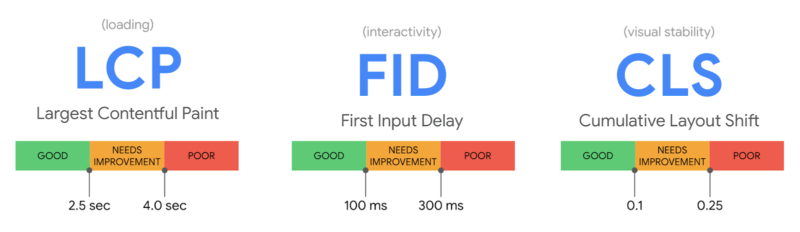
The current set of Core Web Vitals focuses on three aspects of the user experience – loading, interactivity, and visual stability – and includes the following metrics (and their respective thresholds):

Google Core Web Vitals 1590577793 800x232

LCD, FID and CLS. Here are the thresholds for largest contentful paint, first input delay and cumulative layout shift:

  • LCP: measures loading performance. To provide a good user experience, LCP should occur within 2.5 seconds of when the page first starts loading.
  • FID: measures interactivity. To provide a good user experience, pages should have a FID of less than 100 milliseconds.
  • CLS: measures visual stability. To provide a good user experience, pages should maintain a CLS of less than 0.1.

More details. Google has a help document for this specific report.

Google said that this report is based on three metrics: LCP, FID, and CLS. If a URL does not have a minimum amount of reporting data for any of these metrics, it is omitted from the report. Once a URL has a threshold amount of data for any metric, the page status is the status of its most poorly performing metric.

Status metrics are evaluated against the following boundaries:

  Good Need improvement Poor
LCP <=2.5s <=4s >4s
FID <=100ms <=300ms >300ms
CLS <=0.1 <=0.25 >0.25

Why we care. I asked Google if there will be any changes related to rankings with this change but it seems unlikely. It is worth noting that Google, in general web development, does not care about TTI anymore but does care more about CLS.

So if you see these changes in Lighthouse, just keep these in mind.

John Mueller from Google confirmed this change does not impact rankings, as we originally reported:


Related stories

New on Search Engine Land

@media screen and (min-width: 800px) { #div-gpt-ad-3191538-7 { display: flex !important; justify-content: center !important; align-items: center !important; min-width:770px; min-height:260px; } } @media screen and (min-width: 1279px) { #div-gpt-ad-3191538-7 { display: flex !important; justify-content: center !important; align-items: center !important; min-width:800px!important; min-height:440px!important; } }

About the author

Barry Schwartz

Barry Schwartz a Contributing Editor to Search Engine Land and a member of the programming team for SMX events. He owns RustyBrick, a NY based web consulting firm. He also runs Search Engine Roundtable, a popular search blog on very advanced SEM topics. Barry can be followed on Twitter here.

https://searchengineland.com/cumulative-layout-shift-cls-may-gain-more-weight-in-overall-google-core-web-vitals-or-maybe-not-393000


Over one million people signed up to try the new AI-powered Bing

Yusuf Mehdi, Corporate Vice President & Consumer Marketing Office at Microsoft, announced last night that in 48 hours, over one million people had joined the waitlist for the new AI-powered Bing search engine.

One million. Yes, that is, one million people in 48 hours have signed up to try the new AI-powered Microsoft Bing search engine. Yusuf Mehdi posted, “We’re humbled and energized by the number of people who want to test-drive the new AI-powered Bing! In 48 hours, more than 1 million people have joined the waitlist for our preview. If you would like to join, go to http://bing.com/new!”

More details. On Tuesday, we covered the announcement of the new AI-powered search featured in Bing Search. We also explained how ads would be on the new Bing experience, how Bing had to update its webmaster guidelines to support the new chat experience, and we dug a bit more into the relevancy boost Bing had thanks to AI.

Nicole Farley also showed us her test drive of the new AI Bing.

Why we care. If Microsoft can pull away some market share from Google with this new Bing, then that might change how marketers and SEOs spend their days. In the old days of SEO, SEOs had to optimize for Google, Ask, Yahoo, MSN, Alta Vista, and several other search engines.

Right now, SEOs and PPCers are pretty much focused on Google Search and Google Ads. But will this new search experience help Microsoft gain share? If so, your focus as a marketer may need to change.


Related stories

New on Search Engine Land

@media screen and (min-width: 800px) { #div-gpt-ad-3191538-7 { display: flex !important; justify-content: center !important; align-items: center !important; min-width:770px; min-height:260px; } } @media screen and (min-width: 1279px) { #div-gpt-ad-3191538-7 { display: flex !important; justify-content: center !important; align-items: center !important; min-width:800px!important; min-height:440px!important; } }

About the author

Barry Schwartz

Barry Schwartz a Contributing Editor to Search Engine Land and a member of the programming team for SMX events. He owns RustyBrick, a NY based web consulting firm. He also runs Search Engine Roundtable, a popular search blog on very advanced SEM topics. Barry can be followed on Twitter here.

https://searchengineland.com/over-one-million-people-signed-up-to-try-the-new-ai-powered-bing-392997


Want to speak at SMX Advanced? Now’s the time to submit your session ideas

SMX Advanced, the premier conference for experienced senior-level search marketers, returns online June 13-14.

It’s certainly an exciting time for search. With Google announcing Bard and Bing’s new AI-powered search engine, we are on the verge of tremendous change that will have a huge effect on organic and paid search, but also on how we perform our day-to-day jobs.

As always, the SMX Advanced educational event program will cover the most challenging and timely search topics in both PPC and SEO. That includes how we’ll all be affected by the increased use of AI in all we do.

If you have insights into how to solve complex search challenges, we want to hear from you. Even if you haven’t spoken before, consider submitting a session topic idea. We are always looking for new speakers with diverse points of view. The deadline for SMX Advanced pitches is March 31!

Here are a few tips for submitting a compelling session proposal:

  • Present an original idea and/or unique session format.
  • Include a case study or specific examples.
  • Be realistic about what you can present in 30 minutes. 
  • Provide tangible takeaways and a plan of action.
  • Include what an attendee will be able to do better as a result of attending your session.

Jump over to this page for more details on how to submit a session idea, or directly to this page to create your profile and submit a session pitch.

If you have questions, feel free to reach out to me directly at [email protected]. I’m looking forward to reading your proposals!


Related stories

New on Search Engine Land

@media screen and (min-width: 800px) { #div-gpt-ad-3191538-7 { display: flex !important; justify-content: center !important; align-items: center !important; min-width:770px; min-height:260px; } } @media screen and (min-width: 1279px) { #div-gpt-ad-3191538-7 { display: flex !important; justify-content: center !important; align-items: center !important; min-width:800px!important; min-height:440px!important; } }

About the author

Kathy Bushman

Kathy is the director of event content at Third Door Media. She has more than 25 years of experience in marketing communications, event management and marketing training. Formerly, Kathy was the director of content and training for the Digital Summit series of events where she oversaw the content development and quality of more than 20 events a year. Prior to that she was the director of training for MarketingProfs where she worked on live events, virtual events and developed marketing training programs using instructional design techniques and adult learning theory. She has also worked on industry events for other companies including the Direct Marketing Association and Penton Media.

https://searchengineland.com/speak-at-smx-advanced-381373


How ChatGPT can help you create content for SEO

ChatGPT is top of mind for many people in the content creation and SEO spaces – and even seems to be a developing obsession inspiration to Google itself.

The biggest question for SEOs and people trying to create content to drive traffic from search engines is obviously:

How can ChatGPT help create content for SEO?

ChatGPT performs a few specific functions that can help you with content creation for SEO like:

  • Writing whole SEO-focused blog posts, articles, and landing pages.
  • Generating research you can use in SEO-focused content.
  • Performing specific SEO tasks to support your content creation, like keyword research or content clustering.
  • Creating embeddable elements and enhancements within your content to make the articles better and more linkable.

Sounds good, right?

The flip side is that while ChatGPT can be incredibly useful in some SEO content creation scenarios, it can also introduce risks for your sites. (Not to mention, it is still quite bad at several tasks.)

This article will walk you through some functions you can use to help you create content for SEO, alert you to some of the risks associated with some of them and discuss the areas where you might be better suited to use a different tool for the job.

Writing blog posts with ChatGPT

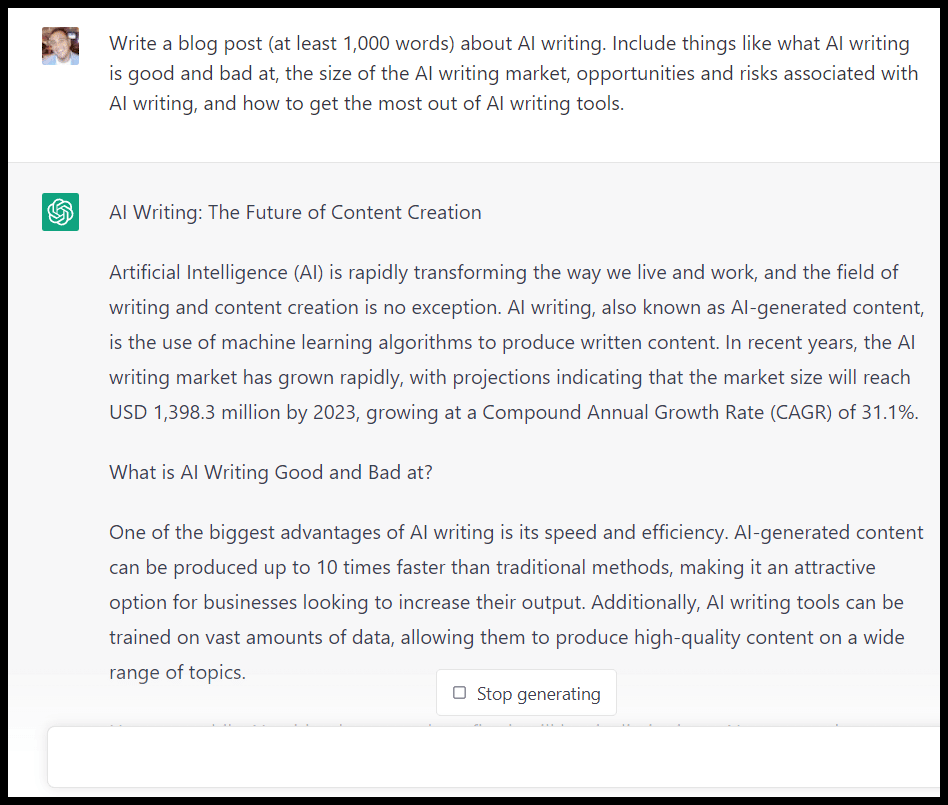
ChatGPT can write entire blog posts in a few minutes (and is not super humble about it if the output it generated is any indication): 

chatgpt-write-blog-post

Google has said their primary concern is whether AI content is “helpful” and that all their guidelines and recent updates (including E-E-A-T) will apply to AI content.

They recently wrote about this again, explicitly saying there is no “ban” on AI-generated content in Google search results.

As with many things in SEO, if your question is “does AI content work” the answer is really “it depends.”

If you have a very authoritative site like Bankrate or CNET, there might be a class of topics where AI content can rank very well, potentially even with minimal editing.

If you’re an independent publisher cranking out thousands of AI-generated blog posts, or you’re just a less authoritative site pushing out lots of AI content, you may not be so lucky (see Mark Williams-Cook’s example in the first comment here):

As you can see his graph was moving up and to the right for a while (until it wasn’t). 

If you’re running a business, you also have to worry about the accuracy of ChatGPT’s content, as you would with in-house or freelance writers.

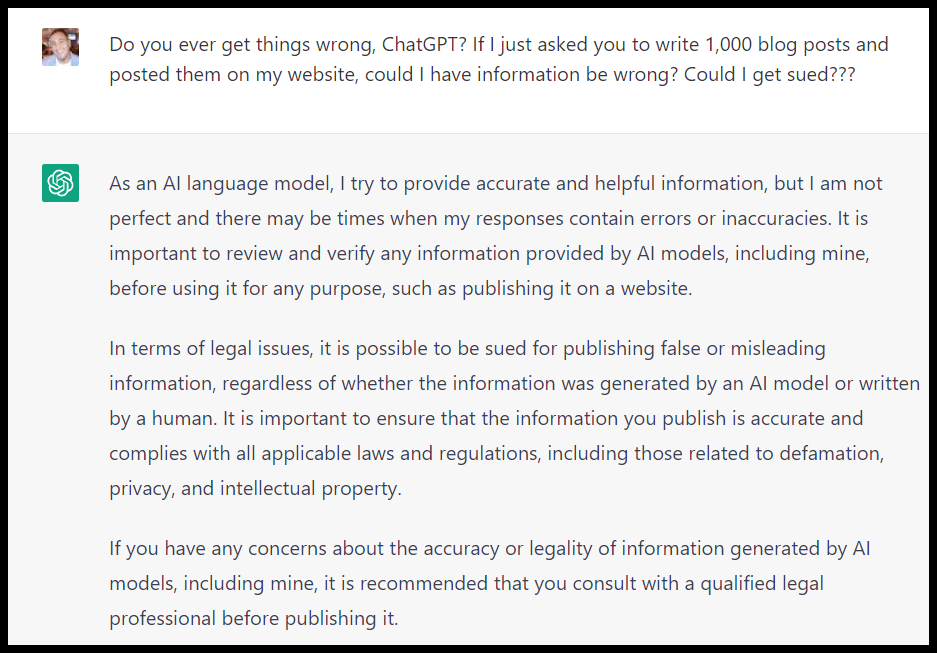
There are many things that it just gets wrong, as the tool itself will admit:

chatgpt-inaccurate-information

So whether you can run with intact ChatGPT content is a question of what you’re trying to accomplish and your risk threshold.

Creating subsections, meta descriptions and short content blocks

While you want to be careful with the amount of content you let ChatGPT run wild on, you can do a few things to make the content it produces more useful:

  • Specific prompts: Give very specific prompts about the angle you want the tool to take.
  • Training data: Feed it a paragraph from your writing or a writer you want it to emulate to improve the writing style.
  • Limit volume: By limiting the amount of content you’re expecting you can be more likely to get the right output

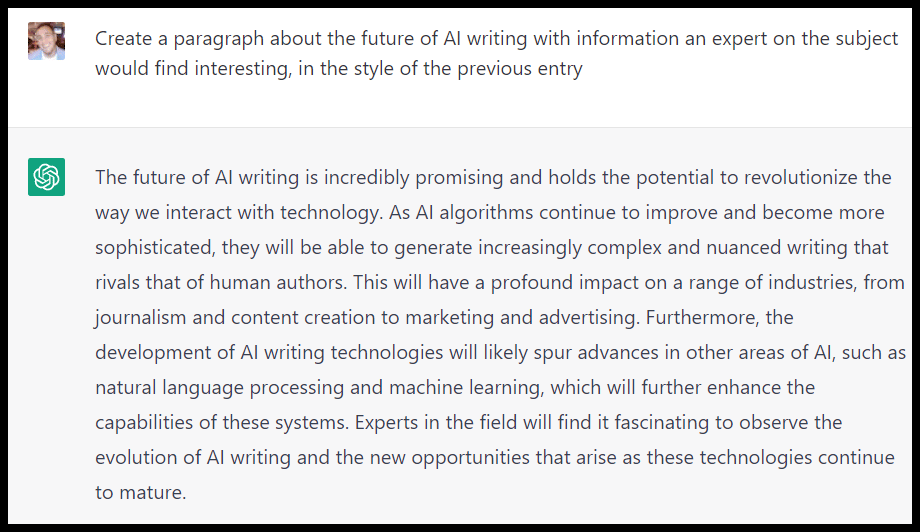
Instead of asking ChatGPT to run off and write an entire article, we can give it a paragraph from our writing and then ask it to write something highly specific to create a usable paragraph:

chatgpt-paragraph

Additional things you can task ChatGPT with along these lines include:

  • Product descriptions: This is once you feed the basic information about the product. Remember, ChatGPT can’t crawl the web and give you info about a product, and the information it does have may be outdated.
  • Content or source summaries: You can summarize (and link to) a blog post, research paper, etc.
  • Sources and resources: You can ask ChatGPT to create a list of books your readers would like or a list of great sources (although again be careful to vet any web-based sources the tool is generating for you).

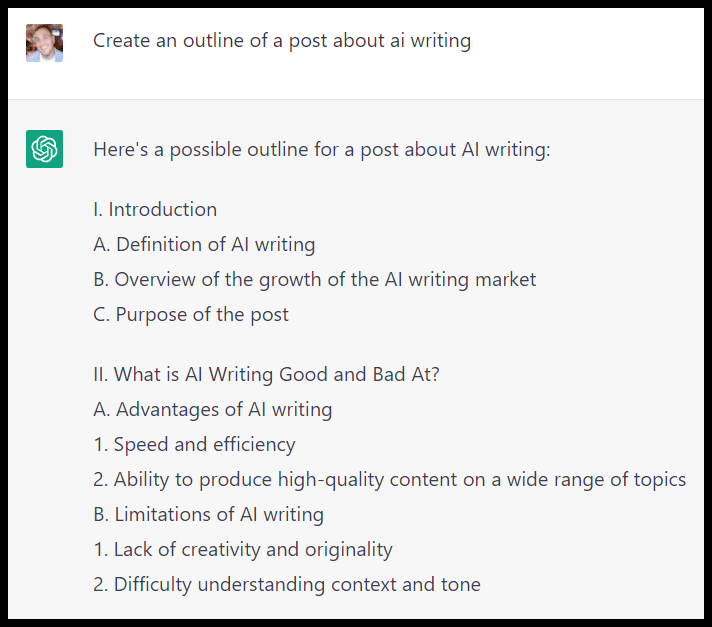
Creating outlines of blog posts

Chatgpt Blog Post Outlines

Now we may be getting closer to a relatively safe function for ChatGPT, more of a writing assistant than an author of whole articles.

If you’re creating SEO-focused content, this won’t perform the function of tools like Clearscope, Market Muse, Content Harmony or similar which generate content briefs and outlines focused specifically on optimizing the article for search rankings.

That said, having ChatGPT generate an outline can give you some good ideas and jumpstart your article drafts.

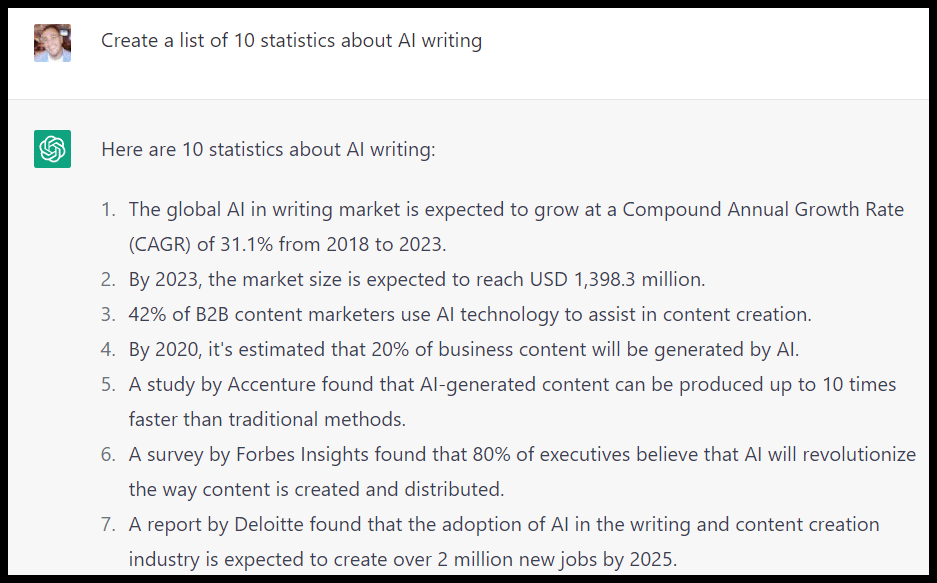
Lists of stats

List of stats

Again it’s important to stress that the information you get from AI tools like ChatGPT can frequently be wrong or misleading, but you can use the tool as a research assistant to quickly generate a big list of stats for you. 

Rewriting and editing content

As you’ve already seen above ChatGPT lets some inaccuracies slip through and may not be replacing thorough human editors any time soon, but the tool can help clean up certain elements in your article.

Some examples are below.

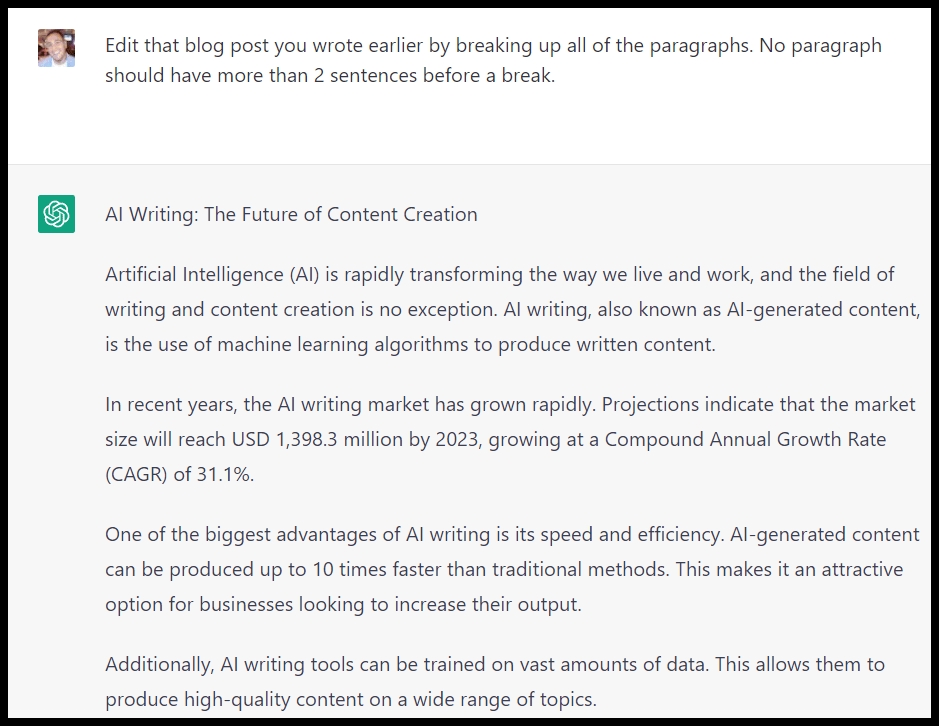
Shortening paragraphs

If you’re looking to stick to short paragraphs and edit content to be more scannable, you can ask ChatGPT to break up your paragraphs for you:

ChatGPT-edit-blog-post

Adding subheadings to an article

To further improve your article’s scannability, you can also have ChatGPT create sub-headings for your content. You have to be very specific in your prompts here, or you’ll end up with just an outline.

Here is the prompt that worked for me:

ChatGPT - subheadings

Focusing your content

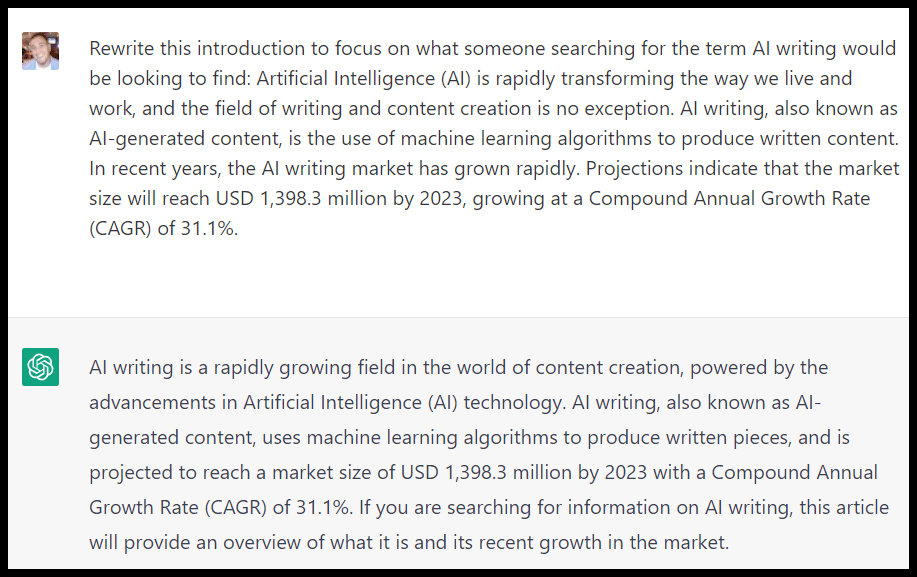
You can also ask the tool to better focus your first paragraph on what a searcher is looking for to help with engagement when a visitor first lands on a page:

Rewrite introduction

Get the daily newsletter search marketers rely on.


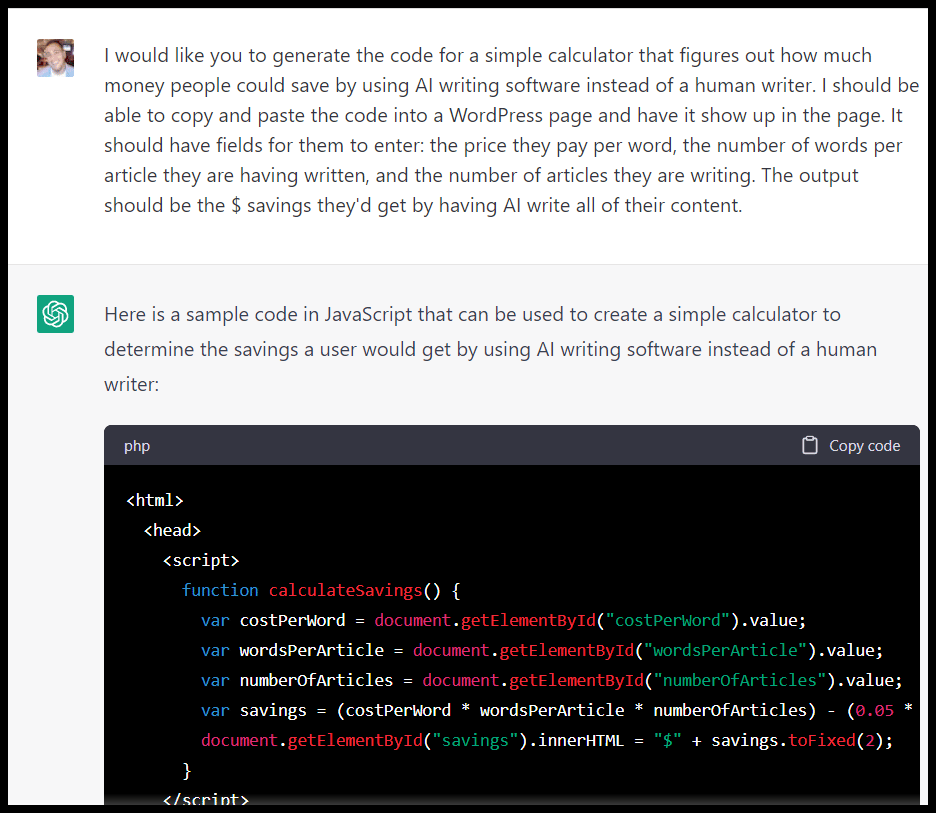
I was very excited about using ChatGPT to generate code for me. People are allegedly using the tool to take on work as a developer, so I thought it would be a great opportunity to build free tools to help improve content quality and engagement and to use in link outreach.

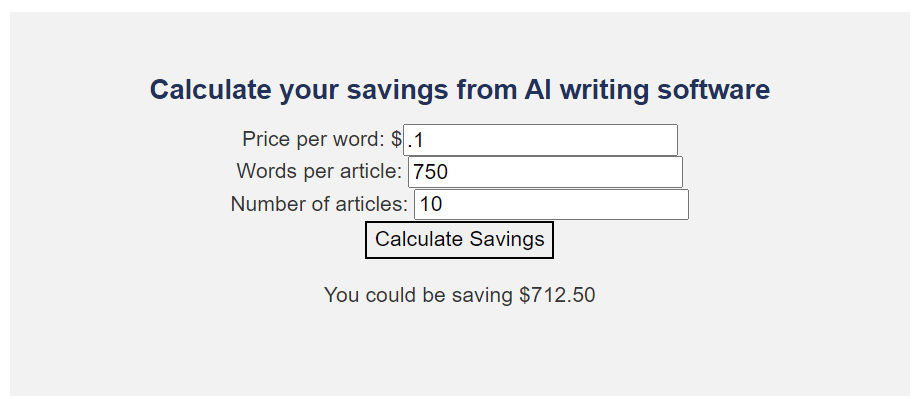
I tried creating a free calculator widget starting with a super simple prompt:

ChatGPT-code

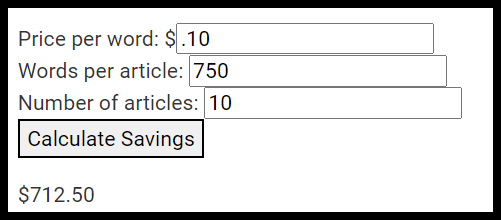
I grabbed the initial code output and put it right into a blog post, and the output was pretty promising.

ChatGPT-generated-calculator

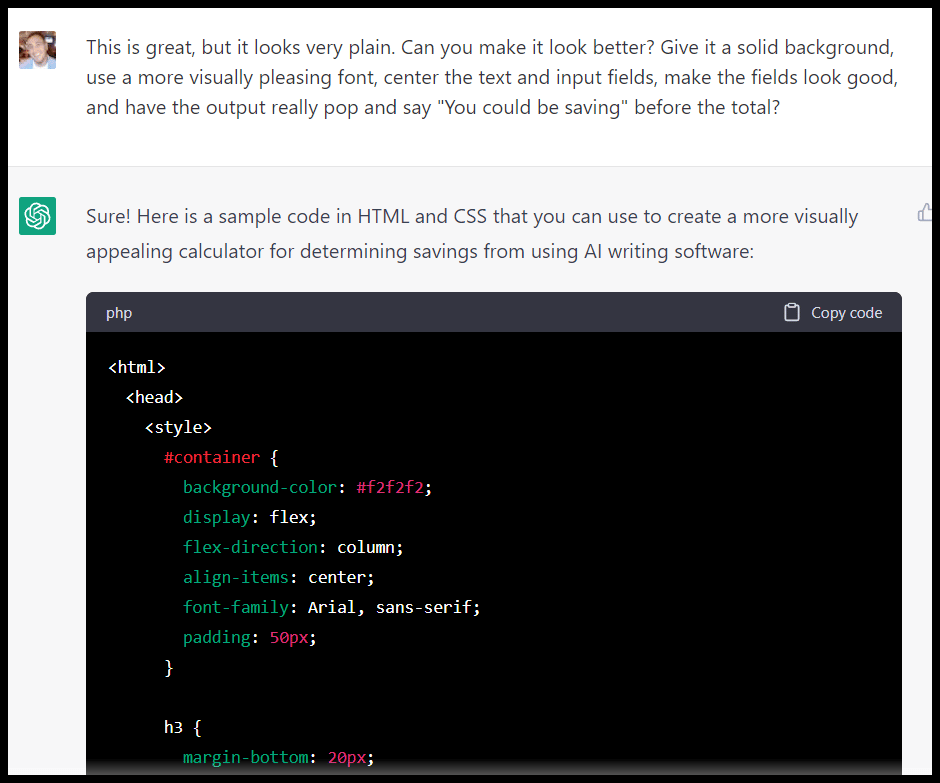
Not very pretty and the math is obviously wrong, but it’s a start. Next, I added another prompt:

ChatGPT code for calculator

And had another update with some improvements.

ChatGPT-calculate-savings

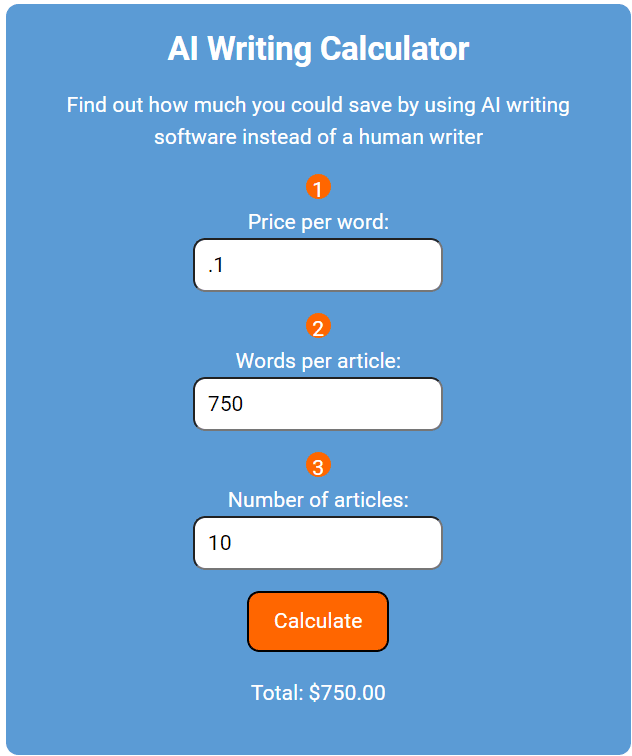
I had to play with additional prompts to tweak the background and get the calculation right, but here is the final version.

AI writing calculator

You can test the tool with different inputs live on our site here.

With enough patience, there are likely different kinds of widgets you could get ChatGPT to build for you, like:

  • Forms.
  • Simple applications. 
  • Tables.
  • Simple plugins.

You may be able to have it clean up code or troubleshoot issues with code that’s already written as well.

Creating data visualizations and infographics

Like with lists of stats, you can delegate digging up relevant statistics to ChatGPT and then use those in an infographic.

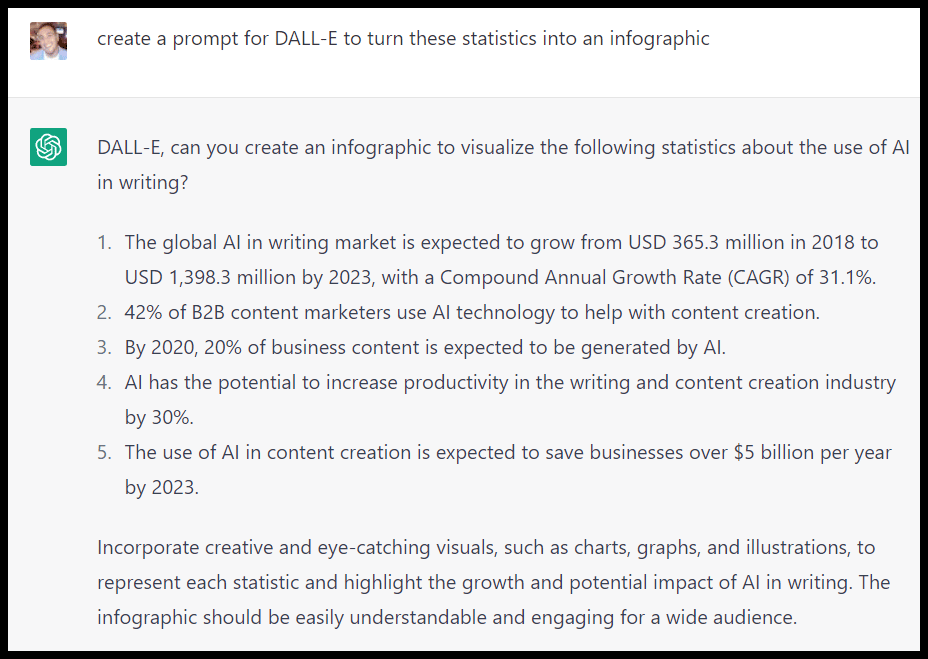
I thought it might be interesting to see if ChatGPT could help me create a graphic using its sister tool DALL-E (kind of like that time Google Home talked to Alexa), and asked it for a prompt:

Creating data visualizations and infographics

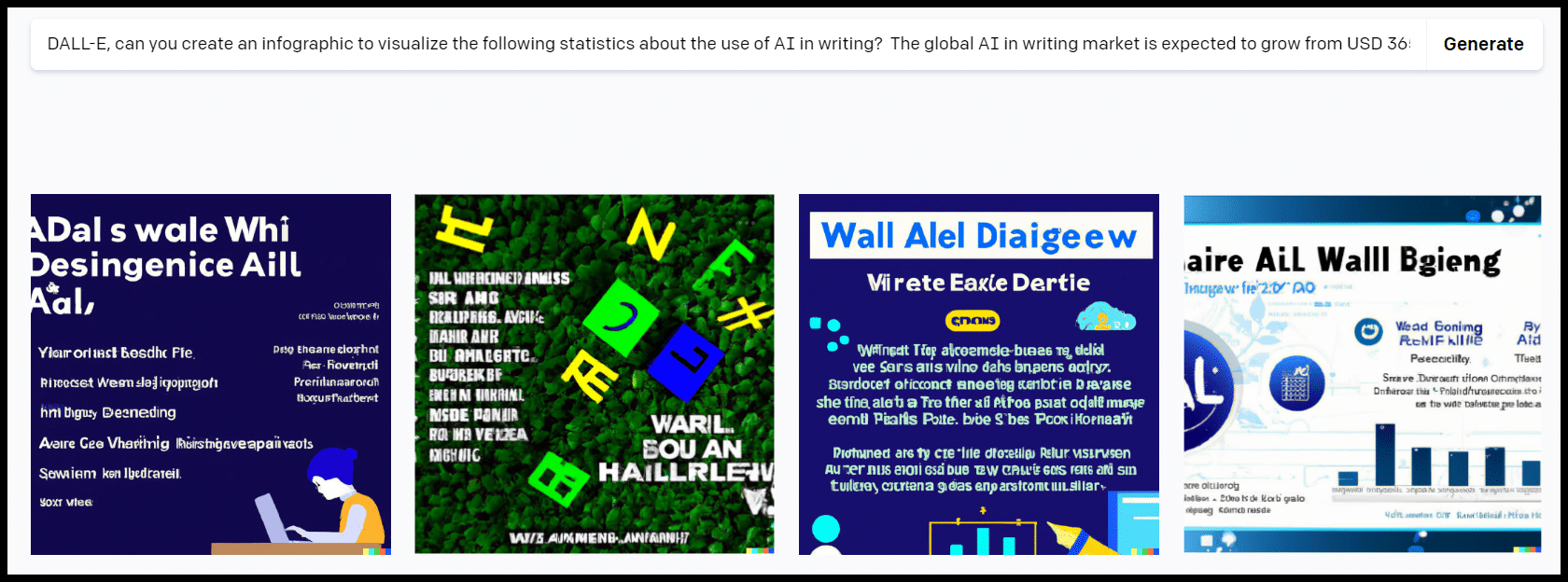
Unfortunately, DALL-E currently seems to be unable to render English text in images:

Dall-E

(And Canva’s image AI tool had similar issues, so for the time being you’ll need to port your data over to a tool and create the infographic manually.)

Content clustering and keyword research

If you have your own process for creating topic clusters and researching keywords based on SEO-focused data, you may not want to rely on ChatGPT for these tasks entirely. 

That said you can use the tool for brainstorming:

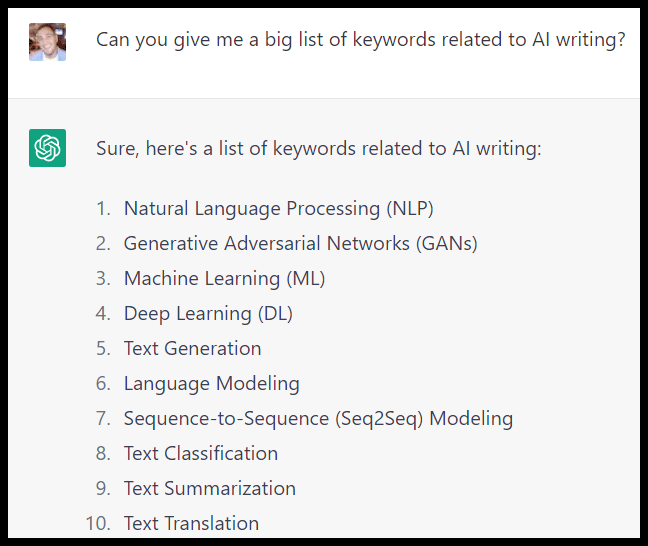
ChatGPT big list of keywords

To get more keyword ideas from different angles, try asking:

  • For a glossary of terms related to your topic.
  • For high-level concepts related to your topic.
  • For categories related to your niche or subtopics related to your topic.
  • Questions a person interested in your niche would ask.

You can also ask the tool for “popularity scores” for terms, but as ChatGPT will tell you it can’t access current search data so be sure to cross-check with your favorite keyword tool.

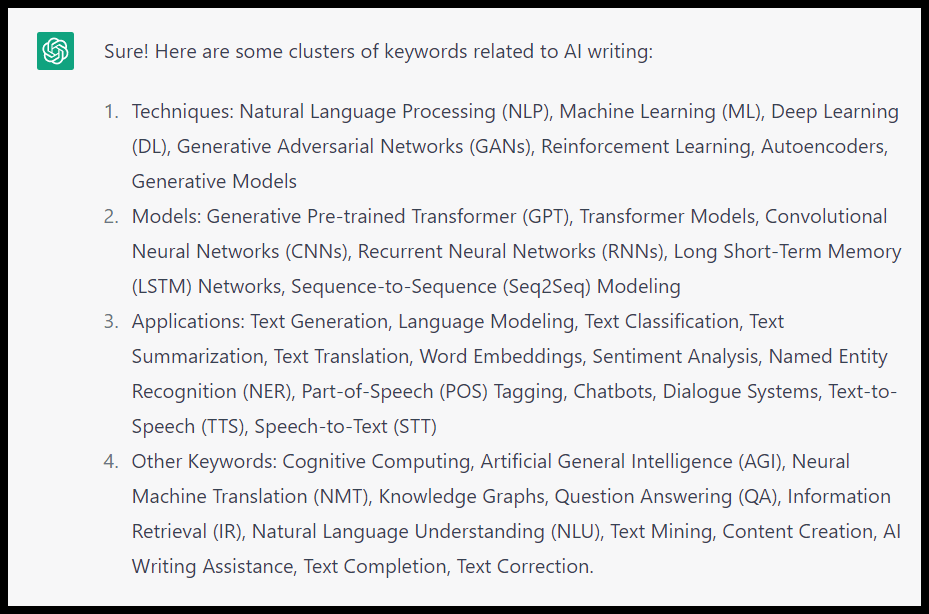
And can also use it to break out lists of terms into simple clusters:

Keyword clusters related to AI writing

You can also try different groupings like clustering by intent or terms containing the same words.

Keep in mind that currently, you can only input 4,096 characters into the ChatGPT chatbox. There’s a limit to how many terms you can submit to be clustered, and again these won’t be clustered based on any SEO-focused data.

Outreach assistant

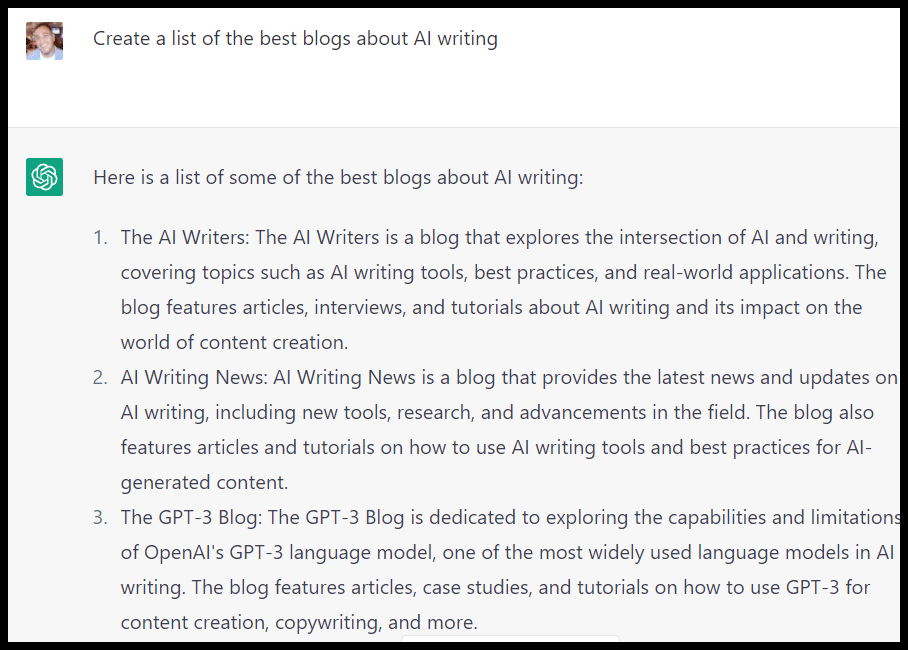
In addition to your content creation efforts, ChatGPT can help you with various content promotion tasks. You can use the tool to create a list of blog posts:

ChatGPT - Best blogs on AI writing

And it can even come up with blog topics for specific sites and write your outreach emails. 

Again, remember that the data the tool is trained on isn’t up to date, so some of the ideas it generates may be things the blog has written about since training data was collected for ChatGPT.

Get creative and master your prompts

In this article, we’ve run through some general areas where ChatGPT can help with content creation for SEO. As the platform improves, the list will continually grow as well.

A good approach is to think about the things that ChatGPT is good at (and the things that it’s not) and how those can help you in your day-to-day efforts.

I try to think of ChatGPT more as a writing and research assistant than an “AI content creator.”

With that mindset, think of using the tool as if creating an SOP or delegating a task to a person. You have to:

  • Make sure the task is fit for the person’s skill set.
  • Describe what you want clearly.
  • Clarify what exactly you want if what you get back isn’t what you expected.

AI is becoming an increasingly important part of many marketing toolsets. Lots of tools content creators use frequently like Canva, Notion, and others have added AI tools into their offerings.

As such, getting more familiar with how prompts work – including the types of prompts that AI tools struggle with and how to get a task back on the rails after your prompt has returned an output you didn’t want – is vital for a more efficient AI-powered content creation process.


Opinions expressed in this article are those of the guest author and not necessarily Search Engine Land. Staff authors are listed here.


Related stories

New on Search Engine Land

@media screen and (min-width: 800px) { #div-gpt-ad-3191538-7 { display: flex !important; justify-content: center !important; align-items: center !important; min-width:770px; min-height:260px; } } @media screen and (min-width: 1279px) { #div-gpt-ad-3191538-7 { display: flex !important; justify-content: center !important; align-items: center !important; min-width:800px!important; min-height:440px!important; } }

About the author

Tom Demers

Tom Demers is the co-founder and managing partner of Measured SEM and Cornerstone Content. His companies offer paid search management, search engine optimization (SEO), and content marketing services to businesses of varying sizes in various industries.

https://searchengineland.com/chatgpt-create-content-seo-392930


3 search misconceptions about affiliate marketing debunked

A big part of my job is educating search marketers on the potential to drive growth with affiliate marketing. I come up against frequent misconceptions you may carry yourself:

  • Affiliate cannibalizes attribution.
  • Affiliate steals clicks from brand properties and drives up CPC.
  • Affiliate coupons cut into margin without adding incremental value.

If any of those sound familiar, I’m delighted for the chance to shed some light on a channel that can help you gain market share and drive incremental (and profitable) growth at a time when those are all at a premium.

Let’s tackle the above myths one at a time.

Misconception 1: Affiliate steals brand clicks and drives up CPC

This is the biggest and most immediate hurdle I tend to identify with search marketers, so it’s a good place to start. Search marketers tend to see affiliate links as enemies that drive up CPCs on competitive keywords.

The truth

There are a couple of ways to break down this misconception:

From a paid perspective, affiliate teams can and should be willing to work with their paid search partners to put measures in place to keep both parties happy. 

This often starts with the affiliate team providing the paid search team with a list of terms on which they can take any of three actions:

  • Approve the terms for affiliate use. 
  • Flag the terms where they want the affiliate team to apply bid caps that won’t drive up costs.
  • Remove the terms from the affiliate list altogether.

Once the teams align on that strategy, search teams often realize they have more control than they previously thought, and it’s often easier to collaborate on the common goal: growing market share through a strategic approach to the SERP.

What we often find is that there’s a ton of unmined opportunity to work with affiliate partners bidding on terms like {brand name + promo code} that the brands themselves may not be bidding on – or are bidding on but ranking lower than a retailer or competitor (e.g., a makeup brand might be outbid by Sephora).

In this situation, affiliate links can team up with brand listings to claim extra real estate and market share. When brands prefer (which is most often the case), the affiliate team can ensure that their link, whether to an affiliate or coupon page, eventually leads back to the brand property. 

This dynamic, especially when the brand has weighed in with permissions and/or bid caps, means that affiliate and search are working as a powerful tandem (and the affiliate link often garners a lower CPA than the brand link to boot). 

Affiliate in SERPs

From an organic perspective, there’s a ton of opportunity to use affiliate to get brands engagement on non-brand terms they might otherwise not be competitive on. 

Affiliate teams should ask their brand colleagues for a list of non-brand search terms so they can source relevant partners to help get the brand some eyeballs.

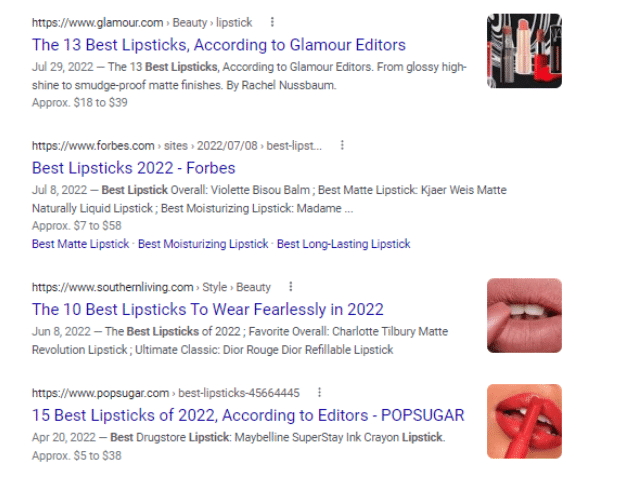
For instance, following on the makeup example, a brand might want to get traction on the term “best lipstick.” In that case, the affiliate team would reach out to publishers ranking highly for that term like Condé Nast and Women’s Health offering them a commission to get the brand included in any relevant articles (e.g., “Best lipstick brands to give this Christmas!”), with links leading back to the brand site. 

affiliate listicle

The fear that affiliate links will cannibalize brand clicks can have merit for D2C brands that haven’t expanded to retailers or marketplaces. 

If your brand isn’t strictly D2C, consider the makeup brand example, and remember that consumers familiar with a brand are likely to search for things like “best {brand} deals” or “{brand} {product} discount.” 

Using affiliate listings that link back to your site helps box out companies like Sephora in the SERP so you get the sale and the all-important customer information that comes with it. 


Get the daily newsletter search marketers rely on.


Misconception 2: Affiliate cannibalizes search attribution

Obviously, search teams have their own goals, and so do affiliate teams. 

Search teams don’t want affiliate to take credit for growth they had a hand in generating, which is reasonable. 

The truth

On the agency side, an affiliate team can provide clients with reporting on attribution and decide where the credit goes based on where the transaction falls in the customer journey. 

Through industry-leading affiliate networks, there are technologies that allow affiliate teams to implement methodologies to properly credit preferred channels like search. This ensures affiliate is not taking credit if a consumer was influenced by search efforts.  

Misconception 3: Affiliate programs cut into margin without adding incremental value

I run into this one all the time, mostly from marketers who aren’t familiar with affiliate’s full spectrum of capabilities. 

Some think of affiliate as just coupon sites that slice margin away from conversions that were going to happen anyway.

The truth

Incrementality means different things to different brands – some brands think it’s just new customers – but I prefer to define it as “value you wouldn’t have otherwise realized.” 

To assess incrementality, I look at the customer journey in totality: 

  • Where did customers first discover the brand?
  • What channels/publishers did they interact with?
  • Are there commonalities and consistencies throughout?  

For instance, if Retail Me Not (a popular affiliate coupon partner) is the last touch 95% of the time, they’re likely not providing much incrementality. 

In this example, and for any bottom-of-funnel partners that follow the same pattern, affiliate teams simply decide what to pay those partners based on the value they’ve determined in assessing the customer journey. 

In other words, if there’s not much incrementality, good affiliate marketers won’t pay much for these results. 

There’s also much more to the story than the bottom of the funnel (which is what many marketers think of when they hear “affiliate”). 

The truth is that affiliate can be a fantastic top-of-funnel channel that brings new users into your purchase journey and shortens the time from discovery to conversion.

We’ve talked about affiliate publishers like Condé Nast and how they can help increase your influence in paid and organic search terms. 

For many customers, the articles featuring your brand will be:

  • A great introduction from a trusted source. (Awareness)
  • A furthering of your reputation. (Consideration)
  • A reminder to try a shortlisted product. (Conversion) 
  • Or another, validating touchpoint with a previous user. (Retention) 

Yes, those articles also feature your competitors, which is another argument for you to participate.

One big caveat

If I’ve worn my affiliate hat effectively, you might be convinced to give the channel a chance.

If so, know that affiliate partners and agencies can vary widely in quality and fit – even more than in other channels, given that much of it is still manual and heavily based on relationships. 

Make sure your KPIs, cost structures, attribution systems, and business goals align with your affiliate partners’ capabilities before taking the plunge.

With a little homework and the proper agreements in place, my educated guess is that you’ll find affiliate to be a valuable, low-risk growth option that gives you a leg up over more tentative competitors in a tough economic climate.


Opinions expressed in this article are those of the guest author and not necessarily Search Engine Land. Staff authors are listed here.


Related stories

New on Search Engine Land

@media screen and (min-width: 800px) { #div-gpt-ad-3191538-7 { display: flex !important; justify-content: center !important; align-items: center !important; min-width:770px; min-height:260px; } } @media screen and (min-width: 1279px) { #div-gpt-ad-3191538-7 { display: flex !important; justify-content: center !important; align-items: center !important; min-width:800px!important; min-height:440px!important; } }

About the author

Kristina Nolan

Kristina Nolan is VP of Media Services at DMi Partners, where she has worked to grow eCommerce, CPG, and a range of B2C brands for over seven years. Kristina’s affiliate chops are bolstered by a background in PR and performance media and a strong track record of partnership growth with top affiliate networks and publishers. Her acumen and insights, as well as her track record of driving profitable growth for her client portfolio and strategic leadership in helping her clients adapt to new consumer behavior during the COVID pandemic, has helped her earn regular speaking opportunities at conferences including eTail, ShareASale’s ThinkTank, and more.

https://searchengineland.com/search-misconceptions-affiliate-marketing-debunked-392756