Seven tips to optimize page speed in 2023

Tips-to-optimize-page-speed-in-2023

30-second summary:

  • There has been a gradual increase in Google’s impact of page load time on website rankings
  • Google has introduced the three Core Web Vitals metrics as ranking factors to measure user experience
  • The following steps can help you get a better idea of the performance of your website through multiple tests

A fast website not only delivers a better experience but can also increase conversion rates and improve your search engine rankings. Google has introduced the three Core Web Vitals metrics to measure user experience and is using them as a ranking factor.

Let’s take a look at what you can do to test and optimize the performance of your website.

Start in Google Search Console

Want to know if optimizing Core Web Vitals is something you should be thinking about? Use the page experience report in Google Search Console to check if any of the pages on your website are loading too slowly.

Search Console shows data that Google collects from real users in Chrome, and this is also the data that’s used as a ranking signal. You can see exactly what page URLs need to be optimized.

Optimize-to-Start-in-Google-Search-Console

Run a website speed test

Google’s real user data will tell you how fast your website is, but it won’t provide an analysis that explains why your website is slow.

Run a free website speed test to find out. Simply enter the URL of the page you want to test. You’ll get a detailed performance report for your website, including recommendations on how to optimize it.
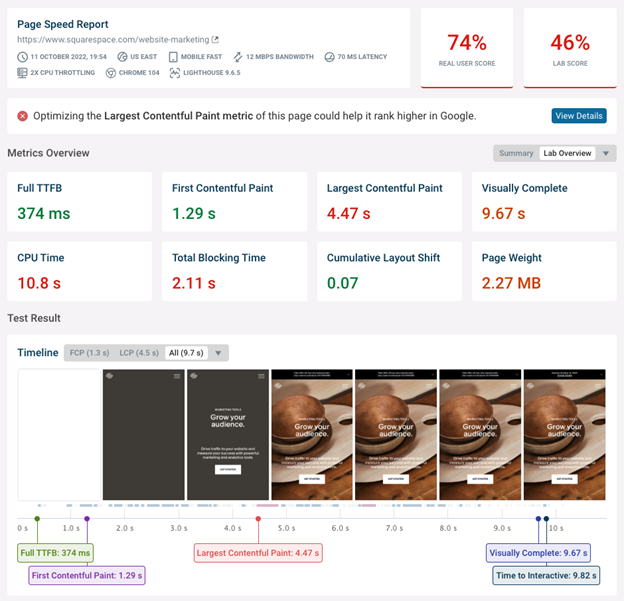
Run-a-website-speed-test-for-optimization

Use priority hints to optimize the Largest Contentful Paint

Priority Hints are a new browser feature that came out in 2022. It allows website owners to indicate how important an image or other resource is on the page.

This is especially important when optimizing the Largest Contentful Paint, one of the three Core Web Vitals metrics. It measures how long it takes for the main page content to appear after opening the page.

By default, browsers assume that all images are low priority until the page starts rendering and the browser knows which images are visible to the user. That way bandwidth isn’t wasted on low-priority images near the bottom of the page or in the footer. But it also slows down important images at the top of the page.

Adding a fetchpriority=”high” attribute to the img element that’s responsible for the Largest Contentful Paint ensures that it’s downloaded quickly.

Use native image lazy loading for optimization

Image lazy loading means only loading images when they become visible to the user. It’s a great way to help the browser focus on the most important content first.

However, image lazy loading can also slow cause images to take longer to load, especially when using a JavaScript lazy loading library. In that case, the browser first needs to load the JavaScript library before starting to load images. This long request chain means that it takes a while for the browser to load the image.

Use-native-image-lazy-loading-for-optimization

Today browsers support native lazy loading with the loading=”lazy” attribute for images. That way you can get the benefits of lazy loading without incurring the cost of having to download a JavaScript library first.

Remove and optimize render-blocking resources

Render-blocking resources are network requests that the browser needs to make before it can show any page content to the user. They include the HTML document, CSS stylesheets, as well as some JavaScript files.

Since these resources have such a big impact on page load time you should check each one to see if it’s truly necessary. The async keyword on the HTML script tag lets you load JavaScript code without blocking rendering.

If a resource has to block rendering check if you can optimize the request to load the resource more quickly, for example by improving compression or loading the file from your main web server instead of from a third party.

Remove-and-optimize-render-blocking-resources

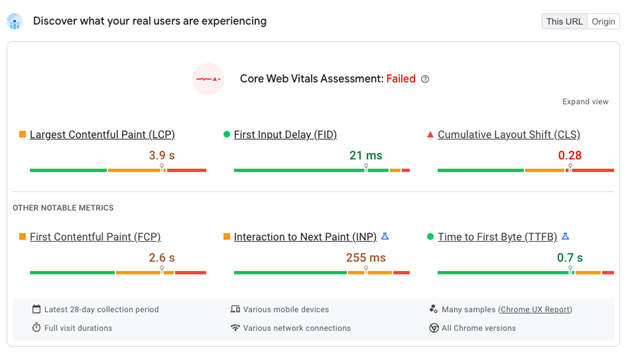
Optimize with the new interaction to Next Paint metric

Google has announced a new metric called Interaction to Next Paint. This metric measures how quickly your site responds to user input and is likely to become one of the Core Web Vitals in the future.

You can already see how your website is doing on this metric using tools like PageSpeed Insights.
Optimize-with-new-Interaction-to-Next-Paint-metric

Continuously monitor your site performance

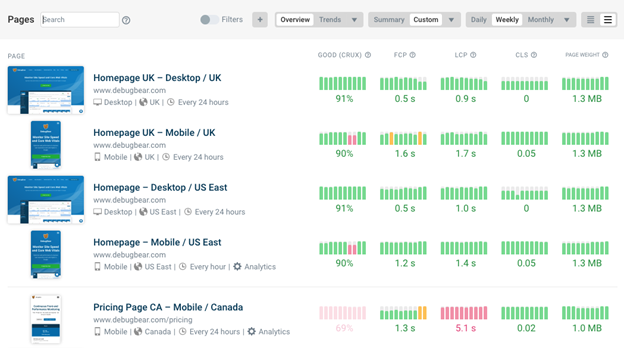
One-off site speed tests can identify performance issues on your website, but they don’t make it easy to keep track of your test results and confirm that your optimizations are working.

DebugBear continuously monitors your website to check and alerts you when there’s a problem. The tool also makes it easy to show off the impact of your work to clients and share test results with your team.

Try DebugBear with a free 14-day trial.
Continuously-monitor-your-site-performance

https://www.searchenginewatch.com/2023/02/08/seven-tips-to-optimize-page-speed-in-2023/


This day in search marketing history: February 8

Google Chrome to mark non-HTTPS sites as ‘not secure’

In 2018, Google announced it would identify all sites that had not migrated to HTTPS as “not secure” in the Chrome browser.

Google had already been pushing webmasters to make the change to non-secure websites for years – including hinting at a small ranking boost to further incentivize the shift.

According to Google, in 2018:

  • Over 68% of Chrome traffic on both Android and Windows was protected
  • Over 78% of Chrome traffic on both Chrome OS and Mac was protected
  • 81 of the top 100 sites on the web were using HTTPS by default

Read all about it in Effective July 2018, Google’s Chrome browser will mark non-HTTPS sites as ‘not secure’.


Also on this day


Google launches revamped Search Ads 360

2022: It supported Performance Max and Discovery campaigns, included a refreshed UI and greater support for other search engines.


Google adds Journeys to Chrome: search your history by topic

2022: The feature made it easier for users to revisit topics they searched for days or weeks ago.


Bing News PubHub moves to Bing Webmaster Tools

2022: This made it easier for for publishers who had already verified their sites with Bing Webmaster Tools to access the Bing News PubHub features.


Google publishes new manual actions aimed at Google News and Discover penalties

2021: Google published a whole new set of manual actions around Google News and Google Discover policies and guidelines.


Yelp introduces Keyword Boosting, rolls out Custom Location Targeting to all advertisers

2021: The feature let business owners optimize their ads for specific keywords


Effective July 2018, Google’s Chrome browser will mark non-HTTPS sites as ‘not secure’

2018: After years of pushing for ‘secure by default’ websites, Google would identify insecure sites in the Chrome browser beginning mid-Summer.


Google Search Console request indexing limit removed from interface

2018: Google wouldn’t comment on why quota details in the fetch tool were no longer displaying.


GoDaddy site builder now integrated with Google My Business

2018: Much of the content creation and verification process was automated.


India’s competition regulator fines Google $21.1 million for ‘search bias’ in travel results

2018: India’s Competition Commission said Google disadvantaged “verticals trying to gain market access.”


Google Data Studio now connects to Search Console

2017: Marketers could build reports that included only Search Console data or combine it with other sources to compare paid versus organic traffic trends, for example.


Bing Ads rolling out list exclusions for retargeting ads

2017: Audience exclusions would be available in all markets.


Google: 82% Of Super Bowl Ad Searches Happened On Mobile, Up From 70%

2016: Ads drove more than 7.5 million incremental searches for Super Bowl advertisers.


Yahoo To Close BOSS (Build Your Own Search Service) Next Month

2016: Launched on July 10, 2008, the service would close officially on March 31, 2016.


French Privacy Agency’s Site Crashes, After Demanding Link From Google France Home Page

2015: The traffic seemed to have slowed and sometimes crashed the CNiL website.


Yahoo Turns To Yelp To Beef Up Local Search

2015: Yahoo would reportedly start incorporating local content and listings from Yelp into its main search results.


Confirmed: Google Removes “Not Selected” From Webmaster Tools

2013: Because it “was causing more confusion than actually helping webmasters with their sites.”


Search In Pics: Googlers Must Wash Hands Before Coding, Facebook & Google Accident & Dan Russell & Duane Forrester

2013: The latest images showing what people eat at the search engine companies, how they play, who they meet, where they speak, what toys they have, and more.


Interesting Quotes From Google’s Search Lead, Amit Singhal

2012: Some insights into Singhal’s role at Google, how Google tested new algorithms, and the future for Google search.


Survey: People Largely Negative About Google’s Personalized Search Results

2012: The majority of respondents expressed ambivalence or outright dissatisfaction about Google’s more personalized search results.


Google Screenwise: New Program Pays You To Give Up Privacy & Surf The Web With Chrome

2012: Google was quietly taking requests from web users who wanted to get paid to surf the web using the Chrome browser while sharing data with Google. 


Why Does Microsoft’s Bing Search Engine Hate Rick Santorum?

2012: Santorum’s Bing problem, as with his Google problem, wasn’t stopping many Republican voters from selecting him over other candidates.


Bing Testing New Search Results Design

2012: The new design seemed a lot cleaner, fresher and more organized compared to the older design.


Apple’s Siri Drives 25 Percent Of Wolfram|Alpha Queries

2012: However, the company received no branding on those results.


Demand Media & Being “The Best Click” On Google

2011: Demand’s chief revenue officer brought screenshots and examples to prove they were generating great content to show up on Google. Additional coverage of FM’s Signal LA event:


Bing Search Volume Up 29% In 2010, Google Up 13%, comScore Says

2011: Meanwhile, Experian Hitwise said Bing-Powered Engines Grew 6.5% in January


Android Closing On BlackBerry As Verizon iPhone Launch Approaches

2011: 63.2 million people owned smartphones in the U.S., a penetration level of 27%.


Google Translate iPhone app: A Small Glimpse at the Future Of Search

2011: “It’s your very own Babel Fish replacing frantic searches through a beat up translation dictionary when you’re in a small town in Estonia and need to find a bathroom.”


Yahoo BOSS Moves From Yahoo’s Index to Microsoft’s, Adds Pay Structure

2011: The fee structure would be based on query volume.


Google Building Instant Translator Companion

2010: You would speak to it in any language, Google would then convert that and spit it back in the language of choice.


Report: Google To Announce A More Social Gmail

2010: Google was about to announce a new social feature inside Gmail that allowed users to see (and add to) a stream of status updates from friends and connections. What could go wrong?


Cambodia Calls Google Maps “Misleading” Over Thailand Border Dispute

2010: Cambodia was the latest country upset with Google over how they drew a border on Google Maps.


Google Warns Chinese Knockoff To Stop Using Google Logo

2010:  Google sent a warning to the Chinese Google knockoff, Goojje to stop using their logo.


Ask.com Puts Its NASCAR Sponsorship Back In Garage

2010: Ask spent about $15 million on its one year of NASCAR-related sponsorships.


Microhoo At One Week 1: Decision Nears? Yahoo Brand To Survive?

2008: There were rumors that Yahoo was nearing a decision, while Microsoft’s Steve Ballmer seemed to want to encourage his potential new employees that a Yahoo brand would survive.


Yahoo Live Launches – Online Video, Um, Live

2008: Yahoo Live let you broadcast live video.


Live Search: There For Skiers And Snowboarders Everywhere

2008: Live Search added Instant Answers for snow conditions at ski resorts.


Rumor: Google To Acquire Plaxo

2008: Spoiler alert: It never happened. 


Why The SEO Folks Were Mad At You, Jason

2007: And follow-up: Diggers Can’t Handle The Truth (About SEO)


Will Google Remain ‘The Start Page For The Internet’?

2007: Thoughts on a “post-search” future.


YouTube Founders & Investors Cash In Big Time

2007: Sequoia Capital, the company that funded YouTube, received 941,027 shares that were worth about $442 million.


Google Maps Sticker Spotted In London

2007: The “find us on Google Maps” sticker was a UK-only campaign.


Roundup Of Feedback On Yahoo’s Panama Release

2007: A collection of blog posts, forum posts and opinion on Yahoo’s new quality score factor.


Yahoo Pipes: Letting Non-Programmers Make Mashups & More

2007: It was an “interactive feed aggregator and manipulator.”


The State of Search Engine Marketing 2006

2007: It was thriving. North American advertisers spent $9.4 billion on in 2006, a 62% increase over 2005.


Past contributions from Search Engine Land’s Subject Matter Experts (SMEs)

These columns are a snapshot in time and have not been updated since publishing, unless noted. Opinions expressed in these articles are those of the author and not necessarily Search Engine Land.


< February 7 | Search Marketing History | February 9 >


Related stories

New on Search Engine Land

@media screen and (min-width: 800px) { #div-gpt-ad-3191538-7 { display: flex !important; justify-content: center !important; align-items: center !important; min-width:770px; min-height:260px; } } @media screen and (min-width: 1279px) { #div-gpt-ad-3191538-7 { display: flex !important; justify-content: center !important; align-items: center !important; min-width:800px!important; min-height:440px!important; } }

About the author

Danny Goodwin

Danny Goodwin is Managing Editor of Search Engine Land & SMX. In addition to writing daily about SEO, PPC, and more for Search Engine Land, Goodwin also manages Search Engine Land’s roster of subject-matter experts. He also helps program our conference series, SMX – Search Marketing Expo. Prior to joining Search Engine Land, Goodwin was Executive Editor at Search Engine Journal, where he led editorial initiatives for the brand. He also was an editor at Search Engine Watch. He has spoken at many major search conferences and virtual events, and has been sourced for his expertise by a wide range of publications and podcasts.

https://searchengineland.com/search-marketing-history-february-8-392857


Test driving the new Bing

ICYMI, Microsoft announced its new collaboration with ChatGPT during an event today. Being able to be there live at the event did have its perks. Like priority access to try out the new experience on Edge, Microsoft’s browser.

Screen Shot 2023 02 07 At 2.29.31 PM 610x600

Trying it out. I downloaded the Edge browser, signed in, and was given access to the new Chat feature.

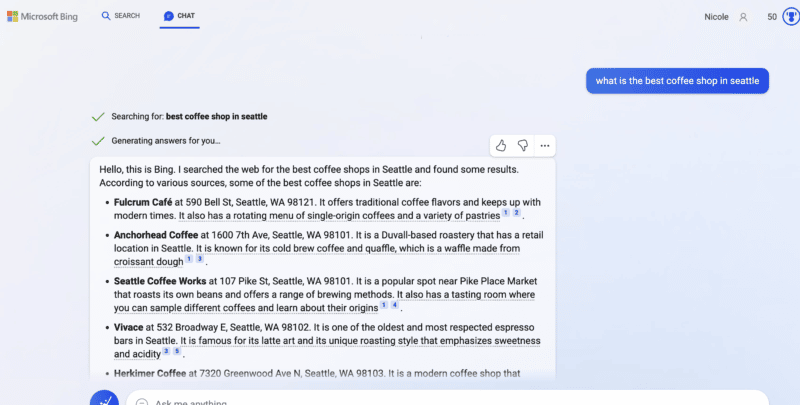
Since I’m in Seattle, and being somewhat of a coffee connoisseur, I wanted to know what the best coffee shops in Seattle were. So I asked, and I received.

Screen Shot 2023 02 07 At 2.42.06 PM 800x405

The style of the results and the way they’re presented is almost identical to going to ChatGPT. Except this time, you can hover over any underlined result to get more information and click on the attributed source.

Screen Shot 2023 02 07 At 2.45.07 PM 800x290

Ok, Bing. Good answer. But this time I wanted to know which one it recommended. I thought it was going to give me one of the answers from the previous list. But it didn’t. It actually just ended up generating a brand new list with five different results.

Screen Shot 2023 02 07 At 2.46.55 PM 800x458

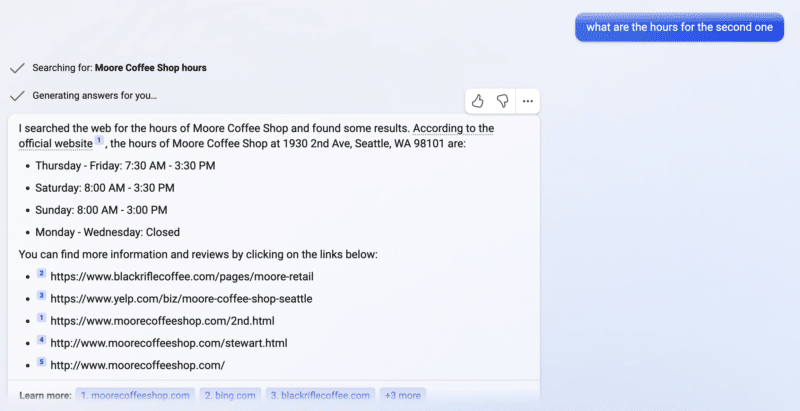
Fine. I’ll go with Moore Coffee Shop. But I don’t feel like typing in the name, so I’ll just ask what the hours are for the “second one.” Let’s see if it knows what I mean.

Screen Shot 2023 02 07 At 2.48.56 PM 800x411

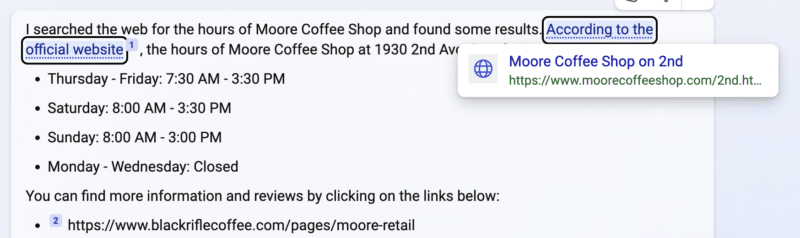
Good bot. Except for the “You can find more information and reviews…” links below the hours aren’t actually links, so you can’t click on them. But you can hover over the official website text at the top, and that’ll open the Moore site in a new tab.

Screen Shot 2023 02 07 At 2.52.15 PM 800x238

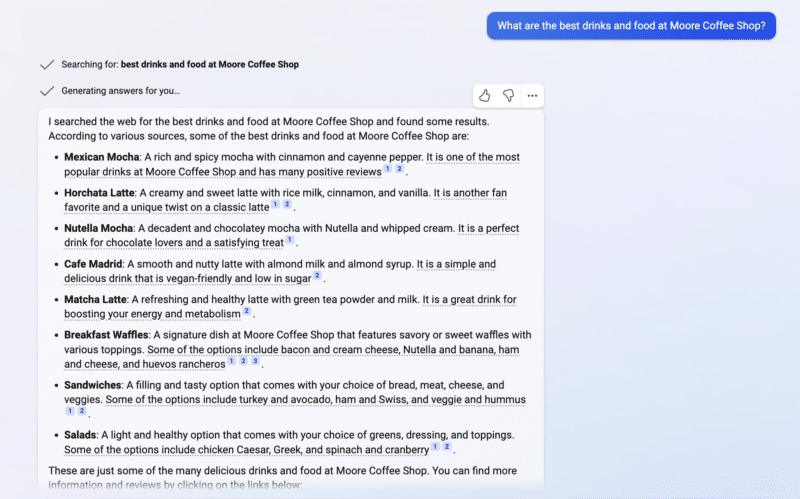
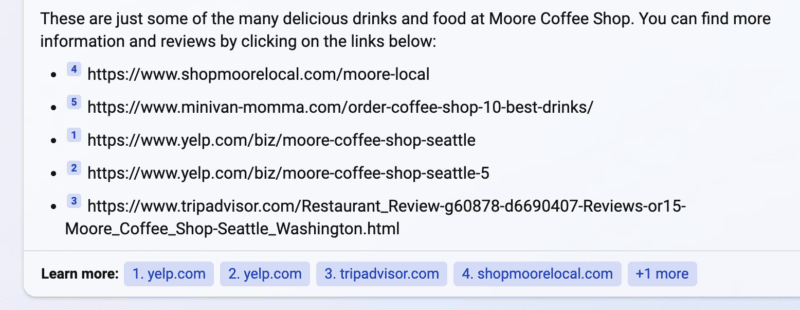
At the bottom of the result, you can either ask another question or click one of the pre-filled prompts. Let’s see if we can get some insight into the best food and drinks at Moore Coffee Shop.

Screen Shot 2023 02 07 At 2.54.41 PM 800x105
Screen Shot 2023 02 07 At 2.57.15 PM 800x499

It looks like Bing got these answers from several sources, including Yelp and Trip Advisor. But it’s helpful, nonetheless. And again, you can’t actually click on any of the links it wants you to.

Screen Shot 2023 02 07 At 2.58.24 PM 800x310

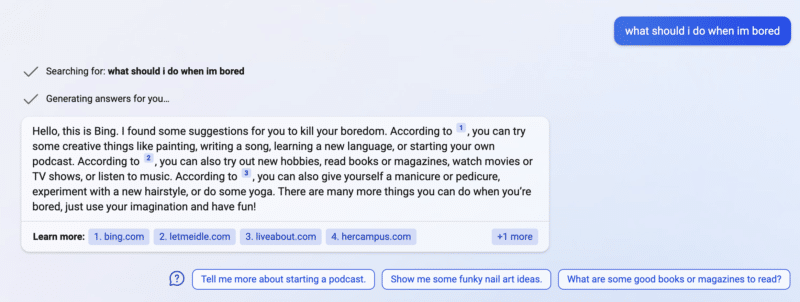
Let’s try another one. I asked Bing what I should do when I’m bored. Though, feeding Bing random prompts isn’t a terrible way to kill time. Here’s what it told me.

Screen Shot 2023 02 07 At 3.00.41 PM 800x302

I could click on one of the pre-filled questions at the bottom, but I’m bored with this example already. So let’s move on.

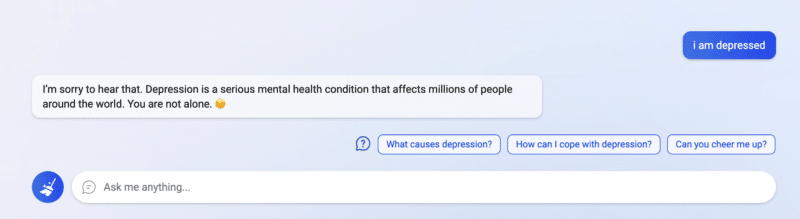
Asking for help. Could ChatGPT be used to ask for help? What resources or answers could it provide if I were mentally or physically unwell?

Screen Shot 2023 02 07 At 3.04.13 PM 800x219

Yikes. But it’s an OK start. Let’s continue.

Screen Shot 2023 02 07 At 3.05.44 PM 800x495

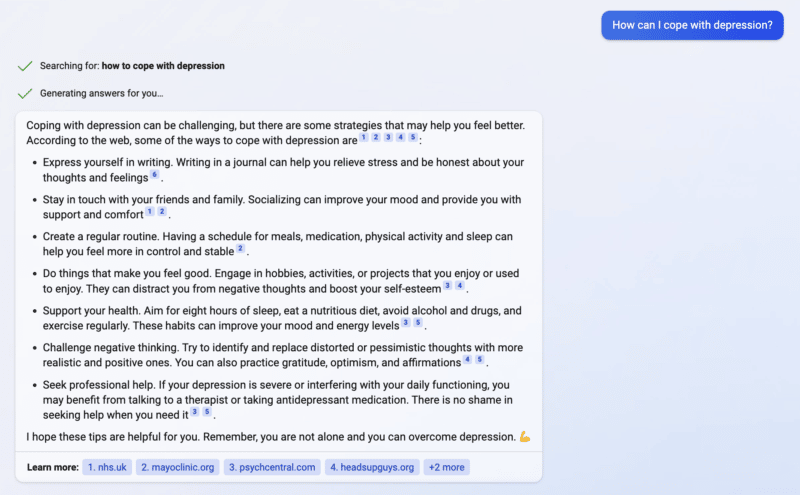
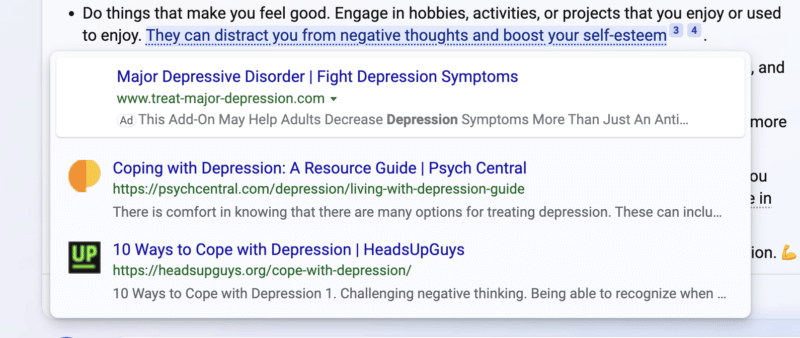
I assumed that the first results that would come up would be hotlines to mental health resources.

The links did direct me to local and non-local centers and articles, and even a few ads. And once I clicked out of the chat and back into the search results, I did see hotline numbers as well as other mental health-related topics.

Screen Shot 2023 02 07 At 3.09.25 PM 800x338

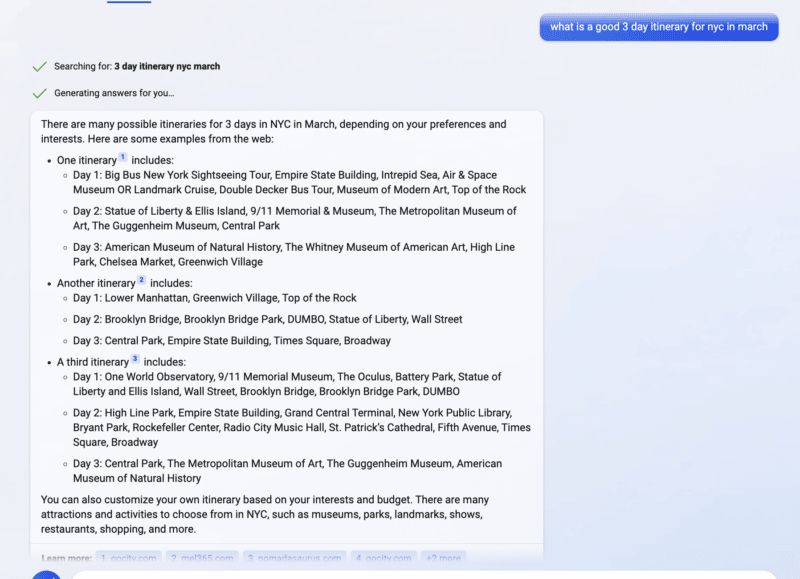
Vacation planning. The last prompt I’ll ask about is vacation planning. I’m visiting NYC for a couple of days next month, and I don’t want to have to do any research. So I’ll ask Bing. “What’s a good 3-day itinerary for NYC in March?”

Screen Shot 2023 02 07 At 3.15.28 PM 800x579

Not bad. But it would have been a much better experience if they had provided direct links to purchase tickets to the suggested activities.

So? All in all, the ChatGPT integration is a fun new feature. Microsoft has a long way to go and there are a few kinks to work out, but I could see myself using this regularly.


Related stories

New on Search Engine Land

@media screen and (min-width: 800px) { #div-gpt-ad-3191538-7 { display: flex !important; justify-content: center !important; align-items: center !important; min-width:770px; min-height:260px; } } @media screen and (min-width: 1279px) { #div-gpt-ad-3191538-7 { display: flex !important; justify-content: center !important; align-items: center !important; min-width:800px!important; min-height:440px!important; } }

About the author

Nicole Farley

Nicole Farley is an editor for Search Engine Land covering all things PPC. In addition to being a Marine Corps veteran, she has an extensive background in digital marketing, an MBA and a penchant for true crime, podcasts, travel, and snacks.

https://searchengineland.com/test-driving-the-new-bing-392841


Missing links: Where are sources in Google’s AI search results?

Google’s introduction of Bard yesterday was huge news.

But perhaps the bigger news for SEOs was the preview of Google’s generative AI search results, which featured a grand total of zero links.

That’s right. Google – a search engine – no longer links to its sources.

You know, websites.

What do you call a search engine that copies mass amounts of content from others to create its own content, without providing any credit (links)?

I believe we still call that a scraper site.

A popular 2014 tweet about Google being a scraper site remains maybe even more relevant today:

As I’ve been digesting all the AI in search results news, the Harvey Dent quote from “The Dark Knight” popped into my mind: “You either die a hero, or you live long enough to see yourself become the villain.”

Now, this isn’t going to be another rant about Google being evil.

However, Google is playing a delicate game here.

Glenn Gabe called this an “act of war against publishers” on Twitter. And he’s not wrong.

For 24 years, Google has provided answers to queries in the form of a list of websites (or in carousels, or some other SERP format).

And over that time, user behavior has changed.

People want instant answers. We don’t always want to wade through 2,500-word articles when a question can be answered in 2-3 sentences or paragraphs. We’ve all complained about having to scroll past the epic backstories that precede nearly all recipe content.

Google has increasingly provided those answers in the form of search features outside of the organic results – knowledge panels, clocks, calculators, sports scores and many more.

The Google backlash got louder with the rise of so-called zero-click searches.

But now we may have zero-link search results. Really?

I remember when Google’s featured snippets made a lot of SEOs mad because they would “steal” traffic from websites. Others were mad before that when Google started showing the current time.

At the time, none of this concerned me. After all, you can’t copyright the time.

If your entire business model was to drive organic traffic from Google to your website just to tell people what time it was, you had a pretty flawed business model.

But here, Google may be entering a dangerous game.

Again, for two decades, websites have fed their content to Google, with the understanding they would get clicks (or at least visibility) out of the deal.

If Google just essentially summarizes (or rewrites, or whatever you want to call it) answers, what separates Google from being a scraper site now?

Or is it just straight up plagiarism?

Google Plagiarism 800x495

Ryan Jones has an interesting Twitter thread, which basically says “no” to this idea. Of note:

  • “None of them directly take text from any specific webpage – and the ideas they present in these examples aren’t things anybody can ‘own’ or ‘copyright.’”

But what happens if publishers and creators stop feeding content to the Google AI machine? What would happen to Google’s multi-billion dollar advertising empire, the majority of which has been built by monetizing search results filled with links to websites?

Today, Microsoft previewed its ChatGPT version of Bing search. It includes plenty of links and citations to the websites where it generated its answers.

Neeva, which in January incorporated generative AI into its search results, has figured out how to link to its sources. So has You.com.

Google needs to do the same.

As Lily Ray put it on Twitter, “Every other search engine figured out how to cite its sources except the one with 90% market share, got it.”


Related stories

New on Search Engine Land

@media screen and (min-width: 800px) { #div-gpt-ad-3191538-7 { display: flex !important; justify-content: center !important; align-items: center !important; min-width:770px; min-height:260px; } } @media screen and (min-width: 1279px) { #div-gpt-ad-3191538-7 { display: flex !important; justify-content: center !important; align-items: center !important; min-width:800px!important; min-height:440px!important; } }

About the author

Danny Goodwin

Danny Goodwin is Managing Editor of Search Engine Land & SMX. In addition to writing daily about SEO, PPC, and more for Search Engine Land, Goodwin also manages Search Engine Land’s roster of subject-matter experts. He also helps program our conference series, SMX – Search Marketing Expo. Prior to joining Search Engine Land, Goodwin was Executive Editor at Search Engine Journal, where he led editorial initiatives for the brand. He also was an editor at Search Engine Watch. He has spoken at many major search conferences and virtual events, and has been sourced for his expertise by a wide range of publications and podcasts.

https://searchengineland.com/missing-links-sources-google-ai-search-results-392826


The new Bing: Microsoft unveils its ChatGPT-like, AI-powered search engine

Microsoft will launch a new, AI-powered search engine that people can chat with, ask questions, or even use to create content.

We learned this today from Yusuf Mehdi, Corporate Vice President & Consumer Chief Marketing Officer, Microsoft today at a special Microsoft press event in Redmond, Wash. I’m live in attendance, along with Search Engine Land editor Nicole Farley to get our first look at the new Bing.

ChatGPT coming to search. A month ago, we reported that Microsoft was planning to add ChatGPT to search. But now it’s been confirmed by Microsoft. Bing will be using a new ChatGPT designed for search.

Microsoft said this version of OpenAI’s ChatGPT is faster, more accurate and customized specifically for search, using GPT-3.5.

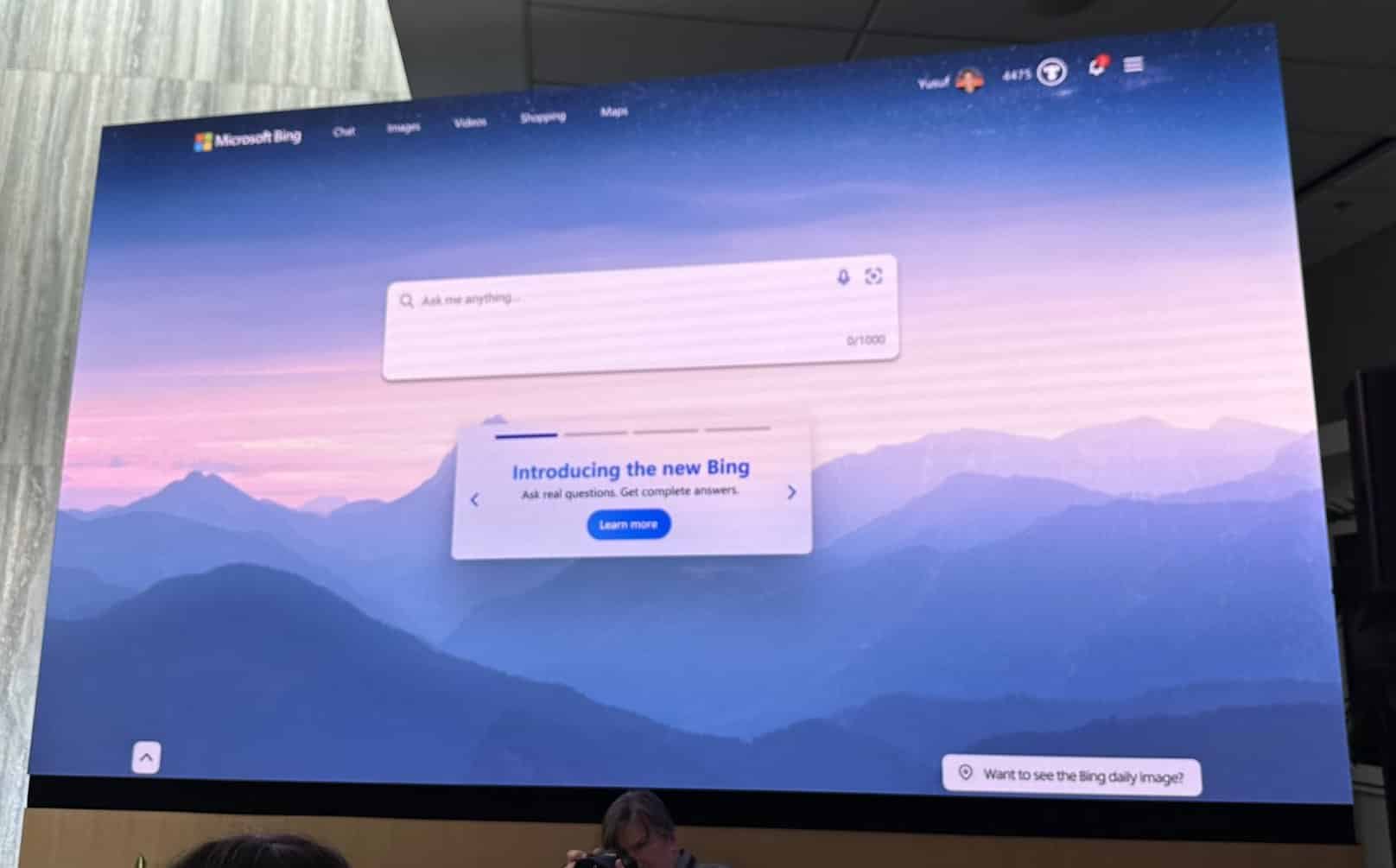
New homepage. We reported on Microsoft Bing’s ChatGPT interface being spotted in the wild, but here is Microsoft officially unveiling the new Bing homepage:

The New Bing 800x498
Introducing the new Bing

With the new homepage, Bing greets searchers with the message “Ask me anything.” Bing tells searchers they can ask questions and get complete answers.

Core search changes. Microsoft also announced new core search index improvements. The company said it applied AI to Bing’s core search ranking engine and the result was a huge improvement in relevancy.

What Bing’s search results look like. Here’s our first look at what the new Bing search results incorporating ChatGPT will look like:

Bing Chatgpt Results Annotations

The results appear on the right side of the search results page and include annotations that cite sources.

It can provide more “real-time” answers, using the Bing index:

Bing Chatgpt Real Time

Microsoft admitted that these results won’t always be perfect, which is why there will be feedback links.

You can also switch between search and chat:

Bing Search Chat Button 800x488

Bing can also create content and inspiration. Here’s what that looks like:

Bing Chat Create Content 800x600

Bing can rewrite code from one language to another. Here’s what that looks like:

Bing Rewrite Code Language 800x476

Prometheus model. Microsoft said it is using its Prometheus model to power these AI integrations. Microsoft said the model helps:

  • Improve relevancy.
  • Annotate answers.
  • Provide up-to-date results.
  • Understand geolocation.
  • Increase safety.

Why we care. Microsoft CEO Satya Nadella opened the event by calling these incredibly exciting times. And he’s right. They are. We are watching AI technology reshape, perhaps even “revolutionize” search. The addition of AI chat to search by Google and Microsoft Bing will have major implications for everyone in search marketing.

Half of people’s searches go unanswered. According to Microsoft:

  • “There are 10 billion search queries a day, but we estimate half of them go unanswered. That’s because people are using search to do things it wasn’t originally designed to do. It’s great for finding a website, but for more complex questions or tasks too often it falls short.”

Some other interesting stats from Microsoft and context on why it’s time for a “new approach” with search:

  • 40% of queries result in someone clicking back.
  • Most searches are three keywords or less.
  • 50,000 people’s searches go unanswered.

Preview. Microsoft said it will be previewing the new Bing today on desktop, where you can do some sample queries and sign-up to get on the waitlist. More people will get the preview in the coming weeks. You can try to gain access yourself at bing.com/new.

Dig deeper. Here’s Bing’s announcement Reinventing search with a new AI-powered Microsoft Bing and Edge, your copilot for the web.

Here’s additional coverage from Search Engine Land:

More in my Twitter thread:


Related stories

New on Search Engine Land

@media screen and (min-width: 800px) { #div-gpt-ad-3191538-7 { display: flex !important; justify-content: center !important; align-items: center !important; min-width:770px; min-height:260px; } } @media screen and (min-width: 1279px) { #div-gpt-ad-3191538-7 { display: flex !important; justify-content: center !important; align-items: center !important; min-width:800px!important; min-height:440px!important; } }

About the author

Barry Schwartz

Barry Schwartz a Contributing Editor to Search Engine Land and a member of the programming team for SMX events. He owns RustyBrick, a NY based web consulting firm. He also runs Search Engine Roundtable, a popular search blog on very advanced SEM topics. Barry can be followed on Twitter here.

https://searchengineland.com/microsoft-bing-search-chatgpt-392789


Mastodon shows declined growth, despite concerns with Twitter

Mastodon was all the craze when Elon Musk took over Twitter, but its growth has not just slowed in the past several weeks but has actually declined. The monthly active users are now at about 1.4 million after reaching 2.5 million users in November 2022.

The growth and decline. Wired published a great chart showing the growth and decline of Mastodon over the past several months.

Wired Mastodon Chart 800x517

Why the decline. That is a good question, and many suspect that Mastodon, being a decentralized platform, is just too hard for the normal user to set up and use. Sure, there is a pretty active SEO community on Mastodon, but even that community seems to be less active today than it was a month or two ago.

The truth is, once you set it up and start using it, it is not hard to use. You just need to know how to find people on the platform, and the best way might be hashtags.

However, most users want to lurk and follow their favorite personalities on a platform. Finding people on Mastodon is hard, very hard, and you first need to find out what server that user is on and then search for that person’s username and server name. It is confusing and frustrating for the average user.

Why we care. Participating in social networks is time-consuming, and if you are active on those networks, you want to see a return on your investment. Maybe that return is friendship, and maybe it is engagement, maybe it is views on your content, maybe revenue or maybe something else.

If the people have a hard time finding you on a network and your reach is limited, is it worth investing your time on that platform? Seems like recent data says no.


Related stories

New on Search Engine Land

@media screen and (min-width: 800px) { #div-gpt-ad-3191538-7 { display: flex !important; justify-content: center !important; align-items: center !important; min-width:770px; min-height:260px; } } @media screen and (min-width: 1279px) { #div-gpt-ad-3191538-7 { display: flex !important; justify-content: center !important; align-items: center !important; min-width:800px!important; min-height:440px!important; } }

About the author

Barry Schwartz

Barry Schwartz a Contributing Editor to Search Engine Land and a member of the programming team for SMX events. He owns RustyBrick, a NY based web consulting firm. He also runs Search Engine Roundtable, a popular search blog on very advanced SEM topics. Barry can be followed on Twitter here.

https://searchengineland.com/mastodon-shows-declined-growth-despite-concerns-with-twitter-392787


Understanding and resolving ‘Discovered – currently not indexed’

If you see “Discovered – currently not indexed” in Google Search Console, it means Google is aware of the URL, but hasn’t crawled and indexed it yet. 

It doesn’t necessarily mean the page will never be processed. As their documentation says, they may come back to it later without any extra effort on your part. 

But other factors could be preventing Google from crawling and indexing the page, including:

  • Server issues and onsite technical issues restricting or preventing Google’s crawl capability.
  • Issues relating to the page itself, such as quality.

You can also use Google Search Console Inspection API to queue URLs for their coverageState status (as well as other useful data points) en masse.

Request indexing via Google Search Console

This is an obvious resolution and for the majority of cases, it will resolve the issue.

Sometimes, Google is simply slow to crawl new URLs – it happens. But other times, underlying issues are the culprit. 

When you request indexing, one of two things might happen:

  • URL becomes “Crawled – currently not indexed”
  • Temporary indexing

Both are symptoms of underlying issues. 

The second happens because requesting indexing sometimes gives your URL a temporary “freshness boost” which can take the URL above the requisite quality threshold and, in turn, lead to temporary indexing.


Get the daily newsletter search marketers rely on.


Page quality issues

This is where vocabulary can get confusing. I’ve been asked, “How can Google determine the page quality if it hasn’t been crawled yet?”

This is a good question, and the answer is that it can’t.

Google is making an assumption about the page’s quality based on other pages on the domain. Their classifications are likewise based on URL patterns and website architecture.

As a result, moving these pages from “awareness” to the crawl queue can be de-prioritized based on the lack of quality they have found on similar pages. 

It’s possible that pages on similar URL patterns or those located in similar areas of the site architecture have a low-value proposition compared to other pieces of content targeting the same user intents and keywords.

Possible causes include:

  • The main content depth.
  • Presentation. 
  • Level of supporting content.
  • Uniqueness of the content and perspectives offered.
  • Or even more manipulative issues (i.e., the content is low quality and auto-generated, spun, or directly duplicates already established content).

Working on improving the content quality within the site cluster and the specific pages can have a positive impact on reigniting Google’s interest in crawling your content with greater purpose.

You can also noindex other pages on the website that you acknowledge aren’t of the highest quality to improve the ratio of good-quality pages to bad-quality pages on the site.

Crawl budget and efficiency

Crawl budget is an often misunderstood mechanism in SEO. 

The majority of websites don’t need to worry about this. In fact, Google’s Gary Illyes has gone on the record claiming that probably 90% of websites don’t need to think about crawl budget. It is often regarded as a problem for enterprise websites.

Crawl efficiency, on the other hand, can affect websites of all sizes. Overlooked, it can lead to issues on how Google crawls and processes the website.

To illustrate, if your website: 

  • Duplicates URLs with parameters.
  • Resolves with and without trailing slashes.
  • Is available on HTTP and HTTPS.
  • Serves content from multiple subdomains (e.g., https://website.com and https://www.website.com).

…then you might be having duplication issues that impact Google’s assumptions on crawl priority based on wider site assumptions.

You might be zapping Google’s crawl budget with unnecessary URLs and requests. Given that Googlebot crawls websites in portions, this can lead to Google’s resources not stretching far enough to discover all newly published URLs as fast as you would like.

You want to crawl your website regularly, and ensure that:

  • Pages resolve to a single subdomain (as desired).
  • Pages resolve to a single HTTP protocol.
  • URLs with parameters are canonicalized to the root (as desired).
  • Internal links don’t use redirects unnecessarily.

If your website utilizes parameters, such as ecommerce product filters, you can curb the crawling of these URI paths by disallowing them in the robots.txt file.

Your server can also be important in how Google allocates the budget to crawl your website.

If your server is overloaded and responding too slowly, crawling issues may arise. In this case, Googlebot won’t be able to access the page resulting in some of your content not getting crawled. 

Consequently, Google will try to come back later to index the website, but it will no doubt cause a delay in the whole process.

Internal linking

When you have a website, it’s important to have internal links from one page to another. 

Google usually pays less attention to URLs that don’t have any or enough internal links – and may even exclude them from its index.

You can check the number of internal links to pages through crawlers like Screaming Frog and Sitebulb.

Having an organized and logical website structure with internal links is the best way to go when it comes to optimizing your website. 

But if you have trouble with this, one way to make sure all of your internal pages are connected is to “hack” into the crawl depth using HTML sitemaps. 

These are designed for users, not machines. Although they may be seen as relics now, they can still be useful.

Additionally, if your website has many URLs, it’s wise to split them up among multiple pages. You don’t want them all linked from a single page.

Internal links also need to use the <a> tag for internal links instead of relying on JavaScript functions such as onClick(). 

If you’re utilizing a Jamstack or JavaScript framework, investigate how it or any related libraries handle internal links. These must be presented as <a> tags.


Opinions expressed in this article are those of the guest author and not necessarily Search Engine Land. Staff authors are listed here.


Related stories

New on Search Engine Land

@media screen and (min-width: 800px) { #div-gpt-ad-3191538-7 { display: flex !important; justify-content: center !important; align-items: center !important; min-width:770px; min-height:260px; } } @media screen and (min-width: 1279px) { #div-gpt-ad-3191538-7 { display: flex !important; justify-content: center !important; align-items: center !important; min-width:800px!important; min-height:440px!important; } }

About the author

Dan Taylor

Dan Taylor is head of technical SEO at SALT.agency, a UK-based technical SEO specialist and winner of the 2022 Queens Award. Dan works with and oversees a team working with companies ranging from technology and SaaS companies to enterprise e-commerce.

https://searchengineland.com/understanding-resolving-discovered-currently-not-indexed-392659


Google Search podcast carousel going away on February 13

Google will be removing the podcast carousel fully from Google Search on February 13, 2023. There is a notice in the Google Podcast Manager about the podcast carousel going away.

The notice. The notice reads, “Note: Google Search will stop showing podcast carousels by February 13. As a result, clicks and impressions in How people find your show will drop to zero after that date.”

Here is a screenshot:

Google Podcst Manager Notice 800x248

Didn’t it already go away. A few weeks ago, a bunch of SEOs who manage popular podcasts or like to consume podcasts, noticed that the podcast carousel was gone from the Google Search results. I guess it is not 100% gone until February 13th.

Reaction. Here is some of the reaction around this feature going away:

Why we care. If you manage a podcast and that podcast you may see less impressions and clicks on your episodes from Google Search. You should also consider downloading your historical data, just in case Google removes that data over time.


Related stories

New on Search Engine Land

@media screen and (min-width: 800px) { #div-gpt-ad-3191538-7 { display: flex !important; justify-content: center !important; align-items: center !important; min-width:770px; min-height:260px; } } @media screen and (min-width: 1279px) { #div-gpt-ad-3191538-7 { display: flex !important; justify-content: center !important; align-items: center !important; min-width:800px!important; min-height:440px!important; } }

About the author

Barry Schwartz

Barry Schwartz a Contributing Editor to Search Engine Land and a member of the programming team for SMX events. He owns RustyBrick, a NY based web consulting firm. He also runs Search Engine Roundtable, a popular search blog on very advanced SEM topics. Barry can be followed on Twitter here.

https://searchengineland.com/google-search-podcast-carousel-going-away-on-february-13-392784


This day in search marketing history: February 7

Noogler: SEO is spam, ads help you rank

In 2012, a Googler made headlines when he said “SEO isn’t good for users or the Internet at large,” and “It’s a bug that you could rank highly in Google without buying ads, and Google is trying to fix the bug.”

Was it Matt Cutts, John Mueller, or another prominent Googler who said this? No. It was actually a Noogler (or new Googler).

So did this this new employee slip up and reveal what Google really thinks? No. Far more likely, he simply didn’t know what he was talking about.

Google didn’t view SEO as spam. As for ads, Google said: “As always, Google search rankings are completely unrelated to Google’s paid advertising services and other partnerships, and there is absolutely no way for a webmaster to pay money to increase search rankings.”

Read all about it in Google Clarifies: No, Ads Shouldn’t Help Rankings & No, SEO Isn’t Bad.

And yet, more than a decade later, these SEO myths persist.


Also on this day


Google says Shopify sites are in a good crawling state after reports of stalled crawling

2022: Google’s John Mueller said the issue was related to a “temporary drop in how we calculate how much we can crawl,” implying there was no issue with the Shopify sites.


Google tests Buying Guides in mobile search results

2022: It presented users with various drop-down menu options to learn more about the product they were searching for.


Google Search Console performance reports data issue may impact analytics

2022: It impacted Google Search, Google Discover, and Google News data.


Google Posts being rejected because of non-compliance with image guidelines

2020: It seemed like maybe Google didn’t want users to use stock photos.


Google adds Siri Shortcuts to its iOS apps

2020: Users could take actions within the corresponding Google app through Siri by saying trigger phrases, such as “search with Google.”


Clicks plummet when images, article info stripped from news results in SERP

2019: Google sought to show potential ‘unintended consequences’ of new copyright rules that require fees when content is shown in search results.


Google Search Console goes live with new consolidated view

2019: Google made a preview of the consolidated data view live early.


Bing to publishers: Start using new Bing URL submission process for indexing now

2019: Bing wanted to reduce the effort and resources put into crawling the web.


Google begins enforcing certification process for event ticket resellers on AdWords

2018: Ticket resellers were now included among the list of restricted advertisers on AdWords and had to be certified by Google before they could advertise.


Google now wants larger images for AMP articles

2018: The new minimum requirement was 1,200 pixels wide and 800,000 pixels in total.


AdWords Express launches notifications for calls from search ads

2018: Advertisers could rate calls and be notified of missed calls.


Google adds new features & improves navigation for mobile hotel & flight searches

2018: Google rolled out tabs that let users switch between hotel, flight and trip details.


Bing rejected 130M ads in 2016, including 17M tech support scam ads

2017: Advertisers attempting Phishing attacks and pushing counterfeit goods continued to try to evade detection.


Suspected Paid-Link Penalty Hasn’t Hit Expedia Bottom Line — Yet

2014: Said Expedia: “Our traffic from Google, both on a paid and an organic basis, continues to increase on a year-on-year basis.”


Google Now Adds Google Now “Launcher,” Video On Demand Providers, Airbnb Reservations & More

2014: Google rolled out several enhancements to Google search app for Android, bolstering Google Now features on the Nexus 5 and some other devices.


YP Wants To Compete Directly With Google And Yelp In Local

2014: New CMO planned to focus on personalization, more content depth and multi-platform experiences.


Google Now Ranks No. 2 Behind Apple As The 2nd Most Valuable Company In America

2014: As the world’s largest online advertiser, Google’s rise was a reflection of the technology industry taking a larger role globally.


Bing Teams Up With The Hollywood Reporter In Anticipation Of The Oscars

2014: To create the “ultimate Oscars resource guide.”


Search In Pics: Golden Tate With Glass At Super Bowl, Google Indoor Clouds & Android Socks

2014: The latest images showing what people eat at the search engine companies, how they play, who they meet, where they speak, what toys they have, and more.


Google’s Enhanced Campaigns Inspire Love, Hate And Hope For The Next Version

2013: Thoughts from marketers about what they liked, what they didn’t like, what needed to be done, and what they wanted to see in future releases.


Sudden Change In The Number Of Links Reporting In Google Webmaster? Don’t Panic.

2013: It was a bug. Google said it was working on it.


Twitter Search Lets You Once Again Find Old Tweets

2013: Twitter said that some older tweets were going to be available.


Google Still #1 Traffic Source For Most Of Top 30 Websites — Report

2012: Google ranked as the number one source of traffic for 23 of the top 30 websites. 


Did Super Bowl Advertisers Take Advantage of Search Interest?

2012: Brands did a much better job of keeping things simple and driving viewers to interesting, relevant pages that engaged them.


Google: 41 Percent Of Super Bowl Ad Searches Were Mobile

2012: Super Bowl ad-related searches in the US rose 200% on desktop, 970% on tablets and 2,700% on smartphones.


New: Google Sitelinks With Small Arrows

2012: Google confirmed rolling out a new look for their one-line sitelinks.


Wolfram|Alpha Goes Pro With Powerful Data Analysis & Presentation Tools

2012: It included the ability to analyze your own datasets.


Google Webmaster Tools and Google Analytics: The Beginning Of A Useful Integration?

2011: The verification page of Google Webmaster Tools included a link to Google Analytics option for all verified sites.


Google Instant Now On Product Search

2011: Google added Google Instant to Google Shopping Search view within the web results.


Google To EU: We’re Always Open To Algorithm Suggestions

2011: Google CEO Eric Schmidt said that “Google could be willing to change some of its algorithm methodology in search,” to avoid potential fines or other penalties.


Scoring the 2011 Super Bowl Commercials For Search Visibility and Visitor Engagement

2011: 100% of brands had at least some search visibility. But many brands didn’t include mention the Super Bowl ads at all on their home pages.


Instant Replay: Where To Find The Super Bowl Ads

2011: Four good sites that made it easy to find and watch them.


PSAs To Be Phased Out Of AdSense

2011: Publishers running AdSense would see fewer public service announcement banners on their sites.


Google I/O Conference 2011 Sells Out In 59 Minutes

2011: It took 90 days and 50 days in 2009 and 2010, respectively, for the event to sellout.


Google’s Egypt Executive, Wael Ghonim, Should Be Released From Egyptian Custody Now

2011: He had been detained by the Egyptian government during protests.


Blekko: Actually We Have A Million Slashtags

2011: If Facebook-generated “/likes” were included the “slashtag count” rose to over a million.


Twitter Study: Mainstream News Are Carbs, Blogs Are Protein For Your Marketing

2011: Bloggers had more influence than mainstream publications in areas such as technology and entertainment.


Google Airs TV Ad During Super Bowl – But Why?

2010: The “Parisian Love” commercial had 1.2 million views on YouTube before it ran during the Super Bowl. 


Searching for the Superbowl Start Time: How Are The Engines, the NFL, and CBS Doing?

2010: The NFL, CBS, and the search engines didn’t do a great job at connecting with searchers who wanted to know what time the game started.


Google News’ New Local Angle

2008: New capabilities allowed users to “create a local section for any city, state or country in the world.”


Microsoft Live Search Core Relevance Program Management Director Eytan Seidman Moves On

2008: The core relevance team that Eytan managed included crawling, indexing, and ranking for Live Search.


Microsoft Acquires 3-D Modeling Software Company Caligari

2008: The group would be a part of the Virtual Earth team, but the software equally used for gaming and game development.


If You Like Digg, You’ll Love Ask’s Big News

2008: Ask embraced the social media tenet that you need others to tell you how important a news story is, with its new “BigFactor” ratings.


January 2008: Search Engine Land’s Most Popular Stories

2008: Search Engine Land’s 10 most popular stories from January 2008.


Rand Fishkin’s Belated SuperBowl Proposal Gets A Yes

2007: Instead of a Super Bowl ad, he popped the question during a “Veronica Mars” commercial.


Google Maps Australia Turns 30 Second Walk Into 18 Minutes Drive

2007: Searching for directions from Shelbourne Hotel to Google’s own Sydney office across the street took you over a toll bridge and back.


Gmail Now Public Beta, Open To All

2007: You no longer needed an invite or SMS code to gain access to your own Gmail account.


Google To Roll Out Fee-Based Google Apps?

2007: Once it was free for companies to adopt Google’s office applications.


Google Sends Mr. Schmidt To Washington

2007: Schmidt lobbied for many things in his talk, including a bill to remove taxes on internet access and e-commerce, net neutrality and government initiatives to help small businesses with technology. 


Live Search SOAP API Out Of Beta

2007: They also added some new features including more languages, increased search results, enhanced search tags, more local options, improved phone results and more coding samples.


Yahoo Adds Featured Search Builder Sites Box

2007: Yahoo added a box to the home page in order to promote user-generated search sites. 


Kudos To National Pork Board For Apologies & Fundraising Efforts

2007: A search marketer and breastfeeding activist received two letters of apology, plus the National Pork Board backed a fundraising campaign for the Mother’s Milk Bank Of Ohio.


Searching For “The Next Google”

2007: A look at search-related demonstrations from the DEMO conference.


Searchforvideo Upgrades Design, Capabilities

2007: Viewers were presented with brand name content channels and hundreds of video partners were added to its search index.


SideStep Raises $15 Million

2007: SideStep had its eye on more acquisitions.


From Search Marketing Expo (SMX)


Past contributions from Search Engine Land’s Subject Matter Experts (SMEs)

These columns are a snapshot in time and have not been updated since publishing, unless noted. Opinions expressed in these articles are those of the author and not necessarily Search Engine Land.


< February 6 | Search Marketing History | February 8 >


Related stories

New on Search Engine Land

@media screen and (min-width: 800px) { #div-gpt-ad-3191538-7 { display: flex !important; justify-content: center !important; align-items: center !important; min-width:770px; min-height:260px; } } @media screen and (min-width: 1279px) { #div-gpt-ad-3191538-7 { display: flex !important; justify-content: center !important; align-items: center !important; min-width:800px!important; min-height:440px!important; } }

About the author

Danny Goodwin

Danny Goodwin is Managing Editor of Search Engine Land & SMX. In addition to writing daily about SEO, PPC, and more for Search Engine Land, Goodwin also manages Search Engine Land’s roster of subject-matter experts. He also helps program our conference series, SMX – Search Marketing Expo. Prior to joining Search Engine Land, Goodwin was Executive Editor at Search Engine Journal, where he led editorial initiatives for the brand. He also was an editor at Search Engine Watch. He has spoken at many major search conferences and virtual events, and has been sourced for his expertise by a wide range of publications and podcasts.

https://searchengineland.com/search-marketing-history-february-7-392777


Google launches Bard, its answer to ChatGPT – here’s what it looks like

Google is now testing Bard, its answer to OpenAI’s ChatGPT. We also have gotten our first look at AI-powered features in Google Search.

Google CEO Sundar Pichai today announced the soft launch of Bard to a set “trusted testers,” showcasing what this early experimental release looks like with some examples.

We knew this was coming because Pichai mentioned it on the latest Google earnings call.

Let’s first start with what ChatGPT-style AI will look like in Google Search – because that’s what everyone has been waiting to see.

Here is a screenshot Google provided. It shows how Googe Search uses AI to respond to long queries with a long AI-created response:

Google Bard Search 600x600

This screenshot gives you an idea of how Google could soon integrate AI-generated answers directly into Google Search.

Pichai wrote:

“Soon, you’ll see AI-powered features in Search that distill complex information and multiple perspectives into easy-to-digest formats, so you can quickly understand the big picture and learn more from the web: whether that’s seeking out additional perspectives, like blogs from people who play both piano and guitar, or going deeper on a related topic, like steps to get started as a beginner.”

And to be clear: Bard is separate from Google search. The above screenshot is highlighting the AI-powered features that will be rolling out on Google Search “soon.”

What Bard looks like

Here is another screenshot from Google showing how Bard, its standalone ChatGPT-style service, might respond to a question:

Google Bard Answer 800x448
“what new discoveries from the James Webb Space Telescope can I tell my 9 year old about?”

In this case, Bard is explaining new discoveries from NASA’s James Webb Space Telescope to a 9-year-old.

As you can see, there is no one right answer to this question.

What is Google Bard?

Google explains that Bard is an experimental conversational AI service, powered by LaMDA (Language Model for Dialogue Applications).

LaMDA was announced two years ago, at the 2021 Google I/O keynote, as Google’s next-generation language and conversation capabilities. It is now being used to create these answers for users.

Bard is powered by a lightweight model version of LaMDA, which requires “significantly less computing power,” Google said. Google said this will allow them to scale to more users while also allowing for more feedback.

Pichai also wrote:

“Bard seeks to combine the breadth of the world’s knowledge with the power, intelligence, and creativity of our large language models. It draws on information from the web to provide fresh, high-quality responses. Bard can be an outlet for creativity, and a launchpad for curiosity, helping you to explain new discoveries from NASA’s James Webb Space Telescope to a 9-year-old, or learn more about the best strikers in football right now, and then get drills to build your skills.”

Bard is experimental

Google emphasized that Bard is experimental and they are excited for this “phase of testing to help us continue to learn and improve Bard’s quality and speed.”

Who are trusted testers?

Google told us they are not the Search Quality Raters. Instead, they are a demographically and geographically diverse group of people external to Google.

These testers test Google’s products to help Google improve and understand how real users are likely to experience these products. Google said they work with a third-party supplier to provide this testing.

It is unclear how you or I can test out Bard before it launches more widely.

Attribution and citations

I asked Google how it plans to provide attribution and/or citations for its answers, either from Bard or in search results. Google did not have an immediate comment at the time this was published.

Why we care

It is fascinating to see how search and AI companies are adding human-like question-and-answer responses. With Bard, Google seems to be taking a similar approach to ChatGPT thus far, but it is early and I expect the user experience and interfaces will evolve rapidly.

How Google may handle attribution and citation – especially in search – is an interesting topic as well. Google has used AI to write knowledge panels for years, which is why Google does not always show attribution for some knowledge panels.

Earlier reports

Earlier this week, we reported Google had started work on its own version of ChatGPT, named Apprentice Bard, as well as testing a new search design integrating chat:

When a question is entered, the search results show a gray bubble directly under the search bar, offering more human-like responses than typical search results. Directly beneath that, the page suggests several follow-up questions related to the first one. Under that, it shows typical search results, including links and headlines.

Here’s how Google responded to the report:

“We have long been focused on developing and deploying AI to improve people’s lives. We believe that AI is foundational and transformative technology that is incredibly useful for individuals, businesses and communities, and as our AI Principles outline, we need to consider the broader societal impacts these innovations can have. We continue to test our AI technology internally to make sure it’s helpful and safe, and we look forward to sharing more experiences externally soon.”

What about Microsoft and ChatGPT?

Meanwhile, Microsoft has invested heavily in OpenAI, the creator of ChatGPT. Microsoft is rumored to be bringing GPT-4 to Bing search in some way in the near future. And we have already seen early screenshots of Bing’s interface with ChatGPT-style integrated into search.

Many companies, especially those in search, are taking these technologies seriously after the explosive popularity of OpenAI’s ChatGPT.


Related stories

New on Search Engine Land

@media screen and (min-width: 800px) { #div-gpt-ad-3191538-7 { display: flex !important; justify-content: center !important; align-items: center !important; min-width:770px; min-height:260px; } } @media screen and (min-width: 1279px) { #div-gpt-ad-3191538-7 { display: flex !important; justify-content: center !important; align-items: center !important; min-width:800px!important; min-height:440px!important; } }

About the author

Barry Schwartz

Barry Schwartz a Contributing Editor to Search Engine Land and a member of the programming team for SMX events. He owns RustyBrick, a NY based web consulting firm. He also runs Search Engine Roundtable, a popular search blog on very advanced SEM topics. Barry can be followed on Twitter here.

https://searchengineland.com/google-launches-bard-its-answer-to-chatgpt-to-trusted-testers-here-is-what-it-looks-like-392729