Sundar Pichai confirms Google is working on AI search feature users can “engage directly with”

Google announced its Q4 earnings just hours ago, more on those numbers later, but Sundar Pichai, the CEO of Google, confirmed in the earnings call the search company’s plans to bring AI-like search features that “people can engage directly with.”

Sundar Pichai said, “In the coming weeks and months, we’ll make these language models available, starting with LaMDA, so that people can engage directly with them. This will help us continue to get feedback, test, and safely improve them. These models are particularly amazing for composing, constructing, and summarizing. They will become even more useful for people as they provide up-to-date more factual information.”

Sundar Pichai said that he “first spoke about Google being an AI-first company” more than “six years ago.” “We have been preparing for this moment since early last year, and you’re going to see a lot from us in the coming few months across three big areas of opportunity; first, large models. We published extensively about LaMDA and PoN, the industry’s largest, most sophisticated model plus extensive work at DeepMind,” he continued to say.

During the question and answer period, Sundar added “We’ll be launching — we’ll — more as labs products in certain cases, beta features in certain cases and just slowly scaling up from there. Obviously, we need to make sure we’re iterating in public, these models will keep getting better, so the field is fast changing. The serving costs will need to be improved.”

“So I view it as very, very early days, but we are committed to putting our experiences, both in terms of new products and experiences, actually bringing direct LLM experiences in Search, making APIs available for developers and enterprises and learn from there and iterate like we’ve always done. So I’m looking forward to it,” he added.

Sundar goes on to add, “In terms of Search too, now that we can integrate more direct LLM type experiences in Search, I think it will help us expand and serve new types of use cases, generative use cases. And so I think I see this as a chance to rethink and re-imagine and drive Search to solve more use cases for our users as well. So again, early days, you will see us be bold, put things out, get feedback and iterate and make things better.”

Earlier reports. Earlier this week, we reported Google is rumored to have started on its own version named Apprentice Bard. CNBC reported,

When a question is entered, the search results show a gray bubble directly under the search bar, offering more human-like responses than typical search results. Directly beneath that, the page suggests several follow-up questions related to the first one. Under that, it shows typical search results, including links and headlines.

Google responded:

“We have long been focused on developing and deploying AI to improve people’s lives. We believe that AI is foundational and transformative technology that is incredibly useful for individuals, businesses and communities, and as our AI Principles outline, we need to consider the broader societal impacts these innovations can have. We continue to test our AI technology internally to make sure it’s helpful and safe, and we look forward to sharing more experiences externally soon.”

Microsoft. Meanwhile, Microsoft invested heavily in OpenAI, the creators of ChatGPT. Microsoft is rumored to be bringing GPT-4 to Bing search in some way in the very near future. Many companies, especially those in search, are taking these technologies very seriously after the explosion OpenAI made with the debut of ChatGPT.

Why we care. We don’t know yet how Google or Bing would incorporate these Q&A style AI features into search. But we all know it is an important space to keep an eye on to see how marketers can leverage it for their brands and how they use utilize these features to better connect with their customers and users.


Related stories

New on Search Engine Land

@media screen and (min-width: 800px) { #div-gpt-ad-3191538-7 { display: flex !important; justify-content: center !important; align-items: center !important; min-width:770px; min-height:260px; } } @media screen and (min-width: 1279px) { #div-gpt-ad-3191538-7 { display: flex !important; justify-content: center !important; align-items: center !important; min-width:800px!important; min-height:440px!important; } }

About the author

Barry Schwartz

Barry Schwartz a Contributing Editor to Search Engine Land and a member of the programming team for SMX events. He owns RustyBrick, a NY based web consulting firm. He also runs Search Engine Roundtable, a popular search blog on very advanced SEM topics. Barry can be followed on Twitter here.

https://searchengineland.com/sundar-pichai-confirms-google-is-working-on-ai-search-feature-users-can-engage-directly-with-392628


Google’s search quality raters protest for higher pay

Dozens of Google’s raters, seeking raises and access to benefits, rallied at the Googleplex in Mountain View yesterday, with the goal of putting an end to “poverty wages.”

Why we care. Google has said it uses as many as 16,000 raters – and about 5,000 are based in the U.S. As a group, Google’s human raters help ensure the helpfulness, quality and relevance of search results by identifying potentially harmful results, spam, outdated information and all the other elements that go into what is now known as E-E-A-T. 

Protest in Mountain View. The goal was to deliver a petition, signed by more than 600 workers, to Google SVP Prabhakar Raghavan (who is responsible for Google’s Search, Assistant, Geo, Ads, Commerce, and Payments products). 

They wanted Raghavan to meet and negotiate with the workers. The group, however, was stopped by security, according to KPIX, a CBS-owned Bay Area news channel.

Alphabet Workers Union tweets about the protest. In a Twitter thread, the Alphabet Workers Union laid out their case for the raters, noting they are “responsible for training, testing & evaluating search algorithms. Their work makes Google billions while they get paid pennies.”

The group noted that Google’s raters can’t get benefits, such as health insurance, paid sick leave or parental leave.

Raters provide an invisible service to Google, rating the quality of Google search & Google ads—products that make billions for the company. 

Yet, Google has denied these workers access to the company’s own “minimum standard” of pay and benefits for “extended workforce workers.”

– @AlphabetWorkers

Raises for raters? At least some of Google’s raters reportedly were given a raise this year. 

Historically, we know U.S.-based raters (who are actually employed through subcontractors) were paid as little as $10 an hour up to $14.50, which is lower than the $15 an hour minimum Google pays to its TVCs (temporary, vendor and contractor staff). (For additional context, California’s minimum wage is $15.50 per hour and the U.S. minimum wage is $7.25 per hour.)

“We’re Google’s lowest-paid workers,” Michelle Curtis, one of Google’s quality raters, told MarketWatch in an interview. “But we play a vital role in its growing source of revenue.”

However, in an interview with Search Engine Land in 2012, we learned that one quality rater was making $14.50 per hour. That means that this most recent “raise” for today’s raters merely put them back to the same pay level some raters were earning over a decade ago. 

The bigger picture. The protest comes not long after Alphabet, Google’s parent company, announced 12,000 layoffs that impacted employees and contractors. 

However, those layoffs followed a two-year period of massive hiring, as Google’s headcount went from 119,000 employees in 2019, to 150,000 by the end of 2021. As of September 2022, Alphabet had 187,000 employees.

Dig deeper. Google ‘rater’ contract workers rally at Mountain View headquarters to demand higher pay by Kelsi Thorud.


Related stories

New on Search Engine Land

@media screen and (min-width: 800px) { #div-gpt-ad-3191538-7 { display: flex !important; justify-content: center !important; align-items: center !important; min-width:770px; min-height:260px; } } @media screen and (min-width: 1279px) { #div-gpt-ad-3191538-7 { display: flex !important; justify-content: center !important; align-items: center !important; min-width:800px!important; min-height:440px!important; } }

About the author

Danny Goodwin

Danny Goodwin is Managing Editor of Search Engine Land & SMX. In addition to writing daily about SEO, PPC, and more for Search Engine Land, Goodwin also manages Search Engine Land’s roster of subject-matter experts. He also helps program our conference series, SMX – Search Marketing Expo. Prior to joining Search Engine Land, Goodwin was Executive Editor at Search Engine Journal, where he led editorial initiatives for the brand. He also was an editor at Search Engine Watch. He has spoken at many major search conferences and virtual events, and has been sourced for his expertise by a wide range of publications and podcasts.

https://searchengineland.com/googles-search-quality-raters-protest-for-higher-pay-392597


Why SEO should be a product

I’ll just come right out and say it…

SEO should be a product because it is an acquisition channel for organic traffic and revenue. 

SEO as a product largely means the business:

  • Understands it operates in a digital-first world.
  • Makes an effort for its digital properties (website, app, etc.) to be SEO-friendly.

This way, when prospective customers are searching online using their devices, looking up through an app or initiating a voice search, the subsequent digital properties are discoverable. 

In a nutshell, product management is a discipline of solving problems leading with customer empathy. While search engine optimization (SEO) is the ever-evolving, broader consideration of being discoverable to customers who are using connected devices to find information, products or services.

There are increasingly more places for humans to “search” outside traditional search engines like Google, DuckDuckGo, Baidu or Microsoft Bing. Prospects can start their product search on Amazon or use YouTube if it’s a visual search.

All this is based on intent – what does the customer want?

To clarify, this article is not about optimizing product detail pages for SEO.

Instead, it examines the bigger picture of dedicating product resources to growing organic traffic and revenue and why SEO should be considered a product by businesses. 

SEO as a product: What does that mean?

Let’s quickly set the stage to highlight the fact that this is a relatively new concept. 

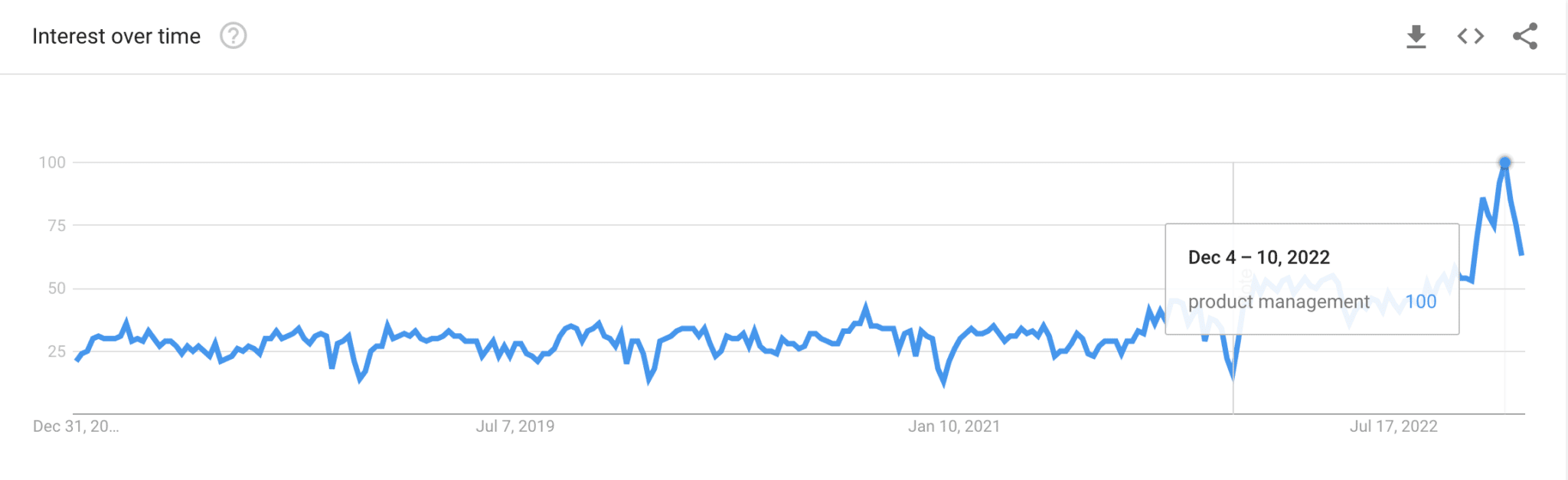
A Google Trends search for “product management” shows the interest over time has begun to peak more recently in December 2022. 

Google Trends - "product management"

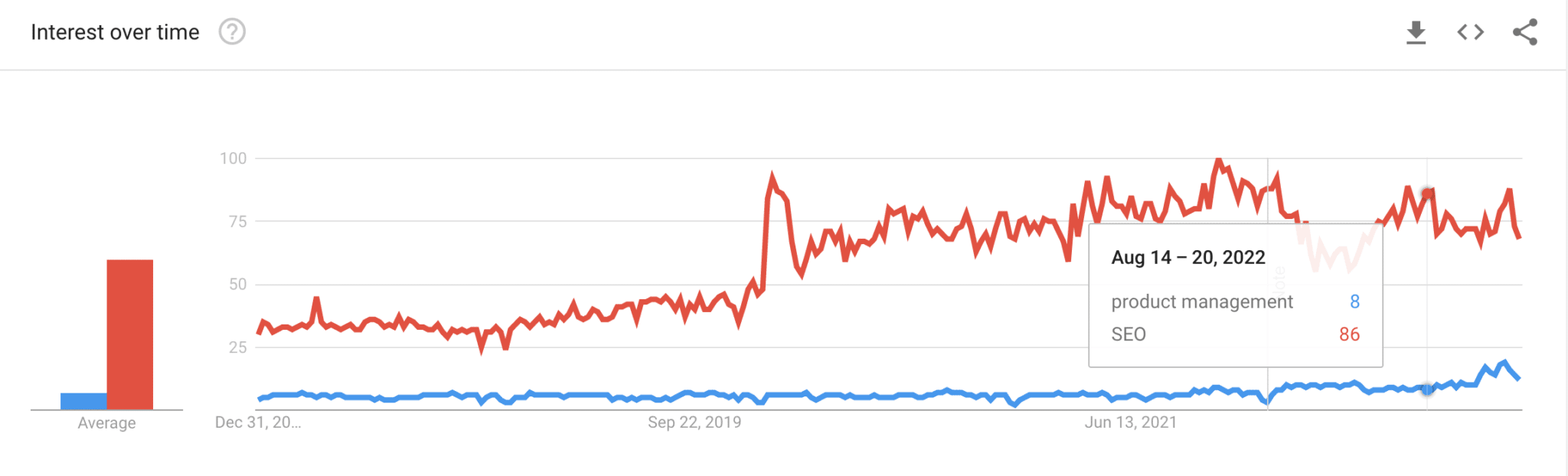
By contrast, the search term “SEO” shows a healthy interest over time. 

Google Trends - "SEO" vs. "product management"

The parallel is, SEO has existed (and continues to evolve) for more than a decade. Whereas product management has just begun to pick up steam. It will take time for the role of an SEO product manager to become more prevalent. 

More importantly, what also needs to evolve is how organizations operationalize their SEO program. When SEO is a product, it’s treated as an aspect of the business that drives revenue and customer acquisition.  

SEO as a product means product management is applied to search engine optimization

For a long time, SEO was all about keywords, particularly how many and which ones to use on your pages. Then, Google’s algorithms evolved significantly to sniff out bad actors.  

To evolve and thrive with the times, Eli Schwartz outlines the concept of a product-led approach to SEO. In his book “Product-Led SEO,” Schwartz explains:

“A Product-Led SEO effort isn’t something that only works with specific companies; rather it is a process that every website working on SEO should employ.

The key part of building a Product-Led SEO strategy is that it is a product (an offering of any sort) that is being built. This should be approached the same way any other product is: a product plan, a roadmap, project management of inputs and collaborators, and, most of all, incorporating user feedback.

Unlike a keyword-research-driven SEO effort, Product-Led SEO strategy needs to have a product-market fit.”

This largely means empathy for customers who bring profit to the business. For SEO, it’s web crawlers like Googlebot and humans.

As an SEO product manager, you have two main customers to account for – search engines and people.

Most product managers are primarily focused on one customer or target market segment (as defined by the business) but don’t realize that major search engines, like Google, are customers in their own right because they consume the products and features built for the web.

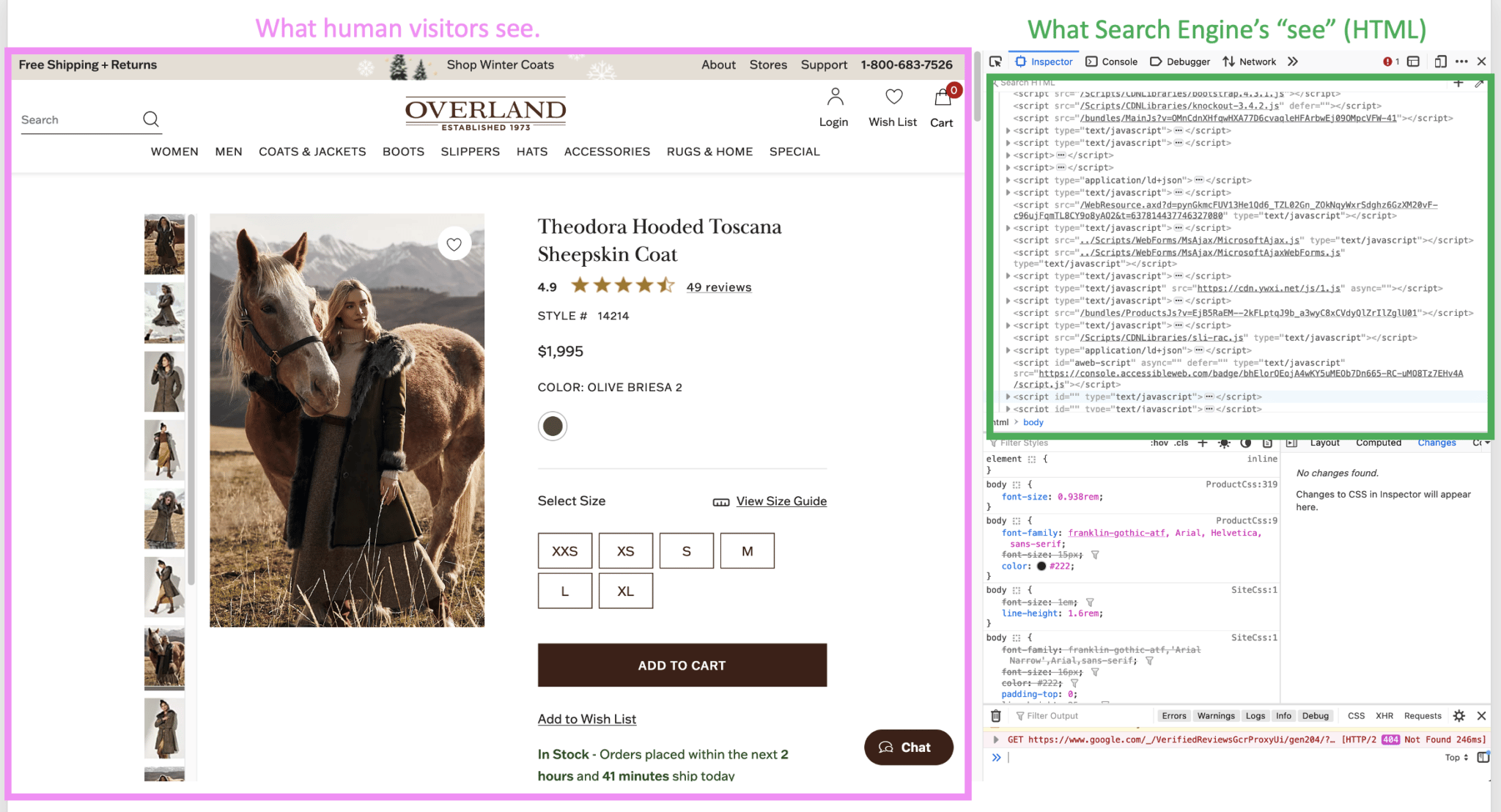
What human visitors see vs. What search engines see

Get the daily newsletter search marketers rely on.


Top 4 reasons why SEO should be a product

Consider the following compelling reasons why SEO should be a product.

  • Treating SEO as a product means accounting for it as an acquisition channel for organic traffic and revenue. SEO best practices are factored into online operations to make sure search engines “see” your website and humans searching online discover your branded site or social media pages.  
  • SEO product managers understand the external factors (like how search engines work) and how aspects of the website need to be optimized in order for the site to be SEO-friendly and earn organic traffic. 
  • Due to the fluid nature of search, SEO should have its own roadmap to continuously address improvements (i.e., advancements in machine learning), growth areas (i.e., producing helpful content) and maintenance. 
  • No business has an infinite amount of funding or capital to be able to acquire new customers through significant investments in paid search. Organic traffic is a scalable and compounding source of revenue for new site visitors. That source needs protection and development in order to grow.   

Some companies have product managers for search, but they typically deal with on-site searches performed by customers and their experience finding, or not finding, products. 

In contrast, I’m referring more to an SEO product manager who is focused on two primary external customers – search engines and customers visiting the website from a search engine results page. 

Read the job description for any product manager role and you’ll see that at a high level, it’s critical for businesses to develop a best-in-class app and/or ecommerce experience by providing an on-brand customer experience that drives sales and retention.

The function requires a balance of both analytical and creative chops with strong consumer instincts.

Product managers own writing the requirements in tickets that get worked on by engineering teams. This is where SEO requirements or considerations can come into play. 

Is there a link involved? Then it should be coded as an <a href> attribute so that search engines can “read” it. 

Publishing a visual product carousel? Make sure it’s not wrapped in JavaScript because if it is disabled on the customer’s end, it won’t be visible to the customer or a search engine. 

SEO is an evolving discipline because it’s tied to earning organic traffic from Google’s searches and their understanding of queries and user intent, which changes over time. This ultimately means the ranking compositions themselves will shift and change.  

In an episode of the Search Off the Record podcast, John Mueller spoke about the fluid nature of search. He pointed out that as Google’s understanding of queries and user intent changes, so can the ranking composition. 

Human nature is dynamic and our needs change over time. For those reasons, it’s important for businesses to focus on how organic search as a channel is evolving in order to continue to drive revenue and capture new customer visits.  

Move away from just asking “What do we do about the latest algorithm update?” or “Which keywords are we or are we not ranking for today?” – which is a myopic view of how search works. 

It’s more productive to solve for, “First, what does my customer want? And how do we make sure Google knows we offer that?” 

When SEO is a product, it benefits from the product framework which helps identify important work and implement it on the site. Then teams can measure it, learn from it, and improve upon it over time. 

How SEO product management fits within an organization

In large organizations, SEO is typically managed by a manager or a team of technical SEOs, content SEOs, and analysts within marketing. SEO doesn’t typically sit within the product vertical. 

But no matter where SEO sits in the organization, there will always be the need to navigate complexity and ambiguity, using a structured approach and delivering results. 

SEO often suffers from a lack of resources (specifically in engineering) to get improvements made and published. 

Part of the product process that most SEO professionals don’t understand is the timeframe in which work gets done. Most major technology companies (Apple, IBM, Microsoft) use agile methodology to deliver work. Lately, more companies are adopting this approach as their way of working and iterating on strategic initiatives. 

This cannot be overstated. In an agile methodology approach, engineering teams operate on sprints and there are a finite amount of sprints each year. This is especially true if you’re an ecommerce brand operating with a “code freeze” time frame that is typically between November to January where no updates are made to the code base.

Because there are a finite amount of sprints, the planning process means working backward from the “pencil’s down” timeframe to prioritize the roadmap items. 

It also means if you slot in new or ad hoc work, it replaces an existing initiative. These are tradeoffs the SEO product manager handles and articulates to leadership. 

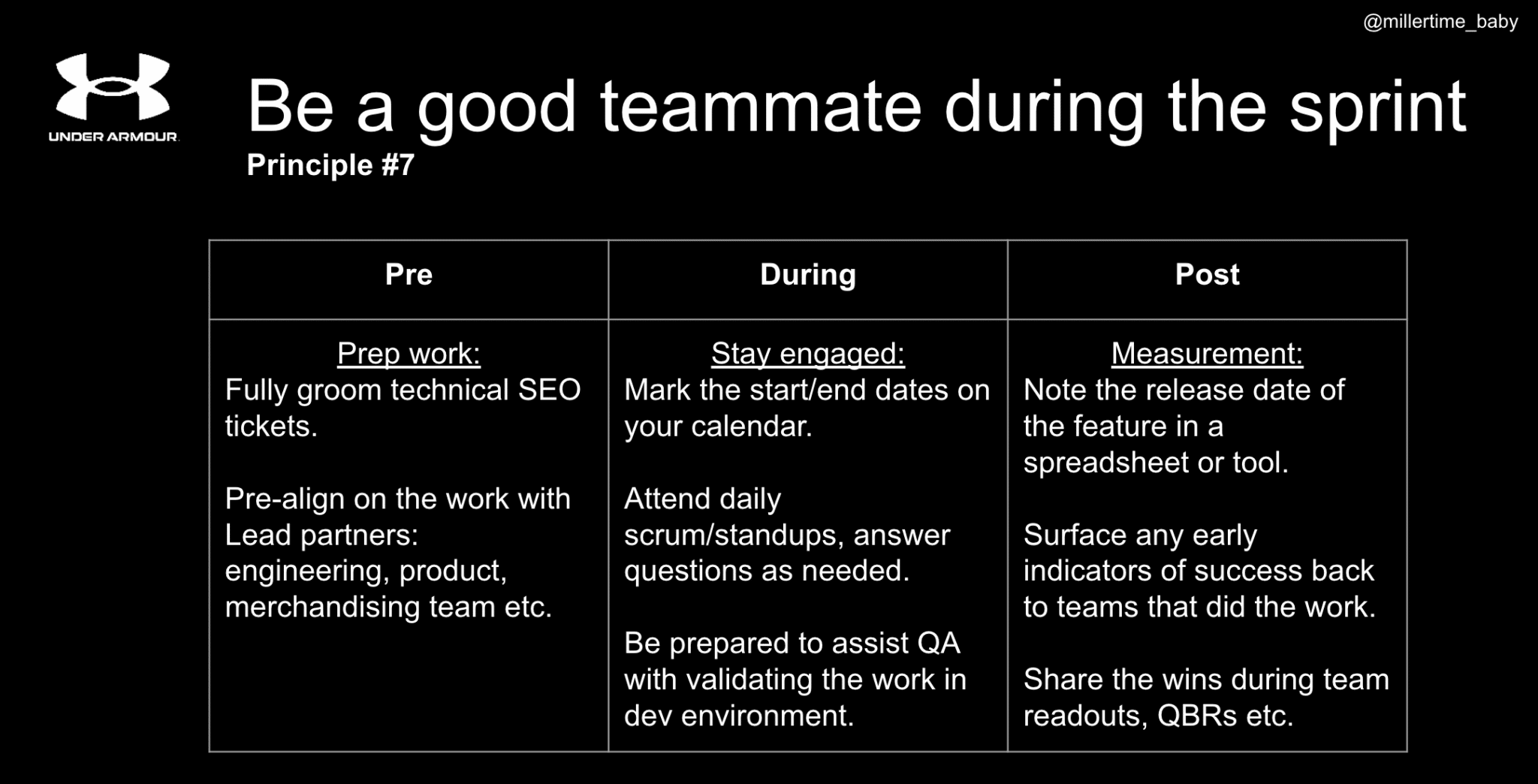
Early in 2022, I spoke at an industry conference about the engagement points SEO product managers have with engineering teams during the agile process which SEO managers are not accustomed to. 

Be a good teammate

Similar to a “before, during and after” strategy, there are specific ways an SEO product manager supports the cross-functional teams on the pathway to delivering SEO work together. 

Product is where the resources are 

SEO as an acquisition source should be resourced in order to contribute to the business’s bottom line.

In reality, product managers have access to these resources and coordinate them. Engineering resources are allocated to product managers usually by vertical or discipline.  

If organizations operated where SEO was treated as a product itself, then there would be: 

  • A product owner.
  • An SEO product roadmap.
  • An allocation of resources specifically for SEO initiatives. 

Any tradeoffs would happen against the planned roadmap of SEO work, as opposed to other product roadmaps and teams. 

It’s the difference between being empowered to organize work on your own roadmap instead of having to ask another team if you can have some of their resources to get (what’s perceived as) your work done.

SEO as a product drives organic traffic and revenue

When SEO is a product itself, teams will be empowered to do what’s best for the business in terms of nurturing and growing a scalable channel for customer acquisition and revenue. 

This means an output of continuous technical improvements and revamping informational content across the spectrum of human needs – from information to purchase. 


Opinions expressed in this article are those of the guest author and not necessarily Search Engine Land. Staff authors are listed here.


Related stories

New on Search Engine Land

@media screen and (min-width: 800px) { #div-gpt-ad-3191538-7 { display: flex !important; justify-content: center !important; align-items: center !important; min-width:770px; min-height:260px; } } @media screen and (min-width: 1279px) { #div-gpt-ad-3191538-7 { display: flex !important; justify-content: center !important; align-items: center !important; min-width:800px!important; min-height:440px!important; } }

About the author

Holly Miller Anderson

Holly Miller Anderson is an experienced SEO and marketing strategist. She has more than a decade of broad, digital marketing experience that includes marketing films, managing events, as well as experience growing SEO as an acquisition channel in various roles from consultant to agency and in-house Product Manager at enterprise-level brands. She has made a career advising marketers on their holistic SEO strategy by developing a strategic plan and tactical roadmap that delivers sustainable growth. Holly is currently a Lead SEO Product Manager at Under Armour.

https://searchengineland.com/why-seo-should-be-a-product-392498


How much will backlinks matter in 2023?

Backlinks have long been considered a crucial factor in determining a website’s ranking on search.

Historically seen as a vote of confidence, plenty of backlinks pointing to a website indicated that it is a trusted and authoritative source of information. And so, the more backlinks a site had, the higher it was likely to rank on search results. 

However, in recent years, search engines shifted how the value of backlinks was evaluated. Google, in particular, with its sophisticated algorithms, now places less emphasis on the number of backlinks a website has – and more on the quality of those links.

Let’s look at the changes surrounding backlinks over the years and why you should still care about them today – albeit to a lesser extent.

As a crucial factor in search engine optimization (SEO) since the early days of the web, backlinks have also been subject to abuse. Some website owners and SEO practitioners use unethical tactics to acquire backlinks in an effort to boost their rankings.

This abuse of backlinks, known as backlink spamming, has a long history on the internet and has even resulted in Google taking actions to prevent these schemes, such as the Penguin algorithm update. 

One of the earliest forms of backlink spamming was the practice of link farming, in which groups of websites would link to each other in an effort to boost their backlink counts. These link farms would often consist of low-quality, irrelevant websites. Because of this, the links were not valuable to users or search engines.

Another common tactic was the use of automated link building tools that generated large numbers of low-quality backlinks from irrelevant websites. This practice not only provided little value to users but also made it difficult for search engines to accurately evaluate the quality and relevance of backlinks.

As search engines have developed, they have implemented measures to combat backlink spamming and other unethical SEO tactics. This includes the use of:

  • Algorithms that can identify and penalize websites that engage in backlink spamming.
  • AI and machine learning to more accurately evaluate the quality and relevance of backlinks.

Despite these efforts, backlink spamming continues to be a problem on the web.

But, as search engines become even more advanced, this abuse will likely become less effective, making it unappealing to those seeking an unfair advantage in SEO.


Get the daily newsletter search marketers rely on.


The majority of SEOs today believe backlinks are not nearly as effective as they were in the past, a recent poll by Barry Schwartz of Search Engine Roundtable revealed. 

Search engines use complex algorithms to evaluate the relevance and trustworthiness of backlinks. They take into account factors such as: 

  • The relevance of the linking website.
  • The relevance of the anchor text used in the link.
  • The overall authority of the linking domain. 

This means that simply having a large number of backlinks is no longer enough to boost a website’s ranking. Instead, those links must be high-quality and come from reputable sources.

In addition, the rise of artificial intelligence and machine learning in search engine algorithms has made it easier to identify and penalize low-quality backlinks, particularly those obtained through link building schemes or other unethical means.

This has further decreased the overall value of backlinks in SEO. Using spammy link tactics will damage a website’s ranking instead of boosting it.

While backlinks still play a role in SEO, their importance has decreased in recent years. Search engines have become more sophisticated in the way they evaluate them. 

Rather than focusing solely on acquiring as many backlinks as possible, it is now more important for website owners to focus on creating high-quality, relevant content that will likely earn natural, organic backlinks from reputable sources. 

This will not only improve a website’s ranking on SERPs but also provide value to its users and build trust with search engines.

Google’s own Duy Nguyen, from the Search Quality team, indicated that backlink significance has fallen significantly in recent years. As the search landscape continues to evolve, the importance of backlinks in determining a website’s ranking on search results has decreased. 

That said, while backlinks are not the be-all, end-all of SEO, they still play a role in improving a website’s visibility on search. 

To maximize the benefits of backlinks and avoid being penalized by search engines, it is important for website owners to follow best practices.

First and foremost, it is important to focus on creating high-quality, relevant content that is helpful and valuable to users.

The natural, and ideal, outcome is that other websites will want to link to your content, resulting in organically earned backlinks.

In addition, steer clear of link building schemes. They may provide a short-term boost, but will not last. Search engines will detect and penalize websites engaging in such tactics, which are never worthwhile.

Instead of spammy tactics, focus on building relationships with other websites and industry experts to earn natural, high-quality backlinks.

The best way to do this: publish useful information and resources. In other words, create more helpful content.

Regularly monitor your backlink profile to ensure the quality and reputation of websites linking to you. This activity also helps you spot spammy inbound links that might be a part of a negative SEO campaign attack from malicious competitors.

Using tools such as Google Search Console, Semrush and Ahrefs, you’ll gain insights into the websites linking to your content and the anchor text they are using.

Overall, while the importance of backlinks in SEO has decreased, and according to Google, will continue to decrease, they still play a role in improving a website’s ranking. 

By following best practices and focusing on creating helpful content that will likely earn natural, high-quality backlinks, website owners can improve their visibility in search results and provide value to their users.


Opinions expressed in this article are those of the guest author and not necessarily Search Engine Land. Staff authors are listed here.


Related stories

New on Search Engine Land

@media screen and (min-width: 800px) { #div-gpt-ad-3191538-7 { display: flex !important; justify-content: center !important; align-items: center !important; min-width:770px; min-height:260px; } } @media screen and (min-width: 1279px) { #div-gpt-ad-3191538-7 { display: flex !important; justify-content: center !important; align-items: center !important; min-width:800px!important; min-height:440px!important; } }

About the author

Taylor Kurtz

Taylor Kurtz was born and raised in Tampa, Florida. Taylor then moved to Tallahassee to attend Florida State University, where he obtained his bachelor’s degree in sports management and his MBA. Taylor focuses exclusively on SEO and owns/operates Crush the Rankings, an award-winning digital marketing agency that focuses on high-quality Search Engine Optimization and website development. Taylor is also a Business Professor at the local community college in Fort Collins, CO and speaks around the country, discussing SEO at various digital marketing summits.

https://searchengineland.com/how-much-will-backlinks-matter-392493


This day in search marketing history: February 2

Revamped Google Partners program finally launches

In 2022, the changes to Partners program requirements, originally announced in 2020, finally took effect.

Those changes were supposed to happen in June 2020 but were first postponed until 2021 and then delayed a second time due to the upheaval caused by the coronavirus pandemic and shelter-in-place orders.

Agencies were not happy with the first iteration of Google’s new Partners program requirements, particularly Google’s doubling of the 90-day spend threshold (from $10,000 to $20,000) and adding an optimization score requirement.

Read all about it in Google finally launches revamped Partners program.


Also on this day


Performance Max campaigns get support in Data Studio

2022: Advertisers could include Performance Max campaigns in Data Studio reports.


Google Search Console snapshot in search results now can show domain properties

2022: A card could appear only if you were an owner or full user of the site in Google Search Console, and you are signed in with that Google account while searching for your site or queries it might rank for.


Google opens up about how Maps review moderation works

2022: Google’s overview detailed why it might update its policies, how it enforced them and the role of machines and humans in content moderation.


Google Q4 search ad revenue: $43.3 billion

2022: Alphabet announced revenue of $75 billion in Q4 of 2021. Of that, $61.2 billion came from Google advertising.


Google Search Console Discover performance report now includes all data

2021: Google would now show not just the data from Google Search app or on Google.com’s home page but also from Chrome.


Australia’s showdown with Google has profound implications for domestic businesses and other digital platforms

2021: The proposed legislation could have created an untenable position for search engines in Australia


Who wins? Google & Bing’s ‘Super Bowl ad’ search results are quite different

2018: People turning to Google and Bing for information about the official Super Bowl Lii commercials found very different treatments of the results. 


Search in Pics: Google Bike riding, hanging hammocks & Valentine’s Day prep

2018: The latest images showing what people eat at the search engine companies, how they play, who they meet, where they speak, what toys they have and more.


Google local knowledge panel testing promotion box

2017: It allowed Google My Business owners to post deals and promotions below their core listing.


Yandex Rolls Out Mobile-Friendly Algorithm In Russia, Code Name Vladivostok

2016: Pages that were not mobile-friendly might not rank as well.


Firefox Deal Continues To Boost Yahoo As US Search Share Grows Again In January

2015: StatCounter said, conclusively, that the Firefox deal was responsible for Yahoo’s recent movement.


Microsoft adCenter Increases Ad Description, Adds Budget Widget & More Mobile Targeting Options

2012: Microsoft’s January 2012 adCenter release update.


Bing: “We Do Not Copy Results. Period.”

2011: Bing’s Yusuf Mehdi: “We have some of the best minds in the world at work on search quality and relevance, and for a competitor to accuse any one of these people of such activity is just insulting.”


Google Uses Amazon’s Algorithm For YouTube’s Recommendation Engine

2011: Google had switched the algorithm they used for YouTube’s recommendation engine from their own to a variation of Amazon’s algorithm that was designed in the late 1990s. 


AdWords Targeting Getting More Geographically Granular in 17 Countries

2011: The changes allowed advertisers to target, analyze and optimize ad campaigns based upon more granular geographic data.


Google’s Mobile Moves Tighten Its Grip On Local

2011: Google was starting to leverage its massive local infrastructure across products.


Study: Facebook Ad Click-Throughs Declining

2011: Click-through rates on Facebook ads only averaged 0.05% in 2010, down from 0.06% in 2009 and well short of what was considered to be the industry average of 0.1%


Google Rolls Out Shopper App For iPhone

2011: Shopper allowed users to search for products by voice, with the camera, via barcode scan or by text entry.


Honeycomb Puts Android 3.0 Tablets On Nearly Equal Footing With iPad

2011: More coverage: Live Blogging The Google Android 3.0 “Honeycomb” Event 


Report: Twitter Co-Founder Ev Williams No Longer Works There

2011: He wasn’t working on product and hardly ever showed up at Twitter’s office. 


Google Apps May Get Its Own App Store

2011: The store reportedly would “sell business software designed by outside developers to integrate and add capabilities to Google Apps, such as enhanced security features or the ability to import contacts.”


Google News Allows You To “Star” News Stories

2011: Starring let Google know you were interested in that subject.


Google Gears Comes To AdWords: Browser Local Storage

2011: Instead of loading the data off Google’s servers each time you clicked on a section in the AdWords console, Google would load the data off your local computer.


Does CityGrid From Citysearch “Answer” The Local SEO Problem?

2011: This was Citysearch’s new local ad exchange/marketplace.


Katy Perry: I Googled Myself & I Liked It

2011: That’s how the singer discovered that Russell Brand was going to propose to her.


How Open Redirects Can Hurt Your Site’s Trust

2009: Open redirects could lead to spammers abusing your site and ultimately hurting your rankings in Google or other search engines.


Google AdWords Tests Campaign Level Keyword Diagnose Tool

2009: Google seemed to be testing a new AdWords feature that allowed you to batch your keyword analysis into a larger overview report.


Yahoo Shuts Down Publisher Network RSS Ads

2009: Yahoo ended the beta program to focus on more popular ad products.


400,000 Google Video Searches Are Polluted: Report

2009: “Blackhat SEO poisoning” could lead users to download malicious software.


SearchBiz: MicroHoo Redux, MySpace ‘Dissed’ By Yahoo, Microsoft Hiring In Search

2009: What could have been if Yahoo had accepted Microsoft’s offer.


It’s Google’s Ocean, We Just Swim In It

2009: More coverage: Live Blogging The Google Earth 5.0 / Google Ocean Event


Google Ramps Up Personalized Search

2007: Google combined Search History, Personalized Search and Personalized Homepage products.


SEO Gains Ground, Search Ads Top In Top Performing Online Ad Tactics

2007: SEO grew from 33% in 2005 to 45% in 2006 in the category of best performing online advertising tactic, whereas search ads declined from 52% in 2005 to 49% in 2006.


Google AdSense Makes Changes to Publisher Referral Program

2007: Publishers could earn up to $255 for referring a new publisher to AdSense, up from $100.


Google Local Ads In Google Earth

2007: Search on Google Earth brought up the same sponsored listings as Google Maps.


Viacom Tells Google’s YouTube To Remove Videos

2007: YouTube agreed to remove 100,000 video clips.


Google Launches Maps For Windows Mobile

2007: The Google Windows Mobile client provided an experience that was significantly better than the mobile browser and almost as good as the desktop – and in some ways better.


Google Demanded North Carolina Stay Quiet

2007: About Google’s tax break demands.


Digg Drops List Of Top Users To Curb Gaming

2007: It was to help lower the perceived manipulation of the Digg system by those top diggers.


New Yahoo ‘OurCity’ Local Mashups

2007: Yahoo tested it in India, incorporating content from Flickr, Del.icio.us, Upcoming and news.


National Pork Board Says: Breastfeeding Is A Viable Trademark Threat

2007: “We have a responsibility to the industry to challenge all viable infringements.”


Past contributions from Search Engine Land’s Subject Matter Experts (SMEs)

These columns are a snapshot in time and have not been updated since publishing, unless noted. Opinions expressed in these articles are those of the author and not necessarily Search Engine Land.


< February 1 | Search Marketing History | February 3 >


Related stories

New on Search Engine Land

@media screen and (min-width: 800px) { #div-gpt-ad-3191538-7 { display: flex !important; justify-content: center !important; align-items: center !important; min-width:770px; min-height:260px; } } @media screen and (min-width: 1279px) { #div-gpt-ad-3191538-7 { display: flex !important; justify-content: center !important; align-items: center !important; min-width:800px!important; min-height:440px!important; } }
About the author

Danny Goodwin

Danny Goodwin is Managing Editor of Search Engine Land & SMX. In addition to writing daily about SEO, PPC, and more for Search Engine Land, Goodwin also manages Search Engine Land’s roster of subject-matter experts. He also helps program our conference series, SMX – Search Marketing Expo. Prior to joining Search Engine Land, Goodwin was Executive Editor at Search Engine Journal, where he led editorial initiatives for the brand. He also was an editor at Search Engine Watch. He has spoken at many major search conferences and virtual events, and has been sourced for his expertise by a wide range of publications and podcasts.

https://searchengineland.com/search-marketing-history-february-2-392580


Report: Microsoft Bing’s ChatGPT feature to be faster and richer with GPT-4

As reported earlier, we are now learning more about Microsoft’s plans to incorporate ChatGPT into Bing Search. Reed Albergotti said that it is not just ChatGPT from OpenAI that is being added to Bing Search but a faster and richer version named GPT-4.

The report. The report says, “The most interesting improvement in the latest version described by sources is GPT-4’s speed. Right now, it can take a while — sometimes minutes in my experience — for ChatGPT to answer.”

Currently, ChatGPT, which runs off GPT-3.5, feels slow and can take minutes to output the result. The replies generated through GPT-4 reportedly “sound more human and are more detailed,” the report says.

GPT-4. GPT-4, which stands for Generative Pre-trained Transformer 4, is a neural network created by OpenAI. It is the next version of GPT-3.5, which is currently used by ChatGPT.

As a reminder, OpenAI introduced ChatGPT in November 2022. It is built on OpenAI’s GPT-3.5 family of large language models, and is fine-tuned with both supervised and reinforcement learning techniques.

ChatGPT uses content across the web from before 2021 to teach itself how to answer questions, but when it comes to recent and trending topics, it has difficulty. You can learn more about how it technically works in this blog post.

Google in trouble? As I said before, I don’t think Google is in trouble despite reports of “code red” at Google over the AI based Chatbot. Google has advanced AI and machine learning that can likely do exactly what ChatGPT does already or better. In fact, Google is rumored to have started on its own version named Apprentice Bard.

Google’s spam team said they have methods to detect and neutralize AI plagarized scraped types of content. Plus, we know there are plenty of tools to detect AI generated content, so if AI can detect AI, I wonder how much of a code red it is?

Why we care. Any new search feature, especially a chatbot, can change searcher behavior. Understanding searcher behavior, and showing up in the places that people are searching, is important to drive awareness, traffic and business for you and your clients.

This is very new but there has been a lot of interest in this type of AI by search engines and marketers alike. I am sure we all will be carefully watching this space to make sure we smartly leverage it for clients and stakeholders.


Related stories

New on Search Engine Land

@media screen and (min-width: 800px) { #div-gpt-ad-3191538-7 { display: flex !important; justify-content: center !important; align-items: center !important; min-width:770px; min-height:260px; } } @media screen and (min-width: 1279px) { #div-gpt-ad-3191538-7 { display: flex !important; justify-content: center !important; align-items: center !important; min-width:800px!important; min-height:440px!important; } }
About the author

Barry Schwartz

Barry Schwartz a Contributing Editor to Search Engine Land and a member of the programming team for SMX events. He owns RustyBrick, a NY based web consulting firm. He also runs Search Engine Roundtable, a popular search blog on very advanced SEM topics. Barry can be followed on Twitter here.

https://searchengineland.com/report-microsoft-bings-chatgpt-feature-to-be-faster-and-richer-with-gpt-4-392565


ChatGPT Plus launches, it costs $20 a month

OpenAI announced that its highly-anticipated paid version of ChatGPT has launched. Called ChatGPT Plus, it will only be available for people who live in the U.S.

Despite earlier pricing rumors reported in the media, ChatGPT Plus won’t cost $42 a month. It will cost $20 per month.

People who have been on the waitlist for the paid version should expect an invite “over the coming weeks.” The company also said it plans to “soon” offer the service in additional countries.

What you get for $20 a month. OpenAI said the paid version will offer three benefits over the free version: 

  • General access to ChatGPT, even during peak times
  • Faster response times
  • Priority access to new features and improvements

Why we care. ChatGPT is a technology that has several use cases in search marketing, whether it’s for SEO or PPC. So if you’ve found yourself unable to use ChatGPT because the service was at capacity, now you have the cure – and it will cost you $20 a month. 

ICYMI. Yesterday, OpenAI launched a new AI tool to detect AI-generated text. Called AI Text Classifier, it predicts how likely it is that text was written by a human or AI.


Related stories

New on Search Engine Land

@media screen and (min-width: 800px) { #div-gpt-ad-3191538-7 { display: flex !important; justify-content: center !important; align-items: center !important; min-width:770px; min-height:260px; } } @media screen and (min-width: 1279px) { #div-gpt-ad-3191538-7 { display: flex !important; justify-content: center !important; align-items: center !important; min-width:800px!important; min-height:440px!important; } }
About the author

Danny Goodwin

Danny Goodwin is Managing Editor of Search Engine Land & SMX. In addition to writing daily about SEO, PPC, and more for Search Engine Land, Goodwin also manages Search Engine Land’s roster of subject-matter experts. He also helps program our conference series, SMX – Search Marketing Expo. Prior to joining Search Engine Land, Goodwin was Executive Editor at Search Engine Journal, where he led editorial initiatives for the brand. He also was an editor at Search Engine Watch. He has spoken at many major search conferences and virtual events, and has been sourced for his expertise by a wide range of publications and podcasts.

https://searchengineland.com/chatgpt-plus-launches-392558


Webinar: 4 disciplines for SEO teams to drive performance by Cynthia Ramsaran

Seo Road To Success 800x450

How do you make sure your SEO team is working on activities that will make the most significant impact on your goals? Have you ever set goals only to realize a month or two later that no one has been keeping track of progress? Have you ever reached the end of a year and felt you’ve made no progress on your organic growth targets? Also, is organic growth the only target to measure?

In this webinar, Craig Bradford, COO of SearchPilot, will show you how to set and achieve better goals using the 4 Disciplines of Execution (4DX) framework.

Register today for “Drive Performance With These 4 Disciplines for SEO Teams,” presented by SearchPilot.


Click here to view more Search Engine Land webinars.


Related stories

New on Search Engine Land

@media screen and (min-width: 800px) { #div-gpt-ad-3191538-7 { display: flex !important; justify-content: center !important; align-items: center !important; min-width:770px; min-height:260px; } } @media screen and (min-width: 1279px) { #div-gpt-ad-3191538-7 { display: flex !important; justify-content: center !important; align-items: center !important; min-width:800px!important; min-height:440px!important; } }
About the author

Cynthia Ramsaran

Cynthia Ramsaran is director of custom content at Third Door Media, publishers of Search Engine Land and MarTech. A multi-channel storyteller with over two decades of editorial/content marketing experience, Cynthia’s expertise spans the marketing, technology, finance, manufacturing and gaming industries. She was a writer/producer for CNBC.com and produced thought leadership for KPMG. Cynthia hails from Queens, NY and earned her Bachelor’s and MBA from St. John’s University.

https://searchengineland.com/webinar-disciplines-for-seo-teams-to-drive-performance-392551


Google Maps removed policy-abiding reviews from Local Guides

Google has accidentally removed legit, policy-abiding reviews submitted by Local Guides from Google Maps. Google acknowledged the issue and said it is working on reinstating those reviews over the next few weeks.

What happened. According to Google’s Local Guides Connect blog, Google said they are “constantly improving our moderation system to keep policy-violating content off the map.” With those efforts, Google said its “protections took down more than expected policy abiding reviews from a set of Local Guides.” Google added that they “acknowledge that this change has affected a lot of your accounts,” and is working to restore the reviews that were impacted.

Fixing the issue. Google said, “as part of our efforts to resolve this situation, we have launched an update to our protections to fix them.” Google added that the search company “will also automatically reinstate” any of the policy-abiding reviews over the “next few weeks.”

What if your review is not reinstated. Google said if your policy-abiding review is not reinstated, then you can submit a request through this form to challenge the decision.

Why we care. If you noticed your reviews are not going through as a Local Guide, Google says to continue to post reviews as normal, and they will automatically fix the issues. At least, you can hope Google does, and if not, you can always request Google to manually review your submission.

So you may see a number of reviews previously not listed on your business show up in a few weeks when Google reruns its review protections.


Related stories

New on Search Engine Land

@media screen and (min-width: 800px) { #div-gpt-ad-3191538-7 { display: flex !important; justify-content: center !important; align-items: center !important; min-width:770px; min-height:260px; } } @media screen and (min-width: 1279px) { #div-gpt-ad-3191538-7 { display: flex !important; justify-content: center !important; align-items: center !important; min-width:800px!important; min-height:440px!important; } }

About the author

Barry Schwartz

Barry Schwartz a Contributing Editor to Search Engine Land and a member of the programming team for SMX events. He owns RustyBrick, a NY based web consulting firm. He also runs Search Engine Roundtable, a popular search blog on very advanced SEM topics. Barry can be followed on Twitter here.

https://searchengineland.com/google-maps-removed-policy-abiding-reviews-from-local-guides-392555


Google testing new search design with AI answers over organic results

Google has reportedly started testing a new desktop search page design that integrates chat technology.

We already knew Google wants to add chatbot features to search this year. A new CNBC report provides more details on what the experimental search page may look like.

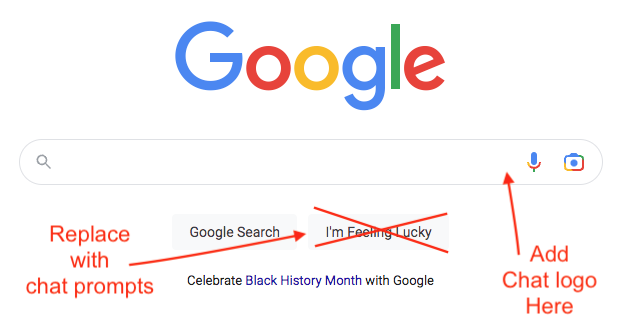
Google’s alternate search page. In one version of Google’s search results, the company replaced the iconic I’m Feeling Lucky button under the search bar with five prompts for potential questions. There was also a small chat logo” inside the far right end of the search bar, according to the report.

Based on this description, here’s a fairly terrible rendering of what that would look like:

Google Search Chat Alternate Desktop

Google’s alternate SERP. It sounds like this would push Google’s organic search results much further down the page. As CNBC explained:

When a question is entered, the search results show a gray bubble directly under the search bar, offering more human-like responses than typical search results. Directly beneath that, the page suggests several follow-up questions related to the first one. Under that, it shows typical search results, including links and headlines.

Now I haven’t seen this experimental design.

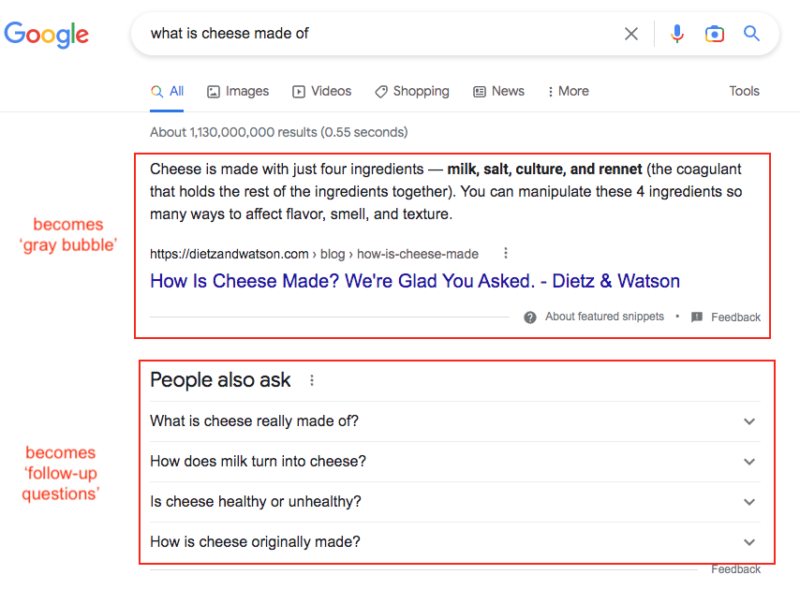
However, based on how this was described, it may look similar to certain SERPs where there is a featured snippet followed by People also ask, then organic results. For example, [what is cheese made of]:

Google Serp What Is Cheese Made Of 800x590

So you could imagine the “gray bubble” in place of the featured snippet explaining how cheese is made (with an answer generated by Google AI instead of awarded to the source of the featured snippet here), and the “follow-up questions” replacing PAA.

Why we care. Could this be what chatbot-style Google desktop search results will look like later this year? While it’s not a radical departure from the current Google desktop design, this would mean that visibility for websites – and perhaps traffic – will be impacted. If you thought Google was stealing your traffic and clicks before, well… it’s safe to say there will be many angry search marketers.

What Google is saying. According to a Google spokesperson:

  • “We have long been focused on developing and deploying AI to improve people’s lives. We believe that AI is foundational and transformative technology that is incredibly useful for individuals, businesses and communities, and as our AI Principles outline, we need to consider the broader societal impacts these innovations can have. We continue to test our AI technology internally to make sure it’s helpful and safe, and we look forward to sharing more experiences externally soon.”

Dig deeper. Jennifer Elias on CNBC (Google is asking employees to test potential ChatGPT competitors, including a chatbot called ‘Apprentice Bard’) also reports on how Google is also testing out its version of ChatGPT, which uses its LaMDA technology that includes answers based on recent events (which is is something ChatGPT can’t do at this time).


Related stories

New on Search Engine Land

@media screen and (min-width: 800px) { #div-gpt-ad-3191538-7 { display: flex !important; justify-content: center !important; align-items: center !important; min-width:770px; min-height:260px; } } @media screen and (min-width: 1279px) { #div-gpt-ad-3191538-7 { display: flex !important; justify-content: center !important; align-items: center !important; min-width:800px!important; min-height:440px!important; } }

About the author

Danny Goodwin

Danny Goodwin is Managing Editor of Search Engine Land & SMX. In addition to writing daily about SEO, PPC, and more for Search Engine Land, Goodwin also manages Search Engine Land’s roster of subject-matter experts. He also helps program our conference series, SMX – Search Marketing Expo. Prior to joining Search Engine Land, Goodwin was Executive Editor at Search Engine Journal, where he led editorial initiatives for the brand. He also was an editor at Search Engine Watch. He has spoken at many major search conferences and virtual events, and has been sourced for his expertise by a wide range of publications and podcasts.

https://searchengineland.com/google-testing-new-search-design-with-ai-answers-over-organic-results-392537