Is AI-written content replacing cheap old content farms?

The Verge has a piece up today named Inside CNET’s AI-powered SEO money machine. It covers much of what we reported in Google search responds to BankRate, more brands using AI to write content last week. It also dives more into how the company has been using machines to replace low-cost humans to generate low-quality content designed to rank well in search.

Google’s algorithms. All of this reminds me of the Google Panda update days, where Google built algorithms to detect content farms and content written with the purpose of generating search traffic. Now, with the helpful content update, that specifically aims to discount content written for search rankings (and not for users) – this strategy deployed by the Red Ventures websites seems like it is set up to fail ultimately – that is, if Google’s algorithms do what they say they will do.

Red Ventures goal. According to The Verge:

“Red Ventures’ business model is straightforward and explicit: it publishes content designed to rank highly in Google search for “high-intent” queries and then monetizes that traffic with lucrative affiliate links.”

That specifically goes against Google’s latest helpful content update algorithm, which aims to downgrade sites where content is written for search engines first (i.e. content written to rank in search and not help people).

The article goes on to explain how these sites are trying to rank well in the credit card space, and turn that traffic into clicks to affiliate revenue. “Red Ventures has found a major niche in credit cards and other finance products,” the article explains.

This goes beyond just CNET. Red Ventures also owns The Points Guy, Bankrate, and CreditCards.com, “all of which monetize through credit card affiliate fees,” they add.

“The CNET AI stories at the center of the controversy are straightforward examples of this strategy: ‘Can You Buy a Gift Card With a Credit Card?’ and ‘What Is Zelle and How Does It Work?’ are obviously designed to rank highly in searches for those topics. Like CNET, Bankrate and CreditCards.com have also published AI-written articles about credit cards with ads for opening cards nestled within.”

Sound familiar?

Content farms. Replace humans with AI to build content farms, content that is aimed to rank well in search, generate traffic, clicks on ads, revenue from affiliates and other publishing goals.

The article goes on to say:

“Viewed cynically, it makes perfect sense for Red Ventures to deploy AI: it is flooding the Google search algorithm with content, attempting to rank highly for various valuable searches, and then collecting fees when visitors click through to a credit card or mortgage application. AI lowers the cost of content creation, increasing the profit for each click. There is not a private equity company in the world that can resist this temptation.”

Didn’t Google already tackle such efforts with Panda with the downfall of content farms? I guess not. Not yet.

Wordsmith. The tool being used to generate this content is Wordsmith, something they have been using for well over a year now, and something other companies have been using as well.

“A former CNET employee says that Red Ventures was using automated technology for content long before the AI byline began cropping up in November. They say a tool called Wordsmith — nicknamed “Mortgotron” internally because of its use in mortgage stories — has been used for at least a year and a half.”

Not new. Yes, for a year and a half, this has been going on. But it has been going on longer.

You see it a lot with financial earnings news analysis, sports scores news stories and anything that can be somewhat templated. Machines can pull out the metrics and then write up a sensible article using the revised data.

It is cheap and serves the purpose. But is this the type of content that Google wants to rank?

Here is a tweet from Glenn Gabe showing how it worked years ago:

Good enough to rank. So with the layoffs at these publishing companies, they came up with more and more ways to have machines write content that ranks in search. The Verge wrote that it just needs to be good enough to rank,

“But the robot articles published on CNET don’t need to be ‘good’ — they need to rank highly in Google searches so lots of people open them and click the lucrative affiliate marketing links they contain.”

It can’t last. I mean, it can’t last, it can’t continue to work in the long run, right?

If Google has their say, and they do, Google wants content written in a way that is designed to help users. If The Verge is accurate in saying the intent of this content that AI writes is to just rank well in search, then Google’s new helpful content update should tackle that. It might not tackle it today but it should in the future.

Why we care. It is tempting to find low-cost ways to generate endless content that can rank well in Google Search. I mean, who doesn’t want to make a lot of money fast, for very little cost? But how long will those efforts last? Is this a long-term strategy? Will we look back at these efforts and say this is why Google rolled out the helpful content update?

Time will tell, but it is super interesting to watch this all play out, just like we did with the Panda, Penguin and other Google Search algorithm updates over the years.


Related stories

New on Search Engine Land

@media screen and (min-width: 800px) { #div-gpt-ad-3191538-7 { display: flex !important; justify-content: center !important; align-items: center !important; min-width:770px; min-height:260px; } } @media screen and (min-width: 1279px) { #div-gpt-ad-3191538-7 { display: flex !important; justify-content: center !important; align-items: center !important; min-width:800px!important; min-height:440px!important; } }

About the author

Barry Schwartz

Barry Schwartz a Contributing Editor to Search Engine Land and a member of the programming team for SMX events. He owns RustyBrick, a NY based web consulting firm. He also runs Search Engine Roundtable, a popular search blog on very advanced SEM topics. Barry can be followed on Twitter here.

https://searchengineland.com/is-ai-written-content-replacing-cheap-old-content-farms-391979


Report: Google search will debut chatbot features this year

Google will demonstrate a version of its search engine with chatbot features this year, according to a New York Times report.

Why we care. AI – and OpenAI’s ChatGPT in particular – has been discussed ad nauseum over the past two months. Microsoft already is reportedly working on adding ChatGPT features to Microsoft Bing search. This has the potential to reshape SEO significantly. If you thought featured snippets were stealing your traffic, just wait until Google starts being able to accurately answer some even more complex questions which your existing content is designed to answer.

Code Red at Google. In December, following the launch of and reaction to ChatGPT, Google CEO Sundar Pichai reportedly issued a “code red,” realizing the technology was an urgent and significant threat to Google’s search business.

Founders return. Google executives reportedly called in Google founders Larry Page and Sergey Brin, who stepped down in December 2019, for several meetings about the company’s A.I. product strategy. Prior to this, neither had been involved with Google search since leaving Google, according to the Times.

What’s coming? According to the Times:

Google now intends to unveil more than 20 new products and demonstrate a version of its search engine with chatbot features this year, according to a slide presentation reviewed by The New York Times and two people with knowledge of the plans who were not authorized to discuss them.

Three priorities were discussed in that chatbot search presentation:

  • Getting facts right.
  • Ensuring safety.
  • Getting rid of misinformation.

Google may block certain words to avoid hate speech and will try to minimize other potential issues relating to hate and toxicity, danger and misinformation, according to the report.

Dig deeper. The New York Times has all the details in Google Calls In Help From Larry Page and Sergey Brin for A.I. Fight (registration required).


Related stories

New on Search Engine Land

@media screen and (min-width: 800px) { #div-gpt-ad-3191538-7 { display: flex !important; justify-content: center !important; align-items: center !important; min-width:770px; min-height:260px; } } @media screen and (min-width: 1279px) { #div-gpt-ad-3191538-7 { display: flex !important; justify-content: center !important; align-items: center !important; min-width:800px!important; min-height:440px!important; } }

About the author

Danny Goodwin

Danny Goodwin is Managing Editor of Search Engine Land & SMX. In addition to writing daily about SEO, PPC, and more for Search Engine Land, Goodwin also manages Search Engine Land’s roster of subject-matter experts. He also helps program our conference series, SMX – Search Marketing Expo. Prior to joining Search Engine Land, Goodwin was Executive Editor at Search Engine Journal, where he led editorial initiatives for the brand. He also was an editor at Search Engine Watch. He has spoken at many major search conferences and virtual events, and has been sourced for his expertise by a wide range of publications and podcasts.

https://searchengineland.com/google-search-chatbot-features-this-year-391977


13 key SEO metrics to track in 2023

There’s software to track just about every piece of SEO data. For marketers, this is a blessing and a curse. Access to data helps make savvy marketing decisions and, when analyzed correctly, aids a deeper understanding of users.

That said, having access to data doesn’t necessarily mean you need to monitor it, especially if it’s unhelpful or feels overwhelming.

For this article, I reached out to marketers and SEOs who shared the SEO metrics they’ll be tracking in 2023 and why they’re important.

What are SEO metrics?

SEO metrics are data sets that help determine the success of SEO’s role in digital marketing campaigns.

By analyzing data, marketers can understand how valuable SEO’s contribution to marketing is. It allows marketers to benchmark success and understand what went well and what didn’t.

More importantly, SEO metrics help businesses refine marketing campaigns to steer them toward the delivery of marketing goals.

Some SEO metrics are more useful than others. You might be familiar with the term “vanity metrics,” referring to metrics that might increase with marketing efforts, but do not move the needle for the business. In SEO, vanity metrics might include impressions and even clicks.

But does that mean these metrics aren’t important? No.

The truth is, the metrics you measure will depend on your goals.

The skill – which comes with time – is knowing which metrics to monitor, which ones to measure in consideration with others, and which metrics to put aside.

In this article:

SEO metrics you can track in GA4

Google Analytics 4 (GA4) is here, and with it comes valuable reports like traffic acquisition. Also, engagement rate, which (if you ask me) is a far superior metric to bounce rate.

1. Engagement rate

Engagement rate is one of the newer metrics which graced us with its presence with GA4.

Engagement rate is an SEO metric that measures meaningful engagements on your site. Out of the box, engagements include clicks, scrolls, conversions, and more.

On engagement rate, SEO professional Kyle Rushton says:

  • “Tracking engagement rate will give you insights as to what pages or channels need improvement – whether that’s on-page, the speed or the page or something else that is driving lower engagements.”

Low-engagement pages, that are falling short of expectations will benefit from additional work.

2. Enhanced measurements

GA4 tracks conversion data as an event. Enhanced measurements provide a level of granularity on user behavior that we didn’t have “out of the box” with Universal Analytics (UA).

Freelance SEO consultant Natalie Slater shares the value of form interactions and form submissions. Slater says:

  • “GA4 has the capability to automatically track interactions with forms, both starting the form fill (form_start), and the form submission itself (form_submit) via Enhanced Measurement. I am coming across cases where this automatic tracking can be perhaps a bit too general, and a manual tracking solution has been required, but it’s a good feature overall, especially the form_start aspect as this allows you to see drop-offs in the form-filling process.”

Form interactions vs. form submissions provide two great data sets for SEO. 

  • Firstly, and most obviously, form submissions are likely to be completed by qualified leads and may result in a sale. Where possible, emails gathered from form submissions should be nurtured and remarketed to via emails or PPC. 
  • Secondly, monitoring metrics such as form interactions vs form submissions may help with CRO. Many users interacting with a form, but not submitting, might point to a form that is too cumbersome to complete or an issue with your submit button.

You can use these metrics to identify potential CRO issues on a site.

3. Landing pages

The Google Analytics Landing Page report seems to be a firm favorite among SEOs, with many mentioning it when asked about SEO metrics. 

The landing page report is perfect for understanding how effective the first page a user visits is. 

You can see which landing pages result in a conversion within the same session – perfect for identifying sales direct from SEO efforts.

Originally you had to customize your own report on GA4, but (probably) thanks to its popularity, GA4 has now released a standard landing page report.

GA4 landing page report

It’s important to note here that looking at sales direct from SEO does an injustice to SEO’s contribution to conversion and that’s why it’s important to track other metrics that don’t seem so obvious.


Get the daily newsletter search marketers rely on.


SEO metrics you might not think to track

SEO has obvious metrics like traffic, clicks, impressions and revenue. But you might not have thought about tracking metrics from other marketing efforts to understand SEO’s contribution to sales.

SEO will always be a traffic driver – and the aim is to drive qualified traffic to a site. Qualified traffic is traffic that is interested in your site’s offering and may purchase.

For many of your web users, SEO will be the first touch point in the marketing funnel. Users will search for a problem and stumble upon your page or article. From here, they might sign up for emails or join an audience for PPC retargeting.

4. Email sign-ups

Zack Reboletti, SEO consultant at Get Web Focused, says:

  • “Email marketing is the lifeblood of many businesses and regularly publishing SEO-informed content on a blog is one of the best ways to grow an email list. While blog posts can and do drive conversions, a more common path is for blog posts to drive traffic, followed by an email sign-up, and then a conversion from email later.”

It’s easy to see how metrics from other marketing tactics are improved by SEO.

Additionally, when it comes to email marketing, SEO data provides the trends and click data to see exactly when your users are looking for certain types of content.

For example, an article might have a particular interest at a certain time of year. Instead of waiting for your audience to search for it and find you (or worse, find your competitor), you can be proactive. 

The data provided by SEO should inspire your content calendar for email or even social media. You can put the content you know people are looking for based on SEO metrics in front of your audience.

5. PPC metrics that are influenced by SEO: Retargeting and keywords

SEO drives traffic that PPC can retarget. And long tail keywords serve ads well by pulling in relevant traffic with specific problems.

Think about articles ranking for longer tail keywords such as “[product] for [specific problem]” or your “how to [solve problem] guides.” Clicks to these content pieces give ads qualified traffic with specific problems.

Display ads and retargeting messaging can be highly targeted to capture attention, nurture the potential buyer, keep your brand front of mind and later convert.

Leigh Buttrey, a paid media specialist, says: 

  • “Within Google Ads, you can set up audiences to capture users who visit specific pages. Set these up early so you can, in the future, set up ads for retargeting. Another tip if you are already running ads, monitor search terms regularly. You will be able to see in real-time what users are searching for and this data can be used in any organic strategies you are using.”

As much as SEO supports PPC, PPC supports SEO, too. PPC is a fast track to the top of SERPs. You can test desired keywords for conversion and determine whether they’re working the efforts to rank organically. Align SEO and PPC to dominate SERPs.

6. Images

In 2022, Google rolled out their continuous scroll to SERPs. With continuous scroll, websites might need a listing that stands out in SERPs more than they did before.

It’s no secret that scrolling is addictive, and users might have an easier time flicking through SERPs until they land on a listing that’s most engaging.

In 2023, as we explore this new way of searching, it might be worth tracking the impact of high-quality images.

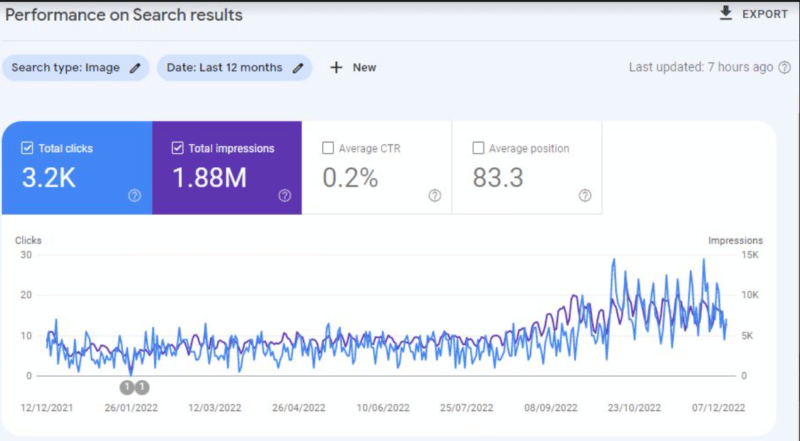
Using Google Search Console you can see how many clicks you’ve earned from images. To get to this report:

  • Go to Google Search Console.
  • Head to Search Results in the left-hand menu.
  • Change the search type, above the graph, to “Image.”

Which pages are generating the right clicks? Which images might be contributing to this?

GSC Performance on Search results - Image

Bonus tip: Increase your chances of ranking images in image SERPs by optimizing your alt text. (And remember to be natural when doing so.)

SEO metrics that aren’t going anywhere in 2023

There are some metrics as old as SEO itself and are still as useful as ever. Here are some of the metrics that, if you aren’t tracking already, you probably should be.

7. Content engagement

Monitoring content is improved in GA4. The loss of bounce rate and the new engagement rate means the value of great content is less likely to be undermined by the bounce.

In GA4, you can measure, by page:

  • Scroll depth (to 90%)
  • Clicks
  • Video plays
  • Site search
  • Video engagement
  • File downloads

All of the above metrics help determine the value of a page. If someone scrolls to 90%, reads an entire article, then leaves the site, the content was still useful. In UA, bounce rate could undermine these meaningful actions.

Content that earns an in-depth scroll or file download is an indicator of an engaged audience that can be retargeted or nurtured through marketing automation, later.

8. Customer lifetime value

Customer lifetime value (CLV) is incredibly important when tracking revenue from SEO. Subscription-based businesses are a great way to demonstrate this. 

If a user lands on your site, via a non-branded Google Search and signs up for a subscription, the initial payment might be $10 for the first month. 

But, if they signed up for 10 months, the value of that interaction is really $100. If that customer is offered a referral scheme and brings on three friends for a subscription the CLV increases again.

Customer lifetime value enables you to see the longevity of SEO efforts.

9. Brand visibility

Tracking brand mentions and clicks from brand search terms can help marketers determine how brand searches are converting. In theory, those searching for your brand are looking exactly for you and what you have to offer.

Tracking brand searches can be useful in understanding which pages earn brand clicks and which do not. If you have pages that receive clicks from Google, but don’t have many (or any) queries related to the brand, then SEO can be attributed entirely to the click.

If these pages also result in a conversion, SEO is likely solely responsible for the click and conversion. These conversions are harder to achieve, but great when they come!

Tracking brand searches lets you see how people are searching for your brand. You’ll find brand searches that you’d otherwise miss.

10. Missed brand searches

If you stay close to how users search for your brand, you’ll get insights into how confident users are in your brand.

Fellow Search Engine Land contributor Sara Taher says:

  • “Looking for missed branded search opportunities and making sure that you satisfy those queries and capture this traffic that was leveraged by other websites is essential. Branded searches can get captured by third-party websites instead of the brand’s own website.”

If you don’t stay on top of brand searches you could miss an opportunity to rank and lose clicks (and users) to competitors or non-authoritative sites.

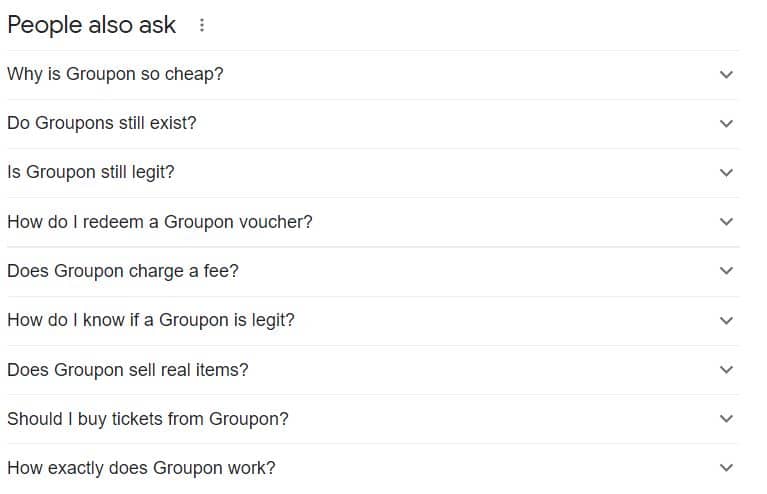
Potential buyers who are close to conversion, but perhaps a little nervous, might search for things like:

  • Is [brand] legit
  • [brand] reviews
  • How does [brand] work?

A good example of these search terms can be found for Groupon.

People also ask - Groupon-related questions

The nature of the industry (discounts and coupons) potentially adds to the buyer’s caution, but these searches can be found for many other brands.

Reviews, in particular, can result in lost clicks for brands with websites like Trust Pilot or Facebook taking the rank over the site’s domain.

Brands can manage these queries by creating pages that satisfy the intent. By doing this, the brand’s site is more likely to rank, earn a click, and control the narrative the potential buyer sees.

11. Conversions and conversion rate

Conversions and conversion rates (CVR) are metrics to look at in relation to each other.

Conversion is a meaningful action taken on your site. For ecommerce, that might be sales, but it could also be a contact form submission, download, or other.

Rebecca Oliver, digital marketing manager at Sixty Eight People, shares the importance of tracking conversion and conversion rate. 

  • “I love to learn more about what happens to impressions and that’s where the conversion rate is invaluable. Out of all the people we did reach, how many of those decided to submit a contact form, call the office phone, register for mailers, and spent time reading a blog post? If you could prove you need 12,000 website visits per month to convert 700 who take an action which leads to 70 business transactions you can then map out future marketing investment and ultimately get a little more budget.”

12. Revenue

Marketing should always be a revenue generator. After the initial investment, if marketing isn’t making more than it costs, it’s failing.

When tracking revenue, consider organic metrics, but don’t neglect overall revenue. Remember, SEO contributes to other marketing channels that drive qualified traffic to the website.

On tracking revenue, Louis Smith, an ecommerce SEO expert, says:

  • “In 2023, you need to be tracking your business revenue growth. It’s important to understand which of your pages are driving revenue and which are not. Tools like Google Analytics will help you track key metrics. Then, your business can work towards financial growth in 2023 knowing your revenue channels are tracked.”

13. Clicks and impressions

Ultimately, earning clicks and traffic to a website will always be one of the primary goals for SEO. So, clicks are likely something you’ll track in 2023. You don’t get conversions without earning a click and you don’t get clicks without impressions.

Jacob Andra says it best:

  • “Clicks are the most important metric that SEOs have direct control over. Of course, we want clicks to turn into conversions, but you can’t steer a parked car. First and foremost, we need to drive organic traffic: as much of it as possible. If there’s a conversion issue, we need to address it – after we’re driving enough traffic to have a robust data set.”

When it comes to monitoring the value of clicks you need to be monitoring clicks alongside other SEO metrics like:

  • Engagements
  • Downloads
  • Sales direct from SEO efforts (try the landing page report)

 The key is to identify which SEO efforts are driving qualified traffic to a website.

Benefits of tracking SEO metrics

The benefits of tracking SEO metrics include a deeper understanding of:

  • Your audience.
  • Website performance.
  • What it takes to build a successful marketing campaign.
  • How marketing tactics can be executed together to pursue marketing goals.
  • Campaigns that failed to meet marketing objectives (and shouldn’t be repeated).

Which SEO metrics shouldn’t you track?

It’s not easy for anyone to tell you which metrics are valuable and which are not. The truth is, the metrics that you value will depend on what you’re trying to achieve with your marketing.

The important thing is to look at the bigger picture. When analyzing SEO metrics, you need to look at a few metrics in conjunction with another. 

For example, users spending a long time on site is generally a good indicator when considered in isolation, but if the traffic isn’t converting, maybe you’re attracting the wrong people, or the site is cumbersome to use and people are struggling to navigate to the page they want.

SEO metrics: A summary

If you were to track every metric recommended by our experts, you’d be tracking:

  • Engagement rate (by session and page)
  • Conversions (by session, page and channel)
  • Enhanced measurements like form submissions
  • Email sign-ups and conversions
  • PPC’s retargeting conversions
  • Phone calls
  • Clicks from images
  • Customer lifetime value
  • Brand visibility
  • Missed brand searches
  • Conversions and conversion rate
  • Revenue
  • Clicks and Impressions

This isn’t an exhaustive list, but these items certainly came up time and time again as we reached out to experts. Not all metrics apply to your site or goals, but if they are, track them and see what you find.

Remember: Have fun with tracking SEO metrics and approach it from a place of curiosity.

Don’t be a victim of analysis paralysis. Instead, enjoy the journey. You can get incredibly close to data with reports in GA4 and track audience behavior with granularity.

It doesn’t hurt to track “too much” and if you’re just exploring SEO monitoring, it might even be better to track more until you can find the metrics that you find most valuable for you and your site’s objectives.


Opinions expressed in this article are those of the guest author and not necessarily Search Engine Land. Staff authors are listed here.


Related stories

New on Search Engine Land

@media screen and (min-width: 800px) { #div-gpt-ad-3191538-7 { display: flex !important; justify-content: center !important; align-items: center !important; min-width:770px; min-height:260px; } } @media screen and (min-width: 1279px) { #div-gpt-ad-3191538-7 { display: flex !important; justify-content: center !important; align-items: center !important; min-width:800px!important; min-height:440px!important; } }

About the author

Zoe Ashbridge

Zoe Ashbridge is a Senior SEO Strategist and Co-Founder at forank. Zoe has a background in digital marketing and digital project management. Zoe supports businesses worldwide with actionable SEO strategy for internal teams, consultancy and search engine marketing implementation. Zoe writes about SEO, Digital Marketing and Entrepreneurship.

https://searchengineland.com/seo-metrics-track-391864



How Google’s continuous scroll can impact SEO

In December, Google introduced continuous scroll to desktop search results. SEO practitioners immediately anticipated what the move’s impact will be on the industry. 

In this article, I’ll share insights on continuous scroll’s relevance today, its potential impact to the search experience, and how SEOs can adapt.

The way I see it, continuous scroll signals a move away from the outdated “page” metaphor.

Since the early 1990s, we have used the term “webpages,” as if websites were printed on paper. Despite over 20 years of technological progress, the flawed metaphor still persists, even on Google’s SERPs. But it might be going away soon. 

The concept of scrolling is pervasive on the web today. Most webpages are extended “below the fold,” and content is mostly reachable through scrolling, the easiest way to navigate websites.

That’s why in recent years, the scroll user experience is being enhanced with continuity. This way, web content is loaded on-demand as the user scrolls down – thus, the name “infinite scroll.” 

Technically, it’s not really infinite since the scroll only lasts for as long as there is content to show. Rather, the correct term is “continuous scroll.”

Most social media platforms implement this approach to show users an unlimited – and often addictive – stream of content. Freedom, an app that blocks infinite scroll sites, is gaining popularity among people looking to eliminate distractions and ensure productivity while at work.

Some publishers even started to merge pagination and scrolling approaches – where users are served with a new article once they reach the end of the post they’re reading.

SEO still heavily relies on the page metaphor to assign particular keywords to certain pieces of content. 

In contrast, smaller search engines, such as DuckDuckGo, have been serving search results without pagination for quite some time.

However, the user still needs to click the “More results” button, which uncovers another batch of organic SERPs, and the search engine still shows numbers on the results pages. 

People are much more likely to scroll than to click. It’s simple psychology.

Why stop and carry out a different action, when it’s so much easier to move in a direction you have already started to move toward?

‘The best place to hide a dead body…’ 

It’s no secret that most searchers only click search results on Google’s Page 1.

Within the SEO industry, there is even an old joke alluding to the comparably minuscule likelihood of getting found on Page 2.

“The best place to hide a dead body is Page 2 of Google’s search results.”

Oh no! Just think of all the dead bodies hidden on page two throughout the years! Soon, they will all be found. 

Apart from the running joke of SEO insiders, the impact of giving up the “page” metaphor on Google search may be significant or negligible. Let’s assess it based on existing data and experience.

Over the years, we have seen studies analyzing click distribution on search results and user experience tests on how “the fold” (or scrolling) affects the visibility of page elements and usability in general. 

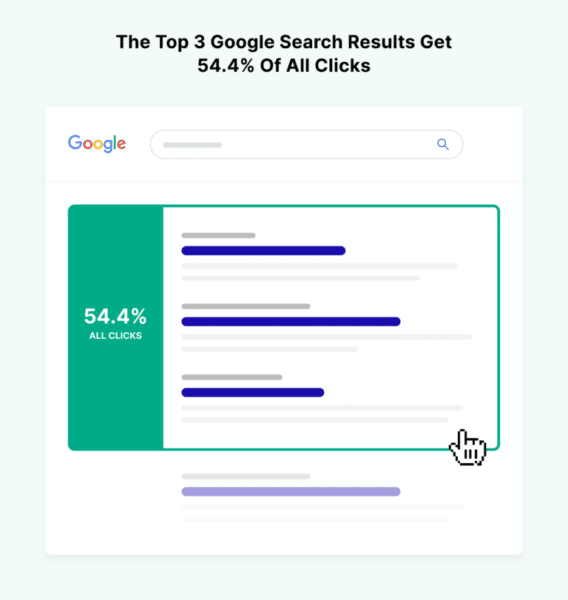
Top 3 Google search results get over half of all clicks

The number one organic result gets the majority of attention and clicks, between 20 to 40%. The second and third results still get double-digit percentages. All in all, it’s more than half of the total clicks.

The rest of the page? Not so much!

Most click distribution studies found that the rest of the results only get 2%–9% of clicks. 


Get the daily newsletter search marketers rely on.


Above the fold: Truth or myth?

The concept of “above the fold” traces its roots to traditional newspapers. Due to their large size, newspapers were often folded in half to be displayed on newsstands or carried around. 

The most important news stories were placed on the first page and “above the fold,” visible to passersby casually scanning the headlines.

When the page and front page metaphors were transferred to the web, many website owners started applying the same rule to online content as well. 

Does “above the fold” only apply to actual newspapers? Information architecture, user experience and graphic design experts have conflicting opinions on the matter. 

Some experts believe it’s vital to put the most important elements on top of the page where it’s visible without scrolling, similar to the “above the fold” concept from traditional newspapers.

Others think that the fold is a myth on the web as most people tend to scroll down to view the rest of a webpage anyway.

Whether they agree with the concept or not, most experts concur that putting as much as possible on the homepage or landing page is important.

This is because, on average, ~80% of website visitors will only see one page during their visit and go back without clicking anything.

Thus, a combined solution seems to be the best compromise – displaying important elements (i.e., value proposition, CTA, contact) above the fold and having the rest visible on scroll without relying on clicks to other pages.

Some designers even create fancy effects to further enhance the experience of scrolling through a page or content, dropping the page metaphor altogether to create “one-page websites.”

Apparently, this is also the approach Google is taking for its search results. 

Given the increasing clutter their search results have amassed over the years, including a plethora of SERP features and an ever-growing number of ads, Google needed more space to potentially push actual organic results further down the SERP.

There are many potential ways continuous scroll can impact the search experience on Google and thus also SEO practices.

Here are some ideas from me and other SEO experts debating the change.

No more ‘Page 1’ results

Let’s start with the obvious outcome. There will no longer be a real “Page 1.”

SXO strategist Lucas Rogala puts it in a very funny way:

  • “Now everybody can rank on [the] first page.”

Andrew Prince, senior SEO analyst at Wayfair, says it more eloquently:

  • “This may end the ‘we want to rank on Page 1’ requests now since ~6 pages of results will appear while scrolling down.”

More results will be viewed

It’s much more likely that people will scroll further down than the usual top 10 organic results due to the newfound convenience.

Areej AbuAli, technical SEO and founder of Crawlina, supports this conclusion:

  • “Humans are scrollers by nature. This is good news and it’ll likely reflect in better click-through rates for lower ranking domains.”

The top 3 may lose some attention

Currently, the top 3 results are where the bulk of organic clicks go. This likely won’t change in the near future, but their dominance might dwindle.

Over the years, we’ve seen this happen due to the proliferation of: 

  • Additional features.
  • Various page elements. 
  • More content types. 

This expansion has already diluted the inverted pyramid of click distribution. Back when Google search results still displayed the proverbial “10 blue links,” click heat maps indicated an overwhelming bias toward the number one spot, with more than 40% of clicks going there. 

Nowadays, the top organic spot earns around 28% of clicks, as Backlinko and Sistrix click-through rate studies have shown. 

Given the additional options further down, people might get used to scrolling more and rely less on the top results.

More ads and features on top

With Google having more potential space to fill ads and special features, there is also a better excuse to push organic results further down. 

We can also probably expect more special features on top because they can’t be shown properly below continuous scroll results. 

Websites with footers, despite having an infinite scroll functionality, are often a usability nightmare. Users have to chase the disappearing footer to reach a footer link and click it. 

Therefore, we potentially won’t see as many ads and features below organic results. Where else can Google put them? In the “middle” before the next section formerly displayed as a separate page?

SEO manager Tobiasz Szlęk expects to see a lower CTR because of this:

  • “… we should be expecting to see more zero-click searches as Google will be presenting more and more information directly on the result pages …”

Fewer or more result clusters from one website

In the past, you could get two results on Pages 1 or 2, or even two separate results on different pages.

When you change the display settings from 10 results per page to 100, you might also see two results for one website combined despite them usually being shown more than a few positions apart (i.e., an article ranking 9th would be grouped with another one from 55th). 

It will be interesting to see how Google will deal with that from now on. Such combined result clusters may become more frequent at first but less likely to show once Google adjusts the relevance to the new reality of continuous scrolling.

Why? Let’s be honest, just because a second result is on the same site does not always mean it is as helpful as the other higher-ranking one.

How can SEO specialists still optimize or adapt?

So how do we adapt as publishers, content creators and SEO practitioners? It depends, of course, on what the actual impact will be.

Given past developments, consider these changes to your SEO approach and long-term content marketing plans.

Focus on low-hanging fruits which can potentially rank in the top 3

It’s still advisable to rank in the top 3, not “Page 1” or “Top 10.” As, without pages, the latter is completely useless. 

So it’s often better to find the low-hanging fruits already ranking and optimize those pages for the keyphrases where they can reach the top 3.

Stand out in the SERPs with page titles

Given the larger number of organic results people will peruse from now on, it’s more important than ever to stand out in the crowded SERPs. 

Some techniques to consider include:

  • Featured snippets.
  • Special characters.
  • Emojis.

Ideally, you must always optimize your page titles and meta descriptions so that searchers do not just choose the listicle with the largest number in front or the article with the latest date before the description.

Make use of Google features like images and ‘People Also Ask’

If you can’t beat them, join them. It’s hard to compete against Google for “SERP real estate” when they own that space. 

You’ll have to play by Google’s rules, and if they say you have to hide below the fold and stay there, then you have no choice.

That said, you can get preferential treatment by optimizing your content for Google’s special features. 

One successful technique is to go after a more specific search query, often displayed as “People Also Ask” (PAA) questions. 

When you check some of them, you have to wonder whether searchers really do make such grammar mistakes or if the algorithm displays potential questions in the most convenient and context-sensitive way. 

Regardless of why this happens, you can always find many questions to answer just by checking the results for the keywords you are optimizing for.

Other ways of fast-tracking your way to the top and being more clickable than your competition are image and video content. Look at repurposing your written content as images or videos using various formats. 

Creating dedicated images (photos, visualization, infographics) or videos (interviews, tutorials, reviews) can boost your chances of getting clicked.


Opinions expressed in this article are those of the guest author and not necessarily Search Engine Land. Staff authors are listed here.


Related stories

New on Search Engine Land

@media screen and (min-width: 800px) { #div-gpt-ad-3191538-7 { display: flex !important; justify-content: center !important; align-items: center !important; min-width:770px; min-height:260px; } } @media screen and (min-width: 1279px) { #div-gpt-ad-3191538-7 { display: flex !important; justify-content: center !important; align-items: center !important; min-width:800px!important; min-height:440px!important; } }

About the author

Tadeusz Szewczyk

Tadeusz Szewczyk, also known as Tad Chef, is a professional blogger and SEO since 2004. Even though based in Berlin, Germany he has covered blogs, social media and search for a global audience starting in 2006. In 2007 he launched his own blog – SEO 2.0 – and also published on numerous other marketing blogs ever since. In recent years he wrote for the social media accounts of many clients as well. You can connect with Tad on LinkedIn and Twitter or visit his website and read his blog about social SEO.

https://searchengineland.com/google-continuous-scroll-seo-impact-391905


This day in search marketing history: January 20

Matt Cutts sticks a fork in guest blogging

In 2014, Matt Cutts, the head of Google’s webspam team, took to his personal blog with a clear message: “Stick a fork in it: guest blogging is done; it’s just gotten too spammy.”

This wasn’t the first time Google or Cutts had discussed the risks of guest blogging. See:

However, this was a clear, strong and definitive message – and one that would be discussed for many months to come. Google’s webspam team was going to take a “pretty dim view of guest blogging going forward.”

Okay, I’m calling it: if you’re using guest blogging as a way to gain links in 2014, you should probably stop. Why? Because over time it’s become a more and more spammy practice, and if you’re doing a lot of guest blogging then you’re hanging out with really bad company.

Matt Cutts, The decay and fall of guest blogging for SEO

Cutts’ post got hundreds of comments and sparked lots of discussion on social media. As a result, Cutts edited his post to clarify that he wasn’t referring to “high-quality multi-author blogs.” He also added “for SEO” to the title of his post.


Also on this day 


Google Ads launches placement reports for Performance Max campaigns

2022: Placement reports could be generated to see where ads had served for Performance Max campaigns as well as how many impressions they received.


Semrush acquires SEO training website Backlinko

2022: Backlinko founder Brian Dean and his colleagues would create and curate original content for the Semrush Academy


The latest data on the January 2020 Google core update

2020: With Google’s January 2020 core update mostly rolled out, several data providers shared their findings on the impact of the algorithm update.


Former Google search chief Amit Singhal joins Uber

2017: Singhal became a senior vice president of engineering, overseeing Uber’s Maps & Marketplace departments.


Search in Pics: Indoor lifeguard tower, tractor & wall art

2017: The latest images culled from the web, showing what people eat at the search engine companies, how they play, who they meet, where they speak, what toys they have and more.


Study: Quality Backlinks & Comprehensive Content Are Still Biggest Factors In Google Rankings

2016: A study of more than one million search results uncovered a handful of ranking commonalities that were prevalent across Google’s top content.


Google Search Console Adds AMP Error Report

2016: The report let you drill down to specific error types and URLs.


Report: 2014 Was A Bad Year For Lyrics Sites In Google

2015: And 2015 was looking to be even worse for this niche.


Google Overtakes Traditional Media To Become Most Trusted News Source

2015: Google’s brand strength around the world was also likely a factor in these rankings. 


What Time Is The State Of The Union? White House Uses SEO To Spread The Word

2015: Neither Google nor Bing were showing direct answers. You just got a list of web results.


Bing Tests New News Card That Expands

2015: Searching in Bing for news-related terms would bring up a box/card, with an arrow at the bottom of the box that enabled users to click to expand to show more news. 


Yahoo Sees Big 1.6% Monthly Search Share Gain At Google’s Expense In New comScore Data

2015: The gain was likely attributable to Yahoo’s Firefox default search deal.


Expedia Lost 25% Of Their Search Visibility In Google Possibly Over Unnatural Links

2014: Expedia saw large SEO visibility declines for many keywords, including hotels, airline tickets, car rentals and vacation.


Google Remarketing Ads Found To Violate Canadian Privacy Law; To Revamp Ad Review System By June

2014: Google said it rejected all active retargeting campaigns involving CPAP devices and increased searches of active retargeting campaigns potentially related to sensitive interest categories.


Searching For Gmail In Google Links You To Compose A Message To A Google Apps User

2014: This only happened if you saw the sitelink and you were logged into a Google Account.


Martin Luther King, Jr. Google Logo Marks Holiday Honoring Civil Rights Hero

2014: The illustrated Doodle included a profile of Martin Luther King, Jr., images of doves to represent King’s 1964 Nobel Peace Prize, and the Lincoln Memorial where King made his iconic “I Have a Dream” civil rights speech.


An Interview With A Google Search Quality Rater

2012: We learned about the hiring process, what Quality Raters looked for when they examined websites, details of the different evaluation tasks they did and much more.


“Ask On Google+” Links Appearing In Google’s Search Results

2012: Google encouraged people to ask their friends about [insert search query here] on Google+.


Bing’s New Ad Campaign: Bing Is For #Doing

2012: Rather than promoting the idea of making decisions, the new campaign was about people doing interesting things.


Wolfram|Alpha Scores Again With Rich NFL Data

2012: National Football League statistics came to Wolfram|Alpha.


Search In Pics: Google Boxers, 90+ Million Google+ & Gundotra Google+ Cadbury Bar

2012: The latest images culled from the web, showing what people eat at the search engine companies, how they play, who they meet, where they speak, what toys they have and more.


Was It Time For A Fresh Face? Thoughts On Larry Page As The New Google CEO

2011: Some reflection on how Eric Schmidt came into the role that Page once held and why the company may have made the change.


Google’s $8B Earnings Overshadowed By Leadership Change

2011: In Q4 2010, Google reported revenues of $8.44 billion, 26% year-on-year growth. Full year revenues exceeded $29 billion. 


Google’s Eric Schmidt: “2011 All About Mobile”

2011: Geolocation on smartphones enabled contexual personalization and a range of new possibilities and user experiences. But to realize that vision, three infrastructure elements were needed.


Confirmed: Google Readies “Google Offers” Groupon Clone

2011: This happened not long after Google’s failed bid to acquire Groupon for nearly $6 billion.


Spain To Google: Anyone Can Potentially Censor Your Index

2011: If anyone could make a request that some piece of information about him or herself be removed it would represent a radical change for Spain and for Google, but also Bing, Yahoo and others.


Google Dominates Top Free iPhone Apps In iTunes

2011: Of the top 10 free iPhone apps of all time, two of them were from Google.


Google Voice Tests Number Porting: Turning Point For The Service?

2011: Though it was only available in a test to a limited number of users, number porting was coming soon to everyone with a Google Voice account.


John F. Kennedy Inaugural Address Google Logo

2011: Google designed the Doodle using the words from his speech. In addition, Google incorporated their middle G, made up of the words of his speech, as a picture of John F. Kennedy.


Google AdWords Allows Advanced Mobile Targeting & App Downloads

2010: Advertisers could specify the device type and carrier they wanted to target their ads to. Also, advertisers could automatically market their apps as direct downloads in the iTunes App Store or Android Market via AdWords.


Google Buys Search Ad In Response To The China Decision

2010: For “Google Leaves China” or “Google vs. Baidu.”


SEOmoz Launches Open Site Explorer, A Competitor (Replacement?) To Yahoo Site Explorer

2010: It showed stats such as overall link counts and a count of domains that link to a URL, along with anchor text distribution and more.


Take The Google Webmaster Quiz

2010: “Fun and educational.” 


Report: Microsoft And Apple Discuss Making Bing Default Engine On The iPhone

2010: Microsoft was seen as a pawn in the battle between Apple and Google.


Bing Silverlight Maps Comes Out Of Beta With New “Destination Maps” And Local Events Apps

2010: One click got users to a list and locations for local event in the desired (US) city


Wired: Monopoly, Microsoft And The Anti-Google ‘Conspiracy’

2009: The article presents Microsoft as the driving force, along with other allies, behind an effort to stop Google’s further dominance in search (via the Yahoo deal) after its own failed bid for Yahoo.


Should Google Let Advertisers Opt-Out Of Google’s Own Properties?

2009: A simple list of properties would give advertisers more control in a day and age where Google wants to show more ads in less relevant spaces.


Google PageRank: A Strange Case Of Hyves

2009: Supposedly, you could check if Google had penalized a domain by adding the word hyves as a subdomain and then checking the PageRank of that subdomain.


Report: Google Leads U.S. Search Advertising Market With 76% Market Share

2009: Based on an analysis of 92 billion impressions and 600 million clicks.


Google Closes The Presses On Print Ads

2009: They discontinued this service because it was “not the right solution.”


Despite Inauguration, Google & Others Still Think It’s President Bush, Not President Obama

2009: The major search engines had yet to catch up with the power change.


SEM Vendors Launches & Other Ways To Find SEM Companies

2009: If you were looking for an SEM company, you could just fill out the form and SEM vendors would be able to pitch their services to you. 


GetListed.org Aims To Simplify Local Search Marketing

2009: GetListed.org operated with a simple premise: It should be as easy as possible for small businesses to find and claim their business listings on local search engines. 


Google & Firefox 2 Anti-Phishing Warning In Action

2007: What a phishing warning actually looked like through the Google – Firefox 2 partnership. (It
was also an incorrect warning.)


Past contributions from Search Engine Land’s Subject Matter Experts (SMEs)

These columns are a snapshot in time and have not been updated since publishing, unless noted. Opinions expressed in these articles are those of the author and not necessarily Search Engine Land.


< January 19 | Search Marketing History | January 21 >


Related stories

New on Search Engine Land

@media screen and (min-width: 800px) { #div-gpt-ad-3191538-7 { display: flex !important; justify-content: center !important; align-items: center !important; min-width:770px; min-height:260px; } } @media screen and (min-width: 1279px) { #div-gpt-ad-3191538-7 { display: flex !important; justify-content: center !important; align-items: center !important; min-width:800px!important; min-height:440px!important; } }

About the author

Danny Goodwin

Danny Goodwin is Managing Editor of Search Engine Land & SMX. In addition to writing daily about SEO, PPC, and more for Search Engine Land, Goodwin also manages Search Engine Land’s roster of subject-matter experts. He also helps program our conference series, SMX – Search Marketing Expo. Prior to joining Search Engine Land, Goodwin was Executive Editor at Search Engine Journal, where he led editorial initiatives for the brand. He also was an editor at Search Engine Watch. He has spoken at many major search conferences and virtual events, and has been sourced for his expertise by a wide range of publications and podcasts.

https://searchengineland.com/search-marketing-history-january-20-391943


Google improves error classification in video indexing report

Google has updated the video indexing report in Google Search Console to improve the accuracy of the error reporting. Google said you might see “missing thumbnail” errors reclassified under new error types. Google also added that the total number of errors reported should not change, and that this is just a reclassification of errors.

January 19, 2023. This change went into affect today, January 19, 2023.

Google’s statement. Google wrote, “Search Console can now more accurately classify thumbnail indexing issues. As a result, you may see a reassignment of “Missing thumbnail” issues to more specific issue types. The total number of affected videos should remain the same.”

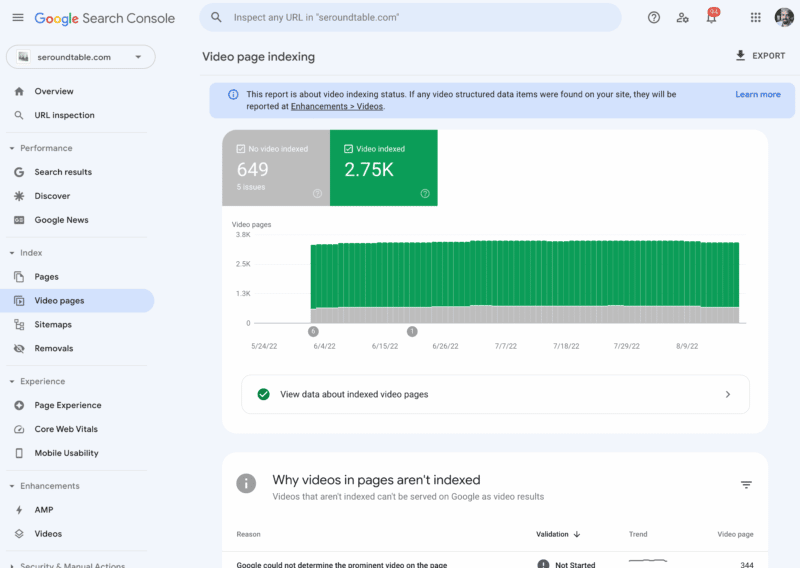
What is the video indexing report. The video indexing report shows how many indexed pages on your site contain one or more videos, and how many of those pages a video could be indexed. Google said the report can help you understand the performance of your videos on Google, and identify possible areas of improvement.

What it looks like. Here is a screenshot of this report for one of my sites in Google Search Console:

When the report shows. Google said if Google detects videos on your site, the Video indexing report will appear on the left navigation bar in the coverage section. If Google has not detected a video on your website, you will not see the report.

What it tells you. The report shows the status of video indexing on your site. It helps you answer the following questions:

  • In how many pages has Google identified a video?
  • Which videos were indexed successfully?
  • What are the issues preventing videos from being indexed?

In addition, if you fix an existing issue, you can use the report to validate the fix and track how your fixed video pages are updated in the Google index, Google explained.

Why we care. You may want to recheck some of the errors in this report and see if some were reclassified from “missing thumbnail” to a different error type. This way you can resolve any errors that might not have been resolved earlier.


Related stories

New on Search Engine Land

@media screen and (min-width: 800px) { #div-gpt-ad-3191538-7 { display: flex !important; justify-content: center !important; align-items: center !important; min-width:770px; min-height:260px; } } @media screen and (min-width: 1279px) { #div-gpt-ad-3191538-7 { display: flex !important; justify-content: center !important; align-items: center !important; min-width:800px!important; min-height:440px!important; } }

About the author

Barry Schwartz

Barry Schwartz a Contributing Editor to Search Engine Land and a member of the programming team for SMX events. He owns RustyBrick, a NY based web consulting firm. He also runs Search Engine Roundtable, a popular search blog on very advanced SEM topics. Barry can be followed on Twitter here.

https://searchengineland.com/google-improves-error-classification-in-video-indexing-report-391938


Technical SEO report reveals what matters in 2023

The State of Technical SEO Report 2023 is out from digital marketing agency Aira and the Women in Tech SEO community. So what matters in 2023? Here’s a quick summary of some of the more interesting results.

Resources matter. The biggest risk the report highlighted was an organizational lack of resources. A lack of resources means changes don’t get made or are very slow to get made – which means less than stellar SEO results. So if you work at a company where resources are lacking, prioritization of tasks will continue to be critically important.

Tools and technology that matter. Google Search Console was the most popular tool for technical SEOs overall – 92% reported using it. It was also the top tool used (78%) for measuring organic search rankings.

Screaming Frog SEO Spider was popular choice for crawling and log file analysis. Meanwhile, Semrush was the top choice for assessing the search visibility of a website.

For non ecommerce platforms, technical SEOs most preferred working on WordPress. Wix was considered the most problematic to work on.

Time matters. Sadly, waiting months for technical SEO changes to happen is fairly common – 88% of respondents waited anywhere from a month to 24+ months for technical SEO changes to be made. 

Perhaps a bit surprising: 22% reported waiting only a month for technical SEO changes to be implemented. Meanwhile, 20% reported waiting 12 months (which was down slightly from the prior year). And 11% of respondents reported waiting 24 months or longer.

Skills that matter. What are the top three skills a technical SEO should have? According to the respondents:

  1. Data anaysis (72%)
  2. Reading and understanding HTML/CSS (58%)
  3. Content strategy (39%)

It was surprising to see content strategy ranked so highly. But as Steph Greaves pointed out in the report comments:

  • “It’s definitely helpful to know how content relates on a website to fully understand internal linking opportunities that serve the user.”

Technical SEO = marketing. Search Engine Land contributor Mark Jackson has made the case that SEO is marketing. So it was nice to see that marketing (74%) was the top answer to this in-house specific question: “In your organisation, in which team does accountability for technical SEO sit?

Dig deeper. There’s much more to read. Here’s the full, ungated report: The State of Technical SEO Report 2023

Why we care. Overall, this report is good news for our industry. Clearly, we’re facing issues, most notably an uncertain economic outlook. Plus there have been many layoffs. But it’s encouraging that the report finds the outlook for SEO is still relatively positive and demand for SEO remains in a good place.


Related stories

New on Search Engine Land

@media screen and (min-width: 800px) { #div-gpt-ad-3191538-7 { display: flex !important; justify-content: center !important; align-items: center !important; min-width:770px; min-height:260px; } } @media screen and (min-width: 1279px) { #div-gpt-ad-3191538-7 { display: flex !important; justify-content: center !important; align-items: center !important; min-width:800px!important; min-height:440px!important; } }

About the author

Danny Goodwin

Danny Goodwin is Managing Editor of Search Engine Land & SMX. In addition to writing daily about SEO, PPC, and more for Search Engine Land, Goodwin also manages Search Engine Land’s roster of subject-matter experts. He also helps program our conference series, SMX – Search Marketing Expo. Prior to joining Search Engine Land, Goodwin was Executive Editor at Search Engine Journal, where he led editorial initiatives for the brand. He also was an editor at Search Engine Watch. He has spoken at many major search conferences and virtual events, and has been sourced for his expertise by a wide range of publications and podcasts.

https://searchengineland.com/state-technical-seo-report-2023-391908


How to create an enterprise SEO monthly report

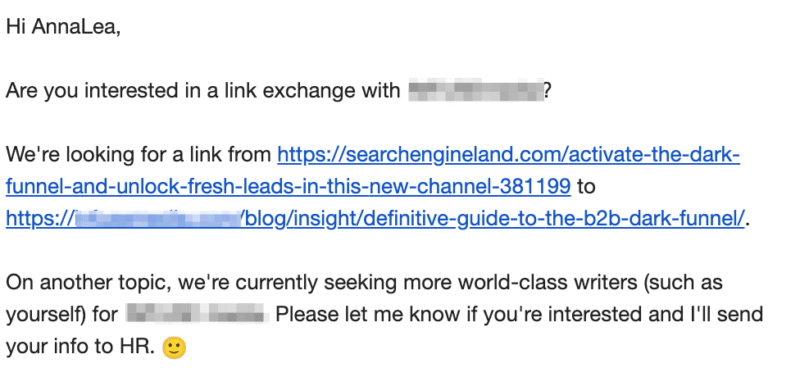
Of all the ridiculous and sublime ways to spend $10,000 a month of your enterprise SEO budget, your least greatest ROI has come from link exchange emails like this below, where a C-note can get you a backlink on a website with a domain authority of 80+ – potentially evening out that PBN you created for another $10k. 

Link exchange pitch
The author took the screenshot.

If you missed that hint of sarcasm above, let’s be clear, you should not be spending your enterprise SEO budget on link exchanges or PBNs. 

Instead, you should be looking to spend your enterprise SEO budget on SEO tactics that bring value to the company and align with the overall business objectives of your leadership team. 

And when it comes to reporting to your C-suite, they want to connect the dots between your SEO budget and the bottom line. 

We’ve all been there. You agonize over creating the Looker Studio dashboard and including the right metrics. You email your boss an impressive, in-depth SEO report and hope for the best. 

But you are struggling to articulate clearly how your enterprise SEO strategy impacts ROI. 

Well, it’s time to put your money where your mouth is. Don’t let feelings guide your decisions. Instead, you need hard, cold data to build your enterprise SEO report that will win over your leadership team. 

My enterprise SEO monthly report template to answer all your boss’s questions

Based on inspiration from Tom Critchlow’s The SEO MBA and Adam Gent’s SEO Roadmap, I created this enterprise SEO monthly report template. 

This report includes screenshots of all my Looker Studio and Tableau dashboards. 

Caveat: I hate presentation decks. It’s a giant waste of time. But the reality is your boss and your bosses boss will likely want a deck. So give them what they want and what they are comfortable reading. 

Here’s how to deliver your monthly enterprise SEO report to your boss and across departments

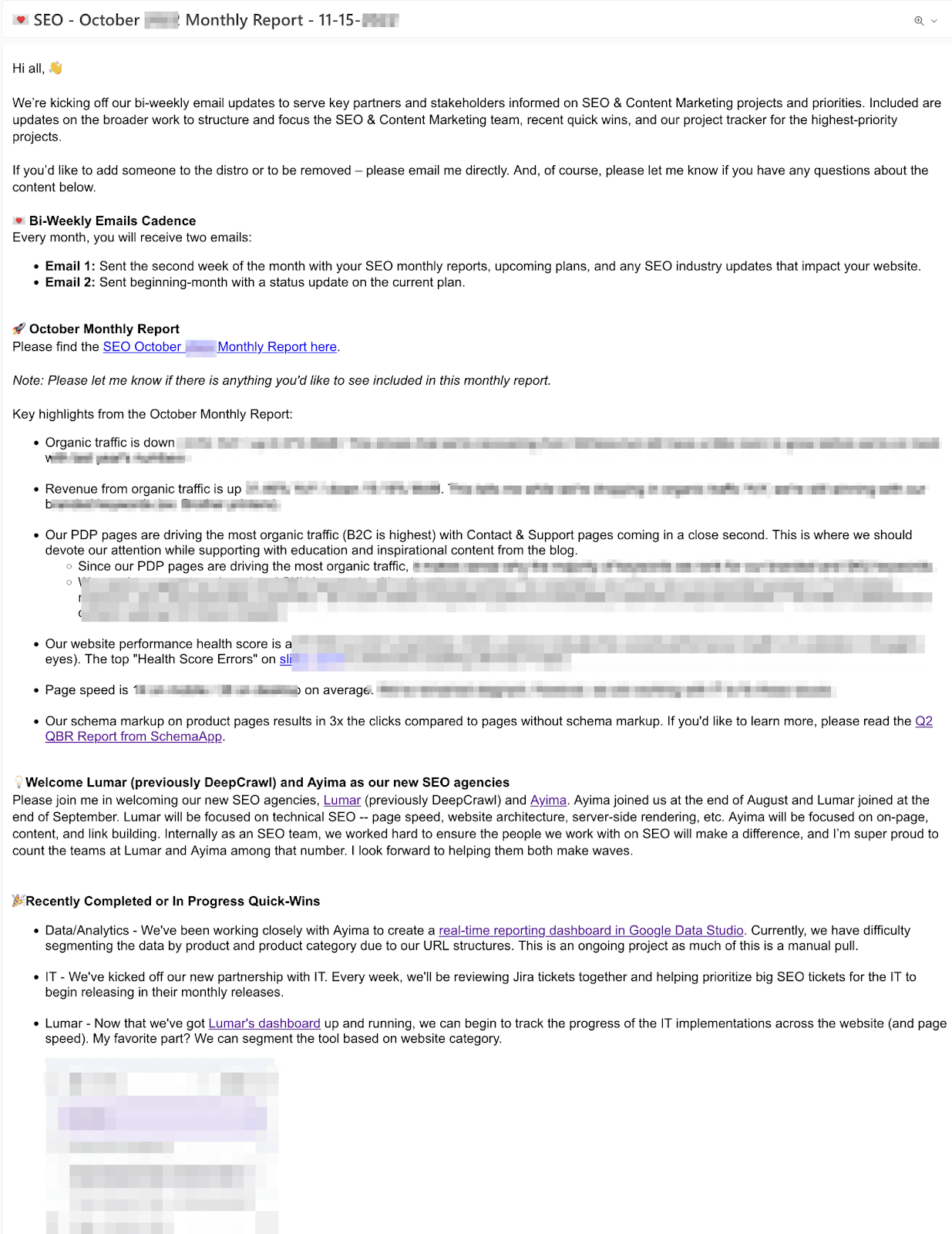
Every month I send two emails to my bosses, direct reports, and cross-departments. The main goal of these biweekly emails is to begin to build an SEO culture within the company. 

The second email of the month, typically on the 15th, is the previous month’s report. I call out 3-5 highlights, lowlights, and next steps to give the C-suite a high-level overview. 

SEO monthly report template
Screenshot taken by author.

Get the daily newsletter search marketers rely on.


72 enterprise SEO metrics to include in your monthly enterprise SEO dashboards

Below is a list of enterprise SEO metrics I include in all my dashboards. 

It’s important to note that not all of these metrics are shared with my leadership team. Use these metrics to help understand the story you want to tell the leadership team.  

Also, remember you are an enterprise SEO lead, not a data scientist or Google Analytics expert. 

If you’re working at an enterprise-level company, you will likely have a data analytics team to collaborate with to build these dashboards with you. 

In your first 90 days as an enterprise SEO lead, I recommend copying/pasting this as a starting conversation with your data team. 

All reports listed below should be available to segment by:  

  • Market (Locations)  
  • Device (Mobile, Desktop)  
  • Branded, Non-Branded, Combined 
  • Directory breakdown (blog, product pages, category pages, support pages, etc.) 
  • Month-over-month, year-over-year  

Website organic dashboard  

All should be available to segment by organic, direct, or referral traffic. 

Organic overview 

  • Website Organic traffic sessions 
  • Website Organic traffic sessions compared to direct and referral 
  • Website Organic traffic sessions branded  
  • Website Organic traffic visits / sessions non branded  
  • Website Organic traffic users  
  • Website Organic traffic new users  
  • Website Organic traffic new users vs. returning 
  • Website Organic traffic pages/sessions  
  • Website Organic traffic avg session duration 
  • Website Organic traffic bounce rate  
  • Website Organic pageviews broken  

Leads overview 

  • Organic
    • Website Organic traffic sessions  
    • Website Organic traffic users 
    • Website Organic traffic leads 
    • Website Organic traffic MQLs 
    • Website Organic traffic SQLs 
    • Website Organic traffic sign ups  
    • Website Organic traffic sign ups %  
    • Website Organic traffic revenue  
  • Direct
    • Website Direct traffic sessions  
    • Website Direct traffic leads  
    • Website Direct traffic MQLs 
    • Website Direct traffic SQLs 
    • Website Direct traffic sign ups  
    • Website Direct traffic sign ups %  
    • Website Direct traffic revenue 
  • Referral
    • Website Referral traffic sessions   
    • Website Referral traffic leads  
    • Website Referral traffic MQLs 
    • Website Referral traffic SQLs 
    • Website Referral traffic sign ups  
    • Website Referral traffic sign ups %  
    • Website Referral traffic revenue 

Organic content overview 

  • Website Organic # of pages driving organic traffic
    • Website Organic All URLs driving most organic traffic – display top 10, should list all URLs if deep dive needed 
    • Website Organic All URLs driving most leads – display top 10, should list all URLs if deep dive needed 
    • Website Organic All URLs driving most MQLs – display top 10, should list all URLs if deep dive needed 
    • Website Organic All URLs driving most SQLs – display top 10, should list all URLs if deep dive needed 
    • Website Organic All URLs driving most sign ups– display top 10, should list all URLs if deep dive needed 
    • Website Organic All URLs driving most revenue– display top 10, should list all URLs if deep dive needed 
  • Website Impressions – pull from Google Search Console
    • Website Impressions biggest winners based on based on search queries filtered by impression difference 
    • Website Impressions biggest losers based on based on search queries filtered by impression difference 
    • Website Clicks 
    • Website Clicks biggest winners based on based on search queries filtered by clicks difference 
    • Website Clicks biggest losers based on based on search queries filtered by clicks difference 
    • Website Avg. Position 
    • Website Impressions vs. URL CTR By Device 
    • Website Top 10 Landing Pages broken down by Impressions, Clicks, CTR 
    • Website Top 10 Queries broken down by Impressions, Clicks, CTR, Avg Position
  • Website Domain rating – Pulled from Semrush/Ahrefs
    • Website Keyword rankings from Top 10 Overall – segmented by page type (blog, product, support, etc.) 
    • Website Keyword rankings from #1-3 spots, #4-11, #11-20 – segmented by page type (blog, product, support, etc.) 
    • Search visibility compared to key competitors 
    • % of visibility 
  • Organic Backlinks Overview – Pulled from Semrush/Ahrefs
    • Link growth  
    • Referring domains 
    • Top 10 links with the highest domain authority  

Organic technical overview 

  • Website pages with crawlability issues (crawl errors) broken down by 3xx redirects, broken 4xx errors, server errors 5xx  
  • Number of pages crawled  
  • Number of new issues   
  • Number of total issues bucketed into high, medium, and low priority  
  • What percentage of page loads are slow, average or fast? – Please pull % YoY comparison and quarterly 
  • How has the page load time changed over the last year?  
  • Homepage speed score desktop  
  • Homepage speed score mobile 
  • Competitor Homepage 1 speed score desktop  
  • Competitor Homepage 1 speed score mobile 
  • Competitor Homepage 2 speed score desktop  
  • Competitor Homepage 2 speed score mobile 
  • Competitor Homepage 3 speed score desktop  
  • Competitor Homepage 3 speed score mobile 
  • How does the site perform for each of the CruX metrics?  
  • Top 10 URLs segmented by performance score, LCP, TBT, CLS, Status 

Below is a list of enterprise SEO tools I use to create my monthly reports: 

Free enterprise SEO tools

  • Looker Studio (previously Google Data Studio) 
  • Google Search Console
  • Google Analytics
  • Google Lighthouse
  • Bing Webmaster Tools

Paid enterprise SEO tools 

  • Semrush or Ahrefs (depending on your preference)
  • Screaming Frog 
  • Lumar (previously DeepCrawl, but comes at a minimum $10k per month price point now)
  • Conductor
  • Supermetrics (this is the only tool to connect all your platforms into Looker Studio)

Enterprise SEO tools I wish I had the budget for: 

  • Clearscope or MarketMuse
  • Sistrix

Avoid overwhelming your C-level executives with SEO metrics they don’t care about

The chances of your boss or any C-level executives reading your 50-page SEO report are about as high as Tom Hanks finding Wilson.

It’s our job as SEO professionals to get under the hood to see how the car works. It’s our job to diagnose the issues. But it’s not our job to explain how the motor works or why. 

You must choose wisely the metrics you share.  

Before you hit send, ask yourself: Is SEO worth it from this report? 

After all, you must make a compelling case for SEO in your reporting, or SEO will be left behind. 


Opinions expressed in this article are those of the guest author and not necessarily Search Engine Land. Staff authors are listed here.


Related stories

New on Search Engine Land

@media screen and (min-width: 800px) { #div-gpt-ad-3191538-7 { display: flex !important; justify-content: center !important; align-items: center !important; min-width:770px; min-height:260px; } } @media screen and (min-width: 1279px) { #div-gpt-ad-3191538-7 { display: flex !important; justify-content: center !important; align-items: center !important; min-width:800px!important; min-height:440px!important; } }

About the author

Anna Crowe

Anna Crowe is a Frank’s Hot Buffalo sauce advocate (leading with obvious priorities), writer, marketer and SEO nerd. Over the last 12+ years, Anna has successfully run SEO and content programs for brands like Dollar Thrifty Rental, Marriott, Hilton, Hearst Magazine, Mailboat Records, Philip Morris International, Bloomin’ Brands and Brother USA and many more. She enjoys burritos and puppies (in that order) when she’s not moonlighting as a soccer coach. https://annaleacrowe.com/

https://searchengineland.com/how-to-create-an-enterprise-seo-monthly-report-391850


Product results in Google’s performance report may see an increase in impressions and clicks

Google Search Console updated the performance report on January 6, 2023, going forward, to report on more product results, even without structured data. That means you may see an increase in impressions and clicks when you filter the performance report by “product results” in the search appearance type.

What Google said. Google posted here saying, “Sites may see an increase in impressions and clicks for Product results search appearance type on their site. This is because Google now includes products found only in page content, without associated Product structured data.”

January 6, 2023. This was annotated on January 6, 2023, saying this change was made to the report on that date and will continue going forward.

Report change. This change seems like a reporting change only, Google Search has shown product results without product-structured data in the search results for some time. But now the report in Search Console also shows the performance of these products. Google wrote, “this is because Google now includes products found only in page content, without associated Product structured data.”

Why we care. If you notice this spike in your performance report, note that this is because of the change Google made to calculating clicks and impressions for products without structured data. Again, this is a reporting change that started on January 6th, going forward.


Related stories

New on Search Engine Land

@media screen and (min-width: 800px) { #div-gpt-ad-3191538-7 { display: flex !important; justify-content: center !important; align-items: center !important; min-width:770px; min-height:260px; } } @media screen and (min-width: 1279px) { #div-gpt-ad-3191538-7 { display: flex !important; justify-content: center !important; align-items: center !important; min-width:800px!important; min-height:440px!important; } }

About the author

Barry Schwartz

Barry Schwartz a Contributing Editor to Search Engine Land and a member of the programming team for SMX events. He owns RustyBrick, a NY based web consulting firm. He also runs Search Engine Roundtable, a popular search blog on very advanced SEM topics. Barry can be followed on Twitter here.

https://searchengineland.com/product-results-in-googles-performance-report-may-see-an-increase-in-impressions-and-clicks-391882


This day in search marketing history: January 19

Google’s page layout algorithm launches

In 2012, Google announced it would penalize sites with pages that were top-heavy with ads.

The page layout algorithm update took direct aim at any site with pages where content was buried under tons of ads.

According to Google:

If you click on a website and the part of the website you see first either doesn’t have a lot of visible content above-the-fold or dedicates a large fraction of the site’s initial screen real estate to ads, that’s not a very good user experience. Such sites may not rank as highly going forward.

Google’s Matt Cutts, Page layout algorithm improvement

On the same day, a message from Google’s AdSense team went out, encouraging some publishers to add more ads to their sites.

Isn’t it ironic.

Read all about it in: The Top Heavy Update: Pages with too many ads above the fold now penalized by Google’s “Page Layout” algorithm.


Also on this day 


Google explains how it deduplicates Top Stories from main search results

2022: Google said it deduplicates a link from its main web results if that same link appears in the first Top Stories slot, so long as the Top Stories section appears before the main web results.


Google recipe markup now requires specific times, no more time ranges

2022: Google removed all references to using time ranges in the recipe schema markup help documents.


Marketers, Google agree that proposed ‘surveillance advertising’ ban goes too far

2022: The legislation would have been a game-changer for every digital marketer who advertises on Google, Facebook and other advertising platforms. 


Google Ads’ updated Experiments page sheds campaign drafts and adds experiment sync

2022: Advertisers no longer had to create a separate campaign draft and changes made to the original campaign are automatically synced to the experiment as well.


Google heightens adult ad policy enforcement after Reuters finds illicit ads

2022: Ads for sex toys, liquor and high-risk investments were discovered in Google’s search results, which violated the company’s attempts to comply with UK regulations.


Google crawl stats report now showing more crawls

2021: This was just a reporting change and any change seen in crawling was not reflective of any change in search results. 


DuckDuckGo’s focus on privacy-minded users pushes it past 100 million searches in a single day

2021: DuckDuckGo served 102,251,307 search queries for the first time, breaking past the 100 million query milestone.


Video: Phillip Thune on finding good writers and writing good content

2021: In this installment of Barry Schwartz’s vlog series, he also chatted with Thune about how SEOs changed how they approached content development after Panda and Penguin.


Search in Pics: A pig visits Google, big teddy bear & a broken Google sign

2018: The latest images culled from the web, showing what people eat at the search engine companies, how they play, who they meet, where they speak, what toys they have and more.


Matt Cutts officially resigns from Google

2017: Cutts became the new director of engineering at the US Digital Service. He had been on leave with Google since 2014.


Study shows search terms with the very worst (and best) click-through rates

2017: Study examined the top 50 keyword “stems” to find what terms helped spur clicks and, more importantly, what terms didn’t.


DuckDuckGo surpasses 10 billion searches, with 4 billion happening in 2016 alone

2017: The search engine said 4 billion of those searches happened in 2016.


Google Revamps Their Webmasters Portal With Clean New Slick Design & Resources

2016: The resource got a new design, better organization and three new features (webmaster troubleshooter, popular resources, event calendar).


Google Expandable PLA View Test Displays 16 Product Listing Ads

2016: When expanded, PLAs muscled out other ads and organic listings to take over most of the above-the-fold real estate.


You Can Now Install Android Apps Directly From Google’s Search Results

2016: Bypassing the need to visit the Google Play store.


Google Sending Mobile Usability Warnings To Huge Number Of Webmasters

2015: These notifications warned there were critical mobile usability errors on 100% of the pages on the site and thus the pages would be “displayed and ranked appropriately for smartphone users.”


Bing-Yahoo Paid Search Share Rises For Two Consecutive Quarters [IgnitionOne]

2015: Advertisers increased spending by 31% year-over-year on the Yahoo Bing Network (through the Bing Ads platform). Spending on Google AdWords rose by 5%.


Yahoo Search Testing Google’s Search Results Design?

2015: The whole page looked right out of Google’s search results design.


Google’s 2015 Martin Luther King, Jr. Day Logo Designed By Ekua Holmes

2015: The Doodle featured Martin Luther King, Jr. in locked arms with fellow civil rights activists with the American flag in the background.


Google: Paid Clicks Up 34% While Cost Per Click Down 8% YoY

2012: More people were clicking on ads, but those clicks were costing advertisers less money per click.


Nokia Now “Powering” Bing Maps

2012: Nokia branding would soon be showing up on Bing Maps for mobile.


Google Maps Now Highlighting Borders Of Cities, Postal Codes & More

2012: Google Maps added a feature where it would highlight in a pink color the borders of a city, postal code or other borders based on your search.


How To Track U.S. Congress Members’ Tweets

2012: PolitickerUSA let you access the non-stop real-time stream of tweets from Senators, Reps, President Obama, governors, and a few of the Republican presidential candidates.


Study: Google “Favors” Itself Only 19% Of The Time

2011: “Even if Google listed itself first for [email] … is it really anti-competitive when its competitor is prominently listed in second place? Wouldn’t it really be more of a concern if Google didn’t list its competitors at all?”


Google Makes Modest Comeback In China

2011: 23.1% of Chinese search users wanted Google.


Deconstructing “Search Neutrality”

2011: In an academic article, an NYU associate law professor closely examined and deconstructed the arguments behind the idea of search neutrality.


Google Knol Still Alive & Fixed, But Questions Linger About Its Future

2011: Google fixed a bug that made Knol look like a ghost town.


Google Exposes Maps Options With New Widget Display

2011: Google formally launched a new Google Maps display that made the different viewing options much more visible.


SEO Gets Dissed by CBS TV Series “The Good Wife”

2011: Let the court record show, for the education of “The Good Wife” writers, and good citizens everywhere – when “SEO” or search engine optimization is performed according to the best practices and guidelines set forth by major search engines, then SEO is considered to be a useful, effective and legal technique for driving visitors to a website.


Google Opens Up Downloads To Iran But Blocks Iranian Government

2011: After years of not allowing those in Iran to download their software, Google opened up downloads of their Google Earth, Picasa and Chrome applications.


Search & The 2011 Sundance Film Festival

2011: Bing was the official search engine of the 2011 Sundance Film Festival website, and YouTube had two special channels for the event.


Real-Time Search Engine Collecta Hits Pause

2011: The company took “a step back” to retool its approach.


Google’s Fourth Doodle 4 Google Competition Announced

2011: “What I’d like to do someday…”


Google’s Paul Cézanne Logo

2011: The logo was first created as a real oil painting by a Googler and then digitized. 


Google Changes How It Handles Synonyms

2010: Rather than only bolding direct variants of words (like “photos” for “pictures”), Google “extended this to words that our algorithms very confidently think mean the same thing, even if they are spelled nothing like the original term.”


Bing Updates Autosuggest With News & Trending Queries

2010: Bing added “breaking news and hot trending queries” into autosuggest, with updates being pushed out every 15 minutes.


Microsoft Complies With EU Demand, First To Cut Data Retention To Six Months

2010: Microsoft became the first of the major search engines to agree to the European Union’s demand that data retention be cut to six months. 


Yahoo Search Marketing Launches New Network Distribution & Import Campaigns

2010: The new network distribution and import campaigns went live for Yahoo advertisers.


Can Google Tell Us What Men and Women Are REALLY Thinking?

2010: What Google Suggest had to say about what men and women were really thinking.


Google New York Expanding

2010: Google was expanding its already humongous New York office by 57,000 square feet. 


Google Testing “Preferred Sites” Option In Search Preferences

2009: Users who were in this experiment could add a list of sites in their search preferences page as their “preferred sites.”


Report: Search Spending Off 8% In Q4

2009: Advertisers who spent less than $50,000 on search ads cut their spending by 23% year-over-year, while advertisers that spent more than $200,000 on search per month cut spending by 9% during that time.


No Surprise: IAA Survey Shows Concern Over Google Market Dominance

2009: 65% said there was one dominant player in the online ad market and that there were “limited choices and price options for online advertisers.”


Google Quietly Drops iPhone Optimized iGoogle Page

2009: Google said the reason they dropped the iPhone version was because they “want to ensure you’ll all see the same version” of the iGoogle mobile page. 


Live Search News Adds Email Alerts

2009: You could get these alerts via email either once a day, twice a day or weekly and you could subscribe by section or by search phrase.


Some Parallels Between Obama And Yahoo’s Carol Bartz

2009: Both Barack Obama and incoming Yahoo CEO Carol Bartz were taking charge of their respective administrations at times of crisis.


GDrive: It’s Alive! — Or So It Appears

2009: Renewed buzz and speculation.


Google & Others Martin Luther King Jr.’s Logos

2009: How the search engines commemorated Martin Luther King Jr. Day.


Checking Out Allcheckin Travel Search

2007: Some thoughts on a travel search alternative.


Yahoo Introduces Personal Finance Site

2007: This new sub-site offered “free tools and how-to guides for tax planning, budgeting, real estate planning, and saving for college and retirement.”


Google Book Search To Add Chinese Books

2007: The initial launch would be about 1,000 books, with the hope of having 3,000 book titles in Google Book Search by year’s end.


Search Engines’ Test Beds

2007: An overview of the different ways search engines like Google, Yahoo, Microsoft and Ask.com used “spin off” sites to test new features.


Yahoo Tells Belgian Newspapers They Did Nothing Wrong

2007: Yahoo said they did not violate any copyright laws for “publishing snippets and links” to their newspapers.


Google, Microsoft & Yahoo To Develop NGO Conduct Code

2007: This move was to help the companies’ ventures into China and help paint a better picture for the search giants in the public view.


Yahoo Debuts U.S. Schools Search Tool

2007: Results were plotted on a map, and you could sort by school district, distance from a specific location, grade level, or school type (public, private, charter). 


Looksmart’s Furl Gets A Facelift

2007: Looksmart also made it easier to create and find topics to help organize saved web pages, and improved the browser buttons and toolbar used to save pages.


Google Picks North Carolina For Server Farm

2007: Google was expected to spend about $600 million on their new data center and employ 210 people.


From Search Marketing Expo (SMX)


Past contributions from Search Engine Land’s Subject Matter Experts (SMEs)

These columns are a snapshot in time and have not been updated since publishing, unless noted. Opinions expressed in these articles are those of the author and not necessarily Search Engine Land.


< January 18 | Search Marketing History | January 20 >


Related stories

New on Search Engine Land

@media screen and (min-width: 800px) { #div-gpt-ad-3191538-7 { display: flex !important; justify-content: center !important; align-items: center !important; min-width:770px; min-height:260px; } } @media screen and (min-width: 1279px) { #div-gpt-ad-3191538-7 { display: flex !important; justify-content: center !important; align-items: center !important; min-width:800px!important; min-height:440px!important; } }

About the author

Danny Goodwin

Danny Goodwin is Managing Editor of Search Engine Land & SMX. In addition to writing daily about SEO, PPC, and more for Search Engine Land, Goodwin also manages Search Engine Land’s roster of subject-matter experts. He also helps program our conference series, SMX – Search Marketing Expo. Prior to joining Search Engine Land, Goodwin was Executive Editor at Search Engine Journal, where he led editorial initiatives for the brand. He also was an editor at Search Engine Watch. He has spoken at many major search conferences and virtual events, and has been sourced for his expertise by a wide range of publications and podcasts.

https://searchengineland.com/search-marketing-history-january-19-391879