Why Is Organic Traffic Down? Here’s How To Segment The Data via @sejournal, @torylynne

As an SEO, there are few things that stoke panic like seeing a considerable decline in organic traffic. People are going to expect answers if they don’t already.

Getting to those answers isn’t always straightforward or simple, because SEO is neither of those things.

The success of an SEO investigation hinges on the ability to dig into the data, identify where exactly the performance decline is happening, and connect the dots to why it’s happening.

It’s a little bit like an actual investigation: Before you can catch the culprit or understand the motive, you have to gather evidence. In an SEO investigation, that’s a matter of segmenting data.

In this article, I’ll share some different ways to slice and dice performance data for valuable evidence that can help further your investigation.

Using Data To Confirm There’s An SEO Issue

Just because organic traffic is down doesn’t inherently mean that it’s an SEO problem.

So, before we dissect data to narrow down problem areas, the first thing we need to do is determine whether there’s actually an SEO issue at play.

After all, it could be something else altogether. In which case, we’re wasting unnecessary resources chasing a problem that doesn’t exist.

Is This A Tracking Issue?

In many cases, what looks like a big traffic drop is just an issue with tracking on the site.

To determine whether tracking is functioning correctly, there are a couple of things we need to look for in the data.

The first is consistent drops across channels.

Zoom out of organic search and see what’s happening in other sources and channels.

If you’re seeing meaningful drops across email, paid, etc., that are consistent with organic search, then it’s more than likely that tracking isn’t working correctly.

The other thing we’re looking for here is inconsistencies between internal data and Google Search Console.

Of course, there’s always a bit of inconsistency between first-party data and GSC-reported organic traffic. But if those differences are significantly more pronounced for the time period in question, that hints at a tracking problem.

Is This A Brand Issue?

Organic search traffic from Google falls into two primary camps:

  • Brand traffic: Traffic driven by user queries that include the brand name.
  • Non-brand traffic: Traffic driven by brand-agnostic user queries.

Non-brand traffic is directly affected by SEO work. Whereas, brand traffic is mostly impacted by the work that happens in other channels.

When a user includes the brand in their search, they’re already brand-aware. They’re a return user or they’ve encountered the brand through marketing efforts in channels like PR, paid social, etc.

When marketing efforts in other channels are scaled back, the brand reaches fewer users. Since fewer people see the brand, fewer people search for it.

Or, if customers sour on the brand, there are fewer people using search to come back to the site.

Either way, it’s not an SEO problem. But in order to confirm that, we need to filter the data down.

Go to Performance in Google Search Console and exclude any queries that include your brand. Then compare the data against a previous period – usually YoY if you need to account for seasonality. Do the same for queries that don’t include the brand name.

If non-brand traffic has stayed consistent, while brand traffic has dropped, then this is a brand issue.

filtering queries using regex in Google Search Console
Screenshot from Google Search Console, November 2025

Tip: Account for users misspelling your brand name by filtering queries using fragments. For example, at Gray Dot Co, we get a lot of brand searches for things like “Gray Company” and “Grey Dot Company.” By using the simple regex expression “gray|grey” I can catch brand search activity that would otherwise fall through the cracks. 

Is It Seasonal Demand?

The most obvious example of seasonal demand is holiday shopping on ecommerce sites.

Think about something like jewelry. Most people don’t buy jewelry every day; they buy it for special occasions. We can confirm that seasonality by looking at Google Trends.

Zooming out to the past five years of interest in “jewelry,” it clearly peaks in November and December.

Google Trends graph for interest in jewelry over the past five years
Screenshot from Google Trends, November 2025

As a site that sells jewelry, of course, traffic in Q1 is going to be down from Q4.

I use a pretty extreme example here to make my point, but in reality, seasonality is widespread and often more subtle. It impacts businesses where you might not expect much seasonality at all.

The best way to understand its impact is to look at organic search data year-over-year. Do the peaks and valleys follow the same patterns?

If so, then we need to compare data YoY to get a true sense of whether there’s a potential SEO problem.

Is It Industry Demand?

SEOs need to keep tabs on not just what’s happening internally, but also what’s going on externally. A big piece of that is checking the pulse of organic demand for the topics and products that are central to the brand.

Products fall out of vogue, technologies become obsolete, and consumer behavior changes – that’s just the reality of business. When there are fewer potential customers in the landscape, there are fewer clicks to win, and fewer sessions to drive.

Take cameras, for instance. As the cameras on our phones got more sophisticated, digital cameras became less popular. And as they became less popular, searches for cameras dwindled.

Now, they’re making a comeback with younger generations. More people searching, more traffic to win.

npr article headline why gen z loves the digital compact cameras that millennials used to covet
Screenshot from npr.com, November 2025

You can see all of this at play in the search landscape by turning to Google Trends. The downtrend in interest caused by advances in technology, AND the uptrend boosted by shifts in societal trends.

Google Trends graph showing search interest in cameras since 2004
Screenshot from Google Trends, November 2025

When there are drops in industry, product, or topic demand within the landscape, we need to ask ourselves whether the brand’s organic traffic loss is proportional to the overall loss in demand.

Is Paid Search Cannibalizing Organic Search?

Even if a URL on the site ranks well in organic results, ads are still higher on the SERP. So, if a site is running an ad for the same query it already ranks for, then the ad is going to get more clicks by nature.

When businesses give their PPC budgets a boost, there’s potential for this to happen across multiple, key SERPs.

Let’s say a site drives a significant chunk of its organic traffic from four or five product landing pages. If the brand introduces ads to those SERPs, clicks that used to go to the organic result start going to the ad.

That can have a significant impact on organic traffic numbers. But search users are still getting to the same URLs using the same queries.

To confirm, pull sessions by landing pages from both sources. Then, compare the data from before the paid search changes to the period following the change.

If major landing pages consistently show a positive delta that cancels out the negative delta in organic search, you’re not losing organic traffic; you’re lending it.

YoY comparison of sessions by landing page for paid search and organic search in GA4
Screenshot from Google Analytics, November 2025

Segmenting Data To Find SEO Issues

Once we have confirmation that the organic traffic declines point to an SEO issue, we can start zooming in.

Segmenting data in different ways helps pinpoint problem areas and find patterns. Only then can we trace those issues to the cause and craft a strategy for recovery.

URL

Most SEOs are going to filter their organic traffic down by URL. It lets us see which pages are struggling and analyze those pages for potential improvements.

It also helps find patterns across pages that make it easier to isolate the cause of more widespread issues. For example, if the site is losing traffic across its product listing pages, it could signal that there’s a problem with the template for that page.

But segmenting by URL also helps us answer a very important question when we pair it with conversion data.

Do We Really Care About This Traffic?

Clicks are only helpful if they help drive business-valuable user interactions like conversions or ad views. For some sites, like online publications, traffic is valuable in and of itself because users coming to the site are going to see ads. The site still makes money.

But for brands looking to drive conversions, it could just be empty traffic if it’s not helping drive that primary key performance indicator (KPI).

A top-of-funnel blog post might drive a lot of traffic because it ranks for very high-volume keywords. If that same blog post is a top traffic-driving organic landing page, a slip in rankings means a considerable organic traffic drop.

But the users entering those high-volume keywords might not be very qualified potential customers.

Looking at conversions by landing page can help brands understand whether the traffic loss is ultimately hurting the bottom line.

The best way to understand is to turn to attribution.

First-touch attribution quantifies an organic landing page’s value in terms of the conversions it helps drive down the line. For most businesses, someone isn’t likely to convert the first time they visit the site. They usually come back and purchase.

Whereas, last-touch attribution shows the organic landing pages that people come to when they’re ready to make a purchase. Both are valuable!

Query

Filtering performance by query can help understand which terms or topic areas to focus improvements on. That’s not new news.

Sometimes, it’s as easy as doing a period-over-period comparison in GSC, ordering by clicks lost, and looking for obvious patterns, i.e., are the queries with the most decline just subtle variants of one another?

If there aren’t obvious patterns and the queries in decline are more widespread, that’s where topic clustering can come into the mix.

Topic Clustering With AI

Using AI for topic clustering helps quickly identify any potential relationships between queries that are seeing performance dips.

Go to GSC and filter performance by query, looking for any YoY declines in clicks and average position.

YoY comparison in Google Search Console for clicks and average position by query
Screenshot from Google Search Console, November 2025

Then export this list of queries and use your favorite ML script to group the keywords into topic clusters.

The resulting list of semantic groupings can provide an idea of topics where a site’s authority is slipping in search.

In turn, it helps narrow the area of focus for content improvements and other optimizations to potentially build authority for the topics or products in question.

Identifying User Intent

When users search using specific terms, the type of content they’re looking for – and their objective – differs based on the query. These user expectations can be broken out into four different high-level categories:

User Intent Objective
Informational

(Top of funnel)

Users are looking for answers to questions, explanations, or general knowledge about topics, products, concepts, or events.
Commercial

(Middle of funnel)

Users are interested in comparing products, reading reviews, and gathering information before making a purchase decision.
Transactional

(Bottom of funnel)

Users are looking to perform a specific action, such as making a purchase, signing up for a service, or downloading a file.
Navigational Brand-familiar users are using the search engine as a shortcut to find a specific website or webpage.

By leveraging user intent, we identify user objectives for which the site or pages on the site are falling short. It gives us a lens into performance decline, making it easier to identify possible causes from the perspective of user experience.

If the majority of queries losing clicks and positionality are informational, it could signal shortcomings in the site’s blog content. If the queries are consistently commercial, it might call for an investigation into how the site approaches product detail and/or listing pages.

GSC doesn’t provide user intent in its reporting, so this is where a third-party SEO tool can come into play. If you have position tracking set up and GSC connected, you can use the tool’s rankings report to identify queries in decline and their user intent.

If not, you can still get the data you need by using a mix of GSC and a tool like Ahrefs.

Device

This view of performance data is pretty simple, but it’s equally easy to overlook!

When the large majority of performance declines are attributed to ONLY desktop or mobile, device data helps identify potential tech or UX issues within the mobile or desktop experience.

The important thing to remember is that any declines need to be considered proportionally. Take the metrics for the site below…
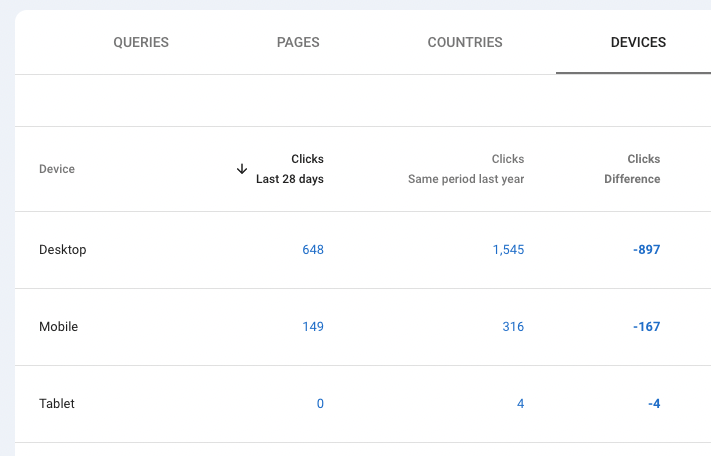
YoY comparison in Google Search Console of clicks by device type
Screenshot from Google Search Console, November 2025

At first glance, the data makes it look like there might be an issue with the desktop experience. But we need to look at things in terms of percentages.

Desktop: 1 – (648/1545) x 100 = 58% decline

Mobile: 1 – (149/316) x 100 = 52% decline

While desktop shows a much larger decline in terms of click count, the percentage of decline YoY is fairly similar across both desktop and mobile. So we’re probably not looking for anything device-specific in this scenario.

Search Appearance

Rich results and SERP features are an opportunity to stand out on the SERP and drive more traffic through enhanced results. Using the search appearance filter in Google Search Console, you can see traffic from different types of rich results and SERP features:

  • Forums.
  • AMP Top Story (AMP page + Article markup).
  • Education Q&A.
  • FAQ.
  • Job Listing.
  • Job Details.
  • Merchant Listing.
  • Product Snippet.
  • Q&A.
  • Review Snippet.
  • Recipe Gallery.
  • Video.

This is the full list of possible features with rich results (courtesy of SchemaApp), though you’ll only see filters for search appearances where the domain is currently positioned.

In most cases, Google is able to generate these types of results because there is structured data on pages. The notable exceptions are Q&A, translated results, and video.

So when there are significant traffic drops coming from a specific type of search appearance, it signals that there’s potentially a problem with the structured data that enables that search feature.

YoY comparison in Google Search Console for search appearance
Screenshot from Google Search Console, November 2025

You can investigate structured data issues in the Enhancements reports in GSC. The exception is product snippets, which nest under the Shopping menu. Either way, the reports only show up in your left-hand nav if Google is aware of relevant data on the site.

For example, the product snippets report shows why some snippets are invalid, as well as ways to potentially improve valid results.

Product snippets report in Google Search Console
Screenshot from Google Search Console, November 2025

This context is valuable as you begin to investigate the technical causes of traffic drops from specific search features. In this case, it’s clear that Google is able to crawl and utilize product schema on most pages – but there are some opportunities to improve that schema with additional data.

Featured Snippets

When featured snippets originally came on the scene, it was a major change to the SERP structure that resulted in a serious hit to traditional organic results.

Today, AI Overviews are doing the same. In fact, research from Seer shows that CTR has dropped 61% for queries that now include an AI overview (21% of searches). And that impact is outsized for informational queries.

In cases where rankings have remained relatively static, but traffic is dropping, there’s good reason to investigate whether this type of SERP change is a driver of loss.

While Google Search Console doesn’t report on featured snippets (example: PAA questions) and AI Overviews, third-party tools do.

In the third-party tool Semrush, you can use the Domain Overview report to check for featured snippet availability across keywords where the site ranks.

filtering to keyword with available AI overviews in the Semrush Domain Overview report
Screenshot from Semrush, November 2025

Do the keywords where you’re losing traffic have AI overviews? If you’re not cited, it’s time to start thinking about how you’re going to win that placement.

Search Type

Search type is another way to filter GSC data, where you’re seeing traffic declines despite healthy and consistent rankings.

After all, web search is just one prong of Google Search. Think about it: How often do you use Google Image search? At least in my case, that’s fairly often.

Filter performance data by each of these search types to understand which one(s) are having the biggest impact on performance decline. Then use that insight to start connecting the dots to the cause.

filtering to Google image search performance in Google Search Console
Screenshot from Google Search Console, November 2025

Images are a great example. One simple line in the robots.txt can block Google from crawling a subfolder that hosts multitudes of images. As those images disappear from image search results, any clicks from those results disappear in tandem.

We don’t know to look for this issue until we slice the data accordingly!

Geography

If the business operates physically in specific cities and states, then it likely already has geo-specific performance tracking set up through a tool.

But domains for online-only businesses shouldn’t dismiss geographic data – even at the city/state level! Declines are still a trigger to check geo-specific performance data.

Country

Just because the brand only sells and operates in one country doesn’t mean that’s where all the domain’s traffic is coming from. Drilling down by country in GSC allows you to see whether declines are coming from the country the brand is focused on or, potentially, another country altogether.
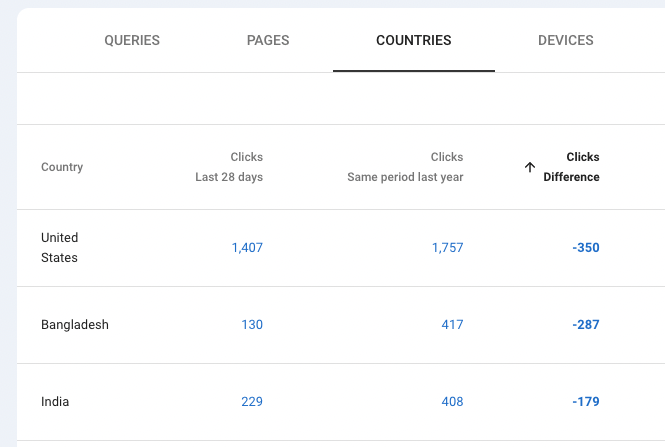
performance by country in Google Search Console
Screenshot from Google Search Console, November 2025

If it’s another country, it’s time to decide whether that matters. If the site is a publisher, it probably cares more about that traffic than an ecommerce brand that’s more focused on purchases in its country of operation.

Localization

When tools are reporting positionality at the country level, then rankings shifts in specific markets fly under the radar. It certainly happens, and major markets can have major traffic impact!

Tools like BrightLocal, Whitespark, and Semrush let you analyze SERP rankings one level deeper than GSC, providing data down to the city.

Checking for rankings discrepancies across cities is possible by checking a small sample of keywords with the greatest declines in clicks.

If I’m an SEO at the University of Phoenix, which is an online university, I’m probably pretty excited about ranking #1 in the United States for “online business degree.”
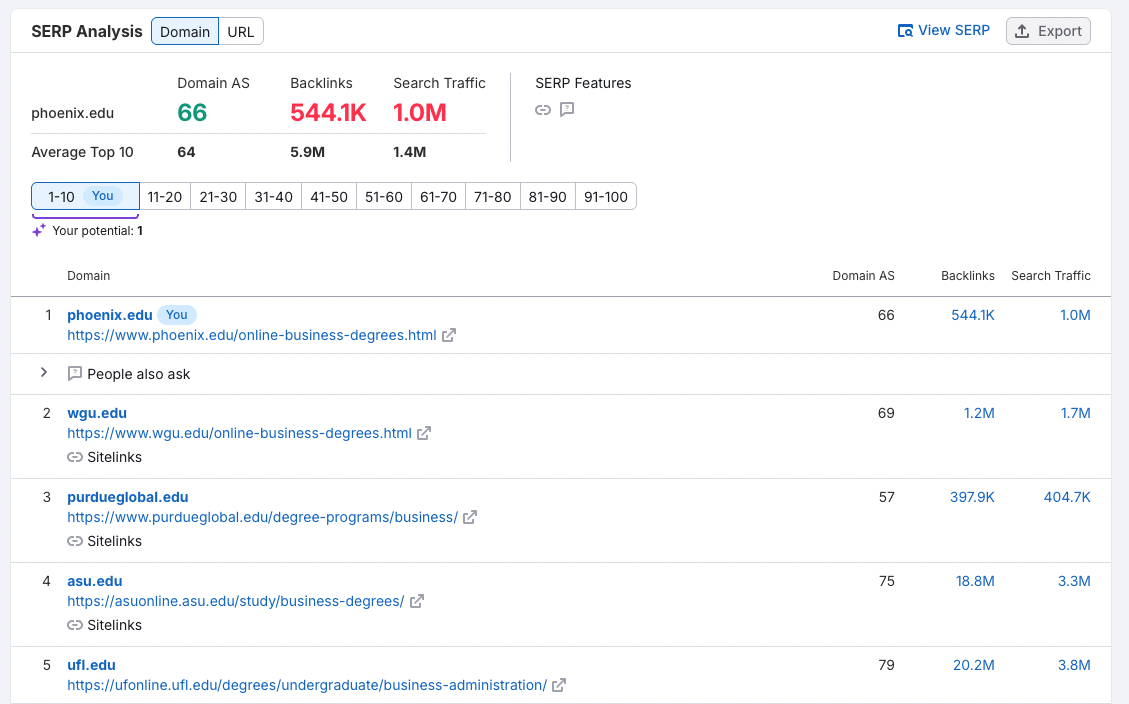
top five serp results for online business degree in the United States
Screenshot from Semrush, November 2025

But if I drill down further, I might be a little distraught to find that the domain isn’t in the top five SERP results for users in Denver, CO…

top five serp results for online business degree in Denver, Colorado
Screenshot from Semrush, November 2025

…or Raleigh, North Carolina.

top five serp results for online business degree in Raleigh. North Carolina
Screenshot from Semrush, November 2025

Catch Issues Faster By Leveraging AI For Data Analysis

Data segmentation is an important piece of any traffic drop investigation, because humans can see patterns in data that bots don’t.

However, the opposite is true too. With anomaly detection tooling, you get the best of both worlds.

When combined with monitoring and alert notifications, anomaly detection makes it possible to find and fix issues faster. Plus, it enables you to find data patterns in any after-the-impact investigations

All of this helps ensure that your analysis is comprehensive, and might even point out gaps for further investigation.

This Colab tool from Sam Torres can help get your site set up!

Congrats, You’re Close To Closing This Case

As Sherlock Holmes would say about an investigation, “It is a capital mistake to theorize before one has data.” With the right data in hand, the culprits start to reveal themselves.

Data segmentation empowers SEOs to uncover leads that point to possible causes. By narrowing it down based on the evidence, we ensure more accuracy, less work, faster answers, and quicker recovery.

And while leadership might not love a traffic drop, they’re sure to love that.

More Resources:


Featured Image: Vanz Studio/Shutterstock

https://www.searchenginejournal.com/segment-organic-traffic-data/561082/


Ask An SEO: Digital PR Or Traditional Link Building, Which Is Better? via @sejournal, @rollerblader

This week’s ask an SEO question is:

“Should SEOs be focusing more on digital PR than traditional link building?”

Digital PR is synonymous with link building at this point as SEO’s needed a new way to package and resell the same service. Actual PR work will always be more valuable than link building because PR, whether digital or traditional, focuses on a core audience of customers and reaching specific demographics. This adds value to a business and drives revenue.

With that said, here’s how I’d define digital PR vs. link building if a client asked what the difference is.

  • Digital PR: Getting brand coverage and citations in media outlets, niche publications, trade journals, niche blogs, and websites that do not allow guest posting, paid links, or unvetted contributors with the goal of building brand awareness and driving traffic from the content.
  • Link Building: Getting links from websites as a way to try and increase SERP rankings. Traffic from the links, sales from the links, etc., are not being tracked, and the quality of the website can be questionable.

Digital PR is always going to be better than link building because you’re treating the technique as a business and not a scheme to try and game the rankings. Link building became a bad practice years ago as links became less relevant, they are still important, so I want to ensure that isn’t taken out of context, and we stopped doing link building completely. Quality content attracts links naturally, including media mentions. When this happens in a natural way, the website will begin rising as the site has a lot of value for users, and search engines can tell when the site is quality.

If you’re building links without evaluating the impact they have traffic and sales-wise, you’re likely setting your site up for failure. Getting a ton of links, just like creating content in mass with AI/LLMs or article spinners, can grow a site quickly. That URL/domain can then burn to the ground equally as fast.

That’s why when we purchase a link, an advertorial, or we’re doing a partnership, we always ask ourselves the following questions:

  • Is there an active audience on this website that is also coming back to the website via branded search for information?
  • Is the audience on this website part of our customer base?
  • Will the article we’re pitching or being featured in be helpful to the user, and is our product or service something that is part of the post naturally vs. being forced?
  • Are we ok with the link being nofollow or sponsored if we’re paying for the inclusion?

If the answer is yes to these four, then we’re good to go with the link. The active audience on the website and people returning by brand name means there is an audience that trusts them for information. If the readership, visitors, or customers are similar or the same demographics as our user base, then it makes sense we’d want to be in front of them where they go for information.

We may have knowledge that is helpful to the user, but if it is not on topic within the post, there is no reason for them to come through and use our services, buy our products, or subscribe to our newsletters. Instead, we’ll wait until there is a fit, so there is a direct “link” between the content we’re contributing, or being an expert on, and our website.

For the last question, our goal is always traffic and customer acquisition, not getting a link. The website owner controls this, and if they want to follow Google’s best practices (which we obviously recommend doing), we will still be happy if they mark it as sponsored or nofollow. This is the most important of the questions. Building links to game the SERPs is a bad idea; building a brand that people search for by name will overpower any link any day of the week. This is always our goal when it comes to Digital PR and link building. Driving that branded search.

So, that begs the question, where do we go for digital PR?

Sources To Get Digital PR Mentions And Links

When we’re about to start a Digital PR campaign, we create lists of the following targets to reach out to.

  • Mass Media: Household names like magazines, news websites, and local media, where everyone in the area, the customers, or the country or world knows them by name. The only stipulation we apply is if they have an active category vs. only a few articles here and there. The active category means it is something interesting enough to their reader base that they’re investing in it, so our customers may be there.
  • Trade Publications: Conferences, associations, and non-profits, as well as industry insiders will have websites and print publications that go out to members. Search Engine Journal could be considered a trade publication for the SEO and PPC industry, same with SEO Roundtable, and some of the communities like Webmaster World. They publish directly relevant content for search engine marketers and have active users, so if I was an SEO service provider or tool, this is where I’d be looking to get featured and ideally links from.
  • Niche Sites and Bloggers: There is no shortage of niche sites and content producers out there. The trick is finding ones that do not publicly allow guest contributions, advertorials, etc., and that do not link out to non-niche websites and content. This includes sites that got hacked and had link injections. Even if their “authority” is zero, there is value if they quality control and all links and mentions are earned.
  • Influencers: Whether it is YouTube, Facebook group leaders, LinkedIn that is crawlable, or other channels, getting coverage from people with subscribers and an active audience can let search engines crawl the link back to your website. It may not boost your rankings, but it drives customers to you and helps with page discoverability if the link gets crawled. LLMs are also citing their content as sources, so there could be value for AIO, too.

Link building is not dead by any means; links still matter. You just don’t need to build them anymore. Focus on quality where an active audience is and where you have a chance at getting traffic and revenue. This is what will move the needle for the long run and help you grow in SERPs that matter.

More Resources:


Featured Image: Paulo Bobita/Search Engine Journal

https://www.searchenginejournal.com/ask-an-seo-digital-pr-or-traditional-link-building-which-is-better/553879/


Budget SEO For Capacity, Not Output via @sejournal, @Kevin_Indig

Marketing leaders are still budgeting to grow clicks in 2026, even though AI Overviews cut organic traffic in half and AI Mode kills it almost entirely.

Image Credit: Kevin Indig

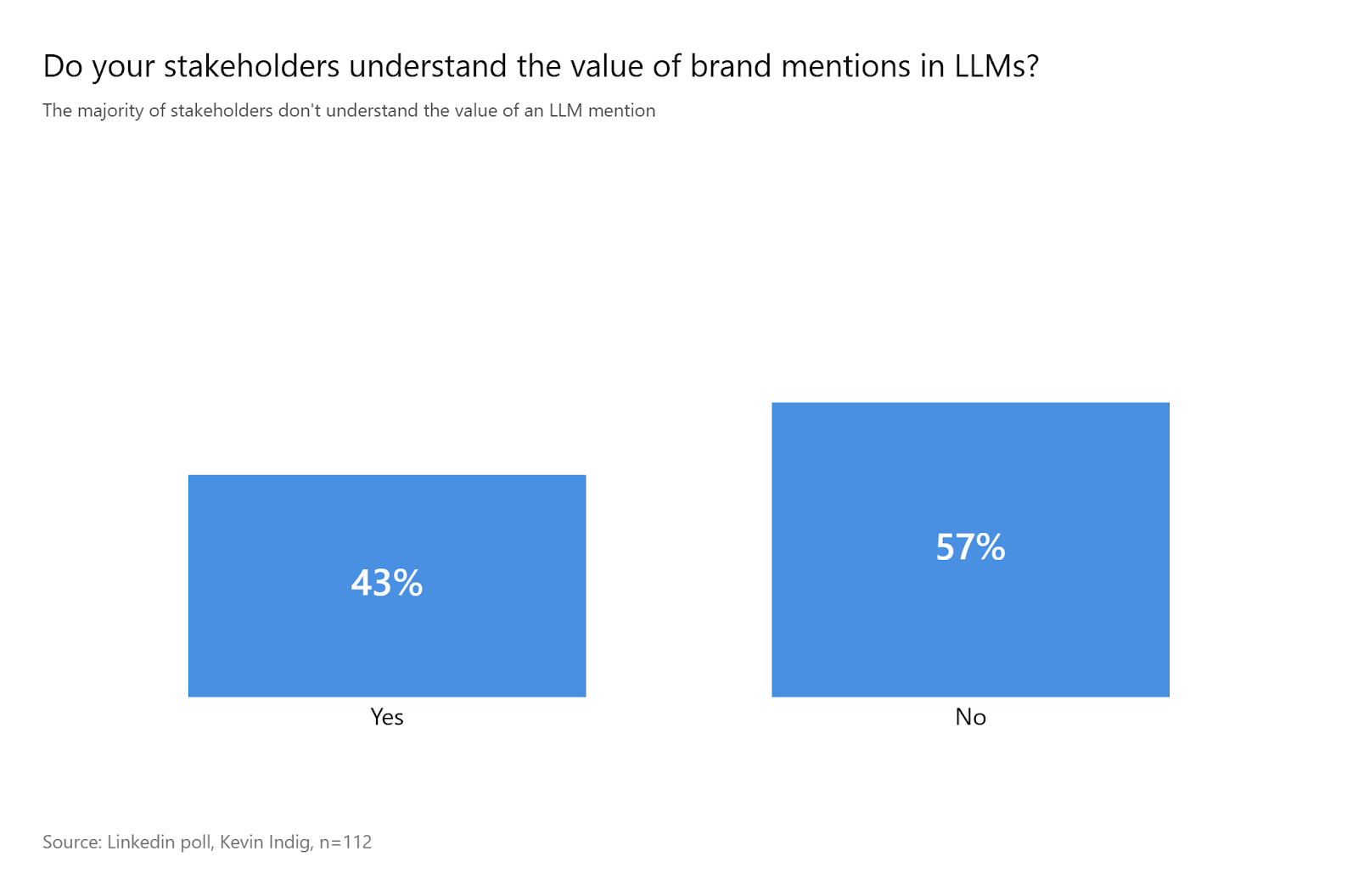
Meanwhile, close to 60% of those who responded to my recent poll report their stakeholders don’t understand the value of brand mentions in LLMs.

The SEO budget conversation has to move from “Why isn’t SEO driving more clicks?/What can we do to drive more traffic?” to “What capabilities do we need to build authority in new discovery channels?”

In 2026, the best marketing teams will stop measuring SEO success by clicks and start treating it as what it really is: a capacity and influence system.

1. Traffic-Based ROI Is A Decayed Model

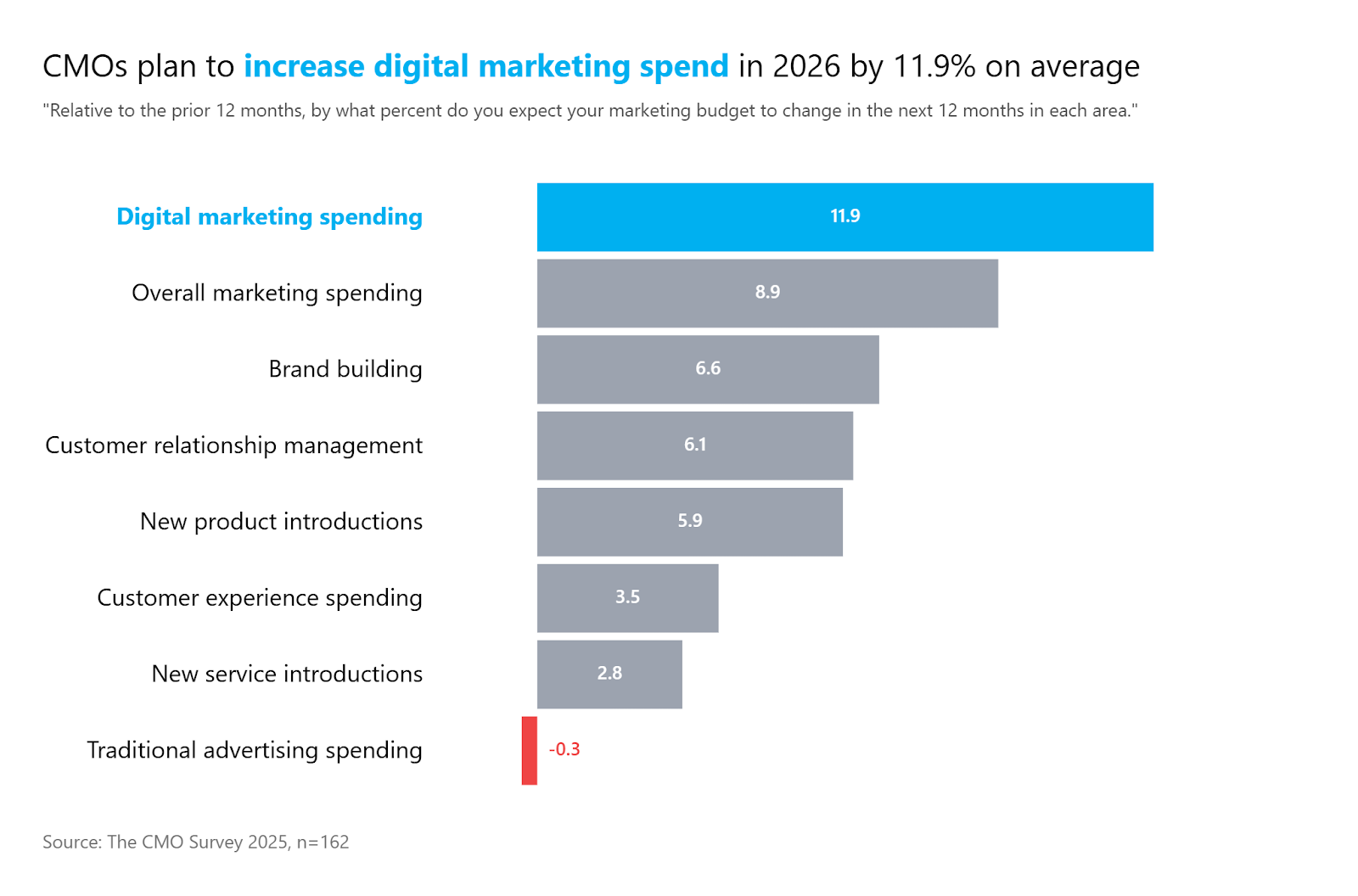
Marketing budgets, on average, rose modestly in the last 12 months. Overall, marketing budgets are up 3.31%. And digital marketing spending specifically is up 7.25%.

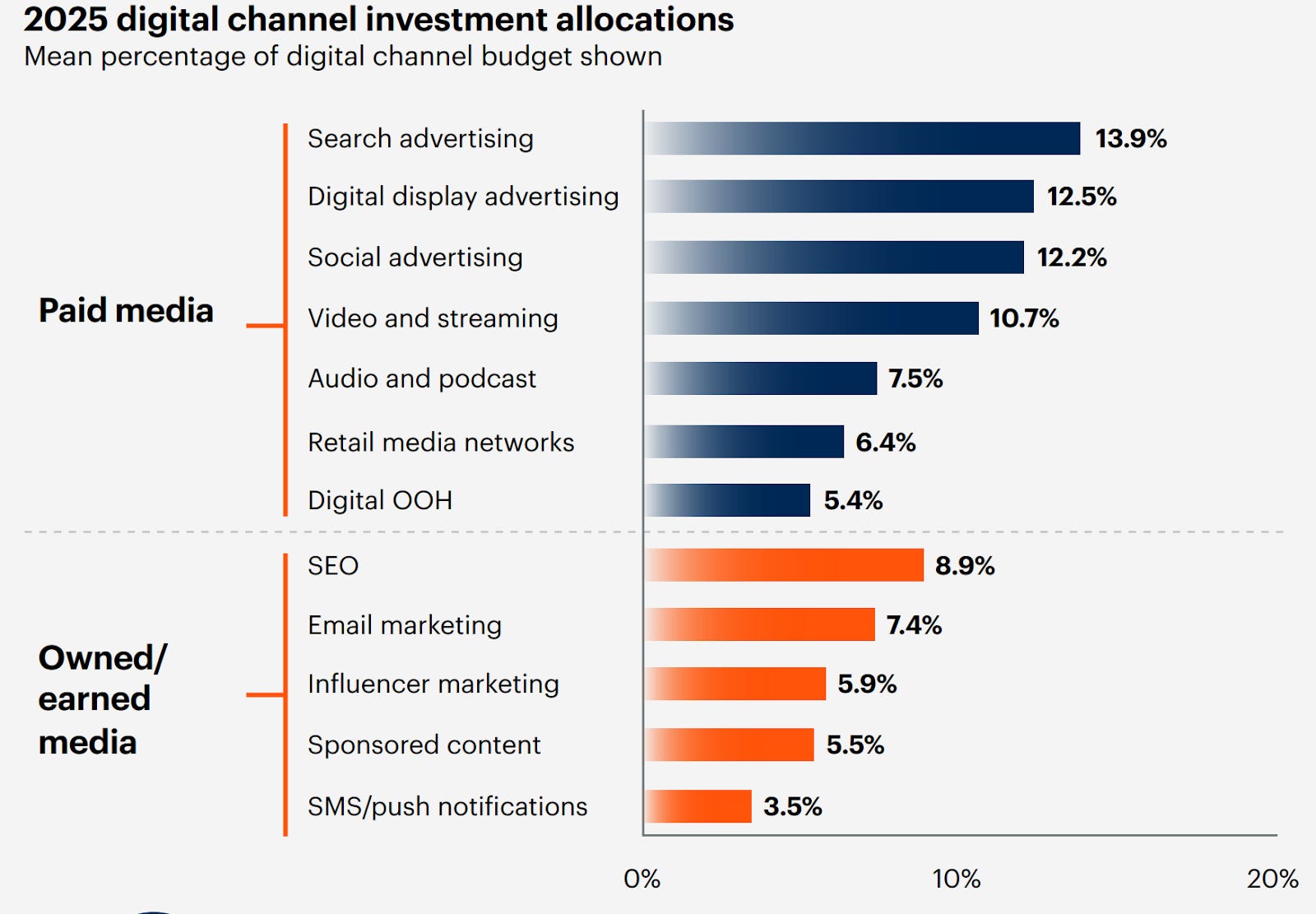
SEO gets less than 10% of the marketing budget despite being one of the most efficient channels.

Image Credit: Kevin Indig

And for years, marketers invested this sliver of SEO budget like paid media – spend more, get more clicks. It’s time to let this go. There’s discomfort here, of course: We’re losing a significant leading indicator with traffic stagnation. In theory, SEO now appears to take “longer” to show results.

As Google dials AI in the search results up, organic clicks are destined to shrink. AI surfaces decouple visibility from clicks. Your brand can appear in every AI output response and get zero measurable traffic. In Semrush’s AI Mode study, 92-94% of AI Mode sessions produced no external clicks. (But that doesn’t mean people buy less. The opposite could be true.) Slowed growth in clicks is not a performance issue of an SEO team – it’s a system feature, and it’s the future of search. Platforms want users to stay within their ecosystems.

The implication: Traffic no longer equals demand. Brand visibility happens upstream inside AI responses, UGC threads, and recommendation loops that don’t often show in your analytics.

Image Credit: Kevin Indig

2. SEO Budgets Are Capacity Allocation, Not Spend-To-Output Trading

With paid ads, you’re buying impressions. Double your spend, you roughly double your impressions (with diminishing returns). There’s a direct, measurable relationship.

But most SEO costs are fixed: salaries, tool subscriptions, infrastructure. You pay for capacity regardless of whether your team delivers a 10% or 50% lift.

65% of those surveyed by Search Engine Journal don’t expect a reduction in SEO budget for 2026.

When deciding on next year’s budget, the question “What ROI do we expect from this spend?” is an outdated one. Instead, you need to answer this query: “What capabilities do we need to earn visibility?”

The variable isn’t spend; it’s prioritization and execution quality:

  • Paid media is transactional: Spend → user impression → user click.
  • SEO is compounding: Optimization → brand visibility → user impressions → brand influence.

Your SEO dollars don’t buy results. They buy the ability to earn trust and surface in the right systems.

3. Design Your SEO Budget Around Influence, Not Output In 2026.

Your budget planning must be scenario-based, not traffic-forecasted.

Because your SEO costs are mostly fixed, you can model it out: “If we allocate 40% of capacity to digital PR, 30% to technical SEO, 20% to content operations, and 10% to foundational research, what visibility outcomes can we reasonably expect?”

Allocate resources by priority, not by historical traffic performance. Strategize your resources for the zero-click world ahead:

  1. Digital PR: Third-party signals drive 85% of brand visibility in LLMs. Digital PR and high-quality, topically related backlink investment are crucial. The biggest gains come when you hit the upper boundaries of link quality/authority over volume.
  2. Technical SEO + UX: Get the foundation right. Agents need to review your site and make recommendations or decisions quickly.
  3. Audience + first-party data research: Users are making decisions about brands within the AI Mode outputs – know your audience and which search surfaces they use. Data from one study showed 71% of companies that exceeded revenue goals had documented personas.
  4. Content operations + re-optimizations: Content recency is non-negotiable, and LLMs prefer it. Some evidence shows refreshing every ~90 days could be a competitive edge.
  5. Additive content rich with information gain: Evergreen content is less valuable. Additive content that provides net-new takes, insights, and conversations is rewarded.
  6. Engineering + design support for interactive tools:Once the validation click is earned, you must provide value that’s worth on-page engagement.
  7. Video and custom graphics: Organic low-fi video content and custom graphics are earning highly visible mid-output placement in AIOs. Don’t let restricted resources stop you from investing in this visibility lever.

Your brand’s prioritization could vary based on audience, goals, and – of course – capacity.

Boost your skills with Growth Memo’s weekly expert insights. Subscribe for free!


Featured Image: Paulo Bobita/Search Engine Journal

https://www.searchenginejournal.com/budget-seo-for-capacity-not-output/560521/


Google Is Not Diminishing The Use Of Structured Data In 2026 via @sejournal, @martinibuster

A recent announcement on the Google Search Central blog gave a Redditor the impression that Google was significantly reducing the use of structured data, causing them to ask if it’s worthwhile to use it anymore.

The person on Reddit posted:

“Google just posted a new update — they’re removing support for some structured data types starting in January 2026. Dataset already works only in Dataset Search, and rich results are getting more selective.

So… is schema still worth it? Or are we moving past it entirely?”

Matt Southern covered the blog post (Google Deprecates Practice Problem Structured Data In Search), focusing on the specific structured data that Google was deprecating. Google’s blog post, authored by John Mueller, could, if read quickly, be accidentally interpreted to be more alarming than it was intended to be.

Google’s announcement explained:

“We’re constantly working to simplify the search results page, so that it’s quick and easy to find the information and websites you’re looking for. As part of this effort, we regularly evaluate all of our existing features to make sure they’re still useful, both for people searching on Google and for website owners.

Through this process, we’ve identified some features that aren’t being used very often and aren’t adding significant value to users. In these cases, we’ve found that other advancements on the search results page are able to get people what they’re looking for more seamlessly. So we’re beginning to phase these lesser-used features out.

For most searches, you likely won’t notice a major difference — most of these features didn’t trigger often and weren’t interacted with much by users. But overall, this update will simplify the page and improve the speed of search results.”

Ending with the following sentence:

“Starting in January 2026, we’ll remove support for the structured data types in Search Console and its API.”

Google’s Search Features Are Always Changing

Someone responded to the initial post to reassure them that Google’s search features and the structured data that triggers them are always changing. That’s true. Google Search has consistently been in a state of change and never more visibly on the front end as it is today with AI search.

Google’s John Mueller responded to the Redditor who noted that Google is constantly changing by affirming that markup types (which includes Schema.org structured data) are always changing.

He responded:

“Exactly. Understand that markup types come and go, but a precious few you should hold on to (like title, and meta robots).”

Structured Data Curation Is Automatic

Keeping up with Schema.org structured data is easy with any modern content management system through plugins or as part of a native functionality because they are responsive to Google’s structured data guidance. So in general, it’s not something that a publisher or SEO needs to think about. Publishers on WordPress just need to keep their plugins updated.

Featured Image by Shutterstock/pathdoc

https://www.searchenginejournal.com/google-is-not-diminishing-the-use-of-structured-data-in-2026/560516/


How To Cultivate Brand Mentions For Higher AI Search Rankings via @sejournal, @martinibuster

Building brand awareness has long been an important but widely overlooked part of SEO. AI Search has brought this activity to the forefront. The following ideas should assist in forming a strategy for achieving brand name mentions at a ubiquitous scale, with the goal of achieving similar ubiquity in AI search results.

Tell People About The Site

SEOs and businesses can become overly concerned with getting links and forget that the more important thing to do is to get the word out about a website. A website must have unique qualities that will positively impress people and make them enthusiastic about the brand. If the site you’re trying to build traffic to lacks those unique qualities then building links or brand awareness can become a futile activity.

User behavior signals have been a part of Google’s algorithms since the 2004 Navboost signals were kicking in and the recent Google antitrust lawsuit shows that user behavior signals have continued to play a role. What has changed is that SEOs have noticed that AI search results tend to recommend sites that are recommended by other sites, brand mentions.

The key to all of this has been to tell other sites about your site and make it clear to potential consumers or website visitors what makes your site special.

  • So the first task is always to make a site special in every possible way.
  • The second task is to tell others about the site in order to build word of mouth and top-of-mind brand presence.

Optimizing a website for users and cultivating awareness of that site are the building blocks of the external signals of authoritativeness, expertise, and popularity that Google is always talks about.

Downside of Backlink Searches

Everyone knows how to do a backlink search with third-party tools but a lot of the data consists of garbage-y sites; that’s not the tool’s fault, it’s just the state of the Internet. In any case, a backlink search is limited, it doesn’t surface the conversations real people are having about a website.

In my experience, a better way to do it is to identify all instances of where a site is linked from another site or discussed by another site.

Brand And Link Mentions

Some websites have bookmark and resource pages. These are low hanging fruit.

Search for a competitor’s links:

example.com site:.com “bookmarks” -site:example.com

example.com site:.com “resources” -site:example.com

The “-site:example.com” removes the competitor site from the search results, showing you just the sites that might mention the full URL of the site which may or may not be linked.

The TLD segmented variants are:

example.com site:.net "resources" example.com site:.org "resources" example.com site:.edu "resources" example.com site:.ai "resources" example.com site:.net "links" example.com site:.org "links" example.com site:.edu "links" example.com site:.ai "links" Etc.

The goal is not necessarily to get links. It’s to build awareness of the site and build popularity.

Brand Mentions By Company Name

One way to identify brand mentions is to search by company name using the TLD segmentation technique. Making a broad search for a company’s name will only get you some of the brand mentions. Segmenting the search by TLD will reveal a wider range of sites.

Segmented Brand Mention Search

The following assumes that the competitor’s site is on the .com domain and you’re limiting the search to .com websites.

Competitor's Brand Name site:.com -site:example.com

Segmented Variants:

Competitor's Brand Name site:.org
Competitor's Brand Name site:.edu
Competitor's Brand Name site:.Reddit.com
Competitor's Brand Name site:.io
etc.

Sponsored Articles

Sponsored articles are indexed by search engines and ranked in AI search surfaces like AI Mode and ChatGPT. These can present opportunities to purchase a sponsored post that enables you to present your message with links that are nofollow and a prominent “sponsored post” disclaimer at the top of the web page – all in compliance with Google and FTC guidelines.

Brand Mentions: Authoritativeness Is Key

The thing that some SEOs never learned is that authoritativeness is important and quite likely millions of dollars have been wasted on paying for links from low-quality blogs and higher quality sites.

ChatGPT and AI Mode are found to recommend sites that are mentioned in high quality authoritative sites. Do not waste time or money paying for mentions on low quality sites.

Some Ways To Search

Product/Service/Solution Search

Name Of Product Or Service Or Problem Needing Solving site:.com “sponsored article”
Name Of Product Or Service Or Problem Needing Solving site:.net “sponsored article”
Name Of Product Or Service Or Problem Needing Solving site:.org “sponsored article”
Name Of Product Or Service Or Problem Needing Solving site:.edu “sponsored article”
Name Of Product Or Service Or Problem Needing Solving site:.io “sponsored article”
etc.

Sponsored Post Variant

Name Of Product Or Service Or Problem Needing Solving site:.com “sponsored post”
Name Of Product Or Service Or Problem Needing Solving site:.net “sponsored post”
Name Of Product Or Service Or Problem Needing Solving site:.org “sponsored post”
Name Of Product Or Service Or Problem Needing Solving site:.edu “sponsored post”
Name Of Product Or Service Or Problem Needing Solving site:.io “sponsored post”
etc.

Key insight: Test whether “sponsored post” or “sponsored article” provides better results or just more results. Using quotation marks, or if necessary the verbatim search tool, will stop Google from stemming the search results and prevents it from showing a mix of both “post” and “article” results. By forcing Google to be specific, you’re forcing Google to show more search results.

Competitor Search

Competitor’s Brand Name site:.com “sponsored post”
Competitor’s Brand Name site:.net “sponsored post”
Competitor’s Brand Name site:.org “sponsored post”
Competitor’s Brand Name site:.edu “sponsored post”
Competitor’s Brand Name site:.io “sponsored post”
etc.

Pure Awareness Building With Zero Internet Presence

This method of getting the word out is pure gold, especially for B2B but also for professional businesses such as in the legal niches. There are organizations and associations that print magazines or send out newsletters to thousands, sometimes tens of thousands, of people who are an exact match for the people you want to build top of mind brand name recognition with.

Emails and magazines do not have links and that’s okay. The goal is to build name brand recognition with positive associations. What better way than getting interviewed in a newsletter or magazine? What better way than submitting an article to a newsletter or magazine?

Don’t Forget PDF Magazines

Not all magazines are print, many magazines are in the form of a PDF. For example, I subscribe to a surf fishing magazine that is entirely in a proprietary web format that can only be viewed by subscribers. If I were a fishing company, I would make an effort to meet some of article authors, in addition to the publishers, at fishing industry conferences where they appear as presenters and in product booths.

This kind of outreach is in-person, it’s called relationship building. 

Getting back to the industry organizations and associations, this is an entire topic in itself and I’ll follow up with another article, but many of the techniques covered in this guide will work with this kind of brand building.

Using the filetype search operator in combination with the TLD segmentation will yield some of these kinds of brand building opportunities.

[product/service/keyword/niche] filetype:pdf site:.com newsletter
[product/service/keyword/niche] filetype:pdf site:.org newsletter

1. Segment the search for opportunities search by TLD .net/.com/.org/.us/.edu, etc.
Segmenting by TLD will help you discover different kinds of brand building opportunities. Websites on a Dot Org domain often link to a site for different reasons than a Dot Com website. Dot org domains represent article writing projects, free links on a links page, newsletter article opportunity, and charity link opportunities, just to name a few.

2. Consider Segmenting Dot Com Searches
The Dot Com TLD will yields an overabundance of search results, not all of them useful. This makes it imperative to segment the results to find all available opportunities. Even if you’re

Ways to segment the Dot Com are by:

  • A. Kinds of sites (blog/shopping related keywords/product or service keywords/forum/etc.)
    This is pretty straightforward. If you’re looking for brand mentions be sure to add keywords to the searches that are directly relevant to what your business is about. If your site is about car injuries then sites about cars as well as specific makes, models, and kinds of automobiles are how you would segment a .com search
  • B. Context – Audience Relevance Not Keyword Match
    Context of a sponsored article is important. This is not about whether the website content matches what your site, business, product, or service are about.  What’s important is to identify if the audience reach is an exact match to the audience that will be interested in your product, business, or service.
  • C. Quality And Authoritativeness
    This is not about third-party metrics related to links. This is just about making a common sense judgment about whether a site where you want a mention is well-regarded by those who are likely to be interested in your brand. That’s it.

Takeaway

The thing I want you to walk away with is that it’s useful to just tell people about a site and to get as many people as possible aware of it. Identify opportunities for ways to get them to tell a friend. There is no better recommendation than the one you can get from a friend or from a trusted organization.  This is the true source of authoritativeness and popularity.

Featured Image by Shutterstock/Bird stocker TH

https://www.searchenginejournal.com/how-to-cultivate-brand-mentions-for-higher-ai-search-rankings/560493/


Why Strategic Review Is The Missing Layer In Many SEO Campaigns via @sejournal, @coreydmorris

Whether you call your SEO efforts a strategy, campaign, or channel, many SEO programs start strong but slowly drift. That could be in the form of reports getting routine, dashboards taking over for thinking, and moving into a mode of “doing SEO” versus challenging and building it.

In many cases, there’s an initial audit, roadmap, and then turn to implementation. Those are all good things, and I strongly advocate for the right level of strategy, research, and planning before moving into any level of ongoing work. However, monthly reports or dashboards, and little reflection can lead to stale tactics.

When activity, tactics, and implementation are the biggest part of what is reported on and/or measured, I question if enough strategic thinking and approach exist.

A strategic review and approach included a structured, periodic checkpoint within the process to assess performance. That includes a mixture of team (and resource/partner/vendor) alignment, execution, and continued connection to overall business goals that SEO is mapped out to impact.

Similar to a retrospective or ending a sprint in agile methodology, it is time for a look backwards at what worked, what didn’t, and where we need to go next in the overall SEO investment. This is different than just a set of reports and metrics; it is time for true reflection and recalibration beyond just measurement.

Why Strategy Is Often Missing

There are some common reasons SEO teams and resources skip strategic review and don’t have the layer fully in place. At times, SEO can seem like an ongoing checklist of things to audit, crawl, fix, and optimize. It can also feel like something that is always on or never-ending.

While all of those things are true to some degree, I think with SEO being a longer-term discipline before seeing return on investment (ROI), there’s pressure to show activity as progress before seeing tangible results, and this can be hard to change after habits and patterns form are embedded in the process.

Agency and client relationships can become rooted in deliverables and lose strategic direction over time. Or, a lack of ownership can exist where no one person or entity truly feels accountable for stepping back and considering if the strategy is still right and delivering.

Risks Of Skipping Strategy

When teams lack or drift from strategy, they run the risk of optimizing for the wrong things. Whether that is the topics, content, context, or even chasing the wrong key performance indicators (KPIs). Going for traffic and things that show activity and progress alone, and are disconnected from the bottom line, lead to danger when they can’t convert at some point.

Additionally, silos can exist, and insights can stay within the silos. When SEO is reduced to activities, tactics, and just actions, learnings from content, dev, brand, product development, customer service, leadership, and other functions aren’t shared with SEO, and vice versa.

Plus, in a world where new information, strategies, and opportunities seemingly emerge daily with how SEO works, AI search, and other areas of change, it is easy to get outdated quickly with assumptions about intent, audience behavior, and connections to the bottom line.

Strategy Integrated Ongoing SEO

Establish A Cadence

The ideal timing for how often to revisit strategy or how it integrates into the ongoing SEO effort is different for everyone. Whether it is quarterly, monthly, or on some frequency that matches the speed at which SEO can and will be implemented, along with the speed of the rest of the moving parts in digital marketing, it is important to lock it in. And, adjust where necessary, but do not keep pushing it down the road.

Since SEO is often an indefinitely ongoing investment, I like the use of sprints and agile thinking, and in this case, building into the agile process. Ultimately, the goal is to not drift or move into a void far enough where strategy problems start happening, yet are missed or ignored.

Dig Deep Enough

However and whenever you build in the strategic review part of the process, there are some key questions to ask however formally you format the process.

This starts with strategy alignment. Are our current goals still the right ones to anchor to? Do they map out to business outcomes versus indicators or vanity metrics? Can we get deep enough in measurement of impact and attribution?

From there, execution and focus are important to review. This includes looking at the tactics that had an impact versus those that didn’t. And, to fully understand why.

Now, we can set our sights on the next sprint or period, looking forward. Consider the opportunities ahead, including trends, SERP features, audience behaviors, AI, and anything else that has emerged that needs to be factored into the effort.

Bring People Together

A tale as old as time in SEO having the best plans stalled out by a lack of resources or a strong resource plan. This means we need to make sure we have the right people, whether they are on the team, in another department, freelance, or at a vendor company, booked and lined up to help us implement.

Better yet, if you can have them in the room with you at any part of the strategic review to learn from the insights you’re seeing and help shape the plan, sharing out of their subject matter expertise and perspective, even better. This is your chance to break down silos and get more integration of SEO with other functions.

Be Structured

I have to confess that I love to iterate and try new things with processes. That’s part of what drew me into SEO over 20 years ago. However, I think that there has to be consistency in the approach and process. You don’t want to spend too much time overdoing it in ongoing strategic reviews. At the same time, you don’t want to be too shallow and gloss over it.

I recommend borrowing some agile retrospective agenda formats and structures to look at what to start, stop, continue, and plan what’s next. Borrow from that if you are struggling to come up with a simple enough, yet powerful review criteria and process.

Revise The Plan

It might feel like a given that you’ll take the work you did and integrate it into your plan and efforts. I simply want to wrap up here by stating the obvious that you need to feed insights into the next period’s plan. That could also include adjusting goals, KPIs, and tactical priorities.

The key is to take things from talk and spreadsheets to action. Especially if your efforts have multiple layers, integrations of teams, or client/agency relationships.

Wrapping Up

SEO is a long game, but progress happens in shorter cycles. It can become a routine, a checklist, or a thing to “do” over time. Often, outdated strategies and tactics come from a lack of frequent enough critical strategic review and adjustment.

My goal for you is to not encounter these issues or find out later than you wished that your SEO has been drifting or gotten stale and isn’t delivering (and hasn’t for some time). The most strategic SEO efforts aren’t always the busiest or most activity-filled with quantity, but are focused on quality and have the mechanisms in place and often enough to adapt intentionally.

The best SEO teams and efforts aren’t just executing; they’re evolving.

More Resources:


Featured Image: Master1305/Shutterstock

https://www.searchenginejournal.com/why-strategic-review-is-the-missing-layer-in-many-seo-campaigns/558806/


A Step-By-Step AEO Guide For Growing AI Citations & Visibility via @sejournal, @fthead9

This post was sponsored by TAC Marketing. The opinions expressed in this article are the sponsor’s own.

After years of trying to understand the black box that is Google search, SEO professionals have a seemingly even more opaque challenge these days – how to earn AI citations.

While at first glance inclusion in AI answers seems even more of a mystery than traditional SEO, there is good news. Once you know how to look for them, the AI engines do provide clues to what they consider valuable content.

This article will give you a step-by-step guide to discovering the content that AI engines value and provide a blueprint for optimizing your website for AI citations.

Take A Systematic Approach To AI Engine Optimization

The key to building an effective AI search optimization strategy begins with understanding the behavior of AI crawlers. By analyzing how these bots interact with your site, you can identify what content resonates with AI systems and develop a data-driven approach to optimization.

While Google remains dominant, AI-powered search engines like ChatGPT, Perplexity, and Claude are increasingly becoming go-to resources for users seeking quick, authoritative answers. These platforms don’t just generate responses from thin air – they rely on crawled web content to train their models and provide real-time information.

This presents both an opportunity and a challenge. The opportunity lies in positioning your content to be discovered and referenced by these AI systems. The challenge is understanding how to optimize for algorithms that operate differently from traditional search engines.

The Answer Is A Systematic Approach

  • Discover what content AI engines value based on their crawler behavior.
    • Traditional log file analysis.
    • SEO Bulk Admin AI Crawler monitoring.
  • Reverse engineer prompting.
    • Content analysis.
    • Technical analysis.
  • Building the blueprint.

What Are AI Crawlers & How To Use Them To Your Advantage

AI crawlers are automated bots deployed by AI companies to systematically browse and ingest web content. Unlike traditional search engine crawlers that primarily focus on ranking signals, AI crawlers gather content to train language models and populate knowledge bases.

Major AI crawlers include:

  • GPTBot (OpenAI’s ChatGPT).
  • PerplexityBot (Perplexity AI).
  • ClaudeBot (Anthropic’s Claude).
  • Googlebot crawlers (Google AI).

These crawlers impact your content strategy in two critical ways:

  1. Training data collection.
  2. Real-time information retrieval.

Training Data Collection

AI models are trained on vast datasets of web content. Pages that are crawled frequently may have a higher representation in training data, potentially increasing the likelihood of your content being referenced in AI responses.

Real-Time Information Retrieval

Some AI systems crawl websites in real-time to provide current information in their responses. This means fresh, crawlable content can directly influence AI-generated answers.

When ChatGPT responds to a query, for instance, it’s synthesizing information gathered by its underlying AI crawlers. Similarly, Perplexity AI, known for its ability to cite sources, actively crawls and processes web content to provide its answers. Claude also relies on extensive data collection to generate its intelligent responses.

The presence and activity of these AI crawlers on your site directly impact your visibility within these new AI ecosystems. They determine whether your content is considered a source, if it’s used to answer user questions, and ultimately, if you gain attribution or traffic from AI-driven search experiences.

Understanding which pages AI crawlers visit most frequently gives you insight into what content AI systems find valuable. This data becomes the foundation for optimizing your entire content strategy.

How To Track AI Crawler Activity: Find & Use Log File Analysis

The Easy Way: We use SEO Bulk Admin to analyze server log files for us.

However, there’s a manual way to do it, as well.

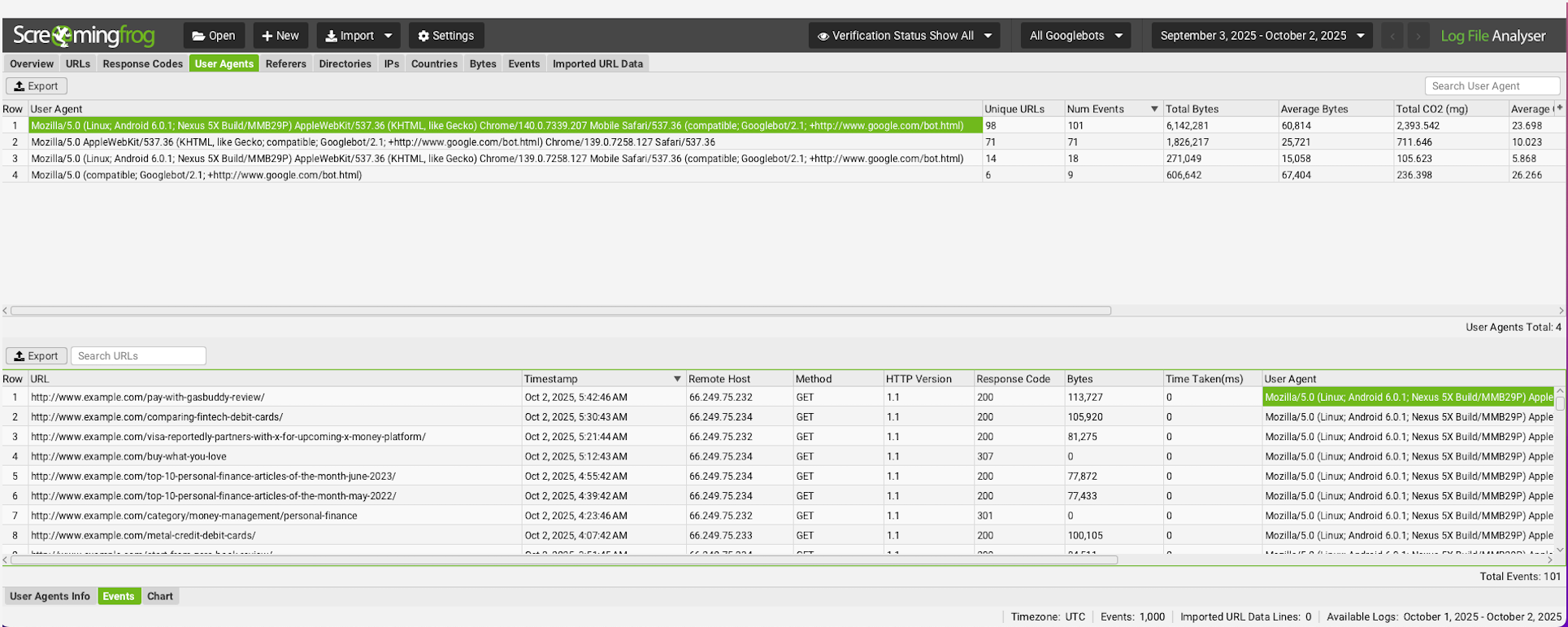
Server log analysis remains the standard for understanding crawler behavior. Your server logs contain detailed records of every bot visit, including AI crawlers that may not appear in traditional analytics platforms, which focus on user visits.

Essential Tools For Log File Analysis

Several enterprise-level tools can help you parse and analyze log files:

  • Screaming Frog Log File Analyser: Excellent for technical SEOs comfortable with data manipulation.
  • Botify: Enterprise solution with robust crawler analysis features.
  • Semrush: Offers log file analysis within its broader SEO suite.
Screenshot from Screaming Frog Log File AnalyserScreenshot from Screaming Frog Log File Analyser, October 2025

The Complexity Challenge With Log File Analysis

The most granular way to understand which bots are visiting your site, what they’re accessing, and how frequently, is through server log file analysis.

Your web server automatically records every request made to your site, including those from crawlers. By parsing these logs, you can identify specific user-agents associated with AI crawlers.

Here’s how you can approach it:

  1. Access Your Server Logs: Typically, these are found in your hosting control panel or directly on your server via SSH/FTP (e.g., Apache access logs, Nginx access logs).
  2. Identify AI User-Agents: You’ll need to know the specific user-agent strings used by AI crawlers. While these can change, common ones include:
  • OpenAI (for ChatGPT, e.g., `ChatGPT-User` or variations)
  • Perplexity AI (e.g., `PerplexityBot`)
  • Anthropic (for Claude, though often less distinct or may use a general cloud provider UAs)
  • Other LLM-related bots (e.g., “GoogleBot” and `Google-Extended` for Google’s AI initiatives, potentially `Vercelbot` or other cloud infrastructure bots that LLMs might use for data fetching).
  1. Parse and Analyze: This is where the previously mentioned log analyzer tools come into play. Upload your raw log files into the analyzer and start filtering the results to identify AI crawler and search bot activity. Alternatively, for those with technical expertise, Python scripts or tools like Splunk or Elasticsearch can be configured to parse logs, identify specific user-agents, and visualize the data.

While log file analysis provides the most comprehensive data, it comes with significant barriers for many SEOs:

  • Technical Depth: Requires server access, understanding of log formats, and data parsing skills.
  • Resource Intensive: Large sites generate massive log files that can be challenging to process.
  • Time Investment: Setting up proper analysis workflows takes considerable upfront effort.
  • Parsing Challenges: Distinguishing between different AI crawlers requires detailed user-agent knowledge.

For teams without dedicated technical resources, these barriers can make log file analysis impractical despite its value.

An Easier Way To Monitor AI Visits: SEO Bulk Admin

While log file analysis provides granular detail, its complexity can be a significant barrier for all but the most highly technical users. Fortunately, tools like SEO Bulk Admin can offer a streamlined alternative.

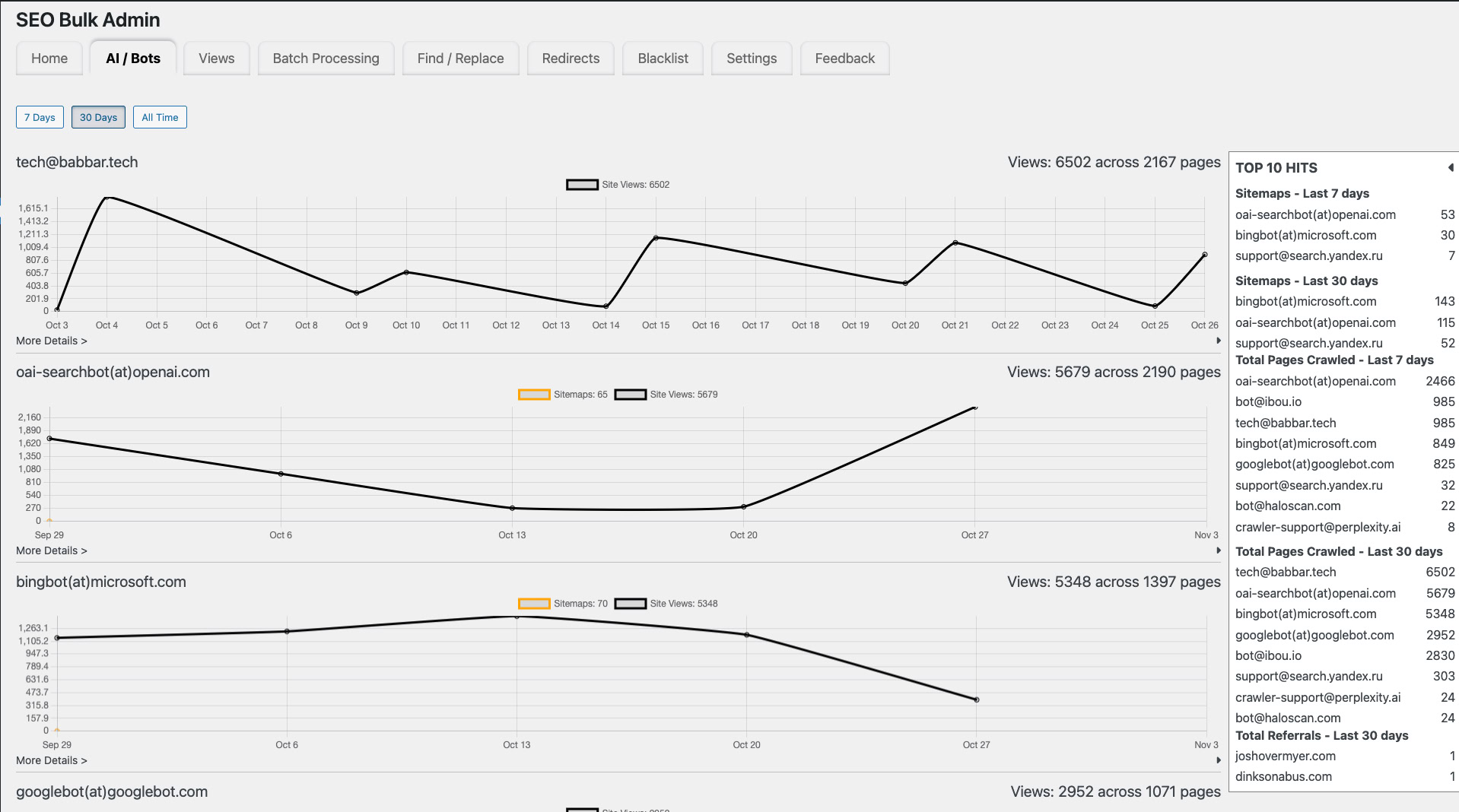
The SEO Bulk Admin WordPress plugin automatically tracks and reports AI crawler activity without requiring server log access or complex setup procedures. The tool provides:

  • Automated Detection: Recognizes major AI crawlers, including GPTBot, PerplexityBot, and ClaudeBot, without manual configuration.
  • User-Friendly Dashboard: Presents crawler data in an intuitive interface accessible to SEOs at all technical levels.
  • Real-Time Monitoring: Tracks AI bot visits as they happen, providing immediate insights into crawler behavior.
  • Page-Level Analysis: Shows which specific pages AI crawlers visit most frequently, enabling targeted optimization efforts.
Screenshot of SEO Bulk Admin AI/Bots ActivityScreenshot of SEO Bulk Admin AI/Bots Activity, October 2025

This gives SEOs instant visibility into which pages are being accessed by AI engines – without needing to parse server logs or write scripts.

Comparing SEO Bulk Admin Vs. Log File Analysis

Feature Log File Analysis SEO Bulk Admin
Data Source Raw server logs WordPress dashboard
Technical Setup High Low
Bot Identification Manual Automatic
Crawl Tracking Detailed Automated
Best For Enterprise SEO teams Content-focused SEOs & marketers

For teams without direct access to server logs, SEO Bulk Admin offers a practical, real-time way to track AI bot activity and make data-informed optimization decisions.

Screenshot of SEO Bulk Admin Page Level Crawler ActivityScreenshot of SEO Bulk Admin Page Level Crawler Activity, October 2025

Using AI Crawler Data To Improve Content Strategy

Once you’re tracking AI crawler activity, the real optimization work begins. AI crawler data reveals patterns that can transform your content strategy from guesswork into data-driven decision-making.

Here’s how to harness those insights:

1. Identify AI-Favored Content

  • High-frequency pages: Look for pages that AI crawlers visit most frequently. These are the pieces of content that these bots are consistently accessing, likely because they find them relevant, authoritative, or frequently updated on topics their users inquire about.
  • Specific content types: Are your “how-to” guides, definition pages, research summaries, or FAQ sections getting disproportionate AI crawler attention? This can reveal the type of information AI models are most hungry for.

2. Spot LLM-Favored Content Patterns

  • Structured data relevance: Are the highly-crawled pages also rich in structured data (Schema markup)? It’s an open debate, but some speculate that AI models often leverage structured data to extract information more efficiently and accurately.
  • Clarity and conciseness: AI models excel at processing clear, unambiguous language. Content that performs well with AI crawlers often features direct answers, brief paragraphs, and strong topic segmentation.
  • Authority and citations: Content that AI models deem reliable may be heavily cited or backed by credible sources. Track if your more authoritative pages are also attracting more AI bot visits.

3. Create A Blueprint From High-Performing Content

  • Reverse engineer success: For your top AI-crawled content, document its characteristics.
  • Content structure: Headings, subheadings, bullet points, numbered lists.
  • Content format: Text-heavy, mixed media, interactive elements.
  • Topical depth: Comprehensive vs. niche.
  • Keywords/Entities: Specific terms and entities frequently mentioned.
  • Structured data implementation: What schema types are used?
  • Internal linking patterns: How is this content connected to other relevant pages?
  • Upgrade underperformers: Apply these successful attributes to content that currently receives less AI crawler attention.
  • Refine content structure: Break down dense paragraphs, add more headings, and use bullet points for lists.
  • Inject structured data: Implement relevant Schema markup (e.g., `Q&A`, `HowTo`, `Article`, `FactCheck`) on pages lacking it.
  • Enhance clarity: Rewrite sections to achieve conciseness and directness, focusing on clearly answering potential user questions.
  • Expand Authority: Add references, link to authoritative sources, or update content with the latest insights.
  • Improve Internal Linking: Ensure that relevant underperforming pages are linked from your AI-favored content and vice versa, signaling topical clusters.

This short video walks you through the process of discovering what pages are crawled most often by AI crawlers and how to use that information to start your optimization strategy.

[embedded content]

Here is the prompt used in the video:

You are an expert in AI-driven SEO and search engine crawling behavior analysis.

TASK: Analyze and explain why the URL [https://fioney.com/paying-taxes-with-a-credit-card-pros-cons-and-considerations/] was crawled 5 times in the last 30 days by the oai-searchbot(at)openai.com crawler, while [https://fioney.com/discover-bank-review/] was only crawled twice.

GOALS:

– Diagnose technical SEO factors that could increase crawl frequency (e.g., internal linking, freshness signals, sitemap priority, structured data, etc.)

– Compare content-level signals such as topical authority, link magnet potential, or alignment with LLM citation needs

– Evaluate how each page performs as a potential citation source (e.g., specificity, factual utility, unique insights)

– Identify which ranking and visibility signals may influence crawl prioritization by AI indexing engines like OpenAI’s

CONSTRAINTS:

– Do not guess user behavior; focus on algorithmic and content signals only

– Use bullet points or comparison table format

– No generic SEO advice; tailor output specifically to the URLs provided

– Consider recent LLM citation trends and helpful content system priorities

FORMAT:

– Part 1: Technical SEO comparison

– Part 2: Content-level comparison for AI citation worthiness

– Part 3: Actionable insights to increase crawl rate and citation potential for the less-visited URL

Output only the analysis, no commentary or summary.

Note: You can find more prompts for AI-focused optimization in this article: 4 Prompts to Boost AI Citations.

By taking this data-driven approach, you move beyond guesswork and build an AI content strategy grounded in actual machine behavior on your site.

This iterative process of tracking, analyzing, and optimizing will ensure your content remains a valuable and discoverable resource for the evolving AI search landscape.

Final Thoughts On AI Optimization

Tracking and analyzing AI crawler behavior is no longer optional for SEOs seeking to remain competitive in the AI-driven search era.

By using log file analysis tools – or simplifying the process with SEO Bulk Admin – you can build a data-driven strategy that ensures your content is favored by AI engines.

Take a proactive approach by identifying trends in AI crawler activity, optimizing high-performing content, and applying best practices to underperforming pages.

With AI at the forefront of search evolution, it’s time to adapt and capitalize on new traffic opportunities from conversational search engines.

Image Credits

Featured Image: Image by TAC Marketing. Used with permission.

In-Post Images: Image by TAC Marketing. Used with permission. 

https://www.searchenginejournal.com/aeo-guide-seo-visibility-tac-spa/559880/


Oddest ChatGPT leaks yet: Cringey chat logs found in Google analytics tool

OpenAI’s response leaves users with “lingering questions”

After ChatGPT prompts were found surfacing in Google’s search index in August, OpenAI clarified that users had clicked a box making those prompts public, which OpenAI defended as “sufficiently clear.” The AI firm later scrambled to remove the chats from Google’s SERPs after it became obvious that users felt misled into sharing private chats publicly.

Packer told Ars that a major difference between those leaks and the GSC leaks is that users harmed by the prior scandal, at least on some level, “had to actively share” their leaked chats. In the more recent case, “nobody clicked share” or had a reasonable way to prevent their chats from being exposed.

“Did OpenAI go so fast that they didn’t consider the privacy implications of this, or did they just not care?” Packer posited in his blog.

Perhaps most troubling to some users—whose identities are not linked in chats unless their prompts perhaps share identifying information—there does not seem to be any way to remove the leaked chats from GSC, unlike the prior scandal.

Packer and Manić are left with “lingering questions” about how far OpenAI’s fix will go to stop the issue.

Manić was hoping OpenAI might confirm if prompts entered on https://chatgpt.com that trigger Google Search were also affected. But OpenAI did not follow up on that question, or a broader question about how big the leak was. To Manić, a major concern was that OpenAI’s scraping may be “contributing to ‘crocodile mouth’ in Google Search Console,” a troubling trend SEO researchers have flagged that causes impressions to spike but clicks to dip.

OpenAI also declined to clarify Packer’s biggest question. He’s left wondering if the company’s “fix” simply ended OpenAI’s “routing of search queries, such that raw prompts are no longer being sent to Google Search, or are they no longer scraping Google Search at all for data?

“We still don’t know if it’s that one particular page that has this bug or whether this is really widespread,” Packer told Ars. “In either case, it’s serious and just sort of shows how little regard OpenAI has for moving carefully when it comes to privacy.”

https://arstechnica.com/tech-policy/2025/11/oddest-chatgpt-leaks-yet-cringey-chat-logs-found-in-google-analytics-tool/


The New Optimization Stack: Where SEO Meets AI Retrieval via @sejournal, @DuaneForrester

Search isn’t ending. It’s evolving.

Across the industry, the systems powering discovery are diverging. Traditional search runs on algorithms designed to crawl, index, and rank the web. AI-driven systems like Perplexity, Gemini, and ChatGPT interpret it through models that retrieve, reason, and respond. That quiet shift (from ranking pages to reasoning with content) is what’s breaking the optimization stack apart.

What we’ve built over the last 20 years still matters: clean architecture, internal linking, crawlable content, structured data. That’s the foundation. But the layers above it are now forming their own gravity. Retrieval engines, reasoning models, and AI answer systems are interpreting information differently, each through its own set of learned weights and contextual rules.

Think of it like moving from high school to university. You don’t skip ahead. You build on what you’ve already learned. The fundamentals (crawlability, schema, speed) still count. They just don’t get you the whole grade anymore. The next level of visibility happens higher up the stack, where AI systems decide what to retrieve, how to reason about it, and whether to include you in their final response. That’s where the real shift is happening.

Traditional search isn’t falling off a cliff, but if you’re only optimizing for blue links, you’re missing where discovery is expanding. We’re in a hybrid era now, where old signals and new systems overlap. Visibility isn’t just about being found; it’s about being understood by the models that decide what gets surfaced.

This is the start of the next chapter in optimization, and it’s not really a revolution. It’s more of a progression. The web we built for humans is being reinterpreted for machines, and that means the work is changing. Slowly, but unmistakably.

Image Credit: Duane Forrester

Algorithms Vs. Models: Why This Shift Matters

Traditional search was built on algorithms, sets of rules, linear systems that move step by step through logic or math until they reach a defined answer. You can think of them like a formula: Start at A, process through B, solve for X. Each input follows a predictable path, and if you run the same inputs again, you’ll get the same result. That’s how PageRank, crawl scheduling, and ranking formulas worked. Deterministic and measurable.

AI-driven discovery runs on models, which operate very differently. A model isn’t executing one equation; it’s balancing thousands or millions of weights across a multi-dimensional space. Each weight reflects the strength of a learned relationship between pieces of data. When a model “answers” something, it isn’t solving a single equation; it’s navigating a spatial landscape of probabilities to find the most likely outcome.

You can think of algorithms as linear problem-solving (moving from start to finish along a fixed path) while models perform spatial problem-solving, exploring many paths simultaneously. That’s why models don’t always produce identical results on repeated runs. Their reasoning is probabilistic, not deterministic.

The trade-offs are real:

  • Algorithms are transparent, explainable, and reproducible, but rigid.
  • Models are flexible, adaptive, and creative, but opaque and prone to drift.

An algorithm decides what to rank. A model decides what to mean.

It’s also important to note that models are built on layers of algorithms, but once trained, their behavior becomes emergent. They infer rather than execute. That’s the fundamental leap and why optimization itself now spans multiple systems.

Algorithms governed a single ranking system. Models now govern multiple interpretation systems (retrieval, reasoning, and response), each trained differently, each deciding relevance in its own way.

So, when someone says, “the AI changed its algorithm,” they’re missing the real story. It didn’t tweak a formula. It evolved its internal understanding of the world.

Layer One: Crawl And Index, Still The Gatekeeper

You’re still in high school, and doing the work well still matters. The foundations of crawlability and indexing haven’t gone away. They’re the prerequisites for everything that comes next.

According to Google, search happens in three stages: crawling, indexing, and serving. If a page isn’t reachable or indexable, it never even enters the system.

That means your URL structure, internal links, robots.txt, site speed, and structured data still count. One SEO guide defines it this way: “Crawlability is when search bots discover web pages. Indexing is when search engines analyze and store the information collected during the crawling process.”

Get these mechanics right and you’re eligible for visibility, but eligibility isn’t the same as discovery at scale. The rest of the stack is where differentiation happens.

If you treat the fundamentals as optional or skip them for shiny AI-optimization tactics, you’re building on sand. The university of AI Discovery still expects you to have the high school diploma. Audit your site’s crawl access, index status, and canonical signals. Confirm that bots can reach your pages, that no-index traps aren’t blocking important content, and that your structured data is readable.

Only once the base layer is solid should you lean into the next phases of vector retrieval, reasoning, and response-level optimization. Otherwise, you’re optimizing blind.

Layer Two: Vector And Retrieval, Where Meaning Lives

Now you’ve graduated high school and you’re entering university. The rules are different. You’re no longer optimizing just for keywords or links. You’re optimizing for meaning, context, and machine-readable embeddings.

Vector search underpins this layer. It uses numeric representations of content so retrieval models can match items by semantic similarity, not just keyword overlap. Microsoft’s overview of vector search describes it as “a way to search using the meaning of data instead of exact terms.”

Modern retrieval research from Anthropic shows that by combining contextual embeddings and contextual BM25, the top-20-chunk retrieval failure rate dropped by approximately 49% (5.7 % → 2.9 %) when compared to traditional methods.

For SEOs, this means treating content as data chunks. Break long-form content into modular, well-defined segments with clear context and intent. Each chunk should represent one coherent idea or answerable entity. Structure your content so retrieval systems can embed and compare it efficiently.

Retrieval isn’t about being on page one anymore; it’s about being in the candidate set for reasoning. The modern stack relies on hybrid retrieval (BM25 + embeddings + reciprocal rank fusion), so your goal is to ensure the model can connect your chunks across both text relevance and meaning proximity.

You’re now building for discovery across retrieval systems, not just crawlers.

Layer Three: Reasoning, Where Authority Is Assigned

At university, you’re not memorizing facts anymore; you’re interpreting them. At this layer, retrieval has already happened, and a reasoning model decides what to do with what it found.

Reasoning models assess coherence, validity, relevance, and trust. Authority here means the machine can reason with your content and treat it as evidence. It’s not enough to have a page; you need a page a model can validate, cite, and incorporate.

That means verifiable claims, clean metadata, clear attribution, and consistent citations. You’re designing for machine trust. The model isn’t just reading your English; it’s reading your structure, your cross-references, your schema, and your consistency as proof signals.

Optimization at this layer is still developing, but the direction is clear. Get ahead by asking: How will a reasoning engine verify me? What signals am I sending to affirm I’m reliable?

Layer Four: Response, Where Visibility Becomes Attribution

Now you’re in senior year. What you’re judged on isn’t just what you know; it’s what you’re credited for. The response layer is where a model builds an answer and decides which sources to name, cite, or paraphrase.

In traditional SEO, you aimed to appear in results. In this layer, you aim to be the source of the answer. But you might not get the visible click. Your content may power an AI’s response without being cited.

Visibility now means inclusion in answer sets, not just ranking position. Influence means participation in the reasoning chain.

To win here, design your content for machine attribution. Use schema types that align with entities, reinforce author identity, and provide explicit citations. Data-rich, evidence-backed content gives models context they can reference and reuse.

You’re moving from rank me to use me. The shift: from page position to answer participation.

Layer Five: Reinforcement, The Feedback Loop That Teaches The Stack

University doesn’t stop at exams. You keep producing work, getting feedback, improving. The AI stack behaves the same way: Each layer feeds the next. Retrieval systems learn from user selections. Reasoning models update through reinforcement learning from human feedback (RLHF). Response systems evolve based on engagement and satisfaction signals.

In SEO terms, this is the new off-page optimization. Metrics like how often a chunk is retrieved, included in an answer, or upvoted inside an assistant feed back into visibility. That’s behavioral reinforcement.

Optimize for that loop. Make your content reusable, designed for engagement, and structured for recontextualization. The models learn from what performs. If you’re passive, you’ll vanish.

The Strategic Reframe

You’re not just optimizing a website anymore; you’re optimizing a stack. And you’re in a hybrid moment. The old system still works; the new one is growing. You don’t abandon one for the other. You build for both.

Here’s your checklist:

  • Ensure crawl access, index status, and site health.
  • Modularize content and optimize for retrieval.
  • Structure for reasoning: schema, attribution, trust.
  • Design for response: participation, reuse, modularity.
  • Track feedback loops: retrieval counts, answer inclusion, engagement inside AI systems.

Think of this as your syllabus for the advanced course. You’ve done the high school work. Now you’re preparing for the university level. You might not know the full curriculum yet, but you know the discipline matters.

Forget the headlines declaring SEO over. It’s not ending, it’s advancing. The smart ones won’t panic; they’ll prepare. Visibility is changing shape, and you’re in the group defining what comes next.

You’ve got this.

More Resources:


This post was originally published on Duane Forrester Decodes.


Featured Image: SvetaZi/Shutterstock

https://www.searchenginejournal.com/the-new-optimization-stack-where-seo-meets-ai-retrieval/559834/


The CMO-CTO Power Struggle: Solving The Web Effectiveness Stalemate via @sejournal, @billhunt

In many organizations, a quiet but costly stalemate exists between two powerful forces: the chief marketing officer (CMO) and the chief technology officer (CTO). At the heart of this tension lies a fundamental misalignment. It is not of intent, but of incentives, timelines, and definitions of success.

What should be a collaborative engine for digital growth instead becomes a friction point that stalls progress, frustrates teams, and undermines website performance.

The Paradox: Shared Mission, Divergent Metrics

The CMO and CTO should be natural allies. Marketing relies on infrastructure such as bandwidth, uptime, speed, and scalability to execute campaigns, scale content, and deliver engaging experiences. And the CTO’s success often hinges on that very growth: traffic spikes, conversions, and customer engagement that justify investment in infrastructure.

Yet, despite their interdependence, their teams often operate in conflict.

This friction often arises because:

  • Different Success Metrics: CTOs are measured by uptime, performance, security, and technical debt reduction; CMOs by campaign speed, reach, conversions, and engagement. What should be complementary can feel mutually exclusive when objectives aren’t aligned or shared.
  • Perceived Bottlenecks: CMOs may perceive technical roadmaps or risk-management procedures as hindering progress. At the same time, CTOs may see marketing priorities as “shiny objects” that risk stability or security – each side underestimating the complexity and importance of the other’s world.
  • Communication Gaps: Technical and marketing teams may lack routine, structured communication, leading to misalignment. Without early involvement, marketing might pursue tools or campaigns incompatible with the site’s architecture, while engineering might roll out upgrades that inadvertently hurt campaign performance or SEO.

The irony is apparent: Without robust, scalable, and secure infrastructure, growth will fail under its own weight; without ambitious, creative marketing, traffic, and brand affinity may stagnate despite technical readiness.

The Cost Of The Stalemate

This tension is not just internal politics; it’s a strategic risk. When the web becomes the battleground between growth and governance, the customer experience suffers:

  • Content takes months to publish.
  • SEO recommendations remain in limbo.
  • Pages break post-launch due to miscommunication.
  • Critical updates are missed, leading to security gaps or ranking drops.

Meanwhile, the executive team wonders why web performance is lagging despite strong talent on both sides.

Case In Point: Overcoming The “IT Line Of Death”

I was invited into a project by the company’s board of directors. After making my pitch, I felt like I had been given the golden ticket: the CEO told me I could have whatever I needed to improve search performance. But when I walked into the IT department, I was met with a harsh reality of the IT roadmap. The CTO informed me that all items on the list had similar C-level backing; however, the fact is that despite an ever-growing list of approved critical actions, budgets, and resources had not changed.

This was my introduction to the IT Line of Death – the fine line between what gets done and what gets ignored.

In the CTO’s attempt to be helpful, he told me there were only two options I could:

  • Get my requests prioritized over the others, or
  • Embed SEO fixes into existing IT priorities.

The only chance of success was to ensure that I integrated SEO into as many of the existing projects as possible. That meant rethinking how we leveraged workflows, ownership structures, and business priorities was key. If SEO isn’t baked into the original blueprint and lacks executive support, it will always be an uphill battle.

Another Case: When Bandwidth Beats Visibility

At one Tech B2B company, I was engaged to help them increase traffic to the website. I started with my technical review and noticed that most of the site was blocked to web crawlers. The server team had done this deliberately as they were concerned that search engine spiders would consume too much bandwidth. Their KPI? An almost unrealistic “Nine Nines” uptime requirement.

Because uptime was their measure of success, any perceived risk to it, even from legitimate indexing activity, was blocked.

Meanwhile, the marketing team had a goal of exponential search growth. These conflicting KPIs put the teams in direct opposition. It took months of structured testing and validation to prove that crawl activity wouldn’t threaten system performance. Only after that were the blocks lifted, and search traffic began to climb.

The lesson: Unless there is a shared understanding of risk, value, and outcomes, the system defaults to self-protection over performance. And that stalls growth.

SEO As A Product: A Call For Deep Integration

In recent years, there has been a shift toward SEO as a product that amplifies the need for proper integration between the CMO and CTO functions. Eli Schwartz’s Product-Led SEO framework recasts SEO as a product development process, not a marketing channel. This view demands a collaborative strategy, user-driven technical builds, and ongoing partnerships between engineering, SEO, and content teams.

When SEO is treated like a product:

  • It has a roadmap, not just a to-do list.
  • It gets budgeted and staffed accordingly.
  • It evolves continuously based on user feedback, search behavior, and business priorities.

This approach elevates SEO to its rightful place: a shared strategic function that requires co-ownership and integrated planning from both marketing and technology leaders.

Turning Friction Into Force

In “Who Owns Web Performance,” we identified the shared nature of visibility, speed, and conversion outcomes. And in “From Line Item to Leverage,” we explored how visibility creates compounding value. But that value doesn’t materialize unless technology and marketing work in tandem, and this starts with the CMO and CTO.

The most effective organizations recognize this symbiotic relationship and create mechanisms for true collaboration:

1. Joint Planning

Have CTOs and CMOs co-create roadmaps for major website initiatives. When both are in the room from the start, stability and scalability get built alongside creativity and agility.

2. Unified Dashboards

Develop shared KPIs that reflect both technical and marketing priorities. This might include:

  • Site speed + Core Web Vitals.
  • Conversion rates by traffic source.
  • Organic visibility + uptime.
  • Structured data health + content engagement.

This makes success a “both/and,” not an “either/or.”

3. Blended Teams

Create cross-functional squads or “growth pods” that combine engineering, SEO, design, and marketing talent. These integrated teams reduce siloed thinking and create tighter feedback loops.

4. Visibility As A Shared Objective

Search visibility, indexability, and performance shouldn’t belong to one department. They are shared outcomes of infrastructure, content, governance, and strategy. Establish shared accountability with Visibility SLAs and cross-team escalation paths.

Executive Mediation: The Role Of The CEO Or COO

Ultimately, resolving this power struggle often requires intervention from above. The chief executive officer, chief operating officer, or chief digital officer must set the tone that growth and resilience are co-requisites, not competing values.

This includes:

  • Setting expectations that speed must coexist with security.
  • Holding teams accountable for shared outcomes.
  • Resourcing integration – not just in tools, but in time and team alignment.

Web Infrastructure Is Growth Infrastructure

If there’s one takeaway from the CMO-CTO power struggle, it’s this:

Your website isn’t just a marketing channel. It’s a growth engine – and it needs to be treated as such.

When SEO, performance, indexability, and campaign agility are considered upstream – not after launch – you don’t just get faster launches; you get smarter outcomes. You get sites that rank, load quickly, deliver meaningful content, and convert effectively.

This is the web as strategic infrastructure. And it can only be built when marketing and technology align.

From Turf Wars To Transformation

As AI-driven search, multimodal discovery, and customer expectations evolve, the web is no longer just a marketing asset – it’s core infrastructure. It requires both creative fuel and technical architecture.

That means the CMO-CTO relationship must shift from tension to tandem.

Organizations that navigate this shift don’t just eliminate friction – they unlock performance.

Because when technology and marketing move in sync, the web becomes more than a channel. It becomes a competitive advantage.

More Resources:


Featured Image: Creativa Images/Shutterstock

https://www.searchenginejournal.com/the-cmo-cto-power-struggle-solving-the-web-effectiveness-stalemate/553329/