Case study: Are indented search results on Google actually hurting your business?
Google reinstated indented search results at the end of 2021. Indented search results are when Google shows additional page(s) from the same domain that it thinks are relevant to your query. These usually occur on Page 1.
Many people might think having two search results on Page 1 is a good thing, but I will show you why I don’t agree.
Keyword optimization
As SEO strategists, we are optimizing certain pages to appear for a keyword or query. In the case of indented search results, pages you did not intend to appear are also showing up for that query.
What if a user clicks on one of the results and doesn’t see what they want? Isn’t this a sign that Google is not sure about which page to show?
CTR based on position
If we look at these three studies, the average click-through rate (CTR) based on Google SERP position looks like this:
Position
CTR range
1
28-40%
2
16-18%
3
10-11%
4
7-8%
5
6% or less
Let’s say a website has an indented search result at position 4. Using the table above, our CTR would be around 14% (adding the high of position 4 and position 5).
However, if we could move that search result up to position 2, our CTR would be between 16-18%.
Of course, moving it up to position 1 would be the best with a CTR of 28-40%.
Can you get Google to remove indented search results?
Yes, you can get indented search results to go away. In the example below, we optimized the top page that was listed in position 5.
However, after we did that, Google started showing an additional page indented between position 5 and position 6.
So, we went back to the site and ensured the site optimization made it clear which page should rank for that keyword through basic SEO tactics like internal linking.
After doing this, the end result was that the page we wanted to rank moved up to position 4 and the indented search result was gone.
What did this do to their traffic?
The month after they moved up from position 5 to position 4, we saw a 55% increase in their traffic on this page.
Rethinking the value of indented search results on SEO
Some people may think that indented search results are a good thing for your website, but I would have to disagree.
I think it is important to have the page you optimized for a specific keyword be the only page from that domain that shows up for that query.
Besides the benefits of a higher CTR, we also cannot be assured which page a user would click on if there are two choices.
I have run into this same scenario with several of our clients in the last few months. In every case I’ve worked on thus far, I found that eliminating the indented result had a positive impact on ranking and traffic to the site.
Opinions expressed in this article are those of the guest author and not necessarily Search Engine Land. Staff authors are listed here.
@media screen and (min-width: 800px) { #div-gpt-ad-3191538-7 { display: flex !important; justify-content: center !important; align-items: center !important; min-width:770px; min-height:260px; }
}
@media screen and (min-width: 1279px) { #div-gpt-ad-3191538-7 { display: flex !important; justify-content: center !important; align-items: center !important; min-width:800px!important; min-height:440px!important; }
}
About the author
Joy is the owner of the Local Search Forum, LocalU, and Sterling Sky, a Local SEO agency in Canada & the USA. She has been working in the industry since 2006 and enjoys speaking regularly at marketing conferences such as MozCon, LocalU, Pubcon, SearchLove, and State of Search. You can find her on Twitter or volunteering as a Product Expert on the Google My Business Forum.
In 2017, Google started rolling out the mobile intrusive interstitials penalty.
In August 2016, Google announced plans to lower the rankings of pages “where content is not easily accessible to a user on the transition from the mobile search results” – and that crackdown would begin on Jan. 10, 2017.
Why did Google do this? They believed this type of ad was “problematic” on mobile devices with smaller screens.
Google explained which types of interstitials were going to be problematic, including:
Showing a popup that covers the main content, either immediately after the user navigates to a page from the search results or while they are looking through the page.
Displaying a standalone interstitial that the user has to dismiss before accessing the main content.
Using a layout where the above-the-fold portion of the page appears similar to a standalone interstitial, but the original content has been inlined underneath the fold.
2021: In this installment of Barry Schwartz’s vlog series, he chats with Thune about the early days in the search industry, his role in running Textbroker and more.
2016: The Google Doodle honored Alice Paul, the American suffragist who played an integral role in getting the 19th Amendment passed, giving women the right to vote, and was the original force behind the Equal Rights Amendment.
2013: StumbleUpon was getting regular requests each week from people asking for it to remove links to their sites. Why? They were worried that being linked to by a popular and long-standing social media sharing site was somehow hurting them with Google.
2013: An image search feature that was often used by bloggers and other content producers returned – and it expanded to image searches on mobile devices.
2013: The latest images culled from the web, showing what people eat at the search engine companies, how they play, who they meet, where they speak, what toys they have, and more.
2012: Google remained tightlipped about exact numbers, but a spokesperson confirmed that “since launch we’ve more than doubled the number of domestic (i.e., U.S.) routes available in the feature.”
2011: With mobile searches growing by leaps and bounds, Google introduced an option on its keyword tool that let marketers find keyword suggestions for mobile devices.
2011: The transition led to small drops in click share and spend share, and a larger drop in overall paid search ad impressions for Yahoo-Bing. But, the flip side of that was a gain in revenue-per-click (RPC).
2011: Foursquare went after local businesses and major brands with an improved and expanded content section that explained how they could take advantage of Foursquare’s platform.
2010: Merchant listings would now come from PriceGrabber and ecommerce sellers would only be able to get into Yahoo Shopping via PriceGrabber or Yahoo Search (Bing).
2009: The latest images culled from the web, showing what people eat at the search engine companies, how they play, who they meet, where they speak, what toys they have, and more.
2007: PageRank updates, supplemental listings, filetype command changes, lost home pages in country-specific results, an update on the disappearing sex blogs, concerns that CSS is being spidered to detect hidden text, duplicate content worries, the Minus 30 penalty and what to do if Google thinks you are a malware site.
2007: It provided access to search engines in the areas of Web, News, Images, Blogs and Jobs. It displayed results from one search engine, searchers click on another engine tab and it displays results from that one and so on.
Past contributions from Search Engine Land’s Subject Matter Experts (SMEs)
These columns are a snapshot in time and have not been updated since publishing, unless noted. Opinions expressed in these articles are those of the author and not necessarily Search Engine Land.
@media screen and (min-width: 800px) { #div-gpt-ad-3191538-7 { display: flex !important; justify-content: center !important; align-items: center !important; min-width:770px; min-height:260px; }
}
@media screen and (min-width: 1279px) { #div-gpt-ad-3191538-7 { display: flex !important; justify-content: center !important; align-items: center !important; min-width:800px!important; min-height:440px!important; }
}
About the author
Danny Goodwin is Managing Editor of Search Engine Land & SMX. In addition to writing daily about SEO, PPC, and more for Search Engine Land, Goodwin also manages Search Engine Land’s roster of subject-matter experts. He also helps program our conference series, SMX – Search Marketing Expo. Prior to joining Search Engine Land, Goodwin was Executive Editor at Search Engine Journal, where he led editorial initiatives for the brand. He also was an editor at Search Engine Watch. He has spoken at many major search conferences and virtual events, and has been sourced for his expertise by a wide range of publications and podcasts.
There are many times during the lifecycle of your website that you will need an expert SEO.
If you don’t enlist the help of a true professional for the following five scenarios, you are risking rankings, traffic and revenue in 2023:
1. Site redesigns
This new year, many are planning to refresh their websites. The problem is that SEO either never enters the conversation during a site redesign or it’s not handled properly. This is a problem.
A site migration is when a website undergoes major changes, such as URL updates, a redesign, or content management system or hosting provider changes.
Any of these changes can negatively impact the website’s performance in the search results when handled well.
And make no mistake – there is a lot to consider. So much so that we usually break up our SEO checklist into pre-launch, launch and post-launch activities when involved in a site migration.
Even when it’s done correctly, it is common for sites to see a temporary drop in organic traffic (80% of SEOs expect it) but it should recover and even excel past previous benchmarks.
When it doesn’t, though, something has gone terribly wrong. The website may never recover and can experience a long-term drop in traffic.
If you’re going to make significant changes to your website, make sure you have the guidance of a seasoned SEO during the entire process. A website design agency may not have the expertise needed.
2. Deep analysis
Even if you are ticking off all the boxes in an SEO checklist, something sinister may be lurking behind the scenes of your website that’s causing a drop in traffic. Only a deep-dive audit can uncover something like this.
It is common for site owners to only focus on the top-performing pages. But that’s only a small representation of your website’s quality. The other 80% of webpages on your site could be harming the overall quality and relevance of it, thus impacting your traffic.
One example? Google’s helpful content update, which looks at the entire website in terms of content quality. If some pages are considered bad, it can impact the whole website.
“The navigation of a website is important in helping visitors quickly find the content they want. It can also help search engines understand what content the website owner thinks is important. Although Google’s search results are provided at a page level, Google also likes to have a sense of what role a page plays in the bigger picture of the site.”
In other words, webpages don’t exist in a vacuum. There are many instances where Google considers the site as a whole when ranking.
There are other hidden issues on a website that can easily be missed without a technical SEO audit. For all these reasons, it’s critical that website publishers get a better understanding of their site through a proper audit.
Get the daily newsletter search marketers rely on.
3. Ranking for highly competitive terms
Let’s be honest, what keywords aren’t competitive these days? Do a search for any keyword and you will find millions of results. Yet, Page 1 is all that matters.
Some keywords are easier to rank for than others. For example, you might have an easier time ranking for something like “list of top video games in 2022” versus just “games.”
We should know. It took us years to help a client rank number one for the highly competitive term: “games.” But we did it. And it stuck.
Ranking for million-dollar keywords doesn’t happen by just following a checklist. It happens with deep SEO expertise from professionals with decades of experience – those who live and breathe technical SEO and understand what’s happening in search right now.
Sure, you can get SEO guidance from anywhere, but if you’re trying to rank for highly competitive terms, don’t settle. Get an expert SEO.
4. Navigating changes to Google
The search engine results pages are constantly in flux.
In 2021 alone, Google ran more than 700,000 experiments, which resulted in more than 4,000 changes to search. That’s about 11 changes per day. Do you have the time to follow and dissect all the algorithm updates and how they apply to your website?
Algorithm updates lead to page one shake-ups and competitors pull ahead. Maybe they have more resources and bigger budgets, maybe they just did slightly better than you. Now you must figure out what changed and how to get ahead again.
Countless factors influence your rankings in the search results. Trying to figure it out should be left to an SEO professional.
5. Technical SEO
Anyone can do easy on-page SEO, but it takes knowledge and experience to get the technical part right. Things like mobile usability, site speed, structured data markup, robots.txt, server maintenance, page experience and much, much more.
Technical SEO requires the expertise of a professional working in tandem with a website developer or webmaster to ensure the correct changes are done well. One mistake and it can throw SEO results off quickly.
Every website needs to ensure the technical part is right to rank. Why? Because if a site is not crawlable, it won’t rank.
“[I] really wish SEOs went back to the basics (i.e., MAKE THAT DAMN SITE CRAWLABLE) instead of focusing on silly updates and made up terms by the rank trackers, and that they talked more with the developers of the website once done with the first part of this sentence.”
Level up your SEO game in 2023
A new year brings new possibilities for your website.
It’s time to seriously consider how you will integrate expert SEO strategies so you have a chance to compete on Page 1.
Opinions expressed in this article are those of the guest author and not necessarily Search Engine Land. Staff authors are listed here.
@media screen and (min-width: 800px) { #div-gpt-ad-3191538-7 { display: flex !important; justify-content: center !important; align-items: center !important; min-width:770px; min-height:260px; }
}
@media screen and (min-width: 1279px) { #div-gpt-ad-3191538-7 { display: flex !important; justify-content: center !important; align-items: center !important; min-width:800px!important; min-height:440px!important; }
}
About the author
Bruce Clay is the founder and president of Bruce Clay Inc., a global digital marketing optimization firm providing search engine optimization, PPC management, paid social media marketing, SEO-friendly site architecture, content development, and SEO tools and education.
Clay authored the book “Search Engine Optimization All-In-One For Dummies,” now in its fourth edition, and “Content Marketing Strategies for Professionals.” He wrote the first webpage-analysis tool, created the Search Engine Relationship Chart® and is credited with being the first to use the term search engine optimization. Bruce Clay’s renowned SEO training course is available online at SEOtraining.com.
Google’s results got more personal with Search Plus Your World
In 2012, Google’s search results were radically transformed as a new “Search Plus Your World” format began rolling out.
Google started mixing together content from the web with content that had been shared with you privately into a single set of listings.
Search Plus Your World didn’t cover content on Facebook, Twitter, or any social networks where content could be shared to a more limited audience. Really, “Search Plus Your World” was best described as “Search Plus Google+”
Twitter was quick to express concerns, stating that Search Plus Your World was “bad for people, publishers, news organizations and Twitter users.”
2018: The PageSpeed Insights tool was updated to use data from the Chrome user experience report, which meant the tool was using metrics from real-world Chrome users.
2014: A small but significant update to the Google Webmaster Guidelines link schemes page: the page now specified the exact type of links that were not allowed within widgets, as opposed to saying any links.
2014: A Virginia state court of appeal ruled that Yelp must disclose the real identities of seven individuals who posted anonymous, critical reviews of an Alexandria, Virginia carpet cleaning business.
2014: The latest images culled from the web, showing what people eat at the search engine companies, how they play, who they meet, where they speak, what toys they have, and more.
2013: Mobile devices accounted for less than 20% of total paid search budgets – and in Q4, tablet metrics grew dramatically faster than those for smartphones.
2013: While saying he’s “still investigating,” the head of the European Union’s antitrust regulatory body said he was convinced that Google was “diverting traffic” and that it will be forced to change its results.
2012: David Mihm published A Brief History of Google Places, which documented everything from 2004 (when Google launched what was then called “Google Local”) up to the Google Places era of 2012.
2011: This deal was about getting more product data directly from their sources and expanding the number of specific attributes or features exposed to consumers
2011: Of the voters asked if there was “a need for government regulation of the way that search engines select the recommendations they provide,” only 11% said yes while 12% were not sure.
2008: Traffic to Mapquest was remained flat year on year and was down 20% in the past 6 months. Meanwhile, Google Maps traffic was up 135% year on year and was up 7% in the past 6 months.”
2008: Do successful search companies have to have CEOs or top execs who “grew up” from the search product side? A look at the major players and where those in charge came from.
2007: Could Google dictate that public domain books that it has scanned and distributed on the web really be subject to restrictions on non-commercial work?
Past contributions from Search Engine Land’s Subject Matter Experts (SMEs)
These columns are a snapshot in time and have not been updated since publishing, unless noted. Opinions expressed in these articles are those of the author and not necessarily Search Engine Land.
@media screen and (min-width: 800px) { #div-gpt-ad-3191538-7 { display: flex !important; justify-content: center !important; align-items: center !important; min-width:770px; min-height:260px; }
}
@media screen and (min-width: 1279px) { #div-gpt-ad-3191538-7 { display: flex !important; justify-content: center !important; align-items: center !important; min-width:800px!important; min-height:440px!important; }
}
About the author
Danny Goodwin is Managing Editor of Search Engine Land & SMX. In addition to writing daily about SEO, PPC, and more for Search Engine Land, Goodwin also manages Search Engine Land’s roster of subject-matter experts. He also helps program our conference series, SMX – Search Marketing Expo. Prior to joining Search Engine Land, Goodwin was Executive Editor at Search Engine Journal, where he led editorial initiatives for the brand. He also was an editor at Search Engine Watch. He has spoken at many major search conferences and virtual events, and has been sourced for his expertise by a wide range of publications and podcasts.
How to build a ‘helpful’ content strategy for 2023
Between the roll-out of the helpful content update and the emphasis of E-E-A-T on every query and search result, Google is clear about the significance SEOs should place on good, valuable content in 2023.
Given that, I’d like to break down the approach, process, and resources my team uses to tackle content this year.
I’m not just talking about a content calendar, which is one facet of your content strategy. I’m talking about using your audience understanding and your organization’s branding to build a content system that provides genuine value.
The right approach for valuable content
The emphasis on quality and value in content is good for marketers, even if it shifts a bit of focus away from quantitative metrics like clicks and external links.
Producing good content will rely on a rich understanding of your audience, good fundamental content structures, and solid delivery methods – marketing skills that will always be relevant.
Start with your audience. Who are they? What do they need? What content should you deliver to help them get there?
Approach content like any other product or service:
Find or understand a need and address it.
Know the emotions (fear, uncertainty, urgency, etc.) in play.
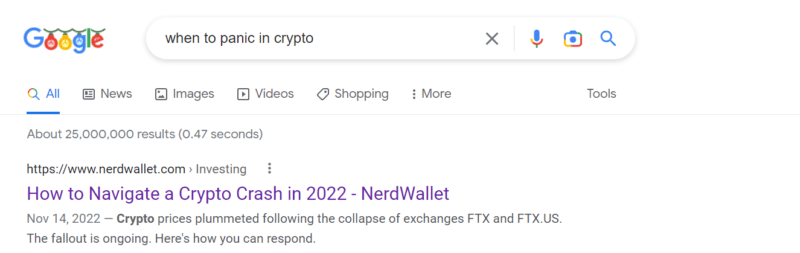
Here’s an example of a valuable piece of content that’s rewarded with a top spot in the SERP even though the title and query aren’t exactly aligned.
Click into the article, and you’ll see NerdWallet’s helpful, on-brand approach to a knee-jerk question. They offer calm, informed content that gives context around the latest crypto crash and guides readers to consider their full economic picture before making any emotion-driven decisions.
Developing a voice that addresses an understanding of problems is valuable, hard to do, and, most importantly, a competitive edge.
Content that helps advance brand differentiation, as the NerdWallet piece does, makes it much harder for your competition to poach your audience by upping the trust ante.
Get the daily newsletter search marketers rely on.
Building a process to create valuable content
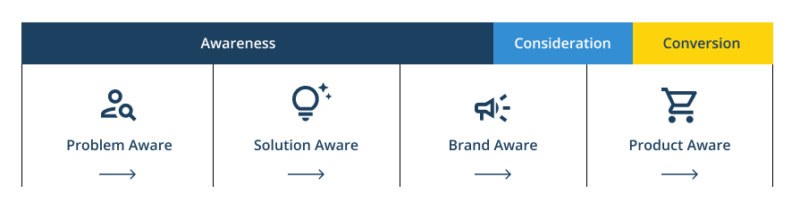
The content strategy path I like to prescribe is as follows:
Problem aware: Empathize with your audience by articulating their problem in a clear, differentiated way.
Solution aware: Present your audience with objective, detailed, valuable options for solutions to their problem.
Brand aware: Develop your brand’s association as a trusted solution provider.
Product aware: Position your specific product or service as the ideal solution for the reader’s problem.
Following this path will:
Drive increased discussion, knowledge, and education around the problem.
Introduce new solutions that audiences hadn’t yet considered.
Position your brand as something transformative, unique, and revolutionary.
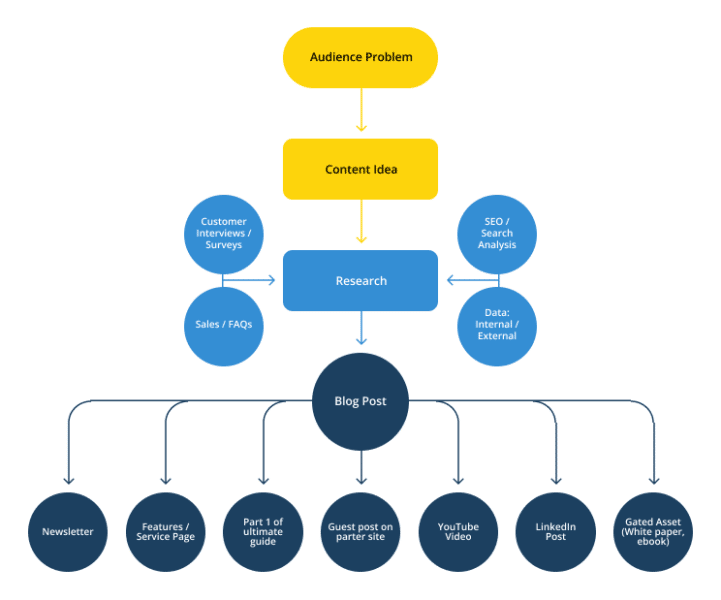
The problem itself will give you an idea for content that you can take into the research stage.
Once your research is conducted, you’ll have what you need to craft content and deploy it in multiple ways.
The flow looks like this:
I’d like to call out a couple of themes here:
SEO / search analysis is one piece of the research pie. Google wants us to write for our target audience, not for Google. Dig into the qualified and quantified information that helps you achieve that.
Truly useful content that isn’t written solely for SERP rankings should be highly engaging on any number of channels and in multiple formats. Don’t stop at a blog post, and don’t just rely on Google for eyeballs.
Resources to use in content development
Presumably, you know how to use Google’s keyword research tools and external tools (e.g., Ahrefs or Semrush). I’ll focus on tools that go beyond keywords to help you develop your content priorities.
Qualitative interviews
Surveys are useful and often expensive if you’re trying to reach an audience outside your CRM.
You can get great insights if you can facilitate other ways to engage subject matter experts with the same professional experiences, challenges, and responsibilities as your target audience.
Slack communities, (live or virtual) meet-ups, and memberships in organizations like the AMA or ANA can provide on-the-ground perspectives for your content mapping.
Social media
Not all social media posts are created equal, but understanding your audience includes knowing where your audience likes to engage: Twitter, Reddit, YouTube, TikTok, etc.
Work those platforms to get information on what your audience is talking about in real-time, and you’ll be able to see trends as they emerge.
Google Search Console
GSC can provide excellent insight into the performance of your previous content performance and give you data on what people are doing on your site and previous content. This allows you to see underperforming content andtop-performing content.
For the former, consider what might be missing in the content you can address. For the latter, spin-off more content if the theme allows, do internal linking, and build deeper authority on the topic to establish a competitive advantage.
Competitor analysis
Competitor analysis, in this case, doesn’t mean just looking for keywords with low competition. It means assessing:
Where your competitors are leaning in.
What ground they aren’t covering.
What formats they are or aren’t using.
What angles they might be taking on broader topics that leave room for your unique point of view.
Go into your research looking for opportunities to stand apart rather than just copying everything your competitors are doing.
Moving the needle with helpful content
Taking this approach to content may ultimately change how you view content KPIs.
Instead of clicks and impressions, for instance, you may put yourself in a position to report on leads and opportunities generated and influenced.
Along with burnishing your brand and helping build awareness, valuable content can move the needle at every stage of the buying journey.
Google’s heavy-handed guidance on helpful content might feel uncomfortable if it forces a pivot in your approach, but in the long run, it may just make us all better marketers.
Opinions expressed in this article are those of the guest author and not necessarily Search Engine Land. Staff authors are listed here.
@media screen and (min-width: 800px) { #div-gpt-ad-3191538-7 { display: flex !important; justify-content: center !important; align-items: center !important; min-width:770px; min-height:260px; }
}
@media screen and (min-width: 1279px) { #div-gpt-ad-3191538-7 { display: flex !important; justify-content: center !important; align-items: center !important; min-width:800px!important; min-height:440px!important; }
}
About the author
Adam Tanguay is Head of SEO and Content at Jordan Digital Marketing, which he joined in Feb. 2019. Formerly Head of Marketing at Webflow and Head of Organic Growth at Weebly, Adam has developed successful growth programs with a mix of content strategy, copywriting, technical know-how, and analytics acumen across a range of organic channels.
How to create an awards page that adds authority to your website (plus 7 examples)
If you’ve racked up awards or accolades for your business, you’re not wrong in wanting to show them off.
Your achievements signify you’re doing a few things right, so why wouldn’t you display them on your website?
The key is to ensure you don’t look too company-focused or braggy – after all, a cardinal sin of content is using too much “I” or “we” language and forgetting to talk to your audience with “you” language.
To strike the right balance, you need to write an awards page that isn’t distracting or annoying, but rather adds credence to your brand and builds trust.
You want customers to say, “Wow, this company is really successful!” Not, “Yuck, this company is obsessed with itself.”
Let’s talk about how to create an awards page, including how having one builds trust with customers.
Why create an awards page on your website?
Awards pages can help establish your authority, giving your SEO a little boost.
How?
Awards are proof that you’re a force in your industry, doing exceptional work. Other people paid attention and recognized you for what you do, and now they’ve given you physical evidence of your company’s prowess.
Thus, those awards are trust signals to prospects and to search engines (E-A-T, anyone?).
For example, the Search Engine Land Awards are handed out yearly to marketers, teams, and agencies that demonstrate excellence in organic or paid search marketing initiatives or campaigns.
How to create an awards page that shows off your achievements – without turning people off (+ 7 examples)
Wondering how to create an effective awards page? Here are six tips with seven examples from real-life businesses that have done it well.
1. Consider creating a separate awards page
If you have earned a lot of awards over the years (good on you!), consider displaying them on a separate awards page.
For example, the University of Dundee in Scotland has a page dedicated to its awards, with additional pages that explain the context of each award.
Rankings and awards page
Individual award page
The awards page is linked under their “About” information, which is also a good practice.
This way, people who want to view your awards have an obvious place to click, while people who don’t care won’t be inundated with a long list to scroll through.
2. Include all your important awards, from most recent to least
If you’ve been winning awards for years, that says a great deal about your company and its legacy. If your award history goes back five, 10, 15, or even 20 years, don’t be shy about displaying your pattern of excellence.
That said, also consider the relevance of each award to your audience and whether they’ll care. For instance, if your company won an award for participation five years ago, you can probably leave that one out.
On the other hand, maybe you won “brand of the year” in an industry-wide contest five to 10 years ago – that’s relevant to your customers, your reputation, and your authority. Thus, you should display it on your awards page.
A good example of this in action is Liberty Mutual’s awards page – they have a long list of awards going back to 2016.
3. Include award badges or icons
Most awards come with small badges or icons for displaying on your website. In most cases, it’s a good idea to do so.
Why?
Because many of these badges come replete with their own recognition, especially among those in your industry. Displaying a recognizable (and perhaps coveted) badge is a really easy way for the people who matter to see it and register it in a second.
One huge tip – if you have a lot of awards badges, make sure they look clean and organized. Otherwise, your page could look messy and unprofessional, which is the exact opposite of what you want. A good rule of thumb is to keep them on the smaller side and organize them into a list or neat grid.
On the Goodnow Farms Chocolate homepage, they include a tidy list of badges as part of a photo carousel.
4. Briefly describe the context of each award
In many cases, simply listing out your awards isn’t enough. Why should customers care if they don’t know what that award means or signifies?
To that end, include a brief description of each award you’ve won, including how you were chosen – especially if customers voted for you (a giant trust signal). Progressive does a good job of this on its awards page:
5. For three or fewer awards, add them to your about page, the sidebar, or the footer
Don’t have a long list of accolades yet? Instead of creating a separate awards page, consider adding your awards badges to a dedicated section on your about page.
This also works if you have more than three awards, by the way, and is a smart strategy to draw attention to them without dedicating an entire page to them.
In this vein, Thrive has included a section dedicated to their awards on their about page. They use a simple paragraph to give some context along with an organized row of small badges, and it does the job nicely.
If you have one or two awards to your name, you should consider adding the badges to your sidebar or footer. These are unobtrusive places that benefit from remaining static across your site, so your awards will be displayed on every page.
Remember, you can always create an awards page later if you earn more.
6. More than 25 awards? Create an awards list
Let’s say your business rakes in the awards consistently. That’s incredible, and you have every right to humble-brag a little.
A smart and crafty way to display these awards is to create a list. The more awards you have, the more impressive it will look, especially at first glance.
Magpie Studios, a British design agency, does this to great effect. Their awards list is incredibly long and goes all the way back to 2011. Altogether, it makes a lasting impression that this is a company to be reckoned with.
Another company that does this well is Hueston Hennigan, a law firm:
Remember: Awards pages are about authority and building trust
Never create an awards page without intention or a strategy. Just like your other website pages, an awards page has a purpose that will help you build toward reaching your goals.
It’s not about showing off but rather offering proof that your business is credible and trusted. To that end, only display awards your customers will care about and keep your page organized and easy to read.
Ultimately, a well-designed awards page is a good idea as long as you keep your customers, goals, and strategy in mind.
Opinions expressed in this article are those of the guest author and not necessarily Search Engine Land. Staff authors are listed here.
@media screen and (min-width: 800px) { #div-gpt-ad-3191538-7 { display: flex !important; justify-content: center !important; align-items: center !important; min-width:770px; min-height:260px; }
}
@media screen and (min-width: 1279px) { #div-gpt-ad-3191538-7 { display: flex !important; justify-content: center !important; align-items: center !important; min-width:800px!important; min-height:440px!important; }
}
About the author
Julia McCoy is the founder of Content Hacker, 7x author, and a leading strategist around creating exceptional content and brand presence that lasts online. At 19 years old, she used her last $75 to build a 7-figure writing agency which she sold ten years later. In the 2020s, she’s devoted to teaching founders and marketers the strategy, skills, and systems they need to build a business through inbound content, so they can create more lasting impact in the world.
AdWords Managed Accounts get shared negative lists across accounts
In 2017, Google added the ability to create and share negative keyword lists across accounts for Managed Accounts.
This was welcome news for advertisers who had been adding the same lists of negative keyword accounts manually or using a script to automate cross-account negative lists.
For accounts in a managed account, you could set up a single list of negative keyword in the top-level Shared Library that could then be associated at the account level.
2019: Google started rolling out a new feature in search named “your related activity” that let signed in Google users pick up on previous searches related to the query they just added.
2018: Google marked what would have been Har Gobind Khorana’s 96th birthday with a Doodle to celebrate the Nobel Prize winner’s accomplishments in the field of biochemistry.
2016: For its first Doodle of the year, Google celebrated the 41st anniversary of the discovery of “The Mountain of Butterflies,” when a research team located millions of Monarch butterflies that had migrated to Mexico’s easternmost Sierra Madre Mountains.
2015: An analysis showed a gradual but continual losses back to Google, and Yahoo’s share of Firefox 34 clicks dropped from 43% (Dec. 10) to about 36 percent
2015: The latest images culled from the web, showing what people eat at the search engine companies, how they play, who they meet, where they speak, what toys they have, and more.
2014: A number of Google international homepages celebrated feminist writer Simone de Beauvoir’s 106th birthday with a Beauvoir-inspired Google logo, but there’s no sign of her on Google’s U.S. homepage.
2013: A striking 36% of respondents thought that search engines “sell users’ personal data to marketers.” Another 29% thought that “companies pay annual dues for use.”
2012: A Korean official asserted that Google has obstructed his agency’s investigation “by deleting key files from PCs and asking its employees to telecommute from home.” Google denied obstructing the inquiry and pledged cooperation with Korean government officials.
2012: Ads for illegal Olympic ticket resellers, ads for cannabis, and ads for fake identification cards and UK passports. All illegal, but all could be found on Google.co.uk
2009: Google’s advertiser growth started at 89,000 in 2003, to 201,000 in 2004, 360,000 in 2005 and 600,000 in 2006. In 2009, one estimate said Google had between 1.3 million and 1.5 million advertisers.
2009: A small but interesting study on how you can improve your chances, by 50 times, of showing up at the top of the Google search results: Utilize Google’s Universal Search by creating videos.
2009: Roundup of personnel moves or speculation about who might get the top spot at Yahoo; the ongoing MicroHoo saga; and MSN being branded a “lewd” site in China for user-generated content.
2009: The latest images culled from the web, showing what people eat at the search engine companies, how they play, who they meet, where they speak, what toys they have and more.
2008: The responsibilities included “investigating deviations from company policies or acts against Google as well as collection and analysis of information helping define and assess threats to Google’s operations and assets.”
2007: the company was getting involved with the Large Synoptic Survey Telescope. To be built in Chile, the LSST was planned to scan the sky on a continuous basis, allowing for “movie-like” looks at the universe.
2007: The company raised millions in venture capital to help online advertisers identify click fraud using statistics, user modeling, machine learning, and IP forensics”
Past contributions from Search Engine Land’s Subject Matter Experts (SMEs)
These columns are a snapshot in time and have not been updated since publishing, unless noted. Opinions expressed in these articles are those of the author and not necessarily Search Engine Land.
@media screen and (min-width: 800px) { #div-gpt-ad-3191538-7 { display: flex !important; justify-content: center !important; align-items: center !important; min-width:770px; min-height:260px; }
}
@media screen and (min-width: 1279px) { #div-gpt-ad-3191538-7 { display: flex !important; justify-content: center !important; align-items: center !important; min-width:800px!important; min-height:440px!important; }
}
About the author
Danny Goodwin is Managing Editor of Search Engine Land & SMX. In addition to writing daily about SEO, PPC, and more for Search Engine Land, Goodwin also manages Search Engine Land’s roster of subject-matter experts. He also helps program our conference series, SMX – Search Marketing Expo. Prior to joining Search Engine Land, Goodwin was Executive Editor at Search Engine Journal, where he led editorial initiatives for the brand. He also was an editor at Search Engine Watch. He has spoken at many major search conferences and virtual events, and has been sourced for his expertise by a wide range of publications and podcasts.
In 2020, Frédéric Dubut of Bing told us: “Keyword research are probably going to become slowly obsolete and you’ll need to switch to intent research as a practice.”
Barry Schwartz asked Google’s John Mueller about Dubut’s statement. Here’s what Mueller said:
“There’s probably always gonna be a little bit of room for keyword research because you’re kind of providing those words to users. And even if search engines are trying to understand more than just those words, showing specific words to users can make it a little bit easier for them to understand what your pages are about and can sometimes drive a little bit of that conversion process.”
So, is keyword research obsolete yet? In 2023, there definitely has been a significant shift in the way SEOs think about user intent, or the search intent behind a query. But keyword research is still far from obsolete.
2020: Search engines continue to get better at understanding intent and rely less on keywords. But Mueller wouldn’t go as far as to say keyword research practices will or should go away anytime soon.
2020: Page owners could use Bing Pages to aggregate social media links, publish contact details, customize Outlook profiles with images and content and promote social media posts.
2020: In this installment of Barry Schwartz’s vlog series, he chatted with Dean about making good quality videos, the nofollow link attribute change and more.
2019: if you have hundreds or thousands of pages, removing URLs one by one can be time-consuming. What tocan you do? Use temporary sitemaps, according to John Mueller.
2019:Lily Ray on changes to how sites are evaluated, dealing with traffic drops due to algorithm changes, Google’s search quality rater guidelines and more.
2018: An investigation revealed an ongoing issue with middlemen bidding on the terms and receiving large kickbacks from the private centers where the searchers were ultimately referred to – a practice called “patient brokering.”
2018: Google and Amazon both announced new device partnerships; the Google Assistant would be on new “smart display” devices, more TVs, speakers and in cars.
2016: The latest images culled from the web, showing what people eat at the search engine companies, how they play, who they meet, where they speak, what toys they have and more.
2015: Some users were missing their Google Now cards, which they rely on to see if there will be traffic on the way to work, how cold it may be or other useful information for their day.
2015: Google France added the “Je Suis Charlie” (“I am Charlie”) badge on its homepage, honoring the lives lost during the Charlie Hebdo massacre in Paris, France.
2014: Ad network Chitika released a new tool that provided a user percentage or traffic market-share breakdown of PC operating system and search usage on a state-by-state basis.
2013: The URL shown under the definition previously wasn’t clickable. Instead, the only way to click through to the source of the definition was to use the smaller Source link at the bottom of the box.
2013: “As Product Marketing Manager within the search growth team, you will be responsible to developing plans, creatives, campaigns and programs to increase the number of user’s signed in.”
2013: How much does Google figure into the “future of search,” whose advances will largely be determined by mobile and non-traditional devices? That was a hard question to answer.
2012: Danny Sullivan called 2011 “alarming.” Why? Because after years of moving forward, the search engines took a big step back, withholding both linking and keyword data.
2010: Some of the results would be powered by Yahoo, while the search results in BOSS (Build your Own Search Service – a Yahoo Developer Network initiative to provide an open search web services platform) would be powered from Microsoft Bing.
2010: Associated Press stories – hosted by Google itself — were no longer appearing in Google News. Google had not added any new AP content since Dec. 24.
2009: Timeframe gave advertisers a new budgeting method that automatically adjusted the daily budget based on traffic to reach a set dollar budget as per the calendar month.
2008: Microsoft got a market-leading enterprise search company and a world-class web crawler (not to mention some of the smartest engineering talent in search).
2008: Sony announced a deal to provide Google’s YouTube five-minute clips of some of their most popular TV shows, including “Married With Children” and “Newsradio.”
2007: A U.S. District Court ruled that the use of keyword-triggered ads and keyword metatags using trademarked terms cannot confuse consumers if the resulting ads/search results don’t display a competitor’s trademarks.
2007: Search marketer Jeffrey Rohrs published an open letter to paid search providers asking critical questions about billing practices, transparency, click fraud and other issues
2007: While second to Google in Web search, the company was hoping it could lead the market for mobile search and associated advertising with a new offering tailored for use on handsets.
2007: Why were advertisers cutting their PPC ad spend significantly in 2007? Because many of the keyword prices have resulted in advertisers being priced out of profitability.
Past contributions from Search Engine Land’s Subject Matter Experts (SMEs)
These columns are a snapshot in time and have not been updated since publishing, unless noted. Opinions expressed in these articles are those of the author and not necessarily Search Engine Land.
@media screen and (min-width: 800px) { #div-gpt-ad-3191538-7 { display: flex !important; justify-content: center !important; align-items: center !important; min-width:770px; min-height:260px; }
}
@media screen and (min-width: 1279px) { #div-gpt-ad-3191538-7 { display: flex !important; justify-content: center !important; align-items: center !important; min-width:800px!important; min-height:440px!important; }
}
About the author
Danny Goodwin is Managing Editor of Search Engine Land & SMX. In addition to writing daily about SEO, PPC, and more for Search Engine Land, Goodwin also manages Search Engine Land’s roster of subject-matter experts. He also helps program our conference series, SMX – Search Marketing Expo. Prior to joining Search Engine Land, Goodwin was Executive Editor at Search Engine Journal, where he led editorial initiatives for the brand. He also was an editor at Search Engine Watch. He has spoken at many major search conferences and virtual events, and has been sourced for his expertise by a wide range of publications and podcasts.
in 2011, startup search engine Blekko launched a spam clock that estimated 155 million spam pages had been created since Jan. 1 of that year. Blekko said 1 million spam pages were being created every hour.
How bad was Google’s spam problem then? Big. But as Danny Sullivan pointed out at the time, it was hard to judge whether Google’s relevancy had actually decreased, because:
We expect more from Google than we do in the past, searching for things we might not have in previous years
We don’t remember all the successful searches, focusing on when things go bad.
We probably don’t do a comparison check on Bing or Blekko to see if they performed better, nor do we use those services on a regular basis to understand if they’re also “failing” to the degree we might feel Google does.
2021: The new reports provided 6 months of data on how people interacted with you (calls and messages) and how people discovered you (the search term used to find your Google business listing in Google Search and Google Maps).
2020: Google was working on fixing a data issue with the URL parameter tool, a legacy tool within Google Search Console that let SEOs communicate to Google insignificant page variations and direct Google to consolidate those URLs.
2014: Google’s John Mueller said, “data in the search queries feature will no longer be rounded / bucketed,” and you will start to notice these changes in Webmaster Tools in the next few days.
2014: Calling itself a “new way to search,” ultimately, Jelly would follow the path of social Q&A platform pioneers failures like Ask.com, Quora, Yahoo Answers and Google Answers.
2013: The Library of Congress was working on plans to create a searchable archive of nearly every public tweet ever sent, but the challenges inherent in that task were making it a slow process.
2009: Leading Chinese search engine Baidu was sued by Chinese medical B2B marketplace Qmyy.com to prevent its site from being blocked or dropped by the engine.
2009: Bush should have stopped redirecting requests for his old biography to the current presidential home page. It left that page with a legacy of ranking for failure.
2008: “Widely hyped … it’s really just yet another crappy search service that may, potentially, if all goes well, eventually turn into something useful.” See also: Wikia Search Launches Alpha Version
2008: There were essentially three pieces to what Yahoo announced: Yahoo Go 3.0, an open mobile widget development platform for third parties, and a redesigned mobile WAP homepage that emphasized personalization and customization.
Past contributions from Search Engine Land’s Subject Matter Experts (SMEs)
These columns are a snapshot in time and have not been updated since publishing, unless noted. Opinions expressed in these articles are those of the author and not necessarily Search Engine Land.
@media screen and (min-width: 800px) { #div-gpt-ad-3191538-7 { display: flex !important; justify-content: center !important; align-items: center !important; min-width:770px; min-height:260px; }
}
@media screen and (min-width: 1279px) { #div-gpt-ad-3191538-7 { display: flex !important; justify-content: center !important; align-items: center !important; min-width:800px!important; min-height:440px!important; }
}
About the author
Danny Goodwin is Managing Editor of Search Engine Land & SMX. In addition to writing daily about SEO, PPC, and more for Search Engine Land, Goodwin also manages Search Engine Land’s roster of subject-matter experts. He also helps program our conference series, SMX – Search Marketing Expo. Prior to joining Search Engine Land, Goodwin was Executive Editor at Search Engine Journal, where he led editorial initiatives for the brand. He also was an editor at Search Engine Watch. He has spoken at many major search conferences and virtual events, and has been sourced for his expertise by a wide range of publications and podcasts.
The helpful content update started Dec. 5, and the link spam update started on Dec. 14.
The algorithm update rollouts were supposed to be completed within two weeks, but clearly that has not happened.
Google’s new statement. Danny Sullivan, Google’s Search Liaison, said on Twitter that these two updates will complete “likely within two weeks, maybe only one” week but he added that it is “not a guarantee” and “timings might change.”
Why the delay? The rollouts are taking longer because of the holidays. Sullivan said earlier on Mastodon, “Both the updates are continuing to rollout. Normally these types of updates would have concluded by now, but rollouts can slow or pause when we get into the holiday periods.”
Why we care. As I said above, both updates are still rolling out at the time this was published. It is very hard to accurately say that one ranking change in aggregate is related to a specific ranking update when both are rolling out at the same time. That being said, it is likely easier to look at individual sites and know if the site was hit by a link algorithm versus a helpful content algorithm, especially if you look at the links and content for that site.
We have some early data on the impact of some of these updates, but this long rollout has made it really hard to measure accurately.
So you will need to do the due diligence and dig into sites impacted by each update on an individual basis. This just shows you that it appears that these updates did show movement and did cause ranking volatility in aggregate.
@media screen and (min-width: 800px) { #div-gpt-ad-3191538-7 { display: flex !important; justify-content: center !important; align-items: center !important; min-width:770px; min-height:260px; }
}
@media screen and (min-width: 1279px) { #div-gpt-ad-3191538-7 { display: flex !important; justify-content: center !important; align-items: center !important; min-width:800px!important; min-height:440px!important; }
}
About the author
Barry Schwartz a Contributing Editor to Search Engine Land and a member of the programming team for SMX events. He owns RustyBrick, a NY based web consulting firm. He also runs Search Engine Roundtable, a popular search blog on very advanced SEM topics. Barry can be followed on Twitter here.