What to do when the wrong page ranks for a keyword

We’ve all heard about search engine optimization (SEO), but what about search engine de-optimization?

In one Search Off The Record episode, Martin Splitt, Gary Illyes, and Lizzi Sassman discussed de-optimization – the process of taking a page off SERPs. The goal of deoptimization is ranking the page that is most likely to attract qualified traffic and conversions. 

If you’ve ever ranked the “wrong” page for a keyword, this article is for you. Get ready to learn the de-optimization process so you can earn clicks from qualified traffic and increase conversions.

How can you tell if the wrong page is ranking?

The purpose of deoptimization is to remove a page driving the wrong type of traffic to your site. Sometimes you might benefit from removing a page from SERPs entirely. Other times, you might want to replace the page that ranks with a more suitable page.

In the de-SEOing episode, Sassman shares an anecdote where site visitors landing on a particular document, listed on Page 1, were not the right types of traffic.

Sassman said this became clear from feedback coming from users visiting their page. The ranking page caused some misunderstandings. Web users started to submit requests for tasks that were not relevant. As a result, users weren’t satisfied and internal teams were busier handling irrelevant support tickets they could not solve.

The page was generating traffic, but it was the wrong type of traffic. There was a mismatch between what the user was looking for and the page they were landing on.

Ranking the wrong page in SERPs is not unusual. Recognize when you’re ranking the wrong page by looking out for:

  • Pages that earn traffic but not conversions.
  • Queries from users that don’t make sense for the business offering.
  • Pages that were commissioned to achieve a certain goal but are falling short of expectations.
  • Articles ranking for conversion keywords that would be better placed on a revenue-generating page (product page, product category, or landing page).

Get the daily newsletter search marketers rely on.


Which page should you rank anyway?

Before attempting to rank any page in Google’s SERPs, it’s important to understand the search intent behind a keyword. Only then can you decide if the keyword is suitable for you to try and rank for and the type of page you should be creating.

You help determine which page should rank for a keyword by understanding how Google prioritizes pages based on its search intent.

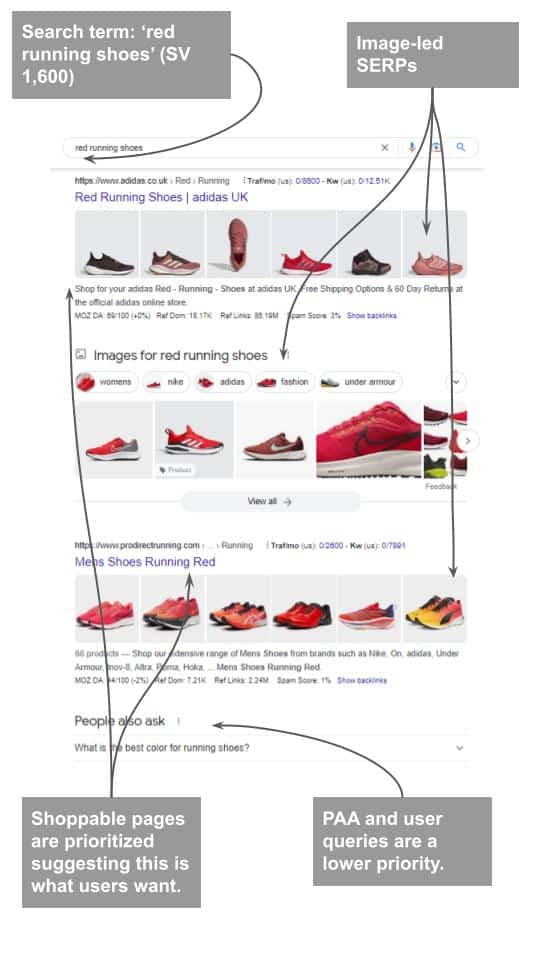
Take a look at the annotated SERP example below. A search for “red running shoes” returns ecommerce category pages and image packs. The SERP suggests that the user is looking to buy red running shoes or view images of them. It’s a product-led SERP.
red running shoes

If ranking for red running shoes is your goal, then you should, at minimum, be able to match the intent in the SERPs by providing page users can buy red running shoes and include images.

Based on SERP analysis, you would not expect an article titled “the best red running shoes” to have a good chance of ranking for the search term ‘red running shoes’ because Google is not prioritizing articles in the SERP. Equally, if an article did rank, you would not expect this type of page to satisfy user intent for this particular search.

If you do have a page ranking that is earning traffic but failing to convert, you might want to consider deoptimization. 

Below, we cover how to deoptimize a page in favor of a more suitable one.

Deoptimization explained

So you’ve got a page ranking that isn’t converting and you have another page on your site that would be better placed to rank for the target keyword.

How can you deoptimize a page while removing it from SERPs for the desired keyword and putting another page in place?

At this point, it’s important to note that you are at risk of losing your rank – and the traffic that comes with it – altogether. But the goal of SEO is not just to earn traffic but to earn qualified traffic that supports business goals.

If all you are losing is clicks and impressions you are not really losing anything.

Here’s a step-by-step guide to search engine deoptimization. 

Step 1: Choose your desired ranking page

Before you do anything, you need to decide which page will rank for your desired keyword and why.

Start by conducting SERP analysis. Based on the prioritized results, decide which page on your site fits among what’s already ranking.

If the SERPs are full of articles, you likely need to write an article that satisfies user intent. If the SERPs prioritize ecommerce pages then you need to have the product to sell.

Step 2: Assign keywords to pages

For the best chance of ranking any page, you need to be the most useful page on the web. 

Make sure you cover a topic in full. Look at what’s ranking and which keywords return the same type of content. You can use this data to inspire sections of content on your page.

You can find related keywords that you should cover by taking a look at what competitor sites are including in their article and ranking for.

The Organic Research report in Semrush can be a useful starting point to find related keywords.

Semrush screenshot showing keyword positions for a page ranking for ‘red running shoes’.

Make sure you’re using the keywords correctly and in the right places.

The keyword you want to rank the desired page for should be used naturally throughout the article. Go back to SEO basics and check it’s used in the title tag and the URL if it makes sense to do so.

Step 3: Evaluate ranking content vs. your desired content

Compare the page you want to rank to pages that are currently ranking.

What elements do competitors include that your page does not? Make sure your page is ultimately useful and competitive. If ranking pages use high-quality images, you should also use them. If competitive pages include video, add a video to your page.

Aim to do everything competitors do, but don’t focus so hard on competitors that you forget your users and customers. 

What more can you add that is genuinely useful to your users? Find out by:

  • Speaking with your marketing and sales team.
  • Discovering questions customers ask so that you can answer them on your page.
  • Digging into reasons for refunds or returns. (Can you be proactive and address issues on the page to save a user from making the wrong purchase or help manage expectations?)

Step 3: Remove keywords from the deoptimized page

One reason for the wrong page ranking can be keyword usage. 

Take a look at the page that you don’t want to rank and, where possible, remove keywords that might aid the rank. If you’re using the keyword in your title tag, for example, exchange it for a better keyword that suits this page so your other page can take the rank for the desired keyword.

Naturally, you don’t want to remove all keywords, especially if they’re contextually useful. Instead, remove keywords where you can and work on your internal linking strategy for those that need to stay.

Step 4: Strengthen internal linking

Internal linking is one of the most powerful tools for helping content rank.

Audit the internal links pointing to the ranking page and internal links pointing to the page you want to rank.

You should:

  • Have links pointing to the desired page using one of the keywords you want it to rank for as the anchor – be natural about this.
  • Link the current ranking page to the desired ranking page using the keyword. On this page, use an exact match as the anchor if you can achieve this naturally.
  • Replace links to the current ranking page with links to the desired page as long as it is still contextually relevant. 

You can use tools like Screaming Frog to audit your internal linking structure or you can do it for free in Google Search Console (GSC). Head to the links report for an overview of your links, including external, internal, top-linked pages and anchor texts. Click on the pages you want to view links to and GSC will give you a list of pages linking to your page.

Screenshot of Google Search Console’s Links report

Finally, build links to the page you want to rank by building your content architecture.

For example, if you’re trying to rank your category page for the search term “red running shoes,” take a look at People Also Ask and see the types of content you can create and link to the category. This builds your authority on the subject and points links to the collection you most want to rank.

Step 5: Submit pages to Google Search Console

Once you’ve completed all of the above, submit your edited pages to GSC and wait for Google to do its thing. You might need to wait a couple of weeks or longer before seeing your edits take effect.

Further considerations to rank your desired page

If you completed all of the steps above, but your desired page still isn’t ranking, here are further steps that you can take.

In a competitive space, you might need to think about increasing your backlink profile. Use SEO tools like Majestic or Ahrefs to see how your backlinks compare to competitors. Aim to close the gap by earning highly relevant backlinks from trusted sites in your niche.

Where natural, you can link directly to the page you want to rank, but if this won’t work, you can link to supporting pages within the content cluster. 

Check engagement metrics

Engagement metrics (i.e., conversions, scroll, time on page, etc.) can help you determine whether our page is really helpful to your users.

If your ranking page is long-form content and users scroll to only 25% of the page before they leave, it’s probably not compelling enough to keep the user engaged. Consider a rewrite.

Consider page speed optimizations

Page speed has become increasingly important and it’s important to stay competitive where you can. In very competitive spaces, page speed could be the difference between your site outranking a competitor.

Google PageSpeed Insights provides all the data about page speed and how to improve it.
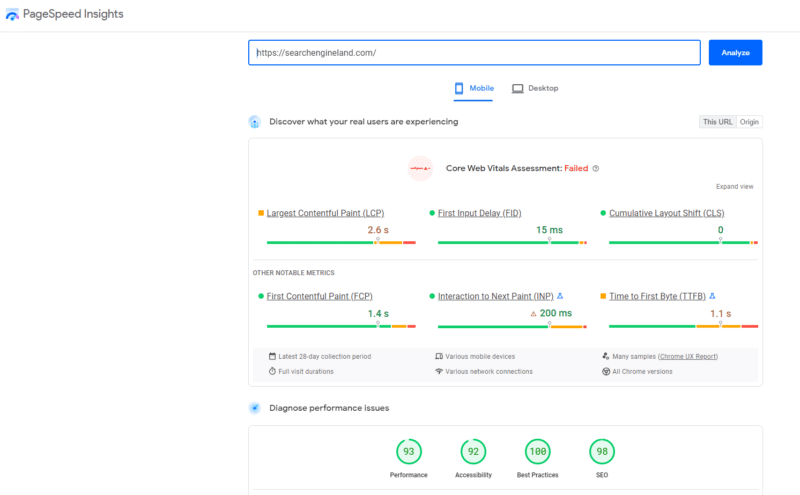
Screenshot of PageSpeed Insights for Search Engine Land.

301 redirects

If you want to remove your original ranking page in the deoptimization process you must remember to add a 301 redirect. 

In some cases, such as in the case of keyword cannibalization, you might want to take a page down to help another rank.

Add 301 redirects, and to be ultimately diligent, go through the links pointing to the old page and edit them so they point directly at the desired ranking page.

Taking the leap into deoptimization can feel a little scary, especially if you risk losing a lot of traffic.

The thing to remember is that clicks and impressions are meaningless if they’re from the wrong audience or fail to result in conversions.


Opinions expressed in this article are those of the guest author and not necessarily Search Engine Land. Staff authors are listed here.


Related stories

New on Search Engine Land

@media screen and (min-width: 800px) { #div-gpt-ad-3191538-7 { display: flex !important; justify-content: center !important; align-items: center !important; min-width:770px; min-height:260px; } } @media screen and (min-width: 1279px) { #div-gpt-ad-3191538-7 { display: flex !important; justify-content: center !important; align-items: center !important; min-width:800px!important; min-height:440px!important; } }

About the author

Zoe Ashbridge

Zoe Ashbridge is a Senior SEO Strategist and Co-Founder at forank. Zoe has a background in digital marketing and digital project management. Zoe supports businesses worldwide with actionable SEO strategy for internal teams, consultancy and search engine marketing implementation. Zoe writes about SEO, Digital Marketing and Entrepreneurship.

https://searchengineland.com/wrong-page-ranking-390988



This day in search marketing history: January 6

In 2011, Google Webmaster Tools started sending out two new types of warnings – for “unnatural links” and “cloaking.”

The messages were sent out when Google detected pages on websites that were using techniques that were outside of its quality guidelines.

At the time, Google had been talking about wanting to increase its outreach to webmasters. See this video (published Dec. 18, 2010), in which Google’s Matt Cutts (featuring Danny Sullivan) mentioned that Google wanted to make communication a priority in 2011.

[embedded content]

Read all about it in Google Adding New Spam Warnings In Webmaster Tools.

Dig deeper: Google penalties, manual actions and notifications: A complete guide


Also on this day 


Google launches ‘Shops’ section in mobile search results

2022: The Shops section showed three to 10 retailers based on their organic search rankings.


Google Ads error tells advertisers exact match keywords are saving as broad match

2022: Search marketers entering exact match keywords may have seen an alert toward the bottom of their Google Ads interface stating, “Broad match keywords are on. Keywords will be saved as broad match.”


Search Engine Land, SMX name Carolyn Lyden content lead

2021: Lyden acted both as editor-in-chief of Search Engine Land and content lead for our SMX events series. She departed Third Door Media in November 2021.


Standard text ads will live on a bit longer, Microsoft Advertising says

2020: Microsoft Advertising, which originally said standard text ads would no longer serve after 2019, announced it would allow existing standard text ads to continue to serve until March 31.


Video: A.J. Ghergich on not chasing the Google algorithm and focusing on human intentions

2020: In this installment of Barry Schwartz’s vlog series, he chatted with Ghergich about how to scale your SEO agency, understanding human intent and more.


Google to start showing local-specific phone numbers when location extensions appear in ads

2017: Google said, starting Jan. 19, it “may” show the local retail phone number when that store’s location extension showed in an ad – even if a call extension in the campaign used a different phone number – in order to increase the relevance of ads that featured specific business locations.


“Illegitimate” SEO Sentenced To 37 Months In Federal Prison For Extortion

2016: William Stanley extorted individuals and companies by threatening to engage in illegitimate SEO work: posting “fraudulent comments and creating negative reviews online, if the victim did not pay him a certain sum of money.”


Google Revamps The Android App-Indexing Crawl Errors Report In The Search Console

2016: Google announced they had finally upgraded the App Indexing Crawl Errors report, which had not been working for months, in the Google Search Console.


2016: Claiming to be enforcing Germany’s “Ancillary Copyright” Law, the publishers were suing to get Google to pay them for showing their content in search results.


Bing Ads, Too, Says Goodbye To Phone Numbers In PPC Ad Copy

2015: Bing Ads told advertisers they soon would no longer be able to put a phone number in the headline, body copy, URL or extensions like Sitelinks. As with AdWords, advertisers would need to use location or call extensions for phone numbers.


Pinterest Beefs Up Its Search Chops With VisualGraph Acquisition

2014: Pinterest said the acquisition would “help us build technology to better understand what people are Pinning. By doing so, we hope to make it easier for people to find the things they love.”


Bing Launches Awards Site In Time For Golden Globes, Grammy’s & The Oscars

2014: The site served as an online resource for “all things awards” with background information on nominees, tips for award-themed parties, and winner predictions based on Bing search statistics.


Bing Makes Driving Directions Twice As Fast

2012: Bing Maps pushed out a major update to their driving directions “routing engine.” The new routing engine was twice as fast as the old one and added more features, such as adding up to three routes in one request.


Search In Pics: Google Bumper Sticker, Knitted Android Sleeve & Yahoo’s CEOs

2012: The latest images culled from the web, showing what people eat at the search engine companies, how they play, who they meet, where they speak, what toys they have, and more.


Google Mobile Strategy Playing Out Almost Flawlessly: Ads Growing, Android Beating iPhone

2011: Google’s AdMob unit reported that it saw more than 2 billion ad requests on a daily basis. Meanwhile, comScore reported that Android passed the iPhone as the number two smartphone platform in the U.S.


South Korea May Arrest Google Execs Over WiFi Data Collection

2011: The country’s national police agency had determined that Google acted illegally when it gathered personal data as part of its Street View mapping service.


Covario: Consumer Electronics Marketers Take Q4 Paid Search Boom Overseas

2011: Among its tech and consumer electronics clients in the Americas, paid search spending only rose 1% in the fourth quarter of 2010, as compared to the third quarter, but that’s because growth from the second to the third quarter was 30%.


Twitter’s New Year Tweet Record Shown In Stunning Video

2011: Twitter started 2011 with a new record: 6,939 tweets were sent at four seconds after midnight in Japan. 


Foursquare Puts The Kibosh On Friend-Tip Spamming

2011: Foursquare started limiting the number of friends and friend requests that a user can have.


Google AdWords Testing Lead Capture Forms: Contact Form Extensions

2010: Contact form extensions provided a contact form directly in the search ad, which a searcher can fill out and the advertiser can then use in the future to contact that lead.


Google Loses French Lawsuit Over Google Suggest

2010: Google was ordered to remove the word arnaque, which translates roughly as “scam,” from appearing as a Google Suggest term on searches for the Centre National Privé de Formation a Distance (CNFDI). 


Surprise: Google’s Home Page Promoting Nexus One

2010: The promotion was found under the search box and read: “Experience Nexus One, the new Android phone from Google.”


Nexus One: What Exactly Happened Yesterday In Mountain View?

2010: Less than 24 hours after the formal unveiling of the Nexus One by Google, we had a collection of differing perceptions and accounts of what was significant (or not).


Google Claims That Google Checkout Increases Conversion By 40% & Clicks By 10%

2009: Google added claims to its Google Checkout Merchant homepage that having Google Checkout as part of your AdWords ads would lead to higher conversions and a better click-through rate.


Google Testing ‘Blended’ Mobile Ads

2009: As it turned out, Google wasn’t doing anything new. On the Google WAP search experience the company had always placed ads at the end of organic text results but before other types of content.


Yahoo To Advertisers: We Can Create Ads & Edit Keywords Without Asking First

2009: Yahoo emailed their search advertisers about new terms and conditions, including a controversial provision that they are allowed to create ads, remove or add keywords to campaigns and “optimize” accounts.


Google Finally Brings Picasa To The Mac

2009: Picasa was a management system for photo sharing and editing.


Google Wins “Gu Ge” Lawsuit In China

2009: The Beijing Haidian District Court ruled that Beijing Guge Science and Technology had to pay Google China 100,000 yuan ($14,624). In addition, Beijing Guge is required to stop using the name.


2009: It was suggested that the art represented an airplane crashing into New York’s former World Trade Center towers on 9/11.


The Big List of 2009 Marketing Predictions

2009: Articles and blog posts filled with forecasts, predictions, and/or resolutions for the new year. 


Mahalo Adds More Social Features

2008: The Mahalo Follow toolbar let you post links to Delicious, Ma.gnolia, Mahalo Social, and Twitter with the click of one button. The sidebar displayed quick tips when you were on sites like Twitter and Gmail.


From Search Marketing Expo (SMX)


Past contributions from Search Engine Land’s Subject Matter Experts (SMEs)

These columns are a snapshot in time and have not been updated since publishing, unless noted. Opinions expressed in these articles are those of the author and not necessarily Search Engine Land. 


< January 5 | Search Marketing History | January 7 >


Related stories

New on Search Engine Land

@media screen and (min-width: 800px) { #div-gpt-ad-3191538-7 { display: flex !important; justify-content: center !important; align-items: center !important; min-width:770px; min-height:260px; } } @media screen and (min-width: 1279px) { #div-gpt-ad-3191538-7 { display: flex !important; justify-content: center !important; align-items: center !important; min-width:800px!important; min-height:440px!important; } }

About the author

Danny Goodwin

Danny Goodwin is Managing Editor of Search Engine Land & SMX. In addition to writing daily about SEO, PPC, and more for Search Engine Land, Goodwin also manages Search Engine Land’s roster of subject-matter experts. He also helps program our conference series, SMX – Search Marketing Expo. Prior to joining Search Engine Land, Goodwin was Executive Editor at Search Engine Journal, where he led editorial initiatives for the brand. He also was an editor at Search Engine Watch. He has spoken at many major search conferences and virtual events, and has been sourced for his expertise by a wide range of publications and podcasts.

https://searchengineland.com/search-marketing-history-january-6-389992


What is an SEO product manager?

SEO product managers are the teammates you never knew you needed. In-house SEO teams also can’t live without them. 

In this article, we will cover what an SEO product manager does, the skills needed to become one, and where the role sits within the organization.

What is an SEO product manager?

At a high level, an SEO product manager (PM) helps teams optimize features and functionalities on a website so that it’s discoverable by search engines and humans alike. 

This role is uniquely positioned to empathize with and understand two important types of customers: 

  • Search engine bots (i.e., Googlebot) that crawl websites.
  • Prospective customers who visit websites looking for information or products. 

SEO product management is a form of specialization within product management since it requires experience in and knowledge of search engine optimization. The role differs from that of an SEO manager in two main ways, as SEO PMs:

  • Maintain a roadmap and partner with other product managers, engineers and delivery leads to execute SEO roadmap initiatives.  
  • Operate in software tools like Jira and Confluence, writing SEO requirements and maintaining detailed product requirements for SEO initiatives.  

On a day-to-day level, the SEO PM helps make sure any necessary SEO requirements are incorporated into the technical work being done by functional teams in terms of how a feature gets built (or coded) so that it’s “SEO-friendly” for search engines and humans. 

Before we go any further, let’s take a quick step back and orient around “what is product management” since the practice itself has only recently come about in the last two decades. 

“While product management has existed in one form or another for a number of decades, the ‘product manager’ title only started picking up steam less than 20 years ago.” Sherif Mansour, a product manager at Atlassian, one of the foremost tools used by agile teams, explains.

“A product manager is the person who identifies the customer need and the larger business objectives that a product or feature will fulfill, articulates what success looks like for a product, and rallies a team to turn that vision into a reality.” 

In this way, product management is a highly integrated, cross-functional role in an organization. The same is true for SEO. “The reality is, every single day, everyone touching the website is doing SEO, whether they know it or not,” explains Jessica Bowman, enterprise consultant of SEO Inhouse. 

Therefore, a large part of an SEO product manager’s role is guiding and advising teammates on SEO best practices, which include:

  • Defining the KPIs that matter most to the business and advising on the SEO leading indicators of organic growth. 
  • Articulating concepts like the signals influencing ranking factors and how major search engines, including Google, define a good user experience (beyond bounce rate).

They collaborate with other teams to get work across the finish line and, in the process, make those around them better at SEO too.  

I would be remiss if I did not mention that with the existence of an SEO product manager, “SEO as a product” should also be embraced.

This means treating search engine optimization as an aspect of the business where a product manager is dedicated to growing organic traffic and revenue by defining the vision, high-level problems, and what success looks like. (Buckle up, friends, I plan to elaborate on this topic in future articles.)  

What’s the difference between an SEO manager, an SEO product manager, and a project manager? 

I hope I didn’t just lose you. The roles sound similar, especially when you abbreviate the “PM.” This chart should help clarify things: 

SEO product manager SEO manager Project manager
– SEO expertise.
– Manages a roadmap of SEO initiatives.
– Writes SEO requirements in tickets for engineering and other teams to execute.
– SEO expertise.
– Operates strategically and tactically depending upon available resources.
– SEO expertise not required. 
– Facilitates projects from idea to completion, organizing teams and stakeholders via (meetings, requirements, deadlines, communicating status and performance, and troubleshooting). 

The big differences between an SEO PM and an SEO manager involve ownership of a product roadmap and operational function.

SEO product managers own a roadmap of features and fixes where the initiatives range from ad hoc technical fixes (bugs) to building features that improve the foundational aspects of SEO like: 

  • Internal linking.
  • The amount of content on the site.
  • Googlebot’s ability to crawl and index the site.
  • User experience.
  • Speed and web vitals. 

Think of it like having a set of offensive and defensive plays in your playbook.

In a given calendar year where engineering and product teams are releasing updates to the site, ideally, a product manager wants to have some initiatives that (offensively) grow the business. That said, they also need to manage the reality of fundamental (defensive) things like shoring up tech debt or dedicating a quarter or two to a platform upgrade.  

Given the nature of SEO, where there’s always a possibility of a code release breaking existing site functionality, SEO PMs rigorously prioritize the SEO roadmap and execute it alongside other PMs through what’s known as agile scrum methodology, a project management system that relies on incremental development.

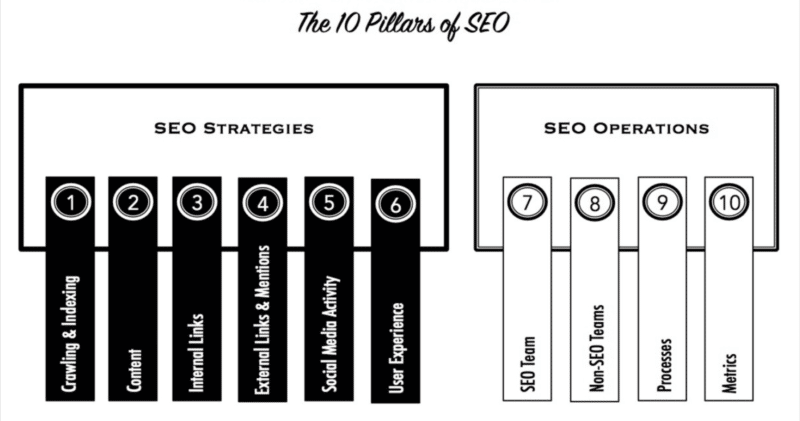
A helpful framework to use to articulate SEO initiatives is the 10 pillars of SEO developed by Bowman of SEO Inhouse. 

10 pillars of SEO

This framework is especially useful at the enterprise level, where SEO PMs are often both educating and advocating for technical SEO initiatives.

It illustrates and compartmentalizes the main concepts of SEO to other teams. And can also serve as a resource for categorizing priority initiatives.   

SEO managers, on the other hand, still reference this framework, but their role is an ancillary one compared to the core roles involved in an agile scrum methodology. Scrum has three roles:

  • The product manager (or owner).
  • The scrum master.
  • The development team members. 
Your perfect development team

Notice how every role here is working on the website but what’s absent is a representative of SEO.

You see, while an SEO manager is not an integral part of the agile process, by design, an SEO product manager is.

Therefore, the challenge SEO managers often face is actually getting SEO priorities onto a roadmap. They’re essentially on the outside of this process looking in.  

Ability to write requirements with SEO recommendations 

In my previous life as an SEO manager, I documented an SEO issue and provided recommendations to the development team or marketing lead with an export of impacted URLs.

But it wasn’t until I was in the role of a product manager that I was in the driver’s seat of ensuring SEO requirements were factored in and that engineers work off of Jira tickets. They don’t work off of an SEO audit or an export from any SEO enterprise tools. 

Specifically, an SEO PM is on hand during grooming sessions as an advisor, listening for areas where SEO should be considered and helping document technical SEO recommendations so that SEO best practices are part of the building process. 

The discipline of product management is in creating clear requirements for other teams to execute. With each ticket they write, the SEO PM articulates “what” the search engine needs to be able to consume and engineering determines “how” best to deliver on those requirements. 

Operational function 

Think of it this way – a priority for an SEO manager might be fixing the 404 errors in a craw, whereas an SEO PM looks at that same initiative and says, “Okay, what teams do I need to partner with to address the broader business issue that’s causing the 404 errors?” 

One targets the issue. The other has more leeway to target the source to prevent the issue from continuing.

Given the nature of development teams operating within an agile framework, the schedule is dictated by sprint cycles.

Within a sprint (which can be either one or two weeks in length) are daily rituals like team stand-ups, grooming sessions, retrospectives, and showcases.

There is a lot of day-to-day involvement that demands dedication and teamwork to continuously address roadblocks and meet sprint goals and deadlines.  

Active participation in those duties alone is a significant difference to how an SEO manager spends their day. (In future articles of this series, I’ll dive further into this aspect by comparing the job descriptions between the two, since I’ve also seen the terms “search product manager” and “digital PM” used to describe this role.)


Get the daily newsletter search marketers rely on.


What skills and qualities are needed to become an SEO PM?

If you’re currently an SEO manager, project manager or product manager, it’s possible to move into an SEO product manager role since you’re tangential to the discipline.

To get started, you’ll need to do a self-assessment to determine how and where to uplevel your skill sets.  

Since SEO product management is a specialization of product management, these are some of the balance of skills you’ll need: 

Hard skills Soft skills
Working knowledge and experience in: 
– Technical SEO
– Content SEO
– Product management 
– Agile principles 
– Tools: Jira, Confluence, Roadmunk, etc.
– Ability to use data to build quantitative business cases
– Project management
– Effective communication
– Organized
– Ability to influence
– Distill complex problems or concepts into simple terms or action steps
– Creative problem-solving and ability to manage and operate through ambiguity
– Enthusiasm
– Ability to guide teams toward seeking a solution
– Business acumen
– Adaptability 
– Critical thinking 
– Problem-solving
– Ability to rigorously prioritize initiativesWillingness to learn
– Empathy 
– Grit and tenacity

In most cases, you’re either an SEO adopting the operating framework of product management or a strong product manager learning to apply SEO principles to supercharge and expedite your approach. 

How does SEO product management define results?

Where a product manager might be focused on delivering a feature or making customer improvements, SEO PMs are focused on SEO metrics.

In my experience in enterprise SEO ecommerce, there are two core KPIs:

  • Organic sales or revenue.
  • Organic sessions or visits.

So, primarily, SEO PMs are focused on protecting and improving organic revenue and traffic for the business. The results themselves are measured incrementally as improvements are published on the website. 

Prioritization is at the heart of product management

Within SEO, prioritization is a learned skill. It comes from years of experience auditing sites, prioritizing the issues, implementing fixes and measuring the results.

As for technical SEO, most enterprise tools categorize site issues by errors, warnings and notifications. Errors are considered critical issues where something is broken or crawlers cannot access your pages.

Seasoned SEOs marry business priorities with technical fixes that can be implemented and will move the needle. 

Product managers, on the other hand, aim to prioritize features and enhancements – essentially ideas – using customer data, scope confidence level, and business impact.  

Perhaps a misconception about “SEO fixes” is that they all improve traffic. Not true. There are secondary KPIs related to creating SEO improvements that are foundational in nature. These create operational efficiencies as opposed to driving organic traffic. 

For example, programmatically defining title tags to be contained to less than 60 characters so they don’t get truncated in the SERP. Does that improvement increase organic traffic? Not directly. It’s more of a best practice. 

An important concept to understand is that there is never one silver bullet initiative that results in online riches. If there were, everyone (and every affiliate site) would be doing it. 

The nature of SEO is that it’s organic. It occurs naturally and over time.

SEO is an acquisition channel and the growth opportunity lies in delivering compounding improvements over time. The attractive part about SEO is that once the improvements are live, all things being equal, the estimated benefits continue year after year.  

Helping other teams improve upon the SEO foundation

The satisfaction in product management comes from collaboration and teamwork with other teams to build and get things done. As an SEO product manager, you get to directly contribute to that process because you’re advising, educating and empowering different teams about their contributions to SEO. 

In practice, this looks like feature documentation outlining SEO requirements for search engines or best practices for coding elements on a page to be search engine friendly. It also means helping engineers understand tradeoffs that impact SEO when dealing with things like pagination, URL parameters, and internal links. 

SEO PMs can bring data that can help inform decision-making. Search data can help merchandisers at ecommerce brands understand product seasonality. It can help copy teams include words or phrases used during the discovery phase. 

SEO data is about what real people are searching for and when. SEO PMs are uniquely equipped to articulate that level of customer insight with internal teams to put the customer at the core. 

Where does the SEO product manager sit within the organization? 

The short answer is – it depends on who hires you and where their team sits. As previously mentioned, the discipline of product management is still a young one and therefore, team size and structure are still evolving. 

In my experience, I’ve been a part of the product vertical as an executing PM, and other times a part of the SEO team that was part of a larger, digital customer experience team responsible for the online experience. 

Fundamentally though, it doesn’t really matter where the role sits because product management (and SEO, really) is a cross-functional discipline.

This means SEO PMs, just like regular product managers, find success in cultivating cross-functional partnerships with the goal of getting things done. 

Product management responsibilities expand and contract based on the org size

Smaller companies typically need product managers that handle a variety of areas. Whereas in larger enterprise-level companies, a big part of product management is learning to navigate the organization. There are also more product managers with specific areas of responsibility for growing and scaling an aspect of the business. 

For example, enterprise brands can have dedicated product managers for the front-end website, internal search and navigation, the cart or “checkout” experience (especially ecommerce brands), content assets, the mobile app, and, as you can see more recently, SEO.   

In his 20+ years in product management, thought leader and practitioner Itamar Gilad describes three common PM role issues. He writes, “…many companies are still figuring out the basics, including the role of PMs, their reporting line, and relationship with other disciplines.”

Education and influence

Without direct reports, product managers largely lead by influence and collaboration.

For SEO PMs, in particular, a key piece of their operational capability is in having mechanisms to continuously train and empower internal teams on the basics of SEO and how their role helps or hurts SEO performance. 

A huge misconception is that SEO teams only do SEO and that SEO “just happens.” This couldn’t be farther from the truth.

To become an SEO product manager, you need to be familiar with the nomenclature and rituals of product management (as well as, of course, SEO).

Here are a few terms to familiarize yourself with to get your feet wet on the product side. 

  • Agile: A methodology that allows teams to efficiently manage a process by breaking it down into parts. In other words, a structured and iterative approach to project management and product development. 
  • Scrum (or agile scrum): A type of framework that consists of meetings, roles, and tools to help teams working on complex projects collaborate and better structure and manage their workload.
  • Sprint planning: A meeting where engineering teams, product managers and any business stakeholders attend to review tickets for an upcoming sprint. 
  • Sprint: A one- or two-week defined period of work where engineering teams pick up pre-determined work in the form of Jira tickets to be completed within that time frame. Efficiency is the name of the game.  
  • Stand-up: Designed to quickly inform everyone of what’s going on across the team, daily stand-ups are rituals with agile teams where engineers and product delivery managers get a quick check of assigned tasks, blockers or questions. 
  • Showcase/demo (a.k.a., iteration review): Part of the agile ritual where teams that have been building demonstrate to business stakeholders the final product or completed aspects of a given ticket. 
  • MVP: Stands for “minimum viable product,” which is basically the first round version of a multi-phased project that you aim to publish to begin the iterative feedback loop of improvement.
  • Spike: Designed to be a quick investigation ticket with the aim of gathering more data points or feedback to better scope the initiative and go-forward path. 
  • Sizing or level of effort (LOE): An estimate from cross-functional teams (engineering, UX, etc.) on what the level of effort will be to complete the task. The sizing ranges at each company are articulated differently. It can be a “t-shirt size”(small, medium, large) or a range (high, medium, low).

Tools and resources used by product managers

Here’s a basic list of the tools used by product managers and the value provided:

  • Slack/ WebEx/ Microsoft Teams: Internal communication, especially remote teams.
  • Jira and Confluence: For tickets and documentation.
  • Trello, Asana: Keeping track of tasks.
  • Adobe Analytics: Organization’s source of truth for data. SEOs use this too.
  • Quantum Metric 
  • Roadmunk: Collaborating and sharing product roadmaps. 
  • Miro: Online brainstorming collaboration tool. 
  • Admin login to the software platform the enterprise website is hosted on.
  • PMs that oversee an app will use Firebase or AppsFollow.

In addition to the tools above, SEO PMs will use:

  • Google Analytics. 
  • Google Search Console (to view the information Google has about your site).
  • Google Trends, a free resource to glean insight on trending search terms and topics.
  • Botify, Screaming Frog, Sitebulb, or other web crawlers. 
  • Semrush, Ahrefs, STAT, Moz, etc., to monitor keyword fluctuations and trends.
  • Tableau, for data consolidation and visualization. 
  • SEO Radar, for monitoring based on specific needs of the business.

What they’re reading: 

  • TechCrunch.
  • Insider Intelligence (eMarketer). 

Newsletters they’re subscribed to: 

SEO product managers help drive organic growth

Did we just become best friends? 

SEO PMs can help you grow your business organically and, in the process, make other teammates around them better at accounting for SEO. It takes dedication, investment and teamwork. 

Both SEO PM and SEO manager roles function as an advisor to cross-functional teams building and working on the website by providing technical guidance and SEO requirements.

But it’s the SEO product managers who are more hands-on, writing product requirements and documentation. Their level of involvement throughout the entire sprint cycle also sets this role apart from an SEO manager. 


Opinions expressed in this article are those of the guest author and not necessarily Search Engine Land. Staff authors are listed here.


Related stories

New on Search Engine Land

@media screen and (min-width: 800px) { #div-gpt-ad-3191538-7 { display: flex !important; justify-content: center !important; align-items: center !important; min-width:770px; min-height:260px; } } @media screen and (min-width: 1279px) { #div-gpt-ad-3191538-7 { display: flex !important; justify-content: center !important; align-items: center !important; min-width:800px!important; min-height:440px!important; } }

About the author

Holly Miller Anderson

Holly Miller Anderson is an experienced SEO and marketing strategist. She has more than a decade of broad, digital marketing experience that includes marketing films, managing events, as well as experience growing SEO as an acquisition channel in various roles from consultant to agency and in-house Product Manager at enterprise-level brands. She has made a career advising marketers on their holistic SEO strategy by developing a strategic plan and tactical roadmap that delivers sustainable growth. Holly is currently a Lead SEO Product Manager at Under Armour.

https://searchengineland.com/what-is-an-seo-product-manager-390952


Is your SEO performance a dumpster fire? Here’s how to salvage it

Is your SEO performance a dumpster fire Here’s how to salvage it

30-second summary:

  • A failing SEO strategy can happen to the best of us
  • No doubt it’s disheartening when your competitors are miles ahead and your business is struggling to bring in new leads
  • Founder of LSEO and best-selling author, Kristopher (Kris) Jones provides comprehensive steps and advice on how you can salvage your SEO performance

Dumpster fires: surely they can’t happen to you. Right? But before you know it, your website’s traffic has tanked, your competitors are getting all the organic love, and you couldn’t get a conversion if your life depended on it. Folks, if your SEO performance sounds like that, you might just have a dumpster fire on your hands.

A failing SEO strategy can happen to the best of us. There’s no doubt it’s disheartening when your competitors are all miles ahead of you and your business isn’t bringing in new leads.

The good news is that it’s never too late to turn things around.

When is the best time to plant a tree? 20 years ago.

When’s the second-best time? Right now, so let’s get to it.

Here’s how to salvage your dumpster fire of an SEO strategy.

1. Review and optimize all your current content

I’m going to talk about content a few times in this post.

That’s because content has long been and remains the most important element to focus on in your overall SEO strategy.

Websites are nothing without content.

You can see a website getting by with no meta descriptions, you can see them getting by without optimized images, but without content, what do you have?

Not a website!

But if you’re focusing on content first to turn around your SEO strategy, where do you start?

Yes, you optimize everything you already have.

You don’t want to get ahead of yourself by constantly creating new content when you have a whole slew of old pages and posts that may have fallen into SEO disrepair.

Google treats optimized content the same as new content, so to start out, you’ll want to audit your existing content to see what’s good, what’s bad, and what you can fix up to be good again.

You can use a content audit tool like that found in Semrush, or, if you have a more manageable load of content to work with, checking things out manually would work well, too.

This is about more than just deciding what content you like or do not like, although you should be able to tell at a glance which topics are still relevant to your website.

But to check out the SEO performance of each page and post, you can use Semrush as I said, or go manual with Google Search Console.

What I like to do is to put each URL into Search Console and check out how it’s doing as far as impressions versus clicks, click-through rate, and the average positions of its ranking keywords.

That gives me a decent snapshot of which pages need attention.

For example

A page with 10,000 impressions in a 30-day period but only 100 clicks will have a CTR of only one percent (not too great).

I would then go to that page to figure out what is causing the low CTR.

The page is obviously being ranked for the keyword, given its high impressions, but if few people are clicking, then maybe the page isn’t as relevant for the term as it once was.

If that’s the case, then optimizing the page for SEO could be a matter of creating new sections of content around that keyword, and certainly retooling what’s there already.

Optimizing your website’s content is a major part of improving your SEO strategy because it involves so many things that are going to help you.

For this first point, I focused only on the writing and editing part of the content optimization.

Let’s now move on to some other parts of an SEO strategy where you could update things (things that could nonetheless still be involved in content optimization).

2. Assess and update all meta tags

Your pages’ meta tags play an important role in your website’s overall SEO health.

Meta tags are also one of the easiest things to let slip by as you work on your website, because they’re so brief and simple, and there are so many of them.

The thing is, meta tags can go out of date as the landscape shifts around your industry and the keywords for which you were optimizing are no longer relevant.

Meta tags are a classic example of why you can’t set it and forget it with SEO.

Meta tags are another element to look at as you go through your content pages to improve their CTR.

Sure, a lot of your content itself could use updates, but retool the meta titles and descriptions, as well.

Remember, the meta information is what organic users see as they scroll a SERP.

If your title and description aren’t interesting or urgent enough to draw in audiences that are in the awareness stage, then those people will keep on scrolling.

Redoing meta tags could include using a new target keyword, rewriting the call to action, or making everything more concise.

Maybe start with a handful of pages only, say 20 or 30, and A/B test the old and new titles and descriptions to see how traffic and CTR change after your edits.

Doing that will confirm for you whether the updating you’re doing is worth it, and whether you should continue down this road with the rest of your pages.

3. Work on your technical performance

When you have to turn around your entire SEO strategy, you have to think about your website holistically.

That means focusing not just on your keywords and content, but also on how your pages perform technically.

I’m grouping issues such as image compression, site speed, mobile responsiveness, and Core Web Vitals all together under the umbrella of “technical performance.”

Although these factors are less “creative” and open-ended as compared to performing new keyword research or optimizing content, they matter just as well.

When people get to your website and are greeted with slow pages, a messy mobile appearance, and content elements that jump around as they load, their trust in you drops.

In a world as competitive as ours, you can’t afford to give people cause for distrust, because you can bet that there are a hundred competitors waiting in line to market to those customers if you can’t do so successfully.

If development work isn’t your forte, look into contracting out to someone who can clean up your website’s coding and otherwise speed things up while also optimizing for mobile.

Images should be compressed so they take up less space but don’t lose any of their quality, and each image should have optimized alt text.

Compressing and optimizing images is something you can definitely do yourself, either through a plugin (on WordPress) or manually if it’s feasible.

Even though page speed and load times aren’t always the most accessible kind of work to business owners and website owners, those are important issues to keep in mind as you labor toward turning around your dumpster fire of an SEO strategy.

4. Resume creating new content

You can turn around even the worst SEO strategy in the world.

Google isn’t going to hold you to the fire forever just because your SEO has been in the dumps even for the last few years.

Google crawls your site every so often whether you’re doing something with it or not, and as it sees that your SEO is improving, it can start to rank some of those pages higher.

So here is where we get into creating all-new, high-quality content.

Content in 2023 can mean a whole range of things, from blog posts to infographics to videos and podcasts and webinars and slide decks.

Whatever makes sense for your business and your industry is what you should do. Whatever types of media you know your audiences like to consume, give that to them.

In 2023, however, you have to be incredibly mindful of being comprehensive and useful for people.

If there’s anything that we’ve learned from 2022’s helpful content update, it’s that you just cannot skimp on content creation (not that you ever could, but Google is smarter than it was 10 years ago).

Gone are the days of skirting by on SEO-centric content, created just to score some ranking for this or that keyword.

Google is paying much more attention now to the intent and usefulness of a piece, and rewarding those web pages featuring actually helpful content (get it?) with higher rankings.

A perfect example of how Google is thinking these days is the product review update, also from 2022.

Google is now deprioritizing the ranking of low-quality product reviews in favor of more expert-level reviews where the reviewer has actually used the product or service and can speak to its pros and cons.

Why? Because Google wants to direct users to content they can actually trust to help them.

When you take the product reviews update and helpful content update together, you can see why content marketing has gotten so much harder over the years.

You can’t just rank after spending an hour on a 400-word blog post anymore.

You have to be a real expert, or at least put in the time and effort to create deep content if you work for a client portfolio.

These are all things you must keep in mind as you create new content for your website in the name of putting out your dumpster fire of an SEO strategy.

Now, of course, there are the nuts and bolts you have to remember, as well, when it comes to new content.

You have to mine the SERPs, develop the proper keyword strategy, and understand the correct intent behind those keywords to be sure you’re creating what people expect to see when they search that keyword.

That stuff you can all learn.

What I want you to take from this section is the idea that you have to work to create that new content. You have to put in that time and dedication to do it well.

5. If you’re local, focus on reviews

I don’t want to leave out the local businesses here: if you’re a local business, do you know that one of the single largest factors in helping your SEO is getting positive Google reviews?

Now, local businesses need to perform all the on-page SEO work that anyone else does, but what do you do as an ongoing SEO strategy?

The play here isn’t keyword-driven SEO content so much, because your local audience isn’t really going to find you that way.

Local audiences find local businesses by performing local searches and checking out the reviews in the map pack.

In fact, 77 percent of local buyers always read online reviews while checking out local businesses.

Your reviews affect the level of trust the public has in you. More people are likely to visit your website and use your business when they see that others have had a positive experience with you.

The cycle goes on when you encourage your customers to leave positive Google reviews.

The more reviews you have, and the more positive they are, the better off your chances will be of rising to the top of your local map pack.

Being at the top should translate into more traffic and better SEO overall.

6. Build natural backlinks

Finally, I want to mention another pillar of Google’s list of known ranking factors: natural backlinks.

Links are what unite everything on the internet together.

They’re also vital in keeping the ranking juices flowing to your web pages when it comes to your SEO strategy.

Backlinks to your website from other websites show Google that you’re an authority in your market niche since people want to reference what you have to say.

Link building, then, is really about building relationships to get your name out there as a trustworthy resource for others.

When Google sees your links coming from relevant, authoritative websites, it will assign more trust to your own site.

Just remember to keep the links coming from websites that make sense to your own.

The quality matters much more than the quantity here.

To do it, create content that people would want to link to, something with a lot of useful stats and other data.

You can also scout other websites in your niche to see where they may have content gaps, and then create content to fill that gap and ask for a link back.

It takes time and effort, and you’re not guaranteed anything, but it’s the natural way to earn backlinks that will actually help your SEO.

Give your SEO time to turn around

You can put out even the biggest dumpster fire when you know what to do and how to do it.

I’ll say again that SEO dumpster fires can happen to the best of us. Sometimes we go all-in on things we think will work, and they don’t.

Sometimes we get lazy and let our SEO go for years.

But it’s never too late to correct things.

It will definitely take time to see things start to shift for you, though; SEO isn’t an overnight solution. It needs anywhere from three to six months or longer to start showing a difference.

If you keep in mind both the broad strokes and the specifics of everything I’ve described here, you truly can reinvent your SEO strategy and be on your way to business growth.


Kris Jones is the founder and former CEO of digital marketing and affiliate network Pepperjam, which he sold to eBay Enterprises in 2009. Most recently Kris founded SEO services and software company LSEO.com and has previously invested in numerous successful technology companies. Kris is an experienced public speaker and is the author of one of the best-selling SEO books of all time called, ‘Search-Engine Optimization – Your Visual Blueprint to Effective Internet Marketing’, which has sold nearly 100,000 copies.

Subscribe to the Search Engine Watch newsletter for insights on SEO, the search landscape, search marketing, digital marketing, leadership, podcasts, and more.

Join the conversation with us on LinkedIn and Twitter.

https://www.searchenginewatch.com/2023/01/05/is-your-seo-performance-a-dumpster-fire-heres-how-to-salvage-it/


This day in search marketing history: January 5

Google AdWords introduces click-to-call ads

In 2010, Google sent out notification to its AdWords advertisers that “your location-specific business phone number will display alongside your destination url in ads that appear on high-end mobile devices. Users will be able to click-to-call your business just as easily as they click to visit your website. You’ll be charged for clicks to call, same as you are for clicks to visit your website.”

What Google was saying, simply, was that it would allow phone numbers to display in ads and would charge advertisers when calls were initiated accordingly.

As we described it at the time, this was effectively a “pay-per-phone call” but the cost per call is the same as a click.

Read all about it in Google To Introduce Click-to-Call (Billing) in Ads on Mobile Devices

Google would later introduce click-to-call phone numbers Jan. 28 on the Inside Adwords blog.


Also on this day 


Google fixes user and permissions issue with Search Console

2022: The problem started in Google Search Console’s user interface in November 2021, when “Full Users” saw their status as “Delegated Owners” within the settings ownership verification section.


Microsoft releases IndexNow plugin for WordPress

2022: The WordPress IndexNow plugin enabled automated submission of URLs from WordPress sites to multiple search engines without the need to register and verify your site with them.


Best Buy to sell search ads under its own in-house media company

2022: Best Buy Ads started offering paid search ads and sponsored product listings on Best Buy’s website, among other ad offerings.


The AdWords 2x budget change: How’s it going?

2018: Search marketers weighed in on their experiences since the change took effect. Many had experienced no issues. But for others, the change wasn’t good. 


Google says Assistant now on more than 400 million devices

2018: And when Google said “devices,” that included Android smartphones, tablets, TVs, headphones and Google Home smart speakers.


Search in Pics: Google’s floppy sofa, rusty Android head & dancers

2018: The latest images culled from the web, showing what people eat at the search engine companies, how they play, who they meet, where they speak, what toys they have and more.


2017: Bing started delivering carousel-styled search results with images that link to a wide variety of exercise options on searches for [workouts], [exercises], [yoga] and [Pilates].


Bing Now Powers AOL Search: What Advertisers Need To Know

2016: Here’s what the move meant for those managing Bing Ads campaigns.


GM Turning Its Cars Into Rolling (Local) Search Engines

2015: GM announced a range of new OnStar 4G LTE services, including “AtYourService,” featuring partners like Dunkin’ Donuts and Priceline.com.


The Strange Explanation Of Why Windows Phone Users Lost Access To Google Maps

2013: Many people suddenly noticed a long-standing redirection that Google had in place for those not using Android or iOS devices.


Google Expands Test Of AdWords That Collect Email Addresses

2012: Google confirmed it had expanded the trial of the lead generation format to additional advertisers.


2012: Google revealed its latest overview of 30 search tweaks that happened in December 2011


Report: Social Media Spending Threatens To Overtake Paid Search Among SMBs

2012: The SMB-specific component of social media spending was roughly $1.14 billion


Trada Secures Additional $9M In Funding From Google Ventures & Foundry Group

2012: This additional seed of Series D financing brought the total money raised for Trada, the crowdsourced PPC marketplace, to $17 million. 


Google Can’t Seem to Quit China

2011: Despite a principled stand against censorship and the subsequent revelation that Chinese government surrogates were behind Gmail hacking, the company was contemplating a “return” to the Chinese market.


Obamacare AdWords: Partisan Outrage Or Public Education?

2011: An AdWords ad appearing for the query “obamacare” led to a landing page on the official government site HealthCare.gov.


Google Buzz Faces New Lawsuit In Canada

2011: Google was again sued over privacy issues related to the launch of Google Buzz.


Data: StumbleUpon Beats Facebook As Top Social Referrer

2011: StumbleUpon had a 43% share of social media referrals, while Facebook has 38%, according to StatCounter.


Ballmer At CES 2011: “Whatever Device You Use, Windows Will Be There”

2011: Live blogging Ballmer’s talk at CES in Las Vegas. (Bing was only mentioned in passing, briefly as part of Windows Phone 7.)


Facebook Funding Subject Of SEC Review: Report

2011: The SEC was in the early stages of an inquiry over rules concerning the dividing line between public and private companies.


Google Teases “Honeycomb” Android 3.0 Tablet OS At CES

2011: “Built entirely for tablet,” this was a different UI than previous versions of Android.


Internet-To-TV Players Compared: Roku, Apple TV, Boxee & Google TV

2011: An at-a-glance look at how Roku, Apple TV, Boxee Box and Google TV measured up against each other.


As AdWords Ads Get Images, What’s Deemed Family Safe?

2010: Google said: “Images in ads are only classified as non-family safe when they are found to contain adult content.”


With Mobile Ad Networks Being Snapped Up By Google And Apple Will Yahoo Or Microsoft Be The Next To Buy?

2010: The mobile market was real – and red hot.


Islam Is … Blocked By ‘Bug’ In Google Suggest

2010: Google said it was working to fix a bug in Google Suggest that was blocking search suggestions related to Islam.


Bellevue Building With Bing Lights

2010: The lights were spread across several stories and in green. It spelled out the name of Microsoft’s search engine, Bing. 


Liveblogging The Google Nexus One Phone Launch

2010: The Nexus One was a widely expected Google Phone that Google apparently closely developed with handset maker HTC, running the Android mobile operating system.


Top Googlers Donate $150,000 To Obama’s Inauguration

2009: Several of Google’s top executives (including CEO Eric Schmidt and co-founder Larry Page) donated significant amounts toward Obama’s inauguration galas, dinners and receptions.


Google & Baidu Fail China’s Pornography Test, May Lead To Penalties

2009: Both Google and Baidu have failed to take “efficient” actions to remove content from their results after being notified of issues.


Marissa Mayer Denies Rumor She’s Leaving Google, Comments On Search Being “90% Done”

2009: Mayer said that “while search is 90 per cent solved, the last 10 per cent will take decades to complete.” Mayer didn’t leave Google until 2012, to become Yahoo’s CEO.


Will Google Book Search Help Or Hurt Libraries And Book Sales?

2009: Some scholars were worried that Google users would be more likely to search for narrow information than to read at length. What a crazy idea. … Oh wait.


Google Docs Releases New Presentation Features

2008: Including the ability to embed presentations into a page of any site.


Marketers Answer, “Would You Hire Matt Cutts” Away From Google?

2007: Not surprisingly, they all would have loved to hire Cutts.


Google Hires NBC Video Executive, Michael Steib

2007: He joined Google to help work with advertisers to create effective, measurable video advertising.


New Features Added To Google’s Enterprise Search Appliance

2007: Clustering of the results, auto-generate a sitemap for Google.com’s crawler and more.


Yahoo Local Adds Quick Add / Edit Business Listing Feature

2007: Yahoo Local let you add your business within about 24 hours.


From Search Marketing Expo (SMX)


Past contributions from Search Engine Land’s Subject Matter Experts (SMEs)

These columns are a snapshot in time and have not been updated since publishing, unless noted. Opinions expressed in these articles are those of the author and not necessarily Search Engine Land.


< January 4 | Search Marketing History | January 6 >


Related stories

New on Search Engine Land

@media screen and (min-width: 800px) { #div-gpt-ad-3191538-7 { display: flex !important; justify-content: center !important; align-items: center !important; min-width:770px; min-height:260px; } } @media screen and (min-width: 1279px) { #div-gpt-ad-3191538-7 { display: flex !important; justify-content: center !important; align-items: center !important; min-width:800px!important; min-height:440px!important; } }

About the author

Danny Goodwin

Danny Goodwin is Managing Editor of Search Engine Land & SMX. In addition to writing daily about SEO, PPC, and more for Search Engine Land, Goodwin also manages Search Engine Land’s roster of subject-matter experts. He also helps program our conference series, SMX – Search Marketing Expo. Prior to joining Search Engine Land, Goodwin was Executive Editor at Search Engine Journal, where he led editorial initiatives for the brand. He also was an editor at Search Engine Watch. He has spoken at many major search conferences and virtual events, and has been sourced for his expertise by a wide range of publications and podcasts.

https://searchengineland.com/search-marketing-history-january-5-389864


A 5-step framework to scale your content operations and SEO

Don’t lie.

Show of hands. 

How many times have you uttered the following in the last year alone? 

  • “I can’t find any good writers.”
  • “No one can create content as well as me.”
  • “Content marketing / SEO doesn’t work in our niche.”
  • “That agency just doesn’t understand our unique POV.”
  • “I can’t publish more than X articles/mo without quality dropping.”

Probably all of them at one point. Amiright? 

No fingers pointed. I’ve used them all, too.

But here’s the thing you need to recognize about these oft-repeated clichés: 

They’re excuses. All of them.

Excuses and lies we tell ourselves to simultaneously:

  • Puff up our ego.
  • Avoid doing the hard work of learning how to systemize and build processes and delegate effectively.

Here’s why you’re your own worst enemy when it comes to scaling content creation and SEO, and how to solve it so you get back on track ASAP.

You are your own worst SEO enemy – here’s why (and how to fix it)

The truth hurts sometimes.

And when it comes to content operations, the faster you recognize that you’re the problem, the quicker you’ll get to crushing your next revenue target.

Companies often fail to scale because they lack content operational systems that underpin the creativity layered on top.

Instead, too many teams still operate under this false assumption that they’ll luck out and the perfect unicorn writer or marketer or [insert rockstar role here] will fall into their laps, solving all of their problems in one fell swoop.

You know, the ones that just get “it.” 

Without ever bothering to figure out what “it” is, or how to document “it,” or how to specifically recruit and train for “it” so that “it” happens like clockwork, 24/7, 365.

Diagnosing this problem is difficult unless you’ve seen it happen before. So here are the clues to look for:

  • You routinely hit self-imposed “glass ceilings.” Quality drops like a rock every time you push quantity or volume up.
  • Your editors are rewriting everything your writers deliver because it “doesn’t sound right” or “isn’t as good” as they can make it.
  • You have constant issues finding new writers because it takes too long for your most expensive and senior people to review writers. So, instead of hiring only the top 1% of candidates, you’re stuck hiring the top 10% and having to weed through the 9% of junk left over). 
  • Your team members give contradicting feedback to new hires because each would describe subjective elements like voice and tone in completely different ways. 
  • Your editors spend multiple hours editing one piece because they have to correct basic image formatting or update primary sources, which means their weekly output is only a tiny fraction of what it could or should be.

Does any of this sound familiar yet?

It should. 

And the biggest problem is that these surface-level issues sabotage your SEO success by killing output, slaughtering velocity, and maiming morale.

But don’t stress. 

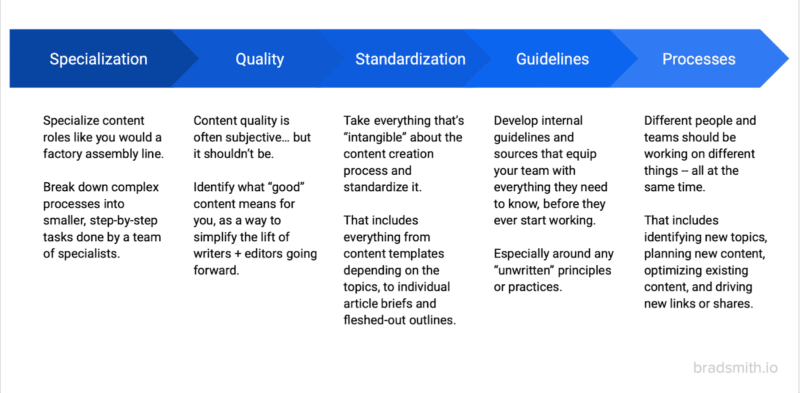
After seeing these issues routinely play out over the last decade (and making the same mistakes ourselves countless times), we’ve been able to come up with a helpful framework to optimize operations.

Here’s an overview graphic, and then we’ll dig into each section in detail. 

1. Role specialization

The best writers make bad editors and terrible content managers.

Why?

Because the best writers thrive on ingenuity, saying the same thing multiple times in multiple ways. 

Editors should be the opposite, in constant pursuit of consistency and uniformity. 

Meanwhile, managers are the glue that keeps the other two’s big-picture goals and day-to-day actions aligned.

In other words, completely different skill sets that too many teams try to force into one individual.

It’s the Michael Scott problem. Great paper salesman. Funny television character. Awful regional manager.

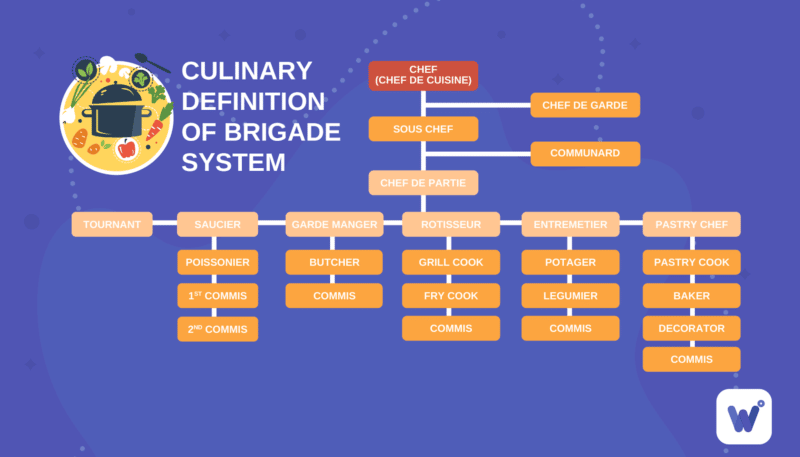
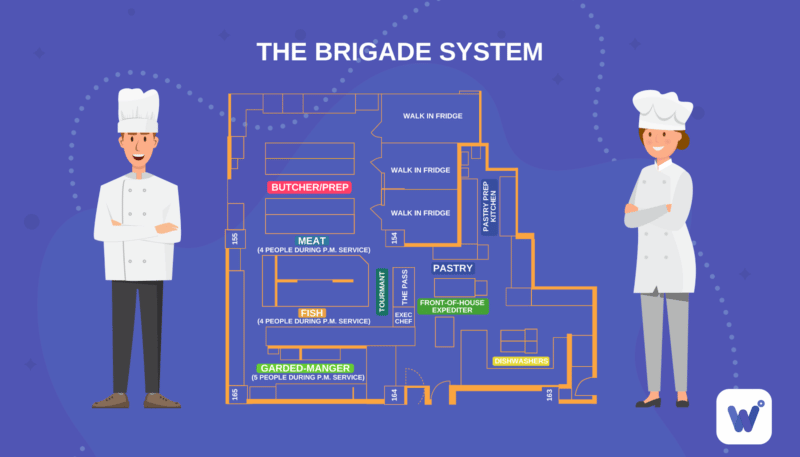
Roll back a few centuries, and the solution comes from the unlikeliest of places: the military.

The brigade management system even influenced the organization of professional kitchens. 

It provides the flexibility and coordination to create hundreds of items, all in sync, within minutes of each other, so that all of your table’s food comes out simultaneously with different preparations.

Culinary definition of brigade system

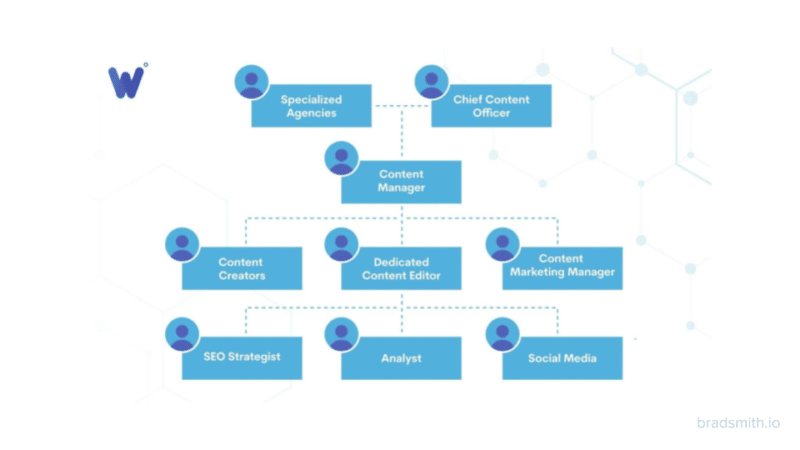
Content teams should be organized in the same fashion.

This starts with separating your writers, editors, and managers. 

From there, as you grow in both stature and resources, you continue adding specializations to master each small piece of the much larger content operation machine – like a giant factory assembly line.

Content team structure

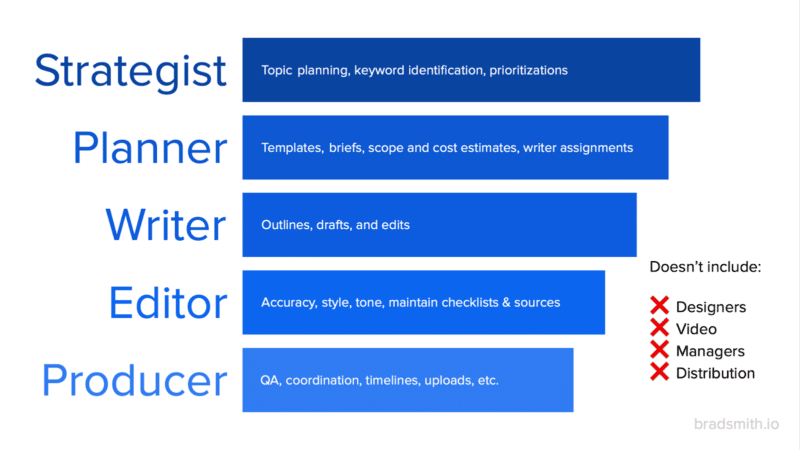
It would help if you also had a well-defined workflow where:

  • The strategists work on strategy.
  • The planners plan.
  • The writers write.
  • The editors edit.
  • The producers coordinate. 

You can add designers, videos, and distribution specialists to the mix as you grow.

Key roles within content team

Get the daily newsletter search marketers rely on.


2. Content quality checklists

This shouldn’t be a trick question, but it often is:

How would you define “good” content?

Everyone talks about the importance of “good” content. Yet, no one can define it the same. 

Ask 10 people in your organization, and you’ll get 10 different answers.

As you can expect, that answer is not good enough.

Sorry to be blunt. But the longer you fly without radar keeping you on track, the better your odds of a crash landing.

Documenting a specific quality checklist is the bare minimum that needs to happen right now. Not tomorrow or next week.

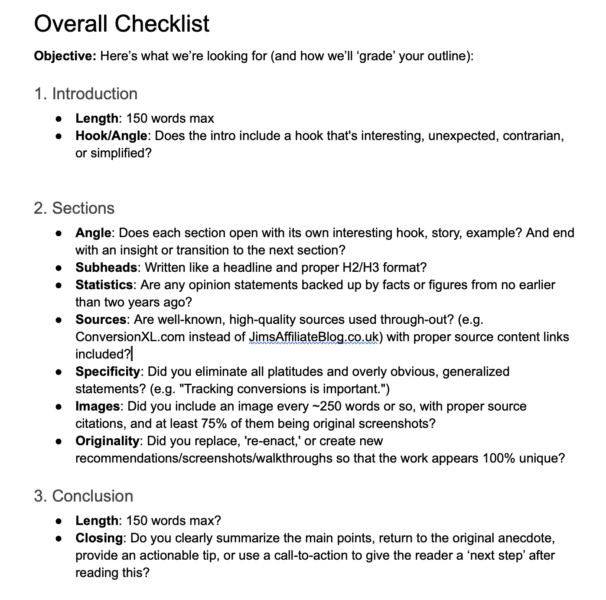
And in it, you should define the overall structure of most content, along with the nitty-gritty details for each sub-section – from word counts to source preferences to image criteria.

Example of an overall content checklist

The more fleshed out this starting point, the faster you’ll:

  • Train writers.
  • Reduce editing time.
  • Drive up ROI (better results for less investment).

The second lesson here is to show, don’t tell.

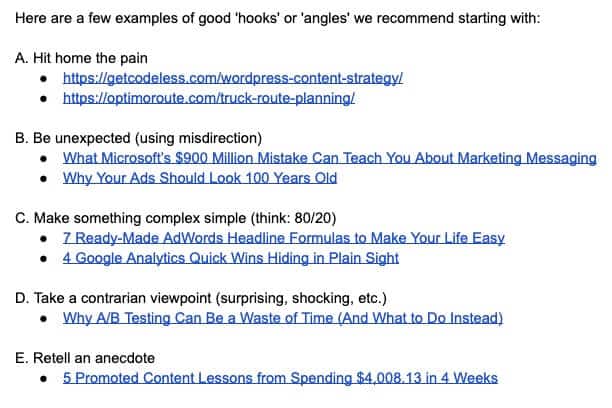
A good example is your acceptable angles. 

Be specific, laying out the ones you like or don’t like, and listing resources to show writers, editors, senior management, clients, or whoever, exactly what these things should look like.

Examples of hooks and angles

We’re talking OCD levels of organization here because it gets everyone on the same page. 

And when everyone is on the same page, your life becomes easier. 

Hiring and firing become almost automatic. Everyone knows the expectations and is aligned. The number of dumb questions or stupid arguments evaporates into thin air.

Who knows. You might even get your weekends back to yourself!

The trickle-down effects are magical.

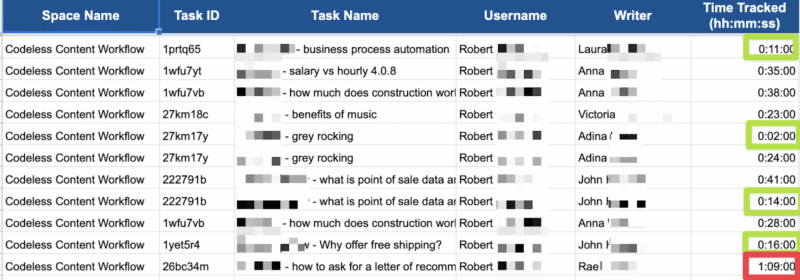
Our senior editors have a one-hour guideline. 

They should not spend longer than one hour editing an article. Because if so, that means the writer screwed up. So the problems should be flagged and sent back to them.

Then, we can review an editor’s time across multiple pieces (or clients or writers) and spot operational issues at a moment’s notice. 

Too little time spent editing might mean those writers are due a pay increase, while too long spent editing would signal the opposite. 

Content workflow time-tracking

3. Standardized templates, briefs and outlines

Sorry to be the bearer of bad news. But no content or SEO manager can control the results you’re looking for.

Rankings, traffic, leads, and customers are all lagging indicators. They are generated months or even years after doing all the actual work.

That means we need to turn our attention to the leading indicators instead. 

Exhibit A. What should you write about? 

Well, the answer is whatever people are already looking for! 

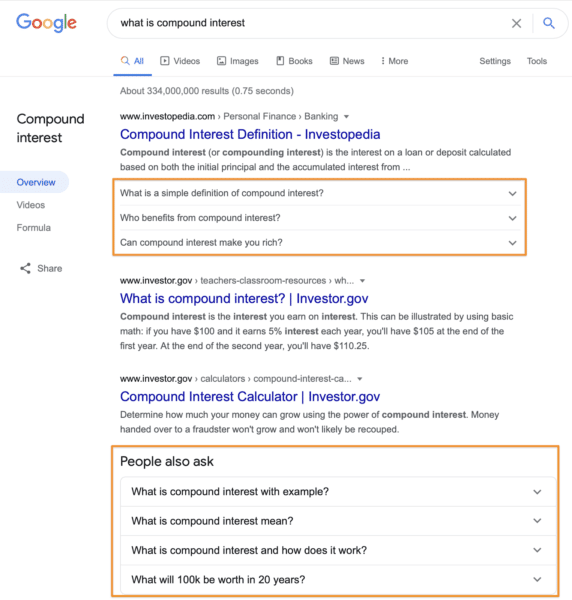
Analyzing search intent helps you understand what people want to read or learn when they type in a specific query. The good news is that Google literally tells you these answers. 

Start with People Also Ask questions after typing in a query:

People also ask section in SERPs

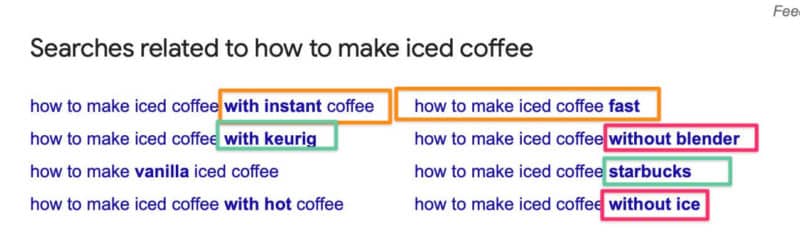
Next, look up Related Searches at the bottom of the SERP to see how the recommendations might line up together to start forming sections with the body of each piece.

Related searches section in SERPs

You’ll start noticing patterns when you do this a lot across dozens, if not hundreds, of queries in your space.

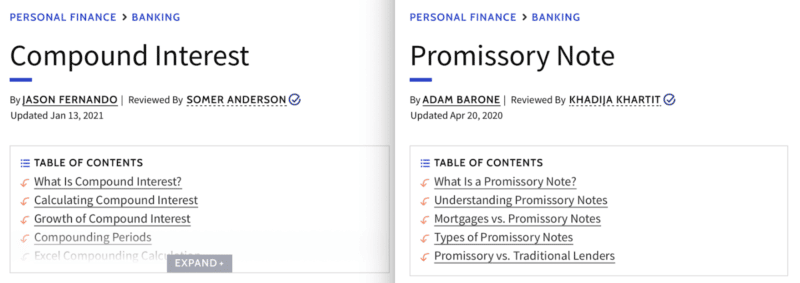
For instance, check out the Table of Contents from these Investopedia pieces on compound interest and promissory notes.

Table of contents for personal finance articles

Almost the same structure! 

Now, you have your first content template.

These are consistent article structures you can use for different queries (think: “what is…”-style queries that might apply across multiple topics or verticals). 

And it also means you can start standardizing article structures across hundreds to thousands. 

So if you had 1,000 topics to produce content on over the next year, those could probably be boiled down into 10 groups of 100. 

One template now might apply to each of those 10 groups (so 10 templates).

From there, you’ll eventually standardize content briefs, which will form the backbone of your writers’ outlines because they spoon-feed them everything from the subheads to the keywords and even word counts at each stage. 

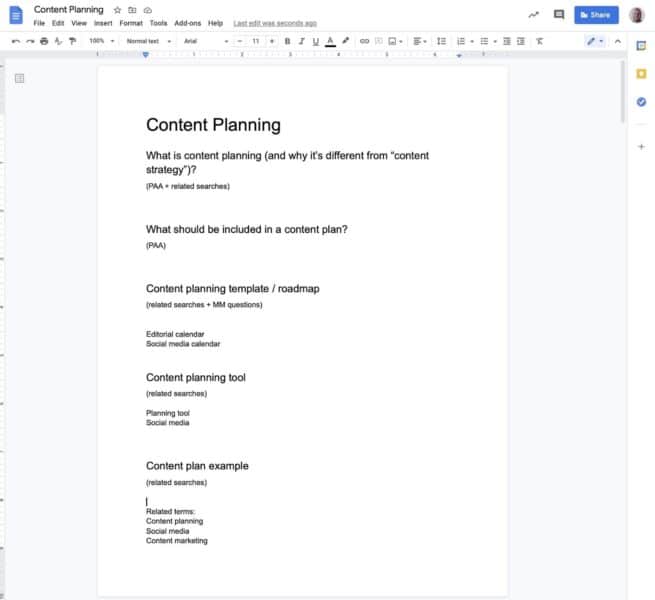
Imagine we’re about to write an article on “content planning.” 

Your content brief would be pulled together by referencing all of these different points of information:

  • People Also Ask questions.
  • Related Searches.
  • Reading some of the best content already ranking.
  • Semantic keywords from content graders.
  • And more.

Standardizing the content planning process like this will make your writers love you because they no longer have to stare at a blank white screen trying to conjure up some fluff.

Your editors will love you because they know exactly how the content should look, read, and sound.

Your SEOs or marketers will love you because you’re performing that difficult balancing act of producing interesting content that will still rank well.

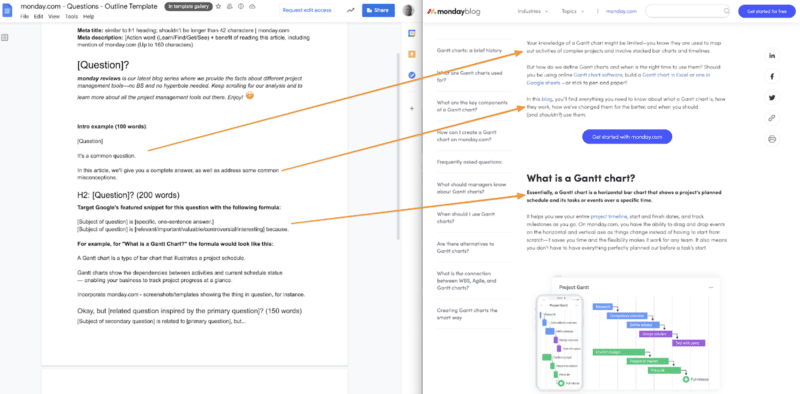
And your bosses, clients or whoever is paying the bill will love you because what you initially planned in the early stages is pretty much exactly what the finished product will look like at the end of the day.

Composite image of Gantt chart content outline and published blog post

And when you do this consistently over months and years, your ultimate success will be virtually guaranteed. 

It’s just a matter of how quickly the Google gods reward your good work.

4. Guidelines and sources

Shades of gray are only for cheesy romance novels and even worse movies.

They have no business in a high-performing content machine.

Take voice and tone preferences. Once again, ask 10 people, and you’ll get ten different answers.

So here’s an easy tip. Sometimes, seeing what you don’t like makes it easier to understand what you do like.

Take the following sentence: 

Sample sentence

It’s fine. Not great. Kinda generic and boring. But fine.

Now, rewrite that sentence like this:

✅ “This company is just the latest in a long line to be gobbled up by the massive hosting conglomerate, Endurance International Group (EIG). Or, as it’s also known, Where Good Web Hosts Go to Die.”

Over the top? Probably. 

Some might like it, some might not. The vivid language (“gobbled up”) and power words (“Go to Die”) would be great for a conversational or satirical brand, perhaps not for a formal medical one, though.

A good example to model is Mailchimp’s extensive documentation. 

From there, you’ll also want to create guides for everything from vocabulary to terminology. 

These are the words, phrases or expressions that your brand uses, unique to your point of view on the industry, that would be different than other direct or indirect competitors. 

For instance, do you prefer:

  • “Profile picture” or “avatar”?
  • “Example” or “use case”?
  • “Click” or “press”?

It doesn’t matter which one you select. It only matters that you pick one, are consistent, and clear up this gray area for your writing and editing teams. 

This supporting documentation should clear up all the intangible or unwritten principles your team already practices – even if they aren’t aware of it.

Last but not least, you should create a list of resources your writers can use, and a list of resources they should not reference (because they have published inaccurate, misleading, confusing, inconsistent, or otherwise untrustworthy information).

Sample document - Resources for content research and linking

Stamp out all unwritten or intangible items, one by one, day after day, like a big game of Whack-a-Mole, and pretty soon, the only shades of grey left are the questionable kinky ones in your free time.

5. Batch and parallel processes

Let’s end at the beginning.

The brigade system helps professional kitchens deliver multiple dishes to the same table simultaneously, all cooked to perfection.

They do that by working in batch and parallel processes. 

Imagine a line cook at the grill. They might be preparing five different cuts of steak for five different tables at five different temperatures with five different cook times. 

Sounds exhausting, right?

So exhausting that they can’t also be cooking pastries or prepping salads at the same time. That’s role specialization in step one above. 

Now imagine that 10 different people in a kitchen are each doing their own version of this at the same time. 

Visualization of the brigade system in professional kitchens

Taking this back to content operations, it means you might have one team of people (writers, editors, SEOs, designers, etc.) working on one content project while at the same time another team of people (writers, editors, SEOs, designers, etc.) is working on another one.

As the leader of this chaos choreography, your job is to have the right teams in place with the right systems so that your output and quality stay high, even if a bunch of people are working on different things simultaneously. 

Tracker for content projects

Now, instead of micromanaging or meddling or trying to control every little detail, you can step back and oversee from a high level while still making subtle tweaks along the way to key stages of the assembly line.

Scale content creation and SEO in 5 key steps

Content is subjective at the end of the day.

You might like short, snappy, snarky sentences. But your boss might prefer formal, flowery, and factual.

Ultimately, it doesn’t matter.

The only thing that matters is that you – and the rest of the people you work with – are all on the same page. 

This seemingly simple yet little-practiced point often derails content projects daily and sabotages your SEO results over the long term. 

Start by optimizing your content operations with the following five steps:

  • Specializing roles within your larger production workflow,
  • Solidifying quality standards and examples that illustrate each point,
  • Standardizing how production should flow from idea to template to brief to finished product,
  • Documenting supporting guidelines and sources to clear up intangibles,
  • Implementing batch and parallel processes so everyone knows what they should do at every moment.
5-step content operations framework explained

It isn’t always easy or fun. It’ll take some getting used to. 

But it’s ultimately the only way to break through your self-imposed barriers and generate the long-term success you deserve.


Opinions expressed in this article are those of the guest author and not necessarily Search Engine Land. Staff authors are listed here.


Related stories

New on Search Engine Land

@media screen and (min-width: 800px) { #div-gpt-ad-3191538-7 { display: flex !important; justify-content: center !important; align-items: center !important; min-width:770px; min-height:260px; } } @media screen and (min-width: 1279px) { #div-gpt-ad-3191538-7 { display: flex !important; justify-content: center !important; align-items: center !important; min-width:800px!important; min-height:440px!important; } }

About the author

Brad Smith

Brad Smith owns three content marketing companies, and has been featured in publications like The New York Times, Forbes, Business Insider, and The Next Web. Each week, he shares first-hand experience and growth strategies behind some of the web’s fastest growing brands.

https://searchengineland.com/framework-scale-content-operations-seo-390150


Google drops the character limit for headlines in article structured data

Google has updated the article structured data help documentation to remove the hard character limit for the headline property. Instead of Google saying there is a 110-character limit, now Google just says you should be concise with your headlines for your articles.

The revision. Google’s article structured data help documentation used to write “The title of the article. The value should not exceed 110 characters.” It has been updated to say, “The title of the article. Consider using a concise title, as long titles may be truncated on some devices.”

Google noted that they have “removed the 110 character limit for the headline property in the Article structured data documentation.” “There’s no hard character limit; instead, we recommend that you write concise titles as long titles may be truncated on some devices,” Google added.

Why we care. If you struggled to fit your headlines into that specific limit, you no longer need to worry about it. If you go over by a few characters, you will be fine. The main thing Google wants you to consider is how the title or headline of the article will appear on the devices your users are consuming your content on.

You will no longer receive errors about your article headlines being too long with article structured data.


Related stories

New on Search Engine Land

@media screen and (min-width: 800px) { #div-gpt-ad-3191538-7 { display: flex !important; justify-content: center !important; align-items: center !important; min-width:770px; min-height:260px; } } @media screen and (min-width: 1279px) { #div-gpt-ad-3191538-7 { display: flex !important; justify-content: center !important; align-items: center !important; min-width:800px!important; min-height:440px!important; } }

About the author

Barry Schwartz

Barry Schwartz a Contributing Editor to Search Engine Land and a member of the programming team for SMX events. He owns RustyBrick, a NY based web consulting firm. He also runs Search Engine Roundtable, a popular search blog on very advanced SEM topics. Barry can be followed on Twitter here.

https://searchengineland.com/google-drops-the-character-limit-for-headlines-in-article-structured-data-390937


Microsoft to add ChatGPT features to Bing Search

Microsoft may be adding OpenAI’s ChatGPT features to Bing Search in the coming months. According to a report by The Information, two sources from the company is saying the company likely will be adding the popular ChatGPT AI question and answer service to Bing, Microsoft’s search engine.

What is ChatGPT. OpenAI-launched chatbot ChatGPT several months ago and it has become incredibly popular across the web. Everyone, not just SEOs, are using it to get answers for homework, for writing essays and to get answers to their queries. Some have called ChatGPT the Google killer, but that may be a stretch.

ChatGPT is a chatbot launched by OpenAI in November 2022. It is built on top of OpenAI’s GPT-3.5 family of large language models, and is fine-tuned with both supervised and reinforcement learning techniques. ChatGPT uses content across the web from before 2021 to teach itself how to answer questions, but when it comes to recent and trending topics, it has difficulty. You can learn more about how it technically works in this blog post.

The report. The report from The Information writes, “Microsoft could soon get a return on its $1 billion investment in OpenAI, creator of the ChatGPT chatbot, which gives humanlike text answers to questions. Microsoft is preparing to launch a version of its Bing search engine that uses the artificial intelligence behind ChatGPT to answer some search queries rather than just showing a list of links, according to two people with direct knowledge of the plans. Microsoft hopes the new feature, which could launch before the end of March, will help it outflank Google, its much bigger search rival.”

There has been a lot of coverage of this report that you can find on Techmeme.

Google in trouble. Honestly, I don’t think Google is in trouble despite reports of “code red” at Google over the AI based Chatbot. Google has pretty advanced AI and machine learning that can likely do exactly what ChatGPT does already or better. In fact, Google’s spam team said they have methods to detect and neutralize AI plagarized scraped types of content. Plus, we know there are plenty of tools to detect AI generated content, so if AI can detect AI, I wonder how much of a code red it is?

Why we care. With any new search feature, espesially a chatbot, this can change and redirect searcher behavior. As SEOs, SEMs and marketers, understanding searcher behavior and showing up in the places that people are searching is important to drive awareness, traffic and business for you and your clients.

This is very new, but I am sure we all will be watching this space very carefully to make sure we leverage it for clients and stakeholders.


Related stories

New on Search Engine Land

@media screen and (min-width: 800px) { #div-gpt-ad-3191538-7 { display: flex !important; justify-content: center !important; align-items: center !important; min-width:770px; min-height:260px; } } @media screen and (min-width: 1279px) { #div-gpt-ad-3191538-7 { display: flex !important; justify-content: center !important; align-items: center !important; min-width:800px!important; min-height:440px!important; } }

About the author

Barry Schwartz

Barry Schwartz a Contributing Editor to Search Engine Land and a member of the programming team for SMX events. He owns RustyBrick, a NY based web consulting firm. He also runs Search Engine Roundtable, a popular search blog on very advanced SEM topics. Barry can be followed on Twitter here.

https://searchengineland.com/microsoft-to-add-chatgpt-features-to-bing-search-390936


4 tips to build a data-centric culture in your agency

As we ring in a new year, among your 2023 goals as an agency may be to level up your data game, deliver excellence to your current clients and stand out to prospects. 

Using the following tips will help you start laying the groundwork to build a culture of data within your organization.

1. Hire expert personnel to guide your strategy

Developing a solid data foundation requires experienced leadership to steer the ship. This person should be responsible for:

  • Defining high-level agency data goals.
  • Laying out a detailed roadmap to accomplish them. 

Many companies are working off piecemeal data pipelines, siloed data and out-of-date infrastructure with no real central ownership. 

A seasoned data pro can come in and wrangle everything into a cohesive data blueprint and determine whether to keep or scrap existing infrastructure and processes moving forward.

Avoid putting these responsibilities on the plate of your ad managers and client service leaders as an afterthought.

When you have experts in the right roles and hand them the key, your agency and clients will see that you are prioritizing your data strategy. 

No matter the size of your company, having dedicated data personnel will result in more efficient processes.

This ultimately supports the work of your marketers, which brings us to the next point.

2. Bridge the gap between the data team and the client services team

While it’s important to have a designated data team, you should consider them as an extension of the client services team rather than a separate department.

The data team’s work should support the client service team’s goals. 

Developing synchronicity between these teams is the key to maximizing the potential of data and demystifying data processes for your whole agency. 

Data education should be an agency-wide initiative. The data team should:

  • Communicate to the client service team what is available and possible from a data standpoint.
  • Offer ongoing cross-training and education to the rest of the team. 

In turn, client services can think creatively about new ways to analyze and present findings to clients to unlock results. 

While ad managers aren’t also expected to be data engineers, understanding data flow and processes will help them think more creatively about how data optimize and deliver deeper insights to clients. 

On the other side, ensuring that your data team has proper marketing education enables them to think about solutions in the correct context.

This keeps them from churning out data pipelines and reports that don’t necessarily support the client or service team’s goals. 

In the same way, your client services team should be provided with ongoing data education, your data team should be proficient in marketing principles and platforms.


Get the daily newsletter search marketers rely on.


Data leadership should stay on top of the latest technology and constantly evaluate the best tools for your agency’s scope at least annually. 

Here are some questions that should be addressed:

  • Are your current tools scalable for projected growth? 
  • Do you have personnel spending extensive time on data-oriented tasks that can be automated with technology solutions? 
  • Do you have multiple tools or processes that could be replaced with one better, multifunctional solution? 

There is no one-size-fits-all approach to data practices or technology. What worked for you last year may not be compatible with your goals for the future. 

Avoid the sunk-cost fallacy if you are currently using solutions that don’t support the data culture you’re trying to build. Don’t be afraid to try new approaches! 

If you decide to integrate new tools and technologies, ensure you have the proper resources and personnel to become experts in:

  • Managing the tools.
  • Creating new processes.
  • Developing documentation.
  • Educating the entire team on the improvements. 

These resources will also still need the bandwidth to support day-to-day activities. 

Good data culture means not burning your team out or rushing through process creation for the sake of saving a few dollars. 

While it is not a directly billable part of your business, your data strategy is a long-term investment that will return to you tenfold when implemented properly. 

4. Get your clients on board

While we can’t force our clients to adopt a data-centric culture of their own, we must lead by example and present ourselves as marketing analytics experts. 

Positive client relationships will look to agencies for guidance and innovation. 

By having an established data culture within your agency, you can set the tone with your clients and impress the importance of data governance on them to optimize for exceptional results.  

Empower your team to push clients for feedback and help guide them in areas where they may have data-related shortcomings. 

Some ways we can support our clients’ data-related projects might include:

  • Helping to clean up tracking.
  • Providing insightful and efficient performance reporting.
  • Integrating down-funnel metrics into your reporting and strategies. 

If we become the de facto experts in these areas, it will make our jobs as marketers much easier and enable us to focus more time and energy on marketing activities. 


Opinions expressed in this article are those of the guest author and not necessarily Search Engine Land. Staff authors are listed here.


Related stories

New on Search Engine Land

@media screen and (min-width: 800px) { #div-gpt-ad-3191538-7 { display: flex !important; justify-content: center !important; align-items: center !important; min-width:770px; min-height:260px; } } @media screen and (min-width: 1279px) { #div-gpt-ad-3191538-7 { display: flex !important; justify-content: center !important; align-items: center !important; min-width:800px!important; min-height:440px!important; } }

About the author

Caille O'Leary

Caille O’Leary is the Business Intelligence Manager at Closed Loop, where she oversees client data collection and reporting across multiple verticals. She is also responsible for software development and business intelligence innovation. O’Leary enjoys calculating risks and reigning big ideas into reasonable, actionable plans based on data. By blending her technical skills, management experience and data-driven nature, she aims to achieve analytics success for our customers. Callie also hails a Master’s degree in Business Analytics from Arizona State University and a Tableau Professional certification. When she isn’t crunching numbers, you can find her exploring Roseville’s dining scene, attending a Sacramento Kings game, running a marathon or embarking on her next travel destination.

https://searchengineland.com/build-data-centric-culture-agency-390172


This day in search marketing history: January 4

In 2014, 10 days after being penalized for “unnatural links” that it helped create, lyrics site Rap Genius returned to Google’s search results.

On Dec. 24, 2013, Google confirmed it was looking into an “affiliate” program Rap Genius created in order to get unnatural links pointing to their website. By the next morning, Google officially penalized Rap Genius for link schemes.

Anyone searching Google for [rap genius] would not find rapgenius.com on Page 1. However, there were links to their Twitter account, Facebook page, Wikipedia profile and stories like this about them being penalized by Google.

The result of the penalty: a 92% drop in search visibility.

Said Rap Genius:

We effed up, other lyrics sites are almost definitely doing worse stuff, and we’ll stop. We’d love for Google to take a closer look at the whole lyrics search landscape and see whether it can make changes that would improve lyric search results.

– Rap Genius

Read all about it in Rap Genius Back In Google After 10 Day Penalty, Ranks For Its Name But What About Lyrics?


Also on this day 


Bing Webmaster Tools adds crawl requests, crawl errors & indexed pages to performance report

2021: The new crawling and indexing data, all of which really weren’t directly related to the performance of your search results in Microsoft Bing, became available directly in the search performance report.


Google launches Question Hub for U.S. publishers

2021: Google launched Question Hub in regions where the company found it did not have enough content in its search index to answer searchers’ questions. (On Dec. 15, 2022, Google announced it was closing down Question Hub.)


Video: Anthony Church on conversion tracking & SEO

2021: In this installment of Barry Schwartz’s vlog series, he chats with Church about about two primary topics: conversion tracking and what SEOs should focus on.


Google buys expert community and ‘answer engine’ Superpod for $60 million

2019: Superpod matched audience questions and expert answers across a broad range of topics. Early reports speculated that Superpod’s founders and assets would be deployed to improve the Google Assistant.


DuckDuckGo broke 9 billion searches in 2018, and it’s growing

2019: By comparison, in 2016 they did 4 billion searches. And as of October 2018, DuckDuckGo reported reaching 30 million queries per day.


Google My Business dashboard showing video upload section for some business owners

2018: Google seemed to be testing the ability of business owners to upload videos to their local listings within the Google My Business dashboard.


Search marketing to enjoy ‘late-stage renaissance,’ according to analyst firm

2018: Privacy, brand safety and other factors were going to make paid search even more attractive to marketers going forward, according to Forrester Research.


Google’s updated iOS app pulls in YouTube videos, menus & more

2017: The update let users watch YouTube videos right in their feed, see hotel rates and booking info in search results and instantly open menus from restaurant search results.


2016: Bing began powering AOL’s web, mobile, and tablet search, providing paid search ads and algorithmic organic search results to AOL’s properties worldwide.


DuckDuckGo Ends 2015 On A High Note, Reaches 12M Searches In A Single Day

2016: The privacy search engine averaged more than 10 million searches per day by the end of the year.


Authors Guild Appeals Lower Court Decision Backing Google’s Book Digitizing Project

2016: At issue was whether Google’s project violates the copyrights of some of the millions of scanned books, or whether it has a valid “fair use” exception.


Blekko Launches New Tablet Search Engine “izik”

2013: Izik was designed to deliver a tablet-friendly search experience. Compared to Google on a wide range of search queries and results, izik surfaced more information and made it more visually accessible.


It’s Official: PayPal President Scott Thompson The New Yahoo CEO

2012: Thompson was viewed initially as a positive hire despite concerns about his lack of experience with digital advertising. After a turbulent few months, Thompson “stepped down” as CEO in May 2012.


How Rick Santorum Is Making His “Google Problem” Worse

2012: One problem Santorum had in ranking tops for a search on just his last name was that he didn’t maintain his own dedicated website about himself, a place independent of his elected office where those who wanted to know about Rick Santorum could discover more.


Google’s Marrisa Mayer Talks New Role, LBS And Groupon

2011: No longer working on search, Mayer’s new responsibilities included Google Maps, local products and some of the company’s mobile products.


Google Working On NFC-Based Mobile Payment Service: Report

2011: Google had plans for a mobile payment service that would allow users to pay for common goods and services by waving or tapping their mobile phones. That turned out to be Google Wallet, which began rolling out in September 2011.


Bing Scores First In-Car Search Deal With Toyota

2011: Bing for Mobile (with Bing Maps) was one of Toyota Entune’s featured apps, giving drivers access to Bing search results via the dashboard’s touch screen or by using Bing for Mobile’s voice search capabilities.


Facebook’s Goldman Investment An IPO Delaying Tactic?

2011: Was Facebook’s IPO right around the corner? Or did this investment delay the IPO for a year or more? (Spoiler alert: Facebook’s IPO happened in 2012.)


On Nexus One Day Tomorrow, Will Google Surprise Us With An Android Tablet?

2010: Spoiler: no. From Jan. 5, 2010: Liveblogging The Google Nexus One Phone Launch.


2010: Google animated the Doodle, where the Apple falls off the Google logo and drops to under the search box.


Research: Fear Explains Irrational B2B Purchase Behavior

2010: B2B buying is not a rational process – it is a decision process driven by the emotions of the people involved.


Google Timeline Experiment Seen In Main Search Results

2009: Clicking the “More timeline results” in the main search results led to a page with much more historical data about the query, which Google said came from their News Archive search service:


Nathan Stoll, Long Time Google News Product Manager, Leaves Google

2008: He would go on to co-found “help engine” Aardvark, which was later acquired by Google in February 2010.


Google Takes NASA To Watch Meteor Shower

2008: That time when NASA scientists used a plane owned by Google’s founders to watch a meteor shower.


Google’s User Experience Expert, Kevin Fox, Joins New Start-up Company

2008: Fox, responsible for helping design Gmail, Google Calendar, and Google Reader 2.0, joined a very small startup called FriendFeed, which ended up being acquired by Facebook in August 2009.


What Time Is It? Don’t Check Google (At Least In Argentina)

2008: Denizens of the capital of Argentina set their clocks forward – but Google neglected to.


Truveo Index Hits 100 Million Videos

2008: The company also said that its search index grew in 2007 from a base of just 5 million videos at relaunch in August 2007


2007: It showed you how you were interacting with your feeds in Google Reader.


Google Calendar Set To Pass Yahoo Calendar

2007: Google Calendar increased its market share by a paltry 333% between June 2006 and December 2006. Wonder whatever happened to it?


Amazon Promotes Askville & LinkedIn Launches Answers Services

2007: These were timely efforts by Amazon and LinkedIn after Google dropped their Answers product


YouTube Forced To Shut Down In Brazil

2007: Why? Because YouTube failed to prevent a celebrity sex video from being posted time and time again


Google Removes “Tips” Feature After Recent Blog Controversy

2007: A search on [calendar] and [blog] no longer brought up the Google Tips at the top. Background: Fury Over Google’s Self Promotion & Wishing For Perspective.


From Search Marketing Expo (SMX)


Past contributions from Search Engine Land’s Subject Matter Experts (SMEs)

These columns are a snapshot in time and have not been updated since publishing, unless noted. Opinions expressed in these articles are those of the author and not necessarily Search Engine Land. 


< January 3 | Search Marketing History | January 5 >


Related stories

New on Search Engine Land

@media screen and (min-width: 800px) { #div-gpt-ad-3191538-7 { display: flex !important; justify-content: center !important; align-items: center !important; min-width:770px; min-height:260px; } } @media screen and (min-width: 1279px) { #div-gpt-ad-3191538-7 { display: flex !important; justify-content: center !important; align-items: center !important; min-width:800px!important; min-height:440px!important; } }

About the author

Danny Goodwin

Danny Goodwin is Managing Editor of Search Engine Land & SMX. In addition to writing daily about SEO, PPC, and more for Search Engine Land, Goodwin also manages Search Engine Land’s roster of subject-matter experts. He also helps program our conference series, SMX – Search Marketing Expo. Prior to joining Search Engine Land, Goodwin was Executive Editor at Search Engine Journal, where he led editorial initiatives for the brand. He also was an editor at Search Engine Watch. He has spoken at many major search conferences and virtual events, and has been sourced for his expertise by a wide range of publications and podcasts.

https://searchengineland.com/search-marketing-history-january-4-389510