The Search Engine Watch Top 5!

First, congratulations on surviving 2022, you’ve done great! 2022 was surprising, unique, and a challenging mix of several global events that kept us on our toes as consumers, brands, and search marketing professionals. The recession, great resignation, a war, FIFA finale, and several silent battles we all fought by ourselves.

As we recap the year gone by, let’s look at the world through the lens of search, SEO, analytics, and content creation.

Source

2022 has been about…

  • Looking at your consumers as human beings and not just data sets
  • Understanding how your target consumers perceive the world and how they experience life in a digital age
  • Tailoring and testing your strategies to meet consumers in their moment of need – all without losing budget (or your sanity!)
  • Finding most-effective tools, technologies, and talent to navigate business uncertainty

We present to you the #SEWTop5

A countdown of editor’s picks that the Search Engine Watch community loved and found great value in!

#5. Understanding the three awareness stages of your online audience

Businesses often forget that success metrics aren’t just numbers – they are living, breathing people who are driven by behavior and emotions. As customer journeys continued to remain complex and multifaceted, businesses competed to ensure they were at the finish line when prospects were ready to convert.

Add People’s Content Operations Lead, Jack Bird created a guide on harnessing a content strategy that caters to consumers and their journeys. He detailed the three key awareness stages of online traffic, what type of content fits these stages, and how to audit your existing content.

#4. A must-have web accessibility checklist for digital marketers

Did you know, 98% of US-based websites aren’t accessible? This year web accessibility moved out of the shadows and took center stage as one of Google’s search ranking factors – making the topic itself more accessible to discussions. Marketers could no longer ignore this critical aspect, because –

Stellar user experience >> Positive brand perception >> Greater appeal to value-driven consumers = Good for business

Web design and marketing specialist, Atul Jindal created a must-have web accessibility checklist for digital marketers. It went beyond dispelling “what is web accessibility?” and spoke about its benefits and action points on “how to make your website accessible?”.

#3. Google Analytics 4: drawbacks and limitations—is it worth sticking around?

On July 1, 2023, Universal Analytics properties stopped processing new hits, forcing users to switch to its successor, Google Analytics 4. This transition demanded SEOs and marketers to have a steep learning curve and adaptability since the shift meant losing some historic data.

This article dove into the issues with Google Analytics 4 from a user perspective and a privacy and compliance standpoint. Objective, hard-hitting observations helped inform SEOs and marketers’ decisions before switching platforms.

#2. The not-so-SEO checklist for 2022

While most of the internet focused on “what to do”, we took an offbeat path of “what not to do” that will help your SEO succeed from the get-go.

Best-selling author and SEW Advisory Board Member, Kristopher (Kris) Jones dispelled some major myths surrounding Core Web Vitals (CWV) and Google’s bigger, mainstream 2021 updates.

As an especially interesting, strategy-focused read, this was one SEOs could not miss before designing their 2022 strategy.

#1. Seven Google alerts SEOs need to stay on top of everything!

We as SEOs and marketers often forget that while we focus on consumers and clients, we too are humans – with limited energy (we mean coffee supply), 24 hours (wish we had more), and sleep deprivation (yes we mean sleep deprivation). As burnout crept in and to-do lists climbed, our very own Ann Smarty shared seven Google alerts that aimed at making life easier for SEOs.

These smart ways helped the community get ahead of competition, prevent a reputation crisis, fix a traffic drop, and do much more (without getting overwhelmed).

We hope you enjoyed this! Thank you for being valuable supporters throughout our journey.

Team Search Engine Watch wishes everyone a happy new year! Keep spreading the love and SEO wisdom.

Via GIPHY

*Ranked on target audience engagement, time on page, and bounce rate.


Subscribe to the Search Engine Watch newsletter for insights on SEO, the search landscape, search marketing, digital marketing, leadership, podcasts, and more.

Join the conversation with us on LinkedIn and Twitter.

https://www.searchenginewatch.com/2022/12/27/the-search-engine-watch-top-5/


How Google Autocomplete works

When you go to the Google homepage, you’ll most likely know what you’re about to type into the search box – whether you’re checking in on the weather forecast, looking for a business or service, or want to find out where you recognize that actor from. (Unless you’re “feeling lucky,” that is.)

You enter a word or a single letter, and Google will populate the search box with a list of “predictions” before you’ve even finished typing. This Google feature is called Autocomplete.

But what exactly is it? How does Google come up with those predictions? Read on to find out how Google Autocomplete works.

What is Google Autocomplete?

Autocomplete is a feature within Google Search that, in Google’s own words, is “designed to make it faster to complete searches that you’re beginning to type.”

Starting as an experimental feature in 2004, it was fully introduced four years later as Google Suggest and was renamed Autocomplete in 2010.

It is available anywhere you can expect to find a Google search box, including:

  • The Google home page.
  • The Google app for iOS and Android.
  • The quick search box from within Android.
  • The “Omnibox” address bar within Chrome. 

Begin typing, and you’ll see predictions appear.

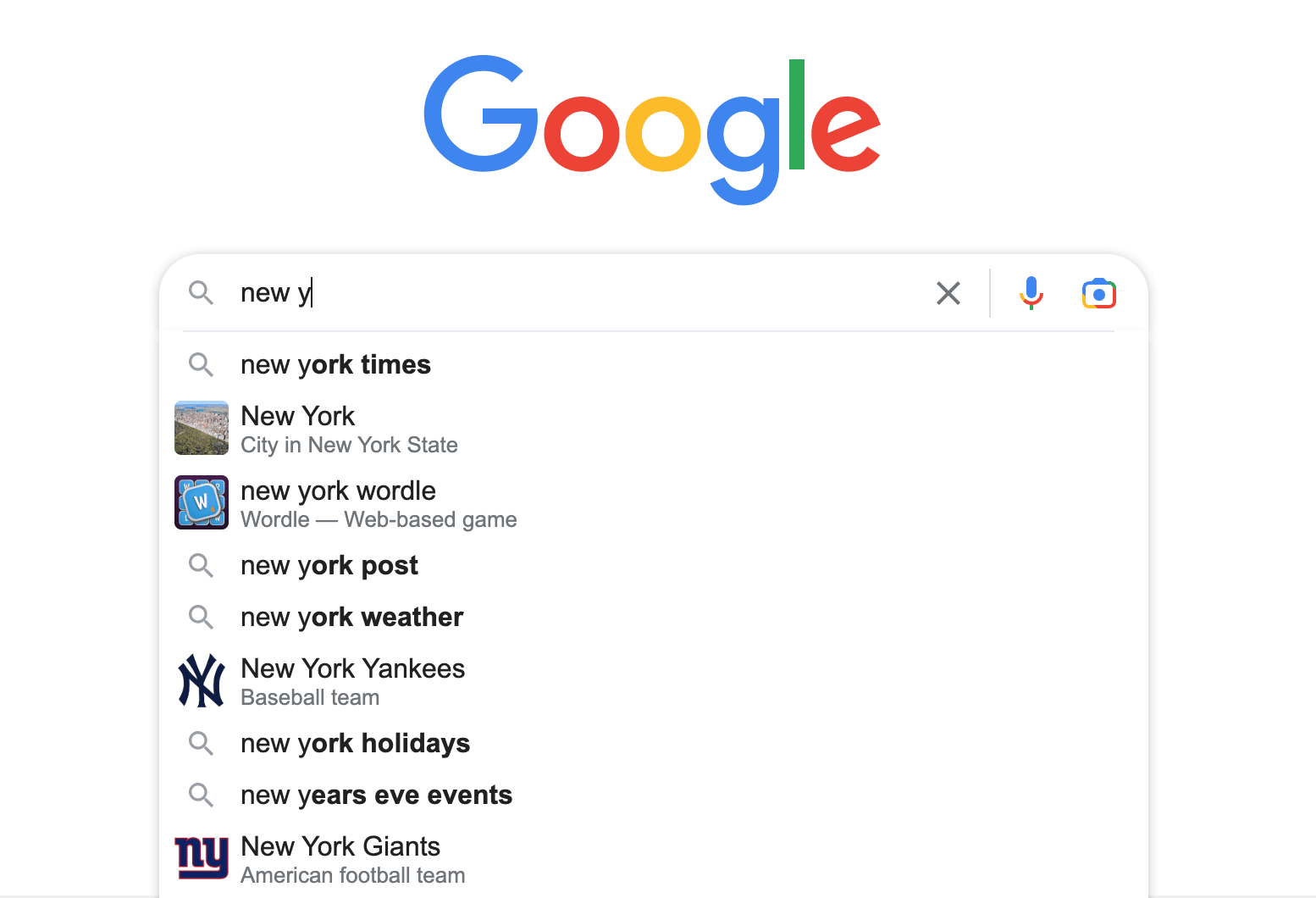
Google Search - Autocomplete for 'new y'

In the screengrab above, you can see that by typing “new y” Google brings up predictions such as “new york times” or “new york Yankees.”

This makes it easy to finish entering your search on these topics without typing all the letters. The predictions change in real-time in response to each character being typed into the search box. 

The user then has the option to continue typing their desired query or choose from the dropdown selection.

But if you know what you’re searching for, why do you need Google to tell you? 

It saves time. While Autocomplete began as a desktop search feature all those years ago, it has become a popular time-saving feature on mobile devices.

Google estimates that, cumulatively, it saves the equivalent of over 200 years of typing every single day and, on average, reduces typing overall by about 25%.

How Google Autocomplete works

Google Search doesn’t quite know how to read minds. Instead, it makes calculated predictions by looking at searches made by real people.

Autocomplete displays common and trending queries relevant to the characters entered into the search bar. 

Here are some key factors used by Autocomplete to predict search queries:

  • Overall popularity.
  • Trending topics.
  • Search history.
  • Location.

Put simply, the results shown are influenced by things you’ve previously searched for, the location you’re searching from, and the search term data that Google has gathered – using all of this data to automatically predict what you’re looking for. 

Let’s take a closer look at each factor.

The popularity of search queries

When it comes to predicting search queries, popularity often walks hand in hand with what’s trending. But trends can fade over time, whereas one or more subjects might always be commonly linked together. 

While some searches are far more common than others, some less popular searches might be shown above more common ones if Google deems them more relevant, the company says. In short, personalized > popular.

We’ve all heard of Google Trends, the website that analyzes the popularity of top search queries across various regions and languages. Well, this isn’t that.

A current trending search is a term or phrase that suddenly spikes in popularity. As people flock to Google to ask the same question, the query can appear as a suggestion, even if it hasn’t gained long-term popularity. 

Google uses the following example to explain:

When actress Anna Paquin was getting married, “Anna Paquin wedding” began appearing as a suggestion just before her big day. The term was useful to suggest, as many people were starting to search for it.

If Google had relied solely on long-term data, then the “suggestion” wouldn’t have appeared as an option in the search box, as it hadn’t widely been searched for previously.

And today, Autocomplete no longer offers the term as it didn’t harness enough long-term popularity (though “Anna Paquin married” has stuck).

Previous search queries

The predictions dropdown list will include a variation of topics and questions depending on who is doing the searching. To speed up the search process and identify what you might be looking for, Google sifts through your past searches.

In the example below, you can recognize that a previous search result appears because the text is highlighted in purple.

Desktop view of Google search bar with autocomplete

On desktop, you’ll also see the word “Remove” appear next to the prediction, which you can click if you want to delete the past search.

However, on mobile, things look a little different. You’ll see a clock icon on the left for previous searches and an X button on the right to remove it. 

Mobile view of Google search bar with autocomplete

You can also delete all your previous searches in bulk or by particular dates or those matching particular terms using My Activity in your Google Account, regardless of the device you use to search.

Language and location

With a service that seems so personalized, it’s perhaps no surprise that not everyone receives the same suggestions. Among the factors that can tailor your experience is the language you’re searching in and the location you’re searching from.

The country, the state or province, and even the city can all produce different suggestions – whether it’s where you currently live or are originally from. 

Different suggestions will also appear if you’ve told Google that you prefer to search in a particular language or based on the language Google assumes you use, as determined by your browser’s settings.


Get the daily newsletter search marketers rely on.


Why are some predictions removed?

Google outlines that Autocomplete makes “predictions” rather than “suggestions.”

This could be due to several controversial and legal claims previously made which suggested that Google was promoting harmful, offensive and/or inaccurate information by suggesting certain search queries.

When rebranding in October 2010, Google moved away from “Suggest” since it’s not always offering the most thoughtful, caring, or appropriate term.

The company prefers to use “predictions” and is committed to bettering the service by taking on feedback and monitoring searches.

In addition, Autocomplete is designed to help people complete a search they intended to do. The feature offers predictions based on the query you were likely to continue entering. 

While the results show depend on several factors outlined above, Google removes predictions that are against its autocomplete policies, which block:

  • Sexually explicit predictions that do not cover or relate to medical, scientific, or sex education topics.
  • Hateful predictions against groups and individuals based on race, religion, sexuality or other demographics.
  • Violent or harmful predictions.
  • Dangerous and harmful activity in predictions.

Google may also remove predictions considered spam, closely associated with piracy, or in response to valid legal requests.

How do inappropriate Autocomplete predictions happen?

While Google has systems designed to automatically catch inappropriate predictions, the search engine processes billions of daily searches.

Billions of searches mean billions of predictions, which means that sometimes, inappropriate predictions can slip through the net.

While some predictions may seem odd, shocking or make you question why someone might want to search for it, looking at the actual search results generated sometimes provides needed context. 

In some cases, the search results themselves may make it clearer that predictions don’t necessarily reflect awful opinions which some people may hold but instead may come from those seeking specific content that’s not problematic. 

This is why popular searches measured in our Google Trends tool might not appear as predictions within Autocomplete.

Google Trends is a tool designed as a way for anyone to research the popularity of search topics over time, regardless of the search intent.

How to report inappropriate Autocomplete predictions

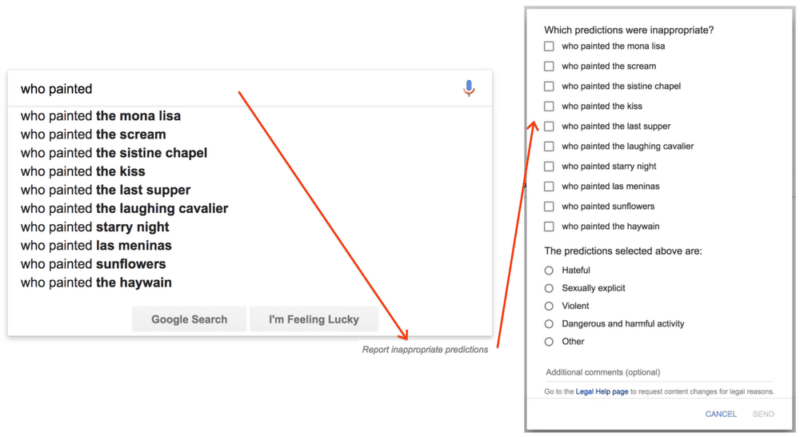
If you spot something which doesn’t feel right, makes you uncomfortable or might offend someone, you can report using the “Report inappropriate predictions” link, which appears below the search box on desktop.

Report inappropriate predictions

For those searching on mobile or using the Google app for Android, long press on a prediction to get a reporting option. Those using the Google app on iOS can swipe to the left to get the reporting option.

Google reassures users that they don’t just remove a reported prediction that violates their policies but also investigate closely related predictions to provide a broader solution and prevent inappropriate predictions from being made in the future.

More than just Autocomplete

Google Autocomplete benefits all types of users, helping them to make searches and load pages more quickly.

Whether you’re looking to inform your marketing strategy, generate content ideas, research keywords or explore search intent, Autocomplete can be a valuable tool.

Search and digital marketers use it to find out what people are actively searching for so they can better meet their customers’ needs.


Opinions expressed in this article are those of the guest author and not necessarily Search Engine Land. Staff authors are listed here.


Related stories

New on Search Engine Land

@media screen and (min-width: 800px) { #div-gpt-ad-3191538-7 { display: flex !important; justify-content: center !important; align-items: center !important; min-width:770px; min-height:260px; } } @media screen and (min-width: 1279px) { #div-gpt-ad-3191538-7 { display: flex !important; justify-content: center !important; align-items: center !important; min-width:800px!important; min-height:440px!important; } }

About the author

Jess Peace

Jess Peace is an experienced copywriter, journalist and marketer who specialises in content strategy and production. After graduating with a degree and masters in Journalism, she fell into the world of marketing, beginning as an in-house social media editor in Barcelona. Since then, she has worked at a number of reputable agencies across roles in SEO, Content and Digital PR. She currently works with the talented folks over at NeoMam, producing hero content campaigns which drive long-term search visibility and land high-quality, authoritative and relevant links. Jess has spoken at several events both in-person and online, including Sheffield DM, Drink Digital and BrightonSEO.

https://searchengineland.com/how-google-autocomplete-works-390257


Why SEO experts rarely share actual success stories

Most SEO experts are still afraid to publish their success stories, with a few notable exceptions. 

Many are simply unable to share their work even when it’s successful. How can SEOs stop practicing “ghost optimization”? 

Before we dive into this question, let’s look at the reasons for the ongoing secrecy and still prevailing negativity among SEO practitioners.

SEO horror stories, anyone?

One of the most popular SEO hashtags within the industry over recent years has been #seohorrorstories. 

Why are SEO experts much more likely to share the horrible failures of the industry and their colleagues than their own success stories? 

Is this the overall prevailing negativity of society as a whole? Or do we have an internal problem aggravating the situation? 

I think it’s probably both.

First off, the recent years have led to a never-ending, downward spiral of public debate. Diplomacy has made way for trolling. 

When even presidents provoke people online to get attention, how is everybody else meant to stay civil in day-to-day conversations? 

Also, social media like Facebook and Twitter have been capitalizing on fear and anger.

Such “bad news” goes straight to our lizard brain and elicits fearful and angry reactions without consulting the parts of the brain responsible for logical thinking.

No wonder that even within the relatively professional SEO industry, the discourse has degenerated into the realm of “OMG! Look at that nonsense! How stupid!”

I’m exaggerating a bit, but that’s the essence of most shares where #seohorrorstories are involved. 

These are more than cautionary tales. It’s also a way of ridiculing those reckless enough to get caught red-handed while employing outdated SEO tactics.

Perhaps the thought process is that when one can’t shed light on their actual successes, then highlight others’ failures. This way, they indirectly stand in a better light by sheer comparison.

Of course, this is merely guesswork. The motivation behind the many horror stories may vary. It won’t simply gloat or malice, in most cases. 


Get the daily newsletter search marketers rely on.


‘Look at this random graph, please – the growth is stellar!’

There is also a compromise, anonymized “success” stories – where the alleged success can’t be fully reviewed by peers.

Such stories seem to be the middle ground between failure and success stories. So what is the logic behind them, then?

You will find lots of social media posts shared of random graphs without any URL connected to them.

It’s usually an analytics screenshot clumsily anonymized before publication. Ultimately, the stellar growth they exhibit lacks any credibility. 

I’m usually acquainted with those who share such success stories, so I know they won’t lie.

In most cases, they also add as much context as possible without giving away any meaningful detail so that you cannot track down the website they’re talking about.

What about industry outsiders and potential clients?

They have no idea who the people sharing the graphs are and how trustworthy the information is.

What is the purpose of sharing graphs without any context?

Again, I can only guess. 

  • Some SEO experts try to convey their expertise that way. 
  • Others share their success out of sheer joy at having made it. 
  • Some may want additional opinions on what happened when things went wrong. 

Take note that #seohorrorstories are quite often anonymous. That way, some limited peer review does happen within a very small perimeter. It’s better than nothing, right?

Are there any SEO hero stories? 

Some of you may have noticed. I have been looking for SEO hero (as in superhero) stories for two months and have been quite aggressive about it. 

There were far fewer success stories than bad news from the SEO industry. Yet, I was astounded that even the prospect of getting additional free publicity did not motivate many SEO companies, in-house SEOs or SEO consultants to divulge their success stories or share their case studies with me.

I started a similar hashtag inspired by #seohorrorstories called #seoherostories to encourage sharing such positive examples, but it seemed like I was the only one using it.

Are SEO experts ashamed of their work or afraid to show it?

Given the poor reputation of the SEO industry in the last 25 years, it’s no wonder some people are not keen on outing themselves as SEO practitioners. 

Numerous SEOs still engage in unethical practices, which might be why they are ashamed to show what they do.

Still, others may simply be afraid. I probed about the reasons behind this fear, and here are the obvious ones.

Manual Google penalties

This is an age-old fear of SEO practitioners stemming back from the early days. Sometimes, outing yourself as a practitioner of the dark arts of SEO – and mentioning the actual website you’re working on – was akin to suicide for your project. 

Even before the somewhat weird term “manual action” was introduced by Google, penalties have been known to hit out of the blue and after too much publicity for SEO practitioners’ work. 

This fear is no longer reasonable. And like most fears, it’s rather irrational.

SEOs are not criminals, and hiding is not necessary in most cases.

‘Secret sauce’ copycats

Another albeit more likely scenario is that the competition may steal your “secret sauce” and copy your SEO techniques. 

While this is possible, it’s important to realize who your competition on the web is. Most SEOs would still say something like “businesses who sell the same thing in the same area.” 

The reality of Google SERPs or the “SERP real estate” is that you mainly compete against the web giants:

  • Google itself pushes its own services and ads above actual organic results.
  • Huge websites like Amazon or Wikipedia are always on top by sheer popularity. 

Would a competitor or colleague who happens to have a similar business as you really hurt you that much by looking at your site’s SEO? 

Also, anybody can look up your secret sauce by using a tool like Semrush and find out about on- and off-page SEO with ease. So, why hide your success from the general public?

Client-stealing competitors

The other fear relating to the competition is that other SEOs may see who you work with and, thus, contact them and “steal your clients.”

People do this. I have had several clients notifying me of such attempts over the years. 

I don’t think I lost any clients that way, though. Why? Is it just because I’m such an expert?

Probably not. I was a beginner at the time as well. 

It’s such a sneaky practice that business people are not fond of offers made that way. If they are, you may be lucky to get rid of them. 

Toxic clients often hurt you more than they help financially. I had to learn that lesson the hard way over the years, trying to satisfy everybody.

I believe the above common “reasons” for not sharing SEO work are often irrational fears and traditions – merely excuses.

One reasonable explanation for why someone would not want to share the actual website address or their “stellar growth” chart is that the work is still in progress. 

Many other parts of the project were far from ready for prime time, and it was not a good idea to share them prematurely. I’ve only heard that justification once, though, even when I asked many times.

NDA: The dreaded acronym

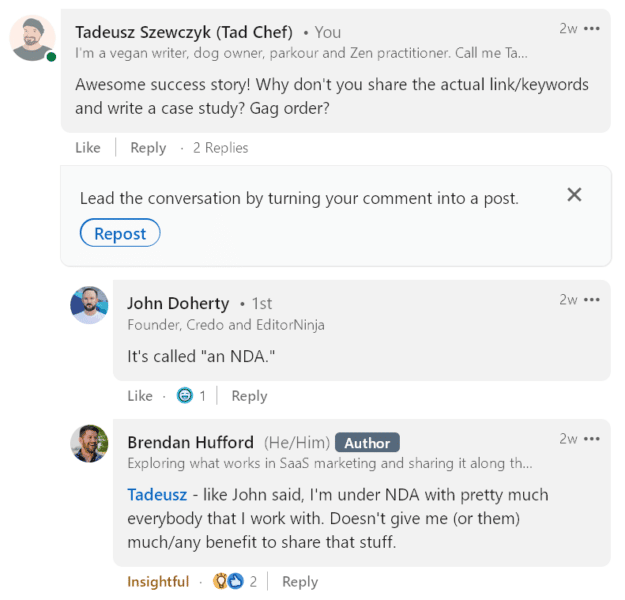
A common explanation for not publishing actual results or disclosing website addresses and client names is the typical non-disclosure agreement (NDA). It may as well be called a “gag order,” as most SEO experts have to shut up completely about their work. 

Some popular search marketers, including John Doherty and Brendan Hufford, emphasized this point on LinkedIn.

For those in creative industries, being unable to share their work or having to do so anonymously would be virtually impossible. 

Imagine the following scenario if designers, architects and programmers were involved.

  • “Look at this house based somewhere in the northern hemisphere. Brown brick has been used for the structure, and the large window frames facing south are made of a local wood I can’t disclose here. To protect the owner’s privacy and hide the location, I had to blur some of the images.”

So why do we have to sign so many NDAs forbidding us to show our actual work or even sometimes tell our friends and families about it?

What’s with the high level of confidentiality? Are we secret agents? 

Clients who demand that SEOs do not talk about their projects may be due to any of the following reasons:

  • They are unethical and will ask you to perform SEO outside Google guidelines or even beyond what the law allows.
  • They want to claim success for themselves and their sales department.
  • They are simply ashamed to buy SEO services as these are still considered to be some kind of voodoo by some.

The common logic is, of course, about “trade secrets.” But as noted above, many tools allow you to analyze those supposed secrets.

The bright side: 3 inspiring case studies that welcome peer review

After talking so much about the issues surrounding (the lack of) success stories in the SEO industry, let’s focus on a few actual case studies that inspired me this year. 

Hopefully, these SEO hero stories encourage you enough to follow in their footsteps.

Example 1: Missguided 

Dogs and owners often become very similar to each other, even by their looks. I am one and can tell you that it often happens “accidentally.”

But there’s an artistic photo series taking it to the extreme, where dog owners and their pets dress up and get their hair done in the same style. 

UK-based SEO agency Rise at Seven made this the idea behind a very successful campaign:

As CEO Carrie Rose reports in her case study, the results have been more than impressive:

“865% increase YoY traffic to this area of the site, 134,757 page views to be exact.”

She goes into great detail to explain how it worked and what exactly happened to make it such a success, so make sure to read the entire case study.

Example 2: LiberEat

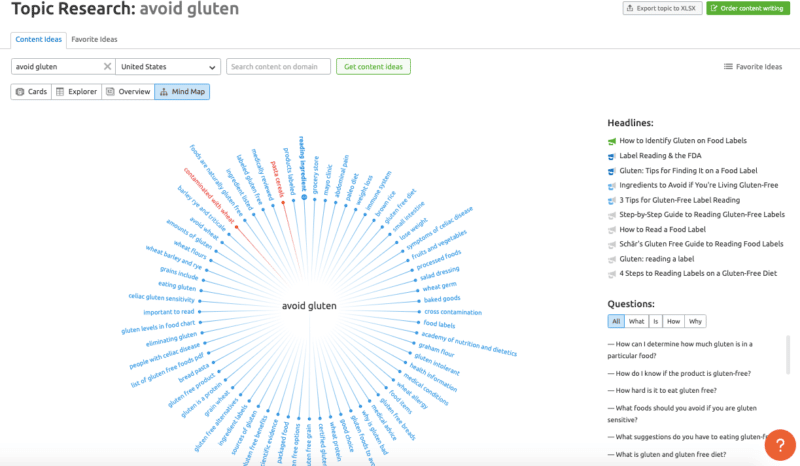
Semrush topic research - avoid gluten

Olga Andrienko, well-known for her leadership role at Semrush, showcased the success story of LiberEat, made possible by Mich McClure and the team behind Hoojy. 

“1000% organic traffic growth in 3 months”.

While this might sound too good to be true, especially given the approximate numbers, she goes to great lengths to highlight what happened, why and how in her extensive Twitter thread.

If that’s still not enough, check out the full-fledged case study with lots of screenshots, keyword examples and figures over at Semrush.

Example 3: Unbeatable Blinds

The folks over at Boom Online have many case studies, but their campaign for Unbeatable Blinds made me feel good. It might be the artistic quality of the images they have shared as part of the campaign. 

While they did not divulge the numbers, the links they attracted speak for themselves:

“The content was covered by a number of high-profile publications such as Design Taxi, Bored Panda, Line Today & The York Press among others.”

Given such attention from popular blogs and local press alike, I’m confident that the traffic and other metrics will follow suit.

How to get clients who are proud to work with you

As a writer, I do not offer ghostwriting services.

Ghostwriters tend to become invisible. Someone else gets the credit for their work.

Nobody knows what they have done, so they can’t prove their expertise. 

It’s pretty straightforward when it comes to writing.

Potential clients usually tell you upfront that they are looking for a ghostwriter. You can just ignore such offers unless your financial situation forbids you to.

With SEO services, it’s much trickier. Nobody will tell you they are looking for a “ghost optimizer.” 

Often, after plenty of discussions and only when you are short of signing a contract will you get a cryptic NDA full of legalese meant to hide its true scope.

In other cases, you get the NDA, or they don’t talk to you at all. Either way, you risk losing a lot of time and money and not getting the client.

Some NDAs are meant to protect trade secrets. Yet, most of them usually grant sweeping powers to the client to ban you from disclosing much of anything. 

No wonder people working in SEO and adjacent industries (think marketing or advertising) are simply shutting up in general in order not to breach their agreements.

You never really know what goes too far, so you play it safe by keeping quiet.

So what can you do to identify clients who undermine your status as an industry expert? 

You can prepare upfront, be clear during the preliminary talks and stand firm once you start working. Below are four specific tips.

Work on your own projects first

Always work on your projects first or at least keep them going in the background. 

Once you have independent revenue sources and ways of gaining status outside client work, you can rest assured when choosing to engage with others.

Having to work for third parties out of necessity is never a good place to be at. 

Whenever possible, work for others because you love the challenge and variety, not because you need the money. Ideally, clients seek you out because they are fond of your personal projects.

Build your authority in the industry and beyond

Visibility is not limited to client work. Many practitioners attend conferences, trade fairs or meetups to show up and teach others what they know.

Some hoard knowledge and keep it to themselves so that nobody can “steal their ideas.” This is a short-sighted approach. 

Ideas can be discovered by more than one person at any given time. But the one who publishes it first or does so more widely is usually credited with the “invention.” 

It’s crucial to become an authority within your industry, and beyond the narrow field you specialize in. 

When I started out in SEO, I made sure to keep branching out into broader yet more popular areas like web development, marketing and blogging. 

SEO is often viewed as merely “technical SEO” and a small subset of actual search engine optimization, in my opinion. The number of people interested in what you are talking about is very small.

By sharing your knowledge, you are enabling those unfamiliar with your work to understand what you do. 

Introverts can share and teach on the web. You don’t have to show up in person, shake hands and pat backs.

You can also network online with like-minded individuals. LinkedIn is your best bet here.

Charge more for ‘ghost optimization’

A simple yet powerful way to make a point is to charge more money for something harder or more valuable. 

Usually, ghostwriters are underpaid young writers who have no name yet so that they are forced to write in the shadows of the bigger names. But once you’ve built a name for yourself, you have to be proud enough to charge accordingly. 

Almost nobody will think you are valuable as long as you undercharge or are too timid.

The few who know will be glad to exploit your expertise for low fees and shut up about your true worth in most cases.

Similarly, you have to make it clear that you charge more for ghost services from the start.

With “ghost optimization” being much more complex and riskier than mere writing, it’s even more important to charge your true value.

There are far fewer high-quality SEO practitioners out there, so don’t be afraid to get what you deserve.

Flatly refuse to do the dirty work 

Once you have worked with a client for a while, some drop their masks or become more daring.

Others might get frustrated with the slow pace of SEO progress and demand you do what the competition does. 

Riskier tactics may get their domain banned or penalized, but in the short term, the results may look impressive. 

Now you have to keep your integrity. How?

Flatly refuse to make your hands dirty and to use questionable means of SEO. 

The client feels safe due to the NDA, so they think they can get away with it. But SEO does not happen in a vacuum. 

Just because you don’t tell anybody that you have to spam doesn’t mean it’s invisible. 

As noted above, publicly available tools give you an X-ray vision of any website’s SEO.

Google also has human quality raters and increasingly sophisticated algorithms to find the bad apples.


Opinions expressed in this article are those of the guest author and not necessarily Search Engine Land. Staff authors are listed here.


Related stories

New on Search Engine Land

@media screen and (min-width: 800px) { #div-gpt-ad-3191538-7 { display: flex !important; justify-content: center !important; align-items: center !important; min-width:770px; min-height:260px; } } @media screen and (min-width: 1279px) { #div-gpt-ad-3191538-7 { display: flex !important; justify-content: center !important; align-items: center !important; min-width:800px!important; min-height:440px!important; } }

About the author

Tadeusz Szewczyk

Tadeusz Szewczyk, also known as Tad Chef, is a professional blogger and SEO since 2004. Even though based in Berlin, Germany he has covered blogs, social media and search for a global audience starting in 2006. In 2007 he launched his own blog – SEO 2.0 – and also published on numerous other marketing blogs ever since. In recent years he wrote for the social media accounts of many clients as well. You can connect with Tad on LinkedIn and Twitter or visit his website and read his blog about social SEO.

https://searchengineland.com/why-seo-experts-rarely-share-actual-success-stories-390201


5 SEO Best Practices for Retailers This Holiday Season

Opinions expressed by Entrepreneur contributors are their own.

With the emerging economic globalization, we see a rising trend of online shopping and ecommerce. Global ecommerce sales amounted to around $5.2 trillion worldwide in 2021 and are expected to grow by 56% over the following years, reaching about $8.1 trillion by 2026.
The holiday season is upon us, and ecommerce SEO during these times has always positively impacted profit and revenues for retailers. With emerging trends in SEO, we need to keep ourselves up to date with SEO best practices to stay competitive.

Ecommerce SEO best practices in 2023

An ecommerce website facilitates buying and selling goods digitally, and it is estimated that 95% of all purchases will occur through ecommerce stores by 2041.

Thus, ecommerce stores are the most profitable digital business strategy for retailers. But, establishing an ecommerce website and putting together the proper marketing is more challenging than it sounds and has many challenges.

Studies showed that the ecommerce store success rate is only 10-20%. Shopify released research that said one-fifth of all ecommerce businesses that started in 2016 closed after their first year in operation.

So, if you have an ecommerce website and want to yield revenue through it, you may have to struggle with its success unless you follow the right ecommerce SEO practices to design and optimize it.

With the following SEO best practices, you can carry out your ecommerce store optimization:

Related: How to Build an Ecommerce Brand in a Crowded and Competitive Industry

1. Keyword research

Conducting keyword research is the most important step in SEO for ecommerce websites. Optimizing your ecommerce website content with the right keywords yields outstanding results in the long run.

Keyword research involves finding those words that users enter into the search engine when are trying to find your products or services.

Your target keyword has to fulfill four standards:

  • Significant search volume
  • High relevance
  • Strong conversion value
  • Adequate competition

Using long-tail keywords can increase conversion rates and rank your website more easily. A long-tail keyword is a term that has low search volume but fulfills the criteria for relevance to your business. People searching with long-tail keywords are usually out with a buying intent, which is why these keywords tend to generate higher conversions or yield high returns on investment.

So, consider including relevant long-tail keywords in your marketing research as you optimize your ecommerce store.

2. Optimize product pages

A product page is a page on your ecommerce website where your prospects view your products. This page contains all the details about your product that a customer might be interested in before making a purchase, including product images, related information, pricing, shipping details and reviews.

After conducting thorough keyword research, you can use your researched keywords to create content for the product pages on your website. A product page with well-optimized content can drive traffic with a strong buying intent to your website.

The product page contains product descriptions, images, videos and reviews. Your product page can be optimized by:

  • Using high-quality images that a user can zoom, pinch and see from different angles.
  • Detailed video about the product.
  • Keyword optimized in product titles and writing rich text descriptions.
  • Adding testimonials from other consumers.
  • Adding CTAs (Call-to-actions)

3. Premium quality product images

How often have you bought an online product after viewing poor-quality images? The chances are low.

The same is the case with other consumers. Product quality influences how customers perceive your brand, consequently impacting their purchase decision. Poor-quality product photos threaten to drive customers away from your store. High-quality product photos, on the other hand, attract people and convince them of your product’s worth.

Therefore, using multiple high-quality product images makes your website look appealing and optimizes your store for SEO. This is because a well-optimized image gets better visibility in Google Images and brings more traffic to a website. It also improves user experience by making a website easier to navigate.

Related: 10 Reasons Ecommerce Sites Fail

4. Website personalization

Website personalization provides your site visitors or buyers with unique experiences tailored to their demands and desires.

86% of customers admit that website personalization influences their purchase decision. This is why personalizing your product recommendations according to the customers’ interests may increase their chances of buying from your store.

For example, personalization on ecommerce can be done using data analytics, which could show customers similar products based on their browsing preferences or even show custom offers that can be used to upsell other items.

5. Simplify the checkout option

A 2021 study suggested that 83.48% of online retail orders were abandoned during the checkout process in 2020.

While there were several reasons for shopping cart abandonment, the primary reason was the complex checkout process. You can increase your ecommerce store revenue by simplifying the checkout process.

Improve your checkout landing page by providing consumers with clear shipping information, multiple payment methods and guest checkout options. This makes the consumers more likely to shop from your store in the future.

Related: How the Online Shopping Checkout Process is Becoming More Efficient

Conclusion

In the present competition, improving the visibility of your ecommerce website in the search engine space is very important to the success of the online business. The holiday season drives most of the traffic to ecommerce stores, and your site with low traffic could be a critical impact on business revenue.

Ecommerce SEO might not be able to deliver overnight success, but you will start noticing the benefits of SEO in terms of traffic and conversions. Depending on your product, you may likely compete with the big sharks.

https://www.entrepreneur.com/article/439542


Microsoft to go fully live with new Bingbot user-agent change in January 2023

Microsoft’s Fabrice Canel has said that in early January 2023, the new BingBot will be responsible for 100% of Bing’s crawling activity. The new user agent is now responsible for about 50% of all crawls.

Some history. In 2019, Microsoft Bing announced new Bingbot user-agent names that fit better with its evergreen Bingbot crawling and rendering service. Then in April 2022, Microsoft announced a name change, a user agent name change, for BingBot.

January 2023. Next month, in the coming weeks, the new BingBot user agent will be responsible for 100% of all crawling from Bing. Fabrice Canel wrote, “will go to 100% early January” for BingBot’s new name. He added they are still at 50% now because they wanted to be extra safe.

Old user-agent. Microsoft said it would stop using its historical user agent by the Fall of 2022. That user-agent looks like this:
Mozilla/5.0 (compatible; bingbot/2.0; +https://www.bing.com/bingbot.htm)

New user-agent. Bing will use a user-agent that identifies the specific version of Microsoft Edge is crawling your site. Here is the format for both desktop and mobile:

Desktop – Mozilla/5.0 AppleWebKit/537.36 (KHTML, like Gecko; compatible; bingbot/2.0; +https://www.bing.com/bingbot.htm) Chrome/W.X.Y.Z Safari/537.36

Mobile – Mozilla/5.0 (Linux; Android 6.0.1; Nexus 5X Build/MMB29P) AppleWebKit/537.36 (KHTML, like Gecko) Chrome/W.X.Y.Z Mobile Safari/537.36 (compatible; bingbot/2.0; +https://www.bing.com/bingbot.htm)

“W.X.Y.Z” will be substituted with the latest Microsoft Edge version Bing is using, for eg. “100.0.4896.127″.

Why we care. You probably should have been prepared for this change since it was announced back in 2019. But in any event, this change can impact your site if you have any user agent detection methods for BingBot. Make sure to test your site to see if it supports the new user agent. Most sites probably do not need to worry about this, but if you have done any advanced bot detection, you may need to take steps to update those scripts.


Related stories

New on Search Engine Land

@media screen and (min-width: 800px) { #div-gpt-ad-3191538-7 { display: flex !important; justify-content: center !important; align-items: center !important; min-width:770px; min-height:260px; } } @media screen and (min-width: 1279px) { #div-gpt-ad-3191538-7 { display: flex !important; justify-content: center !important; align-items: center !important; min-width:800px!important; min-height:440px!important; } }

About the author

Barry Schwartz

Barry Schwartz a Contributing Editor to Search Engine Land and a member of the programming team for SMX events. He owns RustyBrick, a NY based web consulting firm. He also runs Search Engine Roundtable, a popular search blog on very advanced SEM topics. Barry can be followed on Twitter here.

https://searchengineland.com/microsoft-to-go-fully-live-with-new-bingbot-user-agent-change-in-january-2023-390710


The ultimate 2022 Google updates round up

The ultimate 2022 Google updates round up

30-second summary:

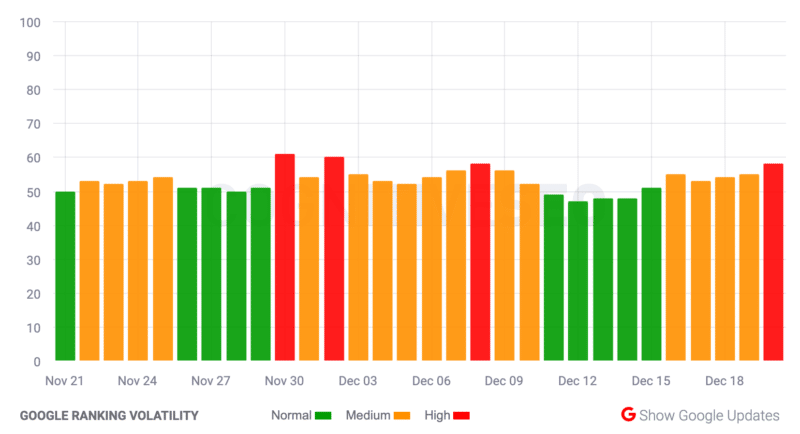
  • 2022 saw nine confirmed updates (including two core updates,) five unconfirmed instances where volatility was observed in page rankings, and one data outage that caused chaos for 48 hours
  • Video and commerce sites were the biggest winners in the May core update, while reference and news sites lost out most, especially outlets without industry specificity
  • This theme largely continued and saw ripple effects from the helpful content update
  • What were these ebbs and flows, who won, who lost? Let’s find out!
  • Joe Dawson takes us through another round-up post that gives you the complete picture of Google’s moves

Only three things are certain in this life – death, taxes, and an industry-wide hubbub whenever Google launches an algorithm update. Like any year, 2022 has seen substantial changes in how the world’s largest search engine manages traffic and page rankings, with some businesses winning and others losing out.

Arguably the most significant change in 2022 is awareness of the rise of AI for content creation, becoming a hot topic in the world of marketing software. “Helpful content” updates have intended to bolster content written by human beings, penned with consumer needs in mind, over auto-generated articles designed to game the SEO system.

Has this been successful, or is the world of online marketing set for a rise of machines in 2023 and beyond? Similar to my last year’s column, let’s review the Google algorithm updates issued in 2022. I hope this helps you decide for yourself and build your business model around the latest developments in page ranking.

Complete list of 2022 Google updates

2022 has seen nine confirmed updates to Google’s algorithms, while an additional five instances of volatility were noticed and discussed by influential content marketing strategists across the year. We also saw one major data outage that caused a short-term panic! Let’s take a look at each of these updates in turn.

1) Unconfirmed, suspected update (January)

The core update of November 2021 was famously volatile, and just as web admins were coming to terms with a new status quo, further fluctuations were noted in early January 2021. Google remained tight-lipped about whether adjustments had been made to the algorithm, but sharp adjustments to SERPs were acknowledged across various industries.

2) Unconfirmed, suspected update (February)

Again, webmasters noticed a sudden temperature shift in page rankings in early February, just as things settled down after the January changes. While again unconfirmed by Google, these adjustments may have been laying the groundwork for the page experience update scheduled for later in the same month.

3) Page experience update (February)

Back in 2021, Google rolled out a page experience update designed to improve the mobile browsing experience. In February 2022, the same update was extended to encompass desktop browsing.

The consequences were not earth-shattering, but a handful of sites that previously enjoyed SERPs at the top of page one found their ranking drop. As with the mobile update, the driving forces behind the page experience update were performance measured against Google’s core web vitals.

4) Unconfirmed, suspected update (March)

Fluxes in page ranking and traffic were detected in mid-March, with enough chatter around the industry that Danny Sullivan, Public Liaison for Search at Google, felt compelled to confirm that he or his colleagues were unaware of any conscious updates.

5) Product reviews update (March)

March saw the first of three product review updates that would unfold throughout the year. As we’ll discuss shortly, ecommerce sites experienced a real shot in the arm throughout 2022 after the core updates, so this would prove to be a significant adjustment.

The fundamental aim of this product review update was to boost sites that offer more than just a template review of consumer goods – especially when linking to affiliates to encourage purchase. Best practice in product reviews following this update includes:

  • Detailed specifications beyond those found in a manufacturer description, including pros and cons and comparisons to previous generations of the same item.
  • Evidence of personal experience with a product to bolster the authenticity of the review, ideally in the form of a video or audio recording.
  • Multiple links to a range of merchants to enhance consumer choice, rather than the popular model of linking to Amazon.
  • Comparisons to rival products, explaining how the reviewed product stacks up against the competition – for good or ill.

The product review update did not punish or penalize sites that failed to abide by these policies, preferring to list a selection of items with brief (and arguably thin) copies to discuss their merits. However, sites, that offered more detail in their assessments quickly found themselves rising in the rankings.

6) Core update (May)

The first core update of the year is always a nerve-wracking event in the industry, and as always, there were winners and losers in May’s adjustments.

The most striking outcome of this update was just how many major names benefitted, especially in the realm of ecommerce, much to the delight ecommerce agencies around the world. Sites like Amazon, eBay, and Etsy saw considerable increases in traffic and prominence following the update, perhaps due to the product review update that unfolded two months prior.

Video sites also saw a spike in viewers and positioning following the May update. YouTube videos began outranking text articles while streaming services such as Disney Plus and Hulu rose to the top of many searches. Health sites began to see a slow and steady recovery after the May core update, for the first time since the rollout of 2018’s Medic update.

News and reference sites were the biggest losers in the May core update. News and media outlets suffered the most, especially those with a generic focus, such as the online arm of newspapers. Big hitters like Wikipedia and Dictionary.com were also pushed down the pecking order. Specialist sites that dedicate their reporting to a single area of interest fared a little better, but still took a hit in traffic and visibility.

7) Unconfirmed, suspected update (June)

Minor nips and tucks frequently follow when a major core update concludes. In late June, many webmasters started comparing notes on sharp changes in traffic and page ranking. Google failed to confirm any updates. These may have just been delayed aftershocks in the aftermath of May’s core update, but the industries that saw the biggest adjustments were:

  • Property and real estate
  • Hobbies and leisure
  • Pets and animal care

8) Unconfirmed, suspected update (July)

More websites saw a sharp drop in traffic in late July, especially blogs that lacked a prominent social media presence. SERPs for smaller sites were among the biggest losers in this unconfirmed update.

9) Product reviews update (July)

A minor tweak to March’s product review update was announced and rolled out in July, but caused little impact – while some review sites saw traffic drop, most were untouched, especially in comparison to changes at the start of the year.

10) Data center outage (August)

Not an update but a notable event in the 2022 SEO calendar. In early August, Google Search experienced an overnight outage. This was revealed to be caused by a fire in a data center in Iowa, in which three technicians were injured (thankfully, there were no fatalities.)

This outage caused 48 hours of panic and chaos among web admins, with page rankings undergoing huge, unexpected fluctuations, a failure of newly-uploaded pages to be indexed, and evergreen content disappearing from Google Search.

Normal service was resumed within 48 hours, and these sudden changes were reversed. All the same, it led to a great deal of short-term confusion within the industry.

11) Helpful content update (August)

The first helpful content update of 2022 saw significant changes to the SEO landscape – and may change how many websites operate in the future.

As the name suggests, this update is engineered to ensure that the most helpful, consumer-focused content rises to the top of Google’s search rankings. Some of the elements targeted and penalized during this update were as follows.

AI content An increasing number of sites have been relying on AI to create content, amalgamating and repurposing existing articles from elsewhere on the web with SEO in mind. On paper, the helpful content update pushed human-generated content above these computerized texts.
Subject focus As with the core update in May, websites that cover a broad range of subjects were likeliest to be hit by the helpful content update. Google has been taking steps to file every indexed website under a niche industry, so it’s easier for a target audience to find.
Expertise The EAT algorithm has been the driving force behind page rankings for a while now, and the helpful content update has doubled down on this. Pages that offer first-hand experience of their chosen subject matter will typically outrank those based on external research.
User behavior As a part of the helpful content update, Google is paying increasing attention to user behavior – most notably the time spent on a site. High bounce rates will see even harsher penalties in a post-helpful content update world.
Bait-and-switch titles If your content does not match your title or H2 headings, your site’s ranking will suffer. Avoid speculation, too. Attempts to gain traffic by asking questions that cannot be answered (for example, a headline asking when a new show will drop on Netflix, followed by an answer of, “Netflix has not confirmed when >TV show name< will drop”) suffered in this update.
Word stuffing Google has long denied that word count influences page ranking and advised against elongating articles for the sake of keyword stuffing. The helpful content update has made this increasingly important. 1,000 relevant words that answer a question quickly will outrank a meandering missive of 3,000 words packed with thin content.

12) Core update (September)

The second core update of 2022 unfolded in September, hot on the heels of the helpful content update.

This update repaired some of the damage for reputable reference sites that suffered in May, while those impacted by the unconfirmed update in June continued to see fluctuations in visibility – some enjoyed sharp uptakes, while others continued to hemorrhage traffic.

The biggest ecommerce brands continued to enjoy success following this update, while news and media outlets continued to plummet in visibility. Household names like CNN and the New York Post, for example, were hit very hard.

The fortunes of medical sites also continued to improve, especially those with government domains. Interestingly, the trend for promoting videos over prose was reversed in September – YouTube was the biggest loser overall.

13) Product reviews update (September)

A final tweak was made to the product reviews update in September as part of the core update, and it proved to be unpopular with many smaller sites, which saw a substantial drop in traffic and conversions. As discussed, it seems that 2022’s core updates have benefitted the biggest hitters in the market.

14) Spam update (October)

In October, Google rolled out a 48-hour spam update. This was an extension of the helpful content updates designed to filter out irrelevant and inexpert search results, in addition to sites loaded with malicious malware or phishing schemes.

Sites identified as potential spam during the update were severely penalized in terms of page ranking and, in some cases, removed from Google Search altogether. The most prominent targets of the update were:

  • Thin copy irrelevant to the search term, especially if auto-generated
  • Hacked websites with malicious or irrelevant redirects and sites that failed to adopt appropriate security protocols
  • Hidden links or excessive, unrelated affiliate links and pages
  • Artificial, machine-generated traffic

15) Helpful content update (December)

Early in December, Google began rolling out an update to August’s helpful content update. At the time of writing, it’s too early to announce what the impact of this has been. However, it promises to be an interesting time.

The August update faced criticism for being too sedate and failing to crack down hard enough on offending sites, especially those that utilize AI content and black-hat SEO tactics.

Many site owners will be crossing their fingers and toes that this update boosts genuine, human-generated copy created by and for a website’s target audience. The impact will become evident early in 2023.

This concludes the summary of 2022’s Google algorithm updates. It’s been an interesting – and frequently tumultuous – twelve months, and one that may set the tone for the years to come.

Google will always tweak and finesse its policies, and attempting to second-guess what Alphabet will do next is frequently a fool’s errand. All the same, it’s always helpful to check in with Google’s priorities and see which way the wind is blowing.


Joe Dawson is Director of strategic growth agency Creative.onl, based in the UK. He can be found on Twitter @jdwn.

Subscribe to the Search Engine Watch newsletter for insights on SEO, the search landscape, search marketing, digital marketing, leadership, podcasts, and more.

Join the conversation with us on LinkedIn and Twitter.

https://www.searchenginewatch.com/2022/12/21/the-ultimate-2022-google-updates-round-up/


How the TikTok algorithm works: Everything you need to know

Since its initial release in 2016, TikTok has become the fastest-growing social media platform.

If you’re looking to learn more about the popular short-form video app and how your brand can use it, you’ve come to the right place.

We read TikTok’s creator guidelines and newsroom documentation, so you don’t have to. 

In this article, we’re sharing everything we learned – along with insights from the TikTokers well-versed in increasing views, engaging users and growing a following.

Find out how the TikTok algorithm works, what you need to do to create a winning video, and decide whether TikTok can benefit your brand.

In this article:

What is the TikTok algorithm?

The TikTok algorithm is a recommendation system that determines the videos you see on your app. Like any good algorithm, it works to bring relevant content that you enjoy based on your interests.

Recommendation systems are used all around us in the digital world and not new. Many platforms, including Netflix, use them to deliver you the content you like the most.

The purpose of a recommendation system is to share content that users like based on their preferences and those of people in similar demographics.

The TikTok recommendation system and algorithm centers around the “For You” page.

What is the For You feed?

The For You feed (a.k.a., For You page or FYP) is a curated stream of videos, a unique and tailored feed to the user’s interests.

Although TikTok users will see the same videos, your FYP is totally unique and curated only for you. 

When you open the app, you land on this feed first. The great news is that you can curate your own FYP by interacting with the app. 

When you first join TikTok, your FYP will likely be curated by the interests within your demographic based on the information you gave (i.e., age, gender and interests).

It’ll be a broad approach until you show TikTok what you want to see more of.

Let’s take a look at the actions that influence the algorithm.

How does the TikTok algorithm work?

TikTok documentation states three core factors that influence the algorithm:

  • User interactions.
  • Video information.
  • Device and account settings.

1. Factor: User interactions

User interaction includes actions that users take on a particular video. These interactions can be negative or positive.

A positive interaction will cause the app to show you more of the same, and a negative interaction will do the opposite. More on negative actions and their impact on “What the algorithm won’t show.”

Positive interactions include engagements like:

  • Posting a comment.
  • Following an account.
  • Liking a video.
  • Video watch time.

As a creator, knowing how the TikTok algorithm works means that you know what to ask from your viewers to increase the right sort of engagement. 

User interactions in practice

User engagements are certainly a factor in the algorithm, and TikTokers know it.

The TikTok algorithm got it right when it put the below viral video on my FYP a few weeks ago. I don’t engage with TikTok videos very often, but I did like the below video and left a comment about how wholesome the content was. I didn’t want to follow the creator, but I enjoyed the brief interaction.

@brialem

🍅🥪

♬ original sound – bria lemirande

The video amassed 785,200 links, 9060 comments, 76,900 saves and 5,579 shares. Most impressively, the video has 6,000,000 views.

Thanks to my like and comment, when the creator made a second, similar/follow-up video, it landed on my FYP.

The second video didn’t quite have the same magic, but the virality of video one certainly helped the creator’s second video land in the right places based on previous user interaction.

To TikTok’s credit, there seems to be a level of trust in the TikTok algorithm. 

On some of the most engaging videos – or videos made in a series – you’ll often see comments like, “Trusting the algorithm to bring me back.”

TikTokers might comment something like this when they want to show the algorithm that they’re interested in the content but (perhaps) don’t want to follow the creator.

In the video below, a creator reminds viewers they can hit the follow instead of trusting the algorithm. A follow is a desirable action for creators as it almost guarantees the user will see more of their content. 

@molzysketch its there for a reason guys 🤨 #tiktokartist #tiktokart #handsofthedsmp ♬ Luna, amore e no – Piero Piccioni

How to encourage user interactions

As a creator, you want to encourage user interactions. You can achieve this by creating great content, but you can inspire meaningful action from passive viewers with a call to action.

TikToker Tyla Brimblecombe from Styla Socials explains the importance of a call to action in her TikTok.

@stylasocials 3 more quick points in the comments 🤌🏼 Send this to someone who would benefit from this 🤍 #tiktokcontentcreator #viraltips #growontiktok ♬ In a French Cafe – Relaxing Piano Waltz – Classical Piano Music Masters

She says:

  • “We all know the most important metric on TikTok is watch time… someone is scrolling on the For You feed, they see your video, they like it, they make it all the way to the end. When they see your call to action, ‘take a look at my other videos,’ they click on your profile, they check out your other videos, which lets TikTok know your content is valuable and is going to push your content out to a wider audience.”

2. Factor: Video information

According to TikTok documentation, video information includes:

  • Sounds
  • Captions
  • Hashtags
  • Video descriptions
  • Text overlays

Video information in practice

TikTok is well known for its association with trending sounds. With a trending sound, the TikTok algorithm can identify a group of people who are likely to engage with a video based on previous user interactions. If a user watches a video to the end each time a certain sound is used, they are likely enjoying the content and want to see more of it.

It’s important to note that trending sounds are not just viral dances. Brands can use sounds to get fast visibility to a wider audience.

Kristyn Higginson, Skinician’s TikTok creator, says:

  • “Creating ‘viral’ content seemed challenging in the early days as a lot of the trending music wasn’t available for business accounts. The way around this was to opt for trending sounds when we wanted to create relatable, relevant content for the platform. This meant, as a brand, we leaned into trends without any copyright infringement. This might be a useful tactic for other small brands in the early stages of content creation on the platform.”

With early adoption of a trending sound, Skincian’s most viral video received 50,900 views, 2,142 likes, and 40 engaged comments. The video introduced the brand to their TikTok audience.

@skinician Get to know us! ☘️👏🏼 #skinician #skincare #localbrand #beautytok #skincaretok ♬ เสียงต้นฉบับ – [FS]ICHIGO_TH 🎗️🇰🇷 – 「 saijoutakato7 」°• ⚘

TikTok creators are finding that video information contributes significantly to video success. 

Kate Smoothy from Web Hive Digital is a TikTok creator.

Smoothy shares that captions, hashtags, and video descriptions are a core part of her strategy. She says:

  • “I can’t express enough how much you have to caption your videos. This is essential for those without hearing but for those who prefer to scroll through TikTok without the sound on. You’ll significantly reduce your audience size and reach without captions. There has never been a better time to include keywords in your TikTok descriptions. We’re seeing a huge shift with the platform where videos optimized for their search feature seem to perform better.”

Smoothy credits the inclusion of video information tactics with the success of her “super low effort marketing hack video.”

@webhivedigital Not enough people know about this super low effort marketing hack to get interactive video on your website. I’ve got it on mine 👀👀👀 #websitetips #websitetipsandtricks #digitalmarketing #marketingtips #websitesyouneedtoknow ♬ original sound – Kate Smoothy | Websites & SEO

The video has 92,400 views, and amassed 5,913 likes, 91 comments, and 740 shares. 

The keywords used in the video description, within the text overlay and within the video description have communicated to TikTok what the video is about. This resulted in the video ‘ranking’ for the search term ‘marketing hack’ and ‘marketing tips’ within TikTok’s search feature. 

How to use video information 

The top tip from TikTok experts is to conduct keyword research using the TikTok app, then use keywords in your video, captions and hashtags.

@socialby.lu Take advantage of the search bar results to see what others are looking for and create content to attract the right audience, make your account relevant, get more views and more followers! This is the easiest way to create a TikTok strategy aligned with your niche and according to the platform’s enhanced SEO! #tiktokseo #tiktokcontentideas #contentcreatortips2022 #growyourtiktok #socialmediastrategist #ugccreator #socialmediatipsandtricks #greenscreen ♬ Hold Me Closer – Elton John & Britney Spears

3. Factor: Device and account settings

TikTok is clear that device and account settings receive lower weight in the algorithm. 

Some of the more obvious factors include language preference and country setting. It makes sense that users want to see videos in the language they speak.

TikTok also includes device type in its algorithm. They may prefer to show you videos that your device can play seamlessly since this would lead to a positive user experience for people using older phones or smaller screens.

Keywords and the TikTok algorithm

In recent months there has been a lot of talk from TikTokers about a change in the TikTok algorithm and how TikTok now prioritizes keywords.

If you search “TikTok Algorithm Change,” you’ll find people saying a lot of the same thing – TikTok SEO is becoming more prevalent. 

@coach.alexrob NEW algorithm changes for TikTok! If you are a business owner or content creator, in this video I break down all the new changes happening to TikTok, you definitely want to make sure you are using some of the key features such as SEO, improved analytics and making your content longer form. #tiktokforbusiness #tiktokforcreators #socialmediaforbusiness #tiktokseo ♬ Trap Sax – Nish

Interestingly, TikTok doesn’t seem to mention “keywords” in relation to their algorithm anywhere in their documentation.

But that doesn’t mean that keywords aren’t important.

It’s no coincidence that TikTok increased video descriptions to 2,200 characters. In their announcement via the app, TikTok did say:

“Increased characters gives creators a chance to ‘generate engagement while becoming more searchable and better recommended by TikTok to viewers.”

TikTok also mentions captions and hashtags, which both contribute to FYP.

Captions and hashtags are words that help contextualize videos. If captions are a contributing factor, it suggests that words – or keywords – contribute to the TikTok algorithm. 

We also know that TikTok users can limit content based on keywords (more on that later).

TikTok SEO and Google

To further explore TikTok SEO and how this transpires on the world’s most loved search platform, Google. We ran some tests to explore Google’s indexation of TikTok videos.

When you search for “TikTok recipes” on Google, you’d expect to return TikTok videos. But what we found was the contrary. 

Google prioritized websites sharing TikTok’s viral recipe trends. TikTok ranked with a tag page in the eighth search position. Considering the relevancy to the search term, this isn’t an overly strong rank.

In the Video results, TikTok ranked sixth below five YouTube videos. It makes sense that Google would prioritize its owned channel, YouTube, above TikTok.

It is worth noting that videos featured in the TikTok recipes tag all featured the hashtag #recipes in the caption. Captions help the TikTok algorithm sort videos by topic and could even boost visibility via Google search.

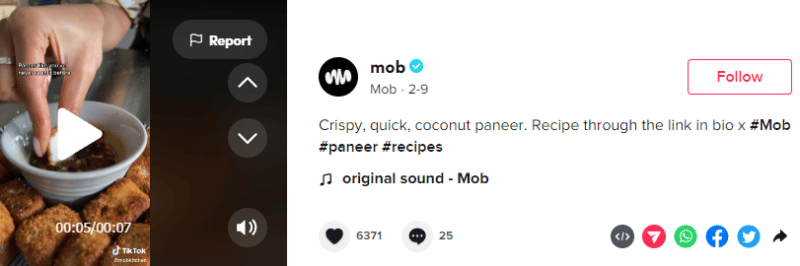
Paneer recipe screenshot from TikTok video that ranked within the TikTok Recipe Tag.

As shown in the screenshot, the caption includes the hashtag #recipes, suggesting that keywords are relevant to the TikTok algorithm.

So, what does this mean?

  • Creators should use relevant keywords in their captions and hashtags.
  • According to TikTok documentation, captions and hashtags are contributing to the TikTok algorithm.
  • For increased visibility in Google, consider sharing your video on other platforms, like YouTube Shorts.

Get the daily newsletter search marketers rely on.


TikTok algorithm myths debunked

Let’s clear up some commonly held misconceptions about TikTok.

Myth: You need to post daily

Posting 1-3 TikTok videos daily is a common recommendation for new TikTokers. However, TikTok’s guidelines make it clear that it’s not required for growth.

That said, it may be useful to test different videos. TikTok’s documentation advises that experimenting with videos you share and posting quality content is more useful to keep an audience engaged.

Myth: Creators in the TikTok Creator Fund get more discoverability

The good news is: you do not need to be in the creator fund to increase your chances of discoverability. 

Those in the TikTok Creator Fund are more likely to earn increased engagement, but this is because these TikTokers know how to create great content that engages the community.

Myth: TikTok is only for short-form videos

Although TikTok started as an app with seven-second videos, the maximum video length has since increased. 

Within the app, you can create videos that are 15 seconds, 60 seconds, or three minutes long.

Alternatively, you can create extended videos and upload them to the TikTok app.

TikTok doesn’t mention longer videos earning favor in the algorithm, but they do seem to be sharing reasons why longer videos are engaging with creators.

@rachforaday make longer videos to get more views – it’s not me saying it – it’s the algorithm ! #tiktoktips #socialmediatips #makelongertiktoks #tiktokhacks #getmoreviews ♬ longer TikToks getting more views – Rach • Social SEO Expert

What the algorithm won’t show

To give TikTok credit, it’s taking action to safeguard and diversify recommendations in the FYP. 

With a recommendation system, it would be easy for TikTok to become repetitive, showing only similar videos. Equally, it could be easy for TikTok to show unwanted content to its viewers. 

TikTok is taking measures to make TikTok a better place for everyone. Here’s what TikTok won’t show in the FYP.

Duplicate content

TikTok says that too much of anything can get tiresome.

For this reason, TikTok won’t show duplicate content in the FYP. Plus, diversifying the FYP keeps users exposed to a range of ideas and perspectives. 

Potentially problematic clusters

The TikTok algorithm works to deliver the platform’s mission to inspire creativity and bring joy. 

To achieve this, TikTok avoids recommending similar content around potentially problematic subjects such as extreme dieting or fitness, sadness, or breakups. 

TikTok wants to protect its users from viewing content that may cause distress if viewed together but might be okay as a single video. 

This type of restriction is positively compounded by the “not interested” and “keyword filtering” features.

Content marked ‘Not interested’

TikTok lets users control what they want or don’t want to see on the platform. 

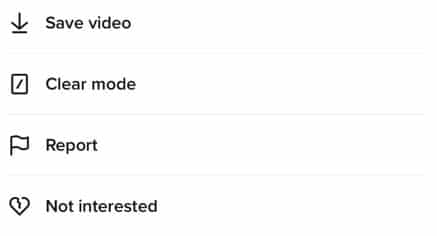
Viewers can press and hold the screen on any TikTok video and select any of the following options:

  • Save video: A positive video engagement indicator for the algorithm.
  • Clear mode: View videos without usernames and captions, etc.
  • Report: This action indicates that a video goes against TikTok’s Community Guidelines and must be addressed.
  • Not interested: This tells the TikTok algorithm that you, as a viewer, don’t like a particular piece of content. In return, you will see less of it.
Screenshot of the TikTok menu with four items: save video, clear mode, report and not interested. All, but clear mode, influence the algorithm.

If a viewer clicks “Not interested,” you can expect this to influence the algorithm and their FYP.

Content including filtered keywords

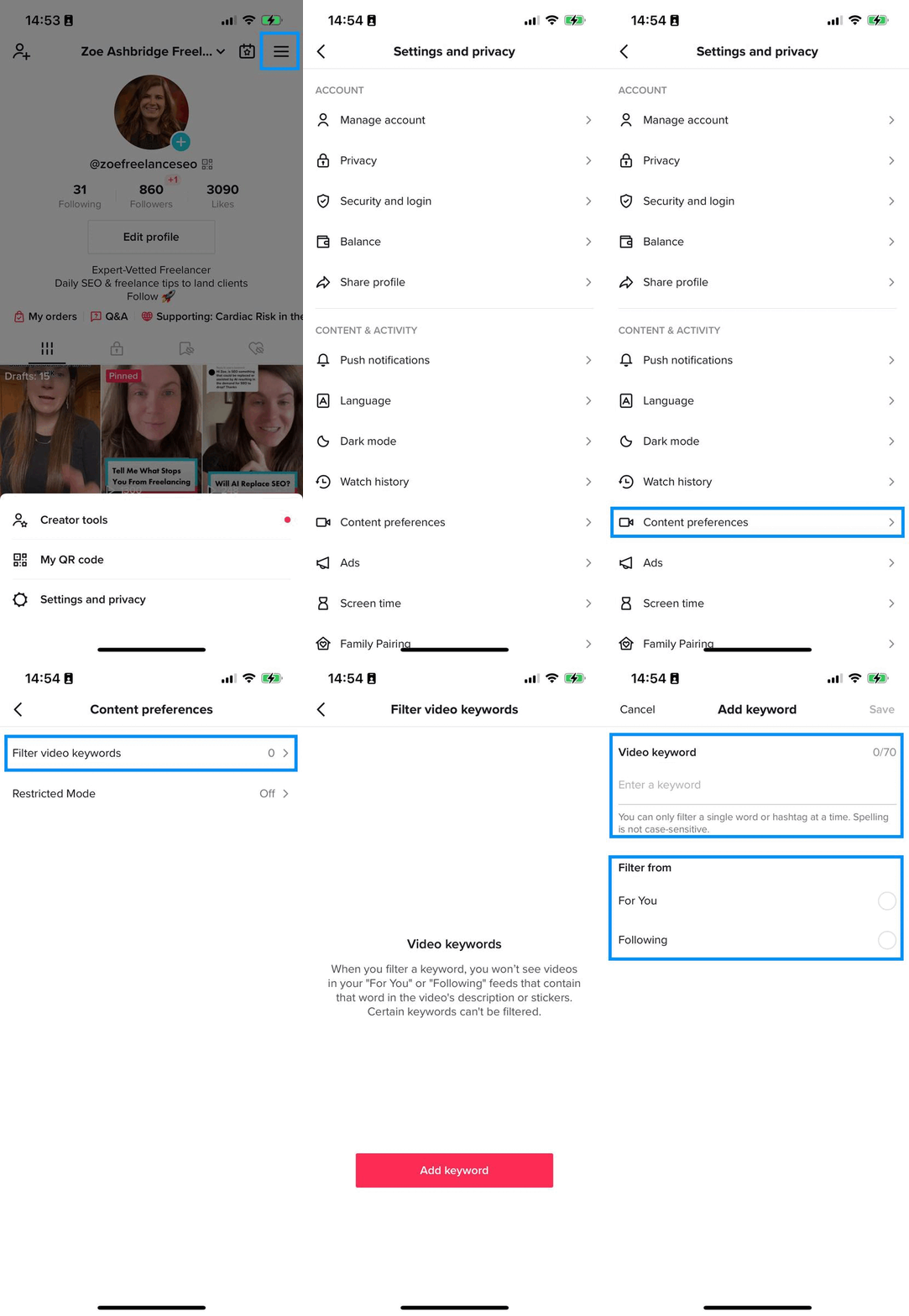
Users can tell TikTok what they don’t want to see by heading to the menu in the top right and navigating to Settings and privacy > Content preferences > Filter video keywords. 

Here, you can add keywords and filter videos from users you’re following and/or the FYP. 

Gif of the process of filtering videos by keyword.

Content created by those under 18

In its commitment to keeping the app a safe place for all, TikTok introduced measures to protect its younger users. 

Children or teenagers under 18 can’t feature content on the Explore feed – meaning their content and profiles are not so easy for other TikTok users to come across.

7 tips for working with the TikTok algorithm and going viral

Some top TikTok creators provide some best practices for creating video content that might gain the algorithm’s favor. 

Tip 1: Switch to a TikTok Pro account

TikTok Pro Accounts provide more detailed analytics to creators. 

By creating one, you’ll be able to see insights on:

  • Weekly and monthly views.
  • Follower growth.
  • Trending videos.

If you’re a lover of in-depth analytics, this might be for you. 

But it’s important to note that TikTok’s guidance advises against creating content primarily around analytics. Instead, think of the bigger picture when creating content.

Tip 2: Find your niche

Finding a niche on TikTok gives you a greater understanding of the bigger picture. 

If you know what niche you fall into, you can explore topics using the search bar and see exactly which videos perform well, so you can recreate something like them.

@secretsocialari You Just Need To Learn The Right Way! #tiktokgrowth #tiktokgrowthtips #socialmediatips #viraltiktok ♬ Lookmeinmyeyes – Iloveslowedmusic🧸

Tip 3: Use the right hashtags, add captions and write video descriptions

Keywords clearly have advantages, as shared above. 

Remember to opt for hashtags highly relevant to your video or niche for a chance to feature in the top lists for keywords.

@brooklynsocial.co How to find trending hashtags for your niche @Brooklyn Social | TikTok Coach @Brooklyn Social | TikTok Coach #trendinghashtags #socialmediacoaching #marketingtips ♬ original sound – Brooklyn Social | TikTok Coach

No matter how much the algorithm changes, music and trending sounds are likely to have a place on the TikTok platform. 

Remember, trending sounds and music aren’t always about voiceovers and viral dance moves. 

You can use them to introduce your brand, make them relatable in your niche and stand out.

Tip 5: Create high-quality videos 

TikTok’s editing tools allow users to create and edit eye-catching, high-quality videos within the app. 

TikTok creators express the importance of creating engagement early on, so try to edit your videos in a way that captures the user’s attention in the first three seconds.

@jimmy_talbert 9 video hook templates. #marketing #socialmediamarketing #videomarketingtips #tiktokmarketing ♬ Shout Out (No Vox) – Chris Alan Lee

Tip 6: Engage with other TikTok users

Your comment section is a trove of video ideas! And you can reply to comments with a video. 

This feature puts your reply in the comment section in video format. 

You can bet other commenters have the same questions, so they’re likely to click through and join you in your next video.

Tip 7: Publish a series

Somewhat contrary to the long-form video format, shorter videos in series can still be effective. 

Henry Purchase from A Couple Things To Do has grown a TikTok following to 193,000 followers. Purchase shares destination and activities for couples. He says:

  • “We post several videos of the same activity, uncovering more information each time – this keeps people coming back for more. For example, at first, we didn’t post the location of our most popular video. Once it had gained popularity we used comments we got to create more content. Therefore reusing content and engaging with our audience.”
@acouplethingstodo Replying to @metaltirana_al our most popular question answered! Have you guys been? ✌🏻 #milan #fyp #italy #qctermemilano #stormroom #travelcouple #acouplethingstodo #traveltips ♬ original sound – Ian Asher

Why brands should care about TikTok

Love it or hate it, TikTok is standing the test of time as its generous algorithm lends itself well to fast growth. 

With a little commitment, brands can reach thousands of people in no time.

Although high-quality videos are preferred, simple to-the-camera videos can earn just as much visibility.


Opinions expressed in this article are those of the guest author and not necessarily Search Engine Land. Staff authors are listed here.


Related stories

New on Search Engine Land

@media screen and (min-width: 800px) { #div-gpt-ad-3191538-7 { display: flex !important; justify-content: center !important; align-items: center !important; min-width:770px; min-height:260px; } } @media screen and (min-width: 1279px) { #div-gpt-ad-3191538-7 { display: flex !important; justify-content: center !important; align-items: center !important; min-width:800px!important; min-height:440px!important; } }

About the author

Zoe Ashbridge

Zoe Ashbridge is a Senior SEO Strategist and Co-Founder at forank. Zoe has a background in digital marketing and digital project management. Zoe supports businesses worldwide with actionable SEO strategy for internal teams, consultancy and search engine marketing implementation. Zoe writes about SEO, Digital Marketing and Entrepreneurship.

https://searchengineland.com/how-tiktok-algorithm-works-390229


Ranking data during the December 2022 Google helpful content update and link spam update

Google is now rolling out two different Google search algorithm updates simultaneously, the December 2022 helpful content system and the December 2022 link spam update. The helpful content update started on December 5th, and the link spam update started on December 14th. Both updates are not finished rolling out, in fact, Google said that the helpful content update “is going to take longer” to complete than the two-week timeline previously given.

I asked several data providers to send me data on what they are seeing with the Google search results during these updates, keep in mind, it is somewhat hard to look at data in aggregate and say this ranking volatility is related to one update over another. But nevertheless, I wanted to share what the data providers are noticing.

Data providers

RankRanger. Let’s start with RankRanger who sent us data broken out by the start of each update. Generally, but not always, the first few days after an update is rolled out by Google is where you’d see the most volatility. So they went with that premise and sent us data on each update.

Here is an overview of the RankRanger risk index showing volatility by day:

The December 2022 helpful content update was less impactful and less volatile than the first helpful content update, according to RankRanger. You can see from the chart below the average position change was less in December than in August.

Diving deeper, you can see that the average top three, top five and top ten search results, the data says the December update fluctuations were lower in the top five results and substantially lower in the top three.

RankRanger also showed the volatility of the December helpful content update by niche or industry:

The December 2022 link spam update was less impactful and less volatile than the July 2021 link spam update, according to RankRanger. You can see from the chart below the average position change was less in December than in July 2021.

Diving deeper, you can see that the average top three, top five and top ten search results, the data says the December update fluctuations were lower in the top five results and substantially lower in the top three.

RankRanger also showed the volatility of the December link spam update by niche or industry:

Semrush. The folks at Semrush did not try to break it out by the helpful content update versus link spam update, and I don’t blame them for not doing that. They just had their data for the past few weeks since that is when the two December algorithm updates began.

The Semrush sensor has been pretty calm, with a little blip today into the “high” volatility range:

If you drill into each niche or industry, you will see some categories were more impacted than others. It is interesting to see it differ by mobile and desktop search:

SISTRIX. SISTRIX also sent over some data in a different format. Steve Paine from the company told us that they did find evidence of volatility in their data for the link spam update but when it came to the helpful content update, finding such evidence was harder. He said “overall there isn’t a huge movement in SERPs,” the company posted some examples on their blog.

SISTRIX sent me these two additional examples of specific sites hit by these updates:

Moz. Dr. Pete Meyer from Moz told us, “I’m seeing some pretty heavy algorithm flux over this past weekend,” but he has not have had enough time to dig through all the data. Overall, Moz data shows that it has been “a noisy month, Google-wise,” he said. The issue is that it “hasn’t been easy to separate things,” like the other data providers showed as well.

You can see that Mozcast showed a lot of hot weather on December 14th, which is likely related to the link spam update.

seoClarity. The folks at seoClarity sent me a graph showing the day-over-day change in Google search results they calculated across all the keywords in their data. They noticed a spike on December 2nd and then “gyrations” on the 7th, 8th, and 9th and then a massive change on December 15th.

Other data providers. Here is a list of other data providers charts that are available publicly.

SERPmetrics:

Advanced Web Rankings:

Accuranker:

CognitiveSEO:

Why we care. As I said above, both updates are still rolling out at the time this was published. It is very hard to accurately say that one ranking change in aggregate is related to a specific ranking update when both are rolling out at the same time. That being said, it is likely easier to look at individual sites and know if the site was hit by a link algorithm versus a helpful content algorithm, especially if you look at the links and content for that site.

So you will need to do the due diligence and dig into sites impacted by each update on an individual basis. This just shows you that it appears that these updates did show movement and did cause ranking volatility in aggregate.


Related stories

New on Search Engine Land

@media screen and (min-width: 800px) { #div-gpt-ad-3191538-7 { display: flex !important; justify-content: center !important; align-items: center !important; min-width:770px; min-height:260px; } } @media screen and (min-width: 1279px) { #div-gpt-ad-3191538-7 { display: flex !important; justify-content: center !important; align-items: center !important; min-width:800px!important; min-height:440px!important; } }

About The Author

Barry Schwartz

Barry Schwartz a Contributing Editor to Search Engine Land and a member of the programming team for SMX events. He owns RustyBrick, a NY based web consulting firm. He also runs Search Engine Roundtable, a popular search blog on very advanced SEM topics. Barry can be followed on Twitter here.

https://searchengineland.com/ranking-data-during-the-december-2022-google-helpful-content-update-and-link-spam-update-390620


Google Search testing search in video

Google is testing the ability to search for spoken words in a video through a new “Search in video” feature. This is officially being piloted in India, but some are also seeing this feature being tested in the United States.

The announcement. Google posted this news on the Google India blog, writing, “besides images, videos are also a rich source of visual information but it’s often hard to find something buried inside a long clip. For example, perhaps you’re watching a long video about Agra, and you’re curious if it also covers Fatehpur Sikri. With a new feature we’re piloting, you’re now able to search for anything that’s mentioned in a video, right from Search. Simply enter a search term using the ‘Search in video’ feature and quickly find what you’re looking for.”

“Use the ‘Search in video’ feature beneath a video, enter a term, and quickly find what you’re looking for within the video,” Google added.

What it looks like. Here is a video showing this feature in action:

Like Google key moments. This, at least to me, isn’t too far off from the technology Google uses for key moments in a video. Google is able to isolate what sections of a video are talking about, without even having to be fed chapters these days. Plus, with YouTube’s advanced transcriptions, it is no wonder Google Search is able to do this.

US searchers. Searchers in the United States are also seeing this feature. Glenn Gabe tweeted that he saw it as well:

Why we care. Besides this being simply cool and, for some, mind-blowing, it also shows how far search technology has come over the years. It also may mean that marketers who post videos should ensure the language used is clear and that Google is able to properly and accurately transcribe the words spoken in the video.


Related stories

New on Search Engine Land

@media screen and (min-width: 800px) { #div-gpt-ad-3191538-7 { display: flex !important; justify-content: center !important; align-items: center !important; min-width:770px; min-height:260px; } } @media screen and (min-width: 1279px) { #div-gpt-ad-3191538-7 { display: flex !important; justify-content: center !important; align-items: center !important; min-width:800px!important; min-height:440px!important; } }

About The Author

Barry Schwartz

Barry Schwartz a Contributing Editor to Search Engine Land and a member of the programming team for SMX events. He owns RustyBrick, a NY based web consulting firm. He also runs Search Engine Roundtable, a popular search blog on very advanced SEM topics. Barry can be followed on Twitter here.

https://searchengineland.com/google-search-testing-search-in-video-390565


Google market pulse for search marketers

Google market pulse for search marketers

30-second summary:

  • Google is always testing new spots on the page for SERP components
  • In simple terms, the #1 position in organic or paid ads does not guarantee that your paid ad listing will be visible without scrolling
  • Organic position #1 reported by Google Search Console is not the actual position 1 on page
  • A lot of anomalies and assumptions impact your paid and organic clicks – is there a smart way to counter this problem?
  • Leading advisor and performance marketing expert, Prasanna Dhungel unravels four key insights marketers to maximize performance marketing initiatives in 2023

Over the last two decades, Google’s search engine results page (SERP) has evolved a lot. The Google SERP, which once only had organic listings now features dynamic paid ads and other organic SERP components as well.

Currently, Google SERP has many organic features like –

  • People also ask (PAA),
  • Popular products,
  • featured snippets,
  • Google MAP,
  • image packs,
  • videos,
  • Tweets, and many more that I believe we are just scratching the surface of

Paid features currently seen on Google SERP are –

  • Shopping ads,
  • text ads, and
  • MAP local search ads

These are some paid features advertisers should not ignore if they want to build better advertising and content strategies for maximum search marketing ROI.

Monitor Emerging and Contracting SERP trends search marketers can use to boost their search strategy

Google varies the composition of SERP by keyword, geography, time of day, and device. Google is testing new spots on the page for SERP components. What does all this mean, you may ask? In simple terms, the #1 position in organic or paid ads does not guarantee that your listing will be visible without scrolling. It means that an organic position #1 reported by Google Search Console is not actual position 1 on the page. So, you have a much lower CTR than you expect, and all these impact your paid and organic clicks.

People Also Ask results across industries and products

With this dynamic nature of SERP, search marketers must understand the SERP landscape and their brand’s true rank on Google vs competition. This view will enable search marketers to deploy the right paid and SEO tactics to maximize visibility and clicks.

Based on my experience and understanding of the dynamic SERP, here are four key insights marketers should focus on to maximize their performance marketing initiatives.

1. Analyze the composition of SERP for your keywords

Marketers must understand SERP features visible for their keywords. The graph below suggests that along with organic, SERP features like PAA and popular products are taking significant real estate for “apparel” and “accessories” keywords. Search marketers that are not targeting these components will miss acquiring customers in different stages of their buying journey that are clicking on People Also Ask.

SERP-Presence

2. Monitor emerging and contracting SERP features

Marketers must understand new SERP features that have appeared and are getting popular for their keyword traffic. This helps develop a long-term advertising and content plan that targets popular SERP features.

In the last quarter, we identified Map Local Search Ads and App Install (in mobile devices) SERP features appearing in the “apparel” and “accessories” keywords. We saw growth in the popularity of PAA and popular products across many keyword groups.

Monitor Emerging and Contracting SERP trends search marketers can use to boost their search strategy

3. Keep track of above-the-fold SERP features

Understanding the SERP features visible above-the-fold real estate is critical. These insights will help marketers understand the dynamics of rising and falling SERP click-through rates. You may wonder why the clicks are declining even though your average position reported on Google Reports is improving. Such questions can be answered with true ad position in SERP.

As shown in the below graph, the usual organic component in this keyword landscape has lower above-the-fold coverage compared to SERP features like PAA and popular products.

Insights like these help marketers understand the fastest gateway to the first page above the fold position. Marketers can build a holistic search strategy to correctly allocate their search marketing budget across organic and paid SERP features.

Monitor Emerging and Contracting SERP trends search marketers can use to boost their search strategy

4. Monitor competitor’s through SERP features

Google is an ultra-competitive channel. You have many domains appear on Google SERP from aggregators to publishers to actual competitors of your business model. To build the right marketing tactics -it is imperative to understand the top domains by SERP features, their competitive tactics, and the SERP landscape changes.

From planning link building to acquiring secondary traffic to improving authority score to crafting advertising and content strategies – SERP-driven insights like these help you maximize search advertising performance.

Track and monitor Leaders-by-SERP-feature

Additionally, monitoring your top emerging competitors’ tactics across SERP formats allows you to timely optimize your advertising campaigns. As shown in the graph below, Amazon has tremendously improved its Google Shopping Ads Share of Voice from May to July 2022.

When brands like this are heavily advertising in a category, marketers will need to advertise products in categories Amazon is not aggressively pushing and come back when Amazon advertising slows down.

Time your search ads based on historical trends to optimize performance

Conclusion

Google is increasingly sharing less data. Google ad data doesn’t show advertisers which low impressions may be appearing and creeping up on your CPCs. Google search console data doesn’t show true rank, and the organic rank shared isn’t representative of the actual location on the page.

Going into 2023, it is imperative for search marketers to use SERP-driven insights to gain an edge in their performance marketing campaigns.


Prasanna Dhungel co-founded and runs GrowByData, which powers performance marketing for leading brands such as Crocs and top agencies like Merkle. GrowByData offers marketing intelligence for search, marketplace, and product management to win new revenue, boost marketing performance and manage brand compliance.

Prasanna also advises executives, board & investors on data strategy, growth, and product. He has advised leading firms such as Melinda & Bill Gates Foundation, Athena Health, and Apellis Pharma.

Subscribe to the Search Engine Watch newsletter for insights on SEO, the search landscape, search marketing, digital marketing, leadership, podcasts, and more.

Join the conversation with us on LinkedIn and Twitter.

https://www.searchenginewatch.com/2022/12/20/google-market-pulse-for-search-marketers/