Customer segmentation models to improve the performance of loyalty marketing campaigns by Comarch

Creating a loyalty marketing strategy is critical to understanding that every customer is unique. Every member has different needs, preferences, communication channels, behavior and emotions. Approaching all these unique members as one via mass communication is a big mistake when trying to scale your business. Segmenting your customers is critical to your success. But what is customer segmentation, why is it important and which segmentation models should be considered?

1. What is customer segmentation?

Customer segmentation is the practice in which marketers divide their customer base into specific groups in order to deliver more effective communication and a personalized experience. These segments can be based on one or several characteristics that clients have in common, such as demographics, psychographics, preferences, or even behavior.

For example, customers can be split based on demographics such as their age, gender or location – then these characteristics can be combined with preferences such as how they want to be contacted –  in addition to account history, say the number of transactions made in the last few months or their lifetime value. Segments can be as simple or as detailed and granular as you prefer.

Defining a customer segmentation strategy requires your organization to understand who your audience is, as well as their needs and behavioral tendencies. This will allow the right allocation of budget and resources to provide more personalized communication and make your business grow faster.

2. Why is customer segmentation important?

Defining a customer segmentation strategy will bring many valuable benefits to any business. Here are some examples of why customer segmentation should be a top priority:

  • More effective communication
    Brands that understand the importance of customer segmentation have the greatest chance of hitting their target. The messaging used for a 20-year-old female shouldn’t be the same as for a 60-year-old male. A deep analysis of your customers will lead to a more personalized experience considering the segment group and the channel they are being communicated through. Ultimately, this will translate to higher response rates and engagement.

    It is also important to consider the number of times per day and days per week a customer should be contacted. Optimizing the communication time will prevent overcommunication and its potential consequence of losing the customers’ trust.

  • Improve marketing ROI
    Effective customer segmentation also helps in allocating internal human and capital resources. Companies can determine which groups will be more and less profitable and decide which ones deserve more or less attention. The final result – your revenue will grow while simultaneously stabilizing your customer base.
  • Increase customer lifetime value
    Improving the customer experience naturally leads to increased engagement. The key is to then maintain this engagement over extended periods. Some techniques to achieve this include custom offers tailored to the preferences of specific groups. This, together with recognizing their loyalty to your brand with incentives (coupons, rewards or promotions), all lead to gaining a larger share of your members’ wallets and spend.

    While most brands tend to target their top-spending customers to reward them and maintain their engagement, it is imperative not to forget about your underperforming members. Those who gave the company a high benefit in the past and whose purchasing trend has dwindled over time can receive special attention to bring them back to their old spending habits

    Personalizing these communications depending on loyalty segments and/or trends also improves customer service and the way the business assists in customer loyalty and customer retention.

  • Product improvements
    By understanding what motivates customers to buy your brand’s products, you can tailor offers to suit client needs better. This will maximize customer satisfaction and in turn, create brand ambassadors. What is better than a happy customer recommending your brand to their friends?
  • Separate your brand from the competition
    All the customer segmentation benefits detailed above enhance clear distinctions from your competitors and prepare your brand to adapt to any and all market changes. Clients can be impulsive, and their opinions, behavior and needs can vary often. Executing customer segmentation means being ahead of the curve in terms of upcoming trends, understanding the clients’ new priorities and adapting to them.

3. Actionable strategies to implement customer segmentation

When embarking on your customer segmentation journey, you must first ask yourself, “What is the goal?” What are your brand’s unique selling points? How many members of the marketing team will be involved? Once this is established, the focus shifts to your customer base. Some tasks could include determining the audience size, the number of potential segments needed, identifying which customer will spend more and which will spend less, etc.

Then, decide what data needs to be collected and how it will be collected. Remember that this information is crucial when creating your segments and will be the foundation of the marketing campaigns and initiatives. To execute any of these segmentation exercises, you must ensure you have access to the most important piece of it all… the data!

Data can be collected in different stages throughout the loyalty lifecycle, whether mandatory upon enrollment or optional after the fact, in the form of a survey. Now, all information received will come directly and voluntarily from clients. This is what is known as zero-party data.

What’s more, these data points can be compiled into segments. It is recommended to start with a broad focus and continuously narrow them down over time. AI and ML can do wonders in unearthing and analyzing behavior and trends, as well as shaving time and resources off the shoulders of your workforce. While defining these customer segmentation models, set up the main strategy to retain and gain customers loyalty, and after that focus on acquiring new ones. 

5. Defining customer segmentation models

Customer segmentation models are the different ways in which a company decides to divide its customers. In loyalty, there is a wide spectrum of customer data points to consider, but the most relevant across the industry are:

  1. Demographic
    Demographic segmentation is when customers are divided by their social characteristics as part of the population. Some examples include age, location, gender and birthday.
  2. Psychographic
    Psychographic segmentation considers an individual’s personality, attitudes, aspirations, interests, and values. For example, in customer segmentation for fashion, the audience can be divided depending on their size, favorite store, product, and even their concern for recycled clothes. For a Veterinary clinic, it will be more interesting to know what type of animals their clients have at home. Each industry will have very distinct data points that are more important to its unique business.
  3. Customer behavior
    Customer behavior is one of the most important attributes when building customer segments. This division will allow a deeper knowledge of customer trends, habits, and product usage. Some examples are the total amount spent on transactions, the total number of transactions, the date of the last purchase, the number of points spent in the last month, the number of redemptions completed, etc. Here is where customer engagement with the loyalty program can be measured.

    Now, member activity can be tracked, and trends can be identified automatically. Thanks to artificial intelligence and machine learning, segments can be created according to customer lifetime value (CLV) trends. Just to give an in-practice example, retail customer segmentation models should focus on targeting their best performers in stores whose lifetime value is greatest, but also send out communications and promotions to those members who have had a high spend in the past, but their trend is now decreasing.

  4. Campaign responses
    Campaign response segmentation can be set up according to, for example, the way your members wish to receive communication -email, SMS, push notifications, etc.-, the channel used to enroll in the loyalty program – mobile app or web portal – or the number of referrals made to a friend. The response to the program awarding customers with different recognition tiers can be another factor to consider for segmentation.
  5. Multiple conditions
    Customer segmentation can apply to multiple different characteristics simultaneously. For instance, companies can target members by a condition as simple as membership type or by their membership in combination with their location and a purchase of a specific product. The most effective segments are as narrow and specific as possible to small groups to personalize the campaign at its lowest level.

6. Summary with CTA

Understanding your members needs, preferences and behavior is the beginning of your customer segmentation journey. Defining goals, resources, unique selling points and crucial data points will prepare your business for all segmentation possibilities. Customer segmentation helps target the right clients, who present more profitable opportunities at the right time and in the most efficient way. With it, their retention and satisfaction will be ensured, as well as the maximization of sales and revenue.

To learn more about customer segmentation models and how to build the most effective loyalty marketing strategy, request a demo with our Loyalty Experts! They will match you with an experienced Loyalty Consultant with experience in your unique market space and industry.


Related stories

New on Search Engine Land

About The Author

Comarch

Comarch is a global designer, provider, and integrator of technologically advanced yet easy-to-use loyalty management & digital marketing tools that companies can use to increase customer lifetime value, drive brand awareness and boost profits. It also delivers professional loyalty consulting services to help businesses build and run highly immersive B2B, B2C, and B2E loyalty programs and marketing campaigns that align with their clients’ needs and expectations. Having 25+ years of experience in carrying out the most complex loyalty projects, it supports some of the world’s most popular brands, including Auchan, BP, Ford, Heathrow Airport, JetBlue Airlines, and Galeries Lafayette.

https://searchengineland.com/customer-segmentation-models-to-improve-the-performance-of-loyalty-marketing-campaigns-390386


Google search retires Web Light, Google’s method to serve faster, lighter pages to people

Google has retired Web Light, Google’s mechanism to serve pages and content faster, using a more lightweight version of that page, to those with slower internet connections. Google said, “while this feature has worked as intended and enabled broader access to the richness of the web, increased affordability of more powerful smartphones has diminished the need for such functionality.”

What was Web Light. Google launched Web Light in 2015 as Google Lite, which was designed to help those with slow mobile connections on their search results page. Google would take the page, remove a lot of the heavier images and media and just show the searcher the text of the page. In 2018, Google even added a Search Console filter to see what pages were being served over Web Light.

Google’s message. As noted above, Google said, “We introduced Web Light to enable us to serve faster, lighter pages to people searching on entry-level devices. While this feature has worked as intended and enabled broader access to the richness of the web, increased affordability of more powerful smartphones has diminished the need for such functionality. We remain committed to evolving and refining the Search experience to meet the changing needs of our users.”

Web light user agent retired. With this news, Google retired the user agent for Web Light named “googleweblight.” So you should no longer see this user agent showing up in your log files.

Documentation removed. Google has also removed the help documentation for web light, so the only way to access the docs is to go to the Wayback Machine.

Why we care. A lot of publishers were not huge fans of Web Light because some felt it resulted in less revenue or no revenue. Plus, publishers do not like when their web pages and content do not look as they expect. In any event, this feature has been retired going forward.


Related stories

New on Search Engine Land

@media screen and (min-width: 800px) { #div-gpt-ad-3191538-7 { display: flex !important; justify-content: center !important; align-items: center !important; min-width:770px; min-height:260px; } } @media screen and (min-width: 1279px) { #div-gpt-ad-3191538-7 { display: flex !important; justify-content: center !important; align-items: center !important; min-width:800px!important; min-height:440px!important; } }

About The Author

Barry Schwartz

Barry Schwartz a Contributing Editor to Search Engine Land and a member of the programming team for SMX events. He owns RustyBrick, a NY based web consulting firm. He also runs Search Engine Roundtable, a popular search blog on very advanced SEM topics. Barry can be followed on Twitter here.

https://searchengineland.com/google-search-retires-web-light-googles-method-to-serve-faster-lighter-pages-to-people-390389


Facebook: A content marketing guide

Facebook is the most-used social media platform in the world. It boasts 2.96 billion monthly active users.

Most likely, you’re on Facebook and use it often. But is your business on Facebook?

Not only that, is your business on Facebook and using a content marketing strategy?

If your audience hangs out on the social media giant, you should answer “yes” to all of the above. Because just existing on Facebook isn’t enough. 

If you want to tap into the potential reach you can achieve there, you need a plan. Goals. Consistency. You need to publish the right type of content at the right time.

Let’s look at how to set up your Facebook content marketing.

How Facebook can contribute to your brand’s overarching content marketing strategy

As part of an overarching content marketing strategy, publishing on Facebook can help grow your reach and build brand awareness. It can even drive more traffic to your website and generate leads.

Because of the sheer reach of Facebook, the opportunities for connecting with your audience are far and wide. 

By establishing a brand presence there, you may be able to tap into segments of your audience that don’t exist anywhere else online.

The world's most-used social platforms - October 2022

By the way, you don’t have to spend a penny on Facebook content marketing if you don’t want to (or if you don’t have the budget). 

As long as you have the means to create high-quality content, you can post that content (and distribute other types of content) for free on Facebook.

Initial steps for marketing on Facebook: Create a Facebook Business Page

Before we go any further, first make sure you have a Page set up on Facebook. You can’t market on the platform without one. That includes advertising, by the way.

A “Page” is Facebook-speak for a business profile. These differ significantly from personal profiles, as they offer unique and beneficial features and tools tailored for businesses.

Pages also showcase business-specific information that’s helpful to your audience and customers, like a call-to-action button you can tailor to your brand and what you’d like visitors to do (“Contact Us”, “Call Now”, “Sign Up”, etc.).

Coca-Cola Facebook page

Create your page

To get started creating your Page on Facebook, use this link: facebook.com/pages/create/

You’ll need to fill out some basic information about your business, including your brand name, brand category, and a short bio. Once you have a basic Page created, you can add more detailed information and customize it further to reflect your business.

Creating a page on Facebook

Invite friends, peers, customers, etc. to like your page

Once you have your Page set up, a good first step is to invite your current customers, friends, peers, and whoever else might be interested in liking the page.

On Facebook, a Page like is equivalent to a follow. People who like your page will automatically see your posts in their feeds and be able to follow your activity, including all the content you post.

Sending out like invites is thus a quick way to notify your existing Facebook audience that you’ve established your business in a more official way there.


Get the daily newsletter search marketers rely on.


How to create a Facebook content marketing strategy

With your Page set up for your business, you can start planning out your Facebook content marketing strategy.

In general, this should mesh with your overarching content marketing strategy, with your website and blog set as priority #1. 

Why do I not recommend focusing 100% of your content efforts on Facebook?

Why Facebook shouldn’t be your #1 content marketing channel

Because you don’t own your Facebook account – not like you own your website and the content that lives there.

Who does it belong to? Facebook.

In fact, any content you post to their platform is fair game. As soon as you post or share something, your rights to that content become very limited. Meanwhile, Facebook’s rights to that content expand like a balloon:

Facebook terms and services

Building your platform entirely on the borrowed land of social media is a huge gamble. That’s why, even though you’ll spend a good amount of effort publishing content on Facebook, most of it should point back to your site.

For example, every content piece you post on Facebook can include links pointing to:

  • Your blog content.
  • An email newsletter sign-up page.
  • A lead magnet.
  • A specific landing page for a product or service.

TL;DR 

Maintaining a presence on Facebook can and should build awareness around your brand and nurture leads, but it shouldn’t be the main focus of your content marketing. 

Instead, set Facebook as the second or even third priority in your content plan, and ensure every major piece you publish there points back to your website in some way so you can capture leads.

With that out of the way, now we can get into building your strategy for content marketing on Facebook.

1. Set goals for your Facebook content marketing

What do you hope to achieve by content marketing on Facebook? 

Figure this out before you do anything else. Your goals will drive every action you take as you build out the rest of your plan.

Don’t overcomplicate it, either. Your goals can be extremely simple, such as:

  • Drive more traffic to your website.
  • Build brand awareness.
  • Generate leads.

Then, decide how you’ll track and measure your goal(s). For example, you can use Google Analytics to track what percentage of your website visitors are coming from your Facebook posts or Page over time.

2. Define your Facebook marketing audience

With goals set, next, make sure you understand exactly what your audience looks like on Facebook.

If you’ve already done audience research for your larger marketing strategy, you can rely on that here, too. Just drill down deeper to discover what goals, challenges, preferences, and habits might be particular to the people who find you on Facebook versus other channels.

If you’re starting from square one, look for insights from 1:1 connections with people who fit the mold of your ideal customer. Interview them to discover what makes them tick, the kind of content they need, and how you can help them.

If you have a pool of existing Facebook followers, use the free Audience Insights tool to find out more about them, including demographics and behavioral data. To find it, go to the Ads Manager and click on the menu icon in the left toolbar (“All tools”).

Facebook Ads manager - All tools

Then scroll down to the Analyze and report section and click Audience Insights.

Facebook Ads manager - Audience Insights

By the way, Facebook has an official tutorial for using Audience Insights if you’re unsure where to start.

3. Decide what you’ll post and how often

Once you know who you’re creating for, you can nail down what types of content you’ll post and how often.

This is important to document because it:

  • Establishes accountability.
  • Keeps your efforts focused.

Let’s start with what you’ll post. To figure it out, consider these questions:

  • What kind of content does my audience crave, and what do they like to see on Facebook?
    • Example: Your audience might like to read in-depth text posts. Maybe they prefer shareable images and infographics. Or perhaps they want bite-sized tips and short videos. Or maybe they enjoy a mixture of all three!
    • If you’re unsure about which content types will land, experiment to see what sticks.
  • What topic areas can I focus on that lean on my expertise and help my audience?
    • Example: You sell content writing services for health food brands. Your content mainly focuses on providing content writing tips and tricks around health, wellness, and cooking.

Next, determine how often you’ll post, including when.

Keep in mind best practices for posting on social media as you decide.

Facebook recommends posting at least once per week, but most experts will tell you to post 1-2 times per day, with a max total of 3-7 posts per week.

Don’t post more often than your brand can handle, however. If you commit to posting too often without the staff, resources, or time to do it, your post quality will tank, which will also tank your reputation.

Lastly, schedule posts for a specific time of day, preferably when your audience is most likely to be browsing Facebook.

You can rely on stats to find optimal post times, or you can simply experiment to see what posting times get the best engagement from your particular audience.

Facebook Global Engagement - days and times

4. Create and follow brand style guidelines

If you’re already posting content on other channels like a blog, you may have brand style guidelines defined at this point. 

If you’re starting from scratch or don’t have any guidelines, however, your next step is to create some.

Brand style guidelines lay out the voice, tone, and personality of your brand. Anyone who creates content for your brand can follow the guidelines and write in your style so your content stays consistent (i.e., it always sounds like the same person is talking/communicating) across channels.

This will help your audience not only remember your brand but also associate your brand with a specific style.

Your brand style guidelines can include:

  • Your preferred brand voice (the personality of your brand).
  • Your preferred tone (how you sound when you write/speak/communicate).
  • Punctuation and grammar preferences (Oxford commas, anyone?).
  • Rules for how to use and refer to your brand name in content.
  • Rules for using visuals in content.
  • Rules for displaying your logo.
  • Rules for writing social media posts, including how to format captions, how to use hashtags, and how to use emojis.
  • Sources of inspiration.

Document them once and keep them updated. This is a tool you can and will use over and over as you create content for all of your channels, not just Facebook.

5. Create a social media calendar

How are you going to keep track of all of your Facebook post topics, including the day/time you’ll publish each one?

How will you stay ahead of creating and posting content, so you’re never last-minute scrambling to get a post ready?

You need a social media calendar.

This handy tool is a must for every content strategy. Whether you use a simple spreadsheet or a more robust tool like Airtable, Trello, MeetEdgar, or CoSchedule, you need a calendar to organize, plan, and track your content pieces, including the day/time they’ll be published.

CoSchedule's Marketing Calendar
CoSchedule’s Marketing Calendar

Depending on your needs and the tool you choose, you can keep one calendar with tabs for each channel, or you can separate your calendars (one for your blog, one for Facebook, etc.).

A good calendar will include weekly and monthly views of your content schedule, so you can see the mix of content you have going out from a bird’s eye view. This helps you ensure you’re posting the right mix of formats with a good array of topics.

More advanced paid tools like MeetEdgar and CoSchedule even have features that let you schedule posts in advance, so you don’t have to worry about posting at the right times.

6. Engage

In the phrase “social media”, the main word is “social.”

That means, to be successful with content marketing on Facebook, you need to not just post, but also engage.

A few tips:

  • Be responsive. Respond as promptly as possible (within reason) to comments, tags, and messages.
  • Have conversations. Don’t be afraid to get more in-depth with your comments. Ask questions, offer ideas, and be friendly.
  • Give customer service. Depending on the business, many customers turn to Facebook to get in touch when they’re having a problem with a product or service. (64% of people would rather send a message than call a business.) Use customer service skills to address these.
  • Share and engage with others’ content. Keep what you share relevant to your audience, but do share, and don’t forget to drop likes and comments.
  • Hire help if necessary. Most brands hire social media managers for a reason: keeping up with all of the above plus posting regularly can be draining, and absolutely a full-time job.  

7. Track and analyze results

Whatever your goals for content marketing on Facebook, you should track your progress toward them by periodically checking out relevant data.

For example, if your goal is to build your brand awareness, you might track Page views and Page likes – both of which you’ll find on Facebook’s built-in Page Insights.

Here you’ll also find a record of all the posts you’ve published, including metrics for each one like reach and engagement. This will be super useful as you’re fine-tuning the content types and topics you post. 

The best Facebook post types for content marketing

For the highest engagement, you’ll probably need to post a mix of content types to Facebook and rotate through them. Here are your best bets.

Text posts

Although a myriad of post types have come to the forefront in recent years (short video! Live video! Stories!), text-only posts are still a strong standby.

This post type enjoys the highest engagement rate (0.13%) of all possible types, including videos.

Text-only posts are best kept short and sweet (short posts get the most views). Use them to share a hot take or ask a question.

Facebook text post

Link posts – you guessed it – include a link to content outside of Facebook.

This type of post is great for sharing your best blog content, a new product or service, a lead magnet, or even an email list sign-up page.

Sprinkle link posts throughout your content calendar to encourage your Facebook audience to visit your website. (If your website/blog is your primary content channel, this is the place where you will convert and capture leads.)

Photo posts

Photo posts feature a single image (or a carousel of images). They can include a short caption or hashtags and are the second-best type of post for engagement on Facebook.

Facebook photo post

Depending on your industry, there are lots of options for sharing photos: beautiful product photography, day-in-the-life snapshots, infographics, quotes, and more.

Videos 

Videos are incredibly engaging and communicate like no other type of media. On Facebook, there are a few different video types you can post:

  • Short videos and reels: This format is Meta’s answer to the popularity of TikTok.
  • Live videos: Stream to your followers, who can watch you and comment/interact in real time.
  • Standard videos: You can also upload longer videos, such as tutorials, interviews, demos, or webinar recordings to Facebook.

Grow your reach with Facebook content marketing

Content marketing on Facebook is a worthy addition to your overarching marketing efforts.

The platform is the most-used social network in the world, hosting billions of users monthly.

If your audience uses Facebook (and they most likely do), you should maintain a consistent presence there with valuable content to engage their interest and nurture their connection.

The key is to focus on your website and blog content first and then use Facebook as a secondary channel to widen your reach.

With smart content strategy, you’ll be able to integrate and manage your Facebook content marketing with your blog content marketing so they connect seamlessly.

Ultimately, customers want to connect with the brands they like on social media. Don’t let that opportunity get away.


Opinions expressed in this article are those of the guest author and not necessarily Search Engine Land. Staff authors are listed here.


Related stories

New on Search Engine Land

@media screen and (min-width: 800px) { #div-gpt-ad-3191538-7 { display: flex !important; justify-content: center !important; align-items: center !important; min-width:770px; min-height:260px; } } @media screen and (min-width: 1279px) { #div-gpt-ad-3191538-7 { display: flex !important; justify-content: center !important; align-items: center !important; min-width:800px!important; min-height:440px!important; } }

About The Author

Julia McCoy

Julia McCoy is the founder of Content Hacker, 7x author, and a leading strategist around creating exceptional content and brand presence that lasts online. At 19 years old, she used her last $75 to build a 7-figure writing agency which she sold ten years later. In the 2020s, she’s devoted to teaching founders and marketers the strategy, skills, and systems they need to build a business through inbound content, so they can create more lasting impact in the world.

https://searchengineland.com/facebook-a-content-marketing-guide-389490


Google says don’t expect a new core update by year-end

With the Google December 2022 link spam update and helpful content update both still rolling out, SEOs are worried that Google may have one more Google algorithm update up its sleeve before the year’s end. Well, it will not happen, said John Mueller from the Google Search team.

No more core updates this year. John Mueller said on Twitter, “FWIW, just to be clear, there’s no core update lined up for the rest of the year.”

Rankings might not be stable. But like I said before, the link spam update and helpful content update both still rolling out, so ranking volatility may still occur until those are done rolling out. And of course, rankings are never static, new content is being added daily, and Google is crawling and indexing those new web pages and the signals that come from those pages.

John added on Twitter, “that doesn’t mean there won’t be visible changes; the linkspam & HCS updates are still rolling out, and, Search continues to reflect changes across the web.”

So SEOs still may have their work out for them throughout the next couple of weeks leading up to the holidays.

The tweet. Here is John’s tweet:

Why we care. With many SEOs and marketers already starting to take off for the holidays, some may be doing so with a little anxiety as these updates finish to roll out. That being said, core updates tend to be the most volatile updates and so far, the helpful content updates and even this link spam update, seem relatively minor in terms of the footprint it had across the web.

Sure, if your site was hit by an update, you will feel the ranking declines and traffic, but it seems like most sites were not yet impacted by these updates. And with no core updates scheduled for the next couple weeks, hopefully some of you can enjoy the holidays and new year.


Related stories

New on Search Engine Land

@media screen and (min-width: 800px) { #div-gpt-ad-3191538-7 { display: flex !important; justify-content: center !important; align-items: center !important; min-width:770px; min-height:260px; } } @media screen and (min-width: 1279px) { #div-gpt-ad-3191538-7 { display: flex !important; justify-content: center !important; align-items: center !important; min-width:800px!important; min-height:440px!important; } }

About The Author

Barry Schwartz

Barry Schwartz a Contributing Editor to Search Engine Land and a member of the programming team for SMX events. He owns RustyBrick, a NY based web consulting firm. He also runs Search Engine Roundtable, a popular search blog on very advanced SEM topics. Barry can be followed on Twitter here.

https://searchengineland.com/google-says-dont-expect-a-new-core-update-by-year-end-390388


E-E-A-T and major updates to Google’s quality rater guidelines

Google has made significant changes to its Quality Rater Guidelines (QRG) for search.

While Google updates this document several times per year, the latest version, updated today, came with notable changes to the structure of the document, with many new sections and tables added and a total of 11 new pages worth of content. 

While there are dozens of important details about what changed, arguably the most important change was the introduction of the letter E to the start of the popular acronym E-A-T. 

Introducing E-E-A-T

Google is now introducing the concept of E-E-A-T, which stands for

  • Experience.
  • Expertise.
  • Authoritativeness.
  • Trustworthiness. 

The addition of “experience” indicates that content quality can also be evaluated through the lens of understanding the extent to which the content creator has first-hand experience in the topic.

With this reframing of E-E-A-T, Google also states that “trust” is at the center of this concept and is the “most important member of the E-E-A-T family.” 

Google also provides many more clear examples of important concepts, such as:

  • Evaluating the reputation of websites and content contributors.
  • The extent to which E-E-A-T matters and how it should be evaluated.
  • What it means for content to be harmful. 

More inclusive language and granularity

Google appears to be evolving its language to be more inclusive and keep up with the times. It added many new mentions of social media platforms, influencers, and how content can take different forms, such as video, UGC, and social media posts.

In this version, Google also takes a granular approach in answering many common questions about how E-E-A-T works and how much it matters for different topics. Google spells out what content should be considered harmful and whether everyday experience is sufficient to produce trustworthy content for the topic at hand. 

There are many more changes than what is outlined below.

All SEOs should take time to read through Google’s new guidelines, as they serve as a representation of where Google wants its algorithms to go. 


Get the daily newsletter search marketers rely on.


The most significant changes to the QRG

Below are some of the most significant changes to the Search Quality Guidelines in December 2022, broken down by section.

Understanding the Website – Section 2.5 

Google updated its guidelines around identifying who operates a website. In the new QRG, Google added the following new guidance:

“Start by finding out who is responsible for the website and who created the content on the page… Then, look for information about the website and/or content creators on the website itself.” (page 15)

This addition implies that it’s important to know who actually owns and operates the website, even if that relationship is not directly clear on the site. 

Google also began to refer to the reputation of the “website and/or content creators” instead of just the website, indicating that the reputation of the people contributing content to the website should also factor into consideration when evaluating that website. 

Finding Who is Responsible for the Website and Who Created the Content on the Page – Section 2.5.2

When identifying who is responsible for a website, Google states it should be clear who owns the website.

In the previous version of the QRG, Google asked raters to look for which “individual, company, business, foundation, etc.” is responsible for the site.

In this version, Google replaced “foundation” with “organization” and “government agency.” 

Google also added: 

“…for pages on websites such as forums and social media platforms, people may post content using an alias or username in order to avoid sharing personally identifiable information online. In these cases, the alias or username is an acceptable way to identify the content creator.”

Google also added a brand new table to help quality raters identify who created the main content on a webpage. 

Google QRG - Page 17
Page 17

This table helps raters identify who is responsible for the content on various types of sites, given that some websites entirely control their own content, while others are comprised primarily of user-generated content or contributions from authors.

Google seems to be focused on distinguishing the website owner from the content contributor(s) on that site. 

Overall Page Quality Rating – Section 3.0

Google significantly shifted around the order of some of its advice related to rating page quality and analyzing reputation information. 

The updated QRG offers a new 3-step process for assessing Page Quality:

  1. Assessing the true purpose of the page and how harmful/deceptive it is
  2. Assessing the potential of the page to cause harm or otherwise be untrustworthy or spammy

(If the rater determines the pages are harmful, untrustworthy or spammy, they should rate them Lowest quality)

  1. If the page is not harmful, the quality rating is based on how well the page achieves its purpose

Google also added a new table to consider when evaluating page quality: 

Google QRG - Page 19
Page 19
Google QRG - Page 20
Page 20

The third consideration asks the rater to consider the “extent to which the topic of the page is YMYL.” This refers to the spectrum of YMYL topics referenced in the previous version (based on their ability to cause harm to the user). 

Google introduced a new consideration for understanding the type of website. Some of these considerations include whether the website:

  • Is a hobbyist site or corporate.
  • Involves financial transactions or requires payments
  • Is supported by volunteers or by professionals. 

Different types of websites have different page quality expectations

Google also indicated that while ads are necessary for many sites to monetize, the “ways in which ads contribute to user experience” are a consideration for page quality.

As stated in previous sections, the reputation of the website and its content creators contributes to page quality.

And lastly, we have the most significant reveal of the updated Quality Rater Guidelines: E-E-A-T: Experience, Expertise, and Authoritativeness and Trust. 

Quality of the Main Content – 3.2

Google made some important changes to how raters should assess the quality of a page’s main content. 

In the previous version (page 24), Google stated: 

“For all types of webpages, creating high quality MC takes a significant amount of at least one of the following: time, effort, expertise, and talent/skill.”

In the new version (page 22), Google removed the word “time” and added the word “originality.” 

“For most pages, the quality of the MC can be determined by the amount of effort, originality, and talent or skill that went into the creation of the content.”

Given Google’s focus on original content this year, this addition is not surprising. 

Google also added a new table to this section, outlining how to assess page quality: 

Google QRG - Page 21
Page 21

Google’s increased focus on effort with a clear explanation of what effort looks like (and doesn’t look like) is a big update to this version of the QRG.

Google seems to be asking raters to focus on how much actual work went into building the content, as opposed to tactics that use automation without oversight or manual curation. 

Google is also increasingly focused on the originality of the content and the presence of insights not found elsewhere. 

As with previous versions of the QRG, Google also states that accuracy and alignment with expert consensus are important for YMYL topics. 

Reputation of the Website and Content Creators – Section 3.3

Google enhanced its recommendations for understanding the reputation of both a website and its content creators. 

One important addition is that reputation research depends on the topic of the page content. Google asks raters to think about the reputation of the content creators “in the context of what the page is about.”

The below paragraph is important for understanding this concept:

Google QRG - Page 22
Page 22

Google also added an important new detail about websites or content creators that create content across many different websites.

In these cases, the quality rater should consider the “underlying company or the content creator,” which means they can look across different websites to obtain reputation information. 

Reputation of the Content Creators – 3.3.4

Google expanded its guidelines around identifying the reputation of individual authors and content creators.

This entire section is new and shows how much Google is focused on the reputation of individual content creators (they even mention influencers!):

Google QRG - Page 25
Page 25

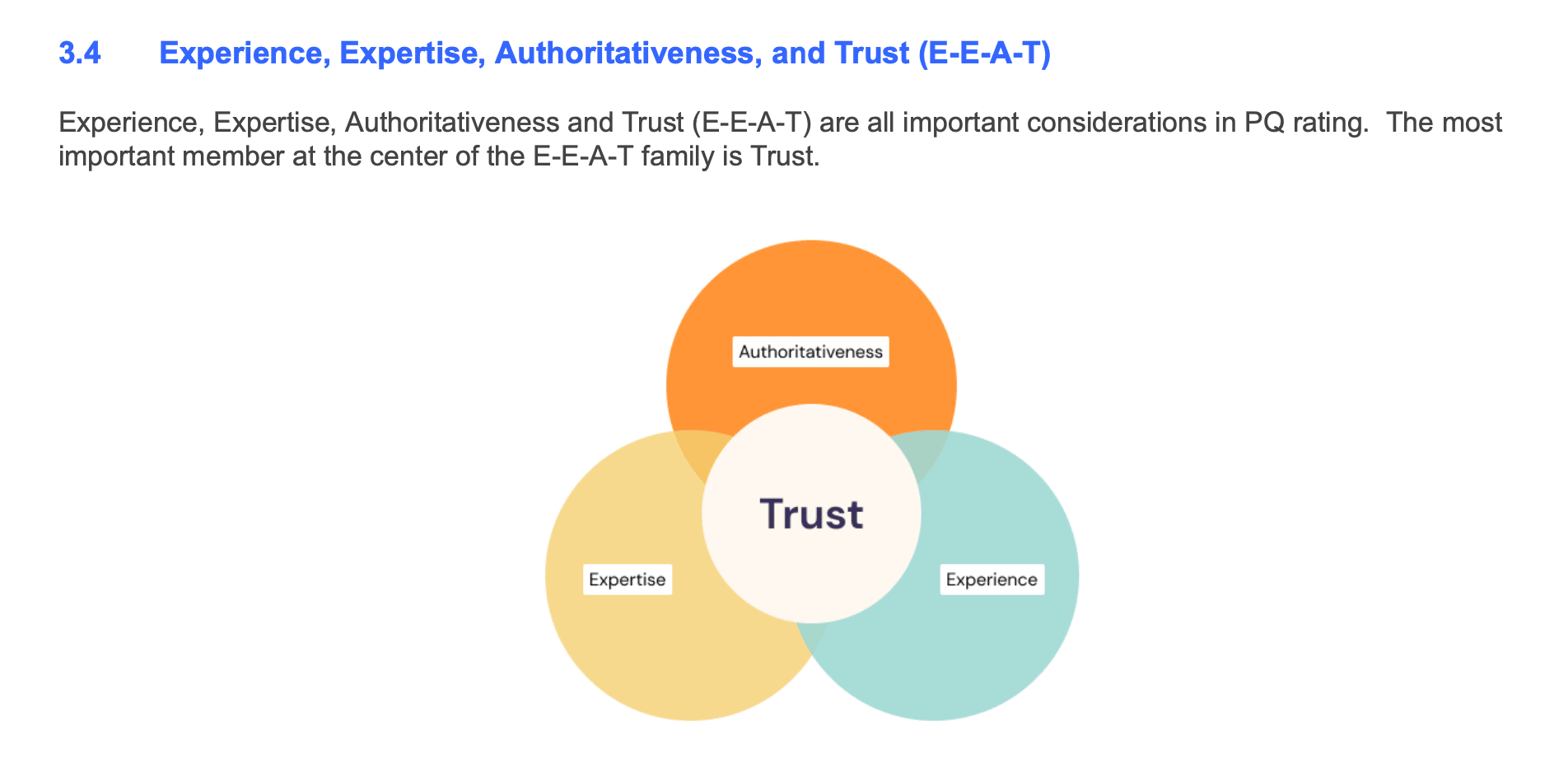
Experience, Expertise, Authoritativeness, and Trust (E-E-A-T) – Section 3.4

Google’s E-A-T has been a hot topic in the SEO community for the past few years. This version of the Quality Rater Guidelines introduces a new, evolved version of E-A-T: 

E-E-A-T: Experience, Expertise, Authority and Trust

Along with introducing an extra letter – E for experience – Google now also places “trust” at the center of this ‘family’ of important considerations for page quality. 

According to Google (page 27):

“Trust is the most important member of the E-E-A-T family because untrustworthy pages have low E-E-A-T no matter how Experienced, Expert, or Authoritative they may seem.”

Google QRG - Page 26

Trust is the mechanism by which raters determine if the page is “accurate, honest, safe, and reliable” (page 27). The amount of trust a page requires depends entirely on the nature of the page. 

Google provides the example of online stores, which require secure online payment systems and good customer service. It also mentions product review sites – a trustworthy review would help searchers make informed decisions rather than just try to sell the product. 

Google introduced a new table to help raters understand how to approach experience, expertise and authoritativeness:

Google QRG - Page 26
Page 26

The introduction of “experience” to the concept of E-A-T is consistent with many of Google’s updates and communications throughout the past couple of years, particularly related to product review content. 

Google focuses on the extent to which content creators have “necessary first-hand of life experience for the topic.” Having significant experience lends itself to trust.

Google uses the example of a product review – someone who has personally used the product has more experience than someone who has not, therefore creating more trust. 

For evaluating Trust, the most important “member of the E-E-A-T family,” raters should consider: 

  • What the website says about itself on its About Page or other profile pages.
  • What others say about the website or its content creators (third-party reviews or references).
  • What is visible on the page – actual evidence on the page that the content creator can be trusted (e.g., real evidence of them doing the thing they claim to be an expert in).

Google also adds a new important detail about conflicts of interest. A review by the product manufacturer is not trustworthy, nor is the review of an influencer paid to promote the product. 

YMYL Topics: Experience or Expertise? – 3.4.1 

Google introduced a new table to distinguish when Experience or Expertise is needed for YMYL content. This table aims to answer whether everyday experience or actual expertise is needed for various topics, such as medical conditions, voting, and saving for retirement:

Google QRG - Page 28
Page 28

This new section indicates that just because a content contributor is not a bonafide expert on a YMYL topic, this does not make the content inherently untrustworthy.

People sharing their stories based on first-hand experience can be considered trustworthy content in certain situations. 

Harmful to Self or Other Individuals – Section 4.2

In the previous version of the QRG, Google introduced the notion that YMYL topics are determined based on their ability to cause harm to the user. 

In this new version, Google provided a detailed table with examples of what is considered harmful or not:

Page 32
Page 32

And a similar table explaining what it means for content to be harmful to groups:

Page 33
Page 33

These nuances are interesting, given much of the public discourse about freedom of speech across various social platforms in 2022.

Google appears to be drawing a clear line between free speech and violent/harassment speech in its definition of harmful content. 

Google also provides clear examples of “harmfully misleading information,” including several popular internet conspiracy theories that are either clearly inaccurate, contradict well-established expert consensus, or are unsubstantiated:

Google QRG - Page 34
Page 34

Lacking E-E-A-T – Section 5.1 

Google provides examples of what it looks like to lack an appropriate level of E-E-A-T for the topic or purpose of the page. These are the examples provided (page 51):

  • “The content creator lacks adequate experience, e.g. a restaurant review written by someone who has never eaten at the restaurant
  •  The content creator lacks adequate expertise, e.g. an article about how to skydive written by someone with no expertise in the subject 
  • The website or content creator is not an authoritative or trustworthy source for the topic of the page, e.g. tax form downloads provided on a cooking website.
  •  The page or website is not trustworthy for its purpose, e.g. a shopping page with minimal customer service information” 

These examples help conceptualize the distinct roles that each letter in E-E-A-T play in evaluating the page quality. 

Language updates throughout the document

Throughout the document, Google appears to be editing its language to be more inclusive, such as changing “webmaster” to “website owners” and removing some gendered pronouns (“himself/herself” becomes “themself”). 

Pay attention to where Google is going with the QRG

The Quality Rater Guidelines are a crucial document for anyone who works in search marketing because they give us a guidebook for where Google wants its algorithms to go. 

Reading between the lines of the language in this document can help inform what Google is looking for in terms of content quality, user experience, and E-E-A-T of websites. 

Following these guidelines will help ensure your site and company can achieve visibility in Google search and, ideally, not be negatively impacted by any of their algorithm updates or other penalties. 


Opinions expressed in this article are those of the guest author and not necessarily Search Engine Land. Staff authors are listed here.


Related stories

New on Search Engine Land

@media screen and (min-width: 800px) { #div-gpt-ad-3191538-7 { display: flex !important; justify-content: center !important; align-items: center !important; min-width:770px; min-height:260px; } } @media screen and (min-width: 1279px) { #div-gpt-ad-3191538-7 { display: flex !important; justify-content: center !important; align-items: center !important; min-width:800px!important; min-height:440px!important; } }

About The Author

Lily Ray

Lily Ray is the Senior SEO Director and Head of Organic Research at Amsive Digital, where she provides strategic leadership for the agency’s SEO client programs. Born into a family of software engineers, web developers and technical writers, Lily brings a strong technical background, performance-driven habits and forward-thinking creativity to all programs she oversees. Lily began her SEO career in 2010 in a fast-paced start-up environment and moved quickly into the agency world, where she helped grow and establish an award-winning SEO department that delivered high-impact work for a fast-growing list of notable clients, including Fortune 500 companies. Lily has worked across a variety of verticals with a focus on retail, ecommerce, B2B and CPG sites. She loves diving into algorithm updates, analyzing E-A-T, assessing quality issues and solving technical SEO mysteries. Lily leads an award-winning SEO team at Amsive Digital and enjoys sharing her findings and research with the broader SEO industry.

https://searchengineland.com/google-search-quality-rater-guidelines-changes-december-2022-390350


Google doubles up on E with updated search quality raters guidelines (E-E-A-T)

Google has updated its search quality raters guidelines for the second time in 2022, only four and a half months since its last update in July 2022. This revised document has some substantial changes to E-A-T, by adding an extra E to E-A-T for “experience.” The document is now about nine-pages longer, adding up to 176 pages up from 167 pages in the previous version.

Double-E-A-T. Yes, Google has added a letter to E-A-T, adding an extra E and going with E-E-A-T. This now stands for experience, expertise, authoritativeness, and trustworthiness.

Experience. What does the new E for experience add? Google said it adds another level of, a new dimension of quality to assess its search results. What is Google looking for with experience? Google said when you write the content, does that “content also demonstrate that it was produced with some degree of experience, such as with actual use of a product, having actually visited a place or communicating what a person experienced?”

Google explained that there are “some situations where really what you value most is content produced by someone who has first-hand, life experience on the topic at hand.”

Google shared this example, “if you’re looking for information on how to correctly fill out your tax returns, that’s probably a situation where you want to see content produced by an expert in the field of accounting. But if you’re looking for reviews of a tax preparation software, you might be looking for a different kind of information—maybe it’s a forum discussion from people who have experience with different services.”

Google said in the updated guidelines that Experience, Expertise and Authoritativeness are important concepts that can support your assessment of trust, with trust being the most important member of E-E-A-T. Here is the diagram Google created to illustrate this on page 26 of the PDF:

Google said, “trust is the most important member of the E-E-A-T family because untrustworthy pages have low E-E-A-T no matter how Experienced, Expert, or Authoritative they may seem.” How does experience differ from expertise? Google said, “pages that share first-hand life experience on clear YMYL topics may be considered to have high E-E-A-T as long as the content is trustworthy, safe, and consistent with well-established expert consensus. In contrast, some types of YMYL information and advice must come from experts.”

One last example and there are many more, of experience mentioned in the guidelines is where Google said on page 51 where Google described when a page has low E-E-A-T when “the content creator lacks adequate experience, e.g. a restaurant review written by someone who has never eaten at the restaurant.”

What else was updated. Google notated on the final page of the revised PDF (download it here), these changes:

  • Broadly refreshed concepts and rating criteria in ‘Part 1: Page Quality Guideline’ to be more explicitly applicable to all types of websites and content creation models
  • Clarified guidance on ‘Finding Who is Responsible for the Website and Who Created the Content on the Page’ for different webpage types
  • Added summary table with the top ‘Page Quality Considerations’ involved in PQ rating, which carry through to each PQ rating section (Lowest to Highest)
  • Refined/expanded guidance on the following core pillars of Page Quality Rating:
    • ‘Main Content Quality’
    • ‘Reputation for Websites and Content Creators’
    • ‘Experience, Expertise, Authoritativeness, and Trust (E-E-A-T)’
  • Reordered PQ rating sections from Lowest to Highest; streamlined transitions
    between these sections; de-duped existing guidance and examples as appropriate
  • Added more guidance and clarifications to sections: ‘Pages with Error Messages
    or No MC’, ‘Forums and Q&A Pages’, and ‘Page Quality Rating FAQs’
  • Reformatted lists of concepts and examples into tables (throughout/as appropriate)
  • Minor changes throughout (updated language, examples, and explanations for
    consistency across sections; removed outdated examples; fixed typos; etc.)

This is not an exhausted list of what changed, but Lily Ray has posted a more in-depth review of the changes.

Why we care. Although search quality evaluators’ ratings do not directly impact rankings (as Google clarified in the document), they do provide feedback that helps Google improve its algorithms. It is important to spend some time looking at what Google changed in this updated version of the document and compare that to the previous version of the document to see if we can learn more about Google’s intent on what websites and web pages Google prefers to rank. Google made those additions, edits, and deletions for a reason.

The additional dimension of “experience” is an important one that Google has been hinting at for a long time. It is nice to see them document it and pull it out as one of the four core aspects of defining quality.


Related stories

New on Search Engine Land

@media screen and (min-width: 800px) { #div-gpt-ad-3191538-7 { display: flex !important; justify-content: center !important; align-items: center !important; min-width:770px; min-height:260px; } } @media screen and (min-width: 1279px) { #div-gpt-ad-3191538-7 { display: flex !important; justify-content: center !important; align-items: center !important; min-width:800px!important; min-height:440px!important; } }

About The Author

Barry Schwartz

Barry Schwartz a Contributing Editor to Search Engine Land and a member of the programming team for SMX events. He owns RustyBrick, a NY based web consulting firm. He also runs Search Engine Roundtable, a popular search blog on very advanced SEM topics. Barry can be followed on Twitter here.

https://searchengineland.com/google-doubles-up-at-e-with-updated-search-quality-raters-guidelines-e-e-a-t-390343


How much impact can visual identity have on your organic visibility?

How much impact can visual identity have on your organic visibility

30-second summary:

  • A visual identity is all the graphic elements that represent your brand making it unique and recognizable
  • When visual identity is build consistently across several channels, it builds brand recognizability which in turn improves conversions
  • Visual branding elements often show up for brand-driven search results allowing users to remember them well
  • Commercial and informational queries often contain visual results as well, so they can reinforce brand presence if you brand all your visual assets consistently
  • To build a strong visual identity in organic SERPs, create lots of original images, cross-publish them on multiple channels and use best SEO practices when using them on your site

What is visual identity?

A visual identity is a collection of graphic elements that represent and differentiate a brand.

It can be a logo, a tiny element of a logo, a color palette, a unique font – or any combination of all of these visual branding elements that make a brand recognizable.

Creating a recognizable visual identity used to be a prerogative of big brands with huge budgets. Thanks to digital channels (social media, video, etc.), a visual identity is something every brand can and should have because it helps your past customers recognize you and become your returning customers.

Creating a consistent and cohesive visual identity is key to cross-channel marketing. People traveling from channel to channel and seeing your brand everywhere will finally start recognizing you and with recognition comes more trust and engagement.

How is visual identity reflected in organic search?

Historically, Google has loved brands because they are easy to understand and map together (hence the Knowledge Graph is based on entities, i.e. brands).

A few years ago, Google started featuring brands visually in SERPs too. So now brands can actually build recognizability through organic search results.

Let’s look at just one example.

Let’s search for a brand name first: Notice how many images show up in different search sections across SERPs, including:

  • The knowledge panel
  • Twitter carousel
  • Image thumbnails
  • Image carousels
  • Video thumbnails, etc.

Visual elements are all over branded search results.

Now, searching for something informational, like [room soundproofing] brings up a well-written guide on how to do it from Hubspot, and the best part is that its search snippet includes a well-branded image:

That’s when a searcher can immediately recognize the brand’s results and click through just because it looks familiar.

How to create a consistent visual identity

The key to building a visual identity online is being active and consistent.

It doesn’t mean living on social media sites. It means using social media strategically and regularly to publicize well-branded visual messages that keep reminding your target audience of your brand.

According to Namify, it takes five to seven impressions for people to remember your brand.

This means serving your visual message to the same person at least 5 times before you start looking familiar.

How can this be achieved?

Reuse the same image across several channels

Apps like Photoleap make it extremely easy to create effective visual assets that can be used across multiple social media channels. You can use it to apply advanced effects or minor touch-ups to existing images, or use the built-in text-to-image AI engine to describe whatever visual you want to see, and then edit from there.

You can find inspiration at the brand’s Instagram account, which is filled with creative images you can create using the app:

Once you have your concept created, you can easily fit it to multiple social media channels, and even animate it, which extends your possibilities even further allowing you to use it as Reels, shorts, and even stories.

Curate your own (and your customers’) images

Monitoring your customers’ reviews and turning them into visual assets (images and videos) is a great way to control your brand sentiment under control and promote your brand’s visual identity through user-generated content.

There are many ways to approach that, and you don’t have to choose once. Try several of them before your create your own UGC-driven visual identity strategy:

Visualize all you can

You need your brand-own assets to rank for a wide variety of brand-driven and generic queries to build recognizability, one search session at a time. This includes posting visual content on Twitter (which has its own carousel section in SERPs) and Facebook (that is usually granted visually rich snippets).

Make sure you stick to your brand-driven color palette for every asset you create (see the orange SERP example above), play with your logo elements, and add watermarks inside your videos.

Consider (but not limit yourself to) a few ideas below:

  • Create original images for every article you publish (and then re-use those images on social media when sharing your link)
  • Use image optimization tactics to ensure your images rank in organic search results. There are SEO plugins that make this step easier.
  • Embed videos on your landing pages to generate video-rich snippets in organic SERPs
  • Create infographics to visualize how-to guides or make steps easier to follow. There are quite a few data visualization plugins to make this easier.
  • Use illustrations: A brand illustration system is a collection of images with a cohesive mood and style that visualizes a brand’s promise

Use retargeting

Retargeting is a great way to reach people who are already familiar with your visual identity, and so they will respond better to your ads. Google offers dynamic remarketing ads within its display network. Facebook is another great retargeting platform that makes it easy to reach your past site visitors and let them continue their buying journey from where they left it.

Conclusion

Building a recognizable visual identity takes time and effort but it is well worth it because a recognizable brand brings higher conversions and more sales. Keep your visual identity in mind when planning your content and visual marketing strategy and you’re halfway there! All you need now is time and consistency. Good luck!


Ann Smarty is the Founder of Viral Content Bee, Brand and Community manager at Internet Marketing Ninjas. She can be found on Twitter @seosmarty.

Subscribe to the Search Engine Watch newsletter for insights on SEO, the search landscape, search marketing, digital marketing, leadership, podcasts, and more.

Join the conversation with us on LinkedIn and Twitter.

https://www.searchenginewatch.com/2022/12/15/how-much-impact-can-visual-identity-have-on-your-organic-visibility/


Top 5 search marketing trends and 3 must-haves for 2023

As we prepare to say goodbye to 2022 and welcome 2023, it’s a great time to review notable changes to search and consumer behaviors and plan our key digital marketing initiatives for next year. 

In this article, we will discuss the most significant search, digital marketing and consumer trends, along with the must-haves for search marketers in 2023. 

First, let’s understand the biggest changes in search this year and what we can expect next year. 

Google released several algorithm updates in 2022. These algorithm updates can be classified into three broad categories. 

  • Core updates: Updates released to make search better and safer. 
  • Helpful content: Updates released to make search results useful and relevant. 
  • Experience: Updates released to make user experience across all devices better. 

Clearly, Google wants to reward websites that offer excellent user experiences.

That means your content must be relevant to their query. In other words, experience and relevancy are key to winning in search today and beyond. 

Search has evolved and is about experience and relevancy.

As we write the perfect recipe for search marketing strategies and must-haves for 2023, let’s keep these two critical ingredients in mind. 

As we reviewed this year’s top search query data and helpful insights shared by various organizations, we realized how critical it is for brands to win the trust of their customers. 

While many data points and trends are being discussed, we are focusing on five of the key consumer insights you will need to remember while creating your search marketing strategies for 2023.

  • Privacy and peace of mind: Consumers are concerned about privacy and look to brands to ensure their data is not shared. 
  • Advertising with a purpose: Consumers are gravitating toward brands including sustainability initiatives as part of advertising and marketing efforts. 
  • Personalization: Google Shopping is a great example of personalizing experiences based on location, preferences, search history, etc. 
  • Direct to consumer: A more visual and interactive experience is critical to engage the consumer. 
  • Predictive analytics: Making informed decisions based on several data points is also critical. 

When we understand consumer trends and insights, we are better equipped to evaluate marketing priorities – giving us peace of mind that our advertising is purposeful, personalized and helpful for consumers.

Next, let’s dive into five key marketing trends and then how to leverage these trends in 2023. 

As we begin a new year of marketing, we must step out on the right foot and shift our mindset. Long gone are the days of keyword density and the concept that content is solely king.

“More” is no longer “better.” Quality over quantity is the name of the game. We need to re-evaluate our priorities and rise to our customers’ expectations. 

After reviewing search queries, consumer and search insights, and the biggest releases of 2022, below are five key trends and the three must-haves to consider for a successful 2023. 

Top 5 trends and 3 must-haves in 2023 

Trend 1: Multisearch – helping you search outside the box 

Consumers typically spend more than 82% of their time on discovery. Google launched multisearch and released several supporting algorithms this year posed to change the way we all do discovery and receive information. 

Google constantly tests different formats to display relevant search results coming from diverse sources, which reflect how people are exploring myriads of topics. 

The good news: We can now search between various assets, including videos, images, PDFs, text, languages, etc.

Multisearch has opened the biggest untapped opportunities for marketers and we can see the direct benefit. Consumers can take any image and use Google Lens to explore everything about the image. 

By leveraging entity data along with high-quality, relevant and contextual images, Google can get to the most relevant search results faster. 

In 2023, we will see savvy search marketers leveraging all types of assets, Google Vision API and entity data to provide the most relevant and qualitative assets. 

Futureproofing your digital assets for discovery is your key to unlocking doors and winning in 2023. 

Futureproofing your digital assets for Multisearch

Trend 2: Helpful content – relevant, qualitative, accessible, authoritative, experiential 

Google recently updated its quality raters guidelines and helpful content system. The easiest way to evaluate whether your content is helpful is by covering critical touchpoints and micro-moments.

Helpful content is content that is readily available for your customer across all the digital touchpoints, minimizing the need for them to search somewhere else. 

Google’s helpful content update is a machine learning algorithm that keeps getting trained based on search result datasets. It is a sitewide signal, so if too many pages of a domain are low quality (e.g., duplicate, thin or created solely to rank in search engines), there is a serious risk that your organic search performance could suffer. 

In 2023, search marketers must ensure that discoverable content is relevant, informative, qualitative, authoritative, and experiential.

Search engines will reward businesses for sharing high-quality and informative content. Brands should enhance online visibility significantly by sharing topical entity-first content. 

Content strategy should include all types of content, including videos, product review information, FAQ, relevant images, PDF, and expert advice.

Brands must also map current content across the customer journey touchpoints and strive to fill all the content gaps. 

Trend 3: Omnichannel experience 

Most consumers shift between various devices, so a consistent and unified experience across all touchpoints is important.

Centralizing critical information about the business and distributing it across all marketing channels is necessary for a seamless omnichannel experience in 2023. 

The speed of change across channels builds trust with consumers. For example, website information should change right away when, as a business, you decide to change your Google Business Profile or social profile information. 

With the release of Google Analytics 4, Google is gently training marketers to focus on customer behaviors and attribution from various channels across the customer journey rather than the last-clicked channel. 

Discovery of content, good website user experience, and site health will also become must-haves for 2023. 

Simple user experience score cards you can create to judge effectiveness

If information cannot be crawled and indexed, it will not be available to consumers making it useless. As the economy slows and budgets become tighter, search marketers must prioritize technical SEO initiatives to yield good results. 

Trend 4: Personalization and localization

Consumers are looking for information based on interest, location, and other known and unknown factors. Online shoppers are likelier to buy from brands with a strong local presence and engagement with their consumers.

We must ensure our global search marketing strategies are customized for location.

Google matches images to searcher intent because today, approximately 36% of a mobile screen is occupied by images. As a local business, consider:

  • Responding to frequently asked questions.
  • Providing relevant local information and images.
  • Ensuring awesome omnichannel experiences for consumers. 
Local 3.0 in 2023 is about enhanced information, experience, engagement.

Local search continues to be highly strategic for Google, according to local SEO expert Greg Sterling. But the search engine is shifting away from local search as a moneymaker (ads driver) and focusing more on product search. That means even thinner support for local SEOs and local businesses. 

Google will further develop and build out product search and SERPs to better compete with Amazon and drive more product-search usage. Retailers are the number one advertiser online and Google wants to keep and grow those dollars. We’ll see more real-time local product inventory online, including from smaller retailers. 

While localization is super critical, I also think that for 2023, personalizing information based on consumer preference will become a must-have. Using customer data platforms to secure preferences and create content and campaigns based on customer data is also key in this area.

Trend 5: Influencer marketing and expert community building

Influencer marketing is growing rapidly and even faster than social media marketing.

Savvy consumers curate information and follow expert opinions from influencers they trust before making purchase decisions.

We’re already seeing various social channels posting information around expert reviews /community and interactive videos are doing well. 

In 2023, brands will benefit by:

  • Building an expert community of influencers.
  • Providing the most informative, helpful content in the most interactive format.
  • Aligning various KPIs such as engagement and clicks to measure success. 
Influencer Marketing Share

Sterling noted that some of Google’s SERP changes are driven by TikTok’s popularity, including the push to make search more visual.

Accordingly, we will see Google emphasize more visual content and potentially de-emphasize reviews (though not for ranking purposes.) 

Google will intensify its recent crackdown on review fraud, which will continue to catch “innocent” reviews on its net.

Local marketers will need to keep a continuous stream of Google reviews coming and simply be prepared to lose a percentage of reviews to Google’s AI filtering. 


Get the daily newsletter search marketers rely on.


Top 3 strategy must-haves to stay ahead

Next, let’s discuss the top focus areas in our strategy to leverage the above trends. 

1. Business intelligence

The global economy is showing slow down. Deriving business insights and actions from the most relevant data points will become critical in 2023.

Keep an eye on market trends, competitive benchmarking, customer behavior, channels and goals prioritization, among others. 

More savvy businesses will pivot toward business intelligence to find the most critical information, prioritizing quality content and assets and basing those decisions on what is most critical based on real data. 

 Must have for Business Intelligence and Analytics in 2023

2. Artificial intelligence and machine learning (AI/Ml) 

In 2023, AI/ML will become a must-have strategy to solve complex marketing problems. AI-generated content (e.g., ChatGPT) has become a much bigger feature of digital and content marketing, including for local search. 

Google is also leveraging machine learning to auto-translate any language quickly. From visual search to auto-generation and translation of content, we will see several AI models, such as GPT-3 (soon GPT-4), used excessively to solve complex problems. 

3. Your success plan

Last but not least, less will be more in 2023. 

The key to winning will be defining and aligning your business objectives, key drivers (channels), important metrics to track, and the solutions that will help you get to those metrics. 

Thanks to Bill Hunt, Greg Sterling, Andrew Shotland and Dixon Jones for sharing insights and ideas for this article. 


Opinions expressed in this article are those of the guest author and not necessarily Search Engine Land. Staff authors are listed here.


Related stories

New on Search Engine Land

@media screen and (min-width: 800px) { #div-gpt-ad-3191538-7 { display: flex !important; justify-content: center !important; align-items: center !important; min-width:770px; min-height:260px; } } @media screen and (min-width: 1279px) { #div-gpt-ad-3191538-7 { display: flex !important; justify-content: center !important; align-items: center !important; min-width:800px!important; min-height:440px!important; } }

About The Author

Benu Aggarwal

Benu Aggarwal, founder and president of Milestone Inc., is a highly recognized expert in digital marketing solutions, voice search, SEO and local. Benu oversees product development, client services, technology and strategic vision for the company. Under her leadership, the company has prospered as it launched a suite of SEO-first software products and thousands of websites of which dozens won design and technology awards. With her technical marketing experience, entrepreneurial spirit, and motivating attitude, Benu has the ability to translate technical ideas into tangible practice that drive results for customers.

https://searchengineland.com/search-marketing-trends-must-haves-2023-390308


Google Question Hub to close down

Google will be shutting down the Google Question Hub on January 15, 2023, about two years after the service launched in the United States and several years after it quietly launched in regions like India.

Shutting down. Google posted a message after you login at questionhub.withgoogle.com that says “As of January 5, 2023, the Question Hub beta will end. If you’d like to retain a copy of your data, you can do so via Google Takeout up until March 6, 2023. After that date, Question Hub user data will be deleted.”

What it looks like. Glenn Gabe posted a screenshot of this on Twitter:

What is Question Hub? Google says “Question Hub is a tool that enables creators to create richer content by leveraging unanswered questions. Question Hub collects these unanswered user questions and surfaces them to bloggers, writers, and content creators like you.”

It is basically a way for Google to enable searchers to tell it that the search results provided are not answering the query. Then, Google takes those questions and feeds them to publishers, who, in turn, can create content that does answer the query.

Content ideas in Search Console. We recently saw Google experiment with a new section in Google Search Console named Content ideas. Content ideas give the content creator, publisher, SEO, webmaster, etc., some tips and advice on what new topics they can write about on their site.

The big question is, will Google move the Question Hub like features into this new Content ideas section in Google Search Console?

Why we care. Creating content ideas can sometimes be a struggle for writers, which may help content creators with that process. With Question Hub going away, there is even more of a reason for Google to add this to Search Console. Hopefully Google will be moving this feature and not completely getting rid of it.


Related stories

New on Search Engine Land

@media screen and (min-width: 800px) { #div-gpt-ad-3191538-7 { display: flex !important; justify-content: center !important; align-items: center !important; min-width:770px; min-height:260px; } } @media screen and (min-width: 1279px) { #div-gpt-ad-3191538-7 { display: flex !important; justify-content: center !important; align-items: center !important; min-width:800px!important; min-height:440px!important; } }

About The Author

Barry Schwartz

Barry Schwartz a Contributing Editor to Search Engine Land and a member of the programming team for SMX events. He owns RustyBrick, a NY based web consulting firm. He also runs Search Engine Roundtable, a popular search blog on very advanced SEM topics. Barry can be followed on Twitter here.

https://searchengineland.com/google-question-hub-to-close-down-390375


Your 2023 guide to SEO reporting and tracking

SEO reporting and tracking are major sticking points for anyone in the industry. 

Data that you find important may be less valuable to C-suite executives.

Or you may not have enough data to show growth, changes and significant events clearly and concisely.

Reports must tell a story. Without the right data, you’ll end up with a confusing plot that won’t be well received.

Before you can begin reporting and tracking data, you need to gather it, which will require you to use the right tools.

Most SEOs use a combination of different tools to properly collect, track and report data. 

A few of the main ones  include:

You can also use third-party tools to track keyword growth, positions and more, such as:

  • Ahrefs
  • Semrush
  • Moz

You’ll find a lot of third-party paid tools available to help you with your reporting and tracking.

But you need to be aware of each tool’s limitations.

For example, Google Search Console only retains data for 16 months, so you need to think about this if you expect to provide lengthy reports that show data past this threshold.

I’m going to assume that you have these tools in place already. However, if you do not have any of these tools, look through them and add any coding that you need to the website to begin tracking.

Otherwise, without the data these tools provide, you’ll go into your SEO journey blindly.

Tracking events (even non-SEO ones)

With your tools and analytics in place, you’ll want to begin tracking major events. 

SEO is about driving organic traffic to a site and generating revenue, but you also need a way to track your progress.

A few of the things I recommend tracking are:

Tracking site changes and updates can demonstrate the value of the work you’re performing and can be extremely insightful as the site continues to grow.


Get the daily newsletter search marketers rely on.


Separating brand vs. non-brand keywords

Now that you are tracking events, it’s time to get into the nitty gritty of keyword separation. 

Providing clients with a long list of thousands of keywords will not show them value. Plenty of these keywords may not be bringing in much value at all.

What you should do is try and segment your keywords into:

  • Brand keywords
  • Non-branded keywords

Brand keywords will include the company and product name, and this is something that a lot of companies want to track when focusing on their branding. 

Nike is a good example of a strong brand where people might search “Nike running shoes” and “running shoes” to find their products.

However, when working with large keyword datasets, you may want to begin separating keywords further by:

  • Informative keywords.
  • Transactional keywords.
  • Generic keywords.

You can then segment these keywords by page, URL or section if you want to further clarify the data and show it in your report.

Working through keyword lists is time-consuming, but it’s the bulk of the work you’ll do for your reports. 

Clients want to see which keywords they’re ranking for and where the traffic is being funneled into on the site.

However, there is one point of data that is more important than any other when tracking – revenue.

Track revenue drivers

Revenue is what opens every stakeholder’s eyes and is the main attention-grabber in a report. 

You will want to do a few things here to show revenue in a way that everyone understands and can appreciate.

Period-over-period comparisons

Comparisons are a great way to show growth over a certain period of time. 

For example, companies earn much of their Q4 revenue on Black Friday and Cyber Monday. 

Everyone is searching for a deal, and it’s a time period that’s filled with valuable data for your reports.

I recommend looking at data for a period of two years so that you can show:

  • Weekly growth (WoW or same week from previous years).
  • Monthly growth (MoM or same month from previous years).
  • Quarterly growth (QoQ or same quarter from previous years).
  • Yearly growth.
  • Seasonal growth.

Showing how higher search engine rankings were able to boost sales by 25% this Black Friday compared to the previous Black Friday is priceless when creating reports.

Sales drivers

Sometimes, it’s difficult to decipher which keywords were responsible for driving sales. 

Tools may not allow for this level of refinement when browsing through traffic, and this is where the IT team can help you.

IT teams can help:

  • Go through logs.
  • Identify sales.
  • Tag keywords responsible for sales (which may require customizations).

Showing that X keyword, which has gone from ranking 19 to 2, led to 17% higher sales for a product will demonstrate how investing in SEO boosts revenue.

You can also segment data for events, such as the traffic that led to calls, email signups, consultations, and so on.

Supply the correct data to the right stakeholders

You’ve collected and segmented your data in a meaningful way. 

But while some data points will be valuable to you and your marketing team, others might be shrugged off by the C-suite.

For instance, say that you created a report showing:

  • Technical SEO changes.
  • 10% rise in organic traffic.
  • Faster site speeds.
  • Higher time on page.
  • Etc.

Marketing teams will appreciate this data, but a C-suite executive will be curious about how the 10% rise in traffic led to a revenue increase. 

If you don’t tie this information into the company’s revenue meaningfully, the C-suite won’t be interested in your reporting.

You’ll want to make reports that touch on the key data that specific stakeholder groups want to see.

Save your SEO data for future use

Your reports today will be referred to in the next year or two, and they will help tell the story of the company’s SEO growth. 

Save the data you collect because it contains valuable information you’ll use in the future.

I have created my own custom tools to back up Google Search Console data so I can refer to it past the 16 months limit. 

I suggest you do the same as most of the reporting work you will be doing even if you change companies.


Opinions expressed in this article are those of the guest author and not necessarily Search Engine Land. Staff authors are listed here.


Related stories

New on Search Engine Land

@media screen and (min-width: 800px) { #div-gpt-ad-3191538-7 { display: flex !important; justify-content: center !important; align-items: center !important; min-width:770px; min-height:260px; } } @media screen and (min-width: 1279px) { #div-gpt-ad-3191538-7 { display: flex !important; justify-content: center !important; align-items: center !important; min-width:800px!important; min-height:440px!important; } }

About The Author

Ludwig Makhyan

Ludwig Makhyan is a contributor for Search Engine Land, covering organic and technical SEO. His background is in web development and digital marketing. Ludwig has over 20 years of experience in website design, coding and promotion. He is the co-founder at MAZELESS, an enterprise SEO agency.

https://searchengineland.com/seo-reporting-tracking-guide-390175