Just when you thought the Google Search updates were done for the year, Google has rolled out a December 2022 link spam update. This update will take about two weeks to roll out and is a global update.
What Google said. Google wrote, “Our launch today, which we refer to as the December 2022 link spam update, will take about two weeks to fully roll out. Ranking may change as spammy links are neutralized and any credit passed by these unnatural links are lost. This launch will affect all languages.”
SpamBrain for links. This is leveraging what Google calls SpamBrain, Google referenced it in the 2018 Google spam report, specifically the spam trends section where Google talks about its “machine learning systems” to improve search spam detection.
Google added that SpamBrain can not only “detect spam directly, it can now detect both sites buying links, and sites used for the purpose of passing outgoing links.”
Helpful content system still rolling out. Google is still in the process of rolling out the December 2022 helpful content system, while this spam update is rolling out.
Why we care. Again, if you see ranking declines in Google over the next two weeks, it might be related to this new link spam update. Ensure your links are natural and follow Google’s webmaster guidelines. Work on improving your site to naturally attract new links over time.
As Google wrote with previous link spam updates, “Site owners should ensure that they follow the best practices on links, both incoming and outgoing. Focusing on producing high quality content and improving user experience always wins out compared to manipulating links. Promote awareness of your site using appropriately tagged links, and monetize it with properly tagged affiliate links.”
@media screen and (min-width: 800px) { #div-gpt-ad-3191538-7 { display: flex !important; justify-content: center !important; align-items: center !important; min-width:770px; min-height:260px; }
}
@media screen and (min-width: 1279px) { #div-gpt-ad-3191538-7 { display: flex !important; justify-content: center !important; align-items: center !important; min-width:800px!important; min-height:440px!important; }
}
About The Author
Barry Schwartz a Contributing Editor to Search Engine Land and a member of the programming team for SMX events. He owns RustyBrick, a NY based web consulting firm. He also runs Search Engine Roundtable, a popular search blog on very advanced SEM topics. Barry can be followed on Twitter here.
2023, the year of SEO: why brands are leaning in and how to prepare
30-second summary:
As marketing budgets inevitably tighten, the demand for cost-effective and dependable channels such as SEO continues to increase
Some of the critical updates and algorithm changes in 2022 give marketers a heads-up on where to focus in 2023
SEO and content marketers need to create better processes and work in tandem to achieve business goals
The days of set-and-forget SEO are over, organizations must utilize SEO in multiple ways
With marketing budgets under more scrutiny than ever, savvy organizations are looking towards SEO for sustained growth. Incorporating organic search into the digital strategy offers rich rewards – both in terms of cost efficiency and improved brand equity – that can contribute to an entire organization. As such, marketers have embraced this approach to maximize returns on marketing and technology expenditure.
In this article, I explain why SEO is so hot, what has changed in 2022, and what to capitalize on in 2023.
According to research from Gartner, CEOs are doubling down on digital investment strategies as they maximize their marketing ROI. However, Google recently reported that ad spending is down.
At the same time, in a recent survey of over 1000 enterprise marketers, over 90% of marketers are planning to place a greater emphasis on SEO in 2023.
Why organizations will lean into SEO in 2023
As marketing budgets inevitably tighten, the demand for cost-effective and dependable channels continues to increase — drawing much-deserved SEO attention from company leaders. In particular, they are finding that SEO insights give them a comprehensive view of consumer trends in times of volatility. It’s this invaluable knowledge that organizational and departmental heads know can help them drive their decisions today and tomorrow.
After two decades of sustained growth, search remains an essential channel despite marketplace volatility. It is a testament to the importance and effectiveness of search for connecting businesses with their target audiences.
Concerning enterprise organizations, some key benefit factors leading to the lean into SEO include:
SEO is a high-yield channel and is not impacted by market conditions
Organizations can benefit from long-term SEO incremental value
Only SEO can provide real-time insights into both market demand and customer intent
SEO insights drive sales, product, digital, and media initiatives across organizations
Organizations benefit from brand equity due to SEO presence on the SERPs
In tandem, SEO and PPC (together) give more control over the customer experience
SEO is rapidly becoming the key to unlocking a connection between businesses and customers. Organizations can get ahead of their prospects’ needs by understanding what they are looking for, why it matters to them, and how optimized content can best meet those requirements when needed most.
The focus on the (human) consumer and their experiences is something that Google focused heavily on in 2022. Some of the critical updates and algorithmic changes give marketers a heads-up on where to focus in 2023.
Learn from 2022 to prepare for 2023
2022 has been an eventful year for organic search, with several significant updates impacting how SEO and marketing teams should focus and operate.
Below are a few key areas where Google has indicated where SEO, content, technical and online marketers need to change – adapt and become agile – and where to prioritize their focus in 2023.
The Page Experience Update and Core Web Vitals was rolled out (mobile and desktop) to ensure users receive results that load quickly and render within a certain time threshold.
In 2023 all organizations must ensure their website’s technical performance creates an optimal user experience
This involves examining the page loading speed, browser response time, and content stability during loading for a seamless customer journey
Leveraging a tailored blend of data-led insights, content, and technical expertise in 2023 will help you create powerful user experiences. Google puts great emphasis on optimizing results and prioritizing accurate, reliable information – from page speed through to navigation capabilities Ensure you combine data-science techniques with best (white-hat) SEO best practices.
By focusing both on website functionality and providing engaging, relevant content – marketing teams can plan for success in the current – and any – economic climate
Google’s Product Algorithm Update was released to help users make informed decisions. This was in the form of a refreshed set of instructions and updates based on the annual performance of product reviews. It was designed to empower users with access to accurate information that will enable them to make sound product purchasing choices.
Future focus for 2023
In 2023 make it your goal to create a world-class experience for consumers, helping them find what they need quickly and easily. Aim to make the process of looking for items simpler than ever before – empowering people who search with an effortless journey directly from search results into their shopping carts!
If your selling products, demonstrate your professional abilities by providing well-founded advice and showcasing why you are the go-to expert on a subject
Back up any product recommendations with reliable data to provide assurance of authenticity
Multisearch was announced in April to enable searches using images and text. Powered by Google Lens, it allows people to use mobile cameras or photos to search relevant images and text to find the most relevant results they need. Connecting words & visuals to create an exciting array of possibilities for consumers.
Future focus for 2023
In 2023 expect more advancements in Google’s AI development and MUM
Balance the content you create, and find an image-to-text ratio to provide the accurate answers users now want and expect
Focus on mobile optimization of images and expect this type of functionality to become a new norm in 2023
Google’s Helpful Content Update was announced and recently rolled out to ensure users receive the most useful search results.
Future focus for 2023
In 2023, content creators and website owners must develop unique materials tailored specifically toward human end-users instead of robots or spiders
For instance, when collecting customer reviews on products sold online – be sure requests inquire about specific details so reviewers can demonstrate intimate knowledge in their feedback
Similarly, blog posts covering events or news should include fresh perspectives not found elsewhere by readers searching through Google’s services
Today’s algorithms are much more sophisticated, and they identify content that does not satisfy the reader – in some cases, content that has been “spun up” by automated tools.
At Google’s Search On event, they revealed some innovative developments that will revolutionize how we search online. For example, visual search results will provide an interactive and engaging experience with graphic cards of imagery directly integrated into every search result.
Additionally, users can also look forward to a new auto-complete feature for their searches as well as more tailored multi-search options designed for them to find meaningful answers quickly.
Googles Spam Update to help direct customers towards content with real purpose. As part of this effort, the search giant is improving the quality of results and expanding into new formats and mediums for delivering helpful information.
Consider how these updates may affect your SEO strategies moving forward
Ensure you are balancing keywords and not keyword stuffing
Avoid thin content and focus on quality over quantity
Use AI correctly for insights and optimization, not article content creation
Conclusion
SEO teams are becoming indispensable for organizations looking to uncover fresh opportunities and build a durable business. Cost-efficient tactics not only save funds but add value across departments too.
In 2023 focus on the following;
Utilizing SEO insights as a source of organization-wide business intelligence
Ensure technical SEO best practices are used to ensure websites provide experiences consumers expect and automate research and site fixes when and where possible
Focus on visual search and expect its importance to rise in 2023
Balance your optimization of content with key Google E-A-T and Helpful content guidelines, do not over-optimize
Leverage AI and automation to manage repetitive and time-consuming tasks and scale
Balance SEO and PPC and find synergies to adapt to changes in the market and with Google
SEO is no longer viewed as a stand-alone task; it is an integral part of your overall marketing plan. It enhances and bolsters other strategies in place while providing maximum reach for your business goals in 2023.
Be prepared for change and be flexible and agile. Slacking regarding optimization in terms of user experience, technical issue resolution, and speed can see you left behind competitors who are continuing their efforts without pause.
The days of set-and-forget SEO are over. Be prepared as organization look to utilize SEO in multiple ways
Change will be the main constant in the economy, with organizations and SEO next year!
Jim Yu is the founder and CEO of BrightEdge, the leading enterprise SEO and content performance platform. Find him on Twitter @jimyu.
Subscribe to the Search Engine Watch newsletter for insights on SEO, the search landscape, search marketing, digital marketing, leadership, podcasts, and more.
Google launches new Google Search status dashboard
Google has launched a new status dashboard, this dashboard is for Google Search at status.search.google.com.
Google Search status dashboard. The Google Search status dashboard will show you if there is an outage or issue with Google Search. Specifically, Google will confirm if there is an issue with crawling, indexing, or serving in Google Search.
Google wrote, “as we head into 2023, we want to introduce another tool for the public to understand the most current status of systems which impact Search—crawling, indexing, and serving.”
Issues are rare. Google said, “while system disruptions are extremely rare, we want to be transparent when they do happen.” And yes, we have reported many issues over the years with Google Search around indexing, crawling, and serving. But now Google has a way to report it within its Google Status Dashboard system as it does for Google Ads and many other products.
What it looks like. Here is a screenshot of this dashboard:
How it works. Google explained, “This dashboard reports widespread issues occurring in the last 7 days, with some details and the current status of the incident. A widespread issue means there’s a systemic problem with a Search system affecting a large number of sites or Search users. Typically these kinds of issues are very visible externally, and internally the SREs’ monitoring and alerting mechanisms are working behind the scenes to flag the issues.”
“Once we confirm with SREs that there’s an ongoing, widespread issue in Search, we aim to post an incident on the dashboard within an hour, and consecutive updates to the incident within 12 hours. Unlike with a traditional automated dashboard, our global staff reports these updates. The start time of the incident is generally when we managed to confirm the issue,” Google added.
Why we care. We sometimes, rarely, see issues with Google Search around indexing, crawling, and serving but we have to reach out to Google to confirm the issue. Now, Google will post those confirmations on the dashboard, as it does for many of its other products and services.
@media screen and (min-width: 800px) { #div-gpt-ad-3191538-7 { display: flex !important; justify-content: center !important; align-items: center !important; min-width:770px; min-height:260px; }
}
@media screen and (min-width: 1279px) { #div-gpt-ad-3191538-7 { display: flex !important; justify-content: center !important; align-items: center !important; min-width:800px!important; min-height:440px!important; }
}
About The Author
Barry Schwartz a Contributing Editor to Search Engine Land and a member of the programming team for SMX events. He owns RustyBrick, a NY based web consulting firm. He also runs Search Engine Roundtable, a popular search blog on very advanced SEM topics. Barry can be followed on Twitter here.
Getting backlinks is like getting regular exercise. It’s time-consuming, and the results aren’t immediate, but a daily workout contributes to your long-term health.
In local SEO, getting backlinks is particularly challenging. Small businesses often don’t have the same resources as an enterprise organization for links. There’s not enough time, money, and energy to build a local backlink profile.
However, limited resources don’t have to limit local link building opportunities.
Often, local businesses do more to support local link growth than they realize. By defining the types of local links, we can reflect on an organization’s values.
Typically, local links are less about developing stellar PageRank and more about building relationships in the community.
4 common types of local links
These are the most common types of local links:
Citations and data aggregators.
Community engagement.
National and local awards.
Relevant local content, campaigns, tools, reports, and studies.
Each type of local link requires a slightly different approach, but they all contribute value to the local community.
Citations and aggregators help customers find phone numbers and addresses, while local awards help customers trust the business.
Achieving local links that will truly impact growth requires a shift in mindset.
Instead of thinking about links as an SEO “to-do” item, think about them as an opportunity to connect with your neighbors.
The best local businesses are known less for their SEO and more for their community involvement.
A company that raises funds for a local charity or sports team can receive more local recognition than a business with great title tags.
A company that does both of these things can win at local SEO.
Let’s dive more into each type of local link below.
1. Citations and data aggregators
Local business citations, also known as online directories, are a well-known local link building tactic. Here, a business’s basic information is listed across websites that resemble a phone book.
The SEO theory behind citations: by submitting location information across a network of online profiles, a local business establishes online consistency for its name, address, and phone number (also known as “NAP consistency”).
Google’s Knowledge Graph uses this directory information to confirm the business information and accurately share it with users.
Common examples of online directories include:
Online phone books (i.e., Whitepages)
GPS submissions (i.e., Garmin)
Voice search (i.e., Siri)
Secondary search engines (i.e., Microsoft Bing, Yahoo)
Travel websites (i.e., Airbnb, TripAdvisor)
As a search engine, Google attempts to provide accurate, credible information for every single search query.
Listing your business information with local citations helps Google and other search engines achieve this goal.
Data aggregators
Rather than spending hours submitting to online directories and updating them, an organization can pay for data aggregators that automate most of the process.
Three companies offer a “bulk submission” service, placing business citations across a specific network of online directories.
Data Axle
Neustar
Foursquare
Each of these organizations submits to a different list of online directories, though there can be some overlap.
For example, Data Axle and Neustar might submit to Whitepages, while only Neustar might submit to Apple.
The exact list of backlinks generated by each aggregator is unknown, but a business typically receives anywhere from 25-100+ backlinks from each one (some of them overlapping).
Aggregator resellers
Many SEO agencies and SEO tools include a service that will submit to all three data aggregators.
For example, BrightLocal submits to the three aggregators listed above and some smaller vendors (i.e., Yellow Pages Network).
Some of these citation link building services are available for a yearly fee, while others have a one-time fee.
SEO impact of local citations
Local SEO experts have noted a downward trend in focus around local citations. In the 2021 Whitespark Local Search Ranking Factors survey, top industry contributors were surveyed on which local ranking factors make the most impact.
The score for local citations was among the lowest impact ranking factors in 2020 and 2021. Survey participants stated they achieved limited growth from citation submissions, indicating high effort for minimal results.
Ultimately, the value of local citations is relative to other SEO efforts and the age of the business.
A brand-new, first-time business needs to get the basics set up to expand its recognition on search.
An older business might need an update to its citations to ensure they’re accurate.
While it might not be clear how many local citations help, they are a fundamental piece of the local link building process for years.
Online directories are an attainable, straightforward way to gain local links or update existing directory information because all a business needs is a one-time fee, an address, and a phone number.
2. Community engagement
Getting local links can show your organization’s goodwill to both Google and the greater community.
In “A Christmas Carol,” Ebenezer Scrooge runs a bookkeeping business that is seemingly cold, calculating, and heartless. He is known by the larger community as a miser.
This bad attitude gives Scrooge’s business a negative reputation, leaving him counting profits in a dark, empty room.
In today’s business ecosystem, similar community perceptions can play a role in local SEO.
If a business gives to and participates within its community, that business is talked about, people engage with the brand, and the conversation continues online.
By investing in the local community, an organization can organically grow its backlink profile and achieve SEO growth.
Types of community engagement and backlinks include:
Local sponsorships.
Local events.
Scholarships.
Charities.
Volunteering.
All of these local link building activities speak to one central facet – community. By investing in its community, a business is investing in itself.
To get started with community engagement, circle back to your organization’s values. What is most important to the company?
Principles such as service, leadership, communication, and education could be applied to a local initiative with link building potential.
For example, a local attorney’s office might value clear communication as its guiding principle.
To channel this principle, the attorney could lead a local seminar on citizens’ researching their rights around an upcoming zoning proposal.
This seminar might result in a backlink to the attorney’s site from the local paper that announces upcoming local events.
SEO impact of community engagement links
It might seem time-consuming to spend additional time or resources on volunteering or a sponsorship, but the return on investment can be significant.
When a local newspaper publishes an article about a $500 scholarship or sports team sponsorship from an organization, that organization is receiving a backlink or mention from one of the most reputable websites in its community.
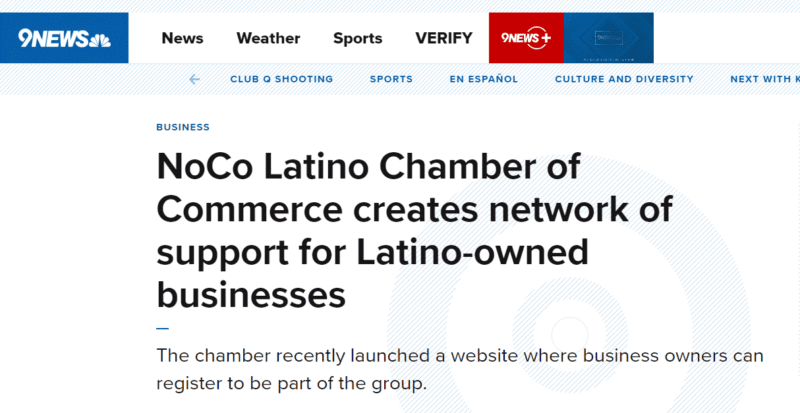
Several businesses involved in the Latino Chamber of Commerce received backlinks from a local news organization in this article.
When competitors rank because of a strong local backlink profile, community engagement is a reliable path to outranking them because it attracts multiple stakeholders who might share links.
A single contribution to charity might result in links from personal blogs, the organization that received the donation, and a local newspaper.
Additionally, community involvement doesn’t necessarily need to result in a link.
Sometimes a mention of the brand name is enough to build the organization’s reputation and improve its online credibility.
SEO practitioners have started to think beyond link building, including it in the larger practice of “off-page SEO,” which weighs brand mentions almost equally to links.
It isn’t easy to measure the complete SEO impact of community participation, but everything we know about search engines indicates that it makes a difference.
By investing in community engagement, an organization does more than improve rankings – it joins a conversation.
3. National and local awards
Receiving an award results in more than a plaque on the wall or feeling good about your business practices. An award is a trust signal.
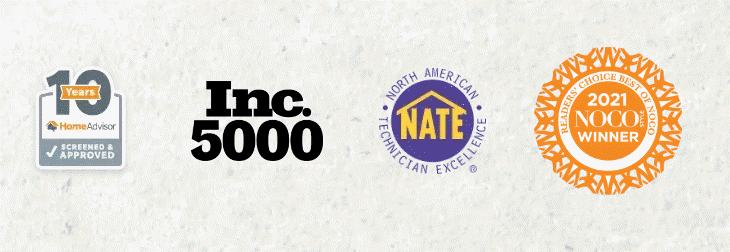
The website footer of a local HVAC business that has received several local awards and certifications.
When choosing a vendor, customers rely on awards and community recognition to decide on the right fit for their needs.
Types of award opportunities for a small business include:
National accreditation (i.e., Better Business Bureau).
Local trade organization awards/certifications.
Local publication awards (i.e., “Best of Phoenix”).
Local environmental awards.
Local awards for community involvement.
The first step to getting locally recognized is researching local awards in an organization’s line of business and local area.
A common starting point is the Better Business Bureau. Getting accredited by this large national organization allows customers to see an organization’s credibility.
Another opportunity to check for awards is the local Chamber of Commerce, which serves as a resource for businesses hoping to connect with the greater community.
Once organizations find an award that aligns with their values, they can develop a plan around the best path to receiving that award.
Sometimes the organization has already achieved many existing aspects of the award, and trying to win is as simple as applying or reaching out to the award company.
When winning the award isn’t an immediate scenario, an organization can develop a company-wide initiative.
Leadership can announce the goal, sharing how it aligns with the organization’s values. From there, a specific team can review why past award winners were recognized.
By developing a plan around the core elements of the award, the organization’s existing successes, and new initiatives to meet award criteria, organizations take a proactive approach to winning the award and achieving backlinks.
SEO impact of national and local awards
It has been theorized that search engines consider awards as a measure of an organization’s expertise, authoritativeness, and trustworthiness.
In the Search Quality Rater Guidelines (the primary resource for studying E-A-T and relevance in SEO), Google tasks its raters with researching a business’s trustworthiness through the awards it has received:
“News articles and informational articles can help you learn about a company and may include information specific to reputation, such as awards and other forms of recognition, or also controversies and issues.”
Achieving local links through awards involves improving a business as a whole.
Rather than being segmented in its own SEO channel, local link building can be incorporated into an organization’s broader goals.
A small business can use community and organizational values to improve its products and services, build long-lasting relationships, and achieve local links.
When small businesses pursue the improvement of their operations, SEO growth is a secondary benefit.
4. Relevant local content and studies
In addition to leading the community through stewardship and award recognition, an organization can become a thought leader by sharing resources about its practice area with local citizens.
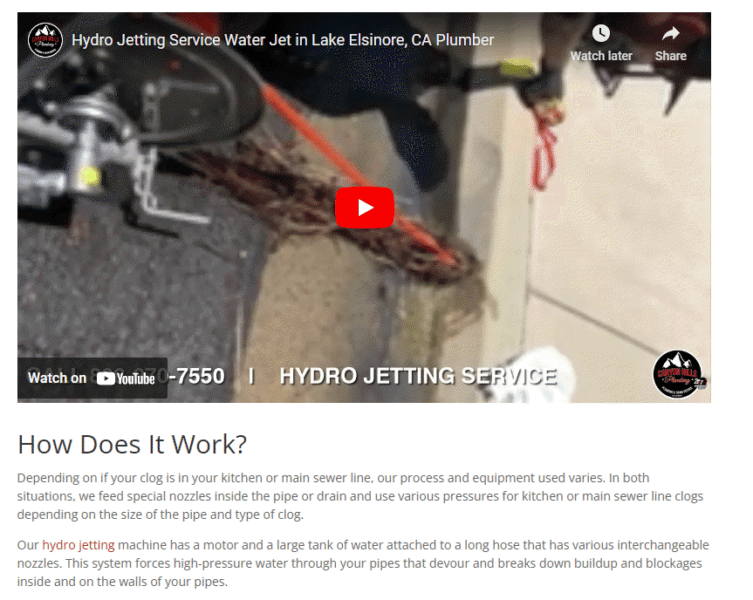
This article and video about hydro jetting on a local plumber’s website started getting backlinks on specialty websites because of its depth of information.
Types of local content will vary based on the type of business or the links desired. Some examples of local content for link building promotion include:
Gathering information about the average age of a home in the area and its energy consumption.
Localizing a national article about a consumer’s average savings account to the local neighborhood’s average savings account.
Interviews with the company’s top experts about their day-to-day challenges.
A mental health initiative for all neighboring businesses.
These are examples of content that can be published directly on the website, which may receive attention and backlinks from third-party websites.
Newspapers, local blogs, community forums, and other online resources always look for the latest information to share with their readers.
An organization can drive the conversation by publishing content that is new, relevant, and helpful.
When brainstorming ideas for local content, an organization should encourage all and any ideas. Creativity is essential to local content promotion and the links it can achieve.
SEO impact of local content and case studies
The results of a local content initiative vary widely based on subject matter and audience. However, the desired outcome is always the same: backlinks and brand mentions.
The theory behind local content for backlinks posits that if the content is interesting enough, people will talk about it.
When an organization publishes interesting content and shares it with local news outlets and consumers, it will receive backlinks and brand mentions.
These backlinks and brand mentions will improve E-A-T and organic rankings.
When the value of local content is apparent, the organic growth from that content will also be apparent.
How to get local links
So, how do you get local links?
The path to local links should look less like a hunting expedition and more like a garden. Plant some seeds and see which sprout:
Establish a citation baseline.
Reflect on company values.
Channel company values into a multi-faceted link building strategy.
Execute strategy and achieve links.
Review what is working, what is not working, and repeat.
Targeting local links based on community needs is an opportunity to outrank local competitors ranking by default.
By integrating your backlink strategy with existing values, the organization connects with the fundamental essence of local link building – caring.
Caring is the essence of local backlinks because it means that your organization doesn’t want links for the sake of links.
It cares about having the right information.
It cares about giving back to the community.
It cares about offering reliable services and has been recognized for that.
It cares about moving the industry forward and being the best at what it does.
Caring and local link building are one and the same.
So while it might seem daunting to pursue these types of local links, the process is less about developing an SEO checklist and more about reflection.
If your organization has already spent some effort defining what matters, then it will be that much easier to make an impact within the community and receive local links.
Opinions expressed in this article are those of the guest author and not necessarily Search Engine Land. Staff authors are listed here.
@media screen and (min-width: 800px) { #div-gpt-ad-3191538-7 { display: flex !important; justify-content: center !important; align-items: center !important; min-width:770px; min-height:260px; }
}
@media screen and (min-width: 1279px) { #div-gpt-ad-3191538-7 { display: flex !important; justify-content: center !important; align-items: center !important; min-width:800px!important; min-height:440px!important; }
}
About The Author
Harmony Huskinson is an SEO strategist at Portent, a full-service digital marketing agency. Harmony specializes in local SEO and has worked with hundreds of businesses since starting her digital marketing career in 2015. You can find Harmony on Twitter or on LinkedIn if you’d like to chat about the intersection of community and digital in local spaces.
Google launches visual elements gallery documenting 22 elements on the Google Search results page
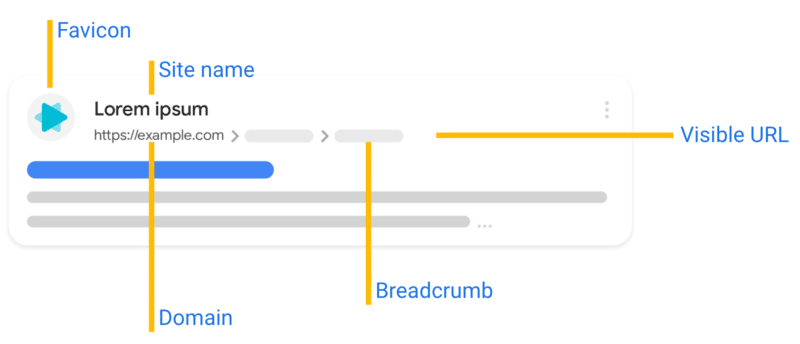
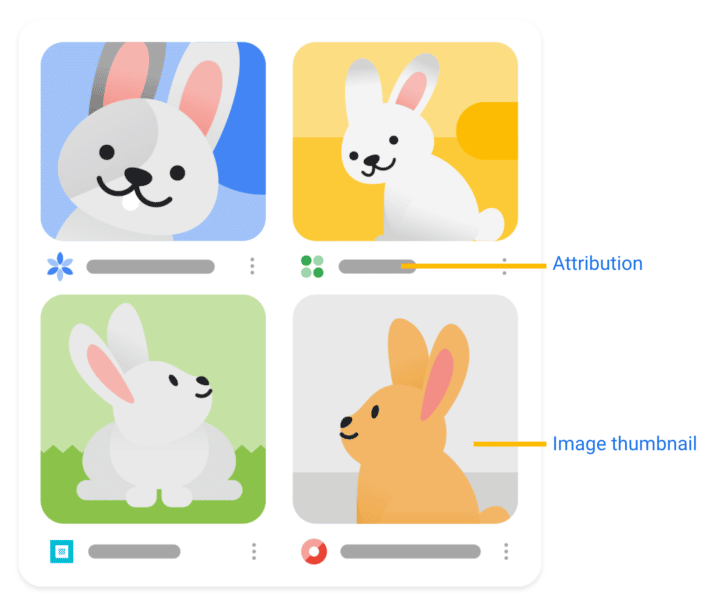
Google has launched a new help page that documents what Google calls the most common visual elements on the search results page. Here Google has laid out visually 22 elements found on the search results page, explaining what the elements look like, what they are called, and whether you can optimize your site for them.
Visual Elements gallery of Google Search. You can find this new document over here in the Google help area. It helps you identify the most common and “impactful visual elements of a search results page,” Google said. The document has 22 visual elements that are most likely to appear on search result pages, Google added. It is broken down into these categories:
Attribution. The attribution elements are elements that help searchers identify the source behind the search result with visual identifiers like the name of the site, the URL, and favicon.
Text result. The text results elements are what we use to call the “10 blue links” and/or “web results.”
Video and image results: The video and image result elements are based on the respective media indexed in the context of their respective landing pages.
An image result element is a result that’s based on an image that’s embedded on a web page.
A video result is a result that’s based on a video that’s embedded on a web page.
Exploration features: The exploration features element is also known as “People Also Ask”, or related searches group or related questions group. Google said these visual elements help users broaden their search journeys.
Why we care. This is a good way for us to get more details from Google on the type of search features in Google Search. It also helps us understand if we can help our sites come up with such rich results or other visual elements. This will also aid us in standardizing what some features are called within the search industry. Finally, Google plans on updating this document as more and more features come out.
@media screen and (min-width: 800px) { #div-gpt-ad-3191538-7 { display: flex !important; justify-content: center !important; align-items: center !important; min-width:770px; min-height:260px; }
}
@media screen and (min-width: 1279px) { #div-gpt-ad-3191538-7 { display: flex !important; justify-content: center !important; align-items: center !important; min-width:800px!important; min-height:440px!important; }
}
About The Author
Barry Schwartz a Contributing Editor to Search Engine Land and a member of the programming team for SMX events. He owns RustyBrick, a NY based web consulting firm. He also runs Search Engine Roundtable, a popular search blog on very advanced SEM topics. Barry can be followed on Twitter here.
After the content audit: 7 steps for improving content
While we may all have goals when we start producing content, it can be easy to stray away from them or stop tracking them over time.
As your website grows, it’s recommended you run a content audit periodically to allow yourself to reset your goals and expectations and align your content with your current business KPIs.
You can greatly expand your content marketing campaign and boost your business outcomes by aligning these goals and acting on information in your content audit.
To truly see results from your efforts, you must actively fix any problems in your audit and align your strategy with your established goals.
In this article, you’ll learn seven ongoing steps that can help you improve content after your audit is complete and optimize new content to reflect your business goals.
1. Establish clear KPIs
Generally, the first step of any content audit will be a review of your business goals to help you benchmark content performance moving forward.
After your audit, it’s essential to benchmark these KPIs and track various fields of progress in your analytics.
There are several metrics to use for this, including:
Traffic/pageviews
Organic keyword position
Backlinks
Bounce rate
Conversion rate
Time on page
Once you’ve established a list of KPIs for benchmarking and comparison to the content audit, you can discover strategies to improve existing content based on your intended outcomes.
For example, are you looking to rank for higher volume keywords that bring in more traffic? Are you looking for less competitive ones with higher click-through rates?
Furthermore, KPIs can be used to model new content that reflects your underlying business strategy.
Resolving these problems on your backend is an essential first step to ensuring that all present and future content can rank higher in organic search.
3. Identify opportunities for wins
Now it’s time to dive deeply into your audit and identify potential opportunities for easy wins.
For example, in this content audit guide, the author divides her content into several categories, including underperforming, thin, and outdated content.
These categories allow you to implement easy changes, such as updating body text to reflect new changes or to make content more engaging to improve your content’s relative performance.
Of course, you can always get more granular, conduct a backlink audit on underperforming pieces of content, and build external and internal links.
Look for content ranking for “striking distance” keywords and make changes, based on the data, that will help it move to the first page.
I also recommend writing new topics for high-volume keywords you might be ranking for in Position 41 or lower.
Get the daily newsletter search marketers rely on.
4. Redirect old and underperforming pages
Throughout your content audit, you might find several URLs with duplicate content and also some content that is just outdated or irrelevant.
In that case, I recommend implementing a 301 redirect to a similar page to help give that page some link authority.
However, consider being tentative about 301 redirects, as you might create more problems for your developer if you abuse them too much.
5. Revamp old content to follow new guidelines
Updating content allows you to win any opportunities you found during your audit. Generally, I like to let the data inform me.
For instance, if I find some content that is outperforming others and leading to better traffic, I might update my internal linking strategy to promote this page.
Ultimately, I recommend using content audits as a guide and a reset to develop a new content calendar and outline strategy.
Create a healthy mix of new and revamped content to give you a boost in Google search.
And if it makes sense, I like reformatting or transferring content into a new medium.
Conducting podcasts around existing content on your site or adding a video on underperforming pages could give them a much-needed boost.
6. Promote new and revamped content
After updating your content, you’ll need to promote it to give it traction. I recommend the following promotional strategies for any piece of content:
Sharing on Facebook, Twitter, and LinkedIn.
Building links.
Tagging an influencer.
Sharing in a newsletter.
Advertising over search or Facebook.
Syndicating content.
By getting more eyeballs and traffic to your pages, you can use your content to create better results for your website.
7. Monitor your analytics
You must continuously track your analytics and ensure your content is performing to your preferred standards.
Your analytics will give you an excellent benchmark to measure your content’s performance and give you ideas about where your content is underperforming or lacking.
Similar to everything in life, there is no get-rich-quick scheme or something you can buy to make your content rank better.
Instead, content marketing requires an ongoing commitment and a holistic approach, leveraging the best practices from technical SEO and link building to perform at its best.
However, with a content audit, you are one step closer to achieving your business goals using content marketing. Now, you just need to start doing the heavy lifting.
Opinions expressed in this article are those of the guest author and not necessarily Search Engine Land. Staff authors are listed here.
@media screen and (min-width: 800px) { #div-gpt-ad-3191538-7 { display: flex !important; justify-content: center !important; align-items: center !important; min-width:770px; min-height:260px; }
}
@media screen and (min-width: 1279px) { #div-gpt-ad-3191538-7 { display: flex !important; justify-content: center !important; align-items: center !important; min-width:800px!important; min-height:440px!important; }
}
About The Author
Ron Lieback is the founder/CEO of ContentMender, an SEO-driven content marketing agency based in Northeastern Pennsylvania, and the author of “365 to Vision: Modern Writer’s Guide (How to Produce More Quality Writing in Less Time).” While working in digital marketing for the past decade, Lieback has ghostwritten nearly 500 articles for C-level executives across various industries. He also contributes content to leading motorcycle magazines, including Cycle World.
6 SEO considerations for a successful international expansion
You might have detected a great opportunity based on a fair amount of traffic to your site from a specific country. Perhaps a PR campaign went viral, and now users worldwide look for your product, creating a constant demand for it.
Whatever the reason, an expansion, a new product launch or a diversification will always have to be supported by a prompt, detailed analysis of every element not only in the wider strategy but in SEO, too.
Entering a new market or going global comes with potentially significant rewards and considerable risks.
Search marketers usually agree on what factors contribute to market entrants’ success, including:
Extensive keyword and competitor research.
Target market persona analysis.
Analysis of new entrants.
Self-contained ecosystems to allow paid and digital PR campaign planning.
These studies will determine whether the brand can enter a new market, if the timing is right, or if there’s an opportunity to scale. Essentially, these are the main factors of success in any market entry or global launch.
In this article, you will discover six elements that worked for me when entering new markets while working for previous clients.
Before we dive in, it is important to note that every brand, agency and market is different. There is no single checklist that should be applied to your work.
Adapt this and other advice to your strategy and ensure it is aligned with wider business goals. Most importantly, finalizing a strategy involves working closely with other departments in your organization.
1. Market profitability assessment
International keyword research
In-depth analysis and keyword research in your target market is crucial to your international expansion strategy, as they will:
Enable you to gather information on the search volume and traffic from words and phrases related to your product or service in the original languages of new markets.
Show you potential variations in the language used (remember that translation and localization are not enough now).
Aside from search traffic, keyword difficulty is an important indicator since it specifies how competitive your keywords can be in various languages, regions and language fusions.
Important tip: If you plan to translate your current set of keywords, make sure they are not only translated and localized but also they are aligned to how people search in your target country.
For example, in the north of Mexico and some parts of the Southern U.S., “Spanglish” is common. This means that in this part of the world, you will find many queries are done by mixing English and Spanish.
Take the fashion term “maxi dress” as an example. In Spain, people would search for “vestido largo,” whereas in some parts of Mexico, people might search for “maxi vestido.”
The example below is from Zara Mexico, where the way people search has influenced how products and categories are presented. As mentioned, the products are called “vestido maxi.”
Whereas in Zara Spain, similar products are called “vestido largo.”
In-depth international keyword research will:
Give you an idea of the resources and capabilities you must have to enter the new market.
Help you decide whether you are ready to expand or if it is better to wait.
Google Analytics data
Analyze your top converting traffic sources using Google Analytics (or other tracking software). Pay attention to the areas around the world where your brand is getting constant traffic.
While traffic is important, make sure to analyze conversions and revenue before deciding to expand to a new market.
Conduct an in-depth report, as this will help determine whether you can satisfy the demand emerging from these new countries.
Will you need a new warehouse? If you can’t have a new warehouse, you may need a communication strategy to emphasize delivery times.
Along with this, you might consider an incentive campaign to increase conversions if your delivery times might affect them.
Get the daily newsletter search marketers rely on.
2. Social networks in the target market
This is one of the most important steps when entering a new market.
You might be thinking that this is not related to SEO. It might not be at first glance.
However, it will determine the strategy for paid media and the type of content you should produce to increase brand awareness and gain links.
Why are social networks important?
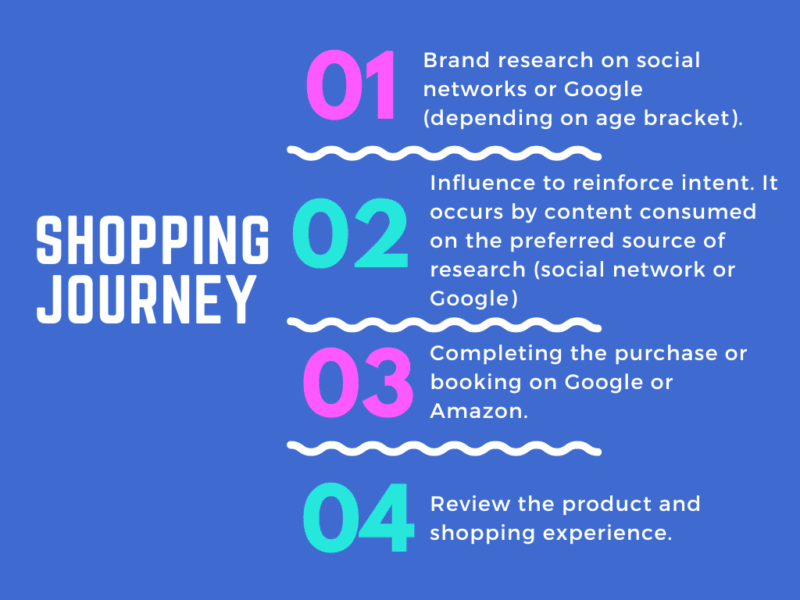
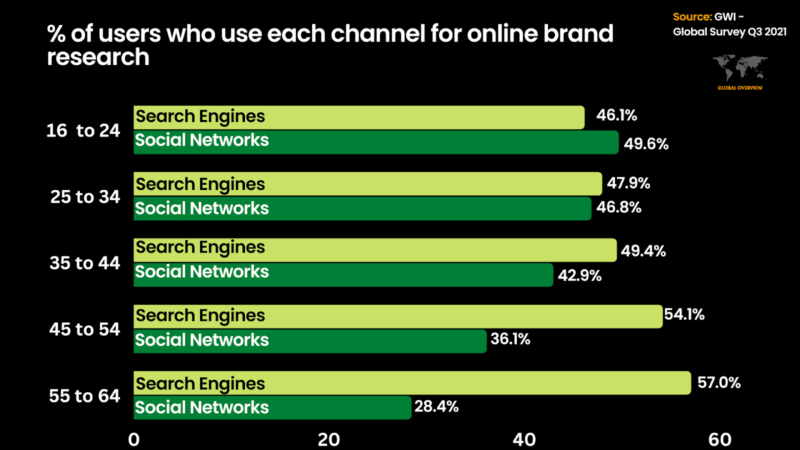
Because a large percentage of online consumers start their purchase journey with brand research on social networks.
However, is important to note that:
Not all consumers will always start their brand research on social networks.
If they start on social networks, it is not always TikTok.
The chart below shows several age brackets and where they typically start their brand research, especially when making a high-value purchase.
Source: GWI – Global Survey conducted in Q3 2021.
This information is useful when planning:
The types of content to create for digital PR.
The types of influencers to work with.
The correct paid media channels for launching in a new market.
In some instances, the paid campaign will be on social networks, and in others, it will be more effective via Google Ads.
It is crucial to identify the main social networks used in the target country you are looking to expand in, especially for the age brackets that start their brand research on social. In some countries, it could be TikTok, while in others, it could be Instagram.
3. Hreflang
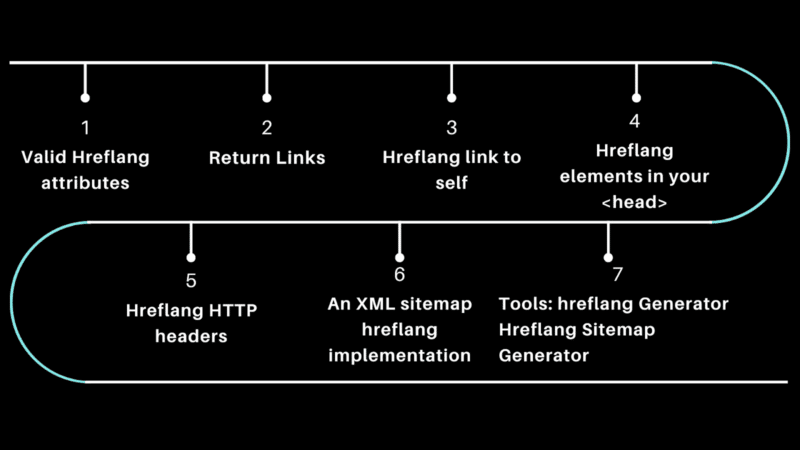
The hreflang is a little snippet of code that looks like this: rel="alternate" hreflang="X".
An hreflang tag should be added if your site has the same content in various languages.
In a global context, the hreflang element assists search engines in determining which URL version of your site should be provided to visitors from a given region or who speak a specific language.
Hreflang contributes toward a good user experience as it:
Helps deliver a search result in the location and language the user made the query.
Prevents duplicate content issues.
Below, I have included some ideas to consider when implementing hreflang.
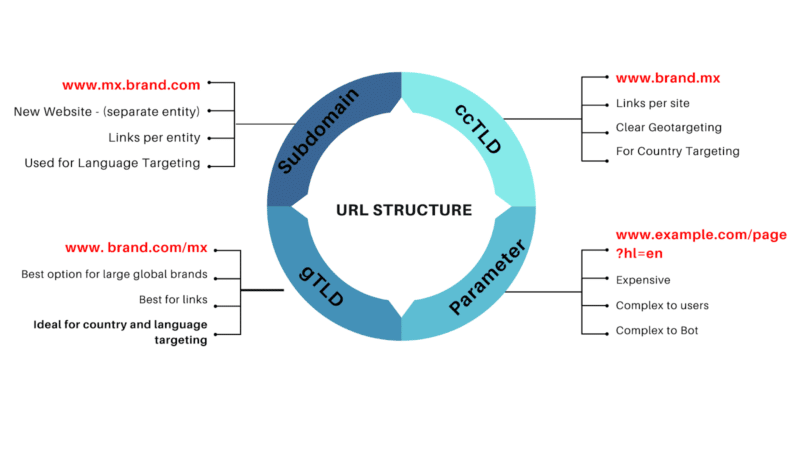
Similar to the hreflang principle of serving your users with results relevant to their language and location, the choice of the URL structure is crucial as it will be an indication for both search engines and users.
Here are the differences and uses of common URL structures: ccTLD, gTLD, subdomain and parameter.
There’s no “one size fits all” when it comes to URL structure. The choice should depend on your objectives and goals.
However, you should consider the limitations of your CMS. This is one reason why you might see some brands still using parameters. While using them is acceptable, parameters are not the best option.
Translating and localizing content is not enough. More than that, content should be aligned with common uses and language phenomena in your target country (i.e., Spanglish).
This principle also applies to your website’s shopping cart. When a customer is about to finish a purchase, it’s vital to consider the following:
Currency: The currency must be the same as the user’s country.
Language: It must be the same as your user’s country.
Payment methods: Make sure you include Apple Pay (crucial), Google Pay, various credit cards and payment methods such as Klarna and Paypal.
Information on delivery and choices for faster and cost-effective delivery methods.
Discount code section.
If your target customers are between the ages of 16 to 34, consider that they are 80% more likely to pay with Apple Pay than with other methods.
Not having the preferred payment method, incorrect language, and unclear information will lead to cart abandonment.
6. International digital PR
Establishing a country-specific link strategy for each market is a must. Depending on your brand’s niche, you might be limited to a few tactics.
If you are in the food, fashion, sports or gifts sectors, the best course of action will be to identify the most used social network by your target audience and work with influencers in those appropriate channels.
Working with a relevant influencer in an appropriate social network and running paid campaigns are the best ways to enter a new market while you lay the groundwork for your organic efforts.
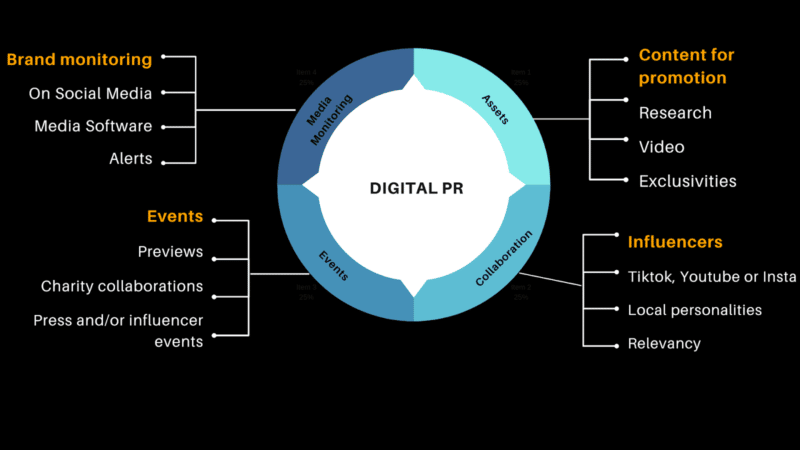
The beauty of digital PR is that there are plenty of opportunities to increase brand awareness and earn links.
If there isn’t a traditional PR team in your brand, you can focus on these tactics:
Brand monitoring.
Events.
Content for promotion.
Influencers.
To build valuable partnerships, it’s crucial always to adjust your approach to the customs of the individual market.
A sample approach can go like this:
Identify influencers on TikTok.
Establish collaborations.
Create assets to promote on media outlets.
Work with paid Media.
Earn local links to add relevance and boost trust.
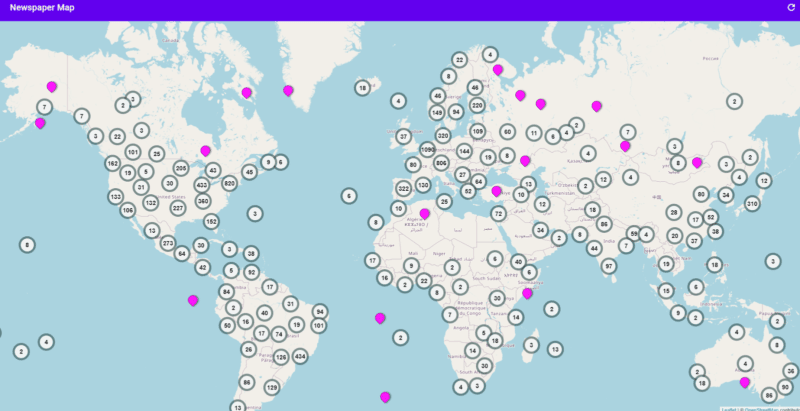
You can also refer to Newspaper Map, an interactive map that shows you online outlets available in every region you could imagine in the world.
When you click the pink bubbles, it will display a link to a specific online newspaper.
The following is an example when zooming into central London, where you’ll see the Financial Times’ office location.
Once you have identified your media outlet of choice and wish to connect to a journalist to request a link or a collaboration, you can use RocketReach (a tool where you can manually get the contact details of journalists).
Go global with the right SEO approach
The most common causes of failure when expanding include:
Impulsivity. Making expensive decisions based on temporarily high product demand from a specific location.
Common biases.
Insufficient analysis.
Poor strategy.
Your SEO team can have the best strategy. However, not working with other teams and having poor negotiation skills may lead to friction, poor implementation, and failure within the first two years of the expansion.
To avoid costly mistakes, it is important to do an in-depth study per element mentioned in this article – plus more.
Don’t base your expansion strategy on a checklist. Adapt resources to the knowledge of your business and the organization’s overall plan.
The following table shows the common biases in a market entry and ideas on how to tackle them.
Core market entry analysis
Description
Common biases
How to tackle
Value Proposition
Business model. Do I have the necessary resources?
Impulsivity and egocentric interpretation of resources.
Determine the degree of variations in required capabilities for the new market.
Market size
Geographic area to expand, and how much demand is there?
Overconfidence, Anchoring and inadequate initial value.
Make decisions based on forecasts made on competitors in the target market.
Competition
Existing competitors in the market Potential entrants
Competitive blindspots
In-depth analysis of possible competitors and related sectors to our target market.
Estimates of market share revenue
Expectations of sales for our offering
Failing to consider the competitive response of existing competitors
Conduct in-depth competitor research.
Detailed cost estimates
Costs of input, distribution and economies to be faced
Underestimation of costs
Once all your cost plans are complete, it is advisable to hire an external consultant or auditor to review them to determine feasibility and potential risks.
Remember that the success factors in an expansion are:
Timing.
Ability to leverage assets.
Scalability.
And, more than anything, work as a team!
Opinions expressed in this article are those of the guest author and not necessarily Search Engine Land. Staff authors are listed here.
@media screen and (min-width: 800px) { #div-gpt-ad-3191538-7 { display: flex !important; justify-content: center !important; align-items: center !important; min-width:770px; min-height:260px; }
}
@media screen and (min-width: 1279px) { #div-gpt-ad-3191538-7 { display: flex !important; justify-content: center !important; align-items: center !important; min-width:800px!important; min-height:440px!important; }
}
About The Author
Maria Amelie White works as Head of SEO at Kurt Geiger a luxury British retailer with concessions in luxury stores such as Harrods and Selfridges in the UK.
Maria is an MSc in Psychological Research from the University of Oxford and has worked in SEO for over 12 years, specializing in Technical SEO, International SEO, Local SEO and Digital PR.
Programmatic SEO: Your missing link to 1M+ sessions
It’s time to rethink SEO growth.
Not every strategy needs to start with a blog post regurgitating the same information across the top Google results and end with an agency begging for links.
In the era of Google Ads becoming more expensive and organic discoverability becoming less effective, companies need to differentiate themselves in SEO.
We must push the envelope and create something that has yet to be seen online.
With creativity, thoughtfulness, and CSV magic, programmatic SEO can do this, resulting in millions of new customers per year.
This sounds impossible, but it’s not.
In this guide, I will walk you through exactly how to get started with programmatic SEO.
What is programmatic SEO?
Programmatic SEO is the strategy of publishing unique, high-quality pages at scale using a template and a database.
The goal of programmatic SEO is to create content with the same depth and thoroughness as a traditionally published article but repeated thousands, if not millions, of times at scale. A programmatic site can be as small as 200 pages and as large as 4 million. The key is ensuring each page serves a unique purpose in the search journey.
An oversimplification of programmatic SEO is building a database, connecting it to a template, and publishing thousands of pages.
But if this is all you do, congratulations, you just created thousands of pieces of spam.
Programmatically building content is a powerful tool that can exponentially grow a site or completely spam it. To become a true player in SEO growth, we must start thinking bigger – or should I say, we need to think “deeper” about our content.
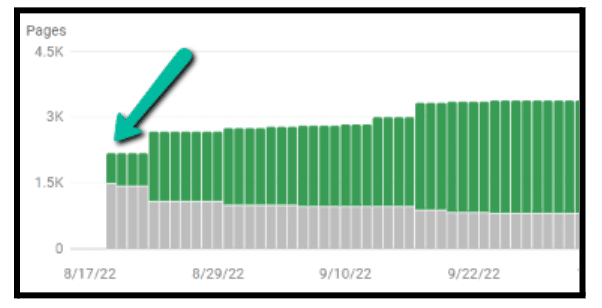
A newly published programmatic site since June 2022.
The benefits of programmatic SEO
Programmatic SEO unlocks traffic in the nooks and crannies of the internet. You no longer need to pick a handful of keywords, pay for written content, publish the post and hope it ranks for a cluster of terms. Now we can target entire categories and win all available searches in one template.
With programmatic SEO, businesses can:
Win keywords at scale.
Produce in-depth content quickly.
Gain low engineering lift.
Get “quicker” results – I use this delicately. Quickly, meaning results and challenges escalate quickly.
The drawbacks to programmatic SEO
As with any strategy, programmatic SEO also has its disadvantages, such as the following:
Indexing is difficult.
High risk – poor execution can hurt site growth.
Limited by data resources.
Remember, if you’re trying to use programmatic SEO to trick Google or create People Also Ask (PAA) scraper sites, you’ll lose.
Great programmatic content enhances content production through data depth and production efficiency.
What follows is a four-step guide to implementing a programmatic SEO structure.
Step 1: Keyword research for programmatic SEO
Instead of picking out a handful of keywords and paying for expensive bespoke content hubs, programmatic SEO aims to target entire directories of keywords under the same entity.
Here are the steps in identifying your keywords.
Define your goals and intent
This will start similarly to a traditional SEO keyword analysis. Identify what category or topical group will drive business value. Hard stop.
Driving traffic to show a cool graph to your client or boss means nothing if the traffic doesn’t move the business forward.
Remember, business value can be as obvious as full conversions through transactional keywords or as light as a session hit to introduce your brand and possibly trigger a returning visit later in the research process.
Here are resources to help complete a thorough opportunity analysis:
Identify main topics
Start broadly. Once you’ve identified the target intent and goals, we need to define the category in which we want to rank.
Think of this as one step below a head term. We call this the “niche” of your site, driven by your product.
For example, “trucks” is a main head term and a broad topic. However, it’s not very intuitive and doesn’t have strong intent for a business-driving keyword, so we want to take it a step further.
“Ford F-150” is a bit more specific but broad enough for our target.
Note that this is a specific brand search; however, that’s perfectly OK. We’ll not try to outrank Ford, but enhance the search experience for the Ford F-150 audience.
Identify modifiers and related terms
Ford F-150 is not our keyword, it is the vessel by which we will morph into a traffic machine.
We do this by identifying questions surrounding the main topic. This is the jumping point from traditional content assets and programmatic building.
If your main topic cannot be modified through repeatable searches, your product may not be viable for programmatic SEO. But if you find common questions surrounding a product, you can win traffic at scale.
Timely: Questions that are impactful in a specific timeframe.
Examples: 2022 F-150, stock prices at November 18 2022, inflation rates last year, sporting event scores from last week.
Comparable: Questions that create value by comparing to others.
Examples: F-150 vs Chevy Silverado, housing costs in 2008, book reviews vs book categories, political affiliation by state, hobbies and interests by zodiac signs.
Hyper-specific: Questions that are only valuable within certain parameters and not the broader audience. Also known as the hyper long-tail.
Examples: F-150 for sale in Marietta, Georgia, 1997 crime rates in Philadelphia PA, David Eckstein’s World Series batting average in 2006, answering public questions (i.e., Reddit and UGC).
For our F-150 example:
F-150 vs Chevy Silverado
F-150 under $50k
F-150 in Marietta, Georgia
If you were using a traditional SEO system, you’d see three pages, potentially 100 if you’re doing the math in your head for states and other car comparisons and weeks to scale handwriting all of these pages.
But for a programmatic approach, we have at least three templates and potentially thousands of pages to publish as soon as our template is ready.
Look for signs that the keyword can be modified. In the example, we have three modifiers – “vs,” “under,” and “in.”
A quick way to find the keyword gold within your topic is to go back into your keyword aggregator and type in the [topic + modifier] (i.e., “F-150 vs” / “F-150 under” / “F-150 in”).
This gives you a better look at the opportunity size of each directory.
Take it one step further: identify other topics that can be modified by the same keywords. In our example: F-150 can be swapped out for Chevy Silverado, Ram 1500, and even targeting “Trucks” with additional modifiers could be viable for a strong site.
Our keyword research should look like this:
Entity
Modifiers
Parameters
F-150
under
10-100 by ten
Chevy
in
Zip code
Ram
vs
All
The additional “parameters” column will define the level of detail you need. You can build this out for as deep or as wide as your product calls for. The more modifiers and entities you find, the more pages you’ll have.
Target long-tail search
The sweet spot is a repeatable, mid- to long-tail keyword.
In the example above, we very obviously made an ecommerce website, which is a great visual, but programmatic SEO as a growth strategy is most effective in targeting long-tail searches for informational intent keywords.
Example: Weather in Philadelphia, PA today
pSEO approach: Weather in {location} {date}
You might think this is impossible to drive meaningful traffic, but again, think deeper.
By targeting specific ZIP codes and low-search volume towns, a relatively unknown site with a decent backlink profile wins an estimated 3,000,000 sessions* per month from these searches. *Estimated with traditional keyword research tools.
There’s no denying that Google is absorbing more of their own traffic. Keywords with multi-intents or hyper-specific keywords are usually pulled directly onto the SERP without needing a click.
As a business owner and growth strategist, you must define the value of each keyword group.
Is showing within a featured snippet helpful for a brand introduction, even if it doesn’t result in a click?
If yes, go after it. If not, look for keywords that focus more on research and action.
The weather example may not be a viable strategy for a casual environmental blogger.
But if your product is a weather app, programmatically winning thousands, if not millions, of keyword variations that are extremely relevant to your targeted audience could exponentially increase app downloads.
Get the daily newsletter search marketers rely on.
Step 2: Building the content template
A programmatic template is the most important aspect of the build.
This is where the art and science of SEO collide by stacking data points to create one cohesive, impactful piece of content that satisfies the user’s intent programmatically.
The biggest difference between traditional SEO and programmatic strategies is that you’re building templates, not final pages.
For SEOs, this means all of your traditionally bespoke updates must be done at scale and, yes, through engineering tickets.
A page template should accomplish three goals:
Goal 1: Create value where the traditional content pipeline cannot
Sometimes, content is better when we stop trying to fit it into a blog post.
Being able to programmatically compare pain points is a great use case to use a programmatic approach.
G2 does this seamlessly by comparing prices, reviews, and related products directly on a category page, bringing additional value to the page that handwritten content cannot.
Goal 2: Go a mile deep into the query, but set boundaries
Consider your audience and Google search results (SERPs) when building your template.
Start by setting limits. If you’re building geo-based content, ask yourself when your content stops changing.
Does your offering change state? By county? By zip code?
Building thousands of pages based on the same content are called gateway pages. They’re easy for Google to eliminate and extremely unhelpful to the visitor.
The goal of a template is to dive extremely deep into a topic, and the result is scale. Not the other way around.
Goal 3: Give access to information previously unavailable
Programmatic content can give access to data that was previously unobtainable because your template is built for a human, powered by a database. It becomes a storytelling medium.
Election data today is so refined that we can visualize results down to the individual county. Is this new data?
Of course not, but through visualizing an extremely large, overwhelming database into an easily consumed medium, we’ve created new value to the conversation.
High-quality templates
Low-quality templates
Answers multiple questions
Answers 1 obvious question
Unique data points
Scrapes other websites
More page value than traditional pipeline
Provides little value but can scale quickly
Each page is uniquely valuable
Gateway pages created to trick Google
A great template will check most, if not all boxes.
Be warned – low-quality templates checking only one box are spam, and Google will quickly drop them from the index.
Step 3: Connect to a database
Your database can be any source of information used to build content.
It can be as simple as a CSV export from a government data source or as complex as a proprietary data warehouse updated by the second.
The key is building a database that meets the goals set by your template.
And don’t let the term database scare you. You don’t need to be a data scientist to find the right data.
Being in tune with your audience’s needs and potentially a few skills in Excel are what’s important. (You can always outsource if you don’t have Excel or Python skills).
Ian Nuttall, creator of Niche Site Metrics, built a depository of where to find all publicly available data.
But it doesn’t only need to be open-source data.
Listen to your customers.
Build a repository of reviews.
Group support ticket questions by topic.
Track industry prices over time and by geography.
Build your database around transforming your product or brand into a uniquely useful resource.
Step 4: Publish and get indexed
Your first challenge in successfully driving traffic with programmatic SEO is indexing because everything happens at scale.
Don’t be alarmed when you do everything by programmatic SEO best practices and your indexing is less than 30%.
Programmatic pages will be similar in nature, kicking most pages into Discovered – currently not indexed or Crawled – currently not indexed.
If you publish more content at once, more pages start in the abyss of discovered or crawled but not indexed.
Don’t panic. Take a hard look at the published templates and ask yourself, are you bringing something new to the SERP?
If yes, move forward with these three steps
Build a better internal link structure
Internal links for programmatic SEO are 10x more important than traditional editorial pages.
You are building hundreds, thousands, or even millions of pages from one directory and will need to build context between each related page.
Create link silos from Directory > Leaf pages. Hardcoding the same 20 links into every page will be disregarded by the visitor and Google, rendering it useless.
Just as you would for traditional SEO, dedicate time to contextual linking and work with your engineer to set the correct logic for each individual page.
If you forget internal linking, you’ll create thousands of orphaned pages and increase the number of dead ends on your site. These will almost entirely be seen as non-influential pages and may never be crawled.
Create a robust sitemap structure
Programmatic SEO sitemaps are as important as robust internal linking. The maximum list of URLs on a robots.txt sitemap is about 50k. For larger sites, you’ll need dozens of sitemaps and sitemap indexes.
Structure your robots.txt file as you would your site structure. If possible, build a sitemap for each individual directory. This will categorize sitemaps by subject rather than publishing date and allows Google to index each category more easily.
Once it’s set, make sure you force crawl each individual sitemap (yes, even if you have hundreds of sitemaps) two times or until Google has returned to the page multiple times.
Create HTML sitemaps
These are not your HTML sitemaps from 2009. Identify each directory page and use it as a linking guide for every “milestone” page.
For a site with millions of leaf pages, you won’t be able to link to each individual, but you can target Category > Subcategory links.
This allows your directories to function as link hubs and creates an easy flow from Homepage > Category > Subcategory that enhances your internal link structure.
To recap, below is a repeatable process for implementing a programmatic SEO structure.
Identify a repeatable search opportunity.
Build a diverse content template.
Build and connect a robust database.
Implement internal links into templates.
Create robots.txt sitemap structure.
Publish.
Optimize and repeat.
Opinions expressed in this article are those of the guest author and not necessarily Search Engine Land. Staff authors are listed here.
@media screen and (min-width: 800px) { #div-gpt-ad-3191538-7 { display: flex !important; justify-content: center !important; align-items: center !important; min-width:770px; min-height:260px; }
}
@media screen and (min-width: 1279px) { #div-gpt-ad-3191538-7 { display: flex !important; justify-content: center !important; align-items: center !important; min-width:800px!important; min-height:440px!important; }
}
About The Author
Jake Gronsky is a former professional baseball player in the St. Louis Cardinals organization turned SEO growth advisor. He’s directed Growth teams and led SEO departments for VC-backed tech companies and Private Equity firms worldwide.
Think LinkedIn is just for business networking and job hunting?
Think again.
The platform is a great destination for both of those things, no question, but it’s also a smart place to focus at least some of your content marketing efforts.
Why? LinkedIn enjoys a wider audience than you might think, with 66.8 million monthly active users in the U.S. alone, with a total reach of 849.6 million users globally.
That includes professionals, sure, but it also includes 14.6% of all people age 18 and older worldwide. LinkedIn’s largest audience is among 25- to 34-year-olds, who make up nearly 60% of users on the platform.
That means there’s a good chance your audience is using LinkedIn, and you could reach them and nurture them with solid content marketing.
As you’ll recall, content marketing is about planning, creating, and publishing helpful, relevant, valuable content to attract a specific audience and nurture their trust over time.
Eventually, that trust translates to profitable action: think sign-ups, downloads, opt-ins, and sales.
Let’s explore this all further.
In this guide, you’ll learn how to set up your LinkedIn content marketing strategy.
Why do content marketing on LinkedIn? 4 big benefits
I always recommend focusing on your website first for content marketing, but LinkedIn could be a worthwhile side channel of focus.
Here are a few reasons why.
Reach more of your audience
By publishing content on LinkedIn, you have the potential to reach a wider audience.
As we said, LinkedIn has an impressive user base that hovers near 1 billion worldwide users. Tapping into that reach is a good way to extend beyond your main organic traffic drivers (i.e., search engines and major social networks like Facebook or Instagram) to find more people who need you.
Build your network
Besides a wide user base, LinkedIn is also the social home base for professionals in your industry.
65 million decision-makers and 61 million senior-level influencers use the platform – in other words, people who call the shots for a myriad of businesses.
That means posting consistent content here will attract more than your audience.
You could grab the attention of peers and colleagues who might be networking and looking for collaboration opportunities – think guest-posting, speaking gigs, interviews, and more that will further spread your name to new audiences.
Potential partnerships with these people could be mutually beneficial, especially if your audiences overlap.
Drive traffic back to your website
LinkedIn is a great place to share your blog content, which drives traffic back to your website.
Maintaining a consistent, valuable presence on LinkedIn will also nurture your audience and build their trust.
That will make them more likely to click the links you share, interact with your other content, and even convert through email sign-ups or straight-up purchases of your products/services.
Keep up with your competition
Are your competitors using LinkedIn for marketing?
If you don’t have a LinkedIn presence, you might be missing out on reaching a valuable slice of your audience – one your competitors will be grabbing instead.
Content marketing for LinkedIn: How to build your strategy
To see results from LinkedIn with content, you need to do more than simply maintain a presence there.
Instead, you need to invest in a LinkedIn content marketing strategy that includes goal-setting, targeting a defined audience, and smart content creation/distribution.
This strategy should directly tie into your website and blog content strategy because they can – and should – work together. (For example, as we mentioned, sharing your blog content on LinkedIn helps drive traffic back to your website.)
For best results, build and document your strategy and stay consistent. Here’s how.
1. Set goals for your LinkedIn content marketing
Every single content marketing strategy guide starts with goals (or should). Here’s why:
Setting goals gives your marketing activities a purpose and destination.
Instead of marketing for marketing’s sake with no direction, you’ll be actively working to grow your brand toward specific goalposts.
Goal-setting keeps you accountable, forcing you to track your progress and review your wins and losses.
You’ll see where your ROI is coming from and how you can tweak your strategy to improve it.
Your LinkedIn content marketing goals can be relatively simple and relate to your overarching marketing goals.
For example, you might choose a primary goal of building brand awareness or increasing website traffic.
After you set one or two goals, decide how you’ll track and measure them.
For brand awareness, you might look at your website traffic to see if it increases over time as more people become aware of your brand.
Or, you might look at post engagement to see how it grows with your reputation.
2. Research and define your LinkedIn audience
Ultimately, defining your audience is about unearthing the people who need what you sell and will be the most likely to buy.
If your brand is established, you’ve probably done audience research already to find these people. If that’s the case, look at your ideal customers and personas to determine which of them is most likely to be on LinkedIn.
If all of them probably use the platform, that’s a good opportunity to post different types of content to target each persona.
Since LinkedIn is largely a network of professionals, you also should consider your audience’s level of employment.
For example, is your audience mostly made up of independent solopreneurs?
Or are you speaking to managers and heads of companies? Or perhaps you’re targeting mid-level employees who report to one or multiple bosses.
Whoever you target, make sure you know and understand them well so your content can be tailored to their needs and desires.
By the way, LinkedIn offers insights on their users, including behavior and demographics, which could come in handy as you research your audience.
Get the daily newsletter search marketers rely on.
3. Set topic areas and content types to create
The next part of your LinkedIn content strategy plan needs to include the types of content you’ll create as well as the topic areas you’ll focus on.
To find your best topic areas, you need to hit two goals:
What your audience wants to read.
Your brand expertise.
Never guess at what you should write about – always lean on your audience research to figure out exactly what they want to read and what format they’d prefer.
On LinkedIn, you have a bunch of options for content types/formats. Most likely, you’ll probably rotate through a few to keep your audience engaged. Let’s break down the key types.
Text posts (status updates)
Similar to Facebook, LinkedIn gives you the option to post short status updates or “mini-blogs” with just a few paragraphs of text (the word limit is currently 542 words for these types of posts). These posts also may include hashtags and links.
What to post:
Share a life lesson or inspirational moment.
Share some tips or a good idea.
Write about an experience that changed you.
Share a funny or thought-provoking quote.
What not to post:
Lots of pitches for your products/services. If every other post is a pitch, you’ll turn people off.
Irrelevant updates.
Too many updates (hello, spammer).
Long-form posts (articles)
You can also publish long-form articles on LinkedIn, just like the content you’d publish on your blog.
Generally, LinkedIn recommends 1,500-2,000 words for these pieces. They should be in-depth, relevant, and meaningful, not to mention give your reader lots of value.
LinkedIn articles can be read by anyone online, not just LinkedIn members.
They can also be indexed in Google and rank in search results – so ensure you use keywords and optimize your page to help even more people discover your content.
Photo posts
LinkedIn is not a photo-driven social network.
That said, photo posts sprinkled in here and there add a nice variety and may increase engagement – especially if you post audience-relevant photos that tie into your brand and expertise.
You aren’t limited to posting one image, either. You also have the option to post a carousel of photos that tie together.
Link posts
Link posts are a great vehicle for sharing the content you publish elsewhere, like on your blog.
They are engaging for another reason. Link posts include a preview that automatically pulls in imagery from the site you’re linking to.
Native videos
Yep, you can upload videos to LinkedIn, too (note: this is different from video ads or embedding a video from YouTube, for instance).
Video engagement is proven, as audiences are 20x more likely to share them than any other content type.
When you create and share videos, use the same standards as you would for your written content:
Stay audience-focused. What do they want to hear/see?
Stay relevant. Don’t post random videos that don’t relate to what you do, what you sell, or who you sell to.
Tell stories about your brand, your company culture, your customers and you.
Document posts
Unique to LinkedIn, document posts let you upload documents like PDFs, PowerPoint presentations, Word files, etc.
That means you can post more in-depth content like ebooks, whitepapers, case studies, slides from your latest presentation, research studies, and more straight into a LinkedIn post.
Your audience will be able to download the documents you post as PDF files, too,
To truly impress with document posts, make sure they have an eye-catching design, like this one from Moz.
Remember that LinkedIn isn’t a platform like Facebook or Instagram.
It is a social network, but it doesn’t serve exactly the same purposes those other networks do.
That also means a slightly different chunk of your audience uses LinkedIn, and they may expect to see content tailored to the LinkedIn platform.
For that reason, don’t make the mistake of copying and pasting your content from one social network to another. Much of what works elsewhere won’t translate to LinkedIn.
Instead, create content exclusively for LinkedIn – especially if it’s your main channel of focus after your blog.
Pinpoint what your audience likes to see in their LinkedIn feeds by doing social listening and a little investigation. Then experiment with posts until you find what works for your brand.
Lastly, don’t forget to use hashtags on LinkedIn. Most of your posts can include them. Plus, they’re handy for reaching a wider audience outside of your network.
5. Set a publishing schedule
Every good content strategy needs to include a schedule for publishing content – including a trusty content calendar.
Without a calendar, you’ll get lost in the day-to-day of posting and forget what has gone out and when. You’ll be more liable to miss posting at the right times, or post repeat content, when in fact you want to do the opposite.
If you already have a content calendar for your blog (and you should), you can use it for your LinkedIn posts, too.
Most tools have a tab feature or a way to color-code posts by type so you can keep track of all of the posts for all of your content channels.
(My favorite calendar tools are MeetEdgar and Airtable. If your budget is tight, consider Google Sheets.)
As you contemplate your posting schedule, think about a few factors:
How many posts you can create per week without sacrificing quality.
The types of content you’ll post (status updates, images, articles, etc.).
The best times to post on LinkedIn for your audience.
Setting up a plan for creating and scheduling LinkedIn content in advance, so you’re never scrambling to post.
The best and worst times to post on LinkedIn, according to CoSchedule’s research.
6. Interact and engage
Content marketing on LinkedIn isn’t one-dimensional.
To see the best results from consistently posting on the platform, you need to be consistently engaging with others, too.
That includes liking, commenting on, and sharing others’ content.
Remember that saying, “You get what you give?” That applies here.
A friendly social presence will help build your brand awareness and reputation just as much as consistent, high-quality content.
With that in mind, add some daily benchmarks for engaging with others into your LinkedIn content marketing strategy. It will help keep you accountable.
7. Measure your results and tweak your strategy as necessary
If you’re truly putting a lot of investment into your LinkedIn content strategy, don’t forget to measure your results and track your progress toward your goals.
Not only will you find out whether your efforts are working, but you’ll also keep tabs on whether they’re worth it.
LinkedIn offers some helpful tools for checking how well your content is performing, including analytics like impressions and engagement for each post.
If you have a LinkedIn Page for your business, you’ll be able to view a wide range of data like pageviews, unique visitors, follower metrics, and more. Check your metrics regularly to track your growth.
Start content marketing on LinkedIn
If you’re looking to expand your reach with content marketing, consider adding LinkedIn to your publishing channels.
If your audience includes professionals or business owners, it’s an even smarter idea to jump in.
However, don’t just post randomly – come up with a content marketing strategy and hone your efforts for the best results.
Don’t focus wholly on LinkedIn, either. Instead, consider your website and blog as priorities for content, with LinkedIn only coming in second place.
Ultimately, you don’t want to build your brand presence on rented real estate.
LinkedIn can be an effective channel to use to reach a wider audience, build brand awareness, and nurture leads. Just make sure you do it strategically.
Opinions expressed in this article are those of the guest author and not necessarily Search Engine Land. Staff authors are listed here.
@media screen and (min-width: 800px) { #div-gpt-ad-3191538-7 { display: flex !important; justify-content: center !important; align-items: center !important; min-width:770px; min-height:260px; }
}
@media screen and (min-width: 1279px) { #div-gpt-ad-3191538-7 { display: flex !important; justify-content: center !important; align-items: center !important; min-width:800px!important; min-height:440px!important; }
}
About The Author
Julia McCoy is the founder of Content Hacker, 7x author, and a leading strategist around creating exceptional content and brand presence that lasts online. At 19 years old, she used her last $75 to build a 7-figure writing agency which she sold ten years later. In the 2020s, she’s devoted to teaching founders and marketers the strategy, skills, and systems they need to build a business through inbound content, so they can create more lasting impact in the world.
A place where you can keep up with what’s happening in the search space.
A community.
An entire new world revolving around the important tools of search engines, a world that continues to grow and be shaped, with such a huge impact on society and our daily lives.
There’s a lot to look forward to in 2023.
But first, let’s take a look back on the past year of Search Engine Land, give some thanks to those who have helped make this year a success, and tease a few things you can expect from us over the next year.
Thank you for reading!
If you’re still reading this, thank you! Yes, you!
Every day, our mission is to bring you the latest news and information as it happens, as well as useful guides and insights to help you thrive and advance in your career, navigate the ever-changing search landscape and understand what’s coming next.
Hopefully, you found our news coverage and articles helpful over the past year.
Search Engine Land has a small team. But as the late Steve Jobs once said, “A small team of A+ players can run circles around a giant team of B and C players.”
And I truly we believe we have those A+ players here.
Barry Schwartz. Barry is a legend – he’s been writing on Search Engine Land since the beginning and covering search for an astounding 19 years. He’s written a ridiculous number of news articles (somewhere around 40,000), documenting all the latest updates and developments in our space. His work ethic is beyond impressive and it’s been an honor to work with him this year.
Nicole Farley: Nicole has been a great addition to the team. I was impressed by her when we first met a couple of years ago. Since joining the team, Nicole has well far exceeded my expectations and does a fantastic job staying on top of all the latest developments in the world of PPC.
Angel Niñofranco: I was beyond excited to have Angel join the team and to work with her for a second time. Fun fact: Angel now has been my first hire at two different companies. Angel is a truly excellent editor and helps make sure our SME content is worthy of your time and attention.
Kathy Bushman: It’s been great working with Kathy on the SMX events. Her focus never wavers from what’s most important: making sure we deliver top-level content (and experience to match) to everyone who attends our events. I’m already looking forward to thinking about the agendas for SMX Advanced and Next in 2023 – both will be here much sooner than we think!
Sarah Slifko-Camarra & Karen DeWeese: I can’t thank them enough for all their help in getting our SME program established and organized. Plus, Sarah and Karen do some great work behind the scenes with SMX.
Marc Sirkin: Marc has been a huge ally and sounding board for starting to make some big and much-needed changes to our website and SEO strategy.
Chris Elwell: I truly appreciate Chris for his leadership, for always challenging us to be better, and for the thoughtfulness in how he approaches business decisions and processes. He has truly created a great team and company. (And, in case you didn’t know, he has been a key figure in the development of our entire industry. Watch this video interview he did with Barry in 2020 to learn more.)
There are so many other fantastic humans who are part of the Third Door Media team who I haven’t mentioned. Just know, even if I didn’t mention you, I appreciate you and all you do to help make our company successful.
Gone, but not forgotten
It has undoubtedly been a year of change for Search Engine Land. I joined Search Engine Land in January. And Nicole and Angel joined around halfway through 2022.
We also bid farewell to some team members. So cue the “In Memoriam” theme for:
Henry Powderly, former vice president of content for Third Door Media, the publisher of Search Engine Land and MarTech (August 2018 – June 2022)
George Nguyen, former editor (June 2020 – March 2022)
Despite some challenges, I’d say it’s safe to call 2022 an overall success for Search Engine Land.
SMX Advanced and SMX Next
Both shows had the highest audience ratings in the history of Third Door Media. More than 8,500 search marketers signed up for both events.
While those numbers are great, what really mattered to me was the feedback we received from people who invested their time in our events. It was overwhelmingly positive for the speakers, content and experience.
It was also great to have Google back at SMX, with keynotes featuring Hyung-Jin Kim and Ginny Marvin.
Plus, the 2022 Search Engine Land Awards revealed some of the truly great work going on in our industry. I can’t wait to see what successes y’all have over the next several months – so make sure to enter next year.
SME program relaunch
One of my top priorities was launching our Subject Matter Expert (SME) program.
A huge thank you to all of our excellent SMEs for all the great content and insights you shared in 2022. We’ll be highlighting the top 10 most popular SEO and PPC columns of the year – so check back Dec. 29-30, when those will be revealed. I look forward to reading even more great advice and insights from you in 2023!
Speaking of 2023 – I’ll be looking for new contributors very soon. More details to come. But if you’re interested in becoming a contributor on Search Engine Land, 2023 may just be your year.
Traffic and audience growth
I won’t lie – not that it’s any secret – Search Engine Land has its share of SEO messes to clean up, including a fairly disastrous “consolidation” of categories that was handled with a blowtorch instead of a scalpel. Most of that SEO damage has, thankfully, been dealt with.
Despite our long SEO to-do list, traffic and audience growth are trending in the right direction:
Sessions – up 30%
Pageviews – up 25%
Users – up 16%
Organic search traffic – up 22%
Direct traffic – up 34%
What’s next for Search Engine Land?
We’re already looking ahead to 2023. You can expect us to continue providing breaking news coverage and insights on all things search.
Plus, we’ll be debuting a couple of new regular features we hope you’ll like.
Also on our to-do list: some long overdue updates to our popular SEO and PPC periodic tables, and accompanying guides.
And save the dates for our SMX events:
SMX Advanced: June 13-14.
SMX Next: Nov. 15-16.
And there’s plenty more to come.
On behalf of everyone at Search Engine Land and Third Door Media, I wish you a great rest of 2022 and a successful and healthy 2023.
@media screen and (min-width: 800px) { #div-gpt-ad-3191538-7 { display: flex !important; justify-content: center !important; align-items: center !important; min-width:770px; min-height:260px; }
}
@media screen and (min-width: 1279px) { #div-gpt-ad-3191538-7 { display: flex !important; justify-content: center !important; align-items: center !important; min-width:800px!important; min-height:440px!important; }
}
About The Author
Danny Goodwin is Managing Editor of Search Engine Land & SMX. In addition to writing daily about SEO, PPC, and more for Search Engine Land, Goodwin also manages Search Engine Land’s roster of subject-matter experts. He also helps program our conference series, SMX – Search Marketing Expo. Prior to joining Search Engine Land, Goodwin was Executive Editor at Search Engine Journal, where he led editorial initiatives for the brand. He also was an editor at Search Engine Watch. He has spoken at many major search conferences and virtual events, and has been sourced for his expertise by a wide range of publications and podcasts.