Google Discover performance reports improve accuracy
Google has improved its system to count clicks and impressions for the Google Search Console Discover performance report. The Discover performance report within Google Search Console helps you track how much visibility your content and articles are obtaining within Google Discover; that report was updated. This update started on November 28, 2022.
Please note that you may see an increase in your clicks and impressions within this report, but it is just a reporting change and not a change related to your actual performance in Google Discover.
What is Google Discover? Google Discover is the new name for Google Feed and shows you topics and news items around items that interest you. With Google Discover you can get information about your interests, like your favorite sports team or news site, without searching for them. This typically shows up on Google’s home page on your Google App or browser, and also can be pushed to your device via the Google mobile app.
What is theDiscover report? The Discover report in Google Search Console will answer the following questions:
How often is my site shown in users’ Discover? How large is my traffic?
Which pieces of content perform well in Discover?
How does my content perform differently in Discover compared to traditional search results?
What is new. Google said as of November 28, 2022, “Google has improved their system for counting Discover clicks and impressions. As a result, you might see an increase in your Discover data that more accurately reflects your site’s appearance in Discover.”
What is looks like. If you login to Google Search Console and see a Discover report (not everyone has this report), then you may see an annotation on November 28th:
Why we care. Reporting is importing in any job but more so in a marketer’s job. Note that these numbers may change in an ever volatile Google Discover landscape. Some days Discover sends you almost no traffic, and some days, it may send you more traffic than you can even imagine. So it might be hard to spot these changes or increases in clicks and impressions, but do note that the change was indeed made according to Google.
@media screen and (min-width: 800px) { #div-gpt-ad-3191538-7 { display: flex !important; justify-content: center !important; align-items: center !important; min-width:770px; min-height:260px; }
}
@media screen and (min-width: 1279px) { #div-gpt-ad-3191538-7 { display: flex !important; justify-content: center !important; align-items: center !important; min-width:800px!important; min-height:440px!important; }
}
About The Author
Barry Schwartz a Contributing Editor to Search Engine Land and a member of the programming team for SMX events. He owns RustyBrick, a NY based web consulting firm. He also runs Search Engine Roundtable, a popular search blog on very advanced SEM topics. Barry can be followed on Twitter here.
Source: Analysis of click studies by Ignite Visibility, Sistrix and Backlinko, BruceClay.com
No offense to PPC or social media – I believe a good marketing strategy includes those, too – but the answer is clear.
Compared to traditional marketing tactics, SEO’s cost-effectiveness becomes even clearer.
Consider this: There are 5.9 million searches on Google per minute. Nowhere else but in the search results do you have the opportunity to reach such a massive market composed of your target audience right when they need you.
Other more traditional marketing strategies don’t even come close to being able to track results, either.
Try figuring out whether your flier, billboard or some other offline marketing tactic actually drove ROI. According to BrightEdge research, the average share of revenue SEO drives is about 45%.
SEO is not a “cheap” solution. Any solution that can move you to the top of millions of competitors for search terms that drive revenue will never be cheap. However, in the end, the rewards can easily justify the effort – and SEO is a cost-effective technique.
For all these reasons, businesses can be grateful that SEO improves their websites to compete in the online marketplace.
Get the daily newsletter search marketers rely on.
2. Google rewards businesses for investing in SEO
“Focus on the user and all else will follow.” This is No. 1 on Google’s “10 things” list.
SEO – when done right – has the same philosophy.
Google aims to serve its users the best possible search results. So they need our help.
When businesses:
Invest in the health of their website, optimize it, and make it easy for search engines to crawl and people to use, and…
Understand their target audience, and create quality content that informs, helps and delights…
… Google will reward these businesses by featuring their content on Page 1 of the search results.
SEO can accomplish all of the things I just mentioned. And Google knows it, too.
And why Google and the SEO industry have been collaborating for years in person, at conferences, via social media, through web content and more. It’s a partnership.
SEO and Google are not at odds. Well, most of the time. And we can be thankful for that, too.
3. SEO builds trust between businesses and customers
If there is one thing that SEO does really well, it’s building a relationship of trust between a potential customer and a business.
How they can deliver exactly what a person needs, when they need it.
Consider all the ways you can build trust with SEO:
The first impression: The search results. By showing up on Page 1 of the search results, people immediately begin to trust you. If Google has chosen it, it must be good, right? Plus, putting work into your SEO to entice people further can get those clicks.
Building more trust: The content. By understanding what your target customer needs at different stages of their buying journey, and creating content specific to those stages, you fill a real need. Whether it’s on your website, your YouTube channel or some other SERP feature, you will show up at the right time.
Sealing the deal: Time on site and conversions. A good SEO strategy will help move people further into your website and business. Once they land on your webpage from the search results, having additional resources that are easy to navigate can get people to browse the site, come back again, sign up for something or make a call.
Businesses that are unsure how to create quality websites and resources can lean on SEO to help them get there. For example, we have Google’s Search Quality Rater Guidelines. You know that trust is a big deal to Google if you’ve read the guidelines.
SEO can help businesses make sense of these guidelines and create more trustworthy websites. Yes, SEO can even help improve a business’s reputation online.
Thanks, SEO
Thanks to search engine optimization, businesses have thrived.
Over the years I’ve been in SEO, I’ve seen how it can take some companies from scarcity to abundance. It has allowed businesses to create more jobs and has impacted countless lives.
SEO is not just a thing we do. SEO is a game-changer. And I am thankful it is what I get to do every day.
Opinions expressed in this article are those of the guest author and not necessarily Search Engine Land. Staff authors are listed here.
@media screen and (min-width: 800px) { #div-gpt-ad-3191538-7 { display: flex !important; justify-content: center !important; align-items: center !important; min-width:770px; min-height:260px; }
}
@media screen and (min-width: 1279px) { #div-gpt-ad-3191538-7 { display: flex !important; justify-content: center !important; align-items: center !important; min-width:800px!important; min-height:440px!important; }
}
About The Author
Bruce Clay is the founder and president of Bruce Clay Inc., a global digital marketing optimization firm providing search engine optimization, PPC management, paid social media marketing, SEO-friendly site architecture, content development, and SEO tools and education.
Clay authored the book “Search Engine Optimization All-In-One For Dummies,” now in its fourth edition, and “Content Marketing Strategies for Professionals.” He wrote the first webpage-analysis tool, created the Search Engine Relationship Chart® and is credited with being the first to use the term search engine optimization. Bruce Clay’s renowned SEO training course is available online at SEOtraining.com.
Balancing paid and organic search strategies for optimum success
30-second summary:
Even though it is evident that SEO and PPC are great tools, these two disciplines work in silos
In fact, these teams and channels mostly work on their own in silos and are often handled separately
Accenture Song’s SEO Manager, Michael McManus discusses how businesses can combine paid and organic SEO to function as one value-add unit
SEO and PPC are a must-have in your arsenal when planning your marketing strategy. Depending on what they are looking to do, most companies tend to choose one over the other, if they are looking to increase their rankings and get traffic from organic search, then they will go with SEO, whereas PPC focuses on getting instant “paid for” traffic from such areas as search, social, and display.
Both SEO and PPC are great tools to boost your site/brand’s authority as well as help generate more traffic and sales for your business. But these two teams/channels tend to work on their own in silos and are often handled separately.
Now while both of these options can and do work well on their own, having both teams work together can be a powerful strategy for any business. Instead of working apart and potentially fighting for budget, time, resources, and rankings. By bringing both departments together so that they can collaborate and work as one, they will benefit from different insights and learnings that they would otherwise not get on their own. These insights will allow them to produce amazing results in both campaigns.
These two marketing channels aren’t meant to operate independently, yet that is the case almost every single time. But instead of looking at both channels as separate entities and you bring them together, you’ll see that they can help you achieve better results across the board than having them work on their own.
The data and insights that you can get from PPC campaigns are extremely insightful and powerful. When you take that data and combine it with your SEO strategies, it will give you the insights that you can use to create content that will make a big difference to your organic search traffic.
Balancing organic and paid search strategies for optimum success is a key challenge and lots of businesses need to catch up as they are typically only using one of these strategies.
How SEO and PPC can work together to boost your business
Along with large amounts of keyword and conversion insights that SEO can use by working with PPC, another huge benefit that companies can achieve when they bring both SEO and PPC together is the potential to consume a large portion of the SERPs, where they can showcase ads at the top of the page while owning the organic listings below.
This is something that shouldn’t be overlooked as it gives you more chances to capture the user, who might be looking for your brand or something that your brand has to offer. For example, let’s say you are running PPC and SEO campaigns separately and a user does a search and your ad appears, but they skip over it and go right to the organic listings but you are not showing up for that particular search, you are potentially missing out on capturing that user.
So now if you are using both PPC and SEO together and you use your PPC data to gather insights as to what the users were and are searching for, where your ads are showing, but not your organic listings. You can then take that data and start to create great content for those terms and optimize your site for that phase of the user’s journey. Now you can potentially have your site’s PPC ads showing at the top of the page as well as your site showing up below those ads in the organic results. This means that if a searcher were to skip over your ad and go directly to the organic results, your site will also be listed there winning you greater brand discovery.
Bringing both PPC and SEO together and working side by side, and taking over the SERPs for a given keyword will not only allow you with getting more exposure than what you would get if you only used SEO or PPC, but you now also increase the visibility of your site and the chances that a user will click over to your site.
Another added benefit from combining both SEO and PPC and taking over the SERPS is that users, searchers, and potential customers are more likely to see value and trust in a brand that is well represented across the SERPs.
If you were able to help guide and encourage users to click through to your site, wouldn’t that be an effort worth the implementation?
Getting SEO and PPC to work for you
Well, you might be asking yourself “ok great now I know that I need to have both SEO and PPC work as one, how do I go about this?”
Here are some practical tips to have both SEO and PPC work together.
Keywords
Keywords are important to both SEO and PPC as each one is reliant on them to help with creating the proper content for each strategy. They are both going to want to target the proper and relevant keywords in order to show up in the SERPs when a user is searching for information, shopping, looking for a brand, etc.
Using the keyword data and insights from your PPC campaigns and providing that information to your SEO team, will allow them to then create content that a user is searching for and thus be able to be in front of the customer throughout their journey.
Creating ads
Paid social media ads as well as retargeting ads are a great way for you to get your content shared across different platforms that will help with getting backlinks that will help your site’s content rank organically. While this is happening, you can create retargeting ads that will help to capture users’ attention once they have left your site.
PPC data
As we mentioned earlier, PPC campaign data has a plethora of information that you can use to help create highly targeted content to help get your site’s pages to rank organically. From your PPC campaigns, you’ll be able to see things like keyword search data, impressions, CTR, and so much more.
This will allow you to better optimize your site’s content and create content that might be missing, as well as help with creating highly targeted and optimized page titles and descriptions.
Conclusion
It’s no longer about SEO vs PPC anymore, or at least it shouldn’t be after reading this article. Now that you are aware of the potential benefits of combing both your PPC and SEO efforts, it’s time to go out and implement this new strategy.
Armed with all the data that you have at your fingertips from your PPC campaigns, use this new data and insights to help with creating better SEO strategies, that will give you a competitive advantage and help you with reaching your customers at every step of their journey.
It’s time to stop treating SEO and PPC as silos and time to bring them together so that your site can benefit from the added data and insights so that your site can dominate the SERPs.
Remember SEO and PPC are each other’s most powerful tools.
Michael McManus is SEO Manager at Accenture Song. Michael has hands-on expertise in branding strategies, website structure/architecture and development, SEO strategies, and online marketing campaigns.
Subscribe to the Search Engine Watch newsletter for insights on SEO, the search landscape, search marketing, digital marketing, leadership, podcasts, and more.
LinkedIn just announced three new features for brands to promote products, monitor trends, and do more with newsletters. Let’s jump in.
Generate more newsletter subscribers. With LinkedIn Newsletters, you can publish recurring Articles and build a subscriber community via a one-time notification to your Page followers and ongoing notifications to your Newsletter subscribers.
If a member searches for your profile they should be able to easily find and subscribe to your newsletter. LinkedIn also suggests incorporating SEO best practices by optimizing your article titles, descriptions, and tags. LinkedIn will also automatically send your new followers a notification to subscribe.
Product pages. Your products can now be discovered via an in-platform search on LinkedIn. Buyers can search by product, company, or category to discover what they’re looking for. You can also use product highlights to showcase specific product content on your Page and point interested members to key details and conversations. You can also re-share content from your product community to your Page and add posts to your product highlights.
Competitor analytics dashboard. There is a new upgrade to the LinkedIn Pages Competitor Analytics dashboard that is now available on desktop and mobile, which can help you understand what competitors are doing and set your brand apart. You can now:
Track follower growth, recent posts, and engagement rates to see what your competitors are talking about and how members are responding, while also benchmarking your own content creation efforts.
Quickly surface trending content from competitors to stay on top of what’s happening in your industry and inspire your own content strategy.
Why we care. B2B brands and advertisers managing pages on LinkedIn should test and use these new tools to make the most out of their profiles. Since many brands may be rethinking their social strategies, companies should optimize the platform’s new features to gain first-party data with newsletter signups, as well as new ecommerce options and competitor metrics.
@media screen and (min-width: 800px) { #div-gpt-ad-3191538-7 { display: flex !important; justify-content: center !important; align-items: center !important; min-width:770px; min-height:260px; }
}
@media screen and (min-width: 1279px) { #div-gpt-ad-3191538-7 { display: flex !important; justify-content: center !important; align-items: center !important; min-width:800px!important; min-height:440px!important; }
}
About The Author
Nicole Farley is an editor for Search Engine Land covering all things PPC. In addition to being a Marine Corps veteran, she has an extensive background in digital marketing, an MBA and a penchant for true crime, podcasts, travel, and snacks.
Google files lawsuit against company falsely promising Page 1 rankings
Google has filed a lawsuit against a company that allegedly was charging business owners money for free Google Business Profiles, selling fake reviews and promising first-page rankings.
Why we care. If anyone claims they are calling on behalf of Google and demands that you pay money for a free service, just don’t. Protect yourself. Do your research. Never pay such demands. It’s a scam.
G Verifier promised first-page rankings on Google. G Verifier, which Google’s suit alleges was run by Kaushal Patel of Ohio, threatened business owners that if they failed to pay (typically $99), their Business listings would be deactivated or marked as “permanently closed” and their positive reviews would be hidden – resulting in lost visibility and revenue.
The G Verifier Websites also make false promises regarding search prioritization and ranking. For instance, G Verifier tells business owners that they will “[g]et the first page on Google search” and that “[i]f you buy the service from us, your Google Maps business location will come first in Google search.” These statements, which imply superior placement among organic search results, are false and deceitful. No service can guarantee that Google’s search engine, which uses a complex algorithm, will place a particular webpage on the first page of results, much less that it will be the very first result.
Google said “hundreds and hundreds” of Business Profile users contacted Google to report the scam since December 2021.
G Verifier also sold fake reviews. Google’s lawsuit noted that in G Verifier’s FAQ section, one question was: “Why should I buy Google reviews from you?” Also, G Verifier discussed its usage of Virtual Private Networks to get “reviews from the country or place of your choice.”
The website also allowed for the purchase of negative reviews, which could be used to harm competitors.
What Google says. In its blog post announcing the lawsuit, Google said:
“We are filing a lawsuit against scammers who sought to defraud hundreds of small businesses by impersonating Google through telemarketing calls. They also created websites advertising the purchase of fake reviews, both positive and negative, to manipulate reviews of Business Profiles on Google Search and Maps. This practice exploits entrepreneurs and small businesses — and it violates our policies on deceptive content.
This is not the first company to impersonate Google, nor will it be the last. So always beware of anybody who claims they are from Google demanding any money for first-page rankings or for 100% free services.
@media screen and (min-width: 800px) { #div-gpt-ad-3191538-7 { display: flex !important; justify-content: center !important; align-items: center !important; min-width:770px; min-height:260px; }
}
@media screen and (min-width: 1279px) { #div-gpt-ad-3191538-7 { display: flex !important; justify-content: center !important; align-items: center !important; min-width:800px!important; min-height:440px!important; }
}
About The Author
Danny Goodwin is Managing Editor of Search Engine Land & SMX. In addition to writing daily about SEO, PPC, and more for Search Engine Land, Goodwin also manages Search Engine Land’s roster of subject-matter experts. He also helps program our conference series, SMX – Search Marketing Expo. Prior to joining Search Engine Land, Goodwin was Executive Editor at Search Engine Journal, where he led editorial initiatives for the brand. He also was an editor at Search Engine Watch. He has spoken at many major search conferences and virtual events, and has been sourced for his expertise by a wide range of publications and podcasts.
R isn’t new and has been around since 1993. Still, learning some of the basics of R – including how to interact with Google’s various APIs – can be advantageous for SEOs.
If you want to pick up R as a new language, good courses to learn from are:
What follows are the steps for creating traffic forecasting models in RStudio using click data.
Step 1: Prepare the data
The first step is to export your Google Search Console data. You can either do this through the user interface and exporting data as a CSV:
Or, if you want to pull your data via RStudio directly from the Google Search Console API, I recommend you follow this guide from JC Chouinard.
If you do this via the interface, you’ll download a zip file with various CSVs, from which you want the workbook named “Dates”:
Your date range can be from a quarter, six months, or 12 months – all that matters is that you have the values in chronological order, which this export easily produces. (You just need to sort Column A, so the oldest values are at the top.)
Get the daily newsletter search marketers rely on.
Step 2: Plot the time series data in RStudio
Now we need to import and plot our data. To do this, we must first install four packages and then load them.
You then want to import your data. The only change you need to make to the below command is the file type name (maintaining the CSV extension) in red:
## Read data mdat <- read_csv("example data csv.csv", col_types = cols(Date = col_date(format = "%d/%m/%Y")))
Then the last two commands in plotting your data are to make the time series the object, then to plot the graph itself:
## Make time series object ts_data <- mdat %>% as_tsibble(index = "Date")
Followed by:
## Make plot autoplot(ts_data) + labs(x = "Date", subtitle = "Time series plot")
And in your RStudio interface, you will have a time series plot appear:
Step 3: Model and forecast your data in RStudio
At this stage, it’s important to acknowledge that forecasting is not an exact science and relies on several truths and assumptions. These being:
Assumptions that historical trends and patterns shall continue to replicate with varying degrees over time.
Forecasting will contain errors and anomalies because your data set (your real-world clicks data) will contain anomalies that could be construed as errors.
Forecasts typically revolve around the average, making group forecasts more reliable than running a series of micro-forecasts.
Shorter-range forecasting is typically more accurate than longer-range forecasting.
With this out of the way, we can begin to model and forecast our traffic data.
For this article, I will visualize our data as a Bayesian Structural Time Series (BSTS) forecast, one of the packages we installed earlier. This graph is used by most forecasting methods.
Most marketers will have seen or at least be familiar with the model as it is commonly used across many industries for forecasting purposes.
The first command we need to run is to make our data fit the BSTS model:
ss <- AddLocalLinearTrend(list(), ts_data$Clicks)
ss <- AddSeasonal(ss, ts_data$Clicks, nseasons = 52)
model1 <- bsts(ts_data$Clicks,
state.specification = ss,
niter = 500)
And then plot the model components:
plot(model1, "comp")
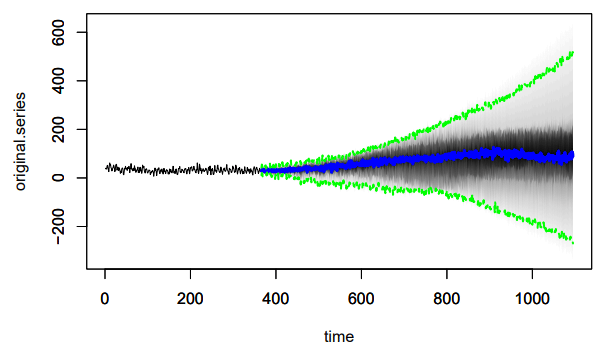
And now we can visualize one- and two-year forecasts.
Going back to the previously mentioned general forecasting rules, the further into the future you forecast, the less accurate it becomes. Thus, I stick to two years when doing this.
And as BSTS considers an upper and lower bound, it also becomes pretty pointless past a certain point.
The below command will produce a one-year future BSTS forecast for your data:
@media screen and (min-width: 800px) { #div-gpt-ad-3191538-7 { display: flex !important; justify-content: center !important; align-items: center !important; min-width:770px; min-height:260px; }
}
@media screen and (min-width: 1279px) { #div-gpt-ad-3191538-7 { display: flex !important; justify-content: center !important; align-items: center !important; min-width:800px!important; min-height:440px!important; }
}
About The Author
Dan Taylor is head of technical SEO at SALT.agency, a UK-based technical SEO specialist and winner of the 2022 Queens Award. Dan works with and oversees a team working with companies ranging from technology and SaaS companies to enterprise e-commerce.
How to create long-form content that ranks, gets read and converts
There are many questions about content length in SEO and what ranks the best.
While Google says there’s no specific word count they recommend, some studies have shown that long-form content tends to rank higher than short-form.
If you’re interested in writing long-form content, you probably want to make sure it’s going to rank, get read, and convert so you create an ROI for your effort.
What is long-form content?
Most consider long-form content to be over 1,000 words. It’s a content piece that goes in-depth, offers extra value for the reader and includes more research, insights, and information than a quick read.
Long-form content should leave the reader feeling comfortable with the subject and as if their questions have been answered and they know what to do with the information or how it applies to them.
What should you include in long-form content?
You want to create content that helps your reader. Think about them and what they need or want to learn from this piece. What questions do they have?
It’s your responsibility to anticipate their questions and answer them in your work. If you’re unsure what questions they have, then think about what you want to ensure they know.
Use the following guide questions to identify which information is most important to help them get to the next stage:
What do they need to know?
Why do they need to know it?
What can they do with the information?
What baseline information should they know to make this make more sense?
What if they don’t have that baseline knowledge already?
How does this information impact them?
What’s their next step?
Don’t write a bunch of unnecessary fluff to try to hit some word count.
You must ensure you’re providing value and helping your ideal customer so they want to consume more of your content.
If you get them to the site but find nothing of value, they’ll be less likely to stay or return another time.
Write to tell a story and provide value rather than writing to an arbitrary word count. Your content will be better in the long run.
Where do you start when creating long-form content to rank, get read and convert?
To start, make sure there’s a conversion path for your reader. Your content pieces need to tie to your products or services to drive revenue and conversions.
If you’re answering questions for your potential customer and providing helpful information, they’re more likely to convert if you offer a solution to their issues. Be helpful, and link to additional information that might help them move to the next step.
If you have an opt-in that ties to this content piece and is the next step for them, offer it in your work. You’re helping them and building your email list at the same time.
If you want your content to convert, you need to make sure there’s a conversion path. Everything you write needs to somehow tie to your core products and services.
I teach my students to choose content pillars that link to their products and services and write about topics related to those subjects.
Creating a long-form content piece and ranking at the top of Google is great, but if it drives irrelevant traffic, it won’t convert, and that’s a waste of your efforts.
Get the daily newsletter search marketers rely on.
How do you make sure your long-form content ranks?
We all know we have no control over the Google ranking algorithm, but we also know how it works and what’s most important from an optimization standpoint.
First, verify there’s search demand for your topic idea, choose a keyword (or keywords) you can rank for, write for your audience, and finally, optimize your content piece.
Make sure there’s interest in your topic
Start by making sure there’s an audience for your content piece.
It may seem like a great idea to you. However, if no one is searching for information on the subject, it’s unlikely that you’ll get much traffic due to low demand.
That said, search volume is not the most critical factor in choosing a keyword, and we’ll talk more about that.
Brainstorm the topics you think you want to cover, and then go to Google and see what’s there today.
Who’s written on the subject you’re considering using for your content piece?
Is there already information on the topic?
Do you have a new angle, new insights, or something more to add to the conversation?
If not, this might not be the best topic. Search the topic and see what shows up in Google Suggested Search.
Is there something closely related to your topic that Google suggests, or are there questions related to it in the People Also Ask section?
If you see your topic idea in either of those places, that’s good because it means there’s interest in your potential topic.
Research keywords
Once you know your topic is viable, use your favorite keyword research tool to identify the keyword or keywords you want to target for this new long-form content piece.
Long-form pieces can rank for multiple keywords a bit easier than short-form pieces just due to the length of the content piece.
Choose your keywords wisely. Look for a primary keyword with good search volume and the ability for your website to rank on Page 1.
Choose your keywords
Go to Google and see who’s currently ranking on Page 1 for the keyword you’re considering using as your primary one.
Are the websites similar to yours?
Are they more prominent brands or companies?
How in-depth are the articles?
Can you provide additional insight or value (not just more words) than the sites currently ranking?
If you see other websites similar to yours and content pieces that you feel aren’t as in-depth or are missing information on the topic you want to write about, then you’re probably making a good choice in your keyword selection.
Choose the keyword with the highest search volume that your website has the best chance of ranking for and is the word your Ideal Customer uses when searching for information on this subject.
How to make sure your content gets read
Now it’s time to write. Go back to your brainstorming notes.
What information do you need to include to answer your readers’ questions?
Be sure you have that information. Sort it in a way that it’s easy to follow and understand so your reader wants to continue.
A long-form content piece is a time commitment for someone to read.
Thus, you must provide value, insights, statistics, and things that are unique from something else they might have read on the subject before – or they won’t continue reading.
Format your piece in a reader-friendly way. This is especially important with longer pieces. Consider:
Using bullets and lists – white space is your friend.
Using headers (suitable for SEO and your reader).
Breaking your text up into small, easy-to-read chunks.
Keeping your sentences and paragraphs short.
It’s better to have many small paragraphs broken up with bullets and numbers than big blocks of text.
People will shy away from reading a piece if the content isn’t formatted in a reader-friendly way.
Your final step is to optimize your content piece
Use your keyword in all of your SEO elements. Make sure it’s in the first paragraph of the copy, which it should be since your keyword is closely tied to your content topic. In most instances, your keyword will be in the title of your piece.
Add your keyword to your URL, image file name, and header tags, and use it throughout your copy.
Focus on providing value, being helpful, and offering information your ideal customer needs rather than how often you use your keyword. You’ll use it naturally by concentrating on your reader.
Done right, long-form content is worth the investment
Long-form content can be a significant time investment. It takes longer to write in-depth pieces than quick bites or short-form.
However, the payoffs can be great. Long-form pieces often rank higher in the search results than short pieces.
And if you’re creating content with an audience, you can rank for and tie to your business, bring relevant traffic to your website, and hopefully, get the conversion.
It’s worth testing long-form content if you haven’t done it yet. Not every piece you write has to be long, but those most important to your business should be longer and more in-depth.
Opinions expressed in this article are those of the guest author and not necessarily Search Engine Land. Staff authors are listed here.
@media screen and (min-width: 800px) { #div-gpt-ad-3191538-7 { display: flex !important; justify-content: center !important; align-items: center !important; min-width:770px; min-height:260px; }
}
@media screen and (min-width: 1279px) { #div-gpt-ad-3191538-7 { display: flex !important; justify-content: center !important; align-items: center !important; min-width:800px!important; min-height:440px!important; }
}
About The Author
Rachel Lindteigen is the President and Founder of Etched Marketing. Rachel has over 20 years of content writing, editing and strategy development and 10 years of digital marketing experience. She works with many top e-commerce retailers and crafts both local and national level SEO strategies. Rachel has a bachelor’s degree in broadcast journalism from the Walter Cronkite School for Journalism and Telecommunications at Arizona State University and an MBA in Marketing.
I have an admission: I once created “doorway pages” on a large scale.
In my defense, this was years before Google existed. And, it was not considered spam in those days.
Doorway pages might seem like a nebulous concept for some marketers to grasp. Since Google announced that creating such pages was considered illicit practice, there has been some confusion.
However, such mixups are just as wrong as cloaking in SEO. So read on, and I will explain what doorway pages are, how to watch for them, and what to do about them.
“…sites or pages created to rank for specific, similar search queries. They lead users to intermediate pages that are not as useful as the final destination.”
They also cite the following examples as doorways:
• Having multiple websites with slight variations to the URL and home page to maximize their reach for any specific query • Having multiple domain names or pages targeted at specific regions or cities that funnel users to one page • Pages generated to funnel visitors into the actual usable or relevant portion of your site(s) • Substantially similar pages that are closer to search results than a clearly defined, browseable hierarchy
The early days of doorway pages
Doorway pages seemed like a mystical, magical thing back in the earliest days of search engines.
This is partly because, in the advent of the commercialized/public internet, everyone thought that website visitors would only enter your site via the homepage.
Essentially, visitors would only arrive and enter through the “front door.” This idea led people to obsess over the design of homepages, while the rest of the website was often nearly an afterthought.
Thus, as search engines absorbed and reflected webpages, it suddenly felt like reaching some high stage of Buddhist-monk-level enlightenment to realize that a website could now have many “front doors” through which visitors would enter.
I did not know what doorway pages were when I thought I invented them circa 1996/1997. Search engines grew first out of curated directories of links, but once pages began being spidered, things changed fast. I had been tasked with increasing traffic to one of Verizon’s biggest websites at the time.
I recognized that the site’s homepage could not be particularly optimized for ~8,000 business categories and ~19,000 cities. I realized that individual pages should be spawned, each optimized to rank for business categories, cities, or combos of both.
I named my pages “portals” because the whole process seemed almost magical. I was following nearly mystical ritual-like designs in optimizing the pages and experimenting. I imagined I was virtually teleporting people who had a search need for “restaurants in springfield” or “doctors in bellevue” into our website where I would match them up with precisely what they wanted.
Despite the lack of any guide or formula that talked about such doorways at scale, many others came up with similar solutions, seeking to expand content to match up with growing varieties of user queries in search engines.
My “portal pages” skunkworks project was a clear success, although it would be some years further before leadership in the company recognized the value and allowed me to deploy the concept beyond my pilot research project.
Get the daily newsletter search marketers rely on.
The rise of doorway pages in search results
When doorway pages were first added to the list of spam practices, there was some degree of hubbub about them, with heavy emphasis expressed by Googlers reinforcing that the use of doorways was contravened.
Not as much has been said about the topic in the years since. Google appeared to be increasingly circumspect about the imposition of penalties related to the practice and other quality rules.
The lack of attention brought to doorway pages seemed to cause some marketers to believe that they are not a big deal.
The typical rationalization is: “Amazon does it, and Google SERPs are full of Amazon, so…”
Often, these folks employ doorway pages on their own websites.
There has been a spike in lawsuits involving doorway pages in the last six years. I first wrote about this in 2017, “Initial Interest Confusion rears its ugly head once more in trademark infringement case,” where I mentioned an older lawsuit where watch company Multi Time Machine sued Amazon for hosting a search results page for “mtm special ops watches” (and other similar keyword searches that could be related to the watch company’s marks).
Amazon hosted the “MTM special ops watches” page, but only showed search results for other competing products.
Multi Time Machine contended that this could confuse consumers expecting MTM products, which was therefore an infringement.
That suit was eventually dismissed as the court determined that no “reasonably prudent consumer” would be confused about the Amazon page that presented products that would be considerably underpriced for MTM watches.
In yet another case (“Bodum USA, Inc. v. Williams-Sonoma, Inc.”), French press coffee maker manufacturer Bodum sued their former retail partner Williams-Sonoma under similar circumstances.
Williams-Sonoma had sold Bodum products for a time but eventually discontinued selling them, opting instead to manufacture their own branded French press coffee makers.
However, the Bodum search results page on the Williams-Sonoma.com website continued to be maintained, only it now presented Williams-Sonoma products and not Bodum’s.
Thus, the circumstances, including accusations that the products themselves were confusingly similar, were arguably much more confusing than in the Multi Time Machine/Amazon case.
The Bodum v. Williams-Sonoma case settled out of court, with Williams-Sonoma adding a disclaimer to their web results, “We do not sell Bodum branded products.”
I subsequently spoke with the CEO of another company that formerly sold their products through Williams-Sonoma. In a similar sequence, the latter also dropped them, began featuring their own, competing products, and maintained a search results page that used (and ranked for) the dropped company’s brand name.
In Google’s recent overhaul of its Webmaster Guidelines, including renaming them to Google Search Essentials, Google could have easily avoided this category if they were no longer a concern.
Instead, the newly updated Spam Policies section page promotes Doorways to the second-listed contravened practice, right after Cloaking. Google also added another example of Doorways as well.
Google’s take on doorway pages: A brief history
Doorway pages were against the rules very early in Google’s 20-plus-year history. I could find reference to doorway pages in Google’s rules as far back as June 2006 (although I think there may have been a rule in place a little before that):
June 2006: Google Webmaster Guidelines prohibited doorway pages early on.
Just a few days later, Vanessa Fox announced on Google’s Webmaster Central Blog that they had expanded on the guidelines, providing more examples, among other things.
“Doorway pages are pages specifically made for search engines. Doorway pages contain many links – often several hundred – that are of little to no use to the visitor, and do not contain valuable content. HTML sitemaps are a valuable resource for your visitors, but ensure that these pages of links are easy for your visitors to navigate. If you have a number of links to include, consider organizing them into categories or into multiple pages. But in doing so, ensure that they are intended for visitors to navigate the sections of your site, and not simply for search engines.”
By 2013, Google’s Webmaster Tools content guidelines section had modified this description, stating:
“Doorway pages are typically large sets of poor-quality pages where each page is optimized for a specific keyword or phrase. In many cases, doorway pages are written to rank for a particular phrase and then funnel users to a single destination. Whether deployed across many domains or established within one domain, doorway pages tend to frustrate users.”
In 2015, Google saw fit to post an article on the Google Search Central Blog, further highlighting what Google disliked about doorway pages and announcing a specific “ranking adjustment” (read: a core update that would penalize doorway pages).
“Over time, we’ve seen sites try to maximize their “search footprint” without adding clear, unique value. These doorway campaigns manifest themselves as pages on a site, as a number of domains, or a combination thereof. To improve the quality of search results for our users, we’ll soon launch a ranking adjustment to better address these types of pages. Sites with large and well-established doorway campaigns might see a broad impact from this change.”
At their best, doorway pages could be an effort to provide navigation between search engines’ results pages and the most granular content within a website. If one had a limited crawl budget, such pages could provide collecting pages for many granular-level, individual website pages.
But, at their worst, doorway pages could inflate a site’s indexed pages by thousands and millions of pages, lending little value between the various ones and seeking to enable the site to appear for many more searches than the site merited.
Jennifer Slegg’s analysis of the doorway pages ranking adjustment announcement at the time was that it was most likely focused on improving the quality of local search queries and mobile search results.
Indeed, local business directory websites had tried to index their webpages for all category and location combinations. (This was what my early doorway pages were, before the anti-doorway rules got instituted, as I worked for Verizon’s Superpages – one of the largest of the early online yellow pages.)
That said, there is cause to think that local directory sites somewhat get special treatment from Google (as I will describe shortly in the “Types of doorway pages” section below).
The automated penalty likely made many realize that doorway pages were considered a serious violation of Google’s guidelines.
Websites had been penalized for this in the past, but many believed that if their sites were not currently penalized, then what they were doing was okay in Google’s eyes.
This irrationally founded belief was proven untrue as the doorway page penalty rolled out.
Seven years later, a whole younger, fresh set of organic search marketers have forgotten that doorway pages are a serious violation, just as some did in the past.
This can happen as an oversight in some instances. Other times, SEO marketers can get progressively bolder and more ambitious about expanding indexable pages to the point where they have crossed a boundary. By then, Google detects doorway pages and dings them pretty sharply.
While having even one doorway page is considered against Google’s rules, in truth, doorway page infractions are determined by scale.
Having a few may not cause issues, but a large ratio of them versus meatier pages is far likelier to be detected, resulting in a negative outcome.
Types of doorway pages
Spammy city/region pages
This corresponds to Google’s example of “[h]aving multiple domain names or pages targeted at specific regions or cities that funnel users to one page.”
For instance, imagine a law firm in a small state like New Hampshire:
Creating pages targeted to “[legal specialty] in [city name]” with all identical templates having just the city name replaced on each page.
The pages all funneling users to a “Contact Us” page.
It would begin to look pretty spammy and repetitive if done for the roughly 234 towns in New Hampshire.
But, also imagine this sort of thing done with over 19,000 incorporated cities and towns in the United States.
There is cause to think that local businesses for large metro areas implementing this (i.e., targeting the roughly 88 cities of greater Los Angeles or the more than 200 cities of the Dallas-Fort Worth Metroplex) could incur a penalty, particularly if the business did not have a physical address in each targeted city, which would qualify it for having such pages.
Here is an example of a doorway page used by a current international business directory (name redacted).
There are clearly some caveats to Google’s algorithmic rules around defining spammy city/region types of pages.
One can perform a search right now and see local business listings pages from major directory websites like Yelp and Yellow Pages appearing in the top search results for a huge number of business category keywords combined with local city names (e.g., “accountants in poughkeepsie, ny”).
Sites like neighborhoods.com and nextdoor.com are doing great. If the page shows high-quality, valuable information about each city a website targets, it likely won’t be considered a doorway page. This is a key criterion that many seem to miss when assessing whether doorway pages are policed by Google.
Now, if you display a page like “Attorneys in New York City”, but the page merely has links to listings for all the boroughs, that would qualify as a doorway page.
If a user seeks “attorneys in nyc” and clicks on a page that does not contain listings for “attorneys in nyc” but merely links to other pages, then that would be a very poor user experience.
But, if they clicked on the page and got listings of attorneys, that would not fit in the model of being a doorway page per se.
You can understand this by searching for “attorneys in nyc.” You will see on the first page of search results listings from Justia, FindLaw, Cornell University attorney listings, Yelp, the New York City Bar Association, Martindale-Hubbell, and Expertise.com.
Microsites
Google does not refer to “microsites” in their guidelines, but this is what the tactic used to be called.
Google’s current rule states, “Having multiple websites with slight variations to the URL and home page to maximize their reach for any specific query.”
The concept of microsites was employed more when SEOs noticed that Google seemed to give ranking preference to websites incorporating the keyword in the domain name.
Imagine if Target.com pursued this. They sell over 3,000 types of products based on their sitemaps file.
Creating a “subwebsite” for each type of product with links back to their main website to conduct a purchase would have been massively irritating. It would also be largely unnecessary because Google can fully show their existing category pages in search results.
This is an attractive idea for website operators who think this will be a shortcut to successes they failed to achieve by insufficiently optimizing their existing websites.
I have argued with CEOs before about this very thing, telling them that “to successfully employ a microsite, you must market it equivalently to your main website – promote it, advertise it, use social media with it, etc – don’t do it, because nobody markets microsites sufficiently when they create dozens, hundreds, or even thousands of them!”
You can create a special promotional website for a few things, but you better treat them pretty close to complete, standalone websites to achieve good rankings.
A unique, keyworded URL is insufficient in itself. This is not a shortcut to across-the-board high rankings.
Indexable internal search results pages
Google has stated for many years now that they do not want to index a website’s search results pages as this could be an infinite set of pages, considering all the many keywords that could be used to conduct a search on a website. Search-results-in-search-results is an irritating user experience.
This is perhaps the most confusing aspect of Google’s guidelines because there are a few ways to define “search results” on websites.
Category pages or item listings pages on some websites use website/database search functionality to display these types of pages.
“Avoid: Letting your internal search result pages be crawled by Google. Users dislike clicking a search engine result only to land on another search result page on your site.”
However, there are differences between allowing one’s category pages to be indexed (of a limited number and very specific) vs. having many variations indexed for category-type keywords that display substantially identical pages.
This can happen with ecommerce websites when marketers create category pages including every variation of product options. Ecatalog software often supplies “faceted” navigation options that produce such pages. Here’s an example:
Micro SD Digital Cameras $100 to $250, 9 or less megapixels
SD Digital Cameras $100 to $250, 9 or less megapixels
Micro SD Digital Cameras $250 to $500, 9 or less megapixels
SD Digital Cameras $250 to $500, 9 or less megapixels
Micro SD Digital Cameras $500 to $700, 9 or less megapixels
SD Digital Cameras $500 to $700, 9 or less megapixels
Micro SD Digital Cameras $100 to $250, 10 to 11 megapixels
SD Digital Cameras $100 to $250, 10 to 11 megapixels
Micro SD Digital Cameras $250 to $500, 10 to 11 megapixels
SD Digital Cameras $250 to $500, 10 to 11 megapixels
Micro SD Digital Cameras $500 to $700, 10 to 11 megapixels
SD Digital Cameras $500 to $700, 10 to 11 megapixels
Now, some websites have such a breadth of content that they might be able to produce such pages without running afoul of a doorway page assessment.
But many websites may display virtually identical content on such pages or display only a single product listing – which would have been served better by only having the product page itself indexed.
In yet more egregious cases, some websites have set up things such that when consumers conduct searches on their websites, it will automatically produce indexable search results pages for each of those queries.
This can result in loads of pages indexed with only the keyword name changing, while the contents of the pages are substantially or wholly similar to others on the website.
This is the case for those Williams-Sonoma pages where an indexed search result for “bodum coffee makers” might be the same content as for a “French press coffee makers” category page.
Even more concerning, blindly generating pages from users’ search results can create pages featuring keywords that are no longer relevant to the website. In other words, spam and, put in another way, potential trademark infringement.
In one lawsuit I worked on, an online retailer allowed thousands and thousands of pages generated by users’ search queries on the site to be indexed, including for major brand names that the website did not carry, such as Nike, Versace, Burberry, Gucci, Yves St. Laurent, Chanel, Eddie Bauer, and more.
An even greater number of pages were indexed from the website, focused on keyword phrases that would produce substantially similar to identical search results pages:
“white jeans”
“white jean”
“size 17 jeans”
“jeans size 17”
“black jeans”
“black rip jeans”
“black rips jeans”
“black ripped jeans”
“black ripped jean”
“ripped black jeans”
“black jeans men”
“black jeans mens”
Imagine these sorts of keyword phrases multiplied hundreds and thousands of times over, and you get the picture. Huge scale, duplicate content, and spammy.
Any website with substantial content and search functionality that uses the GET method can end up with indexed internal search results.
I had a client circa 2007/2008 whose business model was creating a sort of curated search results pages that got de-indexed by Google overnight when this rule was promoted.
Substantially duplicate content propagated via keyword variations
You can already see how this could work in the example above where pages were indexed for an online retailer under multiple, highly-similar keywords, and the pages would have identical content.
There may be some level of plausible deniability where SEO software paired up with Shopify or other online shopping software can result in more and more user-generated search queries getting indexed as pages.
But, some websites have sought to programmatically create alternate versions of content pages using synonyms, keyword research APIs, AI, or some human editors. The page’s content could be published on multiple pages, each titled and headlined with different keywords.
Many thin content websites have done this very thing in the past, and it likely does not work well in Google these days.
You may wonder if you are at risk of having your website “dinged” by Google for having doorway pages. If you *know* you have doorway pages, eliminate them in favor of focusing on pushing the quality and promoting your other content pages.
If you are unsure if you have what Google would consider doorway pages or want ideas on how to fix them, read on for some recommendations.
There has long been the suggestion that Amazon gets away with doorway pages because they have loads of PageRank. Therefore, Google displays many of Amazon’s doorway pages where other websites would not.
With 135 million pages indexed and ranking for top product name queries across the board, Amazon is indeed in a unique position. Google can – and does – take the position that providing users with what they seek is the first and foremost priority.
So if the site is desired/expected in the search results, Google might allow infractions to pass to maintain the page in the search results where consumers can find it. That does not mean that Google likes doorway pages, however.
But, I do not think Amazon’s pages are particularly doorway pages.
Generally, if you click on an Amazon listing in Google’s search results for a product, you will find what you are looking for. Those can be category listings pages or specific product pages.
But, you see pictures, typically, of what you are looking for, and the results are pretty satisfactory. This is a key determinant.
Doorway pages are typically:
A sort of interstitial between Google’s search results and the actual destination pages users are seeking.
Duplicated across many similar keywords.
Are even spammed at keyword combinations with the content of the pages bearing little relation to what the user is specifically seeking.
The takeaway is not that “Amazon gets away with Doorway Pages”. The takeaway is that “Amazon provides a very satisfactory experience for searchers by delivering on the promise of the keyword targeting of their pages.”
Here are some tips for reducing your risks of a doorway “ding”.
Simply remove doorways from the index
Google suggests using robots.txt, but I have another take.
A robust internal link hierarchy is valuable for SEO, as that can help ensure Google finds and indexes the site’s granular content.
For this reason, perhaps the quickest fix is to add a robots meta tag to those pages with a “noindex” directive, along with the “follow” directive to keep the links on the page getting crawled.
Keep internal search from generating pages
It is true that you can mine your internal website search data to discover keywords that your users may be using to find your type of content.
You should still use that as a guide for creating new content, modifying existing content, or introducing other pages related to the top-searched terms.
But do not let your internal searches automatically transform into pages of search results that search engines can index.
Doing so will put your site squarely on an increasing curve of cookie-cutter-templated pages that will generate levels of duplication, pages with low value, and open you up to possible spam-hacking exploits.
You should human-curate the pages added to your site, so stop the uncontrolled flow of pages created each time users type word combos into your search forms.
You should also consider tech modifications if your internal search URLs are indexable because it is natural for users to share page URLs with others. This can result in user-generated external links growing over time until you involuntarily have a large set of doorway pages.
You may need to set all those robot meta tags with noindex directives or disallow them in robots.txt.
Alternatively, you could switch the search functionality to only work with the POST method, revoking the ability for full URLs to be bookmarkable/indexable.
Redesign your category pages to be richer
Category and subcategory pages do not have to be mere navigational lists of links to deeper pages. You can display top items from the categories on the page along with navigational links deeper.
Informational text content could be included, as well as videos and preview snippets and links to related blog posts. Highlight the newest items, recently-updated content, top-sellers, or endorsement blurbs.
In short, you want to transform what have been essentially linking pages for search engines into pages that are simultaneously highly usable and useful for end users.
Make core content pages more relevant for alternate keywords
If you are using doorway pages to try to have content that appears for many related keyword phrases, you are using only one SEO method.
Instead of doorways, you can judiciously add one or two other keyword phrases onto the page itself if you add them in a natural way that reads well for users. Do not go overboard, or you will run afoul of Google for keyword stuffing.
Another option is to create external links pointing to the main page for any given topic, using alternate keyword phrases for the link text. Again, avoid going overboard with too many and do not resort to external link building to accrue the links.
You could write posts on your website’s blog or in articles to link the alternate keywords’ text back to the main page for the topic.
Do away with doorway pages
Doorway pages have now been a contravened practice for about two decades.
Google’s recent update to Search Essentials increased the prominence of doorway pages in the contravened spam policies section. They also added an example among those long present.
This indicates that doorway pages continue to be considered a bad practice and every bit as severe as the other black hat SEO practices that are risky, wrong, and unethical. Otherwise, Google would have used the opportunity of updating the section to revoke the doorway guidelines.
Despite some level of rationalization and confusion on the part of the search community, doorway pages will continue to remain a bad practice.
It could penalize your website (or a portion of it) such that the pages are buried far down in the search results or even de-indexed entirely so that they cannot be found for any search.
Alternative optimizations can provide perceived benefits associated with doorway pages and reduce or avoid the conditions that can cause them.
Stick with contemporary SEO best practices and avoid involvement with doorway pages. You’ll see your organic search rankings program grow and benefit without the risks of getting on Google’s bad side.
Managing doorway pages (by eliminating them) has further benefits as well. You’ll do away with potentially significant legal liability associated with the practice.
Opinions expressed in this article are those of the guest author and not necessarily Search Engine Land. Staff authors are listed here.
The concept of expertise, authoritativeness and trustworthiness (E-A-T) has played a central role in ranking keywords and websites – and not just in recent years.
Speaking at SMX Next, Hyung-Jin Kim, VP of Search at Google, announced that Google has been implementing E-A-T principles for ranking for more than 10 years.
“E-A-T is a template for how we rate an individual site. We do it to every single query and every single result. It’s pervasive throughout every single thing we do.”
From this statement, it is clear that E-A-T is important not just for YMYL pages but for all topics and keywords. Today, E-A-T seemingly impacts many different areas in Google’s ranking algorithms.
For several years, Google has been under much pressure about misinformation in search results. This is underscored in the white paper “How Google fights disinformation,” presented in February 2019 at the Munich Security Conference.
Google wants to optimize its search system to provide great content for the respective search queries depending on the user’s context and consider the most reliable sources. The quality raters play a special role here.
“A key part of our evaluation process is getting feedback from everyday users about whether our ranking systems and proposed improvements are working well. But what do we mean by “working well”? We publish publicly available rater guidelines that describe in great detail how our systems intend to surface great content.”
Evaluation according to E-A-T criteria is crucial for quality raters.
“They evaluate whether those pages meet the information needs based on their understanding of what that query was seeking, and they consider things like how authoritative and trustworthy that source seems to be on the topic in the query. To evaluate things like expertise, authoritativeness, and trustworthiness—sometimes referred to as “E-A-T”—raters are asked to do reputational research on the sources.”
A distinction must be made between the document’s relevance and the source’s quality. The ranking magic at Google takes place in two areas.
This becomes clear when you take a look at the statements made by various Google spokespersons about a quality score at the document and domain level.
“Another problem we were having was an issue with quality and this was particularly bad. We think of it as around 2008, 2009 to 2011. We were getting lots of complaints about low-quality content and they were right.
We were seeing the same low-quality thing but our relevance metrics kept going up and that’s because the low-quality pages can be very relevant.
This is basically the definition of a content form in our vision of the world so we thought we were doing great.
Our numbers were saying we were doing great and we were delivering a terrible user experience and turned out we weren’t measuring what we needed to. So what we ended up doing was defining an explicit quality metric which got directly at the issue of quality. It’s not the same as relevance…
And it enabled us to develop quality related signals separate from relevant signals and really improve them independently. So when the metrics missed something, what ranking engineers need to do is fix the rating guidelines… or develop new metrics.”
(This quote is from the part of the talk on the quality rater guidelines and E-A-T.)
Haahr also mentioned that:
Trustworthiness is the most important part of E-A-T.
The criteria mentioned in the quality rater guidelines for bad and good content and websites, in general, are the benchmark pattern for how the ranking system should work.
In 2016, John Mueller stated the following in a Google Webmaster Hangout:
“For the most part, we do try to understand the content and the context of the pages individually to show them properly in search. There are some things where we do look at a website overall though.
So for example, if you add a new page to a website and we’ve never seen that page before, we don’t know what the content and context is there, then understanding what kind of a website this is helps us to better understand where we should kind of start with this new page in search.
So that’s something where there’s a bit of both when it comes to ranking. It’s the pages individually, but also the site overall.
I think there is probably a misunderstanding that there’s this one site-wide number that Google keeps for all websites and that’s not the case. We look at lots of different factors and there’s not just this one site-wide quality score that we look at.
So we try to look at a variety of different signals that come together, some of them are per page, some of them are more per site, but it’s not the case where there’s one number and it comes from these five pages on your website.”
Here, Mueller emphasizes that in addition to the classic relevance ratings, there are also rating criteria that relate to the thematic context of the entire website.
This means that there are signals Google takes into account to classify and evaluate the entire website thematically. The proximity to the E-A-T rating is obvious.
Various passages on E-A-T and the quality rater guidelines can be found in the Google white paper previously mentioned:
“We continue to improve on Search every day. In 2017 alone, Google conducted more than 200,000 experiments that resulted in about 2,400 changes to Search. Each of those changes is tested to make sure it aligns with our publicly available Search Quality Rater Guidelines, which define the goals of our ranking systems and guide the external evaluators who provide ongoing assessments of our algorithms.”
“The systems do not make subjective determinations about the truthfulness of webpages, but rather focus on measurable signals that correlate with how users and other websites value the expertise, trustworthiness, or authoritativeness of a webpage on the topics it covers.”
“Ranking algorithms are an important tool in our fight against disinformation. Ranking elevates the relevant information that our algorithms determine is the most authoritative and trustworthy above information that may be less reliable. These assessments may vary for each webpage on a website and are directly related to our users’ searches. For instance, a national news outlet’s articles might be deemed authoritative in response to searches relating to current events, but less reliable for searches related to gardening.”
“Our ranking system does not identify the intent or factual accuracy of any given piece of content. However, it is specifically designed to identify sites with high indicia of expertise, authority, and trustworthiness.”
“For these “YMYL” pages, we assume that users expect us to operate with our strictest standards of trustworthiness and safety. As such, where our algorithms detect that a user’s query relates to a “YMYL” topic, we will give more weight in our ranking systems to factors like our understanding of the authoritativeness, expertise, or trustworthiness of the pages we present in response.”
The following statement is particularly interesting as it becomes clear how powerful E-A-T can be in certain contexts and concerning events compared to classic relevance factors.
“To reduce the visibility of this type of content, we have designed our systems to prefer authority over factors like recency or exact word matches while a crisis is developing.”
The effects of E-A-T could be seen in various Google core updates in recent years.
E-A-T influences rankings – but it is not a ranking factor
Plenty of discussions in recent years centered on whether E-A-T influences rankings and, if so, how. Almost all SEOs agree it is a concept or a kind of layer that supplements the relevance scoring.
Google confirms that E-A-T is not a ranking factor. There is also no E-A-T score.
E-A-T comprises various signals or criteria and serves as a blueprint for how Google’s ranking algorithms should determine expertise, authority and trust (i.e., quality).
However, Google also speaks of a rating applied algorithmically to every search query and result. In other words, there must be signals or data that can be used as a basis for an assessment.
Google uses the manual ratings of the search evaluators as training data for the self-learning ranking algorithms (keyword: supervised machine learning) to identify patterns for high-quality content and sources.
This brings Google closer to the E-A-T evaluation criteria in the quality rater guidelines.
If the content and sources rated as high or poor by the search evaluators repeatedly show the same specific pattern and the frequency of these pattern properties reaches a threshold value, Google could also take these criteria/signals into account for the ranking in the future.
In my opinion, E-A-T is made up of different origins:
To rate sources such as domains, publishers or authors, Google accesses an entity-based index such as the Knowledge Graph or Knowledge Vault. Entities can be brought into a thematic context, and the entities’ connection can be recorded.
To evaluate the content quality related to individual documents and the entire domain, Google can fall back on tried and tested algorithms from Panda or Coati today.
PageRank is the only signal for E-A-T officially confirmed by Google. Google has been using links to assess trust and authority for over 20 years.
SEOs must differentiate these possible signals to positively influence E-A-T.
On-page
Signals that come from your own website. This is about the content as a whole and in detail.
Off-page
Signals coming from external sources. This can be external content, videos, audio or search queries that can be crawled by Google.
Links and co-occurrences from the name of the company, the publisher, the author or the domain in connection with thematically relevant terms are particularly important here.
The more frequently these co-occurrences appear, the more likely the main entities have something to do with the topic and the associated keyword cluster.
These co-occurrences must be identifiable or crawlable by Google. Only then can you be recognized by Google and included in the E-A-T concept. In addition to co-occurrences in online texts, co-occurrences in search queries are also a source for Google.
Sentiment
Google uses natural language processing to analyze the mood around people, products and company entities.
Reviews from Google, Yelp or other platforms can be used here with the option of leaving a rating.
Through these findings, SEOse can derive concrete measures for positively influencing E-A-T signals.
Get the daily newsletter search marketers rely on.
15 ways to improve your E-A-T
With E-A-T, Google is ultimately trying to adapt “thematic brand positioning” that marketers have used for centuries to establish brands in combination with messages in people’s minds.
The more often a person perceives a person and/or a provider in a certain thematic context, the more trust they will give to the product, the service provider, and the medium.
In addition, authority increases if this entity is:
Mentioned more frequently in thematic contexts than other market participants.
Positively referenced by other credible and authoritarian sources.
Through these repetitions, a neural network in the brain is retrained. We are perceived as a brand with thematic authority and trustworthiness.
As a result, Google’s neural network also learns who is an authority and, thus, trustworthy for one or more topics. This applies in particular to co-occurrences in the awareness, consideration and preference phases.
The further you position yourself in the customer journey for topics, the broader the keyword cluster Google associates with. If this link is drawn, you belong to the relevant set with your own content.
These co-occurrences can be generated, for example, through:
Appropriate on-page content.
Appropriate internal linking.
Appropriate off-page content.
External/incoming links, anchor texts and the environment of the link influencing search patterns.
You have a lot of creative leeways, especially with off-page signals. But there are also no typical SEO measures that cause co-occurrence here.
As a result, those responsible for SEO are increasingly becoming the interface between technology, editing, marketing and PR.
Below is a summary of possible concrete measures to optimize E-A-T.
1. Create sufficient topic-relevant content on your own website
Building semantic topic worlds within your website shows Google that you have in-depth knowledge and expertise on a topic.
2. Link semantically-appropriate content with the main content
When building up semantic topic worlds, the individual content should be meaningfully linked to one another.
A possible user journey should also be taken into account. What interests the consumer next or additionally?
Outgoing links are useful if they show the user and Google that you are referring to other authoritative sources.
3. Collaborate with recognized experts as authors, reviewers, co-authors and influencers
“Recognized” means that they are already recognized online as experts by Google through:
Online publications.
Amazon author profiles.
Their own blogs and websites.
Social media profiles.
Profiles on university websites.
And more.
It is important that the authors show references that can be crawled by Google in the respective thematic context. This is particularly recommended for YMYL topics.
Authors who themselves have long published web-findable content on the topic are preferable, as they are most likely known as an entity in the topical ontology.
4. Expand your share of content on a topic
The more content a company or author publishes on a topic, the greater its share of the document corpus relevant to the topic.
This increases the thematic authority on the topic. Whether this content is published on your website or in other media doesn’t matter. What’s important is that they can be recorded by Google.
For instance, the proportion of your own topic-relevant content can be expanded beyond your website through guest articles in other relevant authority media. The more authoritative they are, the better.
Other ways to increase your share of content include:
Creating thematically appropriate guest posts and linking this content with your own website and social media profiles.
Arranging interviews on relevant topics.
Giving lectures at specialist events.
Participating in webinars as a speaker.
5. Write text in simple terms
Google uses natural language processing to understand content and mine data on entities.
Simple sentence structures are easier for Google to capture than complex sentences. You should also call entities by name and only use personal pronouns to a limited extent.Content should be created with logical paragraphs and subheadings in mind for readability.
6. Use TF-IDF analyses for content creation
Tools for TF-IDF analysis can be used to identify semantically related sub-entities that should appear in content on a topic. Using such terms demonstrates expertise.
7. Avoid superficial and thin content
The presence of a lot of thin or superficial content on a domain might cause Google to devalue your website in terms of quality. Delete or consolidate thin or superficial content instead.
8. Fill the knowledge gap
Most content you see online is a curation or copy of existing information that is already mentioned in hundreds or thousands of other pieces of content.
True expertise is achieved by adding new perspectives and aspects to a topic.
9. Adhere to a consensus
In a scientific paper, Google describes knowledge-based trust as how content sources are evaluated based on the consensus of information with popular opinion.
This can be crucial, especially for YMYL topics (i.e., medical topics), to rank your content on the first search results.
10. Create fact-based content with links to authoritative sources
Information and statements should be backed up with facts and supported with appropriate links to authoritative sources.
This is especially important for YMYL topics.
11. Be transparent about authors, publishers and their other content and commitments
Author boxes are not a direct ranking signal for Google, but they can help to find out more about a previously unknown author entity.
An imprint and an “About us” page are also advantages. Also, include links to:
Commitments.
Content.
Profiles as authors, speakers, and association memberships.
Social media profiles.
Entity names are advantageous as link texts to your representations. Structured data, such as schema markup, is also recommended.
12. Avoid too many advertising banners and recommendation ads
Aggressive advertising (i.e., Outbrain or Taboola ads) that influences website use can lead to a lower trust score.
13. Create co-occurrences outside of your own website through marketing and communication
With E-A-T, it is vital to position yourself as a brand thematically by:
Linking to subject-related specialist publications from your website so that Google can assign them more quickly and easily.
Building links from thematically relevant environments.
Offline advertising to influence search patterns on Google or create suitable co-occurrences in search queries (TV advertising, flyers, advertisements). Note that this is not pure image advertising but rather advertising that contributes to positioning in a subject area.
Co-operating with suppliers or partners to ensure suitable co-occurrences.
Creating PR campaigns for suitable co-occurrences. (No pure image PR.)
Generating buzz in social networks around your own entity.
14. Optimize user signals on your own website
Analyze search intent for each main keyword. The content’s purpose should always match the search intent.
15. Generate great reviews
People tend to report negative experiences with companies in public.
This can also be a problem for E-A-T, as it can lead to negative sentiment around the company. That’s why you should encourage satisfied customers to share their positive experiences.
Opinions expressed in this article are those of the guest author and not necessarily Search Engine Land. Staff authors are listed here.
@media screen and (min-width: 800px) { #div-gpt-ad-3191538-7 { display: flex !important; justify-content: center !important; align-items: center !important; min-width:770px; min-height:260px; }
}
@media screen and (min-width: 1279px) { #div-gpt-ad-3191538-7 { display: flex !important; justify-content: center !important; align-items: center !important; min-width:800px!important; min-height:440px!important; }
}
About The Author
Olaf Kopp is an online marketing professional with over 15 years of experience in Google Ads, SEO and content marketing. He is the co-founder, chief business development officer and head of SEO at the German online marketing agency Aufgesang GmbH. Olaf Kopp is an author, podcaster and internationally recognized industry expert for semantic SEO, E-A-T, content marketing strategies, customer journey management and digital brand building. He is co-organizer of the PPC-Event SEAcamp and host of the podcasts OM Cafe and Content-Kompass (German language).
When to fire your content marketing agency: 7 things to consider
You hired your content marketing agency in good faith.
You had every hope they would soon start producing fantastic content for your brand or your clients’ brands.
That content would help build awareness around the brand, pull in more traffic, and generate more leads.
But your hope started to fizzle as months passed with little to no changes in awareness, traffic, search engine rankings, or conversions.
What gives? Is it time to fire your content marketing agency and move on?
Hold up. Not so fast.
It might be time to say goodbye. But you might also need to take a step back and pause before you leap. (Content does take longer to work than traditional or paid marketing methods – but it’s also more sustainable.)
Here’s exactly what to weigh and consider.
When is the right time to fire your content marketing agency?
1. You’re not seeing results in the expected time frame
Content marketing does not and will not work in a week – unless you have exceptionally rare or specific circumstances. It won’t work in one month or a few months, either.
To see the full ROI from content, it will take anywhere from multiple months to a full year or more.
That said, the needle should start to move before then. You should start seeing gains within a few months – incremental ones, but gains nonetheless. If you’re seeing absolutely no movement of any metric and six months have gone by, you may want to start asking questions.
And, by the way, your content marketing agency should have set accurate expectations for results from the beginning.
You should have set goals, staked out KPIs (key performance indicators) to measure, and strategized about tracking them. They should have given you an outlook about when to expect ROI and what it will look like.
If none of the above happened, that’s a good reason in itself to question the content agency you’re working with.
Remember, marketing for the sake of marketing is silly. You can and should expect ROI from it, and your agency needs to be accountable for moving that needle.
2. The agency makes repeated mistakes in your content
Everyone makes mistakes. The important thing is whether you learn not to repeat them.
For example, say your content marketing agency creates content for your brand with a few glaring errors (like links pointing to low-authority pages or worse, competitors).
Say this happens during the first few months of your relationship. That’s something that can be quickly pointed out and corrected so it never happens again.
If your agency keeps making mistakes in your content, even after corrections, that’s a good reason to dump them.
The entire point of hiring an agency is to take content off your hands so you don’t have to worry about it. It’s their job to:
Nail your brand voice.
Link correctly in your blogs.
Use correct grammar and spelling.
Use keywords appropriately.
And generally, produce content you can be proud of.
If they’re not paying attention to details, they may not be the right agency for you.
3. You’re dissatisfied with the content quality overall
Content quality is an organic search ranking factor. That means you absolutely should be concerned with the quality you receive from the agency in charge of writing it.
Bad content can have a domino effect on your brand reputation and visibility. Poor content won’t rank well in searches, if at all, and thus will drive zero traffic from Google. (Click-through rates drop off a cliff beyond page two of a Google search.)
Not to mention, a visitor reading bad content is most likely to:
Bounce.
File you away in their mental “do not trust” folder.
Goodbye, ROI.
If the content isn’t cutting it, it probably has one of these things wrong with it. Bad content is:
Poorly structured with few headings and long paragraphs.
Poorly optimized with either little to no keyword placement or keyword stuffing.
Not set up to direct leads to their next action (using CTAs).
Missing external links to authority sites, or internal links to relevant pages on-site.
If you see any of the above markers consistently, it’s time to fire your content marketing agency. They should know better and do better.
4. The content marketing agency isn’t communicating well
You’ll never get good results with a content marketing agency that doesn’t communicate well.
Good communication on their end will help you clarify and pinpoint your goals, set your expectations, understand various stages and processes, get answers to questions as they pop up, and more.
Without solid communication:
You may be left feeling unsure about where you’re headed with content.
You might be unclear on what’s happening and when.
You might feel alone, when in fact you should feel like part of a team.
Some red flags to look out for regarding communication include:
Getting no response to emails or messages, or waiting days to receive a response.
Asking questions but getting unsatisfactory answers, or no answers at all.
Not knowing when you’ll connect with the agency next to go over your strategy, progress, or results.
A lack of transparency on their part, which leads to confusion on yours.
5. The agency continually misses deadlines
Meeting deadlines isn’t just a matter of adhering to a content schedule or publishing content on time.
Yes, those things are important factors in consistent content, which is important to the overarching success of a content strategy, but let’s not forget another aspect:
Meeting deadlines is also about showing respect and responsibility. If you and your agency specify deadlines in advance (such as when and how often content will go out on your blog), keeping those deadlines also shows:
The agency respects your time.
They respect your brand.
They respect the strategy and are following through with it.
They put care and thought into your content all the way down to publication.
Continually missing deadlines and offering excuses is therefore a good reason to part ways with an agency.
That leads us to our next point.
6. The agency isn’t treating you like a partner
To see the best ROI, you need to work well with your content agency. Your individual gears should turn in sync, otherwise, the whole operation will jam and stall.
Part of that is good communication, but another part is acting like collaborators and partners in every stage of the game.
For example:
Does the agency you work with treat your concerns seriously?
Do they listen well?
Do they keep you in the loop every step of the way?
This doesn’t mean they allow you to run the show, by the way. They’re the content experts, not you. That said, your content marketing agency should still keep you involved in the process and decision-making, and help you understand the strategy and its moving parts.
They’re accountable to you, just like you’re accountable to them. Mutual trust is important. If you’re not feeling the teamwork, you might want to reconsider the working relationship.
7. You suspect they’re using spammy or misleading techniques to get quick results
Usually, the only way to get uber-fast results with content is to cheat.
Even today, spammy tactics are surprisingly common in content marketing. However, using them is a giant trap. You may see swift gains in rankings or traffic, but these are unstable gains.
They will disappear just as quickly because Google is incredibly finely-tuned and can detect most types of spam through their automated systems as well as through manual action.
That may result in a penalty for your site – which could range from a ranking demotion to being completely removed from Google search.
If you suspect your content marketing agency may be using spammy techniques to quickly rank your site in search, they’re playing with fire. It may work for a short time, but will inevitably result in death for your site’s visibility.
If they’re playing with fire, dump them and find an ethical content agency that will build up your site rankings for longevity and sustainability.
What to remember before firing your content marketing agency
A content marketing agency’s job is to handle your content marketing so you don’t have to. They’ll manage everything from planning to creation to distribution.
If you hired an agency, you most likely don’t have the time or expertise to handle it yourself. At the same time, you expect smart strategy and results from whoever you hired.
And that’s totally warranted – but don’t make the mistake of giving up too early.
Content marketing is a long-term game. It isn’t about quick wins, but rather slow and steady gains that build over time.
It can be frustrating in the beginning, but consistency will pay off dividends in the future.
If your agency is working diligently on your content marketing, publishing regularly, communicating well, analyzing metrics, treating you like a partner, nailing content quality, hitting deadlines, and keeping you in the loop – just hang tight.
Those results you long for will be coming around the bend.
Opinions expressed in this article are those of the guest author and not necessarily Search Engine Land. Staff authors are listed here.
@media screen and (min-width: 800px) { #div-gpt-ad-3191538-7 { display: flex !important; justify-content: center !important; align-items: center !important; min-width:770px; min-height:260px; }
}
@media screen and (min-width: 1279px) { #div-gpt-ad-3191538-7 { display: flex !important; justify-content: center !important; align-items: center !important; min-width:800px!important; min-height:440px!important; }
}
About The Author
Julia McCoy is the founder of Content Hacker, 7x author, and a leading strategist around creating exceptional content and brand presence that lasts online. At 19 years old, she used her last $75 to build a 7-figure writing agency which she sold ten years later. In the 2020s, she’s devoted to teaching founders and marketers the strategy, skills, and systems they need to build a business through inbound content, so they can create more lasting impact in the world.