Link juice: Is it the new snake oil of Google SEO?

Google’s Search Advocate John Mueller – in a rare case of annoyance – said that any SEO advice mentioning “link juice” is not to be trusted. Is it or not?

I wondered about the context and doubted whether it was true. There are different opinions. 

After Barry Schwartz shared the news on LinkedIn, a lively debate ensued. Even Moz and SparkToro founder Rand Fishkin chimed in on the comments saying, “Maybe link juice is real after all. Maybe y’all should write more about it!”

When he dismissed link juice, Mueller was answering a question about outgoing links. He essentially ignored the original question and solely responded to the undesirable “link juice” mention. 

While Mueller is usually neutral in his tone this time he came close to a rant on Twitter: 

  • “Anything that talks about ‘link juice’ should be ignored.”

This is nothing new. He’s just reiterating what he expressed in the past more than once.

Here’s a similar quote from his Twitter account back in 2020: 

  • “I’d forget everything you read about ‘link juice.’ It’s very likely all obsolete, wrong, and/or misleading.”

So is link juice such a detestable term? Is it akin to the “snake oil” fringe SEO practitioners are still offering? Let’s take a look at the bigger picture.

There’s a reason why the SEO industry had a bad rep for many years. Metaphorical snake oil has been sold in various ways and many websites have been harmed by misguided SEO advice or tactics.

The proverbial “snake oil” – a synonym for misleading promises of miraculous cures to all kinds of diseases – has often been likened to SEO.

Even in 2022, we see many more #seohorrorstories passed on Twitter and other social media than inspiring success stories. SEO experts themselves, not just outsiders, rather focus on those negative news.

Of course, the SEO industry is not the only one guilty of selling snake oil or spreading the word about it. 

I had many clients asking me for unethical SEO practices over the years. To this day, you have to be very firm in your ethics in order not to get caught up in a downward spiral of shady SEO techniques. I also get requests for paid links and other similar offers regularly by mail.

When Google started out in the crowded and messy search engine market, it had a revolutionary ranking algorithm that used the so-called “PageRank” to determine website authority. It was named after Google co-founder Larry Page, not (just) the actual “web page.”

SEO specialists started to use many different slang terms for PageRank – “Google juice” or “link juice” being among the most popular.

In the early years since its inception, Google performed pretty well by PageRank alone and grew its market share continuously. 

First-generation search engines like AltaVista, Yahoo and Infoseek were easily gamed by simply using:

  • Keyword stuffing.
  • Hidden text.
  • Misleading meta tags.

Once Google grew big enough to dominate the market, unethical SEO practitioners mainly focused on artificially inflating the number of incoming links (also called backlinks) so that Google would rank them higher.

PageRank became less and less of a guarantee of high-quality search results leading to Google started adding more ranking signals to the algorithm over time. 

As link juice became more abused, Google kept on adding more ranking signals, sophisticated technologies like AI and quality concepts like E-A-T.


Get the daily newsletter search marketers rely on.


We won’t go too deep into the topic of link juice, as others have done before us. An evergreen guide by WooRank is still worth reading to get a quick overview. Their visualizations are especially self-explanatory.

In theory, the website authority of the site linking out is spread more or less equally to the pages it links to. 

But in reality, the process is much more complex and link value depends on many other elements including:

  • Anchor text (<a href=”example.com”>I’m the anchor text!</a>): Too many keywords are a red flag, not enough pass less value.
  • Placement on the page: Footer links count less than content links, for instance.
  • Context on the site and page: Irrelevant or off-topic context passes less value.
  • Additional attributes: HTML rel attributes such as rel=”nofollow, UGC, sponsored” devalue links. 
  • The number of links: Link lists with dozens of links may not pass any significant value.

By 2019, Google has shifted its messaging to concentrate on quality content. From the outside, the pivot seems to imply that “content is the new link.” Eventually, one of Google’s main SEO documents which largely focused on links was updated to predominantly cover content.

For a long time, Google representatives have been wary of the industry’s emphasis on link building. Instead, they underscore the need for quality content each time the question comes up.

Now, Google tends to overemphasize content in order to make people more aware of it and underrepresent links so SEOs stop obsessing about them.

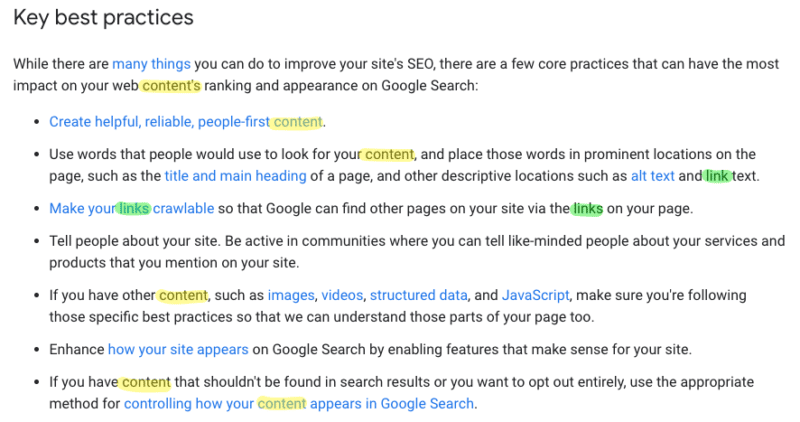
In Google Search Essentials, the “key best practices” section mentions content six times including on top while links are mentioned only three times:
In my opinion, we have to put both tendencies into perspective and ensure we find the middle ground.

Links are still very important yet their impact will be dwindling over time, while content is steadily growing in importance.

While the colloquial term link juice really sounds a bit sleazy, the concept behind it (Google’s original algorithm) is still valid and used to determine website and page-level authority or value. 

It’s a huge oversimplification of the by-now very complex Google algorithm containing numerous checks and balances (as Kaspar Szymanski has summarized) ensuring a proper ranking less prone to manipulation.

At the end of the day, you still have to attract links to your website or else other content of similar quality will outrank you in organic search results. So, while using the term link juice may sound a bit outdated, it’s not yet complete snake oil. 

What do the experts say? Fishkin is not the only one to speak about link juice.

Brian Lonsdale, Co-founder of Smarter Digital Marketing Ltd, maintains:

  • “If Google doesn’t want you to do something it means that it works.”

WhilePierre Zarokian, CEO at Submit Express / Reputation Stars, added: 

  • “I will not fall for that. Google algo has been based on link juice since 1998.”

You can say many things to refer to link juice without sounding like a drug dealer in a back alley. 

Jessica Levenson, Global Head of Digital Strategy & SEO at NetSuite and Oracle, makes it pretty clear:

  • “Frankly, no one should use that term. Links and their purpose aside, it’s the worst phrase ever.”

What else can you say instead then? Some of the more professional-sounding terms include:

  • Link authority
  • Link value
  • Link equity

Daniel Foley Carter, Director at Assertive, explains:

  • “I call it link equity – irrespective of what Google says – anyone who’s been in the SEO industry knows to take things like this with a big pinch of salt.”

If that’s too boring or technocratic for you, you can follow the advice of Brent Payne:

  • “I use ‘link tequila,’ it’s just a lot more fun. And I love tequila.”

When you use a synonym for “link juice” though, remember that the concept is on the way out and doesn’t work by itself as in the early days. 

When I started out in SEO in 2004, it was still common to rank empty websites.

You could even get thin content pages to rank for competitive keywords solely by directing link juice to them. In 2022, that’s a rare exception – if at all possible.

As always, the truth is found somewhere in the middle. While Google is de-emphasizing links in their algorithm and public rhetoric, its technology still relies to some extent on links.

It’s still very difficult to get organic search visibility on Google solely by way of content. But once that content gets endorsed by links from authority sites, the probability of gaining visibility on Google’s top positions grows significantly. 

So how do we get there without buying paid links or otherwise gaming Google? There is a well-traveled path by now. It has worked for many content SEO practitioners.

Create ‘linkable assets’

For many years, website owners wanted to buy SEO services instead of creating content that could actually earn links. I lost many potential clients when explaining that I can’t artificially inflate the ranking of an empty site that only has self-promotional material as its content. 

Linkable assets are any kind of comprehensive, valuable and unique resources that are likely to get recommended by other publishers. In-depth guides, unique survey results, and breaking news are some examples.

Once you have published content that is worth getting linked to, you ideally just have to sit and wait until people notice and link to you. 

This is, of course, the theory. In practice, you will most likely be overlooked unless you are already having an established audience. 

In such instances, you have to at least mention experts in your content who already have an audience. They can help you get the ball rolling.

Reach out to ‘linkaratis’

Influencers, journalists and industry experts are usually very busy and once they are established a social media mention may not be enough to get their attention. 

Good old email outreach is your tool of choice then. So-called linkaratis are often open to helpful suggestions that match their interests. 

When you choose the right people and focus on a few instead of sending mass mailings to hundreds of strangers, you get some initial traction until others notice you organically.


Opinions expressed in this article are those of the guest author and not necessarily Search Engine Land. Staff authors are listed here.


Related Stories

New on Search Engine Land

@media screen and (min-width: 800px) { #div-gpt-ad-3191538-7 { display: flex !important; justify-content: center !important; align-items: center !important; min-width:770px; min-height:260px; } } @media screen and (min-width: 1279px) { #div-gpt-ad-3191538-7 { display: flex !important; justify-content: center !important; align-items: center !important; min-width:800px!important; min-height:440px!important; } }

About The Author

Tadeusz Szewczyk

Tadeusz Szewczyk, also known as Tad Chef, is a professional blogger and SEO since 2004. Even though based in Berlin, Germany he has covered blogs, social media and search for a global audience starting in 2006. In 2007 he launched his own blog – SEO 2.0 – and also published on numerous other marketing blogs ever since. In recent years he wrote for the social media accounts of many clients as well. You can connect with Tad on LinkedIn and Twitter or visit his website and read his blog about social SEO.

https://searchengineland.com/link-juice-seo-389706



Six local link-building tactics for small businesses

According to a study by Moz, backlinks are essential for local packs and localized organic ranking factors, in summary, it’s the backbone of any successful SEO campaign.

Unlike general link-building tactics, location has more impact on local link-building. Therefore, you need to get links from local sites which have locational relevance to your website.

In this post, I’ll be showing you 6 ways to find solid local link prospects that will help you rank higher on Google.

How to build local links

Since the goal is to drive more local traffic to your site, here’s how you can improve your ranking with local links.

1. Join your niche-relevant business association

One of the best ways to build local links is through niche backlinks. Niche backlinks are like targeted advertising. They help you reach your target audience and convert them in no time. You can get these kinds of links by joining your niche-relevant business association.

Conduct a targeted search for legitimate business association sites in your city on Google or any other search engine. This is because they have authority and the right local relevance.

Let’s consider the previous example of a pastry chef. To find relevant associations in your niche, type California chef association on Google. With an SEO tool, you’ll see the SEO metrics for each domain and page within the SERP. If you visit the page of any of the listed associations, you’ll realize that they do have URLs with outbound links to their members’ sites.

In the USA, there are trade associations that negotiate with the government, and unions to provide members benefits. These associations have insane link values because they have links to government sites. Becoming a member of one of these associations through an application or subscription can help you get the needed backlinks.

2. Valuable, meaningful guest posts on local websites

One of the best off-page SEO tactics to win high-quality backlinks is guest posting.

What you need to do is to source for local sites in your niche that you can pitch to.

Let’s say you’re a pastry chef, you can use an SEO tool to search through several pages of content. Then you filter prospects by their SEO metrics.

Target those local websites with food and pastries blog posts as they’re likely to accept a guest post pitch.

Afterward, set a word count filter to show pages with at least 500 words along with a domain rating filter. This process will reveal the sites that have reasonable website authority.

With the few blogs left, you can start pitching for a guest writing opportunity. Consider pitching blogs by sending a direct email to the editor.

3. Generate backlinks from social media

Social media is not only to showcase your product but also enhance your website’s visibility. The truth is, with social media, you can generate as many local backlinks as possible by using your profile.

This process involves adding links to your social media profiles, pages, and groups.

Let’s consider Twitter as an example. Statista reported that Twitter had 7.1 billion website visits worldwide this year. The United States currently has the most Twitter users of 77.75 million users. And states like California and Florida are in the top ten of active Twitter users. Then let’s say you’re in California, you’ll be lucky to get enough clicks.

With the statistics above, it’s clear that you can get a good number of backlinks on this microblogging platform by setting up a decent profile.

One of the most suitable places to get backlinks on Twitter is your bio and website field.

Do you know that your profile has an actual field for your website? It does and with its over 100-character bio space, you can share your link in both places. The benefit of having your site link on your bio is not only to appear straight to your profile visitors but also to show up in Twitter search results.

Sites like Klout help to elevate your Twitter bio information but unlike Twitter, it’ll only hyperlink website links with http://.

Other places to include your site link is your photo and video tweets.

4. Local resource page link building

This is one of the most popular link-building tactics that have been around for a while.

Resource page link building is the practice of getting your site featured on web pages that link out to useful industry resources.

Here are some examples of resource pages.

These are good resource pages because they link out to other related web pages.

To build links with this tactic, you must create a resource that will be of huge value to your local community (shopping guide, travel guide), then you find relevant resource pages. Search for websites with decent domain-level authority. Then visit the pages to check for external links to other websites. After you’ve reviewed the sites based on SEO metrics, scan the remaining prospects and reach out to suggest your resource. For example, Amit Raj got a link for a seafood business from a local university with a resource page.

5. Consider your top organic competitors’ backlinks

The idea behind this is to find backlinks that help your competitors rank well on Google. You’ll need to find common links between your competitors and reach out to those sites. Search for competitors in your niche that are within your city. Then gather a list of those websites domains using SemRush or Map Pack.

Ensure you’re dealing with your real business competitors’ sites and not directories.

Use a tool like Ahref backlinks tool or SEO spyglass to see websites that are linking to your competitors but not you. Look through the lists of sites and you’ll be able to find enough link-building opportunities.

6. Create content that caters to your local audience

This is another great local link-building opportunity. It involves creating relevant local content for a local audience.

Here, the first thing you should target is getting local keywords. For example, if you’re a pastry chef in California, you may search for the most popular cookie recipe in California.

Use keyword planning and research tools like Google keyword planner or SemRush to get the most popular local search queries.

Then your blog posts should be about local events and activities on a local scale.

It would be best if you also connected to local influencers and bloggers to get mentions from them either on their websites or social media. With this strategy, you can be sure to get local backlinks and clicks within your area. For instance, after reaching out to a local influencer, you can be listed among the top 10 pastry chefs in California, increasing your reach.

Final thought

Now, it’s over to you to put these strategies in place for your local link-building system. Even if the process seems challenging, take it a step at a time. You can’t predict the algorithm but at least you can try to be as creative as possible in building your brand’s SEO.

By using the tactics discussed in this post, start your journey to gaining local relevance and authority in your niche.


Guy Sheetrit is the CEO of Over The Top SEO, an award-winning marketing agency that provides customized SEO marketing solutions for ecommerce, local, and Fortune 500 companies. He can be found on Twitter @guysheetrit.

Subscribe to the Search Engine Watch newsletter for insights on SEO, the search landscape, search marketing, digital marketing, leadership, podcasts, and more.

Join the conversation with us on LinkedIn and Twitter.

https://www.searchenginewatch.com/2022/11/23/six-local-link-building-tactics-for-small-businesses/


Use this SEO forecasting template to gain insights for 2023

Even in boom times, marketing budgets are divided among a range of teams, channels, and initiatives.

Going into 2023, with a shaky economy likely to cap many budgets and headcounts far below optimal levels, it will be especially important for marketers to articulate a compelling case for why their area of expertise should get a fair share of resources.

In other words: forecasting how X resources will achieve Y growth is going to be vital.

Because of this, I frequently get the following questions from clients (and prospective clients):

  • “How much traffic will we get from SEO and how long will it take?”
  • “What can SEO do for our revenue?”
  • “What kind of lift are we going to see from this work?”

The beauty and unique challenge of SEO is its blend of art and science. Unlike paid performance channels, where you have CPC and CPM benchmarks that tell you how many clicks and impressions you’ll get for a specific amount of spend, SEO doesn’t have a clear, quantifiable path to cause/effect.

That said, you can do SEO forecasting to give some directional answers to these questions and set traffic expectations for the year (or any specified time frame) ahead. In this article, I’ll explain my approach.

We’ve built a forecasting template that I’m happy to share with you here. 

Before we get started, note that:

  • It’s view-only, so you’ll have to download your copy. The ranges are not recommendations; you’ll need to fill in your own.
  • The randbetween() formulas recalculate with every change to the document, so numbers will not be static. We recommend saving these estimates in another sheet/location for posterity and comparisons.

Let’s break down how the tool works.

Benchmarking your growth data

In this SEO forecasting doc, rows 3-14 give you a year’s worth of monthly traffic history. For the purpose of forecasting a full year to come, you should be able to reference at least a year of historical data for benchmarking.

It’s important to note, though, that reliable forecasting depends on having mature data as a benchmark. Extrapolating growth rates from, say, the first 12 months of a website’s traffic will yield highly skewed projections.

Pick a time period that makes sense for your brand’s traffic history. Make sure you’re accounting for factors that artificially spiked or depressed any particular month’s search:

  • A one-off ad campaign.
  • A site migration.
  • A prolonged site outage.
  • Etc.

Once you have your benchmarking data selected, take those numbers and calculate an average month-over-month growth rate (and add to cell L5); this smooths out factors like seasonality. 


Get the daily newsletter search marketers rely on.


Forecasting baseline growth (with no resources)

Your next 12 rows after the historical benchmarking data are where the forecasting begins. 

Starting with row 15, Column B takes your benchmarked traffic and simply applies the average growth rate (in L5) over the next year to get a forecasting baseline.

Column D takes the previous year’s data and applies the Google Sheets “forecast” formula, which you can get by entering =round(forecast(A15,C$3:C14,A$3:A14),0) into Column D, Row 15 and dragging the formula down through all applicable cells.

This formula does not produce a flat month-over-month growth rate; as Google describes the formula, it “calculates the expected y-value for a specified x based on a linear regression of a dataset.”

The values in columns B and D are forecasting models for your growth if you applied no SEO resources at all and simply let your growth momentum continue on its own.

Forecasting growth with resources

We really get to the good stuff with Column E, which takes your historical, known SEO data (rows 3-14) and applies a range of expected % of growth given whatever SEO resources you’re projected to have on hand. 

It’s up to you to set the two ranges we’ll describe below (which are only included as examples and not as recommendations in the forecasting doc).

To calculate the expected growth ranges:

  • Start by analyzing the keywords you want to rank for over the next year.
  • Look at the monthly search volume.
  • Then apply a basic CTR to get total traffic if you ranked on Page 1 for those terms for approximately nine months (given that it will take a few months to achieve a higher ranking). 

Create two ranges: one conservative range for the first three months (to allow momentum to build for newly in-focus keywords) and a more aggressive range for the following nine months. 

Once you have your conservative range, add the low end to L6 in the sheet and the high end to M6. Paste the formula =round(D3*((RANDBETWEEN($L$6,$M$6)/100)+1),0) into Column E, Row 15, and drag down for the first three months to get forecasts for applicable cells. 

Once you have your aggressive range, add the low end to L7 in the sheet and the high end to M7. Paste the formula =round(E6*((RANDBETWEEN($L$7,$M$7)/100)+1),0) into Column E, Row 18, and drag down for the next nine months to get forecasts for applicable cells. 

Now you have your forecasts for traffic without SEO resources (Column D) and traffic with SEO resources (Column E).

Note: I recommend using Column D, not Column B, for comparison purposes because you’ll likely report to your team by month, not by year, and should therefore reference the more accurate monthly forecasts. Subtract the number from Column D from the number in Column E, and you’ll have estimates for SEO growth that you can share with your stakeholders. 

Using SEO forecasting to gain directional insights

This is not an exact science because of the nature of SEO. With frequent algorithm and SERP updates that can swing your traffic one way or another, this data will be directional.

It also won’t account for external factors like a planned site relaunch, cuts in top-of-funnel ad spend that may stunt organic growth for brand keywords, etc. 

That said, it is a reference point for what’s at stake for teams weighing whether to invest in SEO in the coming months.

All good SEO professionals know how to paint a picture with some data ambiguity, so use those storytelling skills and some Excel formulas to support your cause.


Opinions expressed in this article are those of the guest author and not necessarily Search Engine Land. Staff authors are listed here.


Related Stories

New on Search Engine Land

@media screen and (min-width: 800px) { #div-gpt-ad-3191538-7 { display: flex !important; justify-content: center !important; align-items: center !important; min-width:770px; min-height:260px; } } @media screen and (min-width: 1279px) { #div-gpt-ad-3191538-7 { display: flex !important; justify-content: center !important; align-items: center !important; min-width:800px!important; min-height:440px!important; } }

About The Author

Adam Tanguay

Adam Tanguay is Head of SEO and Content at Jordan Digital Marketing, which he joined in Feb. 2019. Formerly Head of Marketing at Webflow and Head of Organic Growth at Weebly, Adam has developed successful growth programs with a mix of content strategy, copywriting, technical know-how, and analytics acumen across a range of organic channels.

https://searchengineland.com/seo-forecasting-template-389686


NPS for agencies: How to capture client and employee satisfaction

Agencies can often fall into the trap of thinking that clients are happy if they increase their marketing investment. 

Similarly, we assume that employees are happy if we’re focusing on culture and trying to do the right thing.

But are those things really true?

Our agency uses two simple metrics to gather objective data – Net Promoter Score (NPS) and Employee Net Promoter Score (eNPS).

Even if you’ve never heard of NPS, you’ve probably received an email or text that asks a simple question: “Would you recommend us to a friend, family member, or colleague?” 

That single question helps companies measure client satisfaction and can help your agency understand if clients are delighted or simply comfortable.

Those who give you a 9 or 10 are considered “promoters” and are your biggest advocates. They not only tend to stick with you, but they are also likely to evangelize for you internally and externally.

Anyone who gives you a score of 6 or lower is a detractor. That means that they not only aren’t fans of yours, but they generally aren’t willing to defend their relationship with you or your firm either. Scores of 7 or 8 are considered passive and are not counted toward your NPS.

The Net Promoter calculation requires adding up the survey responses and subtracting the percentage of detractors from the percentage of promoters. The delta is your Net Promoter Score. 

For example, let’s say:

  • 65% of respondents are promoters.
  • 25% are detractors.
  • 10% are passives

In this case, your NPS would be 65-25=40.

An NPS score above 70 is world-class, and the benchmark for digital marketing agencies is 68.

The reason that the benchmark is so high for digital marketing agencies is that dissatisfied clients tend to take their business elsewhere if they aren’t happy.

Net Promoter Scores can help you understand how the overall health of your agency is likely to trend and may help you predict (or stop) upcoming client churn.

I’d recommend capturing the score on a quarterly or semi-annual basis since perceptions can change – not only based on results but external factors and feelings.

We use a tool called AskNicely that allows us to ask follow-up questions after receiving the score, and also lets us trigger different workflows based on responses.

We can understand if clients are delighted by technical knowledge, communication, or a different factor. Similarly, we can understand any causes of dissatisfaction.

In addition, we can slice data based on the person working with the client to understand if there’s risk based on one of our employees or by the line of service (e.g., SEO, PPC, strategy).

The additional feedback complements the score itself and allows us to dig into the “why” behind a rating, and course correct anywhere needed.


Get the daily newsletter search marketers rely on.


As all agency leaders know, the market for digital marketing talent is exceptionally hot, especially with so many remote roles. This remote shift has made the barrier to switching jobs extremely low, so managers must have a pulse on employee satisfaction.

The eNPS question is very similar to the one for NPS, “On a scale of 0 to 10, how likely are you to recommend our organization as a place to work to others?”

Although you likely have some raving fans, eNPS tends to have more “passive” or neutral scores than a traditional NPS score for your service offering. Employees likely won’t feel bad about giving you an 8, a score that ultimately gets discarded since it’s considered a neutral sentiment.

An eNPS score of 40 or greater is considered excellent. Employees tend to hold companies to a very high standard – often higher than clients.

Similar to NPS, it’s important to trend this score either quarterly or semi-annually for various reasons:

  • Happy employees generally lead to happy clients and you want to spot any dissatisfaction.
  • Expectations increase over time. Ensure that your agency is holding steady or improving.
  • Client rosters and contacts change and can impact how the employee feels.
  • Scores can be impacted negatively or positively by temporary factors such as project launches or other extremely busy periods.

In addition to tracking the eNPS score itself, I also recommend that smaller firms look at the average of the scores. For example, perhaps your agency has a lot of 9 and 10s, but there are just a couple of people giving you detractors, your overall satisfaction may be strong. 

Sample size can have a big impact on smaller firms, especially if you don’t get a 100% response rate.

Why should your agency care?

Client and employee churn is part of running an agency, but by capturing these two objective metrics, you can try to get ahead of it.

Reach out quickly to clients that give you anything outside of a 9 or 10, and even those who drop from a 10 to a 9. Ask them for candid feedback about what you can do to turn them into promoters and improve the business relationship.

To get the most accurate feedback from employees, you’ll need to gather the data anonymously. This makes gathering actionable insights a bit more difficult.

However, if you receive a lower than optimal score, you can follow up eNPS with another anonymous survey asking employees what their favorite and least favorite parts of working for your agency are.

Getting started

Since NPS and eNPS are based on one question, it’s easy to start. For a free solution, you can try SurveyMonkey or Typeform. 

However, several solution providers specialize in capturing satisfaction feedback such as Delighted, AskNicely, Survey Sparrow and Retently. These SaaS companies can help you extract more details than a simple form.

For more advanced analysis, you’ll want to find a solution that connects to your other data sources (such as your CRM), but it ultimately has to meet the pricing and features required for a business of your size.

Get started today and understand if your agency is on the right track.


Opinions expressed in this article are those of the guest author and not necessarily Search Engine Land. Staff authors are listed here.


Related Stories

New on Search Engine Land

@media screen and (min-width: 800px) { #div-gpt-ad-3191538-7 { display: flex !important; justify-content: center !important; align-items: center !important; min-width:770px; min-height:260px; } } @media screen and (min-width: 1279px) { #div-gpt-ad-3191538-7 { display: flex !important; justify-content: center !important; align-items: center !important; min-width:800px!important; min-height:440px!important; } }

About The Author

Antonella Pisani

Antonella Pisani is CEO and founder at Eyeful Media, where she leads a team of passionate & talented marketers. Over the course of her career, she’s held senior digital marketing & eCommerce leadership positions with Fossil, JCPenney, Guitar Center, and Proflowers but began her career as a web designer in 1996. Antonella is based in Dallas, and her trusty sidekick, Riley (a rescue pup who also serves as the company’s Chief Security Officer), is often sleeping by her desk. She’s been to 37 countries and loves to travel any chance she gets.

https://searchengineland.com/nps-for-agencies-389690


Google Search adds new spam policy: Policy circumvention

Google has added a new spam policy to its search spam policies today, the new spam policy is named “Policy circumvention.” In short, if you find ways to get around the current spam prevention measures, Google may take action on your content, site, or account.

The new policy. Google posted the new policy over here, it reads:

“If you engage in actions intended to bypass our spam or content policies for Google Search, undermine restrictions placed on content, a site, or an account, or otherwise continue to distribute content that has been removed or made ineligible from surfacing, we may take appropriate action which could include restricting or removing eligibility for some of our search features (for example, Top Stories, Discover). Circumvention includes but is not limited to creating or using multiple sites or other methods intended to distribute content or engage in a behavior that was previously prohibited.”

The penalty. Google said if you violate this new policy, Google may restrict or remove the content from showing up in search or for some search features.

What is a policy circumvention? In short, it sounds like any action you take to bypass the other Google Search spam or content policies. This includes creating new sites, using other sites or other methods to distribute that content, maybe on third-party sites or other avenues.

Why we care. Knowing Google’s spam and content policies is a prerequisite for performing SEO services and other marketing services on Google Search. This is a new policy but the fundamentals of logic behind the policy match most of the already published Google Search spam policies. In short, don’t try to manipulate Google Search’s ranking algorithms and if you do, you run the risk of having your site removed or downgraded in Google Search.


Related Stories

New on Search Engine Land

@media screen and (min-width: 800px) { #div-gpt-ad-3191538-7 { display: flex !important; justify-content: center !important; align-items: center !important; min-width:770px; min-height:260px; } } @media screen and (min-width: 1279px) { #div-gpt-ad-3191538-7 { display: flex !important; justify-content: center !important; align-items: center !important; min-width:800px!important; min-height:440px!important; } }

About The Author

Barry Schwartz

Barry Schwartz a Contributing Editor to Search Engine Land and a member of the programming team for SMX events. He owns RustyBrick, a NY based web consulting firm. He also runs Search Engine Roundtable, a popular search blog on very advanced SEM topics. Barry can be followed on Twitter here.

https://searchengineland.com/google-search-adds-new-spam-policy-policy-circumvention-389759


Google publishes document on more notable ranking systems

Google has published a new help document that talks about the more “notable” ranking systems Google has deployed over the years that are both currently in use and no longer in use in Google Search. The document is named a guide to Google Search ranking systems.

Ranking systems in use. The document specifies that these are the ranking systems that are currently in use at Google Search. Google also provides a brief explanation of each ranking system. Note, some of these are multiple systems and some are single systems

  • BERT
  • Crisis Information systems
  • Deduplication systems
  • Exact match domain system
  • Freshness system
  • Helpful content system
  • Link analysis systems and PageRank
  • Local news system
  • MUM
  • Neural matching
  • Original content system
  • Removal-based demotion system including legal removals and personal information removals
  • Page experience system
  • Passage ranking system
  • Product reviews system
  • RankBrain
  • Reliable information systems
  • Site diversity system
  • Spam detection systems

Retired ranking systems. Here are some of the old ranking systems that are either no longer in use, or incorporated into new systems. Such as the page experience system replaced the old page speed system:

  • Hummingbird
  • Mobile-friendly ranking system
  • Page speed system
  • Panda system
  • Penguin system
  • Secure site system

Why we care. This is super useful to see what larger ranking systems are still in use and what is no longer in use. This list is also useful to see how Google defines each system, how it is used and what it means for Google Search.


Related Stories

New on Search Engine Land

@media screen and (min-width: 800px) { #div-gpt-ad-3191538-7 { display: flex !important; justify-content: center !important; align-items: center !important; min-width:770px; min-height:260px; } } @media screen and (min-width: 1279px) { #div-gpt-ad-3191538-7 { display: flex !important; justify-content: center !important; align-items: center !important; min-width:800px!important; min-height:440px!important; } }

About The Author

Barry Schwartz

Barry Schwartz a Contributing Editor to Search Engine Land and a member of the programming team for SMX events. He owns RustyBrick, a NY based web consulting firm. He also runs Search Engine Roundtable, a popular search blog on very advanced SEM topics. Barry can be followed on Twitter here.

https://searchengineland.com/google-publishes-document-on-more-notable-ranking-systems-389741


15 ways to secure your WordPress site

As a marketer, SEO or web developer, you know how important it is to keep your WordPress site secure. 

From using strong passwords and updating plugins to installing a security plugin and monitoring traffic, these tips will help you keep your site safe from hackers. 

Why security matters for SEO

Website security is often overlooked. However, site security is essential for SEO and digital marketing.

WordPress is the most popular content management system (CMS), powering millions of websites. 

However, WordPress sites are also susceptible to attacks which can lead to: 

  • Site hijacking.
  • Malware injection.
  • Phishing scams.
  • And more.

All of these can damage your reputation, hurt your SEO, and cost you money. That’s why it’s important to take proactive steps to secure your WordPress site.

There are a number of reasons why WordPress is a target for hackers. 

  • Because the CMS is so popular, there are more potential targets. 
  • As it is open source, the code is available for anyone to view and study. This makes it easier for hackers to find vulnerabilities. 
  • Due to its ease of use, many people don’t take the time to properly secure their WordPress site. 

As a result, hacked WordPress sites are a major source of malware and spam.

Why security matters for WordPress

WordPress’s large user base makes it a prime target for hackers.

Malware, backdoor and SEO spam issues account for the leading types of attacks across WordPress, according to Sucuri. 

What’s most relevant to SEO is how attackers are using WordPress websites to steal traffic for their own nefarious means. Typically, the methodology is to redirect traffic away to a malicious website or inject spam links on your website.

This not only benefits the attacker but can also damage your website’s reputation and potentially harm your user base. 

How to secure your WordPress site

Let’s dive right into the fun bits of how you can get right into securing your WordPress site.

The majority of these tactics are completely free and require minimal technical expertise.


Get the daily newsletter search marketers rely on.


1. Add a CDN-level firewall

Any website is susceptible to attack from bots and other malicious actors. A distributed denial of service (DDoS) attack can overload a server with requests, causing it to crash and making the site inaccessible. 

A CDN-level firewall adds an additional layer of security by identifying and filtering out suspicious traffic before it reaches the server. This can help to protect your site from DDoS and other bot attacks. 

In addition, a CDN-level firewall can also improve the performance of your website by caching static content and delivering it more quickly to visitors. As a result, adding a CDN-level firewall is an effective way to secure your website and improve its performance.

2. Change your login page URL regularly

Regularly changing your login URL may seem like a small security measure, but it can actually deter hackers from finding easy access to your website. 

By constantly changing your login URL, you make it more difficult for hackers to guess or brute force their way into your site. 

There are ways to change the URL manually, but most hosting providers recommend using plugins to manage this.

3. Add a JavaScript challenge to your login page

Adding a JavaScript (JS) challenge to your login page will help ensure that only authorized users, not bots, are able to access your site. 

When enabled on the page, it serves as a security check to validate that the request is coming from a browser capable of executing JavaScript. 

The challenge requires no interaction from the user but adds a short delay (less than five seconds) until the browser finishes processing the JavaScript.

4. Limit login attempts

It is crucial to limit the number of allowable login attempts to deter hackers from using brute force methods and gaining access to accounts. Doing so makes it more difficult for hackers to guess your password and prevent them from accessing your account even if they have your username. 

In addition, limiting login attempts helps to protect your account from being locked out if someone else tries to guess your password. 

5. Secure all passwords and enable two-factor authentication

Another way to make your WordPress site more secure is to improve the difficulty of your passwords and enable two-factor authentication.

Passwords are often the first line of defense against hackers, so it’s important to choose ones that are hard to guess. A good password should be at least eight characters long and include a mix of letters (uppercase and lowercase), numbers, and symbols. Avoid using easily guessed words like “password” or your birthdate. 

Two-factor authentication (2FA) adds an extra layer of security by requiring a second form of identification, such as a code sent to your mobile phone, email address or authenticator app before you can log in. This makes it much harder for hackers to gain access to your site even if they know your password.

6. Remove XML-RPC.php

A simple measure to secure your WordPress site is to remove the XML-RPC.php file. This file allows anyone to remotely access your WordPress site, which can give hackers the ability to inject malicious code or take over your site entirely. 

Additionally, attackers can conduct brute-force login attempts through this file, so even if you secure your login page, attackers can gain access through it.

Fortunately, removing the XML-RPC file is a relatively straightforward process. Simply connect to your site via FTP and delete the file from your server. Once you have done this, be sure to update your .htaccess file to prevent any further access to the file.

7. Remove WP and plugin versions

Hackers are always finding new ways to exploit vulnerabilities and break into websites. That includes looking at the WordPress and plugin versions you are using.

If you are running an outdated version, it may have known security issues that can easily be exploited. That’s why you must keep your WordPress installation and all plugins up to date. 

That said, zero-day exploits exist and knowing which version of a plugin or WordPress core you’re using can clue in hackers how to gain access to your website.

8. Disable comments

The comment section is among the most vulnerable parts of any website. As this section is often left unmoderated, it can be easy for hackers to insert malicious code into otherwise innocent-looking comments. 

As a result, website owners need to be vigilant in moderating the comment section and ensuring that only safe content is allowed. 

9. Reduce plugins

Having too many plugins – or worse, unused and duplicate plugins – can actually jeopardize the security of a WordPress site. That’s because each plugin represents a potential point of entry for hackers. 

By reducing the number of plugins on a WordPress site, owners can help to reduce security risks. It can also help to improve site performance by reducing the number of requests that the server has to process. 

10. Set up auto-update on plugins

Using WordPress’s native auto-update feature is a straightforward way to ensure that all installed plugins and themes are up to date. 

This is especially important for plugins and themes that handle sensitive data, such as credit card information or personal records. In addition to security benefits, auto-updates also ensure that all installed software is compatible with the latest version of WordPress – improving your site’s stability. 

11. Check open ports on the server

While open ports on a web server may offer some advantages, they also create security vulnerabilities that can be exploited by hackers. 

To determine if there are any vulnerable ports on your server, run an Nmap scan. If you discover any open ports, work with your web hosting provider to close or filter them. 

A safer option would be to work with a notable WP-managed hosting provider who locks down their ports. 

12. Ensure SSL is set up properly

SSL certificates are an important part of website security. They encrypt communication between a website and its visitors, making it difficult for hackers to intercept data. 

However, SSL certificates can be vulnerabilities in themselves if not properly configured. Outdated or unpatched SSL certificates can be exploited by hackers, allowing them to gain access to sensitive information. Renewing SSL certificates regularly ensures that they are up to date and less likely to be exploited. 

In addition, setting up SSL certificates properly in the first place can prevent potential vulnerabilities. For example, ensuring that only strong cipher suites are used can make it more difficult for hackers to crack the encryption. 

13. Add security headers

Security headers prevent malicious code injection and mitigate the risk of cross-site scripting attacks. Adding them also helps block payload-based attacks and reduce the chances of your site being compromised by malware. 

Some types of security headers I recommend adding to your website include:

  • Referrer policies.
  • HTTP Strict-Transport-Security (HSTS).
  • A content security policy.
  • X-Frame options.
  • X-Content-Type-Options.
  • Cross-site scripting (XSS) protection.

14. Set up daily backups

Any website owner knows that there is always a risk of data loss due to hacking, power outages, or other unexpected events. That’s where daily backups come in handy. If your site does get compromised, you will have a fallback option that you can use to restore your site. 

There are many different ways to create backups, but a popular method is to use a WordPress plugin. However, I recommend working with a web host that takes automatic daily backups for you as part of their core services.

15. Run final security tests

Before you can relax and enjoy your newly secured WordPress website, there’s one last step you need to take: run a final security scan to check for any vulnerabilities that might have been missed. 

There are many different security scans available, both free and paid. Which one you choose is up to you, but it’s crucial to make sure the scan you choose is comprehensive. 

Once the scan is complete, take a close look at the results. If any vulnerabilities were found, take steps to fix them right away.

Secure your WordPress site for better search performance 

By following these 15 steps, you can help to secure your WordPress website and protect your data. While no system is 100% secure, these steps will make it much harder for hackers to gain access to your site. 

In addition, be sure to keep all software up-to-date, as security patches are released regularly. 

Finally, run regular security tests on your site to ensure that new vulnerabilities have not been introduced. By taking these precautions, you can help keep your website safe from attack.


Opinions expressed in this article are those of the guest author and not necessarily Search Engine Land. Staff authors are listed here.


Related Stories

New on Search Engine Land

@media screen and (min-width: 800px) { #div-gpt-ad-3191538-7 { display: flex !important; justify-content: center !important; align-items: center !important; min-width:770px; min-height:260px; } } @media screen and (min-width: 1279px) { #div-gpt-ad-3191538-7 { display: flex !important; justify-content: center !important; align-items: center !important; min-width:800px!important; min-height:440px!important; } }

About The Author

John McAlpin

John McAlpin leads the SEO strategy for Cardinal Digital Marketing, an Atlanta SEO agency that focuses on serving enterprise healthcare companies across the United States. Currently located in Colorado Springs, McAlpin is deeply engaged in both the local and national SEO community and has a strong background in technical SEO, web development, and digital marketing strategy. McAlpin also provides freelance web development services for WordPress hosted sites.

https://searchengineland.com/wordpress-site-security-389655


How to use digital PR and cross-channel data to amplify organic growth

How to use PR and cross-channel data to amplify organic growth

30-second summary:

  • With the right strategy, digital PR can help drive both brand awareness and organic performance
  • During an economic downturn, brand visibility is essential to maintain brand advocacy in the long-term
  • Brands that will come out on top are those that take a cross-channel approach to drive more ROI, using data from other channels to inform their approach

Despite being tempted to pull back on spending during a recession, I believe that it is critical that brands stay visible to maintain brand advocacy — and Digital PR is a great, low-cost way to do so.

Future front-runner brands will be those that adopt a cross-channel approach to drive more ROI, utilizing data from other channels to inform their approach and ensure it resonates with target audiences.

With the current economic climate, brands and businesses are understandably scrutinizing every cent, and will likely make cuts to marketing budgets across the globe. 

Businesses need to be realistic about their growth trajectory over the next few months and ensure every marketing dollar they invest is accounted for. While this may naturally lead to greater investment in performance channels, such as paid media, this will result in increased cost per click (CPCs). A way to still stay measurable but reduce costs is to get creative and focus energy on earning attention rather than continuing to pay for every click and impression.

As a result, I would argue that digital PR is one of the most important tools in your marketing toolkit, as, with the right strategy, it can drive both brand awareness and organic performance.

You’re missing a trick if you’re just using Digital PR to drive links

Digital PR is used to build high authority, and relevant links to key category pages to drive search performance through organic growth. A targeted strategy that aligns closely with SEO objectives will enable you to track ROI if you have the right measurement tools in place. This activity feeds into lower funnel marketing activity as it helps to harvest demand, as increased rankings capture better traffic and conversions. 

However, if you’re only using it for this purpose, you’re missing out on a huge opportunity further up the marketing funnel. 

Through securing brand-led, high-impact coverage on authoritative and influential publications, digital PR can also be used to drive search demand and upper-funnel brand awareness. This third-party validation is the perfect way to build salience, credibility, customer advocacy, and trust while simultaneously driving organic performance through high-quality links.

In order to achieve both brand and performance though, you need to be creating relevant and engaging content that your target audience wants to read and share. You shouldn’t be creating content ‘just for a link’ but taking into consideration wider business goals – and making sure you’re actually targeting press that your audience is reading.

In summary, digital PR shouldn’t just be an ‘intent-led’ marketing discipline to increase rankings. It’s a discipline that can both drive demand and awareness, whilst helping to capture intent-led traffic. 

Why brand visibility is even more important during a recession

Recessions are difficult and uncertain times, which is why it’s even more important to continue to build visibility and salience – as with tighter budgets, consumers are likely to become more selective and want to buy from brands that they trust that stay relevant to them.

We have seen in previous economic uncertainty brands that maintain their brand awareness and relevance, retain more market share, and are able to bounce back quicker. Mark Ritson’s marketing recession playbook provides further information and sources on this subject. 

In order to use digital PR to deliver true brand performance, you need to ensure you’re creating it based on as much cross-channel insight as possible.

Sharing cross-channel insight to deliver better ROI

While many marketers say they work ‘cross-channel,’ the reality is that many teams are still working in silos – especially across brand and performance teams.

To drive the best results, it is essential to break down silos and take data insights from each channel to develop one overarching strategy.

For example, to drive organic growth, while it’s critical to start with key SEO insight, search volumes, brand traffic, non-brand traffic, relevance, and the number of backlinks, you should be considering other channels to maximize performance. 

Another example would be that your PPC and paid search teams will have a lot of useful data that you can use to inform your organic strategy. Which are the keywords that are costing the most? You can tailor your efforts to improve organic rankings for these keywords, effectively allowing you to spend less on those terms. 

Your programmatic team will also have access to display placement reports which will provide insight into the publications and websites your in-market audience is visiting. This should then inform your target outreach list. From a paid social perspective, this team will have lots of useful information on what content performs the best — providing valuable insight for your PR brainstorms.

Amplifying your Digital PR coverage further

You shouldn’t just be working with other channel teams to define your strategy, you need to work with them throughout the whole process, to amplify results. 

For instance, if you generate a truly fantastic piece of linking digital PR coverage, on a very credible publication. Whilst this will drive SEO performance and some brand awareness, in order to maximize the opportunity, and the valuable third-party validation, make it work even harder by amplifying through paid social.

Mini case study: Maryland cookies use PR to reach 5+ million people

Maryland came to us because they needed to align PR, programmatic, and paid social to drive mass awareness of their new Sugar-Free cookie and deliver an immediate surge in new customer sales. Through an integrated approach of PR, paid social, and programmatic, we reached 5.3 million people across all channels. View the case study here.

We have seen in past campaigns that by utilizing PR content as part of your social ads, not only can they actually perform better than the ad creative, but they can also help to prevent ad fatigue and provide you with additional assets (that you don’t need to pay anything extra for!). 

Immediate steps to help your 2023 marketing plan

In order to be successful, it’s important to create a framework that helps to pull all channels together. 

At Journey Further we use the ‘4Ds’ – Discover, Define, Develop, and Deliver. 

Discover

This phase involves asking all the channels to provide insight and data based on their recent campaigns and learnings to date. It is recommended to assign a client lead who can be tasked with pulling together a list of questions and a briefing document to ensure the discovery phase is as useful as possible. This will help identify where the biggest opportunities are across channels. 

Define

Agree on the best objective and goals based on the insight provided by all channels. Create an overarching strategy that will deliver against them and drive maximum ROI. 

Develop

Set a clear roadmap, with roles and responsibilities outlined across each channel. Whilst in the case of an organic growth strategy, SEO and PR will take the leading role, it’s important other channels are clear on the ways they can amplify the activity at each stage, and what learnings they can also gather from the activity to improve their own results in-channel. 

Deliver

Marketing activity is activated. If this is a digital PR campaign then influencer marketing and paid social tactics may be used for example, alongside outreach, to bolster the campaign and drive more buzz and engagement. 

Reporting on the right metrics

Another benefit of working cross-channel is that you will be able to report on many more metrics, giving a more holistic and accurate view of ROI. 

Creating a live, 24/7 reporting dashboard utilizing tools such as Data Studio will allow you and your team members to check in and monitor progress at all times. This will provide you with a continuous cycle of insight — to allow you to continuously improve your marketing efforts and deliver one overarching strategy that enables you to remain visible while also driving performance.


Beth Nunnington is the VP of Digital PR and Content Marketing at Journey Further, leading Digital PR strategy for the world’s leading brands. Her work has been featured in The Drum, PR Moment, and Prolific North. Find Beth on Twitter @BethNunnington.

Subscribe to the Search Engine Watch newsletter for insights on SEO, the search landscape, search marketing, digital marketing, leadership, podcasts, and more.

Join the conversation with us on LinkedIn and Twitter.

https://www.searchenginewatch.com/2022/11/21/how-to-use-digital-pr-and-cross-channel-data-to-amplify-organic-growth/


How to choose the right content marketing agency

With just a few strategic pieces in place, content marketing can work outrageously well.

Businesses that blog generate 67% more leads than businesses that don’t blog.

They also get 55% more website visitors and 434% more pages indexed in search engines.

The problem is, how do you put those necessary pieces for results in motion? 

Content marketing strategy is notoriously complex for the uninitiated. It can seem like a giant machine with countless cogs, wheels, and whirligigs that connect in multiple ways.

43% of businesses don’t have a documented content strategy – and they perform less well than brands that do have one.

What if you could hand off content – the entire thing, from planning to creation to publishing – to someone who already knows how it all fits together? Who has a proven record of making it work?

That’s what a content marketing agency is for.

If you want content done right, but don’t have the expertise or experience to do it yourself, you can hire a content agency. Here’s everything you need to know about finding the best one.

What is a content marketing agency?

A content marketing agency is an expert team that helps businesses plan, create, and execute a content marketing strategy.

That team usually includes project and account managers, content strategists, content writers, editors, SEO experts, graphic designers, consultants, salespeople, and more.

What does a content marketing agency do?

Most agencies are full-service, which means they’ll take the entirety of your content marketing off your plate and handle it all. That includes planning your strategy, creating your content, and distributing it to your content channels. They’ll also:

  • Create content marketing campaigns.
  • Do market and SEO research to discover the best audience, topics, and keywords for a brand.
  • Create a brand content calendar.
  • Create most types of content, from written blogs and lead magnets to designed infographics and visual social media posts.
  • Make sure a brand’s site and content are search engine-optimized.
  • Manage a business’ website and blog.
  • Track and measure results.

As you can see, a content marketing agency can do it all. Their teams are robust and cover a vast range of skills. This makes hiring a content agency an all-in-one solution for getting a content plan in place or helping a stagnant one start moving.

What to look for when choosing a content marketing agency

There are a lot of content marketing agencies out there these days.

How do you choose the right one? Consider these criteria.

1. Evidence of expertise and credibility

You’re hiring a content marketing agency because they’re supposed to have the expertise that your team lacks. That means you should make doubly sure it’s actually there.

Look for past examples of the agency’s work. Check their website for testimonials and case studies. Look for a list of past clients and partnerships. 

Specifically, look for examples of past work similar to what you need. Do they typically serve your industry? This will be important for brands in specialized niches like healthcare, finance, or law, where certain standards for content must be met. 

Most agencies will list the industries they serve on their sites, but looking at work examples will show you more detailed proof that they can handle your niche.

The Content Bureau showcases expertise on their company website.

If the agency doesn’t have any samples on its site, it might not have had any clients yet. This isn’t a deal breaker if you’re on a budget – they may have related experience that demonstrates their expertise.

If this is the case, check their “About” page for staff bios and information on what they’ve done that makes them experts.

2. A good reputation

Have you seen/heard other people talk glowingly about this agency? Have you read lots of good reviews? Or does the agency seem to exist in a vacuum of silence?

The information you can find about the agency online should speak volumes about its reputation. Usually, you’ll find proof of reputation in these places:

  • Featured on the agency’s website:
    • Reviews
    • Testimonials
    • Lists of past clients or partners
  • On social media:
    • Mentions, tags, or comments from customers
  • On review sites like Expertise, Agency Match, and Clutch.co
  • From a Google search of the brand name or “[brand name] reviews”

Weigh good, neutral, and bad reviews carefully, and consider them in light of the services you need.

Fractl displays a number of testimonials from some big-name clients.

3. An emphasis on strategy, goals, ROI

Strategy is everything in content marketing. Without a plan of action, your content will go nowhere.

That must include goal setting, how you’ll track and measure those goals, and the type of ROI you’d like to see from content.

78% of marketers who said their content marketing was very successful also reported having a documented content strategy, per a Semrush survey. Most focused on content quality, SEO, and visual content in their planning.

A formal process and documentation attached to content marketing give you a map to follow, essentially. 

If the prospective agency you’re looking at doesn’t emphasize strategy at the bottom of a working content marketing plan, they have no map to follow to reach success. Move on.

4. A skilled team of creators

Most brands want skilled creators behind their content. After all, content quality is a giant Google ranking factor, not to mention a huge reason your audience will stay with you.

When you measure the skill of a creator, think about their subject matter expertise along with their storytelling ability.

For many niches, it’s impossible to create great content without specialized knowledge – be sure that the agency you’re considering has creators with the right expertise or background.

Also, think about the specific skills you need behind your content. For example, say you need video content creation. If the agency doesn’t have videographers on staff, that’s a reason to look elsewhere. 

5. A clear project management process

Content marketing agencies tend to juggle a lot of clients, projects at various stages, and all the associated moving parts. That means they need good project management in their wheelhouse.

You need to know whether your chosen agency has the capacity to deliver results both on time and under budget. For that reason, look for these criteria to ensure they’re up to snuff:

  • They have project management listed as an included service with their other offerings.
  • They provide an outline of their process, going from the idea stage to results and what happens in between.
  • They give an overview of which team member will touch your project at what stage.

Remember, if you can’t find this information on their website, you can always ask about it if you get to the consultation stage with the agency.

6. Good communication

Good communication is a cornerstone of any business relationship. You know it, we all know it – but putting it into practice is another story entirely.

While you’re evaluating your final choices for content marketing agencies, pay careful attention to how they communicate with you. Bad communication can be both the canary in the coal mine and the nail in the coffin.

  • How quickly did they respond to your initial inquiry? 
  • Have you been passed from person to person since, or have you always talked to the same person? 
  • Have replies to emails and phone calls been prompt and courteous? 
  • Have you felt like your questions have been answered to your satisfaction?

Finally, consider this preliminary communication as the initial step toward building a relationship with your agency.

It will give you a giant clue about what they’re like to work with – whether this will be fun and exciting, or difficult and tedious. If your gut tells you it’s not a good fit, you’re probably right.

7. Solid values for ethical content marketing

Ethics matter in content marketing, and you should expect your agency to adhere to them. 

Look for the agency’s values that guide their business on their website. What have they emphasized? What’s important to them? Are those same things important to your brand?

Single Grain talks about the values that guide their business.

A good agency will also have zero-tolerance policies for issues like plagiarism, poor-quality content, manipulative content, content created only for search engines, or content that violates Google’s spam policies.

The right content marketing agency should be fully transparent about their business practices, their past clients, their staff or contracted employees, and their rates. 

For example, if the agency is promising the moon for a ridiculously cheap rate, that’s a red flag. It’s also a red flag if it seems like they’re trying to hide something.

Comb their website carefully, ask lots of questions, and expect clear answers. The right agency will be fully transparent and happily provide them.


Get the daily newsletter search marketers rely on.


Tips for working with a content marketing agency

To give your business the best chance of success with content, you should have some key knowledge under your belt before working with an agency.

Know the basics

Before hiring a content marketing agency, it’s a good idea to study the basics of how content works. This helps keep your expectations realistic and gives you a better understanding of what’s going on behind the scenes.

  • Get an overview of the process of planning and creating a content strategy, including all the necessary pieces that go into it.
  • Research what high-quality content looks like, and what it takes to create it (from planning to publishing). 
  • Understand that content is a long-term game, and not for you if you want fast, quick wins.

Know your needs and goals

Before you hire a content marketing agency, you should know what your needs are. For example, maybe you don’t have a blog on your site yet and want to set up a content marketing system and strategy for blogging.

You should also set clear, reasonable goals attached to a time frame for the results you want to see. What do you want that blog to do for your brand in the next six months? In the next year? 

The clearer you are on both of these things, the more productive your conversations will be with an agency.

Know your budget

What are you willing to spend on content marketing? Set a limit, but don’t set it in stone.

You may need to nudge it up or down depending on how well you understand the costs associated with content. (If you have no idea, you might want to do some research on what content marketing typically costs brands of your size.)

Also, remember that most agencies will be willing to work with your budget and set realistic goals you can reasonably meet with the amount you’ve invested.

Find the right content marketing agency for real growth

When content marketing is set up smartly and the right creators and strategists are behind it, you’ll be surprised at the ROI you’ll eventually see.

The right content marketing agency can fill in any business’s marketing gaps for better reach, visibility, brand awareness, leads, and results.

Carefully vet the agency you hire, because they’ll take on a lot of responsibility for you. However, they can also help your brand grow in ways you never imagined.


Opinions expressed in this article are those of the guest author and not necessarily Search Engine Land. Staff authors are listed here.


Related Stories

New on Search Engine Land

@media screen and (min-width: 800px) { #div-gpt-ad-3191538-7 { display: flex !important; justify-content: center !important; align-items: center !important; min-width:770px; min-height:260px; } } @media screen and (min-width: 1279px) { #div-gpt-ad-3191538-7 { display: flex !important; justify-content: center !important; align-items: center !important; min-width:800px!important; min-height:440px!important; } }

About The Author

Julia McCoy

Julia McCoy is the founder of Content Hacker, 7x author, and a leading strategist around creating exceptional content and brand presence that lasts online. At 19 years old, she used her last $75 to build a 7-figure writing agency which she sold ten years later. In the 2020s, she’s devoted to teaching founders and marketers the strategy, skills, and systems they need to build a business through inbound content, so they can create more lasting impact in the world.

https://searchengineland.com/choose-content-marketing-agency-389284


Google launches new search, shopping and maps features

Google has announced a boatload of new search features across Google Search, Google Lens, Shopping and Maps all aimed at bringing search to more users in more helpful ways. These improvements cross over Multisearch, Google Leons, Google Shopping and Google Maps.

Note that some of these were announced at the Search On event a few months ago.

Find food through Multisearch

See a food dish you think looks tasty and it makes you hungry? Well, now with Google Lens, you can take a photo of that dish and add then type “near me” in Google Multisearch to have Google show you restaurants where you can order that dish off their menu.

“This new way of searching will help me nd local businesses in my community, so I can more easily support neighborhood shops during the holidays,” said Cindy Huynh, Product Manager, Google Lens.

This feature is launching today in English in the U.S. mobile search results.

Here is a GIF of that in action:

Search for specific dishes

In addition to searching by photo for dishes near you, you can also type in your search to find those specific dishes. Google will show you nearby restaurants to find this dish and Google will also give you more information about pricing, ingredients and additional menu information.

This feature is also launching today in English in the U.S. on mobile devices and in the Google app on Android and iOS.

Here is what it looks like:

Google Lens translate getting an upgrade

Google is rolling out a big update to the Google Lens augmented-related translate capabilities. This update lets searchers translate text on more complex backgrounds. Instead of covering up the original text, Google will erase the original text and recreate the pixels underneath with an AI-generated background, then Google will overlay the translated text on top of the image.

Google is using generative adversarial networks, also known as GAN models, to present the translated text better. It is the same technology Google uses in the Pixel devices as the “Magix Eraser” feature on photos.

Here is a sample showing how Google Lens is overlaying the translation in an easier way for searchers to comprehend:

This is launching later this year, before the end of 2022.

Google Shopping with AR shoes

Google is also released shopping features to help you see shoes in AR, augmented reality, over your own shoes. Google said this new shopping AR experience for sneakers, allows you to spin, zoom and see shoes in your space. This will work across brands such as Saucony, VANS and Merrell.

Starts rolling out in the US today, Google said.

Here is a screenshot of what this looks like:

New shopping models for AR beauty

Also, Google has added new augmented reality search features for you to try product on models with various features, skin tones and more. Google added a new photo library with 150 models representing a diverse spectrum of skin tones, ages, genders, face shapes, ethnicities and skin types to help you accurately test over 2,000 foundation shades from a wide selection of brands.

This is a feature we covered a while back but now it is going live today in the US.

Google Maps live view search

Now you can search and explore neighborhoods with augmented reality using the Google App on your phone. You can now take the Google Maps app on your phone, click on the camera icon and look through the screen to see overlays of what is right near you in real-time.

Google has been demoing this feature for some time but starting next week, this feature will start rolling out in London, Los Angeles, New York, Paris, San Francisco and Tokyo.

Here is a screenshot of what this looks like:

Google Maps adds EV charging filters and wheelchair accessibility

Google also added the ability to filter Google Maps for charging stations with fast-charging plugs, or stations with plugs compatible with your EV. This can show CSS and CHAdeMo charges that do 350kW or even 50Kw, plus Google may even show their availability. This will be available globally on Android and iOS wherever EV charging stations are available.

Plus, Google added filtering Google Maps for if a place has a wheelchair-accessible entrance thanks to the wheelchair icon on Google Maps. This will be available globally on Android and iOS wherever EV charging stations are available.

Why we care

If you or any of your customers are in any of these businesses and can leverage any of these features, you likely should as you may get more exposure from Google Search for doing so. As a searcher, these features are not just fun and useful but also, many are downright cool.


Related Stories

New on Search Engine Land

@media screen and (min-width: 800px) { #div-gpt-ad-3191538-7 { display: flex !important; justify-content: center !important; align-items: center !important; min-width:770px; min-height:260px; } } @media screen and (min-width: 1279px) { #div-gpt-ad-3191538-7 { display: flex !important; justify-content: center !important; align-items: center !important; min-width:800px!important; min-height:440px!important; } }

About The Author

Barry Schwartz

Barry Schwartz a Contributing Editor to Search Engine Land and a member of the programming team for SMX events. He owns RustyBrick, a NY based web consulting firm. He also runs Search Engine Roundtable, a popular search blog on very advanced SEM topics. Barry can be followed on Twitter here.

https://searchengineland.com/google-launches-new-search-shopping-and-maps-features-389636