Is Google Search getting worse?

Marissa Mayer, the former CEO of Yahoo, was Google’s 20th employee and the one-time leader of its search team, said Google is concerned about the declining quality of the web.

The comments were made on a recent Freakonomics podcast episode that looked at whether the quality of Google search has declined over the years. The episode also featured comments from former Google executives like Sridhar Ramaswamy, who was the head of its search advertising business and left in 2018, as well as Jeremy Stoppelman, the CEO of Yelp.

Issues with search. Some issues that Google is facing regarding search are about the declining quality of search results and the need to include search terms like “Reddit” in a query to find answers written by humans. Among the issues has been the increase of AI-generated pages, which are able to game Google’s algorithm to appear near the top of search results, even if the pages are of middling quality. Google has tried to combat the problem by updating its search algorithm and filtering out pages it deems “unhelpful.” 

What Google says. Mayer said, “I do think the quality of the Internet has taken a hit.” “When I started at Google, there were about 30 million web pages, so crawling them all and indexing them all was relatively straightforward. It sounds like a lot, but it’s small. Today, I think there was one point where Google had seen more than a trillion URLs.”

When asked if URL inflation was responsible for worse search results, Mayer responded:

  • “When you see the quality of your search results go down, it’s natural to blame Google and be like, “Why are they worse?” To me, the more interesting and sophisticated thought is if you say, “Wait, but Google’s just a window onto the web. The real question is, why is the web getting worse?”  

Google’s solution. One way Google has tried to fight the overall decline in quality is by supplementing its index of a trillion web pages with some content of its own. If you ask a simple question about cooking or the age of some politician or actor, or even what’s the best podcast, you may see what Mayer calls an “inline result,” or what Google calls a “featured snippet.” It’s a bit of text that answers your question right there on the search results page, with no need to click on a link.

Mayer’s response:

  • “I think that Google is more hesitant to send users out into the web. And to me that points to a natural tension where they’re saying, ‘wait, we see that the web sometimes isn’t a great experience for our searchers to continue onto. We’re keeping them on our page.”

The ads side. In response to the host referencing a famous quote about advertising income providing an incentive to provide poor-quality search results, Google Search VP Liz Reid responded:

“We take great pride in not only trying to provide high-quality results but ensuring that they are not influenced by ads. So we have a very strong culture that has lasted my entire time that says whether or not you’re an advertiser, does not allow you to change the results we show. You cannot pay us to change how you show. Those results are very pure, and we go to great lengths to ensure that that is the case. And so the quality of the search we provide is run separately from the ads to do that. Relevant ads are actually quite helpful to people and people often click on them and if they don’t click on them, they disappear. We don’t get paid if people don’t click on the results, it’s not we just get paid for showing them. But fundamentally, what we can do with the search results isn’t affected by the ads. We build out our search results separately.”  

The eight-year-long experiment. Mayer and others at Google were concerned that showing ads with search results would degrade the experience for users. So she helped design an experiment to see how true that might be. Mayer said:

  • “We said, ‘OK, 99 percent of users will get ads and we’re going to hold 1 percent not getting ads,’ just to make sure that if we start to see, in various search-health metrics, a degradation in how the searchers were feeling and using the search engine, we could pick up on it.”

So in 2000, the experiment went ahead – 99% of Google search users saw ads, and 1% did not. Then Google forgot about the experiment.

Mayer continued:

  • “I think it was 2008, one of my colleagues came to me and said, ‘We have this issue, we have advertisers who call our customer support line and they’re very upset because they pay for ads and then they get assigned into this experimental group called No Ads at All, and they can’t see their ads and verify that they’re running.’ And I remember feeling – like I turned kind of white at my desk as I heard this, because I said, ‘Do you mean that experiment that I coded in 2000 is still running?’ And they were like, ‘Apparently.’”

Before they turned it off, Mayer wanted to analyze it.

The result. What Mayer and her team saw was 3% more searches from people who had ads than didn’t. They concluded that there was an appreciable difference over a long period of time that people actually liked Google search results more and did more searches when they had ads than when they didn’t.

Dig deeper. You can listen to the entire Freakonomics episode here.

Why we care. Google makes about 80% of its revenue from advertising. But if search results are low quality, users will go elsewhere, like TikTok. It’s easy to see how the need to stay relevant could be costing them in the long run.


Related Stories

New on Search Engine Land

@media screen and (min-width: 800px) { #div-gpt-ad-3191538-7 { display: flex !important; justify-content: center !important; align-items: center !important; min-width:770px; min-height:260px; } } @media screen and (min-width: 1279px) { #div-gpt-ad-3191538-7 { display: flex !important; justify-content: center !important; align-items: center !important; min-width:800px!important; min-height:440px!important; } }

About The Author

Nicole Farley

Nicole Farley is an editor for Search Engine Land covering all things PPC. In addition to being a Marine Corps veteran, she has an extensive background in digital marketing, an MBA and a penchant for true crime, podcasts, travel, and snacks.

https://searchengineland.com/is-google-search-getting-worse-389658


Are these SEO rookie mistakes costing your search rankings?

Are these SEO rookie mistakes costing your search rankings

30-second summary:

  • SEO has increasingly become a key area of practice for businesses to gain visibility, however, if done wrong can stagnate or even sabotage your online visibility
  • From optimizing your website for the wrong keywords to putting too many keywords in the meta keywords tag or creating lots of similar doorway pages
  • We have listed the most common SEO mistakes to avoid and be future-ready

Through SEO, marketers can improve their websites’ rankings in Google’s search engine results pages (SERPs) and thus reach top results.

While doing SEO, however, there are some common SEO mistakes to keep away from. In case of committing any of these mistakes, marketers might end up harming their search ranking and reputation.

Below are seven of the common mistakes that you must avoid.

SEO Mistake #1: Optimizing your site for the wrong keywords

The first step in any search engine optimization campaign is to choose the right keywords for which you should optimize your site. If you initially choose the wrong keywords, all the time and effort that you devote to trying to get your site a high ranking will go down the drain. What good will the top rankings do if you choose keywords which no one searches for, or if you choose keywords which won’t bring in targeted traffic to your site?

The good news is that there are some warning signs that say you’re maybe optimizing for the wrong keywords. Amongst these, we find the following:

According to Neil Patel, an SEO expert, and co-founder of Crazy Egg and Hello Bar:

If you go about optimizing site content for every keyword you can think of, chances are, you won’t rank highly in search engine results pages.

Worse, you’ll experience a high bounce rate, because search engine users who eventually find your web site will leave without doing anything that you want them to do.

….In fact, not optimizing site content for the right keywords will cripple your search engine rankings.

SEO Mistake #2: Putting too many keywords in the meta keywords tag

We often see sites that have hundreds of keywords listed in the meta keywords tag, in the hope that will get a high ranking for those keywords.

Nothing could be further from the truth. Contrary to popular opinion, the meta keywords tag has almost completely lost its importance as far as search engine positioning is concerned. Google does not use keyword meta tags directly in its rankings.

Hence, just by listing keywords in the meta keywords tag, you will never be able to get a high ranking. Since there is no correlation between the keywords you stuff into a Meta tag and your search engine rank. To get a high ranking for those keywords, you need to naturally add the keywords to the actual body content on page.

SEO Mistake #3: Repeating the same keyword too many times

Another common mistake that people make is to endlessly repeat their target keywords in the body of their pages and in their meta keywords tags.

Because so many people have used this tactic in the past (and continue to use it), the search engines keep a sharp lookout for this and may penalize a site that repeats keywords in this fashion.

Sure, you do need to repeat the keywords a number of times. But, the way you place the keywords in your pages needs to make grammatical sense. Simply repeating the keywords endlessly no longer works. Furthermore, a particular keyword should not ideally be present more than thrice in your Meta Keywords tag.

SEO Mistake #4: Creating lots of similar doorway pages

Another myth prevalent among people is that since the algorithm of each search engine is different, they need to create different pages for different search engines. While this is great in theory, it is counter-productive in practice.

If you use this tactic, you will soon end up with hundreds of pages, which can quickly become an administrative nightmare. Also, just imagine the amount of time you will need to spend constantly updating the pages in response to the changes that the search engines make to their algorithms.

Furthermore, although the pages are meant for different engines, they will actually end up being pretty similar to each other. Search engines are often able to detect when a site has created similar pages and may penalize or even ban this site from their index.

According to Google,

“…they (Doorway Pages) can lead to multiple similar pages in user search results, where each result ends up taking the user to essentially the same destination. They can also lead users to intermediate pages that are not as useful as the final destination.”

Hence, instead of creating different pages for different search engines, create one page which is optimized for one keyword for all the search engines.

SEO Mistake #5: Using hidden text

Hidden text is text with the same color as the background color of your page. For example, if the background color of your page is white and you have added some white text to that page. That is considered a black-hat SEO practice.

Many webmasters, in order to get high rankings in the search engines, try to make their pages as keyword rich as possible. However, there is a limit to the number of keywords you can repeat on a page without making it sound odd to your human visitors.

Thus, in order to ensure that the human visitors to a page don’t perceive the text to be odd, but that the page is still keyword-rich, many webmasters add text (containing the keywords) with the same color as the background color. This ensures that while the search engines can see the keywords, human visitors cannot.

Search engines have long since caught up with this technique, and ignore or penalize pages that contain such text. They may also penalize the entire site if even one of the pages on that site contains such hidden text.

However, the problem with this is that search engines may often end up penalizing sites that did not intend to use hidden text.

For instance, suppose you have a page with a white background and a table on that page with a black background. Further, suppose that you have added some white text in that table. This text will, in fact, be visible to your human visitors, that is, this shouldn’t be called hidden text. However, search engines can interpret this to be hidden text because they may often ignore the fact that the background of the table is black.

In official guidance from Google, they state:

“Hiding text or links in your content to manipulate Google’s search rankings can be seen as deceptive and is a violation of Google’s Webmaster Guidelines.”

Hence, in order to ensure that your site is not penalized because of this, you should go through all the pages in your site and see whether you have inadvertently made any such mistake.

SEO Mistake #6: Using page cloaking

Cloaking, which is against Google’s webmaster guidelines, is defined by Google as follows:

“Cloaking refers to the practice of presenting different content or URLs to users and search engines. Serving up different results based on user agents may cause your site to be perceived as deceptive and removed from the Google index”

People generally use page cloaking for two reasons:

  1. To hide the source code of their search engine-optimized pages from their competitors
  2. To prevent human visitors from having to see a page that looks good to the search engines but does not necessarily look good to humans

The problem with this is that when a site uses cloaking, it prevents the search engines from being able to spider the same page that their users are going to see. And if the search engines can’t do this, they can no longer be confident of providing relevant results to their users. Thus, if a search engine discovers that a site has used cloaking, it will probably ban the site forever from their index.

Hence, our advice is that you should not even think about using cloaking in your site and if you are already doing any cloaking and getting away with it, I guess you may have to be on the lookout.

SEO Mistake #7: Devoting too much time to search engine positioning

Yes – we lied. There’s another common mistake that people make when it comes to search engine optimization – they spend too much time on it.

Sure, search engine placement is the most cost-effective way of driving traffic to your site and you do need to spend some time every day learning how the search engines work and optimizing your site for the search engines.

However, you must remember that search engine optimization is a means to an end for you – it’s not the end in itself. The end is to increase the sales of your products and services. Hence, apart from trying to improve your site’s position in the search engines, you also need to spend time on all the other factors which determine the success or the failure of your website – the quality of the products and services that you are offering, the quality of your content, and so on.

You may have excellent rankings in the search engines, but if the quality of your products and services is poor, or you’re not producing high-quality SEO content, those high rankings aren’t going to do much good.


Jacob McMillen is a copywriter, marketing blogger, and inbound marketing consultant.

Subscribe to the Search Engine Watch newsletter for insights on SEO, the search landscape, search marketing, digital marketing, leadership, podcasts, and more.

Join the conversation with us on LinkedIn and Twitter.

https://www.searchenginewatch.com/2022/11/17/are-these-seo-rookie-mistakes-costing-your-search-rankings/


Google Search Console adds Shopping tab listings feature

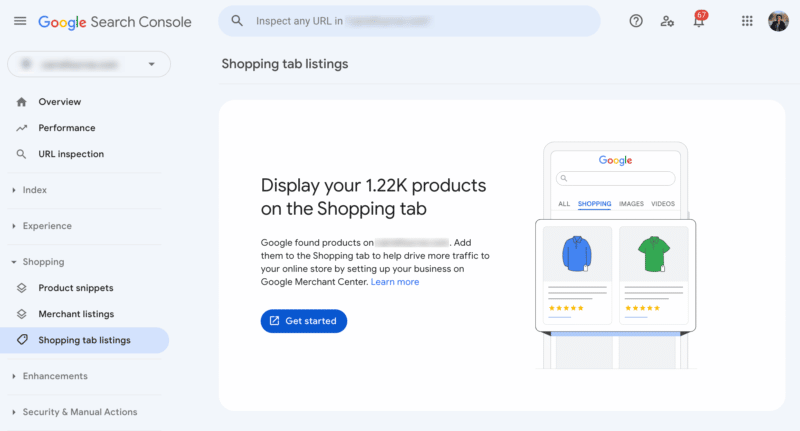
Google is rolling out a new Shopping tab within Google Search Console that contains more information about your product snippets, merchant listings and shopping tab listings in Google Search.

What is new. Google announced “eligible online store owners that have implemented product markup will see a new section called Shopping tab listings.” This is rolling out “gradually over the next few weeks,” Google said, “so you might not see any changes for now.”

What it looks like. Here is a screenshot of this screen:

How to access it. If you are an eligible merchant, you can access this feature at google.com/search-console/shopping-tab-listings.

More information. Google wrote “From there, merchants will be able to easily create a Merchant Center account using a simplified assisted sign-up process without the need to re-verify website ownership. With this new option, there is no need to submit a product feed; merchants only need to keep product structured data up-to-date. This streamlined experience will get products quickly on the Shopping tab on Google and help merchants reach people looking for products.”

Why we care. More information from Google on how well you are performing in Google Search, especially as we approach the holiday shopping season, is super useful. So dig in and see how your products are performing in Google Search and see where you can optimize as the holiday shopping season kicks into gear.


Related Stories

New on Search Engine Land

@media screen and (min-width: 800px) { #div-gpt-ad-3191538-7 { display: flex !important; justify-content: center !important; align-items: center !important; min-width:770px; min-height:260px; } } @media screen and (min-width: 1279px) { #div-gpt-ad-3191538-7 { display: flex !important; justify-content: center !important; align-items: center !important; min-width:800px!important; min-height:440px!important; } }

About The Author

Barry Schwartz

Barry Schwartz a Contributing Editor to Search Engine Land and a member of the programming team for SMX events. He owns RustyBrick, a NY based web consulting firm. He also runs Search Engine Roundtable, a popular search blog on very advanced SEM topics. Barry can be followed on Twitter here.

https://searchengineland.com/google-search-console-adds-shopping-tab-listings-feature-389645


Enterprise SEO is 50% education and culture

Pop quiz: What’s the definition of “SEO culture” at an enterprise company?

Sorry, your answer of “Another meeting, email, or team bonding event that I have to fake smile through that has no hope of success” is incorrect.

I’m looking for “That warm cozy feeling you get when laundry first comes out of the dryer that makes you feel safe, comfortable, and trusting.”

It’s OK, I’m here to educate you.

Look, SEO at an enterprise company is fun. 

Except for the part where you have to learn a dozen different brands and educate yourself on internal lingo terms like “BU” and “QBR.” And that doesn’t even include the fact that you have more than one (sometimes 10 or 20) different business leads you to have to sell and win over with your SEO strategy. 

The fact stands: If you want to gain the respect and trust of your peers for your SEO strategy at an enterprise company, you have to dedicate 50% of your time to education and culture.

If you’re thinking “why,” then you’re doing it wrong. 

Too often, the idea of “SEO culture” is to over-promise and under-deliver, which is why I’ve done the heavy lifting for you. 

After 12 years of working on SEO at enterprise companies, I’m pulling together some golden nuggets of knowledge I’ve learned to help build “SEO culture.” Ahead are a few of my favorites.

‘Office hours’ for enterprise SEO professionals is more than a meeting – it’s a culture shift

The idea of “office hours” started to trend in the tech world when Jason Fried, CEO of 37Signals, announced he was hosting CEO office hours in 2009. 

Reread that sentence again – 2009, people. 

It’s safe to say that “office hours” needs a makeover. 

Let me be clear: I don’t mean this level of a makeover. 

Within my first 3 months at an enterprise company, I make an effort to create SEO office hours.

Why? 

It is all about setting the initiative that SEO is a part of a wider movement – promoting it across the company and different marketing channels. 

Even Google’s John Mueller hosts SEO office hours. 

The key to succeeding with your SEO office hours at a giant company with thousands of employees is having a thorough plan and schedule in advance. 

While I set the schedule and agenda for the SEO office hours in month 3, I don’t kick them off until month 6.

I then host the event biweekly, leaving it open to people with questions. If no one has questions, I use the time as an educational opportunity to share a new update.

The biggest lesson I learned from actively listening and learning during these office hours is the importance of establishing trust. Think of your SEO office hours as an open door where people can share their gripes with the SEO team.

I heard about potential worries from the editorial team about SEO delaying work. I listened to complaints from the product marketing team that our keywords don’t align with the brand vision. I had to hear out what the web development team thought of some of the technical SEO recommendations. 

At first, it may seem like you’re a punching bag. But the reality is, when you bring SEO into an enterprise company that’s been around for years, you’re bringing change. 

People fear change. 

Eventually, you’ll settle in. Conversations will flow. Laughs will be had. 

You’ll learn stuff about your coworkers that you probably wish you hadn’t (like this person is dating this person). At this point, it would behoove you to grab a frosted donut and pour that bourbon you’ve been saving for a special moment into your lukewarm coffee. 


Get the daily newsletter search marketers rely on.


Lunch-and-learns help build SEO into the company culture 

First order of business: Let’s remove the “lunch” from lunch-and-learns.

No one wants to shovel 63 burritos into their mouth in less than 10 minutes like Joey Chestnut in a hot dog eating contest to pretend to participate.

The most important part of lunch-and-learns is the “learn” part. 

Use this as an opportunity to walk through something related to your next quarter plan. 

For example, if I’m managing 1,000+ domains and I want to start implementing best practices in Q1 for all domains, I would walk through schema markup best practices, which help set the stage for the next quarter. 

It helps generate buy-in for your quarterly plan, and if there are any questions that push back, this opens the floor for a bigger conversation. 

Creating a culture around enterprise SEO is more than just drinks on Friday

Defining how you create an SEO culture at an enterprise company is difficult.

As the SEO lead, director or VP, you set the tone. If you want to deliver solid SEO results, it requires a culture and mindset of trust in you and your SEO achievements. 

When you can align your enterprise SEO strategy and your leadership, a strong SEO culture engraining within the company will drive positive outcomes for all teams. 


Opinions expressed in this article are those of the guest author and not necessarily Search Engine Land. Staff authors are listed here.


Related Stories

New on Search Engine Land

@media screen and (min-width: 800px) { #div-gpt-ad-3191538-7 { display: flex !important; justify-content: center !important; align-items: center !important; min-width:770px; min-height:260px; } } @media screen and (min-width: 1279px) { #div-gpt-ad-3191538-7 { display: flex !important; justify-content: center !important; align-items: center !important; min-width:800px!important; min-height:440px!important; } }

About The Author

Anna Crowe

Anna Crowe is a Frank’s Hot Buffalo sauce advocate (leading with obvious priorities), writer, marketer and SEO nerd. Over the last 12+ years, Anna has successfully run SEO and content programs for brands like Dollar Thrifty Rental, Marriott, Hilton, Hearst Magazine, Mailboat Records, Philip Morris International, Bloomin’ Brands and Brother USA and many more. She enjoys burritos and puppies (in that order) when she’s not moonlighting as a soccer coach. https://annaleacrowe.com/

https://searchengineland.com/enterprise-seo-is-50-education-and-culture-389537


6 link-building myths and truths by Internet Marketing Ninjas

Link building is one of the most misunderstood aspects of an effective digital marketing strategy. Being difficult to properly scale, some avoid it altogether while others outsource the work and hope for the best. Getting it right either internally or with a link-building partner can catapult your SEO performance. Still, in doing so, you must avoid these common link-building myths and mistakes to succeed in the long term.

Myth 1: Links must meet a minimum DA or other score in order to pass value.

A common mistake webmasters make is relying on third-party metrics like Domain Authority, Domain Rating, or Citation Flow when deciding on link opportunities.

It’s important to understand what these numbers represent – and what they don’t.

As an example, Domain Authority is Moz’s best guess at a website’s ability to rank itself and has no bearing on a website’s ability to pass link equity to other sites. 

Domain scores from various data providers often vary from one to the next, so who should you rely on? We’d argue none of them. 

These solutions have a fraction of the crawl Google has. Their datasets and algorithms all differ from one another, and there’s a lot they miss when determining a site’s score.

Obviously, Google does not use any of these scores when deciding how to rank websites or treat links from them.

A link from a low-scoring domain like a town library or relevant resource site can not only pass link equity. It can drive direct traffic as well.

Rather than tossing link opportunities due to low DA, use common sense. Would the site link to you in a natural way because your content compliments theirs? Is the site authentic, meaning without SEO or commercial intent? If so, it’s likely an opportunity you shouldn’t pass up – even with a low score.

Myth 2: Links must be from relevant websites or they won’t count.

In an ideal world, other websites within your vertical would link to you – it’s a natural fit. For many of you, these are often your competitors and unlikely links to achieve.

Stretching the relevancy gap when looking for link opportunities is often needed in competitive verticals in order to achieve high-quality links on a consistent basis.

When considering websites to earn links from, think outside your core business and look for opportunities a step or two away. 

In doing so, the quantity and quality of link prospects can increase tenfold and help you discover link-earning opportunities you would have otherwise missed.

Pretend you sell life insurance. Rather than trying to solely get links from other life insurance websites, you could search for websites in supplementary niches like healthy living and family planning, which are generally more resource-heavy.

This will also allow you to find powerful domains to source links from (ones with a lot of high-quality backlinks pointing to them), therefore passing more link equity to you.

To accomplish this, you’ll need to develop a robust linkable content plan focused on these audiences, giving them something worthy of linking to—more on this in the above-linked video.

Myth 3: Relying on guest blogging or link networks is worth the effort.

Google has been clear on this for many years – guest blogging and link buying as link-building tactics violate their webmaster guidelines.

You can find their messaging regarding this here and here;  they also rolled out a link spam update last year detailed here. Some more guidance on this from Search Engine Roundtable is here and here.

TLDR: If you are currently obtaining these types of links, especially in large numbers or as a large percentage of your backlink profile, it’s time to stop.

It’s understandable why many folks lean into these tactics. They’re cost-effective and easy to scale. They can even provide a short-term boost, but it’s only a matter of time before Google discounts them, and you’re back to square one. 

The good news is Google’s default for the past couple of years has just been to ignore these types of links in your backlink profile rather than penalize you for them. However, penalties are still imposed in certain cases, so why take the risk when there are alternative options?

At best, you’ve wasted time, dollars, and other resources obtaining them. At worst, they can cause a link penalty if they remain a cornerstone of your link-building efforts.

Myth 4: Internal linking isn’t as important.

One area we find a lot of webmasters ignore is their internal linking optimization.

It can be difficult to manage and keep up with, especially for large e-commerce websites and other very large websites with pages that come and go on a regular basis.

The truth is internal linking optimization is one of the quickest ways to boost your SERP visibility, especially for mid & long-tail keyword phrases.

Internal linking gives you an opportunity to vary internal link anchor text to individual pages, boosting their rankings for a larger volume of keywords.

We optimize internal linking early on in most SEO campaigns, and it almost always produces a measurable lift in a site’s share of search – that is, the number of keywords ranking in Google, the average ranking of those phrases as a whole, and the total non-paid Google organic traffic coming to the site. And this often times happens within 30 days after optimization. 

It also allows you to control where links appear throughout your website and provide a secondary navigation path for users and Googlebot. 

Not sure where to start? We’ve put together an internal linking guide here, but one of the first things to do is link like-minded content and commercial pages together throughout your website, especially if any of those pages have backlinks to them. Not only will that help establish thematic authority, but it will also pass link equity through to the pages that matter most.

Myth 5: Link building alone will get the job done.

While links are often a necessity to rank in most competitive verticals, they’re not the only piece of the puzzle.

People often view links as the “magic answer” to help them rank better. And in some circumstances, it is links that they need most. But the ability for links to pass maximum value has a lot of assumptions associated with it. 

While they can be the biggest needle mover, you won’t get their full benefit if your website is full of technical errors, has poor content, or has a poor user experience.

The latter is especially true once your site begins to rank on Page 1. If you provide a poor user-experience, you’ll unlikely remain there for long.

It’s also important to realize Page 1 of Google continues to move further away from the “10 blue links” of days past. If you’re not optimizing for a variety of search features – images, videos, People Also Ask, carousels, and so on then, you’re leaving a lot of traffic opportunities on the table.

Often, there are dozens of results to click on before reaching the #1 organic result, especially on mobile.  And links alone won’t help you capture many of these placements.

While organic rankings remain a top priority, don’t ignore all of the other real estate opportunities on Page 1. You’ll need an optimized content, image, video and schema plan in place to maximize your SERP visibility.   

Myth 6: Link building is dead!

We’ve heard this shouted time and time again over the years.

Just last week, John Mueller suggested that links may become less important as time goes on.  It’s important to notice the language used: “I imagine,” “my guess,” “over time,” and so on.

In reality, Google has been saying this for nearly a decade. One of the things that historically sets Google apart from every other search engine is its link data and reliance on it to determine search engine rankings. That remains true to this day.

Yes, there are more ranking considerations now than 10 years ago. And as mentioned previously, Page 1 of Google looks much different now than it did then. These present additional optimization opportunities that links alone won’t help with, and in that sense, Mueller is correct.

It’s also likely Google wants to continuously discourage artificial link building through their communications just as they always have, so it’s not surprising to see this messaging as we close out the year.

Interestingly enough, we do find consistent quality link building to produce stronger results as time goes on, likely as Google continues to discount low-quality link-building tactics. The cream always rises to the top.

But ranking a website for high-value keywords in a competitive vertical without strategic linking will remain difficult for the foreseeable future.

Wrapping it up

Link building is an evolving but important ranking factor. If your business relies on SEO traffic, ongoing link earning should be a cornerstone of your digital marketing strategy.

Read (or watch) more about how to approach link building heading into 2023 on the Internet Marketing Ninjas blog.


Related Stories

New on Search Engine Land

About The Author

Internet Marketing Ninjas

Internet Marketing Ninjas is a leading digital agency specializing in SEO strategy, link building, content marketing, and site speed optimization. Led by industry veteran Jim Boykin since 1999, IMN’s team of 50 is based in Upstate New York and brings nearly 400 years of combined experience helping their clients improve search rankings and increase organic traffic from Google.

https://searchengineland.com/6-link-building-myths-and-truths-389580


What B2B marketers must know in the face of a potential recession

Talking about a recession isn’t always enjoyable. But it’s a situation that inevitably requires a shift in strategy and mindset to continue finding success in the face of economic headwinds. 

Defined technically as a period of a significant decline in economic activity, a recession (and the looming potential for one) directly affects marketing. 

In particular, B2B marketers face a unique challenge in identifying a downturn – with sales cycles expanding beyond 6, 12 or more months into the future and lacking evident shifts. Whereas, B2C and D2C marketers can feel it more quickly when complete verticals go south.

In this article, we’ll unpack how a looming recession impacts B2B marketers and the key factors to consider to successfully navigate this landscape. 

What did B2B marketers do last time? 

You must know the past to understand your present and future. There have been plenty of recessions – some fairly recently. 

In 2007–2009, we experienced the Great Recession in which the mortgage crisis led to the collapse of the housing market bubble. While it may have ended for the U.S. in 2009, the ripple effects were felt in some European countries for years. 

Countries defaulted on their national debt and had to be bailed out by the European Union, resulting in those countries enacting austerity measures to repay their debts, according to History.

Hindsight is 20/20. And when it comes to learning from past mistakes, there’s a clear connection to be made between:

  • Those who increase (or at least maintain) advertising budgets.
  • And those who cut or stop marketing efforts altogether. 

When faced with a potential downturn, brands that committed to advertising and marketing efforts rebounded faster and recovered quicker than those that opted to pull back. 

During the 1990-1991 recession, McDonald’s decreased its advertising and promotion budget, while Pizza Hut and Taco Bell did the complete opposite, according to Pathfind.

This allowed Pizza Hut and Taco Bell to increase sales by 61% and 40%, respectively, while McDonald’s saw 28% fewer sales.

What do B2B buyers want now? 

COVID-19 is one key element that differentiates this potential recession from the others.

We just experienced a global pandemic that permanently altered the entire spectrum of consumer and business decisions. 

As a result, we will need to navigate key shifts in the B2B buyer behavior and landscape.

Offer personalized experiences

B2B buyers want personalized experiences tailored to their needs, just like when they perform their D2C purchases. 

Kibo Commerce provides a few case studies to begin your personalization journey:

  • Use tiered pricing to upsell with product recommendations.
  • Leverage visual predictive search, prioritize results, and set rules to condition results.
  • Enhance the experience for your VIP customers.

Make the move to video

B2B marketers are making the move to video, according to Oracle. 

26% claim that a top investment in the coming years will be video editing software, compared to 14% of their B2C counterparts.

Return to in-person events

In-person events are returning, yet budgets for those won’t be drawn from digital advertising, according to an eMarketer study.

MarTech’s Event Participation Index also found that most marketers are optimistic they will be back attending in-person events in 2023.

Engage through digital channels

B2B marketers love to push every lead, no matter what they did on the site, to a sales rep. 

Yet, 81% of B2B directors or above prefer digital channels vs. face-to-face interactions, per Forrester’s report.

Key chanes in post-pandemic buyer behavior - Forrester for Uberflip

Get the daily newsletter search marketers rely on.


So, what should B2B marketers do?

Let’s talk about the B2B marketing strategies that you should consider during a recession.

B2C will feel it first

Keep a finger on the pulse of B2C industry trends. 

If your target audience is retail, have sales started to plummet? 

If your focus is higher education, have admissions decreased? 

Also, keep in mind some industries tend to fluctuate less, such as healthcare, which isn’t always going to offer up straightforward indicators.

Traditional personas will be less relevant

Traditional marketing personas became less relevant during the 2009 recession, according to a comprehensive Harvard Business Review report on how to market in a downturn market. 

This is a key insight.

Psychological segmentation that takes into consideration consumers’ emotional reactions will result in a more comprehensive and strategic approach. 

Ultimately, the stress of our own day-to-day lives can also impact our decision-making process during difficult times.

Do not stop your marketing efforts

Unfortunately, marketing (and SEO) is almost always considered a “cost” versus a critical component within the pipeline and is subject to being forfeited as a means of saving money. 

This shortsighted budget cut can cause serious damage – driving down awareness, slowing the pipeline, and, ultimately, decreasing business health.

Test, test, and keep testing

A recession is a perfect time to do some small A/B tests to iterate as the market fluctuates and ride the wave vs. waiting for no changes in behavior from your audience.

Embrace martech

In an economic downturn, we’re constantly trying to make our dollars work harder. 

This is where marketing technology can help – from streamlining processes to analyzing data faster, embracing technology will keep you nimble and efficient. 

Leverage existing customers

Acquiring new customers can be 5 to 25 times more expensive than retaining an existing one, studies suggest.

As a matter of fact, Bain and Company, a management consulting company, performed additional research and found that a 5% increase in customer retention can produce more than a 25% increase in profit. 

Enable and empower your clients

When considering B2B retention strategies, you should consider giving clients engaging resources that allow them to solve problems on their own if they pop up. 

Stay in touch

It’s absolutely vital to keep channels of communication open with your clients. This means requesting ongoing feedback and being proactive about it. 

Otherwise, you risk missing key indicators that may tip you off early on to a possible dip in performance or other potential challenges. 

Are you going to fall behind?

It’s time to prepare. Most strategies discussed in this article will require some level of preparatory effort and planning for them to be successful. 

Don’t wait for numbers to plummet to start applying some of these strategies.


Opinions expressed in this article are those of the guest author and not necessarily Search Engine Land. Staff authors are listed here.


Related Stories

New on Search Engine Land

@media screen and (min-width: 800px) { #div-gpt-ad-3191538-7 { display: flex !important; justify-content: center !important; align-items: center !important; min-width:770px; min-height:260px; } } @media screen and (min-width: 1279px) { #div-gpt-ad-3191538-7 { display: flex !important; justify-content: center !important; align-items: center !important; min-width:800px!important; min-height:440px!important; } }

About The Author

Andrea Cruz

Andrea Cruz is a Director of Client Strategy at Tinuiti. She has a decade of experience in driving and implementing SEM, Social Media, ABM, and content syndication campaigns on platforms including Google Ads, Microsoft Ads, Meta, LinkedIn, and more. Beyond paid search and social platforms, Cruz is proficient in Google Analytics, Google Tag Manager, various CRMs and has previous experience in operations and B2B purchasing.
Originally from Venezuela, Cruz earned a master’s degree in international business. She has spoken at numerous industry events, including SMX Advanced.

https://searchengineland.com/b2b-marketing-recession-389518


Choosing an SEO platform

With thousands, tens of thousands, and even millions of pages, sites, social conversations, images, and keywords to manage and optimize, enterprise SEO has become increasingly complicated and time-consuming.

Using an enterprise SEO platform can increase efficiency and productivity while reducing the time and errors involved in managing organic search campaigns.

Ready to help your organization choose the SEO platform that is the right fit for your business needs and goals? MarTech’s Enterprise SEO Platforms: A Marketer’s Guide examines the market for SEO platforms and the considerations involved in implementation.

The 68-page report includes profiles of leading SEO tools vendors, pricing information, capabilities comparisons and recommended steps for evaluating and purchasing. It also covers four steps to help your organization begin the process of choosing the SEO platform that is the right fit for your organization.

Complete the form below to get your copy.

This report is sponsored by alps.ai, a wholly owned subsidiary of iQuanti.

Can’t see the form? Click here.


More MarTech Intelligence Reports
These comprehensive guides will help you evaluate, select, purchase, and implement key marketing technology solutions. The MarTech editors have done the research so you don’t have to.


Related Stories

New on Search Engine Land

@media screen and (min-width: 800px) { #div-gpt-ad-3191538-7 { display: flex !important; justify-content: center !important; align-items: center !important; min-width:770px; min-height:260px; } } @media screen and (min-width: 1279px) { #div-gpt-ad-3191538-7 { display: flex !important; justify-content: center !important; align-items: center !important; min-width:800px!important; min-height:440px!important; } }

About The Author

Digital Marketing Depot

Digital Marketing Depot is a resource center for digital marketing strategies and tactics. We feature hosted white papers and E-Books, original research, and webcasts on digital marketing topics — from advertising to analytics, SEO and PPC campaign management tools to social media management software, e-commerce to e-mail marketing, and much more about internet marketing. Digital Marketing Depot is a division of Third Door Media, publisher of Search Engine Land, MarTech, and producer of the conference series Search Marketing Expo and MarTech. Visit us at http://digitalmarketingdepot.com.

https://searchengineland.com/choosing-an-seo-platform-389634


7 takeaways from the SMX Next keynote with Hyung-Jin Kim, VP Search at Google

It’s rare to hear about the inner workings of Google’s rankings, new products and algorithm updates straight from the source.

We were lucky to get that this morning at SMX Next, as Hyung-Jin Kim, the VP of Search at Google, candidly shared some perspectives about the direction of Google’s algorithms and the critical focus on satisfying user intent.

From the importance of E-A-T to the history of Google updates, Kim shared many important insights about how Google search works.

Here are seven of the most important takeaways from the SMX Next keynote. 

1. The relationship between webmasters, SEOs, and Google is one of a partnership

SEOs don’t always have the best reputation. It’s also common to hear SEOs claiming that Google is against them, particularly when it rolls out major algorithm updates.

But according to Kim, the relationship between webmasters, SEOs, and Google is more of a “partnership.” All parties are interested in improving the experience for the user (as long as you’re doing the type of SEO Google recommends in its guidelines; not the kind that directly violates those guidelines!).

2. E-A-T is pervasive throughout everything Google does

When asked about whether E-A-T only matters for specific queries – particularly the queries Google refers to as YMYL (your money, your life) – Kim stated:

“E-A-T is a template for how we rate an individual site. We do it to every single query and every single result. It’s pervasive throughout every single thing we do.”

Hyung-Jin Kim, VP of Search, Google, speaking at SMX Next 2022

While Google’s quality guidelines themselves indicate that E-A-T matters more depending on the nature of the query (particularly those queries that can cause harm to the user), Kim was clear that the role of E-A-T greatly matters across all queries. 

This is why Google has increasingly used the acronym “E-A-T” as synonymous with “good content quality” in so many of its communications in recent years. 

Interestingly, Kim also noted that Google has been using E-A-T for approximately 10-13 years, which dates it back to 2009-2013. In the SEO community, we weren’t publicly made aware of this concept until the 2014 version of the Search Quality Rater Guidelines, and the role of E-A-T didn’t start to take the forefront of the SEO discussion until about 2018. 

3. Google’s algorithm updates generally share the same mission, but the technology behind them has improved

In terms of the goals of major Google updates dating back to the Panda days, Kim indicated that the focus has largely been the same: improving the quality of results for users and elevating content that best satisfies the searcher’s experience.

However, according to Kim, the most significant change with algorithm updates is the technology behind them. 

In the past 5-10 years, AI has significantly changed Google’s ability to understand what searchers are actually looking for, particularly with the use of deep neural networks.

Kim offered an example of how BERT enabled Google to better understand the query “jewelry for work.”

Before BERT, Google showed results related to working in the jewelry industry. After BERT, the emphasis on the word “for” became more important for Google to understand the query, and it instead surfaced results related to jewelry that’s appropriate for work or jewelry that can withstand hard work.

4. First-hand experience plays a key role in good content

Kim described the importance of first-hand expertise in review content, in line with some of Google’s communications around the recent product reviews updates.

As an example, when Kim looks for a new tennis racket, he likes to see content that proves that the user has actually spent time with the products and done real tests, as opposed to regurgitating the specifications found across many sites. 

This thinking is very much in line with what Google has recently told us about reviewing content quality with core, product reviews and helpful content updates. 

5. The Search Quality team is focused on math and metrics, but they’re also highly empathetic

Kim mentioned that the Search Quality team (which is responsible for how content ranks on Google) relies heavily on data, math, and the latest technology to improve rankings, but they are also highly empathetic.

Kim indicated that they can be skeptical of the data, and are highly focused on the actual user experience. Queries can be short but meaningful, and it’s important that rankings can reflect the actual intent behind the searcher’s query. 

Kim gave the example of the query “depression.” While it’s helpful to show various informational results about depression, this search query could also signal that the user is asking for help – so Google believes it’s important to display resources to help the user in the results.

6. Google algorithm updates aim to improve the overall quality of the web

While SEOs like to think about algorithm updates in a vacuum and focus on how they impact individual sites, Kim provided some context about the role that the updates have in improving the overall quality of the internet.

Updates dating back to Panda – which is now incorporated into the core algorithm – gave Google a way to mitigate the rise of content farms and other spam tactics that create a worse experience across the overall web.

Google is focused on larger trends of how to make the internet a better place for users. 

7. More visual search results are on the horizon

When asked about the future of SEO, Kim quickly mentioned visual search – particularly Multisearch.

Google has made significant advancements in its ability to understand images and enable searchers to use images as the search query.

Kim believes this will be a significant shift to search in the coming years, particularly with Multisearch, which combines image and text queries.


Opinions expressed in this article are those of the guest author and not necessarily Search Engine Land. Staff authors are listed here.


Related Stories

New on Search Engine Land

@media screen and (min-width: 800px) { #div-gpt-ad-3191538-7 { display: flex !important; justify-content: center !important; align-items: center !important; min-width:770px; min-height:260px; } } @media screen and (min-width: 1279px) { #div-gpt-ad-3191538-7 { display: flex !important; justify-content: center !important; align-items: center !important; min-width:800px!important; min-height:440px!important; } }

About The Author

Lily Ray

Lily Ray is the Senior SEO Director and Head of Organic Research at Amsive Digital, where she provides strategic leadership for the agency’s SEO client programs. Born into a family of software engineers, web developers and technical writers, Lily brings a strong technical background, performance-driven habits and forward-thinking creativity to all programs she oversees. Lily began her SEO career in 2010 in a fast-paced start-up environment and moved quickly into the agency world, where she helped grow and establish an award-winning SEO department that delivered high-impact work for a fast-growing list of notable clients, including Fortune 500 companies. Lily has worked across a variety of verticals with a focus on retail, ecommerce, B2B and CPG sites. She loves diving into algorithm updates, analyzing E-A-T, assessing quality issues and solving technical SEO mysteries. Lily leads an award-winning SEO team at Amsive Digital and enjoys sharing her findings and research with the broader SEO industry.

https://searchengineland.com/whats-now-next-with-google-search-smx-next-keynote-389628


Google’s Panda algorithm evolved into the Coati algorithm

Did you know that the Google Panda algorithm from 2012 is no longer? Over the years it not only was incorporated into the core ranking algorithm but also at some point evolved into a new algorithm named after a new animal – Coati.

Hyung-Jin Kim, the VP of Google Search, told us this tidbit during our SMX Next keynote this morning. While this is not something actionable or something that necessarily matters today, I don’t believe anyone in the SEO industry ever heard that Panda evolved into Coati.

What is Google Coati? Kim told us that while Panda has been “consumed” into the larger core ranking algorithm, “Panda has been subsequently replaced by Coati.” Coati was a successor to Panda, he said Coati is an update to the Panda algorithm. 

As time evolved, so has Panda, Kim said, and it evolved to Coati. Coati is another black and white animal. 

Coati would not be considered a core update but Panda and Coati are part of the core ranking algorithm, Kim added. 

What is Panda. Google Panda was a major algorithm update that impacted search rankings for 11.8% of queries in the U.S. Google said Panda was designed to reduce the rankings for low-quality sites (“sites which are low-value add for users, copy content from other websites or sites that are just not very useful”) and reward better rankings to high-quality sites (“sites with original content and information such as research, in-depth reports, thoughtful analysis and so on”).

Hyung-Jin Kim told us Panda was important and it was launched because Google was worried the web was going in a direction they didn’t want it to go, much like today with the helpful content update. Google makes such algorithmic changes not just to improve search quality but also to encourage content creators to create better content.

You can learn more about Google’s Panda algorithm here.

Why we care. Practically, it does not matter to SEOs, publishers, content creators, or even searchers that there was an algorithm named Coati that was the successor of Panda. However, for Google algorithm historians like myself, I find it to be an interesting piece of history that I was unaware of before I spoke with Kim at SMX Next. This is new information about something that is ages old in the Google algorithm world. But it is an interesting tidbit to know Google’s Panda algorithm no longer exists because it evolved into a different algorithm, which we now know is called Coati.


Related Stories

New on Search Engine Land

@media screen and (min-width: 800px) { #div-gpt-ad-3191538-7 { display: flex !important; justify-content: center !important; align-items: center !important; min-width:770px; min-height:260px; } } @media screen and (min-width: 1279px) { #div-gpt-ad-3191538-7 { display: flex !important; justify-content: center !important; align-items: center !important; min-width:800px!important; min-height:440px!important; } }

About The Author

Barry Schwartz

Barry Schwartz a Contributing Editor to Search Engine Land and a member of the programming team for SMX events. He owns RustyBrick, a NY based web consulting firm. He also runs Search Engine Roundtable, a popular search blog on very advanced SEM topics. Barry can be followed on Twitter here.

https://searchengineland.com/google-panda-algorithm-coati-algorithm-389603


SMX Next Day 1 kicks off today with Google VP of Search H.J. Kim

SMX Next kicks off at 11 a.m. ET today, so in about an hour, and we start with an exclusive keynote where I have the honor of interviewing Hyung-Jin Kim, the VP of Google Search. Kim has been with Google for 20 years and he leads the search ranking team.

In this keynote, my goal was for you to understand why Google Search works the way it does, to get into the mindset of Google ranking engineers, and also to understand where Google is going in the future.

This keynote covers:

  • Where you learn about Kim, both professionally and personally 
  • Why Google Search does what it does
  • How to get into the mindset of a Google search-ranking engineer
  • Search quality and search spam 
  • The importance of math and metrics for Google Search
  • Some algorithm updates, some you have never heard of before
  • The role of artificial intelligence and neural networks in Google Search
  • Why Google releases algorithmic updates to Google Search 
  • How Google sees its relationship with the SEO industry
  • Advice from Google on surviving future Google updates
  • The importance of Google’s quality raters guidelines, E-A-T and YMYL 
  • What is coming next from Google Search

Grab your free pass now and join us online for this exclusive keynote with Hyung-Jin Kim, the VP of Google Search.


Related Stories

New on Search Engine Land

@media screen and (min-width: 800px) { #div-gpt-ad-3191538-7 { display: flex !important; justify-content: center !important; align-items: center !important; min-width:770px; min-height:260px; } } @media screen and (min-width: 1279px) { #div-gpt-ad-3191538-7 { display: flex !important; justify-content: center !important; align-items: center !important; min-width:800px!important; min-height:440px!important; } }

About The Author

Barry Schwartz

Barry Schwartz a Contributing Editor to Search Engine Land and a member of the programming team for SMX events. He owns RustyBrick, a NY based web consulting firm. He also runs Search Engine Roundtable, a popular search blog on very advanced SEM topics. Barry can be followed on Twitter here.

https://searchengineland.com/smx-next-day-1-preview-389600