
What stakeholders should expect from SEO

SEO is a long-term play and requires patience.

I’ve told this to clients and stakeholders hundreds of times during my career.

After a couple of decades in the industry, I still believe that SEO demands time to see results.

SEO is a long-term commitment that should be considered an investment versus an expense.

It is not advertising and does not have the same type of quick return on investment measurement.

However, I have also seen clients and contacts who were told to wait and look at SEO as long-term, then end up getting burnt anyway.

There’s a difference between being patient and just waiting.

Beyond time, other factors go into a solid SEO client/agency partnership – or even in-house resources and teams – to ensure that expectations are defined and managed, so the effort is ultimately successful.

How to define and manage SEO expectations?

SEO expectations include:

  • The amount of time that SEO takes.
  • Hard costs associated with SEO resource investments (internal or external/agency).
  • Soft costs associated with SEO resource investments.
  • Non-SEO resources needed (copy, UX, dev, IT, approvals, etc.).
  • Level of involvement by client/stakeholders.
  • Competitive landscape.
  • Audience volume.
  • Overall ROI opportunity.

That’s a lot of stuff! There’s likely more to add to the list or nuanced ways to break out some of the items into more bullet points.

SEO is big. There are plenty of moving parts. It takes time, money, and a baseline level of understanding to:

  • Learn what you are getting.
  • Know that ROI is possible.
  • Have decision points down the road that are objective and not based on emotion or incomplete data.

How long does SEO take?

SEO takes time. It is a long-term discipline that requires consistent short-term tactics and implementation.

Whether you have an agency, consultant, or in-house person/team managing SEO, you need to mentally prepare for it to take some time to see significant results.

But that doesn’t mean you should detach from the effort, waiting for it all to be fully optimized and performing to your liking.

If you haven’t seen a strategy, tactical plan and goals, you should ask for one. 

There’s no reason to be “floating” or waiting for updates or results or to be led to believe that you should trust someone to handle SEO and that, at some point down the road, it will magically be “done.”

Promises about how long it will take to see specific results should not be expected or made. However, experienced SEO professionals should be able to give you some reasonable expectations based on their strategy, plan, and process – tied to your goals – or at what points you should see certain milestones.

You should expect to know:

  • What milestones are ahead.
  • What metrics and KPIs you’ll be seeing.
  • The level of communication and input you need in the process.

Get the daily newsletter search marketers rely on.


How well should I expect SEO to perform?

This question probably could – and should – come before asking how long it will take. However, it sometimes isn’t asked at all until months into an SEO investment.

This is a key question on the front end of any SEO engagement or investment. Much like how long SEO takes, SEOs are often non-committal and can’t guarantee performance.

However, they should be able to do some modeling and projections based on your historical, current, and opportunistic website and business data combined with audience and competitor research.

Suppose there’s a big opportunity to gain new exposure with rankings for new topics and terms, matched with the right content and ability to serve that audience, getting them to convert in a customer journey. In that case, that can be used to do some projecting.

If you know the full investment in any SEO resource (people and tech) plus the other areas that will be needed (copy, IT, etc.), then you can get a pretty good picture of the total monetary investment.

Your SEO should be able to help you with some data to: 

  • Connect the dots with your business information.
  • Calculate possible conversions. 
  • Work through the math to ensure the potential ROI is positive, making for a good business investment overall.

What does SEO success look like?

SEO success can come in many different forms. Return on investment is the one that comes to mind first.

Beyond that:

  • How is SEO performance influencing your customer journey?
  • Is it generating more or new awareness?
  • Is it moving people through to the next step? 

It may not always lead directly to a conversion. Thought leadership and other aspects of exposure and engagement from SEO traffic could be part of your goals and essential in the success equation.

Having a solid partnership with your SEO team is vital as well.

You should be able to trust them to lead the strategy, be transparent, and have open lines of communication on the goals and ROI metrics, making sure no one is caught off guard.

What are warning signs?

Bad SEO warning signs include:

  • Poor communication.
  • Lack of transparency.
  • No conversation around strategy and goals.

These key items are central to so much of what goes right and wrong with SEO efforts. Time, money invested, goal performance metrics, and what it takes to achieve them are critical.

If any of those components aren’t clear, are glossed over, or are missing from your internal or external SEO resources and team, then it should be a cause for concern.

Keep these in mind before you start or call a timeout with your current partner to resolve any concerns before spending additional time and dollars.

Always set and manage SEO expectations

Unfortunately, I know many people who are skeptical about SEO or have given up on it. That tends to stem from the belief that SEO doesn’t work or that SEO providers can’t be trusted, so the effort isn’t worth it.

I totally get it. I’m not saying I’m perfect or that my team is and that every client we’ve partnered with has had an ideal path to their goal results.

However, you can see a profitable path for your SEO efforts. How? By:

  • Managing expectations.
  • Watching for warning signs.
  • Understanding what makes SEO successful.

Yes, there are a lot of moving parts and pieces. 

Yes, SEO takes time and money.

But it doesn’t have to be something you sit back and wait and see while you write checks.


Opinions expressed in this article are those of the guest author and not necessarily Search Engine Land. Staff authors are listed here.


Related Stories

New on Search Engine Land

@media screen and (min-width: 800px) { #div-gpt-ad-3191538-7 { display: flex !important; justify-content: center !important; align-items: center !important; min-width:770px; min-height:260px; } } @media screen and (min-width: 1279px) { #div-gpt-ad-3191538-7 { display: flex !important; justify-content: center !important; align-items: center !important; min-width:800px!important; min-height:440px!important; } }

About The Author

Corey Morris

Corey Morris is a skilled marketing professional with 15+ years of experience developing award-winning, ROI-generating digital strategies for local and national brands. He was recently honored as the recipient of the KCDMA 2019 Marketer of the Year award. Corey serves as the chief strategy officer at Voltage – a marketing firm based in Kansas City, MO. Previously, he founded the KC Search Marketing Conference to help build a local community for search marketers for career growth. He was recognized for his involvement in the conference and invited to join the global board of SEMPO (now part of DAA) as the VP of Cities.

https://searchengineland.com/what-stakeholders-expect-seo-389400


How long does SEO take to show results?

How long does SEO take to show results

30-second summary:

  • The only way to determine any time frames is to determine your client’s goals and flesh out a lot of “it depends” before a commitment
  • There are a lot of “it depends” you will need to clear out with your client before giving any time estimate
  • Factors that can influence how long SEO may take include the site’s age, its previous history with SEO and Google, its size, CMS, and any business specifics that may slow you down
  • The minimum amount of time required for SEO work to show obvious results is 6 months (but a 12-month period is more realistic)
  • There are certain credible strategies that can yield quicker results (if done right)

There’s no way to guarantee SEO results within a definitive timeframe, simply because we can never guarantee what we cannot control, and Google is not under our powers.

There can be rough estimates that should be clearly explained to the client as they are, that is, expectations that are not guaranteed.

Your client should understand that there are no magic bullets and you don’t know any secrets. All you can do is follow the best practices to ensure gradual growth. This is key to managing clients’ expectations properly.

But let’s get back to the question: How long does SEO take to show results?

What is it we are trying to achieve?

First of all, it is important to understand and adjust your client’s goals. What is it they are looking for when investing in an SEO strategy?

Most clients would insist on improving rankings for the keywords they already know they target. In many cases, these are unrealistic keywords that may take years to achieve.

This is where “adjusting” the goals comes into play.

By expanding those keywords to make them longer and less competitive, you can be more confident in achieving SEO goals within a realistic timeframe. Make sure the client is made aware that:

  • Long-tail keywords can actually bring organic traffic that converts much better: The more specific a search query is, the closer that searcher is to complete their buying journey.
  • Keyword gap analysis helps identify business gaps that can help a business stand out and find its unique audience.
  • Discovering new keywords and expanding existing keywords help diversify organic traffic sources which, in turn, helps maintain a more consistent organic visibility. If you lose one or two positions for a short-tail search query with a huge search volume, you risk losing 20 to 30 percent of your traffic. If you lose a few long-tail rankings here and there, your site will still be driving pretty much the same amount of organic traffic. Google’s SERPs are very dynamic and versatile: Losing rankings is inevitable, so diversification is key to stability.

Overall, the best way to set the client’s expectations right is to set a goal of gradual organic traffic (and conversion) growth. This way you focus on positive results that come from a big number of pages instead of stressing over rank monitoring for a few key pages that may be moving up extremely slowly.

What actually are the metrics “it all depends on?”

And yet, the inevitable “it depends” will still come up.

Every site is different: Some sites will benefit from active SEO work quicker than others, even if you focus on gradual traffic growth, rather than a few rankings.

The SEO time frame primarily depends on:

  • The size of the site: It is easier to achieve accumulative growth when the site is large and already has quite a few possibilities
  • The site’s history: If the site has been seeing a slow but steady decline in rankings and organic visibility for a few years, it may be difficult to flatten that curve and ultimately turn it around. Plus, if a site was affected by certain updates (like Product Review Update) requires Google to re-run that update for all the previous work to reflect (or not) on rankings. No SEO professional can ever be sure when the next refresh happens, so that will impact your SEO results to become obvious. And let’s not even talk about a pretty unpopular fact that none of the recent Google updates has any obvious remedy: You need to work on everything under the sun in hopes it will help and sometimes it doesn’t.
  • Current backlinks profile (and possible actions): Things like backlink clean-up may take quite some time for Google to recognize and react to the changes
  • The age of the site: New sites take longer for Google to finally accept the fact that they can be trusted.

There are more factors, of course. Whether a site is already an entity is another factor that can impact how fast the results will come. The current structure of the site is another big thing that can be challenging: Restructuring a site can cause Google to figure it out for quite some time, even if you do everything right.

Obviously, the client’s turnaround is another factor to discuss: Some businesses require a long process of approving any change that is needed to make their sites SEO-friendlier. New and optimized content may take weeks or months of the legal reviewing process. 

Other businesses simply have no development teams to help them with on-site work, so they rely on freelancers. This is another level of back-and-forth process slowing them down, especially when ongoing technical tasks are required. Additionally, some CMSs are easier to manage (these are Wix, WordPress, and a few others), while others require technical skills.

SEOs are seldom lucky enough to get the keys from clients’ sites allowing them to push all the required changes live within days.

So how long does SEO take?

With all of the above in mind, the minimum amount of time required for SEO to start delivering tangible results (i.e. relevant traffic that converts) is six months.

In most cases, you will need about 12 months to proudly report on the results you were able to achieve.

There are quick wins possible…

Of course, there are tricks to start delivering some results within a shorter period of time to keep your clients happy.

For example, optimizing for branded search is something that can quickly help your clients see more traffic that converts like magic (because people searching for a brand name are very likely to convert once they manage to land on that site).

Internal linking can quickly boost the performance of existing pages, especially if those are optimized for search queries with lower competition.

Exploring rich snippet opportunities and using structured markup (where it makes sense) will likely improve click-through without having to wait for the rankings to grow (which will be slower to happen).

Updating old articles that currently rank within the top two pages of search results may also deliver quick wins, if you do it right.

Those are the first steps to take when starting active SEO work.

It is actually an endless process

This is another thing to make clear when clients ask that inevitable question: How long will it take? 

SEO actually never ends. You cannot just optimize a site and watch your organic traffic come and convert. Google’s algorithm is evolving, current content becomes stale (so it needs to be monitored, updated, and re-optimized), and competitors keep getting backlinks, and other key boosts.

You need to always stay on top of your SEO efforts, develop new content and new link-generating assets and lead magnets, explore new searching patterns… the list goes on and on.

An effective SEO service will also always include exploring new tactics, detailed competitor monitoring (and learning from them), and ongoing investigation of new SEO opportunities (like new keywords, new rich snippet opportunities, and new media).


Ann Smarty is the Founder of Viral Content Bee, Brand and Community manager at Internet Marketing Ninjas. She can be found on Twitter @seosmarty.

Subscribe to the Search Engine Watch newsletter for insights on SEO, the search landscape, search marketing, digital marketing, leadership, podcasts, and more.

Join the conversation with us on LinkedIn and Twitter.

https://www.searchenginewatch.com/2022/11/09/how-long-does-seo-take-to-show-results/


How brand marketing helps improve E-A-T signals: An introduction

If you came to SEO from a non-marketing or technical background, it can be beneficial to have a broader understanding of brand marketing. This helps you better ally with your marketing communications colleagues to contribute to improving your website E-A-T. 

In this article, I will share some of the core principles of brand marketing and how they may be reflected in criteria that can positively demonstrate expertise, authoritativeness and trustworthiness.

Note: This is a deep dive into the first part of my SMX Next presentation, which takes place next week on Nov. 16. Register here for free.

Why SEOs should care about brand marketing

In a previous article, I shared the extensive E-A-T auditing process my agency uses. The process is varied and detailed, covering the evaluation of work that may not be under your control. 

For example, one of the checkpoints is to look at the business’s key people to see:

  • How they are referenced and promoted on the site.
  • How much of their research, work, patents and other evidence of expertise is displayed, marked up, and validated through linked references. 

Representing and marketing key people, particularly media-trained spokespeople, is usually the remit of the PR team or agency. 

If you work for a small or micro organization or you are an owner-operator, then perhaps all aspects of marketing communications fall to you. 

In either case, it is really important to understand some of the basics of brand marketing and how mid to large-sized brands behave. This way, you can ensure that the output of brand marketing is communicated in a way that Google can process and evaluate.

Finally, while some aspects of the work that can help validate your E-A-T may not be under your control, you can use this topic to further internal education efforts as to what SEO is and how it can harness the efforts of all marketing teams. 

You can explain to your colleagues how their work has dual purposes and benefits outside of their primary goals. 

As an SEO, this is an exciting opportunity for you to:

  • Coordinate a broad project.
  • Drive awareness of the benefit of SEO in a more accessible, non-technical manner.
  • Implement meaningful improvements for the business.

Let’s get into some principles and commonalities of good brand marketing behaviors so you can replicate this approach for yourself and understand more about how other teams’ work can dovetail into your E-A-T SEO goals.

Why does Google care about brands?

Google cares about brands because consumers care about brands. 

While E-A-T is a relatively new concept coming to life in August 2018, I would argue that it is an evolution of work that can be traced back to updates as early as Vince in 2009, which was informally known in the industry as “the brand update.” 

This update appeared to favor brands, but Google re-framed this as a “trust change.” That the new ranking order appeared to give more weight to brands is more symptom than cause, because [good] brand activity and behavior evince a greater variety of trust signals. 

This matters because this is an example of giving the consumer what they want. Quite simply most consumers are reassured by familiarity and trust brands to deliver on expectations.

Researchers found that 7/10 consumers will buy more from brands they trust and that people abandon purchases if trust is broken, according to the 2021 Future of Marketing Research study by Adobe. 

Moreover, 63% of respondents who indicated they trust a brand, will recommend that brand to their friends. 

Trust is vitally important and can be broken quickly, with the top three reasons respondents gave for leaving a brand relating to misuse of data. 

This a cautionary tale for those who invest time and effort in building brand value, only to lose all benefits through aggressive targeting or failure to remove someone from marketing after opting out.


Get the daily newsletter search marketers rely on.


What brand accomplishments communicate trust to consumers?

Strong brands have a purpose outside of commercial goals, commonly referred to as a company vision or mission. 

Similarly, a set of values or beliefs should be shared by founders, leaders and team members which are aligned with the vision. 

Brands have identities that are instantly recognizable, helping to expand reach and familiarity which engenders trust. 

Finally, brands should behave to a certain standard aligned with values and do so consistently. This is what generates trust. 

When consumers see clear and consistent values and ethos around what a brand stands for, purchases move outside of pure necessity and begin to become a part of our perception of identity. This is social identity theory.

“Social identities are most influential when individuals consider membership in a particular group to be central to their self-concept and they feel strong emotional ties to the group. Affiliation with a group confers self-esteem, which helps to sustain the social identity.” 

Campbell Leaper: Advances in Child Development and Behavior

If we buy into this social identity as personality, it is clear to see why broken trust leads to a sharp rejection as per the Adobe study findings. 

What is a brand vision?

A brand vision or mission statement is simply the brand’s purpose and reason for being.

The most successful global brands that are instantly recognizable exist for much more than the purpose of commercial growth.

Good vision statements are:

  • Driven by purpose.
  • Challenging.
  • Contribute to some degree of greater societal good.
  • Forward-looking and reaching.
  • Recognizable and suitable.

Here are some fun examples that you will likely know. Have a read of these vision statements and see if you can identify the brand they belong to. (I’ll note the answers at the end of this article.)

  • “To bring the best user experience to its customers through innovative hardware, software, and services.”
  • “To inspire and nurture the human spirit – one person, one cup and one neighborhood at a time.”
  • “Our deepest purpose as an organization is helping support the health, well-being, and healing of both people — customers, team members, and business organizations in general — and the planet.”

Note that all of these examples are entirely non-commercial and speak to impacting society and even the planet positively.

Jenna Tiffany, Chartered Marketer and author of Marketing Strategy, states in the book that “transformation of ‘vision’ into ‘sales targets’ can be devastating for a brand and company culture.” 

This is because, without a guiding purpose, there is no action framework outside of the pursuit of profit and revenue, leading to actions becoming disparate and inconsistent. 

To ensure consistency and purpose in operations, most good brands lean into a set of non-commercial values.

What are brand values?

According to The Branding Journal, brand values are:

“[F]oundational beliefs that can steer action and encourage customer loyalty.”

Take the story of Whitney Wolfe Herd and how she founded Bumble, as an example. She took the company to IPO last year and made history as the youngest woman to ever take a company public.

Wolfe Herd’s ambitions for the company were driven by a broader goal to make online dating a safer space. In a Time interview, author Charlotte Alter references Wolfe Herd’s strong belief in the value of brand. 

“Wolfe Herd sees Bumble less as a dating app, a social platform or a tech company than as a brand. It’s the word that she uses the most when talking about Bumble, and it’s the word that crops up most frequently in conversations with employees and executives.” 

It is no surprise then, that along with a non-commercial purpose, the brand has a clear set of values stated on the company About page which are:

  • Integrity
  • Kindness
  • Quality
  • Confidence
  • Respect

It is clear to see how these values are intrinsic to the company’s goal of making online dating a safer space. 

What may not be clear yet, is how having vision and values can contribute to how our E-A-T is perceived. To illustrate this in the most tangible way we will discuss a final introductory aspect of brand marketing and that is identity.

Brand identity matters

In Brand Identities: A Framework for Successful Branding, author Phani Tej Adidam defines brand identity as:

“[A]n outward expression of the brand, including its name and visual appearance. The brand’s identity is its fundamental means of consumer recognition and symbolizes the brand’s differentiation from competitors.” 

With that understanding, a brand’s total identity can be far broader than a simple logo but extends to:

  • Logo
  • Colors
  • Shapes
  • Fonts
  • Emblems
  • Trademarks
  • Words/slogans

It’s not just the image or mark itself that becomes recognizable. Whether trademarked or not, even the text descriptor of a visual device can be understood as part of the whole entity.

As an example, search Google for “three stripes” to see this in action. 

Three stripes knowledge panel

The generic query “three stripes” generates a knowledge panel result explaining:

  • The trademark.
  • Its origin and appearance.
  • Variations in the application of how the three stripes are incorporated into visual marks. 

On this extension of assets and peripherals being a part of the whole brand story, Tiffany of Let’s Talk Strategy and author of the previously mentioned Marketing Strategy book added:

“A brand is how a person perceives and identifies an organization or person (if it’s their personal brand). This perception can be influenced with what are known as branding elements, such as logos, a specific slogan/strapline, designs, symbols, and (most importantly) the feelings which the products or services evoke. A brand is more than a product or service; it is the combination of all of these elements.”

How can brand marketing be leveraged to grow E-A-T?

Simply put, brand marketing is about the creation and marketing of tangible assets. Over time, assets are understood to be entities by search engines. 

Entities can be marked up with schema, linked to, cited and referenced to contribute to a growing semantic dataset of tangibles. 

This is entity SEO, which has been increasingly in focus this year as the rate of progress in joining the strands of entity, quality and complex semantic and contextual understanding is evident with MUM.  

When it comes to brand marketing, all of the brand assets (which may be people, marks, values, vision, slogans, catchphrases, and colors) have the potential to become entities. 

Let’s look at it as a step-by-step process imagining we’re a start-up.

1. Create or evaluate all marketable assets

These are the summation of identity components, vision and values, and key people and their assets too. 

If you are a start-up, this is a very exciting time to define all these things with founding member energy. 

If not, it is never too late to work on this aspect of who you are as a business and why you do what you do best.

2. Assets become entities

Any asset that is defined, named, referenced and marketed consistently over time becomes an entity – a “thing” in and of itself. 

It’s been a very long time since Google acquired Metaweb in 2010, which facilitated a sea change in Google named entity recognition (NER) capabilities. 

When your assets are understood as entities, Google can better understand when a search user may be referring to your asset as opposed to a word or phrase in another context. 

Entities can get more real estate on the SERP particularly if it is exclusive, such as a trademark, an individual or an invention. 

In many cases, you can own the entire first page for your own entities, even if it may be with a mix of owned and operated versus not owned but operated (such as social media pages.)

3. Entities can be marked up

Structured data is becoming the new rule 34 of the web. If it exists, there is a schema for it. 

Adding semantic markup conveys a greater depth of understanding. It can contextualize the object in a way that a query string might not. 

While not absolutely critical to be understood as an entity, we often find that markup can accelerate time to trigger entity recognition. It is also simple to implement and can be added via Google Tag Manager if development constraints exist.

How does any of this contribute to E-A-T?

All of the things we have discussed today are signals or indicators of a level of maturity and responsibility that larger organizations should have within our society. 

These are brand behaviors that engender trust in us as consumers. Therefore, it makes perfect logical sense that known brands that deserve to match a query should rank well in Google Search. 

Better CTR means higher search engagement which leads to greater potential for paid ad clicks which means Google, advertisers and search users all have a better experience.

Authenticity is key

Brand marketing has to be genuine. Vision has to be authentic, or it will be impossible to retain consistency. 

Authenticity in vision, values and message is often referred to as brand DNA, which helps us understand that it isn’t something we should or could fake. 

To fake it would possibly mean more effort and less reward than having vision and values and being authentic in their communication.

Brand vision statements – answers:

  • Apple Inc.
  • Starbucks
  • Whole Foods

Opinions expressed in this article are those of the guest author and not necessarily Search Engine Land. Staff authors are listed here.


Related Stories

New on Search Engine Land

@media screen and (min-width: 800px) { #div-gpt-ad-3191538-7 { display: flex !important; justify-content: center !important; align-items: center !important; min-width:770px; min-height:260px; } } @media screen and (min-width: 1279px) { #div-gpt-ad-3191538-7 { display: flex !important; justify-content: center !important; align-items: center !important; min-width:800px!important; min-height:440px!important; } }

About The Author

Nichola Stott

Nichola Stott founded Erudite: The SEO UX Agency, over a decade ago, following five years as Head of UK Search Partners at Yahoo! where she first found her love for all things search. Erudite has become one of the most respected technical and strategy-focused SEO agencies in the UK, routinely delivering over 500% ROI for clients every year. Stott’s professional recognition includes being named in the BIMA Hot 100 Digital People, as well as Drum Most Respected Agency Leader as voted by Peers in 2018.

https://searchengineland.com/brand-marketing-improve-eat-signals-389390


SEO made simple by SEO Ranker

Skyrocket to the first page of the search engine results with a 14-day free trial of SEO Ranker’s introductory paid plans.

SEO Ranker provides an easy step-by-step process needed to optimize any content or website.

  • Experience local visibility for your business listing with our Google My Business service.
  • Drive unlimited traffic to any website of your choice with our organic traffic service.
  • Get unlimited organic plays, likes, and listeners on your playlist to boost your music career with our Spotify service.

Outrank the competition and gain online visibility today, no professional experience needed! SEO has never been easier.

Ready to get started? Click here to start your fee trial today!


Related Stories

New on Search Engine Land

About The Author

SEO Ranker

SEO Ranker is a premium search engine automation and growth tool that boosts your organic traffic. We work to help you rank quicker and higher on Spotify, Google My Business and get you the organic traffic you need for your website.

https://searchengineland.com/seo-made-simple-389322


How SEO and content marketing work together

SEO and content marketing go together so well. They just work.

For best results, you shouldn’t do content marketing without considering how SEO fits in.

Conversely, you shouldn’t do SEO without understanding how content provides substance and connection to what ultimately matters at the heart of it all: your audience. 

With both content and SEO working together, you’ll hit two bullseyes:

  • SEO drives targeted, relevant traffic from Google – not random people who won’t care about what you do or sell, but rather prospects who could join your audience and convert at some point. It’s so powerful, SEO drives 1,000% more traffic than organic social media.
  • Content marketing builds trust, authority, and loyalty with those prospects. If you’ve been paying attention, most modern consumers do diligent research before making purchases, and they want to like and trust the brands they give their money. 55% of buyers rely more deeply on content for researching and making purchase decisions than they did a year ago.

To put it lightly, SEO and content marketing have an incredibly symbiotic relationship. Let’s explore how they harmonize.

First, what is content marketing?

Content marketing is the creation, publication, and distribution of online content (from blogs and videos to ebooks and podcasts).

This content is not intended to sell something or promote the brand, but rather educate, entertain, or empower prospects. This nurtures their interest, engagement, and trust over time so they eventually become customers.

What is SEO?

SEO, or search engine optimization, is the process of optimizing and improving your website (and your website content) so it’s visible in search results, where people are hunting for information, answers, products, and services.

It can’t be understated how important it is these days to show up in search engines, especially Google. Google Search, Images, and Maps drive 92.96% of global traffic. If your website and pages rank highly in the search engine, you’ll earn a good slice of that. 

What are the major differences between SEO and content marketing?

SEO and content marketing are different but related.

Let’s put it this way:

  • SEO is what brings targeted traffic to your site, including your content.
    • SEO includes a set of actions you can carry out to optimize your website and content to show up in searches.
  • Content is how you keep those people on your pages, nurture and eventually convert them into customers.
    • Content can be optimized for specific keyword searches that connect to the audience (and buyer’s journey stage) you want to bring in.

To sum up, each one supports the other. 

But how, exactly? In what specific ways do content marketing and SEO intertwine for the benefit of brands, search engines, and the users who need them?

How does SEO complement content marketing? (and vice versa?)

SEO and content marketing are very much a yin and yang situation. One improves the other and vice versa.

With both in your strategy, the results will be much more impressive than using either alone.

1. SEO drives relevant traffic to nurture content

You don’t write content so it gets sucked into the black hole of the internet. You write content with the hopes that some weary readers will find it and come away with giant light bulb moments.

They’ll associate those moments with your brand and your expertise. That’s formidable.

Content that doesn’t get read is useless. If you want it to contribute to the success of your marketing, you need people reading it so it can do its job nurturing leads.

One of the best ways to ensure the right eyes land on your content? Use SEO tactics to optimize it with keywords your targets are searching for.

"How to make the best grilled cheese" search query

68% of all website traffic comes from searches. That means, whenever someone in the world opens a browser, they’re starting their online session with a search most of the time. SEO helps drive the chunk of people who need you to your nurturing content.

2. SEO and content boost visibility and brand awareness

Want more people to associate your name with key industry terms? Start showing up consistently in their searches for those terms with SEO.

Even better, start showing up with amazing content that answers their questions and eases their specific pains – the ones only you can solve with what you know and what you sell (or, if you’re a marketer or SEO specialist, what your client knows and sells).

The better you do this, the higher your site and content will show up in results. Ultimately, earning a top 5 spot in organic (non-paid) results in Google promises the best chance people will not just see your listing, but also click on it.

Backlinko CTR for Google search results by position

CTR, or click-through rate, is the percentage of people visiting a webpage who click a specific link. The best CTRs on a search engine results page belong to the top 5 positions.


Get the daily newsletter search marketers rely on.


3. SEO and content work together to improve the user experience

SEO and content aren’t just about ranking in a search engine and driving traffic and leads.

Together, they also help you provide a better user experience to your audience across your website.

SEO is laden with rules and guidelines that govern:

  • How your website should be structured and optimized.
  • How you should approach building pages and content.
  • How you should link to other sites and your own.
  • The level of quality you should aim for.
  • And more.

It also prohibits deceptive or manipulative behaviors that aim to trick users or game the ranking system.

Basic principles of SEO from Google

Following the guidelines for your site and content doesn’t just ensure you’ll rank better – it also ensures your audience will have a good experience once they find you.

And that contributes to everyone’s goals:

  • Search engines want users to find what they’re looking for quickly and efficiently, and they want to provide results that are relevant and helpful.
  • Brands want prospects who find them on Google to eventually turn into customers – and there’s a better chance of that happening if the brand provides a good user experience: from relevant, useful content to a fast-loading site that’s well-structured.

4. High-quality SEO content helps your pages rank better

It’s no secret that high-quality content will help your blogs, articles, and even your landing pages and sales pages climb the search rankings.

Content quality is, in fact, one of the most important elements that will influence your SEO success – if not the most important.

As Search Engine Land’s What Is SEO guide puts it:

“Content should be your first priority when thinking about SEO.”

After all, the content on your website:

  • Determines whether you’re relevant to a user’s search query and whether you’ll add value to their lives or waste their time. 
  • Influences how long they’ll stay on your site (will they read that entire blog? Browse your other content? Look at your “about” page and services/products?).
  • Should provide evidence that they can trust you.

These are essential signals to send out to your prospects, and all of them begin and end with your content and its quality.

Don’t leave home without both SEO and content marketing working in tandem

Let’s not mince words here.

Content marketing set up in a strategy by itself does not have the same power as when it’s mashed together with SEO.

Content without smart SEO will get far less traffic, fewer reads, less engagement, and fewer conversions.

SEO without high-quality content equals a thin, uninspiring, useless website that attracts no one and earns nothing.

The secret sauce comes together when you blend the two.

SEO pulls in traffic and leads. SEO gets a brand seen on a different level. SEO ensures the user experience measures up to high standards and satisfies users.

Content engages leads and keeps them on your site. Content nurtures their interest, trust, and loyalty. Content keeps them coming back for more.

Don’t leave home without a healthy mixture of both in your strategy.


Opinions expressed in this article are those of the guest author and not necessarily Search Engine Land. Staff authors are listed here.


Related Stories

New on Search Engine Land

@media screen and (min-width: 800px) { #div-gpt-ad-3191538-7 { display: flex !important; justify-content: center !important; align-items: center !important; min-width:770px; min-height:260px; } } @media screen and (min-width: 1279px) { #div-gpt-ad-3191538-7 { display: flex !important; justify-content: center !important; align-items: center !important; min-width:800px!important; min-height:440px!important; } }

About The Author

Julia McCoy

Julia McCoy is the founder of Content Hacker, 7x author, and a leading strategist around creating exceptional content and brand presence that lasts online. At 19 years old, she used her last $75 to build a 7-figure writing agency which she sold ten years later. In the 2020s, she’s devoted to teaching founders and marketers the strategy, skills, and systems they need to build a business through inbound content, so they can create more lasting impact in the world.

https://searchengineland.com/seo-content-marketing-388978


Links may be less important to the Google Search ranking algorithm in the future

Google’s John Mueller said that in the future he can see a Google Search ranking algorithm where links are not as important in the overall algorithm as they are today. He also hinted that links are not weighted as much as they were in the history of the Google ranking algorithm.

What was said. John Mueller said at the 13:52 mark in the recording when asked about links:

“Well, it’s something where I imagine, over time, the weight on the links. At some point, will drop off a little bit as we can’t figure out a little bit better how the content fits in within the context of the whole web. And to some extent, links will always be something that we care about because we have to find pages somehow. It’s like how do you find a page on the web without some reference to it?”

“But my guess is over time, it won’t be such a big factor as sometimes it is today. I think already, that’s something that’s been changing quite a bit.”

Links less important. Not only did John say that in the future links might be weighted less in the overall Google Search ranking algorithm, but he said that this has been already changing in the algorithm “quite a bit.” So even today, links are not weighted as much as they once were in the overall ranking algorithm.

Let me listen. Here is an embed of the recording from YouTube, you might want to rewind to the 13:06 minute mark, to hear how the question was phrased:

[embedded content]

Not new? Yes, Matt Cutts, the former Google spam lead, told us several years ago a similar message in this video he posted:

[embedded content]

Although studies have shown that links are still incredibly important for Google rankings. And a few years ago, Google said links are in the top three ranking factors, but links are not number one Google later said.

Why we care. In short, stop obsessing about links, and focus on your content. The trend has been more about having better content and truth be told, generally better content generates links without having to request links or do any real link-building efforts.

Links are not dead, links will never be dead, as a ranking factor. But as Google gets better and better at understanding content, Google can rely less on links.


Related Stories

New on Search Engine Land

@media screen and (min-width: 800px) { #div-gpt-ad-3191538-7 { display: flex !important; justify-content: center !important; align-items: center !important; min-width:770px; min-height:260px; } } @media screen and (min-width: 1279px) { #div-gpt-ad-3191538-7 { display: flex !important; justify-content: center !important; align-items: center !important; min-width:800px!important; min-height:440px!important; } }

About The Author

Barry Schwartz

Barry Schwartz a Contributing Editor to Search Engine Land and a member of the programming team for SMX events. He owns RustyBrick, a NY based web consulting firm. He also runs Search Engine Roundtable, a popular search blog on very advanced SEM topics. Barry can be followed on Twitter here.

https://searchengineland.com/links-may-be-less-important-to-the-google-search-ranking-algorithm-in-the-future-389364


Could these alternative SEO techniques be key to ranking successfully?

With algorithm updates being rolled out on a more regular basis, staying at the top of Google’s search engine results pages (SERPs) has never been harder.

Gone are the days of signing up to directories, exact match domains, and keyword stuffing; SEO practitioners must do whatever they can to outrank their competitors.

Sure, you can put out more grind work through aggressive link-building outreach, hire a PR agency or a bunch of content writers, but could these simple alternative strategies below give you the edge?

Tip #1 – Post content when no one else is

The notion that ‘content is king’ is certainly true – you need good quality content and regular content uploaded to show you are proactive and not a dormant site.

Content cannot be thin, with thousands and thousands of words, because it needs to be relevant and answer questions in your industry, presented by # tags, useful links, images, and videos where possible.

“A competitive edge over your rivals is posting content when no one else is,” explains Rosie Marie, CEO of Rosca Technologies, a data optimisation solution.

“You have to understand that Google is an algorithm and a machine and not just a bunch of suits who look at websites one-by-one.”

Google recrawls every day or at least every few days, Marie explains, stressing it is hard to know precisely when this is. “If you can post content at alternative times of the day or year and Google decides to index your site, who knows, this could give you a competitive advantage,” she says.

Marie notes her business has tried posting content on weekends – easy to do if using a content management system – because others are unlikely to do so.

“In addition, we take advantage of things like UK bank holidays and that lazy week between Christmas and New Year’s because Google could very well pick up that we are being more proactive than our competitors. If this is the case, don’t we deserve to rank higher?”

Tip #2 – Get impartial users to critique your website

We regularly hear that time on site is a good SEO indicator, after all, if people hang on your site for a long time and click through to various pages, this shows that your information is useful, compared to a user who comes and leaves after 5 seconds, resulting in a low bounce rate.

“You could ask your partners and people in your industry to look through your site and offer their feedback,” says Gavin Cooper, founder of Claims Bible.

“Start by posting on LinkedIn and Facebook and say to your friends that you have just redesigned your site or have launched a new business and would truly welcome some feedback,” he says.

“Some of the feedback may not be nice to hear! But you will get a lot of dedicated users really looking through pages and scrolling through and this is great for SEO, certainly in the early days of a website launch.”

Cooper notes businesses must be careful to not forget that a higher click-through rate on Google’s search results also helps during the early buzz of a site launch.

“For instance, if you are ranked position 9 and more people click on you than position 3 or 4, this should also help your ranking,” he says.  “Similar ideas include sending out blast emails and SMS messages or making a big announcement on LinkedIn, but linking to your website. Don’t give LinkedIn the traffic, keep it for yourself!”

Tip #3 – Acquire links from simple sources

One of the most traditional link-building techniques is to create quality data-driven pieces and then email around and get links back to it as a resource e.g calculators, money that can be saved etc.

But not only is this very time-consuming but you have no guarantee over which links point back to you, and what anchor text is used.

“Our alternative technique involves finding websites that have already written articles or blog posts on your subject, whether you talk about health, finance, travel or anything that has expert opinion,” explains Luke Fitzpatrick, head of digital at Earned Media.

“Our approach involves reaching out to all those guides on page two to ten, contacting them and offering to give additional data to help ‘bulk up’ and refine their articles,” he says.

“Understandably, several publishers were thrilled to have more information in their articles and were pleased to give a follow link back as a reference. Link building achieved!”

Tip #4 – Using link bait that has already been successful

Content is king, but we know that links make the world go round. There are some things that work as excellent link bait for a brand, such as being nominated or winning awards, and being featured in press sections.

“But looking into competitors, there seem to be some lists that grab more attention than others,” says Richard Allan, co-founder of Capital Bean.

“Creating top lists such as best cities to do something, start a family or retire, tend to attract more interest than others, especially if they are filled with data.”

Allan also notes businesses should consider sponsoring large organisations in the health industry or non-profits since they often give a link and badge as part of it on their websites. “You get to help a great cause too,” he says.

“Another fascinating one is launching a scholarship or essay writing competition – which can attract links from universities and colleges if positioned well.”

 Tip #5 – Are you starting to fall? simple, refresh the content

Finally, if you ranked beautifully for some big keywords but find yourself starting to fall, you can just consider refreshing the content and replacing it with new and improved information, taking other points used by those who seem to be ranking better lately.

Google loves fresh content, and this helps your indexability, so it would not be strange to update your main landing pages every 6 months or so to give you that refresh.

https://www.searchenginewatch.com/2022/11/04/could-these-alternative-seo-techniques-be-key-to-ranking-successfully/


Is Google headed towards a continuous “real-time” algorithm?

Is Google headed towards a continuous “real-time” algorithm

30-second summary:

  • The present reality is that Google presses the button and updates its algorithm, which in turn can update site rankings
  • What if we are entering a world where it is less of Google pressing a button and more of the algorithm automatically updating rankings in “real-time”?
  • Advisory Board member and Wix’s Head of SEO Branding, Mordy Oberstein shares his data observations and insights

If you’ve been doing SEO even for a short while, chances are you’re familiar with a Google algorithm update. Every so often, whether we like it or not, Google presses the button and updates its algorithm, which in turn can update our rankings. The key phrase here is “presses the button.” 

But, what if we are entering a world where it’s less of Google pressing a button and more of the algorithm automatically updating rankings in “real-time”? What would that world look like and who would it benefit? 

What do we mean by continuous real-time algorithm updates?

It is obvious that technology is constantly evolving but what needs to be made clear is that this applies to Google’s algorithm as well. As the technology available to Google improves, the search engine can do things like better understand the content and assess websites. However, this technology needs to be interjected into the algorithm. In other words, as new technology becomes available to Google or as the current technology improves (we might refer to this as machine learning “getting smarter”) Google, in order to utilize these advancements, needs to “make them a part” of its algorithms.

Take MUM for example. Google has started to use aspects of MUM in the algorithm. However, (at the time of writing) MUM is not fully implemented. As time goes on and based on Google’s previous announcements, MUM is almost certainly going to be applied to additional algorithmic tasks.  

Of course, once Google introduces new technology or has refined its current capabilities it will likely want to reassess rankings. If Google is better at understanding content or assessing site quality, wouldn’t it want to apply these capabilities to the rankings? When it does so, Google “presses the button” and releases an algorithm update. 

So, say one of Google’s current machine-learning properties has evolved. It’s taken the input over time and has been refined – it’s “smarter” for lack of a better word. Google may elect to “reintroduce” this refined machine learning property into the algorithm and reassess the pages being ranked accordingly.    

These updates are specific and purposeful. Google is “pushing the button.” This is most clearly seen when Google announces something like a core update or product review update or even a spam update. 

In fact, perhaps nothing better concretizes what I’ve been saying here than what Google said about its spam updates: 

“While Google’s automated systems to detect search spam are constantly operating, we occasionally make notable improvements to how they work…. From time to time, we improve that system to make it better at spotting spam and to help ensure it catches new types of spam.” 

In other words, Google was able to develop an improvement to a current machine learning property and released an update so that this improvement could be applied to ranking pages. 

If this process is “manual” (to use a crude word), what then would continuous “real-time” updates be? Let’s take Google’s Product Review Updates. Initially released in April of 2021, Google’s Product Review Updates aim at weeding out product review pages that are thin, unhelpful, and (if we’re going to call a spade a spade) exists essentially to earn affiliate revenue.

To do this, Google is using machine learning in a specific way, looking at specific criteria. With each iteration of the update (such as there was in December 2021, March 2022, etc.) these machine learning apparatuses have the opportunity to recalibrate and refine. Meaning, they can be potentially more effective over time as the machine “learns” – which is kind of the point when it comes to machine learning. 

What I theorize, at this point, is that as these machine learning properties refine themselves, rank fluctuates accordingly. Meaning, Google allows machine learning properties to “recalibrate” and impact the rankings. Google then reviews and analyzes and sees if the changes are to its liking. 

We may know this process as unconfirmed algorithm updates (for the record I am 100% not saying that all unconfirmed updates are as such). It’s why I believe there is such a strong tendency towards rank reversals in between official algorithm updates. 

It’s quite common that the SERP will see a noticeable increase in rank fluctuations that can impact a page’s rankings only to see those rankings reverse back to their original position with the next wave of rank fluctuations (whether that be a few days later or weeks later). In fact, this process can repeat itself multiple times. The net effect is a given page seeing rank changes followed by reversals or a series of reversals.  
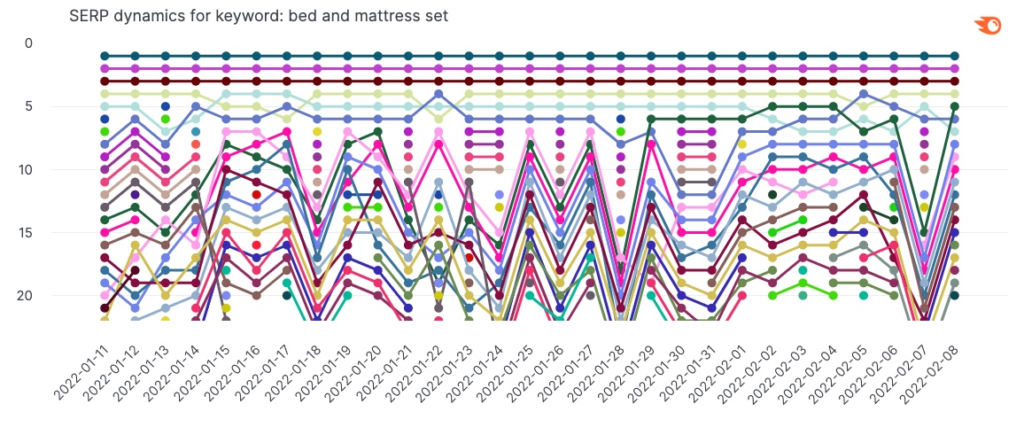
across the board fluctuations - Google moving towards a “real-time” algorithm

A series of rank reversals impacting almost all pages ranking between position 5 and 20 that align with across-the-board heightened rank fluctuations 

This trend, as I see it, is Google allowing its machine learning properties to evolve or recalibrate (or however you’d like to describe it) in real-time. Meaning, no one is pushing a button over at Google but rather the algorithm is adjusting to the continuous “real-time” recalibration of the machine learning properties.

It’s this dynamic that I am referring to when I question if we are heading toward “real-time” or “continuous” algorithmic rank adjustments.

What would a continuous real-time google algorithm mean? 

So what? What if Google adopted a continuous real-time model? What would the practical implications be? 

In a nutshell, it would mean that rank volatility would be far more of a constant. Instead of waiting for Google to push the button on an algorithm update in order to rank to be significantly impacted as a construct, this would simply be the norm. The algorithm would be constantly evaluating pages/sites “on its own” and making adjustments to rank in more real-time. 

Another implication would be a lack of having to wait for the next update for restoration. While not a hard-fast rule, if you are significantly impacted by an official Google update, such as a core update, you generally won’t see rank restoration occur until the release of the next version of the update – whereupon your pages will be evaluated. In a real-time scenario, pages are constantly being evaluated, much the way links are with Penguin 4.0 which was released in 2016. To me, this would be a major change to the current “SERP ecosystem.” 

I would even argue that, to an extent, we already have a continuous “real-time” algorithm. In fact, that we at least partially have a real-time Google algorithm is simply fact. As mentioned, In 2016, Google released Penguin 4.0 which removed the need to wait for another version of the update as this specific algorithm evaluates pages on a constant basis. 

However, outside of Penguin, what do I mean when I say that, to an extent, we already have a continuous real-time algorithm? 

The case for real-time algorithm adjustments

The constant “real-time” rank adjustments that occur in the ecosystem are so significant that they refined the volatility landscape. 

Per Semrush data I pulled, there was a 58% increase in the number of days that reflected high-rank volatility in 2021 as compared to 2020. Similarly, there was a 59% increase in the number of days that reflected either high or very high levels of rank volatility: 
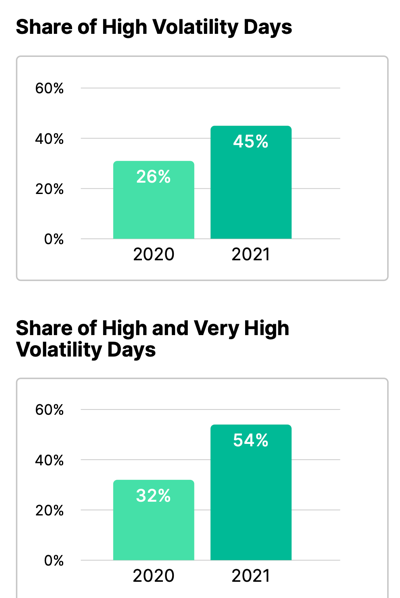
Data showing volatility - Google moving towards a “real-time” algorithm

Simply put, there is a significant increase in the number of instances that reflect elevated levels of rank volatility. After studying these trends and looking at the ranking patterns, I believe the aforementioned rank reversals are the cause. Meaning, a large portion of the increased instances in rank volatility are coming from what I believe to be machine learning continually recalibrating in “real-time,” thereby producing unprecedented levels of rank reversals. 

Supporting this is the fact (that along with the increased instances of rank volatility) we did not see increases in how drastic the rank movement is. Meaning, there are more instances of rank volatility but the degree of volatility did not increase. 

In fact, there was a decrease in how dramatic the average rank movement was in 2021 relative to 2020! 

Why? Again, I chalk this up to the recalibration of machine learning properties and their “real-time” impact on rankings. In other words, we’re starting to see more micro-movements that align with the natural evolution of Google’s machine-learning properties. 

When a machine learning property is refined as its intake/learning advances, you’re unlikely to see enormous swings in the rankings. Rather, you will see a refinement in the rankings that align with refinement in the machine learning itself. 

Hence, the rank movement we’re seeing, as a rule, is far more constant yet not as drastic. 

The final step towards continuous real-time algorithm updates

While much of the ranking movement that occurs is continuous in that it is not dependent on specific algorithmic refreshes, we’re not fully there yet. As I mentioned, much of the rank volatility is a series of reversing rank positions. Changes to these ranking patterns, again, are often not solidified until the rollout of an official Google update, most commonly, an official core algorithm update. 

Until the longer-lasting ranking patterns are set without the need to  “press the button” we don’t have a full-on continuous or “real-time” Google algorithm. 

However, I have to wonder if the trend is not heading toward that. For starters, Google’s Helpful Content Update (HCU) does function in real-time. 

Per Google: 

“Our classifier for this update runs continuously, allowing it to monitor newly-launched sites and existing ones. As it determines that the unhelpful content has not returned in the long-term, the classification will no longer apply.”

How is this so? The same as what we’ve been saying all along here – Google has allowed its machine learning to have the autonomy it would need to be “real-time” or as Google calls it, “continuous”: 

“This classifier process is entirely automated, using a machine-learning model.” 

For the record, continuous does not mean ever-changing. In the case of the HCU, there’s a logical validation period before restoration. Should we ever see a “truly” continuous real-time algorithm, this may apply in various ways as well. I don’t want to let on that the second you make a change to a page, there will be a ranking response should we ever see a “real-time” algorithm.

At the same time, the “traditional” officially “button-pushed” algorithm update has become less impactful over time. In a study I conducted back in late 2021, I noticed that Semrush data indicated that since 2018’s Medic Update, the core updates being released were becoming significantly less impactful.
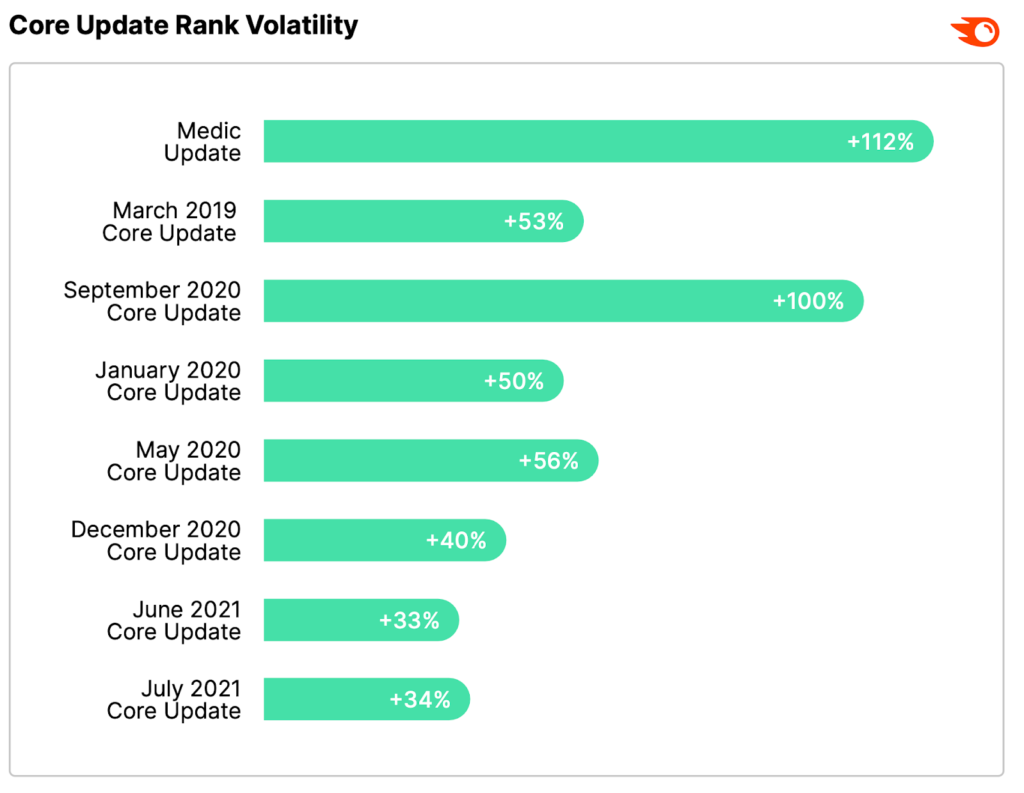
the relation between Google's updates and rank volatility - Google moving towards a “real-time” algorithm

Data indicates that Google’s core updates are presenting less rank volatility overall as time goes on

Subsequently, this trend has continued. Per my analysis of the September 2022 Core Update, there was a noticeable drop-off in the volatility seen relative to the May 2022 Core Update. 
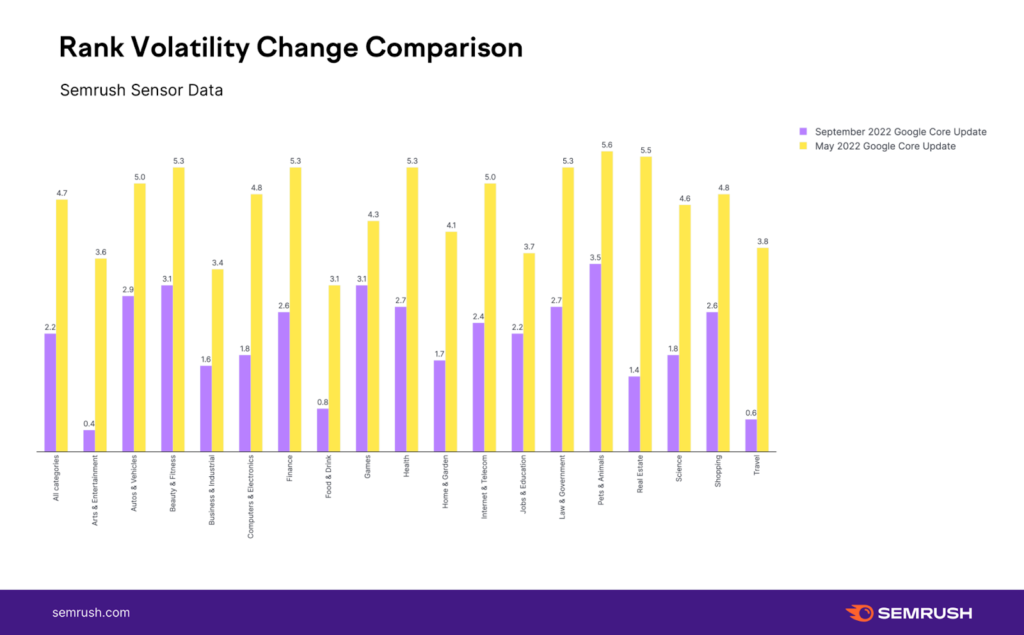
lesser rank volatility seen during Google's core update in Sep 2022 - Google moving towards a “real-time” algorithm

Rank volatility change was far less dramatic during the September 2022 Core Update relative to the May 2022 Core Update 

It’s a dual convergence. Google’s core update releases seem to be less impactful overall (obviously, individual sites can get slammed just as hard) while at the same time its latest update (the HCU) is continuous. 

To me, it all points towards Google looking to abandon the traditional algorithm update release model in favor of a more continuous construct. (Further evidence could be in how the release of official updates has changed. If you look back at the various outlets covering these updates, the data will show you that the roll-out now tends to be slower with fewer days of increased volatility and, again, with less overall impact). 

The question is, why would Google want to go to a more continuous real-time model? 

Why a continuous real-time google algorithm is beneficial

A real-time continuous algorithm? Why would Google want that? It’s pretty simple, I think. Having an update that continuously refreshes rankings to reward the appropriate pages and sites is a win for Google (again, I don’t mean instant content revision or optimization resulting in instant rank change).

Which is more beneficial to Google’s users? A continuous-like updating of the best results or periodic updates that can take months to present change? 

The idea of Google continuously analyzing and updating in a more real-time scenario is simply better for users. How does it help a user looking for the best result to have rankings that reset periodically with each new iteration of an official algorithm update? 

Wouldn’t it be better for users if a site, upon seeing its rankings slip, made changes that resulted in some great content, and instead of waiting months to have it rank well, users could access it on the SERP far sooner? 

Continuous algorithmic implementation means that Google can get better content in front of users far faster. 

It’s also better for websites. Do you really enjoy implementing a change in response to ranking loss and then having to wait perhaps months for restoration? 

Also, the fact that Google would so heavily rely on machine learning and trust the adjustments it was making only happens if Google is confident in its ability to understand content, relevancy, authority, etc. SEOs and site owners should want this. It means that Google could rely less on secondary signals and more directly on the primary commodity, content and its relevance, trustworthiness, etc. 

Google being able to more directly assess content, pages, and domains overall is healthy for the web. It also opens the door for niche sites and sites that are not massive super-authorities (think the Amazons and WebMDs of the world). 

Google’s better understanding of content creates more parity. Google moving towards a more real-time model would be a manifestation of that better understanding.

A new way of thinking about google updates

A continuous real-time algorithm would intrinsically change the way we would have to think about Google updates. It would, to a greater or lesser extent, make tracking updates as we now know them essentially obsolete. It would change the way we look at SEO weather tools in that, instead of looking for specific moments of increased rank volatility, we’d pay more attention to overall trends over an extended period of time. 

Based on the ranking trends we already discussed, I’d argue that, to a certain extent, that time has already come. We’re already living in an environment where rankings fluctuate far more than they used to and to an extent has redefined what stable rankings mean in many situations. 

To both conclude and put things simply, edging closer to a continuous real-time algorithm is part and parcel of a new era in ranking organically on Google’s SERP.


Mordy Oberstein is Head of SEO Branding at Wix. Mordy can be found on Twitter @MordyOberstein.

Subscribe to the Search Engine Watch newsletter for insights on SEO, the search landscape, search marketing, digital marketing, leadership, podcasts, and more.

Join the conversation with us on LinkedIn and Twitter.

https://www.searchenginewatch.com/2022/11/03/is-google-headed-towards-a-continuous-real-time-algorithm/




Google fixed a bug with some search features that may impact your site’s visibility

Google has confirmed it has fixed a bug that affected some search features, such as the top stories section. The bug was “noticeable” around October 18th and 19th, and was fixed around October 28th. Google said the bug fix can take about a week to fully rollout.

What happened. It is unclear exactly what the bug was, outside of there being a bug with “some search features” including the top stories section, as well as other search features. Google posted about this issue in the data anomalies Search Console report. Google wrote that on October 28th, the search performance report may be impacted due to this bug. Google wrote:

“Google released a fix to a bug that primarily affected some search features, such as Top Stories, and that became most noticeable around October 18-19. The bug fix will take about a week to fully rollout.”

Theories. We did ask Google for more details but did not yet hear back, so we can come up with some theories about what this bug was. Google did mention top stories specifically but I also noticed that Google had issues with other search features, like the people also ask and local pack results, amongst others, not showing up as often in the Google Search results listings.

Stay tuned. We hope to get a more detailed statement from Google about this issue and if and when we do, we will update this story.

Why we care. This bug may have had a temporary impact on your traffic and visibility in Google Search. It may have resulted in fewer impressions and clicks in Google Search. Google fixed the issue but you should see things rebound specific to this issue in the upcoming days or weeks.


Related Stories

New on Search Engine Land

@media screen and (min-width: 800px) { #div-gpt-ad-3191538-7 { display: flex !important; justify-content: center !important; align-items: center !important; min-width:770px; min-height:260px; } } @media screen and (min-width: 1279px) { #div-gpt-ad-3191538-7 { display: flex !important; justify-content: center !important; align-items: center !important; min-width:800px!important; min-height:440px!important; } }

About The Author

Barry Schwartz

Barry Schwartz a Contributing Editor to Search Engine Land and a member of the programming team for SMX events. He owns RustyBrick, a NY based web consulting firm. He also runs Search Engine Roundtable, a popular search blog on very advanced SEM topics. Barry can be followed on Twitter here.

https://searchengineland.com/google-fixed-a-bug-with-some-search-features-that-may-impact-your-sites-visibility-389344


5 SEO best practices for Black Friday and the holiday season

The world’s largest shopping season – Black Friday through Christmas – is here. 

Will the rising cost of living, drop in customer confidence, and frequent Google algorithm changes spell doom for SEO specialists?

In this article, we will go over some SEO tips that will help you navigate this holiday season and plan for the next.

1. Create dedicated landing pages for Black Friday 

To increase visibility for Black Friday and Cyber Monday-related search searches, it is advantageous to build a dedicated evergreen landing page for these holidays. 

To find the best deals, users will often search for keyword combinations that include [brand name] or [product], plus the words: deals, discounts, or promos.

Using Google Trends’ historical findings, it is possible to find out what choices are popular in certain product categories. If the idea is to give discounts on Black Friday or Cyber Monday, it may be worth dedicating a separate page to each product or service.

If you are able, it is a much better idea to start planning the creation of these landing pages and their content with as much time in advance as possible.

Then, until those pages are really required, deploy a 302 redirect (a temporary redirect, as opposed to a permanent 301 redirect). This will give you plenty of time to prepare the pages for your Christmas consumers and Google to thoroughly examine the site. 

Even better, you could build a “mini-site” with Black Friday/Christmas-themed pages that can be hidden from visitors until the holiday season approaches.

Once the pages have been created, they must be added to your XML sitemap and navigation. Remember that the purpose of building these new landing pages is to generate traffic from holiday-related search searches. 

Nonetheless, make sure that repeat visitors can see the updated pages in order to take advantage of your holiday specials. By adding the new pages to your sitemap, you provide a map for crawlers to swiftly locate and index them.

By doing these two things, you’ll increase the visibility of your new holiday landing pages to both visitors and search engine crawlers.

Remember: Holiday-related URLs on your site are not temporary. Therefore, it is important to keep these pages as evergreen as possible. 

2. Focus on user experience

The main priority for online Christmas shoppers is always discovering the greatest offers.

This year, several merchants developed tools and filters to facilitate the discovery and curation of Black Friday and Cyber Monday sales.

One of shoppers’ main frustrations is when they are unable to easily find the offers on a website or when encountering out-of-stock products after having browsed around your site for a while. 

Since it is so simple for online buyers to switch to another option fast, brands need these sorts of changes to keep customers on their sites and spending money.

The following elements are key:

  • Using faceted navigation.
  • Optimizing shopping carts.
  • Improving page experience.

Use faceted navigation

Faceted navigation is a way to help your customers to find exactly what they need by allowing them to personalize their searches by providing numerous filters depending on listing criteria.

You might encounter the following issues when implementing faceted navigation:

  • Duplicate content.
  • Index bloat (when search engines index pages on your site that don’t have search value).
  • Crawling issues. 

There are a variety of solutions available to address faceted navigation problems on both small and large websites. 

This topic cannot be adequately covered in a single part of this page so for further information, dig deeper in the following posts:

Optimize shopping carts

Also, consider the following shopping cart optimization suggestions.

Provide multiple delivery options

It is essential to provide a variety of delivery alternatives to cater to your customer’s needs. These options should include regular local delivery, next- or same-day delivery (in the case of florists), delivery costs, and local pickup, to name a few.

Offer a variety of payment methods

Millennials and Gen Z customers, being the most influential digital consumers, demand a range of payment alternatives.

If their preferred method is unavailable, it may cause them to abandon a purchase, not their intent. 

The desire for what they want to buy will prompt them to begin a fresh search, and complete that purchase somewhere else.

Enable account creation and sign-up using social media

Account creation that involves manual data input might potentially result in abandonment. 

Rather than spending time filling out personal information for each transaction on an ecommerce website, consumers want a speedy checkout.

Send email notifications of cart abandonment

Whether a client abandoned because they were window shopping or due to distractions, a personalized message reminding them that they had things in their basket could drive the customer to check the basket again.

Ability to use discount coupons

Adding a section in which customers may be encouraged to make use of discount coupons is yet another ecommerce tactic to encourage customers to complete a transaction.

Customers enjoy promotions and they would not pass up the opportunity to redeem a discount coupon.

Test on all mobile devices

Consider evaluating the mobile responsiveness of your website during the early web construction phase. 

This way you will be able to identify and fix issues on time before it is too late, and a bad user experience costs you a drop in revenue.

Implement a custom 404 error page

When a product has been discontinued or when a visitor types an erroneous URL, having a 404 error page will prevent client traffic from coming to a dead end.

It will also prevent visitors from finding nothing on the website.

Improve page experience

Working on improving core web vitals (CWVs) and the page experience can contribute to a significant increase in revenue as a result of an improvement in traffic. 

Several brands have seen improvements in revenue of up to 70% by working on their page experience, according to this Web.Dev article. 

Make sure the elements that compose the page experience are at their best possible. 

When it comes to core web vitals, it is crucial to make decisions based on the most accurate reports. Here are the best tools to evaluate the CWVs:

  • Google Lighthouse: This tool provides a score on a webpage or URL at any time. It is useful to give an idea of where things could be wrong and where you start more in-depth research. 
    • Type of data: Lab data (simulator). 
  • PageSpeed Insights: 
    • Type of data: Lab and field (real user data).
  • CRUx
  • Google Search Console
  • Screaming Frog
  • New Relic

Dig deeper in these invaluable resources: 

While Black Friday and Cyber Monday (BFCM) represent the most important long weekend of the year for retail, it’s important to work to align your organic search strategy with paid search. This provides your users with the most unified omnichannel experience possible.

Your paid search campaign, like your SEO strategy, should be built on a combination of historical ad performance data and fresh keywords.

Here are a few things to remember when planning a holiday PPC campaign:

  • Ad bidding for BFCM may be hard on your budget. Be cautious when choosing target keywords for paid ads.
  • Run sponsored promotional ads before the busy Black Friday–Christmas shopping season when there is less competition. This year, holiday shopping begins earlier than usual.
  • Remember to match your campaign goals to the appropriate stage of the funnel when running paid social campaigns.
  • Don’t forget to set aside part of your budget for test ads. Try Tiktok, Google Ads, or LinkedIn sponsored posts.

4. Optimize your Google Business Profile

In How to turn your Google Business Profile into a revenue-generating channel, I covered the importance of a Google Business Profile in your SEO strategy. 

Whether you are a small business or a large brand, GBP can be a significant source of revenue if it is optimized properly. 

Here are some things you can do during Black Friday–Christmas season in order to increase revenue:

  • Create a category section per season. For example, a category section for your Black Friday products and once it ends, delete the category and create a new one for Christmas. 
  • Make sure you add all the necessary information regarding delivery during the festive season. This is key as a lack of information can lead to bad reviews.
  • Create GBP posts (once a week is enough) to keep your audience informed about upcoming offers, delivery times, and other important aspects of your business and products. 
  • Encourage your customers to leave a review and always answer their comments. 

In the days leading up to and during Black Friday, there will be a ton of articles that make use of the phrases “Black Friday,” “deal” or “offer.” This only goes to illustrate how much hunger journalists have for Black Friday sale material.

Your company’s next few weeks should definitely entail promoting Black Friday deals for your ecommerce firm to relevant media. 

Here are some things you can do to gain links prior to and during the holiday season:

  • Send journalists covering Black Friday and Christmas specials a list of your top products, complete with photos and prices.
  • Be aware that journalists will be inundated with Black Friday requests, so be careful about how you tailor your pitch and who you are pitching. Here is an old piece but still quite relevant when it comes to pitching a journalist and another great resource by Gisele Navarro on how to pitch a journalist.
  • Monitor media requests related to Black Friday or Christmas.
  • Gather with your team and plan a good piece of content to promote prior to and during the festive season. It could be a report that can be promoted among the media, a collaboration with an influencer, a PR stunt, an event or more.

What if our revenue declines even with a top-notch SEO strategy?

Imagine this – your team or yourself:

  • Have prepared months in advance for the Black Friday and Christmas seasons.
  • Gained fantastic links in national media plus great engagement on social media. 
  • Have a good SEO strategy in place.

You notice that results in traffic and rankings are great and you were not affected by any algorithm update. 

Yet, despite all of this, you see a significant decline in revenue.

It is here where it is important to evaluate all possible external events happening and assess what could be affecting consumer confidence.

Declining consumer confidence, influenced by the current global economic crisis and a general state of pessimism, is a phenomenon becoming rather common in 2022.

That said, you are not alone here. The demand for brands and agencies to acquire customer trust is greater than ever. Despite widespread pessimism, consumer behavior shows signs of optimism.

Some might think, “SEO for Black Friday is a great topic. But of all aspects of interest to SEOs, economy and economic drivers? Not SEO.” 

Well…

  • You will have to explain to stakeholders from the ROI point of view, why – despite significant SEO investment and good results in organic traffic and engagement – there is a decline in revenue. 
  • Knowing what is affecting your consumers’ confidence will lead to sensitivity when brainstorming for content and link campaigns. An insensitive/controversial content, PR or social campaign will get you links, yes, but can also destroy your brand’s reputation in a snap.

It is our job to evaluate everything that could possibly affect our SEO results and, this way, find and propose solutions. 

If those solutions are not part of your day-to-day work, then delegate and work alongside other teams. 

So, what to do when we are affected by factors out of our control?

The most important aspect is to focus on communication with your stakeholders. 

As for your customers, focus on the following to build trust and increase purchase confidence:

  • Offers (seasonal offers, gift cards, subscriptions).
  • Costs (costs on delivery).
  • Sensitive and creative content and digital PR campaigns.
  • Work with paid teams.

Working for seasonal sales is one of my favorite types of work as an SEO. However, to be able to have a great Black Friday/festive season, it is best to plan with as much time as possible in advance.


Opinions expressed in this article are those of the guest author and not necessarily Search Engine Land. Staff authors are listed here.


Related Stories

New on Search Engine Land

@media screen and (min-width: 800px) { #div-gpt-ad-3191538-7 { display: flex !important; justify-content: center !important; align-items: center !important; min-width:770px; min-height:260px; } } @media screen and (min-width: 1279px) { #div-gpt-ad-3191538-7 { display: flex !important; justify-content: center !important; align-items: center !important; min-width:800px!important; min-height:440px!important; } }

About The Author

Maria White

Maria Amelie White works as Head of SEO at Kurt Geiger a luxury British retailer with concessions in luxury stores such as Harrods and Selfridges in the UK.
Maria is an MSc in Psychological Research from the University of Oxford and has worked in SEO for over 12 years, specializing in Technical SEO, International SEO, Local SEO and Digital PR.

https://searchengineland.com/seo-best-practices-black-friday-holiday-season-389219