Google only uses core web vitals. Google’s John Mueller confirmed on Twitter that Google now only uses the most recent update for page speed ranking, specifically the page experience update that measures page speed using core web vitals.
John said “it’s all cwv [core web vitals] now” when asked about if the old page speed algorithms are used.
Old page speed algorithms. John said “no,” to Google using the old 2010 and 2018 page speed algorithms.
No, it’s all cwv now.
— johnmu: nothing is permanent, use 302 always 💫 (@JohnMu) October 28, 2022
Why we care. Truth is, page speed as a ranking factor is super light and does not really make a huge difference for ranking purposes. But either way, it is good to know that Google no longer uses the old page speed algorithms, even though one might consider it obvious for Google not to have two or more competing algorithms.
Related Stories
New on Search Engine Land
@media screen and (min-width: 800px) { #div-gpt-ad-3191538-7 { display: flex !important; justify-content: center !important; align-items: center !important; min-width:770px; min-height:260px; }
}
@media screen and (min-width: 1279px) { #div-gpt-ad-3191538-7 { display: flex !important; justify-content: center !important; align-items: center !important; min-width:800px!important; min-height:440px!important; }
}
About The Author
Barry Schwartz a Contributing Editor to Search Engine Land and a member of the programming team for SMX events. He owns RustyBrick, a NY based web consulting firm. He also runs Search Engine Roundtable, a popular search blog on very advanced SEM topics. Barry can be followed on Twitter here.
It was a cold, dark night. At the end of the long path was an old, rundown mansion covered in cobwebs. Inside was a candle flickering next to the shadow of a person.
You rub the frost off the stained-glass window on the doorstep, and there’s just enough light to see what the man inside is doing. He’s moving his body from side to side, chanting numbers – what could it be? Black magic?
You put your ear to the window to find out what you can hear – and you can make out … something:
“One, two, three, four paid links!”
Alas – he’s not a sorcerer at all – but something even more chilling: A marketer performing the ancient practice of black hat SEO!
Does this tale spook you as much as it does me? It’s almost 2023, and if you’re involved in buying links – or any of the 10 things I’m about to detail in this article – you won’t have a chance to compete in the search results.
So without further ado, here are 10 spooky SEO practices to axe in 2023.
1. Not getting buy-in from the top
Your company may say that you can “do SEO” without actually understanding what SEO means.
Fast-forward to a few months down the road when you need to make big decisions about the site, and management is nowhere to be found.
How will you have meaningful discussions with your SEO team if you don’t know what they are talking about?
How will you get Bob in IT to actually make changes to the website if he has no SEO knowledge?
It is so critical that in-house teams have a baseline understanding of SEO, as well as to keep up with emerging strategies.
SEO training is an excellent way to get teams up-to-speed on SEO.
This proactive step helps ensure you are making sound decisions and can keep things moving forward.
Let go of these spooky SEO tactics
These are spooky times and, unfortunately for many websites, scary SEO tactics still exist.
Give the axe to the 10 items in this article and you will have a chance at competing in the search results in 2023.
Opinions expressed in this article are those of the guest author and not necessarily Search Engine Land. Staff authors are listed here.
Related Stories
New on Search Engine Land
About The Author
Bruce Clay is the founder and president of Bruce Clay Inc., a global digital marketing optimization firm providing search engine optimization, PPC management, paid social media marketing, SEO-friendly site architecture, content development, and SEO tools and education.
Clay authored the book “Search Engine Optimization All-In-One For Dummies,” now in its fourth edition, and “Content Marketing Strategies for Professionals.” He wrote the first webpage-analysis tool, created the Search Engine Relationship Chart® and is credited with being the first to use the term search engine optimization. Bruce Clay’s renowned SEO training course is available online at SEOtraining.com.
Although patience is a great answer, I would never say there is a “greatest” SEO skill.
Why?
Because SEO requires various hard skills (things you can learn or be taught) and soft skills (how you work and interact with others) to succeed.
As I’ve always found, asking many SEO professionals one question will get a wide variety of opinions. So I asked several SEO professionals what they would consider the greatest skill in SEO.
“As far as greatest skills go, I have to go with the stock SEO answer: It depends. In this case, though, it really does.
If the practitioner is content-focused, then writing skills combined with strong research abilities (both SEO and subject-based) would definitely top my list. If the practitioner is a technical SEO, then the most important skills skew to technical knowledge – but even that branches out.
If they work as a contractor, then they likely need to have a broad understanding of different tech and a strong ability to research specifics and work with developers. If they’re an in-house SEO or platform-specific contractor, then they would likely need a stronger grasp of a specific stack, and possibly deployment capabilities.
The one skill that every SEO needs is research and troubleshooting capabilities. If they can’t do that, their career will be short. Thankfully, if you’re reading this, you do your research.”
“For me, one of the greater skills for SEO professionals to develop is critical thinking. The SEO ecosystem is awash with noise and claims, with varying levels of data and anecdotal evidence to support them. Far too often, much of this content and advice is taken verbatim and applied to own situations without a second thought, with the expectation that the implementation will yield the same results.
A common example in SEO happens when working with a client (and other stakeholders) on a website redesign. More often than not, the designs, and some proposed technical implementations, will be taken from other websites without considering the ‘other’ factors that go into how a website ranks. Just because eBay, the BBC, Amazon, etc. do X, doesn’t mean X will work for Bob’s Hardware or Bob’s Finance Co.
With critical thinking, SEOs should read a study online, see the inputs and outcomes, and then intentionally find other studies that contradict these results – and then form their own opinions and influence their strategies with application to the current client scenario.”
John McAlpin, Director of SEO Strategy, Cardinal Digital Marketing
“Most experienced SEO professionals will likely say that the most important skill is a soft skill. I’d say that’s pretty spot-on.
In my opinion, the most important SEO skill is critical thinking. Not everything in SEO is black and white. There’s always a middle ground. It takes real detective skills to find the answers.”
“Problem-solving and the ability to see the big picture. We often get so bogged down in the minutia of various SEO tasks that we miss the big picture of what’s going on between the website, the search engines, the potential visitors, and the business the website represents.
Taking a step back and looking at things from end to end can help us solve problems more than fretting over things like meta description length or figuring out the optimum time to release a blog post.”
“The greatest skill in SEO is problem-solving. It rarely goes according to plan.
Adapting, finding new ways, and exploring all resources for technical, on-page, IT, UX and off-page factors are all critical to success. Using a checklist, and checking boxes, won’t get you far.”
“The greatest skill in SEO is experimenting. One thing that works for one business or industry is not necessarily what would work for another. You cannot judge that without testing.
Also, most of the projects have different audience buying and browsing perspectives, technologies for the website UX, content, how we build the navigation, etc. So you need to keep checking what works for your website, client, or employer because SEO is ever-evolving, and one cannot learn or unlearn new or outdated things without experimenting. Sometimes, we learn from someone else’s experiments, so experimenting is a super duper skill in SEO.”
“As an SEO consultant specializing in enterprise-level SEO consulting for enterprise ecommerce companies and omnichannel retailers, I value SEO strategies that are not SEO strategies for Google, but SEO for business performance results, productivity and economic growth.
A solid understanding of business, business processes, workflow automation and cross-functional alignment is worth gold in this segment.”
“Commercial awareness (ROI) and soft skills because you need to be able to translate the work that you’re doing into measurable impact for your stakeholders. You must also know how to distill technical ideas into concepts that make sense to those stakeholders.”
“SEO is a spectrum. As such, it is hard to dominate all skills (Technical, Data, Content, PR, Story Telling, Management and more). These skills change as Google and search evolve. Every Google algorithm shapes the way we do SEO.
Given that the only constant is change, then the best skill to succeed is the ability to adapt. Changes are the norm when working in an agency: new clients, bigger clients, various budgets, fast pace and more. If, along with that, we add constant changes to the algorithm that involves changing the way we work, then here is where only those with the ability to adapt will not only survive but they will thrive.”
“SEO requires an ability to clearly explain concepts and objectives, usually in many different ways, to many different people. Your ability to do so, professionally and emotionlessly, is a big part of your daily success.”
“The greatest skill in SEO is the ability to learn. One constant in SEO is change – one must learn new things and flex to adapt to new ways constantly.”
“Persistence is the greatest skill, where you don’t get disappointed by failures and continue to learn, push to improve, engage with other teams and cooperate for the greater success of the business you represent.”
“Cross-collaboration is an incredibly valuable skill. SEO is one of the few skills/roles that sits at the crossroads of nearly every department in an organization: design, development, content, UX, PR, marketing, engineering, quality assurance, analytics, and more.”
11. Understanding the user
Mike Grehan, SVP of Corporate Communications, NP Digital
“The greatest skill of an SEO is to fully understand the “information need” of an end user. They don’t start their research as a consumer or a B2C customer or B2B, or anything other than a human being trying to solve a problem. Help Google to help them – and Google will surely help you!”
12. Inquisitiveness
Mark Jackson, President and CEO, Vizion Interactive
“An inquisitive mind. In SEO, you can be a technically gifted and super bright person or a content marketing expert, but if you lack an inquisitive mind, you may not be looking at a project from all the possible angles.”
“The greatest skill in SEO is “ranking experience.” You can do a lot in SEO. But only 20% of that ensures 80% of success. Only with enough experience in knowing which tasks are effective, in which case makes the difference between good and average SEOs.”
Joe Devita, Managing Partner, Moving Traffic Media
“The ability to stay focused on the optimization signals that matter rather than be distracted by all the noise.”
Related Stories
New on Search Engine Land
About The Author
Danny Goodwin is Managing Editor of Search Engine Land & SMX. In addition to writing daily about SEO, PPC, and more for Search Engine Land, Goodwin also manages Search Engine Land’s roster of subject-matter experts. He also helps program our conference series, SMX – Search Marketing Expo. Prior to joining Search Engine Land, Goodwin was Executive Editor at Search Engine Journal, where he led editorial initiatives for the brand. He also was an editor at Search Engine Watch. He has spoken at many major search conferences and virtual events, and has been sourced for his expertise by a wide range of publications and podcasts.
Crawl efficacy: How to level up crawl optimization
It’s not guaranteed Googlebot will crawl every URL it can access on your site. On the contrary, the vast majority of sites are missing a significant chunk of pages.
The reality is, Google doesn’t have the resources to crawl every page it finds. All the URLs Googlebot has discovered, but has not yet crawled, along with URLs it intends to recrawl are prioritized in a crawl queue.
This means Googlebot crawls only those that are assigned a high enough priority. And because the crawl queue is dynamic, it continuously changes as Google processes new URLs. And not all URLs join at the back of the queue.
So how do you ensure your site’s URLs are VIPs and jump the line?
But the benefits are more nuanced than that because the faster a page is crawled from when it is:
Created, the sooner that new content can appear on Google. This is especially important for time-limited or first-to-market content strategies.
Updated, the sooner that refreshed content can start to impact rankings. This is especially important for both content republishing strategies and technical SEO tactics.
As such, crawling is essential for all your organic traffic. Yet too often it’s said crawl optimization is only beneficial for large websites.
But it’s not about the size of your website, the frequency content is updated or whether you have “Discovered – currently not indexed” exclusions in Google Search Console.
Crawl optimization is beneficial for every website. The misconception of its value seems to spur from meaningless measurements, especially crawl budget.
Crawl budget doesn’t matter
Too often, crawling is assessed based on crawl budget. This is the number of URLs Googlebot will crawl in a given amount of time on a particular website.
Google says it is determined by two factors:
Crawl rate limit (or what Googlebot can crawl): The speed at which Googlebot can fetch the website’s resources without impacting site performance. Essentially, a responsive server leads to a higher crawl rate.
Crawl demand (or what Googlebot wants to crawl): The number of URLs Googlebot visits during a single crawl based on the demand for (re)indexing, impacted by the popularity and staleness of the site’s content.
Once Googlebot “spends” its crawl budget, it stops crawling a site.
Google doesn’t provide a figure for crawl budget. The closest it comes is showing the total crawl requests in the Google Search Console crawl stats report.
So many SEOs, including myself in the past, have gone to great pains to try to infer crawl budget.
The often presented steps are something along the lines of:
Determine how many crawlable pages you have on your site, often recommending looking at the number of URLs in your XML sitemap or run an unlimited crawler.
Calculate the average crawls per day by exporting the Google Search Console Crawl Stats report or based on Googlebot requests in log files.
Divide the number of pages by the average crawls per day. It’s often said, if the result is above 10, focus on crawl budget optimization.
However, this process is problematic.
Not only because it assumes that every URL is crawled once, when in reality some are crawled multiple times, others not at all.
Not only because it assumes that one crawl equals one page. When in reality one page may require many URL crawls to fetch the resources (JS, CSS, etc) required to load it.
But most importantly, because when it is distilled down to a calculated metric such as average crawls per day, crawl budget is nothing but a vanity metric.
Any tactic aimed toward “crawl budget optimization” (a.k.a., aiming to continually increase the total amount of crawling) is a fool’s errand.
Why should you care about increasing the total number of crawls if it’s used on URLs of no value or pages that haven’t been changed since the last crawl? Such crawls won’t help SEO performance.
Plus, anyone who has ever looked at crawl statistics knows they fluctuate, often quite wildly, from one day to another depending on any number of factors. These fluctuations may or may not correlate against fast (re)indexing of SEO-relevant pages.
A rise or fall in the number of URLs crawled is neither inherently good nor bad.
Crawl efficacy is an SEO KPI
For the page(s) that you want to be indexed, the focus shouldn’t be on whether it was crawled but rather on how quickly it was crawled after being published or significantly changed.
Essentially, the goal is to minimize the time between an SEO-relevant page being created or updated and the next Googlebot crawl. I call this time delay the crawl efficacy.
The ideal way to measure crawl efficacy is to calculate the difference between the database create or update datetime and the next Googlebot crawl of the URL from the server log files.
If it’s challenging to get access to these data points, you could also use as a proxy the XML sitemap lastmod date and query URLs in the Google Search Console URL Inspection API for its last crawl status (to a limit of 2,000 queries per day).
Plus, by using the URL Inspection API you can also track when the indexing status changes to calculate an indexing efficacy for newly created URLs, which is the difference between publication and successful indexing.
Because crawling without it having a flow on impact to indexing status or processing a refresh of page content is just a waste.
Crawl efficacy is an actionable metric because as it decreases, the more SEO-critical content can be surfaced to your audience across Google.
You can also use it to diagnose SEO issues. Drill down into URL patterns to understand how fast content from various sections of your site is being crawled and if this is what is holding back organic performance.
If you see that Googlebot is taking hours or days or weeks to crawl and thus index your newly created or recently updated content, what can you do about it?
Get the daily newsletter search marketers rely on.
7 steps to optimize crawling
Crawl optimization is all about guiding Googlebot to crawl important URLsfast when they are (re)published. Follow the seven steps below.
1. Ensure a fast, healthy server response
A highly performant server is critical. Googlebot will slow down or stop crawling when:
Crawling your site impacts performance. For example, the more they crawl, the slower the server response time.
The server responds with a notable number of errors or connection timeouts.
On the flip side, improving page load speed allowing the serving of more pages can lead to Googlebot crawling more URLs in the same amount of time. This is an additional benefit on top of page speed being a user experience and ranking factor.
If you don’t already, consider support for HTTP/2, as it allows the ability to request more URLs with a similar load on servers.
However, the correlation between performance and crawl volume is only up to a point. Once you cross that threshold, which varies from site to site, any additional gains in server performance are unlikely to correlate to an uptick in crawling.
How to check server health
The Google Search Console crawl stats report:
Host status: Shows green ticks.
5xx errors: Constitutes less than 1%.
Server response time chart: Trending below 300 milliseconds.
2. Clean up low-value content
If a significant amount of site content is outdated, duplicate or low quality, it causes competition for crawl activity, potentially delaying the indexing of fresh content or reindexing of updated content.
Add on that regularly cleaning low-value content also reduces index bloat and keyword cannibalization, and is beneficial to user experience, this is an SEO no-brainer.
Merge content with a 301 redirect, when you have another page that can be seen as a clear replacement; understanding this will cost you double the crawl for processing, but it’s a worthwhile sacrifice for the link equity.
If there is no equivalent content, using a 301 will only result in a soft 404. Remove such content using a 410 (best) or 404 (close second) status code to give a strong signal not to crawl the URL again.
How to check for low-value content
The number of URLs in the Google Search Console pages report ‘crawled – currently not indexed’ exclusions. If this is high, review the samples provided for folder patterns or other issue indicators.
3. Review indexing controls
Rel=canonical linksare a strong hint to avoid indexing issues but are often over-relied on and end up causing crawl issues as every canonicalized URL costs at least two crawls, one for itself and one for its partner.
Similarly, noindex robots directives are useful for reducing index bloat, but a large number can negatively affect crawling – so use them only when necessary.
In both cases, ask yourself:
Are these indexing directives the optimal way to handle the SEO challenge?
Can some URL routes be consolidated, removed or blocked in robots.txt?
If you are using it, seriously reconsider AMP as a long-term technical solution.
With the page experience update focusing on core web vitals and the inclusion of non-AMP pages in all Google experiences as long as you meet the site speed requirements, take a hard look at whether AMP is worth the double crawl.
How to check over-reliance on indexing controls
The number of URLs in the Google Search Console coverage report categorized under the exclusions without a clear reason:
Alternative page with proper canonical tag.
Excluded by noindex tag.
Duplicate, Google chose different canonical than the user.
Duplicate, submitted URL not selected as canonical.
4. Tell search engine spiders what to crawl and when
An essential tool to help Googlebot prioritize important site URLs and communicate when such pages are updated is an XML sitemap.
For effective crawler guidance, be sure to:
Only include URLs that are both indexable and valuable for SEO – generally, 200 status code, canonical, original content pages with a “index,follow” robots tag for which you care about their visibility in the SERPs.
Include accurate <lastmod> timestamp tags on the individual URLs and the sitemap itself as close to real-time as possible.
Google doesn’t check a sitemap every time a site is crawled. So whenever it’s updated, it’s best to ping it to Google’s attention. To do so send a GET request in your browser or the command line to:
Additionally, specify the paths to the sitemap in the robots.txt file and submit it to Google Search Console using the sitemaps report.
As a rule, Google will crawl URLs in sitemaps more often than others. But even if a small percentage of URLs within your sitemap is low quality, it can dissuade Googlebot from using it for crawling suggestions.
XML sitemaps and links add URLs to the regular crawl queue. There is also a priority crawl queue, for which there are two entry methods.
Firstly, for those with job postings or live videos, you can submit URLs to Google’s Indexing API.
Or if you want to catch the eye of Microsoft Bing or Yandex, you can use the IndexNow API for any URL. However, in my own testing, it had a limited impact on the crawling of URLs. So if you use IndexNow, be sure to monitor crawl efficacy for Bingbot.
Secondly, you can manually request indexing after inspecting the URL in Search Console. Although keep in mind there is a daily quota of 10 URLs and crawling can still take quite some hours. It is best to see this as a temporary patch while you dig to discover the root of your crawling issue.
How to check for essential Googlebot do crawl guidance
In Google Search Console, your XML sitemap shows the status “Success” and was recently read.
5. Tell search engine spiders what not to crawl
Some pages may be important to users or site functionality, but you don’t want them to appear in search results. Prevent such URL routes from distracting crawlers with a robots.txt disallow. This could include:
APIs and CDNs. For example, if you are a customer of Cloudflare, be sure to disallow the folder /cdn-cgi/ which is added to your site.
Unimportant images, scripts or style files, if the pages loaded without these resources are not significantly affected by the loss.
Functional page, such as a shopping cart.
Infinite spaces, such as those created by calendar pages.
Parameter pages. Especially those from faceted navigation that filter (e.g., ?price-range=20-50), reorder (e.g., ?sort=) or search (e.g., ?q=) as every single combination is counted by crawlers as a separate page.
Be mindful to not completely block the pagination parameter. Crawlable pagination up to a point is often essential for Googlebot to discover content and process internal link equity. (Check out this Semrush webinar on pagination to learn more details on the why.)
And when it comes to tracking, rather than using UTM tags powered by parameters (a.k.a., ‘?’) use anchors (a.k.a., ‘#’). It offers the same reporting benefits in Google Analytics without being crawlable.
How to check for Googlebot do not crawl guidance
Review the sample of ‘Indexed, not submitted in sitemap’ URLs in Google Search Console. Ignoring the first few pages of pagination, what other paths do you find? Should they be included in an XML sitemap, blocked from being crawled or let be?
Also, review the list of “Discovered – currently not indexed” – blocking in robots.txt any URL paths that offer low to no value to Google.
To take this to the next level, review all Googlebot smartphone crawls in the server log files for valueless paths.
6. Curate relevant links
Backlinks to a page are valuable for many aspects of SEO, and crawling is no exception. But external links can be challenging to get for certain page types. For example, deep pages such as products, categories on the lower levels in the site architecture or even articles.
On the other hand, relevant internal links are:
Technically scalable.
Powerful signals to Googlebot to prioritize a page for crawling.
Particularly impactful for deep page crawling.
Breadcrumbs, related content blocks, quick filters and use of well-curated tags are all of significant benefit to crawl efficacy. As they are SEO-critical content, ensure no such internal links are dependent on JavaScript but rather use a standard, crawlable <a> link.
Bearing in mind such internal links should also add actual value for the user.
How to check for relevant links
Run a manual crawl of your full site with a tool like ScreamingFrog’s SEO spider, looking for:
Orphan URLs.
Internal links blocked by robots.txt.
Internal links to any non-200 status code.
The percentage of internally linked non-indexable URLs.
7. Audit remaining crawling issues
If all of the above optimizations are complete and your crawl efficacy remains suboptimal, conduct a deep dive audit.
Start by reviewing the samples of any remaining Google Search Console exclusions to identify crawl issues.
Once those are addressed, go deeper by using a manual crawling tool to crawl all the pages in the site structure like Googlebot would. Cross-reference this against the log files narrowed down to Googlebot IPs to understand which of those pages are and aren’t being crawled.
Finally, launch into log file analysis narrowed down to Googlebot IP for at least four weeks of data, ideally more.
If you are not familiar with the format of log files, leverage a log analyzer tool. Ultimately, this is the best source to understand how Google crawls your site.
Once your audit is complete and you have a list of identified crawl issues, rank each issue by its expected level of effort and impact on performance.
Note: Other SEO experts have mentioned that clicks from the SERPs increase crawling of the landing page URL. However, I have not yet been able to confirm this with testing.
Prioritize crawl efficacy over crawl budget
The goal of crawling is not to get the highest amount of crawling nor to have every page of a website crawled repeatedly, it is to entice a crawl of SEO-relevant content as close as possible to when a page is created or updated.
Overall, budgets don’t matter. It’s what you invest into that counts.
Opinions expressed in this article are those of the guest author and not necessarily Search Engine Land. Staff authors are listed here.
Related Stories
New on Search Engine Land
About The Author
Jes Scholz leads a team responsible for the establishment of marketing best practices and transferring learnings globally across Swiss media giant Ringier’s diverse portfolio of brands. Jes spends much of her time testing theories on the future of search, leading projects in chatbots, computer vision, virtual reality, AI for automation and anything else that can future proof brands. A strong believer in data-driven marketing and agile methodologies, she is always testing out new tactics with the help of her team.
Years ago, I was a legal assistant for a criminal defense law firm when my boss assigned me a new task – learning SEO.
I asked him what SEO meant, and he responded, “Search engine optimization. I don’t trust the people I’m working with anymore and need you to learn it.”
As I began to learn and discuss my findings with him, he explained that his website had disappeared entirely from Google’s SERPs.
The company he had been paying to handle SEO for nearly a decade could not, or would not, tell him why it happened.
My biggest takeaway from this other company’s neglect was not their disappointing work but how badly they responded to my boss and their poor communication skills.
Had they been transparent and honest, my then-boss would have allowed them to fix it – and I would never have had the opportunity to learn SEO.
However, they did not, and the course of my career changed as I dove head-first into SEO, quickly becoming a passion that fed my competitive instincts.
Several years later, I started my own SEO company, focusing on doing things right and emphasizing transparency and communication.
My first goal was never to hear the question, “Where is my money going?”
Transparency sets you apart
I quickly realized the biggest complaints companies hiring SEO agencies had centered on poor communication.
Some common client complaints regarding digital marketing agencies include:
“Every time I call, I can never speak with anyone.”
“It takes a long, long time for them to respond to my messages/emails.”
“Every time I meet with my project manager, it’s a different person.”
“They don’t tell me what they’re doing.”
“Agency asks for more money when results aren’t where anticipated.”
“Most solutions proposed by the agency require extra spending, regularly exceeding the monthly retainer.”
“There’s no exclusivity! The company I’m paying is also helping a competitor.”
Poor communication plagues many digital marketing agencies today. And it helps reinforce the idea that many digital marketers are snake oil salesmen selling an intangible service that does not guarantee any result.
This matter provides all of us an opportunity to set ourselves apart through excellent communication.
Let’s keep in mind that if a client has fired their previous provider and is hiring you, they were likely burned or unhappy with their previous services and may already be coming into their relationship with you a little skeptical.
Often, doing great work in the digital marketing world is not enough, as some clients do not understand the value of your services.
Communicate the what, when, and why of your strategy and keep clients in the loop about the results. This helps engage your clients and helps them understand the value you bring.
Get the daily newsletter search marketers rely on.
Why putting extra effort into client communications is worthwhile
A healthy relationship with clients is a beneficial result of communication, transparency and customer service. In addition to helping convey the value you’re bringing, frequent communication and honesty build trust.
When I started in this industry, I knew I did not want to be a part of the rat race, constantly chasing new clients.
Instead, I wanted to form strong relationships with a few clients and give them the best possible service in deliverables and customer service.
To promote absolute transparency with my clients and avoid that dreaded question about where their money is going, I create an openly shared Google Doc with each one.
In these documents, I create a bulleted list each day of tasks done on their project/website. At any time, the client can check it for real-time updates about the work on their website.
This practice has helped me maintain long and healthy relationships with nearly all my clients.
I am blessed to have recognized this gap in most digital marketers’ services. It has been worthwhile to leverage long-standing relationships with clients and make them feel comfortable with our work.
With excellent customer service, you can enjoy the following benefits:
Acquire and keep long-term clients by building trust.
Digital marketing, especially SEO, takes time. But you can make an instant, good impression with strong communication and customer service.
Communication at this level is rare, but it is comforting to clients and often sets you apart, leading to high-quality referrals from your existing clients.
Long-term relationships are more profitable for your business.
Good communication skills allow for a quicker connection with possible clients. If talking to a potential client, poor customer service can eliminate the possibility of working together very quickly.
Clients are willing to pay more when they see conversions and understand the strategy and results. Being able to communicate this succinctly raises your value.
It provides your business with a competitive advantage over those who are poor communicators.
Strategies are often far more successful when the client is involved, engaged, and providing feedback/input.
The fruits of my labor
Simply putting our heads down and working on our tasks/deliverables is what most of us SEO and digital marketers would like to spend our time on.
Sending frequent emails to clients and updating Google Doc trackers can take a lot of extra time and certainly don’t factor into the odds of your chosen marketing strategy’s success.
The level of transparency and customer service my company provides has enabled us to form long-term relationships with our clients, many of which have been with us since the first year of our company’s inception.
We currently have 25 SEO clients, of which 10 have been clients since our first year of business.
I have built an exceptional rapport with these clients, allowing me to communicate any concerns openly just as easily as any successes. Having great communication gives you a longer leash.
Had the agency communicated its shortcomings and mistakes with my previous employer, they would likely still be doing his SEO today.
Let’s say you’ve been working with someone for years and have built rapport. Suppose, for the sake of discussion, they get hit with a core algorithm update and traffic dips. In that case, your client is far more likely to understand and afford you the opportunity to right the ship rather than looking for a new provider.
Make client communications a priority
In digital marketing, there are countless stories of poor communication and client frustration.
Complaints are abundant that money paid to digital marketers does not yield the expected results and has been a waste of investment.
Utilizing transparency and open communication leads to happier clients and more sustained relationships – setting you apart from competitors.
Are you not yet going out of your way to connect with your clients? If not, now is the time to do so.
Improving customer service boosts your overall business, reputation and client experience (and results).
Opinions expressed in this article are those of the guest author and not necessarily Search Engine Land. Staff authors are listed here.
Related Stories
New on Search Engine Land
About The Author
Taylor Kurtz was born and raised in Tampa, Florida. Taylor then moved to Tallahassee to attend Florida State University, where he obtained his bachelor’s degree in sports management and his MBA. Taylor focuses exclusively on SEO and owns/operates Crush the Rankings, an award-winning digital marketing agency that focuses on high-quality Search Engine Optimization and website development. Taylor is also a Business Professor at the local community college in Fort Collins, CO and speaks around the country, discussing SEO at various digital marketing summits.
In the first part of our SEM career playbook series, we defined the roles you will likely find within the digital marketing industry. Once you have secured a great position, you need a game plan to thrive and excel.
Your employer often provides opportunities to sharpen your skills and advance your SEM career. If you proactively capture every opportunity to learn and take on more responsibilities, your development will accelerate significantly.
Flourishing within an SEM role is a balance of mindset, education, and development. Of course, this could be said for career advancement in any industry.
Successful SEM careers have many facets, but if you build a foundation of these attributes, they will serve you well for a long time.
Maintain a growth mindset
The SEM landscape changes constantly and there are no signs of slowing down. This means that everyone in the digital marketing industry is a lifelong learner – or at least they should be!
Many personality types can find success in digital marketing. There is a wide array of tasks and responsibilities that will align with a broad spectrum of working styles and preferences.
Everyone is unique and they bring different strengths to their work.
Here are a few universal attributes that will help any individual bring a growth mindset to their current and future roles.
Self-starter
Be ready to dive into projects.
A self-starter by definition is someone “who begins work or undertakes a project on their own initiative, without needing to be told or encouraged to do so.”
Be the person on your team who is always one step ahead.
Curious inclination
I’ll say it again, SEM is always changing. A growth mindset means always learning.
Continue learning about every shift in the industry. Be curious about account strategy.
Learn why certain objectives are prioritized over others. Understand how the daily tactics impact the overall campaign outcomes.
Clear communication
One of the most important skills in any setting is communication. The ability to convey complex ideas in a clear, concise manner is critical.
Focus on developing communication skills across all mediums. This includes phone calls, presentations, emails, instant messaging like Slack, and even task delegation.
Detail-oriented
SEM activation has a very high level of specificity.
There are dozens of settings and details you need to review for each completed task. From account implementation to performance reporting, all require a high level of detail and attention.
Be that person on the team that is leading with operational excellence.
Positive outlook
No one wants to work with someone who sucks the energy from the team. Be the person on your team who brings positive energy.
Of course, no one can be a ray of sunshine all the time. But strive to be a person who is positive and ready to tackle any challenge.
A growth mindset can apply to any personality type. If you are more introverted or extroverted, these skills are malleable to your strengths and interests!
Focus on proactive education
Don’t wait for learning opportunities to find you. Proactively seek out avenues to sharpen your skills and grow your expertise.
Be enthusiastic about development and doors will open for you.
Attend every available training session
Most companies offer some sort of training program and some programs are more robust than others.
Make sure to take full advantage of any internal programs that are available.
Don’t just show up and be a passive participant. This is your chance to learn and grow. Make it count.
Discover third-party webinars and training
There are countless webinars available almost every week from reliable publications and organizations.
Create a list of sources that broadcast webinars on a regular basis. This can be a form of ongoing education, even after you have completed the training provided by your company.
Here is a quick list of organizations/publications that offer webinars regularly:
Acquire all relevant certifications
In SEM, the available certifications are bountiful!
Platform certifications can help establish and baseline knowledge. They can also help refresh your knowledge.
Most SEM certifications are valid for a year, so you should keep them up-to-date.
Here is a quick list of certifications everyone in SEM should acquire:
Read industry publications regularly
Done! You are here at Search Engine Land, so you are well on your way!
Be sure to read Search Engine Land (this is not a paid spot) and other industry publications daily.
I learn new things constantly from the excellent articles posted in these publications.
Here are a few publications to bookmark or add to your RSS feed reader:
How you manage SEM campaigns today will be different than how they will be managed three years from now.
Reading these publications will help you stay on top of the industry.
Get the daily newsletter search marketers rely on.
Strive for continuous development
As you can see, learning never stops in the SEM industry. This should excite and inspire you!
There are elements of digital marketing that you can master like writing persuasive copy (people are people and that won’t change).
Some elements change every year and you have to stay on top of this. For a successful career in SEM, you have to develop all of your skills.
You should strive for continuous development of your SEM-specific skills and other skills that are required to be successful in the marketplace.
Participate in a mentorship program
Many companies offer a mentorship program. Some are more formal than others.
If your company does not have a mentor program in place, you could reach out to a senior team member directly to ask if they would like to serve as a mentor.
Mentors can provide insights that you may not get from a direct manager.
Focus on goal-setting and achievement
Be fanatical about setting goals and milestones for yourself. Most companies offer a review process, usually every six months, but it varies.
Don’t be a passive participant in this process. Think about how you want to grow over the next quarter or six months.
Always come to your review with a vision for your development.
Of course, your manager will have their own ideas on growth and improvement – but you should arrive at your review ready to discuss your goals.
Understand your personality type
Self-reflection and awareness can serve your career very well.
Often creating personality profiles can feel pointless. But that’s because we don’t take them seriously or put them into action.
If your company offers a personality finder type of program, use it! Learn more about your personality.
Hopefully, you’ll understand how you work best. This will help your long-term growth.
Strike a balance to avoid burnout
No one can grow, develop or do good work if they are feeling burned out. SEM work is fast-paced and endless because there is always work to do!
It’s like running a marathon at a full sprint up a hill in the rain while being chased by a bear.
I’m joking. Sort of.
Learn how to be aware of burnout and take your mental health seriously so that your best self can show up to work every day.
The building blocks of a successful SEM career
Building an awesome SEM career can be complex and challenging at times.
Hopefully, this list is a great resource for anyone getting started. Or perhaps these are helpful resources for anyone who is looking to kick their career into overdrive.
In our next article for this series, we’ll dive into the on-the-job performance that will help advance your SEM career.
Opinions expressed in this article are those of the guest author and not necessarily Search Engine Land. Staff authors are listed here.
Related Stories
New on Search Engine Land
About The Author
Joseph Kerschbaum is Senior Vice President of Search & Growth Labs for 3Q/DEPT. During his 20 years of experience in digital marketing, Joseph has worked with businesses of every size from SMBs to enterprise-scale. Joseph has been a regular speaker at digital marketing conferences for over a decade. Joseph is a regular contributor to Search Engine Land. He is co-author of the Wiley/Sybex book, “Pay-Per-Click SEM: One Hour a Day,” which was published long enough ago to be outdated but that is a good thing because SEM is such a dynamic industry.
Clicks to other Google properties (eg, images, news, shopping) 10.3%
Paid clicks: 0.02%
Another interesting finding (though perhaps not entirely surprising) is that searchers didn’t spend much time analyzing search results, according to Semrush. Most searchers decide what to click on within 15 seconds.
So why are there zero clicks? There’s no one answer to this question. We know that consumers want answers – typically as fast as possible. Google now provides more of those answers than ever in the form of various search features (e.g., time, weather, movie showtimes, even direct answers).
Methodology. The study was conducted by Semrush in May, based on an anonymous sample of 20,000 U.S. desktop and mobile users. Semrush analyzed a total of 609,809 search queries (308,978 on desktop, 146,390 on mobile).
Semrush vs. past studies. SparkToro did a pair of studies (in 2019 and 2020). Here’s Search Engine Land’s coverage of those reports:
Both studies had, let’s say, issues. Barry Schwartz outlined some of those issues on Search Engine Roundtable.
Had there been another analysis this year or last by SparkToro, I’d imagine Google zero-click searches would be somewhere around 85%. (Sorry, couldn’t resist.)
Read the study. It’s definitely an interesting read that I highly recommend reading. See Semrush’s Zero-Clicks Study.
Why we care. Since 2019, there has been a lot of noise made about how Google is stealing clicks for itself. Google’s Danny Sullivan offered more context, pointing out that Google sends more traffic to websites every year and laying out some logical reasons why certain queries don’t end with a click on a website.
Admittedly, two things can be true – Google can send more traffic to websites than ever, and reduce the number of searches that otherwise would have gone to websites had it not introduced its own products or search features that directly compete in organic search.
In my opinion (as well as the opinions of many other smart SEO professionals I know): those past zero-click “studies” were misleading at best, and nonsense at worst. And they got way more attention than they deserved because the math never really added up. I applaud Semrush’s efforts in providing more context and a greater, more nuanced (read: less biased) analysis.
Related Stories
New on Search Engine Land
About The Author
Danny Goodwin is Managing Editor of Search Engine Land & SMX. In addition to writing daily about SEO, PPC, and more for Search Engine Land, Goodwin also manages Search Engine Land’s roster of subject-matter experts. He also helps program our conference series, SMX – Search Marketing Expo. Prior to joining Search Engine Land, Goodwin was Executive Editor at Search Engine Journal, where he led editorial initiatives for the brand. He also was an editor at Search Engine Watch. He has spoken at many major search conferences and virtual events, and has been sourced for his expertise by a wide range of publications and podcasts.
Yelp has created a new attribute, Business Fund, and Resource Hub for veterans
Veterans Day in the US is November 11 and to celebrate and support past servicemembers, Yelp has just launched three new products for their iOS and Android app.
A searchable attribute to help veterans self-identify as veteran-owned on their Yelp page
a $100,000 Veteran Business Fund awarding $10,000 to 10 veteran-owned small businesses
A veteran-owned Business Resource Hub
Let’s take a look at these new products and features.
Helping users find and support veteran-owned businesses
Starting today, people can search for and find veteran-owned businesses. Veteran business owners can have the attribute show on their business profiles by logging into their Yelp Business profile and selecting the appropriate option.
Consumers will see the veteran-owned attribute on iOS and Android apps under the “more info” section of a business profile.
All businesses that select the veteran-owned attribute on Yelp will also receive a free window decal.
New fund to support veteran entrepreneurs
Yelp is launching a Veteran Business Fund, which will award $10,000 to 10 veteran-owned U.S. businesses. Eligible businesses can enter for a chance to win at VeteranBusinessFund.Yelp.com through Veterans Day, November 11, 2022. You can find the official rules at VeteranBusinessFund.Yelp.com/rules.
Get the daily newsletter search marketers rely on.
Veteran-owned Business Resource Hub
This provides instructions on how businesses can add the new attribute to their Yelp pages, as well as offers information and tools, inspirational stories, and more context on how Yelp is giving visibility to veteran-owned businesses.
Why we care. If you are a veteran and want to show the new attribute on your business page, you can do so by logging into your account and following the prompts to add a new attribute.
Yelp is making a great effort to be inclusive. With its recent additions of LGBTQ-owned and Asian-owned attributes, they’re making it easier for audiences that want to support diverse businesses to find them on Yelp.
Related Stories
New on Search Engine Land
About The Author
Nicole Farley is an editor for Search Engine Land covering all things PPC. In addition to being a Marine Corps veteran, she has an extensive background in digital marketing, an MBA and a penchant for true crime, podcasts, travel, and snacks.
Google Search Console mislabeled structured data errors as errors
Instead of labeling many of the structured data issues as “warnings” Google labeled many as “errors” within the rich results reports in Google Search Console. Google fixed the reporting issue on October 25th and as a result, you may see a lot of the errors move from a critical status to a warning status.
Google’s statement. Google posted a statement saying that on October 25, 2022 “Some structured data issues were mislabeled as errors, when in fact they are warnings.”
Action taken. Google has and will relabel these structured data issues correctly in your Search Console reports going forward. So many of the errors will be relabeled as warnings.
Impact. While there is no impact directly in Google Search, meaning, your rich results in Google Search were probably showing anyway, there were issues with the Search Console reports. Google said, as a result, “these issues will move from the critical error table to the warning table in your rich result reports.” “The issue count in the critical errors table will drop to zero, and that issue will be added to the warnings table with the pre-zero count,” Google added.
Google Search not impacted. Again, this was just a reporting issue, this had no impact on what was visible in Google Search. Google wrote “This is strictly a reporting issue and did not affect whether or not a rich result could be displayed in Google Search results.”
Why we care. If you notice a bunch of structured data critical issues going away, this is probably why. While it had no real impact in Google Search, your rich results reports likely will change. And if you were fixing critical issues that did not need to be fixed, this is why. In any event, give it a few days and recheck the rich results report to see which issues are errors and which are just warnings.
Related Stories
New on Search Engine Land
About The Author
Barry Schwartz a Contributing Editor to Search Engine Land and a member of the programming team for SMX events. He owns RustyBrick, a NY based web consulting firm. He also runs Search Engine Roundtable, a popular search blog on very advanced SEM topics. Barry can be followed on Twitter here.
You can’t grow as a marketer without curiosity – here’s why
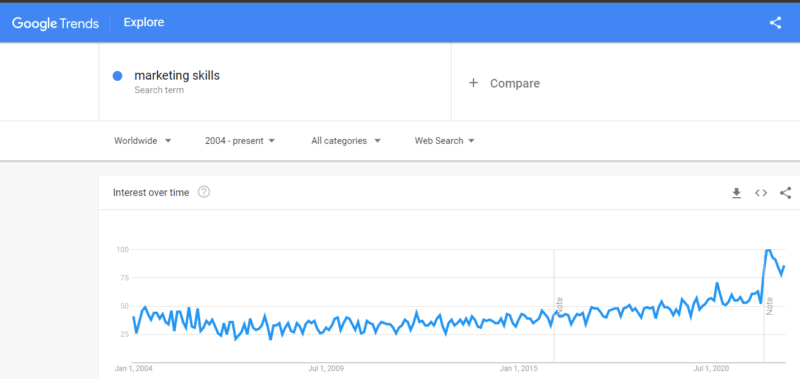
People search a lot about “marketing skills.”
Google Trends shows the upward graph of the above term from January 2016, but its search has dramatically increased in 2022.
This increase leads to the conclusion that more people are looking to enhance their marketing skills. But, one skill remains underrated, despite being included in most online articles and books related to digital marketing skills.
Curiosity.
It’s underrated because some marketers emphasize working on other skills they feel will make them progress in their careers and land them their dream jobs and higher paychecks.
Thus, they’ll work on technical, analytical and communication skills, but not on being more curious.
Why is curiosity important in marketing?
Curiosity improves understanding
Kids are the most curious. They ask questions about anything and everything, and that’s how they know things better and remember for a more extended period.
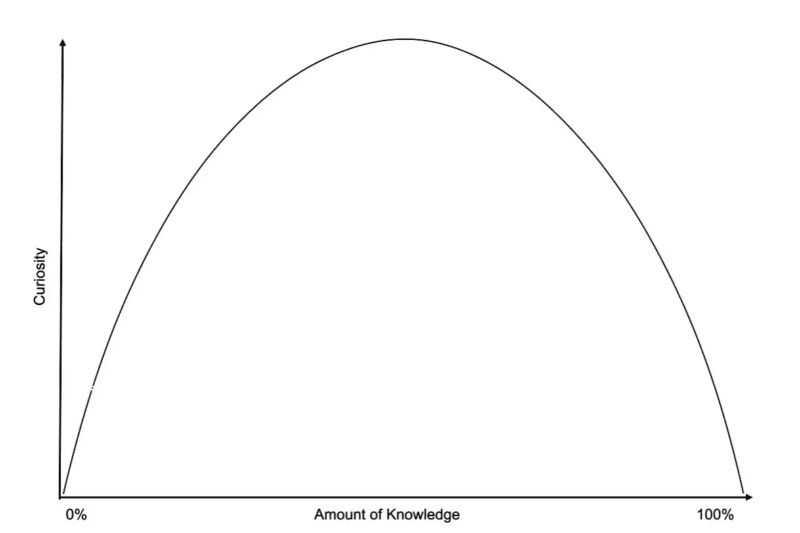
Consider the Information Theory curve below. What I interpret is the more curiosity you have, the more knowledge you can get (the original interpretation is not in this context).
With more knowledge, the understanding improves and takes you to the next growth stage.
That’s how it becomes crucial for everyone, even marketers, to be extremely curious to compel us to:
Ask questions.
Seek out new information.
Expand our understanding of the world around us.
Curiosity brings creativity
Curiosity is one of the most important drivers of creativity. After all, that drives us to explore new things, ask questions and look for answers.
Marketers need to be curious if they want to be creative.
We often get caught up in the day-to-day tasks that we forget to step back and question everything we’re doing.
We become complacent and go through the motions without thinking about our actions or why.
But when we take the time to be curious, we can open up a new world of possibilities.
We can look at our campaigns from different angles and develop innovative ways to improve them. We can also challenge the status quo and find better ways to do things.
When marketers become curious, they would ask more questions.
The more questions, the more understanding.
The more understanding, the better ideas, and solutions.
Curiosity enables enthusiasm
Because they ask many questions, bringing creativity in them, marketers become enthusiastic about everything they’re working on.
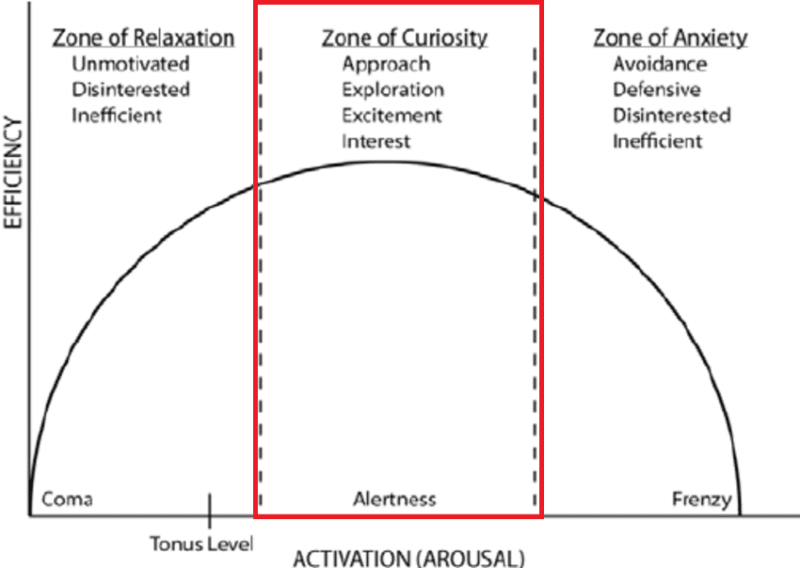
I have highlighted the Zone of Curiosity section within the above diagram, which says that when someone is in the curiosity state, the efficiency is at the optimum level. Hence, the interest and excitement are pretty high.
This interest and excitement can be contagious, sparking the same curiosity and enthusiasm in others.
Such a feeling can bring them together for more experiments, learning, and growth. This can lead to more sales, customers, and success for the business overall.
Curiosity strengthens precision
I would like to refer to the same Zone of Curiosity diagram above says that alertness is also high when someone is in a curious state of mind.
When we’re curious about something, we’re more likely to pay attention to it and note details we might have missed. This heightened focus can benefit marketers by allowing us to target our audience more precisely.
After all, your efforts will likely be in vain if you’re not reaching the right people with the right message. Fortunately, curiosity can help to strengthen precision among marketers.
Now that we know what curiosity delivers to marketers, we need to look at where and how curiosity helps marketers in their day-to-day marketing lives.
Get the daily newsletter search marketers rely on.
Where (and how) does curiosity help marketers?
Let’s start with the basics and then with the advanced ones.
1. Curiosity to learn new things
The number one area where marketers need curiosity is to learn new things. We are so busy in marketing jobs that we just keep doing what we learned in the past.
Though we have Google products that keep us on our toes to learn new things, how successful are we in learning them?
I interviewed a lot of SEOs (seniors and managers) in the past three months, and no one has tried anything there. Most of them know this news, while only a few have set it up.
This shows a lack of curiosity among SEOs to learn new things like GA4.
Seniors and managers who are hiring embrace the talent that learns new things as, most of the time, they are looking to fill the skill gaps, and if you know it, you’ll be preferred.
So, knowing is not enough for a marketer. Learning is more essential.
Be curious to learn more new things.
2. Curiosity to experiment with new things
Whenever someone asks me about experiments I did, the first one I recollect is when I earned my first featured snippet.
It was 2015 when for the first time, I optimized the content before I published it. And within a week, it was on the featured snippets.
Because it’s on the featured snippets, obviously, it satisfied the users’ search and reading intent.
That content got promoted by our competitors, and not just my reporting manager but the owner of the 300-people company appreciated me over an email.
Today, the SEO industry knows me as someone who strategizes, curates, and optimizes content for featured snippets.
My curiosity to experiment with something new helped me reach where I am today.
It could be something else for you. But, it’s vital for you as a marketer to always be curious to experiment.
3. Curiosity to know what worked and what not
Experimenting is not enough. You also need to know what worked. What’s more important is to learn why an experiment was successful.
For one of our niche clients in social media marketing, we tried everything from choosing different audiences to coming out with short, lengthy videos. But none of our posts went to more than 30 likes and 500 reach.
But, the moment we launched our first reel, it went viral.
After digging into why most of our posts didn’t go that viral and most of our reels are getting good reach, it meant our target audience embraced reels, and Instagram prioritized them.
A smart marketer must always be curious to know what works for each client and what not to multiply the effort in the right direction.
4. Curiosity to find out the reason behind the failures
With failures, I mean larger failures, such as:
A damaged relationship with a client.
Missing the targets.
Achieving negative ROI consistently.
And more.
While we had a lot of success stories around featured snippets, we have one client for whom we could not achieve them. We knew the biggest challenge was their user experience. Nothing was dynamic that we could change the page structure, title, H1, and more.
Another failure was losing one of the biggest clients last year.
We recommended many tech improvements, which they never prioritized, but because Missive Digital was new, we provided them with content writing services to prove our SEO worth.
The content we wrote is still ranking on Page 1, and the content strategy we prepared was utilized even after our association with them.
They knew our worth, but we still lost them due to their lack of implementation.
Failures will be there, and they’ll never be in your control. Be curious to identify what brought you the failure and take the necessary steps.
5. Curiosity to learn from mistakes (whether it’s your own or others’)
Though failure and mistake are the results of trying, they are different.
You may not make mistakes because of failures, but you may fail because of mistakes.
I remember an incident that happened a few months ago within my team. I assigned a new team member to optimize the content, and while reviewing her work, I identified that for the target query, another page of the client was ranking on Page 1.
She had spent the whole day optimizing the content, which had keyword cannibalization. That was a mistake, which I mentioned in our Slack group.
Instantly, another team member called me up and asked me what she had to do if such a thing happened to her. I quickly guided her on how it becomes necessary to inform the client first and conclude on which page to optimize for the targeted query based on the users’ search and reading intent.
I appreciated that team member for being curious to learn from her teammate’s mistake.
It’s a great sign of being a good marketer because it lets you avoid future blunders or failures.
6. Curiosity to find the implications of failures
Curiosity should not end at learning from failures. Sometimes, knowing what would happen if we fail at certain things is also essential.
What if we optimize content and it doesn’t reach featured snippets?
What if we fail to achieve that 10K organic traffic in 9 months?
What if the reels don’t drive engagement as expected?
What if the email campaign for Christmas won’t surpass the last year’s sales?
What if the tech implementation doesn’t boost sales?
What if the landing pages we suggest don’t satisfy the user’s expectations?
As a marketer, we strategize and execute various campaigns. We set key performance indicators (KPIs) for every campaign. But we hardly think about what we should do if the KPIs go negative.
What if our campaign doesn’t work as expected? What would be the implications of that?
Some projects are do-or-die situations where business owners or marketing heads have significantly less patience and time when working with agencies, consultants, or freelancers. You can lose the trust of your clients and projects in the long run.
In such cases, be curious enough to ask peers or managers about the implications of the failures during the planning stage.
With such curiosity, you know when to change the plan if a campaign doesn’t perform in two weeks or two months.
Even if such curiosity doesn’t save you from losing the project, but will help you plan better for the next one.
7. Curiosity to know what competitors are doing
Don’t get me wrong here. I know all of our marketing strategies involve thorough competitive analysis. But, most of the time, we stick to analyzing competitors based on the services you’re providing.
For example, if we provide content writing services, we stick to just that and don’t recommend anything that might help your content perform.
Sometimes, you also need to keep an eye on whether your competitors are:
Evolving their product.
Collaborating with different partners.
Investing in other marketing channels.
Revamping their brand positioning.
Automating certain processes.
Hiring specific roles.
Getting PR or social mentions.
Getting audience attention on any platform
And more.
Everything that your competitors do, you should know it. We have made Google Alerts for our competitors’ brand mentions and configured them in our SEO tools.
That helps you be curious about your competitors and proactive in making decisions on time.
8. Curiosity about what other marketers are talking about
No, I’m not talking about the latest news in your industry. Today, everyone has subscribed to more than two or three newsletters where they get the latest updates on the industry.
I’m talking about what other marketers are talking about, learning new things, experimenting, and more in the industry.
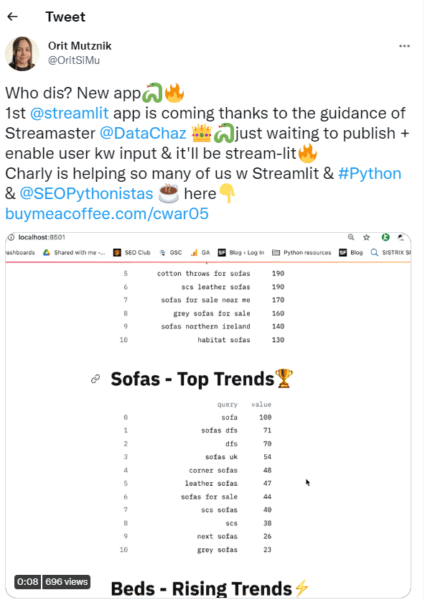
For example, in SEO, many people I know are learning automation through Python, using Streamlit. I learned about Python SEO through the knowledge base of the late Hamlet Batista.
I remember Orit Mutznik (one of my inspirations) started a Python course and even came up with her first script.
Then I see a lot of posts from semantic SEO from Koray Tuğberk GÜBÜR (it’s on my list).
No one can stop your progress when you know what strategies, processes, methods, and tools people use to improve our client’s marketing ROI.
9. Curiosity to see what brands are doing
Most marketers love what more prominent brands do in their marketing. They would post some tweets or carousels dedicated to the great branding done by the brands.
But only a few marketers analyze what is and isn’t working for some brands.
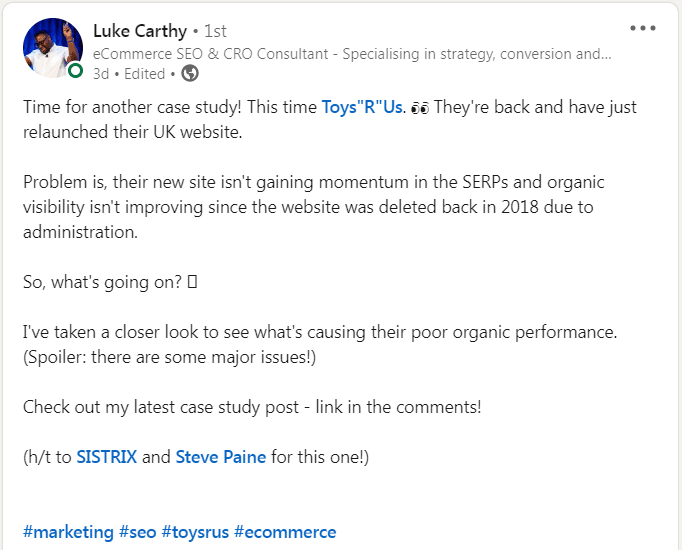
For example, Luke Carthy (one of my favorite ecommerce SEOs) is curious to understand what is happening with the brands, what’s working, and what’s not. He recently devised a case study for Toys ‘R’ Us. These case studies are just the reviews he does for those websites. He does not work for them.
His curiosity makes him do such reviews and analyses of ecommerce websites.
Such curiosity is rare but is required for every marketer to enhance their approach and mindset toward how to learn from and showcase brands if they’re making mistakes.
How can marketers become more curious?
Ask the *right* questions the *right* way
Whenever you read any article on curiosity online, they give one tip – ask questions.
In marketing, just asking questions won’t make you curious. You need to know what to ask, when, and how.
In my opinion, asking questions like the ones below is not considered curiosity:
Is SEO dead?
SEO vs. PPC: What is better?
Is content marketing relevant today?
How much DA does Google recommend for backlinks?
Just as asking the right questions is mandatory, asking the right person in the right way also matters.
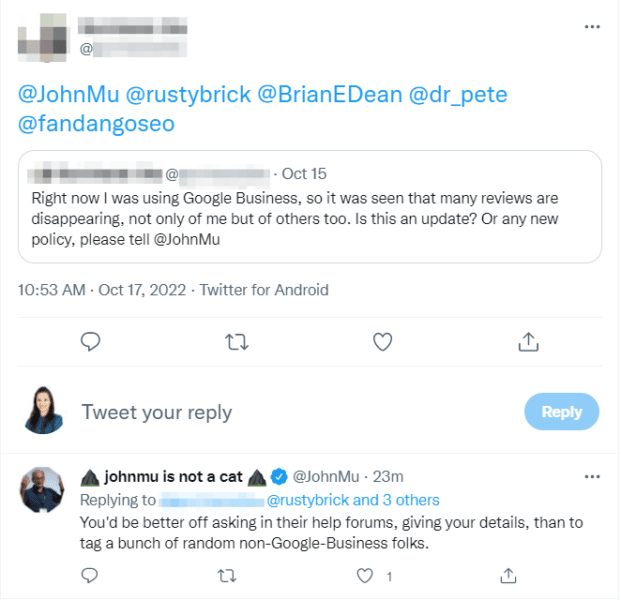
For example, this person tagged John Mueller, Barry Schwartz, Brian Dean, Dr. Pete Meyers, and Fandango for something related to Google Business. That was a completely irrelevant and incorrect way of showcasing curiosity to know from these people.
So curiosity is a skill if you take it seriously, so don’t ask random, irrelevant questions to irrelevant people at irrelevant platforms and timings.
Experiment more
As I explained above, curiosity is generated through experiments and not just by asking questions. The way it happened to me – when I achieved my first featured snippet in 2015.
If not from your experiments, learn from others’ experiments.
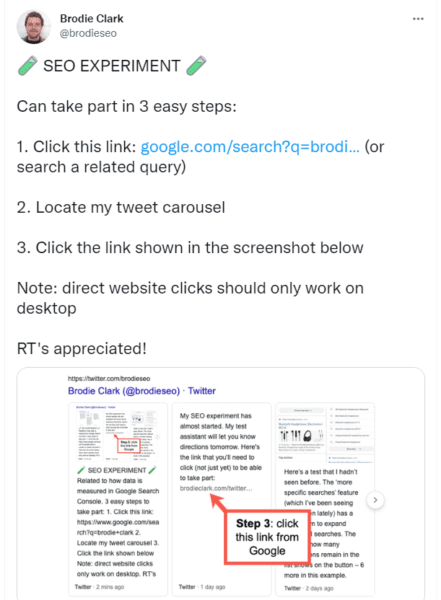
For example, in my BrightonSEO talk on remarketing SEO, I shared an experiment that Brodie Clark (an Australian SEO consultant) did on Twitter.
When he ran the experiment, I participated out of curiosity, and it helped me build this approach of remarketing SEO considering Twitter SEO.
After he shared the results on how Twitter carousel boosts organic impressions and clicks, we started using Twitter as the tool to drive more returning visitors to our website and for faster URL indexing.
So run your experiments or learn from others to enhance your curiosity as a marketing skill.
Be open to feedback
I would be too direct here. If you are not open to feedback, you cannot grow as a professional or human being.
And feedback can come from anyone – your seniors, managers, boss, juniors, mentors, and more.
Also, feedback can come in any form. For example, I usually ask my team members questions to discover what I want to tell them. In such a way, they feel it isn’t feedback but learning.
It doesn’t matter who gave you the feedback. See what you’re learning from the feedback because that’s how curiosity gets strengthened within you.
Leave your comfort zone
Before becoming a consultant, I used to work in-house. Back then, hardly all IT or marketing agencies would have weekends off in India.
But, when I worked in Cygnet Infotech (one of the largest IT headquarters in Ahmedabad), weekends were off, and I was enjoying my work-life balance.
Every month, we used to outperform our targets for TestingWhiz, and it was monotonous to keep enjoying the appreciation from the manager and company directors.
So, I knew that if I had to learn more, I had to come out of my comfort zone of this 5-day work.
I decided to leave my five-day working job and went to another IT company for a six-day working culture.
And after that, I moved to entrepreneurship which is almost a seven-day work (even if you’re not at your desk physically doing office work).
You need to identify your comfort zone and leave it at the right time. Otherwise, you won’t be curious about what the other side of your life and job looks like.
Be ready to help and collaborate (be it with peers or anyone in your network)
Not necessarily someone comes to you for help, considering you know everything. They might think they need someone reliable to work on something they struggle at.
When you agree to help (irrespective of monetary gain), you become more curious about the things you handle.
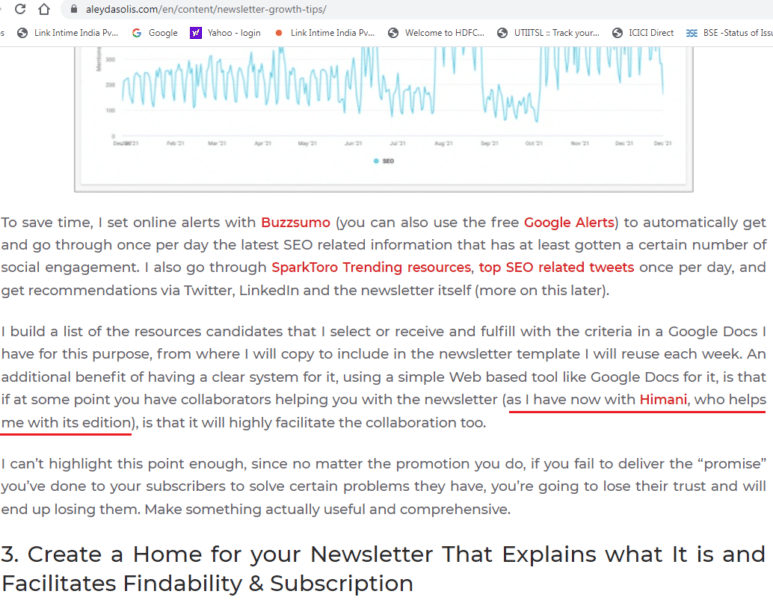
A few months ago, I was not reading all the blogs Aleyda Solis used to add to her #SEOFOMO newsletter. I used to select the interesting ones, such as content, on-page, algorithm updates, studies, etc.
But since we collaborated to write those descriptions, I now read every blog.
This has increased my level of curiosity for even the tech side of SEO. I read for myself and even for my team.
So when you’re passionately involved in helping someone, your mind develops the curiosity to learn everything to help them.
Master curiosity and win as a marketer
A marketer’s job is not only to build curiosity within their target audience but even within themselves to become better every day.
Take the help of peers, thought leaders, mentors, nature, tools, and more because learning is everywhere, and the more curious you become, the more successful you’ll be.
Opinions expressed in this article are those of the guest author and not necessarily Search Engine Land. Staff authors are listed here.
Related Stories
New on Search Engine Land
About The Author
Himani Kankaria is the founder of Missive Digital, an organic digital marketing agency helping businesses multiply their organic visibility and conversions. She specializes in strategizing, creating, and optimizing content for users and SERP features like Featured Snippets. She is a speaker at global conferences and an author sharing her knowledge and experiences around SEO and Content at various publishing sites, webinars, podcasts and more.