The case of the stealth Google-bomb

Earlier this year, I was asked to work on a legal case involving a couple of finance sector companies where one was accused by the other of trademark infringement where the defendant’s website abruptly began ranking for the plaintiff’s service mark.

The only trouble was, the unique phrase was in no way associated with the defendant’s website. In this article, I’ll discuss a unique functionality of Google’s ranking algorithm.

What I expected to find in this case was quite different from what I ultimately found. Most search ranking factors are very straightforward.

SEO is an arena where the logical principle of Occam’s razor (“the simplest explanation is usually the right one”) is typically present in formulating explanations. 

For instance, if a page ranks for a unique keyword, that keyword will be found within a page’s HTML code such as the title, body text, image alt text – or, failing that, the keyword might be present in links pointing to the page. 

But, this case was to prove to be a rare instance wherein media linking the unique, branded phrase, was simply… absent.

The case overview

The scenario was quite unique in a few ways.

Some years ago, the plaintiff had dreamed up a sort of catchphrase that they used in traditional media to promote their business.

The catchphrase combined a word closely related to their business and products with a word that was not traditionally related to their industry. 

They neglected to promote the catchphrase online, and as it was very unique, there were fewer webpages that appeared in Google search results for the precise query. 

When searching for the catchphrase, 1.7 million pages were shown in the results, but many of these were only partial matches – once you searched with quotes around the phrase, the results dropped to only a little over three thousand. 

The phrase had been used generically in a completely different industry, so most of the exact-match results related to that other use. 

The plaintiff’s website used the catchphrase on some of their pages, and had the expectation that only their website would appear in the search results when it was searched upon.

The plaintiff advertised in offline media channels, and on the radio, they ended their promotion with a phrase like “For more information, search in Google for _____ _____!”

At some point, they themselves searched for “_____ _____” and thought it was a little odd that the defendant’s website appeared on page one, near the lower half of the first page of search results.

As their own website was at the top of the results, they did not think more of it at that time. 

However, they eventually thought they might wish to register a .com domain name with their catchphrase. They were unhappy to discover the domain was already registered.

When they typed in the domain, the URL redirected to one of their top competitors, located in their area, not many miles from them. 

That is when they consulted with a lawyer and then decided to sue.

When the attorney approached me to look into how the defendant’s website began ranking for the plaintiff’s catchphrase, I was pretty confident I would find them a veritable “smoking gun” explaining the undeserved ranking. 

In my experience, keyword text must be associated with a webpage in some way for it to appear prominently in the rankings for that keyword query.

I thought it likely that I would find keywords, hidden or otherwise, in the code of the defendant’s website, or links with anchor text pointing to the webpage. (There is also the possibility of a page ranking for a keyword’s synonym searches, too.) 

The keyword was nowhere in the website’s code

I first spot-checked the page that was appearing in the rankings – and did not see the keyword on the page, nor visible in its code.

I glanced at copies of the page in the Internet Archive’s repository of historic copies of webpages, and I did not find the keyword present in the page’s code. 

To be thorough, I developed a list of all the webpages’ instances in the Internet Archive, and I set up Screaming Frog SEO spider to crawl all of them and to check for the keyword in the pages’ code. 

I could not find the keyword in any of the historic copies of the page. I was a bit surprised at that since in some cases where I have been called in on trademark infringement, the offender can be fairly naive or brazen.

Then, I figure out where they wilfully infringed on domain name registrations. They might very well have used hidden keywords in drawing more connection with their competitor’s marks. 

But, the keyword was completely absent from the thousands of copies of pages stored in the Internet Archive.

I next figured it must be present in the backlinks’ anchor text. It is possible to not have any keyword whatsoever on a webpage, and yet have it rank prominently for the keyword if external links have been developed containing the term. Using Majestic, I checked the backlinks and found no links containing the keyword. 

At this point, I was surprised. There are generally few conditions where a webpage can rank for terms not present upon them, and not present in their backlinks’ anchor text. 

One condition is if the keyword phrase is found within text on a page that is linking to the webpage in question. For this to happen, typically the overall topic of the page must be dominated by the keyword, or else one would expect the keyword to be very close to the link. 

Having the keyword on the page but not in the anchor text is a pretty tenuous connection, and one would expect the relevancy conveyed to be pretty weak. This is harder to detect as well, as this is such a tenuous connection that industry link research tools do not detect it. 

Another scenario I have encountered a few times involved the keyword being present on the page (and/or on pages linking to the webpage in question) for some period of time and then subsequently deleted. 

I get to see this in online reputation management cases where a defamatory reference has been present, and we later persuade (or sue and force) a webpage to remove defamatory content or links. 

You might be surprised to know that keyword associations with webpages linger in Google’s algorithm for a period of time in some instances, subsequent to deletion – this factor could be called “historical keyword association.”

But, the association typically fades pretty fast in most cases – the page begins subsiding in search results pretty rapidly in most cases after the keyword association has been removed. (In some cases, the keyword association seems to linger far longer.)

If you have read this far, you probably see where I’m leading: the cybersquatting of the domain name that started off this lawsuit. 

Indeed this is where I am leading. In fact, it was four domain names that were set up using letter sequences that were confusingly similar to the plaintiff’s trademark. The client’s trademark followed this form: “The [Unique] [Industry]”. 

Thus the first word in the phrase was “The”, followed by a “unique” word completely unrelated to the industry, followed by the final “industry” word which is very common throughout that niche of the finance sector. Altogether, the phase was distinctive. 

The four domain names were formed in the following ways (spaces inserted for ease of reading):

  • The [Unique] [Industry] . com
  • [Unique] [Industry] . com
  • [Unique] [Industrys] . com
  • [Unique] . [Industry]

The first domain was the entire trademark word phrase with the spaces removed, followed by .com. 

The second domain was the same as the first domain with the initial “The” term removed. 

The third domain was the same as the second, only the industry term was made plural with the addition of an “s” at the end of the word preceding .com. 

The fourth domain used one of the new generic top-level domains (New gTLD) where the Industry term is the TLD – as in Example.Finance.

I privately approached a few well-regarded SEO industry colleagues, and to a man, they all opined that such a linkage between keywords in the domain names was highly unlikely, or at best a very weak relevancy signal. 

One of them sleuthed to find a business directory page where both the plaintiff and the defendant were listed, some distance apart on the page, along with addresses and links to their respective websites – descriptive text for each business listed on the pages included mention of the plaintiff’s catchphrase. 

But, was this the explanation? 

The catchphrase on the page was closer to the plaintiff’s website link by far, and other businesses were likewise listed on the page as well. Their websites did not rank for the phrase searches in Google. 

This answer was highly unsatisfactory because co-mentions on a common directory page do not typically result in one’s competitors’ websites ranking for one’s trademark name search, but perhaps this very weak connection could be an explanation.

I began to think it was possible that the four infringing domain names that were redirected to the defendant’s website were responsible for the defendant’s website appearing on page one in Google’s rankings for “[Unique] [Industry]” searches. 

The main thing linking the keyword term to the defendant’s website was the four domain names. This theory obviously depends in part on the question of whether keywords in domain names are used by Google.

Are keywords in domain names used by Google?

Keywords in URLs have long been known to convey keyword relevancy to their pages if constructed well. 

As far back as 2009, former Googler Matt Cutts had stated that keywords in URLs help “a little bit”, as long as there was no keyword stuffing. Google’s SEO Starter Guide even now recommends to “Use words in URLs.” 

However, domain names are very specific parts of URLs, and there has been an uneasy shift over time as many years back it was observed by many in the industry that keyworded domain names seemed to have been given too much weight.

In 2012, Google took pains to reduce the influence of exact match domain (“EMD”) names in the rankings for their keyword query equivalents. Whereas once upon a time, HumptyDumpty.com could be expected to rank unusually easily for “Humpty Dumpty” searches, the EMD update reduced the effect while not wiping it out altogether.

In a more recent timeframe, Google has emphasized that keywords in URLs have fairly minimal influence, once the page associated with them is indexed. 

Google has downplayed the keyword URL influence because many websites have been known to expend resources beyond a realistic ROI in converting websites with abstract URLs into keyworded URLs, and lost some rankings and traffic in the process. (Because conversion to keyworded URLs changes requires time to re-establish rankings with the all-new resultant URLs, losing keyword ranking history advantages.)

Despite reducing the weighting of the EMD keyword relevancy factor and downplaying the influence of keywords in URLs and domain names, those keywords in domain names continue to be an influential factor. 

Just aside from the keyword’s presence in a domain name, the domain name itself often gets used as the anchor text for links pointing to it, and this may cause or increase the keyword relevancy for the domain name. 

It often becomes quite impossible to differentiate the effect of the keywords within the domain name with the anchor text of external links pointing to the domain. 

Regardless, it may be taken as given that keyworded domain names carry a definite advantage in SEO. 

Keywords in domain names are either used by Google in ranking determinations, or else the closely associated anchor text associated with links to the domain causes the domain to have ranking advantages for its own keywords. 

The difference between those two things may be a moot point, as the result is that keywords in domain names are certainly a factor that enables webpages to rank for searches for those keyword queries. 

As the keywords associated with the infringing domains are influential in search, the next question is whether the redirection of those domains could transfer the keyword relevancy to the URL they were pointed to.

Why is redirection used?

While keywords in domain names and links unequivocally have some ranking advantage for their equivalent/similar search queries, the next question one must ask is if a domain’s keyword relevancy is transferred through redirection. 

A redirect is a method by which one internet address (a webpage URL) is made to forward a website visitor requesting it to instead view another, different page. 

For example, if an internet user clicked upon a link on a webpage that pointed to “http://example.com”, that page could be set to automatically redirect the user to a different URL such as one at “http://destination.com”. 

Redirection of internet URLs is similar in concept to setting up a phone number to forward calls to a different telephone number.

As you may know, redirects are set up to aid the website visitor in getting to the content they seek when they have visited a legacy URL for content that has since been moved. 

Companies will often set up a redirect when they rebrand, necessitating a change in their domain names. 

For instance, Overstock.com rebranded itself as “O.CO” in 2011, believing the shorter brand name and URL would be advantageous – and they redirected their domain name “overstock.com” and its URLs to “o.co” equivalent URLs. 

This change allowed their customers who had bookmarked the original, legacy URLs or who were more familiar with the original website homepage address to be automatically taken to the new URLs if they typed in or clicked upon legacy URL links. 

Domain names can also be redirected for the purpose of enabling consumers to navigate to a company’s website when they have mistyped a URL, or when a brand may have alternate spellings when typed by consumers. 

Google has set up a number of these – for instance, typing “gogle.com”, “gooogle.com”, or “googel.com” into a browser window’s address box will result in redirecting to the canonical “google.com” domain name.

Domain names can also be redirected to combine or sustain the goodwill associated with a brand name.

For instance, in the early 2000s, FedEx acquired Kinko’s and combined the company’s services under its FedEx branding. Even now, almost 20 years later, “kinkos.com” is still set to redirect to the “fedex.com” domain name. 

Kinko’s was a well-known brand name, so the FedEx company still maintains its intellectual property asset through the redirection of the domain name. (Trademarks generally must be kept “in use” in order to protect their registration status. Redirection could be one method for establishing that a trademarked name remains “in use”.)


Get the daily newsletter search marketers rely on.


Can a domain name’s keywords in a redirected domain cause a separate webpage to rank for them?

The reason why some of my colleagues did not believe this could influence rankings was that it does not have a lot of specific documentation from Google or anyone else.

However, there are some intriguing hints that indicate there may indeed be a dynamic wherein keywords in a domain name will influence rankings for those keywords. 

First of all, there is the closely similar dynamic we know quite a bit about – “Google bombing.” 

Google bombing most famously came to be known circa 2004 as SEO pranksters caused the White House’s biography page for President George W. Bush to rank for the query, “miserable failure.”

This was accomplished by many people cooperating to create external links with the anchor text, “miserable failure”, and all pointing at the White House biography page.

The result of this effort caused the page to rank for words that were not found in the code of the webpage. 

Google bombing works because Google’s algorithm considers the link’s text to be more about the page that the link points to than the page where the link is found. So, the keyword relevancy signals from the link’s anchor text are transferred to the page that is linked to.

Our question here is, “does Google transfer keyword relevancy from a redirected URL to the destination URL?” 

There is a basis to believe they do. In 2009, Cutts stated: 

“Typically, anchor text does flow through a 301 redirect.” 

Also, Google’s contemporary documentation states:

“Ranking signals (such as PageRank or incoming links) will be passed appropriately across 301 redirects.” 

This is perhaps yet unsatisfyingly vague. Colleagues I queried thought this was generally confined to ranking weight, classically referred to as PageRank, and not necessarily any other signals. 

Or, perhaps this was confined to only the anchor text of links redirected to Google and no other ways that keywords could be connected to a page URL that gets redirected. And, what does “appropriately” mean in this context?

In the case I was working on, there was no other content particularly associated with the domains that were redirecting, so there was no anchor text to be transmitted. 

The keywords themselves, present in the domain name, likely would have to be the source of the keyword relevancy that was applied to the defendant’s URL. 

So, the question is also whether keywords in domain names are used by Google as a discreet ranking signal for keyword relevancy. 

Twelve years back, Cutts said that “keywords in a URL” are influential, and the domain is part of the URL, but this is a bit indistinct. 

A few years later, Cutts more clearly acknowledged that Google did pay some attention to keywords in domains and that they were adjusting the weighting of this as a factor. 

Up until that point, having an exact match domain (“EMD”) for a keyword phrase was a major advantage, because it seemed to convey a significant ability to rank for searches involving the phrase. 

But, Google published an update that revoked a lot of this innate advantage, particularly for low-quality websites.

It seems likely that Google did not revoke all influence of that signal, but those of us in the industry for a long time have known that this factor was much reduced from what it once was.

Of course, SEO industry expert books and guides have long advised that search engines use keywords in domains as ranking factors. 

And, industry studies have shown a high correlation between having keywords included in domain names with ranking well for those keyword queries.

At least based on past history of the search engines, keywords in a domain name can confer relevancy in search for those related keyword queries. 

And, there is cause to think that this ranking factor could indeed transfer through a redirect to a destination URL, as this functionality occurs for the anchor text in redirected links.

What happened in the cybersquatting case?

We should generally take it as given that a webpage does not rank for a keyword search if there is not some connection between the keyword and that page.

Google rankings do not occur in a keyword void. The website appeared to never contain the catchphrase. 

Sure, a page can rank for synonyms – but, trust me, this keyword bears no semantic relation to any words found on the defendant’s website. 

It could have made a partial match based on the industry term included in the catchphrase, but then many other local or nationwide companies should also have appeared on page one. 

It is perhaps possible that the keyword could have been added to the webpage, and removed without a copy getting recorded in the Internet Archive. 

But, this seems unlikely – the catchphrase should have been there for a discernible period if that was the case. Majestic’s historical backlinks likewise show no evidence of the keyword in the backlinks.

I shared info on the case with one colleague, and they found only one item connecting the defendant’s website to the catchphrase aside from the redirecting domain names. 

A Yelp page happened to list both companies on the same “top 10” provider page, but the listings were not close in proximity.

Could keywords present on the same page with a link to the defendant’s site cause the site to be deemed relevant in search? Possibly. 

However, without closer proximity to the link, this seemed unlikely.

Semrush showed that the defendant’s website began ranking abruptly for the catchphrase searches early in the year, the same month the domain names were registered:

The defendant’s website organic research report from Semrush.
The defendant’s website organic research from Semrush, showing when rankings began for the plaintiff’s trademarked catchphrase. While this report is for desktop, the website showed similar rankings on mobile as well.

I determined that the greatest likelihood was that the redirected domain names were the cause for the website to achieve prominence for a period of time when the trademark was searched. 

The spike upward in Semrush for the catchphrase occurring directly in close tandem with the registration and redirection of the domain names seemed to be the root cause for why the website was able to appear for a phrase that was not present.

Even with the media advertising conducted by the plaintiff, the catchphrase is something of a niche search phrase. 

Google Trends shows searches for the phrase began when the plaintiff began using it, but the volume is pretty low:

Google Trends

You might expect that keywords in a domain name might not lend much ranking weight, especially if redirected. I believe that is the case. 

There was not a lot of online media involving the catchphrase, so the other items ranking on the page were:

  • Coincidental matches where the phrase was used a little in a casual/generic way in another state or two.
  • Or coincidental in that the industry term and unique term just happened to be on the same page in close proximity. 

I think it is highly likely that if there had been more web content using the catchphrase, almost anything else would have outranked the defendant’s website. 

That site showed it only appeared near the bottom half of the search results page, so it did not rise all that high.

Still, while the facts create a circumstantial case that the trademark phrase ranking was achieved via the cybersquatting and redirection of the domains, this is perhaps not certain proof that this is a thing. 

If we use the scientific method, we can only say that the condition seems to support the theory, but there are still tantalizing alternate explanations when we are dealing with the black box that is Google.

So, I decided to test the theory.

Experiment: Can keywords in a redirected domain name cause a page to rank for them?

I wanted to imitate the main conditions from the legal case, so I would try to create a phrase that had very few pages that would be relevant to the phrase in search results. 

In the legal case, the important parts of the phrase were a real word unrelated to their industry, coupled with a word commonly used in their industry. 

For my test, I came up with the phrase “supercalifragilistic seo.” There are a few SEO industry sites out there that have the word “supercalifragilistic” on one of their webpages, but not particularly in direct combo with “SEO”. 

I registered the following domains using this phrase:

  • supercalifragilisticseo.com
  • supercalifragilistic-seo.com
  • supercalifragilisticseo.agency
  • supercalifragilisticseo.media
  • supercalifragilisticseo.xyz

I took these domains and set them up with 301 redirects to point to my agency website’s homepage at argentmedia.com. 

In order to move the experiment forward quickly, I submitted each of the domain names through Google Search Console to get them spidered. 

While there was no evidence that the defendant in my legal case had done this, it was perhaps unnecessary because of the nature of the internet. There are numbers of websites that auto-generate content based on the domain name system (DNS). 

These websites automatically generate profile pages listing out data about registered domain names, such as the WHOIS data showing registration data. They often also mix additional data into the pages, such as: 

  • IP address location for the website.
  • Other domains on the same server.
  • Information scraped from the homepage at the domain.
  • Links to third-party statistics about the domain/website.
  • And more.

These autogenerated domain profile pages that appear everywhere could be one source by which Google discovers the domains.

That said, Google itself is a registrar that could visit all new domain name registrations. Alternatively, they have general access to the DNS of the internet so they could send Googlebot out to visit any domain names registered. 

Some of the domain information pages that are autogenerated do not have direct links to the domain names they document. They just list the domain names out in unlinked text.

But even that is not necessarily an impediment to Google, since they have the ability to detect hyperlinks in text that are not linked. 

Some have referred to such non-linked hyperlink mentions as “inferred links,” but Google spokespersons have stated that they do not use such for ranking purposes. 

However, the door may still be open to the possibility that Google might use unlinked hyperlinks in text for URL discovery purposes, while not conferring any PageRank on the links. 

Thus, these pages might be part of why the infringing domain names in my case were discovered by Google, leading to them potentially influencing the defendant’s website rankings for the trademarked term.

What I found was that after setting up the experimental domain names and redirecting them to my website, within a few weeks, ArgentMedia.com began ranking for the search term, but only really when the term was searched for in quotes: “supercalifragilistic SEO”.

Can keywords in a redirected domain name cause a page to rank for them?

Also, some of the automated domain profile sites appeared in the results as well, such as a page from “com.all-url.info” as shown in the above screenshot. 

As of writing this piece, my website only ranks for the exact-match phrase when the search is conducted in quotes. 

I expect this means that Google deems my site to be of only very tenuous potential relevancy for the search term. It may only be showing that result in the listing because there are very few webpages that match that precise query. 

When conducting the search without quotes, there are many other webpages that match the query more closely due to having both words present in the visible text of the webpages.

Conclusion

It seems likely that my theory that keyword signals are passed through redirection is valid. 

There remains some degree of fuzziness about the precise mechanisms involved, because it is not possible to isolate the influence of keywords found present in the domain name from keyword anchor text that could be appearing out there in relation to automatically generated domain profile websites or scraper websites.

Interestingly, there is one other historical event that further establishes how keyword signals are passed through redirection. Remember the President Bush “miserable failure” Google bomb? Google got around to suppressing the White House page’s rankings for the “miserable failure” searches in order to diffuse the bomb. 

However, once Obama was elected into office, the White House IT personnel redirected the old profile page for Bush, pointing it to Obama’s new profile page. 

As Google’s ranking suppression and content removals for search are based on using the URL as a unique identifier, redirection of the URL caused the “miserable failure” Google bomb suppression to become undone. 

As many of the links pointing to Bush’s former biography page contained the “miserable failure” anchor text, the keywords then became redirected to Obama’s new page, eventually making it rank for “miserable failure” as well. This is yet another proof that keyword data is passed through redirection – not merely rank weight devoid of other signals.

Demonstrating this particular dynamic in Google’s algorithm does not appear to convey any worthwhile advantage, other than exposing a potential vulnerability that could be exploited by the next evolutionary level of a Google bombing prank. 

If used as a Google bombing, be aware that this practice would then likely be deemed to be a black hat SEO technique.

Any ranking advantage this might convey seems altogether very, very weak – perhaps demonstrating how Google has discounted most or all keyword ranking advantage that was once innate in exact match domain names. 

The automated nature of the advantage in terms of it resulting in links on various domain profile websites seems negligible, in part because such websites appear to be assessed by Google to be very low-quality or even spammy. 

While I did not test it by using much larger quantities of keyworded domain names, I suspect that the introduction of hundreds of domain redirects linked from many low-quality domain profile websites might even incur a penalty. 

(Note that I am not an attorney, and this article is not intended to be used for legal advice.)


Opinions expressed in this article are those of the guest author and not necessarily Search Engine Land. Staff authors are listed here.


Related Stories

New on Search Engine Land

About The Author

https://searchengineland.com/the-case-of-the-stealth-google-bomb-388753


7 tips to turn Google’s Search Essentials into strategy

Google’s Webmaster Guidelines have a new name – Google Search Essentials.

The new guidelines tell us what is important to focus on when it comes to performing well in Google search.

Much of what moved the needle in terms of SEO years ago is no longer effective. 

What matters in SEO today are things like E-A-T, core update quality questions, product review questions, and whether content is helpful.

So what will give you the best chance of performing well as Google continues to refine and improve its ranking algorithms?

What follows are my thoughts on how you can build an SEO strategy around the Google Search Essentials documentation.

1. Don’t overlook technical SEO

You can do a lot of good things with technical SEO. This article discusses the importance of:

  • Optimizing site architecture.
  • Ensuring pages are crawlable.
  • Making sure pages are indexable.
  • Improving page experience. 

I have seen many sites improve their search presence because of improvements made to help Google better crawl and understand a site’s content.

But this cannot be our only strategy as an SEO. 

Google’s documentation tells us there really are only three things required to rank on Google search:

  • Googlebot isn’t blocked.
  • The page works, meaning Google receives an HTTP 200 success status code.
  • The page has indexable content.

Every site I review gets a crawl with either Screaming Frog or Sitebulb (and sometimes Ahrefs’ or Semrush’s site crawl). Any of these tools will give you insight into the technical health of a site and whether there are significant issues that could be impacting quality. 

For me, it has been a long time since improving technical site health has been the main focus of my recommended SEO strategy. 

In most corners of the web today, most sites are relatively sound when it comes to technical SEO.

If there are obvious issues that can be repaired with a good possibility of a positive return on investment, fix these things. But for most sites I work on, the bulk of my recommendations are not technical fixes.

2. Stay up to date with Google’s spam policies

In 2012, my main line of work was helping site owners remove Google penalties. It was incredibly common to see legitimate businesses hiring low-cost SEOs who built easy-to-obtain links in directories and articles at scale only to be demolished by Google’s Penguin algorithm. 

Today, most sites I deal with do not have a problem with violating Google’s spam policies. 

It is important for SEOs to be aware of these policies. If you suspect your client is using techniques like cloaking, keyword stuffing or republishing large amounts of scraped content, you need to be able to advise your client of the risks. 

These are sometimes difficult conversations especially when it comes to link building.

If a client has performed well in the past on the power of paid or otherwise unnatural links, it is often hard to convince them that this type of practice goes against Google’s guidelines and could result in either a manual or algorithmic action which could have devastating consequences.

Google tells us:

“Any links that are intended to manipulate rankings in Google Search results may be considered link spam.”

The same page also contains good advice for affiliate site owners:

“Not every site that participates in an affiliate program is a thin affiliate. Good affiliate sites add value by offering meaningful content or features. Examples of good affiliate pages include offering additional information about price, original product reviews, rigorous testing and ratings, navigation of products or categories, and product comparisons.”

A good SEO should be on top of whether your clients are at risk because of spam issues.

But you are unlikely to improve your client’s rankings simply by disavowing links or cleaning up comment spam.

3. Use Google’s SEO Starter Guide which is loaded with things for SEOs to work on

Google recommends we read their SEO guide. It’s really really good. This guide tells us what is important for SEOs to monitor and do along with instructions on how to do it. It includes advice on:

  • Common indexing issues.
  • Best practices for title tags and meta description tags.
  • Best practices for heading use.
  • Best practices for using structured data.
  • Understanding how to organize your site hierarchy.
  • How to create good content.
  • How to “act in a way that cultivates user trust.”
  • How to demonstrate expertise.
  • How to use anchor text for links.
  • Best uses for nofollow.
  • Best practices for image optimization.
  • Tips for being mobile friendly.
  • Tips for promoting your site.
  • Tips for analyzing search performance and user behavior.

A good SEO can identify which of the above issues are a problem for their client and know how to prioritize fixes. 

Tip: If you are unsure how to prioritize, ask your peers!

The SEO community on Twitter is always happy to give their opinion on SEO issues. If you can get past the fear that someone may think your question is dumb, you can learn a lot when you get the community chatting.

Once you’ve prioritized which fixes are likely to make a difference for your client, you can work through these tasks a little bit more each month. 

Again though, these are all things that can help your site achieve equal footing with your competitors. It is the next section of the Google Essentials Guidelines that give us clues as to how we can be seen as better than our competitors in Google’s eyes.

4. Refer to ‘Key best practices’ for what content Google wants to rank

Some of Google’s key best practices are things SEOs have worked on for years:

  • Use keywords in titles and headings and alt text.
  • Make links crawlable.
  • Tell people about your site.
  • Use best practices for images, videos, structured data and JavaScript.

Again, all possible things to investigate and optimize as an SEO.

Monitoring keywords in Google Search Console and determining where you are getting impressions that could be better optimized is a great monthly activity. 

The first item listed under “key best practices” is to “create helpful, reliable people-first content.”

This is an area where we can continually improve upon in ways that can help improve rankings.

Google Search Essentials - Key best practices

Get the daily newsletter search marketers rely on.


5. Pay attention to Google’s advice on how to create helpful and reliable content that serves people first

Google tells us that their ranking systems are designed to “present helpful, reliable information that’s primarily created to benefit people, not gain search engine rankings.”

The Google Search Essentials document aggregates much of the advice that was previously given in Google’s documentation on what site owners should know about core updates, product review updates, helpful content update, and more. 

If you want to know how to create the type of content Google is trying to rank, you absolutely need to be paying attention to the information in this document. 

Google told us many years ago in the initial Panda update announcement – which first introduced questions like this – that this type of questions should give us some insight into how [they] try to write algorithms that distinguish higher-quality sites from lower-quality sites. These questions are important.

The document on creating helpful content starts by explaining how their ranking systems work. Here, Google tells us there are a few important steps to ranking:

  • First, Google understands the meaning of your query.
  • Next, they find content that appears to be a good match.

It is the third step that has quietly snuck into the algorithms and that I believe Google continues to improve with each core update:

  • Once these matches are found, Google does more work to “prioritize those that seem the most helpful.” They tell us they do this by identifying “signals that can help determine which content demonstrates E-A-T.”
Google's advice on helpful content.

This seems to me to be a very important step. 

If Google prioritizes content that seems to be the most helpful based on whether it demonstrates E-A-T, then we should be paying close attention to the questions Google gives us to self-assess our E-A-T. 

The good news is that these questions can give us many ideas to help our clients improve their content. 

The bad news is that in many cases if a site wants to recover after a core update hit, what’s required is a massive overhaul of the site’s content… one piece at a time.

6. Craft a strategy around Google’s quality questions

The problem with Google’s quality questions is that there is so much that is open for interpretation. 

How do we know whether our content is considered as having “original information, reporting research or analysis?” 

When Google recommends “clear sourcing,” how do we know which sources to cite and does it matter whether they are inline links or references at the end of the content?

How do I know if my client’s content is considered expert-written by Google?

Here is what I do when assessing sites in the eyes of these questions:

Step 1: Find keywords that lost rankings following a Google update

Click around GSC and find examples of keywords whose average position dropped in conjunction with an announced Google update.

Step 2: Determine which competitors started outranking you 

I’m currently finding Ahrefs’ position history to be the best tool to help me here.

Competitive analysis using Ahrefs position history

Step 3: Compare these pages to yours in the eyes of the quality questions

If your rankings dropped for a query due to a core update, then it means that when Google made changes to their core ranking algorithm, the newly weighted algorithm preferred your competitor’s content over yours. 

In Google’s words: 

“Also consider an audit of the drops you may have experienced. What pages were most impacted and for what types of searches? Look closely at these to understand how they’re assessed against some of the questions outlined here.”

Look for clues among the questions that tell you what it is Google may have changed. Below are some made-up examples to help explain my thought process.

Example 1: Affiliate site

Let’s say you are advising an affiliate site owner who reviews baby supplies. The site used to rank well for “how to use a baby thermometer.”

But two sites started outranking them following a core update. Both of them have content that is written by a physician who treats babies in their practice.

In this case, there’s a good chance Google’s newly weighted algorithms have determined that when searchers type this query, one of the factors they should consider more heavily is medical expertise.

It is important to remember that the algorithms that determine this type of thing are weighted algorithms. This doesn’t necessarily mean that only a page with a medical author can rank in this position. 

But, most likely having a medical author is something that is now being weighted heavily in these SERPs. 

To compete, you can discuss the following with your client:

  • Is there a way they can bring their article up to a level of expertise that a searcher would feel just as comfortable with? Perhaps by adding quotes from experts or asking a doctor to rewrite it? 
  • Is there a way they can improve their article to be significantly more helpful than the ones outranking them? If they are still ranking in good positions, this means that Google is satisfied that they have enough E-A-T to trust the content on the first page.  It’s possible that significant content improvements that make it a better option for searchers than what currently exists could result in improved rankings.
  • Are they bordering on writing on too many YMYL topics while lacking E-A-T? If so, a content prune or revision may be needed.

Example 2: Multi-topic statistics website

A client suffers a drop at the end of November. They have a site with hundreds of thousands of pages of helpful statistics on many topics, most of which are auto-generated from a database. 

When you compare pages that improved when your client dropped you can see that these pages have similar content, but it is human-written rather than autogenerated. 

Their content and the design of the page make it easy for searchers to find the answer they were looking for.

There are several things that can be discussed with this client:

  • The site may have been impacted by Google’s helpful content classifier that runs all of the time now. Some of Google’s helpful content questions address this:
    • “Are you using extensive automation to produce content on many topics?”
    • “Are you mainly summarizing what others have to say without adding much value?”
    • “Does your content leave readers feeling like they need to search again to get better information from other sources?” (I personally think this question – whether content fully meets the needs of searchers – was more strongly assessed in the September core update.)
  • Your job in this case would be to brainstorm strategies to make their content truly more helpful to searchers. Perhaps they could:
    • Add well-moderated, user-generated content.
    • Work on manually rewriting the most important of these pages.
    • Hire an expert to add content to these pages based on their personal expertise
    • Find additional ways to answer searcher questions that are important but competitors don’t cover.
    • Consider whether there are UX changes to the page that could greatly improve its usability for searchers.

Your goal in each case should be to determine which of Google’s quality questions would be important to users. And then help your client make a plan to improve in this area. 

A good regular strategy for SEO is to continue to look for keywords that are no longer ranking as well as expected and come up with ideas on how you can make these pages appear more helpful to searchers than what is currently ranking. 

7. Don’t sleep on the quality rater guidelines

Google’s final piece of advice in this document is to “get to know E-A-T and the quality rater guidelines” (QRG).

Get to know E-A-T and the quality rater guidelines

I have written extensively on this topic in the past and also have written a book with my advice on how we can assess our sites like quality raters. 

While the QRG is not an exact blueprint of Google’s algorithms, they give us many clues that can help us understand what kind of content Google wants to rank well when they write their algorithms.

Google ends their documentation on creating helpful content by telling us that doing so can help us rank better:

“Reading the guidelines may help you self-assess how your content is doing from an E-A-T perspective, improvements to consider, and help align it conceptually with the different signals that our automated systems use to rank content.”

Your key to SEO success

There is no shortage of things that an SEO can be working on to help improve a site’s presence in Google.

Some of our tasks, like technical improvements, help us keep our sites running well and improve Google’s ability to find and crawl our content. Keeping our sites technically sound is always a good idea.

Google’s Search Essentials guidelines give us so many things we can work on to have good healthy sites that are competition ready.

My bet though, is that your clients did not hire you just to keep their site technically sound.

They are likely paying you money to help them improve their Google presence and make more money as a result. 

There are technical improvements that can help sites. But if you want to get ahead of your client’s competitors, the answer is going to be determining where and how to make content more helpful.

This could mean making E-A-T-related improvements or it may mean making substantial changes to how content is written and presented to searchers.

If you’ve been struggling to move the needle for your clients, I’d urge you to dedicate some time reviewing their sites in the eyes of Google’s Search Essentials documentation. 

I especially encourage you to obsess over the quality questions Google tells us to ask ourselves. 

If you can crack the nut and help your client create content that truly is seen by searchers as the content that they wanted to land on to fulfill their search needs, this is your key to success.


Opinions expressed in this article are those of the guest author and not necessarily Search Engine Land. Staff authors are listed here.


Related Stories

New on Search Engine Land

About The Author

Dr. Marie Haynes is completely obsessed with trying to understand how Google assesses quality and then helping businesses to improve their websites. Her growing company, Marie Haynes Consulting Inc. specializes in site quality reviews and link audits. You can contact her team or sign up to her newsletter that keeps the SEO world up to date on the latest changes and tips in search.

https://searchengineland.com/google-search-essentials-strategy-tips-388744


Search Engine Land Awards 2022: And the winners are…

Every year, we are delighted to celebrate the best of search marketing by rewarding the individuals, agencies and in-house teams around the world that deliver exceptional results.

And today, on behalf of Search Engine Land and everyone at Third Door Media, we’re excited to announce the final 16 winners of the 8th annual Search Engine Land Awards.

As a reminder, we already announced the winners of two categories already here – Small Agency of the Year – SEO (ANGA Bangkok Co., Ltd.) and Small Agency of the Year – PPC (Streamline Results).

Here are the 2022 Search Engine Land Awards winners:

The 2022 Search Engine Land Award winners

PPC Campaign Award winners

Best Overall PPC Initiative – Small Business

  • NP Digital: Enhancing SEM strategy to elevate returns. How Mann Lake and NP Digital increased paid search revenue by 87% YoY.

Best Overall PPC Initiative – Enterprise

  • SEMbyotic: How SEMbyotic Helped Transform TCS By Growing Revenues 500% During the Pandemic

Best Commerce Search Marketing Initiative – PPC

  • Thrive Digital: How Thrive Digital bridged the gap in seasonality and restructured the account by prioritizing product profitability based on regions and automated feed-driven product segmentation. As a result, we reached 342% ROAS, exceeding the client’s target of 278%

Best Local Search Marketing Initiative – PPC

  • Adwise: Adwise & SPAR – 122% uplift in omnichannel ROAS with hyper local digital advertising strategy

Best B2B Search Marketing Initiative – PPC

  • Workshop Digital: How Workshop Digital Generated 2,400% ROAS for Super Radiator Coils’ with a custom PPC-CRM Feedback Loop

Best Integration of Search Into Omnichannel Marketing

  • NP Digital: Automation & crypto, a perfect match. How NP Digital drove omni-channel success for FTX. 

SEO Campaign Award winners

Best Overall SEO Initiative – Small Business:

  • Growth Skills: How Growth Skills built the first media platform targeting cannabis, CBD and alcohol, leading to over 475% ROI via SEO & Content Marketing

Best Overall SEO Initiative – Enterprise

  • Amsive Digital: Livestrong and Amsive Digital Flex Their Expertise to Bulk Up Major Organic Gains

Best Commerce Search Marketing Initiative – SEO

  • Milestone Inc.: Milestone Inc. Helps Sun Outdoors Triple their Conversions and Online Revenue with a New State-of-the-Art Website that made a significant impact on their visibility on search – locally & organically for their locations

Best Local Search Marketing Initiative – SEO

  • Milestone Inc: Milestone Inc Helps SpeedPro Drive 93% Increase in Local Listing Views and 39% Increase in Online Leads Revenue with State-of-the-Art Local SEO Strategy

Best B2B Search Marketing Initiative – SEO

  • NP Digital: Matching WordPress intent.How we increased organic traffic by 514% for a core Nexcess product offering.

Team, Individual & Overall Award winners

Agency of the Year – PPC

  • NP Digital: Dynamic conversion value integration in paid search. Optimizing for global profitability across Tektronix’s complex sales journey.

Agency of the Year – SEO

  • Megantic: No Pain, All Gains with Supplement Mart’s Shopify Migration

In-House Team of the Year – PPC

  • BH: BH Breaks the Industry Mold with In-House Solution, Saving $500k in Management Fees

In-House Team of the Year – SEO

  • UPMC: Driving SEO Growth with a Little Help from our Friends

Search Marketer of the Year

  • Melissa Liu, RPA

“I’m going to SMX Next!”

Select winners of the 2022 Search Engine Land Awards will be invited to speak live at SMX Next during our two ask-me-anything-style sessions. Bring your burning SEO and PPC questions to ask this award-winning panel of search marketers!

Register here for SMX Next (it’s free) if you haven’t yet.

Congrats again to all the winners. And huge thank yous to everyone who entered the 2022 Search Engine Land Awards, our fantastic panel of judges and our amazing sponsor of this year’s awards, Microsoft.


Related Stories

New on Search Engine Land

About The Author

Danny Goodwin is Managing Editor of Search Engine Land & SMX. In addition to writing daily about SEO, PPC, and more for Search Engine Land, Goodwin also manages Search Engine Land’s roster of subject-matter experts. He also helps program our conference series, SMX – Search Marketing Expo. Prior to joining Search Engine Land, Goodwin was Executive Editor at Search Engine Journal, where he led editorial initiatives for the brand. He also was an editor at Search Engine Watch. He has spoken at many major search conferences and virtual events, and has been sourced for his expertise by a wide range of publications and podcasts.

https://searchengineland.com/2022-search-engine-land-award-winners-388730


What is a content audit?

How is the content on your website performing? What about that blog content you published two months ago? Two years ago?

Is it all helping you meet your goals? Do you know – or do you have no idea?

Then it’s time for a content audit.

What is a content audit? Why should you do one?

A content audit is a systematic review of the content across your site, including:

  • Blogs.
  • Landing pages.
  • Product or service pages.
  • Core content pages.

This review helps you understand whether your content is working to meet your goals, including reaching your desired audience.

But that isn’t all it does.

4 benefits of doing a content audit

1. It shows you which content needs improvement (backed by data)

Besides showing you whether your content is working in general, a content audit also gives you concrete direction on areas you need to improve. 

For example, you might find broken links you weren’t previously aware of, keyword opportunities you’re missing, absent metadata, and other issues you can easily address to improve your content’s usability and search visibility.

2. It gives you a bird’s eye view of your content as a whole

If you have a lot of content on your website, an audit can be a mammoth undertaking. However, completing a content audit is the only way to dig through your entire trove of content and get a true understanding of whether it’s serving your business… or falling flat.

3. A content audit helps you optimize your content so it performs

Even if you have a very small business and not a lot of content, a content audit is still useful. It will help you optimize the content you do have so it performs at its peak.

And content that performs is powerful. 

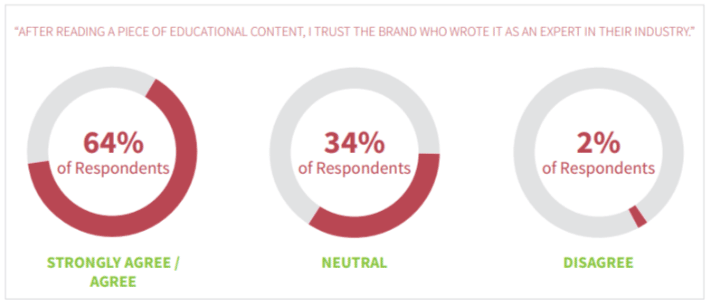
  • It can convince prospects that your brand is trustworthy: 64% of consumers said they feel a brand is trustworthy after reading a piece of educational content from that brand. (Conductor)
Consumers trust brand content
  • Good content can influence purchase decisions: Consumers were 131% more likely to purchase from a brand with effective content. (Conductor)
  • Optimized content is a lead machine: It brings in 3x the leads of traditional marketing but costs 62% less to maintain. (Demand Metric)

4. It will improve your future content creation

Since a content audit helps you understand what works and what doesn’t (because you’ll see evidence of both across your site!), you can apply this to your future content creation for better results.

When to do a content audit

Now that you know what a content audit is and why you should do one, the next question is when.

When is the best time to do a content audit?

Consider these scenarios:

  • Your website is a few years old, and you’ve never done a content audit before. (You’re probably past due!)
  • You’re building a content strategy, and you want a clear picture of what you’re working with.
  • You’re overhauling your content strategy or redesigning your website.

Basic steps of a content audit

How does a content audit work? The basic steps include setting goals, gathering your content and data points, and critically analyzing what you discover.

Step 1: Set goals

Don’t go into a content audit without a clear objective, otherwise, you won’t know which types of content or data points to focus on. Figure out what you hope to get out of your content audit.

Step 2: Gather, categorize, and organize your content

You need a way to compare and contrast your content pieces, have a bird’s eye view of the data and categorize each piece based on the action you’ll take. 

Step 3: Analyze your content

Look at the data and determine which pieces you’ll update, rewrite, keep, or delete.

Step 4: Make a plan based on your findings

Make a priority list for which content pieces need immediate attention, and make a plan for how you’ll carry out updates and rewrites.

Step 6: Adjust your content strategy

What did you learn from your content audit? Carry that forward into your future content strategy.


Get the daily newsletter search marketers rely on.


Tools to use for a content audit

When you’re ready to do your content audit, there are a few options for how you can collect URLs, data, and metrics and put it all together for optimal analysis.

Here are a few of the tools you might need.

1. A plain old spreadsheet

For a no-frills content audit – or one for a relatively small site – a plain spreadsheet is a good option. 

A spreadsheet will help you lay out your content information and data in an organized way that will make it easier to analyze. 

Blog content audit spreadsheet

This is the lowest-cost way to do a content audit since you don’t need any special tools besides Microsoft Excel or Google Sheets.

Cons: It may be time-consuming to collect all your data manually, especially if you have more than a few dozen content pieces to audit.

2. Analytics software

Analytic data is important to your content audit. This includes metrics like page views, number of internal links and backlinks, bounce rate, time on page, conversion rate, average position on Google, and many more.

You need concrete data about each piece of content so you can decide what action to take moving forward (update, rewrite, delete, or keep as-is).

If you aren’t already tracking your content performance in a tool like Google Analytics, you can pull your various metrics from SEO tools like Semrush, Ahrefs, or SEO Site Checkup.

3. Content quality tools

To help you quantify content quality, you may want to use some of these tools to check your content for readability, grammar and word usage, and reading level.

  • Yoast SEO: This tool analyzes your text and provides scores and suggestions to improve readability.
Yoast SEO
  • Grammarly: Besides checking grammar and spelling, the paid version of Grammarly offers performance scoring that can be useful to include in a content audit.
Grammarly performance scores

4. A content inventory tool

If you have a large site, you may need to invest in a content inventory tool to help make your life easier. These tools use your sitemap to grab your content URLs and associated metrics automatically.

A few good options are Screaming Frog SEO Spider and Semrush’s Content Audit Tool.

Types of content audits and their associated goals

While you certainly can audit every single piece of content on your site, it’s a better idea to narrow your focus and complete an audit based on content type and goals.

For example, audit all of your blog content, all of your landing pages, all of your product/service pages, or all of your core content pages. 

After you choose a content type, decide which goal you’re aiming for with your content audit. Here are a few common ones:

1. Goal: SEO

When you approach a content audit with the goal of improving your SEO, you’ll be concerned with how your content pieces are performing in Google. You’ll need to ask yourself if your content pieces are properly optimized for searchers and search engines. Look at:

  • Content quality.
  • Word count.
  • Keyword difficulty and search volume.
  • Average Google position.
  • Organic page views.
  • Content structure and keyword optimization. (Are headers with keywords present? How is the piece organized? Is the focus keyword placed optimally?)

2. Goal: Better engagement and usability

With a goal of improving engagement and usability, your content audit should focus on how your readers interact with your content – and how to increase that engagement. Look at:

  • Social shares.
  • Time on page.
  • Bounce rate.
  • Conversions.
  • Internal links and/or broken links.

Specifically, look at which pieces are earning the most/least engagement, and analyze what’s contributing to that success/failure.

3. Goal: Conversion optimization

Another goal you might shoot for with a content audit is looking at how well your content is converting, and figuring out what needs improvement. You might look at:

  • How well your content addresses each stage of the buyer’s journey, and whether any gaps exist
  • Which pages are converting well vs. which aren’t converting, comparing metrics like:
    • Time on page.
    • Bounce rate.
    • Conversion rate.

What is a content audit? Answer: A necessary piece of your content strategy

A content audit is, quite simply, the only way to understand your content at a few different levels: down in the weeds, and up from a bird’s eye view.

Whether your site is massive or tiny, a content audit can help you understand what you have, what you need, what you don’t need, and what actions you can take in the future to make sure your ecosystem of content is contributing to your goals.

Remember: There isn’t one perfect or set way to do a content audit. Your audit can shift depending on the type of content you’re analyzing and the goals you hope to reach by the audit’s completion. With that in mind, tweak your content audit to suit what your site and content strategy demand.

Finally, don’t shrug aside doing regular content audits. One-and-done will only help your site/business for a limited time. As your content keeps growing, you need to keep taking snapshots of how it’s working, continually tweaking and course correcting.

Content audits are integral to a well-oiled content strategy – don’t neglect this task, and you’ll see results.


Opinions expressed in this article are those of the guest author and not necessarily Search Engine Land. Staff authors are listed here.


Related Stories

New on Search Engine Land

About The Author

Julia McCoy is the founder of Content Hacker, 7x author, and a leading strategist around creating exceptional content and brand presence that lasts online. At 19 years old, she used her last $75 to build a 7-figure writing agency which she sold ten years later. In the 2020s, she’s devoted to teaching founders and marketers the strategy, skills, and systems they need to build a business through inbound content, so they can create more lasting impact in the world.

https://searchengineland.com/what-is-a-content-audit-388544


Google rolling out site names and updated favicon logos in search results

Google is now rolling out what it calls “site names” in the mobile search results. Site names more prominently show the name of the website, as opposed to just the URL, at the top of the snippet. With the site name, Google also announced the size and shape of the favicon will be displayed next to the site name and URL of the search result snippet.

What it looks like. Here is a GIF of this new site name and favicon placement:

Availability. Site names are currently available for the Google mobile search results in English, French, Japanese, and German. Google said it will be rolling out to additional languages over the next few months. As an FYI, we saw Google testing this several weeks ago.

Controlling site names. Google explained that Google Search uses a number of ways to identify the site name for the search result. But if you want, you can use structured data on your home page to communicate to Google what the site name should be for your site. Google has specific documentation on this new Site name structured data available over here.

Upgrading the favicon. Google is also recommending revisiting the documentation for favicons for the latest best practices. Google is now also recommending you provide an icon that’s at least 48px, and follows the existing favicon guidelines.

Ads. This is also coming to ads, so the size of the site name, favicons, and also the ad label will be more prominent in mobile search. In fact, Google is rolling out the “Sponsored” label in mobile search, officially replacing the “Ads” label from Janaury 2020.

Why the change. Google said the change is to help provide “even more information about the sites that you see so you can feel confident about the websites you visit.”

Why we care. With any change to Google Search and the design of the search results, searchers may click differently. So monitor your click through rate in Google Search Console and see if you need to make changes to your site name and/or favicon to make any improvements to your click through rate from Google Search.


Related Stories

New on Search Engine Land

About The Author

Barry Schwartz a Contributing Editor to Search Engine Land and a member of the programming team for SMX events. He owns RustyBrick, a NY based web consulting firm. He also runs Search Engine Roundtable, a popular search blog on very advanced SEM topics. Barry can be followed on Twitter here.

https://searchengineland.com/google-rolling-out-site-names-and-updated-favicon-logos-in-search-results-388714


4 advanced ways you’re not measuring SEO effectiveness – yet

In 4 smarter ways to measure SEO effectiveness, I analyzed four fairly boilerplate SEO metrics (traffic, rankings, conversions, links) and detailed ways to apply an additional layer of rigor to each to improve your analytical insights.

In this article, I’m going to take it up a notch to introduce four new methods of gauging the value of your SEO campaigns. They are:

  • Brand vs. non-brand clicks.
  • SEO’s impact on other channels.
  • SEO CAC (customer acquisition cost).
  • SEO keyword performance (we’re bringing it back!).

While some of these are more directional than others, I’ve found each to be a highly effective way of quantifying the impact of my team’s SEO efforts for our clients. (If you’re in-house, they play well with executives looking to gauge your team’s value.)

1. Brand vs. non-brand clicks

Why is this segmentation important? A couple of reasons.

First, brand traffic indicates a level of awareness and intent that means these users aren’t net-new.

They may have become aware of your brand through earlier SEO searches, but you won’t have a chance to connect those dots without segmenting the data. 

There’s obviously value in brand traffic, particularly when you start getting traffic on {brand + product} or {brand + service} queries. 

But the exact value may differ from bringing net-new users into your system, particularly if you’re using first-touch attribution.

The other reason is that in certain industries (particularly SaaS), a decent chunk of brand traffic comes from customers using Google to find your site so they can log back in. This absolutely affects the aggregate value of brand searches.

All that said, I use Google Search Console to get insight into brand vs. non-brand searches. 

You could use Ahrefs or Semrush to do the same thing, but I prefer GSC (although the UI isn’t as snazzy) because all the data is coming directly from Google. 

Even though it’s only a data sample, I contend that it’s more accurate than third-party tools, and the best organic measurement tries to reduce ambiguity as much as possible.

Of course, because it’s just giving you a sample, GSC isn’t perfect, and I’m clear with my clients about that. 

When we’re all on the same page about it being the best option for measuring brand vs. non-brand traffic, I:

  • Export the keyword data (a subset of the total traffic) from GSC within a date range.
  • Remove/filter any keywords that mention the brand.
  • Calculate the percentage of non-brand vs. brand keyword data. 

Here’s what that looks like:

Brand vs. non-brand clicks

Once you have several months’ worth of this data, you get a good layer of visibility into exact non-brand and brand trends.

2. SEO’s impact on other channels

While SEO can obviously lead directly to conversions (as I’ll discuss more in a minute), much of its value comes from up-funnel engagements. 

It’s extremely common for good SEO campaigns to introduce users to – and educate them about – brands and products/services, only to have users convert on other, more transaction-focused channels.

So what’s the value of those engagements? 

How do we measure SEO’s impact on downstream metrics?

On a macro level, one of the things I look at over time is whether there’s any correlation between increased SEO traffic and lower customer acquisition cost (CAC) on other channels. 

If SEO engagement is growing a lot, and performance marketing is becoming more efficient, that’s a signal to dig into your traffic mix and close/sales mix to see exactly:

  • Where leads are coming from.
  • Which channels are bringing in leads with a good close rate.

One of the most promising features of GA4, which I’ve been playing with a ton recently, is that once you set up events/conversions, there’s an attribution model that shows multi-touch attribution so you can get a direct measurement of touchpoints in a conversion channel. 

That’s a huge boost to a more nuanced measurement of SEO’s value if you’re tying back engagements to conversions. The report looks like this:

Google Analytics 4 attribution example.

To round out the picture with less scientific, more quantifiable data, make sure your sales reps are asking leads where or how they’ve heard of you.

You can get good data and insight into how SEO is related to other channels – whether you’re at an enterprise company with scale that shows you macro trends or you’re at an SMB where one SEO-related conversion can really change the performance picture. 


Get the daily newsletter search marketers rely on.


3. SEO customer acquisition cost

One of my favorite metrics to calculate is SEO customer acquisition cost (CAC). 

I’ve heard fairly frequently over the years that SEO fees are high – especially in times of disruption. But if you can put the ROI of SEO in front of the people holding the budgets, you’ll likely be in good shape.

First, pick a set-up (GA4, Looker, Mixpanel, etc.) that enables you to track engagements. 

Choose an attribution model and create a channel report to track signups, leads, demo requests, etc. (or product views, add to carts, conversions, etc. if you’re in ecommerce). 

Ultimately, you’re looking to ascribe a raw number of events with attributed value back to your SEO campaigns.

Next, look at your SEO costs per month. These generally boil down to agency fees and/or in-house resources, plus any tech stack costs. 

Apply those costs to find how much you pay to get these users (and events). 

For example, if you pay a full-service SEO agency $10,000 a month to run SEO and write content, and the SEO channel delivered 200 last-click signups in that month, you could report a simplified $50 CAC for SEO. 

With metrics like that, odds are you’ll be able to show a great return on spend that you can line up against CPC from paid channels. 

Additionally, you can compare this CAC number to an LTV data point to really see the value. 

If the LTV of your customer is greater than the SEO CAC, you are moving in the right direction for showing SEO as a profitable marketing channel.  

You don’t need to re-invent reporting for SEO, but compare apples to apples if parties are using performance data as a comparison.

4. SEO keyword performance

SEO long-timers will remember with fondness the days before 2011 when Google started replacing valuable keyword-level data with “keyword not provided.” 

It’s a lot harder to pinpoint and quantify exact keyword performance and value, but you can put together some pieces to get close.

Understanding the play between SEO and paid search is really crucial and helps address the question of how to ascribe sign-ups to specific keywords if all you can do is find traffic in GSC.

Paid search provides accurate, to-the-minute keyword data. 

If you’re targeting the same keywords in both paid and organic search, you can take the rough conversion percentage from paid search and extrapolate the value of organic engagement.

Even if you’re not able to access paid search data, there are scenarios where you can ascribe value. 

Let’s say you build a “program features” page for a SaaS product that’s ranking on page one for a long-tail non-brand term. 

You can look at how people are converting on that page (GA4, Looker, Mixpanel) and triangulate how that keyword is doing.

So if 80% of that traffic on the page is from the long-tail keyword (which you can find in GSC), you can say there’s a high likelihood that they’re converting from that keyword.

Are these methods exact? No. 

Are they directionally useful? Yes.

Conclusion

GA4 advancements aside, SEO measurement is an exercise in imperfection.

That doesn’t mean you should settle for the basic units of measurement you can get from Google or third-party platforms. 

Be clear with the powers that be about how you’re getting your numbers and that they’re directional, not 100% accurate.

Flex your analytical muscles to dig a little deeper to understand how your efforts are driving actual business outcomes. 

Measuring SEO impact beyond basic traffic and keyword ranking is hard. 

This is why real SEO business insight is so valuable in helping execs and decision-makers gauge its standing in the marketing mix.


Opinions expressed in this article are those of the guest author and not necessarily Search Engine Land. Staff authors are listed here.


Related Stories

New on Search Engine Land

About The Author

Adam Tanguay is Head of SEO and Content at Jordan Digital Marketing, which he joined in Feb. 2019. Formerly Head of Marketing at Webflow and Head of Organic Growth at Weebly, Adam has developed successful growth programs with a mix of content strategy, copywriting, technical know-how, and analytics acumen across a range of organic channels.

https://searchengineland.com/measure-seo-effectiveness-advanced-388666


How to manage SEO clients’ expectations

How to manage SEO clients' expectations

30-second summary:

  • SEO is expensive, yet offers no tangible guarantees in terms of rankings or traffic. No wonder so many business owners are confused
  • All SEO clients are different. It is important to understand their prior experience in SEO before developing your relationship management strategy with each of them.
  • Getting to know a new lead and their decision-makers will help you position your service in a more useful and easy-to-understand way
  • Educating clients is often necessary for them to know what to expect from an SEO service

SEO is an often misunderstood industry. I’ve seen quite a few business owners who assume that an SEO consultant has some sort of magic button that can boost the site’s organic search visibility within a certain amount of time.

While a decade ago that may have been the case, the SEO industry has evolved far beyond manipulative tactics that (to be quite frank) used to work like a charm in the past.

Today’s SEO is about making websites better, on all possible levels, from content value to usability. It’s doing everything better and faster. There’s no single element that needs to be improved that is sure to boost organic positions. It’s working on a website as a whole consistently to hopefully see gradual growth.

To make things worse, most SEO clients come with a long history of SEO work that has been performed on their site. And that work may have resulted in gradual loss of rankings and organic search visibility. Figuring those out is important because those red flags can prevent those businesses from seeing any progress even if they keep investing into the long-term SEO strategy.

So how to properly manage your SEO clients’ expectations without scaring them off?

Understand your SEO client

It may sound extremely cynical but the best SEO client is the one who has already been burnt by overpromising and under-delivering of those promises. These clients come with a better understanding of why SEO results cannot be guaranteed and why they need to invest into longer-term results.

But those clients have other challenges to fight. Their sites are often penalized or filtered and their budgets are often suffering from months of poor organic traffic. These businesses are often willing to agree to anything that would allow them to fall back into Google’s graces but it is tough for them to erase years of link building efforts and start from scratch.

The other type of an SEO client is a restless one. These businesses may have used other SEO agencies in the past, saw no results and are quite impatient by this point. They are weary of making yet another long-term investment because they feel they have invested enough by this point. 

You need to carefully investigate what has been done for these sites so far and explain why it didn’t work and what you are going to do differently, while still insisting on why you cannot guarantee any results in any definitive timeframe.

Finally, there are clueless clients who don’t care what you do but need to know when they are going to rank within top 5 for their important keywords. These clients require a full-scale education, scary examples of businesses losing all their rankings within a day and case studies showing gradual growth of organic visibility that starts with long-tail strategy, link building research and building a tailored outreach strategy.

Investigate your decision-maker unit (DMU) carefully

In many cases, even when it comes to small businesses, there will be more than one person deciding whether you or your agency is someone they will work with.

In the B2B world, a DMU is a decision making unit, in other words it is a group of people which will determine whether a business will work with you. This group may consist of the company owner or CEO, a marketing manager, head of the dev team, etc.

Lots of businesses have internal SEO teams that need outside help. This SEO team will most likely be part of that company’s DMU. Avoid criticizing their work to the management. Don’t make them feel like your agency can replace the internal team.

Instead, find out what that team is doing and how you can complement their work. 

From experience, most in-house SEO teams will gladly outsource things like link prospecting, outreach and, more recently, Core Web Vitals optimization (the latter is too new, so not many SEOs are keeping up). On-going tasks like competitor tracking, keyword gap analysis, and backlink profile monitoring are often missing from many in-house SEO strategies.

You need to know those gaps to position your service better.

The best approach is to identify your DMU and how exactly your agency can help at the lead generation form. Make sure your service request form includes questions like:

  • Do you have an in-house SEO team or person?
  • Have you used SEO services before?
  • Do you have any concerns we need to be aware of?

Have a report sample ready

Develop a detailed SEO report sample to show prospective clients to ensure they know what to expect:

  • Month one report
  • Sample roadmap of further work
  • Monthly reports detailing projects completed or underway, etc.

Based on different decision-making units you have come so far and the different services you provide, those reports may vary.

Be clear and transparent

SEO is an ongoing and never-ending process. The only way to build a long-term customer base is to build trust even prior to onboarding them. And nothing works better than being honest and transparent.

It is better to lose a demanding client than to face the consequences of improperly managed expectations.

On your onboarding call, spend some time discussing who maintains their website, how their blog is managed, what it takes to push updates live, who is creating, editing and approving content before it goes live, and whether the site is powered by an existing platform or is it custom-built.

Make it clear that you will need access to their data, including analytics and Search Console accounts.

Understanding these details will help you estimate the turnaround of your SEO recommendations to be implemented. If you foresee any slow-downs (for example, every update needs a tedious approval process or developers are the only people who can update the site and these teams tend to be busy and slow), make it clear that these roadblocks can slow down the process and discuss ways to overcome them.

Don’t forget to explain the set-up process in much detail. Your agency needs time to research the site and its SEO history in much detail, and that takes time, and that time isn’t free. Many businesses expect active work to start immediately when they sign a contract, so don’t let it come as a surprise that SEO research is part of the setup process. 

Furthermore, on your onboarding call, try to better understand the rest of the company as well. Mention that you will likely need help and input from other teams, like product development and customer support. The ultimate goal of an SEO strategy is to bring in more sales, not just bring in organic traffic, and that’s the whole company’s initiative.

Ask them for more info on their previous digital marketing efforts, including PPC, lead generation, landing page management, and email marketing. The more you know about the company and its current conversion funnels, the better your SEO service will be positioned to compliment those.

Conclusion

Search engine optimization may seem a very mysterious process to business owners who feel like they are throwing money into thin air without being promised anything tangible in return. If you put yourself into those business owners’ shoes, it is actually quite understandable. 

So don’t feel bad when yet another prospective client is demanding some type of guarantee. Be patient but firm. Onboarding SEO clients often requires educating them on why SEO cannot have any guarantees but how it can be very rewarding in the long run.


Ann Smarty is the Founder of Viral Content Bee, Brand and Community manager at Internet Marketing Ninjas. She can be found on Twitter @seosmarty.

Subscribe to the Search Engine Watch newsletter for insights on SEO, the search landscape, search marketing, digital marketing, leadership, podcasts, and more.

Join the conversation with us on LinkedIn and Twitter.

https://www.searchenginewatch.com/2022/10/13/how-to-manage-seo-clients-expectations/


Google replaces its Webmaster Guidelines with Google Search Essentials

20 years is a long time, especially in internet days and that is how old the original Google Webmaster Guidelines are. Google has done a major refresh of those Webmaster Guidelines today, and with that, also renamed it to Google Search Essentials.

Why the change. Outside of it being two decades old, Google said “a lot has changed since 2002” with the internet and Google Search in general. The updated guidelines are streamlined, simplified, and have been updated “to ensure people have clear guidance for how to build sites that serve people well,” a Google spokesperson told Search Engine Land. Google also told us the “goal is to make this guidance useful and easier to understand and to help site owners focus on things that matter for your site.”

What changed. Yes, while Google has made many updates over the years to the old Google Webmaster Guidelines, Google decided it was time for a major refresh. Here is an overview of what has changed.

  • Name change: From Google Webmaster Guidelines to Google Search Essentials, because, well, Google doesn’t think webmaster is a term used much these days and/or it is too narrowly focused. This is similar to Google dropped the named Webmaster Tools for Search Console in 2015.
  • Technical requirements: Google has published a new section to help people understand how to publish content in a format that Google Search can index and access that content. 
  • Spam policies: Google has updated its guidance for the Google Search policies against spam, “to help site owners avoid creating content that isn’t helpful for people using Search,” Google said. Note that most of the content in these spam policies has already existed on Google Search Central, Google did however make a few additions to provide clearer guidance and concrete examples for issues like deceptive behavior, link spam, online harassment, and scam and fraud, the company told us.
  • Key best practices: Google has also published new guidance with key best practices that people can consider when creating sites, to create content that serves people and will help a site be more easily found through Google Search. 

Other changes include organizing the content in a more logical structure and consolidating similar pages. Google did explain that generally, they haven’t changed the content much in those areas.

Google also documented more changes here, writing:

Why we care. The Webmaster Guidelines has been the go-to resource for SEO best practices in Google Search for the past two decades. Changing the name and updating this resource is a big deal for many SEOs.

SEOs, webmasters (we should not use that word), site owners, publishers, and anyone who owns or manages a website should review the new Google Search Essentials.


Related Stories

New on Search Engine Land

About The Author

Barry Schwartz a Contributing Editor to Search Engine Land and a member of the programming team for SMX events. He owns RustyBrick, a NY based web consulting firm. He also runs Search Engine Roundtable, a popular search blog on very advanced SEM topics. Barry can be followed on Twitter here.

https://searchengineland.com/google-replaces-its-webmaster-guidelines-with-google-search-essentials-388676


Ecommerce SEO guide for the 2022 holiday season

Ecommerce SEO guide for the 2022 holiday season

30-second summary:

  • Global recession and cost of living crisis will not dampen the gifting spirit and consumer spending
  • For the 2022 holiday season, ecommerce retailers forecast $262 billion in revenue which surpasses the $205 billion benchmark from 2021
  • If you found yourself Googling “ideas to boost ecommerce holiday season revenue” we have answers for you!
  • Our latest guide uncovers the 8 sides of a robust, proven-to-work ecommerce SEO strategy that will help propel your sales

Holiday season brings with it many things. One of them being ecommerce revenue. Despite the global recession and cost of living crisis, the 2022 holiday season will see people spending. Economists at Deloitte forecast ecommerce revenue of around $262 billion which is a 13.5 percent growth.

The question here is, how do you get a share of this $260 billion ecommerce pie? By working on improving your ecommerce SEO.

Holiday ecommerce sales forecast to grow 13.5 percent

Source: Axios

Search engines push 37.5 percent of all traffic to ecommerce sites, and a whopping 95 percent of these searchers stick to the first SERP. Having an early enough start to your ecommerce search strategy helps you earn visibility in top SERPs, measure effectiveness, test, and scale practices as the peak season approaches.

Ecommerce SEO can help your store rank higher and offer a better user experience by making sure your website aligns with search engine ranking factors.

However, Google, the most used search engine, updates its ranking factors several times a year according to its users’ changing behavior. So, you need to upgrade your marketing toolkit with the latest SEO techniques before the holiday season.

In this article, you’ll find some of the latest and proven-to-work ecommerce SEO strategies to hopefully point you in the right direction as you prepare to dip your hands into the holiday season. 

Let’s dive right in!

The eight layers of a powerful ecommerce SEO strategy

Ranking an ecommerce store is critical to winning those holiday sales. Why? Because people turn to Google whenever they are looking to shop for holiday essentials or presents.

In this situation, an ecommerce website that fails to rank higher may miss out on interacting with holiday shoppers out with their money.

So, here are some key ecommerce SEO techniques to help you to help your website rank higher and possibly interact with holiday shoppers:

1. Focus on keyword research

Holiday shopping begins with keywords. People type in search phrases when they are looking to buy something. And that’s where your opportunity to rank lies. 

44 percent of people start their online shopping journey with a Google search. Keyword research might help you find words to help Google and other search engines connect these shoppers with your web page.

ecommerce keyword research differs slightly from regular keyword research. In this case, your focus is to identify and include search phrases with commercial or transactional intent.

There could be keywords that appear commercial but could have an informational intent and hence may prove detrimental to your SEO.

The phrase “best winter shoes for women US” may seem like a transactional keyword. But as it appears from the top search result, it has a dominant informational intent. 

Let’s talk about finding these keywords.

Your keyword research should start with brainstorming keyword ideas. Make a list of all the products you sell, and then jump in your customer’s shoes to see how they would search for what you are selling.

Say that you have a shoe store and sell running and other types of shoes. Your customers may search for your product with keywords like “running shoes” or “buy best running shoes.”

Think of all such keywords.

Backlinko also recommends diving into amazon and typing these root words into the search bar to find more keyword ideas.

amazon keywords - ecommerce seo for 2022 holiday season

All of the phrases in the image above can be used as root keywords for shoe store SEO. 

You can also check out your competitor’s websites to uncover the keywords that they are ranking for.

check competitor websites to find keywords for your 2022 holiday season ecommerce strategy

From the image above, we can see that “Buy best winter shoes for women” might be a good alternative to the “best winter shoes for women” keyphrase. 

Also, scroll to the end of the SERPs to check out the related searches section for more keyword ideas.

refer the related keywords to create a keyword list - ecommerce seo for 2022 holiday season

Make a list of keywords during this brainstorming session. 

Make sure to corroborate the search intent before shortlisting a keyword. Sometimes a keyword may appear to have commercial intent, but in reality, it may be informational.

Finally, run your keyword ideas through a keyword research tool like Google Adwords to determine the search volume and competition.

Low search volume and high-competition keywords are usually recommended. But when trying to rank an ecommerce store, you might benefit from long-tail keywords with low search volume and competition. But these keywords are touted to convert better and may help your website rank sooner.

2. Focus on content

Google now prioritizes websites with descriptive and valuable content. You cannot achieve results with your e-commerce SEO campaign while ignoring content.

Find out what’s trending in the holiday season. What are people talking about? And then create content around topics or products that are trending. 

Focus on optimizing all the content present on your website, along with creating new, informational, and valuable content.

Optimize your product descriptions with relevant keywords. Avoid keyword stuffing, though. Instead, create product descriptions that give users all the information they may need before buying a product.

This may include product details and reviews.

focus on the content in product details and reviews - ecommerce seo for 2022 holiday season

Besides product pages, consider creating a separate blog to post top-of-the-funnel content like blogs, case studies, product reviews, etc. Not only will this enrich your website’s content, it may also help rank your site quicker, drive more web traffic, and generate better leads.

Long-form content, especially blogs, gets around 77% more backlinks than short-form content. Therefore, pumping out informative, unique articles may also help build your backlink profile.

Since we have touched on the topic of backlinks…

3. Yes, backlinks are still relevant

Many people believe backlinks have gone down the hierarchy of ranking factors. That’s not true, though.

Backlinks are as important as ever. When determining your website’s authority, Google relies on the number, quality, and relevance of your backlinks. So, don’t slack off on acquiring links from other relevant sites on the internet.

Gaining backlinks for an ecommerce store may not be as straightforward as building some random blog’s backlink profile.

There are many bloggers that create seasonal content and it could be an opportunity in your ecommerce SEO strategy to get backlinks on holiday season offers and discount pages. Consider reaching out to them and asking them if they could write a holiday season piece on your product and link back to your site, or offer to write a guest post for them to earn a backlink.

Additionally, there are many product review websites. You can reach out to them, send your product, and ask them to write a review of the product and link back to the product’s page on your website.

connect with product review websites

Brand mentions like these may help uplift your SEO scores since 52 percent of marketers believe brand mentions impact organic rankings.

4. Work on improving website user experience (UX)

Website user experience is an important ranking factor. Don’t let anyone tell you otherwise.

There are various ways you can improve your website’s user experience. The first one is through site structure.

Your website needs to be easy to navigate for the users and crawl for the search engines. And for that, you will have to make sure all your web pages are arranged so that every page within the website is accessible through three or fewer clicks. This is what backlinko calls the golden rule of website structure.

Here’s a representation of what a good website structure may look like:

what a good ecommerce website structure looks like

Source 

And here’s an example:

page footer site links should be clear to the user - ecommerce seo for 2022 holiday season

Once you have improved the site structure, look at the URLs of the web pages you’ve just sorted. Your website URL should tell the user what the page is about with a short but descriptive keyword.

Here’s an example of what good URLs may look like:

shoesforyou.com/athletic/runningshoes

shoesforyou.com/leisure/sneakers

shoesforyou.com/formal

Furthermore, 73 percent of web designers believe a non-responsive web design is one of the top reasons visitors leave a website. I know these are hard words but I should say all your ecommerce SEO efforts could be wasted, if your e-commerce store is not mobile-friendly and responsive web design happens to be a critical ranking factor. So make sure your website is mobile optimized so the design can adjust according to the screen it appears on.

An example of responsive web design:

responsive web design

Source

Another factor that shapes your website’s user experience is its security. Google, too, prioritizes website security and works to make sure the websites it drives its users to are secure.

Make sure you have a TLS certificate, so “HTTPS” and a little lock appear in the URL bar for the users to know your website is safe.

TLS certificate for HTTPS - site security

5. Page load speed

Page load speed is a part of the website’s user experience. But because it is so important, especially for an ecommerce store, it deserves its own space. 

A drop in page load speed decreases the conversion rates, with almost 75 percent of people tending to change their mind during the checkout process if the website is too slow or taking time to load during checkout.

Since the holiday season usually adds to the website load, your website can slow down. Be proactive and make sure you have enough website resources to handle the holiday rush. 

Google counts a page’s load speed as an important ranking factor and so make sure to remove unnecessary ad blockers, scripts, or optimize everything that can drag your website down in terms of speed.

6. On-page optimization

On-page optimization includes fine-tuning the relatively smaller website elements contained within the web page.

36 percent of SEO experts believe the title tag is the most important SEO element. Therefore, optimize your title tag so it is descriptive, short, and keyword-optimized.

You can use Moz’s Title Tag checker to see how your title would look on the SERP and optimize it accordingly.

title tag optimization for your ecommerce seo strategy - holiday season 2022

Meta descriptions are critical as well. While they do not influence SEO directly, meta descriptions play a vital role in shaping your CTR. So, take the time to write crips and compelling descriptions.

Also, make sure to include keyword-optimized H2s and H3s wherever possible. And don’t forget to optimize the images on every web page.

7. Make good use of schema markup

Schema Markup is a set of codes you can embed in your web page’s HTML to help Google understand the page. It also enables the search engine to return more informative and descriptive results, otherwise known as snippets.

This is particularly important for an ecommerce site because users want to ensure the website they click on contains what they are looking for. And optimized snippets give them that and hence contribute to improved CTRs.

While Google decides what it wants to display in the snippets section, including what you want to be displayed as a snippet through Schema may increase the chances of Google going with what you have chosen.

user schema markup

8. Optimizing ecommerce stores for RankBrain

RankBrain is one of Google’s most historical updates and is now among the top three ranking factors. This algorithm helps Google rank sites that are contextually relevant to the search queries.

Therefore, prioritize understanding your audience and creating the content THEY need alongside working on the technical aspects of e-commerce SEO.

Additionally, work on increasing your website’s engagement rates since Backlinko believes dwell time is an important ranking factor with RankBrain. And as mentioned above, look for any authoritative backlinking opportunity you get and capitalize on it.

Final words

Finding visibility in the search engine space during the holiday season is critical to help drive business revenue. However, winning with ecommerce SEO is tough but not impossible. You might compete with big sharks like Amazon, who dominate the first page. Therefore, you may have to be smart about your strategies.

Building a content-first SEO strategy can help here as these pages may rank more easily and help channel traffic to product pages that may struggle to rank when Amazon reigns over the SERPs.

So, focus on creating optimized, informative, and user-focused content. Work on the technical aspects of SEO, and continue tracking the latest search engine updates to adapt your SEO tool kit accordingly.


Atul Jindal is a web design and marketing specialist. He has worked on website/app optimization for SEO with a core focus on conversion optimization. He creates web experiences that bring conversations and transform web traffic into paying customers or leads.

Subscribe to the Search Engine Watch newsletter for insights on SEO, the search landscape, search marketing, digital marketing, leadership, podcasts, and more.

Join the conversation with us on LinkedIn and Twitter.

https://www.searchenginewatch.com/2022/10/13/ecommerce-seo-guide-for-the-2022-holiday-season/


Search Engine Land Awards 2022: Complete finalists list

NP Digital leads the way in the 8th annual Search Engine Land Awards – the U.S. agency is a finalist in a whopping seven categories.

Two other agencies earning finalist status three times are Rocket Agency (Australia) and Logical Position (U.S.).

Meanwhile, 10 agencies are 2022 Search Engine Land Awards finalists two times (AEK Media, Amsive Digital, DAC, GA Agency, Megantic, Milestone Marketing, SEMbyotic, Thrive Digital, VMLY&R, Wpromote).

Small Agency of the Year – SEO and PPC

The competition was fierce in most of our categories – but in these two, the winners were clear. So we couldn’t think of a reason to wait to announce them:

  • The winner of the Small Agency of the Year – PPC is … Streamline Results.
  • The winner of the Small Agency of the Year – SEO is … ANGA Bangkok Co., Ltd.

Congrats to both agencies!

All the other winners of the 2022 Search Engine Land Awards will be revealed this Monday, Oct. 17.

Meet Search Engine Land 2022 award winners at SMX Next

We will be inviting some of the winners of this year’s awards to join us on Day 1 of SMX Next (Nov. 15). We’ll have two Ask Me Anything-style “Ask the Search Engine Land Award winners” panels – one on the SEO side, moderated by me, and one on the PPC side, moderated by Editor Nicole Farley.

If you haven’t yet, make sure to register for free for SMX Next.

Also: a big thank you to our Search Engine Land Awards sponsor, Microsoft.

The full list of finalists

Best Overall SEO Initiative – Small Business

  • AEK Media: Content Always Wins…Allegedly – 220% Traffic Growth for Criminal Law Firm in Sydney
  • ANGA Bangkok Co., Ltd.: Magnetic maximising the influx in Search post pandemic for Goldelucks
  • How Growth Skills built the first media platform targeting cannabis, CBD and alcohol, leading to over 475% ROI via SEO & Content Marketing
  • How Logical Position Married Offsite and Onsite SEO To Increase NV Landscape’s Local Organic Traffic by 150% YOY
  • How Mickey Llew helped Menstrual Cups Australia win back first place ranking for a key top generic phase in their industry, on a limited budget.

Best Overall SEO Initiative – Enterprise

  • Livestrong and Amsive Digital Flex Their Expertise to Bulk Up Major Organic Gains
  • First Citizens Bank Gains a Trusted Partner in CB/I Digital after Impressive Growth in Keyword Ranking, Local Search, and Non-Brand Traffic
  • GA Agency: 12 Countries, 4 Fashion Brands: Skyrocketing SEO
  • Graphite & BetterUp – Premium Content to Drive +2,000% YoY Growth
  • NP Digital: Leveraging SEO & content to help build a brand. How we increased organic search traffic by 561% for Lantern.

Best Commerce Search Marketing Initiative – SEO

  • Click Intelligence & Anthem Branding – The Journey from Unranked to Page 1
  • GA Agency: 12 Countries, 4 Fashion Brands: Skyrocketing SEO
  • How Logical Position Helped Palouse Ranches Increase New Organic Traffic by 211% with Just 4 Keywords
  • Milestone Inc Helps Sun Outdoors Triple their Conversions and Online Revenue with a New State-of-the-Art Website that made a significant impact on their visibility on search – locally & organically for their locations
  • VMLY&R: Driving Visibility and Conversions Across a Diverse Ecommerce Portfolio

Best Local Search Marketing Initiative – SEO

  • How 3Q/DEPT increased leads by 330% for Source Capital Funding via Organic Search
  • Comrade Digital Marketing Agency: LASIK Goes Local: Growing Organic Traffic by 400+% for Elective Surgical Practice
  • Lastmile Retail: Transforming The Digital Local Customer Experience: T-Mobile x Lastmile Retail
  • How Logical Position Married Offsite and Onsite SEO To Increase NV Landscape’s Local Organic Traffic by 150% YOY
  • Milestone Inc Helps SpeedPro Drive 93% Increase in Local Listing Views and 39% Increase in Online Leads Revenue with State-of-the-Art Local SEO Strategy

Best B2B Search Marketing Initiative – SEO

  • How Advarra Outranked Third Party Reviews For Their Software Category
  • Finn Partners: Boosting organic traffic and rankings in a saturated in-car technology market
  • How LOCALiQ Increased Its Organic Search Traffic by 289% In Just 8 Months With SEO
  • NP Digital: Matching WordPress intent.How we increased organic traffic by 514% for a core Nexcess product offering.
  • How Tacomi utilised SEO to gain a 1,930% ROI for BMJ Careers

Agency of the Year – SEO

  • Dreamscape Marketing: Enterprise Scale Enterprise Outcomes: Performing a website and digital marketing conversion with speed to meet enterprise needs without sacrificing operations and supporting their rapid growth.
  • Megantic: No Pain, All Gains with Supplement Mart’s Shopify Migration
  • NP Digital: Leveraging SEO & content to help build a brand. How we increased organic search traffic by 561% for Lantern.
  • How Sherlock Communications Delivered a 193% Organic Visitor Increase for Betfair Colombia in a Competitive Industry Sector Using a Content First Strategy
  • Wpromote: Flying High: How Wpromote Grew Organic Revenue by 550% for Travelpro

In-House Team of the Year – SEO

  • How Razorfish exceeded a client target that others considered impossible
  • How the T-Mobile SEO team recruited top in-house talent, accelerating innovation and driving business growth
  • UPMC: Driving SEO Growth with a Little Help from our Friends

Best Overall PPC Initiative – Small Business

  • How Brandastic established our client as the #1 DTG Printer Brand in North America 2021
  • NP Digital: Enhancing SEM strategy to elevate returns. How Mann Lake and NP Digital increased paid search revenue by 87% YoY.
  • Primal Malaysia Delivered 323% ROI for Easy Consulting
  • How Rise Interactive Scaled Cross-Channel Results with Performance Marketing & Closed Loop Reporting
  • How Our Agency Vivid Candi Increased Leads by 800% and Sold Out a 6-Figure Housing Product In 3 Months

Best Overall PPC Initiative – Enterprise

  • Healthy Paws & Amsive Digital Making it Rain Search Lift (or cats & dogs)
  • Bayer Consumer Health: Increasing In-Store ROAS driven by Search Media by 2-3x for a CPG/OTC Brand!
  • How Rocket Delivered 331% leads above target for Noggin via Google Ads
  • How SEMbyotic Helped Transform TCS By Growing Revenues 500% During the Pandemic
  • VMLY&R: United Rentals: Localization Strategy Increases Yearly Revenue by 71% to $18.6 Million

Best Commerce Search Marketing Initiative – PPC

  • Beeby, Clark+Meyler: How The Parking Spot paid search program drove a 39% increase in reservations over pre-pandemic Q2 2019
  • Katté & Co and SPOKE – quadrupling non-brand revenue for a fast-growing British men’s clothing brand
  • How Mad Fish Digital Leveraged Full-Funnel Strategy and Google’s AI to Deliver a 1,058% ROAS for Schoolhouse Electric
  • How Thrive Digital bridged the gap in seasonality and restructured the account by prioritizing product profitability based on regions and automated feed-driven product segmentation. As a result, we reached 342% ROAS, exceeding the client’s target of 278%
  • Thrive Digital: How Smith Optics scaled revenue from Google channels 120% YoY by expanding tactics and implementing best practices.

Best Local Search Marketing Initiative – PPC

  • Adwise & SPAR – 122% uplift in omnichannel ROAS with hyper local digital advertising strategy
  • How DAC helped Aqua-tots drive a 300% increase in store visits
  • DAC & StorageMart: Driving occupancy with paid media
  • Ovative Group: Local Campaigns Drove over 60% of Duluth Trading’s Store Visit Growth YoY
  • How Stella Rising SEM Helped Big Y Pivot to Online Grocery Amidst Consumer Behavior Changes

Best B2B Search Marketing Initiative – PPC

  • A mid-funnel mindshift. How ConnectWise and NP Digital increased ROAS of paid search by 100%.
  • How SEMbyotic Helped Transform TCS By Growing Revenues 500% During the Pandemic
  • How Statwax Scaled a B2B SaaS Unicorn’s Search Ad Spend 20X While Improving Profitability & Customer Growth
  • The Media Image & LSEG – Doing More with Less at a Global Scale
  • How Workshop Digital Generated 2,400% ROAS for Super Radiator Coils’ with a custom PPC-CRM Feedback Loop

Best Integration of Search Into Omnichannel Marketing

  • AEK Media: How an Omnichannel Approach led to 130% Month-on-month Sales Growth in Their First Year Online | Tasman Eco
  • Automation & crypto, a perfect match. How NP Digital drove omni-channel success for FTX. 
  • Rakuten Advertising x Vans Omnichannel Bidding
  • Rocket & Rezdy | Scaling Software Sales Globally with Digital
  • UPMC: Building upon our Health and Wellness Brand to Deliver Timely Content during COVID-19 Pandemic

Agency of the Year – PPC

  • How Adviso Delivered a 50% increase in revenue for SAIL via Search
  • Horizon Media: Beating the Headwinds with Localized Profitability
  • NP Digital: Dynamic conversion value integration in paid search. Optimizing for global profitability across Tektronix’s complex sales journey.
  • Rocket & Rezdy | Scaling Software Sales Globally with Digital
  • Wpromote & Intuit QuickBooks: Harnessing First-Party Data to Drive Paid Search Success

In-House Team of the Year – PPC

  • BH Breaks the Industry Mold with In-House Solution, Saving $500k in Management Fees
  • HSBC UK: How an Newly In-Housed Team Delivered Record-Breaking Growth Within a Year’
  • Wiley University Services: In-House Media Team Outperforms Industry Trends by Increasing Leads and Enrollment for University Partners

Search Marketer of the Year

  • David Grow, Goodway Group
  • Heath Hamilton, Megantic
  • Melissa Liu, RPA
  • Nicolas Villeneuve, Adviso
  • Vandana Kumar, Megantic

A huge thank you to our judges

A much-deserved thank you to our awesome group of judges for the 2022 Search Engine Land Awards. Our panel of judges had the difficult assignment of selecting the best of the best from a large number of submissions. Thank you:

  • Amanda Jordan
  • Brad Geddes
  • Brett Bodofsky
  • Mordy Oberstein
  • Tess Voecks
  • Thom Craver
  • Barry Schwartz
  • Nicole Farley
  • Anu Adegbola
  • Benu Aggarwal
  • Crystal Carter
  • Greg Finn
  • John Lee
  • Vani Chopra

Related Stories

New on Search Engine Land

About The Author

Danny Goodwin is Managing Editor of Search Engine Land & SMX. In addition to writing daily about SEO, PPC, and more for Search Engine Land, Goodwin also manages Search Engine Land’s roster of subject-matter experts. He also helps program our conference series, SMX – Search Marketing Expo. Prior to joining Search Engine Land, Goodwin was Executive Editor at Search Engine Journal, where he led editorial initiatives for the brand. He also was an editor at Search Engine Watch. He has spoken at many major search conferences and virtual events, and has been sourced for his expertise by a wide range of publications and podcasts.

https://searchengineland.com/search-engine-land-awards-2022-nominations-list-388677