Why Esports organizations are losing business due to lack of SEO
SEO is a standard within a number of marketing strategies through a myriad of industries, but has someone found themselves outside of the gaming and esports industries? There is a non-factor within new marketing verticals such as influencer marketing despite its immense potential to impact.
During the latest edition of the Gamactica Podcast, I got a chance to talk about the lack of SEO, or Esports SEO, that exists within the industry with Michael Ashford, CEO of The Game Awards.
In this article, I share some highlights and key insights that are affecting the fate of many Esports organizations.
[embedded content]
What Esports can learn from sports and other industries
“I guess where Esports has been very pioneering there are also a lot of things that it can learn from other industries in the same vein,” he said.
“The big controversial one is the sports and Esports gear compared a lot. I’m a big fan of it because sports do very well with media rights and distribution deals. They do very well with sponsorships, two things that are absolutely pivotal and critical to the future of Esports. Those two things go hand-in-hand, they ensure everyone continues to be stable and everyone wins off the back of them. Esports as a term has really only been popular for 10 years. Before that you would just be OpTic gaming, people would just type in “optic” and their website would come up, their socials were there, everything was great and now there are probably 10,000 companies that all call themselves Esports something or another, and it’s a very different problem.
Doesn’t matter to OpTic, because OpTic is still a leading name and people still search for OpTic on Google. OpTic still comes up but it does matter to new businesses coming in.
“There are three waves to Esports”
You have wave one which is all the teams, the TOs, and the publishing companies.
Wave two is supporting services, people like ourselves, agencies, creative agencies, sales, and talent specialists.
Wave three is all the supplementary services under that, and that’s where that trickle-down comes down with publishers at the top and everyone in these waves underneath waiting to get paid. That is where wave three is so pivotal and why you hear stories of these companies trying to get in now that are very challenged because they’re not using proven techniques that work outside of the market to get into the market. They are trying to conform to the market that already exists, and you can’t take on an Esports Awards because we own that domain, we own that optimization, and we have seven years of history working with Google, YouTube, Amazon, we have even worked with Lexus. All these brands have given us that domain authority that is very hard to purchase now.” said, Michael Ashford, CEO of The Game Awards.
The advantage of domain authority in Esports
Ashford goes on to discuss the competitive advantage the domain authority provides them, especially as the Esports landscape continues to evolve and grow.
“So, if you were going to take us on as a competitor, you probably don’t want to go against that unless you’ve got a big, realistic search engine budget to go against us. That’s where marketing gives you that advantage, when you do marketing you put yourself in the eye of the consumer, you look at their journey, you understand their peeves, and you gain a finer understanding of what they’re doing.”
Ashford talked about the difficulties that face new entities, such as Esports teams face as they are entering a fiercely competitive space.
“If you’re a team that just got into this and you’re saying ‘I really want a big sponsorship to land on my doorstep’ like you have to be in their consideration and that’s what it comes down to. If I’m buying for one of the biggest companies in the world and I have a budget and I type in “Esports teams” or “successful Esports teams” or “biggest Esports teams” on Google, if you’re not on that list you’re already outliers from the consideration perspective because all of those other brands have long term domain authority” he said.
“The OpTics, The FaZe, the DSMs have done it for years and they’ll be the first stable thing that people see.”
Despite the proven data, SEO remains on the peripherals of the gaming, Esports, and content creation industries.
While platforms such as Twitch struggle to effectively scale the monetization of creators and their platforms, SEO continues to be an absolute need, a critical of conversation which eludes these spaces.
The Game Awards will be taking place on December 11th-13th in Las Vegas, Nevada, and will air on platforms such as Twitch and Twitter.
Anthony DiMoro is CEO of Gamactica. He can be found on Twitter @AnthonyDiMoro.
Subscribe to the Search Engine Watch newsletter for insights on SEO, the search landscape, search marketing, digital marketing, leadership, podcasts, and more.
Enterprise ecommerce SEO: Why good technology can’t fix a bad process
Several SEO myths and misconceptions are killing enterprise ecommerce and enterprise retail businesses. This article will explore some of them to show how enterprise SEO is unique, and not quite the same as traditional search engine optimization.
To be effective, enterprise ecommerce SEO should be strategy-oriented. And yet, that’s rare to find. Why?
What follows are business-critical problems and lost opportunities I’ve come across while consulting on SEO strategy with some of the biggest brands and corporations in the world.
We’ll begin by looking at the current scenario, with its vast array of ineffective practices.
Then we’ll define the biggest problems in enterprise ecommerce SEO today.
Finally, we’ll discuss diverse challenges, and ways to overcome them to thrive in a difficult, hyper-competitive business climate.
Enterprise ecommerce SEO: Let’s face facts
Reality is often harsh and sobering. Yet facing up to facts is essential to fix problems and boost SEO effectiveness.
The litany of woes is long – and painful.
Business owners and shareholders alike suffer low financial gains, thanks to poor business performance, low productivity and frustrated economic growth.
Corporate governance, risk management and controlling bodies (like boards and leadership) are unaware of problems until too late. Or else, they hesitate to intervene promptly to address problems.
Without risk monitoring processes or reports on external opportunities, they resort to benchmarking and reviews of past growth and financial efficiency.
Goals, objectives and projects are often misaligned. Cross-functional teams are dysfunctional. They leave money on the table, and market share remains untapped.
Without oversight and control over business-critical categories, as well as inefficient integration with business strategy, individuals and teams fall short of targets.
Often even outside specialists called in to help fix the problem are thwarted. Their critical analysis is questioned, and they are labeled “difficult to work with.” No wonder the best, most brilliant minds quit – and companies lose valuable people.
But these are not the biggest hurdles. Those lie elsewhere – in strategy and process problems.
Get the daily newsletter search marketers rely on.
Chaotic SEO strategy
SEO strategy for enterprise ecommerce is essentially a “business strategy.”
Enterprise SEO is not about Google. It doesn’t operate in a silo. And it’s not obsessed with tasks and deliverables.
Enterprise processes are often in pretty bad shape.
Nobody quite expects the business strategy to work. Each department falls short in revenue generation and productivity. Sales and marketing plans are poorly implemented.
A Google-oriented SEO strategy misses business goals and financial KPIs while overlooking lucrative opportunities to dominate the ecosystem.
Whenever processes and workflows support analysis and decision-making, an SEO strategist can identify ways to rake in millions in added revenue. But due to bad processes, these opportunities largely go unseen.
All the while, management behaves like a bus driver in an old American action comedy who speeds crazily along the highway, confidently announcing: “Trust, me! I know what I’m doing.”
Sadly, this is not a movie. The threat is real.
Addressing these problems should be a top priority for business leaders. Brushing things under the carpet with a cosmetic re-design or technology makeover only worsens economic damage.
Enterprise ecommerce SEO: The challenges are real
Next, let’s look at the key challenges unique to enterprise organizations – and see how intelligent SEO can help with them.
Lack of quality data is deadly
To put it bluntly, at many ecommerce enterprises, data often cannot be trusted at all! Using weak data to determine future plans and strategies is doomed to fail.
The train has derailed… even before it leaves the station!
Whenever SEO consultants propose changes based on only limited data, their suggestions are viewed as an added “cost” – rather than as glorious opportunities to expand the business.
Today’s business strategy requires access to granular data that can be mined extensively.
Smart data analysis is rare
Superficial keyword research limited to collecting high search-volume phrases, thanks to a limited, non-flexible budget is a recipe for disaster.
A deep analysis of search data that’s broken down by ecommerce category and sub-category can uncover hidden opportunities and untapped assets.
The future belongs to a company armed with:
The data can intelligently guide content producers to include critical and unique information for each product category and sub-category.
Yet time and resource constraints mean that only a few enterprises get it right. Opportunities and strategic intelligence often go unseen. What you don’t measure, you cannot manage.
Missing data is a vexing problem
Whenever data is incomplete, you can get only an inaccurate picture of reality.
Either the data isn’t rich in detail, or it:
Lacks breadth to cover enough of the customer journey.
Hasn’t been broken down into a granular category or local-level.
Wasn’t adjusted and rinsed to provide a reliable and trusted picture.
Isn’t tailored for unique internal targeting, by buyer intent or geographic location.
Hasn’t been benchmarked against potential markets and qualified customers.
All these problems make data less trustworthy. You cannot use bad data to make good decisions.
Growth stalls and slows down, both in the short and long term. This leads to economic damage to the enterprise, along with its external owners and shareholders.
And that isn’t all.
There are also three other major problems that plague ecommerce enterprise SEO:
People.
Processes.
Workflows.
People, teams and collaboration
Cross-functional teams only rarely align in their goals, objectives and projects.
The problem begins with bad data and poor decisions based upon it. The lack of analysis affects implementation. In turn, this impairs business goals and financial KPIs.
But when information is locked away inside silos:
Work has to be duplicated, losing productivity.
Co-operative teamwork suffers.
Roles and responsibilities are unclear.
People start doing whatever they feel like.
Focus shifts to deliverables, instead of business objectives.
Priorities aren’t set correctly.
Emphasis is upon technology and platforms, rather than business KPIs.
To change this, you should improve business processes. But sadly, there are often problems there, too.
Business and sales process
Business processes are often based on technology, systems, features and IT… instead of business requirements.
To do this effectively, you will need:
Better data quality.
Complete and comprehensive datasets.
Broad and deep data for all categories.
Internal contributions across departments.
Teams and specialists working together.
Effective leadership to guide it all.
You would readily uncover gaps that can be fixed quickly if your enterprise SEO strategy ensures that all necessary data is:
In place.
Tracked all the way through the buyer’s journey.
Constantly benchmarked against your full potential.
Enterprise SEO is not centered on Google, but on business performance and economic results.
If you only track search volumes and rankings but ignore how it translates into sales and profits, you cannot quantify the cost of making any changes. But armed with the right data, you can build a strong business case for a higher budget to make profitable tweaks.
When presented with such information, a board or leadership that doesn’t act on it would be liable for dereliction of duty. Leaders who fail to exercise their judgment, discretion, knowledge and expertise to leverage data will risk damage to their reputation. And maybe even incur penalties and punishments for behaving irresponsibly.
Sub-optimal workflows
When guided by incomplete data or inaccurate datasets, an SEO strategy will not be maximally productive. So the organization will underperform on its financial KPIs.
Collaboration among teams is weak.
Processes are not properly aligned.
Goals get disconnected from overall business priorities.
Lack of measurement leads to missed chances.
Boards overlook opportunities (or fail to intervene promptly).
Leaders don’t spot specific needs they must fill.
Role-based specialists struggle to deliver value.
Enterprise ecommerce SEO: Solutions, tips and strategies
Now that we’ve discussed the flaws and problems with enterprise SEO, we’ll address potential solutions.
Let me begin by stating an overriding principle. Many companies try to solve poor business processes with technology, digital transformation, or re-platforming. I can’t say this clear and loud enough:
You can’t solve a bad process with technology!
When business leadership is weak, or when sales plummet because marketing is out of sync with customers and markets, a technology overhaul alone won’t fix the problem.
Companies that hire SEO agencies and consultants to carry out SEO-oriented tasks no longer enjoy the results they had back in 2005. That version of Google no longer exists!
Enterprise SEO and traditional SEO services may be similar, but they are not identical. If you measure them by the same yardstick, without a focus on business strategy, process and workflows, then the impact might appear small.
This post is already rather long. So let’s briefly highlight solutions and opportunities to get a good head start with enterprise ecommerce SEO.
In a future article, we’ll dive deep into specific elements and discuss case studies of client companies that engineered remarkable transformations after simple tweaks to a broken process.
Action steps for ecommerce SEO
Enable people with a process, workflows and technology that allows for workflow optimization… and avoids reinventing the wheel.
As a company owner and investor, you should understand the business-critical importance of enterprise ecommerce SEO and embrace all necessary changes that lead to improvement.
As process-oriented SEO consultants, marketers, sales, and ecommerce professionals, we play a key role in the adoption of a process that delivers top-priority business goals.
Shiny object syndrome is real. And it is bad for business. Cover the basics first. Business-critical KPIs demand our attention. Beware of the “tools mindset.”
Re-platforming, site-redesign and digital transformation processes may aim to transform the business. But they will not be successful unless the fundamentals are firmly in place.
And always keep this in mind:
Technology and digital transformation alone cannot fix the root cause of the problem: a bad process.
Opinions expressed in this article are those of the guest author and not necessarily Search Engine Land. Staff authors are listed here.
Related Stories
New on Search Engine Land
About The Author
Trond Lyngbø is the founder of Search Planet and a senior SEO Consultant. He has over 20 years of experience in SEO, e-commerce, content strategy and digital analysis. His clients include multinational Fortune 500 corporations and major Norwegian companies. Trond has helped grow businesses through more effective search marketing and SEO strategies. He is most passionate about working with e-commerce companies and web shops to develop and expand their omni-channel marketing initiatives.
As customers, we’re all bombarded with marketing messages everywhere we turn. And, if a company’s message is not relevant to us or our interests, we tune it out completely. That is why businesses need to adopt disruptive marketing strategies to stay competitive.
Disruptive marketing is about more than just creating a buzz. It’s about rethinking the way you do marketing and breaking the rules you’ve been playing by. It’s about taking risks and trusting your intuition.
In today’s distraction-filled, ever-changing landscape, a customer’s attention is harder to come by than ever before. How we consume media has shifted dramatically in just a few years, making us more resistant to traditional marketing techniques.
An overview of disruptive marketing
Disruptive marketing itself is changing as the way of thinking about marketing evolves. Concepts like the metaverse, AI and NFTs have made us rethink traditional web platforms. New perspectives challenge the old guard at every corner. Even in familiar environments, being bold and taking risks are about doing things differently to stand out from the competition.
A tough market and continually changing global demands mean that brands need to get more creative and think outside the box to stand out from the 1000s of marketing communications customers receive daily.
According to Wunderman’s Study, “88% of U.S. consumers want to engage with brands that are setting new standards in meeting their expectations.” And, “74% said brands can do so by providing a higher level of customer service.”
In this setting, businesses need to start thinking about how to be more disruptive and set themselves apart from the rest, even in SEO campaigns.
Some of the most successful companies in the world have used disruptive marketing strategies to great effect. Apple, Virgin and Red Bull are all companies that have disrupted their respective industries.
Why is disruptive marketing so important?
There are three main reasons why disruptive marketing has gained so much traction and why it’s so important for businesses today:
1. Rapid technology growth
Technology is growing at a rapid pace, and this is making a big impact on the way we consume media. We now have access to more information than ever before, and we can consume it whenever and wherever we want.
PWC carried out extensive research on the permanent change in consumers’ habits and values during COVID-19. 50% of them have become more digital.
Social media trends also play a big role in how customers consume information. For example, the rise of Instagram Stories has led to businesses creating more “snackable” content that is easy to consume on the go. Short-form vertical videos are another trend made popular by TikTok and is now being used by businesses across all social media platforms.
Now, brands have to compete with millions of content creators for attention. This is why it’s important to stand out from the crowd and be disruptive.
2. Gen Z customers
Generation Z is the most diverse, tech-savvy, and social media-connected generation ever. They were born in the digital era and grew up surrounded by rich media that occupied their senses 24 hours a day.
It has led to them having shorter attention spans and higher expectations. They’re also more likely to question traditional authorities and are more skeptical of standard marketing techniques.
To reach this generation, businesses need to be more creative and authentic in their marketing. They also need to focus on creating experiences rather than just selling products.
3. Oversaturated market
There are now more businesses than ever before. In the U.S. alone, there are over 30 million small businesses. This number will only go up as the barriers to entry continue to decrease.
Businesses are selling the same products and services in the same industries, using the same marketing techniques. With so many brands competing for attention, it’s becoming harder and harder to stand out from the crowd.
Steps to build a disruptive marketing campaign
It’s time to start thinking outside the box and breaking some rules. If you want to build a disruptive marketing campaign, there are a few things you need to keep in mind:
1. Know your industry
You can’t disrupt an industry if you don’t understand it. Do your research and try to understand the landscape. What are the main players? What are their marketing strategies? What are the common pain points for customers?
Tools like Think With Google, Marketing Engine, Survey Monkey, BizStats and others can help you construct in-depth knowledge of the industry, products or services. The key to developing a better understanding of your industry is to think about its weaknesses and the unmet needs of potential customers.
Once you’ve understood the industry well, you can start thinking about how your brand can fill the gap and create something new or make substantial improvements.
2. Understand your customer
Today’s customers are more discerning and have higher expectations than ever before. They can spot a fake, inauthentic or salesy message from a mile away.
To create a disruptive marketing campaign, you must focus on creating an emotional connection with your audience. This starts with understanding who they are, what they care about, and their needs.
Data science can help marketing teams unearth customer insights at scale, which can help create more personalized and relevant content. Many businesses already use data from Google Analytics, Facebook, ActiveCampaign, Youtube, and many others to personalize their digital marketing campaigns and see great results from segmentation and retargeting.
3. Do the unexpected
People are used to seeing the same old marketing techniques. They are bombarded with ads, emails, and sales messages daily. You need to do the unexpected to stand out.
Surprise them with something unseen and remarkable. Challenge the status quo and push the boundaries. It will grab attention and make people sit up and take notice of your brand.
Applying the latest innovations like artificial intelligence and machine learning can be a great way to do something unexpected. These technologies can help you create interactive experiences, personalized content, and predictive analytics at scale.
4. Stay relevant
It’s one thing to be disruptive, but you must also ensure that your campaign is relevant to your target audience. Relevance is key to creating a connection with your audience and getting them to take notice.
Digital marketing platforms like Google and Facebook are constantly changing and evolving. They are regularly introducing new features and updates to make their platforms more user-friendly. Google’s latest helpful content update is one example.
As a marketer, you need to stay on top of these changes and find ways to add meaning and value to customers’ lives.
Remember, if you can emotionally make your brand resonate with your target audience, your customer will be more likely to find a way to resonate with your brand.
5. Use humor
Humor is a great way to break through the noise and connect with your audience on a deeper level. It allows you to show off your brand’s personality and humanize your message.
When used correctly, humor can be a powerful marketing tool. It can help you build trust, differentiate your brand, and make a lasting impression. It also shows that you’re not afraid to have a little fun and that you’re confident in your brand
Of course, this doesn’t work with every brand, but if you can find a way to make your customers laugh, it will help you to build a strong relationship with them.
6. Refresh your thinking
Don’t stick to the same old marketing methods everyone else uses. To be disruptive, you need to think outside the box.
Be creative and experiment with new ideas. Try something that’s never been done before. This could be anything from a new way to reach your target audience to a new product or service.
From SEO to social media, there are loads of different marketing channels that you can use to reach your target audience. Get creative with your content by changing content drivers, wording styles and themes. Try new tools and features as they become available in beta. Consider a multi-touchpoint approach to reach your audience.
The key is to be brave and take risks. It’s the only way to truly stand out from the crowd.
7. Break the stereotypes
The goal of a disruptive marketing campaign is to redefine the rules and conventions of the industry. Break the existing stereotypes in your industry.
Let’s say all other players in your industry are using social media for their influencer marketing to attract and engage customers. Leverage that by moving to a lead-nurture marketing model that builds through SMS/text, chatbots and email. You can break the mold by using a different marketing technique that no one else is using.
There are no rules when it comes to disrupting the status quo. The world is your oyster, so go out there and make some waves.
8. Knowing when to push and pull back
A successful disruptive marketing campaign requires a delicate balance. You need to know when to push forward and when to pull back.
If you push too hard, you might come across as being too aggressive. On the other hand, if you pull back too much, your campaign might not be successful.
In addition, businesses have to work with a limited marketing budget. You need to make sure that you’re allocating your resources in the most efficient way possible.
Finding the right balance between being disruptive and being too pushy is important. If you’re not sure when to push or pull back, consider seeking out an innovative marketing agency.
The bottom line
We have to find ways to grow in a dynamic world where technology, products and services constantly change and evolve. This can be overwhelming for customers who are faced with an overload of information every day.
As a result, standing out from the crowd has become one of the main challenges for marketers. Disruptive marketing can help you to compete in the global market more effectively and get noticed by your customers.
Related Stories
New on Search Engine Land
About The Author
SEO Vendor is a technology leader in white label SEO, PPC and website development services. Utilizing cutting-edge marketing R&D, SEO Vendor has a proven track record of helping businesses grow their online visibility. SEO Vendor offers a full suite of agency marketing services including agency lead generation, marketing funnel development and professional consultation. The company has developed its own CORE analytics engine, intelligence technology, and is heavily invested in AI to develop new ways to help agencies and businesses succeed online.
What is semantic search: A deep dive into entity-based search
Since 2013, Google has been gradually developing into a 100% semantic search engine.
What exactly is semantic search? You can find plenty of explanations when you search Google for an answer to that question – but most of those are imprecise and create misunderstandings.
This article will help you comprehensively understand what semantic search is.
Google’s road to becoming a semantic search engine
Google’s efforts to develop a semantic search engine can be traced back to 1999 (as seen in this post by the late Bill Slawski). This became more concrete with the introduction of the Knowledge Graph in 2012 and the fundamental change in its ranking algorithm in 2013 (popularly known as Hummingbird).
All other major innovations such as RankBrain, E-A-T, BERT and MUM either directly or indirectly support the goal to become a fully semantic search engine.
By introducing natural language processing (NLP) to search, Google is moving at an exponential rate toward this goal.
Google’s journey to a semantic search engine
Hummingbird: ‘Not strings, but things’ = entities
Hummingbird is the starting signal of Google’s evolution into a semantic search engine.
It was the biggest search query processing and ranking change ever made by Google, affecting over 90% of all searches as early as 2013. Hummingbird fundamentally replaced much of the existing ranking algorithms.
Through Hummingbird, Google was immediately able to include entities recorded in the Knowledge Graph for query processing, ranking and the output of SERPs.
An entity describes the essence or identity of a concrete or abstract object of being. Entities are uniquely identifiable and therefore uniquely meaningful.
Basically, a distinction can be made between named entities and abstract concepts.
Named entities are real-world objects, such as people, places, organizations, products, and events.
Abstract concepts are physical, psychological, or social in nature, such as distance, quantity, emotions, human rights, peace, etc.
Before Hummingbird, Google primarily did keyword document matching for ranking and could not recognize the meaning of a search query or content.
What is a semantic search engine?
A semantic search engine considers the semantic context of search queries and content to better understand meaning. Semantic search engines also consider the relationships between entities for returning search results.
In contrast, purely keyword-based search systems only work on the basis of a keyword-text match.
What is semantic search?
Many definitions of semantic search focus on interpreting search intent as its essence. But first and foremost, semantic search is about recognizing the meaning of search queries and content based on the entities that occur.
Semantics = theory of meaning.
But “meaning” is not the same as “intention.” The search intent describes what a user expects from the search results. Meaning is something else.
Identifying meaning can help recognize search intent, but is more of an additional benefit of semantic search.
The role of the Knowledge Graph in Google’s semantic search
Entity-based ranking also requires entity-based indexing. The Knowledge Graph is Google’s entity index that takes into account relationships between entities.
Classic indices are organized in tabular form and, therefore, do not allow for mapping relationships between datasets.
The Knowledge Graph is a semantic database in which information is structured in such a way that knowledge is created from the information. Here, entities (nodes) are related to each other via edges, provided with attributes and other information and placed in thematic context or ontologies.
Entities are the central organizational element in semantic databases, such as Google’s Knowledge Graph.
In addition to the relationships between the entities, Google uses data mining to collect attributes and other information about the entities and organizes them around the entities.
Sample entities and their attributes: “Joe Alwyn” and “Taylor Swift”
You get an impression of which sources and information Google considers for an entity when you search for it.
“Taylor Swift” as an entity on Google Search
The preferred sources, attributes and information vary depending on the entity type. A person entity’s sources are different from an event entity or organizational entity. This impacts the information displayed in a knowledge panel.
The structure of an entity-based index allows for answers to questions that search for a topic or entity that is not mentioned in the question.
“Canberra” is an entity related to “Australia”
In this example, “Australia” and “Canberra” are the entities and the value “capital” describes the nature of the relationship. A keyword-based search engine could not have returned this answer.
Three levels serve as the basis for a Knowledge Graph:
Entity catalog: All entities that have been identified over time are stored here.
Knowledge repository: Entities are brought together in a knowledge depot with information or attributes from various sources. This is primarily about merging and storing descriptions and creating semantic classes or groups in the form of entity types. Google generates the data via the Knowledge Vault, where it operates data mining from unstructured sources.
Knowledge Graph: Entities are linked to attributes and relationships are established between entities.
Google can use various sources to identify entities and their associated information.
Not all entities captured in the knowledge repository are included in the Knowledge Graph. The following criteria could influence inclusion in the Knowledge Graph:
Sustainable social relevance.
Sufficient search hits for the entity in the Google index.
Persistent public perception.
Entries in a recognized dictionary or encyclopedia or in a specialist reference work.
It can be assumed that Google has recorded significantly more long-tail entities in a knowledge repository such as the Knowledge Vault than in the Knowledge Graph and uses it for semantic search.
By crawling the open internet and through natural language processing, Google is able to carry out scalable entity and data mining independently of structured and semi-structured databases. This provides the Knowledge Vault with more and more information, including on long-tail entities. You can find more about this here.
How does Google work as a semantic search engine?
Google uses semantic search in the following areas:
Understanding search queries or entities in search query processing.
Understanding content about entities for ranking.
Understanding content and entities for data mining.
Contextual classification of entities for later E-A-T evaluation.
Google search is now based on a search query processor for the interpretation of search queries and the compilation of corpuses from documents relevant to the search query. This is where BERT, MUM and RankBrain may come into play.
In search query processing, the search terms are compared with the entities recorded in the semantic databases and refined or rewritten if necessary.
In the next step, the search intent is determined and a suitable corpus of X content is determined.
Google uses the classic search index as well as its own semantic database in the form of the Knowledge Graph. It is probable that an exchange takes place between these two databases via an interface.
There is a scoring engine consisting of different algorithms based on Hummingbird’s core algorithm. It is responsible for evaluating content and then putting it in an order based on the scoring. Scoring is about the relevance of content in relation to the search query or search intent.
Since Google also wants to evaluate the quality of content in addition to relevance, an evaluation according to E-A-T criteria must also be carried out. You can find out which criteria these could be in 14 ways Google may evaluate E-A-T.
For this E-A-T evaluation, Google must assess the expertise, authority and trustworthiness of the domain, the publisher, and/or author. The semantic entity databases can be the basis for this.
Search results are then freed of duplicates via a cleaning engine and any penalties are taken into account.
What does this mean for semantic SEO?
I read a lot about structured data, the semantic optimization of content and the structure of semantic topical worlds when it comes to semantic SEO.
Yes, it makes sense to show Google that you completely cover certain topics with your content and, therefore, show expertise.
Some patents deal with the comparison of documents’ internal knowledge graphs with the Google Knowledge Graph. The theory here is that a high level of correspondence between the entities used in a text and the relationship structures of the main entity in Google’s semantic database leads to better rankings.
That sounds logical. But let’s be honest, in the end, keyword-based optimization does not differ significantly from entity-based content optimization.
The structure of topical worlds also makes sense, although it has to be said that in times of passage ranking, the following should be considered:
Up to what extent is a theme broken down into various sub-themes?
Is separate content produced for each sub-theme?
Is there only a holistic content asset created?
And structured data…
Yes, structured data can help Google understand semantic relationships, but only until they no longer need it. And that will be soon.
In my opinion, Google is so good at machine learning that they are using structured data to train the algorithms faster.
It’s just a matter of time before Google no longer needs structured data.
Structured data is also not a good basis for an evaluation. You either have them or you don’t.
You can count all of this to semantic SEO. However, what I often miss is the global view of entities as publishers and authors. More off-page than on-page signals play a role here. Based on the relationships between authoritative and credible entities, Google wants to determine which domains and authors are the best quality sources for a topic according to E-A-T.
Who is related to whom?
Who recommends whom?
Who hangs out with whom?
Links and co-occurrences from Google can be used as factors for this proximity between authority entities. And by semantic SEO, I also mean optimizing them.
While we’re on the subject of co-occurrence, you should also consider how NLP works when optimizing content. Google uses NLP to identify entities and their context. This works via grammatical sentence structures, triples and tuples made up of nouns and verbs.
That is why we should also pay attention to a grammatical simple sentence structure in semantic SEO. Use short sentences without personal pronouns and nesting. This is how we serve users in terms of readability and search engines.
The future of semantic search: When can a 100% entity-based Google search be achieved?
I think that in the future there will be an increasing exchange between the classic Google search index and the Knowledge Graph via an interface.
The more entities are recorded in the Knowledge Graph, the greater their influence on the SERPs. However, Google still faces the major challenges of reconciling completeness and accuracy.
For Hummingbird’s actual scoring, the document-level entities do not play a major role. Rather, they are an important organizational element for building unweighted document corpuses on the search index side.
The actual scoring of the documents is done by Hummingbird according to classical information retrieval rules. However, on the domain level, I see the influence of entities on ranking much higher. Enter E-A-T.
In the next years, we’ll most likely see the increasing impact of entities in Google search. The new appearance of entity-based searches clearly shows how Google is gradually organizing the indexing of information and content around an entity. This indicates how strongly innovations like MUM follow the idea of a semantic search.
Opinions expressed in this article are those of the guest author and not necessarily Search Engine Land. Staff authors are listed here.
Related Stories
New on Search Engine Land
About The Author
Olaf Kopp is an online marketing professional with over 15 years of experience in Google Ads, SEO and content marketing. He is the co-founder, chief business development officer and head of SEO at the German online marketing agency Aufgesang GmbH. Olaf Kopp is an author, podcaster and internationally recognized industry expert for semantic SEO, E-A-T, content marketing strategies, customer journey management and digital brand building. He is co-organizer of the PPC-Event SEAcamp and host of the podcasts OM Cafe and Content-Kompass (German language).
At the Search On 22 event today, Google announced a number of new features across Google Search, Google News, Google Shopping, and beyond. Let’s go through some of the features that Google spoke about today.
One note: unlike the Search On events we had in the past, it seemed like this event was more focused on maybe more minor features versus Google announcing some major breakthrough in search. Such as with the past announcements with BERT, MUM, and other AI-based advancements in Google Search.
1. Multisearch expanding
Google is expanding multisearch to 70 new languages in the coming months. Google launched multisearch last year for English and U.S.-based queries.
What is Google multisearch. Google multisearch lets you use your camera’s phone to search by an image, powered by Google Lens, and then add an additional text query on top of the image search. Google will then use both the image and the text query to show you visual search results.
How Google multisearch works. Open the Google app on Android or iOS, click on the Google Lens camera icon on the right side of the search box. Then point the camera at something nearby or use a photo in your camera or even take a picture of something on your screen. Then you swipe up on the results to bring it up, and tap the “+ Add to your search” button. In this box you can add text to your photo query.
Last year, Google previews multisearch near me at Google I/O. Well, Google is going to launch that feature in the English and U.S. search results in the coming months. Google technically said it will launch late fall of 2022.
What is near me multisearch. The near me aspect lets you zoom in on those image and text queries by looking for products or anything via your camera but also to find local results. So if you want to find a restaurant that has a specific dish, you can do so.
3. Google Lens translated text now cleaner
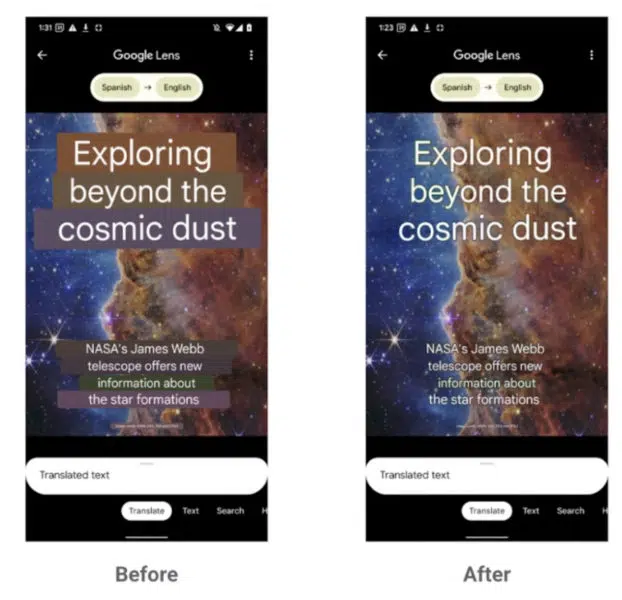
Google Lens is so much fun and it lets you point your camera at text in almost any setting so you can translate that text. Now, Google Lens is going to present that translated text in a cleaner and more blended approach. This is launching later this year.
Google is using generative adversarial networks, also known as GAN models, to present the translated text better. It is the same technology Google uses in the Pixel devices as the “Magix Eraser” feature on photos.
Here is a sample showing how Google Lens is overlaying the translation in an easier way for searchers to comprehend:
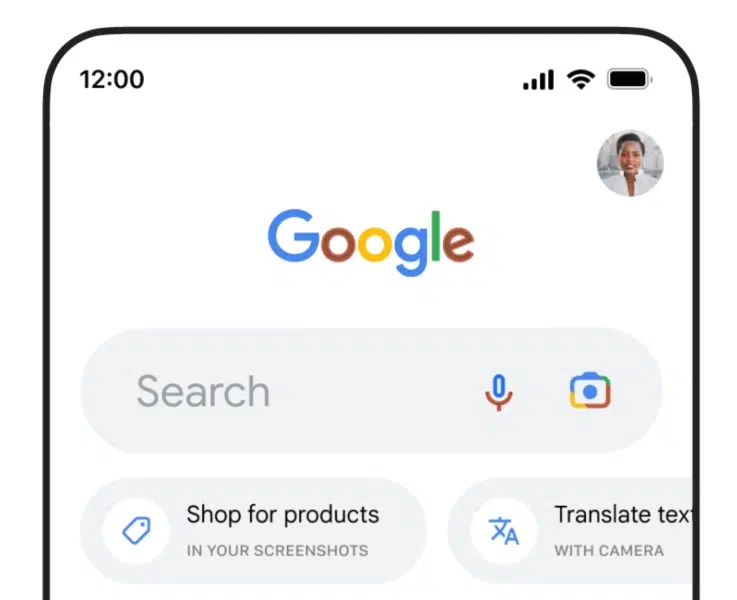
4. Google iOS App shortcuts
Today, the Google Search app for iOS will add shortcuts to make it easier for searchers to search, translate, use voice search, translate, upload screenshots, and more. Here is a screenhot of some of those shortcuts in action:
While this is launching today in the US for iOS users, it will be coming to Android later this year.
5. New Search refinements
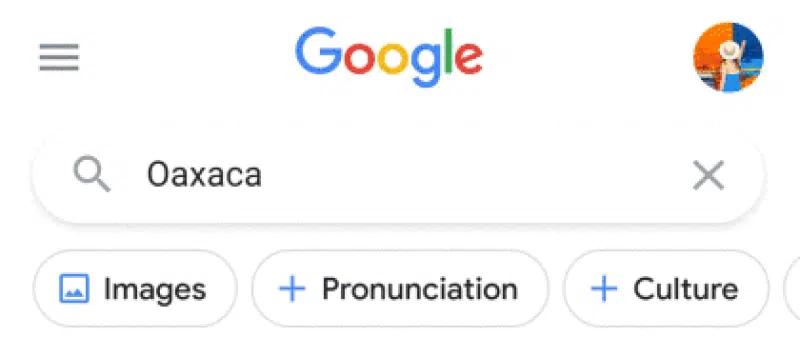
Google is also rolling out new search refinements and aids for when you search in autocomplete and within the search results. Now as you type your query, Google will present tappable words to build your query on the fly. This is a form of a query builder, by simply just tapping on words.
Here is a GIF of it in action:
You will also see richer information show up in the autocomplete results as you type.
Google also has the ability to refine your query after you search by letting you add or remove topics you want to zoom into or out of. It helps you drill down into what you are looking for by adapting the top search bar to be more dynamically driven.
Here is a screenshot of that top bar with refinements:
6. More visual information
Google is showing for some queries a more visually designed approach to the search results. This allows you to explore more information about topics around travel, people, animals, plants and so on.
Google will show you visual stories, short videos, tips, things to do and more, depending on the query. Google will also visually highlight the more relevant information in this UX.
7. Explore as you scroll
As you scroll through the Google Search results, sometimes the more you scroll, the less relevant the results get. I mean, that makes sense, Google should be ranking the most relevant information at the top.
So Google has added a new explore feature to give searchers inspiration around their query but not something that exactly matches their query.
Searchers can use this new explore feature to learn topics beyond their original query.
This is launching for English and U.S. results in the coming months.
8. Discussion and forums
Google Search today may show a section for “discussions and forums,” today for U.S. English results. This is to help people find first-hand experiences from people on the topic in various online discussion forums, including Reddit but beyond just a single forum platform.
Here is what that looks like:
9. Translated local and international news
Google will be launching early next year a way to find translated news coverage for both local and international news stories. Using machine translation, Google Search will show you translated headlines for news results from publishers in other languages.
This will give you “authoritative reporting from journalists” directly from the country that is touched by that specific news story.
Here is a screenshot showing “translated by Google” near the headlines:
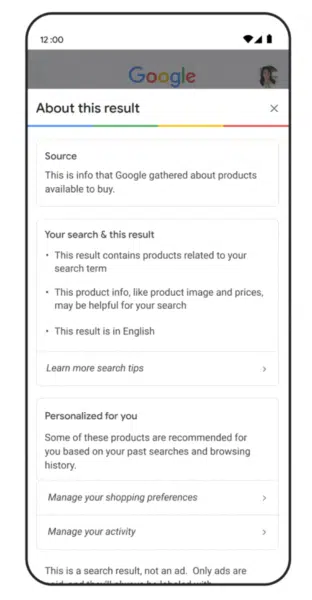
10. About this result displays personalization
Google is also expanding the About this result feature to show if personalization is taken into account.
Google will now show you if the search results are personalized in any way. Plus, Google will give you the ability to turn off personalization or change them.
So if you say you prefer a specific department or brand, within the new shopping features, Google will let you configure that here.
Here is the about this result that says this has been “personalized for you.”
And here is the personalization feature for the shopping results, which we covered in more detail here.
Barry Schwartz a Contributing Editor to Search Engine Land and a member of the programming team for SMX events. He owns RustyBrick, a NY based web consulting firm. He also runs Search Engine Roundtable, a popular search blog on very advanced SEM topics. Barry can be followed on Twitter here.
As we’re approaching a time when many companies are having meetings in their conference rooms to determine budget allocations for the upcoming year, I want to help further the case as to why SEO should have a voice in the room (and budget in your marketing plans).
But first, let me address a bit more why I feel SEO doesn’t get its fair shake.
Proving the value of SEO is complicated
SEO can be a challenge for some in marketing departments to wrap their heads around. There are many moving parts and it’s not as easy as PPC when you understand exactly how that works.
With PPC it’s generally a matter of:
Choose keywords.
Write/ place ads.
Pay when someone clicks.
Send that click to a landing page of your choosing.
Report on results (sales/leads).
It’s true. SEO is more complex than this. And, because of its complexity, I will often instruct prospects to think carefully about not just when to invest in SEO, but whether SEO is even a really viable investment in the first place. Often, the answer to these questions is “it depends.”
Remember, an investment in SEO doesn’t just revolve around hiring an agency or an individual in-house to oversee and drive the strategy.
Unlike PPC, there are many other considerations, including:
Web design and development that may be required, such as:
Creating a new architecture / navigational structure.
Creating new page templates to better support SEO.
Creating a blog/resource section on your website (if you don’t already have one).
Content, such as:
Page content.
Resourceful content.
Thought leadership, white papers or webinars.
PR and legal reviews:
Ensuring that content meets with company compliance needs (especially for medical/pharma/legal/insurance industries and other highly regulated industries).
Case in point: My agency has a client who’s engaged us to aid in the re-structuring of their website (including an audit of their existing presence versus that of a competitor).
The work coming out of this audit resulted in 130 hours worth of web development requirements this client needs to see through to completion in order for the investment that they’ve made with us to be substantiated.
I highly recommend that you consult with a trusted friend/partner who has experience in SEO to help you to make this determination. Many SEOs (the nice ones 😊) would be happy to provide a free analysis/opportunity assessment. Take advantage of the advice.
Today, I’m going to assume that we’ve determined that there is an opportunity for SEO to provide value for your business. Undoubtedly, if you’re in the conference room trying to determine what – if anything – to budget for SEO, you will want to better understand:
The size of the opportunity.
The size of the investment needed to get you there.
Get the daily newsletter search marketers rely on.
Size of the opportunity
When determining the “value” of an SEO effort, there are two sides to the coin.
One easy metric is to consider “replacement cost” of the traffic. If you were to buy this same traffic via PPC (that you’re considering targeting via SEO) what would it have cost? Semrush makes this available via their “Traffic Cost” metric:
This can sometimes be a big number, as we see for Search Engine Land. You may find that many of your competitors are realizing this kind of value, yet you aren’t.
That may be as far as you need to go to make your case to the board that SEO is “worth the investment.” That’s one way to measure it.
Understanding the traffic potential of SEO efforts
But if you’re a mature marketer, you will try to move beyond just “click value” to something more meaningful.
Tangible value.
Sales.
Leads.
Downloads of white papers.
Sign-ups for webinars.
How you measure this will depend upon whether your business is ecommerce or B2B/lead gen. For both verticals, you’ll need to do two things:
Identify the possible keywords that you’ll want to target.
Determine what it might take to compete (i.e., site structure/link acquisition).
Since I’m assuming that you’re a marketing head and perhaps not an SEO, here’s how I would quickly suggest you conduct this type of assessment.
Using Semrush (subscription required), navigate your way to the Organic Research section. Here, you can enter the domains/website addresses for direct competitors who you believe are doing well with their organic presence.
Once you’ve found a competitor who appears to have a significant organic presence, click into the Top Organic Keywords section and click View all organic keywords.
You will now see a complete list of your competitors’ keywords. But this will also include your competitors’ “brand” keywords (their company name, etc.). You need to filter this:
Still, though, this data isn’t great. It’s showing us any keywords that our competitor is ranking for within Google’s top 100 results.
Let’s make this more meaningful/useful by reducing that number down to rankings “which matter” (that’s a subjective metric). In this case, I’m going to only concern myself with the top 20 ranking keywords:
Now I have a workable list of keywords that I know are driving significant organic search traffic to my competitor(s):
This shows me that:
There are 19,029 keywords ranking in Google’s top 20.
The “local guide program” is driving a large share of traffic to my competitor.
The “seo” keyword would have cost me approximately $6.20 cost per click if I were to buy that traffic via Google Ads.
And, as mentioned previously, we can see the “value” of this competitors’ non-brand organic traffic, based on the “replacement cost” (“Traffic Cost”):
If you’re highly ambitious, this is the next step that you can take. Download the Top 20 Rankings list into a spreadsheet.
Create columns into your spreadsheet to make some assumptions (i.e., Ranking Top 3; Ranking 4-7; Ranking 8-10; or you may want to get as detailed as to estimate each top 10 position).
Since we have the estimated monthly search volume for each keyword, you can now multiply those numbers by the potential click-through rate of each potential/future rankings.
SEO is an imperfect science. But this at least gives you some visibility into the traffic potential that exists for an investment. In short, it puts some math into the projections.
Assessing SEO opportunities in ecommerce and B2B/lead gen
Now that you have at least an idea of the traffic potential, we need to break out the tasks for determining what potential “real” value might exist, in terms of things that are more tangible (sales/leads, etc.).
For the purposes of this article, I’ll be focused on either an ecommerce website or a B2B/lead gen website.
Ecommerce opportunity assessment
If you’re an ecommerce website, you should have a general sense of:
Conversion rate into a sale.
Average (net) value of a sale.
Knowing these things, you can run some estimates on how much you might make based upon varying degrees of traffic increases.
For instance:
10,000 visits per month x 1.5% conversion rate into a sale = 150 sales.
150 sales x $300 average net value of a sale = $45,000 per month.
Knowing this potential real value, you can then assess if the investment that you believe will be required in an SEO effort is “worth it.”
B2B/lead gen opportunity assessment
If you’re B2B/lead gen, you should have a sense of conversion rate into a lead (and hopefully you’re tracking form submissions, phone calls, chat/messaging apps and other “leads”/conversion types).
Working with this and your internal data on conversion rates from lead to qualified lead and qualified lead to sale, you should be able to calculate the potential ROI.
Taking the same traffic potential above (10,000), here’s what that calculation might look like:
10,000 visitors x 5% conversion rate into a lead = 500 leads.
Let’s say that ½ of those leads are qualified (500 x .5 = 250).
Then, let’s say that we convert 40% of our qualified leads into a sale (250 x .4 = 100).
So, we have 100 potential sales from the SEO investment.
What’s our average net value of a sale?
Every business is different. We have a client whose average net value of a sale is $400,000. That makes the ROI argument pretty easy to make.
But let’s say that your average net value of a sale is $400. With 100 sales x $400, that’s $40,000 in net value from your SEO investment.
Knowing this, you can determine how much you can profitably invest into an SEO effort.
Putting the math in SEO
These formulas are far from perfect. But they provide an opportunity to put math behind what you’re asking for in an investment into an SEO effort.
You should also caution those involved that SEO is not a quick fix. It may very well be that you’ll spend the first months of the effort in deep research before big changes occur.
As mentioned above, other hard (internal) costs could be involved, such as a restructuring of your website, content additions, page additions and PR/thought Leadership items. Do your best to account for these things.
While there are certainly times when I have strongly recommended against a company investing in an SEO effort, it’s more often that you’ll know me as a champion of the channel.
Opinions expressed in this article are those of the guest author and not necessarily Search Engine Land. Staff authors are listed here.
Related Stories
New on Search Engine Land
About The Author
Mark Jackson is the President and CEO of Vizion Interactive, an agency founded in Dallas, Texas in 2005 and specializing in SEO Services, Paid Media Services (Search/Display/Social/Video/Amazon), Local Listing Management and Conversion Rate Optimization. Mark was a co-founder of the Dallas-Fort Worth Search Engine Marketing Association and Kansas City Search Engine Marketing Association and has been a contributor to Search Engine Watch, ClickZ, Pubcon and the Search Engine Strategies conferences.
https://searchengineland.com/seo-is-math-388151
How to turn your Google Business Profile into a revenue-generating channel
Before purchasing, your customers always look for reviews and references to reinforce and validate their intent.
In the U.K., I worked with an agency that served 600 small businesses of which a large percentage were florists. A flower shop customer’s intent can be one of the following:
Look for seasonal flower arrangements (Valentine’s, Mother’s Day, etc.).
Type of flowers to buy for a dinner date.
Learn how to make a Christmas wreath.
Wedding flower services.
When a potential customer has a clear intent, two things can happen:
They will start their influence journey on TikTok, Instagram or YouTube. Looking at videos to seek inspiration on flower arrangements or the most appropriate flowers for specific occasions.
Go straight to Google to type one of the following queries:
Flower Delivery + location
Same day flower delivery
Same day flower delivery + location
Wedding flower services
Flower subscription services
And it is here where a well-optimized Google Business Profile (GBP) can become a significant source of influence because of its reviews, information, images and products.
An enhanced GBP drives more leads from your listing even though you’re not ranking as high as other listings. Optimize the following elements to turn your Google Business Profile into a revenue-generating channel.
1. Info section: Categories
The category chosen considerably impacts the rankings at the local level. Your company’s primary categorization explains what it performs (i.e., law firm, dentist, plumber, hair salon, etc). Furthermore, this will be the sole category accessible to the entire public.
In the example below, the primary category is “Florist” and the additional category is “Flower delivery.”
2. Reviews
About 77% of consumers “always” or “regularly” read online reviews when browsing for local businesses, according to BrightLocal’s recent survey.
Reviews are an increasingly important ranking component and a conversion factor. They are crucial to local businesses, not only to stand out but to build credibility.
Google will emphasize reviews for branded searches and display them prominently on your company profile.
Another important aspect of reviews is always replying, which encourages customers to leave reviews and increases your credibility.
Reviews may bring in additional consumers, provide insightful criticism, and reveal problems or successes in the customer service department.
When updated regularly, the Products section can be a powerful lever to generate revenue. It is placed higher up than the Services category so it is more prominent.
In this section, you can include:
Images.
Call-to-action buttons.
This gives you an opportunity to match your customers’ search intent with relevant products, making it easier and faster for them to reach a purchase decision.
Did you know you can add products at the top of your local and map listings? You can find out how to do it here.
4. Images
Images heavily influence customers during their research phase before purchasing. Google is making information more useful, allowing users to do searches with images and text and get relevant results.
However, adding images (especially logos) to the Image section of your GBP can be tricky. Ensure the pictures you upload for your products, logos, and general imagery are high resolution.
Publishing posts on your Business Profile provides an excellent opportunity to promote new products, events, workshops or special offers.
You can add call-to-action buttons on your posts to help increase transactions and revenue and most of all, make it easy for your customer to complete a purchase.
Posts should not be used to turn keywords into topics and create unhelpful content to influence the search result pages. It will not work, and this practice is considered spam.
Instead, your posts should be brief, concise, informative and useful to your customers.
UTM tags are crucial to track precisely how many visits, transactions and revenue your Google Business Profile drives to your website.
Now go to the info section on Google Business Profile and paste the URL you just created on the blank space with the earth icon (which stands for a website).
Then if it doesn’t have any errors, it should start tracking and, in a few days, you will be able to see its data on Google Analytics. To see its data on GA, go to Acquisition > Campaigns > All Campaigns.
Then you will be able to see all the campaigns. Look for “gbp-listing.”
Case study: A local flower shop
Magnolia’s is a lovely flower shop in a gorgeous village in Northamptonshire in the U.K.
On Jan. 15, 2021, just before the big season (Valentine’s, Mother’s Day and Easter), I helped them make some improvements to their Google Business Profile, such as:
Improving their information section.
Adding products and categories based on most sold products and most searched products and services.
Starting to publish posts to keep their customers up to date regarding new product launches, upcoming flower workshops and offers.
From zero in revenue at the beginning of January 2021, Magnolia generated €27,328.80 (roughly the same in dollars) in sales by April 2021, just from their Google Business Profile.
What to avoid on Google Business Profile
Keyword stuffing
Adding keywords or cities to your Google Business Profile name is unnecessary unless your business is registered as such.
Additional keywords will not have any influence whatsoever on local rankings or organic listings. Remember that anything we do on GBP will not affect other listings and vice versa.
Important note: If you have keywords on your business name, read this post on Google’s Vicinity Update, the largest update on local search in five years that rolled out in November 2021.
Sectors such as lawyers, insurance and dentists experienced significant fluctuations. Businesses that ranked in areas far from their locations and had keywords in their name were negatively affected.
There is a huge myth that adding keywords to your business description (on the info section) will impact visibility and local rankings. This is not true, and it’s simply a spammy practice.
Make sure your business descriptions are concise and contain information that will be helpful for your customers to know.
Google is not Instagram or Twitter, so hashtags will be completely useless and look bad on your content for GBP. They don’t have any effect on discoverability and local search.
Opinions expressed in this article are those of the guest author and not necessarily Search Engine Land. Staff authors are listed here.
Related Stories
New on Search Engine Land
About The Author
Maria Amelie White works as Head of SEO at Kurt Geiger a luxury British retailer with concessions in luxury stores such as Harrods and Selfridges in the UK.
Maria is an MSc in Psychological Research from the University of Oxford and has worked in SEO for over 12 years, specializing in Technical SEO, International SEO, Local SEO and Digital PR.
Google September 2022 product reviews update rollout complete
Google’s September 2022 product reviews update is now fully rolled out. Google said this update only applied to English-language product reviews.
It took six days to complete, beginning Sept. 20 and concluding Sept. 26.
This marks the end of a flurry of Google algorithm updates that started with the helpful content update (Aug. 25 to Sept. 9), continued with the September 2022 core update (and Sept. 12 to 26) and concluded with the fifth version of the product reviews update.
About Google’s product review updates. These algorithm updates are meant to reward high-quality product reviews (in the form of insightful analysis and original research). Google said it will promote these types of product reviews in its search results rankings.
In short, if you were impacted, that means you probably need to put more effort into improving your product review content. Figure out how to make it unique so it stands out from the competition.
Why we care. Staying on top of Google’s multiple algorithm updates is important. This is a bit unique because Google rolled out overlapping updates this month – product reviews and a core update. Google says the product review update should only impact product review content. But having overlapping algorithm updates could complicate things – especially if you’re trying to diagnose ranking or visibility changes (positive or negative).
Related Stories
New on Search Engine Land
About The Author
Danny Goodwin is Managing Editor of Search Engine Land & SMX. In addition to writing daily about SEO, PPC, and more for Search Engine Land, Goodwin also manages Search Engine Land’s roster of subject-matter experts. He also helps program our conference series, SMX – Search Marketing Expo. Prior to joining Search Engine Land, Goodwin was Executive Editor at Search Engine Journal, where he led editorial initiatives for the brand. He also was an editor at Search Engine Watch. He has spoken at many major search conferences and virtual events, and has been sourced for his expertise by a wide range of publications and podcasts.
Rollout complete. According to Google’s search ranking update page, “The rollout was complete as of September 26, 2022.” The page seems to have been updated about an hour ago.
September 2022 Core Update impact. Based on data from tracking tools, the September 2022 core update hit fast, but was less impactful than previous updates. While there was some rank volatility, the consensus was that it was weaker than past Google core updates.
What to do if you are hit. Google has previously given advice on what to consider if you are negatively impacted by a core update. Google has said you can see some recovery between core updates, but the most significant changes will come following a future core update.
Product Review Update sill rolling out. As a reminder, the September 2022 Product Review Update, released Sept. 20, is continuing to roll out now. We’ll let you know when it’s finished rolling out so you can see what impact, if any, it had on your site.
Why we care. Although the overall impact of this Google core update seems less widespread, sites have been impacted. Now is the time to start digging into your analytics data to see if any pages have lost visibility or rankings – and figure out a plan of action to improve those pages to regain any lost rankings over time.
New on Search Engine Land
About The Author
Danny Goodwin is Managing Editor of Search Engine Land & SMX. In addition to writing daily about SEO, PPC, and more for Search Engine Land, Goodwin also manages Search Engine Land’s roster of subject-matter experts. He also helps program our conference series, SMX – Search Marketing Expo. Prior to joining Search Engine Land, Goodwin was Executive Editor at Search Engine Journal, where he led editorial initiatives for the brand. He also was an editor at Search Engine Watch. He has spoken at many major search conferences and virtual events, and has been sourced for his expertise by a wide range of publications and podcasts.
In-house SEO vs outsourced agency talent: Who wins the debate?
30-second summary:
SEO involves a lot of tasks, processes, and technicalities that are hard to master and manage
Investing in an in-house team can have lots of advantages, like building specialized talent, greater control over performance, productivity, brand and process alignment
However, outsourcing to an SEO agency may not deliver the above-mentioned benefits but can be easier on your marketing budget and overheads
So, how do you identify the right fit for your business?
There are too many parts of SEO and many of those parts are constantly moving and changing. The more a site grows, the more challenging SEO is going to be. So what’s a better approach: to start building your own in-house SEO team or rely on an agency or freelancers?
Let’s see…
Pros and cons of building your own team
Pro #1: You build your own internal talent and knowledge
Your team is your biggest asset. Your company is only as good as the people behind it. These are all cliches but they hold true.
Having an in-house team to rely on makes your SEO strategy more consistent and aligned with your company’s culture and your product positioning strategy. Plus, there is a smoother flow of ideas and communication that leads to better results. You also stand to gain from the cross-pollination of talent that feeds into innovation and greater problem-solving.
Con #1: Talents tend to move on
There’s one huge issue with talented people: They tend to overgrow their employing businesses, and they do that pretty quickly.
It often becomes hard (and expensive) to keep the talent, even if your organization was the one that grew it.
Pro #2: You hold someone responsible
If you are good at hiring, you will likely find someone responsible who will take their training and tasks seriously. The person will have clear ownership which makes everyone’s lives easier and your business more effective.
Any business initiative is going to be successful only if there’s someone inside the company to “own” it.
In-house teams are easier to control, you can ask for and obtain reports within a day. You can ask for clarifications without running out of your billable hours.
Con #2: It is expensive
Not many businesses can afford to have an internal SEO that has nothing but SEO… Apart from regular and inevitable payroll, there are also HR processes that contribute to the overall expenses. And let’s not forget about employee insurance and other benefits.
Yes, growing your own team is generally a great investment but only if your budget allows it. Plus, there’s always a risk your investment will simply leave your company one day (see above).
Pro #3: You own your data
Privacy is a big issue when it comes to letting anyone do marketing for you. On the other hand, you can also control the technology and privacy much more efficiently ensuring that your data is accessible to your internal team only.
Additionally, when you outsource anything, you will inevitably miss lots of data, like contacts that were acquired, templates that worked better, and other assets.
When you have the work done internally, you end up accumulating contacts you can rely on going forward. You also eventually build your own data and find innovative ways to build it into your search marketing strategy.
Con #4: It is slower
Unless you have a huge team, SEO tasks will pile up. They are very hard to organize and scale without outside help because there are too many variables and most of them are done on a continuous and regular basis.
Relying on freelancers to outsource SEO tasks is often the only way to get things done and free some time for looking into analytics to align your SEO strategy better.
Pro #5: The process can be better integrated
SEO is no longer an island. It can only be really effective if it is well-integrated into all processes within an organization, including product development, IT, sales, and customer support.
The intersection of digital and physical consumer experiences is also a strong reason as to why SEO needs to have strong integration with digital marketing, martech, and sales. Your business can achieve its goals only if it has a unified footprint.
Con #5: You cannot build a team that is good at everything
The biggest problem with SEO is that there are several moving parts that require absolutely different training and skill sets.
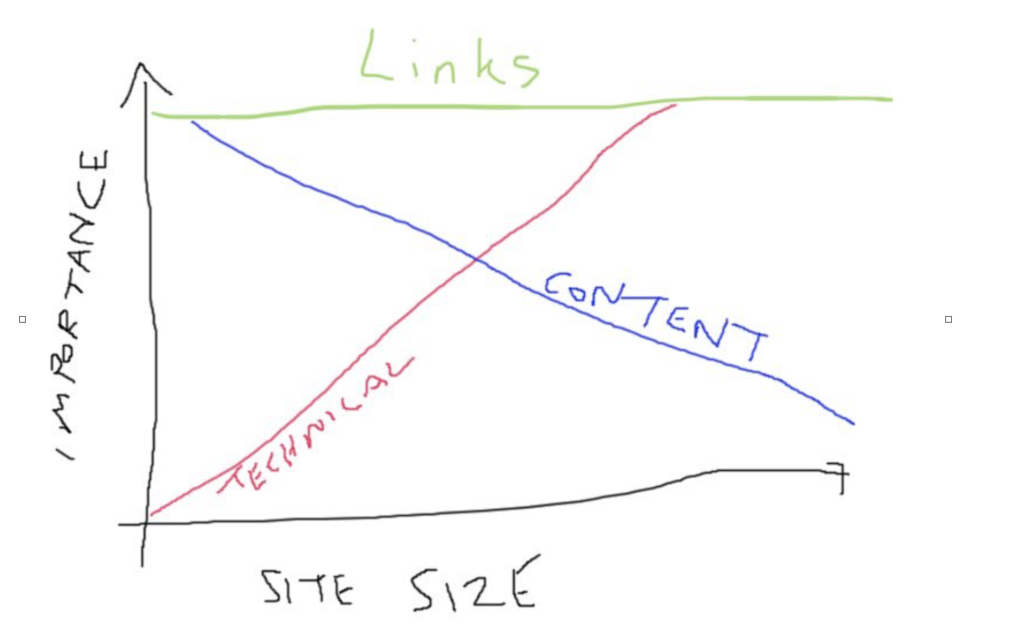
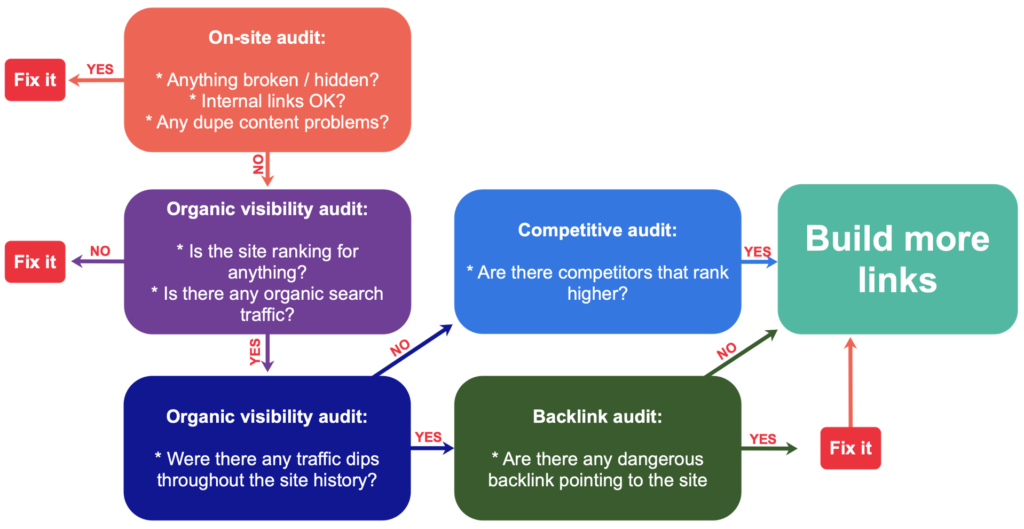
If you need to understand all of these moving parts better, I have a simplified flow chart for you:
Let’s not forget that many of those parts will have to evolve based on ever-changing Google guidelines and ever-developing search algorithms that are hard to keep up with.
With such a variety of skills required, building a team that would handle almost everything is next to impossible, even for corporate entities.
But even with smart technology, to handle all the parts of an SEO strategy you will need a pretty huge team, which is – again – expensive.
The truth is somewhere in the middle
The takeaway from the above is somewhat of a dilemma: You want a team to control something that you may never be able to control.
The best solution is usually in the middle:
Hire an SEO manager who has thorough SEO knowledge
Let that SEO manager find companies and freelancers to outsource different moving parts to
This means having an SEO manager who is brilliant at both SEO and project management.
Yes, it will take time to find the right person but finding the right person is never easy.
It is well worth your time though:
Your in-house person will be able to “translate” any SEO jargon to you whenever you need to understand what is going on
You will have someone owning the strategy and process
There will be a person who will be inside your company to ensure your SEO strategy is aligned with your overall product positioning strategy and include other teams in the SEO processes
In reality, if you want your SEO strategy to deliver results, you need both: An internal person (or a team) and someone outside your company to rely on. This is not a question of choosing one.
Conclusion
Managing SEO is hard. Don’t feel discouraged. There’s no valid alternative to organic search traffic. Find the right person who will be able to manage the process for you and find reliable partners to outsource different SEO tasks to. This way you will keep the strategy under control while still being able to afford it. Good luck!
Ann Smarty is the Founder of Viral Content Bee, Brand and Community manager at Internet Marketing Ninjas. She can be found on Twitter @seosmarty.
Subscribe to the Search Engine Watch newsletter for insights on SEO, the search landscape, search marketing, digital marketing, leadership, podcasts, and more.









 Campaigns > All Campaigns” class=”wp-image-388218″ srcset=”https://rassegna.lbit-solution.it/wp-content/uploads/2022/09/how-to-turn-your-google-business-profile-into-a-revenue-generating-channel-8.png 265w, https://rassegna.lbit-solution.it/wp-content/uploads/2022/09/how-to-turn-your-google-business-profile-into-a-revenue-generating-channel-36.png 249w, https://rassegna.lbit-solution.it/wp-content/uploads/2022/09/how-to-turn-your-google-business-profile-into-a-revenue-generating-channel-37.png 83w, https://rassegna.lbit-solution.it/wp-content/uploads/2022/09/how-to-turn-your-google-business-profile-into-a-revenue-generating-channel-38.png 150w” sizes=”(max-width: 265px) 100vw, 265px”>