15 horrible mistakes even professional online writers make
Writing. Everyone thinks they can do it, no one wants to do it, and it’s never perfect.
We love writing because it stimulates the mind, informs us of something new, and teaches us new ways to think about important topics in our lives.
However, writing can be a difficult skill to master. Even when you think you have, you’ll keep making the same mistakes as when you started.
Likewise, writing requires intense discipline and is not for the wandering or distracted mind.
So the next time you make a mistake or find yourself procrastinating content for a client, don’t sweat it. Even professional writers make some of these common mistakes.
1. Not knowing your target audience
Content requires focus and purpose.
Unfortunately, even as a seasoned veteran in the digital marketing industry, it’s easy to write broad content based on a few high-volume keywords with little relevance.
Writing content without understanding your audience is like throwing money at the wall and hoping it sticks.
Solution
Meet your audience where they surf. Use social listening tools like Hootsuite, examine Reddit forums, and look at other popular blogs/publications in your industry to examine what keywords users use to discuss and research topics in your industry.
In addition, keyword and topic research will uncover various subtopics that users are searching for and want answers to enrich your content.
Bonus tip: If you’re creating content for a client or business and want to excite them, focus on their top ROI products and services first. Find those money keywords with high relevance and low competition to create content that speaks to their audience and gains them traffic quickly.
2. Thinking too narrow
Writing quick blog posts around a single keyword may fulfill your client’s needs, but it most likely won’t net them much return on their investment. If your content thinks too narrow or fails to provide any unique perspective or educational value, it’s just as valuable if you never wrote it in the first place.
Solution
If you’re calling yourself a professional writer, you need to produce high-quality content. Research high-ranking content in your field and find new ways to provide additional insight or personal tips to enrich content.
It’s easy to regurgitate the same content as everyone else, but if you want to move the needle with your content, you’ll need to think outside the box.
3. Having a boring headline
There’s nothing more frustrating than failing to gain any traction on a piece of content you worked incredibly hard and long on.
Often, the problem isn’t your content; it’s your headline.
Solution
To garner clicks on your content, you’ll need to first research what keywords drive clicks and traffic. From there, I follow a simple formula for most of my headlines:
Keep titles to an appropriate length (55-60 characters).
Insert relevant keyword toward the front of the title.
Provide a solution or reason for reading (e.g., Become a Better Writer Today).
Use power words to entice clicks.
4. Not having a strong hook
The two most common reasons people click on content are for quick answers and stories. So, ideally, your headers should provide quick answers to subtopics and your opening has a strong hook to pull the reader into your piece.
Like a headline, your hook will determine whether or not you get clicks for content.
Solution
Make an impression on the reader. Easier said than done, right? But the point is to avoid going straight into a story or description. You need to give the reader a reason to read your post.
While there is no hard and fast rule for writing hooks, here are a few general tips:
Cite a wild statistic. (e.g., Did you know that 50% of writers don’t even know how to write hooks?)
Make a surprising or controversial statement.
Ask a thought-provoking question.
Start a story in medias res.
Use an insightful quote.
Bonus tip: Use your first one or two paragraphs to lead people into a story. In certain cases, you might not dive into the details of your content until the first body paragraph.
I often come across several articles on highly reputable publications with unoptimized header tags or one-word lists that provide minimal context. Optimizing header tags allow readers to scan your article and find the right subtopics they’re researching.
Furthermore, optimizing header tags allows Google to direct users from an answer box to the highlighted portion of your webpage.
Solution
Find a seed keyword and then add question phrases to answer specific subtopic questions on Google SERPs.
Additionally, create subtopics for any related long-tail keywords. For example, if you write about motorcycles, listing out specs, like the suspension and motor, in specific sections with optimized keywords will give users the exact information they’re looking for and tell them where to find it.
Bonus tip: Take a note from the pyramid writing style of journalism. Start with the main topic at the top of your article, then write specific sections of your article with subtopics that relate to the main topic.
6. Not making content scannable
Good content should be easily scannable and consumable.
Most people will bounce right off a page that contains large run-on paragraphs and scrolls for a mile.
Solution
Make content less intimidating by breaking paragraphs up with images, videos, infographics, spaces and well-optimized headers.
Experiment with multimedia where it would make more sense to tell a story or explain a specific topic.
People are typically visual and kinesthetic learners, so find ways to appeal to those learning styles without inundating them with large paragraphs.
7. Failing to invest enough in editing
According to Stephen King, about 10% of writing is editing, but I’ve heard some authors say it’s a lot more. Realistically, any error you make in writing should be attributed to your editing. For this reason, writers need to master the editing process.
Solution
Ever heard the phrase “work smarter, not harder?” When I say invest more time in editing, I’m not talking about devoting more time or spending more money; I mean optimizing the process.
Pass your editing to another team member and get some fresh eyes on a piece.
Bonus tip: Wait a day or two and then quickly edit a draft so that you have an entirely fresh perspective on a topic. This strategy will make the editing process more efficient and less cumbersome.
Get the daily newsletter search marketers rely on.
8. Using complex jargon and words
This point relates to not knowing your audience, but it’s a mistake that we’re all guilty of making as writers and SEO professionals.
Using overly complex jargon and language can be difficult for readers to interpret and follow along with your content. If readers need to constantly Google every other word or phrase you’re saying, they’ll quickly grow bored and irritated.
Solution
Always substitute complex words with simple language. Ideally, you should be writing for an audience with the vocabulary of a 5th or 6th grader to make content easy to consume and retain.
Bonus tip: If you’re forced to use jargon, explain it, link it to another page on your site, and spell out any acronyms.
9. Making content too long
One of the hardest habits for long-time writers to kick is creating lengthy sentences and paragraphs. Unfortunately, we all have a natural impulse to say as much as possible or over-explain our points at the risk of overwhelming our audience.
I always recommend limiting the wording of online content to its medium. For example, blog posts don’t need to be over 2,500 words – save that content for an ebook!
Solution
Depending on the medium, paragraphs in blog posts should only be one to three sentences at most. Additionally, if you’re not writing an evergreen guide, keep subtopics short and sweet, saving content for each subtopic on a separate post!
Bonus tip: Take some inspiration from Hemmingway and his infamous iceberg theory. In some cases, your content can be simple and doesn’t need to explain every argument. For example, most readers understand why “content is king” and don’t need a paragraph reinforcing this point.
10. Not providing a clear call to action
Realistically, your content should provide solutions or next steps to motivate your readers toward a desired action. However, if you don’t include a clear call to action (CTA) or related content on your website, you could risk losing website visitors forever.
Solution
Give readers a reason to stay on your site or interact with your writing more. Offer a newsletter signup link at the end of an article or provide a CTA button that leads to a sale or consultation if you’re writing for a business.
Bonus tip: Create a drip campaign for readers who sign up for your newsletter using related content that eventually leads them to purchase something from your website.
11. Failing to properly interlink between content
You should always provide relevant links throughout your content to build authority on your website. Additionally, interlinking also increases website time on page and increases your website’s likelihood of a conversion.
Solution
Use your favorite organic research tool like Semrush to find your top-performing/highest ROI pages and insert links in your content relevant that reinforce the main topic of the article.
Bonus tip: Form content clusters around main topics and provide supporting links to subtopics on separate pages that interlink with each other. For example, suppose you have a top-navigation page for content marketing and a supporting page on link building. In this case, insert links in both pages of content to link between each other.
12. Forgetting to promote your content
On the flip side, most professional writers are often lazy when it comes to promoting their content. Unless you have an established audience on social media or your blog, your content’s reach won’t go far without links and shares.
Solution
Build links to your content by reaching out to other authors who have written about similar topics and asking for a link. In addition, there are several ways to build links to your site and specific content pages, such as guest posting, content syndication, reaching out to influencers, etc.
The goal is exposure, which will drive relevant metrics to your site and help it rank for various keywords.
Bonus tip: Advertise your content on sites like Facebook and Twitter to help put your content directly in front of your targeted audience. Sure, many people are skeptical of ads on social media, but if your content is good, it will drive engagement.
13. Not reviewing content
If we’re not tracking the performance of our content after it’s written, we’re not gaining any insight into what we’re doing wrong.
Solution
Use Google Search Console, Google Analytics, or your favorite organic research tool to see which content is driving traffic to your site and which is not generating clicks. Compare this data to its keyword ranking and identify areas where meta tag optimizations, different keywords, or adding multimedia could give your content an edge over the competition.
Content is a serious investment, so track its performance to get the best return out of your investment.
Bonus tip: Consider repurposing content by updating it to modern standards or adding video or infographics to content to help it rank organically again.
14. Spending too much time on one piece
Time management is one of the hardest skills for a writer to master. Depending on the length and topic of a piece, you could spend hours working on a single piece.
As a writer, your living is based on your work output. So how do you improve your output and spend less time on each piece without sacrificing quality?
Solution
Optimize your process with a few helpful hints:
Block off a specific time in your day for writing.
Set a goal for each piece of content, along with times to hit.
Create a separate space in your home office for writing.
Hone your craft by constantly writing (not when you’re in the mood).
Create a template and then go in and fill in the blanks.
Eliminate any distractions in your workspace.
Bonus tip: Find your flow state. Everyone has a way to enter a flow state of total concentration and focus. Meditate or listen to music if it helps you get into that flow state.
15. Not reading enough
I find that very few professional writers don’t read, but it’s still a helpful reminder that you’re not reading enough.
Reading is like weight lifting for a writer; it helps strengthen those brain muscles and form new neural pathways.
In addition, reading more about your industry and the topics you’re writing about will make you a topical authority and increase your credibility.
Solution
Set aside time each day or every other day for reading. I often block off some time during my lunch hour to read from my favorite publications, like Search Engine Land, so I’m always informed of the latest news in the SEO industry.
Bonus tip: Practice different forms of writing to improve your writing. For example, try writing about new topics, writing fiction, or writing for different formats like newsletters or press releases. This helps keep the mind fresh, and you’ll never get bored of writing.
All professionals make mistakes, but most of them are not published online for the whole world to see. However, your work will only improve if you go back to basics from time to time and refresh your writing knowledge.
This is why I read William Zinsser’s “On Writing Well” almost annually to hone my writing skills and get back to the basics.
However, the best way to overcome these mistakes is to keep writing. Never feel discouraged because even the most seasoned writers make mistakes constantly.
Opinions expressed in this article are those of the guest author and not necessarily Search Engine Land. Staff authors are listed here.
New on Search Engine Land
About The Author
Ron Lieback is the founder/CEO of ContentMender, an SEO-driven content marketing agency based in Northeastern Pennsylvania, and the author of “365 to Vision: Modern Writer’s Guide (How to Produce More Quality Writing in Less Time).” While working in digital marketing for the past decade, Lieback has ghostwritten nearly 500 articles for C-level executives across various industries. He also contributes content to leading motorcycle magazines, including Cycle World.
The biggest mystery of Google’s algorithm: Everything ever said about clicks, CTR and bounce rate
It’s the biggest mystery and controversy of Google’s search ranking algorithm. For a long time, the SEO community has debated: is the click-through rate (“CTR”) of search results listings a ranking factor? Or the closely related “bounce rate” and “dwell time”?
I present to you everything Google has ever said about this, along with some observations and opinions.
Clicks, CTR, bounce rate and dwell time
If you are newer to SEO, the concept of clicks or click-through rate (“CTR”) being ranking factors is simple to explain. Once a user performs a keyword search, they can then click on a listing on Google’s search results page. Google could count those clicks as a type of vote for the content in the results and lend more ranking ability to those listings that draw more clicks for the keyword in question.
Similarly, “dwell time” would be counting how long one stays on a webpage after clicking through to a page from the search results.
A “bounce” happens when one clicks through to a webpage and leaves without navigating to another page. The assumption is that if a bounce happens too rapidly, the user may have found the page’s content unsatisfactory for their query.
“Dwell time” is also how long the user may linger on the webpage before clicking elsewhere or back to the search results. All of these signals center upon the click to listings in the search results.
Click-through rate, or “CTR”, is the most controversial and mysterious of Google’s “ranking factors.”
The mystery: Are CTR and bounce rate ranking factors?
Despite many of my colleagues believing Google’s official line about CTR or bounce rates not being ranking factors, I will confess that I have long wavered on the question, and I have often suspected it indeed could be a ranking factor. In a recent poll I took on Twitter, CTR was voted the most controversial of all ranking factors.
What would you say the most controversial ranking factor is? As in, is it, or isn’t it? Not counting “Helpfulness” for this!
However, there are a lot of good reasons to believe Googlers when they tell you what does or does not influence search rankings. I have worked in information retrieval myself, and I have known and conversed with a number of official Google evangelists in person or via chats, emails, etc. – and they uniformly give great advice and all seem to be highly honest and generally good people.
But…
…there have been those moments when something rises and sticks in rankings that do not seem like it should, based on all the classic ranking factors that we know.
I have long worked in online reputation management where SEO is leveraged heavily to try to improve how a person or organization appears in search when their name is queried.
There have been these weird instances where a nasty blog post or article with few or no major external links will abruptly pop up in the rankings – and, it just stays.
In contrast, other content that has been around longer and has stronger links just cannot gain traction against the nasty-gram item.
You cannot help but notice the difference when these reputation-damaging items arise on the scene. Such pages often have scandalous and intriguing titles, while all the other pages about a subject have more normal, conservative titles.
When you search for a name, and you see some title referencing them along with the word “lawsuit”, “indictment”, “exposed”, “arrested”, “scam”, etc., you are immediately curious, and you will want to click to hear what it is all about.
I have sometimes described this as “rubbernecking on the information super-highway” because it is like how people are drawn to slow down and look when they see a terrible wreck on the road. You see the scandalous title in the search results, and the impulse is to click it.
It has often seemed like the scandalous headlines keep drawing clicks, and this activity seems to buoy the content into appearing high in the rankings on Google’s Page 1.
I have even engineered more scandalous headlines on positive pages to draw attention for a client. Once that engineered content is getting most of the attention, the original negative item starts to subside in the results. When this happens, it seems like users’ clicks are to blame.
But, is the dynamic just coincidental correlation? Or is it exactly what it appears it could be – an outcome based, in part, on quantities of relative click-through numbers?
Get the daily newsletter search marketers rely on.
Reasons to suspect Google uses CTR as a ranking factor
Beyond my anecdotal examples, there are a number of good reasons to suspect that Google could use clicks of links in the search results as a ranking factor. Here are a few:
1. Google has long tracked clicks on its links
If this is unused data, why track the clicks? I tried to recall when I first glanced at Google results’ HTML and saw that the links were being tracked. It might be sometime in the early 2000s.
What do they do with all that data? After the advent of the inclusion of search analytics in Google’s Webmaster Tools (later renamed to Google Search Console), this click data was at least used in webmaster reports.
But, it was collected by Google well before the search analytics report.
2. Google tracks clicks on ads
Click data affects rankings within the paid ads section. So, why wouldn’t they do the same in organic?
It would not be a surprise if Google used a similar method in organic that they use in paid search, because they essentially have done that with their Quality Score.
Over 15 years ago, Google rolled out its Quality Score, which affects ad rankings – and there is now ample evidence of Google using quality criteria in organic rankings.
While different parts of Google – such as keyword search versus Maps – use different ranking methods and criteria, Google sometimes cross-pollinate methods.
3. Google disclosed in 2009 that clicks on search results affect rankings under personalized search
If it is used or has been used in the past for personalized search results, it clearly can be used for regular results, too.
4. An independent researcher examined click-throughs as a ranking factor and found it to be a potentially valuable method
“The theoretical results are verified in a controlled experiment. It shows that the method can effectively adapt the retrieval function of a meta-search engine to a particular group of users, outperforming Google in terms of retrieval quality after only a couple of hundred training examples.”
Thus, in a limited study, it was found to be effective. Considering this, why wouldn’t Google use it? Of course, his definitions for “outperforming Google” and determining usefulness likely differ from the criteria used by Google.
5. Bing uses click-throughs and bounce rate as ranking factors
Microsoft Bing search engine confirmed that they use click-throughs and bounce rate as ranking factors. However, they mentioned caveats around it, so some other user engagement context is also used for evaluation.
Search engines certainly use different signals and methods to rank content in search results. But, it is an interesting counterpoint to rhetoric that it is “too noisy” of a signal to be useful. If one search engine can use the signal, the potential is there for another.
6. If Google convinces people that CTR is not a ranking factor, then it reduces Google search as a target for artificial click activity
This makes it seem like there could be a substantial motive to downplay and disavow click activities as ranking factors. A parallel for this is Autocomplete functionality, where users’ searches, and potentially also click activity, used to be very prone to bot manipulation.
Google has long disliked artificial activity, like automated requests made by rank-checking software, and has evolved to detect and discount such activities.
However, bot activity in search results targeting ranking improvement through artificial clicks would likely quickly become more significant than they already handle. This can potentially create a negative impact on services similar to DDoS attacks.
Despite the years and years of stating that CTR is not a ranking factor, I have seen many jobs posted over time on microtask platforms for people to perform keyword searches and click upon specific listings. The statements may not have accomplished deterrence, and Google may already be effectively discounting such manipulation attempts (or they are hopefully keeping some of that artificial activity out of Analytics data).
7. Google AI systems could potentially use CTR and Googlers would not know if or when it was impacting rankings
Three years ago, when I wrote about how Google could be using machine learning to assess quality of webpages, I strongly suggested that user interactions, such as click-through rate, could be incorporated into the machine learning models generated for a quality scoring system.
An aspect of that idea could potentially happen, depending upon how Google builds its ML systems. All potential data points about websites and webpages could be poured into the algorithm. The system could select ranking factors and weight them according to what matches up with human quality rater assessments of search results.
With such massive processing power to assess ranking factors, an algorithm could theoretically decide if CTR was or was not a useful predictor of quality for a particular type of webpage and/or website.
This could produce ranking models for many thousands of different kinds of webpage and search query combinations. In such a system, CTR might be incorporated for ranking scientific papers but not for Viagra product pages, for instance.
The mystery remains
You might think that that third point would essentially set the record straight as Google flat out stated the ranking factor for personalization. But the mystery and controversy remain as the question centers upon overall rankings in a broader sense beyond just personalized results. The controversy surrounds whether CTR is used as a core ranking signal. The blog post disclosing clicks as a personalized ranking factor was from 2009 – when personalization effects seemed a little more overt in search.
Because there is some reasonable basis for thinking Google could use CTR as a ranking factor more broadly beyond limited effect in personalization, it creates the groundwork for many SEOs to easily believe that it is indeed a major ranking factor.
Of course, one of the biggest reasons people in SEO have come to think CTR is a ranking factor is because it naturally has a high correlation with rankings.
This is the high-tech version of the age-old question: which came first – the chicken or the egg?
The links on the first page of search results have the vast majority of clicks for any given query, and on the first page of search results, the higher ranking listings typically receive more clicks than those that are lower. This makes CTR as a ranking factor seductive.
The obvious question is:Is this coincidental correlation or is it evidence of causation?
Where cause and effect are so closely intertwined, the prospect of confirmation bias is very easy – and this is why one should be extremely careful.
This leads us to what Google has said over time about CTR as a ranking factor.
Everything Google has ever said about CTR as a ranking factor
2008
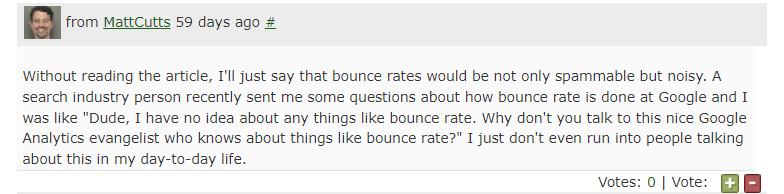
Former Googler Matt Cutts commented that bounce rate was not a ranking factor, stating that it would be spammable and noisy (meaning it would contain a lot of irrelevant data that is unhelpful to ranking determinations).
2009
In a Google Search Central video, Cutts was asked, “Are title and description tags helpful to increase the organic CTR – clicks generated from organic (unpaid) search – which in turn will help in better ranking with a personalized search perspective?”
He only answered a part of the question, saying that “…so many people think about rankings, and stop right there…”, advising the person to improve their page title, URL and snippet text to help their CTR.
He avoided answering whether CTR could affect rankings. Of course, this question was specific to personalized search.
Nine months later, Bryan Horling, a Google Software Engineer, and Matthew Kulick, a Google Product Manager, disclosed that clicks on listings were used in rankings in personalized search, as I noted above.
[embedded content]
2012
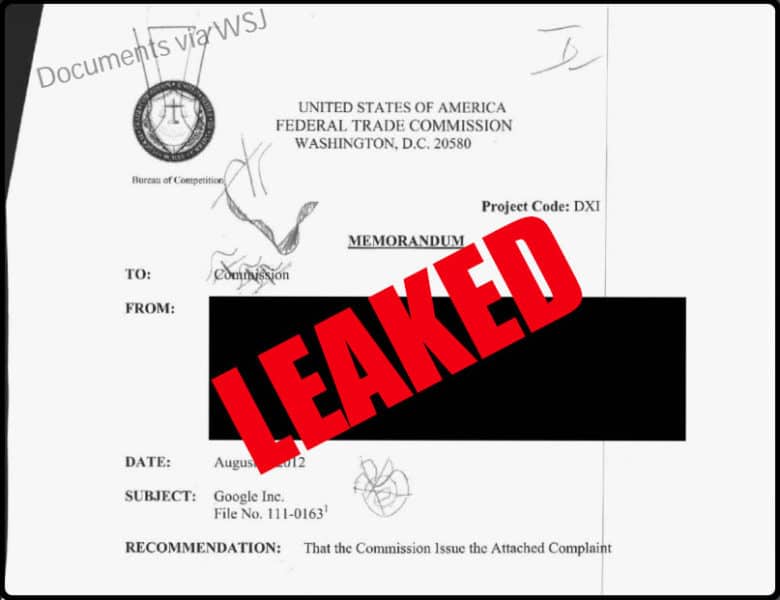
An FTC Google Probe document (regarding an antitrust evaluation) was leaked to the Wall Street Journal. It recorded a statement from Google’s former chief of search, Udi Manber, saying:
“The ranking itself is affected by the click data. If we discover that, for a particular query, hypothetically, 80 percent of people click on Result No. 2 and only 10 percent click on Result No. 1, after a while we figure out, well, probably Result 2 is the one people want. So we’ll switch it.”
The document further reported that:
“Testimony from Sergey Brin and Eric Schmidt confirms that click data is important for many purposes, including, most importantly, providing ‘feedback’ on whether Google’s search algorithms are offering its users high quality results.”
A bit of the context is missing in this document because the segment about rankings and click data comes directly after a missing page – it appears that all the odd pages from the document are missing.
Leaked Google Antitrust Hearing Recommendation Document, FTC
Danny Sullivan, former Editor-in-Chief of Search Engine Land, and current Search Liaison at Google, tweeted about the leaked document’s reference to rankings being affected by click data, stating:
In the comments, he further stated, “I asked again a few months ago :) no answer.”
It seemed mysterious that Google declined to answer one way or the other, and some interpreted this to mean that they indeed did use clicks as a ranking factor.
Or, perhaps the reason was that clicks are used only in certain, limited contexts rather than broadly as an across-the-board ranking factor.
2014
Rand Fishkin performed a test by watching the ranking of one of his blog posts. He called on his social media followers to conduct searches for it and then click on the listing in the search results. The page’s listing climbed to the top ranking position. This is worth mentioning in the timeline because Googlers appear to have become irritated at Fishkin’s publicized test and the conclusions.
Fishkin acknowledged that the test did not eliminate the possibility that other ranking factors might have caused the ranking improvement, such as links produced by the social media post. But, the sequence of events showed apparently considerable correlation between the clicks and the ranking change.
A 2015 post on the topic of CTR as a ranking factor by the late Bill Slawski with feedback from Fishkin, suggested that some thresholds of clicks would need to be reached for the listing before CTR begins to play a role in rankings.
Slawski’s blog post examined a Google patent that had been recently granted that described “user feedback,” which could potentially be clicks in search results, as a ranking factor.
One interpretation of Fishkin’s test results could be that items like news articles and blog posts may achieve higher than typical rankings after their introduction, combined with click-through rate data, as part of Google’s freshness or recency algorithms. (Eric Enge similarly theorized this in a 2016 blog post.)
Thus, topics spiking up in popularity shortly after introduction, like blog posts and news articles, might be able to appear higher as part of Universal Search for brief periods. Such ranking ability might not last, however, and arguably might not be deemed ranking factors in the broad sense that affects keyword search rankings over the longer term.
2015
At the SMX Advanced conference, Jennifer Slegg reported that Gary Illyes from Google stated that they “see those trying to induce noise into clicks,” and for that reason, they know that using those types of clicks for ranking purposes would not be good.
This speaks directly to the idea that Google would claim not to use it to reduce the likelihood that people would attempt to manipulate the signal.
The statement here asserts that Google is already seeing artificially influenced clicks in search results and because they already see such click campaigns going on, they are not using the signal.
Illyes went on to essentially confirm the earlier 2009 disclosure that Google uses clicks in a limited way to feature previously-visited search results higher for individuals through personalization. He also stated that clicks in search results were used for evaluation, such as checking whether algorithm changes or UI changes had impacted the overall usefulness of search results.
In a Google Search Central hangout, John Mueller states that click-through rate is used to check algorithms at a high level after making changes to see if people are still finding what they’re looking for.
“That’s something that on a very aggregated level makes sense for us to use, but on a very detailed site or page-wide level it’s a very, very noisy signal, so I don’t think that would really make sense as something kind of to use as a ranking factor there.”
While the wording of the statement seems a bit ambiguous, Mueller seems to be trying to persuade the audience that it would not make sense for Google to use the signal because it is noisy. Thus, no one should worry about it as a ranking factor.
Nearly a month later, in another hangout, Mueller refers to “CTR manipulation, dwell time manipulation,” saying, “these things may not even work,” which is, again, a little ambiguous.
“So we don’t use anything from Analytics as a ranking factor in search. So from that point of view, that’s something that you can kind of skip over. We do sometimes use some information about clicks from search when it comes to analyzing algorithms. So when we try to figure out which of these algorithms are working better, which ones are causing problems, which ones are causing problems, which ones are causing improvements in the search results, that’s where we would look into that. But it’s not something that you would see on a per-site or per-page basis.”
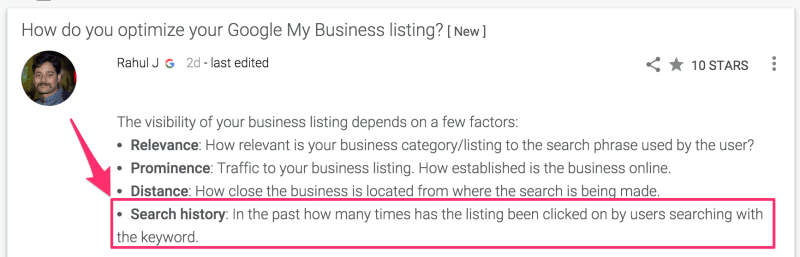
In late 2015, a Googler posted in the Google My Business help forums (Google My Business has since been renamed “Google Business Profile”) that one of the main types of factors they use for ranking local business listings is:
“Search history: In the past how many times has the listing been clicked on by users searching with the keyword.”
Naturally, this excited some commentary and attention. Google rapidly edited the part within a couple of days of its publication to remove the mention of clicks, restating it to read:
“Search history: The number of times it has been useful historically on the basis of relevance, prominence and distance.”
Interestingly, I was told by a Googler in the past that local listings used “listing engagement” as a ranking factor.
In Google Maps search results, or those same local listings embedded within regular keyword search results (Google pulls local search listings into the keyword search results under Universal Search for appropriate queries), the listing engagement factor is some combined metric of all interactions with local listings and not just limited to clicks on the link to the website.
It can include clicks to get Driving Directions, clicks to call the phone number, clicks to copy the address, clicks to share the listing, etc.
The Googler’s accidental disclosure of listing clicks as a ranking factor would seem to confirm what I was told about listing engagement.
As Barry Schwartz conjectured, the sequence of events implied that the Googler made a mistake about what he wrote or accidentally posted accurate information that Google does not want SEOs to know.
Google would not confirm or deny that clicks are a ranking factor. Again, while Google can and does cross-pollinate some methods from one vertical to another, the ranking factor post was very specifically about Maps and local search listings rankings and not about core rankings of webpages.
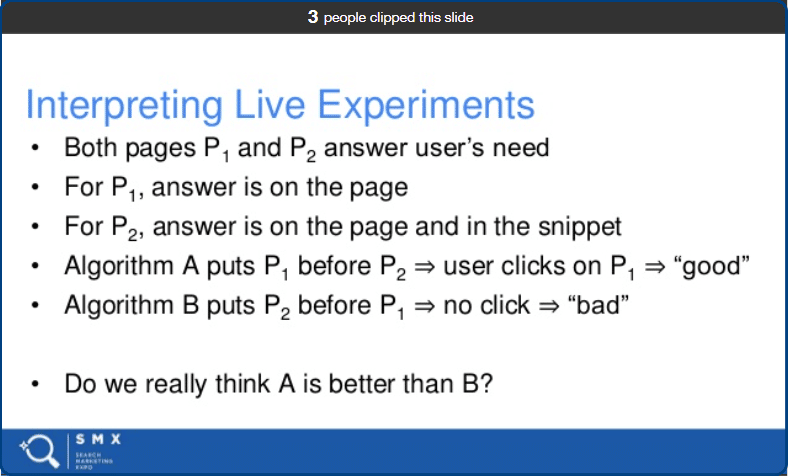
In the slideshow presentation, two of his slides spoke about using click statistics to evaluate changes to the algorithm.
One item they look at when they test algorithm updates is “changes in click patterns,” which in the presentation included the caveat, “Harder to understand than you might expect” (which Haar did not mention verbally).
It was clear that the click data, as he described it, was only used to evaluate changes to the algorithm versus being used as core ranking signals. But, some attendees used the click references in the presentation as proof positive that Google uses CTR for rankings.
“Rank Brain: Lots of people keep saying that part of the RB system includes UX signals, including Dwell Time, Bounce Rate, Click Through Rate etc. As I understood it, RB was about trying to fathom what results to serve for unrecognised searches. Can you please confirm/deny whether RB uses UX signals of any kind?”
Illyes answered:
“No. RankBrain is a PR-sexy machine learning ranking component that uses historical search data to predict what would a user most likely click on for a previously unseen query. It is a really cool piece of engineering that saved our butts countless times whenever traditional algos were like, e.g. “oh look a “not” in the query string! let’s ignore the hell out of it!”, but it’s generally just relying on (sometimes) months old data about what happened on the results page itself, not on the landing page. Dwell time, CTR, whatever Fishkin’s new theory is, those are generally made up crap. Search is much more simple than people think.”
Illyes displayed some clear irritation with Fishkin’s prior experiments/statements around CTR as a ranking factor in denying user experience (“UX”) signals as ranking factors.
The harsh mention directed at someone specific is very unusual in my experience with the typically polite, friendly and patient Googlers, so this denouncement attracted a lot of attention.
The vehemence, characterizing CTR as “made up crap,” and laying responsibility for CTR as a rank element theory at Fishkin’s feet seemed very oddly out of proportion – especially as you add the various other information around click-throughs-as-ranking-factors I have cited herein.
So, was Illyes’ irritation caused by having to answer questions about a bogus ranking factor repeatedly, or because Fishkin showed some real effects that called into question Google’s insistence that CTR does not affect core rankings?
2019
Moz’s then-Senior SEO Scientist Britney Muller pointed out Google Cloud documentation that implied that CTR was a ranking factor. The document said:
“When you click a link in Google Search, Google considers your click when ranking that search result in future queries.”
However, Barry Schwartz reminded everyone that this document appeared to quote from the 2009 blog post establishing that clicks were used in personalized search.
2020
At the U.S. House of Representatives Subcommittee Antitrust Hearing examining big tech companies, Google provided very interesting text about how it uses “long clicks” versus “short clicks” in determining whether:
Users who clicked through to ad links may have found value in the page associated with the ad.
Changes to the search results presentation of ads may have negatively impacted the quality of paid or organic content or increased the time it takes for users to click on the search results.
The text Google provided reads:
“Changes to the presentation of search ads are rigorously tested across a wide variety of metrics, including impact on users and advertisers. For example, a proposed change may lead to more “short clicks” (where users quickly hit the back button on their browser to return to the Google SERP) and fewer “long clicks” (where users stay on the advertiser’s landing page for a relatively long time, suggesting that they found the ad and corresponding website useful). Or, a proposed change may affect the amount of time it takes users to decide on what to click (known as “time to first click”) or adversely affect quality trade-offs between paid and organic content (known as “whole-page metrics”).”
The verbiage involving “short clicks” and “long clicks” is a description of bounce rate and dwell time for ads. The parenthetical aside about how long clicks can indicate the users found the ad and corresponding website useful seems a bit out of place within this text, which is otherwise a description of how Google assesses overall changes impacting the search results page.
What is interesting about this is that Google apparently finds bounce rate to be useful in some contexts. If useful for assessing an ad’s effectiveness, why not a search result listing?
But, it is also clear that this refers specifically to assessing the impact of overall search results presentation and/or algorithmic changes – it is not stating that it impacts rankings.
It is further notable that this is the very way that Google has stated it uses click-through data in search results – as a means of assessing the overall impact of changes to the search results.
In a Google Search Central video titled “Google and the SEO community: SEO Mythbusting,” Schwartz asked Google’s Martin Splitt about whether search engined used user data from Chrome and Android, mentioning how the Direct Hit search engine years ago had used click data for rankings and it got compromised by people clicking to manipulate the results.
Splitt responded:
“It is very noisy as a data source. It’s so noisy… when I say, ‘no we’re not using it for ranking,’ then I mean exactly that. And we might use it for A/B testing of different ways of presenting things in the front end, or we might be using it for I don’t know what. But, people tend to only hear the bits they want to hear, and then you get misrepresented, and then we have to clean up that rather than doing other good things for the community.”
“If CTR were what drove search rankings, the results would be all click-bait. I don’t see that happening.”
So, what is the takeaway after reviewing some of the most prominent Google mentions about CTR as a ranking factor over time? Definitively, is it, or isn’t it a ranking factor?
There really is no mystery about click-through rate as a ranking factor
Google has been pretty consistent across time in its communications about how it uses clicks in search results. Sometimes the language is ambiguous where it should not be. Other times, they’ve been uncoordinated in messaging around the topic.
Considering the company’s large size, relatively few employees know the specifics of the ranking system. Unsurprisingly, some flubs have occurred around this.
But, a large part of the issue has been caused by some degree of semantics and miscommunications about what people mean when they discuss “ranking factors.” It seems very clear in retrospect that when Googlers say that CTR is not a ranking factor, they mean it is not a “core ranking factor” applicable to all webpages.
This reminds me of how Google Maps / Google Local personnel used to state that “review rating scores are not a ranking factor.” But after some years, they moved away from that language.
The reason is that while business rating numbers do not help rankings of listings in general, there are search interfaces where users are allowed to filter the search results based on ratings – making it a de facto ranking factor in those instances.
Unfortunately, CTR appears to be in a similar category: It actually is a ranking factor in some limited contexts.
3 instances where click-throughs are likely ranking factors in Google
1. Personalized search
Google records your historical search keywords and the results listings you clicked upon.
This history of search can cause previously visited pages to rank higher in your search results for the same keyword next time. This one is confirmed by Google.
2. Recency and trending topics
Google can temporarily enhance rankings of listings when there has been a surge in searches and clicks to specific webpages. It ought to be noted that there is some likelihood that the clicks on listings alone are likely not the only signal incorporated, however.
Google may detect an increase of mentions in social media and other sources in tandem with the item. Research has indicated that a minimum threshold of searches and clicks must be reached before the ranking enhancement occurs. Also, there is some likelihood that the ranking benefit may evaporate after a while.
3. Local search and maps
Google slipped up when they disclosed this and then “corrected” their statement. However, the revised text did not remove the possibility they use listing engagement data – since the “number of times it has been useful historically” would only be assessed through usage of the listing.
User interactions with business listings verify searcher interest after seeing the listing in the search results.
Users can click upon several potential elements in local listings, including clicking to call, getting directions, saving the listing, sharing the listing, viewing photos, and more.
Using clicks in local/maps is likely less noisy, as the interfaces may be less prone to bot activity. It may not be feasible to have cheap labor conducting the engagement activities with contextual tech factors verifying real usage.
CTR data matters
The above are cases where Google apparently uses click-through data to affect rankings. They have confirmed the first instance, which can only affect individuals’ search results.
Various research cases, such as ones conducted by Fishkin, suggest the second instance also occurs, but it is also pretty limited in scope.
It would also explain some of the content rankings I have seen anecdotally in reputation management cases involving news articles or blog posts that rank against stronger materials. This is not entirely certain, because some of these items may be ranked due more to mentions, links and references via social media.
The third instance seems highly likely due to the sequence involved with the unintentional disclosure in Google Business Profile forums. It is also supported by some anecdotal evidence and industry analysis of usage data.
Compared to the broader rankings of all webpages, these three instances where clicks are likely incorporated are practically edge cases. Technically, these ranking processes do not comprise evidence of CTR as a core ranking factor.
I believe Google’s multiple personnel have consistently been forthright over time in representing that CTR is not a core ranking factor.
They do not use it generally to determine rankings of webpages, but they do use it in aggregate to assess the impact of changes made to the search results – either changes to the user interface of the results or the overall rankings.
Google’s overall guidance on this has been pretty consistent over time in denying CTR as a core ranking factor.
Inconsistency in terminology confuses the question of CTR as a ‘ranking factor’
There has been inconsistency in definitions when talking about this. The fact that CTR affects rankings of pages under personalized search means that CTR is indeed a “ranking factor,” period, full-stop.
It is a game of semantics to say that it affects some personalized rankings, but it is not a ranking factor. Several of Google’s ranking factors are contextual or specific to particular topics or search verticals.
Google’s algorithm is also a hybrid of multiple algorithms. For instance, for local searches, some Maps listing rankings are replicated in the keyword search results. For current event topics, some News rankings get embedded in the keyword search results.
The likelihood is that ranking factors, the weighting of them, and ranking assessment algorithms are becoming more individualized by types of queries over time – and this is likely to continue.
Google has chosen not to use CTR as a core ranking factor because it is prone to manipulation through bots and cheap labor.
They have called the signal too “noisy” because of this, and perhaps also because users click in and out of pages at many speeds and for many reasons.
But, Googlers have said it was “noisy” for at least 14 years, which now seems odd.
The company that has so effectively fought webspam is unable to filter out artificial click influence?
A top black hat SEO wizard confided in me a few years ago that he had discontinued doing black hat work because it had just gotten so progressively hard that he sought a different means of income. So, Google is not an easy target for artificial manipulation. At this point, black hat SEO is unstable.
Google polices its ad clicks for exactly this type of fraudulent manipulation. So, the “noisy” excuse seems a bit worn out, doesn’t it?
However, I believe Matt Cutts, Gary Illyes, John Mueller and Martin Splitt when they say that Google does not use it as a core ranking signal.
Mueller is also believable in that Google would not want page titles to become terribly click-baity as a reaction to a disclosure that CTR could improve rankings.
The signal is “noisy,” not just due to potential artificial manipulation – it is also noisy because people click in and out of search results listings in varying patterns.
If a user clicks on five listings in the SERP before choosing one, what is the takeaway?
Google has determined that the signal is too blurry to be beneficial except in some specific cases.
Some will never be persuaded that CTR is not a core ranking factor in Google. It will always correlate to a large degree with rankings, which will be misconstrued as cause as much as effect.
But, all the former and current Googlers I have known have been honest and have given good advice. Why disbelieve so many of them?
Attempting to manipulate CTR to gain rankings is contraindicated. The three instances where CTR likely affects rankings are not terribly good targets for trying manipulation.
Where personalization is concerned, CTR only affects rankings for the person who clicked on the listing.
Where recency or trending topics are concerned, it is highly likely that other signals would need to be included in the mix, such as freshness of the content and social media buzz. The buzz and engagement would likely need to be continued to maintain the ranking, plus there could be a time limit for how long the effect lasts, too.
In the case of Local/Maps listing rankings, it will not be easy to game – can a bot request driving directions and geospatially follow them to the location? The clicks used are not isolated signals in a vacuum – there are ancillary activities that go along with them which may be assessed in conjunction with the click.
Will a bot access the listing through the mobile app or make a phone call? In general, cheap labor paid to click on search results may often be foreign, and Google detects foreign users, proxied IP addresses, and artificial usage patterns.
I think Google should probably change its standard messaging around CTR at this point. They ought to make an official document on the various ways it uses click-throughs in search results as its definitive guidance on the matter.
It may be that more transparent disclosure might reduce artificial influence attempts. Google could acknowledge that it affects personalized search and potentially contributes to recent/trending topics and Maps listings.
Opinions expressed in this article are those of the guest author and not necessarily Search Engine Land. Staff authors are listed here.
How AI-generated images can streamline your SEO game with DALL-E 2
30-second summary:
SEOs are always on the lookout for innovative technology that can help them amplify content creation effectively
One such innovation that is on the cusp of being the next big thing in SEO and content creation is OpenAI’s DALL-E 2
What is it, how does it work, and how can SEOs use it (or at least start experimenting with it)?
Have you ever wanted to feel like Salvador Dali? Maybe even create a small cute robot that could look like WALL-E? Your dreams very well might come true with the recent development of the technology behind AI. If that sounds interesting, let’s dive a bit deeper into this topic. Let’s talk about DALL-E 2.
Ok Google, what does AI Do?
Artificial intelligence (AI) aims to create unique algorithms that can behave like people in specific situations – recognize human speech and various objects, write and read texts, and the like. This technology is already far ahead of human capabilities in many spheres involving data processing. Until recently, AI was encroaching mainly on the fields that are linked with technical tasks – predictive analytics, robotization, image, and speech recognition. Today AI surpasses people by40 percent on trivia.
But can AI also take on creative functions? It seems this is the last field to be mastered by neural networks. Art is a complicated combination of skill, creativity, and aesthetic taste, which all are very human elements. However, in April 2022, the OpenAI group proved otherwise by releasing a powerful text-to-image convertor, DALLE – 2, that can transform any text caption into a visual presentation that has never existed before. Its most winning feature is that the tool can precisely and logically convey relationships between objects it displays.
What is DALLE-2?
This neural network was created by OpenAI. Originally, it was GPT-2, a technology thatcould work with languages – answer questions, complete text, analyze content, and make conclusions. It was improved to GPT-3 – its capabilities expanded beyond textual information and enabled it to work with the images.
Already in January 2021, this technology was followed by its new mind-blowing version that could build a connection between text and images. This neural network was called DALLE. The most remarkable thing is that it can come up not only with objects known to us but also produce completely new combinations, creating objects that do not exist in nature. In simple words, DALLE is a transformer consisting of the decoder, which processes a sequence of 1280 tokens. These are 256 text tokens and 1024 image part tokens. The algorithm treats image regions in the same way as words in a text and generates new images identically to how GPT-3 generates new text. In 2022, the project was scaled to DALLE-2. The improved version creates an image just from a text prompt.
How does DALLE-2 work?
It is not the first attempt to create a text-to-image generation system. However, the capabilities of DALLE-2 are much broader. This neural network can effectively link textual and visual abstractions and provide a true-to-life image. How does the system know how a particular object is interacting with the environment? The algorithm is quite difficult to be explained in detail. Still, roughly it consists of several stages and uses other OpenAI models – CLIP (Contrastive Language-Image Pre-training) and GLIDE (Guided Language-to-Image Diffusion for Generation and Editing).
Mapping the image description to its space presentation via the CLIP text encoder. CLIP is trained on hundreds of millions of images and their associated captions, figuring out how a particular piece of text relates to an image. The model does not predict the caption but learns how it is related to the image. This comparative approach allows establishing the relationship between textual and visual representations of the same abstract object. This stage is critical to the creation of images by the neural network.
Encoding the CLIP-learned image. The next task is to create the image, the details of which have been suggested by CLIP. Now, DALLE-2 uses a modified version of another OpenAI model, GLIDE, to create this image. It is based on a diffusion model – data is generated by reversing the process of gradual image noise. The learning process is supplemented with additional textual information, which ultimately leads to the creation of more accurate images.
Based on the above, DALL-E 2 can generate semantically consistent images that naturally fit any object in the surrounding space.
DALLE-2 for SEO
The vast potential of AI image generation immediately attracted the attention of SEO specialists. They spend a lot of time finding appropriate pictures to support their text content. However, it becomes increasingly difficult to invent something that is not just copied and stitched together from the web. So DALLE-2 can become a great source of a never-ending flow of wholly unique and non-standard images. Interestingly, users will have exclusive rights to use the images they create, including for commercial use.
How it can help SEO
Nowadays, website and content promotion are not possible without attractive visuals. Images add more value to your SEO efforts – your site wins more user engagement and accessibility. But sourcing enough appropriate pictures has always been a headache. DALLE-2 can solve this task with ease. You just need to print a descriptive prompt of your future image, and AI will come up with a result. The text should not exceed 400 characters. But users should be ready to train a little to create explicit requests. It is highly advisable to studyPrompt Book and master the basics to avoid weird results. You will learn the most valuable tips on how to get the most out of this fantastic image generator.
If you’d like to further automate your image creation process this tool will allow you to generate a prompt that can be used on DALLE-2.
Use cases (blog posts, product images, designs, digital art, thumbnails)
AI algorithms were already used in SEO before for naming objects on the images and creating descriptions for them based on data. With DALLE-2, this process is flipped around, and now you can generate images based on text prompts. No matter whether you are running an online blog or a store – you need lots of visuals to attract new customers and followers. And DALLE-2 can successfully be integrated into any project where you need image supplements – create illustrations for your blog posts, product descriptions, design sketches, and much more. Moreover, you can further modify already created images.
You can already see some successful use cases of DALLE-2.
Blog thumbnail optimization. TheDeephaven blog thumbnails have been replaced by images fully generated by DALLE-2. It took a couple of minutes and several prompts per image to get the desired result. However, it is a significant time saving compared to what would have been spent on the search for stock images. A nice bonus is that DALLE-2-generated images are fully unique and memorable.
Design development. DALLE-2 can become an efficient tool in thedesign field. And it looks like its capabilities are endless. For example, a picture of the existing garden was taken, and a rectangular swimming pool was applied to it via DALLE-2. It helps the client envision how it might look in reality.
For more use cases and live community discussions join r/dalle.
Currently, users are just experimenting with DALLE-2, but there is no doubt it will be soon actively applied in business, architecture, fashion, and other spheres.
Examples of DALL-E 2
DALL-E 2 is launched in beta version with a credit-based model open to 100,000 users. Another million applicants are waiting for approval to test this AI product. Some users have already shared their first experience with the converter, and the results are impressive. DALL-E 2 processes the craziest requests and offers its interpretation. Here are a few examples:
A sad beaver in the sweater sitting in front of the screen and thinking about apples 😅
DALL-E 2 is a revolutionary text-to-image converter today. It will help you instantly generate a variety of unique images with only a short text prompt in failry shorter time spans than you would spend on photo stock sites. This technology is an absolute game changer and can rearrange a lot of things in SEO in the coming years. Yet, more live testing is still needed to benefit from DALL-E 2 to the fullest.
Dima Makei is Head of SEO at Omnicom Media Group. He is also passionate about teaching and has previously served as a Marketing Professor at Seneca College. Find him on Twitter @dima_makei.
Subscribe to the Search Engine Watch newsletter for insights on SEO, the search landscape, search marketing, digital marketing, leadership, podcasts, and more.
How to define SERP intent and ‘source type’ for better analysis
SERP analysis coupled with your keyword research is a staple of any modern SEO campaign.
Analyzing search intent is already a process within this. But when it comes to SERP analysis, all too often I see reports that stop at classifying a result by its intent – and that’s it.
We know that for queries with multiple common interpretations, Google works to provide a diversified results page with differentiations often being:
Result intent (commercial, informational).
Business type (national result, local result).
Aggregators and comparison sites.
Page type (static or blog).
And then when planning content we might develop a strategy based on Google ranking some informational pieces on Page 1, so we’ll create informational pieces too.
We may also use a tool to “aggregate” metrics on the first page and create artificial keyword difficulty scores.
This is where this strategy falls down, and in my opinion, will continue to show diminishing returns in the future.
This is because the majority of these analysis pieces don’t acknowledge or take into account source type. I personally believe that this is because the Search Quality Rater Guidelines that have led to E-A-T, YMYL, and page quality becoming a major part of our day-to-day workings don’t actually use the term source type, but it does talk about assessing and analyzing sources for things like misinformation or bias.
When we start to look at source types, we also need to look at and understand the concepts of quality thresholds and topical authority.
I’ve talked about quality thresholds, and how they relate to indexing in previous articles I’ve written for Search Engine Land:
But when we relate this to SERP analysis, we can understand how and why Google is choosing the websites and elements it is to form the results page and also achieve an idea of how viable it may be to effectively rank for certain queries.
Having a better understanding of ranking viability helps with forecasting potential traffic opportunities and then estimating leads/revenue based on how your site converts.
Get the daily newsletter search marketers rely on.
Defining source types
Defining source types means going deeper than just classifying the ranking website as informational or commercial, as Google also goes deeper.
This is because Google compares websites based on their type, and not just the content being produced. This is particularly prevalent in search results pages for queries that can have a mixed intent and returns results of both commercial and informational intent.
If we look at the query [rotating proxy manager] we can see this in practice in the top 5 results:
#
Result Website
Intent Classification
Source Type Classification
1
Oxylabs
Commercial
Commercial, Lead Generation
2
Zyte
Commercial
Commercial, Lead Generation
3
Geek Flare
Informational
Informational, Commercial Neutral
4
Node Pleases Me
Informational
Open Source Code, Non-Commercial
5
Scraper API
Informational
Informational, Commercial Bias
Quality thresholds are determined by the website’s identity, general domain type (not just the blog subdomain or subfolder) and then context.
When Google retrieves information to compile a search results page, it will compare websites being retrieved first based on their source type group first. So in the example SERP, Oxylabs and Zyte will be compared first against each other, before the other source types elected for inclusion or that rank highest based on weighting and annotation.
The SERP is then formed based on these retrieved rankings and then overlaid with user data, SERP features, etc.
At face value, by understanding the source types that Google is choosing to display (and where they rank) for specific queries we can know whether they are viable search terms to target given your source type.
This is also common in SERPs for [x alternative] queries where the business may want to rank for competitor + alternative compounds.
For example, if we look at the top 10 blue link results for [pardot alternatives]:
#
Result Website
Intent Classification
Source Type Classification
1
G2
Informational
Informational, Non-Commercial Bias
2
Trust Radius
Informational
Informational, Non-Commercial Bias
3
The Ascent
Informational
Informational, Non-Commercial Bias
4
Capterra (Blog)
Informational
Informational, Non-Commercial Bias
5
Jotform
Informational
Informational, Non-Commercial Bias
6
Finances Online
Informational
Informational, Non-Commercial Bias
7
Gartner
Informational
Informational, Non-Commercial Bias
8
GetApp
Informational
Informational, Non-Commercial Bias
9
Demodia
Informational
Informational, Non-Commercial Bias
10
Software Suggest
Informational
Informational, Non-Commercial Bias
So if you are Freshmarketer or ActiveCampaign, while the business may see this as a relevant search term to target, and it aligns with your product positioning, as a commercial source type you’re unlikely to gain Page 1 traction.
This doesn’t mean to say that having the messaging, and comparison pages on your website are not important pieces of content for user education and conversion.
Different source types have different quality thresholds
Another important distinction to make is that different source types have different thresholds.
This is why third-party tools that produce keyword difficulty scores based on a metric such as backlinks for all results on Page 1 have issues, as not all source types on the majority of SERPs are judged in the same way.
This means that in order to ascertain the “benchmark” for what it will take your website and content to get into a traffic-driving position, you need to compare against other websites with the same source types, and then the type of content that they’re ranking with.
Topic clusters and frequency
Establishing good topic clusters and having easy-to-follow information trees allow search engines to understand your website source type and “usefulness depth” with greater ease.
This is also why, in my opinion, for a number of queries in the same space (e.g., tech), you are likely to see websites akin to G2 and Capterra frequently for a broad range of queries.
A search engine can have a greater level of confidence in returning these websites in the SERPs, regardless of the software/tech type, as these websites have:
High publishing frequencies.
A logical information tree.
Developed a strong reputation for helpful, accurate information
When developing webpages within the topic clusters, aside from semantics and good keyword research, it’s also important to understand the basics of natural language interfaces, particularly the Stanford Natural Language Inference (SNLI) corpus.
The basics of this are that you need to test the hypothesis against the text, and the conclusion is either that the text entails, contradicts, or is neutral against the hypothesis.
For a search engine, if the webpage contradicts the hypothesis, then it will have low value and shouldn’t be retrieved or ranked. Whereas if the webpage entails, or is neutral against the query, then it can be considered for ranking to both provide the answer and potential non-bias perspective (depending on the query).
We do this to an extent through content hubs/content clusters that have become more popular in the past five years as ways of demonstrating E-A-T and creating linkable, high-authority assets for non-brand search terms.
This is achieved through good information architecture on the website, and being concise in our topical clusters and internal linking, making it easier for search engines, at scale, to digest.
Understand source types to inform your SEO strategy
By better understanding the source types ranking most prominently for the target search queries, we can produce better strategies and forecasting that yield more immediate results.
This is a better option instead of driving toward search terms that we’re simply not appropriate for and won’t likely see a return in traffic against the resource investment.
Opinions expressed in this article are those of the guest author and not necessarily Search Engine Land. Staff authors are listed here.
New on Search Engine Land
About The Author
Dan Taylor is head of technical SEO at SALT.agency, a UK-based technical SEO specialist and winner of the 2022 Queens Award. Dan works with and oversees a team working with companies ranging from technology and SaaS companies to enterprise e-commerce.
4 dos and don’ts of a digital marketing apprenticeship
Internships are a staple of early-day careers. Most companies will expect new hires to have some sort of internship experience after graduating college. For the most part, internships do a good job of taking care of college students and entry-level working professionals.
Digital marketing isn’t always an obvious career choice for those who are not in the conventional time in their careers for internships. Setting up budding marketers at different stages in life requires a bit more of a dynamic approach than “for credit” internships.
Apprenticeships need to be structured in a way that honors the experience the new digital marketer has from other professional and life experiences, while still ensuring they get the foundations right.
Here are the dos and don’ts of structuring a digital marketing apprenticeship to ensure you and your apprentice get the most out of working together.
1. Do compensate your apprentice for their time
Internships allow companies to “pay” for work in class credit. This enables brands who otherwise could not afford to take on budding digital marketers.
Adults in the working world typically can’t use college credits.
It’s also unreasonable to ask anyone to work for free. This includes investing the time to learn the craft. Coming up with a stipend of any size (even as little as $500 per month) can go a long way in:
Building confidence in your apprentice that they are worthy and they can build a career in digital marketing. Knowing you are earning from day one can help new practitioners push through the initial learning hump.
Cultivating loyalty between the apprentice and the brand. One of the biggest “risks” of new hires is investing the time into someone who leaves in under a year. Starting your working relationship off by honoring their time and skills goes a long way in building trust that you will do right by your hire.
Structuring compensation for marketing tasks can take many different forms. Whether you go with an hourly rate or a flat rate, it’s important that the rate doesn’t’ cause an operational burden.
For example, when I work with an apprentice, I sell their services specifically. The client knows they are getting someone learning, and they also get discounted access to an expert strategist.
If you work in-house, break down the tasks that your team currently are working on by hourly cost. An established member of the team will be more expensive to assign “grunt work” tasks. Freeing up 5-10 hours per week at a more expensive rate will help bottom line margins, while also facilitating a new marketer to get hands-on experience.
2. Don’t set unrealistic timelines for your apprentice
Just as it’s important to compensate your apprentice for their work, it’s also important to pace their learning and working timelines.
Gaining mastery of anything requires 10,000 hours and assigned tasks should support the learning process, not create opportunities to fail.
When an apprentice is first learning, empower them to do tasks that follow up on any certifications you might have them take. It’s easy to forget the learning curve of jargon and developing efficient workflows in tools. Set them up with tasks that give them opportunities to learn in the way they learn best.
Let the first week be about learning and getting comfortable in whatever part of digital marketing you’re structuring the apprenticeship around. Honor whether your apprentice does better learning by doing, reading, listening, or watching.
Get the daily newsletter search marketers rely on.
3. Do allow for two-way candid feedback on progress
We all want to do well and getting words of affirmation can be really helpful in overcoming imposter syndrome. That said if an apprentice is struggling, telling them they’re doing well when they’re not will create a shaky foundation.
Be transparent with your apprentice about the milestones you expect them to hit and how they’re pacing against your expectations.
When working with an apprentice who is falling a little short, ask questions about how the process could serve them better. When I was first setting up internships and apprenticeships, I struggled to pace the amount of knowledge I’d attempt to impart and actually shut down their confidence. They took longer to get into the workflows than they would have had I allowed them to dictate the learning pace.
4. Don’t accept anyone as an apprentice
It’s important to remember that apprentice programs need to serve the brand just as much as they serve the apprentice. The criteria you look for in new hires should extend to your apprentice.
Digital marketing requires certain core skills to succeed:
Analytical thinking: Being able to dig into the why behind the how.
Empathy: Understanding why people do and think a certain way and being able to adapt to those subtleties.
Communication: Being able to articulate what is happening and empower stakeholders to buy into your strategy.
Creativity is needed, but not as mandatory in an apprentice. By removing the pressure to come up with creative, you will allow your apprentice to organically cultivate that skill as they work with the more technical skills.
If you take on an apprentice with none of the core skills, it invites friction. When I look for apprentices I look for folks who demonstrate the skills I value in unconventional ways. For example, many of my most successful apprentices play MMO video games (which require a lot of data analysis and team development). It also helps that there’s a shared personal interest, so the manager relationship is friendlier and more accessible.
Takeaways
Apprentice programs can be powerful ways of doing well by doing good.
Going the apprentice road vs. the conventional hire will require extra investment from you to set them up for success. However, the long-term benefits of cultivating an apprentice can ensure you have a team member just as invested in your success as you are.
Finding a good apprentice requires you to know what you want and be open to finding them in unconventional places. It’s rewarding to see them light up as they gain mastery, and their work will be a source of pride.
Opinions expressed in this article are those of the guest author and not necessarily Search Engine Land. Staff authors are listed here.
New on Search Engine Land
About The Author
A veteran of the digital marketing industry and “Top 25 PPC Expert,” she began as an SEO in 2008, transitioning to PPC in 2012. She manages the strategy and execution of paid media campaigns, as well as helping brands build relationships with profitable partners and customers. Throughout her career, Navah makes a point to give back and loves sharing lessons learned on the international speaking circuit as well as local universities. She is a frequent contributor to several publications and in 2019, she became a founding member of the Paid Search Association.
Google’s September 2022 core update hit fast but was less significant than previous updates
On September 12, Google began rolling out its second broad core algorithm update this year – the September 2022 core update. We are now several days into the update, and Google has decided to roll out another algorithm update before it is complete – the September 2022 product reviews update.
So we felt it was safe to look at the impact of the September 2022 core update at this time, as the September 2022 product reviews update is now rolling out. As a reminder, the September 2022 core update is not officially done rolling out yet.
Data providers on the September 2022 core update
So far, we have data from a few data providers, and the data seems to pretty much agree across them all. Both Semrush and RankRanger show that the September 2022 core update hit fast but was not as impactful as the previous core update, the May 2022 core update which we reported was fast and significant.
Semrush. Semrush data showed that the September 2022 core update hit pretty quickly after the announcement. In terms of its volatility tracker, as shown below (or you can view live at the Semrush Sensor tool). You can see, the sensor noticed a pick up in volatility on the 12 of September, which carried on through the 13th and started to dip down on the 14th.
Mordy Oberstein, Semrush Communication Advisor, told us “this update was far weaker overall than the May update which was weaker than the November update,” overall he said. He showed this chart comparing the updates:
With the September 2022 core update, Semrush noticed rank volatility increases relative to pre-update volatility fall off 53% as compared to the May 2022 Core Update. “For context, the November 2021 Core Update increases in rank volatility were 19% more drastic than the May 2022 Core Update. In other words, May was already significantly weaker than the update that preceded it and the September 2022 Core Update has been significantly weaker overall than that,” Mordy explained.
Here is a chart showing the difference by niche:
And if you just look at the “peak” data from Semrush, the September update looks much weaker than the May update:
During this update, about 15% of the top twenty results consisted of URLs that were previously ranking in the top twenty positions. If you compare that to just over 17% and just over 16% during the May 2022 Core Update and November 2021 Core Updates respectively.
RankRanger. The RankRanger team also analyzed the Google search results after this September 2022 core update rollout and you can see how quickly their tool also picked it up (you can also see this live at the Rank Risk Index tool). RankRanger said the September 2022 core update resulted in “high levels of fluctuations.” You can see they also noticed the spike on September 13th, the day after the update was announced.
RankRanger noticed similar volatility between the September and May updates but said when you dig into the the top 3, top 5, and top 10 positions, you can see the September update showed fractionally less rank volatility than the May update.
This chart shows by month the average position change in Google Search:
This chart shows a comparison between the two updates:
Then RankRanger dug into each vertical to see the volatility by niche or vertical.
Now that RankRanger is owned by Similarweb, they have Similarweb data to show top winners and losers as well:
Moz. Moz publishes its Mozcast data that also showed also a spike on the day after the announcement, the 13th:
Dr. Pete Myers from Moz told us “there was moderately high volatility the first couple of days, but much like the helpful content update, no clear peak and that volatility is barely above 30-day averages right now.”
SISTRIX. SISTRIX, another data provider that tracks the changes in the Google search results, sent their top 20 winners and losers for the September 2022 core update. These are U.S.-based sites from Sistrix’s data set.
More on the May 2022 core update
The SEO community. The September 2022 core update was significant but not so much as the previous May 2022 core update. I covered the community reaction in one blog post on Search Engine Roundtable early on. It includes some of the early chatter, ranking charts and social shares from some SEOs.
On Twitter you can find plenty of examples of SEOs sharing charts from their clients – mostly showing winners but also showing losers – with this update.
What to do if you are hit. Google has given advice on what to consider if you are negatively impacted by a core update in the past. There aren’t specific actions to take to recover, and in fact, a negative rankings impact may not signal anything is wrong with your pages. However, Google has offered a list of questions to consider if your site is hit by a core update. Google did say you can see a bit of a recovery between core updates but the biggest change you would see would be after another core update.
Why we care. It is often hard to isolate what you need to do to reverse any algorithmic hit your site may have seen. When it comes to Google core updates, it is even harder to do so. What this data and previous experience and advice has shown us is that these core updates are broad, wide and cover a lot of overall quality issues. The data above has reinforced this to be true. So, if your site was hit by a core update, it is often recommended to step back from it all, take a wider view of your overall website and see what you can do to improve the site overall.
Hopefully, your company and your clients did well with this update.
Barry Schwartz a Contributing Editor to Search Engine Land and a member of the programming team for SMX events. He owns RustyBrick, a NY based web consulting firm. He also runs Search Engine Roundtable, a popular search blog on very advanced SEM topics. Barry can be followed on Twitter here.
Sales always has a voice. Revenues have to grow, and anything else is a failure.
But now, many companies have a near-death experience because the sales landscape has radically changed.
Years ago, a salesperson had a valuable Rolodex. The salesperson nurtured the relationships it represented with calls, visits and likely more. They met up at conferences, happy hours and golf outings. The biggest clients would even get invited to company parties and perhaps retreats.
Of course, the Rolodex has evolved into CRMs and the like. But now, it’s just not as useful. The value of a salesperson’s list of names is fundamentally gone.
What changed?
The COVID-19 pandemic suddenly forced salespeople to shift their behavior. They could not meet with clients in person anymore. They found that clients working remotely no longer have a receptionist who can personally hand them a message.
The names they carefully gathered no longer answer their phones. But people respond to email and voicemail messages infrequently.
Reaching someone is basically a game of tag until they quit or surrender.
As a result, relationships have often come to a screeching halt.
Sales networking just isn’t as valuable as it once was.
So a salesperson who used to depend on relationships, meetings, conferences and calls is suffering. And where salespeople still have a loud voice, that voice is now grumbling. The lead sources have dried up and their income is taking a beating.
Who’s to blame?
If sales can’t meet their numbers, everyone in the company is impacted. So Management looks to Sales and demands an explanation.
Of course, it is Marketing’s fault. Their job is to provide leads.
Or it’s Management’s fault. The company should have seen it coming.
Sales executives should have known that their outside sales force was going to suffer, and the company should have invested more heavily in digital lead management. They should have had a survival plan to target new prospects. They should have taken their website to new heights instead of relying on something about to die.
Most salespeople cannot spell SEO or PPC. They have never written content. So regarding the company website, they often have a “build it and they will come” expectation (after all, the internet is free, right?).
In their defense, for a long time, an outside sales force could be relied upon to grow revenues. The sales processes got results. Therefore, the “if it isn’t broken then don’t fix it” approach to marketing used to work.
They simply did not know.
So, surprise – your outside sales team is no longer effective.
They may be going to conferences, but attendance at events is still down by 75%. And the prospects who do attend are not decision-makers.
They may still be calling their (now old) contacts. More likely than not, these people have changed jobs. In any case, the contacts do not answer their calls.
Reaching out to former client companies doesn’t pan out either. The next regime has no idea who you are and certainly has no brand loyalty.
And so the business is suffering.
Get the daily newsletter search marketers rely on.
What to do?
How do you solve the drying up of sales? The answer will vary. Or in the mantra of SEO, “It depends.”
Somehow you need to generate leads for your sales team. This takes sharpshooter precision, and you have many options depending on your budget.
You can buy ads (PPC) and maybe earn some quick wins.
You can buy into the “flood the web with content” approach, with or without a boost from influencers (it may not help, but hey, you have to do something).
You could buy links (but steer clear of this – it’s the kiss of death). You could accept placed-elsewhere content as sold by snake oil SEOs.
Or you can decide that your survival depends upon doing it right.
The most valuable salesperson
So far, it is clear that the world is slow to recover from the impacts of the last few years. The remote work paradigm is not going away, and sales must adapt. Change is needed.
It is also clear that a cheap solution is money wasted. And in some industries, the outside salesperson is doomed if you cannot provide leads.
In today’s sales reality, your company website is your most important salesperson.
Do SEO as if your survival depends upon it.
And whatever you do, do not hire the cheapest solution, thinking there is no difference. There is a difference if you want to rank on the first page out of 10 million competitors for any keyword that matters.
Here is my favorite analogy for generating leads:If you want to catch fish, you must use the bait the fish are biting and fish where the fish are. In practical terms:
Define the ideal fish – a suitable large-fish client, not always a whale.
Find a desired outcome that the ideal fish has been looking to solve.
Build a program that delivers those specific results for that ideal fish.
Find out where the ideal fish are hanging out and put an offer in front of them.
Convert the fish with a pressure-free, trusted expertise sales approach
Sounds simple, right?
What is simple is not always easy. An expert SEO consulting services company may be needed to help you get that message to a lot of fish.
Then target others, rinse and repeat.
Bottom line, if you find that your leads are diminishing, it is likely because your website traffic is suffering. And that is best addressed with SEO.
Opinions expressed in this article are those of the guest author and not necessarily Search Engine Land. Staff authors are listed here.
New on Search Engine Land
About The Author
Bruce Clay is the founder and president of Bruce Clay Inc., a global digital marketing optimization firm providing search engine optimization, PPC management, paid social media marketing, SEO-friendly site architecture, content development, and SEO tools and education.
Clay authored the book “Search Engine Optimization All-In-One For Dummies,” now in its fourth edition, and “Content Marketing Strategies for Professionals.” He wrote the first webpage-analysis tool, created the Search Engine Relationship Chart® and is credited with being the first to use the term search engine optimization. Bruce Clay’s renowned SEO training course is available online at SEOtraining.com.
SEM career playbook: Overview of a growing industry
Digital marketing is a great career field. For more than two decades, digital marketing has been a growing field where individuals can thrive and build impressive careers.
The industry is always changing. But one thing that won’t change is that companies will continue to need smart people to manage their digital marketing initiatives.
U.S. digital ad spending will continue to grow over the next five years, according to eMarketer research. By 2025, U.S. digital ad spending should reach approximately $315 billion. The rate of change is predicted to slow over the coming years, but the digital marketing industry should continue to provide a wide array of career opportunities.
A recent study by the Bureau of Labor Statistics shows similar trends. Their report does not mention digital marketing specifically, but that data is included in this general report.
According to their 2021 data:
“Overall employment of advertising, promotions, and marketing managers is projected to grow 10 percent from 2021 to 2031, faster than the average for all occupations. About 35,300 openings for advertising, promotions, and marketing managers are projected each year, on average, over the decade.”
The economy is on shaky ground right now. A recession seems to be looming, but no one knows exactly what will happen.
Such opportunities can lead you to a small or large agency, an in-house team, your own shop as an individual contractor, and the list goes on. Throughout a career in this field, you will likely find yourself in various roles for a number of organizations.
The career path of someone in search engine marketing (SEM) will likely move from junior to senior roles.
Let’s explore how many of these roles are structured and how your SEM career might take shape. Your path is unique, but these are guidelines for the industry right now.
Entry-level/junior SEM roles
Most people will start their career in any field with an entry-level position. The same goes for the digital marketing industry. Many folks will land their first job out of college with a digital agency or in-house with a marketing team.
Also, individuals move into digital marketing from other departments within an organization as well. For example, moving from product development/management to digital marketing.
These roles often do not require an extensive amount of experience with digital marketing. Most employers will not expect a great deal of experience but they will be looking for individuals with:
A drive to excel.
An aptitude to learn.
A strong ability to communicate.
The expected duration in each role will depend on where you work.
Some employers promote people faster than others. More aggressive progression is positive if you want to move quickly between roles.
However, if you move too quickly, you will not have time to develop and master the skills that will build toward your next role. On average, individuals will serve in entry-level roles for 12-18 months before being promoted.
Tasks and responsibilities
The tasks entry/junior level team members complete often focus on supporting more senior members of the team. These duties include:
Creating reports.
Conducting QA checks.
Building SEM campaigns.
Monitoring account performance.
Attending training sessions and acquiring certifications.
Taking meeting notes.
Other foundational tasks.
Titles and roles
There are an endless number of potential titles within the SEM field for each step along your digital marketing career journey.
There is usually a channel signifier within the title, such as:
Digital
Search
Social
SEO
Display
Paid search
Paid social
Programmatic
The second component of titles is the role/seniority. For entry-level roles, you can expect titles like:
Associate
Specialist
Coordinator
Strategist
Assistant
Get the daily newsletter search marketers rely on.
Experienced SEM roles
On average, once someone has 18-24 months of experience in SEM and digital marketing, they are ready to transition to a more experienced role.
Similar to many other industries, just because you may have gained experience and even gotten a promotion, that doesn’t mean you won’t be responsible for certain entry level-tasks.
A more experienced role within a company will start to contribute to relationships inside and outside the company. Individuals with more experience often help train and oversee junior team members. This doesn’t mean experienced individuals manage entry-level positions – a responsibility usually reserved for the next level of career progression.
Again, the duration of these experienced roles will vary per company. On average, you can expect to be in a similar position for approximately 12-24 months.
I know most folks are pumped to move to the next level of their careers, but make sure to master every role you occupy before transitioning into the next role. Even though it is tempting to move more aggressively, be sure to build a strong foundation for your career during these critical fundamental times.
Tasks and responsibilities
When you are in a more experienced SEM role, you will take on more responsibility and ownership within your team, whether you are in an agency or in-house.
Experienced roles are often seen as experts at execution and QA within accounts. These are the folks who have been in the nitty-gritty with accounts and are ready to be seen as activation leaders. These duties include:
Account management
Large campaign builds
Meeting agenda management
Running partial or all client/internal meetings
Project management
Task delegation
Titles and roles
Similar to entry-level roles, there is a channel signifier as part of the title. Again, those signifiers could include:
Digital
Search
Social
SEO
Display
Paid search
Paid social
Programmatic
The second element of these titles will be position/seniority. You can expect to see titles such as:
Manager
Strategist
Partner
Senior SEM roles
Senior roles in SEM and digital marketing begin to own entire client engagements or in-house programs. Individuals in these roles guide:
Overall strategy.
Internal and external communication.
Client relationship building.
Budget planning.
Cross-channel management.
Complex attribution.
Team management.
Folks in these roles are seen as senior members of their media activation team.
With 3-4 years of experience, individuals in these roles often shift into team management as well. They often strike a balance between:
Account management.
Client communication.
Strategy development.
Management of a small team.
I think this is where position duration begins to vary much more significantly between companies. The duration of the senior SEM role could be 18-36 months. This sounds like a long time, but this is also when entirely new skills are acquired and mastered.
Tasks and responsibilities
Transitioning into a senior role in SEM is a difficult balancing act. Often, you still need to complete tasks from the two prior roles. This happens because you need to fill a junior position or you need to cover for someone who is out of the office.
However, you have management responsibilities as well. These responsibilities can include:
Cross-channel strategy.
Media planning.
Budget forecasting.
Owning internal/external communications.
Team management.
Driving methodology in media campaigns.
Titles and roles
Similar to the other positions, titles and roles can vary between companies. You can expect to see titles such as:
Senior manager
Lead
Director
Senior director
Leadership SEM roles
Leadership roles in SEM and digital marketing mean:
Managing a team of digital marketers.
Understanding macro-level trends within the industry.
Owning internal/external stakeholder relationships, staffing and resource planning.
Tasks and responsibilities
Leadership roles are higher-level and begin to focus on strategy and development. Individuals in these roles have to be able to see what the team needs in order to deliver excellent SEM results.
Communication is one of the most important elements of a leadership role. You need to be able to communicate with entire teams, clients, C-level executives, and individually with team members. Responsibilities in this could include:
High-level account strategy.
Setting objectives and KPIs.
Cross-channel media planning.
Budget planning and scenario forecasting.
Team management.
Team member development.
Staff planning and hiring decisions.
Mentoring junior team members.
Titles and roles
Leadership titles in SEM vary widely depending on each company.
Here are a few titles you should expect to see for these roles:
Director
Senior director
Executive
Vice president
Navigating your SEM career
We could not cover every potential role and title in the SEM industry. Hopefully, this gives you a framework for wherever you are in your career path.
In my next article, we’ll construct a plan to help you be an awesome SEM team member, learn as much as possible throughout your career, develop new skills along your journey and build an amazing career in SEM.
Opinions expressed in this article are those of the guest author and not necessarily Search Engine Land. Staff authors are listed here.
New on Search Engine Land
About The Author
Joseph Kerschbaum is Senior Vice President of Search & Growth Labs for 3Q Digital. During his 20 years of experience in digital marketing, Joseph has worked with businesses of every size from SMBs to enterprise-scale. Joseph has been a regular speaker at digital marketing conferences for over a decade. Joseph is co-author of the Wiley/Sybex book, “Pay-Per-Click SEM: One Hour a Day,” which was published in 2010. For the past four years, Joseph hosted a podcast, 3Q Digital Download, where he discussed digital marketing strategies with industry leaders.
By using a range of techniques to optimize your content, you can make it easier for both search engines and users to consume your written text
Taking the time to plan your content topics and conduct extensive keyword research can make a big impact when it comes to performance
You should always write for the user first, but you can still implement SEO best practices while doing so
Understand the role of accessibility in written content and the importance of providing as much contextual information as possible
Content optimization is essential because it helps users and search engines to easily understand your written text. In addition to this, there are a huge number of other advantages you can gain by optimizing content. You can increase engagement rates, obtain links, generate brand recognition, and appear as an expert in your field. All while improving your organic search rankings.
Sounds good, right?
Let’s find out how you can benefit from all this, and more, by effectively optimizing your content.
Think about your topic
Before you write content, you need to decide on the topic you’re going to cover. This might sound obvious, but it’s worth thinking about. Spending some extra time planning will help you to identify specific subjects and talking points you can discuss. This will help shape your keyword research, which plays a huge role in creating SEO-friendly content.
At this stage, it’s worth thinking about what you want to focus on. You want the topic to be broad enough that you can produce detailed content about it, but not so broad that you won’t be able to cover it all. It might be the case that you need to split the topic into multiple articles. Or if your topic is too vague, you may need to home in on something more specific.
Conduct detailed keyword research
Keyword research is and always has been an essential part of producing good content. It’s the basis for content production and making sure you’re ranking for relevant keywords that you have a good chance of competing for. When performing keyword research, you should be on the lookout for several different types of keywords.
Short-tail keywords
Also known as the head or main keyword, short-tail keywords are made up of a maximum of three words. These keywords will typically have large volumes, but because of this, they have high search difficulties and therefore are highly competitive.
Because these keywords have a broad search intent, they should be used alongside more precise keywords to make it clear to users and search engines exactly what your page is about.
Long-tail keywords
Long-tail keywords are terms made up of more than three keywords and are much more specific than short-tail keywords. These keywords generally have lower volumes, but they also have lower search difficulties, which means they are less competitive.
These keywords are important because they allow you to target a user’s exact search intent. A user who searches for the short-tail keyword ‘motorbike’ might be trying to buy a motorbike, find more information about a model or simply look at a picture of one.
A long tail variation of this search might be ‘Motorbike helmet with Bluetooth speakers’, which narrows down the user’s search intent to a very specific product.
LSI keywords
LSI (Latent Semantic Indexing) keywords are keywords that are loosely related to your head keyword. While these keywords are relevant to your main keyword and the overall topic, they’re not necessarily directly related.
Instead, they’re used thematically to build broader topical depth and make it clear to both search engines and users what the overarching topic of your content is. If your short-tail keyword is the trunk of a tree and your long-tail keywords are the branches, then the LSI keywords are the twigs.
LSI keywords branch out from the main keyword but are still relatable enough to provide additional context and information. These can be a bit trickier to find, but by using the suggested search feature in search engines, you can get your hands on them.
Local keywords
These keywords won’t always be relevant, but if you’re looking to boost your rankings for local terms, then including local keywords is essential.
Luckily, this is a lot easier than implementing other keywords. You simply add your location into your content along with your main keyword. But remember, don’t stuff in keywords for the sake of it! Try to mix it up, using different variations wherever possible.
People also ask (PAA) key phrases
Like the suggested search function, the people also ask feature is an excellent way to obtain relevant keywords and phrases. These are phrases that users have searched for before, so we know that they hold value and have good search volumes.
So, how can we use this to our advantage?
By creating content that targets these queries, you’ll be increasing your chances of appearing in Search Engine Results Pages for these terms.
And the best thing is, these questions are often different to the main keywords you would normally target. This means your content will be more varied and unique and will specifically target pain points that your audience is looking for.
Always write for the user first
People skim content more than ever these days, so it’s important to keep it short, snappy, and engaging. The days of writing solely for search engines are long gone, and Google’s recent helpful content update has really cemented this.
This update emphasizes the importance of writing for the user first. Your focus should be on creating engaging, informative and easy-to-digest content. You can always go through your work afterward and make tweaks and edits to optimize for SEO best practice.
Just be careful not to make it too robotic as search engines can spot keyword stuffing from a mile away! Keep it free-flowing and try to insert keywords in a natural way; both users and search engines will appreciate it.
Include alt-text for your images
If you’re including images in your articles (which you should be) then it’s essential that you add alt text. Alt text is the written copy that describes an image to users who can’t see them or if the image fails to load.
First and foremost, alt text is a core principle of web accessibility for visually impaired users. Its secondary function is to provide additional context and descriptions to search engine crawlers, allowing them to index an image properly.
As some images contain critical information or provide context for the rest of the page, it’s crucial to take the time to write appropriate alt text. By doing this, you are adhering to accessibility standards and improving your SEO at the same time.
Remember internal and external links
Another way to optimize your content is to include internal and external links.
Internal links can be used to take users toward relevant, closely related pages that will provide them with further information they might be looking for. This makes it easier for users to navigate your website and helps to create a strong site structure.
External links are also useful because they can be used to point toward external data and sources of information that back up your content. In the eyes of a search engine, the use of valuable external links improves the authority of your content.
Site speed is always important when it comes to performing well in search engines. No one likes a slow website, and users are more impatient than ever when it comes for waiting for things to load. Even an extra second’s loading time could put some users off and cause them to bounce from your website.
You should regularly review your site speed and make sure your website is performing well. Consider removing unnecessary code and compressing large images as these are common factors that contribute to slow site speed.
Break up your content
Imagine you land on a webpage and the first thing you see is a wall of text with no paragraphs, headings, or subheadings. It’s not exactly going to draw you in, is it?
Users are more likely to consume your content if it’s broken up into digestible chunks. This makes it much easier for them to quickly take in the information they’re looking for.
It also provides you an opportunity to weave keywords into your headings and subheadings, which are strong signals for search engines. It’s a win-win!
Keep things up to date
Remember, even when you’ve produced a well-written, SEO-friendly article, the hard work doesn’t stop there. Google LOVES it when you go back and update existing content because it shows you’re keeping your website up to date.
Has there been a new development that affects the topic of your post? Or perhaps some new data that you could use to explore a new angle? If there is some way that you can update your article and add information that will benefit your users, then it’s worth taking the time to do so.
Enjoy the benefits of optimized content
Now that you know how to optimize your content, you’ll have a better chance of ranking for your chosen keywords. In addition to this, your users will be more likely to stay on your website for longer, increasing your engagement rates and the time spent consuming your content.
As a result of consistently producing high-quality content, you may well find that your site is attracting more links from external sources. This will boost your domain authority and help you to appear as a trustworthy and authoritative source of information.
So, if you’re looking for ways to give your content a little boost, consider implementing some of these techniques into your writing. It won’t always be possible to include everything we’ve mentioned here, but if you write for the user first and take care with your keywords, you’ll be on the right track.
Rob Phillips is Digital Manager at Coast Digital.
Subscribe to the Search Engine Watch newsletter for insights on SEO, the search landscape, search marketing, digital marketing, leadership, podcasts, and more.
What’s best for you? A CDP out-of-the-box? Building a customer data solution yourself? There’s merit in both options, and this webinar is here to help you narrow down what’s best for your business.
Cynthia Ramsaran is director of custom content at Third Door Media, publishers of Search Engine Land and MarTech. A multi-channel storyteller with over two decades of editorial/content marketing experience, Cynthia’s expertise spans the marketing, technology, finance, manufacturing and gaming industries. She was a writer/producer for CNBC.com and produced thought leadership for KPMG. Cynthia hails from Queens, NY and earned her Bachelor’s and MBA from St. John’s University.