Maximizing efficiency for ecommerce paid campaigns

Maximizing efficiency for ecommerce paid campaigns

30-second summary:

  • SEOs must improve the efficiency of ecommerce shopping ad campaigns to meet consumer expectations of a hassle-free online experience
  • Brands need to invest time, gather experience, and implement various new strategies to maximize their performance as the digital space is growing and evolving at a rapid pace
  • Setting up something like a Google Shopping Campaign may not be an uphill task; however, you need to implement smart strategies to make it more effective
  • The valuable tactics mentioned in this post will help you boost your ecommerce sales and get you started on the right track

We are witnessing a significant increase in digital ad spending across the globe. The pandemic has resulted in consumer behavior changes that have led to a new era of ecommerce. The majority of people around the world have increased their reliance on online shopping and brands have been investing more money and attention in direct-to-consumer activity.

According to a report by Oberlo, digital advertising spend in 2022 grew by 15.6 percent from 2021. The report further states that digital ad growth shows no signs of stopping and the growth is expected to continue for the next few years.

If you are running a business that sells products, you should absolutely embrace ecommerce to drive its growth. However, while neglecting ecommerce is not an option, there are numerous other brands online that could be fierce competition for your products, so it is important for you to enhance your strategy to remain both relevant and visible.

Important things to consider before starting a campaign

Ensure that your website is SEO-friendly (search engine optimized) and has a user-friendly design. A well-structured ecommerce website can help you achieve the kind of results you are looking for.

It is extremely crucial to create an ad that resonates with your potential customers. You should create a detailed customer persona with the following steps.

  • Decide who your target audience is. Are you targeting young men who like outdoor activities? Middle-aged mothers? Adults with aging parents?
  • Once you determine your target audience, you should understand what they are looking for. Analyze their requirements and try to find out their interests. What hobbies or goals might your target audience have? What interferes with their ability to do these things?
  • Turn these obstacles – these pain points – into your guidestones and try to address the problems that they pose.

How to maximize efficiency for your ecommerce paid campaigns

If you are looking to establish sustainable positive brand awareness online and improve your revenues from online sources, it’s critical to fine-tuning your online strategy.

Here is a list of key tactics that you must employ in order to achieve optimum results. While we will be specifically speaking about Google ads, many of these tactics are broadly applicable across any paid advertising service you use.

Optimize the product data feed

  • The data in your Google Product Feed determines your campaign performance, which seriously impacts your ROI. Therefore, optimization is key.
  • Make sure that the title is simple so that your audience can understand everything they need to know about your product just by reading it. Such titles can also help you gain maximum visibility on search engines like Google.
  • Instead of the Google Product Feed, if you prefer using a spreadsheet, make sure that you include all possible information about the product such as color, size, material, the age range of potential customers, and so on.
  • Select the right product categories and subcategories and align them with the appropriate product types. Failing to do this can seriously hurt your sales.
  • A quality Product Feed Management tool helps you track your performance, which is crucial, as you can make the necessary adjustments to your ad campaigns based on your performance.

Fine-tune your campaign by using negative keywords

  • Nothing is perfect in this world, and that includes the Google Shopping system as well.  Even though Google Shopping listings are a boon for marketers, imperfect keyword targeting is a big issue as search results can sometimes display your products with irrelevant search keywords. For instance, if you sell running shoes, but not other running accessories, you don’t want your ads coming up for shoppers who won’t purchase. 
  • If you’re showing up for these keywords that won’t generate buys, your ad campaigns could experience high spending but terrible conversion ratios, low click-through rates, and low ROIs and ROAS.
  • Implementing a negative keywords strategy in your Google Shopping ad campaigns can prevent your ads from showing up when certain search phrases are used. This in turn can boost the campaigns’ ROAS and ROI.
  • Using negative keywords in your ad campaigns can prevent unwanted clicks, thereby helping you save money by improving the click rate of your advertisement.

Highlight your sales, discounts, and special offers

  • Every customer loves a great offer as they are getting an opportunity to save while purchasing something.
  • If you want to move your products quickly, showcasing discounts and special offers is a great way to achieve that. While running special offers and deals, you need to specifically mention that, and if you really want to stand out in the field, you should run ads regarding these offers and deals.

Use Single Product Ad Groups

  • Single Product Ad Groups (SPAGs) enable marketers to set bids for each product individually. An SPAG allows you to pause individual products that aren’t giving you the expected results. SPAGs also give you the option to create negative keywords for specific products.
  • An SPAG allows you to identify your best-selling products and least-selling products, which will help you to group them into performing and non-performing categories accordingly.
  • An SPAG is a very useful tool, as it allows you to make modifications at the product level and create keywords for your product and control the bids at the market level.

Try Google Showcase Ads

  • Google Showcase Ads feature product images and prices directly on the results page. These ads expand when clicked and display a custom description of the product and a catalog of related products. These ads allow you to group together related products and present them together to introduce your brand or business.
  • Google Showcase Ads can improve your sales performance and efficiency of your paid campaigns as they allow you to highlight your products using high-quality digital images. You will be able to see them at the top of the SERP (search engine results page), above the paid search ads.

Create a good post-purchase experience

  • Considering the fierce competition from other brands and competitors online, it is very important to encourage repeat purchases, as they are often much less expensive than converting first-time shoppers.
  • A strong check-out experience and post-purchase considerations will help build strong customer loyalty which will make second and third purchases more likely.
  • Use customer data wisely once it is acquired. This will improve your customer retention rate. You can group your customers based on how much they have purchased and how many times they have purchased. You can then provide exclusive discounts and offers to your loyal customers accordingly.

Important points to remember while creating an ecommerce website

Here are a few key points that you must consider while creating an ecommerce website.

  • Ensure that your website is mobile-friendly. Many users use mobile devices for online searches, in fact, most online searches are executed on mobile devices. Making your site mobile user-friendly ensures that customers will be able to navigate your site on their mobile devices seamlessly.
  • Different users prefer different payment methods. Therefore, it is important to offer multiple payment options, as customers may cancel the purchase if they don’t find their preferred payment option on your ecommerce website. For instance, you could offer a normal credit card payment option, as well as PayPal or Google Pay.
  • Keep the sales process simple. Even customers who are not computer or mobile-savvy should be able to complete their purchase without trouble. A simple and straightforward experience can give your customers an effortless and seamless experience while purchasing.

Final thoughts

It is important for every brand to put the time in to ensure that they stand out and speak to their audience. Try to identify the ways in which you can keep your audience engaged as it can help in driving greater data capture and increase brand loyalty.

The strategies mentioned in this post can help you improve the efficiency of your ad campaigns, and implementing them correctly will pay off handsomely in the long run.


Andy Beohar is VP of SevenAtoms, a Google and HubSpot certified agency in San Francisco. Andy develops and manages ROI-positive inbound and paid marketing campaigns for B2B & Tech companies. Connect with Andy on LinkedIn or Twitter.

Subscribe to the Search Engine Watch newsletter for insights on SEO, the search landscape, search marketing, digital marketing, leadership, podcasts, and more.

Join the conversation with us on LinkedIn and Twitter.

The post Maximizing efficiency for ecommerce paid campaigns appeared first on Search Engine Watch.

https://www.searchenginewatch.com/2022/09/07/maximizing-efficiency-for-ecommerce-paid-campaigns/




How To Choose an SEO Agency

Opinions expressed by Entrepreneur contributors are their own.

Today’s consumers begin their customer journey with a search engine. That means companies with a need to rank on the first page of or any other search engine such as and Yahoo. This makes the most powerful online tool available. Not only do search engines attract the highest volume of users, but they also bring customers to you.

Websites that rank on the first page of Google see a massive increase in traffic and conversions. Ranking on the first page increases traffic by 134% for those previously listed on the second page. Ranking in first place on the first page of Google gets 34% more organic traffic than 2nd, 3rd, 4th and 5th place combined, and get this: 75% of search engine users never scroll beyond page one.

However, to rank in Google’s top ten (the first page), you need a fully optimized website that is best buddies with search engine algorithms. This is achieved through the practice of ethical search engine optimization (SEO).

SEO is not magic, but it does require knowledge of search engine algorithms and a specialist skillset. This is why most business owners turn to experienced and reputable SEO professionals. However, choosing an SEO agency to handle your online presence is not as straightforward as it should be. Not every agency will deliver what it promises. But there are tell-tale signs to look for to make sure you pick the right one.

Related: It Might Be Time to Fire Your SEO Company

Do their SEO strategies meet Google‘s guidelines?

Top SEO agencies understand how Google’s algorithm works and do not stray outside the boundaries. You should seek experienced professionals with a proven track record of ranking their clients in elevated positions. More importantly, you want to be assured the methods it deploys are ethical. Search engines have a “Quality Guidelines” list that prevents underhand tactics designed to manipulate search engine results. And there are a lot of SEO agencies that use “” tricks.

Illegal SEO techniques include automatically generated content, sneaky redirects, scraped content, paid link-building schemes and thin content (less than 300-words per page). Google makes it clear that any websites violating the quality guidelines will be banned from search engine listings until the issue is remedied.

Google states, “Website owners who spend their energies upholding the spirit of the basic principles will provide a much better user experience and subsequently enjoy better ranking than those who spend their time looking for loopholes they can exploit.”

Be wary of SEO agency promises

SEO works, but it takes time to reach the highest ranks. You shouldn’t expect to climb into the top three spots within a year. It can take six to 12 months to get onto page #1 of Google.

That’s probably not the news you want to hear, but it is the advice you should look for when choosing an ethical SEO agency. Anyone that promises to get you on the first page of Google in three months is using black hat techniques. Quick results may be great in the short term, but they will have damaging long-term effects that could potentially cripple your business. Good SEO involves a slow and steady climb to the top, but you stay there when you get there.

Are their testimonials genuine?

Testimonials are supposed to provide consumers with assurance and confidence. The problem is that online testimonials can be faked. Never trust the testimonials published on a website alone. Quality SEO companies have a solid online presence. You should be able to find positive reviews on consumer rating websites like TrustPilot and Trustist, together with a choice of social media accounts.

You would expect an experienced SEO agency to have many positive reviews and maybe even a smattering of negative or mediocre comments. But even these so-called trusted platforms can’t be trusted. A company or its competitors can fake reviews.

The best way to verify whether the positive reviews are genuine is to contact the people advertised on the agency’s website. If the reviews are honest, you should be able to find the businesses on the first page of search engines. It is even better if the SEO agency also publishes case studies on its website.

Related: 5 Tips for Choosing Your Next SEO Firm

Ask about your own keywords

Search engines rely on keywords to match search terms with the most relevant pages. However, search engines rank millions of websites that are all using the same principle keywords.

A creative SEO agency will use smarter tactics, namely niche keyword research. This technique identifies high-quality keywords that have the lowest competition. Essentially, niche market research avoids competitive searches by tapping into searches using long-tail keywords. This enables businesses to find their target audience more often.

For example, let’s say you provide a self-development program targeting people with . General keywords that everybody will use are:

  • “Self-development tools for depression.”
  • “Depression Therapist.”

These may be high-quality keywords, but they’re also highly competitive keywords. Niche market research will identify long-tail keywords that target people looking for a specific product or service. For example:

  • “How to cure depression without medication.”
  • “What causes depression?”
  • “How to manage and overcome depression quickly.”

Long-tail keywords increase conversions because they pinpoint customers looking for a specific solution.

Does the agency specialize in local SEO?

Local SEO helps small and medium-sized businesses attract customers by targeting search engine users in your local area, and 46% of all Google searches have local intent.

Optimizing your website that informs Google how you can provide a solution to individuals in your area will help you to show up in search engine results. Moreover, attracting local customers leads to more sales.

Related: 3 Tips for Choosing the Right SEO Agency

https://www.entrepreneur.com/article/434233


Optimizing content for search: A 4-step guide

SEO and content are both powerful on their own.

But it’s the combination of the two where you see the best results.

It isn’t just optimizing your content for search but instead, taking a different approach and creating a single SEO content strategy.

When we talk about optimizing content for search, we often highlight what you’d expect.

  • Choose a keyword.
  • Use that keyword in your
    • Title tag.
    • Meta description.
    • Header tags.
    • Copy.
    • Image file name.

That will get you some results. And a few years ago, that was truly all you needed to do.

But today, you need to do way more to get better results.

You need to intertwine SEO and content so they’re one in your strategy.

How to get better results from your content

Start by thinking about your audience. 

  • Who are you writing for? 
  • What are they interested in? 
  • What questions do they have that you can answer? 
  • What terms do they use for the topics that you write about? 
  • Are they the same words you use, or are they different terms? 

If they’re different, you need to take note of that and speak to them in their language by using the words they use, even if they’re not your brand terms. 

Everything you create should be designed to help your audience. If you’re not providing valuable content, they will not come back again and read more. 

Your goal with all content development is to become a trusted resource for your audience. When users know they can get the answers they need from you, they’re more likely to return and share your content with someone else, which helps your business grow.

How to use SEO and content together 

Once you’ve clarified who you’re creating this content piece for, it’s time to start brainstorming.

You can:

  • Brainstorm ideas.
  • Check the SERPs for terms that might interest your audience and ensure your content aligns with the search intent.
  • Use your favorite SEO keyword research tool for idea generation. 

Search for keywords that are related to your core products or services. Search for questions your ideal customers ask regularly. Often, questions are a fantastic starting point for content development.

Step 1: Research topic

To do your research, you can use search features and tools such as:

  • Google:
    • Autocomplete
    • Related searches
    • People also ask
  • AnswerThePublic
  • Quora
  • Social media
    • Hashtags
    • Searches
    • Groups

You want to look and see what people are asking about the topics most closely aligned with your business. 

What questions do they have? What information do they need to have before making a decision?

Step 2: Research keywords

Once you have a topic idea based on research, you know people are interested because they’re searching for information online. 

Now it’s time to go back to the keyword research tool and see what keyword you want to target in your content piece. 

Choose the keyword option that provides you with a realistic chance of ranking. It should also tie the closest to your desired topic and products or services.

Step 3: Write

Now, you’re ready to start writing. You have a topic you know people are interested in and searching for. You have a keyword you’ve researched, and you know your website has a good chance of ranking at the top of Google. 

It’s time to create a great piece of content that provides value for your ideal customer. You want to focus on them, their needs and their questions. 

Don’t get fixated on a specific number of words or paragraphs. Instead, focus on providing value, answering questions, and helping them. 

You should have a good idea of your customer’s questions about this topic.

Writing tips

  • No one wants to read big blocks of text. You’ll lose your readers if that’s what you publish. Make sure you’re improving the readability for your audience, adding:
    • Headers (H2s/H3s)
    • Ordered/unordered lists.
    • Images/videos.
    • White space.
  • Don’t write to a specific word count. Write to tell the reader what they need. Help them understand the topic. Anticipate the questions they’re going to have and answer them. 
  • Avoid unnecessary fluff. Don’t set out to use your keyword a specific number of times. When you write to a word count or keyword insertion count, you can end up with content that feels unnatural and will not drive the results you want.
  • Make sure your content is of high quality and follows grammatical rules. Edit it to ensure it’s easy to read and understand. Reading your copy aloud can help you identify keyword stuffing, grammatical errors, and more. It’s an easy way to ensure your copy sounds natural when your audience reads it.
  • Make sure your content is helpful, valuable, thorough (have you answered all of your audience’s questions on this topic?), and ultimately better than the competition’s content if you want to outrank them.

In short, tell the story, provide value, let the piece develop naturally, and you’ll have better content. 

Step 4: Optimize

Now it’s time to optimize your content.

You’ve chosen your keyword, and you want to use that in the following SEO elements.

  • Title tag
  • Meta description
  • Copy
  • Header tags
  • Image file name (format with a hyphen in between words)
  • URL

Be sure to follow SEO best practices when optimizing your content.

You should start to see results as long as you’ve chosen a topic that you know people are interested in, a keyword your website can rank for, written for your customer, and provided value – not fluff.

Optimization tips

  • Link to other relevant content on your website. Providing additional resources for your audience can help them better understand the topic.
  • Refresh your optimization periodically. Optimization is not a one-and-done task; it’s ongoing. You can refresh on a schedule or when you see the opportunity to improve keyword rankings for a piece of content. Sometimes an update and refresh can help an older piece move up in the rankings.

The best content is SEO content

Simply churning out content is not enough to win at SEO today. You need to create helpful content for your audiences. 

Think of it as one unified strategy and use your SEO tools from the beginning, and you’ll get better visibility in the SERPs. Craft a strategy focusing on your audience and their questions first and foremost.

Your content strategy should include topics that tie together, are of interest to your audience and are helpful to your audience. 

Link from one piece to another, providing additional resources and information your audience may want to dig deeper into, and you’ll help your overall SEO content efforts.


Opinions expressed in this article are those of the guest author and not necessarily Search Engine Land. Staff authors are listed here.


New on Search Engine Land

About The Author

Rachel Lindteigen is the President and Founder of Etched Marketing. Rachel has over 20 years of content writing, editing and strategy development and 10 years of digital marketing experience. She works with many top e-commerce retailers and crafts both local and national level SEO strategies. Rachel has a bachelor’s degree in broadcast journalism from the Walter Cronkite School for Journalism and Telecommunications at Arizona State University and an MBA in Marketing.

https://searchengineland.com/optimizing-content-for-search-guide-387614


Webinar: How to choose whether to build or buy with this CDP checklist

What’s best for you? A CDP out-of-the-box? Building a customer data solution yourself? There’s merit in both options, and this webinar is here to help you narrow down what’s best for your business.

Register today for “How to Decide to Build or Buy: A Customer Data Management Checklist,” presented by Acquia.


New on Search Engine Land

About The Author

Cynthia Ramsaran is director of custom content at Third Door Media, publishers of Search Engine Land and MarTech. A multi-channel storyteller with over two decades of editorial/content marketing experience, Cynthia’s expertise spans the marketing, technology, finance, manufacturing and gaming industries. She was a writer/producer for CNBC.com and produced thought leadership for KPMG. Cynthia hails from Queens, NY and earned her Bachelor’s and MBA from St. John’s University.

https://searchengineland.com/webinar-how-to-choose-whether-to-build-or-buy-with-this-cdp-checklist-387750


Bill Slawski’s SEO by the Sea website to live on

Bill Slawski recently passed away but his hosting company will continue to ensure his website lives on after the site went offline when the hosting payments were not being processed anymore.

SEO by the Sea. Bill Slawski has published thousands of articles on his SEO by the Sea website, some dating back as far as 2005. The site is known as the most authoritative resource on patents on how search engines work in the space. In fact, he has written countless articles breaking down complex search patents for search marketers and SEOs to understand. The site is referenced by other SEO resources for many many years and will continue to be referenced in the future.

For many in our industry, Slawski was probably best-known for researching, analyzing, interpreting and writing about Google and search-related patents and algorithms at SEO by the Sea. He started the SEO by the Sea blog in June 2005. On SEO by the Sea, Slawski covered it all – from the classics (PageRank, TrustRank, information retrieval) to today (machine learning, the Knowledge Graph, entities).

SEO by the Sea went offline. Earlier this month, his website went offline due to payment not being processed. Of course, with Bill’s passing, he was not able to make payment and the site automatically went offline. After the site went offline, the hosting company heard from the SEO community and that hosting company decided to reactive the site.

SiteGround, the hosting company, wrote on Twitter “We agree that the blog holds significant value for the SEO community, which is why we have reactivated the service. The site should be accessible shortly.”

About Bill Slawski. Slawski did SEO before Google existed. Heck, he did SEO before SEO was even called SEO. He started when all of this online stuff was simply known as internet marketing and web promotion, in 1996. He provided consulting services to help make websites easier to find online, help make them easier to use, and increase conversions and revenue for clients. Throughout his career, Slawski worked on all types of sites – nonprofits, Fortune 500, educational institutions, e-commerce, professional services, consumer goods, B2B and more. Prior to his search marketing career, Slawski earned a Juris Doctor degree and was a legal and technical administrator at the highest level court in Delaware for 14 years. Slawski lived in Carlsbad, California.

Why we care. This treasure trove of information about how search engines and SEO work will remain live, despite Bill’s passing. It is wonderful to report that Bill and his knowledge will continue to live on through his website, SEO by the Sea.


New on Search Engine Land

About The Author

Barry Schwartz a Contributing Editor to Search Engine Land and a member of the programming team for SMX events. He owns RustyBrick, a NY based web consulting firm. He also runs Search Engine Roundtable, a popular search blog on very advanced SEM topics. Barry can be followed on Twitter here.

https://searchengineland.com/bill-slawskis-seo-by-the-sea-website-to-live-on-387725


Google: Best to have a primary language one a page and not mix languages

John Mueller, from the Google Search Relations team, explained that it is best to have one primary language per webpage, so Google can best recognize what the language is for that page. John Mueller said this in a video this morning on the topic of multilingual content.

One language per page. John was asked, “if it’s okay to have two language versions on the same page?” John responded, “for search it’s ideal when our systems can recognize the primary language of a page.”

The reason is that having one language per page “makes it much easier to recommend the page to users who are searching in that language,” John added.

What if you have more languages? “Having some content in other languages is fine though,” John did add. He said sometimes you have to use more than one primary language on a page, for example a website that teaches languages does this.

John Mueller explained “In the case of a website that’s teaching another language my recommendation would be to clearly have one primary language for each page. You can create pages for other languages on the same website too.”

No meta tags. “There’s no meta tag that you need to use to tell search engines your language choice,” John Muller explained. But he did add that using the HTML language attribute is recommended for screen readers, so you might want to use that.

The video. Here is the video:

[embedded content]

More. There is more help documentation from Google on this topic over here.

Why we care. If you have a site that mixes languages, you probably want to consider this advice and restructure some or all of that content. This is not necessarily new information, Google has been saying this for over a decade. But it is always nice to have this reminder and to have it documented in a short video like this from Google representative.


New on Search Engine Land

About The Author

Barry Schwartz a Contributing Editor to Search Engine Land and a member of the programming team for SMX events. He owns RustyBrick, a NY based web consulting firm. He also runs Search Engine Roundtable, a popular search blog on very advanced SEM topics. Barry can be followed on Twitter here.

https://searchengineland.com/google-best-to-have-a-primary-language-one-a-page-and-not-mix-languages-387721


How to do a competitive analysis for local SEO

When it comes to local SEO, there’s a lot of noise.

From the latest industry buzz talk to the nuances of a specific website, a strategy to-do list can quickly become flooded with tasks that don’t consider the big picture.

However, none of these tasks matter if you ignore competitors. 

A competitive analysis for local SEO can uncover: 

  • Who is ranking at the top.
  • Why they achieved this ranking.
  • Where they’ve chosen to target their strategy.
  • What level of effort they’ve put into ranking.
  • When you might be able to outrank them.

If you understand the effort and approach used by those who rank well locally, then you can thrive in even the most competitive search environments. 

Determining your local competitors

Competitors in local SEO require a different approach than competitors in national markets.

In a national SEO campaign, competitors are usually targeting hundreds or thousands of keywords. At the local level, most competitors typically target something in the range of 20-100 keywords. 

Local SEO typically has fewer keywords because it is defined by its physical community. 

Local SEO is designed to support a network of small businesses, franchises and physical goods and services. Unlike national SEO, there is no SaaS or cloud-based architecture or leading national ecommerce website.

Local dealers, practitioners and businesses offer a service or item that customers will receive in their community. Products and services from these businesses are limited to the parameters of their local population. If a local business offers garage door repair, demand is limited to the number of people who need garage door repair in that community. 

Because local SEO is limited to a physical community, discovering competitors is straightforward. Identify 5-10 core keywords and see who ranks first.

However, competitive analysis for local SEO quickly becomes complicated when there is more than one location for the business. Each location poses unique challenges. 

Although local competitive analysis considers a smaller portion of keywords, the complexities of local search impact these keywords. 

3 steps to conducting a competitive analysis for local SEO

A competitive analysis for local SEO considers keyword search visibility in the context of three local ranking factors: 

  • Compare proximity.
  • Assess Google Business Profile (GBP) optimization.
  • Analyze on-page content.

1. Compare proximity

Are you located farther from the city center than your top competitors? Does this information about your location even matter? After all, it’s not like you can move locations for the sake of SEO. 

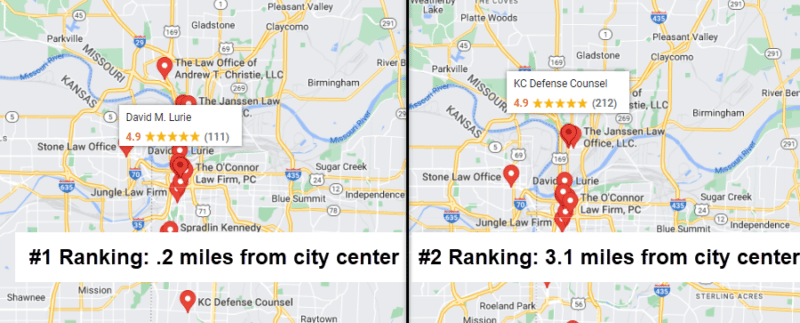
Understanding your location within the context of your competitor’s location is important because proximity might answer why they rank #1. 

In the image below, a search for “kansas city defense attorney,” a highly desirable keyword for defense attorneys in Kansas City, the #1 ranking is held by a law firm that is located .2 miles from the city center of Kansas City. The #2 ranking business is located 3.1 miles from the city center. 

top 2 local search results for "kansas city defense attorney".

A quick search for your top keyword can indicate whether proximity will impact your campaign. Review the distance between verified location and city center for the #1 ranking GBP (a.k.a., your competitor) in the Local Pack. Then, compare your competitor’s distance to the distance between your verified location and the city center.

If you’re a Service Area Business (SAB), then your competitors are also likely SABs, which means you won’t be able to check the distance between their address and the city center. In these scenarios, you should still note the distance between your verified location and the city center.

If your website struggles to achieve local ranking growth in the future, proximity could be limiting progress. Sometimes your verified address will be too far from the target location to rank, which means you may need to change your target location.

During a competitive analysis for local SEO, a quick check of competitor proximity is sufficient to understand how much distance matters in your specific marketplace. However, you may determine from this initial check that a deeper understanding of your proximity would help frame your strategy.

If a more comprehensive analysis of proximity would help, consider completing a full proximity audit as a next step. For example, you might consider a full proximity audit if you look at distance, GBP, and on-page strategy but still can’t determine why a competitor ranks well. The proximity audit is a deeper analysis of all the factors that impact proximity-based rankings in a specific marketplace. 

2. Assess GBP optimization 

In local SEO, Google Business Profile is the star of the show. Everyone is vying for that #1-3 position in the Local Pack. Competitors typically pay the most attention to GBP with their local SEO strategy because this profile appears directly at the top of search results. 

Assess the following ranking factors across your competitors’ GBP listings and compare your own profile: 

  • Name
  • Primary category
  • Other categories
  • Reviews

The name, primary category and reviews are directly visible on the profile, but viewing a business’ additional GBP categories will require a tool like GMB Everywhere. Those are the key ranking factors on Google Business Profile, but it’s also important to look at how much competitors have invested in additional GBP features: 

  • Description
  • Photos
  • Questions and answers
  • Products
  • Services
  • Posts

If competitors are ranking solely due to reviews and proximity, then a few adjustments to your GBP categories might improve your Local Pack rankings. But if a #1 ranking competitor has fleshed out their profile with every detail and they are posting every week, then it will likely require substantial effort to outrank them. 

Ultimately, a Google Business Profile is intended to update users with as much information about the business as possible. Rankings are great, but keeping customers informed about your business is a solid practice across all communication channels. 

3. Analyze on-page content

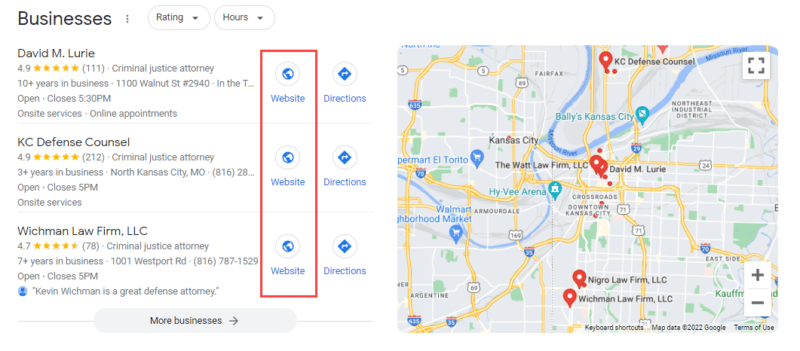
On-page SEO is an important ranking signal for the Local Pack. So, what does that #1 ranking competitor’s website look like? Click the Website button featured directly in the Local Pack to get started. 

Local pack top results.

While analyzing competitor websites, you’ll typically see two types of sites linked from GBP: 

  • Homepage for a single location business.
  • Location page for multi-location business.

Content on a homepage is often structured differently than content on a location page:

Homepage Location Page
Service pages in nav All services listed on the page
High-level business information Location-specific information
High volume of backlinks Typically fewer backlinks
Original content Content might be duplicate between locations

Review your competitor’s homepage or location page to determine how much effort is needed with your website. How much has your competitor invested into their website and/or their location page? 

Here are some questions to review for either a homepage or a location page linked from GBP. 

Homepage questions:

  • Are there a lot of service pages in the navigation?
  • Does the website appear modern/mobile-friendly?
  • Does the website feature awards, testimonials, or customer reviews?
  • Does the website use optimized title tags?
  • Does the homepage feature video, Q&A, or other standalone content?

Location page questions:

  • Does the location page discuss local services?
  • Is the content original to that location page?
  • Is there a CTA that users can easily view and interact with?
  • Does the location page use optimized title tags?
  • How does the rest of the website link to this location page?
  • Does the page include content from local providers (video, bios, etc)?

These questions are by no means exhaustive, but they’re a good starting point and can help you understand the level of investment and strategy behind a competitor’s website. 

Compiling the information and looking at the big picture

You’ve gathered information about a competitor’s proximity, GBP and website. Now, it’s time to analyze this information and ideate your local SEO strategy. 

Here’s an example of what we could learn about a #1 ranking competitor for “houston dentist.”

#1 Ranking Competitor Our Location
.5 miles from city center 2 miles from city center
812 reviews on GBP 435 reviews on GBP
Primary category: Dentist Primary category: Cosmetic dentist
Posts weekly on GBP Posts occasionally on GBP
GBP links to homepage GBP links to location page
Homepage includes video content No video content on location page
15 service pages Location page mentions 2 services

In the above example of competitive analysis for local SEO, we can see that our business needs several improvements to compete for that #1 ranking, from updating the GBP category to considering video content. 

The best local SEO strategy is unique to its marketplace

That marketplace includes competitors who have invested a varying amount of content optimization, linking, and even physical real estate. While there will always be an SEO to-do list, a competitor analysis can help determine which tasks will make the biggest impact.


Opinions expressed in this article are those of the guest author and not necessarily Search Engine Land. Staff authors are listed here.


New on Search Engine Land

About The Author

Harmony Huskinson is an SEO strategist at Portent, a full-service digital marketing agency. Harmony specializes in local SEO and has worked with hundreds of businesses since starting her digital marketing career in 2015. You can find Harmony on Twitter or on LinkedIn if you’d like to chat about the intersection of community and digital in local spaces.

https://searchengineland.com/local-seo-competitive-analysis-387666


9 tips for selecting an SEO agency

SEO agencies can vary in terms of their quality of service. That means a large number of brands and organizations have been burned at least once.

Additionally, many agencies look and sound the same – just swap out the logo and branding. Yet, they offer varying levels of depth of experience and expertise. 

SEO agencies aren’t one-size-fits-all, and getting into a bad-fit relationship can be costly in terms of both dollars and time lost.

I’ve been involved in this process for a long time as an agency leader. It probably sounds self-serving that I’m writing this article. But, let me be the first to say that I don’t want to work with every brand, and my agency isn’t the right fit for everyone.

Leveraging experiences on the agency side of the table, I have outlined nine tips to help you work through the process of choosing the right fit and right agency for your organization.

1. Develop and define goals

If you haven’t translated organizational, sales and marketing goals down to SEO specifically, now is the time to start thinking about it.

Good agencies will ask you pretty early on what your goals are whether those are tied to ROI, conversions, or whatever your measure of success is. (Beware if someone wants to do SEO for you without getting into the topic.)

It is fair not to know what is possible to expect from SEO without the agency helping with the research. However, do what you can to at least know what ROI looks like for you. That can be in the form of the number of conversions you need or specific actions.

You can also look at any industry benchmarks and your own performance baselines as reference points.

Regardless of what you know or don’t, be clear on what success looks like in making money or achieving your goals. Have as much of it as possible before you start your SEO agency search.

2. Evaluate internal resources

You’re likely looking for an SEO agency because you don’t have the internal SEO expertise or time resources required to succeed. Whatever the case, there will be some level of collaboration or effort by you or your team to have a successful agency partnership.

Even if you have the agency do everything, you’ll need certain time commitments and availability for approvals, oversight, feedback and performance reviews.

In many cases, brands and organizations hold onto additional aspects or have other partners to cover the full spectrum of things that SEO needs, including content, IT, UX and any collaborative elements.

Plan out what your internal team could or should own. Be available to collaborate or utilize the agency or outside partners. This will help you evaluate whether the agency is suitable for all or some aspects you’ll eventually need in the SEO work.

3. Consider your budget

You can hopefully find some budget parameters to work from by taking the combination of goals and knowing what ROI looks like, plus the internal resources or existing partners you can lean on.

Even if you want to hear the first number from the agency, knowing your budget parameters will help you qualify faster and filter the ideal agencies in terms of size, scope, and fit.

For example, if you can get some ballpark pricing quickly and know what arena you’re in, you can move on if it is way above (or concerningly below) your estimated budget.

It’s totally fine not to know. It is even better in many cases to have it tied to an ROI ratio rather than a fixed number – viewing SEO as an investment rather than an expense line item.

Be upfront with that information and inquire about how the agency will help you in any initial strategy or audit steps to understand avenues to hit your goals and the risk for different budget levels and investments.

4. Do your research

As you look at websites, talk to those referring you to potential agencies, or get into any initial outreach, be mindful that specific dimensions matter.

That includes the size of the agency compared to your organization. Or, more importantly, how capable they are of serving your company. The stage of your company’s growth and lifecycle might be another factor to consider.

Agencies can be pure generalists who take on any and all clients who have a dollar to pay them. A few consider different factors that help narrow things a bit, like pricing minimums, focus on particular niches or industries, audiences, conversion types, or even the makeup or structure of your team.

Save time and energy on looking for the right areas that match up with who you are and what you want. Resist pitches from agencies that seem to be out of your league or not in alignment with your focuses.

Great ways to do so include:

  • Seeking out case studies, credentials, references and thought leadership content pieces.
  • Looking at the mix of clients they work with currently. 

Do your homework and be prepared to ask about or challenge any contradictions or mixed messages you see.


Get the daily newsletter search marketers rely on.


5. Have an interview plan

Often, I get a lot of really good questions from prospects I talk with. Other times, I don’t get asked enough, so I end up answering questions I wish were asked or assume that my potential clients want to know.

The more organized you are in the questions you ask, the more objective your comparison can be at the end of the agencies you are considering.

Plan questions related to anything and everything important to you, whether that is tied to:

  • Their focus (or aspects of #4 above).
  • Their approach.
  • Ways you’d work together.

Be prepared, especially if you have some internal resources that will own copy or content, dev, or other things that require a tight partnership and collaboration.

Additionally, know who you’re working with and how cultures align (or don’t).

Have a solid list of questions, plan for who is asking what, and whatever level of notes or scorecard you can. In the end, you can be objective and also go back to your finalist(s) with more profound levels of details you’re seeking to firm up.

6. Evaluate fit

Do your personalities match? 

I’m not talking about just you and me, the president who is leading the conversation at this point (or whatever sales or account representative). 

I’m talking about between those on your team and the agency’s team who’ll be working together in the trenches.

Assess the fit between teams. Learn about retention rates of employees and stability. Understand what level of transparency to expect. How hands-on will they be?

These aspects, plus agreement on the agency’s approach, are critical. You don’t want to hit a wall or drop off right after the contract is signed or just a few months into an ongoing agreement.

7. Do a gut check

Does something sound too good to be true? Is something off? Is there a red or yellow flag somewhere?

Trust your gut and dig deeper. If you have concerns about how you match up with the agency, validate them. Ask your hard questions. 

Don’t move forward if things are off or don’t feel right. That’s a warning sign, and you should trust your instinct to pause and dig deeper.

I’m not saying to run away. Maybe you’re the first client they have had in your niche or industry. That could be OK with the right level of transparency, research approach, and risk tolerance. In some cases, it can be great to go with someone fresh versus the cookie-cutter strategy everyone else in the industry uses.

8. Understand the process

Beyond resource constraints and lack of enough understanding of SEO strategy – communication and mismanaged expectations are among the biggest roadblocks to success.

Every client has a different level of SEO knowledge, awareness of SEO processes, and a grasp of the agency’s unique takes on those things.

We (agency people) can take for granted that not everyone nerds out at the level we do.

Ask, and ask again if you’re unclear on what the process is. 

What will it look like in terms of steps from contract to discovery, onboarding, research, strategy, optimization, reporting, communication, timing, and results accountability?

Be clear on it all. Keep asking if you don’t know, and make your notes to get up to speed and have the right level of accountability and expectations for the partnership.

9. Be clear on the agreement terms

Don’t sign something that you haven’t read! If you don’t understand the agreement’s contents, have a lawyer or advisor familiar with SEO look over it.

Beware of long-term agreements, sticky cancellation clauses and work ownership claims. None of those things are wrong, but you want to know what you’re getting into. 

Long-term might get you cost savings and commitment from both sides in the relationship. SEO does take time. However, you want to avoid the following scenarios:

  • Having your work product, content, or properties to be held hostage.
  • Working together a couple of months in only to get hit with change orders.
  • Assuming that other areas (such as content, dev updates, CRO, etc.) are covered and part of the agency’s responsibility, only to find out they weren’t. 
  • Getting into a gray area where they weren’t spelled out.

The ideal scenario is that the relationship is built on trust and accountability, where billings and value stay balanced over time. You don’t have to think about the contract again after signing it.

Conclusion

Selecting the right fit SEO agency is difficult. It can be challenging to get through the clutter of so many sounding alike, find ways to assess the experience and expertise or map out your fit with them.

More than that, it can lead to wasted time, energy and dollars. I don’t want that for you.

Hopefully, the tips I have shared help you prepare for and think about the process in a detailed way to ensure that you find the right fit for you and succeed.


Opinions expressed in this article are those of the guest author and not necessarily Search Engine Land. Staff authors are listed here.


New on Search Engine Land

About The Author

Corey Morris is a skilled marketing professional with 15+ years of experience developing award-winning, ROI-generating digital strategies for local and national brands. He was recently honored as the recipient of the KCDMA 2019 Marketer of the Year award. Corey serves as the chief strategy officer at Voltage – a marketing firm based in Kansas City, MO. Previously, he founded the KC Search Marketing Conference to help build a local community for search marketers for career growth. He was recognized for his involvement in the conference and invited to join the global board of SEMPO (now part of DAA) as the VP of Cities.

https://searchengineland.com/selecting-seo-agency-tips-387679


Google shares 4 examples of how to improve a meta description

Google’s help document on controlling your snippets in search results has added some examples of “bad” and “better” meta descriptions. 

The bad. Google advises avoiding these four types of “bad” meta descriptions:

  • List of keywords: “Sewing supplies, yarn, colored pencils, sewing machines, threads, bobbins, needles”
  • Same description used for every news article: “Local news in Whoville, delivered to your doorstep. Find out what happened today.”
  • Doesn’t summarize the page: “Eggs are a source of joy in everyone’s life. When I was a small child, I remember picking eggs from the hen house and bringing them to the kitchen. Those were the days.”
  • Too short: “Mechanical pencil“

The better. Google’s examples of better meta descriptions:

  • Explains what the shop sells and details like opening hours and location. “Get everything you need to sew your next garment. Open Monday-Friday 8-5pm, located in the Fashion District.”
  • Use a snippet from the specific news article: “Upsetting the small town of Whoville, a local elderly man steals everyone’s presents the night before an important event. Stay tuned for live updates on the matter.”
  • Summarize the whole page: “Learn how to cook eggs with this complete guide in 1 hour or less. We cover all the methods, including: over-easy, sunny side up, boiled, and poached.”
  • Are specific and detailed. “Self-sharpening mechanical pencil that autocorrects your penmanship. Includes 2B auto-replenishing lead. Available in both Vintage Pink and Schoolbus Yellow. Order 50+ pencils, get free shipping.”

The updated document. Google published its documentation on controlling your snippets in search results in October. You can see all the new additions, here.

Why we care. While there is nothing earth-shattering and this is mostly just basic SEO, it’s good to see Google provide some more specific guidance on how to create helpful and descriptive meta descriptions that are more likely to get clicks and traffic. Not that we can ever count on Google to use those meta descriptions, of course.


New on Search Engine Land

About The Author

Danny Goodwin is Managing Editor of Search Engine Land & SMX. In addition to writing daily about SEO, PPC, and more for Search Engine Land, Goodwin also manages Search Engine Land’s roster of subject-matter experts. He also helps program our conference series, SMX – Search Marketing Expo. Prior to joining Search Engine Land, Goodwin was Executive Editor at Search Engine Journal, where he led editorial initiatives for the brand. He also was an editor at Search Engine Watch. He has spoken at many major search conferences and virtual events, and has been sourced for his expertise by a wide range of publications and podcasts.

https://searchengineland.com/google-how-to-improve-meta-descriptions-387691


Google: Helpful content update isn’t done

If you were to play word association game about Google’s helpful content update, what would you say? Dud? Underwhelming? Or something similar? 

That seems to be the general consensus so far. The Google helpful content update began rolling out one week ago. Google said it would take two weeks to fully roll out.

“Update isn’t done.” Google Search Liasion Danny Sullivan discussed the helpful content update yesterday in a series of tweets. He reminded us that the update hasn’t been fully rolled out yet and it will continue to be tuned and refined.

“Update isn’t done. It’s also part of a continuing effort, as we’ve explained. We’ll keep refining how it works. Directionally, the guidance we’ve given is what SEOs and creators should be considering.”

Danny Sullivan tweet 

And Google’s John Mueller added: “I’d give it a bit more time”

“Updates don’t necessarily mean a big giant shift.” Google’s helpful content update was hyped to be as big as Panda and Penguin were a decade ago. But that hasn’t been the case so far. 

“I also get that when we announce an update, there are the memes and the gifs and the jokes and the OMG the sky is falling reactions that can even make me laugh. But updates don’t necessarily mean a big giant shift. If you have good content, you’re generally fine…”

Danny Sullivan tweet

In some cases, that reaction has been warranted. Algorithm updates like Penguin, Panda, and Florida had a huge, detrimental impact on websites and businesses. However, Google didn’t pre-announce any of those updates.

But whenever a major update is pre-announced, people remember that chaos and confusion. That said, a couple of more recent Google updates (“mobilegeddon” and the page experience update) were pre-announced and ended up having a much smaller than anticipated impact. 

Google discussed the helpful content update just a few days before launching it, which was hardly enough time to address potential sitewide content issues. Overall, SEOs weren’t overly concerned about the helpful content update.

“Part of a continuing effort.” While we’re a week in and all seems quiet so far, Sullivan reiterated that this is an update you shouldn’t ignore.

“With this helpful content update, as I said before, it’s part of a continuing effort. Directionally, it’s what SEOs and creators should pay attention to. We’ll continue to tune it, refine it. It matters, which is why we’ve spent so much time talking about it.”

Danny Sullivan tweet

And:

“If there hasn’t been any announced update, but you notice a change in traffic, it makes sense to review all our guidelines and advice. And if you find ‘hmm, maybe some of this content I have isn’t meeting what’s advised about helpful content,’ that’s a sign of what to work on.”

Danny Sullivan tweet

Why we care. Google algorithm updates can impact your rankings, traffic and revenue. Google led us to believe that this would have a significant impact. It hasn’t so far (or at least we’re not hearing about a large number of websites being negatively impacted). But this update is one you shouldn’t ignore. 


New on Search Engine Land

About The Author

Danny Goodwin is Managing Editor of Search Engine Land & SMX. In addition to writing daily about SEO, PPC, and more for Search Engine Land, Goodwin also manages Search Engine Land’s roster of subject-matter experts. He also helps program our conference series, SMX – Search Marketing Expo. Prior to joining Search Engine Land, Goodwin was Executive Editor at Search Engine Journal, where he led editorial initiatives for the brand. He also was an editor at Search Engine Watch. He has spoken at many major search conferences and virtual events, and has been sourced for his expertise by a wide range of publications and podcasts.

https://searchengineland.com/google-helpful-content-update-isnt-done-387676