Google’s new helpful content update targets sites creating content for search engines first

Google is about to launch a new and large search algorithm update, called the helpful content update.

The helpful content update will target websites that have a relatively high amount of unsatisfying or unhelpful content, where the content has been written for search engines rather than humans.

This update, which will start rolling out soon, will have a meaningful impact on the search results, Google told Search Engine Land.

What is Google’s helpful content update?

Google’s new helpful content update specifically targets “content that seems to have been primarily created for ranking well in search engines rather than to help or inform people.”

The purpose of this algorithm update is to help searchers find “high-quality content,” Google told us. Google wants to reward better and more useful content that was written for humans and to help users.

Content written for the purpose of ranking in search engines – what you might call “search engine-first content” or “SEO content,” has been frequently written about lately and discussed across social media.

In short, searchers are getting frustrated when they land on unhelpful webpages that rank well in search because they were designed to rank well.

Google’s new algorithm aims to downgrade those types of websites while promoting more helpful websites, designed for humans, above search engines.

Google said this is an “ongoing effort to reduce low-quality content and make it easier to find content that feels authentic and useful in search.”

When will Google’s helpful content update launch?

The update will start rolling out next week. The helpful content update will take up to two weeks to fully roll out, Google said.

We will post a new story when it begins rolling out and when it is completed here on Search Engine Land. Google will also post on its updates page when it launches and when it is done rolling out.

What types of content will the helpful content update impact?

While these algorithms do not specifically target any specific niche, Google said these types of content may be impacted the most:

  • Online educational materials.
  • Arts and entertainment.
  • Shopping.
  • Tech-related.

This is because content written in those areas has historically been written more for search engines than humans.

Based on Google’s analysis, those areas may be more impacted by this Google helpful content update than other areas.

I asked Google for a specific example of a search where the helpful content update would make an impact. Here’s what Google told me:

  • “If you search for information about a new movie, you might have previously encountered articles that aggregated reviews from other sites without adding perspectives beyond what’s available elsewhere on the web. This isn’t very helpful if you’re expecting to read something new. With this update, you’ll see more results with unique information, so you’re more likely to read something you haven’t seen before.”

Google’s Search Liaison Danny Sullivan was asked on Twitter to elaborate more about what Google meant by “online education.” Sullivan’s response:

“Generally tutorial, things meant to teach something, not really formal courses. But again, it’s not focused on any particular area. That’s just one example where we see notable improvement but there are others and any query about any thing might benefit.”

Danny Sullivan tweet

Helpful content update is a sitewide algorithm

Unlike many Google algorithms that get applied on a page-by-page basis, this new helpful content update will be sitewide.

That means that if Google determines your site is producing a relatively high amount of unhelpful content, primarily written for ranking in search, then your whole site will be impacted.

This will not just impact individual pages or sections of your site, but rather, it will impact the whole site.

Google won’t say exactly what percentage of the pages on your site need to be helpful versus unhelpful to trigger this classifier but they did say it is sitewide and will impact the whole site, even if you have many pages that are helpful.

Again, if you have helpful pages but a relatively high amount of your content is unhelpful, even your helpful content or sections of your site will be hit by this update.

Google said “removing unhelpful content could help the rankings of your other content.”

How to build human-first content – Google’s advice

Google, like with previous updates, like the Panda update, core updates, and product reviews update, has provided a list of questions you can ask yourself about your content, in order to build content that is rewarded by the helpful content update.

Google shared these questions around building human-first content:

  • Do you have an existing or intended audience for your business or site that would find the content useful if they came directly to you? 
  • Does your content clearly demonstrate first-hand expertise and a depth of knowledge (for example, expertise that comes from having actually used a product or service, or visiting a place)?
  • Does your site have a primary purpose or focus?
  • After reading your content, will someone leave feeling they’ve learned enough about a topic to help achieve their goal?
  • Will someone reading your content leave feeling like they’ve had a satisfying experience?
  • Are you keeping in mind our guidance for core updates and for product reviews?

And when it comes to avoiding search-engine first content, Google laid out these questions:

  • Is the content primarily to attract people from search engines, rather than made for humans? 
  • Are you producing lots of content on different topics in hopes that some of it might perform well in search results?
  • Are you using extensive automation to produce content on many topics?
  • Are you mainly summarizing what others have to say without adding much value? 
  • Are you writing about things simply because they seem trending and not because you’d write about them otherwise for your existing audience?
  • Does your content leave readers feeling like they need to search again to get better information from other sources?
  • Are you writing to a particular word count because you’ve heard or read that Google has a preferred word count? (No, we don’t).
  • Did you decide to enter some niche topic area without any real expertise, but instead mainly because you thought you’d get search traffic?
  • Does your content promise to answer a question that actually has no answer, such as suggesting there’s a release date for a product, movie, or TV show when one isn’t confirmed?

It could take months to recover

This algorithm will run automatically, Google said. The scores or classifiers will continue to update all the time.

But if a site gets hit by this helpful content update, it can take several months for the site to recover.

A site needs to prove itself over time that it no longer publishes content with the sole reason to rank in search engines, a search engine first content experience, and that takes time.

So it seems there will be some type of waiting period – maybe a validation period – that sites need to go through, to show Google’s algorithms that the site is providing helpful content to humans first.

This validation period is automated and while Google updates the scores for its classifiers on your site on an ongoing basis, making a change today, likely won’t be reflected in Google’s rankings for several months, Sullivan told Search Engine Land.

According to Google:

  • “Sites identified by this update may find the signal applied to them over a period of months. Our classifier for this update runs continuously, allowing it to monitor newly-launched sites and existing ones. As it determines that the unhelpful content has not returned in the long-term, the classification will no longer apply.”

Google is using machine learning to identify unhelpful content

Google is using a new machine learning algorithm that is able to evaluate and identify unhelpful content.

The algorithms should get better over time between the automated machine learning improvements and Google engineers tweaking and improving the overall algorithms on a regular basis.

Google said the helpful content update looks at a variety of signals about the page and site to determine the ranking of a page.

Google was not specific with us on exactly which signals are used, as you would imagine.

Quality raters validated

Google said the search company validated these new results with its quality raters and confirmed that using this system improves Google’s search quality. This is done for most, if not all, ranking and user experience improvements Google makes to search.

Again, the quality raters do not directly influence the rankings but rather help confirm to Google’s search engineers if the algorithms are making improvements to the overall search quality.

U.S. English searches only

This update will initially launch for English-language searches globally.

Google plans to expand to other languages in the future.

Search-only right now

Google told us this update targets only Google search right now. However, Google may look to cover additional products (e.g., Google Discover) in the coming months.

Will the helpful content update be as significant as Panda?

For many SEOs who lived through the Google Panda update of February 2012, it forever changed how SEOs recommended you write content going forward. Now Panda is built into the core update, so it is still being used today.

This update sounds a lot like the past Panda update.

I suspect, like with Panda, SEOs will look back at Google’s helpful content update and say it caused a fundamental shift in SEO content strategy. Time will tell, and we will see how large of an update this is over the course of the next few weeks.

Why we care

Google’s helpful content update will likely be a significant update that SEOs will look back at as the catalyst of change in terms of the advice SEOs gives clients when building content.

Granted, it is too soon to tell how large of an impact this update will have on Google’s search results, your site or your clients’ sites.

As the update rolls out, make sure to watch your analytics and, if necessary, reevaluate your content strategy around the advice Google has provided above.

We’ll continue to report on all the latest developments around the helpful content update.


Get the daily newsletter search marketers rely on.


You can read Google’s official announcement, here: More content by people, for people in Search.


New on Search Engine Land

About The Author

Barry Schwartz a Contributing Editor to Search Engine Land and a member of the programming team for SMX events. He owns RustyBrick, a NY based web consulting firm. He also runs Search Engine Roundtable, a popular search blog on very advanced SEM topics. Barry can be followed on Twitter here.

https://searchengineland.com/googles-new-helpful-content-update-targets-sites-creating-content-for-search-engines-first-387237




Google to release August 2022 product reviews update in coming weeks

Google will be releasing another product reviews update, the August 2022 product reviews update, in the coming weeks, the search company also announced along with the helpful content update.

Google said they are launching another update “in the coming weeks to make it even easier to find high-quality, original reviews.” Google said this is another refinement to the product reviews ranking system that aims to “make sure you find the most useful information when you’re researching a purchase on the web.”

Timing. Google will post on its updates page when it launches and when it is done rolling out, we will also post a new story when it begins rolling out and when it is completed here on Search Engine Land.

Google did tell us they are targeting to roll it out the week of August 29th but the date may change.

Previous updates. This is the fifth version of the product reviews update, a search ranking algorithm update targeted at ranking product review-related content on the web that is most helpful and useful to searchers. The first product reviews update was launched on April 8, 2021, the second was launched on December 1, 2021, the third has been released on March 23, 2022, and now the fourth has been released on July 27, 0222. The fourth one was named the July 2022 product reviews update and released on July 27, 2022 and completed on August 2, 2022.

Google product reviews update. The Google product reviews update aims to promote review content that is above and beyond much of the templated information you see on the web. Google said it will promote these types of product reviews in its search results rankings.

Google is not directly punishing lower-quality product reviews that have “thin content that simply summarizes a bunch of products.” However, if you provide such content and find your rankings demoted because other content is promoted above yours, it will definitely feel like a penalty. Technically, according to Google, this is not a penalty against your content, Google is just rewarding sites with more insightful review content with rankings above yours.

Technically, this update should only impact product review content and not other types of content.

What is impacted? Google said this update may in the future impact those who “create product reviews in any language,” but Google said the initial rollout will be “English-language product reviews.” Google added they have seen “positive effects” from this update in the past and the search company “plans to open up product review support for more languages” in the future.

Please note that these updates can be very big, almost as big as core updates.

Previous advice on the product reviews update. The “focus overall is on providing users with content that provides insightful analysis and original research, content written by experts or enthusiasts who know the topic well,” Google said about this update. That is similar advice to the core update recommendations mentioned above, but here is a list of “additional useful questions to consider in terms of product reviews.” Google recommends your product reviews cover these areas and answer these questions. Do your product reviews…

  • Express expert knowledge about products where appropriate?
  • Show what the product is like physically, or how it is used, with unique content beyond what’s provided by the manufacturer?
  • Provide quantitative measurements about how a product measures up in various categories of performance?
  • Explain what sets a product apart from its competitors?
  • Cover comparable products to consider, or explain which products might be best for certain uses or circumstances?
  • Discuss the benefits and drawbacks of a particular product, based on research into it?
  • Describe how a product has evolved from previous models or releases to provide improvements, address issues, or otherwise help users in making a purchase decision?
  • Identify key decision-making factors for the product’s category and how the product performs in those areas? For example, a car review might determine that fuel economy, safety, and handling are key decision-making factors and rate performance in those areas.
  • Describe key choices in how a product has been designed and their effect on the users beyond what the manufacturer says?
  • Provide evidence such as visuals, audio, or other links of your own experience with the product, to support your expertise and reinforce the authenticity of your review.
  • Include links to multiple sellers to give the reader the option to purchase from their merchant of choice.

Google also linked to its blog post from earlier this year named providing better product information for shoppers.

Google added three new points of new advice for this third release of the products reviews update:

  • Are product review updates relevant to ranked lists and comparison reviews? Yes. Product review updates apply to all forms of review content. The best practices we’ve shared also apply. However, due to the shorter nature of ranked lists, you may want to demonstrate expertise and reinforce authenticity in a more concise way. Citing pertinent results and including original images from tests you performed with the product can be good ways to do this.
  • Are there any recommendations for reviews recommending “best” products? If you recommend a product as the best overall or the best for a certain purpose, be sure to share with the reader why you consider that product the best. What sets the product apart from others in the market? Why is the product particularly suited for its recommended purpose? Be sure to include supporting first-hand evidence.
  • If I create a review that covers multiple products, should I still create reviews for the products individually? It can be effective to write a high-quality ranked list of related products in combination with in-depth single-product reviews for each recommended product.  If you write both, make sure there is enough useful content in the ranked list for it to stand on its own.

Not a core update. Google also previously said that product review updates are not the same as core updates. This is a standalone update they’re calling the product reviews update. This is separate from Google’s regular core updates, the company told us. Nonetheless, Google did add that the advice it originally provided for core updates, “about producing quality content for those is also relevant here.” In addition to that advice, Google provided additional guidance specific to this update.

Why we care. If your website offers product review content, you will want to check your rankings to see if you were impacted. Did your Google organic traffic improve, decline, or stay the same?

Long term, you are going to want to ensure that going forward, you put a lot more detail and effort into your product review content so that it is unique and stands out from the competition on the web.

Also, those impacted by previous core updates, that put in the work, may be rewarded by this August 2022 product reviews update.


New on Search Engine Land

About The Author

Barry Schwartz a Contributing Editor to Search Engine Land and a member of the programming team for SMX events. He owns RustyBrick, a NY based web consulting firm. He also runs Search Engine Roundtable, a popular search blog on very advanced SEM topics. Barry can be followed on Twitter here.

https://searchengineland.com/google-to-release-august-2022-product-reviews-update-in-coming-weeks-387243


How to approach SEO in a period of global disruption

Marred by a pandemic, a war, political division, and seesawing economies, the past two-plus years have disrupted life as we know it. 

If all these have taught us anything in the world of SEO, it’s that even the most sound, effective strategies are subject to re-evaluation. 

Even in industries that aren’t directly connected to world events, SEO strategies and goals need to reflect the reality of the times and news cycles. 

Let’s look at the role of SEO in a turbulent global landscape and how marketers need to pivot and adjust.

The role of SEO in weird times

One of the first things a fledgling marketer learns is that good SEO should reflect people’s needs: 

  • In the keywords you’re targeting.
  • The content you’re writing.
  • Even what you’re asking of the user in return. 

SEO’s inherent purpose is to add value by providing information relevant to people’s searches. 

When we’re in a state of acute disruption, as we have been for the past 30 months or so, that value is even more imperative. 

SEO strategies focusing on transactions (unless you’re selling toilet paper during a shortage) will be far less effective than SEO strategies that provide the user with helpful information your company is uniquely qualified to provide. 

For instance, a company that manufactures car parts should focus on addressing supply-chain issues and solutions plaguing its target audience of distributors, not building a landing page to convey sentiments on the war in Ukraine.

Effects on your SEO KPIs

The economy is affecting B2B and B2C companies in different ways right now.

Tech companies scramble for funding or are under pressure from concerned investors while their target audiences cut budgets.

Retail and ecommerce companies suffer from tightened consumer spending and higher costs of goods. 

People aren’t throwing money around as they did a year ago – and SEO KPIs need to reflect that.

SEO conversion rate is, and should be, a KPI, but it might not be the most useful optimization benchmark right now. 

Instead, consider focusing on more upper-to-middle funnel KPIs like:

  • Traffic.
  • Time on site.
  • Number of touchpoints.
  • Percentage of returning visitors.
  • Number of pages visited. 

These can accommodate a couple of strategies, such as: 

  • Nurturing and engaging users with valuable information until they’re ready to spend again.
  • Enhancing your purchasing funnel with content and information that reassures people they’re spending their money wisely if they make the leap to buy your product or service.

The silver lining for SEO in this period of disruption is that it can fill funnel gaps left by decreased paid media budgets.

Thus, ensure a holistic view of your marketing team’s goals and how SEO is expected to contribute.

Resources to inform your SEO pivots

Other than keeping a close eye on the macroeconomy and global trends, there are several tools you can use to inform your strategic adjustments.

Google Trends and keyword research tools are extremely useful in helping you understand the topics and queries users are searching for – or aren’t searching for as much as they did in the past.

Internal data also plays a significant role in helping you pivot effectively.

Alignment with your paid search team can get you access to almost real-time information on user search behavior. 

Along with information on keyword demand, your paid search colleagues can tell you whether their campaigns are suddenly converting less (or more) without competitive shifts. 

This could be an indication that the customer journey is changing.

Customers and leads

Your existing base of customers and leads is another great source of information. 

Canceled subscriptions and repeat purchase slowdowns are flashing red indicators that your target audience’s needs are changing. 

When you see those signs, consider sending surveys to collect feedback on their priorities and needs and incorporate those into your keyword and content strategy. (Your product and promotional teams will appreciate that data as well). 

Traffic and impressions

Make sure you’re tracking traffic/impressions.

If they are increasing or decreasing even if your rankings are staying the same, this indicates a broad interest shift. 

And always cross-reference your data with Google Trends – specifically looking for historical trends, including seasonality – to ensure you’re considering the whole picture. 


Get the daily newsletter search marketers rely on.


Use these channels to make quick SEO adjustments

I don’t recommend overhauling your branding and core site assets to address temporary shifts (although, to be fair, the pandemic seems like an eternity). 

Instead, use or add a blog. It’s a great tool for quickly adding new, relevant content and updating evergreen content to fit the times. 

One of my clients, a financial services company, posted an informational blog about applying for COVID-related loans and relief. It quickly became one of their most popular pieces of content.

You should also tackle high-performing blog topics on your social media channels. Just make sure to customize the content to be more interactive and solicit engagement.

How to get instant traction with pivots

Getting your head around the idea of quick results in a long-term channel can be challenging. SEOs spend much time earning authority and trust, and momentum builds on itself over time. 

I recommend focusing on long-tail, low-competition keywords to gain interest in your brand and build authority and backlink volume. 

For instance, you won’t start immediately ranking for “supply chain,” but you can get traction on “why is there a supply chain shortage.”

Organic social media can also provide rapid feedback on topics resonating with your network. 

If a post gets a lot of engagement (constructive) on your social channels, that’s a sign that you’ve hit on a topic that could benefit from a deeper dive. 

Don’t be afraid to try things like LinkedIn polls to surface sentiment. Then, feed this data into your SEO program. 

What your audience responds to or provides you with information on in organic social can be used to create SEO campaigns. 

Grab the topics and responses from this pivot and build a keyword list around the topics. These are instantly great ideas for writing a new blog or guide content or optimizing your existing marketing pages.

Once you start recognizing progress on those terms, consider increasing your focus on more competitive, higher-volume terms closely related to the long-tail terms you first put into play. 

Wrapping up

In a time of global disruption, we must return to the roots of what we do as SEOs and marketers and why this all matters. 

We are here not only to help brands and businesses grow. We are here to help searchers find high-quality answers and solutions to what they need. 

What they need changes dramatically during times like we’re in right now, and we need to adjust accordingly.


Opinions expressed in this article are those of the guest author and not necessarily Search Engine Land. Staff authors are listed here.


New on Search Engine Land

About The Author

Adam Tanguay is Head of SEO and Content at Jordan Digital Marketing, which he joined in Feb. 2019. Formerly Head of Marketing at Webflow and Head of Organic Growth at Weebly, Adam has developed successful growth programs with a mix of content strategy, copywriting, technical know-how, and analytics acumen across a range of organic channels.

https://searchengineland.com/seo-during-global-disruption-387218


How do you use SEO to scale revenue and market share?

How do you use SEO to scale revenue and market share

30-second summary:

  • When the economy and business take a hit, marketing is the first to suffer budget cuts
  • If you are asking, “should I give up my SEO?”, this article is all you need
  • Best-selling author and serial entrepreneur, Kris Jones shows you five ways SEO can help you achieve revenue

Of all the ways to start driving real growth and expanding a business, SEO might not be the first method people generally consider. After all, SEO doesn’t directly make you online sales, right? Isn’t it just all about Google and showing up in position one? Is it just about vanity?

This kind of view is shortsighted and doesn’t appear to take the whole story into account.

We live now in a time when online markets have gotten so competitive that some people are still asking if SEO is dead.

What’s the translation of that question? “Do I even stand a chance on Google anymore with all these competitors crowding up the SERPs? Should I give up my SEO?”

The answer, of course, is no. SEO isn’t dead, and you shouldn’t give up on it.

SEO is your way forward to scaling your revenue and market share. You just need to work harder at it than ever before if you want to play the Google game and get audiences to find and buy from you.

So, SEO really can drive your business growth, and I’m going to show you five ways that you can use it to achieve that end.

1. Stick with SEO long-term

I’m going to start with an item that some people might have expected to see at the end: if you want to drive your business growth beyond just the next six months or year, you have to stick with your SEO strategy long-term.

Everything that I’m going to talk about in this post–every item, from website architecture to keyword usage and on-page page optimization, to creating great content, to building backlinks–is something that will work for you, but only if it’s given enough time to breathe.

I understand that when times are tough, marketing can often be the first cost that businesses want to cut. After all, while it would be nice to be able to market yourself, is marketing really necessary to the business if you’re losing money in so many other places?

In the case of SEO (and marketing in general), the answer is a resounding “yes.”

SEO keeps your business’s online visibility evident no matter what the market looks like. And if you’ve been in business long enough, you know that–surprise!–markets recover, consumers start spending again, and businesses once again become profitable.

If you stop your SEO during a downturn with the idea that you’re going to be saving money, think of the harm you’ll actually be doing to your business when no one can find you through an online search anymore, and that includes after your market has turned around again.

See, SEO is a long game, it’s for those with stamina, those with a vision that their business will survive for many years to come.

Sure, downturns will negatively affect your bottom line, but only temporarily. Do you know what will really hurt, though? When your bottom line disappears completely, and your former place on Google gets swallowed up by all the others vying for your same audiences.

That’s what happens when you haphazardly cut your SEO after six months or a year.

When you stay with it, though, when you ride out all the storms and still make room for your SEO budget, you can really start to win.

You’ll benefit from seeing how your pages and other content are trending over time. You’ll see how you created a post around certain keywords but how that post is now ranking for other keywords and should be reoptimized. You’ll be able to continue building your backlink profile over time rather than letting it die after just a few months. And you’ll see how keyword trends change over time and allow you to target different phrases on your most important pages.

So, you see, long-term SEO is the way to go if you want to be precise and up-to-date in your digital marketing approach.

2. Use SEO to organize your website

If you want to make it easier for your business to scale its revenue and maximize its market share, you’ll need to put some serious work into your on-page SEO. This has to start with a clean website structure arranged in a logical hierarchy.

How your website’s architecture is set up depends on what kind of business you are, but let’s assume we’re talking about a fairly large ecommerce website here.

Ecommerce websites usually make good examples of good and bad website hierarchies because of the volume of pages they typically have.

Now, ideally, a website will be structured according to logic, or what will make its pages the easiest to find for users.

In the case of ecommerce websites, good main navigation would show all the main pages at the top and then have each one open into a menu when you hover over it. The menus are where everything else would be neatly broken down.

For example:

Shop Now > Categories > Products

Users could hover over “Shop Now” to see all the product categories. This structure helps because it starts more generally as shoppers are still thinking about what they want.

Once they click on a category, they will be taken to a category page that will show all the products in that category. From there, they can find the product they need or filter the results to browse until they find something.

That’s it, nice and easy.

This is the kind of structure that will allow your website visitors to convert once they reach you. Remember that confused visitors don’t make purchases, so it will pay to put some serious time and effort into simplifying your website structure if you haven’t done so already.

Clean navigation will help not only people to get around your site but also Google’s search crawlers. When Google can understand your site in the same logical way as people, it may rank it higher than a competitor with messy website architecture.

3. Target the right audiences with the right keywords

Now that your website architecture is set up right, the next step in positioning your website to scale revenues for you is to use the right keywords to target the right audiences in the right places.

Here the concept of keyword intent is key. There are businesses out there that get this all wrong, so it’s worth mentioning here.

By the way, I can understand anyone out there who is looking for the connection between keywords and driving revenues, but these are the SEO details that allow people to find you on Google, and there’s no way to make money from users who can’t find you.

We’ll stay with the ecommerce example from earlier. When you go to optimize your category and product pages with keywords, you’ll want to have intent in mind.

Keyword intent is something you should be thinking about at all phases of your keyword research.

The four main types of keyword intent are –

  • Informational – “I want to learn about something” – “how to start a website”
  • Commercial – “I want to investigate things to buy” – “best athletic items for 2022”
  • Transactional – “I’m ready to buy something right now” – “bulk printer paper buy now”
  • Navigational – “ Take me to this page on this website” – “Walmart privacy policy”

There are personas attached to each type of keyword intent. Think of it as a classic sales funnel. Users enter it with a few needs but have to do some research before buying anything. As they move down the funnel, they become more focused on taking action.

The ones who complete the funnel are the ones who end up buying something or filling out a form, basically just taking whatever action matters to you.

How does this factor into the keywords you target on your website’s pages?

Think of a category page on your ecommerce site. No one is buying anything from a category page. It may not even be possible to do so.

So, your keyword targets for those pages should be more commercial than transactional. Users who arrive on your category pages are thinking about buying, but not yet.

Maybe your keyword target for a category page of printer paper is simply “office printer paper” or “best office printer paper.”

Then, you’ll want to get more specific on the product pages, which is where people will be doing the buying. If you find search volume around them, you want to optimize for terms such as “buy hammermill printer paper now” or “hp printer paper 500 sheets.”

See how the product page keywords got more long-tail and specific? That’s called going after intent, and it’s the way to optimize each part of your website.

That way, the right users will find everything they need from you, no matter where they are on their buyers’ journey.

4. Create (genuinely) amazingly useful content for every buyer persona

Okay, so you want to continue employing SEO to accelerate your growth and increase your market share. Then you will also need to jump head-first into the content marketing game.

To an extent, this idea piggybacks on the keyword intent concept from earlier. Except that here, we’re looking at intent from the content perspective.

Once you have optimized and more or less perfected your website from a user-experience perspective, you might wonder what else you could actively be doing to bring in traffic to your website.

Content is your game at that point.

Content is what drives traffic to websites, and it’s always been that way.

From one perspective, that’s just common sense. What else would we do on the Internet if there were no content?

Taken another way, though, how exactly do you devise a content marketing plan for a website? What do you write about? How does content bring in the traffic and sales you need to bump up your market share?

Think back to keyword intent from above, specifically the informational intent.

People typically don’t navigate to a category page, product page, or other service page with purely informational intent. Traffic to those pages is more ready to do something than learn about something.

Informational keywords apply more to blog posts that elaborate on topics about your business or wider industry.

Since blog posts are often informational, that means you’ll be targeting top-of-funnel traffic that’s just learning about what you do and isn’t ready to buy yet.

But since you’re focusing on scaling revenue and market share right now, you can’t lose sight of the fact that top-funnel traffic has the potential to turn into real customers for you. Blog posts are there to nurture the leads down the funnel.

So, if content seems like a slow or pointless game to you, I assure you it isn’t. It’s one of the main ways you’re going to make it to the top.

5. Build those backlinks

Finally, if you’re looking to use SEO to drive your revenues and business growth, you’ll want to pay lots of attention to your backlink profile.

As you probably know, links mean so much in SEO. The connections among pages and domains fuel how Google understands content on the internet. They are what build authority for websites.

Why? Because Google knows that if people want to link to content from their own websites, the content must be trustworthy and worth ranking highly for people.

Higher authority usually means higher rankings, and higher rankings mean more customers that you want will see you.

But, you can’t depend on the Internet just to find your content and link to it. You have to do the outreach yourself to get your name and content out there.

When you create good content, get in touch with others in your industry to see if their audiences might find it useful. Ask the webmasters if they would like to link to it for their readers.

Or, you could use an SEO tool to find broken external links on other sites and offer up your content as a replacement for those links.

Whatever method you take, though, just be sure that you’re getting backlinks from relevant sources. It won’t matter if you get 10,000 backlinks from completely irrelevant sites. One backlink from a relevant site will count more for you.

The increased authority and rankings you get from your backlinking campaign should help you over time to sustain your showing up for the most relevant searches in your industry.

Bringing it together

All of these pieces are what you need to bring together and put in place to make the best use of SEO for scaling your revenue and growing your market share.

To the uninitiated, it can definitely seem like the tasks I mention here are not directly related to making sales and growing a business. But they are the moves that lay the groundwork for that growth.

Keeping that long vision is how you really put SEO to work for your business.


Kris Jones is the founder and former CEO of digital marketing and affiliate network Pepperjam, which he sold to eBay Enterprises in 2009. Most recently Kris founded SEO services and software company LSEO.com and has previously invested in numerous successful technology companies. Kris is an experienced public speaker and is the author of one of the best-selling SEO books of all time called, ‘Search-Engine Optimization – Your Visual Blueprint to Effective Internet Marketing’, which has sold nearly 100,000 copies.

Subscribe to the Search Engine Watch newsletter for insights on SEO, the search landscape, search marketing, digital marketing, leadership, podcasts, and more.

Join the conversation with us on LinkedIn and Twitter.

https://www.searchenginewatch.com/2022/08/18/how-do-you-use-seo-to-scale-revenue-and-market-share/


Perfectionism in SEO: A route to self-destruction

At the start of my SEO career, I wanted to do many things perfectly. I wanted to be that person who:

  • Was in the office from 7 a.m. to 9 p.m. 
  • Went through the day super energized, motivated, tenacious and with a huge drive from their daily successes. 
  • Highly impressed her bosses and teammates.
  • Was constantly promoted.
  • Delivered great work under ridiculously tight deadlines yet still managed never to miss appointments, conferences, talks and presentations, and dinners with friends.

I did try. But soon after, I suffered severe burnout – and I wasn’t even 30! 

I’m not alone in this experience. Perfectionism is a pervasive challenge across many industries.

Out of 464 SEO professionals, 30.2% consider themselves to be perfectionists, according to a Twitter poll I recently ran.

Perfectionist expectations can hold us back in our careers. Thirty percent of employees are considering leaving their workplace because of it, based on The Hardin Group research.

This article will uncover why we need to talk about perfectionism and how SEO professionals can overcome unhealthy perfectionistic tendencies.

Perfectionism in the workplace

Regardless of industry, young professionals tend to admire people who seem to have a “perfect” lifestyle and put them on a pedestal. We see them as the epitome of success and grant them the illustrious and glamourized title of “perfectionist.” 

The thought of finding issues on these characters to make them more relatable to our deprecated lives might just seem deeply ungracious.

We ask ourselves, “In this unstable and unenthusiastic world, what is the point of complaining about an overzealous pursuit of perfection? Besides, all I want is to be inspirational, right?” 

What could possibly be so flawed about striving for perfection in what for our internal demons is a mundane SEO task?

I’m not criticizing the efforts of those who aim to be perfectionists. In the SEO community, we are in the fortunate position of being the recipients of their amazing work. 

The concern here is the untold – and therefore unknown – effects of perfectionism on our souls and mental health.

The roots of perfectionism

Twitter reply by Joseph Mclean.

It is within our human nature to find attractive and glamorous what seems unreachable and, in some cases, unavailable.

In order to value something, it has to cost us.

What is free and accessible tends to be neglected and considered cheap (even if we know it is something of great quality or the best we can have). 

Perfectionism does not come from the love of seeing things always neat and making no errors. Its origins are far darker.

It is triggered by recollections of disapproval and emotional neglect by our parents or maternal/paternal figures we grew up with. 

Emotional neglect leads us to develop self-comparison, idealization, toxic competitiveness and the ability to learn to know ourselves on the inside and accept everyone else just for their highly edited outside.

Perfectionism did not happen as soon as we started working in SEO. 

Perhaps, it has always been within us and manifested dramatically at the start of our careers.

Why do we become perfectionists?

“For a perfectionist, the drive to an impossible, sky high standards and goals can only be an eternal self-defeat, leading to loneliness and depression.”

The Perfectionist Script for Self Defeat, David D. Burns, Psychology Today

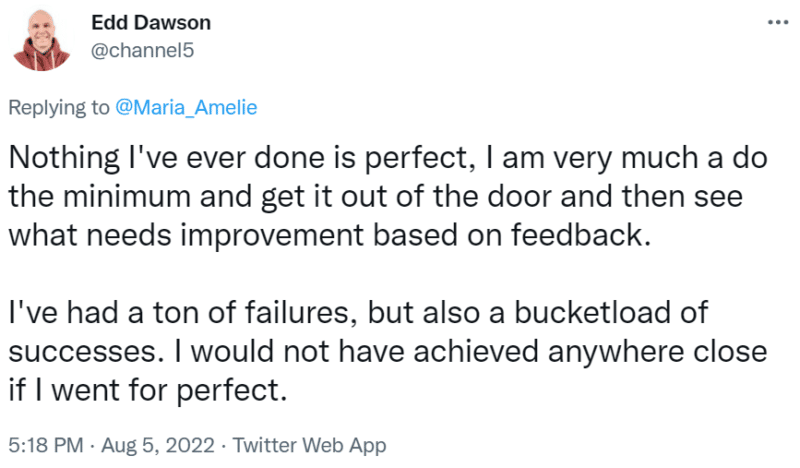
Twitter reply by Edd Dawson.

We evolve into perfectionists when we try to beat an image we have built about ourselves:

Unworthy, a nuisance, someone who fails to meet expectations, ugly, someone once being told by a parent or figure of authority “you could do better.”

The inner feeling of inadequacy becomes so strong and appalling in our minds that we are ready to do whatever it takes to be validated and be a lot more than good enough.

Good enough? That is mediocre.

A perfectionist wants to “be the best” at everything in every angle of their life.

“Love me, like me, accept me, follow me” are subconsciously manifested daily in their actions.

The fact is that a perfectionist is not interested in producing flawless work. Rather, they only attempt to escape the belief that they are horrible individuals.

Work and social media are merely how they seek to become more acceptable in our eyes.

However, as the underlying issue of being a perfectionist didn’t start with work, then it cannot be the solution.

A perfectionist’s true motivation is not to achieve career success, but to feel like a worthwhile human being. 

Being accepted, valued and praised is not our employers’ or the SEO community’s responsibility. 

Once having given the best of our work with our perfectionism, the community will expect more, simply because people enjoy great content (this is only natural, with no sinister intent).


Get the daily newsletter search marketers rely on.


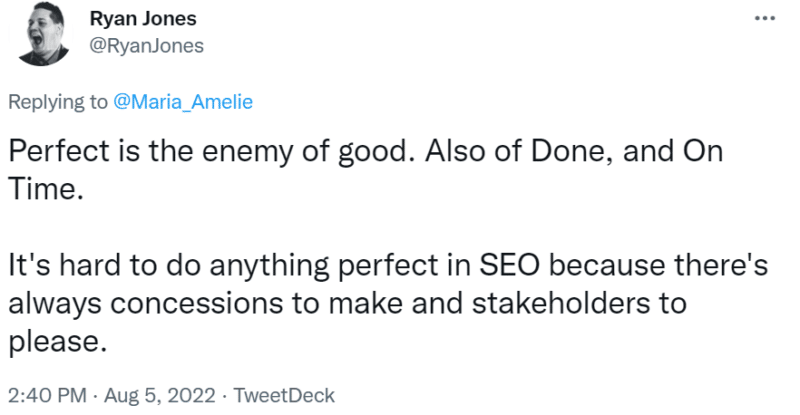
Twitter reply from Ryan Jones.

Here are four tips to help overcome perfectionism.

1. Healthy channeling

We must identify what drives or triggers us to be perfect – and then try to channel that healthily.

It is equally significant to change the mindset that makes us work intensely under the impression that we are unworthy human beings if we don’t do so. 

Working harder is neither the answer nor the cure when we feel worthless or dreadful.

It’s important to be kind to ourselves and understand that we’re worthy of being accepted. It is never our fault if, for whatever reason, we are not. 

2. Self-compassion

Open a picture of yourself as a child. Look into that little face and ask: “Is it too much to ask to believe in yourself every time you send a report, apply for a job, or send a pitch to speak at a conference?” 

What would your answer be?

Working well and being ambitious are admirable goals. However, it becomes a sign of mental turmoil when it’s used to hide a desire to make up for lack of early affection.

3. Rest and self-awareness

We should book the calendar periods to do nothing but be with ourselves. 

This is a way to be kind to ourselves and allow all those feelings of anger to come out, acknowledge them, let them be and move on. 

4. Forgiveness and letting go

Remember that in most cases, those who emotionally neglected us as children don’t mean they didn’t love us. Maybe they didn’t know how to say it. 

Those who, in the name of “wanting the best for us,” made us always feel inadequate were probably living their lives through us and may have genuinely wanted the best for us. 

Twitter reply from Daniel K Cheung.

It is essential to learn to develop self-awareness, take responsibility, and let go.

The moment we start working on letting go, we start healing. 

When we start healing, we start caring more about ourselves and less about impressing or pleasing others. In ghastly words, when we heal, we master the art of not giving a f*ck.

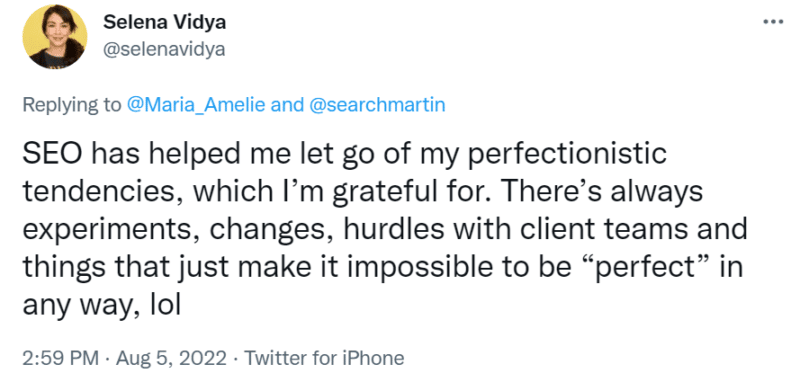
Twitter reply from Selena Vidya.

Dig deeper:


Opinions expressed in this article are those of the guest author and not necessarily Search Engine Land. Staff authors are listed here.


New on Search Engine Land

About The Author

Maria Amelie White works as Head of SEO at Kurt Geiger a luxury British retailer with concessions in luxury stores such as Harrods and Selfridges in the UK.
Maria is an MSc in Psychological Research from the University of Oxford and has worked in SEO for over 12 years, specializing in Technical SEO, International SEO, Local SEO and Digital PR.

https://searchengineland.com/perfectionism-seo-387255


Google Search Console reported pages as being indexed when they were not indexed

Google said there was a bug with its coverage report in Search Console where Google reported pages as being indexed, when in fact, they were not indexed by Google Search. Google said this “affected many properties” and thus, you should probably double-check your coverage reports for the sites you manage over the next few days.

The announcement. Google wrote “Today we fixed a Search Console issue that affected many properties: we were reporting pages that are not indexed as being indexed. As a consequence, you might see a drop in your indexed pages in the Index Coverage report.”

Here is the tweet:

What to do. For now, you should probably add to your calendar to recheck the coverage report within Google Search Console to see if your indexed versus not indexed pages have changed in any significant manner.

Google has annotated the report, but you need to check back daily to see if you notice any major changes in the index saturation of your site’s pages in Google Search:

Why we care. If you provide reports to clients or stakeholders on the index versus not indexed pages on a site, then you will want to make sure to annotate your reports for clients. Hopefully, this does not add to any stress you already have with your SEO job.


New on Search Engine Land

About The Author

Barry Schwartz a Contributing Editor to Search Engine Land and a member of the programming team for SMX events. He owns RustyBrick, a NY based web consulting firm. He also runs Search Engine Roundtable, a popular search blog on very advanced SEM topics. Barry can be followed on Twitter here.

https://searchengineland.com/google-search-console-reported-pages-as-being-indexed-when-they-were-not-indexed-387240


The WORST SEO advice I heard this year (and what you should do instead)

The most common complaint I receive from audit clients and bloggers is the inability to “know which SEO advice to follow.” 

Unlike search engines which can rank, re-rank, or penalize information or practices that are unethical or unscrupulous in nature, the same can’t be achieved by the average blogger weeding through multiple courses, gurus or podcasts.

Unfortunately, 2022 has taken things to a whole new level.

The amount of emails and instant messages I received from bloggers asking, “Is this true?” or “I was told to do this, what do you think?” cannot be quantified other than to say, “It was a lot.”

Executing a correct and competent SEO strategy has never been more challenging, especially in light of the explosion of new websites launched during the pandemic.

As such, understanding what advice is worthwhile and which is complete and utter garbage has never been more important.

To that end, I present some of the worst pieces of SEO advice I was asked about in 2022, with the hope that the answers will help you decide what not to do.

Worst SEO advice #1: “I should never remove content from my website.”

Bad SEO advice meme

The benefits of removing old content from an existing site have been known and practiced for years.

Think of your site as a garden. All the content generating traffic, links, and regular social signals are your flowers. Everything that is not? Those are your weeds. Just like in a real garden, you can kill your flowers if you don’t pull those weeds.

Leaving expired, low-quality or thin content on your site can result in a myriad of bad SEO outcomes, including:

  • Diluting your overall crawl budget.
  • Reducing overall site authority.
  • Creating page and keyword cannibalization issues.
  • Reducing on-page UX and time-on-site metrics.
  • Lowering sitewide revenue per thousand impressions (RPM) for ad income.

It’s also been well-documented by Google’s John Mueller that low-quality content on one part of a site can negatively impact the search rankings of the entire site.

Bottom line

If you can update and improve existing content, do that! 

But if not, delete it, and move on. Think quality with your site content, not quantity.

Worst SEO advice #2: “All I need is to write longer content to rank higher.”

Man holding placard saying "Content length is not a ranking factor."

It has been stated repeatedly that word count is not a ranking factor with Google. And yet, daily, I run into clients who have been directed to write a longer resource as their main method to “recapture” a lost ranking or improve existing visibility.

When asked about word count, Mueller said, “just blindly adding content to a page will not make it (rank) better.”

What does help a resource is adding content that is useful to the audience.

For example, nobody wants to read a 2,000-plus-word treatise on artichoke hearts. As such, understanding what your audience is seeking and what is considered “useful” can still be confusing to the average site owner.

Bottom line

A content update or rewrite has to have a clear purpose and an understanding of why your page isn’t ranking in the first place. 

  • Is there an intent mismatch with your query? 
  • Does the page have technical deficiencies? 
  • Are you competing against much bigger sites? 

These are just a few questions to answer before deciding “just to write a longer resource” for ranking consideration.


Get the daily newsletter search marketers rely on.


Worst SEO advice #3: “I should include my focus keyword in every page heading.”

Keyword stuffed headings meme

During the “good ol’ days” of SEO, it was very common to optimize a page around a focus keyword by including the focus keyword in the title, the meta description, the URL, and every heading on the page.

For example, just a few years ago, a typical recipe post trying to rank for “banana cream pie” may have looked like this:

<H1> Best Banana Cream Pie
<H2> Why this Banana Cream Pie is the Best
<H2> Banana Cream Ingredients
<H2> Step by Step to Make Banana Cream Pie
<H2> Banana Cream Pie Questions & Answers
<H2> Related Banana Cream Pie Recipes
<H2> Banana Cream Pie (recipe card)

Unfortunately, following Google updates from November 2019, and later announced Core Updates in January and May 2020, a clear pattern emerged whereby bloggers who had been over-optimizing their headings (among other issues) suffered decimated ranking and traffic drops.

The pattern was incredibly easy to see in audits and online Facebook groups and was soon backed up by a Food Blogger Study by SEO firm Top Hat Rank published in February of 2020. 

In the study, food blogs saw a 60% drop in direct Google search engine traffic to recipes and posts that had engaged in heading keyword over-optimization.

Fortunately, bloggers who went back through their site and started de-optimizing their headings ended up with recoveries by the May 2020 Core Update, or much later, when Google did their next announced update in December.

Bottom line

Any recommendation to stuff your headings with keywords is not only outdated advice but possibly dangerous for the average site in the current algorithmic climate. 

Referencing your keyword naturally in the H1 and one or two other H2s seems fine. More than that, it will look spammy and should be avoided!

Worst SEO advice #4: “Alt text should be used for SEO keywords.”

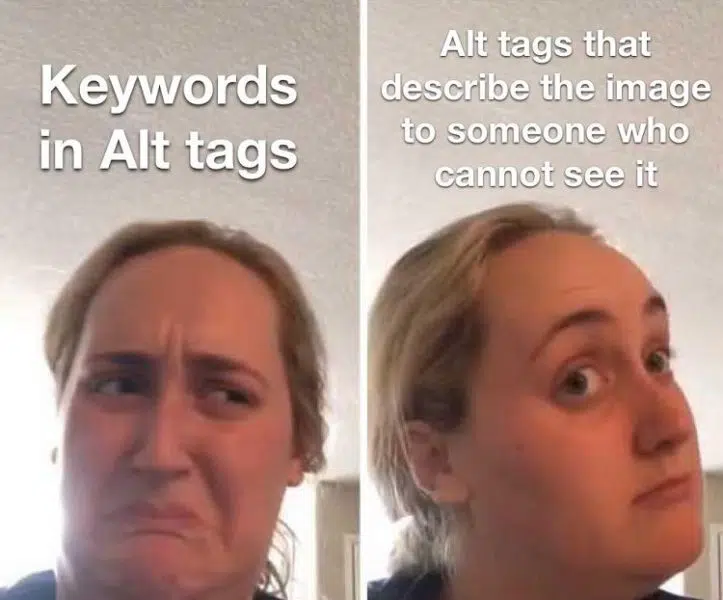
Keyword alt text meme

Alt text, or alternative text, is one of the most important and misunderstood topics in all of SEO and accessibility. Having good and correct alt text for images is not just a simple SEO best practice, but it’s essential for people with visual disabilities who visit the site.

Alt text exists first and foremost to describe the image to someone who cannot see it. The focus is on those accessing the site with screen readers who cannot see the image and, as such, must have the images read out to them for descriptive purposes.

Nothing annoys visually impaired users more than visiting a site and seeing every image read out as “keyword – keyword – keyword.” 

And yet, even today, with as much literature that exists on the correct use of alt text, this still happens more than it should!

Bottom line

Ditch the keywords and describe what is in the photo to someone who cannot see it.

Don’t say “image of” or “photo of” in your alt text. Be short but descriptive.

Finally, add a “period” at the end as a prompt for screen readers to know the alt text has completed.

Toxic links Semrush reference

Oh, Semrush, you never disappoint! 

Although the Semrush suite of tools is, by and large, a quality investment for users and SEOs alike, this is by far its biggest drawback. In this specific example, the tool fails miserably!

I have yet to run a crawl for a client with Semrush and have the tool not spit out a huge “Danger, Will Robinson! Danger!” warning when reviewing a link profile.

Semrush identifies random links as toxic and then recommends that the user submit a disavow file. The problem with this recommendation is it’s unnecessary and completely arbitrary.

Google is very clear that:

In fact, Google doesn’t even have a concept of toxic domains, and blindly following a tool that says “otherwise” should always be avoided.

Bottom line

Unless you have a manual action, or you know you built in bad links yourself, a disavow file is a complete waste of time for the average site owner. 

Ignore the tools and move on to something else that will actually help move your site.

Final thoughts

You’ve heard that SEO is a marathon, not a sprint. As with any marathon, it’s all about training and preparation. 

Don’t derail your SEO marathon by succumbing to poor advice baked into a course, a podcast or a guru trying to sell you their latest tool.

Instead, use a little common sense and push back against advice that “may” seem questionable when given. The site you save may be your own. Good luck out there!


Opinions expressed in this article are those of the guest author and not necessarily Search Engine Land. Staff authors are listed here.


New on Search Engine Land

About The Author

Casey Markee is the owner of internet consultancy Media Wyse. An SEO for over two decades, he has been working exclusively with food and lifestyle bloggers since 2015. During that time he’s worked with thousands of bloggers across every recipe niche imaginable. He likes long walks to the refrigerator and back and believes bacon and candy corn are gourmet foods.

https://searchengineland.com/worst-seo-advice-i-heard-this-year-and-what-you-should-do-instead-387204


5 international SEO tips that don’t include hreflang

International optimization is arguably the most advanced form of SEO, given its complexities, nuances and variation of application. 

The fundamental practices of SEO are meant to address:

  • Technical issues to increase site crawlability.
  • Content optimization to improve keyword usage.
  • Acquire quality links from external sites to accumulate site equity. 

Most of these practices still apply to international search engines because all bots must be able to crawl a site, seek relevant content and examine links from external sites. 

I know what you’re thinking. This is another post about hreflang implementation, right? 

Wrong. I’ll leave that to others who have written extensively about hreflang. 

A few extra, less-talked-about techniques allow a country-specific site a slight edge over other sites.

To begin crafting a strategy, you first need to determine your target regions.

Next, you must decide which languages you will make available to those regions. This is critical because it allows you to lay out the entire project starting with URL structure.

About international search engines

Before we get to some of these specific tactics, it is crucial to understand the global search engine landscape.

While Google, Microsoft Bing, and Yahoo are the leading search engines in the United States, other search engines have significant market share in other countries.

China’s top search engine is Baidu, with a 71% market share.

Russian searchers prefer nearly an even split between Google and Yandex.

South Koreans prefer Google, but the country’s native search engine, Naver, still commands nearly 27% of the market share.

But, on a global scale:

  • Google still rules the world, with 1.2 trillion search queries per year and 91.4% of the global market share. 
  • Microsoft Bing ranked second with 3.3% global share. 
  • Third is Yandex, with a 1.5% share. 
  • Fourth is Yahoo!, with a 1.3% global market share. 
  • Pulling fifth place is China’s Baidu, with 0.91% of the global market share.

So, while international-focused optimizations made for Google will serve you well in most countries, there are still outlier search engines that deserve their own focus.

Baidu

The homepage of Baidu
The homepage of Baidu, China’s top search engine

With China’s huge consumer base of nearly 1 billion internet users, website optimization for the nuances of Baidu search engine rankings will be crucial to capture their attention. 

  • Baidu Webmaster Tools: Set up and submit your site to Baidu through the Webmaster Tools account.
  • Language: Simplified Chinese is the preferred language of Baidu and most online communications. Pinyin is a phonetic equivalent of the Chinese language using Latin characters. Website addresses are designated in pinyin.
  • Internet Content Provider (ICP) licensing: To rank in Baidu, you must comply with Chinese censorship regulations. Obtaining an ICP license is mandatory for good search engine rankings.
  • Web hosting: Baidu prefers websites hosted in Mainland China. Due to the slow internet infrastructure, a high loading speed will be preferred. Alternatively, hosting in Hong Kong can also facilitate a high loading speed. 

Naver

The home page of Naver
Naver is considered the first South Korean portal website with a self-developed search engine

The biggest difference between Naver and other search engines is its bias toward owned platforms and content. So much so that the algorithm is two-part, with one part assigning a “Creator Rank” signal generated via Naver’s other products.

  • Naver Webmaster Tools: Registering your site is a requirement. However, user-generated content (UGC) and paid listings dominate the results.
  • Language: Naver was built around the Korean language, and a fully translated site is critical.
  • Hreflang: Naver doesn’t support hreflang. This means you need to use the HTML meta language tag (<meta http-equiv="content-language" content="ko-kr">) in your page template, as well as utilize a Korean site/alternate version only XML sitemap submitted to Naver Webmaster Tools.
  • Naver products: The primary products to include in your strategy include Naver Encyclopedia, Knowledge iN, Naver Blog, and Naver Café.

1. Domain and URL structure

Each country is assigned a specific country code top-level domain (ccTLD), such as co.uk for the U.K., .ca for Canada, .com.au for Australia, and so on. 

Purchasing a local ccTLD is the first step in ranking well in country-specific search engines since most search engines will slightly favor the local websites that are targeted to the country over a generic .com site. 

Most search engines also offer limiting results to “only pages from country X.” Users also recognize a website with their country designation as being more trustworthy.

ccTLDs are preferred over using subdomains or subdirectories because both of those will reside on site.com. If the same English content for the U.S., U.K., Canada, and Australia were hosted on site.com, it would definitely cause duplicate content issues. 

Although it is not advised to have duplicate content of any kind on a site at all, the major search engines do recognize that www.site.co.uk is targeting only U.K. users and would therefore not count as duplicate content against www.site.com. 

This is something that could change in the future, so it is always wise to localize content that is in the same language. If the same content is in English, French, and Spanish, then there is no concern about duplicate content.

The most important thing to understand about international website domain and URL structures is each option’s pros and cons. (Note: The information below is taken directly from Google.)

ccTLDs (e.g., example.de, example.co.uk)

Pros (+)
– clear geotargeting
– server location is irrelevant
– easy separation of sites
– legal requirements (sometimes)

Cons (-)
– expensive
– potential availability issues
– more infrastructure
– ccTLD requiremennts (sometimes)

Subdomains with gTLDs (e.g., de.site.com, uk.site.com, etc.)

Pros (+)
– easy to set up
– can use Search Console geotargeting
– allows different server locations
– easy separation of sites

Cons (-)
– users might not recognize geotargeting from the URL alone (is “de” the language or the country?)

Subdirectories with gTLDs (e.g., site.com/de/, site.com/uk/, etc.)

Pros (+)
– easy to set up
– can use Search Console geotargeting
– low maintenance (same host)

Cons (-)
– users might not recognize geotargeting from the URL alone
– single server location
– separation of sites is more difficult/less clear

URL parameters (e.g., site.com?loc=de, ?country=germany, etc.)

Pros (+)
– none (not recommended)

Cons (-)
– segmentation based on the URL is difficult
– users might not recognize geotargeting from the URL alone
– geotargeting in Search Console is not possible

Working with multi-regional websites, Google Search Central Blog

Because ccTLDs are a strong indicator to Google, they have historically been the preferred method for international optimization. 

As you can see above, however, there are significant investment and time requirements to maintain the management of each site. 

As a result, subdomains and subdirectories have become increasingly readily adopted as alternatives and more affordable options. 

If you choose this route, you must take additional steps to ensure the correct content is being displayed to your users.

2. Google Search Console geotargeting

Google Search Console allows for manual geotargeting of gTLDs (such as .com and .net) with the Set Geographic Target tool. 

To set up geotargeting in Google Search Console, follow these steps:

  1. On the homepage, select the site you want.
  2. In the left-hand navigation, expand the Legacy tools and reports section and click International targeting.
Google Search Console legacy tools and reports - International targeting
  1. Select the Country tab.
  2. Check the box next to Target users in. 
  3. Select your desired country from the drop-down.
  1. Click Save.

If you want to ensure that your site is not associated with any country or region, simply unselect the check box and re-save.

Google points out that it generally does not make sense to set a geographic target if the same pages on your site target more than a single country. 

This is because your geotargeting settings might limit the reach of your content.

User IP and user-agent detection

User-agent detection is the process of detecting the device a person is using and delivering content based on the best practices for that device. 

IP location detection is the practice of detecting a user’s location and delivering content based on what is more relevant for that IP location. If you implement this correctly, there is a good chance you will lower bounce rates, increase conversions and show users what they are looking for more quickly.

This is a very common practice for localized optimization (as location and device are often detectable), but it is also vital for multilingual and multiregional SEO. Google supports both HTTP redirection and JavaScript redirects. 

Below are some notes from Google on the topic.

Using HTTP redirects

HTTP redirection is a commonly used to redirect clients to device-specific URLs. Usually, the redirection is done based on the user agent in the HTTP request headers. It is important to keep the redirection consistent with the alternate URL specified in the page’s rel="alternate" tag or in the sitemap.

For this purpose, it does not matter if the server redirects with an HTTP 301 or a 302 status code, but use of 302 is recommended whenever possible.

JavaScript redirects

If HTTP redirection is difficult to implement, you can use JavaScript to redirect users to the URLs pointed to by the rel="alternate" tag. If you choose to use this technique, be aware of the latency caused by the client side of redirection due to the need to first download the page, then parse and execute the JavaScript before triggering the redirect.

There are many approaches to implementing a JavaScript-based redirect. For example, you can use JavaScript to execute the media queries your site already uses in the link annotations on the page using the matchMedia() JavaScript function.

Outside of the detection and redirects, you also want to ensure your website has good internal linking and navigation so the user can find the pages that match their demographic.


Get the daily newsletter search marketers rely on.


3. The “content-language” meta tag

The local language is essential and should be crafted carefully to ensure that Google and foreign search engines can understand the content. 

Language declaration tags such as the content-language tag indicate the target language of the site and should appear within the <head></head> along with the meta description and meta keywords tags. 

While this tag does not impact Google, it is used by Microsoft Bing:

Use the “content-language” meta tag to embed a document location in the <head> section of your documents:

<meta http-equiv="content-language" content="en-us">

The “content” attribute is comprised of a 2-letter ISO 639 language code, followed by a dash and the appropriate ISO 3166 geography code. For example:
• de-at: German, Austria
• de-de: German, Germany
• en-us: English, United States
• es-ar: Spanish, Argentina

Alternatively, embed the document location in either the <html> or the <title> element using the same format:
• <html lang="en-us">
• <title lang="en-us">

How To Tell Bing Your Website’s Country and Language, Microsoft Bing Blogs

4. Localized content

Country-specific sites should not be treated as simple clones of the main site with a different ccTLD. 

To avoid duplicate content issues, the content should be localized and catered to each target country, giving local searchers a better user experience. 

So, why don’t more websites do it?

The workflow outlined below of Adobe’s content localization process says it all.

It is hard, laborious and resource-intensive. But it’s highly rewarding!

Adobe's content localization process
Adobe’s content localization process

Keywords

Even among sites using the same language, there are differences in wording, spelling, and the regional vernacular that should be applied for each country-specific site. 

For example, there are differences between American English and British English in wording (lorry vs. truck), spelling (localization vs. localization), and regional vernacular (sleeping policeman vs. speed bump). Please pay special attention when developing your keyword lists for international pages. 

Native speakers are invaluable for regional vernacular keyword insights that may not be obvious to non-native speakers. 

Metadata 

While the weight of the metadata varies from search engine to search engine, it is a best practice to complete the metadata in much the same way you would for a U.S.-based website. 

The only difference is the utilization of locally appealing keywords and phrases. 

Localizing body content

You should be aware of localizing information in several areas, including:

  • Currency conversion
  • Addresses
  • Phone numbers
  • Time zone
  • Weather
  • Seasons

When writing or altering content to address a foreign viewer, remember to write engaging content that someone from the targeted region would be interested in. 

Be sure to use proper localized information, such as listing the local offices and including the operating hours in the time zone appropriate for the region.

A country-specific site should have incoming links from other sites also based within that same country. Search engines can detect the geographical location of a site based on the IP address. 

Therefore, a country-specific site should have incoming links from within the same country. Without sufficient links from a target country, a new ccTLD may have difficulty ranking. 

This requires much manual effort to search, contact, and gain incoming links since the site is completely new.

Begin by identifying your backlink profile and international competitors’ most popular content and networks.

Once you have identified your link profile and competitors’ links, use that as a guidebook for optimizing current links and a link building campaign to gain links from those trusted sources. 

Find relevant sites that Google has categorized in the targeted language (French, Simplified Chinese, Spanish, etc.). 

Obtaining quality links from sites with the same language will increase the perceived off-page relevancy of your website. Where possible, find .com’s, .net’s, etc., written in the appropriate language to reach out for a link building campaign.

Anchor text

With international SEO, there is an increased opportunity to use a broader-scope style of anchor text distribution. 

Using a wide variety of keywords with similar meanings helps to support a website’s theme more distinctly than in the U.S. Consider mixing the language of your anchor texts between local and English with exact, partial, and generic phrases.

Local search registration

Register each site with Google Business Profile, Bing Places for Business, and local equivalents like the Yandex Business Directory. Register with as many local directories as you can find. 

Yandex Business Directory
Adding information about a business to the Yandex Business Directory is free.

Links from local, smaller community business directories usually have high authority and trust.

Social signals

Having a local social media property in the language of the targeted region provides a sense of trust to the viewer. 

Register with the social media portals in each region to increase the potential for social engagement and link sharing within the country. As noted above, this is an absolute must to compete on Naver.

These local links are a cue to the search engines that the website is relevant and beneficial to users. Thus, your efforts might result in higher rankings. 

Wrapping up

The ultimate goal of international SEO is to take a country-specific site and rank it in its local market.

In the end, hreflang tags alone may not be enough to accomplish that, depending on the market being targeted. 

This makes SEO for the international market even more complex, but it doesn’t need to be intimidating. 

By understanding your priority markets (and corresponding search engine market share), you can adapt these techniques to align with the respective international ranking requirements. 


Opinions expressed in this article are those of the guest author and not necessarily Search Engine Land. Staff authors are listed here.


New on Search Engine Land

About The Author

Jon Clark is a proud #girldad and the Managing Partner at Moving Traffic Media, a boutique digital marketing agency in New York. He writes regularly, providing thought leadership on topics related to SEO, PPC, and Social Media. In his downtime, he enjoys hanging out at coffee shops and documenting his travels on Instagram.

https://searchengineland.com/international-seo-tips-that-dont-include-hreflang-387175


Data speaks: Link relevancy trumps volume for SEO

Data speaks Link relevancy trumps volume for SEO

30-second summary:

  • Earned media coverage is more valuable than ever for your website
  • Digital PR is just as important as technical SEO
  • A large volume of links is the goal, what’s stopping someone from picking the most newsworthy idea, even if it has nothing to do with your client?

In 2022, it’s impossible to deny the benefit that digital PR as a tactic has on an organic growth strategy. Earned media coverage is more valuable than ever for your website. You could be doing everything right for SEO, but if you’re not building links, you’re still missing out on the increased search visibility, organic traffic, and brand awareness that backlinks bring to your business.

Last year, Google’s John Mueller finally weighed in on digital PR as a tactic and confirmed what we’ve all known for a while now: that it’s just as important — if not more — as technical SEO.

As digital PR is still a relatively “young industry” that’s only just sprouted up in the past 10 years, many PR pros have relied on “viral” campaigns to boost the backlink portfolio of their clients. These viral campaigns are often celebrated but are often created with little regard to how relevant, or “on-brand” those ideas really are.

After all, if a large volume of links is the goal, what’s stopping someone from picking the most newsworthy idea, even if it has nothing to do with your client?

In 2022, link volume is no longer the goal (or shouldn’t be)

While many PR pros’ were evaluating their success around this one key metric (link volume) others in the industry have suspected for a while now that the relevance of linking coverage is a key factor Google looks at when assigning “value” to links.

Once again, John Mueller has settled the debate about link volume vs link relevance,  coming out in 2021 and saying that ‘the total number of links’ doesn’t matter at all.

This clarity has helped refocus the digital PR industry and forced PR pros to re-evaluate what metrics and KPIs we need to be focusing on to drive true organic growth.

It’s no longer enough to be ‘popular’ you also need to be relevant. Not just in terms of the publications you are targeting, but the keywords you want to rank for,  audience interest, and most importantly, brand alignment to the story you are pitching in.

Google is continuously looking to become more intelligent through its use of machine learning and artificial intelligence. It wants to understand web content as a human, and therefore through its use of natural language understanding, it is likely to not just be looking at the anchor text of links in third-party articles, but it is also wanting to understand the wider context of the article that a brand is placed in.

How to ensure your link-building activity is relevant to your brand

The first steps to coming up with relevant content ideas for your digital PR campaign are to:

  1.  understand your client, and
  2.  understand your client’s audience and their needs.

Every good idea will flow from these two pillars.

If Google’s main objective is to show the best content to users through search, then your job is to create content that either supports your client’s product or service or supports their customers.

It is more important than ever to not only create relevant and on-brand content in the written form but also ensure that any supporting assets created (video, images, audio) are also relevant to the target keywords and services or products that the brand sells.

In addition, it’s important to create content that engages people, to drive further buzz and positive sentiment around the brand, all of which contribute to greater brand awareness and affinity among your potential customers.

How to measure the relevancy of your backlink profile

We now have the technology available to us to be able to understand and assign quantifiable metrics to the relevance of linking coverage (or indeed the relevance of any text-based content) – which allows us to be much more data-driven and targeted when developing digital PR, link creation activity and competitor and marketplace analysis.

For example, natural language understanding tools like Salient, measure the relevancy of both off-page and on-page content. Tools like this help to understand how a search engine is viewing a brand’s content, it not only enables us to identify the gaps in our client’s backlink profile.

At Journey Further, we use this proprietary tool to measure the relevancy of both off-page and on-page content for our clients.

Measuring the relevancy of your backlink profile

We can use this tool to understand how a search engine is viewing a brand’s content, it not only enables us to identify the gaps in our client’s backlink profile but also aids us in optimizing its content on-site. The outcome of which – is a much more focused, effective, and measurable digital PR activity that is better aligned to SEO objectives and that delivers better ROI for clients.

Looking ahead to 2023

Looking ahead to 2023 and beyond, it’s likely that Google will only continue to develop better technology to understand web content.

All digital PR campaigns should reflect this, and where possible, be multi-faceted, not just relying on a single press release to get cut through. We need to be thinking as marketers, not just SEO practitioners, and ensure we are driving as much ROI as possible. Taking a brand plus performance approach to SEO and digital PR will therefore be key.


Beth Nunnington is the VP of Digital PR and Content Marketing at Journey Further, leading Digital PR strategy for the world’s leading brands. Her work has been featured in The Drum, PR Moment, and Prolific North. Find Beth on Twitter @BethNunnington.

Subscribe to the Search Engine Watch newsletter for insights on SEO, the search landscape, search marketing, digital marketing, leadership, podcasts, and more.

Join the conversation with us on LinkedIn and Twitter.

https://www.searchenginewatch.com/2022/08/17/data-speaks-link-relevancy-trumps-volume-for-seo/


6 fundamental truths about SEO

Brands and SEO professionals must take responsibility for the performance of the websites that they run and manage.

Applying these six SEO truths will help you achieve next-level website performance, according to Bruce Clay, the founder and president of digital marketing optimization firm Bruce Clay Inc., who spoke at SMX Advanced.

1. SEO needs to be a strategic initiative across the company

The entire organization participates in SEO. It starts at the leadership level – everyone must understand that SEO is important, commit to it and make it a priority. 

You can’t just do your SEO on Monday. One person can’t randomly do SEO. It isn’t going to work if you aren’t working on SEO every day.

The organization must think about SEO every time there’s a meeting to discuss changing the website. Somebody in that room has to ask, “How does this impact SEO?”

“How can we improve the overall quality and operation of our website so that it actually generates traffic or meets a KPI of the business? … If the commitment is to do SEO, and if you buy into it being long-term, then SEO is a winning operation within your business,” Clay said.

2. SEO should beat the competition, not the algorithm

We must understand how ranking algorithms work. But our job isn’t to beat the algorithm. Beating the algorithm is an insurmountable battle.

Google makes thousands of changes to search every year. And every keyword you’re trying to optimize for is essentially a new algorithm. 

Your job is to beat the competition. 

The best we can do is determine who ranks and determine what they’re doing. Are there any common characteristics? Are there any common words and can we use them better?

“The story I always tell is of two friends who go camping. They set up their tents. They start a fire. They’re cooking a meal and along comes a bear. They take off running down the path. The bear is chasing them. The guy in front doesn’t need to be an Olympic runner. He just needs to be faster than his friend,” Clay said.

Well, SEO is much the same thing. You have competitors. You have to be better than them.

3. SEO done right cares about content architecture

Websites must be built in a way so that search engines see you as a subject matter expert. Publishing authoritative and trustworthy information takes a concentrated effort.

Google prefers content that is presented in a clear hierarchical structure. In other words, a drill down (e.g., a website about electronics has cameras > digital cameras; a website about automobiles has Ford > Mustang). This is called siloing. 

“It actually performs better in search because you’ve concentrated, in one location, all of the information about that particular keyword, instead of spreading it all over the website,” Clay said. “In order to get SEO to perform correctly, you have to be the subject matter expert. You cannot randomly throw a bunch of things onto a website and expect it to work.”

4. It’s not the job of SEO to make a pig fly

Sometimes, no amount of SEO can save a poorly maintained website. That’s why website maintenance has to be built into your SEO program. 

You can’t just push an “easy” button and say you want to rank tomorrow if your website looks like it’s 20 years old, hasn’t been updated in years or isn’t mobile-friendly.

“It’s the job of SEO to take that pig and work with you to genetically engineer it into an eagle. Then you may have something that works. Way too many people come to us with old technology. They haven’t updated their site in five years. They haven’t updated content. And they’re expecting that the search engine is going to give them a reward in the face of people that have been maintaining their sites all along,” Clay said.

Organic search competition is intense. Your competition may have a whole team working on their SEO. Sometimes it can be like trying to compete against websites armed with machine guns while you only have bows and arrows.

5. Cheap SEO is a near-death experience

Cheap SEO has consequences. It can harm you. No business should expect cheap SEO to work well.

Do you want bad advice for half the price, or do you want good advice? How long is it going to take you to discover what went wrong after it goes wrong? And how much will it cost you to fix it later?

What you end up with cheap SEO is inexperienced people experimenting at your expense. And they often can be wrong.

“Get it done right and get it done properly, the first time. You can’t afford to do it over,” Clay said.

6. SEO is done when Google stops changing things and all your competition dies

SEO is a perpetual project because search is constantly changing. So is what your competition is doing. (Oh, and also search behavior.)

Google’s goal is to please users, so they have leaned heavily into things like user experience and rewarding truly expert, accurate, trustworthy content. 

“When you are in an environment like that, where the search engine is going to be constantly changing and experimenting and trying to make itself better – those are changes that are going to seriously impact how you perform in search results,” Clay said. “You cannot ever be done with SEO. The search engines have seen to it.”


New on Search Engine Land

About The Author

Danny Goodwin is Managing Editor of Search Engine Land & SMX. In addition to writing daily about SEO, PPC, and more for Search Engine Land, Goodwin also manages Search Engine Land’s roster of subject-matter experts. He also helps program our conference series, SMX – Search Marketing Expo. Prior to joining Search Engine Land, Goodwin was Executive Editor at Search Engine Journal, where he led editorial initiatives for the brand. He also was an editor at Search Engine Watch. He has spoken at many major search conferences and virtual events, and has been sourced for his expertise by a wide range of publications and podcasts.

https://searchengineland.com/6-fundamental-truths-about-seo-387230