Google launches new image preview interface in web search
Google has rolled out a new image preview pane window that overlays on top of the main search results after you click on an image in those search results. This is instead of Google jumping you to the image tab in the Google Search interface, thus keeping you directly in the main search results.
What it looks like. Here is a screenshot of this in action, you can click on the image to enlarge it:
Not confirmed. Google has not announced this change yet but this now seems to be fully live for all searchers. I personally tested this in numerous browsers and everyone I asked also is able to see this new image interface.
We have reached out to Google for more details on this launch.
Why we care. This may impact how many people come to your site from image search results on Google Search. This change in how the user experience works is substantial and it might increase or decrease your click-through rate from Google Search related to your images.
New on Search Engine Land
About The Author
Barry Schwartz a Contributing Editor to Search Engine Land and a member of the programming team for SMX events. He owns RustyBrick, a NY based web consulting firm. He also runs Search Engine Roundtable, a popular search blog on very advanced SEM topics. Barry can be followed on Twitter here.
Getting buy-in for an SEO investment is already difficult enough. But we also face the challenge that many companies still question where it fits in with their overall marketing budget.
You’d think we’d have this figured out by now.
Are there technical aspects to SEO? Absolutely. But is technical all SEO is? Absolutely not. Not even close.
SEO isn’t advertising. Most companies have PPC budgets in their overall marketing budget. One client I’ve worked with for several years gets about 60% of their traffic from organic search, yet they spend approximately 7x-10x more on paid search efforts which is driving 20% of their traffic. I don’t think this is an unusual case. I think this is more likely the norm.
Website “stuff” is still typically an IT expense, not marketing. But, creating content for the website might fit into the IT, PR or social (marketing) departments.
While SEO has come a long way and developed legitimacy, I think until company leaders see SEO as “marketing,” we will not have earned the due respect that the field plays in a digital marketing effort.
Until SEO is solidly considered a “marketing” function, we won’t realize the requisite budgets to do this stuff right and have an appropriate amount of time/budget invested, considering the potential value/ROI of a solid SEO effort.
What is marketing?
Do a Google search and you’ll find the following definition of marketing, or something similar:
“The action or business of promoting and selling products or services, including market research and advertising.”
I could stop the argument here. That’s exactly what SEO is here for: to promote a company and to assist in the sales of products and services, including market (keyword/competitive) research.
What encompasses an SEO effort in 2022?
Everyone has their own approach to SEO. Some might say SEO involves meta data. Some might say “technical,” including things like addressing page speed.
While those things are certainly true, they’re small pieces of an all-encompassing approach to SEO.
Put simply, SEO is the process of building your business’s web presence to connect with consumers.
This process may begin with keyword research, but even that small task/deliverable is an involved process.
How do we want to position the business, its products and/or its services?
Which competitors seem most aligned to our aspirations and appear to be performing best against those keywords which we’ve identified?
Have we identified keywords – from all of our analysis – which we deem “very important”, yet we have no pages/content relevant enough to Google/searchers to fulfill the intent of the search?
If so, how do we intuitively build new pages/content into our website to provide for a better user experience and gain organic search presence?
How do we cross-promote (link) content, so that it might perform (rank) better?
Do you notice what hasn’t been mentioned?
Anything technical.
SEO is not just technical
Certainly, there have been many instances of stepping into a new SEO engagement and addressing a technical glitch and having this be “the thing” that has been preventing success. Those instances are few and far between. The commonly found “you have a disallow: / in your robots.txt” comes to mind.
The technical elements of a new SEO engagement will certainly involve a technical audit (or should). And this isn’t just using one tool to tell you everything that’s broken.
But the technical elements that should exist in an SEO effort might include items such as:
Technical crawls via any number of tools (Semrush, DeepCrawl, Screaming Frog, etc.).
Mobile-friendly checks, to ensure that your pages are displaying correctly across multiple devices, loading correctly, content recognized, etc.
URL reviews, making sure that, when possible, your URL structures are aligned with the keywords that you’re targeting for any given page and don’t have oddities that may impact a page’s ability to rank.
Canonical reviews.
Page speed.
Schema.
JavaScript usage/reviews.
Technical SEO is still important, but it’s certainly different than 20 years ago when there were many hand-coded websites.
Nowadays, many off-the-shelf content management systems do a decent job of delivering a “search engine friendly” platform. And, aside from that, there are many plug-ins that can help you to keep things in check.
More often, an SEO effort is truly ‘marketing’
You are working to align pages/content of your website to address known searches performed (and the intent of those searches) based upon a lot of marketing research.
Do we want our “money pages” to rank? Of course, 100% of the time, if we can manage it.
But is that the content we often identify as being “what Google/searchers like/want”? Not always.
Google often groups keywords with intent and groups them as follows:
Informational results (We may need to create some resourceful content and/or a blog post to address a question that searchers may be asking)
Transactional results (These folks are looking to buy something/convert; are our pages informative enough, content-rich, etc.?)
Commercial results (These folks are researching brands and services; do we have strong category pages?)
A larger share of time is being spent on those things “non-technical” in an SEO engagement.
More often, we are seeking ways to optimize:
Information architecture.
Taxonomy.
Content.
User experience.
Conversion rate optimization.
Video content/YouTube.
Local organic presence.
Items related to online reputation management.
And more.
Using Google Analytics, other tools and measurements, we then optimize our efforts toward specific goals that we’re trying to reach.
Ideally, at the start of an SEO engagement, we’re able to address many of the large technical roadblocks. Often, new “things” will pop up that will require a technical review.
But what will drive the SEO engagement more than anything is a strategic approach to content and helping clients better position their website (and other assets related to their organic presence) and “drive the action of promoting a business’s products or services, including performing market research.”
Which is…. marketing.
Opinions expressed in this article are those of the guest author and not necessarily Search Engine Land. Staff authors are listed here.
New on Search Engine Land
About The Author
Mark Jackson is the President and CEO of Vizion Interactive, an agency founded in Dallas, Texas in 2005 and specializing in SEO Services, Paid Media Services (Search/Display/Social/Video/Amazon), Local Listing Management and Conversion Rate Optimization. Mark was a co-founder of the Dallas-Fort Worth Search Engine Marketing Association and Kansas City Search Engine Marketing Association and has been a contributor to Search Engine Watch, ClickZ, Pubcon and the Search Engine Strategies conferences.
Ranking high on SERPs requires much effort. To succeed, make sure your page offers supreme value and a unique experience to your target audience. In this article, we will discuss how on-page SEO can improve the quality of your page so that it has a leg to stand on against top competitors.
What is on-page SEO, and why is it important?
On-page, or on-site SEO, is the process of optimizing page elements for specific keywords to improve page rankings and user experience. Under page elements, we observe:
Content quality
Keyword density
Title and description
URL structure
Page experience
Media optimization
Internal and external links, etc.
These page elements are the main communication points between the page, user and search engines. SEO-wise, each page element can be improved to enhance user experience and to tell search engines more about your pages. This increases the chance thatyour pages will rank higher in search and get more traffic.
Optimizing pages with an on-page SEO checker
On-page SEO includes a variety of tasks for every page element, but some are easy to miss. To stay on track, use an automated tool with a step-by-step checklist and actionable tips. You can still complete most tasks manually, but on-page SEO checkers help you perform on-page optimization more efficiently.
Most SEO checkers analyze pages from the search engines’ point of view. They evaluate technical parameters and present a list of issues that might influence rankings.
Some tools offer in-depth analytics. They compare target pages with direct competitors and estimate the range of recommended metrics. Recommendations are more accurate because they are based on relevant metrics and competitive aspects instead of general benchmarks.
One of SE Ranking’s advanced tools is the On-Page SEO Checker. This AI-powered tool helps check and optimize pages for the best SEO results.
Let’s move on to dissecting the on-page optimization process.
Step 1. Identify pages for optimization
Before performing on-site SEO, you must identify pages that require optimization.
Signals that indicate the page needs improvement include:
Traffic is decreasing. As you investigate this issue, carefully study Google Analytics reports.
Page potential is decreasing. If search visibility or the number of clicks continues to fall over time, your ranking position has dropped. Monitor these metrics by checking Google Data Studio or Google Search Console.
The page dropped from the SERP Completely. This is often related to keyword usage, so you’ll need to track keyword rankings and analyze your competitors.
Business performance is deteriorating. When performance metrics like conversion rates or profits drop, some page elements could be underperforming or the pages themselves may not be optimized for SEO.
Important tip: Only optimize pages displaying negative dynamics or stagnation. Don’t try to improve pages that are already showing growth.
Step 2. Run an audit and assess the page quality
The next step is the page audit. SEO audit is the process of checking page elements for general standards and identifying issues preventing the page from ranking high in search results. Users can manually audit pages or use simple plugins that measure important SEO metrics, such as length and keyword density. Consider using automated tools that allow more accurate audits.
After using your auditing tool to analyze a page’s elements and identify errors, you can assess the page’s quality. The more errors your page has, the lower its quality. Optimizing each page element for your target keywords will improve your page’s quality.
How to run page audit with SE Ranking
Parameters that impact the audit results include: Enter page URL, select target location and keywords, and set the depth of analysis. SE Ranking’s location range is worldwide. You can also compare your page to up to 50 SERP rivals.
The dashboard with results features your overall page quality score. SE Ranking checks 94 parameters and calculates an overall quality score (on a scale from 0 to 100) depending on their SEO impact.
You will also find backlink-related parameters on the dashboard. These parameters don’t impact the quality score but help you make informed decisions by giving you a bigger picture perspective.
You will also find a brief benchmark comparison of your closest rivals on the dashboard. Review this section to discover who your competitors are, how they got to the SERP, and what insights you can apply on your own page.
Step 3. Compare results with competitors
Performing competitive research can help you figure out how pages similar to yours reached the top of the SERP and how to overcome them.
Check your competitors’ overall page quality, examine page elements, pay attention to their backlinks and referring domains, and assess technical metrics. Review how they use keywords in titles, descriptions and across the page. Also, review the type of content they offer and look out for any content strategy-related weaknesses.
As you analyze your competitors’ strengths and weaknesses, you’ll discover best practices that can be applied to your page, including errors to be avoided.
Competitive analysis with SE Ranking
SE Ranking features a separate tab specifically for competitive analysis.Here you can easily compare on-page SEO parameters against your competitors:
Check keywords and related metrics: volume potential, count, and density — review primary and secondary content on the page.
Examine page structure, review titles, descriptions, headings and essential page elements. Analyze element length and keywords used.
Assess their technical metrics, including Core Web Vitals.
Use the insights you gathered from your rivals’ page structure, content and technical parameters to find new keyword opportunities to further optimize your page and improve rankings.
Step 4. Assign SEO issues with priority and set tasks to fix them
By now, you have analyzed the page, identified the issues and examined competitors. The next step is to organize your workflow.
The on-page SEO includes fixing issues with page elements, content quality, keyword density, page experience and usability and internal and external links. Pay extra attention to critical errors and tackle them first. These issues have more impact on page quality and rankings.
Once you are done with critical issues, implement new ideas borrowed from competitors.
Identifying errors with SE Ranking
Automated tools do the work for you so you can focus on what’s important. For example, SE Ranking divides all found issues into several groups:
Errors—critical issues that must be fixed first because they have the most negative influence on page rankings.
Warnings—issues that have an average effect on rankings and should be considered.
Notices—issues with minimal impact.
Most SEO platforms suggest a step-by-step plan based on the issues. With SE Ranking, you can easily manage workflow and add new tasks:
Ignore tasks irrelevant to your project’s goals.
Create new tasks and add them to the project.
Change task status to Done and see how it affects page quality.
Export report in .xls or .csv format.
Step 5. Getting tangible results from on-page SEO
Recheck the page quality score once all issues are fixed. If it is close to 100, your page is ready to reach the top of the SERP.
SE Ranking gives you full control of your on-page optimization project, letting you see the results on one dashboard in real-time. Track changes to see your page climb up the rankings.
Bonus: How to apply a data-driven approach to creating new pages
Fixing page issues can be fast and easy, but wouldn’t it be better to have this data before the page is created?
Before creating a page from scratch, consider analyzing the SERP to better understand:
Who the competitors are, and what parameters allow them to rank high?
What keywords should be used, and where they should be placed on the page?
What kind of content needs to be produced?
How many backlinks you should get to keep up with the competition?
With professional SEO tools, like SE Ranking’s SERP Analyzer, you can analyze the content, backlinks, and technical metrics of SERP leaders and get an in-depth report on each page, including practical recommendations.
With this data-driven approach, you can determine if you can reach the top of the SERP, how to do it, and how much effort it will take.
Let’s recap.
On-page optimization is a continuous step-by-step SEO process:
Identify pages that need improvement.
Run a page audit and assess the overall page quality.
Compare your target page with direct competitors and similar pages to find new opportunities.
Discover, prioritize and fix issues on the page.
Create additional SEO tasks and improve your page.
Monitor changes in page quality and rankings.
On-page SEO is the most straightforward way to improve your rankings. If you do everything right, you can see quick and tangible results.
New on Search Engine Land
About The Author
SE Ranking is a powerful cloud-based SEO and marketing platform packed with over 30 tools and features. With more than 500,000 users worldwide, it provides entrepreneurs, SMBs, agencies and enterprises with everything they need to get their websites to the top of the search results and stay there, including advanced competitive and keyword research, rank tracking in every major search engine, technical and SEO website audit, backlink analysis and monitoring, and so much more. All housed in an intuitive, user-friendly interface, the all-in-one platform can help you make the most of your digital marketing activities and yield better sales results.
Search engines want to provide answers to their users in one click or less.
If you design your website with the idea of getting answers to visitors’ questions as efficiently as possible, your site should earn more attention in organic search
Search engines must keep their users happy to retain and/or grow their market share. Therefore, it’s in their best interest to send people to websites that they calculate will give users a good experience.
Both of these stats are a bit old, but there’s no evidence to suggest people are any more patient today.
The challenge I most often run into with brands is that they design their websites in a way that hampers the “one click or less” goal. They incorporate things into their designs like:
Large autoplay videos (sometimes with sound).
Large hero images that push informational content far below the fold (add heroes that rotate through a slideshow and the experience is even worse).
Custom fonts that are not likely to have been installed on the local machines of their visitors.
All of these design elements (and others) detract from user experience, conversion optimization and accessibility standards.
Examples of bad design and UX
Both of these examples show the filmstrip view of the page load over time on WebPageTest.org, a popular site for testing download times that has been recommended by some Googlers. I simulate a Galaxy S7 smartphone over an LTE connection in both examples.
Charity website
This website has a large autoplay video on its home page that pushes much of the main content below the fold.
In the tests I ran, nothing appeared in the viewport until 3 seconds into the load. The CTA at the top of the page is visible, but only the logo’s alt text shows. Some text is hard to read because it is light gray; it is intended to display as an overlay on the darker video.
Visitors may even miss that they are on the right website because the logo does not display until 4.5 seconds into the load and the alt text is difficult to read.
If we are to believe the data from Google and Pingdom, it’s quite likely that unless someone taps on the CTA at the top of the page, they are quite likely to bounce before getting the main message of this organization.
Well-known brand website
This website has a large hero image pushing content below the fold and a custom font that must be downloaded before anything displays.
You can see from the example that nothing other than the hamburger menu displays until 4 seconds into the load.
Here’s a hint: If you have to include some sort of download timer to let people know something is on the way, it’s too big.
Part of the reason the content takes a long time to display is that the custom font alone takes around 4 seconds to download. No text appears until 6 seconds into the load, and that’s only the cookie notice.
All told, it takes longer than 10 seconds for this page to completely download. When the page finishes loading, the only thing you can see other than the hero image is the cookie notice.
To be fair, there is a lot more going on in these examples than large videos, huge heroes, and custom fonts. There are also JavaScript and CSS files, third-party tracking, and more also jamming up the download streams. Those are likely a subject for another time.
Why bad UX happens
When I talk with designers and developers about challenges like this, I’m often given the same justifications:
“Everyone else is designing their websites like this.” This kind of excuse didn’t work when we were kids. Why do some adults think it’s still acceptable?
“The search engines are unfair in how they judge download times. Our tools tell us everything is OK.” There are many reasons to believe that the search engines are being unfair about evaluating download times. In the end, it really doesn’t matter. If we want to compete, we need to be faster!
“But … branding!” Yes, branding is important. But is it so important to risk losing potential customers because the website is too slow?
Avoid these pitfalls
It’s our job to help our clients, partners, and colleagues create engaging sites that download quickly and meet the expectations of website visitors while still looking good.
Doing so will help earn more attention from organic search results and increase business.
Opinions expressed in this article are those of the guest author and not necessarily Search Engine Land. Staff authors are listed here.
New on Search Engine Land
About The Author
Elmer Boutin is VP of Operations at WrightIMC, a Dallas-based full-service digital marketing agency. Following a career in the US Army as a translator and intelligence analyst, he has worked in digital marketing for over 25 years doing everything from coding and optimizing websites to managing online reputation management efforts as an independent contractor, corporate webmaster, and in agency settings. He has vast experience and expertise working for businesses of all sizes, from SMBs to Fortune 5-sized corporations, including Wilsonart, Banfield Pet Hospital, Corner Bakery Cafe, Ford Motor Company, Kroger, Mars Corporation, and Valvoline; optimizing websites focusing on local, e-commerce, informational, educational and international.
Google adds structured data support for pros and cons on product markup
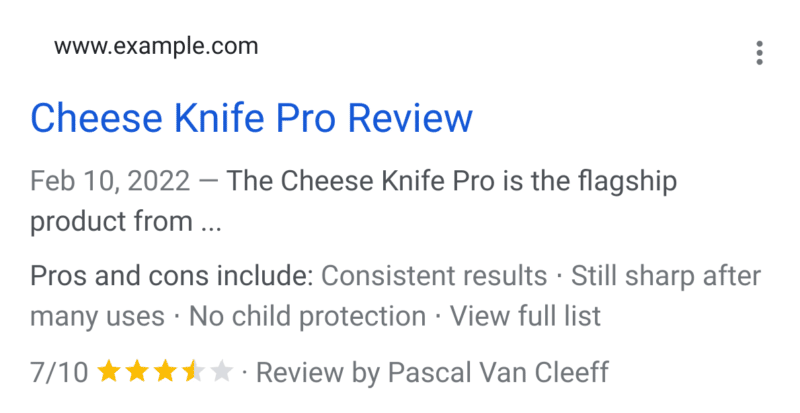
Google has added structured data support to read and potentially use pros and cons for product review snippet in the Google Search results. Google said you can now “tell Google about your pros and cons by supplying pros and cons structured data on editorial review pages.”
Pros and cons look like. Here is a screenshot of pros and cons showing in the Google Search results snippets:
Documentation. Google added a new section to the documentation over here that reads “Pros and cons: Help people see a high-level summary of the pros and cons of an editorial product review. The pros and cons appearance is available in Dutch, English, French, German, Italian, Japanese, Polish, Portuguese, Spanish, and Turkish in all countries where Google Search is available. While Google tries to automatically understand the pros and cons of an editorial product review, you can explicitly provide this information by adding the positiveNotes and/or negativeNotes properties to your nested product review. Be sure to follow the pros and cons guidelines.”
Test tool. Google updated the Rich Results Test to check for pros and cons structured data in addition to all the other structured data types supported by Google Search, the company said. Google said you can use this tool to validate and confirm your structured data is proper and Google can read it.
Guidelines. Google added that if you add pros and cons structured data, you must follow these guidelines:
Currently, only editorial product review pages are eligible for the pros and cons appearance in Search, not merchant product pages or customer product reviews.
There must be at least two statements about the product. It can be any combination of positive and/or negative statements (for example, ItemList markup with two positive statements is valid).
The pros and cons must be visible to users on the page.
Structured data not required. Google said even if you do not add structured data, Google may still show pros and cons. I actually spotted this about a month ago in the wild. Google wrote, “If you do not provide structured data, Google may try to automatically identify pros and cons listed on the web page.”
Google did say it “will prioritize supplied structured data provided by you over automatically extracted data.” So it is probably best you do add the structured data, if you have it.
Why we care. Anything you can do to improve your click-through rate from Google Search to your website is a good thing. Adding more elements and rich results to your search snippet may help you improve clicks. So give it a try and test it out.
New on Search Engine Land
About The Author
Barry Schwartz a Contributing Editor to Search Engine Land and a member of the programming team for SMX events. He owns RustyBrick, a NY based web consulting firm. He also runs Search Engine Roundtable, a popular search blog on very advanced SEM topics. Barry can be followed on Twitter here.
Search Engine Optimization is no longer a do-it-yourself project unless you have a solid decade or so handling digital marketing and the latest Google algorithm changes. Making websites and web pages more relevant, authoritative, and mobile-friendly is now an essential part of any overall business plan.
Search Engine Optimizing produces better rankings on all search engines. The focus is mainly on Google because 92% of all web queries happen on Google. Followed in much smaller percentages by Bing, Yahoo, Baidu, Yandex, and Duck Duck Go. Google is still the King.
Companies seeking to compete in today’s marketplace need to understand that making websites and web pages more relevant and authoritative is now an essential part of their overall business plan. Gone are the days of taking shortcuts and using misleading titles and junk links to improve search engine rankings.
Current algorithms rely heavily on activities and accumulative quality information from billions of internet users. Google changes its algorithms daily, which is another reason to bring digital marketing and SEO professionals onboard to track and adjust to regular changes.
You know it goes much deeper than picking five or six keywords and stuffing your content with those words. Keyword stuffing is an exercise in awkward quantity over true quality. It doesn’t fool today’s search engines, algorithms, or potential customers.
As you know, there is a lot to remember when considering SEO for your website. This is why bringing in the best SEO company with the latest trending SEO services for your website is crucial to your success.
What is an SEO company, and how can they help?
An SEO Company will improve your organic traffic from search engines. More than a trillion questions are put into search engines each year. If you want to capitalize on this, you’ll want the best agency to help you stand out above your competitors.
SEO can be very complicated, but you won’t have to guess what’s working and what isn’t because a quality SEO company will be able to measure and report to you about each optimization strategy and how it is performing. From there, the agency will be able to adjust and improve its plan to get you higher rankings, increased website traffic, and a growing number of users.
Agencies that provide SEO services for your website take on multiple tasks, including ensuring your site loads quickly and contains all clean code with quality content that is the most effective at landing web searches onto your site.
Many global SEO agencies are out there, and you have probably heard of some from this list. You will want to pick the best one for your company’s goals, your industry, the country or countries where you want to attract clients, as well as whether you need better marketing, backlinks, or you need help to understand exactly what steps you need to take to grow your company and make it more profitable.
Here’s who can claim the title of “the best,” according to customers and industry experts.
❖ About the Company: Possibly the very best SEO company out there. RankZ goes on to provide a full array of services. It gets high scores from customers for positive client experiences and measurable positive results. The RankZ team has exceptional experience with winning strategies for e-commerce, small businesses, and start-ups. This company also offers outstanding tools for clients who like to stay hands-on in optimizing their site or content.
❖ About the Company: Ranked as one of the best link-building companies in the market. OutreachZ is an international agency with a client list of more than 1,000 start-ups, brands, and digital agencies. It also maintains a guest posting marketplace with robust 5,000+ connections with experts in their various fields. Also on offer for clients is the premium managed campaigns feature. The team delivers the right publishers for each client based on their requirements. An excellent tool for gaining powerful links.
❖ Services: Link building platform to take control of off-site SEO. There’s a guest posting marketplace connecting to authoritative publishers. The agency handles prospecting, blogger outreach, content production and placement.
❖ Pricing: Average Link Building budget is usually $500 but can be lower or higher depending on your goals.
WebFX
❖ About the Company: A leading digital marketing agency. Customers get a full range of services with an individual strategy tailored just for them. Growth strategies are developed for each customer based on their particular goals and needs. Along with award-winning digital marketing services, WebFX has its own proprietary technology platform. This agency focuses on successful digital marketing campaigns to increase leads, customer calls, transactions, and qualified website traffic. Company offices are all located in the United States.
❖ Services: SEO, link building, PPC, media buying ad spend, website call tracing, SMM and web design.
❖ Pricing: SEO prices per month are $1,000+, and the average hourly rate is $150-$199/hour
Webimax
❖ About the Company: WebiMax can back up its promise “Remove the negative, promote the positive!” This award-winning reputation management company delivers year after year. This agency is results-driven. Every month SEO results are shared with clients to be communicative and transparent.
WebiMax founders say they want clients to feel they’ve gained a strategic partner to help the business grow, not just hiring an outsourced vendor.
❖ Services: Reputation management, search engine optimization, pay-per-click marketing, social media marketing, lead generation, website design and online public relations
❖ Pricing: Bespoke pricing.
OuterBox
❖ About the Company: OuterBox offers a suite of web services while focusing on helping companies expand and increase online sales. Its PPC management and pay-per-click services have a proven high rate of return on investment. It offers an array of digital marketing and SEO packages tailored to each client. OuterBox values the team approach and promises a cohesive approach to online marketing strategy to improve business.
❖ Services: SEO, paid search, digital marketing campaigns, web development, web design, eCommerce
❖ Pricing: SEO prices per month are $1,000+ and average hourly rates of $100 – $149/hour
SeoTuners
❖ About the Company: One of the best specialists in digital marketing. Also prized by clients for business development strategy. This company pledges never to use black hat SEO techniques. Instead, its experts promote web resources using ethical SEO. SEOTuners focus on building powerful websites to provide an increasingly successful market presence. The agency pledges an ethical approach to all work toward getting positive ranking results in search engines for client websites.
❖ Services: SEO, branding, e-commerce development, PPC, conversion optimization, SMM, and web development
❖ Pricing: SEO prices per month are $1,000+ and average hourly rates of $150 – $199/hour
Blue Fountain Media
❖ About the Company: Blue Fountain focuses on modern and emerging technology to develop successful business growth strategies. SEO changes fast, presenting new challenges almost daily, whether algorithm changes or the impact of voice search and Blue Fountain strives to stay at the head of the pack. In addition to optimizing content, this agency optimizes the technical side with reviews of wireframe mockups and redirects.
❖ Services: Website design, digital marketing, mobile app design, website development, strategy, branding and experience design
❖ Pricing: Minimum project size: $50,000
Delante
❖ About the Company: Experienced in helping B2B and B2C businesses create and manage internal SEO strategies. They’re open to even the smallest start-up clients. Their client list includes businesses in the e-commerce industry as well as finance, automotive, SaaS, IT, cosmetics, healthcare, fashion, wellness and more. Delante’s clients enjoy higher website visibility and rankings on the first pages of Google results. The team specializes in long-tail SEO to bring in more users ready to buy.
❖ Services: SEO, link building, SEO consulting
❖ Pricing: Minimum project size: $1,000
Mayple
❖ About the Company: One of the best SEOs for small businesses. It also offers SEO solutions to major brands. Marketing results and managing content are among Mayple’s forte. Each client receives a plan of action specific to their company and goals. The team is made up of experienced marketing experts with exceptional knowledge in specific fields to serve their clients. Mayple drills down to the client’s industry, target audience, and KPIs for measurable positive results.
❖ Services: Business consulting, digital strategy, SEO
❖ Pricing: Minimum project size: $1,000
iSynergy
❖ About the Company: Top-of-the-line programmatic advertising, inbound marketing, and SEO campaigns are all included as part of available marketing services. The focus is on data-driven design with marketing technologies. iSynergy team members take a creative approach to creating a data-driven strategy. They promise well-built websites that develop the client’s brand story by creating memorable digital experiences. The company’s strategy is quality over quantity to give website visitors the information they’re seeking without creating content overload.
❖ Services: SEO, web design, conversion optimization
❖ Pricing: Minimum project size: $5,000
What services do SEO companies provide?
Here’s what you need to know to find the best SEO agencies globally.
The best International SEO firms in the world will masterfully promote your site to ensure prospective clients and customers find it. In addition, an agency can provide a holistic approach to making your company visible and valuable by putting an experienced team to work for you. Therefore, hiring a highly rated agency ends up being cost-effective at the front end and ultimately profitable.
In addition to search engine optimization, a talented SEO Agency will create a content marketing strategy and position your company to benefit from pay-per-click marketing on multiple search engines and popular social platforms while ensuring a good return on investment (ROI).
You’ll want to ensure the SEO company you’re considering hiring is genuinely one of the best by finding out how they capitalize on the fertile ground of user intent. Of course, keywords and phrases remain important, but user intent is a recent SEO star on the scene.
User intent means your content reaches people using search phrases similar or related to your keywords even though they’re not an exact match. Think of it as creating excellent content that touches on your potential customer or client’s wants, even if they’re not using your specific keywords to find the information.
Qualities of the best SEO company
Having an exceptional SEO Company plan and carry out your web content optimization efforts isn’t an exercise in “set it and forget it.”
Markets change, and customer priorities change, as do Google algorithms. To be successful, your SEO must respond and change, too.
People on your SEO agency team should check how things are going every day by viewing keyword position analytics as well as website performance numbers. An SEO expert should also review where the heaviest website traffic originates to see what’s getting you the best results and getting your company the most attention.
Keyword research should be a regular activity. Algorithms may change, but keyword ideas won’t fluctuate as much. Your SEO expert should keep a close eye on search volume and relevance to the questions people are asking and ensure the right words and phrases are correctly placed.
Optimizing content goes beyond researching and using high-value keywords. Members of your SEO team need to ensure your site contains quality metadata with super-clean code structure and proper internal linking. This process of bringing different strategies together simultaneously gets you to a higher ranking.
Top tips for choosing the best SEO agency
The best SEO agency for your small, medium or large business will customize services to meet your goals. Ask to see specific numbers showing how they’ve performed for other clients. Ask for references and check with agency clients. Find out whether the agency feels like the right fit for you.
A quality SEO agency will be able to provide examples of their success for other clients in the form of page loading speed, number and quality of incoming links, keyword phrase usage, HTML and schema mark-up, mobile optimization, and domain authority.
The best SEO firms in the world explore the client’s goals, needs, and expectations. The best don’t take a cookie-cutter approach; each client gets their own customized plan.
The SEO agency you’re considering should be able to explain how they keep an eye out for any changes or updates to techniques and how they stay agile to tailor new information to optimize your website pages better. Identifying the most valuable long and short-tailed keywords, capturing user intent and expert placement of excellent coverage are important pieces of the puzzle.
When an SEO agency is pitching to you, it shouldn’t feel like they promise magical results. Instead, it should be happy to share its strategies and examples of past successful campaigns for other clients.
You need to know who will be on your team within the SEO company. The very best SEO agencies encourage their employees to improve their skills constantly. Find out how often the SEO company employees conduct research specific to understanding changes in the algorithms Google and other search engines use. An expert-level company will also provide in-house training specific to new SEO tools and the ways digital media influences the overall market.
You should also be able to check out the SEO agency’s investment in tools and technology to harness best practices for its clients.
SEO for business growth
SEO gives you the power to answer the questions people ask, specifically those in your field. This increases your visibility, potentially on a global stage. As a result, the amount of traffic to your website and pages should grow. As the number of visits to your pages goes up, you become an authoritative voice in your part of the market. People will trust that voice more and more and therefore trust your brand and products or services.
Identifying relevant keywords and providing quality content (not clickbait) is essential. The meta-text is vital so search engines can hit on those as valuable content.
General SEO and local SEO
There’s general SEO and local SEO. SEO agencies best for small businesses will help hyper-focus local content to grab “in city” or “near me” searches. The beauty of great rankings from local SEO is that the majority of users who conduct city, region, or state searches are ready to do business and ready to pick a company. That’s a solid reason to anticipate higher conversion rates.
Providing specific, uniform information about your company is important in local SEO. Your business name and contact information is a simple place to get gains using Google My Business along with website information. Be sure the company name, address, phone number, and contact email address are exactly the same wherever they’re used.
Research shows that including photos on your site has been found to result in 30% more visits and higher. Active blog posts also improve rankings. Also, schema markup, which is a vocabulary of tags or microdata that can be added to the HTML to improve the way search engines read and express the page in the SERPs because schema helps algorithms recognize how pieces of content relate to each other.
You may find that the SEO agency you hire will submit your site to online directories to make your URL easier to find. For example, you may hear reference to GMB (Google My Business). This can be valuable because it gives you a peek into how users interact with your business profile and the most popular content there.
Invest in quality content creators. The content you put on your website is a service to current and potential customers. It sets the tone for your company’s professionalism and abilities. Consider blog content, videos with written text content to go with them, and photographs because the more people access your different types of content, the more heavily search engines will point to your page rather than competitors.
Hiring one of the best SEO agencies for your company means putting affordable web design and search engine optimization to work for the most profitable results.
Top 10 core elements of SEO
An SEO specialist must have significant knowledge about a wide variety of activities to push a client higher on Google search results pages.
When considering which SEO agency is the best for your business, consider these top ten activities, which are the most important to you, and which agencies have the best reputation for delivering quality:
1. Build an SEO strategy with on-page and off-page SEO
2. Research and identify relevant keywords
3. Competitor website research
4. Identify gaps in competitor strategy which can be used to boost your online presence.
5. Technical audits on load times, status codes, and crawl errors
6. High-quality link building
7. Create a cooperative plan to optimize both search engines and visiting users
8. Daily review of algorithm updates, change strategy as needed and use ethical techniques.
9. Regularly monitor results of SEO campaigns with an eye for how to improve
10. Manage necessary digital tools, including Google Search Console and Analytics and SE ranking software
On-page SEO
The code and content of your website and web pages that you control are called on-page SEO. It includes text, headings, links, and photos or videos.
On-page SEO is the vital foundation for improving search rankings. It’s what a quality SEO company will craft for the best business results, including title tag, images, keyword research and placement, description meta-tag, optimized URLs and sitemap.
On-page SEO comprises standard technical procedures that can be studied and implemented to boost rankings.
Off-page SEO
Off-page SEO is all the things that do not originate on your website but help your site get higher search rankings.
The primary focus of off-page SEO is getting valuable backlinks, which are links that point to your site from other high-quality websites. Off-page SEO is an open-ended process requiring creativity by the SEO specialist to make your content valuable enough that another site wants to refer its visitors to you.
Evolution of SEO
The internet became available to the public in the summer of 1991. Right around six years later, the notion of Search Engine Optimization came on the scene.
Search engines are behind almost every online destination, and they changed how we find information and answer our questions.
In modern times search engine optimization mainly orbits Google. The industry has seen other search engines come and go, but Google continues to reign supreme.
At the start, ranking high up on search engines was essentially directory-driven. Slap “AAA” at the front of your business name and see the gains.
The eternal goal of being number one soon moved beyond ranking based on domain names, on-page content, and alphabetical directories to complicated metrics and algorithms. For example, Google’s PageRank algorithm is notable for making history in the arena of information retrieval.
Social networks exploded onto the scene in the 2,000s. YouTube, Facebook, Twitter, and LinkedIn would spark many similar sites. Experts suspected social signals could impact search rankings, and it did by helping SEO and also driving additional traffic to websites boosting brand awareness and loyalty.
The next steps brought improvements in detecting user intent and a new algorithm that advanced conversational searches.
Mobile phones changed the SEO world again in 2015 when mobile searches topped the number of Google searches performed on a desktop for the first time.
SEO strategies
Start with the basics by knowing which industry you’re competing in and who your target audience is. Then it’s time for keyword research further evolve into content that satisfies user intent behind the search terms.
Accurate reporting is a necessary strategy to hit on successful SEO. Absent correct reporting results, you and your team are not able to make precise adjustments and improvements.
Google’s mobile-first index is aimed at making sure websites look professional and perform well on mobile devices. That functionality must be in addition to, not instead of, laptop and desktop search optimization.
Employ excellent contract creators either within your SEO agency or possibly bring one or more writers directly on board. These experienced professionals will easily skip over the pitfalls many lesser creators make. Mistakes that will hurt you include keyword stuffing and spammy or click-bait content. Your site loses credibility and may anger visitors and potential clients, so aim for blogs and articles that may go viral simply because the information and writing are just that good!
Linking to high-quality web pages is nearly as valuable as getting backlinks because your content is so good. Always double-check that links are working. Error 404 messages can derail your best efforts.
Beyond on-page and off-page SEO, there are good guys and not-so-good guys in the SEO world.
White hat SEO
White hat SEO follows a solid strategy that adheres to search engine rules and best use guidelines.
There’s no trickery in white hat SEO. Truly solid content and coding are used rather than attempting to manipulate or fool a search engine or the user. Think no spam, no clickbait, no loading links that point everywhere but leave the user with very little usable information.
You may also hear it called ethical SEO. It follows accepted rules and is intended to produce long-term positive results. Not just a quick hit that will fade back to or below previous sales levels.
There’s a reward for following the rules and not trying to get around regulations or trick the system. Namely, following proper policies and guidelines will push your site higher in search engine results. Combined with engaging authoritative content, you may even find yourself in the top rankings.
Black hat SEO
Then there is black hat SEO which is considered rather dirty dealings.
Black hat SEO employs techniques specifically intended to manipulate or deceive search engines and users. For example, it may try to trick a search engine’s algorithm to get good results and higher rankings without doing good content and code creation work.
Such unethical methods go against search engine guidelines and could completely remove your site from the engine’s database index. So the risk is certainly not worth any possible short-term reward.
A deeper dive will show that a black hat SEO strategy may produce a sudden rise in organic listings, but the search engines will soon sniff out the rule-breakers bringing penalties to your door.
If an SEO agency proposes any of the following strategies, know they’re talking about using black hat SEO:
● Doorway pages
Pages with no real value are built only for ranking specific keywords, but ultimately the homepage or other doorway pages are basically useless.
● Hidden links or hidden text
This sneaky technique camouflages certain text or links by making them the same color as the background color.
● Cloaking
Cloaking presents a web page to search engines that are different from what users see. Cloaking tricks search engines into displaying a page; it would not show up if proper keywords and user internet were used.
● Link farms
Link farms are intended to create a large number of sites whose sole purpose is to point back to your site through links. However, this artificially inflates the number of backlinks which can throw a search engine off in the short term by masquerading as an authority site.
● Keyword stuffing
One of the original ways to attempt to spam search engines into ranking sites higher. Increasingly it’s completely ineffective because it can’t stand up to ever-changing algorithms. Seeing the same word or phrases all over a page to the point it’s completely unnatural usage; the page has been stuffed.
It’s always a bad idea to attempt to manipulate search engines with the intention of misleading users. Sooner or later, your site will be found out for using unscrupulous methods, and search engines can ban your site altogether on the basis of it using any black hat tactics.
Link building for SEO
Backlinks are a coveted SEO ingredient. They’re links from other authoritative sites that point back to you and your content by linking their web page to yours. It’s pretty difficult to fake, so having another web content creator decide to pass their visitors along to you is incredibly valuable.
Backlinks are also called one-way hyperlinks. Link-building strategies include public relations, email outreach efforts, broken link building, and content marketing.
The goal is always to improve search engine visibility.
The future of SEO
Mobile optimization, ensuring your website works and displays well on mobile devices, is now the metric that helps push your site higher in search engine results. Optimization has to include both Apple and Android products.
It’s one more thing to monitor regularly and course-correct as needed. You must still ensure your website view for desktop and laptop computers remains optimized.
SEO rankings continue to get more competitive. This is because Internet users are becoming savvier at spotting quality content and sites over those trying to beat the system for ranking.
Now SEO tactics have to evolve and improve continually. In addition to mobile optimization, matching user intent is now required for success. The idea is not just to give users a bunch of links but to actually assist them in finding the information they want.
Machine learning is now built into all of Google’s products, including Ads and Gmail. The impact of machine learning can be seen with Google’s RankBrain, which now runs on every search. In addition, intelligent searches now have to cater to visual and voice searches, chatbots, and personal assistants such as Siri and Alexa.
SEO specialists will have to keep up with all the technological advances to keep their skills and services top-notch.
Final thoughts on choosing the best SEO agency
The best SEO companies’ reputations boil down to whether they deliver demonstrable results. Clients are right to expect realistic results and good communication about what is happening if they’re going to include hiring an SEO agency in the budget.
Among expected results from a well-run SEO campaign include increases in your website’s visibility and results that show improvements in brand awareness. The bottom line should improve with increases in sales. It should help you compete successfully against businesses very similar to yours. New customers should be getting in touch with you to buy your products or services. You should see a higher return on investment (ROI), including higher conversions and ultimately more sales. And an agency’s deliverables shouldn’t be a short bump in traffic and sales. Done right, you should be getting long-term results, including long-term increased revenue.
Having a solid and respected online presence is the lifeblood of a successful business these days. Brick and mortar locations simply are not enough for today’s consumers.
Warning signs of SEO companies that talk a good game but may not deliver valuable results are those with aggressive self-promotion methods and aggressive marketing strategies meant to land new customers. SEO success can be measured and reported, so it’s a big red flag if a company balks at showing you their record with other clients.
SEO specialists have to juggle many tasks, even at agencies where different colleagues focus on different portions of an SEO strategy. However, most of the skills complement each other, so you can expect dependable service from any team member when you need it.
We hope this guide has been helpful in finding the right SEO company, especially with so many SEO agencies in the picture; finding the best one that fits your needs could be overwhelming.
New on Search Engine Land
About The Author
RankZ is an online marketing agency with a focus on search engine optimization and content marketing.
Webinar: Secrets to link building from SEO experts
Link building can be an overwhelming venture for those just starting. However, it is an essential part of SEO that all industry experts must learn.
In this webinar, Page One Power link-building experts are spilling their secrets on how to vet links, succeed at outreach, and which link-building strategies to keep and which to skip.
Cynthia Ramsaran is director of custom content at Third Door Media, publishers of Search Engine Land and MarTech. A multi-channel storyteller with over two decades of editorial/content marketing experience, Cynthia’s expertise spans the marketing, technology, finance, manufacturing and gaming industries. She was a writer/producer for CNBC.com and produced thought leadership for KPMG. Cynthia hails from Queens, NY and earned her Bachelor’s and MBA from St. John’s University.
Google updates search result snippets for queries with quotes
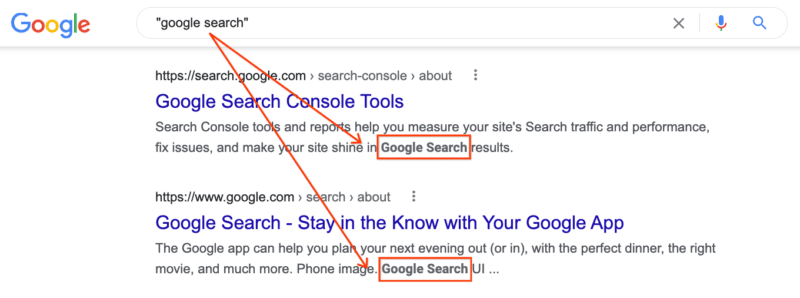
Google has updated how search result snippet in Google Search for queries that contain quotes. Now, Google will show where that exact phrase appears on the page in the search result snippet in Google search, the company announced.
What this means. Google explained if you did a search such as [“google search”], the snippet will show where that exact phrase appears:
Previously. Google said previously, Google Search did not always show the quoted search phrase in the Google Search result snippet “because sometimes the quoted material appears in areas of a document that don’t lend themselves to creating helpful snippets,” Google said. “For example, a word or phrase might appear in the menu item of a page, where you’d navigate to different sections of the site. Creating a snippet around sections like that might not produce an easily readable description,” Google added.
Why the change. Google said they made this change based on searcher feedback, Google wrote “We’ve heard feedback that people doing quoted searches value seeing where the quoted material occurs on a page, rather than an overall description of the page. Our improvement is designed to help address this.”
More advice. Google then gave searchers additional advice on how quotes work in Google Search and how this may impact your search results. Check out their blog post over here.
Why we care. Google confirmed with Search Engine Land that this is not a ranking change but rather a user interface change on how Google Search will show some searches, searches that use quotes. This may impact your click-through rate from the Google search results but will have no impact on how you rank for those types of queries.
New on Search Engine Land
About The Author
Barry Schwartz a Contributing Editor to Search Engine Land and a member of the programming team for SMX events. He owns RustyBrick, a NY based web consulting firm. He also runs Search Engine Roundtable, a popular search blog on very advanced SEM topics. Barry can be followed on Twitter here.
Google July 2022 product reviews update is finished rolling out
Google has quietly updated its update landing page to notate that the July 2022 product reviews update has finished rolling out on August 2, 2022. When it was first announced on July 27, 2022, Google said it would “take 2-3 weeks to complete,” but clearly this only took six days.
July 27 to August 6. This July 2022 product reviews update only took six days to fully roll out and to be honest, that is surprising. We saw very limited changes from the tracking tools and honestly, while some sites seemed to get hard by this update, it does not seem there was a lot of SEO community chatter around ranking changes due to this update. In fact, we saw a spike on August 3rd but clearly, that was after this update was complete.
Google product reviews update. The Google product reviews update aims to promote review content that is above and beyond much of the templated information you see on the web. Google said it will promote these types of product reviews in its search results rankings.
Google is not directly punishing lower-quality product reviews that have “thin content that simply summarizes a bunch of products.” However, if you provide such content and find your rankings demoted because other content is promoted above yours, it will definitely feel like a penalty. Technically, according to Google, this is not a penalty against your content, Google is just rewarding sites with more insightful review content with rankings above yours.
Technically, this update should only impact product review content and not other types of content.
Why we care. If your website offers product review content, you will want to check your rankings to see if you were impacted. Did your Google organic traffic improve, decline or stay the same?
Long term, you are going to want to ensure that you put a lot more detail and effort into your product review content. Make it unique so it stands out from the competition on the web.
New on Search Engine Land
About The Author
Barry Schwartz a Contributing Editor to Search Engine Land and a member of the programming team for SMX events. He owns RustyBrick, a NY based web consulting firm. He also runs Search Engine Roundtable, a popular search blog on very advanced SEM topics. Barry can be followed on Twitter here.
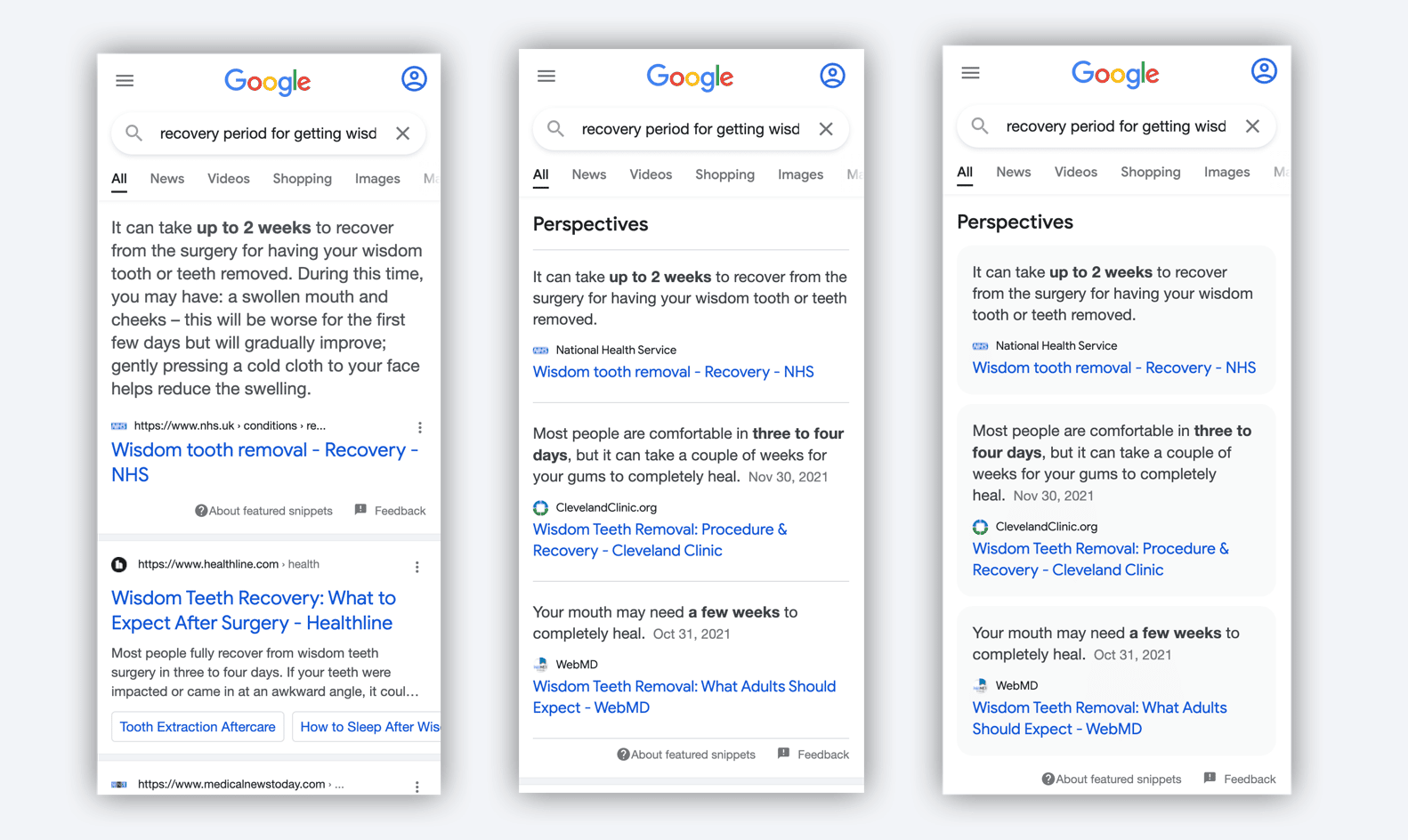
Google tests new SERP feature that gives searchers Perspectives
Google has confirmed with Search Engine Land that it is testing a new search feature named Perspectives.
Google explained this feature is an experiment to help searchers in new ways to find helpful information that they are seeking. However, Google declined to answer more specific questions on how to trigger this, when this might show and how publishers can have their content show in this new search box.
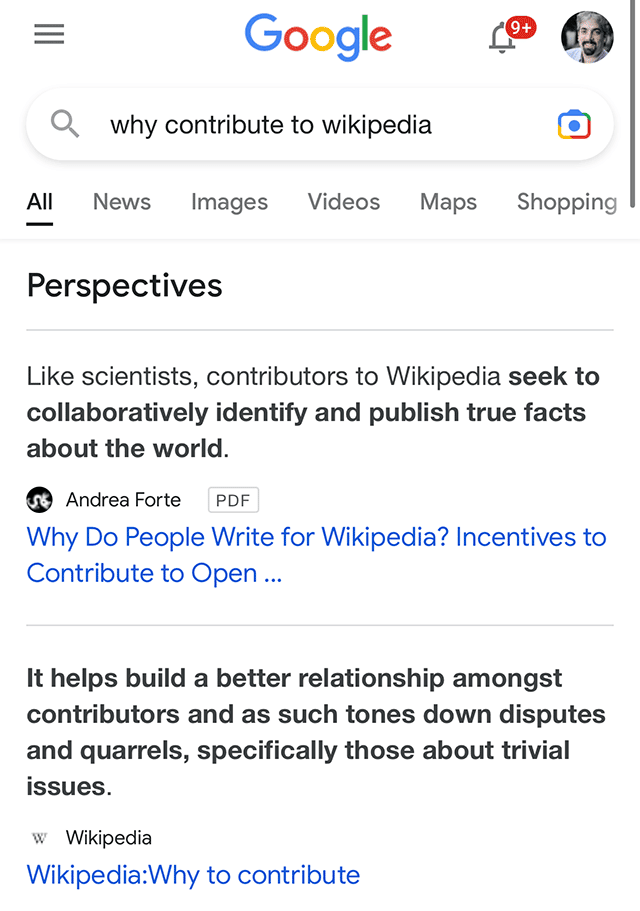
What are search Perspectives? Basically, Perspectives appear to be multiple short featured snippets that give searchers a wider and more diverse set of answers for their query. Again, Google would not give us any official definition, Google would only say this is an experiment and Google does a lot of experiments.
What it looks like. Here is a screenshot I was able to replicate myself:
Brodie Clark posted another example over here and Brian Freiesleben also noted these tests without the Perspectives label at the top.
Other tests. We have seen Google test these other featured snippet variations, such as from the web and various card-based featured snippets. So Google is clearly stepping up testing new user interfaces and experiences for the featured snippet section of the search results.
Why we care. When it comes to featured snippets, it is a spot most SEOs would love to be placed in. At the same time, some complain the click-through rate is not optimal on all queries when being featured in that position. Would sharing the featured snippet spot with this new Perspectives interface change result in more clicks or less? This is something to keep an eye on to see if Google does roll this out more widely and how searchers’ perspectives change around such a feature.
New on Search Engine Land
About The Author
Barry Schwartz a Contributing Editor to Search Engine Land and a member of the programming team for SMX events. He owns RustyBrick, a NY based web consulting firm. He also runs Search Engine Roundtable, a popular search blog on very advanced SEM topics. Barry can be followed on Twitter here.