SEO best practice: How to write effective title tags in 2022

30-second summary:

  • Keep the title concise with meaningful rather than fluffy word (5 to 12 words)
  • High-priority words should be placed at the start of the title which should be less than 70 characters in length
  • Do not use any single word more than twice
  • Use keyword phrases in the precise way they are searched for, and have been analyzed using a keyword analysis tool. Word order is important and the research only applies to the exact phrase. Check the autocomplete tool to check that the title is one recommended as a suggestion
  • Don’t use multiple phrases – research a longtail phrase that includes 3-5 keywords you are targeting
  • Write a keyword-rich title tag that has minimum stop words, but is sensible and appealing to human. You need to make your title very attractive to your users so they will click on it
  • Your title should call for a response and satisfy exactly what the searcher is looking for (i.e. to buy something, learn something, fix something, avoid something, hire something…). Remember this is your hook and bait when fishing via the search engines!

In this article, I provide a review of title optimization I undertook for my own pages and sites and I share my findings with you.

The title element of a web page needs to be an accurate and concise description of a page’s content. A title tag tells both search engines and users what the topic of a particular page is. It is, therefore, a major item that you need to carefully develop and test prior to publishing your page.

Creating a compelling title tag will pull in more visits from the search results. Thus, it’s important to not only think about optimization and keyword usage, but the entire user experience. The title tag is a new visitor’s first interaction with your brand when they find it in a search result and should convey the most positive impression possible. Keyword usage in the title, positioning and phrasing are extremely important to rankings.

In this article I review:

  • Things to do and consider in designing your page title
  • Things to avoid and not to do
  • The compromises and things that apply for various page types

The Title Must be Relevant

Creating a descriptive, keyword-rich title tag is important for increasing rankings in search engines. Keyword usage and placement in the title tag is clearly recognised as most important place to use appropriate keywords to achieve high rankings. However the title and the keywords have to be highly relevant to the body of the blog or article otherwise the ranking will be downgraded by Google and the user will see that they have been deceived and will leave the page without reading it. The other important aspect is that the title appears in the search results with the user’s keywords users in the search highlighted. Google’ advice for Title Tag is shown below. Incidentally, the example shows a page where variations of the word “groom” appear three times. It is definitely more than what’s needed (keyword stuffing?)

*Image via Google

Title Length

It is very important that every page utilizes the highest priority keyword phrase in its Title and that it has optimal design for the page. It must be unique, concise and edited to be rich without fluff and unnecessary useless words.

Where to start? A good rule of thumb is to keep it simple and concise with a minimum of about 5 words but should not be longer than about 10 -12 words. Keep highly relevant to the topic and be creative to create an appealing title because apart from search engines, real people will see your title and you need to entice them to click on your summary and to read it.

Google does not have a maximum number of words that it will read in a Title – they have a maximum number of characters which is 70. According to SEMrush, limiting title tags to 70 characters is highly recommended for “effectiveness”:

“Limit The Size Of Your Title Tag
The most effective title tags are around 10-70 characters long. These include spaces so keep this in mind when coming up with your Title Tags.

If it is too long, the title tag will be cut off from the display not revealing the full message.”

Also, avoid using the same word more than twice in the title. The second use may be justified if you are trying to target a slightly different keyword phrase for a multiple phrase title. Avoid Keyword Stuffing as your page or site may be penalized and its ranking downgraded.

Fewer Words in Title – Google Gives more Weight to Fewer Words

Cutting down the total number of keywords in the title, by combining words and condensing the expression is an ideal way to increase the strength of each remaining keyword, which will boost your ranking. Include only the main relevant keywords. The fewer the number of stop words you include in the title, the extra weight Google will assign to each keywords and the more your page will rank. However, ensure that the title attractive for humans as well after leaving out the unnecessary minor words.

Choosing Keywords in Titles

Does the Order of the Keyword in a Title Matter?

The answer to this is YES!

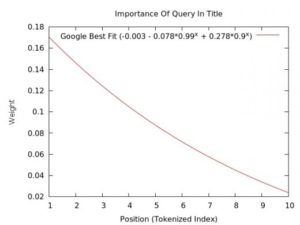
The title tag should begin with the most relevant keyword or phrase for the content of the page (for example a page concerning long-term health insurance policies could have the title ‘Long-Term Health Insurance Policies | XYZ Insurance’). Google assigned its highest priority to the first few words that you enter in the search box. The following words get lower priority and weight. Google also gives higher priority to pages that have search terms that are adjacent to each other, that are in the same order was entered into the search query.

Position the Most Important Keywords Close to the Front of the Title Tag

According to Moz Data, the words closer to the start of the title have higher weight and are more likely to be clicked by the use in search results. So the first couple of words at the beginning of the title have twin priorities: higher weightings by Google and extra appeal to users in the search results.
Try to Predict Exactly How a User will Search for the Topic

This is very difficult but you should try to use keyword phrases in the title in the exactly the same way users will search for them. The order and positioning of the words in the title is critical. There are three ways of doing this:

  • Try various Google Searches and look closely at the titles your competitors are using.
  • Examine the autosuggestion tool that Google displays as you search. The options presented by Google are those which have featured prominently in the search result data that Google has compiled. Try various options. Many website tools will help you explore the options.
  • Use one of these keyword research tools to help you research your best keyword options. They will provide you with broad keyword reports and rely on clickstream data to provide unique click metrics.

Buyer Keywords and Filtering Keywords for Targeting Your Audience

As well as the keywords for the topic of your article or site you should include words that will target and select the group of users that will generate income on your site. This is related to longtail keyword selection as described below. The process of selection keywords is described elsewhere.

Targeting buyers via keyword choice is simply trying to predict how buyers for the products will conduct their searches. Targeting keywords for buyers is more about the quality of visitors and their likely intentions rather than quantity.

With a great landing page, using buyer keywords may provide a fabulous opportunity to make money online. Buyer keywords are phrases and words that demonstrate and select for customer who are more like to buy a certain product. Some of the obvious ones are phrases like ‘discount’, ‘cheap’, ‘buy online’ or ‘great deals for’ and there are many more that are more subtle.

People who are intending to buy may search for ‘reviews’ first and you may want to target the buyer keyword when they are making online purchases so that is another option. Filtering keywords are action words that refine the non-buying audience you want to visit your site. This includes words such a ‘How to’, ‘Review’, ‘treatment’, ‘remedy’, ‘avoiding’, ‘prevention’. Shown in the table are some of the examples or words you can use.
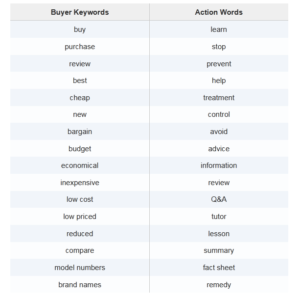
For example, someone typing the phrase ‘diet plans’ in the search box is unlikely to be really a buyer, and this keyword is extremely hard to compete for. But someone looking for ‘review of the Atkins diet’ or ‘discount books for the Atkins diet’ is clearly a potential buyer or a book on this diet!

Similarly, if you have a landing page for ‘Tailor Made’ golf clubs, you would be better off using a title such as ‘Tailor Made Golf Clubs: Tailor Made Drivers and Irons’ – would be much better than ‘Golf Clubs: Tailor Made Golf Clubs’.

The Keyword Drilldown – this describes how users of the internet drilldown their keyword search terms when searching for something on the internet. For example, when a user is interested in getting information to purchase a Digital Camera, they will most likely start with that the general term “Digital Camera”. Next after viewing the search results they will refine their search to ‘Kodak Digital Camera’ or ‘Digital Camera Kodak’ and then finally targeting a specific camera model such as “Review of Kodak Model #XYZ Digital Camera.” or “Best Price for Kodak Model #XYZ Digital Camera”. Only the last search is for a buyer hungry to buy the camera.

Using Keyword Research and Niche Tools to Select a Title

Keyword analysis makes the job of choosing a title very easy. If you have used the Google Keyword Planner, you will notice that the order of the words in the phrase matters. Adding an extra word can dramatically change the results. There is a strong argument that you should use the exact phrase that yields the results you are looking for a keyword phrase as the Title. If you fiddle with it you will probably not get the expected result.

When doing your research, it is a good idea to put the major keyword element at the front of the Title. As discussed previously, keywords that appear near the beginning of title have more weight. Likewise the Autosuggestion tool will be more predictable in sending users to keyword options directly related to the search topic.

If you are targeting multiple keyword phrases (see below) on the same web page, then you should put the major phrase first.

Compromises When Using Long tail keywords

When researching your keyword options there are merits in making the keyword phrase more specific by adding extra words so that you can compete. After choosing various options and selecting the final version using a keyword research tool, you should use the exact phrase in the Title. However, beware of adding extra terms without doing the analysis as it may dilute the ranking for the keywords.

Targeting Multiple Keyword Phrases

You may be tempted to use two or more keyword phrases in the title instead of the single one. The objective may be to bring in more traffic because more keywords are included. However, you need to be careful with this because you may decrease the ranking for your major keywords.

It is a compromise and depends on whether your page is narrowly focused of a specific topic or a more general one. Google may also penalize the page if the added phrase is not relevant to the information on the page. The more relevant a page’s content is for one phrase, the less relevant it is the content for another. Optimizing on a second term will dilute the first, and both terms will be diluted.

Using multiple keyword phrases should only be used when your site or article covers a broad range of topics.

Things to Avoid when Designing Titles

  • Oversaturation – This occurs when the title becomes a long list of words, for example “Inbound Marketing Agency, Social Media, Blog Writing, SEM, SEO, Web Design| EMU Creative’ Google will see this as keyword stuffing and non-relevant.
  • Using Stop Words, Jargon and Useless Words – like ‘the, but, be, and, we, me, our,’ which are stop words. These words provide no value to the person making the search.
  • Fluffy and weak words should be avoided – words such as “experienced, choice, best, most, top, award, professional, winning. These words over-saturate your page titles and make your primary keyword phrase less relevant and provide lower ranking potential.

Summary – Title Tag Best Practices

Below are the key things to focus on when choosing and optimizing a Title tag:

  • Keep the title concise with meaningful rather than fluffy word (5 to 12 words).
  • High-priority words should be placed at the start of the title which should be less than 70 characters in length.
  • Do not use any single word more than twice.
  • Use keyword phrases in the precise way they are searched for, and have been analyzed using a keyword analysis tool. Word order is important and the research only applies to the exact phrase. Check the autocomplete tool to check that the title is one recommended as a suggestion.
  • Don’t use multiple phrases – research a longtail phrase that includes 3-5 keywords you are targeting.
  • Make sure your Title accurately reflect the topic of the page and is highly relevant.
  • Write a keyword-rich title tag that has minimum stop words, but is sensible and appealing to human. You need to make your title very attractive to your users so they will click on it.
  • Your title should call for a response and satisfy exactly what the searcher is looking for (i.e. to buy something, learn something, fix something, avoid something, hire something…). Remember this is your hook and bait when fishing via the search engines!
  • The title tag is unique in relation to other pages on the site.
  • Generally the company name goes at the end of the tag.

https://www.searchenginewatch.com/2022/08/04/seo-best-practice-how-to-write-effective-title-tags-in-2022/


Indexing and keyword ranking techniques revisited: 20 years later

When the acorn that would become the SEO industry started to grow, indexing and ranking at search engines were both based purely on keywords.

The search engine would match keywords in a query to keywords in its index parallel to keywords that appeared on a webpage.

Pages with the highest relevancy score would be ranked in order using one of the three most popular retrieval techniques: 

  • Boolean Model
  • Probabilistic Model
  • Vector Space Model

The vector space model became the most relevant for search engines. 

I’m going to revisit the basic and somewhat simple explanation of the classic model I used back in the day in this article (because it is still relevant in the search engine mix). 

Along the way, we’ll dispel a myth or two – such as the notion of “keyword density” of a webpage. Let’s put that one to bed once and for all.

The keyword: One of the most commonly used words in information science; to marketers – a shrouded mystery

“What’s a keyword?”

You have no idea how many times I heard that question when the SEO industry was emerging. And after I’d given a nutshell of an explanation, the follow-up question would be: “So, what are my keywords, Mike?”

Honestly, it was quite difficult trying to explain to marketers that specific keywords used in a query were what triggered corresponding webpages in search engine results.

And yes, that would almost certainly raise another question: “What’s a query, Mike?”

Today, terms like keyword, query, index, ranking and all the rest are commonplace in the digital marketing lexicon. 

However, as an SEO, I believe it’s eminently useful to understand where they’re drawn from and why and how those terms still apply as much now as they did back in the day. 

The science of information retrieval (IR) is a subset under the umbrella term “artificial intelligence.”  But IR itself is also comprised of several subsets, including that of library and information science.

And that’s our starting point for this second part of my wander down SEO memory lane. (My first, in case you missed it, was: We’ve crawled the web for 32 years: What’s changed?)

This ongoing series of articles is based on what I wrote in a book about SEO 20 years ago, making observations about the state-of-the-art over the years and comparing it to where we are today.

The little old lady in the library

So, having highlighted that there are elements of library science under the Information Retrieval banner, let me relate where they fit into web search. 

Seemingly, librarians are mainly identified as little old ladies. It certainly appeared that way when I interviewed several leading scientists in the emerging new field of “web” Information Retrial (IR) all those years ago. 

Brian Pinkerton, inventor of WebCrawler, along with Andrei Broder, Vice President Technology and Chief Scientist with Alta Vista, the number one search engine before Google and indeed Craig Silverstein, Director of Technology at Google (and notably, Google employee number one) all described their work in this new field as trying to get a search engine to emulate “the little old lady in the library.” 

Libraries are based on the concept of the index card – the original purpose of which was to attempt to organize and classify every known animal, plant, and mineral in the world.

Index cards formed the backbone of the entire library system, indexing vast and varied amounts of information. 

Apart from the name of the author, title of the book, subject matter and notable “index terms” (a.k.a., keywords), etc., the index card would also have the location of the book. And therefore, after a while “the little old lady librarian” when you asked her about a particular book, would intuitively be able to point not just to the section of the library, but probably even the shelf the book was on, providing a personalized rapid retrieval method.

However, when I explained the similarity of that type of indexing system at search engines as I did all those years back, I had to add a caveat that’s still important to grasp:

“The largest search engines are index based in a similar manner to that of a library. Having stored a large fraction of the web in massive indices, they then need to quickly return relevant documents against a given keyword or phrase. But the variation of web pages, in terms of composition, quality, and content, is even greater than the scale of the raw data itself. The web as a whole has no unifying structure, with an enormous variant in the style of authoring and content far wider and more complex than in traditional collections of text documents. This makes it almost impossible for a search engine to apply strictly conventional techniques used in libraries, database management systems, and information retrieval.”

Inevitably, what then occurred with keywords and the way we write for the web was the emergence of a new field of communication.

As I explained in the book, HTML could be viewed as a new linguistic genre and should be treated as such in future linguistic studies. There’s much more to a Hypertext document than there is to a “flat text” document. And that gives more of an indication to what a particular web page is about when it is being read by humans as well as the text being analyzed, classified, and categorized through text mining and information extraction by search engines.

Sometimes I still hear SEOs referring to search engines “machine reading” web pages, but that term belongs much more to the relatively recent introduction of “structured data” systems.

As I frequently still have to explain, a human reading a web page and search engines text mining and extracting information “about” a page is not the same thing as humans reading a web page and search engines being” fed” structured data.

The best tangible example I’ve found is to make a comparison between a modern HTML web page with inserted “machine readable” structured data and a modern passport. Take a look at the picture page on your passport and you’ll see one main section with your picture and text for humans to read and a separate section at the bottom of the page, which is created specifically for machine reading by swiping or scanning.

Quintessentially, a modern web page is structured kind of like a modern passport. Interestingly, 20 years ago I referenced the man/machine combination with this little factoid:

“In 1747 the French physician and philosopher Julien Offroy de la Mettrie published one of the most seminal works in the history of ideas. He entitled it L’HOMME MACHINE, which is best translated as “man, a machine.” Often, you will hear the phrase ‘of men and machines’ and this is the root idea of artificial intelligence.”

I emphasized the importance of structured data in my previous article and do hope to write something for you that I believe will be hugely helpful to understand the balance between humans reading and machine reading. I totally simplified it this way back in 2002 to provide a basic rationalization:

  • Data: a representation of facts or ideas in a formalized manner, capable of being communicated or manipulated by some process.
  • Information: the meaning that a human assigns to data by means of the known conventions used in its representation.

Therefore:

  • Data is related to facts and machines.
  • Information is related to meaning and humans.

Let’s talk about the characteristics of text for a minute and then I’ll cover how text can be represented as data in something “somewhat misunderstood” (shall we say) in the SEO industry called the vector space model.

The most important keywords in a search engine index vs. the most popular words

Ever heard of Zipf’s Law?

Named after Harvard Linguistic Professor George Kingsley Zipf, it predicts the phenomenon that, as we write, we use familiar words with high frequency. 

Zipf said his law is based on the main predictor of human behavior: striving to minimize effort. Therefore, Zipf’s law applies to almost any field involving human production.

This means we also have a constrained relationship between rank and frequency in natural language.

Most large collections of text documents have similar statistical characteristics. Knowing about these statistics is helpful because they influence the effectiveness and efficiency of data structures used to index documents. Many retrieval models rely on them.

There are patterns of occurrences in the way we write – we generally look for the easiest, shortest, least involved, quickest method possible. So, the truth is, we just use the same simple words over and over.

As an example, all those years back, I came across some statistics from an experiment where scientists took a 131MB collection (that was big data back then) of 46,500 newspaper articles (19 million term occurrences).

Here is the data for the top 10 words and how many times they were used within this corpus. You’ll get the point pretty quickly, I think:

Word frequency
the: 1130021
of 547311
to 516635
a 464736
in 390819
and 387703
that 204351
for 199340
is 152483
said 148302 

Remember, all the articles included in the corpus were written by professional journalists. But if you look at the top ten most frequently used words, you could hardly make a single sensible sentence out of them. 

Because these common words occur so frequently in the English language, search engines will ignore them as “stop words.” If the most popular words we use don’t provide much value to an automated indexing system, which words do? 

As already noted, there has been much work in the field of information retrieval (IR) systems. Statistical approaches have been widely applied because of the poor fit of text to data models based on formal logics (e.g., relational databases).

So rather than requiring that users will be able to anticipate the exact words and combinations of words that may appear in documents of interest, statistical IR lets users simply enter a string of words that are likely to appear in a document.

The system then takes into account the frequency of these words in a collection of text, and in individual documents, to determine which words are likely to be the best clues of relevance. A score is computed for each document based on the words it contains and the highest scoring documents are retrieved.

I was fortunate enough to Interview a leading researcher in the field of IR when researching myself for the book back in 2001. At that time, Andrei Broder was Chief Scientist with Alta Vista (currently Distinguished Engineer at Google), and we were discussing the topic of “term vectors” and I asked if he could give me a simple explanation of what they are.

He explained to me how, when “weighting” terms for importance in the index, he may note the occurrence of the word “of” millions of times in the corpus. This is a word which is going to get no “weight” at all, he said. But if he sees something like the word “hemoglobin”, which is a much rarer word in the corpus, then this one will get some weight.

I want to take a quick step back here before I explain how the index is created, and dispel another myth that has lingered over the years. And that’s the one where many people believe that Google (and other search engines) are actually downloading your web pages and storing them on a hard drive.

Nope, not at all. We already have a place to do that, it’s called the world wide web.

Yes, Google maintains a “cached” snapshot of the page for rapid retrieval. But when that page content changes, the next time the page is crawled the cached version changes as well.

That’s why you can never find copies of your old web pages at Google. For that, your only real resource is the Internet Archive (a.k.a., The Wayback Machine). 

In fact, when your page is crawled it’s basically dismantled. The text is parsed (extracted) from the document.

Each document is given its own identifier along with details of the location (URL) and the “raw data” is forwarded to the indexer module. The words/terms are saved with the associated document ID in which it appeared.

Here’s a very simple example using two Docs and the text they contain that I created 20 years ago.

Recall index construction

After all the documents have been parsed, the inverted file is sorted by terms:

In my example this looks fairly simple at the start of the process, but the postings (as they are known in information retrieval terms) to the index go in one Doc at a time. Again, with millions of Docs, you can imagine the amount of processing power required to turn this into the massive ‘term wise view’ which is simplified above, first by term and then by Doc within each term.

You’ll note my reference to “millions of Docs” from all those years ago. Of course, we’re into billions (even trillions) these days. In my basic explanation of how the index is created, I continued with this:

Each search engine creates its own custom dictionary (or lexicon as it is – remember that many web pages are not written in English), which has to include every new ‘term’ discovered after a crawl (think about the way that, when using a word processor like Microsoft Word, you frequently get the option to add a word to your own custom dictionary, i.e. something which does not occur in the standard English dictionary). Once the search engine has its ‘big’ index, some terms will be more important than others. So, each term deserves its own weight (value). A lot of the weighting factor depends on the term itself. Of course, this is fairly straight forward when you think about it, so more weight is given to a word with more occurrences, but this weight is then increased by the ‘rarity’ of the term across the whole corpus. The indexer can also give more ‘weight’ to words which appear in certain places in the Doc. Words which appeared in the title tag <title> are very important. Words which are in <h1> headline tags or those which are in bold <b> on the page may be more relevant. The words which appear in the anchor text of links on HTML pages, or close to them are certainly viewed as very important. Words that appear in <alt> text tags with images are noted as well as words which appear in meta tags.

Apart from the original text “Modern Information Retrieval” written by the scientist Gerard Salton (regarded as the father of modern information retrieval) I had a number of other resources back in the day who verified the above. Both Brian Pinkerton and Michael Maudlin (inventors of the search engines WebCrawler and Lycos respectively) gave me details on how “the classic Salton approach” was used. And both made me aware of the limitations.

Not only that, Larry Page and Sergey Brin highlighted the very same in the original paper they wrote at the launch of the Google prototype. I’m coming back to this as it’s important in helping to dispel another myth.

But first, here’s how I explained the “classic Salton approach” back in 2002. Be sure to note the reference to “a term weight pair.”

Once the search engine has created its ‘big index’ the indexer module then measures the ‘term frequency’ (tf) of the word in a Doc to get the ‘term density’ and then measures the ‘inverse document frequency’ (idf) which is a calculation of the frequency of terms in a document; the total number of documents; the number of documents which contain the term. With this further calculation, each Doc can now be viewed as a vector of tf x idf values (binary or numeric values corresponding directly or indirectly to the words of the Doc). What you then have is a term weight pair. You could transpose this as: a document has a weighted list of words; a word has a weighted list of documents (a term weight pair).

The Vector Space Model

Now that the Docs are vectors with one component for each term, what has been created is a ‘vector space’ where all the Docs live. But what are the benefits of creating this universe of Docs which all now have this magnitude?

In this way, if Doc ‘d’ (as an example) is a vector then it’s easy to find others like it and also to find vectors near it.

Intuitively, you can then determine that documents, which are close together in vector space, talk about the same things. By doing this a search engine can then create clustering of words or Docs and add various other weighting methods.

However, the main benefit of using term vectors for search engines is that the query engine can regard a query itself as being a very short Doc. In this way, the query becomes a vector in the same vector space and the query engine can measure each Doc’s proximity to it.

The Vector Space Model allows the user to query the search engine for “concepts” rather than a pure “lexical” search. As you can see here, even 20 years ago the notion of concepts and topics as opposed to just keywords was very much in play.

OK, let’s tackle this “keyword density” thing. The word “density” does appear in the explanation of how the vector space model works, but only as it applies to the calculation across the entire corpus of documents – not to a single page. Perhaps it’s that reference that made so many SEOs start using keyword density analyzers on single pages.

I’ve also noticed over the years that many SEOs, who do discover the vector space model, tend to try and apply the classic tf x idf term weighting. But that’s much less likely to work, particularly at Google, as founders Larry Page and Sergey Brin stated in their original paper on how Google works – they emphasize the poor quality of results when applying the classic model alone:

“For example, the standard vector space model tries to return the document that most closely approximates the query, given that both query and document are vectors defined by their word occurrence. On the web, this strategy often returns very short documents that are only the query plus a few words.”

There have been many variants to attempt to get around the ‘rigidity’ of the Vector Space Model. And over the years with advances in artificial intelligence and machine learning, there are many variations to the approach which can calculate the weighting of specific words and documents in the index.

You could spend years trying to figure out what formulae any search engine is using, let alone Google (although you can be sure which one they’re not using as I’ve just pointed out). So, bearing this in mind, it should dispel the myth that trying to manipulate the keyword density of web pages when you create them is a somewhat wasted effort.

Solving the abundance problem

The first generation of search engines relied heavily on on-page factors for ranking.

But the problem you have using purely keyword-based ranking techniques (beyond what I just mentioned about Google from day one) is something known as “the abundance problem” which considers the web growing exponentially every day and the exponential growth in documents containing the same keywords.

And that poses the question on this slide which I’ve been using since 2002:

If a music student has a web page about Beethoven’s Fifth Symphony and so does a world-famous orchestra conductor (such as Andre Previn), who would you expect to have the most authoritative page?

You can assume that the orchestra conductor, who has been arranging and playing the piece for many years with many orchestras, would be the most authoritative. But working purely on keyword ranking techniques only, it’s just as likely that the music student could be the number one result.

How do you solve that problem?

Well, the answer is hyperlink analysis (a.k.a., backlinks).

In my next installment, I’ll explain how the word “authority” entered the IR and SEO lexicon. And I’ll also explain the original source of what is now referred to as E-A-T and what it’s actually based on.

Until then – be well, stay safe and remember what joy there is in discussing the inner workings of search engines!


Opinions expressed in this article are those of the guest author and not necessarily Search Engine Land. Staff authors are listed here.


New on Search Engine Land

About The Author

Mike Grehan is an SEO pioneer (online since 1995), author, world-traveler and keynote speaker, Champagne connoisseur and consummate drinking partner to the global digital marketing community. He is former publisher of Search Engine Watch and ClickZ, and producer of the industry’s largest search and social marketing event, SES Conference & Expo. Proud to have been chairman of SEMPO the largest global trade association for search marketers. And equally proud to be SVP of corporate communications, NP Digital. He also is the creator of Search Engine Stuff, a streaming TV show/podcast featuring news and views from industry experts.

https://searchengineland.com/indexing-keyword-ranking-techniques-history-386936


Marketing during a recession: Critical choices to preserve your pipeline

While nothing is guaranteed in the business world, the current economic uncertainty has companies scrutinizing their bottom line, and pressuring marketing teams to produce outsized results with scaled-down resources.

So, how do you navigate the changing economic landscape and protect your lead pipeline? First, let us talk about why marketing matters in a turbulent economic environment. Then, we will focus on the strategies and tactics you can count on to survive and thrive when times are tough.

Why market during a recession

For evidence that supports the importance of smart marketing during financial uncertainty, look no further than the Great Recession of the early 80s.

According to a literature review of existing research, seven studies found that preserving campaign budgets could increase sales during and after an economic downturn. Most notably, one study concludes companies that refused to reduce ad spending increased sales by almost 340% within four years of the economic recovery.

Other studies strike a similar chord — if you fail to feed your sales pipeline, your revenue generation will lag during the economic recovery.

There are two overarching reasons that continued marketing activities will help your business stay the course during economic turbulence.

You cannot seize the lion’s share

If your competitors have abandoned their marketing campaigns to garner short-term savings, now is your time to shine. By maintaining (or increasing) your marketing spend, you position your business to leverage the white space competitors leave unclaimed when they recede into the background during an economic downturn.

Ready for recovery

Marketing during a recession builds resilience, allowing for a quicker bounce-back post-recession. While your competitors are still resuscitating dormant marketing plans, you will have increased your momentum and be heading to market dominance.

How to market during a recession

Whether you are seeing economic indicators of a recession or an industry-wide lull, prepare to justify your marketing budget and share your proactive marketing plans with key stakeholders.

Focus on high-ROI activities

While cost-cutting may be front-of-mind for decision-makers, present a case for saving your budget by offering a plan that doubles down on high-ROI activities. Focus your strategy on leveraging the opportunities rather than mitigating the liabilities in a challenging market.

For example, a search-optimized website can increase traffic and conversions, which are instrumental for revenue growth. We have seen SEO campaigns exponentially increase organic search traffic to a customer’s website, pulling companies back from the brink of disaster.

Make data-driven decisions

Creating more revenue with a smaller budget is tougher but not impossible. If you are tasked with producing outsized results with a downsized budget, center your plans around high-ROI activities.

When it comes to digital marketing, for example, you may find that SEO has a better click-through rate and higher ROI than PPC campaigns. Scaling back advertising spending to re-allocate funds to SEO could yield better long-term and short-term results.

Does SEO work during a recession?

Yes, SEO is a worthwhile investment during a recession. Since SEO works by funneling organic traffic from relevant search terms to your website, you can benefit from a robust search engine optimization strategy regardless of the economic climate.

Optimizing your website content around particular keywords and following technical SEO best practices increases your chances of ranking well in search results. Data demonstrates a direct correlation between Google page rank and organic traffic, meaning an ascension in search engine results generally leads to more organic traffic to your website.

Seize the opportunity to rank

Not only will SEO work during a recession but focusing on search engine optimization strategies during an economic downturn may help you snap up keywords your competitors have been dominating. If you continue creating SEO content and participating in link-building activities while others cut back, you can usurp their keyword positions.

Competitors who “stop” SEO create a white space that businesses who double down on SEO can take advantage of. Essentially, you can reap the benefits of short-term gains with long-term reach. Then, when economic indicators turn around — which they’ll inevitably do — your competitors will be in the unenviable position of needing to catch up to you.

How a family-run travel business came back strong post-Covid

Before the start of the pandemic, we partnered with a family-owned and operated tourism company to help boost their search visibility. When global lockdowns paralyzed the travel industry, we would have understood if they opted to put their campaign on hold. Instead, they doubled down on their SEO efforts, creating content specifically targeted to address traveller uncertainty during this time. Immanuel Tour’s organic traffic more than doubled during the first year of the pandemic, and they captured valuable keywords that continue to bring high-quality traffic to their site.

This story demonstrates an important point. While SEO activities can yield long-term results, there’s no way to “lock in” rank. If your top-ranking competitors cut their SEO budget, you have a critical opportunity to capture new customers in a less competitive environment.

Learn more about how SEO can amplify your other marketing activities and pinpoint how much to spend on SEO.

Find a partner you can trust

Economic events can have lasting effects on consumer behavior and generate big opportunities for marketers bold enough to recognize and act on them. Step forward into the whitespace created by competitor cutbacks and maximize your SEO potential now to yield compounding results that will pay dividends in the future.

At Victorious, we can help you identify high-impact opportunities to generate the highest ROI on your SEO campaign. Schedule a free site analysis, and we’ll talk about your goals.

https://www.searchenginewatch.com/2022/08/04/marketing-during-a-recession-critical-choices-to-preserve-your-pipeline/


The creator economy boom, bust, and need for SEO!

The creator economy boom, bust, and need for SEO!

30-second summary:

  • The content creator economy has created the influencer marketing boom which has been accelerated and growth heavy
  • However, bubbling under the surface is a growing climate of inflated risk, unstable ROI, and a shooing-away of vital practices in lieu of, what can be perceived as, a “faster track” to success
  • Influencer and CEO of Gamactica, Anthony DiMoro shares a topline view of influencer marketing, social channels, and the need to use SEO for amplified digital marketing results

Not long ago, many internet marketing strategies were divided into very specific categories, from search engine optimization (SEO) to search engine marketing (SEM/PPC) and from online reputation management (ORM) to social media marketing (SMM), aside from a few wrinkles, these were the roads most often traveled.

Fast forward to today and the climate has shifted, as brands look for viable ways to penetrate the creator market, and build ROI in a very turbulent space that has a number of variables and differing angles.

The content creator economy has been mostly responsible for the boom of influencer marketing, and the boom has been so accelerated, growth heavy, that it has created a lot of successes. But with those successes, bubbling under the surface, there has also been a growing climate of inflated risk, unstable ROI, and a shooing-away of vital practices in lieu of, what can be perceived as, a “faster track” to success.

Where Instagram once ruled, seemingly by itself, TikTok is now becoming a major threat, so much so that Facebook is making sweeping changes to catch the trend of success that TikTok has had.

TikTok hasn’t just pushed Facebook, it has also pushed platforms such as YouTube to incorporate their own version of short-form video content, ‘Shorts’.

But, is it funneling the marketing dollars to show the viability of these trends?

The marketing spending, on this newer wave of content marketing and social media marketing, is illustrated below, via The Insider.

stats on influencer marketing, the creator economy and SEO

Source: The Insider

There is no denying what the creator economy has become.

But as the creator economy continues to burst through ceilings, it has practically reached a point where now there is an inflation of creators, but more and more aren’t cashing in. And it begs the question – does this apparent dilution hinder the overall successes of the platform and the creators?

According to The Information, more than 39,000 TikTok accounts have more than one million followers. Whereas more people are finding fame, not everyone is cashing in on it.

A snapshot of why every social media channel wants to be TikTok

It’s fair to assume that this can negatively impact brands that use influencer marketing as a pillar of their digital marketing strategy.

TikTok’s short form approach is more closely associated with television content, where entertainment is at an instant push of the button, or in this case a swipe of a finger. But is it the best form of new influencer marketing that delivers viable ROI?

Or, are platforms such as YouTube, where channels have a more long-term journey to success, reliant on branding and community building, delivering far better returns for advertisers and companies?

Surely, there is no clear answer here, and it varies from industry to industry and niche to niche, but TikTok’s success and immense popularity are forcing a shift in the creator economy that is having a serious impact on other platforms.

Amazon’s Twitch platform continues to stand atop the live-streaming game, but how long will Twitch streams be a major player with all the issues the platform has had to navigate through, such as toxicity, hate, and harassment?

And is it fair to consider Twitch streamers as vibrant aspects of influencer marketing the way that TikTok creators and YouTubers clearly are?

Furthermore, while platforms seem to fluidly move with the market trends, Twitch has seemingly stayed the course, for better or worse. Perhaps it’s a bullish vision, or perhaps even Twitch is out of touch in this aspect.

Businesses are showing the willingness to invest market dollars into platforms that have a vibrant influencer marketing value to them, and agencies are focusing on serving these needs.

“Working with content creators and influencers is different than traditional advertising for sure” Brendan Gahan, Partner & Social Officer at Mekanism said earlier this year (via Gamactica).

“Ultimately, the way to be successful with an influencer campaign is to make sure that three things happen:

  1. The audience gets the content they love
  2. The creator has a great experience
  3. The brand gets it’s message across

“When you’re not working with creators you are really starting from a blank slate. It’s wide open. But, the beauty of working with creators is their community. That community (in theory) knows them, trusts them, pays attention and wants to hear from them. As a result, advertisers need to collaborate. They need to focus much more on those first two points.”

A one-track approach could be a potential pitfall

As with most things, being diverse in your approach is key, and this point comes into focus more as we continue to delve into the industries providing the content that drives influencer marketing.

Where we celebrate the successes of this new form of digital marketing, other aspects are being left behind in certain spaces, such as gaming and content creation.

But we have gone over this a few times in the past.

However, little has changed, and despite the metrics, despite the proven formula, and despite the years of data, the absence of SEO continues to be troublesome.

And as the influencer marketing landscape continues to evolve, it will have its own struggles and present its own “risk and reward” and “boom or bust” scenarios, forcing the vertical to shift yet again, and platforms to reshuffle.

It still remains difficult to keep SEO in respective corners, where local businesses in Florida use Miami SEO, and surgeons use Medical SEO, but content creators and influencers don’t.

It seems short-sighted to continue that trends, especially as internet marketing evolves to bring influencer marketing into the spectrum.

Only time will tell.

The SEO element

While many may not automatically, initially, link SEO and influencer marketing together, there is a lot of symmetry, and it begs the question as to why SEO isn’t incorporated in most influencer marketing campaigns.

Influencer marketing is mostly about building relationships and optimizing those relationships in a manner to create impact, and ROI potential – the two appeals of a successful marketing campaign.

But coupling it with SEO is a “cherry on top” of the sundae.

By using SEO to boost the content marketing aspects of influencer marketing, there can be a real added value to both the impact and visibility of the campaign.

We, at Gamactica, have demonstrated that SEO can be viable within the industries and niches of gaming and content creation, both on an organic global level and a targeted search level. This indicates that these specific elements can indeed work to boost potential success, ROI, and impact for any influencer marketing campaign.

These integrations are critical in evolving the influencer marketing landscape so that it is more viable and valuable as these niches and industries grow and evolve. It also helps the SEO sector push forward to become more organically immersed in the new age of digital marketing.


Anthony DiMoro is CEO of Gamactica. He can be found on Twitter @AnthonyDiMoro.

Subscribe to the Search Engine Watch newsletter for insights on SEO, the search landscape, search marketing, digital marketing, leadership, podcasts, and more.

Join the conversation with us on LinkedIn and Twitter.

https://www.searchenginewatch.com/2022/08/02/the-creator-economy-boom-bust-and-need-for-seo/


6 reasons why it makes sense to outsource SEO

Your goal is to find the best way to move SEO forward – and have it be profitable for your company or organization.

Your options:

  • Outsource your SEO.
  • Keep your SEO in-house.

The answer isn’t the same for everyone. And your choice today might not be the same a year from now.

Here are six reasons why it makes sense to outsource SEO.

1. To remove responsibilities

Depending on the size and composition of your team, you may have a lot of marketing, technical, and/or content people wearing a lot of hats or having multiple responsibilities.

SEO requires functions that go beyond the core aspects of research, strategies, and implementation of tactics. It includes content, IT, UX and the ability to navigate any legal or compliance functions.

Outsourcing SEO often removes a responsibility (or multiple) from marketing staff, allowing them to quarterback more of the effort than to have to become an expert and go really deep in a specific channel.

2. To create accountability

Going deeper than thinking about day-to-day responsibilities is thinking about accountabilities.

When someone is wearing too many hats (including the SEO hat), it can be hard to stay focused on the work needed and be fully accountable for progress and performance.

SEO takes time. Yet, it needs a lot of tactical implementation short term to get to the benefits long term. There has to be accountability for the work.

That means the ability to equip the responsible party with the budget, resources, tools and adjacent needs (content, IT, etc.) to do the job right. Plus, there has to be an expectation of a strategy, KPIs and time for how it will happen and be measured.

A part-time resource, or one that doesn’t have all of the resources and expertise needed, can’t fairly be held accountable for the performance and quality of the effort.

3. To have moderation

I have learned over the years even on the agency side of things what it means to have someone in the middle as a moderator.

Having a third party, or someone who isn’t embedded in the organization’s day-to-day, can be a big plus.

That person or group can see things that get missed while dealing with other marketing activities, operations, sales activities or customer service.

Much like a writer proofing their own copy isn’t ideal, marketers who do their own work, with no outside perspective, can have a difficult time. 

4. To create consistency

Consistency can be an issue for in-house SEO focuses. Unless part of a dedicated SEO team, there’s always likely to be a competing interest.

A customer service fire, or the need to work leads, often can take priority over SEO and elements of a plan that won’t have an immediate impact today.

Inconsistent efforts and commitments to the overall SEO strategy suffer if not done consistently and prioritized.

5. To bring in expertise

The ability to stay up-to-date and to be an expert at the level needed to craft, maintain and adapt an SEO strategy can be hard to do in-house.

Algorithms and search results are constantly changing. Competitors are everywhere. And there is a flood of information (accurate or not).

Even the most brilliant in-house SEO has to be able to stay engaged in the SEO community to stay sharp. Beyond the strategy and tactical execution, there is always a new problem to solve or something to troubleshoot.

For a complex organization or big website, it’s challenging to be a jack-of-all-trades SEO. For smaller brands and businesses, it’s hard to hire someone, let alone multiple people, only for SEO.

6. To improve ROI

It is possible to measure SEO ROI whether the effort is managed in-house or with a partner. However, it isn’t always the easiest when “hats”, accountabilities and expertise can be issues.

If you’re doing SEO, you’re investing in people, tech, content and measurement. You want to know you’re getting a return on that investment.

Are you able to tell that with an in-house team? Are there reasons or excuses why SEO isn’t going well? Do you have a moderation issue?

Really, all the reasons I noted for outsourcing point to ROI in some way. Sometimes the best option is to get a dedicated partner to take on SEO and have that be their sole focus or a primary focus to keep that effort moving forward in an accountable and ROI-measured way.

Bonus: Keeping it in house

Still not convinced that outsourcing will help you?

You’re probably right.

I have nothing against in-house teams.

In fact, I’ve worked with several brands over the years in other digital marketing channels that had a good handle on SEO and simply asked for one-off advice for things or outside audits to help provide perspective and wouldn’t have ever told them to outsource anything as they are doing outstanding work.

Some teams and organizations are set up well for an in-house team that can work closely with any and all stakeholders to move things forward.

If you have an in-house team or plan on investing in one, be sure to keep these reasons for outsourcing in mind so they don’t become obstacles or hold back the opportunity to reach your goals.


Opinions expressed in this article are those of the guest author and not necessarily Search Engine Land. Staff authors are listed here.


New on Search Engine Land

About The Author

Corey Morris is a skilled marketing professional with 15+ years of experience developing award-winning, ROI-generating digital strategies for local and national brands. He was recently honored as the recipient of the KCDMA 2019 Marketer of the Year award. Corey serves as the chief strategy officer at Voltage – a marketing firm based in Kansas City, MO. Previously, he founded the KC Search Marketing Conference to help build a local community for search marketers for career growth. He was recognized for his involvement in the conference and invited to join the global board of SEMPO (now part of DAA) as the VP of Cities.

https://searchengineland.com/why-outsource-seo-2-386887


5 Reasons Why SEO Matters for Your Startup

Opinions expressed by Entrepreneur contributors are their own.

The fact that you are reading this online and not in the form of a letter delivered to you proves why digital marketing is thriving in today’s world. Nowadays, building a solid online presence for your company is as important as running the company itself. The online availability of information and content makes it difficult for companies, especially startups, to stay in the game. The beauty of online marketing is the unpredictability and uncertainty of what becomes a trend and what does not.

But if you are like me and prefer a foolproof plan to ensure 90% of your content stays ahead in the game, then you are at the right place. Reading this will teach you the details of the wonder child of digital marketing, Search Engine Optimization (SEO).

What is Search Engine Optimization?

Search Engine Optimization is optimizing a website by creating content infused with rich keywords that helps the website become more relevant, popular and easily discoverable to online user searches. Search engines rank the website based on SEO, resulting in websites gaining traffic and engagement to their pages.

SEO content is any content intelligently created to attract organic traffic, visibility and audience engagement. To make content rank better in search results, writers put a lot of effort into creating SEO content by researching keywords, organizing their content and being consistent with their creatively informative blogs and articles.

Types of SEO content

An age-old technique for building a solid digital presence and attracting customers is to write and publish blogs on different domains of your business. Using many SEO keywords and phrases is why many companies opt for blogging as digital marketing.

A list is exactly what it sounds like! It’s a list, even if it’s heavy in SEO content. Indexes are trending because they are concise and don’t beat around the bush while explaining concepts. Lists clearly describe the problem and solution.

Example: 7 Reasons Why SEO Matters for Every Startup

The purpose of using articles for SEO content is similar to blogs — to create a solid digital presence. But, articles are traditionally considered objective while blogs are subjective around the subject matter and filled with personal opinions. Articles are typically longer and cover more information compared to blogs.

How-to guides for SEO Content are the most organic traffic-generating ways to build a digital presence. The ease of content explanation in these guides results in high audience engagement.

Videos are not a new concept to us in the 21st Century. But, optimized video bytes are a new concept. With the help of SEO, you can now optimize your video content to particularly answer specific questions by tagging that question to the video’s timestamp. You see this a lot with tutorial videos on .

In SEO Content, infographics are a blessing to the world. Everyone thrives on content but has minimal patience and concentration to sit and read an entire about the subject. Infographics help teach the concept in one glance. These visuals are easily shared and can go trend quickly via social media.

Starting a business can be overwhelming considering the extensive workload, strategies, and implementations that fall on one person. One of the necessary factors for business is to build a robust digital presence with the help of SEO. This optimization will have an extensive impact on one’s business.

Related: 3 Steps to Protecting Your Website’s Search Rankings

5 Reasons Why SEO Content Matters for Every Startup

1. SEO improves the user experience

User Experience (UX) is an essential element in digital marketing. Your website’s UX can make or break your brand. It is necessary to improve the UX for better engagement and to keep customer trust. Creating SEO Content improves your brand visibility and ranking in search engine results and user experience. Optimizing your content for SEO involves keyword research and image optimization.

Improved user experience also means creating a simple, easy-to-navigate and user-friendly website that follows Section 508 of the Rehabilitation Act (electronic and should be accessible to people with disabilities). For a good user experience, you want to ensure that your content page loads quickly, your website works on different devices and that you use relevant keywords to create SEO content.

2. SEO increases organic traffic

Optimizing your content with keywords and long-tail phrases relevant to user searches increases the chances your website will be visible. It also helps to secure a higher rank in the search engine page results, thereby increasing the organic traffic generated to your website.

Furthermore, an increase in organic traffic increases your conversion ratios, eventually leading to a rise in revenue. Traffic generation, conversion rates and income are all interrelated to how well the content performs on the search engine results page.

3. SEO helps collect customer behavior data

Startups are new bees trying to build a niche by stepping into the corporate world. The target audience is unidentified in the beginning and customer retention is at a slower pace. Thus, having a source for extracting customer data and analyzing customer behavior is essential for startups. SEO content can act as that crucial source. SEO tools help identify which keywords or phrases the audience uses while searching for a particular topic. Startups can use this information to collect customer data, analyze their behavior and create SEO content to reach their target audience.

4. SEO creates a brand image

A good SEO strategy ensures a higher ranking on the search engine results page and increases the organic traffic generated. The webpage that appears higher in a search to an audience is considered reliable and informative. The more an audience sees your content, the more they find it reliable and trustworthy, thereby improving your brand value and image.

5. SEO gives higher ranking

It is no surprise that SEO can easily change your website’s rank. Using relevant keywords and long-tail phrases works well in increasing the visibility of your website. But to find relevant keywords, conduct extensive research on the subject matter and user search queries.

Besides keywords, things like page optimization and speed will extensively impact your ranking. Thus, to rank better and higher, one must consider SEO as the Holy Bible of digital marketing.

Related: Could SEO Permanently Ruin Your Website?

Conclusion

From a business point of view, startups create something different and fresh. But a startup’s exposure and market space are in danger due to competitors, large multinational companies and renowned small and big enterprises. To battle against this competition and improve exposure, using SEO tools and techniques will give you the stage to reach your target audience and stay ahead of your competitors.

https://www.entrepreneur.com/article/430692


Tips for how to post effectively on LinkedIn from SEO Sara Taher

LinkedIn posting strategy Sara Taher

Whenever I visit LinkedIn lately, I almost always see an update from Sara Taher, the SEO Team Lead at Flywheel Digital.

And many of her posts tend to get a lot of engagement. Her updates regularly attract hundreds of reactions, comments and shares. 

So what’s her secret to posting effectively on LinkedIn and being so visible? Has she figured out the LinkedIn algorithm?

Taher was kind enough to give a little insight into her LinkedIn posting strategy. What follows are highlights of our Q&A. You may notice that much of the advice Taher shares aligns with LinkedIn’s advice for creators.

Pick your LinkedIn goal(s). Taher’s biggest goal on LinkedIn? To build her personal brand. 

  • “My audience is SEO and digital marketers mainly, but I was able to attract some tech-savvy business owners and some marketing managers looking for SEO consultants,” Taher said.

Keys to a successful LinkedIn post. Taher said she doesn’t use a schedule. She writes based on inspiration. Very often, Taher said she gets an idea for a post from something she is actively working on.

So what formula works for Taher?

  • “The formula is four things. Provide 1. relatable and 2. actionable information. 3. Be yourself and 4. be real.”
  • “SEOs can understand my posts, I make sure it’s easy and simple to understand. They also find it relevant to everyday SEO tasks.”

This post is one example of her doing that, when she discussed content audits. 

Here’s another, in which she discussed optimizing the homepage:

In addition to sharing SEO insights and tips, Taher opens up about herself.

In this post, she noted how posting something about herself made her feel “seen” as a person for the first time.

And in this post, she discussed confidence, which she admitted she struggles with. 

Is there a “best time” to post on LinkedIn? I know, I know. Posting at mid-morning, midweek guarantees nothing in terms of visibility or engagement for your LinkedIn post. But I was curious if Taher had noticed any days or times that worked generally for her. Here’s what she said:

  • “My audience is international with different time zones and even sometimes different weekend days (some countries take Friday and Saturday off as weekend). I just found that posting first thing in the morning my time, and generally posting on Sundays, Tuesdays and Wednesdays, would get the most engagement.”

What to avoid. Taher also has some advice on what doesn’t work:

  • “Definitely trying to be like someone else. Don’t try to imitate other people’s style,” Taher said.

Taher said she learned a lot by following other SEO experts on LinkedIn and connecting with them. But you can learn from others without copying them. 

Defining success. Success will depend on your goals. So how does Tahker measure “success” for her LinkedIn post? 

  • “Success for me is when I get engagement on a post. And when I get positive feedback from followers.”

One final bit of advice. And this is something more people in our space need to hear:

  • “Posting and becoming a public figure in the SEO community is a responsibility, as people actually follow your advice. So don’t post anything you are not 100% sure of.”

New on Search Engine Land

About The Author

Danny Goodwin is Managing Editor of Search Engine Land & SMX. In addition to writing daily about SEO, PPC, and more for Search Engine Land, Goodwin also manages Search Engine Land’s roster of subject-matter experts. He also helps program our conference series, SMX – Search Marketing Expo. Prior to joining Search Engine Land, Goodwin was Executive Editor at Search Engine Journal, where he led editorial initiatives for the brand. He also was an editor at Search Engine Watch. He has spoken at many major search conferences and virtual events, and has been sourced for his expertise by a wide range of publications and podcasts.

https://searchengineland.com/linkedin-post-effectively-tips-sara-taher-386871


Google temporarily disables the validate fix feature in Search Console

Google Search Console has temporarily disabled the validate fix button on its coverage report section. There is a notice that reads “Limited functionality: We are making some minor updates in the next few days. During this period you will not be able to issue new validation requests.”

What it looks like. If you try to click on any section under the coverage report, you are presented with a yellow banner that talks about the validate fix feature not working right now. Here is a screenshot from Vijay on Twitter:

What is coming? It is hard to know exactly what “minor updates” are coming in the “next few days” but be on the lookout for updates to the coverage report in Google Search Console by the end of this week.

Validate fix. So for now, the validate fix won’t work in the coverage report, but it does work under the experience reports, such as page experience, core web vitals, mobile usability, and more.

Why we care. If you are trying to validate fixes under Google Search Console’s coverage report and you cannot, you are not alone. Check back daily to see if Google enables this feature again but until then, do not worry – no one can validate fixes in the coverage report.

Postscript. Google explained these changes are related to what was announced in June regarding the item classifications changes. Here is what Google said after we posted this story.


New on Search Engine Land

About The Author

Barry Schwartz a Contributing Editor to Search Engine Land and a member of the programming team for SMX events. He owns RustyBrick, a NY based web consulting firm. He also runs Search Engine Roundtable, a popular search blog on very advanced SEM topics. Barry can be followed on Twitter here.

https://searchengineland.com/google-temporarily-disables-the-validate-fix-feature-in-search-console-386857


Why and how to delete content in bulk for SEO

Whenever I mention deleting content in bulk to clients or colleagues, I’m usually met with some form of skepticism or doubt. This is usually wrapped up in several different positions, all of which make sense. 

Many times, great efforts were made to produce this content, and deleting it is a blow to the emotions. Beyond the emotional hit is the financial one – content costs money, and good content costs real money. Throwing it away seems like such a waste. 

And then there is skepticism around the concept – why would deleting content ever be a good idea? If Google doesn’t like it, they just won’t rank it, right? Bummer, but let’s not throw the baby out with the bathwater, right? It could rank in the future.

We have deleted content in bulk on many websites at our agency, and a recent case study I shared on Twitter surfaced a lot of questions. 

Let’s first dive into the idea of deleting content from a theoretical point. Then, let’s look at the scenario I was up against and why, in this case, deleting content in bulk made sense. Finally, the results from our specific use case. 

Why delete content?

There are several reasons to consider deleting content in bulk on a website, but the two most pertinent are related to low-quality content and authority/relevance. 

Low-quality content

Ever since Google launched the Panda update in 2011, their algorithms have been on the hunt for low-quality content. Panda has been permanently embedded into the core algorithm now, so websites no longer have to be impacted by a specific algorithm update to see the effects of low-quality content. 

Google evaluates low-quality content on a page-by-page basis but does aggregate all of the indexed pages when they evaluate a website for quality. In other words, the quality of individual articles can affect how your entire site ranks.

Better put, here is what Google’s Gary Ilves told Search Engine Land’s Barry Schwartz about Panda:

“[Panda] measures the quality of a site pretty much by looking at the vast majority of the pages at least. But essentially allows us to take [the] quality of the whole site into account when ranking pages from that particular site and adjust the ranking accordingly for the pages.”

Google’s John Mueller has also discussed this concept multiple times, saying low-quality content on one part of your website can affect your entire website’s rankings.

[embedded content]
[embedded content]

Deleting the content that Google determines as “low quality” isn’t a silver bullet. However, as part of a larger strategy aimed at improving content quality and increasing topical authority, it can make sense. 

Here’s a great article on this concept by Glenn Gabe. 

Authority and relevance

Newer to the conversation than Panda is the concept of a website having topical authority. This is closely related, and oftentimes similar, to the idea that Google’s algorithms need to see your content as relevant to what your website is an authority on. 

Mueller commented on this in a 2021 Office Hours, saying:

“For search engines, you are building out your reputation of knowledge on that topic. If Google can recognize that a site is good for the broader topic, then it can surface that site for broader queries on the topic as well.”

[embedded content]

There are many ways to build topical authority, for example:

  • Adding backlinks from other websites that are authorities on the topic.
  • Controlling relevance through internal links and anchor text. 

A favorite approach to gaining topical authority is publishing a lot of highly relevant, in-depth content on the topic. With a good base of helpful content on a topic, Google is much more likely to trust you for that topic by giving you higher rankings.

However, for the same reasons that this approach works when done right, it can also hurt the website when done wrong.

Publishing content about a lot of topics, without building out topical authority on each of those topics, can dilute your website’s overall authority.

There are several ways to fix topics that are not well built out. In a perfect world, you’d prefer to fully build out that topic with lots of rich, in-depth content. However, this takes time and a healthy budget.

Deleting content is often a simpler and quicker approach.

Let’s dive into one specific situation.

Backstory 

The website we were working on primarily focused on one product line in the fashion niche. Since its inception in 2018, the brand built content around this product. The website ranked well for a variety of terms around this product. 

In mid-2019, the brand started to expand into two more related product lines. At a glance, these three products seemed to make sense as they all fell under one umbrella. 

Throughout the first part of 2020, the website started to gain some traction in rankings and organic traffic for these two new product lines. However, June 2020 was where that traction peaked. 

For the second half of 2020, traffic and rankings started to decline across all parts of the website. By early 2021, traffic was down 40% from its previous June 2020 high.

Evaluation

It was tricky to evaluate much of anything in 2020, given that most of the world was shut down due to COVID-19 at the beginning, and then ended in a flurry of pent-up spending. Everything from buying patterns to seasonal trends to traffic changes had to be taken with a large grain of salt. 

The drops for this website weren’t sudden, like something you might see from an algorithm update. The traffic decline was steady but never dramatic or extreme. 

However, when you isolated the URLs from the three different product lines, it became pretty clear:

  • The oldest product and related content were performing worse than in previous years, but not dramatically worse. However, newer content that was published in this product silo was significantly slower to rank.
  • The two newest products and related content had lost the vast majority of their rankings and traffic.

Grouping “content silos” when analyzing poor performance is a great way to determine where problems might be. 

In addition, when isolating traffic and keyword rankings from different silos, it’s important to distinguish if the losses are happening to one or two pages, or to the vast majority of the pages in the silo. 

It’s common for a large share of traffic on a website to come from only a handful of pages. And, if one or two of those pages lose several key rankings, overall site traffic can drop considerably. But it isn’t as though all pages experienced a traffic drop. 

On the contrary, when the majority of pages in a silo lose traffic and keyword rankings, it is a much bigger reflection on the entire silo. 

Here is an example. We isolated the newer product lines, which revealed massive drops across the board. 

Comparison of keyword rankings for newer product lines, June 2020 to February 2021, using Ahrefs Organic Traffic report.
Comparing keyword rankings for newer product lines, June 2020 to February 2021, using Ahrefs Organic Traffic report.

When looking at the same report for the original product and related content, traffic was a lot more stable. There was no growth, but there weren’t the large drops that we saw with the other product silos.

Comparison of keyword rankings for original product and related content, June 2020 to February 2021, using Ahrefs Organic Traffic report.
Comparing keyword rankings for the original product and related content, June 2020 to February 2021, using Ahrefs Organic Traffic report.

Organic traffic charts in Google Analytics told a similar story.  

A comparison of organic traffic from the last week of January to the last week of the previous June, in Google Analytics.
Here is one of the product terms, comparing organic traffic from the last week of January to the last week of the previous June, in Google Analytics.

In summary, we were up against several challenges: 

  • Keyword rankings, traffic, and sales for the two new product lines had dropped considerably. 
  • Keyword rankings, traffic, and sales for the original product line were not growing, even with new content and links going live. 

What to do

Taking a step back, it seemed clear that this could be an authority and relevance problem in Google’s eyes. For several years, this site only published content around one core topic. 

And while the new product lines seemed closely related, that doesn’t mean that Google transferred that topical authority over to this new content. 

In other words, expanding into new products/topics might have diluted the authority the site had in its original product.

Sure, these new product silos ranked well out of the gate, perhaps relying on the site’s overall authority for these early rankings. 

But, Google will sometimes change its mind on what your site is and isn’t an authority on, as we discussed above.

This can make sense, especially upon a deeper evaluation:

  • Most of the backlinks to the site were pointing to the first product silo. 
  • Most of the consistent traffic was going to the first product silo.

Plan of action

There are several viable strategies to consider in such a situation as this:

  1. Invest heavily into the silos that are losing, by producing lots of great content, updating old content and building niche-relevant backlinks.
  2. Delete the content in the silos that are losing.
  3. Do nothing and hope Google changes its mind about the silos

Scenario #1 is expensive, time-consuming and there is no guarantee it will work. 

Scenario #2 is disappointing and removes the opportunity to rank for this content in the future. There is also no guarantee it will work. 

Scenario #3 makes sense if you can make the case that the content should be ranking. In other words, you are 100% sure it is the best content on the topic. But, if you can’t make that case, then this route doesn’t make much sense. 

It’s really tough to evaluate if your content is truly deserving of being the #1 result. I will say that we all generally tend to overestimate how good our own content is. 

For this specific scenario, here is where we landed:

  • We didn’t think the content in the poorly performing silos was bad, but it wasn’t the best content available. 
  • There probably wasn’t enough of it to fully establish topical authority, as a look at competitors showed they had a lot more content than we did.  
  • Additionally, the appetite just wasn’t there for a heavy investment in product silos that hadn’t even been proven yet.

In scenario #2, the idea is that you delete the content silos that Google doesn’t deem you an authority on, thus raising the overall authority of the site. 

You also rebalance the relevance of the site.

This is what we set out to do.

Action

Once we decided to delete all of the content from the poorly performing silos, there was some work to be done. 

We isolated all of the URLs to be deleted and then evaluated each URL to see if it had backlinks or not. 

We set up 301 redirects from all of the URLs that had backlinks in order to preserve the authority coming from those backlinks. We pointed these 301s to the most relevant pages for each URL. In the end, 26% of the URLs were 301 redirected. 

For the remaining 74% of the URLs, we removed the content and set up 410 status codes. As opposed to a 404 code, the 410 code immediately tells Google that this page is no longer live. 

We opted to let a lot of the pages go “dead” without redirects because we wanted Google to know that we no longer had content on this topic. The 410 code gave this information to Google even faster than the 404 code would. 

We followed this up by running a site crawl and fixing any internal links that were still pointing to 301 or 410 pages. 

All of this was performed during the final two weeks of February 2021.

Results

Once we had all of the pages deleted and necessary redirects set up, we knew it was a waiting game. 

Depending on how frequently Google crawls your site, it can take a while for them to get through all of the deleted pages and re-index the pages on your site that are still live. 

And, in terms of seeing significant change as a result of all of the deleted content, this can often take until the next Core Algorithm Update, or even further. 

Gabe, among others, has talked about how recovery from Core Updates often won’t happen until subsequent updates “because there are site-level quality algorithms that refresh during broad core updates.”

While we weren’t trying to recover from a Core Update in this situation, this is what I typically expect when looking for gains from deleting content in bulk. 

However, we didn’t want to just sit on our hands. Another tool we had at our disposal was to publish additional content about the topic we were now 100% focused on. 

Over the next five months, we published 30 articles, ranging from informational topics to specific product reviews. 

Throughout Q2 of 2021, rankings and traffic continued to erode slowly.

The first Google Product Update came in April 2021, but nothing changed with this. However, several months later, the June 2021 and July 2021 Core Updates hit, which had a large impact. 

From the low point in May, traffic spiked 4.5x as a result of the June/July Core Updates. Revenue jumped 3x from its previous low. 

The results really invigorated us, but we noticed that rankings and traffic started to slowly erode as we hit August and September 2021. It was slow and subtle, but we were attuned to this now. 

As a result, we started publishing additional content throughout Q4 2021 by publishing a total of 56 articles. We started seeing gains in December 2021. Given that this is a website in the fashion niche, you could argue that Q4 has increased demand. But, we saw the traffic gains were matched by ranking increases. 

We started a third content push in March 2022, aiming to publish 15-20 articles per month. 

Traffic has now eclipsed its monthly high from July 2021, and May 2022 is on track to have its highest month of traffic ever. 

Revenue is also up, with April 2022 revenue 97% higher than April 2021. Summer and Q4 are the biggest sales seasons, so hopes are high that revenue will continue to climb and exceed previous highs. 

Conclusions

  • It is almost always better to improve the content rather than delete it. If you can do that, that should be your go-to. However, as we know, this isn’t always possible, for a variety of reasons. 
  • Deleting content is not a silver bullet, and it doesn’t work every time. Spend the time analyzing the details of the website’s specific situation to determine if the use case lines up with when deleting content makes sense. 
  • We deleted a lot of content along with publishing lots of new, topically focused content. If you’re looking for a true A/B test about deleting content only, this is not it. But the results are compelling nonetheless.
  • Pay attention to topical authority, even if you aren’t suffering from traffic drops. Google is constantly tweaking the way its algorithm evaluates authority and relevance, and you don’t want to fall on the wrong side of a Core Update. 

For some niches, building topical authority is relatively simple. Publishing high-quality content that answers the query can be enough.

However, in other niches, building topical authority involves a lot more than just publishing high-quality content. Sourcing experts to contribute to long-form content pieces might be necessary. Building high-quality, niche-relevant backlinks and brand mentions might be needed. And, in these cases, a healthy amount of time and patience might be needed. 

Either way, focus your efforts on establishing true topical authority. And when you fall short, consider deleting content in bulk as an option.


Opinions expressed in this article are those of the guest author and not necessarily Search Engine Land. Staff authors are listed here.


New on Search Engine Land

About The Author

Jared Bauman is the Co-Founder and CEO of 201 Creative, LLC. He is a 20-year veteran in the digital marketing space and has spoken on large educational platforms such as Creative Live. Jared is the host of the Niche Pursuits podcast where he interviews guests about website growth, SEO and affiliate marketing.

https://searchengineland.com/seo-deleting-content-in-bulk-386845


Site taxonomy for SEO: A straightforward guide

You’ve optimised your homepage, products and articles – but still aren’t hitting your SEO KPIs.

Why could this be happening?

Chances are your site taxonomy is holding you back.

What is site taxonomy?

Every website has a structure that acts as the scaffolding supporting your individual content pages. It’s a question of quality.

Is the system rigorous and streamlined? Or is it an unmanaged and disorganised jumble of pages?

Site taxonomy is the way in which a website classifies its content.

This allows the content to be organized into groups that share similar characteristics. This helps audiences to find content and Googlebot to index it.

The three most common site taxonomies are:

  • Categories: These tend to be hierarchical and general in nature.
  • Tags: These tend to be single value, non-hierarchical and specific in nature.
  • Facets (a.k.a., filters or attributes): These tend to be multi-value, non-hierarchical and specific in nature.

When you create a new category, tag or facet, you’re creating a term within your taxonomy.

More often than not, every new term auto-generates a new page based on the URL structure. And this is exactly where the SEO problems begin.

Focus on topics, not keywords

Remember the SEO dark ages of keyword targeting – where the reigning advice was to create a page for each variant; the singular, the plural, the words in a different order, etc.

Those days are behind us. Replaced by the topic focus renaissance where we as SEOs need to think bigger than keyword variations and concentrate on satisfying the user intent behind the query.

Yet many website taxonomies unknowingly hark back to those dark ages of one keyword per page. Sometimes due to a lack of understanding. Sometimes because the content is just that old. Often because of poorly maintained taxonomies.

The reality is people love to publish new content, but they are fearful to remove pages.

This leads to a teeming mass of out-of-date, badly organized, potentially cannibalistic content obfuscated by navigation that is designed for the now.

And this is a gargantuan problem for SEO.

URLs are not ranked solely on their own merits. Every page indexed by search engines impacts how the quality algorithms evaluate domain reputation.

Google’s John Mueller has said:

“Our quality algorithms do look at the website overall, so they do look at everything that’s indexed.  And if we see that the bulk of the indexed content is actually lower quality content then we might say ‘well, maybe this site overall is kind of lower quality’.”

All those taxonomy pages lurking in the depths of your site are causing index bloat, where an excessive number of low-value pages have made it into the index and are dragging down your ability to rank all pages on your website.

How to optimize site taxonomies

SEO category pages

If you call yourself a technical SEO, chances are you’ve invested endless hours into category tree (re)design.

You’ve delved into keyword research, competitor analysis, current user behaviour (navigation patterns, page entries, time on page, conversion rates, search behaviour, etc.), brand positioning and content coverage to see if you can not only match but satisfy the user’s intent.

This is followed by seemingly endless discussions and workshops with stakeholders to get buy-in and, after a lot of compromises, an agreement.

Then, finally, it’s time for a nerve-wracking launch that hopefully leads to an upward trend of organic search sessions. 

But site taxonomy is beyond category tree design alone.

On an enterprise-level website, you may have say 50 to 300 categories and subcategories, but tens of thousands of pages auto-generated by other taxonomies, such as tags or facet combinations.

So when Googlebot comes along to look at your website, categories are only a small part of the whole.

And optimizing only a fraction of your website, even if they are the pages with the highest search volume, is not enough. Index bloat can impact your site authority.

What’s more, there’s a high chance for some of your curated category pages there lurks an unseen tag page competing for the same topic. For example, if a restaurant site may have both a category and tag page for “pizza.”

This negatively impacts user experience as it makes it more difficult to find the content the user is looking for. It also dilutes the site’s topical authority, and thus its ability to rank either of the pages.

SEO tag pages

Get a database export of every tag on your website.

You will likely be shocked by not only the number, but also the terms used.

Excessive tagging is criminal. The worst offenders are on sites where content creators can assign free-form tags to each post.

These tags are designed to speak to the entities in the story – things like a person, an event, a location or a broader topic.

I have seen multitudes of tags with only one article assigned. Not because the topic hadn’t been covered many times, but because the people manually tagging the pages don’t all think in the same words. So you get all kinds of keyword variation tag pages.

For example, for one topic (e.g., RuPaul’s Drag Race), there can be multiple free-form tags:

  • RuPaul Drag Race
  • RPDR
  • Ru-Pauls Drag Race
  • UKDragRace
  • Ru-Paul
  • All Stars

Each creating an indexable tag page (hi, BuzzFeed):

And this was just one topic.

More often than not, sites have no agreed upon limitations. No naming conventions. No method. Only madness.

By creating so many redundant tag pages, link equity value is split across multiple pages and the site is bloated with similar but thin content pages, which sends mixed signals to Google.

Quick fix: Use autocomplete to suggest existing tags as content creators begin to type.

Long-term SEO solution: Review the entire tag list. Keep tags that are valuable to users. 301 redirect or remove with a 410 those which aren’t. Then implement relevant limitations on tag creation, either via business processes or a technological approach.

SEO faceted navigation

Enterprise-level ecommerce or classifieds sites are some of the worst offenders when it comes to bloated faceted navigation.

For many sites, similar to tag pages, historical free-form entry has been the issue. So you end up with a color filter with blue, petrol and turquoise.

This creates thin content issues for the more uncommon colors – and annoys the user because there are only three items in petrol, one is actually dark blue and the other turquoise.

For other sites, the issue is balancing the needs of the user to filter down to exactly what they are looking for against indexable pages being high quality and unique. For example, you can filter down by every neighborhood in a city, but only three have substantial content.

Many sites handle their faceted navigation with dynamic parameters and falsely believe this action alone takes care of all things SEO. However, depending how it is implemented, it can have a wide range of impacts on your SEO.

What’s more, a wild proliferation of facets will inevitably lead to pages that have too little content to justify their existence. They are not useful to the user and won’t send a strong topical authority signal to search engines.

  • Quick fix: Consolidate facet values that will never offer either users or Google value, adding a 301 redirect if the facet was indexed.
  • Long-term SEO solution: Review all existing and prospective facets (keys and their values) with both SEO potential and audience usage metrics in mind. Based on this list, take data-backed decisions which are to be static vs. dynamic URLs, as well as how you will handle the parameters. Finally, decide who in your organization owns the ongoing maintenance of that list.

Taxonomy creation is not a one-time event

The secret to designing website taxonomy?

It will never be finished and it will never be perfect because content is constantly in flux:

  • Categories become obsolete.
  • New types of products are added.
  • Market conditions change.
  • Brand positioning shifts.
  • Fresh user data highlights previously unseen opportunities.

There needs to be a plan on how to optimize site taxonomy on a regular basis. 

This often involves a controlled vocabulary – an authoritative, restricted list of terms to classify content to support findability. 

And this requires taxonomy governance – a design for existing and future content to follow the taxonomy with clear directives of when terms are to be added, edited or removed and by whom to reflect the changing needs of users.

The problem? The best laid plans rarely work in the long term.

People leave. Decision power shifts. All that documentation will likely be forgotten.

Rather than having site taxonomy as something to be reviewed on a periodic basis, get familiar with APIs (or hire a developer who is) and build yourself a site taxonomy tool that gives you all the data you need to make the right taxonomy decisions on an ongoing basis.

Understand the reality of your current taxonomies by adding terms and mapping them against a taxonomy type, URL and associated keywords.

Then, for each term, you can begin to balance topic demand against content supply. 

Understand on-site demand with pageviews and site search data from the Google Analytics Reporting API and off-site demand by connecting to the Google Search Console API to pull impressions, CTR and position. For wider market demand, you can pull data from the Google Ads API or the unofficial Google Trends API.

Understand the amount and quality of supply from your database by pulling in the number of content pieces that are assigned to that taxonomy term, freshness based on the average age of the most recent content pieces or bounce rates from the Google Analytics Reporting API.

Bear in mind, the best site taxonomy ever designed won’t perform well if it’s not properly applied so that the right content gets the right tags.

Why use a living tool, rather than periodic review and formal documentation?

  • You can scale the site taxonomy in response primarily to the website’s end user, secondarily to the market.
  • Based decisions on data over individual opinions.
  • Drive a deeper understanding of topics and intents to help you provide content users actually want, not content based only on the face-value of keywords.

Opinions expressed in this article are those of the guest author and not necessarily Search Engine Land. Staff authors are listed here.


New on Search Engine Land

About The Author

Jes Scholz leads a team responsible for the establishment of marketing best practices and transferring learnings globally across Swiss media giant Ringier’s diverse portfolio of brands. Jes spends much of her time testing theories on the future of search, leading projects in chatbots, computer vision, virtual reality, AI for automation and anything else that can future proof brands. A strong believer in data-driven marketing and agile methodologies, she is always testing out new tactics with the help of her team.

https://searchengineland.com/site-taxonomy-seo-guide-386837