Getting backlinks is one of the most challenging and time-consuming tasks in SEO. So how do you get started on creating a successful outreach program that brings in quality links?
Join Purelinq’s Kevin Rowe, who will walk you through creating a scalable outreach program to create a natural link profile, meet minimum quality requirements and drive maximum impact.
Cynthia Ramsaran is director of custom content at Third Door Media, publishers of Search Engine Land and MarTech. A multi-channel storyteller with over two decades of editorial/content marketing experience, Cynthia’s expertise spans the marketing, technology, finance, manufacturing and gaming industries. She was a writer/producer for CNBC.com and produced thought leadership for KPMG. Cynthia hails from Queens, NY and earned her Bachelor’s and MBA from St. John’s University.
How I earned a knowledge panel without a Wikipedia page
Knowledge panels are one of the most coveted, yet mysterious elements in organic search.
Brands desire to have their own robust Knowledge Panel entry, but are left with little to no control over what appears in them.
By this point, we should all have a basic understanding of entities within Google’s Knowledge Graph. Consider that required reading for this article.
Where does Google pull entity data from?
We all know that Google pulls information from their Knowledge Graph for knowledge panels, but where do they pull information for the Knowledge Graph?
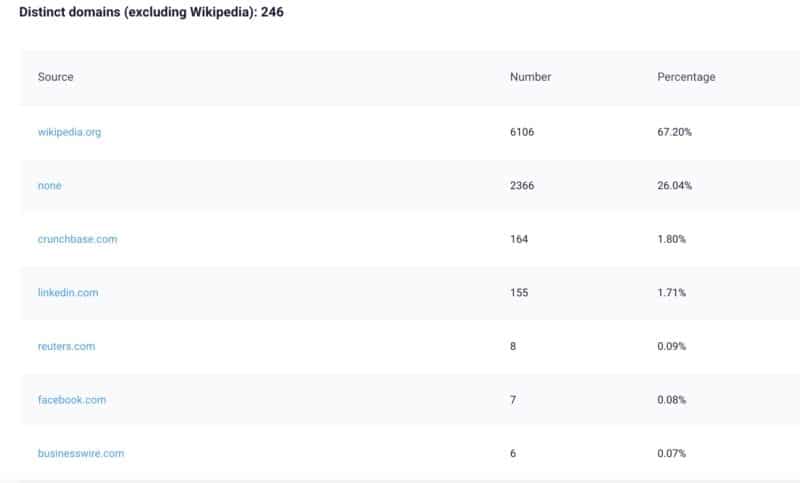
Technically, Google can use information from any crawlable website for their Knowledge Graph. However, we most often see Wikipedia as the dominant source of information.
The types of websites Google likes to pull from are typically directory-style websites that provide information that is:
Accurate.
Structured.
Consistent.
Jason Barnard’s Kalicube has an awesome resource that tracks entity sources for the past 30 days. I referred to this list and many of his articles for guidance on building my knowledge panel and personal entity.
Why is Wikipedia so prolific?
Google tends to use Wikipedia so heavily for a few reasons:
It’s heavily moderated and difficult to get an entry approved.
The content is well structured and easy for search engines to understand.
It’s a highly trusted resource.
While Wikipedia has skeptics reminding us that anyone can edit an entry, a heavy amount of moderation and editing still takes place on Wikipedia. Given that it’s also a fairly neutral/unbiased source of information, that gives Google all the more reason to trust it.
So if it’s so difficult to get an entry, why do so many SEOs only focus on getting a Wikipedia page as their way into the Knowledge Graph?
Well, the answer is that once you have a Wikipedia page, it’s almost a guaranteed entry. However, this is a mindset we need to break, because by now, we should all know that there are no guarantees in SEO.
Sure you can definitely pursue a Wikipedia page for your own brand, but just make sure to diversify your tactics and don’t just focus on that as your sole strategy.
How long does it take to earn a Knowledge Graph entry?
Don’t say it depends, don’t say it, don’t say it. Okay, so it is different for everyone. For me, it took about a year since the beginning of my efforts for mine to appear.
It all depends on how hard your brand is working and whether or not your brand deserves one.
Did I try that hard? Not really.
Did I deserve one? Not at all.
But based on the specific steps I took to market myself in the industry, I just so happened to earn a Knowledge Panel in the process.
I never thought I’d actually get one, but decided to run a series of tests to see if it would actually work, and to my surprise it did.
The specific steps I took to earn my knowledge panel
Okay now that you’ve probably scrolled past all of my intro content, let’s get to what you came here for. What specifically did I do to earn my Knowledge Panel entry and get established in Google’s Knowledge Graph?
Here are the specific steps I took in order.
1. Established entity home
The first step is to establish your root or home of your entity. This could be your personal website, brand’s page, author page, or anything that is the truest source of information for the entity. For me, I chose my personal website’s homepage for my entity home.
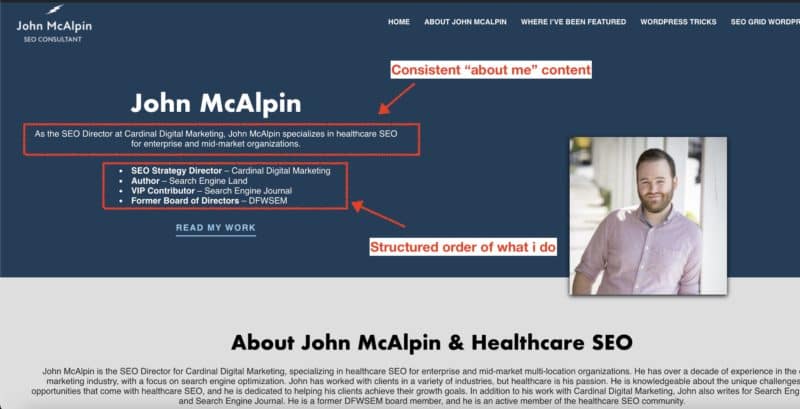
On my homepage, I did two specific things to help search engines:
Created ‘About Me’ Content
I created a one-sentence “about me” that I planned to use on all bio information across the web. Almost all of my personal bios on different websites I’m featured on start with this sentence. This creates consistency on who I am and what I do.
Create bulleted list of work
Having a short, easy to crawl, list of what I do helps create a connection to myself and other entities. My hope was Google would understand that I could be found on those other websites and better understand the relationship between myself and those entities. More on this in the schema section.
2. Industry authorship
For the past four years, I’ve been featured on dozens of podcasts and written plenty of articles for Search Engine Land, Search Engine Journal, OnCrawl, and many mory!
All of my features come with an author page, which has a list of all my articles for that site as well as Person schema for that site.
Additionally, all of my author pages contain a link back to my entity home, which is critically important for building your brand’s entity relevancy.
3. Consistent schema
Schema markup is the connective tissue that brings all of my authorship together. On my entity home, I ensured that I have robust schema markup.
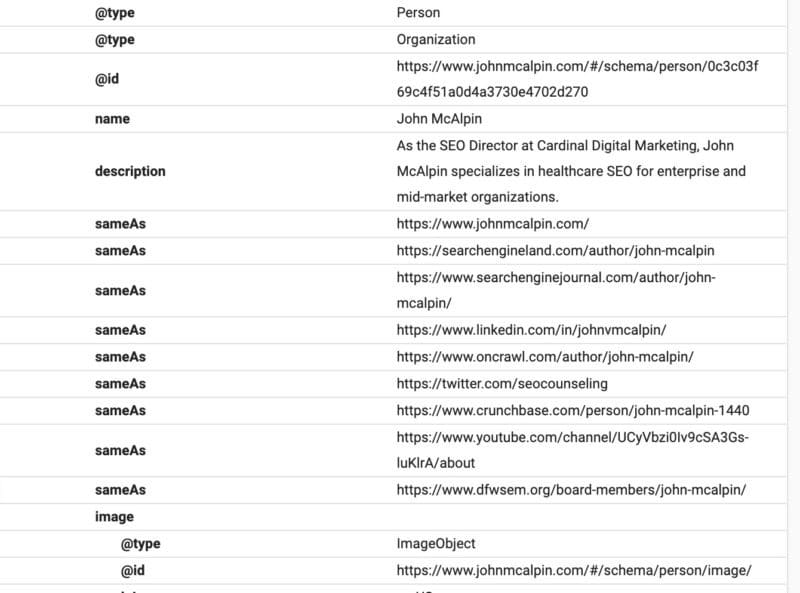
The most important thing to include in the schema markup is the SameAs data which I directed to all of my most important features on the web. I ensured to add SameAs links to any sources that I’ve seen generate entities in the past.
Below is a screenshot of what you’ll see if you run my personal website through the Schema Markup validator.
The specific schema type I chose was Person, as this was most accurate to myself. If you’re creating an entity for your business or brand, try to choose the schema type that’s most accurate to your business.
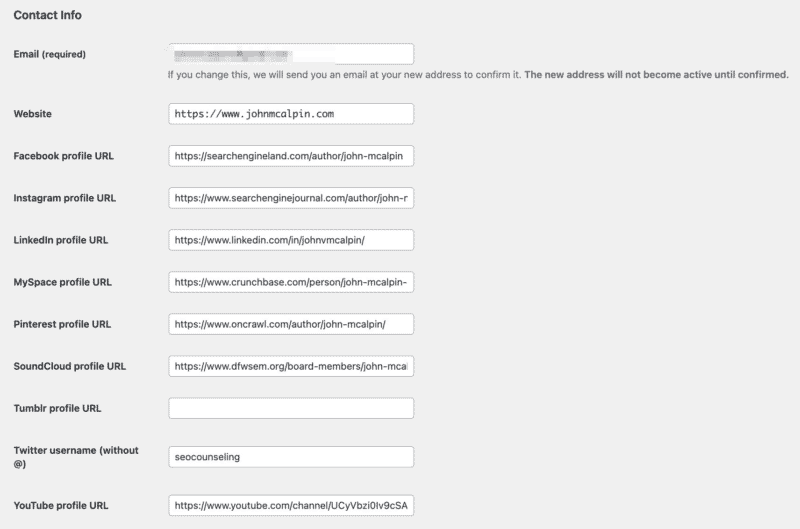
Typically, I create schema from scratch for all of my clients. However, Yoast’s author/person schema provided exactly what I was looking for and included one important feature.
What Yoast did for me was instead of making a generic Organization schema type for my website, I marked my website as a Person.
Within the specific settings, I pasted all of my important links into the contact info fields. Please note that other than Twitter, you can paste any link in those fields.
4. Consistent linking
Schema plays a huge factor in creating an interconnected web of consistent information for Google’s Knowledge Graph. However, external links provide even greater trust signals.
On my website, I have a collections page that links out to all of my important work. It’s like a mini CV of my work for anyone who wants to work with me.
However, you can’t just link out to other places on your website, you need established entities linking back to you.
That’s why all of my featured podcasts and author pages have a link back to my website. Not only are they linking back to my website, they’re all linking to my homepage, which I’ve established as my entity home.
5. Directories
This can definitely help get an easy foot in the door for many people and brands trying to get established with their own knowledge panel. One of the biggest directories that I recommend getting established in is Crunchbase.
In fact, Crushbase is what was listed as the source data during the first iteration of my knowledge panel.
I’ve seen many startups get their first knowledge panel entry through Crunchbase and it seems to be a consistently high source for Google to rely on. This is because Crunchbase has some verification processes that make it slightly more challenging to create spam in bulk.
When getting started with building out your directories, focus on the niche ones that are most relevant to your industry. This will go a lot farther for you than Crunchbase or any other big ones.
The different iterations my knowledge panel has shown
Over the course of about 1-2 months, Google has used a variety of different sources to feed my knowledge panel. It’s been very interesting to see how it’s evolved over such a short amount of time. I’ve even had my own article carousel which has since disappeared.
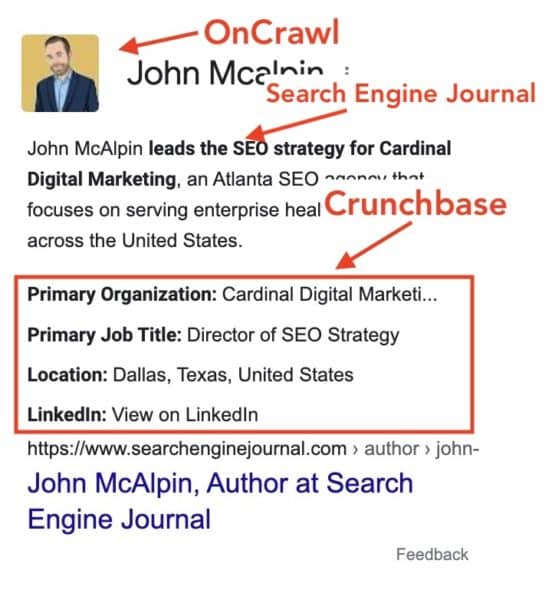
First iteration: All crunch, no flavor
At first, Crunchbase was the source of my entire knowledge panel entry. Something I found amusing is that there’s no link for my LinkedIn page, it’s just the anchor text on Crunchbase.
This was a great win for me and I was pleased with how structured the knowledge panel was.
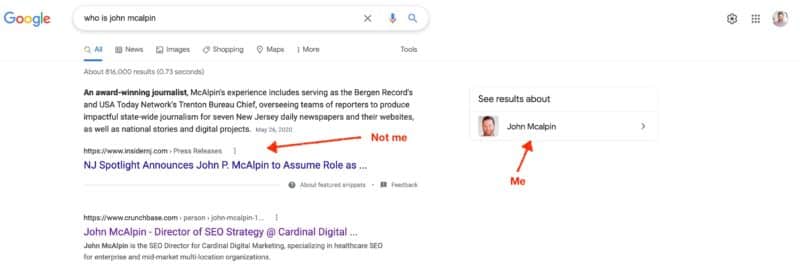
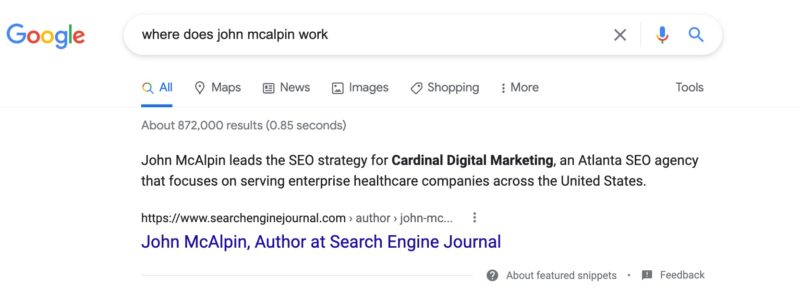
I tested a few queries to see how my entity data would appear as a zero-click result.
Testing searches: “Who is John McAlpin?”
This result was a little disappointing as it brought up a different John McAlpin who was referenced in a press release. However, I did see my entity in a side panel, which was both surprising and exciting.
Testing searches: “Where Does John McAlpin Work?”
This was a much more accurate result, but also a surprising one. If Crunchbase was fueling most of my knowledge panel data, why was Google showing Search Engine Journal as the source for this featured snippet?
We could speculate all day on our theories of how Google came to this decision, but I was just glad to see a more accurate result here.
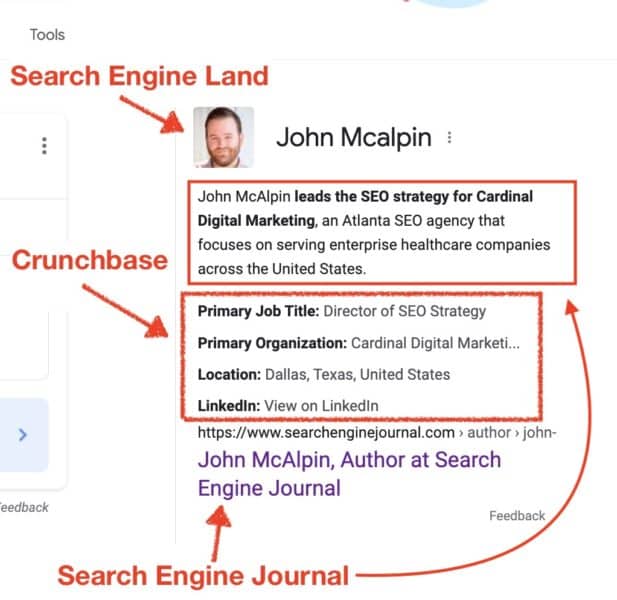
Second iteration: Images getting comical
A few weeks after the first sighting of my Knowledge Panel, I see a few interesting updates:
My image changed to a caricature that I used on one of my OnCrawl articles.
The “about” content changed to my author bio from Search Engine Journal
Summary data remained from Crunchbase
Source data label changed to my Search Engine Journal author page.
Third iteration: Image correction
Unhappy with my image being a cartoon for my professional headshot, I submitted feedback to update the image. I chose my image from Search Engine Land and sure enough it updated it about two weeks later.
Key takeaways
When seeking to earn your own knowledge panel, it’s important to keep in mind a few things.
It may not happen at all. You have no control over what Google displays in its results. All you can do is try to send the right signals consistently and hope that it pays off.
If it does happen, it will take time. It took me longer than a year for my knowledge panel to show up. Large organizations that have aggressive PR firms have a higher chance of showing up sooner, but even that isn’t a guarantee.
Consistency is key. Once you establish the signals you want to send, be consistent in that. As you could see in my second iteration, I wasn’t consistent in my choice of imagery and that messed up how I wanted my knowledge panel to appear.
Have patience. Just like all other factors in SEO, it takes time.
Opinions expressed in this article are those of the guest author and not necessarily Search Engine Land. Staff authors are listed here.
New on Search Engine Land
About The Author
John McAlpin leads the SEO strategy for Cardinal Digital Marketing, an Atlanta SEO agency that focuses on serving enterprise healthcare companies across the United States. Currently located in Colorado Springs, McAlpin is deeply engaged in both the local and national SEO community and has a strong background in technical SEO, web development, and digital marketing strategy. McAlpin also provides freelance web development services for WordPress hosted sites.
The most significant overhauls were to Google’s definitions of YMYL (Your Money, Your Life), and the extent to which E-A-T matters as a matter of page quality.
Google provided new, clear definitions for what it means for content to be YMYL, mostly framed around the extent to which the content can cause harm to individuals or society. Google also provided a new table establishing clear examples of what it means for content to be YMYL or not.
In the newest update to the guidelines, Google also explained that for highly YMYL content – E-A-T is crucial above all other factors. Google also explained that it’s possible to have low-quality content on otherwise trustworthy and authoritative sites.
Your Money, Your Life (YMYL) Topics – Section 2.3
Google completely reframed its definition of YMYL (Your Money, Your Life). In the previous version of the Quality Rater Guidelines, YMYL topics were broken down into the following categories:
News and current events
Civics, government and law
Finance
Shopping
Health and safety
Groups of people
Other
Google completely removed these categories.
The new version of the Quality Rater Guidelines now defines YMYL by its potential to cause harm.
Topics that present a “high risk of harm,” can significantly impact the “health, financial stability, or safety of people, or the welfare or well-being of society.”
Google then defines who may be harmed by YMYL content, including the person viewing the content, other people affected by the viewer, or groups of people or society as a whole. This could potentially be in reference to violent, extremist or terrorist content.
Google then defines YMYL topics as either being inherently dangerous (violent extremism), or harmful because presenting misinformation related to the topic can be harmful. For example, providing bad advice related to heart attacks, investments or earthquakes could cause harm to the user.
Instead of listing individual categories that may be considered YMYL, as in previous versions of the guidelines, Google now asks quality raters to think of YMYL in terms of four types of harm YMYL content can cause for individuals or society:
Health or safety
Financial security
Society
“Other”
In another new addition, Google claims that a “hypothetical harmful page” about a non-harmful topic, such as the “science behind rainbows,” is technically not considered YMYL. According to their updated definition, the content must have the potential to cause harm or otherwise impact peoples’ well-being.
In another big update, Google claims that many or most updates are not YMYL because they do not have the potential to cause harm.
Google also stated for the first time that YMYL assessment is done on a spectrum.
To clarify these new statements, Google provided a new table on page 12 of the guidelines, which specifically delineates the types of topics that Google considers YMYL or not, with clear examples.
Low Quality Pages – Section 6.0
Google revamped its definition of what it means to be a low-quality page.
In a previous version, Google claimed a page may be low quality, in part, because the creator of the main content may lack sufficient expertise for the purpose of the page. This statement was deleted.
Google now expands upon the role of E-A-T in determining whether a page is low-quality in three new paragraphs:
Google explains that the level of E-A-T required for the page depends entirely on the topic itself and the purpose of the page.
Topics that only require everyday expertise don’t require that the content creators provide information about themselves.
Google also suggests that a low-quality page can exist on an otherwise authoritative website, like an academic site or a government site. The topic itself of the page is where YMYL comes into play – if the content could potentially cause harm to the user, quality raters must evaluate that aspect when determining the quality of the page.
Lacking Expertise, Authoritativeness, or Trustworthiness (E-A-T) – Section 6.1
Google added a bullet point in its definition of what it looks like to lack E-A-T when determining whether a page is low-quality:
“Informational [main content] on YMYL topics is mildly inaccurate or misleading”
In another new addition, Google once again repeated that the level of E-A-T a page requires depends on the purpose and the topic of the page. If the page discusses YMYL topics (and potentially presents harm to the user or others), E-A-T is critical.
Even if the website has a positive reputation, if there is a significant risk of harm, the page must be rated as low quality.
Lowest Quality Pages – Section 7.0
Google inserted a new section in the “lowest quality pages” section suggesting that even authoritative or expert sources can still present harmful content. This could include hacked content or user-uploaded videos.
Just because content exists on a site that otherwise demonstrates good quality, if the content itself is deceptive, harmful, untrustworthy or spam, this still requires a “lowest quality” rating.
Google’s new document about Search Quality Rater Guidelines
In addition to updating the Search Quality Rater Guidelines, Google also published a new resource describing how the Search Quality Rater Guidelines work. This resource includes sections about how search works, improving search and the quality rating process.
This document provides the most comprehensive overview to date of the role Google’s quality raters play in evaluating how well Google’s proposed changes are in line with Google’s own quality guidelines.
Google also provides information about who the raters are, where they are located and how the rating process works.
Why these changes matter
For those interested in understanding how Google defines the concepts of YMYL and E-A-T, Google’s updated Quality Rater Guidelines provide some new guidance about what they aim to achieve with their algorithm.
As opposed to thinking about YMYL in terms of business or content categories, Google asks raters to think about the extent to which content can cause harm to users.
Google also clarified that everyday expertise is sufficient for many types of content, but E-A-T is of the utmost importance when the content qualifies as YMYL (it has the potential to cause harm to individuals or society, or can affect one’s financial wellbeing, health or safety).
Opinions expressed in this article are those of the guest author and not necessarily Search Engine Land. Staff authors are listed here.
New on Search Engine Land
About The Author
Lily Ray is the Senior SEO Director and Head of Organic Research at Amsive Digital, where she provides strategic leadership for the agency’s SEO client programs. Born into a family of software engineers, web developers and technical writers, Lily brings a strong technical background, performance-driven habits and forward-thinking creativity to all programs she oversees. Lily began her SEO career in 2010 in a fast-paced start-up environment and moved quickly into the agency world, where she helped grow and establish an award-winning SEO department that delivered high-impact work for a fast-growing list of notable clients, including Fortune 500 companies. Lily has worked across a variety of verticals with a focus on retail, ecommerce, B2B and CPG sites. She loves diving into algorithm updates, analyzing E-A-T, assessing quality issues and solving technical SEO mysteries. Lily leads an award-winning SEO team at Amsive Digital and enjoys sharing her findings and research with the broader SEO industry.
The guidelines break down into three key areas: query understanding, page quality rating and page match rating.
Query understanding. This is all about figuring out the intent behind the user’s search query. Neeva breaks down the types of queries into the following categories:
How to: User is searching for instructions to complete a task.
Error/troubleshooting: Something went wrong, user is searching for a solution.
Educational/learning: Who/what/where/when/why.
Product seeking/comparison: User is searching for a new product/tool or comparing products/tools.
Navigational: User is searching for information on a person or entity.
Ambiguous: Unclear what the user is searching for.
Page quality rating. Neeva has broken down pages into three levels of quality: low, medium and high. Advertising usage, page age and formatting are critical elements.
Here’s a look at each:
Low quality:
Dead pages
Malware pages
Porn/NSFW pages
Foreign Language
Pages behind a paywall
Clones
Medium quality:
3+ ads when scrolling / 1 large banner ad / interstitial or video ads
Page is 5+ years old
Page loads slowly
Format of page makes it difficult to extract information
Forked github repo
Pages behind a login or non-dismissable email capture
Question page with no response
High quality:
Meet the age criteria
Meet the ads criteria
Be well formatted
Page match. Neeva has its raters give a score to the match between the query and a webpage, between 1 (significantly poor) to 10 (vital). Here’s that scale:
Significantly Poor Match. Does not load, page is inaccessible.
Especially Poor Match. Page is wholly unrelated to the query. Missing key terms.
Poor Match. Page may have some query phrases, but not related to the query.
Soft Match. Page is related to query, but broad, overly specific, or tangential.
On Topic but Incomplete Match. Page is on topic for the query, but not useful in a wide scope, potentially due to incomplete answers or older versions.
Non-Dominant Match. Page is related to the query and useful, but not for the dominant intent shown.
Satisfactory Match. This page satisfies the query, but may have to look elsewhere to round out the information.
Solid Match. This page satisfies the query in a strict sense. There is not much extra, or beyond what is asked for.
Wonderful Match. This page satisfies the query in a robust, detailed sense. It anticipates questions/pitfalls that might come up and/or adds appropriate framing to the query.
Vital Match. This is a bullseye match. It is not available on all queries. The user has found exactly what they were looking for.
Read the full guidelines. They were published on the Neeva blog, here.
Why we care. It’s always smart to understand how search engines assess the quality of webpages and content, and whether it matches the intent of the search. Yes, Neeva has a tiny fraction of the search market share. But the insights Neeva shared can provide you some additional ways to think about, assess and improve the quality of your content and webpages.
New on Search Engine Land
About The Author
Danny Goodwin is Managing Editor of Search Engine Land & SMX. In addition to writing daily about SEO, PPC, and more for Search Engine Land, Goodwin also manages Search Engine Land’s roster of subject-matter experts. He also helps program our conference series, SMX – Search Marketing Expo. Prior to joining Search Engine Land, Goodwin was Executive Editor at Search Engine Journal, where he led editorial initiatives for the brand. He also was an editor at Search Engine Watch. He has spoken at many major search conferences and virtual events, and has been sourced for his expertise by a wide range of publications and podcasts.
Google search quality raters guidelines updated today
Google has updated its search quality raters guidelines today, this is an update from the October 2021 update. You can download the full 167-page PDF raters guidelines over here. This version has refreshed language in the new overview section, a refined YMYL section, with more on low-quality content, YMYL, E-A-T, and more.
What is new. Google posted these bullet points on what is new on the last page of this PDF.
Refined YMYL to focus on topics that require a high level of accuracy to prevent significant harm; added a new table of examples and refreshed existing examples
Added clarifications to Low and Lowest Page Quality sections to emphasize that the type and level of E-A-T depends on the purpose of the page, and that low quality and harmful pages can occur on any type of website
Refactored language throughout to be applicable across all devices types Minor changes throughout (updated screenshots; removed or updated outdated examples and concepts; removed user location when irrelevant; etc.)
Also, the previous version was a 171-pages, this revised document is 167-pages.
Why we care. Although search quality evaluators’ ratings do not directly impact rankings (as Google clarified in the document), they do provide feedback that helps Google improve its algorithms. It is important to spend some time looking at what Google changed in this updated version of the document and compare that to last year’s version of the document to see if we can learn more about Google’s intent on what websites and web pages Google prefers to rank. Google made those additions, edits, and deletions for a reason.
You can download the 167-page PDF raters guidelines over here.
New on Search Engine Land
About The Author
Barry Schwartz a Contributing Editor to Search Engine Land and a member of the programming team for SMX events. He owns RustyBrick, a NY based web consulting firm. He also runs Search Engine Roundtable, a popular search blog on very advanced SEM topics. Barry can be followed on Twitter here.
8 steps to a successful entity-first strategy for SEO and content
Entity search can be a massive competitive advantage. But you first need to build your entity-based strategy.
This article will cover how to create a robust entity-first strategy to help our content and SEO efforts.
Most common challenges search and content marketers face
Relevant, topical content, discovery based on customer intent is still the biggest challenge we face as search marketers.
Content relevancy, in my mind, means the content is personalized, must tell a story, should be scannable, readable, provides images, and the layout can be consumed on any device.
Here are five outcomes we aim to accomplish with content:
Discovery: Ensure content is discoverable and available across various customer touchpoints.
Relevancy: Ensure content meets all the searchers’ needs and contains all topics and sub-topics that a searcher cares about, is easy to read and understand and tells a story.
Measurability: Content aligned with overall SEO strategy and is scalable and measurable.
Experience: Content delivers a great user experience and is scannable.
Engagement: Helps drives engagement and guides the visitors to the desired goals – sign-ups, purchases, form fills, calls, etc.
The most common struggle we all face is determining what type of content to create or add.
Aligning strategies with search engines
Search engines are evolving and content marketing strategies need to align across all verticals from popularity and quality to the intent behind the query and the overall page experience.
Search engine priorities, results, algorithms and needs have evolved over time.
Evolution of search engines and impact
As users search on screenless devices and spoken queries increase, search engines use artificial intelligence and machine learning to try and replicate how humans think, act and react.
Search engines must decode a sentence (or paragraph) long query and serve results that best match it. This is where entities come in.
Entities are things search engines can understand without any ambiguity independent of language. Even when a website has a wealth of content, search engines need to understand the context behind it, identify the entities within the content, draw connections between them and map them to the query of the searcher.
Deploying schemas and marking up the entities within your content gives search engines the context and helps them understand your content better.
A convergence of technology and content
Content, where entities are not marked with schemas, tends to underperform.
Similarly, deploying schemas on content that does not contain all the relevant entities or does not provide all the information will also not have maximum impact.
Entity optimization uses advanced nested schemas deployed on content that meets the searchers’ needs and contains all the relevant topics and entities.
Let’s use a live project as an example and show what we accomplished for one of our clients.
8 steps to developing an entity-first strategy
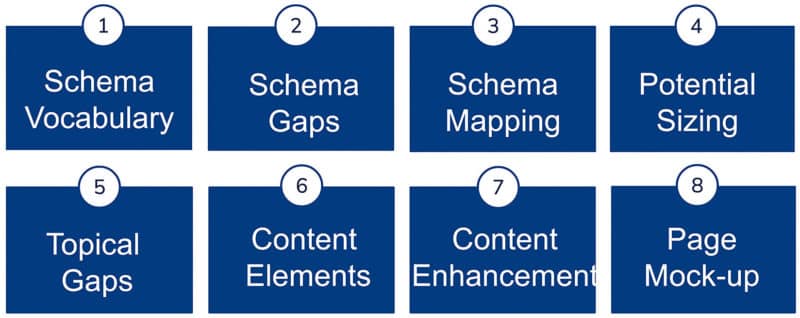
We deployed the eight steps given below as an entity-first-strategy for one of our client in the health care vertical to help them get the best topical coverage and visibility. We started by identifying the most relevant schema in their industry followed by determining the gaps within their content for both schema and entities.
Eight steps for an entity-first strategy
1. Identified schema vocabulary
We created a list of all applicable schemas in the healthcare industry.
2. Determined the schema gaps
We identified the schema gaps by comparing the current site content against the applicable schemas.
3. Mapping schema
Once we identified the schema gaps, we identified the most relevant pages to deploy the unused schemas.
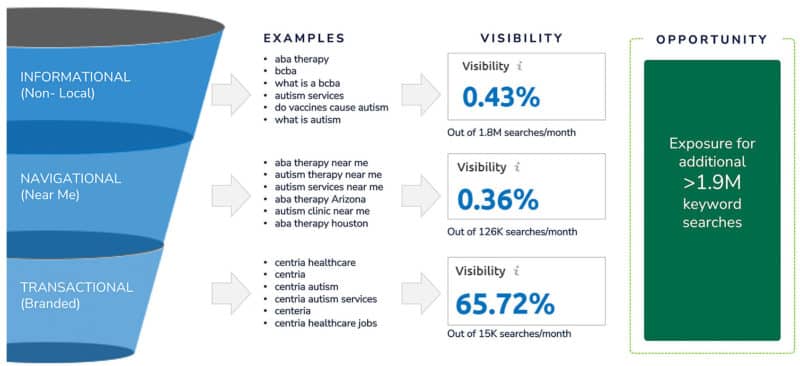
4. Market opportunity and potential sizing
We used in-depth keyword research and analysis of current content performance.
Map content based on informational, navigational and transactional content.
It is critical to see how your current branded and non-branded content is performing and what your focus should be based on business goals.
Market opportunity and potential sizing
We identified the pages that could see the most impact and potential from topic, entity, and schema optimization.
5. Map topic gaps
Once we identified the best potential pages, we cross-referenced the gaps in the content by analyzing the topics and entities covered by other ranking websites.
6. Identify Content Opportunities
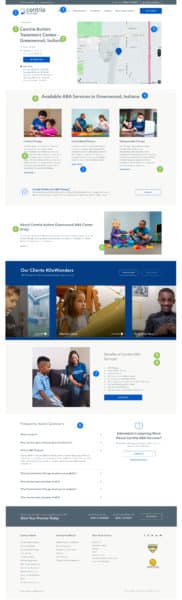
We enhanced the page architecture by adding relevant content elements, such as images, headings and lists.
Page layout showing schema and content opportunities
Topic/entity gaps covered:
care plan
Treatment
Treatment center
ABA services
Behavior technician
Autism spectrum disorder
BCBA
ABA therapist
ABA services
Schema gaps covered:
Medical organization
SiteNavigationElement
Medical clinic
availableService
hasmap
FAQ
ItemList
7. Content enhancement
Optimized the content by incorporating missing topics and entities
8. Create better than the best website page
We then created the perfect in-depth page, rich with relevant topics the target audience is searching for.
Measuring entity strategy Impact
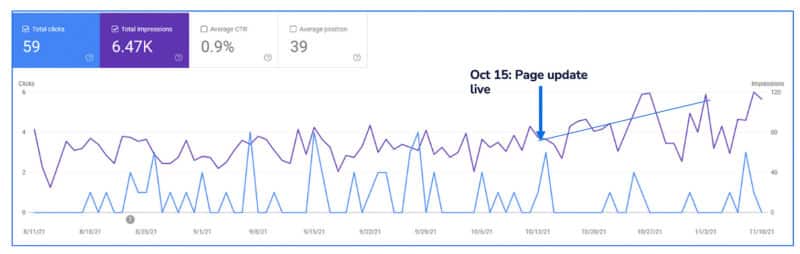
When we measured the impact of adding entities and schema into our strategy for this healthcare company, we saw a 66% lift in visibility and inclusions in rich results.
Overall impact of new page.
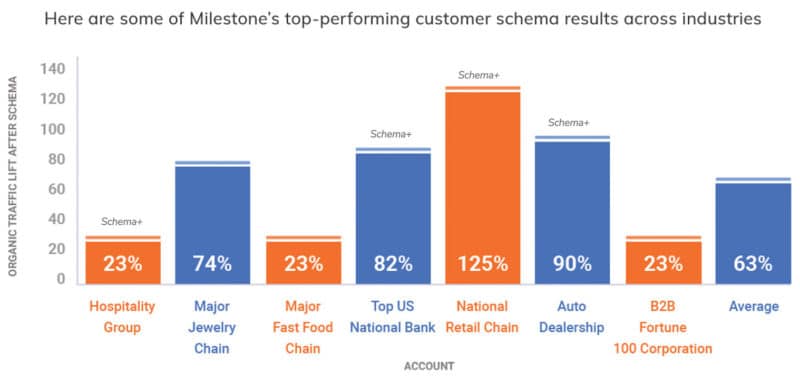
While the above image is just one example of the impact entities and schema can have, you can see below how many different industries benefit by deploying schema and entity coverage.
Impact of schemas across various industries.
Key takeaways
Creating content is more than writing. It is robust when you add in all the elements from design, development, topical entity coverage and schema. All these elements need to align to give optimum results.
Keeping organization in mind, cluster pages of relevant content and connect them through pillar pages, ensuring to take advantage of the interlinking opportunities.
Treat each page as the main category page with several relevant pages linked. Adding interlinking helps in discovery and relevancy.
Once you have an entity-first strategy for content, you need to think about how to scale the process of:
Understanding the entity.
Tagging schema.
Pruning broken links or errors as they come.
Continuing to add more meaningful content.
Entity optimization frameworks for large enterprise sites
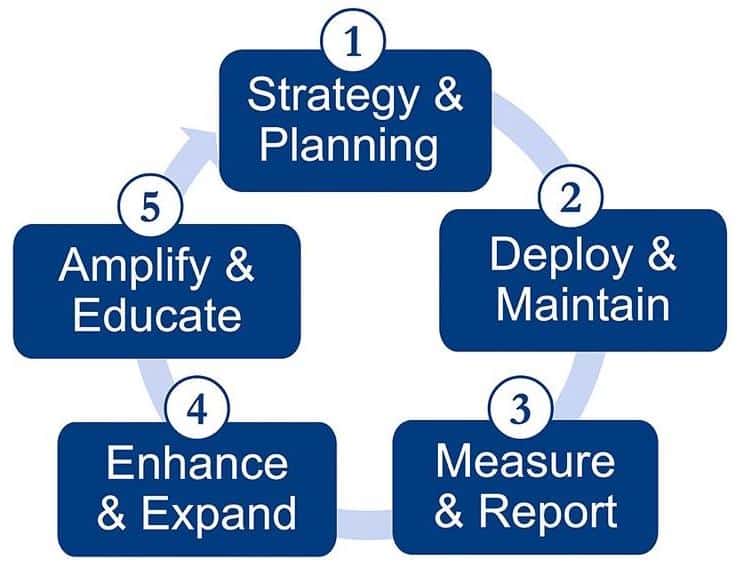
In my next article, we will explore how you can deploy, measure and report performance, enhance where needed and scale your entity-first strategy.
Opinions expressed in this article are those of the guest author and not necessarily Search Engine Land. Staff authors are listed here.
New on Search Engine Land
About The Author
Benu Aggarwal, founder and president of Milestone Inc., is a highly recognized expert in digital marketing solutions, voice search, SEO and local. Benu oversees product development, client services, technology and strategic vision for the company. Under her leadership, the company has prospered as it launched a suite of SEO-first software products and thousands of websites of which dozens won design and technology awards. With her technical marketing experience, entrepreneurial spirit, and motivating attitude, Benu has the ability to translate technical ideas into tangible practice that drive results for customers.
Webinar: Unlock the power of TikTok for your social strategy
With 800 million active users worldwide, TikTok is influencing a whole new generation of social media users and consumers.
This webinar will break down how content and influencers drive engagement and influence consumer behavior. Learn how to measure your competitive share of voice, engage consumers and drive revenue growth for your business.
Cynthia Ramsaran is director of custom content at Third Door Media, publishers of Search Engine Land and MarTech. A multi-channel storyteller with over two decades of editorial/content marketing experience, Cynthia’s expertise spans the marketing, technology, finance, manufacturing and gaming industries. She was a writer/producer for CNBC.com and produced thought leadership for KPMG. Cynthia hails from Queens, NY and earned her Bachelor’s and MBA from St. John’s University.
Chances are, if you are running a business that uses digital marketing, you are already using both. SEO will drive traffic to your website, while you use content marketing in your blogs and on your social media channels. But here is the question: are both tactics working well together? If not, you may be missing out on a great opportunity to help your brand grow.
Making sense of the buzz: SEO vs content marketing
Before considering how SEO and content marketing can be combined in your marketing strategy, it is worth clarifying the differences between both tactics. As digital marketing terms are becoming more widely used, they are also often used synonymously even though they describe different things.
What is content marketing?
According to the Content Marketing Institute, content marketing is “focused on creating and distributing valuable, relevant, and consistent content to attract and retain a clearly defined audience.” The overall goal is to encourage customer actions that benefit the brand, whether that is through subscribing to a service or purchasing a product.
Unlike traditional marketing, content marketing works indirectly with the consumer and is intended to stimulate interest in its products or services, compared to specific brands. Rather than talking to customers about a specific product or service, content marketing helps a customer solve problems by providing information that they may not have had previously.
Brands that excel at content marketing and Search Engine Optimization build long-lasting relationships with their audiences. Customers come to rely on the brand as a source of advice rather than simply a business pushing products and services.
What is Search Engine Optimization (SEO)?
Search Engine Optimization is a crucial part of marketing for businesses that rely on website traffic. It organizes and optimizes content from search engines, like Google, and helps your website rank high in search results. The Digital Marketing Institute defines SEO as a process that helps brands generate website traffic from “free, organic, editorial, or natural search results in search engines.”
As a brand, you may be paying an SEO expert to improve your rankings, but there are no payments to the companies behind the search engines. This is what sets SEO apart from Search Engine Marketing (SEM), which refers to paid listings. While SEO takes time to deliver results, SEM can increase product visibility in the short term.
Many brands use both approaches as part of their digital marketing strategy. But let’s only focus on SEO. SEO has become a non-negotiable part of the digital marketing strategy of any brand relying on website traffic for its success. Without it, even the best-designed website may never be found by relevant audiences.
Based on these clarifications, it is easy to identify the connection between content marketing and search engine optimization.
To reach the full potential to benefit your brand, content marketing and SEO need to work together. As a new brand, you should create content with search engine requirements in mind. As a brand with an existing library of content, it is worth reviewing your content to ensure it benefits your search engine.
Starting from scratch: how to develop SEO-friendly content
Just a few years ago, creating SEO-friendly content meant stuffing keywords into what would have been an otherwise well-written article. As a result, many websites became unreadable and unhelpful for their users. Search engine operators realized that and have started to change their algorithms. Today, search engines strive to deliver the most relevant content to users.
So, how can you tell Google that your content is relevant? The answer is simple: be clear with your content. Search engines probe through websites, and the easier it is to identify the focus of your content, the higher your content will be ranked on search engine results pages.
Staying focused is the key to developing successful content. That may sound simple, but it can be surprisingly hard to implement at times. For example, if you are offering separate online courses for languages and personal finance, avoid putting both types of courses on the same page. Instead, create a separate language course page and another personal finance page. You may even want to break down the language courses into individual languages.
The same goes for blog posts. It is possible to blog about the benefits of online courses in general. However, creating individual pieces of content for online language courses and personal finance courses will almost always drive more content to the relevant pages.
Creating content from scratch means starting with target keywords in mind and matching content to those keywords.
Optimize existing content
Creating brand new content might give you an advantage with SEO, but it is a time-consuming approach. Most established businesses and brands already have a content library and should update and optimize that content to benefit search engine rankings.
Once again, it helps to try and think like a search engine. Websites that are continuously updated rank higher than those with stagnant content. Updating existing content is an excellent way of meeting that requirement while saving time.
Optimizing existing content would not be complete without reviewing internal and external links. Internal linking tells search engines about the structure of your website and reveals content that belongs together. Orphaned content, pages not linked together, struggle to be found by search engines.
SEO and content marketing should work together to attract the most users to your website and generate sales.
To create synergies, start developing content with SEO in mind. Delivering great content that benefits users can easily be SEO-friendly, especially if it is developed that way from the beginning. Treating SEO as an afterthought tagged on to the end of content development simply does not deliver the best results.
Creating content with your audience in mind and a clear understanding of your topic will make it easier to optimize content for rankings. Regardless of the time investment, traffic optimization is worthwhile for your business.
https://www.entrepreneur.com/article/429708
Google releases July 2022 product reviews update
Google has begun the rollout of the fourth version of the product reviews update, a search ranking algorithm update targeted at ranking product review-related content on the web that is most helpful and useful to searchers. The first product reviews update was launched on April 8, 2021, the second was launched on December 1, 2021, the third has been released on March 23, 2022, and now the fourth has been released on July 27, 0222. The new is named the July 2022 product reviews update.
Google announced this update on Twitter referencing the standard help document around how to write product reviews.
Google product reviews update. The Google product reviews update aims to promote review content that is above and beyond much of the templated information you see on the web. Google said it will promote these types of product reviews in its search results rankings.
Google is not directly punishing lower-quality product reviews that have “thin content that simply summarizes a bunch of products.” However, if you provide such content and find your rankings demoted because other content is promoted above yours, it will definitely feel like a penalty. Technically, according to Google, this is not a penalty against your content, Google is just rewarding sites with more insightful review content with rankings above yours.
Technically, this update should only impact product review content and not other types of content.
What is new. Unlike the March product reviews update, it seems nothing specifically changed with any ranking criteria with this update. Google is likely just refreshing the algorithm and making slight adjustments.
The rollout. This rollout will take “take 2-3 weeks to complete,” Google said. These, and core updates, normally take a few weeks to roll out, so that should be no surprise. You should expect the bulk of the ranking volatility to happen in the earlier stages of this rollout.
What is impacted? Google said this update may in the future impact those who “create product reviews in any language,” but Google said the initial rollout will be “English-language product reviews.” Google added they have seen “positive effects” from this update in the past and the search company “plans to open up product review support for more languages” in the future.
Previous advice on the product reviews update. The “focus overall is on providing users with content that provides insightful analysis and original research, content written by experts or enthusiasts who know the topic well,” Google said about this update. That is similar advice to the core update recommendations mentioned above, but here is a list of “additional useful questions to consider in terms of product reviews.” Google recommends your product reviews cover these areas and answer these questions. Do your product reviews…
Express expert knowledge about products where appropriate?
Show what the product is like physically, or how it is used, with unique content beyond what’s provided by the manufacturer?
Provide quantitative measurements about how a product measures up in various categories of performance?
Explain what sets a product apart from its competitors?
Cover comparable products to consider, or explain which products might be best for certain uses or circumstances?
Discuss the benefits and drawbacks of a particular product, based on research into it?
Describe how a product has evolved from previous models or releases to provide improvements, address issues, or otherwise help users in making a purchase decision?
Identify key decision-making factors for the product’s category and how the product performs in those areas? For example, a car review might determine that fuel economy, safety, and handling are key decision-making factors and rate performance in those areas.
Describe key choices in how a product has been designed and their effect on the users beyond what the manufacturer says?
Provide evidence such as visuals, audio, or other links of your own experience with the product, to support your expertise and reinforce the authenticity of your review.
Include links to multiple sellers to give the reader the option to purchase from their merchant of choice.
Google added three new points of new advice for this third release of the products reviews update:
Are product review updates relevant to ranked lists and comparison reviews? Yes. Product review updates apply to all forms of review content. The best practices we’ve shared also apply. However, due to the shorter nature of ranked lists, you may want to demonstrate expertise and reinforce authenticity in a more concise way. Citing pertinent results and including original images from tests you performed with the product can be good ways to do this.
Are there any recommendations for reviews recommending “best” products? If you recommend a product as the best overall or the best for a certain purpose, be sure to share with the reader why you consider that product the best. What sets the product apart from others in the market? Why is the product particularly suited for its recommended purpose? Be sure to include supporting first-hand evidence.
If I create a review that covers multiple products, should I still create reviews for the products individually? It can be effective to write a high-quality ranked list of related products in combination with in-depth single-product reviews for each recommended product. If you write both, make sure there is enough useful content in the ranked list for it to stand on its own.
Not a core update. Google also previously said that product review updates are not the same as core updates. This is a standalone update they’re calling the product reviews update. This is separate from Google’s regular core updates, the company told us. Nonetheless, Google did add that the advice it originally provided for core updates, “about producing quality content for those is also relevant here.” In addition to that advice, Google provided additional guidance specific to this update.
Why we care. If your website offers product review content, you will want to check your rankings to see if you were impacted. Did your Google organic traffic improve, decline, or stay the same?
Long term, you are going to want to ensure that going forward, you put a lot more detail and effort into your product review content so that it is unique and stands out from the competition on the web.
Also, those impacted by previous core updates, that put in the work, may be rewarded by this July 2022 product reviews update.
New on Search Engine Land
About The Author
Barry Schwartz a Contributing Editor to Search Engine Land and a member of the programming team for SMX events. He owns RustyBrick, a NY based web consulting firm. He also runs Search Engine Roundtable, a popular search blog on very advanced SEM topics. Barry can be followed on Twitter here.
Your guide to the first 90 days as an enterprise SEO director
If you’ve enjoyed every SEO job you’ve had in the first 90 days, kindly remove yourself from this article for being a liar.
We good? Awesome.
Did you know that 33% of employees quit their job within the first 90 days that they’re employed.
That’s a sobering fact.
The kind that makes you want to get not-sober as you kickstart for your first 90 days as an enterprise SEO Director.
Enterprise SEO departments have a high turnover rate due to cultural challenges because other departments don’t understand SEO or how to work together.
At the risk of stating the obvious, your first 90 days as an enterprise SEO Director sets the stage for the rest of your time at the company.
Have you found yourself asking these questions before:
How do you make a business use case for more budget for SEO?
How do you scale your enterprise SEO department?
How do develop alignment with Product and Editorial?
Over the next few articles, I’ll help you answer these (and more) questions, based on my experience as an enterprise SEO Director. Starting with
Become a strategic player
In due time, you can show up to Zoom meetings acting like “the champ is here,” but not in the first 90 days.
You’ve got massive plans afoot for an SEO makeover for your enterprise company.
Site architecture changes.
Removing old content.
Possibly building a new website.
It’s a lot to take in.
So I recommend starting with developing relationships. You want your enterprise SEO department to be seen as a strategic player on a bigger team.
Allow me to paint you a picture.
It’s your second week as the new SEO Director. SEO is a brand new department at the enterprise company. Everyone is excited to have you join the team.
Until you start to notice other departments are already doing SEO, but do not realize they are doing SEO.
In the second month as the new SEO Director, you present your observations of the challenges and offer new solutions to the executive team. Your presentation goes well.
Later, you find out those other departments are not happy with you presenting the challenges you see in their department.
This is not what you want to see in your first 90 days as a new enterprise SEO Director. This is a common problem SEO professionals face as SEO is still relatively new in enterprise companies.
SEO Directors need to position themselves as a strategic partner that flows and moves with other departments.
You will lose credibility and trust without empathy
Getting SEO done on a website with millions of webpages requires other teams’ resources.
Enterprise SEO teams are never self-contained. Instead, SEO departments lean on the resources of other departments to get things done.
The hardest part of my job as an enterprise SEO Director is selling SEO to other teams. I have to persuade other teams that my goals can help impact their goals.
So how do we find common ground?
The key to finding common ground with empathy.
You need to understand what your engineering, editorial, design and other teams care about. You need to look at their goals and priorities and build your goals and priorities to align with them.
If you come to the table with audits, deliverables and recommendations, you start to lose social capital. You’re turning people off by getting too into the SEO terminology weeds.
For example, instead of saying “I need to set the SEO strategy,” say “I need to align our SEO strategy with your work so my team can make better decisions.”
Let’s say that the marketing team’s Q3 goal is to scale the international audience.
As an SEO, you might see opportunities in site architecture, page layouts and technical improvements.
Ask yourself: Are there SEO improvements we can make that support the scaling of international audiences?
You need to overlap your SEO opportunities with the marketing team’s strategy.
But your deliverable is documentation of the process into the strategy. You don’t want to skew the conversation by talking about deliverables as audits or keyword research. Your communication is the deliverable.
Your SEO deliverables don’t exist for change. Your SEO deliverables exist to create documentation and standardize the process.
This way of looking at SEO deliverables will help set the landscape to get the resources you need to execute in your first 90 days. You may need to negotiate for resources.
As the SEO lead, you want to communicate that you understand the strategic initiative and that your strategy supports it.
My SEO Director 30-60-90-day plan
Days 1–30
Focus: Learning
Priorities: Get up to speed on needs and challenges for the Content and SEO team and [Company Name] as a company. Understand the expectations [Your Boss’s Name] has for me, learn how the internal processes and procedures currently work, and start to explore some of the challenges facing [Company Name] and Content and SEO.
Learning goals:
Read all of the relevant internal materials available to me. Ask across teams for recommendations of articles, reports, and studies I should review. Get up to speed on [Company Name] as a company and the industry. Gain product knowledge. (Metric: Reading completed)
Get access to the accounts (email, Google Analytics, Google Search Console, Asana, Workfront, Contentful, Google Drive, WordPress, etc.) I’ll need to do my job. Spend time familiarizing myself with each of them. Determine what tools/software we are missing. (Metric: Task completed)
Listen to 10 recorded customer calls (good and bad). (Metric: 10 customer calls listened to)
Understand the need for my open roles to adjust job descriptions if needed. Align with interviews and questions for each interview. (Metric: Task completed)
Performance goals:
Organize the Content and SEO tech stack. (Metric: Establish a list of tools, budget and logins)
Kickstart content inventory research and recommendations on the top 25 pages. (Metric: Content Audit completed on top 25)
Initiate Technical SEO research and break down priorites-based team org structures (Ex: thin content edits to the editorial team, sitemap tweaks to engineering team) and recommendations for the overall health of the website. (Metric: SEO research completed with top 10 priorities)
Dive into a Competitor Analysis that is focused on content and SEO only. (Metric: Competitor Audit of top 5 competitors completed)
Begin to build and document Content & SEO Strategy for FY2022 through the next 3 years based on audit findings. (Metric: Task completed)
Prepare content style guide and deployment checklist to align with SEO best practices. (Metric: Task completed)
Personal goals:
Meet with [Your Boss’s Name] and key stakeholders from product, engineering, editorial, PR, etc. Introduce myself and learn about their roles within the organization. (Metric: Ten meetings held)
Set up recurring meetings with everyone I’ll need to work with on a regular basis—including cross-functional and external partners. (Metric: Regular meetings set and attended)
Days 31–60
Focus: Contributing
Priorities: Perform my role as Director of SEO at full capacity, with a decreased need for guidance. Start to explore how I can make a unique impact within the SEO channels and [Company Name].
Learning goals:
Analyze current SEO performance so far and establish key metrics and benchmarks I care about (sales, leads, revenue, etc.) and share findings across departments and key stakeholders. (Metric: Task completed)
Explore Content and SEO workflow improvements to document in SEO strategy. (Metric: Task completed)
Listen to five recorded customer calls (good and bad). (Metric: Five customer calls listened to)
Continue to work with the Talent team to review candidates for the open roles. (Metric: Task completed)
Performance goals:
Create a Wiki page SEO tech stack for future reference and guidance. (Metric: Task completed)
Share Content research and initial findings (and Competitor Analysis) and recommendations on the top 25 pages to teams and align across departments to tackle recommendations. (Metric: Content Calendar created with research findings included in workflow along with Best Practices documented in Wiki)
Share Technical SEO research (and Competitor Analysis) and recommendations for the overall health of the website to teams and align across departments to tackle recommendations. (Metric: Get recommendations in team queues for completion (i.e. Sprints, Asana, Jira, etc.))
Continue to build and document SEO Strategy for FY2022 through the next 3 years based on audit findings. (Metric: Task completed)
Begin Backlink SEO research (and Competitor Analysis) along with recommendations. (Metric: Competitor Audit of top 5 competitors completed)
Personal goals:
Schedule coffee or lunch with someone from the company I haven’t gotten to know yet. (Metric: Task completed)
Days 61–90
Focus: Taking initiative
Priorities: Start assuming more autonomy and finding small ways to practice leadership skills. Start to explore SEO goals for the rest of the year.
Learning goals:
Work with the Analytics team to establish consistent automated reporting. (Metric: Task completed)
Listen to five recorded customer calls (good and bad). (Metric: Five customer calls listened to)
Continue to work with the Talent team to review/hire candidates for the open roles. (Metric: Task completed)
Performance goals:
Kickstart quarterly content research projects based on website ownership.
Onboard Blog Content Manager to kickstart quarterly content research for the blogs.
Establish monthly, quarterly and yearly goals for the SEO team. (Metric: TBD)
Share SEO Strategy for FY2022 and beyond (hiring, resources, prioritization, etc.). This will include key findings from the research along with a content calendar, technical SEO project roadmap, and reporting metrics (content, technical, backlinks).
Sync with PR and Social teams to begin to talk about an Influencer/Ambassador strategy. (Metric: Task completed)
Develop a Content Distribution Playbook to work across departments. (Metric: Task completed)
Develop a Technical SEO Playbook to work across departments. (Metric: Task completed)
Personal goals:
Schedule coffee or lunch with someone from the company I haven’t gotten to know yet. (Metric: Task completed)
Your first 90 Days as an SEO Director is a fresh start for you and your company
Most enterprise companies don’t have an SEO strategy at an executive level.
During your first 90 days, you want to build a foundation for your SEO strategy that aligns with the bigger marketing and product strategy.
Opinions expressed in this article are those of the guest author and not necessarily Search Engine Land. Staff authors are listed here.
New on Search Engine Land
About The Author
Anna Crowe is a Frank’s Hot Buffalo sauce advocate (leading with obvious priorities), writer, marketer and SEO nerd. Over the last 12+ years, Anna has successfully run SEO and content programs for brands like Dollar Thrifty Rental, Marriott, Hilton, Hearst Magazine, Mailboat Records, Philip Morris International, Bloomin’ Brands and Brother USA and many more. She enjoys burritos and puppies (in that order) when she’s not moonlighting as a soccer coach. https://annaleacrowe.com/