E-A-T auditing: How to level up your credibility game

Reading the Quality Raters Guidelines, all the blog posts and opinions and tests and trying to make sense of it can feel overwhelming.

How do you actually figure out whether your website lacks E-A-T, or evidence of it?

What is E-A-T

E-A-T stands for:

  • Expertise.
  • Athoritativeness.
  • Trustworthiness.

E-A-T isn’t a direct Google ranking signal. You can think of it more like a collection of all the things that really matter and impede your potential. Marie Haynes has a great E-A-T summary here.

In my 20 years of experience outside of technical-only updates from Google, just about everything has been leading up to this. Every update has been an aspect or forerunner of E-A-T.

How to audit for E-A-T

What follows is the exact approach my agency follows when auditing for E-A-T, with everything you need to consider and all the potential gaps.

Off-site reputation signals

1.1 Online recommendations

We’re looking to find any recommendation or commendation of the company, anywhere else online, on a site that isn’t owned or operated by the business. It could be a forum posting, or number of forum postings, or a nice word or two on one of those neighborhood sites that’s indexed well, unlike Facebook’s walled garden.

1.2 Online press

Here we’re looking first to see just how much journalist-written media coverage there is about the business. In particular, we’d be looking at the velocity and recency of coverage.

We’d also look at sentiment analysis on the past month, to three months worth of coverage if there’s a lot. Nothing too deep, just a top-level positive, negative, neutral vibe.

While we have no hard data that negative sentiment throttles rank and I think it’s been largely debunked, if I was building an algorithm that identifies and rewards trust, I’d be sure to add temporal dimensions and an emphasis on sentiment or writing from trusted authors. It’s an interesting topic for R & D, but at this stage we’re definitely collecting the data/

1.3 Key players

Expanding on the previous point, that exercise again, but here we’re going a level down to see if any of the business team are referenced in online coverage.

At the other end of this is a picture of linked entities, which is why it’s important for us to dig a layer deeper. Again, we’re not just looking at whom and how often but we’re also looking at a top-level sentiment analysis.

1.4 Third-party review sites

Consumers trust and value review sites, like TripAdvisor, Trustpilot and more.

Here we’re looking for how many review sites, how many reviews, general sentiment and importantly – interactivity (i.e., does the business visibility and positively interact with reviewers?).

1.5 Wikipedia

Really important, and not just because you may be able to obtain a link from a known editor. Wikipedia is a great source of trusted links in a place that naturally collates a business’ history and story. Thus, solidifying entity understanding as well as graphing together social elements like “owners” and “managers” schema i.e. management team. (There’s much more on entities in section 4, below, specifically 4.3.)

1.6 Social media

Importantly not so much on operated social media sites (i.e. those that the business operates itself) but rather on social media public profiles and social groups. Are there reviews and comments widely available here – and, again, if so… sentiment?

1.7 Link quality

Does the site have a disavow file and what’s in it? Is there evidence of poor quality link building practice? Basically is there an engineered backlink profile that sticks out a mile?

If a site looks trustworthy in all other ways, but has a backlink profile consisting of 20 Russian PBNs then they’re probably not what they seem.

On-site reputation signals

2.1 Professional bodies

Are there any references to any professional bodies that may regulate, accredit or otherwise validate the industry or individuals therein?

2.2 On-site reviews

Are there positive testimonials or reviews on site and are any negative reviews responded to?

2.3. Links to industry authorities

Does the site make any reference to a wider professional community?

2.4 About us

Does the site have an about us page? Does it include the legal order of the site? Is there a limited company name or registration number to validate further?

2.5 Proof signals

Does the site state how long the company is doing business? What makes them an authoritative? Why should they be considered a trustworthy source of information? What proof is there?

Related entities

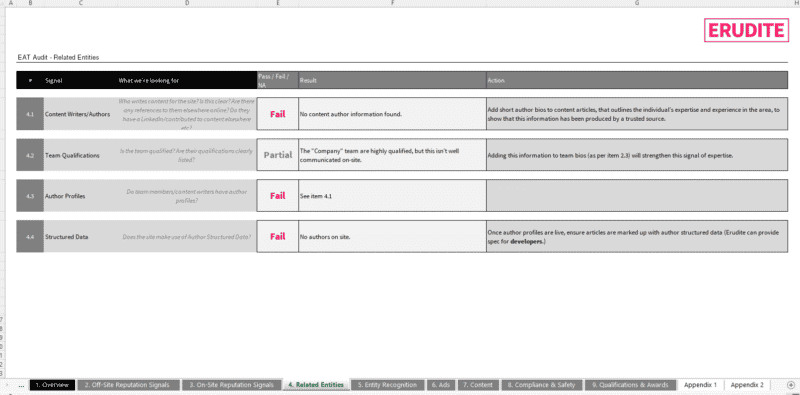
3.1 Content writers/authors

Who writes the content for the site? Is it particularly clear are there any references to these writers elsewhere online (e.g., LinkedIn or have they contributed to content elsewhere?).

3.2 Team qualifications

Is the team qualified in particular the senior management team or any R&D team members, particularly if the company is producing ‘product’ that might be sold to regulatory standards?

3.3 Author profiles

Do content writers have author profiles, including a bio as well as links to other places like LinkedIn or known media where the author contributes?

3.4 Structured data

Are all structured data from the site marked up this can be as simple as author structured data or even explaining qualifications and more. The more structured the data, the more signal.
Entity recognition

4.1 Knowledge Panel

Does the business have a knowledge panel that appears in the Google Search results for brand name queries? Is it comprehensive? Do commonly used variants of the brand name give a result with the business Knowledge panel?

4.2 Wikidata

Super important, as Wikidata is one of a few original sources of entity validation used by Google. Here we’re looking for a broad and error-free entry.

4.3 Organization structured data

Using structured data has already been mentioned. However, does this extend to the organisation wherever it is referenced? This helps with entity recognition; thus reinforcing exactly who the business is.

Think about all of the rich aspects of an organization or corporation and the scheme for “owners” or “members.” There’s just so much you can mark up here. 

4.4 Social consistency 

Does the site link to all social profiles and do all social profiles in turn link to the site and each other. Moreover, are they all using the most current direct URL?

4.5 Site ownership

Is there a clear listed site owner? This can be different to the site name. For example, if a publishing company owns a number of “titles” (i.e., websites).

You can see this, if you search for [Conde Nast Magazines] or look at the footer of a Conde Nast website, the company details are clearly  displayed.  
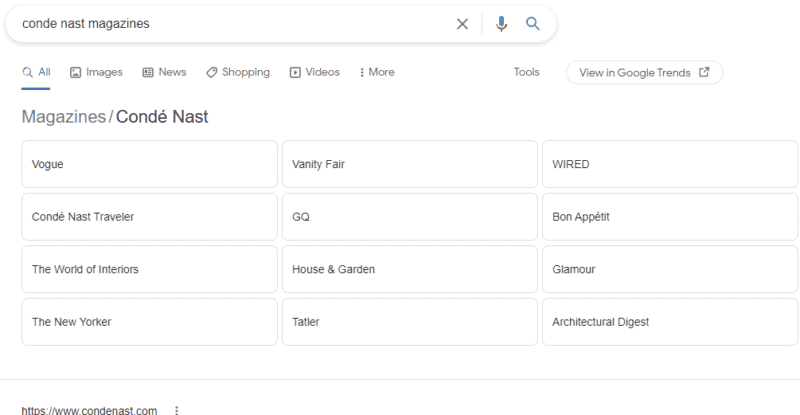
Results of Google Search query for Conde Nast, which generates a Featured Snippet style of in-SERP result, which in this case tells us there’s an obvious parent/child relationship that is understood here in entity terms.

Ads

Now having ads above the fold and where the page subject should be has been the explicit focus of algorithms in the teens, such as Google Page Layout. There was a particularly wild tuning in January 2012, which the industry quickly labelled “top-heavy” but the point is poor quality ads, in places where the page subject should be is one of the oldest signs of poor quality.

Poor quality is the exact opposite of trustworthiness. Pages with bad ad experiences are not going to score well in terms of trust. But AdSense is cool, so where exactly are we defining the line?

5.1 Pop-ups

Here we’re looking for the time to pop, the number, if obtrusive; then if hard to close or if deceptively impossible to close.

5.2 Misleading

Here we’re looking specifically for stuff like advertising disguised as content. It’s the worst.

It might be currently something that seems to fly below the radar, but it won’t be long until we start to see more “traditional” media types eroding further in the SERPs for stuff like this.

Content

6.1. Purpose

Does the content have a clear purpose, and does it fulfil that purpose? Does it offer some benefit or usefulness to the user?

6.2 Accuracy

Is content generally free of errors and mistakes/typos? Does it concur with scientific consensus online (if there is one)? Does contradict erroneously and without other sources to amplify the contradiction?

6.3 References

Are statements backed by source references for any information if it’s used or cited? Are the references to high-authority, reliable or credible sources? Do these sources evince symptoms of authority (like qualifications, professional validation, published as experts.

6.4 Readability

Is the content easily readable? Is there any evidence of keyword stuffing or repetitive sentences that add no meaning?

6.5 Freshness

Is it frequently reviewed and updated? Are statements fact checked as times change. Is it tended like a rose bush or left to rot and disappear in the wind like a pile of autumn leaves.

6.6 Misleading content

Yes, it is incredibly easy to mislead people on the internet, but it is very unethical and should be avoided.

6.7 Titles

Do the titles over-promise and the content under deliver. Clickbait titles are so awful and jarring on site pages. We find that they will not help, but hinder your progress.

Compliance & Safety

I am so pleased you are still with me Dear Reader, as compliance and safety are very important. So please pick up your clipboard and dig deep.. 

7.1 Policies

Are all of the formal policies that the legal entity (LTD company for example) is operating under, clearly displayed. These may be things like:-

  • Privacy Policy
  • T&Cs of using the website and your data
  • T & Cs – for customers, if you by a product there are further terms 
  • Shipping information
  • Returns Policy

All of these should be really clear and usually linked in the site footer.

7.2 Protocol

Does the site have any known security vulnerabilities? Does it make use of HTTPS?

7.3 Security

Has the site been hacked? Is there any evidence of hacking? Malicious intrusion or any other form of nefarious activity that renders the security ergo, trustworthiness of your site a moot point.

Qualifications and awards

Huzzah! Let’s end on a high note, dig out that Duke of Edinburgh award and sew that Gymnastics Level 2 onto your Leotard; because being proud of your achievements shows that you have persevered to accrue some level of expertise and authority.

8.1 Author authority

What makes the author qualified to write about how much collagen is actually bioavailable following ingestion? Get those letters after the name; link to their University profile page, link to their Linkedin page which also shows all their other professional references and recently published works!

8.2 Business awards/accreditations

Has the business won any awards or does it have any accreditations? Are these mentioned on-site? Are these mentioned on third-party sites?

Your potential customers need ways to evaluate if they can really trust certain organisations. However passing these accreditations; investing in your standards and people, is all part of building a credible business with growing Expertise, Authority and Trust.

Conclusion

As a process; this approach is exhaustive and provocative; but the prioritised outputs drive immediate and long-lasting results for your business.

Working on anything that improves your company E-A-T is never time wasted. That said, it takes experience and context to understand which items to prioritise and which to park temporarily or permanently.

I hope you enjoy the process and relish working through the opportunities you discover! 


Opinions expressed in this article are those of the guest author and not necessarily Search Engine Land. Staff authors are listed here.


New on Search Engine Land

About The Author

Nichola Stott founded Erudite: The SEO UX Agency, over a decade ago, following five years as Head of UK Search Partners at Yahoo! where she first found her love for all things search. Erudite has become one of the most respected technical and strategy-focused SEO agencies in the UK, routinely delivering over 500% ROI for clients every year. Stott’s professional recognition includes being named in the BIMA Hot 100 Digital People, as well as Drum Most Respected Agency Leader as voted by Peers in 2018.

https://searchengineland.com/e-a-t-audit-386611


Five must-haves of a conversion worthy ecommerce website

Five must-haves of a conversion worthy ecommerce website

30-second summary:

  • Getting traffic to a website can be difficult, so you need to make sure that visitors are as likely to convert as possible once there
  • Quality site search implementation can increase conversion rates by 5-6x, and including elements like CTAs or a system that accounts for spelling mistakes can have a considerable impact
  • When working with an online store, think about category pages like aisles and sub-categories like shelves within those aisles
  • Breadcrumbs can not only help enhance the user experience but also improve rankings as they help search engines understand how your site structure and relevance

By many estimates, there are over twelve million ecommerce websites on the internet. That’s a lot of online stores, covering a lot of different niches. Getting traffic to these sites is one of the main struggles for businesses, so it’s important that once someone does land on the website, they have the best chance of converting as possible.

At the end of the day, it doesn’t matter how good the rest of your site is, if the commercial pages are poor then you may be throwing leads away.

By ‘commercial pages’, we mean anything that leads to the generation of revenue, like the product, category, and service pages – even the checkout. What may seem like a minor change can have a huge impact on revenue for these pages.

For example, would you have guessed that simply adding a video to a product page would make users 144 percent more likely to add a product to their cart?

In this article, I take a look at five ways ecommerce websites can take their traffic – but most importantly, conversions – to the next level. We’ll start with the largest, and most underappreciated one, first.

1. Prioritise your site search

According to Econsultancy, up to 30 percent of ecommerce visitors use the internal site search available to them. This level of engagement means there is a higher level of purchasing intent, which needs to be capitalised on. Why?

Due to the increased level of purchasing intent from these searchers, they’re known to be 5–6x more likely to convert than the average visitor that doesn’t use the site search. 

If someone invented a tool that reliably increased conversion rates by 5x, they’d be incredibly wealthy – and the tool would be very expensive. Instead, this is available on pretty much all site builds, but lies unutilized in most cases, even if site search optimization has led to conversion rate increases of 43 percent.

So, how can you optimize your search functionality?

First, include a CTA (call to action) in the search bar by default that encourages users to search, or even just explains what the bar is for more basic users. Below are some examples from major online brands:

Boots example of adding a CTA to the search bar - must have for conversion worthy ecommerce websites

Source: Boots

Depop example of adding a CTA to the search bar - must have for conversion worthy ecommerce websites

Source: Depop 

ebay example of adding a CTA to the search bar - must have for conversion worthy ecommerce websites

Source: ebay 

In the first word of each of these, they are both educating the user on what the bar is for and are also encouraging them to use it. They also give people an insight into what they provide beyond just products, whether that’s services for Boots or styles for Depop. The eBay example is also great copywriting as it supports the brand’s character that you can buy and sell anything you want there; they’re not limited to brands or styles, you can search for anything!

A great site search would also be able to handle misspellings. For example, a website may have items listed as “red t-shirt”, but there are a lot of people that would simply search “red tshirt”. If your site search doesn’t show the same products for either, you’re likely losing out on sales. 

You also want to make sure that generating new searches and applying filters don’t create new, indexable URLs. To test this, run a search on your website and then find what the search string URL looks like – basically everything in the URL before your search. Paste this into Google and see if these pages are being indexed/are appearing in the search engine results page. 

It may be that every search is being saved as a new page (which we’ve seen many times before), which can lead to a huge crawl bloat. Consider search engines like Google as having a really short attention span. You don’t want to distract them with pointless pages like these, so make sure you no-index them. 

Options like Fact Finder, Doo Finger, and SLI Systems are flexible choices that work fairly easily out of the box. These are great for smaller businesses with tighter resources. For larger businesses that need more from this functionality, Elastic Search and Solr are strong open source options but require a lot of work. This means that they can become totally bespoke, but that it may be overwhelming for businesses without the time and resources. 

2. Have a Plan B for when a product is out of stock

Most products sold online are finite. Whether you have a lot of stock or a limited amount, almost every product runs the risk of becoming out of stock. This is the nature of an ecommerce business and is often a sign that something is selling well, but you should have a plan for when this happens. 

It’s easy for a potential sale to end when they see that ‘out of stock’ message. However, the truly great ecommerce stores will know this isn’t the end of the customer’s journey – just because the product they originally wanted isn’t available doesn’t mean they can’t be sold on another. 

After all, if you were doing your online grocery shopping and the usual meat feast pizza you buy isn’t available, that probably doesn’t mean you’re just not eating pizza anymore. Instead, you’d likely look for a similar meaty pizza from a different brand. This mindset works for other products, too. 

First, you should consider related products on out of stock pages as absolutely essential. Take this example from John Lewis:

Add similar products in case of no stock to have a conversion worthy website

Source: John Lewis and Partners

In this case, the outdoor set is out of stock, but they are straight away suggesting similar products that would scratch the same itch the customer has. They’re also high up the page, which is important. If people see a product they want is out of stock, they may click away very quickly, so having similar products above the fold means you have a good chance of grabbing their attention before they move away. 

As well as including related products, there should also be a channel for communication with the customer so you can contact them when the product comes back in stock. You can’t just assume that they’ll remember your website to check again in a few more weeks. It’s much more likely they’ll just find the product on a different website and give them their money instead. 

While you can’t stop them from looking elsewhere, a section asking for their email address means that you can now communicate with them directly for marketing purposes but also let them know as soon as the product becomes available. This means that not only can you draw the customer back to the page for a purchase, but you could also sell them on more products over email! 

Finally, if a product is out of stock and you don’t ever plan to restock it again, then consider removing it from your sitemap. For example, if you sell a calendar designed for 2018, this may very well be out of stock and very unlikely to come back in stock. With this in mind, deleting it from your sitemap would mean that search engines don’t bother looking at it and can instead focus on pages of yours that you actually want the likes of Google and Bing to be looking at. 

3. Build a category structure that makes sense

A considered and effective category/sub-category structure is essential for online stores. Not only does this help search engines understand what it is you sell and what your most important pages are, but it also helps the user.

If there were no aisles in a supermarket, customers would be searching blindly for what they need. There’d be no structure and no space for using initiative. Instead, there are frozen aisles, canned aisles, fresh aisles; if you need some frozen french fries or some fresh peppers, you know where to go. Once you’re in that aisle, there are then shelves which can help you get even more specific. There likely wouldn’t be a tomato aisle, but a tomato shelf in the fresh aisle makes sense. 

When working with an online store, think about category pages like aisles and sub-category pages like shelves within those aisles. Shopping online should be as seamless as this. 

Consider what your biggest categories are and ‘zoom in’ smaller and smaller so you can find what your sub-categories are. It may be that you don’t have enough products to necessitate a sub-category.

Toby Dean, the Associate Director of SEO at Add People, believes that “As a rule of thumb, if there are more than 25-30 products in a category, you may want to sub-categorise that down to improve relevance, rankings and UX.” 

Just like how people rarely click on page nine of Google search results, customers will rarely look at page nine of a category. Sub-category implementation will give them a better guide as to where they can find the products they want. For a clothing store, this might look like this:

Clothing > Men > Jumpers > Roll Neck Jumpers

Not having these is the equivalent of a supermarket having all of their food in one humongous aisle. Good luck trying to find what you need in there! 

4. Include breadcrumbs 

Breadcrumbs aren’t on every category or product page, but they should be. They essentially show the user’s journey from the root category page to whatever page they’re on at that point. Using the example above, if you were on a product page for a roll neck jumper, you might see the “Clothing > Men > Jumpers > Roll Neck Jumpers” as a breadcrumb near the top of the page.

Each of these should be clickable, giving the user a chance to go as far back as they would like to in their journey. This massively improves navigation on these pages and means that if they end up down the wrong path, they can quickly ‘turn around’ and go back the way they came. This helps increase conversions and lower bounce rates.

Habitat, an online furniture provider, use this to good effect on their pages:

Add bread crumbs to pass link equity throughout all the pages and guide consumers - must have for ecommerce site that converts

Source: Habitat 

From a search engine perspective, it also helps pass link equity throughout all the pages. The more internal links something like Google detects going to a page, the more it will consider that page important. With that in mind, including breadcrumbs means that you will be linking to many pages at once. This means that they will quickly develop an understanding of how your website is structured, which should make ranking for relevant terms even easier. 

Everything else

These tips below don’t need a whole section to explain, but could still be key movers for your traffic and conversions. 

  • Include trust points and reviews on product pages

According to a BrightLocal survey, 91% of 18 to 34-year-old consumers trust online reviews as much as personal recommendations. This means that your product pages should include reviews of the item and the rest of your website should include testimonials from customers alongside your ratings on services like TrustPilot or Google. 

  • Use photos and videos to sell to the customer

Shoppers expect more than one photo per product now. They want to see it from different angles and in use, in both a photo and video format ideally. One study found that those shoppers who saw videos on product pages were 144% more likely to add a product to their cart.

  • Add filters and sorts to pages

While some popular ecommerce platforms have this as a basic feature, plenty still don’t. With that in mind, make sure that you can apply filters that are relevant to your products. If a website sells shoes, it may need a size filter. If a website sells food, it may need a vegetarian-friendly filter. Regardless of the niche, all pages should also have the ability to sort by price and ratings. 

  • Include optimized copy

After a recent Google update saw some websites crash in rankings, it became even more apparent that optimized copy is crucial for ecommerce-focused pages. By including keywords and matching the intent of the typical customer, you can draw in organic traffic and help them convert while they are there; all while appeasing search engines and assuring them that you’re relevant to the searches your customers are making. 

  • Consider brand-focused pages

If you’re getting a lot of brand-focused searches and interest, you may want to create a dedicated page for that brand and connect all the relevant products to it. This will help establish your relevance for these searches, while also collecting all of the products people are interested in to one place.


Matthew Rogers is Head of Campaign Management at the top Manchester-based digital market agency Add People and has over 14 years of marketing experience. He is also a long-standing member of the Click Z Collective Advisory board.

Subscribe to the Search Engine Watch newsletter for insights on SEO, the search landscape, search marketing, digital marketing, leadership, podcasts, and more.

Join the conversation with us on LinkedIn and Twitter.

https://www.searchenginewatch.com/2022/07/19/five-must-haves-of-a-conversion-worthy-ecommerce-website/


Local SEO Has a Surprising Impact on Your Business. Here’s How to Use It

Opinions expressed by Entrepreneur contributors are their own.

While globalization has significantly changed the marketplace, many businesses start building their success by selling to local customers. The yellow pages may have once been a necessity, but online have taken over. That is why local Search Engine Optimization (SEO) has become one of the most important keys to , regardless of location or company scale.

What is local SEO?

Search Engine Optimization has become an integral part of marketing for businesses that rely on website traffic. Optimizing content from search engines like helps your website rank high in search results, making it more likely for consumers to visit your site and interact with your brand.

Local SEO is simply a strategy of SEO aimed at improving search results in a specific geographical area. If your business relies on online and offline customers within a specific geographic area, local SEO can be the difference between your business surviving and thriving.

Related: Struggling in Local Search? Here’s What Your Local SEO Strategy Needs to Compete in 2022.

The value of local SEO

Google alone processes an impressive 8 billion searches every day, but more importantly, nearly 50% of all Google searches are made by people looking for local products and services. If you don’t have a local SEO strategy for your business, you’ll miss out on valuable online traffic. Local business owners simply cannot ignore an opportunity of this size.

Local SEO is important for online companies and for companies looking to attract foot traffic. A few decades ago, consumers may have looked for local businesses in the yellow pages or on the map. Today, they are using search engines to find contact information, location, hours and other details about a business.

Before the Covid-19 pandemic, about one in two searches made for businesses “near me” led to a store visit. If the search was made on a mobile device, the numbers were even more compelling. Nearly 90% of those queries were followed by a call or a visit to the business within a day.

Any business relying on local customers cannot afford to lose the opportunities local SEO can provide.

Related: The 7 Disadvantages Local Businesses Face Online (and How to Beat Them)

Utilize local SEO and work with Google to improve rankings

Marketers and business owners have a range of options to increase their visibility through local SEO. Is your brand looking to improve rankings or improve conversions and sales?

It’s fair to argue that conversions matter more than rankings, but if the business is not listed on the first page of results, conversions will naturally be low. For most businesses, rankings and conversions are closely related.

Improving local SEO results starts with improvements in relevance, distance and prominence. These are the three criteria Google’s algorithm applies to determine local search results. Your company’s Google Business Profile should also be updated to attract more local customers.

1. Relevance

Relevance is the measure of accuracy in the match between your business and the online search query. The search engine is trying to determine whether your business offers what the user is looking for. Providing clear and complete information on your website and business profile is critical to meeting these criteria and improving your relevancy.

2. Proximity

Proximity is how close your business is to the searcher’s exact location. If a user does not specify a specific location in their search, Google uses their location based on their IP address to prioritize nearby listings. Adding the specification “near me” in a search leads to similar results. To be featured in those listings, your business needs to optimize the location information on its website and Google listings.

3. Prominence

Prominence is Google’s term to describe how well-known a business is both online and offline. The search engine determines your prominence based on the offline information it has about a business as well as through online means, such as reviews and website popularity. Increasing the number of quality reviews for your business will improve ratings. Interacting and responding to online ratings also boosts your prominence.

Algorithms tend to change regularly and without notice. Like any SEO activity, successful local SEO depends on consistent effort. Many businesses benefit from expert support to manage their local SEO.

Related: Why Local SEO Is About to Become Even More Important

Covid-19’s impact on local SEO practices

The Covid-19 pandemic changed almost every aspect of consumers’ lives. It certainly altered shopping habits as lockdowns and movement restrictions became the norm. At this point, it is too early to determine whether long-term consumer habits were affected by the pandemic.

Throughout 2020 and 2021, online searches for products and services increased, partially out of necessity. Consumers needed online alternatives to meet their needs. Right now, evidence supports both the continued popularity of online consumerism along with a growing demand for in-person shopping experiences.

A fact that is not in dispute is the incredible hardship the pandemic caused for many small businesses. Many faced closures, staff layoffs and a loss of customers. Carefully considered and well-managed marketing is essential for a successful restart. Proper local SEO can be the difference in this restart.

Local SEO is one of the most cost-effective ways to increase visibility in a key audience within a short space of time. It may seem like a small part of SEO, but considering the sheer number of searches with local intent, business owners and marketers need to consider it a priority.

Search engines are the new yellow pages — with much more potential to transform the future of small businesses.

Business Strategies, Entrepreneurial Advice & Inspiring Stories are all in one place. Explore the new Entrepreneur Bookstore.

https://www.entrepreneur.com/article/429709


Ahrefs mentions vanishing from Semrush-owned Backlinko

Want to cause outrage in SEO? Change one word. 

Especially if that one word is a recommendation in the form of an SEO tool company. 

At issue. Brian Dean of Backlinko – and his integrity – is under attack for altering references (and links) from Ahrefs to Semrush. As recently as May 16, the most noteworthy article in question said this:

“But if you had to make me pick ONE tool to use for SEO, I’d have to go with Ahrefs.”

At some point, it changed to say:

“But if you had to make me pick ONE tool to use for SEO, I’d have to go with Semrush.”

Why is this an issue? Because Semrush bought Backlinko in January. 

What has not changed. The line following the two variants of the above sentence: 

“This was a REALLY hard call to make. I honestly think you can’t go wrong with either tool.”

The above line was written long before the acquisition. And if something could have gone either way, and Dean wrote as much, changing a choice from one tool to another feels like a stretch to label this an ethical breakdown.

Is it shady? Maybe somewhat. Dean could (and probably should) add a simple disclosure to any mentions or recommendations of Semrush, along the lines of “Disclosure: I work on a part-time basis for Semrush, which owns Backlinko.)

The only mention I see clearly of Semrush’s involvement in Backlinko is a link in the footer of the Backlinko website: “© 2022 Backlinko is a Trademark of Semrush Inc.” 

Will every Backlinko visitor know Semrush owns Backlinko or scroll down past all the comments to see it? No. But it’s there. 

Also at issue. There is more. Here’s what Ahrefs CMO Tim Soulo tweeted: 

This LinkedIn post by ​​Daniel Emery, head of SEO at PWD Australia, implies this is an ethical issue because:

  • Links to competitors have been removed.
  • Mentions of competitors scrubbed.
  • Opinions changed sitewide in what appears to be independently and objectively written review content.

Let’s examine each of these.

First, Removing a link is not a question of ethics. A link is neither good nor bad morally. No website has an obligation to link to any other website, no matter who owns it. A link simply either exists or does not exist. 

Second, not all mentions have been scrubbed, as a simple site: search will show you. Backlinko still features a definitive guide to Ahrefs and a thorough review of Ahrefs. 

Third, changing an opinion is just that – changing an opinion. This was not a life or death choice and the content has always said the decision could go either way. Neither Dean, nor the article, slanders or attacks Ahrefs as being an inferior tool. Though, yes, this change was done lazily and non-transparently. 

In the end, Backlinko is a Semrush-owned product and Semrush can market it however they decide. But clearly, the search community is watching. 

Why we care. Smearing and naming-and-shaming is a popular sport in all of life and in SEO. But Dean isn’t not harming or misleading any person in this specific instance. Not every recommendation is a moral or ethical choice.

This is also a good reminder to question and think about everything you read about in SEO. Beware of myths, misinformation, misconceptions, junk science, commercial motivations and outdated information. Because all of that is everywhere. Question and test everything. 


New on Search Engine Land

About The Author

Danny Goodwin is Managing Editor of Search Engine Land & SMX. In addition to writing daily about SEO, PPC, and more for Search Engine Land, Goodwin also manages Search Engine Land’s roster of subject-matter experts. He also helps program our conference series, SMX – Search Marketing Expo. Prior to joining Search Engine Land, Goodwin was Executive Editor at Search Engine Journal, where he led editorial initiatives for the brand. He also was an editor at Search Engine Watch. He has spoken at many major search conferences and virtual events, and has been sourced for his expertise by a wide range of publications and podcasts.

https://searchengineland.com/ahrefs-backlinko-semrush-ethics-386571


Putting lipstick on a pig: Fix the website or fail at SEO

You’ve landed a new client and you’re digging into the website. One look tells you this is not going to be easy.

Sure, you could do some SEO activities to make the client happy. But there’s bigger fish to fry. 

The information is out of date, it’s not well written and the formatting is hard to read. The website looks old and the CMS is clunky.

The client has big expectations of your SEO program. What do you do?

There’s an old saying about putting lipstick on a pig. Sure, you can “do some SEO.” But you and I both know that we need to address the fundamental problems if we want to succeed in SEO and rank on Page 1 out of millions of results.

At this point, you need to get real with the client. This can be a hard conversation; what if they don’t have the budget for what you are proposing?

You have to prepare to walk away from the project or else get creative with the budget. Because neither one of you will win if you don’t get it right.

That said, there are two major categories you need to fix in any website before you kick an SEO program into high gear:

  1. The content on the website
  2. The technical back-end of the website

I’ll touch on what to look for in each category next.

Updating the content

A common lipstick-on-a-pig mistake is when a client asks for more and more new content and fails to address the content they already have on the website. I encourage clients to divert equal resources to updating their old content in addition to creating new. 

How often to update the content on a website depends on the topic. In general, there are three things to consider:

  1. If the topic is evergreen. Some topics are evergreen, meaning the information can stay relevant for a long time. Of course, that doesn’t mean you can’t tweak and optimize evergreen pages for best results. It simply means that there will likely be less work.
  2. If the query deserves freshness. You will need the most up-to-date content for a website if it is targeting queries or keywords that require the freshest content in the search results. A social or political event is one example. Google discusses that here.
  3. If the topic is deemed “your money or your life” (YMYL). Google discusses YMYL topics in its Search Quality Rater guidelines (think financial or medical advice) and holds webpages that contain them to a higher standard.

In addition to updating the content itself, websites need a strategy for how they will organize the content to get the most SEO value from it — and to create a better user experience.

This includes things like the navigation and how you link pages internally. SEO siloing and internal linking best practices are foundational SEO strategies that will streamline your SEO program’s efforts if done well early on.

Updating the website

At first glance, does the website look trustworthy? Or does it have an outdated look and feel? What about the performance of the website — does it provide a good user experience?

These are the fundamentals we must get right before driving more traffic to a website. 

Some things to work on right away include:

  • Spider-friendly code: The website needs clean, streamlined code the search engine spiders can crawl with ease.
  • The content management system: That custom CMS the client built may have been great at first, but it has SEO problems, and you can’t easily update things inside it. There’s a reason why WordPress is the most popular content management system because it is always up to date.
  • Site speed: How fast a webpage loads impacts the user experience, which is why it’s a part of Google’s ranking algorithm.
  • Mobile usability: Most websites have a large number of people visiting from a mobile device. Websites need to be responsive to desktop and mobile users.
  • Robots.txt: Robots.txt can block unnecessary crawling to reduce the strain on a server and help bots more efficiently find good content.
  • XML sitemaps: It’s a best practice to tell search engines about the pages, images and videos on a website with an XML sitemap.
  • 301 redirects: 301s prevent error pages by redirecting old pages to newer, more relevant content as needed. This can improve user experience.
  • Fully qualified URLs: When you link internally and include the full URL starting with the “https:” instead of a relative URL it can fix certain crawl issues.
  • Canonical tags: The canonical link element tells search engines which version of a URL you want in the search results and can resolve duplicate content issues.
  • Server maintenance: Server diagnostic reports help you address common errors right away to improve the user experience.
  • Plugins: For security reasons, update all plugins.
  • The design: Make sure the web design/user interface is in keeping with modern functionality and trends. Usually, an update every three to five years works.

Of course, there are more ways to address the technical aspects of a website, but this is the minimum to give an old website some new life. For more, an SEO checklist can help.

Just say “no” to pigs

I believe as SEO professionals, we have a duty to advise potential clients in a way that sets them up for success.

If we know that what the client is asking for is merely putting lipstick on a pig, then we need to be upfront about it. Cosmetic changes can add curb appeal, and may be needed — but don’t let the work stop there if the site is still just a pig.

SEOs must go beyond the lipstick and help create a good user experience to succeed. Updated content, Core Web Vitals, and especially page speed are examples of how SEO changes the pig into something better.

And, we should be prepared to either walk away from a potential client who does not want to follow our advice, or get creative and know how to make the most impact with their budget.

That may mean you address the fundamental problems of the website bit by bit on a slower timeline before kicking it into high gear. It’s not the job of SEO to make a pig fly … it’s the job of SEO to transform a website so that it becomes an eagle.


New on Search Engine Land

About The Author

Since January 1996, Bruce Clay Inc. (BCI) has helped websites rank in search engines. BCI has grown into a leading search marketing company providing SEO services and consulting, pay-per-click (PPC) advertising management, content development and social media marketing services. BCI also provides SEO tools including the SEOToolSet® and the Bruce Clay SEO plugin for WordPress. It operates SEOtraining.com, a comprehensive online SEO training and membership site that includes the acclaimed Bruce Clay SEO Training course. More than 5,000 attendees have learned SEO from Bruce Clay’s classes worldwide, and now members can access it from all over the world.

https://searchengineland.com/putting-lipstick-on-a-pig-fix-the-website-or-fail-at-seo-386486


How to use 12 micro intents for SEO and content journey mapping

Classifying queries based on the classic search intents is no longer as effective as it used to be.

Today, SEOs who want to understand search intent should be closely analyzing micro intents.

This article will discuss 12 different types of micro intents that will help you better understand what types of content you should be creating.

Google’s focus on recognizing the search intent

When I first saw the Quality Rater Guidelines in 2011, I was struck by the recurring reference to search intent.

Google clearly indicates in the guidelines that search evaluators must first understand the search intent behind a keyword before proceeding to evaluate search results.

“Understanding the query is the first step in evaluating the task. If you don’t understand the query or user intent, do web research using the Google search engine or an online dictionary or encyclopedia. If you still don’t understand the query or user intent, please release the task.”

Google’s core updates suggest that, in addition to E-A-T, Google is also focusing on recognizing the search intent and the corresponding matching with the content in order to improve the user experience with the SERPs. 

Google is getting better at interpreting search queries and their intent, which makes a more detailed SERP analysis necessary.

The classic search intents 

In classic search marketing, keyword are broken down into these categories:

  • Informational
  • Transactional
  • Commercial
  • Navigational
  • Brand

Transactional and commercial can be combined, as both are similar in terms of user intent.

Google itself classifies the keyword types in its quality rater guidelines according to

  • Do = Transactional
  • Know = Informational
  • Go = Navigational

In 2015, Google also introduced another class to the Know keywords with Know Simple.

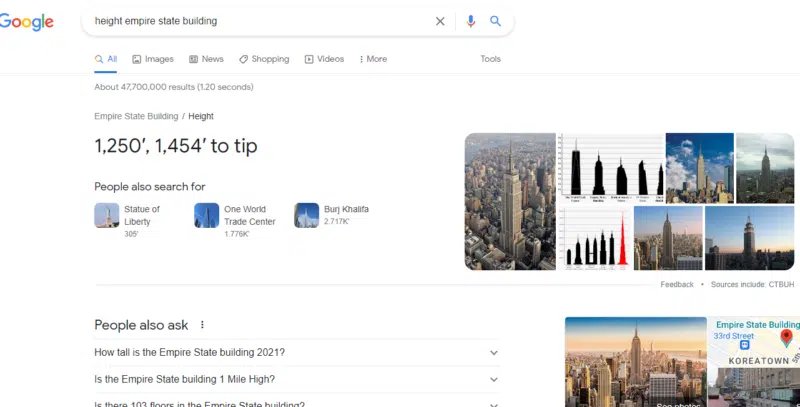
For simple search queries, Google delivers a OneBox to deliver an answer directly in the SERPs. Typical use cases for the delivery of a OneBox are:

  • Calculators
  • Weather
  • Time
  • Translation
  • Specific attributes of an entity

Here is an example for the search query [height empire state building]:

With the search intentions mentioned so far, however, two important differentiating features are still missing. Namely, the need for topicality and regionality. Therefore, it makes sense to add:

  • Trending keywords
  • Regional keywords

I won’t dive deeper into classic search intentions, because there are plenty of great articles on this topic.

What are micro intents?

The concept of micro intents describes sub-forms of the classic search intents or user intents (transactional, navigational and informational).

The determination of micro intents by analyzing the SERPs allows the derivation of certain types of content that users expect for a search term. 

Micro Intents for a better understanding of the search intent

From the experience of hundreds of SERP analyses in the last 10 years, the following content properties and derived micro intents have emerged:

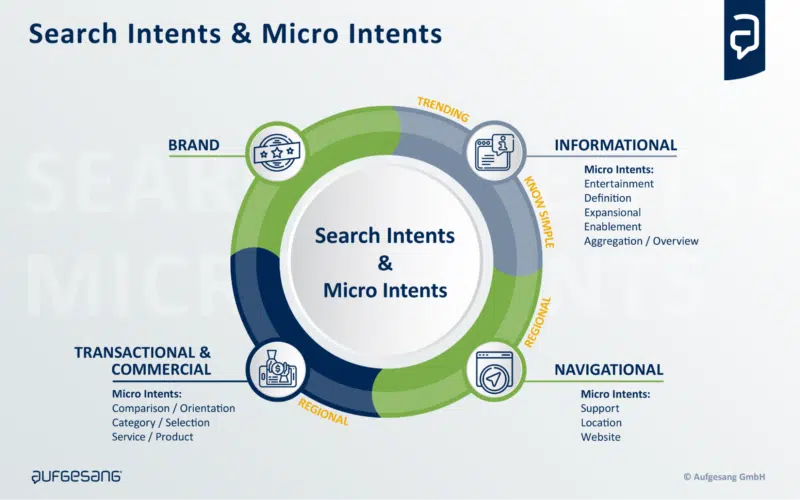
Overview: Search Intents and Micro Intents

Informational Micro Intents

Micro intents for an information-oriented search can be:

  • Entertainment: People want to pass the time and are looking for entertainment. The entertainment can be satisfied with short snackable content such as memes or short video clips, which are usually consumed directly on the respective social media platform (social content) and shared.
  • Definition: Users looking for basic answers (e.g. to the question What is…? Which does ______________ mean …? How important …?) first want to understand what something means in order to open up the context of a topic and/or to decide whether it makes sense to delve deeper into a topic. They are beginners. Wikipedia articles are a typical example of content that fits this micro intent. Google sometimes tries to answer this search intent with answers directly in the SERPs (e.g. featured snippets)
  • Expansional: Users who want to delve deeper into a topic in their online research need detailed content that sheds light on as many perspectives as possible. The content should comprehensively describe a topic and answer several questions. The so-called holistic landing pages or pillar pages are a sensible approach to serve this search intent. Here, the depth and scope of the content plays a special role, but also new perspectives that have not been published often.
  • Enablement: Users who want to empower themselves to do something need specific guidance. Content that is intended to serve this search intent should answer the How do I…? questions step by step.
  • Aggregation/overview: Similar to the expansional search intent, the user is concerned with getting a neutral overview of a topic. However, the content should be kept as short and clear as possible (e.g., in the form of tables, thematic or random listicles).

Transactional/commercial micro intents

Micro intents for a transaction-oriented search intent can be:

  • Comparison / orientation: The user is on the way to buying a product service or at least shows interest in investing. In order to get an overview, he looks for the best solution. Ranked listicles, tests or comparisons make sense for this search intent.
  • Category / selection: With this search intent, there is a specific interest in products and services. The user knows roughly which solution is the right one for him, but is not yet sure which variant of a service or product group is the right one. Classic shop category pages or service overview pages are ideal for this search intent. The products and/or services should be the focus of the main content (MC), possibly accompanied by information to simplify the decision for a variant.
  • Service / Product: The user knows pretty much exactly what he wants or which solution is the right one for him. He is about to make an inquiry/order and would like to find out more about the properties, price, delivery, delivery costs, guarantees … in detail. Service detail pages and product detail pages make sense to serve this search intent.
  • Brand: In addition to the classic search intent brand, another micro intent can be added. This takes into account the user’s need to find out more about the brand or provider in order to build trust. Typical types of content here are testimonials, customer testimonials, field reports…

Navigational Micro Intents

  • Support: The user requires service content for the use of an ordered product. Instructions for use and product-related FAQs make sense here as content.
  • Location: the user wants to find a location near or in a place with the intent to visit it.
  • Website: The user wants to navigate to a specific area of a website.

More to read about the concept of micro intents here.

Micro Intent by Verbs

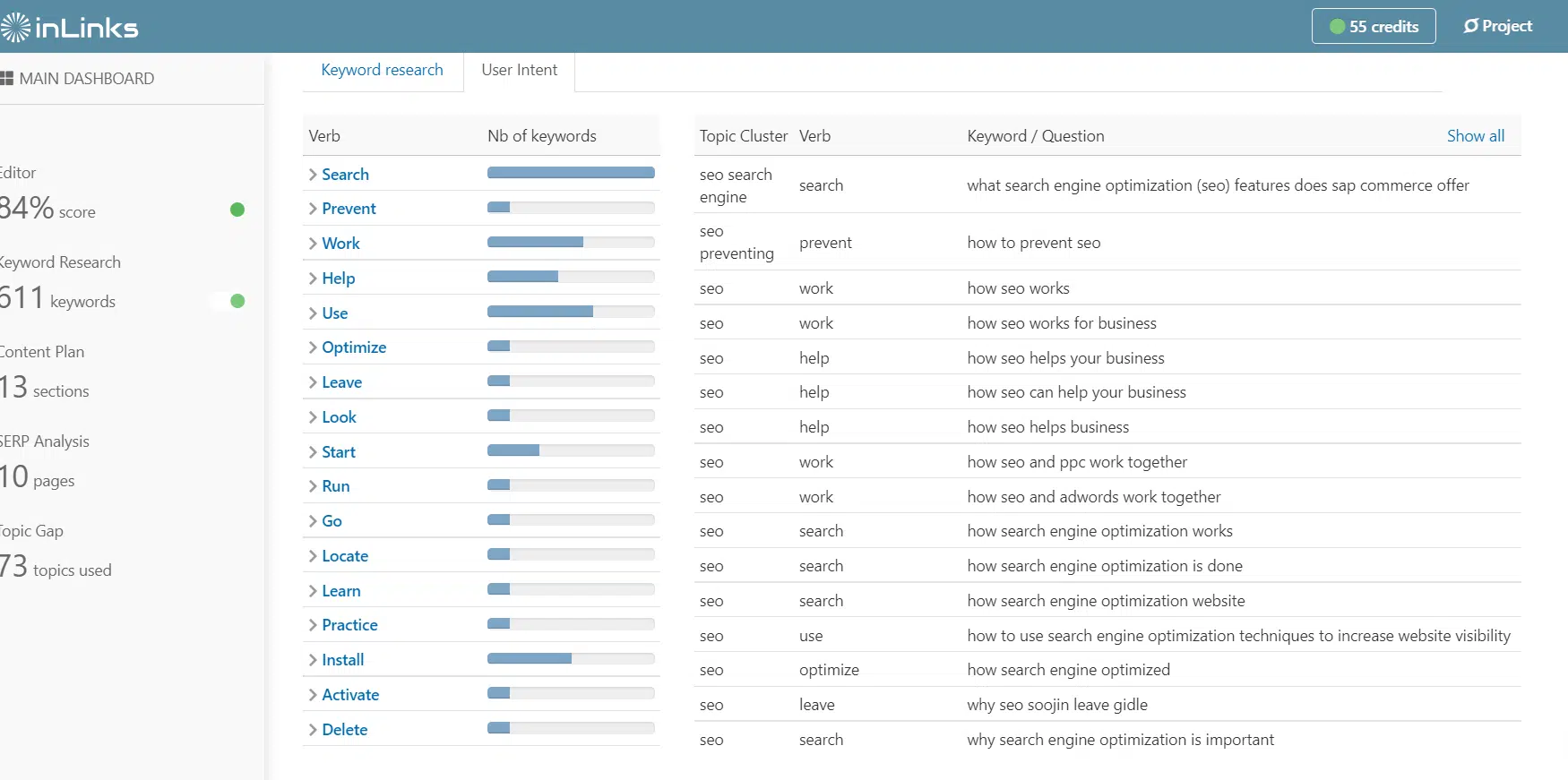
Another smart approach to the detailed classification of search intents can be found at Inlinks. When classifying the search intent, the team around Dixon Jones uses the verbs used in the context of the keyword/topic as a guide.

InLinks User Intent by verbs for the keyword “seo”

The types of search intent in the customer journey

In the research process for solutions, products, offers … search queries often follow a specific sequence.

Depending on the phase in which the searcher finds himself, he wants information, then solutions, and finally certain products to buy.

Here, the search intent types play a role, which can theoretically be arranged in a certain sequence.

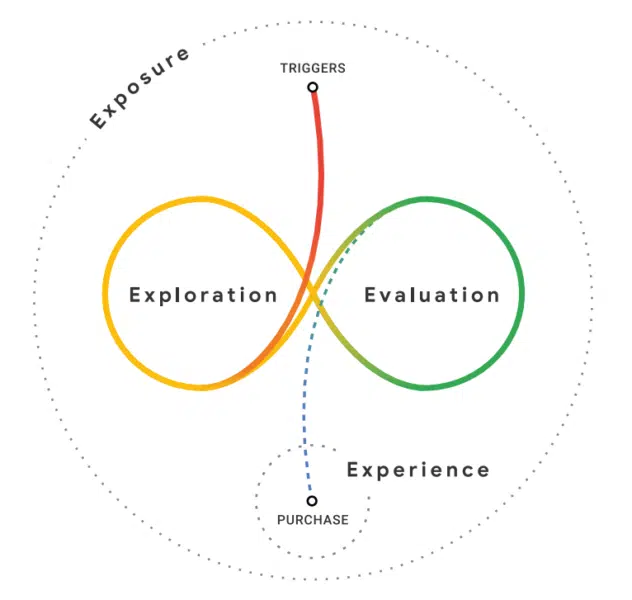
A trigger ensures that a user enters a research process, which can begin at different stages of the customer journey depending on the level of knowledge.

Google describes this process in the “Messy Middle” as alternating between exploration and evaluation, before making a purchase.

From Google’s Decoding Decisions: Making sense of the messy middle

Not every search process follows the same pattern.

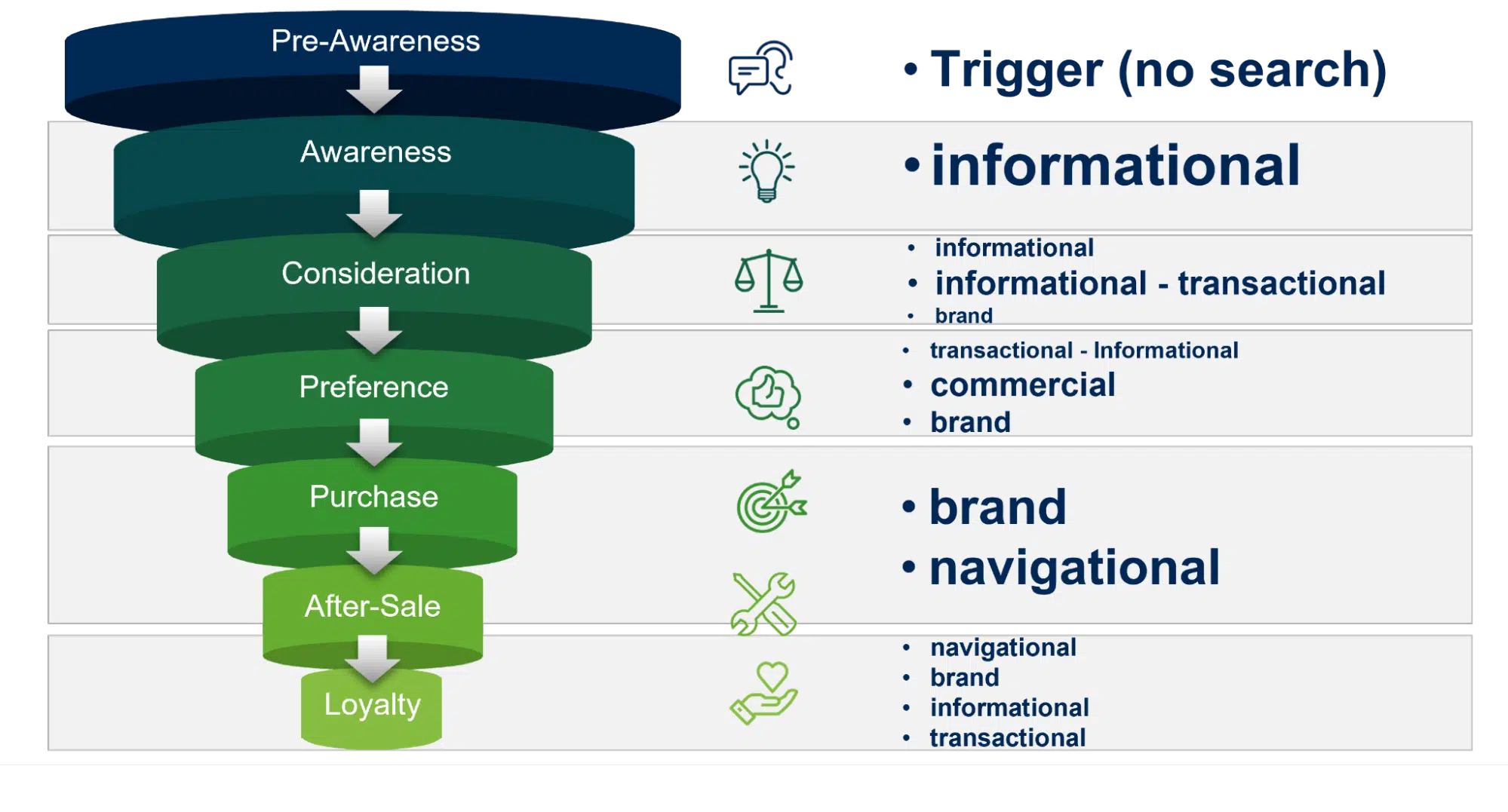
Depending on the offer or product, these search sequences can run differently within the customer journey. The following is a sample search sequence by keyword type:

In the Pre-Awareness phase, a trigger is necessary to lead a user into a search journey. Then, depending on the level of knowledge, the user will work his way through informational, transactional, and commercial to conversion, or directly enter the preference phase via commercial search queries.

Brand and navigational terms play a role from consideration to the end of the customer journey.

Map content types into the customer journey according to micro intents

Mapping content types to the customer journey isn’t easy. It makes more sense to include user micro intents in content journey mapping.

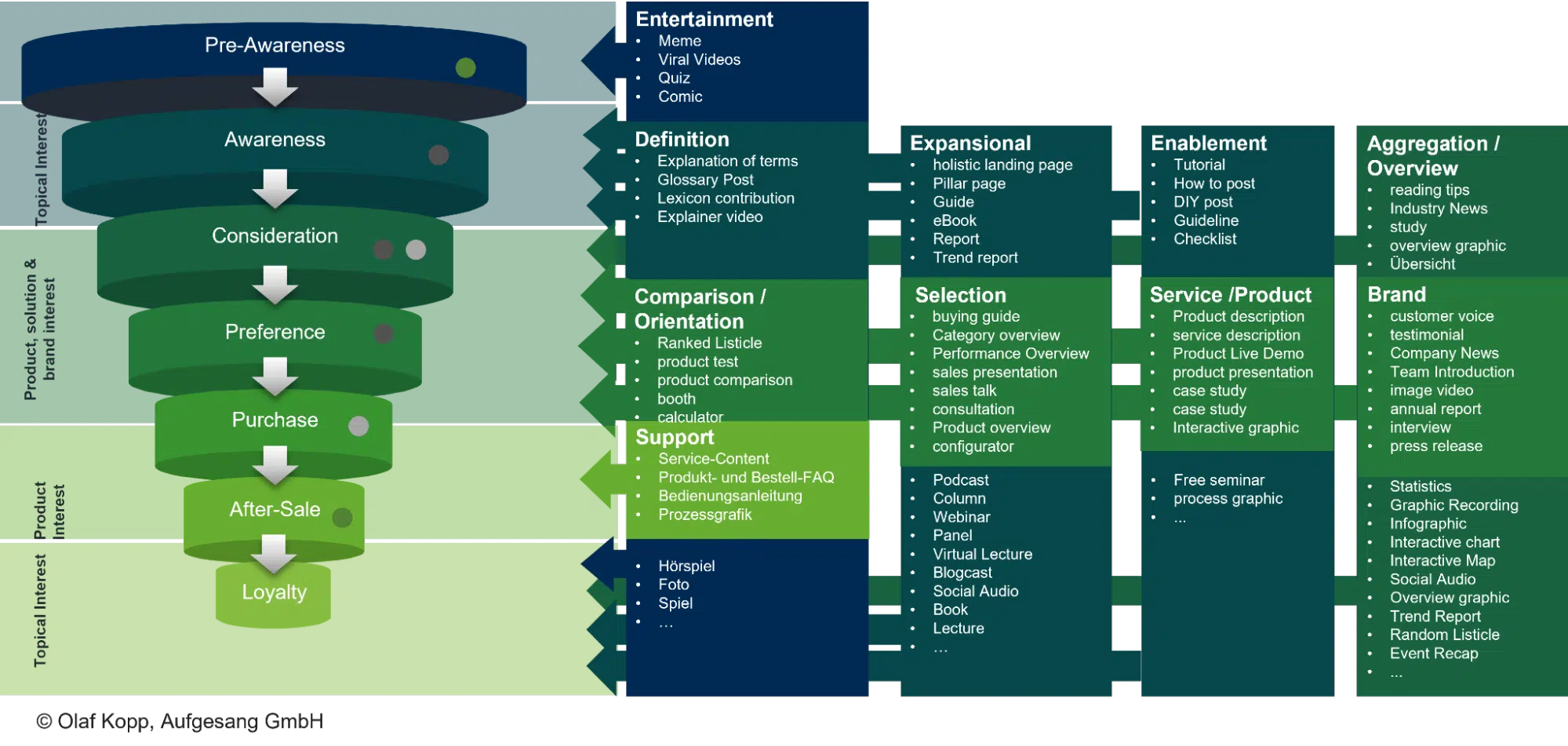
In the following overview graphic, I have grouped the content types according to micro intents.

Again, there are types of content that can be used to satisfy multiple micro intents. The following overview is only intended to explain the principle, but only contains selected typical types of content. A more complete grouping then follows in the next few chapters, broken down by customer journey phase.

Below I have grouped different types of content according to the customer journey phases. In the end, however, it is not the type of content that determines the customer journey phase, but the topic itself or the micro intent that the content should fulfill.

Content types in the pre-awareness phase

In the Pre-Awareness phase, content must be proactively distributed to the user, as the user himself has no proactive interest in a particular topic or need.

In other words, emotional content that generates reach. Possible psychological triggers can be: fear, fun, surprise, indignation or lust.

The topics can be diverse.

Possible content types can include:

  • Viral videos
  • Memes
  • Education
  • Entertainment events
  • Games
  • Comics
  • Riddles
  • Reports and reports
  • Psychological tests
  • Polls 
  • Social media stories
  • Columns
  • Sweepstakes

Content types in the awareness and consideration phases

In the awareness phase, the user actively searches for topics about which he would like to find out more. He or she is actively researching a topic related to the offer or is already doing so.

As a shop for running shoes, you could offer content related to the topic of losing weight and health, such as nutrition tips or fitness guides.

Possible content types can include:

  • Podcasts
  • Calculator
  • Advisory
  • Interviews
  • Webinars
  • texts
  • Instructions
  • Checklists
  • Guides
  • Specialist articles
  • Studies

In the consideration phase, the user shows an initial interest in or need for solutions, which can include their own products.

With the “Around-the-Product-Content” one should take care to keep the information neutral. Here the content acts as a “solution-finding consultant”.

The shop for running shoes should emphasize the advantages of jogging for the goal of losing weight, but also point out other areas such as nutrition, in order to then present an overview of the best running shoes or a running shoe configurator in the next step.

Possible content types can include:

  • Product tests and comparisons
  • Solution overviews and lists
  • Configurators
  • How to find … guides
  • Advertorials
  • Workshops

Content types in the preference and purchase phase

In the preference phase, the user shows specific interest or need for products and offers to which your own products belong. Here the “About-the-Product-Content” acts as a “purchase advisor” and the previous information neutrality can be lifted.

The content on the shop category and product detail pages is important for the running shoe shop.

Possible content types can include:

  • Product texts
  • Product and material
  • Manufacturer
  • Case studies
  • Buying guides

In the preference phase, the user determines a narrower circle of possible suppliers (relevant set). That is why it is also important at this point to communicate the core story directly (“about the brand content”).

Possible content types can include:

  • Company profile
  • Videos
  • Reports on social and ecological commitment
  • Awards
  • Case studies
  • Customer testimonials
  • Reviews

In the purchase phase, the user has decided to order the product or offer from a provider or is in the contractual phase final talks.

In this phase, he needs information about the purchase process by means of “about-the-process-content.”

Possible types of content can include:

  • FAQs
  • Terms
  • Explanations of the ordering
  • Payment

Types of content in the after-sales and loyalty phase

In the after-sales phase, the user again needs “about-the-process” and “about-the-product-content.” But this time to the further process of ordering and using the product.

For the running shoe shop, this could be the order confirmation and care instructions for the shoe.

Possible content types for the after-sale phase can include:

  • Order confirmation
  • Delivery status
  • Information on the first steps or kick-off
  • Use
  • Operating instructions
  • Care instructions
  • Installation or assembly instructions

In the loyalty phase, the user again needs the same content types as in the awareness and pre-awareness phase – tailored to his previous interests and preferences. The goal of the content of the loyalty phase is to turn the customer into a repeat buyer and/or loyal supporter.

11 key insights about micro intents

  • Content formats can/should be used multiple times for one type of content. In this way, synergy effects can be used and the different consumption preferences of the target groups can be taken into account.
  • SERP analysis, keyword research, surveys or discussions with the target group should help identify the appropriate content formats based on consumer preferences.
  • Certain types and formats of content perform differently at different stages of the customer journey.
  • The consumption habits for content differ according to industry, target groups, personas and context (e.g., place of consumption or end device used).
  • The classification according to the classic search intents transactional and informational is often not sufficient to derive clear recommendations for the content to be created. Therefore, the classification according to micro intents makes more sense.
  • In the first two phases, pre-awareness and awareness, “around-the-user content” makes sense. This is content that does not deal with the offer or the product, but with the topics of the users beyond that.
  • From the consideration phase, the user’s interest in solutions and products increases. In the consideration phase, they are often still undecided as to which solution is best for them. There he needs to get an objective overview of possible solutions.
  • In the preference phase, he is already one step further. He has focused on one or more solutions and created a relevant set of potential providers for the solution(s).
  • In the purchase phase, he decided on a provider and wants to conclude the contract quickly and easily.
  • In the after-sales phase, he makes the first positive and negative experiences with the offer and needs it. if necessary, support during commissioning, optimal use or the return.
  • In the loyalty phase, the game starts again from the beginning and he may want more information about topics and offers.

Opinions expressed in this article are those of the guest author and not necessarily Search Engine Land. Staff authors are listed here.


New on Search Engine Land

About The Author

Olaf Kopp is an online marketing professional with over 15 years of experience in Google Ads, SEO and content marketing. He is the co-founder, chief business development officer and head of SEO at the German online marketing agency Aufgesang GmbH. Olaf Kopp is an author, podcaster and internationally recognized industry expert for semantic SEO, E-A-T, content marketing strategies, customer journey management and digital brand building. He is co-organizer of the PPC-Event SEAcamp and host of the podcasts OM Cafe and Content-Kompass (German language).

https://searchengineland.com/micro-intents-seo-content-journey-mapping-386544


Compare 15 leading SEO software vendors

Of all the tactics for driving traffic on the web, search engine optimization (SEO) is among the most powerful. According to a BrightEdge study, 53% of a website’s traffic can typically be attributed to organic search. For e-commerce companies, SEO is even more important, with search generating 65% of website traffic and 67% of website revenue on a last-click basis, according to an analysis by Wolfgang Digital.

This phenomenal return, combined with the increasing complexity of the SEO environment, is why marketers turn to SEO platforms to gather the data and insights they need to identify appropriate tactics, set priorities, and even implement solutions directly.

MarTech’s “Enterprise SEO Platforms: A Marketer’s Guide” examines the market for SEO platforms and the considerations involved in implementation. This report reviews the latest trends and includes profiles of leading vendors, pricing information, capabilities comparisons, and recommended steps for evaluating and purchasing.

Visit Digital Marketing Depot to get your copy.


New on Search Engine Land

About The Author

Digital Marketing Depot is a resource center for digital marketing strategies and tactics. We feature hosted white papers and E-Books, original research, and webcasts on digital marketing topics — from advertising to analytics, SEO and PPC campaign management tools to social media management software, e-commerce to e-mail marketing, and much more about internet marketing. Digital Marketing Depot is a division of Third Door Media, publisher of Search Engine Land, MarTech, and producer of the conference series Search Marketing Expo and MarTech. Visit us at http://digitalmarketingdepot.com.

https://searchengineland.com/compare-15-leading-seo-software-vendors-386535


Google confirmed indexing issue affecting a large number of sites

Google has confirmed that it is having indexing issues indexing new content and displaying that content in Google Search and on Google News. The issue started sometime before 7 am ET today, as I first reported prior to Google’s confirmation on the Search Engine Roundtable.

Google’s confirmation. Google confirmed this on Twitter saying “There’s an ongoing issue with indexing in Google Search that’s affecting a large number of sites. Sites may experience delayed indexing. We’re working on identifying the root cause. Next update will be within 12 hours.”

Timeline. So far, we know Google has been having issues indexing new content prior to 7 am ET today, July 15, 2022. Google confirmed the issue at about 10:50 am ET on July 15, 2022. At around 3 pm ET today, Google said they found the issue and is now working on a fix. Google wrote “We’ve identified the issue with indexing and we’re working on a fix. Next update will be within 12 hours.”

What is the issue. The issue is that Google is not indexing new content from sites published across the web. That includes new content on news sites, like this one, or the New York Times, Wall Street Journal or any new content across the web. Google does seem to be crawling this new content but simply not indexing the new content, preventing Google Search from showing those results in Google Search or Google News.

Here are some screenshots showing the site command restricted to the past hour, not showing content on news sites that post content all the time:

Why we care. If you are a news publisher, breaking news stories, and that content is not being indexed that means you are not going to be seen in Google Search or Google News for those stories. If you are a searcher and looking for new content, you won’t really find that content on Google Search or Google News.

To make things worse, Google Analytics 4 real-time traffic reporting seems to be buggy this morning and not showing full traffic data.

This likely will impact your site’s traffic for any new content that you have published this morning.

Google is working on a fix and we hope they resolve the issue soon.


New on Search Engine Land

About The Author

Barry Schwartz a Contributing Editor to Search Engine Land and a member of the programming team for SMX events. He owns RustyBrick, a NY based web consulting firm. He also runs Search Engine Roundtable, a popular search blog on very advanced SEM topics. Barry can be followed on Twitter here.

https://searchengineland.com/google-confirmed-indexing-issue-affecting-a-large-number-of-sites-386526


How content consolidation can improve your SEO performance

Google’s quality threshold – and how it relates to indexing – has become a more well-known and widely talked about topic over the past year.

Several elements contribute to the value proposition of an individual page and domain. But one key concept that Google covers in their Quality Rater Guidelines is “beneficial purpose.” (I cover how beneficial purpose relates to indexing, in Why 100% indexing isn’t possible, and why that’s OK.)

Increasingly, when websites experiencing performance (and rankings) declines, it’s because:

  • The SERPs have changed (and now present users with different value propositions).
  • The site has spread value around a specific topic across too many URLs with the aim of ranking multiple URLs for multiple keywords.

When we’ve then audited, and consolidated these pages (or page elements), we’ve strengthened the value proposition of the target page and seen performance improve, and the pages better align with what Google is now choosing to serve on Page 1.

Google has discussed content consolidation, but more in the context of consolidating domains or subdomains that have overlap or compete for the same topics and terms.

By applying the logic of value proposition and beneficial purpose to this, we can do the same for documents existing within a single domain.

What is content consolidation?

Content consolidation is the process of merging different pieces of content, such as blog posts, articles, or landing pages built for SEO, into a single, cohesive article. 

This single cohesive piece has a strong value proposition (and main content), and supporting elements that link to associated content (supporting content). 

During this process you will also naturally be removing (or correcting) outdated and incorrect content.

This should work in-line with your overall content strategy in either generating visibility at the top of the funnel, or answering use case questions to then direct the user journey toward your conversion-orientated pages.

Consolidation audits should focus on the content, and in my opinion, keep the page type agnostic.

For example, there’s no harm in moving elements from blog posts onto commercial pages if it helps enhance the commercial page’s value proposition and rank for more relevant queries.

Definition of “quality”

Section 3.1 of the Quality Rater Guidelines defines a bullet list of the most important factors in determining page quality.

But the first bullet point in this list is the one that relates closely to beneficial purpose, and this is literally “the purpose of the page.”

Each page has a different purpose (e.g., to provide information or sell a product/service). A page quality score is then applied to that page type.

As Google has been augmenting and refreshing SERPs in recent months, some seemingly changing or mixing contrasting intents (to provide results to cover multiple common interpretations more than before), “beneficial purpose” has become more poignant.

When we then start talking about a page having a relevant beneficial purpose, and high quality, we enter the realms of describing pages as having:

  • High levels of E-A-T.
  • High quality and satisfactory levels of main content (defining the core beneficial purpose).
  • Good levels of relevant, supporting content.

By contrast, a page can have a strong beneficial purpose (e.g., to sell or promote a product or service), but if it lacks the other factors, it will struggle. Because Google ranks URLs, distributing a topic and its content (and beneficial purpose) over too many pages dilutes potential value.

Google describes this as:

Low quality pages may have been intended to serve a beneficial purpose. However, Low quality pages do not achieve their purpose well because they are lacking in an important dimension, such as having an unsatisfying amount of MC, or because the creator of the MC lacks expertise for the purpose of the page. 

A common situation I see this lead to (a lot) is where Google will choose to rank a blog post, designed as supporting content, ahead of a commercial page for commercial terms (albeit in non-traffic driving positions) because it has a higher value proposition that a commercial page, that has been spread out over a subfolder and multiple URLs.

Consolidation process

Several data sources can inform your consolidation efforts.

These include:

  • Common analytics tools for pageviews, entrances and exits.
  • Google Search Console.
  • Your rank tracking tool of choice.

With this data, you will be able to identify potential problem areas.

Identifying priority URL targets

When I’ve worked with clients to do this, the first question is “where do we start?”

The best answer lies within Google Search Console.

Within coverage reports, we want to look for pages that have been categorized in the excluded section as:

  • Crawled – currently not indexed
  • Alternate page with proper canonical tag
  • Duplicate without user-selected canonical
  • Duplicate, Google chose different canonical than user
  • Soft 404

These are all exclusion categories that indicate potential page quality issues, and that the URLs could be valid but are falling below the quality threshold for indexing.

Grouping pages

As mentioned earlier in the article, removing good content segments from a blog URL and adding them to a commercial URL (if it makes sense to do so and enhances value proposition) isn’t a bad thing before removing the dissected page.

For a number of established websites, you may identify that you have multiple blog articles and other areas of the website (such as support) all competing for similar terms. 

This is a good opportunity to realign these pages. For example, you may have a blog article targeting some top-of-funnel terms, and a support article targeting specific issues. 

Here you can de-optimize the article to not compete with the support article as it provides a better value proposition and better satisfies the intent of the support queries.

There is no set strategy or framework to really follow in doing this, as all websites and content strategies are structured differently.

However, your core focus should be on maintaining and improving performance of business metrics (e.g., leads, revenue) – even if it comes at the cost of some pageviews.


Opinions expressed in this article are those of the guest author and not necessarily Search Engine Land. Staff authors are listed here.


New on Search Engine Land

About The Author

Dan Taylor is head of technical SEO at SALT.agency, a UK-based technical SEO specialist and winner of the 2022 Queens Award. Dan works with and oversees a team working with companies ranging from technology and SaaS companies to enterprise e-commerce.

https://searchengineland.com/content-consolidation-seo-386518


Using videos to optimize engagement in search-driven buyer journeys

Using videos to optimize engagement in search-driven buyer journeys

30-second summary:

  • Videos engage and convert, and they also rank incredibly well in organic search, making them the perfect medium for converting searchers into buyers
  • Videos can help guide customers to your brand at stage of the buyer journey
  • Here’s how to create video content that caters to each stage specifically

The process of acquiring a customer begins with your first contact. There are several stages a consumer goes through before becoming a customer and then a loyal customer. A buyer journey starts with identifying or expressing a need. This need then has to be fulfilled in some way or the other. 

With over eight billion searches per year, real buyer journeys are complicated and may take weeks or months. However, to simplify things, here is a snapshot of the key stages a person goes through to become your customer. Since nearly 68 percent of online experiences begin with a search engine all these stages can very well happen in Google itself:

  • Awareness: when a consumer finds out that you have a solution to a problem, they wish to be solved. In many (but not all) cases, this searching journey starts with a “how to” query. 
  • Consideration: when a consumer adds you to the list of prospective solution providers
  • Decision: when a consumer believes you have the best solution and becomes a paying customer.

Businesses need to help consumers make the right decision by providing information, assistance and instilling trust in your brand through the process.

With video content showing up all over search results, it makes sense to use videos for all these three stages in the consumer’s journey. The best thing about videos is that they rank incredibly well, especially if you host them on YouTube and practice video optimization.

The two distinct sections where video can assist your potential customers at each stage of a buying journey are:

  • Featured snippets: When Google includes a video in a featured snippet, that’s a strong signal that people are searching for a video tutorial to solve their problem. If that’s your target search query, creating a video is a must, especially when optimizing for the “awareness” stage in the funnel.
  • Video carousels: Google includes video carousels when a video intent is implied. It is not at all difficult to rank your video there, especially when it comes to specific (low-search-volume) queries, like brand-driven queries.

Here’s an example of both of these sections ranking on the very top of the search result page, pushing organic results way below the above-the-fold part of the screen. Notice a very-well branded video by Lowes being featured for a very relevant – albeit longtail – query. I bet this generates quite a few leads for them. There’s also another brand – The Home Depot – ranking its video in the carousel below. Looks like, both of these brands are doing their homework well:

The Home Depot - Using videos to optimize engagement in search-driven buyer journeys

There are many different kinds of video content that can be used at each specific stage.  These videos help to encourage the consumer to continue their journey with you rather than with your competitor.

Awareness

As the name suggests, this video optimization strategy ensures that your target customers become aware of your brand.

The types of video marketing content that work best at this stage of the funnel include:

Make sure your videos are well-branded to build recognizability: Use your logo and color palette on your video thumbnail, as it is going to show up in search results.

Once the awareness has been created, it is time to consolidate all that effort and transition your consumer to the next stage of consideration.

Consideration

You can enhance your customer experience at this stage through videos that position your product in a way you want it to be positioned. A good reason to use videos at this stage is that they put your product in a real-life context, that is, they show exactly how other people are using your product.

The most effective videos for this stage are:

  • Explainer videos to introduce your consumer to the product and describe what you offer in detail. The explainer videos present the problem, discuss how your company can prove the solution and highlight the features of the product and its benefits to the consumer. Think of these videos as lead magnets: You want them to provide value, not just talk about your product. 
  • Product demo videos to explain how a product or service works in detail. They highlight all the advantages of using the product in an easy to understand format. They often use step by step instructions to show how to use the product and may include some innovative ideas about where to use it. A good script and excellent presentation make it a standout product demo videos of all time. It is a good idea to create an on-site video gallery on your site to share these demos with your site visitors. Videos do slow down your pages, so mind your page load time when using embedded content.
  • Storytelling videos to show a lighter side of your business, humanize it to make it connect with the consumer. These videos tell a story about your business, its hopes, aspirations, and values. Usually, company employees and executives speak about the company, their experiences with it and their work. They are designed to create an emotive response that will strengthen the consumers’ relationship with your company.

As all of these videos are supposed to be ranking in Google, make sure to match them to the actual search queries that have higher commercial intent.

Decision

The third stage of the consumer’s journey is convincing the interested consumer that your product or service offers the best solution to their problem. 

This is the stage where the consumer is already committed to buy and needs a gentle nudge in the right direction. This is the time when you need to emphasize on trust-building so the consumer trusts your brand and buys your product. The most effective videos at this stage are peer testimonials and reviews.

  • Video testimonials: These are the best types of videos for trust and confidence-building in your potential customers and a must for the final stage of customer acquisition which is lead conversion. 
  • Customer-driven storytelling videos showing how your customers use the product in a more creative context.

Your target search queries for these types of videos include:

  • Your product and your brand name: If you have an established brand (or if you are working towards that), your brand name is being searched in Google, and these videos will ensure you’ll have yet another asset you control in brand-driven SERPs. If you are doing a good job tracking your brand in organic search, you already know your important brand-driven search queries.
  • Competitor-driven search queries: These are search queries exploring your competitors’ alternatives and comparing two competitors.

These videos should also be reused in two important ways:

  • Embed them on your key landing pages: Video content is a well-known way to boost conversions but in this case it is a good way to help your customers feel at home as they will see the same video on the page after clicking the link on YouTube. It is also a good idea to curate these videos on your dedicated customer reviews page.
  • Use these videos for your remarketing campaigns. You can use retargeting on YouTube to serve them to people who already went through stage #2 in the buying journey but haven’t converted yet.

Conclusion

Using videos in your organic search strategy to engage customers at each major stage of their buying journey is one of the best examples of how SEO and sales can help each other. Include videos in both SEO and CRO strategies and you will likely see much better results on both fronts.


Ann Smarty is the Founder of Viral Content Bee, Brand and Community manager at Internet Marketing Ninjas. She can be found on Twitter @seosmarty.

Subscribe to the Search Engine Watch newsletter for insights on SEO, the search landscape, search marketing, digital marketing, leadership, podcasts, and more.

Join the conversation with us on LinkedIn and Twitter.

https://www.searchenginewatch.com/2022/07/14/using-videos-to-optimize-engagement-in-search-driven-buyer-journeys/