How to do a schema markup audit

A full schema audit aims to ensure that your website has the most comprehensive schema types and corresponding attributes in place for your niche.

Schema markup is a vital tool for search engine optimization.

Structured data:

  • Makes it easier for search engines to understand your content and index it properly.
  • Can improve the appearance of your search results.
  • Can help you rank higher in search results.
  • Can help you appear in rich results.

A full schema audit should include a review of the following four key areas:

  1. All schema types being used on your website.
  2. Schema errors.
  3. A competitive SERP schema gap analysis.
  4. Implementation of fixes/new schema identified in steps 2 and 3.

How to get an inventory of schema types used on your website

Google Search Console

One of the easiest places to start is Google Search Console. 

If you don’t have one yet, create an account here using the same login information you use for your Gmail or other Google services.

Once logged in, in the left navigation, scroll down until you see Enhancements. 
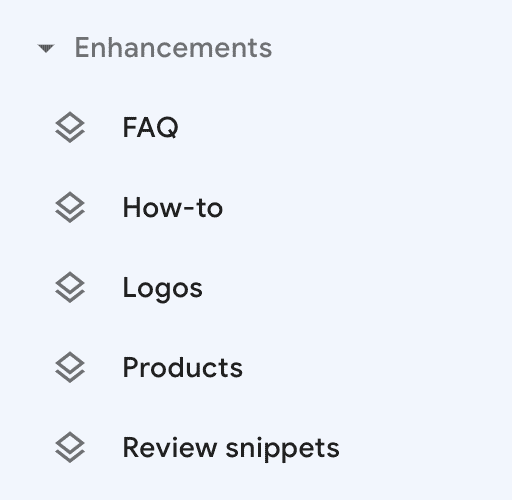
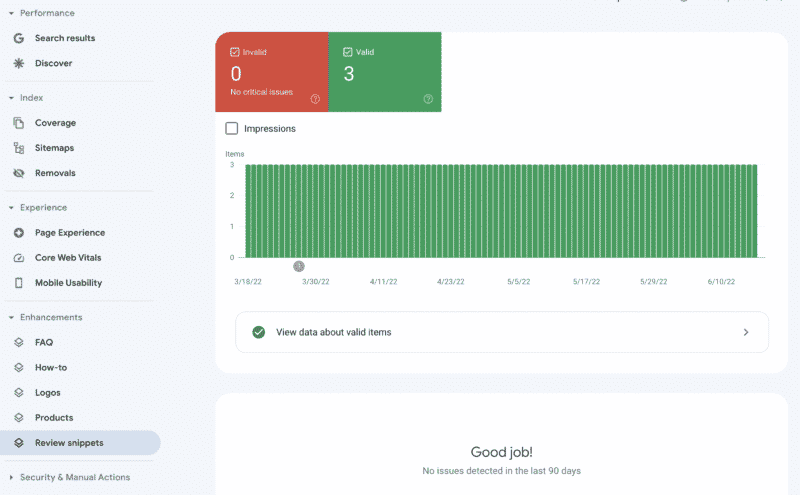
You can then click through each enhancement to view valid pages that Google has identified with this specific markup.
What to look for

You’ll want to review the pages identified by Google. This could identify an area of the site where schema was not implemented.

For example, are there additional pages that utilize FAQs but are not represented in this list? 

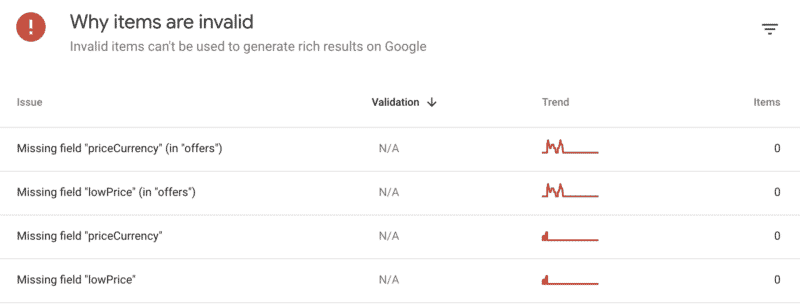
During this review, it is also a good idea to take note of any errors that Google identifies as invalid.
Sitebulb

While other tools offer schema insights during their crawls, I have found Sitebulb to provide a better output of that data.

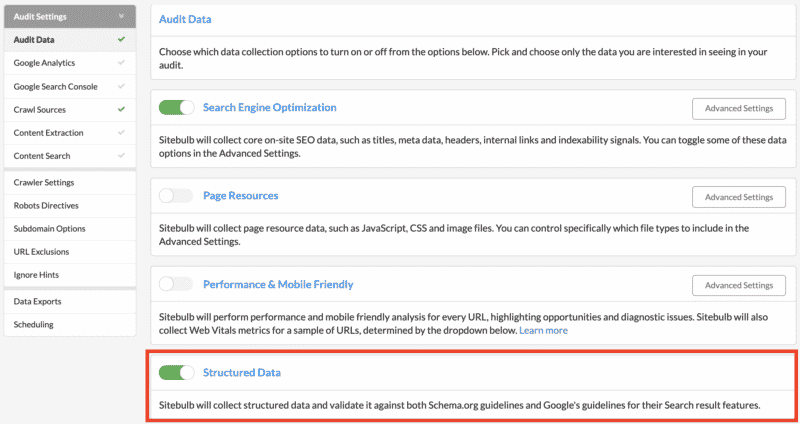
When starting your site crawl, ensure the Structured Data slider is selected in the Audit Data section. Select your other requirements and click Start Audit.
What to look for?

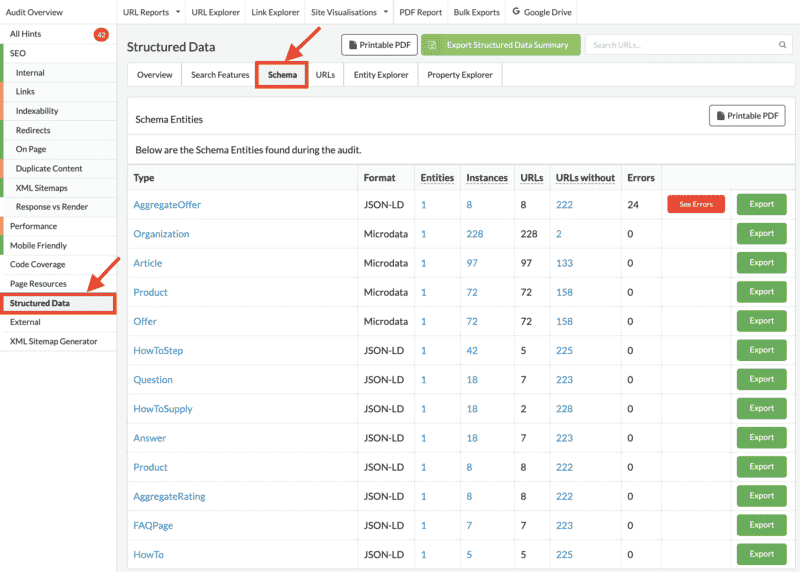
When the crawl finishes, under All Hints, select Structured Data.

The Overview tab will provide some excellent pie charts illustrating the number of URLs with/without schema, passed/failed validation, etc. 

The Search Features tab will provide a list of schema implementations that affect search results.

This list should be similar to what you found in Google Search Console above. 

What we’re primarily looking for, however, is on the Schema tab. 

This is the complete list of schema types found on your site and should provide you a baseline to compare against your search competitors. 
Reviewing your schema for errors

You could spend time looking through your site’s existing code on every page to see if any errors need fixing before moving ahead with further analysis. 

However, the above steps should help identify any errors at scale and save you some time.

Google Search Console

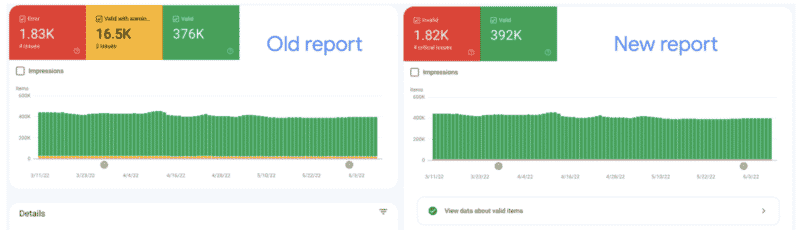
Invalid errors will appear in red text in the console dashboard under each Enhancement.

You may still see Valid with warning errors in your GSC account. However, those are in the process of being removed. As a result, I would recommend focusing on Error/Invalid issues only.
Sitebulb

Other tools (e.g., Screaming Frog) can assist with the validation of your current structured markup. However, we’ll stick with our Sitebulb example from above. 

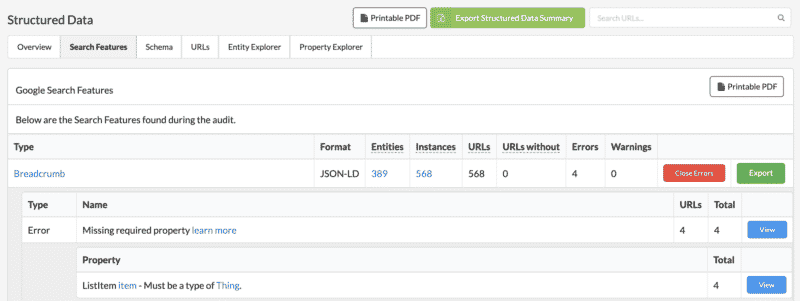
By clicking See Errors, Sitebulb will display the specific validation error and the number of URLs affected.
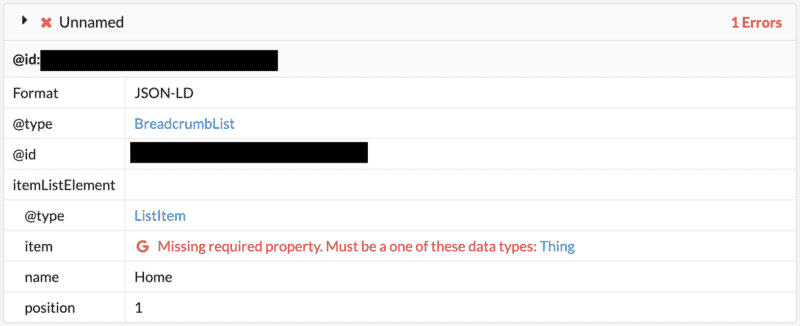
By clicking through to the URL view and then selecting an individual URL, Sitebulb will nicely display the specific item that is missing or incorrectly formatted.
Schema Markup Validator

Lastly, you can validate your structured data code using the Schema Markup Validator. This tool can be beneficial when diagnosing errors on a specific URL and validating a markup snippet of code before pushing live.

Once you’ve identified and tested for structured data errors, now’s a good time to start compiling your competitive schema gap analysis.

Competitive SERP schema gap analysis

Now the fun part begins!

Before you get started, you’ll need:

Using these steps, the goal is to identify Schema markup from the entire Page 1 for your priority keyword(s) and then compare that list with the information included vs. the schema inventory you’ve collected above from your site. 

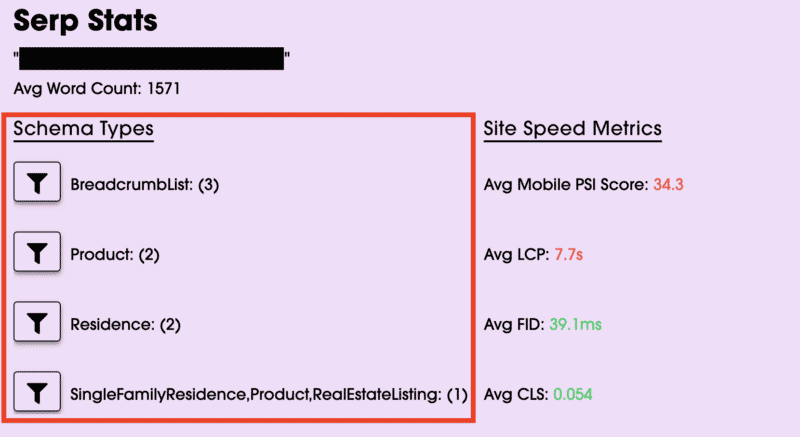
Step 1: Enter a keyword and allow the tool to run. Once completed, all schema types will be nicely aggregated at the top of the page, along with the number of times each is used and some site speed metrics.
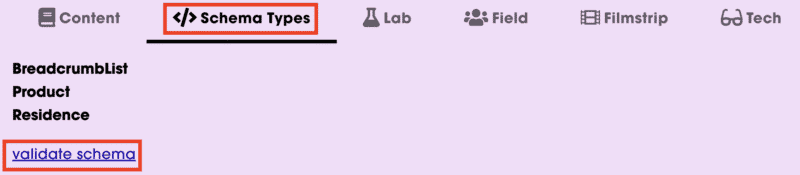
Step 2: Under each result, click the </> Schema Types tab and then the validate schema link.
Step 3: For schema types that exist on your site and your competitors, compare the attributes included by reviewing via the validation tool. 

Again, the goal here is to identify if there are opportunities to include additional detail in your existing schema markup.

The insights could range from the opportunity to add additional content to the page to simply identifying existing content that is available but not yet included in your page’s markup.
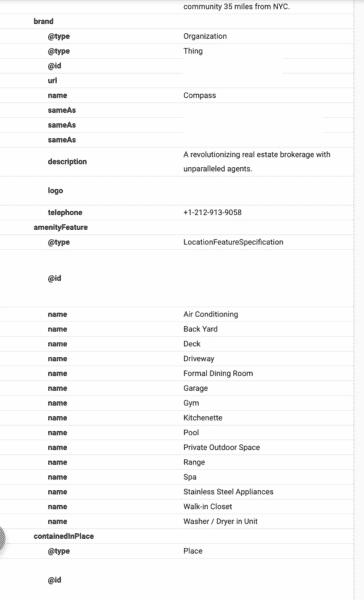
Step 4: If you are not leveraging certain schema types, these are clear opportunities to explore with your development team. 

How can you implement schema markup on your website?

There are several ways to generate schema and implement it on your website. Frankly, there is no one-size-fits-all approach depending on your level of access, the size of the site, etc. 

However, below, you’ll find a handful of standard tools/approaches we use at my agency.

You can implement schema markup on your website by:

  • Using Google’s Structured Data Markup Helper. It’s a simple tool that lets you enter a URL and helps you tag specific elements on the page. The result is a downloadable JSON export that can be added to your site. More information can be found here.
  • Don’t have access to add code, Google’s Data Highlighter might be the best option. Similar to the above, with the Data Highlighter, you can “tag” each data field with your mouse, and Google will be able to display this data in search results without adding the code itself. More information can be found here.
  • Using a schema generator like this one. These tools help create the markup for you based on your inputs. Once created, the script can be added anywhere in your HTML code’s head or footer section.
  • Installing a plugin if you are using WordPress as a CMS platform on your website; there are many plugins available here that will allow you to install Schema Markup easily with just one click!

Think about any schema that you can use

As Google’s understanding of entities and relationships continues to expand and improve, it is only natural that their use of schema types will continue to make their way into search results.

By exploring schema through an audit like this, you can position your site with the best opportunities to take advantage of current and future Google updates.


Opinions expressed in this article are those of the guest author and not necessarily Search Engine Land. Staff authors are listed here.


New on Search Engine Land

About The Author

Jon Clark is a proud #girldad and the Managing Partner at Moving Traffic Media, a boutique digital marketing agency in New York. He writes regularly, providing thought leadership on topics related to SEO, PPC, and Social Media. In his downtime, he enjoys hanging out at coffee shops and documenting his travels on Instagram.

https://searchengineland.com/schema-markup-audit-386485


Google Search Console’s new video indexing report now rolling out

A couple of months ago Google teased a new video indexing report in Google Search Console, that new report is now rolling out, the search company announced. The Video indexing report is rolling out “gradually over the next few months, so you might not see any changes for now,” the company added.

What is the video indexing report. The video indexing report shows how many indexed pages on your site contain one or more videos, and on how many of those pages a video could be indexed. Google said the report can help you understand the performance of your videos on Google, and identify possible areas of improvement.

What it looks like. Here is a screenshot of this report:

When the report shows. Google said if Google detects videos on your site, the Video indexing report will appear on the left navigation bar in the coverage section. If Google has not detected a video on your website, you will not see the report.

What it tells you. The report shows the status of video indexing on your site. It helps you answer the following questions:

  • In how many pages has Google identified a video?
  • Which videos were indexed successfully?
  • What are the issues preventing videos from being indexed?

In addition, if you fix an existing issue, you can use the report to validate the fix and track how your fixed video pages are updated in the Google index, Google explained.

URL Inspection tool for video pages. Google also also enhanced the URL Inspection tool to allow you to check the video indexing status of a specific page. When inspecting a page, if Google detected a video in it, you will see the following in the results:

  • Details such as the video URL and the thumbnail URL.
  • The page status showing whether the video was indexed or not.
  • List of issues preventing the video from being indexed.

Please note, this does not work for the live URL inspection feature.

What The video URL inspection looks like. Here is what this looks like:

Why we care. If you host videos on your site or embed videos on your site, you will want to check out this report to see if there are ways to improve those videos or help other videos to show up in Google Search. Videos are an important aspect of search traffic and visibility in Google Search.

There are a lot more details on this new report in this Google help document.


New on Search Engine Land

About The Author

Barry Schwartz a Contributing Editor to Search Engine Land and a member of the programming team for SMX events. He owns RustyBrick, a NY based web consulting firm. He also runs Search Engine Roundtable, a popular search blog on very advanced SEM topics. Barry can be followed on Twitter here.

https://searchengineland.com/google-search-consoles-new-video-indexing-report-now-rolling-out-386372


Google people also ask feature showing up half as often in Google Search

Three data providers have confirmed with Search Engine Land that the people also ask feature is a lot less likely to show in the desktop Google Search results today, compared to previous weeks. RankRanger, Semrush and seoClarity all confirmed a significant drop for the people also ask box last week in Google Search.

People also ask use to show up for about 60% of all queries those tools tracked but now they show up for about 30% of all queries, that is a 30 point drop and a huge reduction in the people also ask box feature.

What is people also ask. People also ask is a search feature in Google that shows other queries or questions people enter into Google Search. Those questions can be expanded to show more questions and answers to those questions.

Here is what it looks like:

The data. Here are charts from these data providers showing the 30 point drop in the people also ask feature.

RankRanger data:

Semrush data:

seoClarity did not provide a chart but the company told us they saw a 50% drop in SERPs showing PAAs since July 5, 2022.

Why we care. Not only is the people also ask box a useful search refinements and expansion tool for searchers, but SEOs and SEMs love it.

SEOs and SEMs use the people also ask feature for content and keyword generation ideas. It helps marketers come up with new content that they can potentially rank for and show up in the featured snippets section of Google for.

It is unclear if this the reduction of people also ask results is a Google bug or feature, we have reached out to Google and will update this story when we hear back.


New on Search Engine Land

About The Author

Barry Schwartz a Contributing Editor to Search Engine Land and a member of the programming team for SMX events. He owns RustyBrick, a NY based web consulting firm. He also runs Search Engine Roundtable, a popular search blog on very advanced SEM topics. Barry can be followed on Twitter here.

https://searchengineland.com/google-people-also-ask-feature-showing-up-half-as-often-in-google-search-386365


Google removes language in help doc calling hidden Search Console query data ‘very rare’

A recent study from Patrick Stox, Ahref’s product advisor, showed that nearly half of all clicks reported in Google Search Console had hidden or anonymized queries. When looking at some individual sites, we saw some sites only had 15% of queries reported in Google Search Console, but on average, the Ahrefs study showed Google hid 46.08% of all query data.

As a result, Google on Friday has updated its help document to remove the words that anonymized queries are “very rare.” Google also told us they clarified their data limits for these reports in this help document as well.

The data. The study looked at 146,741 websites and about 9 billion total clicks and it compared the total clicks by URL compared to the clicks by query reported in Google Search Console. It found that Google hid 46.08% of all query data, or as Google calls it, classified them as anonymized queries.

Here is a scatter plot of the 146,741 websites showing a dot for what percentage of queries were anonymized in the Search Console reports.

Check your own data. Stox made a super useful Data Studio report where you can see how many queries are hidden for the sites you track in Google Search Console. Make your own copy of the report and add your Google Search Console data as a source. Here are the steps laid out by Stox:

  • In the top right, click the three dots and then click “Make a copy.”
  • In the dropdown for “New Data Source,” select the GSC data source for the site you’re interested in.
  • If the site isn’t available, select “Create data source.” Search for “Search Console” and click it.
  • Click the GSC property you want to use > click “Site Impression” > click “Web.” Then in the upper-right corner, click “Connect.”
  • In the upper-right corner, click “Add To Report.”
  • Click “Copy Report.” 

When I look at my site, Search Engine Roundtable, I see Google shows the total clicks at 1,016,076 but is only showing query data for 547,382, which is 46.13%. This site, Search Engine Land, is showing the number at 43.94%. And our sister site, MarTech, is at about 70% of queries being hidden.

Google updates help document. I asked Google about this and in response to this study and the actual data seen, Google updated its help document from:

“Very rare queries (called anonymized queries) are not shown in these results to protect the privacy of the user making the query”

To:

“Some queries (called anonymized queries) are not shown in these results to protect the privacy of the user making the query.”

I bolded the updated terminology – where Google changed it from saying “very rare” to “some.”

Not 100% new. Google in 2018 start hiding anonymized query data for privacy reasons. Google said back then “an anonymous query is a query submitted [by] only a few users.”

The company said that the number of queries removed from report totals depended on the site. “Some sites will have very few unique queries; other sites will have a large proportion of anonymous queries,” Google said.

So Google did say some sites may see a “large proportion of anonymous queries.” And Google does define anonymized queries as how unique a particular query, not how rare it might be, outside of the update it made to the Google document as mentioned above.

The API. Also, it is important to note that there are limits on how many rows of data that the Google Search Console API and the Google Search Console web user interface will return. Regular users of the Google Search Console API are likely familiar with this, and it has been somewhat explained as part of the rowLimit property here.

When our queries went away. When Google Analytics stopped showing query data, aka the not provided situation, Google told us to get the data in a privacy friendly way through Google Search Console. That was back in 2011, severals years prior to Google hiding query data in Search Console for privacy reasons as well. Also, there is the debate, as mentioned by Danny Sullivan, former editor at Search Engine Land and current Google Search Liaison, about Google showing query data to advertisers but not free organic listings. Since then, in 2020, Google Ads began limiting some search term data (specifically without clicks) for advertisers.

Why we care. As marketers, we keep losing more valuable data to help our businesses succeed online. Truth is, we are living in a more privacy-centric world, at the bar for privacy continues to climb. We need to continue to adapt and leverage the data we have to help our businesses grow online.

The early days of online marketing data is probably long gone and we will likely tell our children and grandchildren the amazing and probably shocking (to them) areas we were able to target our ad campaigns around.

We need to adapt and prepare for even less data for our marketing campaigns in the future, no matter how much we might dislike it.


New on Search Engine Land

About The Author

Barry Schwartz a Contributing Editor to Search Engine Land and a member of the programming team for SMX events. He owns RustyBrick, a NY based web consulting firm. He also runs Search Engine Roundtable, a popular search blog on very advanced SEM topics. Barry can be followed on Twitter here.

https://searchengineland.com/google-removes-language-in-help-doc-calling-hidden-search-console-query-data-very-rare-386328


How to use relationships to level up your SEO

As search engines evolve to understand language in a more sophisticated way, relationships are becoming ever more important in SEO. Semantic search is here to stay so it’s time to pay attention to connections and associations to take your SEO content to a new level. 

Using entities in your content can help you produce higher-quality pieces.

Linking these pages, guides and sections of your website together can help to maximize relationships even further to achieve some outstanding results.

So how can you get started? 

Terminologies you’ll need to know

  • Natural Language Processing (NLP): The process of understanding text and speech words like a human being does. It’s a branch of AI computer science that helps machines to interpret and understand the true meaning behind words. Google uses NLP to better understand our search queries and to serve the best results to those queries. 
  • Entities: Google defines an entity as a thing or concept that is “singular, unique, well-defined, and distinguishable.” These entities are identified and labeled, helping search engines to understand their meaning based on their relationship with other entities. 
  • Semantic search: The process of providing a user with the best possible results to their query based on the true meaning of that query. The search engine uses language and entity relationships to understand search intent, and the context of that query and serve up results grounded in actual meaning rather than keyword matching. 

How are all these connected?

NLP and the understanding of entities are the keys to making semantic search work successfully.

If Google didn’t have a good grasp of how we really use and understand language, it could easily misinterpret certain search queries.

Equally, incorrect labeling of what an entity is could produce some confusing search results.

As humans, we make these connections naturally due to the context in which we experience them. AI has to learn these connections based on contextual cues. 

Over recent years, Google’s Hummingbird, BERT and now MUM updates have all been building toward a more sophisticated semantic search. (You can find out more about Google’s use of AI in search here.)

With all this in mind, it’s time to delve into the multiple facets of leveraging relationships to get better SEO results.  

1. Content

Writing great content for semantic search goes way beyond simple keywords. It must contain the relevant entities and consider the relationships between them. 

Why do entities matter in SEO content?

Entities are important for SEO content because they are connected by relationships. These entities and the relationships that associate them are what Google is using to determine meaning and context within any piece of written content.

All these things and concepts are related to other things and concepts.

Some of these relationships are very strong, others are weaker.

Some entities are widely used in text across the web in lots of different contexts, and others are used sparingly in specific circumstances.

These entities are understood by Google’s knowledge graph. 

For a well-recognized entity like the Empire State Building, you can see a really rich knowledge graph panel that includes basic information, address, opening hours, busy times, reviews and even recent news.

This could help to answer a whole host of users’ queries before they have even asked them.

Semantic search learns from all these connections to determine the information that’s going to be most relevant to a user’s query. 

So, why should this matter for SEO?

If you want Google to serve your content as one of the top results for a certain set of queries, it’s crucial to include the entities with the strongest relationships to those queries.

This requires a thorough understanding of a topic and the entity relationships involved.  

How can I use relationships to write better SEO content?

When we appreciate how important entities are in search, it’s easy to see why considering which entities relate to the topics we’re writing about is vital for serving users’ queries.

If you want to write better content, you need to thoroughly explore the entities and relationships involved.

If you were writing about the theory of evolution, for example, your content would be lacking if it didn’t mention Charles Darwin, natural selection, humans, history, and ancestors.

In fact, you can see a lot of these entities connected to the topic using Google’s image search:

This is a fairly simplistic example to illustrate the idea, and writing great content is much more nuanced. There are likely to be thousands of different words, phrases and entities that will have relationships to your overall topic. 

It’s important to look for phrases that often co-occur with your main topic alongside your partial match terms. This helps to set the context for your content using Phrase-Based Indexing. These related phrases aren’t found using classic keyword research methods.

So here’s how you can find the information you need to start creating NLP-friendly content. 

There are a variety of tools that can help with this such as:

  • InLinks
  • SurferSEO
  • Frase
  • Semrush
  • Scalenut
  • Ryte

These tools are really simple to use. All you have to do is set up an editor or project using your keyword of choice (or a selection of closely related keywords).

The tools do lots of the heavy lifting, providing you with a list of terms, phrases or entities to include in your copy. Some even guide you on how frequently you should use them. 

You can use these guidelines to write your content, using any of the related terms that you can naturally weave in. Often, the NLP terms are arranged by impact too, so you can give more prominence to those at the top of the list.   

You can also review text that already ranks well for a topic using the Google NLP tool. Check the ‘entities’ tab to find salient entities on a topic:

This can help you to pick out any entities you might have missed. You can use this same process to review the salience of certain entities within your own content once you have written it. 

The good news is, that semantic search is aiming to understand human search intent and serve relevant results.

The approach is conversational, so your most powerful tool is your humanity.

Research your topic well, write to serve real people and you should naturally include many of the relevant entities and their relationships. 

2. Pillar pages and topic clusters

Getting each individual piece of content right is only one part of the puzzle.

The next challenge for a content strategist or SEO is to consider and maximize relationships between different topics and content.

Just like each term and entity, each piece of content covers a topic that is related to other topics. These relationships can be powerful or insubstantial. 

What is a topic cluster strategy?

A topic cluster strategy maximizes contextual relationships between pages and pieces of content by clustering them together to add to their strength. It involves a series of supporting pages that look at areas in-depth, linking to a piece of pillar content that broadly covers the central topic. 

Topic clusters improve the user journey because they make it easier for people to find related information. They provide rich and relevant resources and package them based on their relationships with one another. 

How can I find topic clusters?

While it’s easy to find related topics and questions on a subject using tools like AnswerThePublic and AlsoAsked, one of the biggest challenges is how to structure these questions.

Where does an article end and another begin? What forms a relevant part of a topic cluster and what stands alone?

Start by grouping similar questions together and you can quickly form the basis of an article. Arranging queries, prepositions and other long-tail search terms together by common themes will give you a series of different content ideas to form part of a larger cluster. 

The most defined topic clusters should become apparent through critical thinking. Once you’ve created a list of article ideas, you need to consider the relationships between them.

There are some distinct content cluster types, such as:

  • Step-by-step guides: A guide that’s simply too long to be one article, such as a guide to technical SEO, could be split into multiple, detailed parts to create a content cluster. This would create a linear relationship between part 1, part 2 etc. 
  • Monthly calendars: Each monthly entry would form part of the topic cluster. This would also look quite linear, and users will move from one part to the next.
  • A themed set: A group of things with a shared essence that works well together. For example, a set of recipes that all include a specific ingredient or a group of case studies covering a certain industry. The relationships between these may be more complex, but they still form a valid set. 

All these show clear relationships that would form a really strong cluster. They would also benefit from an overarching pillar page to house them all and tie the broad topic together. 

If you have topic cluster ideas but the relationships between them are not immediately clear, create a map of how they link together. If you’re finding it hard to create a relationship between one topic and another, it probably isn’t right for your cluster. Any orphan content should be removed or considered as part of a different topic cluster. 

These relationships will become your internal linking strategy. Contextual links are used by Google as a frame of reference, so it’s important to use relevant anchor text when linking to other parts of your topic cluster.  

Why are pillar pages so powerful?

Pillar pages are really powerful because they show depth and breadth of knowledge about a certain subject. If you execute them well, they help to demonstrate your expertise because you are consistently publishing high-quality content on a topic and demonstrating that you understand the relationships between these topics. 

Here’s an authoritative pillar page on Search Engine Land, that combines a whole host of related articles, relevant questions and entities to create a leading resource on the broad keyword SEO. It’s much more effective than a one-page article about SEO because it helps to signpost readers to other related topics and helps to answer the next question they might have rather than sending them back to search again. 

3. Website

Ideally, your pillar pages will cover all the broad topics that are important to your website as a whole. Getting this right can feel really daunting.

So where do you start?

What content should I post on my website?

If you’re starting from scratch and wondering what content to post on your website, try starting from the top down. Ask yourself what the broadest level of what your website represents is. 

Next, consider all the high-level topics you intend to cover. You might already have this structure in place via your website navigation, depending on what type of site you work on, and what stage of development you’re in. 

  • For ecommerce sites, research all the things people want to know about your main product categories. 
  • For service-based or corporate websites, consider thoroughly answering questions about your core service areas and industry.  
  • For publishing sites, consider the main topics you’ll be covering and create a detailed hub and spoke plan to cover these in-depth.

If you want to harness relationships to improve SEO, it’s really important to keep things relevant. Don’t stray too far from your core topics and make sure every page relates to other pages on your site. 

How do you become an authority on a topic? 

Maximize relationships, and do it well. To become a true authority, you need to regularly post high-quality content related to your main topic and interlink the related pieces of content. When you start to rank well for whole clusters of related keywords, it becomes easier to rank for related topics. 

If you do this often enough, and well enough, you could be creating semantic links of your own. What we write is feeding machine learning, so if your brand is consistently linked with certain phrases you will be strengthening the semantic links between your own brand and these phrases yourself.

This could be the case for unlinked mentions too if an authoritative site is talking about you in the right context.

A real-life example

I decided to use a keyword clustering tool to find a real example of a brand that has strong semantic links to a topic.

In the UK if I search for ‘women’s dresses’ in the keyword clustering tool I can find many clusters covering dress types, but also some branded keyword clusters, like ‘Monsoon dresses’. This shows us that the brand ‘Monsoon’ already has quite a strong semantic connection to the term ‘women’s dresses’. 

And while Monsoon themselves don’t rank on Page 1 for ‘women’s dresses’, their dresses section has reached visibility heights across a whole range of keywords that their competitors have not.

Monsoon has created a diverse range of pages to capitalize on a wide collection of related searches, amplifying their reach by considering the relationship between their pages rather than just focusing on one page ranking for the broad term. 

Quality + relevance + context

A semantic strategy covers all the overarching principles of SEO content.

Writing effective SEO content is really all about recognizing relationships between words, topics and pages – but when you’re working at a granular level that’s easy to forget.

A powerful strategy gets the best out of these relationships to produce results, no matter what industry you’re in.


Opinions expressed in this article are those of the guest author and not necessarily Search Engine Land. Staff authors are listed here.


New on Search Engine Land

About The Author

Claire Brain is the Head of Copywriting for the SEO team at Boom Online Marketing. Claire has 16 years of experience in the digital marketing industry, specializing in SEO for 7 years. She manages both B2B and B2C SEO client accounts and leads the SEO copywriting team.

https://searchengineland.com/use-relationships-level-up-seo-386352


Creating new content vs. optimizing old webpages: Which is better for SEO?

Should the larger focus of your SEO efforts go toward creating new content or updating existing content?

In my opinion, you should dedicate about half of your SEO efforts to updating old content, and the other half to creating new content.

Here’s why.

Webpages build value over time

The content on your website can remain relevant for years to come.

Pages that have been published for some time have presumably built up links and visibility. That creates a lot of page value.

That means those pages can still show up in the search results for the queries your target audience is using today.

Freshness is generally less of a concern for Page Quality rating. “Stale” pages can have high Page Quality ratings.”

Google’s Search Quality Rater Guidelines

What does this mean?

Older content can still be relevant and considered high quality.

Think: An informational page about the American Civil War.

However, other types of old content can only remain relevant if the material is considered “evergreen” and up to date.

Over time, any given website could have hundreds or thousands of outdated webpages.

Google may not trust a site where two-thirds of the pages are, say, three years old or older and have outdated information on them. Especially if those topics are being refreshed by your competition.

You can do a quick check on your older content and see for yourself. When you published the page years ago, did it rank on Page 1 in search results? And is it on Page 2 or lower now?

Usually a refresh of the content can bring it back to Page 1.

Lately I have been asked about the value of a webpage – particularly how to show value as an asset. Normal things depreciate over time, and I believe that happens to webpages. If not maintained, they eventually rot away and become useless. But well maintained, they remain an asset.

If a webpage is designed and researched, outlined and written, edited and optimized – and engagement objects like images and video are added – that can take eight hours for quality work. That time has a significant cost.

You can ignore it and essentially write it off, or you can keep it fresh. We prefer the latter as a content strategy and tactic.

What Google says

Google says you should spend time maintaining your website in order to ensure quality:

… unmaintained/abandoned “old” websites or unmaintained and inaccurate/misleading content is a reason for a low Page Quality rating.

Google’s Search Quality Rater Guidelines

Takeaways:

  • An old or unmaintained webpage may be considered low quality. This is especially true for “your money or your life” pages – those that can impact a person’s health, finances, etc.
  • A webpage that contains inaccurate information is low quality, period. You might need to update your webpages frequently just to keep your info current, depending on your subject matter.

In a 2019 “Office Hours” session, Google’s John Mueller talked about evergreen versus fresh content:

” … We do try to find a balance between kind of showing evergreen content that’s been around and kind of being seeing more as reference content and kind of the fresher content and especially when we can tell that people are looking for the fresher content.”

You can listen to that answer here:

[embedded content]

Mueller is likely referring to the concept of “query deserves freshness” – the kinds of search queries whose results need to reflect new content. You can read more about that in a 2011 Google blog post here.

In another Office Hours video from 2021, Mueller addressed how to handle old content:

” … if it’s something that you think is good content that you want to publish with your website, with your name, then I would keep it. Just because it’s old doesn’t mean it’s bad. But if you look at it and you say, oh, this is embarrassing for me now, I don’t want it to be online. It’s like so bad. Then that’s something where I’d say either improve it or remove it.”

You can listen to that answer here:

[embedded content]

What to do? A content audit

In addition to creating new webpages for your SEO program, a web content audit is going to be key to prioritizing how you refresh old pages.

A content audit identifies weak and underperforming content on your website so that you can improve it.

Using Google Analytics and a tool like Screaming Frog, Semrush or our SEOToolSet, you can get all the data you need to understand the webpages on your site.

Once you’ve compiled the necessary data, you will divide your webpages into three categories. Those that:

  1. Garner the most rankings and traffic (e.g., those on Page 1 of the search results).
  2. Have the potential to get better rankings and traffic (e.g., those on Page 2 of the search results).
  3. Perform poorly and aren’t in either of those categories.

Then, you can:

  • Focus on strengthening the content in the first two categories.
  • Figure out what to do with the rest, which is the poor-performing content. Some webpages may need a content refresh, others may need optimization. And some content may just need a 301 redirect to a more current URL on the same subject.

Grow and maintain your content

The beauty of SEO is that your webpages build value over time through visibility and links. So all the great work you put into them can continue to pay off in traffic and, hopefully, revenue.

But you do need to maintain your website throughout its entire lifecycle.

So to strengthen your SEO program, make sure you spend 50% of your content-focused time creating new webpages and 50% of the time refreshing the old.

As a last encouragement … Your website might already have hundreds or even thousands of outdated pages, and getting a handle on it can be a big project.

Build refreshes into a regular schedule just as you do with creating new content.

Get into a rhythm of identifying existing pages related to each new page, and either update or consolidate them as part of your content creation process.


Opinions expressed in this article are those of the guest author and not necessarily Search Engine Land. Staff authors are listed here.


New on Search Engine Land

About The Author

Bruce Clay is the founder and president of Bruce Clay Inc., a global digital marketing optimization firm providing search engine optimization, PPC management, paid social media marketing, SEO-friendly site architecture, content development, and SEO tools and education.
Clay authored the book “Search Engine Optimization All-In-One For Dummies,” now in its fourth edition, and “Content Marketing Strategies for Professionals.” He wrote the first webpage-analysis tool, created the Search Engine Relationship Chart® and is credited with being the first to use the term search engine optimization. Bruce Clay’s renowned SEO training course is available online at SEOtraining.com.

https://searchengineland.com/create-new-content-optimize-old-webpages-seo-386302


Adaptability: The new competitive advantage in SEO

Lots of people are fascinated by dinosaurs.

But being a dinosaur brand doesn’t make you fascinating.

In fact, it’s the quickest way to lose credibility in the eyes of your customer. 

How do brands become dinosaurs?

No brand ever thinks they are stuck-in-their-ways or will become obsolete.

Yet, many companies behave in ways that unintentionally may lead to their brand becoming obsolete:

  • They lack execution.
  • Their product improvements are stalled in backlogs competing for resources and foundational.
  • Long-term initiatives (e.g., SEO fixes) go unaddressed and unfixed year after year.   

In short, dinosaur brands become slow, neglected, stagnated – and eventually are forgotten by consumers.

Not even established brands are immune to becoming extinct.

But what’s the best way to stay at the top of the proverbial food chain over the long term and navigate navigate the changing digital landscape?

Always be willing to adapt to change – from changing markets and circumstances to shifts in search intent.   

Change is constant. The rate of change in technology is unmatched.

Unless you’ve been comparing SEO advice published in 2010 to articles in 2022, you might think you’re doing just fine. (That said, the late Bill Slawski is, in my opinion, the exception to this rule because even this blog post from 2010 is sage advice.)

So even if your brand is behind on marketing, operations or SEO, you can avoid pitfalls that result in dinosaur brand behavior.

What is dinosaur brand behavior?

Dinosaur brand behavior is what happens when a (frequently older) company operates in an outdated way of thinking or is slow to adopt a more agile way of implementing change, especially in four areas that would otherwise drive sustainable growth for the brand:

  • Strategy 
  • Tactics
  • Collaboration
  • Data 

Strategy

Strategic thinking requires an awareness of one’s current situation in order to be able to get to a more advantageous one.

If a company wants to be considered strategic, it should be aware of not only itself, but how it’s perceived by its customers and its competitors in the marketplace and whether it might be operating on outdated models or information – even misinformation. 

The SEO industry is unfortunately prone to this type of challenge – particularly with dinosaur brands.  The reason being that, before the Internet became mainstream, the pace of business was much slower. 

SEO isn’t the type of discipline where a strategy can be set at one point in time and be valid for years to come. It’s predicated on advances in technology. 

Dinosaur behavior toward a discipline like SEO is building your strategy in 2010 based on SEO articles published that year thinking you can then move onto whatever is next. This outdated approach fails to address how search continues to evolve (e.g., E-A-T and broad core updates).

The literal meaning of brand awareness is that consumers are aware of the brand. But, if adaptability is a form of strategy, brands themselves would be better served by practicing self awareness and being more aware of how they’re perceived.  

For example, when a brand that people don’t see or hear from regularly, tries to use a marketing channel like SEO to grow organic traffic, not only is it an ineffective strategy – it’s not even a problem SEO is designed to solve. 

The brand has an awareness problem because consumers don’t even know to look for that brand. 

When consumers are doing branded searches online for dinosaur brands, it looks like this:

Google search results for [does radio shack still exist]

Remember, SEO is not a demand creation channel. It captures existing demand.

Dinosaur brands have an awareness problem because customers don’t know they still exist. 

“This is usually where I tell my students and clients to focus on getting in front of prospective customers – when they’re still trying to solve a problem,” said Jeff Ferguson, CEO of Amplitude Digital and an adjunct professor at UCLA. “When you’re trying to create awareness with content, your goal should be to be a part of the conversation by helping solve the customer’s problem.”

Tactics

Tactics are the executions, the operational set up or the marketing channels deployed to get things done. Dinosaur behavior look like this: 

  • Doing things that used to work, but haven’t for years (e.g., sending terrible outreach emails).
  • Not easily offering customers a clear way to unsubscribe from a payment plan.
  • Thinking your existing site content is competitive enough and needs no additional investment.
  • Not tapping into modern, social media engagement like spinning up a pilot influencer program.

Adaptability means embracing modern opportunities, especially in a dynamic channel like search.

When the People Also Ask feature began appearing as a SERP element, how many brands actually started adjusting their content to capture a spot in those answer boxes?  

Today, how many are at least trying to infuse their site with more E-A-T related signals? At the risk of oversimplifying SEO, if a company never updated the content on their website, the changing nature of search alone would cause it to lose rankings and traffic. 

Collaboration

SEO isn’t just an investment, it’s a team sport.

SEO does not and should not exist in a silo.  Especially at the enterprise level.  

Very little SEO work gets completed without the help of collaboration from cross-functional teams. Dinosaur behavior that stagnates collaboration is ultimately a lack of execution, especially on SEO initiatives that are key to strengthening the technical site architecture and variety of content types needed to capture organic demand.  

One aspect that brands have found the most challenging to coordinate and get right is having products available for purchase online while a major live-broadcast event is taking place.

Live events (e.g., sporting events or award shows) are an opportunity where consumers, at scale, can be encouraged to search for and purchase what an athlete or performer is wearing because other marketing channels can be in the mix too; social media posts and ads, commercials, and live event sponsorships can influence search behavior. 

Given that search demand is amplified by a live event, the sheer volume of opportunity should be something that is planned for months in advance by cross functional teams. But many brands (even many modern ones) still devote a disproportionate amount of attention to the familiar calendar holidays running their sales on Black Friday, Valentine’s Day, President’s Day or Christmas Day. 

Just think of how many eyeballs (and mobile phones connected to the internet!) are collectively present for things like a live musical concert, the Super Bowl, the Oscars, or the Olympics! It’s an incredible opportunity that, alas, remains a complex challenge.  

I have a feeling more brands are becoming wise to this type of opportunity and are making better inroads with teams to collaborate in a more meaningful way that both delights (and is attuned to) customers in how they search and shop, ultimately delivering dollars to the bottom line. 

For enterprise brands that are proactively adapting here, the future is in unlocking revenue from live events that has been invested as media dollars; to be able to capitalize on the search intent from direct to site and organic visits which can result in transactions. 

Data

What SEO or omnichannel leader wouldn’t love to be able to point to a campaign that involved efforts across SEO, product, marketing and media buying?

Imagine telling the story of how you tied it all together:

“We invested X media dollars across social and streaming for the 4-5 months leading up to this live event. In parallel, we coordinated content optimizations on these category and product page URLs which translated to X amount of revenue immediately following the event and a total of $$$ in the two weeks thereafter.” 

Holy smokes! Revel, rinse and repeat!

In order for something like that to happen, marketers need to be operating from not only an omni-channel perspective, but from/with the best data. 

An immense amount of data available to us. Which means if the data is not properly maintained, scrubbed, untangled and validated across channels from time to time, it can become too noisy and largely unhelpful. 

Because of this, dinosaur brand behavior that neglects data hygiene looks like the following:  

  • Letting legacy versions of analytics platforms persist without planning for future platform updates.
  • Letting analytics tags build up in the website code thereby hindering its speed.
  • Not maintaining or upgrading to a modern product information storage solution .
  • Deterioration of customer data and product data feeds.
  • Not establishing documentation for how channel attribution is defined, set up and tagged. 

The devil is always in the details. 

Adapting and improving is about constantly asking questions that help your business get to a source of truth:

  • How is the data set up?
  • How is each attribute defined?
  • Does the metric provided in this dashboard give us insight into what action(s) should be taken?  

No company has their analytics completely figured out. But that’s part of adapting over time.

The closer you get to properly understanding all data inputs and outputs, the more competitive your business can be because it’s operating from information that’s as clean as it can be. 

The hard truth for dinosaur brands: perception is reality

This is an especially tough pain point for brands that are stuck in their ways because consumers have so many options to choose from.  

Hard truth #1: If consumers do not physically see your brand out in the world and/or they’re not being advertised to, they will think you are no longer in business and will therefore not think to search for you online. 

Hard truth #2: Appearances matter. Whether online or in store the appearance and intangible experience makes an impression about a brand. Websites need to be fast and easy to navigate. Stores need to be clean, stocked with the products shoppers want, have strong WiFi, and have attentive, engaging and knowledgeable staff. 

I’m oversimplifying the omni-space but the point is, those are consumer touchpoints that no brand can afford to ignore.

Websites in particular need to be maintained because that’s the online store that consumers will pull up on their phone or desktop and expect it to be open 24/7.

Without reminders to consumers like a physical store or advertisements like TV commercials, a retail brand becomes extinct in the eyes of the consumer; just another brand swallowed up by the “retail apocalypse.” 

Demand dries up if there’s no investment in brand awareness.

That’s a huge risk to a brand because potential customers literally think your brand no longer exists.

Your brand has not just become, but gone the way of, the dinosaur!

“This is where that classic marketing story about Arm & Hammer baking soda comes into play,” Ferguson said. “They were the go-to brand for baking soda for decades, then people stopped baking so frequently. Instead of the brand just giving up, they looked at all the other ways people used the product and leaned in that way.

“Brands can do that now with content,” Ferguson added. “I’ve seen brands create content that illustrate various ‘hacks’ for their product as a way to stay in the conversation.”

The risk of not adapting to changes in search intent  

Another hard truth: search intent changes over time. 

Brands must continue to invest in adapting their own website content, in particular, to meet the dynamic needs of what and how customers search online. 

Simply put, search is the language of demand. 

Search Intent is the main goal a user has when typing a query into a search engine. As an example, pre-pandemic, most of the search intent for retail locations was about geography (“near me”) and/or finding the hours of operation. 

Since 2020, almost overnight, search intent related to retail stores has changed to reflect the consumer need for new options such as “grocery delivery” or contact-less “curbside pickup”. 

Google Trends data below shows the intent change around a consistent term like “in store pickup” against a new term “contactless delivery” that emerged at the start of the pandemic. 

Google Trends data for “contactless delivery” and “in store pickup”

In the past two years alone, marketers have been watching in real time as brands and businesses adapt to the change in demand for their goods and services. 

Without question, adaptability is the new competitive advantage. 

Spare no expense on adaptability

Business is about execution. 

Brands are about ideas. 

As a brand you always want to be relevant. The key is to maintain an awareness of how your brand is perceived and be willing to adapt and execute on what it takes to stay pertinent. 

If anyone knows about surviving (and thriving) the long game, it’s SEO because it largely comes down to execution in technical improvements (crawling, indexing, speed etc.), content and links.  

The most glaring form of dinosaur brand behavior is not investing in SEO fundamentals related to an adaptive strategy, tactics, data and collaboration.

Build great teams that help keep your brand at the top of the food chain.


Opinions expressed in this article are those of the guest author and not necessarily Search Engine Land. Staff authors are listed here.


New on Search Engine Land

About The Author

Holly Miller Anderson is an experienced SEO and marketing strategist. She has more than a decade of broad, digital marketing experience that includes marketing films, managing events, as well as experience growing SEO as an acquisition channel in various roles from consultant to agency and in-house Product Manager at enterprise-level brands. She has made a career advising marketers on their holistic SEO strategy by developing a strategic plan and tactical roadmap that delivers sustainable growth. Holly is currently a Lead SEO Product Manager at Under Armour.

https://searchengineland.com/adaptability-new-competitive-advantage-seo-386278


Digital marketing ranks in the top 3 hottest skills Americans are learning in 2022

It’s no surprise that the last couple of years have been hard on workers around the world. In the US alone, the “quit rate” reached a 20-year high and came to be known as the Great Resignation. 

Earlier this year we reported another anomaly dubbed the “Great Reshuffle” that saw 618,000 marketers leave their jobs in 2021. A report from LinkedIn predicted that this trend would continue well into 2022 with 24% of marketers looking for a new job, and 62% changing jobs altogether. 

What does the data say. Preply viewed Google Trends data and analyzed 572 keywords representing interest in over 50 different skills relevant to American workers. They found that 35% of the interest was in digital marketing alone. 

LinkedIn noted that there was a 121% YoY increase in remote marketing job share. In the same report, LinkedIn also noted that some of the hottest jobs in demand this year are social media. The increase in digital marketing skills should come as no surprise. Workers are looking to go remote, as COVID protocols continue to change. Digital marketing jobs certainly offer the flexibility and location independence that many workers are searching for. 

Other areas of interest. While digital marketing came in at #2 with 35%, it trailed behind data science at 76%. Other areas of interest were data management (34%), and interpersonal and management (34%). 

Digital marketing hot spots. The report from Preply indicates that most of the interest in these skills comes from urban areas. However, online learning makes it possible for anyone with a solid internet connection to participate, no matter where they are. But the biggest increase in n digital marketing skills come from Arkansas (125%) and Chicago (32%). 

Why we care. Digital marketing isn’t going anywhere any time soon. Even developments in AI and automation aren’t slowing down the need for social media marketers, account managers, and SEO specialists, and more. Marketers had previously looked to relocate to big metropolitan areas such as NYC, LA, and San Francisco. Because of inflation and the increased cost of living, we could see that change soon. Learning additional digital marketing skills helps set up workers to be in demand for the jobs they want and the salaries they deserve.


New on Search Engine Land

About The Author

Nicole Farley is an editor for Search Engine Land covering all things PPC. In addition to being a Marine Corps veteran, she has an extensive background in digital marketing, an MBA and a penchant for true crime, podcasts, travel, and snacks.

https://searchengineland.com/digital-marketing-ranks-in-the-top-3-hottest-skills-americans-are-learning-in-2022-386272


Why you should invest in branded keywords even if your company ranks #1 on Google

Search marketing is generally seen as a core tactic within digital marketing programs.

Capturing the intent of users actively searching your products or solutions is a no-brainer, right?

What seems like a simple question, can often be complicated.

Whether it’s due to budget-constrained environments or the brand having a stellar SEO team, I’ve fielded the same question for nearly every brand/client I’ve worked with:

“Why should I pay for brand search clicks, if our organic search listing is right at the top of the page?”

To be fair to those non-PPC stakeholders who may be reading this article, it is a valid question to ask. ]

Logically, I understand why it is appealing to capture free clicks and focus PPC budgets on tactics that will pull in new customers; however, there is a 1+1=3 effect to SEO and PPC results showing in conjunction. 

Let’s look at some of the top reasons why brands should remain invested in their brand keywords. 

1. SERP authority

Search engines are a part of daily life. Billions rely on search engines to answer information gaps in real-time, every day. They are a brilliant resource that only increases in terms of adoption and value.

Given how frequently we use search to solve problems, our brains naturally establish a correlation between the position of a search result and its relevance to our original query. 

While a bit dated, Microsoft and Google have published studies confirming this notion.

If you still aren’t convinced, just look Google’s and Microsoft’s recent earnings – clearly, advertisers perceive this placement as valuable.

Search ads sit above the organic listings in premium real estate – directly below the search bar. Search ads are typically the first thing a user sees after initiating a search. 

Not only does your ad box out competition from this prime real estate – which lowers the effectiveness of their competing offers – but in addition you have freedom to control the message users are seeing.

While site content can be optimized for search results, PPC provides full autonomy over the presentation of your brand’s message.

The impact of brand SERP management increases as the size of our screens shrinks. 

Mobile searches continue to rise across nearly all categories of searches. Controlling the top result of a mobile brand search is critical, as the searcher’s attention is concentrated on the limited listings that make it above the fold.

Combine your search ad with the top organic listing (due to your team’s great SEO work) and you are now controlling the top of the SERP and with it, the prospect’s (nearly) full attention. 

2. Auction dynamics

This is the most straightforward rationale for brand search keywords. Simply put, you’re getting much more bang for your buck with brand investment. 

Take a step back and think about the purpose of search engines. They try to provide users with the optimal experience, meaning the most relevant results for a query. If you’ve run competitor keywords before, you’ve likely seen this in action. 

Engines charge a surplus for clicks on competitor terms, based on the lower relevance of your ad and landing page. In my experience, competitor clicks have ranged from 5-25x more expensive than brand clicks. 

Consider the SERP authority previously discussed and the economies of search engine auctions. Even if your brand budget is reallocated towards generic or competitor terms, it is possible (if not likely) that you will see an aggregate decrease in site visits. 

Such approaches lean exclusively on SEO for brand visit volume, while reducing the effectiveness of your PPC budget.

Even if SEO captured 100% of the visits previously driven by PPC ads, the incrementality of reinvesting in nonbrand/competitor terms is unlikely to move the needle, due to the relative inefficiency of nonbrand/competitor investments. 

To illustrate this, I’ve created a realistic simulation below of how redistribution of brand investment into nonbrand campaigns could actually yield lower total traffic to the site, due to the relative inefficiency of nonbrand volume.

In this scenario, the $1,000 that had previously been allocated to brand campaigns is now shifted to nonbrand. Despite SEO results capturing 95% of all brand traffic, we still see about even total traffic month over month, as we netted 800 fewer PPC clicks by shifting from brand to nonbrand. 

Setting up clean measurement for your own business is critical, should you find your brand investment threatened.

Work with your analytics teams so that you show how any shifts in investment are impacting total traffic to the site. 

3. Meet the customer where they search

Though digital marketing has evolved in terms of the complexity of tactics, it’s important to remember why search marketing is so effective.

Folks searching for your brands are seeking out additional information about your brand. They are telling you what they are interested in learning more about.

We don’t need to identify those who are close to purchase, as they are revealing that via their chosen queries. 

Search is often referred to as a pull channel because we do not need to push ads in front of users. This is an opportunity to meet those expressing interest in your brand with a catered message. 

Using an offline analogy: it’s similar to someone approaching the front door of your store, but you don’t have the lights on and have the blinds down.

Never take your most engaged audiences for granted. Open the store up and show them what you believe is the best offer to get them in the door. 

4. Messaging autonomy

It’s been mentioned in a couple of the aforementioned arguments, but the value of catering your message for users who are interested in your brand is far greater than the cost of the click.

In order to establish SERP authority or convert those prospects interested in your brand, you need a catered message that shows prominently at the top of the page. 

I’ve been lucky to work with some incredible SEO professionals and it is fascinating what they do to influence a site’s performance; however, there is an element of certainty with PPC that cannot be replicated.

We all tune into this blog on a recurring basis, as we are aware there are variables on search engines that are out of our control, which can have a meaningful impact on site performance.

PPC provides an opportunity to customize the message, based on known attributes of the user. Whether its an early interaction in which you want to establish your brand’s credibility or someone who has been to your site many times, PPC provides you the flexibility and autonomy to control how your brand is perceived on some of the most frequently visited sites on the internet. 

Brand search is a critical tactic that advertisers need to maintain support for at all costs.

There are few other places on the internet where prospects are actively seeking out more information regarding your business.

If in fact you are being asked a similar question, here are some tips for how to manage that conversation:

  • Don’t panic: Seriously! It’s a common question to receive and comes from a logical perspective. It is our job as specialists to educate why brand search is so valuable.  
  • Consult your platform reps: If you are working for an agency or brand with existing platform partnerships, lean on your reps as they have data that quantifies the impact of SEO and PPC in conjunction. If not, Google Support should be able to point you toward useful resources.
  • Turn to the numbers: Brand search is one of the most cost-effective digital marketing tactics. Work with your analytics team/lead to build a data-driven story.
  • Measure impact: If budgets do end up being reduced, make sure you have a measurement in place that quantifies the impact and how much volume is being recaptured by your SEO listings.

Opinions expressed in this article are those of the guest author and not necessarily Search Engine Land. Staff authors are listed here.


New on Search Engine Land

About The Author

Anthony Tedesco is a search engine marketing professional based in Boston, Massachusetts. He started his career at Red Ventures in Charlotte, North Carolina, where he learned the impact of data-driven performance optimization and full-funnel marketing strategies. He then returned to his native Boston, where he joined DWA/Merkle B2B, working with Fortune 100 brands to maximize the value of their SEM investments. In 2021, Anthony joined the global paid media team at Cisco Systems, Inc., where he orchestrates high-impact tactics at scale and helps solve the complex challenges marketers face in the evolving digital landscape. Anthony is an avid Tar Heel and Boston sports fan. If not watching his favorite teams, he enjoys traveling to New England with family and friends or catching up on old seasons of Survivor.

https://searchengineland.com/why-invest-branded-keywords-386220


Top 5 secrets your search bar is hiding

Your search bar is your secret weapon. How can you help improve the site search experience when someone has landed on your site? What can you do to ensure that you’re meeting their needs while on your site?

Once you segment the types of visitors on your site – informational, search intentional, navigational and transactional – you’ll know what they want to get out of your site and improve their search experience. You’ll also get better insights into what you can accomplish with those individual visitors.

Join Jonathan Meyer, senior solutions engineer at Hawksearch by Bridgeline, as he reveals how to optimize your site and transform searches into sales in his informative SMX Advanced session. By breaking down the four types of search personas, you’ll better understand how to leverage your website’s architecture to serve your ideal client best while increasing your chances for brand loyalty. 

After this presentation, you’ll be able to break down your site into the key elements to drive conversion, direct traffic to precisely the right product for purchase and identify new opportunities to raise the value of every shopping cart.

Watch the session and learn how to improve customer trust by having resources available to deliver what your visitor is looking for. 


New on Search Engine Land

About The Author

Hawksearch powers digital experiences for some of the world’s largest brands. Our innovative site search solution goes above and beyond any other search tool in the market. Hawksearch enables companies to capture greater traffic, increase order value, and drive conversion. Our suite of digital experience solutions provide feature-rich eCommerce and content management capabilities, turn-key site search and merchandising, SEO optimization tools and more – all designed to keep your revenue climbing.

https://searchengineland.com/top-5-secrets-your-search-bar-is-hiding-386194