Google rich results guidelines now prohibits weapons, recreational drugs, tobacco & vaping products and gambling-related products
Google has updated its rich results content guidelines to align better with the overall Google merchant guidelines thus disallowing rich results for products that are widely prohibited or regulated, or that can facilitate serious harm to self or others.
These include, but are not limited to, weapons, recreational drugs, tobacco & vaping products and gambling-related products.
Don’t mark up content that promotes widely prohibited or regulated goods, services, or information that may facilitate serious and/or immediate or long term harm to self or others. This includes content related to firearms & weapons, recreational drugs, tobacco & vaping products and gambling-related products.
Application. Google said this policy applies to all forms of rich result markup, including star ratings, prices, or availability information and more. This can impact products with rich result structured data markup that are widely prohibited or regulated, or that can facilitate serious harm to self or others. “This could include goods like fireworks, recreational drugs, and other products that can pose acute threats of physical harm,” a Google spokesperson told Search Engine Land.
Effective immediately. Google told us this policy goes into affect today, at the time this story has published.
Why we care. If you sell any of these types of products, you will probably want to remove the structured data markup from those pages. If you do not remove the markup, either way, Google will not show rich results for these product categories.
We did ask Google if you will receive some sort of manual action within Google Search Console and Google said it will not issue manual actions, instead Google will simply just remove the rich results for these types of search results. So no manual action will be given but technically the removal of these rich results is the penalty one would receive for violating the rich results content guidelines.
New on Search Engine Land
About The Author
Barry Schwartz a Contributing Editor to Search Engine Land and a member of the programming team for SMX events. He owns RustyBrick, a NY based web consulting firm. He also runs Search Engine Roundtable, a popular search blog on very advanced SEM topics. Barry can be followed on Twitter here.
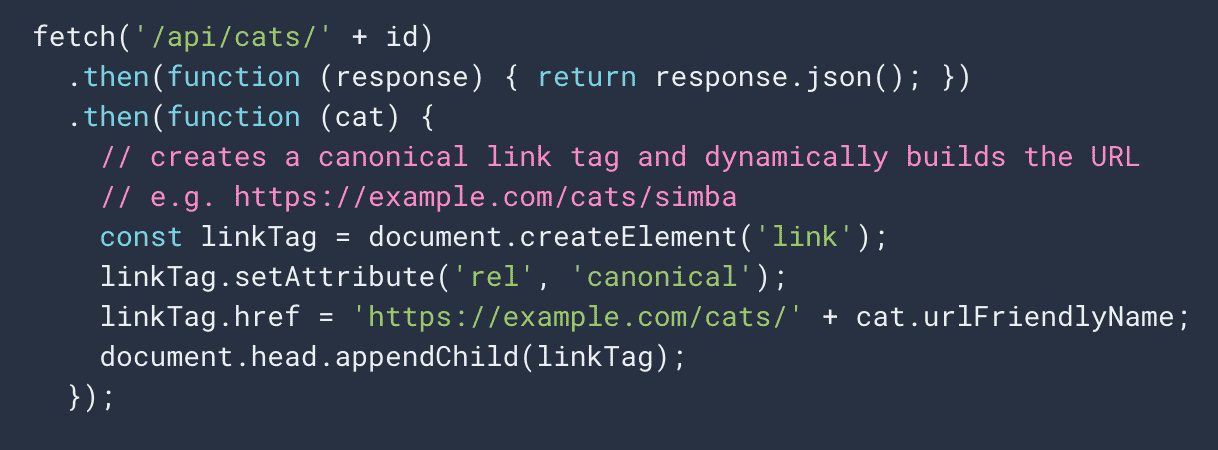
What is new. Here is the new section where Google recommends not to implement your canonical tags using JavaScript, but if you must, Google explains this is the proper way to do so. Google wrote:
While we don’t recommend using JavaScript for this, it is possible to inject a rel=”canonical” link tag with JavaScript. Google Search will pick up the injected canonical URL when rendering the page. Here is an example to inject a rel=”canonical” link tag with JavaScript:
Google added this warning stating “When using JavaScript to inject the rel=”canonical” link tag, make sure that this is the only rel=”canonical” link tag on the page. Incorrect implementations might create multiple rel=”canonical” link tag or change an existing rel=”canonical” link tag. Conflicting or multiple rel=”canonical” link tags may lead to unexpected results.”
Hit or miss. We have seen cases where Google can pick up these canonical tags or other embedded elements, even structured data, using JavaScript. But it can be hit or miss, so it is recommended that if you are going to use JavaScript specifically to inject your canonical tags, follow these directions precisely.
Why we care. Again, if you are injecting canonical tags using JavaScript, Google has finally officially documented the proper way to implement it. So check the documentation over here and make sure your implementation follows Google’s recommendations.
New on Search Engine Land
About The Author
Barry Schwartz a Contributing Editor to Search Engine Land and a member of the programming team for SMX events. He owns RustyBrick, a NY based web consulting firm. He also runs Search Engine Roundtable, a popular search blog on very advanced SEM topics. Barry can be followed on Twitter here.
While it’s not great at plotting ranking data (inverting the y-axis is always ugly), there are numerous ways to use Google Sheets for SEO.
Here are 11 of the formulas and tips I find myself using for SEO on an almost daily basis – for keyword management, internationalization, content/URL management and dashboards.
Get the daily newsletter search marketers rely on.
Google Sheets formulas for keyword management
V LOOKUP
CONCATENATE
FLATTEN
LOWER
=VLOOKUP(text,[range to search],[column number to return],[true/false])
=CONCATENATE(A1,A2,A3) you have the option to concatenate columns
=CONCATENATE(A1,” I’m additional text”) or literal words and characters
Concatenate is one of the most commonly used Google Sheet formulas in SEO, and for good reason.
It can serve a variety of use cases, including creating keyword lists (concatenating two+ variables together), creating URL strings, or even bulk templatizing metadata.
As the name suggests, you can use it to simply string any amount of values together.
Just remember: if you need a space between keywords, a literal space “ “ must be added.
=FLATTEN(A:D) would compress all ranges in A – D in to one column
There’s a reason FLATTEN is coming after concatenate. After you’ve concatenated several thousands of keywords and a couple of hundred dollars away, you generally need to upload the keywords into your rank tracking tool’s UI or via a CSV bulk upload.
It can be tedious when you have a 20×20 block of keywords to get them into a single column so you can upload all your keywords in one go.
With FLATTEN, you essentially select the range of data you want and the output is all of your keywords in one column to make copy-pasting a dream!
This one’s pretty simple – but it can be helpful to LOWERcase all the of the keywords you’re managing (especially if you use a service provider that charges for things like duplicates) or if you’re in a case-sensitive environment like SQL.
LOWER is admittedly one of the simplest Google Sheets formulas for SEO.
The opposite (UPPER) also works, should you feel like auto-capping everything.
COUNTIF lets you count, with accuracy, any literal text you want to match or even some numerical values that meet conditional rules.
It’s particularly useful when grouping together pages, managing an upcoming content calendar or sorting keywords on common dimensions like the page type or product they support.
It can also be used with conditions to match values, such as ones that have CPCs > $10.00 or that have a search volume > 100 searches a month.
=SUMIF([range to search],”[condition to match]”,[range to return])
SUMIF is similar to COUNTIF, but is helpful if you’re trying to add up an additional metric associated with the group of interest, like summing up total keyword volume opportunities by themes or search volume by page type.
Google Sheets formulas for internationalization
=GOOGLETRANSLATE(text, [“source_language” or “auto”, “target_language”])
source_language = two-letter language code of the source language (or “auto” for Google to guess)
target_language = two-letter* language code for your target language, like ES for Spanish
Ahh, one of my favorite and most loved Google Sheets hacks.
Rather than go back and forth to the Google Translate UI and risk carpal tunnel, you can bulk translate lists of keywords in seconds into one, or even multiple languages.
You even have the option to auto-select the origin language by changing source_language to “auto” to let G sheets choose for you (which usually works, usually).
Google doesn’t support translating into all “flavors” of languages (e.g., Canadian French), but supports languages like pt-pt and pt-br, as well as Chinese languages like zh-tw and zh-cn.
Many times when you’re doing an analysis you might be working with data that is not in the required format you need.
There might be extraneous information that is separated (delimited) by things like commas (addresses), phone numbers (parenthesis and hyphens) and more.
While there’s a “split text to columns function” in the toolbar under “Data”, you can also split text that is delimited by a specific character, word or even spaces to individual columns with the SPLIT command directly in the sheet so you can quickly trim and tidy your keyword list.
LEN is a simple Google Sheets formula for SEO you can use to simply count the characters in a line or string.
It can be most helpful when guiding people (both SEOs and non-SEOs) who are writing their own metadata, to stay within a “safe” enough character count so that it will hopefully not get truncated simply due to length.
Regexes are a powerful data mining tool when working on large websites.
If you’ve never even heard of regexes, you’ve probably not yet been challenged with an enterprise-level site.
I find myself using REGEXREPLACE most often when I’m cleaning up or trimming URLs in a sheet, where it can be helpful when I only need a path name minus domain or to manage redirects.
=SPARKLINE(B3:G3,{“charttype”,”line”; “color”,”indigo”; “linewidth”,2}) this version of sparkline is in indigo, with a slightly heavier weight
While BI tools like Tableau and Looker offer additional customizations, Google Sheets can be a cheap way to build simple dashboards.
The command SPARKLINE is capable of leveraging data to create simple visualizations in a Google Sheet.
A good amount of SEO and web data looks great on a time series, and Google Sheets can make it easy.
This is most helpful when you have data that is being actively updated inside of Google Sheets and need to skim 10+ trends quickly in one sheet.
A popular use case is to monitor trends like growth in several countries, campaigns or city-level basis.
=SPARKLINE(B3:G3,{“charttype”,”line”; “color”,”[color you want]”; “linewidth”,2})
Time series/line charts
Time series is probably the most helpful for visualizing changes to traffic patterns over time and is suitable for monitoring most traffic trends and north star goals.
You can also remove the “line width” command, weight and even color for a quick and easy graph, but I find for time series I always need the line to be a little bolder and the contrasting color helps draw attention to the graph.
Column charts and bar charts Sparkline even supports column and bar charts! Just change the chart type to column (shown below) or bar.
In more advanced use cases, most of the formulas above can be manipulated to have enhanced outputs, like automated conditional formatting or fun Unicode emoticon responses instead of nulls.
No matter how advanced you make them, using these formulas inside of Google Sheets is a great and cheap way to do basic SEO tidying work and keyword research.
Opinions expressed in this article are those of the guest author and not necessarily Search Engine Land. Staff authors are listed here.
New on Search Engine Land
About The Author
Jackie Chu is currently the SEO Intelligence Lead at Uber Technologies in San Francisco. She has deep experience in B2B, B2C and online publishing, and has led SEO and ASO efforts both in-house and as a consultant for companies like Square, Dropbox and Yahoo. In addition to doing SEO, she loves wasting money at Barry’s Bootcamp, drinking sparkling wine and hanging out with her mini Goldendoodle, Bailey.
How to empower your SEO and digital marketing strategy with data
After your technical, content and outreach strategies are in place, you should be well on your way to digital marketing success.
At this stage, you should have optimized your website for a strong page experience, created lots of entity-driven content, and gained inbound links providing you with rankings and traffic.
Now, you’ll need to empower your team with the right data to help you continue to grow and shape your digital marketing strategy.
Setting up your dashboards
Fortunately, a myriad of tools can help organize the data you need to keep your traffic growing.
Here are some data points you can look at:
Overall KPIs: Are your site’s sessions, impressions, clicks and conversions trending up or down?
Keywords ranking: How many keywords are ranking in the top 1-3, 4-10, 11-20, or in the top 100 of Google? What keywords are gaining or losing traction? What is the estimated traffic cost of these keywords? What keywords are seeing the most volume and conversions?
Pages trending up/down: What pages have a high volume of traffic? What pages are losing traffic? These pages can be optimized and expanded to add more optimized content and internal links.
Striking distance keywords: What keywords are in the top 20?Once you identify these, consider adding internal and external links to those pages and perform on-page SEO to push those keywords higher in the SERPs.
Content optimizations: What content can you add to pages trending up or down?Type the target keyword for the page, and use questions from Google’s People Also Ask box to enhance your content.
Audience demographics: Google Analytics includes a plethora of audience reports, including age, gender, interests, geographical targeting, devices and more. Use this data to build your persona profiles and target keywords for each persona and buying stage.
Attribution: This reflects the buyer’s journey. Understanding where consumers come from, what pages they visit, and where they go after leaving your site can help you improve the user experience.
Optimization experiments
It’s important to look at your data and develop actionable plans based on your findings.
Some ways to use your data:
Optimize articles trending down by doing better on-page SEO or adding more semantically related content.
Build internal and external links to pages and/or keywords that are trending up or down.
Write more content for a specific target persona and buying stage.
Focus your efforts on channels and partnerships that are yielding traffic and referrals.
Every time you update a page, create new content or add links, you should create an annotation to determine if the changes made resulted in positive growth.
If you continue producing content and building links without checking your analytics and data, you may waste valuable time and resources.
Get the daily newsletter search marketers rely on.
Conversion rate optimization (CRO)
Now you have all this wonderful traffic coming to you, how do you improve your conversion rate and turn more visitors into customers?
The ideal way is to do A/B testing and conversion rate optimization.
You’ll need to set up software that will give users two variants of your site. You can then track to see which cohort had better conversions.
Various tools will help you conduct this research:
FigPii
Heap.io
Hotjar
VWO
Ensure you continuously run tests and update your landing pages and articles. If users have a good experience on your site, this will have a positive impact on your SEO.
Monitor trends
Just when you feel you have a grasp on your strategy, Google releases an algorithm update that creates upheaval in your traffic and rankings.
Monitoring trends will help you stay compliant and within Google’s best practice guidelines.
Some trends you can look out for:
Focus on voice and question-based queries. As smart devices advance, such as watches, glasses, and wearables, interactions with the search engine may increasingly occur via voice. You should always be using questions as keywords and optimizing for voice search.
Emphasis on quality over quantity. Based on crawl prioritization. Produce fewer pieces of content, but ensure those pieces provide the best possible user experience. Promote your articles to build links as often as you publish so that your link growth velocity is congruent with your content publishing ratio.
Optimize for entities, not keywords. As Google’s understanding of natural language processing improves and their machine-learning algorithms become increasingly sophisticated, they can understand pages for meaning, not just keywords. The days of optimizing pages for a single query are over. Instead, we are seeing an emphasis on building pages around topics and including variants of the topic.
Emphasis on user engagement signals, especially speed. Google introduced Core Web Vitals to break down the elements of site load speed, from “How Quickly a Page Loads” to “How quickly do users see the first thing on the page”? How Quickly is the page interactive? How quickly is the page fully functional?
Indexing and crawling prioritization. The number of pages indexed grows exponentially and Google is moving away from indexing everything, to indexing quality content. They are prioritizing crawls to pages that are trusted and authoritative.
Link building. Following their overall shift towards authority, it’ll become increasingly important to receive mentions from media and trusted sources. If your friends all say you’re the best chef, everyone knows this can be biased. However, if people that don’t know you say you’re the best chef, this has more weight and value. Focus especially on gaining authoritative links that your competitors don’t already have.
Tracking your site’s metrics, KPIs and trends in search will help you continuously revamp and update your SEO strategy.
It’s the only way to stay relevant and current.
Make sure you build dashboards that allow you to check the performance of your campaigns and react quickly to changes in your site’s performance.
Opinions expressed in this article are those of the guest author and not necessarily Search Engine Land. Staff authors are listed here.
New on Search Engine Land
About The Author
Marcela De Vivo is an industry veteran with more than 20 years of digital marketing experience, Marcela travels the world speaking about SEO, data-driven marketing strategies, and workflow automation and optimization. Marcela owns a digital marketing agency called Gryffin based in California.
Causes of friction between SEO and PPC often occur because we tend to use different sources of truth for each channel and build silos of communication between teams.
The main core areas of friction? Usually:
Reporting
Landing pages
Budget
Here are five ways you can get your PPC and SEO campaigns working together.
Tip 1: Collaborate on first-party data readiness
All digital marketing campaigns need to account for first-party data.
Understanding whether your brand is compliant requires input from both your SEO and PPC teams.
If you rely heavily on remarketing campaigns (either because you’re in an expensive industry or the customer journey naturally takes multiple steps), you may find yourself increasingly reliant on native audiences.
While some of these audiences can be powerful, most of them underperform against audiences based on brand-tracked activity.
Analytics audience segments can be a powerful way around fluctuating quality.
These audience segments still require consent and the new global site tag. Make sure your tag is updated to GA4.
As you set up cookie consent, it’s important that the module follows cumulative layout shift (CLS) rules. As a general rule, modules on the bottom of the page tend to do better as they don’t distract from the user’s purchasing journey, and carry less CLS risk.
Make sure that first-party data collected is protected (either hashed and synced through tools, or immediately deleted once it’s been uploaded into ad accounts).
Collaborate with your SEO team’s content campaigns to ensure there are engaging hooks to create consensual conversations.
A final note about analytics
One big drawback in the current roll-out of GA4 and conversion modeling is that advertisers need to choose between using analytics as their source of truth versus harnessing the power of enhanced conversions.
Enhanced conversions require using native Google conversion tracking. While enhanced conversion tracking will give you a better idea of what paid campaigns are doing, the numbers will always be off from what your SEO team reports.
In the interest of trust and data continuity, it may make sense to take the “hit” on PPC-reported numbers so long as the overall metrics point to positive ROAS.
Going with enhanced conversions means being ok that reports will be different and all parties need to be ok with that.
Tip 2: Acknowledge and adapt based on domain structure choices
There are three ways to set up brand URLs:
One domain for everything (including international).
Subdomains for various initiatives.
Vanity domains and country domains.
Regardless of what path you take, PPC-specific pages need to be noindex/nofollow and allow for the adbot to access them so they can contribute to quality score.
It’s rare that non-ecommerce brands will be served better by keeping everything on the same domain. That’s because there are strategic elements of a well SEO’d site that can run counter to PPC:
SEO doesn’t want duplicate content, and PPC benefits from testing templates.
SEO benefits from a robust navigation bar, while PPC does better with limited choices for user action.
SEO might need to redirect a page, which will cause the ad to get disapproved (three strikes in a 90-day period causes the ad account to get suspended).
These pitfalls are easily mitigated by having subdomains that can still benefit the main domain, without forcing creative or technical compromises between the SEO and PPC teams.
Additionally, a subdomain will allow you to keep the same analytics property and branding continuity.
If you are forced to use the same landing page for PPC and organic traffic, make sure that any redirects are communicated at least three to five days before it will happen. This will give the PPC team time to adjust the creative so you’re not wasting money sending traffic to a broken page until Google disapproves the ad.
Conveying inventory is also really important for both PPC and SEO.
If your product is constantly out of stock, it will eventually get penalized by the search engines. Make sure all campaigns are made aware of inventory issues so they can exclude products from paid campaigns, as well as apply the out-of-stock schema to the organic page.
Tip 3: Bring transactional intent & CRO to all pages
SEO often gets unfairly pigeonholed as the “research” channel, while PPC is often accountable exclusively for transactions.
While there are some valid reasons to think about traffic in that way, there are lessons in building trust and enabling transactions each can learn from the other.
For example, while it’s true that PPC pages lean towards less content, there still needs to be options to understand the product/service. This content (written or in video format) should be below the fold, keeping the path to conversion clear.
On a similar note, SEO requires rich and authoritative content to rank well. Yet if the path to conversion is buried (or not there at all), the traffic will be all fluff.
On first pass, you’d think this was a well-crafted page on the organic site. Yet this was actually a special PPC version of the page.
Ironically, the SEO version of the page has clearer paths to conversion. If you’re going to take the time to make a PPC page, make sure it honors the rules of PPC.
This page gives the user enough context to know what they’re getting into as well as clear paths to conversion.
If the user wants more info, they can get it, but aren’t overwhelmed. They are also given the option to fill out a multi-step form that builds engagement with the brand.
The organic site is just as clean and easy to navigate as the paid variant. The CTAs are easy to identify and the path to conversion remains uninterrupted.
Tip 4: Use search query reports to inform campaigns
One of the best ways to get PPC and SEO working together is data sharing on search queries.
You’re already paying for the search data from the search terms report. Sharing that data, along with what’s converting and what’s not will help content teams know where to invest.
Yet an easily missed opportunity is sharing the search terms from in-site search and search console.
Understanding what existing customers want and how they think will help prioritize keyword variants.
Both channels should be sharing search term data so brands are able to get insights on the viability of content and auction prices.
Set up automatic report sharing on at least a quarterly basis so all digital channels are talking to each other.
Tip 5: Build in time to talk to each other
This may seem like a silly and trite suggestion, but the amount of good that can come from getting face time with your counterpart is immeasurable.
Whether it’s a 10-15 minute connect at the beginning of the week or a monthly collaboration session, taking the time to connect on the innovations and challenges in each domain will ensure the other can be prepared to mitigate or enhance.
If you’re an agency and your counterpart works for another agency, ask for joint meetings with the client or separately.
Showing your commitment to the brand’s success and collaborative attitude will go miles for client retention and ensure your great work isn’t accidentally countered.
PPC and SEO don’t need to be at odds
Overcome the friction through collaboration and owning where one can mitigate weaknesses and amplify profit.
Opinions expressed in this article are those of the guest author and not necessarily Search Engine Land. Staff authors are listed here.
New on Search Engine Land
About The Author
A veteran of the digital marketing industry and “Top 25 PPC Expert,” she began as an SEO in 2008, transitioning to PPC in 2012. She manages the strategy and execution of paid media campaigns, as well as helping brands build relationships with profitable partners and customers. Throughout her career, Navah makes a point to give back and loves sharing lessons learned on the international speaking circuit as well as local universities. She is a frequent contributor to several publications and in 2019, she became a founding member of the Paid Search Association.
SimilarWeb & Rank Ranger talk acquisition, SEO challenges, opportunities
Web analytics company SimilarWeb acquired rank tracking and monitoring tool Rank Ranger last month. Terms of the deal, announced on May 16, were not revealed.
I recently had a chance to conduct a Q&A with SimilarWeb VP, GM Digital Marketing Solutions Baruch Toledano, as well as Rank Ranger CEO and founder Shay Harel.
Toledano and Harel discussed what the acquisition means for both companies and their customers. They also discuss some of the biggest challenges and opportunities in SEO right now. Here are the highlights.
SimilarWeb
The company, founded in 2007, has more than 1,000 employees. It also has more than 2,500 customers around the world, from startups to Fortune 500 companies, including Adidas, Adobe, Booking.com, DHL, Google, MGM and Pepsico.
According to Toledano, SimilarWeb’s mission is to:
“Empower digital growth by providing decision-makers at all levels with 360° visibility into the digital world. We provide granular insights for any website, mobile app, industry and market globally.”
Why did SimilarWeb acquire RankRanger? Toledano said:
“Rank Ranger provides SEO managers with search term tracking and monitoring. The fidelity of their data and ability to identify ongoing SERP changes has been instrumental to many organic search marketers. We believe that by combining SimilarWeb traffic analysis features and our datasets with ongoing rank performance, SEO managers will have a complete set of insights to design, measure, report and improve their marketing campaigns. From planning to on-going monitoring to actionable insights to improving rank positioning.”
This acquisition provides many SimilarWeb customers with a comprehensive view into their business decisions, Toledano said.
“For marketers, this means tying campaign strategy research activities with ongoing performance and improvements. It means expanded topic ideation and tracking of content visibility on search. For other roles leveraging our solution, it provides additional reporting granularity, allowing for close monitoring of companies, products, investments, compliance and competitive insights. For example, consideration for potential and ongoing investments and their digital competitors’ presence; Brand and their affiliates’ compliance and monitoring for marketing the brand’s products; close inspection of trends as they emerge in search or other channels and many other use cases.”
What is Toledano’s favorite thing about Rank Ranger?
“By far, the ranking granularity and all associated reports. Also, I like the fidelity they have for some of the unique engines like Google For Jobs that allows marketers to optimize across specialty search sites.”
This was the second acquisition for SimilarWeb within six months. In November, SimilarWeb acquired Embee Mobile, a mobile insights provider. That acquisition was meant to strengthen its mobile app intelligence offering.
Rank Ranger
The company, founded in 2009, has “hundreds” of customers (the company declined to be more specific), including H&M, Reckitt and Motley Fool.
All of Rank Ranger’s employees (more than a dozen developers and SEO specialists) now work out of SimilarWeb’s Tel Aviv office. All that has really changed is that Rank Ranger is now a SimilarWeb-owned company.
Harel views SimilarWeb as a complementary software to Rank Ranger, which allows for new opportunities to develop new SEO tools and analytics (e.g., traffic analysis, competitor intelligence, advanced reporting).
Here’s how Harel summed up what Rank Ranger does:
“Rank Ranger is an all-in-one SEO and digital marketing tool designed to give businesses a strategic advantage through advanced reporting and analytics.”
For many startups, the goal is to get acquired. But that was never the goal for Rank Ranger, Harel said:
“We have worked closely with SimilarWeb over the past few years, and the synergies were a fit, and at some point, we saw a great opportunity.”
I asked Harel what he remembered most about the early days of the company. At the time, SEO was still in its early stages and there was a growing demand from marketers for tools that helped them perform daily and monthly tasks:
“It was very exciting to work with digital marketing agencies, understand their needs and build tools for our early clients that could help them with automation of their daily workflows. The SEO space has been evolving so quickly every year and we had to adapt and constantly innovate with new metrics and insights to keep up with the rapid pace of change.”
Harel also shared a couple of highlights from his time at Rank Ranger:
“On the technical side, our Insight Graph innovation has become a best-in-class reporting tool, having a blend of sources all-in-one marketing report. As for the business, the most exciting moment in the early days was when we closed Booking.com as a customer in a short timeframe. It was a challenging case of a custom solution where we excelled in our efforts to come up with a solution, which led to a new offering concept and many new businesses resulting from that use case.”
So what is Harel’s favorite thing about SimilarWeb?
“Without a doubt, the keyword freshness and database is amazing and very different from “our” SEO world. Normal SEO tools are building keyword datasets based on Keyword Planner, Google Suggest/Related, Search Console, etc. These tools, by nature, have so much noise, it’s like an ocean that you need to invest so much time on research to get value. With SimilarWeb’s clickstream data, you get a clean dataset that is also up to date, that can be segmented from a very different angle. I believe that in the coming years, it will become the best common practice used by SEOs.”
The biggest SEO challenges and opportunities right now
According to Toldedano:
“Aligning and telling this story in the design of every marketing campaign is their biggest challenge but also presents the biggest opportunity. In addition, bringing other corporate roles outside of marketing to benefit from SEO insights, can drive better business decisions and promote its prominence in the organization.”
He added that challenges are opportunities where SEO can become a pivotal role within the marketing team:
“SEOs can help align cross-channel marketing activities to deliver the most impact with other marketing roles combining paid and organic activities. SEOs can empower CMOs with relevant insights when crafting mixed marketing strategies, particularly for the mid and long-term traffic and brand awareness goals.
Because SEO sits at the junction between creative, analytical and technical disciplines of marketing, it provides the best representation of the voice of customers and what it means to each of these disciplines, Toldedano said.
“To drive stronger alignment of marketing campaigns activities, the customer needs and expressions on organic search are the most genuine and long-lasting form of marketing that typically deliver the most impactful result.”
Keeping up with Google is the biggest challenge, according to Harel. More specifically, changes to SERP features and the display of organic results.
“These changes are creating new opportunities and invite more competition on keywords and obviously demotes monopolies on certain keyword spaces. For example, in 2015 there were 10 organic results and one Featured Snippet = a total of 11 domains competing. Today you have 10 organic results, a block of related questions, a featured snippet and new boxes that can take the number of domains to 20 and more! That’s a lot of competition on a single keyword.”
New on Search Engine Land
About The Author
Danny Goodwin is Managing Editor of Search Engine Land & SMX. In addition to writing daily about SEO, PPC, and more for Search Engine Land, Goodwin also manages Search Engine Land’s roster of subject-matter experts. He also helps program our conference series, SMX – Search Marketing Expo. Prior to joining Search Engine Land, Goodwin was Executive Editor at Search Engine Journal, where he led editorial initiatives for the brand. He also was an editor at Search Engine Watch. He has spoken at many major search conferences and virtual events, and has been sourced for his expertise by a wide range of publications and podcasts.
Yoast SEO, one of the more popular SEO plugins for WordPress, has finally adopted IndexNow, the Microsoft backed protocol to submit content to search engines. This is available in the premium version of Yoast SEO version 19.2, the company announced.
What is IndexNow. IndexNow provides a method for websites owners to instantly inform search engines about latest content changes on their website. IndexNow is a simple ping protocol so that search engines know that a URL and its content has been added, updated, or deleted, allowing search engines to quickly reflect this change in their search results. The co-sharing of IndexNow went fully live in January 2022.
Integrations. Why Microsoft built its own plugin for WordPress sites to use IndexNow, Yoast decided to build it in to its premium plugin. Why did Yoast add it now? “The latest change to the protocol is the second significant development that made us change our minds about IndexNow. The IndexNow team changed the endpoint of the API from pinging each individual-supported search engine to a single API managed by the protocol. This means that sites only have to ping a single site, making the process much more efficient. All of this fits into our view of a sustainable crawling and indexing solution, so now is the time to implement IndexNow with a new integration in Yoast SEO,” the company explained.
What is IndexNow. IndexNow provides a method for websites owners to instantly inform search engines about latest content changes on their website. IndexNow is a simple ping protocol so that search engines know that a URL and its content has been added, updated, or deleted, allowing search engines to quickly reflect this change in their search results.
Google support? Nope, not yet. Google last year said it was testing IndexNow but since then has not said much about IndexNow. There have been some rumors that Google would not adopt this protocol but as we have seen in the search space, things change fast and often.
Why we care. Like we said before, instant indexing is an SEO’s dream when it comes to giving search engines the most updated content on a site. The protocol is very simple and it requires very little developer effort to add this to your site, so it makes sense to implement this if you care about speedy indexing.
Now, if you have WordPress and use Yoast SEO premium, you can easily active IndexNow for your site.
New on Search Engine Land
About The Author
Barry Schwartz a Contributing Editor to Search Engine Land and a member of the programming team for SMX events. He owns RustyBrick, a NY based web consulting firm. He also runs Search Engine Roundtable, a popular search blog on very advanced SEM topics. Barry can be followed on Twitter here.
What to do if you’re negatively impacted by a major algorithm update
“Not all Google updates are equal,” said Glenn Gabe, SEO consultant at G-Squared Interactive, in his presentation at SMX Advanced. “Google pushes thousands of changes per year, but some are small and some are large.”
Whenever a new Google algorithm update is announced, SEOs often spend a lot of money, time, and resources optimizing their sites. And while this can be a good thing, as it helps improve these properties, it can also distract marketers from higher priority tasks when the update is overhyped.
For example, many sites worked heavily on improving Core Web Vitals even though the page experience signal is lightweight (more of a tiebreaker). Gabe showed examples of sites that saw no movement at all when their CWV scores were “poor” and “good”.
Source: Glenn Gabe
Source: Glenn Gabe
To properly address these updates — and discern what impact they will have — Gabe offered SEOs a few tips that can help them get to the heart of the issue.
Don’t jump to conclusions
Any major drop in rankings/visibility following a Google update will undoubtedly spur many SEOs to action. But, to avoid wasting too much of your valuable time and resources, Gabe recommended getting all the facts in place before jumping to conclusions.
“Avoid the knee-jerk reaction when rankings drop,” he said. “You might need to [make changes], or you might not need to. A drop during a major algorithm update could be due to relevancy adjustments, intent shifts, or overall site quality problems.”
“All of these are very different, so don’t just charge ahead,” he added.
Gabe suggests marketers create a delta report to analyze these changes. This type of report will detail changes in your top landing pages and queries, allowing you to pinpoint those that have dropped during significant algorithm updates. It can also reveal the root cause of the drops and help teams determine the next steps.
Source: Glenn Gabe
“This is quick, easy, and packed with punch,” he said. “It can reveal a lot of information.”
Determine if there are site quality issues
Sometimes visibility changes following a Google update stem from a quality issue with your site, rather than a change in the algorithm or new competitors.
“If you determine this is the case, there’s good and bad news,” Gabe said. “You can address those problems and see recovery eventually, but it takes significant work over the long term. You will typically not recover quickly — it’s usually months of hard work.”
Gabe said that when addressing these quality issues, site owners should analyze their sites through the lens of broad core algorithm updates, then work to improve content quality and user experience. This means reviewing potential technical SEO problems that could be affecting site quality as well.
“As Google’s John Mueller explained, when you think about quality, it’s not just about content,” said Gabe. “It’s not just about the text on a page, so don’t just focus on what people are reading.”
Pay attention to E-A-T
“E-A-T, or expertise, authoritativeness, and trust, is super-important,” said Gabe. “You could think of Google’s algorithm like a human who’s asking if the [site] creator has expertise on a topic. You have to look at your content objectively.”
Because E-A-T isn’t a score or scale, it’s not always easy determining how well your site embodies its principles. Yet Google’s documentation has highlighted its importance — especially when future-proofing sites for algorithm updates. So, SEOs should ensure they’re adhering to its standard.
When it comes to improving E-A-T after a ranking drop, many SEOs focus on improving content quality and thoroughness, which are incredibly important. But, as Gabe noted, authoritativeness is also heavily influenced by links and mentions from authoritative sites.
“If you do the right things content-wise and build trust with your audience, links and mentions from well-known sites could help from an E-A-T standpoint,” he said. “It’s not easy to fix this problem if you don’t have a lot of authority, but you can work at it over time.”
“It’s really important to identify, plan and execute changes to improve the site overall,” he added.
Corey Patterson is an Editor for MarTech and Search Engine Land. With a background in SEO, content marketing, and journalism, he covers SEO and PPC industry news to help marketers improve their campaigns.
The presence of knowledge panels has been increasing in Google’s SERPs for years. As a result, the classic search results, also known as “10 blue links,” are getting more competition when it comes to attracting the attention of the searcher.
Or should we better call it the “questioners”? Because most search queries are implicitly formulated questions that require an answer.
Google wants to use the SERP features to answer the questions directly. These features are a window into theKnowledge Graph or are directly or indirectly associated with it.
This article will explain how Google creates knowledge panels – and how they work.
What are knowledge panels?
Entities play a direct or indirect role in many search queries. That is why you will find different box variants in the SERPs for many search queries.
As soon as Google recognizes that with a search query as a subject directly after the entity asked about knowledge panel delivered. The knowledge panel can also be called an entity box and it is delivered for almost all entity types.
However, a knowledge panel is not delivered for every entity of a type. The entity must be captured in the Knowledge Graph.
One of the fundamental questions for SEOs is which entities to include in the Google Knowledge Graph. According to Google, only named entities from the classes of the following entity types are primarily recorded in the Knowledge Graph.
Books and book series
Educational institutions, government, local shops, companies
Events
Movies and film series
Music groups and albums
People
Places
Sports teams
TV series
Video games and series
Websites or domains
However, not all entities from these classes are associated with a knowledge panel presented in the SERPs. The entities must have a certain social relevance or authority in the respective area.
The classic knowledge panel can be recognized by the share button in the upper area of the panel.
Knowledge panels are not to be confused with business boxes. These are not based on the Knowledge Graph, but on an entry on Google Business. To what extent the data from Google Business is also taken into account in the Knowledge Graph is not clear, but it is not unlikely.
Google uses different templates for the knowledge panel. The placeholders for the content in the knowledge panel vary depending on the entity or entity type that is searched for. The placeholders are based on the standard attributes of the respective entity type.
How does Google determine the relevance of an entity to serve a knowledge panel?
The criteria by which Google evaluates this relevance are not clearly documented or there are no concrete statements from Google.
Wikipedia plays a special role for the proof entity. The surest way to be recognized as an entity is to have an entry on Wikipedia.
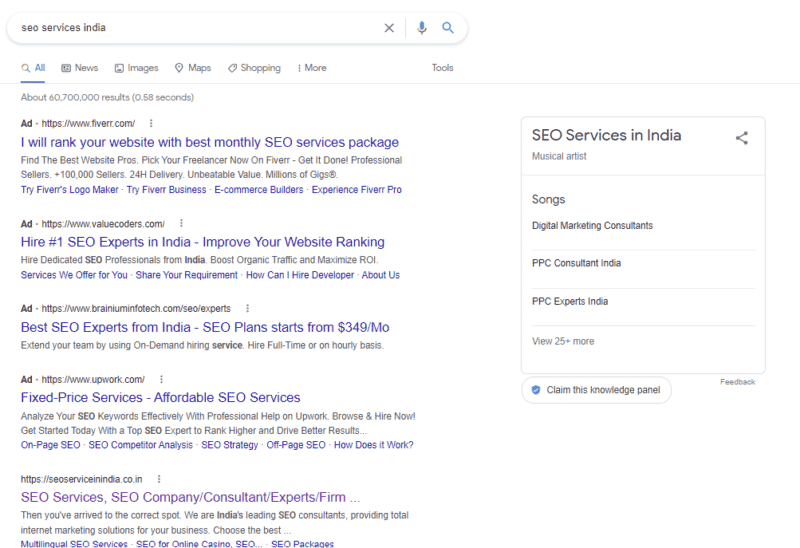
But other platforms that provide semi-structured data, such as Soundcloud, can also be used by Google to identify entities, as the hack for the keyword “SEO services India” has shown.
There it becomes clear that SoundCloud was used as the source for the entity detection. Websites such as SoundCloud or Wikipedia always present information in a consistent structure. This means that the information can be easily extracted from the websites without mark-ups.
How does Google create a knowledge panel?
The knowledge panels were first presented in the SERPs with the introduction of the Knowledge Graph in 2012.
In the Google patent Providing knowledge panels with search results, one finds the basic methodology and purpose of the knowledge panel. The purpose for users of a Search engine is described as follows.
“Knowledge panels can improve users’ search experiences, in particular for queries directed to learning, browsing, or discovery. For example, the knowledge panel supplies users with basic factual information or a summary of information about a particular entity referenced in a search query. Knowledge panels can assist users in navigating to relatedcontent in a seamless and natural way. Knowledge panels can supply new content that may not otherwise be encountered by a user without selecting several search results. Knowledge panels can also help users obtain information faster than they would if the users were required to click through multiple search results to obtain the information.”
Here is an excerpt from the patent on the methodology for delivering the knowledge panel:
“Methods, systems, and apparatus, including computer programs encoded on a computer storage medium, for providing knowledge panels with search results. In one aspect, a method includes obtaining search results that are responsive to a received query. A factual entity referenced by the query is identified. Content is identified for display in a knowledge panel for the factual entity. The content includes at least one content item obtained from a first resource and at least one second content item obtained from a second resource different than the first resource. Data is provided that causes the identified search results and the knowledge panel to be presented on a search results page. The knowledge panel presents the identified content in a knowledge panel area that is alongside at least a portion of the search results.”
The basic functionality when delivering a knowledge panel can be summarized in the following process steps:
Identification of one or more relevant entities in the search query
Identification of relevant sources for the main
Creation of relevant search results regarding the search query
Check whether the search query really refers to the actual main
entity Determination of an entity type for the main entity requested
Selection of a suitable knowledge panel template that matches the one determinedEntity Type
Identification of relevant content elements related to the main entity from a relevant and trusted source.
Determination of another content element from another source.
Filling of the placeholders in the selected knowledge panel template with the selected content elements.
Merging search results and knowledge panel on one search results page
I find it exciting to realize that each entity type is assigned its own knowledge panel template with corresponding placeholders.
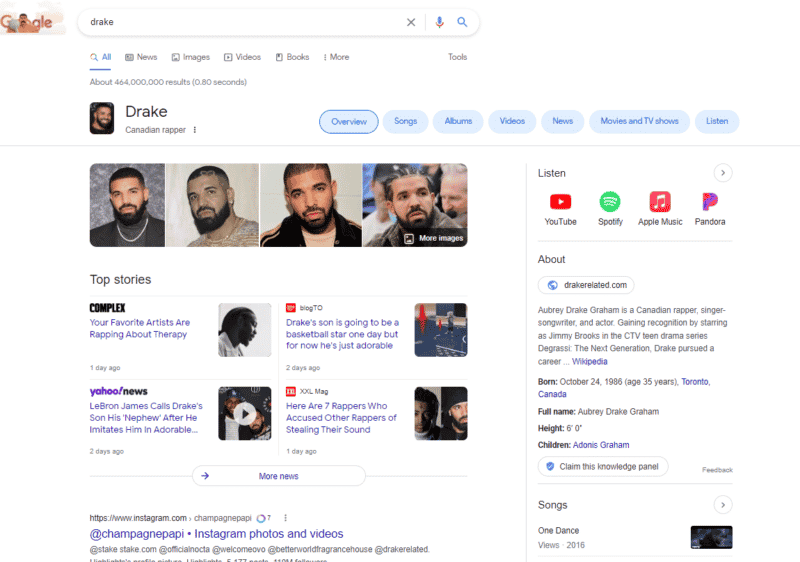
The entity type of the respective entity represented by a knowledge panel is always specified below the name of the entity. Depending on which standard attributes are assigned to the entity type and for which attributes the values are available, content is specified in the knowledge panel.
Example entity type “Canadian rapper” in musician Drake’s knowledge panel
How does Google generate images for the knowledge panel?
Regarding the question of which images are selected for the knowledge panel, I looked at some Google patents from the last few years.
This patent describes how Google could select representative images for entities of the type “person” for the corresponding knowledge panel.
The steps are as follows:
Access a selection of possible images
Cluster by similarity
Identify the most popular clusters
Determine whether the image is a portrait or not
Assigna portrait score
Select the most representative image
Display the image in the knowledge panel
The selection of possible images as well as the clustering of these into categories is determined depending on the proximity to the entity as well as the aspect ratio. It will be very likelythat machine learning methods are used. We get an idea of possible categories by looking at the image search.
Another exciting Google patent related to images and entities describes how Google Images could assemble the images for semantic pre-selection.
“A system and computer-implemented method for associating images with semantic entities and providing search results using the semantic entities. An image database contains one or more source images associated with one or more images labels. A computer may generate one or more documents containing the labels associated with each image. Analysis may be performed on the one or more documents to associate the source images with semantic entities. The semantic entities may be used to provide search results. In response to receiving a target image as a search query, the target image may be compared with the source images to identify similar images. The semantic entities associated with the similar images may be used to determine a semantic entity for the target image. The semantic entity for the target image may be used to provide search results in response to the search initiated by the target image.”
In this patent, images are labeled with attributes. through which the images can be assigned to specific entities. These attributes are initially identified via image recognition of an initial image. Additional attributes are added via attributes of similar images and similar entities, presumably of the same type. This is how the meaning of the picture emerges.
These patents describe some approaches to how Google could specify images for knowledge panels. In my opinion, the source of the image is also decisive, which image Google selects the most relevant image for an entity and thus uses in the knowledge panel.
Popular sources for people’s pictures seem to include Wikidata, Wikipedia, Wikimedia,social media profiles (e.g., LinkedIn, Twitter) and well-known magazines. To what extent the ranking in the image search correlates with the selection of the image(s) for the knowledge panel is unclear.
The influence of the Knowledge Graph is growing fast
The influence of SERP features is increasing every year and with it the influence of the Knowledge Graph on the search results. The classic blue links are losing more attention and thus relevance.
Entities are at the center of the Knowledge Graph and will have an increasing impact on the SERPs.
With regard to voice search, SERP features such as featured snippets and knowledge panels also play an important role.
The changes in the SERPs due to the MUM update can already be seen, as can the increasingly central role of entity-based searches.
Therefore, SEOs should no longer perceive this topic as a “nice-to-have.” The Knowledge Graph should be included in your SEO strategies.
Opinions expressed in this article are those of the guest author and not necessarily Search Engine Land. Staff authors are listed here.
New on Search Engine Land
About The Author
Olaf Kopp is an online marketing professional with over 15 years of experience in Google Ads, SEO and content marketing. He is the co-founder, chief business development officer and head of SEO at the German online marketing agency Aufgesang GmbH. Olaf Kopp is an author, podcaster and internationally recognized industry expert for semantic SEO, E-A-T, content marketing strategies, customer journey management and digital brand building. He is co-organizer of the PPC-Event SEAcamp and host of the podcasts OM Cafe and Content-Kompass (German language).
Core Web Vitals scores improving for top-ranked sites
Organizations have been investing resources into improving their Core Web Vitals scores, according to new research.
Enterprise SEO platform BrightEdge has compared the top rankings for 500 keywords, from this year to last, in four markets: education, B2B technology, finance and retail.
The three Core Web Vitals website performance metrics were a subset of the overall Page Experience Update. Those metrics are:
Largest Contentful Paint (LCP) – loading, target 2.5 seconds.
First Input Delay (FID) – interactivity, target 100 milliseconds. (Note: Google announced in May that it might replace FID with a new metric called INP – Interaction to Next Paint).
Page experiences are improving. Here’s the data from BrightEdge:
Source: BrightEdge
On average:
Retail scores improved by 58%. BrightEdge noted that retail giants have made significant strides in improving poor experiences – last year, top-ranked retail sites failed to meet Core Web Vitals metrics.
B2B tech scores improved by 30%. Publishers and resources from SaaS platforms have made good gains.
Education scores improved by 28%. More .gov sites are ranking and have good Core Web Vitals scores.
Finance scores improved by 27%. This sector was best prepared last year and perhaps due to that saw the least amount of performance gains.
Why we care.SEOs weren’t sold on Core Web Vitals. However, this research shows that companies have been taking Core Web Vitals seriously. It is impossible to point to Core Web Vitals as the sole reason for any ranking boosts or declines. But smart SEO requires driving incremental gains. And every possible positive signal you can give Google (such as good Core Web Vitals scores) is a potential way to positively influence your ranking and visibility.
New on Search Engine Land
About The Author
Danny Goodwin is Managing Editor of Search Engine Land & SMX. In addition to writing daily about SEO, PPC, and more for Search Engine Land, Goodwin also manages Search Engine Land’s roster of subject-matter experts. He also helps program our conference series, SMX – Search Marketing Expo. Prior to joining Search Engine Land, Goodwin was Executive Editor at Search Engine Journal, where he led editorial initiatives for the brand. He also was an editor at Search Engine Watch. He has spoken at many major search conferences and virtual events, and has been sourced for his expertise by a wide range of publications and podcasts.