Why SEO must start with strategy, planning

SEO is ongoing. It isn’t a one-time thing.

Achieving the results you desire requires disciplined thinking and focus.

If you dive into the weeds too quickly, you may find that hours or days have passed and you’ve invested time into areas that may not have any real impact in the end.

While agility is key on an ongoing basis in SEO, it is equally important to have a solid strategy and plan upfront.

A strategy and plan, with a clear direction and baseline, allows for:

  • Meaningful objectives to be set.
  • Expectations to be managed.
  • Adjustments to be made along the way.

Being both proactive and reactive (within a moment) is important, whether you’re working for yourself, your boss, or your clients.

Here’s why.

Goal setting

“What are your goals?”

This is the first question you should ask when someone reaches out for SEO help.

Define them. Document them.

Knowing what you need SEO to produce is critical. Goals are a critical filter for all strategic and tactical plans.

Goals could be:

  • E-commerce sales.
  • Leads.
  • Pageviews.
  • Specific types of engagement.
  • Some other conversion or metric.

When you don’t know what the end goals are – and how to reach them – you can waste a lot of time and resources guessing or floating from SEO tactic to tactic.

Defining target audiences

You need to define who you’re trying to reach and how they search and behave online.

Once you do that, you can map out conversion paths, funnels, and ways to target and engage them.

In addition to knowing who you want to reach, it’s also critical to know the size of the net that you’re casting.

Sometimes, goals can be too big for the opportunity that SEO presents. Reaching a certain audience could be too ambitious. Or perhaps the competition is simply too great to get meaningful results.

Keyword research tools, industry/market research and sources within your industry can help you research and define your target audience, as well as with persona development.

Competitor research

When you know who your audience is and what topics and keywords map out to your conversion goals, you have a narrowed competitor landscape to review.

Dive deep into who owns the SERP real estate for terms and topics that you want to drive traffic to your site.

Use SEO tools to identify, set up monitoring and an ongoing plan to track the competitors. This will give you a reference point and can help you understand why they are ranking.

KPI definition

Goals and KPIs are not the same. Yes, you might have a single KPI that is tied to an end goal, but you can measure several data points that may be close to, or far away from, a conversion goal.

Don’t jump into your action plan before you define the KPIs that matter based on your goals, target audience, and funnels.

While average position and impressions might not be close to the end goal of a lead submission or e-commerce transaction, they are necessary to get there.

Define all the KPIs that matter. Put emphasis and priority on the ones that will be indicators and progress metrics versus those that are tied directly to the end goals.

Be consistent with them and map them out in advance.

Baselines and benchmarks

Using what you know about audiences, competitors and the KPIs that matter to you, it’s important to understand your current performance.

You want to objectively measure the return on investment and outcome of your efforts over time.

Now is the time to capture baselines of your own performance and benchmarks of how they stack up against the industry. Plus, we can compare them to our ultimate goals and see how far we need to go.

This can range from visibility through rankings and average position to impressions to visits and conversions. There are engagement metrics that you can look at as well as to how visitors are moving through defined funnels.

To get this data, you can use SEO tools or Google Analytics’ benchmarking report.

Be sure to document benchmarks. These metrics will become your baseline and define your starting point so you can evaluate your efforts in meaningful intervals going forward.

Reporting setup

Now it’s time to set up your reporting infrastructure. Whether you’re configuring Google Analytics to be your data source, leveraging Google Data Studio, or third party software, you want to get everything in order now.

Don’t wait until you’re off and running. In many cases if you don’t have clean data, filters, and segments, you can’t fix the details later.

There’s nothing worse than over or under counting and not being able to go back and correct it once you’ve gotten deep into your work.

Also, configure your reporting to show the starting points and how you’re tracking toward goals. The reporting should help you tie back to your efforts and gain insights to adjust your strategy as you go.

Strategy development

By this point, you should be ready to do some final initial auditing and strategy work.

A quick technical audit will help you understand how much work is needed to get the technical house in order when you start planning out the work. It will also help you understand how big that effort will be in terms of IT, code and site performance.

At the same time, you’ll want to know what kind of effort and strategy is needed for content.

Doing a gap analysis, going back to audience and competitor research data, and factoring out how much effort is needed to match and exceed competitors will be critical while also delivering exactly what your audience wants.

Use the auditing and reviews to develop a strategy and overall assessment of needs that will go into your tactical plan.

Tactical plan and schedule

By this point, a big picture roadmap should have started to emerge. You’ve identified and defined your big needs.

But you can’t do it all at once. How quickly you can reach specific goals will depend on your resources and pacing.

Now you need to plan the work, measure it and control the resources in a prioritized way. Put together a phased schedule and plan. All the while knowing there will still be a lot of unknowns as you go through multiple tasks, such as:

  • Updating copy.
  • Optimizing on-page elements.
  • Digging deep into technical issues.
  • Going through rounds of link building. 

You must be proactive, not reactive. Drive an organized strategy and the needed tactics to achieve your plans.

Resource planning and roles definition

This step can happen earlier and/or throughout your planning process. Be careful not to get too deep into crafting the perfect strategy and plan without making sure you have the resources to pull it off. 

Resources include:

  • An SEO team.
  • IT.
  • UX.
  • Content creators.
  • Those that will be approving the work.

Your stakeholders are important, too. 

Additionally, any hard costs in terms of vendors and tools shouldn’t be overlooked. These all factor into ROI and as well as how much they can enable or slow your plan and efforts.

Avoid overestimating. Also, make the case for more resources if you think your plan can’t deliver on the goals with your current resources.

Now is the time to have these conversations – not months or years into an effort.

The big idea

I would argue with anyone that SEO is best approached as an ongoing discipline that has proper balance between planned activities and the necessary agility that comes with constant search engine changes and fluidity of the web.

Yes, plans are subject to change – maybe even right after they are written and launched. However, the absence of a strategy and plan leads to a reactive approach and one that lacks efficiency, focus and prioritization.

Start with a strategy and plan. And revisit it on a regular basis.

Take this approach for every new initiative or client. It will make life easier!


Opinions expressed in this article are those of the guest author and not necessarily Search Engine Land. Staff authors are listed here.


New on Search Engine Land

About The Author

Corey Morris is a skilled marketing professional with 15+ years of experience developing award-winning, ROI-generating digital strategies for local and national brands. He was recently honored as the recipient of the KCDMA 2019 Marketer of the Year award. Corey serves as the chief strategy officer at Voltage – a marketing firm based in Kansas City, MO. Previously, he founded the KC Search Marketing Conference to help build a local community for search marketers for career growth. He was recognized for his involvement in the conference and invited to join the global board of SEMPO (now part of DAA) as the VP of Cities.

https://searchengineland.com/seo-strategy-planning-385949


Virtual environment optimization (VEO) is coming. Ready for it?

Virtual reality (VR) and augmented reality (AR) will impact the future of marketing.

Optimizing for the future of virtual marketing demands a name, which I am calling virtual environment optimization (VEO).

Today, we’re already starting to see the building blocks – and optimization potential – for this new technological world with the metaverse.

What is Virtual Environment Optimization (VEO)?

VEO is the task of working within a virtual environment and utilizing the resources available to best position the clients’ products and services within an alternative reality.

In search engine optimization (SEO), the focus is mainly on utilizing content, its best practices, and a slew of strategies to drive the clients’ website to the top of the search results. With the numerous changes in technology, it became necessary for SEO to adapt to areas such as voice search, map search, mobile search and much more.

Considering that there is another technology shift on the horizon with VR and AR, marketing will once again need to consider how clients’ products and services should be marketed in the metaverse or any virtual environment.

By coining the term VEO, we can start strategizing how to shift gears towards a more virtual environment for buying and selling products.


Get the daily newsletter search marketers rely on.


Why you should consider virtual optimization (VEO) now

Statistics indicate how VR and AR has progressed (and will continue to progress) over the next several years.

Currently, in listing the industries where VR is the most useful, marketing and advertising are listed at the bottom, with only 16%. This indicates that there is plenty of room for growth and improvement.

According to Finances Online, the top workforce development benefits of VR are as follows:

  • Providing information in real-time.
  • Facilitating training and mirroring in real-life experiences.
  • Enhancing creativity in product design and development.
  • Enabling a remote workforce to collaborate in real-time.
  • Allowing users to live out someone else’s life experiences.
  • Capturing novel user data like behavior and eye and gesture tracking.

In just 2020 alone, the combined markets of AR and VR were worth approximately $12 billion. By 2024, it is projected to jump with a large annual growth rate of 54%, resulting in a valuation of $72.8 billion.

Virtual reality is projected to change the shopping environment for consumers

Retail is the sector that is projected to deliver the largest commercial investment in AR/VR technology in 2024, with $7.3 billion, according to the International Data Corporation (IDC).

According to pymnts.com, the home try-on effect will be eliminated by 25% from the benefit of virtual store implementation. As of now, the average e-commerce rate is 2%.

With the help of VR, consumers can be influenced by their purchasing decisions. So much so that for 2022, VR statistics show that VR adoption in e-commerce can boost online shopping conversions by 17%.

Regarding shopping online, 61% of consumers would rather shop with AR experiences, and 40% would likely spend more on customizable items through AR.

Virtual products

When looking at how trends may be leaning toward using VR and AR to boost the clients’ visibility, Google is a perfect example. Already Google has worked towards virtual products as early as 2013, with the creation of the Google Glasses.

More recently, they have developed the Google Lens, a vision-based computing capability that allows you to “search what you see.” Using your camera, Google Lens will compare the object in the picture to other images and rank them on similarity or relevance. For instance, if you use Google Lens on a product such as jeans or sneakers, Google Lens can provide more information on the product, including the results available to purchase the product.

Consumer trends and how they have changed

As a result of the COVID-19 pandemic, online shopping saw a massive increase and changed the way people shop.

The commerce platform Kibo surveyed both millennials and Gen Z about their shopping habits. Out of both age ranges, 28% have admitted that they plan to continue online shopping even after the pandemic, as they prefer it over shopping in a physical store.

Lisa Kalscheur, Kibo’s CMO, claims that their research proves that people have started to move towards digital channels:

  • “Retailers need to unify the customer experience online and off more than ever before. Consumer demand for convenience requires modern commerce and order management capabilities.”

Age is not necessarily a factor in the desire for online shopping.

For millennials, 53% of individuals between 25-34 would prefer to find out information about a store online rather than asking the in-store staff for help. The younger generation commonly referred to as “Gen Z,” is extremely focused on online shopping. Gen Z is sustainability-minded and wants to change and update its style constantly. This has led to more non-traditional shopping styles, such as renting clothes.

CEO of Rent the Runway, Jennifer Hyman, commented on the younger generation:

  • “Gen Z lives their life in the cloud—their content, entertainment and music all exist in the cloud with unlimited choice. We are offering them the exact same thing for their physical lives.”

Trends are shifting towards a world where we spend more time online and in VR than ever before. It’s only a matter of time before marketing and commerce penetrate this realm.

In some cases (Nike and Ikea), they have already ventured into this space.

We must consider these factors and prepare for the future ahead of time.

What might optimizing a virtual environment look like?

The Metaverse offers a great example of the future of VR and marketing.

Meta had already taken the initiative to help users monetize on products.

In Horizons World – the company’s social metaverse platform – it will start to test “in-world purchases,” allowing Horizon creators to sell virtual items to enhance the worlds they’ve created for users. In addition, Meta hopes to focus on ads in the future of Horizons Worlds.

Aside from Meta, we can look at real-world sectors for optimizing virtual environments:

Groceries

Online grocery shopping has taken off, especially since the COVID-19 pandemic. A survey from eMeals indicated that 34% of individuals use delivery services to buy groceries online. CEO Forrest Collier said:

  • “With 97% of respondents to our survey saying that they plan to continue using online grocery in the future despite order delays or cancellations, it’s likely that one of the lasting effects of this pandemic will be to accelerate the widespread adoption of online grocery.” 

As a hypothetical example of VR grocery shopping, imagine virtually entering a Kroger’s. By putting on the VR headset and opening Kroger’s app, you would be transported into a virtual supermarket.

This virtual supermarket would be larger than any real physical store in the area and with much more inventory. As the user navigates through the store, they would be able to interact with the products –such as examining the packaging and nutrition panel and finally adding them to their cart.

Three students from UCLA conducted a study on VR and grocery stores. They attempted to draw as close of a parallel as possible to a traditional, in-store experience. They’ve imaged the following features using VR, with each step bringing the user to a more detailed viewing and interactive ability:

  • General carousel view: All items would be categorized by columns and represented by a selection of groceries from that category, likened to one’s view when first entering the virtual store and viewing multiple aisles.
  • Detailed shelf view: As if the user had walked down a specific aisle in a physical store, now with the ability to view all of the items within it.
  • Product detail page – As if the item were to be selected for further inspection, this part would highlight the item-specific information which would appear on the product.
  • Sandbox – This mode would allow the ability to manipulate immersive 3D assets and retain the ability to add it to the person’s VR cart. For example, if someone wanted a watermelon halved or quartered. 

This then raises the question: how will marketers be able to compete for or determine who receives the “most visible” shelf space and placement of their product?

A virtual store equates to a much bigger inventory with more choices than ever before. The goal would be to ensure that the clients’ product gets more visibility rather than remaining “one in the crowd.”

Clothes and other product retailers

The future of VR and AR in clothing stores could result in each brand eventually creating its own unique virtual retail outlet.

In a virtual setting, consumers would be able to explore an incredibly large inventory, filtering based on style, season, brand, size, etc. There may even be a “virtual mirror” to utilize, similar to MTailor’s custom tailoring services using AR.

In terms of marketing, retailers moving towards the VR environment would mean figuring out how to compete for mannequins, maximum shelf visibility, placement of popular brands, popular items, etc.

Home goods

AR has already been implemented into the home goods sector. For example, an individual can use their phone to select items and test how they would appear in their home in real-time.

The benefit of VR marketing in a shopping environment is that groceries and all retailers will be able to save tremendous amounts of money by going virtual.

There will be the ability to cut down (or potentially even eliminate) the number of physical stores, necessary employees and all associated overhead.

In addition, there will be fewer brick-and-mortar stores, with large distribution centers for quick and easy delivery.

Virtual content will reign supreme

The phrase “content is king” has been used as a motivator for clients when planning content strategies for the creation of pages, blogs, videos, etc.

Now, as we start to enter a world of virtual reality, clients will have to shift to keep up with and produce virtual content where it is relevant.

Soon we will see Google begin indexing, crawling, and ranking web content based on the visual search results for AR-based content. As a result, SEOs will need to incorporate both augmented and virtual reality into their future content strategies.

Marketers will now need to devote more resources to visual content, such as infographics, videos and images. SEO-friendly content will make a client’s site more popular and help their visibility in the search results.

With augmented reality, customers would be able to go on a “virtual grocery store” shopping spree within a VR grocery retailer.

A virtual store is capable of housing more inventory than any brick-and-mortar location. It can be navigated and easily accessed by consumers.

Overall, enhancing your content with augmented reality and well-optimized content is a win-win for both the audience and search engines.

The benefit of AR is that both the brand and the customer provide content. This means consumers are more likely to participate in AR if they can add content in real-time.

As always, positive and engaging content is likely to have the greatest impact. As technology and trends continue to change over time, it is the responsibility of the marketing to shift their practices to stay up to date with the consumers’ needs.

VEO is coming. Will you be ready?


Opinions expressed in this article are those of the guest author and not necessarily Search Engine Land. Staff authors are listed here.


New on Search Engine Land

About The Author

Taylor Kurtz was born and raised in Tampa, Florida. Taylor then moved to Tallahassee to attend Florida State University, where he obtained his bachelor’s degree in sports management and his MBA. Taylor focuses exclusively on SEO and owns/operates Crush the Rankings, an award-winning digital marketing agency that focuses on high-quality Search Engine Optimization and website development. Taylor is also a Business Professor at the local community college in Fort Collins, CO and speaks around the country, discussing SEO at various digital marketing summits.

https://searchengineland.com/virtual-environment-optimization-veo-ready-385743


Googlebot will crawl and index the first 15MB of content per page

Google has updated its help document on Googlebot to specify that Googlebot will crawl up to the first 15MB of the page and then stop. So if you want to ensure that Google ranks your page appropriately, make sure Googlebot can crawl and index that part of the page within the first 15MB.

What is new. In the Googlebot help document, Google added this section that reads:

Googlebot can crawl the first 15MB of content in an HTML file or supported text-based file. After the first 15MB of the file, Googlebot stops crawling and only considers the first 15MB of content for indexing.

Why we care. In general, you probably want to keep your pages pretty light for both users and search engine crawlers. But here Google is being very clear about how much Googlebot will consume from your page.

A good way to test this is to use the URL Inspection tool in Google Search Console and see what parts of the page Google renders and sees within the debugging tool.


New on Search Engine Land

About The Author

Barry Schwartz a Contributing Editor to Search Engine Land and a member of the programming team for SMX events. He owns RustyBrick, a NY based web consulting firm. He also runs Search Engine Roundtable, a popular search blog on very advanced SEM topics. Barry can be followed on Twitter here.

https://searchengineland.com/googlebot-will-crawl-and-index-the-first-15mb-of-content-per-page-385995


Finding weird stuff (FWS) is part of SEO

I have a gift: an innate ability to find weird stuff in SEO.

As an SEO professional, this ability can be both a blessing and a curse.

A blessing, because I can typically figure out what makes one website rank above another. A curse, because I would spend many hours, including many late nights, studying search results and looking at stuff for so long that it led to what I called “brain aches.”

Never heard of FWS? That’s because it’s a new initialism, of my creation. Yes, you are witnessing SEO history right now.

Ready to FWS? Here are a few things you can do when approaching a new prospect or project.

FWS

In all of the years of running SEO initiatives and employing SEOs, I have found that there are many who have a talent in content strategy, Information architecture/taxonomy, or perhaps even deep technical analysis.

As much as we may try to create the perfect process documentation for SEO efforts, there will always be one-off issues. Challenges that you won’t find on checklists.

Sometimes, finding weird stuff may unlock the key to SEO success.


Get the daily newsletter search marketers rely on.


So let us account for time for FWS in our SEO scopes. We need a set amount of time for research and discovery, even a few hours each month, for a project.

Convincing a client to agree to “research” (pulling threads and following the trail) can be difficult.

So, assuming that you can convince the powers-that-be that FWS is necessary, what are some ways we might learn how to think differently and find those nuggets that might lead to SEO success?

The site: query  

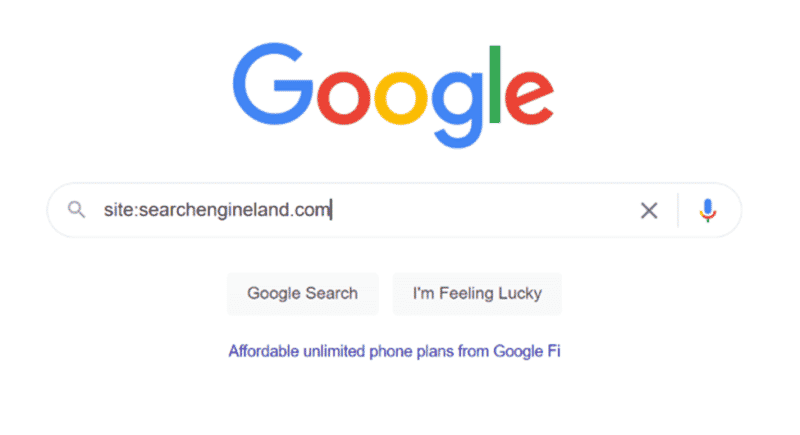
You can learn a lot about a website by performing this simple task. Type site: into Google, followed by whichever domain it is that you want to review.

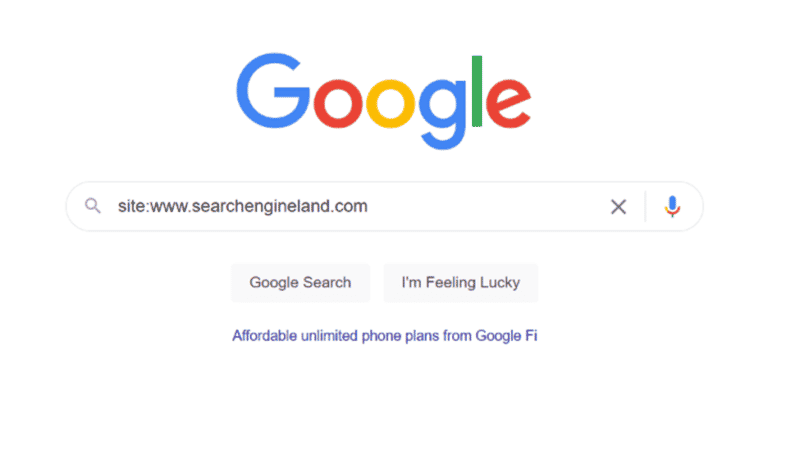
Then, repeat this exercise with the www version:

Now, in this case, Searchengineland.com resides on just that, no www. So, you would expect the “www” query to return zero results if everything is as it should be. And that is correct – zero results for www.

But I cannot count the number of times I have discovered unknown subdomains for companies. Sometimes even some great/old content was heavily linked to and was about to be washed away in the next redesign.

We now needed to think about how we might incorporate a refreshed version of that content and redirect those URLs so that we maintained the link value and perhaps even recaptured some search traffic (rankings) that existed years ago.

Another common occurrence is finding .pdf content that no one cared about.

When you’re reviewing your analytics to determine the performance of your SEO efforts, you are likely to be unaware of the amount of traffic coming to .pdf pages hosted on your website because they lack analytics tracking.

However, if you were to run a Semrush report and filter those results by .pdf, you may find that you are ranking for some pretty significant keywords and have no visibility into the traffic.

In many cases, you may find that by converting these .pdfs into HTML pages, you can accomplish a few things:

  • Analytics tracking for these ranked pages.
  • A more consistent user experience, with a fully built page, complete with site navigation, etc.
  • Ability to update these pages and optimize them; perhaps also link out from these pages to other relevant pages.

Review the history of a website

Too often, I’ve seen people jump into an SEO initiative and “optimize what’s there” rather than dig into a website’s history to see what used to be there.

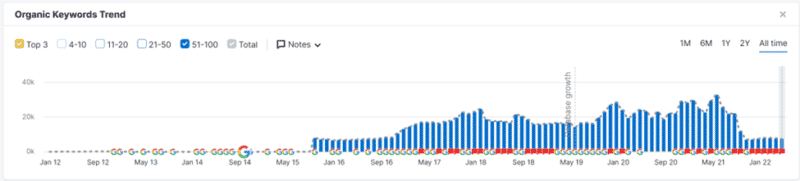
Case in point (real-world example) – I was recently approached by a prospect who had lost a significant amount of their organic search traffic over the past year. A routine that I’ve always followed is to generate an Organic Research report via Semrush, filter to remove brand keywords and look at the All-Time trends.

You can see quite easily the significant dip.

The next step is copying this report, pasting it into a separate tab, and start comparing URLs.

In this case, the prospect had gone through a redesign. Rather than recreating the successful pages, they (under the guidance of a “SEO consultant”) decided to turn those pages into a section of a page (ie: category#page-name.html).

By using the Wayback Machine (archive.org), I was able to see exactly what these pages looked like previously and illustrate to the prospect – in very plain terms – why it is that things fell off a cliff.

Google search the brand

Another tactic I use to FWS is to search a company’s name and click through some of the results.

Several times when doing this, I have found official company domains that I didn’t recognize. In other words, the company had changed domains for their company and just parked the old domain.

For those interested in link building, this could be a quick fix. This is why my agency has a standard domain portfolio analysis procedure. We want to know every domain that our client owns so that we might understand how (or if) these domains are being used.

With this domain research, you may also learn about their affiliations with other companies.

Did a company purchase them in the past? Did they purchase companies in the past?

Drill down on this and you may find opportunities beyond the specific project you’re working on.

Perhaps other companies within their “network” require SEO assistance, too? Maybe they should be consolidating domains/websites to form a powerhouse of a website rather than two (or more) weaker websites?

Other places to FWS

  • Check robots.txt and XML sitemaps. You’ll often find pages that shouldn’t be on the site or publicly available.
  • Crawl the site and compare it to the sitemaps. You’ll often find orphaned pages or important pages that have fewer internal links than they deserve
  • Google Search Console – signs of unknown content appearing on the site in the Coverage > Indexed, not submitted in sitemap report.
  • Google Search Console > Settings > Crawl Stats – signs of previous hacks and unknown content.
  • Reading through Page Speed Insights and looking at the source code – you’ll sometimes find things like JS, CSS, or images being served multiple times or tracking pixels that are no longer in use.
  • Link profile – it can uncover link networks or bad link strategies such as random blog commenting or efforts of the previous agency, where they may have exploited WordPress vulnerabilities to create links.
  • DNS – if you can get a list of their DNS zone files, you’ll often find references to sub-brands, prior acquisitions, micro sites, or other marketing and product initiatives.

Set aside some scheduled time to find weird stuff

I believe that good SEO goes beyond knowing how to use the tools of the trade well, conducting keyword research, competitive analysis and the like.

Being inquisitive is an important aspect of SEO.

We need time to think about, consider and find weird “stuff.”

It can often be that there are valuable finds if we allow ourselves the time to think creatively.


Opinions expressed in this article are those of the guest author and not necessarily Search Engine Land. Staff authors are listed here.


New on Search Engine Land

About The Author

Mark Jackson is the President and CEO of Vizion Interactive, an agency founded in Dallas, Texas in 2005 and specializing in SEO Services, Paid Media Services (Search/Display/Social/Video/Amazon), Local Listing Management and Conversion Rate Optimization. Mark was a co-founder of the Dallas-Fort Worth Search Engine Marketing Association and Kansas City Search Engine Marketing Association and has been a contributor to Search Engine Watch, ClickZ, Pubcon and the Search Engine Strategies conferences.

https://searchengineland.com/finding-weird-stuff-fws-is-part-of-seo-385901


Google cuts back on SEO office hours format, frequency

In late April, John Mueller of Google announced a change in the format of the Google SEO office hours segment.

Historically, Mueller would answer Google search and SEO questions from site owners, webmasters, SEOs and others live to help these people through some challenging SEO-related help.

Now, Mueller is asking you to submit questions beforehand and he will record answers to them and publish them later on.

What changed. Here is a list of the larger changes to this SEO office hours format.

  1. No live audience for the recorded section of when Mueller answers SEO questions.
  2. Only some pre-submitted questions will be answered.
  3. Recordings will be posted after, it does not appear to be live to watch in real-time anymore.
  4. 30-minute segments instead of one-hour segments.
  5. Only one office hours per month, as opposed to four per month.

Why the change. Mueller explained these changes in this video from April 29. He said the changes are because it makes it easier for us to digest shorter videos and it also helps him and Googlers “kind of prepare for these sessions” to the answers are more on point. He later added on Twitter that going from four per month to one per month is because “they’re always quite time-intensive for me, so I need to find a workable balance.”

Why we care. Many SEOs called the SEO office hours a lifeline for their SEO-related questions or concerns. Being able to ask a Googler directly about an SEO question, or get advanced technical SEO advice on a decision they need to make about their site, has been a true blessing for many SEOs. Being able to reference advice from Google representatives is also useful in making a case to one’s boss about investment in SEO.

I know many SEOs who timestamp every word said in those hangouts, who use these talking points in making better decisions and who use these SEO office hours as backup for meetings with clients or their supervisors.

Time will tell how these SEO office hours change over time, how useful they remain to be and if this format will adapt again in the near future. But the overall SEO office hours format has not changed much over 10-plus years, outside of the platform used.


New on Search Engine Land

About The Author

Barry Schwartz a Contributing Editor to Search Engine Land and a member of the programming team for SMX events. He owns RustyBrick, a NY based web consulting firm. He also runs Search Engine Roundtable, a popular search blog on very advanced SEM topics. Barry can be followed on Twitter here.

https://searchengineland.com/google-cuts-back-seo-office-hours-format-frequency-385916


Google updated guidelines for product variants pages and rich results

Google updated the product rich results support page to add details around how these rich results can be used for product variants where each product variant has a distinct URL.

For example, if you have a product page that has a shirt in blue, green, red and yellow, that page may not be eligible to show rich results for product-rich results unless you have a specific landing page for each product variant.

What changed. Google simply clarified how rich results on product variants work by adding this single line: “This includes product variants where each product variant has a distinct URL.”

Before it said:

“Use markup for a specific product, not a category or list of products. For example, ‘shoes in our shop’ is not a specific product. Currently, product-rich results only support pages that focus on a single product. We recommend focusing on adding markup to product pages instead of pages that list products or a category of products.”

Now it says:

“Use markup for a specific product, not a category or list of products. For example, ‘shoes in our shop’ is not a specific product. Currently, product rich results only support pages that focus on a single product. This includes product variants where each product variant has a distinct URL. We recommend focusing on adding markup to product pages instead of pages that list products or a category of products.”

Page may be ineligible. The line links to this section in the help documents that say “A common consideration on e-commerce sites is how to structure URLs when a product is available in multiple sizes or colors. Each combination of product attributes is referred to as a product variant. Google supports a wide range of URL structures for product variants.”

If you choose to include multiple product variants on a single page (meaning, the variants share the same URL), be aware of the following limitations:

  • The page may be ineligible for Product rich results in search results because the experience is only supported for pages holding a single product (and product variants may be treated as distinct products by Google Search).
  • Experiences such as Google Shopping cannot take a user to a specific variant of a product on your site, leading to the user needing to select the variant they wish to purchase on your site before checkout. This can lead to a poor user experience if the shopper already selected the variant they wanted in Google Shopping.

If you choose to use a distinct URL per variant, Google recommends using either:

  • A path segment, such as /t-shirt/green
  • A query parameter, such as /t-shirt?color=green

Help Google understand with canonical tags. Google said on that document, to help Google understand which variant is best to show in Search, choose one of the product variant URLs as the canonical URL for the product. If you use optional query parameters to identify variants, use the URL with the query parameter omitted as the canonical URL. This can help Google better understand the relationship between product variants. For example, if the default value of the color query parameter for a T-shirt is blue, then:

  • Use /t-shirt as the canonical URL for all T-shirt variants
  • For a blue shirt, use /t-shirt (and not /t-shirt?color=blue)
  • For a green shirt, use /t-shirt?color=green

Why we care. Again, this is not exactly new but it has been clarified on the product-rich results help document. Use the advice above to help ensure your product variant pages are eligible to show product-rich results in Google Search.


New on Search Engine Land

About The Author

Barry Schwartz a Contributing Editor to Search Engine Land and a member of the programming team for SMX events. He owns RustyBrick, a NY based web consulting firm. He also runs Search Engine Roundtable, a popular search blog on very advanced SEM topics. Barry can be followed on Twitter here.

https://searchengineland.com/google-updated-guidelines-for-product-variants-pages-and-rich-results-385905


How to measure the value of SEO with CTR

“I see clients, again and again, having to evaluate the value of making this [SEO] change over that change at the ticket level,” said Jessica Bowman, enterprise SEO consultant and author of Executive SEO Playbook, in her presentation at SMX Advanced.

While all SEO tasks are important for the success of your site, there’s a key distinction that should be drawn: those that have the potential to increase revenue, and those that are designed to prevent revenue decreases. SEOs who fail to differentiate these types of tasks often find themselves burnt out and unable to show how their work impacts the bottom line.

“What usually happens is SEO managers fall into this whirlpool of trying to build a positive revenue case for all of the tickets they have,” said Avinash Conda, director of organic growth at Williams Sonoma Inc., in the same presentation. “But that’s not something you need to be applying to all of the tickets.”

Marketers need to prioritize those tickets/tasks that will prove the most SEO value. But they must also choose which metrics should be reported.

According to Bowman and Conda, detailing click-through-rate (CTR) metrics for your brand’s target keywords is a simple yet effective way to prove your SEO efforts are worthwhile.


Get the daily newsletter search marketers rely on.


Data needed to measure SEO’s effect on CTR

To set up the template SEO impact on CTR, Conda suggested marketers first collect a list of specific URLs.

“This could be a subsection of the site, a folder on the site, or just a list of URLs which are impacting,” he said. “The second [step] is to get the list of keywords mapped to these URLs.”

This basic information will serve as the foundation for the formulas on the spreadsheet (see the template below).

spreadsheet showing CTR's impact on keyword and URL rankings
Source: Jessica Bowman and Avinash Conda

To ensure your team gets the CTR metrics it needs, SEOs should also consider adding the following data from Google Search Console (past 12 months) for the URL/keyword combinations:

  • Total impressions.
  • Average rank.
  • Total clicks.
  • Current CTR.

Once this data is added to the template, the formulas will help you calculate the increases in CTR and forecast fiscal-year growth from search. However, there are a few additional manual inputs marketers will need to include to ensure it functions correctly:

  • The list of URLs the SEO task will impact.
  • The list of keyword(s) each URL is targeting.
  • Assumed CTR increases based on high- and low-ranking keywords.
  • The average revenue per visit.

Using the CTR template

Marketers can use a template like this to calculate assumed CTR, clicks and revenue increases. This is a great way to connect URLs/keywords to your organization’s bottom line, helping teams better predict the impact of these efforts.

spreadsheet showing assumed CTR and revenue increases
Source: Jessica Bowman and Avinash Conda

However, as most search marketers probably know, not every aspect of SEO value can be measured in such a clear-cut fashion.

“There are a few tasks which cannot be quantified on a traffic level,” Conda said. “Site speed [tasks] are a good example … We know they are going to have a positive impact on traffic because site speed is a big ranking factor, but I don’t think we’re there yet in terms of coming up with [quantifiable] methodologies.”

Trying to forecast traffic using CTR in such a scenario might not be the most effective plan. In these cases, Conda recommends estimating SEO gains with conversion rates.

For instance, a Portent study found sites with 1-second load times had a conversion rate that was three times higher than sites that loaded in five seconds. Tying less quantifiable SEO tasks to important metrics like this can go a long way in proving their value.

Still, CTR is a solid metric SEOs can use to show the value of their work, especially if the data is made accessible using templates like Conda and Bowman’s.

“This model is a straightforward way to see the updates we are making, which we know for a fact will have a direct impact on rankings,” Conda said.

Watch Jessica Bowman and Avinash Conda’s full SMX Advanced presentation

Not registered for SMX Advanced? Get your free pass here.

Already registered for SMX Advanced? Log in here.


New on Search Engine Land

About The Author

Corey Patterson is an Editor for MarTech and Search Engine Land. With a background in SEO, content marketing, and journalism, he covers SEO and PPC industry news to help marketers improve their campaigns.

https://searchengineland.com/measure-seo-value-with-ctr-385836


How to improve E-A-T with semantic search

“E-A-T – expertise, authoritativeness, and trustworthiness – has become a buzzword,” said Dr. Marie Haynes, CEO of Marie Haynes Consulting Inc., in her presentation at SMX Advanced. “E-A-T is Google’s attempt to figure out which businesses and individuals are authentic.”

Despite working in search marketing for many years, Haynes noted she only recently thought about the ways semantic search – information retrieval in which both the contextual meaning and the intent of a query are taken into consideration – could improve a site’s E-A-T. Her time spent digging into the Quality Raters’ Guidelines (QRG) helped make this connection.

Contrary to what some believe, E-A-T is not a single ranking factor, but rather a collection of signals Google uses to determine what content is high-quality and useful for searchers. And, according to Haynes, semantic search knowledge can help marketers optimize sites for this rating system.

“A lot of the things we’ve been saying Google can do can be explained with semantic search capabilities,” she said. “Semantic [search] relies on understanding the meaning of words, and we’ve seen how proud Google has been in their advancements in understanding language.”

Semantic search and its relation to E-A-T

Google’s Hummingbird algorithm, which rolled out in 2013, was designed to revamp the way the search engine understands and ranks content. With an improved understanding of intent at its core, the update helped Google better evaluate the authoritativeness of sites through semantic search.

“Hummingbird was a change to Google’s engine, and when it happened, few SEOs knew about it,” Haynes said. “It gave Google’s algorithms the capacity to incorporate semantic search.”

Source: Dr. Marie Haynes

Before Hummingbird was implemented, Google was largely a lexical search engine, dependent on keywords. These search engines primarily focus on retrieving documents that contain these keywords, using PageRank to establish a hierarchy along the way. And while these mechanisms are still in play, the addition of semantic search has changed the game.

“You can have lexical search and you can have semantic search together,” Haynes said. “We don’t know exactly how Google is using the combination of these, but we know that back in 2013 when Hummingbird came out, they started to have the capability of doing it well.”

SEOs would be wise to study the changes Hummingbird ushered in, especially when it comes to the search engine’s understanding of language.


Get the daily newsletter search marketers rely on.


Using semantic search and knowledge retrieval to improve E-A-T

Semantic search’s knowledge retrieval capabilities can help marketers improve the E-A-T of their content. According to Haynes, this is due to Google’s Knowledge Graph.

“Knowledge search gathers information from a richly structured database,” she said. “The best example we have of this is Google’s Knowledge Graph.”

Source: Dr. Marie Haynes

The Knowledge Graph helps marketers understand the relationship between entities. By optimizing sites according to entities and their relationships (rather than focusing solely on one keyword and its variants) SEOs can make it easier for Google to relate your content to established entities in its Knowledge Graph.

“I’ve been fascinated by the way Google can use entities in its Knowledge Graph,” Haynes said. “We’ve been making recommendations based on what’s written in the QRG – trusting that somehow Google could algorithmically accomplish these things. What we were really doing was improving E-A-T based on a knowledge of semantic search.”

“When you’re improving Google’s understanding of the entities associated with your business, that’s improving your E-A-T,” she added.

Watch Marie Haynes’ full SMX Advanced presentation

Not registered for SMX Advanced? Get your free pass here.

Already registered for SMX Advanced? Log in here.


New on Search Engine Land

About The Author

Corey Patterson is an Editor for MarTech and Search Engine Land. With a background in SEO, content marketing, and journalism, he covers SEO and PPC industry news to help marketers improve their campaigns.

https://searchengineland.com/improve-e-a-t-semantic-search-smx-advanced-385792


How to train entry-level SEO hires so they can contribute right away

Entry-level in the SEO world can mean many things.

It may mean that candidates have little to no experience.

Or it may require a handful of SEO work years under their belt. 

The majority of SEO jobs (64%) don’t require a college degree, according to Backlinko’s SEO Jobs Report. But most require two to five years of experience.

Many SEO agencies lean heavily on entry-level or newbie SEOs. That’s because it’s more cost-effective.

This business model can work but it typically will require intensive training.

You must always protect the quality of your work and keep clients happy.

You don’t want to run into a situation where your junior SEO is giving guidance that is not on par with the SEO experience of even your client base.

Assuming you’ve already qualified your hires through some critical SEO interview questions (modified for an entry-level candidate), and assuming that your candidates have the soft skills required to be successful at SEO, here are some ways to get your new SEO hires up to speed and contributing.


Get the daily newsletter search marketers rely on.


Make sure new SEO hires are up-to-date with industry best practices 

Right off the bat, you want to make sure they understand SEO best practices and concepts. If they have little experience with SEO, that means getting them trained in key areas.

Different types of SEO learning resources accomplish different things. For example: 

  • SEO training courses can offer a broad overview of SEO as a whole or key areas of SEO (for example, technical SEO, on-page optimization, writing content for SEO, etc.). While a general intro video is a good place to start, your trainees will benefit from a structured course. When it’s from a trusted resource, this is a great way to get entry-level folks up to speed on important concepts.
  • In-depth articles and e-books can give a unique perspective on an SEO issue or topic in a short amount of time. There is no shortage of SEO experts who contribute thought leadership either on their own websites or on third-party industry sites.
  • SEO industry news sites are essential daily reading for anyone working in our industry, no matter your level. They can help your entry-level SEOs get familiar with what’s happening now with Google and search marketing in general. SEO is a fast-moving industry with lots of changes, so encouraging your staff to spend time reading these websites as part of their continuing education is critical.
  • SEO events can offer an intensive deep dive into SEO. These multi-day events (either online or in-person) contribute to any SEO’s education, especially if they’re a newbie.

Beware of just sending your newly hired junior SEO into the wild to find their own educational resources. Provide a list of trusted sources they can learn from. But encourage them to come to you with opportunities they are interested in as well. 

Most importantly: Give them a training budget. Investing in them is an investment in your SEO agency.

Make sure new SEO hires are trained on your SEO methodology

Some new SEO hires may bring unique skills to the table, and you do not want to inhibit them from doing so. 

But make sure they have a framework with which to work. Being armed with industry best practices starts your SEO new hire off on the right foot.

Beyond that, most agencies have a way of doing things. Training on your agency’s procedures and preferences is a matter of making sure you have those practices documented so that your new hires can get up to speed right away.

This also includes the ways that your agency manages projects (this is almost as important as the work itself).

Create a checks and balances system

Letting any new hire’s work go unchecked could lead to issues for your brand’s reputation and your business’s bottom line.

To protect your clients and your brand, make sure that more senior staff are included in any projects the new hire is working on for a period of time. A senior SEO working alongside the entry-level SEO can ensure that the work is sound.

This also allows the senior staff to mentor new hires as they collaborate on a project.

There is no better SEO training than hands-on experience, and this mentorship will offer education on both the way you do SEO and how to handle clients.


Opinions expressed in this article are those of the guest author and not necessarily Search Engine Land. Staff authors are listed here.


New on Search Engine Land

About The Author

Bruce Clay is the founder and president of Bruce Clay Inc., a global digital marketing optimization firm providing search engine optimization, PPC management, paid social media marketing, SEO-friendly site architecture, content development, and SEO tools and education.
Clay authored the book “Search Engine Optimization All-In-One For Dummies,” now in its fourth edition, and “Content Marketing Strategies for Professionals.” He wrote the first webpage-analysis tool, created the Search Engine Relationship Chart® and is credited with being the first to use the term search engine optimization. Bruce Clay’s renowned SEO training course is available online at SEOtraining.com.

https://searchengineland.com/train-entry-level-seo-hires-385859


Google testing new featured snippet layouts

Google has recently been testing new formats, layouts and interfaces for its featured snippet slot in the search results. Generally, Google shows a single source for a featured snippet but since 2018 Google has occasionally shown multifaceted featured snippets for some queries.

Many featured snippets. Google is testing showing many featured snippets, more than one, more than two – but up to four different featured snippets. Here are some tests spotted by William Alvarez on Twitter and Brodie Clark on Twitter – showing this in action.

Card Style Google Featured Snippets
Block and list view Google Featured Snippets

Why we care. Generally, Google will show a single site or source for a featured snippet. But when Google begins to show two or more sources in the featured snippet position – the “position zero” location – that can change how valuable that position is for site owners and SEOs.

These interface tests are worth keeping an eye on because the featured snippet position is one that is generally sought after to achieve by most SEOs and site owners. Changing the design, showing more than one featured snippet, can all impact your click through rate on that position and ultimately your traffic and conversions driven from Google Search.


New on Search Engine Land

About The Author

Barry Schwartz a Contributing Editor to Search Engine Land and a member of the programming team for SMX events. He owns RustyBrick, a NY based web consulting firm. He also runs Search Engine Roundtable, a popular search blog on very advanced SEM topics. Barry can be followed on Twitter here.

https://searchengineland.com/google-testing-new-featured-snippet-layouts-385861