Why entity search is your competitive advantage

Entity search has become a competitive advantage for businesses and brands.

With Google opening its topics API and releasing the most comprehensive deep learning algorithms, such as PaLM, LaMDA2 and MUM, it’s critical to understand the semantic web and how to create and operationalize entity SEO.

This article will start our exploration of the what, why and how of leveraging entity search. (There is much more to come in my future Search Engine Land articles.)    

What is entity search and why is it critical?

Before diving deeper into entity SEO or semantic SEO, let’s start with what problems search engines are trying to solve and how entities help solve these problems.

Simply put, search engines are trying to provide the best and most comprehensive answers to every search query across all devices. 
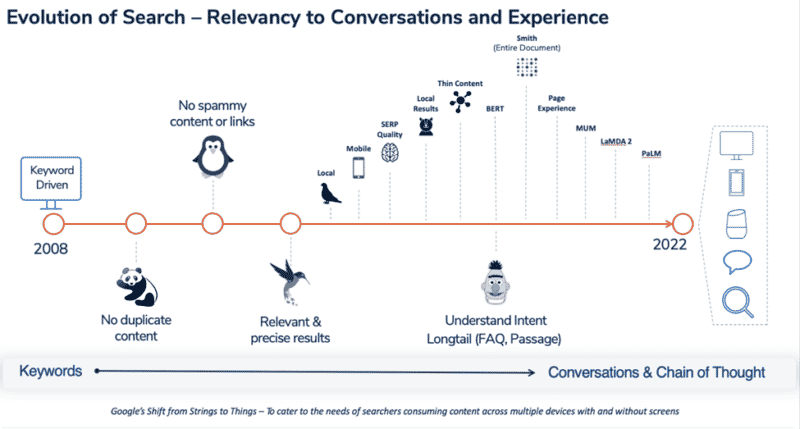
Search evolution from keywords to entities

However, the way we search has evolved.

A few years back, searching meant typing keywords into a search engine. Today, 40-50% of searches are conversational from various devices, such as smartphones, Google Home, Alexa, etc. 

A major challenge for search engines is understanding the context and intent behind the user query. Search algorithms that previously matched content with keywords are inadequate to process and understand queries that are often sentences and paragraphs and match them with the most relevant result.

A search engine can only cater to this changing search behavior by understanding relationships between words without ambiguity.

An entity could be a person’s name, place, object, event, concept or numerical expression that a search engine can understand without ambiguity, regardless of language.

For example, let’s look at a query like, “what is the cheapest price for a hotel in the San Francisco Bay Area?”

How many ways can that question be asked? How would it appear in different languages? How can search engines understand that all those permutations and combinations of queries mean the same thing? 

In the example above, search engines can understand the highlighted text:

  • What: a concept – a question qualifier
  • Cheapest: numerical expression – lowest cost
  • Price: numerical expression
  • Hotel: organization
  • San Francisco: location
  • Bay Area: location

By connecting these entities, search engines can understand both the query and the intent behind the query.

Once the query and the intent are understood, search engines try and find relevant information around “entities” in the query.

Search engines use various sources – the Knowledge Graph, citations, Wikipedia, reviews and various digital content – to provide the most accurate results.

The process of retrieving information by scanning all structured and unstructured content and using AI to provide the most relevant results is called entity/semantic search. 

Traditional SEO versus semantic SEO – the difference

In traditional SEO, pages are ranked based on information retrieval scores using relevance, authority, and backlinks from other popular sites. 

Semantic SEO focuses more on providing the most comprehensive information for user queries using entities, facts associated with those entities, associated attributes, and questions related to that fact.

With entity SEO, the focus is on making it easy for searchers to get the answers they want and the brands that provide the most comprehensive topical information satisfying searcher query intent.  

How does entity optimization work?
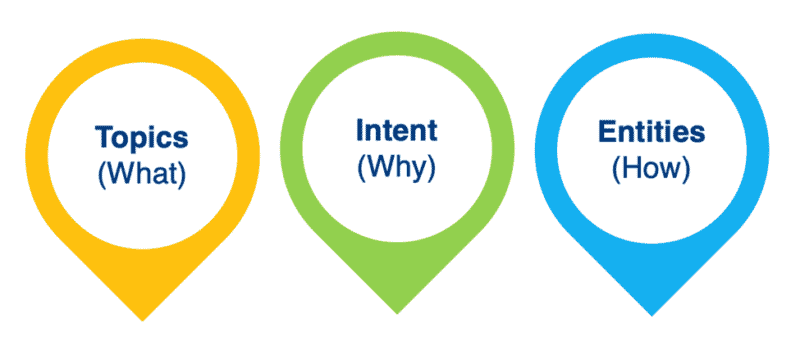
Entity optimization brings together three concepts to provide the most holistic results

Simply put, entity optimization brings three concepts together:

  • What: the central topic of the query and what the searcher expects in the content when they search for that topic. It does sound similar to keywords, right? If you recall the example above, how many different ways can a question be asked in different languages and with cultural nuances? All those different queries are distinct keywords, but they are just one topic since they mean the same thing. Ensuring your content is the most comprehensive source of information on the topic by covering as many related topics as relevant to the searcher helps close topical gaps and address your audience’s needs.
  • Why: The intent behind the query. Are they seeking information? Are they considering and evaluating options? Are they looking to navigate or seeking directions? Are they looking to transact and make a decision? Ideally, your content should cater to every need of your audience across their buying journey. Using a combination of what and why will help you identify all the possible entities relevant to your business. You can then create a content strategy around those topics and inter-connect them, building relationships between these entities.
  • How: How your content is delivered is just as important. If your audience expects a video and you deliver text, it may not have the desired impact. Video, images, headings, bulleted and numbered lists, hours of operation, question and answer, recipe and calories (if you are a food business), the list goes on. These are various entities that we put together to create the most holistic semantic SEO strategy. Therefore, page/content layout becomes a critical part of a semantic search strategy.

These content elements can be marked up with structured data to help search engines understand the context and relationships between the content elements and the entities in your content.


Get the daily newsletter search marketers rely on.


Why semantic SEO/entity SEO gives you a competitive advantage

Clearly, semantic SEO is critical for businesses. Here’s why to adopt this strategy.  

Search algorithms favor semantic search

SEOs in the past focused on link building and utilizing keywords to help search engines find the information. Search algorithms have surpassed keywords and determine the context and intent behind queries by understanding relationships between entities.

Optimizing keywords will help to some extent. Still, the most sustainable way to succeed is to optimize entities in your content and adopt an entity-first or semantic approach to SEO.

  • Entities help provide the most comprehensive topical information and relevant SERPs. When page structure is optimized for entities/topics, the page’s focus is to provide the most comprehensive information about the topic, including text, FAQ images, videos, bulleted lists and everything else that entity/topic is associated with. SERP results referencing these topical pages are most relevant across all types of searches, including voice, web, images, video, etc. 
  • More areas to rank in SERPS: Google Discovery and Google Trends also appear in results based on entities. Google Discovery helps build layers of relevant entities.
  • Optimizing content around semantic search or entities often yields more longer-term growth: Chasing keywords may give growth momentarily, but you must revisit and revise the content to keep the results.
  • Higher impressions, engagement and traffic value: Content optimized for semantic search leads to higher impressions, more engagement, more rich results and much better-quality traffic.
  • SERPs with rich results also provide traffic that engages downstream and converts better: This is because the media type is directly relevant, and they bring the users closer to their desired answer.

Position zero

Marketers sometimes worry that providing rich results, like in the Quick Answer/Featured Snippet listing, People Also Ask or a How-to, gives the user the information in the SERP without them clicking on the listing and driving visitors to the website.

While this is true, the benefits of appearing high up in the SERP outweigh the perceived detriment of users who do not click.

This is especially true when the listing would otherwise have been below the fold lower down on the search results page.

Entity optimization can also guide you when optimizing the content and rich results to maximize CTR from the SERP.

Milestone Inc. research on rich media frequencies in SERPs across over 500 websites
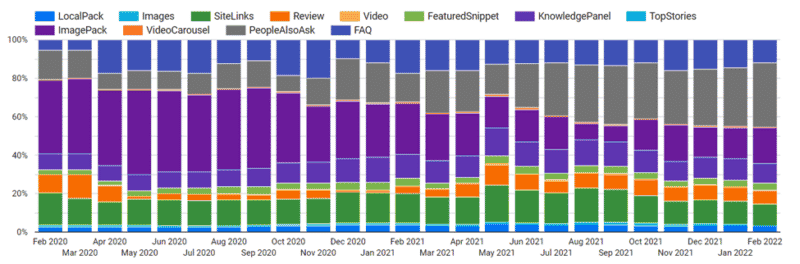
Milestone Click Curve Research showing saturation of SERPs after optimizing for semantic search

Milestone’s click curve research shows that appearing in rich results listings leads to higher engagement. On average, rich result listings get 41% higher engagement in terms of clicks than standard text SERPs without rich results.

Which entities should you focus on? 

The easy answer is any entity that relates to the content of your business, with two categories being the most important. 

The first is any entity that can help reduce ambiguity, such as business type, location, product details, and contact elements. To identify the right entities related to your business, you should review the schema.org classification for your business.
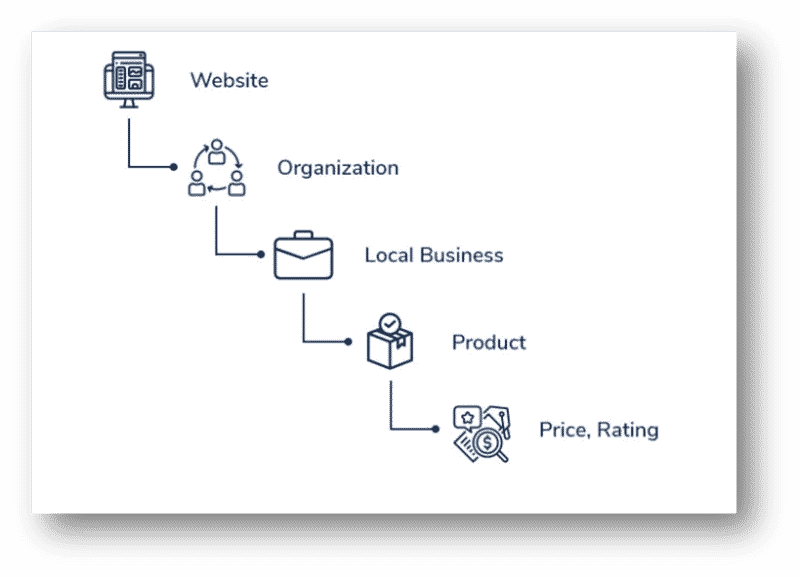
Entities and schema classifications for any business recognized by Schema.org

The second category is those elements where Google provides insights and demonstrates the structure of the business in the Search Console under Enhancements and Search Appearance.

Your website should have all these entities where relevant to ensure the topic/structure of the website is well understood.
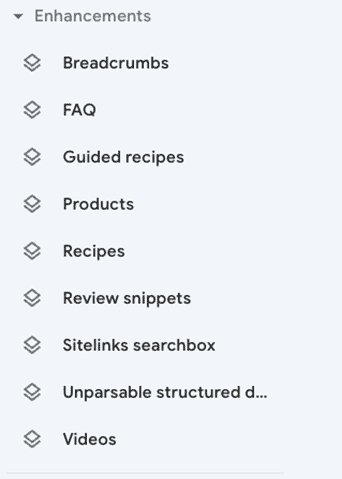
Enhancements from Google Search Console

Why understanding what is recognized and classified by Google and Schema.org is critical

Establishing a comprehensive understanding of what is recognized by Google and schema.org will help you come up with the right site and page structure.

Every business may not have a recipe; however, videos, FAQs, sitelinks and breadcrumb navigation are key elements that should be part of the content strategy for the website. 

This shows the benefit of a well-structured page in SERP appearances and search impressions:
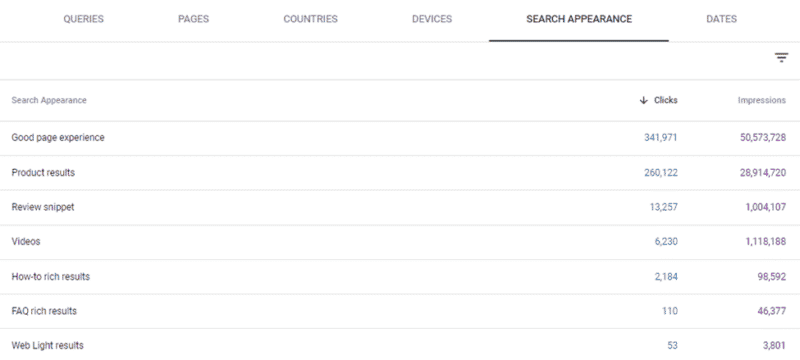
Various rich media search appearance clicks and impressions

Entity-first SEO

Entity SEO is more topical and contextual and often includes rich media to help you position your content as the best answer for any query.

Adopting an entity-first approach can:

  • Give your brand a competitive advantage in search.
  • Future proof your content and digital asset creation strategy.
  • Give your brand a competitive edge.

Opinions expressed in this article are those of the guest author and not necessarily Search Engine Land. Staff authors are listed here.


New on Search Engine Land

About The Author

Benu Aggarwal, founder and president of Milestone Inc., is a highly recognized expert in digital marketing solutions, voice search, SEO and local. Benu oversees product development, client services, technology and strategic vision for the company. Under her leadership, the company has prospered as it launched a suite of SEO-first software products and thousands of websites of which dozens won design and technology awards. With her technical marketing experience, entrepreneurial spirit, and motivating attitude, Benu has the ability to translate technical ideas into tangible practice that drive results for customers.

https://searchengineland.com/entity-search-is-your-competitive-advantage-385705



How to attract your ideal customers with quality content

Search engine optimization (SEO) and content marketing often work together to help businesses grow organically.

You probably know how powerful the combo is and what great results you get when using the two together. 

But do you ever find yourself looking for content ideas that will attract your ideal customer?

The key is being strategic about the content you’re creating if it’s going to turn browsers into buyers.

What’s the best way to do that?

Zero in on topics that will appeal to your ideal customer and bring them to your website.

Finding content ideas that attract customers

Start with your sales funnel and your current customers

What questions do you get asked all the time? Our own frequently asked questions can often lead us to content ideas that will help grow our business.

  • Start by brainstorming the questions you get asked constantly and write them down. At this stage, there’s no good or bad question. You can go through them later and determine which ones you want to pursue and which ones you want to ignore. What does your ideal customer need to know before buying?
  • Think about the questions your ideal customer doesn’t know to ask, but still needs to know before purchasing. Go through your sales notes, and think about the process you take with prospects in your sales funnel. What information do you find they need to consider before deciding to purchase? There may be content ideas here. What do they want to do that your product or service can help them with?
  • Now think about how your customers use your product or service. What might they do with your product that you can help teach them? What might they want to accomplish, where your product is the solution or a tool they need to complete the job? 

For example, I worked with a makeup brand and we saw lots of people asking for makeup tutorials. They wanted to learn how to create specific looks, so we set out to create videos and blog posts teaching them how to create those specific looks.

Our products were showcased in the videos, so people who watched the video were more likely to buy products from this client than someone else because they saw it used to achieve the look they wanted.

Snoop on the competition

Look around and see what your competition is doing on their website, blog or social media.

Don’t simply copy your competition. Consider this as a content research audit. Take note of what they’re doing and what followers respond to.

  • Are they doing lots of Reels or tutorials on YouTube or Instagram?
  • Are they writing blog posts that highlight the features of specific products?
  • Are they addressing the benefits?
  • How is the audience reacting (if you can tell)?

Use keyword research tools 

Go to Google and start searching with keywords related to your business and the content topic you’re thinking about.

What you see in the search results are terms people are searching for right now. Google will try to autofill your search bar with the information they think is relevant to your query. Pay attention to any relevant suggestions.

Take a look at everything that shows up in Autocomplete. This data can be useful when trying to find content ideas that will attract your customers.

Use online research tools 

You can use a tool like AnswerThePublic to find out what questions people ask about topics related to your business.

Start a search with your primary keyword and see what questions the tool generates.

Use your own website

Does your website have site search?

See what questions or keywords your current customers are searching for on your website. You may find that people are looking for specific information that you don’t have on your website or that isn’t easy to find.

These results can help you write blog poss or FAQs

Social listening

Spend a little bit of time on social media simply listening to the conversation.

Join a few social media groups where your ideal customer spends time and listen to the conversation.

  • See what questions people are asking.
  • Is there misinformation being shared? If so, maybe you need to create a piece of content on myths or mistakes people make related to your field, product, or service.
  • Are they looking for solutions you offer? Take note of what they’re asking and the language they’re using because that’s how you’ll be able to connect with them.

Organizing your ideas and brainstorming notes

Take all of your notes, brainstorm ideas, go back to your keyword research tool, and dig a little deeper into the ideas and keywords you could consider using.

You may even find additional content topics in the keywords you discover. Many queries today are in question form, and a lot of them are great topics for blog posts.

Choose the topics that you think will be the best fit for your ideal customer.

Decide if your product or service is an option for that customer, or if you can truly provide value if they read your blog post.

Next, choose the keyword or keywords you have the best chance of ranking for. You will often want to choose the keywords with the greatest search demand and the lowest competition.

Decide what type of content you will create

When deciding what type of content to create, think about your ideal customer. Are they going to be helped the most with a video or a blog post with lots of images? What will provide the most value to them?

Suppose you’re creating a tutorial such as my client’s makeup tutorials. In that case, you’re probably going to want to use video because that’s going to help your ideal customer more than a blog post with images will.

If you’re creating a checklist or something that will walk your ideal customer through a process that leads to a buying decision, you may want to create a blog post with images and maybe even a checklist they can reference later.

Create helpful content

Your next step is to create that valuable piece of content.

Don’t focus on using your keyword X number of times or writing X number of words. Instead, focus on telling your ideal customer what they need to know about this subject.

Provide value by answering their questions. You will naturally use your chosen keywords because your content piece is about a related topic. But you can always go back and review your piece when you’re done and see if you can add additional keywords or remove them if they’re used too many times.

Make sure your content is optimized to get organic traffic

Make sure you optimize every piece of content you want Google to find and share with more new customers.

Follow SEO best practices and use your keywords in the title, meta description, URL, copy, header tags, image file name, and ALT text on your image.

  • Choose topics you know your ideal customer is interested in and searching for.
  • Write great content that helps them, and optimize the content for Google. As long as you’re choosing keywords your website can rank for, you’ll start seeing results.

Opinions expressed in this article are those of the guest author and not necessarily Search Engine Land. Staff authors are listed here.


New on Search Engine Land

About The Author

Rachel Lindteigen is the President and Founder of Etched Marketing. Rachel has over 20 years of content writing, editing and strategy development and 10 years of digital marketing experience. She works with many top e-commerce retailers and crafts both local and national level SEO strategies. Rachel has a bachelor’s degree in broadcast journalism from the Walter Cronkite School for Journalism and Telecommunications at Arizona State University and an MBA in Marketing.

https://searchengineland.com/attract-ideal-customers-quality-content-385669


WordPress pages or posts: Which should you use?

Since its launch in May 2003, WordPress has become the most-used website platform globally. The WordPress platform powers almost 37% of the top 1 million trafficked websites, according to BuiltWith data.

Given the low cost (you really only pay for hosting), ease of installation and use and flexibility, WordPress is ready for websites of all sizes, from personal blogs to enterprise businesses.

Count me as a fan. I’ve advocated for its use, going back to nearly the beginning of its existence in 2003.

I’ve worked on many WordPress websites, and one of the most common questions I still get is about pages versus posts – which one should be used?

Before answering that question, let’s review how WordPress pages and posts differ.


Get the daily newsletter search marketers rely on.


WordPress pages

Pages in WordPress are intended to hold content that may be considered more “evergreen,” such as the home page, product/service pages, or about us-type content.

Pages can be nested to create a directory structure by making one page the “parent” of another.

Generally, pages cannot leverage categories, tags and authors and are usually not included in RSS feeds from the website.

WordPress posts

Posts in WordPress link the platform back to its roots as a blogging platform. Posts were intended to hold news-related, time-sensitive, and other content that might be associated with websites that are strictly blogs.

Posts are time-driven and can leverage categories, tags, and authors for archive pages and on-site search. Posts are included in RSS feeds.

Content authors can make posts appear in a directory structure by setting up categories, which can be in parent/child relationships, and creating the structure in the Permalinks settings in the WordPress settings.

One crucial thing to remember: Both pages and posts are content for your users and the search engines.

The website owner sets their appearance and use. Pages and posts can be used interchangeably for any purpose – though it’s a terrible idea to mix similar content between the two formats.

WordPress pages WordPress posts
Intended for evergreen content Intended for news or “blog” content – very time-driven
Can be nested together in parent/child arrangements to create a directory structure Can fit into a directory structure using categories that can be nested in parent/child relationships
Cannot leverage categories, tags or authors Leverages categories, tags, and authors
Cannot use RSS feeds to share content Can use RSS feeds to share content
Can be styled any way the website owner wishes Can be styled any way the website owner wishes
Is considered content to the website visitors and search engines Is considered content to the website visitors and search engines

Evolving recommendations

In the past, I most often recommended that “evergreen” content be created as pages. These would include items like the home page, product/service pages and “about us,” etc.

Other news-related, time-sensitive, instructive, blog-type content would be created as posts. As mentioned above, this follows what most consider the intention of pages and posts.

Although this way of working is still quite valid, I’ve been rethinking this advice lately.

Why?

A large number of websites I’ve worked on lately have had terrible information architecture.

For many of these sites, most, if not all, content is in the website’s root folder. Some sites have content on the same topic mixed between pages and posts. The former issue is relatively easy to fix, the latter, not so much.

Part of the problem is that WordPress is set to put all content at the website’s root by default. Another part is a misunderstanding of how pages and posts are intended to function.

My recommendations now are slightly different if a site is being built from scratch or undergoing a significant reorganization.

In that case, I have two recommendations based on the type of content that will comprise the majority of the website:

  • For sites with a majority of evergreen-type content, I recommend the site be all pages.
    This allows pages to be built and nested together in parent/child relationships to construct a logical folder structure. Even if there is timely blog-type content, pages will work quite well unless there is an absolute need for tag or author connections.
  • For sites with a majority of timely, blog-type content, I recommend the site be all posts.
    This allows for content to be organized along category lines. Posts also allow for tag and author archives to be used. This type of setup also allows for easy RSS feeds. The home page can be set up to show the latest posts to help keep it fresh with the newest information.

Either of these arrangements would work well because pages and posts are just content to website visitors and search engines. Both content formats can be styled to suit the needs of the website.

If forms and other interactive features are needed, they can be applied equally well to pages or posts.

From an SEO perspective, the content format on the back end is irrelevant – it’s what is presented to users and search engine spiders that matters.

Should I uproot everything and change the structure of my site?

As I mention above, I recommend building this type of structure on a new site or if a site is undergoing significant work like a re-platforming onto a new theme or migration to a new design.

If your website is working well and you don’t notice any significant problems, it’s OK to take an “If it ain’t broke, don’t fix it” approach.

Final thought

The main reason for my changing recommendations is the lack of a logical directory structure on many sites I support. While it is quite possible to create a logical structure with a mix of pages and posts, it is certainly much simpler to set up and maintain if the site is set up with all one type of content.


Opinions expressed in this article are those of the guest author and not necessarily Search Engine Land. Staff authors are listed here.


New on Search Engine Land

About The Author

Elmer Boutin is VP of Operations at WrightIMC, a Dallas-based full-service digital marketing agency. Following a career in the US Army as a translator and intelligence analyst, he has worked in digital marketing for over 25 years doing everything from coding and optimizing websites to managing online reputation management efforts as an independent contractor, corporate webmaster, and in agency settings. He has vast experience and expertise working for businesses of all sizes, from SMBs to Fortune 5-sized corporations, including Wilsonart, Banfield Pet Hospital, Corner Bakery Cafe, Ford Motor Company, Kroger, Mars Corporation, and Valvoline; optimizing websites focusing on local, e-commerce, informational, educational and international.

https://searchengineland.com/wordpress-pages-vs-posts-385682


Google May 2022 core update is finished rolling out

Google has confirmed that the May 2022 core update is now finished rolling out. The update took 15 days to roll out, starting on May 25, 2022 and ending on June 9, 2022.

The announcement. Google posted on Twitter this morning at 3:44am ET that the update has completed rolling out:

May 2022 core update. As a reminder, the May 2022 core update started to roll out at about 11:30 a.m. ET on May 25, 2022. This update took 9 days to roll out after it was announced, it finished rolling out on June 9, 2022.

When and what was felt. Based on the data, this update was a big update and rolled out quickly for many queries the data providers track. We did see some “tremors,” shifts in volatility, after the initial update, the largest tremors were around June 5th and that should be the final sets of volatility you would see from the initial broad core update release.

More on the May 2022 core update

The SEO community. The May 2022 core update seems much more significant than the November 2021 core update. Unlike the November 2021 core update, where the timing for that update was not the best, i.e. right during the busiest online shopping season, this update was scheduled a lot better for retailers. I covered the community reaction in one blog post on Search Engine Roundtable early on. It includes some of the early chatter, ranking charts and social shares from some SEOs.

On Twitter you can find plenty of examples of SEOs sharing charts from their clients – mostly showing winners but also showing losers – with this update.

What to do if you are hit. Google has given advice on what to consider if you are negatively impacted by a core update in the past. There aren’t specific actions to take to recover, and in fact, a negative rankings impact may not signal anything is wrong with your pages. However, Google has offered a list of questions to consider if your site is hit by a core update. Google did say you can see a bit of a recovery between core updates but the biggest change you would see would be after another core update.

Why we care. Whenever Google updates its search ranking algorithms, it means that your site can do better or worse in the search results. Knowing when Google makes these updates gives us something to point to in order to understand if it was something you changed on your website or something Google changed with its ranking algorithm. Google released the May 2022 core update on May 25th and it is now complete – now it is time to dig in and investigate how your site(s) did with this update and take the necessary steps to continue to improve in the future.

More on Google updates

You can read more of our coverage in Search Engine Land’s Google Algorithm Updates history.


New on Search Engine Land

About The Author

Barry Schwartz a Contributing Editor to Search Engine Land and a member of the programming team for SMX events. He owns RustyBrick, a NY based web consulting firm. He also runs Search Engine Roundtable, a popular search blog on very advanced SEM topics. Barry can be followed on Twitter here.

https://searchengineland.com/google-may-2022-core-update-is-finished-rolling-out-385639


Webinar: Build a unified keyword strategy across Google, Amazon and YouTube

Search behavior is no longer limited to a single space. So, how can you build a unified keyword strategy across Google, Amazon and YouTube?

In this webinar, you’ll see how consumers interact with each search engine and what type of content resonates most effectively with different audiences. 

Register today for “Build an Integrated Search Strategy Across Google, Amazon and YouTube” presented by Similarweb.


New on Search Engine Land

About The Author

Cynthia Ramsaran is director of custom content at Third Door Media, publishers of Search Engine Land and MarTech. A multi-channel storyteller with over two decades of editorial/content marketing experience, Cynthia’s expertise spans the marketing, technology, finance, manufacturing and gaming industries.

https://searchengineland.com/webinar-build-a-unified-keyword-strategy-across-google-amazon-and-youtube-385695


How AI will change the future of search engine optimization

As artificial intelligence (AI) becomes more sophisticated, search engine optimization will have to adapt. AI can already analyze data at a rate that humans can’t, so it’s only a matter of time until it starts to dominate SEO strategies.

The SEO industry is always in a state of flux. Google is constantly changing its algorithms, and new technologies are emerging all the time. Ever since Google’s announcement in 2015 that they would be using RankBrain, an artificial intelligence (AI) system, to help process search results, the SEO community has been discussing the impact that AI will have on the industry.

RankBrain is not the only AI system that Google is using. In 2017, they announced that they were also using machine learning to fight spam.

Since Google’s Search Liaison, Danny Sullivan, confirmed in 2019 that RankBrain was now being used for every search query, several companies have started to experiment with AI and machine learning to try and get ahead of the curve. This gave rise to a whole new plethora of AI-based SEO tools. Some of the prominent ways in which AI tools have proven their effectiveness are SEO keyword research, content creation, traffic and site growth analysis, voice search, and SEO workflows.

These applications have made it evident that the future of SEO is in Artificial Intelligence. The question is not whether AI will change SEO but how soon it will happen. The number of companies interested in AI-based SEO has increased significantly in the past year and is only going to grow in the years to come.

“I think we’re going to see a continued move towards more personalized search results, and that will be driven by both better use of data as well as machine learning models.  I also believe we’ll start to see Google put more emphasis on entities, rather than just keywords, as they continue to try and better understand the searcher’s intent,” said Rand Fishkin, founder of Moz.

Here’s how AI is already changing SEO and how we can expect it to change even more in the future.

Keywords and anchor management

SEO keyword research is one of the most important aspects of SEO. It has always been a time-consuming and tedious task, but AI tools have made it much easier. AI-based keyword capabilities like SEO Vendor’s AI Analysis assist in analyzing anchor text usage, keyword variations and semantic keywords.

Content creation and analysis

Content is still the king when it comes to SEO. Google’s algorithm uses natural language processing (NLP) to understand the content on a webpage and match it with the user’s query. This means that creating high-quality, relevant content is more important than ever before.

In spite of heated debates over Google’s reaction to generated content, we continue to see a greater introduction of tools based on GPT-3, and GPT-4 development is well underway.

Traffic and ranking growth analysis

Understanding your website’s rankings and traffic growth is essential for SEO. Google Analytics is a great tool for this, but it can be time-consuming to interpret the data.

AI-based developments like SEO Vendor’s “Eye In the Sky” and “Rankings Analyzer” can predict and also warn about rankings growth so that it can automate the identification of issues and provide corrective measures.

SEO workflows

SEO is a complex process with many steps, from keyword research to link building to on-page optimization. AI-based tools help you automate various SEO tasks to focus on other aspects of your business.

Interestingly, AI-based SEO tools that analyze data and workflows are lesser-known. SEO Vendor’s CORE AI technology can bridge the AI gap for agencies that lack the technology. 

According to Jim Liu, managing partner at SEO Vendor, “Our CORE-AI technology is capable of analyzing websites more effectively and can vastly improve the accuracy of ranking strategies even with search engine algorithm updates. We use artificial neural networks that can learn from more than 100 factors to identify the right direction for a campaign.” 

It is clear that the SEO industry is getting bolder in applying AI and machine learning. The next few years will be crucial in determining how successful these tools are in helping companies rank higher on SERPs. With the right application of AI tools, the future of SEO looks very bright indeed.

“The future of SEO will be heavily influenced by two key factors: the continued rise of mobile search, and the increased use of artificial intelligence in the search industry,” said Neil Patel, founder of Crazy Egg and Hello Bar.

With many numerous companies working on AI-first projects, it’s hard to predict exactly how AI will change SEO in the future. But here are a few developments that are we can expect from AI in the coming years:

Predict rankings 

There are a number of factors that go into ranking a website, including backlinks, social signals, and on-page optimization. With so many variables, it can be difficult to determine which actions will have the biggest impact on your ranking. 

AI can analyze all of these factors and predict how each one will impact your ranking. This information can then be used to develop an effective SEO strategy that is more likely to result in a top ranking.

While platforms like SEO Vendor’s CORE AI  have this capability, it is expected that other companies will also develop new predictive capabilities in the coming years.

Search engines algorithm analysis

Google’s algorithms are constantly changing, and it can be difficult to keep up with the latest updates. This often calls for regular site auditing, which can be time-consuming. 

In addition, if you make a change to your website that Google doesn’t like, you could be penalized or even blacklisted. This can have a devastating effect on your traffic and revenue.

While current audit technology allows you to keep up with the latest changes, in the future, AI will be able to completely analyze your website and identify any potential red flags that could lead to a penalty. This information could then be used to make the necessary changes to your website before it’s too late.

Businesses in the future will be able to avoid the costly process of recovering from a Google penalty.

Monitoring and analyzing the competition 

In order to stay ahead of your competition, you need to constantly monitor their SEO efforts. This can be a daunting task, as you need to keep track of all the changes they are making and figure out how they will impact your website. 

Currently, there are a number of tools that can help you with this, but they require a lot of manual work. In the future, AI tools like SEO Vendor’s CORE AI can do all the heavy lifting for you. It will identify any changes they make and analyze how they impact your website. 

More control over SERP rankings 

Currently, agencies have limited control over their SERP rankings. If you want to rank higher, you need to prioritize SEO strategies on your own and hope that Google’s algorithms will react favorably to them, relying mostly on experience.

In the coming years, agencies will have more control over SERP rankings. AI-powered tools will be able to analyze your website and not only identify areas for improvement but also prioritize and automate strategies.

Consistent and stable rankings

One of the biggest problems with SEO is that rankings can fluctuate a lot. This volatility makes it difficult to track progress and can lead to a lot of frustration. However, this is something that AI will be able to solve. 

AI will be able to reduce ranking fluctuations and help you maintain a more consistent position in SERP. Even if your ranking does drop, AI such as SEO Vendor’s “Eye In the Sky” will be able to quickly identify the problem and alert the agency of the necessary steps to fix it.

Control SEO focus

AI will have a big impact on SEO strategies. It will change the way businesses approach SEO and how agencies help them achieve better results. Businesses that are able to embrace AI will be able to stay ahead of the competition and dominate the SERPs.  Agencies will be able to better automate communication about the focus or aggressiveness of a campaign where client dashboards, such as SEO Vendor’s AI Dashboard, can allow direct control over AI-based strategies and keyword focus.


New on Search Engine Land

About The Author

SEO Vendor is a technology leader in white label SEO, PPC and website development services. Utilizing cutting-edge marketing R&D, SEO Vendor has a proven track record of helping businesses grow their online visibility. SEO Vendor offers a full suite of agency marketing services including agency lead generation, marketing funnel development and professional consultation. The company has developed its own CORE analytics engine, intelligence technology, and is heavily invested in AI to develop new ways to help agencies and businesses succeed online.

https://searchengineland.com/how-ai-will-change-the-future-of-search-engine-optimization-385543


11 enterprise SEO challenges and solutions

Enterprise SEO comes with many challenges.

Larger organizations often have many people working across many offices that aren’t on the same page.

Even when these individuals have aligned their goals, past optimization may become problematic.

It’s not uncommon for legacy systems to be in place, old micro-sites eating up resources or simply not having the right friends in the IT department to make crucial changes necessary on the enterprise level.

Several issues and challenges can – and will – pop up over time.

What follows are 11 of the most common SEO challenges – and solutions – you’ll come across when working with large enterprises.

1. Enterprises with legacy or proprietary CMS systems in place

Challenge

Old CMS systems cause major headaches. You’ll find some departments don’t have access to these systems, some will have SEO capabilities while others do not, and the learning curve for these systems is high.

Solution

Learn what the system can do and start outlining how to perform these tasks. A few things to learn about that come to mind are:

  • Structured data
  • Redirect options
  • Internal link options
  • Template designs
  • Sitewide edits
  • Plugin options
  • Ability to edit <head> data

If you can’t perform these tasks, you may want to consider a system update or maybe even migrating to a new CMS.

Challenge

Enterprises may be using the wrong tools for the job, which is often due to false promises from sales teams. However, many tools cannot offer the refinement necessary to work well across multiple teams.

Solution

First, you’ll need to analyze all of the tools in use to find those that benefit the organization and those holding you back. Then, sit down with vendors, discuss enterprise options and eliminate tools that don’t offer the functionality enterprises need for search engine optimization.


Get the daily newsletter search marketers rely on.


3. Improper content deployment leads to lost opportunities

Challenge

Content is only useful when it’s deployed correctly. A major issue with enterprises is the lost opportunity to capitalize on news and trends because of bad deployment strategies.

Solution

Find ways to get everyone to align their content goals. A few things you need to do here are:

  • Build out a content calendar for the entire organization
  • Put governance models in place
  • Create and update workflows

Finally, outline who the content needs to go through: editors, writers and final approvers. Once you have workflows built out, you can begin deploying content faster to capitalize on timely news and trends.

Also, don’t forget to have procedures to avoid duplicate meta titles, keyword cannibalization and other issues.

4. Micro-sites eating up resources

Challenge

It’s not uncommon for enterprises to have microsites that they build over time. Unfortunately, it can be challenging to manage all of these sites.

Solution

Microsites are an excellent opportunity to gain links and provide focused information, but they eat up a lot of resources. Ideally, you’ll consolidate these sites to your main site and ensure that all stakeholders are part of the transition process.

5. Lack of communication and cohesion among groups

Challenge

When multiple teams and groups are involved, your job as an SEO is a lot more difficult. Unfortunately, it can be a challenge to find cohesion among groups.

Solution

Enterprise SEO requires you to have deep relationships with people in the organization, and this means that you need to engage with managers and teams that go beyond your own. A few things you’ll want to do here are:

  • Network with others in the enterprise
  • Begin forming common goals
  • Engage with others about changes
  • Use communication and collaboration tools

Your goal is to get everyone on the same page to make the integral changes the organization needs to reach its SEO goals.

6. Development teams not buying into SEO strategies

Challenge

Development teams must buy into your SEO strategy, but it’s an uphill battle to ensure that they do. Thankfully, a few tips can help you get IT departments to buy into your strategy.

Solution

First and foremost, these departments and teams are crucial to the enterprise’s technical SEO. You’ll need to work alongside multiple stakeholders every day, but some of the most important will be those in the development and IT departments.

You’ll want to:

  • Become friends with these teams
  • Discuss your plans and issues
  • Work through solutions that these teams can offer you

Working closely with development teams is one of the best things you can do to help an enterprise reach its SEO goals. Also, one thing that works exceptionally well to stress the importance of working together is to share your “wins” with the development team.

For example, share these wins with them if they helped you scale-up servers and make speed optimization tweaks to better rankings and results. Explain what their work helped you accomplish and praise them during meetings.

7. The “it works” mindset

Challenge

Sales are going up, and when the company continues to grow, management is often reluctant to change or add to their marketing budget because what’s in place already “works.” This mindset is problematic when trying to get teams to buy-in.

Solution

If you want to get people to buy into your strategy and push your strategy further, everyone needs to buy-in. You’ll need to take a unique approach with everyone involved here, but it should include:

  • Showing results
  • Creating charts and graphs on how changes are impacting business
  • Sharing user stories when their experience improves

Teams want to know that the work they’re doing is effective and helping the business grow. People buy in when they see results, and if you can’t show these results just yet, run projections on how these changes will positively impact the enterprise.

8. Lack of governance

Challenge

A lack of governance can quickly lead to chaos for current and future SEO teams. If the enterprise lacks governance, it’s up to you to make key changes.

Solution

Businesses need rules to help them maintain the highest level of quality and meet standards. You may have governance for multiple areas of the enterprise, including step-by-step rules and procedures that must be followed by:

  • Content teams
  • Publishing teams
  • Designers
  • Developers
  • Etc.

Governance includes policies, standards and processes that must be followed with precision. When you have the right governance in place, it ensures that everyone is following the “rules.” If future teams are brought in, they can continue following the governance principles you have in place.

When done properly, governance will help create a cohesive digital strategy, promotes web accessibility, reduces errors and bugs and helps the enterprise maintain consistency.

Challenge

Enterprises expect to make a return on their investment. And SEO is an investment that needs to be tracked to show its effectiveness. Unfortunately, many organizations don’t have tools in place to track the results of their campaigns.

Solution

Managers and owners want to see results. If you’re unable to show them how your work impacts business, you will quickly find yourself out of a job. Use tools to track:

  • When changes are made
  • How changes are impacting business
  • Run reports on effectiveness

If you can show that SEO provides value, it’s a lot easier to have everyone in the organization buy into your plans and strategies.

10. Lack of redirect control

Challenge

Redirects for an enterprise can quickly get out of hand and cause more harm to an SEO campaign than good. This is a topic I’ve discussed quite often in the past in my other articles on redirect mistakes, and it must be addressed early on.

Solution

Redirects need control, and a few things to do immediately to get them under control are:

  • Run crawlers to locate all redirects
  • Fix broken redirects or loops
  • Create a redirect database
  • Create governance over redirects

Finally, you’ll also want to have one final person approve redirects that can double-check to ensure that they’re not causing any potential issues.

11. Overlooking technical SEO issues

Challenge

Technical SEO is a huge part of working with enterprises because there are just so many moving parts of a large corporation that you’ll be exposed to. While technical aspects of SEO may not be fun or exciting, they are crucial to address.

Solution

If technical SEO has been ignored, it’s time to get things in order and work on:

  • Improving site speed
  • Creating an internal link structure
  • Scanning and correcting crawl errors
  • Fixing any issues with duplication
  • Putting canonical tags in place
  • Lowering server response time

Often, the “small” issues with technical SEO go overlooked and pile up over time. If you correct these problems early on, you’ll have a much easier time reaching your optimization goals.


Opinions expressed in this article are those of the guest author and not necessarily Search Engine Land. Staff authors are listed here.


New on Search Engine Land

About The Author

Ludwig Makhyan is a contributor for Search Engine Land, covering organic and technical SEO. His background is in web development and digital marketing. Ludwig has over 20 years of experience in website design, coding and promotion. He is the co-founder at MAZELESS, an enterprise SEO agency.

https://searchengineland.com/enterprise-seo-challenges-solutions-385642


WebPageTest’s new Opportunities and Experiments: test practically anything

There’s never been a better time than now for a web developer’s approach to SEO.

The pace at which tools and resources, both new tools and anything familiar, innovate and open options for us also demand that we keep up. Recently, that has meant more requirements for performance optimization as Google releases algorithm updates and changes to metrics calculations.

One tool that you should be familiar with is WebPageTest. They recently released some incredibly useful new fully integrated test tools.

WebPageTest now proxies real-time user-specified HTML modifications through Netlify to run comparison tests right inside their user interface. No coding is required.

Genius makes sense

Smart application logic in three huge areas of concern bubble findings up for you, but not just with text blurbs, with re-test options prepped for you to run combinations of variations for comparison. The array of tests available in WebPageTest now means there will be no more setting up tests using third-party proxy tools that duplicate what you can test directly.

This was all technically possible before and the original approach continues to have importance.

Although impressively comprehensive, there will always be tests you will need to run using a proxy host of your choice. This requires handling JavaScript and Cloudflare, however.

With WebPageTest you get to point and click.

Pesky lab data

Always keep in mind the best possible combination of numbers from lab tests may not yield the same numbers in the field. It can actually result in broken website features.

Scripts and styles have developer-defined load order where any change can mean a breaking change that is not suitable for production. A proxy host can provide access for QA as part of the optimization process.

With that warning out of the way, let us tell you how great it is having a testbed for demonstrating HTML optimizations. It’s been the basis of our workshops and conference sessions now for well over a year.

Our Search Engine Land guide articles can help you set up a testbed. We’ll be using an updated version at SMX Advanced. Join us live if you can make it.

Opportunities

WebPageText’s Opportunities text is available to everyone in reports.

You won’t need JavaScript skills to run HTML variation comparisons anymore. Instead, you will need a paid account to run built-in proxy tests labeled Experiments.

The free account gives you better access to reports and history, but not running Experiments. You can still write JavaScript and proxy your own tests for free.

It’s just nowhere near as handy and it takes up way too much time.

Free opportunities. Paid account for experiments.

Experiments

Select the Opportunities & Experiments menu item in a WebPageTest report and you will be presented with a comprehensive list of findings.

Opportunities here are derived from real-world test conditions (simulated with hardware where possible). Our test indicated an opportunity to re-test experimenting with render-blocking resource variations (typically JavaScript and CSS), lazy loaded images, self-host third-party script and much more.

Pro Account Required for Variations

Test async, defer, or even inline scripts and stylesheets using the interface. We’ve been writing Cloudflare Worker JavaScript to proxy these tests and we also added inline style rules to defer loading content towards the bottom of the page, including the footer. The initial array of WebPageTest integrations can handle most, but not all, of our original tests.

It’s a snap to put tests together now.

Modify test settings and start running variations to hone in on the holy grail of green Core Web Vitals across the board. The offering is amazingly comprehensive and covers far more than what affects a webpages’s performance.

You’ll find three categories which group opportunities to experiment by the following questions:

  • Is it quick? Quickness categorizes and groups performance optimization experiments.
  • Is it usable? Usability groups HTML validation errors that can mess with screen readers and things that affect layout shifts.
  • Is it resilient? Resiliency goes to security concerns including mixed protocols. Modify test settings with a checkbox interface and start running variations. You will get refined options in the comparison report.

Dashboard for a test suite

WebPageTest has to resemble a dashboard for a test suite and manage to do that inside reporting that provides more detail than Lighthouse, and with far better waterfall chart representation than Chrome Dev Tools.

Although it’s true with point and click you can run HTML experiments in a “no-code” environment, the detail provided and navigation requires experience – and coding experience is best.

A new built-in Experiment replicates another Cloudflare worker task by removing all JavaScript. Having stuff like that so accessible is exceptionally handier than writing a script for test variations.

Advanced Experiments allow us to insert HTML in key locations, test tactics to change load order, fail to load, or modify, including minify, resources.

There’s literally nothing technically stopping us from testing practically anything on any page.

Fall into the pit of success

Comparison reports themselves serve to funnel you into selecting and re-testing more variations. The result metrics banner includes color-coded improving and worsening scores between control and experiment.

A remaining opportunities section with a subset of experiment switches appears below. You can click your way through to significant improvement.

We’ve done the hard work to write tests for demonstration at SMX Advanced and when we’re live you can expect us to cover this major update to the very tools we used. It’s going to be so much easier.

We will see if the rapid text cycle of WebPageTest experiment integrations gain what we were already preparing to deliver. Let’s see if we can get to green across the board.


New on Search Engine Land

About The Author

Detlef Johnson is the SEO for Developers Expert for Search Engine Land and SMX. He is also a member of the programming team for SMX events and writes the SEO for Developers series on Search Engine Land. Detlef is one of the original group of pioneering webmasters who established the professional SEO field more than 25 years ago. Since then he has worked for major search engine technology providers such as PositionTech, managed programming and marketing teams for Chicago Tribune, and advised numerous entities including several Fortune companies. Detlef lends a strong understanding of Technical SEO and a passion for Web development to company reports and special freelance services.

https://searchengineland.com/webpagetests-opportunities-experiments-testing-385627


Ahrefs reveals its new search engine: Yep

Did you forget that SEO toolset provider Ahrefs announced plans to build its own search engine in 2019?

If you answered “yep,” you aren’t alone. 

Ahrefs has been busy in those three years since, investing $60 million of its own money into launching a new search engine, called Yep. 

What is Yep? 

Yep is a general-purpose web search engine. Yep will soon be available in all countries and in most languages. 

Ahrefs is positioning it as a Googe competitor. However, we’ve seen plenty of Google competitors and Google “killers” come and go over the past two decades. So for now, let’s just call it a Google alternative.

So what is Yep banking on to become a true Google alternative? Two things: 

Privacy

Yep will not collect personal information (e.g., geolocation, name, age, gender) by default. Your Yep search history will not be stored anywhere.

What Yep will rely on is aggregated search statistics to improve algorithms, spelling corrections, and search suggestions, the company said.

“In other words, we do save certain data on searches, but never in a personally identifiable way,” said Ahrefs CEO Dmytro Gerasymenko. “For example, we will track how many times a word is searched for and the position of the link getting the most clicks. But we won’t create your profile for targeted advertising.”

What Yep will use is a searcher’s:

  • Entered keywords.
  • Language preference received from the browser.
  • Approximate geographical area at the origin of the search at the scale of a region or a city (deduced from the IP address).

Profit-Sharing

The plan for Ahrefs’ search engine is a 90/10 profit-sharing model, where Ahrefs shares 90% of its advertising profits with content publishers. 

The reason: Google displays content in its search results, without the need to actually click through to the website. That means websites are losing traffic. And for many sites, less traffic means less revenue. 

“Creators who make search results possible deserve to receive payments for their work,” Gerasymenko said. “We saw how YouTube’s profit-sharing model made the whole video-making industry thrive. Splitting advertising profits 90/10 with content authors, we want to give a push towards treating talent fairly in the search industry.” 

Here’s what Yep says:

“Let’s say that the biggest search engine in the world makes $100B a year. Now, imagine if they gave $90B to content creators and publishers.

Wikipedia would probably earn a few billion dollars a year from its content. They’d be able to stop asking for donations and start paying the people who polish their articles a decent salary.

There would be no more need for paywalls and affiliate links, so publishers who’ve had to resort to chasing traffic with clickbait articles and filling their pages with ads would be able to get back to doing investigative pieces and quality analysis. A citizen journalist uncovering corruption on the side of a full-time job could get compensated without having to spend time trying to monetize content.

And the best thing? You don’t have to be an expert to benefit.

Let’s say that you love pancakes more than anything else in the world. Now you have an incentive to grow that passion – imagine getting fairly paid to share creative recipes, publish photos of your creations and teach the rest of the world how they, too, can make the fluffiest pancakes ever. Independent creators everywhere will finally be able to flourish.”

All of that sounds nice in theory. But Yep is just launching.

DuckDuckGo, which launched in 2008, gets as many searches per year (~15.7 billion) as Google gets in about two or three days. Even Microsoft Bing – which is owned by Microsoft, the third-largest company on the planet by market cap – has failed to make a significant dent in Google’s search market share since 2009.

How Yep works

What really matters is search quality. That means Yep will have to satisfy the wants and needs of searchers. So how are they going about putting together those search results? 

Crawling

Yep collects website data using AhrefsBot. Ahrefs said it plans to replace AhrefsBot with YepBot in the “near future.”

AhrefsBot visits more than 8 billion webpages every 24 hours, which makes it the second most active crawler on the web, behind only Google, Ahrefs said.

For 12 years, AhrefsBot has been crawling the web. They had just been using the AhrefsBot data to power its link database and SEO insights, 

Indexing

The Yep search index is updated every 15 to 30 minutes. Daily, the company adds 30 million webpages and drops 20 million.

Other technical details

Ahrefs said its Singapore data center is powered by around 1,000 servers that store and process 100 petabytes of web data (webpages, links between them, and the search index). Each server uses at least 2x 100GB connections. Some servers use multiple GPU cards to train big transformer models. Before the end of the year, Ahrefs plans to open a U.S.-based data center.

Ahrefs ultimate goal?

In 2019, Gerasymenko said the goal of its then-hypothetical search engine was to attract the attention of a larger company (e.g., Microsoft) that could afford to bring the idea to scale.

“Considering the platform only generates a fraction of the company’s $120 billion revenue, the organization could easily revamp Bing under a profit-share model. It’s my prediction that the positive public sentiment alone would have greater ROI than existing ad revenue. If we succeed in our endeavors, Google will finally get some long overdue competition for search.”

Ahrefs CEO Dmytro Gerasymenko, “Investor money vs. public interest: did Google fail to build a non-evil platform?“

Yep search results

Yep’s search result pages (SERPs) are minimal. It’s not quite at the level of the old days of 10 blue links, but it’s not far from it.

Your options are web or news results.

There are also “knowledge” boxes on the right side of some SERPs, featuring content pulled from Wikipedia, about your search.

Here’s an example search for [apple wwdc]:

You’ll notice the Apple Events page gets six sitelinks. Many of the other results also have additional links under the search snippet.

And the news results for [apple wwdc]? Well, it seems something went wrong:

Yep also gives you the option to try your same search other search engines – Google, Bing, Mojeek and DuckDuckGo.

Of note: the first organic result for all four other search engines is Apple’s official WWDC page, unlike Yep. That’s a fail. And Yep’s results are much staler than all the competitors it points to, aside from Mojeek’s (which are pretty atrocious).

For comparison, here’s what those look like:

The [Apple WWDC] results for Google, Bing and DuckDuckGo are all much fresher, featuring links to news stories from within the past few minutes or hours, published by CNN, CNBC, MacRumors, TechCrunch and others.

Bottom line: Yep’s stripped-down version of search results aren’t a dealbreaker. And if you don’t care about fresh results, perhaps these results are passable – especially where this is a broad search term. But clearly, Yep has some work ahead of it before it will be a serious alternative and convince searchers to use it over Google – or help any creators earn more than pocket change.

More to come

I’ve reached out to Ahrefs to answer several more questions about their search engine. I will update as those answers come in. 


New on Search Engine Land

About The Author

Danny Goodwin is Senior Editor of Search Engine Land. In addition to writing daily about SEO, PPC, and more for Search Engine Land, Goodwin also manages Search Engine Land’s roster of subject-matter experts. He also helps program our conference series, SMX – Search Marketing Expo. Prior to joining Search Engine Land, Goodwin was Executive Editor at Search Engine Journal, where he led editorial initiatives for the brand. He also was an editor at Search Engine Watch. He has spoken at many major search conferences and virtual events, and has been sourced for his expertise by a wide range of publications and podcasts.

https://searchengineland.com/yep-search-engine-385613


1 million URLs: How to pivot your SEO strategy when you reach enterprise level

“We don’t have enough content on the website. We need to publish 100 pages per month.”

That is typically what I hear from the C-suite and across departments when they hire an SEO director for the first time at an enterprise company. 

Content has long been considered the holy grail of SEO – continually sought after but difficult to grasp intent, relevance and trust. 

More content published doesn’t mean better rankings. Martin Splitt and Lily Ray debunked this myth advising not to produce content for the sake of producing content. 

So, when you get to the one million URLs, does your view on content frequency change? How do you maintain organic traffic increases without more content? And without an increase in organic traffic, how does more revenue come in from organic?

The truth is when it comes to enterprise SEO, if your work doesn’t improve the bottom line, then your SEO strategy needs a gut check. 

Your enterprise company now recognizes that SEO drives revenue. Seize the shift. 

There is a clear paradigm shift from small business SEO to enterprise SEO. It can often feel like an unwelcome sense of deja vu. The reality is when you get to millions of webpages; your SEO strategy needs to adapt. 

Also, the relationship between technical, content and backlinks is entering a new era. Page experience is here to stay.

Over the past few years, enterprise SEO professionals have been forced to tailor their strategies to focus more on content topical relevance and authority and improve Core Web Vitals. 

Luckily, if your enterprise company hired a director of SEO, they understand the importance of SEO for revenue. SEO is integrally connected to sales. 

Now is the time to create a new enterprise SEO strategy that balances short and long-term results. Think of this as an opportunity to be on equal footing as your marketing counterparts. 

As your mindset shifts from small business SEO to enterprise SEO, think about the entire funnel – from top to bottom – to create a holistic approach to SEO to support the different areas of business within your company. 

Segment your technical SEO audit by categories or business function

The transition from SEO to enterprise SEO can be a bit scary from a technical perspective. One small change can have a major impact on your revenue. 

This is what happened with Ryanair.

On the flip side, one small change to your page speed can have massive improvements across your entire website. 

EBay targeted its category pages for image optimizations and eventually trickled this down to all website pages. For every 100 milliseconds improvement in search page loading time, eBay saw a 0.5% increase in “Add to Cart” count.

Enterprise SEO professionals need to get away from top-level and understand the inner workings of a company’s org structure. 

As an enterprise SEO professional, your job is to respect and prioritize your technical SEO audits and roadmap based on categories or themes on the website or business function. 

When you begin to segment your technical SEO by your company’s org structure, you’re opening the door for a collaborative discussion across multiple departments.

For example, I’m working on an audit for a company that sells printers, sewing machines, scanners, label makers, etc.

The business has structured its org chart by business unit (BU). There is one department that supports printers. If I presented a technical SEO audit to the printer’s team about sewing machines, that would be a complete waste of time for those BU leaders. 

By sectioning your technical SEO based on BU, you can prioritize what’s most important to each. 

Audit content by type and department

When it comes to auditing and strategizing on your enterprise SEO content, you want to rinse and repeat how you segment your technical SEO. Stick to the auditing based on content type and company org chart. 

Remember, your value is created by a more holistic approach to content that drives last-mile decisions as opposed to a siloed approach. Utilize key stakeholders across teams to better understand pain points and see how you can help solve a problem with content. 

Then, you want to focus on the right content fueling the engine for each department.

Ola King said it beautifully.

Once you’ve identified the top-performing content, start establishing templates and documentation to replicate the process on a larger scale.

By supporting other department initiatives with your content, you create a true partnership that drives meaningful, high-value organic traffic. 

Link building is dead. There I said it. 

Now before you start to troll me on Twitter, let me explain. 

Link building is dead at enterprise companies. 

Why? 

There are already multiple departments managing the link building work internally. 

The goal of enterprise SEO with link building should be more about collaboration across your org structure. 

I’m not alone in this ideation. See what Nick Wildson, CEO and founder of Torque Partnership, says. 

Think about it.

Your PR department is already doing link building by increasing brand reputation and guest posts for your CEO (or other department head). 

Under the PR department, you may have an Influencer or Ambassador Manager generating sponsored content and user-generated content. 

Your social media team is already repurposing your content into social media, even repurposing to the C-suite social channels. And the social team manages your YouTube or Google Profile. If you’re lucky, the social team also owns Reddit, Quora and Wikipedia. 

You want to create documentation and guidelines to support these department initiatives. You don’t have to own their strategies, but you can contribute to them with an SEO eye to establish guardrails. 

With that said, there are certain SEO link-building tactics like broken link building that should continue to be on your radar quarterly for quick wins. 

A solid enterprise SEO foundation is the key to scaling to one million organic landing pages

I noticed enterprise SEO professionals often ignore or don’t take the time to invest in foundational SEO. Even if it’s not sexy, foundational SEO will get you over the finish line.

Today, enterprise SEO leaders have an opportunity to connect the customer journey to the full-growth business plan. Your goals should be focused on scaling content and website performance in a more meaningful way for the customer.  

By building connective tissue across other departments, your enterprise SEO strategy will begin to get engrained into the culture and transform your company to be more competitive and unlock new levels of content creation, giving you center stage in the C-suite.


Opinions expressed in this article are those of the guest author and not necessarily Search Engine Land. Staff authors are listed here.


New on Search Engine Land

About The Author

Anna Crowe is a Frank’s Hot Buffalo sauce advocate (leading with obvious priorities), writer, marketer and SEO nerd. Over the last 12+ years, Anna has successfully run SEO and content programs for brands like Dollar Thrifty Rental, Marriott, Hilton, Hearst Magazine, Mailboat Records, Philip Morris International, Bloomin’ Brands and Brother USA and many more. She enjoys burritos and puppies (in that order) when she’s not moonlighting as a soccer coach. https://annaleacrowe.com/

https://searchengineland.com/1-million-urls-how-to-pivot-your-seo-strategy-when-you-reach-enterprise-level-385606