We have just learned the shocking news that Bill Slawski, an SEO expert, educator and pioneer, has died.
Slawski was the Director of SEO Research at Go Fish Digital, a digital marketing agency. His company just shared the news of his passing on Twitter, moments ago.
We’re devastated to share that our colleague and dear friend, @bill_slawski has passed away. Words simply cannot express our sadness. We are forever grateful for the opportunity to have worked with Bill. We’ll share much more info and arrangements as it comes available to us. pic.twitter.com/5mD6jqw7XR
We don’t know many details about his death. He was last active on Twitter on May 16 and passed away on May 17.
What we do know is he leaves an incredible void in our industry. Slawski was a wealth of knowledge. Countless SEOs are better off – both directly, and indirectly – as a result of his mentorship, insights and expertise.
About Bill Slawski
Slawski did SEO before Google existed. Heck, he did SEO before SEO was even called SEO.
He started when all of this online stuff was simply known as internet marketing and web promotion, in 1996. He provided consulting services to help make websites easier to find online, help make them easier to use, and increase conversions and revenue for clients.
Throughout his career, Slawski worked on all types of sites – nonprofits, Fortune 500, educational institutions, e-commerce, professional services, consumer goods, B2B and more.
Prior to his search marketing career, Slawski earned a Juris Doctor degree and was a legal and technical administrator at the highest level court in Delaware for 14 years. Slawski lived in Carlsbad, California.
SEO by the Sea
For many in our industry, Slawski was probably best-known for researching, analyzing, interpreting and writing about Google and search-related patents and algorithms at SEO by the Sea. He started the SEO by the Sea blog in June 2005.
On SEO by the Sea, Slawski covered it all – from the classics (PageRank, TrustRank, information retrieval) to today (machine learning, the Knowledge Graph, entities).
Contributions to the search community
They were many.
Aside from writing on his own blog, Slawski contributed articles to the Go Fish Digital blog and other search marketing publications. Slawski was a contributing author here at Search Engine Land from December 2006 to July 2008. You can read Slawski’s articles here.
Slawski was also a popular speaker at several search conferences, including several SMX events. He also did several webinar presentations and was an in-demand guest for multiple SEO podcasts.
Slawski had been active in SEO forums, including serving as a co-administrator on Cre8asite Forums.
In addition to all of that, he was extremely active on Twitter, sharing his own insights and content, as well as from others. He was particularly vocal about debunking SEO myths and misinformation.
‘Our teacher, our professor, our mentor’
That is how Search Engine Land’s own Barry Schwartz described Slawski in 2020.
After Slawski suffered a stroke, Schwartz created a tribute site: billslawski.com. Schwartz asked SEOs for stories about how Slawski had helped them in their career. And they sure delivered.
The site is filled with hundreds of stories and memories, published on a near-daily basis, from Dec. 15, 2020 until May 10, 2021.
One of those stories from Slawski himself, who updated the community on his status:
Thank you to everyone who took a moment to write something, or to send me something while I was in the hospital. I had a small brain clot, and am now taking aspirin as a blood thinner. The clot caused a stroke, which had the effect of throwing off my center of balance, and made it difficult to walk and made me concerned about falling over. I was in hospitals for 2 months going through 3 hours of rehab a day. A lot of that was learning to use a wheeled walker and then a cane to help me get around. By the time I was discharged, I had started walking unassisted. At home, I spent a lot more time walking without a walker or a cane. I am a little clumsier than I was before but can walk fairly well. I am riding a stationary bike 40 minutes a day, and tracking my steps walking too. The stroke did not impact my ability to think or talk or do SEO. The Speech therapists checked me on that, giving me logical puzzles to work through to make sure that I could. They were puzzles that could have fit into spreadsheets, and to someone used to doing site audits were just not very challenging – they kept on saying that they needed more advanced books.
A shoutout to my team at Go Fish Digital, who sent me plants to look at, and to a number of local SEOs who sent me a succulents and a couple of Doordash gifts so that I could order breakfasts directly from them. I managed to keep my connection to Twitter working during that time, and a couple of people who were local ending up helping me make sure that I made it home, and took care of some issues with the DMV and paying my bills during the hospital stay. After 2 months away from a computer, it took me a few tries to write and send emails. I have written about a few patents already, and am now chatting weekly about SEO. I agreed to a chat this week on the future of SEO, 9 years after Penguin, on Twitter Spaces. Have to learn how to use that first. I hope to talk to everyone soon Thank you for setting this website up, Barry. It really has been nice to see a new post on it every day as I continue to work on relearning how to walk.
Community reaction
We are all still in shock and processing this devastating loss.
News quickly spread of Slawski’s passing on Twitter and word-of-mouth. Here’s just a small sampling of reactions from the search community, upon learning of Slawski’s death.
Bill was a shining beacon for all those who wanted to understand often complicated search patents. And SEO generally. I knew and appreciated his kindness and thoughtfulness. This is a terrible loss. Thoughts to his family, friends and coworkers. You’ll be missed, Bill. https://t.co/yXRzVQEAvj
RIP Bill. He had a huge influence on me, and I’m thankful he came to see me speak that time I built a huge part of my presentation as a tribute to ways of thinking I learned from him. So sorry to hear this.
So sad. I’ve known Bill for more than 20 years. He dropped me a note just recently when he found out my new HQ was in San Diego and I’m due to go there in a couple of weeks. I really valued our long time friendship, and such a great contribution to the industry. RIP Bill.
Condolences to he entire family, and our entire industry. Bill had such a unique take on SEO that it made everyone stop and rethink what we thought we knew. He will be missed.
I’m speechless… without words! My dear friend, mon ami, my confident in SEO, patents, algo’s, flowers, sunsets, sunrise, my go to chat friend is gone?! You will be missed Bill, R.I.P.❤️
This is very sad news, thoughts for his family. And our industry is losing a very valuable person, who passed on so much knowledge to our large SEO community around the world. Bill will leave a very big void. Thank you for your generosity!
Danny Goodwin is Senior Editor of Search Engine Land. In addition to writing daily about SEO, PPC, and more for Search Engine Land, Goodwin also manages Search Engine Land’s roster of subject-matter experts. He also helps program our conference series, SMX – Search Marketing Expo. Prior to joining Search Engine Land, Goodwin was Executive Editor at Search Engine Journal, where he led editorial initiatives for the brand. He also was an editor at Search Engine Watch. He has spoken at many major search conferences and virtual events, and has been sourced for his expertise by a wide range of publications and podcasts.
10 reasons to enter the Search Engine Land Awards
The global events of the past two years have made it more important than ever for brands and agencies to stand out against the competition. Being able to call your company “award-winning” is one of the most powerful differentiators you can have.
That’s just one amazing reason to enter the 2022 Search Engine Land Awards. Keep reading for more.
Deadline alert: Super Early Bird rates expire at the end of this month! Submit your entry by Friday, May 27 for just $395 — $200 off last chance rates!
Showcase exceptional work. The campaigns and initiatives you feature in your application will demonstrate to the judges, the community, and the industry at large just how talented you and your team are.
Generate new business. Customers and clients want to work with the best in the biz. And when you take home a Search Engine Land Award, that’s exactly what you’ll be.
Dazzle existing clients and customers. New work aside, your existing contacts will be thrilled to tell their circle they’re associated with an award-winning company.
Boost company morale. Winning a Search Engine Land Award is a wonderful way to put the spotlight on your hardworking colleagues and praise them for their tremendous work. You’ll ride those good vibes for years to come.
Earn international recognition. Search Engine Land Award winners — like Search Engine Land readers — come from all corners of the earth. When you win, you’ll be in the company of some of the world’s most exceptional organizations.
Unlock legit bragging rights. New business is terrific. Industry praise is humbling. Bragging to friends, family, and your entire LinkedIn network is no less a well-deserved perk!
Secure a spot on the front page of Search Engine Land. As a Search Engine Land Award winner, you’ll be featured in editorial coverage on Search Engine Land, the industry publication of record.
Enjoy potential speaking opportunities at Search Marketing Expo (SMX). Search Engine Land Award winners are often invited to speak at our sister conference, SMX — yet another opportunity to showcase your expertise and boost brand awareness.
Display a stunning trophy. Because, at the end of the day, who doesn’t love something beautiful and shiny to look at?
Take home the highest honor in search. The. Highest. Honor. In. Search. This is your field. This is your career. This is your chance. You deserve that honor.
Super Early Bird entry fees are $395 per application — and you can submit to as many categories as you like. But hurry! This rate expires Friday, May 27.
Our judges look forward to reviewing your work. Best of luck to you and your team!
New on Search Engine Land
About The Author
Lauren Donovan has worked in online marketing since 2006, specializing in event marketing, content management, organic and paid social media, community and reputation management, and real-time journalism. She currently serves as Director of Marketing at Third Door Media — producer of the Search Marketing Expo and MarTech conference series and publishers of Search Engine Land and MarTech.
Three critical keyword research trends you must embrace
30-second summary:
Exact-match keywords are useful for researching patterns and trends but not so much for optimization purposes
When optimizing for keywords, optimize for intent and solve problems, don’t just match your page to the keyword
Brand-driven keywords should be your top priority because you cannot control SERPs but you can rank assets that will drive people back to your site
Instead of focusing on keyword strings, research your niche entities and find the ways to associate your business with those through on-site content and PR/link building efforts
If you ask an SEO expert to name one SEO tactic that has changed the most over the years, they are likely to confidently answer “link building.” Some will point out to “technical tasks”, and very few will ever think of “keyword research.”
The truth is, most SEO tasks look completely different these days but few SEO experts have changed the fundamental way they do keyword research and optimize content for those keywords.
Yes, we seem to have finally left keyword density behind (unless Google forces it back) but fundamentally nothing has changed: We run keyword tools, find relevant keyword strings and use them as much as we can throughout a dedicated page.
In the meantime, Google’s understanding and treatments of keywords has changed completely.
1. Exact-match keywords are getting obsolete
Google has a long history of trying to understand search queries beyond matching word strings in them to the documents in the search index.
And they succeeded.
It started years ago with Hummingbird being first quietly introduced then officially announced in August of 2013.
Yet, few SEOs actually understood the update or realized how much of a change to everything they knew it was.
With Hummingbird Google made it clear that they were striving for a deeper understanding of searching journeys and that would ultimately fix all their problems. As they manage to know exactly what a searcher wants and learn to give them that, no fake signals or algorithm manipulations will impact their search quality.
Hummingbird was the first time Google announced they wanted to understand “things” instead of matching “strings of words.” In other words, with Hummingbird exact-match keyword strings started becoming less and less useful.
Then, after Hummingbird came BERT that helped Google to enhance its understanding of how people search.
There’s a short but pretty enlightening video on the struggles and solutions of Google engineers trying to teach the machine to understand the obvious: What is it people mean when typing a search query?
That video explains the evolution of SEO perfectly:
Context is what matters
Google is struggling, yet slowly succeeding at understanding “context, tone and intention”
Search queries are becoming less predictable as more and more people talk to a search engine they way they think
Stop words do actually add meaning, and are often crucial at changing it.
The takeaway here: Keyword research tools are still useful. They help you understand the patterns: How people tend to phrase a query when looking for answers and solutions in your niche.
But those keywords with search volume are not always what people use to research your target topic. According to Google, people search in diverse, often unpredictable ways. According to Google, on a daily basis 15% of searches are ones Google hasn’t seen before.
Every day Google encounters 15% of completely new search queries. That’s how diverse searching behaviors are.
Moving away from keyword matching, Google strives to give complete and actionable answers to the query. And that’s what your SEO strategy should be aiming at doing as well.
Whatever keyword research process you’ve been using is likely still valid: It helps you understand the demand for certain queries, prioritize your content assets and structure your site.
So when creating an optimization strategy for every keyword you identify:
Try to figure out what would satisfy the search intent behind that query: What is it that searcher really looking for? A list? A video? A product to buy? A guide to follow? Even slight changes in a searchable keyword string (e.g. plural vs singular) can signal a searching intent you need to be aware of.
Search Google for that query and look through search snippets: Google is very good at identifying what a searcher needs, so they generate search snippets that can give you lots of clues.
Notice how none of the high-ranking documents has that exact search query included:
Image source: Screenshot made by the author
2. Branded keywords are your priority
More and more people are using search to navigate to a website, and there are several reasons for that:
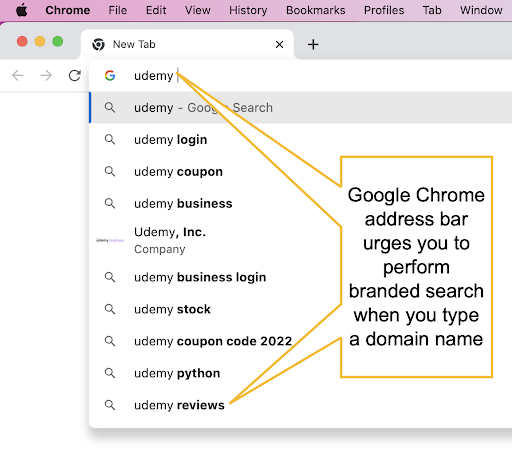
A few strongest browsers allow people search from the address bar (those include Safari on both desktop and mobile and, obviously, Google Chrome)
People are getting used to voice searching, so they just speak brand names to perform a search.
Image source: Screenshot made by the author
In other words, your customers who likely know about your brand and are possibly ready to make a purchase – those hard-earned customers are forced to search for your brand name or for your branded query.
And what will they see?
It is astounding how many companies have no idea what comes up for their branded search, or how many customers they lose over poorly managed (or more often non-existent) in-SERP reputation management.
There are three crucial things to know about brand-driven search:
These are mostly high-intent queries: These searchers are typing your brand name intending to buy from you
These are often your existing, returning customers that tend to buy more than first-time customers
Both of the above factors make these your brands’ top priority.
And yet, you don’t have control over what people see when searching for your brand. In fact, monitoring and optimizing for those brand-driven queries is not a one-time task. It is there for as long as your brand exists.
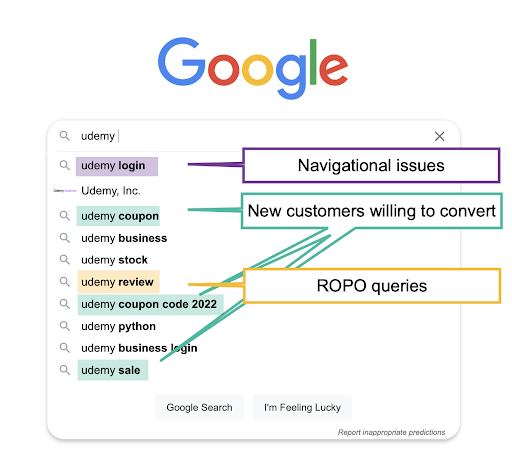
Identify deeper level problems behind your customers’ brand-driven searching patterns: What is it you can improve to solve problems behind those queries?
Image source: Screenshot made by the author
Your branded search queries should become part of your sales funnel – everything from About page to product pages and lead magnets should capture those brand-driven opportunities.
In many cases, when you see a large amount of brand-driven keywords, you may need a higher level approach, like setting up a standalone knowledge base.
3. Entities are key
Entities are Google’s way to understand this world.
Entities are all proper names out there: Places, people, brands, etc.
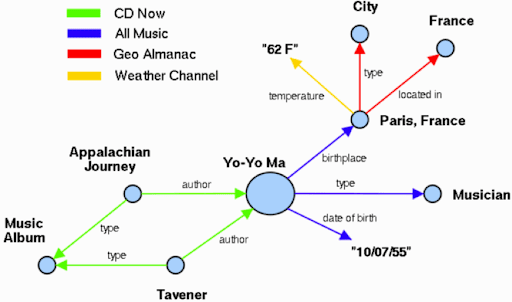
Google has a map of entities – called Knowledge Graph – that makes up Google’s understanding of the world.
Entities help Google understand the context and the search intent.
Being Google’s entity means coming up in searches where you were implied but never mentioned:
Image source: Screenshot made by the author
Through entity associations, Google knows what any search is about.
Entities should be the core of your keyword research process: What are known entities is your niche and how do you associate your brand with those entities?
Conclusion
Search engine optimization is evolving fast, so it requires an agile strategy for brands to keep up. If you are doing keyword research the old, exact-match, way, your business is about 10 years behind!
Ann Smarty is the Founder of Viral Content Bee, Brand and Community manager at Internet Marketing Ninjas. She can be found on Twitter @seosmarty.
Subscribe to the Search Engine Watch newsletter for insights on SEO, the search landscape, search marketing, digital marketing, leadership, podcasts, and more.
Everything you should know about evaluating your competitor’s backlink profile
Competitive backlink research is one of the first steps in either building your own link-building strategy or figuring out what it takes to achieve your competitors’ organic rankings.
Links are certainly not the only ranking signal, but they are still one of the most powerful factors (if not the most powerful one).
When selecting your competitors to analyze you will likely choose those that rank particularly well for your target queries, which makes sense because you want to know what has worked for them.
There’s one important thing to keep in mind here: It’s generally best to select your peers (sites directly in your vertical or niche). In other words, stay away from large websites that play within a variety of verticals but happen to rank above you (big box stores, Wikipedia, etc.).
There’s not much you can learn from Amazon’s backlink profile, for example, apart from the fact that being a web giant is working well for them.
Likewise, there’s less to learn from your oldest competitors apart from starting early (and earning all those age and trust signals over time) is certainly a good idea.
Instead, look for sites that have seen a recent growth in rankings to zero in on tactics working well for them. These are the types of sites you can best learn from, and this is what will make your competitive research actionable, i.e. help you build and implement your own strategy.
Once you have 2-4 competitors to analyze, make sure you rule out all the red flags you want to avoid first. In other words, start with what you don’t want to do. Filter those lower-quality and often risky links out to be able to find the best links common amongst the peers within your industry.
Step 1: Filter out red flags
When it comes to link building, too much of any questionable tactic can be detrimental but let’s get a bit more specific. Look for the following red flags:
Exact match anchor text
Are you seeing a lot of backlinks that repeat the same (or almost the same) anchor text over and over again? This is always a sign of poor and outdated link building that may get (or may have gotten) your competitors into trouble.
Very often when you see a backlink profile that is full of obviously SEO-driven links, you may also notice that the site lost visibility at some point: look for dips in organic visibility that may have happened over the years using Semrush or your favorite SEO toolset.
You cannot access their disavow file, so chances are they have gradually revived their rankings by urging Google to discount those low-quality links. But if those links haven’t caused them to lose rankings yet, chances are it will eventually happen.
It doesn’t have to be a manual penalty though: Google may be already discounting those links, so they have zero impact on their organic visibility at this point.
In either case, these are not the types of links you’d want to be after.
Outdated link building tactics
There are still quite a few outdated link-building patterns found in lots of backlink profiles out there.
These include:
Directory links
Links from blog networks
Article directory links
Content syndication (Press releases or other)
Low-quality guest posting links
Look out for links from websites that invite one to submit an article or “sponsor content” on them. Keep an eye on thin content that was obviously created for the sake of linking to your competitor. More importantly, try and see obvious patterns behind those backlinks: The same link building tactic appearing over and over throughout a backlink profile.
These links are probably also discounted by Google; none of these link types are worth your effort or investment.
Step 2: Learn from their success
Now that you know what to stay away from focus on what you can learn from your competitor’s backlink profile.
If you choose your competitors wisely based on organic visibility, there will likely be more to learn than to avoid. After all, if those sites rank well, Google obviously likes their backlink profile, or at least they are doing something right.
So, what can you learn from your competitors’ backlink profiles?
1. Your competitors’ content marketing tactics
Which content seems to work for your competitors in terms of link generation? What’s their most linked content? Have they managed to get any of their content assets viral or picked up by notable web publications? Can yours do better?
Obviously, you don’t know what happens behind the scenes of them achieving those links, but it is usually obvious when a particular content asset did extraordinarily well for generating solid backlinks.
It is usually easy to identify content that went viral and generated hundreds of links or a resource page that got cited by highly trusted websites like universities and government organizations.
Can you recreate those types of assets for your website and bring them up to date or make them better?
It is also a good idea to identify your competitor’s high-ranking content. Content that ranks on top of Google tends to bring in links naturally as bloggers and journalists use Google to find sources. Getting your articles to rank is also a link acquisition tactic bringing organic link equity on a continuous basis without you having to actively build those links through traditional outreach.
Find your competitors’ articles that rank high for searchable keywords.
Check backlinks of those articles to identify if that works for them.
Try and claim those rankings by creating much better content.
Keep an eye on higher-level tactics that bring your competitors rankings and links. What type of content is delivering topical links? Oftentimes these would be:
Glossaries and knowledge bases;
In-depth how-to content;
Statistical studies and survey results (these tend to be the most powerful), etc.
2. Your competitors’ outreach tactics
Who are your competitors reaching out to when trying to build links?
It is usually easy to tell by the type of links they are getting:
Links from news outlets come as a result of journalistic outreach
Trusted links from educators (college professors, teachers, etc.) require targeted trust-bait content and outreach
Links from blogs are built through blogger outreach (and often creation of viral assets, like free tools and infographics)
Which of those links seem to dominate your competitors’ backlink profile? Knowing the answer will inspire your own link acquisition strategy and help you make more informed decisions.
3. Your competitors’ influencer marketing tactics
Who are your competitors’ content amplifiers? In other words, who are those people (authors, niche experts, etc.) behind those links your competitors are getting?
Influencer marketing is a great way to generate backlinks on many levels:
Lots of niche influencers have sites and blogs they can use to link from
Influencers (if you choose them wisely) can drive organic links by simply sharing your content or mentioning it in their newsletters.
You may be able to actively engage with influencers within your niche via interviews, podcasts, Q&As, etc.
Sometimes, influencer-based tactics are hard to track in your competitors’ backlink profiles. It is often hard to correlate a sudden surge of backlinks to your competitor’s site without knowing the root cause of the spike.
This is where well-organized social media research and listening can help your competitive backlink analysis. Search Twitter and Instagram for your competitors’ brand names to see who is talking about them and what kind of an audience is involved in listening to those messages. Tools like Keyhole (a social media analytics platform) and Milled (a newsletter archive) can help you distinguish those sources of influence and match them with your competitor’s backlink profile.
Conclusion
Competitive backlink research is often enlightening if you know what to look for.
It is no use in trying to go after each and every one of their good links, though. Instead, take a higher-level approach: What is it they are doing to generate links and how can I do the same but better?
Trying to be as good as your competitor means there’s no reason for Google to rank your site higher. You need to always strive to do better: Better content, better outreach, better promotion tools. There’s often a lot of “heavy lifting” internally to get this right, and many companies choose to hire a better link-building company in order to do it right. Whichever direction you go, staying on top of your competitor’s backlinks (and your own!) will help you earn and maintain top rankings as time goes on.
New on Search Engine Land
About The Author
Internet Marketing Ninjas is a leading digital agency specializing in SEO strategy, link building, content marketing, and site speed optimization. Led by industry veteran Jim Boykin since 1999, IMN’s team of 50 is based in Upstate New York and brings nearly 400 years of combined experience helping their clients improve search rankings and increase organic traffic from Google.
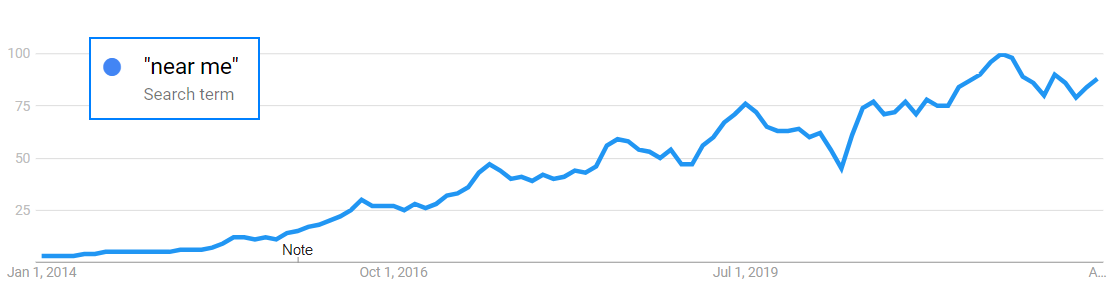
A recent Think With Google article suggests that optimizing for “near me” searches will pay out a bonanza in extra good rankings and qualified referral traffic.
“Near me” has been one of the term optimizations that many of us have recommended for local SEO benefit for years now.
But, there are reasons to think this tactic has completely jumped the shark, making it a waste of time.
And for those who optimized by creating a business name around the phrase, Google’s changes have essentially destroyed their brand name search in Maps.
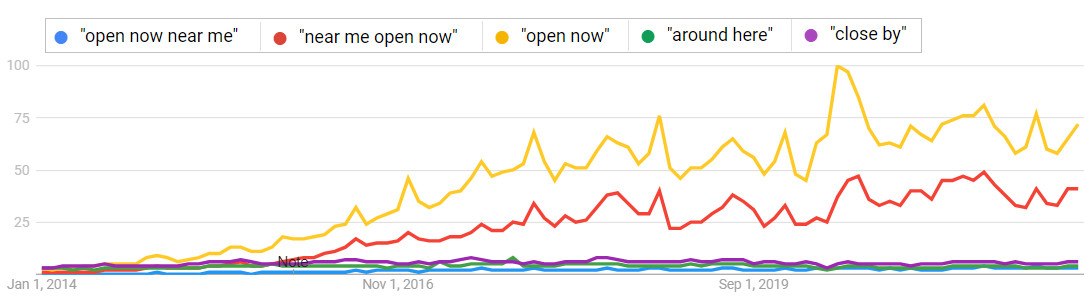
“Searches for “open now near me” have grown globally by over 400% YOY.”
“Near me” searches are queries for local products or services that include qualifier terms like “near me” when consumers want to narrow down to see the businesses closest to them only or primarily.
Also, during its Q1 earnings call, Google revealed that Maps searches for [shopping near me] were up 100% globally year-over-year.
“Open now” is a similar type of qualifier that is often used outside of the typical 9-to-5 timeframe or used later at night, such as to find restaurants that are still open, or clinics and other types of stores that stay open late at night.
While searches for businesses “near me” or “open now” separately are used more frequently, it is not surprising that both qualifying phrases might be used simultaneously in queries.
The rise of ‘near me’ search optimization
If you’ve worked in local SEO for a good length of time, this isn’t particularly surprising. We’ve known for about a decade that “near me” search optimization held huge potential for many types of businesses in many markets.
The 400% YOY growth rate is eye-opening, indicating that consumers have increasingly grown to expect that these qualifiers will help them locate more precisely what they need.
The rising use of mobile devices when conducting searches has influenced the “near me” trend a lot and has helped to drive overall increases in the volume of local searches.
Along with others in the industry, I strongly recommended that local businesses optimize for their ideal keywords in combination with “near me” phrases. There are a number of these types of phrases that are used by consumers, including:
“around here”
“nearby”
“close by”
“close to me”
“local”
I also performed optimizations using these phrases on behalf of clients. In one case (a specialized attorney), keyword research showed that no other competing attorneys in the niche were using “near me” phrases. I created an optimized page for his “near me” specialization phrase. His referrals increased by about 20%.
Get the daily newsletter search marketers rely on.
Optimizing for “near me” phrases was a solid gold recommendation for a long time in local search. It was nearly a slam-dunk.
Why?
Because when you had a website and webpages that included a page or pages for “near me,” along with the industry business category name, for many businesses where people wanted local providers this would connect local consumers with webpages and Google Maps boxes for those businesses that had optimized for it. As a great many businesses were clueless about the optimization, this provided a stealth marketing weapon that virtually guaranteed valuable referral increases.
The rise of ‘near me’ businesses
In the last few years, several businesses have taken this optimization to the next level.
How?
By engineering their business name itself to include “near me”.
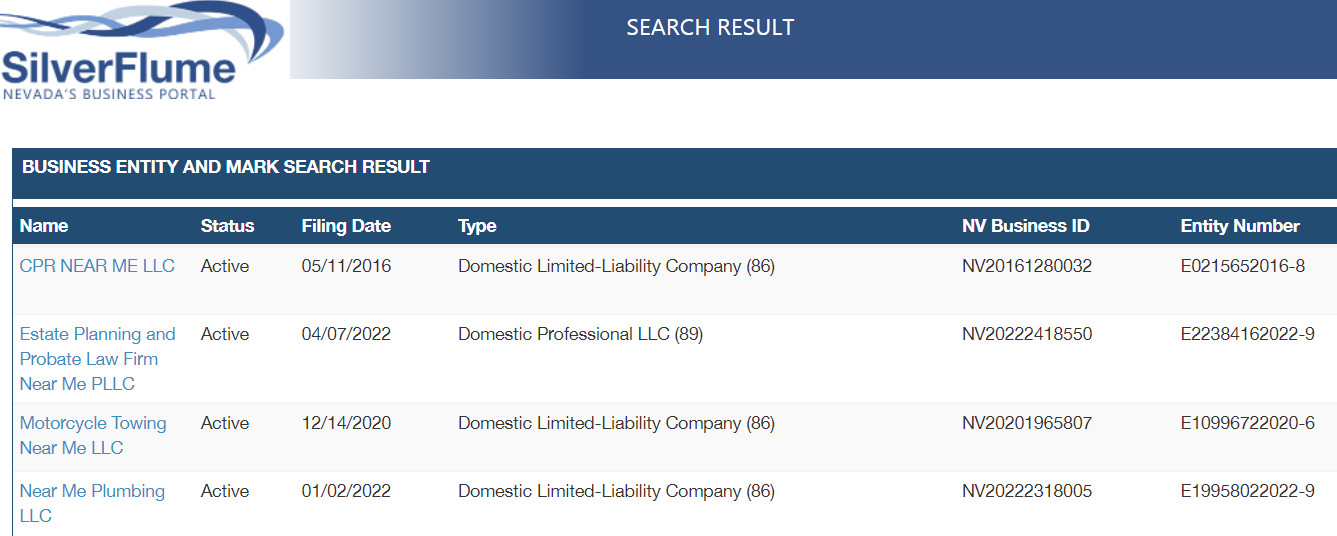
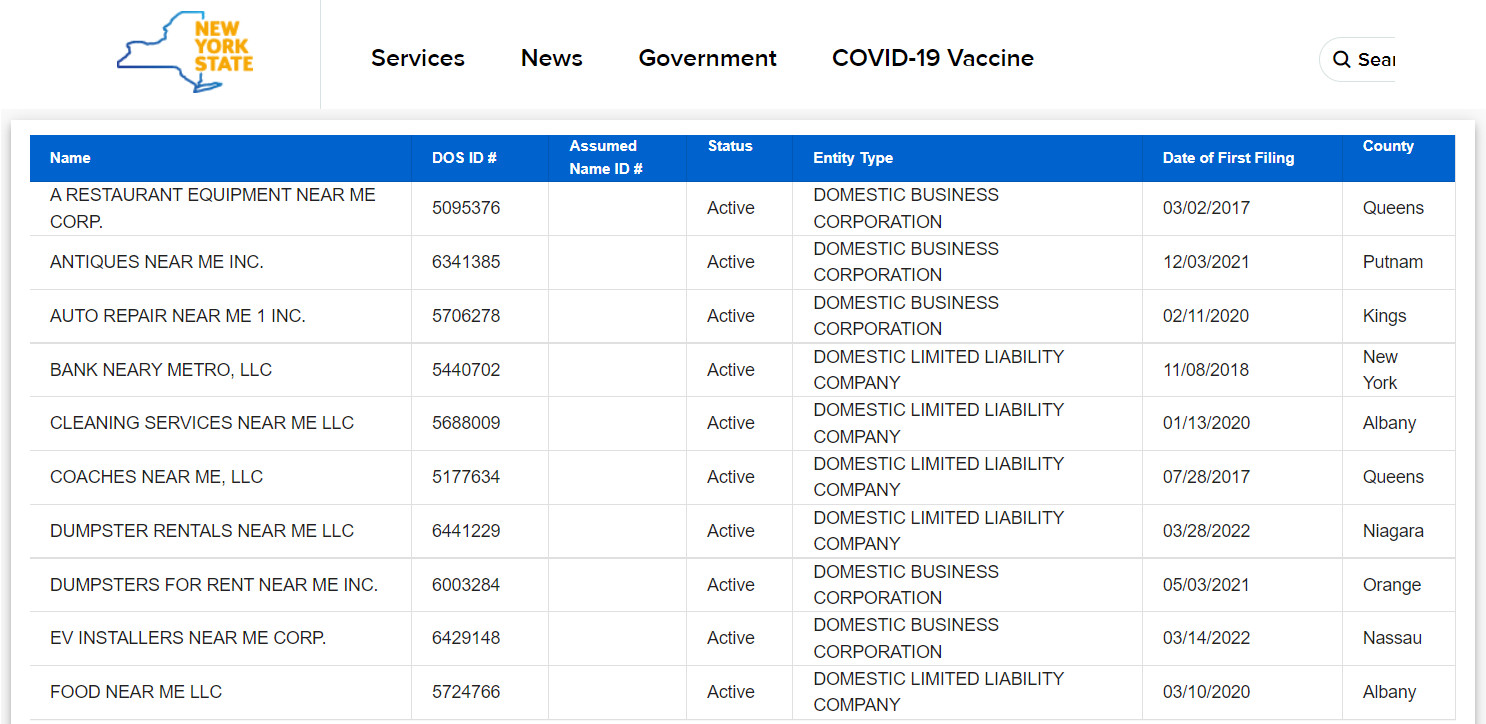
If you check the business registration databases across the U.S., you quickly find there are a number of businesses across the U.S. that have included “near me” into their official business names.
This includes many business categories beyond just a few of the more predictable kinds (e.g., locksmiths).
Clearly, many companies took the idea of optimizing for “near me” queries and made it into a core piece of their strategy that could be expected to return a lot of referrals.
With all of their online collateral materials associating “near me” with their business, how could they not rank for these searches?
Business registrations for “Near Me” in Nevada Business registrations for “Near Me” in New York (partial list).
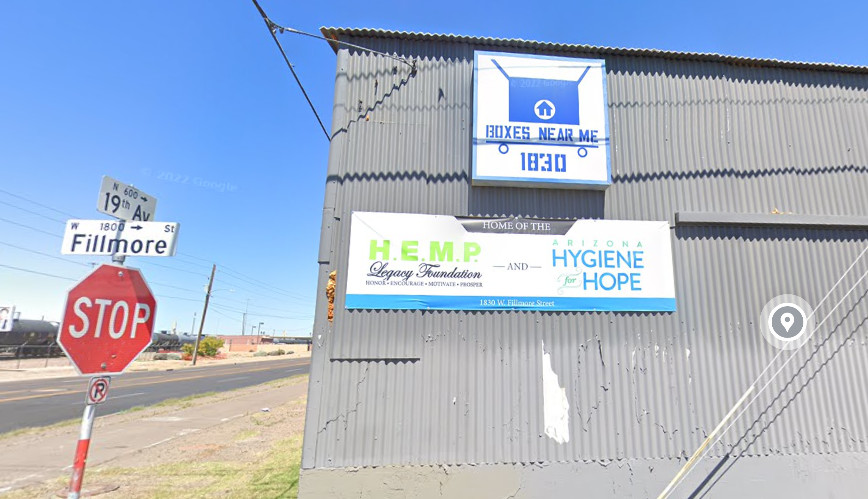
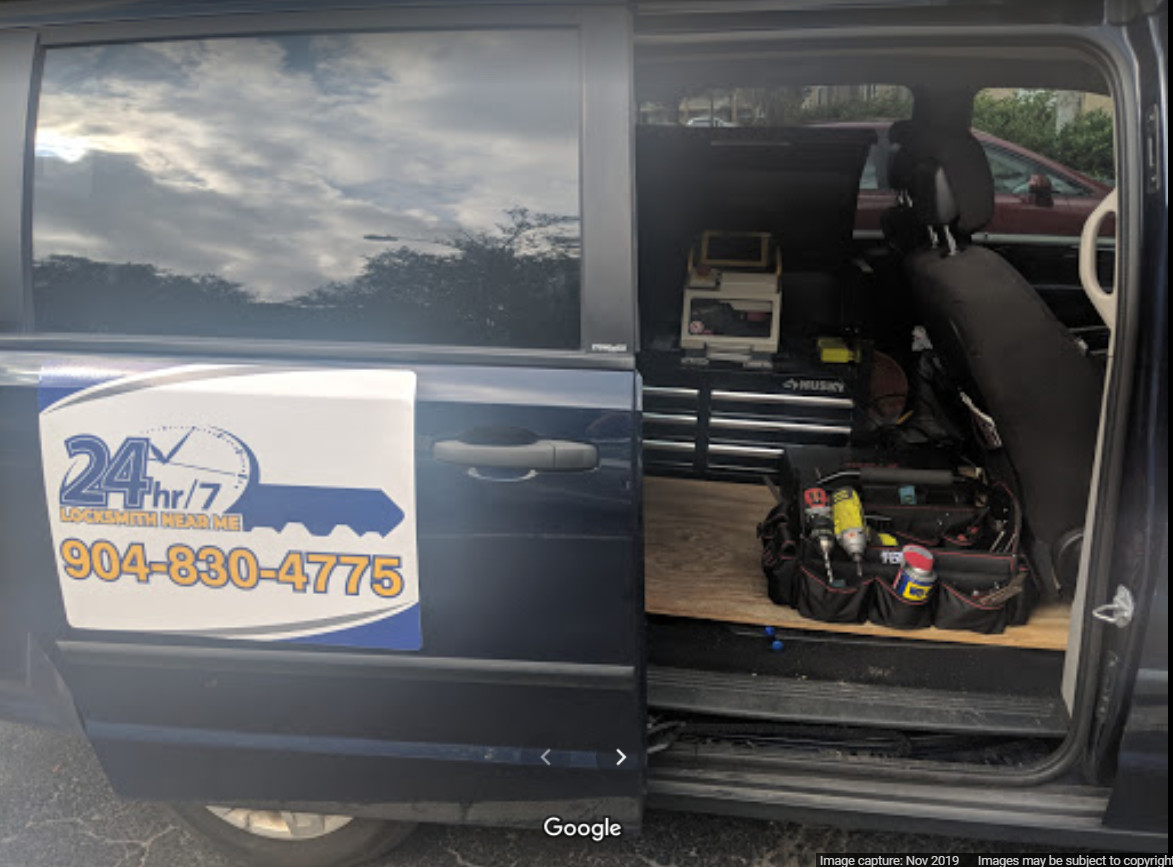
Custom Signs Near Me, Denver, Colorado Boxes Near Me, Phoenix, Arizona Locksmith Near Me Miami, Florida – a service area business 24 HR Locksmith Near Me, Jacksonville, Florida – a service area business Locksmith, Massage, and Moving Company “Near Me” businesses, Manhattan, New York It is unclear if these are service area businesses or fake alternate name business listings. Exterminator Near Me, Indianapolis, Indiana
I’ll take some of the blame for this.
In the distant past, I jokingly promoted some “extreme local SEO tactics” – such as the infamous advice to “change your business name to include a few of the top keywords that users type into search engines when seeking your type of business in your area.” (This was not against the rules at that time, by the way.)
I also had blogged some “ultimate local SEO tactics” which included the idea of having streets named after one’s company, or even having a city or country named after one’s company or brand name!
Part of the point of these joking articles was to educate people as to how Google, and Google Maps search, relied so heavily on literal keyword matching that finagling of keyword optimizations could hotwire a company into appearing more prominently for local business searches.
Google has finally figured it out
Around 10 years ago – when it became clear that consumers were increasingly searching for local businesses while combining the phrase “near me” in their queries – I wondered why Google did not engineer special handling for the phrase.
I asked a Google Maps representative about this issue and was told they had many things on their development priority list – but this was something they would likely get around to.
Well, it seems that Google finally got around to it.
Google has made it now so that a “near me” query will return the closest matching local businesses for one’s search terms within the Maps/Local listings. To do this, Google clearly extracts the “near me” portion of the user’s query and matches the remainder of the query with businesses and websites it believes are closest in location proximity to the user. This handling negates the efficacy of performing keyword optimizations with “near me” phrases for Google Maps/Local search.
Local ranking showdown: business name vs. proximity
I saw this was happening anecdotally, but after locating a number of the businesses pictured above to investigate how they were ranking in their localities for “near me” search phrases that exact-match their business names, the results are striking.
When searching with a Dallas IP address for “ER near me,” 11 businesses come up in the Maps results before a listing for the “ER near me” business is listed. By contrast, searching for other businesses in the list by name results in them being displayed first in the list, and sometimes by themselves in the results.
Searching for another generic-sounding brand by name, “ER of Texas,” produces results listing two of their locations first in Google Maps, followed by other businesses interspersed with more locations for “ER of Texas”.
This is what makes the results for the “ER near me” searches interesting – if Google determined that query was likely a business name search, their listing would come up first in the list.
This dynamic is truly striking. Google has done a lot of work to try to feature a business’s listing first in the search results for its exact brand name search. This is being negated for those listings with “near me” in the business names.
There is a caveat for ranking for the name search if the name appears to be spammy (such as those with keywords crammed in). One could conjecture that the businesses with “near me” names could be treated as keyword-stuffed, which would then negate their keyword benefit. However, I found that they can still rank for the “near me” queries – it’s just dependent upon proximity to the searcher.
Testing for “dentist near me” searches in El Paso in Google Maps, I found a hundred lists in Maps and gave up – the business named Dentist Near Me did not show up when using an IP address location associated with the downtown area of El Paso.
However, the business is located on the eastern edge of town, and by changing the browser’s IP address to a location much closer to that address, I was able to get the Dentist Near Me listing in the fourth organic position in Maps. “Locksmith near me” in Miami was in the 16th position.
Searching for “Sushi near me” in Los Angeles likewise did not return the business with that name in the first three search results. Searching for “Boxes Near Me” in Phoenix produced the business’s listing in the fifth position. The “24hr Locksmith Near Me” was in the 24th position in Maps for a “locksmith near me” search in Jacksonville. Search for “Exterminator Near Me” in Indianapolis placed the business’s listing in the 56th position.
“Custom Signs Near Me” in Denver seems to be an exception to how this is working. But, I believe that is largely because the business is located near the centroid of Denver, and there are few other custom sign businesses that close to the center point.
Switching to a search from Lakewood, which is smack next to Denver, moves the listing’s position down a number of slots. It also could be that “custom signs” might be less-recognized as a business category than “sign shops” by Google. Performing a “sign shops near me” search in Denver places the business’s listing down at the fifth position. It is likely the business only ranked prominently due to its location near the city’s centroid – not because of keyword optimization for “near me” in its business name.
While searching to find examples of businesses with “near me” in their official names, I ran across a great many more instances that are fake business names and locations. A number of companies have created additional listings in Google Maps for “_______ near me” names. These often use the same exact address as their regular business, perhaps expecting consumers to search “near me”, see the location, and arrive in a hypnotized state to walk into the business with the real brand name signage.
The three listings I show above from Manhattan (a locksmith, a moving company and a massage provider) potentially could be fake listings. In many cases, some “near me” listings appear to be completely fake, appearing for service area businesses, and once you view their pinpoint locations they are next to police stations, under overpasses, next to parks or next to shared workspace locations. Predictably, these listings are for moving companies, locksmiths, roofing contractors, plumbers and the categories of businesses that have long been rife with fake listing issues.
Now, for the real “near me” businesses I documented, a number of their websites did appear prominently in the regular, keyword search results outside of Google Maps – often in the first organic position, but not always.
The “near me” keyword optimization does appear to still work there, and there may be some level of value to that in terms of referral traffic. But, experience indicates that the greater value was to be had in Maps search.
Many consumers seeking a local provider are conducting searches directly in the Google Maps app, and those will see other businesses the majority of the time for “near me” searches, and not these over-optimized companies.
Google itself indicates that consumers are showing local intent with these queries, because every one of the test queries reflected blended search results with the Maps 3-Pack at the top, before regular keyword search results.
Is ‘near me’ optimization a detriment to businesses?
When those of us in local SEO first began recommending keyword optimizations for “near me,” there was some light criticism that the keyword optimization was difficult to incorporate on websites and directory listings in a natural-looking manner. But doing so, by adding it into business names, is far more of a smack-you-in-the-face option than merely including it in some isolated paragraphs, page titles and headings.
Incorporating it into business names seems likely to detract from building a non-generic-sounding brand.
While including valuable keywords in a business name can often have a synergetic value if done well, these near me brand names seem to be brute-force functional search marketing above all other marketing and brand-building considerations.
Some would undoubtedly call these brand names spammy-sounding. I think these would not work as well for word-of-mouth marketing or repeat business.
Because Google is now using the “near me” parts of users’ queries as a type of proximity indicator, rather than a literal keyword matching phrase, the use of this in brand name optimizations is arguably a serious disadvantage at this point.
Customers inclined to use a business again will often search online by business name, and if they do so in Maps they will have a lot of trouble finding these businesses because Google’s functionality is now damaging their ability to rank well for their brand name searches.
I do not believe this is necessarily any sort of a penalty. Google simply determined that the “near me” queries are far more frequently consumers’ expressions that they desired to get the specific types of businesses nearest to their physical locations rather than businesses with names that match “near me” queries.
For established businesses, one of the top types of search queries that will refer traffic over time is brand name queries. Whereas using “near me” in brand names may have paid dividends in the past, the tactic is now a major detriment to a local business’s online strategy.
A gimmick whose time has passed
The Think With Google article that references the 400% YOY growth of “open now near me” searches advised businesses to optimize for local to capitalize on those queries. Google didn’t provide instructions on how to do that.
However, I believe this optimization should no longer mean the inclusion of “near me” keywords, in the web marketing materials, much less should it involve hotwiring the business name to include the “open now” and “near me” phrases.
Optimizing for this will mean updating your hours of operation, truthfully, in your Google Business Profile, and including all the address and location signals in your online collateral materials to make your location signals very strong.
Proximity to the user isn’t the sole criteria. Optimizing for prominence signals is vital (e.g., volume and velocity of reviews, having other websites mention and link to your business website).
Bottom line: Any benefits of Incorporating “near me” in your business name are largely canceled out by the disadvantages.
Opinions expressed in this article are those of the guest author and not necessarily Search Engine Land. Staff authors are listed here.
Lucid visibility: How a publisher broke into Google Discover in less than 30 days from launch
Google Discover is one of the most sought-after traffic sources by publishers, while also being one of the most confusing from a visibility standpoint. For many, it’s an enigma. For example, some publishers I help receive millions of clicks per month, while others receive absolutely none. And a ton of traffic can turn into no traffic in a flash, just like when a broad core update rolls out. More on that soon.
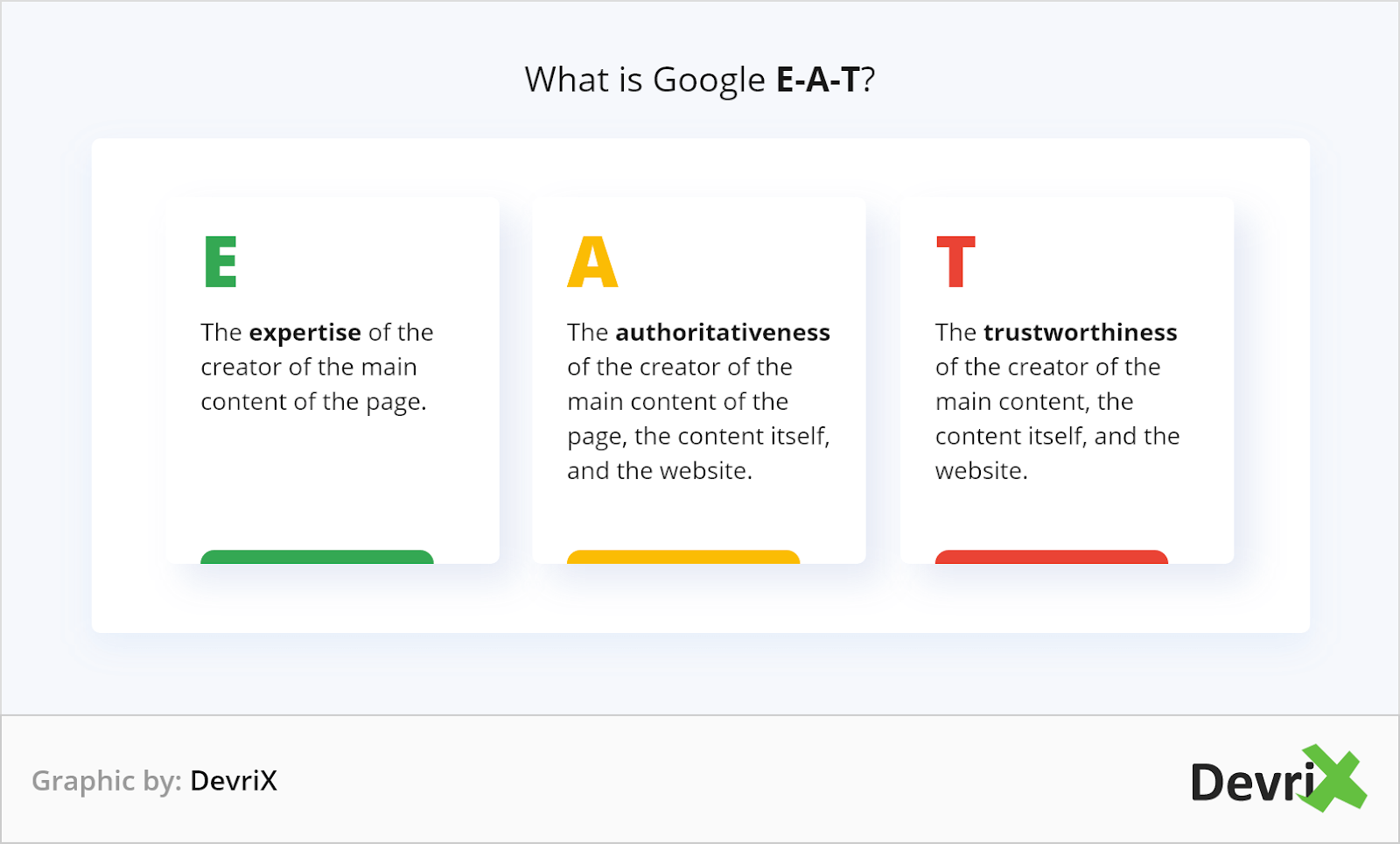
Google has explained that it’s looking for sites that “contain many pages that demonstrate expertise, authoritativeness, and trustworthiness (E-A-T)” when covering which content ranks in Discover. Strong E-A-T can take a long time to build up, or so you would think. For example, when a new site launches and has no history, no links, etc., it often can take a long time to cross the threshold where it can appear in Discover (and consistently).
That’s why the case study I’m covering in this post is extremely interesting. I’ll cover a brand-new site, run by a well-known person in the tech news space, and the site broke into Discover in a blistering four weeks from its launch. It is by far the quickest I have seen a new site start ranking in Discover.
And if you’re in the SEO industry, I’m sure you’ll get a kick out of who runs the site. It’s no other than Barry Schwartz, the driving force behind a lot of the news we consume in the SEO industry. But his new site has nothing to do with SEO, Search Engine Roundtable, or Search Engine Land.
Or does it? I’ll cover more about that in the article below. Let’s jump in.
Barry’s unrelenting blogging process:
As many of you know, Barry’s work ethic is insanely strong. When he decides to do something, look out. So as you can guess, Barry took his Search Engine Roundtable blogging process and employed that for Lucid Insider, his blog dedicated to news about Lucid Motors, a car manufacturer producing the luxury electric sedan Lucid Aid. He blogs every day, with multiple posts covering what’s going on in the Lucid World.
Over the past several days, I went through most of his posts, about 150 so far, and I feel completely up-to-speed on Lucid. It’s sort of the way the SEO industry feels when reading Search Engine Roundtable. I bring this up just so you have an understanding of content production on Lucid Insider.
There are now 204 urls indexed on the site and the first article was published on March 15, 2022. I’ll come back to dates soon.
Time To Discover Visibility (TTDV)
Haven’t heard of TTDV yet? That’s because I just made it up. Lucid Insider started surfacing in Discover in just four weeks from the time the site launched. For the most part, that’s before any (consistent) strong signals could be built from an E-A-T standpoint, before earning many links, before publishing a ton of content on the topic, etc.
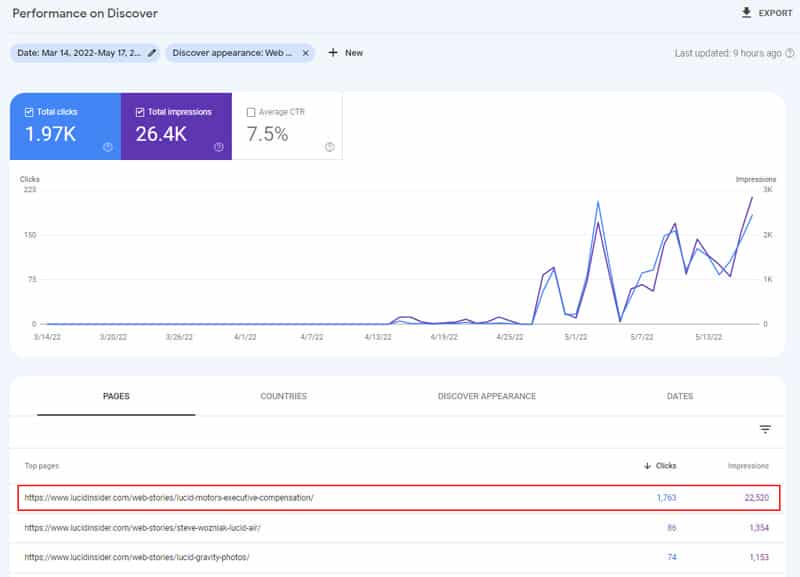
And since the first article broke into Discover, Lucid Insider has consistently appeared in the feed (both as articles and Web Stories). As of a few days ago, Discover has driven 8,351 clicks to the site out of 9,726 total clicks from Google. Traffic from Google Search is building but has only accounted for 14% of total clicks so far. Discover is now 86% of total clicks from Google.
Articles and Web Stories with a nudge from a friend:
After Barry launched Lucid Insider, I pinged him and said he should build some Web Stories, especially as Discover showed signs of life for Lucid Insider. I have covered Web Stories heavily since they launched and have built several of my own stories covering various SEO topics. I have seen first-hand what they can do visibility-wise in Search and in Discover.
Specifically for Discover, Google has a Web Stories carousel, which prominently displays a number of stories in a special feed treatment. So, I thought Barry could create some stories to possibly rank there. And that definitely worked to an extent. Both articles and Web Stories have ranked in Discover for Lucid Insider, although most of the Web Story traffic came from just one story. That story had a strong click through rate of nearly 8%, but it’s really the only one that drove any substantial traffic.
Here is an example of that top Web Story from Lucid Insider appearing in Discover’s story carousel. The feed treatment is killer and can drive a lot of impressions and clicks.
Google News: No Visibility At All… Until This Week!
Since Discover is often tied closely to news publishers, you would think Lucid Insider would have also appeared in Google News – but that wasn’t the case. That was until this week, though! The reporting didn’t even show up in Search Console for Google News until Monday. Sure, it’s not a lot of visibility yet, but this is a brand-new website. So Google is expanding the visibility of Lucid Insider to Google News now and in just two months. Definitely a good sign for Barry.
It’s also worth noting that Barry doesn’t even have a Google Publisher Center account set up. That doesn’t impact visibility in Google News, but most publishers set one up, since you can control several aspects of your publisher account, including site sections, logo, etc.
Search Is Growing:
Before I dig into the possibilities of why and how Lucid Insider broke into Discover so quickly, I wanted to touch on Search. Although driving much lower traffic levels as a percentage of traffic, it is growing over time and will probably continue to do so.
Barry’s blog is starting to rank for a number of queries, and even has some featured snippets already. Just like with Search Engine Roundtable, I’m confident that Lucid Insider will do well in Search. Google’s algorithms just need more time in my opinion, which is at odds with Discover’s algorithms at this point.
That’s a good segue to the next part of the post where I’ll cover the possible reasons why, and how, Lucid Insider is ranking so quickly in Discover. Join me as I travel down the rabbit hole…
E-A-T:
I won’t go in-depth about E-A-T overall, since there are many other posts you can read about that. But it’s important to understand that Google explains in its Discover documentation that it looks for sites exhibiting high levels of E-A-T when determining what should appear in the feed.
It’s also important to understand that Google has explained E-A-T is heavily influenced by links and mentions from authoritative sites.
I asked Gary about E-A-T. He said it’s largely based on links and mentions on authoritative sites. i.e. if the Washington post mentions you, that’s good.
He recommended reading the sections in the QRG on E-A-T as it outlines things well.@methode#Pubcon
Therefore, I immediately jumped into the link profile of Lucid Insider. Remember, it has only been around since March 15, 2022. When digging into the Links report in GSC, there were only 92 links there. And most of them were from SEO-related sites and content, and not automotive content.
That’s because Barry had mentioned his new blog on Search Engine Roundtable and Search Engine Land, and those sites get copied and scraped all the time, so those links end up on many other sites focused on Search. I’m not saying those other sites are providing a ton of power or value link-wise, but it’s worth noting.
From an E-A-T standpoint, both Search Engine Roundtable and Search Engine Land are authoritative sites, but they don’t focus on Lucid Motors, electric cars, automotive news in general, etc. So it’s weird to think Google would provide a ton of value from those links over the long-term, since they aren’t topically relevant at all.
I bolded “over the long-term” because I have a feeling Google’s algorithms are still figuring things out for Lucid Insider. Longer-term, I’m not sure SEO-related links will help Lucid Insider as much, as Google’s algorithms determine more about the site, its content, focus, etc.
There are definitely a few links from Lucid forums to Lucid Insider, but not many yet… And check out Majestic’s topical trust flow, just to understand the topics Lucid Insider are associated with from an inbound links standpoint. The topics reflect an SEO blog and not a blog covering Lucid Air, at least for now.
But It’s BARRY! The Man, The Brick, The Legend
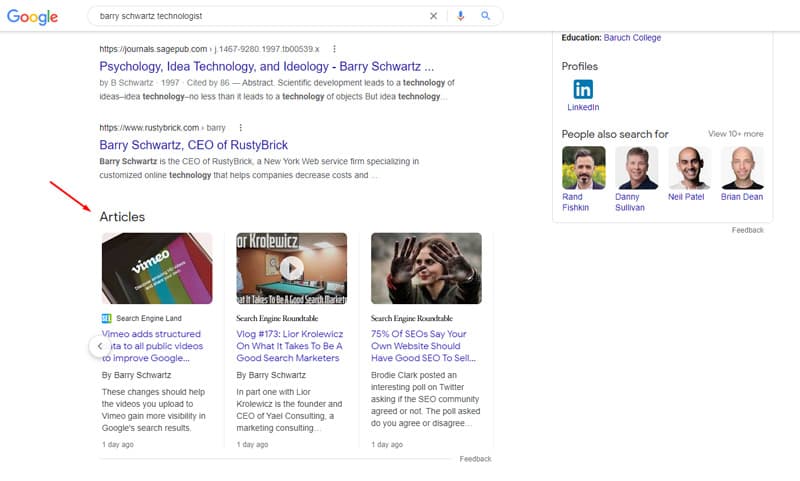
For journalists, Google can connect the dots and understand articles published across sites. Google has explained this before in a blog post about journalists and you can see it firsthand in the SERPs. For example, Google can provide an Articles carousel in the SERPs for certain journalists.
So, is Barry being the author causing Lucid Insider to break into Discover faster than another author would? Could Google really be doing that??
I’m pretty sure that’s not the case. I’ll explain more below.
Barry has an Article carousel in the SERPs, but it only contains Search Engine Land and Search Engine Roundtable articles. Lucid Insider isn’t there. The carousel shows up when you surface Barry’s Knowledge Panel when searching for “Barry Schwartz technologist”.
In addition, Barry isn’t even using Article structured data (or any structured data) to feed Google important information about the article content, including author information. And he could be helping Google connect the dots by providing author information, including author.url, which is a property of Article structured data. That is what Google recommends providing, especially for journalists that write for various news publishers.
And when checking Barry’s Wikipedia page and Knowledge Panel, there is no mention of Lucid Insider. Barry should probably hop on that, but it’s not there as of now.
And last, even using a related query for Lucid Insider doesn’t yield any results (which would show you related sites to the domain you enter). Again, this will change over time as Google understands more about the site, the content, the focus, etc.
So, I doubt Google is making the connection there based on Barry being the author. Let’s move on.
Fresh Topic, Rabid Fans, Big Opportunity:
Lucid Air is a new electric car manufacturer, so there is clearly not as much written or covered as Tesla or other car manufacturers. That could definitely be playing an important factor with Lucid Insider’s visibility in Discover. For example, there’s less content to choose from when selecting content to show in a user’s Discover feed, when that person shows an interest in Lucid.
To give some context, here is Google Trends data for interest in Lucid Motors compared to Tesla, Inc.
And here is Google Trends data showing interest in the various models (Lucid Air versus the Tesla 3 or S):
In addition, there are some serious Lucid fans out there. So those people are eager to check out news and information from various sources of Lucid information. And Discover is based on a person’s interests and activities, so travels across the Lucidsphere could be leading Discover’s algorithms to surface more Lucid information in their feed and maybe the algorithm is hungry for that information. And again, there isn’t as much content for Lucid as other topics, at least yet.
Here is the top Lucid forum showing some of the activity there. And check out the sidebar… there’s a familiar face there.
It will be interesting to see how Lucid Insider performs in Discover as more sources of information hit the web. I saw this first-hand with Web Stories in Discover. When the carousel first launched, I was early to publish a Web Story. And it received 304K impressions in Discover. That wasn’t the case when I published subsequent stories, as more and more publishers started creating Web Stories. Anyway, we’ll see how it goes as more sites cover Lucid Air.
No Structured Data, No Open Graph Tags…
I mentioned earlier that Barry isn’t using any structured data at all for his articles. Well, he’s not using Open Graph tags either. Note, Open Graph tags are not a ranking factor, but they do provide more information about each article, including which images to use when shared. And Google Discover can use that larger image provided by Open Graph tags.
When checking the various social debugging tools, you can see that Facebook is dynamically populating open graph tags via other tags its finds on the page, the Twitter card validator bombs, etc.
I’m just providing this information to show that Barry has a relatively basic setup from a technical standpoint. And he’s ranking in Discover despite not providing all the bells and whistles.
Side Note: Desktop-first Indexing. What?
Google has explained in its developer documentation that mobile-first indexing will be enabled for all new sites starting in July of 2019. Well, for Lucid Insider desktop-first indexing is enabled. Just an interesting side note I discovered (pun intended) while digging into the data and reporting.
That said, the crawl stats show mostly smartphone crawling, so maybe Google Search Console lags for displaying the correct indexing model for Lucid Insider. Again, just an interesting find.
Broad core updates and Discover impact:
I mentioned earlier that Discover visibility can be impacted by broad core updates. I have covered that heavily in my blog posts about broad core updates, in presentations covering the topic, and on Twitter. Google’s John Mueller has explained this as well and it’s in the official blog post about broad core updates.
The reason I mention this is because Lucid Insider was launched in between broad core updates (and a fresh one hasn’t launched yet). So, could Lucid Insider be seeing a surge in Discover because Google doesn’t have enough signals yet to accurately measure site quality and relevance and a broad core update hasn’t been released? As Google’s quality algorithms are refreshed with the next broad core update, will Lucid Insider disappear from Discover?
It’s totally possible. Even Barry understands that what he’s experiencing is super-fast for breaking into Discover and now Google News. Four weeks is nothing when some other sites are still not in Discover, years down the line. We’ll be watching closely as the next broad core update rolls out which will hopefully be soon. We are due, that’s for sure.
Also, John Mueller has explained in the past that some newer sites might rank very well in Search in the short-term until Google’s algorithms can pick up more signals about the site, content quality, relevance, etc. And once it does, then the site could drop, or even surge. So just like I explained above, Lucid Insider can potentially see volatility as Google picks up more signals, understands its place in the web ecosystem, etc.
Here is my tweet about that segment regarding Search. You can check out the video I linked to from the tweet where Google’s John Mueller explains more about this:
That’s pretty normal for a site that’s trusted by Google. I’ve seen pages get indexed that way within minutes of publishing and rank well immediately. Google has explained they need to estimate where it should rank to start. That can change as it learns: https://t.co/xteCwTik3L
Summary: Will Lucid Insider’s Discover Visibility Remain Strong?
So there you have it. Lucid Insider broke into Discover extremely quickly and is driving a majority of the traffic to the site now. Search is increasing, but Discover is 86% of Google traffic as of now. Although I covered a number of areas that could be helping Barry appear and thrive in Discover, this may be short-lived, at least until the site can publish much more content, earn stronger links and mentions from automotive sites, blogs, forums, etc., and build stronger E-A-T overall.
And in true Barry-form, he will be freely sharing how the site is performing over time across Google surfaces. So stay tuned for updates on how Lucid Insider is performing in Search, Discover, and Google News. And on that note, we’re expecting a broad core update soon, so it will be extremely interesting to see how that impacts the Discover visibility for Lucid Insider.
Opinions expressed in this article are those of the guest author and not necessarily Search Engine Land. Staff authors are listed here.
New on Search Engine Land
About The Author
Glenn Gabe is an SEO consultant at G-Squared Interactive (GSQi) and has over 24 years of experience in digital marketing. Glenn currently helps clients with algorithm update recovery, technical SEO audits, SEO for website redesigns and migrations, and SEO training. During his career, Glenn has helped companies across a wide range of industries including publishing, e-commerce, health and medical, finance, startups, military, education, non-profits, real estate, affiliate marketing, and more.
We’ve crawled the web for 32 years: What’s changed?
It was 20 years ago this year that I authored a book called “Search Engine Marketing: The Essential Best Practice Guide.” It is generally regarded as the first comprehensive guide to SEO and the underlying science of information retrieval (IR).
I thought it would be useful to look at what I wrote back in 2002 to see how it stacks up today. We’ll start with the fundamental aspects of what’s involved with crawling the web.
It’s important to understand the history and background of the internet and search to understand where we are today and what’s next. And let me tell you, there is a lot of ground to cover.
Our industry is now hurtling into another new iteration of the internet. We’ll start by reviewing the groundwork I covered in 2002. Then we’ll explore the present, with an eye toward the future of SEO, looking at a few important examples (e.g., structured data, cloud computing, IoT, edge computing, 5G),
All of this is a mega leap from where the internet all began.
Join me, won’t you, as we meander down search engine optimization memory lane.
An important history lesson
We use the terms world wide web and internet interchangeably. However, they are not the same thing.
You’d be surprised how many don’t understand the difference.
The first iteration of the internet was invented in 1966. A further iteration that brought it closer to what we know now was invented in 1973 by scientist Vint Cerf (currently chief internet evangelist for Google).
The world wide web was invented by British scientist Tim Berners-Lee (now Sir) in the late 1980s.
Interestingly, most people have the notion that he spent something equivalent to a lifetime of scientific research and experimentation before his invention was launched. But that’s not the case at all. Berners-Lee invented the world wide web during his lunch hour one day in 1989 while enjoying a ham sandwich in the staff café at the CERN Laboratory in Switzerland.
And to add a little clarity to the headline of this article, from the following year (1990) the web has been crawled one way or another by one bot or another to this present day (hence 32 years of crawling the web).
Why you need to know all of this
The web was never meant to do what we’ve now come to expect from it (and those expectations are constantly becoming greater).
Berners-Lee originally conceived and developed the web to meet the demand for automated information-sharing between scientists in universities and institutes around the world.
So, a lot of what we’re trying to make the web do is alien to the inventor and the browser (which Berners-Lee also invented).
And this is very relevant to the major challenges of scalability search engines have in trying to harvest content to index and keep fresh, at the same time as trying to discover and index new content.
Search engines can’t access the entire web
Clearly, the world wide web came with inherent challenges. And that brings me to another hugely important fact to highlight.
It’s the “pervasive myth” that began when Google first launched and seems to be as pervasive now as it was back then. And that’s the belief people have that Google has access to the entire web.
Nope. Not true. In fact, nowhere near it.
When Google first started crawling the web in 1998, its index was around 25 million unique URLs. Ten years later, in 2008, they announced they had hit the major milestone of having had sight of 1 trillion unique URLs on the web.
More recently, I’ve seen numbers suggesting Google is aware of some 50 trillion URLs. But here’s the big difference we SEOs all need to know:
Being aware of some 50 trillion URLs does not mean they are all crawled and indexed.
And 50 trillion is a whole lot of URLs. But this is only a tiny fraction of the entire web.
Google (or any other search engine) can crawl an enormous amount of content on the surface of the web. But there’s also a huge amount of content on the “deep web” that crawlers simply can’t get access to. It’s locked behind interfaces leading to colossal amounts of database content. As I highlighted in 2002, crawlers don’t come equipped with a monitor and keyboard!
Also, the 50 trillion unique URLs figure is arbitrary. I have no idea what the real figure is at Google right now (and they have no idea themselves of how many pages there really are on the world wide web either).
These URLs don’t all lead to unique content, either. The web is full of spam, duplicate content, iterative links to nowhere and all sorts of other kinds of web debris.
What it all means: Of the arbitrary 50 trillion URLs figure I’m using, which is itself a fraction of the web, only a fraction of that eventually gets included in Google’s index (and other search engines) for retrieval.
Understanding search engine architecture
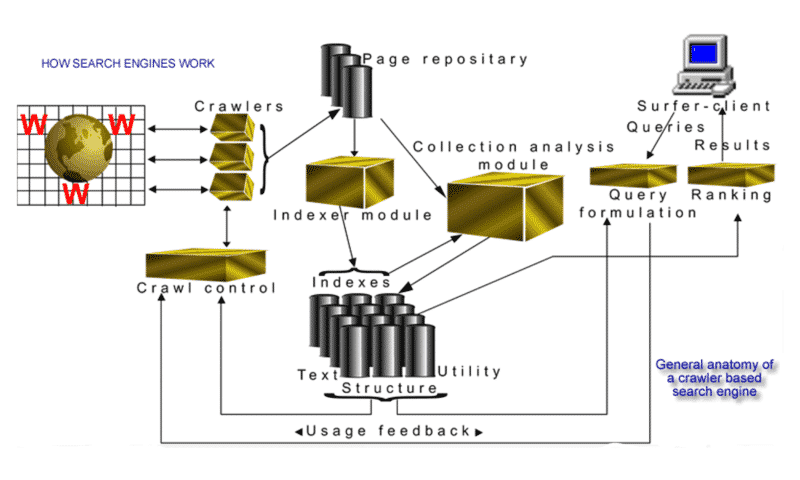
In 2002, I created a visual interpretation of the “general anatomy of a crawler-based search engine”:
Clearly, this image didn’t earn me any graphic design awards. But it was an accurate indication of how the various components of a web search engine came together in 2002. It certainly helped the emerging SEO industry gain a better insight into why the industry, and its practices, were so necessary.
Although the technologies search engines use have advanced greatly (think: artificial intelligence/machine learning), the principal drivers, processes and underlying science remain the same.
Although the terms “machine learning” and “artificial intelligence” have found their way more frequently into the industry lexicon in recent years, I wrote this in the section on the anatomy of a search engine 20 years ago:
“In the conclusion to this section I’ll be touching on ‘learning machines’ (vector support machines) and artificial intelligence (AI) which is where the field of web search and retrieval inevitably has to go next.”
‘New generation’ search engine crawlers
It’s hard to believe that there are literally only a handful of general-purpose search engines around the planet crawling the web, with Google (arguably) being the largest. I say that because back in 2002, there were dozens of search engines, with new startups almost every week.
As I frequently mix with much younger practitioners in the industry, I still find it kind of amusing that many don’t even realize that SEO existed before Google was around.
Although Google gets a lot of credit for the innovative way it approached web search, it learned a great deal from a guy named Brian Pinkerton. I was fortunate enough to interview Pinkerton (on more than one occasion).
He’s the inventor of the world’s first full-text retrieval search engine called WebCrawler. And although he was ahead of his time at the dawning of the search industry, he had a good laugh with me when he explained his first setup for a web search engine. It ran on a single 486 machine with 800MB of disk and 128MB memory and a single crawler downloading and storing pages from only 6,000 websites!
Somewhat different from what I wrote about Google in 2002 as a “new generation” search engine crawling the web.
“The word ‘crawler’ is almost always used in the singular; however, most search engines actually have a number of crawlers with a ‘fleet’ of agents carrying out the work on a massive scale. For instance, Google, as a new generation search engine, started with four crawlers, each keeping open about three hundred connections. At peak speeds, they downloaded the information from over one hundred pages per second. Google (at the time of writing) now relies on 3,000 PCs running Linux, with more than ninety terabytes of disk storage. They add thirty new machines per day to their server farm just to keep up with growth.”
And that scaling up and growth pattern at Google has continued at a pace since I wrote that. It’s been a while since I saw an accurate figure, but maybe a few years back, I saw an estimate that Google was crawling 20 billion pages a day. It’s likely even more than that now.
Hyperlink analysis and the crawling/indexing/whole-of-the-web conundrum
Is it possible to rank in the top 10 at Google if your page has never been crawled?
Improbable as it may seem in the asking, the answer is “yes.” And again, it’s something I touched on in 2002 in the book:
From time to time, Google will return a list, or even a single link to a document, which has not yet been crawled but with notification that the document only appears because the keywords appear in other documents with links, which point to it.
What’s that all about? How is this possible?
Hyperlink analysis. Yep, that’s backlinks!
There’s a difference between crawling, indexing and simply being aware of unique URLs. Here’s the further explanation I gave:
“If you go back to the enormous challenges outlined in the section on crawling the web, it’s plain to see that one should never assume, following a visit from a search engine spider, that ALL the pages in your website have been indexed. I have clients with websites of varying degrees in number of pages. Some fifty, some 5,000 and in all honesty, I can say not one of them has every single page indexed by every major search engine. All the major search engines have URLs on the “frontier” of the crawl as it’s known, i.e., crawler control will frequently have millions of URLs in the database, which it knows exist but have not yet been crawled and downloaded.”
There were many times I saw examples of this. The top 10 results following a query would sometimes have a basic URL displayed with no title or snippet (or metadata).
Here’s an example I used in a presentation from 2004. Look at the bottom result, and you’ll see what I mean.
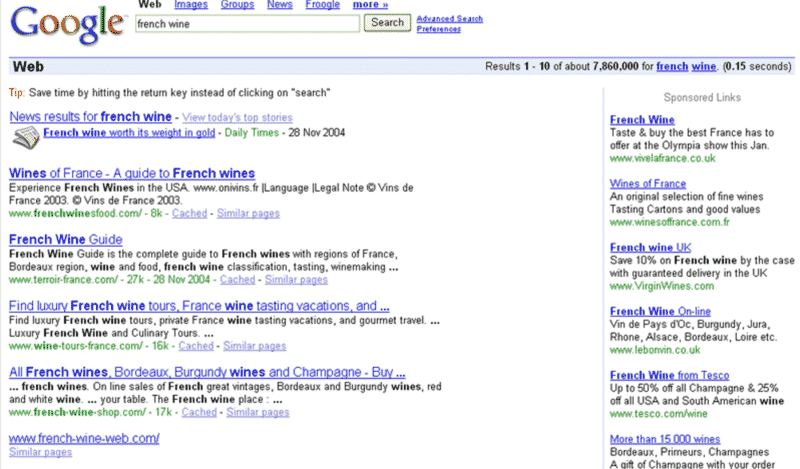
Google is aware of the importance of that page because of the linkage data surrounding it. But no supporting information has been pulled from the page, not even the title tag, as the page obviously hasn’t been crawled. (Of course, this can also occur with the evergreen still-happens-all-the-time little blunder when someone leaves the robots.txt file preventing the site from being crawled.)
I highlighted that sentence above in bold for two important reasons:
Hyperlink analysis can denote the “importance” of a page before it even gets crawled and indexed. Along with bandwidth and politeness, the importance of a page is one of the three primary considerations when plotting the crawl. (We’ll dive deeper into hyperlinks and hyperlink-based ranking algorithms in future installments.)
Every now and again, the “are links still important” debate flares up (and then cools down). Trust me. The answer is yes, links are still important.
I’ll just embellish the “politeness” thing a little more as it’s directly connected to the robots.txt file/protocol. All the challenges to crawling the web that I explained 20 years ago still exist today (at a greater scale).
Because crawlers retrieve data at vastly much greater speed and depth than humans, they could (and sometimes do) have a crippling impact on a website’s performance. Servers can crash just trying to keep up with the number of rapid-speed requests.
That’s why a politeness policy governed on the one hand by the programming of the crawler and the plot of the crawl, and on the other by the robots.txt file is required.
The faster a search engine can crawl new content to be indexed and recrawl existing pages in the index, the fresher the content will be.
Getting the balance right? That’s the hard part.
Let’s say, purely hypothetically, that Google wanted to keep thorough coverage of news and current affairs and decided to try and crawl the entire New York Times website every day (even every week) without any politeness factor at all. It’s most likely that the crawler would use up all their bandwidth. And that would mean that nobody can get to read the paper online because of bandwidth hogging.
Thankfully now, beyond just the politeness factor, we have Google Search Console, where it’s possible to manipulate the speed and frequency of which websites are crawled.
What’s changed in 32 years of crawling the web?
OK, we’ve covered a lot of ground as I knew we would.
There have certainly been many changes to both the internet and the world wide web – but the crawling part still seems to be impeded by the same old issues.
That said, a while back, I saw a presentation by Andrey Kolobov, a researcher in the field of machine learning at Bing. He created an algorithm to do a balancing act with the bandwidth, politeness and importance issue when plotting the crawl.
I found it highly informative, surprisingly straightforward and pretty easily explained. Even if you don’t understand the math, no worries, you’ll still get an indication of how he tackles the problem. And you’ll also hear the word “importance” in the mix again.
Basically, as I explained earlier about URLs on the frontier of the crawl, hyperlink analysis is important before you get crawled, indeed may well be the reason behind how quickly you get crawled. You can watch the short video of his presentation here.
Now let’s wind up with what’s occurring with the internet right now and how the web, internet, 5G and enhanced content formats are cranking up.
Structured data
The web has been a sea of unstructured data from the get-go. That’s the way it was invented. And as it still grows exponentially every day, the challenge the search engines have is having to crawl and recrawl existing documents in the index to analyze and update if any changes have been made to keep the index fresh.
It’s a mammoth task.
It would be so much easier if the data were structured. And so much of it actually is, as structured databases drive so many websites. But the content and the presentation are separated, of course, because the content has to be published purely in HTML.
There have been many attempts that I’ve been aware of over the years, where custom extractors have been built to attempt to convert HTML into structured data. But mostly, these attempts were very fragile operations, quite laborious and totally error-prone.
Something else that has changed the game completely is that websites in the early days were hand-coded and designed for the clunky old desktop machines. But now, the number of varying form factors used to retrieve web pages has hugely changed the presentation formats that websites must target.
As I said, because of the inherent challenges with the web, search engines such as Google are never likely ever to be able to crawl and index the entire world wide web.
So, what would be an alternative way to vastly improve the process? What if we let the crawler continue to do its regular job and make a structured data feed available simultaneously?
Over the past decade, the importance and usefulness of this idea have grown and grown. To many, it’s still quite a new idea. But, again, Pinkerton, WebCrawler inventor, was way ahead on this subject 20 years ago.
He and I discussed the idea of domain-specific XML feeds to standardize the syntax. At that time, XML was new and considered to be the future of browser-based HTML.
It’s called extensible because it’s not a fixed format like HTML. XML is a “metalanguage” (a language for describing other languages which lets you design your own customized markup languages for limitless diverse types of documents). Various other approaches were vaunted as the future of HTML but couldn’t meet the required interoperability.
However, one approach that did get a lot of attention is known as MCF (Meta Content Framework), which introduced ideas from the field of knowledge representation (frames and semantic nets). The idea was to create a common data model in the form of a directed labeled graph.
Yes, the idea became better known as the semantic web. And what I just described is the early vision of the knowledge graph. That idea dates to 1997, by the way.
All that said, it was 2011 when everything started to come together, with schema.org being founded by Bing, Google, Yahoo and Yandex. The idea was to present webmasters with a single vocabulary. Different search engines might use the markup differently, but webmasters had to do the work only once and would reap the benefits across multiple consumers of the markup.
OK – I don’t want to stray too far into the huge importance of structured data for the future of SEO. That must be an article of its own. So, I’ll come back to it another time in detail.
But you can probably see that if Google and other search engines can’t crawl the entire web, the importance of feeding structured data to help them rapidly update pages without having to recrawl them repeatedly makes an enormous difference.
Having said that, and this is particularly important, you still need to get your unstructured data recognized for its E-A-T (expertise, authoritativeness, trustworthiness) factors before the structured data really kicks in.
Cloud computing
As I’ve already touched on, over the past four decades, the internet has evolved from a peer-to-peer network to overlaying the world wide web to a mobile internet revolution, Cloud computing, the Internet of Things, Edge Computing, and 5G.
The shift toward Cloud computing gave us the industry phrase “the Cloudification of the internet.”
Huge warehouse-sized data centers provide services to manage computing, storage, networking, data management and control. That often means that Cloud data centers are located near hydroelectric plants, for instance, to provide the huge amount of power they need.
Edge computing
Now, the “Edgeifacation of the internet” turns it all back around from being further away from the user source to being right next to it.
Edge computing is about physical hardware devices located in remote locations at the edge of the network with enough memory, processing power, and computing resources to collect data, process that data, and execute it in almost real-time with limited help from other parts of the network.
By placing computing services closer to these locations, users benefit from faster, more reliable services with better user experiences and companies benefit by being better able to support latency-sensitive applications, identify trends and offer vastly superior products and services. IoT devices and Edge devices are often used interchangeably.
5G
With 5G and the power of IoT and Edge computing, the way content is created and distributed will also change dramatically.
Already we see elements of virtual reality (VR) and augmented reality (AR) in all kinds of different apps. And in search, it will be no different.
AR imagery is a natural initiative for Google, and they’ve been messing around with 3D images for a couple of years now just testing, testing, testing as they do. But already, they’re incorporating this low-latency access to the knowledge graph and bringing in content in more visually compelling ways.
During the height of the pandemic, the now “digitally accelerated” end-user got accustomed to engaging with the 3D images Google was sprinkling into the mix of results. At first it was animals (dogs, bears, sharks) and then cars.
Last year Google announced that during that period the 3D featured results interacted with more than 200 million times. That means the bar has been set, and we all need to start thinking about creating these richer content experiences because the end-user (perhaps your next customer) is already expecting this enhanced type of content.
If you haven’t experienced it yourself yet (and not everyone even in our industry has), here’s a very cool treat. In this video from last year, Google introduces famous athletes into the AR mix. And superstar athlete Simone Biles gets to interact with her AR self in the search results.
IoT
Having established the various phases/developments of the internet, it’s not hard to tell that everything being connected in one way or another will be the driving force of the future.
Because of the advanced hype that much technology receives, it’s easy to dismiss it with thoughts such as IoT is just about smart lightbulbs and wearables are just about fitness trackers and watches. But the world around you is being incrementally reshaped in ways you can hardly imagine. It’s not science fiction.
IoT and wearables are two of the fastest-growing technologies and hottest research topics that will hugely expand consumer electronics applications (communications especially).
The future is not late in arriving this time. It’s already here.
We live in a connected world where billions of computers, tablets, smartphones, wearable devices, gaming consoles and even medical devices, indeed entire buildings are digitally processing and delivering information.
Here’s an interesting little factoid for you: it’s estimated that the number of devices and items connected to IoT already eclipses the number of people on earth.
Back to the SEO future
We’ll stop here. But much more to come.
I plan to break down what we now know as search engine optimization in a series of monthly articles scoping the foundational aspects. Although, the term “SEO” wouldn’t enter the lexicon for some while as the cottage industry of “doing stuff to get found at search engine portals” began to emerge in the mid-to-late 1990s.
Until then – be well, be productive and absorb everything around you in these exciting technological times. I’ll be back again with more in a few weeks.
Opinions expressed in this article are those of the guest author and not necessarily Search Engine Land. Staff authors are listed here.
New on Search Engine Land
About The Author
Mike Grehan is an SEO pioneer (online since 1995), author, world-traveler and keynote speaker, Champagne connoisseur and consummate drinking partner to the global digital marketing community. Former publisher of SearchEngineWatch.com and ClickZ.com, and producer of the industry’s largest search and social marketing event, SES Conference & Expo. Proud to have been chairman of SEMPO the largest global trade association for search marketers. And equally proud to be SVP of corporate communications, NP Digital.
According to Techradar, there are more than 547,200 new websites every day. Google has to crawl and store all these sites in their database, therefore occupying physical space on their servers.
The sheer volume of content available now allows Google to prioritize well-designed, fast sites and provide helpful, relevant information for their visitors.
The bar has been raised, and if your site is slow or has a lot of jargon in the code, Google is unlikely to reward your site with strong rankings.
If you really want to jump ahead of your competitors, you have a huge opportunity to be better than them by optimizing your site’s code, speed and user experience. These are some of the most important ranking signals and will continue to be as the internet becomes more and more inundated with content.
Auditing your website’s technical SEO can be extremely dense and with many moving pieces. If you are not a developer, it may be difficult to comprehend some of these elements.
Ideally, you should have a working knowledge of how to run an audit to oversee the implementation of technical SEO fixes. Some of these may require developers, designers, writers or editors.
Fortunately, various tools will run the audits for you and give you all the comprehensive data you need to improve your website’s technical performance.
Let’s review some of the data points that will come up, regardless of what technical SEO audit tool you use:
Structure
Crawlability: Can Google easily crawl your website, and how often?
Security: Is your website secure with an HTTPS certificate?
On-page SEO elements: does every page have the keyword in thetitle tags, meta description, filenames, and paths? Does it have the same on-page elements as sites ranking in the top 10 for your target keywords?
Internal links: Does your site have internal links from other site pages? Other elements you can consider are site structure, breadcrumbs, anchor text and link sculpting.
Headings: Is the primary KW in the H1? Do you have H2s with supporting keywords?
Compliance issues: Does your site’s code include valid HTML? What is the accessibility score?
Images: Do your images load quickly? Are they optimized with title, keywords and srcset attribute? Do you use some new image formats such as webP and SVG?
Schema and semantic Web: Are your schema tags in place and set up properly? Some schema tags that you can use include WebPage, BreadcrumbList, Organization, Product, Review, Author/Article, Person, Event, Video/Image, Recipe, FAQ and How-To.
Canonicals: Do you have canonical tags in place, and are they set up properly?
SiteMap: Do you ONLY have valid pages in the site map, and are redirects and 404 pages removed from the sitemap?
These are simply a few of the elements you’d want to look into that most tools will report on.
User experience
Google has been placing more focus on ranking factors revolving around user experience. As the web collectively becomes more organized, Google is raising the bar for user experience. Focusing on user experience will ultimately increase their advertising revenue.
You’ll want to audit the user experience of your website.
Is it fast?
How quickly is the page interactive?
Can it be navigated easily on mobile devices?
Is the hierarchy of the site clear and intuitive?
Some of the ways of measuring this include:
Site speed
Web Core Vitals
Mobile-friendliness
Structured navigation
Intrusive ads or interstitials
Design
Make sure you are working with a developer that is well versed in the latest technical SEO elements and who can apply the changes required to raise your SEO performance score.
Technical SEO audit tools
Some of the most popular SEO audit tools include:
Semrush Site Audit
Screaming Frog
SiteBulb
Website Auditor
ContentKing App
GTMetrix
Pingdom
Google Lighthouse
Google Page Speed Insights
We’ll look at a couple of these tools and the data points you can gain from them.
Semrush site audit
Once you create a project in Semrush, you can run a site audit. Your overview will look like this:
Click on the “Issues” tab, and you’ll see a detailed list of the issues that were uncovered, divided by Errors, Warnings and Notices:
If you click on an item, you’ll see a list of the pages affected by each issue.
Review these as sometimes the data points are not valid.
Ideally, you should export the CSV for each of these issues and save them in a folder.
Screaming Frog
This desktop tool will use your computer and IP to crawl your website. Once completed, you’ll get various reports that you can download.
Here are a couple of example reports:
This is an overview report that you can use to track technical audit KPIs.
For example, this report gives you details of the meta titles for each of your pages.
You can use the Bulk Export feature to get all of the data points downloaded into spreadsheets, which you can then add to your Audit folder.
SiteBulb
Like the others, Site Bulb will do a comprehensive crawl of your website. The benefit of this tool is that it will give you more in-depth technical information than some of the other tools.
You’ll get an Audit Score, SEO Score, and Security Score. As you implement fixes, you’ll want to see these scores increasing over time.
Google Search Console
The Index Coverage report contains a treasure trove of data that you can use to implement the fixes that Google has discovered about your site.
In the details section, you’ll see a list of the errors, and if you click through to each report, they will include the list of pages affected by each issue.
Implementing technical SEO fixes
Once you have all of your CSV exports, you can create a list of all of the issues and go through them to remove duplicate reports created by the different tools.
Next, you can assign what department each fix belongs to and the level of priority. Some may need to be tackled by your developer, others by your content team, such as rewriting duplicate titles or improving descriptions with pages with low CTR.
Here’s what your list might look like:
Each project should include notes, observations, or details about how to implement the fix.
Most websites will have dozens of issues, so the key here is to prioritize the issues and make sure that you are continuously fixing and improving your site’s performance each month.
E-A-T Audit
It’s important that your website reflects topical authority and relevance. E-A-T means:
Expertise: Are you an expert in your field? Are your authors authoritative?
Authoritativeness: Are you considered authoritative in your field by industry organizations? Do your social profiles, citations, social shares and link profile reflect this authoritativeness?
Trustworthiness: Can visitors trust that your website is secure and that their data is safe? Does your site have an SSL certificate, including privacy disclaimers, refund information, contact info and credentials?
Google has an entire team of Quality Raters that manually review websites to assess them based on these parameters. Google has even published the Quality Raters E-A-T guidelines for site owners to reference.
If your website is in a YMYL (Your Money, Your Life) niche, these factors are even more important as Google attempts to protect the public from misinformation.
Analytics audit
Is your Google Analytics code working properly?
Do you have the proper goals and funnels to fully understand how users navigate your site?
Are you importing data from your Google Ads and Search Console accounts to visualize all of your data in Google Analytics?
BrainLabsDigital has created a Google Analytics audit checklist that will help you review your Google Analytics account. The accompanying article will give you a straightforward and strategic approach to ensuring your Google Analytics is set up properly.
Prioritizing technical SEO fixes
Make sure you prioritize continuously improving your on-page SEO. Depending on your site, you may have a list of a dozen or a few hundred fixes. Try and determine which fixes will impact the most pages to see a greater improvement from your efforts.
It can be discouraging to see a list with 85 different technical SEO improvements. The benefit is that, as you go through these improvements, you will start seeing movement in your rankings. Over time, you’ll want to have very few, if any, errors show up in all of your crawling tools.
If your content is relevant, targeted and well developed, and you’re receiving new, quality links every month, these technical = optimizations will become the key differentiating factors for ranking better than your competitors.
Opinions expressed in this article are those of the guest author and not necessarily Search Engine Land. Staff authors are listed here.
New on Search Engine Land
About The Author
Marcela De Vivo is an industry veteran with more than 20 years of digital marketing experience, Marcela travels the world speaking about SEO, data-driven marketing strategies, and workflow automation and optimization. Marcela owns a digital marketing agency called Gryffin based in California.
Vimeo adds structured data to all public videos to improve Google Search visibility
Vimeo, a popular video hosting platform (obviously not as popular as YouTube), has added structured data to all of its publicly available videos on its platform. Vimeo said the SEO changes they made to the videos will give “your videos the best opportunity to appear for relevant searches.”
Google worked with Vimeo? Vimeo wrote that they worked with Google as an “early adopter of Google Search’s best practices for video players” to provide Google with “additional context about your videos.” This will help Vimeo surface those videos in Google search and take advantage of the video-rich results, like displaying key moments for videos in Google Search by adding chapters and timestamps to video structured data.
Google’s video best practices. The video best practices are not exclusive to Vimeo or “early adopters.” These best practices are published by Google over here for anyone who hosts videos to read and adopt on their websites or platforms.
The video best practices cover:
Help Google find your videos
Ensure your videos can be indexed
Allow Google to fetch your video content files
Enable specific video features
Remove, restrict, or update your videos as needed
Steps to take in Vimeo. Vimeo said there is really nothing specific you need to do to take advantage of these SEO changes, outside of making your videos public. Vimeo wrote, “all you need to do is make sure your videos are listed as public. Our technology will handlee the rest.” That means the video platform will ensure the videos are (1) indexable, (2) that your metadata is optimized, and (3) that your chapters are visible to Google Search for key moments.
Get the daily newsletter search marketers rely on.
Vimeo’s SEO advice. Despite Vimeo handling this by default for you, Vimeo posted some tips for you when uploading your videos, naming them and adding descriptions and other data. That advice includes:
Add chapters to your videos: Google doesn’t only review the title, but also the titles used for each chapter – which means adding chapters can help users discover the part of your video that is most relevant to their search.
Choose your titles wisely: The title is displayed alongside your video thumbnail in search results. While it’s great to have a unique and catchy name for your video, it’s also important to keep your title descriptive using keywords most relevant to your audience’s searches.
Research the best keywords: If you want new people to discover your video, it makes sense to describe it in the terms that people are searching for.
Note, that chapters are only available on the Pro plan or above or Vimeo.
Why we care. If you are using Vimeo for hosting, distributing and marketing your videos – rest assured that Vimeo is taking SEO and Google rich results seriously. If you have not used Vimeo and been using YouTube, you may want to try Vimeo out now that they have implemented video SEO tips from Google.
Of course, keep an eye on your video analytics to see if these changes impact any of your past videos. It is possible that Vimeo videos might gain more visibility and thus have a positive impact on Vimeo-hosted videos and potentially a negative impact on other video platforms going forward. Either way, we know YouTube and most SEOs implement video SEO best practices and now you can lump in Vimeo to that list.
New on Search Engine Land
About The Author
Barry Schwartz a Contributing Editor to Search Engine Land and a member of the programming team for SMX events. He owns RustyBrick, a NY based web consulting firm. He also runs Search Engine Roundtable, a popular search blog on very advanced SEM topics. Barry can be followed on Twitter here.
Google Search Console page experience report now tracks more desktop search features
Google has updated some of the reporting within Google Search Console to track additional desktop features for the page experience report, the company noted. That means you may see an increase in desktop impressions in the page experience report and the performance reports when filtered by “good page experience.”
The announcement. The original announcement was posted yesterday and it was super confusing, but this morning, Google has clarified the announcement to read:
“Search Console now logs impressions in the Page Experience report for additional desktop features, such as Top Stories. As a result, you may see an increase in your desktop impressions in the Page Experience report, as well as in the Search and News performance reports when filtering by the “Good Page Experience” search appearance.”
What changed. Google did not track some desktop features in the page experience report. Now that Google is tracking and logging those impressions for additional desktop features for the page experience report, you may see an increase in impressions starting on and after May 13th. This also can impact the Google Search Console Search and News performance reports when you specifically filter those reports using the “Good Page Experience” search appearance.
What to look out for. If you see a spike or increase in impressions starting on May 13th, you can drill in and filter by “Good Page Experience” search appearance in the Search and News performance reports to see if this is likely from the new logging of additional desktop features.
Google has always logged those impressions in the other reports, but not specifically for when it comes to desktop page experience.
Why we care. This is a reporting change that you should be aware of in Google Search Console. Make sure to annotate your reports and take note of this change and if you notice significant changes in your reporting on or shortly after May 13th, it may be attributed to this change.
New on Search Engine Land
About The Author
Barry Schwartz a Contributing Editor to Search Engine Land and a member of the programming team for SMX events. He owns RustyBrick, a NY based web consulting firm. He also runs Search Engine Roundtable, a popular search blog on very advanced SEM topics. Barry can be followed on Twitter here.