What’s your SEO learning style?

SEO is a complex topic. Not only are SEO fundamentals complex, but we live in a world where search engines are constantly evolving. That is why in order to get a proper SEO education, you need layers of training throughout the year.

Some educational theories say that every person has a preferred learning style. For example, the VARK model highlights four common types of learning styles:

Visual: You prefer graphic elements over words.

Auditory: You prefer lectures and discussions.

Read/write: You prefer written information.

Kinesthetic: You learn through doing.

People aren’t limited to just one learning style, however. Other factors can influence how you like to consume content. One of them is your current circumstances, as this article points out:

”You’re a sales rep and you are driving to a meeting with a client. This morning, you saw that some features of a top-selling product were just updated. Would you rather listen to a brief podcast that reviews the changes; read a sales brochure; or watch an animated video that allows you to answer questions and match features to products? If you’re in your car and just need a quick update, the podcast is the most appropriate choice. Does that make you an auditory learner?”

Given the massive amounts of content created and consumed every minute, what’s the best way to get and retain an SEO education?

Information stands no chance of becoming knowledge unless it sticks.

So which format is best for your SEO learning?

If you are on a quest to up your SEO game, you need access to learning tools that suit your preferred learning style and circumstances. Here are five SEO learning formats, their pros and cons, and recommendations:

  1. Online training
  2. Classroom training
  3. Books
  4. Supplemental learning
  5. Membership websites

1. Online training

There are a variety of online training formats. E-learning options for SEO run the gamut from videos and webinars to full online courses with supplemental materials.

Pros: Most legitimate online training courses are self-paced so you can learn in your own time. Online courses typically cost less than in-person training or consulting, and many offer payment options.

Cons: Completion rates for online courses rarely rise above 15 percent. Video training doesn’t come with the same accountability or engagement that an in-person class does. Also, video training can fail if you don’t have access to the experts to ask questions and clarify the material.

Recommendations: Enroll in online training courses throughout the year that have an interactive component for best results (more on that later). Find the courses that will help you solve the specific issues you are facing. Visual learners will enjoy this format most, but so will busy professionals.

2. Classroom 

In-person SEO training is less likely to happen since the pandemic. If and when it’s available, it typically mimics a classroom environment — lectures, discussions and even hands-on practice. This type of training happens either at the trainer’s location, on-site at a company or at conference workshops.

Pros: Classroom SEO training can offer university-level content in a setting that allows for clarification of the materials through live discussion. As a real-time format, the curriculum can be tweaked to discuss current trends in SEO. Oftentimes, you get customized advice that is specific to your biggest SEO problems right on the spot. Plus, classroom training is the best way to sync SEO knowledge across teams if multiple members attend together.

Cons: Research shows that passively listening to lectures is not a good way to learn. To succeed with face-to-face learning, you need to be an active listener, ask questions and participate in the work. The cost of travel and missing work is also a concern for some, but many find it to be worth the investment in the long run.

Recommendations: Classroom training appeals most to auditory and kinesthetic learners. But anyone can greatly benefit from in-person SEO training to get a comprehensive understanding of the subject. I taught in-person SEO training classes for many years (pre-pandemic), and many attendees would return once per year to get a core refresh.

3. Books

With the availability of digital content today, you might expect that print books are becoming less desirable. Not so. In fact, data coming from Pew Research Center shows that print books still prevail over audiobooks and e-books.

Side note: This is why I’ve continued to update our “Search Engine Optimization All in One for Dummies” book with Wiley (now in its fourth edition). It’s a big effort at almost 800 pages, but worth it for those who learn best on paper.

Pros: Books can offer thorough, cover-to-cover insights into a topic like SEO. Also, research shows that people can comprehend information better in print versus on-screen. A good book is something you can keep on your shelf and refer to again and again.

Cons: Some books (like mine) are not something you’d likely take on a subway ride for a casual read. However, reading them at home or at work can be an issue, too. The average American only reads 16 minutes per day. Also, buying books and never reading them is a real problem. Finally, print books are not as easily updated as digital content, so they can get out of date quickly. 

Recommendations: Print books still appeal to people in the read/write category of learning. If you are dedicated to reading, you can get a lot out of a book on SEO.

4. Supplemental learning

Two popular forms of marketing content today can help enhance your SEO learning: e-books and white papers.

E-books

The e-book I’m referring to here is the type that brands use in their marketing funnels, not an e-book you purchase on Amazon, for example. These are designed to give a general overview of a topic in a short amount of time. E-books are often lighter in text and heavier on visuals and white space. 

Pros: E-books are good as an introduction to a topic. Their portable format allows for learning on any device, on the go, without the bulk of a traditional book. Interactive elements, such as links to more resources like articles and videos, allow you to explore more about the topic at your leisure.

Cons: Just like print books, e-books fall prey to being acquired but never read. Also keep in mind that most e-books are a marketing tool, so the information within them could be biased in some way.

Recommendations: E-books largely appeal to the read/write learning style or to someone who is on the go. Read an e-book on SEO to get a high-level overview of a topic, or use it as light reading when you’re standing in line.

White papers / technical content

White papers offer a well-researched, in-depth analysis of a topic delivered in a digital format. This type of content is often used to build a business case and can help a reader make a decision about a solution (whether it’s a service, product or viewpoint).

Pros: The in-depth format of a white paper allows you to get a deeper understanding of a topic or problem you may be facing. Oftentimes, these take a deep dive into one aspect of SEO; for example, you might have a white paper just on schema and its effect on search rankings.

Cons: Often used as a marketing tool, white papers persuasively present info in a way that leads the reader to the publisher’s solution or viewpoint. This is not a con unless the reader doesn’t do their own due diligence. And because white papers are text-heavy documents, they may not appeal to everyone.

Recommendations: White papers are most suited to those in the read/write category of learning. Read a white paper on SEO to get a deep dive into a particular issue — but make the time to do it.

5. Membership site

An SEO training membership site can give you the best of both worlds: a virtual format with lots of types of content for all learning styles and interactive components that can mimic the live classroom experience.

As businesses all over the world adapt to a changing environment, virtual learning is also evolving. Simply pressing play on a video is no longer what people want.

People need updated information and the ability to interact and collaborate with others, especially as so many feel isolated working and learning from home.

We’ve addressed this need with our new SEOtraining.com membership website. We’ve taken our world-famous, in-person SEO classroom curriculum and reimagined it virtually.

Our membership website offers something for every type of learner:

  • Online SEO training course (over 15 hours of updated video lessons)
  • Live Q&A sessions
  • Discussion forums and support
  • Downloadable presentations
  • FAQs
  • “Ask us Anything” videos
  • E-books and guides
  • Mini-courses
  • SEO tools

You can learn more by reading It’s Time to Rethink Your SEO Training or visiting SEOtraining.com.

In an age of information overload with a heavy emphasis on digital content, it’s important to think about how you like to learn. For most people, a mix of interactive, online learning and print materials fits best with their preferences, lifestyle and SEO goals.


New on Search Engine Land

About The Author

Since January 1996, Bruce Clay Inc. (BCI) has helped websites rank in search engines. BCI has grown into a leading search marketing company providing SEO services and consulting, pay-per-click (PPC) advertising management, content development and social media marketing services. BCI also provides SEO tools including the SEOToolSet® and the Bruce Clay SEO plugin for WordPress. It operates SEOtraining.com, a comprehensive online SEO training and membership site that includes the acclaimed Bruce Clay SEO Training course. More than 5,000 attendees have learned SEO from Bruce Clay’s classes worldwide, and now members can access it from all over the world.

https://searchengineland.com/whats-your-seo-learning-style-385091


Microsoft Bing drops anonymous sitemap submission due to spam issues

Microsoft Bing will no longer accept XML sitemaps that were submitted anonymously through HTTP requests, Fabrice Canel from Microsoft Bing announced today. The reason Bing will no longer allow anonymous sitemap submission is due to abuse by search spammers.

How anonymous sitemap submission worked. Microsoft explained that since the inception of XML sitemaps with Bing, Bing allowed for anonymous submission through using a HTTP request, such as http://www.bing.com/ping?sitemap=http%3A%2F%2Fwww.example.com/sitemap.xml.

No longer supported. Microsoft is doing away with HTTP request anonymous submission of Sitemaps starting today, May 13, 2022. Fabrice Canel wrote that Microsoft Bing is “deprecating the ability for anonymous sitemap submissions starting today.”

Why is it going away. SEO and search spammers have been abusing the anonymous submission of Sitemaps and thus, Microsoft is no longer going to support it. Fabrice Canel wrote “recent evaluations have shown that it was often subject to misuse by spammers.”

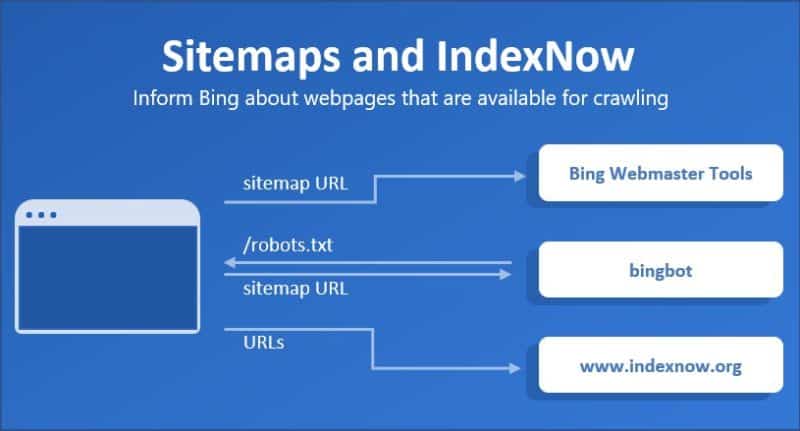
How to submit a sitemap to Bing. You can still submit your sitemaps using robots.txt on your domain name and/or through Bing Webmaster tools.

  • robots.txt: Add a reference to your sitemap in the robots.txt file located at the root of the host to inform all search engines. Example: Sitemap: http://www.example.org/sitemap.xml

Don’t forget IndexNow. Microsoft Bing of course would still love for you to push content to them using IndexNow, so you have that as an additional and supplemental option.

Why we care. If you have been using the anonymous XML sitemap option for your site through HTTP requests, you should be aware that will stop working sometime today. Switch over to using robots.txt or Bing Webmaster Tools for submitting your sitemap going forward.


New on Search Engine Land

About The Author

Barry Schwartz a Contributing Editor to Search Engine Land and a member of the programming team for SMX events. He owns RustyBrick, a NY based web consulting firm. He also runs Search Engine Roundtable, a popular search blog on very advanced SEM topics. Barry can be followed on Twitter here.

https://searchengineland.com/microsoft-bing-drops-anonymous-sitemap-submission-due-to-spam-issues-385178


Google Search Console adds translated results search appearance filter

Google Search Console had added “translated results” to the search appearance filter in the performance reports today. This filter lets you drill down to how searchers who get translated results interact with your content in Google Search.

How to access this filter. You can access this filter by logging into Google Search Console, clicking on your performance report and then clicking on the “+new” filter and selecting the search appearance for “translated results.” Here is a screenshot of how to access the filter:

Translated results report. This report will break down what queries, pages, countries, devices and so on these searchers are using when finding your content in Google Search. Again, when you filter by “translated results,” this will filter the report to show you only those who get translated results. Here is a screenshot of this report:

More on translated results. Searchers who see translated results will be those who are likely based somewhere in India and speak Indonesian, Hindi, Kannada, Malayalam, Tamil, Telugu languages. Google automatically will translate your title link and description it shows in the search results for your site’s snippet. When that user clicks on the result, Google Translate will also likely translate your page as well.

We covered this in more detail when Google released its help document on translated results last year.

As we covered there, the translated results help document explains how Google may automatically translate the search result snippets from the language it was written in, to the language of the Google Search results page. Google said “sometimes Google may translate the title link and snippet of a search result for results that aren’t in the language of the search query.”Google said it does this because “a translated result is a Google Search feature that enables users to view results from other languages in their language, and can help publishers reach a larger audience.”

These translated results work for Indonesian, Hindi, Kannada, Malayalam, Tamil, Telugu languages at the time this story was published. It should be only available on mobile devices with any browser that supports Google Search.

After the user clicks the translated search result link, Google said that “all further user interaction with the page is through Google Translate.” Google said you can opt-out of this through a meta robots tag notranslate. Here are more details on opting in or out of translated results.

Brodie Clark was the first to spot this and wrote “a new Search Appearance filter has surfaced in Google Search Console this month title ‘translated results’. The filter relates to situations where Google has translated the title link and snippet for a web page within Search.”

Why we care. Google is now giving us some idea of how these searchers are interacting with our site through Google Search. We can see what they are searching for, what pages they are accessing, on what dates, what devices and from which countries.

More data, more insights, helps us as site owners, publishers, content writers and SEOs.


New on Search Engine Land

About The Author

Barry Schwartz a Contributing Editor to Search Engine Land and a member of the programming team for SMX events. He owns RustyBrick, a NY based web consulting firm. He also runs Search Engine Roundtable, a popular search blog on very advanced SEM topics. Barry can be followed on Twitter here.

https://searchengineland.com/google-search-console-adds-translated-results-search-appearance-filter-385174


The anatomy of personalized search

Buyers expect easy navigation, relevant search results, and tailored search experiences that remember their preferences and rerank products accordingly, especially for in-session browsing. Unfortunately in 2022, consumers are still experiencing null results, poor relevance and are often pointed in the wrong direction by their favorite brands. 

If you’re running an e-commerce site, internal KPIs most likely have an underlying impact on positive consumer retention, acquisition, and site revenue. All three inadvertently impact brand loyalty and therefore keep that cycle moving. 

Most of these online storefronts you manage started with a passion for the product and/or helping to solve a consumer issue. So, when improving your site’s functionality, how often are you working backward by focusing site search & product discovery efforts for your customer?

Being able to identify and implement the right AI-backed functionalities that power intentional search experiences will help your customers win, your brand’s site win and make you look like a product discovery hero.

Unlock magical experiences that foster customer loyalty online and better understand the capabilities of your site’s search engine. Continue your journey to becoming a product discovery hero by mastering the three key areas of personalized search: semantic understanding, SKU select and 1:1 and segment-based personalization. 

When you understand the anatomy of personalized search, your search bar will be able to understand your customers. It’s a win-win. 

We’re on a mission for #nomorenullresults

Get Started  >>


New on Search Engine Land

About The Author

Bloomreach is the world’s #1 Commerce Experience Cloud, empowering brands to deliver customer journeys so personalized, they feel like magic. It offers a suite of products that drive true personalization and digital commerce growth, including: Discovery, offering AI-driven search and merchandising; Content, offering a headless CMS; and Engagement, offering a leading CDP and marketing automation solutions. Together, these solutions combine the power of unified customer and product data with the speed and scale of AI-optimization, enabling revenue-driving digital commerce experiences that convert on any channel and every journey. For more information, visit Bloomreach.com.

https://searchengineland.com/the-anatomy-of-personalized-search-385062


Entities and E-A-T: The role of entities in authority and trust

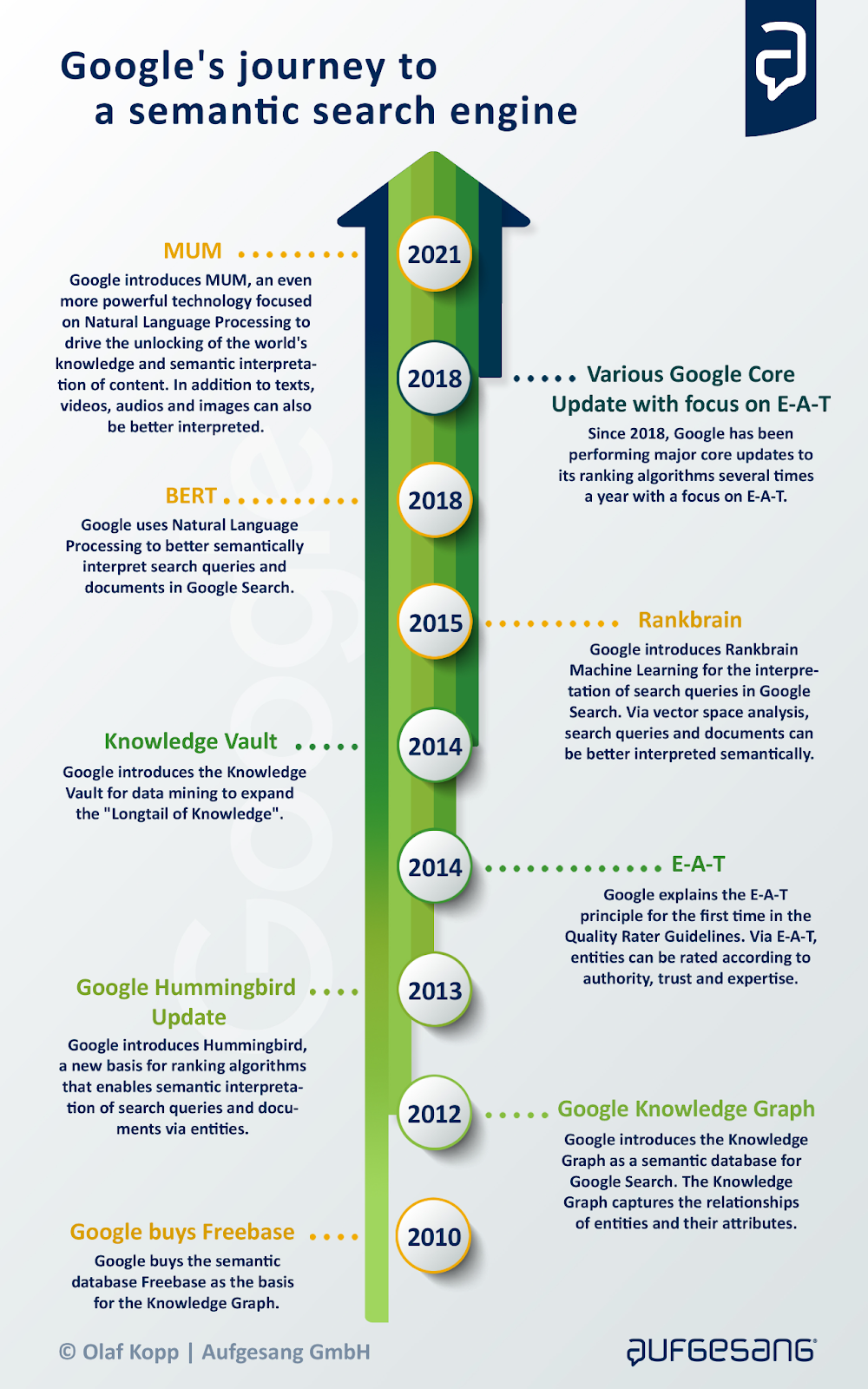
The development of Google into a semantic search engine and the increasing influence of E-A-T on rankings go hand in hand.

There is a common thread of innovation and updates that Google has been following for the past 12-plus years. Here’s a timeline of key events:

The organization of data and information around entities makes it possible for Google to rank entities of the entity type Person such as authors and organizations (publishers and companies) with regard to topics according to E-A-T.

Authors, companies and publishers as entities

Content is published by people such as authors and organizations such as companies, associations and government agencies. These organizations and people are named entities.

Google increasingly arranges or organizes content around entities. Google can draw conclusions about the credibility and relevance of the document or content via the respective entity.

In the case of online content, there are usually at least two parties involved. The author/producer who created the content and the publisher or domain on which the content is published.

The author is not always a direct employee or owner of the domain. For example, in the case of a guest article, the publisher and author are not the same.

In my view of SEO, the entity classes such as organizations, products and people play a special role, as these can be evaluated via the characteristics of a brand such as authority and trust or E-A-T.

Digital representations of entities

Entities that belong to certain entity classes, such as persons or organizations, can have digital representations such as the official website (domain), social media profiles, images and Wikipedia entries. While images tend to be the visual image of the entity, especially for people or landmarks, a person’s corporate website or social media profile is the content image.

These digital representations are the central landmarks closely linked to the entity.

Google can identify this linkage primarily through external linking of the website or profiles with link texts containing the exact entity name and/or the unique click behavior in search queries with navigational or brand or person-related search intent on the URL.

It’s all about relevance, trust and authority

The credibility of author and publisher has become increasingly important for Google. The search engine came under considerable pressure because of its fake news problem. A high degree of accuracy and relevance is a top priority for Google and its users.

Through numerous core updates and the E-A-T ratings introduced in version 5.0 of the Quality Rater Guidelines as part of the PQ rating in 2015, it is clear how important the factors of relevance, trust and authority are for Google in this regard.

The Quality Rater Guidelines list the following important criteria for evaluating a website:

  • The Purpose of the Page
  • Expertise, Authoritativeness, Trustworthiness: This is an important quality characteristic. Use your research on the additional factors below to inform your rating.
  • Main Content Quality and Amount: The rating should be based on the landing page of the task URL.
  • Website Information/information about who is responsible for the MC: Find information about the website as well as the creator of the MC.
  • Website Reputation/reputation about who is responsible for the MC: Links to help with reputation research will be provided.

Here, the points E-A-T, transparency with regard to the operator of the website and his reputation play a role in the domain-wide evaluation.

Expertise, authoritativeness and trustworthiness are currently described as follows in the Quality Rater Guidelines:

  • The expertise of the creator of the MC.
  • The authoritativeness of the creator of the MC, the MC itself, and the website.
  • The trustworthiness of the creator of the MC, the MC itself, and the website.

From entity to digital authority and brand

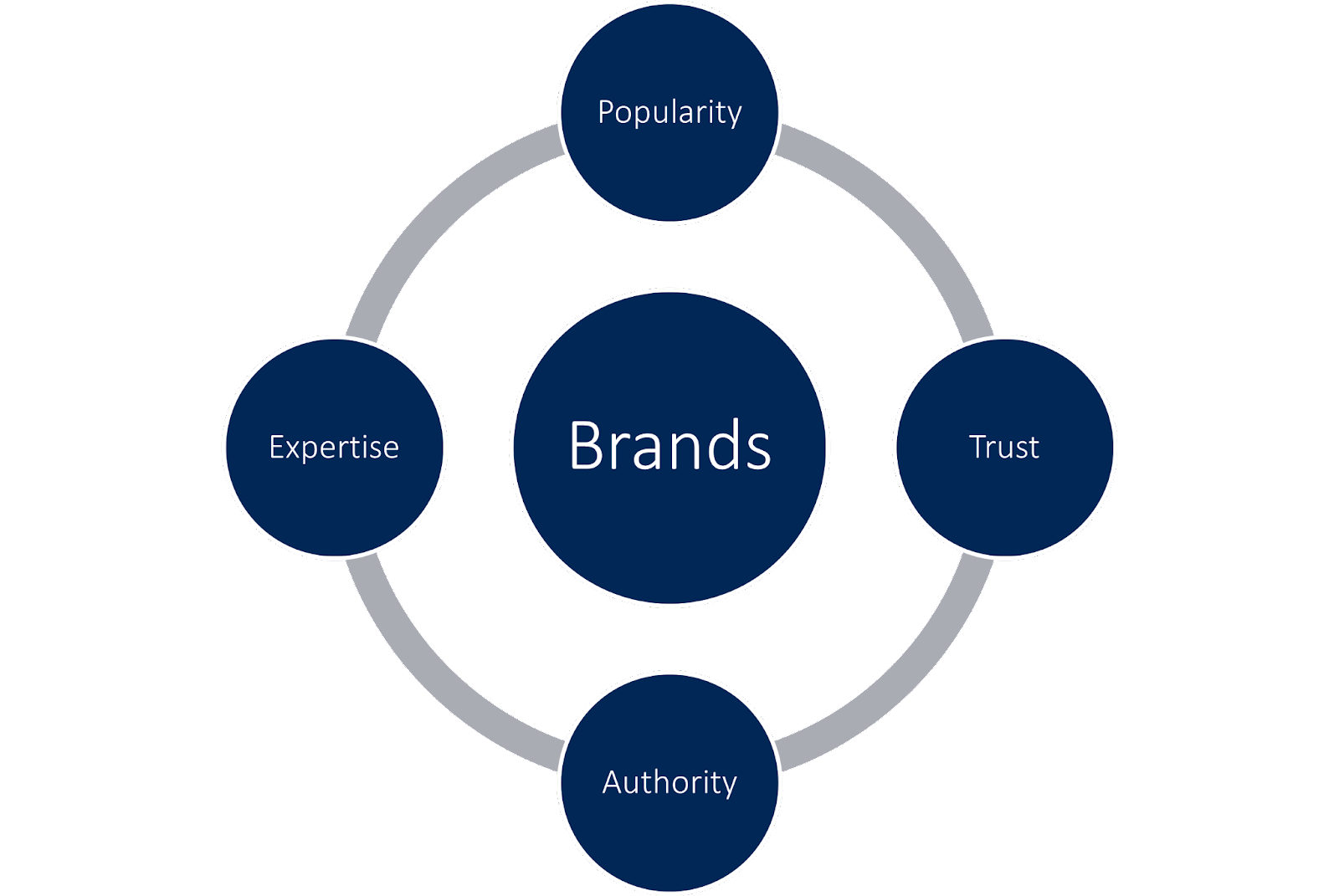
If we look at the characteristics of a brand, expertise, authority and trust play a central role.

In addition to the aforementioned characteristics, popularity is also an important characteristic of a brand, although this is not necessarily the main focus for authority or expertise.

Therefore, it can be said that a brand also combines all the characteristics of authority plus a high level of awareness or popularity.

Google attaches great importance to brands and authorities when ranking websites.

As early as 2009, Google rolled out the Vince Update, which gave large brands a significant ranking advantage.

Not surprising, given this statement:

“The internet is fast becoming a ‘cesspool’ where false information thrives. Brands are the solution, not the problem. Brands are how you sort out the cesspool. Brand affinity is clearly hard-wired. It is so fundamental to human existence that it’s not going away. It must have a genetic component.”

Former Google CEO Eric Schmidt

Brands combine characteristics such as popularity, authority and reputation (i.e., trust). I see trust and authority as one of the most important criteria, in addition to document relevance in relation to the search intent, as to whether Google allows content to appear on Page 1 of search results.

Google cannot afford to place content from untrustworthy sources in the user’s field of vision, especially for YMYL topics.

As a result, many affiliate projects that haven’t bothered to build a brand have fallen flat on their face. Popularity alone only plays a limited role.

Amazon and eBay are very popular brands, but they lack authority in certain thematic areas. That’s why more specialized stores usually rank better than the big e-commerce portals.

Organize an index around entities

A semantic database is organized out of entities, their relations and attributes. Unlike a classic database, information is captured around entities and relationships can be created between entities via edges.

As already mentioned, entities can be provided with labels or information for clear identification and for better classification in the ontological or thematic context. 

Entities are increasingly becoming the central organizational element in the Google index. Insofar as search queries have an entity reference, Google can quickly access all stored information about the relevant entities and relationships to other entities via the Knowledge Graph.

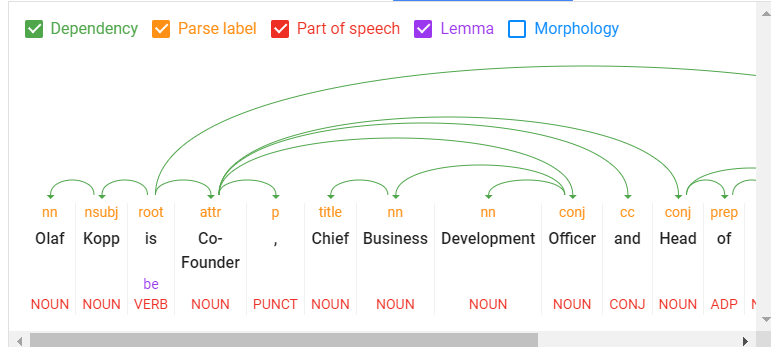
Search queries without reference to entities recorded in the Knowledge Graph are handled as usual according to classic information retrieval rules. However, Google can now use NLP to identify entities not in the Knowledge Graph, provided that the search term contains an existing grammatical structure of subject, predicate and object (triples).

Screenshot from the Google NLP-API

I think that in the future, there will be an increasing exchange between the classic Google search index and the Knowledge Graph via an interface. The more entities are recorded in the Knowledge Graph, the greater the influence on the SERPs.

However, Google still faces the major challenge of reconciling completeness and accuracy.

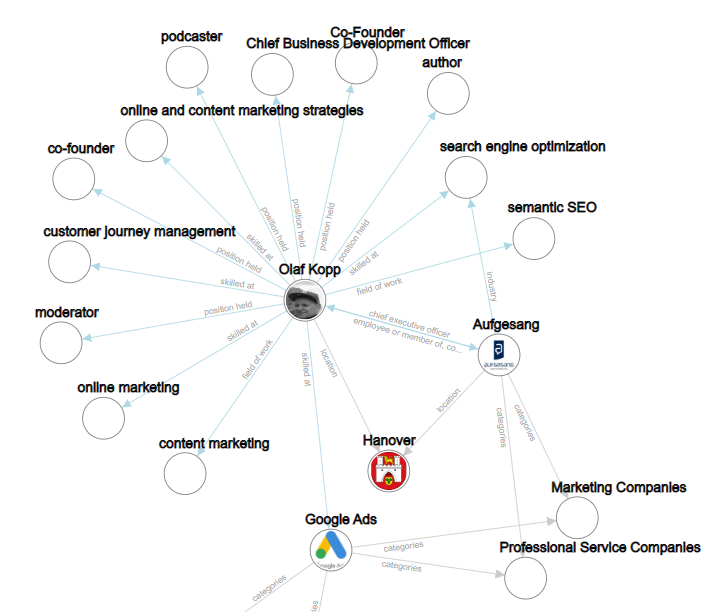
The tool Diffbot Natural Language API Demo shows very nicely how text analysis via Natural Language Processing can be used to collect information about an entity and can be transformed into a Knowledge Graph. 

In an entity-based Index, you have the following components:

  • Nodes (Entities)
  • Entity ID
  • Entity Name
  • Edges (Relationship between entities)
  • Attributes
  • Digital Representations (could be also own nodes/entities)
  • Resources (documents, videos, audios, images, etc.)
  • Entity Types or Classes
  • Topic Classes and their keyword clusters

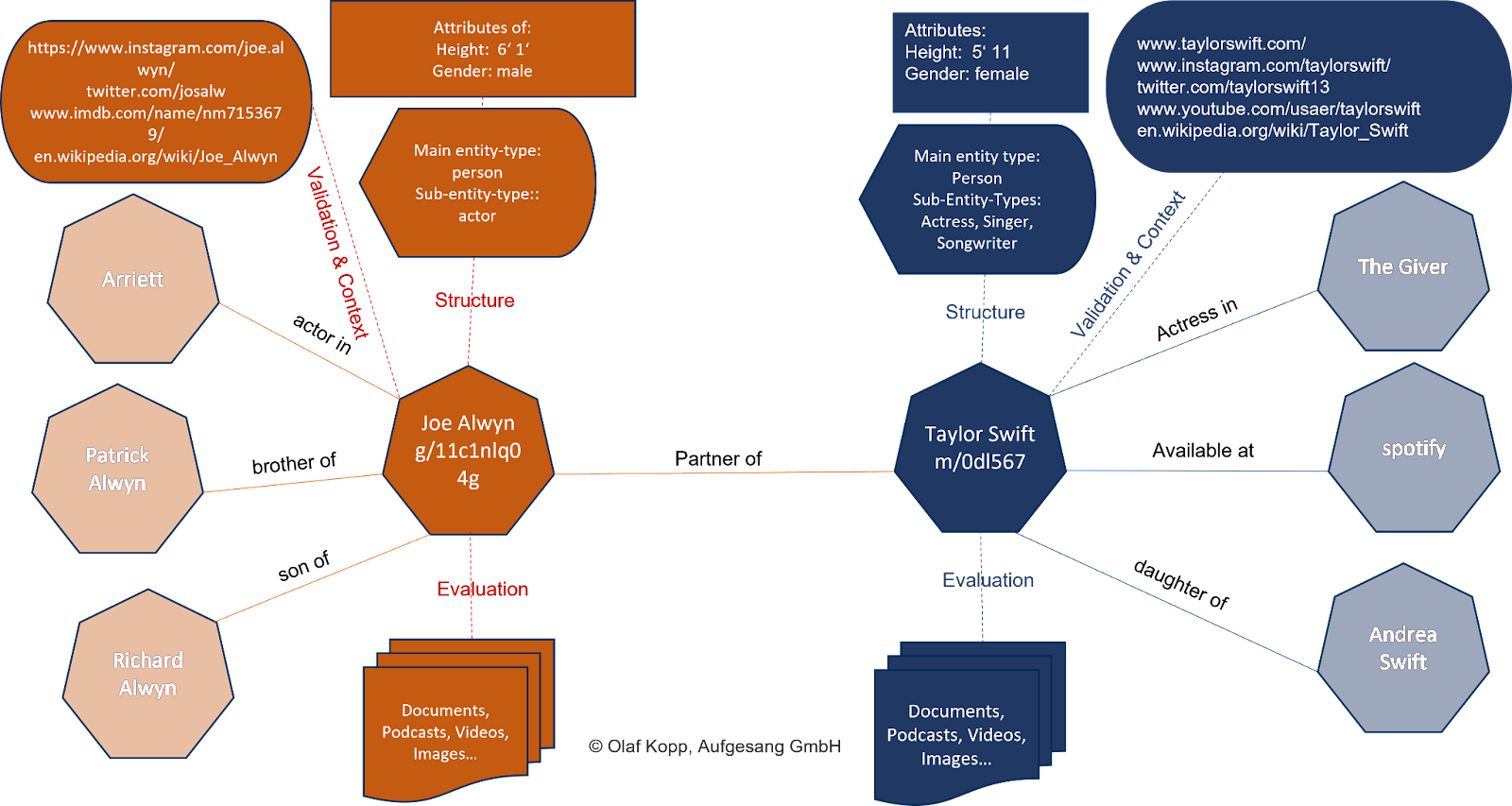
The organizational structure around single entities might look like this:

Possible index structure for the entities Taylor Swift and Joe Alwyn

The Structure around an entity is influenced by the entity types and attributes mined over the digital representations and documents, videos and other resources Google can crawl and analyze.

So Google can connect topics and their keyword clusters with entities.

The E-A-T evaluation is also based on these resources depending on the signals I mentioned in my article 14 ways Google may evaluate E-A-T.

Non-validated entities next to Knowledge Graph

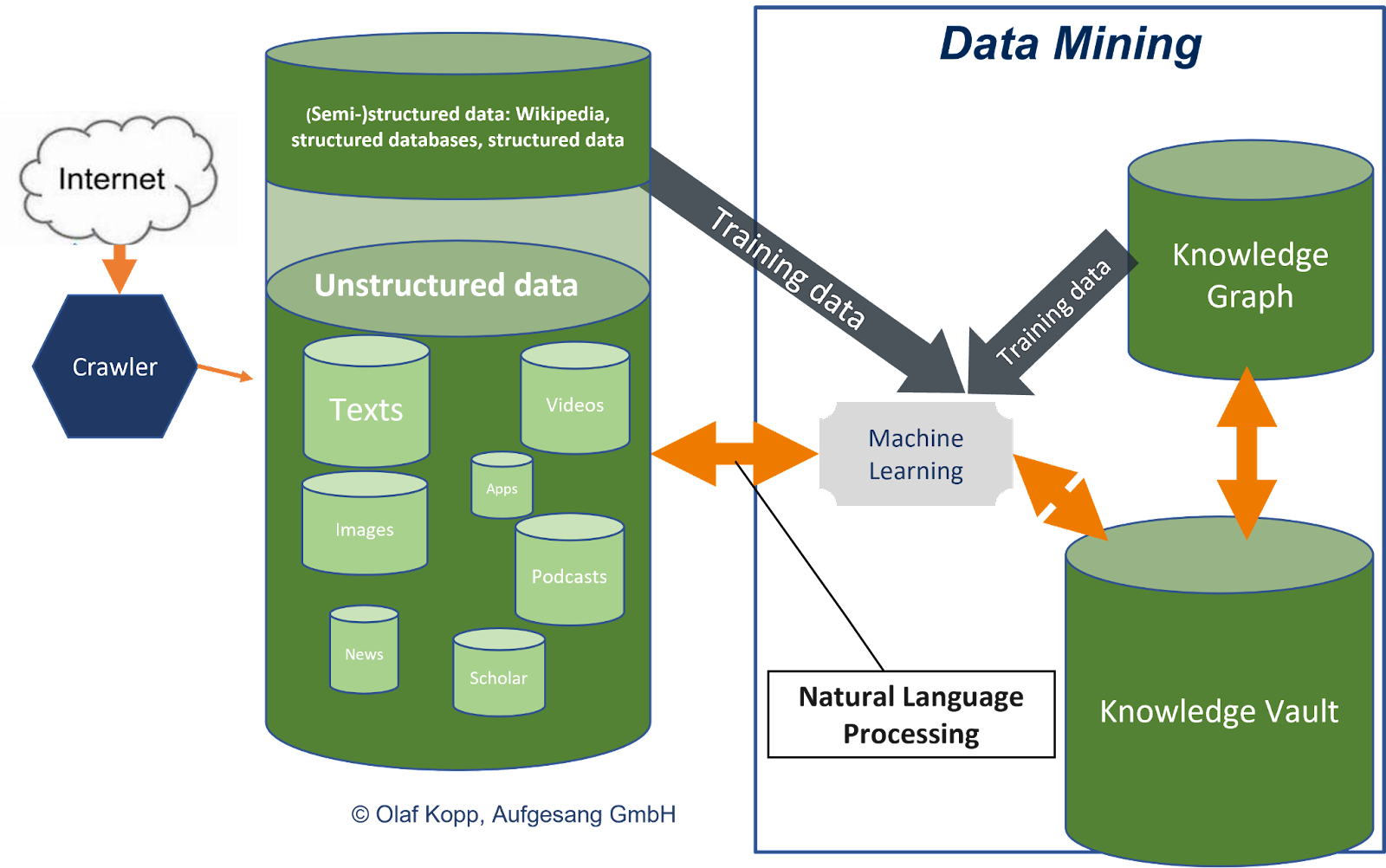
I think Google has more entities on the screen than just the ones officially recorded in the Knowledge Graph. Since the Knowledge Vault and Natural Language Processing can be used to analyze entities in search queries and content of any kind, there will be a second unvalidated database next to the Knowledge Graph. This database could contain all entities recognized as entities, assigned to a domain and an entity type, but that is not socially relevant enough for a knowledge panel.

For performance reasons, something like this would make sense, as such a repository would allow not to start from scratch again and again. I think all entities are stored there, where the information regarding correctness cannot (yet) be validated.

Thus, Google would also have the possibility to apply the explained signals to other entities besides those recorded in the Knowledge Graph to perform E-A-T evaluations.

Overview: Data Mining for the Google Knowledge Graph

Google can recognize semantic relationships between keywords, topics, entities

Since the launch of Hummingbird, Google has sought to identify, extract, and related entities.

The relationships between entities, people and topics are important to Google because this is the way they can algorithmically determine contextual relationships, the quality or strength of the relationship, and about it, authority and expertise.

Google can recognize via co-occurrences of entities and keywords with which topics entities are in context. The more frequently these co-occurrences occur, the greater the probability that a semantic relationship exists. These co-occurrences can be determined via structured and unstructured information from website content and search terms.

If the entity “Empire State Building” is often named together with the entity type “skyscraper,” there is a relationship. Thus, Google can determine the relationship between entities and entity types, topics and keywords. Google can determine the degree of relationship by the average proximity in the texts and/or the frequency of co-occurrences.

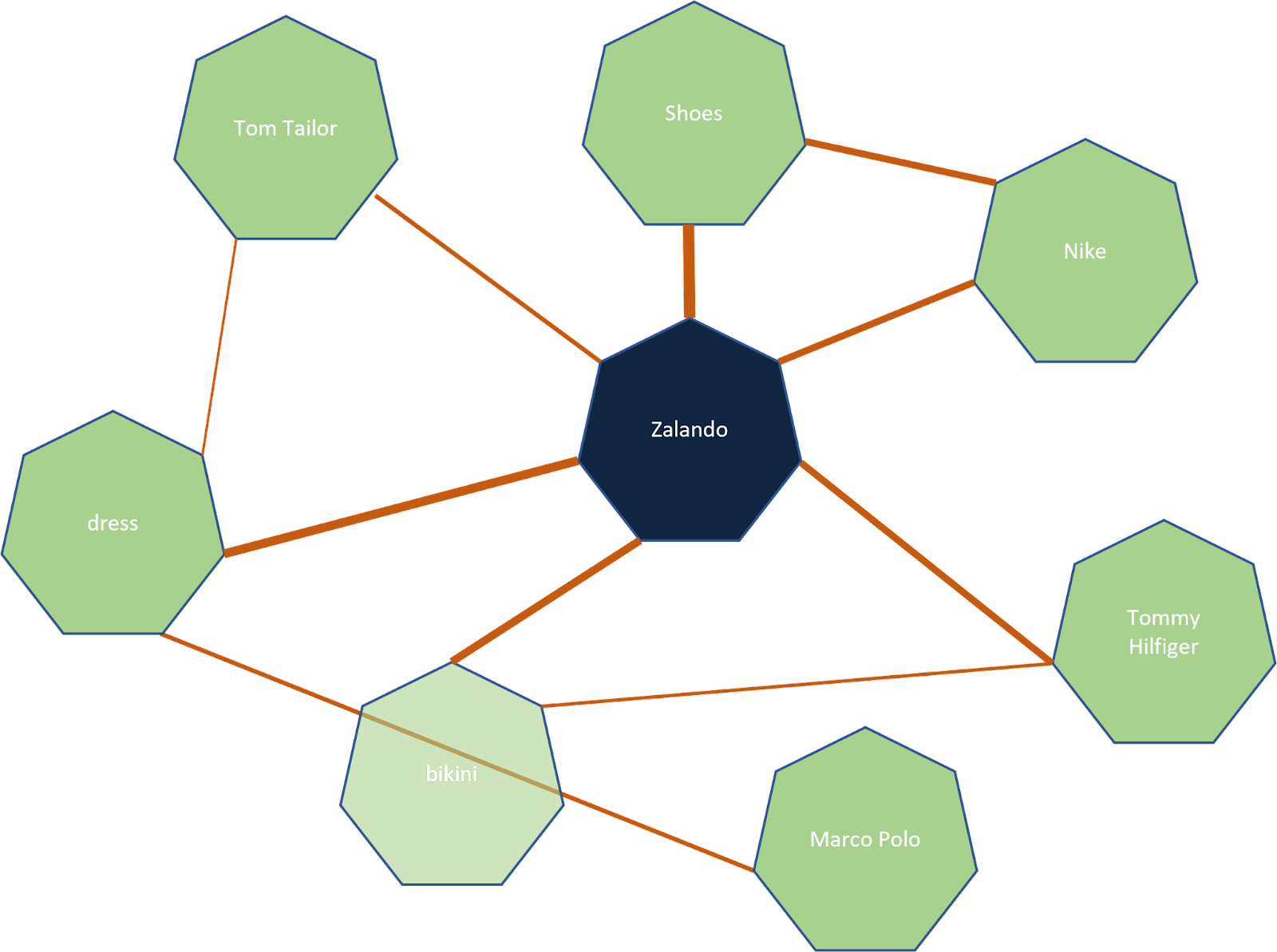
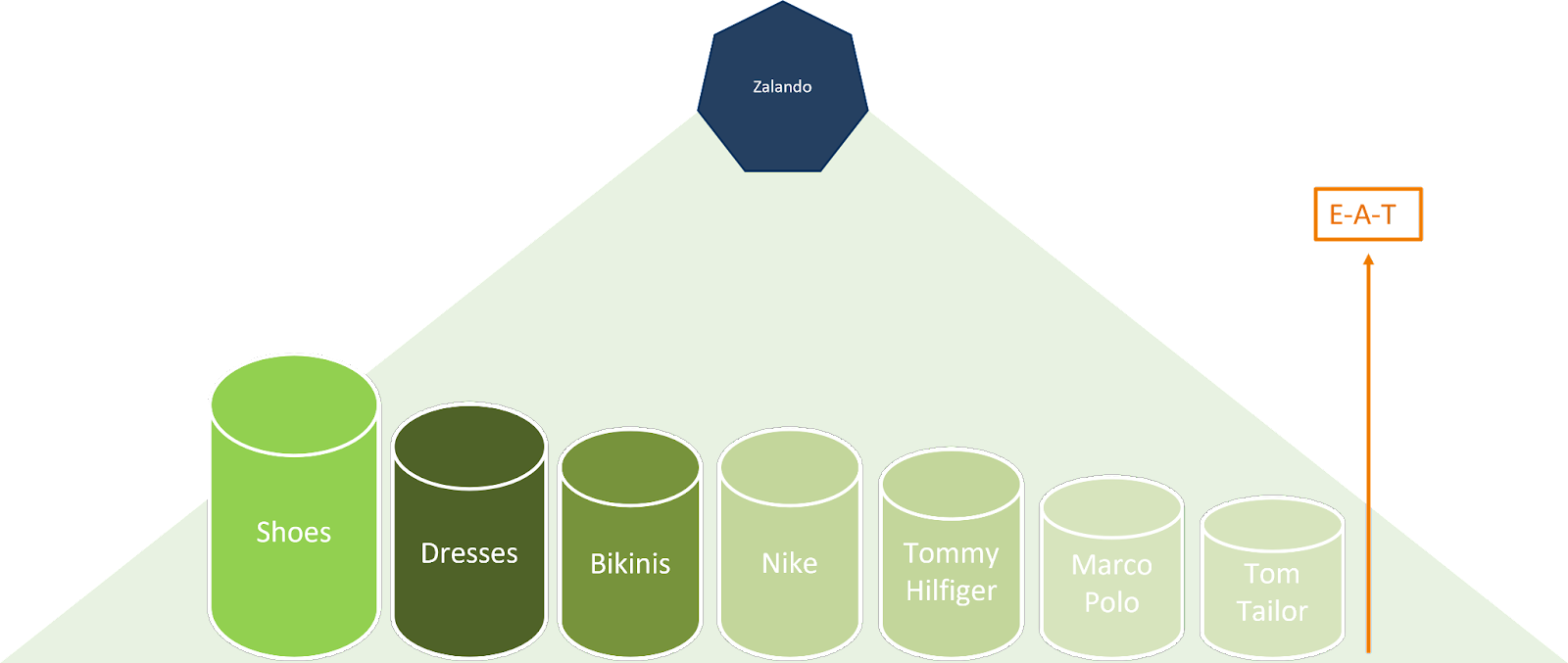
For example, Zalando is closely related to other entities such as fashion brands (e.g., Tom Tailor, Nike, Tommy Hilfiger and Marco Polo) and product groups (shoes, dresses, bikinis).

These relationships can vary in strength. Google can use the strength of these relationships to assess expertise and, above all, authority and incorporate them into the E-A-T concept.

Recognize authority and entity relevance via the domain

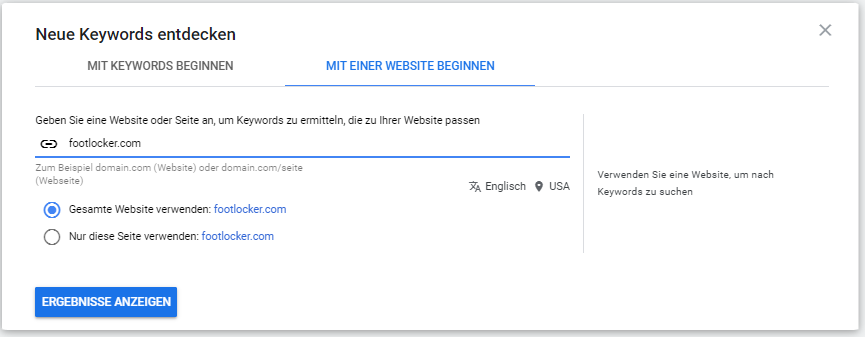
As already explained, the website is a digital representation of an entity. Google Keyword Planner can be used to display keywords related to a domain.

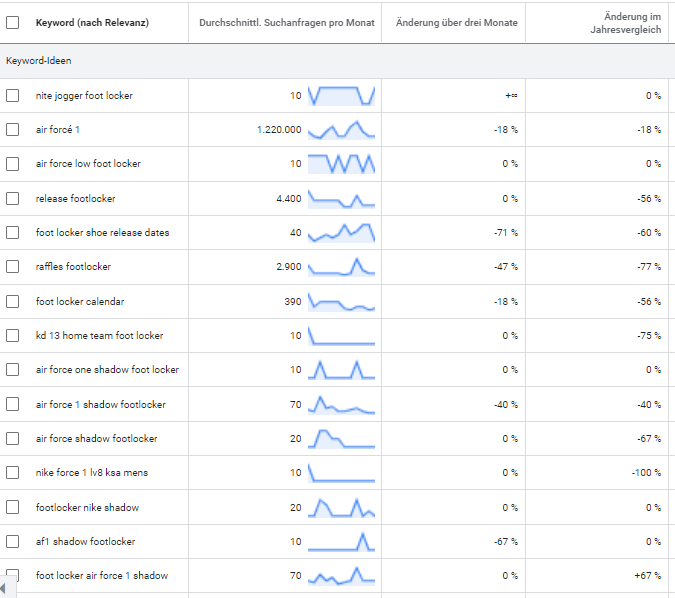
The keywords are output in a list sorted by relevance, as shown here in the example of the domain footlocker.com.

The keyword combinations in which footlocker appears together with products and topics are interesting. They show in which context users search for the brand Footlocker.

Keyword List based on Footlocker.com

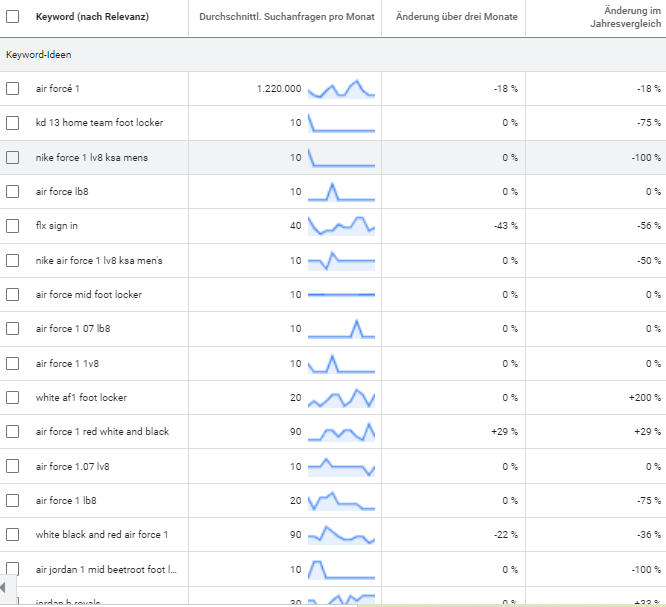
If you then remove all keywords with Footlocker from the list via the filter, you get a list of generic keywords that are still sorted according to a (semantic) relevance in relation to the domain.

Keyword List based on Footlocker.com without Footlocker

Exciting? I leave it to everyone to speculate further.

In my experience, domains for these keywords and topics have it easier to rank in Google search.

What this all means for SEOs and content marketers

Brand and authority are playing an increasingly important role in search engine optimization. This ensures that SEO techniques can no longer influence search results alone. It is just as much about marketing and PR.

In addition to the well-known SEO fundamentals of ensuring crawlability, indexing control, internal linking optimization and website hygiene, it is primarily the triad of relevance, trust and authority that needs to be considered.

For findability on Google, but also in general, SEOs and online marketers should focus not only on content, link building, crawling and indexing control but also on the effects on ranking through brand building. This requires collaboration with the people responsible for branding and PR. This way, possible synergies can already be taken into account during the campaign conception.

Relate your brand to topics/products for which you want to be found

Do this in all marketing and PR activities, with a view to Google ranking. Be it marketing campaigns, marketing collaborations such as Home2go or Footlocker have been done to promote certain search query patterns.

One should try to generate cooccurrences and links from topic-related editorial environments via PR campaigns or content marketing campaigns.

In general, owning content via owned media and signals via co-occurrences or brand and domain mentions in certain topic environments can increase the authority of a brand and thus the ranking for keywords located in these environments.

The more clearly Google can identify the positioning of the company, author and publisher, the easier it will be to rank the thematically relevant content linked to this entity.


Opinions expressed in this article are those of the guest author and not necessarily Search Engine Land. Staff authors are listed here.


New on Search Engine Land

About The Author

Olaf Kopp is an online marketing professional with over 15 years of experience in Google Ads, SEO and content marketing. He is the co-founder, chief business development officer and head of SEO at the German online marketing agency Aufgesang GmbH. Olaf Kopp is an author, podcaster and internationally recognized industry expert for semantic SEO, E-A-T, content marketing strategies, customer journey management and digital brand building. He is co-organizer of the PPC-Event SEAcamp and host of the podcasts OM Cafe and Content-Kompass (German language).

https://searchengineland.com/entities-eat-authority-trust-385156


Link building: the least favorite part of SEO

There are plenty of reasons to love SEO. I certainly do and have since I started my SEO journey in 2007. 

But every job has unique challenges – aspects that can be frustrating, difficult, tedious or even downright painful. 

That’s why, earlier this week in the Search Engine Land newsletter, I asked readers: What is your least favorite part of SEO?

Well, we have a winner. Or loser?

It’s link building. More than 20% of respondents said link building was their least favorite part of SEO. 

Let’s dig into the results. 

Link building and outreach. It’s time-consuming. It’s tedious. And success is never guaranteed. These are a just few of the biggest complaints from SEOs about trying to build quality links that we saw from Search Engine Land readers:

  • “Getting backlinks – it is the equivalent of a vampire sucking your soul for very little return.”
  • “Obviously, getting natural links is nice, but when you’re out there fishing for them, it may or may not be fruitful. It’s so time-consuming and there’s no guarantee you’ll see the results you want.”
  • “Too much work to get any reward. It often feels pointless.”
  • “Dealing with websites that used xyz backlinks in the past. Sometimes, I’ll inherit a client whose previous agency did so, and I end up having to clean it up because it looks bad on my end if potential clients or fellow SEOs are looking at my clients’ backlink profiles to see how we do SEO at my agency.”
  • “There is nothing more tedious and frustrating than reaching out to website owners who are getting spammed 24-7 by all and sundry to try and build a relationship in order to promote an asset your team has spent loads of time creating to either be ignored or to have to go through the awkward process of negotiating only to end up having to chase for weeks or even months to get the link live. It’s like, ‘Head, meet brick wall…’ This is a direct result of so much bad practice out there coming back to impact people who are trying to get it right.”
  • “It takes so much time, thought and care to build lasting links, especially at scale in the B2B space.”
  • “It’s the most abused area of SEO.”

Google. Yes, Google. There were a range of complaints. A few were specific to Google Business Profiles:

  • “Way too many spam listings outranking actual, quality businesses. Legitimate reviews are being removed. If you happen to get suspended for no reason, support is a nightmare to deal with to get your listing back up. And yet, you’ve got deal with GBP, at least in local SEO, because of its prominence in the SERPs.”
  • “Lack of control. Such an important listing for local businesses, yet so volatile. Make it paid already and give us more control and better customer service.”
  • “Too many businesses are able to create spam websites and GBP listings, which makes it a volatile space. The world would be a better place if spammers didn’t exist. Now I have to fight spam each day to help my client be in the position they were supposed to be in.”

But our readers shared other Google-related complaints, ranging from algorithm update timing to GA 4:

  • “Google releasing algo updates right before the holidays.”
  • “The metrics for the so-called “Page Experience” are so ambiguous in testing and evaluating.”
  • “They’re trying their darndest to keep everyone in their ecosystem instead of allowing clicks through to sites. Their profits last year say it all.”
  • “Dealing with and understanding white lies coming from Google representatives.”
  • “It took me a while to set up Google Analytics and it’s my 24/7 go-to for monitoring traffic to my online fashion store. I’m not looking forward to moving to the next generation, GA4, especially while all the features I currently use are not yet available. I’m sure I’ll eventually adapt but it will take some time.”

Proving the worth of SEO. Have you had to convince your organization that SEO is a smart investment? The answer should be as simple as, “Have you heard of this thing called Google.” Well, now you can point them to this article: Why SEO is a great investment, not just a cost.

Defending the value of SEO shouldn’t be such a struggle anymore. It’s 2022. Yet here we are:

  • “People not taking SEO seriously or understanding the worth of its investment and time.”
  • “The expectation that results will be immediate and positive every time.”
  • “Having to work double as hard as PPC managers to prove SEO’s worth.”
  • “Explaining to clients why an automated report they received from a cousin’s, best-friend’s former roommate has no context and should be ignored.”
  • “The constant doubting from other ‘SEO experts’ on the marketing team is demoralizing and demotivating. It’s hard to feel confident as an SEO, because the foundations keep shifting.”
  • “Pushback from uneducated executives or ones who have been jaded by snake-oil SEOs in the past. Makes it really tough to execute on what you know will work, especially when the proof of whether your tactics work or not can take so long in coming to validate your strategies.:
  • “The amount of effort and time sometimes necessary for clients to implement the changes needed for them to be successful in organic search.”

More least favorite parts of SEO. Finally, a few randoms. These answers didn’t fit into any of our other buckets, but they are all valid reasons for these being called out as a least favorite part of SEO:

  • “Technical optimisation. Never straightforward as to what exactly is causing the issues, and more often than not you need help from a developer. It’s rewarding once the problem is solved but the process is a bit of a maze.”
  • “Watching what appears to be a well-optimized page rise and fall sporadically in the SERPs. It’s maddening.”
  • “The uncertainty of what actually influences SERP position. It seems like a mystery and a moving target which makes it hard to manage.”
  • “Keyword analysis, hangs me out of my throat. Uses 5 different tools, and has trouble stopping when enough is enough.” 
  • “Reporting. Nobody reads reports sent by the SEO team. You could send the same report every month and nobody would notice it. I like reporting by exception.”
  • “Cheap, unappreciative clients.”
  • “Digging through tons of articles on SEO topics posturing as new insights, that actually contain old platitudes or even bad analyses, just to find those few pieces a month that actually bring some new insight.”
  • “Trying to find unique product titles for 2,000 products made with the same metal (jewelry). When I see squiggly or zig-zag on a site, I know I am not alone!”
  • “Identifying expertise among agencies.  When everyone starts with a similar checklist of best practice recommendations, it’s difficult to know who will be able to transition into an individualized strategy for our business.”
  • “Dealing with developers. It’s always hard to convince them about how important stuff is and to have them added to their backlog soon.”
  • “Keeping up with technology and UI changes in all the different platforms. I’m fine with keeping up with best practices, trends, evolving standards, strategies, and explaining them to internal and and external stakeholders. It’s adapting to all the menus and paths in all the different software and platforms in order to get things done. Every day, I’m closer to becoming my dad struggling to reprogram the VCR.”
  • “Well… it depends.”

(Note: you can read even more answers to this same question on Twitter. Google’s John Mueller asked the same question.)

Why we care. It’s good to share our frustrations with our peers. Clearly, many of you are experiencing some similar pain points in the SEO world. Just remember, it’s completely normal to not like parts of your job all the time. That could go for certain tasks, projects, clients or co-workers. And if you love link building? We salute you!


New on Search Engine Land

About The Author

Danny Goodwin is Senior Editor of Search Engine Land. In addition to writing daily about SEO, PPC, and more for Search Engine Land, Goodwin also manages Search Engine Land’s roster of subject-matter experts. He also helps program our conference series, SMX – Search Marketing Expo. Prior to joining Search Engine Land, Goodwin was Executive Editor at Search Engine Journal, where he led editorial initiatives for the brand. He also was an editor at Search Engine Watch. He has spoken at many major search conferences and virtual events, and has been sourced for his expertise by a wide range of publications and podcasts.

https://searchengineland.com/least-favorite-part-seo-385159


Google Search Console to release new video page indexing report

A new video page indexing report is coming to Google Search Console in the near future, Dikla Cohen, a Web Ecosystem Consultant at Google, announced at Google I/O today. The new report shows you a summary of all the video pages Google found while crawling and indexing your site.

Video page indexing report. The video page indexing report will be found in Google Search Console, under the “Index” tab, under “video pages.” At the time of writing this, this feature does not seem live yet – but it should be coming soon.

This report shows you a summary of all the video pages Google found while crawling and indexing your site. It will help you:

  • See how many video landing pages Google discovered and in how many of them a video was indexed
  • Examine reasons for unindexed videos in landing pages
  • Use the list of affected video pages URLs to debug and fix issues
  • Validate fix to initiate recrawling of known affected URLs

What it looks like. Here are screenshots from the presentation:

Why we care. Video is an important aspect for many web sites, and these reports will help you discover how important those videos are for you related to Google Search. Google Search Console’s new video indexing reports can help you find indexing issues with your videos and how to debug those issues.

Check back to find out when this report goes live.


New on Search Engine Land

About The Author

Barry Schwartz a Contributing Editor to Search Engine Land and a member of the programming team for SMX events. He owns RustyBrick, a NY based web consulting firm. He also runs Search Engine Roundtable, a popular search blog on very advanced SEM topics. Barry can be followed on Twitter here.

https://searchengineland.com/google-search-console-to-release-new-video-page-indexing-report-385153


Google reveals new image ranking signal, inclusive schema

Google said it will soon incorporate a new signal into image ranking. Google is also introducing a new type of schema in an attempt to help make its image search results more racially diverse and inclusive. 

Google will use MST Scale to rank images. Google said it will be adjusting how it ranks images, using what is called the Monk Skin Tone (MST) Scale. It is a 10-shade scale. It looks like this:

Google will use the MST scale into image ranking and wants brands and publishers to start labeling images using inclusive schema.Google will use the MST scale into image ranking and wants brands and publishers to start labeling images using inclusive schema.
The Monk Skin Tone Scale includes 10 shades.

The MST scale was created with the help of Dr. Ellis Monk, a Harvard professor and sociologist. Google said the MST Scale is being incorporated into Images search, as well as other image products (e.g., Google Photos). And Google plans to expand it more broadly in the coming months.

Inclusive schema. Google said that creators, brands and publishers can use a new type of schema – inclusive schema – to label their content with attributes like skin tone, hair color and hair texture. Using this schema will help Google better understand what appears within the images. 

Content labels coming soon. Google also noted that it wants to create a more representative search experience. As part of that, Google plans to develop a “standardized way to label web content.”

A continuation of image search changes. Google’s push toward image equity began In October 2021, Google told Bloomberg it had updated its algorithms to show more skin tones for a variety of images, ranging from [beautiful skin] to [professional hairstyles] to [happy family]. 

  • “We’ve started to roll out an improvement to Google Images to promote greater skin-tone diversity so more people can find relevant and helpful results,” a Google spokeswoman told Bloomberg. “We’re in the early phases of this effort and are continuing to experiment to provide greater diversity in results.”

Now this effort is being pushed out more widely.

Why we care. Google is pushing to be more inclusive of skin tones in Images and adjusting its ranking algorithm to do so. So if you’re publishing diverse imagery, using this schema will help Google better understand the details within your image content, giving you a higher chance of being found in Google Images.

You can read the full announcement about how Google plans to improve skin tone representation here.


New on Search Engine Land

About The Author

Danny Goodwin is Senior Editor of Search Engine Land. In addition to writing daily about SEO, PPC, and more for Search Engine Land, Goodwin also manages Search Engine Land’s roster of subject-matter experts. He also helps program our conference series, SMX – Search Marketing Expo. Prior to joining Search Engine Land, Goodwin was Executive Editor at Search Engine Journal, where he led editorial initiatives for the brand. He also was an editor at Search Engine Watch. He has spoken at many major search conferences and virtual events, and has been sourced for his expertise by a wide range of publications and podcasts.

https://searchengineland.com/google-mst-scale-inclusive-schema-385127


An SEO guide to audience research and content analysis

How your customers find you can vary significantly. It may be based on their interests, needs or pain points.

Some people may already know exactly what they need and search for that on Google. Others may be just starting the research process. Others may already know what they need and compare to identify the best source to purchase from.

In this stage of your SEO research and planning, you’ll want to identify:

  • Target personas
  • Buying stages
  • Potential keywords 

Your goal will be to map your target personas, buying stages and keywords for each persona and buying stage.  

Persona research 

You can start by using customer service data or information from your Google Analytics demographic details. With this information, you can start creating target personas.  

Below is an example of possible target personas for a real estate company.

Once you have your personas and ideas of who they are, what they need, and what they are looking for, you’ll want to map out the possible steps they’ll take in their buying journey.

Buyer’s journey

Finally, you can add the possible keywords they’ll search for and map them to the journey.

Map keywords to persona to the buyer’s journey

The goal of this phase is to identify all of the possible ways you can be found and to make sure you have content optimized on your website targeting these buying phases and keywords.

You’ll start by identifying primary, root phrases. As you progress, you can go deeper into long-tail terms or semantically related keywords.

This will allow you to identify gaps and opportunities that were missed during your initial baseline and competitive research. Some of these keywords won’t be uncovered unless you truly understand your audience and their needs and pain points.

This stage will complete your research phase and give you all the information to create your content strategy and focus your on-page SEO priorities.   

Evaluate your existing content

With your comprehensive keyword research, the next step is to look at the existing content of your site and see if it’s optimized properly.

  • Does your website have pages that are not getting any traffic from Google, pages that are near-duplicates or multiple pages targeting the same keyword?
  • Do you have content pieces to match the keyword list you created in the previous stage?

Before creating a content calendar or editorial strategy, it’s ideal to audit your existing content. By reviewing your existing pages, you can decide which pages need to be removed, consolidated or optimized.

Some of the elements you can look for include:

  • Page traffic
  • Primary keyword
  • Number of keywords ranking
  • Word count
  • Internal linking

To perform a content audit, you’ll need to export all of your pages from your CMS or use an SEO audit tool, such as Screaming Frog or Semrush Site Audit, to get a list of your site’s existing pages.

Consolidate all of this data into a content audit spreadsheet. Your spreadsheet could look something like this:

Assess your site’s content

Once you have collected all of the data, go through the URLs and label the pages:

  • Keep: The page is optimized and performing well and can be left alone.
  • Optimize: The page could be ranking better with improved on-page SEO.
  • Rewrite/revamp: This is for pages where the content needs to be revamped or rewritten.
  • Remove: These pages are not performing well and should be removed. When doing so, it’s important to remove the page from your sitemap, Google Search Console, and any inbound links.
  • Consolidate: If there are multiple pages targeting the same keyword, consider moving all of the content into the URL that is performing best and using 301 redirects for the other pages. 

How to optimize, revamp or consolidate pages

Once you have all of your pages labeled, it’s time to optimize your content. Some pages may be performing well but could be refreshed to help them perform even better. Others may be performing poorly and need to be optimized to rank.

Typically, this process will involve two steps:

  • Editing and re-optimizing the existing content. 
  • Expanding the article with new content. 

Select the primary and secondary keywords for each page

The best way to gather this data is to use Google Search Console for ranking pages or your keyword database for pages that are not.

To gather data from Google Search Console, click on Performance > Search Results report:

You can click on a page to see the keywords that it’s ranking for and the clicks, impressions and average position for each:

This will help you identify target keywords for each page, which you can add to your spreadsheet.

For each page, add the target primary and secondary keywords you will use when performing the necessary content updates.

Revamp existing content

When optimizing pages, you need to make sure that you are preserving or adding the correct on-page SEO elements. Let’s review these:

Primary keyword optimization

The primary keyword should appear in the:

  • Meta (page) title: For existing articles, you can edit an existing article’s meta-title. Use the Google SERP Simulator to see how your title would look. Where possible, start the title tag with your primary keyword and add modifiers to your titles. 
  • Meta description: Up to 230-character description of the article. Make sure that you use the primary keyword as close to the beginning of the meta description as possible.  
  • The first heading of your article is the title. This should be an H1 heading. The title/heading should include the primary keyword.
  • First paragraph. The primary keyword should appear in the first paragraph, ideally within the first 100 words.
  • Anchor text: Include the primary keyword in at least one outbound, internal link.

Adding any secondary keywords

All related secondary keywords should be incorporated naturally into the article. For each related keyword, add them in an H2 heading. Whatever the focus keyword is for each paragraph, it should be both in the H2 heading and in the paragraph following the heading.

Questions and answers

Q&A is an easy way to expand upon your articles by finding related questions. Take the primary keyword, and search for it on Google. Use the questions in the “People also ask” box as section headers:

The section header with the question will be an H2. In the next section, you should answer the question as quickly and succinctly as possible. Don’t re-state the question; instead, immediately provide the answer.

If the question was “How do you get featured in snippets,” then the first sentence should answer the question: “To get into featured snippets, you need to ask questions and answer them using paragraphs, lists, and quick answers.” 

Use bullet points! Google loves listing answers with bullet points, so where possible, answer the question and immediately add a list with bullet points: 

Content formatting

Use proper formatting to make the content easy for people to read quickly. Here are a few suggestions for formatting your content:

  • Break up giant walls of text. Give information in short paragraphs. Use succinct sentences. 
  • Add lists. Google loves lists! Are there any paragraphs or sections you can change into bullet points or numbered lists? If so, do it!

Add 2-3 internal links to other relevant pages on the site. Keep your anchor text short. Then, find at least 3-5 relevant pages on your site, and link to your target pages. Every page of your site should contain as many links from other site pages as possible.

Add 2-3 external links to relevant pages. Good external links serve a strong purpose. They create a natural link map and connect your sites to authoritative sources. Google will give more weight to a page that has good external links.  

Add new content

If the article is thin, you can add new content to expand on key points.  

Writing new content

  • Add more paragraphs. If you can add a list, more sub-headings, etc., all the better! 
  • Reading level. Keep the language at a 7th-grade reading level whenever possible. The best content is easy to read and understand, not dense and impregnable.

Images

  • Add new, optimized images to your revamped content.
  • Along with the link, please write the alt text for the image. This should be a one-sentence image description that includes the primary keyword. 

Content consolidation

When there are several short pages or articles that are all ranking for the same keyword, it might be ideal to consolidate these articles into one longer, more comprehensive piece.

When consolidating articles, keep in mind: 

  • Take bits and parts of the different existing articles and merge them into one that makes sense.
  • You should write the TARGET URL slug at the top of the document and include the new, optimized meta title and meta description.
  • Add links to internal pages and external sites 

Prioritize your fixes

Once you have created and labeled your spreadsheet and added target primary and secondary keywords, the final stage is to prioritize and assign your optimizations based on traffic or keyword importance.  

If you have pages targeting important keywords that are not ranking well, move those to the top of the priority list.

If there are pages that have a lot of traffic and could be performing better, these should also be prioritized.

At the end of this stage, you should have a comprehensive keyword list that you will have mapped to existing pages or labeled to be created.

Mind the gap

During the early stage, you want to be mindful of identifying persona, content and keyword gaps. If you don’t have content targeting some of your keywords, you’ll be missing opportunities to reach your target audience.

Most sites will have a degree of cannibalization as the SEO and content plans go through different teams and stages.

Before spending significant resources on producing new content, first, identify and maximize the content you already have, and then “mind the gap” by creating a content plan that targets all keywords that haven’t been optimized.


Opinions expressed in this article are those of the guest author and not necessarily Search Engine Land. Staff authors are listed here.


New on Search Engine Land

About The Author

Marcela De Vivo is an industry veteran with more than 20 years of digital marketing experience, Marcela travels the world speaking about SEO, data-driven marketing strategies, and workflow automation and optimization. Marcela owns a digital marketing agency called Gryffin based in California.

https://searchengineland.com/seo-guide-audience-research-content-analysis-385055


New Education Q&A structured data help document from Google

Google has released another new help document to its search developer documents today – named Education Q&A. This technical help document explains how to add Quiz structured data to your flashcard pages to appear in the Education Q&A carousel in Google Search results, Google Assistant, and Google Lens results.

Supported page types. Google said these two page types currently support this type of structured data:

  • Flashcard page: A page that contains flashcards that typically have a question on one side and an answer on the other side. To mark up flashcard pages, continue reading this guide to learn how to add Education Q&A schema.
  • Single Q&A page: A page that only contains one question and is followed by user-submitted answers. To mark up single Q&A pages, add QAPage markup instead.

Technical requirements. Google listed out these technical requirements for the Education Q&A structured data:

  • Put structured data on the most detailed leaf page possible. Don’t add structured data to pages without questions.
  • All questions must use the Flashcard value for the eduQuestionType property. Pages that contain other question types are not eligible for the Education Q&A carousel. For pages with other question types, consider using Practice Problems.
  • Ensure that your host load settings allow for frequent crawls.
  • The questions on your site should be immediately visible to users on the page, meaning that the questions aren’t held only in a data file or PDF.
  • If your page has only one question followed by several user-submitted answers, use QAPage markup instead.

English only. This seems to only be available right now for English language queries, Google said the Education Q&A carousel is available in English when searching for education-related topics on desktop and mobile.

Opt out. Google you can opt out of showing up in this search feature by using this form.

More. There is lot more detail including the technical structured data samples, how to test and monitor the results, and even this screenshot.

Why we care. Anything you can do to differentiate how your content is displayed in Google Search may improve your visibility in Google Search and thus your click through rate from Google to your site. Of course, you should test it and see if the results are worth the effort and the clicks drive more conversions.


New on Search Engine Land

About The Author

Barry Schwartz a Contributing Editor to Search Engine Land and a member of the programming team for SMX events. He owns RustyBrick, a NY based web consulting firm. He also runs Search Engine Roundtable, a popular search blog on very advanced SEM topics. Barry can be followed on Twitter here.

https://searchengineland.com/new-education-qa-structured-data-help-document-from-google-385074