Google’s digital marketing course offers bad SEO advice

That uproar you hear? It’s SEOs calling out Google today. 

Google’s new Digital Marketing & E-commerce certification course, which was announced May 2, includes cringe-worthy SEO advice so shockingly bad that one of Google’s search advocates – Danny Sullivan – is disavowing it.

What happened. It all started with a tweet from international SEO consultant Gianluca Fiorelli. In it, he shared this screenshot of a slide discussing how to avoid keyword stuffing:

This is Google’s official advice from the course:

  • Write more than 300 words on your webpage.
    • Your webpage is more likely to be ranked higher in search engine result pages if you write a higher volume of quality content.
  • Keep your keyword density below an industry standard of 2%.
    • This means that 2% of the words on the webpage or fewer should be target keywords.
  • Be thoughtful about keyword placement.
    • Your keywords should be used only once in the following places on each page within your website: page title, subheading, first paragraph, and body conclusion. 

“Seriously… ‘write more than 300 words’? and ‘keyword density’?” Fiorelli tweeted. “I mean… keyword stuffing is bad, sure! but solving it by spreading SEO myths that SEOs try to eliminate?

“I know that this course is very entry-level, but exactly for this reason myths like these ones should not be taught. Did the SEOs in Google review the course?”

“This can be ignored”. Danny Sullivan, Google’s Search Liaison, responded to Fiorelli, essentially disavowing the course. 

“I’m not on the team that produced that, nor are they part of the Search team,” Sullivan replied. “As someone from the Search team, we don’t recommend any limits or ‘density’ or anything like that. This can be ignored; I’ll pass it on.”

He then linked to Google’s advice from search, Google’s SEO Starter Guide. That document makes no mention of keyword density or word count minimums.

Keyword density. Keyword density is a percentage that tells you how often a keyword or phrase is used on a page. You divide the total number of times a keyword or phrase is used by the total number of words used. Then multiply by 100 and you have your percentage. (Or just copy-paste a URL or your text into a free online keyword density calculator.)

Here’s the fun thing with keyword density. I’ve spoken with many SEOs in the past who swear they successfully figured out the right keyword density in the past and it helped them rank pages. The exact keyword density varied – I heard anywhere from 2% to 10% was the sweet spot, depending on who you talked to (and what year) and what industry they were using it in.

So keyword density myth has a kernel of truth to it. Because it used to work. 

But let’s be clear: there is no keyword density “industry standard.”

Google has downplayed keyword density, as far back as 2006, when ex-Googler Matt Cutts shared advice about writing useful articles that readers will love. In part, he wrote:

“… in the on-page space, I’d recommend thinking more about words and variants (the ‘long-tail’) and thinking less about keyword density or repeating phrases.”

In a 2011 video, Cutts was asked: “What is the ideal keyword density of a page?”

[embedded content]

Key quotes:

  • “So the first one or two times you mention a word, then that might help with your ranking, absolutely. But just because you can say it seven or eight times, that doesn’t mean that it will necessarily help your rankings.”
  • “I would love it if people could stop obsessing about keyword density. It’s going to vary. It’s going to vary by area, it’s going to vary based on what other sites are ranking it. It’s not a hard and fast rule.”

But Google search has advanced much since 2011. Today, it’s not uncommon to find some pages ranking for certain keywords without ever using the keyword it’s ranking for within the page.

Keywords absolutely matter. But there is no magical ratio of keywords to content that can guarantee traffic and rankings. 

Eric Enge, president at Pilot Holding, wondered why Google even addressed keyword density. Enge said:

  • “Much better advice would be to have true subject matter experts create your content. If you do that the content will be reasonably keyword-rich in a way that is naturally a match to the topic of the content.”

Enterprise-level SEO consultant Jessica Bowman said she was shocked to see Google define any keyword density, which Google and SEO leaders have disputed for years. She also said:

  • “I do guide writers on the number of keyword repetitions to use in content (but avoid any discussion/research on density). The reason for specifying the number of repetitions for keywords is that in my experience writers won’t naturally mention keywords enough to establish relevance for the keyword you want to rank for.”
  • “When guiding writers, I include seven keyword types to guide writers such as: Primary keyword, secondary keyword, words that are part of an authoritative discussion on the topic, words to use in links, etc. Each has a number of repetitions to include. I find this guides the writer into a direction of building out robust content with an authoritative discussion that will perform well in search engines.”

Marie Haynes, owner of Marie Haynes Consulting, also said she was quite surprised that Google’s course provided specific advice on keyword density. She wondered if, perhaps, the person responsible for writing this course content wasn’t fully experienced in SEO.

  • “As with all SEO-related information you find on the web, this is a good example of why we should always have a strong reference to point to when making SEO recommendations. Not everything that is written on the internet is true, even if it comes from Google itself!”

Word count and SEO. Where did that 300-word advice come from? I highly suspect a Yoast page. Compare this quote:

“We advise writing more than 300 words for regular posts or pages, while product descriptions should be over 200 words. Why is that? A higher word count helps Google better understand what your text is about. And, generally speaking, Google tends to rank longer articles higher.”

To what Google says in its course:

  • Write more than 300 words on your webpage.
    • Your webpage is more likely to be ranked higher in search engine result pages if you write a higher volume of quality content.

See the similarity? It could be a coincidence. Or not.

Google’s search representatives have said, repeatedly, that word count or content length is not a ranking factor. Here’s what Google’s John Mueller said in:

  • 2018 on Twitter: “Word count is not indicative of quality. Some pages have a lot of words that say nothing. Some pages have very few words that are very important & relevant to queries. You know your content best (hopefully) and can decide whether it needs the details.”
  • 2019 on Reddit: “Word count is not a ranking factor.”
  • 2021 in a Google Search Central SEO Office Hours video: “From our point of view the number of words on a page is not a quality factor, not a ranking factor. So just blindly adding more and more text to a page doesn’t make it better.”

Benu Aggarwal, president and founder of Milestone, said Google talking about word count has no place in any discussion around creating high-quality content. Aggarwal said:

  • “Good quality content starts from understanding four things: who is my customer, what are they interested in, what do they wish to accomplish and what questions do they have. Knowing this is critical before creating relevant and topical content. I feel like Google has not updated its own guidelines to match up with evolutions in search.”

Regardless, the correlation between word count and ranking has long been a hot topic of SEO studies. The problem, as always, is correlation studies are generally for entertainment purposes only. 

I started in SEO in 2007. Around that time, 250 words was considered best practice for blog posts. Then it basically started to increase every few years. 250 became 500, then 1,000, then 1,500. Last I saw, HubSpot was claiming 2,100-2,400 is the ideal length of blog posts.

We also had some briefly popular concepts, like 10x content and skyscraper content (until people figured out “results may vary” and not everybody wanted to read a novella before learning how to screw in a lightbulb).

My advice on writing content is simple: write what it’s worth. It should be long enough to be comprehensive and better than what your competition has published. 

Word count is truly one of those “it depends” situations – it depends on the type of content, the format, your goal, the audience, the industry, search intent, and lots of other variables. Also, blog posts are not product pages or other types of pages. As Enge told me:

  • “Just to point out one obvious issue, on many e-commerce pages you’d expect that there would be fewer than 300 words on the page, and likely little to nothing that appears in some form of a paragraph (i.e., mostly bullet lists of features).”

Why this is bad. Google said “all course instructors are Google employees who are subject-matter experts.” But this advice clearly calls into question the validity of this course and the value of the certification.

This situation made me think of a quote from the movie “Inception”:

“An idea is like a virus. Resilient. Highly contagious. And even the smallest seed of an idea can grow. It can grow to define or destroy you.”

Replace “idea” with “SEO myth” in that sentence, and that’s the problem. Somebody from (or on behalf of) Google wrote this course. I suspect many Googlers watched and gave sign-off on the content of this course. 

Now, many are predicting that some people will use this course to claim to be “SEO certified” by Google. 

Plenty of bad SEO myths have made the rounds over the years. But the origin for most of those myths could always be traced to conclusions drawn by practitioners and influencers publishing articles or “research studies,” speaking at conferences, or sharing updates on social media. 

Google has provided plenty of high-level guidance around SEO best practices, but nothing as specific and outright wrong as this before – let alone in digital marketing training that ends with official Google certification. 

Bowman said this is another reminder that you need to be careful what type of content you read – because sometimes it’s outdated advice, even if it was recently published. Bowman also said:

  • “It’s better to get an understanding of SEO by learning from SEO industry thought leaders who have been around for a while – where you can see across the board what seems to be working and legitimate tactics, so that you can identify what is bad or questionable advice. From there choose the ‘person’ you want to train you and your team, because this Google certification shows that even known and respected companies have people giving out bad advice.”

In fact, most of Google’s search representatives have tried to debunk these bad SEO myths in the past. Repeatedly.

Why we care. Google touted this certification as a way to upskill or reskill employees. The problem: this course has bad SEO advice. Anyone who takes this course is learning bad practices that somebody, at some point, will have to help them unlearn. 

Yes, the course is “free” right now. But people invest their time (which is one thing they can never get back) in this certification, all to learn some bad SEO practices that wouldn’t have even helped you rank a decade ago. 

While Sullivan brushed it off, saying it can be ignored, the people taking the course probably won’t read his tweet disavowing it. Or the other tweets and social media updates calling it out for inaccuracy. Or the articles calling it out, including this one. That’s the problem. And it’s one that can’t be ignored. 

Jori Ford, chief marketing officer at FoodBoss, gave credit to Sullivan for his response, but hopes to see a more thoughtful one that outlines what Google is doing to correct/rectify vs. saying, don’t follow the advice. Ford said:

  • “We all make mistakes, but even Google suggests using SEOs, because let’s be honest, search is forever changing, so much so that not even internal teams are always up to speed. This is a solid example of just that.”

In 2016, Google concluded SEO certification would be a “bad idea.” Well, they were right. Here we are in 2022 and SEO is part of Google’s certification in digital marketing. And it’s certainly proving problematic, just days after launching it as a piece of its digital marketing certification. 

Google is a trusted authority. It is the biggest search engine in the world. Most people taking this course (again, given by Google employees who are subject-matter experts) will trust the information they are being taught about SEO. Hopefully, Google will update this course and have it reviewed by true SEO subject-matter experts. 

If Google keeps teaching SEO myths, these SEO myths will only continue to spread like a virus. Except this time, the myth is coming straight from Google itself. 


New on Search Engine Land

About The Author

Danny Goodwin is Senior Editor of Search Engine Land. In addition to writing daily about SEO, PPC, and more for Search Engine Land, Goodwin also manages Search Engine Land’s roster of subject-matter experts. He also helps program our conference series, SMX – Search Marketing Expo. Prior to joining Search Engine Land, Goodwin was Executive Editor at Search Engine Journal, where he led editorial initiatives for the brand. He also was an editor at Search Engine Watch. He has spoken at many major search conferences and virtual events, and has been sourced for his expertise by a wide range of publications and podcasts.

https://searchengineland.com/google-bad-seo-advice-digital-marketing-certification-course-385064





RSAs. E-A-T. GA4. See the tactic-packed SMX Advanced agenda!

Elite, actionable search marketing tactics, expert answers to your burning SEO and PPC questions, and engaging discussions with passionate search marketers are a just click away… secure your spot at SMX Advanced now and join us online, June 14-15, for free!

The agenda is live… see what’s in store! 

Programmed by the Search Engine Land editors, this experts-only, tactic-rich training features senior marketers from FoodBoss, William Sonoma, Honey (a PayPal company), and more exploring the latest, most sophisticated search marketing topics and trends, including…

  • Leveraging semantic search to improve E-A-T
  • Getting the most out of the Google Search Console API
  • Maximizing PPC performance with automated bidding
  • Seamlessly transitioning to Google Analytics 4
  • Future-proofing against the next Google algorithm update
  • Driving PPC success in a world with only RSAs
  • Understanding the impact AI and entities have on content strategy
  • Boosting Core Web Vitals rankings

… and that’s just the start. You’ll also unlock two exclusive keynotes on authoritative content and the link between creativity and automation, live Q&A with speakers (Overtime!), invigorating Coffee Talk meetups, and afternoon breakout discussions with like-minded attendees, and more.

For more than 15 years, over 150,000 search marketers from around the world have attended SMX to learn performance-enhancing tactics, make game-changing connections, and further their careers. Don’t miss your opportunity to join them online for the only professional training experience created by advanced search marketers for advanced search marketers.

Secure your free SMX Advanced pass now!


New on Search Engine Land

About The Author

Lauren Donovan has worked in online marketing since 2006, specializing in event marketing, content management, organic and paid social media, community and reputation management, and real-time journalism. She currently serves as Director of Marketing at Third Door Media — producer of the Search Marketing Expo and MarTech conference series and publishers of Search Engine Land and MarTech.

https://searchengineland.com/search-marketing-expo-smx-conference-378494


Google adds new valid page metadata help document

Google has added a new help document named valid page metadata that talks about how Google can process invalid or inconsistent HTML with the issues around invalid markup. Google also updated its help document on title links with a new section on “no clear main headline” in the troubleshooting section.

Valid page metadata help document

The new “use valid page metadata” help document can be found here, and it reads “using valid page metadata ensures that Google can process the HTML markup of your pages.” “Google tries to understand HTML even when it is invalid or inconsistent with the HTML standard, but errors in the markup can cause problems with your website in Google Search,” the document added. For example, if you use an invalid element in the head, Google ignores any elements that appear after the invalid element.

This is more of an issue for schema or structured data but can potentially also impact other areas in which Google may not understand an element in your HTML.

Google said you should only place valid metadata inside the . Valid metadata includes the following HTML elements:

  • title
  • meta
  • link
  • script
  • style
  • base
  • noscript
  • template

Google added not to use invalid elements in the head:

The following elements are invalid when used in the , and therefore aren’t supported by Google Search when placed in the :

  • iframe
  • img
  • Any other HTML element

Updated title link help document trouble shooting item

Google also updated its title link help document, which was originally published in October 2021. Google first renamed the sub-head from “Avoid common issues with title elements” to “Troubleshooting common issues.”

Google also added a new section named “no clear main headline” that reads:

When there’s more than one large, prominent headline, and it isn’t clear which text is the main headline for the page. For example, a page has two or more headlines that use the same styling or heading elements. If Google Search detects that there are multiple large, prominent headlines, it may use the first headline as the text for the title link. Consider ensuring that your main headline is distinctive from other text on a page and stands out as being the most prominent on the page (for example, using a larger font, putting the headline in the first visible h1 element on the page, etc).

Why we care

SEOs, in general, should be up-to-date on the Google Search developer help documentation. Many of you have already read through these documents once or twice. Learning about new documents being posted and changes to existing documents can save you time on understanding what has changed or how Google sees SEO and Google Search.

These two changes may help you communicate to your stakeholders how to build better pages that work better for Google Search.


New on Search Engine Land

About The Author

Barry Schwartz a Contributing Editor to Search Engine Land and a member of the programming team for SMX events. He owns RustyBrick, a NY based web consulting firm. He also runs Search Engine Roundtable, a popular search blog on very advanced SEM topics. Barry can be followed on Twitter here.

https://searchengineland.com/google-adds-new-valid-page-metadata-help-document-385049


Virtual environment optimization (VEO): The next evolution of SEO?

Reality is no longer limited to what you see in front of you. We now have alternative realities, including virtual and augmented.

These technological advances are making big changes in the world around us. It is important to have a full understanding of these concepts, as well as how to use them for the future of marketing and e-commerce. 

Virtual and augmented reality are now surpassing the use of entertainment and also heading in the direction of businesses. Trends based on age, time and the pandemic are all leading toward a completely online commerce field.

Could we at some point eventually leave behind the era of SEO and enter a new state with new terms and theories? 

What is virtual reality? 

Virtual reality (VR) is a simulated environment created by computer technology.

Display technology allows for an immersive, virtual experience compared to traditional user interfaces. When virtual reality is applied, users are transported into a three-dimensional world where they can interact with a 3D environment. 

The most recognizable component of virtual reality is the head-mounted displays (HMD). Popular companies that are already applying virtual reality to their products include HTC Vive, Oculus Rift and PlayStation VR (PSVR). 

Three main types of virtual reality 

Virtual reality can be broken down into three main sectors:

  • Non-immersive VR: A computer-generated virtual environment in which the user is aware and controlled by the physical environment they are in. The most common example is a video game where players enter the “game world” with its own storyline and characters. 
  • Semi-immersive VR: An environment partially based in a virtual setting; typically used for training and educational purposes with large projector systems and graphical computing. An example of semi-immersive VR would be flight simulators that pilots have to use during training. 
  • Fully-immersive VR: The most realistic VR experience where sight and sound are fully immersed in the virtual setting. When wearing the appropriate VR gear, users will be able to see and feel the digital environment around them as if they are actually there. 

Virtual reality vs. augmented reality 

Augmented reality (AR) is the use of technology to enhance what users see in the real world, with a digital overlay that incorporates artificial objects. Augmented reality is able to combine elements of both the physical and digital world or adds digital elements to a live view. 

2016 hit mobile phone app, “Pokemon Go” is a prime example of augmented reality. Users could walk around in the real world and search for Pokemon characters that would appear first on their phone screens, and then in the real space in front of them. 

Put simply, here’s the main difference between VR and AR:

  • Augmented reality is an addition to the real-world experience.
  • Virtual reality is creating an entirely new atmosphere and experience from scratch. 

What about the metaverse? 

In broad terms, the metaverse will combine virtual and augmented reality to create a world that continues to exist even while you aren’t playing. It will be a realistic, online sphere where users can go to hang out with friends, attend work meetings and even buy and sell products.

In the idealistic version of the metaverse, the virtual items will be interoperable and allow you to take items from one platform to another. 

Some people may argue that the metaverse has already existed for some time, specifically in video games. For example, “World of Warcraft” already allows the players to buy and sell goods. “Fortnite” has the option of virtual experiences, such as a generated concert or user-created exhibit.

However, someone claiming that “Fortnite” is the same as the Metaverse would be the same as someone claiming that Google is the epitome of the internet. There is much more to the scope of the metaverse and what it can potentially offer.

As it is still a work in progress, there is still some speculation on what exactly the metaverse will be and look like. However, it is apparent that the product has shaped new building blocks for the technological world.

For instance, there will soon be the ability to host hundreds of people in one single server, which could likely go up to thousands or even millions. There are also motion-tracking tools, which can be used to follow the users’ movements in real-time. The metaverse will not only have a huge impact on entertainment and social aspects but on marketing as well. 

Where we stand with virtual reality  

It’s true that virtual reality has not yet lived up to its full potential, even acting as an unfulfilled promise over the years.

Solutions are needed to overcome obstacles in VR, including:

  • Price and availability.
  • Bulky headsets.
  • Technical glitches.

However, statistics show that virtual reality is on the rise, in both popularity and demand. 

Beyond recreation and at-home entertainment, virtual reality is being used in the following fields: 

  • Training: Law enforcement officers have started to use virtual reality as a cheap and safe alternative to training. Simulations can be used for interviewing suspects, practicing arrests, or dealing with dangerous scenarios. 
  • Travel: The travel industry suffered from the Coronavirus pandemic, and new inventions of VR helped to satisfy the wanderlust of many travel enthusiasts. Various companies have created immersive ways to travel the world, including National Geographic Explore VR – which lets you visit breathtaking places such as Antarctica or Machu Picchu. 
  • Real Estate: Companies like Zillow have started to integrate virtual reality into their business. Virtual reality can provide several benefits to real estate agents, such as cutting down costs, and time and letting the potential buyer “window shop” through multiple homes at a time. 
  • Military: Virtual reality is a key technology used by the U.S. Department of Defense. Virtual reality is used by the military for training that is considered too expensive, rare or dangerous to perform in real life. It is also useful in manufacturing weapons, as well as optimizing equipment. 
  • Sports: A long-time tactic of sports teams has been studying recorded practices or games to analyze the performance of players and their opponents. Now with the use of virtual reality, major sporting sectors such as the NFL, NASCAR and the NBA have all begun to use VR to help with practice and training in real-time simulations. 
  • Entertainment: When people first think of virtual reality it is typically for entertainment. Video games are the most common source of VR or AR. However, there are other forms of VR entertainment – immersive cinema and VR amusement parks. 
  • Architecture: Advances in virtual reality have been able to act as a powerful tool for communicating design intent with architects. Using VR can help with stages including design-to-construction, evaluating designs and showcasing proposals and working out errors before the building process begins. 
  • Art: Artists can push the boundaries and limitations of their work using virtual reality. Consumers can “enter” the piece of artwork through interactive videos, walkthroughs, and 360-degree spherical panoramas that feel like museum-quality exhibitions. 
  • Aviation: Pilots must undergo extensive training by using flight simulators and computer screens. Virtual reality has become a more efficient alternative to previous flight simulators, which were either too expensive or bulky. With the use of VR, pilots can practice the in-flight experience, and even build planes. 
  • Conference rooms: Facebook has introduced the potential future for conference calls through VR: Horizon Workrooms. Instead of sitting on Zoom, employers and their employees will soon be able to enter a VR space with their own avatars and sit around a digital conference table together. 
  • Data visualization – Virtual reality and augmented reality can help communicate information faster and in a more digestible manner. Concepts like the stock market, climate change, and even Brexit would be easier to understand for businesses with the help of VR data visualization. 
  • Journalism (immersive journalism): Immersive journalism describes digitally produced stories that help create a first-person experience with the news and ongoing events. Virtual reality has been used for immersive journalism in cases such as in Guantanamo Bay, where a journalist virtually entered the prison to obtain real audio and visuals to obtain a story. 
  • Marketing/advertising: Virtual reality can enhance marketing and advertising for just about any company. Providing a realistic experience of a product to customers can help push the likelihood of them purchasing it. Volvo Reality was the first example of a VR test drive to let potential buyers touch, feel, and experience their vehicles.  
  • Social media: Facebook’s rebrand to Meta is one of the main examples of VR entering the world of social media. Facebook Horizon will allow users to experience social events together, chat with friends, and even build virtual worlds. There are also VR apps such as VRChat and REC Room which allow users to meet and play games in public and private rooms. 

SEO and marketing in virtual reality: Staying on top of trends 

“As technology is evolving so rapidly, it is important that companies incorporate new technologies into their business to help keep up with the times,” said Cas Paton, MD of Onbuy.com

There are many indicators pointing to the future of shopping going fully online. As the audience gets younger, the urge to avoid stores is greater.

Based on an OnBuy.com survey, 53% of those between the ages of 25-34 would rather shop online than go into a physical store. One of the reasons for this is to avoid talking with the staff while inside the shop. In addition, 61% of millennials claim to find it more efficient to speak with a retailer via text or online chat.

There has been a huge shift into e-commerce, as online stores become the showrooms for customers to try out a product, and the physical store acts as an experience center, rather than just a place to buy a product.

Generation Z (Gen Z) refers to the group of people who were born in the late 1990s into the early 2000s. Gen Z is a unique, new breed of consumers. Growing up in a world full of technology has affected the way that young people view their shopping experience. It is assumed that this generation will have a huge impact on the way people shop in the future. 

According to studies, Gen Z has no loyalty to brands and wants to consistently change their style and appearance to keep up with current trends. This can make it difficult for brands to earn their trust; however, it does leave room for other opportunities.

Instagram has taken advantage of the fast-paced shopping among the youth, with one of their latest features including the linking of brand’s sites directly in a posted picture. 

The Coronavirus pandemic has also had a huge impact on the shopping industry. When the world was in lockdown, it was impossible to go into physical stores to purchase goods.

However, this created a massive increase in online shopping. In fact, Amazon’s revenue soared with a 40% increase during the COVID lockdown. 

Considering all the above factors, it is clear that the ways of physical shopping are a thing of the past.

Consumers now seek quicker, more efficient ways to buy their products. With the use of advanced technology, people of all ages can buy whatever they want at the touch of their fingertips. 

What’s next: Virtual environment optimization (VEO)?

Virtual and augmented reality have already begun making a huge impact in a variety of fields. Why shouldn’t we assume the next area of domination would be in shopping and e-commerce?

If it’s an immersive, online experience that shoppers want, then it seems like VR and AR are the answer for the future.

Current examples of virtual and augmented reality used in marketing include Nike’s VR world experience to try on clothing and shoes, and IKEA’s “The Place” app which allows shoppers to use AR to place furniture in their homes. 

Imagine buying a new outfit from your favorite store, or shopping for your weekly groceries from the comfort of your home. While cell phone apps can already assist in buying products online, the opportunity that VR has to offer for online shopping can exceed any current shopping experience we currently see today. 

There is clearly no sign of technology slowing down, and it is the responsibility of marketers to stay on top of the future of VR commerce.

Search engine optimization (SEO) has been a huge part of marking and commerce in the last few years, but the future of virtual reality commerce could bring a new term into existence: virtual environment optimization (VEO). 

Mindy Weinstein, founder and CEO of Market Mindshift, believes virtual reality is here to stay, and as SEO, we need to adapt and be prepared to market within this new environment:

“The metaverse’s growth is inevitable and it is something that we should start taking into account now,” Weinstein said. “For instance, given that the metaverse is a visual environment, we should ensure that optimized images are included in our SEO content strategies. Also, the metaverse is already set up for audio, so it is not a big leap of imagination that some type of voice search option will be developed. Therefore, I believe that as the metaverse evolves, voice search needs to be top of mind for digital marketers.”

More to come

Tune in to our next article to find out about marketing in virtual reality and optimizing for the future of virtual reality and augmented reality.


Opinions expressed in this article are those of the guest author and not necessarily Search Engine Land. Staff authors are listed here.


New on Search Engine Land

About The Author

Taylor Kurtz was born and raised in Tampa, Florida. Taylor then moved to Tallahassee to attend Florida State University, where he obtained his bachelor’s degree in sports management and his MBA. Taylor focuses exclusively on SEO and owns/operates Crush the Rankings, an award-winning digital marketing agency that focuses on high-quality Search Engine Optimization and website development. Taylor is also a Business Professor at the local community college in Fort Collins, CO and speaks around the country, discussing SEO at various digital marketing summits.

https://searchengineland.com/virtual-environment-optimization-veo-the-next-evolution-of-seo-384976


Outrank in organic search with these 5 SEO tactics

Not all SEO tactics are created equal. In fact, many SEO teams spend time working on issues that rarely move the needle.

If you want to generate impression share, drive clicks and bring intent-driven traffic to your site, you need to learn and implement these five core SEO tactics today. 

To learn more, register today for “Outrank in Organic Search with These 5 Core Tactics,” presented by Strategic SEO Solutions.


New on Search Engine Land

About The Author

Cynthia Ramsaran is director of custom content at Third Door Media, publishers of Search Engine Land and MarTech. A multi-channel storyteller with over two decades of editorial/content marketing experience, Cynthia’s expertise spans the marketing, technology, finance, manufacturing and gaming industries.

https://searchengineland.com/outrank-in-organic-search-with-these-5-seo-tactics-385043


Why SEO is a great investment, not just a cost 

Companies make investments all the time. The intention of any investment is to fund something now that will deliver a return later.

So why is the investment not there for an acquisition channel like SEO?

My theory:

Investments in SEO are compounding in nature. It can be difficult to “see” the results of increases in traffic and revenue because the growth is much more visible when measured over time, often up to a year later.  

But who wants to return to leadership 12 months later saying, “Hey, look, we did it!”

Alas, that’s the nature of organic results. They take a while to produce.

This article will discuss some of the main inputs that drive organic growth, as well as the kinds of outputs to expect. Specifically, how SEO needs investments in:

  • People: Building teams to develop and oversee the SEO strategy that drives business results. 
  • Content: Creating and optimizing content that’s supported by a strong, technical foundation that drives the consumer’s journey and decision to trust and transact with your business over another. 
  • Tools: For SEO and content practitioners alike. In the same way a sports team needs a ball and equipment to play, tools are needed to find the many micro-optimizations that drive the macro impact.  

A huge misconception: SEO is “free” 

There’s no such thing as “free traffic.”

Earning consistent, quality web traffic is not free. It never has been.

It doesn’t matter whether you’re a startup, enterprise brand or a company of some other type or size.

What matters is getting the best possible ROI.

That requires investing in the components that contribute to traffic growth.

Another huge misconception: SEO ‘just happens’

At its core, SEO is a long-term strategy. SEO requires an ongoing investment.

Results are realized over time as the amount of improvements compounds.

Just having a website full of content or products to sell won’t make organic traffic magically materialize.  

The reality: any traffic acquisition strategy, especially one involving growing organic traffic, requires funding.

  • People are needed to manage the strategy and daily operations.
  • Writers are needed to create and optimize content.
  • Engineers are needed to code and release improvements to the technical architecture of a website.

Practically every team in an enterprise organization touches the website or app, which means they need to be aware of how to help contribute to SEO efforts (and not unknowingly harm them). 

SEO involves multiple teams and it works best with continuous improvements. 

SEO that delivers real business value requires an ongoing, intentional investment in people, content and tools.

Organic traffic is a sustainable source of customer acquisition. SEO becomes your unfair, competitive advantage once your website outpaces its competitors.

What is an SEO investment?

At a minimum, resources for SEO teams look like this: people, content, and tools.

Businesses can choose to go “all in,” investing in building the team internally, or externally using agencies and consultants, or fund a mix of both.

The only “correct” answer here is what works for the business.

Let’s look at each. 

People

In many ways, the biggest asset a business has is its people. In SEO that means bringing on knowledgeable search engine professionals to manage the ins and outs of maintaining a website (or a group of sites).

This can range from one subject matter expert to, ideally, a team of SEOs each with a specialized skill set or unique experiences they bring to the table (think of any superhero movie where they combine their powers).

Since the success of SEO relies on the coordinated outputs of multiple teams, the investment can also include staffing people on complementary teams who are copywriters, engineering resources, strategists, web analysts, data scientists, product managers and UX professionals. 

Alternatively, if the team is not in-house, the investment costs can go toward outsourcing the work to an agency or specialized consultants. The key here is that there is a team of subject matter experts who create the right SEO strategy for the business based on its resources. They prioritize the work and collaborate with different teams to make periodic releases of SEO improvements. 

I would be remiss if I did not mention the acquisition of knowledge. In a dynamic field like SEO and digital marketing, it’s important for a business to also carve out a budget for continuous learning and development (L&D) for your SEO team.

That can mean anything from supporting their leadership development (e.g., online courses, regional SEO meetups and industry conferences that offer learning and networking opportunities). 

Content

The investment in content can take a few forms – from hiring an internal SEO content strategist to oversee a team of writers to outsourcing the work to an agency or consultant.

Bottom line: no matter how SEO content teams are structured, the key to success is having the capability to upload and publish optimized content on the website. 

It’s uncommon for a single SEO, who is dedicated to running the day-to-day SEO operations, to also be able to consistently write and publish content (those are called unicorns).

It’s also unrealistic to expect a single person to produce content at scale for a business of any size. That kind of output takes a dedicated team of specialized writers working from an editorial calendar.

Websites can’t rank without great, relevant content. This is why this type of investment is key for businesses operating online. 

Tools 

Physical writers and SEOs need tools for content creation, optimization and performance tracking.

The costs involved here? It largely depends on what the business needs and where the gaps are.

It could be volume: how many pages will be published and at what rate? How big is the team that needs access to the tool (some charge by number of “seats”). There’s also varying levels of cost with the software tools themselves ranging from basic keyword and URL rank tracking to enterprise level with more robust data for large websites that need crawling and analysis capabilities at scale. 

There are so many options for teams of all different sizes and budgets. If you’re a marketer making the decision on tools for your teams and resources, it’s best to self-educate and self-evaluate the best approach for the business.  

Paid search and SEO (earned media) are among the two biggest traffic acquisition investments that both basically require funding of people, content and tools.

Many feel the investment in both channels should be more equally distributed. However, the reality is the results are produced in different timelines.

  • Money that goes toward a paid search campaign generates a more immediate result because campaigns can be managed daily – even hourly – which is why SEM often gets a bigger share of the budget. 
  • The ROI for an SEO investment is realized over a longer timeline; it can be months or years before a page (or pages) of optimized content are indexed by search engines and start ranking well enough to drive measurable visitors to a website.  

Think of the investment timeline in this way; you have a garden and want to grow tomato plants. To get the garden to produce that vegetable you must do all the things involved with growing that type of plant which inevitably will take a certain amount of time. 

But if you need tomatoes tomorrow, you would need to buy a fully developed tomato plant and plant it in your garden. That’s Paid Search. 

So if you want tomatoes tomorrow, and if you haven’t been properly tending to your garden, they won’t be there because gardens don’t produce immediate results. That’s SEO.  

Using this example, one can see it’s not sustainable for a business to be overly reliant on a channel like paid search to drive customers to its website. The budget will eventually run out or you will get priced out of the market in a bidding war. 

SEO cannot deliver immediate results like paid search because it doesn’t operate that way. But SEO is like a garden that will bear an abundance of fruit year after year, as long as it’s properly cared for season after season. 

Investing in an SEO team  

Google made more than 5,000 changes to search just in 2021.

That alone is reason enough to have an experienced team overseeing every aspect of SEO. 

Say you’re a director or manager and tasked with growing your SEO team. You have to look at your internal resources and what kind of expertise the business needs.

Maybe it’s an e-commerce site where a technical SEO with e-commerce experience would benefit the business. Maybe your business needs to double down and update its content.

Find whatever type of SEO skills and experience is needed for the business. 

The point is that every company will need a different mix of SEO skills.

A bare-bones in-house SEO team at the enterprise level and estimated salary range (USD) looks something like this: 

  • Director of SEO: $150,000+
  • Senior SEO Manager: $120,000+
  • SEO Product Manager: $120,000+
  • Technical SEO Lead: $120,000+
  • Content SEO Lead: $110,000+
  • SEO Analyst: (specializing in data science and mining the company data for insights) $150,000+
  • Platform specialist: (enterprise sites are built on solutions at scale like Salesforce or they’re bootstrapped together; what matters is that you have an SME that can make technical changes to the site based on the platform it’s on) $150,000+

Remember, you can’t just build the team and not equip them with the right tools. A great football team isn’t just made up of only players – you also need different types of coaches, equipment and gear, training facilities and more.

This is why SEO is considered a long-term investment. Hiring talented and experienced individuals to oversee and improve upon the content and technical architecture of a website is an investment that requires upfront funding and pays dividends later. 

It’s similar to the investment involved in owning a home. A homeowner needs to proactively set aside a budget for home improvement projects and general upkeep of their property. Doing proper repairs over time means when the house is on the market, it’s attractive to a buyer and will sell for top dollar thereby netting a return for the homeowner.  

In the same way that it is financially more prudent to upkeep a property over time than it is to do a full rehab, a business needs SEO professionals to look after and improve upon the website as a whole. 

SEO is profitable: the ROI of SEO

The main SEO KPIs are traffic and revenue. 

How much can SEO increase traffic? That can be tricky to pin down because it depends on a number of factors related to output like:

  • How often are you releasing improvements to your site?
  • What kind of improvements are they?
  • Are they ones that will move the needle?

As a starting point, one way to approach this calculation is to frame it like this: take the baseline of your existing level of yearly organic traffic (from your traffic source, like Adobe or Google Analytics). From there, ask “what does a 1% improvement look like?” And, subsequently, “if we did nothing, what would a hypothetical 1% decline in traffic look like?”

That’s your  +/- baseline where you can then extrapolate up to 5% in either direction as an estimation of improvement or decline in site visits.

For context: “doing nothing” means releasing no technical SEO improvements or updates to existing content or publishing new content.

Important: Doing nothing can sometimes cost more than a marginal investment in SEO. 

Measuring the ROI of an SEO investment

SEO should be more widely viewed as an investment because it doesn’t yield direct results for dollars spent from day one.

Think about the reason it’s considered financially sound to invest money into a 401K account, is that the expectation is that the funds will grow over time and be greater when you need them in the future. That happens because of continued investment in the fund and compound growth.  The same is true for SEO. 

Savvy marketers know Search is an attribution channel that grows over time as improvements are made to the site. 

“Search is a critical part of website traffic, as can be seen clearly from almost any Google Analytics account you might look at,” says Krista Seiden, Founder & Principal Consultant, KS Digital. “Whether it’s last click attribution or a multi-touch path to conversion, organic search is a key driver for a majority of businesses out there, and therefore, an important reason to invest in the channel itself.” 

Content optimizations are another measurable SEO investment that requires funding up front and pays dividends down the road. Let me explain. 

Most marketers should be familiar with the stages of the buyer’s journey:

  • Awareness
  • Consideration
  • Decision

It turns out that customers seek out different types of content based on where they are in the process of their evaluations. The key is to meet the customer’s search intent with your content.

This fantastic illustration from Andy Crestodina of Orbit Media highlights what types of content a business would need to have in order to attract, inform and convince someone to buy their product:  

Now, think about how many types of content your business has, or doesn’t have, from each section on that list. When was the last time that content was updated? What content is missing that you’d need to create that would make your offer more competitive? 

Let’s say you do a content audit on your site and determine you don’t have any how-to content.  Hypothetically, it might cost $500 to $1,000 to get a 1,500-word article written and published on your site so that when people search for something like “how to replace an LG water filter” you have an article that can appear at the top of the SERPs. 

If done well, the article is comprehensive about the topic, relevant for a number of terms people are searching for and maintains its ranking on the first page of Google for months if not years. The result is that the initial, one-time cost to create the article contributes to multiple sales thereafter.  

That, in a nutshell, is how investing in content optimization delivers value year after year.  

SEO Investments based on business size

Now let’s look at how it can be profitable at different levels. Take this with a grain of salt; these are ballpark estimates for the sake of evaluating what an SEO investment breakdown could look like based on annual revenue and company size.

Startup, SMB

  • Headcount: 5-50 full time employees
  • Annual Revenue: $50M 
  • Rough SEO Investment: $1-$5K/month, $60K/yr.
  • Revenue from SEO channel: between 2-5%

At the startup and small business level, an investment in SEO is best once a product market fit has been determined. Most startups are in need of acquiring paying customers quickly. Once there’s stability from customers and recurring revenue, SEO can come in and improve upon the existing site content and performance to help cast a wider net thereby amplifying the product and attracting more prospects. 

Most small businesses should invest in SEO but they often don’t because it’s expensive and there often isn’t anyone besides the business owner to update the website. Investing a small amount in SEO services will help drive foot traffic to retail locations.

Agencies and/or specialized consultants in the local SEO space are great resources because they can often shoulder the resource load to make the website mobile-friendly and optimize the content for things like Google Maps and a Google Business Profile listing. 

For SMBs hiring an SEO should be like hiring a trusted, licensed professional to do your taxes. It’s not something every business owner can or needs to do on their own. Hire an expert that will look out for your SEO needs as it relates to your business.   

My recommendation for SMBs would be to start allocating at least $1,000/month towards SEO services. Take it out of your advertising or marketing budget for 3 months and see what you can get done.

Mid-size 

  • Headcount: 50-250 full time employees
  • Annual Revenue: $50M-$1B
  • Rough SEO Investment: $10-$20K/month, $240K/yr
  • Revenue from SEO channel: between 5-10%

Mid-sized businesses should invest in SEO because it’s a more cost effective way to acquire customers long term and they to benefit the most from SEO investments because they typically have some resources to afford supporting their in-house SEO lead with external agency services and/or consultants. At this level, an investment in SEO can mean the difference between being able to drive efficiencies at scale and pull ahead of competitors or being left behind. 

At mid-size companies and agencies it’s usually the marketing team’s responsibility to oversee the website. An SEO specialist can be part of that team but, still both technical and content resources can be scarce.

The midsize level is where SEO can really grow a business. But without a knowledgeable expert that’s overseeing the technical aspects of your site and optimizing your content for what real people are searching for that relates to your business, you’re missing out. 

Enterprise organizations

  • Headcount: 1,000+
  • Annual Revenue: 1M+
  • Rough SEO Investment: at least $1M/year
  • Revenue from SEO channel: between 5-20%

At the enterprise level, SEO results rely on investment in addition to consistent outputs of multiple teams. Enterprise SEO is more about establishing processes so that different cross functional teams can each improve upon the technical aspects like architecture, internal linking and crawl and index efficiencies.

On the content front, it’s about partnering with internal brand and content teams to write and publish content optimizations at scale that deliver a better user experience than competitor sites. 

Large sites often require more than fixing issues flagged in an SEO audit. Because SEO is inherently a cross functional discipline, if a business wants to be able to thrive off of its organic traffic, it requires strategic oversight to prioritize and collaborate internally across many different teams delivering on the SEO work; product, engineering, QA, delivery managers, content, UX, and design teams just to name a few.

“[To] see SEO results you need more than SEO investment – SEO relies on product, technology and content. It’s a hybrid, complex domain that is interdependent on other resources, teams and outputs.”

– Tom Critchlow in his email newsletter SEO MBA

SEO success depends on cross-functional teams, especially the outputs of engineering and content. If you cannot publish code or content, don’t expect to see your SEO traffic improve. 

The Benefits of SEO

Even a small investment in maintaining a website’s performance, content and user experience can accumulate over time to provide the business with a return, year after year.  

SEO is always a great investment because humans are naturally curious; we’re always searching for ways to solve our problems, new places to eat, directions to where we’re going–we are engineered to ask questions and that handy, mobile device in our pocket that’s connected to the internet 24/7 is ready to answer any and every query. 

Here are some key SEO statistics:

  • 93% of the time, an online session begins by searching keywords on a search engine.
  • As of 2021, 53% of all website traffic (worldwide) clicks on organic results.
  • Google alone processes more than 40,000 keyword searches every single second. That’s over 3.5 billion searches in a single day and 1.2 trillion per year!
  • 16-20% of keywords searched on Google in any given day have never been searched before.

These compelling stats point to the fact that search isn’t going anywhere anytime soon. 

In addition to curious humans, another benefit of investing in SEO is that it addresses many of the same challenges associated with the need for making websites easier to navigate for the percentage of the population that has a disability. This practice is known as accessibility.

It’s not a 1:1 match but there are many principles of technical SEO that also translate into enabling those that must navigate websites with a screen reader (data shows 8.1 million Americans have a vision impairment) to have a better user experience. 

On top of that, SEO with accessibility labels used in the QA automation process makes things even more efficient since those labels make testing automation easier. That’s a nice win for multiple in-house teams contributing to SEO and driving business value. 

SEO Tactics to invest in 

Page speed 

In 2022, the North Star of investment is improving website speed and performance according to measurements from Google known as Core Web Vitals (CWV). These are aspects that help a website load quickly for both search engines and users.

Many teams are organizing around: 

  • LCP (largest contentful paint): loading the heaviest assets first so the rest seems seamless. 
  • CLS (cumulative layout shift): minimizing the elements that “jump” or move around the screen while it loads. 
  • FID (first input delay): the time when users first interact with the page and can accomplish what they came to do.

Fundamentally, your website pages should load quickly. Speed became a ranking factor in July 2018 and it’s what users expect. But speed alone won’t result in increased traffic. 

Relevant and authoritative content 

Improving content (either updating existing content or pruning underperforming pages) is one of the best investments for SEO dollars.

Why?

Google is getting better at determining user intent. Which means it’s table stakes to stay on top of your content making sure it’s helpful, accurate and relevant. 

It’s worth investing in overhauling your content to improve your E-A-T signals: 

  • Expertise
  • Authoritativeness
  • Trustworthiness 

The generic searches that occur at the top of the funnel (TOFU) is largely where SEO is most efficient for enterprise businesses. Big brands can usually afford a larger budget for paid search but over time it benefits the business greatly if the amount of incoming, new visitors arrive at the website due to the efforts of a strategic, ongoing investment in well-written, relevant content. 

Technical SEO outputs

This relates to the velocity, or speed, at which engineering and product teams can collaborate with SEO teams to fix the technical aspects of the site. A consistent level of output will contribute to a healthy and strong technical foundation.

Generally speaking, if a site goes 6 months or more without releasing any technical improvements it’s at risk of losing meaningful rankings and therefore traffic because it’s not able to be as competitive online against other teams who are focused on testing and learning to improve upon the SEO results they’re seeing. 

A few reasons not to invest in SEO

Let’s say you’re a:

  • Startup that hasn’t found a product market fit. 
  • You’re an affiliate site only trying to generate revenue. Keep reaching out to influencers… 
  • You’re under the illusion link building is the only way to go. Have fun with that. 
  • You have a target number of users to hit for investors which means you should look to paid search to acquire customers quickly, then use SEO to keep them. 
  • If your business has limited engineering resources or none at all. SEO relies on partnerships with engineering and content teams and their frequent output. 
  • When you can’t afford to pay a knowledgeable consultant or agency for their services. Worldwide, SEO providers charge $112.22 on average per hour and 50% of SEO providers worldwide have a monthly retainer minimum under $3,000 per month.

For SEO to deliver, it requires investment and collaboration   

Make no mistake: SEO is two things. It is work and it is worth it!

Ever hear the saying “Anything worth having is hard or requires work?” The same is true for SEO.

A site that loads quickly, is secure for processing transactions, and has relevant and helpful content –those are the table stakes that need looking after in order to be competitive online. 

The fallacy that organic traffic “just happens” and doesn’t cost anything is flat out wrong. It takes a level of investment to develop organic traffic into a meaningful marketing channel furthermore driving a sustainable return. 

A steady flow of organic traffic is one of the strongest foundations a business can have.

SEO investments are worth it because every human on the planet searches for products, services and information to make their lives easier. Your business needs to be the solution at the top of customers’ consideration list.  

It’s crucial for businesses to invest in SEO because it’s a discipline that’s uniquely designed to optimize the technical aspects of a website for search engines so that real humans searching online are able to find it when looking for great products and solutions. 

Remember, the ROI of SEO is not immediate; it compounds over time. Whereas paid search is either on or off. When your budget for PPC ads runs out, what then?

SEO is a channel that will always deliver. You just have to keep investing.


Opinions expressed in this article are those of the guest author and not necessarily Search Engine Land. Staff authors are listed here.


New on Search Engine Land

About The Author

https://searchengineland.com/seo-investment-not-cost-384995


How to gain insider expertise as an outside SEO vendor in 4 steps

You’re an expert in SEO, but when you engage with a new client, you aren’t an expert in what they do. But you do need to learn fast.

Hopefully, the client is a subject matter expert with tens of thousands of experience hours under their belt. As an SEO agency or consultant, you do not need their level of expert knowledge.

But you do need to know what they are saying. In most cases, you need to gain some level of insider expertise if you’re going to earn their trust and make a real difference in their business.

To do that, you need to:

  • Get to the heart of why the business stands out in the marketplace.
  • Get into the mind of the customer to gain an intimate understanding of their needs.
  • Know what makes the website tick.
  • Understand the competition, their edge and their SEO strategies.

Let’s look closer at each of these steps that will take you from novice to expert in no time.


Get the daily newsletter search marketers rely on.


1. Client research 

To learn about your new client, your primary and most available resource is the people running the client’s business. Your client will be a treasure trove of expert information, from the executives to the customer service call reps.  

Start your expert learning process with an in-depth discovery interview with those who oversee the business’s marketing, product development and customer service. You may do this on the project kick-off call, or you might break it up into a series of calls with different folks in the company.

Conversations with customer service can be extremely valuable. Knowing what’s important to their customers can help you make recommendations on everything from content holes to site navigation. Answering common questions is one way to create compelling SEO content for a website.

Regardless, you need to create a template of questions for your client research. You want to make sure that you ask every new client about their business and what they do.

Get intimately familiar with their products and/or services. You can even ask them to onboard you like they would a new hire.

2. Customer research 

It’s important to know everything you can about the people your client sells to or interacts with. After all, a good SEO strategy is all about being able to reach these people with the right messages on the web.

A good place to start is to create audience personas with the client. Even better if they already have them. Knowing the audience will set you up for the next step in customer research: keyword research.

I like to say that to catch fish, you need a few things: the bait the fish are eating, to fish where the fish are and hungry fish. Personas help quite a bit. BTW, many people think they have personas well defined… like:

  • Highly intellectual
  • Advanced degree, hopefully, PhD
  • Respected
  • Extremely theoretical
  • Curious to a fault
  • Can invent when called upon
  • “White hair” studious

So beyond defining personas, keyword research is an important exercise in getting to know how the audience you are targeting searches for what you have to offer. This is a cornerstone of your SEO strategy; you want to show up for those searches in the search results with the best information possible.

3. Website research

A good SEO strategy is only as good as the website. So you need to understand the state of the client’s website and what could be hindering search engine rankings. Usually, the best way to do this is through an SEO audit. 

There are several levels of SEO audits out there, but the best SEO audit is an in-depth technical audit. This takes many hours (ours can take over 100 hours) but offers the most thorough look at a website from the technical back end to on-page optimization and beyond.

And beware, free tools are exactly that, and they often waste time focusing on things that do not matter. 

“Any SEO tool will spit out 10s or 100s of ‘recommendations,’ most of those are going to be irrelevant to your site’s visibility in search. Finding the items that make sense to work on takes experience.”

– Google’s John Mueller

4. Competitor research 

SEO is about beating the competition in search results. And to beat them, you should know:

  • Who they are.
  • What they are doing right and wrong with their SEO strategy. 

That’s why competitor research is critical. And there’s quite a bit to it.

Start with your target keywords and then analyze who shows up for them on Page 1 in Google. 

In competitor research, you might look at:

  • The market competition to assess your strengths and weaknesses against theirs.
  • The online competition, including everything from on-page and off-page factors to link profiles to the technical health of their websites to the content and much more.
  • What keywords they rank for and the extent of content on their site. Often, this exercise identifies keyword gaps on your client’s site.

Spying on your client’s competitors is one of the best ways to improve your client’s SEO strategy and how you present the client online.

Rinse and repeat

Even as you go from novice to expert on your client, there’s always going to be more to learn.

Establish a process for staying up to date and keeping the listening channel open. Or else your SEO strategy could get stale.

And invite feedback from your client so you stay on top of their evolving needs.


Opinions expressed in this article are those of the guest author and not necessarily Search Engine Land. Staff authors are listed here.


New on Search Engine Land

About The Author

Bruce Clay is the founder and president of Bruce Clay Inc., a global digital marketing optimization firm providing search engine optimization, PPC management, paid social media marketing, SEO-friendly site architecture, content development, and SEO tools and education.
Clay authored the book “Search Engine Optimization All-In-One For Dummies,” now in its fourth edition, and “Content Marketing Strategies for Professionals.” He wrote the first webpage-analysis tool, created the Search Engine Relationship Chart® and is credited with being the first to use the term search engine optimization. Bruce Clay’s renowned SEO training course is available online at SEOtraining.com.

https://searchengineland.com/how-to-gain-insider-expertise-as-an-outside-seo-vendor-in-4-steps-384965


Google removing support for some video and image sitemap extension tags

On August 6, 2022, Google will no longer support some video and image sitemap extension tags. Gary Illyes from Google said it is removing support for those sitemap extension tags to simplify sitemap extensions and to help “reduce complexity of your codebases” by making sitemaps “less cluttered in general.”

What is being removed. The following sitemap extension tags are no longer going to be supported:

Within image sitemaps:

  • caption
  • geo_location
  • title
  • license

Within video sitemaps:

  • category
  • player_loc[@allow_embed]
  • player_loc[@autoplay]
  • gallery_loc, price[@all]
  • tvshow[@all]

August 6, 2022. Google said the “deprecated tags will have no effect on indexing and search features after August 6, 2022.”

This does not mean you need to race to remove these tags or attributes from your video or image sitemaps. Google said “there’s no immediate action required; you can leave these tags and attributes in place without drawbacks.”

Search Console notifications. Google did add that sometime in the future, if you still have these tags or attributes in those sitemap files, Google may notify you that they have been deprecated via messages or errors in Search Console. “the future, Search Console may show warnings once these updates are included in the next schema versions of the Image and Video extensions,” Google added.

Why we care. If you use these tags or attributes in your video or image sitemaps, you should be aware that they will no longer be supported in about a month. You should also expect notifications of this via Google Search Console. But no rush on making changes – keeping them should not negatively impact your site’s performance in Google Search.


New on Search Engine Land

About The Author

Barry Schwartz a Contributing Editor to Search Engine Land and a member of the programming team for SMX events. He owns RustyBrick, a NY based web consulting firm. He also runs Search Engine Roundtable, a popular search blog on very advanced SEM topics. Barry can be followed on Twitter here.

https://searchengineland.com/google-removing-support-for-some-video-and-image-sitemap-extension-tags-384980


Why good content costs serious money

Have you ever done an online search and wanted to read average content?

Me neither.

Everyone appreciates great content. But when it comes to paying for excellence, the marketing industry is in a race to the bottom.

Why? Let’s dive in.

Content that’s designed to rank vs. content that’s written to be read (you must know this)

Before creating content for a website, you generally need to answer a few questions.

  • Who is this for?
  • What do we want this content to do?

The answers will dictate what kind of marketer you are.


Get the daily newsletter search marketers rely on.


Affiliate marketers exist to get the click. They combine two of the core phases of the messy middle of the search. Subject exploration and evaluation of choice. And they then offer a “done for you service.”

“We’ve explored options for you; we’ve narrowed your choices down; click here to find a great price.”

What matters most for this type of marketer is that a human views the content, and the viewer clicks a link.

Detailed reading is not required. Scanning and clicking are all they need and want.

With this type of content, the cost is upfront. The marketer can’t profit until it ranks, so it makes sense to try and generate content as cheaply as possible.

Content written to be read is different.

Because if it’s not read, the content can’t achieve its goals.

You might ask: what do we want the content to achieve?

We write great content so that change can happen.

That change is internal to the reader.

That change might be how they think about your business. That change might be that the reader sees you as the expert and loves your cause or values. They start to desire your products, your expertise, your ideas.

And unless the words get read, the change can’t happen.

Your goal for the content you create matters. If you want them to skim and click, then the price of the content doesn’t matter. The cheaper, the better.

You’re in a race to generate profit, so quality generally means the minimum topic coverage to satisfy the search engine’s AI.

But if you are a business that serves humans? Those humans have a choice.

Then the onus is on you to create content that affects readers.

But what goes into that type of content?

Let’s find out.

What goes into great content? 

Answer: Blood, sweat and tears.

It’s never just a blog post for a business.

It adds value to the web and adds value to the business.

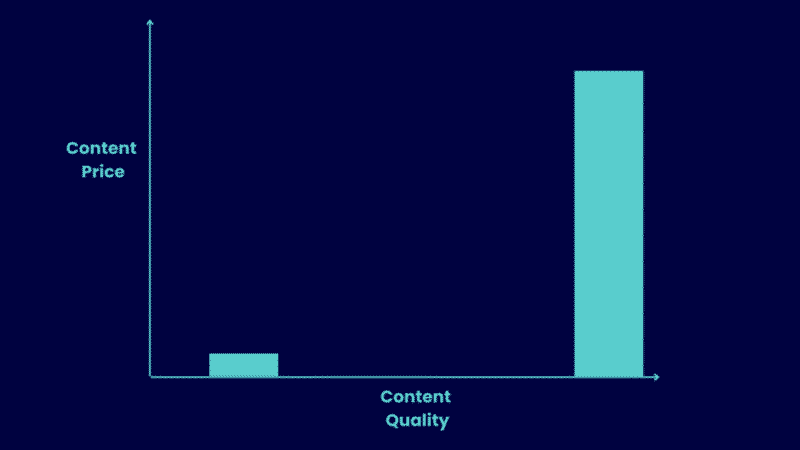
The problem is that for years, marketers have entered into a race to the bottom for content.

“What’s the minimum price we can get our content for?”

As a result, we see a lot of poor content.

It’s the wrong way to think about content.

Cheap content is rarely top quality.

There’s a cost for great content. And it’s often heavy.

Here’s why.

Great content is built and not written.

And so, content writers are content builders, and every piece of content they create has layers of their blood, sweat and tears embedded within.

The architect’s road to great quality content

If great content is built and not written, it makes sense that skilled labor creates that content.

And skilled labor requires payment that reflects the time spent learning the trade.

The mental model for content should be, “we need to create great content. What does it cost to create great content?”

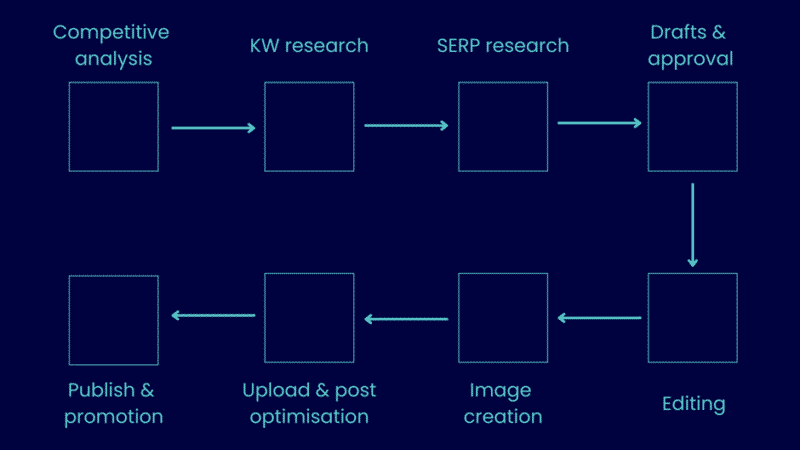
Breaking the content process down, great content requires:

  • Keyword research
  • Outlining
  • Subject research
  • Knowledge of grammar
  • Writing skill
  • Writing experience
  • Image creation
  • Post optimization
  • Headline creation
  • Editing
  • Design
  • Upload

I’ve probably missed a few areas, but each area above is a skill in its own right.

But when the above come together in the right amounts, magic happens.

That’s the alchemy that lies within the creation of good content. And yes, this might mean that multiple people of varying skill sets work on creating great content.

However, it’s words that will always do the heavy lifting.

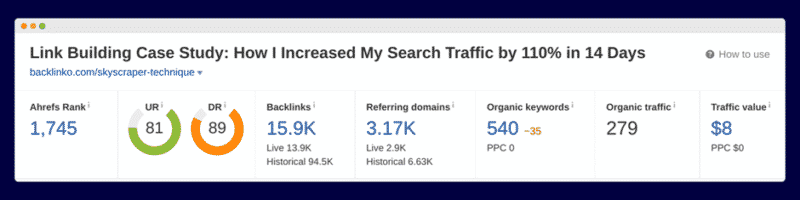
When Brian Dean created his famous skyscraper technique post, he made a post designed to be read and not just ranked online.

The result. It’s probably one of the most well-known and well-used content and SEO techniques.

And it generated more than 15,000 backlinks from more than 3,000 domains.

Sure, he could never have predicted how that content would perform.

But using a combination of all the skills we’ve listed above, the content smashed records.

Had he not designed the content, had a great writing style and added images in all the right places, it would have flopped.

But just what should good content cost?

To decide this, we need to look at the science behind what content does.

Content is alchemy. Price accordingly

Attempting to turn any metal into gold was the task of the ancient alchemists.

Today, modern alchemy happens within the mind.

Behavioral science has shown us that humans are often looking for signals so we can make sense of the world.

We eat at a busy restaurant and avoid the quiet one, believing it will serve better food.

We pick the expensive bottle of wine, believing it will taste better.

Nestled within behavioral science is what is called “costly signaling theory.”

“Costly signaling theory – the fact that the meaning and significance attached to something is in direct proportion to the expense in which it is communicated.”

Rory Sutherland, “Alchemy”

And this is part of the alchemy of quality content. At a human level, we all know that writing content at any level consumes a considerable amount of resources.

Be that writer’s time, uploading, designing images. Even if the reader is unaware of the other intricacies of content creation, there is a mental recognition that “work” goes into the content.

Or, in other words, content is a visible investment in the reputation of your business that the reader can judge.

The content screams at your prospects.

“We’re experts. Choose us. We aren’t going anywhere”.

And when the reader absorbs the content, the change you seek can happen.

That change might be the decision to make a purchase.

It might be to subscribe.

Or it could be that they remember your business when they’re ready to make a purchase.

But it also goes a little deeper.

Because we’re a species of information hunters, and we need feeding.

The content hunger games

In 1990, Peter Pirolli and Stuart Card developed the information foraging theory.

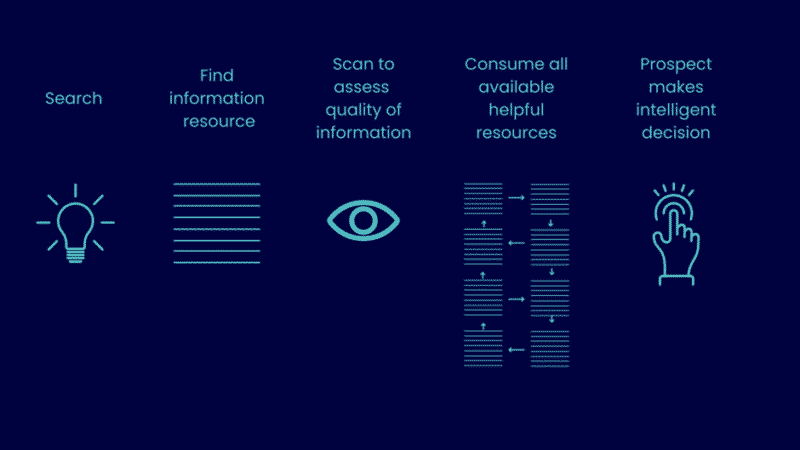
The idea is simple. Information is a resource that we consume, just like food. And we look for high-quality sources of information. This is how, as a species, we evolved through shared knowledge.

Today, the internet handles a large quantity of our shared knowledge. And we are now online hunters, looking for rich patches of information to consume.

As a business, you’ll be judged by the quality of your information. And you’ll be initially judged based on what is known as “information scent.”

“The information scent of a source of information (such as a webpage) relative to an information need represents the user’s imperfect estimate of the value that the source will deliver to the user, derived from a representation of the source.”

Neilson Norman Group

In short, this means that users will judge your content based on how much value they think the content will provide them before they consume it.

Yes, just like a book, your content is judged by the cover, except the cover is a scan read of your content.

Design elements such as typography numbered lists, and interesting H2s play a huge role in the reader deciding to consume your content. And then your words need to keep them on the page, moving line to line through your content.

Your prospects will judge you by the effort you put into your content because they are on the hunt for high-quality information to help them make an intelligent purchase decision.

This is why the quality of your content at all levels is so important.

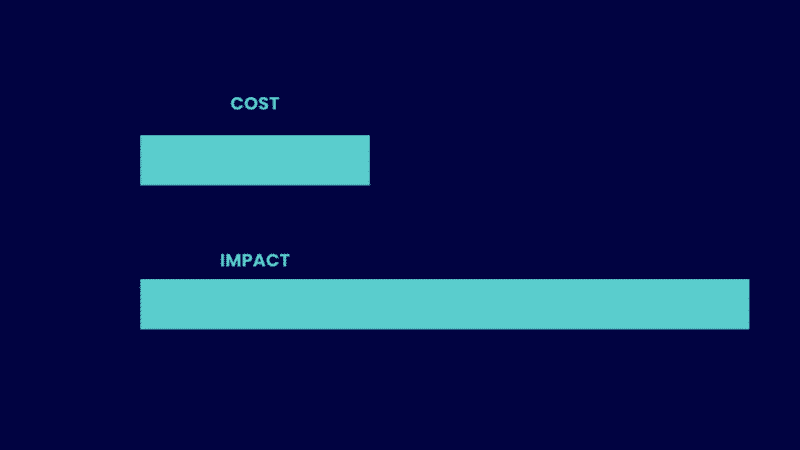
Great content = large impact. Achieving that impact requires effort, time and skill.

And you should be prepared to pay for this.

But how should you judge what quality content costs?

Selling the invisible impact of content

If content makes a tangible impact, we should start to charge for that impact.

So, how do you do this?

The old model of content is to price “by the word.”

It’s cheap and it produces content waffle.

Word count should be a guide rope. It helps you to understand the required depth of the content quickly. But it’s not a target.

Content is finished when the content is good. Not because we reach a word count.

Content connects a business to a customer.

It’s a bridge that helps prospects to make intelligent decisions.

It also serves as a costly signal of intention and reliability. It can generate leads and be pushed to the prospect via paid and organic social media.

Or it can pull customers to your website, acting as a door through a good email marketing message or ranking on Google.

And as stated repeatedly, good content showcases expertise.

So, what is that worth?

I know it’s tough, but to make life easier. Don’t think of what content should cost. Think of what your budget for content is.

How to establish the right content budget

Generally speaking, your content budget should come out of your brand marketing budget and can form part of your SEO retainer.

Think about your needs.

Do you need 45 articles to generate traction for your business, or just 12?

But that’s the question.

“What do I need to create for the change we seek to happen?”

You should then seek the budget to make this happen.

But what about individual articles? What should you spend?

This is the wrong question.

Instead, consider this.

  • What are you prepared to pay for the change you seek to happen?
  • What is an article that ranks online and showcases your business worth to you?
  • What is it worth for a person to positively think about your business?

This is the figure you mentally start your inner negotiations with.

From there, you need to find and assemble the people who can help you build great content.

SEO specialists, writers, content designers and editors.

This might be one person. It might be an agency. It might be several skilled people.

And if this sounds expensive, it’s because it’s going to be.

This is why you must establish a significant budget for your content.

Great content is the expensive bottle of wine on the supermarket shelf.

You’re not buying it because you fancy a drink.

You’re buying it because you want to feel the impact of quality wine.

And if you want your content to have a significant impact on your prospects.

You need to invest in the content assets that will have that impact.


Opinions expressed in this article are those of the guest author and not necessarily Search Engine Land. Staff authors are listed here.


New on Search Engine Land

About The Author

Andrew Holland is Head of Organic at Embryo, one of the UK’s fastest-growing digital agencies.
His SEO background stems from a 17-year career in the police, where a number of years were spent within intelligence, utilizing SEO within internal systems to catch criminals. After developing chronic asthma, Andrew left the police and launched a freelance SEO and digital marketing career, and has worked with a wide range of clients, from SMEs to 8-figure businesses. Today, he manages a growing team of in-house content writers and SEO account managers.

https://searchengineland.com/why-good-content-costs-serious-money-384926


Understanding the three awareness stages of your online audience

Understanding the three awareness stages of your online audience

30-second summary:

  • Are you confident about how your target consumer moves in the three stages, awareness, consideration, and decision?
  • A website that features content only suited to the first stage of awareness will struggle to convert, whereas a site only focused on conversions may struggle to get any traffic to convert in the first place
  • Here’s how you can create content that is balanced and targeted to better serve people throughout every step of their journey

Not all traffic is equal. Businesses often forget that their site visits and success metrics aren’t just numbers – they are living, breathing people who are driven by behavior. By understanding and creating content to fit the different awareness stages of that “traffic”, you can not only draw more – but efficiently turn those clicks into conversions. After all, businesses aren’t built on visits alone.

This article will show you the three main awareness stages of online traffic, what type of content fits in these, and a method for auditing your existing content. Remember, every customer goes on a journey. This is about making sure you’re at the finish line when they’re ready to convert.

The importance of knowing the awareness stages

Now, bear with us, but answer this: would you try and sell roller skates to a newborn baby or its parents? A little extreme, yes, but sometimes these make the best examples. The point is that the baby may grow into someone that needs or wants a pair of roller skates, but they’re not at that stage yet.

Understanding the different stages your potential customers are at and how they’re searching for your products/services (both directly and indirectly) will give you the accuracy to target them better. These stages are awareness, consideration, and decision. Just knowing these won’t be enough, you need a balance.

A website that features content only suited to the first stage of awareness will struggle to convert, whereas a site only focused on conversions may struggle to get any traffic to convert in the first place.

Research and roleplay will help you massively here. To get in the head of your audience and understand what their journey looks like, you should be asking yourself “What would I do if…” at almost every corner.

To better explore these stages and how they apply to content, we’ll stick to one example for the next three sections. We’ll move on from the baby with the roller skates, and instead, focus on a hypothetical Manchester-based SME that sells hearing aids and is looking to grow its customer base.

Stage 1: Awareness

This awareness stage is when the customer is just starting to realize they have a problem and that they need a solution. Before this stage, they may not have even realized that their issue could be fixed, or that it was an issue, to begin with. Good content at this stage plants seeds in their head that they don’t need to go on this way any longer.

With that in mind, you don’t want to overwhelm the reader here. Yes, they may now realize that they want a solution, but it’s exceedingly rare that a piece of content can tick all three boxes in one go. Those being – making them aware of the problem, helping them consider the options, and then decide to go with your option. That’s why we have different content for different stages. 

In our example of the small business in Manchester that sells hearing aids, the content at this stage may look like this:

  • ‘Five common signs of hearing loss’
  • ‘Data shows that hearing loss is on the rise’
  • ‘When to seek help with your hearing’

If we were writing content for this fictional company, we wouldn’t open these articles with “Now you’re here, view our huge sale on hearing aids!”. Instead, we’d relate to the problems the reader may be having. In fact, throughout all of these stages, your language should be empathetic, solution-focused, and relatable to the reader as much as possible. 

Picture a woman in her 40s that has been playing guitar in a rock band since her youth. For her, not being able to hear the nuances of music would almost feel like having an oxygen supply cut off. She might be having some hearing issues, but her search might not start straight away with “hearing aids near me”. She’d try to learn about her issues, if they’re common and how they can be fixed. In these pages, we’d relate to hearing problems and ultimately (but without sounding too sales-y) suggest that hearing aids have helped millions of people by the end. 

By writing content targeting this stage, you can be there right at the start of the consumer’s journey. While they will be more likely to convert at the end of that journey, a good content strategy is all about balance. This brings us to the next stage. 

Stage 2: Consideration

If the first stage is all about letting them know they have a problem, this is all about showing them how they can fix it. Here, the reader would actively be looking for a solution and considering their options.

While our hypothetical business may be experts at helping hearing loss, there are other ways to do so than just providing hearing aids. We can’t just assume that hearing aids are instantly the preferred option for every visitor. The challenge here is about balancing knowledge, empathy, and delivering content that is objective and genuinely useful to your consumer. However, while you educate your target audience about their options, you can add in smart CTAs that prompt the person towards a landing page that will drive revenue for your business – making this more a choice that your consumer made vs what you wanted to force down their throat.

Sticking to our example of that Manchester SME selling hearing aids, content at this stage may look like this:

  • ‘Six ways to help your hearing loss’
  • ‘The five best hearing aids in the UK’
  • ‘Why even teenagers should consider hearing aids’

As this is the middle stage, you’ll want to avoid leaning too much towards ‘awareness’ and too much towards ‘decision’. You won’t want to speak down to the reader and spend paragraphs explaining the very basics of hearing loss. You also won’t want to open up and ramble on about your great new sale on hearing aids.

Picture a scale, with ‘inform’ on the left and ‘sell’ on the right. You want this to be pretty evenly balanced, but leaning slightly to the left and on the side of ‘inform’.

Show the reader their options, and educate them on the solutions available. Then, if/when they decide that what you provide is the fix for them, they’re already on the right website! They just need a page where they can convert and make that final decision. That leads us on nicely to…

Stage 3: Decision

We mentioned before how awareness content gets you in front of the consumer at the start of their journey. While there’s a lot of value to being there at the starting line, it is content suited to this stage that turns clicks into customers.

That’s why pages here will move away from the blog/article format of the content suggested for the other stages. Instead, you want pages designed specifically for selling the reader on your product or service, with the option to convert right there.

For our hypothetical hearing aid business, the pages designed for this stage may look like:

  • Category pages showing off their best brands
  • Product pages where you can purchase hearing aids
  • A service page to organize a hearing test (with a contact form)

These pages will be laser-focused on selling, while still informing the readers why your business is a better choice for them over all of your competitors. This means a huge focus on USPs.

In the case of our hypothetical hearing aid company, these may include free delivery, the lowest prices in Manchester, or even five years of free insurance. Your USPs should all be sung about on these decision-focused pages. Remember, at this point, they know they want whatever it is you’re selling, so you don’t need to go to great lengths to explain the very basics of your offerings. Just why your business is the best for them. Ensure to have some positive reviews scattered across these pages.

The content here should be easy to read, scannable, and supported by images if you think that’s something your audience is interested in (always look to see what competitors are doing).

Outside of the copy, for ecommerce businesses, the path to purchasing these products should be clear, with large buttons to show the user that this is where you can buy them. If you’re a lead generation business, then there should be plenty of CTAs (calls to action) to point the user to contact forms, phone numbers, or email addresses.

Key takeaways

Like with any marketing or psychology model, there are variants of this with even more steps. However, if you boil it down, we believe that only three steps are necessary for most businesses. The important thing to remember is that the same user might not go through this entire journey on your website in one session. A balanced content strategy means that you can attract any potential customer at any stage, no matter where they are in their purchasing journey. 

The danger of having an imbalance in your content strategy is that there might be plenty of blog posts around the first awareness stage, but users don’t realize that you can solve the problem they now realize they have. On the flip side, you could have most of your content focused on the final stage, but you may struggle to draw in the customers that don’t even realize they need you.

That’s why we recommend you run a content audit on your website to see how balanced your current output is. Create a table like the one below and add your existing content to it. 

In the example here, we’ll use the ideas we used for our Manchester business: 

Awareness Stage Content Consideration Stage Content Decision Stage Content
 

Five common signs of hearing loss

Six ways to help your hearing loss Category pages showing off their best brands
 

How to improve your hearing at concerts

The five best hearing aids in the UK Product pages where you can purchase hearing aids
 

When to seek help with your hearing

Why even teenagers should consider hearing aids A service page to organize a hearing test (with a contact form)

While mapping your pages to this, you should be able to easily identify where gaps are and then plan your content strategy around filling those in. ‘Mapping’ is a great term because all successful journeys involve a map.

If you’re just publishing random content with no overall purpose, you’re stumbling around in the dark and hoping you’ll land up where you want to go. A quality content strategy is all about understanding journies and being there for whatever step of it your customer is on.


Jack Bird is the Content Operations Lead at the Manchester-based SEO and digital marketing agency, Add People.

Subscribe to the Search Engine Watch newsletter for insights on SEO, the search landscape, search marketing, digital marketing, leadership, podcasts, and more.

Join the conversation with us on LinkedIn and Twitter.

https://www.searchenginewatch.com/2022/05/05/understanding-the-three-awareness-stages-of-your-online-audience/