How to analyze your SEO competitors and find opportunities

Understanding your competitors can give you tactical insights to help you discover opportunities.

Before competing, athletes spend many hours understanding weaknesses to exploit and finding possible gaps in the playing field.

Your digital marketing should come with the same level of insight and analysis.

Identifying and reviewing your competitors can help you come up with a strong list of potential keywords, find link building opportunities and build your persona profiles.

Starting your competitor analysis

When putting together a competitor analysis, it is important to make sure that your analysis tells you: 

  • What a competitor is doing.
  • How they are doing it.
  • What factors they are most excelling at in their SEO strategy.
  • What are their gaps.

Using this information, it is possible to create strategies at scale that will help you exceed your competitors and get higher rankings.

The first step is to assess the bigger picture of your competitors. You can start by using Google and typing in the main keywords to see what sites show up in the rankings.

Next, you can use tools to help you drill down into your competitor analysis process.


Get the daily newsletter search marketers rely on.


Identify your competitors

You can use Semrush to give you a starting point to identify your competitors.

In the Organic Research report, click on the Competitors tab.

You can use this as a starting point to figure out who your main competitors are.

Some of the data points that can help you in this research are:

  • Competition Level: Analysis of the number of keywords of each domain and the number of the domains’ common keywords. The more keywords the domain share in common, the more likely they are to compete with one another. 
  • Common Keywords: How many keywords do the domains have in common.
  • SE Keywords: How many total keywords each site is ranking for.
  • Traffic: Estimated organic traffic.
  • Cost: Traffic cost based on CPC data and estimated volume.
  • Paid Keywords: How many keywords are being paid for via Google Ads.

Having identified a list of competitors, the next step is to look at their backlink profile.

  • How many unique referring links do they have pointing to them?
  • What is the quality of those links?
  • What is the link velocity of the links they have acquired?  

Understanding their link profiles will help you determine how many backlinks you need to acquire before you are capable of competing for specific keywords.

In Semrush, go to Backlink Analytics and type in your root domain. You can also add up to four competitors to see backlink metrics side by side.

The overview will give you an idea of how your backlink profile looks compared to others vying to rank for the same keywords.  

Pay close attention to the number of referring domains you and your competitors have. To drill down, click on Referring Domains at the top of the report and sort the list by Authority Score.  

If your site has many referring domains, all with low Authority Score, your site may not have enough power to rank against competitors with better quality inbound links.

The different reports in the Backlink Analytics feature in Semrush will allow you to learn the total number and types of backlinks, whether the majority is followed or nofollowed, and what types of links they are. Analyzing the anchor text will also help you figure out whether link building work has been done and if those links include keywords in the anchor text.  

Your backlink analysis data will help you in upcoming research, as it will help you select keywords that you can realistically rank for.

If, for example, your site has an Authority Score of 25, but your competitors average an Authority Score of 45, you will not be likely to outrank them for root terms. You would have to search for keywords with less volume and where the ranking pages have a lower Authority Score. 

Keyword data and content decisions should be closely intertwined with your backlink analysis as it will allow you to select “low-hanging fruit” keywords and realistic ranking targets.

Traffic analytics

The Semrush Traffic Analytics tool gives you traffic estimates for competitors. Whereas Google Analytics will show you how your site performs, traffic analytics can give you estimated traffic data for your competitors.   

At a glance, you can compare how your competitors match up when it comes to:

  • Visits
  • Unique visitors
  • Pages / visit
  • Average visit duration
  • Bounce rate

Additionally, you can see trends over time for each of these categories. You’ll see if competitors have recently lost traffic or have made dramatic progress during a specific time period.

There are a myriad other data points and reports that could help you deepen your understanding of your competitors, such as top pages, traffic sources and traffic journeys.

Keyword research

Keyword Research is one of the oldest and most undervalued skills in SEO. Choosing the right keywords can mean the difference between success and failure in SEO.

Keyword research is not sexy, but it is necessary, foundational work to be done properly. Let’s go over a step-by-step process for keyword research.

Think in terms of “Keyword Sets”

Ideally, you should group your keywords into Keyword Sets. Start with a “seed keyword,” then look for long-tail variants of that keyword.

For example, if your primary keyword is “Real Estate Auction,” some of the sets you could use include:

Then you could move to another keyword set and also get variants for that term.  

Examples of other seed sets include:

  • Online foreclosure auctions
  • Home auctions
  • Online property auctions

Once you have these in place, you can go deeper and deeper using secondary keywords, questions, and other variants.

Look for long-tail keywords

You can use Semrush’s Keyword Magic tool to obtain these seed sets. Type in the seed sets you’ve uncovered, and Semrush will give you a list of possible keywords.

You can group these using the match types:

As you find keywords that you would like to rank for and track, use the checkmark and add them to your “Keyword Manager” list.

Assess the competition level

Next, you need to assess the viability of ranking for the keywords you chose. Ranking for your seed keywords can be your end goal, but you have to select keywords that you can realistically rank for based on your site’s current authority score. If you choose keywords that are too competitive, you’ll never see positive results for your SEO efforts. 

Most keyword research tools use a metric for Keyword Difficulty. You’ll want to identify keywords that have good volume but low KD. What that level is varies based on your site’s age, structure, backlink profile and much more.

Find keyword gaps

You can expand your keyword list by doing a keyword gap analysis. There might be keywords you never thought about that competitors are ranking for.

To perform keyword gap analysis, go to the Keyword Gap report, type the top competitors into the top bar, and click on compare:

There is a list of keywords that you and your competitors are ranking for in the table below. You’ll see which keywords are shared between all competitors, which ones they are ranking for but your site isn’t, which keywords you rank for but not at the top, and more.

Review these keywords, and if there are keywords that seem relevant, you can add them to your keyword manager list.

Compile your final keyword list

The final step is to collect all of your keyword data into the Keyword Manager. You can segment your lists or create one large list with all of your keywords.

By adding keywords from the keyword magic research, keyword gap analysis, competitor research and baseline assessment, you’ll have a comprehensive list of keywords to work with.  

Make sure you click on the “Update Metrics” to get current, accurate data on the volume, competitiveness, and Keyword Difficulty of each of the terms on your list.

Using competitor data to craft your strategy

At this stage, you’ll have a comprehensive understanding of who you’re up against in the SERPs. You’ll know which competitors have the strongest link profiles, what keywords you can target and have various data points about potential opportunities that your competitors have overlooked.

The data you have accumulated can help you build your final target keyword list and prepare you for the next stage, which includes understanding your target audience and building persona profiles.


Opinions expressed in this article are those of the guest author and not necessarily Search Engine Land. Staff authors are listed here.


New on Search Engine Land

About The Author

Marcela De Vivo is an industry veteran with more than 20 years of digital marketing experience, Marcela travels the world speaking about SEO, data-driven marketing strategies, and workflow automation and optimization. Marcela owns a digital marketing agency called Gryffin based in California.

https://searchengineland.com/analyze-seo-competitors-find-opportunities-384898


DMCA request removes Moz from Google Search index

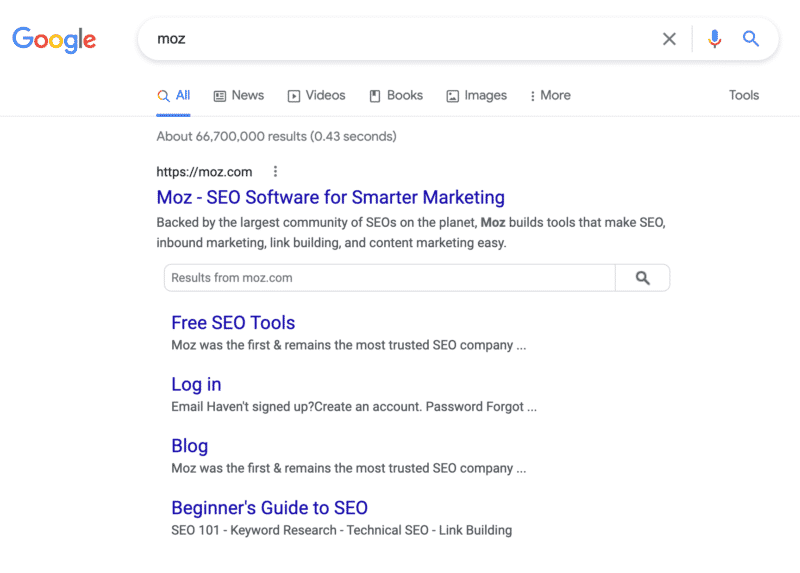
If you search for [Moz] in Google Search, you won’t be seeing the moz.com home page, that page was removed from the Google index due to a DMCA takedown request. The takedown complaint cites that Moz’s home page, along with 185 other URLs were “distribute modified, cracked and unauthorized versions” of the Dr. Driving app.

The takedown complaint. The DMCA, The Digital Millennium Copyright Act, takedown complaint can be viewed over here. You can see the Moz home page listed on line 122. As Cyrus Shepard posted on Twitter “Crazy! You can’t access the Moz homepage from Google right now. A search for “Moz” shows an incredible 8(!) removed results from an overly-broad DMCA filing. DMCA literally lets anybody abuse the system, and it breaks Google.”

Google is aware. Danny Sullivan, the Google Search Liaison responded saying “I’ve passed it on for review.” We suspect Google will reverse this issue really quickly – but so far, Moz is still not showing.

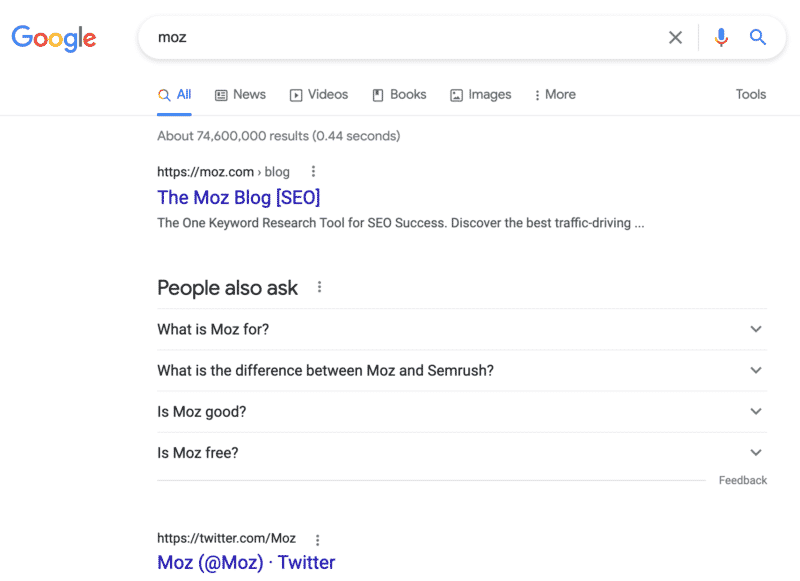
The Google search results. Here is a screenshot of the search results page showing the Moz blog coming up in the first position, not the Moz home page:

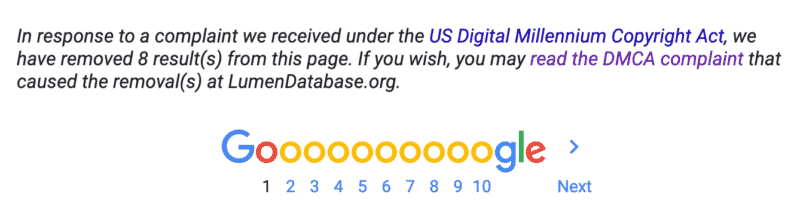
The footer of the Google results show that Google “removed 8 result(s) from this page” due to DMCA violations:

Should not happen but it does. You are all probably thinking, this should not happen – how can Moz not rank for it’s own name in Google Search. How can it be that easy for someone to use a DMCA request to take down a large respected brand from showing in the Google Search results? And you are right, this should not happen – but it does.

We had our own site, Search Engine Land mistakenly removed from Google because Google thought the site was hacked – it was not hacked. Digg was also removed from Google Search because someone accidentally classified it as spam.

I guess mistakes happen, even in massive companies. But how? We don’t know yet. We have reached out for Google for a statement and if we hear back, we will update this story.

More on DMCA requests and Google Search. Google has its transparency report that says “It is our policy to respond to clear and specific notices of alleged copyright infringement. The form of notice we specify in our web form is consistent with the Digital Millennium Copyright Act (DMCA) and provides a simple and efficient mechanism for copyright owners from countries/regions around the world. To initiate the process to delist content from Search results, a copyright owner who believes a URL points to infringing content sends us a takedown notice for that allegedly infringing material. When we receive a valid takedown notice, our teams carefully review it for completeness and check for other problems. If the notice is complete and we find no other issues, we delist the URL from Search results.”

You can dispute these requests and have them reversed but how long does that take? You can submit DMCA requests to Google over here.

Why we care. This is a nightmare for most SEOs and site owners. To be removed from Google Search for your branded term. It should not happen, it is really inexcusable and sad to see but it did happen.

I am sure Moz will return shortly but there is really nothing we can say on how to prevent this from happening to your site. The good news, Moz is a big enough brand that this caught Google’s radar quickly and likely will be fixed soon because of that. But for small brands – good luck.

Postscript. Moz is now back, less than 12 hours after this issue was first reported here:

Statement from Google. May 5th at 6:50pm ET a Google spokesperson sent us the following statement:

Our DMCA removals process aims to strike a balance between making it easy and efficient for rightsholders to report infringing content while also protecting open access to information. If we find that pages have been removed from our results in error, we reinstate them, which we did in this case. Our transparency efforts are designed to help third parties identify these types of issues, and when they come to light, we take action. We’re looking at ways we can improve our systems and processes to prevent these types of errors in the future.


New on Search Engine Land

About The Author

Barry Schwartz a Contributing Editor to Search Engine Land and a member of the programming team for SMX events. He owns RustyBrick, a NY based web consulting firm. He also runs Search Engine Roundtable, a popular search blog on very advanced SEM topics. Barry can be followed on Twitter here.

https://searchengineland.com/dmca-request-removes-moz-from-google-search-index-384943


Why we’re hardwired to believe SEO myths (and how to spot them!)

Give someone a fish and they’ll EAT for one day. Teach someone to fish and they’ll EAT for a lifetime. Yes, that’s an SEO pun. It’s also the goal of this article.

If you pop into either of the fantastic SEO communities on Twitter or LinkedIn, you’ll inevitably encounter some common SEO myths:

  • “Longer dwell time means a good user experience, so it must be a ranking factor”
  • “A high bounce rate indicates a bad user experience, so it must be bad for SEO”

Social media posts like these get tons of engagement. As a result, they amplify the myths we try to squash through repetition, false evidence, and faulty logic. The problem isn’t limited to social media, either. There are plenty of high-profile websites that package hypotheses as facts because readers eat them up.

These myths are a huge problem because they’re red herrings. They cause marketers to prioritize projects that won’t improve the content, user experience, or Google search performance.

So how can the SEO community rally around the truth? We can start by doing two things:

  1. SEOs must admit our personalities and professions hardwire us to believe myths. We have a deep desire for answers, control, and predictability, as well as a fierce distrust of Google.
  2. We need to recognize the psychological and environmental factors that influence our ability to sort fact from fiction.

So rather than busting individual myths, let’s ask ourselves “why?” instead. In other words, let’s learn to fish.

Internal reasons we believe SEO myths

Let’s dig into some internal factors, such as our thoughts and feelings, that influence our beliefs.

1. SEOs need structure and control

SEO is a fascinating branch of marketing because our performance is driven by a constantly evolving algorithm that we don’t control. In fact, there were more than 5,000 Google algorithm updates in 2021 alone.

In other words, SEOs live in a world of crippling dependency. Even the top-ranking signals that we know about can fluctuate based on the industry, query, or available content within Google’s index. For example, if you manage websites in the finance or health space, E-A-T is critical. If you publish news content, then recency is very important.

To gain a sense of structure and control, we look for more ways to influence outcomes. But there are two problems with that approach:

  • We overestimate the impact of individual ranking factors
  • We falsely believe something is a Google ranking factor that is not

Our need to amplify our own level of control is supported by psychology. A 2016 study revealed an individual’s need for structure made them more likely to believe in a conspiracy theory.

“The human tendency to recognize patterns even when none exist is shown to have applications in consumer behavior. The current research demonstrates that as one’s personal need for structure (PNS) increases (that is, requiring predictability and disfavoring uncertainty), false consumer pattern perceptions emerge.”

If you find yourself waffling between fact and fiction, don’t let your desire for control dictate your final decision.

2. The primal need to recognize patterns

The human brain is excellent at recognizing patterns. Throughout history, we’ve relied on that ability to make better decisions and ensure the survival of our species. Unfortunately, we’re so good at spotting patterns that we also fabricate them.

False pattern recognition has several drawbacks –

  • It might influence SEO decisions that could have a sitewide impact
  • If you overstate the connection publicly, others might misinterpret it as fact

An excellent example surfaced on Twitter recently. Google’s John Mueller was asked if adding too many links to your site’s main navigation could impact Google Discover traffic. The individual who asked the question ran several tests and saw positive results, but Mueller said it was merely an interesting correlation.

“I’d still go with ’unrelated’. As mentioned in our docs: Given the serendipitous nature of Discover, traffic from Discover is less predictable or dependable when compared to Search, and is considered supplemental to your Search traffic.”

Fortunately, this individual went straight to the source for an answer instead of publishing a case study that could have had serious implications for website navigation decisions.

3. Confirmation bias

It’s well-documented that people accept information that supports their beliefs and reject information that doesn’t. It’s a primordial trait that evolved when we began to form social groups. Early humans surrounded themselves with others who thought and acted the same way to ensure their survival.

One of the most famous confirmation bias studies comes from Stanford. For the study, researchers segmented students into two opposing groups based on their beliefs about capital punishment.

One group supported capital punishment and believed it reduced crime. The other opposed it and believed it had no impact on crime.

Each group was asked to react to two studies, one which supported their views, and one which contradicted them. Both groups found the study that aligned with their beliefs much more credible, and each became more entrenched in their original beliefs.

SEO practitioners are particularly prone to confirmation bias because we’re terrified of being wrong. We hypothesize, test, build, optimize, and iterate. If we’re wrong too often, we’ll waste time and money, and we could risk our reputation and our jobs.

We need to be right so badly that we may accept myths that confirm our beliefs rather than admit failure.

4. Lack of trust in Google

It’s safe to say most SEOs don’t trust Google. That has led to some of the longest-running SEO myths I could find. For example, even after seven years of repeated rejections from Google, many SEO experts still believe engagement is a ranking signal.

Here’s John Mueller shooting down the engagement myth in 2015:

“I don’t think we even see what people are doing on your website. If they are filling out forms or not, if they are converting and actually buying something… So if we can’t see that, then that is something we cannot take into account. So from my point of view, that is not something I’d really treat as a ranking factor.”

Nearly seven years later, in March 2022, John was asked the same question again, and his response was pretty much the same:

“So I don’t think we would use engagement as a factor.”

And yet, the SEOs piled on in the comments. I encourage you to read them if you want a sense of the intense level of mistrust. Essentially, SEOs overanalyzed Mueller’s words, questioned his honesty, and claimed he was misinformed because they had contradictory insider information.

5. Impostor syndrome

Even the most seasoned SEO professionals admit they’ve felt the pain of impostor syndrome. You can easily find discussions on Reddit, Twitter, and LinkedIn about how we question our own level of knowledge. That’s especially true in public settings when we’re surrounded by our peers.

Not long ago Azeem Ahmad and Izzie Smith chatted about impostor syndrome. Here’s what Izzie said:

“It’s really hard to put yourself out there and share your learnings. We’re all really afraid. I think most of us have this impostor syndrome that’s telling us we’re not good enough.”

This contributes to SEO myths in several ways. First, it erodes self-confidence, which makes individuals more prone to believe myths. Second, it prevents folks who might want to challenge inaccurate information from speaking out publicly because they’re afraid they’ll be attacked.

Needless to say, that enables myths to spread throughout the broader community.

The best way to combat impostor syndrome is to ensure SEO communities are safe and supportive of new members and new ideas. Be respectful, open-minded, and accepting. If more folks speak out when something doesn’t feel accurate, then we can keep some troublesome myths in check.

External reasons we believe SEO myths

Now let’s explore the external forces, like peers and publishers, that cause us to believe SEO myths.

1. Peer pressure

Peer pressure is closely related to impostor syndrome, except it comes from the outside. It’s a feeling of coercion from peers, whether a large group of SEOs, a widely known expert or a close mentor or colleague.

Because humans are social creatures, our urge to fit in often overpowers our desire to be right. When something doesn’t feel right, we go with the flow anyway for fear of being ostracized. In fact, social proof can be more persuasive than purely evidence-based proof.

I asked the Twitter SEO community if anyone ever felt compelled to accept an SEO ranking factor as fact based on popular opinion. Several folks replied, and there was an interesting theme around website code.

“Back in 2014, a web developer told me he truly believed text-to-code ratio was a ranking factor. For a while, I believed him because he made convincing arguments and he was the first developer I met who had an opinion about SEO.”

—  Alice Roussel

“Years and years ago I wanted code quality to be a ranking factor. Many thought it was because it made sense to reward well-written code. But it never was. Browsers had to be very forgiving because most sites were so badly built.”

—  Simon Cox

Similar to combatting impostor syndrome, if we develop a more tolerable SEO community that’s willing to respectfully debate issues, we’ll all benefit from more reliable information.

2. Outdated information

If you publish content about SEO, then you’ll be guilty of spreading SEO myths at some point. Google updates its algorithms thousands of times each year, which means assumptions are disproven and once-good advice becomes outdated.

Trusted publishers have a duty to refresh or remove inaccurate content to prevent SEO misconceptions from spreading.

For example, in 2019 Google changed how it handles outbound links. It introduced two new link attributes into the nofollow family, UGC and sponsored, and began to treat all three of these as hints instead of ignoring nofollow links.

So if you wrote about link attributes prior to September 2019, your advice is probably out of date.

Unfortunately, most SEOs update content because it’s underperforming, not because it’s wrong. So perhaps publishers should put integrity above performance to strengthen our community.

3. Jumping on trends

Sometimes SEO myths explode because the facts can’t keep up with the virality of the myth. One of my favorite examples is the LSI keyword trend. This one pops up on Twitter from time to time, and thankfully Bill Slawski is quick to quash it.

Trend-based myths go viral because they tap into the fear of missing out (FOMO), and SEOs hate to miss out on the opportunity to gain a competitive advantage. They also resonate with SEOs because they appear to offer a secret glimpse into Google’s black box.

Although trends eventually fade, they will remain a thorn in our side as long as the original sources remain unchanged.

4. Correlation vs causation

The most difficult myths to bust are those backed by data. No matter how many times Google debunks them, they won’t die if folks come armed with case studies.

Take exact match domains (EMD) for example. This article lists several reasons why EMDs are good for SEO, using Hotels.com as a case study. But it’s a classic chicken and egg argument. Does the site rank number one for “hotels” because it’s an EMD? Or is it because the owner clearly understood SEO strategy and prioritized keyword research, link building, internal links, page speed, and high-quality content marketing for the last 27 years?

We also can’t discount the fact that the domain has 42 million backlinks.

But if you want to hear it directly from the horse’s mouth, Google’s John Mueller says EMDs provide no SEO bonus. Here’s what he said on Reddit:

“There’s no secret SEO bonus for having your keywords in the domain name. And for those coming with “but there are keyword domains ranking well” — of course, you can also rank well with a domain that has keywords in it. But you can rank well with other domain names too, and a domain won’t rank well just because it has keywords in it.”

This is obviously correlation, not causation.

To be clear, I fully support running SEO tests to learn more about Google’s algorithm. But it’s incredibly difficult to create a signal vacuum that prevents outside influences from skewing your results. And even if you manage to isolate one ranking factor, you have no way of knowing how strong the signal is in relation to other signals. In a total vacuum, one signal may win. But in the wilderness of Google, it may be so weak that it’s virtually nonexistent.

Furthermore, the signal may only apply to certain types of content. We’ve seen signal fluctuations before regarding product reviews and E-A-T in YMYL spaces. So even if data suggests something might improve organic rankings, how reliable is the information, and how important is the signal?

All this is to say that we should be very careful when proclaiming new ranking factors, especially if they contradict Google’s statements or stray too far from universally measuring user experience.

5. It’s plausible, but not measurable

This group of myths is rooted in logic, which makes them particularly dangerous and sticky. Usually, they follow a simple formula: if A = B, and B = C, then A = C.

Here’s an example:

  • Google wants to rank content that provides a good user experience
  • If a webpage has a high bounce rate, it must provide a bad user experience
  • Therefore, a high bounce rate is bad for SEO

This seems to make sense, right? Yet, Google has said many times they can’t see what users do on your website, and they don’t look at bounce rate.

I’ve seen the same argument applied to dwell time, time on page, SERP click-through rates (CTR), and so on. To be clear, Google says CTR  does not drive organic search engine rankings because that would cause results to be overrun with spammy, low-quality content.

Most often these myths stem from competing views about what a good user experience looks like and how to measure it. What constitutes a good experience for one type of search query might be a terrible experience for another. This lack of consistency makes it virtually impossible to identify metrics that can be deployed universally across all websites.

In other words, if potential user experience signals depend on too many factors, Google can’t use them. That’s why they launched the page experience update in 2021 which quantifies user experience with specific, universal metrics.

Here’s your fishing pole

In many cases, SEO myths fall into more than one of the above categories which makes them even more difficult to dispel. That’s why we keep seeing social media posts falsely identifying ranking factors like keyword density, domain authority, conversions, and meta keywords.

If you understand a few basic concepts about ranking factors, you’ll be better equipped to sort fact from fiction and prioritize SEO initiatives that drive more organic traffic.

Ask yourself these five questions when you smell the stench of a myth:

  • Is it quantifiable and measurable?
  • Is it scalable?
  • Is it broadly or universally true, or does it depend on the user?
  • Does it support Google’s goals of delivering a better user experience?
  • Has Google confirmed or denied it publicly?

If you can check each of those boxes, then you may have a valid ranking factor on your hands. But don’t take my word for it. Run some tests, ask some friends, use logic, and confirm your theory. And if all else fails, just ask John Mueller.


Jonas Sickler is a published author and digital marketer. He writes about SEO, brand reputation, customer attention, and marketing. His advice has appeared in hundreds of publications, including Forbes, CNBC, CMI, and Search Engine Watch. He can be found on Twitter @JonasSickler.

Subscribe to the Search Engine Watch newsletter for insights on SEO, the search landscape, search marketing, digital marketing, leadership, podcasts, and more.

Join the conversation with us on LinkedIn and Twitter.

https://www.searchenginewatch.com/2022/04/28/why-were-hardwired-to-believe-seo-myths-and-how-to-spot-them/


How to avoid SEO penalties in algorithm-stricken industries

When trying to rank on Google through search engine optimization, there are some industries which are far more competitive and prone to algorithm updates than others.

Industries such as casinos, insurance, loans, hosting, and FX are highly competitive, and many SEO practitioners will turn to black hat techniques to secure Page 1 positions.

Google is the most popular search engine used by consumers; it makes regular weekly algorithm changes. As a result, firms may find their initial SEO progress is shot down by a penalty which can ultimately lead to a significant loss of traffic and revenue.

The guide below gives some vital tips when trying to rank in the most penalty-stricken and volatile search results on Google.

Choose a good domain

 When trying to rank for a highly competitive keyword, SEO professionals might look at selecting a domain which is very similar to the ‘big money’ keyword. There is certainly evidence that having a domain with competitive keywords in it will give you an SEO boost. For example, carinsurance.com or onlinecasinos.com

However, in today’s marketing landscape, this is not as essential, and Google looks more at brands rather than just keywords within a domain name.

Firms which have an exact match domain or partial match domain (i.e. loans or insurance is in the domain name), will need to be a little bit cautious, however. This is because there will likely be a higher mention of ‘danger’ words, like insurance and loans, a lot more in the content, the meta-data, and the links acquired.

SEO professionals need to be aware of keyword stuffing, or over-use of sensitive words, their brand’s anchor text as this is likely the first thing Google will look at if they are going to penalize a business.

Strong competitor analysis

 Competitors are a good starting point for any SEO professional. Those which rank on the first two pages of Google’s search results will provide insight into what works and what does not.

Not only can SEOs then emulate the right kind of techniques for said industry, but they can also see who has potentially fallen within the search rankings and been hit most by algorithm updates and penalties.

Since the casino and insurance sectors are known to have their own kind of algorithms, SEO’s working in these markets will need to play close attention to whether the landing page, or homepage, is used to rank. Consideration will also need to be given to URL structures, meta titles, and how frequently is a keyword mentioned on a page.

With language in mind, SEOs will also need to take heed of what kind of rhetoric and language is being used within competitor sights, as well as what links are used.

As a result, looking at competitors is essential for ranking in a highly specialized and competitive industry. Firms which are well established in the market are likely to have gone through the motions and have overcome penalties in the past in order to secure such strong positions.

Using low risk link building strategies

 SEOs assisting firms in more penalty-ridden industries will need to be more careful with the links built and acquired.

For starters, getting brand name links to a homepage is always going to be low risk. Spreading these links across several resourceful blogs and guides, will help build a business up as an authority, while appearing organic.

Linking to homepages and guides is much harder to penalize than if links are embedded within ‘money pages’ of hyperlinked to words like casino or loans. However, firms need to ensure their content is not thin and includes real statistics, graphs and images which validate their resources.

It is important, therefore, for SEO professionals to review what percentage of links go to their organization’s homepage, money pages and guides; looking at competitors and their split can be very useful here. In fact, using tools like Majestic can show you this immediately.

Be cautious with link anchor text

 When choosing the anchor text of a links, SEOs should ideally be on the cautious side. In general, no legitimate site will offer hyperlinks of ‘car insurance’ or ‘best casinos’. Instead, SEOs should look to hyperlink to phrases like ‘find more information here’ or ‘check your eligibility’.

Hyperlinking to phrases which can be actioned – like ‘quotes from $300 per month’ – is also likely to be more effective. Using a mix of these techniques will look more organic within money pages.

The use of synonyms can also be helpful when considering which phrases to hyperlink. The word ‘car insurance’ can easily be interchanged with ‘motor insurance’, for example. Rephrasing is also a popular technique used by SEO professionals – instead of ‘car insurance policies’, try ‘insurance for your car’.

Avoiding abbreviations is also a common technique used by SEOs. Instead of saying ‘VPNs’, ‘virtual private networks’ can be used to anchor text more naturally.

 Patience is key 

Overall, the competitive industries mentioned within this article are so valuable that they attract a lot of attention from SEO practitioners, and this means black hat techniques who are trying to game the system and generate some quick traffic.

Whilst cautious techniques will take several months to have an impact, firms can have peace of mind they you will sustain good quality rankings and traffic and avoid future penalties.

Firms which make sure they look carefully at competitors and avoid overusing the big keywords in their content and links should be good to go!

https://www.searchenginewatch.com/2022/04/08/how-to-avoid-seo-penalties-in-algorithm-stricken-industries/


How to use SEO for a great ABM strategy

How to use SEO for a great ABM strategy

30-second summary:

  • Account-based marketing (ABM) helps build a personal bond with your target audience, assuring them that you understand their unique wants and needs
  • ABM is considered the most financially successful marketing approach by 97 percent of businesses
  • ABM can be used in conjunction with inbound marketing for maximum effectiveness, which ties into an effective SEO strategy
  • Use SEO keywords to learn what your target audience is looking for and attract interest from all levels of a business
  • SEO analytics – especially insights into consumer interests, behavior, and preferences – aid the construction of an effective account-based marketing strategy

Priorities in business marketing have drastically shifted in the online age. Throwing enough mud at the wall, hoping that at least some of it will stick, is now an outdated approach. Consumers are savvy, seeking to be wooed by products and services that meet their unique needs.

Naturally, this means that an effective marketing campaign will fish in shallow waters instead of casting a wide net into the ocean. Any business with serious intentions to capture a captive and loyal audience should take the account-based marketing (ABM) approach – and SEO can be essential to such a strategy.

What is account-based marketing (ABM)?

With so many different types of marketing packages available to businesses in 2022, it can be tricky to keep on top of all the different terminology. However, one of the most essential and successful modern approaches is account-based marketing (ABM).

ABM revolves around pinpointing a precise marketing target, such as a unique business – or even a department within a major company – and tailoring a promotional campaign, especially to them. In many cases, that involves breaking down your campaign step-by-step.

Let’s imagine that your business revolves around manufacturing protective cellphone covers. You may sell these covers to high street stores as generic items, but you feel that your business would be taken to the next level by teaming with a cellphone manufacturer. If you could get a contract with Samsung, for example, maybe your cellphone cover will be pushed as a must-have accessory to accompany the latest Galaxy handset.

In this instance, you would need to tailor a unique approach to exactly what Samsung are looking for in a collaborator. You cannot just send the same pitch that you would to Target, asking them to sell the item – a supermarket is just interested in whether they can buy cheap and sell higher, turning a profit on a product that is always in demand.

If you’re going to forge a long-term and successful relationship with Samsung, you’ll need to prove to them why your cellphone cover is the best on the market – better than your competitors, better than any other product the business currently uses, and how you’ll meet expectations going forward. All of this needs to be achieved through a marketing campaign that is impossible to ignore for your targeted account.

How does ABM benefit a business?

There are countless reasons to adopt an account-based marketing approach for your business. These include:

  • Building a substantial profile of your target audience through extensive research, providing an invaluable platform
  • Rapidly earning the trust of a client base, enhancing your chances of loyalty and a long-term working relationship
  • Reducing wasted time spent on managing inappropriate or inefficient marketing leads
  • A simple analysis of the performance and ROI of any campaign – the results will be comparatively black and white
  • Keeping sales funnels tight – there will be no need to continually cajole and encourage consumers to complete their conversion as they are in the bag
  • Enhanced reputation within your industry – you’ll earn a standing as a business that knows exactly what your audience wants

Notably, ABM is often very effective when aimed at global businesses that employ teams in multiple countries. These companies are often dealing with more complex supply chain issues, and are looking for a supplier who understands their needs and can be relied upon to meet them regularly. Prove your worth to such clients, and you’ll reap substantial financial rewards.

Is ABM the same as inbound marketing?

Account-based marketing is not quite the same as inbound marketing, but it could be considered a companion approach. If you’re going to make the most of ABM, keep at least one eye on your inbound marketing strategy.

For the uninitiated, inbound marketing involves laying bait for your potential consumers and waiting for them to come to you. We’ll shortly discuss how SEO aids ABM in greater detail, and inbound marketing will factor heavily into this. The online presence of your business, most notably blogs and social media accounts, will frequently be discovered through organic internet searches.

However, the core difference is that ABM is active whereas inbound marketing is passive. Both approaches involve appealing to the core interests of your target audience, but with ABM, you’ll be approaching the consumers in question. Let’s return to our example of creating cellphone protectors for Samsung products.

You could create content that will potentially attract their attention – blogs with titles like ‘This is the perfect protective barrier for a Galaxy S22’ and infographics on how and why your product will benefit users. This will take a long time to see results, though – and even then, you’ll need to ensure that the right employee from the right department at the right company gets in touch. ABM means reaching that employee yourself.

Overall, there is definitely a place for inbound and account-based marketing under the same umbrella – often working side by side. Both approaches will show potential consumers that you understand, and care about their interests. Just know that an ABM strategy is likelier to yield an immediate investment return. 97 percent of businesses claim to see greater results from ABM than any other marketing approach.

How to use SEO as part of an ABM strategy

We’ve buried the lede for long enough. It’s time to discuss how SEO can work in perfect harmony with ABM to create optimum campaigns that will yield business results. SEO and ABM share five fundamental links that should be embraced to see success. These learnings can be applied to any ABM campaign, no matter how large or small the client may be.

SEO performance reveals the core interests of your target audience

SEO and keywords are intrinsically linked – there is no getting away from that. This can benefit your ABM strategy, though. By focusing on the crux of your SEO strategy, you’ll gain an ever-greater insight into what your potential clients value most.

Understanding what keywords are performing best is critical to making the most of your SEO strategy – and, by extension, understanding who to target for an ABM campaign. Using Google Analytics, you can investigate how visitors to your site respond to keywords. If you’ve paid for a plum keyword, you’ll be expecting a conversion after a user interacts with it. Watch to see if users bounce from the page that is connected to the keyword or stick around and interact. Keep an eye on your Google Quality Score too, as this should be steadily improving with effective use of keywords.

If your keywords are failing to generate traction, this suggests they’re not as important to your target audience as you suspected. This suggests that your choice of keywords – and by extension, your macro and micro-copy – is not resonating with the specific needs of your target audience.

It’s better to learn this before you attempt to build an ABM campaign around inefficient keywords. You only get one chance to make a first impression, after all, and a reputation as an irrelevant offering is anathema to successful account-based marketing. Use SEO to practice and road test your use of keywords to perfect your choices – short- and long-tail alike – before approaching a potential ABM client.

If your keywords are performing, however, it’s all good news. You now have an idea of what seems to matter most to your audience. You can then bring these features into your ABM approach. If ‘free trial’ is performing well, you can write to a business offering an exclusive trial of a software package that lasts a month rather than the standard two weeks. Alternatively, if a particular adjective that describes your product or service gains traction, focus heavily on this when marketing.

Social media marketing is particularly effective once you have a core understanding of keyword performance. Once you know what keywords are likeliest to yield success, you can head to Facebook, Instagram, or LinkedIn and start applying PPC campaigns to business pages. This will go hand in hand with ABM, as social media campaigns will allow you to tailor your target audience and do all you can reach only the most receptive of eyes.

SEO opens doors to your target audience

It can sometimes be challenging to decide where to pitch a marketing campaign, especially in a B2B setting. It makes sense that you’ll try to win over the hearts and minds of decision-makers, as these are people that will ultimately control the purse strings of a company account.

Before building your ABM strategy around occupants of the C-Suite, remember that CEOs and financial controllers lack time to pore over the value proposition of a product or service. They’ll ultimately sign off on a purchase based on the recommendation of their staffing teams. Each of these employees will have different priorities based on their unique roles. This is where SEO comes into play.

Promises of free or discounted services will attract the interest of financial departments, who will welcome any opportunity to improve the bottom line of a business. Support and administrative staff will be more concerned with how the product or service will resolve any common pain points, especially if they’re labor-saving. Managers are likeliest to respond well to any promises of improved performance and higher productivity levels from their subordinates.

By addressing these varied priorities in your SEO strategy, you’ll attract the attention of a wide array of business employees. Launching an ABM strategy aimed straight at the head of a company after laying these foundations means that you’re much likelier to see success. If a business leader asks their team if they are familiar with your offering, they’ll respond positively.

If you can use SEO to pinpoint a particular individual or business interested in your offering, the world of ABM is your oyster. Imagine that you notice significant traffic from a local business, and their offering is aligned with what you are looking to market. Clearly, you are attracting the attention of this business. You need to reel in the catch, now that you have successfully baited the hook.

SEO generates new ABM leads

In an ideal world, you will identify your ABM targets early on and enjoy roaring success with every campaign. Sadly, none of us do business in a perfect world. It’s unlikely you’ll hit the bullseye every time, especially when starting with ABM. You’ll always need to keep at least one eye on your next campaign target.

If your business has a solid SEO strategy, you’ll be tracking a great deal of data – most notably, who is visiting your website and how they’re behaving once they arrive. This is where ABM and inbound marketing start to co-exist. If your content is piquing the curiosity of consumers or other businesses, build a profile of these visitors.

Is this aligned with what you consider your existing target audience to be? If not, you have a new stream of potential clients to aim an ABM approach to. Something about what you have to offer is attracting attention. Use Google Analytics to dig a little deeper into this – sign into your dimensions and metrics summaries, and review reports that summarize page views, bounce rates, and sessions durations. Use these analytics to learn what is attracting the greatest attention.

Once you have this data, you can identify where these visits are coming from (more on that anon) and start approaching potential leads for an ABM campaign. Your content marketing has already done most of the heavy lifting, and these SEO-generated leads are low-hanging fruit. Pluck them with your ABM approach, and turn this potential client into a returning, long-term client.

SEO reveals the buyer journey of your target audience

As discussed, SEO and ABM combine to identify the perfect buyer persona. However, getting in touch with the right person is only half the battle. You also need to understand how this individual prefers to complete a transaction. The average B2B purchase encompasses four stages.

Awareness Your product or service is discovered through SEO marketing, typically a Google search based on relevant keywords. This discovery could be organic or based on a pay-per-click campaign
Exploration Interest piqued by your SEO content, the potential customer will look further into your offering – ideally sharing any blogs, videos, and infographics over social media
Comparison Users will conduct further research into your product or service, comparing it to competitors. This is where you should strike with an effective ABM campaign – use what you have learned through SEO to convince the buyer that your business will meet their needs best
Conversion Content that you understand their unique needs and desires, the customer completes a conversion – hopefully, the first of many in a long and fruitful working relationship

Use SEO to learn how you can appeal to your target audience through these steps, reinforcing promises of trust, value for money, and exemplary performance throughout. That means reviewing where your core web traffic is coming from and building a profile of who is visiting. Is your site more popular with local searches, or do you appear to have an international audience? Is your traffic spread across the globe, or do you appear to be particularly popular in certain regions, such as Eastern Europe or Western Asia? What pages are attracting more clicks than others, and does this mean that you should shift your primary SEO focus and use different keywords? Take each of these learnings and apply them to your conversion funnel, tailoring the experience to what appears to be an increasingly promising set of leads.

SEO analytics provide insight into ABM campaigns

Above all, you should use the results of your Google Analytics to build a tailored, account-based marketing campaign that ticks every box for your potential buyer. This will offer the greatest chance of success for a conversion.

Now, your mileage will vary on what metrics merit the most significant investigation. Every business will have varying priorities, while disparate industries will also attract unique customer behaviors. Examples of analytics to embrace include:

  • Does the user visit your website through a desktop computer or a mobile appliance? Should you develop an app and push this as part of your marketing approach, declaring it the most convenient way to do business?
  • Which channel does the potential customer use most to visit and interact with you? Do they come to your site via Google, or are they spending more time on a particular social media platform? Focus your ABM energy on whichever channel appears to delight the user most
  • Study user behavior once they are on your website. If they are spending prolonged periods on Page A and bouncing from Page B, you should tailor your ABM around the former – though consider adjusting the content of the latter (one more note)

Of course, knowing is only half the battle here. You’ll also need to take these educational opportunities and put them into practice. The first step of this creating audience clusters in Google Analytics and targeting different groups for different stages of the sales funnel.

In an ideal world, you’ll be able to use Google Analytics to identify regular visitors from a particular business. Sign into your Analytics account and select Audience, Technology then Network. From here, you can see the ISPs of who has been visiting your site – and with the aid of a little detective work (and, if we’re being realistic, a paid tool like Leadfeeder or something that suits your business best) you’ll uncover who has been visiting your site.

Let’s consider an ideal case scenario here, returning to our previous ABM business example. Imagine that you have clustered a group that spends several minutes at a time browsing your website, including the product pages, but never attempt to make a conversion. Research informs you that they all appear to be hailing from Samsung HQ in your country.

That sounds like you have the perfect lead-in for a targeted ABM campaign. You know that a number of people at Samsung know who you are, and what you do. This provides the ideal opportunity to introduce yourself as a business contact and seek to open a dialogue about how your two companies could work together.

Ultimately, SEO analytics are a goldmine for all marketing opportunities – including ABM. If effective SEO is the foundation of a successful business, consider account-based marketing the flair and finesse that helps you build and expand a business empire.


Joe Dawson is Director of strategic growth agency Creative.onl, based in the UK. He can be found on Twitter @jdwn.

Subscribe to the Search Engine Watch newsletter for insights on SEO, the search landscape, search marketing, digital marketing, leadership, podcasts, and more.

Join the conversation with us on LinkedIn and Twitter.

https://www.searchenginewatch.com/2022/04/07/how-to-use-seo-for-a-great-abm-strategy/


Simple Ways to Dramatically Improve Your SEO

Opinions expressed by Entrepreneur contributors are their own.

At my startup Little You, a website that engages kids in brain-teasing in the form of games, we spent a great deal of time trying to climb the ladder with some initial stumbles and eventual success.

Here’s how you can avoid some of the former while achieving much more of the latter.

Content remains king

Your writing must always be engaging because it is what corrals new eyes and eventually makes them regular readers. The visitor should get all his queries quickly solved by absorbing your advice. If you don’t have this skill set, hire someone who does. Remember to focus on quality over quantity while focusing on repeating the keywords one might use to eventually find YOU.

Capture the correct captions

Before creating a post you should spend time finding high traffic and low competition keywords. I recommend ahrefs (i.e., linking profile analysis) because it gives you updated data. For my startup, Ubersuggest was as in invaluable as it was free. 

Related: Why So Many Entrepreneurs Don’t Know Their Digital Marketing ROI

Technical SEOs and backlinks

Technical search engine optimization is done on the whole website while on-page and off-page SEO is done for a particular post on your page. Backlinks, when mastered, will also significantly boost your overall score. The better the quality, the higher your page will never rank.

Adhere to algorithms

The secret sauces behind the most popular results are constantly changing. If you want to rank your website then you must keep your eye on this ever-evolving ball. Customize your domain according to the algorithms and your site will rank in a short period while remembering to stay updated.

Related: How to Improve Your Conversion Rates With the Help of SEO

Develop a strategy  

Consider why you need SEO for your business. Knowing what your website needs will help you know where to begin, so make a detailed list of basic requirements.

To maximize the results, you must allot a suitable budget for the same right from the beginning itself. The more mapped out your estimated expenses are, the less vulnerable you will feel.

Define your terms

This world favors the phone and people give preference to mobile versions of , so creating a pocket-friendly page will help grab more traffic. If your product is new, it is important that you educate your visitors as to WHY it is an improvement on what’s already out there. Don’t assume that people already know about your business. Be creative and innovative when it comes to educating.

Reach a global audience

You should design your SEO, and the content of your website, in a way that it is readable to people of other countries with different dialects. Use simple language so that your page can be easily translated into multiple local, national and international versions by getting backlinks from local sites.

Related: Everything You Need to Know About Collecting SEO Data

https://www.entrepreneur.com/article/401529


2022 Search ads 360 update: What you need to know

2022 Search ads 360 update What you need to know

30-second summary:

  • Search Ads 360 platform has seen one of its biggest updates in 10 years
  • Performics’ Senior Media Manager, Alex Medawar shares key highlights of the updates around budget optimization, performance monitoring, and inventory management

Google recently announced a new update to its Search Ads 360 platform – and it’s a big one. SA360 has gotten even more powerful since it was first launched over 10 years ago, making it simpler than ever for commercial enterprises to manage their search advertising efforts.

A select number of Search Ads 360 users finally gained preview access this past month.

The new platform experience will start rolling out over the coming months while allowing users to continue access in the classic experience. In this article, I outline what’s new and share effective ways to make the most of your budgets and inventory in the Search Ads 360 platform.

1. Greater support for alternative channels

One of the Search Ads 360 updates includes greater support for alternative search engines such as Microsoft Ads and Yahoo! Japan.

Other advertising channels have been neglected for years, and the consequence has been time-consuming workarounds to link data and make bulk changes.

As a result of the new update, Google promises that you will now be able to get more of your work done from the same place.

For Microsoft Advertisers, SA360 will now support additional features:

  • Response search ads
  • Call extensions
  • Local inventory ads
  • Access to a variety of audience types

For Yahoo! Japan advertisers, you can now utilize dynamic search ads and site link extension scheduling.

2. Access to new features

Search Ads 360 will now offer support for the newest features in Google Ads including:

  • Performance Max – a new goal-based campaign type that lets performance advertisers access all of their Google Ads inventory from a centralized campaign. 
  • Discovery campaigns – allows advertisers to run ads in Google discover feeds to deliver highly visual, inspiring personalized ad experiences
  • Display and YouTube Advertising (previously only in the platform)

Google has also added advanced enterprise innovation features that will allow teams to scale everyday tasks such as:

  • Campaign management
  • Create automated rules
  • Use labels across various advertisers simultaneously

The addition of Templates will combine current features like inventory management and ad builder for a unified and scalable experience.

For media managers who spend hours crafting forecasts, the new Performance Center will include enterprise planning capabilities with spend, CPA, and conversion forecasts in the coming months.

3. Updated inventory management

A revamped inventory management system provides streamlined workflows and more powerful controls over how you use your ad space.

Utilizing an inventory feed, SA360 can generate ready-to-go paid search campaigns using dynamic data such as price, description, and availability of your product from your feed.

This tool is especially useful for industry verticals with frequently changing prices and availability such as:

  • Airlines
  • Hotels
  • Live and Streaming Entertainment
  • Recruitment
  • Retail
  • Businesses with geo-specific offers

How it works

  1. Provide high-quality data and make a list of attributes for your feed such as product name, price, and landing page.
  2. Create templates for each type of output you want generated such as a campaign, ad group, ad, or keyword. (Tip: start small!)
  3. Utilize functions and attributes to generate highly relevant ads.
  4. Check your output and optimize until you are happy with the results.

Within minutes, you’ll have ready-to-go, targeted campaigns in your account that ready for launch.

In the new Search Ads 360, marketers will be able to manage templates across client accounts to update ads at scale.

4. Budget management

Any media manager will tell you that managing account budgets and pacing is one of the most critical components of campaign management and also one of the most difficult, especially at scale.

As part of the latest Search Ads 360 release, budget management will be improved and integrated with the new ‘Performance Center’.

Later this year, Google plans to provide complete access to these planning tools, allowing you to experiment with a variety of potential media budget flighting scenarios.

Features

The following are some of the features included in the present budget management system:

  • Visual graphs that include target and estimated spend, plus KPIs such as CPA (cost per acquisition) or revenue
  • Automatic budget allocation and bid adjustments set by your chosen budget bid strategy
  • Forecasting capabilities based on historical performance data that factors in seasonality
  • Estimated cumulative spend and likelihood to hit target spend based on historical data
  • Pacing reports at the daily, weekly, monthly, quarterly, and annual level

As Google adds new features throughout the year, we can anticipate that these tools will become more accurate and streamlined for enterprise planning.

New look

The new Search Ads 360 experience closely resembles the Google Ads platform with similar navigation and a familiar user experience.

Upon launching the SA360 platform, you can see the identical account overview dashboard found in Google Ads for seamless navigation between the two.

Into the future

With the new Search Ads 360 update, Google opens doors for the next generation of enterprise innovations to optimize performance.

The new updates will help you get more work done in one place saving time and providing a better cross-channel view for data-driven decision making.

To learn all about the new tools, enroll in Google’s new Skillshop modules for Search Ads 360.


Alex Medawar is Senior Media Manager at Performics and creator of Alex Medawar.com. As a seasoned digital media expert, Alex Medawar focuses on B2B paid search campaign management and strategy for global brands in the tech space. Utilizing a data-driven approach, Alex believes that both small businesses and large enterprises alike can speak to their audience and drive results within the digital media landscape.

Subscribe to the Search Engine Watch newsletter for insights on SEO, the search landscape, search marketing, digital marketing, leadership, podcasts, and more.

Join the conversation with us on LinkedIn and Twitter.

https://www.searchenginewatch.com/2022/03/23/2022-search-ads-360-update-what-you-need-to-know/


Here’s what an ROI-worthy search advertising budget looks like in 2022

Here’s what an ROI-worthy search advertising budget looks like in 2022

30-second summary:

  • Digital marketers experience a potential ROI tunnel vision when it comes to search advertising
  • Seriously, do you need to burn dollars over those high-competition keywords? Does it trickle down into actual business?
  • How do you not lose vision and outweigh the paid search cost with your revenue?
  • We’re bringing you the finer details of designing a paid media budget straight from an SEO expert and serial entrepreneur

It’s a bit of an understatement to say that success in digital marketing depends on a whole lot of things. There’s your skill-set, your team that helps you, and your understanding of the market where you’re trying to make a dent, either for yourself or your clients.

But how often do you think about your budget? Specifically, we’re talking about your search advertising budget here.

On its face, running paid media ads on Google Ads, the Google Display Network, Facebook, Microsoft, and other platforms is pretty simple: you bid on your keywords, define your target audiences, and run your ads for the length of the campaign.

You might not think that your budget factors into things beyond showing you the funds you have to work with, but I argue that there’s more to it than that, especially when every dollar counts and you have a potential tunnel vision on ROI.

The thing is, only you will be able to say ultimately what your ROI-worthy search advertising budget will look like this year, but in this article, I’ll explain how to design your paid media budget to strike gold in 2022.

The basics: What do you want?

So, you want to know what your search advertising budget should look like in 2022.

Let me ask you this first: who are you, how big is your business, how much do you have to devote to search advertising, and, most importantly of all, what do you want to accomplish?

There are so many factors here that only you will know, but the questions I’d ask myself if I were looking at designing a search advertising budget for 2022 would include:

  • What do I want out of my campaigns?
  • How many conversions can I reasonably expect to get from my campaigns?
  • Is search advertising my only growth channel right now, or are there others?
  • How much will I also be putting into SEO or email?
  • How can I track my search advertising to make sure my performance is what I expect?
  • What will success look like?

Your budget is going to reflect what you want out of your campaigns, and what you want should reflect what growth looks like to your business.

For instance, are you an affiliate-marketing blogger who just needs more eyeballs on your pages? Are you a law firm looking for real, honest form-fills? Are you an ecommerce brand that’s retargeting your audiences for products they’ve viewed?

All of it matters, because your approach to your search advertising, and consequently your budgeting, will be determined by your goals.

Closing in: What do you need?

After figuring out what you want, it’s time to think of what you need to get there. Here’s where we’ll talk about hard figures: budgeting.

Only you will know what your search advertising campaigns should be producing (the results ideally will be based on the goals you’ve laid out).

So, if you want to grow by, let’s say, $2,000 a month, then you need to do some math to get there.

How many leads does your current search advertising campaign bring in? Of those leads, how many convert? Knowing your conversion rate will be key, as will knowing what each lead is worth to you and what your cost per lead is.

When you figure these things out, you’ll have a better idea of how to budget.

If a conversion will bring you $500, and your cost per lead is $10, and your conversion rate is five percent, then you need to bring in 80 leads a month through search advertising.

Here’s how it works.

You need four conversions a month to hit your $2,000 goal. You convert five percent of the leads you get. Four is 5% of 80. You, therefore, need 80 leads per month to reach your goal.

And if you pay $10 per lead, then your budget should be $800 a month for search advertising.

Now, that’s an ideal situation. That’s assuming you can make it all happen consistently like that, month after month.

In the perfect world, that budget will indeed be ROI-worthy.

But campaigns may fail, certain methods may not follow through for you.

How can you ensure your budgeting and efforts are worthwhile?

Pulling it together: Get smart about bidding

You want to design an ROI-worthy search advertising budget for 2022. That means you want to be in the big leagues like your competitors. What do you think they’re doing that you aren’t? Do they have some insight into Google Ads that you don’t?

No, it really comes down to your keyword strategy for your ads.

In case you didn’t know, it works like this in SEO, too: the more mainstream, general, and competitive keywords – such as “SEO company” – are going to be pretty expensive to bid on. Depending on your budget, you may not be able to sustain that kind of campaign for long, and it’s going to end up as a lot of wasted dollars.

But again, look at your similarly sized competitors. They probably have roughly the same budget as you do. If they’re outperforming you, they may have a smarter keyword bidding strategy than you do.

Taking the example from above, maybe you don’t want or need to rank your ads for “SEO company.”

A longer-tail keyword such as “SEO agency for link building” will cost you less and have fewer monthly searches. But as in any sales funnel, when searchers get more specific, they tend to be more ready to convert.

Just remember that when you get more specific, you’re going to want to hone in on the quality and relevance of your ads’ corresponding landing pages.

A long-tail keyword search requires a long-tail ad, and a long-tail ad requires a long-tail landing page (so to speak). Be sure to deliver on what your ad promises. Surely, you can develop content related to hiring an SEO agency for link building.

Think of those funnels here. People want to see content related to where they are in the buyer’s journey. When they see it, they will be more ready to convert. It works the same in SEO.

If you want to talk about really honing in on ROI with your search advertising, that’s the way to do it.

What will you do next?

Many businesses spend between seven and 12 percent of their annual budget on marketing. It’s a necessary expenditure for growth.

If you want to make sure that whatever you spend on your search advertising this year is actually worthy of a satisfactory ROI, study the tips I have laid out. Know your strengths, what you can do, and your bidding limitations, as well.

If you’re smart, you can really build something great.


Kris Jones is the founder and former CEO of digital marketing and affiliate network Pepperjam, which he sold to eBay Enterprises in 2009. Most recently Kris founded SEO services and software company LSEO.com and has previously invested in numerous successful technology companies. Kris is an experienced public speaker and is the author of one of the best-selling SEO books of all time called, ‘Search-Engine Optimization – Your Visual Blueprint to Effective Internet Marketing’, which has sold nearly 100,000 copies.

Subscribe to the Search Engine Watch newsletter for insights on SEO, the search landscape, search marketing, digital marketing, leadership, podcasts, and more.

Join the conversation with us on LinkedIn and Twitter.

https://www.searchenginewatch.com/2022/03/17/heres-what-an-roi-worthy-search-advertising-budget-looks-like-in-2022/


Payday loans algorithm update 2022

The payday loans algorithm continues to challenge search engine optimization (SEO) practitioners across the world, notably in the US and UK – the two largest markets for payday loans.

In 2012, UK’s payday loan market was worth around £2 billion and was so sought after that Google’s entire first page for payday loans was dominated by black hat results.

In response, the tech giant created a dedicated algorithm – which was revised in 2018 – known today as ‘payday loans 2.0’. The purpose of the algoritm was target what Google deemed “spammy queries”; never before had Google devoted an entire algorithm for one particular product or service.

The payday loan market in the UK is now heavily regulated and no longer as lucrative. But SEO professionals looking to help promote payday loan companies are still hoping to land on a search engine’s first page in order to access very high converting products with over 100,000 monthly searches.

Drawing on Tudor Lodge’s findings from the 2019 and 2021 algorithm, we look at how the payday algorithm has developed in the UK and US, and what techniques are succeeding in 2022.

 Frequency of updates

 Payday loan companies looking to rank their sites higher on search engines may fine they are struggling to make progress, even with the help of SEO practitioners. When this progress will appear, may also seem uncertain.

In the UK, Google infrequently updates its SEO algorithm which means a company with ‘good’ SEO could result in it ranking highlight for months or even a year, without having to change very much. This means companies can ‘ride the wave’ of their previous good SEO work.

There is an age-old SEO assumption that Google takes the techniques used by websites on page 1 of its search and uses these techniques as the basis for the algorithm. Therefore, companies which copy the links and style of content of page 1 should be successful.

In the US, however, the frequency of SEO changes for payday loans is significantly quicker, with the search results changing far more regularly and competitors having to be consistent to maintain those results.

This could reflect the more competitive environment in the US and how state-specific lenders, such as those from Florida or Ohio, might suddenly start to rank higher due to demand in those areas.

Role of exact match and partial match domains

 Traditionally, having the word ‘payday’ in a business’ domain name was a strong ranking signal to secure a page 1 position, but this seems to be less relevant as time goes on.

Filtering by the UK’s geography, only one website appears on Google’s Page 1 search results page with the word payday in the businesses’ domain name; it is one of the oldest payday lenders in the market. The same occurs when filtering for the US market, only in this instance, the firm has used a black hat technique.

As a result, companies looking to set up a website in this market do not need to include the word ‘payday’ within their domain name to be successful.

Popular techniques and red flags

There are a couple of techniques, however, which will stand businesses looking to gain traction in the payday loan market in good stead.

  1. Careful phrasing is one of these techniques. Companies looking to improve their payday loan SEO should look carefully at the phrasing used by websites which rank on page 1 in the UK and US.

These websites tend to use the following terms: “direct lenders”, “bad credit”, and “alternatives”. Other popular phrases include payday loans online used by Dime Alley and include the word “instalment”.

Tudor Lodge’s previous investigation into the algorithm suggests these phrases push websites up the ranking because Google wants to: provide “alternatives” rather than expensive payday products; ensure “direct lenders” are promoted over brokers; and appeal to “bad credit” which is the real use of the product.

  1. Another technique to be considered is the use of Google Business, a free service which allows organizations to manage and optimize their businesses’ profile on Google. In recent years, the platform has gained more exposure in the SERPs for payday loans.

Arguably this is not surprising since figures show Google Business clicks are surpassing normal clicks on Google for the first time ever this year. This is particularly relevant in the US where there are over 23,000 payday stores and the role of local listings is far more important than in the UK where the industry is mainly online.

For SEO practitioners, having a populated Google Business account with images, descriptions and organic reviews will only help to secure more exposure and clicks, even for new entries.

And of course, making sure the address and contact details on your website are very clear on the footer and contact us page. Without any contact details or address on your website, you are pretty much a ghost in Google’s eyes.

  1. Another important detail for SEO practitioners and payday loan companies to think about is ensuring there is an explanation of how their product works. Customers need to know how to apply for a payday product listed on a website.

Websites listed on Page 1 of Google’s listings all ensure this copy is clear and concise, whether it be through a steps process – as demonstrated by Pheabs – or a dedicated ‘how it works’ page.

 In addition to best practice, there are a number of techniques which are now grossly out of fashion.

  1. Long content and landing pages are one example. Whilst I personally have always been a fan of long content, and nice strong landing pages, there are several strong examples on Google’s Page 1 which seem to defy this.

These websites, some with limited content (but a strong backlink profile) and others just including a ‘how it works’ page and some strong FAQs on their homepages, have managed to maintain their top spots. This might suggest backlinks are stronger than content in this market.

  1. Another faux pas is having multiple pages on a payday website. It could be assumed that having pages dedicated to each product, service and question would help the consumer journey, the sites that have multiple pages have declined and been penalized in 2021. This suggests companies should approach their website through the lens of having one, focused page which discusses different locations on said.

 Where do links fall into this algorithm?

 Links are always so vital for SEO, and Tudor Lodge’s studies show that acquiring links is likely to make a company’s website rank quicker in in the payday market, than adding more content would.

The role of PBNs is still evident with SEO professionals buying links and this is having a positive correlation on rankings, unless hit with a penalty. Some of the best ranking sites can leverage links from ‘gov.uk’ and ‘.edu’ by offering sponsorships and associating with good causes.

 Long SEO articles on third party sites

 Finally, there has been a surge in the US of companies who are ranking third party articles, rather than individual sites.

The SEO professional is writing very long and detailed pieces about payday loans and including lots of relevant keywords such as “no credit check” and “bad credit” – then listing their 4 or 5 favourite sites or clients in the text to generate leads.

Using third party sites, often regional or state press sites with domain authorities of 80 or higher, ensures these articles rank well and gains instant exposure via Google News. This technique is often underrated by the industry but has gained a lot of visibility in recent years.

It is innovative and well executed and essentially just SEO by any other name.

https://www.searchenginewatch.com/2022/03/16/payday-loans-algorithm-update-2022/


How to create B2B content that ranks and drives sales

How to create B2B content that ranks and drives sales

Content is crucial for just about any B2B business as it drives traffic and convinces your leads to become your customers. No wonder, most B2B businesses are increasing their content marketing budgets every year.

But do they use content marketing to its full potential? How do you create content that serves several goals, like traffic acquisition and rankings?

The big challenge with B2B content

While being extremely valuable to business success, B2B content is also extremely challenging for marketers to execute properly. The problem is twofold: Targeting.

Unlike B2C content where you usually target a single human being, in B2B you have to keep the whole group of decision-makers in mind. This group is usually referred to as a DMU (a decision-making unit) and, depending on your platform and your target organizations, it can include the head of marketing, CEO, IT representative, CTO, etc.

In other words, B2B content targets a group of decision-makers and normally takes more time (and more steps) to convert.

Creating convincing content that appeals to every single person within a DMU is hardly possible:

  • CEOs may need to know how your product will save them money
  • Head of marketing will need to make sure that your product solves an existing problem without making their department redundant. In this case, the best interests of the CEO may be in conflict with the best interests of the marketing team, and yet, the latter is likely to be the final decision maker, so you will need to keep their needs and challenges in mind.
  • The IT team will have to ensure your platform is technically possible (it is possible to integrate into their technical environment).

Before you start creating your B2B content strategy for traffic generation, you need to know your decision-makers and be able to plan your content around possible conflicts.

In other words, plan your content assets that convey value and then decide which keywords you can optimize for.

Knowing your decision-makers

So what is the best way to know who you are targeting? You already know your target businesses in mind (those you created that B2B product for) but how to better understand their internal decision-makers?

B2B audience research is different from B2C audience research: You can hardly apply your web analytics demographics info because you have to keep all those intra-organizational levels and politics in mind.

To better understand your target DMU, try several of these options:

  • Talk to your sales and customer support teams. They already interact with your potential and current customers on a daily basis. Let them describe their contacts and who those report to. Get all the details they can share, including their frequently asked questions and common challenges.
  • Survey your customers. Using on-site and on-registration surveys will help you collect more data on the size of companies you are dealing with and your actual users’ roles within those companies. There are a variety of plugins allowing you to integrate surveys with your content.

Additionally, inbox Insight offers a handy checklist for you to organize your data and better understand your target DMUs.

From there, start creating a list of problems each person within a DMU may have and how your product may solve all of them. This is where matching those problems to searchable keywords is the required next step.

Planning your keyword strategy

It is not often easy to identify how people may be searching for solutions and answers to relevant problems. While there’s no such a thing as an ideal word count which would work in every niche, try and create a resource that will answer several related questions.

Google is now mature enough to steer your search into a more popular direction, so I suggest starting your keyword research by simply searching Google. Type the search terms as you yourself would use them, and pay attention to:

  • What Google Autocomplete suggests in the search box
  • “People Also Ask” boxes and featured snippets
  • Words Google shows within search snippets in bold (on desktop)
  • Google’s “Related Searches” and (on a mobile device) Google’s categories that usually appear below organic search results:

Rich results

All of these will help you collect the core terms your target B2B customers are using when searching for solutions to their problems.

From there, use keyword research tools to extend your core terms and discover even more related terms.

Keyword clustering is a good way to better organize your keywords by intent and identify some common searching patterns. Here’s a good guide on using those identified keyword clusters to create a content strategy that will apply in both B2B and B2C.

Promote and repurpose your B2B content

Publishing your content is a good first step to start generating some organic search visibility. But unless you promote your content, you will not achieve much as search engines need more signals than just useful copy.

Promoting your content is a whole new topic that has already been covered in much detail. A lot of content promotion ideas apply to both B2B and B2C content, including social media sharing, email marketing, and more.

When it comes to the B2B niche, some of the more effective content and link acquisition methods include:

  • Organic promotion via email messages. Emailing is the main source of communication for most B2B businesses, so including your recent or most important content assets in your email signature will get you some clicks and possibly even backlinks. Wisestamp will help your employees create a cool signature that can pull your recent articles. They offer some cool email signature examples for you to get inspired.
  • Content repurposing. With so many complicated DMUs in mind, you will need different content formats to cater to all of them. Making your content possible to download as a PDF file (to make it shareable within a company) is the first step. You can make that happen using Google Docs. Another idea is to turn your content into a video format which is pretty easy using Movavi. This would expand your reach to video-only platforms, like Youtube. Additionally, consider reusing your visuals (graphs and screenshots) in a PowerPoint format to create content to promote on Slideshare and Linkedin. Venngage makes it very easy. In other words, turn your content into lead magnets!
  • Webinars make excellent B2B content because they can be used at every step of the sales funnel. You can live stream them, turn them into many videos, transcribe to create text content, enable lead generation forms to engage your prospects. There are lots of platforms that allow you to do all of that.
  • Use email marketing. Email automation is an integral part of any B2B pipeline. Here are a few examples of email marketing campaigns to get you started with yours.

Creating optimized content that targets different roles and comes in different formats will require a lot of organizational efforts. 

Conclusion

Content planning and creation take a ton of time, so it makes sense to set up a content marketing strategy that serves several goals, like organic traffic and sales generation. Hopefully, the above tools and steps will show you some direction. Good luck!


Ann Smarty is the Founder of Viral Content Bee, Brand and Community manager at Internet Marketing Ninjas. She can be found on Twitter @seosmarty.

Subscribe to the Search Engine Watch newsletter for insights on SEO, the search landscape, search marketing, digital marketing, leadership, podcasts, and more.

Join the conversation with us on LinkedIn and Twitter.

https://www.searchenginewatch.com/2022/03/03/how-to-create-b2b-content-that-ranks-and-drives-sales/