How to optimize keywords and SEO titles with popular keywords

30-second summary:

  • Title optimization of articles, blogs, or webpages is critical to get traffic and earn money from Adsense and affiliates
  • The standard advice is to stick to one keyword phrase per page to maintain strict relevance and avoid getting penalized for keyword stuffing
  • Adding extra related keywords, however, apart from the modifiers and words to create a sensible title has the potential to get more traffic to websites
  • Here are some good insights and tips on how you can optimize your keywords titles

Optimizing titles of articles, blogs or webpages is critical for getting traffic and earning money from Adsense and affiliates. The standard advice is to stick to one keyword phrase per page to maintain strict relevance and avoid getting penalized for keyword stuffing. But adding extra, related keywords, apart from the modifiers and words to create a sensible title, has the potential to get more traffic to your site.

In this article, I’ll review, my own experience in crafting carefully multiple keyword titles.

Keep the title short – one keyword phrase to a page

As a golden tip, start targeting individual keywords on separate pages and use multiple pages for related words. General landing pages for mixed or general topics generally will not work because you will not be able to compete for popular single keywords without adding phrases for longtail titles. The general advice is that you should keep the title short (less than 70 characters) and only target perhaps two or three primary keywords that are highly relevant to the content of the page and its objective. You can of course develop long-tail keywords that include your primary keywords plus a series of modifiers to make a ‘sensible’ title that makes sense to humans and the test the bots use to evaluate your sites.

Avoid keyword stuffing

There is a lot of information on the dangers of keyword stuffing, which means over-use of your keyword or keywords in the title, description, and the body copy. Google invokes a penalty for keyword stuffing, though the threshold keyword density is not exactly known. There are various tools for counting keyword use frequencies. Keyword Density is simply measured as the relative number of times your search term (Keyword or Keyword phrase) occurs as a percentage of the total number of words on a given page. The ideal Keyword Density must not be greater than 5.5 percent. But various search engines have different thresholds before they apply penalties. Reasonably, high Keyword Densities can help boost page rankings but you don’t have to overdo it.

Keyword Density can be boosted by using your keywords repeatedly in the:

  • Title tag
  • Header tag
  • Comment tag
  • Body tag
  • Anchor tag
  • Image tag
  • Alt tag
  • Domain name, and
  • Paragraph tag

Another general piece of advice for titles is not to exceed using the identical keyword in the title more than twice.

How Google and other search engines crawl and rank your keywords in the title

It is not widely understood, but Google and other search engines register and rank every individual keyword in your title and every combination – including various orders and positions for the keywords. Although there is a priority for phrases with the keywords in the order they are in the Title, and for words that appear first, Google will register all the keywords and phrases and derive a ranking for them.

Dilution of the weight of the keywords in the title

Google also appears to regard long titles as more likely to be Spammy (especially very long titles). Longer titles may also appear keyword-stuffed. Research has shown that the first keyword in the title has the highest weight; the second keyword has somewhat less weight and so on. By adding more words you may dilute the weight applied to each of them. For targeting two-word searches and phrases, it is important to keep keywords close to each other and in their ‘natural’ order. Try to match the likely order of the terms in the search phrase, to the order in the title.

Use multiple keyword phrases multiply your traffic

If Google derives a rank for all the words in the title, surely, by including two or three keywords rather than one will be more likely to get more traffic. The traffic for each word should add up and multiply. Understanding when this is appropriate and when it is not is the crux of optimizing titles. As explained previously the weight or value of the keyword appears to fall rapidly as you move from the first word to the last. More keywords appear to dilute the weight given for each word. Also, there is the important issue of relevance. Your page may be penalized if the words you use are not highly relevant to the content of the page.

The key aspect is competition – only use a single phrase if the competition is high

If there is a lot of competition for a keyword then it is best to only use a single keyword or phrase. Stick to the keyword phrase you have found using the Google Keyword Planner for use in the title. You know the statistic and competition for that exact phrase and it is unwise to fiddle with it. Various tools can be used to estimate competition for the phrase and the likely traffic. The Keyword Research tool shows how even minor changes in the phrase can dramatically affect traffic and competition.

If the competition is high you have to maintain the strength of your page and title to compete. Adding extra phrases will dilute the weight applied to the keyword. You will be competing against pages that are likely to be strongly targeted on that keyword phrase as well. You could lose the battle if you don’t have that singular, highly focused title for the keyword.

If there is moderate competition enrich your title with more keywords

For moderate competition, there are several ways you can go to use multiple keywords in the title.

1. Use two or more Modifiers

The solution to not duplicating the keyword is to add one or two extra modifiers or action words. If you look at the competitive keyword phrases shown by the Google Keyword Tool you will often find that two phrases look promising that both contain the primary keyword or phrase.

[action word 1 keyword] + [keyword action word 2] = [action word 1 keyword action word 2]

Let’s say, for instance, you are after a keyword title for your article about Green Tea health benefits and you want to use a longtail keyword narrowing the search to extracts. The obvious solution is:

  • Health Benefits of Green Tea Extracts

This provides a title for four phrases

  • Benefits of Green
  • Health Benefits of Green Tea
  • Green Tea Extracts
  • Health Benefits of Green Tea Extracts

Another example is a title about Professional Make-up Artists

Reviews of Professional Make-up Artists + Make-up Artist Portfolios = Reviews of Professional Make-up Artist Portfolios

This makes the title target four phrases in one:

  • Reviews of Professional Make-up Artists
  • Make-up Artist Portfolios
  • Professional make-up artist portfolios
  • Reviews of Professional Make-up Artist Portfolios

In both cases, this very simple tactic makes it possible to create a short concise title that is enriched by optimizing it for more than one key term and narrowing down your target audience. Perhaps your article is about creating portfolios and how to find and review make-up artists and this title targets these keywords. Of course, it is often hard to find word combinations similar to these and it emphasizes that title design is a real art. These examples also show how the use of action keywords and modifier phrases to target buyers who are ready to buy, which will fulfill the aim of your website.

2. Long tail action based keyword choices

Long-tail titles using action words are generally more effective, as action-based queries usually attract users that have already got their credit card out and are hungry to find what they want and to buy it. Targeting your audience will lose part of the potential audience but the ones you have filtered for will be more likely to buy.

The role of SEO title optimization is to enrich the keywords in the title that potential buyers might use when conducting a search to target the group that is interested in your product or services.

The best strategy is to build the longtail keyword title, not by using poorly selected action words as modifiers, but by researching the action words and phrases as well for maximum benefit.

Combine competitive keyword phrases to enrich the title

The Google Keyword Planner Tool might show two promising keyword phrases essentially related to the same topic. Let say, for instance, that you are trying to market green tea extracts using their health benefits, particularly to help people having issues with losing weight. The Google Keyword Planner Tool shows three competitive phrases

  • green tea health benefits
  • green tea extract
  • green tea health benefits for weight loss

These phrases can be combined in ways that retain the order of the words (with green tea as the first phrase) but allow all these phrases to work in your title.

For example

  • Green Tea Extract: Health Benefits for Weight Loss

This longtail keyword is optimized for all three competitive phrases.

The ideal separator for two phrases

What is the ideal separator when using multiple keyword phrases? It does not really matter. You can use a pipe (|), a colon (:) a dash (-), or a comma (,)

However, don’t use the underscore ( _ ) as search engines don’t recognize it as a separator. These characters have no ranking benefit, but they help make your title readable.

Dealing with plurals and synonyms

In some cases, you may want to expand the keywords in the title to include plurals, synonyms, and other expressions for your topic. For example “architect supply”, “architectural supplies” and “technical drawing equipment” essentially deal with the same topic. You will need to craft the title to include these variants if you can.

For example: “Architectural supplies: Technical Drawing Equipment for Architects”

One of the potential dangers with targeting a single term in your title is that it creates a tendency for over-optimization, even when it’s not intended. You may use that single keyword everywhere on your page. If you include variants this is less likely to happen.

Don’t overdo it!

You need to be careful because adding more keywords can mean that each of them will have less and less impact. The more you try to stuff extra keywords into the less natural it is going to sound. For example, if you use the following title it will appear in the search results as –

Cheap Coffee | Gourmet Coffee | Ground Gourmet Coffee

Google won’t like it as it will be interpreted as keyword stuffing. Your potential customers won’t like it because they will see it as unnatural and likely to provide useless promotional material

Much better would be:

Low Price Ground Gourmet Coffee and Fresh Roasted Bean Suppliers

Which version looks better in the search results? Which one is less likely to be seen as keyword stuffing and deception?

If you have a keyword ‘Recycling Information – How And Where To Recycle

What if you want to optimize an article for the keyword “Recycling Tips” as well?

You could build a title such as

Recycling Information – Recycling Tips – How and Why Recycling is Better

But this is clearly keyword stuffing and Google will probably penalize it.

A better option is

Recycling Information – Tips, Tricks and How to Recycle

You can see that your second keyword recycling tips is in the title, but with the keyword word information in between. This will be slightly less effective but Google will still list you page for the keyword Recycling Information – Tips. If you look at the search results where the matching keywords are shown in ‘bold’, you will notice that this often occurs even for pages that appear high up in the search results.

Final thoughts

  • Building traffic is important, but it is conversion rates that really matter
  • The keyword “tail” should not “wag” your dog (marketing strategy). Keep the focus on the major keyword and keep it at the front of your title.
  • Use association and keyword matching to group keywords. Rank your potential phrases for search popularity, but make sure you can compete for them and cascade down by adding modifiers to build a longtail title that will work.
  • Never forget that a human user will determine your conversion rates, not the search engines
  • Your titles must be readable and appealing

If you do all this along with writing high-quality content intended for people and optimized for Google, your articles, blog, or webpages will suddenly be ranking for multiple keywords with high conversion rates. You may even end up being in the first spot for a keyword that was never your main focus.


Jacob M. is a copywriter, marketing blogger, inbound marketing consultant, and founder of Write Minds. He can be found on Twitter @jmcmillen89.

Subscribe to the Search Engine Watch newsletter for insights on SEO, the search landscape, search marketing, digital marketing, leadership, podcasts, and more.

Join the conversation with us on LinkedIn and Twitter.

https://www.searchenginewatch.com/2021/12/22/how-to-optimize-keywords-and-seo-titles-with-popular-keywords/


Four tips for SEM teams to adjust to a privacy-focused future

30-second summary:

  • Within the digital marketing space, the conversation around privacy and cookie changes has focused heavily on programmatic and paid social
  • But how will third-party cookie deprecation and new privacy regulations impact paid search?
  • Here is what search marketers can expect and how to prepare

In the digital marketing world, targeting, measurement, and optimization have foundationally relied on the ability to accurately track user behaviors and performance across the web. However, as we all know, platforms like Google and Apple have introduced privacy-focused initiatives over the past few years that complicate targeting and measurement for advertisers.

When discussing the impacts of these changes, much of the conversation has focused on programmatic and paid social, which are undoubtedly the digital channels feeling the greatest impact. What has not been discussed in great detail is the impact on search marketing. How should advertisers adapt their paid search strategies to adjust to these new realities?

Before digging into action items, let’s recap the newest updates and how they’ll impact paid search campaigns.

Chrome’s privacy updates will have a greater impact than iOS.

There are two key privacy changes top-of-mind for search marketers in 2021. App Tracking Transparency (ATT), introduced through Apple’s iOS 14.5 update, requires a user to opt-in before a company can track their data across other apps or websites. Fortunately, the impact of this update on search programs for most advertisers is limited. Advertisers may see fluctuations in universal app campaign (UAC) volume, and search properties with a larger app-based audience (for example, YouTube) will experience some degradation in measurement and targeting. By and large, though, the ATT update is more of an issue for programmatic advertisers than search marketers.

Google Chrome’s third-party cookie deprecation, coming in 2023, will have a larger impact on paid search. From a targeting perspective, remarketing lists for search ads (RLSA) will become less effective without data on users’ behaviors across non-Google properties. As of Q3 2020, RLSA accounted for 20 percent of Google search ad clicks for Merkle advertisers – so this is a significant segment of traffic. There will also be new measurement challenges, especially for companies relying on proprietary reporting tech.

While iOS 14.5 is already a reality for advertisers, there is more than a year left to prepare for Google’s third-party cookie deprecation. There are several steps search marketers can take now to optimize performance within a more privacy-focused environment.

1. Lean into first-party data audience solutions to target

Effective audience segmentation and targeting will continue to be critical in search moving forward. Google offers several in-platform audience options, such as in-market and affinity audiences, that don’t rely on third-party data and can be leveraged by advertisers indefinitely.

However, there’s a greater opportunity for organizations to differentiate themselves by crafting a strong audience strategy using their own first-party data with Customer Match. Many advertisers already use Customer Match to some degree, but the data may not be refreshed regularly, or it may not be segmented in detail. The transition away from third-party cookies is the perfect impetus for fine-tuning a first-party data strategy.

First, advertisers should assess the quality of their first-party data. How comprehensive is the data that’s collected? Are there a lot of duplicate records, or is there a reliable unique record for each customer? All of the slicing and dicing in the world won’t be helpful if the data you’re working with is fundamentally flawed.

Next, marketers should assess opportunities to segment their customer lists in meaningful ways – a single “email subscribers list” isn’t going to cut it anymore. Smart segmentation is always important, but it will become even more critical because it will empower Google to build more tailored similar audiences.

After establishing segments, there must be a plan to refresh those audiences frequently. Determine an appropriate cadence for updating customer match lists and determine who’s responsible for doing it. Currently, this can be done through the Google Ads API or within the Google Ads interface.

Once a foundation is in place for your audience strategy, revisit your approach quarterly to ensure that segments continue to align with attributes important to your customers and your business. This also creates a natural check-in point to confirm that lists are being updated as expected and that they’re all receiving traffic. If needed, audience bid modifiers should be adjusted to reflect current performance.

On the topic of bidding…

2. Test or transition to Smart Bidding to take advantage of Google’s proprietary signals

While we, as advertisers, will have lesser user data available to us without third-party cookies, Google will continue to have a wealth of information about its users and their behavior on Google-owned properties. Google Ads’ Smart Bidding allows advertisers to take advantage of those audience signals to reach the right person at the right bid with machine learning. That’s not to say that segmentation isn’t important with Smart Bidding – it still is. One of the many signals the bidder looks at is all of the audiences a given user belongs to, including customer match audiences.

Advertisers can and should take advantage of custom audience segmentations through Google Analytics, Looker, or Google Cloud Platform (Big Query). And they should automate the pushing of defined customer audiences to Google marketing activation to maximize business data with Google’s Smart Bidding.

Whatever your advertising goals may be, there is likely a Google Ads Smart Bidding strategy to suit your business needs. For search marketers not yet using Smart Bidding, it’d be smart to start testing in early 2022 to iron out any kinks and have a full-blown Smart Bidding approach before 2023.

3. Get comfortable with new reporting methods

We’ve talked a lot about adapting to the changes to come with targeting, but privacy updates also create challenges for reporting. There will be a measurement gap that advertisers need to solve. Fortunately, Google Ads has solutions in place to help fill holes with enhanced and modeled conversions.

Enhanced conversions improve reporting accuracy by using an advertiser’s hashed first-party data to tie a conversion event to an ad interaction. Enhanced conversions are powerful in that they make a one-to-one connection between an impression or click and a purchase. Modeled conversions, on the other hand, find their power in scalability; Google has been using them to report on cross-device conversions for several years. When used in combination, advertisers get the benefit of precision where a one-to-one connection exists, while smartly estimating conversions in areas where it does not.

As privacy regulations increasingly muddy the reporting waters, the stakes are higher to work with Google to fill the gaps. If you’re relying primarily on proprietary technology for reporting, consider using Google’s measurement system to get a more complete picture of performance. Understanding the full impact of search is critical for being able to optimize and allocate budgets effectively. Note that Google’s global site tag or tag manager is required to appropriately track conversions.

4. Monitor universal app campaigns for performance changes

Advertisers using UAC to drive app downloads via paid search should closely monitor performance for those campaigns. So far, Merkle has observed a slow downward trend in tracked installs as a result of Apple’s ATT update. To avoid the effects of ATT, some advertisers are increasing their investment in Android or shifting spend there entirely. UAC can continue to be an effective channel for marketers, but reduced visibility on iOS may require bid or budget shifts in order to hit performance goals.

Conclusion

Privacy updates are changing the way marketers approach targeting and measurement. Don’t panic – but do put a plan in place. With the right adjustments, search advertisers can effectively pivot along with the industry. More than ever, advertisers must value first-party audiences driven by search to further customer engagement, experiences, and marketing ROI. Using that first-party data, in conjunction with machine-learning-based bid strategies and modeled and enhanced reporting, will create a foundation to help future proof search campaigns for privacy updates in the years to come.


Matt Mierzejewski is SVP of Performance Marketing Lab and Search at Merkle Inc.

Subscribe to the Search Engine Watch newsletter for insights on SEO, the search landscape, search marketing, digital marketing, leadership, podcasts, and more.

Join the conversation with us on LinkedIn and Twitter.

https://www.searchenginewatch.com/2021/12/14/four-tips-for-sem-teams-to-adjust-to-a-privacy-focused-future/


Zero click search: the new consumer comfort zone

30-second summary:

  • Zero click search presents advertisers with the opportunity to pro-long budgets during periods when the paid search landscape is hypercompetitive
  • Brands can cash in on zero click searches for the organic element of their overall search strategy to gain visibility and drive conversions
  • Barilla Group’s global digital & search marketing manager, Nitin Manhar Dhamelia advises on zero click search optimization and measurement

Historic context

Back in 1998 when Google was founded, it served 10,000 searches per day and by 2012 it was 3,500,000,000 searches per day.​ And in 2021, search volumes continue to explode with Google serving around 5,600,000,000 searches globally per day.​

Google Search volume stats 2021

Its success in becoming a transitive verb was borne when Google tasked itself with bringing order to the chaos of the world’s knowledge. It knew that to achieve this magnitude of top-of-mind awareness, the key would be to create a window to the web that was inclusive, accessible, and easy to understand for the general population; it knew that inclusivity would accelerate adoption. Even today, the search giant is always working on improving the consumers’ search experience and 2021 saw several key algorithm updates roll out – passage ranking, page experience, page titles, MUM, mobile-first indexing, and more.

Not too far ahead in the future, Google is going to make it even easier for consumers to access information about brands.​ But why?

Micro funnels

Because people visit Google in key decision-making moments along the buyer journey – essentially, each Search session can be deemed a micro funnel. In fact, after the pandemic, there is no undoing the great reset. Nearly, 15 percent of Google search queries Google attended were first of their kind. And 81 percent of consumers discovered new brands online during the pandemic.

“There isn’t a world where people revert back to their 2019 behaviours, and part of that is now a part of their comfort zones.” – Corie Barry, CEO, Best Buy

Google’s own recent retail report identified four key consumer insights:

  1. Dynamic demand: People’s buying patterns will continue to change in response to unpredictable times
  2. Digital inspiration: People will use the internet to be inspired
  3. Convenience: People will prioritize convenience while shopping
  4. Supportive spending: People will be more mindful of how and where they spend their dollars with “values” playing a major influencer

Even though less favored by advertisers, zero click searches are pockets of opportunity for brands to focus on as part of their branded search strategy.

With great power comes great responsibility

With its always-on innovation focus, Google is constantly expected to eclipse itself (for the better) and the way it aims to achieve that is by presenting information in ever more easy-to-digest consumer-friendly formats.​

Its solution? Bringing convenience and comfort to their searcher’s online journey with zero click search. This means redesigning the search experience to align with a lucid consumer journey, which in some cases implies that – the journey both starts and ends in Google, and without a single click in the search results:

Squid Game Google zero click search

In terms of how this translates into volumes of searches, take a look at the data from an industry study below:

​Zero click search data

What does this mean for brands?

In my own research the split of traffic between the core search marketing channels for a keyword that has a “need” intent, calculates to:

  • Paid: 6.5 percent
  • Organic (above the fold): 31.5 percent
  • Organic (below the fold): two percent
  • Zero Click Searches: 60 percent

Extraordinarily, the last number isn’t too far off an original 2020 study that was made of a sample size that is far greater than most brand marketers might have immediate access to.

However, when smaller, localized in-house studies surface very similar results it drives the conversation forward into where we need to focus a proportion of our overall search budgets: creating data-driven content that contributes to adding value and top-of-mind awareness (TOMA) to consumers.

Tips for brands to optimize and measure zero click search

The people also ask (PAA) feature in Google (essentially website content derived FAQs in Search results) are around six times more likely to appear in a search results page versus featured snippets.  And therefore, PAA should not be underestimated as a branding tool. So the first tip is to create editorial content that resides on your website and optimize for PAA – using long-tail search data.

And the second tip is to optimize your content for featured snippets across brand and partner websites – your keyword traffic or search traffic insights could help prioritize this activity internally.

Another interesting insight that stood out was – regardless of the industry, most “big” brands will trigger a PAA.

PAA box visibility stats

Measuring zero-click performance

Gauging the impact of zero click search remains a frequently asked question itself and a continued enigma that has hampered brands from focusing on this highly important search facet. These are some valuable avenues for search marketers to track the zero click search features’ performance:

1. Understand relativity

Understand the relationship between impression volume and average ranking for a target keyword(s) in the Google search console to create insights into where branded content can trigger a zero click search result.

2. Track soft metrics

This is where the soft metric shines – so by focusing on zero click SERP features for brand vs competitor domains, it’s possible to create an index to track the outcomes and evolution of a soft metric such as ‘share of intent’. This will help you grow product or service awareness/consideration via the zero click search element of your Search Strategy.

Piecing all this information and tailoring it to your brand will positively add a new dimension to your search marketing strategy.


Nitin Manhar Dhamelia is the global digital & search marketing manager at Barilla Group. Nitin has a 15-year track record of global B2B/B2C team management, governance, commercial experience, across Americas, EMEA, APAC.

Subscribe to the Search Engine Watch newsletter for insights on SEO, the search landscape, search marketing, digital marketing, leadership, podcasts, and more.

Join the conversation with us on LinkedIn and Twitter.

https://www.searchenginewatch.com/2021/12/10/zero-click-search-the-new-consumer-comfort-zone/


2021 Google updates round up: everything businesses need to win at search

30-second summary:

  • There have been three core updates in 2021, released in June, July, and November, while another was rumored but unconfirmed in October
  • Featured snippets that fell under the YMYL algorithm were unexpectedly removed in February, then restored in March
  • Product reviews came under the microscope in April, with marketing and sales-centric language penalized in favor of expertise on review-centric websites
  • Multiple spam updates unfolded throughout the year, though these updates should not impact any website that follows Google’s guidelines

Successful SEO strategy is akin to dancing the tango with Google updates. Unfortunately for copywriters, the Big G can be an unpredictable partner at times. In addition to daily algorithm tweaks that go unnoticed, we all brace ourselves for core updates that have a sizeable impact on page ranking and performance. Throughout 2021, Google has confirmed a handful of updates.

Further updates have also been speculated by experienced web-based professionals, reporting these to aid others in remaining on the right side of an adjustment. Throughout this guide, we’ll discuss the updates rolled out by Google in 2021 to date.

Complete list of 2021 Google updates

As promised, let’s review all the algorithm updates issued by Google during 2021, major and minor alike. Some of these are official, confirmed by Alphabet themselves. The core updates are an obvious example of this. Others were noticed by webmasters of influential brands and discussed online. These unconfirmed updates are marked in red below.

1. Passage indexing (February)

The passage indexing update, announced in October 2020, is probably better described as passage ranking. The purpose behind the update is simple and noble. It will pick out one particular sentence or paragraph from a long-form article, aiding a niche web query and avoiding irrelevance.

Essentially, this update seeks out keywords and terminology in an entire article rather than focusing primarily on titles and subheadings. At the time of writing, Google projects that this will impact around 7 percent of search queries. At this point, the passage indexing update also only applies to copy written in US English, though this will eventually become global and translingual policy.

Now, you may be wondering how this differs from a featured snippet. The short answer is that a snippet is chosen based on the whole web page, seeking relevance to the subject at hand in all aspects of the query. The passage indexing update can pick up on a small element of a broader discussion that would otherwise be banished to the mid-page and beyond. Speaking of featured snippets, however…

2. Featured snippet drop/featured snippet recovery (February and March)

In mid-February, MozCast noticed that featured snippets vanished from countless SERPs on Google. This involved a decline of some 40 percent, the largest in over six years. Snippets that revolved around medical or financial advice were particularly impacted. Some of the keywords and terms that experienced this plummet included:

  • Acne
  • Autism
  • Diabetes
  • Fibromyalgia
  • Investment
  • IRA
  • Lupus
  • Mutual funds
  • Pension
  • Risk management

As you’ll see, the YMYL broad algorithm appeared to be a particular bone of contention. We’ll never know for sure, as this update – if indeed there was an update – has never been confirmed or denied by Google. What’s more, around a month later, these snippets returned as though they had never been away.

Without any explanation behind the mystery, it’s impossible to offer advice to webmasters on how to avoid a future unwarned absence of featured snippets. The fact that YMYL was hit so hard suggests that it was a deliberate action, though. Whenever working within this niche, proceed with caution – especially if relying on SERPs for ecommerce opportunities.

3. Product review update (April)

April’s product review update was also critical to ecommerce sites and those that collate product insights. Google is adamant that this has not been a core update. However, the approach that content marketers must now take mirrors the core updates that arose later in the year.

Following the review update, it’s more important than ever that product reviews remain strictly factual. That means discussing a product’s qualities (or lack thereof) without clear and obvious attempts to push for a sale from an affiliate. Sites that used their copy to talk up the qualities of a product using popular keywords and directing consumers toward Amazon were typically penalized.

Thin copy, as always, captured Google’s attention too, and not in a positive manner. Meaningless, fluffy words designed to pad out a page, along with repetition, will see a page slide down the rankings. A product review site that hopes to remain in good stead with Google must remember the fundamental rules of E-A-T. You can still attempt to make a sale, but not at the expense of demonstrating expertise, authority, and trustworthiness.

4. Multitask Unified Model aka MUM (June)

June was a busy month for Google, starting with the Multitask Unified Model update, better known as MUM. This update could be considered a logical extension of the previously discussed passage indexing update. MUM also used AI to improve the search experience for users, replacing BERT (Bidirectional Encoder Representations from Transformers).

It’s claimed that MUM is at least 1,000 times more powerful than its predecessor. In addition to providing greater, much more insightful data for users, MUM works to eradicate language barriers, including misspellings, leaning upon nuance to meet the expectations of a search.

Perhaps more importantly, MUM means that irrelevant content, picked up through a questionable use of keywords to game the SEO system, will soon disappear from the top of the page in favor of more appropriate content. The core update that came later in the month garnered most of the headlines, but don’t sleep on the impact of MUM.

5. Spam updates (June)

Next in June came a spam update, which took place over two weeks. In theory, this update should not have impacted any website operating under white hat SEO rules. It was designed purely to keep content relevant and appropriate, battling against sinister tactics.

As always, though, there was room for error with this update. It’s always advisable to keep on top of the latest webmaster guidelines laid out by Google. This way, a site is considerably less likely to fall foul to a misunderstanding and accusations of black hat traffic-hoarding.

Updates to Google’s Predator algorithm could also be considered a crucial part of this update. Google has been taking lengths to protect people from harassment online, and a big part of this is downgrading sites that seemingly exist purely to denigrate a reputation.

6. Page experience update (June)

Page experience update sounds like a grand event, comparable even to a core update. In reality, this was a pretty low-key affair. It was also a slow procession, kicking off in June and rumbling on until August. All the same, there will be a degree of ebb and flow as a result. Discuss the update with your UX designer and ensure it remains at the forefront of your thinking.

One of the biggest takeaways from this update is that AMP is no longer essential to rank as a top new story. That could make a sizeable difference to any reporting site. The usual caveats still apply, though – sticking to the established policies of Google News is non-negotiable. Although AMP is no longer critical, ensure your news articles remain mobile-friendly, hosted on a fast and secure server, and unfold devoid of interruptions such as intrusive advertising.

7. Core update (June and July)

Here’s the big kahuna that has every web admin across the globe on tenterhooks – Google’s major summer core update. In 2021, Google announced two updates over June and July, both of which would be connected.

As always, there were winners and losers from this update. In a recurring theme, YMYL sites appeared to lose a great deal of traffic throughout the update – especially in June, when the changes were most volatile. Thin content in any niche also seemed to be a particular focus of this update, with such sites pruned cautiously.

However, some sites that were previously heavily penalized may have experienced a little bounce back. It has been claimed that the biggest priorities of the June and July updates, other than thin copy, have been domain age and the use of backlinks.

Review the traffic of any old sites that you wrote off after the game-changing updates of 2019. These sites may have experienced a revival in page ranking and could be worth reinvestment. Just be mindful that Google may consider this an oversight and reverse the decision at any moment.

8. Link spam update (July)

Another spam-detecting algorithm rolled out in July, this time focusing on backlinks. What’s interesting here is that Google referred to this update as ‘nullifying’ spam links, not penalizing them.

Essentially, Google will just stop counting inappropriate links toward a page ranking and quality score. Naturally, though, it would feel like a punishment if a site relied upon these links previously – this is an important Google update for link-building professionals to pay attention to.

Keep an eye on the links on your site if you have seen a drop in traffic, ensuring that they meet Google’s link scheme standards. It could be all too easy to fall foul to this update based on outdated copy that has not been updated in some time and now links to an altered and irrelevant online location.

9. Page title rewrites (August)

Here’s an interesting update from August. Google started to adjust carefully selected page titles, leading to different ‘headlines’ in search results. This may have SEO consultants across the world wailing and gnashing their teeth, seeing meticulously curated messaging adjusted according to Google’s whims.

Rest assured, the page titles are not undertaking complete rewrites. We are talking about adjustments, not wholesale changes, to title tags. All the same, it could be enough to leave a webmaster frustrated with the outcome. Nobody wants to be accused of click-baiting, especially when the news industry has a questionable reputation with a cynical population segment.

There is little anybody can do to prevent this. To retain some measure of control, though, keep your H1 headings short and readable, and be mindful of your H2 headings. These may be used, in part or whole, to adjust the title of a search result.

10. Speculated core update (October)

We previously discussed how, back in February, MozCast acknowledged some strange patterns pertaining to featured snippets that Google never acknowledged. Something similar unfolded in October when various significant webmasters noted sizeable changes in traffic and performance. This led to claims that Google had engaged in another core update.

Much like February, these changes remain unconfirmed. However, as we’ll discuss in a moment, there was a reasonably seismic core update in November. Given that the previous update unfolded over two months, it is not beyond the realms of possibility that Google adopted the same practice this time around.

11. Spam update (November)

Another spam update occurred in November 2021, once again targeting infractions that break Google’s general content guidelines. A website that does not contravene basic regulations or cut SEO corners should remain unaffected. Do keep an eye on your traffic and performance, though. If you notice any fluctuations, it could be time for a refresh of your content.

12. Confirmed core update (November)

Finally, we had another core algorithm update in November. At the time of writing, this was still a very recent development. As a result, the impact of the update will become more apparent over time. Some early responses and acknowledgments have been noted, though.

The most significant adjustment appears to be mobile searches, which were declared 23 percent more volatile than the previous update. Again, much like earlier in the year, featured snippets and ‘quick answers’ in the YMYL niche seem the most heavily impacted. Health and real estate, in particular, have seen a big change in performance.

Now, it’s worth noting here that Google felt compelled to address the timing of this update. Danny Sullivan took to Twitter and accepted that an update just before Black Friday and the Christmas shopping season is not ideal for ecommerce sites – especially those that already adjusted their copy based on previous updates.

Danny Sullivan's Tweet on Google update

Source: Twitter

It will be interesting to see if this will change how Google approaches algorithm updates in 2022 and beyond.

This concludes our trip through the Google algorithm updates of 2021. Just remember, more tweaks and changes are made each day. Most of these adjustments have little to no impact on the performance of your website. If you have spotted a change in fortunes, though, review when this occurred. You may find the answer lies above.


Joe Dawson is Director of strategic growth agency Creative.onl, based in the UK. He can be found on Twitter @jdwn.

Subscribe to the Search Engine Watch newsletter for insights on SEO, the search landscape, search marketing, digital marketing, leadership, podcasts, and more.

Join the conversation with us on LinkedIn and Twitter.

https://www.searchenginewatch.com/2021/12/02/2021-google-updates-round-up-everything-businesses-need-to-win-at-search/


Google AdSense Guide: increase earnings and escape low CPC

30-second summary:

  • There are many factors that affect your AdSense performance right from content quality, ad placements, media selection, and so on
  • High traffic doesn’t directly indicate high earnings, in fact, some of your practices may be equivalent to handing out money to your competition
  • Here are six informed steps to help you earn more from AdSense

Throughout this guide, you’ll learn how to increase your Google AdSense earnings by making some very simple changes and by following a few simple tips. In my personal experience, this can help skyrocket your AdSense CPC and results can increase your AdSense earnings by more than five times.

Your aim and objective throughout should be to gradually increase your AdSense CPC and CTR little by little and by following these simple tips you are bound to see results.

Don’t forget to keep on testing and your AdSense earnings will surely increase over time. Just don’t give up quickly!

1. Content is king on the internet and also on AdSense

The reason content is placed at the top of all the other tips is because it is the single most important rule to follow on your journey through SEO and internet marketing. It is the first thing your visitors, advertisers, and bots (ad bots and crawl bots) will notice after coming to your webpage.

If you are providing your users with low quality or outdated content, Google will rate your website much lower and your CPC (the bids advertisers make to appear on your website) will greatly fall. This can also get you smart-priced, even if you generate quality traffic on low-quality content.

So remember, always provide your readers and visitors with something unique and worthwhile which will actually acknowledge rather than something which has already been posted on a thousand other websites.

2. Ad sizes and placements are decisive

Do not neglect the placement and size of your Google AdSense ads as they play an important into delivering a better user experience and thus, improving your AdSense earnings.

“While creating ad sizes and placements, user experience and ad viewability should be the center focus”, explained SEO expert Boris Dzhingarov, in an email interview.

“Some placements and ad sizes will disrupt users, particularly if they’re covering content. Others, however, will fail miserably as the users never see them leading to a decrease in AdSense revenues”, he added.

So the question now is: where should you place your ad and which of Google’s display ad sizes are best for your business? The answer is pretty simple, place two ads inside your blog posts (or content) and one outside the post. Keep one 336 x 280 large rectangle ad on the top of the blog post just below the title and place the second ad in the middle of the blog post as a 468 x 60 sized banner. The remaining unit can be placed to the right of your post inside your sidebar.

Position your AdSense ad units as such to not annoy your visitors by popping right in their faces. Instead, perfectly fit inside your content, or in positions that you aim to get more clicks from.

For example, a site that provides file downloads can have an AdSense Ad Unit right near the download link to get a High CTR.

3. Monitor and limit the use of AdSense ad units

Have you tried limiting the use of your AdSense ad units? The biggest difference I myself have noticed is that by reducing the ad units which had the lowest CTR you can quickly and easily increase your AdSense CPC.

What usually happens is if you don’t have enough content to support all the ad units is that lower-paying ads start showing on your websites. This may increase your click-through rate (CTR) and bring in more clicks but because the ads may not be relevant to your website (public advertisements). This results in your CPC falling and your AdSense earnings decreasing. If you are increasing your ad units ultimately you are making it easier for advertisers to be shown on your website meaning an even lower CPC (because of low bids).

Remove the low CTR ad units and replace them with the higher paying ad units which have a higher CTR and your earnings will rise automatically.

Trying these tips for a couple of days will make you notice a real improvement and an important increase in low AdSense CPC.

Google AdSense Custom Channels will be necessary to keep track of things. This will give you a precise and clear idea of the best-performing ad slots. Measure the CTR, CPC, CPM, and earning of every ad unit.

Create custom channels for every ad slot and monitor their performance for at least two weeks to get an idea of things. If you keep changing ad units too often without testing them thoroughly you might get inaccurate results and miss out on better opportunities by placing your ads elsewhere.

How this is going to help in increasing your AdSense CPC?

Remove the low-performing ad units from your website (Compare CTR and final earnings of different units). Google should now serve better ads to other remaining ad slots which are performing well, so your earnings and CPC will increase.

4. Enable both text and image, media-rich ads

Always enable both text and image ads on your websites. Never limit your ad visibility to ‘Only image/media-rich ads’ or ‘Only text ads’ as this will lower the bids for advertisers to appear on your website. This directly means low AdSense CPC.

If you enable ‘Both text and image ads’ AdSense will automatically show the ad with the highest bid on your website which means a higher CPC for you.

In short, the more advertisers that are bidding to appear on your website the higher your AdSense CPC will be.

5. Keywords, keywords, and more keywords!

Try researching to find keywords with ‘High AdSense CPC’ and a ‘High Search Volume’. Searched globally using the Google Adwords keyword tool. Search, search and search some more to find specific keywords which have low competition, high CPC, and high search traffic.

After researching you can start creating your website pages, blog posts, and articles on such high-value keywords. Always use these keywords naturally at the beginning, the middle, and the end of your content. It is also very useful to add them to your headings or tags.

Try not to bother with keywords that pay a few cents and those that have a low CPM. Ideally, I would recommend grabbing keywords with a CPC higher than $2.50.

This should be the most important part of your mission. You would never want a page that earns one dollar from five to 10 clicks. Rather you want a page that pulls an impressive four to five dollars out of just two ad clicks, or maybe even $40 dollars out of just eight clicks!

If you don’t concentrate on your keywords, even if you have a lot of traffic you will be wasting it and not earning a substantial amount. Imagine this as handing out money to your own competition! By targeting the right keywords you can make a lot more with a lot less traffic.

Research on the Google keyword tool today and increase your Adsense CPC and earnings.

6. Reduce fraud, accidental, and useless clicks

Do you have an ad unit placed near the top of your content that gets a high CTR? Can this also be because of the awkward location that some people end up clicking on your ad by mistake? When this happens, the visitors often back out or close the ad. This is counted by Google as either an accidental or fraud click.

You may temporarily get earnings from these clicks but they will most probably be reverted due to the low-quality nature of the click.

So always try to minimize any accidental or useless clicks on your AdSense ad units and NEVER ask your friends or family to click on your ads!


Jacob M. is a copywriter, marketing blogger, inbound marketing consultant, and founder of Write Minds. He can be found on Twitter @jmcmillen89.

Subscribe to the Search Engine Watch newsletter for insights on SEO, the search landscape, search marketing, digital marketing, leadership, podcasts, and more.

Join the conversation with us on LinkedIn and Twitter.

https://www.searchenginewatch.com/2021/11/25/google-adsense-guide-increase-earnings-and-escape-low-cpc/


Four Google SERP features for ecommerce SEO

30-second summary:

  • Holiday season shopping is on and your ecommerce store whether a local shop or an international ecommerce brand needs visibility for sales
  • How do you jump right in front of your potential customers and drive sales in a highly competitive space?
  • SEO pioneer, former Pepperjam founder, and serial entrepreneur, Kris Jones shares a practical ecommerce SEO guide

There is perhaps no type of business that is more primed for SEO than ecommerce companies. Think about it: where a local law firm can put up a billboard or buy ad space in a regional newspaper in addition to doing SEO, ecommerce businesses essentially have one resource available to them, the internet.

That’s where they do 100 percent of their business, and it’s where they’re going to reach the customers they want. So, ecommerce companies should spend a lot of time getting their SEO just right. One crucial way of doing that is to optimize your site to appear in Google’s various SERP features.

There are so many ways you can tell users about your business just from the SERP even before they get onto your website. And the information you present could mean all the difference between capturing your ideal traffic and losing it to competition.

Therefore, to market yourself in the best light to all potential customers searching for your products, you have to optimize your website specifically for the SERP features that drive conversions.

How do you do it? Here are four of the most vital Google SERP features for which you should be optimizing your ecommerce business’ SEO.

1. Rich cards

Back in 2016, Google introduced a new mobile SERP feature called rich cards. By using structured data, SEOs could make a business’s results “richer,” that is, more visually appealing, clickable, and therefore more likely to generate an organic click.

If you search for a certain type of product, results marked up with the proper language tell Google to show the product along with an image that can help users know if they want to explore more. Users simply swipe to see more items.

Now, why am I recommending a SERP feature from 2016?

It’s because in the first quarter of 2021, mobile traffic accounted for almost 55 percent of online traffic worldwide, and that number is only going to increase. Basically, mobile search results are even more relevant today than they were in 2016.

With that in mind, how can you optimize your ecommerce products for rich cards?

You need to use the JSON-LD method of marking up your products. You can then test your work with the various free rich results tools on offer from Google.

2. Google Images results

Somewhat related to rich cards is the need for ecommerce businesses to optimize their content for Google Images results. Relevant images will appear at the top of a SERP, before any organic results.

A good product description does indeed go a long way, but don’t forget to think simply, as well: if customers can see clear, high-quality images of your products, that will help your credibility along, and hence drive conversions.

How do optimize for Google Images results? Well, Google doesn’t read images like it reads text, so it’s all going to come down to how you prepare your images on the back end.

First of all, ensure your images are originally yours. You don’t stand much of a chance trying to rank for stock photos.

Next, give your photos descriptive file names that tie into the pages where they will be placed. In the case of ecommerce, since you’ll probably have a series of photos for each product, give the image files titles that reflect the product, with words separated by hyphens.

Here’s an example: unisex-sneakers-blue-brandname-yoursitename

And don’t forget to provide descriptive alt text to each image in case it can’t load and be seen.

Finally, be sure you’re not uploading huge image files that will weigh down a website. Compress them down as small as you can to give your site enough breathing room while still ensuring the images show what you need them to show. Check out this comprehensive guide on image optimization.

3. Rich snippets

Wait a minute, you might say, why are you talking about both rich cards and rich snippets?

With ecommerce products, rich cards will stop you at the images. You can choose to go a step further for appropriate products by optimizing for rich snippets.

Rich snippets add in extra details about your products. These get placed inside your search results, under the meta title, and above the meta description.

To get rich snippets on your product results, you’ll use structured data just like you did for rich cards. You can choose which information to enter based on what specifically can grab your potential customer’s attention and satisfy their search query.

For ecommerce companies, it makes the most sense to optimize your rich-snippet products for prices, in-stock status, sales, different brands, customer reviews, and star ratings.

Think about each of these features. Doesn’t it make sense that a customer searching for this type of product would want to see this information from your online store?

Rich snippets are one great way of reaching users with extra information without the need for the users actually to click on your result. You’re taking the most concentrated bits of data about your product offerings and jumping right out onto the SERPs at the user.

Sure, you can choose not to do this for your products. But if your competitors are, who do you think stands the better chance of getting a click and making a sale?

Rich snippets are just good ecommerce SEO, plain and simple.

4. Sitelinks

Finally, you should attempt to optimize your site for SERP sitelinks.

I say “attempt” to optimize because this isn’t a SERP feature you can just click on and off, like alt text or structured data.

So we’re all on the same page here, sitelinks are the clickable buttons below your result’s metadata on a SERP. They typically offer opportunities for users to navigate directly to sections of your website.

In the case of ecommerce, the most logical sitelinks you would want to get listed in your result would be for your most popular product categories.

But again, I’m saying “would want” because sitelinks are chosen by Google’s algorithm. That doesn’t mean you can’t influence which sitelinks Google places there. Which pages Google links in your results is based primarily on your site’s navigation.

As SEOs, we always recommend having a direct and easy-to-navigate website structure. It helps the user experience, supports navigation, and prompts Google to crawl your pages.

Other things that help Google crawl your site include keyword-optimized content, smart internal linking, and simple, intuitive menus.

It is through these elements that you stand your best chance of defining what your SERP sitelinks will be. When you tell Google which pages are most important to you and your customers, the search engine will respond in kind by generating helpful sitelinks.

This is yet another example of having your SEO jump right to the SERP at users without them having to do anything.

And when you’re in the competitive ecommerce space, that really matters.

Go forth and optimize

Businesses always have it tough when going up against the competition. Whether you’re a local shop or an international ecommerce brand, there’s always someone else trying to beat you at your own game.

While SEO can never make anyone do anything, we put ourselves on the best possible footing when we take the above steps to optimize our websites for the SERP features.

If you’re not doing these things already, you’ll want to get started as soon as you can! And then sit back and watch what happens.


Kris Jones is the founder and former CEO of digital marketing and affiliate network Pepperjam, which he sold to eBay Enterprises in 2009. Most recently Kris founded SEO services and software company LSEO.com and has previously invested in numerous successful technology companies. Kris is an experienced public speaker and is the author of one of the best-selling SEO books of all time called, ‘Search-Engine Optimization – Your Visual Blueprint to Effective Internet Marketing’, which has sold nearly 100,000 copies.

Subscribe to the Search Engine Watch newsletter for insights on SEO, the search landscape, search marketing, digital marketing, leadership, podcasts, and more.

Join the conversation with us on LinkedIn and Twitter.

The post Four Google SERP features for ecommerce SEO appeared first on Search Engine Watch.

https://www.searchenginewatch.com/2021/11/18/four-google-serp-features-for-ecommerce-seo/


Six things missing from your competitor research

30-second summary:

  • There are ways to save and optimize your SEO budget, here’s how
  • Start with creating an “at a glance” report comparing your competitors’ key metrics. Find interesting trends to look further into!
  • Analyze and monitor your competitors’ online sentiment and customer satisfaction. How can you become better than your competitors?
  • Identify your competitors’ marketing priorities by looking at their competitors’ PPC tactics. Note their branded keywords they are bidding on: what do they consider their competitors?
  • Research your competitors’ branded questions by analyzing “People Also Ask” and monitoring tweeted questions from their customers and brand ambassadors
  • Analyze your competitors’ social media marketing tactics: what can you learn from these and which should you avoid?

1. Competitors at a glance for domain analysis

You can never have just one competitor in the real world. In some niches, you’ll end up with ten or more competitors that need your attention. Where to start?

This is the section I usually start my competitive report with: competitors at a glance which is a chart letting me easily compare my competitors.

What should be included in this section?

This section includes any metrics that would allow you to spot some key trends:

  • How new or old is this competitor?
  • How many backlinks has your competitor managed to acquire?
  • What’s their website traffic?
  • How large is the website?

Seeing all these numbers side by side often allows you to see important niche patterns or spot some interesting cases to explore further. For example, you can identify a new competitor that nonetheless gets a lot of organic traffic. Or you can find a competitor with fewer backlinks that managed to build solid web visibility. These are both good cases to learn from.

Here’s an example of how I use an “at a glance” method for my competitive research that is also color-coded based on how successful each competitor is (green showing very good numbers). 

Competitor research and domain alaysis


Source: Screenshot made by the author

2. Online sentiment and customer satisfaction

How happy are your competitors’ customers? Is there an opportunity for your product here? Is there a particular feature or aspect that makes your competitors’ customers unhappy?

Knowing why your competitors’ customers are unhappy helps on many levels, from learning the mistakes you need to avoid, to developing a better product that covers a niche gap.

So why do so many competitive reports fail to include this section?

And that report is pretty easy to generate. Sentiment analysis and monitoring are doable with some advanced social listening that dives into the segmentation of consumer sentiment.

Sentiment analysisSource: Awario

3. PPC keywords

Most competitive reports include organic keywords and positions but how about PPC keywords? 

Whether you are planning to invest in paid ads or not, knowing your competitor’s PPC keywords will help you understand what they are focusing on. It’s a smart way to understand high and low competition keywords without having to spend your own dollars.

When looking through my competitors’ PPC keywords, I always pay attention to their branded keywords. Firstly, it shows the competitors they as a business take seriously. And second, this may inform my own PPC decisions as there’s a solid case for bidding on branded keywords because they tend to have high intent and are often cheaper.

Here’s an example of a branded keyword report from Ahrefs. Notice the ‘Traffic’ column estimating the number of clicks a particular PPC keyword is bringing to the target site:

Analysis PPC keywords to inform your keyword strategySource: Screenshot made by the author

4. Branded questions

Niche question research is useful on many levels but have you ever given a thought on how useful it is for your competitive research? Questions people ask about your competitors will give you valuable insight into:

  1. Your competitors’ drawbacks (and how you can practically fill that need gap in the market)
  2. Your customers’ failures (and how to avoid them)
  3. Your target customers’ journeys (and how to best approach them)

When it comes to understanding your niche buying journeys, Google’s People Also Ask results, also known as ‘intent questions’ help you understand and visualize all the different paths consumers are taking when making their buying decisions.

Branded questionsSource: Screenshot made by the author

Always take note of the “People Also Ask” results when searching for your competitors or their products. These help you better understand your target customers’ interests and research styles throughout their buying journeys.

Source: AlsoAsked

You could also use some freemium-based tools to keep track of questions your competitors’ customers are asking in real-time, use Twitter question search which can also be monitored through a free app called Tweetdeck. Create a new column in your Tweetdeck to monitor this search term:

[competitor ?]

Make sure there’s a space in between your competitor’s brand name and the question mark.

Source: Screenshot made by the author

5. Your competitors’ promoters

Who are your competitors’ most vocal promoters? Can you get them on board to promote your brand instead? Or how did your competitors manage to win their love?

Your competitors’ friends are not your enemies. These are people who may fall in love with your product or agree to collaborate on similar or better terms.

Checking your competitors’ backlinks is the most popular way to find their promoters but it seldom includes people behind those links.

Social media is another great place to look for your competitors’ promoters.

6. Social media content

Are your competitors using social media to find and engage your customers? There are some lessons to learn there as well.

You can run a solid analysis of any Facebook page engagement metrics which you can use for your competitive report:

Social media analysisSource: Screenshot made by the author

Conclusion

Competitive research is much more than tracking your competitors’ organic positions and checking their backlinks from time to time. 

It can give you a lot of insight into your target customers, their struggles, and buying journeys, it can teach you to build a better project and identify niche gaps. Finally, it can help you identify mistakes to avoid and build a stronger business. Good luck!


Ann Smarty is the Founder of Viral Content Bee, Brand and Community manager at Internet Marketing Ninjas. She can be found on Twitter @seosmarty.

Subscribe to the Search Engine Watch newsletter for insights on SEO, the search landscape, search marketing, digital marketing, leadership, podcasts, and more.

Join the conversation with us on LinkedIn and Twitter.

https://www.searchenginewatch.com/2021/11/04/six-things-missing-from-your-competitor-research/


6 Free Tools That Help Optimize Your Website

Opinions expressed by Entrepreneur contributors are their own.

You’re reading Entrepreneur United States, an international franchise of Entrepreneur Media.

What makes a “good” website? High organic rankings? Valuable content? Customer experience? Or something entirely altogether? While experts worldwide have varying opinions of what a website should look like, they all agree that there is no single factor to determine the quality of a website. This is why optimizing your website for both search engines, and users is a crucial part of a website strategy. And here are six free tools that can help you better optimize your website.  

1. Hotjar

Hotjar is your all-in-one suit for gathering qualitative data. It includes a series of tools that help you generate heat maps, funnel tracking, user polls, surveys, and everything qualitative. Hotjar offers webmasters and SEO experts a host of tools to work with, is easy to use, and free-for-all.   

Related: 4 Tweaks to Make to Your Website to Sell More

2. Google Analytics

Understanding user behavior is crucial for optimizing your website. Whether you are an e-commerce website trying to maximize your conversions or an information website looking to extend user time on your website, forming SEO strategies without understanding what visitors do on your website is a lost cause. Google Analytics allows webmasters to track user behavior when they navigate a site. It automatically collects data and offers customized reports to understand user behavior better. And it is free to use.  

3. Google Optimize

If you want to test out a new feature on your website, Google optimize is where you want to go. Offered freely by Google, Google optimize allows webmasters to test different variations on a page like fonts, call to action, headlines, product copy, product placement and match it against the desired objective. If you are looking for a free tool for A/B testing on your website, you won’t find anything better than Google Optimize. And it also seamlessly integrates with Google Analytics.  

Related: 5 Ways to Optimize Your Content for Better Google Rankings

4. PageSpeed Insights

Another free tool offered by Google, PageSpeed Insights is used to measure a website’s performance on desktop and mobile devices. It assigns a score to each website on a ranking scale from 0 to 100. rated over 90 are considered good, 50 to 90 needs improvement, and below 50 are considered poor. The performance score is based on lab data, meaning performance is evaluated in a controlled environment. Results from PageSpeed presents webmasters with an accurate view of how users interact with the website.   

5. Google Search Console

The premise of Google Search Console is straightforward. It allows webmasters to view the performance of their website on Google. The console also comes in handy if you need to troubleshoot your website, fix indexing problems, request re-indexing for new content, and a bunch of other features. But a significant component of the console that makes it invaluable to webmasters is its ability to provide search-related data. How often is your website ranked for in search? What are the keywords you are ranking for? And how often are users clicking through to your website?   

Related: 4 Ways to Find Out How People Found Your Site on Google

6. Screaming Frog

Screaming Frog is a crawler that crawls your website to find out common SEO issues. It finds broken links, spots duplicate content, finds redirects, extracts relevant data from a webpage, analyses page titles and meta tags, amongst a few other uses. Screaming Frog makes it easier for webmasters to detect abnormalities within a website and improve on elements influencing SEO rankings.  

The sooner you start on website optimization, the better. Each of the tools mentioned above is easy to use and offers invaluable information to optimize your website’s performance. And while all of these tools are free, some also come with a paid version should you feel the need.

Related: Top 5 Digital Marketing Jobs for Beginners

https://www.entrepreneur.com/article/380185


How to use PageRank for ecommerce websites

30-second summary:

  • The PageRank still exists and here’s a deeper look at how Google’s Reasonable Surfer Model plays a key role
  • A well thought linking strategy both internally and externally for your ecommerce site can amplify search visibility
  • Google expert, Susan Dolan and Founder of leading agency NOVOS, Samuel Hurley share an ecommerce SEO guide ahead of the holiday season

PageRank is a patent Google introduced, which used links to help determine websites rankings in the SERPs. The algorithm was named after Google founder Larry Page.

The original patent has not been renewed and has since been updated by other algorithms, which work to achieve the same goal. However, by understanding the fundamental principles, we can better understand how to position our eCom sites to drive traffic and revenue.

PageRank key concepts

PageRank is passed between websites through links and can be distributed through a single website with internal links.

Some pages have a higher PageRank than others and thus can pass on more PageRank to pages they link to. When a page links to another, a dampening factor is applied. The original patent set this as 0.85 – so a page with a PageRank of one, linking to another page would pass 0.85 PageRank.

Key update: the Reasonable Surfer Model

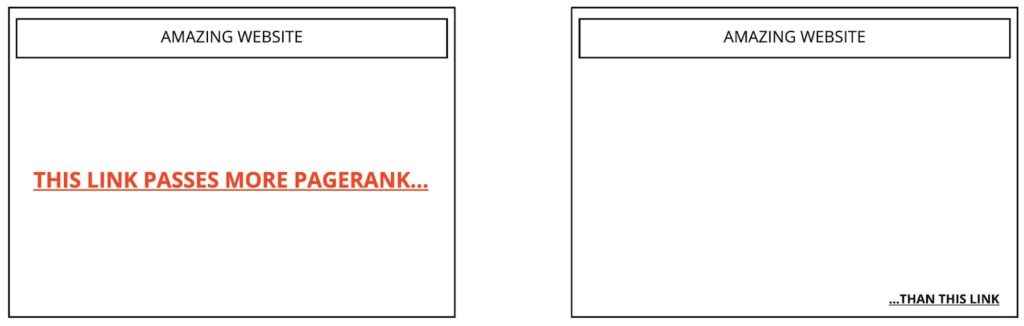
Google’s Reasonable Surfer Model indicates that a link that is more likely to be clicked on will pass more PageRank than a link that is less likely to be clicked on. This is determined by a whole host of factors, including font size, color, and anchor text. However, the position of a link on a page is also something that we often have control over as SEOs and that we can, therefore, leverage.

Here is a simple, rather crude representation of how certain links will pass more/less PageRank based on the prominence of a link and how likely it is to be clicked on.

How link prominence determines PageRank value

Build external links through to key pages

As linking pages pass PageRank, it stands to reason that we want to generate backlinks to key pages that we want to rank. For most ecommerce sites, the pages that rank for the highest volume and most revenue-driving keywords are category pages.

Wherever possible, we should therefore look to use tactics that support link building through to the pages that drive revenue, which for most sites looks something like:

  • Category pages
  • Product pages
  • Homepage
  • Blog posts

This is obviously easier said than done. Practicing these tactics with an overall aim to drive PageRank to your key pages. This reduces the dampening factors at play.

How to get past this

One common way to bypass this difficulty in building links to category pages is internally linking to key category pages we want to push from blog posts/Digital PR pieces that then get links themselves.

Although the PageRank passed to the page we ideally want to rank will undergo a dampening factor, this can still be more beneficial than failing to get any links at all to your target page.

It is worth considering how relevant the category page is to the blog/PR piece it is being included on, as well as where the links are placed on the page, being mindful of the impact the Reasonable Surfer dampening effect can have.

1. Build links from pages with high PageRank

As any Digital PR will know, high authority pages or pages that have lots of PageRank to pass onto your own site are some of the most sought-after links to attain.

Most of the time, this is actually viewed at a domain level, however as is demonstrated in this great review of how PageRank works by Majestic, a domain that should theoretically have a high PageRank can actually be significantly decreased at a page level by its own internal linking.

One caveat for Digital PR teams in this regard is not being too reliant on domain-level metrics as a proxy for links that pass a lot of PageRank and are thus good for ranking. Exactly which pages have high PageRank is nigh-on impossible to know, and although an over-reliance on third-party tools is never optimal, they may be the closest we can get to figuring out PageRank passed by a specific page, rather than a domain.

2. Build links from relevant sites

As part of the Reasonable Surfer Model, it suggests that a link is less likely to be followed if the links are unrelated to the document:

“This reasonable surfer model reflects the fact that not all of the links associated with a document are equally likely to be followed. Examples of unlikely followed links may include “Terms of Service” links, banner advertisements, and links unrelated to the document.”  (Source)

As a result, building links from sites that are of higher relevance to your own site, is likely to pass more PageRank.

3. Remember it is not just about the number of links

Due to how PageRank is calculated, the PageRank value passed by one site can be drastically higher than the PageRank passed by the culmination of 1000s of others combined.

This is why the reliance on the overall number of links can be misleading.

Use internal linking to spread PageRank

We need to consider a few different methods while identifying pages that will benefit the most from ranking and how you pass PageRank around an ecommerce site:

  1. Link to pages you want to rank from pages that have high PageRank themselves
  2. Link to pages you want to rank more frequently throughout the site
  3. Give links to pages you want more prominently ranked

1. Link to pages you want to rank from pages that have high PageRank themselves

Pages that have high PageRank, from which we can assume to be the pages most linked to from external sites, can be used to pass PageRank to – 

Homepage linking

The best example of how you can do this is through the homepage. The homepage for most websites tends to be one of the most, if not the most externally linked to page on a site.

This means that in terms of PageRank, the homepage has the most to pass on to other internal pages.

By carefully selecting which pages you link to from the homepage, and therefore pass the high levels of PageRank to the key pages you want to rank.

2. Link to pages you want to rank more frequently throughout the site

Another method to consider is how frequently you link to the most important pages you want to rank.

Considering that each page can pass PageRank on – this stands to reason that if a page is internally linked to more frequently, it is likely to pass on more as compared to a page less internally linked to (although obviously influenced by the PageRank of the linking pages).

Therefore, you should be considering where you can add internal links to ensure that important pages are linked to more frequently, including:

Global navigation

Due to being outside of the main body content of the page, we can reasonably assume there is a dampening factor applied to links in the menu. However, given its role in navigation, this is likely to be far less than in the footer. 

Therefore, since the global navigation is, as the name suggests, linked globally from every page on the site, the sheer number of links that will be passing PageRank is likely to funnel to those pages included in the navigation. These should therefore be the key pages you want to be ranking.

Breadcrumbs

As long-time fans of breadcrumbs at NOVOS, their benefit of passing PageRank to key pages should not be underestimated, due to the frequency with which different levels of pages are linked to.

The benefit of breadcrumbs on ecommerce sites (outside of usability benefits for the customers) is that they pass PageRank up to the core pages that generally rank for competitive keywords. They are typically helpful to rank the categories.

Most ecommerce websites have a pyramid structure with the homepage at the top, followed by some core categories, an increasing number of subcategories, and lots of product pages. By implementing breadcrumbs on the site, you use the pyramid structure to your advantage (both SEO and CX wise). Since every product page will link up to its relevant subcategories and category, and every subcategory will link through to its relevant category.

In this sense, you distribute internal links as an inverse pyramid, concentrating the highest number (if we disregard the homepage) on the core categories that are the pages generally targeted for high volume keywords. In this sense, your ecommerce site stands a great chance of receiving large amounts of PageRank from internal links.

Product pages also generally are easier to build links to and also naturally generate them. The higher PageRank product pages can distribute upwards, the greater is the relevance – which implies lesser chances of suffering significantly from dampening factors.

Hierarchy of ecommerce site structure and how PageRank can be transferred

Footer

Based on the Reasonable Surfer Model we can assume that the PageRank passed by footer links is significantly impacted by dampening factors. However, the fact that these links are site-wide may mean that there is some benefit to including important pages in the footer for the accumulation of PageRank.

3. Give links to pages you want more prominently ranked

As the Reasonable Surfer Model applied to the likelihood of a link being clicked on a page, it is therefore worth considering whereabouts on a page. This could also mean considering page templates in general links.

For example, in a content strategy, where multiple blogs are being written on a given relevant topic to support a category page, linking to the category page early in the article, with clearly related anchor text, is likely to drive more PageRank than right at the end of an article. On a case-by-case basis, this distinction may appear trivial, however, on an ecommerce site with hundreds and thousands of blogs, the PageRank passed in total may be significant.

Susan Dolan is a Search Engine Optimization Consultant first to crack the Google PageRank algorithm as confirmed by Eric Schmidt’s office in 2014. 

Samuel Hurley is the Founder of NOVOS, Global SEO Agency Of The Year 2020 and 2021.

Subscribe to the Search Engine Watch newsletter for insights on SEO, the search landscape, search marketing, digital marketing, leadership, podcasts, and more.

Join the conversation with us on LinkedIn and Twitter.

The post How to use PageRank for ecommerce websites appeared first on Search Engine Watch.

https://www.searchenginewatch.com/2021/10/22/how-to-use-pagerank-for-ecommerce-websites/


Why Are Most SEO Campaigns Unsuccessful?

Opinions expressed by Entrepreneur contributors are their own.

You’re reading Entrepreneur United States, an international franchise of Entrepreneur Media.

Open a conversation with a owner or a professional and ask them what they think about (SEO). Depending on the context and the experiences of the people involved, you might get a glowing review of how great SEO was for their brand. But you might also get an eye roll and an excoriation of the strategy.

Part of the reason for such variety in opinions about SEO is that people have different experiences when managing a campaign. Although there are plenty of anecdotal examples of companies that have built their entire marketing strategies around SEO and succeeded, there are also millions of people who have seen their SEO campaigns fail.

It’s almost impossible to measure the number of companies that practice SEO (since “practicing SEO” is a vague term reliant on self-reporting), so it’s practically impossible to definitively state what percentage of companies ultimately fail when practicing SEO.

Related: Get to Know the 3 Types of Influencers

Still, in my experience, the majority of SEO campaigns end up unsuccessful – that is, they don’t meet the expectations of the people managing them. Why is this the case?

High expectations (and quitting too soon)

One possible explanation is that, going into a new SEO strategy, people set expectations that are too high. SEO experts and general marketing enthusiasts often proclaim that SEO is a near-perfect strategy. They claim it’s useful for every business, it’s cost-efficient and it’s capable of generating massive returns.

Although these claims are technically true, they set people up to think that starting an SEO campaign is like flipping a light switch that instantly starts bringing people to your website. If you don’t see results right away, or if those results are disappointing, you might feel like the campaign is unsuccessful.

This is also the reason why so many marketers abandon their SEO efforts prematurely. SEO is a long-term strategy that takes months, or even years to fully take off. If you quit after a couple of weeks, you’ll be destined to fail.

Lackluster effort

Some campaigns fail because of the lack of effort on the part of the people executing the campaign. Perhaps they believe that the strategy is risky, so they don’t want to spend too much time or money on it. Or perhaps they simply don’t have the skills or experience necessary to write high-quality content, build links and improve their website.

Whatever the case, SEO isn’t a strategy that can succeed with fractional effort. The only way to get decent results from a campaign is to make a concentrated effort to produce large quantities of great work. It’s to cut corners, then blame the strategy for your own failures.

Competition (and no plan to avoid it)

Any business owner should be able to recognize the importance of competitive research and understanding the competition as it relates to your business operations. But too many of those business owners ignore the competition factor when planning an SEO strategy.

The reality is, most industries and most keyword terms are already being dominated by established players who have spent years building their domain authority enough to rank highly for their target markets. If you want any chance of disrupting these players and displacing them from their entrenched positions, you’ll need a massive budget (and a targeted strategy).

Related: 3 Ways to Avoid Mediocre Marketing Content

Alternatively, you could come up with a plan to avoid the competition. For example, you could target a different audience segment, or you could strategically target a rarer set of keywords and phrases that your current competitors aren’t touching.

In any case, if you don’t have a plan for how to handle the competition, it’s going to compromise your entire strategy.

Scams and black hat SEO

It’s also worth noting that many businesses fall prey to scams and companies practicing “black hat” SEO. If a business owner doesn’t have much personal experience in SEO, they’ll be likely to hire an external agency or a contractor to help them execute the work. Naturally, they’ll gravitate toward professionals who are inexpensive — and/or those who promise big results.

Unfortunately, these two avenues often lead to non-native speaking writers, people who abuse link schemes and “experts” who don’t care about the long-term reputation of your brand. While you might see temporary results in the early stages of your relationship with this type of company, eventually, you’ll be hit with a penalty — or your rankings will fall back to where they “should” be. It’s a discouraging experience, but an avoidable one.

It’s a shame that so many SEO campaigns fail, but it doesn’t have to be the reality. If you’re patient enough to commit to SEO long-term, if you have a plan for the competition, if you do what you can to create great content, and you stick to third-party providers with experience and integrity, there’s no reason SEO can’t work for your brand.

https://www.entrepreneur.com/article/381398