Three organic search opportunities for your local business

30-second summary:

  • Following pandemic-driven shopping trends, lots of local businesses had to explore online marketing opportunities
  • Google offers a few great ways for a local business to get found through organic search
  • Local 3 Pack is Google’s search element containing top three local businesses based on your search query.
  • To rank in the Local 3 Pack you need to ensure your Google My Business listing is complete and active
  • Third-party local business listings (like Yelp and Tripadvisor) may also drive some organic search visibility so it is a good idea to claim your business there
  • Hyperlocal content may help your business discovered by people who were not even searching to buy a local product or service, so produce relevant content on a regular basis

Local marketing has become even a more trending topic, following the pandemic-driven pandemic.

Lots of local businesses that used to rely on local foot traffic were forced to turn to the Internet to get found by customers.

That digital transformation brought this huge challenge to just about any local business – how to get found online. 

Step 1: Claim your business profile on Google My Business

Google offers huge organic search visibility to local businesses through the so-called Local 3 Pack that shows up on top of organic results when search intent reflects buying (or doing) something locally.

Local 3 pack is Google’s search element that includes three relevant businesses from Google Maps results:

Image source: Screenshot by the author

Ranking your business in the Local 3 Pack is no easy task. It heavily relies on proximity of those businesses to the customer’s current location.

However, there are a few things you can do to improve your local rankings:

  • Make sure you have a detailed (and original) description of your business and what it is you do.
  • Add your website (oftentimes Google would grab text from the associated website and rank a business based on that content). There are also a few great plugins allowing you to embed your local listing onto your website for better visibility.
  • Upload pictures and videos of your office and team
  • Add your products and services (Note: Services are not believed to have a huge (or any) impact on your local rankings but why not add those anyway)
  • Your business categories. Keep those categories as relevant as you can as they can harm your local rankings

Image source: Screenshot by the author

Most importantly: Keep an eye on your Google’s reviews

Business reviews are known to be crucial for your local (and hence Local 3 Pack) rankings, so make sure to keep an eye on your reviews and reply to all of them.

Note that Google may remove your review if they find you have been using manipulative or misleading tactics when getting those reviews, for example:

  • If that review is repeated across other business profiles on other sites (which, by the way, can be quite natural… I’ll be the one to admit that I may leave my favorite business the same review on a few platforms I am registered at. But again, I think we are talking about suspicious patterns here rather than one-on-one cases)
  • If you had a massive influx of reviews overnight
  • If Google suspects that you and your team are reviewing your business pretending to be clients.

While you may notice your competitors implement these manipulative tactics without no obviously negative impact on their rankings, I’d still suggest avoiding these at all costs. 

You can invite your customers to review your business on Google through a short URL that’s specific to your local business (and even note that on your business card). But you are not allowed to request positive (five-star) reviews or segment your customer base to only invite happy customers to review you.

If you have a budget, investing in ads on Google maps is also a great idea. This could bring in more customers and reviews.

Step 2: Claim your business profile everywhere else

While claiming your business is generally a good idea to get better control over your branded content, it also gives you additional organic exposure because those listings may rank in organic search results and bring additional exposure.

Hence, your next step is identifying important local directories (like Trip Advisor and Yelp)and claiming your business everywhere.

Here’s a huge list of those you can consider.

Image source: The Ultimate Free Business Directory List for the USA – Updated 2020 

Just about any local business out there will need to ensure a strong Yelp presence, for example, so that one will always be on top of your list. Yelp marketing is tricky but if you start getting reviews there, there’s a way to display those reviews on your site to boost your conversions.

When putting your business on maps…

  • Make sure your business name and address is consistent across all channels, including the phone number format
  • Complete all available fields and use all available characters! More content generally means higher rankings for your listings!
  • Monitor your listings for reviews, add updates, ensure your info is up-to-date!

Step 3: Develop a hyperlocal content strategy

Similar to how foot traffic works for a local business (passers-by may check a store out of curiosity), a well-planned content marketing strategy can drive customers who never intended to buy anything or didn’t know they needed you.

  • Describe (location-driven) problems your business solves. For instance, a Seattle hairdresser publishes an article on haircuts that work well in the windy or rainy climate.
  • Address some problems that are common in your area. These work best when they are timed to a particular seasonal trend. For instance, a bakery in Albany publishes a checklist of foods to store at home to prepare for a snowstorm.

Here are a few ideas for hyperlocal content:

  • Ideas for local vacations and where your business can be of help
  • Local events and how your brand participates
  • Local partnerships like local charities

Take note of local People Also Ask results because those are great sources of hyperlocal content.

Image source: Screenshot by the author

Generally, answering local questions is a great idea! 

Let’s take a look at this search query: “how far is Central Park from Times Square” 

People searching for this may not necessarily be looking to buy anything but there are still some opportunities here as your content may give them ideas on where to dine or stay.

Image source: Screenshot by the author

The beauty of hyperlocal content marketing is that your clients don’t have to be in the area to find your content: They may be planning a trip to your area and discover your business prior to going. This is something local maps placement won’t be able to help with.

Using semantic search is another good way to come up with hyperlocal content ideas because it will help you identify location-based keywords that are able to generate organic traffic. Here’s how semantic search works:

Image source: Screenshot by the author

Conclusion

Organic search provides quite a few opportunities for local businesses to generate traffic and get found by customers. Keep an eye on your local listings and keep creating hyperlocal content to generate relevant traffic for your local business. Good luck!

Ann Smarty is the Founder of Viral Content Bee, Brand and Community manager at Internet Marketing Ninjas. She can be found on Twitter @seosmarty.

Subscribe to the Search Engine Watch newsletter for insights on SEO, the search landscape, search marketing, digital marketing, leadership, podcasts, and more.

Join the conversation with us on LinkedIn and Twitter.

https://www.searchenginewatch.com/2021/10/01/three-organic-search-opportunities-for-your-local-business/


The Future SEO: Boardroom edition

30-second summary:

  • SEO’s dynamic nature and Google’s mysterious algorithm specifics keep the industry on its toes
  • Is it possible to simply spot the inefficiencies of SEO in its infancy and foresee trends?
  • With over 20 years of leadership roles, SEO pioneer Kris Jones taps into his experience to help SEOs derive more strategic value

Pretty much anytime we speak about something’s future, we’re doing something called extrapolating. By definition, extrapolating involves extending existing data or trends to assume the same procedure will continue in the future. It’s a form of the scientific method that we probably use every day in our own lives, quite reasonably, too: the summers will be hot, the downtown traffic will be bad at 9 AM, and the sun will rise tomorrow morning.

But how can we look into the future of something as complex and ever-changing as SEO? As with all cases of hindsight, we are clear on how SEO began and how it has transformed over time.

We see the inefficiencies of SEO in its infancy and how advancing search engines have altered the playing field.

The catch is this: how can we surmise about the future of SEO without having access to all the mysterious algorithm specifics that Google itself holds?

The answer is simple: we have to extrapolate.

I’ve seen SEO from the boardroom perspective for more than 20 years. I’ve seen the old days of keyword stuffing to the semi-modernization of the late 2000s to the absolute beast that Google has become now, in the 2020s.

Given that, where do I think SEO is going in the not-too-distant future? Here are some thoughts on that.

User intent will remain crucial

One aspect of SEO that is essential right now and will become only more vital as time goes on is user intent in search queries.

It’s an antiquated view to think that Google still cares much about exact-match keywords. Maybe 15 to 20 years ago, getting keywords exactly right in your content was a huge deal. Google matched queries to corresponding word strings in content and then served the best of that content to a user.

Today, trying to optimize for exact-match keywords is a futile effort, as Google now understands the intent behind every query, and it’s only going to get better at it as time goes by.

If you recall Google’s BERT update from late 2019, you’ll remember that this was the change that allowed Google to comprehend the context of each search query, or the meaning behind the words themselves. And the latest Multitask Unified Model (MUM) update adds further depth and dimensions to understanding search intent.

No longer does Google look only at the words “family attractions.” It knows that that query references children’s activities, fun activities, and events that are generally lighthearted and innocent.

And all of that came from two words. How did Google do it? Its consistent algorithm updates have allowed it to think like a human.

All of this is to say that user intent has to be part of your keyword and content strategy going forward when you’re doing SEO.

Produce more evergreen content

Sometimes, over the years, I have heard people mention that devising an effective content marketing strategy is difficult because as soon as a topic’s period of relevance is over, that content will never rank again. Use your data to analyze content performance and strike the right balance between content and formats. 

If you don’t know any more about this subject, you might be tempted to believe that. Maybe, at one time, you got a content piece entitled “Top Furniture Brands of 2019” to rank for the featured snippet. That makes sense. The post was probably a long listicle that described the best brands and linked out to the manufacturers’ websites or retail stores that carried those brands.

But maybe, as spring of 2019 transitioned into fall and winter, that post fell way down the rankings and now can’t be found anywhere anymore.

The reason is obvious: you haven’t made the content evergreen. The best furniture brands of 2019 may not be the best brands of 2020 or 2021 or 2022. So, what do you do? You put the work in to make the blog post evergreen by updating it. Go through and change out the best brands, change the content, change the post’s title, and then republish the post.

You can also just plain focus on subjects that will almost never need any updating at all:

  • “Top 20 Christmas cookies to bake this year”
  • “How to train a dog”
  • “10 Steps for Hanging Heavy Objects on the Wall”

Whether it’s 2021 or 2050 or 2100, there are going to be people who have never hung a thing on a wall before and will need some help online.

Whatever your market niche is, do some topic research in Answer the Public, Semrush, or BuzzSumo to find relevant subjects for you. You can also mine the SERPs to see what kinds of content are ranking already for your desired topics. Just remember to mix in plenty of evergreen content with your more timely content posts. Google will reward you for it.

Mobile will remain first

This final point is about mobile-first indexing, but you likely already know about that. It’s certainly no secret that Google is going to rank your website’s mobile version when it crawls your pages. About 60 percent of all searches are now performed on mobile devices, and so Google now prioritizes a site’s mobile web pages over the desktop versions.

As I said, you knew all that.

What some people still may not know is that Google’s new Core Web Vitals should be a major part of your mobile page optimizations.

The Core Web Vitals are primarily a web-dev task. Overall, the three vitals work together to give users positive, seamless experiences when they access a web page.

The vitals are Cumulative Layout Shift (CLS), Largest Contentful Paint (LCP), and First Input Delay (FID).

CLS refers to the amount of moving around that a web page’s content does before it actually loads fully.

If you have a high CLS, that’s bad. It means some elements are appearing before the page loads all the way, which increases the chances of a user clicking on something that then moves elsewhere. That, in turn, means the user will probably click on something unintended.

LCP, meanwhile, is the time it takes for a page’s content to appear. It specifically refers to the amount of time between when you click on a URL and when the majority of that URL’s content appears for you to see.

Finally, FID measures how long it takes users to be able to interact with a web page in any way. These actions could be typing in a field or clicking menu items.

Even if you don’t work in web development, you can see how useful these three measures actually are. They all take user experience into account, which, coincidentally, is why they are part of Google’s larger 2021 Page Experience update.

The Core Web Vitals are essential in and of themselves, but I think my “boardroom” perspective on them is one we can all safely adopt: that they are just examples of more great things to come from Google.

The search engine giant is always thinking of new ways to make users have better, more helpful, and more positive experiences on its platform. As SEOs, we need to be ready to respond so we don’t get left in the dust.

To know the future, look to the past

We know that extrapolation can be taken only so far, but that’s why the past is so vital to understand. It can give us hints at what lies ahead.

What will Google think of next? It’s going to respond to whatever need is out there for improved online search experiences.

Think of 2020, when the pandemic was in its infancy. People needed information, and Google responded. Within months, you could tell whether restaurants were requiring masks indoors, how many virus cases were in your county, and where you could go for more information or help.

What, then, is the future of SEO? It’s going to be whatever the masses need it to become.

Kris Jones is the founder and former CEO of digital marketing and affiliate network Pepperjam, which he sold to eBay Enterprises in 2009. Most recently Kris founded SEO services and software company LSEO.com and has previously invested in numerous successful technology companies. Kris is an experienced public speaker and is the author of one of the best-selling SEO books of all time called, ‘Search-Engine Optimization – Your Visual Blueprint to Effective Internet Marketing’, which has sold nearly 100,000 copies.

Subscribe to the Search Engine Watch newsletter for insights on SEO, the search landscape, search marketing, digital marketing, leadership, podcasts, and more.

Join the conversation with us on LinkedIn and Twitter.

https://www.searchenginewatch.com/2021/09/15/the-future-seo-boardroom-edition/


Everything you need to know about the Google MUM update

30-second summary:

  • Google’s Multitask Unified Model (MUM) update landed in June 2021, seeking to deliver search results that overcome language and format barriers to deliver an improved search experience
  • The Google MUM update uses an innovative solution that accesses a wealth of previously hidden information around a core query, providing more of what we want without having to carry out multiple different searches
  • Google MUM can understand and translates 75 different languages, including text and images
  • MUM will see us bid farewell to BERT

They say Mum always knows best but can the same be said for Google’s MUM update? Giant search engine, Google, launched their latest update as the answer we have been looking for to make internet searching more intuitive and inclusive.

But what does this mean for website owners, SEO practitioners, and agencies providing marketing services?

What is Google’s MUM update?

The Google Multitask Unified Model (MUM) update, aims to answer modern search demands by using an AI-powered algorithm to improve online search capability. When searching the internet, contradictory to expectations users are faced with multiple searches, geographical, and language barriers due to a lack of intuition on the search engine.

Google’s MUM will remove the need to carry out multiple searches that users currently do in order to compare and gain deeper insights. It has the ability to understand and bring solutions based not just on textual content but also an interpretation of images, videos, and podcasts in a way that was never possible before.

It understands 75 different languages which implies that it can pool and serve results to give users the most holistic and comprehensive search experience, answering even the most complex queries.

Google MUM will redefine search relevance changing the way people accesses and use information across the world wide web. This however, needs to be taken with a pinch of salt that not all content can be trusted and would eventually boil down to user discretion.

The MUM update means searches will serve information that provides helpful, related insights, and will reach further for these sources than any other search engine update before it.

Google believes that the MUM update is the answer.

Although in its early days the algorithm will continue to see iterations but it certainly looks to be an exciting move that Google is committed to build on. How? Google intends to follow these in order to ensure they can make it “the world’s best MUM” and remove any machine learning biases:

  • Human feedback from raters using the Search Quality Rater Guidelines will help understand how people find information
  • Similar to 2019’s BERT update, MUM too will undergo the same process applied to Google search models
  • Applying learnings from their latest research on how to reduce the carbon footprint of large neural network training systems to ensure search continues to function as efficiently as possible

Why MUM matters

MUM interprets meaning in a people-friendly way, breaking down language barriers to provide us with the most comprehensive search engine capability ever.

It’s fast, far-reaching, and thorough as compared to any previous search engine update. This matters in a world where users want detailed, relevant, and accurate answers in seconds – anywhere, anytime.

This will remove silos in search dropping all the veils of language barriers and lack of intuition. It will view user queries, questions and comparison needs from all angles reducing the time we spend trying to find the right answers to elicit what we need.

For a long time, keywords and SEO content have been a critical part of how information is served and how it needs to match intent. Over recent years whilst this has remained important to draw attention to specifics, it has changed slightly to be more phrase friendly, finding keywords used in a more natural context. This certainly benefits the MUM search algorithm. It can provide nuanced answers to questions, using NLP, and in-depth world knowledge to gather additional information supplements by a mix of formats – text, images, or even video and audio in the future.

The benefits of MUM

Its ability to think beyond the question or statement will tap into multiple dimensions of the SERP and SEO as a result. Users, businesses, and content creators are being encouraged to say goodbye to the “exact response days” and tap into the user intent and journey that is layered, complex, and sometimes more generalized.

Google MUM’s AI smarts will be another piece in mastering and understanding user intent and thought processes.

Imagine wanting to travel to a country and the questions you currently have to ask to find all you need to know. Firstly, you might wonder how you get there. Then you may search for where to stay, what’s in the area, for visas or vaccinations required and perhaps a bit about the weather and activities available. The list goes on and so does the time taken to search and sift through results.

We now want more, right away, and Google MUM is the beginning of meeting these needs.

Eliminating language barriers

MUM will find results in other languages, opening up a treasure chest of local and more insightful information than any previous Google search technology has ever offered. It aims to become your very own expert and translator, with the added value that you can expect from an enthusiastic human – succinctly delivered, plentiful detailed, and readily given in a language you understand, just like engaging with a human expert.

Searches are no longer inhibited by the words we choose. People can elicit more specific answers to questions by including an image, video or web page in our search. This ensure greater access to international content that previous search engines would not have recognized.

This breaking down of language barriers will allow users, SEOs, and businesses to see more localized insights and responses. On the SEO and digital marketing front, this also means – more competition! Local people create many reviews on areas or facilities, yet we currently miss what could be the best answer to our review style questions due to language barriers.

Unless users search sufficiently and widely using local terms, spellings or language nuances, they never discover pieces of information that would be an integral part of decision making.

Making multi-modal matter

While MUM will know it all (hopefully) since it uses the T5 text-to-text framework and is 1,000 times more powerful than BERT. We will still see answers to straightforward questions. But the ones that are less simple or don’t have a straight answer will flourish with this multi-modal approach. Imagine, what if the answer lies in an image that could be in Japanese?

AI and the search engine

Search engines have driven the way content is created, focusing heavily on keywords, phrases, intent, and other key factors. So should AI change how businesses, SEOs, and agencies think about attracting visitors and engaging them while ensuring we use the exposure Google MUM can offer? This is a far greater intelligent search algorithm that understands nuances and will bring more relevant and varied content to the fore.

Content that is wrongly pitched will disappear more readily than ever before. This reinstates how important the user experience, content, overall SEO, accessibility, and intent are for success in the age of digital. Content must, therefore, be better than a few placed keywords to make it anywhere in page rankings and it must make optimal use of multimedia formats that Google MUM looks at. End-users are MUM’s focus and that must be at the front of how content marketers work. This is important to remember when considering redesigning your website. We see it reinforcing the need for quality SEO and key phrase content if you want to be noticed.

Google MUM has a far greater ability to answer comparison style questions too.

“Will I find the same weather in Turkey as Egypt?” style questions will bring answers in one go. Previously we would have to dig around the information for each country and compare information ourselves. Not only will one question suffice to elicit temperatures for each, but it will offer added value information on each country that it knows people may have gone on to search. It may include relevant comparisons between the two countries, such as vaccinations or visa information, dress codes or helpful information that its AI capability recognizes as appropriate.

MUM vs BERT

Like every launch, the latest proclaims to be the best. BERT (Bidirectional Encoder Representations from Transformers) was launched in 2019 and understood searches better than we have ever been able to before. Around this time, keywords became key phrases seeking to provide results based on user intent. In other words, content had to answer common questions.

Numbers tell us that MUM is 1000 times more powerful than BERT, so will MUM always know best? It undoubtedly would seem that this changes the face of search and SEO as we know it in 2021.

What you need to do

  • Create content that remains high quality and focused yet opens up the possibilities that tangential linking can bring to comparison and related topics. Content must answer questions and provide the right level of added value, including appropriate use of multimedia formats so that MUM will notice you. Written content, including blog posts and articles, is still a key player in attracting attention. There is increased importance on backing this up with podcasts, images, audio, and video content – this would help when MUM’s new iterations come into play.
  • Google MUM will know it is relevant and add it to search results. Your content will now compete amongst the most significant contributions around the world. While it removes language barriers, it would still be wise to have multi-lingual SEO as part of your strategy. This will dramatically affect the regional power of content, so use it to your advantage, ramping up regional relevance, neighborhood interests, or specifics both verbally and visually.
  • Produce content that builds brand recognition and loyalty using informative, engaging writing, images, and other media. Remember to add structured data to your page to give clues about the content. Brands and advertisers need to be mindful that this is an AI-centric update and would learn as it goes. We know that whilst Google MUM will widen search answers, there will always be people that know where to look and who to rely on for trusted content, so the expanded pool of SERP competition will not typically minimize your current audience as long as you continue to remain reliable. Bottom line is – Continue to build your expertise and authority in the industry so you can ‘EAT’ your competition.

In all honesty, with fewer tricks to hide behind, what you need to make sure of when creating MUM-friendly content simply translates to quality. If it is interesting, relevant, and valuable to your end user, then it will be seen. It will widen the potential audience and bring more significant competition for visibility, and that is just as likely to be a good thing as bad for many.

Conclusion

Are we genuinely heading to an internet-driven world without barriers? While Google’s MUM seeks to understand more about what we might be looking for than any search engine has ever before, will this open up the search-scape to a truly more worldly experience? We can’t answer all the questions and there are many still to be asked as the rollout gathers pace. Only time will tell us how Google improvise MUM in the future. After all, technology and innovation never stand still for long.

Joe Dawson is Director of strategic growth agency Creative.onl, based in the UK. He can be found on Twitter @jdwn.

Subscribe to the Search Engine Watch newsletter for insights on SEO, the search landscape, search marketing, digital marketing, leadership, podcasts, and more.

Join the conversation with us on LinkedIn and Twitter.

The post Everything you need to know about the Google MUM update appeared first on Search Engine Watch.

https://www.searchenginewatch.com/2021/09/02/everything-you-need-to-know-about-the-google-mum-update/


Influencers in today’s SEO

30-second summary:

  • With search getting more sophisticated there will be a strong relation between user signals and influencers
  • Google’s Multitask Unified Model (MUM) and the AIDA (Attention, Interest, Desire, Action) model will impact search intent and influence a business’ search visibility
  • Intellifluence’s CEO, Joe Sinkwitz explains key concepts surrounding the impact of influencers on website rankings in modern SEO

One new to SEO might assume that the only role influencers play when it comes to ranking is in the form of bloggers providing reviews and links via guest blogging. However, if we were to segment search into simplistic buckets of links, content, and the cumulative user signals associated with how a visitor interacts with links and content, the future role of influencers is going to skew far more towards the user signals bucket.

Historically, influencers have been viewed as a paid social channel add-on for B2C and D2C companies, only more recently taken seriously for their ability to influence B2B purchases. Their use cases are far more versatile than the initial assumptions and preconceived notions related to value, with expected compensation ranges to match that versatility based on audience sizes and channel selection. As an SEO, it is easy to understand how influencers that maintain blogs in your niche would be useful when undergoing a PR-driven outreach campaign for link purposes. To understand how influencers can affect the outcome of a site’s rankings external to the links generated, it’s important first to understand a few key concepts.

Content created in partnership with Intellifluence.

Targeted peer personas

Within the realm of content marketing, a marketer would seek to develop out personas in order to properly structure content with the appropriate hooks and value propositions. For ease in understanding how to create a sample buyer persona, consider the following process:

  1. Provided you’re not operating on a brand new site, look into your previous 100 customers – if you have enough data, you can be more granular and select out your most ideal customers.
  2. Based on the buyer contact’s email, use a tool such as Clearbit to generate a list of their social media accounts. Keep in mind that where they maintain social accounts is just as important as to their level of usage and subject matters.
  3. Who do these customers aspire to be? Are they constantly seeking out solutions? Whom do they follow to get these solutions? A quick hack in this is to sort their followers by audience size as authoritative influencers tend to have a larger following than most of their industry peers.
  4. Digging further, who influences those subject matter experts? Which sources do they consume?
  5. Who are your ideal customer’s peers? On one hand, you’ll likely have some of that data immediately when analyzing the audience data. If you do not, LinkedIn Sales Navigator makes segmentation rather simple based on their filters and query refinements, allowing you to select extremely similar individuals to your targets.
  6. Repeat the above process as necessary to generate a large enough dataset that you can apply pivots on in a worksheet, in order to determine buyer persona commonalities.

Once targeted personas are created based on those characteristic commonalities, we can use them in order to positively impact those user signals. Here are a few oversimplified pieces for the sake of brevity.

Peer personas

Navigational queries

Through multiple experiments, we know that spikes in navigational queries can have a spillover effect on rankings for non-navigational queries. As Google is introducing Multitask Unified Model (MUM) to make sense of complex queries, the more positive effects we as SEOs can provide on showing that these navigational queries also have informational and transactional signals associated with them, the better the intent and therefore search the ordering will be on the coveted transactional terms.

How does this work with targeted peer personas? It can be as easy as hiring influencers that exist frequently enough in the sum audience data to your targets to share out useful information related to your product or service, specifically writing out the brand name. Each time we’ve run campaigns of this type, the navigational queries spike. This alone is very useful, but there’s more power to these peer influencers.

Repeat dwell

Having a user specifically search for your brand and click the result is a fantastic first step. What could be better? Repeatedly visiting and spending time on-site. I recognize that we’re simplifying here but structuring a campaign with peers that follows the model of Attention, Interest, Desire, Action (AIDA) allows you to introduce the brand name for navigational queries then pepper the targeted audience via those peer influencers with interesting facts and use cases.

In this phase of the campaign, the direct links from social posts could be used as we can all probably agree that our Chrome and Android data is being used to continually refine future searches. The goal of this phase is to drive repeat usage of the site. Some commercial activity may very well take place, which is a bonus, but not the KPI.

Influencers in today's SEO - Finding influencers

Query satisfaction

The final phase of the AIDA model moves from desire to action, and our goal is to turn our navigational queries into transactional rankings. Translated to how MUM might perceive this, a user that seeks out a result navigationally, returns to the result from another channel, and then comes back with a transactional query modifier is likely satisfied with the query result and thus that website should be shown more frequently.

How does that work with the influencers? The third style of posts from the peer influencers to your buyer personas can again return to mentioning your brand name and including a specific value proposition to generate that action. It could be a coupon code, a time-specific call-to-action for a deal, a giveaway, or any combination of the sort. By now focusing on a specific transactional modifier with your brand name, a percentage of those blended queries will occur, resulting in action being taken, which is the definition of query satisfaction. You’ll have successfully used influencers to influence how Google perceives the site for future transactional queries.

Joe Sinkwitz is CEO at Intellifluence.

https://www.searchenginewatch.com/2021/08/20/influencers-in-todays-seo/


Four ways to improve page speed and master Core Web Vitals

30-second summary:

  • Websites that rank well on Google tend to have a higher Core Web Vitals score
  • There are three core web vitals that make up the majority of the site’s overall page speed score
  • Prioritizing user experience in web design and marketing campaigns could give you a competitive edge
  • This comprehensive guide prepares you for the rollout of the new Google Search algorithm update

Google’s latest major update to its search algorithm focuses greatly on the user experience through a new set of ranking factor metrics, called Core Web Vitals. Early results from Core Web Vital audits reveal that the average website performs below these new standards. Searchmetrics’ research revealed that, on average, sites could reduce page load time by nearly one second by removing unused JavaScript.

This provides an amazing opportunity to outperform other websites by boosting your own page rankings.

Here is everything you need to know about Core Web Vitals plus four simple steps to improve your metrics.

Content created in partnership with Searchmetrics.

What are the Core Web Vitals metrics?

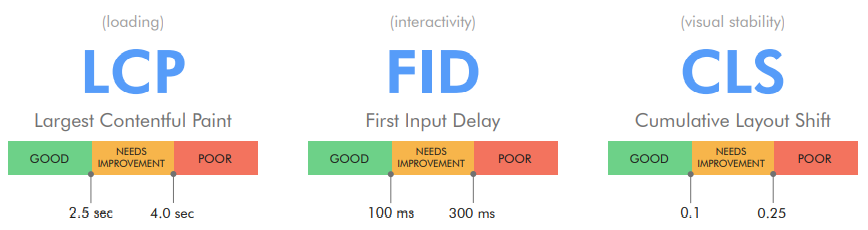
Core Web Vitals are an extension of Google’s page experience signals that include mobile-friendliness and HTTPs. The three Core Web Vitals metrics measure loading performance, interactivity, and visual stability, which Google views as providing an accurate depiction of a real-world, user experience.

  1. Largest Contentful Paint (LCP) measures the loading time of the largest image or text block visible within the user’s viewpoint.
  2. First Input Delay (FID) measures the interactivity on the page by calculating the time from when a user first interacts with the site to the time when the browser responds to that interaction.
  3. Cumulative Layout Shift (CLS) refers to how much the content shifts during page rendering.

How to check your page speed insights

There are many online tools that check your page ranking score, including PageSpeed Insights, Chrome User Experience Report, Lighthouse Audit, and Search Console. These sites measure page speed in various elements and display the results using a traffic light system. PageSpeed Insights provides a breakdown of the results and highlights areas of improvement.

What does “good” performance mean in numbers?

To provide a good user experience, LCP should occur within 2.5 seconds of when the page first starts loading. Pages should have an FID of less than 100 milliseconds and maintain a CLS of less than 0.1.

Websites, like Wikipedia, have the highest page speed score due to a lightweight approach to web design, using mainly text and optimized images. Websites that rely heavily on video content and images are slower to load and make for a poor user experience. Therefore, there is a balance to strike between design and user experience.

See where your site ranks. Visit PageSpeed Insights and enter your URL. Note: The top number is your Lighthouse score, also referred to as PageSpeed score, measuring from zero to 100. While it’s a good general benchmark for the performance of your site. It’s not entirely related to the three Core Web Vitals metrics, which should be viewed as an analysis of LCP, FID, and CLS.

How to improve your page speed

Passing is considered getting a “good” score in all three areas. Making small changes can improve the page speed score by as little as one second, which can shift the site from a “poor” or “needs improvement” score in LCP to a “good” one. Reducing load time will make users happier and increase traffic to the site.

Tom Wells, creative marketing expert at Searchmetrics, says,

“Anything that’s not needed on a website shouldn’t be there.”

Putting it simply, identifying and removing elements that are not used or have a substantive purpose could improve the site’s page speed score.

1. Oversized images

Poorly optimized images are one of the main causes affecting a site’s LCP score as this is usually the largest element to load. Ecommerce businesses and those who rely heavily on images may have poorer LCP scores due to the page rendering of multiple high-resolution images.

Optimizing these assets by using responsive design or next-gen image formatting such as WebP, JPEG 2000 and JPEG XR can improve the score by cutting down rendering time. Often, images can be condensed to a much smaller size without affecting the quality of the image. Free resources like Squoosh can do this for you.

2. Dynamic content and ads

Loading ads on a web page is one of the main causes of a bad CLS score. This can be down to elements on the page shifting to accommodate dynamic ads, which makes for a poor user experience.

Using a smart implementation method such as allocating size attributes or CSS aspect ratio boxes for all ads, videos, and image elements is one way to reduce content shifting. Some companies may use a plugin or coding at the top of the website to place the ads. However, this could lead to a slower website, impacting the user experience negatively and indirectly affecting rankings.

Also, never insert content on top of existing content, except in response to specific user interactions as this ensures any layout shift that occurs. For example, when you click a CTA button and a form appears is an exception.

3. Plugin-centric web economy

Plugins can act like “plaster over the cracks” to solve website problems, says Wells. Despite creating a temporary fix, it can slow down and hinder web performance as all the code needs to load before the user is able to fully interact with the webpage.

Using plugins can increase server request counts and increase javascript execution time. All these factors can lower the site’s FID score.

“Often we look for advanced fixes and solutions but sometimes it’s as simple as deleting what’s not needed,” says Wells.

Therefore, removing some plugins, especially unused ones, can improve the reactivity and speed of the website.

4. Too much code

Google advises focusing on the overall website performance.

“It’s critical for responsive and well-scored websites to be as lightweight as possible,” says Wells.

“The more things that a server has to load, the slower that load time is going to be overall.”

While unused CSS and JavaScript may not directly impact the page speed score, it can still impact the site’s load times, create code bloat, and negatively impact user experience.

When should I start?

Google’s rollout of the new algorithm began in mid-June, so it’s worth getting a start on reviewing how well your site scores on pages speed tests. Websites that rank well tend to have higher Core Web Vitals scores and this trend is set to continue as Google places greater emphasis on user experience.

Want more Core Web Vital insights? Read Searchmetrics’ Google Core Web Vitals Study April 2021.

https://www.searchenginewatch.com/2021/08/18/four-ways-to-improve-page-speed-and-master-core-web-vitals/


Why Google’s Search Page Redesign Is the Death of SEO

October 2, 2020 7 min read

Opinions expressed by Entrepreneur contributors are their own.

I have been a digital marketer for more than 20 years, which seems like an eternity at this point. Google has always been a staple of any good digital marketing strategy, especially for search engine optimization (SEO), to attract free organic traffic based on the quality of the content on your page. But, when we recently started to see our SEO traffic start to decline, we asked our SEO consultant to investigate the root cause. He said it was due to a recent Google Search page redesign, moving the free organic links to the bottom of the search results page. Even more troubling was his answer on how to fix the situation.

“Start spending more money advertising with Google to get back up to the top of the page,” he said. That’s a very strange thing for an SEO expert to say because his services aren’t needed in that scenario. This means SEO as a strategy for ecommerce-driven companies is dying, and paid search marketing has become your primary way to gain an audience through the search engines, at least through industry-leading Google. Allow me to further explain.

Related: Want to Rank Higher in Google and Amazon Search? This $29 Course Can Help.

A quick history of Google Search

Ever since Google hit the scene in 1998, it has been a staple of any good digital marketing strategy. Originally, it was simply having a good SEO plan to help you go up the free organic rankings — ideally to the top of the first page of the search results. Search results were very straight forward and uncluttered and looked similar to the example below. Only free organic results appeared, based on the content of your page, and its relevancy to the keyword being searched. In the example below, I did a search for the word “technology.”

Then, in 2000, Google launched Google AdWords (now called Google Ads), which was a means to “buy” your way to the top of the search results with paid text ads. This meant you needed both a good SEO strategy for free organic traffic (for the links at the bottom of the first page) and a good keyword bidding strategy for paid traffic (for the links at the top of the first page), as seen in this example search result for the keyword “text.” 

Then, in 2002, Google launched Google Shopping, which gave ecommerce companies the opportunity to feed their product listings to Google on a pay-per-click model, adding a third dimension to their mix, but largely separated into its own “Shopping” tab on Google. At the time, it didn’t really impact traditional search results at all. And finally, in 2004, Google launched Google Local, which allowed businesses with multiple retail locations the ability to advertise and promote their various locations, in addition to the corporate parent company. This change simply localized the advertising to the location of the user. Instead of seeing a national ad, they saw an ad for a nearby local business. Again, it really didn’t materially impact the page design. 

Google today

But, in the last several months, Google has materially changed its page design for Google Search. Previous “sacred ground” rules like “stay true to our organic search roots, and don’t clutter the page with a bunch of advertising” got completely flushed down the toilet, as you can see in this example of a keyword search result for “restaurant furniture.”

Notice what has happened to the page design. Today, there are no free organic search results anywhere to be seen on the first page above the fold (where the computer screen breaks the page). Every single link on the top of the page is now a paid advertisement. The links in the upper left are coming from Google Ads, the links in the lower-left map are coming from Google Local and the links on the right coming from the Google Shopping product feed. Every single one is a paid placement, which is great for Google maximizing their ad revenues. But, if you want to see an organic search result that is truly based on the quality of the content of the landing page, you need to scroll down “below the fold,” and even then, they don’t start until the bottom of that second screen view after you page down.

Related: Online Content Monetization 101: How to Make Money From Content

The death of SEO

So, what does this all mean for commerce companies selling products or services? It means search engine optimization as a strategy is on life support and near death. Most Google users focus on the first page of results. If there is no way to get your organic search result in that position based on the current Google page design, then why focus on SEO at all? Your focus needs to be on shelling out a lot of money to Google to make sure your business is promoted in Google Ads, Google Local and Google Shopping placements on the page. This is exactly what Google wants — their cash register to ring with each click on their site.

Now that paints a pretty extreme picture. Yes, you can still be doing traditional SEO for organic rankings, especially for sites other than Google, like Bing and Yahoo. Yes, there are still a few Google users who will scroll down the first page, and an even smaller amount of users that will click beyond the first page, to page two or three. But, the amount of SEO traffic you will receive from free organic SEO efforts has become materially less than you would have received prior to the Google page redesign, especially given its dominant market share position in the search industry. 

Also worth adding, Google is using its new page design on its largest trafficked search terms (e.g., “restaurant furniture”). There may still be SEO value by focusing on long-tail search terms where Google uses a more traditional search result page design, like the example below for “30 x 30 tabletop.”

However, I think it’s only a matter of time before Google figures out how to take over advertising on every single one of their page results, including the long-tail keywords. Even in the above example, Google Shopping has five paid links at the top of the page, Google AdWords has one paid link in the middle of the page and there are only two free organic results at the bottom of the first page.

Related: How to Identify the Best Long-Tail Keywords

Concluding thoughts

As you are trying to figure out how best to spend your limited marketing dollars, the 20-year staple of optimizing your website for free organic traffic has become a much less effective use of your time and efforts. It just doesn’t bring the same bang for the buck that it used to, which means it is much harder to drive an ROI. Whether or not this helps or hurts Google in the long term will be determined in the future. But, you can bet Google’s competitors, like Duck Duck Go, are going to try to win over internet searchers with their largely free organic search results (which you can see this below example for “restaurant furniture”) promoted as protecting your privacy from the evil Google advertising empire. 

Let’s see if Google’s attempt to fleece all of its advertisers for even more money and clutter up its user experience will open up a door for one of their competitors to start growing share in the search industry. But, until then, the grim reaper is sharpening his blade for the SEO industry. R.I.P. my dear friend.

loading…

https://www.entrepreneur.com/article/353000


Now is the best time to stitch your search marketing loopholes before 2022

30-second summary:

  • Confused users don’t spend money
  • Your search marketing needs to thread in your brand’s messaging, targeting, design, and overall experience to ensure trust, clarity, and eventual sales
  • SEO pioneer, serial entrepreneur, and best selling author, Kris Jones helps you weave a tight SEO and search marketing strategy before 2022 ushers in

If you spend enough time in the digital marketing space, even if you focus on just one area of it, you’ll eventually catch wind of the intersection of SEO, paid media, web design, and link building. There’s no avoiding it since all these areas run together to ideally form a strong online presence for a business. Within that context, if you’ve ever been the one to devise a digital strategy for yourself or your clients, you’re probably familiar with the types of market niches that would push a business to focus more on SEO or paid search marketing.

SEO is obviously a fantastic tool for just about anyone, but don’t discount the power of paid media. Each has its pros and cons, and when done the right way, neither is going to hurt you.

What will hurt you, however, is making mistakes in your efforts and then letting them go for a long time. Weak points in your SEO and paid media can be tricky things. They can harm your digital presence in the long term and yet be difficult even to detect unless you really know what you’re doing.

With the home stretch of 2021 right around the corner, now is the best time to stitch up those holes in your search marketing for 2022. Here are four tips for cleaning up your SEO and paid media marketing.

1. Stop writing for keywords over topics

SEOs know the old story, but here it is again for anyone who doesn’t. Ten to twenty years ago, it was a popular practice to keyword-stuff on web pages. That just meant overusing a certain keyword on a page in an attempt to get Google to rank the page more highly.

In 2021, we know this is a bad practice because it doesn’t help users to answer their questions. What answers questions for online users today is content that discusses popular topics rather than just keyword-spamming.

You can use popular topic-research tools such as BuzzSumo, Answer the Public, or Semrush to find topics relevant to your desired industry niche. Then, do your own research to generate content that’s useful. Always think of the user first.

Keywords still have their place, though. Google needs to match up queries with content, and the content that makes the smartest, most useful, and natural use of keywords will tend to perform better. Content needs to have keywords in its headings and also use naturally within the body. But don’t think that you need to overuse keywords or focus your content completely around the keywords. Instead, determine the intent of the keywords and align that with your topic research to create killer content that ranks.

2. Don’t abandon paid media message consistency

When your search marketing includes paid media, too, you have a whole other set of guidelines to follow. Again, everything you do should be with users in mind. Put yourself in their place. How would you respond to this ad if you saw it?

Then, click through to the landing page to make sure everything still makes sense. The thing is, here is where PPC specialists can fail if they aren’t careful.

With paid media, you’re using ads to get people to do things. That’s what you have available: words and images on little square ads on web pages or paid search results on the SERPs.

Sounds straightforward, right? As long as you do your research and get the ads’ messaging correct, you should be golden.

Except you can go way wrong if your messaging isn’t consistent across the entire paid search journey. Your landing pages need to contain the same type of messaging as your ads. They need to reference the information users saw when they first clicked the ad.

That shows continuity across your paid campaigns. Without that continuity, without landing pages that reference offers or claims made in ads, users will be confused. They’ll wonder if they clicked the wrong ad or got taken to the wrong website.

And confused users don’t spend money.

Think about it this way: it’s been estimated that it takes between five and seven impressions before one user remembers a brand. Five to seven! It can be challenging enough to reach those numbers but imagine if you tried to get there without brand consistency. You’d be setting yourself up for failure, plain and simple.

The solution is once again to think like a user. Go through all the elements of a paid search user’s journey. If the messaging and branding flow logically and actually make sense, you may have a winning campaign on your hands.

3. Don’t ignore poor site UX

I said at the outset that the different areas of digital marketing all have the potential to intersect and flow together. Here is where SEO and web design meet up: website UX.

SEOs can spend all day researching keywords, writing content, optimizing meta tags, and building backlinks, but users probably aren’t going to do what you want if your website has a terrible layout and design, not to mention if it isn’t optimized for the mobile experience.

But don’t just listen to me – read the numbers. According to Intechnic, 67 percent of online users say that a badly designed website negatively affects their impressions of a brand. That is a huge figure, to put it mildly.

When Google’s spiders crawl a site, they do so logically, as a human would. That means the main navigation needs to set out the content your site has and be clear about where users can go to find certain information.

Now, what qualifies as a “good” layout? It’s simple when you think about it, and yet so many websites struggle to do it. The main navigation needs to show users all the vital areas of a site. Whatever business you’re in, your nav should show your main services first, followed by a blog if you have one (you should), an “about us” section, and a contact tab.

That setup right there covers all the main points that you’ll need to keep users engaged. Now, how everything else breaks down from there is up to you, but again, keep it logical. Your main services tab should have a submenu of all your main services, your locations tab can break down to show your different business locations, and so on.

Also, you absolutely cannot forget accessibility when you’re talking about website UX today. Accessibility, of course, is the capability of any piece of website content to be consumed and understood by people with a range of physical or mental disabilities. Not only is this simply a good business practice, but it’s also just inclusive and courteous.

Website accessibility includes considerations such as making content available to the visually and hearing impaired, ensuring your web pages are navigable with a keyboard only instead of just with a mouse, and choosing colors that don’t clash so color-blind people have no trouble reading your content.

Makes sense, right?

It’s important that it does make sense because if neither human users nor Google can understand how to navigate your website, you probably won’t rank for your desired keywords.

4. Don’t set and forget PPC

If you’re a business owner and are doing your own digital marketing, or if you employ one (possibly overworked) specialist to do it for you, it can be more than a little tempting to engage in the “set it and forget it” mindset.

Small to medium-sized businesses have so much to do just running themselves that putting sufficient effort into digital marketing can seem like too much of a stretch.

You may think that you’ve come up with a pretty effective PPC ad campaign that contains all the right visuals and messaging and hits all the right audience marks. And maybe you have, for now.

But you can’t set and forget anything in PPC or digital marketing more generally. Trends change, markets shift, consumers move on. You have to check in on your ads’ performance over time to see if you’ve recently fallen flat. Because if you have, then you’re wasting a lot of effort maintaining ads that aren’t converting.

Instead of letting things go like this – put the time into analyzing your ads’ performance, particularly in the time immediately following the start of the campaign. You want to ensure things are running as you predicted and tweak them if they aren’t.

While you’re at it, set aside some time to research how you can optimize your PPC campaigns’ resource consumption. The best campaigns are obviously the most efficiently performing ones, and so how can you do better?

Try reworking your ad copy. It sounds simple, but as you know, more relevant ad copy drives click-through rates and Quality Scores. And high-quality scores reduce your cost per click and cost per conversion.

Another money-worthy avenue you can take to hone in on your ads’ efficiency is to use dayparting and geolocation together. Dayparting will schedule your ads to appear at certain times of day, while geolocation will show your ads only in certain places.

This is particularly useful for local businesses that have brick-and-mortar locations and want to get customers through the doors.

This takes plenty of audience research to get it right, but it’s a smart and common-sense way to optimize the resources you’re using on your PPC ads.

A stale PPC campaign has the potential to be one of your biggest search marketing holes in 2022, so don’t wait on this one.

Jump on your 2022 fixes now

There truly is no time like the present for fixing your search marketing loopholes. Any mistake that’s out there for any length of time is probably going to hurt you. But with the second half of 2021 already here, lots of businesses are setting their sights on 2022.

Become one of them. Follow these pointers to get ahead in your search marketing efforts, and it could make all the difference.

Kris Jones is the founder and former CEO of digital marketing and affiliate network Pepperjam, which he sold to eBay Enterprises in 2009. Most recently Kris founded SEO services and software company LSEO.com and has previously invested in numerous successful technology companies. Kris is an experienced public speaker and is the author of one of the best-selling SEO books of all time called, ‘Search-Engine Optimization – Your Visual Blueprint to Effective Internet Marketing’, which has sold nearly 100,000 copies.

Subscribe to the Search Engine Watch newsletter for insights on SEO, the search landscape, search marketing, digital marketing, leadership, podcasts, and more.

Join the conversation with us on LinkedIn and Twitter.

https://www.searchenginewatch.com/2021/08/09/now-is-the-best-time-to-stitch-your-search-marketing-loopholes-before-2022/


The future of gaming and streaming: a networking and SEO arsenal

30-second summary:

  • As the world starts to return to normalcy, the gaming and live streaming industry need SEO, social networking, and online marketing for continued growth
  • I spoke with industry influencers Alinity, Matt Rehwoldt, and eUnited’s General Manager and VP, Matt Potthoff on the industry’s current scenario, the obstacle course for amplified audience engagement, and the budding need for innovation

Over the past five years, the boom of the live-streaming, esports, and gaming industries has been stealing headlines not only in the tech industry but also in mainstream media.

That boom only increased its radius during the pandemic, which saw astronomical highs in terms of viewership numbers for the Amazon-owned Twitch streaming platform, Google’s YouTube, and even Facebook Gaming, who jumped more aggressively into the marketplace with the acquisition of Microsoft’s Mixer platform during the summer of 2020.

Since then, much of the world has started getting back to more normalcy, which means that studios are back to work on big project games, esports teams are heading back to regular competitions, and the streaming landscape continues its evolution.

Despite the boom, the industry lacks some key ingredients

But despite the impressive numbers, the industry as a whole still lacks some key ingredients that can not only take the industry to the next level, but also improve the business landscape of content creators as well.

More often than not, the industry is splintered off into a number of sectors that, aside from annual conventions and events, don’t often regularly network efficiently.

Compounding the limitations of networking efficiency is the void in marketing practices such as search engine optimization (SEO) and traditional internet marketing that content creators and brands are leaving on the table.

Some of the core complaints among streamers and content creators, among others, is – the lack of discoverability provided by their platforms, and how their growth seems bottlenecked and capped due to the lack of visibility.

Furthermore, content creators and brands often find themselves in the cycle of social media posting, which can lean heavily into monotony and automation – two major factors that drive down engagement.

Sure, you can blame the platforms themselves and you would be partially right. Social media platforms are a wide net of interests and demos, so posts may not hit at high percentages consistently. Streaming platforms seem to be staying the course, which is smart business as it has proven to be profitable, even during the most challenging economic crisis in nearly a century.

That leaves content creators, esports teams, game studios, and the industry as a whole, at a crossroads. Where innovation has seemed to bypass the needs for more connected networking and growth potential, many are forced to double down on the work despite the lack of return just to stay afloat.

Natalia Mogollon, better known as Alinity, is one of the most popular streamers on the Twitch platform, boasting over one million followers to her channel and had leveraged the platform to build one of the more recognizable brands in the streaming industry.

Streaming and content creators

To get an objective perspective on the matter, I caught up with gaming content creator, Alinity and Matt Rehwoldt, former WWE wrestler and content creator.

Alinity on gaming and the need for networking, content creation, SEO

“In regards to networking with other creators, I feel like most creators currently use Twitter for that”

“The problem is that I don’t know which creators are genuinely interested in networking and which just want interactions in order to increase their following. It’s probably 50-50.

“But again, I think the market for small to medium size creators is huge. People that are starting to grow and want to meet other creators”

And it’s the market that remains largely untapped or maximized.

Outside of the most famous streamers in the world, many streamers may be stuck under a ceiling or bottlenecked when it comes to growth, and that is where the streaming side of the industry needs to evolve.

A few years ago, professional wrestler and content creator Matt Rehwoldt was involved in the WrestleMania 34 United States Championship match between Randy Orton, Bobby Roode, Jinder Mahalm, and Rusev, performing in front of over 78,000 people in New Orleans, Lousiana.

And while Rehwoldt is back in the industry with promotions such as New Japan Pro Wrestling and rumored to be heading to Impact Wrestling, the ‘Drama King’ has carved out a home for his brand on both Twitch and YouTube.

Despite his name recognition and work on some of the biggest wrestling stages in the industry, the limitations that platforms present can still negatively impact his content.

Matt Rehwoldt on the gaming industry and the need for SEO skills

“The biggest challenge facing content creators is always discoverability,”

“Twitch struggles with this the most and it’s been said to death by any “How To Grow On Twitch” video you see on YouTube – which is the very point. You need to bring people to Twitch from other sources as their search and discoverability is extremely limited.”

“Here I’ll refer your readers to Alpha Gaming’s Harris Heller. He makes some great points about Twitch’s weaknesses with the most glaring being its searchability.

The inclusion of things like highlights or clips is very cool, but why can’t I search “Crazy FRAG” and find a whole list of clips around those search terms? Then through watching things like that I find new creators.  So there needs to be more searchable content on Twitch where you don’t have to just go to the search bar and type the exact name of the stream you’re looking for.”

“Browsability is key,” he said.

But Rehwoldt also points out that YouTube may present better discoverability but also has its own setbacks.

“YouTube is better but there you’re competing in an even larger ecosystem against clickbait warriors and what feels like the whole world”

he points out.

Rehwoldt goes on to point out how SEO is not only impactful but a valuable resource to learn and utilize.

“That said, if you can take the time to teach yourself a little SEO and how to use titles and keywords properly, it’ll help you a lot. It’s something I still struggle with and am learning too.”

But like many streamers, Rehwoldt has been frustrated with the issues that hold back his content. He stresses the importance of understanding that it all comes down to patience and hard work.

“I’m still learning,”

Rehwoldt says.

“My channels are growing but not nearly as fast as I’d like them to.  So for me, it’s more about keeping my mind right. Do good work that I love and the growth seems to come. Not letting myself get discouraged because some video or stream didn’t “pop off” is key too.”

“Everyone points to people like Ludwig or other creators who blew up seemingly overnight and then get frustrated when they feel like they make similar quality content and the same doesn’t happen to them.”

Well there are two things to consider here: First, that often those creators didn’t blow up from “nowhere” and they’ve been working hard either behind the scenes or prior to launching their content and got seen by the right people at the right time. A classic case of preparation meets opportunity.

Secondly, life is also full of incredible exceptions.

People who explode into stardom because they went viral etc.  But never ever try to compare yourself to the exception. I’ve known and spoken to so many creators, those who make a living at it, and it takes years of trying and putting out content that you later look back on and shake your head. Trial and error everyone. Have patience with your work and yourself.”

Esports

While SEO is not prominent in sectors such as streaming, and the collective industry as a whole, it has trickled in with regards to the Esports industry.

Matt Potthoff is the general manager and Vice President of eUnited, and a former professional esports player who has won championships as a player, coach, and general manager.

eUnited

“eUnited has blossomed into a staple esports organization in North America since its inception in 2016”,  Potthoff said.

“We have competed across many titles and have accumulated over $3 million dollars in prize winnings.

eUnited’s most notable championships are winning the 2018 Smite World Championship and the 2019 Call of Duty World Championship. We pride ourselves on growing amateur talent into championship contender players over numerous gaming communities.”

Part of their growth has been the incorporation of SEO and internet marketing through leveraging social media.

“eUnited does use elements such as SEO to increase visibility when selling merchandise or showcasing new sponsors. Additionally, we help players revise their stream titles and descriptions for better chances of obtaining new viewership when users are searching for different topics on Twitch”

Potthoff points out that the integration of internet marketing, SEO, and targeted social networking can provide results and those results can impact profitability.

“eUnited leverages streaming platforms to grow their players’ brands and sell ads to sponsors by utilizing their player’s streaming audience. Most sponsorship activations in esports that aren’t held in person are done over streaming platforms like Twitch”

Innovation and moving forward with solutions

Regardless of the sector of industry, it seems the problems remain the same, and some success can be rooted in the implementation of SEO and optimized networking.

  • But how does the industry innovate to address this?
  • How do content creators address the areas of need?
  • How do we implement better networking and more meaningful connectivity between these different sectors?

Many brands and content creators face hurdles with finding these solutions. They may not have the budget to consistently contract a quality Internet Marketing & SEO agency, and the SEO agency market certainly doesn’t hone in on these offerings.

So, what is the solution?

I considered all of this when I initially launched Gamactica in October 2018. I asked myself these same questions, and I saw the very issues pointed out in this article when I started streaming.

This is why the foundation of what we have been building with Gamactica is rooted in SEO, internet marketing, and intuitive social networking for the industry. Award-winning internet marketing company Elite Rank Media is the backbone of the internet marketing initiatives and processes. Since 2009, the company has been providing marketing services to brands around the world and has been recognized for its work in both Medical SEO and localized Miami SEO marketing, among others.

An industry where content creators, streamers, gamers, esports teams, esports players, game studios and developers, and cosplayers are spread out so distantly on the social space is one that needs the innovation of improved connectivity.

Our purpose is to provide a professional social network to streamline social networking, bring these sectors together more efficiently, and provides the tools and resources that empower these brands and content creators to reach new levels.

And these are the innovations that can help push through the ceilings, break through the bottlenecks, and clear the hurdles that everyone seems to face, regardless of the industry sector.

Gamactica is implementing those innovations.

“I think the idea is very interesting,”

Alinity says of Gamactica.

“Most current social media platforms focus on relationships with our followings, but a new focus towards networking is innovative. It almost makes me think of LinkedIn.

“I feel like it has a lot of potential for connecting brands and creators, I think there is a big need in that regard. It seems like some streamers are really well connected and get lots of sponsorships, whereas the new creators have no idea how to get these. I think there is a big untapped market within the creators with about 100-500 concurrents (viewers)”

she adds.

“They have more tight communities and often get overlooked but I think there is a huge potential for brand deals with high return on investment for brands, as they tend to be more connected with their viewers. This connection becomes difficult once you get over 1000 concurrent viewers”

she continued.

Alinity points out the vitality of the current market size, the need for better networking, and industry innovation.

“I think the market for small to medium size creators is huge. People that are starting to grow and want to meet other creators. I think the large “whale” streamers would be a good influence for smaller ones to join.”

During the journey of Gamactica, it has been key to stand out as a unique platform, and showcasing how it stands alone is vital to the continued growth.

“I love the idea of something like Gamatica”,

Rehwoldt said.

“But I will be blunt – I’ve seen many trying to compete in this niche space as well. I myself have been approached by several ‘gamer social media’ sites where you open an account, you can link all your streams, socials etc, and it involves you in a like-minded community with the idea that you can all discover each other.

“The key here will be offering something to truly stand apart! Think outside the box!”

And that outside the box thinking is structured in Gamactica’s platform, community, and directories. Streamlining popular social networking features and intuitively interweaving them with the marketing and branding impact that is needed on a larger scale.

“I do think a platform that offers a solution to increase visibility for players is needed,”

Potthoff said.

“My only problem is that a majority of the users are on platforms such as Discord, Twitch, and YouTube.”

“I feel anyone can be discovered in gaming,”

he added.

“It just takes the right moment and presence to take advantage of a situation. If another platform is increasing the odds for a player or company to be discovered, they should definitely sign up and take advantage of it.”

Pushing the needed innovations is at the core of Gamactica’s journey, and implementing the proper concepts while listening to the industry, as a whole, will shape its continued growth.

Not only is the focus on connectivity and marketing, but also helping structure the platform to help combat the harassment and toxicity issues that plague the industry, and also help empower female creators and brands that are operating in a male-dominated sector.

The future requires innovation to achieve growth and continued success, and that journey is what Gamactica is dedicated to continuing.

Stay tuned for more articles in this series.

Anthony DiMoro is CEO of Gamactica. He can be found on Twitter @AnthonyDiMoro.

Subscribe to the Search Engine Watch newsletter for insights on SEO, the search landscape, search marketing, digital marketing, leadership, podcasts, and more.

Join the conversation with us on LinkedIn and Twitter.

https://www.searchenginewatch.com/2021/08/02/the-future-of-gaming-and-streaming-a-networking-and-seo-arsenal/


How to show the business value of your SEO proposal

30-second summary:

  • Your SEO proposal plays an instrumental role not just for your agency but also for your client’s business
  • Forecasting needs to be a star element of your customer acquisition process – but how do you navigate these tricky waters?
  • SEOmonitor dissects the entire thought process and action plan for you
  • Here’s how to ensure realistic, practical, achievable, and mutually agreed milestones and budgets are set with your clients

Clients often ask for a forecast to estimate their ROI with this type of marketing investment. Agencies are caught between building a realistic business case and explaining that they’re all scenarios, not promises. Think about it like this – you both need to know where you’re going, or you won’t have a clue when you’re there. But it’s all about how you set expectations from the start. This is where your SEO proposal plays an instrumental role in customer acquisition and experience.

Let’s imagine the following scenario: a Client Service Director argues about the benefits of presenting a business case to a new lead to make the sell.

Yet, the agency’s CEO wants to make sure the initial internal evaluation is on point. After all, it makes sense to calibrate your model first and then show the opportunity.

With the right forecasting methodology in place, you can do both and prove your SEO services’ business value.

The big question is how to go about it.

Content created in partnership with SEOmonitor.

What does SEO success mean for your client’s business?

To invest in SEO, a client needs to understand how that strategy translates into sessions, conversions, and ultimately revenue. So, as an agency, you need to connect the business metrics with the non-brand organic traffic and keyword ranks – the data that you directly impact.

Keywords are influenced by many variables that you need to consider when designing a trustworthy methodology to create realistic SEO scenarios.

And even before that, the way you do your keyword research influences those scenarios:

  • What is the client’s industry trend like?
  • What is their business trend? Are they in a growth phase, or are they plateauing?
  • What is their market share in terms of organic real-estate (their visibility compared to their competitors)?

Understanding the opportunity for growth

The competitors’ keywords gap analysis

It’s common sense, but it can sometimes escape the client’s focus – showing them who their real online competitors are in terms of queries and search intent.

A perfume shop, for example, will be in tight competition with big retailers such as Amazon more than competing perfume shops, deciding to offer online services.

Exploring the client’s domain in connection with the competitor landscape will give you an overview of the overlapping and non-overlapping keywords, together with their key attributes (search volumes, seasonality, etc.). This is one significant way to understand which keywords are worth introducing into your SEO proposal and ulterior strategy so as not to get sidetracked by misleading keywords.

SEO proposal - domain explorer

Continuing our perfume shop example, although the client might want to focus on a specific set of keywords, you’ll be able to make a compelling, data-based argument on why it’s important to improve non-overlapping keywords.

Let’s say you found out that a competitor to our perfume shop had dedicated pages for aroma-based perfumes, with listings that target “vetiver” or “white musk”. Replicating this won’t involve changing the client’s product line and will add new valuable keywords to the mix.

The client’s market share

Another way to evaluate the client’s business status quo is by using the Visibility metric as a market share indicator. Calculated as an impression share and weighted against search volumes, it shows you the growth potential compared to the client’s competitors and the total shares.

As it’s expressed as a percentage, you’ll know where to focus your attention.

For instance, if it’s a competitive market, and the main competitor has a Visibility of 70 percent, then improving the rankings for high-volume keywords in the top-three group will be a game-changer. You’ll also know which keywords to select for a winning SEO strategy.

SEO proposal - Strategy

Transparent calculations for a realistic timeframe

After thoroughly researching and selecting the targeted keywords at hand, modeling how the non-brand organic traffic might look if a particular performance is achieved in a timeframe of six or 12 months will help your agency set the right expectations.

To do so, you need to look at all the variables impacting your keyword list:

  • Search seasonality and the keywords’ year-over-year trend
  • How the inertial traffic influenced by seasonality only looks (as if the website’s rankings would stand still)
  • The performance in time toward the SEO goal, calculated as linear or exponential
  • The average CTR curve calculated for the top 10 positions for each mix of SERP features and device segmentation, showing you the actual clicks that manage to reach your client
  • The long-tail keywords and their impact on forecasted traffic

With this model in mind, you get to estimate sessions and conversions instead of ranks. For instance, in SEOmonitor’s forecasting module, the estimation of the additional conversions is based on the estimated additional visits multiplied by the corresponding conversion rate of each keyword included in the calculation. You can verify each input and output at an individual keyword level and see what makes a realistic or too far-fetched scenario.

Thus, you transform the loaded notion of forecasting into a more tangible idea – various additional traffic scenarios which translate into possible business results, moving the conversation towards marketing added value.

To make a case for a certain scenario, you can highlight what their traffic would look like with and without the proposed SEO campaign, being transparent about what went into your calculations and what assumptions you’ve made.

Letting the client understand the overall opportunity and what’s in it for their business will help you set a common ground for success.

Is it the right budget for the client’s business now?

When your agency builds a business case, another important thing is to evaluate the direct connection between SEO performance and results, correlated to an objective benchmark that both, you and the client can easily gauge.

Compare the SEO budget and forecasted results to its equivalent in Google Ads, and you’ll have an external comparison showing the worth that SEO brings. For instance, if the estimated Google Ads Value for your realistic scenario is $55,000 for 12 months, then a $500 to $700 retainer seems more plausible than a $1,500 one.

In contrast, if the estimated Google Ads Value reaches $250,000+ for the same 12 months timeframe, it’s clear that we’re talking about international SEO on a highly competitive market and a $5,000 to $7,000 retainer at least.

Determining the pricing for your client SEO proposal

Instead of guesstimations and the painful back and forth of establishing a budget benchmark, you’ll now have an overview of where the business is and how you can contribute in terms of revenue. So these calculations can help you set the right price for that client profile.

Even if you choose not to put that forecasting scenario in your proposal and instead negotiate KPIs after the SEO technical improvements are in place (the third or fourth month of collaboration), you’ll have an important internal calibration tool at your disposal.

The forecasting exercise helps assess if the new client’s objective is worth it and keeps your agency accountable for the SEO strategy you propose.

Is the campaign going in the right direction?

An initial business case with variable scenarios helps the agency define success for the new client. Then, it’s just as important to track the SEO campaign’s progress once it’s in place. After all, forecasting is just a way to estimate a possible future and set “a north star” for both of you. The rest depends on how the strategy evolves against the shifting context.

Here’s where re-forecasting plays a significant part.

Perhaps the agency decides to share KPIs for the first time in the third or fourth month of collaboration after implementing the audit requirements. Or it’s time for the quarterly review, and the initial SEO strategy and subsequent forecasting are scrutinized. Either way, it’s crucial to revise and adapt.

Maybe there are new keyword lists to add and model into a traffic scenario or a digital PR opportunity to add to the overall plan. Maybe the client has additional products or services that they want to optimize that weren’t included in the starting plan.

For instance, coming back to our perfume shop and its pandemic challenges, it’s important to touch base regularly to see what new opportunities are in store. They might be looking to branch out in the home fragrance industry but don’t know how much demand is in their target market. As their SEO agency, you can re-pitch an SEO campaign based on search data for “home perfumes” and design a creative digital PR campaign with that hook.

This step of the client relationship-building process is an added advantage in proving how you’ve created business value and what more you can do.

Summary

Effectively communicating your proposed SEO campaign’s value is crucial for potential clients to decide if – 

  • the price is right,
  • the timeframe is right,
  • the ROI is worth it.

It’s also a way to keep your agency honest and accountable.

A trustworthy forecasting methodology helps with all of the above, as you get to:

  • Establish a common definition of what success looks like – rankings achieved for relevant keywords, Visibility achieved against competitors, and other established factors which directly translates to additional traffic, conversions, revenue
  • Establish a realistic budget based on the client profile and its Google Ads equivalent value
  • Keep track of the SEO objective and re-forecast when it’s the case to adjust the strategy

SEOmonitor’s forecasting module supports SEO agencies to do all that with reliable data and all the necessary variables, taking into account seasonality, YoY trends, and more.

Plus, with the Google Slides integration, you get a Proposal Builder that automatically pulls the forecast data and transforms your business scenario into a pitch-ready presentation.

SEOmonitor's SEO proposal builder model

The forecasting module is just one of the solutions SEOmonitor develops for agencies to acquire, manage, and retain more relevant customers.

Join us in our quest to bring more transparency to the SEO industry!

SEOmonitor SEO proposal builder

https://www.searchenginewatch.com/2021/07/22/how-to-show-the-business-value-of-your-seo-proposal/


The importance of accurate keyword difficulty scores

30-second summary:

  • Keyword difficulty (KD) scores help digital marketers understand potential search engine performance
  • KD scores are useful in building SEO strategies, filtering out ineffective keywords
  • Low competition keywords give an advantage in attracting traffic
  • Some KD calculating tools may be inaccurate due to the use of limited parameters
  • Semrush has developed a new formula for KD score calculations that it says has improved accuracy

With countless companies competing for the same audience, digital marketers need to develop a highly effective and targeted content strategy to find a way through the crowded market and connect with potential customers. Keyword difficulty (KD) is an essential metric to assist marketers in formulating an effective SEO strategy for reaching the top of search engine results pages (SERP).

Focusing on a keyword with a low KD score can achieve faster results with traffic from search engines as there is less competition. Whereas keywords with a higher KD score will typically have far more competition in search results, making it much harder to appear near the top of SERPs in the short term. Long-term improvements are achievable but will take time and require multiple SEO measures to be implemented.

KD calculation tools can determine how effective a keyword may be in search results. However, a lot can depend on the SEO tools that digital marketers are using. Such tools are not always accurate due to the limited parameters that can vary from developer to developer. The result is that the KD calculation may be inaccurate and even lead a digital marketer to believe that their keywords will perform better in practice than in reality.

Content created in partnership with Semrush.

Semrush, an online visibility management platform provider, has developed what it says is a proven formula to achieve an accurate KD percentage score based on in-depth research into SEO patterns and client feedback.

How Semrush’s Keyword Difficulty platform works

This year, Semrush released an updated version of its KD metric. The new formula was the result of extensive lab testing by the company’s team of data scientists and engineers. They studied patterns of SERP activity for approximately 120,000 keywords, covering more than 100 parameters and varying contexts to determine an accurate KD value. Alongside this, the teams analyzed the data to determine the difficulty that keywords would face in using SEO to appear on the first page of search results.

The three steps to decode your SERP standing and opportunities

Semrush’s platform has three steps to calculate the formula.

1. SERP analysis

The first involves SERP analysis, where the median value is identified for three metrics throughout URLs on the first page of search results. The three median values are:

  • The number of referring domains pointing to the ranking URLs
  • The authority score of the ranking domains
  • The ratio of follow/no-follow links to the ranking URLs

2. Keyword parameter analysis

The second step is an analysis of keyword parameters. This considers the above SERP factors, alongside a closer inspection of individual keywords. All factors are weighted differently in Semrush’s formula regarding the likelihood of influencing the first-page ranking.

The parameter weighted the highest by some way is the median number of referring domains for ranking URLs, totaling 41.22 percent. While the second-largest weighted share is the median authority score for ranking domains at 16.99 percent. Search volume is third with 9.47 percent, and the median follow/no-follow ratio for ranking URLs is a fraction lower in the fourth position at 9.17 percent.

Other parameters include featured snippets, branded keywords, and site links, with the weighted share becoming progressively smaller. Factors that can harm the KD score are keywords with a high word count and no SERP features.

3. The calculations

The third step is the calculation itself. The formula also adapts for each country, taking a nation’s population size and the number of websites into account when calculating the KD score based on Semrush’s regional database.

What KD scores mean for your SEO performance

On Semrush’s KD platform, the user can enter up to 100 keywords at a time to check the KD score. Crucially, the platform can help the user find valuable low-competition keywords. KD scores can also be calculated for both long-tail and local keywords. In addition, the tool allows the user to compare their SEO strategy with competitors to see what is performing well and identify any keyword gaps.

The results provide the user with the KD rating and advice on what they need to do next to gain hits. At the lower end of the scale, scores of 0-14 percent are classed “very easy” with the strongest likelihood of new pages appearing near the top of Google rankings without the need for backlinks.

The next step up is 15-29 percent, which is considered “easy”. While there may be some competition, it remains possible to achieve a high ranking for new web pages. However, this will require quality content based on the keywords.

Things get progressively harder as the KD scores get higher. A score of 85-100 percent, for example, is classified “very hard”, where keywords face the strongest competition and the odds are stacked against new websites breaking through. A ranking is still possible through features such as on-page SEO, link building, and campaigns to promote content. In this instance, pay-per-click advertising may prove more beneficial.


To find out more about Semrush and its Keyword Difficulty platform download its recent whitepaper.

https://www.searchenginewatch.com/2021/07/16/the-importance-of-accurate-keyword-difficulty-scores/