The search dilemma: looking beyond Google’s third-party cookie death

30-second summary:

  • In 2020, majority of the 181.7 billion U.S. dollar revenues came from advertising through Google Sites or its network sites
  • Even though they will be removing the third-party cookie from 2022, the search giant still has a wealth of first-party data from its 270+ products, services, and platforms
  • The Trade Desk’s 20 percent stock price drop is proof of Google’s monopoly and why it shouldn’t enjoy it anymore
  • Google expert, Susan Dolan draws from her rich experience and details the current search scape, insights and predicts future key themes that will arise out of the 3p cookie death

Imagine search as a jungle gym, you automatically imagine Google as the kingpin player on this ground. This has been a reality for decades now and we all know the downside of autonomy which is why the industry now acknowledges a need for regulation. Google announced that it would remove the third-party cookie from 2022. But a lot can happen in a year, 2020 is proof of that! Does this mean that cookies will completely bite the dust? Think again. I dive deep into years of my experience with the web to share some thoughts, observations, and insights on what this really means.

For once, Google is a laggard

Given the monopoly that Google has enjoyed and the list of lawsuits (like the anti-trust one and more) this move is a regulatory step to create a “net-vironment” that feels less like a net and is driven towards transparency and search scape equality.

But Firefox and Safari had already beaten Google to the punch in 2019 and 2020 respectively. Safari had launched the Safari Intelligent Tracking Prevention (ITP) update on March 23, 2020. Firefox had launched its Enhanced Tracking Protection feature in September 2019 to empower and protect users from third-party tracking cookies and crypto miners.

Google’s solution to respect user privacy

Google recently announced that it won’t be using identifiers. Google is developing a ‘Privacy Sandbox’ to ensure that publishers, advertisers, and consumers find a fair middle ground in terms of data control, access, and tracking. The idea is to protect anonymity while still delivering results for advertisers and publishers. The Privacy Sandbox will don the FLoC API that can help with interest-based advertising. Google will not be using fingerprints, PII graphs based on people’s email addresses that other browsers use. Google will move towards a Facebook-like “Lookalike audience” model that will group users for profiling.

Did that raise eyebrows? There’s more.

Don’t be fooled – They still have a lavish spread of first-party data

Google is already rich with clusters of historical, individual unique data that they’ve stored, analyzed, predicted, and mastered over the years and across their platforms and services. These statistics give you a clear sense of the gravity of the situation:

  • Google has 270+ products and services (Source)
  • Among the leading search engines, the worldwide market share of Google in January 2021 was almost 86 percent (Source)
  • In 2020, majority of the 181.7 billion U.S. dollar revenues came from advertising through Google Sites or Google Network Sites (Source)
  • There are 246 million unique Google users in the US (Source)
  • Google Photos has over one billion active users (Source)
  • YouTube has over 1.9 billion active users each month (Source)
  • According to Google statistics, Gmail has more than 1.5 billion active users (Source)
  • A less-known fact, there are more than two million accounts on Google Ads (Source)
  • There are more than 2.9 million companies that use one or more of Google’s marketing services (Source)
  • As of Jan 2021, Google’s branch out into the Android system has won it a whopping 72 percent of the global smartphone operating system market (Source)
  • Google sees 3.5 billion searches per day and 1.2 trillion searches per year worldwide (Source)

Google has an almost-never ending spectrum of products, services, and platforms –

Here’s the complete, exhaustive list of Google’s gigantic umbrella.

Google's 270+ products, services, and platforms

Source: Matrics360

Google already has access to your:

  • Location
  • Search history
  • Credit/debit card details shared on Google Pay
  • Data from businesses (more than 2.9 million!) that use Google services
  • Your device microphone
  • Mobile keyboard (G-board)
  • Apps you download from the Google Playstore and grant access to
  • Device camera, and that’s not even the tip of the iceberg

Google’s decision to eliminate the third-party cookie dropped The Trade Desk’s stock by 20 percent

Nobody should have monopoly and this incident serves as noteworthy proof. Google’s decision to drop 3p cookies shocked The Trade Desk’s stock prices causing a 20 percent slump in their stock value. The Trade Desk is the largest demand-side platform (DSP) and Google’s decision kills the demand for The Trade Desk’s proprietary Unified ID 1.0 (UID 1.0) – a unique asset that chopped out the need for cookie-syncing process and delivered match rate accuracy up to 99 percent.

Google’s statement on not using PII also jeopardizes the fate of The Trade Desk’s Unified ID 2.0. which already has more than 50 million users.

Here’s what Dave Pickles, The Trade Desk’s Co-Founder and Chief Technology Officer had to say,

“Unified ID 2.0 is a broad industry collaboration that includes publishers, advertisers and all players in the ad tech ecosystem.”

“UID provides an opportunity to have conversations with consumers and provide them with the sort of transparency we as an industry have been trying to provide for a really long time.”

Adweek’s March town hall saw advertisers and publishers haunted by the mystery that surrounds Google as Google denied to participate in the event. The industry is growing precarious that Google will use this as a new way to establish market dominance that feeds its own interests.

We love cookies (only when they’re on a plate)

Cookies are annoying because they leave crumbs everywhere… on the internet! Did you know, this is how people feel about being tracked on the web:

  • 72 percent of people feel that almost everything they do online is being tracked by advertisers, technology firms or other companies
  • 81 percent say that the potential risks of data collection outweigh the benefits for them

These stats were originally sourced from Pew Research Center, but the irony, I found these stats on one of Google’s blogs.

On a hunt to escape these cookies or to understand the world’s largest “cookie jar” I checked out YouTube which seemed like a good place to start since it has over 1.9 billion monthly active users. You could visit this link to see how ads are personalized for you – the list is long!

My YouTube curiosity further landed me on this page to see how my cookies are shared (you can opt out of these). Even my least used account had 129 websites on this list, imagine how many sites are accessing your data right now.

Back in 2011 when I was the first to crack the Page rank algorithm, I could already sense the power Google held and where this giant was headed – the playground just wasn’t big enough.

Bottom line is, the cookie death is opening up conversations for advertising transparency and a web-verse that is user-first, and privacy compliant. Here’s what I foresee happening in search and the digital sphere:

  • Ethical consumer targeting
  • Adtech companies collaborating to find ways that respect their audience’s privacy
  • A more private, personalized web
  • More conversations around how much and what data collection is ethical
  • More user-led choices
  • Rise in the usage of alternative browsers
  • Incentivizing users to voluntarily share their data
  • Better use of technology for good

What do you think about the current climate on the internet? Join the conversation with me on @GoogleExpertUK.

Susan Dolan is a Search Engine Optimization Consultant first to crack the Google PageRank algorithm as confirmed by Eric Schmidt’s office in 2014. Susan is also the CEO of The Peoples Hub which has been built to help people and to love the planet.

https://www.searchenginewatch.com/2021/04/16/the-search-dilemma-looking-beyond-googles-third-party-cookie-death/


UX: an important SEO ranking factor

30-second summary:

  • The story of SEO and UX began almost 20 years ago with both making a foray into the market in the 1990s
  • After years of analyzing data, I found that UX is a critical ranking factor for SEO
  • If you’ve exhausted all your SEO techniques but still don’t see a considerable movement on your website or rankings – you’re probably losing at user experience (UX)
  • Adobe Research’s Sr. Web Engineer, Atul Jindal condenses years of his experience and observations into this SEO guide to help you win at SEO and search experience

I’ve worked with many SEO and CRO campaigns as well as fortune 50 companies over the years. This gives me access to valuable data that helped me understand what is working and what’s not. Over the years by analyzing data I found that UX is a critical ranking factor for SEO.

The story of SEO and UX began almost 20 years ago with both making a foray into the market in the 1990s. While SEO was widely used as a marketing technique, UX (user experience) concentrated on giving the users an enhanced engaging experience on the website.

If you have exhausted all your SEO techniques but still don’t see a considerable movement on your website or rankings. Then probably you’re losing at User experience.

But it is quite difficult to find UX-related issues on your website. When you’re only looking at your website from an SEO perspective! You need to take a look at your website with your user’s (customer’s) eyes.

In this guide, I’ll explain UX and guide you on how to implement it into your SEO campaigns to get results.

What is UX?  

User experience (UX) is the experience of a user with your website/application. An easy-to-use website will provide a pleasant user experience but an unplanned website will have a bad or poor user experience.

UX focuses on the site architecture, visitor journey, desktop, and mobile layouts, user flows. In short, user experience is driven by how easy or difficult it is to navigate through the user interface elements that the website designers have created.

User interface (UI) focuses on the graphical layout of any application. It includes several factors such as fonts and design styles, text entry fields, transitions, images, and animation interface. In short, anything visual comes under the umbrella of UI.

It is important to note that UI and UX are two different functionalities. While UI revolves around design layout, UX is the experience of the user on the website while they are navigating the web pages.

Since we have a better understanding of the two, let us further understand how we can successfully implement UX into an SEO campaign.

Why does UX matter in SEO?

In recent years, Google has changed its ranking criteria. There was a time when Google was looking for the keyword reparations in your content or the number of backlinks that your website has.

But now the scenario has been completely changed. Google is becoming more user-centric day by day. They are using artificial intelligence (AI), machine learning (ML), natural language processing (NLP), and other kinds of latest technologies to understand, evaluate and provide the best of the best results. 

Google has introduced the EAT concept as well as metrics like search intent, page speed, mobile-friendliness, dwell-time are ranking factors to rank on Google. All these factors are part of a rich user experience. 

A rich user experience is a factor that creates the difference between the first and second positions. Providing a rich user experience is always helpful for visitors and encourages them to stay longer and engage more on your website. That sends positive quality signals that show your website the best result to Google. And as a result of that Google rewards you with top spots.

How to implement UX into an SEO campaign?

As mentioned above, SEO and UX share common end goals – audience engagement. SEO will answer a person’s query, while UX will take care of their navigational queries once they reach the webpage. 

Today, it has become imperative to include the two while designing SEO campaigns or any digital marketing strategy. Google is constantly evolving its user experience and merging effective SEO strategies to give the audience a more meaningful experience. 

An excellent example of UX and SEO design is IKEA. We all know what IKEA stands for, but their website forms a story at every step. It guides the user to the correct landing pages and keeps them engaged. The color palette, their tags, and categories make a user stay longer and engaged on the website. 

UX and its role in SEO an important ranking factor - IKEA example

Source: IKEA designed on Canva

Empathy plays a vital role in optimizing your web pages with the right combination of keywords. Those days are no more with us when the exact keyword matches were enough to rank well. Today, it is about putting yourself out there and thinking from a bigger perspective. 

Google has done a great job over the past five years of getting away from ranking signals that can be spammed easily such as links and keyword stuffing. 

In other words, understanding your audience’s buying intent and analyzing their search queries will lead to refined and sustainable results. 

Let us understand the three most critical factors that influence the SEO + UX ranking. 

Understand your audience

It is probably one of the trickiest parts of running any successful campaign – Understanding the target audience. 

Most companies spend a considerable amount of time researching the audience before concluding who will be their right target. It is why we have spent a sizable amount of time highlighting its importance. 

We have often heard of marketers, businesses, and content creators emphasizing the importance of the right target audience. While sometimes it is more or less commonsensical to grasp the audience’s pulse, there are times when you need to explicitly ask: 

  • Who is my target audience? 
  • What do they want? 
  • What they are searching for? 
  • How are they looking for the information? 
  • Did my searcher bounce right away? 
  • Was there any action taken on the link?

These are key questions, Google’s algorithm takes into consideration to understand whether search results are aligned to the searcher’s intent.

For example, Airbnb works on an inclusive design model that concentrates on improving readability across all platforms. Their target audience is clearly defined – travel enthusiasts, people looking for holiday home options, and people looking for holiday hosting solutions. Their focal point has been improving the user experience by leading them to the right landing pages. They coupled it with catchy CTAs that probed the user to take an action. Whether you are a host or someone seeking an extraordinary travel experience, their comprehensive holiday solutions pave the way to make booking a holiday faster and easier. 

UX and its role in SEO an important ranking factor - Airbnb example

Source: Airbnb. Designed on Canva 

Once you understand your audience completely, it can lead to a page getting clicks and some action taking place if you are on the first of Google search results. 

UX helps the audience stay glued to the page while SEO honors their intent to click on the page’s keyword and land. Everything you do, your focal points are always around the satisfactory experience of the users. From addressing their color preferences to the layout and messages, you have to build everything that caters to your customers. 

Another critical factor in understanding the audience is the user’s intent. It would help if you addressed it while carrying out a detailed audience persona such as informational, navigational, transactional, or commercial purpose. In each case, the queries have to be predefined to understand the user’s need. 

Keyword research

Understanding the intent of potential visitors landing on your web page through search is another crucial factor that makes up for an effective UX and SEO strategy. If your website is not fully optimized with the right set of keywords, there is a bleak chance of it ranking on Google or even leading to any action. 

For example, imagine searching for the keywords – “How to wear a bowtie?” 

The most logical conclusion is that your search will lead you to a tutorial or a video, right? If the same set of keywords are used by an ecommerce site selling the bowtie, your query will remain unanswered. You may conclude that the website using this keyword is not worth visiting in the future because they apply ‘click-bait’ words to lead a consumer to their website. 

But if the person lands on the right page with the instructions clearly outlined, they stay to learn, thus increasing the dwell time and may browse the website for more information. Here your keyword has played a vital role in leading the consumer straight to the tutorial. 

Google keyword planner, Moz keyword explorer, Keywordtool.io, Ahrefs Keywords explorer, or SECockpit are some practical tools used widely to search for the right keywords. 

The best way to select the right keywords to fit your SEO strategy is to iterate the keywords you need ranking. Search relevant topics based on your business to portray and understand how the user intent affects keyword usage. 

In short, keyword research, before setting up SEO campaigns and merging them with UX, help you evolve with changing market trends. 

Site architecture

Designing a website without optimizing it for search engines is a waste of time and vice versa. Both these aspects work together and need to be carefully considered right from the beginning. 

The site’s architecture is how the pages flow on your website. From the SEO point of view, good website architecture means Google will easily find and index your page. Simply, links should help Google to navigate smoothly from high to low authority pages. Google Search Console has improved a lot since its early days and became highly informative to SEO technicians, helping them to understand how a website is indexed and appeared to Google. 

Using H1, H2 tags, headings, taglines, catchy CTAs, and informational menu labels, decide whether your audience will interact with your website or not. Remember- your homepage should not be more than four clicks away. 

Mobile responsiveness

Mobile-responsive design has gained significant importance for both the user experience and SEO. Over 50 percent of all traffic is now driven by mobile search and sites that are not mobile-responsive will compromise the user experience.

According to Google’s page experience document, mobile-friendly websites have priority access to appear above in search results. Enhancing the readability of your readers by incorporating the right font family and text size is a must-have to consider improving the mobile experience. Having a responsive website with the ability to load faster has on varying screen sizes has become a standard these days.

You can check a site’s mobile responsiveness by using Google’s Mobile-friendly testing tool. 

Conclusion

Bad SEO + UX ruins the entire motive of brand building. It pays well to give importance to the fine attributes today. It includes domain name, informational content, internal links, optimizing meta tags, meta descriptions, image alt tags, headings, and page titles to make the entire experience worthwhile.

Implementing SEO with UX design may seem a little daunting initially; however, it is critical to boost rankings and build a great brand.

Atul Jindal is Sr. Web Engineer at Adobe Research.

The post UX: an important SEO ranking factor appeared first on Search Engine Watch.

https://www.searchenginewatch.com/2021/04/12/ux-an-important-seo-ranking-factor/


Mobile-first and Core Web Vitals: connecting the dots for page experience success

30-second summary:

  • The Mobile Experience is critical for all categories when looking at Core Web Vitals (CWV)
  • Image compression seems to be a leading challenge for leading brands
  • Pages doing well for CWV tend to be informational in nature
  • Retail, in particular, could see significant disruption if second-tier retailers receive a boost
  • Across all sectors, there is opportunity and time for improvement and preparation as long as issues are addressed as a business priority
  • Enterprise Search and Digital Marketers need to prescribe the right course of action to meet core vital benchmarks
  • They must also convince the rest of the organization that the efforts will be worth the results

The long-awaited implementation of mobile-first indexing is now upon us, meaning that content visible only on desktop will be ignored from this point on by the world’s largest search engine. Mobile-first has been a priority of Google’s for years as the beat of the user experience drum has grown to a crescendo.

A few short months from now, the Page Experience update as a whole will roll out, too. Page experience “measures aspects of how users perceive the experience of interacting with a web page,” according to Google and consists of five major Search signals.

Hopefully you’re familiar with at least four of these, as they’ve been in play for some time. Mobile-friendliness, safe-browsing, HTTPS-security, and intrusive interstitial guidelines have each been rolled out and updated as Google has sought to keep pace with evolving consumer expectations.

So what’s new?

In May, signals from a new metric called Core Web Vitals (CWV) will combine with these existing four signals for one mega-metric called Page Experience. BrightEdge (my company) conducted a study into CWVs preparedness and mobile-first compliance to determine the potential impact on sites in four major industries. But first, it’s important to understand the CWV opportunity and the relationship between this new set of metrics and the mobile-first index.

Demystifying Core Web Vitals

Before we go any further, note that CWVs are not a guideline that could instigate a penalty if not followed. Cloaking is one such example of a violation of Google’s Webmaster Guidelines, and if you’re caught out at it you run the risk of being penalized by Google.

Core Web Vitals, on the other hand, is an opportunity. If you fail to meet the thresholds for each of the three major areas of focus that make up the CWV signal, you won’t get a penalty. But you will miss out on the rankings boost available to those who meet the standards.

And what are those standards?

mobile-first understanding core web vitals

Meeting one of two of these goals won’t suffice; Google has confirmed that all three must be met in order to see the rankings boost available via CWV. You can read more about these important metrics here.

Core Web Vitals and mobile-first go hand-in-hand for search UX

Safe browsing, HTTPS security, and intrusive interstitial guidelines are fairly straightforward — you’re either in line with the guidelines or you’re not.

Mobile-first and Core Web Vitals are more complex, consisting of a greater volume of moving parts, and therefore are getting the lion’s share of webmaster attention as the May rollout looms. Hosting, site structure, image optimization, and more can all impact how your site loads on mobile. James Parsons recently shared a 28-point checklist of optimizations to work through as you’re preparing for CWVs that every webmaster and SEO should check out.

core web vitals are part of the google ranking factors

Mobile-first has an outsized impact due to its influence on local search experience, as well. Considering that 60 percent of mobile searches have local intent, the vast majority of businesses cannot afford to ignore Google’s emphasis on the mobile index. When local consumers are out in their neighborhoods searching for nearby businesses to meet their needs, it’s imperative that the website loads lightning-fast.

So how are businesses doing at preparing for the Page Experience update? BrightEdge (my company) recently conducted research that compared top sites in different industries to see how vulnerable each is to the May update. We currently have no way to gauge just how impactful the introduction of CWVs to the ranking algorithm will be, and so wanted to both explore preparedness and establish a baseline.

Here’s what we found.

Which sites stand to benefit from the Core Web Vitals boost?

We analyzed over 1,500 URLs across four industries for the purpose of this study:

  • Education (253 URLs)
  • Finance (328 URLs)
  • B2B (302 URLs)
  • Retail (689 URLs)

Rather than using the homepage, we selected the URLs responsible for driving organic traffic for each site. For each webpage, we measured Share of Voice for the top 500 keywords in each industry, analyzed mobile page speed performance using the Crux database, and evaluated adherence to Core Web Vitals using the parameters:

  • Largest Contentful Paint: Less than 2.5 Seconds
  • First Input Delay: Less than .1 Second
  • Cumulative Layout Shift: Less than .01

As it turns out, some industries are better prepared than others for the Page Experience update, as reflected in these findings of what percentage of URLs would receive the Core Web Vitals rankings boost if it rolled out today:

  • 24 percent of Finance URLs
  • 13 percent of B2B URLs
  • Five percent of Education URLs
  • Less than one percent of Retail URLs

As you can see, there are massive seats at the table for brands that act now to get in line with this impending update. First-movers will enjoy the benefits of this ranking boost when it hits. The full findings can be found here.

  1. LCP has an impact on user bounce rates and reducing the time to First Contentful Paint can improve conversions by up to 15 percent
  2. CLS impacts conversion as layout shift annoys users and disrupts their experience
  3. FID is key in your site’s ability to respond to the action a user wants to take. helps a website respond more quickly to the actions your audiences take
  4. Enterprise sites built on apps that require a lot of scripts to execute are creating complexity and potentially significant investment to bring in line with CWVs

Here are some of our findings by industry.

industries that are preparing for the core web vitals

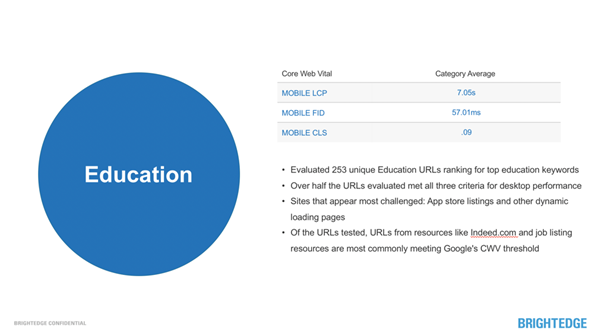
Education

  • More than 50 percent of pages met all three CWVs criteria on desktop
  • Job listings sites like Indeed.com most often met the CWV thresholds

education sector stats on core web vitals and mobile-first

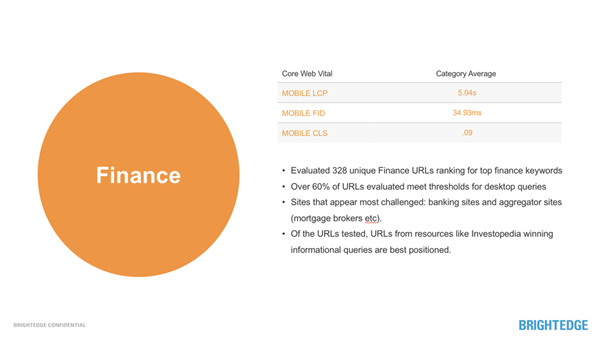
Finance

  • More than 60 percent of pages met all three CWVs criteria on desktop
  • Banking and brokerage sites struggled while informational resources such as Investopedia excelled

finance sector stats on core web vitals and mobile-first

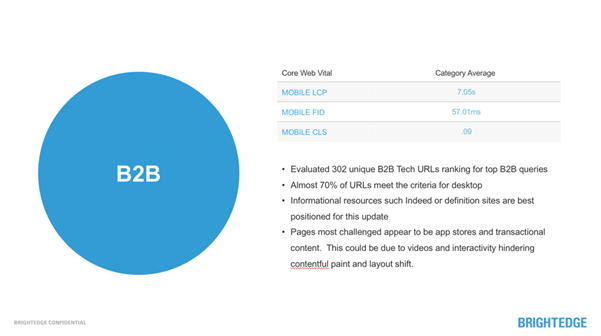
B2B

  • Close to 70 percent of pages met all three CWVs criteria on desktop
  • Informational and definition-type pages performed best, while transactional content struggled

B2B sector stats on core web vitals and mobile-first

Retail

  • More than 50 percent of pages met all three CWVs criteria on desktop
  • Again, informational resources such as Tech Radar and Consumer Reports performed best

retail sector stats on core web vitals and mobile-first

It is worth mentioning that in retail, multiple product listings from the same domains dominated share of voice, resulting in a higher proportion of retail URLs being tested. We did not see a single example of major online retailers (Amazon, Target, and the others) winning a share of voice with their homepages – rather, their organic traffic is being fueled by product and category pages.

We hypothesize that page attributes such as hero images of products and promotional pop-ups are driving non-compliance for the largest contentful paint and layout shift.

Key Takeaways

Core Web Vitals signals and the larger Page Experience set of metrics are sure to be impactful, but they are among many signals that indicate to Google that your webpage offers a safe, positive, and useful experience for the searcher. This is the heart and soul of every update Google makes and should therefore be the driving force in your SEO strategy.

Keep these findings in mind as you prepare for the Page Experience update and implementation of Core Web Vitals as Google ranking signals:

  • Mobile experience is impactful and critical to optimize for across all industries.
  • Image compression and optimization is proving challenging for many brands, which presents an opportunity for those able to get this right.
  • More informational pages meet Core Web Vitals metrics than transactional.
  • Retail brands stand to experience major volatility in search results , particularly if second-tier retailers are able to capitalize on Page Experience and receive a rankings boost.

Enterprise digital marketers and SEOs must work now on the right course of action to meet core vital benchmarks, so they are not left behind. How you communicate the potential impact of this upcoming shift to decision-makers to win buy-in is key.

The post Mobile-first and Core Web Vitals: connecting the dots for page experience success appeared first on Search Engine Watch.

https://www.searchenginewatch.com/2021/04/02/mobile-first-and-core-web-vitals-connecting-the-dots-for-page-experience-success/


Cross-channel marketing: why you shouldn’t put all your eggs in the Google basket

30-second summary:

  • Very few SMBs use multiple channels for their online advertising
  • Facebook is the most effective channel based on the cost for CPM and CPC
  • It’s important to remember that every business is unique when it comes to deciding on budget allocation

For any business in the software as a service (SaaS) space, data analysis and science are crucial to ensure they keep pushing ahead to reveal those insights that can really make a difference. With this in mind, the Cambridge MBA team looked to leverage Adzooma’s extensive data to identify new ways for SMBs to maximize their ad spend with cross-channel marketing.

For the team at Cambridge University, this was an exciting opportunity to produce some truly unique insights, given that even the big players such as Google and Microsoft only have data that pertains to their individual channels.  The project promised to provide a much broader view and deliver some new insights thanks to the access to anonymized data from thousands of accounts across the three big platforms via Adzooma.

A cross-channel approach

The findings immediately identified that very few SMB customers use multiple channels (Facebook, Google, and Microsoft).

Although this wasn’t part of the main project, it was a really interesting piece of analysis and it’s something we’ve stressed the importance of a lot. Most people just stick to Google, for example, as that’s where they think they should be but that’s not always the best case for everyone’s business, and being seen across multiple touchpoints – or at least trying out multiple channels – can be crucial to digital marketing success.

Our analysis found Facebook to be the most conducive channel for SMBs based on cost (CPM, CPC) as well as return (impressions, clicks), however, it was Microsoft that came out on top for reaching a more professional and affluent audience.

The research highlighted the importance of pre-determining your specific target audience. Hence, when it comes to choosing the channel – or channels – for your business it’s really worth thinking about what you are trying to achieve with your ad spend and who you’re truly trying to reach.

What are you really trying to achieve?

Right at the offset, it’s important to think about your end goal and ask yourself who are the customers you are looking to target and what is the most efficient way to get to them.

Existing research told us that for SMBs acquiring new customers was the most chased goal on the customer journey followed by ‘generating awareness’, ‘generating leads’, and ‘retaining customers’.

Taking this into account, the Cambridge team found that merging the traditional sales funnel with the customer lifecycle model would be the best way for an SMB to manage its overall marketing goals.

Overlapping resolution methodology then allowed the team to determine the impact of cost on different marketing channels. This way, SMBs would be able to effectively determine which platform is best to use when similarities occur.

We found through the research that it was the choice of the channel itself that had the most significant impact on both CPM and CPC. Having determined a connection between channel and cost KPIs, further research was conducted to find out the average CPM and CPC across Google, Facebook, and Microsoft Ads.

While it was Facebook that was the most cost-effective channel on average for SMBs overall, the recommendations were that businesses should still look at the click-through rates of other channels to determine whether other factors such as industry or geography could make a significant difference.

If you’re choosing between Google and Microsoft, the results suggest using Google due to its high reach and low cost, however, Microsoft could also be useful, particularly as it offers high-level targeting and demographics that can be suitable for specific business types.

What is your ad saying?

Another factor that perhaps many businesses don’t consider when deciding on a platform is the sentiment of their messaging.

When analyzing the data this was another area where the research team saw differentiation depending on the channel where the advert appeared.

cross-channel marketing and advertising CTR stats

Microsoft proved to be the most popular platform when it came to a positive sentiment with a CTR of 4.2 percent, compared to 3.6 percent for neutral and 3.3 percent for negative sentiment.

Interestingly, the opposite was true for Google ads where negative sentiment proved most popular with users, gaining a CTR rate of 6.5 percent compared to 5.7 percent for neutral and negative messaging.

Again, it highlights how important it is to take that time to tweak your ads for testing purposes and learn what works best for your target customers so you can capitalize on your spends.

Every business is unique

It’s no secret that the one size fits all approach doesn’t necessarily work. All businesses are different and therefore their ad spend and utilization will of course differ.

Some people, as we all do, want to go with the stats and what has proven to have worked historically for businesses, and whilst that can be taken into account, that’s not to stay that it will work for every business. Therefore, it’s always important to remember to take the time to consider where you are spending and who you are trying to reach.

Plus, it is worth remembering that although Google, Facebook, and Microsoft Ads are the most popular online advertising platforms, there are alternative (and less expensive) places to list your ads including Reddit, Amazon, and industry-specific sites such as Capterra. Despite having fewer users, these are still effective as it’s often easier to reach your exact target audience and could work as an addition to your primary platform.

Looking ahead

We hope that through this research we’ve provoked SMBs to think carefully about their target audience and specific objectives prior to ad spend allocation.  What we’ve showcased here is that the advertising platforms explored within this study work effectively in their own right depending on the end goal and we hope these insights will enable SMBs to achieve greater overall results.

These learnings help determine how cross-channel partnerships can be best leveraged for SMB customers. As Facebook seems to be the most used channel by 70 percent of SMBs, and data analysis suggests it is optimal in terms of cost and return, the data will be used to scale Facebook features and opportunities. A lot of the learnings we unearthed from this study will also go directly into the core technology of the Adzooma product.

Rob Wass is Co-founder and CEO of Adzooma.

Akanshaa Khare is currently pursuing an MBA at Cambridge University and has five years of Product Management experience and three years of Consulting experience, helping consulting firms such as BCG and ZS Associates.

https://www.searchenginewatch.com/2021/03/26/cross-channel-marketing-why-you-shouldnt-put-all-your-eggs-in-the-google-basket/


What five news-SEO experts make of Google’s new, “Full Coverage” feature in mobile search results

30-second summary:

  • Google recently rolled out the “Full Coverage” feature for mobile SERPs
  • Will this impact SEO traffic for news sites, SEO best practices, and content strategies?
  • Here’s what in-house SEOs from The LA Times, New York Times, Conde Nast, and prominent agency-side SEOs foresee

Google’s “Full Coverage” update rolled out earlier this month – but what does it really mean for news-SEOs? In-house SEOs from The LA Times, New York Times, Conde Nast, and prominent agency-side SEOs weigh in.

As a news-SEO person myself, I was eager to get my peers’ opinions on: 

  • If this feature will result in greater SEO traffic for news sites?
  • If editorial SEO best practices and content strategies will evolve because of it?
  • If it will result in closer working relationships between SEO and editorial teams?
  • Or, will everything remain “business as usual”?

ICYMI: Google’s new, “Full Coverage” feature in mobile search

Google added the “full coverage”  feature to its mobile search functionality earlier this month – with the aim of making it easier for users to explore content related to developing news stories from a diverse set of publishers, perspectives, and media slants.  

Just below the “Top Stories” carousel, users will now begin seeing the option to tap into “Full Coverage”/“More news on…” for developing news stories. The news stories on this page will be organized in a variety of sub-news topics (versus one running list of stories like we’re used to seeing), such as:

  • Top news
  • Local news
  • Beyond the headlines, and more

Take a look at  in-action, here:

Google's "Full Coverage" feature

Source: Google

While the concept of Google “Full Coverage” was developed back in 2018,  it pertained strictly to the Google News site and app. The technology, temporal co-locality, works by mapping the relationships between entities – and understanding the people, places, and things in a story right as it evolves. And then, organizes it around storylines all in real-time to provide “full coverage” on the topic searched for.

The launch of Google’s new “Full Coverage” feature in mobile search, specifically, is exciting because it takes its technology a step further; able to detect long-running news stories that span many days, like the Super Bowl, to many weeks or months like the pandemic to serve to users.  The feature is currently available to English speakers in the U.S. and will be rolled out to additional languages and locations over the next few months. 

What five news-SEO experts think about “Full Coverage” in mobile search

Lily Ray, Senior Director, SEO & Head of Organic Research at Path Interactive on Google's "Full Coverage" feature
Source: Linkedin

1. Lily Ray, Senior Director, SEO & Head of Organic Research at Path Interactive

Lily Ray is a Senior SEO Director at Path Interactive in New York. She’s a prominent voice within the SEO community (with +15K followers on Twitter), and has been nominated for multiple search marketing awards throughout her career. She is well known for her E-A-T expertise.  Here’s what she had to say:


“Full Coverage appears to be another new tool in Google’s arsenal for displaying a diversity of perspectives and viewpoints on recent news and events. It’s a good thing for publisher sites because it represents another opportunity to have news content surfaced organically. It may also serve as a way for niche or local publishers to gain more visibility in organic search, since Google is specifically aiming to show a broader range of viewpoints that may not always come across with the major publications.

Hopefully, Google will allow us to be able to monitor the performance of Full Coverage via either Search Console or Google Analytics, so we can segment out how our articles do in this area compared to in other areas of search.”

Louisa Frahm, SEO Editor at The LA Times on Google's "Full Coverage" feature
Source: LinkedIn

2. Louisa Frahm, SEO Editor at The LA Times

Louisa Frahm currently serves as the SEO Editor at the Los Angeles Times and is also pursuing a master’s degree in communication management at the University of Southern California. Prior to the LA Times, Frahm was an SEO strategist at other high-profile digital publications including Entertainment Weekly, People Magazine, TMZ, Yahoo!, and E! Online. Here’s her take:

“I’ve always liked that element of Google News. It taps into readers (like me!) who are consistently hungry for more information. 

Working in the journalism field, I’m always in favor of readers utilizing a diverse array of news sources. I’m glad that this new update will tap into that. I’m interested to see which stories will fall into the “develop over a period of time” criteria. I could see it working well for extended themes like COVID-19, but big breakout themes like Harry and Meghan could also potentially fit that bill. 

A wide variety of story topics have resulted from that Oprah interview, and fresh angles keep flowing in! As we’re in the thick of 2021 awards season, I could also see the Golden Globes, Grammys, and Oscars playing into this with their respective news cycles before, during, and after the events. 

The long-term aspect of this update inspires me to request more updates from writers on recurring themes, so we can connect with the types of topics this particular feature likes. Though pure breaking news stories with short traffic life cycles will always be important for news SEO, this feature reinforces the additional importance of more evergreen long-term content within a publisher’s content strategy. 

I could see this update providing a traffic boost, since it provides one more way for stories to get in front of readers. We always want as many eyeballs as possible on our content. Happy to add one more element to my news SEO tool kit. Google always keeps us on our toes!”

Barry Adams, Founder of Polemic Digital on Google's "Full Coverage" feature
Source: Linkedin

3. Barry Adams, Founder of Polemic Digital

Barry Adams is the founder of SEO consultancy, Polemic Digital. He has earned numerous search marketing awards throughout his career and has also spoken at several industry conferences. His company has helped news and publishing companies such as – The Guardian, The Sun, FOX News, and Tech Radar to name a few. This is his opinion:

“The introduction of Full Coverage directly into search results will theoretically mean there’s one less click for users to make when trying to find the full breadth of reporting on a news topic. 

Whether this actually results in significantly more traffic for publishers is doubtful. The users who are interested in reading a broad range of sources on a news story will already have adopted such click behaviour via the news tab or directly through Google News. 

This removal of one layer of friction between the SERP and a larger number of news stories seems more intended as a way for Google to emphasize its commitment to showing news from all kinds of publishers – the fact remains that the initial Top Stories box is where the vast majority of clicks happen. This Full Coverage option won’t change that.”

John Shehata, Global VP of Audience Development Strategy at Conde Nast on Google's "Full Coverage" feature
Source: Linkedin

4. John Shehata, Global VP of Audience Development Strategy at Conde Nast, Founder of NewzDash News SEO

John Shehata is the Global VP of Audience Development Strategy at Conde Nast, the media company known for brands such as – Architectural Digest, Allure, Vanity Fair, and Vogue. He’s also the founder of NewzDash News SEO – a News & Editorial SEO tool that helps publishers and news sites boost their visibility and traffic in Google Search. This is his opinion:

“Google has been surfacing more news stories on their SERPs over the past few years, first Top Stories were two-three links then it became a 10-link carousel. Google then started grouping related stories together expanding Top Stories carousel from one to three featuring up 30 news stories. They also introduced local news carousels for some local queries, [and now, this new feature]. It is obvious that Google keeps testing with different formats when it comes to news. One of our top news trends and prediction for 2021 is Google will continue to introduce multiple and different formats in the SERPs beyond Top Stories article formats.

As of the impact on traffic back to publishers, it is a bit early to predict but I do not expect much boost in traffic. Do not get more wrong, this feature provides more chances for more publishers to be seen, the question is how many search users will click. And if users click, Google surfaces over 50 news links plus tweets which makes it even more competitive for publishers to get clicks back to their stories.

I did some quick analysis back in July of last year When Google Search Console started providing News tab data. I found that News Impressions are less than five percent of total web impressions. Not quite sure how is the new “Full Coverage” feature CTR will be and how many users will click! The “full coverage” link placement is better than the tabs, so we might see higher CTR.”

Claudio Cabrera, Deputy Audience Director, News SEO at The New York Times on Google's "Full Coverage" feature
Source: LinkedIn

5. Claudio Cabrera, Deputy Audience Director, News SEO at The New York Times

Claudio Cabrera serves as the Deputy Audience Director of News SEO at the New York Times. He is an award-winning audience development expert, journalist, and educator. Prior to working at The New York Times, he was Director of Social and Search strategy at CBS Local. Here are his thoughts:

“It can be looked at in so many ways. Some brands will look at it as an opportunity to gain more visibility while some will feel their strong foothold may be lost. I think it just encourages better journalism and even better SEO because it forces us to think outside of our playbooks and adjust on some level to what we’re seeing Google provide users. 

From a site traffic perspective, I can’t really comment on whether this has affected us or not but I do know there are so many other areas where sites have done serious research and testing into like Discover where audiences can grow and be picked up if you do see a drop-off. I don’t think the best practices of SEO change too much but I think the relationship between search experts and editors deepens and becomes even closer due to the changes in the algo.”

Conclusion

Google’s new “Full Coverage” feature in mobile search rolled out earlier this month and is an extension of the full coverage function developed for Google News back in 2018. The aim of this new feature is to help users gain a holistic understanding of complex news stories as they develop – by organizing editorial content in such a way that it goes beyond the top headlines and media outlets. In essence, giving users the “full coverage” of the event. 

News-SEO experts seem to be in agreement that this new feature will make it simpler for users to explore – and gain a holistic understanding of – trending news stories. As far as what this new feature means for SEO traffic and strategy, experts can only speculate until more developing news stories emerge and we can analyze impact. 

Elizabeth Lefelstein is an SEO consultant based in Los Angeles, California. She’s worked with a variety of high-profile brands throughout her career and is passionate about technical SEO, editorial SEO, and blogging. She can be found on LinkedIn and Twitter @lefelstein.

The post What five news-SEO experts make of Google’s new, “Full Coverage” feature in mobile search results appeared first on Search Engine Watch.

https://www.searchenginewatch.com/2021/03/24/news-seo-experts-make-of-googles-new-full-coverage-feature-in-mobile-search-results/


Four ways to use your website data to discover missed sales opportunities

30-second summary:

  • Analyzing and understanding website data helps enhance potential sales and conversions
  • Google Analytics records the exit rate of specific website pages, helping you pinpoint exactly where users abandon your sales filter
  • Google Tag Manager can help identify if users are leaving forms uncompleted, leaving you tantalizingly close to conversion without sticking the landing
  • Recording and analyzing common user search terms on a website will reveal if consumers are seeking services they are willing to pay for but you do not provide
  • Search analysis tools will shine a light on any underutilized and under-monetized website pages, helping you make the most of your PPC budget

In the age of online marketing and data intelligence, every click matters. Traffic is a great metric for the potential success of your business, after all. Alas, traffic means little without conversions. A brick-and-mortar store that sees plenty of footfall but fails to make sufficient sales will be considered a failed business model. The online world is no different. Without conversions, a website is just an expensive – and ultimately unsuccessful – advertising campaign.

A conversion is the completion of any pre-determined action on a website. This could be downloading free content in exchange for joining a mailing list or interacting with the site through social media or a contact form. The gold standard of conversions will always be sales, though. If your product or service is not turning a profit, something needs to change.

By studying and understanding website data, you can pinpoint missed opportunities for sales on your site. Utilizing tools and software, you’ll understand what visitors are looking for and why they bounce without converting.

Data to review

Here are four core KPIs that should be studied to understand why visitors leave your site without making a conversion. By mastering and understanding this data, you can make any necessary adjustments to your website and marketing strategy – potentially reaping financial rewards.

1. Google Analytics exit pages

The exit page of a website, which is tracked on Google Analytics, is the last interaction a user has with your website before terminating a session. Google Analytics records exit pages as a percentage, referring to this as an exit rate.

In an ideal world, the most popular exit page on any website will be the thank you page after completing a conversion. At this stage, the user has concluded their business to the satisfaction of all parties.

If you notice a high exit rate on a different page, it merits investigation. Something about this page is deterring visitors from converting. Ergo, this exit page is potentially responsible for missed sales.

Be aware that an exit rate is not the same as a bounce rate. Bounce rate relates to users that leave a site without any interaction. Exit pages are recorded when users begin the journey toward conversion but fail to complete the process.

By understanding which pages on your website have the highest exit rate, you can improve your sales. Take a look at this page and consider why users are not completing a conversion. Potential explanations include:

  • An unclear or weak call to action
  • A lengthy sales funnel with too many steps
  • Insufficient information about your product or service, failing to convince the user to convert – or too much data, confusing a user and causing them to lose interest
  • Lack of preferred payment options (that is, ewallets – not everybody likes to use their credit card online)

Tweak this exit page to improve user experience and convince users to conclude a conversion. This is easier if one page of your website, in particular, has a high exit rate. If exit pages are equally spread throughout your site, it may be worth considering a complete overhaul and refresh of the content.

2. Google Tag Manager

The internet has brought a lot of good to the world, but enhancing patience is not among these benefits. With so much competition out there, users are unlikely to tolerate any kind of interface issues when attempting to complete a conversion. You can use Google Tag Manager to identify these issues.

Form completion is arguably the best use of GTM. If you study the analytics of a form and find that it is frequently being abandoned before completion, something is amiss. You had the user on the end of your hook – they would not have started to fill in the form otherwise. Unfortunately, something made them change their mind and you missed out on a sale.

Use the GTM debugging mode to ensure that a technical hitch was not to blame. If this is the case, it’s time to look inward. Some of the common reasons for users to abandon forms before completion include:

  • The form is just too long and cumbersome! Slow and steady may win a race, but it bores the life out of online consumers
  • Unnecessary questions. If you’re not selling age-restricted products or services, don’t ask for a user’s date of birth. Unless it’s relevant to the product, do not ask for clarification of gender or race
  • Pop-up advertising. Unfortunately, you may be standing trial for the sins of other sites here – previous experiences elsewhere may tarnish a user’s view of all online forms
  • Lack of assurance about the safety and security of any data that will be provided. Make it clear that you are not in the business is selling personal information to other businesses
  • Lack of mobile device compatibility. Over half of all web traffic now comes from smartphones and tablets. Ensure your form is not fiddly and persnickety to complete on such a device

Using Google Tag Manager to understand your website data and fix missed conversion opportunities

Source: Google Tag Manager

Using GTM to gain insights into why forms remain uncompleted can be an easy fix, and potentially turn half-completed questionnaires into successful conversions. Don’t miss out on a possible sale for something as prosaic as a needlessly complicated sign-up process.

3. Search records

As we touched upon previously, consumers want to feel understood by a business. The modern visitor to a website will ideally not wish to search to find what they’re looking for. Visitors want to find everything they need before their eyes and to see that your product or service will resolve a particular pain point.

If users are making use of the search function, configure the site to record search terms. This provides the perfect opportunity to study what your potential customers are seeking – and presumably not finding – on your site. If they located what they were looking for, they would likely have completed a conversion.

Understanding what users are searching for means that you can improve and enhance your offering to apply these missing services. Alternatively, it may just reveal that your copy needs a little updating. Check whether users are using terminology that does not match up with keywords used on your site. This is an easy fix with a content refresh and reduces the frustration of being so near but yet so far from a conversion.

This will also have a welcome side-effect of potentially bolstering your SERP standing. Google is moving toward a model of enhanced search equity, which makes your use of copy all the more important. It will be very welcome for a website’s page ranking – and conversion potential – to stand or fall on quality and relevance of content, as opposed to restrictive technical obstacles.

4. Traffic value

To paraphrase George Orwell, “all website traffic is equal, but some traffic is more equal than others.” Some pages on your website will inevitably demonstrate greater potential for sales and conversions. Investing in a search analysis tool can aid you in identifying these pages so you can focus your financial outlay on them. Google Trends can also be an invaluable ally here.

Your website will likely utilize at least one cost-per-conversion model, such as Google Ads. You may be using several, with Facebook Ads (which includes Instagram Ads) and even Microsoft Advertising providing plentiful leads to conversions. While PPC business models are constantly evolving, some tactics are evergreen.

Perhaps the most critical of these is identifying which pages on your site have potential that is not being maximized. By undertaking SEO analysis, you will gain a greater understanding of what users are looking for online. In learning this, you may realize that you are placing too much of a marketing budget on one page when judicious use of keywords on another may yield greater results.

For example, it’s always tempting to place all of your financial muscle on a completion page. We have discussed already how users are looking for a brief and practical conversion funnel. Do not overlook the potential to educate and entertain before pushing for conversion, though. If you embrace – and more importantly, perfect – content marketing, you will convince users to click through to a conversion page after learning more about your offering. This enhances your traffic stats, potentially building brand loyalty in the process.

What next?

Now that you are aware of these metrics, use them to calculate your conversions. That’s easily done – just divide the number of conversions by the number of visitors, then multiply the total by 100. How does that number look to you?

If you feel that your conversion rate is lacking in any of these metrics, there are steps that you can take to improve it. These include:

  • Simplifying any forms and streamlining your sales filter
  • Improve and simplify the copy on pages with a high exit rate
  • Considering adding a pop-up with a renewed CTA – or even the promise of a discount or freebie – when a user tries to close a common exit page
  • Review your search records and ensure your offering matches consumer needs and expectations
  • Keep up to date with search trends and ensure you are monetizing the right pages on your website

Follow these steps and you’ll potentially see your conversions soar. Few things are more frustrating than missing out on a sale that came enticingly close. These minor improvements will not take much work but could make a real difference to your bottom line.

FAQ

What is a website conversion?

Any website will contain a range of actions for visitors to complete. This could be signing up for a newsletter mailing list, sharing a post on personal social media channels, making a query through a contact form, or ideally making a purchase. If a visitor to your website completes this action, it is considered a conversion. The number of people that do so compared to your traffic quantity is referred to as a conversion rate.

What is a good conversion rate for a website?

This depends on a range of factors, including your industry and your anticipated return on investment. A website that operates on a cost-per-conversion model, such as Google Ads, needs a higher conversion rate to turn a substantial profit. The average conversion rate on this platform is circa three percent. What matters most is that you are seeing a return on your investment – and that your conversion rate continues to grow, not shrink.

How to increase the conversion rate on a website?

The most effective way to increase a conversion rate is to make the process as fast and simple as possible for consumers. Create a superior user experience by making it obvious what a visitor needs to do to convert, and by removing any unnecessary steps from the resulting filter. Every additional action you ask of a user gives them another opportunity to lose patience and walk away.

How to calculate a website conversion rate?

There is a simple formula for calculating the conversion rate of your website. Track your conversions over a set period, divide this by the number of visits to the website in this time, then multiple the total by 100. For example, a website that enjoys 700 conversions from 12,500 visitors over 30 days has a monthly conversion rate of 5.6%.

How to set up conversion rate tracking on your website?

Any website must track conversions to ensure optimum efficiency and return on investment. Major platforms like Facebook Ads and Google Ads have in-built tracking facilities. Learn how to utilize these tools and turn the data to your advantage.

Joe Dawson is Director of strategic growth agency Creative.onl, based in the UK.

https://www.searchenginewatch.com/2021/03/22/four-ways-to-use-your-website-data-to-discover-missed-sales-opportunities/


Get more subscribers with these seven podcast SEO tips

30-second summary:

  • Did you know that, as of 2020, upwards of 68 million people listen to a weekly podcast?
  •  Your podcast can easily reach more subscribers if you take some time to do some off-page SEO tactics and a few other best practices along the way
  • Check out these seven podcast SEO tips to help you get in front of more people and get more subscribers

If you have a podcast for your business, something you’ve probably thought about is how to get more subscribers to tune in to future episodes. 

After all, unlike with traditional blogging where you have a dedicated space for your content, your listeners are accessing your podcast episodes through a third-party streaming service or podcast directory. And these services often carry hundreds of thousands of other podcasts in their network. 

So how can you get your podcast discovered by more of the right leads and future customers?

The answer is simple: podcast SEO. Blog posts aren’t the only thing that stands to benefit from search engine optimization techniques. Your podcast can easily reach more subscribers if you take some time to do some off-page SEO tactics and a few other best practices along the way.

Wondering how to get started and get that podcast out there? Check out these seven podcast SEO tips to help you get in front of more people and get more subscribers.

Seven ways to get more podcast subscribers using SEO

1. Have a clear persona for your podcast

Did you know that, as of 2020, upwards of 68 million people listen to a weekly podcast? Given the year-on-year growth of podcasts, you’re bound to have a dedicated audience in that huge market.

But the growing number of podcast listeners is also a sign of the growing number of podcasts available online. In order to stand out, you’ll have to speak to a specific set of podcast listeners instead of trying to reach just anyone.

This is where having an audience persona is helpful. The persona not only tells you what kind of podcast content your ideal subscribers want to see — but it also shows you their lifestyle, beliefs, and goals.

podcast seo - audience persona

Source: Optinmonster

Your audience persona doesn’t have to be complex.

When you have a clear picture of what these things are, you can then optimize not only your podcast as a whole but each episode according to search terms your subscribers might be looking for.

If your podcast listeners are interested in sales, for instance, then use keywords that reflect actual searches they may make. Example episode titles that practice proper podcast SEO for this niche include, “How to train your sales team” or “How to master video sales calls”.

2. Choose the right platform

In technical SEO, uptime and loading speeds are important ranking factors. If your website loads slowly too, your page is less likely to rank higher on search.

The same applies to your podcast. Podcast ranking may be influenced by how quickly your platform loads. The less optimally it performs, the less likely people are going to subscribe.

Many podcasters choose to host their podcast episodes on their own website then create dedicated episode pages to increase their chances of getting in front of their ideal subscribers using typical on-page SEO. When going this route, you need to make sure your platform is up to speed.

Educate yourself on different podcast hosting platforms that prioritize site performance for podcast hosting. Not every web host may be well-optimized for podcasts and cause your site to perform slower or have issues with loading audio files. Fortunately, as the podcasting industry grows, more and more web hosts are making a point to add seamless support for podcast episodes and files.

3. Interview industry leaders

One great way to get in front of your audience and get more podcast subscribers is by inviting well-known thought leaders and influencers in your niche onto your show. 

Their supporters and followers are more likely to listen to your podcast if they know that somebody they trust is sharing valuable information on your platform. Having those important guests just gets your ideal subscriber’s foot in the door — they may discover your podcast for the first time and decide to subscribe for more related content.

If you’re a relatively small podcast, build your way up the ladder before reaching out to huge leaders in your industry. Don’t be afraid to reach for low-hanging fruit and asking industry experts with a slightly smaller following on to your podcast. 

Use this as an opportunity to showcase your interviewing skills and grow your existing listenership before getting in front of bigger names in your niche.

4. Incorporate your podcast into your blog posts

We mentioned briefly that some podcasters choose to host their episodes as dedicated pages on a website. Why not really level up your podcast SEO by attaching podcast episodes into SEO-friendly blog posts?

While Google has been making the effort to include multimedia results on search — including, yes, even podcasts and YouTube videos — the reality is that most of the search query results still pull up blog posts and pages the majority of the time. 

Stay ahead of the competition by combining your blog and podcast efforts. There are a couple of options to go about this. First, you can create a blog post around a podcast episode. So after recording your episode, repurpose it into a high-value blog post that you can then optimize with the best SEO practices.

Another way to do this is doing an audit of your existing blog posts and inserting podcast episodes into them. This allows you to make the most of your blogs’ on-page SEO and get your podcast in front of more visitors and potential subscribers.

Check out this example on the FreshBooks blog that inserts a podcast episode inside a blog post. They went with the first route, where they created a dedicated blog post around the main topics that emerged in this specific podcast episode.

To encourage people to actually listen to the episode, you can tease the content in the form of questions or simply highlight what to expect. Mention key phrases and SEO-friendly search terms to make the most of on-page SEO.

5. Submit your podcast to reputable directories

Another way to get more podcast subscribers? Getting yourself listed in the top podcast directories online. Getting on these podcast directories is often straightforward enough, especially if your podcast is already up and running on one platform.

You can choose to submit your podcast to directories like Apple Podcasts or Spotify one at a time, while another option is using services like Anchor.fm to submit your podcast to multiple directories all at once.

podcast seo and stats on podcasts

Source: Statista

A comparison of the top podcast directories and apps among US listeners between 2019 to 2020, according to Statista.

These top directories are most likely where listeners themselves go to search for new podcasts, so you stand the chance to get more subscribers using this method. With dozens of available options, choose the top-performing apps and services first then slowly trickle your way down the rest of the market.

Also, be aware of any new players that might emerge in the podcast app industry to be at the forefront of their growth. Or if there are niche podcast directories that your specific audience might be on, that can be a fantastic way to reach the right audience without the steep competition.

6. Incorporate this as part of your customer support

If your business has a podcast that creates short, high-value episodes that walk people through your product or service or answer their commonly asked questions, why not incorporate said episodes into your customer support knowledge base?

Users might have frequently asked questions about your product or app, for example. In your FAQs pages and knowledge bases, embed your episodes in relevant pages that will help answer your customers’ queries. 

This can also be a way to humanize and personalize your email ticketing system. Because many email ticket support software allow your team to upload files to send to customers, why not send these helpful podcast episodes in response to their questions or concerns. 

Of course, make sure that the links you send to your customers through support channels are always relevant to their concerns.

7. Cut it up into micro-content

To really drum up your podcast SEO, repurpose your episodes and turn them into micro-content you can share across other platforms. 

For example, choose a segment with a big takeaway or story in under one minute that you can then post on your Instagram feed. Or cut an engaging exchange between guests then post the excerpt on Facebook or YouTube.

The beauty of this tactic is that you can create multiple pieces of micro content from just a single podcast episode, so you’ll be able to make endless content for social media. 

Use soundbites as excerpts, create graphics based on quotes from the episode, turn your main topics into viral-worthy infographics — either way, it’s a great way to not only create content for other platforms but to especially grab attention and bring awareness to your podcast.

The podcast Happier in Hollywood creates micro-content by taking excerpts from their recorded episodes and turning them into videos with subtitles for Instagram.

micro-content for podcast seo

Source: Happier in Hollywood

Key takeaways

Getting more podcast subscribers can seem like an uphill climb, but remember that your content creation efforts have to be punctuated by a solid promotion strategy too. Podcast SEO makes sure that your podcast is seen by the people who’d love to follow your podcast the most. Aside from basic podcast SEO, use the tips in this blog post to help you boost those search results and get your podcast heard.

Kevin Payne is a content marketing consultant that helps software companies build marketing funnels and implement content marketing campaigns to increase their inbound leads.

https://www.searchenginewatch.com/2021/03/18/get-more-subscribers-with-these-seven-podcast-seo-tips/


Research: The integration of SEO and PR

30-second summary:

  • Experts have told us for a few years that SEO and public relations (PR) need to merge
  • Are SEO and PR really integrating “in the wild”?
  • In case you too searched the web about how this and found nothing considerably valuable, here are some answers for you
  • Founder and CEO of Organic Growth, Kevin Carney surveyed 184 SEO and PR professionals across brands, agencies, and consultants
  • Dive in to discover more on the state of SEO and PR integrations in the industry

We’ve been hearing for a few years now that SEO and public relations (PR) need to merge. The primary reason given is that they have similar goals, as well as similar strategies and tactics. It is sometimes argued that some aspects of SEO are PR, in an age when publishing has become comparatively low-cost. So much so that anyone can become a publisher, and due to the advent of content marketing, brands now have to.

I searched the web for information about how this integration is going, or not. I found nothing I considered to be of value on this topic. So I decided to create this article after collecting information from SEO and PR professionals to get a clear picture of our industry.

Methodology

I created a survey, then used Help a Reporter Out (HARO) to reach out to SEO and PR professionals. This resulted in 78 survey responses. I waited a month, went back to HARO, and got 91 more. I then shared my survey in a few SEO and PR groups on Facebook, which resulted in 15 more. I got 184 survey responses in total.

When I started I had arbitrarily decided I wanted 200 survey responses but decided to stop at 184 rather than do another round of HARO or Facebook group outreach.

Of course, all surveys have some level of bias

In this instance, the bias occurs for the following reasons:

  • I designed my survey with my preconceived notions of what questions mattered most
  • I looked for people in nooks and crannies of the internet where I felt it would be easy to find willing participants
  • People who took my survey self selected

Does this mean my data is flawed? No more than any other set of data collected via most surveys, but it is possible that had I surveyed only SEO folks, or only PR folks, that I would have gotten different data, and I just want that stated upfront. I believe my data is relevant, but by no means is it the final word on this topic.

So, is this integration of SEO and PR happening?

In a word, yes.

So now let’s look at the charts whose underlying data lead me to believe this is true.

Initial questions were very objective

This first set of charts show the answers that were pretty cut and dry, and not so much a matter of opinion.

The breakdown of survey participants

Survey participants categorized themselves as representing brands, representing agencies, or being consultants who represented various clients. Below is the breakdown.

As you can see, it’s a pretty good split with agencies slightly outnumbering brands.

SEO and PR integration survey participant categories

Do agencies publish articles about SEO and PR or SEO vs PR?

I was personally curious what percentage of agencies feel the topic of PR and SEO or PR vs SEO is important enough to publish articles about. It was surprisingly few.

Content publication stats on SEO and PR or SEO vs PR

What percentage of participants have one integrated team?

A lot more than I expected: 71 percent to be precise.

SEO and PR are not one integrated team

Do firms without one integrated team have both SEO and PR?

To my surprise, the answer tends to be, “no”. Team sizes within this group tended to be smaller, which likely accounts for this.

Within this group, 35 out of 52 companies had teams of three members or fewer, which means only 17 companies had teams of four members or larger. Only four companies had teams of more than 20 people.

SEO PR integration team data

For firms with two teams, how closely do they work together?

While this includes only 16 firms, I do not see a strong pattern here. Perhaps this is due to the small data sample, or perhaps the question is too subjective for everyone to have a common understanding of how close “closely” is.

Stats on team integration

The following statements were completely subjective

I asked the survey participants to rate how much they agreed or disagreed with a series of statements about PR and SEO. Every statement was rated on a ten-point scale where 10 means strong agreement and one means strong disagreement.

Can SEO be separated from PR?

As you can see, the bulk of participants feel they can not.

They can not be separated

What is the primary focus?

I was thinking that some firms put PR ahead of SEO and consider that SEO supports their PR efforts, whereas other firms put SEO ahead of PR and consider that PR supports their SEO efforts.

I was expecting these two charts to be mirror images of each other and I am surprised that they don’t.

What surprised me the most is not either chart by itself, but that they do not mirror each other. I had thought the two questions were opposites of each other, which to me at least means the charts should be mirror images of each other.

While there is a pretty strong consensus shown by the “We do SEO” chart, this is not shown by the “We do PR” chart.

Are SEO and PR equally important?

There is strong agreement with this idea.

SEO and PR are equally important

Are PR and SEO separate functions?

There is a consensus leaning to “no”, they’re not.

They are separate functions across the industry

Is link building the PR of SEO?

In the spirit of full disclosure, this is something I believe to be true. Now don’t get me wrong, I believe there are good and bad forms of link building, but I suppose there are also good and bad forms of PR.

That this statement was shared with the participants reflects a bias of mine. Having said that, I consider participant responses to be validating.

Link building is the PR of SEO

In closing

The SEO-PR integration is happening, and so far has happened more than I expected would be true.

My next thought is “What does this all mean?”

Should we change the way we’re doing what we’re doing as a result?

For this, I’m interested in feedback from readers. What do you think?

Kevin Carney is the Founder and CEO of the boutique link building agency Organic Growth.

https://www.searchenginewatch.com/2021/03/12/research-the-integration-of-seo-and-pr/


On-page SEO: a handy checklist to tick off in 2021 and beyond

30-second summary:

  • On-page SEO is the process of optimizing your web pages and content for search engine crawlers
  • It involves a lot of moving parts, so it’s easy to forget some elements or tweak them incorrectly
  • This quick checklist will help you keep all the various on-page SEO elements on track

On-page SEO is basically a set of techniques and best practices for your web pages to make them more search-engine friendly and thus, boost your rankings.

Now, as you know, keywords are at the heart of nearly everything on-page SEO. But on-page optimization involves a lot of elements — not just keywords — so it’s easy to overlook some of them.

To make it easy for you to ensure all your pages are correctly optimized for the best possible rankings, here’s a handy checklist to tick off.

URLs

Review the URLs of all pages on your site to ensure they’re concise rather than long and complex. Shorter URLs tend to have better click-through rates and are more easily understood by search engine crawlers.

Include your page’s primary keyword in the URL, remove filler (aka stop) words like “the”, “for”, and “to”, and keep it under 60 characters.

Images

Your website is likely brimming with images, and that’s a good thing as images contribute significantly to improving both user experience and rankings. They make your content more easy-to-consume, engaging, and memorable, and when optimized correctly, help you drive more traffic to your website.

To optimize your images for on-page SEO, here are a couple of things to ensure:

Image filename and alt text

Google bots can’t “see” images like humans. They need accompanying text to understand what the image is about. So, write a descriptive filename (“blue-running-shoes.jpg” instead of “82596173.jpg”) and alt text (which helps in case the image fails to load for some reason) for every image on your site, including keywords in both.

Alt text also helps make your website more accessible, as screen readers use the alt text to describe images to visually-challenged users. In fact, it’s prudent to test your website’s accessibility to ensure you don’t ever have to cough up big bucks for ADA lawsuit settlements.

Image file size

Page speed is a major ranking signal for both desktop and mobile searches, and bulky images slow down your site’s load speed. So make sure to compress all images to reduce their size — ideally under 70 kb.

Titles and meta descriptions

See to it that you’ve included your main keywords in the front of the title tags of all pages. Ensure the length of your title tags is under 60-65 characters and no longer than 70 characters, otherwise, it may get truncated in the SERPs.

Also, the title should be the only element wrapped in the H1 heading tag. In other words, only one H1 tag per page that’s reserved for the title.

For meta descriptions, just ensure you have written a keyword-rich and inviting meta description that is relevant to your user’s search intent. Keep it under 160 characters for all your pages. If you don’t, Google will pick some relevant text from the page and display it as the meta description in the SERP, which isn’t ideal for SEO.

Page load speed

Speed is a major ranking factor you just can’t afford to overlook. If your pages take anything over two to three seconds to load, your visitors will bounce to a competitor, and achieving first page rankings will remain a dream.

Thus, verify that:

  • Code is optimized with minified CSS and JS
  • There are no unnecessary redirects
  • You have compressed all images
  • You’ve enabled file compression and browser caching
  • Server response time is optimal

Regularly review your site speed using PageSpeed Insights to find out the exact areas that can be improved.

Links – internal and external

Ensure you have a proper linking strategy that you always follow. Both internal and external links play a role in your on-page SEO.

External links

Citing external sources and having outbound links is crucial for building credibility in the eyes of both Google crawlers and human visitors. However, make sure that you’re only linking back to high-quality websites and reliable sources.

Plus, ensure there are no broken (“404 not found”) links, as they hurt SEO and user experience. In case you may have a lot of site pages, it is best advised to create an engaging and easy-to-navigate 404 error page. This will help you retain site visitors and help them find relevant content/actions.

Internal links

Make sure to strategically interlink pages and content on your website. This helps crawlers to better understand and rank your content for the right keywords.

Internal linking also helps to guide visitors to relevant pages and keep them engaged.

Content

All your blog posts and website copy play a pivotal role in on-page optimization. Besides ensuring your target keywords are sprinkled judiciously and naturally throughout your content title, URL, subheadings, and paras. Here are a couple of things to get right.

Structure and readability

Verify the structure of content on all pages. Make sure you’ve used keyword-optimized headings and subheadings – H1, H2, H3, and so on, to build a logical hierarchy, which improves the readability and crawlability of your content.

Comprehensiveness

Studies suggest that longer, in-depth posts perform better than shorter ones when it comes to Google rankings. So, strive to have a word count of 2,000+ words in every piece of content.

Comprehensive, long-form content will also serve your audience better as it likely answers all their questions about the topic so they don’t have to look for more reading resources.

Over to you

With each new update to its core algorithm, Google is fast shifting its focus on rewarding websites with the best user experience.

But nailing your on-page optimization which ties closely with UX will continue to help you achieve top rankings and stay there. And so, keep this checklist handy as you work on your SEO in 2021 and beyond.

Gaurav Belani is a senior SEO and content marketing analyst at Growfusely, a content marketing agency specializing in content and data-driven SEO. He can be found on Twitter @belanigaurav.

https://www.searchenginewatch.com/2021/03/11/on-page-seo-a-handy-checklist-to-tick-off-in-2021-and-beyond/


Is Google moving towards greater search equity?

30-second summary:

  • Search equity allows for your average business owner to compete on the SERP without being impeded by a lack of SEO-knowledge
  • A more equitable SERP is a necessity for Google from a business and overall web-health perspective
  • Google is pushing for equity on the SERP to a far greater extent
  • The democratization of the SERP represents an enormous paradigm shift that brings certain SEO skills to the fore

What would happen if instead of having to jump through hoops to rank your new website, you were given a seat at the SERP straight away? Presumably, that would cause all sorts of havoc for SEO professionals. What if I told you that there’s a strong push at Google to do just that? I call it “search equity”. It’s Google trying to remove optimization barriers so site owners (aka business owners) can focus on creating great content and reap the benefits of it. 

It’s a move that I think Google is pushing hard for and has already taken steps towards. 

What is search equity?

Search equity is the ability for a site to be able to compete at some level of significance on the SERP without being impeded by technical structures. It is the ability for a site to rank its content solely because that content is worthy of being consumed by the searcher. 

As such, search equity would mean that sites with limited resources can compete on the SERP. It means they would not need to have an overly complex understanding of SEO on a technical level and from a content structure perspective (think things like page structure and other technical SEO aspects). 

Search equity gives a business owner the ability to be visible on the SERP and in many ways helps to preserve the overall health of the web.

It’s a spectrum. It’s not even possible to have total search equity. At any given time, there could be more or less of it within the Google ecosystem. It’s not an all-or-nothing equation. It’s not even possible to have total search equity. What matters is that Google is trying to create as much search equity as it reasonably can. 

Why is search equity necessary?

The idea of search equity being highly desirable to your average site is self-evident but it also makes a lot of sense. What do I mean by that? 

Business owners are content experts. They are experts on the subject matter that is related to their business. They are the ones who should be creating content around the topics associated with their business. Not SEOs, not content marketers, and not some content agency. 

There’s a problem with this, however. That problem is the incentive. Content creation is hard and time-consuming so there has to be a reward for the efforts. Also, there needs to be a way to address the various technicalities that go into SEO, but that’s for later. This is where the current model falls into trouble. 

What happens when a business decides to dedicate the time and resources to create content? What happens when they are now faced with things like optimizing their page structure, internally linking, external linking, title-tags, canonical tags, keyword cannibalization, or whatever else floats your SEO boat? 

Do you see the problem?

SEO, as it’s often thought of, discourages the very people you want to be creating content for from creating content. Business owners don’t know anything about tags and links and structure. They know about running their businesses and creating content around that expertise. 

This is a real problem for Google. It means there is a lot of potential content out there that the current incentive structure doesn’t allow for.

If you think the notion that there’s a gap in the content generation is fantastical, it’s not. For starters, Google has often indicated such a gap exists in non-English speaking markets. Further, Google has an entire “Question Hub” to provide answers for when the “content just isn’t there”.

What I think makes this notion a contradiction and hard pill to swallow as there is an overabundance of content and a lack of it at the same time. This is because a vast amount of content being produced simply lacks substance. I’m not even referring to spam and the 25 billion+ pages of it that Google finds each day. The content bloat we experience is due to the overabundance of low to medium quality content. When was the last time you felt there was just so much really quality content on the web? Exactly. 

There is no gap in the quantitative amount of content on the web but there is in its quality. If Google’s main SEO talking point is any indicator, the gap of quality content out there might well be significant. That’s not to say that such content doesn’t exist, but it may not exist in healthy quantities. 

To fully capitalize on the content creation resources it needs to maintain a healthy web, Google needs, and has moved towards, search equity.

But not all of Google’s drive towards search equity is purely altruistic—there’s also a business interest. This isn’t necessarily a bad thing. In fact, in this case, it’s quite healthy. In any event, understanding how search equity aligns with Google’s business interests is an important part of understanding the impending urgency of a more equitable SERP. 

Why Google My Business demands search equity

The prominence of Google My Business and of the local SERP, in general, has risen in recent years. No longer is local SEO relegated to the loser’s table at SEO conferences. Rather, local SEO has come front and center in many ways. 

Part of this is due to the growing importance of having a GMB profile. Local SEO isn’t getting more attention because of some internal shift in SEO, it’s because it’s becoming more important for businesses to have a GMB listing set up. 

With the plethora of options and abilities that GMB offers (think Reserve with Google or Product Carousels) having a listing has become a way for a business to showcase itself.

Look no further than GMB itself advocates setting up a profile as a way to “stand out”.

Here too, Google runs into the very same problem I mentioned earlier: incentives. If Google My Business isn’t just about “managing your listing” but is also about standing out and marketing yourself, then the environment on the SERP has to be equitable.

In other words, what would happen to GMB adoption if business owners felt that in order for them to compete on all fronts they had to jump through all sorts of hoops and/or spend a ton of money hiring an SEO on a continuing basis?

Clearly, Google is trying to grow the relevancy of GMB not just in terms of the number of businesses adopting it but in how involved the platform is in the everyday functioning of the business. This incentivizes the business to create a listing, add images, and create Google Posts. What’s lacking, however, is content. 

When it comes to the content local sites create, they have to play by the rules of every other site. There is no branded query driving users to their product carousel, Google Posts, or online menu. If Google wants businesses to feel they can thrive with GMB that success has to be across the board. This means sites have to have success within the traditional organic results for a slew of keywords (not just branded local searches).  

You can’t have the truly successful adoption of GMB if it doesn’t incorporate the business’ site itself. If a business feels that Google is making it excessively difficult to perform in one area, it will not fully adopt the other area. Meaning, if Google makes it difficult for a business to rank content, that business will not be willing to fully commit to GMB in the way that Google so desires. Businesses have to feel that Google has their backs, that Google is not an impediment before they’ll consider GMB a place to showcase themselves. It’s just common sense.  

If GMB is to continue to thrive and grow in unprecedented ways, then Google needs to make sure businesses feel that the entire Google ecosystem is a place where they can thrive. 

Search equity is the only way this can happen.

How Google has already been moving towards search equity

Truth be told, Google has been heading towards greater search equity for a while. I would argue that this movement began back in 2015 when RankBrain entered the scene. As time has gone on and as Google has introduced other machine learning properties as well as natural language processing the move towards greater search equity has followed exponentially. 

To put it simply, as Google can better understand content per se, it inherently no longer needs to rely on secondary signals to the extent it used to. This is why the debate about the importance of links and specific ranking factors has grown like a wildfire in a dry forest. 

Take headers or title-tags. Whereas at one point in time you might have had to worry about the specific keyword you put into your titles and headers, that’s not exactly the case today. Aligning your title-tags to user intent and being topically focused is more significant than a specific keyword per se (one could even argue, that while still important, the overall ranking significance of the title-tag has diminished as Google takes a broader look at a page’s content).

This is really the idea of taking a more “topical” approach than a keyword-specific approach to a page’s content (an idea that has come to the forefront of SEO in recent years). That’s search equity right there. What happens when you don’t have to rummage through a tool to find the exact keyword you need? What happens when you don’t need to place that exact keyword here, there, and everywhere in order for Google to understand your page? 

What happens is businesses can write naturally and, by default (so long as the content is good), create something that Google can more or less assimilate.

In other words, the flip side of Google’s often discussed “breakthroughs” in better understanding content is “search equity”. If Google can better understand a page’s main content without having to rely as much on peripheral elements, that inherently translates into a more equitable environment on the SERP.    

You don’t need to look any further than Google’s mantra of “write naturally for users” to see what I’m referring to. Google’s improved ability to comprehend content, via elements such as BERT and the like, allows for site/business owners to write naturally for users, as previous “impediments” that demanded a specific understanding of SEO have to an extent been removed.  

An even stronger push towards increased search equity

Advocating that Google is headed towards increased search equity by pointing to an almost ethereal element, that is, the search engine’s ability to more naturally understand content is a bit abstract. There are clearer and more concrete cases of Google’s ever-increasing push towards search equity. 

Passages ranking and the clear move towards a more equitable SERP

Passage ranking is the absolute perfect example of Google’s desire for a more equitable search environment. In fact, when discussing Passage ranking, Google’s John Muller had this to say: 

“In general, with a lot of these changes, one thing I would caution from is trying to jump on the train of trying to optimize for these things because a lot of the changes that we make like these are essentially changes that we make because we notice that web pages are kind of messy and unstructured.

And it’s not so much that these messy and unstructured web pages suddenly have an advantage over clean and structured pages.

It’s more, well… we can understand these messy pages more or less the same as we can understand clean pages.”

Does that not sound exactly like the concept of search equity as I have presented it here? Passage ranking further equalizes the playing field. It enables Google to understand content where the page structure is not well optimized. In real terms, it offers an opportunity to content creators who don’t understand the value of strong structure from an SEO perspective, i.e., a business owner. 

Simply, Passage Ranking is a clear and direct move towards creating a more equitable SERP.  

Discover feed could lead to more equity

This is a tricky one. On the one hand, there is a tremendous danger to the average site with auto-generated feeds, such as Google Discover. It’s easy to conceive of a person’s feed being dominated by large news publishers, YouTube, and other high authority websites. That would leave little room for the average business owner and their content. 

However, let’s take a step back here and focus on the nature of the beast and not the specific content possibly being shown. What you have with Google Discover (and personally this sort of custom feed is where things are headed in many ways), is content delivery without the ability to influence placement via direct SEO. In other words, unlike the SERP, there is far less direct influence over what you can do to optimize a specific page for Discover. There is no keyword that a user implements in Discover, so there are far fewer things SEOs can do to tilt a page in a certain and very specific direction. 

Rather, Google Discover relies on the overall relevance of the page to a user’s interests as well as the site’s general authority around the topic at hand. It’s far more a content strategy-focused endeavor that hinges on the production of highly relevant and authoritative content in the context of a site’s overall identity than it is about traditional SEO. 

Discover, as such, is inherently a far more equitable construct than the SERP itself. Does that mean that it is in actuality a more equitable environment? That all depends on how Google goes about weighing the various considerations that go into showing content in Discover. Still, as a framework, the feed is of a more equitable nature regardless. 

CMSes and their role in search equity

There’s been an interesting development in the role of CMSes for SEO, to which I have a front-row seat (as I work for Wix as their SEO liaison). CMSes, like Wix and Shopify in particular, have put a heavy emphasis on evolving their SEO offering. 

As a result, and I can tell you this first-hand as I’m often a direct participant in these conversations, Google seems to be taking a more outright welcoming approach to the closed-CMSes. The reason is that as the CMSes have evolved for SEO, they offer the ability to create an equitable experience on the SERP. 

Just look at what John Mueller had to say as part of a conversation around businesses using Wix: 

The evolution of some of the closed CMSes is in many ways the missing piece to Google’s search equity puzzle. If a platform like Wix or Shopify provides the defaults and out-of-the-box solutions that remove the impediments associated with the more technical side of SEO then the SERP is far closer to search equity than ever. 

This is reflected by John’s statement in the next tweet from the thread I presented just above: 

Having platforms out there that take care of the user from a technical standpoint puts businesses in the position to be able to rank content. This is search equity. 

If you combine what’s happening with the CMSes along with Google’s advances around Passages and the like and you have one massive step forward for search equity. 

This creates an environment where the average person can use a platform that handles many of the SEO issues and then rely on Google’s ability to parse unstructured content. That’s a tremendous amount of equity hitting the SERP at one time. 

What greater search equity means for SEO

When you look back and what we’ve discussed so far here, search equity is a far-reaching construct. It touches on everything from the algorithm to the CMSes supporting the web. More than that, it’s an enormous shift in the paradigm that is Google search. In a way, it’s revolutionary and has the potential to fundamentally change the search marketing landscape. I don’t mean that hyperbolically either and I’m not generally an alarmist. 

No, I’m not saying SEO is dead. No, I’m not saying technical SEO is dead (not by a long shot). What I am saying is a more even playing field for those who can’t invest heavily in traditional SEO is a major change to the SERP and potentially for our industry. 

Bringing SEO strategy into focus

The evolution of search equity might mean that it is (and will be) easier for business owners to create content that ranks. It does not mean that these businesses will have any idea of what to target and how to construct the most advantageous SEO content strategy. 

In fact, I speculate that most businesses will end up trying to target extremely competitive spaces. They will try to target top-level keywords without focusing on the elements that differentiate themselves and without creating an “organic niche” for themselves. 

The point is, search equity only makes understanding SEO at the strategic level more important than ever. Understanding the algorithm and the overall direction and “inertia” that Google is trending towards will be an extremely valuable commodity.  

The business owners who will benefit from search equity will need our help to give their content efforts direction. 

(By the way, this is not to say that ensuring these sites adhere to SEO best practices should or will fall to the wayside. Although, I do think this does widen the gap in what it means to do SEO for different kinds of sites). 

Emphasis on the site as a whole (not the page)

As mentioned, search equity takes the focus off the “page” and the explicit optimization of it and places it onto the content itself. The spotlight being moved onto content per se creates a new operating framework. Namely, the importance of the site from a holistic point of view versus the significance of a per-page outlook on SEO. 

The various pages of content on a site do not exist in isolation of each other. They’re all intricately related. Imagine a site that had pages that talked about buying car insurance and other pages on how to make chicken soup with no clear connection between the two topics. From a per page perspective, each page could offer wonderful content and be intricately optimized and therefore expected to rank. However, if you step back the lack of topical focus brings with it a slew of issues. 

Search equity is synonymous with an explicit focus on the substance of a page’s content. You cannot have search equity without Google being better able to understand and subsequently value the content on a page. Search equity is synonymous with an increased valuation of the page content as page content (as opposed to page structure, for example).  

An increased focus on the content itself, with ancillary factors having, at times, a diminished role. This means that the site itself comes into a larger focus. Once that happens, the overall purpose, identity, focus, and health of that site become more important as well. 

Great content that is out of context relative to the other content on the site is less relevant. Just think about a user who hits the page from the SERP. They finish reading a blog post only to see a carousel of related articles that are entirely irrelevant to them. Who is that good for? Or imagine the internal links in such a piece of content, how relevant would they be? How strong is the content if it intrinsically can’t have any internal links, as internal links can often help support the user’s content acquisition? 

The effectiveness of a webpage’s content does not exist in a vacuum. It gains strength and relevancy from the pages that support it. If Google is taking a more direct look at content, the pages that support a given piece of content must also come into focus. 

The advancements towards greater search equity require us to take a more holistic view of a website. Search equity and the direct content focus that Google has taken mean that the relevancy of the entire site comes into focus.

This means we need to perhaps shift our attention from the role of individual pages to consider the site’s efficacy overall. This might mean a revamping of our SEO strategies and priorities and directly speaks to the importance of having a well-thought-out SEO outlook (as I mentioned earlier).   

It’s a good thing

At the end of the day, a web that removes impediments to the creation of strong content is a good thing. Might it change the SEO landscape as time goes on? Certainly. A more equitable SERP will most likely have a major impact on SEO over time. Does that mean we shouldn’t embrace it? No. Does that mean SEO is dead? Of course not. Does it mean we shouldn’t be concerned with best SEO practices to the same extent? Clearly, doing so would be a terrible idea. 

What it does mean is that we may need to change our outlook on SEO a bit and understand where we have true value to certain types of sites. 

Search equity is a good thing.

Mordy Oberstein is Liaison to the SEO Community at Wix. Mordy can be found on Twitter @MordyOberstein.

https://www.searchenginewatch.com/2021/03/10/is-google-moving-towards-greater-search-equity/